Movie Night: Bram Stoker’s Dracula

Released: 13 December 1992
Director: Francis Ford Coppola
Distributor: Columbia Pictures
Budget: $40 million
Stars: Gary Oldman, Winona Ryder, Keanu Reeves, Richard E. Grant, Billy Campbell, and Anthony Hopkins

The Plot:
Having renounced God after the suicide of his love, ruthless vampire Count Vlad Dracula (Oldman) travels to London to seduce her lookalike, Mina Harker (Ryder), indulging his bloodlust and inspiring a rag-tag band of would-be vampire killers to stand against him.

The Background:
Inspired by Irish folklore and age-old vampire myths, Bram Stoker’s Lord of Vampires undeniably popularised the vampire as we know it today and inspired many critical and academic discussions. About thirty years after the book was published, World War I infantryman Bela Lugosi first embodied the role of Dracula for a stage production, eventually transitioning to the silver screen for Tod Browning’s horror classic before the legendary Christopher Lee made the role his own in 1958. After decades of reinterpretations and filmic appearances, Dracula lived again in 1992 thanks to the efforts of star Winona Ryder, who brought James V. Hart’s screenplay to director Francis Ford Coppola as a project for them both. Attracted to the haunting, disturbing sensual nature of the material, Coppola agreed and Gary Oldman jumped at the chance to work with the prolific director, who spared no expensive crafting the film’s ornate costumes. Veteran production artist Mentor Huebner and even comic book writer and artist Mike Mignola worked on the film’s extensive storyboards while hair and makeup designer Michèle Burke crafted Oldman’s signature look. After Christian Slater turned down the Jonathan Harker role, Keanu Reeves stepped in, though his hard work to convey a British accent drew much criticism. Oldman apparently lost himself in the sexuality and intensity of the role so completely that fell out with Ryder for a while and Coppola’s eccentric demands drew some criticism at the time. Finally, Coppola also insisted on utilising practical, in-camera, and old-school special effects technique utilising forced perspectives, miniature effects, and matte paintings. Opening at number one at the US box office and with a final gross of over $215 million, the award winning Bram Stoker’s Dracula was largely praised as a visual masterpiece. While many criticised some of the performances and its overly dramatic elements, just as many praised it as a tragic, alluring mixture of romance and horror, lauding Oldman’s performance and the tangible nature of its presentation.

The Review:
Bram Stoker’s Dracula mixes folklore, fiction, and history to present the titular Lord of Vampires as having started life as a Vlad III Drăculea, a warrior for the Romanian Orthodox Church, a commander and soldier so ruthless and bloodthirsty that he single-handedly slaughtered many in the Ottoman Empire and impaled their bodies and heads on pikes as a way to destroy their moral. Back in 1492, Dracula’s campaign against the Turks was seen as a righteous one, fought to defend his church in the name of almighty God, who Dracula praised and devoted himself to above all else save his beloved wife, Elisabeta (Ryder). However, while Dracula was successful in slaughtering his enemies, Elisabeta took her life after receiving false reports of his death, unable to face living life without her husband. Upon discovering this, and learning that Elisabeta’s suicide had damned her soul, Dracula cursed and renounced God, desecrating the chapel and drinking a strange blood spewing from its altar. In the process, Dracula became the first vampire, an undead thing with powers over the elements (he conjures great storms and winds), dominion over the “children of the night” (wolves, rats, and such), and the ability to transform into a monstrous bat-like form, mist, and rats. Contrary to most popular depictions, Dracula is merely weakened by sunlight, though he does draw strength from the cursed soil of his homeland, Transylvania, and renew himself by drinking the blood of his victims. Yet, Dracula spends four centuries isolated in his decrepit, ominous castle on the outskirts of a nearby village with only his lustful, ravenous concubines (Florina Kendrick, Michaela Bercu, and Monica Bellucci) for company, presumably terrorising and feeding upon the locals whenever the thirst or fancy takes over. When the film jumps ahead to 1897, however, visits to Transylvanian to liaise with the mysterious Count have driven solicitor R. M. Renfield (Tom Waits) insane, leaving him in the care of Doctor Jack Seward (Grant), who’s both disgusted and amazed by Renfield’s hunger for flies and mad rantings about his “master”.
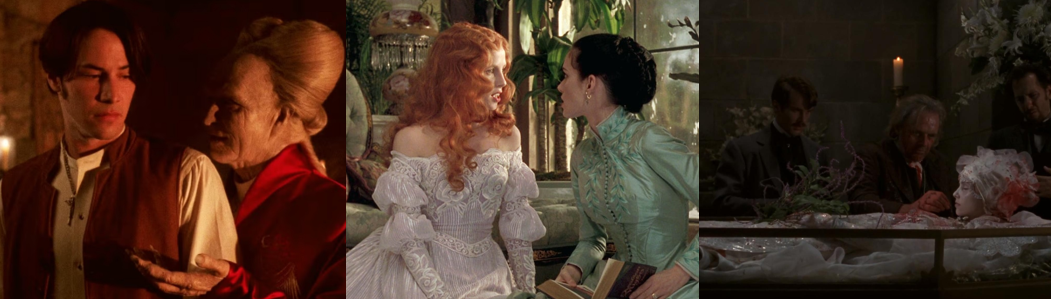
When Dracula pays a visit to London, he terrorises the aristocracy with his perverse lusts.

Since Dracula wishes to purchase properties around London and represents a substantial investment, Renfield’s duties are passed to fresh-faced, well-spoken, and somewhat frigid solicitor Jonathan Harker (Reeves). Though his fiancée, Wilhelmina “Mina” Murray, is saddened to hear he will be gone for some time, eager to consummate their marriage, she recognises that this is a big opportunity for Harker and takes solace in his frequent correspondence. Though well-mannered and good-natured, Harker is unnerved by Transylvania, where wolves freely wander, darkness looms ominously, and his client is prone to bizarre outbursts. Dracula treats Harker as a guest, welcoming and feeding him and expressing his desire to be amongst civilisation once more, but is erratic and eccentric, lamenting his cursed family bloodline, driven to a frenzy by the sight and smell of blood, and generally testing Harker’s civil nature. While I love Keanu Reeves, he is dreadful in this role, delivering perhaps the worst British accent I’ve ever heard and appearing lost and confused. This is a case where it might’ve been better to let him use his natural accent, if only to make his line readings less awkward, but that wouldn’t have helped with his awful haircut/wig and robotic tone. Harker’s effectively held prisoner in Dracula’s castle, feasted upon by his brides for at least a month before he finds the willpower and courage to escape and being left severely traumatised. While pining for her love, Mina takes solace in the courtship of her dear friend, the promiscuous Lucy Westenra (Sadie Frost), giggling over sex acts while Lucy flits between her suitors, Dr. Seward, wealthy Lord Arthur Holmwood (Cary Elwes), and gunslinger Quincey P. Morris (Campbell). Though she settles on Holmwood (presumably for the financial security, accustomed as she is to such a lifestyle), the other two continue to hang around and curry her favour, forming first a dysfunctional friendship and then a rag-tag group of vampire hunters when the peculiar Professor Abraham Van Helsing (Hopkins) alerts them to the vampire’s threat.
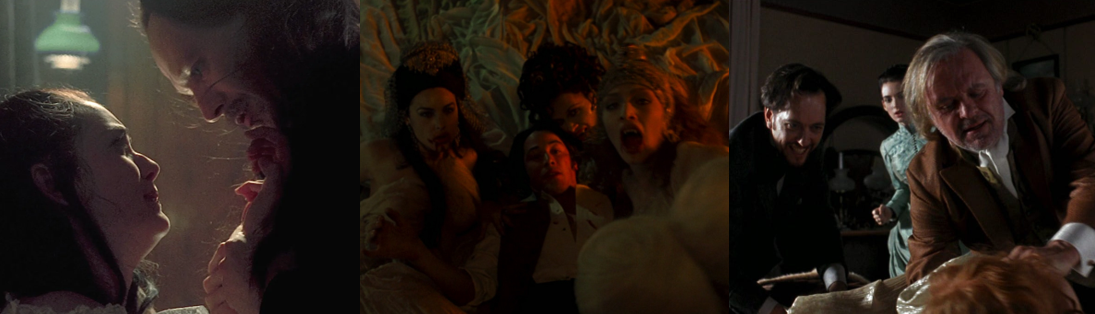
While Mina succumbs to Dracula’s charm and Harker’s tortured, Van Helsing offers his expertise.

Betrayed by his faith, Dracula is presented as a far more tragic and sympathetic figure. Upon seeing Mina’s photograph, Dracula alters his plans for London to include seeing his reincarnated love, mercilessly slaughtering the crew of the Demeter to restore his youth. Unlike other adaptations of Dracula, where he integrates into London society and socialises with Dr. Seward and the others, Dracula is a largely enigmatic figure once he reaches Ol’ Blighty. Appearing as a peculiar foreign prince, Dracula stalks Mina through the streets, using his hypnotic and persuasive powers to entrance her and slowly unearth her forgotten memories of their past life and love. Though initially rude towards him, Mina comes to be captivated by Dracula and begins a love affair in Jonathan’s absence, naturally unaware that her handsome prince has been feeding upon Lucy in the night as a wolf-beast. However, when she receives word of Jonathan’s condition, Mina goes to him, encouraged by her sick friend, to rekindle their love and get married, though it’s obvious that her feelings have changed and that her thoughts constantly drift to her passionate and mysterious prince. When Lucy’s condition worsens and defies Dr. Seward’s expertise, he calls Van Helsing for aid, only for the outlandishly blunt priest to conclude that she’s been targeted by Nosferatu, a subject he’s well versed on. Although Van Helsing tries to stave off the infection with a questionable blood transfusion, Mina’s beset by a fever, constantly wandering off in a daze, and undergoes radical personality changes, resembling Dracula’s ever-horny, ever-hungry brides and quickly making believers out of Lucy’s bemused suitors.
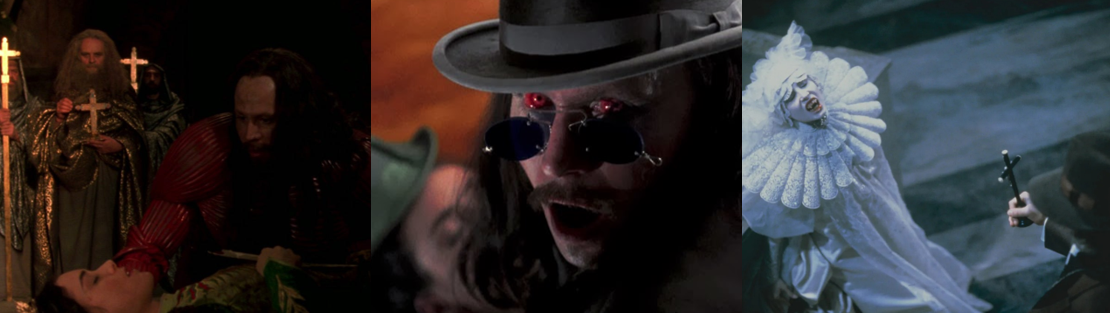
Dracula is depicted as a demonic, yet ferociously tragic and aggressively sexual romantic figure.

Jonathan’s return to London confirms Van Helsing’s worst fears, that Dracula himself is amongst them, and he leads the fledgling vampire to hunters to “where the basturd sleeps” so they can destroy Dracula’s cursed soil. However, Dracula is agonised when Mina breaks off their tryst, conjuring violent winds and fully transforming Mina into a vampire out of spite. This process sees her rise as an undead seductress with the same unnerving taste for children as Dracula’s concubines. While Dr. Seward, Quincey, and Holmwood falter against Lucy’s monstrously sexual transformation, Van Helsing leads the charge, wielding a holy cross and easily placing Lucy into a vulnerable slumber so she can be staked and decapitated. While Jonathan is startled about how blasé Van Helsing is about this, he eagerly joins their cause to deal a measure of revenge against Dracula, who murders Renfield for running his mouth to Mina before appearing before her, all pretence dropped. Although Mina is horrified and angered to learn that her lover murdered her best friend, she cannot deny her feelings for him or the strength of her vague memories and begs to be with him, forever. While elated to hear this and desperate to inflict his curse upon her to be reunited with his lost love, Dracula hesitates at the last second, unable to bring himself to watch her suffer from eternal torment as he has. However, horny little minx that she is, Mina refuses to listen and gladly, hungrily drinks his blood in an explicitly sexual act that sees her undergo a similar transformation to Mina. This means that she constantly interferes with the hunters’ attempts to intercept and destroy Dracula when he flees to Transylvania, attempting to seduce Van Helsing and even holding her husband at bay with a rifle to defend her dying love, having willingly sacrificed her humanity for some real passion in her life.

The Nitty-Gritty:
Since I haven’t read the original book, I’m not really qualified to comment on how accurate an adaptation Bram Stoker’s Dracula is. However, from what I’ve heard, it’s one of the most faithful retellings and I did like that the film incorporated voice overs and diary entries to mimic the book’s epistolary nature. Dracula is undeniably a vastly different character to other, more popular depictions, appearing as a once proud and seemingly noble (if ruthless) soldier who slaughtered armies in the name of his God. He cherished Elisabeta more than anything in the world and felt betrayed when the church turned on him after his many years of faithful service, renouncing God since he’d forever be denied his love even in death due to her damning her soul through suicide. His quest to London thus becomes a desperate desire to reunite with Elisabeta, who’s seemingly been reincarnated in Mina, and he wastes no time in captivating and wooing her. Whereas Jonathan is reluctant to give in to carnal desires, Dracula is an extremely passionate man whose romantic way with words entrance Mina as much as his hypnotic gaze and the shadows of her former life. While he’s overjoyed to reunite with his love, Dracula hesitates to subject her to his curse, knowing it cannot be undone and will lead to eternal earthly damnation for them both. Interestingly, he doesn’t spare this same concern for his other concubines or show mercy to the children he regularly feasts on, but these are apparently secondary concerns for the lovelorn Mina, who’s so desperate to get laid that she gleefully renounces her humanity. And make no mistake about it, Bram Stoker’s Dracula is the horniest, sexiest adaptation of the text you’ll ever see! Lucy is super horny for all her suitors, Dracula’s many attacks are framed as blatantly sexual acts, the vampire brides all exude succubus energy, and then there’s the scene where Mina drinks Dracula’s blood and he reacts with orgasmic pleasure!
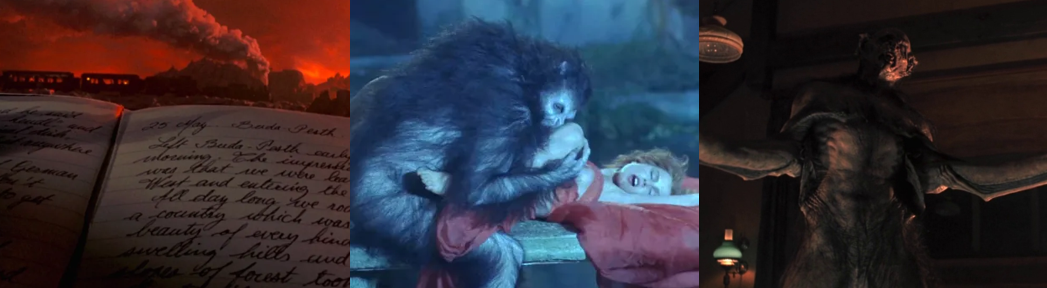
Despite some impressive visuals, the monster designs are questionable, at best.

Bram Stoker’s Dracula may also be the most visually impressive version of the book. It’s clear that the filmmakers spared no expensive on the elaborate costumes and sets, with the woman, especially, being strapped into extravagant gowns and the men all dressed in their finest regalia. While I dig Dracula’s beehive hairdo and opulent robes, I do question the design of his blood red armour, which seems awfully devilish for a man of God and also looks far too much like heavy leather for my tastes. The film uses practical effects and traditional optical trickery to fantastic effect to overlay miniatures with backgrounds and diary entries and project Dracula’s gaze into the storm clouds. The film is surprisingly sparing with the gore, but it makes quite an impression when it does appear, with arterial spray drenching drapes, Lucy spewing up blood when Van Helsing shoves a cross in her face, and heads flying after being severed by the vampire hunters. Dracula has quite a few forms here, though some are better than others. His aged, withered appearance is one of my favourites, though his youthful guise makes the girls wet and his unnerving mist proves suitably deadly to the rabid Renfield. Sadly, Dracula’s monstrous forms leave a lot to be desired, his man-bat form is the superior of the two, but even this looks awkward and uncomfortable, especially as his arms are literally bent-back wings. His wolf-man form is even worse, however, appearing very fake and shaggy looking, with only the facial prosthetics and his unsettling sexual attack saving it from being ludicrous. Dracula’s decaying appearing in the finale is far more striking, as is his mysterious horseman and the techniques used to show him and his concubines moving with unnatural grace. Unfortunately, little of this keeps the film from being an absolute slog to sit through. At just over two hours long, Bram Stoker’s Dracula sure does drag things out, inflating its runtime with bizarre editing choices and unnecessary cutaways and perhaps sticking a little too close to the text for its own good.
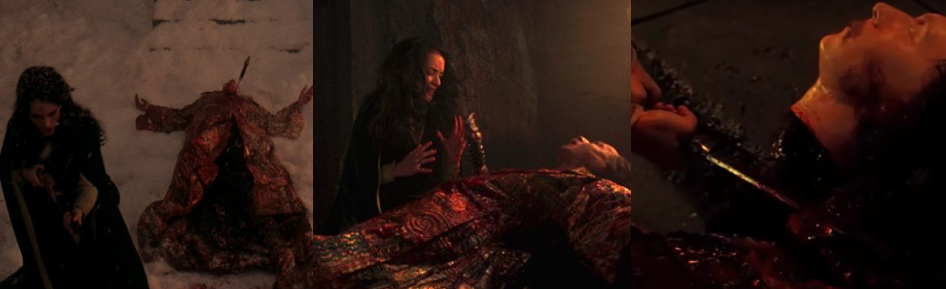
Thankfully, the entranced Mina ends Dracula’s torment, and mine, by ending this dull movie.

Thanks to Jonathan, Van Helsing and the others destroy all but one of Dracula’s boxes of earth. When his seduction of Mina is interrupted, Dracula’s forced to flee to Transylvania in his last box, his powers fading and his appearance quickly degenerating, to regain his strength. Van Helsing leads his group in intercepting Dracula, bizarrely taking Mina with them despite her being less of a liability in London. While Harker and the others try to cut off the gypsy slaves transporting Dracula’s carriage, Van Helsing and Mina head directly for his castle, with the eccentric vampire expert desperately fending off the brides with his flaming torch and subduing Mina with a communion wafer when they try to seduce and bite him. When the brides kill their horses, Van Helsing takes a swift revenge and claims their heads before joining up with the others at Dracula’s castle. Although Quincey is fatally stabbed in the hectic fracas, he does stab the decaying Dracula through the heart and Harker gets a measure of revenge by slitting the Count’s throat. However, Mina stops them from finishing off the monstrous abomination and Harker and Van Helsing reluctantly allow her to get Dracula into the chapel where he once turned his back on God. There, the demonic Dracula shares a kiss with his beloved and is amazed when the chapel undergoes a supernatural restoration; the candles ignite and the cross he disgraced repairs itself, restoring Dracula to his youth. However, he’s still mortally wounded and, with his dying breath, Dracula begs Mina to bring him peace. Although she’s heartbroken, Mina agrees to end his suffering and stake shim through the heart before decapitating him, undoing the curse inflicted upon her and seemingly allowing Dracula to reunite with Elisabeta in the afterlife.
The Summary:
I’m going to be honest and say I’ve never liked Bram Stoker’s Dracula. I never watch it because I remember it being a long, boring, overly stylised affair with some atrocious performances. And that isn’t just a knock against Keanu Reeves, either, as Winona Ryder and Sadie Frost are just as bad with their accents and delivery. Hell, even Gary Oldman and Anthony Hopkins are hamming it up, though I at least give them credit for bringing a Shakespearean gravitas to this tediously dull movie. While I’m sure Bram Stoker’s Dracula is exceedingly faithful to the book, there’s something to be said for condensing the text when making an adaptation. For example, did we really need Dr. Seward, Holmwood, and Quincey all in the film? I feel it would’ve been far simpler to combine them into Dr. Seward for the sake of brevity. Additionally, we spend way too long in Dracula’s castle with him, Harker, and the brides. Like, I get it; Dracula’s manipulated Harker and imprisoned him there, but this sequence goes on for what feels like an age and yet the Demeter scenes are a glorified montage? I did like how tragic and human Dracula is, with him depicted as a disgraced former believer who’s spent centuries yearning for his lost love and yet hesitates to afflict her with his curse as it’s been such a tortured unlife for him. Paradoxically, Dracula is still a monstrous fiend who feasts upon innocent souls (and children) to prolong his life and make others suffer for his own amusement. While the film is undeniably beautiful and the old-school filmmaking techniques are appreciated, giving the film a tangible quality that makes it seem like a big-budget stage play, Dracula’s monstrous forms leave a lot to be desired. His man-bat form is a major disappointment and the man-wolf effects are laughable, though it is intriguing how sexually aggressive the film is, explicitly depicted Dracula’s attacks as sexual misdeeds. It may be the most faithful adaptation of Stoker’s text, but Bram Stoker’s Dracula is just too tedious for me to rate much higher. I dreaded revisiting it for this review and hoped my opinion would’ve changed, but it’s just as dull and painful to sit through as ever, despite its strong visuals and atmosphere.

My Rating:

Rating: 2 out of 5.

Could Be Better

Are you a fan of Bram Stoker’s Dracula? If you’ve read the book, how faithful is this adaptation and would you say it stuck too close to the text in some areas? Do you agree that the film is too long or were you captivated by the gothic atmosphere? What did you think to Gary Oldman’s performance and Keanu Reeves’s atrocious accent? Which adaptation of Dracula is your favourite and how are you celebrating Halloween this year? Tell me I’m wrong about Bram Stoker’s Dracula in the comments, read my other horror reviews, and donate to my Ko-Fi if you want to see more Dracula content.

Movie Night: John Wick

Released: 24 October 2014
Director: Chad Stahelski
Distributor: Summit Entertainment
Budget: $20 to 30 million
Stars: Keanu Reeves, Michael Nyqvist, Alfie Allen, Willem Dafoe, Adrianne Palicki, and Ian McShane

The Plot:
Former hitman John Wick (Reeves) returns to his violent life when a dog gifted to him by his beloved wife, Helen (Bridget Moynahan), is killed by a mobster’s reckless son, unleashing the feared “Baba Yaga” upon the terrified underworld once more.

The Background:
After Taken (Morel, 2008) became a surprise critical and financial success, it not only reinvigorated Liam Neeson’s career but also inspired a slew of similarly-themed movies. All of a sudden, aging action stars were in vogue, which meant writer Derek Kolstad’s dream to sell a spec script of an aging hitman being called back into service saw a new lease of life. The script caught the eye of producer Basil Iwanyk, who was looking for the freedom offered by smaller budget films and attracted to the core concept, and Kolstad accepted his lower bid so the movie could start production. The role was initially envisioned for an older star like Clint Eastwood and Bruce Willis was first attached to star before Keanu Reeves joined the project, eager for a new action role, and he recommending the script to veteran stuntmen Chad Stahelski and David Leitch. The duo suggested they direct they film (though Leitch was denied a co-director credit) and worked with Reeves to retool the script, de-aging the title character and making him a more stoic and mysterious character. Reeves’s personal experience with bereavement and previous experience with action roles served him well during his rigorous training, though the film was beset by budgeting woes. Inspired by crime thrillers and spaghetti westerns, Stahelski and Leitch sought to craft a unique world and avoid rapid editing for fight scenes, and the film’s $86 million box office made it a sleeper hit. Widely praised for Reeves’s enigmatic performance, impressive choreography, and exhilarating action sequences, John Wick was followed by equally praised sequels and spin-offs, re-established Reeves as an action star, and is the perfect film to revisit for the actor’s birthday.

The Review:
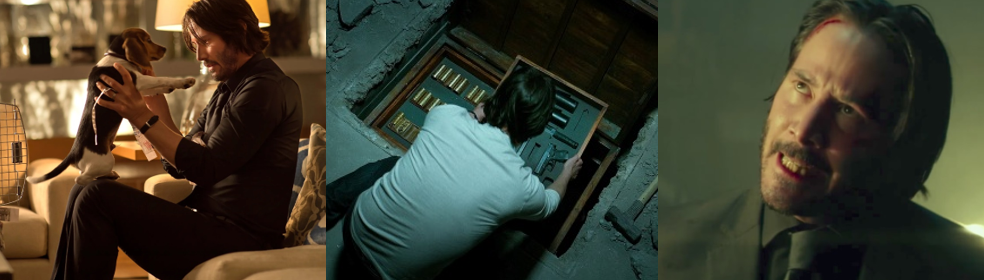
John Wick begins with intrigue, as it starts in medias res to find a battered and wounded John collapsing from his wounds, passing out while watching a video on his phone of his beloved wife. We then walk back a few days (maybe a week? Time’s a bit fast and loose here) to find John alone in his sparse, but spacious, home, still reeling from Helen’s unexpected death from an undisclosed illness (presumably cancer). Though surrounded by friends and well-wishers and finding some solace in his daily routine, John is like a zombie in these early scenes, sleepwalking through the burial and wake and greeting old friend Marcus (Dafoe) with a stoicism that borders on suspicion. It’s clear just from these quiet, sombre scenes that John’s a very private and reserved man who’s internalising his grief, that he faces an uphill battle of solitude and sorrow where his life has little meaning, the colour as drained from his world as it is from his abode. Then, an unexpected package arrives on his doorstep and John’s mask cracks as he reads Helen’s last message to him. Openly weeping, descending into heartbreaking floods of tears, John barely manages to read Helen’s note, which bequeaths him a cute little beagle, Daisy (Andy). Although John is initially ill-equipped for a puppy companion, forcing Daisy to sleep on the floor and feeding her cereal instead of kibble, the two quickly bond and John integrates her into his daily routine. This mostly consists of keeping a tidy and ordered house and taking his prized 1969 Ford Mustang Mach 1, a vehicle that was his second love after Helen and which he regularly takes for a spin to keep his obvious skills up to par and to vent his grief and anger. Daisy joins him for these jaunts, enjoying the thrill and giving him something to care for rather than losing himself to anguish. John’s car is so impressive that it catches the eye of loudmouthed Russian lout Iosef Tarasov (Allen), who arrogantly tries to buy the car and is stunned and angered when John not only refuses but insults him in perfect Russian.

Feared former hitman John Wick is drawn back into his violent lifestyle after his dog is murdered.

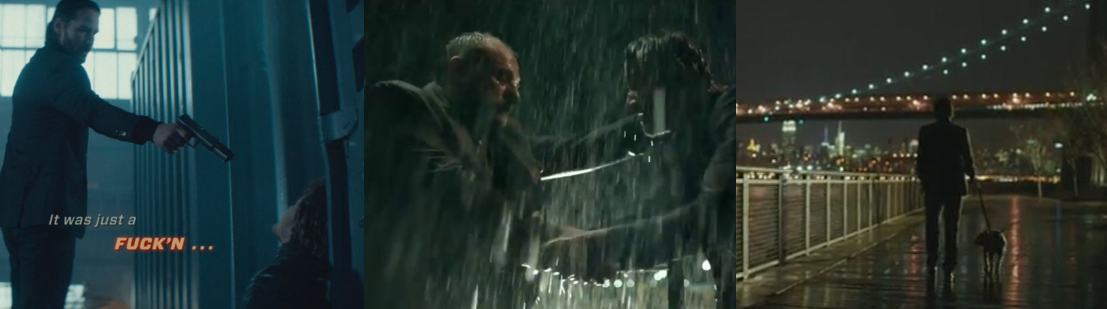
Unfortunately, John’s cool demeanour and stoic confidence during this confrontation come back to haunt him when Isoef and his shit-kicking cohorts follow John home and jump him at night. After beating John down and leaving him a bloody mess, they steal his car and maliciously murder Daisy with a lead pipe, returning John’s numb devastation and marrying it with a rage the likes of which the hoodlums could never expect. Excited by his latest acquisition, Iosef delivers the Mustang to Aurelio’s (John Leguizamo) chop shop, only for the mechanic to react in horror, punching the mobster’s son and incurring the wrath of his father, whose anger is immediately quenched when he learns that Iosef stole the legendary John Wick’s car. Rattled, Viggo Tarasov (Nyqvist) admonishes his son, clearly torn between fear, love, and desperation, and reveals that the “fucking nobody” was a hitman so feared within the criminal underworld that he was the man many hired to “kill the bogeyman”. Described as a man of focus and pure will, John left behind his violent ways after falling for Helen and successfully escaped that life by performing an impossible task: namely, murdering Viggo’s competition and making him New York City’s top mob boss. Having employed John in the past, Viggo is very familiar with his methods and reputation, having seen him kill three men with a pencil, and knows his son is doomed, for John’s wrath is mythical. Still, Viggo tries to reason with John, only to be met with blunt silence. He even tries to proactively stop John before he can get rolling, leaving his squad murdered and John calling in favours from the past to help clean up the mess. His life shattered, fuelled by grief, anger, and a lust for revenge, John digs up his long-buried weaponry, washes himself off, and suits up to take action, insisting that he’s paying a quick visit to his old life to get to Iosef. Though he’s been out of the game for five years, John is a slick, ruthless, and efficient killer, often ending most foes with a quick one-two to the chest and head and easily overwhelming groups of armed men with his superior gunplay and uncanny ability to adapt to his environment. His reputation proceeds him, with many (even his enemies) respecting him or knowing to stay out of his way, though John’s not some mindless killer and spares those who are simply doing their job.
John is surreptitiously aided by some old allies, even if they pay the price for their deeds.

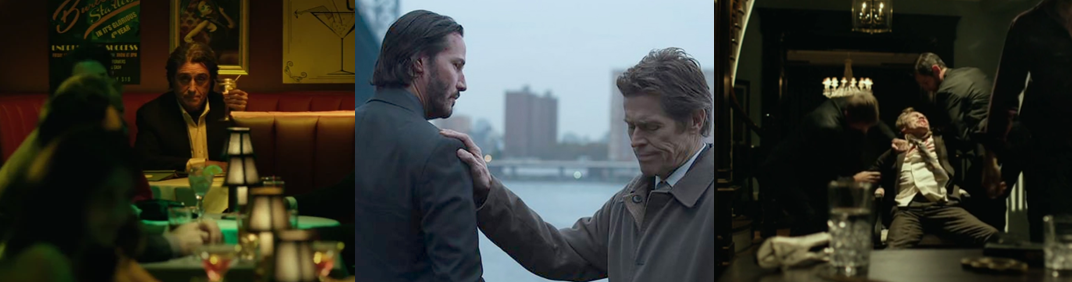
Despite insisting that he’s not returning to his old ways, John’s drawn back into his previous life by the need for information and resources. This leads him to the Continental, an opulent hotel and bar run by the enigmatic Winston Scott (McShane) and managed by Charon (Lance Reddick), a polite concierge who accommodates John’s wishes with a silver-tongue grace. Though pleased to see John, Winston warns him about dipping even briefly into his old ways and adds some additional lore to this fascinating world by stating that no “business” can be conducted on the Continental’s grounds, effectively making it a safe haven for all as long as they have enough of the strange gold coins the hitmen use for currency. Not everyone within the Continental is as mindful of these rules, however, as Miss Perkins (Palicki) eagerly ignores them to take a shot at John, relishing both the $2 million bounty and the chance to knock off the legendary John Wick. Though subdued by John, thanks to a warning shot from Marcus, Ms. Perkins seals her fate when she kills Harry (Clarke Peters), a former colleague of John’s who he paid to watch her and essentially becomes Viggo’s right-hand when he goes on a crazed revenge spree in the finale. This costs her dearly as Winston has her executed, not just for breaking his rules but also out of loyalty to John, whom he surreptitiously aids throughout the film. John’s also secretly aided by Marcus, a crack sniper and old friend who agrees to the $2 million contract only to help John by either warning him of imminent dangers or rescuing him, such as when he snipes the goons suffocating John during his passionate outburst to Viggo. This also ends badly for Marcus when Viggo takes a hands-on approach to making Marcus pay, though the feisty sniper doesn’t go down without a fight.

Despite knowing full well what John’s capable of, Viggo desperately tries to protect his son.

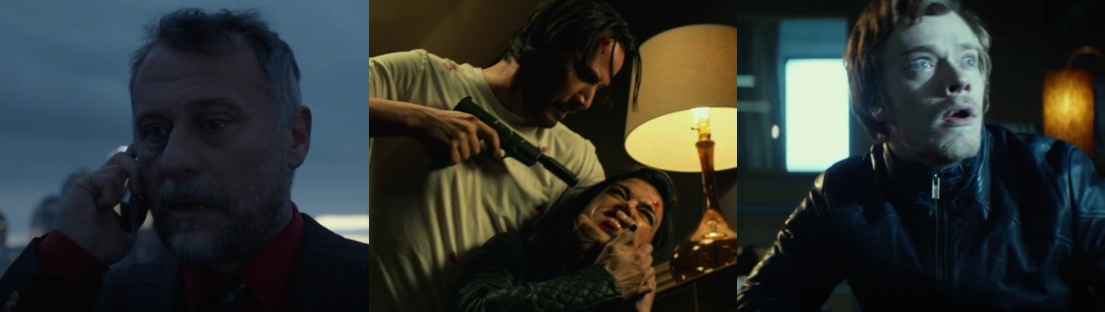
Despite having amassed a vast and profitable underworld empire thanks to John, Viggo is immediately rendered powerless upon learning that the “Baba Yaga” is coming for his son. He tries to barter with John and desperately tries to keep his son hidden and safe, but Wick is relentless, easily tracking Iosef down and extracting his revenge. Though he usually favours slick gunplay, John’s happy to get down and dirty with his foes, such as Iosef’s buddy, Gregori (Omer Barnea), whose neck he snaps with relish after he killed Daisy. Though far from invulnerable, and ending up pretty banged up from his escapades, John gloriously bests even swarms of armed opponents. However, he runs into a metaphorical wall when confronted by Kirill (Daniel Bernhardt), a towering opponent who briefly manhandles John and forces him to fight from beneath. Yet, John is implacable and is completely unfazed when he’s captured or held at gunpoint, sure that he’ll either find some innovative way to fight out of the situation or he’ll die trying, bringing as many with him as he can. Although Viggo could easily stop John’s rampage by giving up his son, he refuses to do this since, though Iosef is a fuck up and an asshole, Viggo has the same sense of loyalty and love as John feels for Helen and Daisy. Viggo’s reasonable at first but is enraged when John raids one of his hidden vaults and destroys not just a sizable stash of cash, but a bunch of documents and evidence he used to stay in power. However, when push coms to shove, Viggo is an opportunistic and self-serving mobster and eventually sells Iosef out to save his own hide. Interestingly, while John massacres Iosef’s bodyguards, there’s little to his final confrontation with the arrogant wannabe mobster, whom John simply executes via headshot. Although Viggo knew this was inevitable, having witnessed John at his peak and being terrified of him returning to the fold, Iosef’s death pushes Viggo over the edge. He transforms from a powerful but disconnected gangster into a spiteful, bloodthirsty savage as he takes his anger and grief out on Marcus and even taunts John, seemingly descending into near madness as he sees his end rushing towards him while John remains unnervingly cold and calm while on the job.

The Nitty-Gritty:
John Wick is a fascinating exploration of grief and how it affects different people. Even now, with all its sequels and spin-offs, we know surprisingly little about John’s life as the feared “Baba Yaga”. We get snippets of it here, but only as legends and in the way characters react to him (a mixture of fear and respect), but he is noted more than once to have been changed by Helen. It’s not clear how the two met, but her influence was clearly enough to have him questioning his ways and deciding to give up his guns for a simple life of peace and happiness. By all accounts, he stuck to this vow for “five years and change”, disappearing into myth to live an unglamorous but content existence, and characters react with both excitement and surprise when he appears to be “working again”. Interestingly, though John claims to have gotten “rusty”, his skills don’t appear diminished (but, then again, for all we know, the old “Baba Yaga” emerged unscathed from every fight) and he immediately snaps back into that mindset to get his revenge. John’s clearly struggling with his emotions and the weight of grief, which Helen knew would cause him only pain and loneliness, hence why she sent him Daisy. Although John and Daisy don’t spend much time together, she seems to at least partially fill the hole in his heart, and he was just getting used to her being around when she was ripped away from him. Plunged into the depths of his anguish and anger, John snaps back into his old ways and begins a quest for simple revenge, wishing only to make Iosef and his cohorts pay, but ends up tearing down Viggo’s empire as easily (if not more so) than he helped build it. It’s genuinely heartbreaking seeing John read Helen’s note, and hearing Daisy’s final yelp and seeing that she apparently crawled over to be near him as she died (or was dragged there to mock him). In this regard, John’s anger is fully justifiable as who hasn’t been enraged and spiralled into a fit of anguish at the unfair death of a loved one or the loss of a beloved pet?

John Wick is depicted as a fast, efficient, and ruthlessly relentless killer.

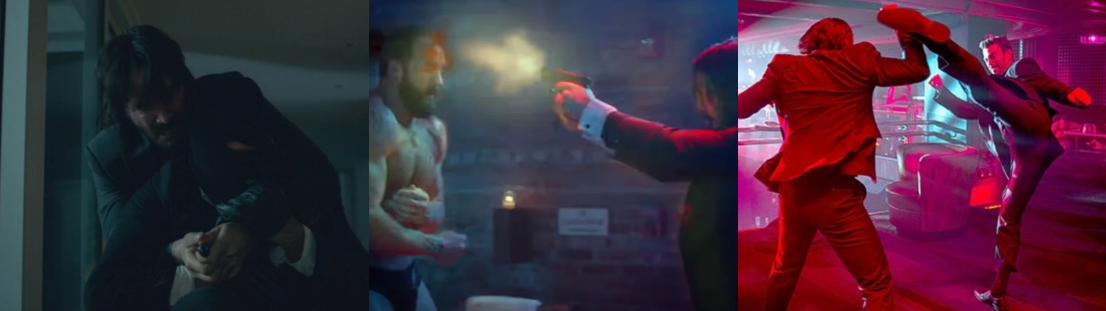
Being that it was spearheaded by career stuntmen, John Wick naturally impresses with its brutal and scene stealing fight scenes. John is a focused and intelligent former assassin, laying explosive traps and using the environment to his advantage wherever possible. He tosses goons through windows, drowns them, and takes any chance to snap their necks or stab them when they’re injured or prone. Most of the goons he fights are simple, out of shape mobsters with itchy trigger fingers who easily go down with the old one-two to the chest and head, splattering blood on the walls and easily being manhandled by John’s equally skilled close quarters combat skills. Kirill represents a far greater challenge due to his height, imposing physique, and impressive fighting skills, easily hefting John over a balcony and choking him with a plastic bag. John, however, is not only constantly moving and fighting back, but also not afraid to fight dirty, targeting limbs and even the balls to wound his foes and give him time to skillfully reload and execute a headshot. This sees him biting Kirill to escape being throttled, attacking his eyes, and finally choking the life out of him with a headscissor hold. The sadistic Ms. Perkins also offers John a physical challenge, surprising him in the Continental and striking while he’s nursing a serious wound. Unlike the tight-lipped Kirill, Ms. Perkins delights in taunting John, using her speed and sleight stature to target his arm and wound; anything to give her the edge over the feared “Baba Yaga”. In the end, as with every fight, John’s sheer tenacity wins out, but this is a great fight to showcase his adaptability, as John fights unarmed (save for a pillowcase). Later, John lugs around an impressive heavy shotgun, blasting at Viggo to learn Iosef’s location, and takes a page out of Marcus’s book to snipe Iosef’s bodyguards. The fights would steadily get more complex and intricate as the series went on, but there’s a raw grit to John Wick’s action sequences, which eschew quick cuts and frantic editing to showcase violent, ferocious, and largely grounded fight scenes that leave John battered and bloody and a pile of bodies in his wake.

John callously takes his revenge and is then motivated to keep going with a new canine friend.

In an attempt to buy himself time or eliminate John through sheer numbers, Viggo puts out a $2 million contract (upped to $4 million for those who break the Continental’s rules) for the legendary assassin, only for his men and those that take up the challenge to by brutalised and dead at John’s skilled hands. In desperation, Viggo has Iosef taken to a safe house, only for Winston and then Viggo himself to give up the boy, leading to John shooting up a club and then getting his revenge by executing Isoef via headshot. This would’ve likely been the end of it but, when news of his son’s death reaches Viggo, he visibly and disturbingly transforms into a near-psychotic agent of revenge, grief overtaking him and driving him to violent acts, just as it did John. This sees him callously torture Marcus for betraying him and even challenge John to a final showdown to settle the score, planning to flee via helicopter and sacrifice his remaining men by proxy. John takes up the challenge, incensed by Marcus’s death and uncompromising in his quest to make everyone pay for taking away the last ray of hope in his life. What follows is an intense car chase through the city, where Viggo succumbs to drug-fuelled madness and simply laughs as John offs his men one by one, even passing his exasperated assistant, Avi (Dean Winters), a gun and wishing him luck before delighting as John crushes the man with his car. Though far from a physical match for John, Viggo engages him in a hand-to-hand bout in the rain. Naturally, John mortally wounds the mobster with a knife to the neck and, in his own way, pays morbid respect to Viggo as he dies. Though seemingly happy to face his own end while watching a video of Helen, his late wife’s words are enough to encourage John to treat his wounds at a nearby veterinary clinic, where he also finds and adopts a dog scheduled to be euthanised. Having thus found a reason to live, John limps off through the rainswept night to return home, unaware (or unfazed) that his actions will have dire consequences…

The Summary:
I’ve always been a fan of Keanu Reeves’ more action-oriented roles. The guy has done enough movies by this point to be considered a star of the genre and he impresses once again here, bringing John Wick to life with a brutal efficiency that defined not only this franchise, but this sub-genre of action/thriller cinema. While the movie’s premise may be ridiculously basic and even a little laughable, the execution is anything but and I appreciated the raw simplicity of a man seeking revenge for his dog’s death, as who can’t relate to that? Of course, it’s not just about that as John is as much motivated by his unresolved grief about Helen’s untimely death as Daisy’s and what we’re left with is the story of a man who desperately sought to leave behind his violent past who’s now forced to reignite that fire to avenge his losses. Of course, John Wick is also a spotlight for the underappreciated and extremely talented stuntmen who work in the movie industry, showcasing startling and engaging fight scenes in full detail, even when under cover of darkness or in a packed nightclub. There are no frantic editing or quick cuts here: just fast, efficient, physical action that paint John as an effective, ruthless, but also vulnerable assassin. While the sequels would continuously up the ante, the simplistic, gritty nature of the fight scenes has always been very appealing in this first entry. This extends to the world-building, too, as we’re given just enough breadcrumbs and insight into this strange world to be intrigued without completely lifting the lid. While I would’ve loved to see more detail about John’s former life, I loved how his legend spoke for itself and the mystery surrounding him, and Keanu Reeves excelled in showcasing a range of emotions (from utter grief, to boiling rage, to a focused stoicism) in this enduring platform for both the actor and this genre.

My Rating:

Rating: 5 out of 5.

Fantastic

Are you a fan of John Wick? What did you think of Keanu’s performance and which of the fight scenes was your favourite? Were you fully behind John once his dog died or did you find the plot a bit too ridiculous? What did you think of the bits and pieces of lore we got here and the presentation of this underworld of assassins? Which film in the franchise is your favourite, and what’s your favourite Keanu Reeves movie? Whatever your thoughts, leave a comment below and become a member on my Ko-Fi to suggest other Keanu Reeves movies for future reviews.

Movie Night: The Matrix Revolutions

Released: 5 November 2003
Director: The Wachowski Brothers
Distributor: Warner Brothers
Budget: $110 to 150 million
Stars: Keanu Reeves, Hugo Weaving, Carrie-Anne Moss, Laurence Fishburne, Jada Pinkett Smith, Harry Lennix, and Ian Bliss

The Plot:
Zion, the last bastion of humanity, faces imminent destruction from an all-out machine attack. While the city fortifies their defences, the fate of humanity is placed into the reluctant hands of Neo (Reeves) as he prepares for a final showdown with the rogue program Smith (Weaving) that will decide the fate of all lives, human and mechanical alike.

The Background:
In 1999, the aspiring writer/director duo of brothers Andy and Larry Wachowski (as they were then known) – inspired by manga and anime – combined a mixture of impressive martial arts, philosophy, and science-fiction to create an instant and lasting impression on action cinema, one that popularised “bullet time” and wire-assisted kung fu (or “wire-fu”) in movies. The Matrix was a massive critical and commercial hit and the Wachowskis made the brave decision to produce two sequels, back-to-back, alongside a varity of tie-in multimedia, including comics, videogames, and animated shorts. Although The Matrix Reloaded (Wachowski Brothers, 2003) made over $740 million worldwide, critics were torn: the film’s dense philosophy confused and divided many, though its intense action sequences were praised. Audiences only had to wait six months for the third, far more contentious entry, which the directors sought to resolve the emotional and spirutual journey of their characters while also delivering the same cutting-edge digital and practical effects and influential fight scenes. Perhaps it was the unrealistic expectations brought about by fan debate, the sheer influx of Matrix content, or the close release of the third film to the second, but The Matrix Revolutions was the lowest grossing of the original trilogy. Though its $427.3 million worldwide gross and persistent popularity later inspired a fourth film as much as greed, The Matrix Revolutions was largely dismissed by critics. Many felt that the film was anticlimactic, the performances wooden and strained, and that it focused too much on style over substance. Though it naturally has its fans, even star Keanu Reeves felt the movie disappointed as a finale but, since today is Keanu’s birthday, this seems like the perfect time to finish my ongoing retrospective of the franchise.

The Review:
I think it’s fair to say that The Matrix changed action cinema. It’s not really hyperbole to claim that The Matrix paved the way for not only a new wave of all-action films but also the superhero genre as we know it today, to say nothing of revitalising Keanu Reeves’ career. As celebrated as the first movie is, however, the sequels and subsequent multimedia spin-offs have had a mixed reaction, to say the least. I’m definitely in the minority of people who actually quite enjoyed The Matrix Reloaded, and even I’ll admit that it falls short of the original movie thanks to needlessly bogging down this unique cyberpunk world with dense lore and confusingly overblown dialogue. In the aftermath of The Matrix Reloaded, I remember there being a great deal of speculation about where the third movie would go, with a prevailing belief being that the post-apocalyptic real world would also turn out to be a simulation. I think this, and the expectations that the magic of the first movie would ultimately pay off, means that The Matrix Revolutions was always going to struggle as even now I’m not sure what would’ve constituted as a suitable finale for the ground-breaking franchise. The Matrix Reloaded ended on one hell of a cliff-hanger, with Neo demonstrating electromagnetic abilities in the real world and collapsing from the exertion and his rival, Smith, having downloaded a version of himself into Bane (Bliss) so he can expand his reach outside of the Matrix.

Faced with forging the world’s new destiny, Neo must overcome his grief and fight like never before.

Thus, Neo begins the movie trapped in the subtly named “Mobile Ave”, a kind of backdoor environment through which the repulsive Trainman (Bruce Spence) ferries illegal programs with no purpose from the Matrix to the machine world. This in itself is a bizarre idea, that Neo could somehow “plug into” this cyberspace environment because he’s “not ready” to die, but it also directly ties into the film’s message regarding the Matrix and its programs. In Mobile Ave, Neo meets Rama Kandra (Bernard White) and Kamala (Tharini Mudaliar), two programs who have fallen in love and have made a deal with the Merovingian (Lambert Wilson) to get their daughter, Sati (Tanveer K. Atwal), to safety since she has no “purpose” within the confines of the machines’ digital realms. Neo’s interactions with Rama Kandra actually have lasting ramifications for his later decision to head to the machine city to broker a peace between humans and the machines and show that the programs are fully capable of adopting complex human behaviours such as love and faith. Although Neo is virtually unstoppable in the Matrix, he has no power in Mobile Ave and is thus reliant on his lover, Trinity (Moss), forcing the Merovingian to free him in order to return him to the fight. However, Neo returns as the barer of bad news: because of his decision to reject his predetermined destiny to continue the cycle of death and rebirth within Zion in favour of saving Trinity’s life, the last refuge of humanity is facing imminent destruction from an army of Sentinels. A final discussion with the Oracle (Mary Alice) reveals to Neo that his destiny is now to face Smith to the end, with the fate of both humans and machines in his hands, and he decides that the best way to approach this battle is to venture into the machine city to address their common enemy. Despite all his superhuman abilities and his messiah-like status within much of Zion, Neo remains as conflicted and troubled as ever. He knows that he’s betting the survival of the human race on his ability to best Smith and is reluctant to have Trinity accompany him since he knows it’s likely to be a one-way trip, and yet he fully commits to his mission even after he’s been permanently blinded in battle with Bane since he knows his sacrifice will bring an end to the conflict.

Unfortunately, Trinity and Morpheus take a backseat to the greater conflict.

Once a prominent linchpin in Neo’s awakening as “The One”, Trinity has largely devolved into a desperate, lovesick sidekick. Her first priority over all else is to rescue Neo from Mobile Ave and, when the Merovingian attempts to blackmail her and the others into doing his bidding in return for Neo, she simply initiates a Mexican standoff and demands that Neo is returned or they will all die. This recklessness pays off and she’s apparently delighted to be reunited with her lover (it’s honestly hard to tell since there’s still very little chemistry between the characters and actors) and, from there, she resolves to stay by his side even as he embarks on a suicide mission. Trinity is horrified when a psychotic Bane attempts to sabotage their trip and Neo is blinded in the fight. From there, she acts as Neo’s pilot (even though he can still inexplicably see, only now in an ethereal golden glow) and pushes herself, and the Logos, to the limit to break through the Sentinel barricade protecting the city. Although this grants her a view of the untainted sky above the broiling dark clouds that have suffocated the world, this trip ends in tragedy as the Logos crashes into the city and she is fatally wounded. With her dying breath, she expresses her gratitude to Neo for changing her life and her love for him. However, while it’s a poignant moment and Neo’s heartache is readily apparent, it’s a sudden, anticlimactic, and underwhelming death scene thanks to how long it drags on and, again, the lack of chemistry between the two. It’s a shame that Trinity doesn’t get more to do here as she was quite the ass-kicking machine in the first movie, and even The Matrix Reloaded made her a pivotal component to the plot and Neo’s greater destiny, but she’s basically just his pilot and the object of his affections her. Seraph (Collin Chou) is similarly neutered; I remember there being so much speculation about him and even the Merovingian being former Ones and Seraph has such a reputation in the film as a “wingless” fighter who has “beaten” Smith before but, despite demonstrating his fighting prowess in the second film, he’s just here to make up numbers and fail to protect Sati from Smith and his duplicates and the film makes no attempts to delve into who or what he really is.

Although the stakes couldn’t be higher, I was underwhelmed by the conflict raging in Zion.

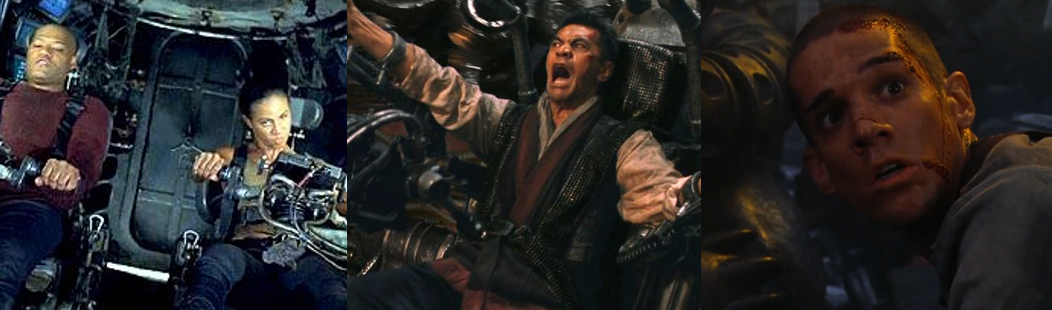
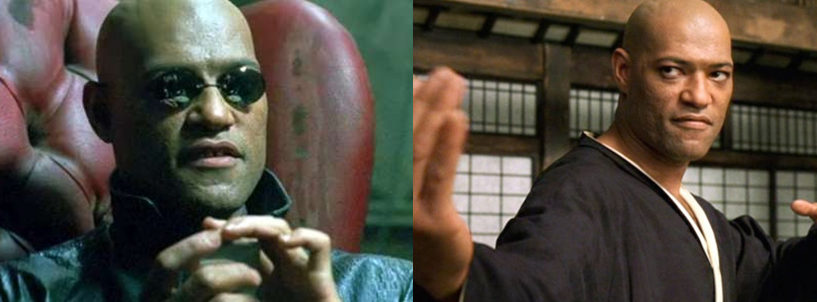
Morpheus (Fishburne) has also lost a lot of his allure; he went from this enigmatic figure who spoke in riddles and exposited information with a cool demeanour to an almost fanatical figure of controversy in the last film. Now, with the truth about the Matrix and the One revealed to him and having lost his beloved ship, Morpheus’s faith is shaken and he’s far from the charismatic leader he was once painted as. Largely a bit player, he’s forced to take a backseat to Niobe (Smith) as she expertly pilots the Hammer through “mechanical” lines towards Zion and further raises the ire of the cantankerous Commander Lock (Lennix) when he crashes through the city’s defences and sets of an electromagnetic pulse that disables a wave of Sentinels attacking the dock but also renders Zion temporarily vulnerable. Indeed, Morpheus is disappointingly ineffectual during the massive assault between the Sentinels and Zion, giving way to the strict Captain Mifune (Nathaniel Lees), who’s given the unenviable task of organising the inhabitants into a fighting force to repel the endless waves of Sentinels. Although the Zion forces are armed in durable mech suits, they’re vastly outnumbered, leading to Mifune reluctantly allowing the overly enthusiastic Kid (Clayton Watson) to join the fight despite being underage. While technically an impressive and visually elaborate battle, the clash between Zion and the Sentinel swarm is a bit of a mess. It’s more like an extended videogame cutscene than anything else and it drags on way too long, laying waste to Zion’s forces and leaving Mifune shredded to death and the Kid as their only hope of salvation. Through sheer determination and his unwavering belief in Neo, the Kid is able to lumber his mech to the gate and allow the Hammer into the dock, where it subsequently knocks out the Sentinels with its EMP blast but leaves the city on the bring of all-out destruction until the machines suddenly stand down and Morpheus realises that Neo is fighting on their behalf within the Matrix.

Having spread throughout the Matrix and beyond, Smith is on the brink of absolute victory.

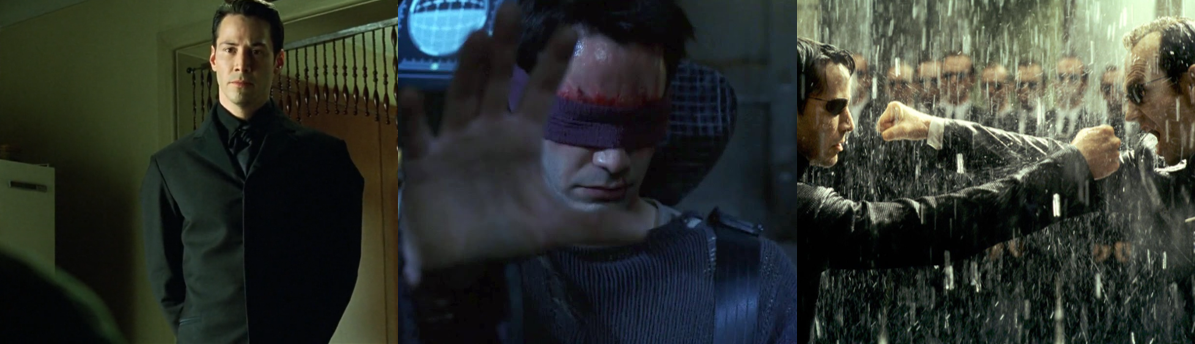
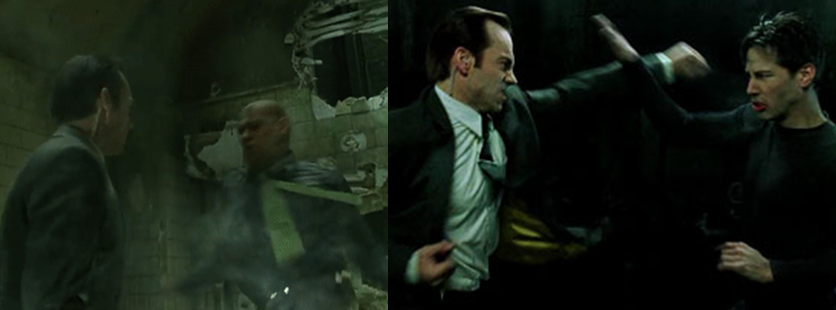
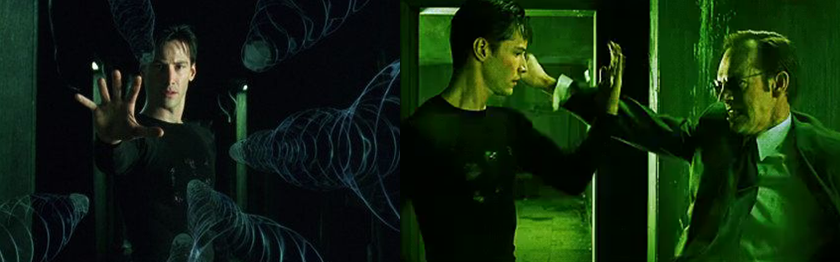
Once a loyal, if disgruntled, agent of the Matrix, Smith has since become his own man; thanks to his ability to endlessly duplicate himself by overriding other programs and inhabitants of the Matrix, his threat increases a thousandfold when he and his duplicates storm the Oracle’s apartment building and assimilate Seraph, Sati, and the Oracle herself! This gives Smith the “eyes of the Oracle” (the ability to see future events, to a certain degree) and allows him to spread like a literal virus throughout the simulation, and he’s even able to confront Neo in the real world by inhabiting Bane’s body. This initially catches Neo off-guard and ends up with him being horrifically scarred and blinded, but Smith is hampered by the fragility of his human body and ultimately defeated since a little thing like blindness is of no consequence to the One. Although we don’t really get to see Smith’s takeover of the Matrix happen since we’re too busy watching the never-ending battle in Zion, it’s effectively demonstrated when Neo confronts Smith in the finale, with the Matrix now a storm-ravaged hellscape populated only by Smith. After negotiating a peace treaty with a visual representation of the machine consciousness (subtly referred to as “Deus Ex Machina” (Henry Blasingame/Kevin Michael Richardson)), Neo is reinserted into the Matrix to fight on behalf of Zion and the machines against their common enemy and end the conflict between the two. Unlike in The Matrix Reloaded, Smith chooses to fight Neo one-on-one because he’s so confident of his victory. Indeed, his abilities have increased to the point where he can not only match Neo blow for blow but even emulate his superhuman abilities, allowing him to fly and pose a significant physical threat with just one of him. Still, it is a bit underwhelming after the madcap Burly Man Brawl of the last film, but I guess it allows for a more intense and personal battle between these two. Indeed, Smith’s power is now so great that, technically, Neo is unable to defeat him. Similar to his experiences in Mobile Ave, the Matrix is now so vastly corrupted and Smith’s power so vast that it’s all Neo can do to hold his own in the fight against the manic Smith, who desires nothing less than to assimilate all life, human and mechanical, and replace it with himself.

The Nitty-Gritty:
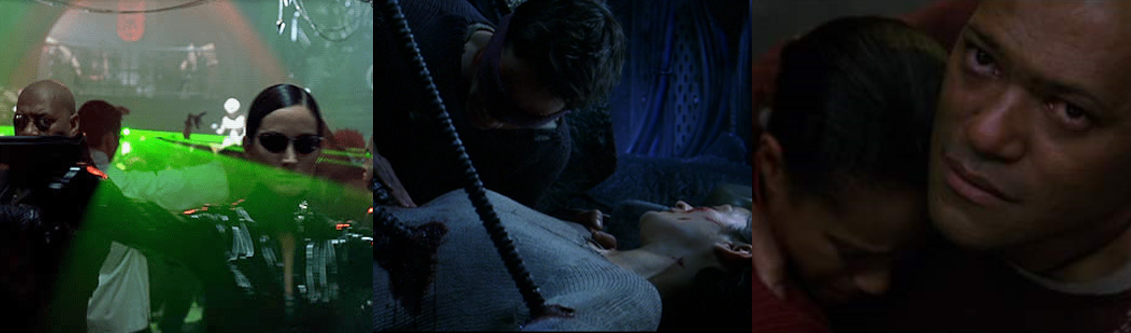
We’re far beyond deception, games, and subtlety in The Matrix Revolutions, and nowhere is this emphasised more than in Trinity, Morpheus, and Seraph’s infiltration of the Merovingian’s risqué club (literally descending into “Club Hel”, a place of sadomasochism, excess, and near-demonic denizens) to not bargain with the aristocratic Frenchman but to hold him to ransom. This emphasis on getting to the point continues in Neo’s discussion with the Oracle. Not only does she explicitly (and, in my view, unnecessarily) call attention to her different appearance, but she abandons all riddles and double talk and clearly spells out to Neo that he must defeat his dark opposite, Smith, to decide the fate of the world. In this respect, The Matrix Revolutions is perhaps the simplest of the films to understand: Zion is in danger and Neo must fight Smith to save them and the machines, and this simplicity is perhaps why I find the film so dramatically underwhelming. The protracted and frankly boring war in Zion doesn’t help. It really feels like the film has run out of steam and is thus extending its runtime with a lengthy and muddled war sequence, and it definitely feels like the balance between action and exposition is a little off in the two Matrix sequels. I did, however, enjoy seeing a bit of a role reversal in Niobe and Morpheus. Once a devout believer in Neo and the One, Morpheus’s faith is shaken by Neo’s revelations, but Niobe has become convinced that Neo is worth betting on after witnessing first-hand what he can do. To be fair, Morpheus’s trust in Neo does remain steadfast and is showcased both in their surprisingly emotional farewell and in his ability to intuit that Neo has chosen to fight for his friends and the world.

Sadly, the endless machine attack on Zion pales in comparison to the series’ iconic wire-fu.

I think one thing that really brings The Matrix Revolutions down is the disappointing lack of wire-assisted, visually stunning kung-fu fight sequences. The Matrix Reloaded really impressed with some unique and fun fights, even if they were a little underdeveloped and a bit cartoony at times, but the third film meanders along for most of its runtime with only a brief ceiling-based scuffle between Trinity, Morpheus, Seraph and the Merovingian’s guards to tide us over until the action-packed finale. This, again, is another reason I find the battle for Zion so underwhelming and dull; there’s no fight choreography to marvel over, no physical skill to admire, and no fun CGI-assisted bullet time effects to spice things up. It’s just a boring mess of metal and screaming, a blur of indistinct characters jerking around in mech suits, bullets flying and shells clattering everywhere, and an uninspiring mess of Sentinels swarming the screen. Admittedly, it is impressive and imposing when they burst in as a cloud of writhing metallic limbs and tear through Zion’s forces, but there’s just way too much obvious greenscreen to really engage with it and it’s hard to really be invested since I know nothing about Captain Mifune (except that he doesn’t take any shit and never completed his training), don’t give two hoots about the Kid (who we’re never really given any reason to care about beyond him being a Neo fanboy), and couldn’t name any of their fellow soldiers who get decimated by the Sentinels. Perhaps if Morpheus had joined the fight, maybe even replacing Captain Mifune and dying in his place, this battle might have made a greater impression on me but, as is, it’s a slog that I just don’t find as interesting as the Hammer’s race to the city or Neo’s surprisingly brutal fight against Bane. Indeed, I simply find myself tuning about and pondering questions like how did Zion build all those mechs? Where is all that ammo coming from? How was Zion even built? We’re left to intuit that the machines helped build the city after the One resets the Matrix but it’s frustrating that questions like these (and how, exactly Neo’s abilities outside the Matrix work) aren’t answered. It’s almost as if the filmmakers couldn’t think of a suitable explanation and again makes it feel like it would’ve been far simpler to have the real world be another simulation, another “system of control”, to keep humans in line.

An unexpected truce and a heroic sacrifice sees Neo end the war between humans and machines.

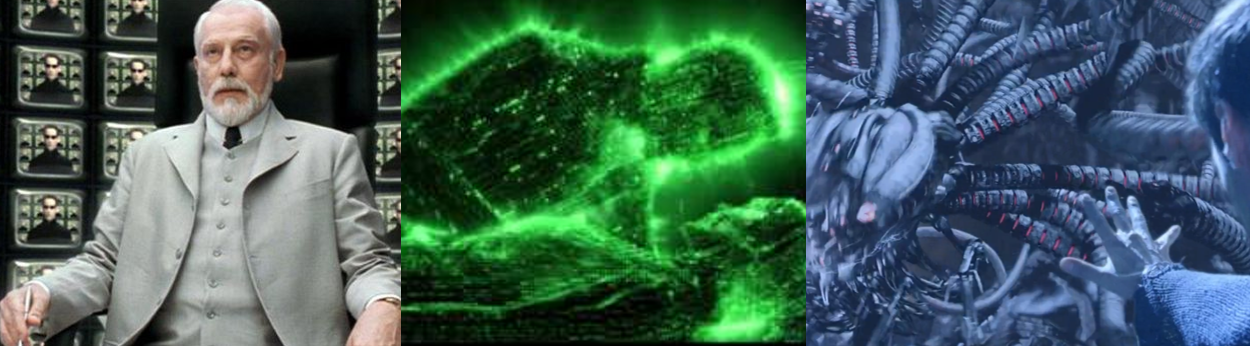
As mentioned, Neo’s fight with Bane ends with him being blinded; however, he’s still able to “see” at least the machines and their proxies, which are rendered in an ethereal gold light. This, and his ill-explained ability to explode Sentinels with his mind, allows him to direct Trinity towards the machine city, destroy much of their defences, and converse with Deus Ex Machina. This stubborn representation of the machine hivemind initially scoffs at the idea of “needing” Neo’s help but is forced to relent since Smith’s existence poses a very real threat to the machines inside and outside of the Matrix. Thus, an offscreen deal is reached: Neo will enter the Matrix to stop Smith and, if successful, there will be peace between the two races. Reluctantly, Deus Ex Machina agrees and we finally get our big, explosive final showdown between Neo and Smith. This fight is pretty much the only thing worth watching The Matrix Revolutions for; against a relentless rainstorm and a nightmarish city landscape, Neo and Smith collide both on the ground and in the air, delivering a superpowered brawl that far surpassed Superman Returns (Singer, 2006) three years later. Although Neo previously bested Smith, he’s outmatched but the goal was never for him to actually defeat his rival, but to lure him into a false sense of security so that Smith could assimilate him. Thanks to the eyes of the Oracle, Smith knows that his victory is inevitable and, despite a moment of uncharacteristic fear when Neo appears resigned to his fate, he plunges his hand into Neo’s chest and overwrites his code, breathing a sigh of relief at having finally bested his foe. However, it really was just “a trick” as Deus Ex Machina uploads a destruct sequence into Neo’s lifeless body that summarily destroys all the Smiths and allows the Matrix to be restored, now without its grainy green hue. A conversation between the restored Oracle and the Architect (Helmut Bakaitis) reveals that Neo’s sacrifice has earned a fragile peace, one where those who wish to be freed (both human and machine) are allowed to go and all hostilities have ended. The Oracle is left assuring Sati that Neo may return some day and that she always believed that he would end the war that had ravaged and oppressed the world.

The Summary:
The downward spiral of the Matrix films is probably one of the greatest disappointments in cinema history. I firmly believe there was more than enough goodwill and lore to support two or three follow-ups to the first film as it just barely touched upon the unique cyberpunk world it presented, but none of the sequels were truly able to really deliver upon this. I can just about give The Matrix Reloaded a pass as I enjoy the action and fight sequences and even the ham-fisted philosophy, which served to unnecessarily overcomplicate things rather than simply giving us straight answers or naturally developing this post-apocalyptic world. Sadly, I can’t say the same about The Matrix Revolutions, which is generally a bleak and boring limp to the finish line for these otherwise captivating characters. Trinity’s death is really an allegory for this movie: it’s long, overly dramatic, and underwhelming, and nowhere is this more evident in the battle for Zion, which is so tedious that I still feel like I’m watching it even now! The stakes couldn’t be higher in this film and yet I feel almost nothing in this fight as it doesn’t directly involve any of the characters I care about, resulting in a grim slaughter that acts more as a showcase for some lacklustre digital effects than a tense battle. The fight between Neo and Smith is the only reason to watch this film again, and even that is a little disappointing since it boils down to a one-on-one brawl that can’t help but be underwhelming no matter how hard the two fly at each other since we saw Neo fending off an army of Smiths in the last film. Also, I love Keanu Reeves but even I can’t defend him in this film. He’s stoic to the point of boredom, is severely lacking in charisma, and has absolutely zero chemistry with the equally bland Carrie-Anne Moss, robbing her otherwise poignant death of any real impact and causing the film to end with a whimper rather than a bang as it’s not massively clear what happened. It’s a shame as The Matrix was such a unique and ground-breaking film and The Matrix Reloaded tried really hard to inject some new ideas into the concept. But The Matrix Revolutions failed to live up to expectations or deliver a satisfying conclusion to the original trilogy, opting not to deliver a largely mind-numbing finale rather than play into the rabid speculations offered by the fanbase.  

My Rating:

Rating: 2 out of 5.

Could Be Better

Are you a fan of The Matrix Revolutions? Were you disappointed that it didn’t really provide a decent explanation for Neo’s expanded powers? Did you also find the battle between Zion and the Sentinels to be long and boring? What did you think to the idea of Neo battling Smith to the death to decide the fate of the world? What were you expecting from the film at the time and were you disappointed by the end? How are you celebrating Keanu Reeves’ birthday today and what are some of your favourite roles of his? Whatever you think about The Matrix Revolutions, drop a comment below or let me know your thoughts on my social media and be sure to check out my other Matrix reviews.

Movie Night: The Matrix Reloaded

Released: 15 May 2003
Director: The Wachowski Brothers
Distributor: Warner Brothers
Budget: $127 to 150 million
Stars: Keanu Reeves, Carrie-Anne Moss, Hugo Weaving, Laurence Fishburne, Lambert Wilson, and Randall Duk Kim

The Plot:
After shedding the artificial reality of his mundane life and realising his destiny as “The One”, Neo (Reeves) is conflicted between his duty and his status as a saviour to the remnants of humanity. As the machines prepare an all-out assault against Zion, Neo must unravel the mystery of his purpose and face the fight of his life when his old enemy, Smith (Weaving), inexplicably returns with the power to endlessly duplicate himself!

The Background:
Back in 1999, up-and-coming writer/director duo Andy and Larry Wachowski (as they were known then) brought together an impressive mixture of martial arts, philosophy, and science-fiction that pulled heavily from manga and anime and made an instant and lasting impression on action cinema by popularising “bullet time” and wire-assisted kung fu (or “wire-fu”) in movies. The Matrix was a smash at the box office, and with critics, and the Wachowskis made the bold decision to follow it up with not one film, but two, filmed back-to-back and accompanied by a bunch of tie-in multimedia, including comics, videogames, and a series of animated shorts. Seeking to push the boundaries of the mind-bending concepts and special effects pioneered in the first film, Warner Bros. set up ESC Entertainment to develop the technology needed to bring their vision to life once more. Virtual cameras, incredibly detailed facial capture programs, and optical flow techniques, among others, allowed the duo to better manipulate the virtual space and pit Neo against hundreds of Agent Smiths in the memorable “Burly Brawl” and the producers even constructed a 1.5-mile freeway specifically for an action-packed chase sequence. Going bigger with the action and spectacle paid off dividends at the box office as The Matrix Reloaded made over $740 million worldwide, though critics were divided on the increased focus on philosophy and its complex narrative. Unlike the first film, which was relatively straight-forward, The Matrix Reloaded spawned endless readings and discussion with its dense themes, though many praised the intense and spectacular action sequences and fight scenes. Audiences didn’t have to wait long for the third, far more contentious entry, though it would be nearly twenty years before Warner Bros. decided to revive the franchise. Still, I’ve always enjoyed this second Matrix movie and, since today is Keanu Reeves’ birthday, this seems like the perfect time to revisit it once more.

The Review:
It’s still pretty crazy to me to think back to The Matrix, which was a huge deal when it came out. When my friends and I had sleepovers, The Matrix was usually always one of a handful of films we would put on and we were all enthralled by the action, the special effects, and the concept of machines having overrun a post-apocalyptic world and subdued us all in a virtual reality environment. The hype for the sequel was pretty high, as I remember; The Matrix opened up so many philosophical and layered discussions that it was probably my first experience of really intense fan debates and speculation about where the series would go in the sequel, especially regarding the expansion of this fictional world. I don’t recall if I watched The Animatrix (Various, 2003) before seeing this film, but I know I didn’t play the videogames (and have still yet to do that), so I went into this with only my affection for the first film and the anticipation of the trailers behind me, both of which were more than enough to excite me.
For all his power within the Matrix, Neo remains a conflicted and doubt-ridden saviour.

The Matrix Reloaded takes place some six months after the events of the first film and finds Neo in a much more comfortable position than he was throughout The Matrix, where he was mostly confused, overwhelmed, and struggling to pick between panic, adrenaline, and instinct. Now garbed in an all-black ensemble that resembles an all-in-one suit and cape, Neo cuts a confident and awe-inspiring figure thanks to having unlocked incredible and unprecedented powers within the Matrix. This allows him to sense the presence of Agents of the system, view the Matrix’s code at will, perform superhuman and physics-bending actions, and, of course, to fly through the sky at the speed of sound. While many in Zion, the last human city, don’t fully understand Neo’s abilities or question his status as their saviour, there’s no doubt that he’s easily the most powerful character in the film when plugged into the Matrix. While other characters are forced to run from the Agents, Neo can engage them in hand-to-hand combat and best them without much difficulty, even when going up against “upgrades” like Agent Johnson (Daniel Bernhardt). However, as formidable as Neo’s physical abilities are within the Matrix and as celebrated a figure he is amongst a certain sect of Zion’s inhabitants, he remains a fallible man plagued by self-doubt that’s only been exacerbated since being heralded as a saviour and the growing pressure he faces at being the literal key to the survival of humanity. As before, he seeks guidance from the Oracle (Gloria Foster), who continues to bombard him with riddles regarding his true destiny and turns to his lover, Trinity (Moss), for support and solace as he struggles to meet the lofty expectations placed upon him and combat the incredible power of his old enemy, Smith, when he makes an unexpected return.

In addition to being Neo’s rock, Trinity is a bad-ass character willing to sacrifice herself for him.

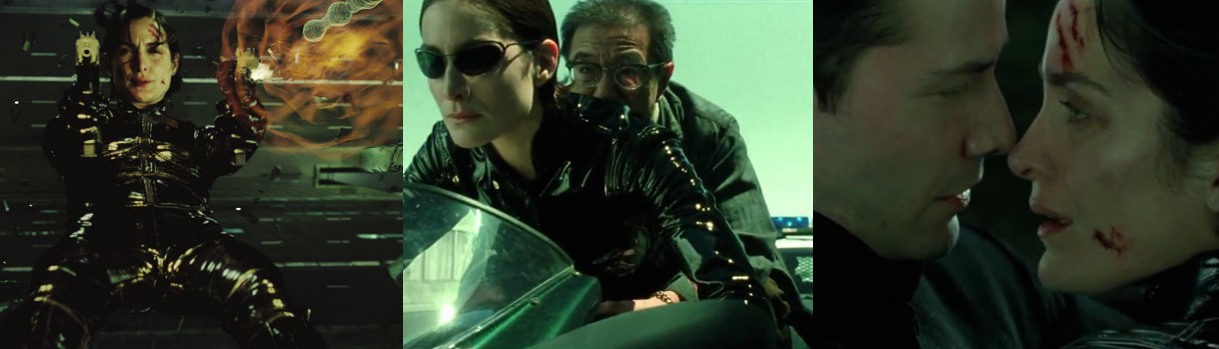
While Trinity was very much a catalyst for Neo’s unplugging and guiding him towards realising his true calling as The One in the first film, here she’s reconfigured the centre of Neo’s world. While the chemistry between the two characters (and actors) is incredibly lacking, with both being quite wooden in their passion and delivery (beyond when they’re sucking face or getting raunchy during a sweaty rave), the film goes out of its way to emphasise that their connection, their true love, is central to Neo’s relationship to humanity. Still a forthright and capable figure, Trinity is far more than just Neo’s arm candy or a damsel in distress; she’s treated as one of his strongest supporters and an equal and given her fair share of action scenes thanks to her taking the lead on liberating and safeguarding the Keymaker (Duk Kim) using her motorcycle skills. There’s no question that Trinity is a formidable and bad-ass fighter and shooter; even when fighting alongside Neo, who can basically do whatever he wants in the Matrix (though, oddly, rarely ever does this), Trinity holds her own but all the physical skill in the world don’t stop her from taking offense when Persephone (Monica Bellucci) demands a passionate kiss from Neo before she agrees to betray her husband, the condescending Merovingian (Wilson), so they can get to the Keymaker. While Neo and Trinity don’t really have the greatest chemistry as a couple (which is potentially due to everyone assuming a stoic demeanour within the Matrix), their love is much envied by Persephone, who has grown weary of her husband’s cheating ways and pompous arrogance and longs for the days when he was more like Neo (a throwaway line that many took to believe that the Merovingian was once a One), but warns that their love is doomed to end in tragedy. Accordingly, Trinity plays a huge role in the film as Neo finds himself plagued by nightmares of her impending demise during a bombastic action scene; fearing that his visions may come true, and desperate not to lose her, Neo asks that she stay out of the Matrix for the finale, which sees the crew of the Nebuchadnezzar team up with other crews in a multi-staged assault to get Neo plugged into “The Source”. However, when the crew of the Vigilant is destroyed during a Sentinel attack, Trinity has no choice but to enter the Matrix to complete the mission and, in the process, Neo is faced with his greatest choice yet as he must pick between literally saving the last remnants of humanity from the machine’s reprisals or saving the life of the woman he loves.

Morpheus is now a questionable figure whose beliefs and methods are the subject on ongoing debate

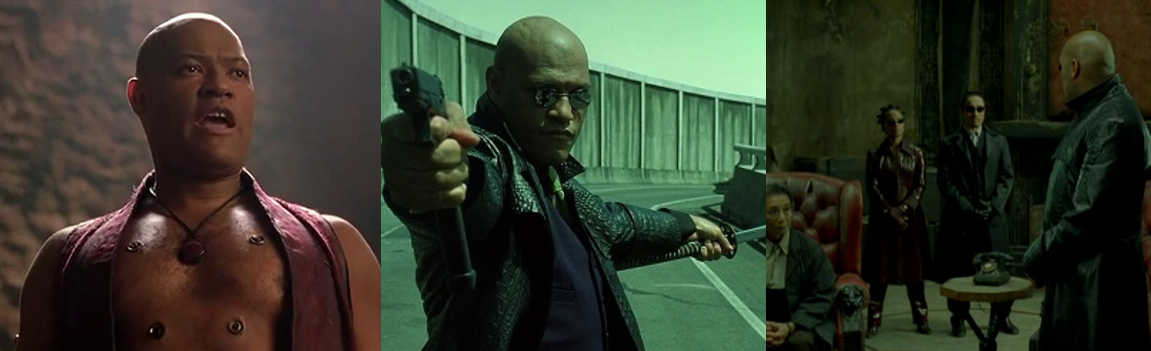
A pivotal and memorable character in the first film, Morpheus (Fishburne) undergoes a significant character shift here from wise and benevolent mentor to a figure of some controversy. As presented in The Matrix, I always saw Morpheus as a crucial figurehead in the Zion hierarchy but it turns out that he’s actually something of a religious zealot; many in Zion not only question is unwavering belief in the Oracle, Neo, and the prophecy of The One but also see him as a reckless, disobedient, and dangerous individual who often acts against the interests of the ruling council. Labelled as “crazy” by some and treated with contempt by Commander Lock (Harry Lennix), whose concerns are more realistically focused on the impending assault from the machines, Morpheus jarringly loses much of his mystique and becomes a much more layered and human character as a result. This is aided by the presence of Captain Niobe (Jada Pinkett Smith) of the Logos, a sceptical character who once had a romantic relationship with Morpheus that was forever changed after Morpheus first met the Oracle and learned that his destiny was to find The One. Clearly still harbouring feelings for each other, their relationship is frosty, to say the least, thanks to Niobe now being with Lock and her resentment towards The One and Morpheus’s devotion to his beliefs. Still, it’s not as if everyone doubts Morpheus; Neo and Trinity still hold him in high esteem for showing them the truth, Councillor Hamann (Anthony Zerbe) and others on the council treat him with reverence and respect even if they don’t fully believe the same things he does, and he’s revered as an influential figure, regardless of his beliefs, who can inspire the citizens of Zion to rise up against the fear of their impending destruction and therefore face the oncoming attack with gusto. Within the Matrix, Morpheus plays a largely supporting role but sparks up a bit of a rivalry against Agent Johnson and plays an important part in helping Neo fend off the Merovingian’s minions, though his primary role within the virtual reality environment is to be a stoic and implacable believer in Neo’s abilities and destiny to lead the human race to victory regardless of the odds, the risk, or the concerns of others. Indeed, Morpheus is completely nonplussed by his doubters; it’s only when Link (Harold Perrineau) questions his decisions that he steps in, and his faith is even rewarded as Neo arrives to save him when he “prays” for help during the chaotic highway chase. However, his unwavering devotion to the cause is shaken in the finale, when he sees his ship destroyed before his eyes and stunned to find that Neo’s insertion into the Source didn’t out-right destroy the Matrix as he was led to believe.

Neo’s abilities cause a stir within Zion, with some sceptical and others devouted to him.

Naturally, given that The Matrix Reloaded is a much bigger film than its predecessor and actually shows just how large and complex the steampunk underground city of Zion is, the film includes a large number of supporting characters. The Nebuchadnezzar has been reduced to a four-man crew, with newcomer Link acting as the ship’s operator; Link is still getting used to his role and processing not only Morpheus’s unwavering faith in Neo and the prophecy but also Neo’s incredible abilities, which he’s seen first-hand and has turned from a sceptic to a believer. The aforementioned Niobe, Hamann, and Lock are three of the principal figureheads of Zion, with each one offering another wrinkle to the film’s greater focus on philosophy and the question of choice and destiny. Lock is a pig-headed, militaristic man who wants every resource possible at his disposal to effectively barricade Zion and fend off the impending attack and is constantly frustrated at the council’s insistence of wasting manpower and ships following Morpheus’s mad beliefs but, while he might be a hard-nosed blowhard, his devotion to the safety of Zion is never in question. Niobe remains torn between her lingering feelings for Morpheus and her scepticism regarding The One; while she has little faith in this, she does believe in Neo’s character and volunteers to help the Nebuchadnezzar get Neo to The Source, much to Lock’s chagrin and jealousy. Amusingly, Neo is actually more perturbed by his believers than the sceptics; he’s visibly uncomfortable when Zion’s citizens offer him gifts and beg him to watch over their friends and family as part of the film’s explicit and unashamed Christ metaphor and aggravated by the hero worship piled onto him by The Kid (Clayton Watson), an overly enthusiastic youngster who yearns to join Morpheus’s crew to fight alongside his hero. Finally, Hamann walks the line between practicality and faith; having lost much of his life to the virtual reality of the Matrix, he seizes every waking moment and is clearly awestruck by Neo’s abilities, which he believes are a greater design even if he doesn’t fully understand what that is.

Suspicion surrounds many allies when they’re revealed to be programs of the system.

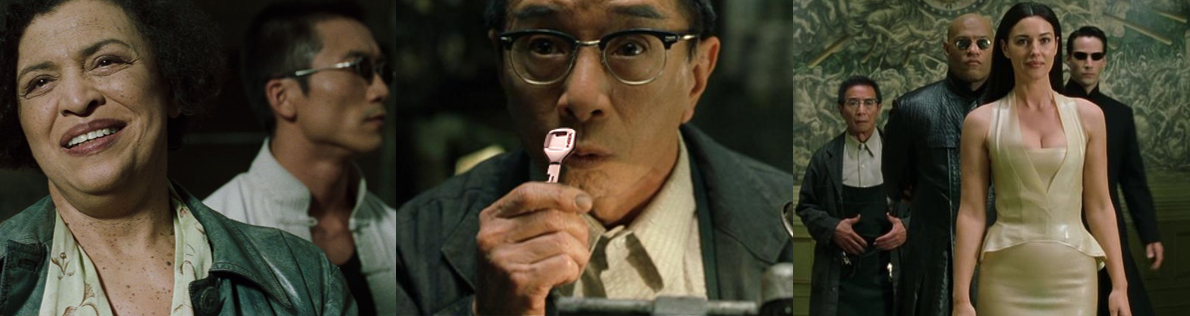
Hamann also lays the groundwork for the film’s overarching theme regarding control; the humans use machines to maintain their lives, while fighting other machines looking to kill them, and the balance between the two, their duel capacity for life and death, plays a pivotal role in Neo’s ultimate destiny when he’s faced with the choice between giving into a greater power or smashing the system that maintains so many lives, even if only in a form of slavery. This is in stark contrast to the Oracle, an enigmatic and cryptic figure who continues to pick and choose what information she gives out. Quickly revealed to actually be a program, and thus part of the system of control within the Matrix, the Oracle’s trustworthiness and true motivations are briefly called into question by Neo, despite his gratitude to her for helping guide himself towards his great destiny. Believing that the war between needs to come to an end and that both races need to find a way to co-exist, the Oracle adds to Neo’s considerable load by expositing that he must reach The Source to complete his destiny and that he’s as much a slave to his choices and fate as she is to her programming. It’s through conversations with the Oracle that we learn more about the Matrix and get a sense of just how complex The One is; it’s not merely about bullet time or humbling Agents, it’s a coding system that holds the key to humanity’s salvation, and the weight of this responsibility weighs heavily on Neo’s shoulders. This time, the Oracle is accompanied by a bodyguard, Seraph (Collin Chou), a program designed to safeguard her at all costs; he doesn’t say much but makes an immediate impression by going toe-to-toe with Neo in order to “truly know him”. When Neo and the others finally reach the Keymaker, they find a wizened old man with a collection of keys that allow one to travel vast distances through doors and even traverse backdoor corridors in the Matrix’s coding. The Keymaker represents the film’s focus on everyone having a reason and a purpose; his purpose is to make the keys and to know how to access The Source, and protecting him from the Agents becomes the protagonist’s highest priority in their desire to end the war.

While the Merovingian and the Twins are more interesting than Agents, they’re wasted potential.

This mission is, as ever opposed by the Agents; these men-in-black antagonists remain as formidable as ever, able to jump to new host bodies, dodge bullets, and proving a persistent threat even when Neo is around thanks to having been “upgraded” to give him a bit more of a fight. Their threat is eventually lessened not just by Smith and his inexhaustible army of clones but also the presence of the Merovingian, a charismatic and self-aggrandising “Exile” who has amassed an army from previous versions of the Matrix (inexplicably meaning that vampires and werewolves make a very brief cameo) to establish a vast network for programs, like himself, who wish to travel beyond the restrictions of the virtual reality world. A self-styled “trafficker of information”, the Merovingian is arrogant and patronising to the heroes, unimpressed with their grandeur and what he sees as their lack of knowledge about what they want and why. Seeing them as little more than lapdogs for the Oracle, he dismisses their demands and shows no fear of Neo’s powers, having “survived his predecessors” in the past. Oozing disgust and disdain, the Merovingian lives only for his own self-gratification; he delights in creating programs that cause physical and sexual stimulation, regularly cheats on his wife, and desires only to acquire more power and knowledge through whatever means necessary. While Hamann muses on the duality of control, the Merovingian delivers a twisted diatribe on the illusion of choice; although he’s speaking in the context that people are unable to deny their true natures, his perspective is actually not a million miles away from the truth as Neo eventually discovers that the choices everyone makes (especially those connected to the Matrix) are not of their own free will but dictated to them by the system’s methods of control and also all part of the greater cycle of death and rebirth inherent to the nature of the Matrix. His primary underlings, and one (two?) of the film’s more wasted opportunities, are the Twins (Neil and Adrian Rayment), albino, dreadlocked sadists who can assume gruesome, incorporeal forms and attack with straight razors and can even heal their wounds with a thought (something that, like almost everything about them, is unfortunately not elaborated upon). Sadly, these two have very few lines and, despite being central to some of the second act’s biggest action scenes, end up underutilised and ultimately wasted as they fail to retrieve the Keymaker, or really cause much of a problem for Morpheus and Trinity despite being more threatening than the regular Agents, and are then promptly taken out by a car explosion (despite clearing turning incorporeal), meaning both the visually impressive Twins and the eloquent menace of the Merovingian boil down to some philosophical musings and adrenaline-fuelled action sequences and little else. It’s such a shame as the Twins look and fight so cool, and really stand out against the black-suited Agents, so I would’ve loved to see them have a greater role here or in the next movie, but you could honestly remove them from the film (or replace them with Agents) and the plot wouldn’t even suffer in the slightest.

Now able to duplicate himself, Smith threatens to overrun everything and everyone in the Matrix.

On the other hand, Smith is back in full force; now literally unplugged from the system he once rebelled against, Smith is exploring his newfound freedom by indulging every sadistic desire that comes to mind and literally spreading himself across the Matrix using his newfound copy ability. With a violent thrust to the chest of an Agent or human, Smith can override their code (both digital and genetic) and create an exact duplicate of himself, with all of his powers and personality, though a “prime” version remains at the forefront. Like everything in The Matrix Reloaded, Smith’s survival and new abilities is the subject of discussion in the film, with Smith musing that Neo somehow overwrote or passed on a piece of himself when he destroyed him at the end of the last film and then promptly dismissing it as “irrelevant” compared to his new purpose in life, which is to eradicate all life within the Matrix and replace it with himself. As formidable as Smith was before, his threat is now magnified to an almost incalculable degree as more and more of his copies swarm in to overwhelm Neo; even though Neo is able to fend them off and trump Smith with his ability to fly (and can even resist Smith’s infection through sheer force of will), he can’t simply destroy or erase Smith with a thought (although…he should be able to do this, but that wouldn’t be very visually exciting now, would it?) and he’s forced to flee, giving Smith the chance to make more and more copies and continue to show up at the worst possible times to hinder their mission. Though Smith’s desire to kill Neo and the others aligns with that of the Merovingian and the Agents, he is allied with neither of these forces and actually copies himself to their minions to increase his power; so evolved is Smith that he even overtakes the body of Bane (Ian Bliss), a resistance fighter, to allow a version of himself to wander around in the real world! Although this wouldn’t be fully explored until the next movie, we do get a glimpse of how sadistic Smith is as he cuts his human form and attempts to stab Neo in the real world before being interrupted, and even plays an active role in sabotaging the humans’ mission in the third act simply because he gets a sick thrill out of causing death and destruction.

The Nitty-Gritty:
Like in the last film, music plays a huge role in The Matrix Reloaded; composer Don Davis put together a whole bunch of memorable and catchy beats to accompany the film’s biggest moments, such as the Burly Brawl and the highway chase, which were collaborations with Juno Reactor, in addition to a great tie-in song by P.O.D. Diegetically, music is pivotal to rallying the people of Zion; it’s a surreal inclusion in the film, but the big sweaty rave scene galvanises the people, with all their doubts and fears, in a celebration of life. Highly sexually charged, the scene shows how passionate these people are at embracing their lives, even though the real world is hard and dangerous and lacks the creature comforts of the Matrix. Still, Zion is doing a lot better than I ever imagined from the brief descriptions in the first film; despite the revelation that humans have been fighting the machines for 100 years, Zion is a bustling, steampunk-inspired metropolis filled with rudimentary dormitories, a huge dock, defensive cannons and blast doors, an independent virtual reality security system, and even a water recycling and processing plant and the means to heat, feed, and clothe all of its citizens. There’s never a question that Zion is lacking in these resources, only that some are extremely basic (clothes, food, and possessions) and others are unbelievably advanced (their ships and technology), and I do find myself asking how they make their clothes and built all that stuff. It’s somewhat implied that they repurposed a lot of the machines’ technology to their own ends, but actually building such a large and self-sustaining city seems beyond the capabilities of the few human liberated from the Matrix, and the actual implied truth is far more ominous.

The Burly Brawl and chateau fights show off the new technology and Neo’s incredible powers

Without a doubt, The Matrix Reloaded is much, much bigger than the first film; with at least double the budget, the film is able to present far more visually interesting and technologically impressive fight and action scenes. Fights are much longer and more detailed, slicker and contain more combatants and movements at any one time, and bolstered by an abundance of wire work and CGI to bring Neo’s gravity-defying moves to life. The film’s big action scene is the Burly Brawl, wherein a seemingly inexhaustible swarm of Smiths pile onto Neo in the middle of an urban playground; while it’s true that many aspects of this sequence haven’t aged as well as others in the film (or the first movie), it remains an exciting and surprisingly long fight scene as Neo (or a rubbery representation of him) fends off Smith after Smith with blows, throws, and a strangely bendy steel pipe. While I find it an exhilarating display of Neo’s superhuman abilities, the fight goes on so long that it almost becomes a little ridiculous, but I suspect that might’ve been the point thanks to the bowling pin sound effects used when the Smiths are knocked down. Punctuated by some fun wire-fu, effective use of bullet time, and dynamic camera shots, the Burly Brawl is primarily there to show off the technology that’s been developed since the first film, to paint Neo as an absolute bad-ass as he holds his own against the Smith army, and Smith as this relentless, unstoppable force that’s desperate to tear his hated enemy apart. The chateau brawl is a similarly visually engaging fight, but very different; not only is it more claustrophobic due to taking place in a more enclosed space, it also features much more weapon combat, more diverse combatants, and more variety as Neo isn’t just swatting away hundreds of guys in suits and he actually gets a chance to show off a few fancier movies. While the Merovingian’s minions number far less than Smiths army, they’re no less formidable; made up of programs exiled from older, far more primitive versions of the Matrix, they’re assumed to be somewhat supernatural and, unlike Smith, actually cause Neo to bleed thanks to favouring bladed weapons. This means their fight is exciting in wholly separate way as Neo must flip about, balance on bannisters, and use swords and sai to fend them off.

The action comes thick and fast and showcases the awesomeness of Neo’s abilities within the Matrix.

On the flip side, we get a noticeably subdued exchange between Neo and Seraph; while it’s clear that Neo isn’t exerting anywhere near the power as he was against the Agents or Smith, it’s still a fun fight that includes an impressive one-handed cartwheel from Neo and is a great shorthand to show that Seraph is no slouch when it comes to fighting. Things ramp up again for the highway chase, another obvious standout action sequence; this is an adrenaline-fuelled sprint that features Agents desperately overtaking bodies to chase after Trinity and the Keymaker on a high-speed motorcycle, Morpheus battling Agent Johnson on top of a trailer truck with a samurai sword, and the Twins ghosting through vehicles and tangling with Trinity in close quarters from the back seat of a car. The action then suitably ramps up for the third act as Trinity is forced to storm a power plant full force, which is actually the explosive opening sequence of the film and serves to show just how capable she is even without code-bending abilities. As fun as all of these action sequences are, however, the true highlight of the film for me is Neo, now liberated from many of the shackles and doubts about himself that held him back in the last film. We saw a glimpse of what The One was capable of when he easily fought off the Agents with one arm, destroyed Smith, and then blasted off into the sky but, here, Neo practically has no equal. He can rocket into the sky at will, blast down the streets and supersonic speed, and even enter the code and physical body of others to remove bullets. However, despite what you and many of the characters think, he’s not some all-powerful God; he can bleed just as easily as anyone, is as conflicted by self-doubts as any of us, and his fight scenes aren’t just a simple case of him blinking his opponents out of existence. He still has to stop bullets in mid-air, dodge blades, and tackle his foes hand-to-hand and the film generally tries to both make him look powerful and vulnerable at the same time by throwing multiple opponents at him at once to give him something resembling a physical challenge.

Neo vehemently rejects the system’s control and discovers new aspects of his powers in the process.

Neo’s biggest challenge, however, is emotional; terrified at the idea of losing Trinity and burdened by the weight of expectation, Neo is still trying to find his way in this complex world where he has so much power but little understanding of what he’s actually supposed to do with it. Luckily for him (but not so lucky for some segments of the audience), Neo has his destiny spelled out to him, in a fashion, in the finale when he enters The Source and comes face-to-face with the Architect (Helmut Bakaitis), a conceited and haughty program who claims to have created the Matrix. In what essentially amounts to an overly complicated version of the dressing down Mr. Rhineheart (David Aston) gave Neo (then Thomas Anderson) in the last film, the Architect explains (using condescending words like “concurrently”, “apropos”, and “ergo”, which I have since added to my vocabulary) that Neo isn’t as special as he first thought. Instead, he is the fifth “One”, an unavoidable anomaly that the machines expect to crop up as a side effect of giving everyone plugged into the Matrix a choice to accept or reject the program. While only a tiny percentage of people do this, they eventually grow into Zion and a resistance effort and, with each generation, the machines cull Zion’s population and have The One reboot the Matrix, taking a bunch of its inhabitants to rebuild the city and start the cycle over again. Neo is aghast at the idea that he’s as much a part of this system of control as anything else and vehemently rejects the Architect’s demand that he fulfil this function to allow the human race to continue limping along for, if he chooses not to, Zion will be destroyed and the Matrix itself will suffer a “cataclysmic system cash” that will kill everyone plugged into it, thereby causing humanity’s extinction. However, unlike his predecessors, Neo has a far more specific human attachment, Trinity, and he chooses not to go along with this plot in favour of rescuing her even if it means the death of his species. While I admit that I’ve read more into this scene using interpretations and essays and such, I really enjoy it as a deep dive philosophical discussion regarding choice and control; it’s also really fun seeing Neo’s multiple reactions reflected in the television screens, which actually let him showcase some emotion as he vehemently rejects the “old white prick’s” overwhelmingly arrogant diatribe. Neo barely even gives the Architect’s ultimatum a second’s thought; he chooses to save Trinity, adamant that he’ll be able to fight against the resulting disaster but, while he does save her, things immediately go downhill soon after: the Nebuchadnezzar is destroyed, Bane is found comatose and accused of sabotage, and Neo passes out after exhibiting electromagnetic powers in the real-world for a dramatic cliff-hanger ending!

The Summary:
I’ve spoken to a lot of people over the years who’ve told me that they don’t understand The Matrix, and I’ve never understood this; the first film is pretty simple (humans are trapped in virtual reality by machines in a post-apocalyptic world) but The Matrix Reloaded definitely confuses things and I can totally understand how some people were left a bit baffled by the lengthy, vague discussions regarding fate, choice, and the nature of humanity. While the films have long been the subject of academic debate, these discussions really ramped up with The Matrix Reloaded, which hinted at there being so much more at work in this sci-fi world than we originally believed; Morpheus had a questionable reputation, not all programs were malevolent, and Zion was this impossibly self-sustaining city. Questions were raised about whether or not the real world was also a simulation, people wondered if the Merovingian and Seraph were former Ones, and all of a sudden The Matrix turned from a thought-provoking piece of visually stunning sci-fi cinema to this absolute mind bender of philosophy and metaphysical debate. Personally, I’ve always really enjoyed this. The Matrix Reloaded is a thinking man’s sci-fi film, one that’s maybe a little too vague and a little too clever for its own good but which always has me engaged whether characters are throwing punches or discussing the self-destructive nature of love and choice. The action and fight sequences are absolutely thrilling, and probably the best in the series thanks to how consistent they are; sure, some effects haven’t aged all that well, but I loved seeing the multiple Smiths dog-piling Neo and watching Neo fend off numerous enemies at once with a slick efficiency. It’s not a perfect film, of course, and hindsight makes me wish the filmmakers had done a few things differently (the Matrix-within-a-Matrix might’ve been good, giving the Twins a bigger role, and maybe making Morpheus a little less controversial would be just three examples), but this is still my second favourite of the entire franchise. While even I, as a big Keanu Reeves fan, have to admit that Keanu was disappointingly wooden throughout much of this, Neo’s mannerisms and stoic proficiency paint him as an effortlessly cool hero, and I love that even after finding himself he’s still conflicted and how the world is just made more complex following his awakening as The One. It’s maybe a little too heavy-handed to put on all the time, but The Matrix Reloaded remains an exciting, visually and intellectually stimulating film that never fails to impress or entertain me and I think it’s well worth a deeper consideration as there’s a lot to sink your teeth into here, even if the payoff for all its plot threads didn’t exactly deliver as many might’ve hoped.

My Rating:

Rating: 4 out of 5.

Great Stuff

Are you a fan of The Matrix Reloaded? What did you think to the progression of Neo’s character and his powers? Were you a fan of Smith’s copy ability and what do you think to the action scenes? Did you enjoy the film’s characters and concepts or do you feel like it became too bogged down in philosophy? What are some of your favourite fan theories regarding the franchise from back in the day? How are you celebrating Keanu Reeves’ birthday today and what are some of your favourite roles of his? Whatever you think about The Matrix Reloaded, drop a comment below or let me know your thoughts on my social media.

Movie Night: Speed

Released: 10 June 1994
Director: Jan de Bont
Distributor: 20th Century Fox
Budget: $30 to 37 million
Stars: Keanu Reeves, Dennis Hopper, Sandra Bullock, Jeff Daniels, and Joe Morton

The Plot:
Los Angeles Special Weapons and Tactics (S.W.A.T.) specialist Jack Traven (Reeves) is sent to diffuse a bomb that revenge-driven extortionist Howard Payne (Hopper) has planted on a city bus. However, there’s a catch: passenger Anne Porter (Bullock) must keep the bus above fifty miles an hour or else the bomb will detonate!

The Background:
Speed was the brainchild of screenwriter Graham Yost, who was inspired by The Runaway Train (Konchalovsky, 1985) and thought the concept would be made more exciting if the train had a bomb on it and had to maintain a certain speed. Initially, the entire film was set on the bus and would culminate in a dramatic crash through the iconic Hollywood Sign but the ending was changed and the script was altered in order to sell the concept to 20th Century Fox, with Yost even working with Joss Whedon to refine the script’s dialogue and heavily alter Traven into a more earnest character. Reeves prepared for the role by shaving his head and incorporating his prior experiences on Point Break (Bigelow, 1991), and, after Halle Berry turned down the role of Annie, worked closely with Bullock to develop chemistry between their characters. Speed was a massive financial success; it made over $350 million at the box office and was widely praised for its action and intensity. While the sequel was a dismal critical and commercial failure, Speed remains one of the best action movies of the nineties and, considering that today is Keanu Reeves’ birthday, this seems like the perfect time to revisit the film.

The Review:
Speed begins not on a bus on the Los Angeles highway but in a large office skyscraper where a bunch of well-dressed, successful businesspeople find themselves trapped in a lift and held to ransom courtesy of a bomber we will later learn is named Howard Payne. For now, though, he’s just a maniacal madman who places a bomb on the lift and demands a $3 million ransom for the safety of his hostages, so the Los Angeles Police Department send in their S.W.A.T. team to try and free the hostages before the bomb can go off. The team is led by Lieutenant Herb “Mac” McMahon (Morton), who meticulously co-ordinates his guys with one primary goal in mind: the evacuation of the building’s occupants and the maintenance of protocol to avoid upsetting the bomber and unnecessarily losing lives.

Jack comes up with a unique solution when Harry is taken hostage by a mad bomber.

Jack Traven is a point man in Mac’s team; a bit of a wise-ass, Jack’s snark doesn’t float with Mac, who orders both him and his friend and fellow officer, Harry Temple (Daniels), to investigate the explosive device but strictly forbids them from interfering with it. While Jack remains professional enough to offer words of comfort to the trapped inhabitants, who have no idea of the predicament they’re in, Harry is the expert on explosives and Jack is far more likely to go with his gut instincts regarding the whole situation. Jack deduces that the bomber has every intention of blowing the lift whether he gets paid or not, and showcases his adaptability by rigging a nearby crane to take the weight of the lift, thereby ensuring the hostages’ safety when his hunch turns out to be right (though Payne only blows the lift because of Jack’s interference). Further deducing that their perpetrator is in the building, Jack sets out to track him down, with Harry reluctantly in tow; when Payne gets the drop on them, he takes Harry as a hostage and tries to use him as leverage to ensure his escape but Jack puts into motion his unique approach to such a situation and wounds Harry with a bullet to the leg and Payne appears to kill himself with a suicide vest. Unbeknownst to Jack, Payne survived the explosion and watches with glee as Jack and Harry are commended for their bravery and fortitude; Harry even gets a promotion to detective but warns Jack that they got lucky and that “luck runs out”.

Jack leaps aboard the bus and finds an ally in the annoying Annie, who takes the wheel.

Pissed off that Jack’s interference cost him $3 million, the maniacal Payne strikes by blowing up a bus and its driver right in front of Jack; Payne then calls Jack from a nearby payphone and challenges him to stop him once more. This time, he’s placed his bomb on another bus that will explode once the vehicle goes over fifty miles an hour, and specifically declares his intention to set off the bomb if any passengers are evacuated or if he doesn’t get his ransom in about three hours’ time. Naturally, Jack races to locate the bus and this is when we’re introduced to easily the most annoying character in the film, Annie Porter, played by one of my least favourite actresses in all of cinema, Sandra Bullock. A loud and flighty character, Annie has been forced to take the bus since she lost her driving license on a speeding charge and is the first to actively speak up when Jack dramatically leaps his way aboard the bus. However, when the driver, Sam Silver (Hawthorne James), is injured by an errant gunshot, Annie finds herself in way over her head and taking a central role as the panic-stricken driver of the bus.

Jack is wracked with anger when Payne causes the deaths of a passenger and his close friend.

On the bus, Jack finds an assortment of normal, everyday Los Angeles citizens, including Doug Stephens (Alan Ruck), a tourist on his first visit to the city who offers wry commentary, and Helen (Beth Grant), a regular passenger whose utter terror results in her being another of Payne’s casualties. When he first boards the bus, Jack is first faced with Annie’s loudmouth but the situation unexpectedly escalates when Ray (Daniel Villarreal) pulls a gun on him and demands the bus be stopped. Thanks to Gigantor Ortiz (Carlos Carrasco), Ray is disarmed but Sam is shot in the process, meaning Annie has to take over and, while tensions inevitably flair between the frightened passengers, Jack is eventually able to calm them. He does an equally good job of offering encouragement and support to Annie while remaining focused and pragmatic about the entire situation. Thankfully, he has Harry on the line to offer his insight on the bomb, which is packed full of C4, flanked by a number of decoy wires, and wired into a regular gold wristwatch. Bothered by the unreliability of the timer and the unpredictability of the bomber’s methods, Harry conducts a thorough investigation not just into criminals but into former cops and uncovers the bomber’s identity as a former member of the Atlanta Police Department bomb squad. Unfortunately, Harry’s desperation to nail Payne and help his friend leads to his tragic and untimely death as Payne rigged his home with an explosive booby-trap that kills Harry and, in one of the film’s (and Keanu’s) most emotionally impactful scenes, sees Jack enraged into a frenzy and swearing to make the bomber pay for his actions.

The Nitty-Gritty:
Speed is an exercise in tension and excitement; since the bus is forced to stay in constant motion, and over fifty miles an hour, the sheer level of pressure faced by Jack is reflected in the pacing and frantic nature of the film. Even when the bus gains a police escort, they’re never far out of danger; first it’s the gunman, Ray, then Helen nearly blows the whole thing (literally) by trying to escape from the bus as Sam is safely unloaded in an act of faith on Payne’s part, and then they start to run out of road. Even when Jack directs Annie to circle the airport indefinitely, he has to worry about the bus’s severed fuel line and is constantly having to adapt to new problems on the fly.

Jack is more than physically capable of taking on Payne’s sadistic challenge

Thankfully, Jack is more than capable of meeting Payne’s challenge; a focused and driven individual with a strong moral compass, he isn’t afraid to leap head-first into action but is also switched on enough to consider all of his options, while still acting on instinct the vast majority of the time. He commandeers a civilian’s car in a desperate attempt to warn Sam about the danger on his bus and, when that fails, he dramatically leaps from the car and onto the bus despite the fact that both vehicles are travelling at well over fifty miles per hour. While on the bus, he is as honest and forthcoming with the passengers as possible while still doing everything he can to keep things under control and exudes a confidence that, for the most part, keeps the passengers calm. Disgusted at Payne’s lunacy, Jack walks a fine line between negotiating and satisfying the bomber while making it abundantly clear that he has a personal vendetta against Payne. Desperate to keep the passengers safe, Jack doesn’t hesitate to try and disarm the bomb from underneath the bus and, once he figures out how Payne is monitoring them, he comes up with a genius and often copied/parodied solution of looping Payne’s video feed, thus outsmarting his opponent and safely evacuating the passengers.

The bus makes for some of the film’s most tense and action-packed moments.

Of course, much of the film’s action revolves around the tension and drama on the bus; while Mac works to keep the roads clear and safe for Jack, Annie is forced to plough head-first through the dense Los Angeles traffic, make sudden and hard turns to avoid collisions, and, of course, to make a seemingly impossible leap to cross an unfinished freeway. While it’s perhaps a little unlikely that such a large and cumbersome vehicle would be able to make such a jump, especially with the added weight of all those passengers, it does make for a thrilling scene that’s one of the film’s most memorable moments. Once the bus hits the airport, it’s largely out of danger and Jack’s focus switches to figuring out how Payne can always know so much; after making the connection between Payne’s seemingly random “Wildcat” reference, Jack discovers that Payne has a camera rigged on the bus and has Mac commandeer Payne’s signal to loop the feed. It’s lucky, and seemingly unlikely, that Payne only had the one camera on the bus (and that he didn’t rig up a microphone or other device so he could hear what was going on as well) but, when he figures out that he’s been duped out of his money again, the mad bomber decides to take a more direct approach for the film’s finale.

The film ends with a showdown on, and on top of, a runaway subway train!

After Jack and Annie’s dramatic (and explosive) escape from the bus, Payne disguises himself as a police officer, abducts Annie, straps her into an explosive vest, and escapes into the subway with his money and his hostage. Having eliminated Jack’s “shoot the hostage” strategy, Payne hijacks a subway train, handcuffing Annie to the inside, and makes his getaway, but is driven into a psychotic rage when he discovers his ransom is rigged with paint that makes it worthless. Jack, ever the man of action, pursues and boards the train, drawing Payne into a confrontation on the train’s roof! Despite being Payne older, insane, and handicapped by his missing thumb, the mad bomber is initially able to overwhelm is younger, stronger foe thanks to the threat of the detonator in his hand. However, Jack is able to behead Payne using an overheard railway signal (delivering an odd quip about being taller in the process), ending his threat once and for all while keeping Annie safe. Thanks to Payne’s trigger finger, though, the train is left out of control; with no way to free Annie from her cuffs and few options left, Jack opts to speed the train up and send it crashing out onto Hollywood Boulevard. Unbelievably, the two are left unharmed beyond the few scrapes and cuts they picked up from escaping the bus, and the film closes with them finally acting on the middling amount of sexual tension they shared during the film’s chaotic events while a gaggle of spectators look on.

The Summary:
I hate to say it, but I’ve never really been that big a fan of Speed. The premise is certainly unique, and definitely ends up being much more than just “Die Hard (McTiernan, 1988) on a bus” thanks to the high-octane thrill of a bus that cannot slow down and the many different obstacles that get in the way of that premise. Where it excels is in the performances of Keanu Reeves and Dennis Hopper; whenever anyone tries to tell me that Keanu is “wooden”, I point them to his intense and emotional fit of rage at learning of his friend’s death and his performance is only bolstered by Hopper’s maniacal bomber. Hopper is as much of a highlight as the ever-escalating action on the bus, which ploughs through traffic, red lights, and even inexplicably leaps a gap in the freeway in a bid to stay over fifty mile an hour. Where the film slightly falls, for me, though is in the casting of Sandra Bullock and her ever-grating performance as the flustered Annie (who’s as much of a liability as she is an asset) and the ending, which attempts to out-do the intensity felt on the bus with a runaway subway train and maybe pushes its luck a little too far. It’s an oddly contradictory film as well, feeling both too long and yet well-paced at the same time, but it’s definitely an entertaining and intense spin on the action genre. Speed is worth your time for Reeves, Hopper, and the sequences on the bus alone and is a great showcase of Reeves’ range and capability as an actor and leading man.

My Rating:

Rating: 3 out of 5.

Pretty Good

Are you a fan of Speed? What did you think of the film’s premise and Keanu’s performance? Are you a fan of Sandra Bullock, or did she also bring the film down a notch for you? Did you enjoy the tense sequences on the bus and Dennis Hopper’s maniacal Howard Payne? How did you react when Harry met his untimely end? Would you have liked to see Keanu return in the sequel? How are you celebrating Keanu Reeves’ birthday today and what are some of your favourite roles of his? Whatever you think, go ahead and sign up to leave a comment down below or let me know on my social media.

Movie Night [Sci-Fanuary]: The Matrix Resurrections


January sees the celebration of two notable dates in science-fiction history, with January 2 christened “National Science Fiction Day” to coincide with the birth date of the world renowned sci-fi writer Isaac Asimov, and HAL 9000, the sophisticated artificial intelligence of Arthur C. Clarke’s seminal 2001: A Space Odyssey (1968), being created on 12 January. Accordingly, I have decided to spend every Sunday of January celebrating sci-fi in all its forms.


Released: 22 December 2021
Director: Lana Wachowski
Distributor: Warner Bros. Pictures
Budget: $190 million
Stars: Keanu Reeves, Jessica Henwick, Yahya Abdul-Mateen II, Carrie-Anne Moss, Jonathan Groff, and Neil Patrick Harris

The Plot:
Twenty years after the events of The Matrix Revolutions (Wachowski Brothers, 2003) Neo (Reeves) lives a seemingly ordinary life as Thomas A. Anderson in San Francisco where his therapist prescribes him blue pills. However, when Morpheus (Abdul-Mateen II) offers him a red pill, Neo finds his mind reopened to the world of the Matrix.

The Background:
Andy and Larry Wachowski (as they were known then) hit upon their greatest and most notable success when they were able to sell Warner Brothers on The Matrix, a science-fiction film that was heavily influenced by manga and anime and made an instant and lasting impression on cinema by popularising “bullet time” and “wire-fu”. Produced for a paltry $63 million, The Matrix was a massive hit that is spawned not only two sequels but a whole slew of multimedia merchandise. However, neither of the sequels garnered quite the same critical reaction as the quasi-cult hit original; while the directors were content to allow the story to be continued, and ended, in The Matrix Online (Monolith Productions, 2005 to 2009), rumours continued to persist that a fourth film was being considered, with stars Reeves and Hugo Weaving both expressing interest in revisiting the franchise. Development of a continuation finally gained traction in 2017, when writer Zack Penn was confirmed to be working on a fourth instalment of some kind; although Lily Wachowski chose not to commit to such a large scale production, she gave her blessing and her sister, Lana, officially returned to direct the fourth film alongside returning stars Reeves and Cary-Anne Moss. Framed as a direct continuation of where the third film left off, fans were left confused when the first trailer dropped and Lawrence Fishburne announced that he was the only member of the original cast not asked to return. The movie also attracted undue criticism when filming damaged buildings and street lights in San Francisco, and was delayed due to the COVID-19 pandemic, but The Matrix Resurrections finally released and accrued a disappointing $15738 million at the box office. It was also met with largely mixed reviews; critics praised the film’s sentimental value and the return of its familiar characters while also criticising it as a redundant revisitation suffering from muddled execution.

The Review:
If you’ve read my review of the original film, you’ll know that The Matrix is one of my all-time favourite films and franchises; I was obsessed with the first film when it came out and watched it religiously on sleepovers with friends. The film was ground-breaking and endlessly alluring at the time and, while some elements haven’t aged too well, it remains a firm favourite of mine. I even really enjoy the blending of philosophy and high-octane action featured in the second film and, though I was disappointed by the third, I felt like the trilogy had been wrapped up decently enough and was somewhat annoyed to find that the franchise was going to be dusted off some twenty years later (twenty years! Man, do I feel old!) as I felt like the story had been told and it seemed like a cheap cash grab to me. But…it’s the Matrix, and I do love me some Keanu Reeves, so I was obligated to check it out if only to satisfy my own morbid curiosity and having been intrigued by the vague trailers and marketing.

Thing are not all they seem for Anderson, whose perception is skewed by fragmented memories.

It’s a good job that I am such a fan of Keanu’s and the Matrix franchise as those elements ended up being some of the best parts of The Matrix Resurrections. Framed as a kind of re-quel, which treads over familiar ground (and even splices in footage of the original trilogy as flashbacks and dream sequences) while advanced the story twenty years after the last film. Despite apparently sacrificing his life to bring about peace between the machines and the humans of Zion, the man once known as Neo is alive and well in a new version of the Matrix, one without the green tint and grungy filter. Back in his original identity of Thomas A. Anderson, he is a successful videogame designer who found fame and fortune by creating an incredibly successful trilogy of (presumably virtual reality) videogames based on his disparate memories of the first three films. However, just as Anderson’s dreams and fragmented memories have created a virtual world for millions of players, so too have them plagued his sense of reality, and even drove him to try and leap off a rooftop in order to “fly away”. Following this apparent suicide attempt, his business partner, Smith (Groff), requests that he attend regular therapy sessions with the ominously named Analyst (Harris) and, thanks to a constant prescription of blue pills, Anderson is able to keep himself from suffering a psychotic break.

Anderson is captivated by Tiffany, whose visage stirs up memories of Trinity .

Despite being deep into the production of a new videogame, Binary, for is company, Deus Ex Machina, Anderson is disturbed by Smith’s insistence that they work on a new Matrix videogame, leading to a montage sequence wherein Smith, Anderson, and his fellow programmers and stuff wax lyrical with some metatextual, on the nose commentary about big corporations mining familiar franchises just to make more money off previous successes. Sadly, this kind of fourth-wall-breaking discussion permeates a great deal of The Matrix Resurrections, with even Anderson himself being saddened to be taking a creative step backwards rather than trying something new and innovative. His only reprieve is his infatuation with Tiffany (Moss), a beautiful woman he sees on a consistent basis in a coffee house and who reminds him of Trinity, a woman from his dreams and whom he programmed into his videogame. When not struggling to strike up a conversation with her, or debating his sanity, or working on Binary, Anderson is running a singular module of The Matrix that recreates the iconic opening of the original film, but with a few alterations to mix things up, but for the most part is fairly convinced that he’s just a videogame designer with mental issues and a skewed sense of identity.

Allies old, new, and fundamentally changed work to bring Neo back to the real world.

All of that changes when he is suddenly met by a new incarnation of Morpheus, one seemingly pulled from his videogame world, who offers him a familiar choice: stay in his reality, or return to the real world. If you were wondering whether Lawrence Fishburne makes an appearance in this film, or his perhaps adopting a new avatar, you’ll be disappointed to find that Morpheus is long dead and only appears in archival footage; instead, where get this new version of Morpheus, one apparently spliced with elements of Neo’s old nemesis, Agent Smith (Hugo Weaving), to act as an agent within that loop. A far more mischievous version of the character, this new Morpheus is actually a sentient program, of sorts, who is able to communicate with and assist the heroes in the real world thanks to an advanced kind of nanotechnology, but he’s far from the wise mentor figure of his predecessor. Instead, he ‘s more like a necessary component to help convince Anderson to leave the Matrix and reclaim his identity as Neo, something he is largely reluctant to do thanks to the Analyst’s influence on his perception of the world. Still, Neo’s curiosity and familiarity with the words and images presented to him by Morpheus override his hesitation, and he’s soon joining Captain Bugs (Henwick) and the rest of her crew aboard the Mnemosyne hovercraft, sixty years after sacrificing himself to save Zion. Neo is disorientated and melancholy to find that his sacrifice didn’t appear to change much about the world, but Bugs takes him to the new Zion, Io, and reunites him with an elderly, cynical Niobe (Jada Pinkett Smith) and learns that a peace does exist between man and machine. Shortly after the end of the war, the Matrix was purged of all former anomalies and blue-tinted machines helped the remnants of humanity to build a new haven and worked with them to grow fresh fruit and vegetables, while staving off attacks from the red-tinted, squid-like Sentinels that refused to abide by the peace treaty. The original Morpheus refused to believe that Neo’s sacrifice would fail, which led to Zion’s destruction, and a contingent of people have grown up idolising and even deifying Neo and Trinity for their actions, but Niobe’s primary concern is keeping her people safe, which leads to her reluctantly locking Neo up and pushing Bugs to defy her commander’s direct order and help spring Neo so that he can lead a desperate reinsertion into the Matrix to try and rescue Trinity.

The Nitty-Gritty:
If you’re a fan of the original film but haven’t really seen it in a while, then The Matrix Resurrections really has you covered, for the most part. It opens almost exactly like the original film, and the majority of its call-backs and references are to the ground-breaking original while repurposing some of the stronger elements of the sequels in new ways. One thing that is sadly largely absent from the film, however, is the kung-fu (or “wire-fu”, to be more accurate) fight scenes that so heavily influenced action cinema right up to present day. The first half of the film is a slow, introspective reintroduction to the world of the Matrix, one both familiar and disconcertingly different, as we follow Neo and try to figure out what’s real and what isn’t. Thanks to his fragmented memories and a skewed avatar, his sense of reality is more shot than ever, but he starts to piece his identity back together once he reawakens in the real world and is put through his paces by Morpheus. However, this isn’t really the all-powerful, full capable Neo we knew and loved; instead, he’s plagued by self-doubt and has no interest in fighting any more, especially after giving everything he had seemingly for nothing. While the world is noticeably better than the one he remembers, humanity is still somewhat divided; less and less people have been freed from the Matrix thanks to Niobe’s focus on keeping those who are free safe and the system of control he fought so hard against has simply been repurposed by a contingent of malevolent machines.

The new Smith offers little in the way of challenge for Neo, or interest to me as a viewer.

After his sacrifice, Neo’s body was taken away by the Analyst, who is revealed to basically have replaced the Architect (Helmut Bakaitis) and is behind the stability of the Matrix’s new iteration and the resurrection of Neo and Trinity. Initially looking to study them, he patched them back together using a combination of the cloning technology used to grow humans and additional mechanic parts, only to find that their incredible bond threatened the very Matrix itself. However, when kept safely apart, their very presence in the Matrix vastly improved the energy output and acceptance of those plugged in, thus largely negating the peace Neo so desperately fought for. With Neo unplugged, the machines are on the brink and a new reboot of the system, something which Smith is adamant to prevent as it would mean he would once again be absorbed into the Matrix code. However, this is not my Smith; I’m sure Jonathan Groff is a great actor, and he’s clearly doing his best to channel Hugo Weaving at points, but he’s a faint shadow of Waving/Smith’s former greatness and I actually question including him at all. Had the filmmakers brought Weaving back and had Smith, like Neo, also suffer from fragmented memories and a new life, then maybe his inclusion would have been worthwhile but, instead, Smith feels very tacked on and largely inconsequential. There’s a moment where it seems like he and Neo would join forces this time around (and that does crop up again in the finale, with very little explanation), but it quickly gives way to a bust-up between the two that is one of the few highlights of the film, recalls their subway fight from the first film, and is spoiled only by the inexplicable and completely pointless insertion of the Merovingian (Lambert Wilson) and his exiles.

Despite some good moments, it’s an unnecessary retread of things done better in the previous films.

A great deal of the film’s emphasis is, instead, on reuniting Neo with Trinity; while their romance was severely lacking in chemistry in the original trilogy, save for a few choice moments, they seem much more comfortable at ease with each other here, arguably because of the Analyst’s efforts to bestow them with new lives and personalities. While still a troubled and largely stoic reluctant saviour, Neo has a few more moments of levity here than in the original films, where he rarely showed much emotion at all, but is still as blinded by his love for Trinity as ever as he risks the fragile peace between Io and the machines by leading a risk attempt to convince her to return to him and the real world. This involves Bugs and Morpheus infiltrating the machine city, where Trinity’s body is held, with the help of their machine allies and Neo bartering with the Analyst with everyone’s future on the line. This proves to be a risky proposition as Neo’s God-like powers are both neutered and noticeably different this time around; although he still knows kung-fu, he cannot yet fly and his more acrobatic feats come in bursts, but he can still stop bullets and even has much more emphasis on creating shields and blasting foes away. The Analyst, however, proves to be a formidable foe as he’s ability to manipulate the Matrix’s famed “bullet time” technique to slow even the One to a crawl, but in the end he’s undone thanks to a tricky plot that sees Neo get through to Trinity, Bugs swap out with her physical body, and Trinity randomly revealed to be a new incarnation of the One as she and Neo fend off the Analyst’s swarm of ‘bots and fly off with a promise (more like a threat) to rebuild the world free from the Analyst’s influence.

The Summary:
I was hesitant about The Matrix Resurrections; the trailers were questionably vague and trying a little too hard to be mysterious for my liking, something which has only led to disappointment where the Matrix is concerned in the past. They also made the film seem to be a retread of the original, but over twenty years later and with some cast members inexplicably returning or absent. I feel like I could have maybe understood the need for a new Matrix movie if we’d had an entirely new cast, with maybe only Keanu returning, or seen the One reborn within the Matrix but in Keanu’s body once again (confirming a long-held theory of mine that the One always looks like Neo) rather than finding a pretty weak excuse to bring both Neo and Trinity back. It was pretty great seeing Neo back onscreen and revisiting the Matrix lore after the third movie to see where things had progressed, but I think the film played things a little too safe; not much has really changed thanks to the contingent of machines still warring against humanity, and I would have preferred to see humans and machines living and working together without any major discord and maybe have some the rogue faction be a more prominent plot point. So much of the film is focused on reintroducing Neo and the Matrix to us, which would probably be interesting for anyone who hasn’t seen the original films, but I’d wager that the vast majority of the audience has so I kind of wanted to get things moving, or maybe spend more time seeing how the Analyst was screwing with Neo’s mind rather than retreading the same old ground again but with different actors. In the end, it was an interesting enough epilogue to one of cinema’s most influential trilogies, but I honestly dread to think where the story will go when Warner Bros. greenlight an inevitable follow-up.

My Rating:

Rating: 2 out of 5.

Could Be Better

Have you seen The Matrix Resurrections? If so, what did you think to it? Did you enjoy the direction the story took Neo and how it handled his and Trinity’s resurrections or would you have preferred to see the franchise stay dormant? Which of the new was your favourite and did you like seeing how the relationship between humanity and the machines had progressed? Were you disappointed by the lack of Lawrence Fishburne, Hugo Weaving, and proper fight scenes? Which of the other Matrix sequels or spin-offs was your favourite? How are you celebrating National Science-Fiction Day today? Whatever you think about The Matrix Resurrections, sign up to leave your thoughts below or drop a comment on my social media, and be sure to check in next Sunday for more sci-fi content!

Movie Night: Constantine

Released: 18 February 2005
Director: Francis Lawrence
Distributor: Warner Bros. Pictures
Budget: $70 to 100 million
Stars: Keanu Reeves, Rachel Weisz, Tilda Swinton, Shia LaBeouf, and Djimon Hounsou

The Plot:
Cynical exorcist John Constantine (Reeves) spends his days smoking and “deporting” demons to Hell in a desperate attempt to earn salvation before he dies from lung cancer. However, in begrudgingly helping troubled police detective Angela Dodson (Weisz) learn the truth about her twin sister’s death, he stumbles upon a much larger and darker plot to bring about the apocalypse.

The Background:
Constantine is an adaptation of DC Comics’ popular cult comic series John Constantine, Hellblazer. Created by Alan Moore and Stephen R. Bissette and first appearing in the pages of The Saga of Swamp Thing #37 (Moore, et al, 1985) and visually inspired by British musician Sting, Constantine earned his own solo series in 1988 and became a popular anti-hero thanks to his grouchy demeanour and surreal occult misadventures and plans for a live-action adaptation of the character can be traced back as far as 1997. After passing through the hands of different directors and having a variety of actors attached to star, Constantine finally gained traction in 2002 but the title change wasn’t the only alteration the filmmakers made to the character: despite drawing inspiration from the “Dangerous Habits” storyline (Ennis, et al, 1991), the character was changed from a blond-haired, brown trenchcoat-wearing Liverpudlian conman to Keanu Reeves in a black coat with a cantankerous attitude. Despite this lack of fidelity to the source material, Constantine did relatively well at the box office, earning over $230 million; sadly, despite earning a well-deserved cult following over the years, the film was met with lukewarm reactions upon release, which has cast doubt over the chances for a sequel. As much as I enjoyed the later, unrelated Constantine series (2014 to 2015) and Matt Ryan’s remarkable turn in the role as part of the “Arrowverse”, I’ve always had a soft spot for Constantine and, considering that today is Keanu Reeves’ birthday, this seems like the perfect time to revisit this underrated gem.

The Review:
While not a snarky, Liverpudlian conman, Constantine is a moody, blunt, egotistical prick through and through; he’s thoroughly unlikeable in many ways with his demanding and condescending attitude but, while he acts like he has no interest in the welfare and interests of others, Constantine goes out of his way to help those in need and to exorcise any demons that are brought to his attention. Of course, he only does this out of his own self-interests; slowly and painfully dying of inoperable lung cancer, he is determined to buy his way into Heaven by “deporting” any demons and spirits that violate the rules and try to cross over. Yet, he doesn’t appear to take payment for his actions and tries, in his own grouchy and irritable way, to keep those around him safe (primarily by pushing them away to keep his conscience clean but still…) Though irritable and cantankerous, Constantine instantly recognises that something is amiss when a demon attempts to cross over to the living world and believes that something bigger and more threatening is coming as a result. He is disgusted when neither Good nor His God’s emissary, the Archangel Gabriel (Swinton), offer any assistance and resolves to sort the issue out by himself in his own sullen way.

Initially sceptical, Angela comes to warm to Constantine’s abrasive demeanour.

Constantine isn’t a man who suffers fools gladly and has no time for red tape, excuses, or time-wasters and, though he knows that he is destined to go to Hell for his sins, and to die from his habitual smoking, he nevertheless continues to oppose demons and angels alike as much as he continues to smoke. Constantine’s investigations into this larger threat eventually cause him to cross paths with Angela, a cop who is haunted by her uncanny ability to sense where her targets are without even seeing them and tormented by the sudden apparent suicide of her twin sister, Isabel (also Weisz). Raised as a Catholic, Angela repeatedly repents for her actions as a cop and her conviction that her sister would never had killed herself leads her to Constantine, with whom she initially has a frosty relationship due to his rude and bitter nature. As the audience surrogate, we learn alongside Angela as Constantine exposits the “rules” of the wager between God and the Devil, Lucifer Morningstar (Peter Stormare), and take a dive through the nightmarish landscape of Hell itself. Angela is a tough and capable character with a real vulnerability to her; Isabel’s death clearly rattles her and there’s a definite sense that she’s way out of her element with all the supernatural mumbo-jumbo that follows Constantine and, yet, she repeatedly calls out his shit and holds her own and she only ends up in need of rescue because of her latent psychic abilities.

Constantine’s allies have complete in faith in him despite their nasty tendancy to die.

Constantine’s investigation is aided by a variety of his old allies; his constant companion is Chas Kramer (LaBeouf), here interpreted as a young and enthusiastic cab driver who is eager to be more involved with Constantine’s work and continually annoyed at the way he keeps him at arm’s length. Two more of Constantine’s allies, Beeman (Max Baker) and Father Hennessy (Pruitt Taylor Vince) help him to piece together the puzzle of the looming threat because they genuinely believe in and care for Constantine. Papa Midnite (Hounsou), meanwhile, is a far more reluctant ally; operating a bar that is “neutral ground” for Heaven and Hell, he refuses to get involved or to favour one side or the other. As detestable as Constantine can be at times, it’s heart-breaking to see his friends and allies die purely by association with him and it really lends a sense of tragedy to the character as it’s easy to see why he keeps them at arm’s length and is the way he is as he “doesn’t need another ghost following [him] around”. One thing I also really like about Constantine is the suggestion that Constantine, Midnite, Beeman, and Hennessy were once this team of exorcists and demon hunters and I would have loved to see their past expanded upon more in a sequel or prequel.

Constantine battles many demons but his true antagonist remains elusive.

A slight downside to Constantine is the lack of a tangible primary antagonist; Manuel (Jesse Ramirez) fulfils this role to a degree as, after finding and being possessed by the Spear of Destiny, he ominously makes his way towards Los Angeles as a constant reminder of the looming threat but he’s not an actual villain of the film and is quickly discarded once the finale kicks in. Balthazar (Gavin Rossdale) somewhat fulfils this role as a scheming, devious puppet master but, again, he’s more of a lingering threat rather than a central one and, for the most part, Constantine battles against various demons and denizens from Hell, such as the decomposing soldier demons and bat-like scavengers. As a result, for most of the runtime, the mystery of the Spear of Destiny and the impending resurrection of Mammon, the son of the Devil, takes centre stage until the very end of the film, where it’s revealed that Gabriel has been conspiring with Mammon. It turns out that Gabriel is just as jaded and weary with humankind as Constantine is with Heaven and Hell; appalled that humanity is allowed the chance to repent, no matter what their sins, and believing that people should earn their place in Heaven through true suffering, Gabriel goes behind God’s back to bring Hell to Earth through Mammon. It’s definitely a twist, especially for Constantine, who would never have guessed that an angel and a demon would join forces, and renders all of his incantations and wit mute since Gabriel’s power is unmatched, forcing him to make the ultimate sacrifice to end their combined threat.

The Nitty-Gritty:
One thing Constantine definitely really has going for it is snark; Constantine has a dry, cynical wit and biting, abrasive tone at the best of times but it makes for some amusing moments, such as when he literally points Angela in the right direction and compares Chas to other famous sidekicks, and it seems he always has a snarky comment and sardonic  response to everything happening around him. Despite this, and his demanding and patronising personality, Constantine inspires a great deal of awe and loyalty in those around him; Hennessy willingly communes with the dead and puts himself at risk even though it gives him horrible nightmares and leads to his death simply out of loyalty to Constantine and Beeman sums it up nicely, and emotionally, when, right before his own death, he tells Constantine that, despite his lack of faith, his friends have faith in him. Such is Constantine’s allure that he is able to convince reluctant middleman Midnite to get off the fence and help him (commenting that he (as in Midnite) is the “only one following the rules”) and, despite their rough start and Constantine’s abrasive nature, he builds a natural chemistry and rapport with Angela. Initially, she detests him and his rudeness but, the more she becomes exposed to his world and his beliefs, the more she comes to relate to and warm towards him. Their clear and obvious attraction is handled well and the two have great chemistry despite their conflicting personalities; they never truly consummate on this attraction, which is both surprising and frustrating since I just wanted to see them break that sexual tension.

Constantine depicts a nightmarish, fire-strewn version of Hell based largely on Catholicism.

Constantine’s approach to religion is largely based on Catholicism; rather than explore other religions or consolidate them into one, the idea seems to be that Catholicism sets the rules for this world and, as a result, suicides are condemned to Hell and repentance is the road to salvation. This simplifies matters considerably, but it does make one question how other religions fit into this world since we clearly see that Heaven, Hell, demons, angels, God, and the Devil are all real. This is best seen in Constantine’s frequent trips to Hell within the film, which is a nightmarish, post-apocalyptic mirror of our world populated by demons, tormented souls, and full of fire and suffering and even home to an extended version of the Bible. It turns out that travelling to Hell is incredibly easy and that all one has to do is die under the right circumstances for even the shortest length of time or simply sit in a bowl of water with a cat on your lap (though, to be fair, this appears to be a trick that only Constantine can pull off).

Constantine is a much more action-orientated character in the film.

As far as I can tell, Keanu’s Constantine differs from his comic book counterpart in that he is one of the few born with the ability to see demons, angels, and the “half-breeds” that walk among the living; Angela and Isabel also have this ability but, while Angela suppressed it, Isabel was constantly haunted and driven to her death by it. The same thing happened to Constantine, forever damning him to Hell upon death and driving his mission to deport half-breeds from either side when they break the “rules”. Constantine’s sorcery and magicks are downplayed compared to the source material; while Constantine has various religious and spiritual tattoos to help ward off evil spirits and is able to bring Gabriel forth at the conclusion, he primarily relies on special weaponry and gadgets provided to him by Beeman. This makes him a far more action-orientated version of the character; whereas his comic book counterpart would trick his enemies into defeating themselves or con his way out of confrontations, Keanu’s Constantine beats Balthazar into submission with a Holy knuckle duster and loads up a shotgun that blasts dragon’s breath and Holy bullets.

In the end, Constantine gets the last laugh on Lucifer through his selfless sacrifice.

Still, this is only really for one scene and, for the most part, Constantine is still more of a detective than a superhero; his methods involve a degree of preparation but he’s also able to think on the fly and use whatever he has around or on him to ward off demons (such as when he amusingly threatens Balthazar not with being deported to Hell but by reading him his last rites!) In the finale, when faced with Gabriel’s Holy power and Mammon’s inevitable resurrection, he performs the ultimate con, however, by slitting his wrists and bringing Lucifer to Earth to personally collect his soul. In the process, he’s able to bargain for the release of Isabel’s soul and is fully prepared to die and take her place in Hell, only to be lifted towards the Golden Gates of Heaven because of his selfless act. This results in one of the greatest moments in the film when Constantine flips Lucifer the middle finger as he slowly ascends to Heaven, which I always find to be incredibly in-character and enjoyable. Ultimately, though, Lucifer heals Constantine of his cancer and allows him not only to live but also gives him the chance to earn his place in Heaven; while it’s clear that Lucifer believes that Constantine won’t be able to change his cynical ways or contemptible personality, the film ends with him swapping cigarettes for gum and sardonically commenting that, after dying twice, he has come to believe that God truly does have a plan for everyone.

The Summary:
Going into Constantine, I had pretty much no knowledge of the comic book, so this was my first introduction to the character. Instead, I went in as a fan of Keanu Reeves and supernatural films and, as a result, was pleasantly surprised by what I saw. Even now, as big a fan as I am of the character and Matt Ryan’s work, my experience with Hellblazer is pretty much limited to the character’s sporadic adaptations and the Original Sin (Delano, et al, 1993) graphic novel but, even so, it was this film that first made me aware of and spurred my interest in the character. As a result, if you’re unfamiliar with Constantine, I’d highly recommend this as your first exposure to the character; long-time fans of Hellblazer may have been disappointed by the many changes but, even as a Brit myself, I still really enjoy this movie for what it is: a supernatural action/horror film. There’s a lot to like here, from Keanu’s cynical portrayal of the character and his dry, bitter wit and cool, undeniable charisma to a striking and suitably terrifying interpretation of Hell and a pretty fantastic turn by Stormare as Lucifer. Obviously, Matt Ryan has delivered a far more faithful rendition of the character in the years since but, as an Americanised version of a notable British character, I think the film does really well at staying true to the spirit of Constantine and his comic books and I would definitely recommend this to anyone remotely interested in the concept.

My Rating:

Rating: 4 out of 5.

Great Stuff

Are you a fan of Constantine? What did you think of the film’s concept and characters, especially Keanu’s performance? Have you ever read the Hellblazer comics? If so, what are some of your favourite stories and moments from Constantine’s history and how do you think Constantine holds up as an adaptation? Were you put off by the Americanisation of the character and, if so, do you prefer Matt Ryan’s portrayal? Would you have liked to see a sequel or Keanu return to the character in some way? How are you celebrating Keanu Reeves’ birthday today and what are some of your favourite roles of his? Whatever you think, go ahead and leave a comment down below.

Movie Night: The Matrix

MatrixLogo

Released: March 1999
Director: The Wachowski Brothers
Distributor: Warner Brothers
Budget: $63 million
Stars: Keanu Reeves, Laurence Fishburne, Carrie-Anne Moss, Hugo Weaving, and Joe Pantoliano

The Plot:
Thomas A. Anderson (Reeves) is a nobody; by day, he sits in a cubicle and works a monotonous job as a software developer but, in his spare time, he has crafted a reputation under his hacker alias “Neo”. When he is targeted by Agent Smith (Weaving), Neo is brought to the enigmatic Morpheus (Fishburne) and offered both a startling truth and a destiny he could never have suspected.

The Background:
After managing to sell their script for Assassins (Donner, 1995) and the success of Bound (The Wachowski Brothers, 1996), Andy and Larry Wachowski (as they were known then) were able to sell Warner Brothers on another of their scripts: The Matrix. Featuring an impressive mixture of martial arts, philosophy, and science-fiction not often seen in major Hollywood releases and heavily influenced by manga and anime, particularly Ghost in the Shell (Oshii, 1995), The Matrix made an instant and lasting impression not just on the science-fiction and action genres but on cinema as a whole. The film both popularised the concept of “bullet time” and wire-assisted kung fu (or “wire-fu”) in movies and cemented Keanu Reeves as an action star. Suddenly, parodies were everywhere and movie heroes were all sporting long dark coats, shades, and flipping all over the place and it was all largely thanks to The Matrix. When I was a kid, The Matrix was a big, big deal. My friends and I watched the film constantly, eating up the action sequences and the cool aesthetic and soundtrack. Produced on a paltry budget of $63 million, The Matrix was a massive commercial and critical hit, making over nearly $500 million worldwide. So great was The Matrix’s success that is spawned not only two sequels but a whole slew of multimedia merchandise, including comic books and videogames. While the sequels may not have garnered quite the same critical reaction as the quasi-cult hit original, The Matrix’s important at the time (and today) cannot be understated and the later release of a fourth film proved that The Matrix still has an enduring legacy in cinema. Considering today is “National Science Fiction Day”, this seems the perfect opportunity to look back at this classic piece of cyberpunk cinema.

The Review:
The Matrix has a pretty simple concept, one that has been done before and since in cinema, but complicates it with musings on fate, destiny, and the sense of identity and reality. At its core, the plot is incredibly simple, though: the world as we know it is merely a computer-generated construct, a form of virtual reality in which we have been enslaved by a race of machines in a post-apocalyptic world. Amidst this, though, we have themes regarding providence, choice, and some of the most impression action and fight sequences put to cinema.

MatrixNeo
Apathetic to his everyday life, Anderson has far more prominence as “Neo”.

Our window into The Matrix is Thomas A. Anderson (or “Neo”, as he is known throughout the hacking community), a bored program developer who has lived most of his life with a feeling that there’s something not quite right with the world. Thanks to his illicit activities, he is acutely aware of the legendary Morpheus, a charismatic and prophet-like figure in Neo’s circles, and “the Matrix”, an undefined concept that is enough to rouse Neo’s curiosity. Keanu Reeves makes for a perfect audience surrogate; you instantly buy into the idea of him as an isolated, distracted hacker who is unfulfilled in his mundane life and eager for change but not quite confident enough to really buck the system more than showing up late for work or being generally apathetic. Once he meets Trinity (Moss), though, and is set on the path towards Morpheus and answers concerning the Matrix, Neo’s outlook begins to change; he was too afraid of plummeting to his death when trying to escape Smith and his cohorts but, once captured, is defiant enough to give them the finger and, after being reminded of the poor choices he’s made in life that have kept him stagnant, resolves to follow Trinity and her teammates towards an uncertain future.

MatrixSmith
Agent Smith is a chilling, complex villain.

Opposing Neo is the aforementioned Agent Smith; in this movie, he’s just one of a number of men in black who target our heroes and are meant to be indistinguishable from each other. As the de facto leader, and the most charismatic of the three, Smith’s personality is revealed over time and in layers; he goes from a monotonous, fittingly robotic agent of the system to being wracked with personal animosity for Neo and being overcome by his own pride and hubris. Weaving is excellent in the role, exuding both menace and charm with the subtlest of movements and the merest of words and seeing him break out of his shell and reveal just how layered Smith is beneath his cold exterior is both captivating and terrifying at the same time. We also have Cypher (Pantoliano), the more outspoken and neurotic of the crew who takes an instant dislike to Neo thanks to his largely jaded attitude. Cypher is, if his name and Pantoliano’s scenery-chewing acting didn’t make it clear, the ultimate betrayer of the crew as he has grown disillusioned with Morpheus’s teachings and the reality of the real world and therefore deceives his crewmates, killing three of them and leaving Morpheus in the hands of Smith and the other agents. Cypher’s motivations are entirely believable, however, as the real world isn’t all it’s cracked up to be but it’s still extremely cathartic to see that smug smile blown off his face after his heel turn.

MatrixTrinity
Trinity is a capable, if underwhelming, character.

Luckily, Neo is not alone in his journey; Trinity is his main link to Morpheus’s world and serves as his eventual love interest. Yet, while Carrie-Anne Moss is acceptable in the role and more than capable at holding her own in her fight scenes, I never really bought into the attraction between the two characters. People like to rag on Keanu for being “wooden” but I’ve always enjoyed his work and found him very charismatic and that’s no different in The Matrix, where’s he’s able to showcase a variety of emotions and character quirks. Trinity, however, is a very guarded and reserved character through and through; some of this is due in part to the way those awakened to the truth of the Matrix tend to be more emotionless and reserved, especially inside the Matrix, but it’s also because of her reluctance to admit her feelings to Neo out of the fear that he isn’t who she thinks he is and the fear that he is what she thinks, as it means a dramatic change for the world if true.

MatrixMorpheus
Morpheus is easily my favourite character (…after Neo, of course).

Morpheus, however, fully believes in Neo from start to finish and never once does his belief falter. Morpheus is the enigmatic captain of the Nebuchadnezzar and is regarded as a legendary figure not only by Neo but his crew as well. Years ago, the Oracle (Gloria Foster) prophesised the return of “the One”, a man born inside the Matrix who would be able to manipulate it in superhuman ways and spell the end of humanity’s subjugation, and Morpheus has dedicated his entire life to finding the One. For whatever reason (it’s not really explained how or why), Morpheus believes that Neo is the One and actively seeks him out, shows him the truth, and pushes him to break beyond what he has been conditioned to know. Never once does Morpheus’s conviction falter and Fishburne makes for a very fitting mentor and father figure; he anchors the film, offering exposition, and is the heart and soul of The Matrix. Subsequent sequels may have ruined (or spoiled) Morpheus’s mystique somewhat but it’s captivating in The Matrix as he seems so infallible and believable that you can’t help but be sucked in by his words. The rest of Morpheus’s crew is largely one-note and expendable; Switch (Belinda McClory) and Apoch (Julian Arahanga) are pretty forgettable and have maybe three lines between them and Mouse (Matt Doran) is the young, naïve crew member whose death is meant to be heartbreaking because of his youth but ends up falling a little flat as his characterisation amounts to “enthusiastic/annoying kid”. Tank (Marcus Chong) and Dozer (Anthony Ray Parker) stand out a little more thanks to Tank acting as the team’s operator (when inside the Matrix, he directs them, uploads additional training material and resources, and provides them with a way to dial out) and their status as brothers born naturally in the real world.

MatrixFights
The fights are varied and grow in intensity.

Of course, as good as the majority of the cast and characters are, the film’s main draw is its extensive action and fight scenes. Thanks to a combination of computer-generated imagery (CGI), wire work, and an extensive training regime, the film’s fights are high intensity and a spectacle to see; the film begins with Trinity performing that iconic leaping kick in slow motion as the camera pans around her, includes a playfully enjoyable sparring session between Neo and Morpheus, emphasises the aggression and nigh-unstoppable nature of the agents when Morpheus is effortlessly pummelled by Smith, and ends with a long, multi-layered fistfight between Neo and Smith. Unlike the majority of action films, The Matrix presented a world where characters don’t need to appear athletically competent to perform superhuman feats as knowledge and techniques are literally downloaded into their minds, instantly turning them into a master of the arts when plugged into the Matrix. Unfortunately, the special effects falter a bit in the real world; the sets and interiors are great, with the film favouring the “lived in” look of similar movies like Event Horizon (Anderson, 1997) and made popular by the Aliens movies (Various, 1979 to 2017), but the CGI elements haven’t aged too well. The squid-like Sentinels, especially, look particularly cartoony these days and most of the sequences involving them and the Nebuchadnezzar don’t quite hold up to the more practical effects of the film. Similarly, some fight scenes, particularly those using bullet time or other camera tricks, can result in the actors taking on a rubbery appearance but, when they’re inside the Matrix, I feel this effect actually works better and serves to highlight the falseness of that reality.

The Nitty-Gritty:
The Matrix still holds up very well to this day thanks to its enduring themes and the intensity of its otherwise over-the-top fight sequences. There are, of course, a few plot holes and questions raised by the film’s concept that are either not answered in subsequent sequels or poorly addressed. First and foremost for me is the question of how, exactly, child birth happens when humans are simply grown in endless fields. The idea of the fields themselves seems to suggest that the machines are cloning humans, but this isn’t really addressed; neither is how the awakened humans built their ship and other equipment, where their food and clothes come from, or how they don’t simply freeze to death under the scorched skies that blanket the real world.

MatrixBatteries
The machines grow and harvest humans to use them as a power source.

Most of these questions are left intentionally unanswered in this film; we’re told (briefly) about Zion, the last human city, and given snippets of information regarding their war against the machines but nothing concrete. This adds to the mystery of what exactly happened to turn the world into a post apocalyptic hellhole ruled by machines and is completely believable; if all of humanity were blasted to smithereens, why would we have any specific information some one hundred years later? Truthfully, the real world is of little consequence in The Matrix; it’s there and a stark contrast to the artificial world of the Matrix but is never portrayed as being preferable. Instead, the idea is that the truth and the concept of being free from the machines’ control is preferable to being a slave, a literal biological battery, to the will of the machines. As a result, any human awakened to the truth is immediately drafted into the resistance effort but Morpheus is explicitly honest about their chances:

MORPHEUS:
They are the gatekeepers. They are guarding all the doors, they are holding all the keys, which means that, sooner or later, someone is going to have to fight them.

The agents embody this philosophy; practically nameless and faceless, the agents are able to possess (more like overwrite) any person currently plugged into the Matrix, effectively allowing them to endlessly respawn even in the rare instances that they are defeated or incapacitated. Yet, Morpheus also states that everyone who has ever tried to fight an agent has died, which isn’t that surprising considering that, as computer programs, they are faster, stronger, and far more durable than a mere human.

MatrixTheOne
As the One, Neo effortlessly stops bullets and parries Smith’s attacks with one arm.

In a reflection of Morpheus’s conviction, though, he doesn’t hesitate to take on Smith in hand-to-hand combat to allow Neo to escape; Morpheus, previously portrayed as calm, collected, and a severely disciplined fighter, is absolutely dominated in this fight. His near infallibility is then tested to the limit when the agents subject him to a concoction of drugs, torture, and questioning to try and obtain access codes to the Zion mainframe. Morpheus resists, however, and retains enough of his strength (both physical and mental) to break his bonds once Neo and Trinity affect their action-packed rescue plan and, throughout the entire movie, maintains a quiet confidence that, in time, Neo will see the truth about himself. It is therefore heartbreaking when Neo is executed by Smith, leaving Morpheus so distraught that he doesn’t even care about living any more. In the wake of Neo’s death, Trinity finds the resolve to finally admit her feelings for him and, with a kiss, restores Neo to life. As cliché as this sounds, it’s actually one of the most affecting scenes in the film; previously, the Oracle said that Neo was “waiting for something”, specifically suggesting that “something” was his next life, and Neo’s resurrection sees him assume the confident, God-like status of the One at last. His wounds healed, the speed and power of Smith is as nothing; Neo easily blocks and parries Smith’s attacks with one arm, looking hilariously and awesomely bored by the conflict, and easily dispatches the agent by blasting him to pieces. Now able to view the complex code of the Matrix itself, Neo ends the film fully able to manipulate and alert the environment as he blasts off to the sky to the sounds of Rage Against the Machine (a fitting band if there ever was one).

MatrixFlaws
The film is not without a few logistical concerns regarding its world.

This ending is as exhilarating and cathartic as you could hope for; all throughout the film, Neo has struggled with the destiny Morpheus has laid out for him and seeing him grow in confidence and ability leads to some of the film’s more impressive action and fight sequences. The gunfight between him and Trinity and a bunch of guards is worth the price of admission alone but seeing Neo effortlessly take out Smith, especially after the gruelling physical battle they went through previously, never fails to get my blood pumping. That’s not to say that the film isn’t without a few flaws, though. Chief among them, for me, is the “bug” that Smith implants into Neo; it makes sense, as he wants Neo to lead him to Morpheus, and it’s a nightmarish sequence, but it’s rendered immediately mute when Trinity pulls it out of Neo in the very next scene. Ironically, if Smith had simply just waited outside Neo’s apartment building he would have been led right to Morpheus but…no, apparently the bug is more efficient. Additionally, the scene where Neo is awakened is a bit confusing; he swallows a pill to help the crew find him in the real world, randomly gets smothered by liquid glass with no explanation, and when he does wake up the Nebuchadnezzar isn’t even there to retrieve him until he is literally flushed away. Finally, while I like that the film addresses that Neo’s eyes and muscles would have suffered atrophy, I would argue that the plugged in humans would be next to useless in the real world, especially upon being unplugged.

The Summary:
The Matrix’s philosophical musings are far less as explicit as in its sequels; here, exposition is delivered in snippets that are easy to digest and understand. There’s no double talk or complicated words here; we’re simply told as much information as these characters know and even Morpheus explicitly says that he (and even the Oracle) doesn’t have all the answers for Neo’s (or our) questions. Clearly, the film is left with many questions still to be answered but, unfortunately, it didn’t really turn out that the Wachowski’s were capable of delivering interesting answers to those questions. As a result, as much as I enjoy the sequels, neither are on the same level as the original, which is still one of the most compelling and original movies ever made that never fails to deliver despite a few flaws. The Matrix still holds up really well even after all this time; sure, some of the effects aren’t as impressive as they once were and a lot of the tricks popularised in this film have been done bigger and better since then, but it’s still a great piece of cyberpunk cinema. The sequels may have somewhat tarnished the legacy of the first film, and retroactively raise more questions than answers, but the concept and action on display in The Matrix is just as exhilarating as ever. The film is also full of some strong performances; Keanu Reeves proved with this film that he was a competent leading man in Hollywood, Laurence Fishburne set himself up for similar mentor roles in the future, and the film all but launched Carrie-Anne Moss’s career and put Hugo Weaving on the map. It’s not a flawless film, or even a perfect one, but it’s still highly enjoyable from start to finish; effectively a live-action anime, The Matrix is a perfect example of a strong, original concept bringing new life into tried and tested ideas we’ve seen executed in previous films and media. Ahead of its time in many ways, The Matrix set the scene for the slew of action and superhero movies that followed and built upon many of the techniques on display here and its legacy still holds up to this day.

My Rating:

Rating: 5 out of 5.

Fantastic

What did you think of The Matrix when it first came out? Did you enjoy the sequels or do you feel they spoilt the concept of the first movie? Which of the film’s characters or many spin-offs was your favourite? Are you excited for the upcoming fourth movie or do you feel it’s maybe best to let the franchise lie? How are you celebrating National Science-Fiction Day? Whatever you think about The Matrix, or sci-fi in general, drop a comment below.

Movie Night: John Wick: Chapter 3 – Parabellum

JW3Logo

Released: May 2019
Director: Chad Stahelski
Distributor: Summit Entertainment
Budget: $55 million
Stars: Keanu Reeves, Ian McShane, Laurence Fishburne, Halle Berry, Mark Dacascos, and Asia Kate Dillon

Plot:
On the run with a $14 million bounty on his head, former hitman John Wick (Reeves) must fight for his life against not only a city full of assassins looking to cash in but also his former masters, who will stop at nothing to kill him.

The Background:
John Wick (Stahelski, 2014) was a surprise hit that both reinvigorated Keanu Reeves’ career and showcased, with brutal glee, that violent action movies can still be popular and profitable. In a world where action movies are often watered down affairs, John Wick opted for a smorgasbord of head shots, tightly choreographed fight scenes, and high-octane, no-nonsense brutality that was only further escalated in John Wick: Chapter 2 (ibid, 2017). While Chapter 2 had a few narrative flaws, it still upped the action and the fight scenes and anticipation was high when, at the end, Wick committed the ultimate sin by killing a member of the High Table on hallowed Continental grounds.

The Review:
John Wick: Chapter 3 – Parabellum (which, if we’re honest, is one hell of a mouthful of a title) picks up only a few minutes after the end of Chapter 2, with John Wick desperately battling through his wounds and scores of assassins looking to collect the $14 million bounty in order to retrieve a few personal items to help him get the bounty off of his head. With few friends left and few avenues to go down, Wick finds his life made all the more miserable when an Adjudicator (Dillon) visits his allies Winston (McShane) and the Bowery King (Fishburne) to punish them for helping Wick in Chapter 2. As part of this, she recruits the help of Zero (Dacascos) and his students to further compound the highly trained killers looking to collect on Wick’s bounty.

JW3Dogs
Wick is forced to call in some old favours…

As with a lot of sequels, Parabellum chooses to expand its scope internationally; after battling through New York, Wick manages to secure passage to Casablanca and Wick also ends up traversing a harsh desert, helping to give the film (and its multi-layered world) a unique visual flair. Wick is forced to turn to Sofia (Berry) for help in trying to appeal to the Elder of the High Table and get his bounty lifted but, along the way, he must fight scores of assassins and killers in increasingly brutal fight scenes and action sequences. This is where the strength of Parabellum, and the John Wick franchise, lies; like its predecessors, Parabellum’s plot is incredibly simple, allowing the world and intricate network of assassins to be expanded even further while Wick uses any means necessary to stay alive.

JW3Fights
Wick is more than capable of handling mutliple foes…

Wick is a character who doesn’t mess around; if he has a means to kill someone, he’ll use it, and he’s more than capable of engaging bigger, or multiple, foes, even with his bare hands. Once he gets a firearm in his hands, though, he doesn’t hesitate to unload his trademark gut shot/head shot combination at every opportunity. Parabellum is largely padded out by lengthy fight scenes, some of which you could argue go on a little too long, but it honestly never gets old seeing Wick find new ways to bludgeon his enemies to death or adapt to new situations. I am a massive fan of Keanu Reeves; I’ve enjoyed a lot of his movies and he’s an incredibly inspirational guy in real life too. Wick is a perfect character for his particular acting style, being soft spoken and direct; he doesn’t say too much and, when he does, generally opts for simple, short statements. Wick is generally cold and calculating in battle but is quick to rage and has a truly heartbreaking reason to stay alive. While it seems like he is set to undergo a dramatic character change mid-way through the movie, however, this plot point is suddenly and strangely dropped but the reward for this is some of the most brutal and exciting fight scenes put to film.

The Nitty-Gritty:
There isn’t too much to spoil here; John Wick beats a guy to death with a book, stabs another guy in the eye, and kills his way out of pretty much every situation he is in; however, the central plot revolves around Wick trying to appeal to the Elder of the High Table to have the bounty lifted and this is where some of Parabellum’s issues lie. Wick goes to great lengths, pushing himself to the point of death, to gain an audience with the Elder (Saïd Taghmaoui) and, in the end, is asked to do two things to get his bounty lifted: sever his ring finger and give up his wedding ring (and “his weakness”) and kill Winston, a man he considers a close friend. Wick, desperate to stay alive to remember his wife, doesn’t hesitate to do the former and it seems as though he is set to become the emotionless, remorseless Baba Yaga of legend but, when the time comes to kill Winston, Wick instead decides to spare his friend and fight alongside Charon (Lance Reddick) to defend the Continental.However, while they are able to route the Adjudicator’s army and Wick defeats Zero, Wick is seemingly betrayed by Winston in order for him to stay in the employ and favour of the High Table. Winston shoots Wick off the rooftop but Wick survives (thanks to his bulletproof suit and being John fuckin’ Wick) and is taken to the Bowery King, who was badly scarred by Zero earlier in the film, apparently setting the two up to fight against the High Table in a fourth movie. While it seems as though Winston knew Wick would survive and that his betrayal seems to have been planned, this turn right at the end of the film left me a little more confused than I expected to be. it seems that the conclusion is setting up Wick, Charon, Winston, and the Bowery King to join forces against the High Table and go to actual war but, instead of that or Wick degenerating into the ruthless killer he is said to have been, we’re left with an uncertain future for the inevitable fourth film, which is good for building anticipation but I think it might have landed better if it had been a bit more obvious that Winston hadn’t truly betrayed Wick.

The Summary:
If there’s one word you could use to sum up the John Wick franchise, it’s consistency (well, “brutality” would also work…); each movie is tightly choreographed and filmed, has some spectacular action scenes, and ups the ante in an effortless way. It’s quickly become a film franchise where it’s hard to pick a favourite, as each entry is just as good as the last; though John Wick: Chapter 3 – Parabellum has some issues with its narrative choices, it more than makes up for it with its rich world and vicious fight sequences that make it a must-see for anyone who is a fan of action movies or wants to get into the genre.

My Rating:

Rating: 3 out of 5.

Pretty Good