Back Issues [JLA Day]: JLA #43-46


To celebrate the release of Justice League (Snyder/Whedon, 2017), DC Comics named November 18 “Justice League Day”. Setting aside all the drama surrounding that movie, this provides a perfect excuse to spotlight DC’s top superhero team, which set the standard for super teams.

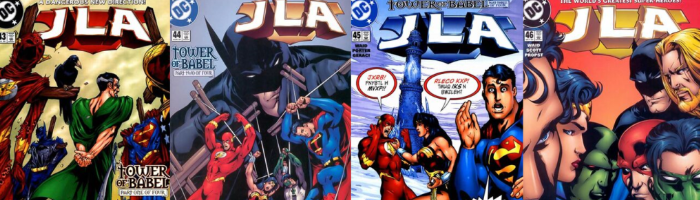
Writer: Mark Waid Artist: Howard Porter

Story Title: “Tower of Babel, Part 1: Survival of the Fittest”
Published: July 2000

Story Title: “Tower of Babel, Part 2: Seven Little Indians”
Published: August 2000

Story Title: “Tower of Babel, Part 3: Protected by the Cold”
Published: September 2000

Story Title: “Tower of Babel, Part 4: Harsh Words”
Published: October 2000

The Background:
In the 1940s, All Star Comics brought together eight superheroes from different publishers for the first time, birthing not just the Justice Society of America (JSA) but also the first ever superhero team in comics, allowing readers to see their favourite characters interacting for the same price in a single issue. The JSA’s ever-changing roster underwent their most significant change at the late-1950s, when then-editor Julius Schwartz had writer Gardner Fox with reintroduce and rebrand the team as the Justice League of America (JLA) to capitalise on the popularity of the American Football League and Major League Baseball’s National League. Clark Kent/Superman, Bruce Wayne/Batman, Diana Prince/Wonder Woman, Hal Jordan/Green Lantern, Arthur Curry/Aquaman, Barry Allan/The Flash, and J’onn J’onzz (or “John Jones”)/Martian Manhunter debuted as the JLA in The Brave and the Bold #28. Their origin story became a best-seller and the initial line-up of DC’s heavy-hitters is arguably the most iconic, which is exactly why they were at the forefront of the team’s revamp in the 1990s. Spearheaded by Grant Morrison, the new JLA title also became a best-seller and greatly inspired their celebrated animated adventures. This new team battled the likes of White Martians and the adaptable supervillain Prometheus, whose unexpected victory over the JLA laid the foundation for this widely regarded story. Marking the beginning of Mark Waid’s memorable run on the book, “Tower of Babel” had long-term repercussions, was critically acclaimed, and was even loosely adapted into a pretty decent animated feature.

The Review:
Although I grew up reading odd issues and random annuals from the 1970s and 1980s, this is the Justice League I mostly closely associate with. Superman (fresh off his brief stint as an energy being), Batman, Wonder Woman, Wally West/The Flash, Kyle Rayner/Green Lantern, Aquaman (in his best, most intimidating look), and even Patrick O’Brian/Plastic Man being included for some visual variety and laughs made for an impressive and powerful incarnation of the team. “Tower of Babel” pits this team against Rā’s al Ghūl, the “Demon’s Head” who fronts the League of Assassins and believes humanity is a danger. His anger at an aide accidentally dooming the Javan tiger to extinction only precipitates his latest plan to wipe out humankind, which begins with him playing spiteful mind games with his respected adversary, the Batman (whom he reverentially refers to as “The Detective”), by exhuming his parents. Rā’s then dispatches his daughter, Talia, to strike the Martian Manhunter with an explosive shell of strange nanites. Nearby, the Flash and Wonder Woman desperately fight a mysterious and aggressive forest fire, only to be amazed and horrified when the source turns of to be J’onn, his body engulfed in perpetual flames that the Flash extinguishes with his fantastic speed. Aquaman and Plastic Man are then attacked within the United Nations, Aquaman being gassed by a substance that makes him deathly afraid of water and Plastic Man frozen and shattered into a dozen pieces!
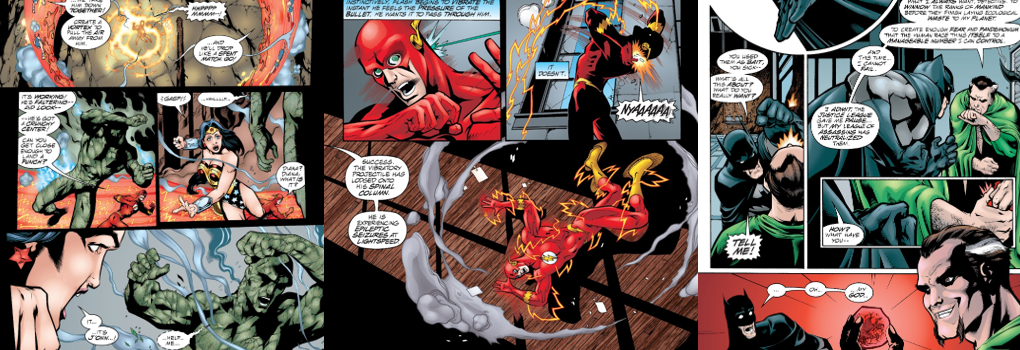
Batman’s horrified when Rā’s targets the JLA using his secret contingency plans!

The injured or affected JLA members are brought to their Watchtower space satellite by their teammates. Superman analyses the nanites infecting the Martian Manhunter and discovers they’ve forced his body to combust in air. Crippled by fear toxin, Aquaman’s condition deteriorates as he rapidly dehydrates and, though the Flash pieces Plastic Man back together, they’re unable to restore him. Realising that the JLA is being targeted, Superman coordinates with John Henry Irons/Steel and Barbara Gordon/Oracle to keep their reserve members are safe but Batman abruptly refuses to help. After switching to Clark Kent to use his sources at the Daily Planet for a possible lead, Superman and the staff are astonished to find that all text has become incomprehensible! Superman races to curb the ensuring madness, learning from Oracle that the aphasia’s caused by ultrasound waves, which he successfully disrupts by retrofitting some Brainiac tech. Finally, Wally and Diana find Kyle woke up suddenly blind, which understandably causes the artist great distress. Although Aquaman figures out that the League of Assassins are tracking their signal devices, his warnings come too late and Diana is trapped within a never-ending battle simulation courtesy of a virtual reality chip. The Flash is also shot with a “vibrational projectile” that induces epileptic seizures at lightspeed and Kyle, directionless and berserk without his eyes, is easily subdued by a begrudging Talia. The world is plunged into chaos as the stock exchange collapses, gang wars break out, planes narrowly avoid collision, military services grind to a halt, and hospitals are rendered useless. The Batman angrily confronts Rā’s in his modern-day Tower of Babel, where Rā’s relishes the chaos and threatens offers to resurrect the Waynes using his rejuvenating Lazarus Pits.
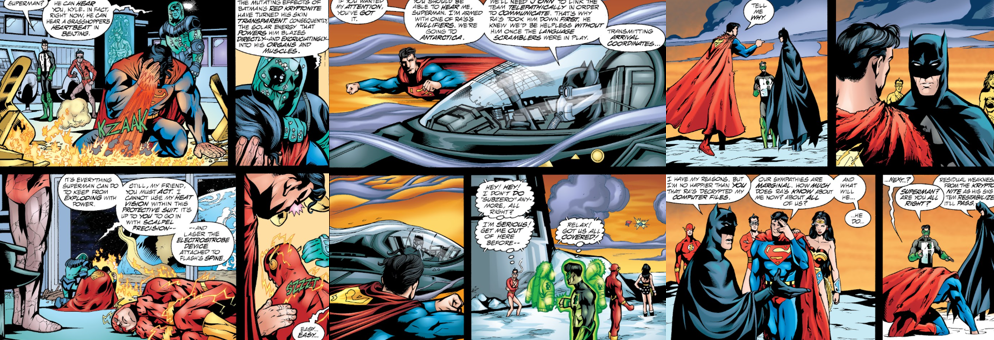
The JLA is left aghast and traumatised by Batman’s betrayal.

Despite clearly being tempted and overwhelmed by the proposition of being reunited with his parents, the Batman attacks in a rage but is horrified when Rā’s brandishes synthetic red kryptonite. Subdued by Rā’s’s troops, Batman fails to warn Superman who is caught completely off-guard when he arrives to help Wally, Diana, and Kyle with Martian Manhunter (wearing a special Atlantean water suit). Although Batman escapes Rā’s and Talia seems displeased at being her father’s lapdog, Superman’s crippled with agony when the rock turns his skin transparent and overloads him with solar energy. Alarmed that Rā’s has stolen his secret contingency files and turned them on his allies, Batman desperately tries to contact Aquaman with a solution, only for Rā’s to further disrupt communications. Luckily, Batman fools his pursuers with a fake death and Plastic Man finally pulls himself back together to teleport the JLA back to the Watchtower. There, Arthur is sustained by a telepathic illusion courtesy of J’onn, Plastic Man removes the chip lodged in Diana’s brain, and Superman focuses long enough to destroy the device tormenting the Flash. Finally, Diana and J’onn work with Kyle to deduce that his ring was slipped on him during sleep and that his blindness was caused by a post-hypnotic suggestion; by focusing, Kyle’s sight returns. The shellshocked JLA discuss Batman’s actions, their faith in their teammate shattered, with Superman feeling especially betrayed. Despite knowing the JLA distrust him, the Batman gathers them in Antarctica to infiltrate Rā’s’s tower, demanding the team work together to end the worldwide disruption. The battle is incredibly brief as Superman simply explodes in a burst of power, bringing the tower down and demanding an explanation from his comrade, only to be stonewalled by Batman’s stubborn nature.
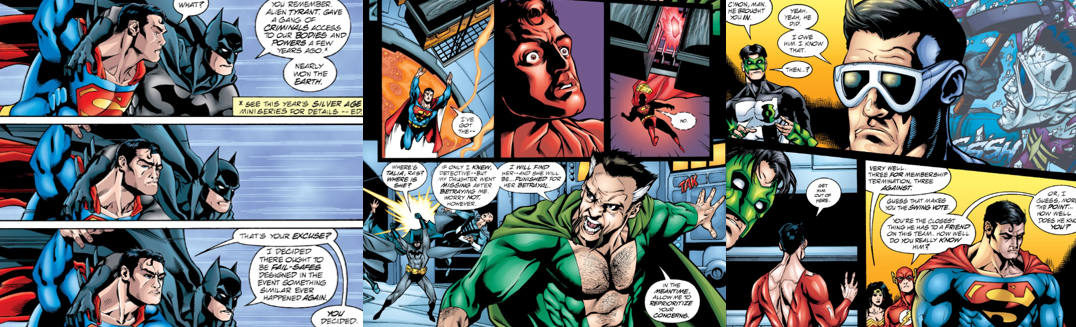
Although Rā’s is stopped, the JLA are fractured by Batman’s questionable actions.

Despite the tower’s destruction, a disgruntled Talia informs the JLA that Rā’s is still a threat, leading Batman to split the fractured team up to handle each crisis. While Green Lantern, Plastic Man, the Flash, and Wonder Woman stop a chemical attack in Rhapastan, Batman explains to Superman that he created fail-safes after the alien tyrant Agameno swapped their consciousnesses with a gang of criminals. Finding little comfort in that explanation, Superman echoes Plastic Man’s uncharacteristically stoic and enraged demeanour by leading Batman through Rā’s’s stronghold. Though Rā’s prepares to retreat in frustration and Superman’s held off by the red Kryptonite, he covers his escape by dropping the Waynes’ coffins! Luckily, the restored Aquaman and Martian Manhunter pull both Superman and Batman’s parents from danger, leaving Batman free to pursue his adversary. While Rā’s escapes, his assistant, Doctor Kant, isn’t so lucky and takes the brunt of Batman and Aquaman’s retaliation, while Wonder Woman convinces Rā’s’s agent out of unleashing his chemical agent. With the danger over and the JLA back to full strength, the team debate what to do about Batman. While the Dark Knight awaits their decision, Superman questions whether they should have safeguards against their powers being manipulated. Aquaman believes the team should be based on trust, the Flash reluctantly thinks Batman has a point, and J’onn somewhat echoes this sentiment. When Arthur challenges J’onn’s loyalty to the Batman, pointing out that he once had similar dossiers, a fight almost breaks out between them, though J’onn ultimately votes in favour of Batman. While Kyle’s also not happy about what happened, he recognises that their powers are potentially dangerous and also votes to keep Batman on the team. However, while Wonder Woman agrees in principle, she refuses to fight alongside someone she can’t trust and Plastic Man coldly agrees. Although the deciding vote comes down to Superman, Batman makes the decision for them and quits the team without a word while they’re debating.

The Summary:
Like I said, this was a great time to be a JLA fan. The artwork was always really good in these comics and the team gelled really well together visually and with their contrasting personalities. It’s a very nineties period for the JLA, of course, with guys like Aquaman and newcomer Kyle Rayner offering very different interpretations of classic characters. I’ve always loved this version of Aquaman, though, with the harpoon hand and dishevelled appearance. Kyle is and will always by my favourite Green Lantern and I enjoyed the dichotomy he brought to the team as he obviously felt a little out of his depth and often deferred to his superiors as a result. These are characteristics reminiscent of Wally’s early days as the Flash, which led them to eventually form a tight friendship, but much of Kyle’s characterisation at this time was proving (or at least realising) that he’s worthy to hang with the big boys. Plastic Man was something of a wild card, for sure, especially due to his goofy nature and bizarre abilities. “Tower of Babel” showed that there was more to him than just being a wise-ass, though, as he’s so traumatised by being frozen and shattered (and by the Batman’s actions) that he drops the jokes and dismissively votes against Batman. Indeed, this story shakes the foundations of the JLA as, up until this point, they’ve all fought together on the understanding that they can trust each other. I’m pretty certain they all know each other’s strengths, weaknesses, and secret identities, for example, and feel they’re more than just colleagues. Thus, when they discover that Rā’s al Ghūl’s plot is due to Batman’s secret contingency plans, the team rightfully feels betrayed and angry, with Superman noticeably upset since he knows Batman the best and has worked with him the longest.
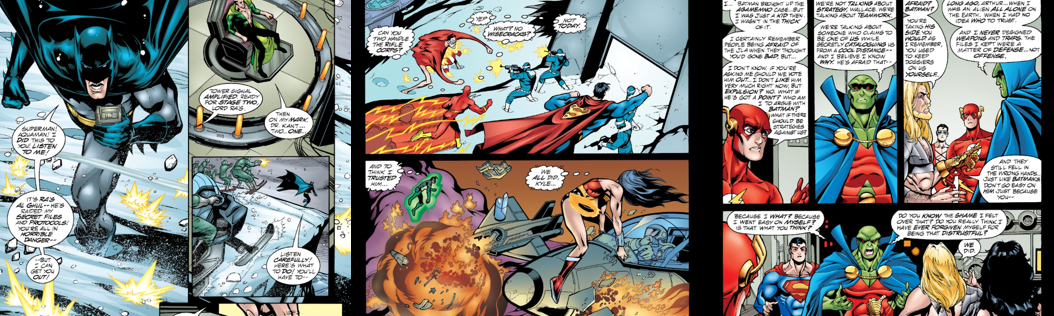
The JLA is divided and rattled by Batman’s betrayal and questions his trustworthiness.

Thus, the main enemy in “Tower of Babel” is essentially Batman, while technically also being the group’s insecurities, and more accurately being the devious Rā’s, who disrupts them to facilitate his latest scheme. The JLA is caught completely off-guard when Talia and her troops ambush them, wielding weapons designed specifically to neutralise their powers or otherwise subdue them. While I believe Batman’s plan was always to non-fatally pacify his teammates if they go rogue or were manipulated, some of his contingencies are very questionable. J’onn, for example, bursts into flame when exposed to air, something that would be both physically and emotionally traumatic for him considering his fear and weakness to fire. Aquaman is almost killed by dehydration when fear toxin variant made him deathly afraid of water, forcing J’onn to put him at ease with a telepathic vision so he could be safely placed in water. The Flash had it pretty bad, too, forced to endure what felt like days of torturous seizures in less than half an hour, while Superman’s powers raged thanks to red kryptonite. Similarly, it seems Wonder Woman would’ve eventually been so lost in her endless combat that she would’ve perished and Kyle was extremely distressed when he was duped into making himself blind. Seems to me that Batman could’ve just as easily used virtual reality environments for all his allies for a similar end, so it’s likely Rā’s al Ghūl perverted his countermeasures. Either way, the JLA are outraged at both the experience and the betrayal, believing Batman misled them and cannot be trusted. Even if he was right, since the JLA are mind controlled every other week and have extremely dangerous powers, the characters are angry at the deception. I doubt their reaction would’ve been much better had they known about Batman’s fail-safes, but it certainly would’ve lessened the sting since they put a lot of trust in him as their strategist and smartest mind.
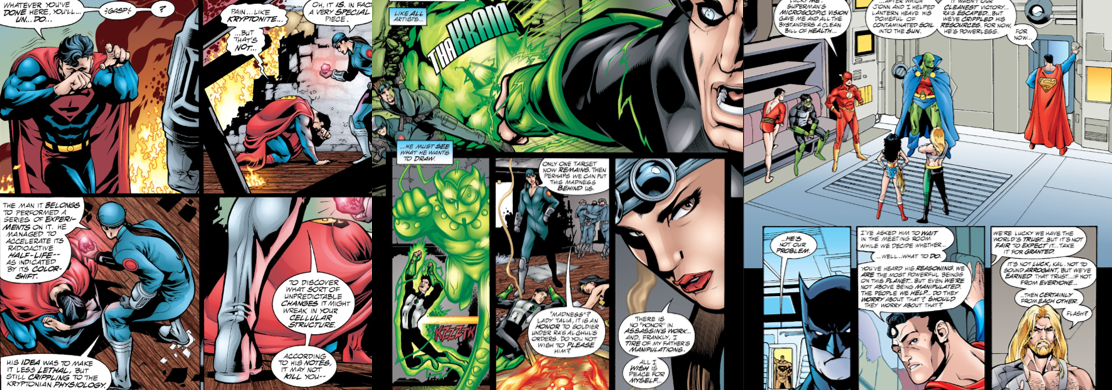
A classic story that deconstructs the JLA and had far-reaching consequences.

This ethical quandary hangs over “Tower of Babel”, creating tension and animosity within the group for the finale, where they can barely function as a cohesive unit and are extremely reluctant to listen to Batman. Though he’s horrified by what Rā’s al Ghūl has done, Batman offers no apology and little explanation. He believes he was right to create contingencies and won’t be swayed from the belief, kick-starting a long-tunning theme of Batman being a stubborn, paranoid, and somewhat unethical character whose efforts to prepare for every scenario alienated his nearest and dearest. Interestingly, “Tower of Babel” doesn’t suggest what Batman’s back-up plan was if he went rogue (though it’s implied to be the remaining JLA) and barely gives him a chance to counteract Rā’s al Ghūl’s actions since the Demon’s Head keeps messing with their communications. I would’ve liked to see more of the world being plunged into chaos but I think “Tower of Babel” wisely focuses on the JLA and how they’re affected by Batman’s actions. The entire point is to fracture DC’s greatest superhero team, which literally happens by the end when the Batman walks away without hearing a verdict, but has knock-on ramifications as tensions are high amongst the others. I enjoyed seeing the team struggle to decide Batman’s future since they were personally disgusted and angered by the betrayal but recognised the need for fail-safes, and also how black-and-white the decision was for Aquaman and Wonder Woman, who felt the betrayal outweighed the risk. “Tower of Babel” easily ranks as one of the top JLA stories for a reason and it’s a great deconstruction of the team and exploration of their powers, weaknesses, and the fragile ethics that hold them together. It had far-reaching consequences for all involved and is well worth a read, especially for fans of this era of DC Comics.

My Rating:

Rating: 3 out of 5.

Pretty Good

What did you think of “Tower of Babel”? Do you consider it a classic JLA story or do you think it’s over-rated? Which of Batman’s contingencies do you think was the worst to suffer through? Did you enjoy this incarnation of the JLA or do you prefer a different line-up? Do you think Batman was right to have contingency plans or do you agree that he crossed a line? How are you celebrating Justice League Day this year? Whatever your thoughts on the JLA, feel free to share them below, check out my other Justice League reviews, and go donate to my Ko-Fi to suggest other JLA stories for me to cover.

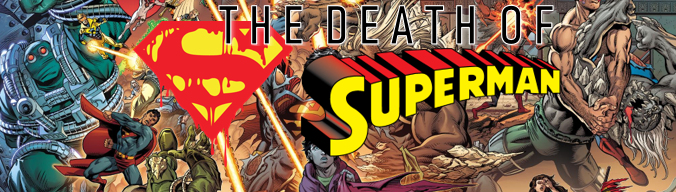
Back Issues [Superman Day]: The Death of Superman


In 2013, DC Comics declared the 18th of April as “Superman Day” so fans of the Man of Steel could celebrate Clark Kent/Kal-El/Superman, the superpowered virtue of “Truth, Justice, and the American Way” who is widely regarded as the first ever costumed superhero.


Published: December 1992 to October 1993
Writers: Dan Jurgens, Jerry Ordway, Louise Simonson, and Roger Stern
Artists: Brett Breeding, Dan Jurgens, Jackson Guice, Jon Bogdanove, and Tom Grummett

The Background:
Jerry Siegel and Joe Shuster first met in 1932 while attending Glenville High School and, just one year later, dreamed up their first draft for a superman with “The Reign of the Super-Man”. About five years later, a revised version of this concept appeared in Action Comics #1 and the world met Superman for the first time. Not only was Superman an immediate hit, but he went on to become a cultural icon. After decades of increasingly over-the-top stories, DC Comics tasked John Byrne with reimagining Superman for modern audiences. Under Byrne’s direction, Superman was a more grounded character and his stories adhered to strict continuity guidelines. After Byrne left DC Comics over creative differences, Superman group editor Mike Carlin moderated frequent “Superman Summits” involving Byrne’s replacements. It was during these chaotic meetings that writer/artist Jerry Ordway would jokingly suggest killing the Man of Steel. With Superman’s sales taking a hit thanks to readers favouring more violent anti-heroes, the creatives planned to shake things up by having Superman reveal his identity to his long-time love, Lois Lane, and eventually marry her. However, these plans were postponed to coincide with a similar arc on Lois & Clark: The New Adventures of Superman (1993 to 1997) and thus the idea of “Doomsday for Superman” was developed. Writer Dan Jurgens came up with the concept of a monster tearing through Metropolis and a climactic fist fight between it and Superman, before sketching a design for the creature that was subsequently dubbed Doomsday. Although DC always planned to resurrect the character, Superman’s death was headline news and became a best-selling title, despite being criticised as a publicity stunt. Despite also dying in this story, Doomsday would return to dog Superman, evading the literal death of the universe and evolving into both an ally and an intelligent being, though he never returned to the prominence he had in this first arc. Doomsday and the “Death of Superman” concept also appeared outside the comics: there was a videogame adaptation, multiple animated ventures, and it was long considered for a live-action adaptation before being brought to life first on television (with disastrous results) and then on the big screen (to similar chagrin) before finally having more faithful live-action renditions on Krypton (2018 to 2019) and Superman & Lois (2021 to 2024).

The Review:
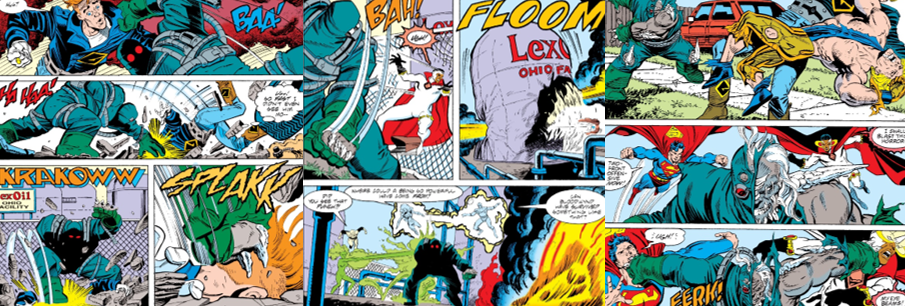
Our story begins “somewhere else…” where, deep underground, in a reinforced prison, a mysterious monster repeatedly strikes its cage. Each blow sees the thing’s containment suit rupture little by little, revealing menacing bone appendages on its knuckles, and the metal wall crack and weaken until, eventually, the creature we now know as Doomsday bursts free! Oblivious to this impending threat, Superman’s far more concerned with tracking down the Underworlders, a group of misfits, monsters, and outcasts from the shady Project Cadmus who dwell deep beneath Metropolis. Led by the simple-minded but nigh-invulnerable Clawster (whose rocky design and bony appendages are eerily evocative of Doomsday’s final form), the Underworlders cut the city’s power in a bid to rise up and take the streets as their own. Luckily for Superman, young Keith White alerts him to the Underworlders’ plot and that they’ve taken Lois Lane hostage after she stumbled upon their lair. Though bolstered by technology stolen from War World, the Underworlders are no match for Superman, who easily fells Clawster with a grenade to the mouth, trashes their digging machine, and ends their plot. Thanks to Lois’s informant, Charlie Underwood, the plot is revealed and the uprisers are imprisoned to await trail by their more peace-loving people. However, while all this is going on, Doomsday runs amok across the countryside and causes chaos in Ohio…all with one hand tied behind his back! Thanks to Oberon monitoring the police band, Justice League International arrives to help with the rescue effort and, after learning the devastation was caused by a “monster man”, Ted Grant/The Blue Beetle rallies the JLI in pursuing the culprit. While Superman gives a candid interview of his life and allies, the JLI follow Doomsday’s trail of destruction. Though neither the mysterious Quintus Arce/Bloodwynd or the battle hungry Maxima’s psychic probes offer little information on the creature other than him being “hate–death and blood lust personified”, they soon come face-to-face with Doomsday when he wrecks the Bug with a tree trunk and starts tearing through a LexCorp oil refinery.

A monstrous creature tears across the countryside…and through the Justice League!

Never one to back down from a fight, Guy Gardner (who wasn’t a Green Lantern at this point but instead wielded Thaal Sinestro’s yellow ring) immediately attacks, only to be blindsided by the creature’s incredible speed and left damn near blinded when it pounds his face into the ground! Beatriz Da Costa/Fire’s intense heat blasts do little to halt Doomsday’s attack so Bloodwynd steps in. Summoning the “spirits of the dead” into a powerful blow, he’s stunned when Doomsday barely registers the punch and is then sent hurtling into the oil refinery (and an explosive end). The Blue Beetle rushes in to help his secretive ally, catching a glimpse of Bloodwynd’s true form before Doomsday strikes. With no superpowers and being little more than a child against the monster’s awesome strength, the Blue Beetle is manhandled by Doomsday and beaten into a coma. Enraged, Michael Carter/Booster Gold throws a “full-intensity blast” but barely has time to erect his force field before Doomsday sends him flying. Luckily, Superman intercepts him, having been alerted to the crisis by a stagehand. Unfortunately, though Maxima spirits the Blue Beetle away for medical attention, Superman’s too late to save Tora Olafsdotter/Ice from being tossed into the home of some innocent bystanders. Superman’s initially unimpressed by Doomsday, easily taking the creature’s first blow, but is astonished when the follow-up kick sends him flying harder than he’s ever been hit before. Realising Doomsday’s threat, Superman rallies and stands with the remaining Leaguers, who combine their individual powers in an intense barrage. Though completely encompassed by the onslaught, the effort drains Fire and Booster Gold’s physical and power reserves. Unfortunately, their efforts are wasted as Doomsday emerges unscathed save for his torn containment suit, revealing a scowling, gruesome visage that gleefully rushes the fatigued heroes. Booster Gold endures a horrific beating, then Doomsday easily tramples the others and causes another inferno before leaping away. Although Superman chases and temporarily subdues the creature underwater, he’s forced to help the injured Justice League rescue the innocent bystanders caught up in Doomsday’s rampage. With the JLI down, Superman resolves to pursue and stop Doomsday alone.

Despite Superman’s best efforts, Doomsday crashes into Metropolis and endangers his loved ones.

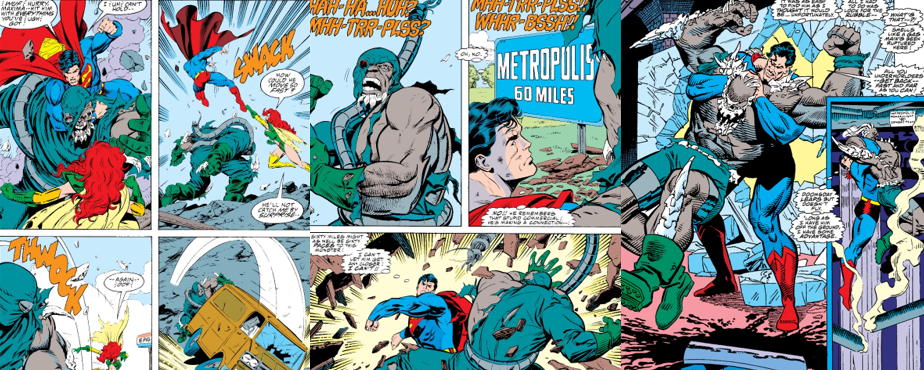
Despite the military’s best efforts, Doomsday continues his rampage. As Superman battles the creature, he’s stunned by Doomsday’s complete lack of empathy and troubled that the snarling brute seems to be growing stronger as the fight progresses. Although Lex Luthor II (Lex Luthor inhabiting a young, fit body and masquerading as his own son) forbids Matrix/Supergirl (a protoplasmic alien rather than the traditional Kara Zor-El) from assisting Superman out of fears for her safety, Maxima jumps in to help…only to cause more destruction and endanger additional lives. After Maxima is left concussed, Superman asks James “Jim” Harper/Guardian to tend to her and continues pursuing Doomsday, determined to put the monster down before he does any more damage. Doomsday carves a path of destruction across the countryside and eventually winds up tearing through a Lex-Mart store, where a television commercial for a Metropolis wrestling match catches his attention. Obsessed with “Mhh-trr-plss”, Doomsday prepares to head there and Superman flies into a desperate second wind,  continuously amazed that his strongest blows barely faze the monster. With Lois and Jimmy Olson covering the battle, Superman accidentally hurls Doomsday into Habitat, a tree-city created by Project Cadmus. Resolving to fight smarter rather than harder since just hitting Doomsday hurts, Superman buries Doomsday beneath Habitat, only for him to burst free in a rage and resume his course towards Metropolis. Superman intercepts Doomsday and finally tries to fly him off-world, only for Doomsday to easily wriggle free and send Superman crashing into a construction site. As Jonathan and Martha Kent watch on horrified, Doomsday crashes into the Underworlder domain, inadvertently rescuing and then purposely slaughtering the prisoners, and causes a massive explosion to rock the city when his foot collides with a power line.

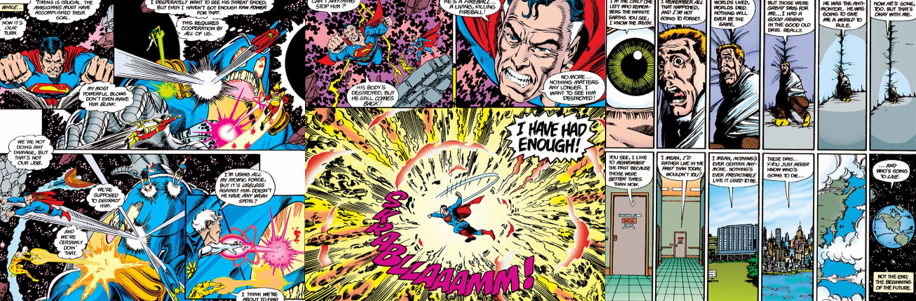
Superman battles valiantly and ultimately stops Doomsday at the cost of his own life.

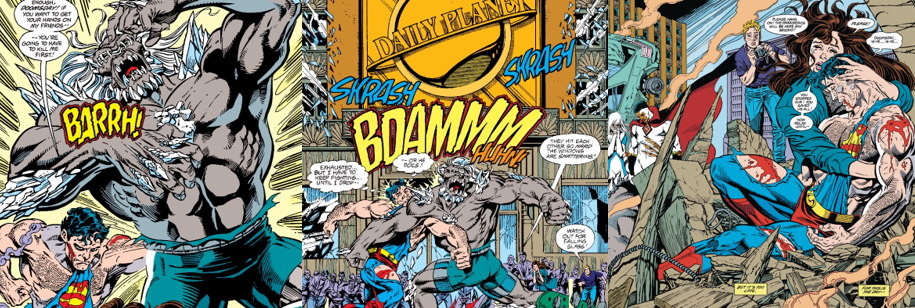
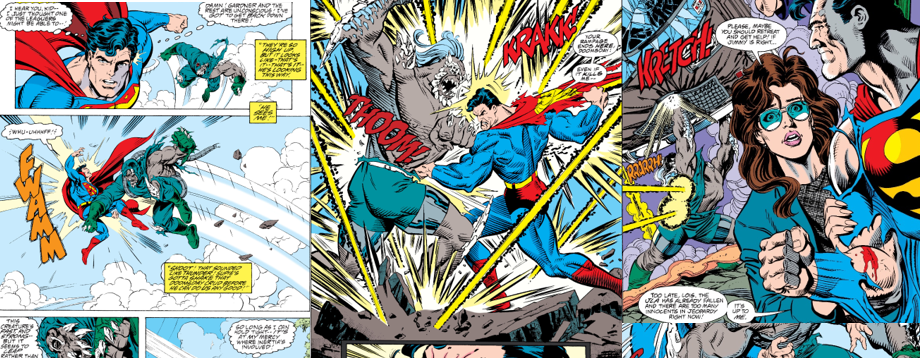
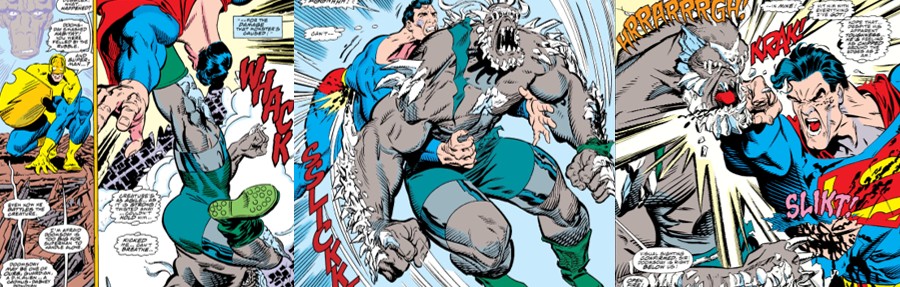
Superman’s second attempt to fly Doomsday away ends with him skewered through the abdomen by one of Doomsday’s spines. Finally released to assist, Supergirl is immediately dispatched with a single punch that reduces her to protoplasmic goop and even Professor Emil Hamilton’s massive laser cannon barely fazes the beast. Still, these distractions give the injured Superman time to regroup; hoping that Doomsday is as fatigued as him, Superman redoubles his attack. Luthor’s paratroopers and even Metropolis’s finest try to aid the Man of Steel, bombarding the creature with laser blasts that seemingly have no affect. Battered, exhausted, and desperate, Superman’s constantly distracted by saving innocents so, after rescuing Lois and Jimmy, he bids an emotional farewell to his fiancée and flies at his adversary, determined to put Doomsday down by any means necessary. Despite fighting for most of the day and having journeyed across the country and endured horrendous punishment, Doomsday easily overpowers Superman, cutting and bruising him. Superman finally hurts the creature by targeting Doomsday’s bony protrusions before the fight devolves into a slugfest outside the Daily Planet. Each blow shatters windows as the two relentlessly pummel each other, neither backing down until, finally, they fly in for the killing blow. Superman and Doomsday strike simultaneously, the force of their final blows sending shockwaves across the country, and Doomsday finally falls, apparently dead. Too late to help, Bloodwynd and Ice can only watch in shock alongside the world and Superman’s nearest and dearest as the Man of Steel collapses. Lois cradles her beloved, unconcerned about hiding her grief, as Superman breathes his last and succumbs to his wounds. Lois is left wailing as Superman, his costume torn and tattered and bloody, lies still amidst the rubble of his titanic clash, leaving the onlookers and his friends and family stunned.

The Summary:
“The Death of Superman” isn’t so much a story as it is a long, protracted beatdown of the Man of Steel. Amidst the fighting, the story takes a few detours to explore Superman’s opinion of his fellow heroes and his impact on the world. While most people find him an awe-inspiring figure and celebrate him as the world’s greatest hero, others are more dismissive. A teen eventually caught in Doomsday’s rampage is especially outspoken about the Man of Steel, preferring hot-headed Guy Gardner instead, only to be indebted to Superman when he puts his life on the line to protect his family. Guy, especially, is overly critical of Superman, blinded by pride and arrogance and attacking Doomsday head-on only to be mutilated and humbled. Doomsday’s threat is so great that even some of Superman’s more duplicitous and mysterious allies aid him with Dubbilex attempting to probe the beast for clues to his origin and the supercilious Maxima throwing herself into the bout to try and prove her worth. While the outside world sees Lex Luthor II as a benevolent figure, he’s the same conniving antagonist he’s always been. He doesn’t get involved until Superman and Doomsday are literally tearing through his city and, even then, his tech and even Supergirl’s bizarre powers are no match for the creature. Nowhere is this better showcased than in Doomsday’s utter decimation of the Justice League. Sure, the JLI was never the strongest incarnation and his demolition of them isn’t as powerful as if he were shredding the likes of Arthur Curry/Aquaman, Princess Diana Prince/Wonder Woman, and Wally West/The Flash, but it sends a startling message when Earth’s greatest heroes are beaten by one creature. However, the narrative is quite repetitive after a while. I lost count of how many times Superman and other characters muse over the creature’s strength, tenacity, and origins and, while the art is good, it’s inconsistent throughout. For example, Superman’s injuries vary between issues, with some issues ending with him bleeding and bruised and others ignoring those injuries before leaving him with different ones.

When Doomsday decimates everyone else, Superman resolves to put him down at any cost.

As a story about Superman’s will, “The Death of Superman” is quite powerful. Where the JLI and others fail due to being significantly underpowered, Superman fights on, battling Doomsday almost non-stop across the country. During their fight, Superman constantly stops to rescue bystanders and is always trying to keep Doomsday from populated areas. When he realises Doomsday’s heading to Metropolis, Superman desperately tries to keep him from reaching the city and, when this fails, he commits to ending the beast’s rampage. Sure, Superman rarely tries to get Doomsday off-world, but Doomsday is not only incredibly strong, but extremely agile and he easily escapes Superman’s grasp or leaves him gravely injured. At one point, Superman tosses Doomsday several miles away so it’s possible he could’ve launched Doomsday into space. However, Superman constantly notes that Doomsday never tires, seems to be growing stronger, and adapts to each situation. What works against Doomsday once won’t necessarily work a second time, something greatly expanded upon in subsequent appearances, so I think this is acceptable enough as an explanation for why Superman doesn’t just toss Doomsday into space. The conflict causes great distress for Lois and Jimmy, who are forced to watch and report as the man they love and admire is beaten to death before their eyes. While Lois eschews the usual restraint regarding her relationship with Superman to comfort and tend to him, the Kents are forced to watch, helpless, as their son is beaten to a pulp on live television. The impact of Superman’s deteriorating health is felt by every character and is palpable through the artwork. There’s a real sense of desperation as the fight reaches its climax and a shocking gut punch as the final blows are struck.

The mysterious Doomsday lives to kill and is little more than a mindless beast.

In many ways, it’s disappointing that Superman dies not at the hands of a traditional villain but in a slugfest with a monster. However, Doomsday is a visually intimidating and impressive monster. Initially garbed in an uninspiring containment suit, Doomsday’s true form – a snarling, grey-hued monstrosity – is revealed as he tears through his opponents and shrugs off their attacks. Doomsday never speaks; he simply barks laughter, grunts, and mumbles a bastardised growl of “Metropolis”. He’s noted to be “faster than Flash”, easily overturns trucks and rips apart bridges and buildings, and is not only inhumanly strong but absorbs tremendous punishment. Even the combined energy powers of the Justice League barely faze him, blows from mighty man-made trees barely slow him, and even hitting the brute causes Superman pain. Doomsday is malicious and bloodthirsty, slaughtering wildlife and innocents and beating the JLI with relish, and becomes fixated on both Metropolis and Superman. Throughout the story, psychics try to learn his origins and find only hatred and destruction. Doomsday is, essentially, a blank canvas; a mindless beast determined to destroy. Later stories fleshed out his origin (which is actually really interesting) but I can totally understand why adaptations made him a man-made doomsday machine or added to his lore as he’s primarily an invincible McGuffin shamelessly designed to shock the world by killing Superman. Superman realises far too late that Doomsday can be hurt by targeting his bony protrusions and he barely takes advantage of this, breaking one before going back to trading punches with the beast. This is a bit of a shame as it means the finale was always anti-climactic for me. We never see Doomsday tire, he rarely shows pain, he has no injuries and survives shots that look far more devastating than Superman’s final blow. This, as much as the tedious nature of their fight, means I’ve never held “The Death of Superman” to very high regard beyond it being notable for killing the Man of Steel and introducing a monstrous new villain for Superman, one who sadly never reached these same heights again because it’s difficult to top killing the world’s most powerful superhero.

My Rating:

Rating: 3 out of 5.

Pretty Good

What did you think to “The Death of Superman”? Were you disappointed that Superman wasn’t ended by one of his more iconic foes? What did you think to Doomsday, his design and characterisation (or lack thereof)? Were you disappointed that a more powerful version of the Justice League didn’t battle Doomsday? Do you think the story suffers from being little more than a prolonged slugfest? Did you enjoy Doomsday’s later appearances or do you think he peaked here? How are you celebrating Superman Day today? Whatever you think, feel free to share your opinions in the comments below and feel free to check out my other Superman content on the site.

Back Issues [Crossover Crisis]: Crisis on Infinite Earths


Cover-dated April 1985, the first issue of this ground-breaking event precipitated the destruction of the “Multiverse” in favour of a unified DC canon. Though DC returned to this concept again and again, that doesn’t change how influential this massive crossover was and what better way to celebrate than with a “Crossover Crisis” of my own?


Published: 3 January 1985 (cover-dated: April 1985) to March 1986 (cover date)
Writer: Marv Wolfman
Artist: George Pérez

The Background:
In Showcase #4 (1956), writer Robert Kanigher and artist Carmine Infantino debuted Barry Allen/The Flash, the successor to Jay Garrick, who was established as an alternative version of the Fastest Man Alive. This concept was taken to the next level when Barry and Jay met face-to-face, revealing an infinite number of parallel worlds. Regular crossovers between the likes the Justice Society of America and the Justice League of America soon followed, allowing alternative heroes and various stories to exist simultaneously. Over time, writers like Mark Wolfman became frustrated with this concept, which made keeping track of continuity difficult and it was hard for both writers and readers to connect with the stories. Wolfman initially pitched a reader guide to simplify the DC universe, which then evolved into a sprawling tale of multiversal destruction seen as a risky proposition as it meant erasing all continuity and starting from scratch to attract new readers. Such an event was unprecedented and DC spent two years laying the foundation for this Crisis, hiring researchers to document every character and event in their library and bringing in George Pérez to illustrate, with the artist excited at the idea of illustrating every DC character. Crisis on Infinite Earths became a bestseller for DC Comics and was heralded as a turning point for both the publisher and the industry. The fallout saw every DC character rebooted, with Clark Kent/Superman notably being reimagined as a more grounded character and Wally West taking over as the Flash, though Carter Hall/Hawkman was irrevocably damaged for years as DC struggled to reconcile certain elements of his character. Praised as the greatest comic book crossover in history, the event popularised massive, cosmic crossovers and DC revisited this concept numerous times in subsequent years. The event was even adapted into an ambitious and well received television event and an impressive three-part animated feature.

The Review:
Confused by the concept of the multiverse? Well, Crisis on Infinite Earths has you covered, to a degree, as it opens with (and features throughout) narration and exposition from the tragic Kell Mossa/Pariah. In the beginning, before there was light and life, there was only darkness. Then, from nowhere, came a single light that grew and expanded and finally exploded in “pain [and] relief” as the multiverse was born. The idea is infinite parallel realities all co-exist at once, separated by vibrational planes, though this is noted to not have been the intention when the light burst into being. The story the shifts to one such Earth where the hooded, weeping Pariah witnesses the destruction of not only that world, but the entire reality, at the hands of an all-encompassing white light. As entropy erases everything it touches, Pariah begs to be taken with it, sparing him his grim fate, only to be teleported away as the universe meets its destructive end. We then jump to Earth-3, home of the Crime Syndicate, an evil alternative version of the Justice League. There, Harold Jordan/Power Ring and Clark Kent/Ultraman desperately try to stop the cataclysmic natural disasters springing up across their world as the anti-matter wave approaches. While Thomas Wayne Jr./Owlman and Jonathan Allen/Johnny Quick lament their helplessness against such awesome power, the world’s only superhero, Alexander Luthor, watches helplessly as lifelong enemies like Diana/Superwoman are devoured by the anti-matter wave. With no way to save his world, Alexander rushes to be with his wife, Lois, and baby son, Alexander Luthor, Jr. In a parallel to Superman’s iconic origin, the baby is loaded into a specially prepared rocket and spirited away to Earth-1 as his world dies.

With all universes at risk of annihilation, the Monitor assembles a team of heroes and villains.

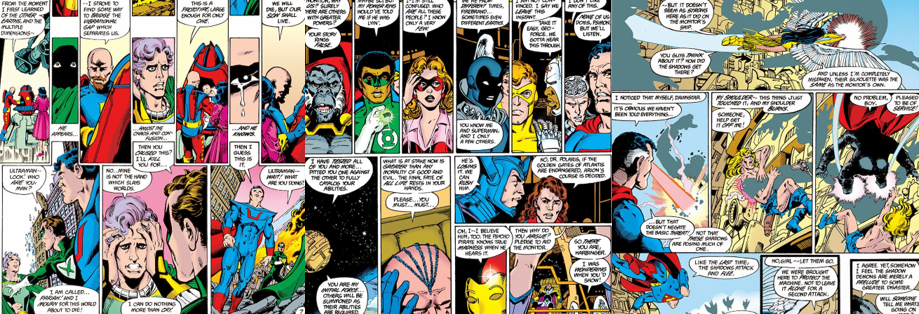
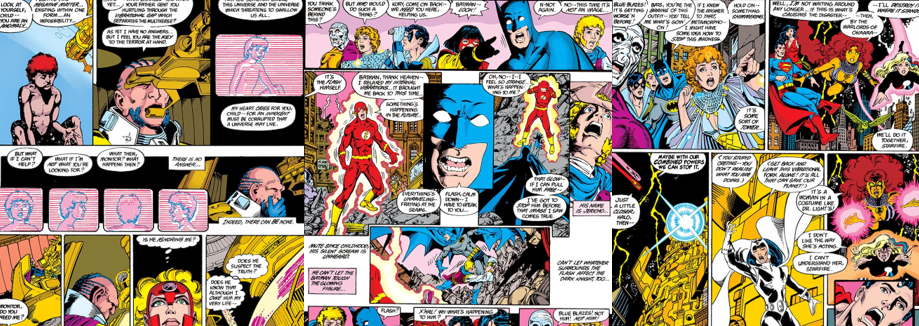
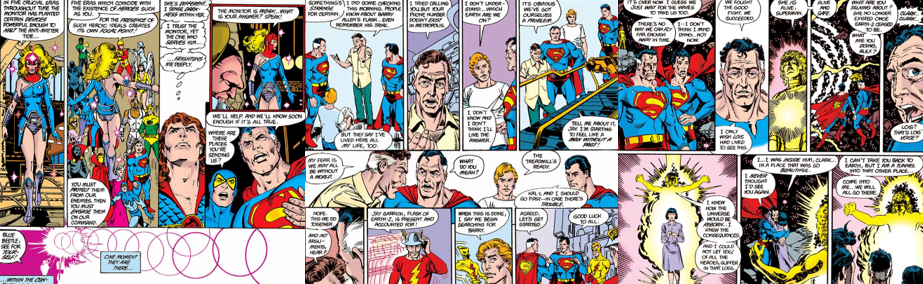
The mysterious Mar Novu/The Monitor observes this from his orbiting, spherical space station alongside Lyla Michaels/Harbinger, whom he sends to recruit Earth’s greatest heroes and villains to stop the pending Crisis. Harbinger recruits King Solovar from Gorilla City, Dawnstar from the 30th century Legion of Super-Heroes, Danette Reilly/Firebrand from Earth-2 1942, Ted Kord/The Blue Beetle from Earth-4, and Roger Hayden/Psycho-Pirate from present-day Earth-2. She returns Psycho-Pirate’s emotion manipulating Medusa Mask and coerces him into quelling Louise Lincoln/Killer Frost’s bloodlust and bringing both her and Ronnie Raymond and Professor Martin Stein/Firestorm to the cause. Though Harbinger is possessed by a Shadow Demon when recruiting Ahri’ahn/Arion the Sorcerer, he joins the other recruits, including Kal-L/Superman, John Stewart/Green Lantern, Neal Emerson/Doctor Polaris, Victor Stone/Cyborg, Simon Jones/Psimon, and Todd Rice/Obsidian. With tensions running high, the group are attacked by Shadow Demons, which seem impervious to physical, mental, and energy-based attacks. While the likes of the Blue Beetle can only run and Firestorm struggles with Killer Frost’s newfound affections, Obsidian and the arrogant Dr. Polaris put their shadow- and magnetism-based powers to good use. The Monitor halts the attack and introduces both himself and the threat to their universes. Weakened by the spread of anti-matter and facing suspicion from his assembled forces, the Monitor reveals that he’s judged them as the best hope of protecting five devices spread across the different eras that he hopes will halt the anti-matter wave. Meanwhile, reality is warped across the multiverse: in prehistoric times, Anthro the Cave-Boy is as astonished to spot a futuristic city amongst the wilds as Querl Dox/Brainiac-5 is to see mammoths stampeding through the 30th century. Half a galaxy away on Oa, the Guardians of the Universe prepare to summon their entire Green Lantern Corps to meet the threat, only for a mysterious voice to corrupt the Central Battery and trap them in a stasis beam. On Earth-1, Bruce Wayne/Batman is busy confronting the Joker during his latest crime spree and is astonished when an emaciated, confused Flash suddenly appears babbling about the end of the world and begging for help before disintegrating before the Dark Knight’s eyes!

As the Crisis worsens, the Monitors prepares Alexander and a new Dr. Light to face the threat.

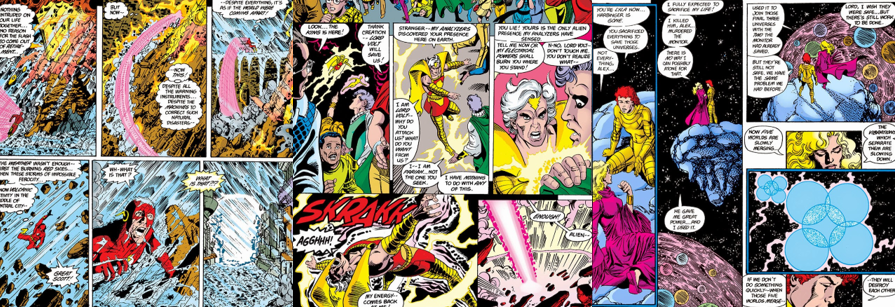
On the post-apocalyptic Earth-AD, Kal-L, King Solovar, and Dawnstar meet Kamandi, the last boy on Earth, and discover the Monitor’s device, a towering, golden Cosmic Tuning Fork that’s immediately (though only briefly) attacked by Shadow Demons. Arion, Obsidian and the Psycho-Pirate watch over another tower in Atlantis, only for the Psycho-Pirate to be transported to a dark realm and coerced into turning against the Monitor just as Harbinger secretly conspires with that same dark force. Oblivious, the Monitor experiments on the rapidly aging Alexander Luthor, Jr., an impossible merger of matter and anti-matter who potentially holds the key to defeating the anti-matter spread, whom Harbinger’s dark master wants destroyed before he can threaten his schemes. Meanwhile, in the far future of Earth-1, the Flash races to keep his world from being torn apart from natural disasters but is forced to vibrate at super-speed to escape death. This same anti-matter energy arrives on present-day Earth-1, much to the horror of the Teen Titans, who desperately try to both halt the destructive wave and save lives alongside Batman and Superman. As Linda Lee/Kara Zor-El/Supergirl does the same, Barbara Gordon/Batgirl gives in to self-doubt, and John Constantine arrogantly believes it’ll all work out, Vril Dox/Brainiac coldly observes the events concludes that, if he’s to survive, he must team up with Lex Luthor. While defending a Cosmic Tuning Fork from both Nazi forces and Shadow Demons in 1942 Markovia, the Blue Beetle discovers the mysterious Scarab fused to his suit is lethal to the shadowy entities but is wounded before he can put this to good use and returned to his world by the Monitor to spare him. Back on Earth-AD, the skies turn red and King Solovar succumbs to his wounds while Cyborg, Firebrand, John Stewart, and Psimon team up with some local heroes (including Jonah Hex) in 1879 to defend another tower, only to be as overwhelmed by anti-matter as the far-flung future of the Legion of Super-Heroes. Elsewhere, the terrified heroes of Earth-6 blame Pariah for the looming threat, to no avail (though Pariah does save Tashana/Lady Quark to ease his suffering). While the unseen villain forcibly recruits the Red Tornado, the Monitor activates an “ion-based energy ray” to empower Doctor Kimiyo Hoshi, transforming her into the new Doctor Light and sending her to defend his tower on Earth-1.

Following the Monitor’s death, his champions are convinced to unite and save the remaining Earths.

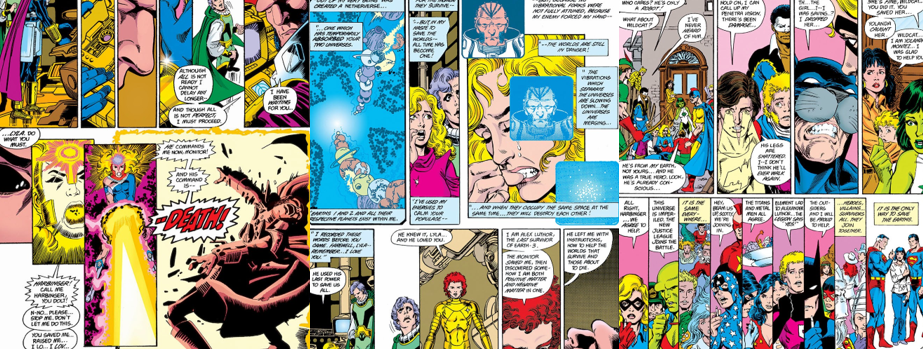
When the heroes attack her, believing she and the tower caused the entropy, Superman quells the fighting, though things take a turn when the Shadow Demons combine into one gigantic, terrifying entity in each era. Even Princess Diana Prince/Wonder Woman’s hopes of recruiting her Amazonian sisters fail. When Pariah berates the Monitor for not doing more to intervene, he reveals just how weak he’s become and then nobly faces his end at Harbinger’s hands. Distraught, Pariah weeps as Earth-1 and Earth-2 are finally consumed; confused to find his strength hasn’t increased as a result, the dark villain delights in having the Psycho-Pirate torture the Flash. Depowered, Lyla is distressed by her actions but a pre-recorded message from the Monitor reveals that his death allowed his essence to empower his Cosmic Tuning Forks and create a “netherverse”, a pocket dimension to keep Earth-1 and Earth-2 safe. After giving the Monitor an appropriate burial, Lyla, Pariah, and the now teenage Alexander Luthor, Jr. gather both world’s champions on the Monitor’s satellite to merge all existing realities into one lest all worlds and realities be lost. Since there are some doubters, Alexander has them witness the Red Tornado be forcibly transformed into a being of pure, primal force, one easily subdued by sorcerers like Kent Nelson/Doctor Fate and Zatanna Zatara (though Ted Grant/Wildcat’s legs are shattered during the fracas). Thus, even the most sceptical agree to defend their worlds, only for the satellite to disintegrate courtesy of the event’s big bad, the Anti-Monitor! Fleeing to the emptiness of limbo, Alexander moves to save Earth-4, -S, and -X, only for Harbinger to subdue him and take his place. While Yolanda Montez continues Wildcat’s legacy on Earth-2, the Freedom Fighters and the Monitor’s agents come to blows on Earth-X when the Psycho-Pirate, his powers augmented by the demonic Anti-Monitor, stirs fear and hatred amongst them. Similarly, on Earth-1, Billy Batson/Captain Marvel and his siblings mindlessly attack Supergirl and Wonder Woman, though the fighting ends when Harbinger forces Earth-4, -S, and -X into the netherverse alongside Earth-1 and Earth-2, exhausting her incredible powers but dooming them to be slowly merged together.

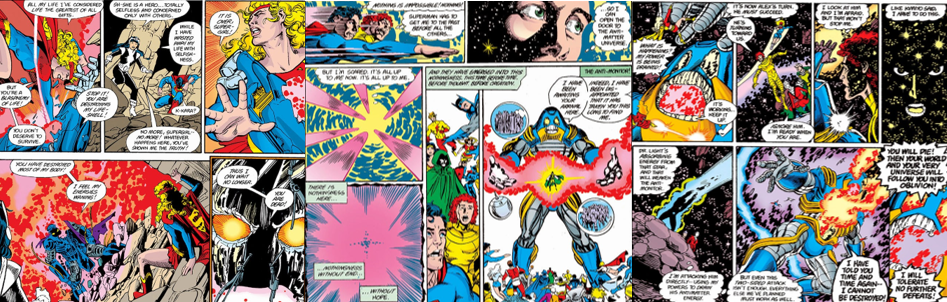
After Lyla relates the Anti-Monitor’s origin, Supergirl sacrifices herself to try and destroy him.

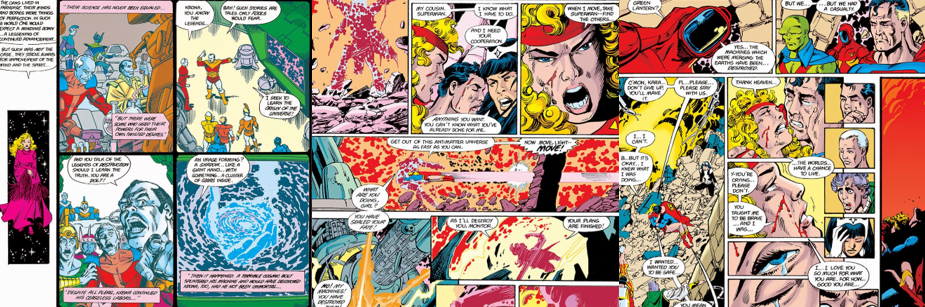
Thus, Lyla, Pariah, and Alexander assemble Earth-1’s Superman, Earth-2’s (Kal-L), Captain Marvel, the Blue Beetle, Lady Quark, and Uncle Sam and reveal that, ten billion years ago, the Oan scientist Krona dared to seek the beginning of the universe, witnessing a giant hand clutching a star cluster. This caused a cosmic fracture, creating not just the multiverse, but an anti-matter universe and a counterpart to Oa, Qward. After banishing Kronoa, the Oans created peacekeeping forces like the defective Manhunters and the Green Lantern Corps but were fractured by a civil war, birthing the Controllers. Amidst the fighting, the Monitor and his evil, anti-matter counterpart came into being. The Anti-Matter conquered Qward and created the Shadow Demons to spread his influence throughout the anti-matter universe before waging war against the Monitor upon sensing his presence. Evenly matched, they were rendered unconscious for nine billion years before being awoken by the misguided Pariah, once a celebrated healer and scientist who also investigated the origin of the universe. Pariah’s world paid the price, and he was damned to live forever and watch all worlds die, though the Monitor also saw him as instrumental in saving all reality. Alexander uses his unique matter/anti-matter powers to create a dimensional tear to the anti-matter universe, which Pariah leads the heroes to the Anti-Monitor’s vast stone fortress. Enraged that the Psycho-Pirate is too drained to corrupt them, the Anti-Monitor has his stronghold attack, injuring the usually invulnerable Kal-L. Dr. Light and Superman discover the Anti-Monitor’s solar collector but are attacked before they can destroy it and halt the merger of the Earths. Hearing her cousin’s agony, Supergirl flies to Superman’s aid, brutally beating the villain in a rage and chastising his disdain for life, tearing through his protective armour. Furious, the Anti-Monitor prepares to explode with all his energy and, in a last-ditch effort to destroy him, his machine, and save everyone, Supergirl tackles him, destroying his machine but being fatally blasted. As the Anti-Monitor’s deteriorating, incorporeal form slinks away, Superman mourns his cousin’s death and vows to kill the Anti-Monitor. Kal-L calms his counterpart and they escape, and a memorial service is held on Earth-2, where Superman pays homage to Supergirl, vowing to remember her and fight in her name. Despite the loss, the five worlds are saved; similarly, the Green Lantern Corps free their masters and almighty Darkseid wisely cloaks Apokalips from the Anti-Monitor’s gaze. However, the Anti-Monitor reconstitutes himself on his ship, where the Flash is imprisoned, and prepares a counterattack from Qward.

Despite the Flash’s noble sacrifice, the Anti-Monitor gains God-like power from his anti-matter universe.

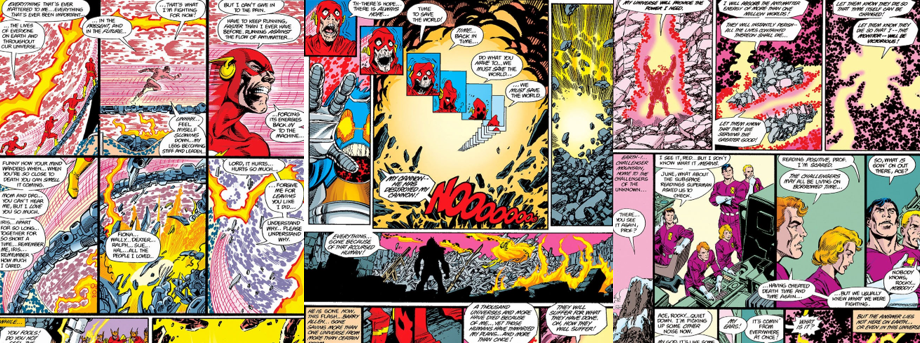
Though saved, the five worlds are still overlapping, causing anomalies and damage to each while  the Anti-Monitor oversees the creation of the anti-matter cannon, which he plans to use to obliterate the worlds. Just as the Psycho-Pirate feels his powers return, the Flash escapes and angrily attacks the sadistic villain, forcing him to turn the Anti-Monitor’s slaves against their master as a distraction. Though stunned to find the anti-matter cannon is powered by concentrated anti-matter and realising that destroying it would kill him, the Flash bravely circles the weapon’s core to turn its destructive energy back on it. Staving off the agony with memories of his loved ones, the Flash runs fast enough to move back in time (explaining his earlier, sudden appearances). Though Barry successfully destroys the weapon, it costs him his life. Enraged, the Anti-Matter absorbs the anti-matter universe, literally sucking the life out of over a million worlds to feed his lust for power and vengeance, an act so awesome that it’s detected by both the Challengers of the Unknown and the embodiment of the Lord’s wrath, Jim Corrigan/The Spectre. In the face of multiversal destruction, the Guardians of the Universe offer Guy Gardner the chance to become a Green Lantern once again and, when all but one of them are all slaughtered by a sudden explosion, Guy vows to avenge them as their champion. The Brainiac/Luthor team then recruit dozens of villains to strike while the remaining Earths are weak and in disarray. As time runs amok on Earth-1 and Alexander, Lyla, and Pariah address the United Nations, the villains make their move, having conquered Earth-4, -S, and -X, encasing them within impenetrable barriers, and threatening to destroy the remaining worlds. Lyla and Jay recruit a reluctant Wally West/Kid Flash to breach the barrier with the cosmic treadmill, though neither Luthor or Brainiac care much about their losses since they still possess the power to destroy everything. However, the Spectre ends the hostilities by revealing that the Anti-Monitor still lives and plans to corrupt the flow of time and formation of life by travelling to the dawn of time.

The Spectre demands co-operation, resulting in a singular world being created.

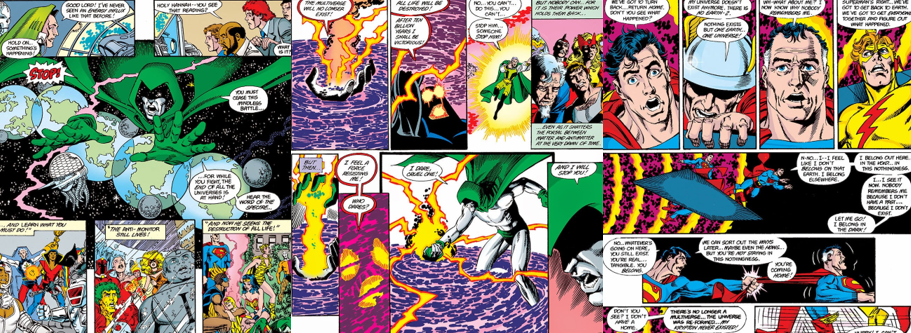
With the villains back on side, Kal-L bids an emotional farewell to his wife, Lois Lane, to join the counterattack, alongside a surprising newcomer: the Superboy from Earth-Prime (a fictional approximation of the real world where he’s the only superhero). After a rousing speech from Uncle Sam, heroes and villains alike pool their technology and powers to travel to the dawn of time and confront the anxious Anti-Monitor. The Anti-Monitor reveals that he, not Pariah, was responsible for the destruction of Pariah’s world after he took advantage of Pariah’s experiments to rebuild his power, absolving the tragic figure of his sins. Now grown to immense proportions, the Anti-Monitor withstands the assault of those assembled (with guys like Batman offering only support), absorbing their life energy to add to his power and allowing his hand to be the one that shapes all reality, as witnessed by Kronoa. His grasp is intercepted by the Spectre and the combined magic of the unified sorcerers, reducing the battle to a literal arm wrestle between the Anti-Monitor and the Spectre. Thanks to their bickering, Luthor’s underlings fail to kill Kronoa before he can cause the creation of the multiverse and the Anti-Monitor, and all seems lost. However, following a blinding light and the literal shattering of all time and space, Kal-L awakens on present-day Earth to find he’s on the same world as his Earth-1 counterpart. Sharing the same fragmented memories, Superman explains that time seems to be healing (albeit wonkily) and that elements of multiple Earths have been merged into one. For example, everyone knows Supergirl died but not how, the Flash is presumed vanished, and Earth-2’s Keystone City and Jay Garrick now live on this Earth. Jay, Wally, and the Supermen use the cosmic treadmill to discover Earth-2 is missing. Realising that the multiverse no longer exists, Superman has to force his older counterpart to return rather than throw himself into the endless void in despair. With the cosmic treadmill irreparably damaged, Wally assembles everyone at Titans Tower, discovering guys like Captain Marvel, Superbody-Prime, Uncle Sam, and the Earth-2 Dick Grayson/Robin also exist on this world, where they’re all shocked to see Harbinger alive and powered back up. The refugees are despondent and horrified to learn their worlds, pasts, and many loved ones are gone thanks to “cosmic irony” as Harbinger explains that there is now one Earth with one coherent timeline that folds their disparate lives into its flow, sending Kal-L into a crazed distress at having lost his wife and home.

A final, all-out assault ends the Anti-Monitor and starts the universe anew, with some casualties.

After questioning the imprisoned Lex Luthor, Batman, Jason Todd/Robin, and Alexander confirm that, while some duplicates remain and some lives were restored, others weren’t and only those who present at the dawn of time remember the multiverse. Just as they’re processing this, the skies turn red and the world suddenly shifts to the anti-matter universe, where the titanic, disembodied Anti-Monitor still lives! Though incensed by their efforts, the Anti-Monitor congratulates them for handing him his first defeat in ten billion years and then decrees that they must all die. Wally’s shock at his mentor’s death is mirrored by the abject panic that sweeps the civilians following the Anti-Monitor’s threat, which doubles when the Shadow Demons kill Don Hall/Dove, Helena Wayne/Huntress, and Tula Marius/Aquagirl. While the sorcerers remove the Shadow Demons, Harbinger assembles one last effort to stop the Anti-Monitor on Qward. Though the Anti-Monitor is too large and powerful to be damaged, Harbinger has Dr. Light absorb the star feeding him power, weakening him enough for Alexander to breach the villain’s armour. With the threat seemingly ended by a combined energy blast, Alexander struggles to return Earth home and the Anti-Monitor absorbs his exiled Shadow Demons to rise again and vaporise Wonder Woman. Rather than see anyone else die, Kal-L tackles the Anti-Monitor, believing he’s got nothing to lose, and Alexander and Superboy-Prime are trapped with him. Though Darkseid, watching from Apokalips, strikes a fatal blow through Alexander’s eyes, the Anti-Monitor refuses to die, so Kal-L delivers a final strike that obliterates the tyrant. Faced with the pending destruction of the anti-matter universe, Kal-L and Superboy-Prime prepare to meet their end only for Alexander to teleport them, alongside Kal-L’s Lois, to a pocket dimension. In the aftermath, Wonder Woman returns to the clay that forms Themyscira, her Earth-2 counterpart is welcomed among the Gods, the dead heroes are memorialised, and Wally assumes the Flash mangle. Confined to Arkham Asylum, the Psycho-Pirate is dubbed a raving lunatic since he’s the only one who remembers the multiverse and the catastrophic events of the Crisis.

The Summary:
Whew, there’s a lot happening in Crisis on Infinite Earths. There’s a reason I’ve put off reviewing it for so long, and why I rarely revisit it. It’s a very dense and complex story, full of exposition and cameos and faces both obscure and iconic. As a celebration of DC’s rich history and characters, it’s hard to find much better than Crisis on Infinite Earths, which stuffs just about every costumed character, hero or villain, into its dense twelve issues! My hat’s off to George Pérez; it must’ve been painstaking to sketch all these group shots, action sequences, montages, and dramatic events. Equal praise to Marv Wolfman as I can’t imagine how difficult it was to make sense of all these different worlds and come up with a cohesive way to explain, link, and destroy them all. In the end, the solution was simple: pure, destructive, unstoppable entropy. It’s fitting that the anti-matter wave is depicted as a blinding white light that erases everything it touches, for it symbolically represents a blank page or an artist’s eraser, indicating that these colourful and convoluted worlds are being literally wiped clean for a new status quo. Our guide through most of this is Pariah, a tragic figure doomed to watch each world die as penance for kick-starting the events that follow. Immortal but seemingly powerless to intervene, all he can do is shout desperate warnings and is powerless to rescue anyone and constantly met with aggression, suspicion, and accusations. He’s merely a pawn in a much larger game, however, much like Harbinger, who acts as an all-powerful emissary of the Monitor and deliver exposition in his stead. A conflicted individual burdened with the knowledge that she will betray and murder the man to whom she owes her life, Harbinger, nevertheless works to uphold the Monitor’s legacy and bring together heroes and villains alike to stand against his dark counterpart.

The Anti-Monitor’s power sends shockwaves through the multiverse and those who’ve witnessed it.

The dreaded inevitability of death is a focal point in Crisis on Infinite Earths. When the anti-matter wave hits, heroes and villains set aside their differences and use all their powers and resources to either stop it or save people from its destructive touch. Even the abhorrent Crime Syndicate find themselves fighting to save their world and Ultraman willingly enters the wave to die on his terms. Even before the wave arrives, the worlds are shaken to their core by natural disasters; volcanoes, tsunamis, and ominous, crackling red skies precipitate the disaster as much as Pariah. Perhaps no character is more synonymous with the coming destruction than the Flash; thanks to his super-speed, he ends up travelling through time, arriving before the likes of Batman and Wally as an omen of what’s to come and taking on an appearance that resembles Death itself. The Anti-Monitor echoes this in his design; though shrouded by his all-powerful armour, he sports a skull-like visage and dark, piercing eyes. Commanding demonic shadows, he’s very much the embodiment of Death and his lust for utter annihilation drives him to snuff out all life and light. Sadistic to the core, he employs the Psycho-Pirate to foster fear and hate, turning his would-be opponents against each other and causing countless more deaths. His ruthlessness seemingly knows no boundaries as he gleefully corrupts Harbinger, relishes the death of his counterpart, and nonchalantly obliterates his rebellious slaves without a second thought. His power and cruelty are so great that even the mighty Darkseid is driven to hide rather than confront him, striking when the villain is at his most vulnerable and largely avoiding the greater conflict. For all his God-like power, the Anti-Monitor still relies on technology; his merger and destruction of worlds can be halted or stopped by Cosmic Tuning Forks or destroying his solar collector. Indeed, it’s only after his massive, world-ending cannon is destroyed that the Anti-Monitor eschews all other methods and absorbs the entire lifeforce of the anti-matter universe into himself to literally take matters into his own hands.

The Supermen anchor the story, leading the assembled champions in battle and saving all reality.

There is no one central character in Crisis on Infinite Earths. Instead, it’s a team-up story through and through, meaning some of your favourites may be sidelined. In some respects, I don’t mind this; Batman outright admits how useless he is against the Anti-Monitor and it’s clear only beings of incredible power can stand against him. Yet, the Blue Beetle is said to be pivotal in opposing the villain, the Red Tornado is briefly said to be incredibly important, and Lex Luthor comes close to co-ruling five entire worlds and even leads the charge to assassinate Kronoa. The Earth-2 Superman, Kal-L, is often at the heart of the conflict, leading the others and inspiring confidence, as is his Earth-1 counterpart. It’s therefore more tragic seeing Superman’s grief-stricken reaction to his cousin’s death; holding Supergirl in his arms, the Man of Steel briefly forgets his morals and vows to kill the Anti-Monitor as recompense. This is but one of the unforgettable deaths featured in Crisis on Infinite Earths as the Flash sacrifices himself to deal a critical blow to the Anti-Monitor, making a martyr of himself for decades before DC made the bone-headed decision to revive him. There’s an odd dichotomy in Crisis on Infinite Earths; these alternative worlds and characters co-exist and are even folded into one by the end. Rather than wiping everything away and starting afresh by the conclusion, the story clunkily has the survivors forget key events and weaves characters like Captain Marvel and the Justice Society into a unified timeline. This works for me as I prefer a coherent narrative, but it essentially means Crisis on Infinite Earth takes place mid-way through the early years of the post-Crisis reboot and reimaginings like John Byrne’s Superman stories happen before and during this event, rather than after it.

Worlds lived, worlds died, and the DC Universe was never the same…for about twenty years…

These days, Crisis on Infinite Earths may be a lot for modern readers to take in. Many of its characters and concepts are either forgotten, wildly different, or have been done to death thanks to the multiple reality-altering events that followed (many specifically to address loose ends from this story). At the time, though, I’d wager many long-term DC readers appreciated the cameos and call-backs weaved into the story. I’m glad DC devoted twelve issues to the story and didn’t rush it, but it does get repetitive and convoluted as it drags on. The secondary threat of Brainiac and Luthor directing a team of villains to conquer the five worlds, for example, could probably be skipped or relegated to a tie-in comic. Similarly, the defending of the Cosmic Tuning Forks isn’t very interesting and doesn’t really add to the story since we barely see any action around this, the Shadow Demons are too powerful to be interesting, and it’s all negated by the Monitor’s death. In this respect, I think the event could’ve been cut down to eight or ten issues and still been just as effective, especially as many Earths and characters feature as quick cameos to be obliterated. The remaining five Earths are said to be the most important, which is a little disrespectful to those that perished by the Anti-Monitor’s hand and a bit of an insult to any fans of those worlds. I liked seeing new heroes rise during the chaos, like a new Dr. Light (who was an aggressive bitch throughout), Wildcat, and Guy being Green Lantern again, though it falls a little flat when you know the canon is going to be altered after this to return the status quo. I liked the Anti-Monitor’s design and his characterisation as a reprehensible being who craved only power and destruction, but it was hard to get a sense of his power and limitations. One minute he’s weakened by giant towers, then his armour is containing his energy, and then he’s being powered by a black sun despite having absorbed the lifeforce of his anti-matter universe. Still, the unification of heroes and villains to oppose him was fun to see, the sacrifices and determination were poignant, and the weaving together of a singular continuity, while flawed, was ambitious and visually engaging to behold.

My Rating:

Rating: 4 out of 5.

Great Stuff

Have you ever read Crisis on Infinite Earths? What did you think of this unprecedented mash-up of DC’s various worlds and characters? Which parallel world was your favourite and were you upset to see destroyed? What did you think to the Anti-Monitor, his vast power and his stubborn refusal to die? Were you shocked to see Supergirl and the Flash die so dramatically? Do you agree that the story dragged on a bit by the end? Which of the subsequent Crisis events was your favourite and what are some of your favourite cosmic events? Drop a comment below to share your thoughts about Crisis on Infinite Earths and feel free to check out my reviews of other notable crossovers.

Screen Time [JLA Day]: Justice League: Secret Origins


To celebrate the release of Justice League (Snyder/Whedon, 2017), DC Comics named November 18 “Justice League Day”. Setting aside all the drama surrounding that movie, this provides a perfect excuse to spotlight DC’s premier superhero team, which set the standard for super teams in comics by bringing together DC’s most powerful heroes.


“Secret Origins”

Air Date: 17 November 2001
Director: Dan Riba and Butch Lukic
Original Network: Cartoon Network
Stars: George Newbern, Kevin Conroy, Susan Eisenberg, Phil LaMarr, Michael Rosenbaum, Maria Canals-Barrera, Carl Lumbly, and Kevin Michael Richardson

The Background:
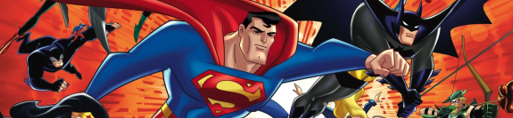
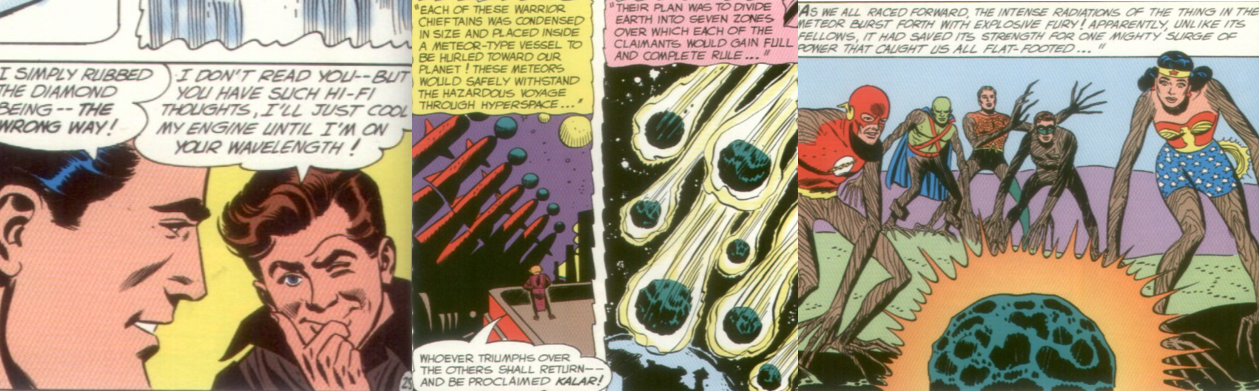
In 1992, hot off the success of Tim Burton’s gothic Batman movies, Bruce Timm and Paul Dini produced one of the most lauded cartoons of an entire generation with Batman: The Animated Series (1992 to 1995). The award-winning animated series was soon accompanied by one of the greatest adaptations of Clark Kent/Superman’s adventures, and it wasn’t long after that The New Batman Adventures (1997 to 1999) and Superman: The Animated Series (1996 to 2000) were crossing over. Superman also introduced a number of additional superheroes into the celebrated DC Animated Universe (DCAU), colourful faces familiar to comics readers who would be pushed to the forefront when Dini and Timm collaborated on the illustrious Justice League animated series (2001 to 2004). The late, great Kevin Conroy (for many the definitive Bruce Wayne/Batman) returned to voice the Dark Knight, though George Newbern replaced Tim Daly as the Man of Steel, and the show came to define the values and appeal of the titular team. Starting with a bang with a three-episode arc that was later collected as a feature-length presentation, Justice League expanded its lore and roster evermore in its sister-series and has been widely praised for its mature themes, relatable characters, and for setting a new standard for animated adaptations, to the point that DC’s later animated ventures are often directly compared to the DCAU.
The Plot:
When the alien invaders who decimated Mars attack the Earth, the planet’s greatest superheroes are called together for the first time by Martian survivor J’onn J’onnz (Lumbly) to combat the threat.

The Review:
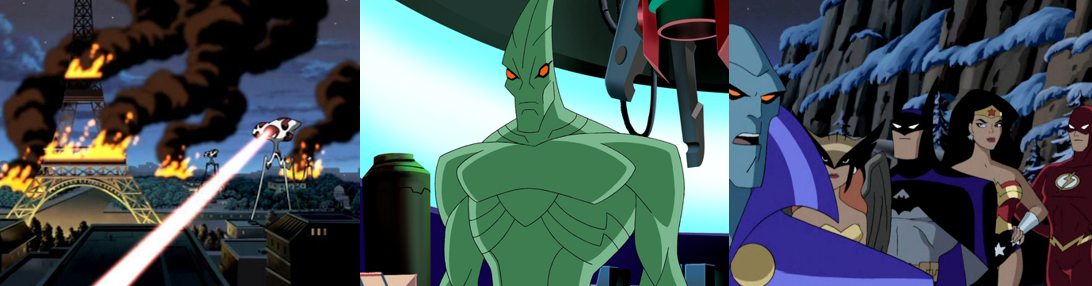
The DCAU started as a very grounded affair. Batman: The Animated Series largely stuck to street-level or city-wide disturbances, focusing on Batman villains who were crazed, yes, but largely human. There were obviously exceptions, but things rarely got too fantastical. That changed when Superman: The Animated Series was confirmed to take place in the same continuity; suddenly, Batman existed alongside aliens, magic, and other supernatural threats far beyond his mortal limits. Yet, even then, Superman: The Animated Series focused more on the titular Man of Steel and his exploits; when costumed heroes did appear, it was more of a spotlight or a cameo, a glimpse into an even bigger world. I say all this as “Secret Origins” wisely starts off from Batman’s perspective, with him investigating a series security breaches in WayneTech’s global deep space monitoring network and finding the culprits are guilty of more than simple corporate espionage. Confronting the facility staff as they attach an alien device to a satellite dish, Batman is stunned to find the employees not only speaking an alien language but exhibiting superhuman strength and an unnerving ability to reconstitute broken limbs. Stubborn as ever, Batman refuses Superman’s help when he stops by, only to end up aiding the Man of Steel when he’s half-crippled by what appears to be a psychic attack. Though Batman scoffs at the idea of calling for Superman’s help with his signal watch, he pockets the device and continues his investigation over the next six months, undeterred despite his enemy being far outside of his weight class. However, when checking out a Metropolis warehouse, Batman discovers more scientists, this time encased in disgusting, egg-like pods, held in stasis so the alien invaders can better assume their identities. When he’s attacked by an alien guard dog, Batman’s forced to signal Superman for help but even the Man of Steel is seemingly powerless when a series of meteors crash to Earth and birth gigantic, tripod-like alien walkers that decimate the world’s major cities.

When invaders attack, Earth’s heroes are forced to work together (and with J’onn) to fight back.

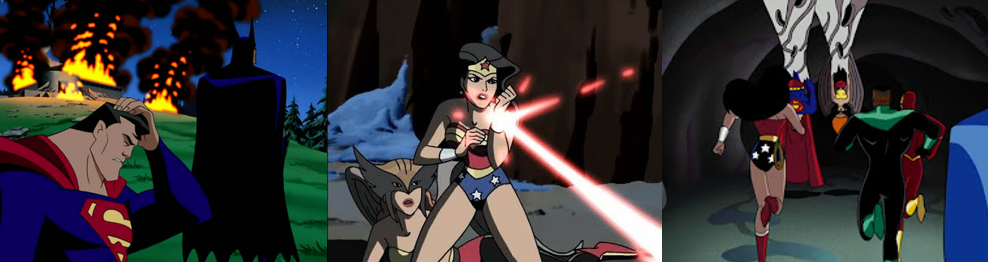
Despite throwing his best punches, Superman barely slows the destructive walkers, but another psychic barrage clues him in on the key to fending off the invaders. Closely followed by Batman, who’s no match even in his kitted-out Batplane, the World’s Finest find a strange alien humanoid held in captivity in an alien base. Freeing the visitor, they learn that he is J’onn J’onnz, the last survivor of Mars, and that he was attempting to communicate to Superman on a mental level. Though naturally distrustful, even after J’onn assumes a more human guise, Batman listens intently as J’onn relates how the once-peaceful Martian civilization was decimated by the relentless, gloop-like invaders. They destroyed all trace of J’onn’s people, committing mass genocide and even stealing their shape-shifting powers, and were only stopped when J’onn himself led a final, desperate attack on their underground stronghold and paralysed them with a nerve gas. Though he sealed the invaders away and kept watch for 500 years, J’onn was in a hibernation cycle when two astronauts accidentally opened the tomb, reawakening the invaders and turning their aggression towards Earth. Desperate to ensure that another civilisation doesn’t suffer as his did, J’onn escaped and tried to warn the Earth, only to be captured and studied. Luckily, he retained enough of his power to call out not just to Superman, but to Wally West/The Flash (Rosenbaum), John Stewart/Green Lantern (LaMarr), and Shayera Hol/Hawkgirl (Canals-Barrera), who all join the fight and take down a contingent of the alien walkers. Their efforts are further aided by Princess Diana of Themyscira/Wonder Woman (Eisenberg), a “rookie” hero (as John puts it) who abandons her island paradise to aid mankind. Though new to the hero game, Wonder Woman makes an immediate impression, deflecting incoming fire with her wrist guards and showcasing superhuman strength and flight, aiding Hawkgirl and taking down the walkers as forcefully as Superman. Still, distrust is rife amongst the fledgling Justice League; not only are they wary of J’onn but Diana’s expertise is called into question, and the group initially struggles to gel. John immediately takes charge, barking orders and dividing the group into teams to gain intel on the walkers, only to be lumbered with the childish Flash and left chastising Wally for his reckless nature. Such recklessness is echoed in both Hawkgirl and Wonder Woman, whose first instinct is to fight and cause them to blindly charge into ambushes and traps as a result. Superman is constantly trying to help everyone and therefore lets his guard down. Apparently somewhat complacent since he’s largely invulnerable, Superman’s easily subdued by the invaders’ powerful tech.

The fledgling Justice League ultimately triumph over the invaders and become a cohesive unit.

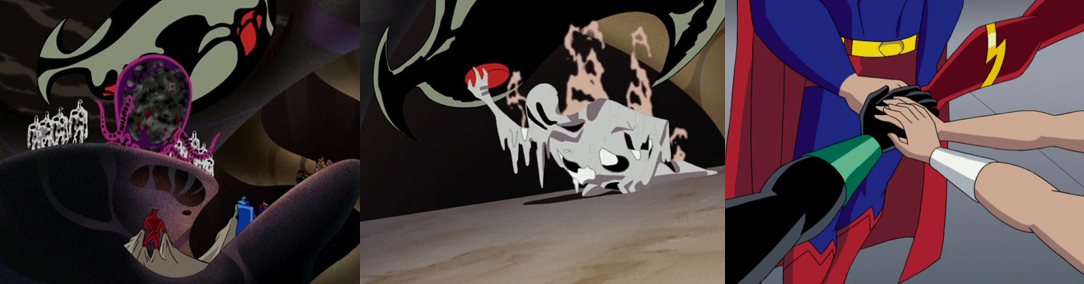
Although they’re unsure about J’onn, he proves to be dependable and is extremely capable in a fight. Boasting psychic powers, he can also fly, turn invisible and intangible, and exhibits superhuman strength on par with his peers. He also holds the key to shutting down one of the invaders’ drilling facility, working alongside Wonder Woman and Batman to steal the ion crystal, only for Batman to be left behind and seemingly gunned down. As the only member of the team without superpowers, Batman is at a physical disadvantage, but he does his best. He has his toys, of course, but his greatest asset is his mind. He colludes with J’onn to fake his death, an act that galvanises the team to work harder in rescuing Superman and Hawkgirl, and which deceives the invaders and their overseer, the Imperium (Richardson), a Lovecraftian, tentacled nightmare that delights in torturing J’onn before his newfound allies. The Imperium realises all-too late that Batman has survived as the Dark Knight sabotages the ion crystal, reversing its polarity and dispelling the polluting cloud that’s blanketed the Earth since the invaders arrived. It’s also Batman who deduces that the invaders are vulnerable to sunlight, a weakness the team quickly takes advantage of by ripping holes in the alien craft, killing the creatures without a second’s hesitation. Though they have no name, the alien invaders are a formidable force; they use shape-shifting abilities stolen from the Martians to impersonate public figures and even the heroes, laying the groundwork for their forces to arrive. They also wield laser blasters and are fully malleable, pulling themselves back together or reforming after taking damage. Most notably, they attack humanity using tripod-like walkers ripped right out of The War of the Worlds (Wells, 1898) just as the Imperium’s arrival is ripped from Independence Day (Emmerich, 1996). Their numbers and advanced alien tech make them more than a match for each of the team individually, even overpowered members like Superman and J’onn, but, once the disparate heroes start working together, the invaders are summarily driven off and Earth gains a powerful group of protectors.

The Summary:
“Secret Origins” has quite a mountain to climb. Sure, while DCAU viewers would’ve been well acquainted with Batman and Superman and have some knowledge of the Flash and the Green Lantern Corps, Wally, John, Shayera, and Diana are essentially brand-new characters in this sprawling continuity. Rather than spending time delving into the background of each of these new heroes, “Secret Origins” spends more time focusing on introducing J’onn and Wonder Woman, assuming the audiences will remember lore about the Flash and the Green Lantern Corps from Superman: The Animated Series and simply dropping Hawkgirl in our laps. I think this was a good approach; I liked that the first part was essentially another Batman/Superman team-up as it showcased neither man could fight off the invaders alone and that the two together wouldn’t be enough, either. This greatly aided in establishing the invaders as a true threat; they easily manhandled Batman, forcing him to ask Superman for aid, and Superman was distracted by J’onn’s attempts to communicate and unprepared to face a physical challenge. J’onn is depicted as a suitably tragic figure, one who’s seen his whole world die at the hands of these invaders and who is determined to prevent it happening again. J’onn even apologises for humanity’s violent nature and defends the very people who treated him so poorly when he arrived. He finds a kindred spirit in Superman and a surrogate family in the Justice League, who eventually accept him as one of them through his courageous actions. This arc is echoed in Wonder Woman, who renounces her place in paradise out of curiosity to explore “Man’s World” and a sense of duty to defend the planet from its aggressors. However, as she’s new to the superhero lark, she’s initially treated with contempt by the strait-laced John Stewart. A gruff military man who focuses solely on the job, John has no time for the Flash’s games and is dismissive of Diana for being a “rookie”. The others are much more accepting and even John is turned around after seeing the fantastic abilities Wonder Woman brings to the table.

Heroes old and new must learn to fight together to defend the Earth.

The dynamic between the fledgling Justice League is at the forefront of “Secret Origins”. J’onn calls them together to defend the planet but none of them have any experience working together. Sure, Batman and Superman have teamed up, but they didn’t exactly like it or make a habit of it. Indeed, the only one with a sense of teamwork is John and even he’s bad at it, ordering the heroes around like he’s king shit and simply expecting them to fall in line or work together without laying the groundwork first. Egos and personalities clash throughout, with Batman being his usual pig-headed self, Hawkgirl charging into conflict, and the Flash toying with his foes, seemingly oblivious to the stakes. Even Superman struggles with the team dynamic, feeling obligated to help everyone and being blindsided as a result, and consequently sees the value in bringing the team together as a permanent fixture. Superman’s focus is on solving all the world’s problems, so much so that he doesn’t even suspect he’s being manipulated by the invaders to weaken Earth’s defences. The invaders are relentless and extremely aggressive, laying waste to cities with little resistance, but are both formidable and extremely vulnerable. Even Batman takes them out with enough effort and their machines are brought down by the heroes, but their sheer numbers and tenacity mean they can easily subdue even the Justice League. It isn’t until they underestimate Batman and their weakness is exposed that they show any signs of fear, with the Imperium desperately fleeing once its exposed to sunlight, only for Wonder Woman and Hawkgirl to violently bring down its escape craft and send the rest of its kind scurrying back to the depths of space. Again, it’s a very War of the Worlds-like ending and perhaps a little too contrived and nonsensical for the invaders to have such a glaring weakness, but it’s used to emphasise the team coming together as a unified force, so I’ll allow it. Ultimately this was a great introduction to the DCAU Justice League. “Secret Origins” established their different and conflicting personalities and how their various powers and abilities will work going forward, emphasising that they all have a part to play, and showed that there are some threats that require a whole group of special heroes to oppose it.

My Rating:

Rating: 4 out of 5.

Great Stuff

What did you think to “Secret Origins”? Did you enjoy seeing these heroes come together? What did you think to threat they faced? Would you have liked to get a little more insight into the Flash and Hawkgirl? Are you a fan of J’onn J’onnz? What are some of your favourite Justice League episodes? Feel free to use the comment section below to share your opinions and be sure to check out my other Justice League content across the site.

Back Issues [JLA Day]: Justice League of America #9


To celebrate the release of Justice League (Snyder/Whedon, 2017), DC Comics named November 18 “Justice League Day”. Setting aside all the drama surrounding that movie, this provides a perfect excuse to spotlight DC’s premier superhero team, which set the standard for super teams in comics by bringing together DC’s most powerful heroes.


Story Title: “The Origin of the Justice League”
Published: February 1962
Writer: Gardner Fox
Artist: Mike Sekowsky

The Background:
All Star Comics (1940/1941) brought together eight superheroes from different publishers for the first time, birthing not just the Justice Society of America (JSA) but also the first ever superhero team in comics, allowing readers to see their favourite characters interacting all for the same price as any one comic. The JSA’s roster expanded and changed over the years but the team underwent their most significant change in the late-1950s when then-editor Julius Schwartz tasked writer Gardner Fox with reintroducing and rebranding the team as the Justice League of America (JLA) to capitalise on the popularity of the American Football League and Major League Baseball’s National League. The Clark Kent/Superman, Bruce Wayne/Batman, Diana Prince/Wonder Woman, Hal Jordan/Green Lantern, Arthur Curry/Aquaman, Barry Allan/The Flash, and J’onn J’onzz (or “John Jones”)/Martian Manhunter debuted as the JLA in The Brave and the Bold #28, a title famous for featuring superhero team-ups. However, the team’s actual origin wasn’t revealed until this issue of their self-titled series, which became one of DC Comic’s best-selling titles. Over time, the JLA’s roster has also changed and many splinter groups and spin-offs have been introduced, but perhaps there is no more iconic line-up than this original roster of DC’s heavy-hitters.

The Review:
I was going to open this review by saying how odd it was that the Justice League’s debut story wasn’t actually a bumper tale about how these seven characters first came together, but quite a few first appearances of famous comic book teams and characters simply started with them already in their superhero role or somewhat established as a team, so I guess it wasn’t completely against the norm. “The Origin of the Justice League” gets off to a rocky start with perennial hanger-on, Lucas “Snapper” Carr, racing to the Justice League’s cavernous headquarters, the Secret Sanctuary, to celebrate a birthday, though he can only imagine which member of the team is to be honoured. When he gets there, he finds Green Lantern, Wonder Woman, Aquaman, and Oliver Queen/Green Arrow in the midst of getting the place and spik-and-span for the party; there’s something a bit odd about seeing Amazonian warrior and peacekeeper Diana Prince wiping down a table like a scullery maid but it’s great to see them making Snapper do menial chores like mopping the floor and cleaning out their display cabinets since this aggravating hipster youth really isn’t fit for anything else. It doesn’t take Snapper long to get distracted, however, when he spies a display case filled with wooden splinters that is directly tied to the team’s first mission. Wonder Woman has the entire Justice League pitch in getting the Secret Sanctuary ready for their event, which is of course to celebrate the anniversary of the first time they came together, and each of Leaguers take it in turns to share the story with their overexcited mascot.

J’onn and Aquaman are the first to encounter alien beings and to be transformed into trees!

J’onn J’onnz starts things off since it was he who first discovered the threat that would unite the world’s greatest heroes. After hearing a “queer report” about people spontaneously having turned to stone, J’onn investigated and found an entire town full of people turned to stone and confronted the source of the petrification: a massive stone giant that proves impervious physical assault. Using his “Martian vision”, the Martian Manhunter learned that the giant came from the alien world Appellax and was one of seven contenders to the throne who came to Earth in a meteor storm with the goal of conquering the planet to earn the title of Emperor (or “Kalar”) of his home world. Although the giant briefly sapped J’onn’s strength after learning of his weakness to fire, J’onn easily used his “Martian breath” to suck up some water from a fire hydrant to extinguish the flames and then attacked the giant’s weak spot with his great Martian strength. With the giant rendered unconscious, his victims returned to normal and J’onn summoned the police to “take the giant into custody” (apparently leading to them smashing the alien rock monster with sledgehammers!) but was transformed into a tree when he investigated the meteor that brought the being to Earth. While swimming through the Indian ocean, Aquaman learned from a dorado of another meteor, one causing panic in the seas after spawning a strange alien creature made of glass who turned underwater life to glass. Although also turned to glass the moment he investigated, Aquaman was still able to call upon his fishy friends to attack the creature, first attempting to shatter it with brute force and then succeeding in defeating the alien by causing massive sonic vibrations. However, when learned of another meteor and raced to oppose its threat, he too was transformed into a tree.

Wonder Woman and Green Lantern overcome their limitations to defeat their alien threats.

Wonder Woman’s arrival on Themyscira was ruined by the presence of strange glittering globs all over the island that unleashed a living blob of mercury that transformed the Amazons into liquid. Calling upon Hera for strength, Wonder Woman whipped out her magical lasso to ensnare the blob-like alien; although she was unable to simply fling it into space since her strength was divided between fending off the creature’s “queer radiation”, Wonder Woman was, inexplicably, able to swing the creature around so fast that it was destroyed by the resulting friction heat. Although this caused her great strain, Wonder Woman was ultimately successful and returned her sisters to normal, but she too was turned into a twisted tree-like being when she investigated the other meteor. Around the same time, Green Lantern was returning to Earth and was startled by the sudden appearance of one of these meteors, and even more shocked when it spawned a gigantic golden bird that systematically began transforming humans and animals alike into ghastly winged creatures using a “white ray”. Since his Power Ring is useless against anything even remotely yellow, Green Lantern was powerless and being partially transformed into a bird-man himself before luring the creature into a nearby waterfall and using his Power Ring to freeze both solid. With the winged terror effectively subdued, all of its victims returned to normal and Green Lantern got them to safety but found himself becoming a gnarled tree at the same time as Wonder Woman!

The Flash and the others help to free their comrades so Wonder Woman can finish off the wood alien.

While in Europe acting as a representative to an Interpol meeting, the Flash learned of a strange meteor falling near Italy and raced out to investigate, finding a flaming humanoid creature transforming humans into similarly blazing monsters. His attempts to whip up a strong wind, douse the flaming alien with water, and snuff it out with sand were all unsuccessful, however, when the creature proved powerful enough to turn these to steam and glass. The Flash quickly discovered the solution was the same as almost every situation he ever finds himself in and he simply ran around super fast to create a vacuum that extinguished the flaming beast, returning its victims to normal, but he wasn’t fast enough to avoid becoming a tree like his fellow costumed heroes. Their great powers rendered mute and their strength inert by the meteor’s radiation, the fledgling Justice League were powerless to stop a massive wooden alien from emerging from its cocoon and compelling them to follow its bidding. Did I say powerless? Well, not quite as Aquaman (of all people) summoned the strength necessary to chip a small piece of wood from Green Lantern’s hand, exposing his Power Ring and enabling him to free J’onn’s face. J’onn then used his Martian breath to free the Flash, who then helped to free Wonder Woman, thereby allowing her to regain just enough control over themselves to easily destroy the wood-like alien by stripping it to splinters with her magical lasso.  

Superman finishes off the last alien with little to no help from the other heroes.

This wasn’t the end for the colourful heroes, however; one last meteor landed in Greenland but, when they flew over to confront the final claimant to Appellax’s throne, they found Batman and Superman already clashing with the alien, this one a jagged, slender ice being. Although the other heroes were content to leave this last alien to the World’s Finest, Superman ran into a spot of bother when the meteor turned out to be made of Kryptonite, leaving him weak and vulnerable. Although his arms and legs were rapidly turning to diamond as a result of the creature, the Batman was able to use his Batplane to get the meteor away from the Man of Steel, allowing Superman to instantly destroy the creature by using one of his many crazy super powers to turn it into harmless coal. In the aftermath, despite none of the individual heroes even remotely learning anything about working as a team or coming together to destroy a threat greater than any one of them with the exception of Batman and Superman (who had already worked together numerous times by this point), the seven superheroes agree to form a the Justice League to oppose any threats to the sanctity of peace and justice. Back in the Secret Sanctuary, Snapper is blown away by the story, and Superman’s solution to the problem; although awestruck, he wants to know even more of the team’s secrets, like how the Secret Sanctuary was built, but is content to set these questions aside and join his masked friends in celebrating their anniversary.

The Summary:
Have I mentioned how much I detest Snapper-bloody-Carr? Jeez, I mean, of all the jive talkin’, hipster teenage characters in comics from this era, he’s got to be the dirt worst. At least he’s not constantly snapping his fingers like a moron throughout this story, but the way he talks just grates on me. Did the writers really think kids would appreciate seeing a character like this mooching off their favourite superheroes? It really blows my mind to think that this was ever considered a good idea; I mean, if you want to toss in a teenager for the young ‘uns to relate to, just use Dick Grayson/Robin! Anyway, luckily, Snapper is hardly in this story and he doesn’t get to take all the glory for himself like in the Justice League’s first issue, but that doesn’t make this story any better, to be honest. Like in their first issue, the Justice League is painfully divided here, and the focus is more on the less popular superheroes, meaning Batman and Superman don’t show up until the very end. To be fair, though, I don’t actually mind this; especially in today’s world, where Batman is everywhere, on every team, all the time and massively overexposed, it’s nice to see guys like Green Lantern and the Flash get a bit more of the spotlight (Hell, all Batman does is get the Kryptonite away from Superman; he’s probably in the story less than Snapper Carr!)

The combination of Snapper, a weak threat, and lack of teamwork make for a mediocre origin story.

Unfortunately, this isn’t really a compelling origin story. The idea that these seven elemental aliens have landed on Earth and are causing havoc has a lot of potential; seven threats for seven heroes to unite against. Instead though, each threat is dealt with individually; while this does showcase the power of Wonder Woman and the extent of Aquaman’s telepathy, it’s really not a good way to justify them forming a team. The only time they even remotely do anything even slightly team-orientated is when they free each other from the wood-alien’s control; they don’t get overwhelmed and need another hero’s help and they don’t come together to face off a greater threat. They just dispose of their individual menaces, get turned into wood like idiots, and then watch on as Superman finishes off the last alien since he doesn’t need their help. How much better would it’ve been if, say, one alien was boiling or freezing the sea, so the Flash had to use friction to help out Aquaman? Or if Wonder Woman had to bail out Green Lantern after his Power Ring proved useless? Or if J’onn faced the fire alien and Aquaman helped him out with water? The primary appeal of this story is paying the same price you would for a solo book and seeing seven superheroes in action, but the action and narrative really isn’t all the compelling; the aliens have no personalities or characterisations or motivations beyond this throwaway desire to rule the world, and they’re all pretty weak. The wood one is built up as this major threat, but it’s disposed of pretty easily, and the ice/diamond one is similarly undone in the blink of an eye by Superman. Honestly, I feel like Starro the Conqueror was a far more credible and League-worthy threat and, if you recall from my review of that story, he was basically a joke as well, meaning I can’t really take this menace that seriously or find the idea that these heroes would ever want to form a team after this lacklustre experience.

My Rating:

Rating: 2 out of 5.

Could Be Better

What did you think to the JLA’s origin story? Were you satisfied with the explanation of how the seven came together or, like me, did you find the threat and motivation incredibly weak? What did you think to the aliens the heroes faced off with and would you have liked to see the heroes interacting a little more? Are you a fan of Snapper Car and, if so, why? Which era or incarnation of the JLA is your favourite and what are some of your favourite JLA stories? Who would you like to see in the JLA some day? How are you celebrating Justice League Day this year? Whatever your thoughts on the JLA, feel free to share them below or join the discussion on my social media.

Movie Night [Robin Month]: Teen Titans Go! To the Movies


In April of 1940, about a year after the debut of arguably their most popular character, Bruce Wayne/Batman, DC Comics debuted “the sensational find of [that year]”, Dick Grayson/Robin. Since then, Batman’s pixie-boots-wearing partner has changed outfits and a number of different characters have assumed the mantle as the Dynamic Duo of Batman and Robin have become an iconic staple of DC Comics. Considering my fondness for the character and those who assumed the mantle over the years, what better way to celebrate this dynamic debut than to dedicate every Thursday of April to celebrating the character?


Released: 27 July 2018
Director: Peter Rida Michail and Aaron Horvath
Distributor: Warner Bros. Pictures
Budget: $10 million
Stars: Scott Menville, Hynden Walch, Khary Payton, Tara Strong, Greg Cipes, Will Arnett, Kristen Bell, and Nicolas Cage

The Plot:
Determined to be a Hollywood star, Dick Grayson/Robin (Menville) will go to any lengths to impress director Jade Wilson (Bell) to notice him and his team! With a few madcap ideas and musical numbers, the Teen Titans try to take the limelight, but when Slade Wilson/Deathstroke the Terminator (Arnett) messes with their plans, the Teen Titans will have to become true superheroes to save the world!

The Background:
About four years after the debut of the Justice League of America (JLA), their teen sidekicks came together to form the Teen Titans, presumably to appeal to younger readers. The team were a relatively consistent presence throughout the 1960s and 1970s but writer Marv Wolfman and George Pérez breathed new life into the concept with characters like Victor Stone/Cyborg and Princess Koriand’r/Starfire, who became synonymous with the team. No strangers to adaptation, the Teen Titans have seen some success in animated ventures; Teen Titans (2003 to 2006) was widely regarded as a popular spin-off of the incredibly well-regarded animated series pioneered by Bruce Timm and Paul Dini. Many long-term fans were therefore put off when the show was retooled into a more kid-friendly aesthetic with the slapstick Teen Titans Go! (2013 to 2022), though many praised the show for its bizarre nature and light-hearted humour. Additionally, the show was popular enough to spawn this feature-length production; universally praised for its metatextual comedy, its gleeful destruction of superhero tropes, and its unhinged comedy, Teen Titans Go! To the Movies also gave finally star Nicolas Cage the chance to portray Clark Kent/Superman after missing out on a live-action appearance in the nineties. With a box office gross of $52.1 million, the film was followed by a reasonably well received straight-to-DVD crossover between the Go! Titans and their more serious predecessors, as well as a couple of other similar features of varying quality.

The Review:
So, like a lot of kids my age, I watched a fair amount of Bruce Timm and Paul Dini’s DC cartoons back in the day; even into my late teenage years, I was enjoying Justice League Unlimited (2004 to 2006), and I really enjoyed the original Teen Titans cartoon. Although never explicitly stated to be a part of the same fictional universe, I always liked to think that Teen Titans was a spin-off from the main DC Animated Universe and I loved how it gave a bit of a gritty edge and a commanding presence to one of my favourite characters, Robin, and allowed him to be in the spotlight in a world where he’s often given the shaft in live-action movies. I’d be lying if seeing Teen Titans Go! for the first time wasn’t a little off-putting for me in this regard; however, it was clearly aimed at a younger audience and I found it to be quite funny the few times I did watch it, the same as Batman: The Brave and the Bold (2008 to 2011), which showcased a more light-hearted version of the Dark Knight but in a fun and action-packed way. There is room for both interpretations of these characters, as much as I prefer the darker interpretations as they’re truer to the original spirit of Batman and his world, and it’s not as if there weren’t other animated ventures that showcased this side of the likes of Batman and Robin, so it was still pretty exciting when a feature-length presentation was announced, especially as it aimed to poke fun at Warner Bros.’ tumultuous history with cashing in on their DC Comics franchises.

The happy-go-lucky Titans are distraught to learn the public and their peers see them as bumbling fools.

Things get off to a loud and action-packed start as Jump City is attacked by the megalomaniacal supervillain known as Balloon Man (Greg Davies), a ludicrous character who is quite literally a gigantic, anthropomorphic balloon who can easily smash his way into a bank and squeeze through small gaps by expanding and contracting his bulbous body. Although Jump City’s police are no match for the inflated villain, the Teen Titans soon arrive to help out; what follows is a fight scene, set to an electric guitar remix of the Teen Titans Go! main theme, that helps to establish the characters and abilities of the titular team for those who are unfamiliar. Robin is the leader, jumping head-first into the fight and partially tearing Balloon Man’s hide with his shuriken; Cyborg (Payton) is the enthusiastic muscle, able to transform his body into all kinds of heavy ordinance; Starfire (Walch) is a naïve, childlike misfit from another world who wields incredible cosmic power but is easily distracted by cute things; Rachel Roth/Raven (Strong) is the dark, stoic enchantress capable of manipulating others and creating constructs out of a black magical energy; and Garfield “Gar” Logan/Beast Boy (Cipes) is the team’s goofball shape-shifter, who delights in monkeying around and transforming into a range of green-hued animals (including becoming a porcupine to pierce Balloon Man’s butt for an extended fart gag). So consumed by their own hype are the team that they completely miss that the Justice League – Superman (Cage), Diana Prince/Wonder Woman (Halsey), and Jon Stewart/Green Lantern (Lil Yachty) – take out Balloon Man and are saddened to learn that both the public, and the superhero community, see them as a team of goofballs rather than “real” superheroes worthy of their own movies. Despite the fact that people “don’t talk” about Green Lantern’s movie, Superman advises the team that they’ll never be seen as anything other than a joke unless they shape up and start acting like real heroes rather than goofing off for food and dance numbers. Despite the evidence lobbied against them, Robin is adamant that he and his friends are not only world-renowned heroes but worthy of their own movie; it’s been his lifelong dream to have his own movie franchise, after all, and he’s determined to prove that he’s worthy of this accolade.

Robin’s so determined to get his own movie that he briefly messes up with the timeline.

Unfortunately, he and his friends are aghast to learn that they’re not on the list to attend the premiere of Batman’s (Jimmy Kimmel) newest film, and even more insulted when the Challengers of the Unknown, of all people, are more known than they are. Thanks to Raven’s ability to teleport them using her extradimensional portals, the team are able to gate crash the screening and steal the Challengers’ seats, introducing them to beloved superhero movie director Jade Wilson. Robin is dejected to see first-hand that he’s not only not slated to appear in a movie, but that the entire superhero community laughs him off as simply a sidekick and a nobody. After dispelling Robin’s depression with a musical number, the team head to Warner Bros. Studios in Hollywood, determined to demand that they get their own movie from Jade. Unfortunately, she’s not interested in the prospect of a solo Robin movie and states that she would only consider it if there were no other superheroes in the world, a dismissive comment that gives him the outrageous idea to travel through time to prevent the world’s superheroes from ever coming into being using their time cycles (because their regular time machine is too “boring”). Thus, the team prevents Krypton’s destruction (using disco-synth, no less), stealing Wonder Woman’s magical lasso when she’s just a girl, cause Arthur Curry/Aquaman (Eric Bauza) to get caught up in trash and drown as a baby, prevent four turtles from coming into contact with radioactive ooze, and redirect Thomas, Martha, and young Bruce Wayne (Kal-El Cage) from going down Crime Alley. As you might expect, this results in the world being overrun by supervillains in the present day and therefore no superhero movies being produced, so the Teen Titans immediately travel back to undo their efforts…resulting in them being directly responsible for Krypton’s destruction and gleefully pushing Thomas and Martha Wayne to their deaths with a smile and a thumbs-up!

Slade’s master plan to control the world brings him into conflict with the Teen Titans.

Since rewriting the space/time continuum did nothing to improve their standing in the superhero community, the Teen Titans resolve to prove themselves the old-fashioned way. Earlier, the others suggested to Robin that they’re not taken seriously because they lack a cool archnemesis with an ominous name and they attempt to address this by confronting Deathstroke (as ever referred to simply as “Slade”) as he steals “the perfect plot device”, the Ditronium Crystal, from Scientific and Technological Advanced Research Laboratories (S.T.A.R. Labs). A bombastic villain who mocks the Teen Titans pose and easily tricks them with simple illusions and distractions, Slade is nonetheless fully capable of holding the team off using only his skill, weapons, and vast array of gadgets. Still, by taking themselves seriously, the team is able to retrieve the crystal on their second encounter, but Slade easily escapes by preying on Robin’s ego and painting himself as his archnemesis. Incensed at their interference, Slade vows to divide the team to take away their greatest advantage, something made considerably easier when jade summons the team to Warner Bros. Studios, impressed by their fight, to start shooting their movie. However, when the others embarrass him by repeatedly pooping in a prop toilet, attacking their co-star and subduing Superman with Kryptonite, causing havoc, and almost destroying her Digitally Ordering Online Movies Streaming Directly At You (D.O.O.M.S.D.A.Y.) Device (Phil Morris), Robin angrily ditches his friends in order to have his own solo movie and shake the stigma of their idiocy from his character. Heartbroken at his decision, especially after they supported his dream all throughout the movie, the team leave him to indulge his greatest fantasies on the set of his very own movie, finally bringing him the adulation he has craved for so long, though all the digital enhancements and action sequences in the world can’t make up for the loss of his friends.

The Nitty-Gritty:
I gather there are a lot of people who dislike the art and animation style of shows like Teen Titans Go!; many comparisons are made to the likes of Steven Universe (2013 to 2019), though I’m not sure why that’s a bad thing as, while I’ve never watched it, I always thought the show was quite popular. Again, it’s potentially because of the nostalgia and love for Timm and Dini’s traditionally dark and moody visual style, and the anime influences seen in the original Teen Titans, but I thought the change in visual direction was a great way to immediately show that Teen Titans Go! is aimed at a completely different audience to its predecessor, and enjoyed the presentation because it, like some of the line-towing humour, reminded me of The Ren & Stimpy Show (1991 to 1996; 2003). Jump City is a bright maze of skyscrapers and beaches, its inhabitants all sport comically oversized heads and cartoonish proportions, and much of the allure of the movie’s visual style comes from the short, sharp movements characters make that remind me of traditional animation techniques such those using construction paper. The movie’s tongue-in-cheek approach is also evident right from the start, as DC’s heroes are chibi-fied in the opening credits to fit with the show’s more exaggerated art style; the movie even appears to ape the traditional Marvel Studios opening by rapidly flicking through pages of Teen Titans comics, only to subvert expectations and show that it’s simply a seagull flicking through a comic book! In this cartoonish world, the DC superheroes are such huge celebrities that they have their own merchandise and movie franchises, just like in the real world, with even the grim Dark Knight playing up to the paparazzi at the premiere of his new film, Batman Again, and heroes like Kara Zor-El/Supergirl (Meredith Salenger) and even Doctor Raymond “Ray” Palmer/The Atom (Patton Oswold) being treated as Hollywood starlets.

The movie is jam packed with references, cameos, and fun musical numbers.

This is taken to the nth level when we see just how many superheroes are being given feature-films and the lengths to which Hollywood is going to milk Batman’s popularity with movies about his loyal butler, Alfred Pennyworth, his high-tech vehicle, the Batmobile, and even his utility belt! Although a hilarious gag at the time, and with some basis in truth given how much Batman content had been produced by 2018, this lands even harder now considering Alfred received his own live-action television series and we even got a Cars-like (Various, 2006 to 2022) Batmobile cartoon! Even the D.O.O.M.S.D.A.Y. Device is a precursor to the stranglehold over the genre that Marvel Studios would get with the onset of Disney+, making the film scarily ahead of its time in its metacommentary. The film also stands out with its fourth-wall-breaking humour; this includes jabs not only at existing DC properties, but also gags like the Teen Titans mistaken Slade for Wade W. Wilson/Deadpool, a parody of the iconic opening of The Lion King (Allers and Minkoff, 1994), references to one of my favourite cartoons, Animaniacs (1993 to 1998; 2020 to present), Superman (Donner, 1978) and the Tim Burton Batman movies (1989; 1992), and the Back to the Future trilogy (Zemeckis, 1985 to 1990), a gratuitous and self-referential cameo by Stan Lee himself, a fantastic jab at the whole “Martha!” debacle during the filming of Batman vs. Superman: Part II by having the two come to blows because their fathers have different names, and having Robin’s team mates embarrass him when they kick the crap out of Shia LaBeouf (James Arnold Taylor). Musical numbers also play a huge role here; we get our first taste of this when Balloon Man insults and shocks the group by claiming not to know who they are (he thinks they’re “lesser members” of the Justice League of the Guardians of the Galaxy), leading to them performing a rap number running down their names, powers, and a bit of their background (“GO!”). Unfortunately, they get so wrapped up in their singing and dancing that they’re completely upstaged by the Justice League. Struggling with his sense of self-worth and disheartened at being mocked by everyone, even the team’s adorable hand-crafted movie fails to cheer Robin up; it takes an amusingly generic “upbeat, inspirational song” to reignite Robin’s spark and renew his enthusiasm (“Upbeat Inspirational Song About Life”). Additionally, Robin’s able to describe his perfect solo superhero through song, resulting in a montage and homages to Batman: The Dark Knight Returns (Miller, et al, 1986),  Batman: The Animated Series (1992 to 1995) specifically designed to emphasise Robin’s competency, cute butt, and totally adult hands (“My Superhero Movie”). When the Teen Titans travel through time to take out their competition, the sequence is brilliantly set to A-ha’s “Take On Me” and Huey Lewis and the News’s “Back in Time”, they play Krypton’s crystals like a DJ deck to prevent the decidedly Donner-esque planet from exploding, and Cyborg, Starfire, Raven, and Beast Boy get themselves kicked out of their own movie by pulling pranks all over the Warner Bros. Studio (“Shenanigans”).

In the end, the Titans come together to defeat Slade and earn the respect of their superhero peers.

Robin is so caught up in finally getting his time in the spotlight, away from the shadow of the Batman and the goofiness of his teammates, that he doesn’t even question Jade’s motivations or inputting the code to the vault as part of his movie’s finale. All too late, he realises that he’s been tricked into opening the actual vault and that Jade has been Slade in disguise all along in a surprising, and amusing, twist. Thanks to his manipulations as Jade, Slade has effectively subdued the Justice League by distracting them with their movies, leaving him free to steal the Ditronium Crystal, insert it into the D.O.O.M.S.D.A.Y. Device, and control the minds of the world’s populace as part of a diabolical scheme for world domination. Thanks to his baby hands and Bat-gadgets, Robin is able to escape the exploding Titans Tower; seeing his home and his friends’ possessions go up in smoke makes him realise how selfish and foolish he’s been but his friends enthusiastically return to his side to aid him in stopping the broadcast of Robin: The Movie to prevent Slade’s plans from coming to fruition. After unmasking Slade before their superhero peers, the Teen Titans are forced to battle the Justice League when Slade uses the D.O.O.M.S.D.A.Y. Device to turn them into his mindless slaves; thanks to a golf cart and Raven’s portal abilities, they’re able to take the Justice League out of the equation but, when Robin engages Slade in a one-on-one fight, Robin’s unable to resist watching footage of his film and is compelled to attack his friends. Robin’s brought to his senses when forced to watch the remainder of the homemade film the Titans made for him, reuniting the team in friendship just in time to battle Slade’s ridiculously oversized robot! Although Slade mocks them and boasts at his invincibility, Robin realises that their greatest asset is their goofball antics and they’re able to take out Slade’s robot using another of their dope songs (“GO! (Battle Remix)”) and an overwhelming combination of their unique powers and abilities. With the world freed from Slade’s control, the Ditronium Crystal destroyed, and Slade defeated, the Teen Titans finally earn the approval and respect of their peers, though Robin’s denied the chance to deliver a meaningful speech as everyone else insists that the movie’s over.

The Summary:
Teen Titans Go! To the Movies is a ridiculously over the top, slapstick romp in this exaggerated and cartoonish spin-off of the darker DC Animated Universe. Everything from the visuals, the gags, and the action is designed to appeal to younger audiences, ones who will delight at the instances of toilet humour and the fun music numbers, yet there’s a fair amount here for older audiences to enjoy as well. From cameos, references to other movies and DC properties, and some surprisingly dark inclusions that might go over the heads of little kids but had my spitting out my drink at times. The overriding narrative of the Teen Titans trying to earn respect for being superheroes is done pretty well, and wisely focuses on Robin’s obsession with being seen as more than a sidekick and worthy of his own movie, though the film doesn’t dwell too much on the wedge this causes between him and his friends. Similarly, the time travel side plot was primarily there as a gag, a funny one to be sure but one immediately undone to focus on the campaign against Slade. I would’ve liked to see the Teen Titans realise their worth in a world without the other superheroes, but it was fun seeing Slade mock them and wipe the floor with them and be revealed to have been disguised as Jade all along. While there isn’t much here for the other Teen Titans to do beyond be goofy, say their catchphrases, and sing and fight alongside Robin, the metacommentary on the influx of superhero movies was amusing and I found myself thoroughgoingly entertained through the film. I always enjoy it when animated movies sprinkle their narratives with little Easter Eggs for adults to enjoy and Teen Titans Go! To the Movies certainly succeeds in this regard, and with including some genuinely funny gags that keep the energy high, resulting in a very enjoyable animated romp.

My Rating:

Rating: 4 out of 5.

Great Stuff

Did you enjoy Teen Titans Go! To the Movies? Were you a fan of the cartoon or did the move towards slapstick put you off? Which member of the team was your favourite and what did you think to Robin’s desire to be taken seriously as a superhero? Did you enjoy the musical numbers and the sprinklings of dark humour laced throughout? What s your favourite incarnation of the Teen Titans? Who is your favourite Robin and how are you celebrating the Boy Wonder’s debut this month? Whatever your thoughts on this film, Teen Titans, and Robin, leave a comment either below or on my social media.

Game Corner [JLA Day]: Justice League Heroes (PlayStation 2)


To celebrate the release of Justice League (Snyder/Whedon, 2017), DC Comics named November 18 “Justice League Day”. Setting aside all the drama surrounding that movie, this provides a perfect excuse to spotlight DC’s premier superhero team, which set the standard for super teams in comics by bringing together DC’s most powerful heroes.


Released: 22 November 2006
Developer: Snowblind Studios
Also Available For: Nintendo DS, PlayStation Portable, and Xbox

The Background:
After coming together in November 1959, the Justice League of America (JLA) quickly became one of DC Comic’s best-selling titles. This shouldn’t be entirely surprising considering the team came to be comprised of DC’s most popular characters: Clark Kent/Superman, Bruce Wayne/Batman, Diana Prince/Wonder Woman, Hal Jordan/Green Lantern, Arthur Curry/Aquaman, Barry Allan/The Flash, and J’onn J’onzz (also known as “John Jones”)/Martian Manhunter. The team saw many members come and go over the years but was a constant staple of DC’s library of comic books and soon expanded into other media. Interestingly, the Justice League’s success hasn’t always resulted in the best videogames, though, meaning developers Snowblind Studios faced a bit of an uphill battle right from the start when creating Justice League Heroes. Built out of a modified engine of their critically acclaimed title Baldur’s Gate: Dark Alliance (ibid, 2001), the developers ending up removing features from that game and engine to focus on extending the length of Justice League Heroes, which has more than a few similarities to Marvel: Ultimate Alliance (Raven Software/Barking Lizards Technologies, 2006), which released about a month earlier. Reviews of the game were mixed across platforms, though, and the game was generally regarded as a bit of a mediocre and mindless beat-‘em-up.

The Plot:
The Earth is under attack from the robot forces of Brainiac, who has coerced many of the world’s most notorious supervillains into helping him consolidate the power afforded to him by a mysterious box from the stars. In response, the world’s greatest heroes, the Justice League, leap into action and team up to oppose Brainiac’s plot in a globe-trotting adventure that requires all of their individual abilities and skills.

Gameplay:
Justice League Heroes is a top-down action brawler in which you (and either another player or a computer-controlled partner) battle through a number of recognisable locations from the DC universe as various members of the Justice League. The game’s story is split into a number of missions that see two members of the Justice League teaming up at any one time; a second, human player can join the game at any point from the pause menu, a solo player can freely switch between the two heroes at will by pressing up on the directional pad (D-pad), and you’ll also be tasked with assembling one or more custom teams of two characters later in the story but you’ll never get the opportunity to switch out characters completely or replay missions with different characters. Gameplay in Justice League Heroes revolves almost entirely around beating up endless hoards of robots and aliens and solving some very light puzzles; characters can jump with a press of the Triangle button (and double jump or fly/glide with subsequent presses depending on who you’re playing as), attack with strong and fast attacks with Circle and X, respectively, and can grab enemies or objects with Square and block incoming attacks by holding R1. By entering different button presses (X, X, O, for example), players can pull off simple combo attacks to take out enemies but there are, sadly, no team up attacks to be found here.

The Justice League’s various superpowers are at your disposal and can be upgraded to be more effective.

While every character controls the same except for their ability to fly or glide, each one is made slightly different from the other through their individual superpowers. By pressing L1 and either Triangle, Square, Circle, or X, players can pull off their character’s signature super moves as long as they have enough energy stored up. This allows you to blast enemies with Superman’s heat vision, for example, or turn them into rabbits with Zatanna Zatara’s magic, or smash them with John Stewart/Green Lantern’s massive sledgehammer. Pressing L1 and R1 will see each character (with some exceptions) pull off a more powerful  super special attack which, again, varies per character; Superman, for example, will become stronger while Batman unleashes a swarm of bats to damage foes and Martian Manhunter briefly becomes intangible and invisible. They’re all pretty useful and different enough in their own way, with most characters having a projectile of some sort, a move to boost their attack or speed, or being able to stun or otherwise incapacitate enemies and you’ll sometimes (very rarely) need to use a specific character’s superpowers to bypass obstacles in order to progress. When playing alone, you can also issue simple commands to your partner using the D-pad; this allows you to increase the aggressiveness of their attack or have them focus on defence, which can be useful when teamed with Zatanna as she’s able to heal all team members.

Rescue civilians, activate consoles, and destroy targets to progress amidst the mindless brawling.

Overall, I found the computer to be surprisingly useful and competent; if your partner gets downed, however, you’ll have to rush in to revive them but the game automatically revives any downed characters when you reach one of its numerous checkpoints and enemies will often drop health-restoring orbs to keep you ticking over. Furthermore, if you’re able to attack enemies without taking damage, you’ll build up your “Heroic Meter”, which will increase your damage output until you get hit, and you can alter the difficulty of the game and its enemies by selecting different difficulty settings from the main menu. Despite the game being extremely linear, the developers included a helpful mini map, which you can expand by pressing in the right analogue stick. This isn’t always necessary but, as many of the environments are rather drab, grey, similar, and somewhat labyrinthine at times, it’s a welcome addition to keep you on track even during the game’s shorter and more straightforward missions. Unfortunately, the top-down view can be rather restrictive at times; many areas are filled with debris or obstructions and it always seems like you can only see just enough of the area, which can lead to enemies catching you off guard or hiding behind parts of the environment with no way to see them as they don’t show up on the map. It’s not all mindless brawling, either; occasionally, you’ll be tasked with rescuing a number of civilians or hostages, faced with a time limit, or directed to activate consoles to lower barriers in order to progress. As alluded to earlier, these very rarely require you to use the Flash’s superspeed or the Martian Manhunter’s intangibility to get past obstacles and stop fans, lower energy barriers, or deactivate Kryptonite hazards so that you can progress further. Sometimes you’ll also need to destroy a wall or use a character’s flight to progress across rooftops and, in the final portion of the game, you’ll not only have to protect Superman as he smashes through Darkseid’s fortress but you’ll also be faced with an extremely frustrating and confusing teleport puzzle that was the only time I had to actively look up a solution online.

Graphics and Sound:
Thanks to its zoomed out, top-down perspective, Justice League Heroes is, largely, able to get away with hiding any inconsistencies and defects in its in-game character models. Since you never really see your characters up close, the developers can have them talk and drop hints and quips without really needing to animate their mouths and the simple beat-‘em-up action of the game means that characters just need to look somewhat decent when they throw punches, grab cars, or blast out energy beams. And, for the most part, they do; there’s some neat little touches here and there (like Martian Manhunter being able to transform into his true, more monstrous form and the Flash being accompanied by a speed force double and lightning) and characters are always talking so you know when you need to drop or combine Boosts or have a vague idea of how the story is progressing.

Sadly, the game’s environments and enemies tend to be quite dark, bland, and boring.

Sadly, enemies and environments don’t always live up to the colourful and eye-catching depiction of the titular Justice League. It takes a long time for you to battle anything other than Brainiac’s generic robots or explore areas beyond the wrecked streets of Metropolis or the cold, grey corridors of Scientific and Technological Advanced Research Laboratories (S.T.A.R. Labs) and the like. Eventually, though, you do venture into more visually unique environments like the subways, a honeycomb and sap-encrusted hive, the ruins of J’onn’s civilisation on Mars, Gorilla City, a Lovecraftian dimension populated by strange rock creatures and living tentacles, and a version of Apokolips created on Earth but there’s very little variety offered in terms of the enemies or puzzles and hazards you face as you progress. No matter where you are, it’s the same thing every time: defeat all enemies, maybe activate a console, and reach the end of the stage.

Even Ron Perlman can’t salvage the blurry, rubbery graphics of the game’s cinematics.

The bulk of the game’s story (which is about as generic as you can get for a Justice League videogame) is conveyed through CG cutscenes featuring the traditional rubbery-looking graphics you’d expect from a PlayStation 2 game. I did notice some slowdown when there was a lot happening onscreen and, in terms of music and sound, the game is very unimpressive; the voice cast isn’t even the same one as in the popular Justice League animated series (2001 to 2006) and, while I love me some Ron Perlman, he just sounds bored whenever his Batman speaks (I’m also not really a fan of how often Batman is shown in broad daylight).

Enemies and Bosses:
As I’ve mentioned a bit already, you’ll wade through numerous disposable enemies in your mission to stop Brainiac and his lieutenants but none of them are particularly interesting. You’ll battle robots of varying sizes, humanoid wasps, White Martians on the surface of Mars, Gorilla Grodd’s gorilla forces, and Parademons but, once you’ve fought one lot of enemies, you’ve fought them all as they all feature regular foot soldiers who shoot at you and both flying and bigger variants that can take a bit more punishment. Honestly, the only enemies I even remotely found interesting were the weird crab and toad-like enemies you face later in the game and the instances where you battle Brainiac’s skull robots and failed clones of Doomsday because they at least looked a little different.

Many of the game’s bosses require you to fend off minions or destroy or activate consoles to attack them.

Before you can defeat Brainiac, you’ll have to battle a number of bosses; some of these are simply bigger, more dangerous versions of enemies you’ve already fought or Brainiac’s more deadly robots and duplicates. You’ll battle a Brainiac duplicate in S.T.A.R. Labs, for example, but this fight isn’t just about throwing punches. Instead, you have to activate consoles to lower barriers and rescue the scientists against a time limit all while “Brainiac” fires lasers and energy blasts at you. You’ll also encounter some of the more obscure villains from DC Comics’ gallery; Queen Bee has established a hive in the Metropolis subway and is transforming civilians into monstrous insect hybrids and, when you confront her in her throne room, she shields herself from your attacks and rains missiles into the arena that make the floor sticky. She’s only vulnerable when she leaves her throne but your window of opportunity to attack her is hampered somewhat by her minions, her energy blasts, and her tendency to dart across the screen like a madwoman. You’ll also butt heads with the Key, of all people. Like with Brainiac’s duplicate, you have to rescue some scientists against a time limit during this battle but the Key proves to be a particularly elusive and versatile enemy as he teleports around the place and causes hazards to blast out from his dimensional portals.

Grodd and Brainiac use their powers, technology, and minions to keep you at bay.

Similarly, when fighting Doctor Louise Lincoln/Killer Frost, you’re given one minute and forty seconds to destroy three missiles (and five seconds to get away from each before they explode) in addition to battling her and her icy minions. Killer Frost can conjure grunts, form ice shields, and blast at you with ice and icicles, all of which can make battling her quite tricky and annoying as your attentions are constantly divided. After reaching the core of a pyramid-like structure on Mars, Superman and the Martian Manhunter have to battle the White Martian leader; this guy is also accompanied by disposable White Martian grunts and you’re tasked with activating four nearby power nodes to defeat him. Things get noticeably more interesting when the Justice League splits into teams; while one team flies through the upper atmosphere destroying generators on invading spacecraft, another destroys power turbines in Gorilla City and gets into a confrontation with Gorilla Grodd. Grodd primarily uses his staff to attack and is joined not only by an inexhaustible supply of gorilla minions but also a series of energy-firing turrets so it’s probably best to try and keep your distance and stay on the move to emerge victorious in this fight. After battling their own security system in their Watchtower space station, the Justice League then faces off with a larger, more powerful Doomsday clone that, unlike pretty much every other boss in the game, boils down to a question of who can attack hardest and fastest rather than distracting you with tricks and puzzles.

Of course Darkseid turns out to be the true final boss of the game!

Eventually, you’ll breach Brainiac’s main base and be forced to battle his three robot guardians before you confront him; Brainiac is completely protected by an energy shield and is only vulnerable when he rises from his throne and only for a brief window of time. He also likes to teleport you to the far end of the arena, where you’re forced to destroy the generators that power his barriers and take out some minions just to get back up to him, so it’s more a question of patience than anything. As you might have guessed, the moment you defeat Brainiac he is immediately usurped by Darkseid, who teleports you away to a hellish dimension and then converts Earth into a new Apokolips. You’ll need to assemble two teams of four to confront Darkseid, who stomps around his throne room creating shockwaves and plumes of fire along the ground and blasting at you with his powerful Omega Beams. Being an all-powerful New God, his health also regenerates over time, meaning you’ll have to keep pummelling him again and again in order to keep him down. This was, honestly, a bit of a confusing fight; you can grab the “Apokolips Hypercube” nearby, which seems to weaken him and make him vulnerable to your attacks but I also found myself running around with it in my hands and not doing any damage to Darkseid at all and then he just suddenly succumbed to my attacks and was defeated.

Power-Ups and Bonuses:
In almost every area in the game, you’ll find objects that you can grab and use as weapons; some of these are limited to the specifics of your character, though, meaning that you won’t be lifting cars over your head as, say, Oliver Queen/Green Arrow, for example. Still, you can grab post boxes and parking meters and cars and such to bash over enemy’s heads, which adds a bit of variety to the otherwise relentless combat. You can also pick up temporary power-ups throughout each environment to give yourself and your team mate a bit of a power boost so it can be worth exploring a little bit and smashing destructible objects wherever you see them.

Level-up to increase your stats power-up your attacks with Skill Points and Boosts.

The game also features some light role-playing elements; as you defeat enemies, you’ll gain experience points (EXP) and level-up once you’ve earned enough EXP. This will increase your stats and abilities but you also earn Skill Points that you can spend upgrading your character’s superpowers up to five different ranks to increase their effectiveness and duration. Additionally, enemies will also drop various “Boosts” that you can equip at any time; you can also combine Boosts together to create new, more powerful Boosts and equipping these will also boost your superpowers, increase your damage output or defence, or increase the range and duration of your attacks.

Additional Features:
Although the game is extremely linear, there are often some rewards to be found through exploration; generally, these will just be stockpiles of health, energy, or Boosts but you’ll also find be civilians in danger who need rescuing who will drop “Justice League Shields”. Shields can also be found by destroying parts of the environment and you can spend these on skins and additional characters. While you can select any of the unlockable costumes at any time, they won’t actually load until you reach the next checkpoint/area and you can only select to play as the unlocked characters when the game allows you to pick a team of your own. The skins available are quite impressive, though; while not every character gets a skin, some offer bonus boosts to your stats and there’s some fan favourites available here, like Superman’s black suit, Batman’s traditional blue and grey suit, and the Jay Garrick version of the Flash. You can also unlock the likes of Green Arrow, Aquaman (sporting his water hand), Helena Bertinelli/The Huntress, and what I assume is the Kendra Saunders version of Hawkgirl.

Unlock additional characters, costumes, and modes by finding Shields and completing the game.

You’ll notice, however, that neither Huntress, Aquaman, or Hawkgirl have an L1+R1 special move, though I’m not entirely sure why. You can also unlock Hal Jordan and Kyle Rayner but, despite these two being separate characters, they control exactly the same as John Stewart, which is a little disappointing; none of the unlockable characters have alternate costumes either, which is a bit of a missed opportunity in my book. Initially, you can select from Easy, Normal, or Hard difficulties but you’ll unlock two more difficulty levels (Elite and Superhero, on which most enemies will kill you in one hit) and be given the option of starting the game over from the beginning with all of the upgrades and EXP you amassed during your run upon completing the game. Sadly, there’s no option to free play any mission with any character, no versus mode, and no option to play online or with more than one other player but there are a number of cheats that you can activate from the pause menu to give yourself invincibility, infinite energy, all upgrades, and a bunch of Shields to quickly unlock all of the game’s skins and characters.

The Summary:
Justice League Heroes isn’t going to really offer you anything you can’t get from any other mindless beat-‘em-up; the stages and enemy designs can be very bland and boring and there really isn’t much asked of you other than to mash the same buttons over and over and activate a few consoles. Still, as a fan of beat-‘em-ups and brawlers, I found Justice League Heroes to be a pretty decent way of spending an afternoon; there’s a lot of characters available to you and I like that the story mixes the teams up quite often and allows you to put together your own teams, and the game is probably even more enjoyable with a friend to play with. There could have been more options and unlockables available (such as free play mode, maybe some challenges, and a boss rush), the music and graphics can stutter a bit, and the game is awash with dark, boring, grey locations, but, as a repetitive brawler featuring the Justice League, it’s decent enough, though probably not very appealing to those that aren’t fans of the source material and characters.

My Rating:

Rating: 2 out of 5.

Could Be Better

Have you ever played Justice League Heroes? If so, what did you think to it? Were you disappointed by the game’s presentation, selection of villains, and the inability to freely pick characters on the go? Which of the available characters was your favourite and preferred duo? What genre do you think would work for a future Justice League videogame? What version of the Justice League is your favourite and are there any DC superheroes you’d like to see added to the team someday? How are you celebrating Justice League Day this year? Whatever your thoughts on Justice League Heroes, and the Justice League in general, feel free to drop a comment below.

Back Issues [JLA Day]: The Brave and the Bold #28


To celebrate the release of Justice League (Snyder/Whedon, 2017), DC Comics named November 18 “Justice League Day”. Sadly, this clashes with another pop culture holiday but, setting aside all the drama surrounding that movie, this still provides a perfect excuse to dedication some time to talking about DC’s premier superhero team, which set the standard for super teams in comics by bringing together DC’s most powerful heroes.


Story Title: “Starro the Conqueror!”
Published: 29 December 1959 (cover-dated March 1960)
Writer: Gardner Fox
Artist: Mike Sekowsky

The Background:
All Star Comics (1940/1941), brought together eight superheroes from a number of different publishers for the first time as the Justice Society of America (JSA). This not only heralded the birth of the first ever superhero team in comics but also allowed readers to see their favourite characters interacting all for the same price as reading any one comic. The JSA’s roster expanded and changed over the years but the team underwent their most significant change when, in the late 1950s, then-editor Julius Schwartz asked writer Gardner Fox to reintroduce and rebrand the team as the Justice League of America (JLA) to capitalise on the popularity of the American Football League and Major League Baseball’s National League. Though the team debuted in The Brave and the Bold #28, a title famous for featuring team-ups between various fictional and superheroic characters, the team’s actual origin wasn’t revealed until the ninth issue of their self-titled series, which became one of DC Comic’s best-selling titles. As with the JSA and other super teams, the JLA’s roster has changed over the years and many splinter groups and spin-offs have been introduced but perhaps there is no more iconic line-up than the JLA’s original roster that was comprised of DC’s heavy-hitters: Clark Kent/Superman, Bruce Wayne/Batman, Diana Prince/Wonder Woman, Hal Jordan/Green Lantern, Arthur Curry/Aquaman, Barry Allan/The Flash, and J’onn J’onzz (referred to here as “John Jones”)/Martian Manhunter.

The Review:
“Starro the Conqueror!” begins with the odd choice to not detail the first time these superheroes joined forces and, instead, starts off with the seven heroes already having agreed to come together in times of crisis (they each have a signalling device to summon the others). I kind of like this on the one hand as it suggests that DC’s top superheroes already set aside their differences for the greater good without any real fuss and it helps speed things up but, on the other hand, it feels a bit out of place to not detail the first meeting of these heroes. Anyway, the first member of the team to become aware of an impending threat is Aquaman who, thanks to information provided to him by a puffer fish, is learns of the arrival of the gigantic extraterrestrial starfish known as Starro.

Aquaman’s summons is answered by some of DC’s greatest superheroes.

This monstrous being has travelled across the depths of space to Earth with one goal in mind: conquest. To that end, Starro…somehow…transforms three of Earth’s starfish into replicas of itself and spreads them across the world to begin its mad scheme. Aquaman’s summons are immediately picked up and answered by Wonder Woman (who is in the middle of an awkward conversation with her beau, Steve Trevor, regarding marriage), Green Lantern (who, as Hal Jordan, was in the middle of a test flight), the Flash (who quickly disperses of a potentially life-threatening tornado), and the Martian Manhunter (who was simply about to start his vacation…). Each of these introductory panels immediately gives the reader and idea of what each character is capable of: Aquaman can breath underwater and talk to fish, Wonder Woman has an invisible jet, Green Lantern’s ring allows him to perform virtually any task, the Flash is super fast, and the Martian Manhunter can shape-shift. Aquaman’s signal also reaches Superman and Batman but the two are unable to respond right away since Superman is busy taking care of a potentially dangerous meteor shower and Batman is in the middle of stopping a crime spree. You might think that Superman would have spotted Starro’s arrival from space but he was dealing with a great deal of meteors (it’s also entirely possible that Starro caused the meteor shower specifically to distract Superman) and I guess it’s in character for Batman to prioritise Gotham City’s safety over a JLA summons (though a JLA-level peril is surely more threatening for Gotham than a crime spree…)

Green Lantern is able to defeat the Starro duplicate with relative ease.

Regardless, the five heroes meet at the “modernistically outfitted cavern” that serves as the JLA’s headquarters. Having been informed of Starro’s threat and where it intends to strike, the Flash, as the JLA’s chairman, orders the team to split up and it is at this point that the story diverges from the team-based format and instead switches to cover each individual mission. The first sees Green Lantern battling one of Starro’s deputies in the skies above Rocky Mountain National Park; Hal arrives in time to see the gigantic creature but is too late to stop it from attacking a passing air force jet-bomber and relieving it of its payload: nothing less than an atom bomb! Green Lantern is able to save the aircraft when it goes into a deadly freefall but is unable to keep the Starro duplicate from detonating the atom bomb! Thankfully, Hal’s energy shield protects him from the blast and he watches in horror as the creature absorbs the energy released from the bomb. Hal pursues and is nearly blasted from the sky by a scorching beam fired from the creature’s tentacle. However, Green Lantern is easily able to avoid the creature’s thrashing limbs and attacks and reduce it down to a regular starfish by scoring a direct hit on its massive eye.

Starro’s duplicate falls before the might of Wonder Woman and the Martian Manhunter.

Next, the story switches to “Science City” where Wonder Woman and Martian Manhunter (why Diana has to team up with another hero is beyond me…) find another of Starro’s deputies abducting the “Hall of Science”, where the greatest scientific minds of the United States are gathered. The creature intends to bring the scientists into the upper atmosphere so it can absorb their brainpower and knowledge; Wonder Woman attempts to use her magical lasso to prise the creature’s tentacles from the building but ends up being yanked off of her invisible jet and onto the Hall of Science thanks to the giant starfish’s incredible strength. Meanwhile, J’onn uses his super-breath to bombard the creature with fragments of the meteors Superman is destroying and uses the same technique to cause a torrential rainfall when flames from the building threaten his life. Starro’s deputy then attempts to destroy them both by firing bolts of nuclear energy their way but Wonder Woman is, of course, able to deflect them with her magical bracelets and J’onn shields himself using the building’s conveniently lead-lined roof. Diana then whips her lasso around her jet and uses the momentum to forcibly drag the building out of the sky. The effort of battling both heroes at once soon takes its toll on the creature, which plummets from the sky and begins to revert back into a regular starfish.

The Flash makes short work of the final Starro duplicate.

When then join the Flash as he confronts another of Starro’s deputies at Happy Harbour; this part of the story is easily the worst simply because it introduces one of the most annoying and aggravating characters ever conceived: the JLA’s “mascot”, Snapper Carr. Snapper is a hip, super cool teenager with the annoying habit of constantly snapping his fingers all the God-damn time who is shocking to find his family, and the entire town, enthralled by Starro’s trance. For whatever reason (possibly due to being high, judging by the way he speaks!), Snapper is immune to Starro’s influence so he needs to be saved from certain death by the Flash. Despite Starro’s best efforts to vaporise the Scarlet Speedster, the Flash (literally) runs rings around the creature and ultimately defeats it when it tries to hide in the sea. In the process, the townsfolk are freed from their trance and Snapper’s family are able to tell Flash where they were ordered by the creature to head to: Turkey Hollow.

The JLA defeat Starro with ridiculous ease and make Snapper an honorary member!

The final part of the story sees the team reunite to take on the real Starro at Turkey Hollow; despite the defeat of its deputies, Starro remains confident since it was still able to absorb the power of that atomic bomb, the knowledge of Earth’s scientists, and…whatever it is the townsfolk of Happy Harbour contributed to its mind (local Earth knowledge, I guess?) Starro plans to use all that it has learned to force humanity into destroying the world with nuclear weapons and then use the influx of nuclear energy would then allow it to conquer other worlds across the universe. When the JLA arrive, Starro immediately puts its abilities to good use by reading Hal’s mind and turning itself yellow to render itself immune to his power ring but the Flash notices that Starro’s awesome energy ray has absolutely no effect on Snapper (who he, of course, brought along for the ride!) Flash orders Wonder Woman and the Martian Manhunter to distract Starro while Hal uses his power ring as a spectroscope to discover that Snapper is covered in lime from when he was mowing the lawn earlier. Apparently, lime is deadly to starfish so Hal dumps a whole bunch of it onto Starro to weaken it. Martian Manhunter then uses his super-breath to blow a load of calcium oxide (which is, apparently, also lime) onto the creature and thus imprison it within an unbreakable shell of lime. With Starro’s threat ended, Superman and Batman return just in time to see the Flash making Snapper an honorary member of the JLA and…boy, do they look thrilled to be there!

The Summary:
I don’t mind telling you that I am a bit disappointed by “Starro the Conqueror!”; the story started pretty strong but fell off a cliff pretty quickly at the end, becoming little more than a science class rather than a big old fight between Earth’s greatest heroes and an alien menace. I suppose it speaks to the intelligence of the JLA (specifically Barry) to come up with a way to outwit, rather than outfight, the creature and the sudden introduction of lime as the might Starro’s one weakness is arguably no less lame than fire being J’onn’s weakness and yellow being Hal’s and there is a lot of action prior to the finale but still…the entire point of the comic is to see these heroes joining forces and we don’t really get that.

Aquaman is unfairly side-lined and does nothing except alert the JLA to Starro’s presence.

You might be wondering where the hell Aquaman was during this story; despite appearing to be a pivotal member of the team in the early panels, Arthur is little more than an early warning system to alert the team to Starro’s threat. Hell, when Barry is divvying out the JLA’s individual missions, Aquaman doesn’t even get to fight one of the creatures as he’s sent back to the ocean to watch out for any more of the duplicates and, when he does return to the story for the finale, he does absolutely nothing. It’s pretty sad considering the JLA were light on power with Superman out of the equation and when you consider that Arthur might have actually been really useful at Happy Harbour so could have easily teamed up with the Flash for that mission…but then we might never have gotten Snapper-fuckin’-Carr now, would we!?

Hal and J’onn are severely underutilised, with their powers reduced to the bare minimum.

Honestly, Snapper could have been dropped entirely from the story; he’s only there so the teenager readers can act like they’re fighting alongside their favourite heroes, after all, and it’s legitimately sad that he’s more important to the story than Aquaman! Seriously, drop Snapper, have Aquaman and the Flash go to Happy Harbour, and have Arthur get covered in lime while battling the creature in the water and reveal the key to Starro’s defeat. Seems like a pretty simple solution to me. Similarly, it’s pretty disappointing that Superman and Batman don’t play any part in the story at all. I can understand why as Superman’s power alone would probably be able to end Starro’s threat but it’s a bit of a let down that they don’t even join the team for the big climactic battle. Instead, we’re left with the likes of the Martian Manhunter, who is probably just as powerful as Superman if not more so and yet is reduced to simply puffing away with his super-breath. Similarly, Hal’s potential and power is also significantly reduced; his ring allows him to do virtually anything but, in the end, all he really uses it for is to fly about, rescue a falling plane, and zap at Starro with energy blasts.

Starro seems like a threatening villain but end sup being a massive disappointment.

Still, at least Wonder Woman gets a lot to do; she basically does all the work in her team-up with J’onn which, again, makes me question why she has to have a partner and no one else does. The implication may be that it’s because she’s a woman but she’s easily the most dependable and capable superheroine I’ve seen all year; she doesn’t even get bound or anything, which is refreshing. The Flash also gets far more chances to show off his abilities and competence; beyond his super speed allowing him to easily best one of Starro’s duplicates, Barry is portrayed as a decisive team leader and his intelligence is what ultimately wins the day over brute strength. Overall, Starro is just another in a long line of potentially dangerous foes that really don’t amount to a whole hell of a lot. It openly admits that its plot to conquer Earth is the first time it’s ever tried anything like that, exposing its naivety and inexperience in world conquest and battle. Its scheme seems pretty good to start with as it creates duplicates of itself and absorbs power and knowledge but it fails to really do anything with this beyond making itself yellow; it could have spewed flames at J’onn, bound Wonder Woman’s wrists, subjected Aquaman to intense heat, or slowed the Flash down with quicksand but it never does any of that. For all the power and knowledge it has, Starro ends up just being a giant alien punching bag that, arguably, the Flash alone could have defeated and, because of that, it’s simply a piss-poor excuse to see all these heroes band together and even then they spend the majority of the story working separately!

My Rating:

Rating: 2 out of 5.

Could Be Better

What did you think to the JLA’s debut appearance? Were you happy to see five out of the seven joining forces for the first time or would you have liked to see all seven of them getting in on the action? What did you think of Starro as the principal villain and the introduction of Snapper Carr? Which era or incarnation of the JLA is your favourite and what are some of your favourite JLA stories? Who would you like to see in the JLA some day? How are you celebrating Justice League Day this year? Whatever your thoughts on the JLA, feel free to leave a comment below.

Movie Night [Multiverse Madness]: Justice League: Crisis on Two Earths


In September 1961, DC Comics published “Flash of Two Worlds” (Fox, et al), a landmark story that brought together the Golden Age Jay Garrick and the Silver Age Barry Allen. In the process, DC Comics created the multiverse, an infinite number of parallel universes that allowed all stories and characters to exist and I’ve been celebrating this ground-breaking concept every Sunday of this month!


Released: 23 February 2010
Director: Sam Liu and Lauren Montgomery
Distributor: Warner Home Video
Budget: Unknown
Stars: William Baldwin, Mark Harmon, Gina Torres, James Woods, Brian Bloom, and Chris Noth

The Plot:
In an alternate version of Earth, the Crime Syndicate (evil doppelgängers to the Justice League) rule with an iron fist. When the Lex Luthor (Noth) of this parallel world travels across the dimensions, the Justice League find themselves battling against their dark mirrors to decide the fate of all worlds.

The Background:
Following the much-lauded Batman: The Animated Series (1992 to 1999) and the conclusion of Batman Beyond (1999 to 2001), co-creator Bruce Timm spearheaded easily the biggest and most ambitious DC animated show of that era, Justice League (2001 to 2004), and then out did himself with the exhaustive roster of Justice League Unlimited (2004 to 2006). Both cartoons were incredibly well-received and helped contribute to the continued success and popularity of the DC Animated Universe. Originally, Timm intended to produce an animated feature named Justice League: Worlds Collide to bridge the gap between Justice League and Justice League Unlimited that would draw inspiration from the seminal story “Crisis on Earth-Three!” (Fox, et al, 1964). However, these plans were scrapped by Warner Brothers, who were in the middle of producing a series of direct-to-video animated films with no ties to any existing continuity, and the script was consequently rewritten to avoid directly referencing either show. Despite this, Justice League: Crisis on Two Earths shared a very similar style to Timm’s earlier works and, considering the first issue of the ground-breaking Crisis on Infinite Earths (Wolfman, et al, 1986) was first publish in this month back in 1986 I figured this would be as good a time as any to look back at this often overlooked animated feature.

The Review:
The multiverse is quite a daunting and confusing concept, to be honest; even I, a self-confessed comic book enthusiast, struggle with the notion at times and I feel it only really works in comics, where readers are used to the idea after a few decades of dimensional-hopping antics, and television (especially cartoons), since long-running series’ just have more time to introduce and explore the concept. In that regard, Crisis of Two Earths eases viewers into the idea of parallel worlds by primarily focusing on the idea of two alternative worlds and also its opening sequence, in which we see our beloved heroes radically changed, monstrous even, and killing a heroic version of the Joker, the Jester (James Patrick Stuart), and being opposed by a far more virtuous incarnation of Lex Luthor. We then switch over to our Earth, where a more recognisable version of the Justice League are finishing up the construction of their Watchtower space station and their teleportation device; right away, we’re introduced to two concepts that form the basis of the film: the Flash (Josh Keaton) is the comic relief and Batman (Baldwin) is a bit of a grouch. Flash is full of the quips and amusing pop culture references but Batman is a stubborn pragmatist; even when clearly outmatched by Superwoman’s (Torres) power, he preserves through a broken rib and is able to subdue her with anaesthetic gas, proving his capability despite his lack of super powers.

An alternative Lex Luthor recruits the Justice League to help liberate his world.

When the alternative Luthor arrives, he is immediately apprehended and brought to the attention of the League; Superman (Harmon) confirms that the duplicate isn’t their Lex and the Luthor brings the League up to speed with the issue of the Crime Syndicate of his Earth. On this alternate world, Luthor was the leader of the Justice League but the Syndicate has rendered their world a virtual dictatorship thanks to their power and maliciousness, held in check only by the threat of a nuclear retaliation. Superman, naturally, doesn’t trust Luthor but J’onn (Jonathan Adams) confirms that the alternative refuge is telling the truth. The League debate the merits, logistics, and morals of assisting Luthor’s world and, though Green Lantern (Nolan North) is opposed to it, it is Batman who is most against the mission since they struggle to maintain order on their world. Regardless, the majority agree to assist.

Owlman and Superwoman exercise the Syndicate’s diabolical will with relish.

The Crime Syndicate, specifically Owlman (Woods), are interrupted in their search for the “Quantum Trigger” by the arrival of the Justice League and a fight breaks out. This gives the film a chance to showcase a variety of evil versions of classic heroes, “Made Men”, such as Black Lightning, Vixen, and Elongated Man. Though the League are able to get the upper hand, Luthor forces them to retreat to avoid facing even more of the Syndicate’s Made Men and, in the process, they end up in a battle with the Captain Super family (evil versions of the Shazam/Captain Marvel family). This takes the battle from inside to the cloudy skies of this parallel world as Wonder Woman (Vanessa Marshall) is able to commandeer Owlman’s ship and use its cloaking device to escape the fray. The Crime Syndicate are revealed to run their organisation like a super-powered crime family, with Ultraman (Bloom, using a bit of a stereotypical Italian mobster accent) acting as the head of the “family”, who have thousands of lieutenants working beneath them (the aforementioned Made Men) and dividing their territories between them. Thanks to their power, they are able to bribe and forcible coerce the world’s government and other officials into bowing to their every whim but Owlman takes this to the next level by constructing the Quantum Eigenstate Device (Q.E.D.), a bomb that will give them the ability to hold the entire world hostage. While the public largely wishes to simply acquiesce to the Syndicate’s demands to maintain some kind of peace, their dictatorship is openly challenged by Rose Wilson (Freddi Rogers), daughter of Slade Wilson (Brice Davison), who is the President of the United States in this world.

Owlman has plans of his own to destroy all life on every Earth.

Unlike the League, which is a largely unified team ruled by democracy, the Syndicate is a fragile alliance of egos and greed; Ultraman rules through sheer power and intimidation but Owlman and Superwoman conspire behind his back. Owlman plans to use the Q.E.D. to destroy all life without mercy or conscious since the discovery of an infinite number of parallel worlds has shattered his grasp on reality. Believing that no decision he, or anyone, makes has any meaning since whatever they accomplish means nothing elsewhere in the multiverse, he plans to find “Earth-Prime” in order to use the Q.E.D. to annihilate all life everywhere, which Superman, a self-confessed murdering psychopath, finds to be one hell of a turn on. Although Luthor recruits the League to help, he insists on taking on and defeating Ultraman himself since “if it’s going to mean anything after [the League] is gone, it has to be [Luthor]”. Luthor is able to match blows with Ultraman thanks to his armoured suit and having acquired a piece of Blue Kryptonite, the only substance that can hurt and weaken Ultraman. Because of this, Luthor is able to defeat and humiliate Ultraman in public and have him arrested for his crimes; however, as gallant as his actions are, he is chewed out by the President for risking further retaliations from the remaining members of the Syndicate and Ultraman is allowed to go free in a desperate attempt to keep a shaky truce with the Syndicate.

The Nitty-Gritty:
Many of the film’s action sequences, though exciting, are, understandably, all too lacking in context; thanks to the wildly different designs of the parallel worlds Made Men, it’s not always easy to tell who is cameoing when and most of them don’t have any speaking lines, making them little more than disposable grunts who exist simply to showcase the stranglehold the Syndicate have on their world and give the League someone to beat up without fighting the same handful of Syndicate members all the time. Because of the large roster and many different characters running around the film, there’s obviously not enough time for everyone to really get much to do; Green Lantern, for example, is a bit of a non-factor and, while J’onn does get an interesting side plot revolving a romantic attraction to Rose, the majority of the League exist simply to battle with the evil doppelgängers. This is exacerbated when Batman calls in heroes from his world to help fend off Superwoman and the Super family, resulting in yet more cameos and characters taking up the film’s run time; don’t get me wrong, it’s great to see so many heroes onscreen at once and all these villainous versions of normally heroic characters but I also feel like the focus should have been more on the League/Syndicate members since those are the only fights that really mean anything.

As you might expect, the film (eventually) degenerates into an all-out brawl.

Thankfully, the film does eventually focus up once Rose provides the League with the location of the Syndicate’s headquarters (spoilers: it’s on the Moon) and the two teams engage in an all-out brawl with their doppelgängers. Green Lantern’s evil counterpart, Power Ring (North), is about as useless as heroic double; Superman, for all her strength and aggression, lacks the finesse and combat acumen of Wonder Woman; and Ultraman’s sadistic focus on destruction means he not only destroys much of the environment but is easily outwitted by Superman. Of course, the battle between the Flash and Johnny Quick (Stuart) comes down to a test of their super speed but, amidst all the mindless brawling, Owlman is able to escape with the Q.E.D. to enact his insane plan to destroy all realities. Faced with the threat of mutually assured destruction, the League and the Syndicate form a shaky truce simply to save their own hides.

Batman ultimately sacrifices Johnny Quick and kills his counterpart to save the multiverse.

A side plot throughout the film is that the Flash believes Batman doesn’t like or respect him and the idea that Batman is this irritable, obstinate loner. However, when they need someone to power the Quantum Trigger, Batman has Johnny Quick take the Flash’s place as the conduit to spare his teammate’s life since he knows that the effort will kill the speedster. While this is a great way to show that Batman does truly care for the Flash and his teammates, it’s a little out of character since he knew that the effort would kill Johnny so he willingly sacrificed a life to confront Owlman and then, rather hypocritically, lectured his counterpart about his willingness to kill untold numbers of people with the Q.E.D. Somewhat unsurprisingly, given that Batman is generally the focus of all of DC’s animated endeavours, the film culminates in a battle of ideologies and skill between him and Owlman, with the depths of his doppelgänger’s psychosis revealed so completely that Batman has no choice but to doom Owlman to destruction on a desolate, barren alternate world, saving the multiverse in the process but at the cost of Johnny’s life.

The Summery:
Justice League: Crisis on Two Earths is a pretty decent little animated film; it’s full of action and lots of big, explosive, and visually interesting fights but the main draw of the film, for me, is the philosophical and ideological differences between the Justice League and the Crime Syndicate, specifically between Batman and Owlman, this dichotomy is given the most focus throughout the film, which is probably the right choice but it does mean that we don’t really get to see just how different the Syndicate are to their heroic counterparts beyond them being super-powered mobsters and psychopaths. If you watched any of the Justice League and Justice League Unlimited episodes based around the Justice Lords, it’s arguable that you could say the film’s concept is somewhat redundant and has already been explored but I think there’s enough here to separate the film from those episodes, mostly thanks to the abundance of cameos and the iconography of the Crime Syndicate. While the film doesn’t complete align with those cartoons, I think you can easily suspend disbelief to see it as a bridge between Justice League and Justice League Unlimited since it ends with the League preparing for a massive recruitment drive but it also works pretty well as a standalone animated feature…as long as you’re already somewhat familiar with DC’s characters and some of their more complex concepts.

My Rating:

Rating: 3 out of 5.

Pretty Good

Have you ever seen Justice League: Crisis on Two Earths; if so, what did you think to it and where would you rank it against the other DC animated movies? Which character was your favourite and what did you think to the film’s voice cast? Which evil doppelgänger would have liked to see more of and what do you think about the concept of the Crime Syndicate and the DC multiverse? Did you ever watch the Justice League cartoons and, if so, what were some of your favourite characters and moments? How are you celebrating the publication of Crisis on Infinite Earths this month? Whatever your thoughts on DC’s animated ventures, the multiverse, and the Justice League, feel free to leave a comment below.

Movie Night: Zack Snyder’s Justice League

Released: 18 March 2021
Director: Zack Snyder
Distributor: HBO Max/Warner Bros. Home Entertainment
Budget: $70 million (on top of the original $300 million production costs)
Stars: Ben Affleck, Gal Gadot, Ray Fisher, Jason Momoa, Ezra Miller, Ciarán Hinds, Amy Adams, and Henry Cavill

The Plot:
Following the death of Clark Kent/Superman (Cavill), Bruce Wayne/Batman (Affleck) scrambles to bring together a team of super-powered heroes when the disgraced New God Steppenwolf (Hinds) arrives on Earth and begins violently searching for the mysterious “Mother Boxes”.

The Background:
Oh God, where to start with this? Okay, so, after the Marvel Cinematic Universe (MCU) became this super successful juggernaut, Warner Bros. scrambled to try and catch up and craft their own cinematic universe. The first step was Man of Steel (ibid, 2013); Zack Snyder was picked to helm the project and steer the direction of the DC Extended Universe (DCEU) and, initially, the results were promising. Despite some mixed reviews, Man of Steel was a financial success but the cracks in Snyder’s vision started to form with Batman v Superman: Dawn of Justice (ibid, 2016). Despite the presence of acclaimed superstar Ben Affleck and reaping a hefty box office, the film divided many due to its pace and bleak tone and Warner Bros. started to get cold feet regarding Snyder’s vision for the DCEU. As a result, they brought in Joss Whedon to lighten the follow-up’s tone and ultimately replace Snyder after the tragic death of his daughter. Despite a similar box office gross to its predecessors, Justice League (Whedon/Snyder, 2017) released to scathing criticism and the film was disowned by even DCEU collaborators. The DCEU chugged along regardless but, very quickly, reports of Whedon’s reprehensible behaviour surfaced alongside rumours that a “Snyder Cut” was all but completed in Warner’s vaults and fans all over the world began campaigning hard for the release Snyder’s original version. While this did lead to a toxic community that I cannot condone, the movement gained serious traction when members of the cast voiced their support and Snyder finally returned to complete the film and was even afforded additional money and resources to film new scenes for his four-hour epic for the HBO Max streaming service. To the delight of Snyder’s fans, Zack Snyder’s Justice League finally released and drew a lot of attention to HBO Max. The general critical consensus, however, was mixed; though reviews praised the film as a coherent story and the culmination of Snyder’s vision, its length and excess were criticised. After the film’s release, Warner Bros. made the decision not to capitalise on its success and fans immediately campaigned to complete Snyder’s vision for the DCEU, despite his lack of interest in returning to the property, proving that some fans are just never satisfied.

The Review:
When I reviewed the original, theatrical cut of Justice League (no, I will not call it “Josstice League”), I gave it a ten out of ten. This was primarily because I am a massive DC Comics fan and, after years (literally decades) of DC’s live-action characters always existing in their own self-contained bubbles, I was just happy to see them all onscreen together and co-existing and felt that this was the most positive thing to take away from Snyder’s rushed attempt to build DC’s cinematic universe. Time, however, has changed this perspective; Justice League is by no means perfect but it was honestly never going to be. Warner Bros. scrambled about trying to play catch up to the MCU and, in focusing on cramming everyone together as quickly as possible and sucking the fun out of many of their most popular characters, they lost me a little along the way. So to say I was excited for the Snyder Cut is to lie, honestly. As much as I enjoyed Man of Steel, Snyder really dropped the ball with Batman v Superman, which was more a collection of ideas and themes than a coherent movie, and I took massive issue with his grandiose vision of the DCEU which jumped from Superman’s origin all the way to Multiversal shenanigans in, like, two films. Still, as a rule, I generally do enjoy a longer director’s cut as you get more bang for your buck and, in that regard, Snyder certainly goes above and beyond to present the closest version of his vision for Justice League as possible, even going so far as to present the film in a 4:3 aspect ratio.

Superman’s death cry activates the Mother Boxes and calls Steppenwolf to Earth.

Zack Snyder’s Justice League begins with an egregiously slow-motion recap of Superman’s dramatic (and, in my view, unnecessary) death in battle against Doomsday. His death rattle (which seriously goes on for about six minutes), echoes all around the world, activating the Mother Boxes stored in Atlantis and Themyscira and sending a beacon out into the void of space with a simple message: Earth is vulnerable. Steppenwolf (now dramatically redesigned into a hulking creature wearing razor-sharp armour that honestly looks just as ugly as his original design but for different reasons) once again arrives to reclaim the Boxes; this time, however, his slaughter of the Amazons is much more brutal, featuring far more Parademons and presenting Steppenwolf as a formidable and imposing force. Indeed, compared to his theatrical counterpart, Steppenwolf is a much more well-rounded and interesting character; in the original cut, he was little more than a means to an end, an obscure and generic bad guy for the titular heroes to unite against in order to save the world but, here, he’s a driven, focused, and aggressive foe who is motivated not just by loyalty to his master and devotion to bringing about “the great darkness” but also desperate to regain his place among the New Gods after losing favour centuries before. Owing Darkseid (Ray Porter) a debt of fifty thousand worlds for his failures, Steppenwolf has been ostracised and forced to toil in endless conquest to regain his place at his master’s side; this desperation and motivation transforms Steppenwolf from a mere disposable hulk and into a surprisingly complex villain who seeks redemption and validation in the eyes of his master and will do anything to appease the will of Darkseid.

Superman’s loss affects each of the characters in different ways.

While the Man of Steel’s loss was felt in the theatrical cut, Superman’s death is a much bigger aspect of the Snyder Cut; carrying the guilt of Superman’s death on his shoulders, Bruce Wayne sets out to build an alliance of metahumans to combat this threat. While Diana Prince/Wonder Woman (Gadot) is reluctantly onboard with the plan and Barry Allen/The Flash (Miller) signs up immediately and enthusiastically, Arthur Curry/Aquaman (Momoa) basically laughs in his face and Victor Stone/Cyborg (Fisher) is busy struggling to reconcile his humanity after a horrific accident leaves him part machine. Furthermore, Superman’s loss is embodied here not just in Bruce’s guilt and desire to honour Superman’s legacy with a team of superheroes but in both Lois Lane (Adams) and Martha Kent (Diane Lane), both of whom struggle to adjust to life without Clark. Since Bruce has already been told that “Lois [is] the key” to reaching Superman, it makes sense to give Lois and Martha a little more prominence in the film, especially as her death is what causes Superman’s corruption in the dark future that looms over Snyder’s films.

Batman is now absolutely focused on bringing together a team to honour Superman’s memory.

Bruce Wayne is, of course, extremely different compared to his characterisation in Batman v Superman. Now driven by an obsessive desire to make good on his promise to unite Earth’s heroes in Superman’s name, he works himself tirelessly to track down the metahumans from Lex Luthor’s (Jesse Eisenberg) file, much to the continued chagrin of his faithful butler and father-figure, Alfred Pennyworth (Jeremy Irons). Since he works closely with Diana to find and appeal to these metahumans, there’s even a little (microscopic, even) bit of romantic chemistry between the two and there’s now a nice little scene of Alfred making tea with Diana and showing her Batman’s new Parademon-absorbent gauntlet (which replaces the original cut’s side plot regarding Batman luring the Parademons out with “fear”). Mostly, though, Bruce remains the same character as in the theatrical cut; he’s still blinkered in his focus on bringing the team together, resurrecting Superman, and preparing the world to face escalating threats but all of his weird little attempts at humour are thankfully gone (sadly, that God-awful “I’m rich” line remains but, thankfully, we get the return of his “I’m real when it’s useful” line).

Wonder Woman now warns the team of Darkseid’s intentions for Earth.

Wonder Woman, however, is noticeably different this time around; more time is spent showing her as a willing ally of Bruce’s and she is also part of a pivotal extended scene that explores Steppenwolf’s previous campaign against the Earth. This sequence, which expands upon the prologue seen in the theatrical cut, shows the forces of man, Gods, Atlantis, Themyscira, and beyond uniting not just against Steppenwolf and his Parademons but also their exalted and imposing leader, Darkseid. Darkseid received only a passing mention in the original cut but, here, Diana’s obvious fear of the New God helps to establish early on that an even greater threat looms behind Steppenwolf’s actions. Furthermore, when out in the field with the team, Wonder Woman directs the fledging Justice League in the best way to attack Steppenwolf and his Parademons, which places greater emphasis on her capabilities as a warrior and leader.

The Snyder Cut retains Aquaman’s characterisation but explores a little more of his world.

Aquaman is largely the same as in the theatrical cut except, unsurprisingly, more haggard and bleak rather than being an obnoxious jock. Though he claims to have no interest in Bruce’s crusade or working with others and has turned his back on Atlantis, he continues to do good and help those in need in his own way to get his hands on more whiskey. Bruce’s warning, though, compels him to return to the ocean and converse with Nuidis Vulko (Willem Dafoe), his former mentor, and ultimately to arrive all too late to help Mera (Amber Heard) defend the Mother Box from Steppenwolf. A couple of odd continuity issues are raised with all this, however, that fly in the face of DC’s directors wanting to align their movies with the Snyder Cut; first there’s Mera’s accent, which jumps from British to American to whatever the hell she likes, and second is the Atlantean’s ability to communicate using dolphin squeaks rather than just talking underwater as they do in Aquaman (Wan, 2018). Regardless, this version of Justice League does a far better job of setting up Aquaman’s solo film by showing more hints towards his world and Aquaman remains the film’s breakout character for me for me thanks to Momoa’s charismatic portrayal of the character.

Though still very neurotic, Barry plays a pivotal role in the film’s events and finale.

Barry Allen also gets a bit more time to shine this time around; this includes the restoration of his encounter with Iris West (Kiersey Clemons) and just more time to explore his awkward, energetic, and socially inept character traits. Barry was very much the comic relief of the theatrical cut and those who disliked many of his annoying character traits will be disappointed to find most of them intact and given more prominence in his increased screen time but I can’t fault Snyder’s attention to detail in showcasing Barry’s superspeed: his shoes and clothes disintegrate, the street is wrecked by his footfalls, and he experiences time in extreme slow motion when utilising the Speed Force. While the Flash loses one of my favourite scenes from the original cut (the “Just save one” moment), he plays a far greater role in not just the rescue of scientists from Steppenwolf’s clutches but also the film’s finale where, faced with defeat at the hands of Steppenwolf’s forces, he summons all of his super speed to travel back in time using the Speed Force and ensure that the invasion is halted.

Cyborg’s role is greatly expanded, making him the heart of the film and fleshing out his character.

Of course, the character who benefits the most from the Snyder Cut is Cyborg; in the theatrical cut, Cyborg is a stoic, confused young man who resents his father, Doctor Silas Stone (Joe Morton), for transforming him into a machine-monster in order to save his life. While this remains at the start of Cyborg’s character arc in the Snyder Cut, Snyder restores not just Cyborg’s importance to the film as the “heart” of the Justice League but also his eventual reconciliation with his father and showcases excised scenes of his promising career as a college football player, his natural aptitude for hacking (which he used to help those in need), and the horrific accident which left him near death. While I’m personally not a fan of Cyborg being on the Justice League, it was clear that there was originally more to his inclusion and importance to the film’s plot; since he’s literally comprised on a Mother Box and Apokoliptian technology, he is afforded numerous abilities and insights into the invading New Box forces and, here, Silas actually guides and mentors him in exploring these abilities (which includes his ability to access every technological device and network and essentially makes him the most powerful man on Earth).

Superman returns, now in a black suit, and galvanises the team.

Finally, there’s Superman; as you might expect, Superman is absent for a massive amount of the film on a small account of being dead. Like Darkseid, Superman looms over the film but as a hero lost and much needed as a symbol for the world’s heroes to properly rally behind. Bruce’s plan to resurrect Superman with the Mother Box is discussed (and edited) far more competently this time around; although there’s doubt about the moral and ethical implications of the plan (mainly from Alfred this time around), Bruce and Diana don’t come to blows like in the original film but the outcome remains the same. Like before, Superman is disorientated upon returning to life and attacks the fledgling Justice League in his confusion; his confrontation with Batman is a little different (and not as good as in the original cut, in my opinion) and there’s more to his return to the Kent farm but, upon regaining his senses, he returns to action as the team’s ace in the hole for the finale. Cavill is an absolutely fantastic Superman and Justice League finally got the character to a place where he is the charming symbol of hope and strength that the world needs and, despite his new black suit, Zack Snyder’s Justice League only expands upon that (of course, Cavill’s natural charisma and the absence of a horrible CGI face play a huge part in that).

The Nitty-Gritty:
One word to describe Zack Snyder’s Justice League (apart from “long”) would certainly be “epic”; Snyder pads the film’s runtime out with not only an abundance of never-before-seen footage, alternate takes, and new content but also an overuse of slow-motion and long establishing shots. To help make the film more accessible to viewers, the film is also split into six chapters, which was probably a great way to view it on HBO Max, and the DVD version of the film is split across two discs but, either way you slice it, this is a slog to get through and I have to believe that Snyder simply milked the extra time and money he was afforded just to capitalise on all the hype surrounding his version of the film. The closest comparison I can make is with his director’s cut of Watchmen (Snyder, 2009), which was similarly epic and ambitious in its scope, presentation, use of music, and its presentation of its costumed adventurers.

Some shots effects, and inconsistencies negatively affect the Snyder Cut.

It has to be said, though, that Zack Snyder’s Justice League has quite a few faults; some of the new special effects shots understandably look worse than others (and Cyborg still looks like dog shit), it’s pretty crazy that Darkseid and his forces just forgot where Earth was for hundreds of years (especially considering how badly he wants the secret of the Anti-Life Equation), the score has been completely reworked to remove Danny Elfman’s contributions (though, thankfully, Wonder Woman’s kick-ass musical theme remains), and many of the new scenes shot exclusively for the film suffer from poor lighting, inconsistent editing, and stand out like a sore thumb to the point where I’d much rather Snyder hadn’t bothered including the likes of the Joker (Jared Leto) when it makes little sense narratively (you’re telling me that in a grim, apocalyptic future where Superman has gone bad the Joker is alive but Aquaman isn’t?) Personally, I have never been a fan of Snyder’s “Knightmare” timeline; it made no sense in Batman v Superman and, thanks to Warner Bros. having no interest in allowing Snyder to fully explore this alternate timeline in Justice League sequels, it makes even less sense to me that he chose to continue pushing this dark vision of a future ruled by Darkseid and a corrupted version of Superman in the Snyder Cut (but, at least, it’s mainly confined to the film’s final moments rather than being awkwardly wedged in the middle of the film like in Batman v Superman).

Snyder’s cut expands and recontextualises many of the film’s existing scenes and characters.

Although many scenes and sequences may be familiar to anyone who has seen the theatrical cut of the film, the Snyder Cut expands upon every single one of these and, in many cases, recontextualises them into this larger narrative. This includes a longer scene of Bruce Wayne meeting and attempting to recruit Aquaman (accompanied by a lengthy song of reverence for the Atlantean), an expanded version of Wonder Woman’s introduction (including the first of a handful of pointless f-bombs), a longer version of Steppenwolf’s attack on Themyscira and the recap of Darkseid’s defeat centuries ago, more scenes of Steppenwolf and his Parademons’ search for the Mother Boxes (including torturing Atlanteans for information and a far better sequence where he acquires the final Box), and even recontextualising the interactions between Lois and Martha with the reveal that General Calvin Swanwick (Harry Lennix) has been J’onn J’onnz/Martian Manhunter all along.

The Snyder Cut restores and dramatically changes excised characters.

One of the main selling points of Zack Snyder’s Justice League, however, is the restoration of scenes and plot threads excised from the theatrical version. This includes characters removed from the original film, like Doctor Ryan Choi (Ryan Zheng), Vulko, Iris, DeSaad (Peter Guinness), Cybrog’s mother, Elinor Stone (Karen Bryson), and more time devoted to side characters like Silas (who now gives his life to mark the final Mother Box) and the origins of the Mother Boxes. One of the benefits of this is that we actually get to see an in-depth look into Cyborg’s expansive abilities (which includes a deep dive into the way he now perceives reality). Much of the Snyder Cut’s hype was also built around the inclusion of Darkseid but, in truth, the character is little more than a cameo; he simply takes Steppenwolf’s place in the flashback of the war between the allied forces of Earth and Apokolips and looms over the film like an ominous shadow as the ultimate threat for the united Justice League. Sadly, despite Snyder choosing to push his Knightmare future throughout the film and concluding it with a tease of Darkseid’s impending retaliation against the Justice League, it seems like we won’t be seeing Darkseid (or any of the New Gods for that matter) in the DCEU again any time soon.

Thanks to the team, and time travel shenanigans, Darkseid is left humiliated.

Snyder’s vision of the DCEU remains extremely bleak in its presentation; for all the characters’ talk of “hope” and the better nature of men, Snyder continues to suck all the life and colour out of these vivid characters. One thing I liked about Justice League was that it did a fantastic job of bringing some life and colour to this world, allowing the costumes to pop out on screen but, here, everything retains the same muted look and sombre tones of Batman v Superman. This is best exampled in Snyder’s instance on garbing the resurrected Superman in his black suit; Superman wore this in the comics after returning to life for about three issues and it was later stated to have helped aid his recovery but, here, no real reason is given for his choice of attire and it honestly would have made more sense for the evil Knightmare Superman to have worn the suit instead. Additionally, Snyder removes the red tint and tumultuous skies from the finale of the film, which admittedly does make the climatic battle against Steppenwolf’s forces easier to see but I feel the original colouring worked a lot better as a reference to the red skies that were are of DC’s various Crises. Speaking of the finale, Zack Snyder’s Justice League slightly recontextualises the ending. Although there’s still an implication that Batman is heading into battle with the intention of dying, it’s not as explicit as in the theatrical cut; what is much more explicit, though, is the feeling of team work between the Justice League as they each play their part in breeching Steppenwolf’s defences (Flash, again, gets way more to do in using his Speed Force charge to help Cyborg interact with the Mother Boxes) before Superman dramatically shows up to again completely lay waste to Steppenwolf. I’m glad that this beatdown is maintained as it was always a glorious showcase of Superman’s return and of the team coming together against a common enemy but, here, things go slightly differently as the heroes fail to stop the unity between the Mother Boxes and prevent Darkseid’s arrival. With no other choice, the Flash enters the Speed Force and reverses time in a beautifully surreal sequence, allowing Cyborg to reject the Apokolips’ influence and Wonder Woman to decapitate Steppenwolf right before Darkseid’s eyes.

The Summary:
I went into Zack Snyder’s Justice League with low expectations. Toxic fans and a rabid, almost cult-like online community had beaten any sort of excitement and wonder out of me. I quite enjoyed the theatrical cut; it wasn’t perfect but, news flash: none of the DCEU has been perfect and few films really are. Knowing that Snyder got so screwed over by Warner Bros. stung and it definitely frustrated me that we didn’t get a concise and more accurate version of Justice League years ago so that maybe the DCEU would be in a slightly better place but it was hard for me to feel invested in the film when it was so self-indulgent and so clouded by negativity and entitlement. In this case, though, I am glad to be wrong; there are many benefits to Zack Snyder’s Justice League. For one thing, it actually feels like a coherent story (even more so than Batman v Superman) and each member of the team is given so much more time to shine and showcase their powers and personality. Thus, when the Justice League unite for the finale, it means that much more as we actually get to know them all a little better and see them grow as a team through their interactions; it’s still a rush job as so much had to be crammed into so few films but, as a big fan I am of DC Comics and these characters, it remains a real thrill to actually get to see Batman, Superman, Wonder Woman, the Flash, Aquaman, and Cyborg all in a big budget, live-action film rather than constantly existing in self-contained bubbles (which seems where the DCEU will be heading again going forward). I’m not a massive fan of Snyder’s vision for the DCEU or many of the decisions he made but it’s better than nothing and not seeing an interconnected series of DC films so, while I was initially hesitant to enjoy Zack Snyder’s Justice League, I have to say that I was pleasantly surprised in the end. Had Warner Bros. not interfered and screwed things up, we probably would’ve gotten a two-and-a-half-hour long film that would have satisfied everyone enough to justify at least one more team effort but it is what it as and at least we got to see the closest approximation of Zack Snyder’s true vision of the film in the end and that’s something to be celebrated rather than simply, selfishly, demanding more.

My Rating:

Rating: 5 out of 5.

Fantastic

What did you think to Zack Snyder’s Justice League? Do you think it lived up to all the hype or was it all style and no substance? What did you think to the additional, extended and recontextualised scenes from Justice League and how do you feel the Snyder Cut compares to the theatrical version? Which of the characters was your favourite and what did you think to their extended screen time? How did you watch the film; in sections or as one long movie? Would you like to see more from Snyder’s DCEU or are you happy with the direction Warner Bros. is taking? What did you think to the whole Knightmare timeline Snyder tried to push and were you a fan of Superman donning the black suit? Whatever you thought about Zack Snyder’s Justice League, good or bad feel free to leave a comment below (even if it is super toxic).