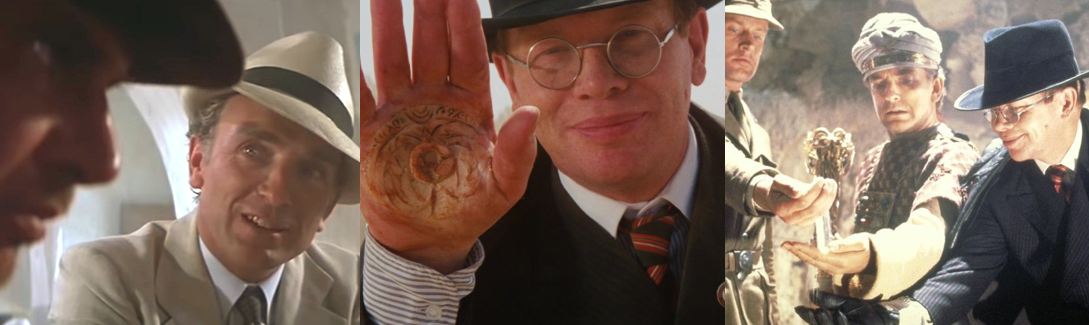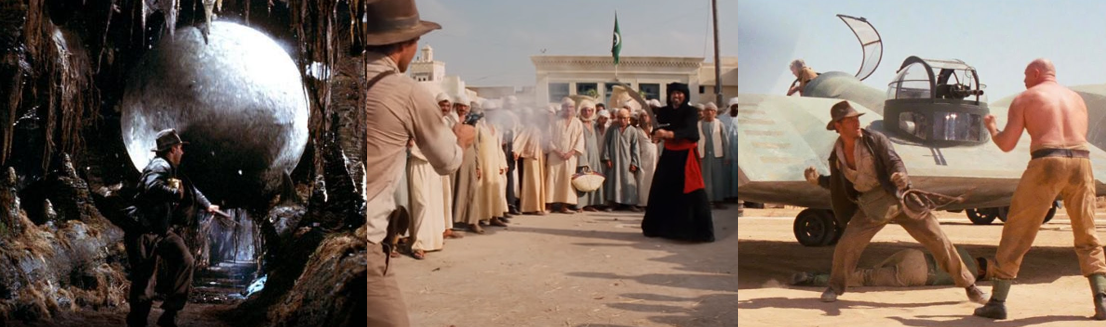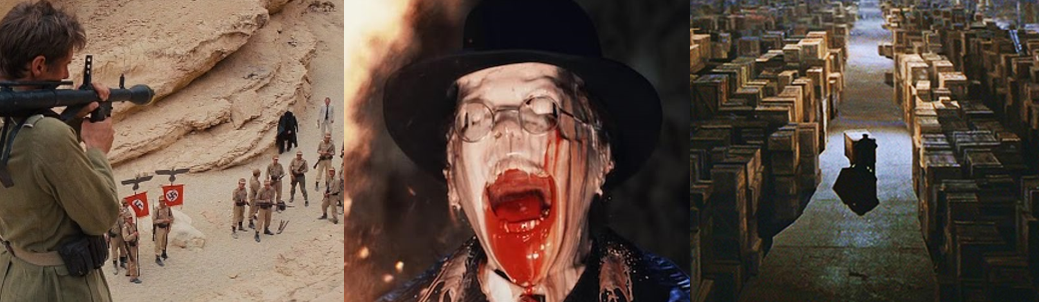
Movie Night: Indiana Jones and the Dial of Destiny

Released: 30 June 2023
Director: James Mangold
Distributor:
Walt Disney Studios Motion Pictures
Budget: $295 million
Stars:
Harrison Ford, Phoebe Waller-Bridge, Mads Mikkelsen, Boyd Holbrook, Ethann Isidore, and Antonio Banderas

The Plot:
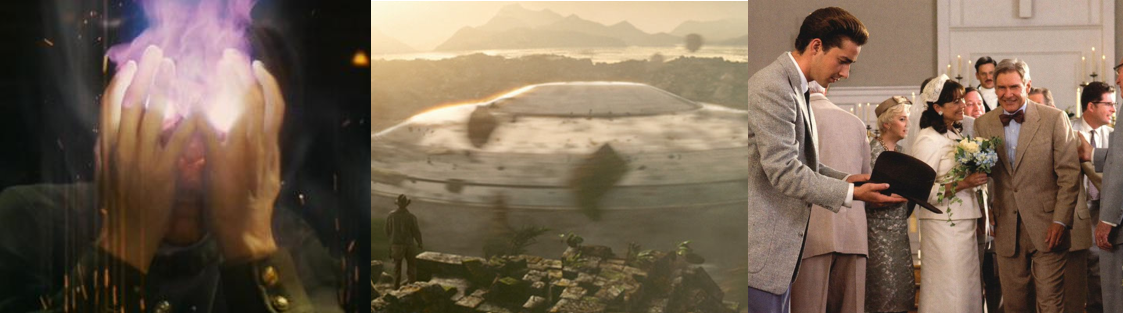
Former adventure-seeker Doctor Henry Jones Jr. (Ford), better known as “Indiana Jones” (or simply “Indy”), is facing retirement and a life of regret and loneliness when his goddaughter, Helena “Wombat” Shaw (Waller-Bridge), bursts into his life in search of the fabled Antikythera, a scientific artefact said to allow time travel and coveted by Nazi scientist Jürgen Voller (Mikkelsen).

The Background:
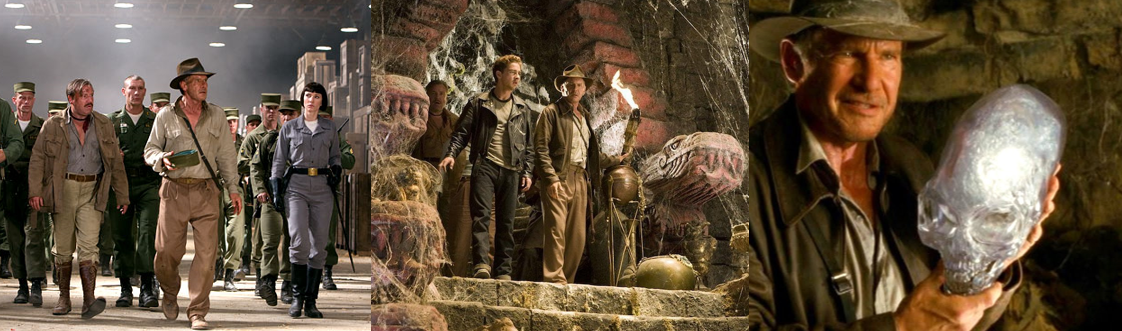
Taking inspiration from the pulp serials of his youth, George Lucas created the character and concept of Indiana Jones alongside director Steven Spielberg and star Harrison Ford, resulting in one of cinema’s most influential franchises with the critical and commercial success Raiders of the Lost Ark (Spielberg, 1981), the controversial Indiana Jones and the Temple of Doom (ibid, 1984), and the highly-praised (and profitable) Indiana Jones and the Last Crusade (ibid, 1989). After Lucas and Spielberg focused on the Young Indiana Jones Chronicles (1992 to 1993) prequel series, they stumbled upon the idea for a fourth film. Unfortunately, despite a hefty $790.7 million box office, Indiana Jones and the Kingdom of the Crystal Skull (ibid, 2008) was met with mixed reviews and mockery, meaning it was a surprise when a fifth entry was announced shortly after the franchise was purchased by the Walt Disney Company. While neither Lucas or Ford were bothered by concerns over Ford’s age and never considered recasting, it was decided early on that Mutt Williams (Shia LaBeouf) would not be taking over as the lead and Helena’s role was specifically written for star Phoebe Waller-Bridge. Although Spielberg contributed to the plot, he declined to direct so James Mangold could bring a fresh perspective to the franchise. The most expensive of the franchise, Dial of Destiny included some elaborate chase sequences utilising both on-set filming and CGI, including an extended opening sequence that digitally de-aged Ford, while the story was specifically written to address Indy’s advancing age. After filming was delayed due to an injury Ford suffered, Indiana Jones and the Dial of Destiny released to generally positive reviews; it has currently made $171.9 million at the box office and critics praised Indy’s character arc and the entertaining narrative, though some noted that it failed to live up to the standards of the original trilogy.

The Review:
It wasn’t until I headed out to see Dial of Destiny that I realised that my relationship with the Indiana Jones franchise isn’t as strong as it is with others; I didn’t grow up with the films in the same way as I did other franchises, I often skip over watching them if they’re on TV and rarely feel the urge to rewatch them on DVD, and generally consider them all to be of about the same level of quality, separated by the big action sequences and set pieces unique to each one. However, I’m of the firm belief that Indiana Jones is a young man’s game; Kingdom of the Crystal Skull got lucky in its depiction of an aging Indy who can still go but effectively retired the character, meaning I would have much preferred to see a new actor take on the role for earlier adventures or a recast of his son to allow Mutt to take centre stage and re-frame the aging Indy into something resembling the father/son dynamic we saw in The Last Crusade. Indeed, Dial of Destiny begins very promisingly, showcasing a hitherto-unknown adventure from Indy’s past, with de-aging technology applied to Harrison Ford so he appears to be in his prime during the fall of Berlin in 1944. I say “appears” to be because, while this technology is so impressive I’d wager an entire film could be produced in this manner now (and probably be more enjoyable), there are times when it falters, and you can tell that the elderly Ford is struggling with the physicality of the role. Still, this opening is classic Indy and sees him butting heads with Nazis over a forgery of the mythical Lance of Longinus, scrambling to rescue his close friend Basil Shaw (Toby Jones), and stumbling upon the titular Dial of Destiny, the Antikythera, a device created by renowned mathematician Archimedes (Nasser Memarzia) to detect fissures in time, which Nazi scientist Jürgen Voller wishes to present to Adolf Hitler to undo their defeat.
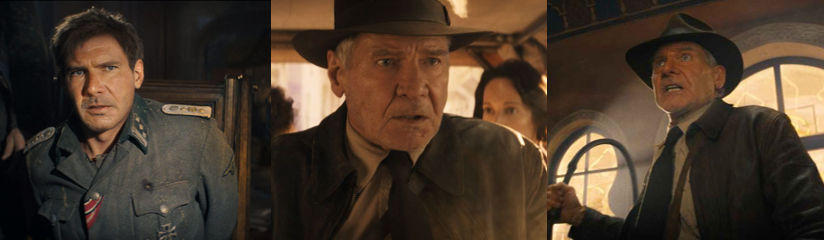
Following a look at his gory days, old man Indy awkwardly embarks on an impromptu adventure.

Naturally, Indy defeats Voller’s aspirations and retrieves the Antikythera, but his friendship with Basil later crumbles over arguments about the search for the missing half of the device, which drove Basil to near madness, just one of many regrets weighing down Indy when the film jumps ahead to the 1960s. Old, worn down, and alone, age has well and truly caught up to Indy; his students no longer fawn over him and are more interested in the Moon landing than archaeology, and he’s currently facing a divorce from his wife and recurring love interest, Marion Ravenwood (Karen Allen). It turns out that, despite getting his happy ending in Kingdom of the Crystal Skull, things really went bad for Indy in the intervening years: Mutt enlisted to “piss him off” and got himself killed, destroying Indy’s relationship with Marion since neither of them could properly process their grief, leaving Indy a bitter and cantankerous old man who yells at his neighbours and sleepwalks through both life and even his retirement. Shuffling through his day to day with the weight of his adventures and toll of loss wearing him down, Indy has lost much of his zest and thirst for adventure; his memory is fuzzy to the point he doesn’t immediately recognise Helena, and he openly mocks her suggestion of one last adventure to retrieve the Antikythera (though, to be fair, this is primarily because he still has it in storage despite his promise to Basil to destroy it). Indeed, Indy is very much a passenger in Helena’s quest for the device since his first reaction when Klaber (Holbrook) arrives shooting first and asking questions later is to call the police, but he’s soon determined to keep Helena from auctioning off the Antikythera out of respect for his and Basil’s love of antiquities, which was so strong that they stormed a Nazi train to preserve history. There’s no doubt, however, that time has more than caught up with Indy; he’s extremely ineffectual in a fist fight here, often easily being captured or overpowered, and he struggles with his failing body when clambering about a tomb. Strangely, though, his character arc is less about rediscovering his old self (though this is haphazardly suggested at the end) and more about coming to terms with the fact that he’s old and the world has passed him by.
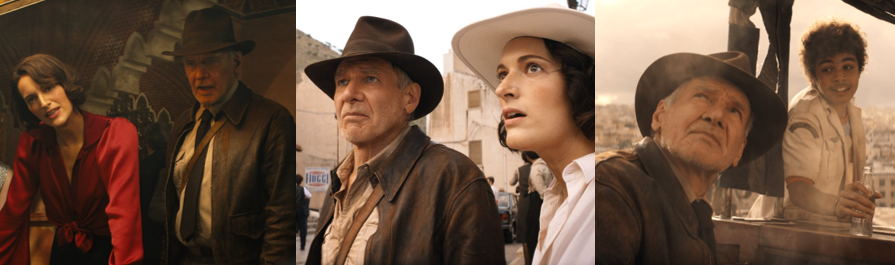
Helena manipulates Indy into helped her achieve her dreams of fortune and infamy.

In place of Mutt, Indy shares the screen with his goddaughter, Helena (who he affectionately refers to as “Wombat”, though there’s no explanation for this). Although she initially approaches him as an excited and warm family friend, this is a front for her true purpose, which is to steal the Antikythera from Indy and sell it off to pay off her debts. A promiscuous and selfish young lady, Helena is as manipulative as she is capable; she easily toys with the emotions of others, making many enemies in the process, in the pursuit of fortune and fame rather than to preserve history. Yet, while she sells herself as a glorified treasure hunter, Helena is as learned as Indy; she memorised all of her father’s notes on the Antikythera and has a degree in archaeology, so she knows her stuff and is constantly depicted as being as knowledgeable as Indy through her awareness of various myths, customs, and ability to decode ciphers. While she appears to use this knowledge only for personal gain, Indy observes that she has an emotional stake in the Antikythera since Basil obsessed over it up until his death, but she’s resentful towards Indy since he neglected to fill her father’s shoes, so she thinks nothing of using him to her own means and is initially reluctant to team up with him despite needing his expertise. She softens towards him after Indy gets emotional about his losses and they soon pool their resources and respective knowledge to find the missing half of the Antikythera. Tough and adaptable, Helena even has her own kid sidekick, budding pilot Teddy Kumar (Isidore), a pickpocket who acts as her lookout, bodyguard, and backup as needed, but her manipulative and selfish actions mean that she’s short on allies to aid in their journey. This is where Indy becomes even more useful as he has many allies, such as the returning Sallah (John Rhys-Davies), who helps him get out of the United States, and newcomer Renaldo (Banderas), an ill-fated, lame pilot who provides them with the specialised diving equipment they need to locate a wax tablet that reveals the location of Archimedes’ grave and the missing half of the Antikythera.
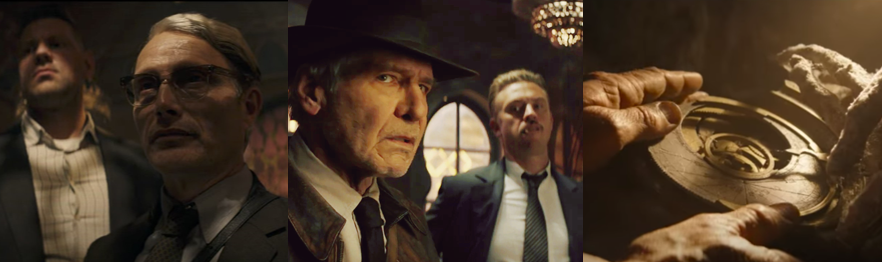
Nazi scientist Voller and his goons will use any means necessary to acquire the Antikythera.

Indy, Helena, and Teddy are relentlessly hounded throughout this quest by Voller, who defected to the US after the war, took on a new name, and put his science to use getting a man on the Moon all to acquire support for his efforts to locate the Antikythera. A stoic, unnervingly charismatic villain, Voller makes little attempt to hide his prejudice towards other races and cultures and his complete disinterest in anything other than acquiring the Antikythera and conquering time itself through its unique mechanism. Although cordial and soft-spoken, Voller switches to a psychotic madness on a dime; he thinks nothing of threatening, torturing, or killing others to get what he wants and gives Klaber carte blanche to exercise any means necessary to carry out his orders, outraging sadly underutilised government agent Mason (Shaunette Renée Wilson), just one of many people Voller and his Nazi buddies murder in cold blood to achieve their ends. Volley’s underlings are simply trigger-happy psychos but Voller himself is far more conniving and patient; Voller’s goal is to acquire the completed Antikythera and use it to locate a time fissure so he can go back to 1939, assassinate Hitler, and change the course of history by leading the Nazi’s to ultimate victory and he’s perfectly happy to let Indy do all the leg work for him and simply steal his rewards or follow his enemies to the source of his obsession. As captivating as Mads Mikkelsen always is (he truly commands every scene, especially when he’s colluding and conspiring with those around him), I was a bit confused by Voller; I’d love to know how he survived his opening encounter with the younger Indy, and I kept waiting for a reveal that he’d already used the Antikythera in some way, but it never came to be. I think it might’ve landed a little better if Voller had been scarred or otherwise incapacitated in some way, because as is he just seems as immortal and indestructible as Indy, who survives being caught in a massive explosion and swung about from a noose with barely a scratch. I also went through the whole film not really knowing Voller’s name or those of his underlings as they’re either not said or are difficult to make out, and most of them lacked any characterisation beyond psychopathic Nazi, which was a bit of a shame.

The Nitty-Gritty:
On the surface, Dial of Destiny very much delivers everything you’d expect from an Indiana Jones movie: it uses the same title font introduced in Raiders of the Lost Ark, map sequences for when Indy and his allies are covering great distances, John Williams returns to do the score, and it features Indy bouncing all over the place on a globe-trotting adventure. However, for me, Dial of Destiny lacked a lot of the energy and excitement I associate with the franchise specifically because of the unavoidable reality that Harrison Ford has aged out of this role. Burdened by regret, grief, and loss, Indy is now snappy and grouchy, and with good reason; the world has passed him by and he’s in a lot of pain over Mutt’s death, his failure to protect him, and his inability to support Marion in her own grief. Learning that Helena felt abandoned by him only compounds that but travelling with her and Teddy offers a sliver of redemption, in a way; initially, he goes along with them to retrieve the Antikythera out of a devotion to Basil but, once he learns of Voller and the Nazis’ involvement, he’s motivated by that same spark to preserve history, which then gives way to giddy excitement when he realises that all the stories of the Antikythera are true and that it actually can detect fissures in time. I am a bit confused about this, though; the Antikythera doesn’t generate the time fissures, it simply directs you to them, so are they just…there…with no explanation of how are they formed. Also, it was pretty ballsy to put in a time travel plot considering the backlash against aliens in the last film; it feels a little disconnected, to be honest, and I was surprised the film didn’t opt for a more traditional, less sci-fi premise, especially as it doesn’t really explore the potential of the Dial in interesting ways beyond briefly plonking Indy in Ancient Greece.
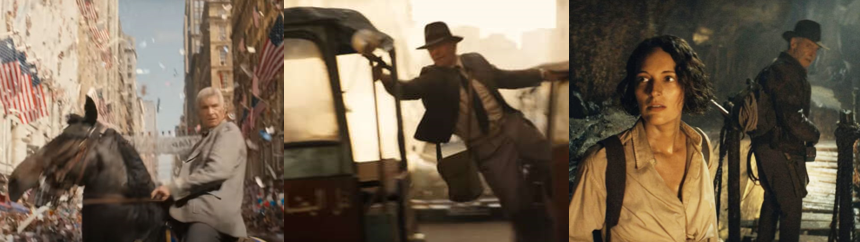
With Indy’s action scenes relegated to chases, the film focuses more on the quest than crazy stunts.

Indy’s advanced age definitely reflects on the film’s action sequences; I felt like the fetch quest aspects of the film were emphasised way more so the film could focus more on Indy’s knowledge rather than whip-cracking stunts and this is noticeable in Indy’s few fight and action sequences. His whip is now used defensively, to keep others at bay, rather than as an offensive weapon and its usefulness is constantly undermined by the heavy use of firearms in the film, both by Indy and his enemies. Indy has also lost a lot of his explosive impact in a fist fight; he’s now much better suited to catching his enemies unawares than taking them on in a straight fight, so he’s far more likely to jump in a speeding tuctuc or commandeer a horse than he is to trade blows with his younger, stronger foes. While the opening sequence showcases Indy in his prime, getting into many of the same wacky scrapes you’d expect, it’s a stark juxtaposition to then be left with the awkward and cumbersome aging Indy for the rest of the film, one whose action scenes are relegated to where he’s scrambling about in numerous chase sequences that drag on a little too long at times. It ties into some of the themes of the movie, and Indy himself, who’s always been a flawed, vulnerable, and scrappy character but it’s not like Helena does much of the heavy lifting in his place. She’s younger, obviously, but her strengths are in sleight of hand, manipulation, and impulsively escaping from dangerous situations rather than showcasing any impressive physical ability, meaning things do get a little repetitive and underwhelming in the action department. There are some nice visuals, though; I enjoyed the chase scene amidst the Moon parade, the underwater sequence was quite tense and made effective use of some aggressive eels, and the film surprisingly references Temple of Doom both explicitly and in the incorporation of a new batch of disgusting bugs when Indy and Helena are exploring Archimedes’ tomb.
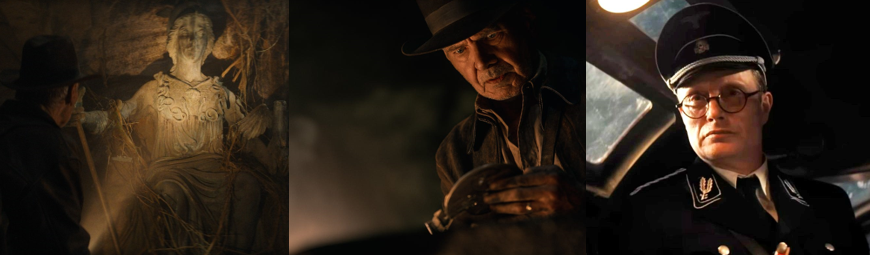
The Antikythera allows travel to the past, where Indy is tempted to stay to escape his pain.

Thanks to Indy and Helena’s combined knowledge of Archimedes and the Antikythera, they’re able to reach Archimedes’ tomb and complete the device, but Voller proves himself both persistent and intelligent and simply follows them there, using Teddy as a hostage, to claim the device for himself. As in previous Indiana Jones movies, Indy and his enemies share a respect for the artifact’s power and mystery; they’re both astounded to learn from Archimedes’ mummified remains that the ancient mathematician must have used the device at some point as he’s sporting a modern-day watch, but Voller is driven to maniacal distress when he fails to take continental drift into account when making his calculations. With Indy as his prisoner, Helena as a stowaway, and Teddy in hot pursuit, Voller and his allies don their best Schutzstaffel uniforms and fly a German bomber through a time fissure, only to find Indy’s warnings were correct and they’ve landed themselves in 212 BC! Amidst the Battle of Syracuse, the plane is shot down by Roman warships and Archimedes’ innovative defences, killing Voller, Klaber, and their nameless henchmen. Wounded in the fight, Indy is awestruck to be literally witnessing history and meeting the legendary Archimedes, who takes Voller’s watch for himself and is equally fascinated by their story. Feeling he has nothing to live for in the present day, Indy is adamant about staying in the past to witness history first-hand and the film lingers on this for so long that it really feels like Indy’s going to live out what little time he has left in Ancient Greece. But an emotional Helena, having rediscovered her affection for the aging adventurer, simply knocks him out and drags him, off camera, back to the present so he can survive and continue to be a part of her life. She even reunites him with Marion and the film ends with the suggestion that Indy is “back”, not so much as a free-spirited adventurer but back from his grief, though this ending felt very rushed to me. It definitely seemed to want to bring Indy’s journey full circle and leave him in the past, but then it just didn’t; I also thought the plot point of Indy regretting not being able to save Mutt would tie into the Antikythera/time travel plot and allow him to save his son but that doesn’t happen either.

The Summary:
I went into Indiana Jones and the Dial of Destiny with low expectations; I really didn’t think we needed another Indiana Jones film, especially one where he’s portrayed a broken down, bitter old man, and Kingdom of the Crystal Skull was still very much fresh in my mind. I went into it out of respect for the franchise and the title character and hoping it would make good on the mistakes of the last film, and ended up with a half-baked adventure that lacked the energy and excitement I associate with the series and its iconic lead. Old, cantankerous Indy could work with a younger lead to team him up with, one who embodied his adventurous spirit in a new age and could teach Indy new things, but Helena sadly fails to fill this role just as Mutt did before her. She’s a better character, that’s for sure, but it’s weird how she’s only now being mentioned and I wonder if it might’ve been better to have her be his granddaughter, resenting Indy for her father’s death. Visually, the film is quite impressive and the performances do land for me; Indy showcases some stirring emotional depth at times and Mads Mikkelsen once again delivers as the psychotic, cold-hearted, yet surprisingly captivating antagonist but, overall, Dial of Destiny just fell flat for me. It felt like a shadow or what had come before, less of a celebration and homage to Indy’s old adventures and more a last gasp effort to squeeze some life out of the franchise. It’s sad seeing Indy’s story turn out so tragically and watching him stumble through scenes, and I think the film squandered a lot of its potential by playing things a little too safe, meaning it’s probably better that Indy hang up the whip and hat for good this time as I think we’ve done everything we can do short of recasting a younger actor in the role for prequels and interludes.

My Rating:

Rating: 3 out of 5.

Pretty Good

Did you enjoy Indiana Jones and the Dial of Destiny? Do you think it was better than the last film or are you equally put off by Indy’s advanced age? What did you think to Helena and her relationship with Indy? Were you a fan of Mads Mikkelsen’s performance and what did you think to the time travel plot? Which of the Indiana Jones movies is your favourite? Whatever you think about Dial of Destiny, feel free to share your opinions in the comments or on my social media and be sure to check out my other Indiana Jones content!

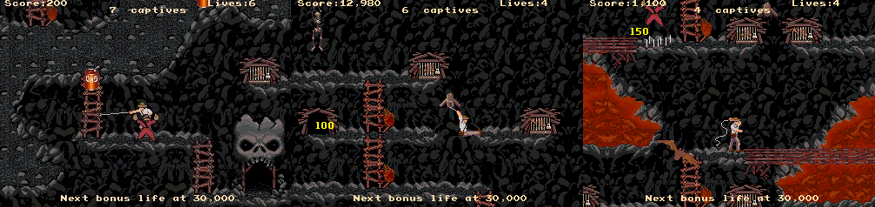
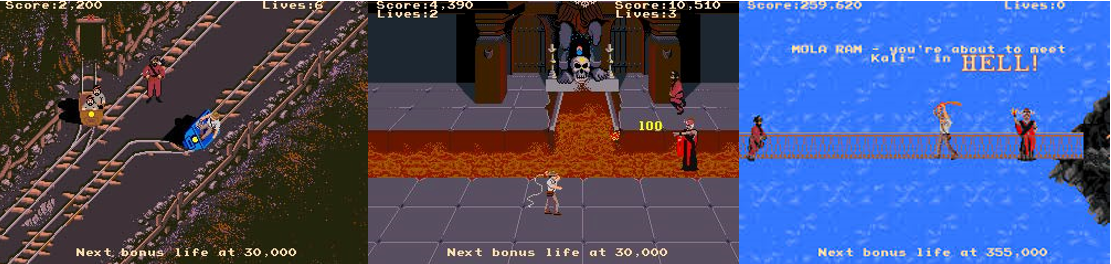
Mini Game Corner: Indiana Jones and the Last Crusade: The Action Game (Mega Drive)

This review has been supported by Chiara Cooper.
If you’d like to support the site, you can do so at my Ko-Fi page.

Released: November 1992
Developer: Tiertex Design Studios
Also Available For: Amiga, Amstrad CPC, Atari ST, C64, DOS, Game Boy, Game Gear, MSX, Master System, Nintendo Entertainment System (NES), ZX Spectrum

A Brief Background:
In 1981, legendary director Steven Spielberg joined forces with George Lucas and Harrison Ford to bring the first Indiana Jones film to cinema screens; inspired by both old serial films and the James Bond franchise, the three crafted an action/adventure film that was so critically and commercially successful that it kicked off one of cinema’s most beloved franchises, helped launch Harrison Ford to superstardom, and fundamentally changed the cinema rating system. Naturally, given the franchise’s success, the Indiana Jones films and character have been adapted into books, comics, and videogames; the first Indiana Jones videogame was a simple 8-bit adventure for the Atari but it was the third film, Indiana Jones and the Last Crusade (Spielberg, 1989) that received the most love back in the day, with three titles released across multiple platforms between 1989 and 1991. This particular game was the more action-orientated version and was met with divisive reviews that praised the presentation but criticised the content, combat, and difficulty of the game.

First Impressions:
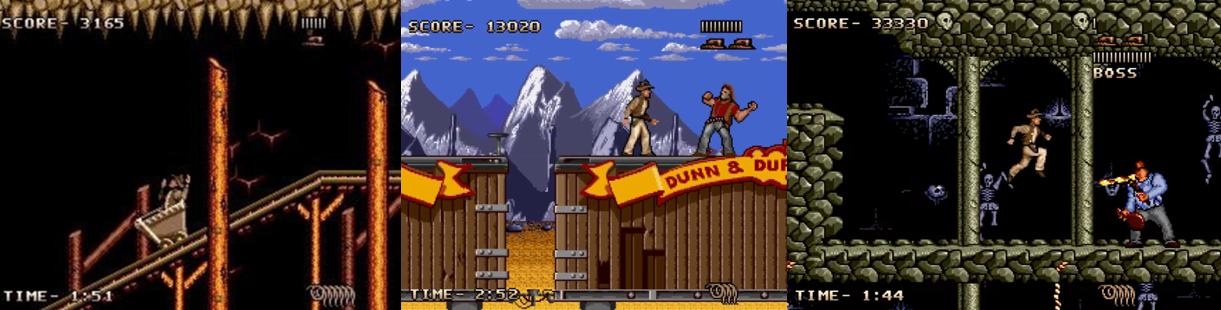
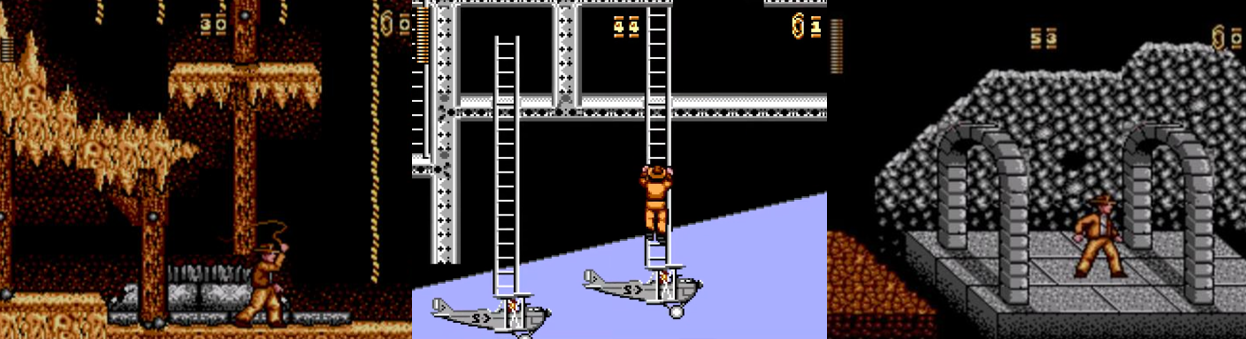
Indiana Jones and the Last Crusade: The Action Game (boy, is that ever a mouthful!) is a 2D, sidescrolling action/adventure game in which players assume the role of the titular archaeologist and adventurer. The controls couldn’t be simpler; by default, you press A to punch, B to attack or swing with your whip, and C to jump, but you can customise these inputs as you desire. Indy can also duck and crawl through tunnels, attacking as he goes, climb up and down ropes (lashing out with his whip to take out enemies), and can swing from certain objects simply by whipping near them. Although Indy doesn’t seem to utilise his pistol, his whip can be used to take out enemies from afar, but the more you use it, the weaker it becomes, as indicated by the whip icons decreasing with each button press. Luckily, you can replenish this by finding whip pick-ups in suitcases and you can still use the whip even after exhausting your supply. Indy’s mission is to travel across a number of levels (referred to as “Scenes”) from the movie, exploring hazardous environments and reaching the exit before the timer runs out. Players can pick between “Easy” and “Hard” difficulty modes and are given two lives and two credits on Easy mode, which you’ll quickly realise is nowhere near enough to help you get through his unforgiving title. Literally everything around you is out to get you; Indy will even lose health if he jumps and hits his head on the ceiling, to say nothing of the falling stalactites, boulders, and armed enemies looking to quickly drain his health and leave him little more than his trademark hat.

Don’t be fooled by the graphics or your love of the franchise: this game is absolutely merciless!

Gameplay is given a little bit of variety thanks to the gimmicks found in each Scene; you’ll get to jump in a minecart in the caves, for example, but will need quick reactions to hop from one cart to another, and to a rope, to avoid plummeting to your death. The second Scene sees you running across train carriages jumping over telegraph poles, ducking through tunnels, and avoiding giraffe heads and snake pits as you desperately try to progress without falling. You can also grab flaming torches to light up dark areas, but you’ll need to watch out for spikes that instantly kill you, bursts of flame from the ceiling, and make precarious jumps up a castle wall in rain-swept Venice. Enemies are all largely generic and look the same in each Scene and can punch and shoot at you, though they’re easily defeated in a few hits. Unfortunately, Indy’s punch is pathetically short and you’re more likely to take damage engaging with them, so it’s best to just avoid combat or use your whip wherever possible, though none of that will save you from the game’s many instant death traps or the fact that you take damage from jumping! Water, snake pits, train tracks, and skeletons will instantly kill Indy, meaning there is very little margin for error, and you’ll not only have to deal with some merciless knockback but often need split second reactions to dodge damaging (or instant death) traps after besting each Scene’s boss. Indy can find goblets to replenish his health and sand timers to increase the time, but you’re constantly walking on eggshells as so much can either hurt you or out-right kill you that it makes playing the game a frustrating chore and Indy, one of cinema’s toughest action heroes, weak as a kitten.

My Progression:
Technically, I couldn’t even get past the first Scene; I inched my way onwards only to fall victim either to accumulated damage or an instant death trap, made all the worse by how large and unforgiving Indy’s hit box is. Thus, I used the one and only cheat for the game, which is a level select code; this not only lets you pick the Scene to start on, but the starting point as well (the game is filled with hidden checkpoints), which is very handy for seeing later areas of the game or battling bosses. I fought the first three bosses, the first being a strongman with a huge piece of wood that he swings at you to knock you to the instant death water and smashes on the ground to cause rocks to fall on you, the second being a bulbous fire-breather whose flames you need to quickly duck or jump over while frantically whipping him, and the third a Native American who shoots high and low arrows at you, but I shut the game off shortly after besting this boss.

I was really hoping for a challenging, but fun, action/adventure title and instead what I got was a torturous and ridiculously difficult title that no doubt had many kids pulling their hair out back in the day. When you struggle, or can’t, get past the first level, to me that’s the sign of a bad game and Indiana Jones and the Last Crusade: The Action Game reeks of being cobbled together to cash-in on the movie by having kids rent it over and over just to get past the first damn level! It’s a shame as there’s a lot to like here. Graphically, the game looks really well; Indy doesn’t really have an idle animation, but he looks and controls pretty well, and games environments are all nicely detailed. The sound is pretty good too, with a decent rendition of the iconic Indiana Jones theme, but the game is just too difficult to really enjoy. It’s a shame as I’m a big fan of the franchise and was hoping this would be a decent little action platformer, but it kicked my ass the moment I pressed the jump button under a low ceiling and Indy is just way too fragile for the game to be as enjoyable as I would like. But maybe I just suck. Maybe you’ve beaten this game multiple times, or really enjoy it. Or maybe you prefer a different Indiana Jones videogame. Whatever your thoughts or experiences on the subject, sign up to share them below or leave a comment on my social media.

Movie Night: Indiana Jones and the Kingdom of the Crystal Skull

This review has been supported by Chiara Cooper.
If you’d like to support the site, you can do so at my Ko-Fi page.

Released: 22 May 2008
Director: Steven Spielberg
Distributor:
Paramount Pictures
Budget: $185 million
Stars:
Harrison Ford, Shia LaBeouf, Cate Blanchett, Karen Allen, Ray Winstone, and John Hurt

The Plot:
When greaser Mutt Williams (LaBeouf) drops into his life with the news that his old friend, Professor Harold Oxley (Hurt), has gone insane and been captured by Nazi forces seeking the legendary Crystal Skulls, aging archaeologist and adventure-seeker Doctor Henry Jones Jr. (Ford), better known as “Indiana Jones” (or simply “Indy”), sets out on a life-changing rescue mission.

The Background:
Inspired by the pulp serials of his youth, George Lucas came up with the concept of Indiana Jones in the 1970s and, alongside director Steven Spielberg and star Harrison Ford, produced the critical and commercial hit Raiders of the Lost Ark (Spielberg, 1981), the controversially violent Indiana Jones and the Temple of Doom (ibid, 1984), and the highly-lauded (and highly profitable) third entry, Indiana Jones and the Last Crusade (ibid, 1989) to create one of cinema’s most influential franchises. Lucas and Spielberg initially made a deal to make five Indiana Jones movies for Paramount Pictures but, when they struggled to come up with a suitable story for a fourth film, focus shifted to the prequel series, The Young Indiana Jones Chronicles (1992 to 1993). While filming Harrison Ford’s cameo as an aged version of Indy for this series, Lucas was inspired by the concept of an older character tangling with B-movie-style aliens in the 1950s; although both Ford and Spielberg criticised the idea, Lucas pushed forward with a script, which would include the return of Sean Connery and Indy getting married, but the idea was summarily quashed upon the blockbuster release of Independence Day (Emmerich, 1996). However, by 2000, the idea was revived and refined to centre around the mysterious crystal skulls. Work on the script, and getting the project off the ground, stalled between 2002 and 2005 as the plot shifted away from the Nazis and towards the Cold War and, when filming finally began in June 2007, the production stayed firmly in the United States so Spielberg could stay close to his family. Although practical stunts and effects were emphasised to retain the style of the previous films, with the aging Ford still performing many of his own stunts, over 450 CGI shots ended up being incorporated to create the sci-fi elements and more dangerous aspects of the action, the quality of which was the subject of scathing criticism. Indeed, while Indiana Jones and the Kingdom of the Crystal Skull’s $790.7 million worldwide box office made it a huge success, reviews were mixed; while the action sequences and lead performances were praised, its execution and effects were criticised. The film was openly mocked for its more over the top elements and even star Shia LaBeouf spoke out against the film, a decision he later came to regret and potentially impacted his future in the franchise. Despite the overwhelming negative reception of the film, a fifth entry was announced soon after the franchise fell under the vast umbrella of the Walt Disney Company to continue the series, for better or worse.

The Review:
Unlike many my age, I didn’t really grow up with the Indiana Jones movies; I’d seen bits of them, maybe all of one, as a kid but it wasn’t until I was a little older that I really started getting into them. For years, it was one of the great constants and reliefs of my life that we had these three movies, a pretty consistent trilogy that was largely well regarded, and that I didn’t have to worry about any re-releases taking up more of my time, space, or money. And then, out of nowhere, Indiana Jones and the Kingdom of the Crystal Skull came along. Almost twenty years after the last Indiana Jones adventure, in a climate where action cinema had not only changed so much but was on the cusp of exploding into fantastical superhero productions, Indiana Jones was set to return and I, like many, met this with a mixture of excitement and uncertainty. Harrison Ford had aged pretty well but had largely moved on from his more action-orientated roles, to say nothing of outright disowning some of them, but the concept of an aging hero returning to the fold was becoming popular at the time and, like Lucas’s epic sci-fi series, Indiana Jones is as much a popular brand as it is a character so it was guaranteed to bring audiences in on the name alone. For me, this movie also offered the first chance I’d ever had to see an Indiana Jones adventure on the big screen, adding to its allure, despite my personal dislike for Shia LeBeouf and the scepticism I had about the film, negatives that ultimately came to influence my perception of the movie, especially compared to its predecessors.

Though older and jaded, Indy still retains his adventurous spirit and curiosity despite the dangers.

As ever, Indy’s reputation proceeds him; he’s specifically captured by the Russians because of his knowledge of Area 51 and, similar to the ending of Raider of the Lost Ark, is just as intrigued and excited by the secrets that are contained within it even when he has a butt-load of guns pointing at him. Seemingly having learned nothing after his experiences both on and, presumably, off-screen, Indy continues to scoff at superstitions and legends, particularly the idea of psychic powers, and is instead driven by the science and opportunity presented by such artefacts as the titular crystal skull. Interestingly, between movies, Indy was drafted into the war effort and contributed to the fight against the Axis Powers, coming out the other side with a war record and the rank of Colonel, indicating a development from a morally grey mercenary and tomb raider, to scholar and part-time government agent, to a fully-fledged and highly decorated patriot willing to go to war for his country. He’s thus understandably infuriated to be accused of treason thanks to his association with turncoat former MI6 agent George “Mac” McHale (Winstone), and with the shroud of secrecy and paranoia that has overtaken the American government since the war, especially concerning the Roswell incident that he was forced to advise on, and force both him and his friend, Dean Charles Stanforth (Broadbent), out of the university. Interestingly, Indy has noticeably grown in other ways; he’s more likely to consider the consequences of his actions and recognises the odds are against him now that he’s older, and also encourages his students to get out of the library, which is in stark contrast to his teachings from Indiana Jones and the Last Crusade. Yet, at the same time, it seems Indy has resigned himself to his teaching; he’s taken away from the classroom against his will and even openly introduces and refers to himself as Henry Jones, Jr. rather than his more adventurous nickname. Indy remains as well-read and learned as ever; of course, in this case, it helps that he advised on the Roswell remains and that he has first-hand knowledge of the crystal skulls thanks to his former friendship with Harold Oxley. It’s because of this that he’s able to decipher Oxley’s riddles and begin the film’s globe-trotting adventure, one that seems him decoding the old man’s mad scribbles and notes very similar to piecing together the notes from his father’s diary in the last film.

Rebellious greaser Mutt is stunned to learn this Indy is his real father.

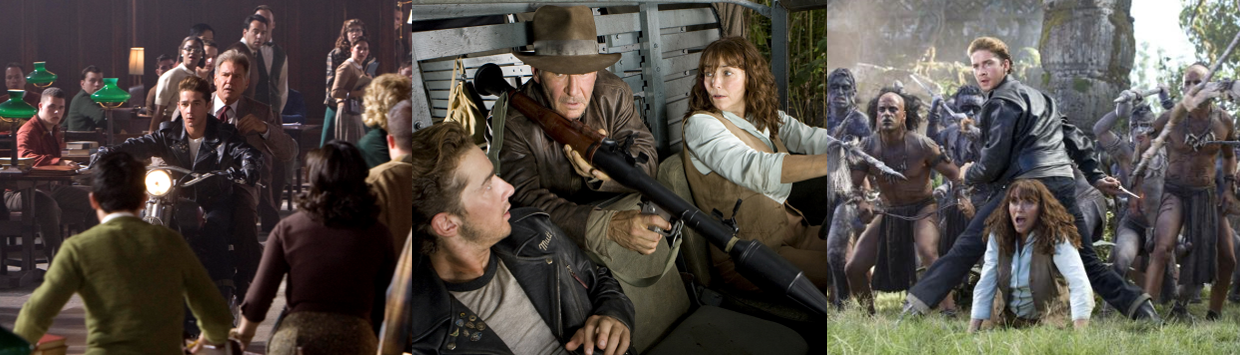
Thanks to being set in 1957, Indiana Jones and the Kingdom of the Crystal Skull takes place during a time of free-spirited teenage rebellion; fun-loving kids take joyrides through the desert for a thrill, hang out at diners, and obsess over rock ‘n’ roll music. Accordingly, image and style are important to these youths, none more so than greaser Mutt Williams, a hot-headed upstart garbed in a leather jacket, infatuated with his slicked hair, and quick to defend his mother and himself from any perceived slights. Embodying a “too cool for school” attitude, Mutt was raised by his mother, Marion Ravenwood (Allen), without any knowledge of his true father; instead, he saw Oxley as father figure after his own father died in the war and has no idea that Oxley’s old protégé, Indy, is his real father. Of course, anyone with half a brain can see this twist coming a mile away but Indy remains oblivious for some time, meaning he and Mutt initially bond as peers; Indy encourages him to do his own thing and to follow his passions, advice he immediately retracts once he learns he’s Mutt’s father. As the youngest of the film’s protagonists, Mutt naturally takes centre stage in many of the action sequences; armed with a switchblade, the fighting spirit of youth, and willing to throw or ride into danger without a thought for the consequences, Mutt is very much the rebellious boy Indy was seen as by his own father. Though he’s still capable of holding his own in a fight, venturing into the field, and pulling off some insane tricks when his back’s against the wall, even Indy despairs of Mutt’s cavalier attitude; he’s of a generation that Indy doesn’t quite understand, forcing Indy into a scolding, cantankerous role of disgruntled mentor and father not entirely unlike the strict demeanour of Professor Henry Jones, Sr. (Sean Connery). While there’s a lot he admires about Mutt, the youngster is an emotional and volatile greaser who underestimates Indy’s skills and abilities and yet is dependent on his elder to figure out what happened to Oxley since mythology and history aren’t Mutt’s strength.

Indy’s quest sees him betrayed and reunited with old flames and friends alike.

Despite the tensions running throughout the United States and federal agents being quick to point the finger at him, Indy still isn’t short on allies; while the bumbling Marcus Brody (Denholm Elliott) and Indy’s own father have died between movies (proving once and for all that, despite vague allusions to the contrary, neither Henry or Indy were granted everlasting youth or immortality by the Holy Grail), Indy still has a friend at the university, one willing to put his own career on the line to at least keep Indy tenuously connected to the institute, and eventually comes to bond with Mutt despite them both being aghast to learn of their true heritage. Indy and Marion’s reunion goes about as well as in Raiders of the Lost Ark but is given an extra wrinkle by the fact that she managed to move on after him and has become determined to shield her son from following Indy’s reckless ways to the point where she’s very overprotective of him and reluctantly reveals that his true name is Henry Jones III only when she and Indy face imminent death from a dry sand pit. From there, she gets swept up in their adventure as Indy’s deciphering of Oxley’s mad ravings leads them through the hazardous Amazon jungle to the lost city of Akator, resulting in some heated exchanges and, ultimately, the rekindling of their romance as neither can deny the attraction they still feel and are united in their affection for Mutt. Indy is distraught after seeing his old friend and mentor’s mental state when reunited with him in Peru; driven mad by prolonged contact with a crystal skull, Oxley is little more than a raving lunatic, a fact that breaks Mutt’s heart and unsettles Indy, who scoffs at the legends and rumours surrounding the crystalline artefacts. While largely relegated to comic relief, more of Oxley’s true self begins to bubble to the surface as he sees Indy in action and his research proves crucial to locating Akator, though only Indy is able to make practical use of it since Oxley’s in no state to share his knowledge and his rantings are beyond the expertise of the Russians.

Irina is determined to acquire the power of the crystal skull to dominate the minds and wills of others.

In a nice change of pace, Kingdom of the Crystal Skull uses the Soviets as its primary antagonist rather than the Nazis; while functionally not too different, the Russian antagonists rely more on subterfuge and deception that blunt execution, posing as American military personnel to force their way into Area 51 and allowing Indy to do all the heavy lifting for them. The sense of distrust and geopolitical tension between these two superpowers is best embodied by Mac, an old ally of Indy’s from the Second World War who routinely betrays both friend and foe alike, his motivations never fully known, all to serve his own ends. Mac’s constant betrayals end up coming across more as a running gag and a constant annoyance; since we’ve never seen this character before, it’s hard to care when he turns on Indy and I can’t help but feel it might’ve meant more if this had been a character like Sallah (John Rhys-Davis) who we’d had a previous relationship with. His knowledge of Indy’s methods is invaluable to the alluring and menacing Colonel-Doctor Irina Spalko (Blanchett), a cold-hearted Russian agent who seems to example some form of telepathy, or at least empathetic powers, in order to forcibly extract information from her victims. An efficient and driven individual, Irinia maintains her composure at all times, proving swift and deft with her rapier and maintaining an eerie, unblinking façade no matter what’s happening around her. With little time for Indy’s antics or pointless delays, Irina isn’t above slaughtering an entire people or threatening anyone and everyone that gets in her way, torturing Oxley and holding him captive to the point of driving him to near madness in her search for the fabled crystal skulls, with which she and her fellow comrades plan to brainwash the world into following their will. While we don’t really learn all that much about her, Irina has a strange allure to her; she and Indy have a bit of a love/hate relationship which means that actually work well together when figuring out Akator’s location, and they could’ve been allies or perhaps even lovers in another set of circumstances, but her ruthlessness and dreams of world conquest are decidedly at odds with Indy’s quest to return the crystal skull to is resting place so its masters can finally leave our world.

The Nitty-Gritty:
Like Indiana Jones and the Last Crusade, Kingdom of the Crystal Skull seeks to evoke the spirit of Raiders of the Lost Ark, essentially tarnishing Indiana Jones and the Temple of Doom as an aberration, a perpetual and unfortunate black sheep whose themes and presentation are secondary to the title font, structure, and narrative of the first movie. This means we not only get a classic Paramount Pictures logo, the return of the more subdued credits font, and a chance to see Indy teaching at the university, but also that the film explicitly references the first movie by finally exploring that secret government warehouse where the Ark of the Covenant was stored at the end of Raiders. To be fair, Indy still cuts an impressive figure despite his advanced age, but there’s a gruffness and weariness about him that’s to be expected now that he’s past his prime; he’s as adaptable as ever, maintaining his adventurous spirit and still capable of tackling multiple foes at once, but he’s much less optimistic about his odds and relies far more on elaborate tricks rather than his fists. Indeed, it’s telling that he barely uses his whip in this movie (though, to be fair, he didn’t use it much in Raiders…) and that there are numerous references to his age getting the better of him. These are played for laughs and give the character a sense of vulnerability and desperation that was either lacking or framed somewhat differently in the previous movies, where he was always flying by the seat of his pants, but do make me question the logic of portraying an older Indy in such an action-orientated fashion. Sure, Harrison Ford can clearly still go, or at least to the best of his ability, but recontextualising him in a way where he’s coming to the end of his adventurous ways (or, to put it another way, getting “too old for this shit”) and having to begrudgingly rely on Mutt in a twist on Indy’s relationship with his eccentric father might’ve been a better fit for me since I feel Indy’s character works best when he’s in his physical prime.

The move really ups the ante into ridiculousness with its comical set pieces and action.

This means that Indy is even more on the backfoot than ever before which, again, is great for crafting a wily and vulnerable action hero but can lead to him looking a little foolish at times as he’s dominated by physically fitter enemies and forced to rely on pratfalls like incinerating a bunch of soldiers using a rocket engine and causing a brawl at a diner to escape the Russkies. Although I consider it an under-rated entry in the franchise, even I cant deny that Temple of Doom went a little over the top with its cartoonish humour and action sequences, but Kingdom of the Crystal Skull has it beaten thanks to two notorious set pieces. The first sees Indy stumble into a makeshift town designed to test the effects of an atomic bomb; literally at ground zero, Indy chooses to ride out the blast by shutting himself in a lead-lined fridge freezer. Somehow, despite being blasted clear across town by the resulting explosion, Indy emerges with barely a scratch on him and then immediately stops to admire the immense mushroom cloud left by the explosion, surely undoing whatever protection this tactic would’ve granted him and resulting in a sequence that’s so over the top that it may as well be in orbit! Mutt certainly follows in his old man’s footsteps in this regard; not only does he lash out at the Russians without a clear plan in mind, he’s able to put his fencing skills to the test against Irina while…somehow…maintaining his balance between two vehicles as the jungle swats at his crotch. Although he puts up a decent fight, he’s massively outclassed by the Russian, and most foes; like his father, Mutt has wiles and guts but not the greatest finesse in a fight. Given when the film was made, and the reputation of George Lucas at the time, it’s no surprise that CGI is a huge part of the film; even seemingly innocuous elements, like rodents, monkeys, and army ants are now rendered using dated and largely cartoonish computer effects rather than the tried-and-true practical efforts of the previous films. To be fair, there are many practical effects, car chases, and fight sequences that are more in keeping with the previous movies, especially when Indy and Mutt are exploring the ruins in Peru and the ancient hieroglyphics of Akator, but many of these are unnecessarily “enhanced” by ugly CGI.

Whether you accept the aliens’ presence in the film or not is really a matter of personal preference.

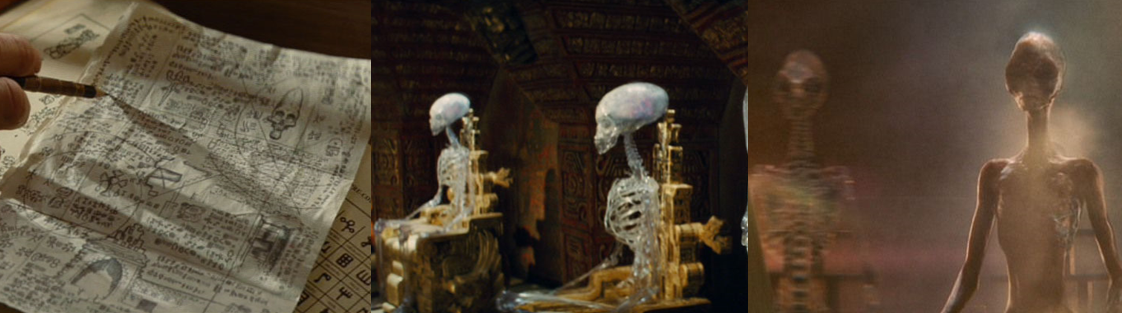
It’s been said by many that one of the reasons Kingdom of the Crystal Skull doesn’t work is because of the central narrative involving aliens, an element that many feel doesn’t belong in an Indiana Jones. I’m not entirely convinced that this is true; yes, the previous movies all had a supernatural and paranormal bent, ones deeply entrenched in religion, but Kingdom of the Crystal Skull is expanding upon real-world myths and conspiracy theories, such as the Roswell spacecraft crash and the titular crustal skulls, which have long been believed by many to be extraterrestial in origin, and these elements are framed in a way that’s in keeping with the previous films, where elements such as voodoo and religious mythology were revered in an almost magical context. Ultimately, my issue isn’t that aliens were included; in fact, I quite enjoy the depictions of the creatures and their crafts, which is in keeping with sci-fi movies and stories of the time. No, my issue is in the execution of the aliens, especially in the finale, where they’re brought to life through some truly horrendous CGI, and the explanation that they are “interdimensional beings” from “the space between spaces”, as though the filmmakers backed out at the very last minute regarding the extraterrestial nature of these beings. Another butt-ugly sequence sees Spielberg abandon practical effects in favour of cartoonish CGI and an obvious overabundance of green screen during the jeep chase through the Amazon jungle. Here, disturbingly fake trees and hazards whip by in a blur and Mutt ends up ridiculously swinging from vines alongside a gaggle of moneys, with the only thing missing being a Tarzan scream, which blasts the realms of believability right out of the water.

The aliens dispatch of Irinia and disappear, leaving Indy to undertake perhaps the greatest adventure yet…

After overcoming a series of hazards each more comical than the last, including surviving three waterfalls and the aforementioned army ants, Indy and the others finally find the lost city of Akator, where they’re attacked by a tribe of savages. Thankfully, these primitives both revere and fear the crystal skull our heroes possess, allowing them to scale the overgrown pyramid-like temple and finally figure a way inside, where they’re met by a series of suitably thrilling boobytraps such as temporary stone platforms and a spike pit filled with less fortunate tomb raiders. Even Indy is awestruck by the collection of treasures held within but, while Mac loads himself up with as much gold as he can carry to satisfy his greed, Indy uses the skull to unlock a door to an impressive chamber seemingly made of gold and in which sit the crystalline skeletons of thirteen extraterrestrial visitors, one of which is missing its skull. Betrayed by Mac one last time, Indy and the others can only watch as the captivated Irinia enters the chamber and reunites the skeleton with its skull; speaking through Oxley, the creature offers to reward them and Irinia volunteers without hesitation, desperate to know the truth and the limits of the aliens’ powers and origins. She gets far more than she could’ve ever imagined, however, when the temple whirs to life, crumbling away around them; the Russkies are swept away to another dimension, Mac is unable to control his greed and perishes as a result despite Indy’s best efforts, and Irinia is so overwhelmed by the aliens’ true nature that she immolates into nothingness from the sheer awesomeness of their psychic power. Indy and the others are swept to safety by a sudden rush of water and can only watch in awe as the flying saucer disappears out of existence, the experience having returned Oxley to his senses and brought Indy and Marion back together. Indeed, after years of messing around and denying their feelings, the two finally marry in the finale, seemingly putting an end to Indy’s adventurous ways. However, as Mutt retrieves his father’s hat and prepares to don it for himself, Indy snatches it away at the last second with a cheeky smile, indicating that he’s not quite ready to pass the torch on to the next generation.

The Summary:
If there’s a word to describe Indiana Jones and the Kingdom of the Crystal Skull, it’s definitely “divisive”. Like many people, I came away from this movie feeling less than impressed and, even now, it’s my least watched of the entire franchise. Whenever it’s on television I avoid it and I went into this review fully expecting to give it a sold two-star summary, but I’m actually going to be a little lenient on it and bump it up to three stars. Is it perfect? No, not even a little bit. Is it on par with any of the previous movies? Absolutely not, but how much of that is down to nostalgia raising their quality in our eyes as fans of the franchise and its star? There are some good qualities to Kingdom of the Crystal Skull; it continues the adventurous spirit of the previous films, expands and explores Indy’s character in new ways, and does a pretty good job of depicting him as a disgruntled, aging hero who’s suddenly forced into becoming the last thing he ever expected: a father. Mutt, in concept, is a pretty good counterpart to Indy; filled with the gusto of rebellious youth, he’s everything Indy isn’t and yet they share the same spirit and compliment each other well, despite my dislike for Shia LaBeouf. I enjoy the few practical effects employed in the movie and that the film uses new antagonists and goes down new avenues; even the idea of aliens being the focal point of the film is intriguing to me. However, some of the execution is flawed and it definitely hobbles the film; the CGI, some of the characterisations, and the decision to even depict an older Indy chief amongst them. Yet, I quite enjoyed this latest watch of it; it’s definitely got way more issues than any of its predecessors but it’s entertaining enough for what it is, though I’d still recommend you just re-watch The Last Crusade again instead.

My Rating:

Rating: 3 out of 5.

Pretty Good

Are you a fan of Indiana Jones and the Kingdom of the Crystal Skull? What did you think to the idea of an aging Indy? Which of the film’s more ridiculous aspects annoyed or entertained you the most? Were you a fan of Mutt and the idea of Indy being a father? What did you think to the incorporation of aliens into the franchise, and do you think they are suitable for an Indiana Jones film? If not, what would you have preferred to see in their place? What is your current ranking of the Indiana Jones movies? Whatever you think about Kingdom of the Crystal Skull, feel free to share your memories of Indiana Jones in the comments or on my social media.

Mini Game Corner: Indy – Indiana Jones and the Last Crusade: The Action Game (Master System)

This review has been supported by Chiara Cooper.
If you’d like to support the site, you can do so at my Ko-Fi page.

Released: February 1992
Developer: Tiertex Design Studios
Also Available For: Amiga, Amstrad CPC, Atari ST, C64, DOS, Game Boy, Game Gear, MSX, Mega Drive, Nintendo Entertainment System (NES), ZX Spectrum

A Brief Background:
1981 saw legendary director Steven Spielberg join forces with George Lucas and Harrison Ford to bring the first Indiana Jones film to cinema screens; inspired by the serial films of yesteryear and the James Bond franchise, the three crafted an action/adventure film that was so critically and commercially lauded that it marked the beginning of one of cinema’s most beloved franchises, propelled Harrison Ford to superstardom, and fundamentally changed the cinema rating system. Since the franchise was so successful, Indiana Jones has been adapted into books, comics, and videogames, with the first being an 8-bit adventure for the Atari. It was the third film, Indiana Jones and the Last Crusade (Spielberg, 1989), that received the most love back in the day, however, as three titles were released across numerous platforms between 1989 and 1991. This particular game was the technically inferior version of its 16-bt counterpart that scored rather well at the time thanks to its colourful graphics and gameplay, but was also criticised for its difficulty and collision detection.

First Impressions:
Indy – Indiana Jones and the Last Crusade: The Action Game (yep, somehow the developers found a way to make the title even longer!) is a 2D, sidescrolling action/adventure game that puts you in control of the famous archaeologist and adventurer. Since the Master System only uses two buttons, you wouldn’t believe how simple the controls are in this version: Button 1 allows you to punch, crack your whip, and swing while Button 2 allows you to jump. These buttons can’t be switched around, but Indy can duck down to avoid incoming bullets and punches and attacks from below, and climb up and down ropes simply by jumping to them. It doesn’t appear that Indy can use a gun of his own this time around, and his whip is limited significantly here; you need to pick up a whip icon to even use it, and you only get a few swings before you lose it until you get the next power-up. As in the bigger 16-bit title, Indy must journey through six levels (referred to as “Scenes”) that recreate environments and situations from the movie, but there are no difficulty settings here; instead, you start with six lives and three credits and face a super tight time limit to clear each Scene, gaining additional time by picking up hourglasses and aiming to accrue a high score and some precious extra lives. As in the Mega Drive game, Indy has a daunting uphill battle ahead of him as he’s practically made of glass; not only does he take fall damage, but hitting the ceiling will drain his health, and he’ll crumble to his knees in seconds from dodgy hit detection and instant death hazards such as water.

Don’t let the impressive visuals fool you, this game is tough as balls!
While the game recreates the train scene from the film and eventually sees you scaling a castle and airship as in the film, you’re unlikely to see this as it’s more than a chore to progress any further the first few screens of the first Scene. While the game delivers a fair attempt at recreating the iconic Indiana Jones theme for the title screen, levels are completely silent save for the sounds of attacks and your continuous death, though the graphics are surprisingly impressive. Sprites aren’t exactly the most expressive but they’re colourful and quite detailed; Indy grabs his hat when he jumps, wooden platforms crumble beneath his feet, and the environments contain a decent amount of detail for a Master System title. The first Scene is primarily based around traversing the caves using ropes; you’ll need to hop to them (avoiding hitting your head, of course) and shimmy down, avoiding gun fire, and then precariously jump across lethal water to progress. As in the Mega Drive version, there are a number of hidden checkpoints in the Scenes, and you’ll even restart from these after continuing after losing all of your lives, but the constant injury you’ll take form everything around you and the ludicrously tight timer make just playing the game one of the most difficult experiences I’ve ever had the misfortune of suffering through.

My Progression:
While I couldn’t get past the first Scene in the Mega Drive game, I was at least able to give it a decent shot; here, though, there was absolutely no hope. Indy’s six lives will disappear in a blink of an eye and, before you know it, you’ll be staring at the game over screen again and again having made little progression. There aren’t even any cheat codes to help you jump ahead to other Scenes, either, so I have absolutely no idea how anyone is ever supposed to see anything other than the first Scene as the game absolutely bricks you right out the gate. Looking ahead at the game (which can apparently be beaten in about ten minutes…), it seems like you’ll face a lot of the same challenges as in the 16-bit title, including avoiding Native Americans on a circus train, fireballs and skeleton pits, even trickier jumping and swinging up the caste’s stone walls, and be faced with avoiding buzz saws and bottomless pits in a pseudo-isometric rendition of the Temple of the Sun. Although you’ll collect artefacts from the movie, there are absolutely no bosses to contend with this time around, making for an extremely frustrating and lacklustre experience, I would imagine.

After the struggle I went through with the Mega Drive version of this game, I didn’t exactly expect much from Indy – Indiana Jones and the Last Crusade: The Action Game; I guess part of me was hoping that it would be easier, since it would obviously be a scaled down version of its 16-bit counterpart, and it certainly offers a lot less than that version of the game but ramps up the difficulty to a ridiculous degree. The longplay I watched to get a sense of the rest of the game made it look so easy but this really was a kick in the balls to play, and I imagine would have really disappointed kids who rented (or, heaven forbid, bought) it back in the day. Indy is so fragile that the game may as well have one-hit kills, the sound is basically non-existent, and all the impressive visuals in the world can’t make up for the fact that this game is basically unplayable and not enjoyable in the slightest. I’m curious, though: what did you think to this version of the game? Did you prefer it to the Mega Drive version? What’s your favourite Indiana Jones videogame? Whatever your thoughts or experiences on these games, share them below or leave a comment on my social media.

Movie Night: Indiana Jones and the Last Crusade

This review has been supported by Chiara Cooper.
If you’d like to support the site, you can do so at my Ko-Fi page.

Released: 24 May 1989
Director: Steven Spielberg
Distributor:
Paramount Pictures
Budget: $48 million
Stars:
Harrison Ford, Sean Connery, Alison Doody, Julian Glover, John Rhys-Davies and Denholm Elliott

The Plot:
Famed archeologist and adventure-seeker Doctor Henry Jones Jr. (Ford), better known as “Indiana Jones” (or simply “Indy”), begrudgingly teams up with his eccentric father, Professor Henry Jones, Sr. (Connery) to search for the mythical Holy Grail before it falls into the hands of Nazi forces.

The Background:
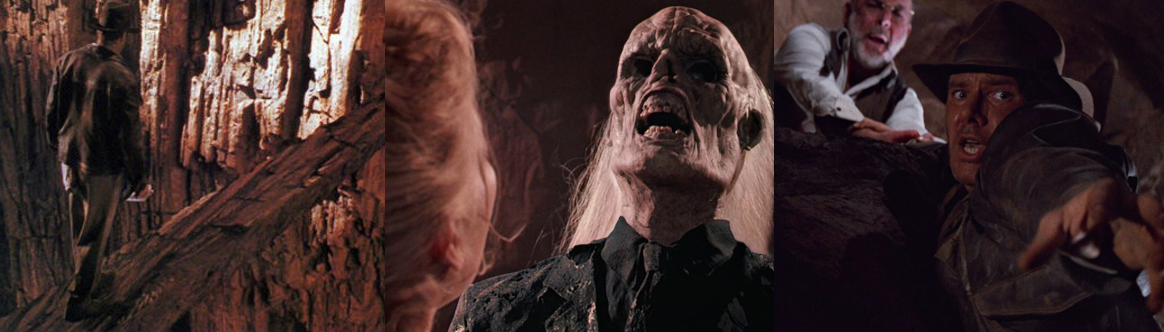
The brainchild of George Lucas, Indiana Jones was a concept first thought up after filming wrapped on American Graffiti (Lucas, 1973). Inspired by pulp serials, Lucas was initially forced to shelve the project in favour of Star Wars: Episode IV: A New Hope (ibid, 1977) but eventually teamed with Steven Spielberg, Lawrence Kasdan, and Harrison Ford to brave the sweltering temperatures of Tunisia for Raiders of the Lost Ark (Spielberg, 1981), a critical and commercial hit that kick-started one of cinema’s most influential franchises. Its success took Lucas on step closer to his goal of a trilogy of films; however, the sequel (which was actually a prequel) attracted mixed reviews and controversy for its darker aspects, which contributed to a re-evaluation of film ratings. Yet, Indiana Jones and the Temple of Doom (ibid, 1984) was still one of the year’s highest-grossing movies and is often regarded as a cult classic, and the three joined forces for a third entry in 1989; originally conceived of with a haunted house premise, the plot shifted focus towards the legendary Holy Grail. Spielberg, however, was unconvinced, leading to a Chris Columbus-penned script focusing on pygmies and the Monkey King that also dissatisfied the director, who then suggested introducing Indy’s father and using their strained relationship as a thematic parallel to the search for the Holy Grail. Though initially turning down the role as he was only twelve years older than Ford, the late Sean Connery relented and significantly contributed to the characterisation of the elder Jones so he could be a match for his adventuring son. The most significant of Connery’s suggestions was a prologue that established many of Indy’s character traits, a complex and action-heavy scene involving a specially rigged train and a pit partially filled with live snakes. Equally complex was the temple set used in the finale, which was built on hydraulics and gimbals and took twenty minutes to reset for each take; Industrial Light & Magic returned to work on the film’s special effect, utilising clever camera techniques to compensate for the limitations of a tank, the Grail trials, and a combination of make-up and animatronics for the villain’s iconic death scene. With a box office of nearly $475 million, The Last Crusade was the most successful of the original trilogy; critics were largely unanimous in praising the film for returning to the light-hearted roots of Raiders and the humorous and heart-felt relationship between Indy and his dad. The film is generally regarded as the best of the series and it directly inspired a spin-off television series depicting Indy’s youth, but wouldn’t be the last time we’d see Indy on the big screen as, inexplicably, the franchise was revived for a disastrous fourth entry nearly twenty years later.

The Review:
As exciting and captivating as two previous Indiana Jones movies were, we really didn’t learn all that much about the title character; we know he’s a learned professor of archaeology, extremely capable in a pinch, has a shady past when it comes to his reputation and romances, and that he’s made both allies and enemies over the years but there was no sense of his specific background. This mystery was, honestly, a big part of Indy’s allure; there was a roguish quality to him, a subtle complexity that drives his search for lost artefacts n the name of both “fortune and glory” and preserving them for the benefit of others…and the growth of his wallet. Each movie touched upon different aspects of this and his past, with him having left Marion Ravenwood (Karen Allen) broken hearted, him having a cheeky kid sidekick, and seeing him walk a fine line between mercenary and patriot through dialogue, allusions to his past, and just the way he carried himself with both confidence and experience, and yet still being able to adapt on the fly when thrown off by the presence of real magic.

The opening delves into Indy’s childhood and establishes many of his character traits.

The Last Crusade immediately seeks to delve further into Indy’s character than ever before, however, by opening in 1912, where we find  young Indiana Jones (River Phoenix) as a budding thirteen-year-old Boy Scout. While exploring the caves at Arches National Park in Utah, Indy and his nervous friend, Herman Mueller (J.J. Hardy), stumble upon a group of grave robbers just as they unearth the fabled golden crucifix of Francisco Vázquez de Coronado. Even at a young age, Indy was outraged at the thought of such an important artefact being sold for profit; so much so that he charges Herman with going back to raise the alarm and takes it upon himself to swipe the cross when the robbers aren’t looking. The grave robbers are led by an unnamed individual in a fedora hat (Richard Young) whose entire look Indy would come to adopt as an adult; he’s got the chinos, the jacket, the rugged good looks, and is so impressed by Indy’s gusto that he gifts him his trademark hat after retrieving the cross through more manipulative means. If you ever wondered why Indy is afraid of snakes, this sequence also has you covered; despite initially tossing one away without a second thought, Indy was traumatised when he came face to face with a hissing serpent on a circus train and then took a dive into a literal pit of the slithering reptiles during his dramatic escape. Crucially, this opening shows Indy’s adaptability, moral integrity, and touches upon his tumultuous relationship with his father that is such a focal point of the movie. In the space of about twelve minutes, this opening sequence examples how trouble just seems to find Indy, and that he’s not some invulnerable action hero; he takes a pratfall while escaping on his horse, accidentally slices open his chin with a bullwhip, and crucially is outsmarted by a combination of his youthful exuberance being a constant headache for his father and the authority wielded by adults.

When his father goes missing, Indy uses his lifelong obsession to find the location of the Holy Grail.

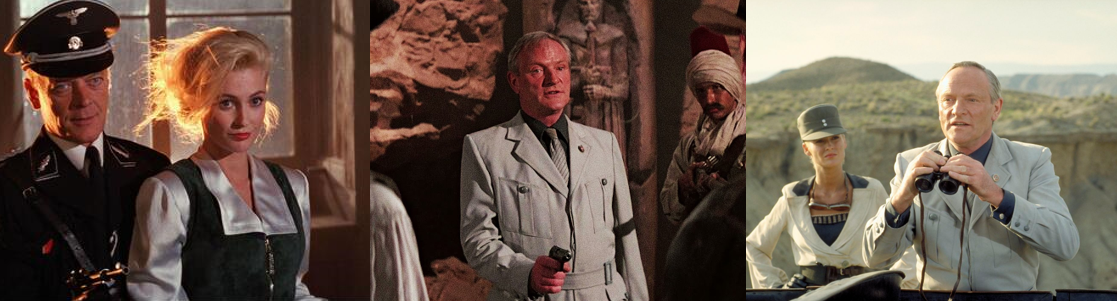
When we jump ahead to 1938, we find the now-the adult Indy finally achieving his lifelong dream of recovering the Cross of Coronado from the robber’s Panama-wearing client (Paul Maxwell), which brings him not only the gratitude of his university colleague, Marcus Brody (Elliott), but also a great deal of closure. Indy is then approached by wealthy businessman Walter Donovan (Glover), a man with a “passion for antiquities” who has contributed generously to Indy’s university over the years. Donovan possesses a stone slab inscribed with Latin text that acts as a map and a guide to the legendary Holy Grail. It’s here where we get a glimpse of why Indy is always so quick to scoff at legends and superstition; not only have countless men died in the pursuit of such stories, but Indy’s father also dedicated his entire life to the pursuit of the Holy Grail at the expense of showing his son any affection, and Indy there for views the Arthurian myth and the search for eternal youth as an “old man’s dream”. Indy is stunned to learn that his father, a “bookworm” with no interest or experience in field work, was not only actively working with Donovan but has also vanished in the process; finding his father’s house ransacked, Indy recovers Henry’s Grail diary and sets out to pick up where his father left out in a bid to rescue him and discover whether the Holy Grail truly exists. Marcus, revealed to have been a close friend to Henry, accompanies Indy on his globe-trotting adventure. Although the bombastic Sallah (Rhys-Davies) tries to help Marcus, the blundering academic is quickly taken hostage; however, Sallah is able to lead the Jonses to him and even accompanies them to the Grail’s location. Indy also runs afoul of the Brotherhood of the Cruciform Sword; led by Kazim (Kevork Malikyan), this secret society is so dedicated to protecting the Holy Grail that they’re willing to die, which they ultimately do when they’re utterly decimated by the Nazi’s superior firepower.

Indy’s strained relationship with Henry is very entertaining.

As mentioned, Indy has a strained relationship with his father stemming back to his youth; as a child, Indy always resented that his father was constantly buried in his research into the Holy Grail, to the point where he barely seemed to acknowledge his son. This bitterness was only exacerbated when Henry could offer no comfort for their shared grief over his mother’s untimely passing and runs so deep that Indy preferred to take the name of the beloved family dog rather than be associated with his famous and inattentive father, and consequently Indy is confused when Henry sends him his life’s work and goes missing while working in the field. Henry’s diary contains all of his knowledge and findings about the Holy Grail, including maps, pictures, rumours, writings, and vague musings. Indy is quickly able to decipher it to follow in his fathers footsteps and pick up where he left off, completely unaware that Henry sent the diary to him to keep it safe and in the hopes that he would do the exact opposite. Thus, when Indy is betrayed by Henry’s beautiful colleague, Elsa Schneider (Doody) and left to die, Henry is disappointed and outraged to learn that Indy brought the diary with him and unwittingly helped the Nazis discover the Grail’s resting place. Indy and Henry’s relationship throughout the film is framed by awkwardness and comedy; the aloof professor smashes a vase over his son’s head after mistaking him for a Nazi, constantly carries his briefcase and umbrella, and seems continuously nonplussed, if not aggravated, by Indy’s more adventurous and violent lifestyle. Indy’s usual bravado falters around his father; he regresses somewhat to a childish state, referring to henry as “Sir”, being irritated by Henry’s insistence on calling him “Junior”, and constantly aggravated by his father’s obsession with the Holy Grail and refusal to acknowledge that he wasn’t the most loving father. In contrast, Henry believes that he taught Indy self-reliance and respected his privacy, the very tools which have made him the man he is today, and is quick to brush aside Indy’s plea for a more traditional father/son relationship to focus on the more pressing task of reaching the Holy Grail before the Nazis. Like Henry, Marcus isn’t accustomed to field work and quickly becomes the bumbling comic relief of the movie; far from being a detrimental aspect of the film, though, this results in one of my favourite sequences where Indy resolutely hypes up Marcus as being a capable and formidable adversary, only for us to see that he’s hopeless in over his head amidst the crowded streets of İskenderun and to learn that he once got lost in his own museum!

Both Elsa and Donovan betray Indy and utilise the Nazis to find the coveted Holy Grail.

Indy and Marcus are met in Venice by Elsa, an Austrian art professor who immediately catches Indy’s eye. Having worked closely with Henry throughout his investigation, she appears devastated at his disappearance especially as he had recently become uncharacteristically excited by his findings and continuously notes the similarities between the two Jonses, much to Indy’s dismay. Though angered to find that he didn’t trust her with Henry’s diary, Elsa eagerly (and practically literally) jumps at the chance to get intimate with Indy after their rooms are ransacked and dutifully plays the part of Indy’s assistant when he adopts the questionable guise of a Scottish lord to infiltrate Castle Brunwald, a Nazi-controlled castle in Austria. Indy quickly becomes besotted by her and this, as much as his animosity towards his father, leads to him being easily betrayed by Elsa, who claims the diary for her Nazi superiors, represented by brutal Schutzstaffel colonel Ernst Vogel (Michael Byrne). However, when Indy confronts her in Berlin, we see that Elsa is distraught by their xenophobic and violent ways and simply covets the Holy Grail for her own selfish ends. Thus, like in Raiders of the Lost Ark, the Nazis are used as a means to an end and essentially portrayed as bumbling, glorified henchmen for Indy to shoot, beat up, and embarrass at every turn. Initially introduced as an affluent businessman who desires to locate the Holy Grail and realise every man’s dream of eternal youth, Donovan is well versed in Grail lore, such as its discovery by three Knights of the First Crusade. While Indy scoffs at these bed time stories, he is intrigued and impressed to find that Donovan not only possesses the incomplete Grail slab but also an elaborate manuscript that proves the stories are true. Having worked with Henry in a bid to uncover the Grail’s location, Donovan desperately turns to Indy to complete the quest for the benefit of all mankind but, in actuality, uses both the Jonses, and the Nazis, and even bribes the sultan of Hatay (Alexei Sayle) to realise his dreams of immortality and everlasting youth.

The Nitty-Gritty:
Indiana Jones and the Last Crusade is a u-turn back to the free-spirited adventure and quirky action/comedy of Raider of the Lost Ark; perhaps, in some ways, too much of a u-turn. Not only is the title font now the same as in Raiders, robbing us of the more stylistic Indy logo, but Indy is seen back in the classroom teaching a bunch of lovestruck teenagers before he’s joined by Marcus, who asks all about his latest escapade, and his conscripted into going off on another adventure, just like in Raiders. Interestingly, Indy’s lesson paints archaeology as a decidedly dull profession, where he downplays clichés and excitement of the profession and urges his students to do their research rather than gallivanting across the world despite the fact that this is exactly what he does; the movie even makes this a bit of a joke as, despite Indy’s assurances, X very much does “mark the spot” later in the narrative. As someone who actually enjoyed the darker aspects of Temple of Doom, and how it offered something a little different to the franchise, it is a little disappointing to see The Last Crusade go back to the Nazis and hit many of the same beats as Raiders of the Lost Ark but, thankfully, there’s enough here to make it stand out on its own, not least in the extended opening that shows us Indy’s childhood and the most elaborate action sequences of the franchise so far, but crucially in demonstrating the relationship between Indy and his father.

Indy and Henry are more alike than they would care to admit and bond over their adventure.

This relationship is what really sets The Last Crusade from its predecessors and, in my opinion and the opinions of many, makes the film the most enjoyable of the franchise. Who out there can’t relate to trying to earn the respect and attention of their parents, after all? Indy has been striving for this his entire life; even s an adult, he just wants his father to show him some warmth and love but he’s constantly playing second fiddle to his obsession with the Holy Grail or his admiration for antiquities. Even when tied to a chair, the Jonses cannot help but bicker with each other as Henry chastises his son’s foolishness and Indy desperately tries to escape their bonds, only for his father’s clumsiness to cause the room to catch fire! Still, it’s fun seeing Indy put together the vague clues in Henry’s diary, which lead him to desecrate a church (that’s been revamped into a library) to uncover the tomb of a Grail Knight beneath the beautiful water-logged streets of Venice and complete the Grail slab. While Henry’s diary makes it clear just how close he was to uncovering the Grail’s location, he’s still thrilled and even gives Indy praise for finding the tomb and the starting point for the trail to the Grail, the ancient city of Alexandretta. Henry may be aghast at Indy’s penchant for violence and lacks his son’s more physical attributes, often taking the role of an inept hostage or accidentally trigging hidden doors or damaging their plane with erratic gunfire, he’s never short of a biting remark or a disapproving scowl at Indy’s “intolerable” actions. However, he shows a spark of capability when he sends a flock of birds flying into a Nazi plane using his umbrella and gets his hands dirty to rescue Marcus from Donovan’s tank, and is also revealed to be just as much of a ladies’ man as his son since he also shared a bed with Elsa.

The film is bolstered by exhilarating action sequences, with Indy’s battle against a tank being a highlight.

In addition to detailing how every recognisable element of Indy came to be, the opening doubles as an exciting action set piece as young Indy is chased by grave robbers to a circus train, resulting in a thrilling chase across the rooftops and through the carriages of a circus train and some close encounters with giant reptiles, an enraged rhino, and a voracious lion amidst the threat of being shot and stabbed. Even as a youth, Indy showcased an admirable fighting spirit; though outnumbered and outclassed by the grave robbers, he was still able to steal the Cross of Coronado from them, got in a few good shots, and temporarily outwit them. While retrieving it as an adult, he’s become adept at using his surroundings to his advantage in a fight, even when fighting in the midst of a raging storm at sea, and at swinging about with his whip. The Last Crusade takes Indy into the heart of Nazi Germany, where he comes face-to-face with Adolf Hitler himself (Michael Sheard), and sees him hilariously masquerading as a ticket attendant aboard the Nazi’s impressive blimp (after). This also results in a riveting chase sequence that sees Henry bungle their escape via biplane and Indy outracing the German fighters in a car. Perhaps the film’s most thrilling action sequence involves Indy chasing after a massive tank on horseback. Despite the insurmountable odds, Indy is able to jam the tank’s cannon, guns down three soldiers with a single shot, and goes toe-to-toe with Vogel atop the tank as his men are crushed underfoot. This sequence again reinforces Indy’s vulnerability as he’s constantly swarmed by armed soldiers, almost crushed against a canyon wall, and appears to go tumbling over a cliff edge along with Vogel and the tank in an amusing fake out that doubles as a poignant moment where Henry finally (if briefly) shows some love and affection for his son.

After besting the trials and choosing wisely, Indy saves his father and the two finally reconcile.

Thankfully, not all of the darker elements of the franchise have been excised; the walls of the Grail Knight’s tomb are filled with skeletal remains and the sewer-like catacomb is populated by mewling rats, recalling the bug-infested tunnel of Temple of Doom but the most disturbing effect is saved for the finale. Thanks to Henry’s diary, Donovan and Elsa are able to reach to the Canyon of the Crescent Moon, where temple where the Holy Grail is guarded behind three trials. Lacking the preparation and knowledge to best these tasks, Donovan’s soldiers are unable to keep from being beheaded by the temple’s boobytraps, so Donovan mortally wounds Henry with a gunshot to force Indy to venture inside and lead them to the Holy Grail. Once again forced to acknowledge that mysticism is all-too-real, Indy desperately relies on his father’s research to guide him through: realising that a penitent man kneels before God, Indy is able to narrowly avoid being diced by a series of buzzsaws; Indy then steps on the correct floor tiles to spell out God’s true name, though he almost falls to his death when he forgets his Latin alphabet. Finally, Indy faces a literal leap of faith when confronted with a large chasm; though he willingly takes the plunge, he’s stunned to find the path is an optical illusion that leads right to a chamber filled with dozens of different chalices and guarded by an aging Grail Knight (Robert Eddison). Donovan and Elsa follow and are captivated by the treasures; out of spite, Elsa picks an ornate golden chalice that more than meets Donovan’s expectations, but his elation turns to horror when drinking from it causes him to rapidly and agonisingly age into a howling skeleton. Indy chooses far more wisely by selecting a modest cup, which he successfully tests on himself before using to heal his father; a passing line by the Knight reveals that the Grail cannot pass beyond the temple, potentially explaining Henry’s later death and Indy’s lack of everlasting youth in future films. However, Elsa cannot give up her obsession, causing the temple to crumble apart around her; in her desperate desire to claim it for herself, she falls to her death and Indy briefly comes close to suffering the same fate when he’s left dangling precariously with the fabled chalice within reach. He’s talked away from the brink by this father, who touchingly refers to him as “Indiana” for the first time, saving his life, realising Henry’s lifelong dream, and repairing the rift between the Jonses through their shared experience.  

The Summary:
I may have some issues with how Indiana Jones and the Last Crusade regresses the narrative and direction of the franchise in some ways; it takes maybe a few too many cues from Raiders of the Lost Ark at times, which is a little disappointing, but I think it benefits from being the third entry. If it had been the second, these elements might have stuck out as being more derivative but, luckily, The Last Crusade takes everything that worked in the last two films and expands upon them in exciting and unique ways. It might be a little unbelievable that all of Indy’s most important experiences occurred on one Boy Scout expedition but this glimpse into his adventurous youth, but it really helped to show how his attitude and personality was shaped by his childhood. Of course, the heart of the film is the adorable and intricate relationship between Indy and his father. An aggravating authority figure who grates on Indy’s last nerve, the chemistry these two serves is the selling point of this movie and it’s fantastic to see new nuances added to Indy’s character through his interactions with Henry. They’re bumbling adventures with the Nazis are so much fun that I could honestly watch these two get into all kinds of scrapes and go on further adventures, which sadly wasn’t to be but really elevates The Last Crusade above its predecessors while staying true to their pulp origins. Although not as dark as the second entry, The Last Crusade more than makes up for it with some fun action sequences, elaborate boobytraps, and a truly horrific final fate for Donovan. Ultimately, while the three classic Indiana Jones films all have appealing factors and each one is great in its own way, for me The Last Crusade edges out the other two thanks to the efforts of Harrison Ford and Sean Connery and remains the standard barer for the franchise even now.

My Rating:

Rating: 5 out of 5.

Fantastic

Is Indiana Jones and the Last Crusade your favourite of the series? What did you think to the chemistry between Harrison Ford and Sean Connery and the relationship between Indy and his father? Did you see Elsa and Donovan’s turn coming and what did you think to the Nazis returning as antagonists? Which of the film’s action set pieces was your favourite? Did you enjoy the opening sequence and the look into Indy’s childhood or was it a little unbelievable for you? Do you think you would’ve been able to best the trails and select the correct Holy Grail? Would you have liked to see more from Henry in a fourth movie and did you think he and Indy had been gifted with eternal youth? Whatever you think about Indiana Jones and the Last Crusade, feel free to share your memories of Indiana Jones in the comments or on my social media.

Game Corner: Indiana Jones and the Temple of Doom (Arcade)

This review has been supported by Chiara Cooper.
If you’d like to support the site, you can do so at my Ko-Fi page.

Released: August 1985
Developer: Atari Games
Also Available For: Amiga, Amstrad CPC, Apple II, Atari ST, Commodore 64, DOS, MSX, ZX Spectrum

The Background:
In 1981, director Steven Spielberg joined forces with George Lucas and Harrison Ford to bring Indiana Jones to life in Raiders of the Lost Ark (Spielberg, 1981), a critical and financial success that launched one of cinema’s most beloved franchises and expediated Ford’s rise to superstardom. The movies soon led to a wealth of multimedia merchandise, including toys, comic, a spin-off television series, and videogames, beginning with an extremely basic 8-bit adventure for the Atari. Although Spielberg’s sequel, Indiana Jones and the Temple of Doom (ibid, 1984) made slightly less than its predecessor at the box office and attracted controversy for its performances, potentially insensitive cultural depictions, and its darker aspects, it too was accompanied by a videogame. Thanks to a graphically superior version being released in arcades, Temple of Doom was allegedly the first Atari System 1 game to include digitised speech, voice clips, and even John Williams’ iconic music. Seen as a marked improvement over its predecessor, Temple of Doom was also reportedly the fourth-most-successful upright arcade unit of August 1985 in Japan and has been noted as being one of the best videogame adaptations of a movie at that time.

The Plot:Archaeologist and adventure-seeker Doctor Henry Jones Jr., better known as “Indiana Jones” (or simply “Indy”), infiltrates a Thuggee cult to free the children they’ve kidnapped as slaves, recover the mystical Sankara Stones, and defeat the cult’s leader, Mola Ram.

The Review:
Anyone who actually makes a habit of reading my reviews will notice that this review is laid out a little differently from my usual ones and there’s a very good reason for that: there’s honestly not enough to Indiana Jones and the Temple of Doom to warrant a more extensive analysis. Considering the accolades it apparently received at the time, I was left very disappointed by the barebones presentation and mechanics offered by the game, which is a simple 2D adventure that takes place entirely in the lava-and-ladder-infested caves of the Thugee cult. Players, obviously, take control of Indy, in an extreme basic control scheme that allows him to whip in multiple directions, including diagonally, but unable to jump. Indy’s whip will only stun the Thugee enemies who relentlessly pursue him, however; to actually kill them, you’ll need to whip an explosive barrel or knock them to their deaths. Luckily, the snakes and weirdo, dinosaur-like bats can be killed but this is a small consolation considering how many enemies swarm you at any one time.

Whip, swing, and explore to reescue the children from their cages.

Upon starting the game, you’re presented with a pretty decent piece of sprite art depicting Indy and one of the game’s handful of voice samples from the film, which are muffled and painfully basic. From there, you select to play with either three or seven lives (which you’d ever pick less is beyond me) and pick from the Easy, Medium, and Hard difficulty setting and are tasked with rescuing several captured children from cages scattered all around the looping screens. Here, you’ll need to run up ladders, avoid slipping from platforms, swing over gaps using your whip, and try not to fall into lava as you rescue the kids and allow access to the minecart that acts as the level’s exit. Unfortunately, Indy is not only extremely limited in his abilities, being unable to jump, duck, punch, or shoot, but he’s extremely fragile, too. One touch from an enemy or spikes will do him in and, while he can drop from small heights, a high plummet will also kill him and the game’s clunky, slippery controls make it very easy to fall to your death and end up being asked to enter your initials on the high score table. Luckily, you’ll be granted an extra life after accumulating a set number of points and the only time you’ll face a time limit is when picking your difficulty setting; however, the amount of kids you need to rescue, and the hazards and enemies you’ll face, increase with each playthrough and it doesn’t matter how many credits you have, once you get a game over you’re done, so I recommend playing on an emulator to make liberal use of save states.

Even if you somehow best the minecarts and acquire the stones, you still have to face Mola Ram…

Gameplay is broken up a bit by two other sections; after reaching the minecart, you’ll race along a track just like in the film, leaning this way and that to avoid dead ends, and using your whip to dispatch enemies or set off explosives. At this, these sections are quite fun but, by the end, they feature such fast-paced, winding, and hazard-filled tracks that I have no idea how you’re supposed to legitimately get past them. After each of these, you’ll need to snag one of the three Sankara Stones from Mola Ram’s volcanic altar. You’ll need to quickly cross a wooden bridge, avoiding the trapdoor that leads to the lava, or swing across from the far ends of the room while fending off Thugee enemies. Once you have all three and conquered one final, vertically inclined cave section with ten children to rescue and more enemies than you can shake a stick at, you’ll reach the wooden bridge from the finale of the film for a final confrontation with Mola Ram. Mola Ram randomly appears during the game’s other stages, teleporting in and sending a flaming heart that is very difficult to hit and follows you around incessantly, and he represents the game’s most frustrating challenge here. Thugee will constantly spawn in from behind as you clunkily cross the bridge, forcing you to quickly whip them to the deaths and then turn the other way to smack Mola Ram’s projectiles out of the air, which requires split second timing and more luck than this game sees fit to gift you. If you somehow do get close enough, a cutscene will play showing Indy collapsing the bridge and you’ll get to play through a bonus round in the cave section where you run, climb, and slide about whipping golden statues for extra points until your lives are exhausted.

The Summary:
I was excited to play Indiana Jones and the Temple of Doom; I love old arcade games, and even got to play it in the wild at an arcade place a short drive from where I live. Technically, the game’s presentation is pretty good; sprites are large and colourful, if a bit crude and repetitive, and the handful of environments certainly are faithful to the movie. If you were a fan of anything other than the temple scenes, minecart chase, and the final, though, and characters other than Indy, Mola Ram, and random Thugee cultists, you’re shit out of luck as the entire game is built around these few individuals and locales. The classic Indiana Jones music is barely included, playing only as a celebratory jingle, and the voice samples, while cute, aren’t really worth praising. The main issue with the game is its crippling, unforgiving difficulty; this is another rare arcade game where credits mean nothing, a clearly conscious decision to account for the game’s limitations and short length. Indy is depressingly fragile, crumbling from the lightest touch, and the weird, quasi-isometric perspective our untimely death makes it far too easy to slip from platforms to your untimely death. It’s a shame as Indiana Jones could easily have worked as a fun, mindless run-and-gun (or run-and-whip) adventure, with thrilling minecart chases and button mashing sequences sprinkled throughout. Instead, the developers went for the cheapest, easiest route to force kids to waste their hard-earned pocket money trying to shift Indy’s useless ass around the cave and make blind, near impossible decisions in the minecart, making for a frustrating experience that looks far more appealing than it actually is.

My Rating:

Rating: 2 out of 5.

Could Be Better

Have you ever played the arcade version of so Indiana Jones and the Temple of Doom? If so, what did you think to it and were you also put off by its unrelenting difficulty? Were you impressed by the visuals and the voice samples? What did you think to Indy’s limitations and vulnerability? Did you enjoy the minecart and Sankara Stone sections and were you ever able to best Mola Ram? Which Indiana Jones videogame is your favourite and why? Whatever your thoughts on Indiana Jones and the Temple of Doom and classic arcade games, feel free to share them in the comments or on my social media.

Movie Night: Indiana Jones and the Temple of Doom

This review has been supported by Chiara Cooper.
If you’d like to support the site, you can do so at my Ko-Fi page.

Released: 23 May 1984
Director: Steven Spielberg
Distributor:
Paramount Pictures
Budget: $28.17 million
Stars:
Harrison Ford, Kate Capshaw, Ke Huy Quan, Amrish Puri, and Roshan Seth

The Plot:
Prior to his adventure with the Ark of the Covenant, archeologist and adventure-seeker Doctor Henry Jones Jr. (Ford), better known as “Indiana Jones” (or simply “Indy”), and his enthusiastic young sidekick Short Round (Quan) infiltrated a Thuggee cult practicing child slavery, black magic, and ritual human sacrifice to retrieve a mystical stone and rescue enslaved children.

The Background:
First dreamed up as “Indiana Smith”, George Lucas’s throwback to the heroic pulp serials of his youth gained momentum when he teamed with Steven Spielberg and Lawrence Kasdan and cast Harrison Ford in the now-iconic role. Raiders of the Lost Ark’s (Spielberg, 1981) nearly $390 million gross and widespread critical acclaim meant that Lucas’s dream of a trilogy of films could become a reality and the two set to work on crafting a far darker adventure, one that initially involved fantastical concepts such as a lost world of dinosaurs and a haunted Scottish castle. When Lucas introduced the concepts of a religious cult devoted to child slavery, black magic, and ritual human sacrifice, screenwriter Lawrence Kasdan refused to work on the project, which recycled an excised minecart sequence and other set pieces cut from Raiders. With Spielberg in high demand, there was a sense of urgency to get the script finalised; Lucas jumped at the chance to include a musical sequence and set out to make the infamous dinner scene as gross as possible. Since the Indian government found the script offensive, filming took place in Sri Lanka and made extensive use of matte paintings and scale models; creative lighting also disguised that around eighty percent of the movie was shot at Elstree Studios and incredibly complex miniatures were created by Industrial Light & Magic for the thrilling minecart sequence. Returning star Harrison Ford suffered a spinal disc herniation during filming but soldiered on with the production, and Spielberg even ended up marrying Ford’s new co-star, Kate Capshaw. Although Temple of Doom made slightly less than its predecessor at the box office, it was still one of the year’s highest-grossing movies, however it was met with mixed reviews. Some criticised Capshaw’s performance as annoying, Ke Huy Quan’s character as racist, and were so outraged by the depiction of Indian culture and the film’s darker aspects that it contributed to a change in film ratings. Even Spielberg regretted making the film so dark, but Temple of Doom also received its fair share of praise for its adventurous action sequences, the physical comedy and performances, and it’s been noted as a cult classic. Like its predecessor, Temple of Doom was accompanied by a tie-in videogame and followed by a third instalment five years later, one that was not only much more in-line with the tone of Raiders of the Lost Ark but which also proved the most successful of the original trilogy.

The Review:
Indiana Jones and the Temple of Doom immediately separates itself from its predecessor by opening with a very James Bond-like sequence; not only is Indy in an exotic location, he’s even dressed in an outfit that’s a dead ringer for James Bond/007’s (Sean Connery) famous white tuxedo from Goldfinger (Hamilton, 1964) and cabaret dancer/singer/entertainer Willie Scott’s (Capshaw) song and dance routine that plays over the far more elaborate title sequence is reminiscent of the Bond series’ trademark title sequences. While the first fifteen minutes of the movie owe a lot to the Bond movies, they also establish Indy as something of a mercenary; while he still mentions that he’s a professor at a university, it seems like he’s acting less out of the interests of preservation and more for the profit and thrill of his escapades, which expands upon how morally grey the character could be at times in Raiders of the Lost Ark especially when Prime Minister Chattar Lal (Seth) muses that Indy has had his manhood threatened for his “grave robbing” antics in the past.

After channelling 007, Indy picks up a stray and helps a village suffering from the local Thuggee cult.

Before, we saw that Indy often undertakes what could be described as illegal ventures to the furthest corners of the globe to acquire rare or forgotten relics for the museum and that he was tasked by the United States military to put these same skills to use in service of his country. Here, he’s in a fancy nightclub in the bustling city of Shanghai and doing shady deals with local crime boss Lao Che (Roy Chiao/Ron Taylor) to recover the remains of Emperor Nurhaci. After being insulted when Che sent his sons to forcibly recover Nurachi, Indy takes the clueless Willie hostage in order to get what’s owed to him in a tense showdown between the two that leaves him poisoned and his old friend Wu Han (David Yip) dead from a gunshot and ends with Indy making a hasty and action-packed retreat that lands him in India. Although essentially the adventurous tomb raider we saw in the opening of Raiders of the Lost Ark, Indy still dons his familiar outfit and showcases a respect for local culture and traditions, if only to allow him and his allies safe passage courtesy of a local shaman (D. R. Nanayakkara). Upon arriving at the shaman’s simple village, Indy is clearly unsettled by the misfortunes that have befallen them; in exchange for guiding him to Delhi, the shaman basically demands that Indy detour to Pankot Palace to recover the village’s sacred stone (which they directly attribute to the prosperity of their land) and their kidnapped children from the local Thuggee cult since they believe he has been brought to them by the Hindu God, Shiva, to aid them. While Indy dismisses this as a “ghost story” and recognises that their beloved stone is just one of any supposed sacred rocks, it’s clear to him that the disasters that have befallen the village are directly tied to the missing artifact not because of the wrath of some evil God but from the actions of the destructive cult. However, it should be noted that he’s just as motivated by the promise of “fortune and glory” as he is by the desire to rescue the lost children,

Short Round acts as Indy’s enthusiastic sidekick and is instrumental in bringing him to his senses.

That Indy is so rattled by the kidnapped children might explain why he inexplicably has a child sidekick for this particular adventure; the endlessly enthusiastic Short Round acts as his getaway driver, lookout, and bodyguard, of sorts, with only the briefest explanation offered for how they hooked up (Indy caught the orphaned Shorty, who was living on the streets, trying to pick his pocket). Short Round takes his job very seriously; he insists that Willie refer to Indy as “Doctor Jones”, just like he does, and willingly follows him into every danger while carrying his bags and showcasing a demeanour beyond his years while still being a kid. He tosses out fun puns and exclamations not unlike Dick Grayson/Robin (Burt Ward) from the 1960s Batman show, delights in Willie’s awkwardness and ungainly nature, makes friends with his elephantine steed, and is completely nonplussed by the dangers of the jungle that drive Willie into a screaming frenzy, yet Indy still recognises that he’s a child and makes efforts to shield him from the Thuggee’s brutal ways and even Shorty is disgusted by the food served at Pankot Palace. Indy allows Shorty to follow him into the palace’s hazard-filled tunnels, where he accidentally sets off a series of boobytraps that see them trapped in a death chamber and left to rely on Willie to save them from being crushed by a spiked ceiling. However, Shorty is instrumental in snapping Indy out of the Thuggee spell in the finale; Short Round is forced to dig alongside the other captive children and heartbroken to see his beloved friend a mindless follower of the Thuggee who willingly beats his young sidekick and, Shorty first tries to appeal to Indy’s heart and then drives the poison from his body using a flaming torch in order to bring him to his senses and save Willie from being sacrificed to Kali, the Thuggee’s dark Goddess. When Indy’s busy dealing with the hulking Thugee slave-driver (Pat Roach) in the climactic finale, Shorty again proves instrumental in freeing the enslaved children, and the enthralled Maharajá, Zalim Sing (Raj Singh/Katie Leigh), from their desolate days of endless torture and hardship in the Thuggee mines.

Far from the stage, Willie is put through the wringer and fails to be much more than a bimbo.

Willie is a natural performer; she’s at home on the stage, in a glittery dress, with all eyes on her and with her every whim catered for. Pampered, spoiled, and basking in the adulation of superstardom, she’s more than a performer; she’s a diva, one who abhors violence and squalor and expects to get everything she asks for even if the conditions don’t allow for it. Curious and bombastic, she forces herself into Indy’s life by interrupting his meeting with Lao Che and ends up being held hostage and treated as an expendable commodity by the conniving crime boss. Positioned as Marion Ravenwood’s (Karen Allen) exact opposite, Willie is literally swept up in his adventure because she happens to snag the antidote he needs and, from there, it’s just one major inconvenience after another for her as she’s taken on a destructive drive through downtown Shanghai, is forced out of a crashing aeroplane, and ends up choking down rancid cuisine far from her make-up chair and room service. When they arrive at Pankot Palace, Willie is initially far more comfortable surrounded by luxury and draped in a dress befitting of a princess but is distraught to find that the Maharajá is a child, thus ruining her chances of seducing him, and that he serves bizarre food that cause her to faint. While she is exasperated by Indy’s lifestyle, she can’t help but be attracted to his rugged handsomeness…and the fruit he brings to her…but their flirtatious banter in the palace ends in a childish game to see who snaps first before they’re interrupted by a Thuggee assassin and Indy’s discovery of secret tunnels in Willie’s bed chamber.

Mola Ram’s brutal voodoo practices enslave the locals and bring him close to acquiring the five stones.

Rather than butting heads with the bungling might of the Third Reich, Indy is faced with a malevolent cult who worship Kali, the Hindu Goddess of power and destruction, with their ways and practices being akin to Satanic rituals and Devil worship. Led by the priest Mola Ram (Puri), the threat of the Thuggees is slowly built up: we see the devastating consequences of their victimisation in the village, the brutal nature of their ways as the protagonists head to Pankot Palace, and clearly see that they’ll stoop to any means (including torture, killing, and kidnapping children) to spread their vitriol across the land. Their influence has infected Pankot Palace through and through; both the Prime Minister and the adolescent Maharajá have been enchanted by the power and allure of Mola Ram, which promises to shake them free of the condescending shackles of the British Empire, represented by Captain Philip Blumburtt (Philip Stone). A malevolent and sacrilegious figure, Mola Ram relies as much on grandeur as he does fear; he appears capable of tearing out human hearts and leaving the victims alive so they can be sacrificed to his dark goddess using a lava pit and keeps his followers entranced through his violent ways as much as the three sacred stones. Although Indy is unfazed by the mysticism surrounding the Thuggee, it turns out that Mola Ram is capable of putting others under his spell using a strange potion and demonstrates that voodoo magic is wielded by the Thuggee when the enraptured Zalim Sing causes him agonising pain by stabbing a voodoo doll made in his image. Furthermore, similar to Raiders of the Lost Ark, the threat of Kali’s destruction is real enough for Mola Ram to set himself the lofty goal of not only slaughtering his enemies but destroying all other deities to allow his dark Goddess to rule unopposed, with him as Her primary enforcer in a world overrun by chaos and bloodshed.

The Nitty-Gritty:
Considering how dark the film becomes later on, it’s a little strange how wacky Temple of Doom can be at times; the melee at Club Obi Wan in the opening is the first example of this strange dichotomy as Indy desperately trips and fights his way to the antidote, punching out a cigarette girl and taking out a goon with a cymbal as balloons fall and screaming patrons run everywhere, and shielding himself from an onslaught of gunfire using a giant gong like it’s a Three Stooges skit! His dramatic escape from Shanghai is hampered by his getaway plane containing a cargo of live poultry and ends with them plummeting from the plane using an inflatable lifeboat, which inexplicably doesn’t result in them being splattered all over the Himalayas, and even surviving a further plunge over a cliff and a raging river in a set piece so over the top that it would make Roger Moore’s Bond blush! Rather than attributing the film’s wackier aspects to Indy’s cheeky sidekick Short Round, it’s actually Willie who is responsible for them; there’s hardly a scene where she isn’t complaining, shrieking like a banshee, or making an idiot of herself with the local wildlife and culture. It’s extremely grating, though at the same time amusing to see Indy and Shorty ignore her screams and discomfort and to see her unknowingly toss away a large snake in a fit of rage while Indy freaks out at the sudden appearance of his worst fear.

The Thuggee palace and exhilarating minecart chase make up for the film’s wackier aspects.

The map sequences return, albeit only briefly, as does the score, which is largely unchanged from the first film and Indy remains as adaptable as ever; even while struggling from the effects of Lao Che’s poison, he’s able to impale one of his sons with a flaming skewer and make a hasty exit from Club Obi Wan and he’s not only shown to speak multiple languages but is always well aware of local customs and folklore. Because of this, he knows better than to offend his hosts (even when they’re offering food they cannot spare or serving up eyeball soup and chilled monkey brains) and to apologise when his accusations of Thuggee worship insult Zalim Sing. Actual fisticuffs, gunplay, and whip action are few and far between here; Indy brawls with an assassin in Pankot Palace, leaving him hanging from an overhead fan, the fight with the hulking Thuggee is a brutal affair that ends with the brute being ground into a bloody paste, and the film even subverts the classic ad-lib from the first movie but Temple of Doom definitely emphasises elaborate set pieces more than grounded action. One of the more harrowing is the bug-infested tunnel within Pankot Palace that seeks to outdo the trap-filled chamber from the last movie, but both are surpassed by the Thuggee temple with its massive stone idol to Kali, an actual lava pit, and its elaborate mine. Here, the local children are worked and beaten within an inch of their lives trying to find the last two stones and left begging for death rather than fall under Mola Ram’s dark spell. More importantly, however, this setting allows for easily the most extravagant and exciting sequence of the film, if not the entire series; the minecart chase that takes up a massive chunk of the finale. And what a sequence it is! Although the mines are impossibly huge and there’s absolutely no way they could have built those tracks, especially as the mines are so dangerous and adjacent to an active volcano, a combination of composite effects, highly detailed miniatures, and to-scale practical effects make this one of the most exhilarating set pieces in all of cinema! Sure, some of the effects and composite shots are a little dodgy and the sequence is maybe a little too ambitious, especially given how long it goes on for, and it’s a bit ridiculous that Indy is able to stop their out of control cart with just his feet but this thrilling minecart chase is reason alone to watch this movie and give it some extra props as an under-rated entry in the franchise.

After overcoming Mola Ram’s voodoo, Indy recovers the stone and returns it and the kids to the village.

Even with its wackier aspects, Temple of Doom is, without a doubt, the darkest entry in the franchise. Not only is the wholesale kidnapping and torture of children darker than anything else seen in the series (which is saying a lot considering its reliance on Nazis….), the voodoo practises and aesthetic of Mola Ram and the Thuggee cult are a disturbingly violent and gruesome affair. Mola Ram appears to rip out human hearts, immolates victims with his lava pit, has left a trail of bodies in his boobytrapped tunnels, and there’s even a bask of crocodiles waiting to chomp down on human flesh in the finale. If Mola Ram’s heretical attire and ominous demeanour weren’t bad enough, we also have a sadistic little child in the form of Zalim Sing, a disturbing scene where Indy is beaten and whipped into submission, and Willie is left facing her own horrific end when she’s lowered to Mola Ram’s lava pit. After being rescued thanks to Shorty snapping Indy out of his trance, she joins her friends as they fight off the Thuggee and race through the mines, stones in hand, as the children flee to safety. However, Indy, Willie, and Shorty’s escape is cut off when the Thuggee ambush them on a precarious rope bridge with a fatal fall and a grisly end at the jaws of the crocodiles below awaiting them. As crazy and adept as ever, Indy chooses the sever the rope bridge, dooming all of those not secured to certain death and he and Mola Ram fight over the sacred stones while dangling from the bridge. Indy’s knowledge of their religion is what ultimately allows him to outlast Mola Ram; by evoking the name of Shiva, the stones burst to fiery life and the mad priest plummets to his death trying to recover them. Thanks to Captain Blumburtt’s cover fire, the Thuggee are fended off and Indy returns to the village with their children and is hailed as a hero. Having learned a newfound respect for the power and significance of the sacred stone, Indy respectfully returns it to the shaman rather than see it gather dust in a museum and finally shares a passionate kiss with Willie.

The Summary:
I can understand why Indiana Jones and the Temple of Doom is the black sheep of the franchise; it gets very dark and edges away from the high-spirited action and adventure of the first film and seems uncharacteristically mean-spirited at times. Delving into Hindu mysticism and the sprinkling in of a bit of voodoo and human sacrifice alone makes this a more exotic entry in the franchise, one that’s more reliant on elaborate sets and outdoing the boobytraps of the first film rather than globe-trotting. Juxtaposing these darker moments are some of the wackiest action set pieces in a series known for being a little over the top at times; by drawing on the more extravagant aspects of the James Bond films and relying a little too heavily on Willie’s…shall we say “unique”…brand of humour, Temple of Doom feels decidedly at odds with itself at times. The inclusion of a kid sidekick is a strange choice; while Short Round isn’t too annoying, especially compared to Willie, he’s little more than a stereotype and appears to be there primarily to snap Indy out of his trance in the finale and to showcase that the adventurer has a heart of gold, something almost necessary considering his more mercenary nature in this film. However, Temple of Doom contains just as much of the appeal, action, and adventure as its predecessor if not more; as mentioned, the minecart sequence alone justifies a watch and I personally enjoyed the darker aspects, especially surrounding Mola Ram and his gruesome dedication to Kali and the disgusting feast laid before our heroes. For me, Temple of Doom isn’t any better or worse than Raiders of the Lost Ark, even with Willie’s grating and incessant squealing; it’s definitely a different film but I can’t in good conscience rate it any higher or lower than Raiders since I have just as much fun with it as the first movie and personally consider it to be an under-rated entry that’s worthy of re-evaluation.

My Rating:

Rating: 4 out of 5.

Great Stuff

Are you a fan of Indiana Jones and the Temple of Doom? How do you think it compares to Raiders of the Lost Ark and were you put off by the film’s darker aspects? What did you think to Indy’s more mercenary presentation and his enthusiastic little sidekick? Who did you find more annoying, Willie or Short Round, and what did you think to the wackier set pieces on offer here? What did you think to Mola Ram and the Thuggee threat and were you blown away by the minecart sequence? Which of the Indiana Jones movies is your favourite? Whatever you think about Temple of Doom, feel free to share your memories of Indiana Jones in the comments or on my social media.

Movie Night: Raiders of the Lost Ark

This review has been supported by Chiara Cooper.
If you’d like to support the site, you can do so at my Ko-Fi page.

Released: 12 June 1981
Director: Steven Spielberg
Distributor:
Paramount Pictures
Budget: $20 million
Stars:
Harrison Ford, Karen Allen, Paul Freeman, Ronald Lacey, John Rhys-Davies, and Denholm Elliott

The Plot:
Renowned archeologist and professor Doctor Henry Jones Jr. (Ford), better known as the adventure-seeking “Indiana Jones” (or simply “Indy”), joins forces with his former lover, Marion Ravenwood (Allen), on a globe-trotting quest to recover the long-lost Ark of the Covenant before the forces of Nazi Germany.

The Background:
Indiana Jones was the brainchild of George Lucas, who dreamt up the concept shortly after finishing American Graffiti (Lucas, 1973). Inspired by the heroic pulp serials of his youth, Lucas initially envisioned the adventurous archeologist as “Indiana Smith” and developed the idea alongside Philip Kaufman before being forced to shelve the project to focus on Star Wars: Episode IV: A New Hope (ibid, 1977). While vacationing in Hawaii, Lucas met with director Steven Spielberg, who was eager to direct a James Bond-style movie, and the two agreed to work together to on the project. Lawrence Kasdan worked with them to plot out action set pieces using miniatures and changed Indy’s surname to “Jones”, defining him as a fallible, but honest, thrill-seeker. Many compromises had to be made to get the script to an acceptable length, including omitting a minecart chase and large aspects of the romantic sub-plot, and Lucas struggled to find financing before Paramount Pictures came onboard. Insisting that a relatively unknown actor assume the title role, Tom Selleck was within arm’s reach of being cast before being forced to drop out to work on Magnum, P.I. (1980 to 1988); Lucas was reluctant to indulge Spielberg’s suggestion of Harrison Ford, but Ford happily signed on and offered his own insight into the character. Location shooting proved both costly and restrictive, meaning Spielberg favoured fewer takes during filming, and the production was hampered by sweltering temperatures in Tunisia; Ford’s later bout of dysentery also saw a lengthy sword fighting scene trimmed down to a far simpler and now iconic exchange. Finally, Lucas’ Industrial Light & Magic and special effects artist Steve Gawley created complex practical effects involving wax blood bags and various camera speeds to portray gruesome melting faces. Raiders of the Lost Ark’s nearly $390 million worldwide gross made it a big hit; it was also met with widespread critical acclaim, with reviews praising the cast, special effects, and pulp escapism on offer. The film kicked off another successful franchise for Lucas and became one of Ford’s defining roles; it spawned not only additional sequels, but also videogames, comic books, and even a prequel series, with the Indiana Jones franchise largely regarded as one of the most influential in all of cinema.

The Review:
Raiders of the Lost Ark does a masterful job of establishing the fortitude of its main character within its first fifteen minutes; framed from behind, in silhouette, and as a confident adventurer who isn’t disturbed by superstition or ages-old boobytraps, Indy leads a small expedition deep into a Peruvian temple. Wily, with his wits ever about him, he’s as capable of defending himself and the map to the golden idol with his crack skill with a bullwhip as he is of braving the temple, regardless of the creepy-crawlies and the dangers within. Unlike the unfortunate Doctor Forrestal, Indy is far more attentive to his surroundings; his whip also doubles as a lasso, allowing him to swing across bottomless pits, unlike his inept guide, Satipo (Alfred Molina, if you can believe that!) Satipo examples the impetuousness of greed and arrogance, a handicap not shared by Indy, thus allowing him to spot the deadly traps that prove Satipo’s downfall. Indy also has the foresight to fill a bag with sand so he can safely retrieve the golden idol from its pedestal and, when this results in the temple collapsing round him, is more than capable of escaping even after Satipo betrays him. Indy is also a professor of archelogy; his ventures are not for personal glory but to bring these long-lost relics into the public eye for the benefit of the museum (though he does profit from his finds). Still, Indy’s reputation proceeds him and sees him directly recruited by the United States military to intervene when it’s discovered that the Nazis are searching for the fabled Ark of the Covenant.

Adventurer Indiana Jones allies with a former flame to uncover the Ark of the Covenant.

Though fully aware of the mythology surrounding the Ark, Indy isn’t one for tall tales and sees the pursuit of the relic as perhaps his greatest challenge, and of incredible significance to the museum, literally laughing off the concerns of his friend and colleague, Marcus Brody (Denholm Elliott). Obviously a figure of sexual appeal thanks to his rugged good looks and physicality, Indy has more than his fair share of admirers; his classes are filled with lovestruck teens who are more interested in favouring him with forlorn stares and leaving him notes and gifts than paying attention to his lecture about the dangers posed by temples and local superstitions. He meets his match when his journey inevitably causes him to cross paths with Marion, the daughter of Indy’s old mentor, a strong, feisty, independent woman who owns a bar in Nepal and is more than capable of drinking men twice her size under the table and handling herself in a fight. Though angered at being left heartbroken by Indy some ten years ago, Marion has the medallion that reveals the location of the Well of Souls and demands to join his crusade after his actions see her bar go up in flames. Clearly still infatuated with her, Indy’s usually bold demeanour falters when it seems like Marion has been killed and it’s only the intervention of his old friend, Sallah (Rhys-Davies), that keeps him from throwing his life away seeking revenge. It’s thanks to Sallah, an Egyptian excavator who has no love for the poor treatment his people have receive from the Nazis, and his contacts that Indy is able to decipher the medallion, infiltrate the Nazi dig site, and discover the location of the Well of Souls. Indy is also overjoyed to discover Marion was alive and well in the hands of the Nazis, though he’s forced to leave her behind so he and Sallah can get to the Ark before the Nazis.

Belloq allies with the Nazis to fulfill his own desires for the fabled Ark.

Indy is dogged at every turn throughout the film by René Belloq (Freeman), a rival archaeologist who ends up allying with the Nazis to help them find the fabled Ark of the Covenant. We get an immediate sense of the differences between the two right from their first meeting; while Indy braves the dangers of his pursuits head-on, Belloq patiently waits on the side lines and simply takes what he wants by force without the need for physical dramatics. A twisted version of Indy whose respect for their profession has dissolved completely, Belloq openly admits to being Indy’s dark reflection, delights in flaunting his superiority over his rival at every turn, and is obsessed with perverting the Ark’s power for his own means. Accordingly, though allied with the Nazis, Belloq doesn’t believe in their cause and sees them as merely a “necessary evil”; when they threaten to torture Marion for information, he attempts to coerce her into telling what she knows willingly but is ultimately unable to defy his Nazi partners directly. The primary antagonist force in the movie, the Nazis have been scouring the globe in search of religious and superstitious artifacts to satisfy the desires of Adolf Hitler for power beyond the measure of mortal men. Their primary representative is Gestapo agent Major Arnold Toht (Lacey), slimy, sadistic man who relies on intimidation and torture to get what he wants. Toht is so committed to his Fuhrer’s will that he grabs the red-hot medallion and ends up permanently scarred meaning that, while the Nazi’s fail to acquire the artifact, they are able to produce a replica.

The Nitty-Gritty:
Just like Lucas’s popular sci-fi franchise, Raiders of the Lost Ark is bolstered by another of John Williams’ unforgettable scores; easily one of the most recognisable themes in movie history, the score from Raiders of the Lost Ark perfectly captures the adventurous spirit of the character and the franchise and brings every scene to life with a fittingly bombastic, pulp glory. The set design and visual presentation on offer here are just as important, and impressive, to the film; set in 1936 and in faraway locations such as the jungles of Peru and the sands of Cairo, the film definitely lives up to its pulp roots in its visual aesthetic. The opening sequence alone is a testament to this, featuring a boobytrapped Peruvian temple filed with tarantulas, cobwebs, impaled corpses, great stone walls and, of course, the gigantic rolling boulder that remains one of the most iconic set pieces of not only this film, but the entire franchise. Equally unforgettable are the scenes showcasing Indy’s globe-trotting travels as we see a red line drawn across a map every time he travels from one destination to another when the film could’ve easily relied on less visually interesting techniques like camera cuts, onscreen text, or fancy wipes.

Raiders of the Lost Ark impressed with his visuals and the exciting nature of its action set pieces.

The film gives the very real sense that trouble naturally seems to find and follow Indy wherever he goes, which is exacerbated by the Nazi’s desperate search for the medallion and the Well of Souls. Consequently, Indy is forced to defend himself at all times; handy with his fists and as equally skilled with a gun as he is his whip, it’s Indy’s adaptability that often helps him out in a tight clinch. Despite being outnumbered and outgunned at Marion’s bar, he purposely spreads a fire to even the odds; he’s also not above fighting dirty, kicking opponents in the balls or simply gunning them down. Indy meets his physical superior when trying to escape from the Nazi’s dig site; here, relieved of his gun, Indy’s goaded into a fist fight by a large German (Pat Roach) who easily manhandles him and he’s only able to triumph thanks to the brute being skewered (thankfully offscreen) by a propeller blade in a sequence that also sees Marion take to a plane’s turret to provide cover. While he exudes confidence when out on an adventure and is clearly very learned, Indy isn’t some infallible action hero; he’s fully capable, yes, and highly adaptable, but he generally always has the odds against him, takes his fair share of punishment, and even gets grazed by a bullet. In fist fights, he’s usually outnumbered or facing armed foes and must use his wits to find ways to tip the balance in his favour. Indy also has a very specific Achille’s heel in his crippling fear, and hatred, of snakes; while this is initially played for laughs during his dramatic escape from Peru, Indy’s forced to face his fear head-on in the Well of Souls first to find the glorious solid chest and then to affect his and Marion’s escape by crashing through the walls of the buried stone crypt. Additionally, thanks to Belloq always being one step ahead of him, Indy is forced to think on the fly to intercept the Ark and commandeer the Nazi truck carrying it after a length brawl that doubles as a thrilling chase sequence.

Ultimately, Indy survives the Ark’s destructive power and it’s sealed way by shady government agents.

Victorious in this endeavour, Sallah arranges for the Ark to be transported back to London by ship; onboard, Marion tends to Indy’s wounds, but their intimate moment is soon interrupted by the persistent Nazis, who recapture both Marion and the Ark. Indy manages to slip aboard their submarine and follow them to an island in the Aegean Sea, where Belloq plans to test and witness the Ark’s power before presenting it to Hitler to ensure they have the genuine article. When Indy threatens to blow them all to kingdom come, including the Ark, in exchange for Marion, Belloq calls his bluff; he knows that Indy is just as curious to see the Ark opened as he and, unable to deny it, Indy surrenders to the Nazis. Donning ceremonial robes, Belloq oversees the opening and is initially aghast to find it contains only sand; however, an electrical surge precipitates a wave of malevolent spirits and supernatural lightning that destroys all who behold it. It’s often said that Indy has little to no bearing on Raiders’ plot, that the Nazi’s would’ve been undone by the destructive power of the Ark without Indy’s presence. I’m not sure this is entirely true, however; after all, it’s only because of Indy that the Nazis are even led to the Ark in the first place, which at least accelerates the plot if not directly impacts it, and he’s the one who ensures that it isn’t just left lying around for others to stumble upon. Whatever the case, when faced with the true power of the mythical Ark, Indy orders Marion to close her eyes, sparing them the gruesome, flesh melting fate that befalls Toht and being consumed by the holy fire like Belloq and the other Nazis. Although they survive, and seemingly rekindle their romance, and Indy and Marcus are generously compensated by the United States government, Indy’s frustrated that he’s denied access to the Ark, which has been stored away in a vast warehouse alongside countless other artifacts.

The Summary:
It’s tough to pick between which is Harrison Ford’s more iconic role, Indiana Jones or Han Solo. I suppose it depends greatly on your genre preference; I know a lot of people who aren’t sci-fi fans, so they probably prefer the more pulpy adventures of the world’s most famous fictional archaeologist. It’s not hard to see why; Ford shines in the role, bringing a rugged appeal to the character, who is both very learned and physically capable while also being vulnerable and relatable. He absolutely carries the film, which is only bolstered by a series of impressive action set pieces and special effects, all of which have aged incredibly well thanks to being realised by tried and true practical means and camera trickery. As much as I enjoyed seeing how Indy would get out of each situation, watching him struggle and fight tooth and nail for every advantage, I also enjoyed the dynamic between him and Marion, who’s more than capable of holding her own and gives as good as she gets and really hammers home that, sometimes, Indy is quite a morally grey character. The parallels between him and Belloq were also interesting, if a little one-note thanks to the larger focus given to the more explicitly evil Nazis and the greater narrative concerning the Ark of the Covenant. Ultimately, Raiders of the Lost Ark is adventure in its purest form; a rollicking, enjoyable action-packed romp from start to finish with an alluring main character, a memorable score, and some iconic sequences that deliver as a fresh take on classic pulp troupes made fresh through the film’s undeniable visual presentation.

My Rating:

Rating: 4 out of 5.

Great Stuff

Are you a fan of Raiders of the Lost Ark? Were you impressed by Harrison Ford’s performance and what sort of impact did Indiana Jones have on you at the time? Did you enjoy the throwback to the pulp serials of old? What did you think to the dynamic between him and Marion and the parallels between Indy and Belloq? Which of the film’s action set pieces was your favourite? Do you think Indy is largely inconsequential to the main plot? Which of the Indiana Jones movies is your favourite? Whatever you think about Raiders of the Lost Ark, feel free to share your memories of Indiana Jones in the comments or on my social media.