Back Issues [Sci-Fanuary]: The Fly: Outbreak #1-5


January celebrates two notable dates in science-fiction history: “National Science Fiction Day” on January 2 to coincide with the birth of world renowned sci-fi writer Isaac Asimov, and 12 January being when Arthur C. Clarke’s HAL 9000 was created. Accordingly, I dedicate January to celebrating sci-fi in all its forms.

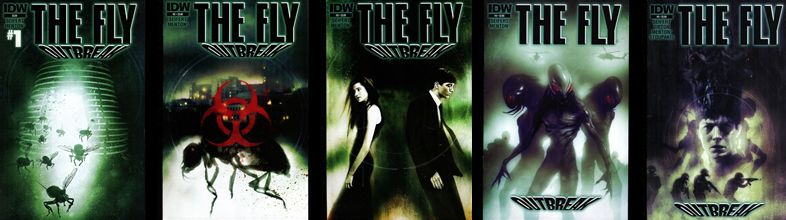
Writers: Brandon Seifert and Denton J. Tipton – Artists: mention3 and David Stoupakis

Story Title: “The Book of Transgenesis”
Published:
March 2015

Story Title: “Quarantine”
Published:
April 2015

Story Title: “Metamorphosis”
Published:
May 2015

Story Title: “All Hell Breaks Loose”
Published:
June 2015

Story Title: “The Book of Revelation”
Published: July 2015

Quick Facts:
Published by IDW Comics, this five-issue miniseries does what director David Cronenberg and star Jeff Goldblum could not by continuing the lauded world of The Fly (1986) and its under-rated sequel, and impressed with its respect to the source material and atmospheric artwork.

The Review:
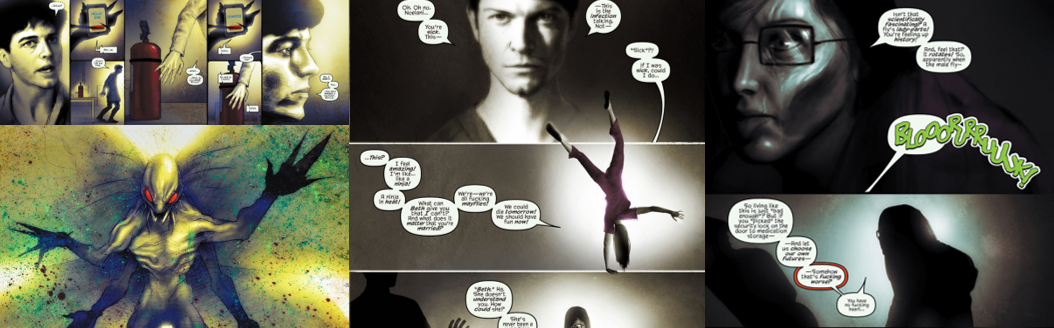
The Fly: Outbreak picks up some years after The Fly II (Walas, 1989) to find Martin Brundle now a certified PhD and still working on his father’s Telepods. Specifically, Martin has been trying to cure (or at least regress) the fly genes he transferred into his devious adopted father, Doctor Anton Bartok. Despite his genius, Martin is frustrated by failure and intimate probing from his assistant, Noelani Tanaka, who questions why he doesn’t want to have children. This sore subject rears its head later that night while Martin’s celebrating his anniversary with his wife, Beth Logan, who attempts to spice things up with sadomasochistic sex toys. Martin angrily stops this bizarre sexy time when Beth refuses to use protection but, while he insists he’s trying to protect her from his “buggy genes”, Beth takes this as a rejection and bitterly criticises him for putting barriers between them. To make things worse, Martin’s experiments “upregulated” Bartok’s insect genes, transforming him into a monstrous (if strangely beautiful) winged man-bug that rampages through the facility. Though he rejects Bartok as his father, Martin insists on confronting him, using a handy-dandy translator pad to communicate with the mutated industrialist. When Martin’s efforts to reason with the Bartockfly fail and result in bystanders being either melted by its “vomit drop” or sprayed with strange spores, Martin flees, resulting in Bartock being gunned down and Martin being covered in spores. Exposed to an unknown transgenic disease, the Army places Martin, Noelani, and the others under quarantine on North Brother Island for observation. Though Doctor Mayweather and Major Vurvin allow Martin to research the disease, the whole thing is classified so he must hack the computer system to give Beth an update.
When Bartock infects a bunch of people, a guilt-ridden Martin desperately searches for a cure.

Although Martin could reproduce the gene swapping solution from The Fly II, he refuses to sacrifice another healthy soul and largely blames himself for the infection (as do the other patients). After nine days processing everything, Noelani finally confronts Martin and he explains that he assumes the disease will manifest similar to how his father mutated. Indeed, over several days, the infected sprout coarse hairs and become euphoric, manic, and increasingly sexual alongside developing superhuman strength, stamina, and an inflated, erratic self-esteem. When Noelani interrupts Martin’s latest call to Beth (where she whips out a vibrator and starts making a show of herself!), Martin is horrified when she comes on to him and reveals she’s been infected. When he rejects her, Noelani spitefully manhandles him, berating Martin for ignoring her, forcing him to subdue her with an electric shock. Beth keeps her libido in check long enough to be devastated when a guilt-ridden Martin tells her he must focus on finding a viable cure, eventually administrating lithium pills to Noelani to calm her “unipolar mania”. Haunted by dreams of his failure, the city being overrun by Brundleflys, and the personification of his guilt and inner demons (the “Martinfly”), Martin works tirelessly, berating himself for his lack of answers and the rapidly degenerating infected. Martin’s horrified to witness this as an outsider, seeing the likes of Doctor Ross brutalise themselves rather than transform into an inhuman fly-thing, and begrudgingly taking them off their medication so the infected won’t be rational enough to take such drastic measures. When Martin refuses to use the gene swap cure or let the infected commit suicide, the increasingly spiteful Noelani gives him a first-hand instruction on fly anatomy and mating rituals and…somehow…inadvertently gives Martin the solution he’s been searching for.
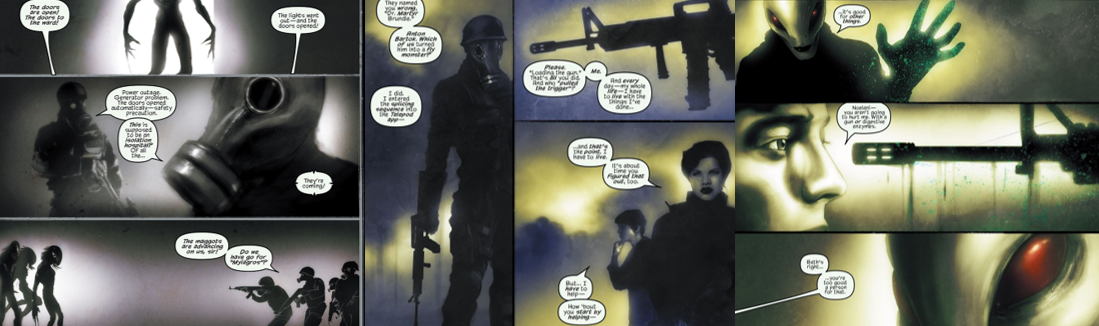
When the fly-things go on a rampage, Beth tries to help but Noelani has other ideas.

However, when Martin advises using the bodies of organ donors as donor material, Dr. Mayweather and Major Vurvin immediately shoot the suggestion down since thousands of people are waiting for those healthy organs. They also angrily chastise Martin and his father for being irresponsible mad scientists who tainted science with their reckless, crackpot ideas. Although it goes against their every instinct, Dr. Mayweather and Major Vurvin order the infected to be destroyed before they can reach their final forms, only for them to hatch from their cocoons. Drinking himself into a stupor, a depressed and remorseful Martin watches as soldiers are attacked by the fly-things, which resemble the Bartockfly and easily dispose of the troops with their superior strength, wings, and acidic spit. Martin’s stunned when Beth arrives to help disguised herself as a solder, only for Martin’s nightmare to become reality as the fly-things escape the facility. Although Martin begs Beth not to shoot the fly-things (reasoning that they’ll eventually die anyway) as they were once human, she ignores him since she was the one who activated Martin’s gene swap programme and is just as guilty of mutating Bartock as he is. When they reach the dock, Martin refuses to leave and their argument about this exacerbates when Noelani (now a surprisingly loquacious and attractive alien-like humanoid) asks them to get her to the mainland. When Martin convinces her that she could be “patient zero” of a wider fly epidemic, Noelani threatens to first shoot and then melt Martin if he doesn’t perform the gene swap on her. When Martin refuses, Noelani threatens Beth and, consumed by guilt for ignoring his wife and causing Noelani’s condition, Martin acts as her donor and fires up the Telepods.
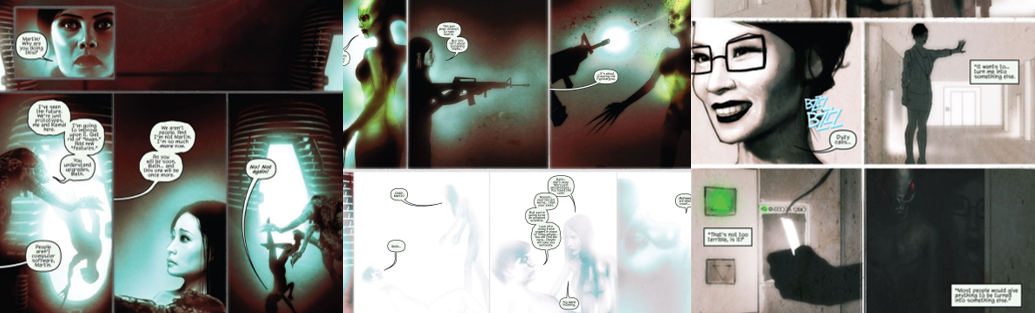
Noelani manipulates Martin and Beth to finally be recognised for her genius.

Noelani emerges whole and human while Martin regresses to the monstrous Martinfly, now psychotic and intelligent enough to speak. Martinfly immediately scoops up Noelani and considers ripping her limb from limb or digesting her a piece at a time. Amazed to find he can fly, Martinfly soars into the sky and sees the chaos he’s causes. Noelani successfully appeals to Martin’s humanity and he lets her go to help, ripping apart the fly-things and even saving Dr. Maywather. However, his animalistic side soon takes hold, pushing Noelani to encourage Beth to destroy him before it’s too late since Martin “likes being a monster” and no one would ever volunteer to restore him. Martinfly returns to the Teleport lab with one of the fly-things, now determined to perfect the breed, much like his father tried to do, by splicing Noelani and the creature into one. Beth saves Noelani and traps Martinfly in a Telepod before freeing the fly-thing, gunning it down and trusting Noelani to do the same for her after she voluntarily enters the other Telepod. Emerging as a glorious Fly Queen, Beth is horrified to find the restored Martin fatally impaled in the Telepod. Beth realises all-too late that Noelani was somehow responsible for this and takes a shot to the head. As he apparently dies, Martin provides Noelani with the key to solving the outbreak (“[using] fresh organs in place of living people”), finally acknowledging her as he passes. Several years later, Noelani has earned her doctorate and apparently become a principal figurehead of Bartock Industries, twisting Martin’s creed (“Words are just words. Actions are what count”) into her mission statement. It’s also shown that she has one of the fly-things in captivity, though there’s no hint as to why.

Final Thoughts: 
Considering how big a fan I am of the entire Fly concept, especially the remake and its sequel, I was massively disappointed by The Fly: Outbreak. On paper, the idea has a lot of promise, especially as the films never delivered on the idea of a fully grown, human/fly hybrid with wings and all that. To be fair, this was never the intention as the creatures were grotesque abominations, but there’s still an appeal in seeing a more fully formed hybrid. I also liked the idea of Martin being wracked by guilt for the state he left Bartock in and wishing to cure his surrogate father, despite his monstrous actions, without sacrificing another healthy life. This guilt consumes Martin as he knows that Bartock is suffering because of his genes, the same warped DNA that keeps him from impregnating his wife and spawning another genetic anomaly. This could’ve been a very harrowing character arc for Martin as he embraces his monstrous side once more and finally purges himself of his curse, and his guilt, to lead a normal, happy life and the ghost of this idea is peppered throughout the story, but it takes a backseat to Martin’s marital issues. While Martin and Beth had a very passionate relationship in The Fly II, I (like Noelani) never pegged her for a closeted sexual predator! Beth is so fucking horny that she disregards Martin’s concerns about contraceptives, decides the best way to take her husband’s mind off his guilt and the rapidly declining state of the infected is to play with herself over a video call, and routinely snaps at him for caring more about her safety (and his work) than her libido. It’s a very strange decision to characterise Beth this way and I’m not sure I like it as she wasn’t this sexually aggressive in The Fly II, so it feels odd. I think it would’ve been far more fitting to have her be upset because she wants children and Martin’s reluctant rather than having her strap him down and stuff a ball gag in his mouth!
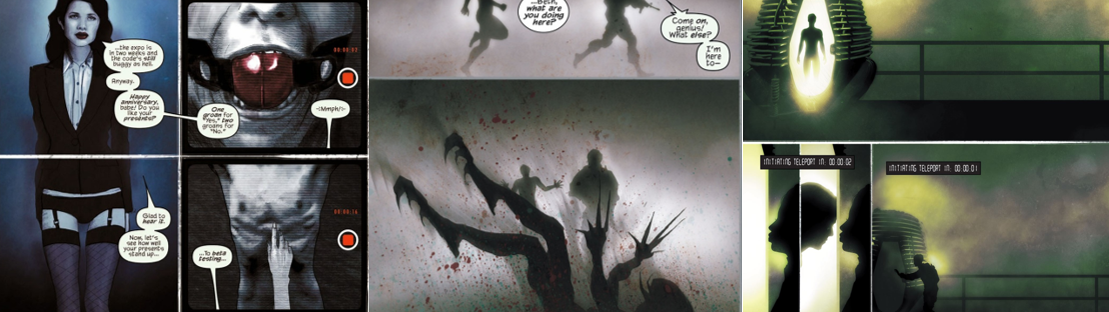
Some bizarre characterisations and atrocious artwork make this an incoherent and ugly read.

This might not have been so bad if the artwork was coherent. While “mention3” and David Stoupakis do an excellent job capturing the likenesses of Eric Stoltz, Daphne Zuniga, and Lee Richardson, most other characters are hidden behind ironically bug-like gas masks and others appear like lifeless marionettes. Again, this might’ve been acceptable if either artist could draw a background! Almost every panel is framed against indistinct darkness or a murky mess of blacks, greys, and greens, making it very difficult to decipher where the characters are. The Telepod lab, for example, appears to exist in a misty void, the facility is a foggy mess, and the grounds look like they’re in the midst of an atomic explosion! It’s truly a horrendous comic to look at and I really struggled to get a sense of the space and time passing, especially in “Metamorphosis”, where the story bounces from place to place and apparently ahead in time without warning. The art is much better when depicting the fly-things but even they are a mess at times, often appearing blurred and warped so it’s hard to make out individual features. Oddly, despite Martin comparing the infected to his father, these fly-things are strong, healthy, and far more beautiful than Brundlefly and Martinfly. They can think and talk with far more logic and intelligence than they displayed during their metamorphosis, fly, and rip limbs and heads off with ease. The fly-things appears more like aliens, depicted as beautiful, elegant humanoid creatures rather than misshapen atrocities, assumedly because the disease somehow improved the mutation process (though it’s hard to tell as Martin offhandedly suggests the fly-things have a short lifespan). The image of a swarm of fly-things descending on the military should have been a powerful and horrifying visual but, instead, it’s a nightmarish blur of colours and nonsense and barely a footnote in the story since it’s more concerned with the quarantine procedure and Noelani’s ambitions.
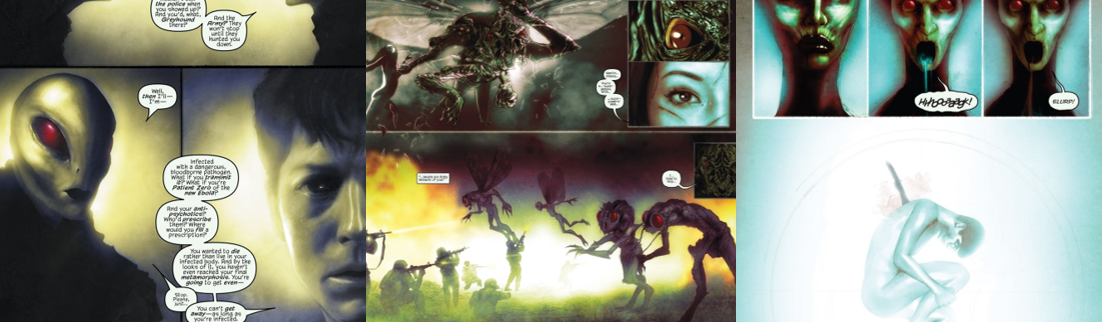
It’s honestly difficult to tell what’s happening in this disappointing mess of a story.

I could forgive all of this if The Fly: Outbreak stuck the landing, but it really doesn’t. Things made a twisted sense right up to “The Book of Revelation”, where it all goes downhill. Noelani threatening Martin and Beth eats a lot of panels and Martin’s transformation back into Martinfly isn’t as exciting as it could’ve been as, for some inexplicably reason, he can talk but loses his humanity and compassion. While I liked the call-back to Brundlefly’s insane plot to create the “ultimate family”, it wasn’t worth tarnishing Martin’s characterisation, especially as he was seen as virtuous (if more aggressive) when he first became Martinfly. Again, maybe I could forgive this is the rest of the finale made sense, but it really doesn’t. Beth becomes a gorgeous Fly Queen (despite Bartock being horrifically mutated by the same gene swap process) only to immediately be executed by Noelani. Martin returns to normal but is somehow impaled on…something…inside the Telepod. Beth accuses Noelani of this but it’s not clear how she would’ve done it, or even why. Martin apparently dies and gives Noelani to chance to cure the others, but it’s implied she imprisoned the fly-things instead? It’s a really confusing and messy end that drags the entire story down and I still don’t understand why the fly-things turned out how they did or what the hell was going on with the ending, or Noelani. Sadly, The Fly: Outbreak is not a story I’d recommend unless you really hated Martin and Beth and want to see them bastardised and tarnished by this incoherent, ugly mess. This could’ve been a fun story of a Brundlefly outbreak and Martin having to reconcile his guilt and his mutation to get some closure. But, instead, it’s a confusing, hideously realised story that disappointed me in basically every aspect.

My Rating:

Rating: 1 out of 5.

Terrible

Do you think I was too harsh on The Fly: Outbreak or do you agree that it’s an ugly, incoherent mess? Were you also disturbed by Martin and Beth’s relationship woes? Did you also find the fly-things oddly designed or did you like seeing them flying about? Can you explain to me what the hell happened in the ending? Would you like to see more comic books continuing the Fly story? How are you celebrating sci-fi this month? Like the review and leave a comment below, check out my other sci-fi content, and donate to my Ko-Fi to support more reviews like this.

Back Issues [Sonic Month]: Sonic the Hedgehog 30th Anniversary Special


Sonic the Hedgehog was first introduced to gamers worldwide on June 23 1991 and, since then, has become not only SEGA’s most enduring and popular character but also a beloved videogame icon. Thus, in keeping with tradition, I’m dedicating some time to celebrate SEGA’s supersonic mascot.


Story Title: “Seasons of Chaos”
Published: June 2021
Writer: Ian Flynn
Artists: Aaron Hammerstrom, Thomas Rothlisberger, and Tracy Yardley

The Background:
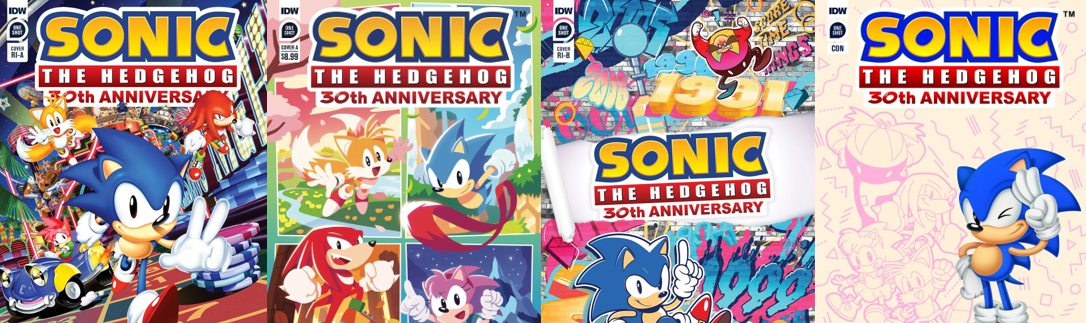
SEGA were quick to capitalise on Sonic’s surge of popularity once he was catapulted to mainstream success and finally (if briefly) knocked Nintendo from the top of the videogame industry. Following Nintendo’s success with DiC, SEGA soon spearheaded Sonic’s small screen debut with two concurrent cartoons, with most popular being Sonic the Hedgehog (1993 to 1994), or “SatAM”. SatAM’s darker tone made it stand out from the slapstick approach of its sister-series, though both styles were originally (and awkwardly) mashed together when Archie Comics began publishing a semi-continuation of both. Eventually bringing in more elements from the source material alongside their own convoluted lore, Archie’s Sonic the Hedgehog comics became the longest-running comic series based on a videogame. However, this achievement was sullied when a series of lawsuits forced not only major continuity changes but the eventual cancellation of the series after twenty-four years. In 2017, IDW Publishing picked up the license and an all-new series of Sonic comics hit shelves, one spearheaded by Archie Sonic writer Ian Flynn and artist Tyson Hesse and whose events and original characters were said to be canon to the videogames. To celebrate Sonic’s 30th anniversary in 2021, SEGA released a bunch of merchandise, including a new compilation for modern consoles and this one-shot publication, which was lauded as a fitting tribute for the Blue Blur and one of the greatest comic book outings for the character.

The Review:
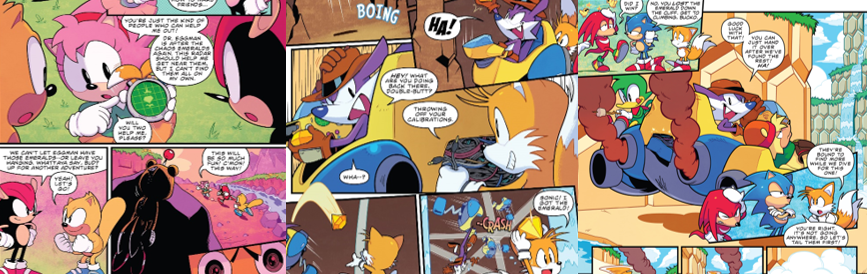
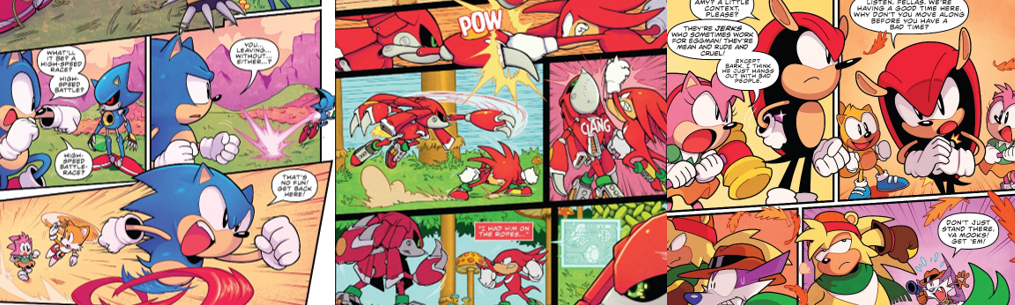
“Seasons of Chaos” begins with Sonic the Hedgehog and his friends, Miles “Tails” Prower and Amy Rose (all beautifully rendered in their “Classic” forms) adventuring through Spring Valley Zone, whimsically smashing Badniks, before stumbling upon a Chaos Emerald out in the open. Just as Sonic moves to nab it for himself, the gem is stolen by none other than Metal Sonic! While Tails and Amy react in horror, Sonic gleefully prepares for a rematch against his metallic doppelgänger and is first sad and then enraged when Metal Sonic simply blasts away without a word. Eager to test his mettle against…Metal…Sonic gives chase and, following a hilarious misunderstanding with Amy when he asks for a “boost” and an assist from Tails, Sonic rockets into the sky and has to be saved from a fatal plummet by Knuckles. Knuckles relates how he was hanging out on Angel Island (exactly as depicted in the opening cutscene of Sonic & Knuckles (SEGA Technical Institute, 1994)) when one of the animals also found a Chaos Emerald, leading to am ambush by Metal Knuckles!  Though Knuckles fought valiantly against his metallic double, Metal Knuckles endangered the locals, forcing Knuckles to save their lives and allowing the robot to scarper with the Chaos Emerald. Naturally, Knuckles pursed his foe, which led him to Sonic. Realising that Metal Sonic and Metal Knuckles must’ve been sent by Doctor Eggman to retrieve the Chaos Emeralds for some nefarious scheme, our heroes waste no time in racing off to stop this plot…in fact, they’re so quick to run off that they leave Amy behind!

Amy ropes Mighty and Ray into helping her find the Chaos Emeralds, which are also sought by Fang.

Angered and despondent about being left out, Amy sadly wanders off with Tails’ Emerald Radar, oblivious to the robotic puppet spying on her. Her sadness turns to excitement when she bumps into Mighty the Armadillo and Ray the Flying Squirrel during their exercises. Interestingly, this is depicted as their first time meeting, though they have a mutual friend in Sonic. Realising the two are just the guys to help her out, Amy quickly convinces Mighty and Ray to join her in tracking down the Chaos Emeralds using Tails’ radar. Over in the Summer Falls Zone, Tails realises, to his dismay, that he’s lost his radar; luckily, the trio have an “expert treasure hunter” on hand and quickly find another Emerald. However, just as they go to grab it, they’re accosted by Fang the Hunter, Bean the Dynamite, and Bark the Polar Bear, three unscrupulous mercenaries who’ve been hired by Dr. Eggman to retrieve the Chaos Emeralds. While Knuckles matches brawn with the strong, silent Bark and Sonic tangles with the wacky, bomb-tossing Bean, Tails pursues Fang, awestruck by the hunter’s hover craft, the Marvelous Queen, which he sabotages to relieve Fang of his prize. However, Fang’s popgun leads to a game of hot potato as the teams vie for the gem, Bomb barely stopping himself from blowing it up, Sonic emulating another videogame icon, and the gem finally plummeting down a waterfall after Knuckles and Bark beat each other senseless trying to claim it. Realising that the thieves will find more Chaos Emeralds in the time it’ll take them to dive for this one, Sonic and his friends choose to get moving rather than waste their time, completely oblivious that the jewel has landed on Mighty’s head below! Ecstatic, Amy enthusiastically leads her new allies onwards, unaware that the Heavy King is monitoring not just their progress, but all the competing teams from its ominous control room through the eyes of its mechanical minions.

Sonic and his friends begrudgingly team up with their enemies to confront a common foe.

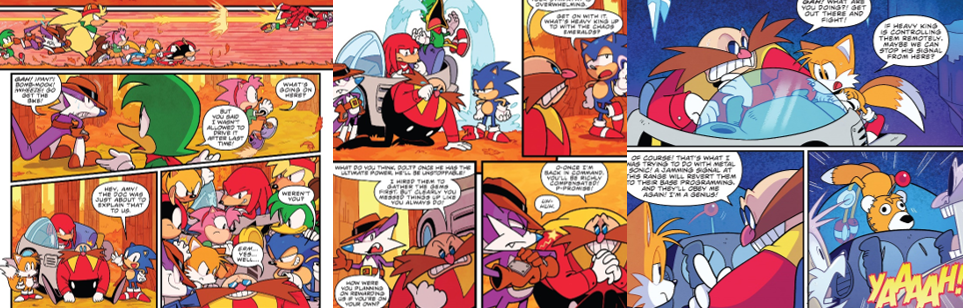
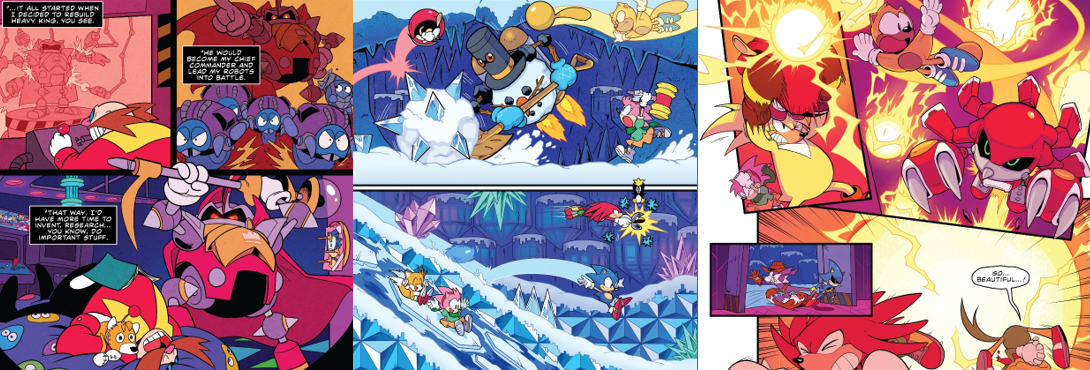
Running loops through the dense Autumn Forest Zone, Sonic and friends find themselves struggling with the dense foliage and troubled by Dr. Eggman’s aggressive pursuit of the Chaos Emeralds. Speaking of whom, they happen to spot Dr. Eggman pursuing Metal Sonic through the forest and, naturally, attack, easily disarming (literally) his Egg-O-Matic of its buzzsaw appendages. Nearby, Amy and the others find another Chaos Emerald and are challenged by Fang and his goons. Amy fills his friends in on the trio, noting that they’re all jerks except for the sullen Bark (who she thinks is just misled) and Mighty leads the three in an attack. True to Amy’s suspicions, Bark appears reluctant to fight and begrudgingly defends Fang from Mighty’s attack, stuffing him into a tree trunk. Bomb’s erratic explosives blast Ray and Amy from the sky and dislodge the Chaos Emerald, allowing the crazed duck to claim it, but Metal Knuckles suddenly steals it, leading the two teams to set aside their differences and give chase, Fang livid at the double-cross. They bump into Sonic, Tails, Knuckles, and the defeated Dr. Eggman, who explains that the rebuilt Heavy King turned against its master, reprogrammed Metal Sonic, Metal Knuckles, and Tails Doll and kicked Dr. Eggman from his base. Realising they share a common enemy, the group decides to work together to stop the Heavy King and heads to Dr. Eggman’s base in the Winter Caverns Zone, overcoming the natural landscape and the Heavy King’s defences through surprisingly effective teamwork. Sonic can’t help but mock Dr. Eggman’s embarrassing defences, leading to the doctor enjoying watching Metal Sonic blast Sonic while he’s distracted. While everyone works together to fight Metal Sonic and Metal Knuckles, Dr. Eggman and Tails reprogram Tails Doll to jam the Heavy King’s signal, returning the robots to Dr. Eggman’s control and forging another unlikely alliance. Not wishing to see his base suffer any further damage, Dr. Eggman simply remote opens the doors rather than let his newfound allies trash the place and they head inside to confront the Heavy King.

Sonic and friends defeat the Heavy King and split the Chaos Emeralds between them.

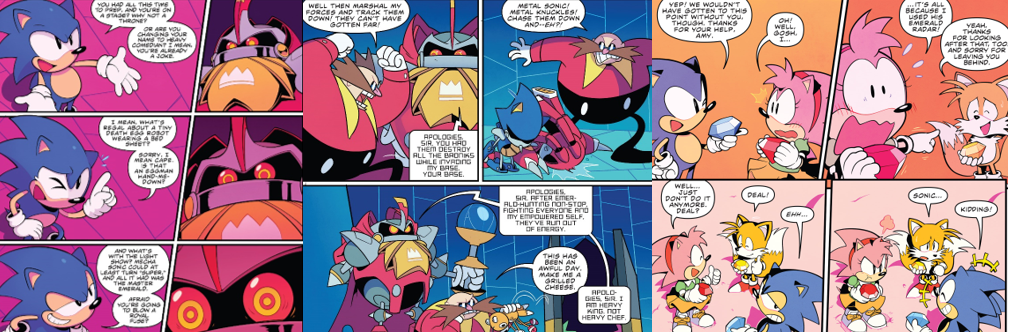
However, the Heavy King is nigh-untouchable thanks to having gathered all seven Chaos Emeralds. It channels their power through its staff, casting lighting bolts and energy balls that rain destruction upon its foes. The Heavy King relishes the conflict, plotting to restore the Hardboiled Heavies and conquer the world and easily shielding against or shrugging off their counterattacks. Realising they’re outmatched, Sonic uses himself as bait, focusing the Heavy King’s attention solely on him by insulting the maniacal robot. Sonic’s allies then steal the Chaos Emeralds and, rather than becoming Super Sonic and destroying the Heavy King, Sonic settles for easily toppling the now-powerless robot. It then begs forgiveness from Dr. Eggman, claiming to have been following its programming. Dr. Eggman commends his creation and forgives it, planning to install a software patch to keep it in check, and then orders his forces to attack. However, Sonic and the others have gone, along with the Chaos Emeralds, and Dr. Eggman’s forces are too weak and rundown from the assault to give pursuit, leaving Dr. Eggman sulking in his frozen base. In the aftermath, Bark meekly says goodbye to Amy and leaves with Fang, who claims a Chaos Emerald as his reward. Similarly, Knuckles leaves with another, planning to keep it as safe as the Master Emerald, and Mighty and Ray take two more, hoping to team up with Sonic again in the future. Sonic, Tails, and Amy also keep hold of a Chaos Emerald each, splitting the gems up to keep them out of Dr. Eggman’s hands in the future. To Amy’s glee, Sonic and Tails not only apologise for leaving her behind but also thank her for her help, leaving her as flustered as Bark. Sonic then races off into the sunset towards his next adventure.  

The Summary:
I absolutely adored “Seasons of Chaos”! after years, decades, of Sonic comics using art styles that were far removed from the original Japanese depictions of Sonic and his friends, it’s really refreshing to see a return to the classic art style, as beautifully brought to life in Sonic the Hedgehog CD’s (SEGA, 1993) anime sequences. Don’t get me wrong, I grew up with Richard Elson and Greg Martin’s renditions of Sonic and I love what Patrick “Spaz” Spaziante did with the characters, but Tracy Yardley always evokes the classic style so wonderfully and Sonic and his friends have never looked better than in “Seasons of Chaos”, in my opinion. Everyone looks ripped right out of the original Japanese artwork and strikes poses reminiscent of the videogames, to say nothing of the times the story switches to a side-view to recreate the kinetic, sidescrolling action of the videogames. Many Sonic comics focus more on drama and character moments and convoluted plots, and I can understand why. They’re comic book adaptations trying to keep readers coming back for more; simply showing Sonic smashing robots and dodging traps isn’t as engaging as it is in the games. However, there’s something to be said for the simplicity at work in “Seasons of Chaos”, which pays homage to the classic videogames by acting as a continuation of their events and could easily be slotted in as another post-Sonic Mania Plus (Christian Whitehead/PagodaWest Games/Headcannon, 2018) adventure. Interestingly, “Seasons of Chaos” opts for unique locations clearly inspired by the likes of Green Hill Zone, Angel Island Zone, and Robotnik Winter Zone. While it would’ve been nice to see familiar locations, I like that we got to see new environments that were similar and yet different enough as it tied into this story being a follow-up to Sonic Mania Plus, which also included a handful of new Zones clearly inspired by the classic videogames.

I cannot and will not ever stop gushing about how beautiful the art work is in this special!

“Seasons of Chaos” also references not just obscure Sonic titles but also the 3D adventures. Dr. Eggman chastises Metal Sonic’s brief hesitation when the Heavy King talks about becoming a “Metal Overlord”, for example, and the comic features Metal Knuckles as a primary antagonist, finally giving long-time Sonic fans a good look at its complex, armoured plated intricacies. I enjoyed the adventure set out in this story; it’s a classic race to retrieve the Chaos Emeralds but one that subverts expectations. Sonic is continually insulted and dismayed at Metal Sonic’s refusal to race, for example, and the Chaos Emeralds are scattered across the world, not unlike Sonic’s 8-bit adventures. “Seasons of Chaos” also brings back three of the franchise’s most obscure characters, Fang, Bean, and Bark, retaining them as a mercenary duo as depicted in previous American Sonic comics. I loved Fang’s depiction as an opportunistic, cowardly weasel who lets others do his fighting and is selfish and full of bluster (there’s a fun moment in the finale where Metal Sonic drags him back into the fight!) Bean retains the same crazed, pyromaniacal characterisation seen in the latter days of the Archie comics, while Bark is the strong, silent type who’s depicted as misled and reluctant but happy to match his strength against powerful foes. Similarly, the story also ropes in Mighty and Ray, two characters I never get tired of. I loved their brotherly dynamic (which is similar to the relationship between Sonic and Tails) and them making fast friends with Amy, forming a trio that acts as an early incarnation of Team Rose. Amy’s desire to prove herself and be useful is as infectious as her enthusiasm and the three bring a lot of levity to an already whimsical tale. Naturally, I adored the depiction of Sonic, Tails, and Knuckles as well. I loved the banter between Sonic and Knuckles, with Knuckles being oblivious to Sonic’s taunting and Sonic being a wise-cracking, adventurous spirit. While Tails felt like a bit of a background character, he stepped up to sabotage Fang’s craft and work with Dr. Eggman to reprogram Tails Doll, showing that these three have the perfect balance of skills to oppose Dr. Eggman’s plans.

A fantastically written and wonderfully illustrated celebration of the franchise.

In an interesting twist, Dr. Eggman isn’t the main villain. Instead, he’s the victim of another robot rebellion, humiliated and seeking revenge after the Heavy King took its programming a little too literally. Dr. Eggman’s depiction reminds me very much of his portrayal in Sonic the Hedgehog (Ikegami, 1996), being a prideful, grandiose, comical figure capable of malicious actions but largely a spiteful buffoon. Sonic routinely mocks his creations and easily trounces his machines and defences, Dr. Eggman reacts to the Heavy King’s betrayed with a childish tantrum, and he immediately sets his revived forces against his former allies the moment he regains control of them, only to find they’re too drained to fight. Every time I read “Seasons of Chaos”, I’m enamoured by the gorgeous colours and striking artwork. Everything has such a cute visual appeal that recalls a far less dramatic and more whimsical time in Sonic’s history, a time where the spirit of high-speed adventure was enough of an appeal for players and readers. I honestly wish IDW would publish a dedicated side series of classic Sonic adventures in this style as it’s truly beautiful and would be perfect for a five-page backup feature, at least, alongside whatever dramatic, world-ending plot is running through the main story. I loved how the comic recreated visuals from the videogames as fun Easter Eggs for long-time fans while crafting a fun, easy to follow adventure for these three teams. The action was bold and kinetic, with panels full of little details and quirks and humorous moments, from wild expressions to visual callbacks to the source material, and character defining moments for the likes of Amy, Mighty, and Ray, who both proved their worth and solidified their alliances with the main trio through this story. Ultimately, “Seasons of Chaos” was a fantastic celebration of Sonic’s 30th anniversary. The story and art did a great job of honouring the character’s past and rich history, weaving recognisable elements into a largely original story and casting a spotlight on the classic depictions of both iconic and obscure characters as only the comics can. I honestly wish the games leaned more towards this style, embracing what worked so well in the past and emphasising Sonic’s rich supporting cast and fun sense of adventure rather than focusing solely on Sonic alone as it made for a hugely enjoyable read.

My Rating:

Rating: 5 out of 5.

Fantastic

Did you enjoy “Seasons of Chaos”? Were you as captivated by the art style as I was? Did you like seeing Amy team with Mighty and Ray and the inclusion of Fang, Bean, and Bark? Were you disappointed that we didn’t get a Super Sonic finale? Would you like to see a spin-off comic in this style? What are some of your favourite stories and moments from IDW’s Sonic comics? How did you celebrate Sonic the Hedgehog this month? Whatever your thoughts, leave a comment below, consider supporting me on Ko-Fi, and go check out my other Sonic content.