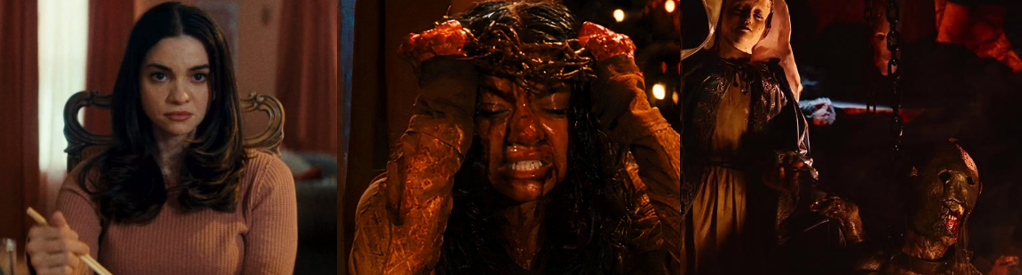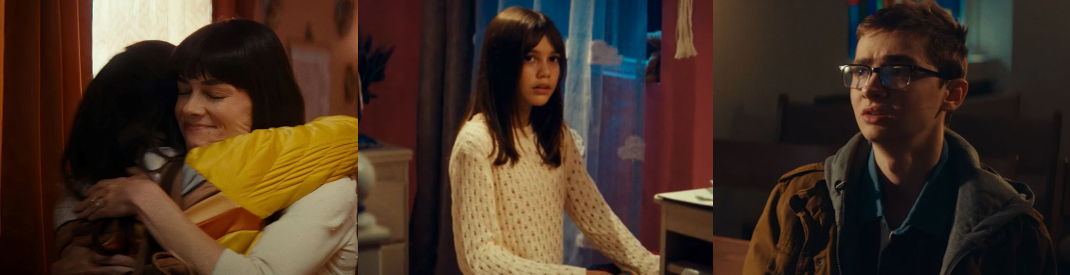
Movie Night [Christmas Countdown]: Terrifier 3

Released: 11 October 2024
Director: Damien Leone
Distributor: Cineverse / Iconic Events Releasing
Budget: $2 million
Stars: David Howard Thornton, Lauren LaVera, Antonella Rose, Samantha Scaffidi, and Elliott Fullam

The Plot:
Supernaturally reborn Art the Clown (Thornton) and his demonic cohort, Victoria Heyes (Scaffidi), torment traumatised Sienna Shaw (LaVera) and her family at Christmas.

The Background:
The fear of clowns (or “Coulrophobia”) crops up a lot in horror and reality, largely thanks to fictional “Evil Clowns” like Stephen King’s Pennywise and twisted psychos like John Wayne Gacy. Though I’ve never found clowns particularly scary, writer and director Damien Leone touched upon Coulrophobia with The 9th Circle (2008), a short film that featured a prototype of Art the Clown (Mike Giannelli). Though merely a supporting character, Art was popular enough for Leone to bring him back in Terrifier (2011) and All Hallows’ Eve (2013), and to expand the character into a modern-day slasher icon in Terrifier (2016). Though a modest success met with largely positive reviews (especially for David Howard Thornton’s performance and the sickening gore), Leone was dissatisfied with some his characterisations of the protagonists and sought to address this in the 2022 sequel. Weathering criticisms about its brutal content, Terrifier 2 was a critical and commercial success and Leone was excited to add additional nuance to Samantha Scaffidi’s returning character. Leone also gave wrestler Chris Jericho additional screen time, reaped the benefit of a vastly increased budget, and sought to emulate John Carpenter by shooting the film with Panavision anamorphic lenses. With a $90 million box office, Terrifier 3 was the most successful of the franchise at the time, and the reviews mirrored this. While the narrative and extreme content continued to be criticised, critics praised the ever-expanding lore and characters, with many reviews lauding the various complex and captivating performances, and this success all-but ensured the continuation of the controversial slasher franchise.

The Review:
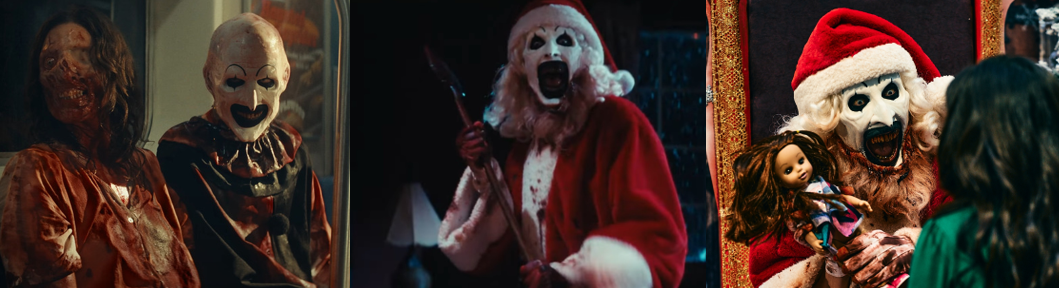
Terrifier 3 opens with pure, unadulterated shock value: a home invasion around the festive season where Art’s dressed as Santa Claus and which establishes the slightly different direction of the film. Namely, Leone relies far more on long, lingering shots and a tense build-up to the brutal gore. Thus, we follow cute youngster Juliet Thomas (Luciana VanDette), who’s awakened by the sounds of commotion on the roof she adorably believes is Santa. While her mother, Jennifer (Krsy Fox), encourages her imagination to get her back to sleep, neither her father or brother (Mark (Alex Ross) and Timmy (Kellen Raffaelo), respectively) have any time for her wild claims. Juliet’s ecstatic when she creeps downstairs and sees Santa lingering near the family tree, but enters a state of awestruck shock when Jolly Ol’ Saint Nick pulls out a fire axe and tip-toes upstairs to hack Timmy to death (off camera, but still rather shocking) and brutalise Mark. Yes, it’s Art the Clown in his newest festive guise, as spiteful as ever. He relishes Jennifer’s screams as he bludgeons Mark and gleefully chases her downstairs before caving in the distraught mother’s head. Art then helps himself to milk and cookies and even does the dishes. Art spies Juliet hiding in a kitchen cupboard, though her fate’s ultimately left ambiguous and I wouldn’t be against seeing her return in a future film. This opening is extremely unsettling, mainly because it’s easy to imagine it happening. Mark tends to leave the front door unlocked and ajar and he and his son are slaughtered before they even knew what hit them. To say nothing of Jennifer’s horrified reaction to her son’s body parts strewn around his bloodstained room and the trauma Juliet suffered as she tries to comprehend the horror happening before her eyes. It’s extremely effective, mainly because of the time Leone takes to build anticipation and the way he teases us with bits and pieces of the kills. I am surprised that Terrifier 3 didn’t go the whole hog and show Art hacking a child to death, considering the franchise isn’t exactly known for pulling its punches.

Traumatised by her encounter with Art, Sienna struggles to realise her seemingly divine destiny.

A security guard (Chris Jericho) at the mental hospital where the horrifically disfigured Victoria Heyes has been incarcerated since the first movie then stumbles open the scarified wretch consuming a nurse, Art’s disembodied head joining in and connected to Victoria by a ghastly umbilical cord! Victoria lets out a plea for help that appears to be her last gasp of sanity and humanity before the demonic force (the “Little Pale Girl” (Amelie McLain) from the last film) possesses her. The demonic Victoria then cheerfully joins Art in tearing the guard’s head to pieces, Art’s headless body having sprung to life and travelled across town after ripping off a cop’s (Stephen Cofield Jr.) head. This reanimation and possession seems to exhaust them as they travel to an abandoned house and enter a strange hibernation, Art reclining in a rocking chair and Victoria slitting her wrists in a bathtub, where they wait for five years. It’s not entirely clear why: potentially exhaustion, as I said (Art seems visibly annoyed with Victoria’s antics, as though cranky and needing a nap) or possibly because the dark power of the Halloween season is leaving them. Regardless, they lie dormant and the “Miles County Clown” becomes a modern-day myth discussed on true crime podcasts like Mia’s (Alexa Blair Robertson), a fangirl who’s hooking up with Jonathan’s (Fullam) roommate, Cole (Mason Mecartea). We catch up with Sienna as she’s being discharged from five years in therapy following her bizarre and brutal encounter with Art. Jonathan, however, is in college and seemingly happy to survive on a diet of denial, pills, and isolation, despite initially being so obsessed with demonology and possession that he wrote Sienna letters about his wild theories regarding Art, the demonic forces behind him, and the strange, seemingly angelic destiny bestowed upon Sienna by their father, artist Michael Shaw (Jason Patric). With her mother dead, Sienna stays with her aunt and uncle, Jess (Margaret Anne Florence) and Greg Shaw (Bryce Johnson), though their compassion wanes as Sienna becomes agitated and aggressive after first sensing Art’s presence and then receiving conformation that her tormentor is still alive.

Though Sienna tries to find peace with her extended family, Jonathan remains in denial.

Sienna is very different from the last movie but is initially determined to get back on track and rediscover herself by rekindling her sisterly relationship with her cousin, Gabbie (Rose). Gabbie is in awe of Sienna and looks up to her as an idol and older sister, admiring Sienna’s scars and reading her journal, a private musing of the nightmares that still haunt our traumatised heroine. Sienna tries to rebuild bridges with Jonathan using the festive season and is dismayed to find her little brother deep in denial and refusing to believe that Art is still alive. Despite her years of therapy, Sienna is still very fragile; she relies on medication to sleep and is shaunted by screams and visions from her experiences. She’s either hearing the dreaded “Clown Café” jingle or seeing delusions of her brutalised best friend, Brooke (Kailey Hyman), feeding her survivor’s guilt and leaving her a neurotic mess. However, as good as LaVera continues to be, I would’ve liked to see more emphasis placed on Sienna’s fractured mental state. Brooke could’ve shown up more, for example, and Sienna’s scars could’ve been more prominent. Her relationship with Gabbie was adorable, though, and there’s a sense that Sienna relies on this normalcy to move on from her past, but Sienna is quick to anger when Mia badgers her and erratically lashes out at Jonathan when he seemingly turns his back on her, unaware that he’s hiding his panic attacks. Terrifier 3 delves a little more into Sienna’s past where, as a child (Luciana Elisa Quiñonez), she was doted on by her father, who depicted her as an angelic warrior. Jonathan also claims Sienna was “chosen”, presumably by angelic forces seeking to counterbalance the demon that possessed Art and Victoria, and the film teasing with a bizarre nightmare depicting the statuesque Virgin Mary (Juliana Lamia) forcing a bound demon (Michel Vidal) to forge Sienna’s magical sword.

Joined by the demonic Victoria, Art’s more supernatural and malicious than ever.

Though he may have started as a theatrical, but still mortal, serial killer, Art has become something far worse. He was essentially supernatural in Terrifier 2, but it’s taken up a notch here, with his headless body lumbering about and killing and his disembodied head being reborn through Victoria. Yet, though Art can reattach his head, shrug off bullets, and hibernate for years, he still feels pain when attacked by Sienna and her sword, and his abilities remain rooted in his bag of tricks (now given a festive makeover). Art cobbles together a liquid nitrogen spray device and later boobytraps gifts with a homemade bomb, and cosplays as Santa seemingly on a whim. He spots Charles Johnson (Daniel Roebuck) drinking in a bar and excitedly accosts him, believing he’s the real Santa, only to steal his outfit and leave Johnson a frigid, bloody mess. Art delights in luring victims with his festive guise, enjoying the same degree of anonymity his clown outfit gave him at Halloween, making his horror even more visceral since he targets children. Art’s joined by Victoria, a demonic presence who literally (and gruesomely) gets off on Art’s antics. Although Victoria’s very loquacious, she’s very aloof about who and what they are. Jonathan’s theory that the demonic force possessed the worst person imaginable (a serial killer) and is seeking to inhabit another, stronger body seems as true as his belief that Sienna’s been “chosen” to oppose these forces. Victoria first mocks Sienna’s status as a saviour then compliments her strength, and then literally tries to break Sienna by murdering what little family she has left so she (as in Victoria) can forcibly possess her. Unfortunately, this finale kind of relegates Art to Victoria’s henchman as she dictates the torture and is presented as something of a puppet master. It’s only a fleeting suggestion and the two are depicted more as equals when they do appear onscreen, but I would prefer Leone steer away from diminishing Art like that in future instalments.

The Nitty-Gritty:
I’m not going to get into a debate about whether or not Terrifier 3 is a Christmas movie. It’s set during the festive season, there are Christmas trees, mall Santas, presents, and trappings everywhere, and Art’s going around dressed as Santa, which is enough for me! I will, however, debate the evolving lore. While it seems like Leone is simply making up the story as he goes, suggesting things that may or may not be relevant in the future, there’s a strong suggestion of biblical forces at work. Jonathan believed the Little Pale Girl was the key to it all the film suggests that Art was once a serial killer who, upon his death (either in Terrifier or before), was possessed by a demonic force like the demon in Victoria. Someone, presumably angels or another divine presence, then seemingly chose Sienna to counter these forces and worked through her father to prepare her for this destiny, bestowing her with a magical sword forged by a captive demon. However, while this is said to be the only weapon capable of stopping Art and Victoria, Art still recovered after being beheaded by it and he survives another stabbing from the blade here, though the sword does heal Sienna’s wounds. Sienna previously fell down some kind of Hell hole in Terrifier 2 and another pops up here to swallow Gabbie and the sword, and Sienna’s haunted by memories of the Clown Café, an unsettling upbeat corner of whatever Hell these demons are from that seemingly relishes the suffering of others. It’s intriguing and there are some interesting visuals and suggestions here, though Terrifier 3 stubbornly refuses to provide any explicit details, perhaps to maintain a sense of mystery or perhaps because Leone hasn’t figured out how it all fits together yet. Instead, the film uses it as a backdrop to Sienna’s fractured mental state, which leaves her on edge and tormented by nightmares, though I would’ve liked to see more of these so we could get a better sense of how much she’s struggling with her guilt.

The film certainly delivers the brutal kills you’d expect, though with more suspense than before.

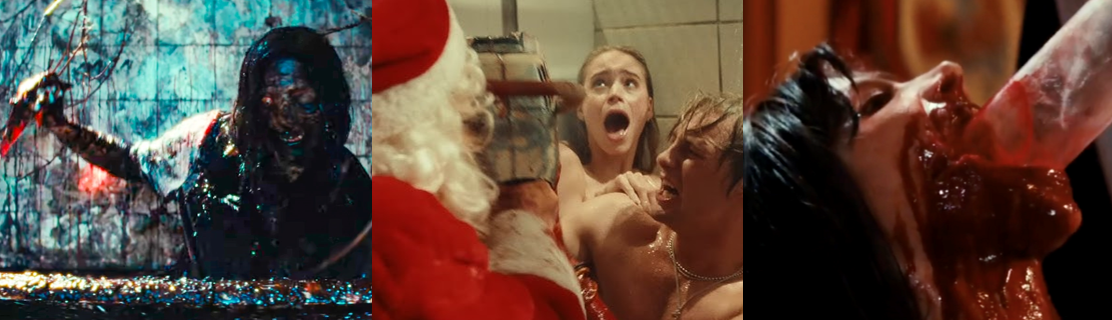
Terrifier 3 had an uphill battle trying to top the last film’s gruesome kills and, perhaps in recognition of this, puts more effort into building tension before Art strikes. Naturally, there are exceptions: Art’s headless body pounces upon the cop that discovers it, for example, Victoria viciously stabs an unassuming exterminator (Michael Genet) through the neck with a shard of glass, and Art opts to simply gun down the bar patrons before torturing Charles. Interestingly, some kills are kept off-screen: we never see what Art and Victoria do to the Art cosplayer (Peter Mitchell), for instance, and both Greg and even Jonathan die off camera. This was an odd choice for me, and it felt like some scenes were cut from the movie, so jarring was their end, to the point where I’m assuming Jonathan is either still alive or we’ll get a flashback in Terrifier 4. Of course, there’s plenty of onscreen brutality and it’s just as macabrely fascinating and disturbing. While Art starts rather pedestrian with a fire axe, he and Victoria are soon ripping Chris Jericho’s jaw off and it’s not long before demented clown is slicing through another exterminator’s (Jon Abrahams) head with a Stanley knife and ripping his skin down his skull! Art’s particularly proud of his liquid nitrogen contraption, which he uses to flash-freeze Charles’ leg, hand, and face before bashing the limbs with a hammer and ripping his beard off. The film’s standout kill sequence sees Art attack Cole and Mia in the college showers with a chainsaw, cutting through bone and muscle and leaving Mia a gibbering mess of sliced meat as he grants her wish to be face-to-face with pure evil. Cole gets the worst of it, having half a hand chopped off, then his leg severed in sickening fashion, before being sliced up the rear and then from the groin to his belly, leaving him little more than steaming meat on the tiles. While it’s truly bizarre that Jonathan’s supposed death happens offscreen, it leads to a particularly ghastly end for Jess as she gets a plastic tube hammered down her throat and is forced to swallow rats before having her throat cut. It’s a scene eerily similar to a sequence form American Psycho (Ellis, 1991) and one that, again, I feel could’ve been even more extreme, like the rats could’ve come clawing out her nether regions or something!

Although Sienna dispatches Victoria, Gabbie falls to Hell and Art escapes into the night…

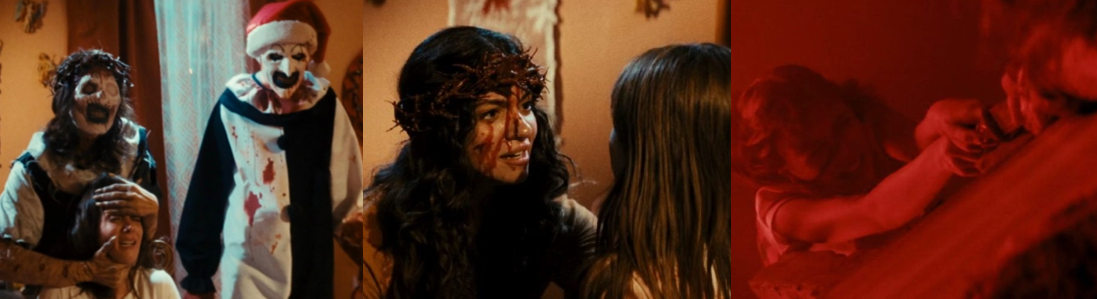
Perhaps the most distressing kills, however, are those that befall the unsuspecting children fooled by Art’s disguise. After posing as Santa at the mall, Art leaves a bunch of kids and their parents splattered across the festive scenery with a bomb, which deeply unsettles Sienna to the point where she starts screaming for Jonathan to be brought to them so they can get to safety. Although Greg begrudgingly goes to get him, Sienna wakes from a disturbing dream to find her uncle beheaded and nailed to the lounge wall and Art and Victoria in her home. Bound and gagged and beaten with a mallet, Sienna’s forced to watch her aunt’s horrific death. Her relief at finding Gabbie alive is short-lived since the girl’s held at knife point by Art and Victoria triumphantly presents Jonathan’s gory skull to her captive. When her first attempt to possess Sienna fails, Victoria prepares to kill Gabbie to finally break Sienna’s spirit but decides it’d be amusing to watch Sienna open Gabbie’s Christmas present first. After Art bashes Sienna’s hands to a pulp, Victoria demands she open the gift but she and her mute cohort are horrified when it turns out to be the magic sword (which Sienna recovered from the Terrifier funhouse, though I’ve no idea why she left it there or why we never see her get it…) Empowered by the sword, Sienna stabs and beheads Victoria and then jousts with Art, who attacks with his chainsaw. Although Sienna pins Art to the wall, she’s forced to abandon him when Victoria’s remains rot away and open a portal to Hell right under Gabbie! Despite Sienna’s best efforts, she fails to save her cousin, who’s sucked into the void alongside the sword. Although Sienna’s wounds heal and she’s determined to save her surrogate sister, Art escapes into the night to continue unsettling the populace, ending the festive slasher on a cliff-hanger…

The Summary:
I had high hopes heading into Terrifier 3. The first one might’ve been a bit rough around the edges, but the sequel was such a vast improvement, with memorable gore and a relatable and adorable main character to root for. Terrifier 3 seems to struggle with its momentum right from the start, substituting gruesome kills for suspense, which would be fine if this wasn’t a series known for its in-your-face splatter gore. While there are some standout kills and many of the dismemberments and torture sequences are as brutal as you’d expect, it’s jarring when the camera cuts away or significant characters like Jonathan are seemingly killed onscreen. If Leone is going for pure shock value by killing kids, the least he can do is follow through and present some nightmarishly unsettling deaths rather than merely showing us the bloody aftermath. It doesn’t help that Terrifier 3 feels like it’s making the story up as it goes along, clumsily suggesting a coherent narrative through exposition and teases but potentially setting up for an underwhelming payoff. Art’s still very mysterious but the supernatural, demonic context takes some of the allure off him, as does relegating him to Victoria’s henchman in the finale. It’s a fleeting moment and one that’s inconsequential compared to the carnage Art unleashes throughout the film, but I wonder if it might’ve been just as good, if not better, if Victoria had accompanied him throughout and joined in with the kills, if only to cement them as equals. Similarly, while I enjoyed Sienna’s struggles with her trauma and her desperate attempts to continue on after everything she went through, I don’t think the film focused on her delusions and nightmares enough. It could’ve been so much more harrowing if she was having visions of her loved ones so that she (and we) question her sanity. Instead, it’s kind of swept under the rug near the end. It feels like some of this (like other sequences and deaths) were cut to save time, resulting in an uneven narrative that left me unsatisfied at times. David Howard Thornton and Lauren LaVera still give excellent performances, newcomer Antonella Rose is everything Elliott Fullam isn’t, and I did like seeing Victoria depicted as a cackling witch and the hints towards some greater biblical endgame…I just hope the payoff is satisfying and it all fits together in the end.

My Rating:

Rating: 3 out of 5.

Pretty Good

Did you enjoy Terrifier 3? What did you think to Victoria joining Art as a demonic partner? Do you agree that more focus should’ve been placed on Sienna’s fractured mental state? Which of the kills was your favourite and what did you think to the greater emphasis on tension? Did you also feel like key moments were cut from the film? What’s your favourite Christmas-themed scary movie and which Terrifier film is your favourite? Let me know your thoughts about Terrifier 3 in the comments, support me on Ko-Fi, and check out my other horror and Christmas content!

Movie Night [Christmas Countdown]: Black Christmas (1974)

Released: 11 October 1974
Director: Bob Clark
Distributor: Ambassador Film Distributors
Budget: $686,000
Stars: Olivia Hussey, Keir Dullea, Margot Kidder, James Edmond, John Saxon, and Nick Mancuso/Bob Clark/Albert J. Dunk

The Plot:
Jess Bradford (Hussey) and her Sorority Sisters are tormented by obscene phone calls from “The Moaner” (Mancuso/Clark) that soon turn violent when the bodies pile up over Christmas.

The Background:
While John Carpenter’s Halloween (Carpenter, 1978) can be said to have popularised the “slasher” sub-genre, and copycats like the equally iconic Friday the 13th franchise (Various, 1980 to present) established its enduring tropes, slasher films can more accurately be traced back to this seminal, Christmas-themed horror. Initially developed by Canadian screenwriter Roy Moore and inspired by both urban legends and a gruesome string of murders, Black Christmas aimed to present realistic protagonists and challenge perceived notions of female leads with a socially relevant character arc. The late Olivia Hussey took the lead on the advice of a psychic, while Margot Kidder was allegedly attracted to how wild her character was and director Bob Clark was said to have meticulously storyboarded the entire film. Clark employed first-person shots to portray the mysterious killer and his techniques genuinely shocked both cast and crew. Briefly retitled Silent Night, Deadly Night upon release, Black Christmas was an unexpected box office hit that initially garnered mixed reviews. Over time, the film was heralded as a classic of the genre that was especially celebrated for its feminist subtext and subverting expectations of the festive holiday. While it massively influenced subsequent slashers, Black Christmas never spawned a sequel, though it was eventually remade over the years and fan film continuations later emerged,

The Review:
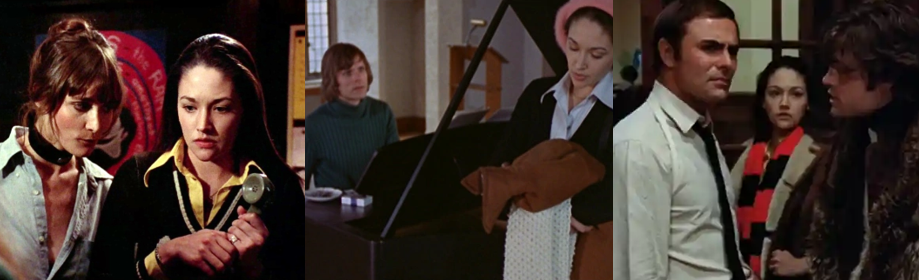
Black Christmas is set almost entirely within a sorority house around the Christmas season. This provides a good sense of space and the rooms in the house, but it does get a touch repetitive being stuck in the same location 90% of the film. Interestingly, despite there only being a handful of residents cared for by alcoholic and incorrigible housemother Barbara MacHenry/Mrs. Mac (Marian Waldman), the house seems to shrink as the film goes on, becoming more claustrophobic and ominous, especially as many scenes are shot from the perspective of the killer hiding in their attic. This largely unseen, mysterious figure approaches the house in the dead of night at the start of the film and easily clambers to the attic, watching the sorority sisters muddle about with their various dramas. Chief among them is the repeated obscene phone calls they receive from a raspy, vulgar voice they’ve dubbed the Moaner. At least once a day, the Moaner calls and growls aggressively sexual threats and comments to the girls, who are disgusted and amazed by this. While Jess is appalled and quiet newcomer Clare Harrison (Lynne Griffin) is disturbed, headstrong, domineering Barbara “Barb” Coard (Kidder) fearlessly challenges the voice and barks equally obscene insults. Barb’s efforts only exacerbate the deranged Moaner, leading to the voice screaming, arguing with itself, and threatening to kill her. Already upset by the calls and Barb’s snide comments, Clare prepares to spend Christmas with her father (Edmond) only to be surprised and suffocated by their unwanted house guest. Her corpse is toyed with by the killer (let’s call him “Billy”) and undiscovered for the entire film but driving much of what follows.

As if obscene phone calls aren’t bad enough, Jess is dealing with an unwanted pregnancy.

A big and very unusual sub-plot of Black Christmas revolves around beautiful and determined Jess, who ironically usurps many of the tropes of a “Final Girl” as she’s in a sexual relationship with Peter Symthe (Dullea) and it can be inferred she enjoys drinking with her sisters. Jess discovers she’s pregnant early on, leading to disagreements between her and her piano playing “artist” boyfriend about what to do. Jess decides it would be unfair to have an abortion without telling Peter first, but he’s stunned by her decision and comes across as very condescending and neurotic when she tells him. Any time Peter questions her, Jess stands her ground, determined to decide what to do with her body and only informing him as a courtesy. It’s telling that Jess only replies with “I know you do” when Peter says he loves her, especially as she later shoots down his marriage proposal and insists that she doesn’t want to give up her dreams (whatever they are) just because he’s decided to drop out. Although they initially seem to have a very loving relationship, the baby revelation rocks Peter to the point where he messes up his piano playing and takes a very draconian view on the matter. While I agree that Peter is allowed to be upset and deserves to know that she’s pregnant, Jess makes very valid points about not being ready or willing to be a mother or throwing her youth away on a marriage that likely won’t last. It’s a very mature and pragmatic attitude and it’s clear she’s thought it all through, just as it’s clear she’s disappointed not to have his support but not very bothered since she knows she’s better off without him. When the Moaner’s calls emulate a baby’s screams and seemingly mock her, Jess finally reports the calls and concerned Lieutenant Kenneth Fuller (Saxon) immediately suspects Peter after seeing and hearing of his attitude about the abortion.

The sorority sisters have no idea that they’re being stalked by a deranged killer.

This relationship drama is as much a focal point of Black Christmas as the mystery of the calls and the stranger in the sorority house, though it’s married with Mr. Harrison’s concerns for his daughter. When she no-shows their rendezvous, he visits the sorority house to look for her, dismayed at the idea of his daughter picking up boys and partying rather than studying. While Mrs. Mac tries to alleviate his concerns, he remains unimpressed by Barb’s outspoken demeanour and taste for the booze. Regularly swigging back shots and even encouraging minors to drink, Barb drowns her sorrows, clearly upset that her mother would rather go off with her new fancy man than spend Christmas with her. Though her sisters rally around her, Barb is a prickly and difficult person to love and her drinking only makes her worse as she humiliates herself before the worried Mr. Harrison and alienates the others with her selfish and confrontational attitude. This is only worsened by growing concerns about Clare and a local teenager being killed in the park, with most of our main characters helping to search for the girl. Lieutenant Fuller leads this effort, immediately taking Mrs. Quaife’s (Martha Gibson) concerns for her daughter to heart and organising a search party. Lieutenant Fuller equally takes the report of Clare’s disappearance very seriously, and the obscene calls reported by Jess, chastising inept Sergeant Nash (Douglas McGrath) for dismissing them and withholding what he sees as irrelevant information. Determined to help, Lieutenant Fuller taps the sorority house phone and encourages Jess to keep the Moaner on the line to trace the source, only to grow increasingly suspicious of Peter when he overhears them arguing about the abortion.

The Nitty-Gritty:
This was my first time watching Black Christmas, which I can immediately tell inspired John Carpenter. The shots from Billy’s perspective, the disconcerting breathing, the sense of dread surrounding the sorority sisters as we know there’s someone in the house but they don’t is all mirrored in Halloween. In some ways, however, it might’ve been better to not show Billy entering the house or any shots from his perspective except when he’s killing as it makes the iconic reveal that “The calls are coming from inside the house” less impactful since we know Billy is behind the calls. Still, it is disturbing knowing Billy is rattling around upstairs and could strike at any moment, and seeing the characters be so oblivious to this. And, honestly, why wouldn’t they be? Jess is notably very distracted by her unwanted pregnancy and her issues with Peter, delivering an extremely progressive (and no doubt controversial, then and now) sub-plot regarding a woman’s decision to do what she wants with her body and how insensitive and entitled men can be about that. Personally, I think she’s right to have an abortion if she’s not ready. She never says she wouldn’t want children some day; she just wants a chance to live her life first rather than being trapped with an asshole and his baby, resenting both. The search for Mrs. Quaife’s daughter was an odd sub-plot, however. It might’ve been better if Lieutenant Fuller and the others were searching for Clare instead, though it was odd that the police never thought to search the sorority house or Clare’s room, where her lifeless corpse is left rocking in a chair for Billy’s amusement. While Barb is clearly the loudest and most obnoxious, she’s clearly upset about her mother and people judging her. Phyllis “Phyl” Carlson (Andrea Martin) is easily the weakest of the sisters in terms of screen time and characterisation, portrayed as the voice of reason when Barb gets drunk, but Mrs. Mac was a delight every time she was on the screen sneaking booze, searching for her cat, or coyly apologising for the sisters’ behaviour.

Thanks to Peter’s bad attitude, Billy goes as undiscovered as some of his victims.

Although Black Christmas is more of a suspenseful thriller than a stab-happy slasher and the body count is very low, the deaths are pretty decent and harrowing. Clare is asphyxiated with cling film and her corpse is left rocking in a chair, eyes bulging and mouth silently screaming, for Billy to toy with. Although Mrs. Mac gets a roped hook to the neck offscreen, we do hear her strangled cries and see her hanging there, blood dripping down her body, as undiscovered as Clare. Mrs. Quaife’s little girl is killed offscreen and we never see her body or how Phyl and Officer Jennings (Julian Reed) die (though we do see their bodies and that Jennings has had his throat slit). Barb’s death is thus the showcase of the film. Sent to bed by Phyl after making a fool of herself, Barb is brutally stabbed by Billy with a glass unicorn, giving a rare glimpse of the killer (his bulging eye against his darkened silhouette), though the kill is mostly from his perspective. Billy is a demented and disturbing figure who seems to have multiple personalities, mood swings, and to despise women, hinting at an abusive childhood and a deranged psyche. Delighting in tormenting the sisters, he strikes from the shadows and goes largely unnoticed as they’re more concerned with his phone calls. After Sergeant Nash urges Jess to leave the house immediately as the killer’s in there, she naturally disregards his warnings and investigates, discovering her dead friends and being forced into the basement by the crazed stranger. When Peter breaks into the basement to help her, the panicked Jess reacts without thinking (or possibly assuming Lieutenant Fuller’s suspicions were correct) and beats Peter to death with a fire poker. In the aftermath, Lieutenant Fuller wraps the case up, believing Peter went nuts after being spurned by Jess, completely oblivious that Billy is still hiding in the attic.

The Summary:
As I said, this was my first time seeing Black Christmas, much to my shame. I was well aware of its place in horror history, and its twist ending, and somewhat familiar with the plot since I’ve seen the 2006 remake a few times but never found time to watch the original. Consequently, much of my opinion comes from love of Halloween, which clearly borrowed many elements from this film, especially regarding the mysterious and stalkerish nature of its disturbed killer. It was interesting seeing how much focus was placed on the sorority sisters and how relatable they were, Jess especially. She’s making difficult decisions at a difficult time of her life and dealing with a difficult boyfriend, all while being increasingly unnerved by the Moaner’s ghastly phone calls. Barb might’ve been an obnoxious and rowdy character, but I appreciated her subtle layers and the insecurities she was dealing with. Mrs. Mac was a fantastic addition and John Saxon brought a lot of authority to his role, especially in how he chastised dismissive Sergeant Nash, whose ineptitude cost lives and time. Billy’s obscene language and deranged behaviour becomes increasingly harrowing and malicious as he specifically targets each girl, and I loved the mystery surrounding him as we never learn anything about him or even see what he looks like. My only complaint is that we’re fully aware that Billy is in the sorority house and that Peter is innocent, meaning there’s little suspense around who’s behind it all, but it was still thrilling knowing Billy was always lurking and watching and could strike at any moment. Ultimately, I feel this is a fair rating as Black Christmas laid the foundation for the slasher sub-genre but many of its most distinguishable features were done far better in subsequent films, though I did enjoy the character drama and the sense of dread that built throughout the film.

My Rating:

Rating: 3 out of 5.

Pretty Good

Is Black Christmas a Christmas tradition for you? Which of the sorority sisters was your favourite? Were you shocked to see the film tackling abortions? Do you think it detracted from the horror to know that Billy was in the house? Which of the kills was your favourite? What’s your favourite Christmas-themed scary movie? Use the comments below to discuss Black Christmas, check out my other horror content, and donate to my Ko-Fi if you’d like to see me review the other Black Christmas movies.

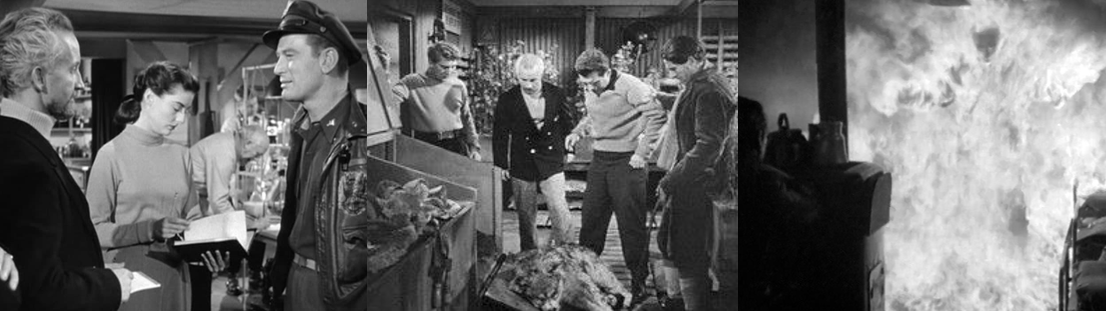
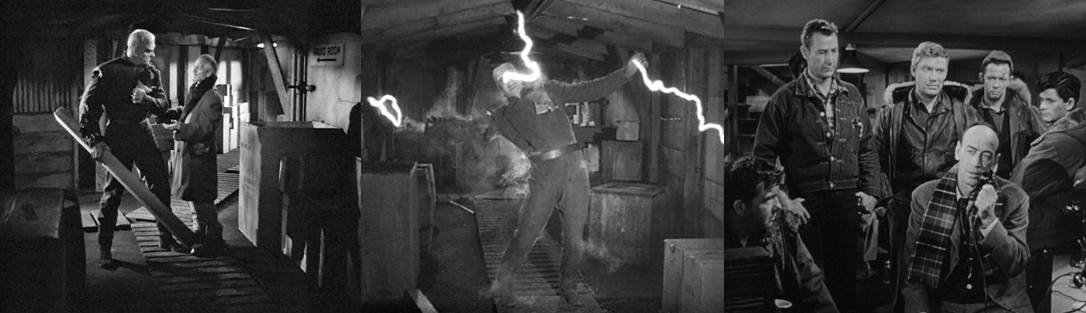
Movie Night: Creepshow

Click here to listen to my guest spot on the Anthological podcast discussing this film

Released: 10 November 1982
Director: George A. Romero
Distributor: Warner Bros. Pictures
Budget: $8 million
Stars: Carrie Nye, Jon Lormer, Stephen King, Leslie Nielsen, Ted Danson, Hal Holbrook, Fritz Weaver, E. G. Marshall, and Joe King

The Plot:
Abused Billy Hopkins (Joe King) takes solace in Creepshow, a horror anthology comic with tales of a cursed family’s Father’s Day, a simple-minded yokel’s encounter with a meteorite, a heartless millionaire’s spiteful vengeance, a mysterious crate, and a germaphobe’s battle against cockroaches.

The Background:
Horror has a long and successful association with anthologies for many decades. Books, comics, and television shows have benefitted from telling episodic or short-hand horror tales over the years, with celebrated horror author Stephen King using the medium to deliver some of his finest works. In 1982, King collaborated with the grandfather of the zombie genre, George A. Romero, on this cult classic horror anthology movie. While two of King’s existing short stories were adapted for the film, the remaining shorts were written specifically for the movie, with King and his young son appearing as actors. Star Ted Danson endured a gruelling experience shooting in a specially prepared pit to simulate being drowned while co-star Leslie Nielsen (then known as a dramatic actor) kept things light on set with a hidden fart machine. Additionally, although 20,000 live cockroaches were utilised for the “They’re Creeping Up on You” segment, horror legend Tom Savini bolstered their numbers with nuts and raisins. With a box office gross of over $21 million, Creepshow was a surprise success that proved popular with critics for its quirky blend of comedy and horror and became a horror classic. However, while Creepshow led to a comic book and two sequels of varying quality, distribution issues led to a planned television spin-off being reworked into the thematically similar Tales from the Darkside (1983 to 1988), though a well-regarded TV series revival did eventually emerge in 2019.

The Reviews:
As Creepshow is an anthology film comprised of five short stories and a framing narrative to tangentially link them together, it’s just logical that I go over each one individually and then discuss the overall film. The prologue and epilogue reveal that Creepshow is a horror anthology comic with pulp horror stories and advertisements for prank toys like x-ray glasses and voodoo dolls. Billy Hopkins (an avid horror fan judging by his bedroom) loves the comic but is berated by his cruel and strict father, Stan (Tom Atkins), for wasting his time on such trash. When Billy dares to speak back to his father, he gets a smack for his troubles, much to the chagrin of his loving but ultimately helpless mother (Iva Jean Saraceni). When Billy tries to appease his father and apologise, Tom sees through the trick and demands that he give up his comics and horror, forcing him to go to bed and tossing Creepshow in the trash. Unbeknownst to him, there is inexplicable supernatural power in those pages as the comic’s skeletal host, the Creep, lingers outside Billy’s window as he wishes death upon his father. The segments that follow are then presented as adaptations of the comic stories, complete with the occasional comic book panelling and colour effects to tie everything together. Once they’re all finished, two garbagemen (Marty Schiff and Tom Savini) retrieve the comic from the Hopkins’ trash and find the voucher for an “authentic” voodoo doll removed. Inside the Hopkins residence, the still grouchy and aggressive Tom complains of neck pain before experiencing stabbing pains all over. As Tom collapses in agony, Billy cackles gleefully in his bedroom as he repeatedly stabs at the voodoo doll, the image turning into the cover art for the next issue of Creepshow.

The wealthy Granthams are horrified when their patriarch reanimates and avenges himself upon them.

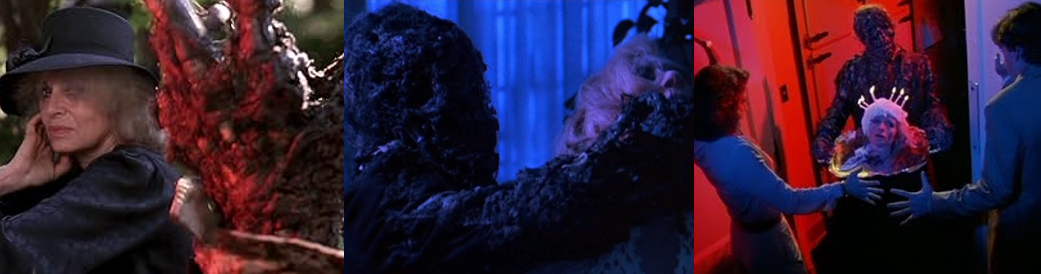
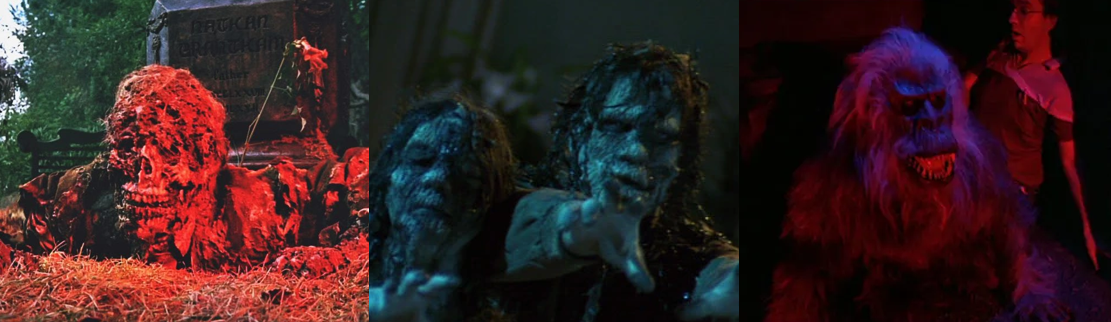
The first full-length story to spring to life is “Father’s Day”, which revolves around the filthy rich Grantham family. Every year, Sylvia (Carrie Nye), gathers the family for a special dinner. This year, her niece, Cass Blaine (Elizabeth Regan), brings her husband, Hank (Ed Harris), to meet her condescending aunt, her self-absorbed cousin, Richard (Warner Shook), and her great aunt, Bedelia (Viveca Lindfors). Between criticising Cass’s healthy appetite, Sylvia nonchalantly tells Hank that Bedelia, the family matriarch, once murdered the disgustingly wealthy and miserly Nathan Grantham (Lormer). Having accumulated vast wealth through unscrupulous and criminal means, the aged patriarch became aggressive, demanding, and paranoid, believing everyone was using him for his fortune and making constant, abusive demands of Bedelia, who was forced to care for him and endure his belittlement. Bedelia finally snapped after her father orchestrated the death of her fiancé, the only man who’d shown her any kindness, to keep her in check. Unable to take her father’s barrage of insults and childish demands for his Father’s Day cake, Bedelia cracked him in the head with an ash tray. Though free of Nathan’s abuse, Bedelia remained scarred and traumatised, placing a flower at his gravesite every Father’s Day. While drunkenly reminiscing about the murder, (which Sylvia helped cover up to profit from her inheritance), Bedelia is horrified when her father’s gaunt, gruesome corpse suddenly bursts from his grave and throttles her to death, still slurring demands for his cake. While having a smoke, Hank wanders into the family cemetery and ends up crushed when the zombified Nathan telekinetically drops a gravestone on him. When Cass expresses concern for her husband, Sylvia begrudgingly volunteers to look for him (hinting at her desire to seduce him), only to end up with her head twisted backwards by Nathan. Impatient and frustrated, Cass demands the lackadaisical and half-cut Richard help search for their missing party, only to be appalled when Nathan’s ghastly, maggot-ridden corpse bursts from the kitchen and proudly presents his cake: Sylvia’s severed head on a silver platter, covered with frosting and candles!

Unlucky halfwit Jordy is transformed by alien vegetation due to his stupidity.

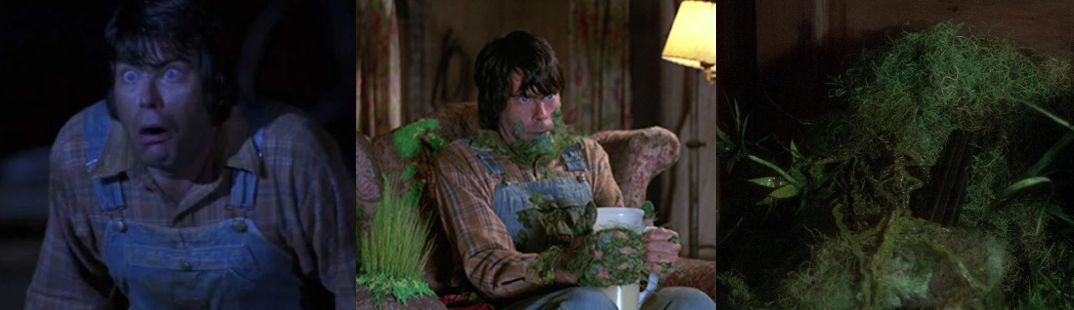
Stephen King takes centre stage in “The Lonesome Death of Jordy Verrill” as the titular, dim-witted, hillbilly farmer. After being amazed by a falling meteorite, Jordy investigates and, dreaming of collecting a cool $200 from the “Department of Meteors” at the local college, touches the red-hot rock without thinking. Jordy’s dismayed at his characteristic bad luck and thinks he’s cost himself a payday when he tries to cool the meteorite and it cracks and is so preoccupied by his overactive imagination that he misses the strange goo that spills from the rock and touches his skin. Retreating home, hoping to repair the meteorite in the morning, Jordy enjoys a beer and some wrestling, sucking his fingers out of habit, but is perplexed and horrified to find a strange, green vegetation growing there. Though he immediately thinks to call a doctor, he stops himself when he imagines it leading to a painful amputation and resolves to simply ignore the problem. As the night continues, the vegetation rapidly spreads across his land, his house, and his body, causing him dreadful itching and to drink himself into a stupor after seeing the vegetation consume his face. Unable to take the itching, Jordy tries to relieve his discomfort with a bath, only to be inexplicably warned against it by his deceased father (Bingo O’Malley), who warns that water will only feed his condition. Realising that he’s beyond help anyway, Jordy gratefully plunges into the bath for some momentary relief but, by the morning, his entire farm, house, and body are consumed by the alien vegetation. Despite the short opting for bizarre, dumbfounded comedy, the finale is unexpectedly grim and emotional as the transformed Jordy cocks his gun, prays for some good luck for once in his life, and blows off what used to be his head. While this ends his torment, the alien vegetation continues to spread beyond Jordy’s land, potentially spelling doom for humanity.

Psychotic spurned husband Richards finds his revenge revisiting him in the form of drowned ghouls!

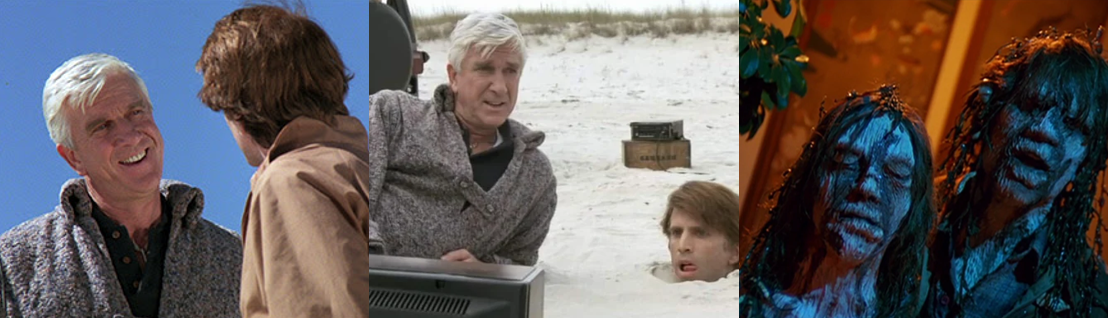
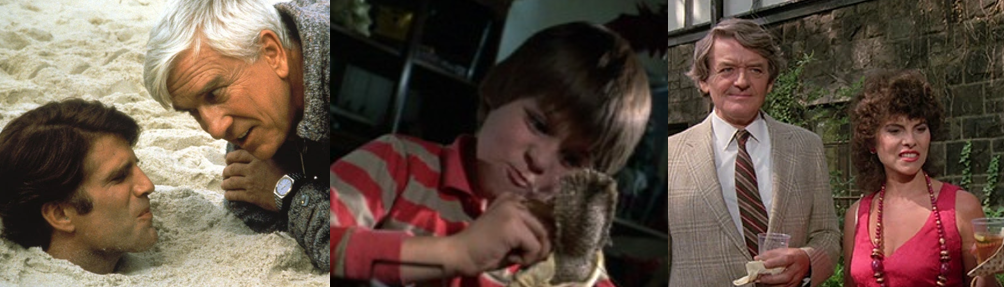
If you’re anything like me, you’ll be surprised to see the late, great comedy actor Leslie Nielsen delivering a seemingly uncharacteristic performance as maniacal, spurned millionaire Richard Vickers in “Something to Tide You Over”. In actuality, Nielsen started his career in more dramatic roles, though his comedic flair seeps through here as Richard is disturbingly jovial and avuncular in his vengeance. After learning that his wife, Becky (Gaylen Ross), is having an affair with square-jawed Harry Wentworth (Danson), Richard visits Harry, coldly dismissing his feelings and simply looking to assert his right over his property. Unimpressed by Harry’s threats, Richard lures his rival to Comfort Point, a private beach he owns, where he implies Becky is in danger. Since he has no choice, Harry makes the trip, only to find a shallow grave in the sand, which he’s forced into at gunpoint by the menacingly aloof millionaire. Harry’s forced to bury himself neck-deep in sand and to watch a live feed of Becky in the same position, slowly succumbing to the tide as it washes over her. Dismissing Harry’s pleas and bribes, Richard simply drives off, watching with glee from his high-tech home as the two struggle to hold their breath. While a glimmer of sanity seems to suggest Richard has some remorse for his actions, a stiff cocktail quickly alleviates such emotions and he dispassionately returns to tidy up the crime scene hours later, sure that his victims were washed out to sea. However, Richard is stunned when Becky and Harry return as drenched, shuffling revenants bent on revenge. Though initially nonplussed and confident his pistol can hold off the ghouls, Richard’s reduced to a cackling, terrified wretch as the two shrug off his assault and use their supernatural powers to grab him, subjecting him to the same fate they suffered and leaving the raving lunatic to see just how long he can hold his breath.

The crate’s ravenous inhabitant represents the perfect chance for Henry to off his abusive wife.

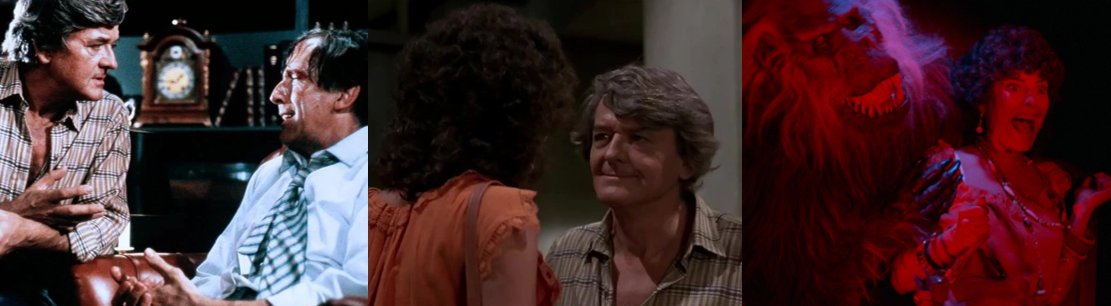
“The Crate” is easily the longest segment and centres on good friends Dexter Stanley (Weaver) and Henry Northrup (Holbrook), professors at Horlicks University. Meek and mild-mannered, Henry daydreams of murdering his emotionally abusive, borderline alcoholic wife, Wilma/Billy (Adrienne Barbeau), who frequently belittles and embarrasses him in front of his friends. Though Dexter feels for his timid friend’s predicament, he’s powerless to intervene, but this drama is superseded when university janitor Mike Latimer (Don Keefer) discovers a mysterious crate hidden under a basement staircase. Though apparently originating from an Arctic expedition, the crate is a mystery to Dexter, who forces it open and is horrified when the bizarre, voracious ape-like “Fluffy” (Darryl Ferrucci) bursts out and devours Mike’s hand (and then the rest of him!) Fleeing, the shellshocked Dexter babbles of the horror to a passing graduate student (Robert Harper) who, first sceptical and then curious of the creature, is promptly mauled and dragged off by Fluffy, which returns to its crate after each kill. The half-mad Dexter shares the gory story with Henry, begging him to help dispose of the creature in a nearby quarry. Though loyal to his clearly traumatised friend, Henry sees this as the ideal way to dispose of his abusive wife and promptly drugs Dexter, clears up the crime scene, and lures Billy to the university on the pretence of helping a young girl who’s been assaulted by Dexter. Eager to both mock the girl’s ordeal and further demean Henry, the tanked-up Billy races over and, suspecting nothing from her meek husband, willingly enters the creature’s hovel without fear. Seizing his opportunity, Henry finally enacts his fantasies and desperately calls for the monster to awaken and kill his wife, only to be met with silence and a barrage of insults from Billy. Just as she’s done criticising his manhood, Fluffy pops out to feed. Though disgusted, Henry finds the courage to reseal the crate and dump it (and the bodies) in the quarry as Dexter suggested. Despite some apprehension, both men agree to stay quiet, though henry’s insistence that the ravenous creature has drowned turns out to be false when we see Fluffy tearing through the submerged crate.

Cruel germaphobe Pratt gets his comeuppance when he’s set upon by a swarm of cockroaches.

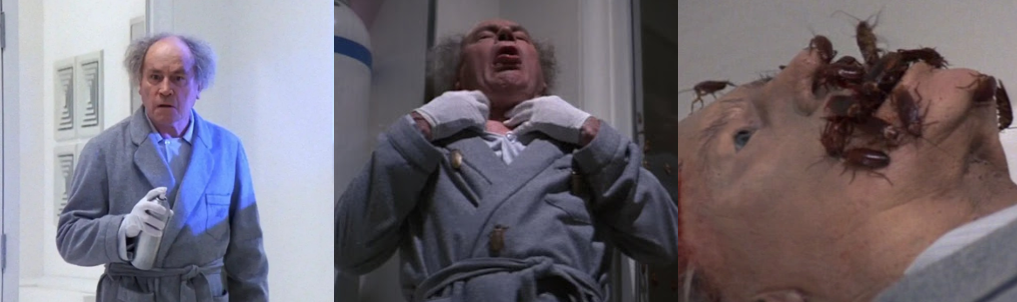
The final story, “They’re Creeping Up on You!”, forces us to share about twenty minutes with uncompromising, belligerent, and extremely wealthy businessman Upson Pratt (Marshall), a germaphobe who lives in a sparse, air-tight penthouse apartment and conducts all his business via telephone and computers. Pratt begins the story battling a cockroach infestation, spraying and stamping the bugs, demanding an exterminator, and threatening to rob people of their livelihoods if his demands are not met. Pratt is delighted to learn that his company’s recent successful corporate takeover resulted in the suicide of his business rival, Norman Castonmeyer, and dismissive towards Norman’s grieving widow, Lenora (Ann Muffly). When Lenora blames him for her husband’s death and wishes all kinds of pain upon the cruel entrepreneur, Pratt simply laughs, having fended off such insults all his life just as effectively as he’s stamped out bugs. Still, Pratt is increasingly disgusted and troubled by the cockroaches, which appear in his food, his equipment, and soon swarm throughout his apartment during a blackout. Having insulted an alienated anyone who could help him, Pratt never wavers in his desire to avenge himself on those who have subjected him to the infestation but is soon overrun by persistent bugs. In his panic, Pratt flees to a more secure panic room only to be mocked by another call from Lenora, who wishes death upon him, and promptly suffers a fatal heart attack upon seeing cockroaches scuttling around his bed. When the blackout lifts, the aggrieved, unsympathetic building handyman (David Early) stops by to check on the unresponsive Pratt. While the cockroaches seem to have disappeared, perhaps vanished now Norman’s death has been avenged or being manifestations of Pratt’s isolation and paranoia, they soon burst from his corpse, tearing through his skin and enveloping his shredded remains.

The Nitty-Gritty:
Although Creepshow offers a unique premise, with its segments being stories in a comic book, the comic book hook isn’t used much. Sure, some shots are framed by comic book panels, actors are rendered against colourful backdrops, and each story fades into an artist’s depiction of the ending, but it’s a tangential link, at best. While the Creep is a questionable animatronic creation, he has a fun, creepy design and it would’ve been nice to see him (and/or Billy) thumbing through the pages of Creepshow and reacting to the stories between segments. The film is an interesting, if occasionally awkward, blend of horror and comedy, with “The Lonesome Death of Jordy Verrill” being the worst offender. I’d like to say King is doing his best but Jordy is such a cartoonish buffoon that it’s hard to take his plight seriously, what with his bizarre fantasises about college professors and doctors. This seems to be a bait and switch, however, as the segment has an unexpected and emotional conclusion where Jordy blows what can loosely be described as his head off, but it doesn’t land quite as well since he’s such a bizarre moron prior. Creepshow really has an issue with pacing, to be honest, as the film is way too long at just over two hours and some stories drag on needlessly. I can’t help but think “The Crate” could’ve easily skipped right to Mike and Dexter examining the titular crate and cut out much of the dull build up. Sure, it effectively paints Billy as an abusive bitch and Henry as a timid, put upon husband, but we clearly see that in every interaction they have and dwelling upon how awful Billy is takes too much focus away from the monstrous Fluffy. While it’s likely it was intentional to paint Fluffy as an afterthought as the true horror was Billy’s belittling and vindictive ways, this segment outstayed its welcome by tacking on an odd final exchange between Henry and Dexter.

Though occasionally questionable, the practical effects are mostly gruesome highlights.

Even my favourite segment, “Something to Tide You Over”, suffers from uneven pacing. Richard’s threat and Harry’s awful predicament are well conveyed but things linger a little too long rather than focusing on Harry’s desperation and slow, painful death. It’s fun seeing Leslie Nielsen be such a despicable, crazed lunatic and there’s a fair bit of nuance to Richard as he shows glimmers of regret and madness throughout. The same can’t be said for Sylvia or any of the Grantham family, who were all obnoxious and thoroughly unlikable characters, or Pratt, who we delight in seeing tortured by the relentless cockroaches. While there’s not much gore in Creepshow and many of the scares are played for laughs, the practical effects are impressive. The squelching, zombified Nathan Grantham sets an early standard, rendering him as a grinning, rotting corpse who strangely exhibits telekinetic powers alongside superhuman strength, all while demanding his special cake. Harry and Becky’s waterlogged corpses are equally impressive, sporting sunken eyes, shrivelled features, and gushing bloody seawater when shot. Equally, the alien vegetation was really good in “The Lonesome Death of Jordy Verrill”, with grass, moss, and vines rapidly overtaking the simple-minded goon’s land, house and, most terrifyingly, his body. This is a slow process more akin to an infection than body horror, though the depiction of the fungus gradually consuming him and eventually transforming him into a vaguely humanoid grass man nicely tied into his desperation for relief from his suffering. Fluffy may be one of the most obvious hand puppets but it’s certainly a unique creature, being some kind of rabid monkey. It’s a little weird and incredibly convenient that it always returns to its crate and only attacks when it’s most dramatic, but Fluffy delivers the most gruesome gore of the movie as it claws, gouges, and bites at its victims.

Despite some intriguing performances, the wraparound is bland and the pacing drags the film down.

“They’re Creeping Up on You!” was probably my second favourite of the segments (“The Crate” is just too long for me to rate it at number two), but it still felt lacking at times. Pratt is a suitably deplorable excuse for a human being and I enjoyed seeing him squirm and get increasingly agitated as cockroaches swarm his germ-proof apartment. There definitely seems to be a suggestion of the supernatural here, even knowing how quickly cockroaches can infest buildings, as they increase the more he belittles others and delights in the death and grief he’s caused. Lenora’s calls, especially her ominous final message, suggest she is putting a death curse upon him, or that her husband is enacting a gruesome and fitting revenge for all the pain Pratt’s caused. Although Pratt’s corpse is also quite obviously a highly detailed dummy, it was quite unnerving to see the cockroaches burst through his skin and envelop him, with this final segment certainly bringing more of a creepy vibe to the proceedings as opposed to the black comedy and unsettling atmosphere of its predecessors. There’s something deeply disturbing about the usually jovial Leslie Nielsen coldly describing what he plans to do to Sam Malone, forcing Harry to bury himself in sand at gunpoint and watch his lover struggle against the tide. Richard has a madcap nature to him that makes him extremely unpredictable, with him coolly commanding every situation with a few curt words and threats rather than physical violence. It’s tough to pick whether Nathan Grantham was more cruel and vindictive than Billy as both are aggressive, patronising, and demanding individuals who push their victims to breaking point, meeting fitting ends as a result (though Nathan’s so stubborn and malicious that he literally returns from the dead to get his Father’s Day cake!)

The Summary:
Although I’m a big fan of horror, horror comedies, comedies, and comic books, Creepshow missed the mark for me in many ways. It’s always to be expected that some segments in an anthology film will be stronger than others. Creepshow certainly offers a variety of stories, but the film is just too long and some segments really outstay their welcome rather than telling fun, gory horror tales. I liked that each one had a different flavour, from bickering families faced with a spiteful zombie patriarch to a spurned husband enacting a chilling revenge and a bizarre monster living in a box and ready to eat an abusive wife. The practical effects were an obvious highlight, with the rare instances of gore being quite shocking, the undead appearing very tactile and disturbing, and even the unconvincing Fluffy making an impression since it’s so weird and wild. I enjoyed seeing some famous faces pop up here, especially Ted Danson and Leslie Nielsen, though it might’ve been a mistake to give Stephen King such a prominent role. Jordy is so dim-witted he makes Tom Cullen seem like a genius (M-O-O-N, that spells “genius”!) and I felt the comedic buffoonery of the character really lessened the emotional impact of his transformation and suicide. Similarly, while it helps to build sympathy to see just how put upon Henry is, “The Crate” is crippled by its overly long run time, which is doubly disappointing considering most of the other stories deliver on their premise in an acceptable length of time. I enjoyed seeing the likes of Pratt and Richard get their comeuppance, and how different each story was, but the wraparound segments felt lacking to me as they didn’t capitalise on the unique aspect of the Creepshow comic book. Ultimately, I can’t help but feel a little dissatisfied with Creepshow, which maybe crams too much into its runtime to be as effective as other horror anthologies and definitely has a format that’s more suited to an anthology television show than the big screen.

My Rating:

Rating: 3 out of 5.

Pretty Good

How offended are you by my disappointment with Creepshow? Which of its short stories was your favourite? Do you agree that the pacing is off and it runs too long or were you satisfying by the length? What did you think to the special effects and sparing use of gore? Were you surprised to learn that Leslie Nielsen used to be a dramatic actor? Which of Creepshow’s sequels and counterparts is your favourite? Whatever you think about Creepshow, leave a comment, go check out my other horror anthology reviews and my guest spot on the Anthological podcast, and donate to my Ko-Fi to fund more reviews like this.

Game Corner: Spawn: Armageddon (PlayStation 2)

Released: 21 November 2003
Developer: Point of View
Also Available For: GameCube and Xbox

The Background:
After making his debut in the comic book industry with his work on Coyoteavid artist Todd McFarlane stood out from his peers by revitalising The Amazing Spider-Man with his signature art style. In time, McFarlane became dissatisfied with his lack of creative control at Marvel and established Image Comics alongside other Marvel creatives in 1992. Image was led by Al Simmons/Spawn, a hellborn anti-hero first dreamed up by McFarlane as a teenagerSpawn #1 was a record-setting hit and became the most successful creator-owned comic of all-time. This led to a widely panned live-action adaptation, a beloved animated series, numerous toys, and a handful of videogames. Spawn’s first videogame outing was Todd McFarlane’s Spawn: The Video Game (Ukiyotei, 1995) which set a precedent for his subsequent outings, which garnered mixed reviews across the board. Developers Point of View sought to deliver the definitive Spawn experience in 2003, though there’s sadly little information available online about the development of this game. I can tell you, however, that Spawn: Armageddon received mixed reviews that criticised the repetitive gameplay, though some have praised it as an enjoyable enough title.

The Plot:
When the demonic forces of Malebolgia invade New York City, signalling the onset of Armageddon, Lieutenant Colonel Al Simmons/Spawn turns his supernatural powers against the hordes of Heaven and Hell to defend humanity.

Gameplay and Power-Ups:
Spawn: Armageddon is a third-person action brawler that focuses on melee, gunplay, and magical attacks courtesy of Spawn’s finite “Necroplasm”. Unfortunately, rather than striking a balance between high intensity, action-packed combat and emphasising stylish combo attacks like the Devil May Cry series (Capcom/Ninja Theory, 2001 to present), Spawn: Armageddon limits the player to a handful of melee attacks, assorted regular and supernatural firearms, lacklustre demon powers, and aggravating platforming sections. Offering three difficulty levels (which alter the strength of your enemies) and favouring a mission-based structure, Spawn: Armageddon sees you cutting down demon entities with Spawn’s “Agony Axe” (formed from his sentient cape) with Circle, jumping, double jumping, and gliding short distances with his tattered cape with X, and awkwardly using his chains (fired from his crotch!) to grapple with L1. Players fire Spawn’s currently equipped firearm with Square and unleash his Hell Powers with Triangle, using the directional pad to switch between them. You can (and should) hold R1 to target enemies, though there doesn’t seem to be a way to cycle your targets and you only target the closest one, can hit an axe slam by pressing Circle in mid-air, and open doors with X. Weapons are found as you explore the restrictive, bland environments and each needs ammo. In lieu of your guns, you can attack with your crotch chains, though defeated enemies and smashed crates will yield ammo to keep you topped up.

Switch your weapons depending on who you’re facing and battle the game’s awful camera.

Enemies and crates also drop coloured “Souls” you must collect. Green Souls replenish your Necroplasm, allowing you to use Spawn’s Hell Powers; Red Souls replenish your health; and you trade Blue Souls for upgrades between missions. From here, you can increase Spawn’s maximum health and ammo and the damage output of your guns, though each upgrade costs progressively more so I’d focus on increasing your health since there are no mid-mission checkpoints. Spawn has a shotgun for close-quarters combat, dual pistols, a sub-machine gun, a mini-gun, the Brimstone Cannon, a missile launcher, and the Inferno Cannon, with the latter requiring a charge and larger weapons (such as the mini-gun) weighing you down. Spawn can toss Necroplasm fireballs, fire an energy beam, erect a shield, and use “bullet time” to pummel enemies for as long as his meter lasts. Some enemies are weaker to certain attacks than others; they’ll shrug off your Necroplasm attacks and your explosives do minimal damage, so you must whittle them down with bullets. Like many elements, this isn’t as deep or as developed as it could be. It would’ve been interesting to see demons weak to bullets and angels weak to your Hell Powers, for example. Spawn’s axe combos aren’t very useful or complex, either, and I often forgot I had it. While you’ll largely be jumping or gliding over gaps or grappling about, Spawn can also wall jump. Unfortunately, the finnicky camera and Spawn’s clunky-ass controls make these platforming tricks frustrating. Spawn cannot block and has few options to avoid damage. He can be easily stun-locked and ragdolled by projectiles, making combat aggravating. It doesn’t help that Spawn: Armageddon throws waves of enemies at you, which just serves to expose how shallow and unfulfilling the combat is.

Tedious combat is awkwardly married with clunky platforming, delivering a lacklustre experience.

Spawn is often confined by Hellfire barriers or mist dispel or destroy skeletal Guardians once all nearby enemies are dispatched. Each mission has a specific objective you can review from the pause menu, but these mainly focus on destroying all enemies, activating switches, or spawning (pun intended) the end goal. In between awkwardly jumping up walls or between moving platforms, you’ll often destroy objects like junction boxes, generators, and power nodes for Heaven’s ominous space station. This opens doors, lowers barriers, or re-routes power to new areas, though it’s often unclear where you need to go or what you need to do as there is no map system and no onscreen indication of your objectives or when you’ve met them (beyond the end goal appearing). This was especially aggravating in the newspaper factory, where I activated a bunch of switches and was left clueless how to reach a higher platform. In the end, getting Spawn on top of a printing press and forcing the double jump and glide to barely get him close enough to ledge grab was the key. I was equally frustrated when disabling auto turrets, attacking gargoyles to raise bridges in Hell, and following blood trails in the subway since some gaps were very difficult to clear thanks to Spawn’s useless glide and grapple. When inside buildings, the game becomes uncomfortably claustrophobic and difficult to navigate as every area looks the same. When outside, the camera gets stuck and blocks your view. Heavenly bolts can rain down upon you, enemies constantly teleport in, you’ll take lifts and portals to new areas. Spawn must also struggle past laser defences and flame bursts, which only adds to the frustration when navigating the floating platforms and narrow stone columns of Hell. While dropping down pits usually resets you on solid ground, it’s an instant game over when descending deeper into the volcanic malebolge and good luck figuring out the looping, maze-like hallways of the Angel Station.

Presentation:
Spawn: Armageddon makes a good first impression. The pre-rendered cinematics bring Todd McFarlane’s distinctive art to life and suggest a game that’s going to at least be visually interesting to look at. You’re only further encouraged when Keith David reprises his celebrated portrayal of the titular anti-hero, but things quickly take a turn with the in-game graphics and painfully generic rock/metal soundtrack. Obviously, you have to give the game some leeway as it is a PlayStation 2 title but…damn, do these character models and environments look ugly and generic. I want to say Spawn fares the best since he closely resembles McFarlane’s artwork but he’s very clunky and struggles to navigate the largely claustrophobic locations. Keith David tries to add some gravitas to the action, punctuation victories with low chuckles and commenting on what’s happening around him, and Spawn’s cape impresses with it unfurls, but it’s odd to me that Spawn looks so low-res when Dante looked sleek and sexy just two years earlier. I liked that demonic creatures like the Violator and Malebolgia communicated through telepathy like in the animated series, though the game is disappointingly light on recognisable characters and villains from the comics. While cutscenes utilise both pre-rendered and in-game graphics, with Spawn being aided/mocked by Mammon throughout, it seems the developers ran out of time or money as major events are often relayed through text prior. This became increasingly noticeable as the game progressed and they were often used to explain a sudden shift in location, but the execution just felt very lazy and cheap to me.

Despite some strong visuals, the game struggles to leave a lasting impression.

You start the game in the heart of the city and return there often, clumsily wall jumping and hopping across rooftops as you defend Spawn’s alley, Rat City. You can destroy fire hydrants, cars, and bins for goodies and may notice the music awkwardly skipping, looping, or cutting out. This quasi-open environment is then replaced with the restrictive newspaper factory, a warehouse-like interior full of large printing presses that are deceptively difficult to climb on. Spawn raids Jason Wynn’s elaborate office building, though the luxurious corridors and offices aren’t much to shout about. However, I liked the wider foyer with its staircases and rooms were often ransacked, splattered with blood and corpses. Things switch back to generic, muddy, and dull as you explore the docks (you might want to adjust your television’s brightness settings for this game, just saying). While things were more visually interesting in the dilapidated subway, it was equally difficult to figure out where to go as everything looks the same. Spawn fends off angels outside city hall and spends a few missions in a twisted, nightmarish bastardisation of Central Park. Though you’re confined to a set path, the gnarled trees, burning Hellfire, and freakish enemies made this an enjoyable section. After battling in a disappointingly bland opera house (save for the giant props), Spawn’s forced to retreat to Hell to subdue his angelic counterpart, Anti-Spawn/The Redeemer. Hell is a volcanic mess of flame bursts, floating rocks, and chains floating around a central tower. After striking a deal with Malebolgia, Spawn fights through the Angel Tower and into the Angel Station, easily the most visually interesting and repetitive areas. While I enjoyed the ethereal lights, marble-like stone, the strange mixture of alien and otherworldly technology, this was a confusing mess of samey corridors that I was glad to see the back of.

Enemies and Bosses:
Spawn’s most recurring enemies here are imps, scrambling little demons who attack in groups, slashing with their claws, leaping at you, or tossing fireballs from afar. Luckily, they’re very weak and easily disposed of, as are the Hell Leeches that often burrow up from the ground and vomit Necroplasm-draining spit. Flying imps can be a bit trickier as they attack from afar while slaughtered corpses rise as flailing Meat Puppets whose torsos claw their way across the floor. While raiding Wynn’s office, you battle both his armed troops and possessed variants, who are noticeably feeble, unlike the twisted Tree demons who haunt Central Park. Often, these demonic forces are bolstered by the unsightly Lamenting Demon, a thrashing monstrosity that spawns floating eyes and is best fought from a distance. The Berserkers were some of the more annoying enemies as they leap at you with blade arms, strike fast, and take a lot of punishment a d made tougher when joined by the durable Whip Demons. Perhaps the most bizarre of Malebolgia’s forces are the Claw Demons, distinctly crab-like demons that scuttle around and lunge with their large front claws. You’ll also battle the formidable forces of Heaven, who teleport about in a blaze of Heavenly light and attack with lances, rain projectiles, and wield Brimstone Cannons. Angels were easily the most tiresome foes, especially in the Angel Station, where they just kept spawning. The space station’s crew also appear here; angels in their purest form, they travel as beams of Heavenly light and share a health bar, though your Necroplasm attacks can whittle them down quite nicely.

The game doesn’t use enough of Spawn’s rogues but, when it does, they’re the best bosses.

Many enemies are recycled as mini boss encounters, like when you battle angels outside City Hall and when the Hellhole opens in Central Park and you’re forced to fend off waves of Newborn demons who pose a significant threat if you’re low on ammo and Necroplasm. You’ll twice battle the Spider Tank, an arachnid mech possessed by demons; once in the docks and then in the more restrictive military warehouse. Either way, it lurches at you firing mini guns and a powerful front cannon, though it’s vulnerable from the rear. While in the docks, you contend with a hellish bulldozer, which tries to run you down and spawns Berserkers. Its weak spot (a disturbing, tentacle-like tongue) is only briefly exposed and is difficult to hit with those nippy bastards distracting you. This battle echoes the one against the brutish Michael Konieczni/Cy-Gor. This cybernetic ape fills a narrow alleyway and forces you to avoid its shockwaves and the debris it hurls, which is difficult as your movements and resources are limited. Spawn’s archenemy, the Violator, is also fought twice but, while he assumes a “frenzied” form in Hell, both battles are functionally the same. You must stay on an upper, circular path avoiding his claw swipes (which destroy your platforms), grappling to safety, and peppering him with attacks until he keels over. You get a prelude of your later battles with the Redeemer when fighting the Reaver, an armoured avenger who wields a titanic sword that covers a wide arc and which he hurls at you, alongside a devastating beam attack. The Redeemer favours floating above you, igniting the floor (forcing you to grapple to nearby spikes), and attacking with his own massive sword. In the finale, the Redeemer transforms into the Metatron for a two-stage final boss. In the first phase, it resembles a scorpion, attacking with its stinger and pincers and shielding itself at times. In the second, it becomes humanoid and leaps across the arena, fires fast projectiles, and unleashes a massive chest cannon. In every encounter, though, the Redeemer is a slow, lethargic enemy who often leaves himself wide open to your heavier attacks.

Additional Features:
After clearing each mission, no matter how short, your progress is tallied up, awarding you unlockables like concept art. Every enemy you encounter is added to the game’s encyclopaedia, providing additional lore and tips on how to defeat them, and numerous comic books can be found in most of the game’s environments, unlocking Todd McFarlane’s beautiful artwork to view. Clearing missions also allows you to freely replay them, challenging different difficulties if you wish, though your upgrading and saving options are limited when you choose this mode. Spawn: Armageddon also has a few cheat codes, inputted from the pause menu, that’ll bestow you with unlimited ammo and Necroplasm, all guns, unlock every comic and enemy entry in the encyclopaedia, and disable the blood. While it’s annoying that there isn’t an infinite health cheat, these codes make blasting the game’s wildly inconsistent missions a breeze.

The Summary:
I was really excited to play Spawn: Armageddon. I’m a huge fan of the character, and brawlers, and had high hopes for the game from what I’d seen, expecting something like a mixture of the Devil May Cry and God of War games (Various, 2005 to present). As I mentioned, my anticipation was high after seeing the decent FMVs and hearing Keith David’s voice, but it was all downhill after a couple of missions. Spawn: Armageddon looks and plays like an ambitious PlayStation title at times; its blocky visuals and clunky controls do little to showcase the power of the PlayStation 2. While the locations are true to the comics, they’re also painfully empty, generic, and bland, bar a few excepts (such as Central Park and Angel Station). Spawn and the demons may look passable enough, but the Violator and Malebolgia look awful and the game’s disappointingly light on recognisable characters. Take away the Spawn title and it’s just another ugly, muddy, clunky action game that needlessly pads out its awkward gun combat with frustrating platforming sections. Spawn’s powers are largely useless here; his cape and glide are stunted, his chains woefully ineffective, and his movement handicapped by his ungainly nature. Missions are all over the place, forcing you to knob about hopping to platforms or trying to get the damn glide and chains to work and then having you quickly destroy a few enemies and supplanting the cutscenes with cheap-ass text. A lack of unlockables (no skins? Really?) and collectibles and some uninspired bosses only compound matters, as do the endless waves of enemies that simply drive home how repetitive and shallow the combat is. It’s such a shame as there’s the ghost of a good game here but it feels as though the developers ran out of time and/or money and simply slapped together a quick, lacklustre brawler that really doesn’t do the character justice and is barely worth the time of even a die-hard Spawn fan such as myself.

My Rating:

Rating: 2 out of 5.

Could Be Better

Did you ever play Spawn: Armageddon? Did you enjoy it or, like me, did you find it a lifeless and disappointing experience? What did you think to Spawn’s firearms and array of powers? Did you also struggle with the gliding, grappling, and camera? Which if the bosses were you most disappointed by? Would you like to see Spawn get another videogame on modern consoles? Which of his videogame outings is your favourite, if any? Whatever you think about Spawn: Armageddon, share your thoughts in the comments, support me on Ko-Fi, and take a look at my other Spawn content.

Movie Night: In a Violent Nature

Released: 31 May 2024
Director: Chris Nash
Distributor: IFC Films
Budget: $3 million
Stars: Ry Barrett, Andrea Pavlovic, Cameron Love, Liam Leone, Charlotte Creaghan, and Reece Presley

The Plot:
When some friends nonchalantly take a locket from the remains of a fire tower, the ranged Johnny (Barrett) resurrects and begins a slow and violent search for it.

The Background:
John Carpenter’s Halloween (Carpenter, 1978) wasn’t the first “slasher” but it absolutely popularised this horror sub-genre and laid the foundation for a slew of copycats, with perhaps none more influential than the Friday the 13th franchise (Various, 1980 to present). These films cemented many horror tropes, such as the hulking, masked, mute killer and the events taking place in dense woodland, and proved incredibly popular arguably because they repeatedly returned to these clichés. After decades of these movies, and others, even the most ardent fans would agree that the formula became stale. Writer/director Chris Nash sought to address this with a low-budget throwback that sought to return to the slower, more methodical roots of the slasher genre and simultaneously subvert it by framing the events from the killer’s perspective and as though the film were a nature documentary. Premiering at the 2024 Sundance Film Festival, In a Violent Nature received a limited cinema release and eventually made $4.5 million at the box office. The film was received very positively, with reviews praising the imaginative spin on the slasher genre and arthouse approach, while also criticising its more predictable elements. Still, many ranked it as the best horror film of 2024 and a sequel was announced at the 2024 San Diego Comic-Con.

The Review:
Unlike any horror movie or slasher film I’ve ever seen, In a Violent Nature follows the killer for most of its runtime or framing shots from his perspective. This unique approach is immediately evident as the camera starts focused on the locket and the scorched fire tower where Johnny’s body is buried rather than on the kids who take his property, and the film rarely deviates from this perspective. Fundamentally, In a Violent Nature like a Friday the 13th slasher, specifically Friday the 13th Part VI: Jason Lives (McLoughlin, 1986) and Friday the 13th (Nispel, 2009), primarily by depicting Johnny as a slow, lumbering, dishevelled, reanimated corpse who trudges through the woods and brutalises his victims. Like Crystal Lake, the Ontario wilderness is effectively haunted by Johnny’s legend, which is told to his unsuspecting victims and the audience (over a campfire, no less) by Ehren (Sam Roulston). “Slow” Johnny was the son of a shopkeeper in a nearby logging community who was regularly targeted by the loggers, who felt slighted by his father’s extortionate prices. One day, they lured him up a fire tower and accidentally caused him to fall to his death. His father then died in a barroom brawl after seeking revenge and Johnny’s restless spirit has been blamed for subsequent murders ever since, with the only things keeping him at bay being his mother’s locket and the grounds of the old fire tower. Of course, Kris (Pavlovic), Colt (Love), and the others laugh this off as a simple ghost story but, for the locals, it’s all-too- true and they’re very guarded about keeping Johnny subdued and hidden away.

Follow Johnny as he rises from the grave to hack and slash his way to his missing locket.

Once he awakens, Johnny begins his search and wanders seemingly aimlessly through the thick, oppressive woods and wilderness. Mute and acting purely on instinct and rage, he plods incessantly through brambles and thickets, shrugging past all obstacles and rarely being distracted. However, it seems he has no true idea of where the culprits are and is acting purely on instinct. He’s driven to head towards the nearest sounds, slaughtering a local and clutching desperately at anything that remotely resembles his lost locket, experiencing memories of his father and his past in the process. Although we follow close behind him, the other characters are not so attentive and Johnny easily slips past them, stalks them, and enters their property, largely because no one expects an undead killer to be wandering the woods and they’re usually distracted by petty disagreements or dope. Vague memories seemingly drive Johnny to seek out the local ranger station, where he acquires an old firefighter mask to hide his gruesome visage, an axe, and a particularly ghastly set of dragging hooks to skewer and mangle his victims. Unlike Jason Voorhees (Various), who exhibited various supernatural abilities thanks to sloppy editing, we always see exactly where Johnny’s going, how he gets there, and what he does with his victims. He tends to drag their bodies away or casually dispose of them and is as captivated by various woodcutting implements as he is by key chains, showcasing a child’s mindset alongside his seething bloodlust. Never moving faster than a brisk stride, Johnny nevertheless exhibits superhuman strength and endurance, easily shrugging off gun shots, breaking bones, and nailing his victims with pinpoint accuracy. Johnny searches each victim for the locket and moves on to the next when he comes up short, though we’re later told by a local ranger (Presley) that simply returning the locket isn’t enough to stop Johnny’s rampage and he instead needs to be subdued and buried under the fire tower, a seemingly impossible feat.

The victims get even less characterisation than normal since the film isn’t about them.

Although we end up with a “Final Girl” in Kris, we don’t learn too much about her or her friends except that they’re comfortable enough to banter about their dicks, tease each other about their lusts, and that there’s some sexual tension here and there. Ehren is the first to die when he goes for a smoke (or a shit, or to go try his luck with some gas station girls) but, beyond his foreknowledge of Johnny’s legend, we mainly learn that he’s potentially horny. Similarly, Aurora (Creaghan) initially stands out since she’s desperate to get a signal and enjoys a good selfie, but she gains a touch more characterisation when she flirts with Brodie (Lea Rose Sebastianis) and practises yoga. Brodie’s “thing” is swimming in the nearby lake (which is naturally a fatal pastime) and flirting with Aurora, while Colt and Troy (Leone) spend most of their time bickering. It’s a little hard to tell and the characters are difficult to distinguish since we mainly hear their conversations offscreen and only get a glimpse of their lives through Johnny’s peripheral senses. By the time the survivors realise their friends are dead, there’s little to no emotional connection to their plight. Colt and Kris plan to lure Johnny into an ambush, one assumed to involve setting him ablaze, but there’s little reason to be invested since we barely know them and Johnny offs them so brutally. In a Violent Nature thus takes the notion of cheering the killer over the hapless victims to the nth level, devoting basically it’s entire runtime to this enraged zombie’s pursuit and making us invest our time and energy into him and his quest rather than his victims. Thus, his victims are depicted similar to how slasher killers are seen in classic horror: on the periphery, with little insight into the character or motivations. It’s an interesting contrast and one that lands fairly well until the finale, where we’re robbed of a climactic showdown and the film is left to fizzle out as we suddenly shift to following the traumatised and wounded Kris as she’s rescued by a passing motorist (Lauren-Marie Taylor).

The Nitty-Gritty:
In a Violent Nature is a very methodical film. Since we’re following Johnny most of the time, the film has a very slow and deliberate pace. Normally, slasher killers stride through the environment to build dramatic tension or magically appear for a jump scare. It’s rare that these films show us what the killer is up to between these moments, but In a Violent Nature depicts it in painstaking detail. Johnny walks. A lot. From the moment he digs himself from his grave, he walks and barely stops except to watch his victims, choose a weapon, or distract himself with a toy. He walks, and walks, and walks some more, covering vast distances with a determined stride, all to ambient noise. There is no soundtrack, no sudden strings or memorable score. There’s a touch of digetic music but otherwise we’re left with the sounds of crickets, Johnny’s heavy footsteps, and general woodland noises. It’s creepy and gritty and grounded in a way most horror audiences probably aren’t used to provides a stark, naked isolation to the events. However, it does get somewhat tedious after a while. Occasionally, jump cuts advance Johnny’s progress across or change day to night, a technique I feel could’ve been employed more to cut down the repetition. After a while of following Johnny, I think we get the point and the over-the-shoulder perspective wears out its welcome, especially as I feel the filmmakers missed the opportunity to do more with Johnny in these moments. Like, maybe he grows dormant and shuts down at times, or maybe he has more memories unlocked during his jaunt, or we could see him stalking his victims more elaborately. Just…something to break things up a bit.

While some kills are brutally memorable, the film doesn’t have enough to balance the slower moments.

Like any decent slasher, In a Violent Nature features a fair few kills ranging from brutally creative to sadly disappointing. Johnny’s first kill is offscreen; all we’re shown is his hand slowly reaching for his victim’s face before it cuts to that same hand dripping in blood, the local’s cap drenched in blood splatter. I didn’t mind this as it’s very creepy to imagine what Johnny did to the guy’s face, but I also think the film would’ve been better served by showing us the true, gory end this guy met if only to counterbalance the slower, more methodical moments. Similarly, Brodie is simply offed by Johnny grabbing her when she’s swimming. We see this entirely from an outsider’s perspective, meaning she disappears into the lake with a yelp, surfaces once, and then floats to the surface, dead. It’s a stark and sudden affair somewhat at odds with the film’s main hook, which is following Johnny’s every action. Compare it to Ehren’s death, where we follow Johnny as he arms himself with a drawknife, stalks him in the dark, and comes up behind him when he’s smoking by a tree. The resultant face-splitting death is made more gruesome by Ehren’s struggles and the sickening depiction of his severed head, and by Johnny dragging his body around and using it to smash his way to his mask and hooks. Johnny uses his hooks for a shocking and delightful kill when he surprises Aurora, shoves his fist through her stomach, and yanks her head through the hole! When he attacks Troy and Trevor, he makes a mockery of their attempt to limp to safety with his precision axe throwing and then delivers a spectacular head smash with a rock. Although the ranger seemingly offers Kris and Colt hope, his past experiences with Johnny mean nothing when he’s easily disarmed and paralysed. Johnny then systematically drags the ranger into a nearby cabin, demonstrates the cutting power of a log splitter, and then severs his would-be-nemesis’s arm (a disappointingly weak effect since it’s obviously a fake limb). He then hauls the ranger’s body into the log splitter’s path to cut his head off, which was a bit disappointing as I was hoping the guy would be split crotch to head and the ranger was paralysed so he’s not even screaming, making for a surprisingly weak kills despite its elaborate nature.

Rather than a climactic showdown, the film ends with a limp allegory on the nature of survival.

Johnny’s search for his stolen locket takes him all over the wilderness. He kills anyone in his way and searches for it each time, only to come up short and move on to the next victim, with the locket eventually making its way around Kris’s neck. We never see this, but the ranger reacts with anger when he spots it when she and Colt go for help upon discovering their friends’ dead bodies and narrowly escaping Johnny’s wrath. The ranger offers a bit more exposition about Johnny and his previous encounter with him but, thanks to Colt being so useless he can’t even chain the temporarily subdued killer’s limbs, the ranger’s left at Johnny’s mercy. After dispatching his foe, Johnny pursues the last two survivors into the dark woods where we hear Kris and Colt whimpering and whispering, desperately trying to come up with a plan. Colt’s plan to distract Johnny so Kris can set up a trap ends horrifically badly when the lad gets his head caved in with an axe. Witnessing Johnny repeatedly bludgeon her lover’s head leaves Kris in a traumatised stupor and she abandons the plan, leaving the locket behind and slipping away. She’s then picked up by a passing motorist and left little more than a vegetable as her saviour bizarrely details her brother’s encounter with a bear in an attempt to calm Kris’s nerves. Injured from her experience, Kris flies into a panic when the driver stops to tend to her wound, anxiously expecting Johnny to burst from the woods. However, in a subversion of the usual jump scare that punctuates such slasher films, this doesn’t happen. Instead, we get one last slow camera shot showing that the locket is gone, presumably retrieved by Johnny, though his fate is left ambiguous. This was such a surreal deconstruction of the slasher’s usual climactic and bloody ending. Instead of a dramatic showdown with the killer, we get a prolonged anecdote about a bear that I guess is supposed to be an allegory for trauma but instead grinds the film to a halt and ends In a Violent Nature on a perplexingly limp note.

The Summary:
I’d seen a lot of hype surrounding In a Violent Nature. Trailers, reviews, and social media posts lauded the film as a brilliant deconstruction of the slasher genre, a unique twist on a tried-and-tested formula that changed how these films are presented. For the most part, that is certainly true. The decision to follow the mute, hulking, zombie-like killer is an inspired one and definitely helps it to stand out against other films of its genre. The nature documentary slant is an intriguing decision and it’s interesting following Johnny as he wanders about, easily slipping past unsuspecting victims and brutalising them with little effort. Unfortunately, the film can be a bit of a slog. Not only is the setting uninspired (the masked killer in the woods has been done to death) but the lack of visual variety may put some horror fans and casual audiences off. It’s fine to show the ludicrousness of these killers just walking everywhere but I would’ve liked to see more insight into Johnny, maybe show him setting traps or doing something more interesting with his victims’ bodies than hauling them around. Similarly, while no one watches these films for the protagonists, In a Violent Nature definitely suffers from not allowing us to emotionally connect with Johnny’s victims. It’s hard to care when he kills them and, indeed, the film seems to suggest that we shouldn’t since it’s turning the tables and painting the victims as unknowable, even evil forces (they did steal from Johnny, after all). If these slower moments had been bolstered by some truly memorable, outrageous, and gruesome kills then I think the pacing would’ve benefitted. Instead, we get a couple of decent kills but that’s all. Johnny has an instantly iconic look, a suitably tragic and relatable backstory, and suitable motivation for his kills but any goodwill is swept away for an overly subversive ending that causes the film to fall flat on its face. I get what In a Violent Nature was going for in subverting expectations and putting a new spin on a clichéd genre and, for the most part, it works but I can see the movie being a hard sell for more casual horror viewers. Hell, even long-time horror fans like myself may find it a bittersweet pill to swallow since it denies a lot of the tried-and true elements of the genre in favour of trying to be cute and artsy with it, resulting in an entertaining but polarising final product.

My Rating:

Rating: 3 out of 5.

Pretty Good

Have you ever seen In a Violent Nature? Did you enjoy the unique perspective on the genre or did all the walking and slow pacing put you off? What did you think to Johnny, his look and backstory? Were you disappoint by the lack of characterisation given to his victims? Which kill was your favourite and would you like to see more from this world? Which slasher film is your favourite? Whatever you think about In a Violent Nature, leave your thoughts below and go check out my other horror content across the site!

Movie Night: Hollow Man: Director’s Cut

Released: 25 December 2009
Originally Released: 4 August 2000
Director: Paul Verhoeven
Distributor: Sony Pictures Releasing
Budget: $95 million
Stars: Kevin Bacon, Elisabeth Shue, Josh Brolin, Kim Dickens, and William Devane

The Plot:
When ambitious scientist Doctor Sebastian Caine (Bacon) arrogantly subjects himself to his invisibility serum, his team is horrified when he descends into madness after going drunk with power.

The Background:
By 1897, British author Herbert George Wells had established himself as a prolific author in the science-fiction genre. Possibly inspired by W. S. Gilbert, Wells’ 1897 literary classic The Invisible Man captivated readers with its cautionary tale and then impressed audiences when adapted into James Whale’s ambitious and celebrated 1933 classic. Followed by a bunch of pseudo-sequels and spin-offs, The Invisible Man developed an enduring legacy in sci-fi and horror and eventually lived again, in spirit at least, when acclaimed auteur Paul Verhoeven sought to make a more “conventionally commercial” blockbuster. Writer William Goldman disliked the script but attempted to salvage it with rewrites, only for Verhoeven to ignore his input and double-down on the special effects work. Sony Pictures Imageworks and Tippett Studio developed the intricate invisibility effects, which involved compositing scenes with and without star Kevin Bacon and dressing him in a latex body suit to create a digital double. Initially absent once his character became invisible, Bacon was brought back for reshoots to give the characters someone to interact with and the actor detailed a troublesome pre-production period. With a box office gross of $190.2 million, Hollow Man was Verhoeven’s biggest hit since 1992 but was met with largely negative reviews that criticised its formulaic characters and misogynistic undertones, though the visual effects were widely praised. Accompanied by this Director’s Cut, which added about ten minutes of slightly extended scenes, and followed by a critically panned direct-to-DVD standalone sequel in 2006, Hollow Man saw the remorseful Paul Verhoeven retreat from Hollywood, though it’s often regarded as an under-rated gem.

The Review:
Hollow Man follows a team of scientists, technicians, and other assorted specialists developing an invisibility serum. Genius narcissist Sebastian Caine is at the forefront of the project, which was entrusted to him by his old mentor, Doctor Howard Kramer (Devane), and his team includes his ex-girlfriend, Linda McKay (Shue), and his frenemy Doctor Matthew “Matt” Kensington (Brolin). The team has already cracked invisibility, producing a startling neon blue serum that undergoes some vague irradiation process and is injected directly into the blood stream. The team have tested the serum on multiple test animals, cared for by feisty veterinarian Doctor Sarah Kennedy (Dickens), though they cannot reverse the process. While Linda and Matt embark on a love affair, Sebastian works tirelessly on the problem until he suddenly intuits the solution. Giddy with excitement, eager to claim a Noble Prize and etch his name in history, Sebastian insists on testing the formula on Isabelle (Tom Woodruff Jr.). Although the gorilla’s heart rate and blood pressure spikes wildly, the team stabilises her and she becomes visible. Emboldened by their success, Sebastian attempts to rekindle his romance with Linda, only for her to coldly shut him down due to his narcissism (though it’s clear she admires him, as do the rest of the team).

Narcissistic scientist Sebastian loses what little sanity he had to invisibility madness.

However, Linda and Matt are infuriated when Sebastian lies to the Pentagon, arrogantly wishing to be the first person to turn invisible and back. Despite their protests, Linda and Matt agree to Sebastian’s proposal and lie to the others to get them onboard, each eager to be at the forefront of the experiment. Though tense and demanding, Sebastian insists on injecting himself to protect Linda from legal repercussions and endures agonising convulsions as he slowly and painfully dissolves. Though he’s extremely sensitive to lights, Sebastian and the others are elated by the successful trial, and they endure his playful invisible antics. The first red flags occur when Sarah is unnerved by his presence, believing he sexually assaulted her, and technician Janice Walton (Mary Randle) refuses to go anywhere without her infrared goggles. Thus, they’re horrified when he reacts violently to the reversion serum before fading away again (potentially because they didn’t use the defibrillator). Sebastian’s initial excitement about being invisible quickly turns to anger and resentment as he endures days of testing, with no solution in sight, angrily lashing out at Linda and Matt when they try to help him and struggling with cabin fever. On the plus side, the team forge a latex mask to give him a physical presence, but Sebastian still storms out, much to the alarm of friendly but naïve medic Carter Abbey (Greg Grunberg).

Sebastian’s warped mind is further twisted, driving him to paranoia, anger, and murder.

Returning to his apartment, Sebastian tries to talk himself out of messing with his alluring neighbour (Rhona Mitra) before stripping down and raping her. Obviously, he keeps this to himself (though he makes allusions to Carter, who obliviously encourages him), but the team is pissed at him breaking protocol and essentially place him under house lab arrest. However, while Sebastian feigns compliance, he surreptitiously fiddles with the video camera to fool technician Frank Chase (Joey Slotnick) and sneaks out again, discovering Matt and Linda’s romance and finally snapping. His ego wounded and angrily resentful at the team, Sebastian brutally murders one of Sarah’s dogs and talks down to the others, raising their suspicions further. Linda’s sympathy evaporates when Sebastian showcases the extent of his mania, considering his condition as a “gift” that they’re jealous and fearful of. When they discover that Sebastian’s messed with the cameras, Linda and Matt come clean, enraging Sarah and driving them to ask Dr. Kramer for help, even if it means the end of their careers. Unimpressed and incensed, Dr. Kramer dismisses them and prepares to report Sebastian, only for the manic scientist to drown him in his pool. Thus, like basically every invisible man, Sebastian descends into full-blown madness. Sebastian was already an arrogant, self-absorbed asshole before he turned invisible, believing himself “God” but cabin fever and unforeseen side effects of the serum escalated his violent tendencies. Sebastian relishes the power and freedom of invisibility (“It’s amazing what you can do when you don’t have to look at yourself in the mirror”) and is willing to kill anyone who tries to stop him.

The Nitty-Gritty:
Technically speaking, Hollow Man isn’t a remake of The Invisible Man and barely resembles H.G. Well’s classic text beyond surface level similarities. However, a scientist going mad partially from an invisibility serum and going on a killing spree are all reminiscent of The Invisible Man. Like Griffin, Sebastian is wholly unlikeable from the start. Sure, there are moments of humility and humanity, mainly in his interactions with Linda, but it’s clear he only wants her because he can’t have her and wants to be seen as superior to her lover. Sebastian openly mocks Sarah and her love for animals, gets very handsy with his colleagues when invisible, and routinely berates Matt simply to prove his intellectual superiority, completely missing the irony and hypocrisy of him being as unable to crack reversion. Hollow Man is a very different film for director Paul Verhoeven. It has none of his usual satirical or visual signatures, no commentary on the media or government, and everything is presented in such a clinical and by-the-number way that it could’ve been directed by anyone. It doesn’t help that most of the film takes place in a visually boring laboratory or that it feels like Verhoeven was making a cookie-cutter sci-fi/horror simply for a pay cheque, compromising his usual signature style simply to appease studio executives and producers.

The impressive special effects largely carry this otherwise tedious horror/thriller.

Hollow Man makes up for this with its impressive visual effects. The CGI when Isabelle and Sebastian turn invisible or return (briefly, in Sebastian’s case) to visibility is extremely detailed. Sure, it makes no sense how any of the test subjects can see but that’s largely inconsequential when skeletal structures, arteries, muscle, and flesh appear or disappear before your eyes. Sebastian’s experience is noticeably more traumatic since he can articulate the pain of the process but also because it’s like his flesh is dissolving. With Isabelle, it’s the reverse and the filmmakers painstakingly show her organs and body structure reforming. While they’re occasionally cartoony, the CGI still holds up and I also enjoyed the simpler techniques used when Sebastian is invisible, like moving chairs and the others reacting to his unseen presence. Sebastian cuts an unsettling figure in his latex mask, with empty voids for his eyes and mouth, making him a true “Hollow Man” devoid of a body, soul, and eventually conscience. The invisibility effects can be somewhat inconsistent, however. When Sebastian attacks Dr. Kramer, you can clearly see Sebastian’s hair, eyes, and mouth but, other times, he appears to be bald or to have no eyes or mouth depending on what suit Kevin Bacon is wearing. While this can be distracting, the sight of Sebastian cutting through water, covered in blood, or strangling Carter from an overhead pipe is as unnerving as his incredible physical strength, which is apparently augmented by his insanity. Verhoeven’s signature gory style finally appears in the finale, where blood spurts from Carter’s neck wound, Frank takes a pole through the abdomen, and Matt suffers a sickening blow to the gut.

Linda preys upon Sebastian’s ego and lusts to get the better of him and finally end his rampage.

After killing Dr. Kramer, Sebastian prepares to erase all traces of the team and the experiment. Thus, he traps the team in the lab and picks them off one by one. Though armed with their infrared goggles and tranquilizer darts, and utilising a tracking system, the team are essentially powerless against Sebastian, who easily subdues and kills them before grievously wounding Matt and spitefully locking him and Linda in a freezer. Confident of his victory, Sebastian casually applies a semi-convincing false face and rigs a makeshift bomb with some chemicals and a centrifuge. He underestimates Matt’s tenacity (some duct tape takes care of his internal bleeding) and Linda’s adaptability as she cobbles together an electromagnetic to escape the freezer. Moments away from freedom, Sebastian is surprised by Linda, who attacks with a flamethrower, melting his disguise and making him temporarily visible from the burns. Matt makes a miraculous recovery to help in the scuffle, which sees Sebastian being electrocuted and partially restores him. Desperately clambering up the elevator shaft as Sebastian’s bomb explodes, Matt and Linda barely avoid being smushed by the elevator and are attacked by the relentless Sebastian, now reduced to a skinless, raging maniac obsessed with taking them with him. However, Sebastian’s obsession with Linda gets the better of him and he pulls her in for one last kiss, “for old time’s sake”, giving her the perfect opportunity to brace herself and release the elevator’s emergency brake, sending the egomaniacal murderer plummeting to his fiery end. The film then ends rather abruptly with Linda and the injured Matt being met by emergency services, robbing us of any kind of stinger relating to Linda’s trauma following the events.

The Summary:
I’ve always been a fan of Hollow Man, though sometimes I wonder why. The film is quite long, which doesn’t help, and the visually repetitive setting only exacerbates this issue. Perhaps if the lab had been a bit more futuristic, or if different areas had different colour schemes or themes, that might’ve helped but, as is, it gets very tedious looking at the same clinical, drab locations the entire time. The characters aren’t all that great, either. Sebastian’s a narcissistic prick with a superiority complex who elicits little sympathy and who’s already unbearable before he loses himself to invisibility madness. Elizabeth Shue seems to be trying her best but also seems bored, only coming to life when Linda has to be horny, while Josh Brolin seems somewhat miscast, despite my gravitating to his more “Everyman” persona. I liked Sarah’s feistiness and how depraved Carter was, but the team were largely forgettable and boring, meaning I don’t care much when they die. Thankfully, their deaths are quite gory and/or harrowing, but Paul Verhoeven’s signature visual and thematic style is entirely absent here, making for a confusing film that was wasted on his unique talents. The special effects are what carries Hollow Man but, while they do a bulk of the heavy lifting and are impressive, they don’t really make up for the other tiresome aspects. Yet, I find myself drawn to Hollow Man and the impressive visuals of skeletons and circulatory systems fading in and out before our eyes in painstaking detail. The invisibility effects may well be the best I’ve ever seen and they do give Sebastian a horrific aura, especially as he’s so unpredictable and aggressive. Still, I can see why people dislike this film and struggle to recommend it, but Hollow Man remains a somewhat guilty pleasure for me.

My Rating:

Rating: 3 out of 5.

Pretty Good

Are you also a fan of Hollow Man? Did you enjoy its twist on the Invisible Man formula? How impressed were you by the digital effects and the depiction of invisibility? Did you find it hard to sympathise with Sebastian and the other characters? Were you disappointed that Paul Verhoeven’s signature style was entirely absent? Which incarnation of the Invisible Man is your favourite? How are you celebrating Halloween this year? Share your thoughts on Hollow Man in the comments, go read my other horror reviews, and support me on Ko-Fi to suggest other translucent horror content.
Movie Night: The Invisible Man (1933)

Released: 13 November 1933
Director: James Whale
Distributor: Universal Pictures
Budget: $328,033
Stars: Claude Rains, Gloria Stuart, William Harrigan, Henry Travers, and Una O’Connor

The Plot:
After turning invisible with a special formula, Doctor Jack Griffin (Rains) first obsesses over a cure and then goes on a crazed rampage through a Sussex village.

The Background:
By 1897, prolific British author Herbert George Wells had quickly made a name for himself as a creative visionary and futurist, with The Time Machine (1895) laying the foundation for the science-fiction genre and The Island of Doctor Moreau (1896) inviting discourse regarding morals and ethics. Potentially inspired by W. S. Gilbert’s “The Perils of Invisibility” and allegedly starting as a short story Wells later expanded, The Invisible Man became a literary classic as a startling cautionary tale regarding the dangers of science. Development of a silver screen adaptation can be traced back to 1931 where, after their unexpected success with Dracula (Browning, 1931), Universal Studios suggested The Invisible Man as a follow-up. While producer Carl Laemmle and his son opted to prioritise Frankenstein (Whale, 1931) instead, they purchased the rights during filming (though Wells demanded script approval). Though James Whales was reluctant to direct out of fear of being typecast as a horror director, he eventually signed on and the script underwent many rewrites before shooting started. While Boris Karloff was initially set to star in the title role, stage actor Claude Rains took over for his feature film debut, where he shared the screen with some simple and innovative visual effects. Everything from simple wire tricks to layering negatives over each other sold the illusion of invisibility so well that they stood as a blueprint for modern-day green screen effects. Highly praised upon release and regarded as one of the best films of its era, The Invisible Man has stood the test of time for its ambitious visuals, stirring performances, and masterful exploration of the corruption of power. Followed by a handful of quasi-sequels and spin-offs, The Invisible Man has had an enduring legacy in sci-fi and horror, resulting in everything from under-rated sci-fi dramas, to big-budget remakes and reimaginings that were both underappreciated and evocative, to infamous comic book adaptations of his classic literary icon.

The Review:
I’m somewhat familiar with H. G. Wells’ classic sci-fi story of an invisible man terrorising a small English village, and have long been a fan of the concept and its adaptations and how they often depict an ambitious scientist meddling in things beyond him and turning to madness. The original invisible man (here given the first name “Jack”) is already a rude and demanding character when he first stumbles through the snow and into Iping looking for a room. His appearance startles the locals at the Lion’s Head since he’s covered in bandages. Despite his odd appearance and gruff nature, doting and bothersome landlady Jenny Hall (O’Connor) caters to his every whim. However, the nosey old shrew can’t help but bother Griffin, fussing over his room and catching a glimpse under his bandages, and spreading gossip to her husband, Herbert (Forrester Harvey), and the snooping locals, who believe he’s an escaped criminal. In reality, Griffin is an understudy of Doctor Cranley (Travers), who was allowed to conduct experiments in his spare time. To the suspicion of his colleague, Doctor Arthur Kemp (Harrigan), Griffin worked in secret against the open and honest code of most scientists. Indeed, Griffin’s beautiful fiancée and Dr. Cranley’s daughter, Flora (Stuart), notes that Griffin had become more withdrawn before his sudden disappearance and openly laments his departure, worrying herself sick about his health. Though Dr. Kemp uses Griffin’s actions to proposition her, he’s hilariously unsuccessful and his dislike of Griffin counters Flora’s romanticised opinion of him, strongly indicating that Griffin was previously an eccentric but nonetheless caring and compassionate man.

A mysterious and rude stranger upsets the locals of a small village with his gruesome visage.

Eager for fame and glory, Griffin experimented with the obscure drug “monocaine”, which drains colour from its surroundings. By distilling the substance and regularly injecting it under his skin, Griffin successfully turned himself invisible but fled from his laboratory and home to discover the way back to visibility in seclusion. When he reaches Iping, Griffin is irritable and quick to anger, eventually launching into a tirade after Jenny reprimands him for messing up her sitting room with his bizarre equipment. Insulted and enraged, Jenny orders Herbert to evict their guest, who desperately pleads with the landlord before angrily tossing Herbert down the stairs. The barflies fetch pompous and ludicrous Constable Jaffers (E. E. Clive), only to be amazed when Griffin dramatically reveals he’s completely invisible! While they’re shocked and powerless to catch Griffin, who half-throttles Jaffers and causes havoc in town, the unmasking and the frustration at his condition briefly unhinges Griffin’s usually ordered (if unstable) mind. Griffin delights in chaos before fleeing to Dr. Kemp, who’s stunned when Griffin calmly explains his maniacal plot for a mutually beneficial partnership so that Griffin can terrorise the world with his powers. Though hesitant, Dr. Kemp’s too terrified to resist Griffin’s demands and gives him shelter, helping him retrieve his notebooks, all while Griffin giggles about the mayhem and murder he plans to indulge to showcase his intellectual superiority. While Griffin claims to be “strong” and easily outwits the police as they mobilise to flush out the invisible man causing so much death and panic, he’s still very vulnerable as he must stay naked and out of rain, soot, and snow to remain undetected.

Despite attempts to humanise him, Griffin is largely depicted as an unhinged psychopath.

Griffin’s madness comes in waves, with him switching between reasonable (if callous) and enraged. When docile, he sees Dr. Kemp as his valued and trusted partner but, when angered, Griffin gleefully murders even his reluctant ally when Dr. Kemp calls in first Dr. Cranley and Flora and then the police. Griffin’s demeanour noticeably softens around Flora, but his madness returns when he realises Dr. Kemp has betrayed him. Griffin renews his killing spree, all thoughts of returning to visibility forgotten as he tosses men over ravines, shoves over baby carriages, and casually derails a train, killing over a hundred passengers! Regardless, Flora remains devoted to her man and near sick with worry, though Dr. Cranley’s powerless to do much but promise to help try Griffin once he’s apprehended. When the sceptical Police Chief (Holmes Herbert) is strangled to death for his ignorance, the Chief Detective (Dudley Digges) takes the threat very seriously. Unfortunately for him, his office is swamped with calls from “helpful” civilians offering outlandish solutions and all plans must be spoken privately, necessitating his men walk a giant net across his office! When Griffin vows to murder Dr. Kemp in retaliation, the Chief Detective uses the terrified doctor as bait to lure Griffin into an elaborate trap. However, despite his crazed state, Griffin easily evades the traps and follows Dr. Kemp, casually explaining how he’s going to kill him and then executing the plan, sending Dr. Kemp to a spectacularly fiery death! The invisible man’s rampage continues over several montages, with many policemen and volunteers joining the search and just as many terrified civilians barricading their doors, though Griffin constantly makes fools of them.

The Nitty-Gritty:
The Invisible Man has an edge over many classic Universal Monsters movies with its orchestral score. It also impresses with its surprising and startling body count, especially as the titular antagonist is simply one man running around in the nude. Griffin’s mood swings seemingly grant him augmented strength and he thinks nothing of murdering for his own amusement. As explicitly stated by Dr. Kemp and then reiterated in the finale, The Invisible Man is another cautionary tale of the dangers of dabbling in science. Griffin meddled in things he didn’t understand and, in his arrogance, blundered into his experiment without conducting proper research, essentially dooming himself to madness, debauchery, and ultimately death. The Invisible Man is reasonably close to the source material, recreating many aspects while bolstering Dr. Kemp’s role and altering both the title character and making his unfortunate more dramatic. The book spends more time in Iping, as I recall, while these scenes merely introduce the mystery of the bandaged stranger. Naturally, the concept of a person turning invisible and consequently losing their mind to the freedom and power originates here, with Griffin first toiling for cure and then revelling in his abilities. The process makes him unhinged and gives him an inflated sense of superiority, eventually bringing him ruin. However, Griffin seems perfectly happy to be the all-powerful, untouchable invisible man…except for having to always be naked.

Simple and pioneering filmmaking techniques alike are used to bring Griffin’s rampage to life.

Of course, the most startling way The Invisible Man stands out from its peers is its groundbreaking visual effects. Obviously, everything seen here was achieved practically using unique and clever solutions and they hold up ridiculously well. While it’s clear when a dummy has been used, you can sometimes spot wires, and there’s an odd translucent effect at times, I remain impressed and amazed by the innovation on show. There are scenes where Griffin is simply a talking shirt or has half his jaw missing that blend better than some modern-day CGI and I especially when he took and lit one of Dr. Kmep’s cigarettes with a match. Of course, many of the effects are incredibly simple, being basically actors talking to thin air or pretending to be throttled, but many sequences showcasing the invisible man’s actions were setup to avoid making things too easy. Like, when he escapes through the window, it would’ve been simpler to just show the window opening but, instead, we see the net curtain opening, an ornament set aside, and then the window opens. Other effects are simply achieved through wires, which works incredibly well and the black and white, grainy filter helps hide many of the tricks used. A fun model train and car also go down in flames during Griffin’s rampage to add a sense of danger and scale things. While later iterations relied more and more on CGI, I appreciated the simplicity and hard work that went into rendering Rains invisible. His reveal is an incredibly powerful scene where he angrily tosses his fake nose, glasses, and bandages at the gawping locals and flails like a madman, a far cry from his composed and demanding demeanour and the first true indication that Griffin is gone completely off his nut.

Griffin’s reign of terror is ultimately undone, returning his senses and flesh in time for his death.

While the Chief Detective works to apprehend the invisible man, apparently employing over 100,000 men in a widespread manhunt, he’s eluded at every turn. This is largely because Griffin easily slips past traps or patiently waits to act. While Flora renders him docile, Griffin embraces mayhem and death once the cops mobilise, never once trying to contact Flora. Initially, Griffin wants Dr. Kemp help him spread true chaos. Then, he plots to master the serum so he and Dr. Kemp can take turns indulging their destructive whims (though Dr. Kemp is aghast at this). Upon being discovered, however, Griffin simply runs amok until he burns himself out. Throughout the film, however, Griffin is seen to be exhausted and famished, constantly demanding food, rest, and a fire to warm his frozen, exposed flesh. Though he delights in killing Dr. Kemp, Griffin collapses, exhausted, in a farmer’s (Robert Brower) barn. Upon discovering the sleeping invisible man, the farmer raises the alarm, prompting the Chief Detective to capitalise on the latest snowstorm and flush Griffin out with fire. In desperation, Griffin flees into the snow, where his footprints clearly show, allowing the police to gun him down. Griffin finally reunites with Flora in the hospital where, despite the best efforts of those involved, he faces a quick and probably painful death from the bullets in his lungs. Despite this, there’s no blood and Griffin is coherent enough to make amends with Flora and realise the folly of his experiments. Griffin’s sanity is restored moments before he passes and he dramatically and ambitiously becomes visible, his wounds and death apparently flushing the serum and the madness from his system and leaving Flora distraught by his bedside.

The Summary:
Even now, The Invisible Man is my favourite of all the classic Universal Monsters movies. I think that’s because, from my perspective, the concept hasn’t been as worn out as other classic horror concepts, like Count Dracula or Frankenstein, and also because I find the film more visually impressive than many of its peers. Of course, it’s not perfect: Una O’Connor’s grating, shrieking, over-the-top performance is very obnoxious at the start and many of the later, one-note constables and supporting characters are strangely comical. There’s a fanciful nature to Griffin’s rampage, with many of his actions framed as pranks, but things nicely escalate as he first causes mischief and then amasses one of the greatest body counts of his era! While the film attempts to humanise Griffin through Flora and the descriptions of monocaine, he’s still a despicable and unstable character, being rude and demanding and then giving in to enraged outbursts when his experiments are constantly interrupted. We see little of Griffin’s more logical, compassionate side, instead seeing him flip-flop between being coldly ruthless and utterly off his rocker as he plots to cause chaos alongside Dr. Kemp. It’s a stirring, magnetic performance from Claude Rains, especially as he’s barely in the film and yet his presence is constantly felt. Of course, The Invisible Man really impresses with its ambitious and ground-breaking visual effects, pioneering practical filmic techniques that were further refined over time. I personally believe these sequences hold up extremely well, especially because of the black and white film stock, and have aged the most gracefully of all the Universal Monsters films of this era. The Invisible man also set the standard for the concept many would follow but few would as masterfully execute, and told a stirring cautionary tale about the dangers of science in a way that was at least somewhat scientifically plausible. Ultimately, while The Invisible Man is more shocking and at times amusing than scary like its peers, it’s an admirable product of its time that still makes an impression today and you’re truly missing out if you’ve slept on this classic piece of cinema.

My Rating:

Rating: 3 out of 5.

Pretty Good

Were you as impressed by The Invisible Man as I was? If you read the book, what did you think to the film’s execution of the concept? Did you like the attempts to humanise Griffin or do you prefer him as an unhinged maniac? What did you think to the visual effects used to render Claude Rains invisible and do you agree that they hold up today? Were you surprised by the large death toll? Which version of The Invisible Man, or Universal Monsters movie, is your favourite? How are you celebrating Halloween this year? Make your thoughts on The Invisible Man visible in the comments, go read my other horror reviews, and support me on Ko-Fi for more translucent horror content.

Movie Night: Hatchet

Released: 7 September 2007
Director: Adam Green
Distributor: Anchor Bay Entertainment / Echo Bridge Entertainment
Budget: $1.5 million
Stars: Joel David Moore, Tamara Feldman, Kane Hodder, Deon Richmond, Mercedes McNab, and Parry Shen

The Plot:
During Mardi Gras in New Orleans, tourists find themselves stranded on a haunted swamp tour and discover that disfigured local bogeyman Victor Crowley (Hodder) is butchering his way through the wilderness.

The Background:
Although John Carpenter’s Halloween (Carpenter, 1978) wasn’t the first “slasher” film, it unquestionably popularised the horror sub-genre and inspired a bunch of copycats back in the day, directly birthing the equally iconic Friday the 13th franchise (Various, 1980 to present). These slashers established such famous horror tropes as hulking, silent, masked killers stalking dense woodlands, and proved incredibly popular in part because they consistently returned to these clichés. However, after decades of slashers, the genre became somewhat stale and horror explored other avenues. For first-time director Adam Green, Hatchet was an attempt to pay homage to the spirit of the genre and create a new horror icon in the malformed Victor Crowley. Inspired by ghost stories told while he was at camp as a boy, Crowley was brought to life by certified horror legend Kane Hodder, who welcomed the chance not just to portray another monstrous killer but also flex his more dramatic acting muscles in a dual role. Despite struggling to fund the film, Green secured cameos by horror royalty Robert Englund and Tony Todd and produced one of the most celebrated gorefests in all of modern horror. Initially airing at the 2006 London FrightFest Film Festival, Hatchet underperformed at the box office and received mixed reviews, but recouped its losses and found an audience on home media. While some criticised it for digging up well-worn tropes and odd comedic elements, others lauded the unapologetically brutal throwback and Hatchet inspired three more equally gory, cult favourite entries alongside a bunch of comic books, and toys.

The Review:
Hatchet immediately loses points in my estimation simply for taking place in a dark, murky, often rainswept swamp in the backwaters of New Orleans. I never find these settings all that enjoyable as they’re gloomy and off-putting. Luckily, Hatchet plays into the disgusting and confusing setting, with sceptical, unimpressed Marcus Harrison (Richmond) constantly complaining to Ben Schaefer (Moore) about being stuck in the dank swamp. Marcus feels obligated to accompany his friend on a “haunted swamp tour” since Been is struggling after recently being dumped by his girlfriend, who amusingly took off with an amateur wrestler. Marcus and their other friends bring him to Mardi Gras for a bout of booze and boobs, only for Ben to be far from in the partying mood. After learning that the enigmatic Reverend Zombie (Tony Todd) had to shut down his tours after being sued by a disgruntled tourist, the two follow his directions to Shawn Young’s (Shen) business, where he enthusiastically and theatrically takes anyone on a night-time tour through the local, forbidden swamp (though he naturally charges the pretty girls less). While Ben’s excited to experience some local flavour and something to better take his mind off his heartbreak, Marcus is very disgruntled, refusing to pay his way and barely being excited at joining aspiring porn stars Jenna (Joleigh Fioreavanti) and Misty (McNab) on the tour (even with them constantly whipping their boobs out).

Ben and Marcus are horrified when the swamp tour becomes a fight for survival against a savage killer.

I really enjoyed the banter and friendship between Ben and Marcus, with Ben even encouraging his friend to return to the party with no guilt but being genuinely happy to have him along. Ben constantly tries to see the positive in what quickly becomes a disappointing tour and a horrific situation, but makes a fool of himself with stoic local Marybeth Dunston (Feldman). Already annoyed at being stuck on the tour, Marcus is incensed when Shawn’s local knowledge, accent, and capabilities slowly deteriorate, with the inexperienced guide getting lost, messing up local legends and landmarks, and finally scuttling the boat and revealing that he has no idea of where he is or what he’s doing. This deception extends to pornographic film producer Doug Shapiro (Joel Murray), who dupes airheads Jenna and Misty into flashing their goods for his private porn collection. Luckily, friendly and enthusiastic couple Jim (Richard Riehle) and Shannon Permatteo (Patrika Darbo) help balance out the group’s duplicitous nature, happily greeting each of their fellow tourists (with Jim being especially friendly to the girls) but causing Shawn grief when they join Marcus and Marybeth in correcting his many mistakes. While Jenna and Misty are constantly bickering, Ben fails to get close to Marybeth, randomly pouring out his recent troubles while she gives him the cold shoulder. After they’re left stranded in the swamp, Jim injured from an alligator attack, the group’s panic turns to horror when Marybeath reveals the truth about local legend Victor Crowley and her true reasons for joining the tour. Namely, it was the cheapest and easiest way to investigate the disappearance of her father (Robert Englund) and brother (Joshua Leonard). Although she comes armed with a gun and knowledge about Crowley, the group is nevertheless largely helpless against the vengeful spirit, especially as they’re constantly turned around and failing to heed Marybeth’s warnings.

Though a tragic figure, Victor is a wild, brutal spirit who tears his victims apart.

As a local, Marybeth knows all about Victor Crowley, a disfigured and simple-minded boy raised in isolation by his devoted father (Hodder). Regularly bullied for his horrific appearance, Victor was kept hidden in the Crowley shack deep in the woods and cared for by his father, until some kids came to bully the boy. Their firecrackers accidentally set the shack ablaze, trapping the panicked Victor inside and, when his father tried to break down the door, Victor took a hatchet to the face and died, with his father following some ten years later. Since then, the locals shun the swamp for fear of disturbing Victor’s unquiet spirit, which roams the swamps crying for his father and savagely tearing trespassers apart. Naturally, the tourists fall back on denial even after Victor brutalises the Permatteos. Though he can be wounded and slowly and is clearly a physical being, Victor’s essentially a wraith or spirit of some kind that cannot be permanently stopped and who exhibits incredible physical strength. Victor appears out of nowhere, rips off arms and torsos, tears open heads, and is adept with various tools. Obviously, his primary weapon is a rusty, dull, bloodstained hatchet but Victor also utilises a belt sander to brutalise his victims. A hideous backwoods monster, Victor stalks his prey relentlessly, easily shrugging off Marybeth’s bullets and even being set ablaze. Victor’s wild, unpredictable nature sees him easily get the drop on each of his victims, ripping out their insides, turning their heads around, and comically splattering gore all over. While it’s easy to dismiss Victor as a knock-off Jason Voorhees, he’s an erratic and animalistic brute who showcases a caveman-like violence. Hodder pulls double duty as Victor’s father, giving him a small chance to showcase emotions beyond just rage, but throws himself into the role of the disfigured brute, who seemingly relishing getting his grubby hands on his perplexed and terrified victims.

The Nitty-Gritty:
Like Wishmaster (Kurtzman, 1997), Hatchet is a homage to the horror genre and features cameos by some bona fide horror legends. Tony Todd delivers a scenery chewing cameo as the bizarre Reverend Zombie and Robert Englund appears in the opening as Marybeth’s ‘gater huntin’ father who gets his guts ripped out by Crowley offscreen. Kane Hodder, arguably the most recognisable incarnation of Jason Voorhees, brings a crazed mania to Crowley alongside his undeniable screen presence. There’s an air of camp surrounding much of the film, with characters constantly spouting amusing lines, bickering, or turning out to not be what they presented. Shapiro, for example, duped the girls into thinking he was a porn producer but was simply a regular dude with a camera who just wanted to film titties. Jenna and Misty are constantly arguing over what one of them is the stupidest and the sexiest. Though the voice of reason, Marcus is forced to endure the dingy swamp but is the first to tap out with Victor attacks, preferring to hide up a tree and wait for help and only coerced into venturing on because he doesn’t want to be left alone. Hatchet firmly has its tongue in its cheek at times, portraying even the kills as ludicrously over the top, meaning much of its horror comes from Victor’s gruesome appearance, jump scares, and how well you can stomach gore splattering everywhere.

The gore and brutal kills are hilariously over the top and the best part of the film.

Every kill is deliciously over the top, with blood and viscera and entrails splattering across trees, Victor, and other characters. Every time Victor gets his hands on someone, I cringed as he’s so immensely powerful that he can twist Shapiro’s head completely around (and off!). Victor tends to rip the arms off his victims and throw their screaming, bleeding bodies all about, which is sadly the fate that befalls Marcus. Despite constantly urging the others to get the hell out of there, Marcus gets both arms ripped off and is smashed against a tombstone, leaving Ben so distraught that he all-but gives up running. Shawn’s attempts to fight Victor end very badly as the beast hacks off his foot and head with a shovel, Jenna gets a face full of a belt sander, wearing her jaw down to mush before being impaled on said shovel, and Misty also ends up with her head cut off. Poor Jim suffers a particularly ghastly end thanks to being slowed by his leg wound. Victor easily catches him and repeatedly hacks at his shoulder with his hatchet, finally cutting the friendly bloke diagonally in two across the torso. Shannon gets barely a minute to grieve before Victor pounces on her for the film’s most brutal kill, which sees Victor grab Shannon’s jaw and tear her head in two! Hatchet certainly impresses with how savage and unsettling its kills are, utilising practical effects in every instance and pumping its often-obvious fake bodies full of blood to spray out. It’s incredibly unrealistic and clearly an excuse to show off some gory special effects, but I welcome it as the dark lighting and frantic nature of the kills adds to their horror, and it’s refreshing to see a slasher be so uncompromisingly explicit with its kills after years of Friday the 13th movies being butchered by censorship.

Despite appearing to escape, Ben and Marybeth are attacked by the unstoppable Victor in the finale…

After her father and brother go missing in the swamp, Marybeth arms herself and joins Shawn’s tour to search for them, regardless of the danger posed by Victor, only to be distraught to find their remains. Though she shuns Ben’s awkward flirting, she’s forced to reveal the truth about Victor to the terrified survivors and try to lead them to safety, fully aware that they’re essentially doomed since Victor owns the swamps. Indeed, her knowledge proves largely useless as Victor tears them apart one by one, easily returning no matter how many times Marybeth shoots him. Theorising that the monster can conceivably be stopped, the survivors attempt to burn him alive at his old shack, only for rain to mess up their plan, resulting in Jenna, Misty, and (most sadly of all, for Ben at least) Marcus being brutalised by Crowley. Encouraged by Marybeth, Ben struggles on and gets impaled through the foot by a pole. While this roots Ben to the spot, it provides the perfect means to impale Victor when he comes charging in to finish the job, seemingly ending his threat with one final and amusing regurgitation of gore from the monster’s mutilated lips. Marybeth helps Bent to a nearby boat and the two hope to drift to safety, only for Marybeth to tumble into the dangerous, alligator-infested swamp water. Tangled in seaweed, Marybeth gratefully reaches for Ben’s hand when he tries to save her, only to be horrified by Victor’s roaring visage! Having survived their attack due to being cursed to relive the night of his death over and over, Victor clambered into the boat, tore off Ben’s arm, and used it to lure Marybeth into his clutches, ending the film on a shocking cliffhanger that’s another homage to some of the slasher greats of old.

The Summary:
Despite not being a fan of swamp settings, I do have a soft spot for Hatchet. It’s not a horror film I watch often as it can be very dark and the environment isn’t that appealing to me, meaning I often forget how fun it can be. The writing is just the right level of ridiculous and realistic, with Ben coming across as an incredibly awkward guy just trying to find his feet after a breakup and desperately hoping for the best even in a horrific situation. Marcus stole the show most of the time, bringing the right level of cynical energy and yet being unable to escape his fate, while Shawn provided many amusing moments and the Permatteos offered friendly faces amidst such disreputable people. It was a shame to see the two go, but they sure went out in spectacular fashion, beautifully emphasising Hatchet’s main selling point: the over-the-top gore! Victor Crowley makes for a decent slasher villain, being a sympathetic mongoloid unfairly bullied by the locals but driven to a murderous, unquenchable rage following his death. While his design isn’t much different from the hundreds of backwater freaks in horror films, Kane Hodder brings a manic, savage energy and Victor stands out by massacring anyone he gets his hands on! Sadly, Tamara Feldman was a bit of a weak link (it’s no surprise she was replaced by the far better Danielle Harris in the sequels) and the film’s humour may miss with some audiences. I enjoyed it but even I was a bit surprised with how oddball some of the lines and performances were. Hatchet aimed to craft a brand-new horror icon and legend and, while I wouldn’t say Victor Crowley will be topping any best-of lists any time soon, he certainly makes an impression and there was some decent world-building here, which was bolstered by some fun cameos. I’d say Hatchet is well worth your time if you’re a fan of slashers and over the top gore, or just want a fun, mindless horror film to put on in the background, though it’s true there are better alternatives out there.

My Rating:

Rating: 3 out of 5.

Pretty Good

Are you a fan of Hatchet? What did you think to Victor Crowley, his tragic backstory and his violent nature? Did you enjoy the film’s quirky sense of humour and over the top gore? Which kill was your favourite? Are you a fan of swamp settings? Which of Hatchet’s sequels is your favourite, if any? Whatever your thoughts on Hatchet, leave them below, check out my other horror content, and donate to my Ko-Fi if you’d like to see me review the other Hatchet movies.

Movie Night: The Mummy (1999)

Released: 7 May 1999
Director: Stephen Sommers
Distributor: Universal Pictures
Budget: $80 million
Stars: Brendan Fraser, Rachel Weisz, Arnold Vosloo, John Hannah, Kevin J. O’Connor, and Oded Fehr

The Plot:
Coerced into leading a team to the fabled “City of the Dead”, Hamunaptra, roguish former Legionnaire Rick O’Connell (Fraser) faces the wrath of cursed, undead priest Imhotep (Vosloo) after they unknowingly disturb his ancient tomb.

The Background:
When British archaeologist Howard Carter and his benefactor, Lord Carnarvon, discovered Tutankhamun’s tomb in 1922, they unearthed an elaborate sarcophagus. This inspired producer Carl Laemmle Jr. to task Richard Schayer to produce a Mummy-centric horror movie to go alongside Universal Studios’ previous success with Dracula (Browning, 1931) and Frankenstein (Whale, 1831). The result was The Mummy (Freund, 1932). a modest box office success heralded as a classic of it era. After decades of reinterpretations of this original concept, producers James Jacks and Sean Daniel pitched an updated version in the late-1980s, though Universal only agreed if they kept the budget small. Zombie godfather George Romero and horror maestro Clive Barker were initially attached to the project, which spent some time in Development Hell before the studio agreed to finance a bigger budget period piece and lifelong fan Stephen Sommers came onboard. Reimagining the concept as a romantic-adventure-horror piece inspired by the Indiana Jones trilogy (Spielberg, 1981 to 1989), Sommers cast rising star Brendan Fraser for his swashbuckling allure, while Arnold Vosloo both lost weight and put his theatre background to good use as the tortured Imhotep. While prosthetics were implemented wherever possible, $15 million of the budget was spent on cutting-edge CGI effects, such as painstakingly creating the desiccated Imhotep and an ambitious CGI sandstorm. Though criticised for its historical accuracy, The Mummy’s $818.1 million box office made it an unexpected blockbuster success praised for its action-packed narrative, adventurous spirit, and impressive special effects. Fraser was especially praised and the film was followed by two sequels, an animated spin-off, kickstarted the Rock’s acting career, and is widely regarded as one of the best adventure movies of its era.

The Review:
As this is the story of disgraced High Priest Imhotep, The Mummy opens with a flashback to ages past, narrated by the Medjai warrior later known as Ardeth Bay (Fehr), to show how Imhotep came to be cursed. It seems the horny priest couldn’t keep his hands off Pharaoh Seti I’s (Aharon Ipalé) alluring young bride, Princess Anck-su-namun (Patricia Velásquez), and the two were so besotted that they conspired to murder the pharaoh. The ever-watchful Medjai instantly acted, leading Anck-su-namun to commit suicide, believing her lover would resurrect her with the fabled Book of the Dead (not that one). Unfortunately for Imhotep and his loyal followers, the ceremony was interrupted by the Medjai, who subjected the priest to the worst fate imaginable. He was mummified alive, buried with flesh-eating scarabs, and cursed to exist in a state of limbo, not quite dead or alive. However, this punishment carried a hefty and ridiculous upside, namely that Imhotep would gain incredible supernatural powers if disturbed. He would be a living cataclysm, bringing about the fabled “Ten Plagues of Egypt” (a locust swarm, rivers turning to blood, all that jazz) and herald the end of the world. In hindsight, it seems it would’ve been far easier and less trouble to simply execute Imhotep as the Medjai then spent lifetimes guarding his tomb in Hamunaptra. Hundreds of years later, soldier Rick O’Connell stumbles upon the accursed sight while fighting a losing battle against the Tuareg. This sees Rick’s entire garrison but himself and cowardly opportunist Beni Gabor (Kevin J. O’Connor) wiped out in search of the ancient treasure buried in the long-forgotten “City of the Dead”.

Roguish Rick leads Evy and her brother on an expedition to a forgotten, cursed city.

Three years later, Rick (now a dishevelled mercenary) is imprisoned in Cairo and sentenced to be hanged by lecherous warden Gad Hassan (Omid Djalili). Luckily for Rick, he was recently pick-pocketed by unscrupulous Jonathan Carnahan (Hannah) who brings his prize to his bookish, scholarly sister, Evelyn “Evy” Carnahan (Weisz). Though intrigued and baffled by the artefact, Evy immediately recognises that it contains a map to Hamunaptra and eagerly requests to get some much-needed field experience searching for the fabled city, only for her superior, Doctor Terence Bey (Erick Avari), burns a vital part of the map, ostensibly to protect them from running off on a fool’s errand. Undeterred, Evy has Jonathan take her to the man he stole it from and, though aghast by Rick’s boorish nature, successfully barters for his freedom in return for leading an expedition to Hamunaptra. Although Rick has no love for Hamunaptra, he feels he owes Evy a debt and is obviously captivated by her beauty, innocence, and drive to prove that she’s more than a simple clumsy librarian. Evy finds herself constantly daydreaming of the spontaneous kiss she shared with Rick and excited by the adventure, seemingly naïve to any danger, excitedly explaining local legends and superstitions and identifying the best places to dig. While unimpressed by Rick’s impudence, Evy’s nevertheless besotted by him and, honestly who could blame her? Brendan Fraser excels as a gunslinging rogue and is a constant highlight, bringing a wit and determination that makes Rick an easy character to root for. Rick has fantastic chemistry with Evy, who’s essentially the exact opposite of him, and admires her determination, though he’s reluctant to face the danger after Imhotep is unleashed and only does so to keep Evy safe.

Evy’s scholarly knowledge and Ardeth’s experience help combat the malicious mummy.

While travelling to Hamunaptra, Rick finds Beni leading some well-funded and well-equipped Americans to the same location. Thanks to Beni being a snivelly little weasel and a constant screw up, Rick successfully leads Evy to Hamunaptra first and the two groups continue to try and one-up each other as they search the site. Thanks to Evy, Rick and the others uncover Imhotep’s long-forgotten tomb, though Egyptologist Doctor Allen Chamberlain (Jonathan Hyde) discovers the Book of the Dead but cannot open it without Evy’s artifact. Knowing this, Evy “borrows” the hefty tomb and reads from it, despite Rick’s objections, unwittingly reawakening an ancient evil. Imhotep’s powers immediately manifest, causing a swarm of locusts to drive both groups into the underground chambers, where Imhotep ruthlessly robs short-sighted Bernard Burns (Tuc Watkins) of his eyes and tongue before being stunned by Evy’s likeness to Anck-su-namun and procuring Benji’s services since he speaks the “language of the slaves”. Both groups are then hounded by the Mummy, who finishes off Burns and similarly absorbs the flesh from Isaac Henderson (Stephen Dunham) and David Daniels (Corey Johnson), quickly regaining confidence and power, much to the horror of the Medjai. Despite attacks by the Medjai and Ardeth’s warnings, the groups persist and struggle to comprehend what they’ve unleashed, though Ardeth eventually joins them in combatting the Mummy despite mortal weapons having little effect on the creature. Even Jonathan, largely lethargic and cowardly, steps up, gunning down Medjai and hiding amongst the brainwashed civilians once Imhotep’s powers increase and proving himself useful in the finale, despite his distinct disadvantages compared to his sister when it comes to reaching ancient hieroglyphics.

Though driven by love, Imhotep’s Biblical powers are a threat to the world.

Although Imhotep is motivated by a burning desire to reunite with his beloved, the Mummy is a fearsome and formidable adversary. He seemed to have no interest in world destruction in ancient times but happily calls forth Biblical plagues once resurrected, smiting foes with falling meteorites, siccing his undead loyalists upon those who defy him, and even manifesting a sandstorm to knock Rick from the sky after he drafts drunken, suicidal World War I pilot Captain Winston Havelock (Bernard Fox) to help rescue Evy. Despite initially awakening as a decrepit, desiccated skeleton and fearing cats (the “guardians of the underworld”), Imhotep wields awesome power, easily shrugging off bullets, ripping out organs, and sucking the flesh from his victims with a supernatural scream. Each victim restores more of him, eventually returning the glorious Arnold Vosloo to the screen, where he exudes a quiet, confident menace with a simple glance. Though Beni acts as his translator, Imhotep’s intentions are always clear through his smirk, glare, and body language, to the point where he and Rick understand each other during their tense showdown in Cairo. While it’s not emphasised much as we only see the effects of Imhotep’s actions in the nearby area, it’s stated that Imhotep will destroy the entire world once reunited with Anck-su-namun. However, the primary concern is rescuing Evy before she’s sacrificed to complete Anck-su-namun’s resurrection. Anck-su-namun is Imhotep’s greatest weakness (aside from cats…) as he constantly stops to gaze upon Evy. Evy even uses this to her advantage, kissing Imhotep to dispel his sandstorm, though he has no hesitation in ordering his undead followers to pin her down to be killed so her true love can return.

The Nitty-Gritty:
The Mummy is a great example of a remake done right as it reinterprets the 1932 original as a period-piece adventure film. The basic plot of the original film is here but mainly condensed to the opening sequence and the general threat of an undead mummy trying to resurrect his former love. Comparisons to the Indiana Jones movies are suitable, but not entirely apt. Rick is nothing like Doctor Henry Jones Junior/Indiana Jones except that they’re both rugged, capable heroes. Indeed, Indy’s academic traits are ascribed to Evy (and, to a lesser extent, Jonathan) as Rick’s knowledge comes from experience and hearsay. While the film veers towards horror, it’s noticeable light on gore. When Burns gets his eyes and tongue removed, for example, they’re merely gaping voids in his pained face and it’s always obscured when characters get their flesh melted or devoured. Still, The Mummy doesn’t need to be a gore-fest and is much more enjoyable as a more accessible horror adventure film, and it still has some unsettling visuals. Imhotep’s rotting form is quite disturbing and the flesh-eating scarabs are probably very disturbing for entomophobes. The Mummy also has a great sense of humour, especially in the banter between Rick, Evy, and Jonathan and the depiction of many action scenes. There’s a goofy quality to the mummy fights as their limbs and heads are hacked off and it’s fun seeing Rick’s completely understandable reactions, like screaming in Imhotep’s face, fleeing when his mummified hoards advance, and openly criticising poor decisions like returning to Hamunaptra, reading from the Book of the Dead, and fighting the functionally invincible Imhotep.

While some effects are better than others, there’s still a lot of fun action in this adventure.

While I have a lot of nostalgia for The Mummy, I’d be lying if the CGI has stood the test of time. At times, it works really well, generally in low lighting or alongside practical effects, and it’s clear that a lot of effort went into rendering Imhotep’s “juicy”, skeletal corpse. However, it can look quite cartoonish, especially when the lighting’s off or he appears in broad daylight, scarabs scuttling under his flesh and his jaw hanging crooked. It was pretty ground-breaking at the time, though, and they’re still impressive shots, they’ve just not aged well. Paradoxically, it’s somewhat disappointing when the alluring Arnold Vosloo returns as a CGI mummy, a big selling point, but he still showcases some supernatural abilities, such as reattaching his severed limb and turning into sand. Surprisingly, these sentient sand effects have held up really well and I love the added detail of Imhotep’s screaming, smirking face in the effect. The plagues also look great, especially the meteor shower and the disgusting boils that appear on Imhotep’s brainwashed slaves, though his mummified cronies are hit or miss. I think the budget was stretched thin by the finale and the filmmakers were a tad ambitious in bringing a dozen or so mummies to the screen. This is best evidenced when you compare Imhotep’s followers to Anck-su-namun, who looks much better (and creepier) for being a practical effect. There are some fun gunfights though, with Rick impressing with his dual pistols, constant supply of firearms, and adaptability as he wards off the Medjai and waves Evy’s cat at Imhotep. The sets are also impressive, ominous recreations of Egyptian tombs and catacombs to really give a sense of foreboding when the characters are stumbling around in the dark.

Imhotep’s plot to be reunited with his lover are undone, with Rick and Evy finding love instead.

Having hunted down the Americans, Imhotep reaches full power, recovering the Book of the Dead and kidnapping Evy so she can be sacrificed at Hamunaptra. Determined to rescue her and stop the Mummy using the fabled Book of Amum-ra, Rick drafts Jonathan, Winston, and Ardeth into helping him and successfully braves Imhotep’s storm (with some quick thinking from Evy), though Winston is lost in the crash. Since Imhotep needs time to read the incantations and return Anck-su-namun from the underworld, he conjures his mummified acolytes for a fun action sequence where Rick hacks at some mummies and Ardeth blasts them with a machine gun. After retrieved the Book of Amum-ra, Jonathan uses it to distract Imhotep, allowing Rick to free Evy, though she’s attacked by the wretched, undead corpse of Anck-su-namun as Imhotep’s soldiers prepare to finish Rick. Thanks to Evy, Jonathan gains control of Imhotep’s minions, ordering them to hack Anck-su-namun to pieces, much to Imhotep’s rage. He takes his anger out on Rick, manhandling him and preparing to throttle him, only for Evy and Jonathan to read a second incantation that sees Anubis strip Imhotep’s powers. Undeterred, Imhotep prepares to finish his foes off, only to stupidly walk right into Rick’s sword. Startled, Imhotep stumbles into a pool of tar-like liquid, where wailing spirits rapidly decompose him (though he does manage ominously state, “Death… is only the beginning.”) Though victorious, Rick and the others are forced to flee when Beni, who decided to ransack the temple, accidentally triggers a boobytrap. Despite all his flaws and misdeeds, Rick makes a valiant effort to save Beni, but he gets distracted by his haul and left behind with the scarabs. Still, our heroes escape, earning Ardeth’s gratitude, and they ride off with a haul of riches and Rick and Evy finally sharing a passionate and consensual kiss.

The Summary:
While I generally prefer the sequel, The Mummy still holds up really well. Considering how much I disliked the original film and how awful the later reboot was, this is a fun action/adventure with a lot of heart and humour mixed with some light horror elements and thrilling action. Brendan Fraser excels as roguish gunslinger Rick O’Connell, who is immediately likeable and extremely capable while still flawed and vulnerable. I loved how he was so smitten by Evy that it occasionally rattled his confidence, and how he threw himself into every situation regardless of how sceptical he was. His banter with Evy and Jonathan was a constant highlight and he’s honestly a joy to watch, as is the disgustingly beautiful Rachel Weisz, who perfectly embodies this meek but feisty academic who eventually finds the courage to speak her mind. Jonathan was a great counterbalance to them both and I was always intrigued by the mystery surrounding Ardeth Bay, who really should’ve gotten a spin-off. Arnold Vosloo makes for a deliciously menacing villain, yet one who’s still quite tragic and sympathetic since he’s motivated by love and cursed to be a horrific creature. Although I stand by my criticism of the CGI, The Mummy still boasts some impressive special effects that largely hold up and the desiccated mummy design is very well done. I liked how the film expertly balanced its accessible horror with more action-orientated elements and kept the stakes grounded, but with the suggestion that the world was also at stake. In the end, The Mummy is still a fantastic film that far surpasses the original and has stood the test of time as a hugely enjoyable romp with some memorable characters, fun action, and impressive (if, let’s be honest, dated) special effects.

My Rating:

Rating: 4 out of 5.

Great Stuff

Did you enjoy this action-orientated remake of The Mummy? Did you enjoy Brendan Fraser’s performance as the roguish Rick? Do you agree that the CGI effects haven’t aged too well or do you think they still hold up? Did you like the blossoming romance between Rick and Evy or did you find it a bit nauseating? Why do you think Imhotep wasn’t simply executed? Would you read from the Book of the Dead? Which of Mummy trilogy is your favourite and how are you celebrating Halloween this year? Let’s see your thoughts on The Mummy below, then read some of my other horror reviews and donate to my Ko-Fi for more Mummy content.
Movie Night: The Mummy (1932)

Released: 22 December 1932
Director: Karl Freund
Distributor: Universal Pictures
Budget: $196,000
Stars: Boris Karloff, Zita Johann, David Manners, Edward Van Sloan, and Noble Johnson

The Plot:
Mummified for attempting to resurrect his dead lover, Egyptian high priest Imhotep (Karloff) reanimates when his tomb is disturbed and sets about wooing Helen Grosvenor (Johann) under the guise of an Egyptian historian.

The Background:
In 1922, British archaeologist Howard Carter and his, benefactor Lord Carnarvon, discovered the tomb of ancient Egyptian pharaoh Tutankhamun, uncovering a cache of riches and an elaborate sarcophagus that wowed and inspired generations. Producer Carl Laemmle Jr. was also inspired by this event, and the so-called “Curse of the Pharaohs” and commissioned story editor Richard Schayer to find a novel for a Mummy-centric horror movie to mirror Universal Studios’ previous success at adapting Dracula (Stoker, 1897) and Frankenstein; or, The Modern Prometheus (Shelley, 1818). Schayer and writer Nina Wilcox Putnam discovered Alessandro Cagliostro’s Cagliostro, a nine-page treatment with some similarities to Arthur Conan Doyle’s The Ring of Toth, which was then retooled by screenwriter John L. Balderston into The Mummy. Taking inspiration from ancient, real-world figures, Balderston’s script became cinematographer Karl Freund’s first gig as a director in America and saw Boris Karloff flex his acting muscles in the title role. Still, Karloff endured a lengthy and uncomfortable make-up process as Jack Pierce transformed him into a desiccated corpse, slathering his face with cotton, collodion, and spirit gum and wrapping him in linen bandages treated with acid and burnt in an oven! While the film’s historical accuracy was debated, The Mummy was a modest box office success met with mixed reviews that has since been regarded as a classic horror for its unique blending of romanticism and horror. The film inspired a few loose sequels and spin-offs before being expertly reconfigured into a highly regarded blockbuster adventure in 1999 (which also spawned sequels and some questionable spin-offs). Although that goodwill was undone by an ill-fated remake in 2017, the visual of an undead creature wrapped in bandages has been an enduring horror figure regardless.

The Review:
The Mummy begins in 1921, where archaeologist Sir Joseph Whemple (Arthur Byron) uncovers Imhotep’s sarcophagus alongside his assistant Ralph Norton (Bramwell Fletcher). While the two are excited to examine the find, Whemble’s friend and colleague, Doctor Muller (Van Sloan), warns that the sarcophagus carries a terrible curse, which Whemble scoffs at, but Dr Muller insists is a warning of the wrath of the ancient Egyptian Gods. While the two wax philosophical, Norton opens the tomb and discovers Imhotep’s surprisingly well preserved remains, the priest having been mummified alive (rather than having his “viscera” removed) for some terrible affront, alongside the “Scroll of Thoth.” Despite Dr. Muller’s warnings, the curious Norton reads from the scroll, unintentionally awakening Imhotep, who lurches to life, swipes the scroll, and leaves Norton so out of his mind that he eventually dies laughing in a straitjacket. The film then jumps ahead some ten years to find Whemple’s son, Frank (Manners), following in his now deceased father’s footsteps, digging for ruins in Egypt alongside Professor Pearson (Leonard Mudie) but having nothing to show for it but a lot of wasted money and a few trinkets. Frustrated and disheartened, the two prepare to leave when they’re visited by the enigmatic and mysterious “Ardath Bay”, Imhotop’s dishevelled but largely human pseudonym, who points them to the long-lost tomb of Princess Ankh-es-en-Amon (Johann). Although they’re initially sceptical, the two are overjoyed when their enthusiastic (but surely underpaid and overworked) dig team uncover the tomb, though Frank is mildly scorned that their discovery is claimed by the Cairo Museum as per the terms of their contract. In contrast, Professor Pearson is overjoyed, welcoming their mysterious benefactor to the museum and holding Ardath Bay in high regard despite his odd demeanour and superstition about being touched and digging up his people’s dead.

Imhotep has little trouble using incantations to fool and manipulate the unsuspecting characters.

Whemple returns to Cairo to bask in the find and Frank is soon enamoured by the beautiful half-Egyptian Helen, a patient of Dr. Muller’s, who suddenly becomes entranced when Imhotep mutters an incantation over a cauldron to show him the reincarnation of his lost love, Ankh-es-en-Amon. Mumbling a language she couldn’t possibly know, Helen is compelled to answer Imhotep’s call, only to be stopped by a locked door and promptly faint, with little to no recollection of what happened. Transfixed by the girl, Frank promptly flirts with her with his stories of how they discovered and unwrapped Ankh-es-en-Amon’s tomb, only for Helen to react with distaste for his sacrilege and somewhat mock him for being smitten by a rotting corpse. While this is somehow enough to earn him a snog, the two are horrified to learn that a museum guard was murdered and that the Scroll of Toth (which Whemple somehow recognises despite him never seeing it) was discovered with the body. While Frank and Muller suggest burning the cursed object, they’re interrupted by Ardath Bay, who’s immediately captivated by Helen and her striking resemblance to his long-dead lover, entrancing the confused girl with the faded memories of her past life. Suspicious of Ardath Bay, Frank and the others confront and quiz him, compelling him to reveal his true identity and to demand the scroll or die (a strange demand considering he had the scroll) and showcasing his ability to hypnotise anyone with Egyptian blood as he brainwashes their Nubian servant (Johnson). Although Whemple resolves to burn the scroll, Imhotep watches from his cauldron and commands the Nubian to intercept him, murdering the old man but ultimately fooling no one with some burned newspaper. Unable to resist Imhotep, Helen returns to the museum and, while spellbound, learns of her past like in ancient Egypt.

Condemned for sacrilege, Imhotep is determined to be reunited with his long-dead love.

Back in the day, Imhotep was besotted by Ankh-es-en-Amon but heartbroken when she died of some illness. Defying the Gods and her father, “Pharoh” Amenophis (James Crane), Imhotep stole the Scroll of Thoth but was buried alive with it when his scheme to resurrect her was discovered. Though Helen’s conflicted, she begs Frank to confine her to her room, terrified of what might happen, leading Imhotep to further manipulate his underlings to reunite his love’s soul with her reincarnated body. Luckily, Boris Karloff provides an enigmatic performance as the titular mummy as this was a chore to sit through. While Imhotep gives Karloff the chance to showcase his range, he’s hardly a terrifying force, even when a decomposing figure, and comes across more like a bored narcoleptic who watches events from his cauldron and threatens people with his scarab ring. The film is more of a bizarre love story, with Imhotep professing a timeless love that he’s carried throughout a restless death and which has seemingly allowed Ankh-es-en-Amon to resurrect throughout the ages. Though Frank can’t compete with Imhotep’s lovelorn declarations, he’s at least alive and doesn’t look like a dried-out sultana so Imhotep plots to kill him, thus removing his rival and any doubt in Helen’s heart. Helen seems into both men, even though she barely knows Frank and Imhotep essentially hypnotises her to make her docile and thus vulnerable for him to kill and perform some mumbo-jumbo to return Ankh-es-en-Amon’s soul to her restored body. While Imhotep seemingly murders those in his way, he seems quite careless as he lost the Scroll of Toth and was forced to demand it. Equally, he’s held at bay (Ardath Bay, you might say…) by a protective amulet and prefers to let the Nubian do all his busy work since he must sit around mumbling incantations, spying on people, or creeping them out with his odd appearance and behaviour.

The Nitty-Gritty:
While I don’t believe for a second that the production filmed in Egypt, I was impressed by the sets and interiors, which are filled with Egyptian artifacts to sell the illusion. Many may not be historically accurate, and the flashback to 1800 BC isn’t very convincing, but there was a clear attempt to make things look a little more elaborate than most Universal Monsters movies. I also appreciated the surprising violence, with a convincing spear impalement and Imhotep describing how the slaves and soldiers present for his burial were executed, and that the film incorporated music (though sporadically) to punctuate dramatic moments. I wish I could say more about Karloff’s make-up but it’s not really that impressive as Imhotep mostly looks drawn and wrinkly. When he’s a desiccated corpse, things are more impressive, but I think a gaunt dummy would’ve been more effective than slathering Karloff in make-up and prosthetics that barely appear for that long. Rather than shambling about as a withered corpse wrapped in tattered bandages, Imhotep waltzes about in a fedora as Ardath Bay, conjuring spells and directing his minions, making him more of a warlock than a mummy. His horror comes from his supernatural abilities, which are limited to hypnotism (and further limited to only affecting those with Egyptian blood). He showcases no superhuman strength or wizardry, instead being a letch who relentlessly pursues, mesmerises, and manipulates others, meaning The Mummy is more about the fear of being controlled than the fear of some ancient creature.

In the end, the ineffectual Imhotep is undone by the Gods in anti-climactic fashion.

Confined to her room and watched like a hawk, Helen’s condition worsens the more she’s kept from Imhotep and the more he tries to reach her with his curses. Luckily, Frank is stupid enough to remove his amulet and take a nap, barely saving himself from Imhotep’s killing curse but nonetheless powerless to keep the Mummy from bewitching Helen. When Helen reaches the museum, her personality has been replaced by Ankh-es-en-Amon, though Imhotep still plans to murder Helen with the most unconvincing dagger I’ve ever seen and then reading from the Scroll of Toth to return Ankh-es-en-Amon’s soul to Helen’s body, allowing them to rekindle their love as undead mummies. Surprisingly, Ankh-es-en-Amon resists this, wishing to inhabit Helen’s young and supple body, and Helen’s personality also struggles against the Mummy, though neither can resist Imhotep’s hypnotic power. After being revived, Frank and Muller rush to Helen’s aid, only to be held back by Imhotep’s spooky scarab ring. This distraction is enough for Ankh-es-en-Amon to beg the Goddess Isis for aid. Incredibly, this works and the statue of Isis lurches to life, pointing an ankh at Imhotep that dispels his power over the Nubian and burns the Scroll of Toth. This also causes Imhotep to (somewhat) rapidly rot and turn to a mere skeleton, clattering to the floor. If you thought this was an abrupt end, the film then doubles down by suddenly cutting to black and the end credits after Frank calls to Helen to return to her body. Admittedly, it’s potentially left ambiguous whether this worked as it could’ve just as easily been Ankh-es-en-Amon who woke up, but I was so bored and annoyed by the film that I really didn’t care and was glad that it was finally over!

The Summary:
My God, this was a chore to watch. I’ve seen The Mummy before and didn’t remember it being this bad, but it really is one of the most boring Universal Monsters movies I’ve seen. I’ve never been the biggest fan of the concept, despite my love for Egyptian superstition and history, but The Mummy really impressed with its sets, attention to detail (historical accuracy be damned), and overall presentation. Sure, we never get a proper look at Cairo or any exteriors, but the interiors and artifacts and such really sold the illusion for me. It’s a shame it’s filled with a bunch of stupid-ass characters who are little more than walking clichés. Zita Johann captures the camera with her beauty, effortlessly showcasing Helen’s confusion and allure, though I would’ve liked to see more of Ankh-es-en-Amon’s personality and how it differed from Helen’s. Frank was just kind of there and I honestly got some of the male leads mixed up as I struggled to sit through this one, though it was amusing seeing them all rendered ineffectual and the day being saved by both a woman and a Goddess. Boris Karloff stole the show with his acting and range, rather than being buried under heavy make-up, but I found the titular Mummy to be a weak and ineffectual character. He wasn’t scary (unless you’re afraid of being hypnotised), he didn’t really do anything (any kills that could be attributed to him were offscreen), and he was defeated with ridiculous ease. Even if you view The Mummy as a bizarre love story rather than a horror, it falls apart under close scrutiny thanks to a questionable script, bone-headed characters, and the concept running out of steam early on. It’s such a shame as there could’ve been something really special here but there aren’t even any impressive make-up effects or chilling moments to salvage this one and it’s easily the most forgettable of the Universal Monsters movies, in my opinion, and far surpassed by the 1999 remake.

My Rating:

Rating: 1 out of 5.

Terrible

Do you think I was too harsh on The Mummy? Perhaps you’re a fan of this one; if so, why? Were you disappointed that Imhotep wasn’t more monstrous or did you enjoy seeing Boris Karloff’s range? What did you think to the presentation of the film and the depiction of ancient Egypt? Were you entranced by the love story angle or did you also find the film a slog to sit through? Which version of the Mummy is your favourite and how are you celebrating Halloween this year? Share your thoughts on The Mummy in the comments, check out my other horror reviews, and donate to my Ko-Fi if you want to see more Mummy reviews.