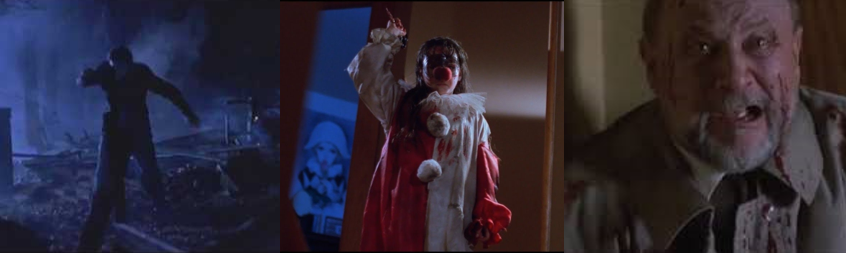
Movie Night [Halloween]: Halloween 5: The Revenge of Michael Myers


Starting as the ancient Celtic festival of Samhain, Halloween is largely associated not just with ghosts, ghouls, and confectionery but also a long-running series of horror movies. Beginning with John Carpenter’s Halloween (Carpenter, 1978), largely credited with birthing the “slasher” sub-genre and one of the most influential films in all of horror.


Released: 13 October 1989
Director: Dominique Othenin-Girard
Distributor: Galaxy International Releasing
Budget: $5.5 million
Stars: Donald Pleasence, Danielle Harris, Don Shanks, Wendy Kaplan, Beau Starr, and Ellie Cornell

The Plot:
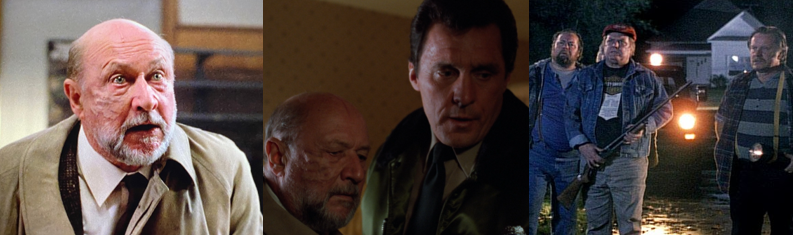
A year after a lacklustre defeat, serial killer Michael Myers/The Shape (Shanks) returns to Haddonfield to pursue his niece, Jamie Lloyd (Harris), who was left traumatised from their previous encounter and in the care of Michael’s increasingly manic former doctor, Sam Loomis (Pleasence).

The Background:
Widely dismissed upon release, John Carpenter’s Halloween became one of the most successful independent films thanks to its $63 million+ box office. It also heralded the start of a long-running and convoluted horror franchise bolstered by the commercial success of Halloween II (Rosenthal, 1981). After John Carpenter tried to turn Halloween into a horror anthology movie series with the abject failure of Halloween III: Season of the Witch (Wallace, 1982), the studio scrambled to bring Michael back with the aptly-named Halloween 4: The Return of Michael Myers (Little, 1988), a commercial (if not critical) success that saw a fifth entry fast-tracked for the following year. The initial script capitalised on Halloween 4’s dramatic ending by having Jaime Lloyd join Michael Myers in his newest killing spree while another draft sought to humanise Myers, but producer Moustapha Akkad insisted on retaining much of Myers’ established character. A later script introduced the mysterious “Man in Black”, an element eventually downplayed and returned to in the troubled follow-up. Although Donald Pleasence and Danielle Harris returned, Ellie Cornell was disappointed when she was killed early on and Don Shanks took over as the iconic Shape, receiving an accidental broken nose from the deeply committed Pleasence! With a box office of $11.6 millionHalloween 5 was met with mixed reviews criticising Pleasence’s performance and the confusing inclusion of the Man in Black. Its poor reception led to a noticeable gap between the fifth and sixth films as Akkad sought to re-evaluate how to get the series back on track, with disastrous results.

The Review:
Halloween 5 opens with a truncated recap of the ending of Halloween 4, primarily focusing on Michael’s inauspicious end where he fell down a mine shaft. Naturally, the Shape survived and was washed away. Wounded and exhausted, Michael attempts to kill a kindly old hermit (Harper Roisman) but collapses from his injuries and spends the next year in a coma. The film implies that Michael’s running out of juice, as though he only “activates” every Halloween and must kill to keep his energy up, something explored further in the sequel. Jamie Lloyd was last seen attacking her stepmother, Darlene Carruthers (Karen Alston) while dressed in the same clown outfit Michael wore for his first kill but Halloween 5 goes to great lengths to downplay the seriousness of that. It’s not shown in any great detail, Dr. Loomis’s anguished reaction and attempt to kill Jamie is omitted, and it’s casually revealed that Darlene survived the attack. Halloween 5 this clearly walks back this ending, leaving Jamie severely traumatised in a local children’s clinic and rendered mute for the first half of the film. Consequently, Halloween 5 loses me right from the start. The filmmakers had a great opportunity to do something different with the franchise, to show Jamie teetering between following in her uncle’s footsteps and rejecting his murderous ways, to give Dr. Loomis a chance to atone for his failure with Michael, and to perhaps retire the Shape in favour of a new killer who could explore the later shenanigans with the Cult of Thorn without screwing up Michael’s character. Instead, Halloween 5 plays it safe by delivering a by-the-numbers slasher with very few new elements that progress the franchise.
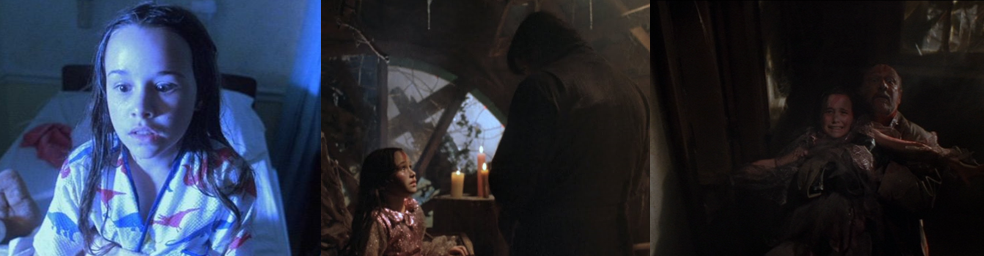
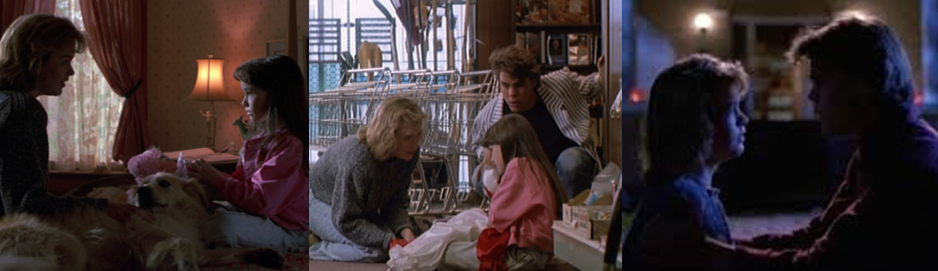
Traumatised by her experiences, Jamie struggles to make sense of her connection to her uncle.

One of these elements is the continued exploration of Jamie’s convenient and chaotic psychic link with her uncle. Presumed to be because she’s his last living relative (that we know of at this point), Jamie senses Michael’s whereabouts and intentions and is haunted by nightmares where he’s either stalking her or she’s seeing through his eyes. These visions, coupled with the trauma she endured, leave Jamie a distressed mute subjected to a battery of tests and whose only links to the real world is her stepsister, Rachel Carruthers (Ellie Cornell), Rachel’s cheerful best friend, Tina Williams (Kaplan), and their dog, Max (Unknown). The three regularly visit, sneaking Max into the clinic and helping her prepare for the Halloween costume contest. Jamie later attends this with her friend, shy stutterer Billy Hill (Jeffrey Landman), and becomes increasingly concerned for their safety when her visions grow stronger on “Halloween Eve”. When Michael awakens, kills the hermit, and reclaims his mask, Jamie suffers seizures, convulsions, and panic attacks, scrawling warnings on her chalkboard and muttering gibberish, which both excites and drives Dr. Loomis frantic since he’s desperate to put an end to Michael for good. Jamie spends most of the first half in bed or in the clinic, routinely being shaken and accosted by the increasingly demented Dr. Loomis, who thinks nothing of yelling at her and badgering her to get a lead on Michael or who the Shape’s next victim is. Scarred, half crippled, and seemingly on the verge of madness from all the death and violence, Dr. Loomis has degenerated into the raving lunatic he was thought to be in the first movie and only receives assistance from Sheriff Ben Meeker (Beau Starr) because of their shared experiences in Halloween 4. Dr. Loomis is livid with Jamie, convinced she’s protecting her uncle (why she would do that isn’t clear) and guilt-tripping her into helping despite her being terrified and confused by her visions. Ultimately, Jamie agrees to help after being chased by Michael and seeing Billy and Tina attacked by her uncle, but by then Dr. Loomis has seemingly lost all reason and regularly uses the petrified child as bait (and even a human shield!)
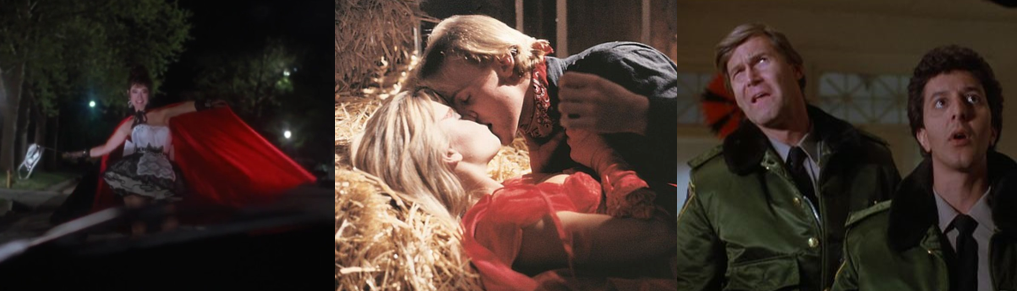
In a town full of forgettable and oddball characters, it’s easy for rambunctious Tina to stand out.

Although Rachel still offers Jamie comfort, she doesn’t last long. Jamie is assaulted by visions of her stepsister and tries to warn her, but Michael inevitably kills Rachel offscreen. Although Tina goes to check on her friend and finds the house empty, Rachel’s all-but forgotten about until Jamie stumbles upon her lifeless corpse in the dilapidated Myers house. While this sucks for Rachel, Tina is more than a worthy substitute; a bubbly bundle of enthusiasm and energy, Tina is an infectious and adorable personality who treats Jamie like a little sister. Outrageous and outgoing, she regularly teases her boyfriend, Mike (Jonathan Chapin), an angsty greaser who’s obsessed with his car, and encourages their friends, Samantha Thomas (Tamara Glynn) and grocery store clerk “Spitz” (Matthew Walker), to dress up for a Halloween party at a local farm. Thanks to Jamie’s visions, Tina’s rescued after Michael masquerades as Mike but, upon seeing how unstable Jamie is, chastises Dr. Loomis and ignores his warnings. Embracing her nature as a free spirit, Tina goes and has fun, thinking nothing of it when Sam and Spitz sneak off to the barn (after Spitz fakes Sam (and us) out by imitating Myers), but doesn’t hesitate to get Jamie and Billy to safety when they escape the clinic to warn her of the danger. With Michael poised to kill the children, Tina steps in, taking a knife to the shoulder and promptly vanishing on a gurney, her fate unknown, and leaving Jamie forced to rely on Dr. Loomis. Indeed, while Sheriff Meeker tries to hunt Michael down, he and his men are always one step behind. Two of his patrolmen, Nick Ross (Frank Como) and Tom Farrah (David Ursin), are so woefully inept that they not only openly admit to being bad cops but are accompanied by ridiculous clown-like sound effects.
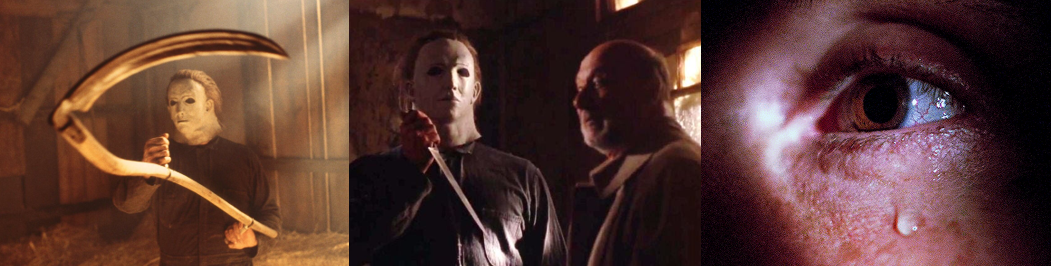
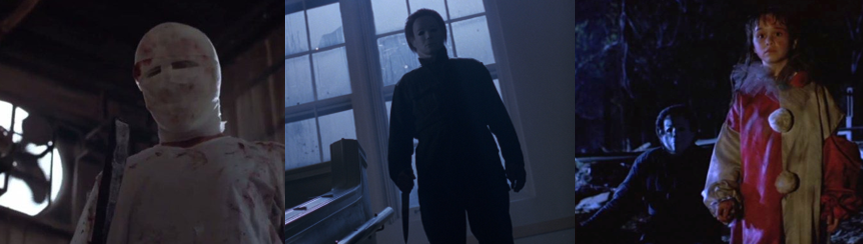
Sporting one of his worst looks, Michael’s shown to be cursed be an insatiable rage.

Now played by Don Shanks, Michael is as determined and unstoppable as ever but moves with a more deliberate, robotic grace. Stalking his prey in broad daylight from behind bushes, commandeering police cars, and driven by an insatiable rage to hunt down and kill his bloodline, Michael is cast as a horrific bogeyman for Jamie and the object of Dr. Loomis’s obsession. Sporting an ill-fitting mask and a mysterious rune tattoo on his wrist, Michael slaughters anyone in his way and seemingly goes out of his way to target Tina’s friends to both quench the rage driving him and, perhaps, sustain him as Halloween drags on. Still sporting severe scars to his hands (at the very least), Michael’s stoic visage contrasts with Dr. Loomis’s increased hysteria. Having similar scars and limping on a cane, Dr. Loomis and Michael are more similar than different by Halloween 5, especially as Dr. Loomis blatantly ignores local authority and hounds Jamie almost as much as Michael, waving her around in front of him like a dog’s chew toy. After luring Michael to the Myers house, Dr. Loomis tries to reason with him by promising to deliver Jamie to him, understanding that Michael believes killing Jamie will end his agonising rage. In these moments, the old Dr. Loomis shines through but his efforts are ultimately useless. Jamie also tries to reach her uncle, even convincing him to remove his mask and revealing that he’s suffering from the curse that drives him, but Michael lashes out both times. Haddonfield is also stalked by a mysterious “Man in Black” (also Shanks), who also has a rune tattoo and lurks around the Myers household, the town streets, and assaults the police station in the finale. This same rune is painted on the wall in Michael’s house, reinforcing a previously teased pagan connection to his rage and killing spree, but these elements are ultimately teasers for the sequel rather than anything significant here.

The Nitty-Gritty:
Halloween 4 teased that Michael’s bloodlust was somehow genetic and that Jamie was destined to follow the same dark path. This is largely downplayed in favour of a more supernatural bent to Michael’s character. The bond between him and Jamie is definitely implied to be supernatural and her visions and nightmares help spare some lives (at least for a while), though they’re forgotten by the third act, which descends into screaming and running and hiding. There’s the suggestion that Dr. Loomis is still trying to atone for failing Michael, but only in his interactions with the Shape, which are framed more as Dr. Loomis trying to subdue Myers so he can be captured or killed. Even Dr. Loomis’s plot to use Jamie as bait is part of this rather than true malicious intent on his part, but the line sure is blurred since Dr. Loomis is more unstable than ever. Dr. Loomis suggests that Michael is driven by rage that can only be quelled by killing and that he believes ending his bloodline will give him peace, something Dr. Loomis strongly suggests is a lie. We see Michael’s rage flare numerous times but, when he unmasks, a single tear runs down his cheek. This, coupled with those strange runes, strongly suggests that Michael’s not in full control of his actions. The film further suggests the Man in Black is part of this but also suggests it’s a supernatural element to Michael’s character. It’s all very vague and thus you can argue it doesn’t dilute the traditionally cryptic Myers, but it’s also explicit and bonkers enough to show that the franchise is on a slippery downhill slope.
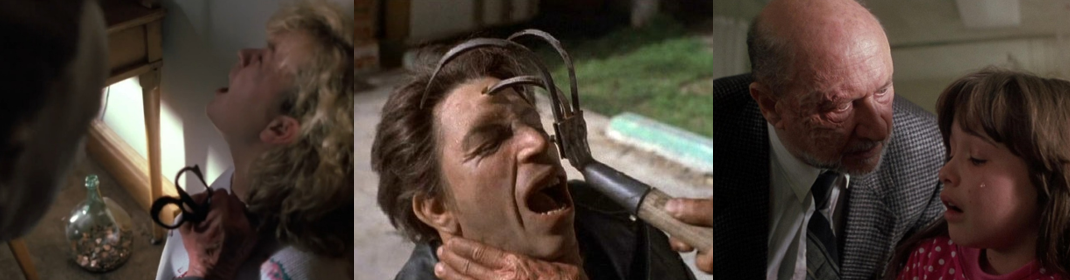
Sadly, Halloween 5 is bogged down by toothless kills and half-baked ideas that go nowhere.

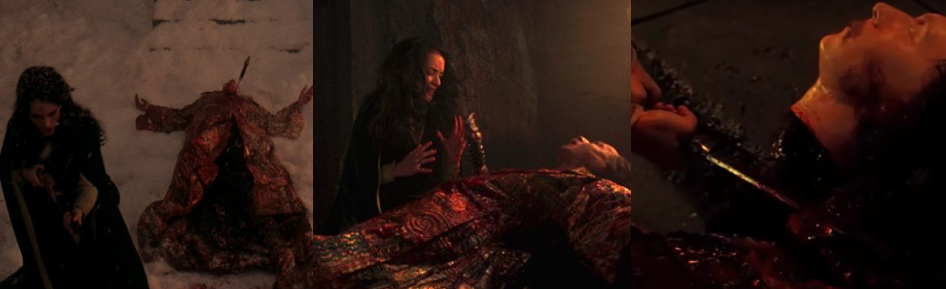
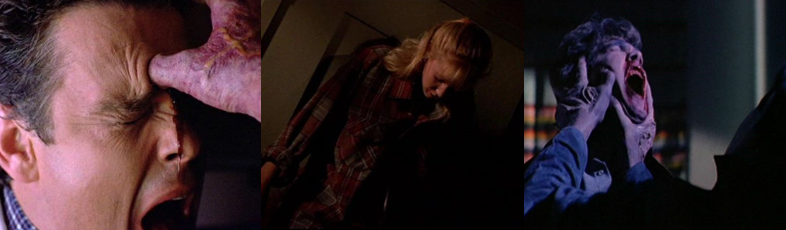
Still, one good reason to watch any slasher film is the kills. And the sex, of course. Halloween 5 is very light on the sex and nudity; Tina teases and straddles Mike a few times but is never seen engaging in sexual activity (though it’s heavily implied she has, and is perhaps high most of the time, directly violating the “rules” for a “Final Girl” and perhaps explaining her ambiguous fate). Sam and Spitz get it on in a barn thanks to some suspiciously redubbed moaning, but their sexy time is brutally interrupted when Michael skewers Spitz with a pitchfork. Michael then stalks Sam (who, credit to her, at least attempts to fight back) with a scythe, which makes for an awesome visual and makes me wish Myers had adopted this weapon over his traditional kitchen knife. Sadly, the way Sam’s death is framed implies Michael cuts her throat rather than beheading her and he inexplicably attacks Ross and Farrah with the pitchfork afterwards. If Myers did behead her, it’s not shown on camera; neither are Ross and Farrah’s deaths, just the aftermath, which are just two examples of how toothless Halloween 5 is. Similarly, while we see Rachel get stabbed, the film cuts away before going into detail, robbing her of a dignified death scene and reducing her to a jump scare when Jamie later finds her body. Many of Michael’s victims are strung up in his house in the finale, though none of their deaths are particularly inspiring. Mike’s was good, though. Michael toys with him at first, raising his ire by scratching his beloved car and then impaling him through the head with a garden claw. The editing is particularly disheartening in Halloween 5, robbing the kills of their impact and even making me question Tina’s ultimate fate. There is a cool shot of Michael chasing after Jamie in a car that’s really well lit, though, and I loved the derelict Myers house (even if it’s a recycled location for the finale). Otherwise, Halloween 5 can’t even bolster some goodwill through some decent sex and gore, leaving us to settle for the half-baked mystical connection between him and Jamie and Jamie’s obviously fractured mental state.
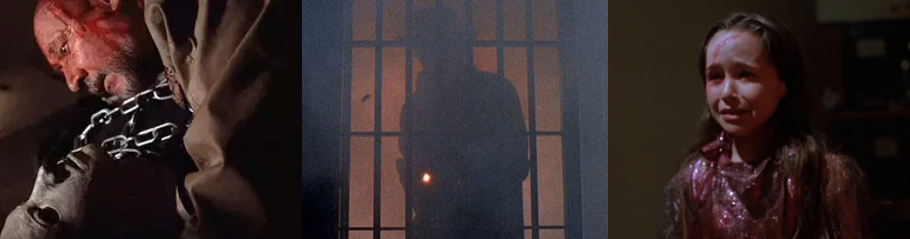
Thanks to Dr. Loomis’s bizarre choices, Michael is freed from captivity by a mysterious Man in Black…

To her credit, Danielle Harris does a great job in scenes where she’s suffering from her nightmares and in her interactions with Donald Pleasence. The shared fear and madness between the two is a highlight and certainly more appealing than the uninspired depiction of Myers, who’s mostly going through the motions. After escaping the clinic, Jamie and Billy desperately try to warn Tina, only to witness her being attacked by Myers. Determined to put Michael down, Dr. Loomis challenges the Shape to meet him at the rundown Myers house, where he waits with Jamie as semi-willing bait. After sending away the cops, Dr. Loomis tries to talk Michael down, only to get slashed across the chest and manhandled by the Shape, who then angrily pursues Jamie. Just as he’s poised to kill her, Michael falters and reveals he’s tortured by his nature, only to fly into a renewed rage and fall right into Dr. Loomis’s trap. Weighed down by a chain net, Michael’s an easy target for Dr. Loomis to blow away with a shotgun. Oh no, sorry, that doesn’t happen…instead, Dr. Loomis tranquilises Michael and bashes him over the head with a wooden plank? An odd decision considering Dr. Loomis spends the whole movie heavily implying he wants to kill Michael and even screams at him to “Die!” during the beat down (which also leaves Dr. Loomis collapsed from exhaustion and potential heart attack). Thus, Michael is arrested (!) and chained up in a cell to be transferred to a maximum-security prison. The shellshocked Jamie is taken from the station, only to be drawn inside by the sound of gunfire and screaming courtesy of the enigmatic Man in Black. Venturing into the ransacked station, Jamie finds Michael’s cell blown open and empty and is horrified by the realisation that her murderous uncle is once again on the loose…

The Summary:
I gave Halloween 4: The Return of Michael Myers a bad time for simply being a carbon copy of John Carpenter’s seminal original, and for adding very little to the franchise and effectively keeping it on life support by introducing Jamie Lloyd. However, that film ended with the tease that something new would happen in its sequel and, unfortunately, that wasn’t the case. Just like how the Friday the 13th franchise (Various, 1980 to present) got cold feet about replacing Jason Voorhees (Various), Halloween 5: The Revenge of Michael Myers wimps out on going all-in with Jamie as a replacement for the Shape. This could’ve been an opportunity to explore Jamie’s descent into madness, to show the parallels between her and Michael, to show Dr. Loomis desperately trying to atone for his past and perhaps resolving to kill her by the end. Michael still could’ve gone on a killing spree in the background, perhaps getting slower and more fatigued as he goes, as though his essence were transferring to Jamie, who could’ve killed Dr. Loomis and been spirited away by the Man in Black. But, no. Instead, we get the psychic connection between the two that’s interesting but underdeveloped and forgotten about, another mindless killing spree from Michael, and another half-baked retread of the previous films as Dr. Loomis tries to reason with and destroy Michael. I did enjoy the dark turn Dr. Loomis takes here; seeing the physical and mental toll on his morals was really interesting and I loved that he was willing to put Jamie at risk and even let her die just to get his hands on Michael. Danielle Harris also did a great job, particularly in the first half where she’s mute and traumatised, and I adored Wendy Kaplan’s rambunctious character. However, the bungling cops, bizarre sound cues, and toothless gore all made Halloween 5 a shallow and dull experience, overall. The teases about the Cult of Thorn felt as random as everything else in this movie, as though the screenwriters were just making shit up as they went along and hoping for the best, and this diluted what could’ve been dramatic scenes, such as Dr. Loomis and Jamie trying to reach Michael. In the end, Halloween 5 is just another slasher that fails to capture the magic of the original and simply serves to show that we didn’t need to make a franchise out of this series.

My Rating:

Rating: 2 out of 5.

Could Be Better

Did you enjoy Halloween 5: The Revenge of Michael Myers? Were you also disappointed that Jamie didn’t take over as the killer? Were you annoyed that Rachel was killed off so unceremoniously? What did you think to Dr. Loomis’s fractured mental state and questionable morals? Were you disappointed by the lacklustre kills and cliff-hanger ending? How are you celebrating Halloween this year? Whatever your thoughts on Halloween, and the Halloween franchise, drop a comment below, support me on Ko-Fi, and have a spook-tacular Halloween!


Movie Night: Hollow Man: Director’s Cut

Released: 25 December 2009
Originally Released: 4 August 2000
Director: Paul Verhoeven
Distributor: Sony Pictures Releasing
Budget: $95 million
Stars: Kevin Bacon, Elisabeth Shue, Josh Brolin, Kim Dickens, and William Devane

The Plot:
When ambitious scientist Doctor Sebastian Caine (Bacon) arrogantly subjects himself to his invisibility serum, his team is horrified when he descends into madness after going drunk with power.

The Background:
By 1897, British author Herbert George Wells had established himself as a prolific author in the science-fiction genre. Possibly inspired by W. S. Gilbert, Wells’ 1897 literary classic The Invisible Man captivated readers with its cautionary tale and then impressed audiences when adapted into James Whale’s ambitious and celebrated 1933 classic. Followed by a bunch of pseudo-sequels and spin-offs, The Invisible Man developed an enduring legacy in sci-fi and horror and eventually lived again, in spirit at least, when acclaimed auteur Paul Verhoeven sought to make a more “conventionally commercial” blockbuster. Writer William Goldman disliked the script but attempted to salvage it with rewrites, only for Verhoeven to ignore his input and double-down on the special effects work. Sony Pictures Imageworks and Tippett Studio developed the intricate invisibility effects, which involved compositing scenes with and without star Kevin Bacon and dressing him in a latex body suit to create a digital double. Initially absent once his character became invisible, Bacon was brought back for reshoots to give the characters someone to interact with and the actor detailed a troublesome pre-production period. With a box office gross of $190.2 million, Hollow Man was Verhoeven’s biggest hit since 1992 but was met with largely negative reviews that criticised its formulaic characters and misogynistic undertones, though the visual effects were widely praised. Accompanied by this Director’s Cut, which added about ten minutes of slightly extended scenes, and followed by a critically panned direct-to-DVD standalone sequel in 2006, Hollow Man saw the remorseful Paul Verhoeven retreat from Hollywood, though it’s often regarded as an under-rated gem.

The Review:
Hollow Man follows a team of scientists, technicians, and other assorted specialists developing an invisibility serum. Genius narcissist Sebastian Caine is at the forefront of the project, which was entrusted to him by his old mentor, Doctor Howard Kramer (Devane), and his team includes his ex-girlfriend, Linda McKay (Shue), and his frenemy Doctor Matthew “Matt” Kensington (Brolin). The team has already cracked invisibility, producing a startling neon blue serum that undergoes some vague irradiation process and is injected directly into the blood stream. The team have tested the serum on multiple test animals, cared for by feisty veterinarian Doctor Sarah Kennedy (Dickens), though they cannot reverse the process. While Linda and Matt embark on a love affair, Sebastian works tirelessly on the problem until he suddenly intuits the solution. Giddy with excitement, eager to claim a Noble Prize and etch his name in history, Sebastian insists on testing the formula on Isabelle (Tom Woodruff Jr.). Although the gorilla’s heart rate and blood pressure spikes wildly, the team stabilises her and she becomes visible. Emboldened by their success, Sebastian attempts to rekindle his romance with Linda, only for her to coldly shut him down due to his narcissism (though it’s clear she admires him, as do the rest of the team).

Narcissistic scientist Sebastian loses what little sanity he had to invisibility madness.

However, Linda and Matt are infuriated when Sebastian lies to the Pentagon, arrogantly wishing to be the first person to turn invisible and back. Despite their protests, Linda and Matt agree to Sebastian’s proposal and lie to the others to get them onboard, each eager to be at the forefront of the experiment. Though tense and demanding, Sebastian insists on injecting himself to protect Linda from legal repercussions and endures agonising convulsions as he slowly and painfully dissolves. Though he’s extremely sensitive to lights, Sebastian and the others are elated by the successful trial, and they endure his playful invisible antics. The first red flags occur when Sarah is unnerved by his presence, believing he sexually assaulted her, and technician Janice Walton (Mary Randle) refuses to go anywhere without her infrared goggles. Thus, they’re horrified when he reacts violently to the reversion serum before fading away again (potentially because they didn’t use the defibrillator). Sebastian’s initial excitement about being invisible quickly turns to anger and resentment as he endures days of testing, with no solution in sight, angrily lashing out at Linda and Matt when they try to help him and struggling with cabin fever. On the plus side, the team forge a latex mask to give him a physical presence, but Sebastian still storms out, much to the alarm of friendly but naïve medic Carter Abbey (Greg Grunberg).

Sebastian’s warped mind is further twisted, driving him to paranoia, anger, and murder.

Returning to his apartment, Sebastian tries to talk himself out of messing with his alluring neighbour (Rhona Mitra) before stripping down and raping her. Obviously, he keeps this to himself (though he makes allusions to Carter, who obliviously encourages him), but the team is pissed at him breaking protocol and essentially place him under house lab arrest. However, while Sebastian feigns compliance, he surreptitiously fiddles with the video camera to fool technician Frank Chase (Joey Slotnick) and sneaks out again, discovering Matt and Linda’s romance and finally snapping. His ego wounded and angrily resentful at the team, Sebastian brutally murders one of Sarah’s dogs and talks down to the others, raising their suspicions further. Linda’s sympathy evaporates when Sebastian showcases the extent of his mania, considering his condition as a “gift” that they’re jealous and fearful of. When they discover that Sebastian’s messed with the cameras, Linda and Matt come clean, enraging Sarah and driving them to ask Dr. Kramer for help, even if it means the end of their careers. Unimpressed and incensed, Dr. Kramer dismisses them and prepares to report Sebastian, only for the manic scientist to drown him in his pool. Thus, like basically every invisible man, Sebastian descends into full-blown madness. Sebastian was already an arrogant, self-absorbed asshole before he turned invisible, believing himself “God” but cabin fever and unforeseen side effects of the serum escalated his violent tendencies. Sebastian relishes the power and freedom of invisibility (“It’s amazing what you can do when you don’t have to look at yourself in the mirror”) and is willing to kill anyone who tries to stop him.

The Nitty-Gritty:
Technically speaking, Hollow Man isn’t a remake of The Invisible Man and barely resembles H.G. Well’s classic text beyond surface level similarities. However, a scientist going mad partially from an invisibility serum and going on a killing spree are all reminiscent of The Invisible Man. Like Griffin, Sebastian is wholly unlikeable from the start. Sure, there are moments of humility and humanity, mainly in his interactions with Linda, but it’s clear he only wants her because he can’t have her and wants to be seen as superior to her lover. Sebastian openly mocks Sarah and her love for animals, gets very handsy with his colleagues when invisible, and routinely berates Matt simply to prove his intellectual superiority, completely missing the irony and hypocrisy of him being as unable to crack reversion. Hollow Man is a very different film for director Paul Verhoeven. It has none of his usual satirical or visual signatures, no commentary on the media or government, and everything is presented in such a clinical and by-the-number way that it could’ve been directed by anyone. It doesn’t help that most of the film takes place in a visually boring laboratory or that it feels like Verhoeven was making a cookie-cutter sci-fi/horror simply for a pay cheque, compromising his usual signature style simply to appease studio executives and producers.

The impressive special effects largely carry this otherwise tedious horror/thriller.

Hollow Man makes up for this with its impressive visual effects. The CGI when Isabelle and Sebastian turn invisible or return (briefly, in Sebastian’s case) to visibility is extremely detailed. Sure, it makes no sense how any of the test subjects can see but that’s largely inconsequential when skeletal structures, arteries, muscle, and flesh appear or disappear before your eyes. Sebastian’s experience is noticeably more traumatic since he can articulate the pain of the process but also because it’s like his flesh is dissolving. With Isabelle, it’s the reverse and the filmmakers painstakingly show her organs and body structure reforming. While they’re occasionally cartoony, the CGI still holds up and I also enjoyed the simpler techniques used when Sebastian is invisible, like moving chairs and the others reacting to his unseen presence. Sebastian cuts an unsettling figure in his latex mask, with empty voids for his eyes and mouth, making him a true “Hollow Man” devoid of a body, soul, and eventually conscience. The invisibility effects can be somewhat inconsistent, however. When Sebastian attacks Dr. Kramer, you can clearly see Sebastian’s hair, eyes, and mouth but, other times, he appears to be bald or to have no eyes or mouth depending on what suit Kevin Bacon is wearing. While this can be distracting, the sight of Sebastian cutting through water, covered in blood, or strangling Carter from an overhead pipe is as unnerving as his incredible physical strength, which is apparently augmented by his insanity. Verhoeven’s signature gory style finally appears in the finale, where blood spurts from Carter’s neck wound, Frank takes a pole through the abdomen, and Matt suffers a sickening blow to the gut.

Linda preys upon Sebastian’s ego and lusts to get the better of him and finally end his rampage.

After killing Dr. Kramer, Sebastian prepares to erase all traces of the team and the experiment. Thus, he traps the team in the lab and picks them off one by one. Though armed with their infrared goggles and tranquilizer darts, and utilising a tracking system, the team are essentially powerless against Sebastian, who easily subdues and kills them before grievously wounding Matt and spitefully locking him and Linda in a freezer. Confident of his victory, Sebastian casually applies a semi-convincing false face and rigs a makeshift bomb with some chemicals and a centrifuge. He underestimates Matt’s tenacity (some duct tape takes care of his internal bleeding) and Linda’s adaptability as she cobbles together an electromagnetic to escape the freezer. Moments away from freedom, Sebastian is surprised by Linda, who attacks with a flamethrower, melting his disguise and making him temporarily visible from the burns. Matt makes a miraculous recovery to help in the scuffle, which sees Sebastian being electrocuted and partially restores him. Desperately clambering up the elevator shaft as Sebastian’s bomb explodes, Matt and Linda barely avoid being smushed by the elevator and are attacked by the relentless Sebastian, now reduced to a skinless, raging maniac obsessed with taking them with him. However, Sebastian’s obsession with Linda gets the better of him and he pulls her in for one last kiss, “for old time’s sake”, giving her the perfect opportunity to brace herself and release the elevator’s emergency brake, sending the egomaniacal murderer plummeting to his fiery end. The film then ends rather abruptly with Linda and the injured Matt being met by emergency services, robbing us of any kind of stinger relating to Linda’s trauma following the events.

The Summary:
I’ve always been a fan of Hollow Man, though sometimes I wonder why. The film is quite long, which doesn’t help, and the visually repetitive setting only exacerbates this issue. Perhaps if the lab had been a bit more futuristic, or if different areas had different colour schemes or themes, that might’ve helped but, as is, it gets very tedious looking at the same clinical, drab locations the entire time. The characters aren’t all that great, either. Sebastian’s a narcissistic prick with a superiority complex who elicits little sympathy and who’s already unbearable before he loses himself to invisibility madness. Elizabeth Shue seems to be trying her best but also seems bored, only coming to life when Linda has to be horny, while Josh Brolin seems somewhat miscast, despite my gravitating to his more “Everyman” persona. I liked Sarah’s feistiness and how depraved Carter was, but the team were largely forgettable and boring, meaning I don’t care much when they die. Thankfully, their deaths are quite gory and/or harrowing, but Paul Verhoeven’s signature visual and thematic style is entirely absent here, making for a confusing film that was wasted on his unique talents. The special effects are what carries Hollow Man but, while they do a bulk of the heavy lifting and are impressive, they don’t really make up for the other tiresome aspects. Yet, I find myself drawn to Hollow Man and the impressive visuals of skeletons and circulatory systems fading in and out before our eyes in painstaking detail. The invisibility effects may well be the best I’ve ever seen and they do give Sebastian a horrific aura, especially as he’s so unpredictable and aggressive. Still, I can see why people dislike this film and struggle to recommend it, but Hollow Man remains a somewhat guilty pleasure for me.

My Rating:

Rating: 3 out of 5.

Pretty Good

Are you also a fan of Hollow Man? Did you enjoy its twist on the Invisible Man formula? How impressed were you by the digital effects and the depiction of invisibility? Did you find it hard to sympathise with Sebastian and the other characters? Were you disappointed that Paul Verhoeven’s signature style was entirely absent? Which incarnation of the Invisible Man is your favourite? How are you celebrating Halloween this year? Share your thoughts on Hollow Man in the comments, go read my other horror reviews, and support me on Ko-Fi to suggest other translucent horror content.

Movie Night: The Invisible Man (1933)

Released: 13 November 1933
Director: James Whale
Distributor: Universal Pictures
Budget: $328,033
Stars: Claude Rains, Gloria Stuart, William Harrigan, Henry Travers, and Una O’Connor

The Plot:
After turning invisible with a special formula, Doctor Jack Griffin (Rains) first obsesses over a cure and then goes on a crazed rampage through a Sussex village.

The Background:
By 1897, prolific British author Herbert George Wells had quickly made a name for himself as a creative visionary and futurist, with The Time Machine (1895) laying the foundation for the science-fiction genre and The Island of Doctor Moreau (1896) inviting discourse regarding morals and ethics. Potentially inspired by W. S. Gilbert’s “The Perils of Invisibility” and allegedly starting as a short story Wells later expanded, The Invisible Man became a literary classic as a startling cautionary tale regarding the dangers of science. Development of a silver screen adaptation can be traced back to 1931 where, after their unexpected success with Dracula (Browning, 1931), Universal Studios suggested The Invisible Man as a follow-up. While producer Carl Laemmle and his son opted to prioritise Frankenstein (Whale, 1931) instead, they purchased the rights during filming (though Wells demanded script approval). Though James Whales was reluctant to direct out of fear of being typecast as a horror director, he eventually signed on and the script underwent many rewrites before shooting started. While Boris Karloff was initially set to star in the title role, stage actor Claude Rains took over for his feature film debut, where he shared the screen with some simple and innovative visual effects. Everything from simple wire tricks to layering negatives over each other sold the illusion of invisibility so well that they stood as a blueprint for modern-day green screen effects. Highly praised upon release and regarded as one of the best films of its era, The Invisible Man has stood the test of time for its ambitious visuals, stirring performances, and masterful exploration of the corruption of power. Followed by a handful of quasi-sequels and spin-offs, The Invisible Man has had an enduring legacy in sci-fi and horror, resulting in everything from under-rated sci-fi dramas, to big-budget remakes and reimaginings that were both underappreciated and evocative, to infamous comic book adaptations of his classic literary icon.

The Review:
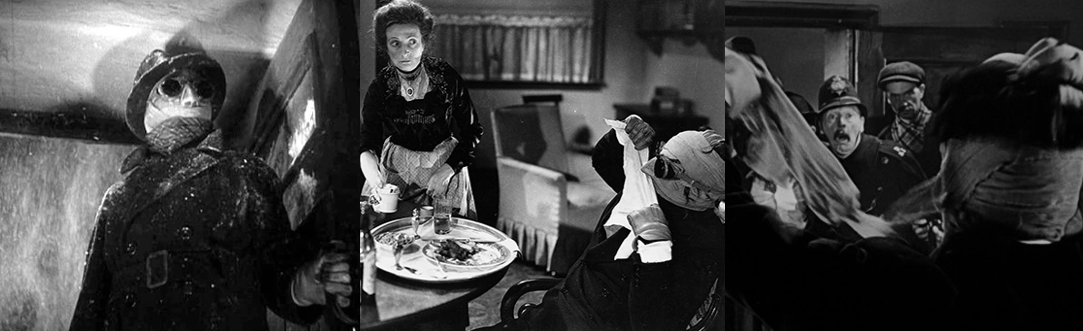
I’m somewhat familiar with H. G. Wells’ classic sci-fi story of an invisible man terrorising a small English village, and have long been a fan of the concept and its adaptations and how they often depict an ambitious scientist meddling in things beyond him and turning to madness. The original invisible man (here given the first name “Jack”) is already a rude and demanding character when he first stumbles through the snow and into Iping looking for a room. His appearance startles the locals at the Lion’s Head since he’s covered in bandages. Despite his odd appearance and gruff nature, doting and bothersome landlady Jenny Hall (O’Connor) caters to his every whim. However, the nosey old shrew can’t help but bother Griffin, fussing over his room and catching a glimpse under his bandages, and spreading gossip to her husband, Herbert (Forrester Harvey), and the snooping locals, who believe he’s an escaped criminal. In reality, Griffin is an understudy of Doctor Cranley (Travers), who was allowed to conduct experiments in his spare time. To the suspicion of his colleague, Doctor Arthur Kemp (Harrigan), Griffin worked in secret against the open and honest code of most scientists. Indeed, Griffin’s beautiful fiancée and Dr. Cranley’s daughter, Flora (Stuart), notes that Griffin had become more withdrawn before his sudden disappearance and openly laments his departure, worrying herself sick about his health. Though Dr. Kemp uses Griffin’s actions to proposition her, he’s hilariously unsuccessful and his dislike of Griffin counters Flora’s romanticised opinion of him, strongly indicating that Griffin was previously an eccentric but nonetheless caring and compassionate man.

A mysterious and rude stranger upsets the locals of a small village with his gruesome visage.

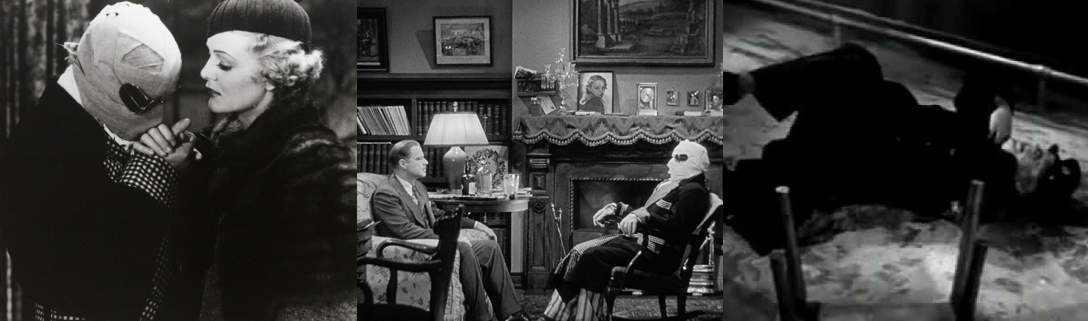
Eager for fame and glory, Griffin experimented with the obscure drug “monocaine”, which drains colour from its surroundings. By distilling the substance and regularly injecting it under his skin, Griffin successfully turned himself invisible but fled from his laboratory and home to discover the way back to visibility in seclusion. When he reaches Iping, Griffin is irritable and quick to anger, eventually launching into a tirade after Jenny reprimands him for messing up her sitting room with his bizarre equipment. Insulted and enraged, Jenny orders Herbert to evict their guest, who desperately pleads with the landlord before angrily tossing Herbert down the stairs. The barflies fetch pompous and ludicrous Constable Jaffers (E. E. Clive), only to be amazed when Griffin dramatically reveals he’s completely invisible! While they’re shocked and powerless to catch Griffin, who half-throttles Jaffers and causes havoc in town, the unmasking and the frustration at his condition briefly unhinges Griffin’s usually ordered (if unstable) mind. Griffin delights in chaos before fleeing to Dr. Kemp, who’s stunned when Griffin calmly explains his maniacal plot for a mutually beneficial partnership so that Griffin can terrorise the world with his powers. Though hesitant, Dr. Kemp’s too terrified to resist Griffin’s demands and gives him shelter, helping him retrieve his notebooks, all while Griffin giggles about the mayhem and murder he plans to indulge to showcase his intellectual superiority. While Griffin claims to be “strong” and easily outwits the police as they mobilise to flush out the invisible man causing so much death and panic, he’s still very vulnerable as he must stay naked and out of rain, soot, and snow to remain undetected.

Despite attempts to humanise him, Griffin is largely depicted as an unhinged psychopath.

Griffin’s madness comes in waves, with him switching between reasonable (if callous) and enraged. When docile, he sees Dr. Kemp as his valued and trusted partner but, when angered, Griffin gleefully murders even his reluctant ally when Dr. Kemp calls in first Dr. Cranley and Flora and then the police. Griffin’s demeanour noticeably softens around Flora, but his madness returns when he realises Dr. Kemp has betrayed him. Griffin renews his killing spree, all thoughts of returning to visibility forgotten as he tosses men over ravines, shoves over baby carriages, and casually derails a train, killing over a hundred passengers! Regardless, Flora remains devoted to her man and near sick with worry, though Dr. Cranley’s powerless to do much but promise to help try Griffin once he’s apprehended. When the sceptical Police Chief (Holmes Herbert) is strangled to death for his ignorance, the Chief Detective (Dudley Digges) takes the threat very seriously. Unfortunately for him, his office is swamped with calls from “helpful” civilians offering outlandish solutions and all plans must be spoken privately, necessitating his men walk a giant net across his office! When Griffin vows to murder Dr. Kemp in retaliation, the Chief Detective uses the terrified doctor as bait to lure Griffin into an elaborate trap. However, despite his crazed state, Griffin easily evades the traps and follows Dr. Kemp, casually explaining how he’s going to kill him and then executing the plan, sending Dr. Kemp to a spectacularly fiery death! The invisible man’s rampage continues over several montages, with many policemen and volunteers joining the search and just as many terrified civilians barricading their doors, though Griffin constantly makes fools of them.

The Nitty-Gritty:
The Invisible Man has an edge over many classic Universal Monsters movies with its orchestral score. It also impresses with its surprising and startling body count, especially as the titular antagonist is simply one man running around in the nude. Griffin’s mood swings seemingly grant him augmented strength and he thinks nothing of murdering for his own amusement. As explicitly stated by Dr. Kemp and then reiterated in the finale, The Invisible Man is another cautionary tale of the dangers of dabbling in science. Griffin meddled in things he didn’t understand and, in his arrogance, blundered into his experiment without conducting proper research, essentially dooming himself to madness, debauchery, and ultimately death. The Invisible Man is reasonably close to the source material, recreating many aspects while bolstering Dr. Kemp’s role and altering both the title character and making his unfortunate more dramatic. The book spends more time in Iping, as I recall, while these scenes merely introduce the mystery of the bandaged stranger. Naturally, the concept of a person turning invisible and consequently losing their mind to the freedom and power originates here, with Griffin first toiling for cure and then revelling in his abilities. The process makes him unhinged and gives him an inflated sense of superiority, eventually bringing him ruin. However, Griffin seems perfectly happy to be the all-powerful, untouchable invisible man…except for having to always be naked.

Simple and pioneering filmmaking techniques alike are used to bring Griffin’s rampage to life.

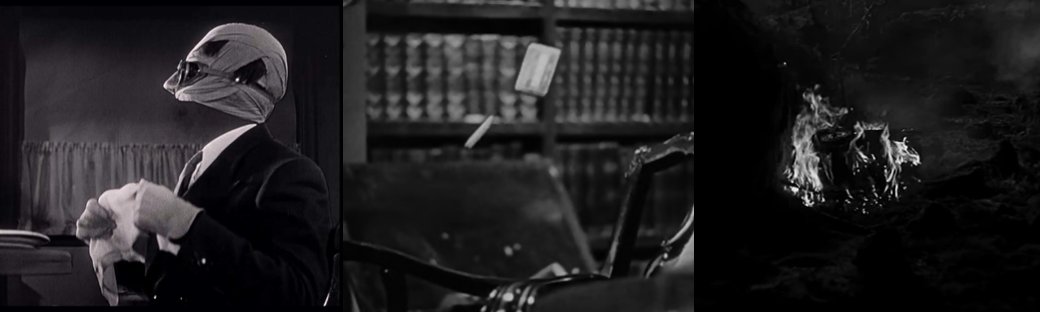
Of course, the most startling way The Invisible Man stands out from its peers is its groundbreaking visual effects. Obviously, everything seen here was achieved practically using unique and clever solutions and they hold up ridiculously well. While it’s clear when a dummy has been used, you can sometimes spot wires, and there’s an odd translucent effect at times, I remain impressed and amazed by the innovation on show. There are scenes where Griffin is simply a talking shirt or has half his jaw missing that blend better than some modern-day CGI and I especially when he took and lit one of Dr. Kmep’s cigarettes with a match. Of course, many of the effects are incredibly simple, being basically actors talking to thin air or pretending to be throttled, but many sequences showcasing the invisible man’s actions were setup to avoid making things too easy. Like, when he escapes through the window, it would’ve been simpler to just show the window opening but, instead, we see the net curtain opening, an ornament set aside, and then the window opens. Other effects are simply achieved through wires, which works incredibly well and the black and white, grainy filter helps hide many of the tricks used. A fun model train and car also go down in flames during Griffin’s rampage to add a sense of danger and scale things. While later iterations relied more and more on CGI, I appreciated the simplicity and hard work that went into rendering Rains invisible. His reveal is an incredibly powerful scene where he angrily tosses his fake nose, glasses, and bandages at the gawping locals and flails like a madman, a far cry from his composed and demanding demeanour and the first true indication that Griffin is gone completely off his nut.

Griffin’s reign of terror is ultimately undone, returning his senses and flesh in time for his death.

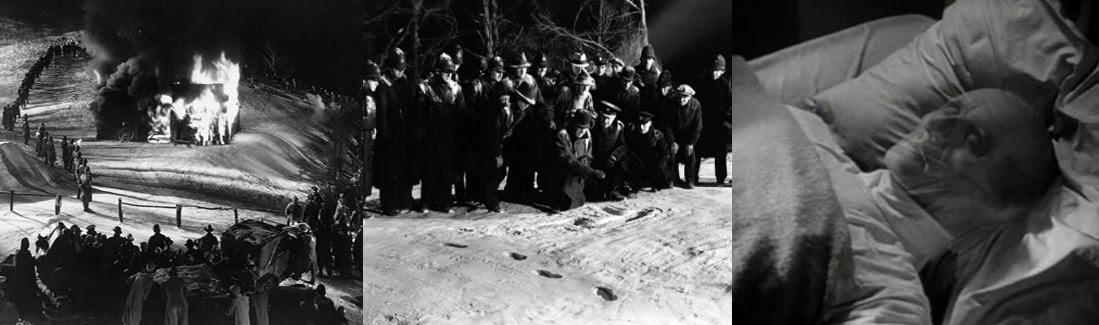
While the Chief Detective works to apprehend the invisible man, apparently employing over 100,000 men in a widespread manhunt, he’s eluded at every turn. This is largely because Griffin easily slips past traps or patiently waits to act. While Flora renders him docile, Griffin embraces mayhem and death once the cops mobilise, never once trying to contact Flora. Initially, Griffin wants Dr. Kemp help him spread true chaos. Then, he plots to master the serum so he and Dr. Kemp can take turns indulging their destructive whims (though Dr. Kemp is aghast at this). Upon being discovered, however, Griffin simply runs amok until he burns himself out. Throughout the film, however, Griffin is seen to be exhausted and famished, constantly demanding food, rest, and a fire to warm his frozen, exposed flesh. Though he delights in killing Dr. Kemp, Griffin collapses, exhausted, in a farmer’s (Robert Brower) barn. Upon discovering the sleeping invisible man, the farmer raises the alarm, prompting the Chief Detective to capitalise on the latest snowstorm and flush Griffin out with fire. In desperation, Griffin flees into the snow, where his footprints clearly show, allowing the police to gun him down. Griffin finally reunites with Flora in the hospital where, despite the best efforts of those involved, he faces a quick and probably painful death from the bullets in his lungs. Despite this, there’s no blood and Griffin is coherent enough to make amends with Flora and realise the folly of his experiments. Griffin’s sanity is restored moments before he passes and he dramatically and ambitiously becomes visible, his wounds and death apparently flushing the serum and the madness from his system and leaving Flora distraught by his bedside.

The Summary:
Even now, The Invisible Man is my favourite of all the classic Universal Monsters movies. I think that’s because, from my perspective, the concept hasn’t been as worn out as other classic horror concepts, like Count Dracula or Frankenstein, and also because I find the film more visually impressive than many of its peers. Of course, it’s not perfect: Una O’Connor’s grating, shrieking, over-the-top performance is very obnoxious at the start and many of the later, one-note constables and supporting characters are strangely comical. There’s a fanciful nature to Griffin’s rampage, with many of his actions framed as pranks, but things nicely escalate as he first causes mischief and then amasses one of the greatest body counts of his era! While the film attempts to humanise Griffin through Flora and the descriptions of monocaine, he’s still a despicable and unstable character, being rude and demanding and then giving in to enraged outbursts when his experiments are constantly interrupted. We see little of Griffin’s more logical, compassionate side, instead seeing him flip-flop between being coldly ruthless and utterly off his rocker as he plots to cause chaos alongside Dr. Kemp. It’s a stirring, magnetic performance from Claude Rains, especially as he’s barely in the film and yet his presence is constantly felt. Of course, The Invisible Man really impresses with its ambitious and ground-breaking visual effects, pioneering practical filmic techniques that were further refined over time. I personally believe these sequences hold up extremely well, especially because of the black and white film stock, and have aged the most gracefully of all the Universal Monsters films of this era. The Invisible man also set the standard for the concept many would follow but few would as masterfully execute, and told a stirring cautionary tale about the dangers of science in a way that was at least somewhat scientifically plausible. Ultimately, while The Invisible Man is more shocking and at times amusing than scary like its peers, it’s an admirable product of its time that still makes an impression today and you’re truly missing out if you’ve slept on this classic piece of cinema.

My Rating:

Rating: 3 out of 5.

Pretty Good

Were you as impressed by The Invisible Man as I was? If you read the book, what did you think to the film’s execution of the concept? Did you like the attempts to humanise Griffin or do you prefer him as an unhinged maniac? What did you think to the visual effects used to render Claude Rains invisible and do you agree that they hold up today? Were you surprised by the large death toll? Which version of The Invisible Man, or Universal Monsters movie, is your favourite? How are you celebrating Halloween this year? Make your thoughts on The Invisible Man visible in the comments, go read my other horror reviews, and support me on Ko-Fi for more translucent horror content.

Movie Night: The Mummy (1999)

Released: 7 May 1999
Director: Stephen Sommers
Distributor: Universal Pictures
Budget: $80 million
Stars: Brendan Fraser, Rachel Weisz, Arnold Vosloo, John Hannah, Kevin J. O’Connor, and Oded Fehr

The Plot:
Coerced into leading a team to the fabled “City of the Dead”, Hamunaptra, roguish former Legionnaire Rick O’Connell (Fraser) faces the wrath of cursed, undead priest Imhotep (Vosloo) after they unknowingly disturb his ancient tomb.

The Background:
When British archaeologist Howard Carter and his benefactor, Lord Carnarvon, discovered Tutankhamun’s tomb in 1922, they unearthed an elaborate sarcophagus. This inspired producer Carl Laemmle Jr. to task Richard Schayer to produce a Mummy-centric horror movie to go alongside Universal Studios’ previous success with Dracula (Browning, 1931) and Frankenstein (Whale, 1831). The result was The Mummy (Freund, 1932). a modest box office success heralded as a classic of it era. After decades of reinterpretations of this original concept, producers James Jacks and Sean Daniel pitched an updated version in the late-1980s, though Universal only agreed if they kept the budget small. Zombie godfather George Romero and horror maestro Clive Barker were initially attached to the project, which spent some time in Development Hell before the studio agreed to finance a bigger budget period piece and lifelong fan Stephen Sommers came onboard. Reimagining the concept as a romantic-adventure-horror piece inspired by the Indiana Jones trilogy (Spielberg, 1981 to 1989), Sommers cast rising star Brendan Fraser for his swashbuckling allure, while Arnold Vosloo both lost weight and put his theatre background to good use as the tortured Imhotep. While prosthetics were implemented wherever possible, $15 million of the budget was spent on cutting-edge CGI effects, such as painstakingly creating the desiccated Imhotep and an ambitious CGI sandstorm. Though criticised for its historical accuracy, The Mummy’s $818.1 million box office made it an unexpected blockbuster success praised for its action-packed narrative, adventurous spirit, and impressive special effects. Fraser was especially praised and the film was followed by two sequels, an animated spin-off, kickstarted the Rock’s acting career, and is widely regarded as one of the best adventure movies of its era.

The Review:
As this is the story of disgraced High Priest Imhotep, The Mummy opens with a flashback to ages past, narrated by the Medjai warrior later known as Ardeth Bay (Fehr), to show how Imhotep came to be cursed. It seems the horny priest couldn’t keep his hands off Pharaoh Seti I’s (Aharon Ipalé) alluring young bride, Princess Anck-su-namun (Patricia Velásquez), and the two were so besotted that they conspired to murder the pharaoh. The ever-watchful Medjai instantly acted, leading Anck-su-namun to commit suicide, believing her lover would resurrect her with the fabled Book of the Dead (not that one). Unfortunately for Imhotep and his loyal followers, the ceremony was interrupted by the Medjai, who subjected the priest to the worst fate imaginable. He was mummified alive, buried with flesh-eating scarabs, and cursed to exist in a state of limbo, not quite dead or alive. However, this punishment carried a hefty and ridiculous upside, namely that Imhotep would gain incredible supernatural powers if disturbed. He would be a living cataclysm, bringing about the fabled “Ten Plagues of Egypt” (a locust swarm, rivers turning to blood, all that jazz) and herald the end of the world. In hindsight, it seems it would’ve been far easier and less trouble to simply execute Imhotep as the Medjai then spent lifetimes guarding his tomb in Hamunaptra. Hundreds of years later, soldier Rick O’Connell stumbles upon the accursed sight while fighting a losing battle against the Tuareg. This sees Rick’s entire garrison but himself and cowardly opportunist Beni Gabor (Kevin J. O’Connor) wiped out in search of the ancient treasure buried in the long-forgotten “City of the Dead”.

Roguish Rick leads Evy and her brother on an expedition to a forgotten, cursed city.

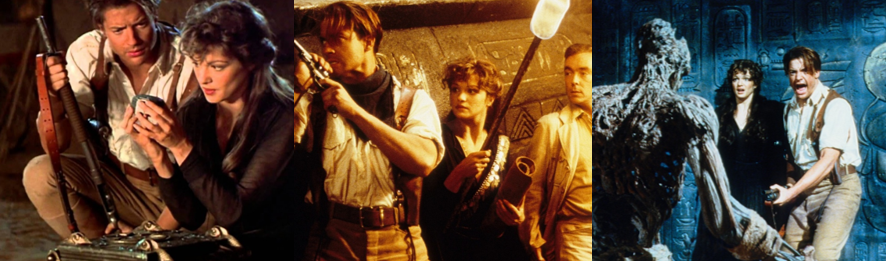
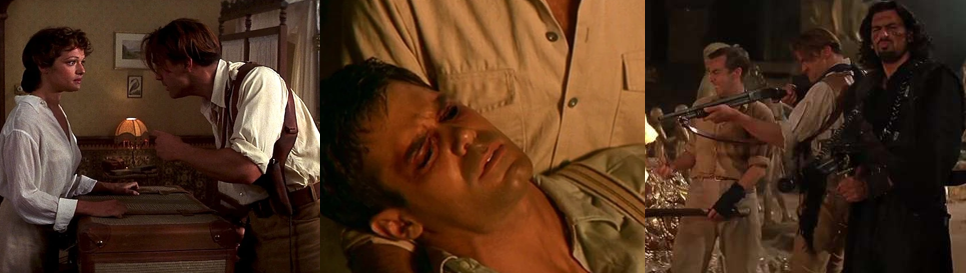
Three years later, Rick (now a dishevelled mercenary) is imprisoned in Cairo and sentenced to be hanged by lecherous warden Gad Hassan (Omid Djalili). Luckily for Rick, he was recently pick-pocketed by unscrupulous Jonathan Carnahan (Hannah) who brings his prize to his bookish, scholarly sister, Evelyn “Evy” Carnahan (Weisz). Though intrigued and baffled by the artefact, Evy immediately recognises that it contains a map to Hamunaptra and eagerly requests to get some much-needed field experience searching for the fabled city, only for her superior, Doctor Terence Bey (Erick Avari), burns a vital part of the map, ostensibly to protect them from running off on a fool’s errand. Undeterred, Evy has Jonathan take her to the man he stole it from and, though aghast by Rick’s boorish nature, successfully barters for his freedom in return for leading an expedition to Hamunaptra. Although Rick has no love for Hamunaptra, he feels he owes Evy a debt and is obviously captivated by her beauty, innocence, and drive to prove that she’s more than a simple clumsy librarian. Evy finds herself constantly daydreaming of the spontaneous kiss she shared with Rick and excited by the adventure, seemingly naïve to any danger, excitedly explaining local legends and superstitions and identifying the best places to dig. While unimpressed by Rick’s impudence, Evy’s nevertheless besotted by him and, honestly who could blame her? Brendan Fraser excels as a gunslinging rogue and is a constant highlight, bringing a wit and determination that makes Rick an easy character to root for. Rick has fantastic chemistry with Evy, who’s essentially the exact opposite of him, and admires her determination, though he’s reluctant to face the danger after Imhotep is unleashed and only does so to keep Evy safe.

Evy’s scholarly knowledge and Ardeth’s experience help combat the malicious mummy.

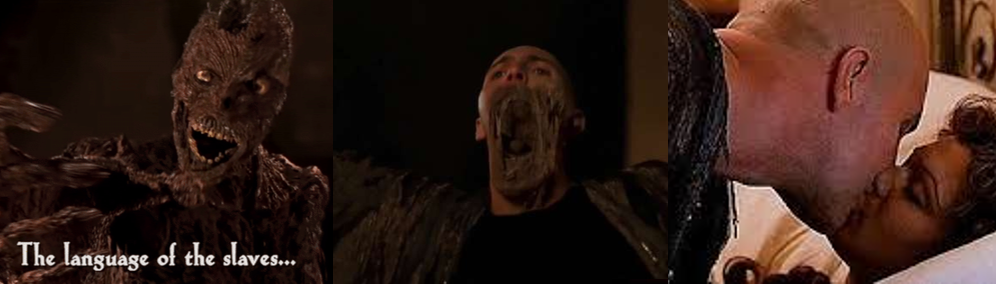
While travelling to Hamunaptra, Rick finds Beni leading some well-funded and well-equipped Americans to the same location. Thanks to Beni being a snivelly little weasel and a constant screw up, Rick successfully leads Evy to Hamunaptra first and the two groups continue to try and one-up each other as they search the site. Thanks to Evy, Rick and the others uncover Imhotep’s long-forgotten tomb, though Egyptologist Doctor Allen Chamberlain (Jonathan Hyde) discovers the Book of the Dead but cannot open it without Evy’s artifact. Knowing this, Evy “borrows” the hefty tomb and reads from it, despite Rick’s objections, unwittingly reawakening an ancient evil. Imhotep’s powers immediately manifest, causing a swarm of locusts to drive both groups into the underground chambers, where Imhotep ruthlessly robs short-sighted Bernard Burns (Tuc Watkins) of his eyes and tongue before being stunned by Evy’s likeness to Anck-su-namun and procuring Benji’s services since he speaks the “language of the slaves”. Both groups are then hounded by the Mummy, who finishes off Burns and similarly absorbs the flesh from Isaac Henderson (Stephen Dunham) and David Daniels (Corey Johnson), quickly regaining confidence and power, much to the horror of the Medjai. Despite attacks by the Medjai and Ardeth’s warnings, the groups persist and struggle to comprehend what they’ve unleashed, though Ardeth eventually joins them in combatting the Mummy despite mortal weapons having little effect on the creature. Even Jonathan, largely lethargic and cowardly, steps up, gunning down Medjai and hiding amongst the brainwashed civilians once Imhotep’s powers increase and proving himself useful in the finale, despite his distinct disadvantages compared to his sister when it comes to reaching ancient hieroglyphics.

Though driven by love, Imhotep’s Biblical powers are a threat to the world.

Although Imhotep is motivated by a burning desire to reunite with his beloved, the Mummy is a fearsome and formidable adversary. He seemed to have no interest in world destruction in ancient times but happily calls forth Biblical plagues once resurrected, smiting foes with falling meteorites, siccing his undead loyalists upon those who defy him, and even manifesting a sandstorm to knock Rick from the sky after he drafts drunken, suicidal World War I pilot Captain Winston Havelock (Bernard Fox) to help rescue Evy. Despite initially awakening as a decrepit, desiccated skeleton and fearing cats (the “guardians of the underworld”), Imhotep wields awesome power, easily shrugging off bullets, ripping out organs, and sucking the flesh from his victims with a supernatural scream. Each victim restores more of him, eventually returning the glorious Arnold Vosloo to the screen, where he exudes a quiet, confident menace with a simple glance. Though Beni acts as his translator, Imhotep’s intentions are always clear through his smirk, glare, and body language, to the point where he and Rick understand each other during their tense showdown in Cairo. While it’s not emphasised much as we only see the effects of Imhotep’s actions in the nearby area, it’s stated that Imhotep will destroy the entire world once reunited with Anck-su-namun. However, the primary concern is rescuing Evy before she’s sacrificed to complete Anck-su-namun’s resurrection. Anck-su-namun is Imhotep’s greatest weakness (aside from cats…) as he constantly stops to gaze upon Evy. Evy even uses this to her advantage, kissing Imhotep to dispel his sandstorm, though he has no hesitation in ordering his undead followers to pin her down to be killed so her true love can return.

The Nitty-Gritty:
The Mummy is a great example of a remake done right as it reinterprets the 1932 original as a period-piece adventure film. The basic plot of the original film is here but mainly condensed to the opening sequence and the general threat of an undead mummy trying to resurrect his former love. Comparisons to the Indiana Jones movies are suitable, but not entirely apt. Rick is nothing like Doctor Henry Jones Junior/Indiana Jones except that they’re both rugged, capable heroes. Indeed, Indy’s academic traits are ascribed to Evy (and, to a lesser extent, Jonathan) as Rick’s knowledge comes from experience and hearsay. While the film veers towards horror, it’s noticeable light on gore. When Burns gets his eyes and tongue removed, for example, they’re merely gaping voids in his pained face and it’s always obscured when characters get their flesh melted or devoured. Still, The Mummy doesn’t need to be a gore-fest and is much more enjoyable as a more accessible horror adventure film, and it still has some unsettling visuals. Imhotep’s rotting form is quite disturbing and the flesh-eating scarabs are probably very disturbing for entomophobes. The Mummy also has a great sense of humour, especially in the banter between Rick, Evy, and Jonathan and the depiction of many action scenes. There’s a goofy quality to the mummy fights as their limbs and heads are hacked off and it’s fun seeing Rick’s completely understandable reactions, like screaming in Imhotep’s face, fleeing when his mummified hoards advance, and openly criticising poor decisions like returning to Hamunaptra, reading from the Book of the Dead, and fighting the functionally invincible Imhotep.

While some effects are better than others, there’s still a lot of fun action in this adventure.

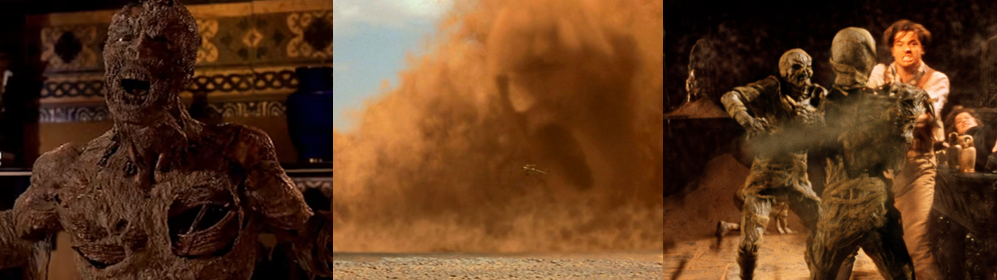
While I have a lot of nostalgia for The Mummy, I’d be lying if the CGI has stood the test of time. At times, it works really well, generally in low lighting or alongside practical effects, and it’s clear that a lot of effort went into rendering Imhotep’s “juicy”, skeletal corpse. However, it can look quite cartoonish, especially when the lighting’s off or he appears in broad daylight, scarabs scuttling under his flesh and his jaw hanging crooked. It was pretty ground-breaking at the time, though, and they’re still impressive shots, they’ve just not aged well. Paradoxically, it’s somewhat disappointing when the alluring Arnold Vosloo returns as a CGI mummy, a big selling point, but he still showcases some supernatural abilities, such as reattaching his severed limb and turning into sand. Surprisingly, these sentient sand effects have held up really well and I love the added detail of Imhotep’s screaming, smirking face in the effect. The plagues also look great, especially the meteor shower and the disgusting boils that appear on Imhotep’s brainwashed slaves, though his mummified cronies are hit or miss. I think the budget was stretched thin by the finale and the filmmakers were a tad ambitious in bringing a dozen or so mummies to the screen. This is best evidenced when you compare Imhotep’s followers to Anck-su-namun, who looks much better (and creepier) for being a practical effect. There are some fun gunfights though, with Rick impressing with his dual pistols, constant supply of firearms, and adaptability as he wards off the Medjai and waves Evy’s cat at Imhotep. The sets are also impressive, ominous recreations of Egyptian tombs and catacombs to really give a sense of foreboding when the characters are stumbling around in the dark.

Imhotep’s plot to be reunited with his lover are undone, with Rick and Evy finding love instead.

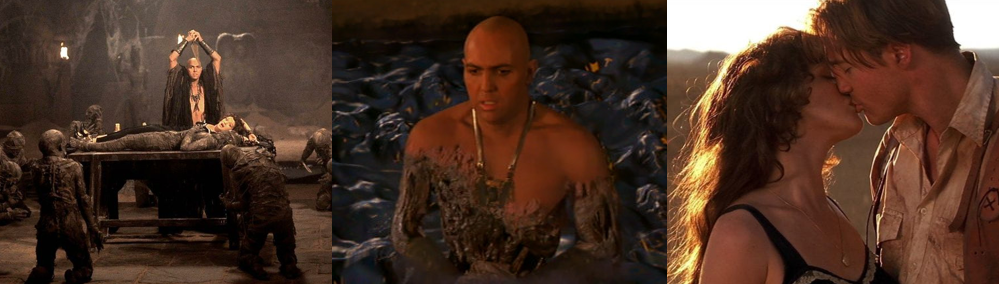
Having hunted down the Americans, Imhotep reaches full power, recovering the Book of the Dead and kidnapping Evy so she can be sacrificed at Hamunaptra. Determined to rescue her and stop the Mummy using the fabled Book of Amum-ra, Rick drafts Jonathan, Winston, and Ardeth into helping him and successfully braves Imhotep’s storm (with some quick thinking from Evy), though Winston is lost in the crash. Since Imhotep needs time to read the incantations and return Anck-su-namun from the underworld, he conjures his mummified acolytes for a fun action sequence where Rick hacks at some mummies and Ardeth blasts them with a machine gun. After retrieved the Book of Amum-ra, Jonathan uses it to distract Imhotep, allowing Rick to free Evy, though she’s attacked by the wretched, undead corpse of Anck-su-namun as Imhotep’s soldiers prepare to finish Rick. Thanks to Evy, Jonathan gains control of Imhotep’s minions, ordering them to hack Anck-su-namun to pieces, much to Imhotep’s rage. He takes his anger out on Rick, manhandling him and preparing to throttle him, only for Evy and Jonathan to read a second incantation that sees Anubis strip Imhotep’s powers. Undeterred, Imhotep prepares to finish his foes off, only to stupidly walk right into Rick’s sword. Startled, Imhotep stumbles into a pool of tar-like liquid, where wailing spirits rapidly decompose him (though he does manage ominously state, “Death… is only the beginning.”) Though victorious, Rick and the others are forced to flee when Beni, who decided to ransack the temple, accidentally triggers a boobytrap. Despite all his flaws and misdeeds, Rick makes a valiant effort to save Beni, but he gets distracted by his haul and left behind with the scarabs. Still, our heroes escape, earning Ardeth’s gratitude, and they ride off with a haul of riches and Rick and Evy finally sharing a passionate and consensual kiss.

The Summary:
While I generally prefer the sequel, The Mummy still holds up really well. Considering how much I disliked the original film and how awful the later reboot was, this is a fun action/adventure with a lot of heart and humour mixed with some light horror elements and thrilling action. Brendan Fraser excels as roguish gunslinger Rick O’Connell, who is immediately likeable and extremely capable while still flawed and vulnerable. I loved how he was so smitten by Evy that it occasionally rattled his confidence, and how he threw himself into every situation regardless of how sceptical he was. His banter with Evy and Jonathan was a constant highlight and he’s honestly a joy to watch, as is the disgustingly beautiful Rachel Weisz, who perfectly embodies this meek but feisty academic who eventually finds the courage to speak her mind. Jonathan was a great counterbalance to them both and I was always intrigued by the mystery surrounding Ardeth Bay, who really should’ve gotten a spin-off. Arnold Vosloo makes for a deliciously menacing villain, yet one who’s still quite tragic and sympathetic since he’s motivated by love and cursed to be a horrific creature. Although I stand by my criticism of the CGI, The Mummy still boasts some impressive special effects that largely hold up and the desiccated mummy design is very well done. I liked how the film expertly balanced its accessible horror with more action-orientated elements and kept the stakes grounded, but with the suggestion that the world was also at stake. In the end, The Mummy is still a fantastic film that far surpasses the original and has stood the test of time as a hugely enjoyable romp with some memorable characters, fun action, and impressive (if, let’s be honest, dated) special effects.

My Rating:

Rating: 4 out of 5.

Great Stuff

Did you enjoy this action-orientated remake of The Mummy? Did you enjoy Brendan Fraser’s performance as the roguish Rick? Do you agree that the CGI effects haven’t aged too well or do you think they still hold up? Did you like the blossoming romance between Rick and Evy or did you find it a bit nauseating? Why do you think Imhotep wasn’t simply executed? Would you read from the Book of the Dead? Which of Mummy trilogy is your favourite and how are you celebrating Halloween this year? Let’s see your thoughts on The Mummy below, then read some of my other horror reviews and donate to my Ko-Fi for more Mummy content.

Movie Night: The Mummy (1932)

Released: 22 December 1932
Director: Karl Freund
Distributor: Universal Pictures
Budget: $196,000
Stars: Boris Karloff, Zita Johann, David Manners, Edward Van Sloan, and Noble Johnson

The Plot:
Mummified for attempting to resurrect his dead lover, Egyptian high priest Imhotep (Karloff) reanimates when his tomb is disturbed and sets about wooing Helen Grosvenor (Johann) under the guise of an Egyptian historian.

The Background:
In 1922, British archaeologist Howard Carter and his, benefactor Lord Carnarvon, discovered the tomb of ancient Egyptian pharaoh Tutankhamun, uncovering a cache of riches and an elaborate sarcophagus that wowed and inspired generations. Producer Carl Laemmle Jr. was also inspired by this event, and the so-called “Curse of the Pharaohs” and commissioned story editor Richard Schayer to find a novel for a Mummy-centric horror movie to mirror Universal Studios’ previous success at adapting Dracula (Stoker, 1897) and Frankenstein; or, The Modern Prometheus (Shelley, 1818). Schayer and writer Nina Wilcox Putnam discovered Alessandro Cagliostro’s Cagliostro, a nine-page treatment with some similarities to Arthur Conan Doyle’s The Ring of Toth, which was then retooled by screenwriter John L. Balderston into The Mummy. Taking inspiration from ancient, real-world figures, Balderston’s script became cinematographer Karl Freund’s first gig as a director in America and saw Boris Karloff flex his acting muscles in the title role. Still, Karloff endured a lengthy and uncomfortable make-up process as Jack Pierce transformed him into a desiccated corpse, slathering his face with cotton, collodion, and spirit gum and wrapping him in linen bandages treated with acid and burnt in an oven! While the film’s historical accuracy was debated, The Mummy was a modest box office success met with mixed reviews that has since been regarded as a classic horror for its unique blending of romanticism and horror. The film inspired a few loose sequels and spin-offs before being expertly reconfigured into a highly regarded blockbuster adventure in 1999 (which also spawned sequels and some questionable spin-offs). Although that goodwill was undone by an ill-fated remake in 2017, the visual of an undead creature wrapped in bandages has been an enduring horror figure regardless.

The Review:
The Mummy begins in 1921, where archaeologist Sir Joseph Whemple (Arthur Byron) uncovers Imhotep’s sarcophagus alongside his assistant Ralph Norton (Bramwell Fletcher). While the two are excited to examine the find, Whemble’s friend and colleague, Doctor Muller (Van Sloan), warns that the sarcophagus carries a terrible curse, which Whemble scoffs at, but Dr Muller insists is a warning of the wrath of the ancient Egyptian Gods. While the two wax philosophical, Norton opens the tomb and discovers Imhotep’s surprisingly well preserved remains, the priest having been mummified alive (rather than having his “viscera” removed) for some terrible affront, alongside the “Scroll of Thoth.” Despite Dr. Muller’s warnings, the curious Norton reads from the scroll, unintentionally awakening Imhotep, who lurches to life, swipes the scroll, and leaves Norton so out of his mind that he eventually dies laughing in a straitjacket. The film then jumps ahead some ten years to find Whemple’s son, Frank (Manners), following in his now deceased father’s footsteps, digging for ruins in Egypt alongside Professor Pearson (Leonard Mudie) but having nothing to show for it but a lot of wasted money and a few trinkets. Frustrated and disheartened, the two prepare to leave when they’re visited by the enigmatic and mysterious “Ardath Bay”, Imhotop’s dishevelled but largely human pseudonym, who points them to the long-lost tomb of Princess Ankh-es-en-Amon (Johann). Although they’re initially sceptical, the two are overjoyed when their enthusiastic (but surely underpaid and overworked) dig team uncover the tomb, though Frank is mildly scorned that their discovery is claimed by the Cairo Museum as per the terms of their contract. In contrast, Professor Pearson is overjoyed, welcoming their mysterious benefactor to the museum and holding Ardath Bay in high regard despite his odd demeanour and superstition about being touched and digging up his people’s dead.

Imhotep has little trouble using incantations to fool and manipulate the unsuspecting characters.

Whemple returns to Cairo to bask in the find and Frank is soon enamoured by the beautiful half-Egyptian Helen, a patient of Dr. Muller’s, who suddenly becomes entranced when Imhotep mutters an incantation over a cauldron to show him the reincarnation of his lost love, Ankh-es-en-Amon. Mumbling a language she couldn’t possibly know, Helen is compelled to answer Imhotep’s call, only to be stopped by a locked door and promptly faint, with little to no recollection of what happened. Transfixed by the girl, Frank promptly flirts with her with his stories of how they discovered and unwrapped Ankh-es-en-Amon’s tomb, only for Helen to react with distaste for his sacrilege and somewhat mock him for being smitten by a rotting corpse. While this is somehow enough to earn him a snog, the two are horrified to learn that a museum guard was murdered and that the Scroll of Toth (which Whemple somehow recognises despite him never seeing it) was discovered with the body. While Frank and Muller suggest burning the cursed object, they’re interrupted by Ardath Bay, who’s immediately captivated by Helen and her striking resemblance to his long-dead lover, entrancing the confused girl with the faded memories of her past life. Suspicious of Ardath Bay, Frank and the others confront and quiz him, compelling him to reveal his true identity and to demand the scroll or die (a strange demand considering he had the scroll) and showcasing his ability to hypnotise anyone with Egyptian blood as he brainwashes their Nubian servant (Johnson). Although Whemple resolves to burn the scroll, Imhotep watches from his cauldron and commands the Nubian to intercept him, murdering the old man but ultimately fooling no one with some burned newspaper. Unable to resist Imhotep, Helen returns to the museum and, while spellbound, learns of her past like in ancient Egypt.

Condemned for sacrilege, Imhotep is determined to be reunited with his long-dead love.

Back in the day, Imhotep was besotted by Ankh-es-en-Amon but heartbroken when she died of some illness. Defying the Gods and her father, “Pharoh” Amenophis (James Crane), Imhotep stole the Scroll of Thoth but was buried alive with it when his scheme to resurrect her was discovered. Though Helen’s conflicted, she begs Frank to confine her to her room, terrified of what might happen, leading Imhotep to further manipulate his underlings to reunite his love’s soul with her reincarnated body. Luckily, Boris Karloff provides an enigmatic performance as the titular mummy as this was a chore to sit through. While Imhotep gives Karloff the chance to showcase his range, he’s hardly a terrifying force, even when a decomposing figure, and comes across more like a bored narcoleptic who watches events from his cauldron and threatens people with his scarab ring. The film is more of a bizarre love story, with Imhotep professing a timeless love that he’s carried throughout a restless death and which has seemingly allowed Ankh-es-en-Amon to resurrect throughout the ages. Though Frank can’t compete with Imhotep’s lovelorn declarations, he’s at least alive and doesn’t look like a dried-out sultana so Imhotep plots to kill him, thus removing his rival and any doubt in Helen’s heart. Helen seems into both men, even though she barely knows Frank and Imhotep essentially hypnotises her to make her docile and thus vulnerable for him to kill and perform some mumbo-jumbo to return Ankh-es-en-Amon’s soul to her restored body. While Imhotep seemingly murders those in his way, he seems quite careless as he lost the Scroll of Toth and was forced to demand it. Equally, he’s held at bay (Ardath Bay, you might say…) by a protective amulet and prefers to let the Nubian do all his busy work since he must sit around mumbling incantations, spying on people, or creeping them out with his odd appearance and behaviour.

The Nitty-Gritty:
While I don’t believe for a second that the production filmed in Egypt, I was impressed by the sets and interiors, which are filled with Egyptian artifacts to sell the illusion. Many may not be historically accurate, and the flashback to 1800 BC isn’t very convincing, but there was a clear attempt to make things look a little more elaborate than most Universal Monsters movies. I also appreciated the surprising violence, with a convincing spear impalement and Imhotep describing how the slaves and soldiers present for his burial were executed, and that the film incorporated music (though sporadically) to punctuate dramatic moments. I wish I could say more about Karloff’s make-up but it’s not really that impressive as Imhotep mostly looks drawn and wrinkly. When he’s a desiccated corpse, things are more impressive, but I think a gaunt dummy would’ve been more effective than slathering Karloff in make-up and prosthetics that barely appear for that long. Rather than shambling about as a withered corpse wrapped in tattered bandages, Imhotep waltzes about in a fedora as Ardath Bay, conjuring spells and directing his minions, making him more of a warlock than a mummy. His horror comes from his supernatural abilities, which are limited to hypnotism (and further limited to only affecting those with Egyptian blood). He showcases no superhuman strength or wizardry, instead being a letch who relentlessly pursues, mesmerises, and manipulates others, meaning The Mummy is more about the fear of being controlled than the fear of some ancient creature.

In the end, the ineffectual Imhotep is undone by the Gods in anti-climactic fashion.

Confined to her room and watched like a hawk, Helen’s condition worsens the more she’s kept from Imhotep and the more he tries to reach her with his curses. Luckily, Frank is stupid enough to remove his amulet and take a nap, barely saving himself from Imhotep’s killing curse but nonetheless powerless to keep the Mummy from bewitching Helen. When Helen reaches the museum, her personality has been replaced by Ankh-es-en-Amon, though Imhotep still plans to murder Helen with the most unconvincing dagger I’ve ever seen and then reading from the Scroll of Toth to return Ankh-es-en-Amon’s soul to Helen’s body, allowing them to rekindle their love as undead mummies. Surprisingly, Ankh-es-en-Amon resists this, wishing to inhabit Helen’s young and supple body, and Helen’s personality also struggles against the Mummy, though neither can resist Imhotep’s hypnotic power. After being revived, Frank and Muller rush to Helen’s aid, only to be held back by Imhotep’s spooky scarab ring. This distraction is enough for Ankh-es-en-Amon to beg the Goddess Isis for aid. Incredibly, this works and the statue of Isis lurches to life, pointing an ankh at Imhotep that dispels his power over the Nubian and burns the Scroll of Toth. This also causes Imhotep to (somewhat) rapidly rot and turn to a mere skeleton, clattering to the floor. If you thought this was an abrupt end, the film then doubles down by suddenly cutting to black and the end credits after Frank calls to Helen to return to her body. Admittedly, it’s potentially left ambiguous whether this worked as it could’ve just as easily been Ankh-es-en-Amon who woke up, but I was so bored and annoyed by the film that I really didn’t care and was glad that it was finally over!
The Summary:
My God, this was a chore to watch. I’ve seen The Mummy before and didn’t remember it being this bad, but it really is one of the most boring Universal Monsters movies I’ve seen. I’ve never been the biggest fan of the concept, despite my love for Egyptian superstition and history, but The Mummy really impressed with its sets, attention to detail (historical accuracy be damned), and overall presentation. Sure, we never get a proper look at Cairo or any exteriors, but the interiors and artifacts and such really sold the illusion for me. It’s a shame it’s filled with a bunch of stupid-ass characters who are little more than walking clichés. Zita Johann captures the camera with her beauty, effortlessly showcasing Helen’s confusion and allure, though I would’ve liked to see more of Ankh-es-en-Amon’s personality and how it differed from Helen’s. Frank was just kind of there and I honestly got some of the male leads mixed up as I struggled to sit through this one, though it was amusing seeing them all rendered ineffectual and the day being saved by both a woman and a Goddess. Boris Karloff stole the show with his acting and range, rather than being buried under heavy make-up, but I found the titular Mummy to be a weak and ineffectual character. He wasn’t scary (unless you’re afraid of being hypnotised), he didn’t really do anything (any kills that could be attributed to him were offscreen), and he was defeated with ridiculous ease. Even if you view The Mummy as a bizarre love story rather than a horror, it falls apart under close scrutiny thanks to a questionable script, bone-headed characters, and the concept running out of steam early on. It’s such a shame as there could’ve been something really special here but there aren’t even any impressive make-up effects or chilling moments to salvage this one and it’s easily the most forgettable of the Universal Monsters movies, in my opinion, and far surpassed by the 1999 remake.

My Rating:

Rating: 1 out of 5.

Terrible

Do you think I was too harsh on The Mummy? Perhaps you’re a fan of this one; if so, why? Were you disappointed that Imhotep wasn’t more monstrous or did you enjoy seeing Boris Karloff’s range? What did you think to the presentation of the film and the depiction of ancient Egypt? Were you entranced by the love story angle or did you also find the film a slog to sit through? Which version of the Mummy is your favourite and how are you celebrating Halloween this year? Share your thoughts on The Mummy in the comments, check out my other horror reviews, and donate to my Ko-Fi if you want to see more Mummy reviews.

Movie Night: Mary Shelley’s Frankenstein

Released: 4 November 1994
Director: Kenneth Branagh
Distributor: TriStar Pictures / Sony Pictures Releasing
Budget: $45 million
Stars: Kenneth Branagh, Robert De Niro, Helena Bonham Carter, Aidan Quinn, and Ian Holm

The Plot:
Obsessed with preventing death, eccentric scientist Victor Frankenstein (Branagh) patches together a monstrous being (De Niro), who embarks on malicious crusade when its creator rejects it.

The Background:
In a bid to tell a story that spoke to “the mysterious fears of our nature” while snowed in in Geneva, eighteen year old Mary Shelley dreamed up Frankenstein; or, The Modern Prometheus in 1818, attracting much controversy for its blasphemous content and producing a celebrated piece of literary fiction. Following a short silent film in 1910, Frankenstein saw considerable success on the stage and silver screen thanks to James Whales’ 1931 horror classic and Boris Karloff’s iconic performance. Following numerous additional reinterpretations, and the incredible critical and commercial success of Bram Stoker’s Dracula (Coppola, 1992), director Francis Ford Coppola wanted to helm a more faithful adaptation of the book before moving into a producer role. Coppola’s first mandate was that Robert De Niro be cast as the tragic creature and that Kenneth Branagh should direct. Next, Frank Darabont was drafted to rewrite Steph Lady’s initial script, though he later lamented that Branagh had heavily altered his vision for the film. Alongside a far more fantastical depiction of the Monster’s reanimation, Mary Shelley’s Frankenstein presented a dramatically different version of the creature, one far closer to Shelley’s text than other adaptations. With a box office of $112 million, Mary Shelley’s Frankenstein was a modest financial success met with mostly mixed reviews that criticised the manic pace and surprisingly bland execution, while praising De Niro’s heart wrenching performance and the intriguing exploration of Victor’s haunting obsessions.

The Review:
Mary Shelley’s Frankenstein immediately gets off on the right food by establishing a framing narrative the echoes the original text, beginning by following Captain Robert Walton as he leads his crew in a desperate bid to find a path through the ice to the North Pole. Unfortunately, the journey is so perilous and difficult that his crew are close to breaking point. Even when the ship gets trapped in ice, Captain Walton refuses to turn back, having spent his entire fortune funding the trip and being driven by an obsession with etching his name in history, no matter the cost. As the crew frantically try to free the ship and entertain thoughts of mutiny, they’re startled by an inhuman howl and amazed when a dishevelled cloaked figure appears from the storm, babbling about some “thing” out on the ice. Captain Walton takes the exhausted stranger in and cares for him, curious about what’s waiting in the frigid wasteland, only to be introduced to the manic, wild-eyed rantings of Victor Frankenstein, who begs Captain Walton to give up his crusade due to the danger of the mysterious thing pursuing him. When Captain Walton refuses, scoffing and enraged at the idea of being denied his destiny, Frankenstein is distraught to see the stubborn captain shares his madness and, in a bid to convince him to turn back before he destroys himself and his crew, tells Captain Walton his life story. This is related through the remainder of the film, with some correspondence between Frankenstein and his adopted sister, Elizabeth (Carter), and excerpts from Frankenstein’s journal mirroring the epistolary nature of the novel, and being bookended by Captain Walton’s reaction to Frankenstein’s crazed story of scientific obsession turned to destruction.

Obsessed with defeating death, Frankenstein employs immoral and outlawed sciences to create life.

Frankenstein met Elizabeth when they were children (Rory Jennings and Hannah Taylor-Gordon) and spent his whole life caring for her as though she were his own, as instructed by his beloved mother, Caroline (Cherie Lunghi), and expert surgeon father, Baron Alphonse Frankenstein (Holm). Even from an early age, Frankenstein hungered for knowledge and conducted many eccentric experiments using ancient tomes, mostly concerning the transfer and nature of energy, to the amazement of his family. Unfortunately, Frankenstein’s youth was marred by tragedy as his mother died giving birth to his younger brother, William/Willie (Charles Wyn-Davies/Ryan Smith), an event that traumatised Frankenstein and began his obsession with defeating death. Upon arriving at the University of Ingolstadt to follow in his father’s footsteps, Frankenstein immediately gains notoriety for studying and championing unconventional texts and authors long considered heretics or sorcerers, angering his more rational and scientifically minded tutors, who believe their focus should be on saving lives using the scientific method. Obstinate and arrogant, Frankenstein secretly continues his experiments alongside his enthusiastic (if medically conventional) friend Henry Clerval (Tom Hulce), but his outbursts attract the curiosity of Professor Waldman (John Cleese), who touted similar beliefs in the past and was tarnished because of it. Frequent discussions and experiments with Professor Waldman further Frankenstein’s obsession with preventing or reversing death, discovering that the applying electricity to key areas of the body can reanimate corpses, though even Professor Walden refuses to share his notes and divulge how close he came before giving up his crusade. Frankenstein, however, is undeterred and only redoubles his efforts after his mentor is senselessly murdered trying to prevent an outbreak of cholera. Despite Clerval’s objections, Frankenstein studies Professor Walden’s notes and arrogantly believes he can succeed where his mentor failed by acquiring the right “raw materials” for his “reanimate”, locking himself in his attic laboratory and ignoring his friends and loved ones as he works himself to exhaustion stitching together a monstrosity that he believes will be both smarter, stronger, and superior to man.

Frankenstein’s work sees him shun those closest to him, including his devoted adopted sister and lover.

Frankenstein’s fixation on overcoming death sees him become a recluse; he locks Clerval out and stops writing letters to his family and Elizabeth, who’s particularly distraught as the two became so close over the years that they couldn’t deny their feelings and vowed to be married once Frankenstein finished his studies. While it is admittedly quite disturbing to see these “siblings” suddenly lustful for each other, no one bats an eyelid at their romance because it’s been obvious to everyone, especially nursemaid Justine Moritz (Trevyn McDowell), who’s been in love when Frankenstein since they were children, that that two have always cared deeply for one another, Elizabeth is besotted by Frankenstein, eagerly anticipating consummating their relationship on their wedding night and desiring to bring new life to their family home through their children. Encouraged by Justine, Elizabeth travels to Ingolstadt to be with her lover, concerned for his welfare, only to find him a physical and emotional wreck living in squalor. Erratic and fixated on his work, Frankenstein shuns Elizabeth and sends her away, breaking her heart. However, when he’s discovered in a feverish stupor by Clerval, Frankenstein is nursed back to health by his friend and his love, reconciling with Elizabeth and suddenly vowing to give up his bizarre and secretive experiments. Frankenstein returns to his family home in Geneva, ready to commit himself to medical science alongside Clerval, and joyously announcing his engagement to his father, who celebrates the union as a blessed event. However, Frankenstein remains tight-lipped about his dark days isolated in his lab and refuses to speak of what transpired there, taking solace in his newfound happiness. Elizabeth and Alphonse are left devastated when Frankenstein’s past comes back to haunt him, however, as poor little Willie is brutally murdered on the family grounds and poor Justine is unfairly and unlawful lynched as the primary suspect, thrown off the prison roof and hanged by the bloodthirsty local despite the true culprit being a hideous creature of Frankenstein’s own making.

Robert De Niro disappears behind the creature’s monstrous make-up.

Following Professor Walden’s notes, Frankenstein cobbles together a brutish patchwork creature from bits and pieces of others, including the man who killed his mentor and Professor Walden’s brain. Using a bizarre contraption filled with amniotic fluid and powered by electric eels, Frankenstein maniacally sees his experiment through and is initially overjoyed when his creature comes to life. However, he immediately regrets his actions, echoing Professor Walden’s own conclusions, when the Monster appears ungainly, deformed, and brain damaged. Believing the creature to be dead, a remorseful Frankenstein forgets the entire thing, unaware that his creature stumbled through Ingolstadt in a daze before being driven to the countryside by paranoid locals who, upon seeing the monstrous visage, assumed it was the cause of the cholera outbreak. While in the woods, the Monster shelters in the barn of a kindly family of farmers, who are struggling to survive due to the bitter winter cold. Touched by their kindness towards each other and their plight, the creature secretly helps harvest their crops and learns (or, as it later says, remembers) how to read and write by observing them. When the creature defends the family’s blind grandfather (Richard Briers), it’s welcomed by the grateful old man, who shows compassion, only for the rest of the family to misread the situation and drive the Monster away before fleeing. Learning of its origins from Frankenstein’s journal, the enraged creature hunts down its creator and confronts him on “the sea of ice”, desperate to learn the purpose of its existence. Though a deeply sympathetic and pitiable creature, it’s hard to feel too bad for Frankenstein’s being when it delights in detailing how it crushed the life from Willie and set Justine up for her execution. It vows to indulge its insatiable rage if Frankenstein refuses to build it a mate, promising to disappear from the world if it has a companion to ease its suffering, and is presented as the personification of Frankenstein’s folly.

The Nitty-Gritty:
It’s been a while since I read the book, but Mary Shelley’s Frankenstein is certainly the most accurate adaptation of the text I’ve ever seen. It has the framing narrative, showcases his family life, details his studies, and presents the Monster as being intelligent and articulate, all things largely ignored in the 1931 version. Frankenstein has always been a favourite of mine, largely because of this movie, which I believe was my first exposure to the story. It’s amusing to watch in some ways, however, since Frankenstein’s rantings about hair and fingernails regrowing after death have long been proven to have nothing to do with the body still being alive. Similarly, his experiments with electricity are shown to literally reanimate a frog when we know that any convulsions and movements are due to the electrical current. Frankenstein does touch upon some valid aspects of medicine in his rantings, however, like organ transfers, very much making him ahead of his time (and thus a heretic to the God-fearing scientific community). I’ve always found it odd, though, that Frankenstein stitches together his creation. Professor Walden’s notes state that the right “raw materials” may result in success, though it’s not clear what makes any of the body parts Frankenstein gets more “right” than others except when he harvests “the very finest brain” from his mentor. It seems like it’d be much easier to simply zap Professor Walden’s body to bring him back but, instead, Frankenstein cobbles together a creature he feels will be the perfect lifeform, only to be disgusted and ashamed of his feeble creation once he realises he’s made a massive mistake. I really enjoyed that we got to see the Monster learning from the family and the exploration of how its mind works. Many of its memories and abilities are presented as “trace memories”, as though each body part remembers something different from its previous life and the creature can use that knowledge to learnt to speak and play the flute while also being a completely unique personality, one driven by incredible love and equally powerful rage.

A visually memorable, gory, and faithful adaptation of the thought-provoking text.

It’s astounding to me that Robert De Niro, of all people, was cast as the creature but he does an excellent job depicting the Monster’s confusion, anguish, and hatred. Initially a mindless, wailing creature acting on instinct, the Monster comes to realise it is a living thing (in a sense) and has been abandoned by its creator. Its conversation with Frankenstein echoes the bitter resentment a man may have towards God and Frankenstein’s blunt, clinical answers about the creature’s purpose and origin speak to the disappointment one might feel upon asking God, “Why am I here?” Rather than being a bulky, block-headed giant lumbering about with bolts through it sneck, the Monster is a patchwork of skin and body parts, with De Niro’s eyes conveying the bulk of the emotion as the impressive make-up distorts his features. Instead of channelling a lightning bolt into his creation, Frankenstein constructs an elaborate and frankly ridiculous contraption that uses special chemicals, electrodes, and electric eels in an unsettlingly sexualised sack to birth his creature, somewhat overcomplicating the process but providing some unique visuals, if nothing else. The creature is depicted as being incredibly unstable, boasting superhuman strength and agility and seemingly impervious to the cold, and flip-flopping between loving and gentle and abhorrently brutal as it relishes killing Willie and tormenting Frankenstein. Mary Shelley’s Frankenstein gets very gory, with death, especially, depicted as a messy and traumatising affair. Caroline and Professor Walden’s deaths are particularly gruesome, leaving the Frankenstein’s covered in blood, and Justine’s is notably harrowing given the senselessness of it all. Things come to a head when the Monster, enraged when Frankenstein breaks his vow, makes good on its promise and brutally murders Elizabeth on their wedding night, ripping out her heart and mangling her corpse with glass and fire. It’s no wonder that Frankenstein is so obsessed with defeating death considering these experiences, but his obsession is tainted by arrogance and a God complex that makes him foolhardy and stubborn, refusing to entertain any notions contrary to his or apply his admittedly keen mind towards perfecting surgeries and medicines to achieve his goal.

Frankenstein’s obsession ends in heartbreak and death when his creation demands recompense.

Although Frankenstein reluctantly agrees to create a mate for the Monster, desperate to atone for his mistakes and to give his creation some peace, he backs out on the deal when the experiment again alienates him from Elizabeth. Marshalling his family guards, Frankenstein abandons his work to marry Elizabeth, only to be devastated and horrified when the Monster tears out her heart in recompense. With his lover dead and his father dying of a broken heart following Willie’s murder, a grieving Frankenstein shuns Clerval’s objections and frantically stitches Elizabeth’s disfigured head to Justine’s corpse and recreates his experiment, desperate to be reunited with his love and lost to his insane obsession once more. Even when the confused, clearly disfigured and inept Elizabeth returns to life, Frankenstein refuses to realise what he’s done, begging her to say his name, slipping on her wedding gown and ring, and dancing with her with manic joy even as she flops around like a lifeless puppet. Frankenstein’s bliss is shattered when the Monster appears and claims Elizabeth for itself, her being drawn to the monstrous being on some primal instinct. While Frankenstein is elated when she finally chokes out his name, Elizabeth is horrified when she catches sight of her mangled reflection and incensed when the two fight over her, eventually choosing to immolate herself, taking Frankenstein’s home with her. Returning to Captain Walden, we learn that Frankenstein pursued his creature for months, always being drawn north, intent on killing the beast. However, Frankenstein succumbs to pneumonia and dies, much to the despair of his creation, who weeps for its “father”. Taking pity on the Monster, Captain Walden organises a funeral, only for the ice to crack and the Monster to choose to die alongside his father rather than return to the world of man. Finally, after seeing how destructive obsession can be and touched by Frankenstein’s story, Captain Walden agrees to abandon his crusade before he’s destroyed in the same way.

The Summary:
I’ve always had a soft spot for Mary Shelley’s Frankenstein as it was my introduction to the story and sparked a lifelong fondness for the text, its stirring themes, and its complex, monstrous creature. However, it’s not a film I watch all that often as it is quite long and it does have some flaws. While Kenneth Branagh did an excellent job conveying Frankenstein’s obsession and mania, I think it was quite self-indulgent to cast himself in the movie. I’m not always convinced by Helena Bonham Carter or her relationship with Frankenstein, which is a bit questionable in this day and age, and the film overly complicates iconic moments like the construction and birth of the Monster, seemingly to be more grounded and realistic despite how fantastical the story is. Robert De Niro did a surprisingly great job as the Monster, however. I never would’ve pegged him for a role like this, but he showcases an unexpected emotional depth that perfectly captures the creature’s intense love and blinding fury, presenting a very different and much more accurate portrayal of the creature that challenges the popular depiction of it as a mindless, lumbering giant. This is a very beautiful film, with some fantastic sets and costumes, that really captures the period setting. It’ll always be weird to seeing the bizarre equipment used to bring the creature to life but it’s certainly memorable, and doubly unsettling when viewed as an allegory for birth. Frankenstein’s obsessions are very relatable, as is the Monster’s rage, and both are flawed, justified characters in different ways that really make you think about the nature of “good” and “evil”. The creature is like the personification of karma, relentlessly causing death and torment for its creator, literally destroying Frankenstein’s entire family for revenge. Had Frankenstein embraced and nurtured his creation, or simply destroyed it, much of the anguish he suffers could’ve been avoided but Frankenstein’s arrogance and superiority complex constantly prove his undoing. Ultimately, I can understand why many dislike Mary Shelley’s Frankenstein as it’s not the easiest film to watch, but it’s always been a not-so-guilty pleasure of mine and it remains as evocative today as it did when I was a teenager, so I have a lot of fondness for this flawed creation.

My Rating:

Rating: 3 out of 5.

Pretty Good

Are you also a fan of Mary Shelley’s Frankenstein or did you find it too much of a slog to sit through? What did you think to the cast and their performances and were you surprised to see Robert De Niro in such a role? Did you like how different the creature’s make-up effects were? Do you consider this the most faithful adaptation of the text? How are you celebrating horror this year? Leave your thoughts on Mary Shelley’s Frankenstein in the comments, check out my other horror reviews, and donate to my Ko-Fi to suggest more Frankenstein content.

Movie Night: Frankenstein (1931)

Released: 21 November 1931
Director: James Whale
Distributor: Universal Pictures
Budget: $262,007
Stars: Colin Clive, Boris Karloff/?, Mae Clarke, Dwight Frye, and Edward Van Sloan

The Plot:
Obsessed with playing God, eccentric scientist Henry Frankenstein (Clive) cobbles together a monstrous being (Karloff/?) whose child-like nature sees it embark on a rampage.

The Background:
“I busied myself to think of a story […] One which would speak to the mysterious fears of our nature, and awaken thrilling horror…” And so it was that Mary Shelley, while effectively snowed in in Geneva, thought up the concept for Frankenstein; or, The Modern Prometheus at just eighteen years old. First published anonymously in 1818, what began as a ghost story that attracted much controversy due to Shelley’s gender and its blasphemous content, evolved into a celebrated piece of literary fiction whose scientific, gothic, and religious themes have been discussed endlessly for over two hundred years. Frankenstein was first adapted into a short silent film in 1910 but saw considerable success on the British stage, courtesy of Peggy Webling, despite numerous changes to the source material. Following their surprising success with Dracula (Browning, 1931), Universal Studios gave producer Carl Laemmle Jr. the go-ahead to produce more horror movies, with them acquiring the rights to the Frankenstein stage play. Though Laemmle Jr. initially planned to play the Monster, Dracula star Bela Lugosi was approached for the role but (in)famously turned it down as the initial script had stripped the creature of all nuance and humanity. Instead, the Monster was famously embodied by Boris Karloff, who endured long, painful hours in make-up to bring the creature to (un)life with a look that was noticeably removed from the book. Though subjected to rigorous censorship demands, Frankenstein was a remarkable box office hit at the time thanks, in part, to clever marketing. Despite its many differences from the book, Frankenstein was widely praised for Karloff’s captivating performance and as one of the best films of its year. The film stood the test of time as a horror classic, popularising this interpretation of the Monster for generations and leading to numerous sequels and reinterpretations of the text.

The Review:
Surprisingly, I do have some experience with Shelley’s Frankenstein, having studied it at secondary school and during my undergraduate years, if only briefly. Although I’ve read and written about the text before, it has been a while since I revisited the book and most of my experiences come from the movies, as with all the Universal Monsters characters. Still, I remember enough to know that Frankenstein is a very loose adaptation, missing many details and supplanting them with others, though some of the missing material was utilised in the sequel, Bride of Frankenstein (Whale, 1935), so literary purists may have a better time watching both back-to-back. The first and most obvious change is that Frankenstein is named “Henry” here, with his title given to his cantankerous father, Baron Frankenstein (Frederick Kerr) and his original first name given to his friend, Victor Moritz (John Boles), who’s essentially an adaptation of the book’s Henry Clerval. Frankenstein also has a simple-minded, hunchbacked assistant in the movie (named Fritz (Frye) rather than the more mainstream “Igor”) rather than working alone, the Monster is deathly afraid of fire and never speaks, and many events are shuffled around. This is largely because, like Dracula, Frankenstein is based more on the stage play than the text, but it does mean the movie hits differently and explores alternate, if tangentially similar, themes regarding science, playing God, and the nature of man. The very fact that Frankenstein deals with such issues, no doubt shocking to a God-fearing world, potentially explains why the film opens with star Edward Van Sloan warning audiences to turn away if they’re shocked by such content. Indeed, the horror of Frankenstein, at the time, was just as much about a man playing God as it was the titular (or not so titular) Monster, since the idea that anyone but God can create life would’ve been deeply blasphemous and the fear of the unknown (in this case, science) would’ve made the subject matter particularly upsetting, I’m sure.

Despite warnings from his friends and loves ones, Frankenstein creates monstrous life with science.

Anyway, in Frankenstein, Henry comes from a wealthy family with a great deal of influence on a small village in the Bavarian Alps. While the curmudgeonly Baron Frankenstein despairs of his son’s bizarre experiments and decision to isolate himself in an ominous stone tower laboratory with Fritz, Henry’s correspondence to his fiancée, Elizabeth Lavenza (Clarke), tells of his need for privacy and solitude. This is primarily because he and Fritz are sneaking out at night and digging up bodies, selecting organs and body parts for a patchwork man Henry aims to bring to life through the awesome power of electricity. While they scavenge everything they need for the body, Henry’s frustrated that the recently deceased can’t provide a viable brain, so he has Fritz steal a preserved brain from his old mentor, Doctor Waldman (Van Sloan), not realising that it’s a “criminal brain” seemingly hardwired for evil (that’s also further damaged by the clumsy Fritz). Concerned for her love’s welfare, Elizabeth politely shrugs off Victor’s advances and convinces him to ask Dr. Waldman for advice, with the three braving a horrific thunderstorm to visit Henry. Though frustrated by their interference, Henry invites them to witness his crowning achievement when Victor (fully aware of his intentions) accuses him of being mad. While Henry denies this claim, it’s obvious that he is a little bonkers, as seen in his exuberant and iconic cry of “It’s alive!!”, his claims to “be God”, and his initial denial regarding his creation once it comes to life. Ecstatic to have brought the creature to life, Henry insists that the childlike being needs time to adjust rather than rejecting it on first sight as in the novel. This is despite the protests of Dr. Waldman, who correctly warns that the “Monster” is an abomination to God and a threat to all due to its capacity for evil and its unpredictable nature.

Thanks to its unnatural origin, Frankenstein’s Monster is confused and quick to wild emotions.

Despite his efforts to teach the Monster, Frankenstein is forced to agree when the creature flies into a rage at the sight of fire and acts like a wild animal while chained in the basement, murdering Fritz, attacking Dr. Waldman, and almost throttling Henry before Dr. Waldman subdues it with what’s supposed to be a lethal injection. During Henry’s recuperation, his madness lifts and he returns to a normal life, finally marrying Elizabeth (to the joy of his father and the village). Ever the curious scientist, Dr. Waldman leads the vivisection on the Monster, becoming its second victim when it reanimates and strangles him to death. Though initially oblivious to the threat, Henry (and the entire village) are alerted of a wicked murderer after learning that local girl Maria (Marilyn Harris) has been drowned, Dr. Waldman killed, and after Elizabeth is attacked. Much of this is similar to the book, such as the Monster stumbling across a little girl, murdering a child, and going on a bit of a killing spree, but it’s framed as the actions of a confused and misunderstood creature rather than acts of wickedness. While the film goes to great lengths to assert that Frankenstein’s experiments are immoral and inhuman, the tone is awkwardly balanced between Henry’s madness, the darker sequences, and some strange comedic moments. These largely involve the blustering Baron Frankenstein, who’s convinced his son’s having an affair, demands that he forget his experiments, and constantly rambles about his grandmother’s wine. The Baron has no patience for Burgomaster Herr Vogel (Lionel Belmore) or the expectant masses…until Henry snaps out of his obsession and returns to the real world, and then the Baron’s all smiles and jokes. Elizabeth is the quintessential supporting fiancée, deeply devoted to Henry despite him isolating himself and Victor being right there, and far more suitable. Victor is basically a blank slate, shouting accusations at Frankenstein and offering little else, and honestly his role could’ve easily been merged into Dr. Waldman’s to speed things up.

Madness and science birth a confused and potentially dangerous abomination.

As ever, “Frankenstein” is both the Monster and the creator as Henry brings the wretch to life and is the subject of the film but does so through abhorrent acts like grave robbing and stealing. The Monster is seemingly a mishmash of different parts and pieces, with no true personality of its own, but it does retain rudimentary memories. These initially encourage Frankenstein as the Monster’s capable of stumbling about and obeying basic instructions, but his enthusiasm quickly dies when he sees how savage the Monster becomes when confronted by fire. The Monster’s rage is only fuelled when Fritz beats it and Henry gives up on it, reluctantly agreeing to kill the creature only to find Fritz strung up. Depicted as simple-minded but incredibly strong, the Monster easily overpowers two or three men at once and gleefully throttles Dr. Waldman, perhaps out of sheer muscle memory from its “criminal brain” or perhaps because it recognises the threat those around him pose to its existence. Indeed, when the Monster stumbles upon Maria, it sits and plays, laughing and seemingly content. However, it misunderstands the girl’s game of tossing flowers into the river and chucks her in for a laugh, drowning her despite her landing in the shallow end and unintentionally whipping the villagers into a lynch mob. It’s not clear why the Monster pays a visit to Elizabeth, especially as it seemed to be wandering at random, but she’s horrified by its grotesque appearance, and it attacks her when she tries to flee. Luckily for her, it leaves her alive, which only motivates Frankenstein to join the mob. Although the Monster looks nothing like Shelley’s descriptions, its design is certainly iconic and striking. A tall, lurching, shambling wretch with its eyes largely rolled back, two bolts in its neck, and misshapen skin, the Monster is an unnatural man-thing that mocks the beauty of natural life. Yet, interestingly, Henry isn’t immediately disgusted by it and the Monster is shown only to be confused and scared, lashing out accordingly and in need of guidance rather than persecution.

The Nitty-Gritty:
Frankenstein was certainly ambitious for the time. Boris Karloff’s make-up looks both impressive and extremely uncomfortable, with the actor perfectly stomping about and making stiff, jerky movements to show the creature is unnatural and undead. Although the film lacks a score to emphasis dramatic moments, there’s some great use of sound during the thunderstorm, which delivers the film’s most impressive moment. Sure, it’s weird that Henry’s visitors aren’t drenched when they enter the laboratory and his whole setup takes a lot of liberties with the source material, but Frankenstein’s laboratory is the quintessential “mad scientist” setup and a wonderful way to show the awesome and seemingly unknowable power of nature (in this case, lightning). Baron Frankenstein’s residence also impressed in its opulence, and I liked that Frankenstein incorporated many different locations, though some sets were a bit too obvious (which is to be expected). The film utilised a decent miniature to depict the windmill and its destruction and I was impressed by how often flaming torches appeared onscreen, and how fast and loose everyone played with getting up close to them! While the Monster’s jerky movements made his “fight scenes” a joke, I did like seeing these normal guys and scientists struggling to subdue the savage Monster, who easily overpowered them and left a decent body count in its wake. It’s a shame that we don’t get to see the Monster learning to speak or being more than a near-mindless creature, but the intention seems to be to emphasise that Henry came so close to playing God but screwed it up because man isn’t meant to meddle in such things. It’s always amused me as it surely would’ve been easier for Frankenstein to reanimate a fresh body than to stitch together a grotesque behemoth, and he arguably pays the price for that approach since the Monster is as much a victim of its disparate pieces as it is the situation it finds itself in.

A dramatic showdown between man and creation ends this startling loose adaptation.

Upon discovering Maria’s dirty, drowned body, her shellshocked father (Michael Mark) carries her through the village and to the Burgomaster to warn of a murderer and immediately incites a lynch mob. The seething masses are only further incited when Dr. Waldman is found dead and Elizabeth is attacked, for the village holds the Frankensteins in high regard and is outraged at such an act. Frankenstein joins the search, which is split between different areas of the village and the surrounding grounds, with Henry venturing into the jagged mountains alongside rabid dogs and villagers wielding flaming torches. Unaware that his Monster is to blame for the deaths (since Henry believes the creature perished from Dr. Waldman’s serum), Henry is stunned when the Monster attacks him in the wastelands. The scuffle is brief and one-sided, with Frankenstein easily bested and hauled to a nearby dilapidated windmill with the mob in hot pursuit. Desperate to escape to the high ground, the Monster tangles with Frankenstein when he wakes, with Henry proving no match for his creation and being tossed from top floor. Luckily for him, the slow-moving windmill blades break his fall, leaving Frankenstein a gravely injured (but inconceivably alive) wreck on the ground. While some villagers carry Henry home, the others set the windmill on fire, sending the trapped Monster into a frenzy and seemingly causing its destruction when it’s consumed by the fire. In the aftermath, Frankenstein recovers at home alongside Elizabeth and his father celebrates with another shot of the family wine, toasting his family house and blissfully unaware that the rampage was caused by another “son of the house of Frankenstein”. It’s obviously a very different ending from the book, with the entire sub-plot and bookend of Captain Robert Walton dropped, Elizabeth and Henry surviving the events, and the omission of the Monster’s bride and vengeance upon Frankenstein’s family. Still, the Monster does seemingly perish in a fire like in the book and I don’t expect filmmakers from 1931 to try and bring the Arctic to life.

The Summary:
Since the stage play that Frankenstein is more directly adapted from has essentially been lost to the mists of time, it can be difficult to reconcile how loose an adaptation the film is from the source material. The film omits and changes many elements from the book, distilling the key events and themes to a feature-film length and losing much of the complex charm and horror of Shelley’s book. Yet, these elements are still present and, even in this modern day, there’s still a chilling message about man’s arrogance in using science to play God. While Henry Frankenstein insists that he’s the model of sanity, he is out in the dead of night digging up corpses, isolating himself from friends and family, and practically frothing at the mouth when his Monster comes to life. Though he lacks much of the nuance of the source material, Frankenstein is depicted as an egotistical and obsessed scientist who claws back some sympathy after initially appearing somewhat unlikeable, ultimately paying for his arrogance not with his life, but with a traumatic experience. Frankenstein’s lasting legacy is, without a doubt, the design and portrayal of the Monster. Boris Karloff gives a remarkable physical performance, lumbering about, throwing clubbing blows, and growling at his prey as the Monster struggles to adapt to its newfound unlife. The visual of the Monster, with its cuboid head, large suit, and metal bolts, is enduring and iconic and is so burned into the cultural consciousness that I’d wager most people don’t realise that the Monster looks nothing like that in the book. Frankenstein also impresses in its ambition, featuring many different locations and sets, some superb set design, and a surprisingly high body count (including a child, no less!) The film distils the book’s warnings about meddling in the unknown into a far more simplistic message about reaping what you sow, but it’s still a decent watch, despite some unavoidable flaws, that no doubt galvanised this version of Frankenstein’s Monster into the cultural zeitgeist.

My Rating:

Rating: 2 out of 5.

Could Be Better

Are you a fan of Frankenstein’s big-screen debut? What did you think to the changes to the source material and which parts did you miss the most? Did you also find Baron Frankenstein a bizarre character? What did you think to Boris Karloff’s performance and the dramatic redesign of the Monster? Where do you stand on who should or shouldn’t be called “Frankenstein”? Which adaptation of Frankenstein, or Universal Monsters movie, is your favourite? How are you celebrating Halloween this year? Share your opinions on Frankenstein in the comments, check out my other horror reviews, and donate to my Ko-Fi if you want to see more Frankenstein content.

Movie Night: Bram Stoker’s Dracula

Released: 13 December 1992
Director: Francis Ford Coppola
Distributor: Columbia Pictures
Budget: $40 million
Stars: Gary Oldman, Winona Ryder, Keanu Reeves, Richard E. Grant, Billy Campbell, and Anthony Hopkins

The Plot:
Having renounced God after the suicide of his love, ruthless vampire Count Vlad Dracula (Oldman) travels to London to seduce her lookalike, Mina Harker (Ryder), indulging his bloodlust and inspiring a rag-tag band of would-be vampire killers to stand against him.

The Background:
Inspired by Irish folklore and age-old vampire myths, Bram Stoker’s Lord of Vampires undeniably popularised the vampire as we know it today and inspired many critical and academic discussions. About thirty years after the book was published, World War I infantryman Bela Lugosi first embodied the role of Dracula for a stage production, eventually transitioning to the silver screen for Tod Browning’s horror classic before the legendary Christopher Lee made the role his own in 1958. After decades of reinterpretations and filmic appearances, Dracula lived again in 1992 thanks to the efforts of star Winona Ryder, who brought James V. Hart’s screenplay to director Francis Ford Coppola as a project for them both. Attracted to the haunting, disturbing sensual nature of the material, Coppola agreed and Gary Oldman jumped at the chance to work with the prolific director, who spared no expensive crafting the film’s ornate costumes. Veteran production artist Mentor Huebner and even comic book writer and artist Mike Mignola worked on the film’s extensive storyboards while hair and makeup designer Michèle Burke crafted Oldman’s signature look. After Christian Slater turned down the Jonathan Harker role, Keanu Reeves stepped in, though his hard work to convey a British accent drew much criticism. Oldman apparently lost himself in the sexuality and intensity of the role so completely that fell out with Ryder for a while and Coppola’s eccentric demands drew some criticism at the time. Finally, Coppola also insisted on utilising practical, in-camera, and old-school special effects technique utilising forced perspectives, miniature effects, and matte paintings. Opening at number one at the US box office and with a final gross of over $215 million, the award winning Bram Stoker’s Dracula was largely praised as a visual masterpiece. While many criticised some of the performances and its overly dramatic elements, just as many praised it as a tragic, alluring mixture of romance and horror, lauding Oldman’s performance and the tangible nature of its presentation.

The Review:
Bram Stoker’s Dracula mixes folklore, fiction, and history to present the titular Lord of Vampires as having started life as a Vlad III Drăculea, a warrior for the Romanian Orthodox Church, a commander and soldier so ruthless and bloodthirsty that he single-handedly slaughtered many in the Ottoman Empire and impaled their bodies and heads on pikes as a way to destroy their moral. Back in 1492, Dracula’s campaign against the Turks was seen as a righteous one, fought to defend his church in the name of almighty God, who Dracula praised and devoted himself to above all else save his beloved wife, Elisabeta (Ryder). However, while Dracula was successful in slaughtering his enemies, Elisabeta took her life after receiving false reports of his death, unable to face living life without her husband. Upon discovering this, and learning that Elisabeta’s suicide had damned her soul, Dracula cursed and renounced God, desecrating the chapel and drinking a strange blood spewing from its altar. In the process, Dracula became the first vampire, an undead thing with powers over the elements (he conjures great storms and winds), dominion over the “children of the night” (wolves, rats, and such), and the ability to transform into a monstrous bat-like form, mist, and rats. Contrary to most popular depictions, Dracula is merely weakened by sunlight, though he does draw strength from the cursed soil of his homeland, Transylvania, and renew himself by drinking the blood of his victims. Yet, Dracula spends four centuries isolated in his decrepit, ominous castle on the outskirts of a nearby village with only his lustful, ravenous concubines (Florina Kendrick, Michaela Bercu, and Monica Bellucci) for company, presumably terrorising and feeding upon the locals whenever the thirst or fancy takes over. When the film jumps ahead to 1897, however, visits to Transylvanian to liaise with the mysterious Count have driven solicitor R. M. Renfield (Tom Waits) insane, leaving him in the care of Doctor Jack Seward (Grant), who’s both disgusted and amazed by Renfield’s hunger for flies and mad rantings about his “master”.

When Dracula pays a visit to London, he terrorises the aristocracy with his perverse lusts.

Since Dracula wishes to purchase properties around London and represents a substantial investment, Renfield’s duties are passed to fresh-faced, well-spoken, and somewhat frigid solicitor Jonathan Harker (Reeves). Though his fiancée, Wilhelmina “Mina” Murray, is saddened to hear he will be gone for some time, eager to consummate their marriage, she recognises that this is a big opportunity for Harker and takes solace in his frequent correspondence. Though well-mannered and good-natured, Harker is unnerved by Transylvania, where wolves freely wander, darkness looms ominously, and his client is prone to bizarre outbursts. Dracula treats Harker as a guest, welcoming and feeding him and expressing his desire to be amongst civilisation once more, but is erratic and eccentric, lamenting his cursed family bloodline, driven to a frenzy by the sight and smell of blood, and generally testing Harker’s civil nature. While I love Keanu Reeves, he is dreadful in this role, delivering perhaps the worst British accent I’ve ever heard and appearing lost and confused. This is a case where it might’ve been better to let him use his natural accent, if only to make his line readings less awkward, but that wouldn’t have helped with his awful haircut/wig and robotic tone. Harker’s effectively held prisoner in Dracula’s castle, feasted upon by his brides for at least a month before he finds the willpower and courage to escape and being left severely traumatised. While pining for her love, Mina takes solace in the courtship of her dear friend, the promiscuous Lucy Westenra (Sadie Frost), giggling over sex acts while Lucy flits between her suitors, Dr. Seward, wealthy Lord Arthur Holmwood (Cary Elwes), and gunslinger Quincey P. Morris (Campbell). Though she settles on Holmwood (presumably for the financial security, accustomed as she is to such a lifestyle), the other two continue to hang around and curry her favour, forming first a dysfunctional friendship and then a rag-tag group of vampire hunters when the peculiar Professor Abraham Van Helsing (Hopkins) alerts them to the vampire’s threat.

While Mina succumbs to Dracula’s charm and Harker’s tortured, Van Helsing offers his expertise.

Betrayed by his faith, Dracula is presented as a far more tragic and sympathetic figure. Upon seeing Mina’s photograph, Dracula alters his plans for London to include seeing his reincarnated love, mercilessly slaughtering the crew of the Demeter to restore his youth. Unlike other adaptations of Dracula, where he integrates into London society and socialises with Dr. Seward and the others, Dracula is a largely enigmatic figure once he reaches Ol’ Blighty. Appearing as a peculiar foreign prince, Dracula stalks Mina through the streets, using his hypnotic and persuasive powers to entrance her and slowly unearth her forgotten memories of their past life and love. Though initially rude towards him, Mina comes to be captivated by Dracula and begins a love affair in Jonathan’s absence, naturally unaware that her handsome prince has been feeding upon Lucy in the night as a wolf-beast. However, when she receives word of Jonathan’s condition, Mina goes to him, encouraged by her sick friend, to rekindle their love and get married, though it’s obvious that her feelings have changed and that her thoughts constantly drift to her passionate and mysterious prince. When Lucy’s condition worsens and defies Dr. Seward’s expertise, he calls Van Helsing for aid, only for the outlandishly blunt priest to conclude that she’s been targeted by Nosferatu, a subject he’s well versed on. Although Van Helsing tries to stave off the infection with a questionable blood transfusion, Mina’s beset by a fever, constantly wandering off in a daze, and undergoes radical personality changes, resembling Dracula’s ever-horny, ever-hungry brides and quickly making believers out of Lucy’s bemused suitors.

Dracula is depicted as a demonic, yet ferociously tragic and aggressively sexual romantic figure.

Jonathan’s return to London confirms Van Helsing’s worst fears, that Dracula himself is amongst them, and he leads the fledgling vampire to hunters to “where the basturd sleeps” so they can destroy Dracula’s cursed soil. However, Dracula is agonised when Mina breaks off their tryst, conjuring violent winds and fully transforming Mina into a vampire out of spite. This process sees her rise as an undead seductress with the same unnerving taste for children as Dracula’s concubines. While Dr. Seward, Quincey, and Holmwood falter against Lucy’s monstrously sexual transformation, Van Helsing leads the charge, wielding a holy cross and easily placing Lucy into a vulnerable slumber so she can be staked and decapitated. While Jonathan is startled about how blasé Van Helsing is about this, he eagerly joins their cause to deal a measure of revenge against Dracula, who murders Renfield for running his mouth to Mina before appearing before her, all pretence dropped. Although Mina is horrified and angered to learn that her lover murdered her best friend, she cannot deny her feelings for him or the strength of her vague memories and begs to be with him, forever. While elated to hear this and desperate to inflict his curse upon her to be reunited with his lost love, Dracula hesitates at the last second, unable to bring himself to watch her suffer from eternal torment as he has. However, horny little minx that she is, Mina refuses to listen and gladly, hungrily drinks his blood in an explicitly sexual act that sees her undergo a similar transformation to Mina. This means that she constantly interferes with the hunters’ attempts to intercept and destroy Dracula when he flees to Transylvania, attempting to seduce Van Helsing and even holding her husband at bay with a rifle to defend her dying love, having willingly sacrificed her humanity for some real passion in her life.

The Nitty-Gritty:
Since I haven’t read the original book, I’m not really qualified to comment on how accurate an adaptation Bram Stoker’s Dracula is. However, from what I’ve heard, it’s one of the most faithful retellings and I did like that the film incorporated voice overs and diary entries to mimic the book’s epistolary nature. Dracula is undeniably a vastly different character to other, more popular depictions, appearing as a once proud and seemingly noble (if ruthless) soldier who slaughtered armies in the name of his God. He cherished Elisabeta more than anything in the world and felt betrayed when the church turned on him after his many years of faithful service, renouncing God since he’d forever be denied his love even in death due to her damning her soul through suicide. His quest to London thus becomes a desperate desire to reunite with Elisabeta, who’s seemingly been reincarnated in Mina, and he wastes no time in captivating and wooing her. Whereas Jonathan is reluctant to give in to carnal desires, Dracula is an extremely passionate man whose romantic way with words entrance Mina as much as his hypnotic gaze and the shadows of her former life. While he’s overjoyed to reunite with his love, Dracula hesitates to subject her to his curse, knowing it cannot be undone and will lead to eternal earthly damnation for them both. Interestingly, he doesn’t spare this same concern for his other concubines or show mercy to the children he regularly feasts on, but these are apparently secondary concerns for the lovelorn Mina, who’s so desperate to get laid that she gleefully renounces her humanity. And make no mistake about it, Bram Stoker’s Dracula is the horniest, sexiest adaptation of the text you’ll ever see! Lucy is super horny for all her suitors, Dracula’s many attacks are framed as blatantly sexual acts, the vampire brides all exude succubus energy, and then there’s the scene where Mina drinks Dracula’s blood and he reacts with orgasmic pleasure!

Despite some impressive visuals, the monster designs are questionable, at best.

Bram Stoker’s Dracula may also be the most visually impressive version of the book. It’s clear that the filmmakers spared no expensive on the elaborate costumes and sets, with the woman, especially, being strapped into extravagant gowns and the men all dressed in their finest regalia. While I dig Dracula’s beehive hairdo and opulent robes, I do question the design of his blood red armour, which seems awfully devilish for a man of God and also looks far too much like heavy leather for my tastes. The film uses practical effects and traditional optical trickery to fantastic effect to overlay miniatures with backgrounds and diary entries and project Dracula’s gaze into the storm clouds. The film is surprisingly sparing with the gore, but it makes quite an impression when it does appear, with arterial spray drenching drapes, Lucy spewing up blood when Van Helsing shoves a cross in her face, and heads flying after being severed by the vampire hunters. Dracula has quite a few forms here, though some are better than others. His aged, withered appearance is one of my favourites, though his youthful guise makes the girls wet and his unnerving mist proves suitably deadly to the rabid Renfield. Sadly, Dracula’s monstrous forms leave a lot to be desired, his man-bat form is the superior of the two, but even this looks awkward and uncomfortable, especially as his arms are literally bent-back wings. His wolf-man form is even worse, however, appearing very fake and shaggy looking, with only the facial prosthetics and his unsettling sexual attack saving it from being ludicrous. Dracula’s decaying appearing in the finale is far more striking, as is his mysterious horseman and the techniques used to show him and his concubines moving with unnatural grace. Unfortunately, little of this keeps the film from being an absolute slog to sit through. At just over two hours long, Bram Stoker’s Dracula sure does drag things out, inflating its runtime with bizarre editing choices and unnecessary cutaways and perhaps sticking a little too close to the text for its own good.

Thankfully, the entranced Mina ends Dracula’s torment, and mine, by ending this dull movie.

Thanks to Jonathan, Van Helsing and the others destroy all but one of Dracula’s boxes of earth. When his seduction of Mina is interrupted, Dracula’s forced to flee to Transylvania in his last box, his powers fading and his appearance quickly degenerating, to regain his strength. Van Helsing leads his group in intercepting Dracula, bizarrely taking Mina with them despite her being less of a liability in London. While Harker and the others try to cut off the gypsy slaves transporting Dracula’s carriage, Van Helsing and Mina head directly for his castle, with the eccentric vampire expert desperately fending off the brides with his flaming torch and subduing Mina with a communion wafer when they try to seduce and bite him. When the brides kill their horses, Van Helsing takes a swift revenge and claims their heads before joining up with the others at Dracula’s castle. Although Quincey is fatally stabbed in the hectic fracas, he does stab the decaying Dracula through the heart and Harker gets a measure of revenge by slitting the Count’s throat. However, Mina stops them from finishing off the monstrous abomination and Harker and Van Helsing reluctantly allow her to get Dracula into the chapel where he once turned his back on God. There, the demonic Dracula shares a kiss with his beloved and is amazed when the chapel undergoes a supernatural restoration; the candles ignite and the cross he disgraced repairs itself, restoring Dracula to his youth. However, he’s still mortally wounded and, with his dying breath, Dracula begs Mina to bring him peace. Although she’s heartbroken, Mina agrees to end his suffering and stake shim through the heart before decapitating him, undoing the curse inflicted upon her and seemingly allowing Dracula to reunite with Elisabeta in the afterlife.

The Summary:
I’m going to be honest and say I’ve never liked Bram Stoker’s Dracula. I never watch it because I remember it being a long, boring, overly stylised affair with some atrocious performances. And that isn’t just a knock against Keanu Reeves, either, as Winona Ryder and Sadie Frost are just as bad with their accents and delivery. Hell, even Gary Oldman and Anthony Hopkins are hamming it up, though I at least give them credit for bringing a Shakespearean gravitas to this tediously dull movie. While I’m sure Bram Stoker’s Dracula is exceedingly faithful to the book, there’s something to be said for condensing the text when making an adaptation. For example, did we really need Dr. Seward, Holmwood, and Quincey all in the film? I feel it would’ve been far simpler to combine them into Dr. Seward for the sake of brevity. Additionally, we spend way too long in Dracula’s castle with him, Harker, and the brides. Like, I get it; Dracula’s manipulated Harker and imprisoned him there, but this sequence goes on for what feels like an age and yet the Demeter scenes are a glorified montage? I did like how tragic and human Dracula is, with him depicted as a disgraced former believer who’s spent centuries yearning for his lost love and yet hesitates to afflict her with his curse as it’s been such a tortured unlife for him. Paradoxically, Dracula is still a monstrous fiend who feasts upon innocent souls (and children) to prolong his life and make others suffer for his own amusement. While the film is undeniably beautiful and the old-school filmmaking techniques are appreciated, giving the film a tangible quality that makes it seem like a big-budget stage play, Dracula’s monstrous forms leave a lot to be desired. His man-bat form is a major disappointment and the man-wolf effects are laughable, though it is intriguing how sexually aggressive the film is, explicitly depicted Dracula’s attacks as sexual misdeeds. It may be the most faithful adaptation of Stoker’s text, but Bram Stoker’s Dracula is just too tedious for me to rate much higher. I dreaded revisiting it for this review and hoped my opinion would’ve changed, but it’s just as dull and painful to sit through as ever, despite its strong visuals and atmosphere.

My Rating:

Rating: 2 out of 5.

Could Be Better

Are you a fan of Bram Stoker’s Dracula? If you’ve read the book, how faithful is this adaptation and would you say it stuck too close to the text in some areas? Do you agree that the film is too long or were you captivated by the gothic atmosphere? What did you think to Gary Oldman’s performance and Keanu Reeves’s atrocious accent? Which adaptation of Dracula is your favourite and how are you celebrating Halloween this year? Tell me I’m wrong about Bram Stoker’s Dracula in the comments, read my other horror reviews, and donate to my Ko-Fi if you want to see more Dracula content.

Movie Night: Dracula (1931)

Released: 14 February 1931
Director: Tod Browning
Distributor: Universal Pictures
Budget: $341,191
Stars: Bela Lugosi, Helen Chandler, David Manners, Dwight Frye, and Edward Van Sloan

The Plot:
When R.M. Renfield (Frye) travels to Transylvania to oversee the purchase of a London abbey to the enigmatic Count Dracula (Lugosi), he unwittingly facilitates the malicious vampire lord’s trip to London, where he terrorises beautiful maiden Mina Harker (Chandler).

The Background:
In 1897, the literary world was introduced to Count Dracula, Lord of Vampires, courtesy of Irish author Bram Stoker. Inspired by Irish folklore and long-standing vampire myths, Dracula undeniably popularised many characteristics of vampires that are still used to this day. Dracula also inspired many critical and academic discussions regarding its narrative and subtext, becoming a literary classic, and was said to be a big hit at the time, despite its controversial content. About thirty years later, Dracula was adapted for the stage, with former World War I infantryman Bela Lugosi first assuming the role that would make (and haunt) his career. Though the production was a hit, Lugosi wasn’t the first choice for the role when Universal Pictures began producing a feature film adaptation and only got the part after accepting a significantly lower salary. Although Browning’s film was the first official film adaptation of Stoker’s novel, Nosferatu: A Symphony of Horror (Murnau, 1922) owed its existence to Dracula, to the point that Stoker’s widow sued the filmmakers and ordered all copies to be destroyed. After acquiring the rights to the property, Universal Pictures funded what was said to be a disorganised shoot, with Lugosi alienating some cast members and Dracula stage veteran Edward Van Sloan expressing displeasure with the film. Despite some apprehension surrounding the film, Dracula was bolstered by reports of audience members fainting and it was well received by critics. Of course, nowadays, Dracula is regarded as a classic of the silver screen, with Lugosi’s portrayal being the quintessential standard of all subsequent screen Draculas. Its success not only led to additional big-screen outings for the count and a slew of horror releases from Universal Pictures, but also defined the titular character for generations.

The Review:
I think it’s important to preface this review by saying that I’ve never gotten around to reading Stoker’s Dracula. My experience with the Lord of Vampires is all based on movies and other media rather than books, so I can’t speak to Dracula’s status as an adaptation. If I had to guess, it seems it’s more an adaptation of the original stage production than the epistolary text, but I’m sure a lot of the most prominent elements of the book are represented here. Dracula is initially the story of Renfield, a painfully polite and well-to-do Englishman who travels to a morbidly superstitious town in Transylvania to oversee the sale of Carfax Abbey. Respectful and courteous to the locals, Renfield insists on meeting a midnight carriage, as arranged by his client, Count Dracula, only to be warned off by villagers. In a lengthy, awkward opening scene with many obvious insert shots, the locals react with horror at Renfield’s plan to meet Count Dracula and insist he carry a crucifix to ward off the vampires they believe live in the ominous, gothic castle. Undeterred by superstition and enthusiastic about closing the deal, Renfield maintains his composure even when Dracula’s carriage driver vanishes, his luggage is left behind, and the enigmatic count appears to pass through an enormous spider’s web. Renfield enjoys Dracula’s hospitality, complimenting his home despite it being quite dilapidated and eagerly partaking of his food and wine, only to be duped by the charismatic vampire, who easily hypnotises him with his alluring glare and then samples his blood to turn Renfield from a chirpy and pleasant solicitor into a grinning, cackling nutjob with a taste for insects and an unwavering devotion to his “master”. With Renfield’s help, Dracula not only legally secures Carfax Abbey, but also loads crates of his home soil onto the Vesta, ensuring he can maintain his full strength on the journey to London and while hobnobbing about the city as an eccentric aristocrat.

Vampire lord Dracula corrupts Renfield and heads to London to target an innocent young lady.

Once Dracula enslaves Renfield, the film juggles between the alluring count and Doctor John Seward (Herbert Bunston) and his inner circle. A renowned physician, Dr. Seward operates the sanatorium that sits alongside Carfax Abbey and where Renfield is committed after being discovered as the crazed sole survivor of the Vesta. Dr. Seward lives with his beautiful daughter, Mina, who’s engaged to his protégé, Jonathan Harker (Manners) and best friends with Lucy Weston (Frances Dade). The four are rarely seen apart, enjoying the opera together when they’re first introduced to Count Dracula, who shuns Harker and takes a shine to Lucy. Captivated by the count’s charisma, Lucy jokes to Mina of her attraction to him but quickly becomes his next victim when he enters her room and feast on her blood. Despite Dr. Seward’s best efforts, Lucy dies and Mina is left devastated, haunted by terrifying nightmares of wolves and bats. As Renfield keeps mysteriously leaving his cell, perplexing bumbling attendant Martin (Charles K. Gerrard), and ranting about all kinds of nonsense, Dr. Seward has his colleague, polymath Professor Abraham Van Helsing (Van Sloan), analyse the madman’s blood. Van Helsing concludes that Renfield has been bitten by a vampire and constantly exposits folklore about Nosferatu, who assume various animal forms, drink blood, and cast no reflection. While Harker is sceptical, Mina takes them to heart and they’re seemingly proven true when Renfield reacts violently to wolfsbane, a vampire repellent. During a tense meeting with Dracula, Van Helsing reveals that the count has no reflection and deduces that he’s their vampire, though Dr. Seward and the others are only convinced to do something other than just stand around discussing the threat after Dracula easily coaxes Mina into the garden for another suck session, eventually leading Van Helsing to give her wolfsbane for her protection.

Despite his allure and incredible powers, Dracula is surprisingly vulnerable if you know his weaknesses.

Of course, the main draw of Dracula is the titular count, played masterfully by the magnetic Bela Lugosi. A charming, gracious man with a silver tongue, Dracula oozes charisma but is as unnerving as he is appealing thanks to his raspy accent and peculiar behaviour. Dracula relishes the sound of wolves, the sight and taste of blood, and particularly enjoys getting close to his quarry, captivating with his steely gaze and wooing with his words. Van Helsing instantly distrusts Dracula and they have some tense face-offs, with the professor’s willpower resisting the count’s hypnotism and his knowledge of vampires giving the protagonists the edge. Since Dracula is vulnerable to sunlight and needs Transylvanian soil to maintain his strength, he rests in a coffin of dirt during the day but easily enters Dr. Seward’s residence by becoming the fakest bat you’ve ever seen. Dracula showcases superhuman strength but his greatest assets are his charming personality and alluring gaze, though his brides (Cornelia Thaw, Dorothy Tree, and Geraldine Dvorak) flinch at his command and he clearly instils fear in the locals. This fear isn’t felt by Dr. Seward and the others since they see him as a polite, if eccentric, foreign count, and isn’t felt by Van Helsing, who’s clearly wise to the vampire’s tricks. Unfortunately, many of these are kept offscreen, merely told by Harker and Renfield, because of the limitations of the time. I was also a bit unclear about what Dracula’s endgame was. He buys Carfax Abbey and targets Dr. Seward and his wards, but I’m not sure why? I guess to spread his wings beyond his stuffy old castle but it’s not clear why he targets Mina beyond enjoying torturing Harker and turning something innocent into an abomination, as he did Renfield, who spends the film conflicted and wrestling with his loyalties and his wish to die without blood on his hands. Lugosi plays the role so well that it’s easy to forget these criticisms, but it was frustrating seeing everyone just standing around or him just glaring at people or randomly being inserted into shots to show him lurking on the grounds.

The Nitty-Gritty:
I usually cut black and white films a lot of slack. It was a different time with many limitations compared to today, where almost anything is possible in cinema. Therefore, I can forgive the obvious sets and painted backgrounds, and the slight imperfections in the camera movements and film quality. This extends to the few special effects, such as cutting to Renfield’s reaction rather than showing Dracula pass through the web, having Harker describe the wolf running across their grounds, and Renfield’s mad rant about the “thousands … millions!” of rats promised to him by his master. Dracula’s bat form is silly, for sure, but the effort put into Lugosi’s costume and lighting his eyes is impressive, even if his close-ups often feel awkward and out of place. Dracula gets ambitious by using a passable model ship for the Vesta’s trip (though some water effects over Lugosi would’ve helped sell the sequence) but strangely relies on voice overs to describe the massacre Dracula leaves on the ship. I did like how theatrical the whole production was, which isn’t surprising considering the time period and Lugosi’s experience portraying the role on stage, with the actors (especially Dwight Frye) largely overacting and chewing the scenery. I do feel Dracula suffers from a lack of music, though, as the film basically has no soundtrack and some scenes would’ve greatly benefitted from some ominous tunes. Dracula, especially, needed a haunting theme accompanying him and some ambient music would’ve really helped to liven up the film’s many dull exposition scenes.

Dracula’s brief and confusing rampage is easily ended when Van Helsing stakes him in his sleep…

Despite Van Helsing’s best efforts, Mina falls under Dracula’s spell, confessing to Harker that she’s becoming a creature of the night and breaking off their engagement. While Van Helsing is unflinching against Dracula’s threats, Mina’s maid (Joan Standing) is easily coerced into removing the wolfsbane from the entranced girl and spiriting her away. Luckily for her, Harker and Van Helsing spot Renfield fleeing to Carfax Abbey (although, honestly, where else would Dracula be?) and they pursue the crazed lunatic. This leads to a tragic end for Renfield as Dracula is incensed that his witless minion has betrayed his location (though…again…that should be the first place anyone would look!) and, despite Renfield begging to be tortured or punished, the sad fool is nonchalantly tossed down a flight of stairs to his death. While you might expect a tense showdown between Dracula and Harker, or perhaps a battle of wits between the count and Van Helsing, with the two perhaps buying time to expose Dracula to the rising sun and turn him to ash, the finale is far more disappointing. Dracula flees into Carfax Abbey with Mina in his arms and Harker and Van Helsing muddle about in search of him, knowing full well that he must rest in his coffin to avoid the rising sun. Van Helsing also knows that the only way to kill a vampire is with a wooden stake through the heart, so he improvises such an implement from the dilapidated abbey and the two stumble upon a coffin. While Mina isn’t inside, Dracula is, already fast sleep despite mere minutes passing, allowing Van Helsing to easily stake him to death with no resistance or the count’s death even being shown onscreen. Harker then finds Mina, who conveniently returns to normal, and the film abruptly and anticlimactically ends with the firm belief that Count Dracula has been destroyed forever.

The Summary:
Dracula’s never really been a favourite of mine. Out of all the classic gothic horror novels and all the Universal Monsters films, I can think of at least three others I’d rather watch or read than this one. Dracula lives and dies by the allure of its main star, the enigmatic Bela Lugosi, who brings an unmistakable gravitas to the role (and the screen) every time he appears. The man embodied the role so perfectly that it set the standard not just for future portrayals of Dracula, but most vampire characters (especially their leaders). Charming, sophisticated, and with a glare that can chill to the bone, Lugosi’s Dracula commands the screen and effortlessly woos all around him. Except, of course, for Van Helsing, played with stoic confidence by Edward Van Sloan as the natural foil to the malicious count. Honestly, I wish we’d gotten more interactions between these two in a battle of wits and wills as Van Helsing employed his vast knowledge to reveal Dracula’s true nature. Instead, we get a lot of sitting and standing around as characters describe stuff I would’ve loved to see, reiterate the plot or discuss vampire lore, or wonder what’s to do in their quirky, oh-so-British way. Dracula is visually impressive at times, especially the Castle Dracula set, though obviously its effects and techniques are painfully dated these days. The film touches upon the fear of the unknown, of being preyed upon by a conniving and manipulative, lustful predator, and Dracula’s tortured immortality but never fully commits. Similarly, the film’s ending seems to be very different and far less grandiose than the book’s, which definitely hurts it as it just…ends, leaving you unfulfilled. Ultimately, no one (least of all me) is denying the cultural significance of Dracula, but I absolutely feel it’s lacking in ways other Universal Monsters movies aren’t. Watch it to witness history but don’t expect much to hold your attention, especially if Lugosi isn’t on the screen.

My Rating:

Rating: 2 out of 5.

Could Be Better

Are you a fan of the 1931 big-screen adaptation of Dracula? If you’ve read the book, what did you think to the changes it made and the elements it brought to life? Do you agree that the film drags in the middle or were you as captivated by the narrative as Mina was by Dracula? What did you think to Bela Lugosi’s performance and would you agree that he’s the standard all Draculas should be compared to? Which adaptation of Dracula, or Universal Monsters movie, is your favourite? How are you celebrating Halloween this year? Let me know your thoughts on Dracula down in the comments, go read my other horror reviews, and donate to my Ko-Fi if you want to see more Dracula content.

Movie Night [Halloween]: Halloween 4: The Return of Michael Myers


Starting life as the ancient Celtic festival of Samhain, when people would light bonfires and wear costumes to ward off ghosts, Halloween is largely associated not just with ghosts, ghouls, and confectionery but also a long-running series of horror movies. Beginning with John Carpenter’s Halloween (Carpenter, 1978), the franchise is largely credited with birthing the “slasher” sub-genre of horror films and has endured numerous remakes and reboots and is one of the most influential films in all of horror.


Released: 21 October 1988
Director: Dwight H. Little
Distributor: Galaxy International Releasing
Budget: $5 million
Stars: Donald Pleasence, Danielle Harris, Tom Morga and George P. Wilbur, Ellie Cornell, Beau Starr, and Karen Alston

The Plot:
Ten years after appearing to die in a fire, serial killer Michael Myers/The Shape (Morga/Wilbur) awakens from a coma and targets his young niece, Jamie Lloyd (Harris), who appears to have a psychic link with the killer, and only his mentally and physically scarred doctor, Sam Loomis (Pleasence), has a hope of putting an end to his rampage.

The Background:
Although critics mostly dismissed it upon release, John Carpenter’s Halloween’s box office gross of over $63 million made it one of the most successful independent films ever and it both popularised the clichés of the slasher genre and is now seen as one of the most influential horror movies. Thus, a sequel was inevitable, although writer/director John Carpenter wasn’t enthusiastic about this. Halloween II (Rosenthal, 1981) was a commercial success and the studio was eager for a third entry, which Carpenter only agreed to if it went in a different direction and became a horror anthology movie series. Unfortunately, Halloween III: Season of the Witch (Wallace, 1982) was a box office flop that was derided by critics, stars, and even the director so the decision was made to bring Michael back some six years later to reclaim his place as the star of the franchise. Initially, Carpenter and writer Dennis Etchison were attached to the project, but producer Moustapha Akkad decided a more back-to-basics approach was best and drafted writer Alan B. McElroy to craft a new script. Since her career had taken off since Halloween, star Jamie Lee Curtis refused to return to the film, which aimed to recreate much of the horror and suspense of the first. George Wilbur took over the Myers role, reportedly wearing hockey pads under his suit, and regularly put young co-star Danielle Harris at ease, though his mask appears inconsistent throughout due to the filmmakers altering the design mid-way through. With a $17.8million box office, Halloween 4 got the franchise back on track financially but was again slated by critics for abandoning the strengths of the original and being little more than a cheap knock-off of the first film, though some have defended it as one of the stronger Halloween sequels, though none of this stopped a fifth entry from being fast-tracked for release the following year.

The Review:
Halloween 4 takes place on October 30th and 31st, 1988, some ten years after the end of Halloween II. Michael’s been in a coma for ten years and his vegetative ass is being transferred back to Smith’s Grove Sanatorium, all of which we learn in the most ham-fisted way possibly from an overly chatty guard (Raymond O’Connor) and the callous Doctor E.W. Hoffman (Michael Pataki). Although he’s been content to lie dormant all this time, Michael bursts to life and starts killing his way back to Haddonfield when he happens to hear that he has a young niece living there. Since Laurie Strode (Jamie Lee Curtis) died between movies in a car wreck (a plot point I’m glad to see reversed later as that’s the lamest way to kill off a legacy character), Michael’s target is his niece, Jamie, who lives with her foster family. Richard (Jeff Olson) and Darlene (Alston) are doting, hardworking, and caring parental figures who recognise that Jamie needs all the support and love they can offer and their teenage daughter, Rachel (Cornell), does her best to make Jamie feel accepted within the family. Jamie is still struggling with the loss of her parents, who died only eleven months previously, and is very insecure about her place with the family and whether they really love and accept her. Jamie has had trouble sleeping thanks to nightmares and visions of Michael, who she might not recognise but is aware of since the unnecessarily cruel schoolkids tease her for being an orphan and for being related to the “Bogeyman”.

Michael’s presence haunts Jamie, who struggles to fit in with her peers and her family.

Because of this, Jamie is determined not to hide away and show that she is just as good as the other kids by going trick-or-treating in her very own costume and, as luck (or fate) would have it, she’s enamoured by a clown costume that’s nearly identical to the one worn by young Michael Myers (Erik Preston). This triggers another hallucination in which she sees first herself as the young, bloodstained Michael and is then attacked by the Shape himself…or so it seems. Undeterred, Jamie heads out with Rachel and not only enjoys herself getting candy but is even accepted by the same kids who were previously mocking her with such venom because her crappy clown costume is apparently that “cool”. Halloween 4 positions Rachel as a stand-in for Laurie; the two even have a connection since Laurie used to babysit Rachel when she was younger. Although Rachel isn’t perfect, she’s generally as attentive to Jamie’s needs as Laurie was to Tommy Doyle (Brian Andrews) and makes the effort to apologise to Jamie after accidentally upsetting her. Unlike Laurie, Rachel would like to enjoy herself with her boyfriend, Brady (Sasha Jenson), though she sets this aside to take Jamie trick-or-treating and protects her in the final act. Unfortunately, Rachel’s blow off upsets Brady, who was clearly eager to seal the deal with her that night. This means he goes elsewhere for some action and Rachel is humiliated when the kids knock on Sheriff Ben Meeker’s (Starr) door and Kelly (Kathleen Kinmont), his promiscuous daughter, answers wearing next to nothing and with Brady right there with her. Although Brady makes a pathetic attempt to defend himself, Rachel angrily brushes him off (and rightfully so) and he begrudgingly settles for just having his cake rather than eating it, too. Interestingly, Halloween 4 doesn’t include a gaggle of disposable bodies for Michael to wade through despite establishing characters like Rachel’s outgoing best friend, Lindsey (Leslie L. Rohland). However, the town’s youths do deliver one of the best and creepiest scenes when Dr. Loomis and Sheriff Meeker are surrounded by an army of Michael Myers clones. While this turns out to be an elaborate prank, both are momentarily perturbed by the sight and even more so when they return to the police station to find Michael has slaughtered everyone there.

Dr. Loomis is more scared and obsessed than ever, though this time he has the town’s support.

Thankfully, we have Donald Pleasance back as Dr. Loomis. Does it make sense that he survived the raging inferno that clearly immolated him and Michael in Halloween II? No. Do I appreciate that he has burn make-up, walks with a cane, and is clearly in physical discomfort from that incident? Yes. In the years since, Dr. Loomis’s reputation and authority have been largely stunted by his association with Michael. Unlike in the first film, he isn’t even present for Michael’s transfer since Michael was a federal prisoner and Dr. Hoffman regards Dr. Loomis very poorly, believing the tormented psychiatrist will struggle without Michael to obsess over. Dr. Loomis is incensed that Dr. Hoffman allowed “It” to leave the hospital and renews his crusade to hunt Michael down, once again spouting the same doomsaying speeches to anyone who’ll listen and again being seen as a madman until it’s too late. Dr. Loomis actually get s a rather tense confrontation with Michael early on. After stumbling upon Michael’s victims, Dr. Loomis pleads with him to stop and offers himself in place of further bloodshed but is enraged with Michael refuses to acknowledge him and simply continues on to Haddonfield in Dr. Loomis’ vehicle, forcing him to hitch a ride with God-fearing Reverend Jackson P. Sayer (Carmen Filpi). Upon reaching Haddonfield, Dr. Loomis immediately seeks out Sheriff Meeker to warn him of Michael’s presence. Although Meeker is sceptical of Dr. Loomis’ wild claims and chaotic reputation, he takes the threat as seriously (perhaps even more so, given what happened ten years previously) as his predecessor and mobilises his troops, though their efforts are hampered when Michael causes a town-wide blackout. Sheriff Meeker follows Dr. Loomis’ advice to enforce a lockdown, but this has the unintended side effect of inspiring a trigger-happy mob of angry townsfolk to take matters into their own hands once they learn that Michael is stalking the streets once more.

Michael is more dangerous, supernatural, and goofy-looking than ever in his big return.

And, finally, there’s the equally scarred Michael. This is the film where Michael really transitioned from a silent psycho in a mask with a high pain threshold to a quasi-supernatural force of nature, but with about as much explanation as he was given in the previous films. Indeed, while Michael had near-superhuman strength and patience in the first two films, his abilities are now almost on par with masked rival Jason Voorhees (Various), who was an unstoppable zombie at this time, meaning he has full mobility despite his injuries, no sign of muscle atrophy, and manhandles victims with ease. Although he briefly sports a new bandaged look, it’s not long before Michael’s back in his familiar overalls and mask. Well, I say “familiar” but Michael’s mask looks absolutely awful here. While the film makes a point to show that it’s an entirely new mask, it just looks…wrong. It’s too squat and white and lacks the personality of the original William Shatner mask, making Michael look more goofy then terrifying. Michael’s supernatural abilities are also expanded somewhat as the film has Jamie and Michael be linked by blood, meaning she is haunted by terrifying nightmares of him. However, this mainly serves to pepper the film with jump scares and their psychic connection would become much more prominent in the next film. Still, it has a profound impact on Jamie even here; though she’s terrified of the imposing, masked figure that’s constantly leaving bodies in his wake and trying to kill her and her sister, Jamie shows sympathy towards Michael after he’s lying prone on the ground in the final act. Perhaps out of morbid curiosity, perhaps because he’s the only “real” family and connection to her beloved mother she has left, Jamie briefly takes Michael by the hand before he’s blasted by the state police and is apparently left “touched” by his influence and evil as a result.

The Nitty-Gritty:
Considering how much Halloween 4 borrows from the first film, it’s surprising that it opts for a more ominous title sequence, one that is more bleak than atmospheric and even omits the iconic John Carpenter score. The score does make an appearance throughout, thankfully, and is as hauntingly impactful as ever but boy, does this film take a lot from Halloween. We’ve got Michael escaping custody, murdering a mechanic for some clothes, stalking Haddonfield while Dr. Loomis runs around like a wild man trying to warn people, we have a Laurie proxy in Rachel, and the film explicitly and thematically recreates the start of the first film for its shocking twist ending. While many, even John Carpenter, decry the decision to make Michael and Laurie related and add a familial motivation to his killings, I actually never really minded this and would argue that it had potential, but one squandered by poor execution in these movies. Michael only resumes his killing spree when he learns of Jamie, indicating very explicitly that his whole reason for being is to murder his bloodline and he’s simply a void (or “Shape”, if you will) without that. Like in the first film, Dr. Loomis openly comments on Michael and the nature of his evil, referring to him as “It” and delivering many of the same speeches, but with slightly altered verbiage, as in Halloween. Thanks to Pleasence’s unparalleled delivery and screen presence, this has the intended effect of painting Michael as the embodiment of evil and works perfectly as sound bites for a film trailer, but again it’s just all a repeat of what we’ve already seen.

Michael’s kills are a little more gruesome but largely derivative of the first film.

Although Halloween wasn’t really known for its nudity and debauchery, Halloween 4 sees Brady and Kelly’s sexy time in front of a roaring fireplace cut short when her dad arrives looking to protect Jamie and Rachel from Michael. Still, we don’t have to wait long for our first kill as Michael awkwardly crushes a male attendant’s (David Jansen) head with one hand and jams his thumb into his forehead within the first ten minutes. Michael leaves his ambulance a bloody wreck and impales an unassuming mechanic (Unknown) with a metal rod and leaves his corpse hanging from chains for Dr. Loomis to find and tosses a plant worker (Harlow Marks) into a transformer, frying him alive and causing a blackout. Initially, the kills are largely bloodless, or at least tame in their execution, just like in the first film, which used blood sparingly and to horrifying effect. I don’t necessarily mind this as I prefer Halloween as a more creepy and subdued horror franchise and find it a bit gratuitous when Michael starts hacking people up like Jason, but it’s again too derivative of the first film. Luckily, Michael is stronger than ever and more than capable of upping the ante from what came before it, as seen in the brief shot of various dismembered corpses at the police station and in Michael’s assault on the Meeker home. This moment is predicated by a relatively tense sequence as the film builds anticipation for Michael’s arrival and sees him recreate his famous pin-to-the-wall kill by ramming a shotgun into Kelly’s gut, leave Meeker’s last deputy (George Sullivan) a broken mess, crush (not snap, crush) Brady’s neck with ease, and leaves Rachel momentarily unconscious after she falls from the roof. In the finale, Michael viciously stabs a bunch of townsfolk who try to get Rachel and Jamie to safety and even partially tears through the skin and neck of poor Earl Ford (Gene Ross) in a precursor to his later, far gorier methods of killing.

Although Michael is seemingly killed, Dr. Loomis is horrified to see his evil reborn through Jamie.

Rather than stalking babysitters, Michael comes to Haddonfield specifically to track down and kill Jamie. Sure, he kills a handful of others but that’s mostly because they’re either in his way or the film needs to up the body count. Thanks to Jamie’s waking nightmares of the “Nightmare Man”, it’s often unclear whether Michael is actually there, and this paranoia is echoed by the lynch mob that roams the streets, armed to the teeth and blasting at anything that even resembles Michael Myers. Naturally, this results in them gunning down an innocent man but Sheriff Meeker is left relying on them to back him up after Michael butchers all his deputies. Initially, Meeker attempts to protect Jamie and Rachel but, when Michael ruins that plan, Dr. Loomis is forced to shelter Jamie in the school. Here, Dr. Loomis has a second, far more violent and physical confrontation with Michael (who’s inexplicably wearing a different mask in some shots) that sees Dr. Loomis tossed through a window. Luckily, Rachel arrives to rescue her; she also convinces the mob to get them to safety since the state police are en route. However, their saviours are summarily slaughtered when Michael attacks, having hitched a ride on the truck’s underside. Luckily, Sheriff Meeker and the state police arrive in time to pump Michael full of lead, causing him to disappear down an abandoned mine and Dr. Loomis to confidently declare him “dead…in Hell” despite the lack of a body. Dr. Loomis’s relief, and that of Jamie’s obviously traumatised family, is short-lived, however, when the film suddenly shifts to a first-person perspective, Halloween theme playing, to track an unseen killer through the Carruthers’ house. At the sound of Darlene’s scream, Dr. Loomis investigates and is horrified to the point of madness at the sight of Jamie, covered in blood, a pair of bloodstained scissors in her hands, an all-too-familiar blank stare in her eyes. Dr. Loomis even moves to shoot her, distraught to see Michael’s evil reborn in Jamie’s innocent form, but is stopped by Sheriff Meeker and the others, who can only look in horror as Jamie stands there, breathing heavily, apparently ready to continue her uncle’s work…

The Summary:
Although I’m not really a fan of Halloween III, I do enjoy anthology series and I think turning Halloween into an anthology series had some potential behind it, especially considering how dull and repetitive some of the sequels were. It’s possible that the idea would’ve had stronger legs if Halloween III hadn’t explicitly taken place in a separate universe; if it had been adjacent to and connected to the previous films, maybe it might’ve gone down better. Or, if they’d started the anthology idea with Halloween II instead of waiting for the third film…and if the third film had actually been good… In any case, I do understand the need to return to the tried and tested formula. Michael Myers is one of the most iconic horror villains and there was definitely some potential there, but the problem is that Halloween 4 really doesn’t try anything especially new with the character and basically acts as a remake of the first film, just with a few different characters. It’s a shame, too, as that final scene of Jamie standing there all ominous and Dr. Loomis shouting “No!” over and over is really chilling and I love the idea of Michael passing his evil on to a new host, but sadly this wasn’t meant to be as God forbid slashers try something new. Dr. Loomis was as great as ever here; the scars and injuries and increased madness add a desperate edge that made him almost as unhinged as Michael. Sadly, there’s just not much here that wasn’t in the first two films. Rachel’s personal drama isn’t as interesting or as well done as Laurie’s and it’s hard to care about most of Michael’s victims as they’re barely even side characters much less main ones. Ultimately, the film is simply a retread of the original. I get that this is probably to get the franchise back on track but I do think it might’ve been better if more emphasis had been placed on exploring Jamie’s link with Michael, the mob that hunts him, and Dr. Loomis’s increased desperation and obsession with putting him down (a better “death” for the Shape would’ve been appreciated, too, as this was ridiculously anti-climactic).

My Rating:

Rating: 2 out of 5.

Could Be Better

Did you enjoy Halloween 4: The Return of Michael Myers? What did you think to Michael’s return and were you happy, sad, or indifferent to see him come back? Were you annoyed that Laurie was killed off so unceremoniously? Are you a fan of Jamie’s and would you have liked to see her takeover as the franchise’s killer? Were you disappointed by the film’s kills and it just being a retread of the first one? How are you celebrating Halloween this year? Whatever your thoughts on Halloween, and the Halloween franchise, drop a comment below, oand have a spook-tacular Halloween!