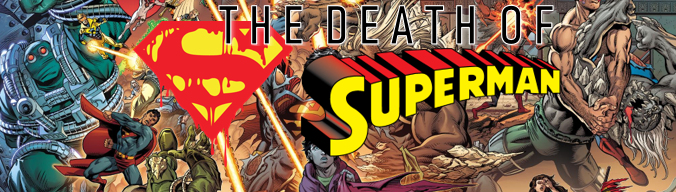
Back Issues [Superman Day]: The Death of Superman


In 2013, DC Comics declared the 18th of April as “Superman Day” so fans of the Man of Steel could celebrate Clark Kent/Kal-El/Superman, the superpowered virtue of “Truth, Justice, and the American Way” who is widely regarded as the first ever costumed superhero.


Published: December 1992 to October 1993
Writers: Dan Jurgens, Jerry Ordway, Louise Simonson, and Roger Stern
Artists: Brett Breeding, Dan Jurgens, Jackson Guice, Jon Bogdanove, and Tom Grummett

The Background:
Jerry Siegel and Joe Shuster first met in 1932 while attending Glenville High School and, just one year later, dreamed up their first draft for a superman with “The Reign of the Super-Man”. About five years later, a revised version of this concept appeared in Action Comics #1 and the world met Superman for the first time. Not only was Superman an immediate hit, but he went on to become a cultural icon. After decades of increasingly over-the-top stories, DC Comics tasked John Byrne with reimagining Superman for modern audiences. Under Byrne’s direction, Superman was a more grounded character and his stories adhered to strict continuity guidelines. After Byrne left DC Comics over creative differences, Superman group editor Mike Carlin moderated frequent “Superman Summits” involving Byrne’s replacements. It was during these chaotic meetings that writer/artist Jerry Ordway would jokingly suggest killing the Man of Steel. With Superman’s sales taking a hit thanks to readers favouring more violent anti-heroes, the creatives planned to shake things up by having Superman reveal his identity to his long-time love, Lois Lane, and eventually marry her. However, these plans were postponed to coincide with a similar arc on Lois & Clark: The New Adventures of Superman (1993 to 1997) and thus the idea of “Doomsday for Superman” was developed. Writer Dan Jurgens came up with the concept of a monster tearing through Metropolis and a climactic fist fight between it and Superman, before sketching a design for the creature that was subsequently dubbed Doomsday. Although DC always planned to resurrect the character, Superman’s death was headline news and became a best-selling title, despite being criticised as a publicity stunt. Despite also dying in this story, Doomsday would return to dog Superman, evading the literal death of the universe and evolving into both an ally and an intelligent being, though he never returned to the prominence he had in this first arc. Doomsday and the “Death of Superman” concept also appeared outside the comics: there was a videogame adaptation, multiple animated ventures, and it was long considered for a live-action adaptation before being brought to life first on television (with disastrous results) and then on the big screen (to similar chagrin) before finally having more faithful live-action renditions on Krypton (2018 to 2019) and Superman & Lois (2021 to 2024).

The Review:
Our story begins “somewhere else…” where, deep underground, in a reinforced prison, a mysterious monster repeatedly strikes its cage. Each blow sees the thing’s containment suit rupture little by little, revealing menacing bone appendages on its knuckles, and the metal wall crack and weaken until, eventually, the creature we now know as Doomsday bursts free! Oblivious to this impending threat, Superman’s far more concerned with tracking down the Underworlders, a group of misfits, monsters, and outcasts from the shady Project Cadmus who dwell deep beneath Metropolis. Led by the simple-minded but nigh-invulnerable Clawster (whose rocky design and bony appendages are eerily evocative of Doomsday’s final form), the Underworlders cut the city’s power in a bid to rise up and take the streets as their own. Luckily for Superman, young Keith White alerts him to the Underworlders’ plot and that they’ve taken Lois Lane hostage after she stumbled upon their lair. Though bolstered by technology stolen from War World, the Underworlders are no match for Superman, who easily fells Clawster with a grenade to the mouth, trashes their digging machine, and ends their plot. Thanks to Lois’s informant, Charlie Underwood, the plot is revealed and the uprisers are imprisoned to await trail by their more peace-loving people. However, while all this is going on, Doomsday runs amok across the countryside and causes chaos in Ohio…all with one hand tied behind his back! Thanks to Oberon monitoring the police band, Justice League International arrives to help with the rescue effort and, after learning the devastation was caused by a “monster man”, Ted Grant/The Blue Beetle rallies the JLI in pursuing the culprit. While Superman gives a candid interview of his life and allies, the JLI follow Doomsday’s trail of destruction. Though neither the mysterious Quintus Arce/Bloodwynd or the battle hungry Maxima’s psychic probes offer little information on the creature other than him being “hate–death and blood lust personified”, they soon come face-to-face with Doomsday when he wrecks the Bug with a tree trunk and starts tearing through a LexCorp oil refinery.

A monstrous creature tears across the countryside…and through the Justice League!

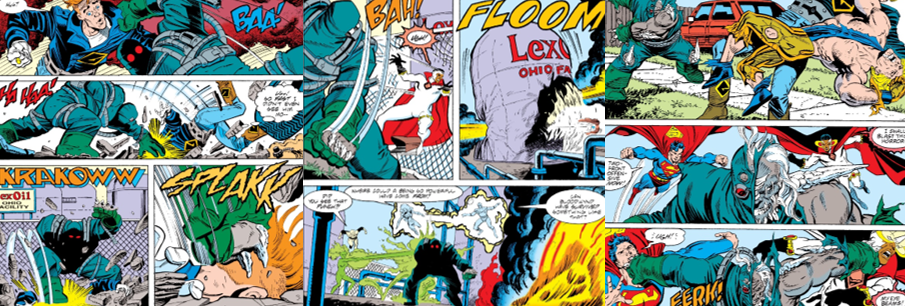
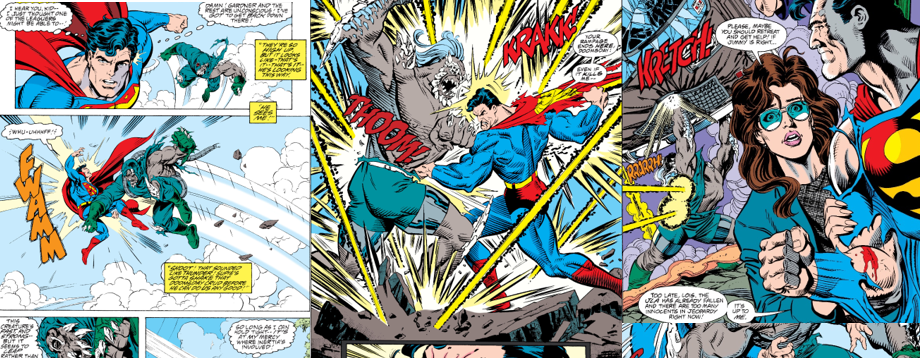
Never one to back down from a fight, Guy Gardner (who wasn’t a Green Lantern at this point but instead wielded Thaal Sinestro’s yellow ring) immediately attacks, only to be blindsided by the creature’s incredible speed and left damn near blinded when it pounds his face into the ground! Beatriz Da Costa/Fire’s intense heat blasts do little to halt Doomsday’s attack so Bloodwynd steps in. Summoning the “spirits of the dead” into a powerful blow, he’s stunned when Doomsday barely registers the punch and is then sent hurtling into the oil refinery (and an explosive end). The Blue Beetle rushes in to help his secretive ally, catching a glimpse of Bloodwynd’s true form before Doomsday strikes. With no superpowers and being little more than a child against the monster’s awesome strength, the Blue Beetle is manhandled by Doomsday and beaten into a coma. Enraged, Michael Carter/Booster Gold throws a “full-intensity blast” but barely has time to erect his force field before Doomsday sends him flying. Luckily, Superman intercepts him, having been alerted to the crisis by a stagehand. Unfortunately, though Maxima spirits the Blue Beetle away for medical attention, Superman’s too late to save Tora Olafsdotter/Ice from being tossed into the home of some innocent bystanders. Superman’s initially unimpressed by Doomsday, easily taking the creature’s first blow, but is astonished when the follow-up kick sends him flying harder than he’s ever been hit before. Realising Doomsday’s threat, Superman rallies and stands with the remaining Leaguers, who combine their individual powers in an intense barrage. Though completely encompassed by the onslaught, the effort drains Fire and Booster Gold’s physical and power reserves. Unfortunately, their efforts are wasted as Doomsday emerges unscathed save for his torn containment suit, revealing a scowling, gruesome visage that gleefully rushes the fatigued heroes. Booster Gold endures a horrific beating, then Doomsday easily tramples the others and causes another inferno before leaping away. Although Superman chases and temporarily subdues the creature underwater, he’s forced to help the injured Justice League rescue the innocent bystanders caught up in Doomsday’s rampage. With the JLI down, Superman resolves to pursue and stop Doomsday alone.

Despite Superman’s best efforts, Doomsday crashes into Metropolis and endangers his loved ones.

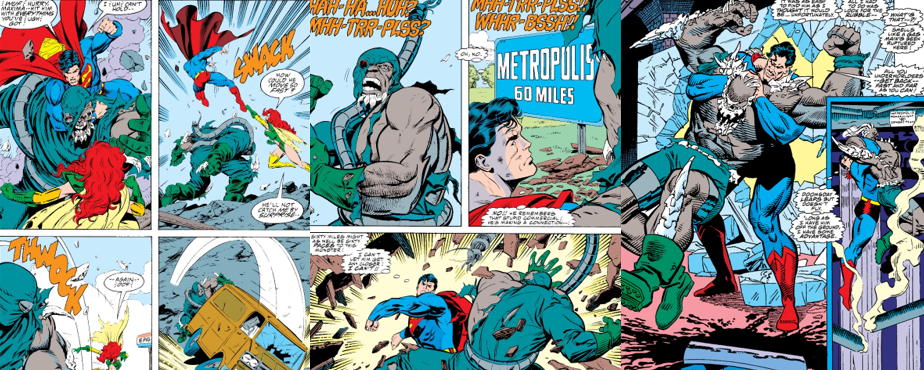
Despite the military’s best efforts, Doomsday continues his rampage. As Superman battles the creature, he’s stunned by Doomsday’s complete lack of empathy and troubled that the snarling brute seems to be growing stronger as the fight progresses. Although Lex Luthor II (Lex Luthor inhabiting a young, fit body and masquerading as his own son) forbids Matrix/Supergirl (a protoplasmic alien rather than the traditional Kara Zor-El) from assisting Superman out of fears for her safety, Maxima jumps in to help…only to cause more destruction and endanger additional lives. After Maxima is left concussed, Superman asks James “Jim” Harper/Guardian to tend to her and continues pursuing Doomsday, determined to put the monster down before he does any more damage. Doomsday carves a path of destruction across the countryside and eventually winds up tearing through a Lex-Mart store, where a television commercial for a Metropolis wrestling match catches his attention. Obsessed with “Mhh-trr-plss”, Doomsday prepares to head there and Superman flies into a desperate second wind,  continuously amazed that his strongest blows barely faze the monster. With Lois and Jimmy Olson covering the battle, Superman accidentally hurls Doomsday into Habitat, a tree-city created by Project Cadmus. Resolving to fight smarter rather than harder since just hitting Doomsday hurts, Superman buries Doomsday beneath Habitat, only for him to burst free in a rage and resume his course towards Metropolis. Superman intercepts Doomsday and finally tries to fly him off-world, only for Doomsday to easily wriggle free and send Superman crashing into a construction site. As Jonathan and Martha Kent watch on horrified, Doomsday crashes into the Underworlder domain, inadvertently rescuing and then purposely slaughtering the prisoners, and causes a massive explosion to rock the city when his foot collides with a power line.

Superman battles valiantly and ultimately stops Doomsday at the cost of his own life.

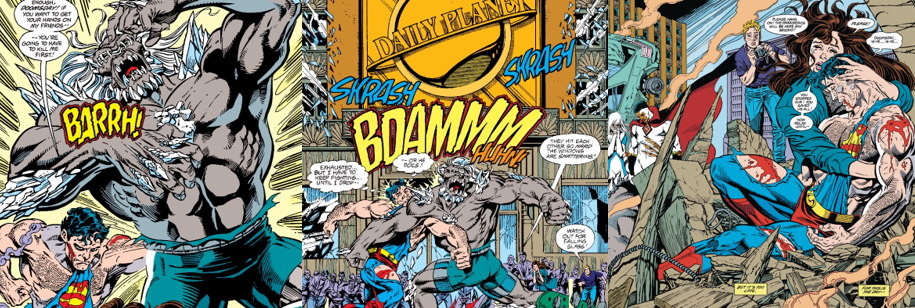
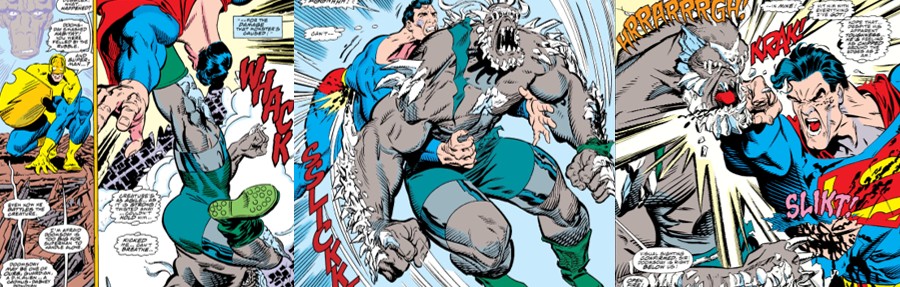
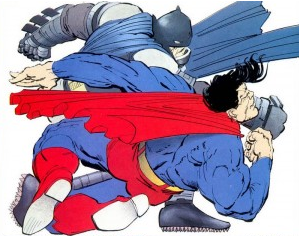
Superman’s second attempt to fly Doomsday away ends with him skewered through the abdomen by one of Doomsday’s spines. Finally released to assist, Supergirl is immediately dispatched with a single punch that reduces her to protoplasmic goop and even Professor Emil Hamilton’s massive laser cannon barely fazes the beast. Still, these distractions give the injured Superman time to regroup; hoping that Doomsday is as fatigued as him, Superman redoubles his attack. Luthor’s paratroopers and even Metropolis’s finest try to aid the Man of Steel, bombarding the creature with laser blasts that seemingly have no affect. Battered, exhausted, and desperate, Superman’s constantly distracted by saving innocents so, after rescuing Lois and Jimmy, he bids an emotional farewell to his fiancée and flies at his adversary, determined to put Doomsday down by any means necessary. Despite fighting for most of the day and having journeyed across the country and endured horrendous punishment, Doomsday easily overpowers Superman, cutting and bruising him. Superman finally hurts the creature by targeting Doomsday’s bony protrusions before the fight devolves into a slugfest outside the Daily Planet. Each blow shatters windows as the two relentlessly pummel each other, neither backing down until, finally, they fly in for the killing blow. Superman and Doomsday strike simultaneously, the force of their final blows sending shockwaves across the country, and Doomsday finally falls, apparently dead. Too late to help, Bloodwynd and Ice can only watch in shock alongside the world and Superman’s nearest and dearest as the Man of Steel collapses. Lois cradles her beloved, unconcerned about hiding her grief, as Superman breathes his last and succumbs to his wounds. Lois is left wailing as Superman, his costume torn and tattered and bloody, lies still amidst the rubble of his titanic clash, leaving the onlookers and his friends and family stunned.

The Summary:
“The Death of Superman” isn’t so much a story as it is a long, protracted beatdown of the Man of Steel. Amidst the fighting, the story takes a few detours to explore Superman’s opinion of his fellow heroes and his impact on the world. While most people find him an awe-inspiring figure and celebrate him as the world’s greatest hero, others are more dismissive. A teen eventually caught in Doomsday’s rampage is especially outspoken about the Man of Steel, preferring hot-headed Guy Gardner instead, only to be indebted to Superman when he puts his life on the line to protect his family. Guy, especially, is overly critical of Superman, blinded by pride and arrogance and attacking Doomsday head-on only to be mutilated and humbled. Doomsday’s threat is so great that even some of Superman’s more duplicitous and mysterious allies aid him with Dubbilex attempting to probe the beast for clues to his origin and the supercilious Maxima throwing herself into the bout to try and prove her worth. While the outside world sees Lex Luthor II as a benevolent figure, he’s the same conniving antagonist he’s always been. He doesn’t get involved until Superman and Doomsday are literally tearing through his city and, even then, his tech and even Supergirl’s bizarre powers are no match for the creature. Nowhere is this better showcased than in Doomsday’s utter decimation of the Justice League. Sure, the JLI was never the strongest incarnation and his demolition of them isn’t as powerful as if he were shredding the likes of Arthur Curry/Aquaman, Princess Diana Prince/Wonder Woman, and Wally West/The Flash, but it sends a startling message when Earth’s greatest heroes are beaten by one creature. However, the narrative is quite repetitive after a while. I lost count of how many times Superman and other characters muse over the creature’s strength, tenacity, and origins and, while the art is good, it’s inconsistent throughout. For example, Superman’s injuries vary between issues, with some issues ending with him bleeding and bruised and others ignoring those injuries before leaving him with different ones.

When Doomsday decimates everyone else, Superman resolves to put him down at any cost.

As a story about Superman’s will, “The Death of Superman” is quite powerful. Where the JLI and others fail due to being significantly underpowered, Superman fights on, battling Doomsday almost non-stop across the country. During their fight, Superman constantly stops to rescue bystanders and is always trying to keep Doomsday from populated areas. When he realises Doomsday’s heading to Metropolis, Superman desperately tries to keep him from reaching the city and, when this fails, he commits to ending the beast’s rampage. Sure, Superman rarely tries to get Doomsday off-world, but Doomsday is not only incredibly strong, but extremely agile and he easily escapes Superman’s grasp or leaves him gravely injured. At one point, Superman tosses Doomsday several miles away so it’s possible he could’ve launched Doomsday into space. However, Superman constantly notes that Doomsday never tires, seems to be growing stronger, and adapts to each situation. What works against Doomsday once won’t necessarily work a second time, something greatly expanded upon in subsequent appearances, so I think this is acceptable enough as an explanation for why Superman doesn’t just toss Doomsday into space. The conflict causes great distress for Lois and Jimmy, who are forced to watch and report as the man they love and admire is beaten to death before their eyes. While Lois eschews the usual restraint regarding her relationship with Superman to comfort and tend to him, the Kents are forced to watch, helpless, as their son is beaten to a pulp on live television. The impact of Superman’s deteriorating health is felt by every character and is palpable through the artwork. There’s a real sense of desperation as the fight reaches its climax and a shocking gut punch as the final blows are struck.

The mysterious Doomsday lives to kill and is little more than a mindless beast.

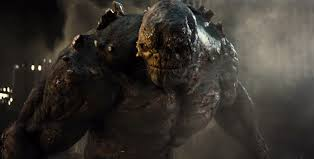
In many ways, it’s disappointing that Superman dies not at the hands of a traditional villain but in a slugfest with a monster. However, Doomsday is a visually intimidating and impressive monster. Initially garbed in an uninspiring containment suit, Doomsday’s true form – a snarling, grey-hued monstrosity – is revealed as he tears through his opponents and shrugs off their attacks. Doomsday never speaks; he simply barks laughter, grunts, and mumbles a bastardised growl of “Metropolis”. He’s noted to be “faster than Flash”, easily overturns trucks and rips apart bridges and buildings, and is not only inhumanly strong but absorbs tremendous punishment. Even the combined energy powers of the Justice League barely faze him, blows from mighty man-made trees barely slow him, and even hitting the brute causes Superman pain. Doomsday is malicious and bloodthirsty, slaughtering wildlife and innocents and beating the JLI with relish, and becomes fixated on both Metropolis and Superman. Throughout the story, psychics try to learn his origins and find only hatred and destruction. Doomsday is, essentially, a blank canvas; a mindless beast determined to destroy. Later stories fleshed out his origin (which is actually really interesting) but I can totally understand why adaptations made him a man-made doomsday machine or added to his lore as he’s primarily an invincible McGuffin shamelessly designed to shock the world by killing Superman. Superman realises far too late that Doomsday can be hurt by targeting his bony protrusions and he barely takes advantage of this, breaking one before going back to trading punches with the beast. This is a bit of a shame as it means the finale was always anti-climactic for me. We never see Doomsday tire, he rarely shows pain, he has no injuries and survives shots that look far more devastating than Superman’s final blow. This, as much as the tedious nature of their fight, means I’ve never held “The Death of Superman” to very high regard beyond it being notable for killing the Man of Steel and introducing a monstrous new villain for Superman, one who sadly never reached these same heights again because it’s difficult to top killing the world’s most powerful superhero.

My Rating:

Rating: 3 out of 5.

Pretty Good

What did you think to “The Death of Superman”? Were you disappointed that Superman wasn’t ended by one of his more iconic foes? What did you think to Doomsday, his design and characterisation (or lack thereof)? Were you disappointed that a more powerful version of the Justice League didn’t battle Doomsday? Do you think the story suffers from being little more than a prolonged slugfest? Did you enjoy Doomsday’s later appearances or do you think he peaked here? How are you celebrating Superman Day today? Whatever you think, feel free to share your opinions in the comments below and feel free to check out my other Superman content on the site.

Movie Night [Doomsday]: Deep Impact


Over the years, there have been many theories about when the world will end but one of the more prevalent was the mistaken belief that doomsday would befall us on December 21st 2012 based on the Mayan calendar ending on this day. Of course, not only did this not happen but it wasn’t even based on any actual fact to begin with. Nevertheless, I figured today was a good day to celebrate this popular concept.


Released: 8 May 1998
Director: Mimi Leder
Distributor: Paramount Pictures / DreamWorks Pictures
Budget: $80 million
Stars: Elijah Wood, Téa Leoni, Robert Duvall, Morgan Freeman, Ron Eldard, Leelee Sobieski, and Vanessa Redgrave

The Plot:
When journalist Jenny Lerner (Leoni) badgers United States President Tom Beck (Freeman) about a White House scandal, the world discovers that teenager Leo Beiderman (Wood) spotted a world-ending comet heading for Earth and veteran astronaut Captain Spurgeon “Fish” Tanner’s (Duvall) leads a mission to destroy it.

The Background:
The origins of Deep Impact can apparently be traced back to the late-seventies, when producers Richard D. Zanuck and David Brown proposed remaking When Worlds Collide (Maté, 1951) to Paramount Pictures, a project which stalled for many years. Things took a turn when they tried to get Steven Spielberg involved and he combined the idea with his hopes of adapting The Hammer of God (Clarke, 1993), though he was unable to direct due to his commitments to Amistad (Spielberg, 1997). By the time Mimi Leder took over as director, the film’s production and release coincided with that of Armageddon (Bay, 1998), a similarly-themed disaster movie that was directly compared to Deep Impact by the press. Author Arthur C. Clarke was left disgruntled when he was omitted from the film’s credits after influencing the concept, CNN apparently refused to be involved, leading to MSNBC lending their name to the narrative, and Leder claimed on the DVD commentary that the budget didn’t allow for the production to show perspectives from outside the United States. Real world scientists and astronauts were reportedly brought onboard as consultants and the film’s harrowing scenes of destruction were handled by legendary effects studio Industrial Light & Magic, who used both traditional miniatures and model work alongside cutting edge CGI water rendering to depict the comet’s disastrous impact. Deep Impact proved a commercial success with its near $350 million box office and held the record for the biggest opening weekend for a female-directed film for some ten years. Reviews, however, were mixed, with some praising the brooding tone and others criticising the wooden performances. Still, Deep Impact is generally regarded as being more scientifically accurate than Armageddon and has been considered to be the more nuanced and mature of the two productions.

The Review:
If I had £1 for every time Hollywood released a world-ending asteroid movie in 1998…I’d have £2. Which isn’t a lot, but it’s weird that it happened twice, right? On paper, Deep Impact and Armageddon have the same premise (the Earth is threatened by an extinction-level event) and a group of astronauts try to save it with nuclear weapons, but their presentation couldn’t be more different. For me, I’ve always preferred Armageddon and have always seen Deep Impact as a bit of a cheap knock-off so, spoilers, I don’t rate this one too highly. Unlike Armageddon, which largely takes place on the surface of its ridiculously oversized, planet-killing asteroid and in the control centre of the National Aeronautics and Space Administration (NASA), Deep Impact follows a handful of characters from different walks of life and showcases the comet’s threat from different perspectives. The first of these we’re introduced to is aspiring young astronomer Leo Beiderman, the first to spot the comet when it’s about a year away from reaching our solar system. Although his girlfriend, Sarah Hotchner (Sobieski), teases him that he’s simply misidentified an existing star, his discovery is verified as not only true but a significant threat by professional astronomer Doctor Marcus Wolf (Charles Martin Smith), who then promptly dies racing to alert the authorities to the danger. Quite how anyone learns of the comet in the year gap that then passes isn’t explained. It’s hinted that documents were recovered from the crash, though Dr. Wolf’s car went up in a massive ball of flames so I’m not sure how the government learned of the comet or came to the erroneous conclusion that Leo also died in the same accident. Still, the United States government spends the next year covertly preparing for the comet’s arrival, secretly colluding with the Russians to construct a space craft and nuclear bombs capable of deflecting it and also digging out caves in case the worst should happen. These contingency plans don’t bring much comfort to Secretary of the Treasury Alan Rittenhouse (James Cromwell), who resigns to be with his family and make his own preparations for what could potentially be the end of all life on Earth.

Ambitious and obnoxious reporter Jenny discovers the Earth is facing impending doom.

Rittenhouse’s resignation raises questions over at MSNBC, where ambitious journalist Jenny Lerner investigates the story, believing it to first be a dead-end gig compared to landing the coveted anchor chair and then a convoluted cover-up for an illicit scandal in the White House. However, after questioning Rittenhouse, Jenny’s puzzled to find him stockpiling food and referring to his assumed mistress, Ellie, as “E.L.E”. Though frustrated at being lumbered with the boring story and amazed at Rittenhouse’s ego, Jenny’s terrified when she’s suddenly accosted by the Secret Service and brought to the President himself, Tom Beck, a stern man who remains tight-lipped about what, exactly, the E.L.E. is but offers to advance her career by giving her a prime spot at the press conference where he reveals the truth. Desperate to be taken seriously, Jenny jumps at the chance, ignoring minor concerns like national security and public panic, but even she is left speechless at the announcement of an Extinction-Level Event (hence “E.L.E.”) and the plan to defend the planet. From there, Jenny earns herself the anchor spot and becomes the face of the Messiah’s mission, delivering bland, robotic addresses to the public as only the dull and lifeless Téa Leoni can. Jenny’s given some edge in her dramatic relationship with her parents. Her mother, Robin (Redgrave) later takes her own life after learning she’s ineligible for the cave sanctuary and donating all her worldly goods to the preservation project. Jenny’s estranged father, Jason (Maximilian Schell), starts the film elated to have just married Chloe (Rya Kihlstedt), a woman only two years Jenny’s senior, and desperate to reconnect with his daughter, only to then be accused of being a neglectful father and finally make peace with Jenny as she does something selfless for a change and gives up her spot in the cave to be comforted by her dad. As this comes in the face of the best moment of the film (the city destroyed tsunami), it’s a very emotional moment but I just don’t care for Téa Leoni. Jenny’s an insufferable character, focused only on her career and constantly lashing out like a child, which to be fair ties into her eventual growth when she realises the end is nigh, but her delivery is so wooden and she looks so bored all the time that I have a hard time buying her as this charismatic and developed news anchor.

While Leo’s a bit of a dud, President Beck is a commanding and surprisingly vulnerable presence.

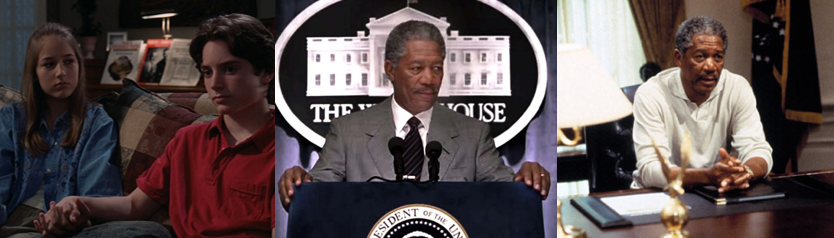
Sadly, Elijah Wood isn’t much better as Leo and seems out of his depth here. Leo is basically a blank slate, walking around in perpetual bewilderment at having a world-ending comet named after him and being celebrated as a hero at his high school. He doesn’t really do all that much until the third act, when he and his family are inexplicably selected to be taken to safety and he coerces Sarah into marrying him so her and her family can be saved, too. However, an administrative cock up sees the Hotchner’s names missing from the list, forcing Leo to journey all the way back to his hometown to rescue Sarah. As the smaller half of the comet, Beiderman, streams overhead and then crashes into the sea, Leo finds Sarah and her family and her parents, Vicky (Denise Crosby) and Chuck (Gary Werntz), force them to get their baby to higher ground. Leo provides more of a grounded perspective on the incoming comet, but the film doesn’t really follow him beyond the start and the third act, meaning he’s stuck with one-dimensional characterisation as a good kid who’s a little overwhelmed and desperate to get Sarah to safety. Instead, the Beidermans and the Hotchners are just another set of characters who spend their time anxiously watching Jenny’s news reports on the comet’s trajectory and the Messiah’s mission to intercept it. Indeed, much of Deep Impact focuses on people just staring at the television, which I guess speaks to the passive helplessness of the masses against this incredible external threat but doesn’t make for thrilling viewing. President Beck makes several addresses ensuring his citizens that “life will go on” and, thanks to Morgan Freeman’s peerless gravitas and delivery, comes across as a strong and trustworthy leader. He’s tough but fair, considers all viewpoints, and plans for both the best- and worst-case scenarios. At the same time, he has a vulnerability to him, one that becomes more evident as each mission meets failure. His attire becomes more formal, changing from a dress suit to a simple rolled up shirt, and his cadence becomes more severe as he prepares the nation for calamity. It’s a stirring performance that really belongs in a better film, and yet the cynic in me wonders what world leader would ever dare be so honest to his constituents!

The Messiah crew are the planet’s last hope to destroy the lacklustre comet.

Like Armageddon, Deep Impact also follows a group of astronauts in a specially built “rocket”. The mission is crewed not by hard and hardy oil drillers but by fully certified astronauts: Commander Oren Monash (Eldard) leads the mission, Andrea “Andy” Baker (Mary McCormack) is the pilot, Doctor Gus Partenza (Jon Favreau) is the chatterbox medical officer, and Mark Simo (Blair Underwood) is the navigator. They even have a token Russian cosmonaut, Colonel Mikhail “Mick” Tulchinsky (Aleksandr Baluev), who’s in charge of the explosives, and are joined by veteran astronaut Captain Spurgeon “Fish” Tanner. While the youngsters respect Fish, they see his appointment as a publicity stunt as he hasn’t been properly trained for the mission. However, Fish soon shuts them down since he’s the only one to log actual space flight time (he even walked on the Moon back in the day) as opposed to training on “videogame” flight simulators. While most of the crew are painfully one-note, they set aside their personal differences once the mission’s underway and perform their duties to a high standard. It’s just not particularly interesting and certainly nowhere near as dramatic as in Armageddon. The Messiah might appear more realistic and the space scenes are far less exaggerated, but it’s weird seeing the crew spend all their time in casual clothing rather than jump suits and their initial tactic is no less questionable than in Armageddon. Instead of one big bomb, the Messiah drills a series of nuclear warheads into Wolf- Beiderman but, as many have suggested, all this does is split the comet into two parts. They also take so long to set their explosives that they’re exposed to the Sun, blinding Oren, sending Gus flying into space courtesy of an explosive release of gas, and leaving the Messiah dangerously low on fuel. The crew are then largely forgotten until the final act, where they seek to outdo Bruce Willis and concoct a suicidal plan to vaporise the larger half of the comet which, again, is a surprisingly emotional scene but just lands flatter than Armageddon because the presentation is so tedious. Even the comet, Wolf-Beiderman, isn’t as visually impressive as Dottie. Sure, it’s more realistic (both visually and in terms of size) and looms in the background, getting closer and more dangerous as time passes, but it just looks like a big ball of ice and lacks any menacing character in its design.

The Nitty-Gritty:
Deep Impact approaches the end of the world as a story of hope and humanity. The aware of the comet, President Beck makes plans to knock it off course or destroy it as a priority and to prepare for the preservation of human life as a secondary (but equally important) objective. While Rittenhouse doubts the Messiah’s success, President Beck is confident in the mission succeeding. He’s equally confident that his strike missiles will deter the comet; and, finally, he’s even more confident that the million people he randomly selects to be brought to safety will rebuild human society. As pragmatic as President Beck is, his faith in these contingencies is flawed. The Messiah was never going to succeed by drilling so shallowly into the asteroid and his projections about how long it’ll take for the comet’s devastation to recede seem woefully optimistic. He (or rather, presumably, his advisors) estimate it’ll take just two years for the dust to settle and for the survivors to rebuild. For comparison, it took something like 300,000 years for the Earth to recover from the asteroid that wiped out the dinosaurs! He doesn’t seem to have factored in potential fallout, the shifting of landmasses, or the widespread destruction of resources. Instead, he’s literally built an underground Noah’s Ark and placed his faith in a higher power to guide them, which exposes chinks in his leadership armour. MSNBC present the mission from a purely factual approach, bringing in experts to talk with Jenny about specific aspects of the mission and what it means if it succeeds or fails. As the situation grows more dire, Jenny’s stoic mask finally slips when she reads Gus’s obituary and delivers the specifics on the lottery, which excludes older citizens like her mother. Rather than descending into abject fear and panic, everyone we see continues their lives as normal. MSNBC and the White House staff work right up into zero hour and only start evacuating just before Beiderman hits! While we see a mass exodus in the face of this danger, it’s obvious that most of these people are doomed. Jenny and Vicky react to this selflessly, giving up their safety and their child to ensure young life has a chance to survive, and President Beck’s first address after “the water’s [recede]” is one of hope and renewed appreciation for the planet.

The devastating destruction is the film’s biggest selling point and most impressive moment.

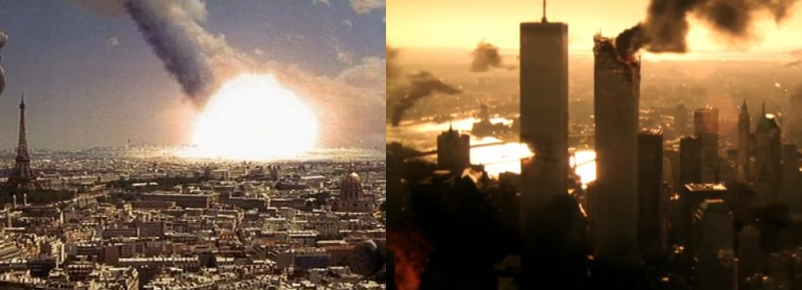
Like any good disaster movie, the main selling point of Deep Impact is the devastation caused by Beiderman’s impact. Unfortunately, whereas Armageddon opened with a meteor shower and destroyed both Paris and Shanghai, there is no Earthly destruction until the film’s final act. Before then, it’s all character drama and staring at television screens but we do get some tension when the Messiah crew touchdown on Wolf-Beiderman. Though the comet isn’t as hostile as Dottie, the crew only have a few hours to set their explosives before the Sun rises and combusts the comet’s surface. This leads to a distressing scene where Oren is blinded, Mark is injured, and Gus is blasted into space. While Mick pleads with Fish to go after their colleague, it’s ruled out since they don’t have the fuel for a rescue operation and Gus is left to suffer one of the worst fates imaginable. To make matters worse, the bombs don’t even work and instead cause a smaller section of the comet to split off. When the President’s missile strike fails to have any impact on the approaching threat, our Earth-bound protagonists can only watch in horror as Beiderman splashes down and kicks up a tidal wave large enough to suck the water from land masses and engulf entire cities. After finally reconciling with her father, Jenny faces this destructive torrent head on, comforted by Jason’s embrace, and the waters wash over the world. We only see the destruction of New York City, unfortunately, but man is it worth it. The wave ploughs through skyscrapers and national landmarks like the Twin Towers and the Statue of Liberty, obliterating anyone unfortunate enough to still be on the streets and wiping away forests, homes, and entire towns. Leo and Sarah are left running from the incoming waters, which wash away the gridlock of traffic (that includes Sarah’s parents) and drive them, exhausted and devastated, to higher ground. In the finale, President Beck gives an overview of the impact’s devastation, which also tore through the United States Capitol, but we sadly don’t see any other countries or cities affected by the wave. Still, the visual rendition of the impact and the destruction is distressing and easily the best part of the movie.

The Messiah‘s heroic sacrifice spares the world from total destruction…and the water’s receded.

After failing to destroy Wolf-Beiderman, the Messiah is left with two choices: risk suffocation or irradiation either coasting or rushing back to Earth. At Oren’s suggestion, they accelerate back home, only to find that they’re far from a high priority in the face of Beiderman’s arrival. Still, Fish runs some calculations and suggests detonating the remainder of their payload into the large chasm left behind when Beiderman separated from Wolf (something I feel they could’ve done a lot sooner, like when they were right by the comet!) Unfortunately, this is a one-way trip as they don’t have the time, fuel, or resources to land and deposit the bombs, and they all remorsefully agree to sacrifice themselves to give the world a chance. Luckily, they’re close to home so they successfully contact NASA flight director Otis “Mitch” Hefter (Kurtwood Smith), who’s also inexplicably still at his station, and arrange to say their goodbyes to their loved ones. Again, the similarities to Armageddon as astounding; instead of one heroic figure saying farewell to his daughter, we have a handful of them tearing up to their wives and newborns and Fish delivering a poignant goodbye to his late wife. The crew then strap in, acknowledge their appreciation for each other, and meet their end in the most anti-climatic way possible as Wolf simply shatters into tiny fragments upon impact. These then harmlessly burn up in the atmosphere and end the comet’s threat, though again I’m left disappointed by how visually unfulfilling this depiction is. Wolf also appeared a lot closer to Earth than Dottie, meaning a fair amount of nuclear fallout probably swept over the shattered remains of our world but it’s okay…the water’s receded! Lives and homes and entire nations were swept away but it’s okay…the water’s receded! The Earth suffers the greatest calamity in thousands of years and humanity is seemingly united in their efforts to rebuild, never mind how many resources were lost to the waters or how low a priority building the White House has to be. But it’s okay…the water’s receded.

The Summary:
I feel like I’m being way too harsh on Deep Impact. It’s not that I don’t enjoy the film…I just prefer Armageddon. Sure, Deep Impact is more realistic and the sets, the science, and the presentation are far more true to life than Michael Bay’s style over substance approach. However, while I’m not much of a Bay fan, at least his effort was visually engaging, and I never felt bored watching Armageddon. Deep Impact drags along at a snail’s pace, building tension and anticipation for its show stealing scenes of destruction but populating its runtime with dull, obnoxious, and forgettable characters. Téa Leoni is the worst of the bunch; I’ll give her props for making Jenny such an aggravating character, but watching Leoni is like watching grass grow. She’s so wooden and seems bored the entire time, meaning I just don’t care about anything she says or her character arc. Elijah Wood isn’t much better, unfortunately, relying on his doe-eyed charm to carry him through the film’s dramatic moments and failing to deliver a compelling character. Unsurprisingly, Morgan Freeman and Robert Duvall carry this film. President Beck may be the best example of a United States President we’ve ever gotten, being confidant and authoritative but also humane and vulnerable, while Fish brings vigour and expertise to his otherwise mediocre crewmates. Of course, the big wave is the main reason to watch Deep Impact and it really is worth it; splice this scene into Armageddon and you’d have the best of both worlds! I also enjoyed the more emotional moments and the poignant message off hope the film ends on, but Deep Impact is quite a chore for me and lacks the visual and dramatic punch of its bigger, louder, and ultimately more enjoyable counterpart.

My Rating:

Rating: 3 out of 5.

Pretty Good

Are you a fan of Deep Impact? How do you feel it compares to Armageddon and other disaster films? Did you prefer the film’s more realistic approach? Which of the characters was your favourite and what did you think to Téa Leoni and Elijah Wood’s performances? Were you impressed by the massive tidal wave? How important is scientific accuracy and realism to you in disaster films like this? How are you celebrating the end of the world today? Whatever you think about Deep Impact, disaster films, and overblown predictions of the end of the world, go ahead and drop a comment down below.

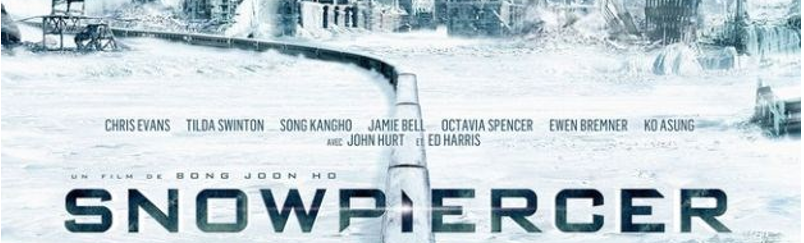
Movie Night [Doomsday]: Snowpiercer


Over the years, there have been many theories about when the world will end but one of the more prevalent was the mistaken belief that doomsday would befall us on December 21st 2012 based on the Mayan calendar ending on this day. Of course, not only did this not happen but it wasn’t even based on any actual fact to begin with. Still, doomsday scenarios and depictions of the end of the world have been an enduring genre in fiction so I figure today was a good day to dedicate some time to this popular concept.


Released: 29 July 2013
Director: Bong Joon-ho
Distributor: CJ Entertainment/Lionsgate
Budget: $40 million
Stars: Chris Evans, Song Kang-ho, Jamie Bell, Tilda Swinton, John Hurt, and Ed Harris

The Plot:
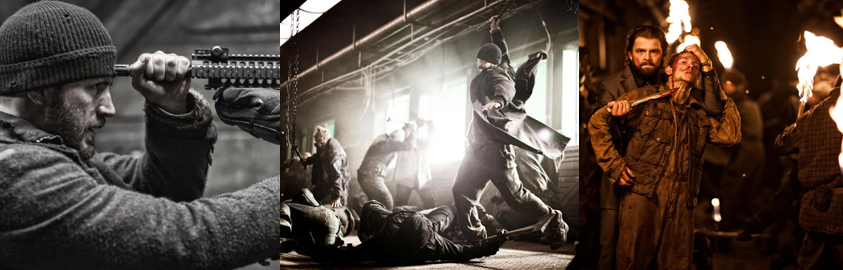
After an attempt to reverse global warming causes an ice age to render the Earth uninhabitable, the remnants of humanity are crammed into a circumnavigational train, the Snowpiercer, where the elite thrive in the extravagant front cars and the poor struggle in squalid tail-end compartments. With tensions rising, Curtis Everett (Evans) prepares to lead an uprising against the train’s domineering authority, represented by Minister Mason (Swinton).

The Background:
Snowpiercer began life as a French language graphic novel, Le Transperceneige (Lob, et al, 1982); after discovering a copy in a South Korean comic book shop in 2005, director Bong Koon-ho was immediately fascinated by the story’s depiction of social classes desperately vying for survival in a claustrophobic, post-apocalyptic scenario. Despite his fascination with the graphic novel, and having secured the rights to a live-action adaptation thanks to his friendship with fellow director Park Chan-wook, development of the film took a great deal of time to get off the ground. Star Chris Evans came on board (no pun intended) in 2012; although he brought with him a mainstream star power thanks to his prominence in the Marvel Cinematic Universe, Bong had to employ some clever filmmaking techniques to hide the actor’s muscular physique during filming. Featuring some complex practical and computer effects to render the titular train’s numerous cars and the desolate frozen wasteland of the outside world, Snowpiercer had the largest film budget of all time for any film with Korean investors but its theatrical release was limited to South Korea at the time. Still, while Snowpiercer’s box office may not have been the most spectacular, the film received largely positive reviews, was widely regarded as one of the best films of 2014, and eventually led to a television adaptation in 2020.

The Review:
Snowpiercer presents a unique spin on the concept of a global disaster movie; while we’ve seen ice ages and frozen Earth films before, I’m hard pressed to think of one where we were directly, unequivocally responsible for the planet becoming a block of ice and snow much less one where the few remnants of humanity were crammed inside a world-spanning, perpetual motion train.

The tail section lives in abject poverty and is routinely abused by the upper classes.

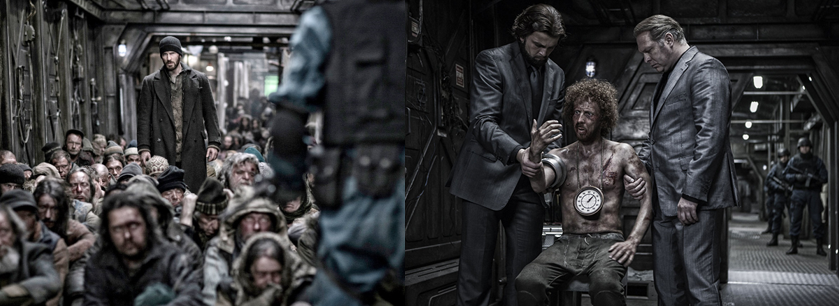
Immediately, the film’s depiction of class and social segregation is made explicitly clear; Curtis, his young friend Edgar (Bell), and his fellow lower classes are forced to live in abject poverty and extremely cramped, disgusting conditions like homeless vagrants. Muddy, dishevelled, and little more than meek, subservient cattle, the lower ends are fed nauseating protein blocks and held at the mercy of the upper classes and the train’s armed guards, who do not hesitate to beat them mercilessly or tear children away from their mothers. Curtis, a principal figurehead amidst the dregs of the train, is very much a reluctant leader and uncomfortable with his position after a traumatic experience in the past. Indebted to Gilliam (Hurt), the aged, half-crippled true leader of the resistance movement, Curtis begrudgingly uses his powers of observation and force of will to help co-operate with prisoner Namgoong “Nam” Minsoo (Kang-ho) in a desperate attempt to storm the train’s length to seize control of the engine (and, thus, the “world”), and kill its operator, Wilford (Harris).

Much to Curtis’s chagrin, Edgar worships and looks up to him as a leader and a brother.

Much to Curtis’s chagrin, Edgar worships him as a hero and leader and sees him as something of an older brother; optimistic and full of fight, Edgar is willing to follow Curtis into the fray, which greatly disturbs Curtis as he believes that Edgar is willing to die for nothing. Their relationship is one based on both necessity and a lifetime of lies as Curtis carries tremendous guilt after he nearly killed and ate Edgar when he was just a baby. Such abject mania and cannibalism was rife in the early days of the train and many of the back-end’s inhabitants, such as Gilliam, are missing limbs after being willingly (or forced) to offer sustenance to their fellow passengers.

Snowpiercer features a diverse cast, making communication another source of contention.

Snowpiercer features an extremely diverse cast, with many of the supporting characters being South Korean actors; the most prominent of which is Curtis’s contact, Nam, and his seventeen-year-old daughter, Yona (Ko Asung). Both are addicted to a coal-like waste by-product, Kronole, which offers abusers a hallucinogenic high, yet Nam is instrumental to their efforts since he designed all the doors and locks on the train and his daughter exhibits some degree of clairvoyance. Since Namgoong mainly communicates in Korean, Curtis and the others are forced to communicate with him through the use of an unreliable mechanical translation device, though there are many instances of subtitles as well.

Mason is an abominable, despicable coward who’s only looking after her own self interests.

The upper classes are condescending, well-kept, and ruthless individuals who regularly lord their position and power over the lower classes; none embody Wilford’s order or the will of the upper class more than the detestable Minister Mason. A comical figure in many ways, sporting a pompous Yorkshire accent, an elaborate sense of style, and a self-righteous attitude, she stresses the importance of social order and subjugation through capital punishment and fully believes that everyone, and everything, must adhere to their pre-ordained place to maintain society and order.

Against overwhelming odds and cruel oppressors, Curtis’s rebellion is a bloody and brutal affair.

Even after decades of suppression and failed revolutions, which have resulted in countless deaths and mutilations, the lower classes maintain a degree of resistance and fighting spirit; thankfully, those same years have taken their toll on the upper classes, who have not only become complacent but have also run out of bullets over the years. As a result, Curtis’s campaign to seize the train takes the guards completely off-guard and is, initially, somewhat successful. Along the way, they discover to repulsive truth behind the protein bars and are enamoured by seeing the sun, the outside world, and the opulence of the upper classes. Much death and violence accompany this push to the front, however, resulting in the sudden death of Edgar and turning Curtis’s mission into one of revenge as much as liberty.

The Nitty-Gritty:
Snowpiercer is an extremely bleak and claustrophobic tale, full of dark, desolate lighting and a surprising variety of environments considering the entire film takes place on overcrowded train carts. The back end is a grim, gloomy area that is little more than a slum but, as Curtis’s revolution proceeds through the train, environments become much more elaborate and ornate as we see the luxury and indulgence that the upper class surround themselves in.

The train’s construction and stability raises some questions but it’s definitely a unique premise.

This includes a fully-functioning school (which teaches the children of the upper class to respect and pay reverence to the train and to Wilford as though they are some kind of religious icon), lavish first-class cabins equipped with lighting, heating, and actual cooked food, and such extravagances as musicians and even a greenhouse, aquarium, and hot tubs. Of course, as with many post-apocalyptic tales, there are some questions raised by Snowpiercer’s concept and left unanswered: the train is, by definition, a perpetual motion engine that circles the world endlessly thanks to being powered by small children but, while we see it precariously clinging to the tracks throughout the film, it’s pretty obvious that the train, its tracks, or the many bridges would surely have degraded or been destroyed by the extreme cold.

It’s a hard life in an even harsher world and revolution carries a heavy cost.

Still, I can forgive a lot of these questions mainly because the film does go to some lengths to address some of the main ones (by explaining that Wilford had the foresight and the capital to prepare his train tracks and engine before the world went to Hell) and the rest are best left to one side as a degree of suspension of disbelief is necessary to allow the film to actually happen. Additionally, the overall concept of the subjugated lower classes rising in a desperate suicide mission to take control of the train is compelling enough to carry the film even through its more preposterous ideas. After a particularly bloody and costly battle through the train, Curtis secures safe passage through the train by taking Mason hostage and is disgusted to see the extent to which the upper classes indulge themselves. At the mercy of the lower classes, Mason’s previously haughty attitude and lofty position is shattered as she is force-fed the protein blocks and sells out her beloved Wilford purely to save her own wretched hide. Thankfully, as satisfying as it is to see her reduced to a blubbering wreck, she gets her ultimate comeuppance when she is duly executed by Curtis not only for the deaths and suffering she has willing taking part in over the years but also for indirectly being responsible for Gilliam’s death.

After Curtis rejects Wilford and derails the train, the two survivors face an uncertain future.

There are a number of dramatic twists that await Curtis at the head of the train; the first is that Gilliam and Wilford conspired to inspire Curtis’s rebellion simply to maintain the train’s delicate and ghastly self-sustaining ecosystem by killing off a large portion of the tail section. The second is that Wilford, seeing the need for a successor, offers Curtis the opportunity to take over as the train’s operator but, while he is tempted, having lost everything and in the face of mass executions, Curtis violently refuses when Yona reveals that the engine is powered by children from the tail section. In that moment, Curtis finally sacrifices not just a limb for his fellow passengers but also himself to derail the train and leave Yuna and the boy, Timmy (Marcanthonee Reis), to an uncertain future in a world that may be slowly thawing.

The Summary:
Snowpiercer is a fantastically dreary and depressing tale about the decaying and desperate remnants of humanity being forced into a claustrophobic space, separated by class and social standing, and forced to either scramble for survival and scraps and eek out a pathetic existence in the tail end or indulge in their every desire and whim at the front end. Trapped under the thumb of their oppressors and driven by hunger and desperation, Curtis is determined to see his mission through simply because of the suffering and death he has witnessed first-hand and his hatred of both himself and Wilford for forcing them to live in such conditions. As far as post-apocalyptic tales go, you could do a lot worse than Snowpiercer, which expertly focuses its narrative on this fragile ecosystem and presents a desolate, desperate tale of survival within a suffocating, oppressive space that separates it from its competition and results in a bleak and intense story of desperation and survival.

My Rating:

Rating: 3 out of 5.

Pretty Good

Are you a fan of Snowpiercer? How do you feel it holds up against other post-apocalyptic tales? Were you a fan of the social and class issues represented in the film and or did its bleak atmosphere put you off? Have you read the original graphic novel and, if so, how do you feel Snowpiercer works as an adaptation? Perhaps you were more a fan of the later television adaptation; if so, why is that and how does it compare to the film? How are you celebrating the end of the world today? Whatever your thoughts on Snowpiercer, feel free to leave a comment down below.

Movie Night [Doomsday]: Sunshine


Over the years, there have been many theories about when the world will end but one of the more prevalent was the mistaken belief that doomsday would befall us on December 21st 2012 based on the Mayan calendar ending on this day. Of course, not only did this not happen but it wasn’t even based on any actual fact to begin with but, nevertheless, doomsday scenarios have been an enduring genre in fiction so I figured today was a good day to explore this popular concept.


Released: 6 April 2007
Director: Danny Boyle
Distributor:
Fox Searchlight Pictures
Budget:
$40 million
Stars:
Cillian Murphy, Chris Evans, Cliff Curtis, Rose Byrne, Michelle Yeoh, Hiroyuki Sanada, and Mark Strong

The Plot:
In the year 2057, the Sun is dying thanks to a destructive Q-Ball. In a desperate attempt to ignite it, a crew of scientists and astronauts is sent on a last-ditch effort to deliver a nuclear device into the star.

The Background:
By 2007, British director and producer Danny Boyle had made a name for himself, most notably with the critically-acclaimed Trainspotting (ibid, 1996) and the post-apocalyptic zombie horror 28 Days Later (ibid, 2002), when he was presented with the concept for what would become Sunshine. The script, as conceived by writer Alex Garland, was funded partially by Fox Searchlight and numerous outside investors, which afforded Boyle a great deal of creative freedom. Boyle and Garland worked on the script for a year and consulted with one of my favourite scientific personalities, Doctor Brian Cox, regarding the scientific accuracy of the concept, who dismissed criticisms of the film’s science in favour of creative license. Boyle assembled an ensemble cast of international characters to show all of mankind uniting in the face of their destruction, and consulted with the National Aeronautics and Space Administration (NASA) regarding the technology and presentation of the interior and exterior of the ship. Sadly, Sunshine’s $32 million worldwide gross made it a box office disappointment and the film was met with mixed reviews that mostly focused on the abrupt twist towards slasher movie territory for the ending. Personally, I found Sunshine to be one of the most poignant and underappreciated science-fiction movies ever made and am glad to see that it has developed something of a cult following since its release, and it’s my pleasure to revisit it for this review.
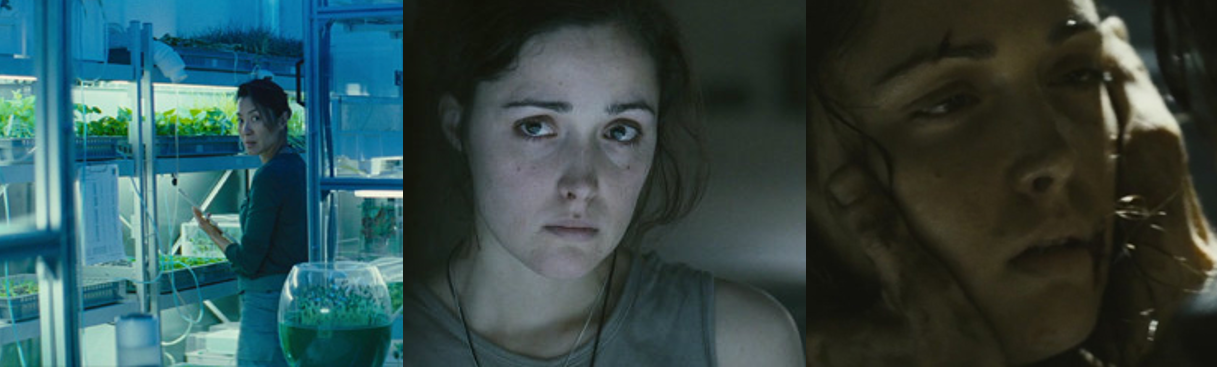
The Review:
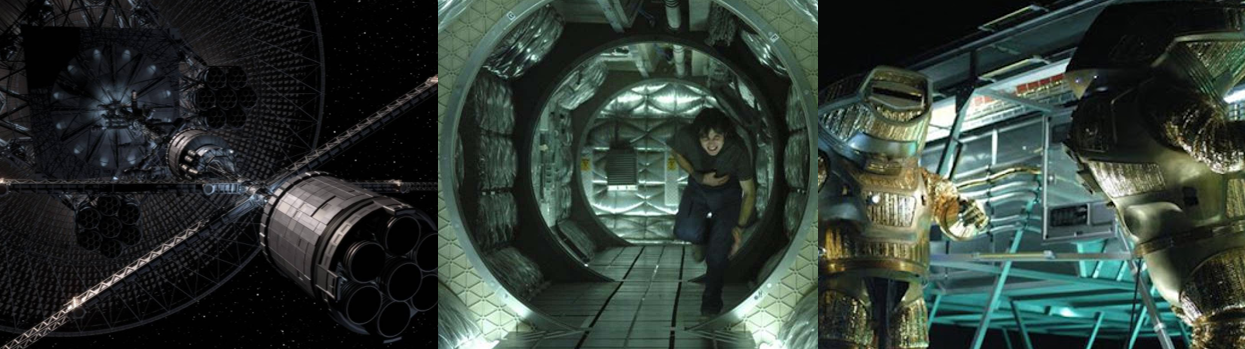
Sunshine begins with Doctor Robert Capa (Murphy) outlining the basic premise and some of the history of the film; the Sun is dying due to unknown reasons, pushing mankind to the brink of extinction due to the Earth slowly freezing over. Seven years before the start of the movie, Icarus was sent on a mission to restart the Sun but was mysteriously lost before it could deliver its payload; Capa and the rest of his crew have spent the last sixteen months travelling towards the Sun aboard Icarus II carrying a “stellar bomb” with a mass equivalent to Manhattan Island in a last ditch effort to “create a star within a star”. The eight-person crew is an interesting mixture of personalities, nationalities, faiths, and specialisms, with each member having a specific field and function on the ship, while also operating not in a democracy but based on who is the most qualified and informed to make certain decisions.

Capa and Mace have a tumultuous relationship that leads to disagreements and conflict.

Capa is the genius behind both the stellar bomb and the mission to restart the Sun; a physicist who is something of a quiet outsider, Capa finds his nights haunted by horrifying nightmares of him falling, screaming, towards the surface of the Sun and his days preoccupied with checking and double-checking his calculations and simulations for the stellar bomb. Essentially, Capa is worried that the bomb won’t actually do the job since it’s obviously untested; the simulations are often inconclusive, meaning that he is working somewhat on faith in the scientific accuracy of the bomb’s payload, and thus he agrees that it is only logical for the Icarus II to intercept Icarus I and retrieve its bomb to double their chances. Capa is a humble man just trying to do the best job he can who fills his messages back to his family with reassurances, but comes into frequent conflict with the ship’s engineer, Mace (Evans), a rugged and confrontational individual who isn’t afraid to call others out on their mistakes and often lets his emotions get the better of him. As hot-headed and blunt as he can be, though, Mace is absolutely devoted to the mission, to the point where he is willing to sacrifice his life (and considers all of their lives expendable) in service of completing the mission and saving the world. Still, he is an abrasive and hypocritical character; tensions between him and Capa rise after they get into a fight over the communications system and, while they share an awkward apology over the matter, Mace continues to antagonise Capa, volunteering him for a dangerous mission to repair the ship’s damaged solar panels and then later blaming him for endangering the crew despite all projections suggesting that the risk was worthwhile.

Corazon keeps everyone alive and Cassie is the heart of the crew, but there isn’t much for them to do.

The crew are kept fed and breathing thanks to the efforts of biologist Corazon (Yeoh), who maintains the ship’s “oxygen garden”, and the ship is kept on track thanks to the efforts of pilot Cassie (Byrne). These two are the only female members aboard Icarus II and prove to be two of the more emotionally stable amongst the crewmembers; of the two, though, Corazon is probably the least developed and interesting. Although she’s the first to suggest that they need to trim their numbers in order to maximise their resources and reach the payload destination, Corazon doesn’t really have much of a presence or much to do beyond caring for the plants; she’s thus naturally horrified when the oxygen garden is destroyed, and unceremoniously murdered while trying to salvage some life from the torched garden. Cassie is far more prominent, but not by much; she also suffers from nightmares of the Sun and is very much the heart of the crew and the one who maintains the most humanity throughout the mission. She clearly cares about the entire crew, even an asshole like Mace, and has an obvious affection for Capa (though their relationship stays plutonic and professional throughout the film), and refuses to participate in their vote about killing one of their own to conserve their oxygen supply later in the film. Ultimately, however, Cassie really doesn’t have too much of an impact on the film beyond being a source of emotional support for Capa and a representative of the humanity the crew struggles to maintain out in the void, and push Capa towards seeing the mission through to its conclusion, even at the cost of their lives.

Harvey fails to live up to Kaneda’s example, while Pinbacker lost faith in the mission entirely.

Icarus II is captained by Kaneda (Sanada), a stoic and practical man without ego who is happy to defer to the expertise of the other crew members when it comes to certain decisions. Fully aware of the magnitude and risks of the mission, he appears to be a well-respected authority figure who does a decent job of keeping everyone focused and on track with the mission; when they enter the communications “dead zone” seven days early, he emphasises that it’s not something for them to get worked up about since they were fully prepared for the resulting communications blackout, and when they discover Icarus I he leaves the decision regarding docking with it to Capa, recognising that he’s the most qualified man to make that risk assessment. While maintaining a professionalism at all times, Kaneda grows concerned about their mission the closer they get to the Sun since Icarus I disappeared at around the same point as they find themselves at the start of the movie and he pours over Captain Pinbacker’s (Strong) video logs for some answer to what happened to the ship. Interestingly, when the Icarus II is damaged due to a misalignment of the shields, it’s Kaneda who volunteers to head out on a space walk to repair the damage, which isn’t something I would expect from the ship’s captain. Unfortunately, this proves to be a fatal decision as Kaneda is unable to make it back to safety and is incinerated by the Sun’s rays, which greatly affects the moral of the crew and the stability of their mission. With Kaneda gone, the chain of command falls to the far less respected and far more ineffectual Harvey (Troy Garity), a communications officer whose job is made completely redundant when the ship loses its communications antenna. Harvey struggles to make competent decisions and to be a rallying force; he also ends up suffering a horrific fate during a dangerous space jump between the two ships, which sees him floating off into the empty void and choking/freezing to death in the vacuum.

Just as Trey is consumed by guilt, Searle and Pinbacker are obsessed with the allure of the Sun.

Searle (Curtis) acts as the ship’s doctor and psychologist; a clinical and pragmatic man, he helps to maintain crew moral and mental health aboard the ship, which grows increasingly strained due to the seriousness of the mission and the isolation of being so far away from loved ones. These issues are primarily embodied by Mace, who exhibits violent and aggressive behaviour towards Capa on a number of occasions, but also by Trey (Benedict Wong), the ship’s navigator, who falls into a suicidal depression after endangering the mission due to a miscalculation. Searle attempts to maintain order on the ship through counselling but, as rational as he is, he has grown obsessed with the power, magnitude, and beauty of the Sun; he regularly sits in the observation room to view the Sun without protective filters and it’s here that we get the first hints towards the Sun as this overwhelming, almost God-like force that has a significant impact on each member of the crew. Both Capa and Cassie admit to having recurring nightmares about the surface of the Sun, and we later find that Pinbacker has taken Searle’s fascination with the Sun’s astounding force to dangerous and destructive levels. Forced to board Icarus I when the oxygen garden is destroyed by Trey’s mishap, the crew find a dead and lifeless ship; the remains of the crew sit immolated in the observation room and the payload has been sabotaged, but the ship hides an even more destructive secret. Pinbacker, a scarred and burned mess of a man, has managed to survive in orbit around the Sun over the last seven years; driven to insanity by the Sun, which he believes “speaks” to him and which he worships as a God, Pinbacker stows aboard Icarus II and sets about sabotaging the ship and murdering the crew since he believes that humanity is destined to meet their extinction at the hands of his God.

The Nitty-Gritty:
One thing I’ve always enjoyed about Sunshine is the bleak atmosphere of the film; like many doomsday scenarios, this is a story where, on paper, everything should have gone exactly as planned but, thanks to a minor miscalculation and an unforeseen element of danger, the entire mission is put into jeopardy and all of the crew become fatally endangered. It’s something about these films that I’ve always found incredibly appealing on an emotional level; Icarus II is literally the last chance for humanity as the last remnants of the Earth’s resources have been put into constructing the ship and its payload, so they cannot afford to fail, and the crew largely accept the very real possibility that they might not make it back from their mission or even succeed since the stellar bomb’s success is entirely theoretical. This bleak tone is perfectly reflected in the film’s presentation and the presence (or absence) of sound; exterior sound is notably more muted than in many sci-fi films, which is very much appreciated, and much of the events are punctuated by light, ambient sounds and a building score courtesy of Underworld and John Murphy. This culminates in the film’s most emotional and impactful orchestral number, “Sunshine (Adagio in D Minor)”, a poignant and stirring tune that has since been used in many other films and trailers and never fails to get an emotional response from me; most notably, it definitely makes Kaneda’s death, and the dramatic finale of the film, all the more impactful.

All of Sunshine‘s technology and equipment is very practical and grounded in reality.

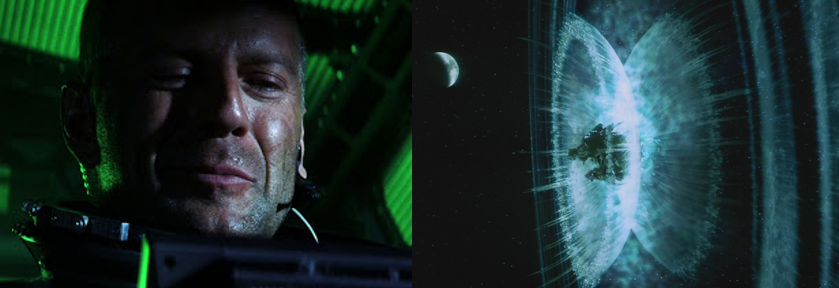
Sunshine was easily Danny Boyle’s most ambitious and effects-heavy film to date, and something of a dramatic departure for him, and yet does a wonderful job of keeping things grounded in a scientific basis thanks to utilising practical effects wherever possible to bolster the CGI shots. Both Icarus and Icarus II are extremely functional in their design; essentially long, cylindrical missiles, the ships are designed to be as narrow and efficient as humanly possible. Every part of the interior has a purpose and the ships are protected from the Sun’s intense heat and deadly radiation by a massive set of solar panels that act as both shields and a power source for the ship. Naturally, being a science-fiction film, some creative liberties have been taken place regarding the ships’ realism; computer panels and monitors have pretty futuristic touchscreens and sport very sci-fi graphics on them but they’re probably not a million miles away from where technology would be at this point, the interiors are far larger and more accommodating than real-life space stations and shuttles, and feature a number of creature comforts for the crew. This includes the viewing room, where crewmen such as Searle and Pinbacker can view the Sun at varying degrees of intensity, a beautiful oxygen garden, where Corazon monitors the plants and natural habitat that sustains Icarus II’s oxygen and life support systems, and a “holodeck”, of sorts, where crewmen are advised to spend their downtime in order to stave off the mental toll of being adrift in the vast emptiness of space. Unlike a lot of sci-fi films, Sunshine’s space suits choose to be bulky and practical rather than sleek and sexy; comprised of a startling golden material and featuring bulbous helmets to reflect and filter out the harsh sunlight, the suits appear cumbersome but also realistic, and the frustration Capa feels when trying to manoeuvre in the suit towards the finale is one of the most relatable and agonising moments of the film thanks to how perfectly Murphy captures the character’s frustration at simply getting up after a trip.

The void of space holds many dangers, none more threatening than the looming and destructive Sun.

I find it disappointing that some regard Sunshine unfavourably; the film is a bleak, atmospheric mediation on humanity’s last, desperate attempt at saving themselves from extinction and a visually impressive piece of cinema. I love the depiction of the Sun as this all-encompassing, awe-inspiring entity; the power of its mere presence has a profound effect on every character and it constantly looms in the background of the endless void as this necessary, but destructive, force (the Sun even appears to “roar” when seen in full view or overwhelming its victims). The crew’s mission is one that requires them to journey closer to Sol than anyone has ever been before and jump start it back to life with the largest nuclear payload ever devised but, while the Sun is dying and is the key to humanity’s survival, it is also extremely harmful to the ship and her crew. The slightest shift, the smallest miscalculation, is all it takes for the ship to be damaged and the oxygen garden to be destroyed, jeopardising the crew, the mission, and our entire world and, in their dying moments, many characters choose to have the Sun envelop them, as if sacrificing themselves to Pinbacker’s God. I’ve heard that many were put off by the suddenly tonal shift at the end of the film, and I guess I can understand that to a degree; Sunshine starts out as something of a run-of-the-mill, space-based drama that focuses on character interactions and conflicts, but escalates when the crew stumble upon Icarus I and Icarus II is damaged trying to intercept it.

Although Pinbacker causes many deaths, Capa is able to complete the mission at the cost of his life.

Upon boarding Icarus I, the film takes a sharp turn towards a surreal, horrifying slasher, which appears to have put a lot of people off but I think actually adds to the tension and appeal of the film’s final act. At first, it seems as though the Icarus II computer itself (Chipo Chung) is sabotaging the mission; it constantly overrides Cassie’s manual control, leading to the destruction of the oxygen garden and Kaneda’s death, and then reports that they have too many crew members aboard the ship. However, Mace discovers that Pinbacker and his crew chose to abandon their mission due to the futility to challenging “God”, and Capa is horrified to find that Pinbacker is their mysterious extra crew member. A broken, fanatical man, Pinbacker is covered in severe burns and driven by murderous intent; constantly filmed using an unsettling and disturbing “shaky cam” style that makes him appear as little more than a monstrous entity (or an embodiment of the Sun itself), Pinbacker stalks Icarus II with an electric knife, directly killing Corazon and indirectly causing Mace to slowly and painfully freeze to death in an unsuccessful attempt to undo his sabotage. With no choice left, Capa is forced to disengage the stellar bomb from Icarus II and manually operate the device to complete the mission; he manages to fend off Pinbacker, despite suffering a deep cut, by ripping the scarred tissue from the former captain’s arm in a sickening scene and enjoys one moment of blissful serenity as he is caught between the blast of the bomb and the surface of the Sun before the star finally flares back to life and promises salvation for the remainder of humanity.

The Summary:
Sunshine may be one of the most intense and bleak science-fiction events I’ve ever experienced. I find myself continuously fascinated by the film’s visuals, soundtrack, and atmosphere; there’s just something about it that leaves an indelible impression upon me and I always find myself getting drawn into its grim depiction of humanity’s last chance at survival. While some characters are more one-dimensional and noticeably less memorable than others, I was impressed by all of the performances in the film, though Cillian Murphy and Chris Evans are the obvious standouts. Their differing personalities make for much of the dramatic conflicts between the characters, but it’s fascinating seeing the other characters be influenced by the increasingly dire nature of their mission, to say nothing of the Sun. The idea of the Sun slowly dying out and freezing the Earth is pretty terrifying, as is the nigh-impossibility of mounting a mission to restart it; it’s inspirational seeing a diverse collection of scientific minds and skills coming together to fulfil this mission, and their willingness to sacrifice themselves is as tragic as their many moments of conflict and the mistakes that threaten disaster for the mission. The late introduction of a murderous fanatic completely changes the tone and direction of the finale, but I think delivers some of the film’s most startling message: in the face of extinction, every person reacts differently, and Pinbacker completely gives himself over to the inevitability of humanity’s destruction and is as devoted to ensuring this as the Icarus II crew is to preventing it. An insane, homicidal maniac, Pinbacker is horrifically presented as being a monstrous force, as though the Sun itself (or whatever is eating it up) has taken physical form to destroy our last chance of survival, and ensures that the finale takes a dramatic and heart-wrenching turn as the crew is whittled down one by one and Capa is left to make the ultimate sacrifice. Overall, I find Sunshine to be as powerful and influential an experience as the Sun is presented in the film; I’m obviously no scientist but I see it as one of the most realistic and scientifically accurate depictions of a doomsday scenario and I never fail to be left an emotional wreck by the tragedy that befalls the characters. It’s maybe not for everyone, and possibly a little too slow and tonally confused at times, but I’ll never get sick of singing its praises and think that it’s definitely well worth your time if you’re in the mood for an intelligent and poignant sci-fi tale that’s laced with a little horror and a lot of introspective discussion on how much we take our most inexhaustible power source for granted.

My Rating:

Rating: 5 out of 5.

Fantastic

Are you a fan of Sunshine? How do you feel it compares to other disaster films? Were you a fan of the concept or did you find the idea of the Sun dying a little unbelievable? Which of the characters was your favourite and what did you think to Cillian Murphy and Chris Evans’s performances? Did you like that Danny Boyle imbued the Sun with a form of malevolence and what did you think to the tonal shift towards a slasher horror for the final act? How important is scientific accuracy and realism to you in disaster films like this? How are you celebrating the end of the world today? Whatever you think about Sunshine, disaster films, and overblown predictions of the end of the world, sign up to drop your thoughts down below or leave a comment on my social media.

Game Corner [Crossover Crisis]: Injustice: Gods Among Us (Xbox 360)


In April 1985, the first issue of the ground-breaking Crisis on Infinite Earths (Wolfman, et al, 1986) released and saw the temporary destruction of the “Multiverse”. To celebrate this momentous event, I’m discussing multiversal crossovers all throughout April in an event I dubbed “Crossover Crisis”.


Released: 16 April 2013
Developer: NetherRealm Studios
Also Available For: Arcade, Mobile, PC, PlayStation 3, PlayStation 4, PlayStation 5, PlayStation Vita, Xbox One and Xbox Series One X/S (Backwards Compatible), Wii U

The Background:
When it was first released, Mortal Kombat (Midway, 1992) was a phenomenal success for Midway because of its focus on gore and violence, and it offered some real competition for Street Fighter II: The World Warrior (Capcom, 1991) in arcades and on home consoles. For a time, the series seemed unstoppable during the 2D era of gaming but struggled to find a footing in the emerging 3D fighter arena and Mortal Kombat seemed to be in jeopardy after Midway went bankrupt in 2010. The main reason for this was the poor reception of Mortal Kombat vs. DC Universe (Midway Games, 2008), the first collaboration between Midway’s Mortal Kombat and the DC Comics characters owned by Warner Bros. Interactive, which was hampered by age-related restrictions. Luckily, Warner Bros. Interactive stepped in and the team, now rebranded to NetherRealm Studios, immediately set about getting their violent franchise back on track; Mortal Kombat (NetherRealm Studios, 2011) was subsequently very well-received for its “back to basics” approach and, bolstered by the reboot’s success and eager to take advantage of the vast library of characters of their parent company, NetherRealm Studios sought to expand upon the game’s mechanics with a new, all-DC brawler. Although the game wasn’t as bloody and violent as its sister series, Injustice: Gods Among Us was a massive critical and commercial success that was followed up by not only a bunch of additional fighters and skins added as downloadable content (DLC) but also a sequel in 2017 and a critically-acclaimed comic book series.

The Plot:
In an alternate reality, Clark Kent/Superman has become a tyrant and established a new world order after the Joker tricked him into killing Lois Lane before destroying Metropolis with a nuclear bomb. In an effort to stop him, Bruce Wayne/Batman summons counterparts of the Justice League’s members from another universe to join his insurgency and end the totalitarian regime that threatens to subjugate the entire world.

Gameplay:
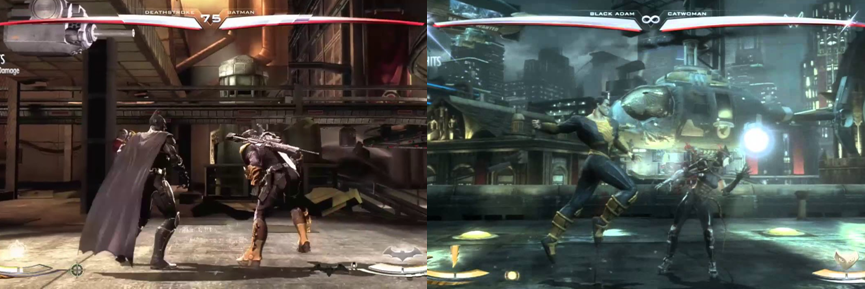
Just like Mortal Kombat, Injustice: Gods Among Us is a 2.5D fighting game; however, this time you’re able to select one of twenty-four characters from the DC Universe and battle it out in the game’s single-player story mode, one-on-one against another player or computer-controlled opponent (both on- and offline), tackle numerous arcade-style ladders, or take on character-specific missions in Scientific and Technological Advanced Research Laboratories (S.T.A.R. Labs) training scenarios. Just as you’d expect from a Mortal Kombat videogame, Injustice’s fights take place in a best-of-three format (although there are no longer announcements or screen text between each round) and against a time limit, though you can alter these settings (and many others, such as the game’s difficulty) to your heart’s desire in the game’s options to suit your playstyle. If you’ve played the Mortal Kombat reboot then you’ll be immediately familiar with this game’s fighting mechanics and controls, although there are subtle differences: X, Y, and A are assigned to light, medium, and heavy strikes, for example, and may be either punches, kicks, or weapon-based melee attacks depending on which character you’re playing as. You can still grapple and throw your opponent with the Left Bumper (or X and Y and a directional input), dash towards or away from the opponent with a double tap of the directional pad (D-Pad), but now you must hold back on the D-Pad while standing or crouching to block, which can make blocking a bit trickier as sometimes you’ll simply walk or dash backwards when trying to block. If your opponent is crouch-blocking, you can land an attack by pressing towards and A for an Overhead Attack, and string together light, medium, and heavy attacks with directional inputs and your various special moves to pull off quick and easy combos.

Attack with strikes, grapples, and combos to pummel a number of DC’s most recognisable characters.

As is the standard for NetherRealm Studios’ releases these days, you can practise the game’s controls and mechanics as often as you like and take part in a very user-friendly tutorial to learn the basics of the game’s simple, but increasingly complex, fighting mechanics. You can also view your character’s moves, combos, special attacks, and “Character Power” from the pause menu at any time, allowing you to also see a range of information (such as where and how to pull of certain moves, the damage they inflict, and frame data). Each character has a range of special attacks that are unique to them; these mostly consist of certain projectiles or grapples and strikes but can also include various buffs for your character or to slow down your opponent. Each character also has a specific Character Power that is performed by pressing B; this sees Batman summon and attack with a swarm of bats, Oliver Queen/Green Arrow fire different trick arrows at his opponent, Doctor Harleen Quinzel/Harley Quinn gain various random buffs, and allows characters like Diana Prince/Wonder Woman and Rachel Roth/Raven to switch between different fighting styles and thus access different special attacks. While some Character Powers have a cool-down period, others don’t, but they can also be detrimental to you; for example, Slade Wilson/Deathstroke can briefly give his shots perfect aim but, once the Character Power is expended, he’ll miss every shot until it refills. Another new addition to the game is the annoying “Wager” system; when the Super Meter is filled up by two bars, you can press towards and RT when blocking an attack to play a quick mini game where you and your opponent select how much of your Super Meter to gamble. If you win, you’ll regain some health; if you lose, the opponent regains health; and if you tie then you both lose. Personally, if find these “Clash Breakers” even more annoying than the usual “Breakers” seen in the modern Mortal Kombat games as I never win them and they generally just unnecessarily prolong a fight (and, even worse, there’s no option to turn them off).

Different characters attack and interact in different ways according to their strengths.

In a bridge between the differing character movesets of Mortal Kombat and the “Variation” mechanic seen in Mortal Kombat X (NetherRealm Studios, 2013), Injustice features a limited “Class” system whereby characters are split into two camps: Gadget- or Power-class characters. Gadget characters are generally smaller, faster, and rely on various tricks and weapons in fights while Power-class characters are typically bigger, often slower, and rely more on brute strength. One of the main ways you’ll notice the difference between playing as, say, Barry Allen/The Flash and Cyrus Gold/Solomon Grundy is that they interact with the game’s fighting stages in different ways. As in Mortal Kombat X, you can press the Right Bumper when indicated to use (or attack your opponent with) various environmental hazards, such as firing missiles at them or knocking them into the background. But, whereas Superman will wrench a car out of the air and slam it on his opponent, someone like Dick Grayson/Nightwing will rig the same car to explode or somersault off the environment to get behind their foe rather than try to crush them with a wall. As you might naturally expect, there are no Fatalities or gruesome finishing moves in Injustice (not even “Heroic Brutalities”). However, when your Super Meter is full, you can still press LT and RT together to pull off a devastating Super Move; while you won’t see bones breaking and organs shattering like in Mortal Kombat’s X-Ray Moves, it’s still pretty fun to see Hal Jordan/Green Lantern transport his opponent to Oa to pummel them with his constructs, Ares shower his foe with arrows and stamp on them while grown to gigantic proportions, Arthur Curry/Aquaman force his enemy into the jaws of a ferocious shark, and Bane demolish his opposition with a series of throws and grapples, culminating in his iconic backbreaker.

In addition to powerful Super moves, you can bash your foe into new areas using stage transitions.

Another way the game separates itself from Mortal Kombat is stage transitions; when near the far edge of certain stages, you can hold back and A to wallop your opponent through the wall or off into the background where they’ll be smashed up, down, or across to an entirely new area of the stage which often allows more stage interactions and new stage transitions available for your use. You might wonder exactly how someone like Louise Lincoln/Killer Frost can survive being blasting through the brick walls of Wayne Manor or go toe-to-toe with the likes of Doomsday but the game’s entertaining story mode explains that, on this alternative world, the tyrant-like Superman has developed special pills that bestow superhuman strength and dexterity to his generals. As is also the standard in NetherRealm’s titles, the story mode is broken down into twelve character-specific chapters, which is again a great way to experience a wide variety of the game’s roster (though Batman does feature as a playable character in two chapters, which seems a bit lazy). You can replay any chapter and fight you’ve cleared at any time, which is great, and skip through the cutscenes after they’ve loaded a bit, and the story mode isn’t all constant fighting either as you’re asked to pull off a handful of quick-time events (QTEs) at various points, such as blasting cars with Superman’s heat vision. The story is a fairly standard multiverse tale of the main canon heroes fighting against their corrupted or misled counterparts but it’s pretty fun and easy to blast through in no time at all.

Fight to earn XP and level-up, unlock additional perks and modes, and take on a series of challenges.

Every time you win a fight, you’ll earn experience points (XP) that will eventually level-up your character profile. This, and performing a certain number of specific attacks, playing through the story mode, and tackling the game’s other modes and mechanics, unlocks icons and backgrounds for your profile card as well as additional skins in certain circumstances. You’ll also be awarded “Armour Keys” and “Access Cards” to spend in the “Archives”, which allows you to unlock concept art, music, more skins, and certain boosts that will increase how much XP you earn, to name just one example. Like in Mortal Kombat, you can also take on ten opponents in arcade ladders in the “Battle” mode; these range from the basic tournament-style ladder to specific challenges against heroes, villains, or battling while poisoned, injured, or with certain buffs (such as a constantly full Super Meter or health falling from the sky). We’d see a similar system be incorporated into the “Towers” modes in later Mortal Kombat games and similar scenarios exist here, such as a survival mode, battling two opponents, or being forced to fight against the computer set to the hardest difficulty.

Graphics and Sound:
Like its violent sister-series, Injustice looks fantastic; there’s almost no difference between the high-quality story mode cutscenes and the in-fight graphics (which, again, makes it all the more frustrating that NetherRealm Studios insist on having character’s endings represented by partially-animated artwork and voiceovers), though it has to be said that the graphics are much more palatable when in a violent fight. I say this purely because I am not a big fan of some of Injustice’s character designs: The Flash looks a bit too “busy”, for example, and Batman’s suit (and cowl, especially) look really janky to me, though I love the representation of Green Lantern and Thaal Sinestro.

In addition to various intros, outros, and Wager dialogue, characters also take on battle damage.

Each character gets a nice little fitting intro and outro for each fight and, between rounds, will perform and quip a variety of taunts to the opponent. In a nice little touch, different character skins get different intros and outros; when playing as the evil Superman, for example, he enters and exits the fight differently to his more heroic counterpart. When playing as different skins, like John Stewart or Hank Henshaw/Cyborg Superman, you’ll also be treated to slightly different dialogue and animations, which is a much-appreciated touch on the developer’s part. Although there aren’t any character-specific interactions in the intros, there are during the Wager cutscenes and, even better, both characters and the arenas will accrue battle damage as the fight progresses! This means that you’ll not only see Selina Kyle/Catwoman’s cat suit rip and her skin be blemished by bruises and blood but arenas will degenerate or change around you the more damage you dish out, which can also allow different intractable options to become available to you.

Stages include a range of recognisable DC locations and take damage as you fight.

Speaking of the stages, Injustice really goes above and beyond to make the best use of the DC license; while it’s a little disappointing to see Arkham Asylum and Wayne Manor feature twice in the game, they are made distinctive by having Joker-ised and night-time variants, respectively (and also being clearly modelled after, and featuring cameos by, the Batman: Arkham (Rocksteady Studios/Various, 2009 to 2015) videogames and villains). Additionally, the use of stage transitions really helps to add a whole new dimension to combat, with some stages featuring more than others (or even none at all), to help ensure that every fight can be a little different. Stages also feature a bevy of other little cameos and DC references, such as the Fortress of Solitude being clearly modelled after Superman (Donner, 1978) while also featuring a portal to the Phantom Zone and a cameo from Starro the Conqueror. Similarly, J’onn J’onnz/Martian Manhunter floats in the background of the Watchtower space station, Floyd Lawton/Deadshot is just hanging out at Stryker’s prison, and Amazons are preparing a boat to launch on Themyscira. Every single stage has a number of intractable elements and changes as you fight, cause damage, or smash foes around, with Gotham City being my favourite as you can battle on the roof with the Bat-Signal and then down to the grimy streets below and then blast your foe back up to the roof using a nearby truck!

Enemies and Bosses:
Injustice helpfully separates its character-selection screen into heroes (on the left) and villains (on the right) but, despite their different alignments (and that their loyalties change due to the multiverse shenanigans of the story), every single one of them will be an enemy of yours at some point as you play through the story, Battles, S.T.A.R. Labs missions, and on- or offline. Consequently, it’s worth keeping track of which character suits your playstyle as some have easier combos and special moves to pull off compared to others, or more useful Super Moves and Character Powers.

Play as, and against, the game’s characters to learn their strengths, weaknesses, and skills.

Additionally, the Class system should also be factored in; Lex Luthor, Doomsday, and Solomon Gundy may be powerful and capable of gaining armour to tank through attacks but they’re also a lot slower on their feet and with their jumps. Superman and Shiera Hall/Hawkgirl are much faster Power-class characters but can also have their own drawbacks at times depending on your playstyle (Superman’s Character Power, for example, simply powers up his attacks rather than being a more offensive move like, say, Areas being able to conjure massive magical weapons). Personally, I tend to lean more towards Gadget-based characters, like Nightwing (who can switch between using quick batons or a longer bo staff to attack) or Green Arrow (whose arrows and bow allow for both ranged attacks and blindingly fast melee attacks).

Take on the corrupted Superman and banish him to the Phantom Zone for his crimes!

Unlike Mortal Kombat, Injustice doesn’t really feature any secret or hidden fights or unplayable sub-bosses or boss characters; the story mode and basic arcade ladder culminates in a battle against the corrupted Superman that is a far fairer and more competitive fight compared to the finales of NetherRealm’s recent Mortal Kombat games. While Superman is definitely a bit more of an aggressive foe, even on the game’s easiest difficulty, he doesn’t gain inexplicable armour, can be stunned, and doesn’t deal ungodly amounts of damage or spam his attacks like a cheap bitch. Additionally, he doesn’t transform into some monstrous final form and, instead, the final battle is a far better use of the skills you’ve built up through regular gameplay rather than forcing you to resort to cheap tactics and tricks.

Power-Ups and Bonuses:
Because it lacks a “Test Your Luck” mode and “Kombat Kodes” for multiplayer fights, there aren’t really any in-game power-ups available to you outside of the various status effects seen in the Battle mode. As before, though, some characters can gain in-game buffs with their special attacks and Character Powers: Lex Luthor, for example, can erect a shield, Doomsday can cover himself in impenetrable armour for a brief period, and Solomon Grundy slows time down and drains his opponent’s health with his swamp gas. However, you’ll earn yourself additional XP if you mix up your fighting style and take advantage of stage interactions and transitions, which will allow you to unlock further customisation options for your profile card, and you can also earn additional skins and rewards by playing and linking up to the mobile version of the game.

Additional Features:
There are fifty Achievements up for grabs in Injustice, with three of which being directly tied to the story mode (50- and 100% completion and succeeding at all of the QTE mini games). Others are tied to the game’s online modes, levelling-up to specific levels, customising your profile card, and finishing Classic Battle with one (and every) character. There are also some character-specific Achievements on offer, including performing every character’s Super Move or a ten-hit combat and winning a fight using only arrows as Green Arrow, or landing at least twelve shots without missing as Deathstroke. Batman is the only character to have two specific Achievements tied to him, though, as you’ll get some G for winning a match using all of his special moves and his Super Moves and for defeating every villain as him. Another standard of NetherRealm Studios is their addition of further skins and characters through DLC; you can get skins to play as John Stewart, Cyborg Superman, and the Flashpoint (Johns, et al, 2011) Batman, among others, and they’re all easily applicable when selecting a character (no need for extraneous “Gear” here).

Injustice included some surprising DLC fighters; even Scorpion showed up!

While the game’s DLC characters have no additional Achievements tied to them, Injustice included some fun and interesting extra fighters; Lobo, General Dru-Zod (who also sports his Man of Steel (Snyder, 2013) look as a skin), Barbara Gordon/Batgirl, Zatanna Zatara, and the Martian Manhunter were all great choices to add to the roster and it was nice to see NetherRealm Studios exercise a little restraint and not overload the DLC with additional Batman characters. By far the most exciting DLC fighter was the inclusion of Scorpion, who sports a Jim Lee redesign and began a trend of DC and Mortal Kombat characters appearing in each other’s games. When you’ve had enough of the story mode and regular battle options, you can take the fight online in a series of matches; here; you can participate in ranked and unranked fights and “King of the Hill” tournaments where you watch other players fight until it’s your turn and bet on who’s going to win. The S.T.A.R. Labs missions will also keep us offline, solo players occupied for some time; these are expanded upon when you download the DLC fighters, which is much appreciated and, similar to Mortal Kombat’s “Challenge Tower” mode, basically serve as extended tutorials for each of the game’s characters. You’ll take on ten character-specific missions, with each one getting a little bit of text and maybe a picture to set the context of the mission, and these range from performing certain combos or attacks, winning fights, or completing tricky challenges (such as guiding Catwoman’s cat through laser trip wires, avoiding damage or debris, or racing against Superman).

The Summary:
Injustice: Gods Among Us is a far better marriage of Mortal Kombat and DC Comics than Mortal Kombat vs. DC Universe and a fantastic expansion of the gameplay mechanics and features NetherRealm Studios revitalised their violent fighting game series with in Mortal Kombat (2009). While Injustice is obviously not as gory or violent as its sister-series, that doesn’t make it any less fun and it’s still a very brutal fighter; the Super Moves, especially, and certain character’s outros (such as the Joker’s) are definitely in the Mortal Kombat mould. With gorgeous in-game graphics, a fantastic amount of variety thanks to all of the character’s different special attacks and gameplay mechanics and the stage transitions, and a simple to learn, easy to master fighting system, Injustice is an extremely enjoyable game for anyone who’s a fan of either franchise or fighting games in general. The story is a breeze to get through (thought it is essentially every basic multiverse story ever told in comics) and nicely varied with some QTE sequences; the S.T.A.R. Labs missions and different arcade ladders are much more enjoyable and challenging than in its sister-series and there are plenty of character options, variety, and unlockables to keep you busy. Best of all, the game isn’t bogged down by endless grinding to unlock Gear, skins, or other perks and is a much more user-friendly and accessible fighting game, and overall experience, than its sequel.

My Rating:

Rating: 4 out of 5.

Great Stuff

Were you a fan of Injustice: Gods Among Us? What did you think to it as a blend of Mortal Kombat and DC Comics? What were your thoughts on the game’s story and its depiction of a parallel world terrorised by a corrupted Superman? Which of the game’s fighters was your favourite and why? Did you buy the base game and all the DLC packs separately or did you pick up the Ultimate Edition when it released later? What did you think to the additional DLC characters and skins? Were there any characters or features missing from the game for you? Which DC Comics videogame, movie, comic, or other piece of media is your favourite? Are you a fan of multiverse stories and crossovers? Whatever you think about Injustice, leave a comment down below and be sure to check back in next Wednesday for more Crossover Crisis content!

Movie Night [Doomsday]: Armageddon


Over the years, there have been many theories about when the world will end but one of the more prevalent was the mistaken belief that doomsday would befall us on December 21st 2012 based on the Mayan calendar ending on this day. Of course, not only did this not happen but it wasn’t even based on any actual fact to begin with but, nevertheless, doomsday scenarios and depictions of the end of the world have been an enduring genre in fiction so I figured today was a good day to dedicate some time to this popular concept.


Released: 1 July 1998
Director: Michael Bay
Distributor:
Buena Vista Pictures
Budget:
$140 million
Stars:
Bruce Willis, Ben Affleck, Will Patton, Steve Buscemi, William Fichtner, Liv Tyler, and Billy Bob Thornton

The Plot:
When an asteroid the size of Texas hurtles towards Earth on a collision course set to wipe out all life on the planet in a mere eighteen days, National Aeronautics and Space Administration (NASA) Project Director Dan Truman (Thornton) has no choice but to draft the world’s best deep-core drilling team, led by Harry Stamper (Willis), and send them into space to split the rock in half before it ends life as we know it.

The Background:
By 1998, director Michael Bay had started to make a bit of a name for himself in Hollywood following a successful collaborative relationship with producer Jerry Bruckheimer. Bad Boys (ibid, 1995) had been a massive box office success and he was just coming off The Rock (ibid, 1996), the success of which landed him a two-picture deal with Disney’s Buena Vista arm. The first of these films was Armageddon, which was coincidentally one of two asteroid-based disaster movies released in 1998; Armageddon proved to be the more successful of the two, however, earning over $550 million compared to Deep Impact’s (Leder, 1998) $349.5 million box office. However, Armageddon as met with largely negative reviews; it’s famously one of legendary movie critic Roger Ebert’s most hated films of all time and audiences and critics alike found the film’s frenetic editing and more ridiculous moments as egregious as Bay’s bombastic action scenes. Even stars Ben Affleck and Billy Bob Thornton thought very little of the film and numerous scientific minds have attacked the film’s lack of scientific accuracy.

The Review:
Armageddon’s concept is, admittedly, massively over the top; not only is the Earth threatened with total destruction and mankind with complete extinction by the biggest and most improbable piece of rock ever conceived but NASA deems it easier and faster to train a bunch of oil drillers to fly into space rather than training astronauts to drill. Interestingly, much of the movie could have been the same had the script been tweaked slightly to have, maybe, one or two of the oil drillers join the space expedition as consultants and experts but, regardless, complaints of this nature miss the entire point of the film: It’s supposed to be that a group of all-American, ordinary, everyday blue collar men are called upon to do the impossible and save the world and that’s precisely what makes it such an appealing concept. The primary representative from NASA is Dan Truman, a man who always dreamed of going into space and being an astronaut but was grounded by what looks to be a debilitating knee injury. Still, he’s the unquestioning authority at NASA; when the space shuttle Atlantis explodes at the start of the film and meteorites start raining down across New York City, he immediately organises response teams to figure out the source of the problem.

Harry might be an immature father but he’s a consummate professional at drilling holes.

Horrified by the looming presence of “Dottie”, the incoming asteroid, like all NASA characters in movies he quickly focuses on solutions rather than problems; this means entertaining and demanding any and all possible solutions to the issue in a very short window of time. With no other contingencies in place, he calls upon the expertise of Harry Stamper, initially to train his astronauts but find sit perfectly acceptable to send Harry and his team up in their place in order to get the job done properly. The star of the film is, unquestionably, Bruce Willis; while long before he simply phoned in his performances and offered only the bare minimum of effort, Armageddon doesn’t really call for him to be much more than a semi-snarky, overprotective father who is the best at what he does and, despite being childish and immature at times, is a consummate professional when on the job. No one knows more about drilling (which he regards as a science and an art) than him, and no one is better at it than him; he tolerates no insubordination on his oil rigs. Harry takes Truman’s request and the impending danger very seriously and, unimpressed and insulted by NASA stealing his oil rig design and having “only” trained their team for eight months, he immediately demands that he has to take up his team, men he can trust to do the job properly, and maintains order even when the team overshoots their landing mark and is forced to drill through “iron ferrite”.

Somewhat reckless and impulsive, A.J. just wants Harry’s respect and trust.

Harry’s conviction and focus are total when on a job but are somewhat distracted; he is estranged from his daughter, Grace (Tyler), and disapproving of her relationship with A.J. Frost (Affleck), the youngest member of his team and to whom Harry is basically a surrogate father. Harry is so incensed to discover their relationship that he hilariously chases A.J. across his oil rig with a shotgun but, discounting his personal feelings, doesn’t hesitate to fire A.J. when his arrogance almost causes a drilling operation to be botched and endanger his crew. Still, when called upon to pick members for the drilling teams, he reluctantly  drafts in A.J. A.J. just wants Harry’s trust and approval in his ability and instincts, which Harry is reluctant to bestow out of his overprotectiveness and belief that A.J. isn’t quite as experienced as he believe she is. Despite being surrounded by “roughnecks”, many of whom are his close friends and trusted colleagues, Harry is insulted and enraged to find that Grace has “settled” for A.J., believing that she deserves more than to be tied to a roughneck her whole life. Grace, however, vehemently stands by her choice, accepting A.J.’s proposal and stating that she is a grown woman who can make her own choices. Her issues with her father and almost immediately resolved when she learns of Dottie, however, and she is forced to watch the two men she loves the most head off on the most vital and dangerous mission ever conceived. When General Kimsey (Keith David) stubbornly follows the President of the United States’ (Stanley Anderson) orders to remote detonate the nuclear weapon on the asteroid when it’s not ready, Grace aggressively protests and demands that Truman do something since he was the one responsible for involving them in the mission.

In a sea of colourful characters, these three stand out as the most developed, interesting, and entertaining.

The rest of Harry’s team are a bunch of misfits, ex-cons, perverts, and muscleheads…and I absolutely love it! It’s an ensemble cast, with some given more screen time and development than others, who are just there to die. Charles “Chick” Chappel (Patton), a compulsive gambler and estranged from his wife and son, is Harry’s closest friend and conscience; he trusts Harry with his life and follows him to the ends of the Earth, and beyond. “Rockhound” (Buscemi) is a genius on the level of NASA’s very best but chooses to indulge in his love of explosives by lowering himself to oil drilling; he frequently points out that they are way out of their depth on the mission and ends up succumbing to “space dementia” and becoming something of a liability to the team. Another member of the team who stands out is, of course, “Bear” (the late, great Michael Clarke Duncan); Armageddon was one of Duncan’s first, big time roles in Hollywood and he shine snot just through his imposing physical stature but the gamut of emotions he displays, from playfulness to fear and panic, to sombre reflection by the film’s end. Certainly, he’s much more well-rounded than guys like Max Lennert (Ken Campbell), who is mainly the comic relief of the film, and Oscar Choi (Owen Wilson) and Freddie Noonan (Clark Brolly), who basically get a handful of lines between them and are killed when their shuttle crashes on Dottie to emphasise how dangerous the mission is.

Dottie takes on a life of its own and seems to have malevolent intentions for the Earth.

Harry and his team are joined by a handful of actual astronauts, the most prominent of which is Colonel Willie Sharp (Fichtner); Sharp is unimpressed with the drillers and personally makes it his mission to subject them to the harshest crash course in astronautics in order to properly prepare them for the rigours and dangers of space travel. Calm and composed, Sharp loses his cool somewhat when the shuttle overshoots its landing mark and grows increasingly concerned that the mission is headed to failure. When the order comes through to detonate the bomb before the hole is ready, he unlocks a gun and becomes almost a secondary antagonist; driven by the fear of the asteroid’s threat, he is prepared to kill to follow his orders to the letter but is convinced by Harry’s strength of conviction to allow the mission to proceed as planned. I say “secondary antagonist” because, if there’s one thing Michael bay was sure to do throughout Armageddon, it’s paint Dottie as almost a sentiment, malevolent force of nature; the asteroid is revealed in stages, bit by bit, almost like a slasher villain. At first, we see only wisps of dust and an ethereal cosmic aura, with the rock’s potential devastation shown to us through a comparatively harmless meteor shower. However, once the two shuttles slingshot around the Moon and approach the asteroid, it looms onscreen like an ominous, malicious entity purposely looking to destroy the Earth. When the teams land, they are beset by geysers of air, quakes, showers of rock, and constant explosions; Chick even suggests that the asteroid is purposely trying to shake them loose and keep them form “[killing] it”, as though it’s a living thing, and it even seems to roar and scream at times thanks to its tumultuous environment.

The Nitty-Gritty:
One of the most impactful aspects of Armageddon is the score; Trevor Rabin’s score is both bombastic and heroic but also haunting, ominous, and emotional. It’s perfectly used to highlight the amusing nature of the drillers’ training montage at NASA and adds just the extra exclamation point during the film’s more poignant and emotional moments. It’s a ridiculous film that plays its concept almost completely straight, which only emphasises the blue collar nature of the idea and adds to its appeal, in my opinion, and the score is a large part of that. It’s interesting to think about the fact that, technically, the plan to blow up the asteroid from the inside out was expected to go off without any real problems; after the shuttle Independence is taken out during the approach to Dottie, Freedom is thrown off by the unexpected gravitational forces from the asteroid and the Moon and lands way past the optimal landing spot. Had they landed in the intended area, it’s possible that much of the deaths and drama wouldn’t have unfolded as they did; similarly, a freak electrical accident causes the Mir space station to explode, almost as though the mission was doomed to failure from the start.

Meteors rain down across the world as Dottie draws inexorably closer by the hour.

The botched approach sees the teams split into two; while Harry continue son with the mission and believes A.J. and the others are dead, A.J. and Bear work alongside the Russian cosmonaut Lev Andropov (Peter Stormare) on a bit of a side quest to reunite with their friends, which leads to some intense sequences involving the armoured Armadillo vehicle and its efforts to plough through and float over the asteroid’s dangerous surface. With drilling slowed and the mission threatened by the rock-hard iron ferrite, which chews up the drill heads and causes the rig’s transmissions to overload, time becomes a significant factor; the asteroid was projected to hit in eighteen days but the team is given only eleven hours to complete the mission and remote detonate before Dottie passes “zero barrier” since an explosion after this threshold would still result in the Earth’s destruction. The action isn’t simply confined to the asteroid either as the film continues to show that the planet (especially poor old Paris and Shanghai) continues to be bombarded by meteor strikes. This makes the general public aware of the impending “global killer” but, despite Truman’s belief that this knowledge would causes “mass religious hysteria [and] the worst parts of the Bible”, people are generally seen to be united in hope and belief in America’s desperate mission to save the world (at least until the mission appears to have failed, anyway, though the film never really dwells on the worldwide impact of the asteroid’s impending approach). Of course, people will harp on for days about how inaccurate and ridiculous the film is but, honestly, I really couldn’t care less. Armageddon goes to some lengths to cover its inaccuracies as well; the asteroid is described as having a minor atmosphere, somewhat explaining how the guys can just toss poles and equipment around, and the focus is clearly on spectacle and excess rather than scientific accuracy (it’s more exciting to see two space shuttles launch right next to each other, for example, no matter who dangerous and ludicrous that idea might be).

Harry bids a tearful farewell and sacrifices himself to save the entire planet.

Additionally, the film’s attention to detail and attempts to recreate the inner workings of NASA are impressive; the shuttles aren’t some futuristic ships kitted out with touch screens or absurd technology, for example. They’re cramped and full of the same switches, lights, and efficient use of space that real-life shuttles are known for and, while the team wear quasi-futuristic space suits, they’re still grounded in realism and nowhere near as extravagant as in other films. For me, the real appeal of Armageddon is the central concept of a group of normal, everyday men answering the call to lend their unique expertise to a desperate mission to save all of humanity as well as the appeal of there actually being some kind of solution to a potential, fatal meteor strike on the Earth. The film’s message is one of hope and unity, that all nations and people can set aside their differences and work together for our mutual survival; this is emphasised more explicitly at the film’s emotional conclusion when, following a devastating rock storm on Dottie, the one remaining nuclear weapon is damaged and one of our blue collar heroes must stay behind to complete the mission. After reluctantly drawing straws, A.J. finds himself faced with this ultimate responsibility and, putting aside his reservations and deciding to ensure the future for his daughter, Harry dramatically takes A.J.’s place. Even now, it’s one of the most emotional and devastating scenes I’ve ever seen as A.J. collapses in hysteria and, after tearfully saying goodbye to Grace, Harry overcomes the last of Dottie’s resistance to press the button and save the Earth form destruction. You can harpoon all you want about how stupid and inaccurate the Armageddon is but very few films reduce me to tears more than this one, and this scene, thanks to the surprisingly moving performance from Willis (to say nothing of Affleck and the one-two gut punch of Sharp’s respectful “Thank you, Harry” and Bear’s gravelly, reverential farewell: “Yo Harry…you dah man”).

The Summary:
Now, I’m not really much of a fan of Michael Bay (or Ben Affleck, for that matter…) but I make an exception for Armageddon; this was another of those films that was a formative part of my teenage years and I distinctly remember renting the VHS tape and watching, transfixed, with my friends and being completely invested and using every ounce of my self-control to not burst into tears at the film’s dramatic conclusion. Yes, it’s ridiculous and over the top. Yes, it’s absolutely mental and takes numerous liberties. And, yes, it’s not the most scientifically accurate and realistic move ever made but let’s say, for sake of argument, that it had been. How fucking boring would that have been? I paid to see Bruce Willis drill a hole into an asteroid and save the world and that’s exactly what I got! Armageddon delivers top notch action, explosions, drama, and entertainment from start to finish thanks to its impressive practical effects, sets, and some great use of special effects to give life to an inanimate object. It’s an intense rollercoaster of a disaster film, one geared around hope and unity and normal people overcoming insurmountable odds to destroy the greatest threat the world has ever faced. Yet, it’s also an extremely emotional film and remains, to this day, one of my favourite disaster movies and is always guaranteed to get the man tears flowing.

My Rating:

Rating: 5 out of 5.

Fantastic

Are you a fan of Armageddon? How do you feel it compares to Deep Impact and other disaster films? Were you a fan of the concept or did you find the idea of oil drillers being shot into space too over the top? Which of the characters was your favourite and what did you think to Bruce Willis’ performance? Did you like that Michael Bay imbued Dottie with a form of malevolence or did you think that was one of the film’s more ridiculous concepts? How important is scientific accuracy and realism to you in disaster films like this? How are you celebrating the end of the world today? Whatever you think about Armageddon, disaster films, and overblown predictions of the end of the world, go ahead and drop a comment down below.

Talking Movies: Batman v. Superman: Dawn of Justice

Talking Movies
BatmanVSuperman.png

In 2013, director Zack Snyder released his gritty, modern interpretation of Clark Kent/Superman after a long hiatus and after Superman Returns (Singer, 2006) almost killed the franchise with ridiculous plotlines and nonsensical decisions. Man of Steel (Snyder, 2013) caused quite a deal of controversy for its darker, more grounded approach and the massive amounts of destruction caused by the battles between Clark Kent/Superman (Henry Cavill) and General Zod (Michael Shannon). Personally, I enjoyed the movie for making Superman awesome again and showcasing the impact of super-powered beings doing battle in highly-populated areas. Batman v Superman: Dawn of Justice follows-up on Man of Steel’s themes and narrative by introducing the first-ever live-action meeting between the two iconic superheroes. It should be noted that this post is going to be full of spoilers and talk about the film’s narrative, so if you haven’t seen the film then it’s probably best not to read on further. With the conclusion of Christopher Nolan’s Dark Knight trilogy (2004 to 2012), the role of Bruce Wayne/Batman was taken up by Ben Affleck in a casting decision that also caused a stir of controversy, mainly due to Affleck’s previous work on Daredevil (Johnson, 2003). Personally, this decision riled me the wrong way. While I actually enjoyed Daredevil (especially The Director’s Cut), I cannot say that I am much of a Ben Affleck fan; also, I felt that his casting took the role away from other actors who could have shined in that sort of role. Basically, this casting felt like the producers were trying to leech of Affleck’s star power.

1
The loss of Robin has affected Bruce’s attitude, just as it did in the comics.

However, Affleck’s portrayal of Wayne/Batman is a true gem of a surprise; Affleck plays an older, grizzled, veteran Batman who is constantly haunted by nightmares, fatigue, and inner turmoil. In the film, Wayne has been Batman for about twenty years; Gotham has gone to hell despite his presence (Wayne Manor is dilapidated, for reasons unknown, and the Gotham Police Department is similarly run-down and seemingly abandoned) and his approach towards his vigilantism has become cruel and violent. This is not just due to his age but also to the dramatic shift in Wayne’s entire persona and attitude after the loss of his partner, Robin, at some point in the past. As a result, Batman (refreshingly commonly referred to as “The Bat” on numerous occasions) tortures and brands criminals in his night-by-night activities and, at a number of points in the film, brandishes firearms and racks up quite the body count. If people were pissed that Michael Keaton’s Batman killed people back in the day, then I wouldn’t be surprised to see Affleck’s Batman attract some debate given that he clearly guns down, blows up, and drives through quite a few goons. Personally, again, I have no problem with that because of the movie’s context. Batman is older, admittedly slower; he’s worn down by age, weariness, and his new mission in life: mainly, the destruction of Superman. It transpires that Wayne was present during the events of Man of Steel and witnessed Superman and Zod’s fight devastating Metropolis, causing the deaths of numerous Wayne employees.

2
Affected by the events of Man of Steel, Batman makes it his mission to end Superman.

As a result, despite the protestations of his ever-loyal butler Alfred (Jeremy Irons), Batman has decided to view Superman as a potential threat that doesn’t need stopping…he needs killing. It doesn’t help Wayne’s mindset that he is constantly haunted by nightmares of not only the deaths of his parents (as standard) but also visions of a dystopian future where Superman rules as a tyrant. These visions are given further credence not only by a surprise visit by Barry Allen/The Flash (Ezra Miller) in a scene straight out of Crisis on Infinite Earths (Wolfman, et al, 1986) where he warns Wayne of this apocalyptic future and urges him to “find us”, but also through the machinations of Lex Luthor (Jesse Eisenberg). Given the controversy caused by Man of Steel, the world is suitably divided by Superman’s presence. A big side plot in the film is the world’s views on Superman; while many view him as a hero, saviour, and messianic figure, others are also fearful of his presence and uncomfortable with his status as an all-powerful alien who answers to no one. While Batman comes to represent the extremes of the latter, Superman’s extended family – the ever-pretty Amy Adams and Lois Lane and his mother, Martha (Diane Lane) – represent the former, urging Clark to be a symbol of hope and/or remove himself from the equation entirely and leave the world to its own issues. Luthor capitalises on the divide that Superman causes and works it to his advantages; through his devious machinations, Luthor gains access to the remains of Zod’s Kryptonian ship, the body of Zod himself, and frames Superman as a destructive force through a series of terrorist actions. This is aided by the general consensus that, because Superman acts as an independent force, his actions have consequences for the rest of the world that led to a number of deaths, a fact that weighs heavily on Superman’s conscience and his belief in himself and what he’s doing.

4
Separated at birth?

For me, the casting of Eisenberg is the exact opposite of Affleck’s: while I generally believed that he could bring something unusual to the role, he is less of a gem and more of a scenery-chewing, ham-fisted version of the character. In his defence, I was glad to see that he wasn’t the corporate, suit-wearing version; Eisenberg brings a manic, hyperactive energy to the role that masks his true, devious intentions; however, while it kind of portrays the character as a quirky, eccentric tycoon, it lends itself more to Jim Carrey’s over-the-top acting from Batman Forever (Schumacher, 1995) people continue to lament to this day. Luthor, implied to be from observing how often Superman saves Lois Lane from danger, pieces together Superman’s secret identity and kidnaps his mother and places Lois in peril in order to bend Superman to his will. He has also been fuelling Wayne’s thirst for blood by manipulating him over time, effectively setting the two against each other in order to publically discredit and shame Superman. However, Luthor’s ultimate plot involves not only the discovery of Kryptonite (which Wayne manages to intercept and use to his own advantage) but also the genetic tampering of Zod’s remains. Accessing forbidden Kryptonian technology, Luthor creates a hulking genetic monstrosity whose sole purpose is to kill Superman: he creates Doomsday.

5
Doomsday serves as the penultimate threat of the film.

Doomsday, whom many online have criticised as being shoe-horned in to unite the central characters, also surprised me. When I first saw the footage of Doomsday from an earlier trailer, I lamenting his presence as it causes so many issues. People have been asking me over the last few years how Batman and Superman can fight and I have explained, over and over, that the two have not only fought numerous times in the comics but also that Batman has often come out on top more than once. Superman, for all his powers, is fallible and has numerous weaknesses; Doomsday, however, traditionally has no such weaknesses and, in a fight against him, the most useless ally you would want would be Batman. However, the film’s version of Doomsday is markedly different; it’s somewhat weaker, physically, and vulnerable to Kryptonite but remains as immensely powerful as ever, if not more so. Doomsday emits concussive blasts of heat energy, seems to float or straight-up fly a few times, and expels shockwaves of energy every time it evolves to repair from damage and attacks. In Superman’s favour, he learns from Man of Steel and attempts to take Doomsday into space and away from the planet; however, this plan is foiled by the governmental decision to nuke them once their out in orbit, which brings Doomsday back more powerful than ever. Joining Superman and Batman to oppose Doomsday is Diana Prince/Wonder Woman (Gal Gadot), who appears at numerous points in a sub-plot concerning her attempts to retrieve vital data of metahumans from Luthor.

6
Miller’s influence on Snyder is painfully obvious.

It turns out that Luthor has kept tabs on Barry Allen/the Flash, sightings of Aquaman (Jason Momoa), and the augmentation of Victor Stone into Cyborg (Ray Fisher) and is eager to keep Luthor from eliminating these metahumans. In service of this, she runs into Wayne at numerous points, who discovers that Diana has been around for about a hundred years and is more than she seems. Diana opts to interject herself into the conclusion and assist Batman and Superman, relishing the battle against Doomsday. For the first-ever live-action portrayal of Wonder Woman, Gadot bring both beauty and strength; while her casting also attracted controversy, she was actually portrayed very well and as integral to not only this film but also the formation of the upcoming Justice League. However, the primary title of this movie involves the fight between Batman and Superman. These two clash immediately due to their ideals and approaches and because of Wayne’s vendetta against Superman, but don’t actually come to blows until the third act. For this battle, Snyder draws implicitly from The Dark Knight Returns (Miller, 1986); Batman dons a cybernetic suit exactly as in the comic, blasts Superman with Kryptonite gas as in the comic, and beats him into submission just like in the comic. I guess, in execution, the fight between the two comes across as very similar to the showdown in Freddy vs. Jason (Yu, 2003) in that the entirely film builds the tension towards the confrontation, and builds it some more, and, when the tension finally snaps, it is a very satisfying event.

Superman famously died in battle against Doomsday in 1992.

Batman, as mentioned before, is violent and aggressive in his fighting style; his combat prowess is ripped straight from the Arkham series of videogames (Rocksteady Studios/Warner Bros. Interactive Entertainment, 2009 to 2015) and there is no question that, once Superman is suitably weakened, Batman is the superior fighter. Superman, in a change of pace, shakes off the effects of Kryptonite over time and it merely weakens him, rather than kills him. However, that’s alright because Batman is more than willing to stab a Kryptonite spear through Superman’s head! Batman bests Superman, beating him into submission, and is poised for the kill before Superman begs him to save his mother after the fact and Lois rushes in to help clear the air. It is at this moment that Batman comes to his senses and realises that Superman is a selfless man trying to do good; however, this revelation comes off quite rushed. Indeed, once the revelation that Wayne and Clark’s mothers share the same first name (a point I had never actually considered or thought of before) is brought up, Wayne does a complete turn around. Not only is he now willing to assist Superman’s causes, he also pledges to unite the other metahumans in honour of Superman’s penultimate sacrifice.

Oh, didn’t I mention that Superman dies?

Well, honestly, I was pleasantly surprised that Snyder saw this through as totally as he did. As I said on numerous occasions before the movie came out, you cannot involve Doomsday and not do The Death of Superman (Jurgens, et al, 1992) from the comics. Doomsday’s entire purpose is to kill Superman; leaving that out would be like using bane and not having him break Batman’s back. In fact, one of the major issues I had with Smallville (2001 to 2011) using a version of Doomsday was that it obviously wouldn’t be killing Clark (Tom Welling) and would be portrayed as another “villain-of-the-season”. Here, Doomsday and Superman kill each other through mutual impalement; this heroic act brings Batman entirely over to Superman’s cause. It also (through the effective use of a military/state funeral, the more emotional funeral in Smallville, and the montage of reaction shots to the news of Superman’s death) turns Superman into a matriarchal symbol of hope and heroism, effectively ending the divisive conflict he caused in life.

8
Smallville‘s Doomsday was an abomination.

Of course, a two-part Justice League movie is scheduled to begin filming soon and Superman is already confirmed as being part of the line-up. As a result, the film’s final shot is of Superman’s grave trembling slightly, signalling his inevitable return (and without the four bogus clones as in the original story, one would assume). However, the fact that Snyder actually had the balls to do The Death of Superman, in my mind, completely justifies and exonerates the inclusion of Doomsday. It wasn’t just some half-assed inclusion there to be brought down by the trinity of superheroes; it was there to unite them, the Justice League, and the world by killing Superman, so kudos for that. Visually, the film is actually quite magnificent; say what you will about Snyder as a storyteller, the man knows how to be cinematic. Batman shines the most throughout because of this, being shot in pitch black and having his action scenes be energetic and clear to see. Snyder’s visual symbolism extends to Superman as well; while the God and Christ metaphors have been done to death with Superman, here they actually have relevance in the plot so they don’t come off as cheap or superficial. The visual dichotomy of the film is wonderfully done; the contrast between Metropolis and Gotham City is apparent, the costumes all pop out and appear functional, and Batman’s weapons and gadgets are showcased to the fullest.

It really feels as though the film-makers held nothing back (except for the half-hour of cut footage rumoured to be on the home release) and that has, in the eyes of many, caused more controversy. I have heard of critics attacking the film for being “choppy” at the start, shoe-horning in the Justice League elements and Doomsday, and having nonsensical decisions woven into the dialogue, script, and plot. To them, I say, these are valid points in some cases. However, I never experienced any issues with the pacing or the editing; sure, it’s a long film, but films are these days and, when you’re enjoying a movie, that’s not a bad film. I found myself engaged with the plot; I wanted to know more about Wayne Manor, Gotham, and Batman (which is a perfect way to re-introduce this version of the character and will be expanded upon in future DC films), I followed along easily enough with Luthor’s plot and the side-plots involving the Justice League, and never felt that anything else done an injustice or there for the sake of it. The fact is that DC and Warner Bros. are very late to the shared universe party; Marvel Studios have gained the upper hand after building their individual heroes separately and now having them cross over regularly. While DC’s television efforts are popular and are beginning to cross over, their television shows will not be a part of this forthcoming DC film universe and the studio, which has largely been happy to produce mainly Batman and Superman movies after the lacklustre reception of Green Lantern (Campbell, 2011), doesn’t have the time or the release schedule to introduce the Flash, Aquaman, Wonder Woman, Cyborg or the other Justice Leaguers. Instead, what will set DC movies apart from Marvel’s from now on is their cross-connectivity and their immediate focus of having their films and character converge right off the bat, which could make for some exciting future releases.

Overall, yes, this film has some flaws but nowhere near as many as I was expecting and it certainly doesn’t deserve the critical backlash it is currently facing. It re-introduces Batman, presenting a grizzled, more violent version of the character who seems just as mental as the villains he faces, and brings more humanity and empathy to Superman. The visual presentation is top-notch, more than making up for any narrative deficiencies, and the thematic portrayal of both characters is largely in keeping with their portrayals in several prominent comic books, even the vaunted Dark Knight Returns. Snyder had the balls to do new thins with this movie: he incorporates Robin (no one knows which one but, most likely it was Jason Todd, meaning Nightwing could be active in this universe), a character no one has used in film for nearly ten years (and that’s just criminal); he utilised Doomsday to its fullest extent; he addressed and upped the scale of destruction from Man of Steel; and the apocalyptic future witnessed by Wayne, which is implied to be the result of Superman’s actions (somehow), and Luthor’s manic rant at the end (I half-expected him to announce that “a Crisis is coming”) lend credence to the rumours that the Justice League will come together to battle Darkseid. Make no mistake, the DC movies are a violent one where actions have consequences and the heroes amongst us may cause more trouble than the villains but it is one soon to be united by heroes and villains alike and, for the first true attempt and making headway towards a Justice League movie, I would say that Snyder has delivered on all fronts.

My Rating:

Rating: 3 out of 5.

Pretty Good

Recommended: Sure, why not? The film is beautifully shot, exciting, and engaging. It’s maybe not the best-paced film and has it’s issues, but it’s Batman…versus Superman!
Best moment: Easily the entire final act of the film from the titular clash between the two heroes, into Batman’s vicious rescue mission, through to the Trinity joining forces against Doomsday.
Worst moment: Jesse Eisenberg’s performance as Lex Luthor totally ruins what should have been a far more cerebral, menacing characterisation.