Screen Time [JLA Day]: Justice League: Secret Origins


To celebrate the release of Justice League (Snyder/Whedon, 2017), DC Comics named November 18 “Justice League Day”. Setting aside all the drama surrounding that movie, this provides a perfect excuse to spotlight DC’s premier superhero team, which set the standard for super teams in comics by bringing together DC’s most powerful heroes.


“Secret Origins”

Air Date: 17 November 2001
Director: Dan Riba and Butch Lukic
Original Network: Cartoon Network
Stars: George Newbern, Kevin Conroy, Susan Eisenberg, Phil LaMarr, Michael Rosenbaum, Maria Canals-Barrera, Carl Lumbly, and Kevin Michael Richardson

The Background:
In 1992, hot off the success of Tim Burton’s gothic Batman movies, Bruce Timm and Paul Dini produced one of the most lauded cartoons of an entire generation with Batman: The Animated Series (1992 to 1995). The award-winning animated series was soon accompanied by one of the greatest adaptations of Clark Kent/Superman’s adventures, and it wasn’t long after that The New Batman Adventures (1997 to 1999) and Superman: The Animated Series (1996 to 2000) were crossing over. Superman also introduced a number of additional superheroes into the celebrated DC Animated Universe (DCAU), colourful faces familiar to comics readers who would be pushed to the forefront when Dini and Timm collaborated on the illustrious Justice League animated series (2001 to 2004). The late, great Kevin Conroy (for many the definitive Bruce Wayne/Batman) returned to voice the Dark Knight, though George Newbern replaced Tim Daly as the Man of Steel, and the show came to define the values and appeal of the titular team. Starting with a bang with a three-episode arc that was later collected as a feature-length presentation, Justice League expanded its lore and roster evermore in its sister-series and has been widely praised for its mature themes, relatable characters, and for setting a new standard for animated adaptations, to the point that DC’s later animated ventures are often directly compared to the DCAU.

The Plot:
When the alien invaders who decimated Mars attack the Earth, the planet’s greatest superheroes are called together for the first time by Martian survivor J’onn J’onnz (Lumbly) to combat the threat.

The Review:
The DCAU started as a very grounded affair. Batman: The Animated Series largely stuck to street-level or city-wide disturbances, focusing on Batman villains who were crazed, yes, but largely human. There were obviously exceptions, but things rarely got too fantastical. That changed when Superman: The Animated Series was confirmed to take place in the same continuity; suddenly, Batman existed alongside aliens, magic, and other supernatural threats far beyond his mortal limits. Yet, even then, Superman: The Animated Series focused more on the titular Man of Steel and his exploits; when costumed heroes did appear, it was more of a spotlight or a cameo, a glimpse into an even bigger world. I say all this as “Secret Origins” wisely starts off from Batman’s perspective, with him investigating a series security breaches in WayneTech’s global deep space monitoring network and finding the culprits are guilty of more than simple corporate espionage. Confronting the facility staff as they attach an alien device to a satellite dish, Batman is stunned to find the employees not only speaking an alien language but exhibiting superhuman strength and an unnerving ability to reconstitute broken limbs. Stubborn as ever, Batman refuses Superman’s help when he stops by, only to end up aiding the Man of Steel when he’s half-crippled by what appears to be a psychic attack. Though Batman scoffs at the idea of calling for Superman’s help with his signal watch, he pockets the device and continues his investigation over the next six months, undeterred despite his enemy being far outside of his weight class. However, when checking out a Metropolis warehouse, Batman discovers more scientists, this time encased in disgusting, egg-like pods, held in stasis so the alien invaders can better assume their identities. When he’s attacked by an alien guard dog, Batman’s forced to signal Superman for help but even the Man of Steel is seemingly powerless when a series of meteors crash to Earth and birth gigantic, tripod-like alien walkers that decimate the world’s major cities.
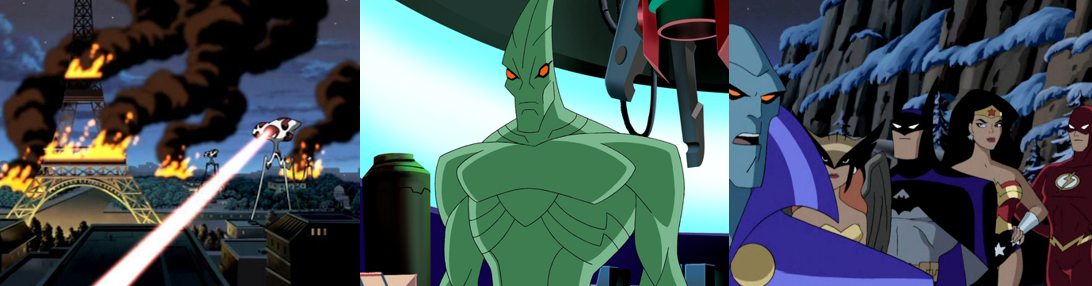
When invaders attack, Earth’s heroes are forced to work together (and with J’onn) to fight back.

Despite throwing his best punches, Superman barely slows the destructive walkers, but another psychic barrage clues him in on the key to fending off the invaders. Closely followed by Batman, who’s no match even in his kitted-out Batplane, the World’s Finest find a strange alien humanoid held in captivity in an alien base. Freeing the visitor, they learn that he is J’onn J’onnz, the last survivor of Mars, and that he was attempting to communicate to Superman on a mental level. Though naturally distrustful, even after J’onn assumes a more human guise, Batman listens intently as J’onn relates how the once-peaceful Martian civilization was decimated by the relentless, gloop-like invaders. They destroyed all trace of J’onn’s people, committing mass genocide and even stealing their shape-shifting powers, and were only stopped when J’onn himself led a final, desperate attack on their underground stronghold and paralysed them with a nerve gas. Though he sealed the invaders away and kept watch for 500 years, J’onn was in a hibernation cycle when two astronauts accidentally opened the tomb, reawakening the invaders and turning their aggression towards Earth. Desperate to ensure that another civilisation doesn’t suffer as his did, J’onn escaped and tried to warn the Earth, only to be captured and studied. Luckily, he retained enough of his power to call out not just to Superman, but to Wally West/The Flash (Rosenbaum), John Stewart/Green Lantern (LaMarr), and Shayera Hol/Hawkgirl (Canals-Barrera), who all join the fight and take down a contingent of the alien walkers. Their efforts are further aided by Princess Diana of Themyscira/Wonder Woman (Eisenberg), a “rookie” hero (as John puts it) who abandons her island paradise to aid mankind. Though new to the hero game, Wonder Woman makes an immediate impression, deflecting incoming fire with her wrist guards and showcasing superhuman strength and flight, aiding Hawkgirl and taking down the walkers as forcefully as Superman. Still, distrust is rife amongst the fledgling Justice League; not only are they wary of J’onn but Diana’s expertise is called into question, and the group initially struggles to gel. John immediately takes charge, barking orders and dividing the group into teams to gain intel on the walkers, only to be lumbered with the childish Flash and left chastising Wally for his reckless nature. Such recklessness is echoed in both Hawkgirl and Wonder Woman, whose first instinct is to fight and cause them to blindly charge into ambushes and traps as a result. Superman is constantly trying to help everyone and therefore lets his guard down. Apparently somewhat complacent since he’s largely invulnerable, Superman’s easily subdued by the invaders’ powerful tech.
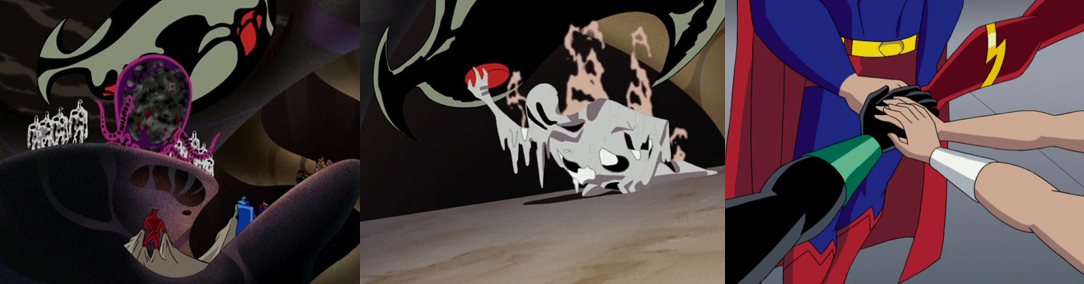
The fledgling Justice League ultimately triumph over the invaders and become a cohesive unit.

Although they’re unsure about J’onn, he proves to be dependable and is extremely capable in a fight. Boasting psychic powers, he can also fly, turn invisible and intangible, and exhibits superhuman strength on par with his peers. He also holds the key to shutting down one of the invaders’ drilling facility, working alongside Wonder Woman and Batman to steal the ion crystal, only for Batman to be left behind and seemingly gunned down. As the only member of the team without superpowers, Batman is at a physical disadvantage, but he does his best. He has his toys, of course, but his greatest asset is his mind. He colludes with J’onn to fake his death, an act that galvanises the team to work harder in rescuing Superman and Hawkgirl, and which deceives the invaders and their overseer, the Imperium (Richardson), a Lovecraftian, tentacled nightmare that delights in torturing J’onn before his newfound allies. The Imperium realises all-too late that Batman has survived as the Dark Knight sabotages the ion crystal, reversing its polarity and dispelling the polluting cloud that’s blanketed the Earth since the invaders arrived. It’s also Batman who deduces that the invaders are vulnerable to sunlight, a weakness the team quickly takes advantage of by ripping holes in the alien craft, killing the creatures without a second’s hesitation. Though they have no name, the alien invaders are a formidable force; they use shape-shifting abilities stolen from the Martians to impersonate public figures and even the heroes, laying the groundwork for their forces to arrive. They also wield laser blasters and are fully malleable, pulling themselves back together or reforming after taking damage. Most notably, they attack humanity using tripod-like walkers ripped right out of The War of the Worlds (Wells, 1898) just as the Imperium’s arrival is ripped from Independence Day (Emmerich, 1996). Their numbers and advanced alien tech make them more than a match for each of the team individually, even overpowered members like Superman and J’onn, but, once the disparate heroes start working together, the invaders are summarily driven off and Earth gains a powerful group of protectors.
The Summary:
“Secret Origins” has quite a mountain to climb. Sure, while DCAU viewers would’ve been well acquainted with Batman and Superman and have some knowledge of the Flash and the Green Lantern Corps, Wally, John, Shayera, and Diana are essentially brand-new characters in this sprawling continuity. Rather than spending time delving into the background of each of these new heroes, “Secret Origins” spends more time focusing on introducing J’onn and Wonder Woman, assuming the audiences will remember lore about the Flash and the Green Lantern Corps from Superman: The Animated Series and simply dropping Hawkgirl in our laps. I think this was a good approach; I liked that the first part was essentially another Batman/Superman team-up as it showcased neither man could fight off the invaders alone and that the two together wouldn’t be enough, either. This greatly aided in establishing the invaders as a true threat; they easily manhandled Batman, forcing him to ask Superman for aid, and Superman was distracted by J’onn’s attempts to communicate and unprepared to face a physical challenge. J’onn is depicted as a suitably tragic figure, one who’s seen his whole world die at the hands of these invaders and who is determined to prevent it happening again. J’onn even apologises for humanity’s violent nature and defends the very people who treated him so poorly when he arrived. He finds a kindred spirit in Superman and a surrogate family in the Justice League, who eventually accept him as one of them through his courageous actions. This arc is echoed in Wonder Woman, who renounces her place in paradise out of curiosity to explore “Man’s World” and a sense of duty to defend the planet from its aggressors. However, as she’s new to the superhero lark, she’s initially treated with contempt by the strait-laced John Stewart. A gruff military man who focuses solely on the job, John has no time for the Flash’s games and is dismissive of Diana for being a “rookie”. The others are much more accepting and even John is turned around after seeing the fantastic abilities Wonder Woman brings to the table.
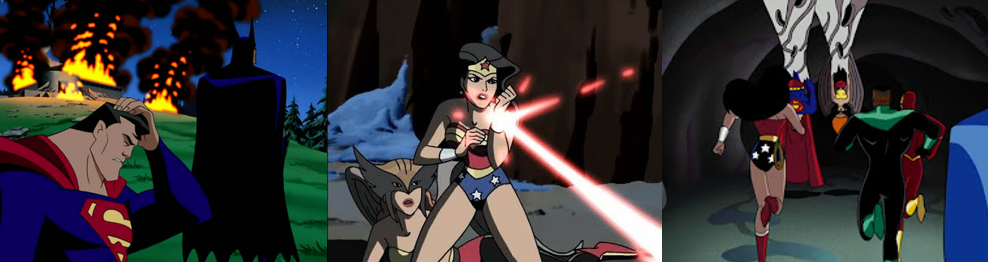
Heroes old and new must learn to fight together to defend the Earth.

The dynamic between the fledgling Justice League is at the forefront of “Secret Origins”. J’onn calls them together to defend the planet but none of them have any experience working together. Sure, Batman and Superman have teamed up, but they didn’t exactly like it or make a habit of it. Indeed, the only one with a sense of teamwork is John and even he’s bad at it, ordering the heroes around like he’s king shit and simply expecting them to fall in line or work together without laying the groundwork first. Egos and personalities clash throughout, with Batman being his usual pig-headed self, Hawkgirl charging into conflict, and the Flash toying with his foes, seemingly oblivious to the stakes. Even Superman struggles with the team dynamic, feeling obligated to help everyone and being blindsided as a result, and consequently sees the value in bringing the team together as a permanent fixture. Superman’s focus is on solving all the world’s problems, so much so that he doesn’t even suspect he’s being manipulated by the invaders to weaken Earth’s defences. The invaders are relentless and extremely aggressive, laying waste to cities with little resistance, but are both formidable and extremely vulnerable. Even Batman takes them out with enough effort and their machines are brought down by the heroes, but their sheer numbers and tenacity mean they can easily subdue even the Justice League. It isn’t until they underestimate Batman and their weakness is exposed that they show any signs of fear, with the Imperium desperately fleeing once its exposed to sunlight, only for Wonder Woman and Hawkgirl to violently bring down its escape craft and send the rest of its kind scurrying back to the depths of space. Again, it’s a very War of the Worlds-like ending and perhaps a little too contrived and nonsensical for the invaders to have such a glaring weakness, but it’s used to emphasise the team coming together as a unified force, so I’ll allow it. Ultimately this was a great introduction to the DCAU Justice League. “Secret Origins” established their different and conflicting personalities and how their various powers and abilities will work going forward, emphasising that they all have a part to play, and showed that there are some threats that require a whole group of special heroes to oppose it.

My Rating:

Rating: 4 out of 5.

Great Stuff

What did you think to “Secret Origins”? Did you enjoy seeing these heroes come together? What did you think to threat they faced? Would you have liked to get a little more insight into the Flash and Hawkgirl? Are you a fan of J’onn J’onnz? What are some of your favourite Justice League episodes? Feel free to use the comment section below to share your opinions and be sure to check out my other Justice League content across the site.

Screen Time: Batman: “Joker’s Favor” (S1: E22)

Series 1, Episode 22: “Joker’s Favor”

Air Date: 11 September 1992
Director: Boyd Kirkland
Original Network: Fox Kids
Stars: Mark Hamill, Arleen Sorkin, Ed Begley Jr., and Kevin Conroy 

The Background:
Gotham’s caped crusader is no stranger to adaptation. Around three years after his debut appearance, Bruce Wayne/Batman was brought to life in an oft-forgotten fifteen-chapter cinema serial and made his first appearance in animation in The Batman/Superman Hour (1968 to 1969), courtesy of Filmation. After the critical and commercial success of Tim Burton’s Batman movies, Batman (1989) and Batman Returns (1992), Batman shed the remnants of the camp trappings that had been associated with him since the sixties and was popularised as a dark, brooding vigilante once more. Perhaps no piece of ancillary media was more influential in this, however, than Bruce Timm and Paul Dini’s Batman: The Animated Series (1992 to 1999), which placed the Dark Knight into a distinctly art deco world and pushed the boundaries of what cartoons could get away with. Eventually expanding into an extremely popular animated DC universe, Batman: The Animated Series not only came to influence subsequent Batman media but also introduced new characters to the Bat-world, with none more prominent than Doctor Harleen Quinzel/Harley Quinn. Created by Dini and Timm for this very episode, Harley was initially planned to simply be a one-off character but Dini decided to make her a recurring antagonist, an abused henchwoman whom the Joker (Mark Hamill) could play off. Initially portrayed by the late Arleen Sorkin, Harley quickly became a popular breakout character and was officially woven into the mainstream DC Comics in 1999. She has seen significant growth since then, transitioning from the Joker’s mistreated plaything to a strong, independent – if maniacal – anti-hero and even joining the Bat-Family in later years. Harley Quinn has become so popular that she made the transition to live-action with a pitch-perfect performance by Margot Robbie and a tone deaf outing from Lady Gaga, got her own hilarious animated series, and has consistently cropped up in videogames and animated ventures, to the point where she’s now considered to be as important to DC Comics as heavy-hitters like Batman and the Justice League

The Plot:
Mild-mannered accountant Charlie Collins (Begley Jr.) insults the Joker (Hamill), who spares his life in return for aiding him and right-hand woman, Harley Quinn (Sorkin), in their latest plot.

The Review:
This is my first time reviewing an episode of Batman: The Animated Series on my website beyond the feature-length productions, and it’ll come as no surprise how much I love this series. I didn’t watch every single episode as a kid (though I have since) but I really enjoyed the entire DC Animated Universe. It was fun seeing these characters and their stories adapted and tweaked and presented in an engaging and serious way, no more so than Batman, whose mainstream popularity was arguably bolstered by Bruce Timm and Paul Dini’s animated series. The show makes an impact right from the start with its stark, gritty opening sequence that’s completely devoid of any titles or text. It screams “Batman” and really sets the tone for what’s to come. That and the stellar voice cast; it’s impressive how many character, veteran, and big-name actors featured on the show, with Mark Hamill’s turn as the Joker widely regarded as one of the best interpretations of the character, to say nothing of Kevin Conroy’s enduring and timeless take on the Batman himself. All this is to say that Batman: The Animated Series rarely missed; it changed superhero cartoons and adaptations for the better and its impact on the source material is just as significant, with Harley Quinn being just one piece of that puzzle. With the obligatory gushing out of the way, let’s get to the episode, which opens to find Charlie Collins stuck in Gotham City traffic on perhaps the worst day of his life: he’s been turned down for a raise, his kid needs braces, the ball game has been delayed, and his wife Bonnie is making meatloaf! Charlie hits his breaking point when a fellow driver rudely cuts him off; sick of being treated like a punching bag, he barges into the car and hurls insults at the driver, only to find the Joker behind the wheel!

After insulting the Joker, hapless Charlie Collins is coerced into aiding his latest devious scheme.

Despite Charlie’s best efforts to drive along amiably and lose the Joker, his car eventually breaks down, allowing the Clown Prince of Crime to confront him in the woods. Amusingly, the Joker is offended by Charlie’s rude behaviour and chastises him for being so impolite, though his teacherly demeanour quickly turns to a sinister anger, reducing Charlie to begging for mercy. Intrigued by Charlie’s desperation to save his hide, the Joker gleefully agrees to spare him on the proviso that Charlie promises to do him a favour at some point, with even the Joker unsure as to what that favour may be. Charlie readily agrees, relieved to be in one piece, and the episode jumps ahead two years and to the office of police commissioner James “Jim” Gordon (Bob Hastings), who’s due to be honoured for his work, something he finds to be a waste of time. The Batman (Conroy) echoes the sentiments of Detective Harvy Bullock (Robert Costanzo) and many others by stating that Jim deserves credit for keeping Gotham safe around the clock, and Jim begrudgingly agrees to attend the function. Unbeknownst to him, the Joker has also set his sights on gatecrashing the event; as he relates to his enthusiastic cheerleader, Harley Quinn, the Joker insists demands the chance to honour Gordon and picks Charlie’s driving license out of his little black book to call in that favour. Despite changing his name to Don Wallace and moving himself and his family to Ohio, Charlie is terrified when the Joker calls him, having kept tabs on him the entire time, and demands that he return to Gotham in return for keeping his family safe. With no other choice, Charlie makes the flight and is picked up by Harley before he can alert the police. The Joker expertly feigns pleasure at seeing his “old pal” once again and promises to send him home once he’s fulfilled his obligation, asking simply that Charlie opens a door for Harley when she delivers a massive celebration cake to Gordon’s gala under the clever guise of Crazy Clown Catering.

The Joker underestimates Charlie’s resolve and ends up falling for his bluff.

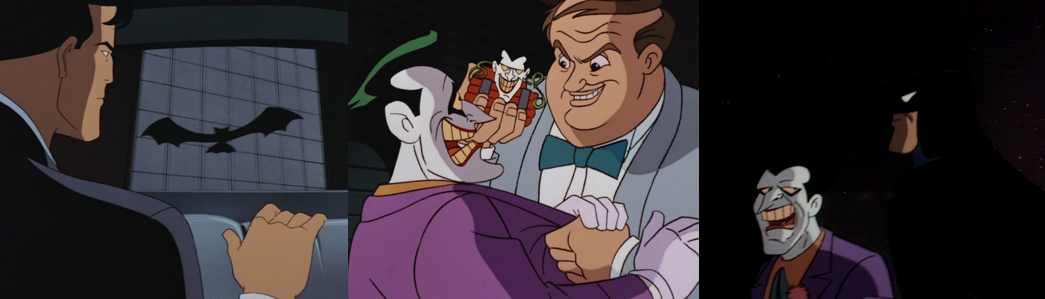
Entering the gala, Charlie desperately tries to alert the authorities – and the Batman – to the Joker’s plot by swinging around a convenient bat-shaped model, catching the attention of Bruce Wayne as he’s leaving to search for the Joker. As Gordon delivers his speech, Charlie opens the doors to the function room and Harley wheels in his cake (much to Bullock’s lustful delight), but finds himself glued to the door by a particularly strong adhesive. Harley delivers a rhyming threat and promptly gases the attendees, paralysing them and leaving them powerless to avoid the bundle of dynamite the Joker delivers as a gift to the long-serving commissioner. Charlie is incensed that the Joker welched on his word, but the Batman makes a timely arrival to toss the dynamite out of the building, destroying the Joker’s getaway van. After freeing Charlie and learning of his plight, the Batman easily subdues Harley and the Joker’s goons, but the Joker covers his escape with a series of boobytraps and an explosion. However, while he’s racing away outside, the Joker is confronted by an angered Charlie, who’s ready to blow them both up with one of the Joker’s own bombs, apparently having lost his mind. Terrified, the Joker screams for the Batman’s intervention and willingly hands over all the documentation he has on Charlie and his family, completely falling for the disgruntled civilian’s bluff. Charlie gratefully leaves, happy to taste his wife’s meatloaf, now that the Joker is in Batman’s custody and his family is safe.

The Summary:
This was a fun little side story in the grand tapestry that was Batman: The Animated Series. As ever, the episode is dark and gritty, sporting a neo-noir styling and expertly using shadows and atmosphere to give its simplistic character designs a surprising amount of nuance and paint the Batman as a terrifying, ethereal figure. The Batman himself features only briefly in this episode, primarily appearing in the last five minutes or so to foil the Joker’s plot, but makes an impression when he’s onscreen thanks to Conroy’s distinctive Bat-voice and the effortless way he deals with the Joker’s minions and traps. Indeed, the wider Batman cast takes a backseat in “Joker’s Favor” so the episode can focus more on the Joker and his recent “hobby”, poor, unlucky Charlie Collins, a balding, middle-aged, underappreciated husband and father who’s frequently horrified and dumbstruck by the duality of the Joker’s insanity and menace. Charlie is an incredibly amusing and sympathetic figure; despite his loving wife and child, he’s beset by bad luck almost to the point of parody and completely helpless to avoid the Joker’s reach. Even changing his name and uprooting his family doesn’t help, and his desire to keep them safe is what drives him to both agree to paying the Joker back and going along with his latest madcap scheme. Even the Joker sees Charlie as worthless and impotent, never once believing he would have the guts to raise the alarm or fight back, which allows Charlie to scupper the Joker’s plan with his makeshift Bat-Signal and even bring the Clown Prince of Crime to the verge of tears by threatening his life. This final showdown between them is especially potent given the Joker’s familiarity with how important “one bad day” can be. He pushed Charlie to the edge, terrorising, manipulating, and threatening him, and can see that the man is ready to have his revenge even if it means his own death. However, in an ironic twist, Charlie actually picked up a few of the Joker’s habits, mainly toying with his victims, and pulled a cruel prank on his tormentor, tricking him into giving up the hold he had over the accountant to save his own hide.

Harley shines as the Joker’s colourful cheerleader who follows his every word without question.

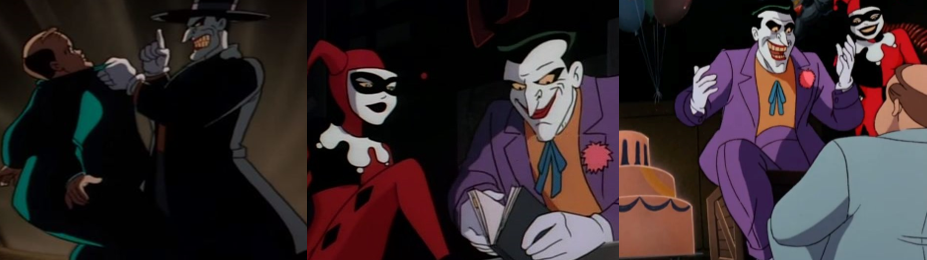
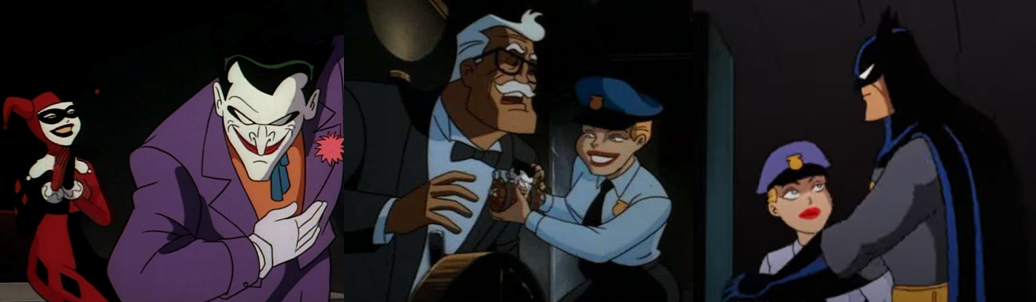
Of course, “Joker’s Favor” is best known for including the first appearance of Harley Quinn. Harley actually briefly appears early in the episode, walking through the police department in her civilian disguise, though this isn’t expanded upon in the episode and is more of an Easter Egg for eagle-eyed viewers. Harley is depicted as a joyful, enthusiastic, devoted follower of the Joker. I described her as his cheerleader earlier and that’s incredibly apt as she claps, celebrates, and encourages every idea, action, and word her “Mistah J” says, no matter how bonkers his scheme may be. Although she only appears in her trademark harlequin outfit once in this episode, Harley is seen to be a master of disguise. She dresses as a chauffeur to pick up Charlie and masquerades as a police officer when infiltrating Gordon’s gala, raising no suspicion either time despite her loud and overly cheerful demeanour. Unfortunately, we don’t get to see Harley in action here; she doesn’t bust out any gymnastics or her signature giant mallet. She does try to distract the Batman with her woe-is-me façade and surprise him with a knife attack, but is handcuffed with little effort from the Dark Knight. Similarly, we know nothing of her backstory, and she primarily exists as a more colourful henchwoman for the Joker, one he both openly confides in for his need for an appreciative audience and demeans with menial tasks like cutting his hair. Still, Harley excels in this role; you can tell that there’s more to her than the dumb, brutish thugs the Joker employs, and she steals every scene with her joyful and bombastic personality. Overall, this was an enjoyable episode for its main plot, but fans of Harley would be better served watching “Mad Love” (Lukic, 1993) or reading the original comic book of the same name (Dini, Timm, et al, 1993) for a more in-depth exploration of Harley Quinn, her relationship with the Joker, and her tragic origin story.

My Rating:

Rating: 3 out of 5.

Pretty Good

What did you think to “Joker’s Favor”? Did you enjoy the Joker’s tormenting of hapless Charlie Collins or did the lack of Batman action put you off? What did you think to Harley Quinn at the time, or how do you feel about this being her first appearance? Did she make much of an impression on you at the time and are you a fan of how widespread her popularity has become? What are some of your favourite Harley Quinn stories and moments, or episodes of Batman and the DCAU? There’s a comments section down below, feel free to use it to share your opinions, and be sure to check out my other Batman content across the site.
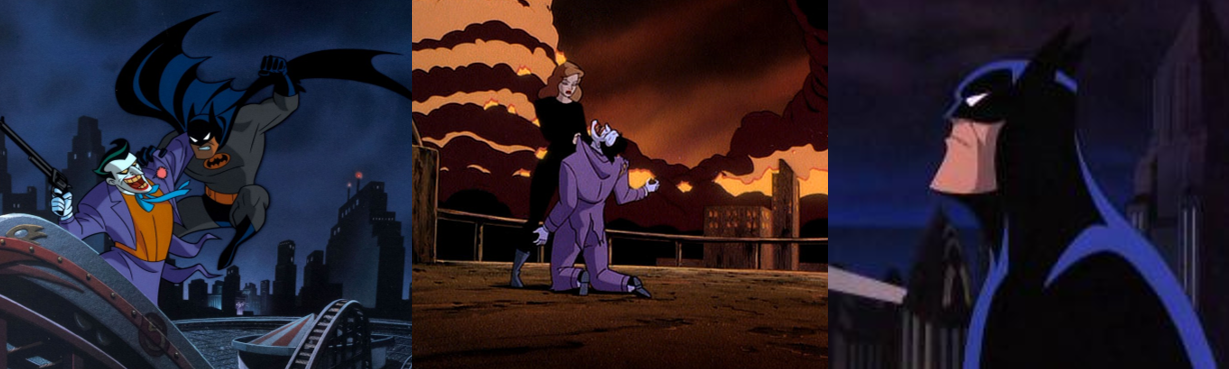
Movie Night [Bat-Month]: Batman: Mask of the Phantasm


In the decades since his first dramatic appearance in the pages of Detective Comics, Bruce Wayne/Batman has become a mainstream, worldwide, pop culture icon. The brainchild of writer Bob Kane, Batman was brought to life by artist Bill Finger and has been a popular staple of DC Comics and countless movies, videogames, and cartoons over the years. So, as today is “Batman Day”, I figured this was a perfect excuse to spend every Saturday celebrating comic’s grim and broody vigilante.
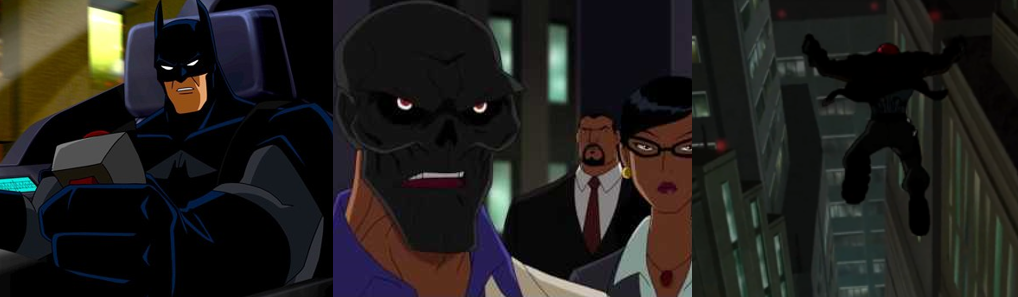

Released: 25 December 1993
Director: Eric Radomski and Bruce Timm
Distributor: Warner Bros.
Budget: $6 million
Stars: Kevin Conroy, Dana Delany, Hart Bochner, Bob Hastings, Efrem Zimbalist Jr., and Mark Hamill

The Plot:
Early into his crimefighting career as the Batman, Bruce Wayne (Conroy) finds mobsters being slain by a mysterious and vicious, Grim Reaper-esque vigilante “The Phantasm” (Stacy Keach). In trying to uncover the Phantasm’s identity, Batman reconnects with his lost love, Andrea Beaumont (Delany), and uncovers a terrible connection between the two.

The Background:
Artist Bob Kane may have dreamed up the idea of a new masked crimefighter to capitalise on the success of Clark Kent/Superman’s debut, but it was the long-suppressed efforts of artist Bill Finger that the “Bat-Man” became such an iconic figure. Decades later, the likes of Dennis O’Neil sought to correct the Batman’s image following the gloriously camp (and incredibly popular) 1960s television show, but the release and relative success of Batman (Burton, 1989) and Batman Returns (ibid, 1992) saw renewed interest in the character. Consequently, Bruce Timm, Paul Dini, and Eric Radomski spearheaded a new animated series influenced by both films that became one of the most beloved and influential cartoons of its era. Batman: The Animated Series aired eighty-five episodes between September 1992 and 1995 before being succeeded by twenty-four episodes of The New Batman Adventures (known as The Adventures of Batman & Robin in the United Kingdom) between 1997 and 1999, but its initial success convinced Warner Bros. to task Alan Burnett with writing a full-length animated feature. Heavily influenced by Batman: Year Two (Barr, et al, 1987), the film was set to feature a Grim Reaper-like counterpart to Batman while also acting as something of an origin story for both the Dark Knight and his long-standing nemesis, the Joker. Filming was completed within eight months, and Warner Bros. made the last-minute decision to release it theatrically. Although this negatively impacted its box office return, Batman: Mask of the Phantasm made up for this in home media sales and is widely regarded as one of the best superhero films ever made. Critics praised the presentation and score, the slick animation, and its mature themes, and it remains one of the quintessential adaptations of the character for many Batman fans.
The Review:
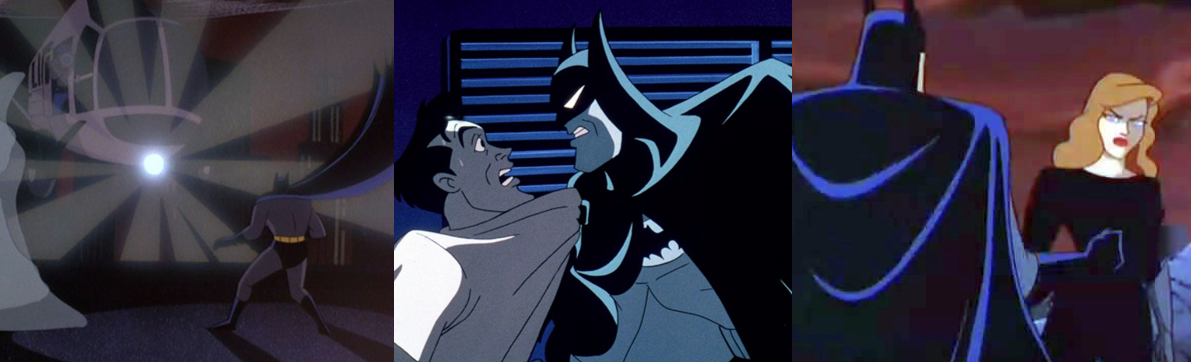
I watched Batman: The Animated Series as a kid, alongside a host of other popular cartoons at the time, but my memories aren’t massively clear. This is a general statement of my childhood in this regard, and I think it’s because I usually slept in at the weekends and didn’t get up until after a lot of the big cartoons had already been on, then I’d spend the rest of my time eating, playing videogames, or watching the same video cassettes over and over. Still, Batman: The Animated Series definitely made an impression on me. It was dark, surprisingly violent, and probably the most readily available incarnation of Batman since it didn’t involve buying any books or comics, so it was massively exciting when this animated feature aired on television for the first time or you saw the VHS available for purchase. The film begins in present day Gotham City, where Batman has established himself as a nocturnal vigilante but is still early enough in his career to large be considered an urban myth. As a result, Chuckie Sol (Dick Miller) has no qualms about conducting his business in the dead of night, which naturally means his money laundering deal is interrupted by the Batman. Although Chuckie slips away with his counterfeit money, he’s intercepted by a mysterious, Grim Reaper-like figure we now know as the Phantasm and so intimidated by the spectre that he drives out of the parking lot to a violent death.

The mystery of the Phantasm puts Batman in the frame, but their true identity may surprise you!

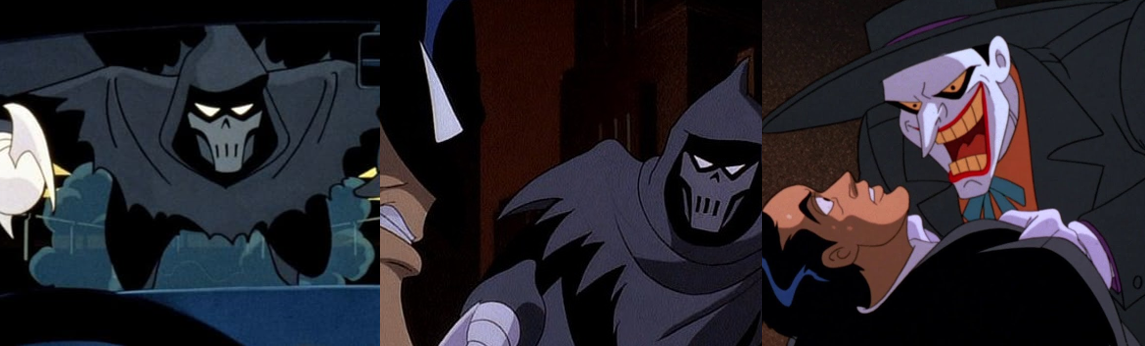
Thanks to the Phantasm, and the testimony of bystanders, Batman is fingered for Chuckie Sol’s death and councilman Arthur Reeves (Bochner) wastes no time publicly declaring Batman a violent vigilante who needs to be brought to justice. When Commissioner Jim Gordon (Hastings) remains adamant that sensationalist claims that Batman has snapped and gone on a killing spree are against Batman’s very nature and washes his hands of the entire debacle, Reeves personally leads numerous unsuccessful attempts to apprehend the Dark Knight. Batman is more concerned with analysing a piece of Chuckie’s windshield, which is stained by chemical residue from the Phantasm’s smoke, and investigating the graveyard where Buzz Bronski (John P. Ryan) was killed. Batman: Mask of the Phantasm does a wonderful job of depicting Batman’s detective skills and it’s a nice change of pace from all the thrilling action, chase, and fight sequences to follow his investigation into the murders. Additionally, there are two pressing mysteries in the feature: the identity of the titular Phantasm and the connection between the mobsters left dead in their wake. Of course, these end up overlapping but there’s a decent attempt to throw some red herrings our way. Reeves, Andrea’s father Carl (Keach), and Andrea are all potential suspects but it’s the latter who turns out to be behind the cloak and hand-scythe of the Phantasm. There’s an argument to be made that this isn’t too surprising given we’ve never heard of Andrea before this film, but the stature and physicality of the Phantasm definitely helps to keep this a dramatic reveal at the finale. Unlike the Batman, the Phantasm isn’t above killing; Andrea utilises theatricality to equal Batman, appearing to appear and disappear in a cloud of smoke, brandishes a dangerous scythe-like gauntlet, and is garbed in a heavy-duty armoured suit that makes her more than a match for Batman’s skills and gadgets when they inevitably come to blows.

Kevin Conroy delivers another stellar performance as Bruce is torn between his vow and his heart.

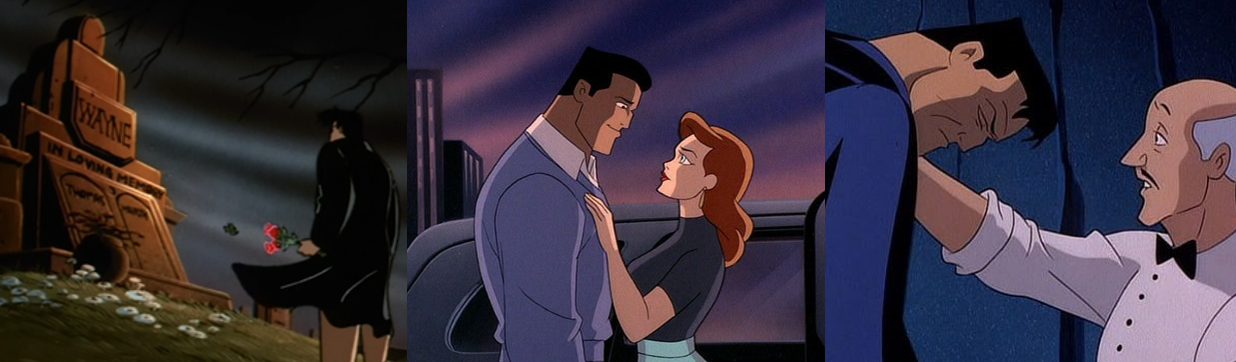
While Michael Keaton may have set the bar for live-action portrayals of Batman, make no mistake that Kevin Conroy remains the standard for depictions of Batman. Any actor looking to take on the iconic role must depict his three dominant personas: Public (Bruce Wayne, socialite and playboy), Private (Bruce Wayne, brooding and melancholy), and Vigilante (the grim and stoic Batman) and Conroy perfectly nails all three of these. When Bruce is attending functions and banquets, he’s a suave and smooth-talking ladies’ man known for being extremely generous with his family’s wealth, hands-on with charities and opportunities from growth and employment in Gotham, and for stringing along a seemingly endless parade of bimbos and lusty women. At home, in both the solitude of Wayne Manor and the sanctity of the Batcave, this public mask slips, allowing Bruce to confide in his faithful butler and father-figure, Alfred Pennywoth (Zimbalist Jr.), and is the closest he gets to being truly honest with anyone. And, of course, under cover of night, he stalks the criminal underworld as a theatrical vigilante, and Conroy expertly depicts the differences in each of these personas and situations with subtle changes to his tone, line delivery, and inflections that really went a long way to making this version of Batman one of the most well-realised, complex, and layered interpretations of the character. This really comes to the forefront here thanks to repeated flashbacks to an earlier time in Bruce’s life where he struggled with how to make good on the vow he made to avenge his parents’ death by tackling the criminal scum that took their lives. At this point, he’s still an angry, directionless young man whose vigilante debut goes sideways because, while he has the physical means to overpower even armed crooks, he’s at a disadvantage because he’s seen as just a man, rather than a force of darkness and justice (as he puts it: “They weren’t afraid of me!”) While brooding at their gravestone, he crosses paths with the beautiful Andrea Beaumont. Though she comes across as dismissive and aloof, she’s actually intrigued and somewhat taken by him since he has all this wealth and privilege but always seems so melancholy. As she’s also lost someone, her beloved mother, the two bond over their shared grief and, when she comes to visit him, she impresses him with her combat prowess and the two begin a whirlwind romance.

As if the mysterious and brutal Phantasm wasn’t enough, the Joker shows up to steal the show!

Bruce is so taken by Andrea that he questions his vow and contemplates a life of happiness as a benevolent entrepreneur with her by his side. He is therefore devastated when she suddenly rejects his proposal and leaves the city, forever setting him on a path of grim vigilantism. When Andrea returns to Gotham some years later, in the present day of the story, Bruce is a fundamentally changed man. A chance encounter between her and Batman accidentally reveals his true identity to her, and she greets the Batman with a cutting hostility when he’s forced to question her as part of his investigation into the recent killings (delivering a biting jibe about how he’s controlled by his parents). Buzz Bronski, a mob associate of Chuckie’s, is the Phantasm’s next target; his henchmen see him chased by the cloaked figure and crushed to death under a gravestone and mistake the “Angel of Death” for Batman, which causes a media sensation. Startled by the murders of his associates, the decrepit Sal Valestra/The Wheezer (Abe Vigoda) fears for his safety and turns to the Joker (Hamill) for protection. As if touching upon Batman’s origins wasn’t enough, Batman: Mask of the Phantasm thus provides a glimpse into the background of the typically mysterious Clown Prince of Crime. Although not named as such here, the Joker was once Jack Napier like in Batman, but we also learn that he was once a chauffeur and assassin for the mob before taking his dive into disfiguring acid. While I appreciate the effort to flesh out the Joker’s backstory a little, and the film does a decent jump of bringing him in late into the runtime, I can’t help but feel like the Joker’s inclusion was a little forced and unnecessary. It’s as though the filmmakers didn’t quite trust the intriguing mystery of the Phantasm, the glimpse into Bruce’s past, or the narrative of Batman being hunted by the police and felt they had to shoehorn the Joker in to make things more exciting.

The Nitty-Gritty:
Of course, I’d be doing Batman: Mask of the Phantasm a disservice if I didn’t mention the absolutely haunting score from the late, great Shirley Walker. Having collaborated with composer Danny Elfman for Batman, Walker was the perfect choice to evoke the same melancholic, gothic undertones of Burton’s blockbuster reinvention of the character, and she’s at her absolute best here. The sweeping, operatic score really gives Gotham City an ominous, looming character, punctuates the action, and makes the more poignant moments of the film all the more heart-breaking and that’s all thanks to Walker’s absolutely iconic and memorable orchestral number. The animation must also be praised; thanks to an emphasis on shadows and darkness, Batman moves like a slick, otherworldly figure and comes across as fearsome, intimidating, and efficient all at once. Nowhere is the use of lighting more impressive than in scenes in the Batcave, where deep, never-ending shadows and darkness are at their most prominent, and this all really adds to the stark contrast between the inky black of night and the brighter, dull pastels of the few day time scenes.

The feature provides a tantalising glimpse into Bruce’s motivation to become the Dark Knight.

One thing that helped Batman: Mask of the Phantasm stand out as an animated feature was how surprisingly adult it was. Batman: The Animated Series always expertly towed the line with the censors by depicting guns and bullets rather than laser pistols, and the feature film gets away with even more to depict people smoking, modern-day pistols rather than Tommy guns, a bit of blood when Batman takes a beating, and an unexpectedly high body count for a “kid’s film” thanks to the murderous Phantasm. A central aspect of the film is the exploration into the motivation and tragedy that pushed Bruce into assuming the Batman guise. Despite travelling the world and gaining the physical and deductive skills to be a crimefighting detective, Bruce is torn between seeing his vow to the fullest extent and using his wealth to benefit the city while living a happy life with Andrea. Alfred naturally pushes him towards the latter, and Andrea even believes that his parents “sent [her]” as a sign that he can go back on his vow. Unfortunately, fate intervenes. Right after she accepts Bruce’s proposal, Carl Beaumont forces Andrea to leave the city after his dealings with the mob threaten both of their lives and, rather than explain the situation to her love, Andrea left him heart-broken and rejected. With his one last chance of a happy, normal life denied him, Bruce returns to his vow and, in a hauntingly impactful scene, embraces the cape and cowl of the Batman, losing himself to the darkness of his never-ending crusade and shocking even Alfred with his monstrous transformation.

The climatic finale sees Batman engage with the Joker, and seemingly lose his one true love forever.

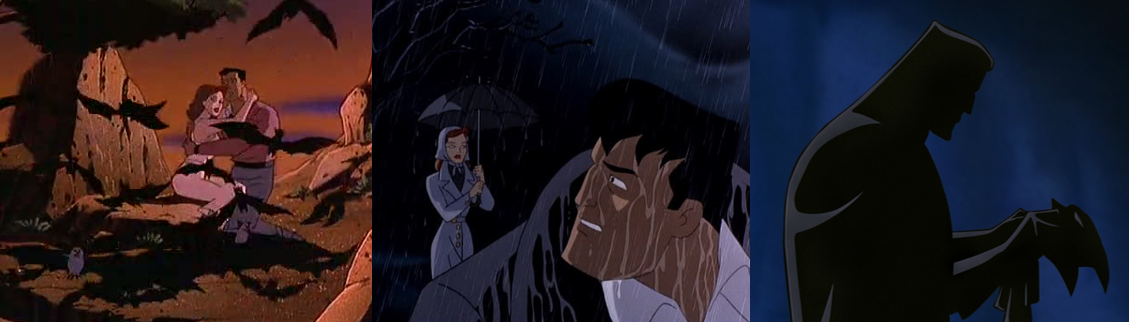
Batman takes his investigation up a notch after figuring out that the Joker is involved, and the cackling madman quickly takes a perverse pleasure in hunting down the one responsible for killing his old buddies. This involves murdering Valestra and wiring to explode, reducing Reeves to a hysterical mess with his laughing gas, and trying to off the Batman with ludicrous contraptions cobbled together from the abandoned world’s fair that the Joker’s taken as his hideout. Oddly enough, once Andrea’s true identity is revealed, the Joker actually holds his own in a fight with her thanks to his acid-spitting flower and turning the fair’s animatronics and rides into death traps. Andrea, however, is driven by a murderous bloodlust. Since the Joker was responsible for killing her father, she has no problem fighting dirty, kicking him in the nuts and tracing him across the hazardous amusement park in a bid to have her revenge. Naturally, Batman makes a dramatic save and chases down his most persistent nemesis, leading to a somewhat ludicrous conclusion where Batman battles a jetpack-wearing-Joker through the skies of a dilapidated amusement park wired to explode. Determined to see the Joker pay, Andrea ignores Batman’s pleas to leave and seemingly perishes along with the Clown Prince of Crime as the world’s fair is dramatically engulfed by explosions, leaving Batman not only heart-broken but guilt-ridden at his failure to save his former flame. In the darkness of the Batcave, he finds solace in Alfred’s reassuring words and Andrea’s pendant, giving him hope that she’s still alive. Hardened by the experience, he returns to the night as the Batman, grim avenger of injustice, while Andrea sails off to an unknown future with only her own heartbreak for company.

The Summary:
It’s hard to get much better than Batman: Mask of the Phantasm for pure, unadulterated Batman action. In many ways it, like the cartoon it spun out from, is one of the most striking, influential, and unapologetically faithful renditions of DC’s Dark Knight ever put to screen and perfectly captures the dark, gothic melancholy of the titular vigilante, his city, and his never-ending crusade against crime. This was one of the rare, few glimpses into a time of Bruce’s life where he was struggling to make the transition from angry, vengeful young man to grim avenger of the night and it’s absolutely tragic to see how close he came to abandoning his crusade for true love and was forced to fully commit to his dark alter ego once fate set him on that path. One of the things I absolutely love about Batman: Mask of the Phantasm is that it’s not afraid to show Batman’s more cerebral side. The mystery of the Phantasm and the killings is as crucial to the narrative as the romance between Bruce and Andrea, and is far more of a focus than the handful of fantastically realised and slickly animated fight and chase sequences. Batman also feels fallible and human while still being a fearsome and intimidating figure. He easily outmatches street level scum but can be hurt by the likes of the Phantasm and the Joker thanks to their skills and/or gadgets. As I’m also a big fan of Batman: Year Two, the Phantasm struck me as a brilliant foil for Batman. As cold and stoic as the Dark Knight, Andrea’s gruesome, cloaked persona is a dangerous and ruthless foe out for blood and nothing more, but more than a match for the Caped Crusader thanks to gadgets, theatricality, and a degree and physical ability. While I find the finale a bit over the top thanks to the focus shifting towards the Joker, you can’t deny that Mark Hamill steals the show at every turn with his maniacal performance, delivering every line with a sadistic glee that makes the Clown Prince of Crime a joy to watch. Honestly, if you know anyone who isn’t sure if they want to get into Batman or who wants to learn more about Batman, I would absolutely recommend you point them towards Batman: Mask of the Phantasm as you’ll be hard-pressed to find a better representation of everything that makes the Dark Knight such an enigmatic and alluring character.

My Rating:

Rating: 5 out of 5.

Fantastic

Are you a fan of Batman: Mask of the Phantasm? Where would you rank it against other Batman films, live-action or otherwise? What did you think to the Phantasm, their depiction, and the reveal of their identity? Were you a fan of the Joker’s inclusion or, like me, did it kind of overshadow the rest of the plot for you? Did you enjoy Batman: The Animated Series growing up? What are some of your favourite episodes, and where would you rank Kevin Conroy’s performance? What was your first experience of Batman and how are you celebrating his debut this month? Feel free to share your thoughts on Batman: Mask of the Phantasm down below, or leave a comment on my social media, and be sure to check back in for more Batman content in the near future!

Movie Night [Robin Month]: Teen Titans Go! To the Movies


In April of 1940, about a year after the debut of arguably their most popular character, Bruce Wayne/Batman, DC Comics debuted “the sensational find of [that year]”, Dick Grayson/Robin. Since then, Batman’s pixie-boots-wearing partner has changed outfits and a number of different characters have assumed the mantle as the Dynamic Duo of Batman and Robin have become an iconic staple of DC Comics. Considering my fondness for the character and those who assumed the mantle over the years, what better way to celebrate this dynamic debut than to dedicate every Thursday of April to celebrating the character?


Released: 27 July 2018
Director: Peter Rida Michail and Aaron Horvath
Distributor: Warner Bros. Pictures
Budget: $10 million
Stars: Scott Menville, Hynden Walch, Khary Payton, Tara Strong, Greg Cipes, Will Arnett, Kristen Bell, and Nicolas Cage

The Plot:
Determined to be a Hollywood star, Dick Grayson/Robin (Menville) will go to any lengths to impress director Jade Wilson (Bell) to notice him and his team! With a few madcap ideas and musical numbers, the Teen Titans try to take the limelight, but when Slade Wilson/Deathstroke the Terminator (Arnett) messes with their plans, the Teen Titans will have to become true superheroes to save the world!

The Background:
About four years after the debut of the Justice League of America (JLA), their teen sidekicks came together to form the Teen Titans, presumably to appeal to younger readers. The team were a relatively consistent presence throughout the 1960s and 1970s but writer Marv Wolfman and George Pérez breathed new life into the concept with characters like Victor Stone/Cyborg and Princess Koriand’r/Starfire, who became synonymous with the team. No strangers to adaptation, the Teen Titans have seen some success in animated ventures; Teen Titans (2003 to 2006) was widely regarded as a popular spin-off of the incredibly well-regarded animated series pioneered by Bruce Timm and Paul Dini. Many long-term fans were therefore put off when the show was retooled into a more kid-friendly aesthetic with the slapstick Teen Titans Go! (2013 to 2022), though many praised the show for its bizarre nature and light-hearted humour. Additionally, the show was popular enough to spawn this feature-length production; universally praised for its metatextual comedy, its gleeful destruction of superhero tropes, and its unhinged comedy, Teen Titans Go! To the Movies also gave finally star Nicolas Cage the chance to portray Clark Kent/Superman after missing out on a live-action appearance in the nineties. With a box office gross of $52.1 million, the film was followed by a reasonably well received straight-to-DVD crossover between the Go! Titans and their more serious predecessors, as well as a couple of other similar features of varying quality.

The Review:
So, like a lot of kids my age, I watched a fair amount of Bruce Timm and Paul Dini’s DC cartoons back in the day; even into my late teenage years, I was enjoying Justice League Unlimited (2004 to 2006), and I really enjoyed the original Teen Titans cartoon. Although never explicitly stated to be a part of the same fictional universe, I always liked to think that Teen Titans was a spin-off from the main DC Animated Universe and I loved how it gave a bit of a gritty edge and a commanding presence to one of my favourite characters, Robin, and allowed him to be in the spotlight in a world where he’s often given the shaft in live-action movies. I’d be lying if seeing Teen Titans Go! for the first time wasn’t a little off-putting for me in this regard; however, it was clearly aimed at a younger audience and I found it to be quite funny the few times I did watch it, the same as Batman: The Brave and the Bold (2008 to 2011), which showcased a more light-hearted version of the Dark Knight but in a fun and action-packed way. There is room for both interpretations of these characters, as much as I prefer the darker interpretations as they’re truer to the original spirit of Batman and his world, and it’s not as if there weren’t other animated ventures that showcased this side of the likes of Batman and Robin, so it was still pretty exciting when a feature-length presentation was announced, especially as it aimed to poke fun at Warner Bros.’ tumultuous history with cashing in on their DC Comics franchises.

The happy-go-lucky Titans are distraught to learn the public and their peers see them as bumbling fools.

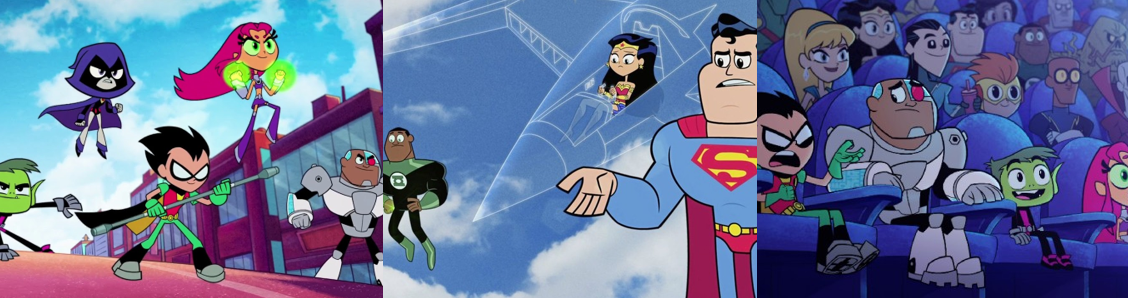
Things get off to a loud and action-packed start as Jump City is attacked by the megalomaniacal supervillain known as Balloon Man (Greg Davies), a ludicrous character who is quite literally a gigantic, anthropomorphic balloon who can easily smash his way into a bank and squeeze through small gaps by expanding and contracting his bulbous body. Although Jump City’s police are no match for the inflated villain, the Teen Titans soon arrive to help out; what follows is a fight scene, set to an electric guitar remix of the Teen Titans Go! main theme, that helps to establish the characters and abilities of the titular team for those who are unfamiliar. Robin is the leader, jumping head-first into the fight and partially tearing Balloon Man’s hide with his shuriken; Cyborg (Payton) is the enthusiastic muscle, able to transform his body into all kinds of heavy ordinance; Starfire (Walch) is a naïve, childlike misfit from another world who wields incredible cosmic power but is easily distracted by cute things; Rachel Roth/Raven (Strong) is the dark, stoic enchantress capable of manipulating others and creating constructs out of a black magical energy; and Garfield “Gar” Logan/Beast Boy (Cipes) is the team’s goofball shape-shifter, who delights in monkeying around and transforming into a range of green-hued animals (including becoming a porcupine to pierce Balloon Man’s butt for an extended fart gag). So consumed by their own hype are the team that they completely miss that the Justice League – Superman (Cage), Diana Prince/Wonder Woman (Halsey), and Jon Stewart/Green Lantern (Lil Yachty) – take out Balloon Man and are saddened to learn that both the public, and the superhero community, see them as a team of goofballs rather than “real” superheroes worthy of their own movies. Despite the fact that people “don’t talk” about Green Lantern’s movie, Superman advises the team that they’ll never be seen as anything other than a joke unless they shape up and start acting like real heroes rather than goofing off for food and dance numbers. Despite the evidence lobbied against them, Robin is adamant that he and his friends are not only world-renowned heroes but worthy of their own movie; it’s been his lifelong dream to have his own movie franchise, after all, and he’s determined to prove that he’s worthy of this accolade.

Robin’s so determined to get his own movie that he briefly messes up with the timeline.

Unfortunately, he and his friends are aghast to learn that they’re not on the list to attend the premiere of Batman’s (Jimmy Kimmel) newest film, and even more insulted when the Challengers of the Unknown, of all people, are more known than they are. Thanks to Raven’s ability to teleport them using her extradimensional portals, the team are able to gate crash the screening and steal the Challengers’ seats, introducing them to beloved superhero movie director Jade Wilson. Robin is dejected to see first-hand that he’s not only not slated to appear in a movie, but that the entire superhero community laughs him off as simply a sidekick and a nobody. After dispelling Robin’s depression with a musical number, the team head to Warner Bros. Studios in Hollywood, determined to demand that they get their own movie from Jade. Unfortunately, she’s not interested in the prospect of a solo Robin movie and states that she would only consider it if there were no other superheroes in the world, a dismissive comment that gives him the outrageous idea to travel through time to prevent the world’s superheroes from ever coming into being using their time cycles (because their regular time machine is too “boring”). Thus, the team prevents Krypton’s destruction (using disco-synth, no less), stealing Wonder Woman’s magical lasso when she’s just a girl, cause Arthur Curry/Aquaman (Eric Bauza) to get caught up in trash and drown as a baby, prevent four turtles from coming into contact with radioactive ooze, and redirect Thomas, Martha, and young Bruce Wayne (Kal-El Cage) from going down Crime Alley. As you might expect, this results in the world being overrun by supervillains in the present day and therefore no superhero movies being produced, so the Teen Titans immediately travel back to undo their efforts…resulting in them being directly responsible for Krypton’s destruction and gleefully pushing Thomas and Martha Wayne to their deaths with a smile and a thumbs-up!

Slade’s master plan to control the world brings him into conflict with the Teen Titans.

Since rewriting the space/time continuum did nothing to improve their standing in the superhero community, the Teen Titans resolve to prove themselves the old-fashioned way. Earlier, the others suggested to Robin that they’re not taken seriously because they lack a cool archnemesis with an ominous name and they attempt to address this by confronting Deathstroke (as ever referred to simply as “Slade”) as he steals “the perfect plot device”, the Ditronium Crystal, from Scientific and Technological Advanced Research Laboratories (S.T.A.R. Labs). A bombastic villain who mocks the Teen Titans pose and easily tricks them with simple illusions and distractions, Slade is nonetheless fully capable of holding the team off using only his skill, weapons, and vast array of gadgets. Still, by taking themselves seriously, the team is able to retrieve the crystal on their second encounter, but Slade easily escapes by preying on Robin’s ego and painting himself as his archnemesis. Incensed at their interference, Slade vows to divide the team to take away their greatest advantage, something made considerably easier when jade summons the team to Warner Bros. Studios, impressed by their fight, to start shooting their movie. However, when the others embarrass him by repeatedly pooping in a prop toilet, attacking their co-star and subduing Superman with Kryptonite, causing havoc, and almost destroying her Digitally Ordering Online Movies Streaming Directly At You (D.O.O.M.S.D.A.Y.) Device (Phil Morris), Robin angrily ditches his friends in order to have his own solo movie and shake the stigma of their idiocy from his character. Heartbroken at his decision, especially after they supported his dream all throughout the movie, the team leave him to indulge his greatest fantasies on the set of his very own movie, finally bringing him the adulation he has craved for so long, though all the digital enhancements and action sequences in the world can’t make up for the loss of his friends.

The Nitty-Gritty:
I gather there are a lot of people who dislike the art and animation style of shows like Teen Titans Go!; many comparisons are made to the likes of Steven Universe (2013 to 2019), though I’m not sure why that’s a bad thing as, while I’ve never watched it, I always thought the show was quite popular. Again, it’s potentially because of the nostalgia and love for Timm and Dini’s traditionally dark and moody visual style, and the anime influences seen in the original Teen Titans, but I thought the change in visual direction was a great way to immediately show that Teen Titans Go! is aimed at a completely different audience to its predecessor, and enjoyed the presentation because it, like some of the line-towing humour, reminded me of The Ren & Stimpy Show (1991 to 1996; 2003). Jump City is a bright maze of skyscrapers and beaches, its inhabitants all sport comically oversized heads and cartoonish proportions, and much of the allure of the movie’s visual style comes from the short, sharp movements characters make that remind me of traditional animation techniques such those using construction paper. The movie’s tongue-in-cheek approach is also evident right from the start, as DC’s heroes are chibi-fied in the opening credits to fit with the show’s more exaggerated art style; the movie even appears to ape the traditional Marvel Studios opening by rapidly flicking through pages of Teen Titans comics, only to subvert expectations and show that it’s simply a seagull flicking through a comic book! In this cartoonish world, the DC superheroes are such huge celebrities that they have their own merchandise and movie franchises, just like in the real world, with even the grim Dark Knight playing up to the paparazzi at the premiere of his new film, Batman Again, and heroes like Kara Zor-El/Supergirl (Meredith Salenger) and even Doctor Raymond “Ray” Palmer/The Atom (Patton Oswold) being treated as Hollywood starlets.

The movie is jam packed with references, cameos, and fun musical numbers.

This is taken to the nth level when we see just how many superheroes are being given feature-films and the lengths to which Hollywood is going to milk Batman’s popularity with movies about his loyal butler, Alfred Pennyworth, his high-tech vehicle, the Batmobile, and even his utility belt! Although a hilarious gag at the time, and with some basis in truth given how much Batman content had been produced by 2018, this lands even harder now considering Alfred received his own live-action television series and we even got a Cars-like (Various, 2006 to 2022) Batmobile cartoon! Even the D.O.O.M.S.D.A.Y. Device is a precursor to the stranglehold over the genre that Marvel Studios would get with the onset of Disney+, making the film scarily ahead of its time in its metacommentary. The film also stands out with its fourth-wall-breaking humour; this includes jabs not only at existing DC properties, but also gags like the Teen Titans mistaken Slade for Wade W. Wilson/Deadpool, a parody of the iconic opening of The Lion King (Allers and Minkoff, 1994), references to one of my favourite cartoons, Animaniacs (1993 to 1998; 2020 to present), Superman (Donner, 1978) and the Tim Burton Batman movies (1989; 1992), and the Back to the Future trilogy (Zemeckis, 1985 to 1990), a gratuitous and self-referential cameo by Stan Lee himself, a fantastic jab at the whole “Martha!” debacle during the filming of Batman vs. Superman: Part II by having the two come to blows because their fathers have different names, and having Robin’s team mates embarrass him when they kick the crap out of Shia LaBeouf (James Arnold Taylor). Musical numbers also play a huge role here; we get our first taste of this when Balloon Man insults and shocks the group by claiming not to know who they are (he thinks they’re “lesser members” of the Justice League of the Guardians of the Galaxy), leading to them performing a rap number running down their names, powers, and a bit of their background (“GO!”). Unfortunately, they get so wrapped up in their singing and dancing that they’re completely upstaged by the Justice League. Struggling with his sense of self-worth and disheartened at being mocked by everyone, even the team’s adorable hand-crafted movie fails to cheer Robin up; it takes an amusingly generic “upbeat, inspirational song” to reignite Robin’s spark and renew his enthusiasm (“Upbeat Inspirational Song About Life”). Additionally, Robin’s able to describe his perfect solo superhero through song, resulting in a montage and homages to Batman: The Dark Knight Returns (Miller, et al, 1986),  Batman: The Animated Series (1992 to 1995) specifically designed to emphasise Robin’s competency, cute butt, and totally adult hands (“My Superhero Movie”). When the Teen Titans travel through time to take out their competition, the sequence is brilliantly set to A-ha’s “Take On Me” and Huey Lewis and the News’s “Back in Time”, they play Krypton’s crystals like a DJ deck to prevent the decidedly Donner-esque planet from exploding, and Cyborg, Starfire, Raven, and Beast Boy get themselves kicked out of their own movie by pulling pranks all over the Warner Bros. Studio (“Shenanigans”).

In the end, the Titans come together to defeat Slade and earn the respect of their superhero peers.

Robin is so caught up in finally getting his time in the spotlight, away from the shadow of the Batman and the goofiness of his teammates, that he doesn’t even question Jade’s motivations or inputting the code to the vault as part of his movie’s finale. All too late, he realises that he’s been tricked into opening the actual vault and that Jade has been Slade in disguise all along in a surprising, and amusing, twist. Thanks to his manipulations as Jade, Slade has effectively subdued the Justice League by distracting them with their movies, leaving him free to steal the Ditronium Crystal, insert it into the D.O.O.M.S.D.A.Y. Device, and control the minds of the world’s populace as part of a diabolical scheme for world domination. Thanks to his baby hands and Bat-gadgets, Robin is able to escape the exploding Titans Tower; seeing his home and his friends’ possessions go up in smoke makes him realise how selfish and foolish he’s been but his friends enthusiastically return to his side to aid him in stopping the broadcast of Robin: The Movie to prevent Slade’s plans from coming to fruition. After unmasking Slade before their superhero peers, the Teen Titans are forced to battle the Justice League when Slade uses the D.O.O.M.S.D.A.Y. Device to turn them into his mindless slaves; thanks to a golf cart and Raven’s portal abilities, they’re able to take the Justice League out of the equation but, when Robin engages Slade in a one-on-one fight, Robin’s unable to resist watching footage of his film and is compelled to attack his friends. Robin’s brought to his senses when forced to watch the remainder of the homemade film the Titans made for him, reuniting the team in friendship just in time to battle Slade’s ridiculously oversized robot! Although Slade mocks them and boasts at his invincibility, Robin realises that their greatest asset is their goofball antics and they’re able to take out Slade’s robot using another of their dope songs (“GO! (Battle Remix)”) and an overwhelming combination of their unique powers and abilities. With the world freed from Slade’s control, the Ditronium Crystal destroyed, and Slade defeated, the Teen Titans finally earn the approval and respect of their peers, though Robin’s denied the chance to deliver a meaningful speech as everyone else insists that the movie’s over.

The Summary:
Teen Titans Go! To the Movies is a ridiculously over the top, slapstick romp in this exaggerated and cartoonish spin-off of the darker DC Animated Universe. Everything from the visuals, the gags, and the action is designed to appeal to younger audiences, ones who will delight at the instances of toilet humour and the fun music numbers, yet there’s a fair amount here for older audiences to enjoy as well. From cameos, references to other movies and DC properties, and some surprisingly dark inclusions that might go over the heads of little kids but had my spitting out my drink at times. The overriding narrative of the Teen Titans trying to earn respect for being superheroes is done pretty well, and wisely focuses on Robin’s obsession with being seen as more than a sidekick and worthy of his own movie, though the film doesn’t dwell too much on the wedge this causes between him and his friends. Similarly, the time travel side plot was primarily there as a gag, a funny one to be sure but one immediately undone to focus on the campaign against Slade. I would’ve liked to see the Teen Titans realise their worth in a world without the other superheroes, but it was fun seeing Slade mock them and wipe the floor with them and be revealed to have been disguised as Jade all along. While there isn’t much here for the other Teen Titans to do beyond be goofy, say their catchphrases, and sing and fight alongside Robin, the metacommentary on the influx of superhero movies was amusing and I found myself thoroughgoingly entertained through the film. I always enjoy it when animated movies sprinkle their narratives with little Easter Eggs for adults to enjoy and Teen Titans Go! To the Movies certainly succeeds in this regard, and with including some genuinely funny gags that keep the energy high, resulting in a very enjoyable animated romp.

My Rating:

Rating: 4 out of 5.

Great Stuff

Did you enjoy Teen Titans Go! To the Movies? Were you a fan of the cartoon or did the move towards slapstick put you off? Which member of the team was your favourite and what did you think to Robin’s desire to be taken seriously as a superhero? Did you enjoy the musical numbers and the sprinklings of dark humour laced throughout? What s your favourite incarnation of the Teen Titans? Who is your favourite Robin and how are you celebrating the Boy Wonder’s debut this month? Whatever your thoughts on this film, Teen Titans, and Robin, leave a comment either below or on my social media.

Movie Night [Robin Month]: Teen Titans: The Judas Contract


In April of 1940, about a year after the debut of arguably their most popular character, Bruce Wayne/Batman, DC Comics debuted “the sensational find of [that year]”, Dick Grayson/Robin. Since then, Batman’s pixie-boots-wearing partner has changed outfits and a number of different characters have assumed the mantle as the Dynamic Duo of Batman and Robin have become an iconic staple of DC Comics. Considering my fondness for the character and those who assumed the mantle over the years, what better way to celebrate this dynamic debut debut than to dedicate every Sunday of April to celebrating the character?


Released: 4 April 2017
Director: Sam Liu
Distributor: Warner Home Video
Budget: Unknown
Stars: Sean Maher, Kari Wahlgren, Stuart Allan, Christina Ricci, Gregg Henry, and Miguel Ferrer

The Plot:
Dick Grayson/Nightwing (Maher) rejoins his old team mates, the Teen Titans, who are now training a new generation of costumed heroes. Alongside their newest recruit, Tara Markov/Terra (Ricci), the Titans work to end the maniacal aspirations of Sebastian Blood/Brother Blood (Henry). However, things escalate when Blood hires mercenary Slade Wilson/Deathstroke (Ferrer) to kill the Titans and the team are faced not only with Slade’s burning desire for revenge against them but also a very real threat from within their ranks.

The Background:
The Teen Titans first came together in the pages of The Brave and the Bold #54 in 1964, some four years after the debut of their adult counterparts, the Justice League of America. The team was comprised entirely of the teenage sidekicks of DC Comic’s adult superheroes, potentially to appeal to younger audiences. The team had a relatively consistent presence throughout the 1960s and 1970s but was given new life when writer Marv Wolfman and George Pérez, who introduced characters like Victor Stone/Cyborg and Princess Koriand’r/Starfire who would become synonymous with the team for years to come. One of the team’s most celebrated stories was “The Judas Contract” (Wolfman, et al, 1984) in which they were betrayed by one of their own thanks to the machinations of the vindictive Deathstroke. An animated adaptation had been in the works for some time but, after a few false starts, finally came to life as part of the DC Universe Animated Original Movies series. The film, which was the third in this new animated continuity of films and iconic actor Miguel Ferrer’s last role before his untimely death, made over $3,250,000 in home video sales and was modestly received compared to what had come before it.

The Review:
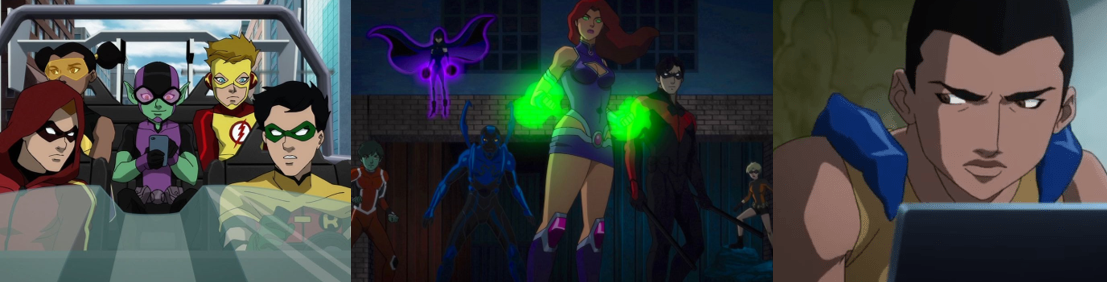
The film begins with the original incarnation of the Teen Titans – comprised of Dick Grayson/Robin (Maher), Wally West/Kid Flash (Jason Spisak), Roy Harper/Speedy (Crispin Freeman), Garfield Logan/Beast Boy (Brandon Soo Hoo), and Karen Beecher/Bumblebee (Masasa Moyo) – meeting Starfire (Wahlgren) for the first time. If you’ve watched the awesome Teen Titans (2003 to 2006) cartoon before then many of the Titans’ characterisations will be instantly familiar: Robin is the composed leader, Beast Boy is the comic relief, Kid Flash is impatient, and so forth. This version of Starfire, while still being somewhat naïve and innocent, is far less childish compared to her counterpart; however, she nevertheless forms an immediate bond with the team after learning to communicate through kissing.

After a random flashback, we rejoin the Teen Titans adjusting to their new team dynamic.

We then jump ahead to “NOW” to find Brother Blood and his lover and right-hand, Mother Mayhem (Meg Foster), packing up their most recent Hive base. Choosing to ignore Deathstroke’s warning, the cult are caught completely off-guard when the Titans – now made up of Nightwing, Starfire, Beast Boy, Rachel Roth/Raven (Taissa Farmiga), Jaime Reyes/Blue Beetle (Jake T. Austin), Damian Wayne/Robin (Allan), and newcomer Terra – break into the facility using Terra’s power over earth and rock. Nightwing, who has only recently rejoined the team, finds it difficult adjusting to the new dynamic, which places Starfire as the field commander, but his experience and combat strategies are nevertheless appreciated by Starfire and his older teammates. There is, however, some discord within the team; not only are Nightwing and Starfire a little distracted by their intimate relationship outside of the team but she doubts her place as the team’s leader (despite Robin approving of her) and Robin constantly clashes with Blue Beetle over the unpredictability of Jaime’s alien Scarab suit. Still, the team takes out Blood’s goons and reconvenes at Titan Towers, where their teamwork and interpersonal relationships are developed a little more. Damian continues to have a somewhat disconnected and abrasive personality and remains fully committed to his role as Robin (he’s the only member to never appear outside of his costume during the film) and, interestingly, the film makes a subtle allusion to unpredictability of the Scarab to puberty during Jaime’s video call with his parents (Maria Canals-Barrera and David Zayas, respectively) and his interactions with a young girl he is attracted to that helps to highlight how, despite their superpowers or physical abilities, the Teen Titans remain just that: troubled teenagers trying to find their place in the world.

Blood is a twisted zealot who hires Deathstroke to capture the Titans and fuel his desires for Godhood.

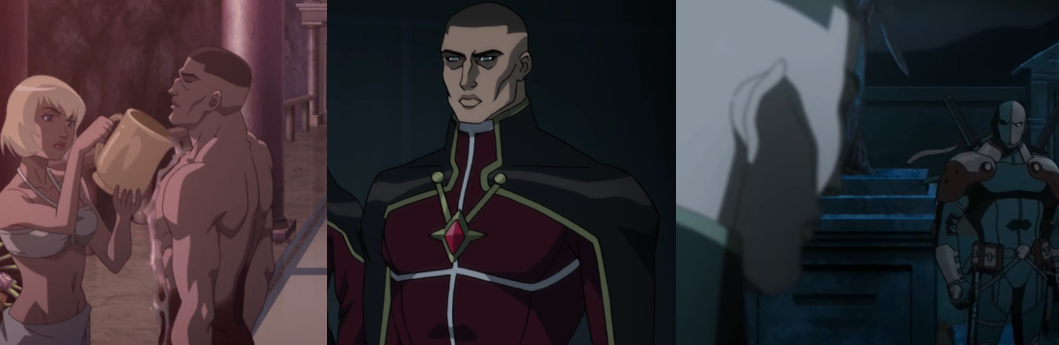
Brother Blood is a ruthless zealot of a man; having organised Hive into a cult-like following, he believes that he has the gift of foresight and is fully willing to kill any who blasphemes against his beliefs. Regularly bathing in the blood of his enemies to maintain his youth and vigour and with a penchant for hanging out in graveyards, Blood has constructed an elaborate machine that is powered by the lifeforce of those connected to it that he plans to use to absorb the Titans’ superpowers and abilities to become a demigod. To that end, he hires Deathstroke to deliver the Titans to him, a task he takes great pleasure in given his past history with Damian and has prepared for by augmenting his already-impressive physical abilities by regularly bathing in a Lazarus Pit.

Deathstroke manipulates Terra into infiltrating the Titans to get revenge on Robin.

Terra constantly feels underappreciated by the team and perturbed by Beast Boy’s constant attentions and remains dismissive and bitter towards their personalities, hobbies, or issues. Aggressive and snappy, Terra has little interest in helping others in a way that doesn’t involve busting heads with her powers and is weary of the team’s constant attempts to reach and befriend her. Tormented by memories of her life in Markovia, where she was beaten and hounded and accused of being a witch, Terra has grown angry at and resentful towards humanity and has no interest in serving it for the greater good. Thus, she willingly infiltrates the team on Deathstroke’s behalf and allows him to capture Damian for Blood. Terra is absolutely besotted with Deathstroke after he saved her life in Markovia prior to the start of the film; devoted to him, she sees him as more than a mentor and father-figure and constantly attempts to seduce him in some truly awkward scenes that have her dressed in an overly provocative outfit. Although he rebukes her advances, he nevertheless commands her complicit behaviour by promising that they’ll be a couple and take command of the League of Assassins once the contract is fulfilled. Thus, begrudgingly, she returns to Titans Tower, now equipped with an audio/visual link up to Deathstroke, to continue her subterfuge. Though her anti-social personality begins to crack when she sees just how appreciative they are of her and she even shares a kiss with Beast Boy, she nevertheless lures each of the Titans into a series of traps that lead to them all being captured by Deathstroke and placed in Blood’s machine.

The Nitty-Gritty:
Teen Titans: The Judas Contract shares the same quasi-anime, stilted animation as other DC Universe Animated Original Movies. Still, the animation and visual presentation is made more appealing due to the aesthetic distinctiveness of each of the Titans and their individual powers. Raven, for example, exudes dark, ethereal magic while Beast Boy cycles between a variety of amusing animal forms as part of his somewhat awkward and hyperactive personality. Unfortunately for me, many of the Team’s appearances are taken from their New 52 designs, meaning that Nightwing is wearing his awful red suit; however, Deathstroke more than makes up for this with his bad-ass outfit that is only made all the more intimidating thanks to Ferrer’s distinctive gravely tones. The voice acting, in general, is really good, actually; Stuart Allan is particularly great at capturing Damian’s dickish attitude, I’ve always had a soft spot for Christina Ricci (and it’s great to see her voicing Terra rather than someone more cliché, like Raven), and (though I’m not really his biggest fan) the film even includes a brief cameo by Kevin Smith.

Terra’s abrasive attitude cracks but she remains loyal to Slade … right up until he betrays her.

Having the reveal of Terra’s dual nature quite early into the film makes for a great bit of suspense as we see her emotionally and physically manipulate each of the Titans into Deathstroke’s traps. The relationship between Terra and Slade has always been an unnerving and disgusting one full of appalling sexual subtext and this remains largely prevalent in the film as Deathstroke manipulates Terra’s motions in order to craft her into the perfect double agent. Even though Damian, with his unique insight into both Deathstroke and the League of Assassins, attempts to reach her, Terra is ruled by her bitterness and anger and is thus completely blindsided when Deathstroke betrays her in order to fully deliver on his contract with Blood.

Ultimately, Terra shows her true colours and sacrifices herself to stop Blood and Deathstroke.

In the finale, Nightwing frees his friends thanks to faking his death at Deathstroke’s hands and interrupting the party. Still, Blood is able to absorbs most of the Titans’ powers, which transforms him into a demonic creature and makes him more than a match for Starfire, Beast Boy, Raven, and Blue Beetle while Nightwing and Robin attack Deathstroke head-on in easily the film’s most impressive fight scene. Despite his near-unstoppable new powers, the Titans are only able to overcome Blood when Raven unleashes the full extent of her supernatural powers to strip him of his abilities and render him helpless, though Mother Mayhem kills Blood before he can be brought into the Titans’ custody. At the same time Terra, enraged at Deathstroke’s betrayal, mercilessly attacks and kills him with her incredible powers by bringing the entire area down him. Unable to live with her betrayal and pain, she then destroys the entire temple, taking herself along with it in recompense for her actions but, while Beast Boy is left heartbroken, the team honour their former comrade as a Teen Titan to the end.

The Summary:
As an adaptation of the source material, Teen Titans: The Judas Contract does the best that it can in its limited time; obviously, the story has been changed a little, the team is almost completely different, and even Deathstroke’s motivations are very different compared to in the original story but a lot of this is to be expected from the adaptation process. The film’s main concern seems to be with telling another story in the  DC Universe Animated Original Movies series; however, while it might be beneficial to have seen Justice League vs. Teen Titans (Liu, 2016) for a bit of additional context, it works pretty well as a standalone story. I do question why the film went to the effort of including a prelude where an almost completely different version of the team first meets Starfire as this doesn’t really tie into the main story (maybe it would’ve been better to have the older team be comprised of grown-up versions of the characters seen in the prelude) and I also feel like the story might have been better served by removing Brother Blood completely and instead focusing on Deathstroke and his vendetta against the Titans as the primary antagonist. Still, it’s a decent enough animated venture and adaptation of the seminal storyline, with some engaging action and intriguing character beats and some great vocal work from Allan, Ricci, and the late, great Miguel Ferrer especially.

My Rating:

Rating: 3 out of 5.

Pretty Good

Did you enjoy Teen Titans: The Judas Contract? Were you a fan of the changes that the film made to the story and the new team line-up? Have you ever read the original comic book the film is based on and, if so, where does it rank for you amongst other Teen Titans stories? Who is your favourite Robin and how are you celebrating the Boy Wonder’s debut this month? Whatever your thoughts on this film, Teen Titans, and Robin, leave a comment below and thanks for joining me for Robin Month!

Movie Night [Robin Month]: Batman: Under the Red Hood


In April of 1940, about a year after the debut of arguably their most popular character, Bruce Wayne/Batman, DC Comics debuted “the sensational find of [that year]”, Dick Grayson/Robin. Since then, Batman’s pixie-boots-wearing partner has changed outfits and a number of different characters have assumed the mantle as the Dynamic Duo of Batman and Robin have become an iconic staple of DC Comics. Considering my fondness for the character and those who assumed the mantle over the years, what better way to celebrate this dynamic debut than to dedicate every Sunday of April to celebrating the character?


Released: 27 July 2010
Director: Brandon Vietti
Distributor: Warner Home Video
Budget: Unknown
Stars: Bruce Greenwood, Jensen Ackles, John DiMaggio, Wade Williams, and Jason Isaacs

The Plot:
Gotham City’s underworld is terrorised by a murderous vigilante known only as “The Red Hood” (Ackles). In investigating this new threat, Batman (Greenwood) is forced to face the greatest failure of his career as old wounds reopen and old, once buried memories come into the light.

The Background:
As I detailed in my review of A Death in the Family (Starlin, et al, 1988), readers were first introduced to Jason Todd in March 1963. With the original Robin, Dick Grayson, having grown up and gone away to college, Jason was initially almost indistinguishable from his predecessor until he was given an “edge” by writer Jim Starlin following the Crisis on Infinite Earths (Wolfman, et al, 1985 to 1986). Readers didn’t take kindly to the new Robin and, in a moment that went on to define Batman for years to come, DC Comics made the decision to kill the character off in the aforementioned Death in the Family storyline. For over fifteen years, Jason Todd stayed dead and his death haunted Batman; his monument in the Batcave served as a constant reminder of Batman’s greatest failure and he was long considered one of only a handful of comic cook characters who would stay dead. The character made a surprise return during the “Hush” storyline (Loeb, et al, 2002 to 2003) before being officially brought back to life (through cosmic, reality-bending shenanigans, of course) in the “Under the Hood” arc (Winick, et al, 2004 to 2005; 2005 to 2006). Jason’s resurrection was generally positively received and he has gone on to become a popular anti-hero as the Red Hood and, 2010, Winick came onboard to write the animated adaptation of his influential storyline. Batman: Under the Red Hood was the eighth animated feature of the DC Universe Animated Original Movies line-up, which aimed to be more mature than the DC Animated Universe popularised by Bruce Tim and Paul Dini. Batman: Under the Red Hood was one of the most successful of DC’s animated ventures, making over $12 million in sales and being critically applauded; a follow-up even surprisingly landed in 2020 in the form of an interactive animated feature that was also quite well received.

The Review:
I never really had any strong feelings for or against Jason Todd as I read comic books so sporadically as a kid that, by the time I even read A Death in the Family, Dick Grayson had already become Nightwing and Tim Drake was already the third Robin so, if I didn’t like what happened to him, it was too late to be mad about it. I do feel, though, like the idea of bringing him back was great…on paper….but that DC Comics screwed it up in execution. Personally, I think Jason should have been Hush all along as his outfit in Hush was way better than the Red Hood look and, considering DC kind of retconned that Jason was present during Hush anyway, I think this would have made a lot more sense. Plus, it took DC a long time to find a way to mention Jason’s dramatic return without having to reference the reality-breaking shenanigans of Infinite Crisis (Johns et al, 2005 to 2006) and, in that regard, if feels like Under the Red Hood tells a far simpler and much more coherent version of events surrounding Jason’s resurrection thanks to the benefit of hindsight.

Still haunted by Jason’s death, Batman hears of a new player muscling into Gotham’s underworld.

Under the Red Hood opens with its interpretation of the events of A Death in the Family; in this adaptation, Ra’s al Ghul (Isaacs) allied with the Joker (DiMaggio) in his latest bid to disrupt Europe’s economy. He realises the error in his judgement all-too-late as the Joker captured Jason Todd/Robin (Vincent Martella) and was busy amusing himself by taunting Robin and mercilessly beating him with a crowbar. Although Jason remained defiant, even with a collapsed lung and having been beaten half to death, he was helpless against the Harlequin of Hate. Despite Jason struggles with all his failing might to hold out for Batman, who raced to aid his young partner, he was killed when the warehouse that he was trapped in explodes (again, take note: Jason is killed by the explosion and not by the crowbar!) The film then jumps ahead five years to find Gotham’s criminal figureheads lured into a meeting and confronted by the mysterious Red Hood. Red Hood delights in taunting the criminals and muscles his way into the operation, promising to protect them from both Batman and Roman Sionis/Black Mask (Williams) on the proviso that they don’t peddle their wares on young kids and proves himself a credible threat by presenting a bag full of the severed heads of their lieutenants. Meanwhile, Batman continues to operate within the city; however, his experiences with Jason have left him more of a loner than ever, to the point where he even out-right refuses Nightwing’s (Harris) help in taking down Amazo (Fred Tatasciore), a superpowered android with all of the powers of the Justice League. Nightwing, of course, completely disregards this and helps anyway and, in the process, the two learn of the Red Hood’s bid to muscle the Black Mask out of power and control Gotham’s underworld.

The Red Hood makes an enemy of both Batman and Black Mask through his violent actions.

When the Red Hood kills the thugs transporting Amazo, Batman gives chase in the Batwing but loses him in the Axis Chemical Plant (though not before having a flashback to his first encounter with the Joker, who, at that time, was hidden under the guise of the original Red Hood). Back at the Batcave, Batman and Nightwing analyse the footage of the biker-gear-clad vigilante and note that, since he arrived in town, crime has fallen significantly. Suspecting that the Joker may be behind the new Red Hood, they head to Arkham Asylum to interrogate the Clown Prince of Crime, who denies any involvement in his activities but takes the opportunity to rile Batman up over failing to save the former Robin. Meanwhile, the Red Hood’s activities have angered Black Mask, the ruling mob boss of Gotham City. In this incarnation, Black Mask is similar to Johann Schmidt/The Red Skull in that, rather than wearing a mask or a helmet, his head is literally a charred black skull. Apart from that, he’s a bombastic, maniacal gangster who viciously beats anyone who dares to stare at his gruesome appearance. His efforts to kill the Red Hood meet in failure as he is closely monitoring Black Mask’s meetings and movements so that he can steal his weapons and merchandise. Thankfully, Batman has also been monitoring Black Mask, correctly guessing that the Red Hood would hijack his latest shipment, and as a result comes face-to-face with Gotham’s newest vigilante once more after an exhilarating chase through a construction site, across the city rooftops, and even across the city’s famously impractical blimps.

Revived by the Lazarus Pit, Jason enacts a plan of revenge against the Joker.

Thanks to the Red Hood’s impressive skills, physical aptitude, and apparent knowledge of Batman’s weapons and tactics (all of which Nightwing, and even Batman, admit to being amazed by), this proves to be a trap as Batman and Nightwing are lured into an explosion that leaves Dick’s leg injured. Both of them marvel at the Red Hood’s physical abilities and skills and knowledge of Batman’s tactics but Batman is stunned when he reviews the playback of their encounter and hears the Red Hood calling him “Bruce”. Black Mask steps up his campaign against the Red Hood, beating, threatening, and killing all of those who have sold out to him and hiring mech-wearing mercenaries to hunt him down, but Batman interrupts the fracas and takes the mercs out alongside Red Hood. Although Batman is disgusted when the Red Hood uses lethal force to kill one of the mercenaries, he nevertheless attempts to offer Red Hood help but the helmet-clad vigilante angrily refuses, believing that his willingness to kill is making an actual difference as opposed to Batman’s more merciful ways. By analysing the Red Hood’s blood, Batman confirms, without a doubt, that he is Jason Todd resurrected. Realising that only one man could possibly have been responsible for Jason’s return to life, Bruce angrily confronts Ra’s and learns about what happened all those years ago: remorseful for allowing the Joker to kill Bruce’s young partner, Ra’s recovered Jason’s body (leaving a dummy in his grave) and revived him by submerging him in the restorative Lazarus Pit.

The Nitty-Gritty:
Aesthetically, Under the Red Hood greatly resembles many of DC’s other animated efforts; characters aren’t quite as exaggerated or cartoony as they are in the DCAU but are still quite stiff and rigid. Luckily, this allows the film’s many chase and fight sequences to shine even more, but it does make prolonged scenes of dialogue and exposition to appear a bit inflexible. The voice cast, however, is pretty stellar; Bruce Greenwood makes for a gravelly and intimidating Batman, even if he is imitating the iconic Kevin Conway somewhat, and the film does a pretty good job of showcasing the impact Jason’s death had on him and his rage at allowing himself to be so easily duped by Ra’s’ deception. John DiMaggio makes for a serious and menacing Joker who appears to be evoking both Mark Hamill and Heath Ledger’s take on the character, and Neil Patrick Harris makes for a great Nightwing as well and makes an impression despite being taken out of the film before long (although it’s a bit odd that common thugs know about his past as Robin) but it’s Jensen Ackles’ wit and biting tongue as the Red Hood and Wade William’s explosive portrayal of Black Mask that are the highlights of the feature for me.

Jason goes from carefree youth to violent and unhinged vigilante as he grows and changes.

The film is peppered with flashbacks to Batman’s time working alongside Jason; during the boy’s (Alexander Martella) first year as Robin, he was an excitable, carefree Boy Wonder who Batman first met as he was in the process of stealing the tyres off the Batmobile and delighted in being Batman’s brightly-coloured, hyper-chatty crimefighting partner. As he grew into a teen, however, he became and angry and bitter young man who constantly defied Batman’s orders and brutalised criminals without mercy. His dip in the Lazarus Pit saw him awaken from death half-crazed and unstable and set him on the path towards becoming a murderous vigilante and making both Batman, and the Joker, pay for their actions. Driven to the edge by the Red Hood’s disruptive actions, and the vigilante’s direct assault on his offices with a rocket launcher, Black Mask arranges for the Joker to be smuggled out of Arkham and sets him loose to kill the Red Hood on his behalf. This, however, was exactly what the Red Hood wanted as it allows him to get his hands on the man who murdered him and deliver a measure of payback with a crowbar.

Batman refuses to compromise his moral integrity and remains haunted by his failures.

Luring Batman to Crime Alley, the Red Hood finally reveals his face to his former mentor and demands to know why the Joker is still alive after everything he’s done but especially for taking Jason away from Bruce. He makes a damn good point, one that has been endlessly debated, and states that he can forgive everything Bruce has done and that he’s not talking about mass murder of every two-bit thug or supervillain, but he cannot forgive (or understand why) the fact that Batman hasn’t killed the Joker in recompense for his years of slaughter and for killing him (as in Jason). After a brutal fist fight between the two, Batman apologises but states that he could never kill anyone, not even the Joker, because it would be “too easy” and lead to him becoming just as bad as the criminals he hunts on a nightly basis. Enraged and distraught, Jason demands that Batman shoot him before he executes the Joker; when Batman adamantly refuses to betray his morals, Jason triggers an explosion and disappears once again. In the aftermath, Bruce refuses to have Jason’s monument removed from the Batcave as he never wants to forget how badly he failed young Jason and turned him from a cheery youth and into a damaged, violent killer.  

The Summary:
Batman: Under the Red Hood is an incredibly bleak and sombre examination of Batman’s greatest failure; one thing I always liked about Jason being dead was how this incident weighed heavily on Batman’s mind and that a constant reminder sat in the Batcave for years so that he (and the reader) would never forget those dramatic events. When Jason returns to life as a violent and unhinged vigilante and twists Batman’s teachings and moral codes into a spiteful vendetta, Batman is forced to confront his failure, and his past, head-on and the film does an excellent job of not only adapting the source material it is based on but also adding to it and, in many ways, improving it. Having Ra’s be the one responsible for Jason’s resurrection as opposed to an alternative version of Superman punching reality just makes so much more sense and seeing Jason snark, shoot, and muscle his way into Black Mask’s dealings was really great thanks to Ackles’ portrayal of the character. I also enjoyed the flashbacks to Jason’s youth and even the Joker’s origin, which helped add some additional context to those who may be unfamiliar with these elements, and overall the film is a great example of the unwavering commitment Batman has to his “no-kill” rule and the impact that has on his never-ending war against crime.

My Rating:

Rating: 4 out of 5.

Great Stuff

Are you a fan of Batman: Under the Red Hood? How do you feel it works as an adaptation of A Death in the Family and Under the Hood and did you enjoy the changes that the film made to the story and Jason’s resurrection? What did you think to the voice cast, particularly Greenwood, DiMaggio, and Ackles? Were you a fan of Jason Todd when he was Robin, or do you prefer his anti-hero persona? Would you like to see elements of this story make their way into a live-action Batman movie someday? Who is your favourite Robin and how are you celebrating the Boy Wonder’s debut this month?  Whatever your thoughts on this film, Jason Todd, and Robin, leave a comment below and check back next Monday as Robin Month continues!