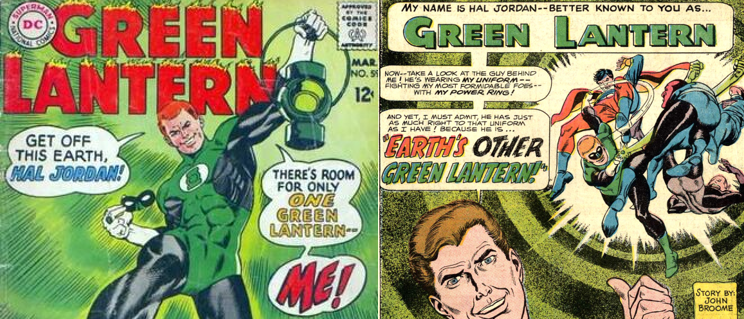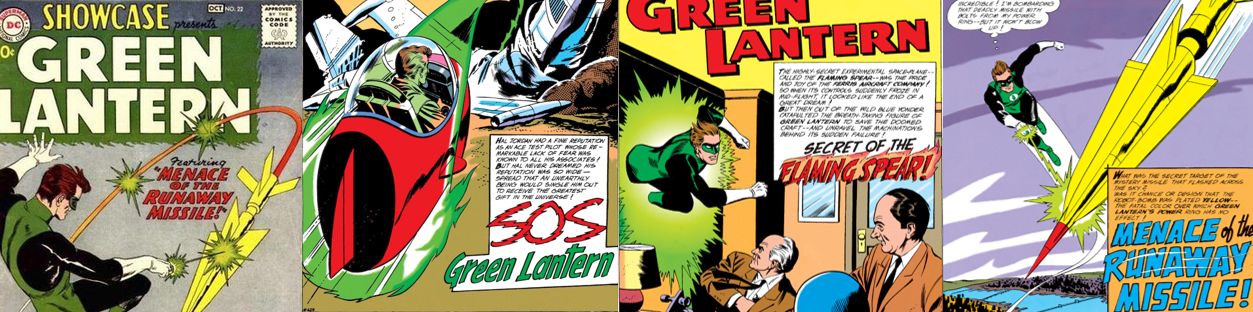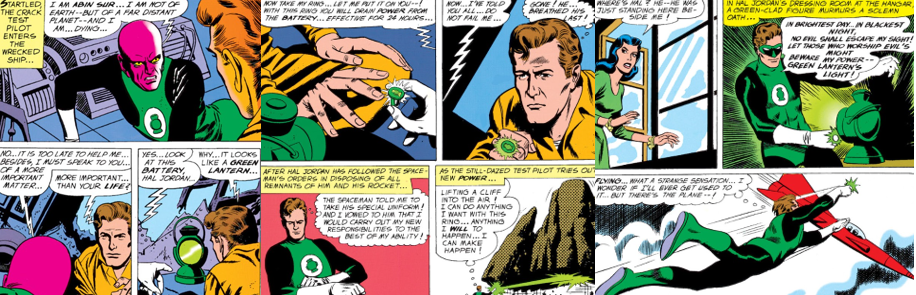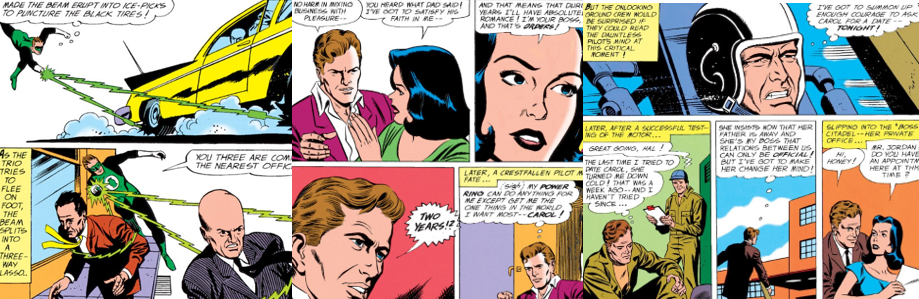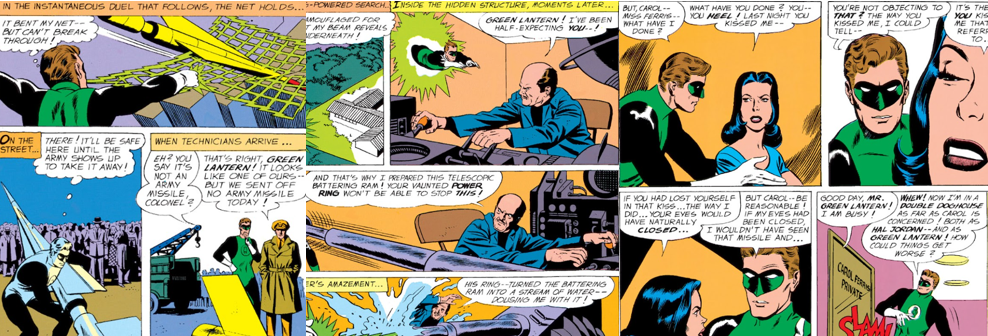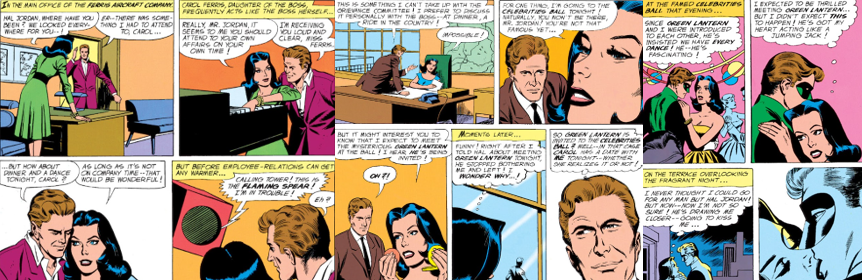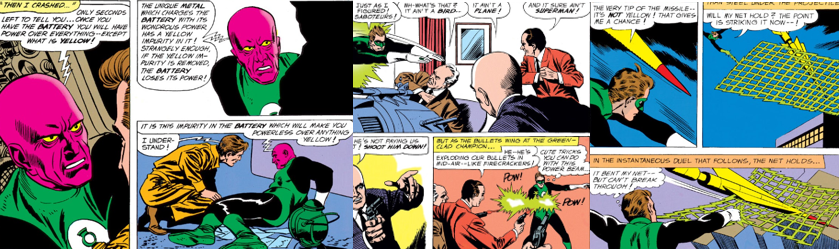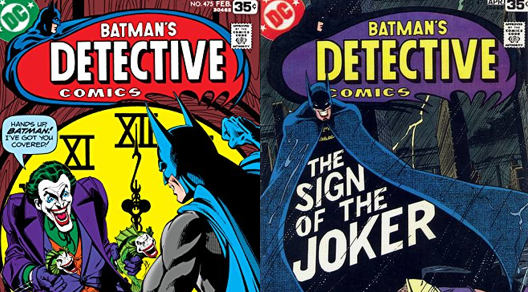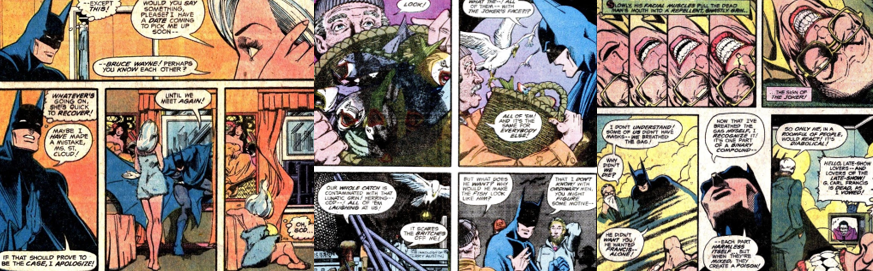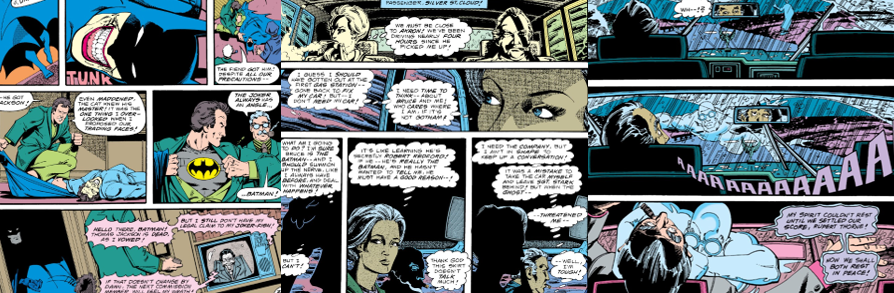
Although February 2014 was dubbed “Green Lantern Day” (because, by the American calendar, the date read as “2814”, the sector of space assigned to Earth in DC Comics), the significance of this date has passed as the years have changed. Instead, as perhaps the most popular iteration of the character, Hal Jordan, first appeared in October of 1959, I’m choosing to dedicate every Sunday of October to the Green Lantern Corps!
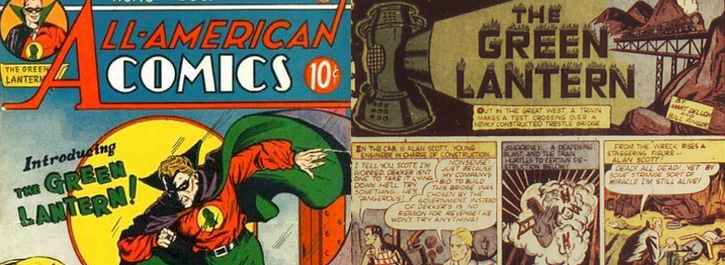
Story Title: “The Origin of Green Lantern” (or simply “The Green Lantern”) Published: July 1940 Writer: Bill Finger Artist: Martin Nodell
The Background: The peacekeepers of the galaxy, the Green Lantern Corps, are popularly known as a space-faring force comprised of various creatures and aliens from across the cosmos, but this depiction of the Emerald Warriors has only been around since 1959. Originally, there was only one colourful superhero known as Green Lantern, Alan Scott. The brainchild of artist Martin Nodell, the Green Lantern was inspired by Richard Wagner’s Der Ring des Nibelungen (The Ring of the Nibelung), the sight of a trainman’s green railway lantern, and elements of Greek mythology. After his pitch for a superhero who wielded a magical ring was approved by DC Comics publisher Max Gaines, Nodell set to work crafting Alan Scott’s first story and soon brought in the legendary (and often forgotten) Bill Finger to help with the project, cementing a partnership that lasted for seven years. After his debut in this issue of All-American Comics, Alan Scott became a regular fixture of both the publication and DC’s first super team, the Justice Society of America (JSA). It’s this association with the JSA that I best know Alan for. As chairman of the group, he fought numerous intergalactic and Lovecraftian threats, gained a degree of eternal youth thanks to various magical enhancements and time dilations, and mentored a new generation of heroes, including his wayward son. Even after he was supplanted by his more sci-fi-orientated successors, Alan Scott remained a prominent figure in DC Comics, gaining additional relevance when he came out as gay in 2020, retroactively establishing him as DC’s first-ever gay superhero. Outside of the comics, however, Alan hasn’t been quite as significant. He missed out on appearing in Justice League (2001 to 2004) and has been largely absent or relegated to brief cameos in other cartoons and live-action shows, potentially due to Warner Bros. often blocking Green Lantern appearances after the critical mauling of Green Lantern(Campbell, 2011).
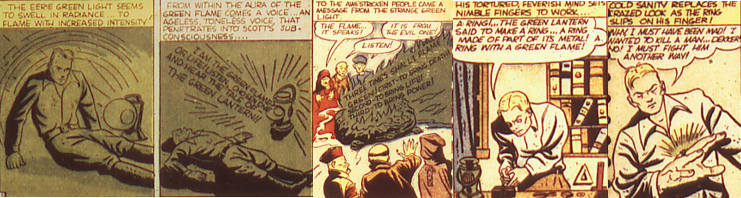
The Review: The story opens “out in the Great West”, where s train is making a test crossing over a new-constructed trestle bridge. Alan Scott, the young engineer who spearheaded the bridge’s construction, is in the cab with a colleague to oversee the test run, which seems to be asking for trouble, in my opinion. Indeed, Alan’s colleague is anxious that Alan’s rival, Alert Dekker, might try to sabotage the operation since Alan’s “company” outbid Dekker’s and cost him a big, fat government contract. Although Alan is confident that Dekker wouldn’t try anything, his optimism is immediately proven wrong as the bridge explodes beneath them, sending the train, its carriages, and all aboard crashing into a ravine. By “some strange miracle”, Alan is the sole survivor, merely being shaken up and coming over all queasy as he holds onto a mysterious green lantern. Suddenly, the artifact bursts to life, emitting an “eerie green light” and, even more incredibly, speaking to him! The lantern tells a tale that begins back in ancient China, where a village’s evening prayers were suddenly interrupted by the arrival of a huge meteor. The meteor cracked open before impact, depositing a pool of flaming emerald liquid before their amazed eyes. This Green Flame spoke to them and delivered a fairly ominous prophecy: “Three times shall I flame green! First – to bring death! Second – to bring life, and third – to bring power!” The villagers were in awe, believing the Green Flame had come from the “Evil One”, a subject about which Chang, the lamp maker, knew a great deal thanks to his studies of the “Old Book”, which had raised some suspicions about his intentions.
After surviving a train crash, Alan Scott is gifted incredible power by a green lantern.
Chang used the Green Flame to forge a lamp, which the paranoid villagers believed will anger their Gods and bring them only suffering, so they barged in, burned Chang’s books, and attacked him, causing the lamp to burst to life and punish them all, bringing death as it foretold. Over the years, the strange lamp passed between many hands, bringing destruction to the bad and luck and fortune to the good, eventually appearing in the rubbish bin of an insane asylum. The staff decide to give the lamp to Billings, a harmless Chinese patient of theirs known for forging lanterns, and it’s Billings who transfigures the lamp into its more familiar lantern shape. In return, the lantern awakens once more an brings “life” by curing Billings of his insanity, allowing him to leave the asylum as a sane, free man. And, from there, the green lantern eventually made its way onto Alan Scott’s train and into his hand (how isn’t detailed here) to fulfil the final stage of its prophecy, bringing power to the dazed engineer. The lantern tasks Alan with using this great power to seek out and oppose evil, to be a light against the darkness, and that he will retain this power as long as he has “faith in [himself]” for “will power is the flame of the Green Lantern”. After seeking clarification, Alan is instructed to craft a ring for himself from the lantern’s metal so he can always carry its power with him, though he must touch the ring to the lantern every twenty-four hours to recharge it (because…ugh…I guess faith and will power isn’t all that powers the magic?) After gathering his wits, Alan initially believes the whole experience to have been some mad dream but, when he grabs the lantern and feels its power, he knows that it was all true and, angered at the sight of his dead colleagues and Dekker’s amoral actions, he vows to make his rival pay for his murderous ways. To that end, Alan does as the Green Flame instructed and makes himself a ring; but, when he puts it on, he realises that his murderous lust for revenge is wrong and that he must find a more virtuous way to fight Dekker.
Alan’s magical powers see him confront his rival and begin a career as the Green Lantern.
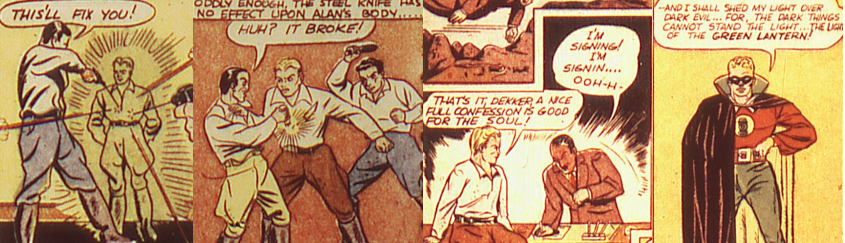
Alan then spends a few panels testing out his newfound powers; he wishes to fly to Dekker’s house and the ring allows it to be so. His desire to “[go] through the fourth dimension” allows him to easily pass through the walls of Dekker’s place and appear before the callous businessman and his mooks in a puff of green smoke and light. Appearing as a “wraithlike figure”, Alan seems to be a ghost to the astonished goons, but Dekker assumes it’s simply a trick and orders them to shoot the young engineer. Although the bullets just pass through Alan’s body and a knife simply breaks against his chest, a wooden club to the temple surprisingly brings Alan down, so he assumes that wood is his vulnerability. He also notes that he doesn’t possess superhuman strength (though, presumably, he could will himself to if he actually bothered…), but thankfully he’s skilled enough to overpower Dekker’s minions and scare them off. Fearing for his safety, Dekker attempts to barter, offering Alan money and his friendship, so Alan toys with his rival by flying him through the sky and threatening to drop him to his death to force a confession. Terrified, Dekker admits that he caused the explosion and promises to cover the payments and sign a confession. However, right after he does this, the stress of it all causes him o suffer a fatal heart attack. Mourning the waste of life, Alan retires to his unseen “sanctum” and pledges himself to fighting against evil in all its forms, realising that he needs a “bizarre” costume that will ensure evildoers never forget him once they encounter him. To that end, he fashions one of the gaudiest red and green numbers in all of comicdom and vows to “shed [his] light over dark evil” as the Green Lantern.
The Summary: I don’t always have the greatest track record when it comes to Golden Age superhero stories; they’re often messy, rushed, and incredibly simplistic, echoing the pulp sensibilities that were so popular at the time. Thus, a degree of leeway must always be shown towards such stories, which are products of their time and restricted by the artistic style and expectations of the period. Having said that, I actually didn’t mind “The Origin of Green Lantern”. We don’t learn a great deal about Alan Scott beyond his profession, optimism, and thirst for justice, making him a bit of a blank slate in many ways, but there’s enough here to make him relatively intriguing. I liked that he was naïve enough to think Dekker would simply take losing out on the contract like a man, and his shock at seeing how far his rival will go to secure that government grant. It was very relatable that Alan’s first thought was to kill Dekker, though it’s not entirely clear why he has a sudden change of heart and opts to force a confession rather than kill his enemy. Alan doesn’t do anything particularly creative once he acquires the green ring, learning as he goes and testing the limits of his power with a whimsical theatricality that shows he’s getting a kick out of spooking Dekker’s men and shrugging off their attacks. Still, his stance towards injustice proves that the Green Flame chose wisely in bestowing him with its seemingly limitless power and thus leaves the door open for future stories to explore Alan’s abilities in more depth. It also allows enough wriggle room for the writers to pull whatever powers or limitations they can think of out of their asses.
The mysterious green lantern has an ominous aura and some strange limitations.
While Dekker is simply a gangster posing as a businessman, Alan doesn’t don his awful costume until the final panel, and it’s not really clear how Alan survives the crash (though I assume it’s because he was holding onto the green lantern), the titular emerald lamp is the true enigma of the story. A miracle from the stars, the Green Flame is a seemingly menacing sentient element that promise to bring, death, life, and power, apparently at random and not just once since it changes the fortunes of numerous people during a time jump. Those who witness the Green Flame are filled with awe and dread, immediately believing it to be the work of some vague “Evil One” and lashing out in fear, meaning the prediction of “death” becomes a self-fulfilling prophecy. The Green Flame also seemingly supernaturally inspires individuals to forge it into new forms, such as a lamp, lantern, and a ring, so it can pass between new hands over the years. I’ve always found the idea of a magically empowered lantern to be one of the most random concepts in comics. Surely just the magic ring is more sensible, after all, and a superhero taking the name “Green Lantern” not only feels redundant but also announces his source of power to his enemies, not unlike his later JSA colleague, Rex Tyler/Hourman. The Green Flame is also quite vague in its limitations here. It’s said that willpower will allow Alan to wield great power, but he also needs to have a piece of the lantern on him at all times and recharge his ring every twenty-four hours. He’s then strangely injured by wood, of all things, a vulnerability that seems particularly dangerous when you stop and think about it. Still, the ring allows him to fly, pass through walls, and deflect all other attacks, and I have to assume that Alan is still too new to the superhero life to think about increasing his strength or trying anything fancy like creating hard-light constructs and such. In the end, this was a mostly inoffensive tale. It definitely could’ve been better in many ways, but I think it established its bizarre premise just enough to give us a colourful new superhero with a strong sense of justice. The story is worth a read just to see how the sprawling Green Lantern mythos started with one young train engineer and an ominous lantern from the stars.
My Rating:
⭐⭐⭐
Rating: 3 out of 5.
Pretty Good
Have you ever read Alan Scott’s debut story? What did you think to it and how do you think it compares to other superhero origins from the Golden Age? Were you surprised that Alan Scott’s origins are so different from other Green Lanterns? Would you have liked to see more of the Green Flame’s time influencing others? What are some of your favourite Alan Scott stories and where does he rank for you in the Green Lantern hierarchy? How are you celebrating Green Lantern this month? Whatever your thoughts on Alan Scott, and the Green Lantern Corps, leave them down below orand be sure to check out my other Green Lantern content.
In the decades since his first dramatic appearance in the pages of Detective Comics, Bruce Wayne/Batman has become a mainstream, worldwide, pop culture icon. The brainchild of writer Bob Kane, Batman was brought to life by artist Bill Finger and has been a popular staple of DC Comics and countless movies, videogames, and cartoons over the years. “Batman Day” fell on 21 September this year so I’ve been spending every Saturday celebrating comic’s grim and broody vigilante.
Released: 18 July 2008 Director: Christopher Nolan Distributor: Warner Bros. Pictures Budget: $185 million Stars: Christian Bale, Heath Ledger, Aaron Eckhart, Maggie Gyllenhaal, Gary Oldman, Morgan Freeman and Michael Caine
The Plot: After his dramatic debut as “The Batman”, billionaire vigilante Bruce Wayne (Bale) is cracking down on organised crime within Gotham City. However, his mettle is tested by the clown-faced anarchistic “The Joker” (Ledger), who seeks to disrupt social order and corrupt upstanding district attorney Harvey Dent (Eckhart).
The Review: After the disaster that was Batman & Robin (Schumacher, 1997), I think it’s safe to say that everyone thought Batman’s feature film career was dead in the water. For me, that’s why Batman Begins was such an exciting and enjoyable experience. Finally, after decades of Batman being either a goof or a psychopath, we got a live-action film that really nailed the heart and drive of the character. The extended and in-depth exploration of Bruce’s psyche, determination, and training to become “more than just a man” really put him at the forefront of the piece and allowed the most accurate depiction of the Dark Knight ever seen in cinema at that point as Bale deftly shifted between numerous subtle personas. With Batman Begins’ conclusion masterfully teasing the Joker, expectations were high for the sequel, but reactions to Ledger’s casting were mixed at the time due to his reputation as a “pretty boy”. To address this, Nolan opens his film with an intense and engaging bank heist, filmed entirely in IMAX, in which the mysterious Joker showcases his hands-on, manipulative abilities by arranging for his clown-faced goons to knock off a mob bank and off each other once their specific tasks are completely, allowing him to easily slip away in the chaos. It’s been about a year or so since the last film and Batman now appears at crime scenes to liaise with Lieutenant James “Jim” Gordon (Oldman), much to the chagrin of cops like rookie detective Anna Ramirez (Monique Gabriela Curnen) because of his vigilante status and the corruption that continues to infest the Gotham City Police Department (GCPD). However, neither Batman or Gordon initially place much stock in the Joker’s continued threat since their focus is solely on taking down the last vestiges of organised crime in the city, represented by mob bosses Salvatore “Sal” Maroni (Eric Roberts), Gambol (Michael Jai White), and “The Chechen” (Ritchie Coster), a decision that’s entirely logical bit which comes back to bite them in due time.
Batman’s war on crime is thrown into chaos by the maniacal Joker.
Bruce has been extremely busy in the time between films. Although he’s forced to operate out of a penthouse and highly equipped bunker in the city as he waits for Wayne Manor to be rebuilt, he’s established quite the reputation both in and out of his cowl. As Bruce Wayne, he’s the bored, party-going philanthropist who’s just as likely to abscond with a bunch of actresses to an isolated yacht as he is to fall asleep in board meetings. Although Bruce is seen by many as an aloof, reckless, and embarrassing billionaire, this persona effectively keeps anyone from questioning his nightly jaunts and he’s still savvy enough to fund and promote any programs or individuals who are committed to bringing Gotham City back to glory, such as Harvey Dent. As Batman, Bruce’s reputation is even stronger; criminals are now so afraid of the Dark Knight that they think twice about being on the streets when the Bat-Signal is in the sky and mobsters hold their meetings during the daytime. Although the Batman is still something of an urban legend, many in the city have been inspired to dress up as him and take the law into their own hands, something Bruce is disturbed to see since it results in a bunch of out of shape blokes with itchy trigger fingers wearing “hockey pads”. Still, Batman’s presence has had a positive impact on the city. He and Gordon collude to tackle the city’s mob, eventually entering a shaky alliance with Dent to apprehend mob banker Lau (Chin Hau) and make mass arrests, and Batman even detains Doctor Jonathan Crane/The Scarecrow (Cillian Murphy) in during the opening, finally taking the maniac’s drugs off the streets. However, night after night fighting crime and getting into fist, fire, and dog fights takes a toll on Bruce. His faithful butler and father figure, Alfred Pennyworth (Caine), continues to offer wry commentary and deep concern for his master’s welfare but Bruce is determined to clean up the streets and make the city safe before even considering giving up his crusade.
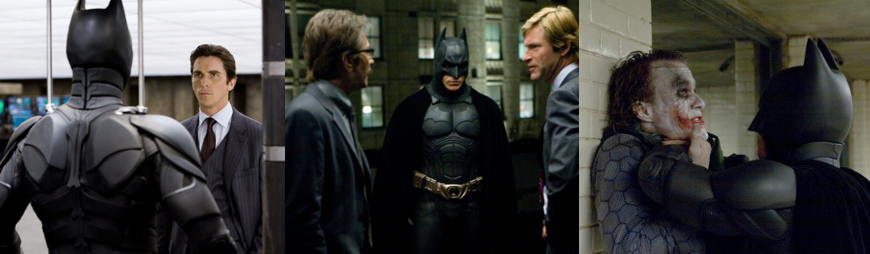
The loss of Rachel takes a heavy toll on Gotham’s “White Night” and drives him to murder.
However, Batman’s positive impact, the arrest of hundreds of mobsters, and the public’s approval of Dent give Bruce pause to reconsider his path. Since the last film, Bruce has been keeping a close eye on childhood friend and crush (and assistant district attorney) Rachel Dawes (Gyllenhaal), who works closely with Dent to prosecute the criminals and the corrupt. Thanks to Gyllenhaal being a far superior actress to her predecessor, Rachel has much more gusto this time around. She exudes a confidence and determination that was lacking in Katie Holmes’ performance and allows her to not only appear effective when interrogating Lau but also sees her fighting back against the Joker when he targets her at Bruce’s fundraiser for Dent. Although Bruce is clearly rattled by how close Dent and Rachel have become (the two are shown to be in a relationship) and somewhat condescending towards Dent’s marketing campaign, he’s as impressed by the D.A.’s conviction as the rest of the city. Dent is a square-jawed patriot who makes a buzz in the court room with his no-nonsense approach towards criminals and inspires the wealthy and the destitute alike with his commitment to justice. Dent is also an avid supporter of the Batman and determined to do whatever it takes to keep the city streets clean, even if just for six months, but he’s not as squeaky-clean as everyone believes. Gordon is sceptical of Dent due to his past in Internal Affairs, while Dent is highly critical of the corruption within the GCPD, but the two form an efficient trio alongside the Batman when they agree to pool their resources to bring Lau back from Hong Kong. Dent proves to be a surprisingly complex man. He believes so strongly in the iconography of the Batman and in not giving in to the Joker’s demands, no matter how many lives are at stake, that he publicly outs himself as the Dark Knight to keep the myth alive but also proves that he’s not above threatening criminals at gunpoint, showcasing an unexpectedly erratic side to his character. This is only exacerbated when Dent and Rachel are targeted by the Joker and Batman is forced to choose which one to save. Naturally, he picks Rachel but both he and Dent are horrified to learn that this was a double-cross that leaves Dent hideously scarred and despondent, his faith in both justice and the caped vigilante shattered and replaced by a cruel devotion to “chance”.
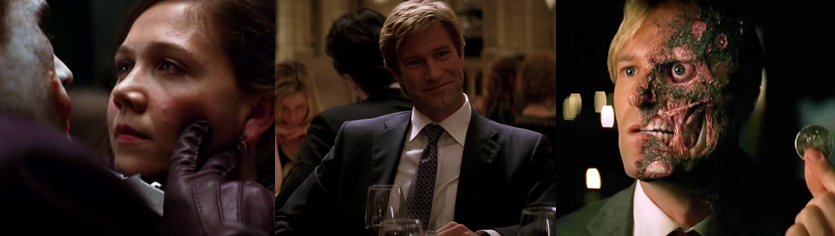
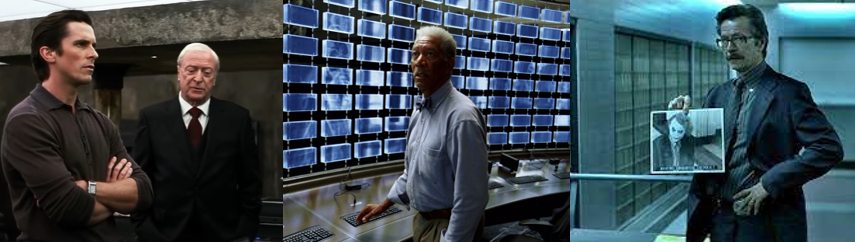
Bruce’s allies believe in the Batman and play a hands-on role in aiding and advising him.
As before, Bruce is supported in all things by Alfred, who acts as a field surgeon, conscience, and advisor to his duties both in and out of the Batsuit. We learn a little bit more about Alfred in this film through his entertaining exchanges with Bruce, in which the two share a banter that is both amusing and heart-warming. Alfred spent some time in the Peace Corps in Burma, indicating he’s seen combat and has a military background, and his insight into chaotic aberrations such as the Joker are almost on par with Bruce’s years of training to learn the criminal mind. Initially, Bruce dismisses Alfred’s insight, however, refusing to believe that the Joker is anything more than a thug with a gimmick, but is forced to admit that he’s underestimated his foe when the Joker pushes him to breaking point with his killing spree. Interestingly, Alfred actually encourages Bruce not to give in to the Joker’s demands, to “endure” the slings and arrows so as to maintain the Batman’s incorruptible persona, and also secretly shields Bruce from the knowledge that Rachel ultimately chose Harvey over him to spare his surrogate son further pain. As before, Bruce is provided with new toys and even a sleek new suit by Wayne Enterprises Chief Executive Officer Lucius Fox (Freeman), who now exhibits a working knowledge of Bruce’s dual identity despite both never outright saying it. Fox plays a pivotal role not just in helping Bruce apprehend Lau but also in throwing off the suspicions of Coleman Reese (Joshua Harto) when his number crunching exposes Batman’s identity, and in the creation of a fantastical device that allows Batman to pinpoint the Joker’s location by hacking every cell phone in the city. Though Fox threatens to resign if the device isn’t destroyed because of the dangerous invasion of privacy it offers, his loyalty is rewarded when Batman rigs the machine to self-destruct once the Joker has been located. Finally, we have Gordon, who publicly disavows any knowledge of Batman but regularly colludes with him to fight the mob. Gordon’s role is also crucial to the film as he is seemingly killed protecting mayor Anthony Garci (Néstor Carbonell), only for this to be revealed as an elaborate plan by him and Batman to capture the Joker, a gamble that sees Gordon promoted to police commissioner after the Harlequin of Hate assassinates commissioner Gillian Loeb (Colin McFarlane). Although horrified by the Joker’s murderous antics, Gordon’s riding quite the high when he, Dent, and Batman finally get their hands on the city’s mob, but his hubris comes back to bite him when Dent specifically targets him as failing to protect Rachel since Gordon’s forced to work with corrupted cops and a wayward vigilante.
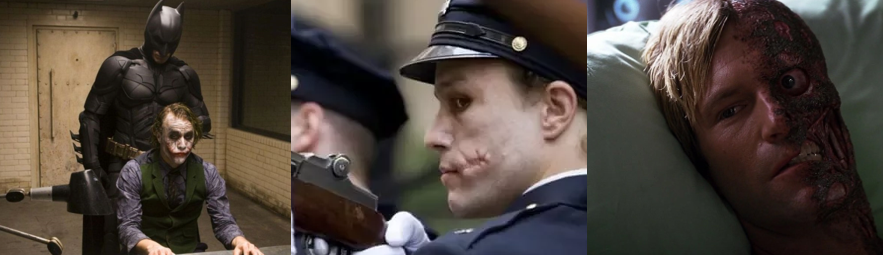
Ledger delivers a star-making performance as the chaotic and unhinged Joker.
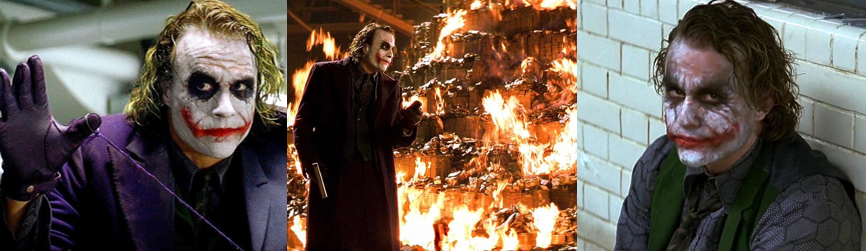
And then there’s the Joker, played with an unnerving, scene-stealing performance by the late Heath Ledger. Unlike in Batman(Burton, 1989) where the Joker was provided with a hefty original backstory, this Joker is a complete enigma. A self-styled “agent of chaos” who proudly showcases both his gruesome facial scars and boasts that he’s simply “a dog chasing cars”, the Joker is as manipulative and psychotic as he is unpredictable and hypocritical. With no identification or fingerprints, the Joker is like a ghost. When he’s introduced, it’s like he’s been conjured by the city itself to challenge Batman’s presence and there’s no definitive explanation for who he is and why he does what he does. Indeed, much like popular depictions of his comic book counterpart, the Joker himself offers conflicting versions of his origin, scars, and motivations. The film suggests he’s been “rippin’ off mob bosses” for some time, he’s shown to have an intense hatred towards city officials and authority figures, and he even openly mocks the city’s mob bosses, threatening and murdering them with a gleeful menace. Although he favours knives over guns since they’re “more personal”, he’s proficient with firearms and, especially, explosives, hinting at a military background but, in true Joker fashion, his origins are completely irrelevant as he “just wants to watch the world burn”. Initially, the Joker encourages the mob to pay him to kill the Batman so they can run rampant over the city but he becomes infatuated by the Dark Knight’s incorruptible nature and refusal to kill. Thus, his motivation switches to opposing Batman’s ideology by corrupting the city’s “White Knight”, Harvey Dent, and breaking the will of the city by exposing their heroes as flawed human beings, demanding that the Batman publicly unmask and forcing both criminals and civilians to make life or death choices to test their mortality. In combat, the Joker is wild, dangerous, and apparently suicidal. He laughs manically in life-threatening situations, practically begs Batman to run him down, and is more than willing to die if it means forcing Batman to breaking point. Although his greatest strength is his unhinged imagination (he absolutely does have a plan, despite his claims, and carries them out with an almost supernatural foresight), the Joker gets the best of even the Batman thanks to appropriating mobsters for his own use and surprising Batman with his tenacity. But his true goal isn’t to simply fight Batman to the death but to instead cripple Gotham City by proving that anyone can turn to psychotic madness after one bad day, necessitating extreme actions from both Batman and Gordon to ensure that Dent’s reputation remains untarnished.
The Nitty-Gritty: The Dark Knight represents how ingrained Batman’s iconography has become not just in the fictional world, but in ours. Just the fact that we got a Batman movie that omitted the character’s name entirely shows how synonymous this description is with the character, and it takes on a double meaning here since Batman is depicted (and, by the end, explicitly referred to) as a “Dark Knight”, a necessary evil to keep Gotham in check, since a “White Knight” has little chance of surviving the crime and corruption that infests the city. Indeed, Bruce is actively considering hanging up the cape and cowl when he sees how effective and unanimously beloved Dent is. Dent is the hero Gotham deserves without a masked persona, giving Bruce a sliver of hope that he can make good on his promise to be with Rachel once the city no longer needs Batman, but he vastly underestimates the destructive influence of the Joker, who perfectly encapsulates Gordon’s previous concerns about “escalation” through his unique brand of anarchy. The Joker is depicted as a man even Bruce “doesn’t understand”, someone beyond reason, intimidation, and bribery, and we see this when he shows no fear when interrogated by Batman and simply cackles with glee when the Dark Knight unloads on him since the Joker always has an ace up his sleeve (both literally and figuratively). Thus, the film very much focuses on the “battle for Gotham’s soul”, with the Joker shifting his motivation towards opposing and destroying not just the city officials and authority figures, but Batman himself since he’s the ultimate symbol of incorruptibility, to the point where he and his allies allow five people to die rather than reveal his identity because the Batman has become such an iconic force for justice within the city.
Some impressive practical effects and stunts make the film instantly memorable.
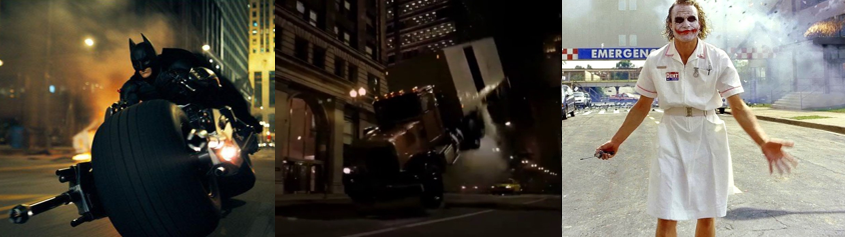
Speaking of Gotham, we’re shown a much different side of the city this time around. We’re firmly topside amongst the towering, glistening skyscrapers rather than in the dingy alleys of the Narrows, which is thematically relevant since the Joker is targeting the upper-class façade of the city but does rob it of a lot of its bleak, gothic identity. The Dark Knight also continues Batman’s crusade not against the street-level crime that killed his parents, but organised crime. He, Gordon, and Dent believe cutting the head off the proverbial snake will kill the body, and this is reflected after their big arrest that sees the lower-level scum facing at least six months in jail, giving the city breathing time to recover. However, this has the knock-on effect of reducing Batman’s street-level crimefighting to near zero since he’s more focused on nailing the likes of Maroni and the Joker and less on stopping random muggings and such. This isn’t necessarily a bad thing because, sadly, there’s little to no improvement in the fight scenes here. Nolan again opts for a close quarters, frenetic depiction of Batman’s fighting that does paint him as a brutal and efficient animal but robs us of seeing what he’s truly capable of. On the plus side, The Dark Knight explores Bruce’s detective skills; while it’s a bit confusing how he recreates fingerprints from bullet casings and he’s constantly one step behind the Joker, I liked how he colluded with Gordon and Dent to apprehend the mob and he’s given some fancy new toys to help him in these endeavours. The most prominent remains the tank-like Tumbler but, when this is destroyed by the Joker, Batman spends the remainder of the film blasting through the city streets on the sleek, bad-ass “Batpod”, a motorcycle-like vehicle that performs all kinds of unlikely turns and tricks with its near-spherical wheels, When extraditing Lau from his office building, Batman makes impressive use of his cape to soar through the skyline and then uses a “skyhook” to yank himself and his quarry out of there, just one of many impressive practical effects utilised in the film, with two more being the Joker’s insane truck flip and the fully practical, full-scale hospital explosion.
While I don’t like the new Batsuit, the Joker and Two-Face look especially impressive.
As mentioned, Batman gets a new suit this time around once he realises that he’s “carrying too much weight” and needs more flexibility. Sadly, I’m not a fan of the new suit; it allows full head movement and is less bulky, sure, but the Bat-symbol is too small, it’s unnecessarily “busy”, and just seems incredibly impractical to put on. It’s also far less durable; separation of the plates means Batman’s more vulnerable, which levels the playing field in his fight with the Joker, and the whole suit just looks too plastic-y and ugly for me. On the plus side, the Joker looks amazing; this might be my favourite depiction of the Joker and he looks ripped right out of a Lee Bermejo comic. While he still sports a permanent grin thanks to his facial scares, his clown make-up is haphazard and intimidating, specifically applied to resemble “war paint” and even degrades to reflect his insanity. His suit is also absolutely perfect, and I love how it’s filled with “knives and lint” and little booby traps, like grenades and such. The Joker also assumes various disguises, included dressing up as one of his own henchmen in a callback to the 1960s TV show, masquerading as a police offer at Commissioner Loeb’s funeral, and, most disturbingly of all, dressing up as a nurse to have a heart to heart with Dent! This is where the film really surprised me; obviously I half-expected Dent to become Two-Face (or “Harvey Two-Face” as films insist on labelling him…) but I never expected Nolan to go so comic-accurate with the depiction of Dent’s burns. Two-Face is absolutely gruesome to behold and the perfect example of how CGI can be used sparingly to enhance practical effects. You can see tendons, muscle, and charred flesh as Dent talks and he really does look like the comic come to life, almost to a fault as I find it difficult to believe that he’s talking so coherently and functioning so efficiently despite refusing pain medication. Similarly, I think we could’ve had a few more scenes exploring Dent’s dark side and his “lucky coin” before his scarring. His descent into vengeance and anarchy seems purely motivated by grief, perceived betrayal, and anger at having “lost everything” rather than having always had a dark side deep within him. Sure, there’s one scene where this is hinted at but it’s not what it seems; Dent never leaves anything up to chance since his coin is double-sided, meaning the odds are always in his favour. Accordingly, he was never actually going to hurt anyone, though this is twisted when he goes on a killing spree as Two-Face as he shoots his enemies dead based on the flip of that same coin.
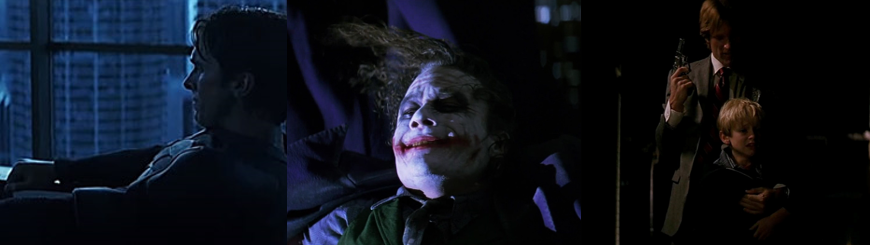
Crushed by Rachel and Dent’s deaths, Batman sacrifices his reputation to keep hope alive in Gotham.
Another element that doesn’t sit right with me is how everyone (and I do mean everyone) is aware of Batman’s code against killing. Maroni and the Joker challenge him on his “one rule” and Batman openly champions it at every turn, severely diminishing his threat somewhat and presenting a familiarity with him that irks me for some reason. A huge part of the Joker’s final plan is predicated on the notion that even “civilised people” will kill to survive. He even rigs the game in his favour to prove this point and is so determined to tarnish the Batman’s heroic visage that he plummets to his death with a maniacal laugh. However, Batman saves him at the last second and the two have an unnerving conversation about their duality and intertwined fates. This is made doubly uncomfortable not just because of Bale’s strained Bat-voice but knowing that they would never tangle again due to Ledger’s untimely death, and part of me wonders if it might’ve been better to insert an edit that shows the Joker willing die after giving his speech. When I first saw The Dark Knight in the cinema, I was so engrossed in the Batman’s fight against the Joker that I completely forgot about Two-Face and, as much as I enjoy the entire film and the finale, I wonder if it might’ve been better to incorporate Two-Face’s actions into the third film and cap things off here. Regardless, both Dent and Bruce are devastated when Rachel is brutally murdered by the Joker. This helps tip Dent over the edge and to kill those who’ve wronged him, but he forces Gordon to choose which of his family should be killed to teach him a lesson in pain and loss. When Batman arrives to confront Two-Face, both he and Gordon desperately try to appeal to Dent’s better nature and fail. Disillusioned and broken, Two-Face disregards Gordon’s pleas and prepares to kill his son (Nathan Gamble), forcing Batman to tackle him to his death. Glossing over the fact that Batman just killed a man (I guess, technically, it was the fall), Batman decides to heed Alfred’s advice and maintain Dent’s reputation by assuming responsibility for Two-Face’s murders. Though reluctant, Gordon realises that it’s the only way to keep people from losing faith in the justice system and begrudgingly agrees to paint Batman as a murderer, ending the movie with Batman a wanted fugitive who willing endures any punishment, mental, spiritual, or physical to ensure peace in Gotham.
The Summary: I absolutely loved Batman Begins when it first came out. It was the dark, gritty, comic-accurate Batman I’d been hoping for for years and I was really excited to see where Bale and Nolan took the character in the sequel. To say that The Dark Knight exceeded expectations would be an understatement. The film is an absolute masterpiece not just of comic book cinema, but of the thriller genre. Bale continues to deftly embody the conflicting personalities and introspective drive and determination that fuels Batman’s crusade, and his Batman continues to be the definitive version of the character for me, despite the dodgy fight scenes and my dislike for the new suit. At its core, The Dark Knight works as an intense thriller depicting the fundamental conflict between justice and anarchy, logic and sanity, and truly elevated the genre to a new level by taking elaborate and colourful concepts like a clown-themed terrorist and a guy with half his faced burned off and treating them seriously. Naturally, Heath Ledger steals the show here; we may never see a better performance of the Joker and you can see that he’s as lost in the role as Bale is as Batman. Ledger’s manic energy and subtle touches really create a feeling of dread, mystery, and unpredictability to the villain, and it remains a tragedy that he didn’t live on to have more dramatic roles like this. Add to that the impressive practical effects, sweeping cinematic score and visuals, and the engaging discussion regarding Batman and his influence on the city and its criminal element and you have, for my money, one of the finest Batman movies ever put to cinema. The film masterfully pulls from some of Batman, Joker, and Two-Face’s most iconic and engaging stories to present an emotional and gripping tale of adversity for the Dark Knight. The film absolutely set the standard for both Batman and comic book movies going forward and, while the third film might have stumbled in concluding the story so wonderfully established here, it doesn’t diminish the timeless appeal of The Dark Knight in the slightest.
My Rating:
⭐⭐⭐⭐⭐
Rating: 5 out of 5.
Fantastic
Did you enjoy The Dark Knight? Where would you rank it against the other Batman movies? What did you think to Heath Ledger’s portrayal of the Joker? Were you a fan of the new Batsuit or do you also find it a bit too busy? What did you think to the effects and stunt work used in the film? Were you also surprised by how gruesome Two-Face’s scars were? Did you agree that Bruce had to maintain his identity, or do you think you should’ve come forward sooner? How did you celebrate Batman Day this year and what is your favourite Batman movie? Whatever your thoughts The Dark Knight, or Batman in general, share them below or leave a comment on my social media.
In the decades since his first dramatic appearance in the pages of Detective Comics, Bruce Wayne/Batman has become a mainstream, worldwide, pop culture icon. The brainchild of writer Bob Kane, Batman was brought to life by artist Bill Finger and has been a popular staple of DC Comics and countless movies, videogames, and cartoons over the years. So, as today is “Batman Day”, I figured this was a perfect excuse to spend every Saturday celebrating comic’s grim and broody vigilante.
Released: 25 December 1993 Director: Eric Radomski and Bruce Timm Distributor: Warner Bros. Budget: $6 million Stars: Kevin Conroy, Dana Delany, Hart Bochner, Bob Hastings, Efrem Zimbalist Jr., and Mark Hamill
The Plot: Early into his crimefighting career as the Batman, Bruce Wayne (Conroy) finds mobsters being slain by a mysterious and vicious, Grim Reaper-esque vigilante “The Phantasm” (Stacy Keach). In trying to uncover the Phantasm’s identity, Batman reconnects with his lost love, Andrea Beaumont (Delany), and uncovers a terrible connection between the two.
The Background: Artist Bob Kane may have dreamed up the idea of a new masked crimefighter to capitalise on the success of Clark Kent/Superman’s debut, but it was thelong-suppressed efforts of artist Bill Finger that the “Bat-Man” became such an iconic figure. Decades later, the likes of Dennis O’Neil sought to correct the Batman’s image following the gloriously camp (and incredibly popular) 1960s television show, but the release and relative success of Batman (Burton, 1989) and Batman Returns (ibid, 1992) saw renewed interest in the character. Consequently,Bruce Timm, Paul Dini, and Eric Radomski spearheaded a new animated series influenced by both films that became one of the most beloved and influential cartoons of its era. Batman: The Animated Series aired eighty-five episodes between September 1992 and 1995 before being succeeded by twenty-four episodes of The New Batman Adventures (known as The Adventures of Batman & Robin in the United Kingdom) between 1997 and 1999, but its initial success convinced Warner Bros. to task Alan Burnett with writing a full-length animated feature. Heavily influenced by Batman: Year Two (Barr, et al, 1987), the film was set to feature a Grim Reaper-like counterpart to Batman while also acting as something of an origin story for both the Dark Knight and his long-standing nemesis, the Joker. Filming was completed within eight months, and Warner Bros. made the last-minute decision to release it theatrically. Although this negatively impacted its box office return, Batman: Mask of the Phantasm made up for this in home media sales and is widely regarded as one of the best superhero films ever made. Critics praised the presentation and score, the slick animation, and its mature themes, and it remains one of the quintessential adaptations of the character for many Batman fans.
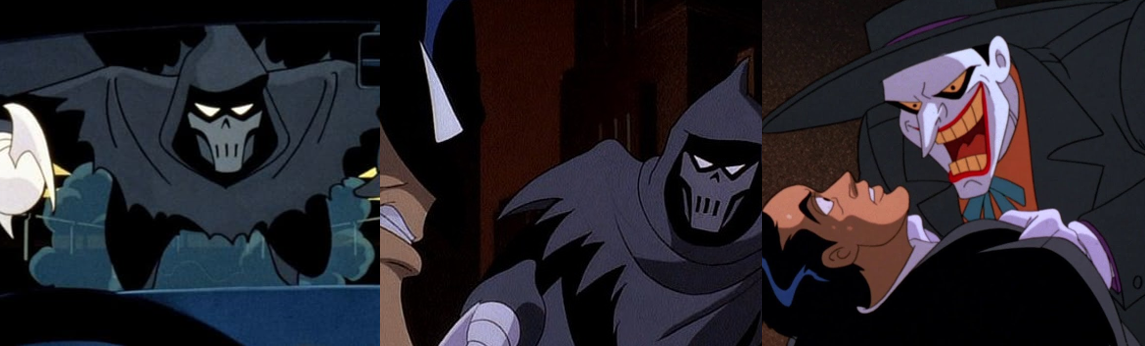
The Review: I watched Batman: The Animated Series as a kid, alongside a host of other popular cartoons at the time, but my memories aren’t massively clear. This is a general statement of my childhood in this regard, and I think it’s because I usually slept in at the weekends and didn’t get up until after a lot of the big cartoons had already been on, then I’d spend the rest of my time eating, playing videogames, or watching the same video cassettes over and over. Still, Batman: The Animated Series definitely made an impression on me. It was dark, surprisingly violent, and probably the most readily available incarnation of Batman since it didn’t involve buying any books or comics, so it was massively exciting when this animated feature aired on television for the first time or you saw the VHS available for purchase. The film begins in present day Gotham City, where Batman has established himself as a nocturnal vigilante but is still early enough in his career to large be considered an urban myth. As a result, Chuckie Sol (Dick Miller) has no qualms about conducting his business in the dead of night, which naturally means his money laundering deal is interrupted by the Batman. Although Chuckie slips away with his counterfeit money, he’s intercepted by a mysterious, Grim Reaper-like figure we now know as the Phantasm and so intimidated by the spectre that he drives out of the parking lot to a violent death.
The mystery of the Phantasm puts Batman in the frame, but their true identity may surprise you!
Thanks to the Phantasm, and the testimony of bystanders, Batman is fingered for Chuckie Sol’s death and councilman Arthur Reeves (Bochner) wastes no time publicly declaring Batman a violent vigilante who needs to be brought to justice. When Commissioner Jim Gordon (Hastings) remains adamant that sensationalist claims that Batman has snapped and gone on a killing spree are against Batman’s very nature and washes his hands of the entire debacle, Reeves personally leads numerous unsuccessful attempts to apprehend the Dark Knight. Batman is more concerned with analysing a piece of Chuckie’s windshield, which is stained by chemical residue from the Phantasm’s smoke, and investigating the graveyard where Buzz Bronski (John P. Ryan) was killed. Batman: Mask of the Phantasm does a wonderful job of depicting Batman’s detective skills and it’s a nice change of pace from all the thrilling action, chase, and fight sequences to follow his investigation into the murders. Additionally, there are two pressing mysteries in the feature: the identity of the titular Phantasm and the connection between the mobsters left dead in their wake. Of course, these end up overlapping but there’s a decent attempt to throw some red herrings our way. Reeves, Andrea’s father Carl (Keach), and Andrea are all potential suspects but it’s the latter who turns out to be behind the cloak and hand-scythe of the Phantasm. There’s an argument to be made that this isn’t too surprising given we’ve never heard of Andrea before this film, but the stature and physicality of the Phantasm definitely helps to keep this a dramatic reveal at the finale. Unlike the Batman, the Phantasm isn’t above killing; Andrea utilises theatricality to equal Batman, appearing to appear and disappear in a cloud of smoke, brandishes a dangerous scythe-like gauntlet, and is garbed in a heavy-duty armoured suit that makes her more than a match for Batman’s skills and gadgets when they inevitably come to blows.
Kevin Conroy delivers another stellar performance as Bruce is torn between his vow and his heart.
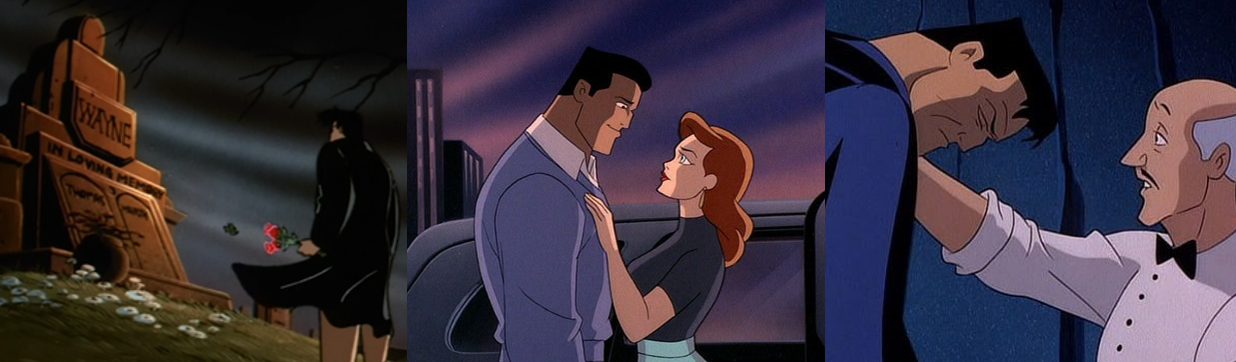
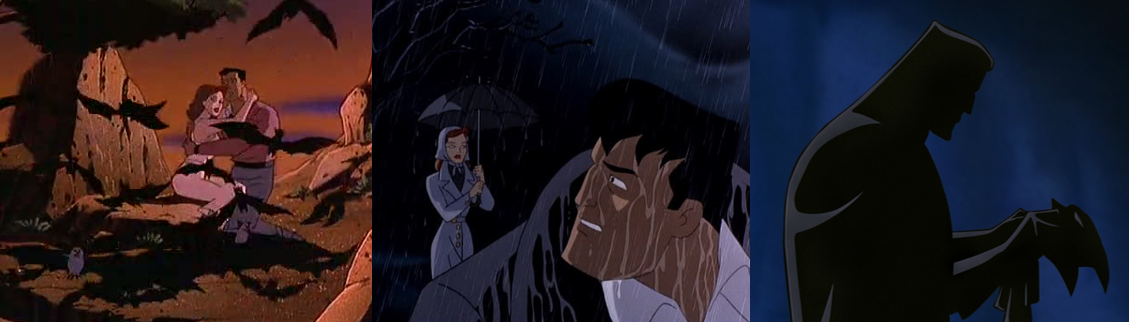
While Michael Keaton may have set the bar for live-action portrayals of Batman, make no mistake that Kevin Conroy remains the standard for depictions of Batman. Any actor looking to take on the iconic role must depict his three dominant personas: Public (Bruce Wayne, socialite and playboy), Private (Bruce Wayne, brooding and melancholy), and Vigilante (the grim and stoic Batman) and Conroy perfectly nails all three of these. When Bruce is attending functions and banquets, he’s a suave and smooth-talking ladies’ man known for being extremely generous with his family’s wealth, hands-on with charities and opportunities from growth and employment in Gotham, and for stringing along a seemingly endless parade of bimbos and lusty women. At home, in both the solitude of Wayne Manor and the sanctity of the Batcave, this public mask slips, allowing Bruce to confide in his faithful butler and father-figure, Alfred Pennywoth (Zimbalist Jr.), and is the closest he gets to being truly honest with anyone. And, of course, under cover of night, he stalks the criminal underworld as a theatrical vigilante, and Conroy expertly depicts the differences in each of these personas and situations with subtle changes to his tone, line delivery, and inflections that really went a long way to making this version of Batman one of the most well-realised, complex, and layered interpretations of the character. This really comes to the forefront here thanks to repeated flashbacks to an earlier time in Bruce’s life where he struggled with how to make good on the vow he made to avenge his parents’ death by tackling the criminal scum that took their lives. At this point, he’s still an angry, directionless young man whose vigilante debut goes sideways because, while he has the physical means to overpower even armed crooks, he’s at a disadvantage because he’s seen as just a man, rather than a force of darkness and justice (as he puts it: “They weren’t afraid of me!”) While brooding at their gravestone, he crosses paths with the beautiful Andrea Beaumont. Though she comes across as dismissive and aloof, she’s actually intrigued and somewhat taken by him since he has all this wealth and privilege but always seems so melancholy. As she’s also lost someone, her beloved mother, the two bond over their shared grief and, when she comes to visit him, she impresses him with her combat prowess and the two begin a whirlwind romance.
As if the mysterious and brutal Phantasm wasn’t enough, the Joker shows up to steal the show!
Bruce is so taken by Andrea that he questions his vow and contemplates a life of happiness as a benevolent entrepreneur with her by his side. He is therefore devastated when she suddenly rejects his proposal and leaves the city, forever setting him on a path of grim vigilantism. When Andrea returns to Gotham some years later, in the present day of the story, Bruce is a fundamentally changed man. A chance encounter between her and Batman accidentally reveals his true identity to her, and she greets the Batman with a cutting hostility when he’s forced to question her as part of his investigation into the recent killings (delivering a biting jibe about how he’s controlled by his parents). Buzz Bronski, a mob associate of Chuckie’s, is the Phantasm’s next target; his henchmen see him chased by the cloaked figure and crushed to death under a gravestone and mistake the “Angel of Death” for Batman, which causes a media sensation. Startled by the murders of his associates, the decrepit Sal Valestra/The Wheezer (Abe Vigoda) fears for his safety and turns to the Joker (Hamill) for protection. As if touching upon Batman’s origins wasn’t enough, Batman: Mask of the Phantasm thus provides a glimpse into the background of the typically mysterious Clown Prince of Crime. Although not named as such here, the Joker was once Jack Napier like in Batman, but we also learn that he was once a chauffeur and assassin for the mob before taking his dive into disfiguring acid. While I appreciate the effort to flesh out the Joker’s backstory a little, and the film does a decent jump of bringing him in late into the runtime, I can’t help but feel like the Joker’s inclusion was a little forced and unnecessary. It’s as though the filmmakers didn’t quite trust the intriguing mystery of the Phantasm, the glimpse into Bruce’s past, or the narrative of Batman being hunted by the police and felt they had to shoehorn the Joker in to make things more exciting.
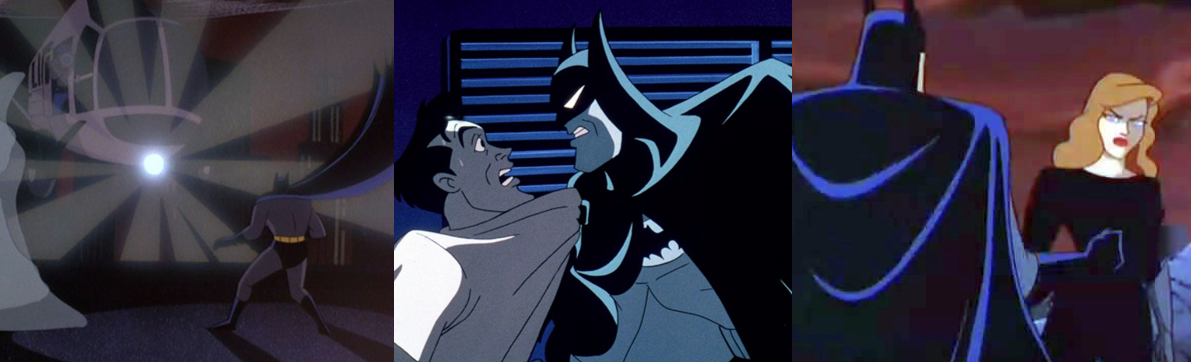
The Nitty-Gritty: Of course, I’d be doing Batman: Mask of the Phantasm a disservice if I didn’t mention the absolutely haunting score from the late, great Shirley Walker. Having collaborated with composer Danny Elfman for Batman, Walker was the perfect choice to evoke the same melancholic, gothic undertones of Burton’s blockbuster reinvention of the character, and she’s at her absolute best here. The sweeping, operatic score really gives Gotham City an ominous, looming character, punctuates the action, and makes the more poignant moments of the film all the more heart-breaking and that’s all thanks to Walker’s absolutely iconic and memorable orchestral number. The animation must also be praised; thanks to an emphasis on shadows and darkness, Batman moves like a slick, otherworldly figure and comes across as fearsome, intimidating, and efficient all at once. Nowhere is the use of lighting more impressive than in scenes in the Batcave, where deep, never-ending shadows and darkness are at their most prominent, and this all really adds to the stark contrast between the inky black of night and the brighter, dull pastels of the few day time scenes.
The feature provides a tantalising glimpse intoBruce’s motivation to become the Dark Knight.
One thing that helped Batman: Mask of the Phantasm stand out as an animated feature was how surprisingly adult it was. Batman: The Animated Series always expertly towed the line with the censors by depicting guns and bullets rather than laser pistols, and the feature film gets away with even more to depict people smoking, modern-day pistols rather than Tommy guns, a bit of blood when Batman takes a beating, and an unexpectedly high body count for a “kid’s film” thanks to the murderous Phantasm. A central aspect of the film is the exploration into the motivation and tragedy that pushed Bruce into assuming the Batman guise. Despite travelling the world and gaining the physical and deductive skills to be a crimefighting detective, Bruce is torn between seeing his vow to the fullest extent and using his wealth to benefit the city while living a happy life with Andrea. Alfred naturally pushes him towards the latter, and Andrea even believes that his parents “sent [her]” as a sign that he can go back on his vow. Unfortunately, fate intervenes. Right after she accepts Bruce’s proposal, Carl Beaumont forces Andrea to leave the city after his dealings with the mob threaten both of their lives and, rather than explain the situation to her love, Andrea left him heart-broken and rejected. With his one last chance of a happy, normal life denied him, Bruce returns to his vow and, in a hauntingly impactful scene, embraces the cape and cowl of the Batman, losing himself to the darkness of his never-ending crusade and shocking even Alfred with his monstrous transformation.
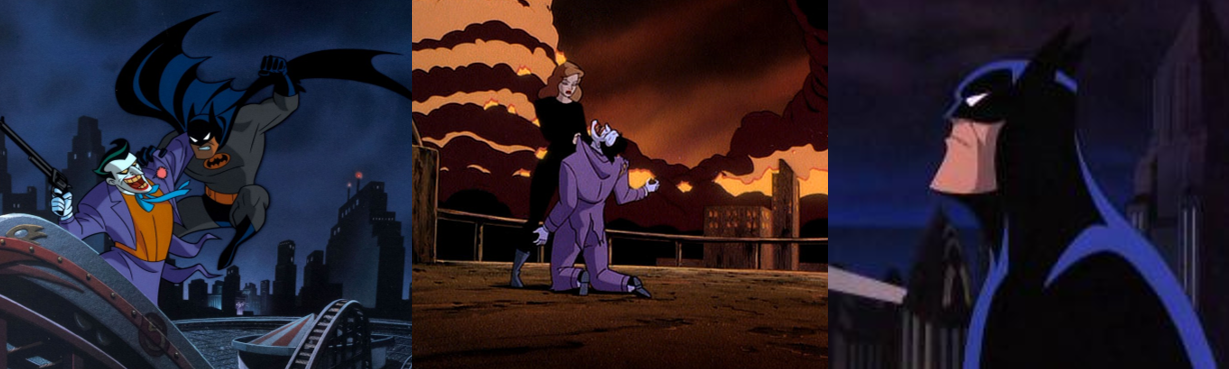
The climatic finale sees Batman engage with the Joker, and seemingly lose his one true love forever.
Batman takes his investigation up a notch after figuring out that the Joker is involved, and the cackling madman quickly takes a perverse pleasure in hunting down the one responsible for killing his old buddies. This involves murdering Valestra and wiring to explode, reducing Reeves to a hysterical mess with his laughing gas, and trying to off the Batman with ludicrous contraptions cobbled together from the abandoned world’s fair that the Joker’s taken as his hideout. Oddly enough, once Andrea’s true identity is revealed, the Joker actually holds his own in a fight with her thanks to his acid-spitting flower and turning the fair’s animatronics and rides into death traps. Andrea, however, is driven by a murderous bloodlust. Since the Joker was responsible for killing her father, she has no problem fighting dirty, kicking him in the nuts and tracing him across the hazardous amusement park in a bid to have her revenge. Naturally, Batman makes a dramatic save and chases down his most persistent nemesis, leading to a somewhat ludicrous conclusion where Batman battles a jetpack-wearing-Joker through the skies of a dilapidated amusement park wired to explode. Determined to see the Joker pay, Andrea ignores Batman’s pleas to leave and seemingly perishes along with the Clown Prince of Crime as the world’s fair is dramatically engulfed by explosions, leaving Batman not only heart-broken but guilt-ridden at his failure to save his former flame. In the darkness of the Batcave, he finds solace in Alfred’s reassuring words and Andrea’s pendant, giving him hope that she’s still alive. Hardened by the experience, he returns to the night as the Batman, grim avenger of injustice, while Andrea sails off to an unknown future with only her own heartbreak for company.
The Summary: It’s hard to get much better than Batman: Mask of the Phantasm for pure, unadulterated Batman action. In many ways it, like the cartoon it spun out from, is one of the most striking, influential, and unapologetically faithful renditions of DC’s Dark Knight ever put to screen and perfectly captures the dark, gothic melancholy of the titular vigilante, his city, and his never-ending crusade against crime. This was one of the rare, few glimpses into a time of Bruce’s life where he was struggling to make the transition from angry, vengeful young man to grim avenger of the night and it’s absolutely tragic to see how close he came to abandoning his crusade for true love and was forced to fully commit to his dark alter ego once fate set him on that path. One of the things I absolutely love about Batman: Mask of the Phantasm is that it’s not afraid to show Batman’s more cerebral side. The mystery of the Phantasm and the killings is as crucial to the narrative as the romance between Bruce and Andrea, and is far more of a focus than the handful of fantastically realised and slickly animated fight and chase sequences. Batman also feels fallible and human while still being a fearsome and intimidating figure. He easily outmatches street level scum but can be hurt by the likes of the Phantasm and the Joker thanks to their skills and/or gadgets. As I’m also a big fan of Batman: Year Two, the Phantasm struck me as a brilliant foil for Batman. As cold and stoic as the Dark Knight, Andrea’s gruesome, cloaked persona is a dangerous and ruthless foe out for blood and nothing more, but more than a match for the Caped Crusader thanks to gadgets, theatricality, and a degree and physical ability. While I find the finale a bit over the top thanks to the focus shifting towards the Joker, you can’t deny that Mark Hamill steals the show at every turn with his maniacal performance, delivering every line with a sadistic glee that makes the Clown Prince of Crime a joy to watch. Honestly, if you know anyone who isn’t sure if they want to get into Batman or who wants to learn more about Batman, I would absolutely recommend you point them towards Batman: Mask of the Phantasm as you’ll be hard-pressed to find a better representation of everything that makes the Dark Knight such an enigmatic and alluring character.
My Rating:
⭐⭐⭐⭐⭐
Rating: 5 out of 5.
Fantastic
Are you a fan of Batman: Mask of the Phantasm? Where would you rank it against other Batman films, live-action or otherwise? What did you think tothe Phantasm, their depiction, and the reveal of their identity? Were you a fan of the Joker’s inclusion or, like me, did it kind of overshadow the rest of the plot for you? Did you enjoy Batman: The Animated Series growing up? What are some of your favourite episodes, and where would you rank Kevin Conroy’s performance? What was your first experience of Batman and how are you celebrating his debut this month? Feel free to share your thoughts on Batman: Mask of the Phantasm down below, or leave a comment on my social media, and be sure to check back in for more Batman content in the near future!
In the decades since his first dramatic appearance in the pages of Detective Comics, Bruce Wayne/Batman has become a mainstream, worldwide, pop culture icon. The brainchild of writer Bob Kane, Batman was brought to life by artist Bill Finger and has been a popular staple of DC Comics and countless movies, videogames, and cartoons over the years. “Batman Day” falls on 21 September this year and I figured this was a perfect excuse to spend every Saturday celebrating comic’s grim and broody vigilante.
Writer: Bill Finger – Artist: Bob Kane
Story Title: “The Crimes of Two-Face” Published: August 1942
Story Title: “The Man Who Led a Double Life” Published: October 1942
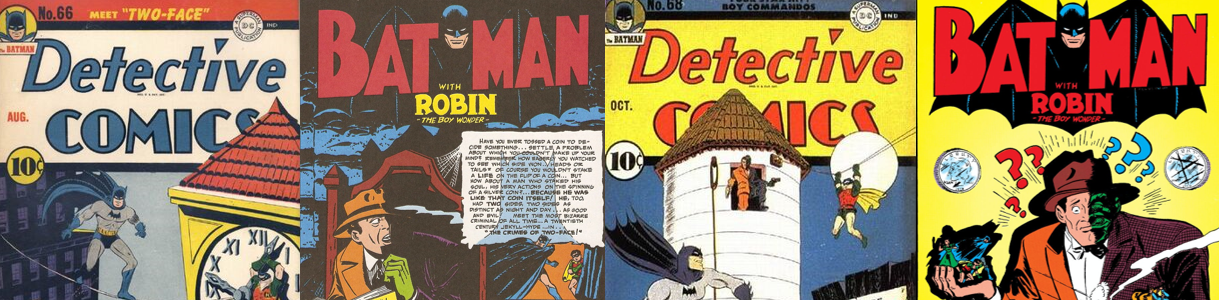
The Background: Following the huge success of Clark Kent/Superman, National Comics Publications had Bob Kane create another masked crimefighter to add to their repertoire. Thanks to the long-suppressed influence of artist Bill Finger, the “Bat-Man” soon became not only one of DC Comics’ most popular characters but also a mainstream cultural icon. In the years that followed, the Batman battled numerous costumed supervillains, but perhaps none are more tragic then former district attorney-turned-criminal Harvey Dent/Two-Face. Originally debuting in this two-part story as Harvey “Apollo” Kent, Two-Face was heavily inspired by the 1925 adaptation of The Phantom of the Opera (Leroux, 1909) and the 1931 adaptation of Strange Case of Dr Jekyll and Mr Hyde (Stevenson, 1886), both tales of a tortured soul, often gruesomely depicted or disfigured, who struggled with the duality of good and evil. Subsequent Two-Face stories have offered further insight into his tragic and abusive childhood, as well as further emphasising his complex relationship with Bruce Wayne, and the character is often a rival or litmus test for Batman’s different Robins. Widely regarded as one of Batman’s best villains, Two-Face has appeared as a prominent foe outside of the comics, from his renowned appearances in the acclaimedBatman: The Animated Series (1992 to 1999), Tommy Lee Jones’s bombastic portrayal in Batman Forever(Schumacher, 1995), and Aaron Eckhart’s understated turn in The Dark Knight (Nolan, 2008).
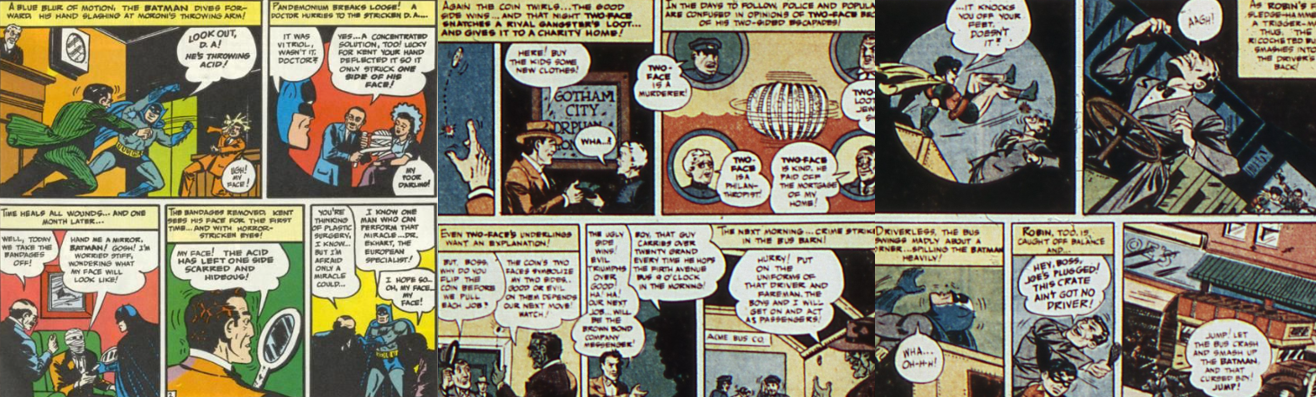
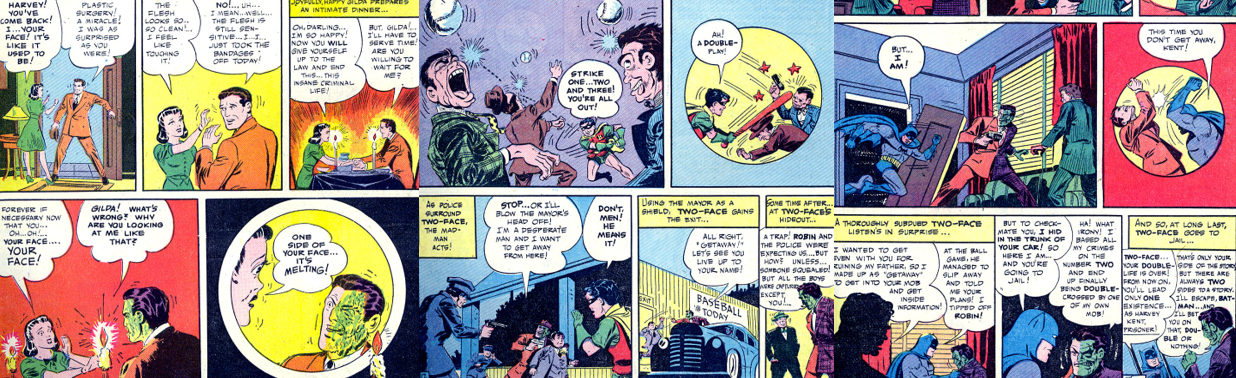
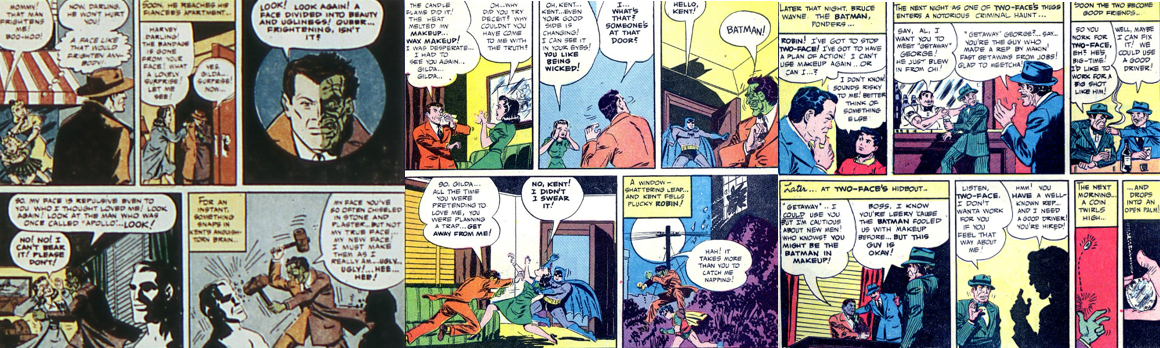
The Review: This two-part story begins by introducing us to Harvey Kent, the dashing and famous district attorney beloved by the press and nicknamed “Apollo” for his courageous stance against organised crime, such as mob boss Sal “Boss” Moroni. Kent is the lead prosecutor in the case against Moroni and wastes no time in calling the Batman to take the stand as a key witness in Moroni’s trial. Amazingly, the testimony of a masked vigilante is seen as perfectly acceptable and admissible as evidence. Batman relates how Moroni shot “Bookie” Benson while escaping from a fight and Kent produces his most damning piece of evidence: Moroni’s lucky, two-headed silver dollar with his fingerprints on it! Moroni’s so incensed by Kent’s bravado that he tosses a vial of acid right at the district attorney! Although Batman intercepts the throw, Kent is hit with a concentrated splash of vitriol on one side of his face, leaving him wrapped in bandages for an entire month. When the time comes to reveal the extent of the damage, Kent is horrified to find that the left side of his face is “scarred and hideous”. He’s even more despondent to find that his only hope, a “European specialist” Batman knows of, is currently imprisoned in a Nazi concentration camp. The Batman simply peaces out after that, advising Kent to face his fiancée, Gilda, sooner rather than later, but Kent is distraught to find his gruesome visage frightens not only children, but also his beloved Gilda. Seeing the fear in her eyes, he flies into a rage, defacing a sculpture of his former chiselled features and terrifying her almost as much as his monstrous scarring.
After being hideously scarred, Two-Face embarks on a bizarre crime spree across the city.
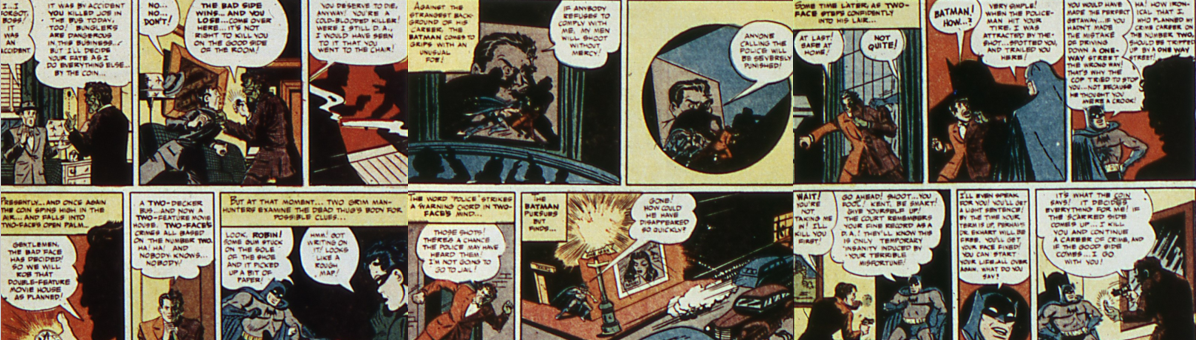
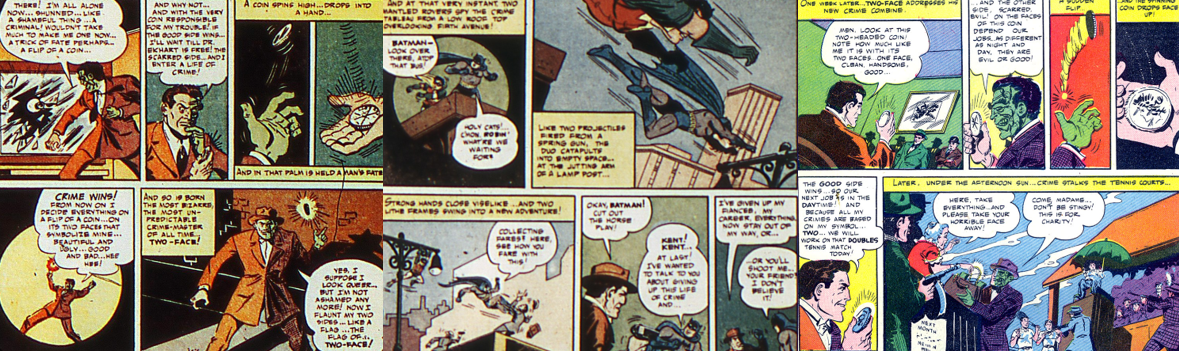
Tormented, driven to the brink of madness, Kent ponders this dichotomy of his explicit duality. He focuses his rage on Moroni’s silver dollar, defacing one side of it and lashing out at the cruelty of fate. Deciding that all life hinges on the flip of a coin, Kent projects his duality onto the now-scarred dollar. He resolves to decide his immediate future on a coin toss, promising to wait for Batman’s specialist to be freed if the unmarked side comes up or embark on a criminal career if the scarred side comes up. Of course, the scarred side wins and Kent rebrands himself “Two-Face”, adopting a suit to match his split face and putting his knowledge as district attorney to use in his crimes. Since everything he does is decided by this bizarre coin, one day he and his goons might rob a bank for illicit gain, but the next day he might donate his stolen money to charity! This causes public opinion of him to be fittingly divided, with some branding him a thief and a murderer and others a philanthropist and saviour. Even his goons are confused by Two-Face’s unpredictable nature, but they’re excited when the bad side wins and they undertake an elaborate scheme to rob the Brown Bond Company messenger that sees them hijack a double decker bus to rob the bondsman. As luck would have it, Batman and Robin happen to spot the mugging taking place and swoop in to intervene. Apparently well aware that Kent is Two-Face, Batman tries to talk him out of his life of crime but is stunned when his former friend pulls a gun on him and orders his men to toss him off the roof of the bus!
When Batman confronts Two-Face, the tragic villain is left clueless when his coin fails him.
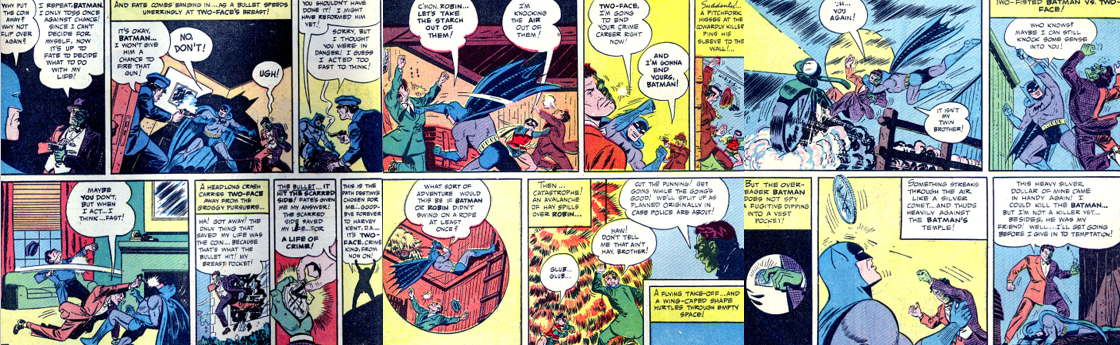
Although this doesn’t come to pass thanks to Robin accidentally causing the thug driving the bus to be killed, Batman is incapacitated in the fracas and the Dynamic Duo are left to die on the out of control vehicle, though Robin manages to get to the handbrake in time. Back at his thematically appropriate lair (one side is clean and pristine and the other is a shambles), Two-Face chastises himself for his actions. Believing that he’s killed his good friend, Two-Face almost regains his sanity before lashing out at the mirror and murdering his other goon after blaming him for causing the shambles on the bus. Two-Face then steps his game up by targeting the double-feature movie house, since he’s now committed to basing his crimes on the number two, but remains unaware that Batman and Robin survived the bus crash. Upon investigating the dead body of Two-Face’s goon, the Dynamic Duo happen to find a map stuck to the sole of his shoe by a piece of gum! This leads them to the Bijou Theatre, Two-Face’s next target, where Two-Face takes over the projection booth and demands that the audience hand over their loot. While Robin takes out the goons in the projection booth, Batman swoops onto the stage for a brief fight with Two-Face while his pre-recorded message looms and rants in the background. Somehow (it’s really not too clear), Two-Face slips away, but the Batman easily tracks him back to his lair by simply…y’know, following him after Two-Face made the error of driving down a one-way street and attracting police attention. Refusing to go down without a fight, Two-Face again threatens to shoot Batman, but the Dark Knight pleads with him to come along quietly. Batman promises to testify on his behalf to argue temporary insanity and to do everything he can to see Kent gets a light sentence until that specialist can fix his face, but Two-Face is unable to make a decision without flipping his beloved coin. Unfortunately for the tragic villain, cruel fate strikes again and the coin ends up standing on edge, leaving Two-Face conflicted and incapable of deciding whether he should give up his life of crime or kill Batman and continue down his dark path.
Two-Face slips away, continues his unique crimes, and even bests Batman in a fight.
The story continued, fittingly two issues later, in “The Man Who Led a Double Life”, which picks up right where the first story ended and sees Two-Face pocketing his coin, resolving to let fate decide what he does with his life. Unfortunately, a trigger-happy cop bursts in and guns down Two-Face, believing he’s about to shoot Batman, but the bullet strikes the coin in Two-Face’s breast pocket, allowing him to survive and make a hasty retreat by leaping out of the window! Since the bullet hit the scarred side of the coin, Two-Face believes this is fate’s way of telling him to commit himself to his criminal career. His first act is to rob the doubles tennis match (during the daytime, since the coin landed good side up) and donate the cash to charity. Next, he and his goons kidnap matchstick mogul Henry Logan, whose entire home is apparently made out of matchsticks, but Batman and Robin are stunned to find it was actually the cantankerous tycoon’s double who was taken since Kent knew about Logan’s doppelganger from his time as district attorney. Batman and Robin are disgusted by Logan’s indifference towards his double’s fate and his selfishness, but the reclusive hobbyist agrees to pay Two-Face’s $200,000 ransom. However, when Logan and his wife arrive at the disused barn to make the transfer, Two-Face is enraged to find he’s been tricked and that it’s Batman and Robin in disguise! Batman and Robin easily overpower Two-Face and his mooks. Although one of the goons buries Robin under a pile of hay, Batman continues hammering Two-Face after the scarred villain tries escaping on a motorcycle. Laughably, Batman is felled when Two-Face tosses his coin at his forehead; however, Batman is spared since Two-Face “[is] not a killer yet” (despite it being said that he was in the first story) and still has some compassion for his former friend.
Two-Face’s attempt to return to his wife, and succeed at crime, are thwarted by the Batman.
When Batman and Robin return the double to Logan, they find the tycoon to be as grating as ever, so Robin teaches him a lesson by dropping a lit match into his shoe, something the Batman simply laughs about despite the fact that the house place could’ve gone up in flames! Anyway, after spotting a loved-up couple in the street, Two-Face decides to pay a visit to his lost love, Gilda. Gilda is elated when the fully restored Harvey Kent surprises her at home, but he ensures she doesn’t get too close to his face. Over a candlelit dinner, he promises to come back to her and forgo his criminal ways if she waits for him, but is incensed when her happiness turns to horror after the heat from the candles melts the wax make-up covering his hideous scars. Gilda is driven to tears by the revelation that Kent has completely lost himself to wickedness and insanity, but Two-Face flies into a rage when Batman bursts in since he assumes she was colluding with the Dark Knight. Once again, Two-Face escapes through a window and he avenges his misfortune on the mask and make-up factory that cost him his love. Two-Face and his goons beat up the proprietors and torch the place, leaving the mask-maker destitute and his son swearing revenge. The story then leads us to believe that, despite Dick’s warnings, Bruce uses make-up to infiltrate Two-Face’s gang as “Getaway” George when the coin flips in his favour. Two-Face’s next target is the double-header baseball game between the city’s fire and police departments, in which honorary police officers Batman and Robin are publicly seen participating. Two-Face brazenly steals the $50,000 takings and even takes the mayor hostage at gunpoint after Robin beats up his minions. When Two-Face gets back to his lair and finds the cops waiting, he assumes that “Getaway” is Batman in disguise and is stunned when the real Dark Knight barges in to deliver a swift uppercut. It turns out that “Getaway” was the mask-maker’s son working in cahoots with Batman, and Two-Face bitterly comments on the irony of being double-crossed by one of his own gang in the end.
The Summary: Two-Face’s links to Jekyll and Hyde aren’t simply thematic, they’re explicit. Hell, the first dialogue box on the opening page of “The Crimes of Two-Face” not only refers to Two-Face as “a twentieth-century Jekyll-Hyde” but even shows the disfigured criminal reading a copy of the book! I may be committing a literary sin here, but I haven’t actually read that book so I can only speak to the widely regarded themes of duality and man vs. monster that are at work in the text, but “The Crimes of Two-Face” definitely goes out of its way to draw parallels between Kent’s fate and that classic piece of gothic literature. They are, however, really only skin deep. Sure, we only see Kent for a few panels before he’s hideously scarred, but there’s no indication in either story that he was anything but a model citizen and champion of justice. More than once, he and Batman refer to each other as old friends and Two-Face is noticeably conflicted about the Dark Knight, more so than his criminal career, it seems. Indeed, it’s quite jarring when Kent just suddenly decides he has only two options: wait to be fixed or turn to crime, but it’s pretty well conveyed that his ghastly condition has caused him to snap. Batman refers to him suffering from temporary insanity, the text boxes allude to his rage, and Gilda’s reaction to his outburst all point towards this, but it’s still quite the sudden turn from model civil servant to notorious bank robber. One thing I did enjoy was that the reveal of Two-Face’s horrific visage is kept hidden to start with, so we only see it when he reluctantly reveals himself to Gilda, which builds a sense of anticipation about what he looks like. It’s a shame that he’s depicted with a literal line running down the middle of his face, but I can forgive that given the simplistic art of the time.
Despite Two-Face’s obvious gimmick, there’s little detective work involved in stopping him.
We’re well into Batman’s time as a much brighter, kid-friendly character here. He’s appearing in broad daylight, working alongside the police, and even taking to the witness stand and playing baseball, for God’s sake! Now fully deputised members of the police department, Batman and Robin are seen as assets rather than vigilantes and are specifically brought in by Police Commissioner James “Jim” Gordon to help with the Henry Logan kidnapping case. More importantly, the Batman had a close working relationship with Harvey Kent that sees him repeatedly appeal to his better half in “The Crimes of Two-Face”. Sadly, we never get to actually see the extent of their friendship. It’s simply said and inferred by their dialogue, and neither story explores Bruce’s reaction to his friend’s condition or delves into how conflicted he feels about Two-Face. Instead, Batman tries to out-think the tragic villain, occasionally begs him to listen to reason, and settles for socking him in the jaw when he refuses to come quietly. By the end, Batman views Two-Face as just another colourful supervillain and there’s no indication that he wants to try to help or rehabilitate his former friend; he just wants him locked up. As a villain, Two-Face is both visually interesting, surprisingly tragic, unpredictably volatile, and incredibly restrictive. Since he dictates his actions on a coin flip, his crimes can either be horribly violent or unnervingly charitable, casting him almost as an anti-villain since he’ll help those in need with ill-gotten gains and even kill his own men if they violate his rules. This makes the coin his most obvious Achilles’ heel, but it’s at least tied to his dual and conflicting nature. His obsession with the number two is far more of a crutch and I’m surprised that more wasn’t made of it. Once again, Batman and Robin do very little detective work here (they happen upon that map and Batman simply guesses that Kent would return to Gilda) so there’s no depictions of them trying to figure out Two-Face’s next scheme or running around the city looking for obscure references to the number two. It’s simply them reacting whenever Two-Face strikes or stumbling upon a lead.
Two-Face is a tragic and visually interesting character even in his more basic debut story.
Still, while Two-Face’s complex nature, volatile personality, and relationship with Batman is only touched upon or inferred in “The Crimes of Two-Face” and “The Man Who Led a Double Life”, both stories were surprisingly fun and unique tales. It’s not often that Batman’s villains had such a tragic twist to them back then and the references to Two-Face using his knowledge as district attorney for evil only add to the cruel twist of fate dealt to this once handsome and honourable man. I enjoyed Two-Face’s lamentations, which were suitably Phantom-esque, and his whole gimmick, including the split suit and lair. Despite seeing it as a handicap, I’ve always liked the double-headed coin aspect of the character and I enjoyed how quickly he became fixated on the coin’s decisions and how he was rendered panic-stricken and impotent when the coin landed on its side. I think “The Man Who Led a Double Life” would’ve been served better if it had begun with a babbling and broken Two-Face being taken into custody and seeing doctors try to salvage his mind and face until he inevitably returned to his evil ways, but that was kind of toyed with when he desperately resorted to a wax facsimile to reconnect with Gilda. Overall, the two tales didn’t exactly blow my socks off and there are definitely better Two-Face origin stories and tragic tales out there, but they were entertaining enough. Two-Face is an elaborate criminal with a unique, if narratively exhausting, gimmick and has (and continues to have) a tragic appeal to him that’s prominently introduced here, even with the lacklustre depiction of Kent’s time before his scarring.
My Rating:
⭐⭐⭐⭐
Rating: 4 out of 5.
Great Stuff
Have you ever read the two-part debut of Two-Face? If so, what did you think to it, which of the two was your favourite, and where would you rank Two-Face in Batman’s villain hierarchy? Would you have liked to see more backstory given to Harvey Kent? What did you think to his coin, obsession with the number two, and the depiction of his volatile duality? Did you enjoy Batman’s time as a brighter, friendlier character or do you prefer the brooding, grim Dark Knight? What are some of your favourite Two-Face stories and which interpretation of Two-Face is your favourite? Whatever your thoughts on Two-Face, share them below or on my social media, and be sure to check out my other Batman content!
In the decades since his first dramatic appearance in the pages of Detective Comics, Bruce Wayne/Batman has become a mainstream, worldwide, pop culture icon. The brainchild of writer Bob Kane, Batman was brought to life by artist Bill Finger and has been a popular staple of DC Comics and countless movies, videogames, and cartoons over the years. “Batman Day” falls on 21 September this year and I figured this was a perfect excuse to spend every Saturday celebrating comic’s grim and broody vigilante.
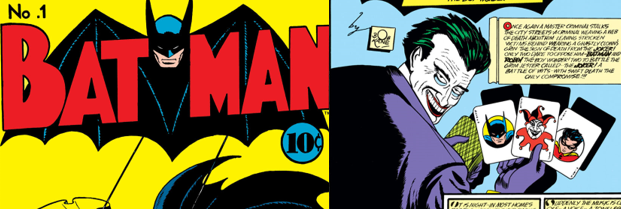
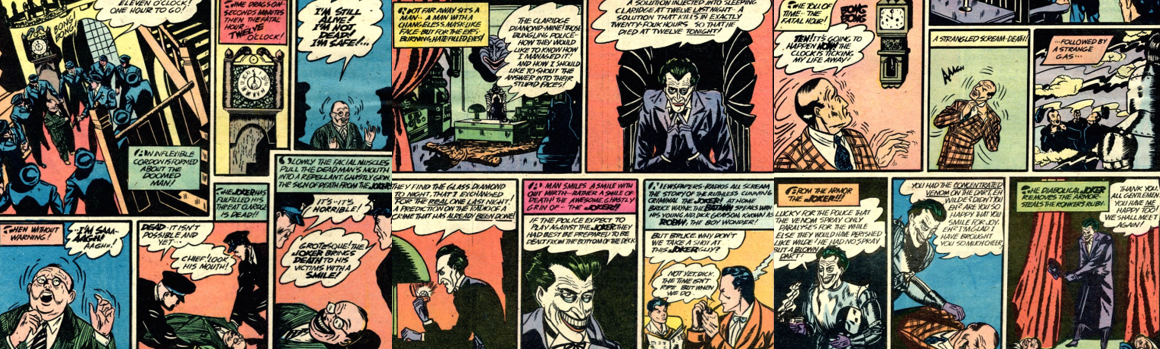
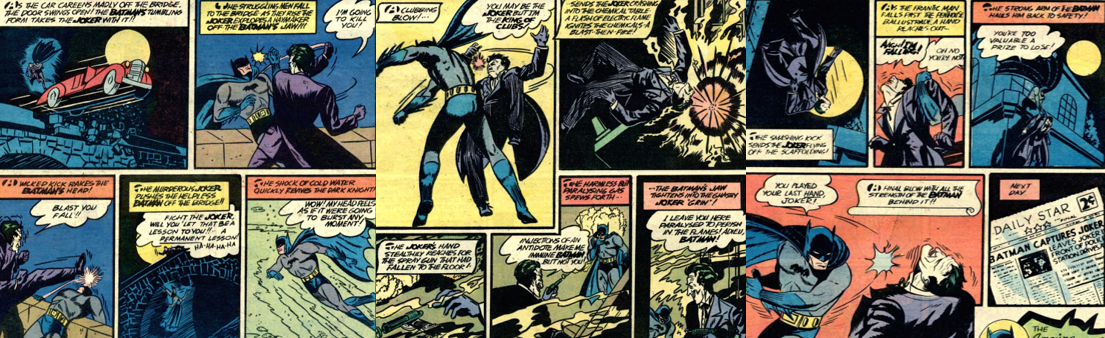
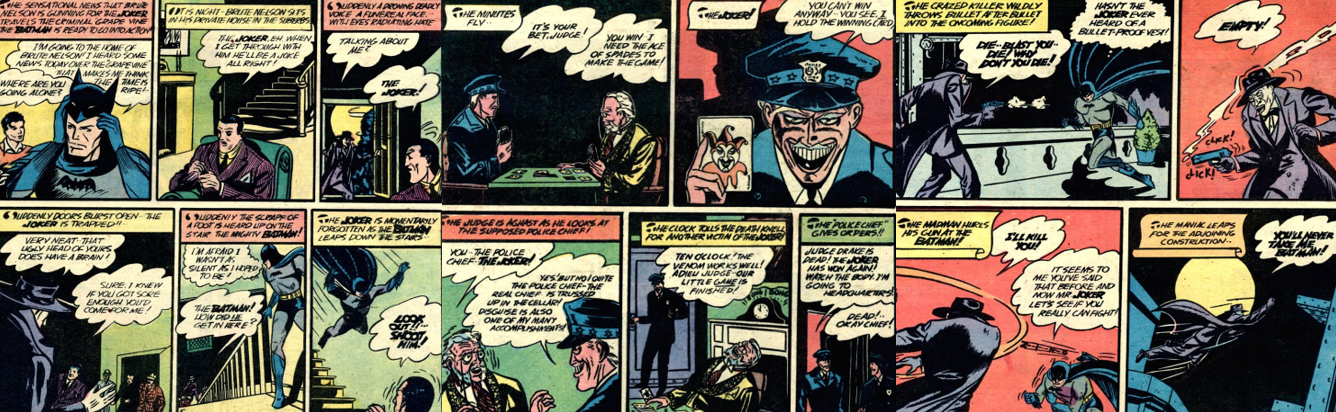
Story Title: Technically untitled, but commonly known as “The Joker” Published: March 1940 Writer: Bill Finger Artist: Bob Kane
The Background: After seeing success with Clark Kent/Superman, National Comics Publications charged Bob Kane with creating another masked crimefighter to add to their portfolio and, thanks to the long-suppressed influence of artist Bill Finger, the “Bat-Man” soon became both a popular DC Comics character and a mainstream cultural icon. Over the years that followed, the Batman has matched wits against some of the most recognisable supervillains in all of comics, but unquestionable his greatest nemesis has always been the self-styled Clown Prince of Crime, the Joker. Bob Kane, Bill Finger, and Jerry Robinson all laid claim to creating the Harlequin of Hate, but what is widely known is that the character’s iconic, gruesome smile and clown-like visage was heavily influenced by Gwynplaine (Conrad Veidt) from The Man Who Laughs (Leni, 1928). It was a last-second decision by then-editor Whitney Ellsworth that saw the Joker survive his initial encounter with the Batman and, though the character was used less under the eye of editor Julius Schwartz, he rose to prominence thanks to the efforts of Dennis O’Neil and Neal Adams during the 1970s and 1980s. Since then, the Joker has become easily Batman’s most notorious and mainstream foe. In addition to terrorising Gotham City with laughing gas, the famously elusive and mysterious Joker crippled Barbara Gordon/Batgirl for many years, murdered both Jason Todd/Robin and Commissioner James Gordon’s second wife, had his face removed for a time, and has fought Batman to the death on numerous occasions, repeatedly returning to plague the Dark Knight, his allies, and Gotham City despite appearing to die more than once. The Joker has also been a prominent villain in Batman media outside the comics, often used as a primary antagonist in Batman videogames and brought to life with gleeful relish by many actors, such as Cesar Romero (who famously refused to shave his iconic moustache to portray the character), Jack Nicholson, and Mark Hamill (for many, the quintessential actor to tackle the role). The Joker has been the subject of numerous psychological and introspective debates and his popularity and infamy are such that he’s had his own self-titled comic, been a playable character in DC-related fighting games, and even appeared in standalonemovies, with the first making over $1 billion at the box office!
The Review: Our story wastes no time in introducing us not just to the Joker’s gruesome, grinning visage but also his menacing ways. A quintessential 1940s home is startled when the Joker’s cackling threats interrupt their nightly radio broadcast to issue an ominous threat against millionaire Henry Claridge, whom the Joker promises to kill and rob of his famed family diamond at midnight that night! Although some members of the public laugh it off as a gag akin to Orson Welles’ infamousWar of the Worlds prank from 1938, the radio station is swamped with concerned calls and Henry Claridge is understandably panicked. His fears are allayed when the city police arrive and promise to watch over him, and his diamond, overnight and Claridge is overjoyed when his grandfather clock strikes twelve and he’s still alive. However, he suddenly convulses in agony and collapses dead to the ground with a ghastly rictus grin on his lifeless face – “the sign of death from the Joker!” As if that wasn’t bad enough, the cops are stunned when they inspect the Claridge diamond and find that it’s been replaced with an elaborate forgery and the Joker’s calling card, a literal joker-faced playing card, has been left behind to taunt them.
The Joker baffles the police by killing his victims and leaving them with a gruesome grinning visage.
Luckily for us readers, the Joker is quite a loquacious fellow. When the story switches to his ornate lair to focus on the hate-filled harlequin, he openly explains how he delivered on his threat and outwitted the police: he simply injected Claridge with a slow-acting poison as he slept so that he would die at exactly twelve midnight. He also swiped and replaced the diamond while he was at it, and is immensely proud of his cunning, which has riled up Dick Grayson since he’s astounded by the Joker’s repeated acts of violence. However, his mentor, billionaire Bruce Wayne, believes that it’s not quite time for them to intervene as the crimefighting duo, Batman and Robin. Because of this, the Joker makes good on another threat. This time, he promises to kill Jay Wilde at ten o’clock and steal his ruby and his victim again collapses in pain, dropping dead with a smile, after being shot by a poisoned dart when the Joker easily hid amongst the cops in one of Wilde’s suits of armour. Luckily for the cops assigned to watch him, the Joker chooses simply to “paralyse” them with a gas; he then liberates his victim of his ruby and gleefully slips away. The city-wide manhunt for the Joker is met with embarrassing failure, but his actions have also riled up the city’s mobsters. Angry and envious that the Joker has been beating them to the punch, surly Brute Nelson vows to teach him a lesson and has his boys spread the word that he thinks the Joker is a “yeller rat”. Since those are fightin’ words during this time, the Joker bursts into Nelson’s home to confront him and is impressed to find that the mobster has lured him into a trap. Luckily for him, the Batman saw the mob’s interest in the Joker as enough of a reason to finally step in so he’s also in Nelson’s home and manages to get the drop on his goons despite his characteristic lack of stealth.
The Batman recovers from an initial failure to put an end to the Joker’s killing spree.
The Joker uses this distraction to his advantage, gunning the arrogant Nelson down in cold blood and making a quick getaway in his car. The Batman easily follows and leaps onto the speeding vehicle. However, when the two are launched from the car as it flies off a bridge, the Batman is surprisingly outmatched by the Joker, who socks him with a haymaker and delivers a kick that sends the Dark Knight plummeting to the water below. The Joker then takes a much more direct approach to target Judge Drake, the man who once sent him to prison. He disguises himself as the police chief (who he again chooses to simply subdue rather than kill) to get close to the judge and inject him with his gruesome poison. Although his disguise means the Joker gets away without suspicion, Robin takes his orders to “follow anyone that comes out of the judge’s house” literally and finds himself at the Joker’s hideout, where he’s summarily knocked out by the grinning maniac. The Batman, also staking out the judge’s house, uses his “infra-red lamp” to follow Robin’s trail and arrives just in time to save Robin from also being poisoned. Although the Batman overpowers the Joker, the Harlequin of Hate is knocked into a table of chemicals and a fire suddenly breaks out. Thanks to immunising himself from his poisons, the Joker sprays the Batman with a paralysing gas and leaves him to perish in the flames. However, the Batman simply recovers at superhuman speed and rescues Robin, who points him in the direction of the Joker’s next target: Otto Drexel and Cleopatra’s necklace. The Dynamic Duo arrive just as the Joker’s breaking into Drexel’s penthouse. The Joker’s driven to frustration by the Batman’s bulletproof vest and tries to make a death-defying getaway to a nearby construction site, only to be foiled by Robin and sent plunging to his doom. However, the Batman catches him and delivers a knockout blow, finally ending the Joker’s killing spree and seeing him behind bars…where he’s seen already plotting his escape!
The Summary: I really enjoy seeing how “The Joker” influenced future live-action iterations of the titular villain. He’s shown broadcasting his threats over the radio, which is similar to how both Jack Nicholson and Heath Ledger’s portrayals would issue threats over the television. I believe Mark Hamill’s Joker used a similar system on more than one occasion, and the Joker would return to this method in future stories. The Joker’s entire persona here is one that is wholly unique to him and really helps him to stand out not just against the darker Batman but other comic book villains of this era. Not only does he have chalk-white make-up on and an unnerving lipstick grin, he’s decked out in the bizarre purple suit and hat that gives an unsettling air of menace to him. He’s also seen to be extremely cunning; he issues his threats as a method of intimidation and appears to be almost omniscient in the way he carries out his evil deeds, poisoning his victims ahead of time of hiding in plain sight to strike. Indeed, the Joker’s crimes have the police suitably baffled and even Batman, famously known as the “World’s Greatest Detective”, isn’t seen investigating or even trying to understand how the Joker pulls off his elaborate crimes. Beyond Bruce commenting that the Joker must use “some sort of drug” to give his victims their ghastly smiles, it’s up to the titular madman to explain his methods in an extended soliloquy, which actually goes a long way to show not just his theatricality but also how he’s got the guile and wits enough to bamboozle everyone.
The Joker is seen as a cunning and ruthless foe with a bizarre and terrifying gimmick.
At the same time, the Joker isn’t above simply gunning a man down; a prideful man, he rises to Brute Nelson’s bait and targets not just the wealthy for their priceless possessions but also those who have wronged him in the past, like Judge Drake. Constantly portrayed as being one step ahead of everyone, the Joker always has a plan B, whether that’s disguising himself as the police chief, speeding off in his car, or boldly leaping to a construction site to evade the Batman. He’s also seen to be quite capable in a brawl; when they first tussle, the Joker gets the better of the Batman, who we’d seen overpowering multiple armed men on the previous page. One quirk of the tale I found amusing was Bruce’s hesitancy to get involved until “the time is ripe”, which indirectly causes the deaths of at least three men. This is probably because the Batman’s relationship with the city’s police isn’t yet as co-operative as we know it today, but I found it interesting that he didn’t get involved sooner, especially considering the baffling nature of the Joker’s methods. Batman is surprisingly light on gadgets here, too; he has his infra-red lamp and a bulletproof vest but that’s about it, so he’s far more reliant on his wits and incredible recuperative and physical powers. This actually puts him and the Joker on relatively equal ground, but Robin gives the Batman the edge. Sure, the Boy Wonder ends up captured and is nearly killed, but he’s enthusiastic to get after the Joker where Batman is more impassive and even almost kills the Clown Prince of Crime when he sends him plummeting from the construction site. As is to be expected of this era, the artwork is quite questionable; everything has a very sketchy, “pulp” feel to it that works in the context of the time, even if I find it a bit rudimentary. However, the Joker certainly makes a visual impression; we don’t get any backstory to him beyond him having once gone to prison and being full of hate, which adds to his allure, and I’d say this set a pretty good standard for future Joker stories to build upon his character and his complex rivalry with the Batman.
My Rating:
⭐⭐⭐
Rating: 3 out of 5.
Pretty Good
Have you ever read “The Joker”? What did you think to the Joker’s debut story and the way he performed his kills? Were you surprised it took the Batman so long to get involved in the case? What are some of your favourite Joker stories? Which interpretation of the Joker, whether animated, pixelated, or live-action, is your favourite? Whatever you think about the Joker, share your thoughts below or leave comment on my social media, and be sure to check out my other Batman content across the site!
In 2013, DC Comics declared the 12th of June as “Superman Day”, a day for fans of the Man of Steel the world over to celebrate Clark Kent/Kal-El/Superman, the superpowered virtue of “Truth, Justice, and the American Way” who is widely regarded as the first ever costumed superhero.
Story Title: “Europe at War (Part II)”” Published: April 1940 Writer: Jerry Siegel (credited as “Jerome Siegel”) Artist: Joe Shuster
Story Title: “How Luthor Met Superboy!” Published: April 1960 Writer: Jerry Siegel (credited as “Jerome Siegel”) Artist: Al Plastino
The Background: Jerry Siegel and Joe Shuster, sons of Jewish immigrants, first met in 1932 at Glenville High School. By the time they were sixteen, they were already accomplished comics creators and, in 1933, they thought up their first concept for a superman with “The Reign of the Super-Man”. This story depicted a bald mad scientist who attempted to dominate others with his telepathic powers. Though a far cry from the most influential fictional character in American history, the duo would revisit the concept of a bald mad scientist in 1940. Originally known only as “Luthor”, Alexander “Lex” Luthor would evolve beyond his relatively childish reasons for hating the Man of Steel and become Superman’s arch-nemesis. While Kryptonite might weaken or kill Superman, Doomsday and Darkseid might pummel him, and Vril Dox/Brainiac might threaten his adopted world, Lex Luthor has become infamous for pitting his mind against the Man of Steel. Whether a scheming industrialist with seemingly unlimited resources, an egomaniacal megalomaniac, or enjoying the power of the United States Presidency, Luthor has created robots, patsies, mech suits, and even cheated death itself and had a brief stint as a superhero, all with the aim of acquiring the power to either humble, humiliate, or destroy his alien foe. As Superman’s most complex and enduring villain, Lex Luthor is a staple of any Superman adaptation. Clancy Brown and Michael Rosenbaum are considered two of the finest to portray the character, though it was Gene Hackman who set a high standard for all future portrayals of DC Comics’ most conniving criminal mastermind.
The Review: The first appearance of a dangerous maniac named Luthor occurred in the second part of the “Europe at War” storyline. As established in the previous issue, the “lesser nation” of Galonia was suddenly attacked by Toran and reporters Clark Kent and Lois Lane were sent to cover the conflict as war correspondents. While sailing to Luxor, Clark was stunned to find beautiful actress Lita Laverne was a spy working alongside the Toranian Council of War to target the neutral vessel. Action Comics #23 picks up with the Man of Steel defending Belgaria from incoming shells before he (as Clark) and Lois meet with bald General Lupo, who’s confident that the war will end soon as a contingent of Toran officials are on their way to peacefully negotiate. Clark switches to Superman and flies ahead to take some photos of their arrival, only to witness the convoy be destroyed, which causes hostilities to renew. After sending an update to the Daily Star, Clark questions General Lupo, who insists that the Galonians would never be so deceitful, only to then make a suspicious phone call, completely unaware of Clark’s super-hearing. Suspicious, Superman trails General Lupo to a mountain range, where he disappears into thin air! Using his incredible strength, Superman rips open the mountainside and discovers a hidden passageway, where General Lupo is transfixed by a huge slab of rock, which bursts into hypnotic lights and a commanding face. General Lupo is astonished when Superman confronts him and, though he fears his disembodied master, desperately begs off being smushed against a wall and reveals that the mysterious “Luthor” is orchestrating events to engulf both nations in bloody warfare.
Superman is perplexed by the mysterious Luthor, who plots to take over the word through chaos.
However, when Superman demands to know who “Luthor” is, green lasers suddenly burst from the wall-face and “[slice] the General in half”! Naturally, Superman is immune to the attack; he destroys the cave and escapes just in time to spy Luthor’s bombers flying overhead. He then destroys them all using his super strength and a mounted gun before warning both sides (as Clark) about Luthor’s machination. Although they don’t believe him since he has no proof, this brings him to Luthor’s attention, who orders Clark eliminated to keep him from talking. Conveniently, Lois happens to be looking for Clark in his hotel room, so Luthor’s minions grab her instead, transporting her to Luthor’s secret base, which is suspended from a gigantic dirigible “high above” Earth’s atmosphere! Although unimpressed that his goons failed him so badly, Luthor – a red-haired despot in a matching robe – nevertheless interrogates Lois, only to be met with confusion and sarcasm. While in her cell, Lois notices that her guard, a surly bald man, isn’t under Luthor’s hypnotic influence. She then threatens to expose him to Luthor unless he informs Clark about her capture and the guard is so terrified of his leader’s reprisals that he readily agrees. After reading the note, Clark flies into action as Superman, takes out a couple of guards, and bursts through a brick wall to rescue Lois. However, when Luthor threatens to harm Lois, Superman readily submits to parlay with the maniac, who describes himself as having the “brain of a super-genius” and plans to use his “scientific miracles” to plunge the world’s nations into conflict, weakening them so that he can assume control.
Superman is revealed to have known Luthor as a youth when he adventured as Superboy.
Luthor demonstrates his ability by strapping Superman up and bombarding him with an intense concentration of rays. However, Luthor grows tired of this and prepares to finish Superman off with a burst of deadly exposure, only for Superman to suddenly break free, turn the machine against Luthor’s underlings, shrug off its effects, and destroy the machine. After unsuccessfully trying to barter for his life, Luthor is equally unable to keep Superman from trashing the dirigible’s controls, sending it (and, presumably, all its inhabitants) crashing to the ground in a fiery blaze. The sight of the dirigible’s destruction is enough proof for the nation’s representatives to believe Clark’s story and the conflict comes to a peaceful resolution, with Clark praised for breaking the scoop and Lois eagerly awaiting her next encounter with the dashing Superman. Although Superman clashed with Luthor many times after this, it would take nearly twenty years to delve into Luthor’s origins, a story that took place during Superman’s youth in Smallville, Kansas, as Superboy. In this story, the young Lex Luthor has just moved to Smallville and, being the friendly youth that he is, Superboy flies in to say hello. Conveniently, a Kryptonite meteor lands right next to the Boy of Steel and immediately begins weakening him. Luckily, Luthor and his trusty tractor are on hand to save Superboy and the two quickly become friends. Luthor is a Superboy fanboy, as evidenced by his shrine to the young superhero, and a budding scientist, with ambitions to become a world-famous scientist. In gratitude for his help, Superboy builds a modern laboratory for his new friend using nothing by junk metal and his super speed and strength, which he fills with rare Earth materials for Luthor to experiment with. Although Superboy expresses caution since the chemicals are unknown and Luthor’s young and inexperienced, Luthor promises to be careful and the two part as friends, with Superboy owing his life to Lex and Luthor astounded to have befriended the Boy of Steel. Luthor wastes no time in getting to work, feverishly working with the chemicals over a period of weeks and producing a crude protoplasmic lifeform that he’s so excited by that he immediately sets to work coming up with a Kryptonite antidote so his new buddy won’t ever have to worry about that pesky substance threatening his health.
Embittered after a lab accident, the once-kindly Luthor turns against his former friend.
Luthor retrieves the meteor from the lake, takes a few samples, and creates the antidote in no time at all. However, in his excitement, he accidentally knocks over a chemical flask that starts a toxic fire in his lab. Luckily, Superboy happens to be passing by and hears Luthor’s screams for help; he uses his super breath to put out the flames, accidentally blowing a jar of acid against the antidote and destroying it. To make matters worse, the gas fumes caused Luthor to go bald and destroy his weird protoplasmic creature, destroying all his hard work. And, while Superboy is apologetic and insists it was an accident, Luthor accuses him of being jealous of his genius and purposely sabotaging him, instantly flipping from a kindly boy to an embittered youth in the blink of an eye. Superboy offers to help him rediscover his experiments, and insists he’d never harm the boy who saved his life, but Luthor’s having none of it. He feigns sorrow to get rid of Superboy and then flies into a rage, destroying his Superboy memorabilia and plotting to avenge himself on the Boy of Steel with the last sliver of protoplasm. The next morning, Luthor has Superboy drink the “antidote” and then accompany him into space, protected by a space-globe Superboy brought along, to observe its effects. At first, Superboy is delighted to find he’s no longer vulnerable to the Kryptonite meteors floating around in space, completely unaware that they’re actually “Fool’s Kryptonite”, a ruse even Krypto the Superdog can see from a mile away. As soon as they return to Earth, Luthor spitefully reveals it was all a ruse and that the antidote is only temporary and vows to be more admired, and more famous, than Superboy, who flies away despondent and commenting that Luthor needs “a father’s guidance”.
When his attempts to outshine Superboy fail, Luthor resorts to attempted murder.
Some weeks later, Luthor approaches Smallville’s mayor with a fantastic invention, a weather-tower to keep the town perpetually warm by reflecting the sun’s rays, and the mayor is so impressed by his pitch that he approves it immediately. Both Superboy and the townsfolk are in awe and admiration of Luthor’s ingenious invention, which spares them the bitter chill of winter, and Superboy quietly wishes his former friend all the success in the world, harbouring no ill-will towards him. However, young Clark is alarmed when he notices that his adopted parents – Jonathan and Martha Kent – suffer from the intense heat. He’s even more startled when he sees the weather-tower is causing fires to break out all over the town, endangering its people, so he uses his freeze breath to cool the construction down, which effectively destroys it. Smallville’s populace are less than thrilled and openly mock Luthor in the street for putting their lives at risk with his crazy inventions, which he bitterly blames on Superboy. To atone, Luthor toils away for many months and produces seeds that promise to near-instantly produce fruit trees for the local farmers; although people are sceptical, they’re astounded when Luthor’s claims come true, but their elation soon turns to horror when simple rain turns the trees into marauding giants! Superboy deals with the issue, chalking it up to carelessness on Luthor’s part rather than maliciousness, but Luthor’s reputation is further tarnished and his hatred for Superboy only grows. This sees him unearth the Kryptonite meteor and lure the Boy of Steel into a trap and taunt the dying Superboy with the only antidote to his slow, painful death. In his arrogance, Luthor fails to remember Superboy’s super-breath, which allows him to suck up the antidote vial and save his own life, but Superboy chooses to consider them even rather than acquiesce to Luthor’s demands to be arrested. Out of respect for the friendship they once had and believing that Luthor could be a force for good, Superboy lets Luthor go, with the obsessed youth swearing to not only surpass the Boy of Steel’s popularity but destroy him in the process!
The Summary: Let’s tackle each story in turn here, shall we? “Europe at War (Part II)” is a typically Golden Age Superman story, featuring simplistic dialogue, illustrations, and concepts. Part of me enjoys this simpler time, when fantastical things were just taken as the norm and superhero plots were both grounded and almost comical in their content, such as Superman threatening to bash General Lupo against a rock wall and presumably casually murdering countless of Luthor’s minions. It’s amusing to read as I find myself questioning why Clark warned of Luthor’s threat in his civilian guise, rather than as Superman, and seeing him use a machine gun rather than his heat vision since he didn’t have his full gamut of powers at that point. The core concept of “Europe at War (Part II)” actually has some legs to it: two nations being manipulated into all-out war with spies, heroes, and villains on both sides, and the mysterious Luthor pulling the strings behind the scenes and offering a challenge Superman can’t settle with his fists since he needs to get to the root of the problem. Unfortunately, a lot of its concepts are left ambiguous or flat-out forgotten; apparently, Luthor can hypnotise people into following his every command, yet he only demonstrates this power once and doesn’t think to use it on Lois or Superman (or the nation’s leaders). Not to mention that Luthor’s secret base is an elaborate castle suspended from a dirigible, but no one noticed it, and why was that one bald guard immune to Luthor’s control? It’s not explained, but the number of prominent bald henchmen at Luthor’s command makes me wonder if that particular guard was actually the real Luthor and the red-haired leader was merely a patsy.
Neither story provides a particularly engrossing or accurate portrayal of Luthor.
And then we have “How Luthor Met Superboy”, a story that’s more influential than you think since it’s basically the inspiration for the entire series of Smallville(2001 to 2011). This is such a weird story that it almost reads like an elaborate dream sequence or fantasy story that recasts Superboy and Luthor as the best of friends thanks to a ridiculously convenient Kryptonite meteor (and don’t even get me started on the influx of similar meteors in near-Earth space!) People often criticise Superman for being infallible and unrelatable, but Superboy is the kindest, most trusting, and most understanding youth you’ll ever meet! He sees the best in Luthor all throughout the story, never once saying or thinking a bad word against him until he (as in Superboy) is dying at the young scientist’s feet and even then Superboy’s first act after saving himself is to forgive his former friend and hope that he turns his obsession to good deeds. It almost descends into parody as the story progresses, with Superboy genuinely believing that Luthor is trying to do good and has met with misfortune, and Luthor equally refusing to even think that he could be to blame for anything since he’s so embittered towards Superboy. It’s so strange seeing Luthor flip from a kindly boy to a venge-seeking maniac after the fire. Like, I get being mad at losing all your work and your hair but it’s a bit of a leap to blame Superboy. I think the implication is that the strange chemicals and toxic fumes altered Luthor’s mind in some way, though that’s not really explicitly stated (or even implied in the story text), but I think Luthor’s elaborate plot to cruelly taunt Superboy with the promise of a Kryptonite cure and to oust his popularity, to say nothing of his quick temper following the accident, go a long way towards suggesting that.
Though amusing footnotes, both stories are fantastical nonsense unbecoming of Luthor.
Truthfully, neither story really gives the best impression of Luthor. It can be argued that the “Luthor” present in “Europe at War (Part II)” isn’t even Lex Luthor since he has hair, for one thing, and possesses hypnotic abilities. Sure, it could be a wig and his scientific acumen could account for the hypnosis and other inconsistencies, but he doesn’t really exude “Lex Luthor” energy and seems to simply be a maniacal, supervillain-esque third party for Superman to flex his muscles against once he stops his elaborate plot. “How Luthor Met Superboy” tries to flesh out Luthor’s character by providing him with a semi-sympathetic backstory and emotional connection to his hated nemesis, but ultimately reads like a non-canon adventure as I’m pretty sure no stories prior to his every hinted at the two knowing each other as youths. It is interesting seeing Luthor as an arrogant young scientist who idolises Superboy and is inspired to be a great scientist because of the Boy of Steel, it’s just a shame that the execution falters. Ultimately, Luthor’s hatred comes from losing his hair, rather than genuinely building towards a resentment towards Superboy or Luthor’s ego getting the better of him. Like, what was up with that protoplasmic creature? That could’ve factored into things, showing that Luthor is messing with things he doesn’t understand and his inability to recognise his limits and failings. Like, I would’ve maybe had Luthor build his weather-tower and plant those seeds before he loses his hair, so that when they go bad and Superboy has to intervene it adds to his growing bitterness towards Superboy for “stealing his thunder”. In the end, both stories can be largely ignored in the grand scheme of things and you wouldn’t be missing anything. They’re historical footnotes and amusing curios in Lex Luthor’s history, but you can simply skip to stories like “The Man of Steel” (Byrne, et al, 1986), “Birthright” (Waid, et al, 2003 to 2004), “Lex Luthor: Man of Steel” (Azzarello, et al, 2005), or “Secret Origin” (Johns, et al, 2009 to 2010) for better, more concise, and more in-depth explorations of Luthor and his complex relationship with Superman.
Action Comics #23 Rating:
Adventure Comics #271 Rating:
⭐
Rating: 1 out of 5.
⭐⭐
Rating: 2 out of 5.
Terrible
Could Be Better
Have you ever read these Luthor-centric stories? Do you like the idea of the two having been childhood friends? What are some of your favourite Luthor moments and stories? How are you celebrating Superman Day today? Whatever you think, feel free to share your opinion and thoughts on Superman in the comments below.
Released: 17 March 2023 Director: James Wan Distributor: Warner Brothers Budget: $205 million Stars: Jason Momoa, Patrick Wilson, Yahya Abdul-Mateen II, Randall Park, Temuera Morrison, and Amber Heard
The Plot: Desperate to find the means to avenge himself against Arthur Curry/Aquaman (Momoa), pirate David Kane/Black Manta (Abdul-Mateen II) stumbles upon the mythical Black Trident, which possesses him and compels him to unleash an ancient threat so powerful Aruthur is forced to join forces with his deposed brother, Orm Marius (Wilson).
The Review: I was pleasantly surprised by Aquaman; it was big, colourful, mindless fun in an era when the DCEU was unnecessarily dark and bleak, and it altered Aquaman’s characterisation in a way that made him so much more entertaining and relatable. Jason Momoa attacks the role with such relish and natural charisma that it’s easy to overlook flaws in logic or pacing, and that same charm returns in this sequel. Of course, it helps that he’s disgustingly good looking and absolutely shredded, but Momoa’s Aquaman has the kind of Dude/Bro mentality and whimsical childishness that really brings a smile to my face. In this film, a lot has changed for the slovenly brute who once shunned humanity and responsibility; he’s now the King of Atlantis, doting father to Arthur Junior (Various), and loving husband to Y’Mera Xebella Challa (Heard). First, let’s address the elephant in the room: yes, Mera is in this movie but no, she does not have much of a role. In fact, given all the controversy surrounding Amber Heard, I was expecting Mera to be killed off and it does seem like that almost happened; instead, she’s merely severely wounded by Black Manta and taken out of the second act of the movie, only to make a minor reappearance at the end to help Arthur and Orm and get the baby to safety. I can fully understand this, and it’s not like her presence is really missed; she still impresses in her skin-tight outfit and gets to show off her hydrokinetic powers, but the plot doesn’t require her presence and it’s better she was given less prominence considering everything that happened. Interestingly, much of her character development from the first film is repeated with Orm; he’s prejudiced against the surface world like Mera was, confused by their words and ways, and slowly comes to enjoy some of our customs by the movie’s end, though these lessons are reframed in the context of Arthur encouraging a stronger bond between them and him pulling pranks on his relatively naïve younger brother by tricking him into thinking cockroaches are a delicacy!
Now a father dissatisfied with the crown, Arthur teams up with his brother to face a powerful threat.
So, there’s not much focus on the romance here; even Arthur’s father, lighthouse keeper Tom (Morrison) and Queen Atlanna (Nicole Kidman) don’t share a scene together until the start of the third act, and Arthur’s initial conversations with his father even somewhat imply that Atlanna is dead. She’s not, but her role here is equally minimal and simply the catalyst to unite her two estranged sons into joining forces. Instead, we’re left with Arthur, but that’s more than enough! Despite his big victory in the first film, Arthur is bored by the crown, his duties, and the endless politics of the Atlantean council, which handicap him with bureaucracy. A child of both worlds, he spends as much time out of the sea as he does in it to care for his son, something with many of his kingdom resent, and his desire to reveal Atlantis to the surface world and work with them to reduce pollution and climate change are continuously shot down. Frustrated by self-doubt about his role as a leader, Arthur is almost giddy when David Kane returns armed with a powerful trident of his own and wielding forgotten Atlantean technology. Kane’s plot to steal Atlantis’s highly volatile stockpiles of Orichalcum and exacerbate the heating of the world (which also causes a deadly plague to kill many Atlanteans, including Arthur’s mentor, Nuidis Vulko (Willem Dafoe), between movies) causes Arthur great distress. With no way of tracking Black Manta, Arthur enlists the help of King Nereus (Dolph Lundgren) and Topo the octopus to sneak into the desert prion where Orm is held captive and enlist his help since he’s the only one who may be able to lead them to Kane. Arthur jumps at the chance for some action, even if it risks all-out war breaking out, as he’s desperate to get into the thick of it again, to say nothing of trying to connect with his brother and settle the score with his old rival.
Orm is disgusted by his brother’s childishness but proves surprisingly trustworthy.
This dysfunctional dynamic is where the heart of Aquaman and the Lost Kingdom lies, and where much of its entertainment value comes from. Emaciated from his time in prison and embittered by his brutish brother’s lack of decorum when it comes to the throne, Orm is depicted as a conniving, untrustworthy bigot who lusts for power. Yet he agrees to help Arthur, and even stats he will willingly return to custody afterwards, out of loyalty to Atlantis, and never misses an opportunity to chastise his brother’s buffoonery and overreliance on his muscles. Orm emits a more stately persona, attempting to use diplomacy rather than brute force; he’s able to lead them to an underwater den of debauchery and an aquatic crime boss, the appropriately named Kingfish (Martin Short), to get information on Black Manta’s location and even drops condescending advice to Arthur about what it means to be a king. The banter and bickering between Arthur and Orm is great; Orm is visibly disgusted by his older brother, and the humiliation he felt at his hands, while Arthur tries to win him over with his boisterous personality and surface world benefits such as beer and cheeseburgers. Although King Nereus cautions about trusting Orm, the former Ocean Master proves surprisingly reliable; he never runs from a fight, doesn’t attempt to kill or sell out Arthur, and doesn’t even show envy at learned Arthur married Mera. Although it seems like Orm is happy to leave King Nereus to die, he saves the king and earns his respect in the process, and even readily joins Arthur in battling Black Manta when he could easily slip away and let them kill each other. Orm proves equally invaluable in delivering exposition about the Black Trident and the titular lost kingdom of Necrus, though the two brothers are briefly set against each other in the finale when Orm claims the Black Trident and briefly falls under its malicious sway.
Possessed and empowered by the Black Trident, Black Manta’s threat is significantly increased,
Established in the first film as a vengeful, sadistic mercenary, David Kane has become obsessed with discovering the secrets of Atlantis so he can repair his Black Manta suit and avenge himself on Aquaman. Kane’s fascination with Atlantis is shared by his reluctant scientific advisor, Doctor Stephen Shin (Park), who’s longing to see Atlantis is manipulated by Kane into helping him figure out Necrus’s ancient weapons. Once he finds the Black Trident, Kane is bombarded with visions, promises of power, and a superhuman lust to free the imprisoned King Kordax (Pilou Asbæk), who’s dark magic slowly infests Black Manta and drives him to the brink of insanity. Even Orm is stunned to learn of Black Manta’s newfound viciousness, which sees him threaten the entire world with climate instability simply for the sake of it rather than for any kind of ransom, and Kordax’s influence means Black Manta can now go toe-to-toe with both Aquaman and Orm without his power suit. However, he still utilises his technology, blasting his enemies with beams of intense energy and combines both science and magic (and a massive disrupter cannon on a repurposed Necrus ship) to showcase his new might. Black Manta’s need to awaken King Kordax and his list for revenge are so powerful that he targets Arthur’s family, critically wounding Mera and Tom and even kidnapping his son with the intention of using his blood to destroy the magic seal imprisoning the undead king. As for King Kordax, he’s more of an ethereal spirit, a ghastly skeletal wraith who whispers in Kane’s ear, possesses any who touch the Black Trident, and formally commanded a legion of undead warriors in battle against his brother, King Atlan (Vincent Regan). Desperate to return to unlife once more, he feeds the ego of whoever wields the Black Trident, compelling them to spill the blood of Atlan’s bloodline so that he and his army can ransack the entire globe!
The Nitty-Gritty: Aquaman and the Lost Kingdom charts the natural next chapter in Arthur’s story; this loveable manchild feels increasing pressure on all sides to grow up and be more responsible as a husband, father, and leader, roles that he attacks with his usual juvenile vigour but which he finds himself questioning at times. Though devoted to his family, he finds the politics of the crown tedious and expresses dissatisfaction with the role, which he only fulfils out of obligation to his mother and his people. There’s no question that he’s a good father (indeed, Tom encourages Arthur to have more children!) or that he wants what’s best for Atlantis, but he desires a worldwide unity that the council aren’t willing to risk and struggles to balance both sides of his life. These issues are explored through his tumultuous relationship with Orm; both were denied a childhood together and are wary, if not frustrated, by each other, with only their love for Atlanna and Atlantis keeping their fragile alliance alive throughout most of the film. They’re two halves of the same coin, though, and both learn a lot from the other; Arthur learns more about what it takes to be a king and Orm learns to not be such a dick and enjoy other cultures. However, while they’re one of the best parts of the film, I would’ve liked to see a little more of this; perhaps a scene or two where Orm does abandon Arthur, or one where Arthur’s knowledge of the surface world helps Orm, or seeing Orm’s stoic disdain crack upon learning that he’s an uncle. The galvanising love show to them both by Atlan helps fill these gaps, as does the presence of King Nereus and the Brine King (John Rhys-Davies), who have their own issues with Orm, but it does feel like some scenes were left on the cutting room floor to keep the pace up.
The visuals and costumes continue to impress, and the fight are more personal this time.
Not that that’s a bad thing; Aquaman and the Lost Kingdom has a very brisk pace that doesn’t waste too much time, but it’s also learned to not interrupt every character moment with a dramatic explosion (there’s even a tongue-in-cheek reference to that at one point. The underwater realms are as captivating as ever, being a neon-drenched wonderland of strange, almost monstrous undersea races and futuristic technology alongside rusted apparatus and long forgotten ancient ruins. Aquaman’s ridiculously good orange/gold armour returns, looking better than ever, and he even gets a sleek, form-fitting black/blue suit and makes him invisible for a few moments at a time, perfect for sneaking into the arid desert prion and battling the dried-out, horrifying guards who dwell there. Although Orm is shafted in the costume department this time around, Mera still catches the eye in her tight little number and Black Manta steals every scene in his ludicrous saucer-like helmet. The fight sequences are much more intense this time, too; moving away from full-scale undersea battles to focus on gritty melee combat, the fights between Aquaman and Black Manta are great now that Kane has received a power boost and is a significant threat able to hideously burn even Atlantean flesh. There are a fair few visually interesting locations on offer as well, from the throne room and market square of Atlantis to the scorching desert and the overgrown, hazardous forest on Black Manta’s island (complete with volcano lair) thanks to the presence of polluting Orichalcum. A fair bit of the film involves ice and frozen locations, too, with Necrus and his army encased in an icy tomb, but overall I found the CGI and action sequences to be really well done; perhaps a bit less bombastic at times, but the focus on crafting meaningful fight scenes benefitted the plot greatly, I feel.
Arthur and Orm come together to defeat Black Manta and repair their relationship.
Despite working surprisingly well as a team, Arthur and Orm are unable to defeat Black Manta; they disrupt his operation, with the help of the remorseful Dr. Shin, but find Kane is willing to sacrifice Arthur Junior to set King Kordax free, leading to a more concentrated assault against Black Manta and the quickly rising undead army of the entrapped king. Determined to save his son, Aquaman battles Black Manta once more, only to find Kane has been fully overtaken by the malicious Kordax. Luckily, Mera and Orm are both on hand to get the baby to safety, but Orm falls under Kordax’s spell when saving Mera and his nephew from certain death. Although it seems like the two brothers are about to fight once more, Arthur tries a different approach, one influenced by his time with Orm and his desire to build bridges between them. Instead of fighting, Arthur also grabs the Black Trident and tries to reason with his brother, with both struggling against Kordax’s influence, and successfully talks Orm down. Orm then provides Arthur with the means to destroy the awakened undead king and finally acknowledges him as his brother in the aftermath, where all involved agree to say that Orm perished in the battle as thanks for his help. With Orm out exploring the surface world for the first time, Arthur makes the decision to finally reveal Atlantis to humanity, directly addressing the United Nations and calling for a global effort in reversing the damage done to the environment and thus ending the DCEU on a surprisingly hopeful message. Sure, the climate change aspects of the film are a little ham-fisted, but I think they’re to be expected in an Aquaman story, especially as suspicion of humankind is such a prominent aspect of the mistreated Atlanteans.
The Summary: I was excited for an Aquaman sequel; I’ve loved Jason Momoa in the role right from the start and really enjoyed the first film, so it bugged me that Aquaman and the Lost Kingdom was delayed and pushed back and mired in controversy and said to be awful. It really isn’t, to be fair; it’s not as good as the first (though repeated viewings may change that opinion) but it’s not an incomprehensible mess, an ugly noise of awful CGI, or a lacklustre bore-fest either. It’s a fun, thrilling, and surprisingly intense adventure; Black Manta’s vendetta against Aquaman is deeply personal, as are the issues between Arthur and Orm, and the performances of those three actors really sell that. Kane is a cold-blooded, merciless pirate who blood on his mind; Orm is a bitter and resentful fallen king; and Arthur is just trying to do the right thing but struggling with his suitability to the throne. While the actors all do a fantastic job of embodying their roles, the visual effects are absolutely top-notch; I love seeing these characters come to life, Atlantis is a gorgeous undersea society, and the various dishevelled ruins and repurposed technology really give a sense of scale and time to this world. The bickering between Arthur and Orm more than makes up for Mera’s dramatically reduced role and makes this more of a dysfunctional buddy comedy at times, but the more personal and fierce fight sequences are just as appealing to me. It’s shame that the DCEU died out so quickly; I don’t relish having to restart Aquaman’s story and find a new actor for the role, but at least we have these two movies to show us what the character is capable of in the right hands. Ultimately, Aquaman and the Lost Kingdom may not be the best DCEU or superhero movie you’ll ever see, but I think it’s definitely high in the ranks and worth your time for the lead actor alone, but there’s plenty to enjoy beyond that if you’re simply looking for a fun and surprisingly intense action film.
My Rating:
⭐⭐⭐⭐
Rating: 4 out of 5.
Great Stuff
Did you enjoy Aquaman and the Lost Kingdom? How do you think it compares against the first film and other DCEU movies? Did you enjoy Jason Momoa’s performance and Arthur’s relationship with Orm? Were you glad that Arthur Junior was spared the fate of his comic book counterpart? What did you think to Black Manta and his newfound power boost? Were you annoyed by the climate change plot, or did you find it suitable for the film? Who would you like to see portray Aquaman in James Gunn’s new DC Universe? Whatever your thoughts on Aquaman and the Lost Kingdom, and Aquaman in general, drop a comment below or on my social media.
Story Title: “Between Two Dooms!” Published: August 1967 Writer: Bob Haney Artists: Nick Cardy
The Background: In November 1941, readers of More Fun Comics were introduced to Arthur Curry/Aquaman for the first time; while superficially appearing to be a knock-off of writer/artist Bill Everett’s Prince Namor McKenzie/The Sub-Mariner, the two aquatic supermen are actually very different characters. Mort Weisinger and Paul Norris created the character as part of DC Comics’ (then known as National Comics) call for new costumed heroes to captialise on the success of Clark Kent/Superman and Bruce Wayne/Batman, and Aquaman proved popular enough to prominently feature throughout the 1950s and beyond. In addition to seeing his cast of supporting characters expand to include a wife and ill-fated son, Aquaman amassed quite the gallery of nautical rogues; while his half-brother, Orm Marius/Ocean Master, tops most lists as his archnemesis, one of his most persistent antagonists is David Hyde/Black Manta. Initially debuting without a definitive origin, Black Manta was revealed to have a deep-seated hatred for Aquaman (and the sea as a whole) and proved to be a malicious and dangerous adversary;. Utilising a number of weapons and technology built into his distinctive battle suit, Black Manta was responsible for the death of Aquaman’s aforementioned son and frequently clashed with the Atlantean King alongside the Injustice Society. Black Manta has proven persistent enough to appear in DC’s animated ventures and videogames and made his live-action debut in Aquaman(Wan, 2018), where acclaimed actor Yahya Abdul-Mateen II shined in the role of secondary antagonist and promised to further explore the character in the sequel.
The Review: Our story begins deep beneath the ocean at the long-lost underwater city of Atlantis, now prosperous and protected by an impenetrable dome and home to the Atlantean Royal family: Aquaman, his wife, Mera, their babbling baby, Arthur Curry, Jr./Aquababy, and Aquaman’s teenage sidekick, Garth/Aqualad. Like their fellow citizens, the three are startled when a menacing submarine begins orbiting their city, but both Mera and Aqualad are aghast when Aquaman volenteers to investigate alone; he states, very plainly, that it’s his duty as the Guardian of Atlantis and that he relies on Aqualad to safeguard the city in his absence, and then torpedoes himself towards the sinister-looking craft. Upon latching onto the submarine, a slew of comically expressive mutated Manta-Men burst forth, cluing Aquaman in that it’s the work of his old enemy, Black Manta. Black Manta has come more than prepared, trapping Aquaman to the ship’s hull through “bio-magnetics” and leaving him an open target for the Manta-Men’s deadly stun blasts and unable to intercept the villain’s assault on Atlantis. In an altogether different, far sleeker underwater craft, Black Manta heads towards Atlantis; garbed in an armoured outfit and sporting two enormous, glowing eyes on his helmeted head, Black Manta mocks Aquaman’s foolishness as he attaches a strange tube to the outer dome that protects the city. Within, Atlantis’s leading scientist, Doctor Nuidis Vulko assures Queen Mera and Aqualad that the dome cannot be penetrated, but both of them are horrified to see Aquaman under attack on their “radar-video” and, despite Aquaman’s orders, marshal themselves to go to his aid, with Mera using her command over water to open the heavily-guarded main lock and Aqualad commanding two giant seahorses, Imp and Storm, to carry them to their king.
Black Manta leads a life-changing assault on Atlantis and even kidnaps Aquababy!
They arrive just as Aquaman is heaving the ship into a spin, thereby making himself a more difficult target, and Mera promptly destroys Black Manta’s craft with a massive hammer made from “hard water”. Despite Dr. Vulco’s assurances, Black Manta throws Atlantis into chaos by using a “photon transducer ray” to bombard the dome with concentrated light particles that flash-boil the city’s water, forcing Dr. Vulco to empty Atlantis of the life-giving liquid and dooming its inhabitants to death as they cannot survive outside of water for longer than one hour. Although grateful for the assistance, Aquaman chastises Aqualad for leaving Atlantis undefended and orders the three of them back to the city to intercept Black Manta, where Aquaman is aghast to find the city empty of water. Black Manta’s efforts have succeeded all too well; Dr. Vulco’s attempts to refill Atlantis with water are met with disaster and he’s equally unsuccessful at removing the chemical substance the villain has affixed to the dome, potentially dooming the Atlanteans. With no options left, Aquaman orders Dr. Vulco to employ “Project X”, a radical solution that sees every Atlanetan administered with a serum that enables them to breathe air, with the exception of the Royal Family as they’re needed to protect the waters. The serum has a near-instantaneous effect, thereby nullifying Black Manta’s threat and temporarily causing his tactical retreat. Aquaman takes Aqualad into the ocean to ensure that the threat has finally passed and, mere moments after they’ve gone, Black Manta threatens the city once more, this time by launching a missile at them and kidnapping Aquababy after rendering Mera unconscious with a strange mist emitted from his craft. With the leverage swung back in his favour, Black Manta orders Aquaman to surrender in return for his son’s life and Aquaman has no choice but to give in to the villain’s demands.
Surprisingly, it’s the villainous Ocean Master who comes to the aid of Aquaman and his son.
Although Black Manta goes back on his word and attempts to have both Aquaman and his child as his prize, the villainous Ocean Master just happens to be passing by, himself swearing revenge against Atlantis and his half-brother, and intercepts Aquababy simply to have the pleasure of destroying Aquaman for himself. Helpless within Black Manta’s strange, unbreakable capsule…thing…Aquaman can only watch as his two foes wage war on each other using their crafts, with Aquababy at risk from the devastating missile salvo. Following an underwater dogfight, Ocean Master lands a crippling blow to Black Manta and causes his craft to crash into a coral reef. However, Black Manta scuppers Orm’s ship with one final missile, leaving him unconscious and at the mercy of his monstrous Manta-Men. Thankfully for the would-be despot, Aquababy has taken a shine to him and uses his own command over hard water to fend off the mutated monstrosities, much to Ocean Master’s chagrin as he’s humiliated to owe his life to the son of his worst enemy. Meanwhile, Aquaman asks two whales to free him and he engages Black Manta head on, only to be wounded by the villain’s harpoon gun and left staring death in the face. At the last second, Aquaman’s life is spared by a begrudging Ocean Master, who grapples with Black Manta and the two engage in a brutal fist fight even as they’re being carried away by a powerful (and convenient) current. Black Manta’s fate is left ambiguous, but Ocean Master returns to find Aquababy crawling alone, so he delivers him to his unconscious foe; however, this one act of charity is accompanied by the promise of one day battling and ending Aquaman in the near future. When he comes to, Aquaman is overjoyed to find Aquababy safe and sound; Mera and Aqualad are equally happy to find them both alive, and the threat having been ended, but none of them notice an envious Ocean Master glaring at them from the murky depths and swearing to conquer Atlantis.
The Summary: A lot has changed between Aquaman’s debut story and this issue; Atlantis is now a thriving underwater community, a city inhabited by sea-breathers and protected by its impenetrable dome. Aquaman also appears to be somewhat revised, now installed as king of Atlantis and having bolstered his social circle with friends and family. His overall demeanour remains unnervingly chirpy; his dialogue is a little too “hip” for my tastes at times and it’s a little cringy to see him refer to Aqualand as “Tadpole”, but this is nothing compared to Aqualad’s excited exclamations. In the style of quintessential boy sidekick Dick Grayson/Robin, Aqualad is not only impulsive and eager to battle at the side of his mentor and king, but also prone to spitting out such cries as “Holy Haddocks!”, “Suffering Swordish!”, and “Wailing Wolf Fish!” While he doesn’t really get much to do in this story, Aquaman clearly trusts Aqualad to safeguard Atlantis in his absence and he appears to share many of the same abilities as his mentor, but he’s not depicted nearly as capable as the water-bending Mera. While Mera is largely defined by her role as a wife and a mother, and thus has some of that air-headed demeanour that was commonplace in female comics characters back in the day, her ability to create hard water constructs and willingness to battle at Aquaman’s side show there’s more to her than just being a bit of arm candy.
A dramatic debut sadly somewhat overshadowed by Aquaman’s extended cast and villains.
Aquaman himself is generally depicted as a proud and dutiful defender of his city and its people; at the first sign of danger, he volunteers to meet it head-on, but his impulsiveness leads to him falling for Black Manta’s trap and almost being blasted to smithereens by his ridiculous Manta-Men. Although this is Black Manta’s first appearance, the dialogue indicates that this isn’t the first time he’s battled Aquaman or Ocean Master; we don’t get any kind flashback hinting at the villain’s origin or true name and appearance and he’s largely absent for most of the story, represented mainly by his various armoured crafts and his monstrous underlings. When he does appear, he’s a pretty intimidating figure with his armoured outfit and distinctive helmet, and he makes quite an impression by constantly fooling Aquaman, boiling Atlantis’s water and forcing them to undergo physiological (and presumably permanent) changes in order to survive, and even stooping so low as to kidnap Aquababy all to get his hands on Aquaman, who he injures and drives to the point of exhaustion. Black Manta also goes toe-to-toe with Aquaman’s half-brother Ocean Master, whose appearance somewhat pads this story be is actually quite beneficial to his character; though he has every reason to hate Atlantis and Aquaman and is as driven to destroy both as Black Manta, Ocean Master actively opposes Black Manta simply to have the honouring of conquering Atlantis and killing Aquaman. Him going out of his way to save Aquababy also shows that Orm has a code of honour unlike most villains and he ends the story being reasonably well-rounded as a character rather than just mercilessly evil for the sake of it like Black Manta. Unfortunately, this means that the story does more for Ocean Master, overall, than its debuting villain but I still think Black Manta came off pretty well here and proved himself to be a cunning and vindictive new foe for Aquaman.
My Rating:
⭐⭐⭐⭐
Rating: 4 out of 5.
Great Stuff
What did you think to Black Manta’s debut story? Were you impressed by his cunning and guile or were you put off by his lack of physical presence? What did you think to his attack on Atlantis and the last-second intervention of Ocean Master? Are you a fan of Aquaman’s family and extended cast? What are some of your favourite Black Manta stories and moments and are you excited for his return to the big screen? Whatever you think about Aquaman and Black Manta, feel free to leave a comment below or start the discussion on my social media.
Story Title: “The Submarine Strikes” Published: November 1941 Writer: Mort Weisinger Artists: Paul Norris
The Background: In April 1939, writer/artist Bill Everett introduced readers to Marvel Comic’s first Mutant, Prince Namor McKenzie/The Sub-Mariner, the superpowered prince of Atlantis who could live on land and in the sea and was just as likely to wage war against humanity as he was to defend it. While, on the surface, Arthur Curry/Aquaman appears to be another instance of blatant borrowing from their competitor, Mort Weisinger and Paul Norris’s aquatic superman couldn’t be more different. Aquaman was co-created by Weisinger after he moved to National Comics (the precursor to DC Comics) and was charged with coming up with some new costumed heroes to captialise on the success of Clark Kent/Superman and Bruce Wayne/Batman; after More Fun Comics changed its focus from superheroes to humour, Aquaman switched to Adventure Comics and was prominently featured throughout the 1950s. In addition to getting the cover spot on issues of Showcase and backup features in Detective Comics, Aquman had his own self-titled series, which saw him gain a wife, an ill-fated son, and undergo some pretty radical changes (including losing his hand). Often the subject of unfair ridicule for his ability to talk to fish and presumed uselessness, Aquaman has been part of DC’s biggest stories and proved popular enough to feature in numerous DC cartoons, a poorly-received videogame, and very nearly got his own teen drama show before Jason Momoa made a huge impression in his live-action debut as the character, portraying him as a bad-ass king of the deep and helping to change the character’s perception.
The Review: As the story begins, a helpful text box informs the reader that many, especially those at sea, are well aware of the legend of the Aquaman, a water-dwelling do-gooder who emerges from the dark depths of the sea to battle evil and injustice, though even they consider him to be just that, a legend. While out on a mission of mercy, an unarmed ship is suddenly scuppered by a torpedo fired from an unseen submarine, the U-112; immediately, the captain orders an evacuation and stays behind to ensure that the crew and their consignment of refugees and hospital workers gets safely off the ship before he himself boards a lifeboat. At first, it’s not made clear where the enemy submarine is from or why they targeted the ship but it’s soon revealed that they’re goddamn Nazi sons-of-bitches who are determined to leave no witnesses to their heinous act. Luckily, just as the Nazis open fire upon the lifeboat, the scaled figure of the Aquaman arrives to help; his strength tempered by the crushing ocean depths, it’s no trouble at all for Aquaman to shunt the lifeboat out of the path of the submarine’s torpedo. Aquaman then turns his attention towards the “metal fish” and its maniacal crew.
Aquaman saves a boatload of refugees then delivers a startlingly different take on his origin.
Aquaman leaps aboard, sending one Nazi overboard with a good kick to the chin, but the commander sends the sub into a dive and makes a getaway. Although Aquaman vows to track them down and make them pay, his first priority is the safety of the ship’s compliment; to that end, he commands a pod of dolphins to help push the boat to dry land. The porpoise purpose of this seems to be to demonstrate Aquaman’s ability to clearly and openly communicate with sea life as he could have easily pushed the lifeboat to shore himself, and while that works the cynic in me also views it as him kind of making slaves out of the dolphins. Anyway, once on dry land, the captain begs to know Aquaman’s secret and he freely relates his origin story: his father was a famous undersea explorer who vowed to discover the secrets of the ocean after his wife’s death. This eventually led to him discovering the lost kingdom of Atlantis and constructing a water-tight home within its ruins, where he read up on ancient tomes and learned the secret of living under the ocean from Atlantean science and writing. Somehow, by “drawing oxygen from the water and using all the power of the sea”, the man who would come to be known as Aquaman was able to thrive underwater and continues his father’s work at the bottom of the ocean. So…quite a different Aquaman origin than I am familiar with, and one that’s absolutely full of plot holes and unanswered questions.
After escaping from the Nazi’s death trap, Aquamanputs an end to their threat.
With his story told, Aquaman dives back into the sea to get on the trail of the U-112, determined to do his share of punishing the evil that dwells on the surface world. By this point, the submarine has docked at a small island where the captain tells tales of his success and the strange sea-man who attacked them. Although his commanding officer balks at such an unlikely story, he’s forced to eat crow when Aquaman comes riding in on the back of a dolphin! Aquaman dives under the waters to avoid their bullets and, with a single powerful blow, sinks their submarine before their horrified eyes, trapping the Nazi bastards on their island. When Aquaman confronts them, he effortlessly swats away the commander’s pistol and chastises them for thinking him a “helpless refugee woman” but…somehow…the U-112 captain and his commander escape to their munitions house and then, even more startlingly, knock Aquaman unconscious by dropping a mallet on this head! Patting themselves on the back for their victory, the two tie Aquaman up, clamp weights to him, and toss him into the ocean, where he plummets into the mouth of an extinct sea-volcano. The sheer crushing depths restricting him, Aquaman desperately signals his dolphin friends by rubbing against a bulb-like plant and secreting an inky liquid (why he didn’t just shout for help isn’t clear; I guess he’s too deep?) The dolphins rush to his aid and allow him to easily break his bonds and return to confront the two Nazis. He knocks the submarine captain out with a stiff uppercut but the commander manages to slip back to the munitions room again; this time, he lobs a grenade at Aquaman’s head and, out of sheer instinct, he tosses it right back, blowing up the munitions storehouse and sending the commanding hurtling into the sky with comedic effect (but killing him nonetheless…) The deed done and the wicked punished, Aquaman returns to the sea, ready and willing to fight for justice in all its forms in the future.
The Summary: So, yeah, Aquaman’s first story is decidedly different from his Marvel Comics counterpart; for one thing, Aquaman isn’t a murderous, ignorant fool ready to wage war against humanity but, and perhaps most strikingly, he’s not a native Atlantean and his powers don’t come from his heritage but are instead mysteriously and vaguely manufactured through a combination of “training” and “science”. It’s left incredibly vague exactly how Aquaman survives and breathes underwater or how he communicates with dolphins “in their own language” and, is so often the case in these early tales, we don’t really learn what his limits are (he can survive underwater but was effectively powerless when dumped in that sea-volcano because it was too deep; he can swim super-fast but is also seen riding dolphins, and he exhibits some superhuman strength but is knocked out by a mallet!) or even what his true name is! Garbed in a striking orange-scale outfit with green, fin-like gloves and a generally jovial personality, Aquaman stands out against his peers for lacking a cape and operating exclusively underwater; depicted as a highly trained and superhuman man, Aquaman is seen as the defender of injustice in all its forms, but especially out at sea, rather than being the Prince (or even King) of Atlantis.
A whimsical tale, despite some holes in the plot and Aquaman’s limits and origins.
Nowhere is this more evident than in the story’s choice of antagonist; no one’s going to mourn the death and destruction of Nazi soldiers and munitions and depicting the Nazis as openly firing upon innocents and mocking their foes is a great way of depicting them as morally reprehensible, if a little cliché (both the captain and the commander wear monocles and snigger about their superiority over others). The action is almost as haphazard as the artwork, however; Paul Norris shines in depicting the Greek-God-like Aquaman, panels at sea, and scenes that take place underwater, but the Nazi island is a bit bland and it’s jarring that the Nazis are able to just run away from Aquaman, especially as he’s right there in front of them! They even get the drop on him, again making me question his powers and durability, but this also seems to just be another excuse to reinforce Aquaman’s knowledge of the sea and command over its denizens. When Aquaman does leap into action, it’s with a cringey pun or taunt and he’s swift and efficient, easily knocking grown men out cold and tossing back grenades even if he doesn’t understand what they are. In the end, I was a bit surprised that Aquaman’s origin didn’t originally tie him as a native of Atlantis; this skewed my perception of the story somewhat as it raises a lot of questions that naturally aren’t answered here, but it was a pretty whimsical and enjoyable little tail tale that stands out against those of other superheroes, if nothing else.
My Rating:
⭐⭐⭐
Rating: 3 out of 5.
Pretty Good
What did you think to Aquaman’s debut story? Are you a fan of the character and, if so, what is it about him that you like? Were you also surprised by his differing origin and what do you think about his ability to talk to fish? What are some of your favourite Aquaman characters, stories, and moments and are you excited for his return to the big screen? Whatever you think about Aquaman, feel free to leave a comment below or start the discussion on my social media.
To celebrate the release of Justice League (Snyder/Whedon, 2017), DC Comics named November 18 “Justice League Day”. Setting aside all the drama surrounding that movie, this provides a perfect excuse to spotlight DC’s premier superhero team, which set the standard for super teams in comics by bringing together DC’s most powerful heroes.
Story Title: “The Origin of the Justice League” Published: February 1962 Writer: Gardner Fox Artist: Mike Sekowsky
The Background: All Star Comics (1940/1941) brought together eight superheroes from different publishers for the first time, birthing not just the Justice Society of America (JSA) but also the first ever superhero team in comics, allowing readers to see their favourite characters interacting all for the same price as any one comic. The JSA’s roster expanded and changed over the years but the team underwent their most significant change in the late-1950s when then-editor Julius Schwartz tasked writer Gardner Fox with reintroducing and rebranding the team as the Justice League of America (JLA) to capitalise on the popularity of the American Football League and Major League Baseball’s National League. The Clark Kent/Superman, Bruce Wayne/Batman, Diana Prince/Wonder Woman, Hal Jordan/Green Lantern, Arthur Curry/Aquaman, Barry Allan/The Flash, and J’onn J’onzz (or “John Jones”)/Martian Manhunter debuted as the JLA in The Brave and the Bold #28, a title famous for featuring superhero team-ups. However, the team’s actual origin wasn’t revealed until this issue of their self-titled series, which became one of DC Comic’s best-selling titles. Over time, the JLA’s roster has also changed and many splinter groups and spin-offs have been introduced, but perhaps there is no more iconic line-up than this original roster of DC’s heavy-hitters.
The Review: I was going to open this review by saying how odd it was that the Justice League’s debut story wasn’t actually a bumper tale about how these seven characters first came together, but quite a few first appearances of famous comic book teams and characters simply started with them already in their superhero role or somewhat established as a team, so I guess it wasn’t completely against the norm. “The Origin of the Justice League” gets off to a rocky start with perennial hanger-on, Lucas “Snapper” Carr, racing to the Justice League’s cavernous headquarters, the Secret Sanctuary, to celebrate a birthday, though he can only imagine which member of the team is to be honoured. When he gets there, he finds Green Lantern, Wonder Woman, Aquaman, and Oliver Queen/Green Arrow in the midst of getting the place and spik-and-span for the party; there’s something a bit odd about seeing Amazonian warrior and peacekeeper Diana Prince wiping down a table like a scullery maid but it’s great to see them making Snapper do menial chores like mopping the floor and cleaning out their display cabinets since this aggravating hipster youth really isn’t fit for anything else. It doesn’t take Snapper long to get distracted, however, when he spies a display case filled with wooden splinters that is directly tied to the team’s first mission. Wonder Woman has the entire Justice League pitch in getting the Secret Sanctuary ready for their event, which is of course to celebrate the anniversary of the first time they came together, and each of Leaguers take it in turns to share the story with their overexcited mascot.
J’onn and Aquaman are the first to encounter alien beings and to be transformed into trees!
J’onn J’onnz starts things off since it was he who first discovered the threat that would unite the world’s greatest heroes. After hearing a “queer report” about people spontaneously having turned to stone, J’onn investigated and found an entire town full of people turned to stone and confronted the source of the petrification: a massive stone giant that proves impervious physical assault. Using his “Martian vision”, the Martian Manhunter learned that the giant came from the alien world Appellax and was one of seven contenders to the throne who came to Earth in a meteor storm with the goal of conquering the planet to earn the title of Emperor (or “Kalar”) of his home world. Although the giant briefly sapped J’onn’s strength after learning of his weakness to fire, J’onn easily used his “Martian breath” to suck up some water from a fire hydrant to extinguish the flames and then attacked the giant’s weak spot with his great Martian strength. With the giant rendered unconscious, his victims returned to normal and J’onn summoned the police to “take the giant into custody” (apparently leading to them smashing the alien rock monster with sledgehammers!) but was transformed into a tree when he investigated the meteor that brought the being to Earth. While swimming through the Indian ocean, Aquaman learned from a dorado of another meteor, one causing panic in the seas after spawning a strange alien creature made of glass who turned underwater life to glass. Although also turned to glass the moment he investigated, Aquaman was still able to call upon his fishy friends to attack the creature, first attempting to shatter it with brute force and then succeeding in defeating the alien by causing massive sonic vibrations. However, when learned of another meteor and raced to oppose its threat, he too was transformed into a tree.
Wonder Woman and Green Lantern overcome their limitations to defeat their alien threats.
Wonder Woman’s arrival on Themyscira was ruined by the presence of strange glittering globs all over the island that unleashed a living blob of mercury that transformed the Amazons into liquid. Calling upon Hera for strength, Wonder Woman whipped out her magical lasso to ensnare the blob-like alien; although she was unable to simply fling it into space since her strength was divided between fending off the creature’s “queer radiation”, Wonder Woman was, inexplicably, able to swing the creature around so fast that it was destroyed by the resulting friction heat. Although this caused her great strain, Wonder Woman was ultimately successful and returned her sisters to normal, but she too was turned into a twisted tree-like being when she investigated the other meteor. Around the same time, Green Lantern was returning to Earth and was startled by the sudden appearance of one of these meteors, and even more shocked when it spawned a gigantic golden bird that systematically began transforming humans and animals alike into ghastly winged creatures using a “white ray”. Since his Power Ring is useless against anything even remotely yellow, Green Lantern was powerless and being partially transformed into a bird-man himself before luring the creature into a nearby waterfall and using his Power Ring to freeze both solid. With the winged terror effectively subdued, all of its victims returned to normal and Green Lantern got them to safety but found himself becoming a gnarled tree at the same time as Wonder Woman!
The Flash and the others help to free their comrades so Wonder Woman can finish off the wood alien.
While in Europe acting as a representative to an Interpol meeting, the Flash learned of a strange meteor falling near Italy and raced out to investigate, finding a flaming humanoid creature transforming humans into similarly blazing monsters. His attempts to whip up a strong wind, douse the flaming alien with water, and snuff it out with sand were all unsuccessful, however, when the creature proved powerful enough to turn these to steam and glass. The Flash quickly discovered the solution was the same as almost every situation he ever finds himself in and he simply ran around super fast to create a vacuum that extinguished the flaming beast, returning its victims to normal, but he wasn’t fast enough to avoid becoming a tree like his fellow costumed heroes. Their great powers rendered mute and their strength inert by the meteor’s radiation, the fledgling Justice League were powerless to stop a massive wooden alien from emerging from its cocoon and compelling them to follow its bidding. Did I say powerless? Well, not quite as Aquaman (of all people) summoned the strength necessary to chip a small piece of wood from Green Lantern’s hand, exposing his Power Ring and enabling him to free J’onn’s face. J’onn then used his Martian breath to free the Flash, who then helped to free Wonder Woman, thereby allowing her to regain just enough control over themselves to easily destroy the wood-like alien by stripping it to splinters with her magical lasso.
Superman finishes off the last alien with little to no help from the other heroes.
This wasn’t the end for the colourful heroes, however; one last meteor landed in Greenland but, when they flew over to confront the final claimant to Appellax’s throne, they found Batman and Superman already clashing with the alien, this one a jagged, slender ice being. Although the other heroes were content to leave this last alien to the World’s Finest, Superman ran into a spot of bother when the meteor turned out to be made of Kryptonite, leaving him weak and vulnerable. Although his arms and legs were rapidly turning to diamond as a result of the creature, the Batman was able to use his Batplane to get the meteor away from the Man of Steel, allowing Superman to instantly destroy the creature by using one of his many crazy super powers to turn it into harmless coal. In the aftermath, despite none of the individual heroes even remotely learning anything about working as a team or coming together to destroy a threat greater than any one of them with the exception of Batman and Superman (who had already worked together numerous times by this point), the seven superheroes agree to form a the Justice League to oppose any threats to the sanctity of peace and justice. Back in the Secret Sanctuary, Snapper is blown away by the story, and Superman’s solution to the problem; although awestruck, he wants to know even more of the team’s secrets, like how the Secret Sanctuary was built, but is content to set these questions aside and join his masked friends in celebrating their anniversary.
The Summary: Have I mentioned how much I detest Snapper-bloody-Carr? Jeez, I mean, of all the jive talkin’, hipster teenage characters in comics from this era, he’s got to be the dirt worst. At least he’s not constantly snapping his fingers like a moron throughout this story, but the way he talks just grates on me. Did the writers really think kids would appreciate seeing a character like this mooching off their favourite superheroes? It really blows my mind to think that this was ever considered a good idea; I mean, if you want to toss in a teenager for the young ‘uns to relate to, just use Dick Grayson/Robin! Anyway, luckily, Snapper is hardly in this story and he doesn’t get to take all the glory for himself like in the Justice League’s first issue, but that doesn’t make this story any better, to be honest. Like in their first issue, the Justice League is painfully divided here, and the focus is more on the less popular superheroes, meaning Batman and Superman don’t show up until the very end. To be fair, though, I don’t actually mind this; especially in today’s world, where Batman is everywhere, on every team, all the time and massively overexposed, it’s nice to see guys like Green Lantern and the Flash get a bit more of the spotlight (Hell, all Batman does is get the Kryptonite away from Superman; he’s probably in the story less than Snapper Carr!)
The combination of Snapper, a weak threat, and lack of teamwork make for a mediocre origin story.
Unfortunately, this isn’t really a compelling origin story. The idea that these seven elemental aliens have landed on Earth and are causing havoc has a lot of potential; seven threats for seven heroes to unite against. Instead though, each threat is dealt with individually; while this does showcase the power of Wonder Woman and the extent of Aquaman’s telepathy, it’s really not a good way to justify them forming a team. The only time they even remotely do anything even slightly team-orientated is when they free each other from the wood-alien’s control; they don’t get overwhelmed and need another hero’s help and they don’t come together to face off a greater threat. They just dispose of their individual menaces, get turned into wood like idiots, and then watch on as Superman finishes off the last alien since he doesn’t need their help. How much better would it’ve been if, say, one alien was boiling or freezing the sea, so the Flash had to use friction to help out Aquaman? Or if Wonder Woman had to bail out Green Lantern after his Power Ring proved useless? Or if J’onn faced the fire alien and Aquaman helped him out with water? The primary appeal of this story is paying the same price you would for a solo book and seeing seven superheroes in action, but the action and narrative really isn’t all the compelling; the aliens have no personalities or characterisations or motivations beyond this throwaway desire to rule the world, and they’re all pretty weak. The wood one is built up as this major threat, but it’s disposed of pretty easily, and the ice/diamond one is similarly undone in the blink of an eye by Superman. Honestly, I feel like Starro the Conqueror was a far more credible and League-worthy threat and, if you recall from my review of that story, he was basically a joke as well, meaning I can’t really take this menace that seriously or find the idea that these heroes would ever want to form a team after this lacklustre experience.
My Rating:
⭐⭐
Rating: 2 out of 5.
Could Be Better
What did you think to the JLA’s origin story? Were you satisfied with the explanation of how the seven came together or, like me, did you find the threat and motivation incredibly weak? What did you think to the aliens the heroes faced off with and would you have liked to see the heroes interacting a little more? Are you a fan of Snapper Car and, if so, why? Which era or incarnation of the JLA is your favourite and what are some of your favourite JLA stories? Who would you like to see in the JLA some day? How are you celebrating Justice League Day this year? Whatever your thoughts on the JLA, feel free to share them below or join the discussion on my social media.
You must be logged in to post a comment.