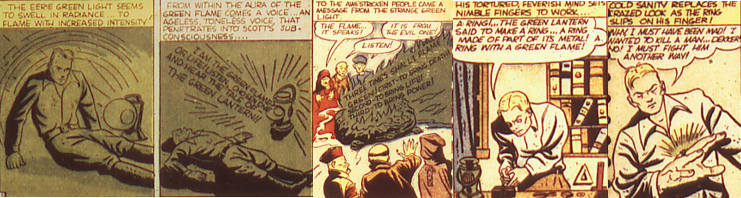
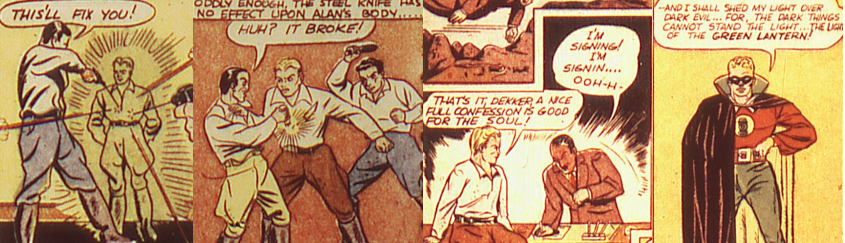
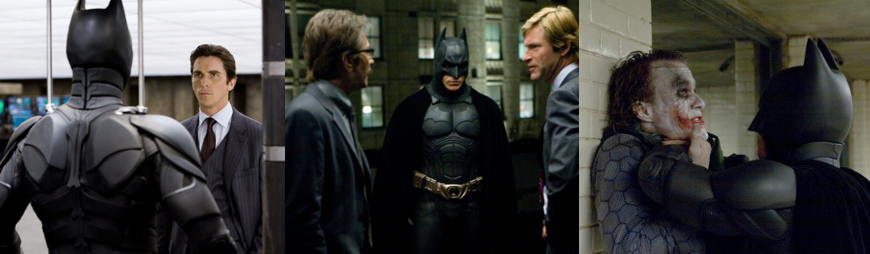
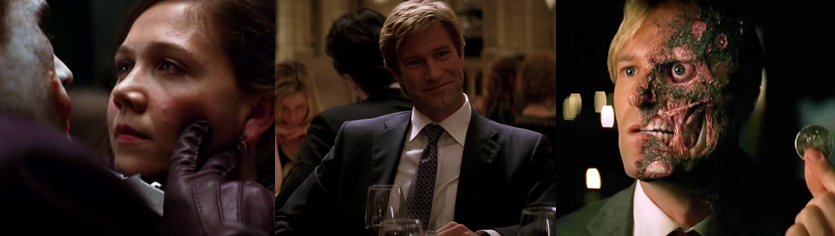
Although February 2014 was dubbed “Green Lantern Day” (because, by the American calendar, the date read as “2814”, the sector of space assigned to Earth in DC Comics), the significance of this date has passed as the years have changed. Instead, as perhaps the most popular iteration of the character, Hal Jordan, first appeared in October of 1959, I’ve been dedicating every Sunday of October to the Green Lantern Corps!
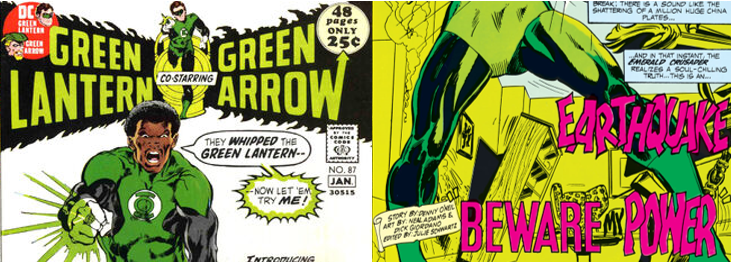
Story Title: “Beware My Power!” Published: January 1972 Writer: Dennis O’Neil Artist: Neal Adams
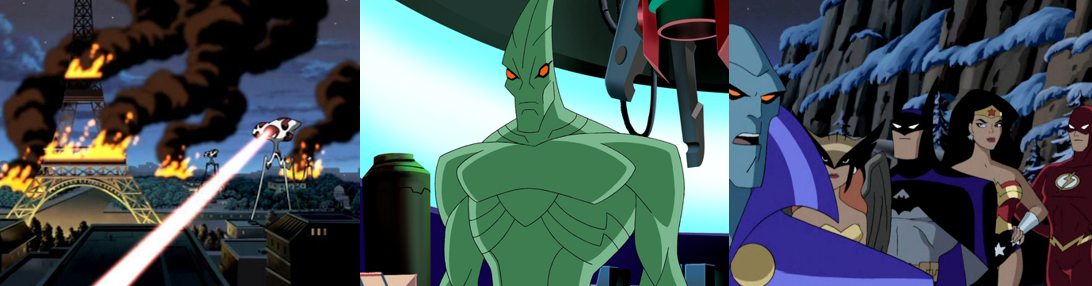
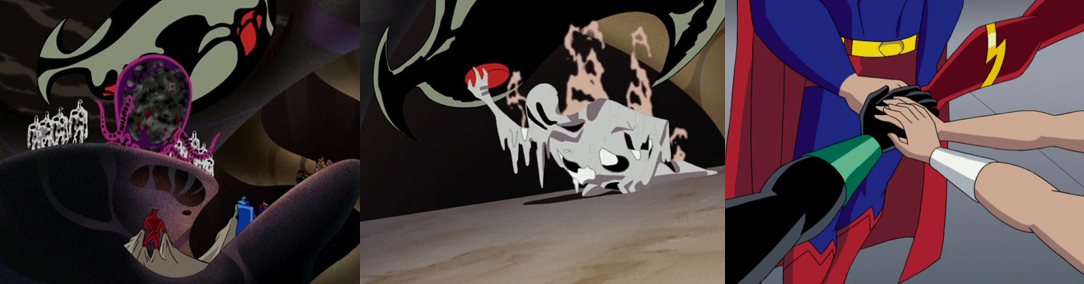
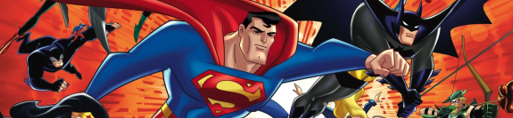
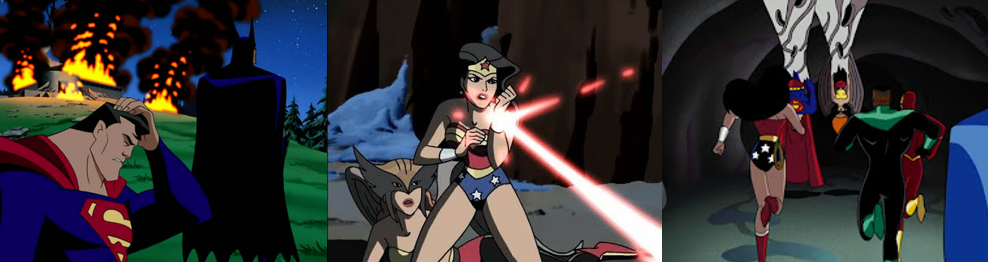
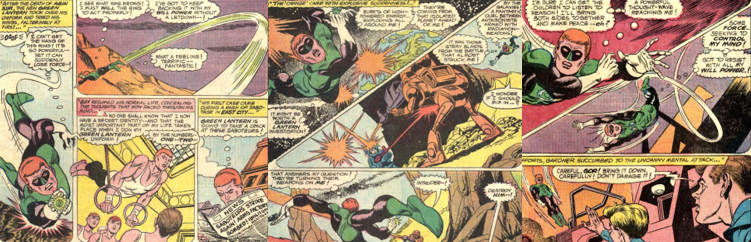
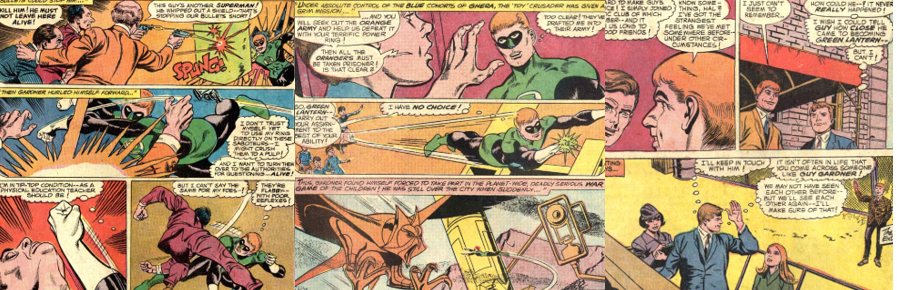
The Background: Initially presented as magically empowered railroad engineer Alan Scott, Martin Nodell and Bill Finger’s colourful Green Lantern was significantly reinvented by writer John Broome and artist Gil Kane in 1959, becoming a more science-fiction-oriented superhero. Almost ten years later, Groome and Kane planted the seeds for a diverse peacekeeping force, a Green Lantern Corps, with the introduction of Guy Gardner, a volatile individual who acted as a backup to Harold “Hal” Jordan, popularly known as the greatest Green Lantern of all time. Arguably, however, many fans are more familiar with military-minded John Stewart as Earth’s go-to Green Lantern, particularly after his inclusion in the popularJustice League cartoons (2001 to 2004; 2004 to 2006). Created by Neal Adams, who favoured shelving Guy Gardner for an African-American Green Lantern, John was originally depicted as a belligerent architect whose methods and sensibilities clashed widely with Hal’s, and famously refused to hide his identity. John was later retconned to be a former United States Marine, a change that would come to define his character, and became burdened by guilt after accidentally committing genocide. In addition to serving on the Justice League, John became the first mortal Guardian of the Universe, was one of the rare male members of the Star Sapphires, and has prominently featured in DC adaptations, appearing as a skin for Green Lantern in multiple videogames and very nearly making it to live-action on more than one occasion.
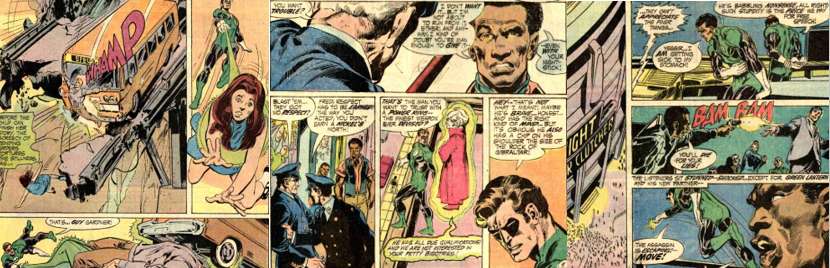
The Review: Things get off to a dramatic start here as an earthquake rocks Southern California just as Hal Jordan is charging up his ring. Although the tremors are brief and have cause only minor damage, Green Lantern swoops over the city to help out where he can, do-gooder that he is. And he’s not the only one; outside the city, the quake has wrecked a bridge and sees little Suzie teetering over a fatal drop. Luckily, Guy Gardner is on hand to help talk her down, but the poor girl’s so terrified that she’s rooted to the spot. With the remains of the bridge unstable and a plummet into the canyon awaiting them both, Guy makes a desperate run for the girl just as Green Lantern arrives to help. Hal shows up just in time to see Guy get smashed by a bus(!) as the section collapses, rescuing them both from the fall but grieved to see that Guy was critically injured from the impact. When doctors at a local hospital inform Green Lantern that Guy should fully recover in six months’ time, Hal is left dejected. Since Guy has been pegged as his successor, Hal has been relying on him taking over if his personal issues become too overwhelming. Luckily, one of the enigmatic and all-power Guardians of the Universe senses Hal’s anxiety and, aware of the situation, suggests that a new substitute be picked in case the worst should happen. Hal agrees and the Guardian takes him to meet his new replacement in the last place Hal expected to go: an urban ghetto.
When Guy is injured, Hal begins training socially-minded John to be his backup.
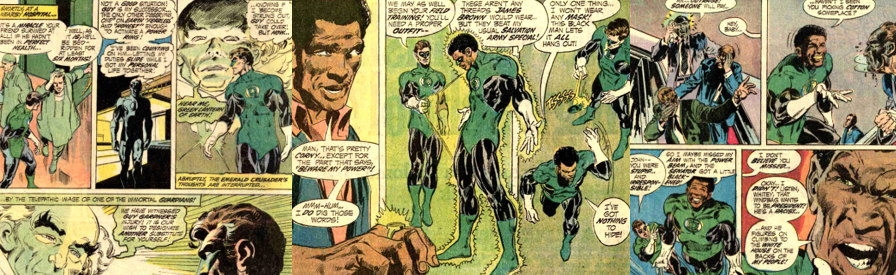
There, we’re introduced to John Stewart in a way that perfectly encapsulates his alternative sensibilities. When a police officer threatens two Black youths with disciplinary action for playing dominoes on the pavement, John intervenes, questioning his authority and calling the cop out on his obvious racism. Hal, however, is unimpressed (though not, as the Guardian suggests, because he’s equally prejudiced) by John’s apparent ego. Though he disagrees with the choice, Hal agrees to approach John as Green Lantern and offer him the position as his backup and John, who’s struggled to find work as an architect because of his race, readily agrees to the opportunity to shake off his reputation as a “square” as a superhero, jokingly suggesting he change his name to “Black Lantern”. Thus, Green Lantern (who doesn’t reveal his true identity to John) begins teaching John about the powers and limitations of the power battery and the ring. Hal teaches John the Green Lantern oath (which he finds “corny”), reminds him to charge his ring every twenty-four hours, and temporarily empowers John with his own Green Lantern uniform so they can begin field training, John, however, refuses to hide his identity behind a mask. He also takes to his training like a natural, mastering the ring easier than avoiding muggers and bigots, and is quickly given the chance to put his skills to the test when they spot an out of control fuel tanker heading towards a crowd at the airport. Although they succeed, Hal is enraged when John purposely causes Senator Jeremiah Clutcher to receive a face full of oil, giving John the chance to insult him with a racist quip. John, however, justifies his actions since Clutcher is a known racist who openly oppresses John’s people in his bid to become President of the United States.
Despite their clash of personalities, John earns Hal’s resect for his deductive reasoning.
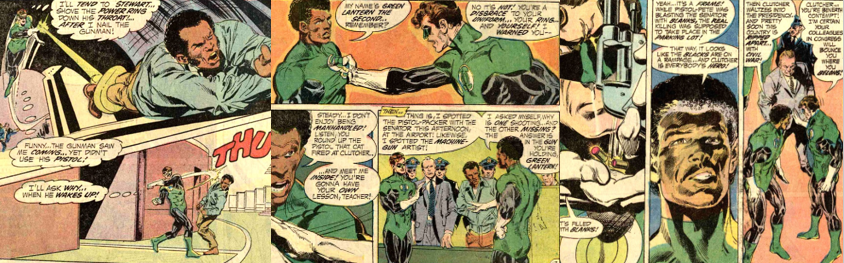
Hal chastises John and, to teach him a lesson, orders him to guard Clutcher from reprisals; he also objects to being called “Whitey”, especially considering John’s so pent-up about racism. Later, Clutcher makes an impassioned speech to his supporters, openly mocking “The Darkies” and accusing them of being of lesser intelligence, which only further raises John’s ire. Although Hal doesn’t approve of Clutcher’s insensitive attitudes, he’s so strait-laced that he believes the senator has the God-given right to free speech, meaning he leaps into action when a Black man suddenly shoots at Clutcher during his tirade while John refuses to get involved. Hal quickly tackles the gunmen, noting that the assassin never tried to put up a fight, while John subdues a White gunman outside the stadium. Hal reprimands John for his prejudice, accusing him of bringing disgrace to his uniform, but John simply shrugs him off and teaches Hal a lesson of his own: he spotted both gunmen at the airport and was suspicious to note that one was shooting and the other was missing. Hal’s stunned to learn that the Black man’s gun was filled with blanks as part of an elaborate frame. The Black man was a patsy, setup to make it look like the “Blacks are on a rampage” and winning Clutcher the Presidency at the cost of an all-out civil war. Hal condemns the senator’s actions and is impressed by John’s deductive reasoning. Hal still has apprehensions about John’s methods and style, but the content architect simply brushes it off and the two seem to finish the story with a mutual respect for each other.
The Summary: First and foremost, I have to praise the stunning artwork of the late, great Neal Adams. Adams first came to my attention when I read Batman annuals as a kid and I’ve always loved his bold, kinetic, square-jawed depictions of DC’s superheroes. He brings Hal and John to life in such a dynamic way, depicting them as lean, muscular heroes and giving a fluidity to their actions, and it’s always a joy to see his art on the page. Sadly, the scans I’m reading don’t do the art justice. The colours are muted, messy, and robbed of their “pop”, though this does give “Beware My Power” a bit of a dark edge to it that is reflected in the nature of the plot. Next, I have to comment on Guy Gardner. While he tries to help a girl endangered by the earthquake, he’s unceremoniously taken out when a bus smashes into him, leaving him bedridden like a chump. This element was so random, so unnecessarily over the top, that it may as well have killed Guy (and, realistically, should’ve) since it was a pretty extreme and unintentionally hilarious way to put him on the shelf. It was also weird that Hal’s concern was less for Guy’s welfare and more for his own. His entire concern is on what will happen to him and the Green Lantern mantle if he’s unable to perform his duties and less on how the injuries will impact Guy’s future. It’s pretty selfish, if I’m honest, and does as little to endear me towards the “greatest Green Lantern” as his unwavering commitment to the concepts such as authority and free speech.
With his outspoken nature and unique appearance, John makes a great first impression.
This means he naturally clashes with John Stewart. While John admittedly has a chip on his shoulder and is overly suspicious of authority figures, he has every right to be since he’s an out of work Black man struggling to make a living in the ghetto and facing unfair persecution wherever he goes simply for the colour of his skin. His attitude might be confrontational, and he might ruffle Hal’s feathers with his cavalier nature, but John’s entirely justified since the story depicts a cop persecuting young Blacks for no justifiable reason and then paints Senator Clutcher as such an exaggerated racist bastard that it’s almost comical. Of course, this is probably truer to reality at the time than we realise. The segregation and public dismissal of Blacks was commonplace and African-Americans had every right to take issue with it. Unlike many of them, John is given the power to affect real change when he agrees to become Hal’s backup Green Lantern. He easily masters the ring (potentially because of his creativity as an architect but also because of the strong sense of injustice he feels) and immediately clashes with Hal in his approach towards using his power. While Hal obviously doesn’t agree with racism, he’s a stickler for the rules and believes everyone should have basic human rights, even dirty scum like Clutcher, so he constantly reprimands John, who frankly doesn’t give a shit about Hal’s opinion. Being a product of the 1970s, the story naturally infuses John’s dialect with a bit too cliché “Jive talk” for my tastes, but it instantly gives him more personality than Guy; as does his refusal to wear a mask, his confrontational behaviour, and his unique look. Consequently, I’d definitely say John makes a better first impression than Guy, Hal, or even Alan. While they were all quite bland and cookie cutter in the debuts, John is bold and outspoken. He might be a bit of a hypocrite at times (he exhibits the same prejudices towards Whites as he receives from them) and in need of some seasoning, but his introduction was the shake-up the book needed at the time and I’d go as far as to say that both Guy and Hal should’ve been taken out by that bus so the Guardian could’ve empowered John to take over the comic!
My Rating:
⭐⭐⭐
Rating: 3 out of 5.
Pretty Good
Did you enjoy John Stewart’s debut story? What did you think to his characterisation and the personality clash between him and Hal? Were you as unimpressed by Guy’s accident as I was? What did you think to the racism angle threaded throughout this story? Do you think John was justified in his actions or do you think he needed tempering a little to approach things more diplomatically? Where does John rank in the Green Lantern hierarchy for you and what are some of your favourite stories and moments of his? How are you celebrating Green Lantern this month? I’d love to hear your thoughts on John Stewart so leave them below, and go check out my other Green Lantern content across the site!
Released: 4 October 2024 (Hey, that’s my birthday!) Director: Todd Phillips Distributor: Warner Bros. Pictures Budget: $190 to 200 million Stars: Joaquin Phoenix, Lady Gaga, Brendan Gleeson, Catherine Keener, and Harry Lawtey
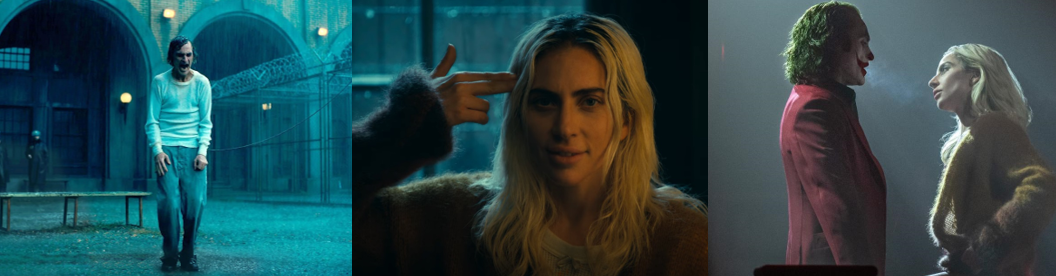
The Plot: Two years after killing Murray Franklin (Robert De Niro) on live television, Arthur Fleck/Joker (Phoenix) is incarcerated at Arkham State Hospital, experiencing musical madness through a shared delusion with Joker fan Harleen “Lee” Quinzel (Gaga).
The Background: The Joker has been a staple of DC Comics for decades and is inarguablyBruce Wayne/Batman’s greatest foe. Created by Bill Finger and Bob Kane, the “Clown Prince of Crime” first appeared in 1940 and has been responsible for many tragedies in the Dark Knight’s life, including the death of Jason Todd/Robin and the crippling of Barbara Gordon/Batgirl. The Joker has also appeared in live-action many times: Cesar Romero famously refused to shave his moustache for the role in the sixties, Jack Nicholson set a new standard in Batman(Burton, 1989), Heath Ledger received a posthumous honour for his incredible turn in The Dark Knight(Nolan, 2008), and Jared Leto’s screen time was significantly cut from Suicide Squad (Ayer, 2016). A standalone Joker movie was initially planned to spin out from Suicide Squad before numerous blunders saw Warner Bros. shift towards an unrelated interpretation of the character. Filmed on a modest budget, Joker (Phillips, 2019) was the first “R” rated DC Extended Universe movie and an unprecedented critical and commercial success, despite its protesters and controversy. Though planned as a standalone and the first in a series of darker, more experimental DC films, star Joaquin Phoenix personally lobbied for a follow-up after dreaming up the premise of a musical sequel. After briefly considering a Broadway show and unanimously deciding against transforming Arthur Fleck into a traditional criminal mastermind, Phoenix and director Todd Phillips developed the musical concept further, bringing in Lady Gaga as a new version of Harley Quinn that required her to change her approach to singing. The musical numbers were performed live, which proved an editing nightmare for Philips, who was given an extraordinary level of autonomy over the project, which ultimately failed to replicate the financial success of its predecessor. Reviews were equally far more scathing this time around; indeed, while Phoenix ’s performance was praised and Lady Gaga was seen as underutilised, many questioned the use of musical numbers and criticised the pacing and tedious, plodding narrative. In the wake of James Gunn rebooting DC’s live-action ventures, it seems our time with this alternative Joker is over not just because of these factors but also because Phillips stated he was finished with the character and this fictional world.
The Review: I’m proudly in the minority of people who didn’t care much for Joker. Even it had somehow been a decent film, in my opinion, I still would’ve found it annoying to have an alternative version of the Joker running around in a Batman-less Gotham City. As a psychological thriller that made you question the sanity and reliability of its narrator, it was okay; but I would still rather watch the vastly superior American Psycho (Harron, 2000) for that fix. Either way, Joker: Folie à Deux (ridiculous title, by the way) picks up two years after the first movie and finds a heavily emaciated, largely silent Arthur Fleck committed to Arkham State Hospital, where he’s routinely harassed, abused, and mocked by bullish guards like Jackie Sullivan (Gleeson). While Joker ended with the suggestion that some of the film’s events were part of Arthur’s twisted imagination, Joker: Folie à Deux confirms that he did kill five people (actually, it’s six, but it’s not common knowledge that he killed Penny Fleck (Frances Conroy), his overbearing and abusive mother), with Murray Franklin’s live execution inciting a riot and a gaggle of clown-themed protestors calling for Arthur’s release. Despite finding his true self and experiencing a euphoric empowerment by embracing his psychotic urges, Arthur is a broken shell of his former self. Lethargic and largely mute, he’s easily bossed around by the guards and kept under the whim of his daily medicines. Jackie and the others regularly taunt him, forcing him to kiss other inmates and rewarding him with cigarettes whenever he tells one of his bad jokes, but the strong, confident, self-assured Joker is absent in the early going of the film (and, truthfully, for much of it). Arthur’s so mellow that his lawyer, Maryanne Stewart (Keener), is working to convince him, a jury, newly elected assistant district attorney Harvey Dent (Lawtey), and basically anyone who’ll listen that the meek Arthur and his psychotic Joker are distinctly different personalities. Her goal in aiding him, in trying the change the public’s opinion of him as some crazed murderer or a martyr to the lower classes, isn’t to prove he’s innocent, of course, since he absolutely is guilty of murder. Instead, she wants to show the tragedy behind his childhood, the mitigating circumstances around his killings, and prove that he’s a disturbed individual who needs real medical help, not to be caged in a veritable torture chamber or sent to the electric chair for actions outside of his control.
A broken down Arthur is given new life as Joker through Lee’s musical influence.
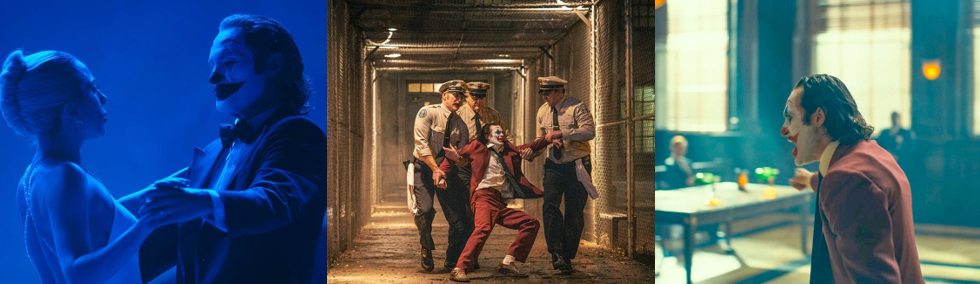
Arthur is largely apathetic about all this. He endures his daily torment and routine without so much as a peep and does his best to go along with Maryanne’s plan, taking solace in his fantasy world where he imagines his life as a classic Warner Bros. cartoon, relives the trauma he suffered at the hands of others and his mother, and seemingly longs for the feeling of empowerment he felt when he embraced his Joker persona. All this changes, however, when he passes through B Wing, a low security section of Arkham housing non-violent inmates, and catches the eye of Lee Quinzel. When Jackie arranges for Arthur to participate in the same musical therapy class as Lee for good behaviour, Arthur finally opens up to this self-professed Joker fan. Instantly enamoured by Arthur and having been inspired by his actions, Lee claims to have struck out against her own abusive family and landed herself in the nuthouse after burning down her apartment building. The two grow closer as Lee professes her admiration and love for the ideal Arthur embodied when he killed Murray Franklin and Arthur, love starved and craving attention, falls head over heels for her in return. The two express themselves through song almost constantly, either in Arthur’s warped imagination or, seemingly, for real. As in the first movie, it’s not always clear when things are real or not, though many of the musical numbers take place in Arthur’s head. These imaginary sequences are also the only times Arthur shows his violent side, braining and beating people to death with footstools and mallets, and are seemingly his new way to work through his pain and frustration and emotion. Unlike Arthur’s obsession with his neighbour, Sophie Dumond (Zazie Beetz), Lee is quite real. Others see and acknowledge her, though it’s debatable whether she really did blag her way into his cell to seduce him and much of her character is called into question when Maryanne reveals that Lee lied about her past to get closer to Arthur. Indeed, rather than being a downtrodden and forgotten member of the lower classes like him, Lee comes from money, is studying psychiatry, and willingly committed herself to meet him, reframing the usual Joker/Harley dynamic as she’s the one subtly influencing him to coax out what she sees as his “true” self.
Faced with daily abuse and a death sentence, Arthur retreats into a musical fantasy.
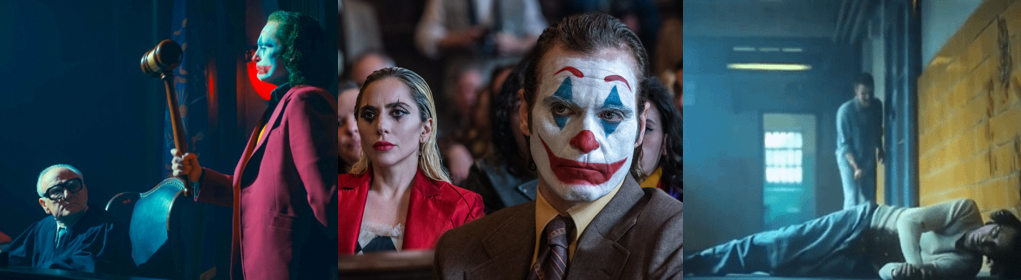
Lee’s influence sees Arthur become bolder, more confident, regaining the spark that took Gotham’s crooks and destitute by storm. A parade of supporters surrounds the courthouse during his trial, which is broadcast live since he’s such a high-profile killer, and witnesses testify against Arthur’s mental state. Encouraged by Lee to embrace his status as a cult symbol, Arthur snaps and fires Maryanne and opts to represent himself, donning the Joker makeup and persona once more and strutting around the courtroom ranting about his shitty life. By his own admission, however, Arthur knows nothing about the legal system, resulting in him mocking his traumatised former co-worker Gary Puddles (Leigh Gill). These moments, and where Arthur is wailing or uncontrollably cackling in despair, are where Phoenix excels in the role. I’ve never liked the idea of a definitive origin for the Joker, but he certainly brings his A-game in personifying Arthur’s depressing bleakness and Joker’s manic insanity. For the most part, Lady Gaga does well enough as a heavily revised version of Harley Quinn. After she checks out of Arkham, we’re told that Lee campaigns on Arthur’s behalf and she slowly adopts more clown-ish makeup and mannerisms in support of him. When she’s not singing (and she sings all the damn time), she’s an intriguing character, one who I would’ve liked to see more from. She seems to want Arthur to embrace his Joker persona and lead his followers in some kind of revolution (to “build a mountain”, as they say) but it’s not clear why or what their ultimate goal is rather than simply sticking it to “The Man” and unapologetically being true to oneself. Arthur’s main antagonist is himself, as ever; he’s riddled with insecurity, feelings of abandonment and helplessness, and is thus depends on Lee for emotional support. However, while he relishes frolicking around like Foghorn Leghorn, Arthur’s outbursts and rantings see him anger Jackie and the other guards. While the Arkham inmates and Joker’s supporters cheer and applaud his antics, the guards mercilessly beat and seemingly sexually assault him, with Jackie even throttling Arthur’s fellow inmate, Ricky Meline (Jacob Lofland), for being a little too outspoken in his rambunctious support.
The Nitty-Gritty: Despite some confusion in the marketing and various interviews, Joker: Folie à Deux is very much a musical. Even before Arthur meets Lee, his fantasies favour belting out Frank Sinatra and, after they get closer, this only increases, to the point where almost every conversation becomes a musical number. I like musicals; I’m not against the idea of a musical. I like the idea that Arthur’s warped imagination has evolved to where he retreats into musical fantasy. However, I don’t think it was executed well here and it became very tedious. It seems the only reason these musical numbers is because of Lady Gaga’s stunt casting as Harley Quinn (sorry, “Lee”), and I definitely feel it would’ve been more impactful to just have three or four of these numbers. Indeed, it bothered me that Arthur was suddenly so into singing when surely his fantasy should be being a stand-up comedian or a talk show host like his former idol? Either way, it was physically exhausting seeing mundane conversations turned into songs and it got tired very quickly. While the first half of Joker: Folie à Deux mostly examines a beaten-down Arthur as he shuffles through daily torment in Arkham and his blossoming relationship with Lee, the second half is a courtroom drama, where Arthur’s very presence causes controversy even before he’s prancing around in his clown makeup. Personally, I found the courtroom stuff more interesting, but it was also a joke. The idea that anyone would acquit Arthur when thousands of people saw him commit murder on live television is laughable, to the point where Dent seemingly only endures the circus to bolster his career using the publicity. Things seem to turn a corner when Arthur represents himself as Joker, finally standing tall as a taunting, unhinged figure and stirring up a fresh wave of support from the incels who worship him as a martyr. However, beneath the makeup and the façade is lowly old Arthur Fleck, a damaged man who struggles to live up to expectations. Dent argues that Arthur is faking his mental illness and Arthur’s brief euphoria at reassuming his Joker guise soon comes crashing down following Jackie’s assault, leading him to openly denounce his persona, admit to his wrongdoings, and essentially criticise not just those who support him, but the myriad audiences who hailed Joker a subversive hit.
Ultimately, Arthur fails to live up to Lee’s expectations and ends up shanked like a bitch.
Indeed, Joker: Folie à Deux appears to be taking all the goodwill of the first movie’s success and purposely flushing it down the toilet. Arthur is taken right back to square one, being pushed around and bullied like a feeble, pathetic child and his number one supporter, Lee, is shown to be a deluded, obsessed super fan who encourages Joker’s outbursts with no real end goal in mind. His anonymous supporters rally for him but mostly use the Joker persona as an excuse to lash out, attack the police and government, and commit petty crimes. They’re not trying to overthrow the elite or get equality; they just want an excuse to act like assholes. After seeing how traumatised Gary is and suffering Jackie’s malicious abuse, Arthur snaps again and the empowerment he rediscovered leaves him. His public denouncement of Joker sees Lee leave in disgust and either kill herself or bluntly reject him, depending on which scene you want to believe is real. As the jury delivers their unanimous guilty verdict, the courthouse is attacked, leaving Dent mildly wounded on one side of his face, and Arthur escapes. He’s briefly picked up by some Joker fanatics, who desperately try to shield him in hopes of inciting a revolution, only to be astonished when he flees in fear, wanting no part of their movement. After Lee rejects him, Arthur is immediately and easily apprehended and dragged back to Arkham, ending the film right where he started: a small, broken, screwed up little man facing the death penalty. However, when he’s called to see a visitor, Arthur is stopped by a fellow inmate (Connor Storrie), one of many who gleefully watched Arthur’s trial and supported his manic actions. Disgusted that the lauded Joker is nothing but a worthless nobody who doesn’t appreciate his following, the inmate spitefully tells Arthur a joke and then repeatedly shanks him, mutilating his own face with a Glasgow smile as Arthur bleeds out on the floor and, presumably, dies.
The Summary: I didn’t care for Joker. I thought it was largely pointless and meaningless since we’d never see this version of the character in the larger DC extended universe and the idea of doing a Joker movie without Batman seemed like a waste of time to me. I’ll admit, it was a decent, gritty, psychological thriller but…it wasn’t the Joker. Joker: Folie à Deux hammers that home explicitly; by the end, it’s obvious that Arthur Fleck was never supposed to be the Clown Prince of Crime and was, instead, the catalyst for psychotic copycats to spread terror and discord. This wouldn’t be a bad concept if the movie was actually good. Maybe if it had taken some time to explore how Arthur’s actions influenced people, perhaps shown us more of Gotham from Lee and Dent’s perspectives and juxtaposed them with Arthur cackling it up in Arkham, I could’ve endured the obnoxious musical numbers. Alas, this isn’t the case and the film instead devotes itself to stripping away everything people loved about the first film except the performances, and even those are called into question by the tedious singing. I didn’t like the idea that Arthur regressed while in Arkham; he ended Joker on a high but it took the obsession of a woman to get him back in gear, which made him seem weak and lack agency. Lady Gaga may as well have been an entirely different character; she’s as removed from Harley Quinn as Arthur is from Joker. In that regard, the idea makes perfect sense but it’s hardly providing a quintessential adaptation of these two popular characters. What really bugs me about these Joker films is how some audiences will grow up or go around thinking that this is what Joker and Harley should be, when the actual intent seems to be the exact opposite. But, by messing with our expectations and presenting this weird, poorly paced, nonsensical musical, Joker: Folie à Deux wastes more of my time than I would’ve liked. It’s not clever or saying anything new; indeed, much of its runtime treads the same ground as the last film. The singing is annoying and gets in the way of the story, and any potential of seeing Arthur truly embody the Joker persona is done away in favour of trolling audiences. I’d love to know where the $200 million budget went on this titanic insult of a film. Still, hopefully now that Arthur is dead we’ve seen the last of his “Joker” and we’ll never have to worry about this terrible incarnation of the character ever again.
My Rating:
⭐
Rating: 1 out of 5.
Terrible
Did you enjoy Joker: Folie à Deux? If so…why? Name one thing you enjoyed; I dare you! What did you think to Lady Gaga’s version of Harley Quinn? Were you disappointed that Arthur didn’t truly embrace his Joker persona? What did you think to the musical numbers? Are you glad Arthur was shanked in the end or are you insane and think this is the best Joker ever? What are some of your favourite Joker-centric stories over the years? Whatever you think, good or bad, about Joker: Folie à Deux, drop a comment down below and let me know your thoughts.
Although February 2014 was dubbed “Green Lantern Day” (because, by the American calendar, the date read as “2814”, the sector of space assigned to Earth in DC Comics), the significance of this date has passed as the years have changed. Instead, as perhaps the most popular iteration of the character, Hal Jordan, first appeared in October of 1959, I’ve been dedicating every Sunday of October to the Green Lantern Corps!
Story Title: “Earth’s Other Green Lantern!” Published: March 1968 Writer: John Broome Artist: Gil Kane
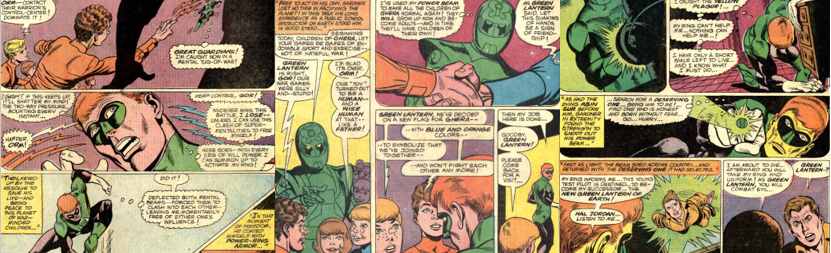
The Background: Martin Nodell and Bill Finger’s original version of the Green Lantern, Alan Scott, was a magically empowered railroad engineer rather than a space-faring peacekeeper. However, following the successfully reinvention of the Flash in 1956, John Broome and artist Gil Kane changed the Green Lantern mythos forever with the introduction of test pilot Harold “Hal” Jordan, widely regarded as the greatest Green Lantern of all time, in 1959. Nearly ten years later, Groome and Kane revealed that Hal was just one of the potential candidates for Abin Sur’s power ring, the other being volatile Guy Gardner, who first debuted in this issue. Not only was Guy relegated to backup status, he soon found himself gravely injured and briefly trapped in the Phantom Zone. Then, he was replaced by another and developed brain damage, becoming even more hostile and egotistical, especially regarding his status as a Green Lantern. Guy is perhaps best known for his time on Justice League International, where he often clashed with his teammates, as much as his unstable temperament, which saw him kicked out of the Green Lantern Corps and wielding Thaal Sinestro’s yellow power ring. Guy’s backstory was significantly altered in the early-1990s, revealing him to be of Vuldarian heritage, before he returned to the Green Lantern Corps as one of Earth’s many emerald defenders. Whether wielding a green, yellow, or red power ring, though, Guy has maintained a vocal fanbase, despite his flaws. Though allegedly cut from the universally derivedlive-action film, Guy’s appeared, in some form or another, in various DC adaptations and is due to be portrayed by Nathan Fillion in James Gunn’s reimagined DC Universe movies.
The Review: Our story opens with Hal Jordan on Oa, the headquarters of the Green Lantern Corps and home to the enigmatic Guardians of the Universe, for an intensive two-day training course. Yes, it seems even intergalactic space cops have to endure team meetings sometimes, folks! However, rather than learning trust exercises, Hal is shown a gigantic, Jack Kirby-esque telescope that displays current events all across the universe and even keeps a record of a person’s life after they die as a “mental post-mortem”. Hal jumps at the chance to see the last thoughts of his predecessor, Abin Sur, and to learn why he, of all the millions of people on Earth, was chosen to become his successor. As in Hal’s origin story, Abin is fatally injured in a crash and tasks his power battery to find a worthy inheritor of his power ring, but there’s a twist: the battery claims that there are two equally strong candidates! One is, of course, fearless test pilot Hal Jordan and the other is the hitherto-unknown Guy Gardner, a schoolteacher who lost out on becoming Green Lantern simply because Hal was closer. After reliving Abin’s dying soliloquy over the next few panels, Hal is left astonished to learn that there was another potential candidate. Luckily, the Guardians’ incredible machine can also show Hal potential alternative timelines and, at his request, program it to show what would’ve happened if Guy had been selected instead.
In another life, Guy became Green Lantern and embarked on a very similar superhero career.
In this version of events, gym instructor Guy is whisked away by the green energy and readily accepts the ring. However, since he’s not subjected to the same monologue as Hal, it takes Guy a hot minute to figure out how to use the ring, though he’s no less committed to using its power to battle injustice as Green Lantern. Like Hal, Guy’s first mission was confronting a group of saboteurs. Unlike Hal, who phased through walls and bullets and was dazed by a yellow lamp, Guy crashes through walls and erects an energy shield to block their bullets, hesitating to directly use his ring against them in case he “[crushes] them to a pulp”. Instead, Guy relies on his physical superiority to beat them into submission. Victorious, he also embarked on a fantastical superhero career, tackling colourful supervillains and even defeating renegade Green Lantern Thaal Sinestro. This victory saw Guy finally summoned to Oa and learning the true extent of his powers and responsibilities, but it’s in his return journey home that the biggest deviations occur between Hal and Guy’s lives. Guy was distracted by a series of intergalactic explosions that saw him detour to the planet Ghera to interject in a duel between two alien robots. Their conflict quickly turns against him, though he easily bested the two droids and learned that the planet is populated solely by human children. The robots explain that the Gheran parents created them before being wiped out by a mysterious yellow plague. This same virus kept the children from growing and, in their boredom, they programmed the robots to engage in war games for their amusement, meaning the planet is constantly in a state of conflict between the orange side and the blue side. Amazed, Guy vows to show the children that they’re walking a dark path, confident that he can teach them the benefits of peace, only to suddenly find himself completely paralysed when the children of the blue side not only sense his presence but take control of his body with their mental powers (a feature the robots conveniently neglected to mention earlier).
Guy eventually breaks free and brokers peace, only to succumb to a fatal disease.
Thinking Guy is an advanced automaton and using their incredible psychic powers to learn his name (but, strangely, not his true purpose), they send him against their enemies. Completely under their sway, Guy has no choice but to obey and is forced to defend them against a mechanical bird the orange’s send to attack the blue’s city. Next, he’s set against the orange’s fish-like submarine, resisting its lightning attacks and scuppering it with a giant green energy hand. Impressed by his abilities, the blue’s send him to wage an all-out attack on the orange’s city. However, after besting their defences, he finds himself caught in a mental tug of war as both sides try to control his mind and body with their mental powers. Desperate to save himself, Guy summons all his willpower to break free and conjure a suit of armour to protect him from further mental attacks. This form is also enough to convince both sides to agree to a parlay; a simple suggestion for “enjoyable sport and exercise” is enough to convince the children to stop their conflict. However, it’s not just Guy’s words that sway the children; he uses his ring to subtly influence them, making them “normal” and unifying them in peace. Pleased, Guy leaves to recharge his ring (uttering an amended version of the classic Green Lantern oath), only to suddenly fall violently ill. Having contracted the yellow plague while on Ghera, Guy quickly finds himself facing certain death and wills his power ring to search out a replacement. The ring brings Hal to him and, just as in the main timeline, the stunned test pilot is gifted the power ring and the Green Lantern mantle, though he “makes up” his own oath since Guy never got to teach him it. Amazed by these visions, Hal returns to Earth to meet Guy in his civilian guise. He joins the same athletic club Guy attends and quickly becomes fast friends with him, eager to keep an eye on him out of respect for his candidacy for the mighty Green Lantern Corps.
The Summary: “Earth’s Other Green Lantern!” is one of those classic misleading comic books as the cover advertises the promise of a physical confrontation between Hal and Guy, one that sees the upstart Gardner usurp Hal to become Earth’s only Green Lantern. In truth, this never happens, nor is Guy’s personality anything like the cover depicts. Ironically, the cover paints Guy as an egotistical hothead, which would become his defining personality trait, but the actual story shows him to be as bland and generically heroic as Hal. Indeed, much of the narrative is geared towards showing how similar the two are, which I feel is a massive missed opportunity. Hal is excited by the idea that he wasn’t the only one considered as Abin Sur’s replacement, but Hal and Guy’s superhero careers are functionally identical save for Guy having less initial instruction on the ring and his side quest to Ghera. I have no idea if Hal went to this planet and encountered the strange psychic children, but Guy’s time there isn’t massively significant except that it sees him prematurely killed and handing the mantle to Hal, meaning this alternative timeline really isn’t all that interesting. Now, if Guy had been his later cocky, overconfident self, utilising more direct or brutal methods, maybe things would’ve been more interesting. There are hints that Guy approaches his duties slightly differently, such as being more creative with his energy constructs and being more physically capable than Hal, but there’s not enough deviations between the two to really make me care.
The differences between Hal and Guy are sparse, and the story’s a fantasy anyway!
The story tries to say that things took a dramatic turn on Ghera but…they don’t, really, except that it sees Guy killed. It seems like it’s going in a different direction, maybe having the kids turn Guy rogue or expanding on him using his power ring to influence their behaviour and having him be reprimanded for that, but that doesn’t happen either. The Ghera sub-plot is actually quite dull. I enjoyed the Jack Kirby influences on the art and visuals of the planet, but the random mental powers came out of nowhere and their control over Guy seemed more like an excuse to show off his control of the power ring than anything else. Indeed, the whole escapade makes Guy seem secondary to Hal since it took him a while to summon the willpower to shake off their influence, and then he just ends their long-running thirst for war with a few words and subtle influences. I’ll admit that I wasn’t expecting Guy to die at the end, though I probably should’ve considering the nature of the yellow plague. Again, it might’ve been more interesting if the virus had been affecting him throughout the story, adding an extra dimension to his plight, but…again, no. In the end, this read like another of those crazy imaginary stories DC liked to publish in the Golden Age where nothing really matters because it’s all a dream or some elaborate fantasy. Sure, it led to Hal seeking Guy out by the end but even that is a bit weird. There’s no suggestion here that he befriends him in case he needs a backup, it’s more out of curiosity and respect, so I can’t help but feel like the whole issue can be skipped as it’s ultimately meaningless in the short term (and even in the long term, as Guy’s personality was eventually completely different).
My Rating:
⭐⭐
Rating: 2 out of 5.
Could Be Better
What did you think to Guy Gardner’s debut story? Were you shocked to learn that Abin Sur had two choices to pick from? What did you think to Guy’s characterisation here and were you disappointed by how bland he was? Would you have liked to see more differences between the two and more from the concept? Where does Guy rank in your Green Lantern hierarchy, and what are some of your favourite stories of his? There’s a comments section below, so share your thoughts there and go check out my other Green Lantern content!
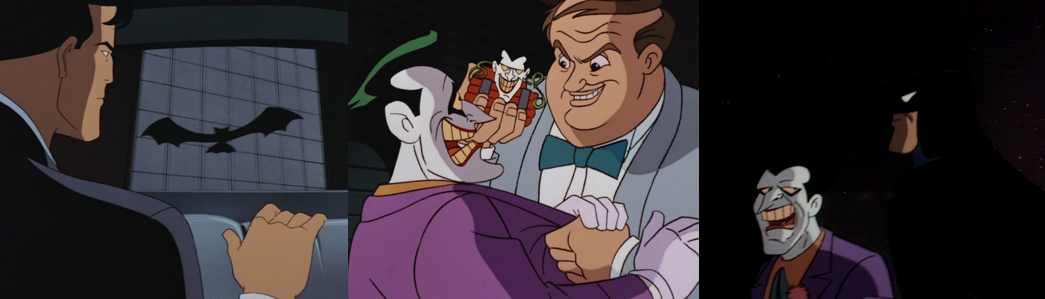
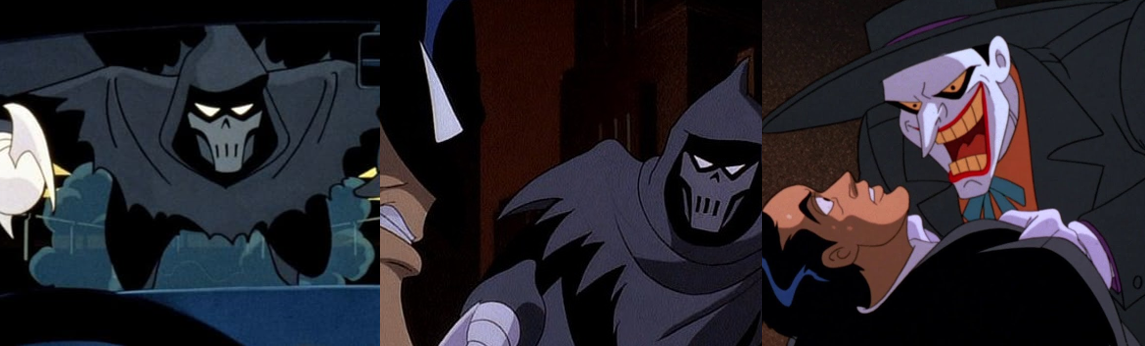
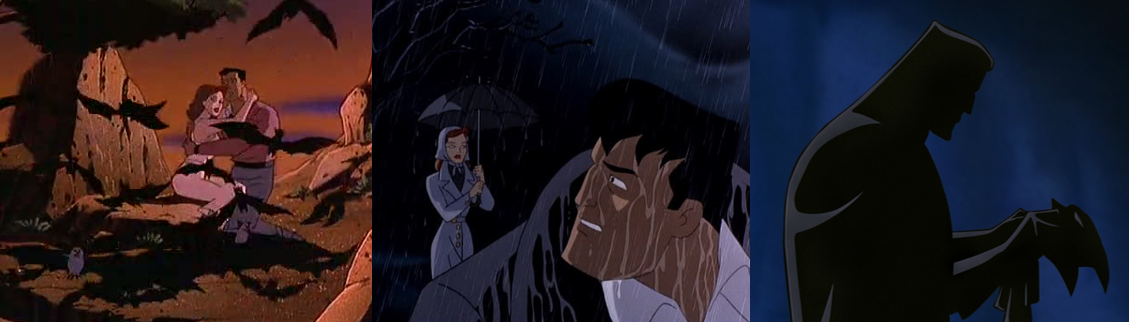
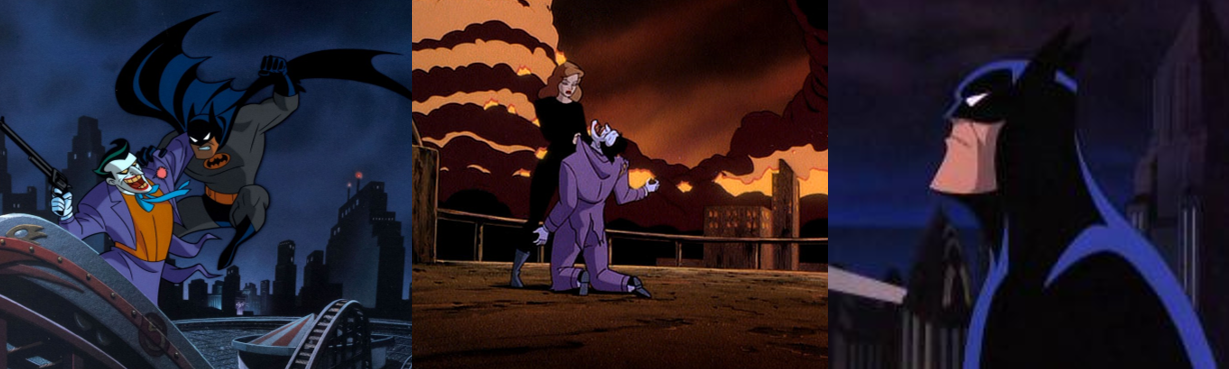
Air Date: 11 September 1992 Director: Boyd Kirkland Original Network: Fox Kids Stars: Mark Hamill, Arleen Sorkin, Ed Begley Jr., and Kevin Conroy
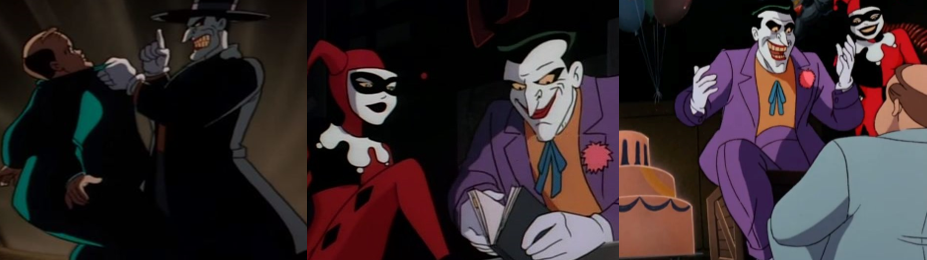
The Background: Gotham’s caped crusader is no stranger to adaptation. Around three years after his debut appearance, Bruce Wayne/Batman was brought to life in an oft-forgotten fifteen-chapter cinema serial and made his first appearance in animation in The Batman/Superman Hour (1968 to 1969), courtesy of Filmation. After the critical and commercial success of Tim Burton’s Batman movies, Batman(1989) and Batman Returns(1992), Batman shed the remnants of the camp trappings that had been associated with him since the sixties and was popularised as a dark, brooding vigilante once more. Perhaps no piece of ancillary media was more influential in this, however, than Bruce Timm and Paul Dini’s Batman: The Animated Series (1992 to 1999), which placed the Dark Knight into a distinctly art deco world and pushed the boundaries of what cartoons could get away with. Eventually expanding into an extremely popular animated DC universe, Batman: The Animated Series not only came to influence subsequent Batman media but also introduced new characters to the Bat-world, with none more prominent than Doctor Harleen Quinzel/Harley Quinn. Created by Dini and Timm for this very episode, Harley was initially planned to simply be a one-off character but Dini decided to make her a recurring antagonist, an abused henchwoman whom the Joker (Mark Hamill) could play off. Initially portrayed by the late Arleen Sorkin, Harley quickly became a popular breakout character and was officially woven into the mainstream DC Comics in 1999. She has seen significant growth since then, transitioning from the Joker’s mistreated plaything to a strong, independent – if maniacal – anti-hero and even joining the Bat-Family in later years. Harley Quinn has become so popular that she made the transition to live-action with a pitch-perfectperformanceby Margot Robbie and a tone deaf outing from Lady Gaga, got her own hilarious animated series, and has consistently cropped up in videogames and animated ventures, to the point where she’s now considered to be as important to DC Comics as heavy-hitters like Batman and the Justice League!
The Plot: Mild-mannered accountant Charlie Collins (Begley Jr.) insults the Joker (Hamill), who spares his life in return for aiding him and right-hand woman, Harley Quinn (Sorkin), in their latest plot.
The Review: This is my first time reviewing an episode of Batman: The Animated Series on my website beyond the feature-length productions, and it’ll come as no surprise how much I love this series. I didn’t watch every single episode as a kid (though I have since) but I really enjoyed the entire DC Animated Universe. It was fun seeing these characters and their stories adapted and tweaked and presented in an engaging and serious way, no more so than Batman, whose mainstream popularity was arguably bolstered by Bruce Timm and Paul Dini’s animated series. The show makes an impact right from the start with its stark, gritty opening sequence that’s completely devoid of any titles or text. It screams “Batman” and really sets the tone for what’s to come. That and the stellar voice cast; it’s impressive how many character, veteran, and big-name actors featured on the show, with Mark Hamill’s turn as the Joker widely regarded as one of the best interpretations of the character, to say nothing of Kevin Conroy’s enduring and timeless take on the Batman himself. All this is to say that Batman: The Animated Series rarely missed; it changed superhero cartoons and adaptations for the better and its impact on the source material is just as significant, with Harley Quinn being just one piece of that puzzle. With the obligatory gushing out of the way, let’s get to the episode, which opens to find Charlie Collins stuck in Gotham City traffic on perhaps the worst day of his life: he’s been turned down for a raise, his kid needs braces, the ball game has been delayed, and his wife Bonnie is making meatloaf! Charlie hits his breaking point when a fellow driver rudely cuts him off; sick of being treated like a punching bag, he barges into the car and hurls insults at the driver, only to find the Joker behind the wheel!
After insulting the Joker, hapless Charlie Collins is coerced into aiding his latest devious scheme.
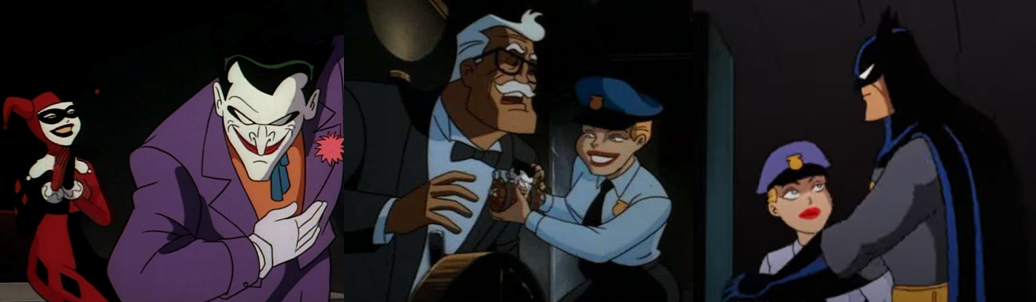
Despite Charlie’s best efforts to drive along amiably and lose the Joker, his car eventually breaks down, allowing the Clown Prince of Crime to confront him in the woods. Amusingly, the Joker is offended by Charlie’s rude behaviour and chastises him for being so impolite, though his teacherly demeanour quickly turns to a sinister anger, reducing Charlie to begging for mercy. Intrigued by Charlie’s desperation to save his hide, the Joker gleefully agrees to spare him on the proviso that Charlie promises to do him a favour at some point, with even the Joker unsure as to what that favour may be. Charlie readily agrees, relieved to be in one piece, and the episode jumps ahead two years and to the office of police commissioner James “Jim” Gordon (Bob Hastings), who’s due to be honoured for his work, something he finds to be a waste of time. The Batman (Conroy) echoes the sentiments of Detective Harvy Bullock (Robert Costanzo) and many others by stating that Jim deserves credit for keeping Gotham safe around the clock, and Jim begrudgingly agrees to attend the function. Unbeknownst to him, the Joker has also set his sights on gatecrashing the event; as he relates to his enthusiastic cheerleader, Harley Quinn, the Joker insists demands the chance to honour Gordon and picks Charlie’s driving license out of his little black book to call in that favour. Despite changing his name to Don Wallace and moving himself and his family to Ohio, Charlie is terrified when the Joker calls him, having kept tabs on him the entire time, and demands that he return to Gotham in return for keeping his family safe. With no other choice, Charlie makes the flight and is picked up by Harley before he can alert the police. The Joker expertly feigns pleasure at seeing his “old pal” once again and promises to send him home once he’s fulfilled his obligation, asking simply that Charlie opens a door for Harley when she delivers a massive celebration cake to Gordon’s gala under the clever guise of Crazy Clown Catering.
The Joker underestimates Charlie’s resolve and ends up falling for his bluff.
Entering the gala, Charlie desperately tries to alert the authorities – and the Batman – to the Joker’s plot by swinging around a convenient bat-shaped model, catching the attention of Bruce Wayne as he’s leaving to search for the Joker. As Gordon delivers his speech, Charlie opens the doors to the function room and Harley wheels in his cake (much to Bullock’s lustful delight), but finds himself glued to the door by a particularly strong adhesive. Harley delivers a rhyming threat and promptly gases the attendees, paralysing them and leaving them powerless to avoid the bundle of dynamite the Joker delivers as a gift to the long-serving commissioner. Charlie is incensed that the Joker welched on his word, but the Batman makes a timely arrival to toss the dynamite out of the building, destroying the Joker’s getaway van. After freeing Charlie and learning of his plight, the Batman easily subdues Harley and the Joker’s goons, but the Joker covers his escape with a series of boobytraps and an explosion. However, while he’s racing away outside, the Joker is confronted by an angered Charlie, who’s ready to blow them both up with one of the Joker’s own bombs, apparently having lost his mind. Terrified, the Joker screams for the Batman’s intervention and willingly hands over all the documentation he has on Charlie and his family, completely falling for the disgruntled civilian’s bluff. Charlie gratefully leaves, happy to taste his wife’s meatloaf, now that the Joker is in Batman’s custody and his family is safe.
The Summary: This was a fun little side story in the grand tapestry that was Batman: The Animated Series. As ever, the episode is dark and gritty, sporting a neo-noir styling and expertly using shadows and atmosphere to give its simplistic character designs a surprising amount of nuance and paint the Batman as a terrifying, ethereal figure. The Batman himself features only briefly in this episode, primarily appearing in the last five minutes or so to foil the Joker’s plot, but makes an impression when he’s onscreen thanks to Conroy’s distinctive Bat-voice and the effortless way he deals with the Joker’s minions and traps. Indeed, the wider Batman cast takes a backseat in “Joker’s Favor” so the episode can focus more on the Joker and his recent “hobby”, poor, unlucky Charlie Collins, a balding, middle-aged, underappreciated husband and father who’s frequently horrified and dumbstruck by the duality of the Joker’s insanity and menace. Charlie is an incredibly amusing and sympathetic figure; despite his loving wife and child, he’s beset by bad luck almost to the point of parody and completely helpless to avoid the Joker’s reach. Even changing his name and uprooting his family doesn’t help, and his desire to keep them safe is what drives him to both agree to paying the Joker back and going along with his latest madcap scheme. Even the Joker sees Charlie as worthless and impotent, never once believing he would have the guts to raise the alarm or fight back, which allows Charlie to scupper the Joker’s plan with his makeshift Bat-Signal and even bring the Clown Prince of Crime to the verge of tears by threatening his life. This final showdown between them is especially potent given the Joker’s familiarity with how important “one bad day” can be. He pushed Charlie to the edge, terrorising, manipulating, and threatening him, and can see that the man is ready to have his revenge even if it means his own death. However, in an ironic twist, Charlie actually picked up a few of the Joker’s habits, mainly toying with his victims, and pulled a cruel prank on his tormentor, tricking him into giving up the hold he had over the accountant to save his own hide.
Harley shines as the Joker’s colourful cheerleader who follows his every word without question.
Of course, “Joker’s Favor” is best known for including the first appearance of Harley Quinn. Harley actually briefly appears early in the episode, walking through the police department in her civilian disguise, though this isn’t expanded upon in the episode and is more of an Easter Egg for eagle-eyed viewers. Harley is depicted as a joyful, enthusiastic, devoted follower of the Joker. I described her as his cheerleader earlier and that’s incredibly apt as she claps, celebrates, and encourages every idea, action, and word her “Mistah J” says, no matter how bonkers his scheme may be. Although she only appears in her trademark harlequin outfit once in this episode, Harley is seen to be a master of disguise. She dresses as a chauffeur to pick up Charlie and masquerades as a police officer when infiltrating Gordon’s gala, raising no suspicion either time despite her loud and overly cheerful demeanour. Unfortunately, we don’t get to see Harley in action here; she doesn’t bust out any gymnastics or her signature giant mallet. She does try to distract the Batman with her woe-is-me façade and surprise him with a knife attack, but is handcuffed with little effort from the Dark Knight. Similarly, we know nothing of her backstory, and she primarily exists as a more colourful henchwoman for the Joker, one he both openly confides in for his need for an appreciative audience and demeans with menial tasks like cutting his hair. Still, Harley excels in this role; you can tell that there’s more to her than the dumb, brutish thugs the Joker employs, and she steals every scene with her joyful and bombastic personality. Overall, this was an enjoyable episode for its main plot, but fans of Harley would be better served watching “Mad Love” (Lukic, 1993) or reading the original comic book of the same name (Dini, Timm, et al, 1993) for a more in-depth exploration of Harley Quinn, her relationship with the Joker, and her tragic origin story.
My Rating:
⭐⭐⭐
Rating: 3 out of 5.
Pretty Good
What did you think to “Joker’s Favor”? Did you enjoy the Joker’s tormenting of hapless Charlie Collins or did the lack of Batman action put you off? What did you think to Harley Quinn at the time, or how do you feel about this being her first appearance? Did she make much of an impression on you at the time and are you a fan of how widespread her popularity has become? What are some of your favourite Harley Quinn stories and moments, or episodes of Batman and the DCAU? There’s a comments section down below, feel free to use it to share your opinions, and be sure to check out my other Batman content across the site.
Although February 2014 was dubbed “Green Lantern Day” (because, by the American calendar, the date read as “2814”, the sector of space assigned to Earth in DC Comics), the significance of this date has passed as the years have changed. Instead, as perhaps the most popular iteration of the character, Hal Jordan, first appeared in October of 1959, I’m choosing to dedicate every Sunday of October to the Green Lantern Corps!
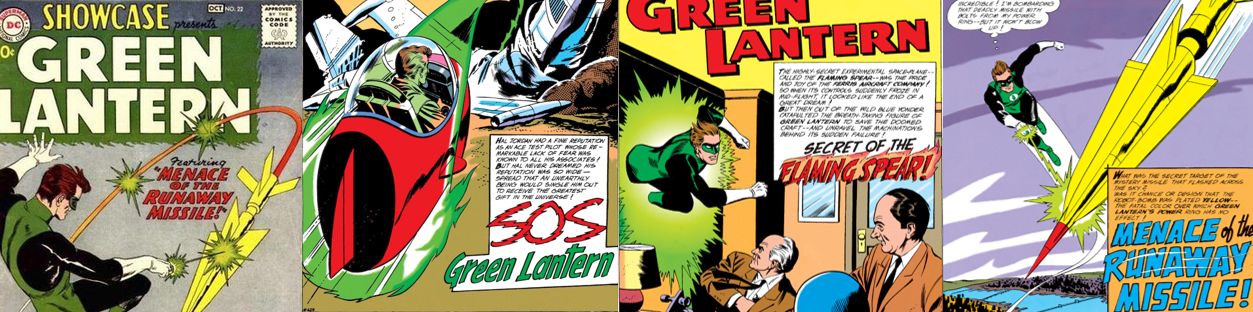
Story Titles: “S.O.S. Green Lantern”, “Secret of the Flaming Spear”, and “Menace of the Runaway Missile” Published: October 1959 Writer: John Broome Artist: Gil Kane
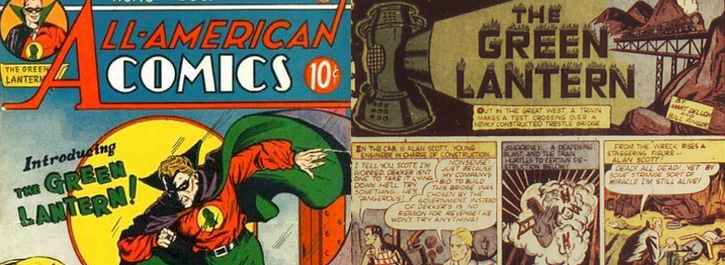
The Background: In July 1940, Martin Nodell and Bill Finger introduced readers of All-American Comics to Alan Scott, the very first Green Lantern. Far from an intergalactic lawman, Alan was a magically empowered railroad engineer who became a regular fixture of the title and DC Comics’ first super team, the Justice Society of America (JSA). However, after Gardner Fox, Harry Lampert, and Julius Schwartz successfully reinvented the Flash in 1956, a new green-hued superhero began operating under the codename Green Lantern in 1956. Re-envisioned as fighter pilot Harold “Hal” Jordan, the Green Lantern concept was drastically reimagined to incorporate a science-fiction slant, and Hal later became he de facto Green Lantern after the universe-shattering Crisis on Infinite Earths(Wolfman, et al, 1985 to 1986) saw Alan Scott and his teammates briefly banished from DC continuity. A hotshot pilot with an eye for the ladies, Hal fully represented the Green Lantern Corps. He opposed tyranny in all its forms, even making an enemy of his tyrannical mentor, Thaal Sinestro, helped found the Justice League of America, and even formed an unlikely partnership with liberal spokesman Oliver Queen/Green Arrow. Widely regarded as the greatest Green Lantern of all time, Hal isn’t without his flaws; his despair at seeing his hometown obliterated by Hank Henshaw/Cyborg-Superman, saw him infested by the malevolent entity Parallax and briefly become a genocidal madman before being redeemed and retaking his place as the premier Green Lantern. This reputation means that Hal is popularly the go-to character whenever Green Lantern appears outside of comics. He’s appeared in numerous videogames and cartoons, even if just to characterise other Green Lanterns, and was the main character of the much malignedlive-action adaptation.
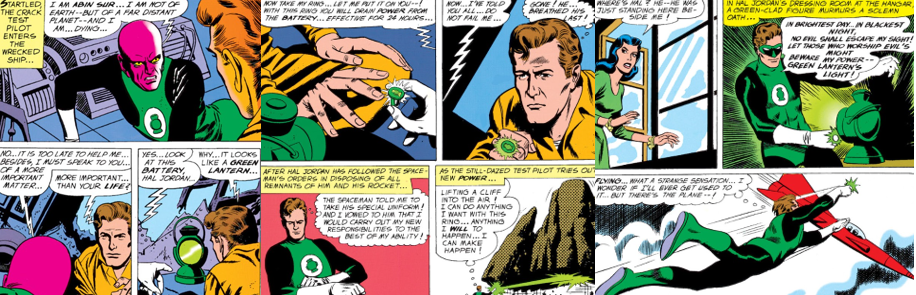
The Review: If there’s one thing Hal Jordan is known for in his role as the greatest Green Lantern, it’s his ability to overcome great fear and this is emphasised on the first page of his first-ever story, when we’re introduced to “ace test pilot” Jordan who has a reputation for his “remarkable lack of fear”. It’s this quality that fatally wounded Green Lantern Abin Sur seeks after his spacecraft crash-lands in “Southwest U.S.A.”. Summoning the remains of his strength, the dying alien wills his Battery of Power – the titular green lantern – to seek out a worthy successor, one who is without fear, and sends an emerald-hued energy beam across the globe in search of the perfect candidate. Over at the Ferris Aircraft Company, hotshot test pilot Hal Jordan is tinkering with a “flightless trainer” (presumably some kind of simulator to train space pilots) when he and the craft and bathed in a green glow and, to his astonishment, blasted away at high speed to Abin’s crash site. There, Hal is momentarily stunned to behold the purple-skinned alien, who telepathically welcomes him and begs that he listen to his instructions for the green lantern, which is a weapon against injustice utilised by space-patrolmen across the galaxy. Although Hal is eager to help Abin and save his life, the alien waves off his concerns, accepting the inevitability of his death, and confirms that the lantern chose a worthy successor.
Hotshot test pilot Hal Jordan is bequeathed a dying alien’s ring and becomes Green Lantern.
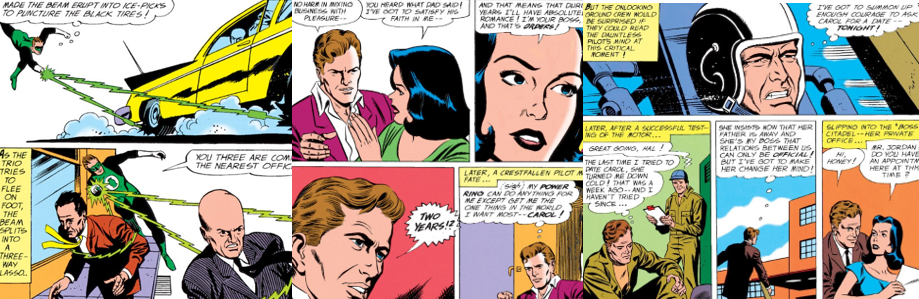
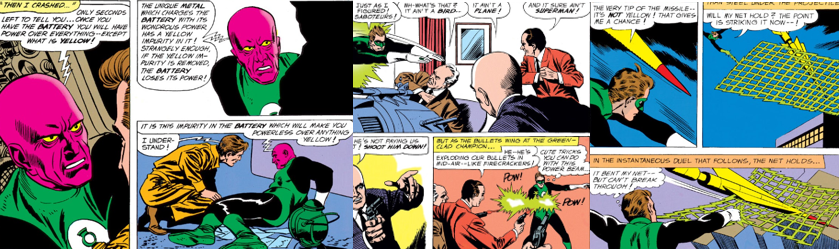
Abin then uses what little time he has left to share how his ship was unexpectedly battered by Earth’s radiation bands and he was momentarily blinded and left powerless by the flashing yellow lights. He goes on to relate that, for all the green lantern’s great power, it contains an “impurity” that renders it useless against anything tinted yellow, and that the power ring that channels the green lantern’s awesome might must be charged every twenty-four hours. Abin then hands Hal his ring, begs him to carry on the good fight, and promptly dies, much to Hal’s sorrow. On Abin’s instruction, Hal takes the alien’s slick, form-fitting uniform, tests the ring’s power by wiling a nearby cliff into the air, and vows to oppose evil in all its forms as Green Lantern. The issue’s next story, “Secret of the Flaming Spear”, introduces us to Carol Ferris, daughter of Carl Ferris, and Hal’s boss. Although she doesn’t approve of Hal’s tardiness, she’s more than wiling to go on a date with him, but their intimacy is cut short when pilot Frank Nichols suddenly calls in an S.O.S. when the controls of his experimental plane, the titular Flaming Spear, seize up on him. Feeling partially responsible since Frank’s only up there due to him being unavailable, and realising he has the power to intervene, Hal ditches Carol and utters a sacred oath before the green lantern: “In brightest day, in blackest night, no evil shall escape my sight. Let those who worship evil’s might beware my power… Green Lantern’s light!” Fully empowered, Hal takes to the skies as Green Lantern through sheer fore of will (noting how strange it is to fly without a plane) and easily guides Frank to safety using a burst of energy from his power ring.
For all his power, Green Lantern can’t affect anything yellow or influence Carol’s heart.
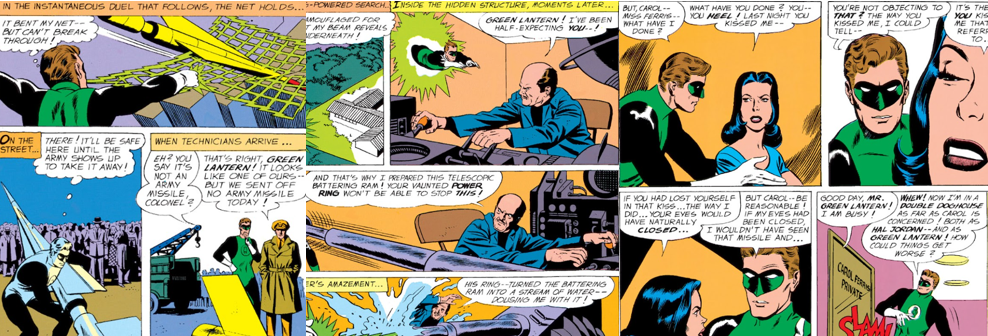
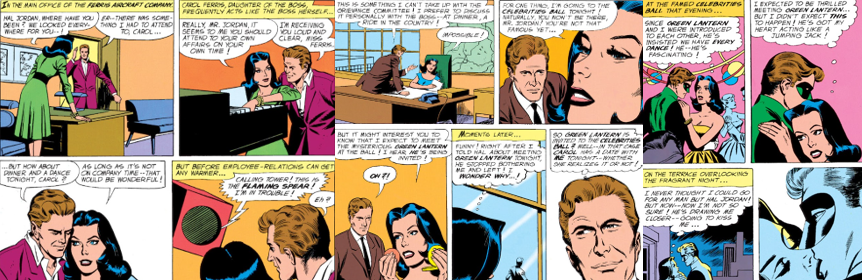
However, on closer inspection of the Flaming Spear, Green Lantern realises that the incident was no accident. Radiation caused the controls to freeze, so Green Lantern uses his ring to follow the lingering radiation to its source, a group of saboteurs holed up in a house not far off. Like his predecessor, Green Lantern phases through the wall of their hideout and confronts them, intercepting their bullets in mid-air but being briefly knocked out when the lead saboteur tosses a yellow lamp at his face. His pride hurt more than his body, Green Lantern recovers and chases after them, only to find they’re making a getaway in a yellow car. Although Green Lantern can’t affect the car directly, he does burst the tyres by conjuring hard-light ice picks with his power ring, wrangling the saboteurs with energy lassos so they can be apprehended by the authorities. When Hal returns to Ferris Aircraft, he finds Carl and Carol delighted at Green Lantern’s actions and that Carl is planning to take a two year leave of absence to go travelling, during which time he officially names Carol as his worthy successor. Carol takes the promotion very seriously, immediately shutting down any romantic involvement with Hal and leaving him to ponder the quandary that his ring can perform any miracle…except win the heart of his love interest. This irony continues in the final story, “Menace of the Runaway Missile”, where Hal wows his colleagues with his fearless testing of a rocket-sled. While Hal has the bravery to endure the intense speed and g-force of the sled, he struggles to find the courage to ask Carol out, especially after she knocked him back. He decides the best way to win her over is to invade her personal space, call her “Honey”, and be overly pushy in asking her out to dinner. Carol maintains her cold demeanour, however, and not only rejects him but also states she has a more pressing appointment at the charity ball, an event with an exclusive guest list that doesn’t include a nobody like Hal.
Green Lantern captures a wayward scientist, but both his personas end up in Carol’s bad books,
However, Carol lets slip that the mysterious Green Lantern is invited to the ball, so Hal decides that Carol is going to go on a date with him whether she’s aware of it or not. He attends the ball as Green Lantern and spends the whole night dancing with Carol, much to her excitement. Ironically, Carol’s thoughts reveal that she did harbour feelings for Hal and thought they would end up together, but the masked enigma has got her heart skipping a beat and, when Green Lantern leans in for a kiss, she responds eagerly, completely smitten. Unfortunately, at that exact moment, a yellow-hued missile comes baring down on Coast City, catching Green Lantern’s eye and forcing him to abandon Carol mid-kiss, much to her outrage. Upon inspecting the titular runaway missile, Green Lantern discovers it’s armed with an atomic warhead, but he’s unable to stop it because his ring is powerless against yellow. Conveniently, however, the missile’s tip is red, so Green Lantern constructs an elaborate net to catch the missile, which an Army Colonel informs him is not U.S. Army property nor does it contain the deadly payload Hal suspected. The two deduce that the missile’s true target was a hydrogen facility, so Green Lantern questions local aircraft spotters to find the source of the attack, an elaborate facility concealed by a forest. Phasing inside, Green Lantern confronts the man responsible, the maniacal Doctor Parris, who’s amazed when the Ring-slinger turns his high-powered battering ram into water and collars him without breaking a sweat. A lengthy interrogation from the Colonel reveals that Dr. Parris allowed ambition to overpower his reason. Desperate to harness the secret of “H-Power” first, he sought to eliminate his competition, only to now be faced with a lengthy jail sentence. Green Lantern’s victory is short lived, however, as Carol spurns him for not “losing himself” to their kiss, accusing him of not being as into the moment as she was, meaning both Hal’s identities are left in the doghouse by the issue’s end!
The Summary: Showcase #22 doesn’t waste any time when it comes to telling Hal’s origin. Alan Scott’s origin story was longer than Hal’s, the bulk of which is taken up by exposition from Abin Sur as he delivers a soliloquy about the green lantern, its limitations, and his expectations for his successor. Unlike later revisions of Hal’s origin, there is no lengthy montage of Hal training with the Green Lantern Corps to be found here. Indeed, there’s barely a mention of the peacekeeping space cops to be found here, and Hal’s place in the grand scheme of the universe is largely cast aside the moment Abin Sur dies as Hal commits to defend Earth from evil, rather than the universe. It’s interesting, then, that John Broome and Gil Kane chose to so radically alter the nature of the Green Lantern for this revision. They lean more towards the science-fiction aspects of the character, but don’t commit to it, meaning we get no space-faring action here and everything is very grounded, which is a shame as I think one of these stories could’ve explored that. Thus, it’s fitting that I compared Hal to Alan in their shared methods of entering buildings with their phasing ability as Showcase #22 is essentially a retelling of Alan’s origin but expanded upon and tweaked here and there. Rather than the Green Flame informing Alan of his abilities, it’s Abin Sur telepathically giving Hal a crash course on the lantern; both channel the lantern’s power through a ring, the lantern comes from space, and the power is fuelled by both willpower and a twenty-four-hour charge limit. Hal also tests the ring’s abilities in similar ways, flying and phasing at will, but expands upon this by conjuring hard-light constructs, immediately demonstrating his greater degree of creativity compared to Alan, though Hal also has an equally arbitrary and ridiculous weakness. At least Showcase #22 makes a partial effort to explain the yellow impurity as an inherent flaw in the power battery. This would, of course, be elaborated upon to a dramatic degree decades later, but it’s just as illogical a weakness as Alan’s vulnerability to wood and leads to absurd scenarios where this all-powerful space cop is felled by a lamp or powerless against anything remotely yellow, which I guess is supposed to say something about the infallibility of even great cosmic power and the ingenuity of the Green Lanterns, but it just looks a bit silly, especially here.
Hal’s relationship with Carol is uncomfortable and detrimentalto both characters.
Although Showcase #22 doesn’t include any supervillains, or even Hal’s mentor-turned-villain Sinestro, and little in the way of a physical challenge for Hal, it does introduce many elements that became synonymous with the character. Chief among these are his reputation for being fearless, his vaulted skill as a test pilot and the arrogance and unreliability that comes with this, and his love interest, Carol Ferris. An independent and strong-willed woman, Carol doesn’t make life easy for Hal. She makes him work for her affections, expecting better from him at work and as a man, but immediately puts an end to any inappropriate flirtations once she’s promoted. Hal’s pursuit of Carol seems a bit undercooked here; his interest in her seems purely based on her looks and appeal as an authority figure since he never mentions anything he likes about her personality. Carol seems equally shallow in her reluctant attraction towards him, basically being interested purely because there’s no one better around, especially at work. Just as I was beginning to admire Carol’s no-nonsense attitude, she does a complete turnaround into full lovelorn Lois Lane the moment she’s face-to-face with Green Lantern. Excited by the masked man’s mystery, she melts into his arms and gives in to the allure, only to turn on him because his eyes weren’t closed during their kiss! The romance between the two, and the shaky attempt at a love triangle, feels tacked on and cheap. I definitely think it would’ve been better if Hal simply admired Carol for her strong will, feistiness, and no-nonsense attitude, with him only developing feelings for her during the ball and Carol’s inner monologue revealing that she secretly does want Hal, but is torn between her duty to her father and her heart, and is feeling conflicted since Green Lantern is so enigmatic.
There’s a surprising lack of space action here and Hal’s a bit of a creep.
As I mentioned, it’s a bit of a shame that Showcase #22 doesn’t do more with its revised concept for Green Lantern. The origin is different, now firmly rooted in space and including aliens, the costume is way better (even with the useless domino mask), and we of course get the iconic Green Lantern oath and more creativity with the ring’s abilities, but it all feels a bit wasted as the stories are stuck on Earth. Hal isn’t facing anything more challenging than saboteurs and jealous scientists, who only cause him troubles because they just happen to utilise yellow in their schemes. If the lamp, car, and missile had been any other colour, Green Lantern would’ve neutralised these threats even faster, meaning the yellow impurity is simply a contrivance that honestly makes Hal look like an idiot as much as it showcases his adaptability. Hal definitely has to think a little outside the box on two occasions to stop the saboteurs getting away and halt the runaway missile, but apprehending Dr. Parris is a cakewalk for him since there’s no yellow involved, meaning Hal’s greatest obstacles in these stories come from his civilian life and his pursuit of Carol. This could be an intriguing aspect, showing that this all-powerful superhero is powerless in matters of the heart, were it not for how down-right creepy Hal acts towards Carol in “Menace of the Runaway Missile”. He’s a pushy, insistent, misogynist who won’t take “no” for an answer, and even plots to mislead Carol into going on a date with him by wooing her as Green Lantern. The worst part is that this works, completely ruining Carol’s formally forth-right character and turning her into another Lois Lane, and really doesn’t make Hal a very appealing protagonist as he’s just so brash and arrogant whenever he puts the “moves” on Carol. I was very surprised by this, and it did spoil the remainder of the issue, which features some bright, colourful art and makes Green Lantern immediately more visually interesting than his predecessor. I’ve never been a fan of Hal Jordan, though, and his debut issue didn’t do much to change that, casting him as a fearless flyboy whose questionable pursuit of Carol clashes with his righteous battle against evil, which was as disappointing to see as the lack of space-based action.
My Rating:
⭐⭐
Rating: 2 out of 5.
Could Be Better
Have you ever read Hal Jordan’s debut issue? What did you think to the revisions made to the Green Lantern mythos? Were you surprised by how pushy Hal was towards Carol? Would you have liked to see at least one of these stories be set in space? What are some of your favourite Hal Jordan stories and where does he rank for you in the Green Lantern hierarchy? How are you celebrating Green Lantern this month? Whatever you think about Hal Jordan, and the Green Lantern Corps, leave them down below and be sure to check out my other Green Lantern content.
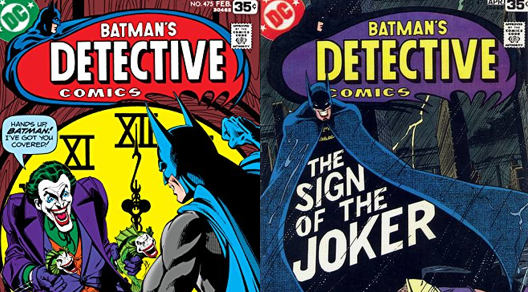
Story Title: “The Laughing Fish!” Published: February 1978
Story Title: “Sign of the Joker!” Published: April 1978
The Background: After achieving success with Clark Kent/Superman, National Comics Publications tasked Bob Kane with creating a masked crimefighter to add to their superhero portfolio and, thanks to Bill Finger, the “Bat-Man” went on to become a mainstream cultural icon. Over the decades, the Batman has gone toe-to-toe some of comics’ most recognisable supervillains, though his greatest nemesis is unquestionably the self-styled Clown Prince of Crime, the Joker. Bob Kane, Bill Finger, and Jerry Robinson all claimed to have created the Harlequin of Hate, but it’s widely agreed that the Joker’s trademark visage was heavily influenced by The Man Who Laughs (Leni, 1928). A last-second decision from then-editor Whitney Ellsworth saw the Joker survive his first encounter with the Batman, though the character faded from the spotlight under the direction of editor Julius Schwartz. Dennis O’Neil and Neal Adams reinvigorated the Joker in the 1970s and 1980s with stories such as this classic two-parter that is such a pivotal Joker story that it was adapted for the hugely popularBatman: The Animated Series (1992 to 1995). The stories played a huge part not just in giving the Joker back his edge, but in reviving the character to terrorise Gotham City for years to come as the Batman’s number one antagonist.
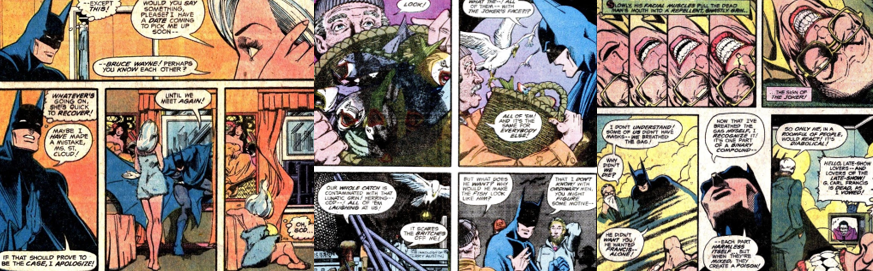
The Review: This classic two-part Batman story begins, appropriately enough, in the murky dead of night with the Batman prowling across the rooftops of Gotham City, preparing for the greatest confrontation of his vigilante career. At this point in time, billionaire philanthropist Bruce Wayne had been dated wealthy socialite Silver St. Cloud, a gorgeous platinum-haired woman who quickly captured Bruce’s heart. They became so close that Bruce suspected that Silver had figured out his dual identity, so he swings by her apartment in the guise of the Dark Knight to confirm his suspicions. Although Bruce is convinced that Silver is aware of the truth, she denies that she has anything to confess to the Batman and her demeanour convinces him that there’s a shred of doubt in his assumptions. Realising that it’d be foolish of him to simply unmask in front of her if there’s even a one percent chance he’s wrong, the Batman bids her goodnight and leaves, only for Silver’s resolve to falter once he’s gone. Wracked by her knowledge of Bruce’s dual life, Silver makes the difficult decision to take a hiatus from both men, and Gotham City, to get her head straight. The Batman is still mulling over his complicated love life and the dichotomy between his two identities when he’s aroused by local fishermen, who frantically show him that all the fish they’ve caught have been horrifically mutilated to carry the Joker’s signature smile, perplexing both them and the Dark Knight.
Batman’s personal issues are compounded by the Joker’s latest insane threat.
The phenomenon isn’t limited to Gotham City; over the next few days, reports of “laughing fish” come in from all across the country, shocking the nation. However, it’s G. Carl Francis who gets the biggest shock when the Joker himself, and his goons, storm into his office and demand that he helps to copyright the laughing fish so that the Joker can profit from every one sold. Unfortunately, Francis is duty-bound to inform the Clown Prince of Crime that fish can’t be copyrighted as they’re a natural resource, angering the Joker and causing him to threaten Francis to find a loophole before midnight or face his wrath. The Joker then pays a visit to crime boss Rupert Thorn, who’s already on edge after being seemingly haunted by the ghost of Professor Hugo Strange, whom he murdered tree issues prior. Since Thorn was one of many villains who tried to purchase the knowledge of Batman’s identity from Strange, the Joker warns him to stop trying to expose his rival’s identity as the Joker is eager to match his wits against the Dark Knight and believes unmasking him would rob his game of all its fun. With Thorn left slipping into insanity, Commissioner James “Jim” Gordon calls in the Batman to help with the threat against Francis’s life. After the Joker makes a televised promise to murder Francis, Batman meticulously checks the apartment and places him under lockdown, though he remains frustrated by the Joker’s madcap nature and unpredictable insanity. Still, the Batman acts swiftly when a mysterious gas suddenly floods the apartment. Be fixes a breathing apparatus to Francis’s face, but to no avail; Francis collapses, dead, his face twisted into the hideous smile of the Joker. Although Jim is confused since the gas didn’t harm anyone else, the Batman correctly surmises that the Joker must’ve secretly poisoned Francis at their meeting so the gas would have a lethal effect.
The Joker outwits Batman, as Silver and Thorn struggle with their literal (and figurative) ghosts.
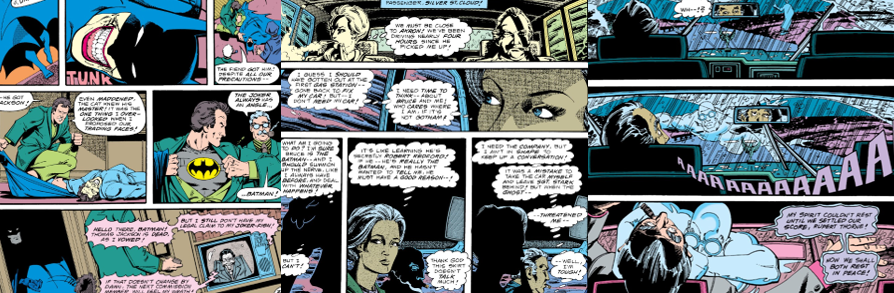
The Joker boasts of his victory through another pirate broadcast and vows to kill another bureaucrat if his legal claim on the fish isn’t approved by 3am, and the issue ends with the Batman aggravated and Silver skipping town courtesy of Rupert Thorn. The story continues in the next issue, with Batman, Jim, and Officer O’Hara keeping a vigil on the Joker’s next target, Thomas Jackson, lamenting that state laws prohibit them from simply executing the Joker since he’s clinically insane. Despite their best efforts, Jackson’s cat wanders in with a Joker fish in his mouth, which drives him to bite and instantly kill the Batman, leaving him with the pale grin of the Joker! However, Batman had actually switched places with Jackson using a clever disguise, but the cat recognised and attacked his master regardless. After the Joker mocks them through his broadcast, the frustrated Batman flees into the stormy night, momentarily spying Strange’s ghost and stumbling upon a vapor analysis meter. The story briefly jumps over to the Joker’s lair, where he somewhat breaks the fourth wall to chuckle at his wit and having bamboozled his foe, and even plots expanding his food-related antics to other products. Another detour delves into Silver’s troubled mind; she’s overwhelmed by her knowledge, unwilling to destroy the mystery of the Batman but pining for her lost love, while Thorn wrestles with the stress caused by his visions. When the radio mentions Batman, the two get into a heated debate about his presence and Thorn angrily ejects Silver from the car, leaving her by the side of the road. While she quickly finds another ride, Thorn is terrified when Strange’s ghost flies at him from the night and seemingly throttles him to death!
Batman’s victory is tainted by ambiguity and personal heartache for the Dark Knight,
At dawn, the Batman and Jim prepare for the Joker’s next attack, but Jim is horrified when the vapour analyser drives Batman to suddenly attack one of his officers, who’s quickly revealed to be the Joker in disguise! Though rumbled, the Joker keeps the Dark Knight at bay with an acid-spitting flower and makes a hasty retreat using the fire escape. Arriving in town via a cab, Silver pulls up just in time to witness the Batman in action as he ventures into the rainswept night to apprehend his foe, surprisingly caught off-guard by an errant kick and almost tumbling to the street below. While the Joker gleefully taunts his rival, the Batman ponders his own mental instability since he’s the only one crazy enough to chase after the grinning madman, and their chase takes them to the city rooftops. The two come face-to-face atop a construction site, where the Batman is forced to take a desperate plunge to avoid getting a face full of acid, and the Joker is hit by lightning while laughing on a hanging girder. The Batman watches the Joker plunge into the raging river below and frantically checks for any sign of his foe, but it appears the Joker has finally perished. Batman is then stunned when Silver approaches him, confessing not only her love for him but also that that same love caused her great pain when she watched him in battle and realised that he could die at any moment. Unable to shoulder the loss of the man she loves, or expose his true identity, she tearfully begs him to leave her alone and runs off into the night, leaving him stoic and heartbroken. Even Jim’s news that Thorn was picked up, terrified out of his mind and spilling the beans on all his criminal activities, brings Batman little comfort and he simply swings off as a new dawn rises, his victory bittersweet and emotional.
The Summary: These two stories are representative of the kind of Batman stories I grew up with. I had a handful of Batman annuals as a kid, which contained assorted stories from the 1970s and 1980s and featured names like Steve Englehart and Denny O’Neil prominently. Consequently, I have a real fondness for the gritty, dark, neo-pulp art style on show here. Gotham City is seeped in gothic darkness and flooded by incessant rain, making it grimy and claustrophobic and uncomfortable to behold, and characters are rendered with a stark realism. Although I’m not the biggest fan of Batman’s blue-and-grey ensemble, he cuts an intimidating figure here and it’s fun seeing him operate so openly with Jim and others. He’s still regarded as a bit of an urban myth, but also respected as an informed mind and necessary evil to help combat threats such as the Joker. His presence in Gotham City is the subject of much debate at this time. Thanks to Thorn’s influence, the people and council have started to question the Batman’s necessity and his impact on the city, aspects which come to be reflected in Silver’s conflict regarding her knowledge of his identity. Though these stories are all I really know of her, I like Silver and it’s not often Batman gets a love interest who knows of his dual life. I enjoyed the emotional conflict between them both, where they both knew the other knew but didn’t dare say it aloud for what it would entail, and it brings a real humanity to Batman when she has to reluctantly end their relationship to spare herself greater pain and perpetuate his myth.
Batman’s detective skills and limits are tested by the Joker and his complicated love life.
One aspect I really like about this time in Batman history is how much his detective skills are emphasised. Jim calls the Batman in as an advisor and immediately sets to work meticulously safeguarded each victim’s apartment, checking every inch for possible threats and desperately trying to prepare for every eventuality. Although his thoughts are shown to be completely focused on the task at hand, I think it’s pretty clear his frustration with the Joker’s antics is exacerbated by his personal issues with Silver. The Batman laments time and again that the Joker is nigh-impossible to predict as he just does whatever he wants for seemingly no reason, meaning Batman’s preparation and planning are meaningless as the Joker outwits him each time. Even swapping places with Jackson doesn’t help the Batman, and it’s only by utilising the analyser left for him by Strange’s ghost (or some other unknown ally) that Batman exposes the Joker’s disguise before he kills his last victim. The battle between the Batman and the Joker is depicted as a war of attrition, a game of one-upmanship, rather than a physical confrontation (at least, until the end). Like in his first appearance, the Joker hijacks television broadcasts to make threats and taunt his foe, and employs disguises and subterfuge to bamboozle even the World’s Greatest Detective. One thing I especially enjoyed here was that Bruce Wayne doesn’t appear in these stories. His personal life is of great concern to Batman, but he stays in costume throughout both issues, emphasising his unwavering focus on protecting the Joker’s victims and apprehending him. Another interesting aspect is, like in his first appearance, the Joker surprisingly holds his own against Batman thanks to being a slippery devil and surprising him with his acid flower, wild kicks, and daredevil nature.
A fantastic return to form for the Joker that emphasises his insanity and menace.
Indeed, this is a fantastic return to form for the Joker after years of being a buffoonish clown or being absent from DC Comics. Drawn as what I would define as the quintessential depiction of the character (tall, gangly, in a purple suit, coat, and fedora, and sporting an elongated jaw), the Joker is a cackling maniac whose newest plot is to spread fear and profit from his laughing fish. His scheme is ludicrous in its simplicity; he’s tainted the water supply with his Joker toxin, killing the fish, poisoning their meat, and leaving them with his signature cheshire grin, all with the intention of profiting from their sale! Obviously, these demands are preposterous but the Joker won’t take no for an answer and mercilessly targets and kills the bureaucrats he believes are denying him his intellectual rights. As mentioned, the story takes hefty influence from the Joker’s first appearance and is, in many ways, an expansion and remake of that first story. The Joker is an elusive, diabolical, and maniacal figure who tests the Batman’s mind as much as his resolve. However, the Joker is also prideful and overzealous. He enjoys toying with Batman so much that he threatens Thorn to stop trying to unmask the vigilante and arrives, in person and in disguise, to finish the job by the end, a decision that proves to be his downfall. However, there’s a clear suggestion that the Joker doesn’t care; he doesn’t care about winning, losing, living, dying, or being locked up. He simply enjoys jousting with Batman and takes glee in their conflict, and the death and terror he spreads, fully aware that the Batman’s moral code keeps him from cross that line. In the end, these are two essential Joker stories; they highlight his outrageous nature, his chilling menace, and his versatility as one of the Batman’s most enduring foes. It’s also a great showcase for the Dark Knight; not only of his detective skills and standing amongst his peers but also the complicated dichotomy of his dual identity. In a nutshell, I’d say this two-parter is a must-read Batman tale, as is most of this run since this really was a great time in the Batman’s publication history.
My Rating:
⭐⭐⭐⭐
Rating: 4 out of 5.
Great Stuff
What did you think to the Joker’s plot to profit off his laughing fish? Did you enjoy this era of Batman’s history? Are you a fan of more cerebral challenges for the Dark Knight or do you prefer it when he’s beating villains up? What did you think to the subplots involving Silver St. Cloud and Rupert Thorn? Do you consider these two stories essential reading for any Batman and Joker fans? What are some other Joker stories you enjoy? Whatever your thoughts, leave a comment below or and be sure to check out my other Batman and Joker content across the site.
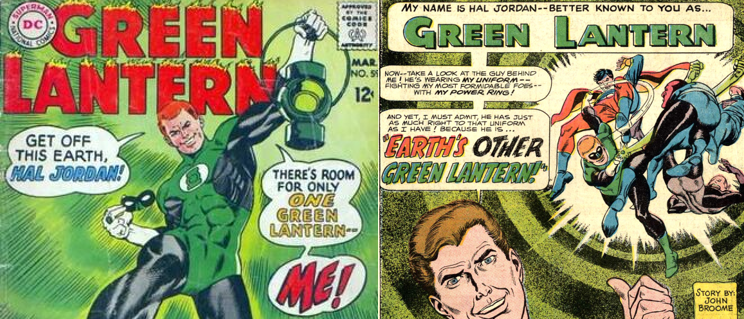
Although February 2014 was dubbed “Green Lantern Day” (because, by the American calendar, the date read as “2814”, the sector of space assigned to Earth in DC Comics), the significance of this date has passed as the years have changed. Instead, as perhaps the most popular iteration of the character, Hal Jordan, first appeared in October of 1959, I’m choosing to dedicate every Sunday of October to the Green Lantern Corps!
Story Title: “The Origin of Green Lantern” (or simply “The Green Lantern”) Published: July 1940 Writer: Bill Finger Artist: Martin Nodell
The Background: The peacekeepers of the galaxy, the Green Lantern Corps, are popularly known as a space-faring force comprised of various creatures and aliens from across the cosmos, but this depiction of the Emerald Warriors has only been around since 1959. Originally, there was only one colourful superhero known as Green Lantern, Alan Scott. The brainchild of artist Martin Nodell, the Green Lantern was inspired by Richard Wagner’s Der Ring des Nibelungen (The Ring of the Nibelung), the sight of a trainman’s green railway lantern, and elements of Greek mythology. After his pitch for a superhero who wielded a magical ring was approved by DC Comics publisher Max Gaines, Nodell set to work crafting Alan Scott’s first story and soon brought in the legendary (and often forgotten) Bill Finger to help with the project, cementing a partnership that lasted for seven years. After his debut in this issue of All-American Comics, Alan Scott became a regular fixture of both the publication and DC’s first super team, the Justice Society of America (JSA). It’s this association with the JSA that I best know Alan for. As chairman of the group, he fought numerous intergalactic and Lovecraftian threats, gained a degree of eternal youth thanks to various magical enhancements and time dilations, and mentored a new generation of heroes, including his wayward son. Even after he was supplanted by his more sci-fi-orientated successors, Alan Scott remained a prominent figure in DC Comics, gaining additional relevance when he came out as gay in 2020, retroactively establishing him as DC’s first-ever gay superhero. Outside of the comics, however, Alan hasn’t been quite as significant. He missed out on appearing in Justice League (2001 to 2004) and has been largely absent or relegated to brief cameos in other cartoons and live-action shows, potentially due to Warner Bros. often blocking Green Lantern appearances after the critical mauling of Green Lantern(Campbell, 2011).
The Review: The story opens “out in the Great West”, where s train is making a test crossing over a new-constructed trestle bridge. Alan Scott, the young engineer who spearheaded the bridge’s construction, is in the cab with a colleague to oversee the test run, which seems to be asking for trouble, in my opinion. Indeed, Alan’s colleague is anxious that Alan’s rival, Alert Dekker, might try to sabotage the operation since Alan’s “company” outbid Dekker’s and cost him a big, fat government contract. Although Alan is confident that Dekker wouldn’t try anything, his optimism is immediately proven wrong as the bridge explodes beneath them, sending the train, its carriages, and all aboard crashing into a ravine. By “some strange miracle”, Alan is the sole survivor, merely being shaken up and coming over all queasy as he holds onto a mysterious green lantern. Suddenly, the artifact bursts to life, emitting an “eerie green light” and, even more incredibly, speaking to him! The lantern tells a tale that begins back in ancient China, where a village’s evening prayers were suddenly interrupted by the arrival of a huge meteor. The meteor cracked open before impact, depositing a pool of flaming emerald liquid before their amazed eyes. This Green Flame spoke to them and delivered a fairly ominous prophecy: “Three times shall I flame green! First – to bring death! Second – to bring life, and third – to bring power!” The villagers were in awe, believing the Green Flame had come from the “Evil One”, a subject about which Chang, the lamp maker, knew a great deal thanks to his studies of the “Old Book”, which had raised some suspicions about his intentions.
After surviving a train crash, Alan Scott is gifted incredible power by a green lantern.
Chang used the Green Flame to forge a lamp, which the paranoid villagers believed will anger their Gods and bring them only suffering, so they barged in, burned Chang’s books, and attacked him, causing the lamp to burst to life and punish them all, bringing death as it foretold. Over the years, the strange lamp passed between many hands, bringing destruction to the bad and luck and fortune to the good, eventually appearing in the rubbish bin of an insane asylum. The staff decide to give the lamp to Billings, a harmless Chinese patient of theirs known for forging lanterns, and it’s Billings who transfigures the lamp into its more familiar lantern shape. In return, the lantern awakens once more an brings “life” by curing Billings of his insanity, allowing him to leave the asylum as a sane, free man. And, from there, the green lantern eventually made its way onto Alan Scott’s train and into his hand (how isn’t detailed here) to fulfil the final stage of its prophecy, bringing power to the dazed engineer. The lantern tasks Alan with using this great power to seek out and oppose evil, to be a light against the darkness, and that he will retain this power as long as he has “faith in [himself]” for “will power is the flame of the Green Lantern”. After seeking clarification, Alan is instructed to craft a ring for himself from the lantern’s metal so he can always carry its power with him, though he must touch the ring to the lantern every twenty-four hours to recharge it (because…ugh…I guess faith and will power isn’t all that powers the magic?) After gathering his wits, Alan initially believes the whole experience to have been some mad dream but, when he grabs the lantern and feels its power, he knows that it was all true and, angered at the sight of his dead colleagues and Dekker’s amoral actions, he vows to make his rival pay for his murderous ways. To that end, Alan does as the Green Flame instructed and makes himself a ring; but, when he puts it on, he realises that his murderous lust for revenge is wrong and that he must find a more virtuous way to fight Dekker.
Alan’s magical powers see him confront his rival and begin a career as the Green Lantern.
Alan then spends a few panels testing out his newfound powers; he wishes to fly to Dekker’s house and the ring allows it to be so. His desire to “[go] through the fourth dimension” allows him to easily pass through the walls of Dekker’s place and appear before the callous businessman and his mooks in a puff of green smoke and light. Appearing as a “wraithlike figure”, Alan seems to be a ghost to the astonished goons, but Dekker assumes it’s simply a trick and orders them to shoot the young engineer. Although the bullets just pass through Alan’s body and a knife simply breaks against his chest, a wooden club to the temple surprisingly brings Alan down, so he assumes that wood is his vulnerability. He also notes that he doesn’t possess superhuman strength (though, presumably, he could will himself to if he actually bothered…), but thankfully he’s skilled enough to overpower Dekker’s minions and scare them off. Fearing for his safety, Dekker attempts to barter, offering Alan money and his friendship, so Alan toys with his rival by flying him through the sky and threatening to drop him to his death to force a confession. Terrified, Dekker admits that he caused the explosion and promises to cover the payments and sign a confession. However, right after he does this, the stress of it all causes him o suffer a fatal heart attack. Mourning the waste of life, Alan retires to his unseen “sanctum” and pledges himself to fighting against evil in all its forms, realising that he needs a “bizarre” costume that will ensure evildoers never forget him once they encounter him. To that end, he fashions one of the gaudiest red and green numbers in all of comicdom and vows to “shed [his] light over dark evil” as the Green Lantern.
The Summary: I don’t always have the greatest track record when it comes to Golden Age superhero stories; they’re often messy, rushed, and incredibly simplistic, echoing the pulp sensibilities that were so popular at the time. Thus, a degree of leeway must always be shown towards such stories, which are products of their time and restricted by the artistic style and expectations of the period. Having said that, I actually didn’t mind “The Origin of Green Lantern”. We don’t learn a great deal about Alan Scott beyond his profession, optimism, and thirst for justice, making him a bit of a blank slate in many ways, but there’s enough here to make him relatively intriguing. I liked that he was naïve enough to think Dekker would simply take losing out on the contract like a man, and his shock at seeing how far his rival will go to secure that government grant. It was very relatable that Alan’s first thought was to kill Dekker, though it’s not entirely clear why he has a sudden change of heart and opts to force a confession rather than kill his enemy. Alan doesn’t do anything particularly creative once he acquires the green ring, learning as he goes and testing the limits of his power with a whimsical theatricality that shows he’s getting a kick out of spooking Dekker’s men and shrugging off their attacks. Still, his stance towards injustice proves that the Green Flame chose wisely in bestowing him with its seemingly limitless power and thus leaves the door open for future stories to explore Alan’s abilities in more depth. It also allows enough wriggle room for the writers to pull whatever powers or limitations they can think of out of their asses.
The mysterious green lantern has an ominous aura and some strange limitations.
While Dekker is simply a gangster posing as a businessman, Alan doesn’t don his awful costume until the final panel, and it’s not really clear how Alan survives the crash (though I assume it’s because he was holding onto the green lantern), the titular emerald lamp is the true enigma of the story. A miracle from the stars, the Green Flame is a seemingly menacing sentient element that promise to bring, death, life, and power, apparently at random and not just once since it changes the fortunes of numerous people during a time jump. Those who witness the Green Flame are filled with awe and dread, immediately believing it to be the work of some vague “Evil One” and lashing out in fear, meaning the prediction of “death” becomes a self-fulfilling prophecy. The Green Flame also seemingly supernaturally inspires individuals to forge it into new forms, such as a lamp, lantern, and a ring, so it can pass between new hands over the years. I’ve always found the idea of a magically empowered lantern to be one of the most random concepts in comics. Surely just the magic ring is more sensible, after all, and a superhero taking the name “Green Lantern” not only feels redundant but also announces his source of power to his enemies, not unlike his later JSA colleague, Rex Tyler/Hourman. The Green Flame is also quite vague in its limitations here. It’s said that willpower will allow Alan to wield great power, but he also needs to have a piece of the lantern on him at all times and recharge his ring every twenty-four hours. He’s then strangely injured by wood, of all things, a vulnerability that seems particularly dangerous when you stop and think about it. Still, the ring allows him to fly, pass through walls, and deflect all other attacks, and I have to assume that Alan is still too new to the superhero life to think about increasing his strength or trying anything fancy like creating hard-light constructs and such. In the end, this was a mostly inoffensive tale. It definitely could’ve been better in many ways, but I think it established its bizarre premise just enough to give us a colourful new superhero with a strong sense of justice. The story is worth a read just to see how the sprawling Green Lantern mythos started with one young train engineer and an ominous lantern from the stars.
My Rating:
⭐⭐⭐
Rating: 3 out of 5.
Pretty Good
Have you ever read Alan Scott’s debut story? What did you think to it and how do you think it compares to other superhero origins from the Golden Age? Were you surprised that Alan Scott’s origins are so different from other Green Lanterns? Would you have liked to see more of the Green Flame’s time influencing others? What are some of your favourite Alan Scott stories and where does he rank for you in the Green Lantern hierarchy? How are you celebrating Green Lantern this month? Whatever your thoughts on Alan Scott, and the Green Lantern Corps, leave them down below orand be sure to check out my other Green Lantern content.
In the decades since his first dramatic appearance in the pages of Detective Comics, Bruce Wayne/Batman has become a mainstream, worldwide, pop culture icon. The brainchild of writer Bob Kane, Batman was brought to life by artist Bill Finger and has been a popular staple of DC Comics and countless movies, videogames, and cartoons over the years. “Batman Day” fell on 21 September this year so I’ve been spending every Saturday celebrating comic’s grim and broody vigilante.
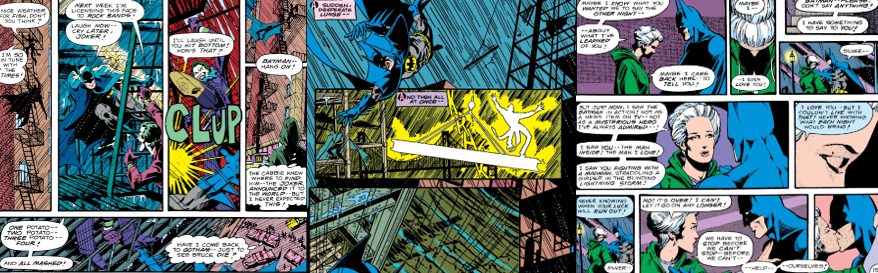
Released: 18 July 2008 Director: Christopher Nolan Distributor: Warner Bros. Pictures Budget: $185 million Stars: Christian Bale, Heath Ledger, Aaron Eckhart, Maggie Gyllenhaal, Gary Oldman, Morgan Freeman and Michael Caine
The Plot: After his dramatic debut as “The Batman”, billionaire vigilante Bruce Wayne (Bale) is cracking down on organised crime within Gotham City. However, his mettle is tested by the clown-faced anarchistic “The Joker” (Ledger), who seeks to disrupt social order and corrupt upstanding district attorney Harvey Dent (Eckhart).
The Review: After the disaster that was Batman & Robin (Schumacher, 1997), I think it’s safe to say that everyone thought Batman’s feature film career was dead in the water. For me, that’s why Batman Begins was such an exciting and enjoyable experience. Finally, after decades of Batman being either a goof or a psychopath, we got a live-action film that really nailed the heart and drive of the character. The extended and in-depth exploration of Bruce’s psyche, determination, and training to become “more than just a man” really put him at the forefront of the piece and allowed the most accurate depiction of the Dark Knight ever seen in cinema at that point as Bale deftly shifted between numerous subtle personas. With Batman Begins’ conclusion masterfully teasing the Joker, expectations were high for the sequel, but reactions to Ledger’s casting were mixed at the time due to his reputation as a “pretty boy”. To address this, Nolan opens his film with an intense and engaging bank heist, filmed entirely in IMAX, in which the mysterious Joker showcases his hands-on, manipulative abilities by arranging for his clown-faced goons to knock off a mob bank and off each other once their specific tasks are completely, allowing him to easily slip away in the chaos. It’s been about a year or so since the last film and Batman now appears at crime scenes to liaise with Lieutenant James “Jim” Gordon (Oldman), much to the chagrin of cops like rookie detective Anna Ramirez (Monique Gabriela Curnen) because of his vigilante status and the corruption that continues to infest the Gotham City Police Department (GCPD). However, neither Batman or Gordon initially place much stock in the Joker’s continued threat since their focus is solely on taking down the last vestiges of organised crime in the city, represented by mob bosses Salvatore “Sal” Maroni (Eric Roberts), Gambol (Michael Jai White), and “The Chechen” (Ritchie Coster), a decision that’s entirely logical bit which comes back to bite them in due time.
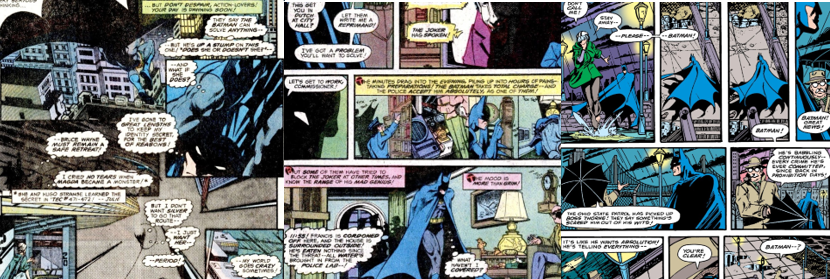
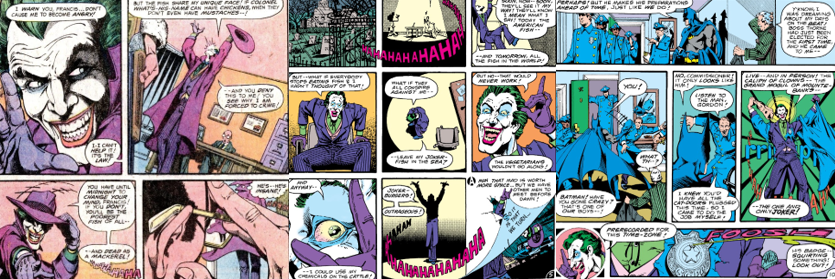
Batman’s war on crime is thrown into chaos by the maniacal Joker.
Bruce has been extremely busy in the time between films. Although he’s forced to operate out of a penthouse and highly equipped bunker in the city as he waits for Wayne Manor to be rebuilt, he’s established quite the reputation both in and out of his cowl. As Bruce Wayne, he’s the bored, party-going philanthropist who’s just as likely to abscond with a bunch of actresses to an isolated yacht as he is to fall asleep in board meetings. Although Bruce is seen by many as an aloof, reckless, and embarrassing billionaire, this persona effectively keeps anyone from questioning his nightly jaunts and he’s still savvy enough to fund and promote any programs or individuals who are committed to bringing Gotham City back to glory, such as Harvey Dent. As Batman, Bruce’s reputation is even stronger; criminals are now so afraid of the Dark Knight that they think twice about being on the streets when the Bat-Signal is in the sky and mobsters hold their meetings during the daytime. Although the Batman is still something of an urban legend, many in the city have been inspired to dress up as him and take the law into their own hands, something Bruce is disturbed to see since it results in a bunch of out of shape blokes with itchy trigger fingers wearing “hockey pads”. Still, Batman’s presence has had a positive impact on the city. He and Gordon collude to tackle the city’s mob, eventually entering a shaky alliance with Dent to apprehend mob banker Lau (Chin Hau) and make mass arrests, and Batman even detains Doctor Jonathan Crane/The Scarecrow (Cillian Murphy) in during the opening, finally taking the maniac’s drugs off the streets. However, night after night fighting crime and getting into fist, fire, and dog fights takes a toll on Bruce. His faithful butler and father figure, Alfred Pennyworth (Caine), continues to offer wry commentary and deep concern for his master’s welfare but Bruce is determined to clean up the streets and make the city safe before even considering giving up his crusade.
The loss of Rachel takes a heavy toll on Gotham’s “White Night” and drives him to murder.
However, Batman’s positive impact, the arrest of hundreds of mobsters, and the public’s approval of Dent give Bruce pause to reconsider his path. Since the last film, Bruce has been keeping a close eye on childhood friend and crush (and assistant district attorney) Rachel Dawes (Gyllenhaal), who works closely with Dent to prosecute the criminals and the corrupt. Thanks to Gyllenhaal being a far superior actress to her predecessor, Rachel has much more gusto this time around. She exudes a confidence and determination that was lacking in Katie Holmes’ performance and allows her to not only appear effective when interrogating Lau but also sees her fighting back against the Joker when he targets her at Bruce’s fundraiser for Dent. Although Bruce is clearly rattled by how close Dent and Rachel have become (the two are shown to be in a relationship) and somewhat condescending towards Dent’s marketing campaign, he’s as impressed by the D.A.’s conviction as the rest of the city. Dent is a square-jawed patriot who makes a buzz in the court room with his no-nonsense approach towards criminals and inspires the wealthy and the destitute alike with his commitment to justice. Dent is also an avid supporter of the Batman and determined to do whatever it takes to keep the city streets clean, even if just for six months, but he’s not as squeaky-clean as everyone believes. Gordon is sceptical of Dent due to his past in Internal Affairs, while Dent is highly critical of the corruption within the GCPD, but the two form an efficient trio alongside the Batman when they agree to pool their resources to bring Lau back from Hong Kong. Dent proves to be a surprisingly complex man. He believes so strongly in the iconography of the Batman and in not giving in to the Joker’s demands, no matter how many lives are at stake, that he publicly outs himself as the Dark Knight to keep the myth alive but also proves that he’s not above threatening criminals at gunpoint, showcasing an unexpectedly erratic side to his character. This is only exacerbated when Dent and Rachel are targeted by the Joker and Batman is forced to choose which one to save. Naturally, he picks Rachel but both he and Dent are horrified to learn that this was a double-cross that leaves Dent hideously scarred and despondent, his faith in both justice and the caped vigilante shattered and replaced by a cruel devotion to “chance”.
Bruce’s allies believe in the Batman and play a hands-on role in aiding and advising him.
As before, Bruce is supported in all things by Alfred, who acts as a field surgeon, conscience, and advisor to his duties both in and out of the Batsuit. We learn a little bit more about Alfred in this film through his entertaining exchanges with Bruce, in which the two share a banter that is both amusing and heart-warming. Alfred spent some time in the Peace Corps in Burma, indicating he’s seen combat and has a military background, and his insight into chaotic aberrations such as the Joker are almost on par with Bruce’s years of training to learn the criminal mind. Initially, Bruce dismisses Alfred’s insight, however, refusing to believe that the Joker is anything more than a thug with a gimmick, but is forced to admit that he’s underestimated his foe when the Joker pushes him to breaking point with his killing spree. Interestingly, Alfred actually encourages Bruce not to give in to the Joker’s demands, to “endure” the slings and arrows so as to maintain the Batman’s incorruptible persona, and also secretly shields Bruce from the knowledge that Rachel ultimately chose Harvey over him to spare his surrogate son further pain. As before, Bruce is provided with new toys and even a sleek new suit by Wayne Enterprises Chief Executive Officer Lucius Fox (Freeman), who now exhibits a working knowledge of Bruce’s dual identity despite both never outright saying it. Fox plays a pivotal role not just in helping Bruce apprehend Lau but also in throwing off the suspicions of Coleman Reese (Joshua Harto) when his number crunching exposes Batman’s identity, and in the creation of a fantastical device that allows Batman to pinpoint the Joker’s location by hacking every cell phone in the city. Though Fox threatens to resign if the device isn’t destroyed because of the dangerous invasion of privacy it offers, his loyalty is rewarded when Batman rigs the machine to self-destruct once the Joker has been located. Finally, we have Gordon, who publicly disavows any knowledge of Batman but regularly colludes with him to fight the mob. Gordon’s role is also crucial to the film as he is seemingly killed protecting mayor Anthony Garci (Néstor Carbonell), only for this to be revealed as an elaborate plan by him and Batman to capture the Joker, a gamble that sees Gordon promoted to police commissioner after the Harlequin of Hate assassinates commissioner Gillian Loeb (Colin McFarlane). Although horrified by the Joker’s murderous antics, Gordon’s riding quite the high when he, Dent, and Batman finally get their hands on the city’s mob, but his hubris comes back to bite him when Dent specifically targets him as failing to protect Rachel since Gordon’s forced to work with corrupted cops and a wayward vigilante.
Ledger delivers a star-making performance as the chaotic and unhinged Joker.
And then there’s the Joker, played with an unnerving, scene-stealing performance by the late Heath Ledger. Unlike in Batman(Burton, 1989) where the Joker was provided with a hefty original backstory, this Joker is a complete enigma. A self-styled “agent of chaos” who proudly showcases both his gruesome facial scars and boasts that he’s simply “a dog chasing cars”, the Joker is as manipulative and psychotic as he is unpredictable and hypocritical. With no identification or fingerprints, the Joker is like a ghost. When he’s introduced, it’s like he’s been conjured by the city itself to challenge Batman’s presence and there’s no definitive explanation for who he is and why he does what he does. Indeed, much like popular depictions of his comic book counterpart, the Joker himself offers conflicting versions of his origin, scars, and motivations. The film suggests he’s been “rippin’ off mob bosses” for some time, he’s shown to have an intense hatred towards city officials and authority figures, and he even openly mocks the city’s mob bosses, threatening and murdering them with a gleeful menace. Although he favours knives over guns since they’re “more personal”, he’s proficient with firearms and, especially, explosives, hinting at a military background but, in true Joker fashion, his origins are completely irrelevant as he “just wants to watch the world burn”. Initially, the Joker encourages the mob to pay him to kill the Batman so they can run rampant over the city but he becomes infatuated by the Dark Knight’s incorruptible nature and refusal to kill. Thus, his motivation switches to opposing Batman’s ideology by corrupting the city’s “White Knight”, Harvey Dent, and breaking the will of the city by exposing their heroes as flawed human beings, demanding that the Batman publicly unmask and forcing both criminals and civilians to make life or death choices to test their mortality. In combat, the Joker is wild, dangerous, and apparently suicidal. He laughs manically in life-threatening situations, practically begs Batman to run him down, and is more than willing to die if it means forcing Batman to breaking point. Although his greatest strength is his unhinged imagination (he absolutely does have a plan, despite his claims, and carries them out with an almost supernatural foresight), the Joker gets the best of even the Batman thanks to appropriating mobsters for his own use and surprising Batman with his tenacity. But his true goal isn’t to simply fight Batman to the death but to instead cripple Gotham City by proving that anyone can turn to psychotic madness after one bad day, necessitating extreme actions from both Batman and Gordon to ensure that Dent’s reputation remains untarnished.
The Nitty-Gritty: The Dark Knight represents how ingrained Batman’s iconography has become not just in the fictional world, but in ours. Just the fact that we got a Batman movie that omitted the character’s name entirely shows how synonymous this description is with the character, and it takes on a double meaning here since Batman is depicted (and, by the end, explicitly referred to) as a “Dark Knight”, a necessary evil to keep Gotham in check, since a “White Knight” has little chance of surviving the crime and corruption that infests the city. Indeed, Bruce is actively considering hanging up the cape and cowl when he sees how effective and unanimously beloved Dent is. Dent is the hero Gotham deserves without a masked persona, giving Bruce a sliver of hope that he can make good on his promise to be with Rachel once the city no longer needs Batman, but he vastly underestimates the destructive influence of the Joker, who perfectly encapsulates Gordon’s previous concerns about “escalation” through his unique brand of anarchy. The Joker is depicted as a man even Bruce “doesn’t understand”, someone beyond reason, intimidation, and bribery, and we see this when he shows no fear when interrogated by Batman and simply cackles with glee when the Dark Knight unloads on him since the Joker always has an ace up his sleeve (both literally and figuratively). Thus, the film very much focuses on the “battle for Gotham’s soul”, with the Joker shifting his motivation towards opposing and destroying not just the city officials and authority figures, but Batman himself since he’s the ultimate symbol of incorruptibility, to the point where he and his allies allow five people to die rather than reveal his identity because the Batman has become such an iconic force for justice within the city.
Some impressive practical effects and stunts make the film instantly memorable.
Speaking of Gotham, we’re shown a much different side of the city this time around. We’re firmly topside amongst the towering, glistening skyscrapers rather than in the dingy alleys of the Narrows, which is thematically relevant since the Joker is targeting the upper-class façade of the city but does rob it of a lot of its bleak, gothic identity. The Dark Knight also continues Batman’s crusade not against the street-level crime that killed his parents, but organised crime. He, Gordon, and Dent believe cutting the head off the proverbial snake will kill the body, and this is reflected after their big arrest that sees the lower-level scum facing at least six months in jail, giving the city breathing time to recover. However, this has the knock-on effect of reducing Batman’s street-level crimefighting to near zero since he’s more focused on nailing the likes of Maroni and the Joker and less on stopping random muggings and such. This isn’t necessarily a bad thing because, sadly, there’s little to no improvement in the fight scenes here. Nolan again opts for a close quarters, frenetic depiction of Batman’s fighting that does paint him as a brutal and efficient animal but robs us of seeing what he’s truly capable of. On the plus side, The Dark Knight explores Bruce’s detective skills; while it’s a bit confusing how he recreates fingerprints from bullet casings and he’s constantly one step behind the Joker, I liked how he colluded with Gordon and Dent to apprehend the mob and he’s given some fancy new toys to help him in these endeavours. The most prominent remains the tank-like Tumbler but, when this is destroyed by the Joker, Batman spends the remainder of the film blasting through the city streets on the sleek, bad-ass “Batpod”, a motorcycle-like vehicle that performs all kinds of unlikely turns and tricks with its near-spherical wheels, When extraditing Lau from his office building, Batman makes impressive use of his cape to soar through the skyline and then uses a “skyhook” to yank himself and his quarry out of there, just one of many impressive practical effects utilised in the film, with two more being the Joker’s insane truck flip and the fully practical, full-scale hospital explosion.
While I don’t like the new Batsuit, the Joker and Two-Face look especially impressive.
As mentioned, Batman gets a new suit this time around once he realises that he’s “carrying too much weight” and needs more flexibility. Sadly, I’m not a fan of the new suit; it allows full head movement and is less bulky, sure, but the Bat-symbol is too small, it’s unnecessarily “busy”, and just seems incredibly impractical to put on. It’s also far less durable; separation of the plates means Batman’s more vulnerable, which levels the playing field in his fight with the Joker, and the whole suit just looks too plastic-y and ugly for me. On the plus side, the Joker looks amazing; this might be my favourite depiction of the Joker and he looks ripped right out of a Lee Bermejo comic. While he still sports a permanent grin thanks to his facial scares, his clown make-up is haphazard and intimidating, specifically applied to resemble “war paint” and even degrades to reflect his insanity. His suit is also absolutely perfect, and I love how it’s filled with “knives and lint” and little booby traps, like grenades and such. The Joker also assumes various disguises, included dressing up as one of his own henchmen in a callback to the 1960s TV show, masquerading as a police offer at Commissioner Loeb’s funeral, and, most disturbingly of all, dressing up as a nurse to have a heart to heart with Dent! This is where the film really surprised me; obviously I half-expected Dent to become Two-Face (or “Harvey Two-Face” as films insist on labelling him…) but I never expected Nolan to go so comic-accurate with the depiction of Dent’s burns. Two-Face is absolutely gruesome to behold and the perfect example of how CGI can be used sparingly to enhance practical effects. You can see tendons, muscle, and charred flesh as Dent talks and he really does look like the comic come to life, almost to a fault as I find it difficult to believe that he’s talking so coherently and functioning so efficiently despite refusing pain medication. Similarly, I think we could’ve had a few more scenes exploring Dent’s dark side and his “lucky coin” before his scarring. His descent into vengeance and anarchy seems purely motivated by grief, perceived betrayal, and anger at having “lost everything” rather than having always had a dark side deep within him. Sure, there’s one scene where this is hinted at but it’s not what it seems; Dent never leaves anything up to chance since his coin is double-sided, meaning the odds are always in his favour. Accordingly, he was never actually going to hurt anyone, though this is twisted when he goes on a killing spree as Two-Face as he shoots his enemies dead based on the flip of that same coin.
Crushed by Rachel and Dent’s deaths, Batman sacrifices his reputation to keep hope alive in Gotham.
Another element that doesn’t sit right with me is how everyone (and I do mean everyone) is aware of Batman’s code against killing. Maroni and the Joker challenge him on his “one rule” and Batman openly champions it at every turn, severely diminishing his threat somewhat and presenting a familiarity with him that irks me for some reason. A huge part of the Joker’s final plan is predicated on the notion that even “civilised people” will kill to survive. He even rigs the game in his favour to prove this point and is so determined to tarnish the Batman’s heroic visage that he plummets to his death with a maniacal laugh. However, Batman saves him at the last second and the two have an unnerving conversation about their duality and intertwined fates. This is made doubly uncomfortable not just because of Bale’s strained Bat-voice but knowing that they would never tangle again due to Ledger’s untimely death, and part of me wonders if it might’ve been better to insert an edit that shows the Joker willing die after giving his speech. When I first saw The Dark Knight in the cinema, I was so engrossed in the Batman’s fight against the Joker that I completely forgot about Two-Face and, as much as I enjoy the entire film and the finale, I wonder if it might’ve been better to incorporate Two-Face’s actions into the third film and cap things off here. Regardless, both Dent and Bruce are devastated when Rachel is brutally murdered by the Joker. This helps tip Dent over the edge and to kill those who’ve wronged him, but he forces Gordon to choose which of his family should be killed to teach him a lesson in pain and loss. When Batman arrives to confront Two-Face, both he and Gordon desperately try to appeal to Dent’s better nature and fail. Disillusioned and broken, Two-Face disregards Gordon’s pleas and prepares to kill his son (Nathan Gamble), forcing Batman to tackle him to his death. Glossing over the fact that Batman just killed a man (I guess, technically, it was the fall), Batman decides to heed Alfred’s advice and maintain Dent’s reputation by assuming responsibility for Two-Face’s murders. Though reluctant, Gordon realises that it’s the only way to keep people from losing faith in the justice system and begrudgingly agrees to paint Batman as a murderer, ending the movie with Batman a wanted fugitive who willing endures any punishment, mental, spiritual, or physical to ensure peace in Gotham.
The Summary: I absolutely loved Batman Begins when it first came out. It was the dark, gritty, comic-accurate Batman I’d been hoping for for years and I was really excited to see where Bale and Nolan took the character in the sequel. To say that The Dark Knight exceeded expectations would be an understatement. The film is an absolute masterpiece not just of comic book cinema, but of the thriller genre. Bale continues to deftly embody the conflicting personalities and introspective drive and determination that fuels Batman’s crusade, and his Batman continues to be the definitive version of the character for me, despite the dodgy fight scenes and my dislike for the new suit. At its core, The Dark Knight works as an intense thriller depicting the fundamental conflict between justice and anarchy, logic and sanity, and truly elevated the genre to a new level by taking elaborate and colourful concepts like a clown-themed terrorist and a guy with half his faced burned off and treating them seriously. Naturally, Heath Ledger steals the show here; we may never see a better performance of the Joker and you can see that he’s as lost in the role as Bale is as Batman. Ledger’s manic energy and subtle touches really create a feeling of dread, mystery, and unpredictability to the villain, and it remains a tragedy that he didn’t live on to have more dramatic roles like this. Add to that the impressive practical effects, sweeping cinematic score and visuals, and the engaging discussion regarding Batman and his influence on the city and its criminal element and you have, for my money, one of the finest Batman movies ever put to cinema. The film masterfully pulls from some of Batman, Joker, and Two-Face’s most iconic and engaging stories to present an emotional and gripping tale of adversity for the Dark Knight. The film absolutely set the standard for both Batman and comic book movies going forward and, while the third film might have stumbled in concluding the story so wonderfully established here, it doesn’t diminish the timeless appeal of The Dark Knight in the slightest.
My Rating:
⭐⭐⭐⭐⭐
Rating: 5 out of 5.
Fantastic
Did you enjoy The Dark Knight? Where would you rank it against the other Batman movies? What did you think to Heath Ledger’s portrayal of the Joker? Were you a fan of the new Batsuit or do you also find it a bit too busy? What did you think to the effects and stunt work used in the film? Were you also surprised by how gruesome Two-Face’s scars were? Did you agree that Bruce had to maintain his identity, or do you think you should’ve come forward sooner? How did you celebrate Batman Day this year and what is your favourite Batman movie? Whatever your thoughts The Dark Knight, or Batman in general, share them below or leave a comment on my social media.
In the decades since his first dramatic appearance in the pages of Detective Comics, Bruce Wayne/Batman has become a mainstream, worldwide, pop culture icon. The brainchild of writer Bob Kane, Batman was brought to life by artist Bill Finger and has been a popular staple of DC Comics and countless movies, videogames, and cartoons over the years. So, as today is “Batman Day”, I figured this was a perfect excuse to spend every Saturday celebrating comic’s grim and broody vigilante.
Released: 25 December 1993 Director: Eric Radomski and Bruce Timm Distributor: Warner Bros. Budget: $6 million Stars: Kevin Conroy, Dana Delany, Hart Bochner, Bob Hastings, Efrem Zimbalist Jr., and Mark Hamill
The Plot: Early into his crimefighting career as the Batman, Bruce Wayne (Conroy) finds mobsters being slain by a mysterious and vicious, Grim Reaper-esque vigilante “The Phantasm” (Stacy Keach). In trying to uncover the Phantasm’s identity, Batman reconnects with his lost love, Andrea Beaumont (Delany), and uncovers a terrible connection between the two.
The Background: Artist Bob Kane may have dreamed up the idea of a new masked crimefighter to capitalise on the success of Clark Kent/Superman’s debut, but it was thelong-suppressed efforts of artist Bill Finger that the “Bat-Man” became such an iconic figure. Decades later, the likes of Dennis O’Neil sought to correct the Batman’s image following the gloriously camp (and incredibly popular) 1960s television show, but the release and relative success of Batman (Burton, 1989) and Batman Returns (ibid, 1992) saw renewed interest in the character. Consequently,Bruce Timm, Paul Dini, and Eric Radomski spearheaded a new animated series influenced by both films that became one of the most beloved and influential cartoons of its era. Batman: The Animated Series aired eighty-five episodes between September 1992 and 1995 before being succeeded by twenty-four episodes of The New Batman Adventures (known as The Adventures of Batman & Robin in the United Kingdom) between 1997 and 1999, but its initial success convinced Warner Bros. to task Alan Burnett with writing a full-length animated feature. Heavily influenced by Batman: Year Two (Barr, et al, 1987), the film was set to feature a Grim Reaper-like counterpart to Batman while also acting as something of an origin story for both the Dark Knight and his long-standing nemesis, the Joker. Filming was completed within eight months, and Warner Bros. made the last-minute decision to release it theatrically. Although this negatively impacted its box office return, Batman: Mask of the Phantasm made up for this in home media sales and is widely regarded as one of the best superhero films ever made. Critics praised the presentation and score, the slick animation, and its mature themes, and it remains one of the quintessential adaptations of the character for many Batman fans.
The Review: I watched Batman: The Animated Series as a kid, alongside a host of other popular cartoons at the time, but my memories aren’t massively clear. This is a general statement of my childhood in this regard, and I think it’s because I usually slept in at the weekends and didn’t get up until after a lot of the big cartoons had already been on, then I’d spend the rest of my time eating, playing videogames, or watching the same video cassettes over and over. Still, Batman: The Animated Series definitely made an impression on me. It was dark, surprisingly violent, and probably the most readily available incarnation of Batman since it didn’t involve buying any books or comics, so it was massively exciting when this animated feature aired on television for the first time or you saw the VHS available for purchase. The film begins in present day Gotham City, where Batman has established himself as a nocturnal vigilante but is still early enough in his career to large be considered an urban myth. As a result, Chuckie Sol (Dick Miller) has no qualms about conducting his business in the dead of night, which naturally means his money laundering deal is interrupted by the Batman. Although Chuckie slips away with his counterfeit money, he’s intercepted by a mysterious, Grim Reaper-like figure we now know as the Phantasm and so intimidated by the spectre that he drives out of the parking lot to a violent death.
The mystery of the Phantasm puts Batman in the frame, but their true identity may surprise you!
Thanks to the Phantasm, and the testimony of bystanders, Batman is fingered for Chuckie Sol’s death and councilman Arthur Reeves (Bochner) wastes no time publicly declaring Batman a violent vigilante who needs to be brought to justice. When Commissioner Jim Gordon (Hastings) remains adamant that sensationalist claims that Batman has snapped and gone on a killing spree are against Batman’s very nature and washes his hands of the entire debacle, Reeves personally leads numerous unsuccessful attempts to apprehend the Dark Knight. Batman is more concerned with analysing a piece of Chuckie’s windshield, which is stained by chemical residue from the Phantasm’s smoke, and investigating the graveyard where Buzz Bronski (John P. Ryan) was killed. Batman: Mask of the Phantasm does a wonderful job of depicting Batman’s detective skills and it’s a nice change of pace from all the thrilling action, chase, and fight sequences to follow his investigation into the murders. Additionally, there are two pressing mysteries in the feature: the identity of the titular Phantasm and the connection between the mobsters left dead in their wake. Of course, these end up overlapping but there’s a decent attempt to throw some red herrings our way. Reeves, Andrea’s father Carl (Keach), and Andrea are all potential suspects but it’s the latter who turns out to be behind the cloak and hand-scythe of the Phantasm. There’s an argument to be made that this isn’t too surprising given we’ve never heard of Andrea before this film, but the stature and physicality of the Phantasm definitely helps to keep this a dramatic reveal at the finale. Unlike the Batman, the Phantasm isn’t above killing; Andrea utilises theatricality to equal Batman, appearing to appear and disappear in a cloud of smoke, brandishes a dangerous scythe-like gauntlet, and is garbed in a heavy-duty armoured suit that makes her more than a match for Batman’s skills and gadgets when they inevitably come to blows.
Kevin Conroy delivers another stellar performance as Bruce is torn between his vow and his heart.
While Michael Keaton may have set the bar for live-action portrayals of Batman, make no mistake that Kevin Conroy remains the standard for depictions of Batman. Any actor looking to take on the iconic role must depict his three dominant personas: Public (Bruce Wayne, socialite and playboy), Private (Bruce Wayne, brooding and melancholy), and Vigilante (the grim and stoic Batman) and Conroy perfectly nails all three of these. When Bruce is attending functions and banquets, he’s a suave and smooth-talking ladies’ man known for being extremely generous with his family’s wealth, hands-on with charities and opportunities from growth and employment in Gotham, and for stringing along a seemingly endless parade of bimbos and lusty women. At home, in both the solitude of Wayne Manor and the sanctity of the Batcave, this public mask slips, allowing Bruce to confide in his faithful butler and father-figure, Alfred Pennywoth (Zimbalist Jr.), and is the closest he gets to being truly honest with anyone. And, of course, under cover of night, he stalks the criminal underworld as a theatrical vigilante, and Conroy expertly depicts the differences in each of these personas and situations with subtle changes to his tone, line delivery, and inflections that really went a long way to making this version of Batman one of the most well-realised, complex, and layered interpretations of the character. This really comes to the forefront here thanks to repeated flashbacks to an earlier time in Bruce’s life where he struggled with how to make good on the vow he made to avenge his parents’ death by tackling the criminal scum that took their lives. At this point, he’s still an angry, directionless young man whose vigilante debut goes sideways because, while he has the physical means to overpower even armed crooks, he’s at a disadvantage because he’s seen as just a man, rather than a force of darkness and justice (as he puts it: “They weren’t afraid of me!”) While brooding at their gravestone, he crosses paths with the beautiful Andrea Beaumont. Though she comes across as dismissive and aloof, she’s actually intrigued and somewhat taken by him since he has all this wealth and privilege but always seems so melancholy. As she’s also lost someone, her beloved mother, the two bond over their shared grief and, when she comes to visit him, she impresses him with her combat prowess and the two begin a whirlwind romance.
As if the mysterious and brutal Phantasm wasn’t enough, the Joker shows up to steal the show!
Bruce is so taken by Andrea that he questions his vow and contemplates a life of happiness as a benevolent entrepreneur with her by his side. He is therefore devastated when she suddenly rejects his proposal and leaves the city, forever setting him on a path of grim vigilantism. When Andrea returns to Gotham some years later, in the present day of the story, Bruce is a fundamentally changed man. A chance encounter between her and Batman accidentally reveals his true identity to her, and she greets the Batman with a cutting hostility when he’s forced to question her as part of his investigation into the recent killings (delivering a biting jibe about how he’s controlled by his parents). Buzz Bronski, a mob associate of Chuckie’s, is the Phantasm’s next target; his henchmen see him chased by the cloaked figure and crushed to death under a gravestone and mistake the “Angel of Death” for Batman, which causes a media sensation. Startled by the murders of his associates, the decrepit Sal Valestra/The Wheezer (Abe Vigoda) fears for his safety and turns to the Joker (Hamill) for protection. As if touching upon Batman’s origins wasn’t enough, Batman: Mask of the Phantasm thus provides a glimpse into the background of the typically mysterious Clown Prince of Crime. Although not named as such here, the Joker was once Jack Napier like in Batman, but we also learn that he was once a chauffeur and assassin for the mob before taking his dive into disfiguring acid. While I appreciate the effort to flesh out the Joker’s backstory a little, and the film does a decent jump of bringing him in late into the runtime, I can’t help but feel like the Joker’s inclusion was a little forced and unnecessary. It’s as though the filmmakers didn’t quite trust the intriguing mystery of the Phantasm, the glimpse into Bruce’s past, or the narrative of Batman being hunted by the police and felt they had to shoehorn the Joker in to make things more exciting.
The Nitty-Gritty: Of course, I’d be doing Batman: Mask of the Phantasm a disservice if I didn’t mention the absolutely haunting score from the late, great Shirley Walker. Having collaborated with composer Danny Elfman for Batman, Walker was the perfect choice to evoke the same melancholic, gothic undertones of Burton’s blockbuster reinvention of the character, and she’s at her absolute best here. The sweeping, operatic score really gives Gotham City an ominous, looming character, punctuates the action, and makes the more poignant moments of the film all the more heart-breaking and that’s all thanks to Walker’s absolutely iconic and memorable orchestral number. The animation must also be praised; thanks to an emphasis on shadows and darkness, Batman moves like a slick, otherworldly figure and comes across as fearsome, intimidating, and efficient all at once. Nowhere is the use of lighting more impressive than in scenes in the Batcave, where deep, never-ending shadows and darkness are at their most prominent, and this all really adds to the stark contrast between the inky black of night and the brighter, dull pastels of the few day time scenes.
The feature provides a tantalising glimpse intoBruce’s motivation to become the Dark Knight.
One thing that helped Batman: Mask of the Phantasm stand out as an animated feature was how surprisingly adult it was. Batman: The Animated Series always expertly towed the line with the censors by depicting guns and bullets rather than laser pistols, and the feature film gets away with even more to depict people smoking, modern-day pistols rather than Tommy guns, a bit of blood when Batman takes a beating, and an unexpectedly high body count for a “kid’s film” thanks to the murderous Phantasm. A central aspect of the film is the exploration into the motivation and tragedy that pushed Bruce into assuming the Batman guise. Despite travelling the world and gaining the physical and deductive skills to be a crimefighting detective, Bruce is torn between seeing his vow to the fullest extent and using his wealth to benefit the city while living a happy life with Andrea. Alfred naturally pushes him towards the latter, and Andrea even believes that his parents “sent [her]” as a sign that he can go back on his vow. Unfortunately, fate intervenes. Right after she accepts Bruce’s proposal, Carl Beaumont forces Andrea to leave the city after his dealings with the mob threaten both of their lives and, rather than explain the situation to her love, Andrea left him heart-broken and rejected. With his one last chance of a happy, normal life denied him, Bruce returns to his vow and, in a hauntingly impactful scene, embraces the cape and cowl of the Batman, losing himself to the darkness of his never-ending crusade and shocking even Alfred with his monstrous transformation.
The climatic finale sees Batman engage with the Joker, and seemingly lose his one true love forever.
Batman takes his investigation up a notch after figuring out that the Joker is involved, and the cackling madman quickly takes a perverse pleasure in hunting down the one responsible for killing his old buddies. This involves murdering Valestra and wiring to explode, reducing Reeves to a hysterical mess with his laughing gas, and trying to off the Batman with ludicrous contraptions cobbled together from the abandoned world’s fair that the Joker’s taken as his hideout. Oddly enough, once Andrea’s true identity is revealed, the Joker actually holds his own in a fight with her thanks to his acid-spitting flower and turning the fair’s animatronics and rides into death traps. Andrea, however, is driven by a murderous bloodlust. Since the Joker was responsible for killing her father, she has no problem fighting dirty, kicking him in the nuts and tracing him across the hazardous amusement park in a bid to have her revenge. Naturally, Batman makes a dramatic save and chases down his most persistent nemesis, leading to a somewhat ludicrous conclusion where Batman battles a jetpack-wearing-Joker through the skies of a dilapidated amusement park wired to explode. Determined to see the Joker pay, Andrea ignores Batman’s pleas to leave and seemingly perishes along with the Clown Prince of Crime as the world’s fair is dramatically engulfed by explosions, leaving Batman not only heart-broken but guilt-ridden at his failure to save his former flame. In the darkness of the Batcave, he finds solace in Alfred’s reassuring words and Andrea’s pendant, giving him hope that she’s still alive. Hardened by the experience, he returns to the night as the Batman, grim avenger of injustice, while Andrea sails off to an unknown future with only her own heartbreak for company.
The Summary: It’s hard to get much better than Batman: Mask of the Phantasm for pure, unadulterated Batman action. In many ways it, like the cartoon it spun out from, is one of the most striking, influential, and unapologetically faithful renditions of DC’s Dark Knight ever put to screen and perfectly captures the dark, gothic melancholy of the titular vigilante, his city, and his never-ending crusade against crime. This was one of the rare, few glimpses into a time of Bruce’s life where he was struggling to make the transition from angry, vengeful young man to grim avenger of the night and it’s absolutely tragic to see how close he came to abandoning his crusade for true love and was forced to fully commit to his dark alter ego once fate set him on that path. One of the things I absolutely love about Batman: Mask of the Phantasm is that it’s not afraid to show Batman’s more cerebral side. The mystery of the Phantasm and the killings is as crucial to the narrative as the romance between Bruce and Andrea, and is far more of a focus than the handful of fantastically realised and slickly animated fight and chase sequences. Batman also feels fallible and human while still being a fearsome and intimidating figure. He easily outmatches street level scum but can be hurt by the likes of the Phantasm and the Joker thanks to their skills and/or gadgets. As I’m also a big fan of Batman: Year Two, the Phantasm struck me as a brilliant foil for Batman. As cold and stoic as the Dark Knight, Andrea’s gruesome, cloaked persona is a dangerous and ruthless foe out for blood and nothing more, but more than a match for the Caped Crusader thanks to gadgets, theatricality, and a degree and physical ability. While I find the finale a bit over the top thanks to the focus shifting towards the Joker, you can’t deny that Mark Hamill steals the show at every turn with his maniacal performance, delivering every line with a sadistic glee that makes the Clown Prince of Crime a joy to watch. Honestly, if you know anyone who isn’t sure if they want to get into Batman or who wants to learn more about Batman, I would absolutely recommend you point them towards Batman: Mask of the Phantasm as you’ll be hard-pressed to find a better representation of everything that makes the Dark Knight such an enigmatic and alluring character.
My Rating:
⭐⭐⭐⭐⭐
Rating: 5 out of 5.
Fantastic
Are you a fan of Batman: Mask of the Phantasm? Where would you rank it against other Batman films, live-action or otherwise? What did you think tothe Phantasm, their depiction, and the reveal of their identity? Were you a fan of the Joker’s inclusion or, like me, did it kind of overshadow the rest of the plot for you? Did you enjoy Batman: The Animated Series growing up? What are some of your favourite episodes, and where would you rank Kevin Conroy’s performance? What was your first experience of Batman and how are you celebrating his debut this month? Feel free to share your thoughts on Batman: Mask of the Phantasm down below, or leave a comment on my social media, and be sure to check back in for more Batman content in the near future!
In the decades since his first dramatic appearance in the pages of Detective Comics, Bruce Wayne/Batman has become a mainstream, worldwide, pop culture icon. The brainchild of writer Bob Kane, Batman was brought to life by artist Bill Finger and has been a popular staple of DC Comics and countless movies, videogames, and cartoons over the years. “Batman Day” falls on 21 September this year and I figured this was a perfect excuse to spend every Saturday celebrating comic’s grim and broody vigilante.
Writer: Bill Finger – Artist: Bob Kane
Story Title: “The Crimes of Two-Face” Published: August 1942
Story Title: “The Man Who Led a Double Life” Published: October 1942
The Background: Following the huge success of Clark Kent/Superman, National Comics Publications had Bob Kane create another masked crimefighter to add to their repertoire. Thanks to the long-suppressed influence of artist Bill Finger, the “Bat-Man” soon became not only one of DC Comics’ most popular characters but also a mainstream cultural icon. In the years that followed, the Batman battled numerous costumed supervillains, but perhaps none are more tragic then former district attorney-turned-criminal Harvey Dent/Two-Face. Originally debuting in this two-part story as Harvey “Apollo” Kent, Two-Face was heavily inspired by the 1925 adaptation of The Phantom of the Opera (Leroux, 1909) and the 1931 adaptation of Strange Case of Dr Jekyll and Mr Hyde (Stevenson, 1886), both tales of a tortured soul, often gruesomely depicted or disfigured, who struggled with the duality of good and evil. Subsequent Two-Face stories have offered further insight into his tragic and abusive childhood, as well as further emphasising his complex relationship with Bruce Wayne, and the character is often a rival or litmus test for Batman’s different Robins. Widely regarded as one of Batman’s best villains, Two-Face has appeared as a prominent foe outside of the comics, from his renowned appearances in the acclaimedBatman: The Animated Series (1992 to 1999), Tommy Lee Jones’s bombastic portrayal in Batman Forever(Schumacher, 1995), and Aaron Eckhart’s understated turn in The Dark Knight (Nolan, 2008).
The Review: This two-part story begins by introducing us to Harvey Kent, the dashing and famous district attorney beloved by the press and nicknamed “Apollo” for his courageous stance against organised crime, such as mob boss Sal “Boss” Moroni. Kent is the lead prosecutor in the case against Moroni and wastes no time in calling the Batman to take the stand as a key witness in Moroni’s trial. Amazingly, the testimony of a masked vigilante is seen as perfectly acceptable and admissible as evidence. Batman relates how Moroni shot “Bookie” Benson while escaping from a fight and Kent produces his most damning piece of evidence: Moroni’s lucky, two-headed silver dollar with his fingerprints on it! Moroni’s so incensed by Kent’s bravado that he tosses a vial of acid right at the district attorney! Although Batman intercepts the throw, Kent is hit with a concentrated splash of vitriol on one side of his face, leaving him wrapped in bandages for an entire month. When the time comes to reveal the extent of the damage, Kent is horrified to find that the left side of his face is “scarred and hideous”. He’s even more despondent to find that his only hope, a “European specialist” Batman knows of, is currently imprisoned in a Nazi concentration camp. The Batman simply peaces out after that, advising Kent to face his fiancée, Gilda, sooner rather than later, but Kent is distraught to find his gruesome visage frightens not only children, but also his beloved Gilda. Seeing the fear in her eyes, he flies into a rage, defacing a sculpture of his former chiselled features and terrifying her almost as much as his monstrous scarring.
After being hideously scarred, Two-Face embarks on a bizarre crime spree across the city.
Tormented, driven to the brink of madness, Kent ponders this dichotomy of his explicit duality. He focuses his rage on Moroni’s silver dollar, defacing one side of it and lashing out at the cruelty of fate. Deciding that all life hinges on the flip of a coin, Kent projects his duality onto the now-scarred dollar. He resolves to decide his immediate future on a coin toss, promising to wait for Batman’s specialist to be freed if the unmarked side comes up or embark on a criminal career if the scarred side comes up. Of course, the scarred side wins and Kent rebrands himself “Two-Face”, adopting a suit to match his split face and putting his knowledge as district attorney to use in his crimes. Since everything he does is decided by this bizarre coin, one day he and his goons might rob a bank for illicit gain, but the next day he might donate his stolen money to charity! This causes public opinion of him to be fittingly divided, with some branding him a thief and a murderer and others a philanthropist and saviour. Even his goons are confused by Two-Face’s unpredictable nature, but they’re excited when the bad side wins and they undertake an elaborate scheme to rob the Brown Bond Company messenger that sees them hijack a double decker bus to rob the bondsman. As luck would have it, Batman and Robin happen to spot the mugging taking place and swoop in to intervene. Apparently well aware that Kent is Two-Face, Batman tries to talk him out of his life of crime but is stunned when his former friend pulls a gun on him and orders his men to toss him off the roof of the bus!
When Batman confronts Two-Face, the tragic villain is left clueless when his coin fails him.
Although this doesn’t come to pass thanks to Robin accidentally causing the thug driving the bus to be killed, Batman is incapacitated in the fracas and the Dynamic Duo are left to die on the out of control vehicle, though Robin manages to get to the handbrake in time. Back at his thematically appropriate lair (one side is clean and pristine and the other is a shambles), Two-Face chastises himself for his actions. Believing that he’s killed his good friend, Two-Face almost regains his sanity before lashing out at the mirror and murdering his other goon after blaming him for causing the shambles on the bus. Two-Face then steps his game up by targeting the double-feature movie house, since he’s now committed to basing his crimes on the number two, but remains unaware that Batman and Robin survived the bus crash. Upon investigating the dead body of Two-Face’s goon, the Dynamic Duo happen to find a map stuck to the sole of his shoe by a piece of gum! This leads them to the Bijou Theatre, Two-Face’s next target, where Two-Face takes over the projection booth and demands that the audience hand over their loot. While Robin takes out the goons in the projection booth, Batman swoops onto the stage for a brief fight with Two-Face while his pre-recorded message looms and rants in the background. Somehow (it’s really not too clear), Two-Face slips away, but the Batman easily tracks him back to his lair by simply…y’know, following him after Two-Face made the error of driving down a one-way street and attracting police attention. Refusing to go down without a fight, Two-Face again threatens to shoot Batman, but the Dark Knight pleads with him to come along quietly. Batman promises to testify on his behalf to argue temporary insanity and to do everything he can to see Kent gets a light sentence until that specialist can fix his face, but Two-Face is unable to make a decision without flipping his beloved coin. Unfortunately for the tragic villain, cruel fate strikes again and the coin ends up standing on edge, leaving Two-Face conflicted and incapable of deciding whether he should give up his life of crime or kill Batman and continue down his dark path.
Two-Face slips away, continues his unique crimes, and even bests Batman in a fight.
The story continued, fittingly two issues later, in “The Man Who Led a Double Life”, which picks up right where the first story ended and sees Two-Face pocketing his coin, resolving to let fate decide what he does with his life. Unfortunately, a trigger-happy cop bursts in and guns down Two-Face, believing he’s about to shoot Batman, but the bullet strikes the coin in Two-Face’s breast pocket, allowing him to survive and make a hasty retreat by leaping out of the window! Since the bullet hit the scarred side of the coin, Two-Face believes this is fate’s way of telling him to commit himself to his criminal career. His first act is to rob the doubles tennis match (during the daytime, since the coin landed good side up) and donate the cash to charity. Next, he and his goons kidnap matchstick mogul Henry Logan, whose entire home is apparently made out of matchsticks, but Batman and Robin are stunned to find it was actually the cantankerous tycoon’s double who was taken since Kent knew about Logan’s doppelganger from his time as district attorney. Batman and Robin are disgusted by Logan’s indifference towards his double’s fate and his selfishness, but the reclusive hobbyist agrees to pay Two-Face’s $200,000 ransom. However, when Logan and his wife arrive at the disused barn to make the transfer, Two-Face is enraged to find he’s been tricked and that it’s Batman and Robin in disguise! Batman and Robin easily overpower Two-Face and his mooks. Although one of the goons buries Robin under a pile of hay, Batman continues hammering Two-Face after the scarred villain tries escaping on a motorcycle. Laughably, Batman is felled when Two-Face tosses his coin at his forehead; however, Batman is spared since Two-Face “[is] not a killer yet” (despite it being said that he was in the first story) and still has some compassion for his former friend.
Two-Face’s attempt to return to his wife, and succeed at crime, are thwarted by the Batman.
When Batman and Robin return the double to Logan, they find the tycoon to be as grating as ever, so Robin teaches him a lesson by dropping a lit match into his shoe, something the Batman simply laughs about despite the fact that the house place could’ve gone up in flames! Anyway, after spotting a loved-up couple in the street, Two-Face decides to pay a visit to his lost love, Gilda. Gilda is elated when the fully restored Harvey Kent surprises her at home, but he ensures she doesn’t get too close to his face. Over a candlelit dinner, he promises to come back to her and forgo his criminal ways if she waits for him, but is incensed when her happiness turns to horror after the heat from the candles melts the wax make-up covering his hideous scars. Gilda is driven to tears by the revelation that Kent has completely lost himself to wickedness and insanity, but Two-Face flies into a rage when Batman bursts in since he assumes she was colluding with the Dark Knight. Once again, Two-Face escapes through a window and he avenges his misfortune on the mask and make-up factory that cost him his love. Two-Face and his goons beat up the proprietors and torch the place, leaving the mask-maker destitute and his son swearing revenge. The story then leads us to believe that, despite Dick’s warnings, Bruce uses make-up to infiltrate Two-Face’s gang as “Getaway” George when the coin flips in his favour. Two-Face’s next target is the double-header baseball game between the city’s fire and police departments, in which honorary police officers Batman and Robin are publicly seen participating. Two-Face brazenly steals the $50,000 takings and even takes the mayor hostage at gunpoint after Robin beats up his minions. When Two-Face gets back to his lair and finds the cops waiting, he assumes that “Getaway” is Batman in disguise and is stunned when the real Dark Knight barges in to deliver a swift uppercut. It turns out that “Getaway” was the mask-maker’s son working in cahoots with Batman, and Two-Face bitterly comments on the irony of being double-crossed by one of his own gang in the end.
The Summary: Two-Face’s links to Jekyll and Hyde aren’t simply thematic, they’re explicit. Hell, the first dialogue box on the opening page of “The Crimes of Two-Face” not only refers to Two-Face as “a twentieth-century Jekyll-Hyde” but even shows the disfigured criminal reading a copy of the book! I may be committing a literary sin here, but I haven’t actually read that book so I can only speak to the widely regarded themes of duality and man vs. monster that are at work in the text, but “The Crimes of Two-Face” definitely goes out of its way to draw parallels between Kent’s fate and that classic piece of gothic literature. They are, however, really only skin deep. Sure, we only see Kent for a few panels before he’s hideously scarred, but there’s no indication in either story that he was anything but a model citizen and champion of justice. More than once, he and Batman refer to each other as old friends and Two-Face is noticeably conflicted about the Dark Knight, more so than his criminal career, it seems. Indeed, it’s quite jarring when Kent just suddenly decides he has only two options: wait to be fixed or turn to crime, but it’s pretty well conveyed that his ghastly condition has caused him to snap. Batman refers to him suffering from temporary insanity, the text boxes allude to his rage, and Gilda’s reaction to his outburst all point towards this, but it’s still quite the sudden turn from model civil servant to notorious bank robber. One thing I did enjoy was that the reveal of Two-Face’s horrific visage is kept hidden to start with, so we only see it when he reluctantly reveals himself to Gilda, which builds a sense of anticipation about what he looks like. It’s a shame that he’s depicted with a literal line running down the middle of his face, but I can forgive that given the simplistic art of the time.
Despite Two-Face’s obvious gimmick, there’s little detective work involved in stopping him.
We’re well into Batman’s time as a much brighter, kid-friendly character here. He’s appearing in broad daylight, working alongside the police, and even taking to the witness stand and playing baseball, for God’s sake! Now fully deputised members of the police department, Batman and Robin are seen as assets rather than vigilantes and are specifically brought in by Police Commissioner James “Jim” Gordon to help with the Henry Logan kidnapping case. More importantly, the Batman had a close working relationship with Harvey Kent that sees him repeatedly appeal to his better half in “The Crimes of Two-Face”. Sadly, we never get to actually see the extent of their friendship. It’s simply said and inferred by their dialogue, and neither story explores Bruce’s reaction to his friend’s condition or delves into how conflicted he feels about Two-Face. Instead, Batman tries to out-think the tragic villain, occasionally begs him to listen to reason, and settles for socking him in the jaw when he refuses to come quietly. By the end, Batman views Two-Face as just another colourful supervillain and there’s no indication that he wants to try to help or rehabilitate his former friend; he just wants him locked up. As a villain, Two-Face is both visually interesting, surprisingly tragic, unpredictably volatile, and incredibly restrictive. Since he dictates his actions on a coin flip, his crimes can either be horribly violent or unnervingly charitable, casting him almost as an anti-villain since he’ll help those in need with ill-gotten gains and even kill his own men if they violate his rules. This makes the coin his most obvious Achilles’ heel, but it’s at least tied to his dual and conflicting nature. His obsession with the number two is far more of a crutch and I’m surprised that more wasn’t made of it. Once again, Batman and Robin do very little detective work here (they happen upon that map and Batman simply guesses that Kent would return to Gilda) so there’s no depictions of them trying to figure out Two-Face’s next scheme or running around the city looking for obscure references to the number two. It’s simply them reacting whenever Two-Face strikes or stumbling upon a lead.
Two-Face is a tragic and visually interesting character even in his more basic debut story.
Still, while Two-Face’s complex nature, volatile personality, and relationship with Batman is only touched upon or inferred in “The Crimes of Two-Face” and “The Man Who Led a Double Life”, both stories were surprisingly fun and unique tales. It’s not often that Batman’s villains had such a tragic twist to them back then and the references to Two-Face using his knowledge as district attorney for evil only add to the cruel twist of fate dealt to this once handsome and honourable man. I enjoyed Two-Face’s lamentations, which were suitably Phantom-esque, and his whole gimmick, including the split suit and lair. Despite seeing it as a handicap, I’ve always liked the double-headed coin aspect of the character and I enjoyed how quickly he became fixated on the coin’s decisions and how he was rendered panic-stricken and impotent when the coin landed on its side. I think “The Man Who Led a Double Life” would’ve been served better if it had begun with a babbling and broken Two-Face being taken into custody and seeing doctors try to salvage his mind and face until he inevitably returned to his evil ways, but that was kind of toyed with when he desperately resorted to a wax facsimile to reconnect with Gilda. Overall, the two tales didn’t exactly blow my socks off and there are definitely better Two-Face origin stories and tragic tales out there, but they were entertaining enough. Two-Face is an elaborate criminal with a unique, if narratively exhausting, gimmick and has (and continues to have) a tragic appeal to him that’s prominently introduced here, even with the lacklustre depiction of Kent’s time before his scarring.
My Rating:
⭐⭐⭐⭐
Rating: 4 out of 5.
Great Stuff
Have you ever read the two-part debut of Two-Face? If so, what did you think to it, which of the two was your favourite, and where would you rank Two-Face in Batman’s villain hierarchy? Would you have liked to see more backstory given to Harvey Kent? What did you think to his coin, obsession with the number two, and the depiction of his volatile duality? Did you enjoy Batman’s time as a brighter, friendlier character or do you prefer the brooding, grim Dark Knight? What are some of your favourite Two-Face stories and which interpretation of Two-Face is your favourite? Whatever your thoughts on Two-Face, share them below or on my social media, and be sure to check out my other Batman content!