
Back Issues: The Crow

Story Title: “Inertia”, “Pain”, “Fear”, “Irony”, and “Despair”
Published:
January 1989; February 1989 to May 1989
Writer/Artist:
James O’Barr (as “J. O’Barr”)

The Background:
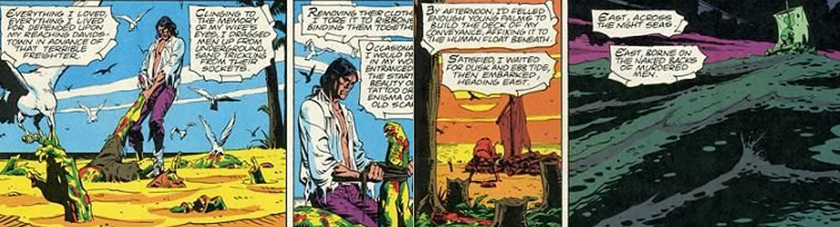
The Crow began life as a comic book published by Caliber Comics in 1989, with the title character’s first appearance being a short prequel tale, “Inertia”, which was published in Caliber Presents #1 (January 1989). The comic book was the creation of writer and artist James O’Barr as a way of coping with the pain and loss he felt after losing his fiancée to a drunk driver. Although it took O’Barr nearly ten years to find a publisher, The Crow became an underground success thanks to its bleak tone, striking black and white artistic style, and emotional narrative. Wildly regarded as one of the most unique and poignant tales in the industry, the comic book achieved even greater mainstream success with the release of a suitably bleak 1994 feature film adaptation. Although The Crow (Proyas, 1994) was a cult hit, its sequels were disappointingly lacklustre; nevertheless, the original comic remains a highly regarded masterpiece and was succeeded by a number of spin-offs and subsequent stories.

The Review:
I first became aware of The Crow in very much the same way as I’m sure a lot of people did: by watching the first movie, which immediately captivated me and made me curious enough to seek out the original comic book. The story begins in the grimy, dangerous streets of Detroit, where gangs and crime and vice run rampant; the first thing we see is small-time thug Jones Transfer, a muscle-bound skinhead desperate for a fix of cocaine and having just swiped a Toshiba cassette player. His exhilaration turns to horror, and then anger, when a large, shadowy figure draped in a long black trench coat and with a face painted into the image of irony (a perpetually smiling clown-like face that is decidedly at odds with his generally more stoic and column appearance). Completely unfazed by Jones’s switchblade, even after it’s stabbed into his shoulder, the clown-faced mystery man demands to know the whereabouts of another local thug, T-Bird, and his cronies (Tom Tom, Top Dollar, Fun Boy, and Tin Tin). Jones is terrified to see the ghostly figure remove the switchblade, lap blood from the blade, and reveal that he tortured Jones’s friend and associate, Shelby the Giant, by clipping off his fingers one by one until he gave up everything he knew. Convinced, and desperate to save his own miserable life, Jones reveals that where each of the ghost-man’s targets can be found throughout the city, and is left alive to tell the thugs that he (as in, the painted-up vigilante) is coming for them.
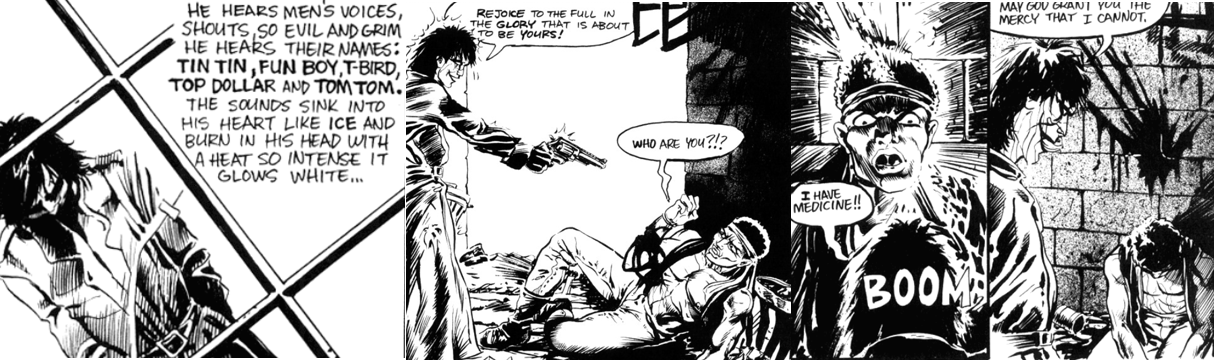
Tormented by his fragmented memories, the Crow executes his first victim.

When the story proper begins, both the art and the presentation has shifted somewhat; text boxes allow us into the mind of the ghost-faced vigilante, now identified as “The Crow”, who stalks through the murky city streets and broods in an abandoned house outside of the city, constantly reliving the memory of a girl being attacked, though he cannot remember the exact specifics. All he can think about are the names of those responsible, and we transition over to find one of them Tin Tin, testing out a gun on a hapless pedestrian. He guns down the seller, and the little punk who arranged the sale, caring only about sending a message to Top Dollar’s would-be competition and little for the innocent woman’s cat, Gabriel, who would be left homeless as a result of his actions.  Thankfully, we don’t have to wait long for Tin Tin to pay for his reprehensible nature as the Crow immediately confronts him down a dark alley; showing no fear and completely no-selling an errant shot to the head, the Crow downs Tin Tim with a bullet to the wrist and, after bombarding Tin Tin with nonsensical religious statements, triggers his victims memory by detailing his part in attacked a man and a girl on a cold October night. Although Tin Tin begs for his life, pinning the blame entirely on T-Bird and the drugs they were on, the Crow, wracked with fragmented memories of happier times, shows no mercy and blows the asshole’s head clean off.
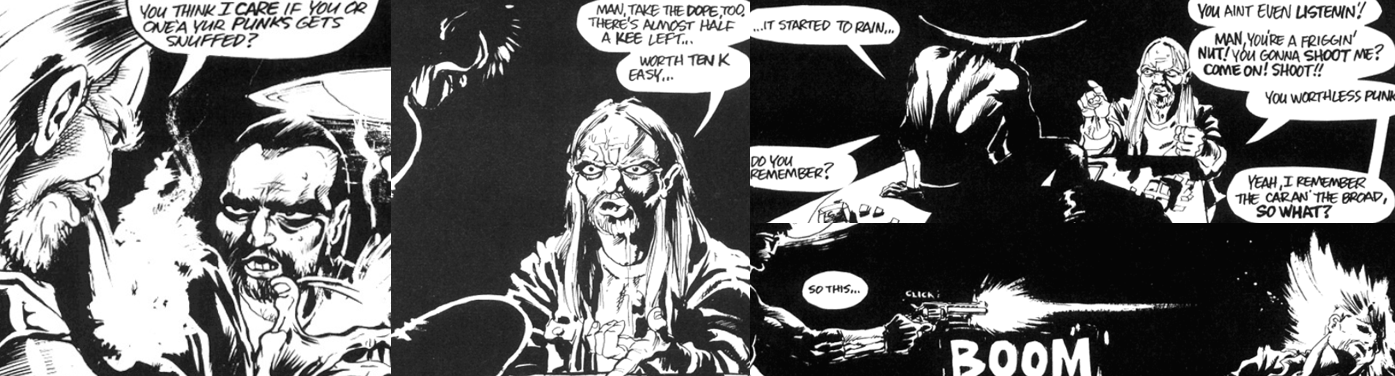
The Crow wastes no time in dispatching the top player in town.

The Crow ties a shotgun shell into his hair to indicate that the first of his victims has fallen, and Tin Tin’s death causes some concern amongst his shit-kicking associates; Top Dollar, the self-styled head honcho of the neighbourhood, is unconcerned, however. He doesn’t give two shits what the street punks think about it, or that Tin Tin got killed, and vehemently asserts that he owns the dope, the neighbourhood, and that “[his] word is the law!” Top Dollar is quickly convinced to give a shit, however, when the Crow gate-crashes the meeting and guns down everyone there. Some of the punks are sporting bulletproof vests, but the Crow is as unfazed by this as he is by their wild bullets, which strike him and draw blood but do not drop him, and simply executes them with a shot to the head while preaching a sermon on their evil ways. In the end, only Top Dollar is left; he attempts to barter for his life with money and drugs, but the Crow ignores him and simply stoically tells his story of a man, a woman, and a 1971 Plymouth on a rainy night. the second Top Dollar admits to remembering what the Crow is talking about amidst his angered ranting, the Crow executes him with two shots to the head. That’s right, in the original comic book, the Crow went pretty much directly to the top of the pecking order and then worked his way down, rather than working his way up the chain of command in the gang responsible for his suffering, showing him to be slightly more efficient and direct than his filmic counterpart.
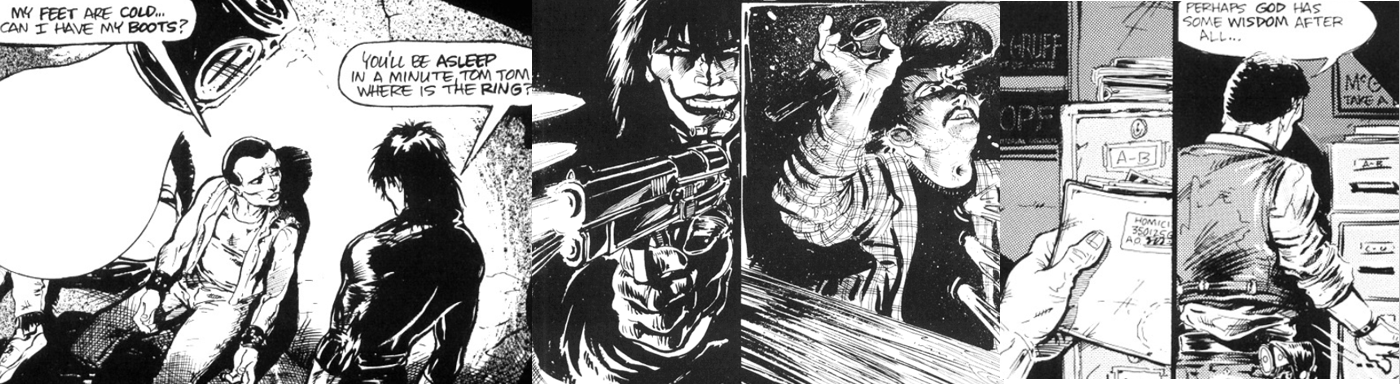
The Crow retrieves Shelly’s engagement ring and catches the attention of the local cops.

Those that were concerned about Gabriel’s welfare can rejoice as the Crow takes the fluffy white cat in brings her (Gabriel is initially thought to be a boy but is later revealed to be a girl, and pregnant to boot) back to their old home, where he presents the cat as a gift to his lost love. This triggers a cute flashback to when the fresh-faced, unscarred and far less tortured Crow (then known as Eric) proposed to his beautiful girlfriend Shelly, during a playful bout of painting their home. Later, as Christmas closes in, Gabriel triggers another memory of when Eric surprised Shelly with the news that he had secured the house for them, leading to the Crow lamenting that the cat “[makes him] smile too much”. The Crow then arms himself with a samurai sword and heads out to confront Tom Tom, beheading his punk-ass friend Skank before taunting the gun-toting thug with the iconic gag about Jesus Christ being “put up for the night” at a hotel. Shrouded in darkness, Tom Tom has no chance to land a shot quickly has his legs literally taken out from under him with one swipe of the Crow’s sword. Bleeding out, and suffering from shock, Tom Tom seems mildly repentant for his part in Eric and Shelly’s murder and tells the Crow where he can find Shelly’s engagement ring. This leads the Crow to Gideon Resale, a pawn shop in a seedier part of town, where he calmly confronts the grouchy owner, stabbing him through the hand and forcing him to hand over a box full of rings. After locating Shelly’s ring and taking it for himself, the Crow executes Gideon, loads himself up with armaments from his shop, and sets it ablaze using a makeshift kerosene bomb. Young police officer Albrect attempts to interrupt the Crow, but is suitably intimidated by the vigilante’s stoic demeanour and conviction, bringing the Crow to the attention of the police for the first time. Based on Albrect’s description of the Crow, Sergeant Hook figures out that he’s Eric returned from the grave pretty much right away since, as we later find out, he visited Eric in hospital after he was attacked and offered his condolences. Hook was shocked when Eric utters his dying words: “The crow said don’t look!!” and is later less than impressed to find that the Crow has left him the pregnant, flea-ridden Gabriel to look after.
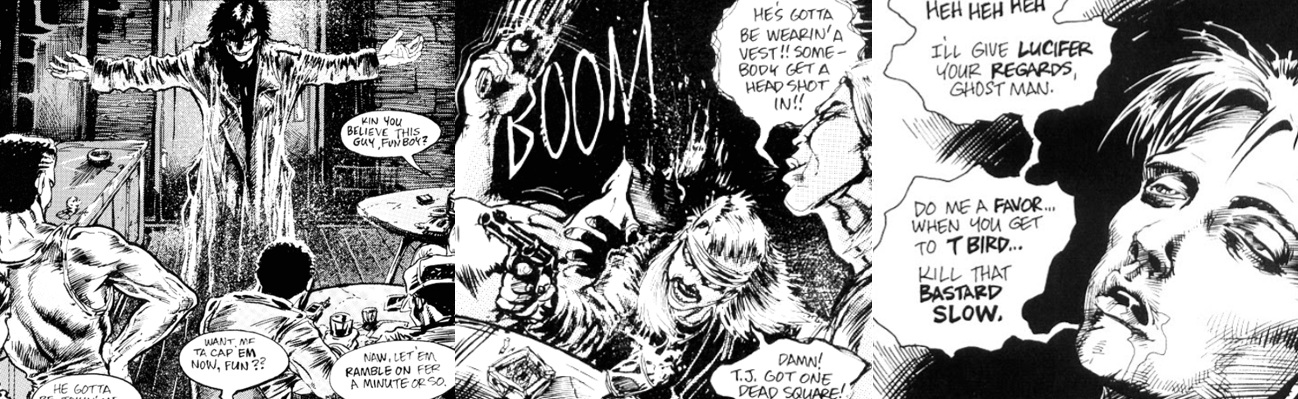
The Crow wades through Fun Boy’s goons and grants him a merciful death for his honesty and help.

On his way to confront Fun Boy, Crow comes across a young girl, Sherri, whose mother is one of the punk’s concubines. Feeling a connection with the girl’s innocence, the Crow gifts her with Shelly’s engagement ring, much to the girl’s emotional appreciation, and promises to return her mother to her. Later, before bringing his vengeance to an end, the Crow bids a heartfelt farewell to Sherri and promises her that things in her life will one day get better, or at the very least she will find serenity in the afterlife. Barging in on Fun Boy and Sherri’s mother in bed, the Crow demands that she leave and compels her to do better by her daughter with the memorable “Mother is the name for God” line, before getting into it with Fun Boy. Unlike his film counterpart, who was a wacked out junkie, the comic book Fun Boy is far more defiant and integral to the plot; he talks snark to the Crow and agrees to gather the rest of the gang together in a bar for a big gun fight. After intimidating the hugs with his loquaciousness, the Crow dispatches them in a blood-soaked battle that sees him burying an axe in one guy’s neck and gunning them all down with two pistols without missing a single shot, all while shrugging off any bullets that happen to hit or graze him until only Fun Boy is left. Unlike his associates, he doesn’t beg or plead or even repent for his actions; instead, he owns his reprehensible actions and even admits to perpetrating even worse acts against his fellow man. Tired of all the killing and vengeance, the Crow demands that Fun Boy go and get T-Bird so that they can finish this where it all started, at the side of a road outside of town where Eric and Shelly were tortured and killed. In return for Fun Boy’s assistance, the Crow promises him a quick, clean death, but makes no such promises for T-Bird, the man who pulled the trigger on himself and his lover.
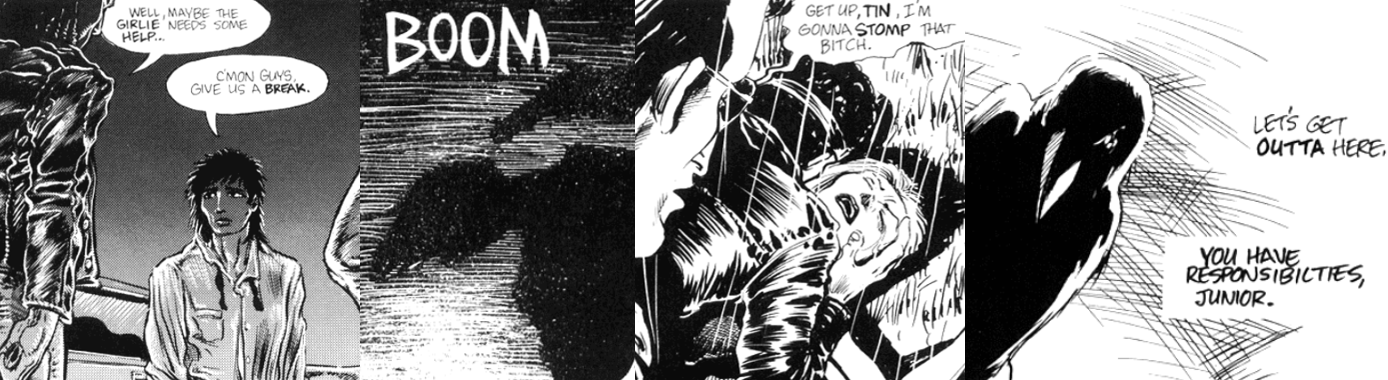
Eric and Shelly are brutally murdered by a gang of coked up assholes.

After following the Crow’s vicious and bloody path of vengeance throughout the story and being treated to brief flashbacks and memories of Eric and Shelly’s lives together, the final chapter shows us exactly what happened to the two on that fateful night. After proposing to Shelly, Eric takes her on a night out to celebrate but, on their way home, their car suddenly breaks down. As Eric is attempting to fix it, T-Bird and his cronies, completely off their heads on cocaine, alcohol, and other drugs, randomly happen to drive past them and, spotting Shelly, decide to circle back and harass them. Eric has Shelly lock herself in the car and attempts to reason with the gang and, for his efforts, is violently shot in the bac of the head by T-Bird. The bullet blows part of his skull off (giving him the scar over his nose and the one glazed over eye we’ve seen him sport throughout the book as the Crow) but doesn’t actually kill him. Even when T-Bird follows this up with a second, direct shot that briefly sets Eric’s hair on fire, Eric still doesn’t die; instead, he’s left helpless and paralysed on the cold, wet road and forced to watch as Shelly is beaten and raped by the gang before being killed by T-Bird. As Eric lies there, mortally wounded and barely clinging to life, he is berated by a vision of the crow, who begs him not to look and urges him to give up the mortal coil so that he can have his revenge.
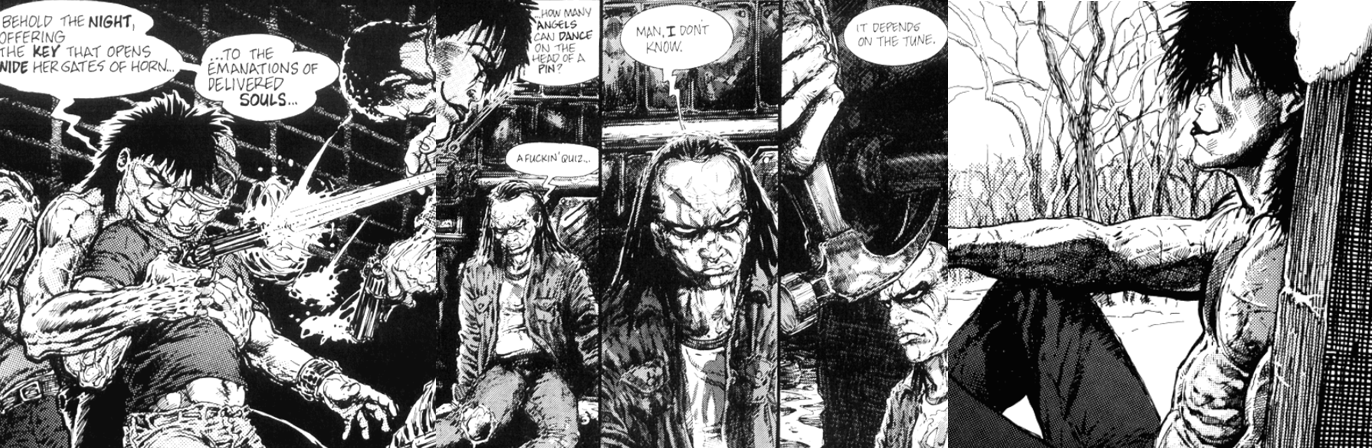
The Crow destroys T-Bird’s crew and finally completes his mission of revenge.

After burning his house down and leaving Albrect a note to look after Sherri, the Crow heads to the final showdown at a dilapidated house in the city after Fun Boy was unable to convince T-Bird and the others of the Crow’s threat. Still, the Crow remains true to his word and allows the junkie to kill himself with a lethal dose of morphine, before pumping a dose of the drug directly into his heart, killing a number of T-Bird’s cronies (with the exception of Two-Tone, whom he allows to live), and finally confronting T-Bird himself by stowing away in the back seat of his car. The Crow endures a bombardment of bullets from T-Bird’s gang before brutalising them with his superior strength and turning their weapons against each other, butchering them all in violent fashion and even walking away from a bullet shot through his neck at point-blank range. Terrified by the Crow’s manic violence, T-Bird races away in his blood-soaked and ends up crashing at the exact location where he killed Eric and Shelly; suffering from two broken legs, T-Bird remains defiant to the end and the comic cuts away as the Crow approaches his helpless foe with nothing more than a hammer in hand. The story ends with the Crow resting at a cemetery, having succeeded in avenging himself and his lover, and allowing himself to be spirited back to the afterlife by memories of himself and Shelly as the crow lies overhead.

The Summary:
Each chapter of the story is preceded by a quotation or a short poem that sets up the theme of the chapter, and the entire book, be it “Pain” or “Night”. Flashbacks to Eric’s journey to the afterlife, or his far happier life, are rendered in a far different visual style; these are beautiful, soft paintings rather than harsh pen strokes of black and white and, from the very first interlude, set the tragic tone for the entire story. “Shattered in the Head” appears to show Eric in a dream-like memory of riding a train but is, in actuality, a representation of his journey to the afterlife; he sees a beautiful white horse get tangled up in barbed wire, suffering in agony as it bleeds to death, which is an obvious parallel to how Shelly died. Just like in that instance, Eric was helpless to do anything to help and powerless to do anything but look on in horror, something which the Crow admonishes him for as the skeletal train conductor as for his ticket (an obvious representation of the Grim Reaper or, more specifically, Charon, with the train being an interpretation of the ferry he uses to take souls to the realm of the dead). Another interlude shows the Crow performing Kata-like dances while brooding over pictures of his former life and being tormented by memories of Shelly’s dead; we also see that the Crow regularly engages in self-harm, cutting and scarring his arms and wrapping them up in black tape in an attempt to either commit suicide and return to his love or feel something, anything, other than his eternal emotional torment.
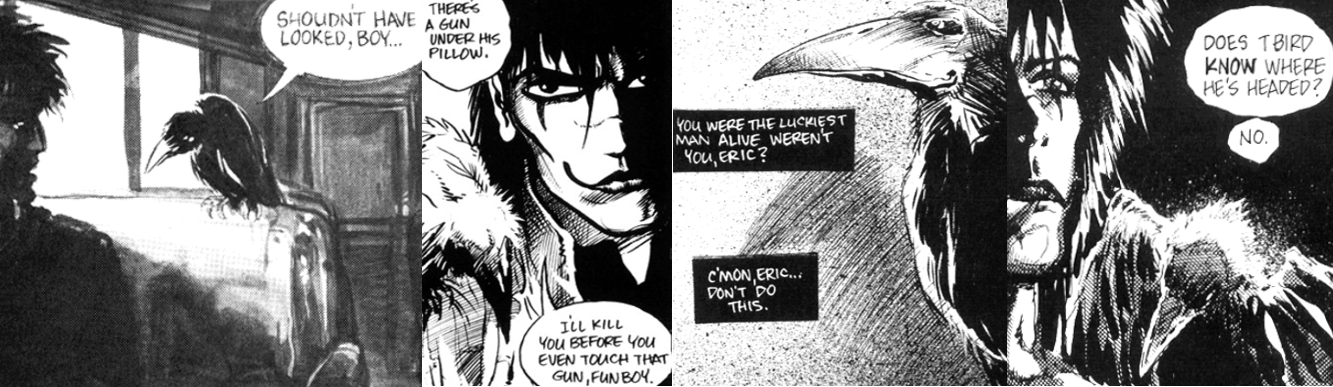
Eric is guided by a snarky, supernatural crow that keeps him focused on his violent mission.

Unlike in the film, only Eric can see the crow; it advises him here and there throughout his mission but noticeably disappears between panels, indicating that it’s much more of a supernatural entity. It also has far less play then in the film; there, it was a mysterious guide and commonly seen at Eric’s side but, here, it appears sporadically and directly communicates with him, chastising him for constantly tormenting himself with memories of his past and distracting himself from his vengeance. In one of the interludes, the Crow chastises Eric for losing himself to the throes of passion with Shelly in what appears to be the closest representation of his paradise, before the conductor (now dressed as a Skull Cowboy) violently shoots Shelly in the head and forces him out of his heaven. In another, the crow scolds Eric for juicing up on Fun Boy’s drugs and reliving sexual memories of him and Sherry; while the crow is overly blunt and direct, it’s clear that it cares about Eric, his feelings, and his need for revenge and just wants to keep Eric on track rather than constantly dwelling on the past. After Eric is shot and left for dead, the crow immediately appears before him and its first advice is to turn away from the horrors being performed by his killers; it tries to comfort him by telling him that it wasn’t his fault and then chastises him for clinging to life, eager to give Eric the power to avenge himself on his killers.
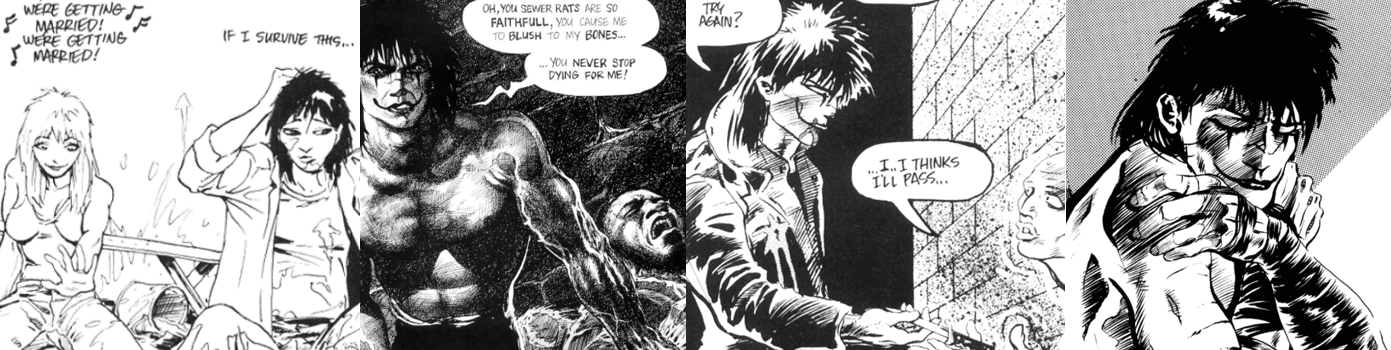
The Crow is a tortured, tragic, invincible figure who is the embodiment of vengeance and fury.

The Crow’s mission is fuelled by rage and a lingering sense for brutal justice; there’s very little “heroic” about the Crow in that he’s acting solely to appease his need for vengeance rather than for the benefit of others. However, he remains a tortured and vulnerable character; he has no desire to hurt Albrect or those who aren’t on his list and shows a great deal of love for Sherri. At the heart of his motivation is, of course, Shelly; he curses a God who would allow someone as beautiful and innocent as Shelly to be molested and murdered in such a violent fashion, and who would allow him to suffer so badly by association, and regards the scum he guns down and brutalises as being little more than vermin deserving of punishment. Eloquent and largely impassive, the Crow is prone to bouts of intense rage and emotion when avenging himself; thanks to being undead, he has nothing to fear and willingly walks into gunfire and knives without hesitation. Although the comic doesn’t actually go into detail in explaining exactly what Eric has become, how he was resurrected, or the extent of his powers, it’s largely inconsequential to the story; all you need to know is that he is retribution personified on what he sees as a Holy mission to purge the city of undesirable sinners. The Crow remains a powerful, intense, and brutal tale of revenge and love; it’s far from a traditional comic book story and is more akin to a Gothic mediation on loss and chaotic emotion, and is bolstered by some great use of shadows and pen work. The black-and-white art style makes the story as beautiful as it is violent and it remains a passionate, tragic story to this day; it’s made even more enjoyable for fans of the movie as the film directly lifted entire scenes and dialogue from the original comics and perfectly captured, and expanded upon, the atmosphere of this dark, gritty story that I would definitely recommend everyone check out.

My Rating:

Rating: 5 out of 5.

Fantastic

Have you ever read The Crow? What did you think to the story, artwork, and the narrative structure? How did you feel about Eric and Shelly’s plight, their love story, and their deaths as the motivation for the Crow’s mission? What did you think to the Crow; did his loquacious nature annoy you or did you find him intimidating and compelling, and do you think he was overpowered? Were you a fan of the interludes, poetry, and symbolism employed throughout the comic? Which of The Crow’s follow-ups was your favourite and how were you introduced to the franchise? How are you celebrating Devil’s Night tonight? Whatever you think about The Crow, leave a comment on my social media or sign up to reply down below.

Back Issues: Resident Evil (2009)

BackIssues

Issue One
Story Title:
“One if by Land, Two if by Space…”
Published: May 2009
Writer: Ricardo Sanchez
Artists: Kevin Sharpe, Jim Clark, et al

Issue Two
Story Title:
“Dirty Jobs”
Published: June 2009
Writer: Ricardo Sanchez
Artists: Kevin Sharpe, Gabe Eltaed, and Randy Mayor

Issue Three
Story Titles:
“If You Meet the Zombie on the Road…” and “Holiday Sugarman: Special Operations Agent”
Published: January 2010
Writer: Ricardo Sanchez
Artist: Jheremy Rapaak

Issue Four
Story Titles:
“Ich Bin Ein Schlechtes Genie…” and “Mina Gere: Special Operations Agent”
Published: May 2010
Writer: Ricardo Sanchez
Artist: Jheremy Rapaak; Al Barrionuevo

Issue Five
Story Title:
“The Bio-Weapons of Urador”
Published: July 2010
Writer: Ricardo Sanchez
Artist: Jheremy Rapaak

Issue Six
Story Title:
“Schafft Chaos Und Lasst Die Kriegshunde Los”
Published: February 2011
Writer: Ricardo Sanchez
Artist: Jheremy Rapaak

The Background:
As I’ve detailed previously, WildStorm comics first published a five issue anthology series based on the first two Resident Evil videogames (Capcom, 1996; 1998). Resident Evil: The Official Comic Magazine featured stories and characters, both primary and secondary, from the videogames and fleshed out the lore surrounding the Raccoon City outbreak and the malevolent Umbrella Corporation’s experiments with the Tyrant Virus (T-Virus) and the Golgotha Virus (G-Virus). While many of these events have since been rendered non-canon, WildStorm also went to the trouble of creating a number of original characters, who were revived for a subsequent four-issue series, Resident Evil: Fire and Ice, published between 2000 and 2001. This series focused on the hitherto-unknown Special Tactics and Rescue Service (S.T.A.R.S.) Charlie team and was, honestly, pretty terrible compared to WildStorm’s previous efforts. With Resident Evil 5 (ibid, 2009) having been released earlier in the year, WildStorm returned to the franchise with another six-issue series, simply titled Resident Evil, that featured an entirely new creative team and was marketed as a prequel to Resident Evil 5 despite its events also being rendered non-canon almost immediately.

The Review:
Our story begins exactly where you would expect a Resident Evil story to start…in space. Thanks to some expository text boxes, we discover that the President of the United States has been made aware of some illegal bio-organic weapons (B.O.W.) research being conducted onboard the Joint Nations space station, so he authorises a shuttle to be sent up to investigate. The investigation is assisted by rookie agent Mina Gere of the Bioterrorism Security Assessment Alliance (B.S.A.A.) who, after arriving on the space station, discovers no response from the crew and that the station has suffered a non-lethal hydrogen leak. Much of Mina’s backstory is later revealed through a two-page backup story that details that she was arrested for hacking into the Federal Bureau of Investigation’s (F.B.I.) most wanted and added her school principal’s name to the last as an April Fool’s joke. After choosing to enlist rather than go to prison, she excelled during her training with the Marines and as part of an experimental space combat unit, all of which made her an ideal candidate to join the B.S.A.A.

Of course the story begins in space, just like every classic Resident Evil story.

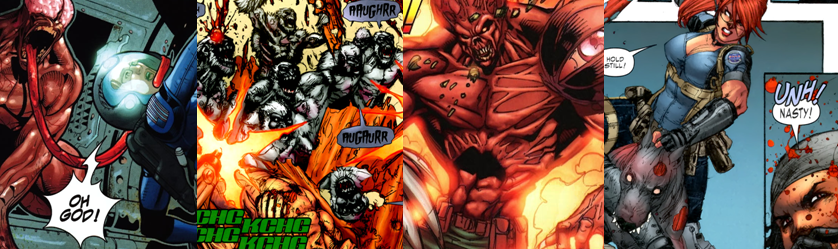
Her deployment to the space station is her first official B.S.A.A. assignment and she immediately lives up to her reputation by dispatching a Licker with her “shotgun pistol” that fires special “flechette loads” to keep her from accidentally depressurising the space station with an errant shot. Investigating the space station further, Mina confirms that the space station has suffered an outbreak of the T-Virus after they conducted experiments by exposing “Cnidaria” samples to the virus and that they launched satellites containing a G-Virus sample down to Earth before the station went offline. The danger to her is still very present, however, as not only do zombies roam the station but a monstrous, tentacled creature is also looming within, absorbing everything it touches, being completely immune to her gunfire, and Mina postulates that the creatures (and the virus) will evolve and mutate further thanks to the lack of gravity. This, apparently, rules out sucking the creatures into space so Mina fights her way past the zombies and escapes into space (and the safety of the space shuttle) after setting the space station to explode.  

Maybe if Holiday spent less time quoting philosophy he wouldn’t have lost his team…

The story also follows the B.S.A.A. Alpha Team, lead by Holiday Sugarman (a Barry Burton lookalike of sorts with an annoying penchant for quoting the literary greats and historical figures) who are dispatched to the hostile territory of Grezbekistan to contain a B.O.W. outbreak caused by one of these satellites. When the team are suddenly over-run with what appear to be Las Plagas, Holiday has no choice but to kill his own team after they are eviscerated by the creatures. This leaves him alone against the rampant creatures and hunted by a larger alpha who more closely resembles Doctor William Birkin’s “G” form. Holiday conveniently stumbles upon a weapon cache when trying to outrun the creatures which, even more conveniently, also includes a rocket launcher that allows him to hurt the “G” creature. Figuring out that all of the lesser B.O.W.s feel the pain of the Alpha, Holiday leaps in and stabs it repeatedly in its exposed brain with his trusty knife and causes all of his pursuers to die as a result. As his evacuation team flies in to retrieve him, he ensures that the mission wasn’t in vain by busting out a flamethrower and destroying all traces of the infected in the area.

While neither are happy about their partnership, it’s clear that they both need each other’s expertise.

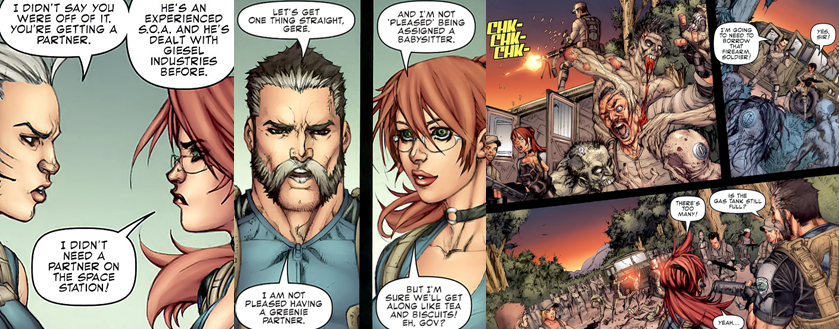
Holiday doesn’t get much time to rest on his laurels, though, as he’s told that Giesel Industries made the satellite and is ordered to head to Übelandia, partner with Mina, and investigate further. Holiday is unimpressed with the assignment, believing it’s a waste of his time and is even more perturbed at the nothing of partnering with a “little [girl] who [has] no business in the field”. In Übelandia, Mina and her partner, Cruz, find a lone survivor, a terrified young girl, in a village on the way to Fritz Giesel’s estate and are summarily attacked by a hoard of zombies. Luckily, though, the three manage to fight their way to a jeep and escape without injury rather than trying to fight them all off but Mina’s insult at being assigned a partner after how capably she performed without one on the space station quickly takes a back seat in terms of priorities when the little girl suddenly attacks Cruz, biting him on the arm before she’s executed by Mina. This incident is used by her commanding officer, Espinoza, to emphasise how Mina is inexperienced and that partnering with Holiday, despite his rough and pig-headed demeanour, will help her to gain valuable experience. On his way to rendezvous with Mina, Holiday’s internal monologue reveals that much of his demeanour comes from the death of his daughter, Summer, who has many similarities to Mina. The exact specifics of his backstory are further elaborated on in a short, two-page backup story, which reveals that he gave up his former life as a teacher to become something of a mercenary before settling down with his wife and daughter in Raccoon City. The zombie outbreak took their lives and saw him return to action as a member of the B.S.A.A.; angered that men like Giesel caused the death of his daughter, Holiday made a vow to bring all of those responsible to justice.

Despite some obstacles and disagreements, the two reach Giesel’s estate and meet his supposed nephew.

Upon the two meeting, they immediately air their grievances at being partnered with a “greenie” and a “babysitter”, respectively, but the two are able to fill in the gaps in each other’s knowledge (Mina has intel on the local area, the unrest between Übelandia and Urador, and the use of viral agents in the region and Holiday has more combat and field experience, not to mention being more seasoned overall). When their jeep is suddenly ambushed by zombies, Holiday thins out much of the infected heard by blowing up the vehicle with a grenade launcher (or, more specifically, a “tank buster” that fires a “depleted uranium armor piercing casing with a high-energy explosive core on a short delay”). Impressed by the weapon, Holiday quickly switches to plan B when Mina’s request for an air evacuation is denied and the group salvage what they can and prepare to make their way on foot instead. Upon reaching Giesel’s estate, Holiday and Mina disagree on how to get past Giesel’s massive armoured doors; Holiday wants to blow them with C4 but Mina manages to talk their way in more peacefully by stating their intentions to Giesel’s nephew, Neurmann (or “Neu” for short). Neu takes the team on a tour throughout his uncle’s elaborate estate, which more than resembles the Spencer Mansion from the first game and the various estates from Resident Evil 4 (Capcom Production Studio 4, 2005). Impressing with his eccentric demeanour, Neu leads the team into Giesel’s greenhouse where they are attacked by mutated plants, zombies, and infected apes, much to Neu’s giddy pleasure.

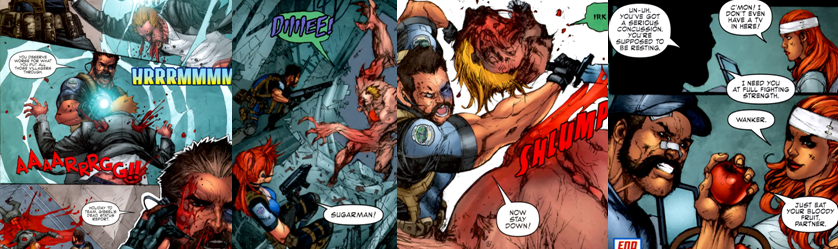
Although suffering heavy losses from B.O.W.s, Mina takes out the Tyrant using a knife and a grenade.

While a number of their team are skewered and dismembered by the plant or ripped to shreds by the apes, Holiday and Mina manage to lead themselves and the few survivors to safety and, under Holiday’s supervision, immediately set about setting up a narrow kill zone to fight their way out using the remainder of their resources in clever combination with the supplies in the surrounding environment. This plan works but, again, Neu is more excited by their victory than troubled since he also has a Tyrant (the Ubersoldat prototype) at his command! Holiday’s improvised “fertiliser bomb” only causes the Tyrant to mutate into a more monstrous form but Mina proves her worth and her ingenuity by having the team distract the creature with gunfire so she can slice it open and blow it apart with a grenade. Still undeterred by these events, Neu watches the team through a series of monitors and prepares to send more B.O.W.s their way. Still, despite being beset by more infected apes and even Hunters, the team are able to shoot their way to Neu’s control room…only to helplessly watch he fly away to safety on a biplane. Thanks to Mina’s hacking skills, though, the team are able to locate a B.O.W. manufacturing depot that is, of course, hidden beneath a Ziggurat pyramid in Urador and that the local villages were attacked by B.O.W.s as a demonstration for the local fascist dictator, Del Valle. As the entire area has been overrun with zombies and B.O.W.s, Espinoza is unable to spare a helicopter or any backup for Holiday and his team but authorises them to pursue Neu by any means necessary.

While Holiday struggles against Giesel, Mina and the others place explosives while fending off B.O.W.s.

While searching for more intel, Mina discovers that Neu has used T-Virus-based gene therapy to enhance his “metabolic function [and increase his] regenerative capabilities” and that Neu is Fritz Giesel but enhanced and restored to the prime of his life. The team take what they can salvage and head out on an armour-plated truck to rendezvous with a supply drop; along the way, Mina explains that the B.O.W.s have been fitted with an explosive charge to execute them if they ever become a threat to their masters. Loading up with heavy ordinance, the team begin a co-ordinate attack strategy on the pyramid (which is guarded by Hunters and Cerberuses) and manage to sneak in using a combination of sniper rifles and stealth. Inside, the team splits up; Holiday follows Del Valle in a bid to get to Giesel and Mina leads the rest of the team in planting explosive charges throughout the facility, which greatly resembles the hi-tech laboratories and facilitates from Resident Evil 5. Holiday is surprised by Giesel, who sets his Überhund B.O.W.s (basically albino Cerberuses that don’t appear to be much of a threat compared to the Hunters or Tyrants) against his team while he personally deals with Holiday. Absorbing bullets like they were nothing and exhibiting superhuman strength, Giesel easily overwhelms Holiday and has him at his mercy while Mina and the others place the remainder of their charges (ensuring that the finale as the trademark final countdown that accompanies basically all Resident Evil videogames) and fend off the Überhund.

Thanks to his enhancements and mutations, Giesel keeps coming but is finally defeated by Holiday.

Although Holiday is able to incapacitate and then execute Giesel using an “infrasonic weapon” that causes his organs to explode from the inside out, Mina discovers that Giesel planted B.O.W.s all across Übelandia and rigged them to remotely activate if the facility were destroyed. While Holiday guards the door, Mina works to disable the “No Go” signal before the explosives detonate; while the two are injured in the explosion, she is successfully able to cause the implants to detonate rather than activate, stopping the B.O.W.s from being unleashed across the country. However, Giesel suddenly returns, now mutated into a “G”-like Tyrant and attacks Holiday; although he shrugs off their bullets and instantly regenerates from even a shotgun blast to the head, he is finally put down for good when Holiday uses his trusty knife to slice his head off. In the aftermath, while Mina recovers from her concussion, Holiday reveals that the documents they recovered from the facility show that Neu was a clone of Giesel and that the real Giesel is not only alive and well but publically absolved of any involvement in the events of the story. However, it’s not a total loss; Del Valle was summarily executed by the Uradorian military and the entire experience sees Holiday and Mina forge a strong bond, partnership, and friendship.

The Summary:
If there’s one area where Resident Evil excels, especially compared to Fire and Ice, it’s in the artwork; the art is much more in line with WildStorm’s first Resident Evil comic book series, with Holiday featuring a bulky build similar to Chris Redfield’s from Resident Evil 5 and Mina (and the other females) being very curvy and sexy but still bad-ass in their demeanour and ability, like Claire Redfield and Jill Valentine. Sadly, zombies and other B.O.W.s don’t benefit from the comic’s otherwise impressive art style as they take a backseat in the narrative. When zombies, Las Plagas, and other B.O.W.s do show up in a mindless hoard to be gunned and knifed down while ripping chunks of flesh from their prey, which is where the art fails to properly do them justice. When the more monstrous B.O.W.s like the Lickers, Hunters, and Tyrants appear, however, they are used sparingly and with dramatic effect but are still reduced to slightly tougher cannon fodder like in WildStorm’s other efforts. I’ve never really understood this; you’d think in a comic released to coincide with the more action-orientated Resident Evil 5 that the B.O.W.s would make more of an impact or be a bit more formidable but it really doesn’t take much for Holiday or Mina to survive a Tyrant’s attack and put them down using heavy weapons or even just their knives and grenades.

Holiday and Mina might be one-note characters but at least they have names and some personality.

The story is also a little weak; it’s great that it focuses on Mina and Holiday but, even with their little backup stories, they’re largely one-note characters given a bit more personality through their frosty relationship but even this is largely put to one side as the two work together to reach the same goal. They are surrounded by numerous other characters, very few of which are named; even those that avoid being eaten or killed and actually play a more pivotal role in the story largely go unnamed and are just there to provide backup or be killed. Again, I find it very odd that these comics always leans towards a squad as the games generally only focus on two or maybe four characters in a survival situation and I think this story might have benefitted more from Mina and Holiday being the lone survivors after their team is wiped out at Giesel’s hands in, say, issue two. Speaking of Giesel, he’s this really elaborate, over the top German, a mad scientist type whose motivations are geared more towards his own self-interests (and amusement) and lust for power and superiority rather than anything else. He’s kind of an amalgamation of Birkin and Albert Wesker but, for all his eccentricities, is a shadow of those more iconic villains; for one thing, he’s dispatched stupidly easily, even in his Tyrant form, and he wastes time gloating and toying wit his prey rather than actually being a significant threat. One thing that is really underdeveloped is that he seems to have a vendetta against Holiday, specifically, but it’s not really shown why; sure, Holiday is actively hunting him and opposing him but so is Mina and the rest of their team but Giesel remains fixated on Holiday alone.

It’s bloody and action-packed but still doesn’t do much with the license and misses the mark at times.

In the end, it was a pretty good story; way better than Fire and Ice and more coherent than the anthology format seen in Resident Evil: The Official Comic Magazine but let down byfocusing a little bit too much on trying to inject some life and personality into these characters rather than some good, old-fashioned gory zombie action. A resident Evil comic seems like it’d be really easy to do; you tell stories of ordinary people trying (and, possibly, failing) to survive against zombies and B.O.W.s or follow iconic characters as they clear out a facility and battle one or two super tough B.O.W.s that require a bit more than a few bullets or one shot to put down, or maybe even follow ordinary Umbrella scientists as they experiment on animals and humans. And, yet, WildStorm’s efforts always seem to miss the mark just a little bit; it’s not quite horror, it’s not quite action, it’s not quite a mystery, it’s not quite a battle for survival, and it does very little to really add to the lore of the Resident Evil mythos. This particular comic actually doesn’t do that bad a job of expanding upon the world seen in Resident Evil 5, which is dramatically different to that seen in the first game, but I think maybe tying into that game with a story involving Chris, Jill, and Wesker and the development of the viral outbreak seen in that game might have been better and more enjoyable.

My Rating:

Rating: 3 out of 5.

Pretty Good

Did you ever read Resident Evil? If so, what did you think to it and how do you feel it holds up compared to WildStorm’s other Resident Evil comics? What did you think to the new characters and villains introduced in this story? Did you like the art work and the use of B.O.W.s or do you think the comic could have emphasised these elements, and others from the videogames, a bit better? What is your favourite piece of Resident Evil media apart from the videogames and do you think a Resident Evil comic book could work in a different format? Whatever you think, feel free to leave a comment below.

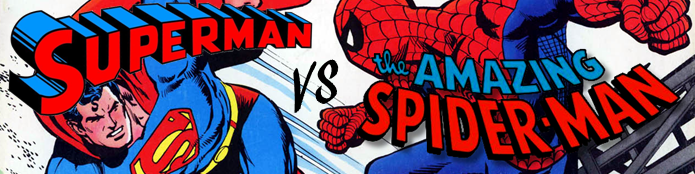
Back Issues [Multiverse Madness]: Superman vs. The Amazing Spider-Man


In September 1961, DC Comics published a little story called “Flash of Two Worlds” (Fox, et al), a landmark story that featured in The Flash #123 and brought together two generations of the Flash: the Golden Age Jay Garrick and the Silver Age Barry Allen. In the process, DC Comics created the concept of the multiverse, the idea that DC Comics continuity was comprised of an infinite number of parallel universes that allowed any and all stories and characters to exist and, more importantly, interact and I’ve been celebrating this ground-breaking concept every Sunday of September!


Story Title: “The Battle of the Century!” (Includes four chapters: “A Dual of Titans”, “When Heroes Clash!”, “The Call of Battle!”, and “The Doomsday Decision”)
Published: March 1976
Writer: Gerry Conway
Artists: Ross Andru and Dick Giordano

The Background:
Despite the fact that the two companies were both producing colourful, superpowered costumed heroes in a cut-throat industry, relations between DC Comics and Marvel Comics have been surprisingly collaborative and amicable over the years (they’ve certainly been more civil with each other than many of the toxic fans” I see arguing on social media every day…) Sure, there’s been lawsuits and underhanded tactics from both companies, but not only were the legendary Stan Lee and the disreputable sham Bob Kane actually good friends but the two companies both borrowed from and inspired each other and they’ve even collaborated on numerous joint publications in the past. The idea of pitting Clark Kent/Superman against Peter Parker/Spider-Man was first suggested by author and literary agent David Obst, who pitched the idea to Marvel Comics publisher Stan Lee and DC Comics editorial director Carmine Infantino as a live-action feature film. Writer Gerry Conway and artist Ross Andru, two of the few who had worked on both characters in the past, were brought in to bring the concept to life, which was treated as more of a fantasy tale (despite the fact that DC had introduced the concept of the “Multiverse” over a decade previously). The comic, which generally sells for quite a high price these days, wouldn’t be the last time Superman and Spider-Man (or DC and Marvel, for that matter) crossed paths as the two would collaborate on a number of inter-company crossovers during the eighties and nineties.

The Review:
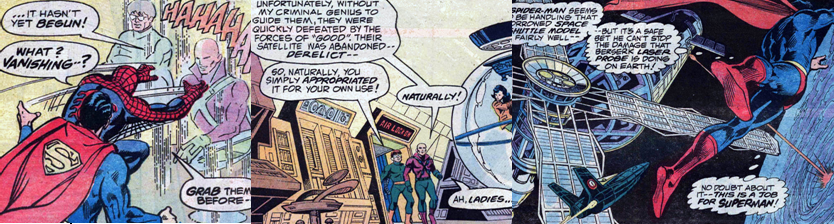
Our story begins with just another normal, boring day in Metropolis as a gigantic mechanical construct is tearing its way through the city. Even Superman laments the frequency of such events but is unable to see who is controlling the robot thanks to it being lined with lead and is equally unable to stop it thanks to its incredible strength, an “inertia ray”, and gravity beams being emitted from its mechanical feet that crush Superman with “ten times the gravity of Krypton”. All of this means that Superman is smashed through the nearby buildings (which are, we later learn, conveniently empty despite the fact that the robot is rampaging through downtown Metropolis with reckless abandon and Superman even has to save innocent civilians from falling debris) and is unable to keep the robot from stealing a computer console from Scientific and Technological Advanced Research Laboratories (S.T.A.R. Labs). Indeed, Superman is so distracted with trying to retrieve this from the robot’s head that he completely misses that the mastermind directing the machine’s attack was none other than Lex Luthor himself!

Superman tracks Luthor down, gets his ass kicked again, and rescues Luthor from certain death.

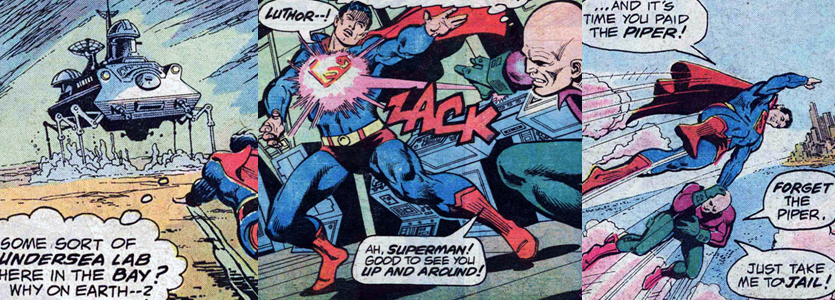
Superman returns to his civilian life as Clark Kent, reporter for the Daily Planet (owned by Galaxy Communications at the time), who avoids one of Steve Lombard’s mean and unprofessional pranks thanks to his super powers, gets chewed out by his boss, Morgan Edge, for not covering the attack (quite why Edge chooses to target Clark over Lois Lane or Lombard is beyond me), and realises from watching the footage back that he can track the robot’s obvious trail of destruction and gigantic footprints to Metropolis Bay There, beneath the water, he immediately discovers (and is attacked by) a walking undersea laboratory. Inside the lab, Superman confronts Luthor and after trying, and failing, to convince him to renounce his evil ways and rekindle heir former friendship, is attacked by a series of high-intensity laser beams. Though he’s able to dart through them, one blasts him into his eyes and, thanks to essentially being red sun radiation (which weakens Superman), dazes him and causes him to wreck Luthor’s lab. Luthor manages to spirit away the programming circuit he stole from S.T.A.R. Labs but ends up being apprehended by Superman after almost drowning to death.

Spider-Man almost immediately tracks Doc Ock down and puts him out for the count for the cops.

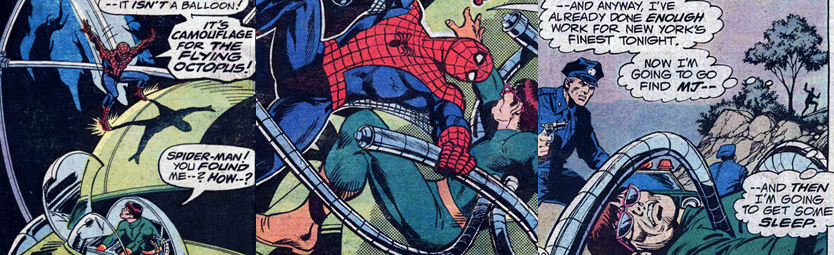
The story then switches to New York City right as Spider-Man is swinging in to take care of a handful of crooks who are in the middle of robbing the Metropolitan Museum. Of course Spidey easily trounces the crooks with his spider-powers but things quickly escalate when the mastermind behind the plan, Doctor Otto Octavius/Doctor Octopus, suddenly attacks with his mechanical limbs and, thanks to the element of surprise (and a good old whack to the back of the head), is able to temporarily knock Spider-Man unconscious and escape in his ridiculous looking “Flying Octopus” craft with boxes and boxes of loot. After fleeing from the police (who naturally assume Spider-Man to have been involved in the robbery), Spidey (as Peter Parker, obviously) presents the photographs of the entire event to his boss, J. Jonah Jameson, but earns the cantankerous editor’s wrath when Jameson prints the shots unseen and is left with nothing but a blurry, instinct picture on page one of his newspaper, the Daily Bugle. When his spider-sense suddenly alerts him to a passing blimp overhead, Peter ditches Mary Jane Watson and heads off to investigate as Spider-Man only to discover (after having to think on the fly thanks to his web fluid having run dry) that the blimp was disguising Doc Ock and his flying machine. The ensuing fight wrecks the blimp, causing it (and them) to crash into the Central Park reservoir and, with one swift punch to the jaw, Spidey successfully apprehends Doc Ock and heads off to try and smooth things over with Mary Jane.

Mere hours after being locked in an escape proof prison, Luthor escapes and takes Doc Ock with him.

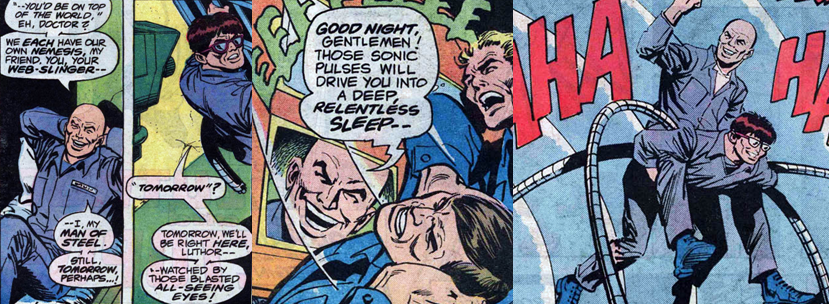
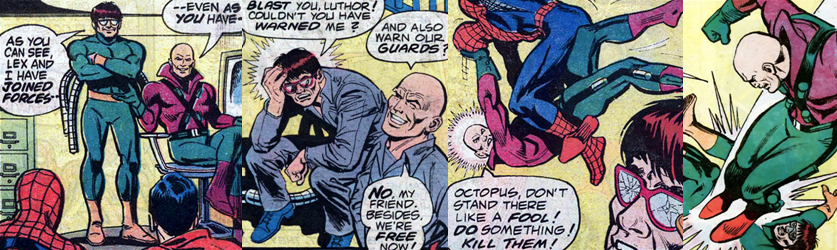
As luck (or fate, or simple plot convenience) would have it, both Lex Luthor and Doc Ock end up being shipped off to “Federal Maximum-X Security Penitentiary Number One, the most “escape proof” prison in the world” out in New Mexico and the two immediately bond over their respective losses and enemies and agree to join forces upon escape. Though Doc Ock is sceptical of their chances, Luthor quickly uses a number of small, high-tech devices hidden under a layer of fake skin to disrupt the prison’s security cameras and guards and allow Doc Ock to regain control of his mechanical limbs and literally carry them both to safety within just a few hours of Luthor’s arrival, The story proper begins with Clark, Lois, and other members of the Daily Planet staff attending the world news conference in New York; as you might expect, Peter is also there and, after being berated by Jameson, snaps at his boss and quits his job, shocking (but also impressing) Mary Jane with his sudden outburst. Meanwhile, Clark is stunned to hear that Edge doesn’t want him covering the news conference and, again, alludes to his temptation to replace Clark with a more well-known newscaster. Frustrated that Clark is happy to roll over and allow himself to be forced out of the “biggest story of his career”, Lois storms off in anger at his cowardice and her inability to truly hate him since he’s so charming and likeable. In true Lois Lane fashion, she risks her life climbing up a scaffold to get some better pictures (because Jimmy Olsen couldn’t make the trip, apparently) and nearly falls to her death when she’s saved by Peter. They bond over their respective professional accomplishments, much to Mary Jane’s displeasure, but Peter is left flabbergasted when Superman suddenly swoops in and seemingly vaporises them both right before his eyes!

When reason doesn’t work, Superman nearly kills Spider-Man before the web-slinger calms down.

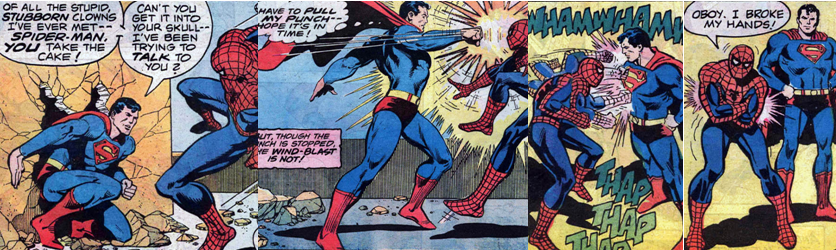
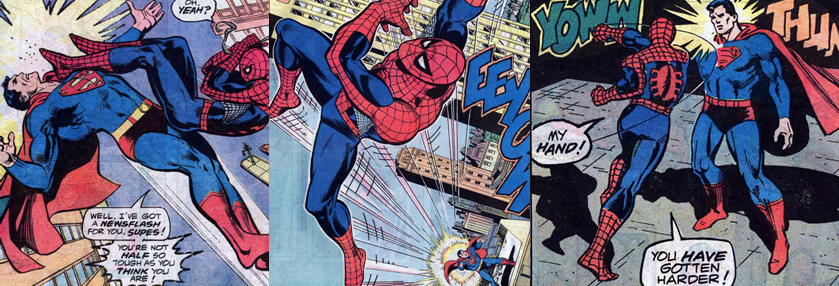
Clark also witnesses this event and is equally stunned and changes to Superman to investigate while Peter frantically switches to Spider-Man using the staircase (because, in a cute moment, the convention doesn’t have traditional phone booths). The two superheroes instantly run into each other in the skies above the building and come to blows (Superman having assumed, as many often do, that Spidey is connected to his doppelgänger). Although Superman immediately begins to be the voice of reason, Luthor and Doc Ock (who were behind the fake Superman; Luthor’s even still wearing the costume and has the lifelike mask nearby!) decide to escalate their conflict by surreptitiously blasting Spider-Man with red sun radiation to power him up for the fight. Thanks to the red sun radiation, his anger at being pushed around, and believing the Superman has captured or killed the woman he loves, Spider-Man attacks relentlessly; his strength knocks Superman off balance and his fury causes him to stubbornly refuse to listen to reason, all of which makes Superman mad enough to throw a killing blow at Spidey’s head. At the very last second, Superman is able to pull his punch but the resulting “wind-blast” sends Spider-Man flying through buildings and across the city. Disgusted at having nearly killed a man, Superman tries one more time to get Spidey to listen to reason and, when the red sun radiation wears off and amusingly leads to Spidey simply hurting his fists on Superman’s steel-hard body, Spider-Man finally relents. After comparing notes, they quickly bury their issues and agree to work together to uncover the truth about what happened but the proof of the pudding is clear: Spider-Man dominated the fight between the two and had Superman reeling throughout.

Lex Luthor and Doc Ock appropriate the Injustice Gang’s satellite to hold the world to ransom.

Following the “energy residue” of the imposter to the Penn Central railroad yard, Superman shows that he hasn’t quite shaken off the dickish ways of his sixties incarnation by allowing Spider-Man to go in first and run a gauntlet of traps and hazards before he (as in Superman) just ploughs right in there and they both confront the combined might and intelligence of Luthor and Doc Ock. Revealing that Lois and Mary Jane have simply been taken captive to lure the two heroes into a trap, the villains quickly vanish, having been mere projections all along (which you’d think Superman and Spider-Man would be able to register with their enhanced sense but apparently not…), and nearly manage to kill Spidey with a booby trapped computer console before Superman intervenes. Superman then rebuilds the wrecked computer at super speed and down to the smallest detail, apparently somehow managing to repair and restore the destroyed files that would have been on it in the process, which leads the two to Mount Kilimanjaro. There, a local nomadic Masai tribe lead them to another of Luthor’s secret bases. After battling and defeating a superpowered tribesman (who also wields a sword charged with red sun radiation), the two discover that Luthor and Doc Ock have headed to the upper atmosphere and the abandoned satellite headquarters of the Injustice Gang. There, Lois and Mary Jane are held hostage and are privy to the supervillains’ mad scheme: using the programming circuit he stole from S.T.A.R. Labs, Luthor is able to disrupt and hijack Comlab (a massive, missile-like communications tower in orbit) and cause it to fire a “high-intensity laser probe” into the Earth’s atmosphere and hold the world to ransom or face untold death and destruction from the violent storms the laser causes.

Thanks to Spidey, Otto turns on Luthor, Superman stops a deadly tidal wave, and the heroes triumph.

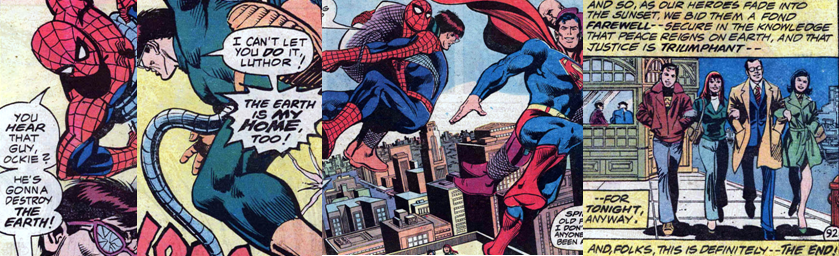
Superman and Spider-Man (piloting a shuttle of his own with surprising efficiency) head up to stop them but are immediately overwhelmed by Luthor’s lasers and captured. Although they catch their foes off-guard by feigning helplessness, Superman and Spider-Man are thrown off balance when Luthor suddenly shuts off the satellite’s artificial gravity (quite how this would affect Superman is beyond me…), which allows the villains to topple the costumed heroes with a humiliating ease. Quickly recovering, the two turn the tide when Superman is able to get close enough to Doc Ock to…remove his glasses! Distracted by recovering his comrade’s glasses, Luthor is unable to defend himself against Spider-Man, and Spidey is able to turn Doc Ock against Luthor by appealing to his greed because, after all, what use is money if Luthor plans to decimate the world? Although this is enough to disable to destructive laser and cause the two villains to come to blows, Superman must still take care of a gigantic tidal wave that threatens to engulf the entire United States! Of course, Superman is able to dispel the wave by flying at it at super speed and, with the villains subdued and the threat ended, Superman and Spider-Man part as allies and return to their respective lives, with both men able to win over (and back) their employers with their exclusive insight into this one of a kind team up.

The Summary:
I grew up reading Superman, Batman, and Spider-Man stories from the 1970s so, for me, Superman vs. The Amazing Spider-Man feels like a very familiar and nostalgic little tale. The artwork and characterisations are representative of this era; both the main characters and their villains pop out nicely, with Luthor being more of the scheming supervillain rather than a manipulative businessman. While Spider-Man is just as troubled by his angst and anxieties and spouts the usual quips and puns that were “hip” at the time, Superman is far from an unstoppable demigod while still having one foot in the ridiculously overpowered nature of his Golden Age counterpart. If you’re a fan of Lois and Mary Jane then this isn’t the comic for you; the two barely factor into the plot at all and, arguably, could have been excised completely and the villains’ scheme would have carried on largely unchanged. Similarly, characters like Jameson, Morgan, and Lombard are mainly just there for comic relief or to flesh out and contrast the normal, everyday lives of our two heroes. This is a bit of a missed opportunity, in many ways, as we’re denied a meeting between Jameson and Clark’s usual boss, Perry White, or even a sub-plot where Lois and Mary Jane have to work together to either escape or help stop the villains. Maybe if the story hadn’t suddenly veered off to waste time on the Marais tribe or wasted pages recapping the origins and powers of the heroes and villains we could have seen more of these interactions or had Spider-Man visit Metropolis.

The fight between Superman and Spider-Man, brief as it is, is the main appeal of the comic.

Still, the comic is called Superman vs. The Amazing Spider-Man and we definitely do get that; the two fight for about twelve pages and it’s a fairly evenly matched affair thanks to Spidey being supped-up by Luthor’s special red sun ray. Superman, ever the Boy Scout, spends most of the fight reeling from Spidey’s surprising strength and trying to calm the web-slinger down and, every time he tries to fight back, Spider-Man is right there to shut him down and press the attack. In fact, Superman only throws one punch in the entire fight but it’s enough to send Spidey flying with “the force of a compact hurricane”. Interestingly, there’s a lot of subtext that can be gleaned from this bout; Spidey, representing Marvel Comics, is the young, hot-tempered upstart who hits first and asks questions later and Superman, representing DC Comics, is the older, more level-headed veteran who seeks to resolve conflict peacefully but will strike back if pushed too far. Naturally, the two pool their respective talents far more than they clash and, after resolving their issues, never come to blows or conflict again. I suppose it’s nice that there wasn’t a lame excuse for them to fight again, like hypnotism or whatever, but the actual inciting incident is pretty paper thin (even though he saw “Superman” vaporise Mary Jane and Lois, Peter knows Superman by reputation so you’d think he’d hesitate to suddenly think he’d gone rogue) and I would have liked to see a bit more of how their different approaches to situations clash. We only really got to see this once when they reached the rail yard and it seemed petty and mean on Superman’s part to send Spidey in alone when he (again, as in Superman) could just burst in there without issue. It’s a good job that the clash and interactions between the two heroes pays off as the supervillain team up is a bit lacklustre; Doc Ock is reduced to a mere common criminal and a henchman here, having no real agency and playing very little role in the story other than giving Luthor someone to talk and boast to and acting as Luthor’s muscle. It’s a shame as Doc Ock is one of Spidey’s most devious, intelligent, and imposing villains but he may as well not be in the story at all since everything (from the prison escape, to framing Superman, to the red sun ray, and the orbiting satellite/laser plot) is Luthor’s plan and Lex may as well have teamed up with Flint Marko/The Sandman for all the use Octavius’s arms and demented genius were.

Sadly, the potential of this team is never realised as Doc Ock is reduced to being Luthor’s henchman.

As a result, Luthor comes out of this looking like a scheming, diabolical madman who is happy to threaten and kill millions for a measly ten billion dollars; his genius allows him to create all kinds of fantastic technology and even duplicate red sun radiation to weaken Superman but, in the end, he’s undone because Spidey was able to manipulate Octavius to turn against him. Overall, it’s a decent enough story; well drawn and full of big, action-packed panels when the two heroes clash and take on their foes but the main appeal of Superman vs. The Amazing Spider-Man is, unsurprisingly, in seeing two of Marvel’s premier superheroes butting heads and joining forces. In that regard, the story works but just barely; it reads like a typical, run of the mill Superman story from the time just with a guest appearance by Spider-Man and some of his supporting characters. When the Marvel characters do appear, they’re written exactly as you’d expect from that era as well and no one side really looks better or dominates the other…unless you look at the subtext at work. Superman and Spider-Man appear to be evenly matched in their fight but Spider-Man is clearly the aggressor; Luthor outshines Doc Ock at every turn, relegating him to being a mere henchman, so I guess everything just about evens out on both sides but I can’t help but feel like the story was lacking a little. It would have been nice to see Spidey in Metropolis, more interactions between the two in and out of costume, and the two having to deal with their counterpart’s villains in a more interesting way than flailing around on a space station but there’s an appeal to Superman vs. The Amazing Spider-Man, if only because of the comic’s rarity and the chance to see these two heroes, and worlds, collide for a change so it’s probably worth seeking out for the sheer spectacle of it if nothing else.

My Rating:

Rating: 3 out of 5.

Pretty Good

Have you ever read Superman vs. The Amazing Spider-Man? If so, what did you think to it? Do you own a copy of the original comic or do you remember reading it when it was first published? Were you also disappointed that the comic didn’t make better use of its concept, supporting characters, and villains or were you happy with the story we got? Which of the two heroes, and publishers, was/is your preference? Do you enjoy all comic books and superheroes equally or are you one of those toxic fans who actively hates other characters and companies? Would you like to see DC and Marvel collaborate again in the future and, if so, what stories would you like to see? Whatever your thoughts on Superman vs. The Amazing Spider-Man, and comic book crossovers of this kind, drop a comment down below and check out my other multiverse reviews.

Back Issues [A-Day]: The Avengers #1


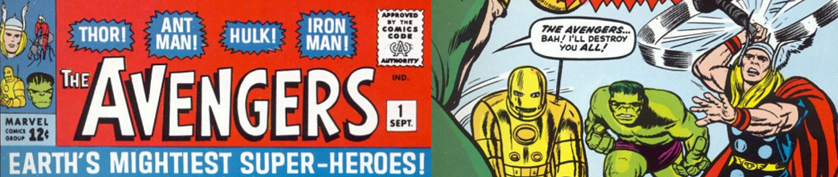
Having introduced comic readers to a whole host of colourful characters, in September of 1963 the legendary duo of Stan Lee and Jack Kirby brought together six of Earth’s mightiest heroes to form the Avengers. A super team like no other, with a constantly rotating roster, the Avengers has become the premier team of Marvel Comics and, thanks to the team and its individual members forming the backbone of the Marvel Cinematic Universe, have become an unbelievably popular and successful franchise in their own right.


Story Title: The Coming of the Avengers!
Published: September 1963
Writer: Stan Lee
Artist: Jack Kirby

The Background:
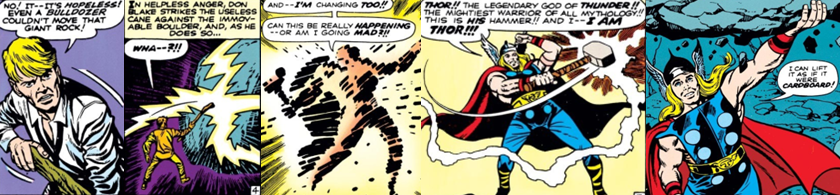
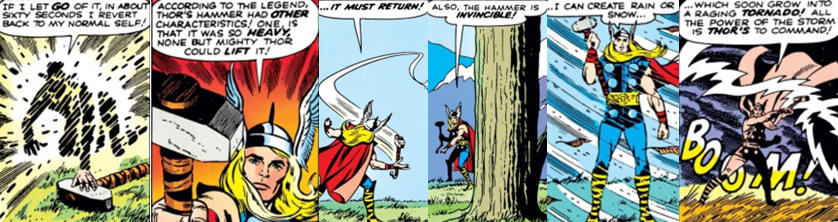
In 1960, DC Comics brought together their most popular and powerful characters to form the Justice League of America. Never ones to let the competition get a leg up on them, and having seen successful with the Fantastic Four and the debut of the X-Men in that very same month, Marvel Comics head honcho Martin Goodman asked Stan Lee to create a similar team of superheroes. Helpfully, Lee and a number of his most famous collaborators had already established a number of colourful characters to bring together: Tony Stark/Iron Man, Doctor Bruce Banner/The Hulk, Doctor Donald Blake/Thor Odinson, and Doctor Hank Pym/Ant-Man and Janet van Dyne/The Wasp. Since the debut issue, the Avengers have been a consistent and influential presence in Marvel Comics; the roster constantly shifted and changed, with the Hulk leaving the team in the second issue and Lee memorably dusting off the long-retired character of Steve Rogers/Captain America in issue four. Since then, the team has expanded and changed many times, seen spin-offs and splinter groups, been disassembled and reassembled, and taken part in all manner of massive cosmic events in the decades since their introduction.

The Review:
“The Coming of the Avengers” begins with Thor’s brother, Loki Laufeyson, the God of Mischief, imprisoned on the “dreaded Isle of Silence” in the mythical realm of Asgard. This is, of course, back when Loki was a despicable, irredemable villain whose previous mad schemes for power and conquest were thwarted by his brother; consequently, Loki is incensed at being exiled to the barren wasteland by Odin Allfather and plots a devious scheme for revenge.

Loki burns with a desire to destroy Thor, not Blake, and sees the Hulk as his chance to do so!

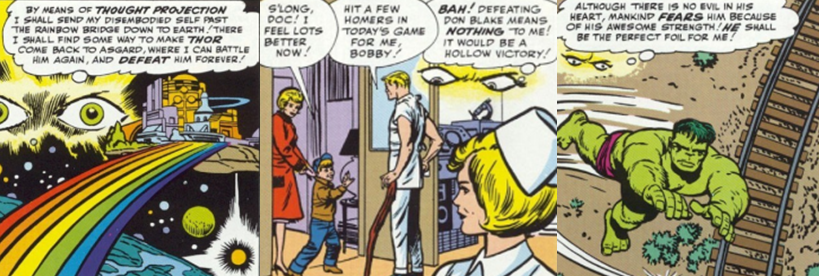
Though his physical self is trapped, Loki is able to use his vast magical abilities to project his disembodied self across the length of he dimension-spanning Bifrost and down to Earth, the planet Thor loves so dearly. He spies in on Donald Blake but dismisses him as a lame and insignificant mortal; he is acutely aware that Blake and Thor are one and the same but desires victory over Thor, not his crippled mortal shell. After many long hours, Loki comes upon the Incredible Hulk and is instantly intrigued by the creature’s brute strength and disdain for humanity. Thanks to Loki’s manipulations, the Hulk is blamed by the media when a train almost derails (despite the fact that the Hulk went out of his way to keep the train on track after Loki’s tricked him into damaging the tracks). Concerned for the well-being of his friend, Rick Jones desperately attempts to contact the Fantastic Four for help but Loki intercepts the broadcast and successfully coerces Blake to transform into Thor.

Words almost can’t express how much I despise Janet’s characterisation in these early comics!

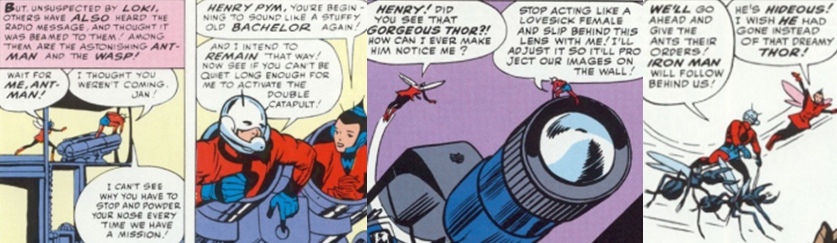
However, Rick’s broadcast is also intercepted by Ant-Man and the Wasp and Tony Stark, who eagerly leap into action to stop what they perceive to be one of the Hulk’s trademark rampages. Though he’s now decked out in his slightly more streamlined gold plated armour (which can also charge through solar power), Stark is still entirely reliant upon his iron plated chest device to keep him alive but, nevertheless, he’s eager to test the strength of his armour against the Hulk’s much-vaulted power. The Fantastic Four eventually pick up the transmission regardless of Loki’s interference but are unable to assist since they’re already busy on another case but Rick and his fellow “Teen Bridge” are star-struck when Thor, Iron Man, Ant-Man, and the Wasp all show up to answer their summons. This is probably as good a time as any to talk about how much I loathe Janet van Dyne, especially in her earlier appearances in the sixties and seventies! She’s such a ditzy, scatterbrained little tart; all she ever does is think about her hair, make-up, and appearance and constantly fawn over other men right in front of her partner/husband, Hank. Sure, Hank is generally much more focused on his work, the mission, or being professional and is largely neglectful and ignorant of Janet but that doesn’t excuse her God-awful characterisation. Similar to Susan Storm/Invisible Girl, Jean Grey/Marvel Girl, and many of Marvel’s supporting female characters at the time, Janet is constantly patronised and spoken down to by men but, unlike many of them, she actually deserves such harsh treatment since she’s more of a glorified model or brainless celebrity than a capable superheroine, much less an individual worthy of their respect since all she wants to do is drool over Thor’s muscles!

Loki is apprehended but the battle between Iron Man and the Hulk continues to rage!

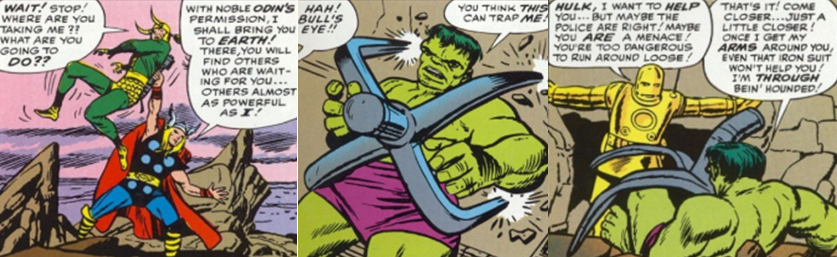
Anyway, having inadvertently brought together some of Earth’s mightiest heroes, Loki changes tactics and uses his powers to trick Thor into thinking the Hulk is right outside their door! Acting without thought or logic, Thor immediately heads out to battle the Green Goliath and immediately heads to Asgard when he realises that the “Hulk” is merely one of Loki’s visions…just as Loki planned all along! Meanwhile, the Hulk, now free from Loki’s control, has…disguised himself as Mechano the Mechanical Man and hidden himself away at a circus? Thanks to Ant-Man’s uncanny helmet, which allows him to control and communicate with ants, Pym is able to first locate the Hulk and then use countless numbers of ants to cause a cave-in beneath the beast’s feet. Unimpressed and irritated, the Hulk easily bursts free of the trap and reacts with anger when Ant-Man attempts first to calm him and then to trap him. As in his debut appearance, the Hulk is far more than the mindless, rampaging beast he is generally known as; he’s eloquent and intelligent, using words like “masquerade” and being smart enough to disguise himself as a circus performer and use weapons to blow the Wasp out of the air and render her helpless. The Hulk is kept from crushed the Wasp into a fine paste by the timely arrival of Iron Man; after Iron Man’s attempts to lure the Hulk into a trap fail, he gives chase but the Hulk is wily enough to allow Iron Man to pass harmless overheard so that he (as in the Hulk) can deliver a crippling blow to Stark’s “propulsion battery”. Over in Asgard, Odin grants Thor permission to travel to the Isle of Silence to confront Loki and he has to overcome numerous traps and hazards conjured by Loki’s black magic along the way. Thor perseveres and shatters Loki’s magical barrier using his enchanted hammer, Mjölnir, in his mission to “avenge” Loki’s foul deed. However, Thor is kept from attacking Loki first by the sudden arrival of a monstrous troll, a nature of the isle, and then by Loki’s deceitful illusions.

Loki is defeated with ridiculous ease and a new super team is born!

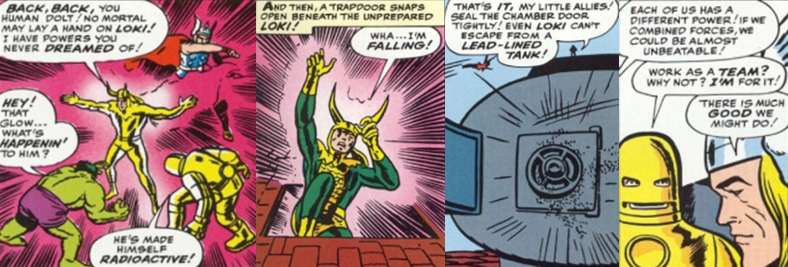
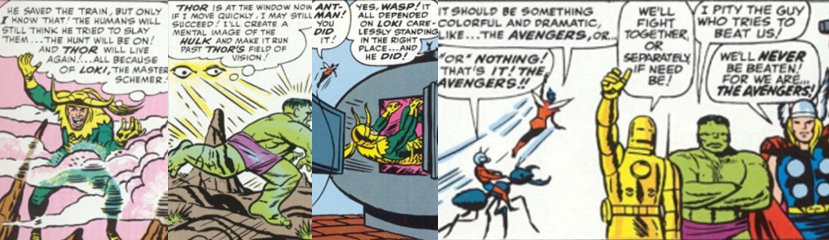
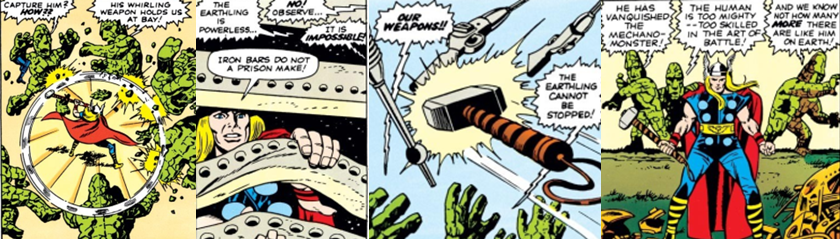
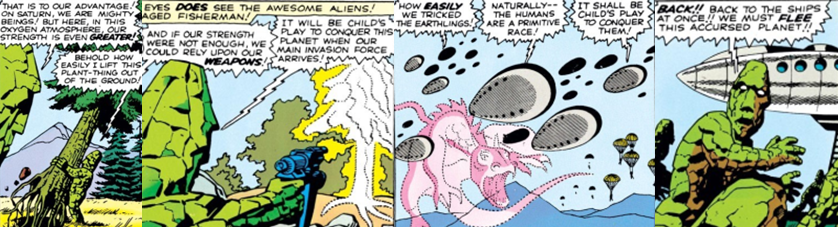
Regardless, Thor triumphs again by summoning lightning to drive the creature away and then dispels Loki’s duplicates with an implausible twirling of his hammer. Though Thor has Loki in his grasp and intends to bring him to Earth to answer for his deception, there’s still the little problem of the Hulk to contend with; Iron Man, having repaired his battery, continues his pursuit of the Hulk to an automobile factory, where the Hulk is able to endure and outwit Iron Man’s attempts to subdue him. Thor interrupts the battle and reveals that Loki was behind everything; Hulk’s desire to make Loki pay for framing him is momentarily avoided when Loki breaks free of Thor’s grasp and prepares to resume his battle with his hated brother…only for a hoard of ants to open a trapdoor beneath his feet and cause him to fall into an lead-lined chamber. With the threat ended, Ant-Man suggests that the six of them join forces as a team, which the others (including the Hulk, despite everything he went through during the issue) readily agree to and it is the Wasp who suggests the team’s name: The Avengers!

The Summary:
“The Coming of the Avengers!” is a breath of fresh air after the year I’ve had looking back at early origin stories and comic books; even compared to standalone stories of the time, it’s refreshing to not have the plot be endlessly bogged down with recaps of the characters’ origins and to not have every other piece of dialogue by a description of that character’s ability. Characters do still have an annoying tendency to monologue and describe what they’re doing as they’re doing it but it’s a far more action-packed issue than some other comics I’ve read this year, that’s for sure.

The brisk pace means some characters get more focus than others but there’s still time for cameos…

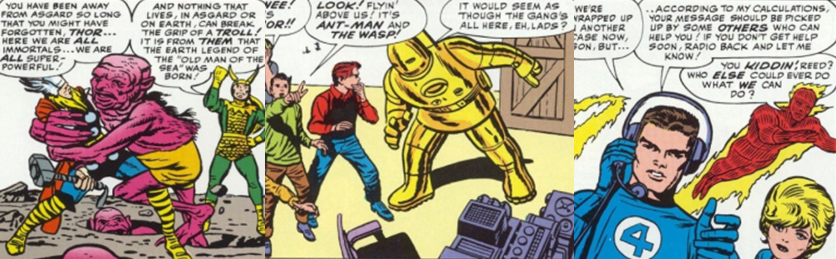
If you’re a newcomer to Marvel, this is obviously a bit of a disadvantage since you’d have no idea who any of these characters are; the only characters who really get any extended backstory and focus are Thor and Loki, which is only natural considering it is Loki who drives the main plot of the issue. However, we never see an appearance from the Hulk’ alter ego (Banner isn’t even mentioned in the issue), Ant-Man and the Wasp are never seen outside of their costumed identities, and the comic even has time to waste panels on a cameo by the Fantastic Four. The intention, however, is pretty clear: Rick’s first thought is to call the Fantastic Four since there are only a couple of superhero teams in existence at that time and the implication is that Loki is a threat worthy of the Fantastic Four’s involvement, which thus makes the Avengers appear just as capable and formidable by proxy. Not that the Avengers really need any help in that regard; each character has already had numerous chances to shine and show how capable they are in their solo issues but what better way to showcase that to its fullest than by pitting them against the Hulk, the most powerful mortal in Marvel Comics at the time?

For all his power and scheming, Loki is incredibly ineffectual and his plan massively backfires!

Iron Man, especially, is eager to pit his skills and augmented strength against the Hulk’s (who sadly never gets to tussle with Thor to see which of the two truly is mightier) and it’s certainly unique seeing Ant-Man and the Wasp futilely try to subdue the beast with traps and trickery. It’s not a perfect story by any means; I could talk for days about Janet’s characterisation and she basically does nothing except buzz around, pine after Thor, and name the team and Loki never thinks to use his powers to send the Hulk into a mindless rampage to help tip the balance in his favour. Indeed, though Loki’s powers are vast and have the potential to be extremely dangerous, he’s pretty ineffectual as Thor easily fights off his illusions, he’s anti-climatically defeated by Ant-Man and the Wasp (of all people), and all he succeeds in doing is uniting Earth’s Mightiest Heroes as a team. He might have had more success if he’d tried to manipulate them into fighting each other or used his powers to better effect but, as an excuse to bring together six of Marvel’s most formidable superheroes into a super team, “The Coming of the Avengers!” succeeds far more than it fails…it just needed to be a bit longer and have a bit more interaction between the characters.

My Rating:

Rating: 3 out of 5.

Pretty Good

How do you feel about “The Coming of the Avengers!”? Do you feel it was an effective introduction to Marvel’s newest and greatest team or do you, perhaps, find it a little weak and light on content? Which of the original line-up is your favourite? What did you think to the Wasp’s characterisation and the treatment of females during this time? Which version of the team is your favourite or who would you like to see on an Avengers roster one day? Do you think the singular threat of Loki was suitable enough justification for bringing together these heroes or would you have preferred a bigger threat? How are you celebrating the debut of the Avengers today and what are some of your favourite Avengers storylines, characters, or adaptations? Feel free to share your thoughts and opinions on the Avengers in the comments below.
Back Issues [Multiverse Madness]: The Flash #123


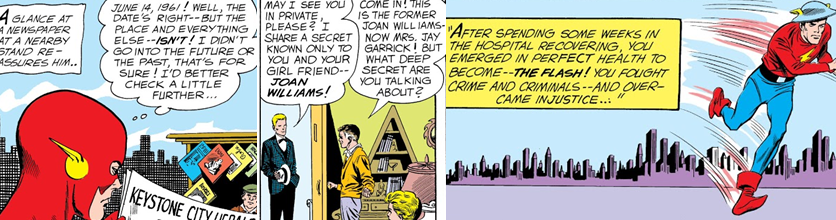
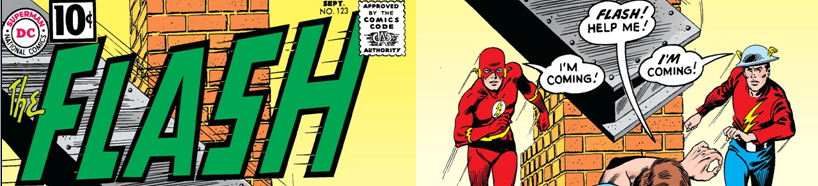
In September 1961, DC Comics published a little story called “Flash of Two Worlds” (Fox, et al), a landmark story that featured in The Flash #123 and brought together two generations of the Flash: the Golden Age Jay Garrick and the Silver Age Barry Allen. In the process, DC Comics created the concept of the multiverse, the idea that DC Comics continuity was comprised of an infinite number of parallel universes that allowed any and all stories and characters to exist and, more importantly, interact and I’ll be celebrating this ground-breaking concept every Sunday of this month!


Story Title: “Flash of Two Worlds!”
Published: September 1961
Writer: Gardner Fox
Artist: Carmine Infantino

The Background:
In the pages of Showcase #4 (1956), writer Robert Kanigher and artist Carmine Infantino introduced readers to Barry Allen/The Flash, the Fastest Man Alive. However, Barry wasn’t the first character to carry the name of the Flash; back in the 1940s, Jay Garrick operated under the codename before superhero comics saw a decline in popularity due to World War Two. Interestingly, although Jay’s solo Flash title was cancelled in 1948, the character’s last appearance was in 1951, a mere five years before the character was dramatically reimagined for the “Silver Age” of comics. To Barry Allen, Jay Garrick wasn’t some long forgotten hero of a bygone era; he was a mere comic book character, a work of fiction, and, while the idea of parallel versions of DC’s heroes had been previously hinted at, it wasn’t until “Flash of Two Worlds” that DC began to really explore, and expand, the concept. The story led to the discovery of an infinite number of parallel worlds, regular crossovers between teams like the Justice Society of America and the Justice League of America and, of course, epic cosmic crossovers that gave DC the perfect excuse to shake up their continuity. So influential was “Flash of Two Worlds!” that it’s iconic cover art has been parodied and replicated numerous times, and it directly inspired not just one episode of The Flash (2014 to present) but directly led to that series, and the entire “Arrowverse”, exploring the vast complexities of the multiverse.

The Review:
“Flash of Two Worlds” begins innocently enough with Barry Allen once again characteristically late for a date with his long-term girlfriend, Iris West. I’ve always been more of a Wally West fan when it comes to the Flash since Barry was long dead by the time I started reading comics but there are a couple of things about Barry’s Flash I always liked and which make him unique, in my eyes, compared to other heroes and characters of the same name. For one thing, he might be the Fastest Man Alive but he was constantly late in his civilian guise, which was the perfect way to keep anyone suspecting his true identity; for another, Barry actually worked for the police department as a forensic scientist and there weren’t a great many superheroes who actually worked within the system.

Barry is stunned to find himself on another Earth where the fictional Jay Garrick was once the Flash!

Like all good superheroes, of course, Barry is currently keeping his dual identity a secret from Iris and is able to use his position with the Central City Police Department to explain that he is “friends” with the Flash. This allows him to arrange for the Scarlet Speedster to make an appearance at Iris’s show for local orphans and also gives the Flash an opportunity to show off the near limitless potential of his superhuman speed but, in the middle of vibrating a rope at super speed, the Flash suddenly vanishes from sight! Though momentarily disorientated, the Flash quickly surmises that he must have vibrated his molecules so fast that he passed through “some sort of space-warp” but, when he attempts to return to the community center, is shocked to discover he’s now in a strange, vaguely familiar place named Keystone City. Recognising the name, Barry confirms his suspicions by looking up Jay Garrick in a telephone book and paying him a visit (as an interesting side note, Garrick’s house number is 5252, which goes a long way to explaining DC’s later obsession with the number fifty-two). Rather than introduce himself and get Jay, and us, up to speed, Barry decides to regale us, and Jay, with Jay’s origin story: while a student at Midwestern University, Jay inhaled fumes of “hardwater” and, somehow, gained super speed and began a career as the Flash.

Barry explains his multiverse theory that, while ridiculous, also makes a crazy kind of sense.

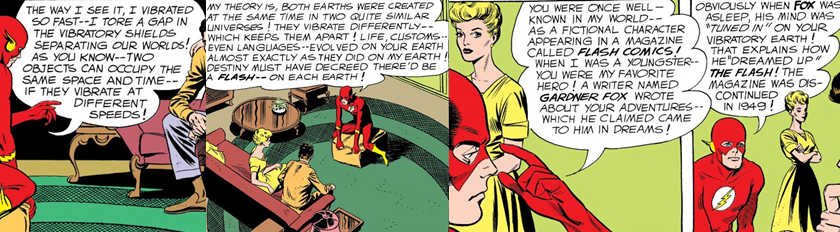
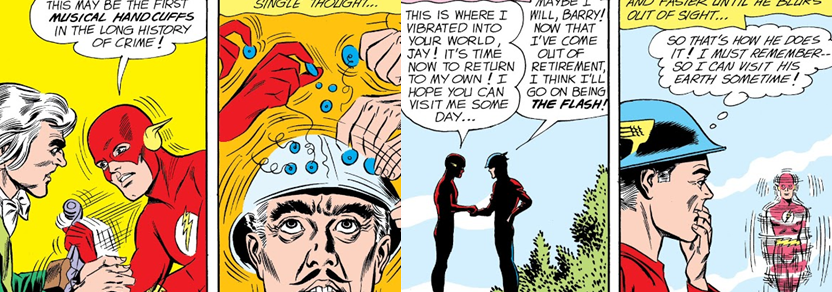
Jay and his wife, Joan, are shocked at Barry’s expert knowledge of Jay’s history and even more awestruck when Barry explains that he is the Flash of a parallel world. Barry goes on to explain the basic fundamentals of DC’s multiverse: their two worlds exist in the same space and at the same time but are separated by different vibrational frequencies. He theorises that both Earths evolved almost exactly the same but that “destiny must have decreed there’d be a Flash — on each Earth!” It is only after explaining his multiverse theory that Barry brings Jay and Joan up to speed on his origin; during an experiment, he was struck by a errant lightning bolt (a common occurrence, as you well know…) and bathed in a mysterious chemical concoction. The result was the development of his own super speed but he was directly inspired to become the Flash after reading of Jay’s adventures in comic books on his world. Barry even further speculates, ridiculously so, that real-world writer Gardener Fox must have somehow been attuned to Jay’s world to dream up stories of the Golden Age Flash’s adventures. Jay is intrigued at the concept and in awe of Barry’s fourth dimensional Flash ring; he reveals that, despite no longer having the endurance of his prime years, he’s as fast as ever and in the midst of mounting a dramatic comeback thanks to a series of mysterious robberies that have been happening all over town. Ever the helpful chap, Barry offers to assist and the two solidify their partnership and newfound friendship with a hearty handshake. It’s then revealed to the reader that the perpetrators of these crimes are three of Jay’s most notorious rogues: Isaac Bowin/The Fiddler, Clifford DeVoe/The Thinker, and Richard Swift/The Shade. All three have a personal grudge against Jay for apprehending them “more than a dozen years” ago and, since their release (or escape, it’s not made entirely clear which), each has refined their abilities and gimmicks to take their revenge (the Thinker’s “thinking cap” allows him to cause anything he thinks of to happen within fifty yards of himself, the Fiddler’s Stradivarius violin allows him to generate destructive sound waves, and the Shade can conjure absolute darkness with his special cane).

Jay is outwitted by the Thinker’s mental images and collapses from exhaustion.

In the process of their revenge, the three villains are also indulging in elaborate crimes to bring themselves notoriety, fortune, and, presumably, to attract the attention of the Flash and the two Flashes immediately divide their efforts in order to uncover the culprits behind these crimes. The Thinker heads to the home of millionaire Edward Jarvis to steal the priceless Neptune Cup; he uses his thinking cap to persuade Jarvis’s guard dogs to lure the Flash into his trap and is easily able to manipulate Jarvis into handing the treasure over to him. When the Jay conveniently races by, the dogs literally follow the Thinker’s command by talking in English! Jay rushes into the house to confront the Thinker but is shocked to find that the villain continuously eludes his grasp; driving himself to near exhaustion in the effort, Jay laments what he believes to be a by-product of his advanced age but it turns out he’s only half right. The Thinker has been conjuring “mental mirages” to distract and tire out the Flash and, with Jay too weak to pursue him, is easily able to slip away with his prize as Jay blacks out from fatigue. Why the Thinker didn’t use his special cap to control Jay like he did Jarvis is beyond me, though…

The Flashes subdue the villains and Jay is left pondering the secret of dimensional travel.

Meanwhile, at the waterfront, Barry investigates a strange black fog surrounding a private yacht and is drawn into a confrontation with the Shade. Thanks to the Shade’s ability to summon thick, pitch blackness, Barry is unable to stop the villain from stealing especially rare and extortionately expensive “historical curios”. When he spots the Shade making his escape in a speedboat, Barry gives chase by running over water but is easily knocked off balance by the Shade’s darkness and returns to Garrick’s house humbled but no less disheartened. Galvanised by their individual failures, the two Flashes decide to team up to stop the villainous duo but, in the process, find the Fiddler (on his Fiddle Car, no less!) causing panic and destruction in downtown Keystone City. This finally provides context for the issue’s memorable front cover as the two Flashes race to save a man from being crushed from a falling girder. Thanks to the Fiddler’s outrageous vehicle, the Flashes are easily able to track him down to the Keystone City Museum, where the villain is in the process of stealing the “European crown jewels”. Despite the partnership of the two Flashes, the Fiddler is easily able to subdue them with his magical music, much to the shock of his fellow villains, who rushed over to assist as soon as they figured out that there were now two Flashes. The Fiddler rubs salt in the wound by compelling the Flashes to steal the jewels for him and plans to cover their escape by freezing the Flashes solid for twenty-four hours. Somehow, though, the spell doesn’t work and the Flashes break free; in the blink of an eye, Jay sends the Shade spinning like a top, Barry handcuffs the Fiddler, and the two Flashes disassemble the Thinker’s thinking cap to subdue and summarily defeat the three villains. The Flashes then reveal that they escaped the Fiddler’s spell through a convenient and obtuse loophole (he never specified that they shouldn’t try to escape and they placed tiny gems not their ears to distort the effects of his fiddle). With the villains defeated, Barry and Jay part ways amicably, with Jay admiring Barry’s ability to vibrate between dimensions and vowing to learn the secret of dimensional travel to visit Barry’s world in the near future. Barry is so ecstatic to return home that he doesn’t even mind getting an ear-bashing from Iris for leaving her, and the orphans, in the lurch and the issue ends with Barry breaking the fourth wall to encourage readers to write in with their appreciation of the story and the Golden Age Flash.

The Summary:
“Flash of Two Worlds” is a pretty fun, if incredibly random, little tale; the way that Barry just happens to slip between dimensions whilst performing the most minor of tasks is extremely convenient and underwhelming and it definitely feels like Barry could have been undertaking a better, more exciting physical feat. It’s also incredibly opportune that Barry, a forensic scientist, is apparently an expert in dimensional theory; I get that he’s smart and scientifically minded but I would argue that quantum mechanics and multiverse theory is a little outside of the training for a forensic scientist. Like many comics books at the time, the issue also suffers a little by stopping to catch readers up not just on Barry’s origins but Jay’s, too; I get recapping Jay’s origin since he had been absent from DC Comics for about five years but it seemed a bit unnecessary and a waste of time to recap Barry’s in such detail.

The issue’s three villains are largely portrayed as being quite formidable and competent.

Still, the selling point of the issue is the return (or introduction, depending on your experience) of Jay Garrick and the discovery of a parallel world. The logistics of the multiverse are a bit hokey but I can chalk this up to Barry’s conjecture and the concept being in its infancy and it’s still pretty cool to see Jay, now a bit older and more seasoned, teaming up with Barry. I find it interesting that Fox decided not to have to two come to blows or even engage in a race to find out who was better; he had the perfect opportunity to do this when Jay was defeated by the Thinker but declined, preferring to focus on the two Flashes co-operating amicably instead. The villains are an interesting dichotomy; technically, the combined abilities of the Thinker, the Fiddler, and the Shade are quite formidable and the three are shown to be more than a match for both Flashes, both separately and as a group. Indeed, any one of the villains seems capable of subduing the Flashes and this really helps to keep the stakes reasonably believable and high. Sadly, the Flashes are able to defeat all three in no time at all with a pretty laughable plot convenience; it might have been more interesting to have the Thinker control Jay and turn him against Barry and then have the two overcome this and turn the villains’ gimmicks against each other but I get it, the comic is more about the gimmick of the two Flashes meeting and the exploration and re/introduction of Jay and his world over anything else.

The Flash is a colourful, appealing character and seeing the two team up is pretty cool.

While I am a fan of the Flash, like I said I generally prefer Wally and his adventures in the mid-nineties to early 2000s so, as a result, I haven’t really read that much of Barry Allen, especially his early adventures. However, I was pleasantly surprised by how much I enjoyed “Flash of Two Worlds”; the Flash is such a unique character, one that is, at times, more overpowered than even Clark Kent/Superman, and it’s interesting seeing him balance his dual identity and come up with new ways to use his powers. Flash stories also tend to be much more whimsical and wacky than other superheroes so it’s not too surprising that he was able to pass between dimensional barriers; I could definitely see the all-powerful Superman of the time being capable of such a feat as well but it’s somehow more charming when the Flash does it and seeing him be awestruck at meeting his hero and inspiration and the two generations of heroes immediately getting along is refreshing, despite my belief that the story may have been improved by them coming to blows at least once.

My Rating:

Rating: 3 out of 5.

Pretty Good

Have you ever read “Flash of Two Worlds”? If so, what did you think of it? Were you a fan of DC’s decision to introduce the multiverse or do you find the concept daunting and overwhelming? Which of the two Flashes is your favourite; perhaps you prefer a different Flash or speedster, if so who is it and why? What is your favourite Flash story? Which of DC’s infinite parallel worlds is your favourite? How are you celebrating the birth of the DC multiverse today? Whatever your thoughts, drop a comment below and be sure to check back in next Sunday as Multiverse Madness continues!

Back Issues [Thor’s Day]: Journey into Mystery #83


In August 1962, Stan Lee, Larry Lieber, and Jack Kirby introduced readers of Marvel Comics (specifically Journey into Mystery) to Thor Odinson, God of Thunder and mightiest of the Asgardian deities. Through associations with Marvel’s premier super team, the Avengers, and a number of cosmic, mythological adventures, Thor has gone on to become another of Marvel’s most successful and versatile characters, with appearances in cartoons, videogames, and a number of incredibly profitable live-action movies. Being as it’s the first Thursday (or “Thor’s Day”) of the month, what better way to celebrate the God of Thunder than to take a look back at his debut appearance!


Story Title: Thor the Mighty! and the Stone Men from Saturn! (also comprised of “Part 2: The Power of Thor!” and Part 3: Thor the Mighty Strikes Back!”)
Published: August 1962
Writers: Stan Lee, Larry Lieber, and Jack Kirby
Artist: Jack Kirby

The Background:
Following the creation of Doctor Bruce Banner/The Incredible Hulk, legendary Marvel writer, editor, and creator Stan Lee was inspired by Norse mythology and legends to create an even more powerful superheroic character, one who was more than human…a literal God among men! In collaboration with Larry Lieber and the renowned Jack Kirby, Lee crafted a version of the character quite different from those that had appeared before, one who debuted in Journey into Mystery and effectively took over that title until eventually replacing it with a self-titled comic in 1970. Thor would go on to become a founding member of Marvel’s premier super team, the Avengers, and his stories became increasingly elaborate and over the top, with the character undergoing numerous changes throughout the years whilst also taking on more of the mythological aspects of his inspiration. Adopting flamboyant, archaic speech patterns and wielding the indestructible, all-powerful, magical hammer Mjölnir, I’ve always enjoyed Thor’s aesthetic and unique qualities and he’s one of my favourite characters in the Marvel Cinematic Universe but his comics can be a little impenetrable for me due to their dense and complex nature.

The Review:
“Thor the Mighty! and the Stone Men from Saturn!” introduces us to Doctor Donald Blake, a frail and lame figure who walks with a cane and is vacationing in Norway at exactly the same time as the titular Stone Men from Saturn arrive on Earth. Like Clark Kent/Superman, the Stone Men find that Earth’s vastly different atmosphere affords them incredible superhuman strength in addition to the relative invulnerability of their stone bodies. As if that wasn’t enough, the Stone Men are also packing advanced weaponry that can vaporise objects in a flash of light, as witnessed by a stunned old man. Though the aged fisherman’s stories of stone creatures from outer space are met with ridicule and mockery by the local villagers, it catches the attention of the curious Blake, who heads out to the coastal region to investigate and soon stumbles upon the Stone Men! Unfortunately, Blake steps on a twig and gives away his presence and, thanks to his unexplained lame leg and losing his walking stick after a trip, has no hope of escaping from the aliens.

Blake discovers an enchanted cane and is imbued with the power of the mighty Thor!

Blake finds refuge in a nearby cave but is disheartened to find that it’s a literal dead end; trapped, he begins to despair but is awestruck when a hidden stone wall suddenly opens and leads him to a secret chamber that houses a “gnarled wooden stick”. Ever the innovator, Blake attempts to use the cane as a lever but is unsuccessful and, in helpless anger, strikes the cane against the boulder which blocks his only viable exit. In a flash of blinding light, Blake and the cane are magically transformed into a heavily muscular, elaborately garbed form and an enchanted hammer, respectively. Overwhelmed by the power courses through his body, the figure observes the hammer’s iconic inscription (“Whosoever holds this hammer, if he be worthy, shall possess the power of… Thor”) and quickly realises that the hammer is Mjölnir, the weapon of the mythological God of Thunder, and that he is now Thor!

Much time is spent explaining Thor’s powers in a way that interrupts what little plot there is.

Now possessing the power of a God, Thor easily lifts the boulder that was blocking his exit and, now safe and free from his prison, ponders the mystery of his newfound power. You’ll notice that, when he’s Thor, Blake retains his speech patterns and personality rather than switching places with the Norse God or having his personality fundamentally altered by the transformation; it’s basically a Billy Batson/Shazam situation where he magically transforms but retains his personality. Using what little he knows of Thor from Norse mythology, Thor walks us through the “rules” of the character’s early days: Blake transforms into Thor when he touches the hammer but, if he is separated from it for more than sixty seconds, he magically reverts back to Blake. In addition, Mjölnir is magically enchanted so that only he can wield it, it always returns to his hand after being thrown, and is functionally indestructible. Finally, by stamping the hammer on the ground twice, Thor can conjure storms or rain or snow and whip up a raging tornado, all of which can be dispelled with three hits of the hammer on the ground.

Despite the Stone Men’s threat, they are absolutely no match for Thor, who bests them with ease!

Before Blake can warn the world of the presence of the Stone Men, the aliens unleash a “three-dimensional picture” (basically a holographic projection) of a fearsome dragon to scare off incoming armed aircraft and shield themselves and their ship from reprisals and attacks with their advanced forcefield. Blake observes this with horror and, resolved to oppose the invading alien forces, he showcases one of his most iconic abilities: by swinging around Mjölnir as fast as possible, he can fly through the air and cover vast distances by hurling the hammer but holding on to the handle. It’s not quite flying and not quite the Hulk’s massive leaps but it’s something unique that no other hero can replicate. Astounded by Thor’s abilities, the Stone Men attempt to capture him but Thor is easily able to fend them off, break free of their prison, and use Mjölnir to disarm the aliens. In response, the Stone Men unleash their “Mechano-Monster”, a robot enforcer of theirs that is immediately and anti-climatically smashed to junk with one swing of Thor’s hammer. This is enough to scare off the Stone Men, who immediately flee alongside their entire fleet to avoid having to battle Thor and, possibly, more like him. The issue ends with the military dumbfounded as to what drove off the alien invaders and Blake resolving to head back to the United States with his newfound power.

The Summary:
“Thor the Mighty! and the Stone Men from Saturn!” is an absolutely bat-shit crazy story; much like the Hulk’s debut, Thor’s first appearance isn’t a typical superhero story, being more a tale of random alien invasion that just so happens to feature a guy stumbling upon a magical weapon. The Stone Men get a lot of time in the comic but we’re not really told much about them; they simply arrive as a superior alien force and prepare to use their advanced weaponry and augmented physical abilities to dominate the planet.

The Stone Men seem to be a formidable threat but are easily scared off by Thor’s power.

Yet, despite how formidable they seem to be, they’re actually some of the most ineffectual villains I’ve ever seen; they utilise holographic technology and laser weapons and have an entire fleet of ships ready to attack but they’re no match for Mjölnir, Thor tears through their weapons like they’re paper, and their ace in the hole, the Mechano-Monster is an absolute joke. Of course, the Stone Men would later be retconned into the Kronans and one of their race, Korg, would become an important ally of the Hulk many years later.

We don’t learn much about Blake but he’s morally pure enough to put Thor’s power to good use.

Perhaps because of the presence of the aliens, we don’t really get to learn anything about Donald Blake; it’s not said what kind of doctor he is, why he chose Norway for his vacation, or what caused his lame leg. All we really learn about him is that he appreciates the beauty and ambiance of Norway and that he’s curious enough to investigate the claims of aliens nearby. When he’s on the run and hiding from the Stone Men, Blake fall into despair and is all but ready to accept what he sees as his inevitable death until he stumbles upon the power of Thor. Once he becomes Thor, he immediately proves why the hammer deemed him so worthy as he leaps into action to oppose the aliens but, again, we don’t really get a sense of why Blake is so morally inclined towards using his awesome power for the benefit of mankind. Obviously, as with many debuts of superheroes, much of Thor’s backstory and motivation would be revealed in time but, even with that in mind, “Thor the Mighty! and the Stone Men from Saturn!” is surprisingly light on characterisation for its debuting protagonist; even Tony Stark/Iron Man got a brief mention of his carefree ways before his life-changing transformation but Blake, instead, is a bit of a blank slate compared to Lee’s previous heroes.

My Rating:

Rating: 1 out of 5.

Terrible

What are your thoughts on Thor’s debut appearance? Do you like that Marvel constantly tried to mix up all their new superheroes and characters with vastly different origins and backstories? What did you think to the Stone Men and the pacing of the story? What is your favourite character, arc, or era in Thor’s long publication history and where does Thor rank for you against Marvel’s other superheroes? How are you celebrating Thor’s debut this month, if at all? I’d love to hear your thoughts on Thor in the comments below so be sure to drop a line down there.

Back Issues [Spider-Man Day]: Amazing Fantasy #15


Easily Marvel Comics’ most recognisable and popular superhero, unsuspecting teenage nerd Peter Parker was first bitten by a radioactive spider and learned the true meaning of power and responsibility in Amazing Fantasy #15, which was first published in August 1962. Since then, the Amazing Spider-Man has featured in numerous cartoons, live-action movies, videogames, action figures, and countless comic book titles and, in celebration of his debut and his very own day of celebration, I’ll be dedicating every Wednesday of August to talk about everyone’s favourite web-head!


Story Title: Spider-Man!
Published: August 1962
Writer: Stan Lee
Artist: Steve Ditko

The Background:
The year was 1962 and Marvel Comics had seen incredible success with the Fantastic Four; wishing to capitalise on this, Marvel editor and head writer Stan Lee wanted to create a teenaged superhero for his younger readers to identify with. After being inspired by a fly climbing his office wall, Lee experimented with different insect names before settling on Spider-Man (eventually placing emphasis on the hyphen to avoid associations with Clark Kent/Superman) and, after being dissatisfied with Jack Kirby’s interpretation of his new young superhero, Lee turned to artist Steve Ditko to finalise Spider-Man’s costume and accessories.

Spider-Man was an incredible success and has gone on to become a mainstream pop culture icon.

Stan Lee purposely set out to make Spider-Man a troubled young teenager rather than a flawless character or the sidekick to an older hero, one who was constantly struggling with relatable issues such as money, love, and the health of his family. Despite the success of the Fantastic Four, Stan Lee also still needed the approval of Marvel publisher Martin Goodman, who disliked the character and the concept and only allowed Lee to feature Spider-Man in Amazing Fantasy as the comic was scheduled to be cancelled with its fifteenth issue. Despite this, Amazing Fantasy #15 proved to be one of the company’s best selling titles and the character’s popularity led to him not only getting his own solo title, The Amazing Spider-Man, in 1963 barely a year after his debut but also catapulting Spider-Man into mainstream popularity that endures to this day.

The Review:
“Spider-Man!” immediately begins with Stan Lee’s peerless narration setting up just how different the concept is and the art delivers on this promise by introducing us to Peter Parker, a bespectacled teenager who is the subject of much abuse and ridicule from his peers who ostracise him and see him as nothing more than a bookworm and a wallflower.

Peter has a loving home life and excels in his studies but is relentlessly teased at school.

Peter lives with his aged and doting Uncle Ben and Aunt May, who shower him with love and affection, and excels in his studies, particularly in science (which his aunt and uncle actively encourage), but is incredibly shy and awkward around his fellow students. When he ineptly attempts to ask Sally out, she rudely rebuffs him and his efforts to impress her, and the others, with an invitation to a science exhibit are drowned out by the braying taunting and arrogance of Flash Thompson, the most popular guy in school.

The dying radioactive spider bites Peter’s hand and he immediately feels its effects.

Though upset at the mockery of his classmates, Peter joins a number of other attendees in witnessing a demonstration of the latest in cutting edge atomic science, specifically the mysterious power of radioactive rays. As the head scientist begins the experiment, though, an unassuming spider, unseen and unnoticed by all, is bathed in a full blast of radiation and, with its dying breath, bites the back of Peter’s hand and immediately sends him a bit queasy (to the mockery of those in attendance because it’s not just teenagers who take the piss out of poor old Peter!)

Peter is startled to discover he has all the strength and abilities of a spider!

Distracted by the sudden charge of energy that flows through his body, Peter narrowly avoids being run down in the street but leaping up a nearby building! Astounded, Peter finds he can cling to the wall as easily as…well, a spider…and that he can crush a steel pipe as though it were mere paper! As if that wasn’t enough, he suddenly has superhuman dexterity and balance, which allows him to easily and fearlessly traverse a cable as effortlessly as a spider would crawl along a web.

Proto-Spidey easily overpowers and humiliates Crusher Hogan.

Excited at his newfound powers, Peter does the first thing anyone would in this situation and throws on a makeshift disguise to test his abilities in the ring against Crusher Hogan (and earn a cushy $100 in the process). Though initially dismissive of the proto-Spider-Man’s slight physical stature, Hogan is almost immediately left flustered and humbled when Peter effortlessly dodges his attack, hoists him up, and holds him precariously over the ring.

Peter puts his skills to use creating a spider-themed costume and accessories.

After the match, as Peter is counting his winnings, a television producer approaches him with an offer to appear on Ed Sullivan’s show. Overwhelmed at his incredible abilities and enthusiastic at appearing on television, Peter sets to work designing a colourful costume for himself; it’s not made clear why he choose red and black/blue but it certainly makes for a colourful, striking appearance. As if Peter’s sewing skills weren’t impressive enough, he also uses his scientific aptitude to construct a pair of mechanical web-shooters so that he can fire off webs just like a spider. Honestly, as much as I like Peter’s practical web-shooters, I always felt like the organic web-shooters made much more sense rather than him being “imparted” with the knowledge of how to make his own web-shooters because…you know, he gets a spider’s strength, speed, agility, well-clinging, and a version of their multiple eyes with the spider-sense but he can’t naturally produce webs?
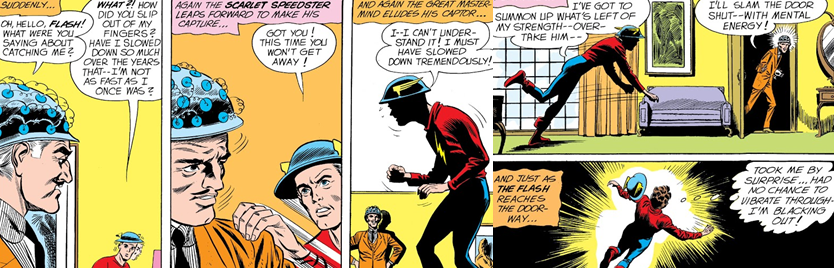
Spider-Man revels in his newfound fame and refuses to stop a thief from escaping.

Anyway, Spider-Man makes his big television debut, wowing the audience with his many abilities; he becomes an immediate headline sensation and is suddenly inundated with offers for interviews, photo shoots, and even movies (imagine that!) However, as he is making his way back to the changing room, a security guard is in the process of chasing down a thief; Spider-Man allows the thief to escape unhindered to the elevator, rightfully but crucially stating that it’s not his job to stop criminals since he’s a performer, not a cop!

Peter is horrified to find his uncle dead and angrily confronts the man responsible.

Peter revels in his newfound fame but, one fateful evening (not that same evening, it’s interesting to note), he returns home to be told the news that his beloved Uncle Ben has been shot and killed by a house burglar! Overcome with grief and a burning desire for revenge, Peter races to his bedroom and pulls on his Spider-Man costume to confront the burglar after the cops tell him (Peter) where he’s holed up. Thanks to his web-slinging abilities, Spider-Man easily crosses town to reach the warehouse where the thief is hiding out and gets the drop on him.

Peter learns a harsh and humbling lesson to use his great powers selflessly.

Of course, Spider-Man is easily able to corner the thief, disable his gun with his webs, and knock him out with one right hook. However, Peter is devastated when he sees the face of his uncle’s killer and recognises him as the same thief he refused to stop a few days earlier! Peter leaves the thief in the custody of the police and wanders off into the night, distraught with grief and guilt at his selfish ways and learning, as the narrator sombrely informs us, the harsh lesson that “With great power there must also come — great responsibility!”

The Summary:
“Spider-Man!” is a brilliant, almost timeless tale; of course, it’s obviously full of allusions and references to the time period it was created in but none of these elements really overwhelm the general pace, direction, and themes of the story. Spider-Man was the first superhero to be a normal, everyday, awkward teenager; shunned by his peers for being a bookworm, he’s far outside of the popular social circle yet, though he’s clearly affected and upset by the teasing he constantly endures, he never falls into angst or despair and, instead, revels in the love and affection his adoring aunt and uncle constantly show him.

After years of being bullied for being a wallflower, Peter revels in his newfound fame.

Upon being granted his amazing spider abilities, Peter is immediately fascinated and excited and jumps at the chance to flex his newfound muscles in the ring. Finally, after years of persecution for being a wallflower, he has the power to topple even large, muscular wrestlers like Crusher Hogan and quickly becomes a television sensation. It’s clear that Peter is both overwhelmed and enthusiastic by the fame (and, presumably, brief fortune) his celebrity status brings him; there’s a sense that all these opportunists and media moguls are simply using Spider-Man and taking advantage of him but Peter is too distracted by the applause and adulation to even care.

Spidey’s dramatic origin is easily one of the most iconic and memorable in all of comics.

So overcome by this admiration and fame is Peter that his selfish actions cause him to make one fateful error in letting a seemingly harmless thief escape punishment and, of course, pays for it when that same thief kills his beloved Uncle Ben. The sight of Peter staring at the face of his uncle’s killer and realising that he (Peter) could have easily stopped him is a haunting and enduring image, as is the valuable life lesson that would go on to not only define Spider-Man’s superhero career but also become largely synonymous with the character. This origin, one born out of pure, unadulterated grief, is perhaps second only to the traumatic murder of Thomas and Martha Wayne in its significance, iconography, and impact on both the character and the comics and subsequent media he appeared in and ensures that Spider-Man’s dramatic debut is both memorable and relatable since Peter’s actions, though selfish, were completely understandable and natural. He didn’t get his powers and immediately become a crimefighter; he used them for fortune and glory and who among us can say we wouldn’t do the same?

My Rating:

Rating: 4 out of 5.

Great Stuff

What are your thoughts on Spider-Man’s iconic debut? Were you a fan of the character at the time or were you introduced to him through some other means and, if so, what were they? How would you rank Spider-Man’s traumatic origin story and how important would you say it is to the character and the comics industry as a whole? What is your favourite Spider-Man storyline, costume, or character and why? Do you prefer mechanical or organic web-shooters? Why do you think Peter chose red and black/blue for his costume? How are you celebrating Spider-Man Day today? Whatever your thoughts on Spider-Man, leave a comment below and be sure to stick around for Spider-Man Month starting this Wednesday!

Back Issues: Doomsday Clock

Published: 22 November 2017 to 18 December 2019
Writer: Geoff Johns
Artist: Gary Frank

The Background:
Ever since Watchmen (Moore, et al, 1986 to 1987) proved to be a critical and commercial hit, DC Comics have attempted to milk the property to capitalise on its popularity. A film adaptation had been in the works for decades and, when it was finally produced, spawned a videogame tie-in; finally, after years of trying to convince Moore and Gibbons to return to the franchise, DC drafted in a crop of the industry’s most talented creators (against Moore’s wishes, of course) to produce a prequel series. After years of subjecting readers to the largely-awful “New 52” era, DC finally decided to relaunch and reboot their continuity with another of their trademark Crises; “DC Rebirth” not only returned a lot of characters and concepts to their pre-New 52 portrayals but also concluded with Bruce Wayne/Batman discovering Edward Blake/The Comedian’s iconic, bloodstained button in the Batcave and the first hints that Doctor Jon Osterman/Doctor Manhattan was observing the DC Universe. Doomsday Clock finally saw the worlds of Watchman and the DC Universe come together and, despite a questionable release schedule and wonky canonicity (the story took years to be told and its placement in the timeline is confusing, at best), was met with critical acclaim and even led to a solo book for the series’ popular vigilante, Rorschach.

The Plot:
So, like Watchmen, Doomsday Clock is quite a dense text with a lot of things happening all at once and a lot of lore to dissect so I’m going to expand upon my breakdown of the story as I did with that graphic novel. The story’s plot is split between different characters and complex concepts like the multiverse, perceptions of time, and public’s opinion of superheroes in the DC Universe. One of the central concerns of Doomsday Clock is the state of Watchmen’s alternate world, now firmly established as one of the many parallel worlds in the DC multiverse. Seven years after Adrian Veidt/Ozymandias dropped his genetically-engineered squid into Times Square and killed millions of people, his dreams of world peace have been dashed after Walter Kovacs/Rorschach’s journal exposing his actions was published. As a result, the United States is once again on the brink of nuclear war with Russia and, desperate to save the world once more, Veidt allies with the new Rorschach, Reggie Long (son of Malcolm Long, Kovacs’ psychiatrist from Watchmen), and two of Dr. Manhattan’s former enemies, Erika Manson/Marionette and her husband, Marcos Maez/Mime.

Tensions between the public, the government, and superheroes are fragile on Earth-0.

The group uses a refitted version of Daniel Dreiberg/Nite Owl’s (sadly, once again, entirely absent from the tale) Owlship to then follow Dr. Manhattan’s unique energy signature to the mainstream DC Universe just as their world is destroyed by nuclear war. However, life on Earth-0 isn’t exactly much better; riots and violent protests against Batman’s presence run rampant in Gotham City and the public’s perception of superheroes has soured thanks to the publication of the “Supermen Theory”, which uncomfortably pointed out that the vast majority of the world’s superheroes are white American men and suggested quite explicitly that the American government (clearly led by President Donald Trump) have manufactured their superheroes through a series of clandestine experiments and operations. The only superhero that the public and the world’s governments has any faith in is Clark Kent/Superman, who is still regarded as a worldwide icon and allowed to freely cross borders. The linchpin of the animosity towards superheroes is the outspoken and volatile Ronnie Raymond/Professor Martin Stein/Firestorm and, to compound matters, the Russian government (led by Vladimir Putin) forms their own team of metahumans to protect their borders, while Teth-Adam/Black Adam offers sanctuary to all metahumans, good and bad, in the sovereign nation of Kahndaq.

Dr. Manhattan has been manipulating and altering the DC Universe for some time.

Amidst all of this is the mystery of Dr. Manhattan himself; at the end of Watchmen, Dr. Manhattan left to create some life of his own but, instead, was drawn to the DC Universe and discovers what is referred to as the “Metaverse”. The tumultuous nature of the DC Universe, which is not only populated by a wide variety of metahumans and magic but also subject to near-annual cosmic events and reality-shifting Crises, intrigues Dr. Manhattan, who begins to experiment with altering Earth-0’s history by subtly changing events in the past. This leads to the creation of multiple, widely different timelines and realities but, no matter what Dr. Manhattan does, Superman continues to emerge as the premier superhero of this world. Haunted by a vision of Superman flying at him in a rage and once again curious at his inability to see beyond this point, Dr. Manhattan observes the turbulent events unfolding around him with a morbid interest as he awaits to see if he destroys all reality or is himself destroyed by Superman.

The Review:
In the unfortunate absence of Nite Owl and Laurie Juspeczyk/Silk Spectre, and with Kovacs dead, there’s not a lot of opportunities for the iconic characters of Watchmen to interact with the mainstream DC Universe. Indeed, Doomsday Clock is less “DC Universe Meets Watchmen” and more “Some of the Watchmen characters pop over to Earth-0 alongside characters you’ve never heard of and a new Rorschach”, which is honestly a little disappointing. Like the television show, Doomsday Clock is a sequel to Watchmen but, because of its very nature as a comic book and its integration into the larger DC canon, is actually considered to be the true follow-up to the original graphic novel. Similar to the show, though, the future is depressingly bleak for Alan Moore’s characters; Veidt’s attempt at world peace was almost immediately undone and that world is quickly destroyed early into the story, making you question what the point of all that death and drama even was.

In a bid to save his world, Veidt once again lies and manipulates others to satisfy his ego.

Veidt, however, is largely undeterred by the state of his world; though he sees a macabre irony in his elaborate plan falling apart and despairs at the world’s insistence on destroying itself, he immediately concocts another desperate plot to save the world by tracking Dr. Manhattan down and convincing him to intervene. As is his way, Veidt’s scheme involves deceit, lies, subterfuge, and his unmatched intelligence; smug as ever, Veidt easily manipulates Reggie Long into assisting him by faking that he (as in Veidt) has a tumour on his brain (and feigning remorse for his actions, which led to the death of Reggie’s parents) and has him recruit Marionette and Mime to their cause specifically because he knows that Dr. Manhattan once spared Marionette’s life in a past encounter. Upon arriving on Earth-0, Veidt attempts to recruit Lex Luthor and is met only with scorn and a surprise attack by the Comedian, whom Dr. Manhattan transported to Earth-0 moments before his death. Having read Kovacs’ journal, Batman is also less than impressed with Veidt’s actions and megalomania; Veidt, however, maintains that he did what he did in an attempt to save and unite a world on the brink of destruction and attacks his new scheme with just as much blind obsession. Thanks to a cute little clone of his lynx, Bubastis, the green lantern of Alan Scott, and the presence of another temporal anomaly, Imra Ardeen/Saturn Girl, Veidt is able to forcibly summon Dr. Manhattan, who not only refuses to help but also exposes Veidt’s lies. Veidt orchestrates a massive conflict between Superman and other metahumans in order to inspire Jon to finally intervene and, though this does result in the restoration of Earth-0, the Watchmen world, and the entire multi/metaverse, he ends up imprisoned at the conclusion of the story.

Traumatised by Veidt’s squid, Reggie comes to assume the mask and identity of Rorschach.

One of the things that disappointed me about the television show was the absence of Rorschach; I know we’re not supposed to like Rorschach but I don’t give a shit, he’s still the most interesting and compelling character in Watchmen. Although Kovacs is dead, his spirit and influence lives on in Doomsday Clock; not only was his tell-all journal instrumental in revealing Veidt’s deception, his crusade is taken up by Reggie Long, a confused and volatile young man traumatised by the effects of Veidt’s destructive squid. Like many exposed to the squid’s nightmarish psychic field, Reggie was driven to near insanity and spent a great deal of time confined to a mental hospital. There, he befriended former Minuteman Byron Lewis/Mothman, who becomes a friend and mentor to Reggie but ultimate contributes to Reggie assuming Rorschach’s mantle by purposely hiding the truth of Kovacs’ relationship with Reggie’s father.

Reggie’s crusade briefly falters, sadly removing him from the story until the finale.

Believing that Rorschach and his father were friends and that Malcolm was able to reach and help Kovacs, Reggie is initially focused on killing Veidt for his actions but is convinced to aid him when Veidt claims to be dying and remorseful for his actions. Having read truncated versions of his father’s notes and Kovacs’ journal, Reggie assumes Rorschach’s costume and mannerisms and initially goes to Batman for help and finds himself imprisoned in Arkham Asylum for his trouble. Like in Watchmen, an entire issue is dedicated into delving into Reggie’s past and psychosis but he quickly gets lost in the shuffle as more and more characters and conflicts bog down the tale, even abandoning the mask and his crusade after Veidt’s lies are exposed. Ultimately, Alfred Pennyworth and Batman are able to convince Reggie to mask up and join the fight and Reggie even chooses to spare Veidt to see him brought to justice, claiming “Rorschach is me” but, while I appreciate the presence of a Rorschach, Reggie fails to be as compelling and instrumental as the real Rorschach and I think I would have preferred it if Dr. Manhattan had undone his actions or brought Kovacs forward in time as he did with the Comedian.

Dr. Manhattan screws with the DC timeline, creating different realities and outcomes as a result.

Speaking of Dr. Manhattan, he, too, gets another entire issue dedicated to him and his journey throughout the DC Universe. It’s basically exactly the same as issue four of Watchmen, with Jon spending a lot of time on Mars, ruminating about his origins and past with Janey Slater, and recapping the events of Watchmen. Although Jon appeared to have somewhat rediscovered his humanity at the end of Watchmen, to the point where he willingly went along with Veidt’s plan and even killed Rorschach to protect it, and his desire to reconnect with humanity was a big aspect of the TV show, in Doomsday Clock he’s basically exactly the same disconnected and emotionless demigod he was in the original graphic novel. He is despondent to discover that he feels just as out of place in a world of metahumans and magic as he did amongst mortals and takes to exploring and experimenting with the DC Universe’s fragile reality to keep himself from growing bored. Dr. Manhattan’s perception of time is both the same as in Watchmen (he can see the past, present, and future simultaneously but cannot see anything past his vision of Superman rushing at him) but different. I always assumed from Watchmen that Jon could only perceive time from his lifetime since he never visits the past beyond his lifetime in Watchmen but, in Doomsday Clock, he can freely walk between the past, present, and future of the entire DC canon, including a multitude of parallel worlds. Fascinated by the metaverse and the role Superman plays in this world, he purposely messes with time, killing Clark’s parents before their time and causing Alan Scott/Green Lantern to die, thus removing the Justice Society of America (JSA) from continuity, intervening in Flashpoint (Johns, et al, 2011), and basically creating the New 52 and Rebirth continuities through his actions.

Even with the world falling into anarchy, Superman is able to inspire Dr. Manhattan to intervene.

Accordingly, Superman is a central figure in Doomsday Clock; Dr. Manhattan is curious to see whether the Man of Steel kills him for his actions or whether he (as in Jon) destroys all reality and, still vehemently refusing to even try and go against the inevitability of fate, he refuses to intervene or to help Superman when he ends up battling against a horde of metahumans. As the only superhero who maintains the trust and respect of the public and world’s governments, Superman desperately tries to keep the peace, repair relations, and to help Firestorm after he accidentally turns a bunch of people to glass. However, he ends up making things worse and escalates the tensions between the world’s governments and metahumans, leading to an all-out war. Though disgusted at Dr. Manhattan’s refusal to get involved, and his part in causing not only the events of Doomsday Clock but also the tragedies of his life, Superman is ultimately able to inspire Jon into restoring the worlds and multi/metaverse to normal through his selfless nature.

Doomsday Clock is stuffed full of characters and and cameos, more of whom derail the plot.

I mentioned before that Doomsday Clock is swamped with characters and it really is; a handful of the Watchmen characters obviously feature, including a brief appearance by the Comedian, who mainly features to try and kill Veidt for his attack on him at the beginning of Watchmen and to be a pain in the ass. Marionette and Mime, two completely original characters, feature extensively as Dr. Manhattan imbues their child with his powers in the finale to, presumably, become the Watchmen version of Superman. Additionally, a whole host of DC characters play a role in the story: Batman finally solves the puzzle of the mysterious bloodstained button but uncharacteristically chooses not to believe Reggie’s claims and has him locked up in Arkham, leaving him underequipped to intercede in the events of the story; Firestorm, here a volatile and immature character, escalates much of the tension regarding the perception of metahumans and the Supermen Theory when he is unable to control his powers; and, of course, the Joker makes an appearance but does little more than derail the main plot with an ultimately pointless side story.

Allegorical and metaphysical ruminations and canon fixes largely supplant big fight scenes.

Like Watchmen, Doomsday Clock contains an allegorical story-within-a-story, in this case the films of Carver Coleman, with whom Jon forms a strange kind of bond and how becomes his “anchor” in this new world. Carver’s hit film, The Adjournment, parallels the mystery that permeates Doomsday Clock and Jon’s own struggle against his true identity. Doomsday Clock also goes out of its way to closely emulate the art style and presentation of Watchmen but greatly overdoes its commitment to this by slavishly sticking to a rigid 3×3 panel structure. Like Watchmen, Doomsday Clock is also rather light on action and packs a whole bunch of symbolism, imagery, and references into each panel, mainly to Watchmen but also to the long and convoluted history of the DC Universe. The conclusion of the book sees the JSA returned to continuity, Clark’s parents and Alan Scott returned to life, and the restoration of the multi/metaverse but also leaves the story open ended for further continuations down the line exploring the restored Watchmen universe.

The Summary:
It seems that DC’s attempts at recapturing and revisiting Alan Moore’s seminal work are doomed to fail; just as I was unimpressed by the TV show, I can’t help but feel let down by Doomsday Clock, which is a quagmire of convoluted plot threads, self-indulgent allusions to Watchmen, and is a largely confusing and uninteresting mess. I feel like the book focuses too much on being sequel to Watchmen but it doesn’t really work since seven years have passed since the end of that book and we only spend about an issue and a half really reconnecting to Moore’s world before it’s destroyed. After that, it’s just another elaborate “Crisis” event as the few surviving Watchmen characters mingle about in the DC Universe and spend far too much time interacting with obscure characters like Johnny Thunder and Saturn Girl rather than the big guns like Batman and Diana Prince/Wonder Woman.

Dr. Manhattan’s God-like powers make him largely immune to conventional attack.

The story is framed around this epic, potentially cataclysmic battle between Superman and Dr. Manhattan, a concept that feels like a betrayal of Jon’s character as he’s largely a pacifist because of his stubborn refusal and disinterest in getting involved in the affairs of mortals. Yes, he fought crime and waged war against the Vietnamese but that was a long time ago by the present day events of Watchmen, where he was simply content to just let life play out as is preordained so, while the idea of these two titans clashing sounds good on paper, it seems like the sort of thing a child would think up while bashing action figures together. To me, Dr. Manhattan has always seemed more like Jim Corrigan/The Spectre, a being of incredible power who shapes events but only really gets involved in them when the cosmic shit is about the hit the fan, which is kind of how he ends up being in the end since we don’t really get to see him fight with Superman because the entire promise of their conflict was a big fake out. There is, however, a pretty good scene where a whole gaggle of DC’s superheroes and Green Lanterns confront Dr. Manhattan on Mars only to be easily subdued by his near-limitless powers

Sadly, there just aren’t enough interactions between the DC and Watchmen characters.

Similarly, the idea of Rorschach meeting Batman and Ozymandias meeting Lex Luthor sounds great…on paper but this isn’t the same Rorschach and, no matter how hard Reggie tries, he will never be that same character so it wouldn’t really work even if Batman didn’t just disregard him and lock him up in Arkham. Luthor is scornful towards Ozymandias and a potential team up between these two is also immediately cast aside, with Luthor mocking Veidt’s intelligence and plan as though Johns is poking fun at the very work he is so blatantly trying to homage and leech off of. The absence of Nite Owl and Silk Spectre equally hurts not just the story’s plot but also Doomsday Clock’s legitimacy as a Watchmen sequel; again, it feels less like the characters of Watchmen meeting the DC Universe and more like a handful of them dropped into the unexplainably chaotic DC Universe and struggling to make sense of it.

The attempts to recapture Watchmen‘s bleak political undertones largely fall flat.

Basically, Doomsday Clock tries and fails to emulate the unique narrative and approach that Watchmen took; Watchmen’s bleak, uncompromising and, dare I say it, adult themes don’t mesh well at all with the mainstream DC Universe and I can’t help but feel like it would have been better to supplant the Watchmen characters mid-way through the events of Moore’s book so that we could see all their recognisable and flawed heroes actually butting heads with DC’s big guns in a clash of both ideals and fists. Dr. Manhattan could have been responsible for this, manipulating events from behind the scenes to cause the two worlds to emerge, and we could have seen interesting team ups and interactions between these characters (Batman and Nite Owl and Wonder Woman and Silk Spectre spring instantly to mind) but, instead, we get this weird mess of a story that’s more concerned with turning superheroes into hated figures, destroying or leeching off of DC’s Golden Age and Watchmen’s legacy, and desperately attempting to address some of the issues with the Rebirth universe.

In the end, Doomsday Clock was just another convoluted “Crisis” event.

Ultimately, I feel like I have to recommend Doomsday Clock, though, if only to see the botch job DC makes of officially canonising Watchmen into the DC Universe. As a love letter to Watchmen, it’s not so bad; the way it evokes the imagery and atmosphere of Moore’s work is pretty astounding and the artwork is quite appealing but the problem is that, while reading it, I just felt like I’d rather be reading Watchmen or any other “Crisis” event. It’s better than the TV show, I’ll give it that, if only because it actually includes a number of recognisable Watchmen characters but it similarly fails to properly recapture the magic of Moore’s story because the characters haven’t really changed and they don’t really fit in the mainstream DC Universe. This is brought up a few times but not often enough as the story has to make way for the escalating conflict between Superman and other metahumans and its confusing ending, and I can’t help but feel like Johns dropped the ball and that Doomsday Clock failed to really live up to all the hype and potential it had.

My Rating:

Rating: 2 out of 5.

Could Be Better

Did you enjoy Doomsday Clock? Did you suffer through the comic’s long publication or did you pick up the collected edition, like I did? Were you excited to see the Watchmen characters interact and be integrated into the DC Universe and were you disappointed with how the story turned out? What did you think to the new Rorschach and Dr. Manhattan’s role in the DC Universe? Were you a fan of the interactions, characterisations, and references included in the story or do you agree that it failed to live up to its potential as a concept? Would you like to see the Watchmen characters interact with the DC Universe again in the future or do you think it’s best that it stays separate from mainstream canon? Whatever your thoughts on Doomsday Clock and Watchmen in general, drop a comment below and thanks for joining me for Watchmen Wednesday.

Back Issues: Watchmen

The Introduction:
Usually, my Back Issues articles are a little more relaxed and sort of like informal mini-essays and musings about single issues or limited runs but Watchmen is going to need a little bit more than that, I fear. I’ve written about Watchmen before, specifically as part of my Master’s dissertation, and it’s no small feat; the maxiseries has been picked apart, scrutinised, and analysed perhaps more than any other comic book or graphic novel thanks to it inspiring “the evolution of comics into ‘graphic novels’. [Ironically,] the creators hoped literally to deconstruct the superhero genre and break its stranglehold on the American industry, but in fact tightened the grip” (Newman, 2009). Watchmen is typically the first, and finest, example of the literary worth of comic books, looming “over the [genre] like the Colossus over Rhodes” (Douthat, 2009: 50), and was not only “chosen as one of the Greatest One Hundred Novels in English from 1923 to 2005” (Shephard, 2009: 213) but also long regarded as unsuitable for other mediums.

So, because of all that, and more, this is easily the most complex edition of Back Issues I’ve had to put together so I think it’s only fair to expand upon my usual format in order to best delve into the intricacies and layers of Watchmen.

Published: September 1986 to October 1987
Writer: Alan Moore
Artist: Dave Gibbons

The Background:
Published between September 1986 and October 1987, Watchmen was the brainchild of noted comic book writer Alan Moore; Moore, who was born just down the road from me in Northampton, had achieved much success in his home country with V for Vendetta (Moore, et al, 1982 to 1989) and at DC Comics thanks to his groundbreaking work on The Saga of Swamp Thing and, after DC acquired the rights to Charlton Comics characters, devised a murder mystery scenario that would star such Silver Age characters as Vic Sage/The Question and Ted Kord/Blue Beetle. Although DC managing director Dick Giordano was receptive to Moore’s premise, he denied the use of the Charlton characters so as not to damage their reception when they were folded into the main DC Comics lore so Moore collaborated with artist Dave Gibbons to reimagine the concept with an entirely new cast of characters.

With the Charlton characters off limits, Moore and Gibbons created their own.

Lacking the usual advertisements and attractive cover designs (Reynolds, 1992: 108-109), Watchmen incorporated a sophisticated adult narrative in which Moore explored new avenues of the superhero genre; Moore sought to subvert the usual expectations of comic book heroes, grounding them in reality (for the most part), and tackling the genre with a serious, contemplative direction. Filled with dense imagery and complex themes, and despite several delays, Watchmen was a critical and commercial success; it’s still the only graphic novel to make Time magazine’s 2005 list of “All-Time 100 Greatest Novels” and DC have long pursued Moore to produce prequels, sequels, and other spin-offs of his seminal work. Despite Watchmen’s success, though, and DC going ahead with these aforementioned continuations and licensing numerous adaptations of Watchmen, even officially folding it into mainstream DC continuity in 2017, Moore has publically distanced himself from DC’s ventures and even refused to have his name associated with Zack Snyder’s live-action adaptation and the HBO limited series.

The Plot:
Rather than portray super-powered heroes, Watchmen focuses on middle-aged, mostly retired, ordinary people and, with one exception, poses the question: “What if superheroes were real?” and its influence on the genre resonated for decades thanks to its stringent focus on dark realism and increasingly complex, adult themes. Watchmen takes place in an alternative version of 1985 where, because of the presence of superheroes in the 1940s and 1960s, the United States won the Vietnam War, Richard Nixon remains as the President of the United States, and the world stands on the brink of all-out nuclear war thanks to rising tensions between the U.S. and the Soviet Union. Amidst this bleak alternate reality, Watchmen retains the murder mystery plot Moore originally conceived; the story begins with Edward Blake/The Comedian, one of the few government-sponsored vigilantes still active after vigilantism was outlawed, being hurled to his death. Walter Kovacs/Rorschach, who stubbornly refuses to retire or compromise to any authority, investigates the murder and uncovers what he believes to be a plot to kill off former “masks” but, in attempting to get to the bottom of the mystery and warn his fellow former costumed heroes, stumbles into a plot to cause near-genocide.

The vigilantes of the 1960s were eventually forced to retire from action.

Throughout its twelve issue run, Watchmen alternates between this plot, weaving in numerous side plots and supplementary materials, and exploring the origins of our main characters and the legacy they continue. As a result, the narrative constantly shifts between the present day and the Golden Age of superheroics in America, when ordinary civilians, former wrestlers, and cops took to wearing garish costumes and fighting crime as the Minutemen of the 1940s. Age, however, inevitably caught up with the Minutemen and they either died, quietly (or publically) retired, or disappeared from the spotlight as a new generation of costumed adventurers, the Crimebusters, came to prominence in the 1960s. Unlike their predecessors, however, the Crimebusters were forced to retire by the 1977 Keene Act, with only Rorschach defying this law and government-sponsored operatives like the Comedian and the God-like Jon Osterman/Doctor Manhattan remaining active. Because of the abundance of real-life costumed heroes, and the general disdain of vigilante activities, the world and society is a very different place; comic books retain pulp stories such as horror and pirate tales and there is a bleak feeling of desolation and despair in the general public despite all of the technological advances brought to the world by Dr. Manhattan’s awesome power and the ingenuity of the self-proclaimed “World’s Smartest Man” Adrian Veidt/Ozymandias thanks to Manhattan’s mere presence stunting the aspirations of mankind (to say nothing of the looming threat of nuclear war).

The Characters:
Watchmen’s characters, though inspired by numerous classic Charlton Comics superheroes, contain a deep inter- and metatextual insight into the world around us as it is and could be, subverting comic book expectations by portraying flawed heroes who are confused, struggling to define their identities, and quite capable of failing, being seriously injured, or dying, and is a story unbound from mainstream DC continuity. Moore does not have to be concerned about ostracising an iconic character like Clark Kent/Superman from the rest of humanity, for instance, meaning Doctor Manhattan is free to have a complete character arc in one standalone text. In addition, “the superheroes of Watchmen also lack any supervillains to measure themselves against. They are forced to confront more intangible moral and social concerns” (Reynolds, 1992: 115); Watchmen also forgoes the need to trawl through back issues researching each character because exposition is incorporated within each chapter and made readily available throughout. This affords Watchmen many advantages not readily available to other comic books (or their adaptations), with the most obvious being that it brings the constantly malleable comic book medium closer to the static preservation of the literary novel: “With its array of carefully crafted oddballs and interconnected plot lines, [Watchmen] reads like a superhero story filtered through Dickens […] aimed at flaws in the era’s comic books: unchallenging narratives, flat characters, simplistic morality” (Suderman, 2009). Conversely, Watchmen also carries limitations; essentially, Moore had to secure an emotional attachment with the reader without being able to rely on a character’s proven popularity as one could with Superman, for example.  

Rorschach is the closest thing Watchmen has to a main character.

For the most part, despite its large ensemble cast, Watchmen is told through the eyes and narration of Rorschach, a brutal and uncompromising vigilante who was heavily influenced by the Question, Rex Garine/Mr. A, and Bruce Wayne/Batman’s more aggressive style of vigilante justice. Indeed, Rorschach has largely been regarded as Watchmen’s most iconic and popular character but Moore rejected the idea that a character as extreme, uncompromising, and right-wing as Rorschach should be idolised: “You’re not going to have any friends because you’re going to be crazy and obsessive and dangerous and frightening” (Reynolds, quoting Moore, 2005: 117). Watchmen contains numerous other characters commenting on Rorschach’s questionable methods, mentality, and sanity; he’s given a distinctive, gravely, monotone voice (one of only two characters to have their own unique speech bubbles), is generally regarded as being rather pungent, to say the least, and doesn’t hesitate to torture or kill in order to advance his never-ending crusade. Aesthetically, Rorschach takes on the suit-and-fedora combination of a cynical noir detective (circa-1950), appearing a lot closer to his closest Charlton counterpart, the Question, than Moore’s other characters. Even their masks are similar, with both the Question and Mr. A hiding behind blank, expressionless visages and Rorschach’s entire individuality expressed through a mimetically shifting inkblot mask (a face-obscuring impediment that uniquely portrays his shifting emotions through a variety of constantly shifting patterns). However, Rorschach’s aesthetic similarity with the Question clouds the definition of Rorschach’s character considerably.

Rorschach is a borderline psychopath but…he gets results!

Certainly, his semi-psychotic personality and unnerving grasp of his duel identities make him a character unique in his own right (while the Question could be more ruthless than other heroes of the Silver Age, Rorschach’s willingness to bludgeon criminals places him more in the vein of the darker anti-hero birthed around the time of Watchmen’s publication). Additionally, Rorschach’s psychosis stems so far that he considers his masked persona to be his “true face”, while his counterparts easily slipped in and out of their duel identities. It could be argued that Rorschach’s aesthetic is a question of homage, perhaps sincere respect for a peer’s work, and a simple case of cultural influence (rather than plagiarism justified by some extreme characterisation and the bleakness of Watchmen’s context) but Rorschach also adopts filmic conventions of the hardboiled noir detective, comic book conventions of the mysterious masked vigilante, and realistic issues concerning identity and purpose, inviting (if not forcing) the reader to look at themselves and the world around them differently. Since “[Watchmen] originated […] as a way of ‘using up’ third-tier characters — Blue Beetle, Captain Atom etc — that [DC] had picked up along with the defunct Charlton company” (Newman, 2009), Moore incorporated those familiar designs into these relatively obscure characters and reinterpreted them into his fictional world in order to depict just how psychologically broken a vigilante would be in real life: “You’re probably going to be too obsessed with your vendetta to bother about things like eating or washing or tidying your room because what have they got to do with the War Against Crime?” (Reynolds, quoting Moore, 2005: 117). Rorschach believes that beating, maiming, and killing criminals will bring about change within society and, as Moore’s template for a real-world vigilante, tells us that society is tainted, corrupted, and poisoned, and that to fight against such vices one must be as uncompromising as possible in the service of justice.

Dreiberg is a shell of his former self and is reinvigorated by donning his outfit once more.

Honestly, I could focus my entire analysis of Watchmen on Rorschach alone but he’s not the only character in the series; in the past, when he was slightly less unhinged, Rorschach worked side-by-side with Daniel Dreiberg/Nite Owl, a character based heavily on Blue Beetle and who also has more than a little influence from Batman in him. Having inherited a modest amount of wealth, Dan put his resources towards continuing the legacy of Hollis Mason, the first Nite Owl and costumed adventurer, buying up numerous properties, designing useful gadgets like night vision goggles and Rorschach’s grapple hook, and even building himself his own Batcave (the “Owl’s Nest”) and a military-grade airship, Archimedes. Nite Owl exemplifies the neutered, powerlessness of Watchmen’s once-lauded costumed heroes; having developed a paunch and a largely lethargic attitude in his retirement, Dreiberg is as pragmatic and realistic as Rorschach is cynical and uncompromising. Surrounded by the dusty relics of his once colourful life, Dreiberg is a man living in a limbo between the past and the future, literally and figuratively made impotent by the changing state of society. Indeed, it’s only when he finally reassumes the role of Nite Owl that Dreiberg finally awakens from his apathy, immediately becoming a more physically and mentally competent character who is morally disgusted by the plot he and Rorschach uncover.

Laurie is happy to have left behind her costumed ways if only to spite her mother.

The only female member of the Crimebusters, Laurie Juspeczyk/Silk Spectre is an angry and repressed woman who was forced into the life of a costumed adventurer from birth by her oppressive and controlled mother, Sally Jupiter, the original Silk Spectre and former member of the original Minutemen. As a result, like many children forced to live their parents’ broken dreams, Laurie carries a lot of repressed emotions and resentment within her; she is the only one of the Crimebusters to be grateful at being forced into retirement but finds herself little more than token baggage due to her relationship with Dr. Manhattan being the last remaining thing keeping the God-like figure invested in America’s interests. Laurie’s boiling emotions and feelings of repression and resentment also stem from her utter disgust and rage at the knowledge that the Comedian once tried to rape her mother and the verbal abuse she suffered at the hands of her stepfather. Though she similarly detests Rorschach, she finds comfort in the presence of Dreiberg, who offers her a sympathetic ear and the attention and respect she so craves. Eventually, she is able to reawaken his passion not just sexually but for life in general and they come to help each other rediscover the thrill of being costumed heroes…sadly, this comes right as the world teeters on the razor’s edge of full-scale nuclear war.

A freak accident bestows Jon with God-like powers and shifts his perception of time.

This is primarily due to the sudden self-imposed exile of Dr. Manhattan to Mars; once a simple, unassuming scientist, Jon Osterman was caught in an “intrinsic field” and ripped apart atom by atom only to reassemble himself into a glowing blue figure who perceives past, present, and future simultaneously can manipulate, create, and transfigure matter in any way imaginable. Effectively a God-like figure, the mere presence of Dr. Manhattan is enough to bring the Vietnam War to an end and to keep the Russians in check as a living nuclear deterrent. However, Dr. Manhattan’s higher state of being eventually renders him emotionally closed off to humanity; able to perceive the future but unable to change it, he describes himself as a puppet who can “see the strings” and comes to regard humanity as a squabbling, self-destructive speck in the grand scheme of the universe. Laurie remains his sole link to his humanity and, when his increasingly detached mentality creates distance between them and he is bombarded with allegations of causing terminal cancer in those nearest to him, he exiles himself to Mars and seems poised to abandon humanity to their fate in order to focus on the chaotic beauty of the universe.

A reprehensible human being, the Comedian chose to be a sick parody of the joke that is life.

While the costumed adventurers of Watchmen exhibit considerable physical ability, none of them are inherently superhuman save for Dr. Manhattan; able to teleport, alter his size, and transfigure atoms, Dr. Manhattan is a literal God walking amongst mortals and his arrival spells the end not only for all-out war against the U.S. but the majority of human achievement, too. His abilities mean that environmentally-damaging fossil fuels will soon become a thing of the past and he is generally heralded as rendering usual notions of costumed heroics completely redundant. Yet, the world still spins and teeters on the edge of global meltdown; the public, initially in awe of Dr. Manhattan, eventually learn to simply co-exist alongside him and take him for granted, meaning that the entire world is sent into a mess of confusion and worry when he suddenly teleports away to Mars. The linchpin of Watchmen is the Comedian; a brutal and violent vigilante who has lived through both generations of costumed heroes, the Comedian is an absolutely reprehensible individual who takes a perverse pleasure in violence, conflict, and war. Blake’s experiences in Vietnam see him killing and torturing countless Vietnamese soldiers (and, he openly admits, children); he even shoots the mother of his unborn child point blank when she scars his face with a shattered glass bottle and delights in bringing his extreme methods to the rioters in the seventies.

As despicable as he was, Blake was clued in enough to see the world was heading for disaster.

Given that the Comedian starts the story little more than a twisted, broken corpse on the streets of New York, much of his story is told through flashbacks and the memories of other characters; an antagonistic individual with a twisted world view, Blake is, nevertheless, the only one of the Crimebusters to recognise that the world is spiralling towards all-out nuclear war and that all of their schoolboy heroics will be rendered meaningless when the world is little more than a burning cinder. Still, he catapults the plot into action when, prior to the story’s beginning, he stumbles upon a mysterious, uncharted island and a plot so gruesome and outlandish in its scope that it breaks even his spirit. While few characters mourn his death, the Comedian’s discovery is directly responsible for his murder and for Rorschach’s uncompromising investigation and is the one thing, in all the atrocities he has both witnessed and willingly taken part in, to bring the Comedian to tears of despair.

Veidt concocts an elaborate ruse to fool the world into peace through mass murder.

His discovery is the private island of Adrian Veidt; Veidt, once the flamboyantly-dressed costumed hero known as Ozymandias, was the only member of the Crimebusters perceptive enough to predict the coming of the Keene Act and to retire two years before vigilantes were outlawed. He then put his incredible intellect and self-made wealth towards building a multimedia empire; he not only publically revealed his identity and capitalised on his popularity with a line of action figures, he also strived to create renewable sources of energy and numerous consumer products, always with the aim of advancing humanity towards a greater destiny. Modelling himself after Alexander the Great and obsessed with Egyptians, their culture and society, and their fascination with death, Ozymandias came to see that it was only a matter of time before humanity destroyed itself, whether through nuclear war or environmental collapse, and thus began a ten year plan to unite the world in a way so ridiculous that it had to be taken seriously. To that end, he commissions scientists, artists, and writers to duplicate Dr. Manhattan’s teleportation powers and genetically engineer a horrific creature with which he can fool the world into uniting against a common, extraterrestrial foe.

The Themes:
Watchmen is a dense text, perhaps the most intricate and complex comic book series ever published, reading far more like a visual novel than a traditional loud and bombastic, action-packed comic book. One thing that often puts me off about Watchmen is just how intense its narrative can be; with a detailed, intricate, and deliberately unorthodox art style and panel arrangement, and bolstered by numerous supplementary materials, Watchmen is a slow, methodical tale that emphasises a deconstruction of the genre, character exploration, and contemplative themes on the nature of humanity over fight scenes. Indeed, there is very little in the way of action depicted in the comic at all and, when fights do that place, they’re generally a brief and brutal scuffle than emphasises realism over grandiose action sequences.

The morality of good and evil and the nature of the world comes into scrutiny in Watchmen.

Through its intricate exploration of the morality of good and evil and the deconstruction of superhero conventions, Watchmen poses many unique questions regarding what it means to be human (or superhuman) and how best humanity can truly be saved from both anti-social elements such as petty criminals and organised crime and world-ending threats like war and environmental collapse. Rorschach unflinchingly believes that vigilante actions serve a purpose to the safeguarding of society; together with Nite Owl, he brought down many prominent criminal figureheads, thus sparing countless lives from their influence, and, despite his questionable frame of mind and methods, refuses to compromise this belief even in the face of Armageddon. The Comedian, meanwhile, while sharing Rorschach’s penchant for brutality, views all life as one big, cruel joke and Veidt’s master plan as the ultimate joke, one which would spell an end to his lifetime of conflict, while Dr. Manhattan engages in superheroics simply because he is asked to by the government and takes little to no pleasure in it, or much of anything for that matter, eventually becoming a superman who cares little for the defending out-dated ideals like Truth, Justice, and the American Way.

Watchmen‘s bleak world is populated by numerous supporting characters.

Peppered throughout Watchmen are a number of side plots and supporting characters, all of whom offer differing perspectives on Moore’s world and the politics and costumed individuals who inhabit it. One of the most prominent is Bernard, a widowed newsvendor who offers commentary on the mounting tensions between America and Russia; selling tabloids and magazines with an affable charm, Bernard interacts with many of the other side and main characters without even realising it and represents the “man on the street” throughout Watchmen. Another prominent character is Malcolm Long, a psychiatrist who is given the unenviable task of psychoanalysing Rorschach after the vigilante is arrested; though initially excited at the prospect of working with such a prominent individual, Rorschach’s unflinching and unsettling demeanour deeply disturb Malcolm and lead to a breakdown of his marriage as he slowly becomes obsessed with Rorschach’s twisted perspective on life. Yet, despite this, both Malcolm and Bernard (and other side characters) come together to help break up a fight in the streets; ironically, though, this brief flash of the inherently good nature of humanity comes right as Veidt triggers his horrific master plan to “save” the world.

As ridiculous as the squid is, Veidt’s plan works and only Rorshach refuses to play along.

It is through Veidt that Watchmen so openly deconstructs pre-conceived notions of superheroes; rather than take to the streets and work his way up the food chain of various criminal elements like the likes of Rorschach, Veidt prefers to tackle the route of not only that problem but the problems of the world as logically and directly as possible. While Nite Owl and Rorschach muse that Ozymandias has gone insane, his motivations are meticulously thought out, premeditated, and planned to minute detail; worst of all is that, despite how extreme his plan is, it has an undeniable logic behind it and, most disturbing of all, is that it actually works! Going completely against type, Ozymandias initiates his plan thirty-five minutes before Nite Owl and Rorschach attempt to stop him, meaning he can monologue about his motivations and justify his actions as much as he likes as his grotesque squid-like creature has already devastated New York. As ridiculous as this squid appears, the seeds for its appearance are sown all throughout Watchmen, as are the hints towards Veidt’s involvement; every panel is packed with details, nuances, and foreshadowing towards not just this ending but also the nature of the comic’s various characters and sub-plots, all-but-demanding repeated reads in order to see how masterfully Moore and Gibbons build towards this gruesome conclusion. Every now and then, the narrative shifts to Veidt’s island where we see characters discuss their work on the creature and even sketch a picture of it and its violent appearance in New York does exactly what Veidt set out to achieve; in the face of such a terrifying mutual enemy, all hostilities between the U.S. and Russia immediately end and an era of worldwide unity and peace is ushered in as humanity makes every effort to fortify their defences against Veidt’s perfectly-orchestrated deception. The only character who refuses to keep Veidt’s terrible secret for the sake of world peace is Rorschach, who literally gives his life for his uncompromising moral integrity and yet still threatens to topple Veidt’s utopia after leaving his tell-all journal in the hands of his preferred tabloid, the New Frontiersman.

Watchmen contains an allegorical story-within-a-story.

Perhaps the most prominent side story in Watchmen is “Marooned”, a story within the pulp pirate comic book Tales of the Black Freighter; read by a young boy who frequents Bernard’s newsstand (and who is also called Bernard, indicating the commonalities people can have, however small and seemingly inconsequential or coincidental). “Marooned” depicts a sea captain who is left the sole survivor after his ship is destroyed and his crew killed by the titular Black Freighter, a ghost ship of sorts filled with malevolent spirits. Driven half-bad from hunger, isolation, and paranoia, the sea captain fashions a gruesome raft out of the bloated corpses of his men and the remains of his ship, and endures ravenous seagulls and even sharks in his obsessive quest to return to his family and beloved home of Davidstown. Upon arrival, though, he finds that the Black Freighter has beaten him there, its ghoulish occupants threatening his family and townsfolk, so he resolves to attack and murder them with little hesitation in order to protect his wife and children. However, in that moment, he realises that Davidstown is unmolested, that he has killed both an innocent couple and his wife, and that he is the true monster of Davidstown. Resigned to his fate, he willingly swims out to board the Black Freighter and take his place amongst his own kind. Initially somewhat jarring in its inclusion, “Marooned” directly parallels the story of Veidt’s unwavering obsession with committing unspeakable acts for the greater good and is a subtle allegory towards many of the other stories and themes seen in Watchmen, particularly those revolving around blind obsession and distorted perspectives on morality.

The Summary:
Even after all these years, Watchmen continues to be a commendable piece of fiction; by subverting and challenging the norms of both superheroes and comic books, Watchmen tells an intricately-crafted, methodical examination of the genre in a way that is gritty, mature, and entirely relatable. Forgoing bombastic comic action for introspective and unapologetically bleak deconstructions of clichés such as the faultless superhuman and the colourful costumed characters we’ve come to expect from comic books, Watchmen is extremely heavy-handed with its themes of obsession and musings on the morality between good and evil in the face of worldwide conflict. Watchmen is, honestly, a bit of a paradox in that it’s not for everyone but anyone who is a fan of comic books should really take the time to read it to see just what the medium is capable of. Largely considered unfilmable for years, Watchmen has nevertheless been adapted into a live-action feature, an award winning HBO series, and even a pretty simple videogame but, if you’re one of the many who sympathise with Moore’s abhorrence for adaptations of his work or don’t really have the time of patience to tackle this admittedly-dense text, you can always fall back on the excellently produced motion comic (Hughes, 2008 to 2009) which is easily the most faithful adaptation of Watchmen.

It’s not for everyone but you can’t deny the importance and impact of Watchmen.

Still, I would recommend giving Watchmen a read; while I initially didn’t much care for it and preferred the movie (and, truthfully, I still do), I have come to appreciate it much more over the years for its intricate detail and subtle nuance. Moore may dislike people popularising Rorschach but he’s a fascinating character and easily the most interesting and complex of the comic’s varied and multifaceted original characters and, similarly, Dr. Manhattan is a startling glimpse at what it could mean should an all-powerful superhuman like Superman grow tired and apathetic towards humanity. Watchmen’s depiction of society’s reaction towards costumed heroes continues to be relevant and influential to this day and the comic inspired a wave of introspective, mature takes on the genre and changed the industry forever by actually taking comic books, and superheroes, seriously and propelling them into mainstream attention in a way that had never been done before.

My Rating:

Rating: 4 out of 5.

Great Stuff

How do you feel about Watchmen? Did you read it when it was originally published in its twelve issue run or did you first discover it as a graphic novel? Which of Moore’s original characters do you find the most, or least, compelling and why? What do you think of Watchmen’s methodical pace and heavy-handed themes? Perhaps you feel it’s a bit too impenetrable and overhyped; if so, why? Would you like to see a version of the story told with the Charlton Comics characters as Moore originally intended? What did you think to the comic’s sudden and dramatic ending? Did you care for Watchmen’s numerous sequels, prequels, and adaptations; if so, which was your favourite and, if not, why is that and what do you think about Moore’s attitude towards adaptations of his work? Whatever your thoughts about Watchmen, feel free to leave a comment below and pop back next Wednesday for my review of Zack Snyder’s big screen adaptation.

Back Issues [Sonic Month]: Sonic the Hedgehog (US Promo Comic)


Sonic the Hedgehog was first introduced to gamers worldwide on 23 June 1991 and, since then, has become not only SEGA’s most enduring and popular character but also a beloved videogame icon. Since the Blue Blur turned thirty this year, I have been dedicating every Friday to SEGA’s supersonic mascot.


Story Title: Sonic the Hedgehog
Published: Fall 1991
Writer: Francis Mao
Artist: Francis Mao

The Background:
So, I mentioned previously that, during the development and marketing of Sonic the Hedgehog (Sonic Team, 1991) for a wider audience outside of its native Japan, Sonic’s design and lore underwent significant alterations. In Japan, Sonic originally had a human girlfriend and battled Doctor Eggman in a wacky fantasy world that was an alternative version of ours openly populated by humans and anthropomorphic animals. However, for Sonic’s American debut, the character was redesigned from a sleek, aerodynamic character and into a Mohawk-sporting superhero who lived on the alien world Mobius and fought with Doctor Ivo Robotnik, who was once the kindly scientist Doctor Ovi Kintobor. This story, which was only briefly reflected in the game’s manual and had pretty much no representation in the videogame, became a prominent and influential part of Sonic’s canon outside of Japan thanks to it featuring in a variety of media. Most notably, the story was told in great detail in Stay Sonic (Mike Pattenden, 1993), formed the basis of Sonic the Comic’s (1993 to 2002) lore, but it first featured in a promotional comic book released in the United States in autumn of 1993. The comic had a very limited run and is now extremely rare, so the only way to read this time capsule of a vastly different and conflicting time in Sonic’s life is by use of online scans.

The Review:
“Sonic the Hedgehog” beings in medias res with SEGA’s super-speedy mascot racing through the Green Hill Zone and being chased by Dr. Robotnik (who is piloting his wrecking ball Egg-O-Matic and being flanked by a variety of Badniks). The narration box provides a brief bit of context to establish where we are and what’s going on: this is, of course, the planet Mobius, which was once a peaceful and fun place to live before the evil Dr. Robotnik began his attempt to take the planet over and the only one who can stop his the “short, blue, super-fast, and radically cool” Sonic the Hedgehog.

Sonic rescues his animal friends and drops a bombshell regarding their friend, Dr. Kintobor…

After outrunning Robotnik, Sonic makes short work of his mechanical Badniks, freeing his animal friends in the process. However, he gets distracted and, thanks to a crumbling cliff side, plummets to a spiky death! Thankfully, Johnny Lightfoot (one of the aforementioned animal friends) pushes a swinging platform into Sonic’s path and save him from an unfortunate end. Panicked by the appearance of Dr. Robotnik, Sonic’s animal friends suggest they ask Dr. Kintobor for help and Sonic breaks the news that Robotnik is Kintobor and reveals not just Robotnik’s origin story but his (Sonic’s) as well.

Kintobor wishes to drain Mobius of all negative energy using six special Emeralds.

The story the flashes back to show Sonic, then a brown, far less aerodynamic character, stumbling upon the laboratory of the kindly Dr. Kintobor. Kintobor (who is modelled directly on Albert Einstein), an absent-minded but kind-hearted scientist, has created a machine called the Retro-Orbital Chaos Compressor (or R.O.C.C. for short). Inside of the R.O.C.C. are six orbs that Kintobor calls “Emeralds”; Kintobor’s machine is (…somehow) able to channel all the evil forces from the planet and lock them into these Emeralds, with the Doctor’s end goal being the complete removal of negativity from the planet. However, he is unable to achieve this goal without a Grey Emerald, which would neutralise the evil energy and stabilise the Emeralds.

Sonic undergoes a startling and dynamic transformation after breaking the sound barrier…

Upon seeing Sonic, Kintobor is shocked and intrigued (apparently he never noticed in all this time that Mobius was home to anthropomorphic animals…) and he begins to help Sonic develop his super-speed using a supersonic treadmill. During one of these experiments, Sonic breaks the sound barrier, destroying the treadmill and being physically altered into his more recognisable blue form thanks to “the cobalt effect”; Kintobor also gifts Sonic with his iconic red sneakers after his battered old trainers get wrecked.

Kintobor is bombarded with evil energy and becomes the maniacal Dr. Robotnik!

Things take a turn for the worst, however, when Kintobor accidentally spills a soda onto the R.O.C.C.’s main control console, causing a massive explosion; in the process, the “containment Rings” that were inside the R.O.C.C. were scattered across the planet and Kintobor was bombarded with “over 10,000 volts of pure evil energy”. This, combined with the hardboiled egg Kintobor was holding, transformed him into the egg-shaped madman Dr. Robotnik, a literal inversion of his former self.

Sonic randomly acquires a Chaos Emerald while escaping from Robotnik’s traps…

Sonic reveals to his friends that he has set out to collect all of the scattered Golden Rings in order to rebuild the R.O.C.C. and reverse the process…while also vowing to oppose and defeat Robotnik. To that end, he randomly races off and comes across Robotnik but blunders straight into an ambush of Badniks. In a mad dash to escape, he tumbles into the Labyrinth Zone and barely avoids being scorched alive and drowning but, in the process, randomly finds one of the Chaos Emeralds (I guess this comic is based more on the Master System version of the game…)

Although Robotnik escapes with the Emerald, Sonic vows to continue opposing his threat!

Emerging from the water, Sonic chases Dr. Robotnik through what appears to be the Marble Zone and the dastardly doctor manages to slow Sonic down by having him race through the Starlight Zone. Sonic, however, is easily able to avoid Robotnik’s traps and Badniks and finally confronts Robotnik in his “secret lab” (clearly the Scrap Brain Zone). There, he finds another of his animal friends, Porker Lewis, bound and tied to a conveyor belt and facing certain death. This distraction allows Robotnik to literally get the drop on Sonic and cause him to drop the Chaos Emerald; Robotnik then presents Sonic with a choice: save his friend or retrieve the Chaos Emerald! Sonic opts to save Porker, allowing Robotnik to take the Chaos Emerald for himself and make a hasty retreat, vowing to rule the world in due time. It’s not a completely sour ending, though, as Sonic summarily destroys Robotnik’s Badnik Transforming Machine and frees even more of his animal friends and swears to end Robotnik’s threat over the course of the Mega Drive videogame.

The Summary:
Being a fifteen page promotional piece, there’s not really a lot going for “Sonic the Hedgehog”; unlike its Japanese counterpart, the art isn’t as appealing, the story isn’t as fun and exciting, and the dialogue is nowhere near as quirky and unique. A lot of SEGA’s promotional media at the time was focused (obsessed, you might say) with characterising Sonic as this cool, edgy, radical surfer-dude so his dialogue hasn’t exactly aged well when looking back at adaptations of this time.

Some of the game’s Zones and gimmicks are briefly featured in the story.

Still, the comic does a decent job of adapting the gameplay mechanics and features of the videogames; it doesn’t showcase every Zone from the game and is largely focused on Green Hill Zone more than the others but it does include things like the crumbling cliffs, spike pits, swings, and the various hazards of the other Zones that briefly feature in the games. There’s a sense that anyone reading this would get a small head’s up on what to expect when playing Sonic for the first time and the objectives of the game are spelled out pretty clearly in the comic’s narrative: Collect Golden Rings to save the planet and smash Badniks to free woodland critters.

The Kintobor origin became accepted canon in many of Sonic’s multimedia ventures.

The biggest contribution “Sonic the Hedgehog” makes is, of course, the popularisation and depiction of Sonic and Robotnik’s American origin. Rather than the two simply being who they are, they undergo separate transformations (one into a super-fast superhero and the other into a crazed madman) that have more in common with traditional superhero origin stories than the simple plot of environmentalism that is prevalent in the videogames. The idea that Sonic and Robotnik were once friends adds an interesting wrinkle to the plot but, honestly, this concept rarely, if ever, impacted subsequent continuations of this narrative. Even in Sonic the Comic, which revisited Kintobor on more than one occasion, had Sonic more determined to defeat Robotnik rather than turn him back into his former self and, since the transformation basically turned Kintobor into an entirely different, deranged individual, this previous relationship wasn’t ever really used by Robotnik as a means to goad Sonic and considering that it was never mentioned in the games or the manuals it really does make me wonder why they ever bothered to come up with such a convoluted way to explain why an anthropomorphic hedgehog has super speed and is collecting Golden Rings and smashing robots.

It’s an interesting, if outdated, piece of obscure Sonic merchandise, if nothing else…

If you’re unfamiliar with Sonic’s previous lore or in need to a jolt of nostalgia, I’d say it’s worth giving “Sonic the Hedgehog” a quick read, if only to scratch that itch and to satisfy a curiosity for one of the franchise’s rarer materials. Still, as much as I loved Sonic the Comic, I never really cared for the whole Kintobor/R.O.C.C. origin story and feel that it didn’t really add anything to the videogames. Add to that the fact that the comic doesn’t really showcase much of the source material beyond the basic concept and the Green Hill Zone and you have a disappointingly barebones piece of media designed specifically to tantalise children with bright colours and quirky characters and to help sell the videogame, which is fine but the manga proved that there are ways of creating a piece of shameless promotion and still producing an entertaining comic at the same time.

My Rating:

Rating: 1 out of 5.

Terrible

Have you ever come across the Sonic the Hedgehog promotional comic online, or perhaps out in the wild? Maybe you own a copy; if so, how did you get it and what is the condition like? What did you think to it as a reflection on Sonic’s lore at the time? Were you a fan of the Kintobor origin or do you, like me, find it a bit of an unnecessary addition to the story? Which Sonic canon did you go up with and are there any unused aspects of Sonic’s long and complex story that you’d like to see make a return? Share your thoughts in the comments below and be sure to check back in next week for even more Sonic content!