Back Issues [Sci-Fanuary]: Marvel Super-Heroes! #18


January sees the celebration of two notable dates in science-fiction history, with January 2 christened “National Science Fiction Day” to coincide with the birth date of the world renowned sci-fi writer Isaac Asimov, and HAL 9000, the sophisticated artificial intelligence of Arthur C. Clarke’s seminal 2001: A Space Odyssey (1968), being created on 12 January. Accordingly, I’ll be spending every Sunday of January celebrating sci-fi in all its forms.
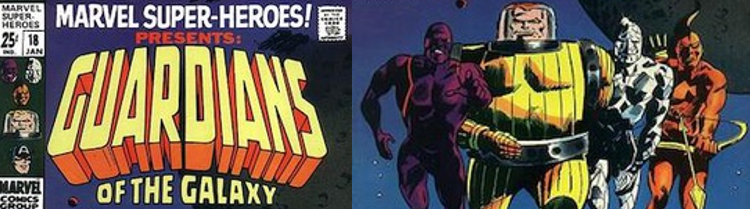
Story Title: “Guardians of the Galaxy! Earth Shall Overcome!”
Published: January 1969
Writer: Arnold Drake
Artist: Gene Colan

The Background:
Nowadays, Marvel Comics’ Guardians of the Galaxy are quite a well-known team of reprobates thanks to their inclusion in the Marvel Cinematic Universe (MCU); when Guardians of the Galaxy (Gunn, 2014) was produced, it’s fair to say that the team (and the concept) was relatively obscure compared to other Marvel heavy-hitters like the Avengers and Peter Parker/Spider-Man. Fans of the films and the MCU may be surprised to learn that the cosmic team was quite different when they first debuted in the pages of Marvel Super-Heroes!, a Marvel spin-off title that told standalone side-stories and was responsible for debuting many of the publications supporting characters. The concept began life as an idea by writer and editor Roy Thomas about super-guerrillas fighting against Russians and Red Chinese that was altered into an interplanetary situation by writer Arnold Drake and the legendary Stan Lee. Despite strong sales of the team’s debut issue, the Guardians of the Galaxy remained dormant for about five years; eventually, though, the team earned their own solo series and underwent numerous alterations over the years before evolving into something resembling the team dynamic reflected in the MCU and it all began with this bizarre space adventure about a team of misfits from the year 3007.

The Review:
As mentioned at the end there, our story opens in the far-off future of 3007 to find the Earth, and dozens of other planets, united as the United Lands of Earth Federation (U.L.E.). However, conflict is still rife throughout the various star systems of the galaxy and it is into this squall that we are introduced to Charlie-27, a stout, semi-cybernetic inhabitant of Jupiter who is finally returning home after six months of “solitary space-militia duty”. Expecting a big parade for returning as a conquering hero, Charlie-27 is confused to find the immediate area deserted and lifeless except for a contingent of the nefarious Badoon, a reptilian race of warmongers who have overrun the entire planet and captured its inhabitants, including Charlie-27’s father. After disposing of a couple of Badoon using his massive bulk, Charlie-27 follows a prison transport and finds his fellow Jovians are being forced to mine “high-intensity Harkovite”, a substance that will cause them all to die of radiation poisoning within five days.
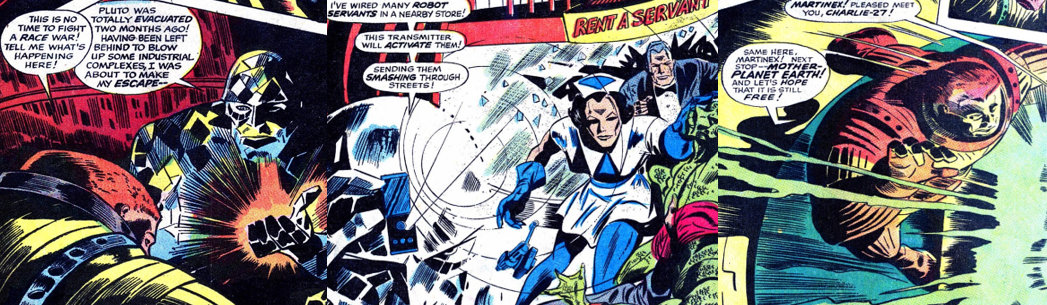
The crystal-bodied Martinex helps Charlie-27 escapes the Badoon forces who have over-run Pluto.

Realising that it is suicide to take on the invading Badoon forces alone, Charlie-27 desperately dives into a teleporter and randomly arrives on Pluto hoping to recruit an army to aid his cause and finding the ice-planet equally empty of life an, d overrun by the Badoon. Set upon by a Saturn Hound-Hawk, Charlie-27 is rescued by Martinex, a Pluvian man comprised entirely of a crystal-like substance. Though Maritinex harbours resentment to people like Charlie-27, who refer to him and his kind by the derogatory term “Rock Head” despite both races being descended from Earthman, Martinex catches the Jovian up with event son Pluto and uses a radio transmitter to cause a distraction that allows them to take a Tele-Train to Earth. Like Jupiter and Pluto, however, Earth has been enslaved by the Badoon; Drang, the Badoon supreme commander, is overjoyed to find his men has captured Major Vance Astro, the so-called “Thousand-Year-Old Man” who was the first Earthman to visit the stars. Curious to learn his story, Drang subjects Astro to a painful Memory Probe that quickly recaps how he came to be in the year 3007: back in 1988, Earth had established a small Moon colony and had started making excursions to Mars and Vance volunteered to be cryogenically frozen for a thousand years in a bid to explore beyond the reach of Earth’s solar system. Awakening a thousand years later, Vance was forced to remain forever garbed in a copper foil wrapping lest his centuries of slumber catch up to him and found his trip was ultimately futile as humanity learned to travel faster than light in the intervening years.
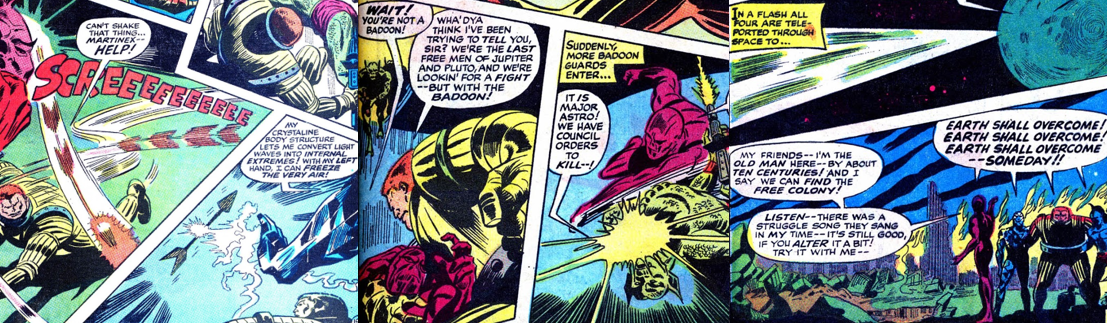
After a brief misunderstanding, the four misfits join forces against the Badoon as the Guardians of the Galaxy.

Thanks to his unique knowledge and experiences, Vance is spared the Badoon’s usual slave disk and seemingly agrees to aid Drang’s dreams of conquest. However, when Drang puts Vance’s loyalty to the test by having him execute his comrade, Yondu Udonta, Vance reveals it was all a ploy to reunite his blue-skinned friend with his special bow-and-arrow, which Yondu is able to control using whistles to take out Drang’s forces and allow them to escape. Vance and Yondu immediately run into Charlie-27 and Martinex, with each duo mistaking the other for an enemy; a fight between the two teams breaks out, in which Martinex showcases his ability to freeze air molecules and Vance reveals that he has (somehow…) acquired psychic powers, but they are soon interrupted by their actual enemy, the Badoon. United against a common foe, the group dispatch the Badoon guards and teleport themselves to New New York, determined to find the rumoured free colony and free the Earth from Badoon enslavement as the Guardians of the Galaxy.

The Summary:
When I went to see Guardians of the Galaxy, I was intrigued by the presentation of the film, which gave off vibes of Firefly (2002)/Serenity (Whedon, 2005) and the J. J. Abrams Star Trek films (2009; 2013), I knew absolutely nothing about the characters, the team, or the concept beyond a very rudimentary familiarity with the likes of Drax the Destroyer, Gamora, and Nebula thanks to having read The Infinity Gauntlet (Starlin, et al, 1991). No doubt to capitalise on the release and success of the first film, Marvel released a collection of Guardians of the Galaxy stories as part of their “Marvel Platinum” range of graphic novels and this is primarily where my experience of the comic book versions of the team comes from. Reading the Guardians’ debut issue is a bit jarring for anyone who is a fan of their MCU counterparts; the only character that carries over to the films is Yondu, here characterised as little more than a simpleton rather than the leader of a band of space pirates. There’s no Peter Quill/Star-Lord, no Drax, Rocket Raccoon, or Groot and rather than being a band of well-meaning reprobates, the original Guardians of the Galaxy are a rag-tag collection of oddballs united by a common cause.
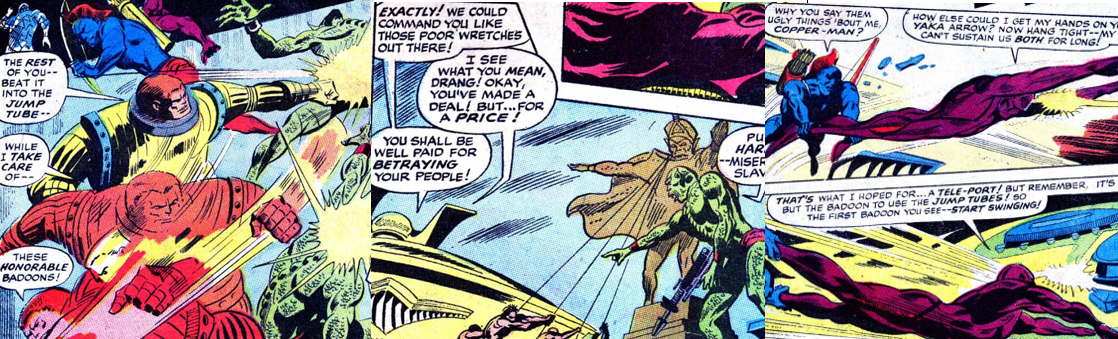
This is a very different team of Guardians than you may be used to…

Each of the Guardians is the last of their kind either due to slavery or the slow passage of time and are very bold, independent characters…with the exception of Yondu, who is denied any kind of in-depth backstory and whose character is reduced to a couple of throw-away lines from Vance. Aesthetically, ‘Guardians of the Galaxy! Earth Shall Overcome!” is a bit of a mess; taking place in the far future, we find that colonisation has extended far into our solar system and rendered even gas giants like Jupiter entirely habitable but evolution has also caused Earthlings to adapt in radical ways to survive in their new environments. A lot of the backgrounds and the comic’s more cosmic-trappings are very reminiscent of the works of Jack Kirby but, while this is very fitting, it does make for quite a cluttered and messy presentation. The issue has its work cut out for it by introducing four brand-new characters in about thirty pages of story, something I find early Marvel Comics often struggled with, and while there are some interesting elements to each character (Charlie-27 seems to be going for a self-entitled righteousness, Martinex hints at possibly being racially targeted, Yondu is a monosyllabic grunt, and Vance has his whole, very rushed, “man out of time” thing going on), I can’t really say that I was massively blown away by either their characterisation or their abilities (which are, for the most part, vaguely defined).
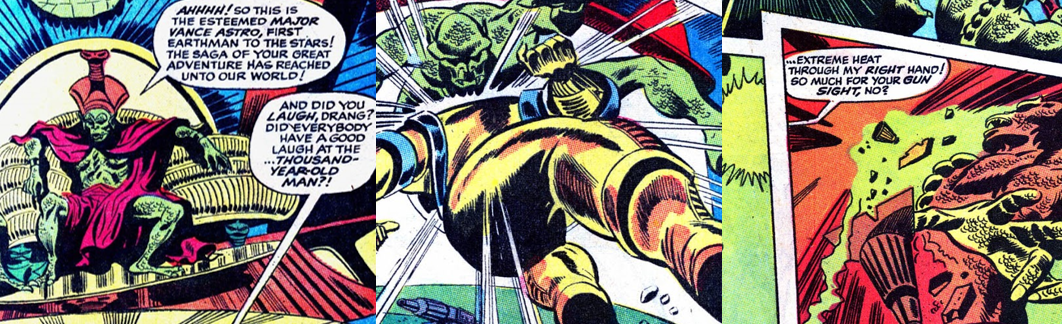
The Badoon are a major invasion force for the fledgling Guardians to unite against.

I’m not massively familiar with the Badoon; from what I can tell, this story wasn’t their first appearance but they really don’t seem to be that much different from other monstrous, semi-humanoid galactic conquers like the Free and the Skrull (despite, obviously not having shape-shifting powers). As a villainous force to unite against, they’re relatively unremarkable; while we can assume that they’re a formidable force since they have completely enslaved Jupiter, Pluto, and the Earth, Drang’s forces crumble like paper whenever they engage with the Guardians. Still, they have the numbers advantage, which is a great way to show that even a veteran like Charlie-27 knows when to fight and when to flee, and it’s pretty clear that the main aim of this issue was to bring together these misfits to continue telling stories of their struggle against the Badoon in subsequent issues. Still, as interesting as it is to see how the Guardians first came about the Yondu’s wildly different initial characterisation, there’s not really a whole hell of a lot to really say about this first Guardians tale; this isn’t the team that’s been popularised in the decades since, inevitably the writing and presentation is a product of its time, and the art isn’t particularly engaging or eye-catching (or even good, at times) so this is more of a quaint look at the Guardians’ humble beginnings rather than a bombastic showcase of what the team is truly capable of and probably has more appeal to die-hard fans of Marvel’s cosmic stories than the more casual Guardians readers like myself.

My Rating:

Rating: 3 out of 5.

Pretty Good

Have you ever read the Guardians of the Galaxy’s debut story? If so, what did you think to it, especially compared to the various interactions of the team that have come since? What did you think to the idea of setting the story in the year 3007 and of the Badoon having conquered the solar system? Which of the original four characters was your favourite? Which version of the team is your favourite and why? Are you a fan of the Guardians of the Galaxy comics and, if so, did you like the MCU’s interpretations of the characters and concepts? Would you like to see the original team get a larger focus in the MCU someday? Share your thoughts on the Guardians of the Galaxy in the comments below and check in again next Sunday for more sci-fi content.

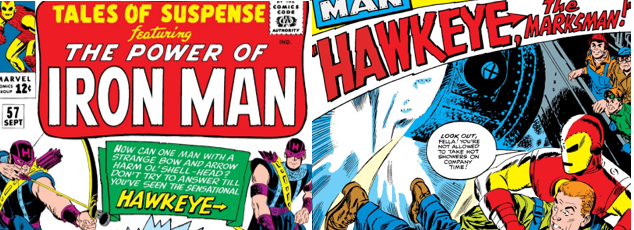
Back Issues: Tales of Suspense (Featuring the Power of Iron Man) #57

Story Title: “Hawkeye, The Marksman!”
Published:
1 September 1964
Writers: Stan Lee and Larry Lieber
Artists: Don Heck and Larry Lieber

The Background:
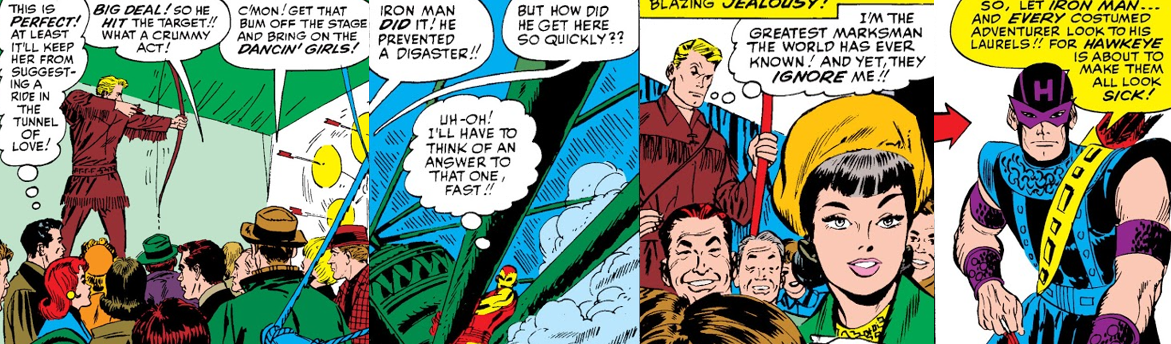
In November 1941, Mort Weisinger and George Papp introduced readers to Oliver Queen/Green Arrow, a crimefighting archer heavily influenced not just by Robin Hood and The Green Archer (Horne, 1940) but who also borrowed more than a few inspirations from Bruce/Wayne/Batman. In perhaps one of the more blatant borrowings from their competitor, Marvel Comics later introduced an archer of their own, Clint Barton/Hawkeye. Created by Stan Lee and Don Heck, Hawkeye was initially portrayed as a villainous character but would soon repent his mercenary ways and go on to not just be a member of the Avengers, but even lead his own off-shoot, the West Coast Avengers. Despite sharing a similar gimmick, Green Arrow and Hawkeye couldn’t be more different in terms of their personalities and status; indeed, while Hawkeye may have been a D-list hero in the grand scheme of Marvel Comics, he was involved in some of their most prominent storylines and became a household name thanks to Jeremy Renner’s portrayal of the character in the Marvel Cinematic Universe. Consequently, for many, the character is one of Marvel’s most relatable and inspirational heroes since he lacks any kind of superpowers and he’s even become a symbol of representation for the deaf community in recent years, and it all started here with his first appearance as an antagonist for ol’ shellhead himself, Tony Stark/Iron Man.

The Review:
It’s hard to say definitively, but I’m fairly certain that I’m far more familiar with the exploits of Green Arrow than Hawkeye. To be fair, it’s probably about 50/50; maybe weighted a little more towards Hawkeye as he tends to show up in the Avengers stories I’ve read. I mostly know Hawkeye from his appearances in the first season of the under-rated Iron Man cartoon (1994 to 1996) and from being a playable character in Captain America and the Avengers (Data East, 1991), both of which were firm staples of my childhood. I’m also relatively familiar with his background and characteristics, but have always been somewhat…meh about him. I don’t really care that he’s an archer or that he doesn’t have any superpowers, as plenty of superheroes get by just being regular people with extraordinary gifts, and I’ve never really questioned his capability as an Avenger, I’ve just never had much of an inclination to seek out any of his stories even though I’m a fan of Jeremy Renner’s portrayal of the character in the Marvel Cinematic Universe. Thus, I went into “Hawkeye, The Marksman!” without any real expectations and with an open mind, ready to see how Marvel handled his debut story, which opens with Iron Man heroically saving a factory worker from being doused by molten steel. This story is set during the time when the official line was that Iron Man was Tony Stark’s personal bodyguard, so no one really questions what ol’ shellhead is doing flying about one of Stark’s weapons facilities, but this also means that Harold “Happy” Hogan has no idea that he’s pouring his heart out to Stark himself when he asks Iron Man to grease the wheels with Stark’s secretary, Virginia “Pepper” Potts, to get him a date.

Hawkeye is so jealous of Iron Man that he crafts a costumed identity to earn the respect of the public.

While Stark now has a reputation as a womaniser, at this point he’s reluctant to get serious with any female since he’s entirely dependent on the transistor-powered device permanently grafted to his chest to keep him alive from the deadly shrapnel lodged dangerously close to his heart, and yet he longs for a more intimate relationship with Pepper and can’t help but feel jealous at Happy’s advances towards her. However, when Stark attempts to raise the subject with Pepper, he makes a poor attempt at it and she immediately assumes that he’s asking her out so she readily accepts, much to the heartache of Stark’s faithful footman. Rather than try and explain things to Pepper, or give her the brush off, Stark decides to take her on a date but not to a fancy theatre show or to dinner; instead, he takes her to Coney Island, where an archer known as Hawkeye fails to impress the sceptical crowd with his perfect marksmanship. While Stark is desperately hoping that Pepper doesn’t suggest riding the Tunnel of Love or moving on to a more intimate setting, fate intervenes (as it so often does in Marvel tales) when the Flying Pinwheel suddenly goes out of control, endangering the lives of its passengers. Seeing the crisis, Stark excuses himself with a paper-thin white lie (“I’ve got to call the factory!!”) so he can clamber into his Iron Man suit (which he generally carries around in a briefcase, though the artwork doesn’t show him holding it here…) and save the day, much to the adulation of the crowd. One man who’s not so impressed, however, is Hawkeye; annoyed that the audience dismisses him in favour of Iron Man, he sulks off to a “basement workshop” to put together a garish outfit for himself in order to emulate the Golden Avenger’s reverence as a costumed adventurer. Armed with little more than a quiver full of specially-made arrows and his unmatched marksmanship skills, Hawkeye vows to show up every other masked hero out there even without any superpowers and immediately feels the thrill of swinging across rooftops using his roped arrows and stopping a jewel thief with a perfect shot.

Assumed a thief, Hawkeye falls under Black Widow’s spell and is soon going up against Iron Man.

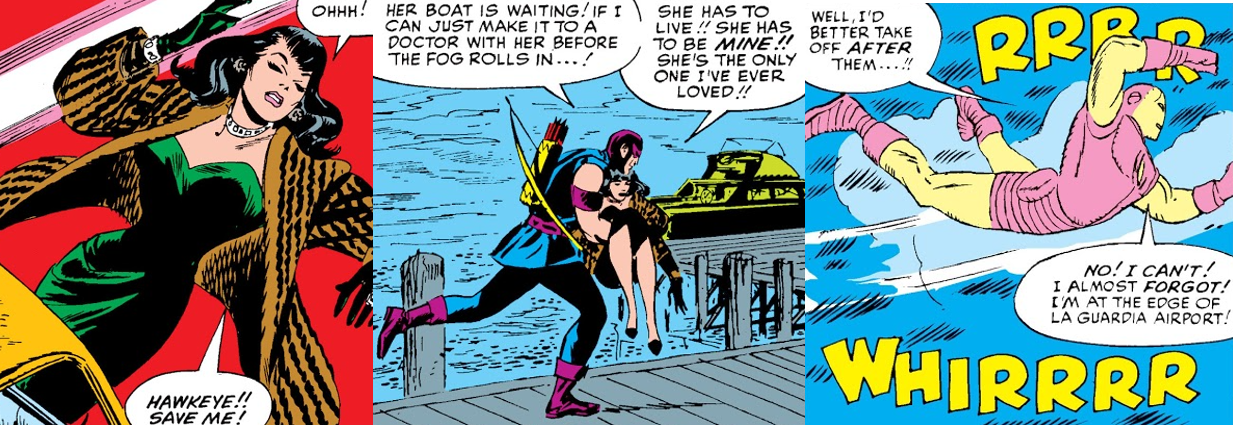
Unfortunately, Hawkeye’s decision not to deliver a fatal shot to the thief results in the crook getting away and, as the archer is investigating the loot of precious stones the man stole, he’s discovered by the cops and immediately pegged as the perpetrator. Choosing to run rather than waste time explaining himself, Hawkeye is randomly picked up by none other than alluring Russian superspy Natalia Romanova/Black Widow, herself also a recurring femme fatale for Iron Man during this time. Instantly smitten by the captivating spy, Hawkeye willing allows himself to be taken to her luxurious estate, where Black Widow is easily able to charm him into going up against Iron Man in exchange for upgrading his arsenal and the implied promise of winning her over if she’s able to defeat the Avenger. Speaking of whom, Stark’s personal life continues its drama as, when he goes to apologise to Pepper for leaving her high and dry, he finds that she’s soured on him and has finally agreed to date Happy (although she does this purely to make Stark jealous. Poor Happy!) To lure out his foe, Hawkeye easily sneaks into one of Stark’s factories and causes an explosion with one of his trick arrows; sure enough, the Avenger flies in to investigate and is startled when Hawkeye fires at him with arrows laced with a rust-inducing chemical. Realising that the substance is quickly hardening, Iron Man swiftly takes cover and removes his boots and gauntlets (and, as ever, I remain in awe of just how cloth-like Iron Man’s “armour” is). Hawkeye discovers the discarded pieces of Iron Man’s armour and is elated, hoping that analysing them will allow him to learn the Avenger’s secrets and increase his threat ten-fold; while he’s able to escape from the factory unopposed as Stark is frantically (and literally) re-arming himself with spare parts from the facility, it’s not long before Iron Man has tracked the archer down and run him off the road with a blast from his “Power Ray”.

After injuring Black Widow, Hawkeye’s forced to retreat and Iron Man is unable to pursue them.

Since he’s run out of his special rusting arrows, Hawkeye is forced to rely on the rest of his quiver, which Iron Man is easily able to deflect with his magnetic Repulsor Beams. However, realising that his transistors can’t power his weapons forever, Iron Man tries to swoop down and subdue Hawekeye and ends up ensnared in nylon rope strands that restrain him for all of one panel. By the next panel, Iron Man is not only free but crashing into a wooden pier and flinging Hawkeye into the water, which effectively renders the archer unconscious. As the Black Widow looks on with unimpressed disgust, Hawkeye tries one last trick to complete his mission and win over the gratitude of the gorgeous Russian spy: a “Demolition Blast” arrow that he hopes will conquer the Armoured Avenger once and for all. Unfortunately, the arrow simply ricochets off Iron Man’s armoured hide and the resulting energy blast injures the Black Widow with a glancing blow. Grief stricken and aghast at having injured the “only one [he’s] ever loved”, Hawkeye ignores the stunned Iron Man in favour of spiriting the hurt spy to safety on her nearby boat. Thanks to a convenient fog descending, and the fly zone of La Guardia airport, Iron Man is unable to pursue the two and is forced to return to his factory to brood over his complicated social/love life and to wonder where and when his next threat will arise.

The Summary:
“Hawkeye, The Marksman!” actually ended up being a pretty decent little Iron Man story. I should also point out that I’m not massively familiar with Iron Man’s comics either, though I’ve read a decent amount thanks to the various Marvel Platinum complications that Marvel have published. Consequently, it was interesting to see Stark portrayed as a conflicted and lovelorn man who desperately wants to confess his love of Pepper but dare not because of his dependence upon his armour to stay alive. It was also interesting seeing him torn between his feelings for her and his loyalty towards Happy; he wants to do the right thing by his friend, however difficult and tragic that is for him personally, but at the same time he willingly takes Pepper to Coney Island on what she naturally assumes is a date since she’s also besotted by him. This paints Stark as a morally grey individual since he could have easily just given Pepper the brush-off, but he’s got eyes for her so of course he wants to spend time with her, though he also doesn’t want to step on his friend’s toes (even though he already did…) so he takes her to the least romantic place he can think of. If anyone looks really bad in all this, though, it’s Pepper; she’s infused with that besotted obsession that was all-too prevalent in comic books of this era so she naturally jumps at the chance to date Stark and then only agrees to go out with Happy because she wants to make Tony jealous.

Although he’s got no superpowers and is easily led astray, Hawkeye proves to be a formidable foe.

Thankfully, all of this is just a brief distraction from the main focus of the narrative, which is the introduction of Hawkeye. Here portrayed as a talented but underappreciated circus marksman, Hawkeye provides an interesting and little-seen glimpse into another side of Marvel’s fictional world. In Marvel Comics, the public are generally very fickle, easily forgetful and emotionally chaotic people who will laud the accolades of the Avengers one minute while hating and fearing Mutants and the likes of Peter Parker/Spider-Man the next while also tuning on them in either positive or negative ways on the flip of a coin. In a world so readily populated by super-powered individuals, what chance does a simple archer have of impressing the crowd? Thus, it’s no surprise that Hawkeye should feel jealous that Iron Man stole his thunder, consciously or not, and it’s somewhat understandable that he chooses to craft a brightly-coloured outfit for himself in order to share in some of the glory afforded to other costumed heroes. Unfortunately, his first tentative attempt at masked heroics ends with him being labelled a thief and then being manipulated by Black Widow; it really doesn’t take much more than a sultry glance and some irresistible charm from Madame Natasha for him to not only join her cause but to fall in love with her at first sight and, very quickly, Hawkeye’s initial plan to usurp his peers has been twisted into battling Iron Man on the urging of his newfound partner. The result is a surprisingly layered character; we don’t learn much about Hawkeye (his name and full origins are a mystery here) except that he craves acknowledgement of his unparalleled skills and is easily manipulated by a pretty face, and yet I find myself completely relating to his plight. While you could argue that he’s a naïve buffoon who allows himself to be manipulated, I see him as angry and misguided and trying to do the right thing but unable to resist the allure of the gorgeous Black Widow. Even more amusing his how completely clueless Iron Man is to all of this; he doesn’t even realise Black Widow is involved in the plot, treats Hawkeye as a mere annoyance, and is more concerned about his personal troubles than the archer’s threat. In the end, this was an entertaining introduction to Marvel’s most famous archer, who would go on to show additional layers to his personality and motivations in subsequent appearances, and I think the main takeaway from this was the tragedy that Hawkeye wished to be a celebrated hero like Iron Man and was quickly and easily led down a darker path mere moments into his debut as a costumed avenger.

My Rating:

Rating: 3 out of 5.

Pretty Good

Did you read “Hawkeye, The Marksman!” when it was first published? If so, what did you think to it at the time and what were your thoughts on Hawkeye? Did you enjoy his portrayal as a spurned archer looking for adulation or did you find him perhaps a bit corny? What did you think to Stark’s personal drama and did you enjoy Black Widow’s repeated attempts to defeat Iron Man during this time? What are some of your favourite Hawkeye stories and moments? Do you think he’s earned his place as an Avenger or do you find him to be a bit pointless? Whatever your thoughts on Hawkeye, feel free to sign up and leave them below or drop a comment on my social media, and check out my review of his Disney+ series.

Back Issues: Whiz Comics #2

Story Title: “Introducing Captain Marvel!” (or simply just “Capt. Marvel!”)
Published:
February 1940
Writer: Bill Parker
Artists: C.C. Beck

The Background:
After DC Comics (then known as National Comics) saw incredible success with their benchmark superheroes, Clark Kent/Superman and Bruce Wayne/Batman, the comic book industry was ripe for a whole slew of new costumed heroes to take the stage. Not wanting to miss out on the action, Fawcett Publications set about establishing their own colourful superheroes, each sporting the powers of Greco-Roman Gods, but it was Ralph Daigh who decided to combine them into one superpowered entity to directly oppose Superman, which he initially dubbed “Captain Thunder”. Taken by the concept, both writer Bill Parker and artist C.C. Beck saw the concept as a chance to tell a story that hearkened back to the folk-tales and myths of old. Initially, Captain Thunder debuted in the pages of a comic published as both Flash Comics and Thrill Comics but, when trademark issues arose concerning all of these names, artist Pete Costanza suggested the alternative name of “Captain Marvelous”, soon shortened to Captain Marvel, and the Big Red Cheese proved to be a massive success when his debut issue sold over 500,000 copies. Sadly, legal issues would continue to dog the character even after Fawcett was absorbed into DC Comics and Captain Marvel started rubbing shoulders with the Man of Steel and the Justice League, creating some confusion about the character’s name since Marvel Comics had since established their own Captain Marvel, leading to the Big Red Cheese often being dubbed “Shazam” instead. Whatever you want to call him, Captain Marvel has quite the legacy; he’s shared his powers with a colourful extended family (including a bumbling uncle and a talking tiger!), clashed with Superman and been involved in some of DC’s biggest crossover and Crisis events, and his phenomenal success on the big screen in 2019 led to not only a sequel and a spin-off but a newfound surge in popularity for the magical man/boy superhero.

The Review:
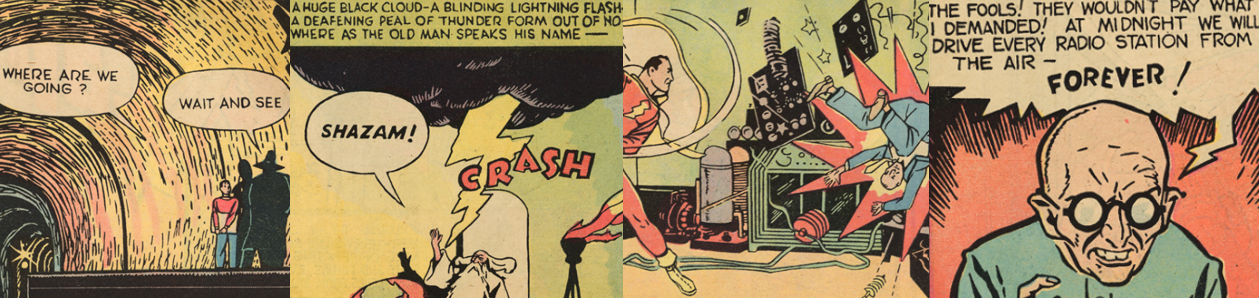
Our story begins with a youngster in a bright red jumper and jeans hanging around outside the city subway trying to sell newspapers. He’s approached by a mysterious man in a black overcoat and fedora and we learn that, despite his clean-cut appearance, the boy is homeless and sleeps in the subway to stay warm. The mystery man bids the lad to follow him into a danky subway tunnel and, naïve as he is, the boy goes along; there, he boards a strangely garish-looking subway car and thinks absolutely nothing of it when he’s transported to an ominous subterranean cavern. Seriously, the boy barely says a word and seems perfectly happy to be whisked away by this darkly-garbed figure to the bowls of the city. His youthful trust (or stupidity, you decide) leads to him entering a vast underground hall where crude, cartoonish carvings of the Seven Deadly Enemies of Man (Pride, Envy, Greed, Hatred, Selfishness, Laziness, and Injustice) adorn the walls of the cavern, which is lit only by flaming torches and home to an enigmatic, heavily bearded old man who sits on a huge marble throne. The old man (who bares more than a passing resemblance to God) introduces himself as Shazam and demonstrates his all-knowing demeanour by identifying the boy as Billy Batson. Even more incredibly, upon speaking his name, Shazam causes a bolt of lighting to fill the cave and the names of six Gods and their attributes to magically appear on the wall behind him: Solomon (wisdom), Hercules (strength), Atlas (stamina), Zeus (power), Achilles (courage), and Mercury (speed).

Naïve Billy is taken to meet Shazam and transformed into a superhuman being!

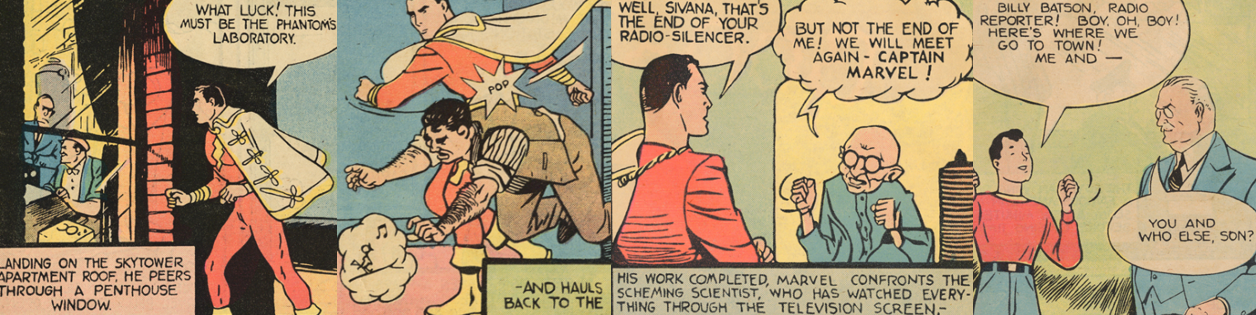
Shazam explains that he has utilised the powers of these Gods to defend the Earth from the forces of evil for three-thousand years; in that time, he claims to have “seen everything – known everything” and, rather than using his incredible magic to prove this, falls back on a “historama” – a “super-television screen capable of depicting past, present and future events” – to show how Shazam watched as Billy was driven from his childhood home after the death of his parents by his wicked uncle, who sought to get his grubby hands on the money and bonds Billy was willed by his father. This is, apparently, enough of an explanation as to why Shazam brought Billy to his mysterious cave; after battling injustice and cruelty for centuries, Shazam is looking for a successor to carry on his work as “the strongest and mightiest man in the world”, Captain Marvel. Upon speaking the old man’s name, Billy is transformed by a magical lightning bolt into a tall, physically powerful adult male in a bright red costume and fancy side-cape and unquestionably pledges to continue Shazam’s legacy. After Captain Marvel speaks the magic word once more, however, Shazam appears to be crushed under a massive granite block that’s randomly suspended over his head. Okay… Anyway, in a flash of lightning, Billy’s back to his normal self and outside the subway with his newspapers, and left thinking that it was all a dream. The next morning, a couple of no-good gangsters buy one of Billy’s papers to read up on their boss’s handiwork: a madman known as “The Phantom Scientist” has threatened the United States radio system and is demanding $50,000,000 for…something. Suspecting the two, Billy follows the gangsters to “the swanky Skytower apartments” but is turned away by a pushy doorman. He then tries to get word to the radio “head”, Sterling Morris, by dashing into his office after the receptionist tries to shoo him away. Unfortunately, Morris dismisses Billy’s story as hogwash simply because the gangsters are holed up at somewhere as reputable the Skytower apartments.

Captain Marvel disrupts Sivana’s plan and earns his child alter ego a job as a radio reporter.

Undeterred, Billy vows to find the Phantom’s laboratory and even manages to convince Morris to award him a job as a radio announcer if he succeeds in this goal. Since he can’t enter Skytower apartments directly, he takes the elevator to the rooftop of the nearby office building and, deciding that he didn’t dream up his extraordinary encounter the other night after all, transforms to Captain Marvel with his magic word. Captain Marvel easily clears the gap between the two buildings with a mighty leap (like Superman in his first appearance, the Big Red Cheese can’t fly yet) and, in an astounding piece of luck, finds himself right outside of the Phantom’s laboratory. Inside, he learns of the Phantom’s true identity: he’s Sivana, a balding, gnarled little man who operates through a number of hired goons and plans to put an end to any and all radio broadcasts at midnight unless his hefty ransom is paid. Having seen enough, Captain Marvel bursts in, hurling one of Sivana’s men into his complex “radio-silencer” machine, smashing it to smithereens. The other man flees to a private elevator but to no avail; Captain Marvel rips the door from its hinges and then hauls the elevator up with his incredible strength, laying the goon out with a wallop to the back of his head. With the mooks tied up, Captain Marvel addresses Sivana directly using the mad scientist’s gigantic television screen, with both vowing to confront each other again…though only Captain Marvel delivers a death threat to the odd little madman. With Sivana’s plan thwarted, Captain Marvel turns back to Billy and calls Morris over; though perplexed, Morris is suitably impressed by Billy’s actions and the plucky boy earns himself a job as a radio reporter, while also vowing to continue fighting the good fight as Captain Marvel!

The Summary:
I’ve not read much of Captain Marvel. I think the only solo stuff of his I’ve read prior to this was the initial Power of Shazam (Ordway, et al, 1995 to 1999) run. Other than that, he’s rarely cropped up in other DC stories and crossovers I’ve read, but I’ve always wanted to read a little more from the character as I find him pretty interesting as a source of wish fulfilment. What kid hasn’t wanted to become a superhero, after all, and the idea of a homeless little boy suddenly being able to transform into a literal superman has a great deal of appeal. As ever with Captain Marvel’s stories, the art is of a slightly different calibre to his contemporaries, favouring a more whimsical and cartoonish style that, for all the colour and pop-art appeal, really falls flat when it comes to portraying backgrounds and environments. Shazam’s cave, for example, is quite poorly rendered compared to the other, more realistic locations. C.C. Beck shines in rendering facial expressions, his work being very reminiscent of pulp stories and characters like Samuel Bradley/Sam Bradley, and he even brings to like quasi-science-fiction elements like Sivana’s technology in adorable detail that is perfectly in keeping with the technology of the time, but just a touch more fanciful but not in a way that’s needlessly overdesigned like some of Jack Kirby’s work.
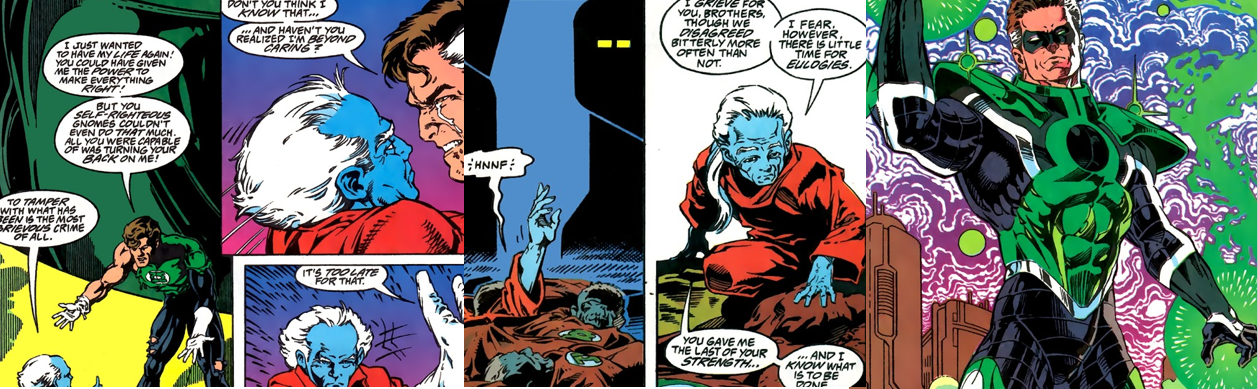
Captain Marvel impresses, despite some narrative hiccups in his debut story.

Narratively, Captain Marvel’s debut is a bit wonky, however. We don’t really get to learn much about Billy beyond what Shazam shows us with his “historama” and it’s really odd that he so willingly went along with the dark stranger. Who even was that, anyway? He just disappeared once they got to Shazam’s cave and there was no real explanation behind him. I think having it be Shazam himself might’ve been a little better, but it kind of made Billy look like a naïve fool. His reaction to meeting Shazam is also very one-sided in the old man’s favour; Billy questions none of it, instantly accepts his new mission, and yet doesn’t even explore his superpowers since he dismisses it all as a dream. He has some pep to him, I’ll give him that, in the way he barges in to see Morris and hoodwinks the guy into giving him a job, but there’s not much to Billy and no personality shift between the boy and his superpowered alter ego. Captain Marvel himself looks great, but we don’t really see many of his powers on show; he does a leap, tosses some goons around, and that’s it, so he’s hardly on par with Superman in terms of abilities in the context of this issue. Sivana’s plot was also a bit low-key; I mean, disrupting radio stations for money? Is that really the best he can come up with? Overall, though, I did enjoy it, even if the narrative is a bit scattered and questionable; I definitely think subsequent retellings and revisions have made Captain Marvel’s origin and personality more interesting and diverse, though.

My Rating:

Rating: 3 out of 5.

Pretty Good

Were you a fan of Captain Marvel’s debut story? What did you think Billy’s presentation and the depiction of his first meeting with Shazam? Were you impressed by Captain Marvel’s powers and costume? What did you think to Sivana’s threat? Which of the Captain Marvel family is your favourite? What are some of your favourite Captain Marvel stories and moments? Whatever your thoughts Captain Marvel, feel free to leave them below or drop a comment on my social media.

Back Issues: Fantastic Four #52/53

Writers: Stan Lee and Jack Kirby – Artist: Jack Kirby

Story Title: “The Black Panther!”
Published:
12 April 1966 (cover-dated July 1966)

Story Title: “The Way It Began…!”
Published:
10 May 1966 (cover-dated August 1966)

The Background:
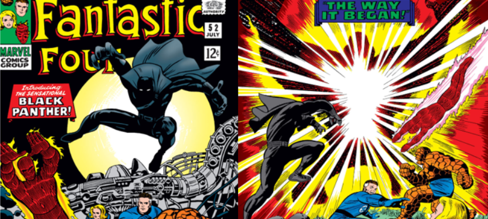
The popular story behind the Fantastic Four is that Marvel Comics head honcho Martin Goodman wanted then-editor Stan Lee to create a superhero team in response to DC Comics’ Justice League of America. Lee used the opportunity to create stories and characters that appealed to him and drafted a quick synopsis of a dysfunctional superhero family for legendary Jack Kirby to work on, thus creating the “Marvel Method” of writer/artist collaboration. While Kirby disputed this story, the two are credited as co-creators of Marvel’s First Family – Doctor Reed Richards/Mister Fantastic, Susan Storm/The Invisible Girl, and her brother Johnny, the Human Torch, and Ben Grimm/The Thing – whose comic books eventually introduced characters and concepts that would forever impact Marvel Comics. One such character was T’Challa, the Black Panther, whose name and appearance actually predate the Black Panther Party in a strange coincidence; initially dubbed the Coal Tiger in Kirby’s concept art and briefly flirting with the name Black Leopard, the Black Panther is notable for being the first-ever black superpowered character in comic books. Like the Fantastic Four, Lee and Kirby disputed which of them came up with the character and concept of the Black Panther, though both claimed to have created the character out of a desire to include more racial diversity in their publications. Soon after his debut appearance, the Black Panther made several guest appearances in numerous Marvel Comics before hits first critically acclaimed series and graduating to a short-lived solo title in 1977. The Black Panther became a pretty consistent presence in Marvel’s line-up, building his own supporting cast, joining the Avengers, forming the super secret superhuman cabal known as the Illuminati, and featuring in a number of pivotal Marvel events and politically charged storylines. The Black Panther is also no stranger to adaptation, featuring in the 1994 Fantastic Four cartoon, getting his own Marvel Knights motion comic series, and being brought to life in live-action by the late Chadwick Boseman in the Marvel Cinematic Universe. Black Panther (Coogler, 2018) proved to be a spectacular critical and commercial success and, as the sequel is due out this Friday, this seems like a great excuse to revisit his debut story arc.

The Review:
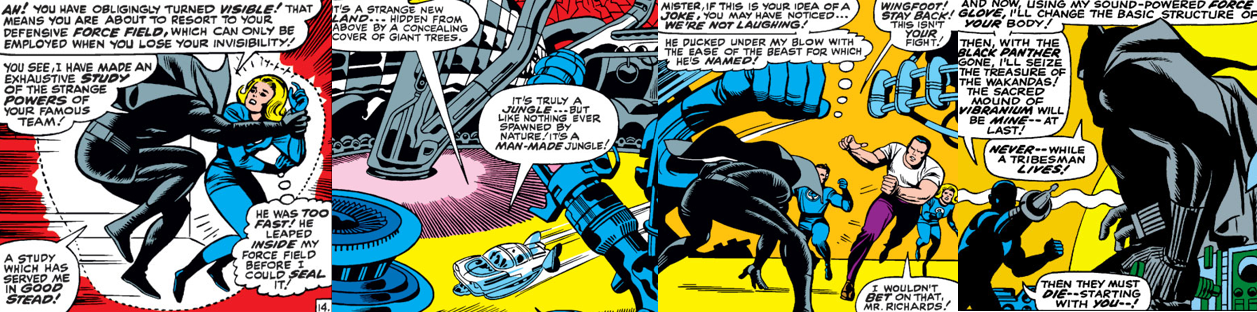
“The Black Panther!” opens with three of the Fantastic Four (Reed, Sue, and Ben) flying through the skies of New York City in a fancy, high-tech craft unexpectedly gifted to Reed by a mysterious African chieftain known only as the Black Panther. Powered by magnetic waves, the ship is extremely nimble and manoeuvrable, but Ben is less than thrilled by the experience, which makes him more than a little air sick (to the surprise of even Sue, since Ben is an ex-air force pilot). After concluding their little joyride, the three land on the roof of the Baxter Building to chat with the Black Panther’s emissary; the enigmatic robed ambassador allows them to keep the futuristic craft if they accept an invitation to join the Black Panther (who goes unnamed beyond this throughout the arc) as honoured guests in the kingdom of Wakanda, where “the greatest hunt of all time” will be held in honour of their visit. Marvelling at the Wakandan’s clearly advanced technology and eager to see more, and noting that the team could do with a vacation, Reed accepts to invitation and the emissary sends word back to his nation using a peculiar communication device that uses “Cosmic Channel Waves” to instantaneously send messages across the globe. In the faraway jungle city of Wakanda, the chieftain rejoices at having correctly guessed that his invitation would be accepted and enters a vast, highly advanced bunker held within a colossal stone statue of a panther where he garbs the sleek, form-fitting “stalking costume” of the Black Panther to prepare for the team’s arrival.

The cunning Black Panther catches the Fantastic Four completely off guard.

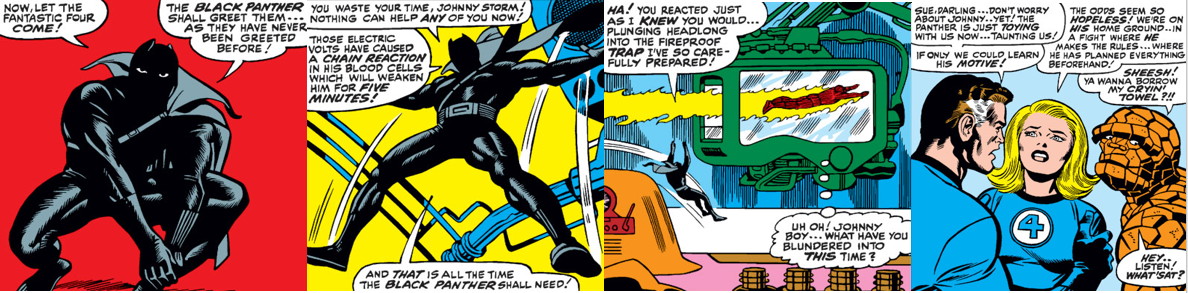
Meanwhile, back in the U.S., the story switches over to Johnny Storm, who’s stressing over his recent exams when his teammates literally drop in on him to bring him along on their trip. Unfortunately for me (but not, as we’ll see, the team or the plot), Johnny asks to bring his roommate, college athlete Wyatt Wingfoot (one of comic’s most boring and unnecessary characters) along as well. Johnny is grateful for the distraction, however, as it keeps him from pining over Crystalia Amaquelin, a beautiful Inhuman girl he recently met who’s currently trapped (alongside the rest of her race) behind an impenetrable barrier (the story even briefly cuts away to show that all of the Inhumans’ incredible powers are as nothing compared to the “Negative Zone” shell that the mad Inhuman, Maximus Boltagon, has sealed them within). Once the team enter Wakanda, they’re both in awe, and suspicious, of the lush, verdant jungle that greets them. Although Wakanda shows no signs of industrialism or human pollution, it is merely a façade for the sprawling, technical jungle made up of a veritable chaos of computer dynamos, mechanical apparatus, and elaborate tubes and wires. Naturally, Reed is enthralled at the scientific wonders on display, but he tempers this with caution, which is only ignited when their guide suddenly spirits away to an elevator. Unimpressed with the wonderous technology surrounding them and suspecting a double-cross, the Thing leaps into action without hesitation and suffers a massive electric shock that leaves him “as weak as a blamed Yancy Streeter” (because we had to constantly have those Yancy Street references in Ben’s dialogue back then) and thus vulnerable when the Black Panther suddenly strikes to begin the great hunt…with the Fantastic Four as the prey! The Black Panther easily dodges Mr. Fantastic’s elongated fist, and just as easily tricks the Human Torch into flying into a fireproof trap that subdues him with an asbestos lining and powerful vacuum blasts. While the Black Panther watches them from the shadows, the Thing recuperates his strength and Wyatt and Reed stress that they need to think ahead as they have no idea what other boobytraps await them. In an effort to be useful and put his Native American ancestry to good use, Wyatt runs off to scout the area, meaning he’s not around when Wakandan soldiers suddenly rush in and blast Reed, Sue, and Ben with “magnetic polarity guns” that cause them to violently repel off each other like human pinballs.

After overcoming the Black Panther’s assault, the Fantastic Four learn his tragic origin.

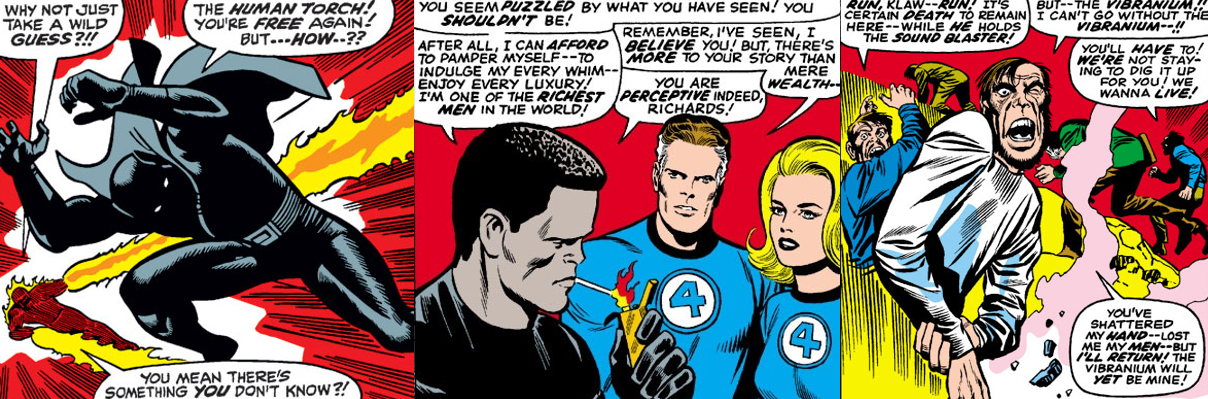
Though the Invisible Girl tries to outwit their pursuer by turning invisible, the Black Panther’s keen senses easily lead him to her and he’s so fast that he’s able to leap inside of her forcefield as she’s raising it and render her unconscious with a blast of sleep gas. Rather than heed Wyatt and Reed’s suggestion, the Thing stops for a drink of water and finds his strength sapped once more, allowing the Black Panther (who boasts of being the continent’s boxing champion) to go toe-to-toe with him. In the end, though, it’s Ben’s impulsive nature that is his undoing as he blindly charges into a refrigeration unit and ends up frozen solid! Somehow, Wyatt stumbles across a hidden observation post and makes short work of those stationed there (though, realistically, you’d think Wakanda’s soldiers would stand more of a chance against some roided-up football star…), trashing the equipment to disrupt the Black Panther’s communications, but it’s of little consequence to the chieftain’s battle with Mr. Fantastic. Plunging the room into complete darkness, the Black Panther easily out-fights the elasticated scientist and successfully completes his hunt by trapping Reed in titanium cuffs. However, the Back Panther’s hard-fought victory is short lived as Wyatt frees Johnny from his trap, catching him completely off-guard; he’s even more off balanced when the entire team regroups around him, their strength restored and free from their confinement thanks to Wyatt and Johnny. Outnumbered and humbled in defeat, the Black Panther unmasks with the promise of revealing his motives and explaining his tragic origin story; this is related in “The Way It Began…!”, which finds the five being treated to a traditional Wakandan ceremony of friendship. Again, while the others are in awe of Wakanda’s technology and self-sufficient, primitive ways, the Thing is unimpressed and rudely dismissive of the Black Panther’s origin story since he’s seen it a hundred times in films and books about Tarzan. While casually lighting up a cigarette, the Black Panther regales them with the story of his warrior king father, T’Chaka, who pledged his life to defending the people’s virtually inexhaustible supply of super rare, super expensive, super absorbent “Vibranium”. However, when the unscrupulous mercenary known as Klaw, Master of Sound, led heavily armed goons into Wakanda to steal the Vibranium and power his “sound transformer” (which would let him change sound waves into any living form he can conceive), T’Chaka was brutally gunned down for opposing him. Despite the Wakandan’s advanced technology and tribal lifestyle, they are a largely peaceful nation and had no defence against Klaw’s machine guns and T’Chaka’s entourage are mercilessly gunned down, leaving only the young prince to stand against them.

The Fantastic Four hold back Klaw’s sound creatures while the Black Panther avenges his father.

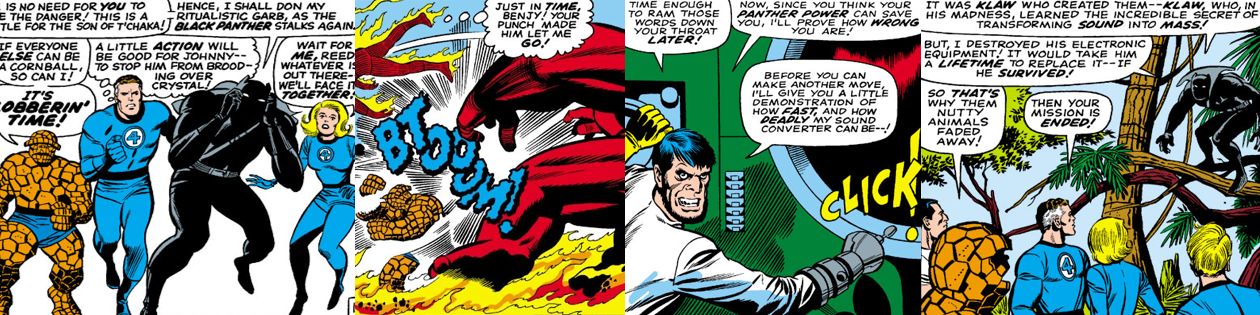
As Klaw and his men burned down the village and slaughtered everyone, the grief-stricken youth turned Klaw’s sound blaster against him, destroying their weapons, damaging Klaw’s hand, and finally driving him from their lands in humiliation and defeat. Now, ten years later, the Black Panther has amassed a vast fortune from selling Vibranium to “various scientific foundations”, constructed his elaborate mechanised jungle “for a lark” to test his skills, and relates that his incredible superhuman abilities and senses come from special herbs and rigorous secret rituals. After a lifetime of preparation, he decided to hone all of his skills against the “supreme test”, the Fantastic Four, so that he’d know that he was truly ready to battle Klaw once more. Although the Black Panther knew that Klaw was planning to return at some point, the so-called Master of Sound conveniently makes his return in suitably dramatic fashion right as this origin story is wrapped up with a massive red gorilla made entirely of sound waves. Despite Wakanda’s best efforts, the beast absorbs any attack and hurls it back as a pure, devastating rush of destructive sound waves. Now that they’re all on the same page, the Fantastic Four (and Wyatt…) leap into action alongside the Black Panther to combat the beast, which shows no fear of the Human Torch’s flames and blasts the Thing aside with a sonic boom, completely invulnerable to conventional attack as it’s comprised of living sound and simply strikes back with a magnified version of whatever force is thrown at it. Rather than attack the creature head-on, the Black Panther goes directly to the most likely source of its creation, a large cave kitted out with more of Kirby’s bizarre mechanical art. There, he finds Klaw, now sporting a “force glove” in place of his shattered hand and the final version of his diabolical master conversion system, which allows him to sic a panther of pure sound energy onto his foe! Although the Thing is unable to triumph over another of Klaw’s creatures, this one a massive elephant, the Black Panther actually battles the panther to a standstill, much to Klaw’s shock. However, Klaw’s attempt to blast the Black Panther with his force glove results only in his beloved machine being destroyed, taking the entire cave and all his creatures with it. Finding solace in the defeat of his father’s killer, the Black Panther is encouraged to use his fortune and abilities to serve all of humanity rather than give up his crusade for justice. And what of Klaw? Defeated, humiliated, and desperate for revenge, he plunges into the master convertor and willingly transforms himself into a being of pure sound so that he may avenge himself on the Black Panther another day.

The Summary:  
This two-issue story arc did a decent job of introducing readers to this striking new character; clad all in black and sporting a superhuman agility and intelligence that is a cut above most Marvel characters, the Black Panther certainly makes an impression even beyond his race. Most prominently, he’s smart and capable enough to lure in the Fantastic Four (which includes one of Marvel’s smartest characters and is easily one of their most powerful and tightly-knit groups) and subdue them with relative ease thanks to his abilities and extensive research into the group. What better way to introduce a new character than by having him best the Fantastic Four, and not just through convenient or overpowered means but by using his wiles? Indeed, while the Black Panther’s abilities are somewhat vague (he boasts of his boxing prowess, agility, and keen senses but they’re not as dramatically on show as you might think) and Wakanda’s technology is seen as wonderous and almost magical, neither of these are explored in much detail so the Black Panther’s accomplishments seem more like skill than him being unnecessarily overpowered. Interestingly, there’s very little social commentary on the Black Panther’s race; Reed and the others are awestruck by Wakanda’s wealth and power and the mixture of traditions and technology, but never does anyone express incredulity that a Black man or a race of Black people could be powerful adversaries or allies. Even the Thing’s unimpressed demeanour is based more on his familiarity with pulp media rather than a disbelief in a Black man’s capabilities, and the entire experience is seen as an eye opening excursion for the team, who are completely caught off guard by how prosperous and dangerous such an out of the way nation is. Similarly, unlike many Black characters (and other characters at this time, particularly women and teenagers), the Black Panther and his cohorts never speak in some stereotypically contrived fashion; there’s no jive talk, no street slang, and no creole to depict them as being “lesser” or one-dimensional clichés and, instead, Wakanda is depicted as a place of very sacred traditions and an almost fantastical place with its mixture of technology and tribal customs.

While the Black Panther and Wakanda impressed, I wasn’t as taken by Wyatt Wingfoot or Klaw.

Although it seems like there’s a strange juxtaposition with this as Wakanda is comprised of a warrior race who wield both spears and special weapons and fully capable of creating these amazing technological wonders, but they’re easily gunned down by Klaw’s assault rifles and weapons, it’s clear that Wakanda has only fortified their defences and technology in the ten years since T’Challa’s death and that things were considerably less advanced before the chieftain’s son began accumulating his wealth and knowledge. There was a lot to like here; the action was fun, particularly in the Black Panther’s methods in subduing the Fantastic Four, and, while Sue often spouts some air-headed dialogue, it’s nowhere near as bad as the blatantly sexist and dismissive shit she normally says. If there are downsides, it’s Kirby’s surreal art (I’m not really a big fan of his overly elaborate and incomprehensible backgrounds) and the presence of Wyatt Wingfoot, who sticks out like a sore thumb and has no place running around with the Fantastic Four. He offers absolutely nothing to the story and he’s really just there to rescue the four after they’re subdued by the Black Panther, which seems incredibly lazy to me and completely unnecessary as the Black Panther later reveals that he had no evil intentions towards the team and probably would’ve set them free anyway. Klaw is also a pretty uninspiring and unnecessarily grandiose villain who basically amounts to a glorified ivory trader. He easily guns down T’Challa’s forces with his automatic weapons and the Black Panther’s entire mission is based on wanting to avenge his father’s death at the mercenary’s hands, but he doesn’t really have a visually interesting look (even after acquiring his metal hand…weapon…thing) and his sound creatures seemed overly cartoony. He’s basically just there to give the Black Panther and the Fantastic Four someone to fight against, spawning unbeatable sound creatures, and allowing the Black Panther to end the threat and thus further paint him as a formidable force. It’s a great cathartic moment for the new hero, for sure, but not a particularly interesting villain to pit him against and Klaw’s aspirations are ended pretty easily. These criticisms aside, the two issues are very enjoyable and it’s easy to see readers being interested to learn more about the Black Panther (whose true name we never learn) and Wakanda (whose society and traditions and technology are just barely touched upon), and I liked seeing the team completely overwhelmed by first his abilities and then Klaw’s sound monsters. For all their smarts and bluster, the Fantastic Four were very much on the back foot here, allowing the Black Panther to take the spotlight, and it went a long way to humbling the team and debuting this visually interesting character in a dynamic way.

My Rating:

Rating: 4 out of 5.

Great Stuff

What did you think to the Black Panther’s debut story arc? Did you enjoy seeing him running circles around the Fantastic Four or do you think he was a little too good in his first appearance? What did you think to Wakanda and Jack Kirby’s artwork? Are you a fan of Klaw or do you agree that he’s quite an underwhelming villain? What are your thoughts on Wyatt Wingfoot and the Inhumans sub-plot that both appeared in the comics at the time? What are some of your favourite Black Panther stories or moments? Whatever your thoughts on Black Panther, sign up to leave them below or drop a comment on my social media and be sure to check back in for more Fantastic Four and Black Panther content throughout November.

Back Issues: Motion Picture Funnies Weekly #1

Story Title: “Here Is the Sub-Mariner!” (or possibly just “The Sub-Mariner”)
Published:
April 1939
Writer and Artist: Bill Everett

The Background:
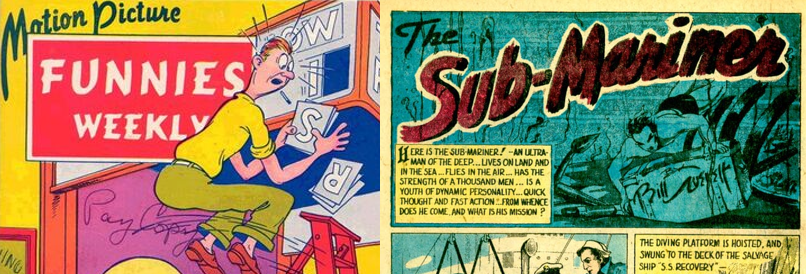
The brainchild of writer/artist Bill Everett and billed as Marvel’s first Mutant, Prince Namor McKenzie/The Sub-Mariner owes his creation to Carl Bugos’s Jim Hammond/The Human Torch. Since the Human Torch could manipulate fire, and given Everett’s keen interest in anything nautical, the writer/artist desired to create an antithesis to the flaming android who could live on land and in the sea and possessed incredible superhuman strength. Initially slated to appear in this giveaway comic, only a handful of copies of Motion Picture Funnies Weekly were produced and, when the deal fell through, Everett took the character and his story to Timely Comics, the predecessor to what we now know as Marvel Comics. Over the years, Namor has made quite the splash (pun intended) in Marvel; he’s been both a defender of and aggressor towards humanity, serving on teams such as the Invaders and the Illuminati, and had run-ins and dealings with some of Marvel’s biggest heavy-hitters, such as the Fantastic Four, with whom he has a longstanding contentious relationship with. Namor has also made appearances in Marvel’s animated ventures, generally being involved with the Fantastic Four, and, while development of a solo movie for the character has often been fraught with issues, he’s due to make his Marvel Cinematic Universe debut in Black Panther: Wakanda Forever (Coogler, 2022).

The Review:
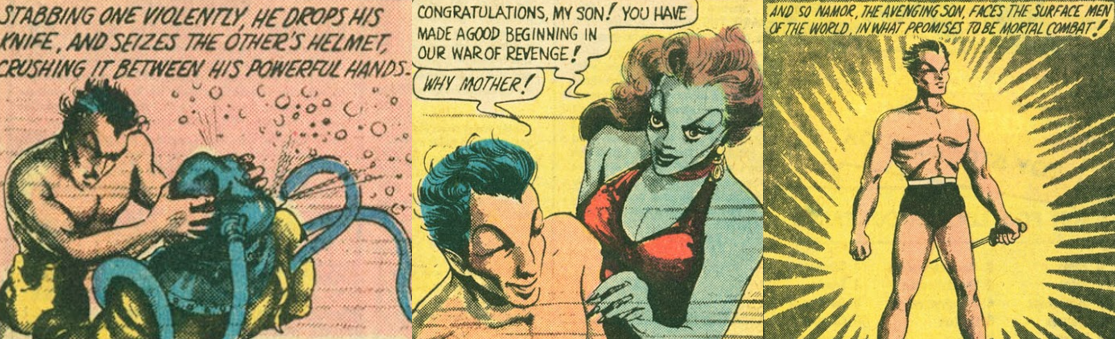
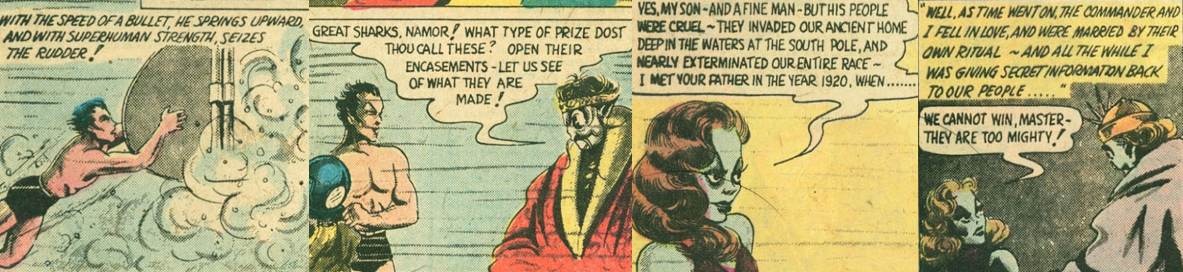
The story of Namor, the Sub-Mariner, the “ultra-man of the deep” begins with a salvage ship, the aptly named S.S. Recovery, out at sea and investigating a wrecked ship under the ocean. Deepsea diver Rod nelson comes up from the depths and, after recovering in the decompression chamber, relates that the safe he was sent down to recover had been opened, and recently, too. As they’ve been out there for a week and seen no signs of any other ships, and there’s been no reports of any other ships in the area for three weeks, the captain has Nelson and Carley head back down there to try and figure out what, exactly, has happened, Carley goes on ahead and notices that the ship’s side hatch has been opened and, when he’s joined by Nelson, the two are stunned to spot slim, youthful swimmer in short-shorts mingling through the wreckage, apparently unfazed by the incredible pressure of the need for oxygen! The swimmer, the titular Sub-Mariner, is confused by the divers’ appearances; since they’re clad in heavy diving suits and equipment, he doesn’t recognise them as men or fish and assumes them to be some kind of hostile robot due to their vaguely mechanical appearance, the “control wires” running to their suits, and the “fire-weapon” (actually an acetylene torch to allow them to se in the murky depths) they hold. Consequently, the Sub-Mariner severs the wires, cutting Nelson and Carley off from their communications and oxygen supply, and then attacks them mercilessly, stabbing on with his knife and crushing the other’s head with his bare hands! Worried for the safety of his men, the captain sends another diver, Anderson, down to investigate but, when he gets down there, he frantically rushes to the surface upon seeing his crew mates’ bodies, unaware that he’s drawn the Sub-Mariner right to the S.S. Recovery!

Namor learns that he’s destined to led a war against all humankind!

When Anderson relates his story, the ship makes a hasty exit but the Sub-Mariner effortlessly twists its rudder and stops its propeller with his incredible strength (said to be that of “a thousand men”). Panicked, the captain desperately tries to steer the out of control ship but, unfortunately for the lives left aboard the S.S. Recovery, the Sub-Mariner forces it to crash and split in two on some rocks. Pleased with himself, the Sub-Mariner grabs Nelson and Carley’s dead bodies and speeds away to a secluded grotto by way of his winged feet. He brings his victims to a vast, chapel-like chamber where he’s met by a curious, robed, fish-like priest and boasts of his great victory over the mechanical, alien lifeforms. However, the Sub-Mariner (identified by the holy fish-thing as “Namor”) is shocked to find that his prey weren’t alien invaders or robots, but actually “Earth-men”. His mother, however, is more than pleased by his efforts; she commends him for striking a blow in the war against humans and even demands that the bodies at strewn up as an example. When Namor questions why she hates humans so much, especially as his father was an Earth-man, she relates that, while his father was a “fine man”, human beings are cruel and dangerous and almost drove their entire race to extinction. Back in 1920, Namor’s father, Commander Leonard McKenzie, led a scientific expedition out at sea and ended up unknowingly obliterating their society with depth charges and explosives. With the death toll climbing faster and faster, the elders sent Namor’s mother, Fen, to infiltrate the “white monsters” and bring an end to their actions since she most closely resembled a human. Leonard took pity on her, tried to feed and clothe her, without realising he was making her sick or that she couldn’t understand him. In time, though, she learned the language of men, and the two fell in love, all without the humans ever suspecting that she was returning to the water to stay alive and ferry back information to her people. Despite her warnings, her fellow Sub-Mariners tried to strike back and were no match for man’s weaponry, and Fen has spent the last twenty years preparing Namor, a being born of both worlds, to avenge his race on the world of man using his superhuman strength and in the name of his unduly oppressed people.

The Summary:
Jeez, well, okay…I can’t say I was expecting that! I’ve had some limited experience with Namor before; I know he’s a proud man and that he walks the line between hero and villain, someone who’s just as likely to sink half a continent as he is to save the world, but I never expected his debut story to involve him brutally murdering people and smiling about it! I have to address right off the bat that I couldn’t really find any decent scans of this issue, so the image quality probably isn’t all that great, but the artwork is actually pretty good for the time. It’s a bit crude and simple in places but it reminds me of pulp novels and comic books in its dark, subdued aesthetic; panels showing Namor underwater are really well done, with lots of blues and greens and murkiness to cast him as a frightening figure, and I really like the way Bill Everett conveys Namor’s hair when underwater and the simple, but effective, depictions of his incredible strength and speed.

Namor’s certainly formidable, but is he being manipulated by his vengeful mother…?

As for Namor himself…well, we don’t really learn too much about him in terms o his character, but there’s quite a bit related to us and that we can intuit. Interestingly, the opening dialogue box describes him as “a youth of dynamic personality…quick thought and fast action” and that’s certainly true as he doesn’t even stop to consider that the divers might be men rather than robots and just murders them without a second’s thought. We’re also told, by the narrator and by Fen, that he’s able to live on land and under the sea, fly through the air and swim rapidly through the water, and we see some pretty fantastic and startling examples of how powerful he is. He can crush a man’s skull with ease and it’s nothing for him to manhandle an entire ship and cause it to explode in spectacular fashion, to say nothing of how nimble he is underwater. At first, he seems aghast and confused as to why men are deemed his enemy, but he seems perfectly willing to carry out his mother’s wishes by the final panel after hearing how destructive humans were towards his race. It’s a bit odd, though; Fen claims Leonard was a kind man and it seems she really loved him, yet at no point did she try to get him to stop his destructive bombardment of her people. I guess having it be so that Leonard captured, tortured, and raped her would be a little too dark for this already pretty damn dark story but it definitely feels like something’s off about Fen’s story, and the narrative ends with Namor apparently ready and able to strike swift and unrelenting vengeance upon humanity, which is a daunting prospect given the glimpse we’ve seen of his power.

My Rating:

Rating: 3 out of 5.

Pretty Good

What did you think to Namor’s debut story? Were you impressed with his brutality and power? What did you think to the backstory presented here and do you think there’s more to Fen’s tale? What are some of your favourite Sub-Mariner moments and stories from the comics? Are you excited for his live-action debut? Whatever you think about the Sub-Mariner, feel free to share it in the comments or on my social media.

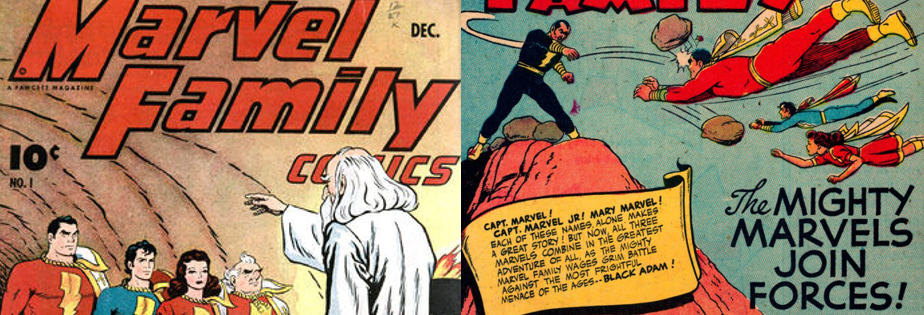
Back Issues: Marvel Family Comics #1

Story Title: “The Mighty Marvels Join Forces!”
Published:
December 1945
Writer: Otto Binder
Artists: C.C. Beck

The Background:
Following the incredible success of Clark Kent/Superman and Bruce Wayne/Batman over in National Comics (the precursor to DC Comics), Fawcett Publications desired their own colourful superheroes to get in on the new craze. While the initial plan was for a team of heroes, each sporting the powers of Greco-Roman Gods, Ralph Daigh made the executive decision to combine them into one superpowered entity to directly oppose Superman. Originally dubbed “Captain Thunder” and debuting in a comic published as both Flash Comics and Thrill Comics, trademark issues led to artist Pete Costanza suggesting the alternative name of “Captain Marvelous”, soon shortened to Captain Marvel, and the character was a big success for the publisher. Captain Marvel soon became a franchise all unto himself thanks to sharing his powers with a colourful extended family and, about six years after his debut, he and his Marvel Family met their dark opposite in the form of Teth-Adam/Black Adam, who had the same magical as the Big Red Cheese but was corrupted by greed and power. In his original form, Black Adam only appeared once in Fawcett’s original run but saw a new lease of life after the publisher was absorbed into DC Comics; under the direction of the likes of Jerry Ordway, Geoff Johns, and Peter J. Tomasi, Black Adam became a complex and aggressive anti-hero, one who was at times as reprehensible as the villains he opposed, and who was capable of great love and loyalty but also nigh-unstoppable wrath. Ranked as one of the most interesting anti-heroes in comicdom, Black Adam has also featured in many of DC’s animated ventures and, after nearly twenty years of Development Hell, finally set to make his live-action debut in 2022 with Dwayne “The Rock” Johnson in the role.

The Review:
By the time of this story, Captain Marvel had already shared his awesome powers (which grant him the wisdom of Solomon, the strength of Hercules, the stamina of Atlas, the power of Zeus, the courage of Achilles and the speed of Mercury whenever he shouts the magic word “Shazam!”) with his crippled friend, Freddie Freeman, his long-lost sister, Mary Bromfield to create a superhero family with them as the similarly powered and attired Captain Marvel Jr. and Mary Marvel alongside former con artist Dudley H. Dudley as the non-powered Uncle Marvel. As the story progresses, we’re treated to a recap of how this is possible but it’s basically thanks to the blessing of the Wizard, himself also called Shazam, who resides in a magical realm known as the Rock of Eternity. Billy’s first encounter with the Wizard literally amounted to him being summoned there, being bestowed with God-like powers, and then being directed by the Wizard’s spirit to put those powers to good use as Earth’s Mightiest Mortal. After saving Freddie’s life, Billy brought him to the Wizard and he was similarly empowered, while Mary was just able to transform simply because she shared Billy’s bloodline and the trio accepted Uncle Marvel as an honorary member/mascot because he means well despite his lack of superpowers. Quite how the Wizard is able to carve Captain Marvel’s continued adventures despite being a ghost is beyond me, but the mysterious old mystic also carries the burden of failure from his first champion, whom he called Mighty Adam before he turned to evil, was rechristened Black Adam, and banished to “the farthest star” for his crimes.

Black Adam returns for revenge after being exiled for thousands of years.

Before that can come back to bite Captain Marvel in the ass, though, our story switches over to the Big Red Cheese’s youthful alter ego, star child newscaster Billy Batson, who’s sent to the “astronomical observatory” to investigate reports of an unidentified object that’s hurtling its way towards Earth. While viewing the object (which is apparently traveling at the speed of light, which seems like something you wouldn’t be able to tell with a telescope such as this), Billy is forced to transform into Captain Marvel to save the astronomers life when his damaged telescope threatens to crush him. Freddie then returns the favour by saving Billy from being run over by a couple when they’re distracted by something flying overheard, which turns out to be the sinister Black Adam. Garbed in a black version of Captain Marvel’s costume (sans the cape) and sporting a widow’s peak and a permanent scowl, Black Adam has returned to Earth after five-thousand years of space travel hell-bent on conquering the planet. He wastes no time in causing an affray, blocking traffic, swiping aside cops, proving impervious to gunfire, and even breaking a cop’s back over his knee before Captain Marvel Jr. intercepts him. though momentarily amazed by the flying boy’s appearance, both Black Adam and Captain Marvel Jr. are stunned to find their powers are equally matched; when Captain Marvel joins the fray, his punch does stagger Black Adam but that’s about it as the three are equally matched in terms of power. Shocked to find that he’s no longer the most powerful man on Earth, Black Adam chooses to lose himself in the passing crowd so he can rethink his strategy and, after witnessing the two Marvels transform back and head to the Wizard for council, follows the two to get the revenge he has craved for centuries.

Despite all his great power, Black Adam is easily tricked into a defeat.

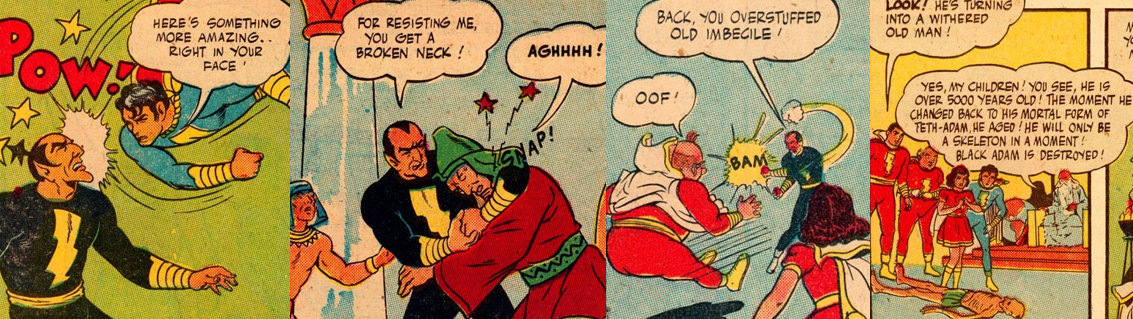
The Wizard’s spirit is distraught to learn of Black Adam’s return and regretfully tells them the story of how, five-thousand years ago, he bestowed the power of the Gods upon Teth-Adam and charged him with fighting the evils of the world as Might Adam. However, the Wizard chose poorly; the power immediately corrupted Mighty Adam, easily allowing him to overpower the Pharaoh’s guards and then snap his neck to claim himself ruler of Egypt! Mighty Adam’s reign was ridiculously short-lived, however, as the Wizard immediately showed up, dubbed him Black Adam, and banished him from Earth. It took the Wizard five-thousand years to figure out that his mistake was empowering a man, rather than a pure-hearted child, and he also underestimated Black Adam’s ability to breathe and fly through space, meaning it now falls to the Marvels to undo the Wizard’s mistakes. Unfortunately for the boys, Black Adam strikes at that very moment, choosing to bound and gag them and then plan to kill them to stick it to the Wizard (again, kind of daft as he could’ve just killed them on the spot but then we wouldn’t have a story, I guess…). However, after learning of Billy and Freddie’s disappearance, Mary and Dudley decide to ask the Wizard for help and arrive just in time to help fight with Black Adam; although Uncle Marvel is no match for Black Adam, he does untie the boys while Mary tries to fight him but Black Adam remains unfazed even when all three of them attack him at once! In the end, though, it’s Uncle Marvel who saves the day; after the Wizard relates that the only way to stop Black Adam is to force him to say his magic word, Uncle Marvel’s buffoonery is enough to trick Black Adam into doing so! Captain Marvel then delivers a good wallop to Teth-Adam’s face and the Marvels look on as the would-be tyrant’s body withers and decays before their eyes, apparently ending Black Adam’s threat once and for all.

The Summary:
One of the big appealing factors of Captain Marvel’s comics from this time was the artwork; C.C. Beck employs a cartoony, almost “rubber hose” style aesthetic that really helps the art and characters to pop out almost as much as their brightly coloured costumes, though the backgrounds and level of detail are noticeably lacking. This isn’t unusual for comic books of this time, but it is quite noticeable here, especially in the Rock of Eternity, which is an especially bland and lifeless environment save for the ridiculous depictions of the Seven Deadly Sins and the crude explanation of Shazam’s powers carved into the wall. Interestingly, if you’ve never read a Captain Marvel story before, “The Mighty Marvels Join Forces!” is actually a good place to start as the story wastes quite a bit of time recapping Billy, Freddie, and Mary’s origins when it could have been showcasing the villain of the piece a little more.

As brutal as Black Adam is, he doesn’t really get to do much and is defeated very easily.

Black Adam is built up reasonably well; right from the beginning, it’s clear that the Wizard carries a great deal of shame and regret for having made a mistake in empowering Teth-Adam and his looming threat remains in the background amidst such hijinks as a collapsing telescope and inattentive driver. Once he arrives, he certainly makes a visual impression; I always like it when a villain or anti-hero wears a dark version of a hero’s costume and the black really works for Black Adam. Unfortunately, he doesn’t really do all that much; he just kind stands around, laughing and mocking any attempts to harm him and easily manhandling any mortals who stand in his way. He does, however, show a mean streak that was actually rather shocking, even considering how morally ambiguous comics could be back then; Black Adam snaps a guy’s spine and breaks a guy’s neck, which is pretty brutal considering he uses his bare hands, but sadly that’s about as far as his actions go. He’s banished by the Wizard as soon as he seizes the throne and there isn’t really a proper fight between him and the Marvels since none of them can really harm or even faze the other, meaning he has to be duped into depowering himself, which seems like something even the arrogant and haughty Black Adam just wouldn’t fall for. I guess it works as a comedic twist of fate to have the bungling Uncle Marvel stumble upon the solution, but I also feel like there could’ve been a better way to neutralise Black Adam’s threat.

My Rating:

Rating: 2 out of 5.

Could Be Better

Were you a fan of Black Adam’s debut story? What did you think to the way he was portrayed, and defeated? Do you agree that the story was unnecessarily padded? Which of the Captain Marvel family is your favourite? What are some of your favourite Black Adam stories and moments? Are you excited for Black Adam’s live-action debut? Whatever your thoughts on Black Adam and Captain Marvel, feel free to leave them below or drop a comment on my social media.

Back Issues [Brightest Day]: Green Lantern #48-50


Although February 2014 was dubbed “Green Lantern Day” (because, by the American calendar, the date read as “2814”, the sector of space assigned to Earth in DC Comics), the significance of this date has passed as the years have changed. Instead, I’m choosing to celebrate the debut of perhaps the most popular iteration of the character, Hal Jordan, who first appeared in October of 1959.


Writer: Ron Marz – Artists: Bill Willingham, Fred Haynes, and Darryl Banks

Story Title: “Emerald Twilight, Part One: The Past”
Published: January 1994

Story Title: “Emerald Twilight, Part Two: The Present”
Published: February 1994

Story Title: “Emerald Twilight, Part Three: The Future”
Published: March 1994

The Background:
The character of Green Lantern, in the form of Alan Scott, first appeared in All-American Publications’ (a precursor of DC Comics) All-American Comics #16 in July 1940. In 1959, DC Comics editor Julius Schwartz enlisted writer John Broome and artist Gil Kane to reinvent the character as Hal Jordan and, in the process, created countless other Green Lanterns through the establishment of an intergalactic police force. Although Jordan became one of DC Comics’ most prominent superheroes, the company decided to make some major changes to the character in the mid-nineties, a period of time often referred to as the “Dark Age” of comics that saw stories such as “The Death of Superman” (Jurgens, et al, 1992 to 1993) make headline news and Bruce Wayne/Batman left crippled at the hands of a superhuman foe. Although Batman later recovered and Clark Kent/Superman soon returned to life, Hal Jordan’s home town of Coast City was destroyed during the Man of Steel’s resurrection, leaving Hal devastated and driving him to near madness in his attempt to rebuild his home. The story’s primary purpose was to depict Hal’s downfall into a maniacal, reality-destroying villain known as Parallax and to introduce a new, young, sexy Green Lantern (my favourite of the Emerald Warriors, Kyle Rayner). Eventually, of course, DC backpedalled on this decision and went out of their way to redeem the “greatest Green Lantern” but, for a while there, things were definitely exciting and different in DC Comics as they introduced new legacy characters and fundamentally altered their predecessors in startling ways.

The Review:
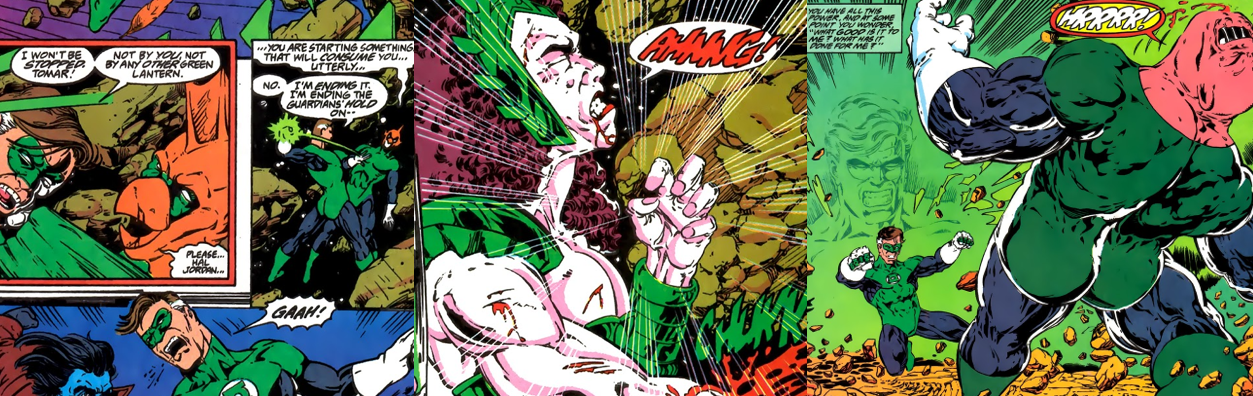
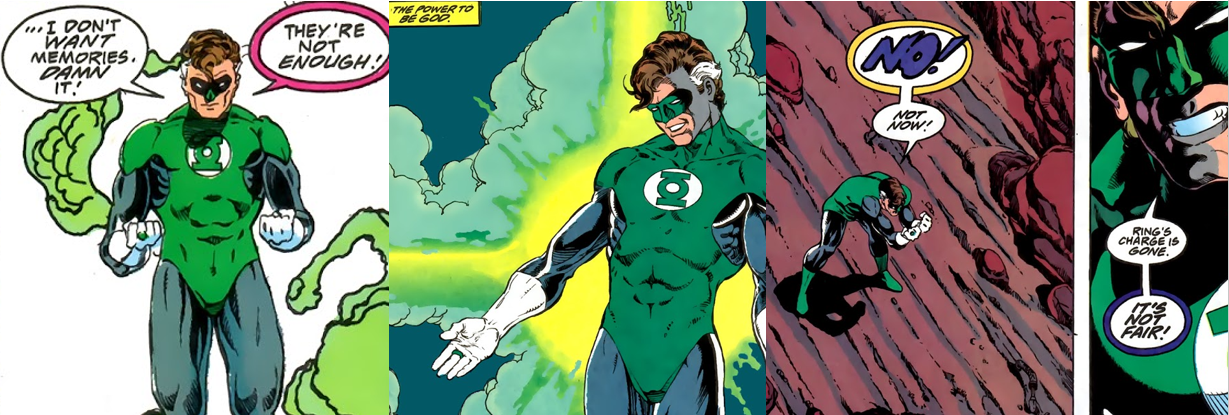
“Emerald Twilight” begins pretty much immediately after the conclusion of the “Return of Superman” story arc (Stern, et al, 1993) with an injured and emotionally shattered Hal Jordan kneeling amidst the still-smouldering crater that is all that remains of his hometown, Coast City. Burdened by his grief at arriving too late to stop Mongul and Hank Henshaw/Cyborg-Superman from obliterating the city, Hal uses the vast powers of his power ring to heal his broken arm and conjure a construct of his father, Martin, for a bit of a heart-to-heart. Primarily, Hal wants to address his resentment towards his late father for favouring his older, more successful brothers and never telling Hal that he was proud of him and all he had accomplished. However, as Martin is simply a manifestation of Hal’s memories of him, and his guilt and unresolved issues, Martin simply tells Hall that he just never measured up to his brothers, guilt-trips him for not being there for Coast City, and then forces Hal to relive the traumatic experience of watching him die in a plane crash. A construct of Hal’s mother, Jessica, then arrives to comfort her son, pointing out Martin’s many faults as a husband and a father and encouraging Hal to hold on to the happier memories and move on from the pain and loss. Despite her encouragement, however, Hal isn’t satisfied with just having memories; they’re not enough to quell his guilt or his anger or his pain and, in his vehement refusal to let go of his anguish, he focuses his willpower in a wholly selfish way.

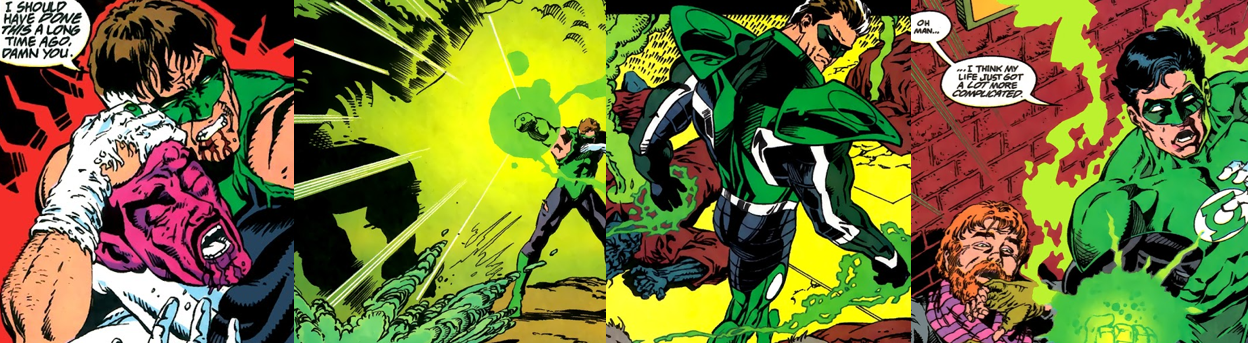
Grief-stricken, his anguish turned to rage, Hal carves a path of destruction to confront the Guardians.

Hal uses his willpower to create a living, breathing, emerald-hued recreation of Coast City, including all of its buildings and inhabitants. The temptation to right those wrongs, to “be a God”, is overwhelming and even brings back a manifestation of his first love, Jennifer. Reminiscing about the past and what could have been between them, Hal laments how he screwed up his relationship with Jennifer even after she helped him through the trauma of his father’s death. Jennifer, however, assures Hal that she was happy after him, settled in Coast City, and that the end came quickly for her and the others; she also says that “nobody blames [Hal]” and that they’re just happy that he’s keeping their memories alive. Jennifer walks Hal to his childhood home, where he again meets the “ghost” of his father; Martin echoes Jennifer’s sentiments, stating that every appreciates that he’s “restored” Coast City, but falters when he is about to finally say the words Hal is longing to hear (that he’s proud of him) and promptly vanishes, along with the entire Coast City illusion, when Hal’s ring exhausts its charge. Hal’s anger and bitterness at being denied his desire, and the limits of his power ring, are soon interrupted when one of the Guardians of the Universe manifests before him. The Guardian reprimands Hal for using his power ring for personal gain and violating the rules and regulations of the Green Lantern Corps, and demands that he return to Oa for disciplinary action. Hal, however, lashes out in anger absorbs the residual energy from the Guardian’s projection to give himself a charge and, blasts off to Oa to confront his masters, appearing as little more than a green shooting star to lovers Kyle Rayner and Alex DeWitt. Overcome by his grief, and incensed at the losses and injustice he feels, Hal blasts his way through space and is met by opposition from his fellow Corpsmen, Ke’Haan of Varva and Laira of Jayd, two Lanterns who, while experienced, are no match for Hal’s experience and newfound rage.

Hal’s crusade sees him cutting down some of his most trusted comrades.

Furious at being used as a puppet by the Guardians for so long, Hal incapacitates the two and steals their power rings, leaving them for dead in the void of space and adding more power to his arsenal. While the Guardians of the Universe are concerned at Hal’s trail of destruction, they have faith that the entirety of their Corps, and their near-limitless power, will be enough to stop him; after all, he’s just one rogue Lantern, right? Well Tomar Tu learns the hard way that Hal is not so easily subdued; although he tries to shackle Hal using a parasite not unlike the Black Mercy creature, Hal’s willpower is so strong, and his rage so out of control, that he easily overpowers his former comrade and friend. Jack T. Chance meets a similar end as, while he is far more willing to fight dirty, his inexperience leaves him adrift in space like so many other Corpsmen. Hal is even forced to battle Boodikka, a warrior female he personally recruited into the Corps, but the loyalty of his brothers and sisters now sickens Hal and he’s so obsessed with making them pay for their hubris that he slices Boodikka’s hand off to claim her ring as his own. One by one, both on-panel and off, Hal bests the Guardian’s Lanterns and, with each victory, he becomes increasingly brutal. Upon reaching Oa, Hal is met by the Corps drill instructor, the surly Kilowog, easily the proudest and most loyal member of the Green Lantern Corps. However, while he lasts longer than any of the other Green Lanterns, Kilowog also falls before Hal’s newfound might and rage.

Sinestro is sent to stop Hal, leading to an epic clash between the two with their roles almost reversed.

Even the stoic Guardians, so self-righteous in their power and position, begin to fear Hal’s crusade and, in their desperation, turn to Ganthet’s final solution to Hal’s rampage: releasing the renegade Green Lantern, Thaal Sinestro, from his captivity within the Central Power Battery. And so it is that Hal is pitted against his former mentor, the very man who he stood up to when Sinestro perverted the power and privilege of the power ring for his own ends. The irony is not lost on Sinestro, who finds himself as the last hope of his former masters, beings he has almost as much reason to despise as Hal, and delights in Hal’s torment. Sinestro manages to goad Hal into relinquishing all of his stolen power rings and battling him on equal ground, something Hal is only too happy to agree to just so that Sinestro has no doubt that he was finally, truly, bested by his superior. Eager to have his revenge against Hal for having him imprisoned, Sinestro presses his attack but Hal matches him blow for blow, theorising that the Guardians must have lost their minds to turn to someone as vindictive as Sinestro and seeing his rival’s return as the final proof of the Guardians’ hypocrisy and fallibility. Sinestro taunts Hal by telling him that, years ago, the Guardians asked him, their greatest warrior, to mould Hal into his image but, despite being flattered by their trust, he never thought that Hal would be able to live up to those expectations. When they come to a penultimate clash, Sinestro is almost admiring of Hal’s newfound bloodlust, but maintains that the difference between the two has always been that Hal is unwilling to kill, whereas Sinestro is only held back from killing by the promise of his freedom to subdue Hal non-lethally.

Hal kills Sinestro, and the entire Corps, becoming Parallax and leaving Kyle as the sole Green Lantern.

Ultimately, their battle descends into a wild brawl; as the Guardians impassively watch on, Hal mercilessly beats Sinestro to a pulp. Hal claims victory, having finally bested his long-time rival with his bare hands, but Sinestro continues to taunt him, claiming that he has lost himself in his brutality. Hal’s response? To break Sinestro’s neck, finally killing him and crossing that forbidden line. His attempt to absorb the full power of the Central Power Battery is interrupted by Kilowog, who makes one last desperate plea for Hal to stop before he strips all of the Corpsmen of their powers and leaves them in mortal danger, but Hal simply cannot look past his grief, his pain, and his lust to obtain the power to correct those mistakes. In an instant, he reduces Kilowog to a charred skeleton, tearfully discards his power ring, and has one last heated confrontation with the Guardians before entering the Central Power Battery. As he absorbs the Central Power Battery into himself, the Guardians channel all of their remaining powers into one last power ring; Hal emerges, forever changed, crushing his power ring and fleeing to the stars to begin enacting his grand plan for the universe, and only Ganthet is left alive. He teleports to Earth and stumbles upon struggling artist Kyle Rayner, seemingly at random, and bequeaths him the last power ring, birthing an all-new Green Lantern, the last in the entire universe, in the process.

The Summary:
It’s definitely not recommended to go into “Emerald Twilight” without at least some understanding of Hal Jordan, or having read some of the “Return of Superman” arc, but it’s not absolutely necessary. The text boxes and dialogue help to bring you up to speed with how Hal got his power ring, his reputation, and how Coast City was destroyed, but it definitely adds even more emotional weight to the story if it’s not your first exposure to the character. Compared to “The Death of Superman” and “Knightfall” (Dixon, et al, 1993 to 1994), it’s also a much shorter and far more condensed story. Hal literally ploughs through seemingly the entire Green Lantern Corps (or most of them) off-panel or in a few panels in the middle chapter of the story, and much of Hal’s downfall is set up subtly in previous issues and stories rather than being this big, headline event. That’s not to say that “Emerald Twilight” didn’t shake things up, though, but it definitely acts as more of an epilogue to “The Return of Superman” rather than an event of equal proportions. I fully believe that, if this story was done today, it would probably be a six to twelve-issue miniseries that also included Hal fighting his Justice League teammates as well.
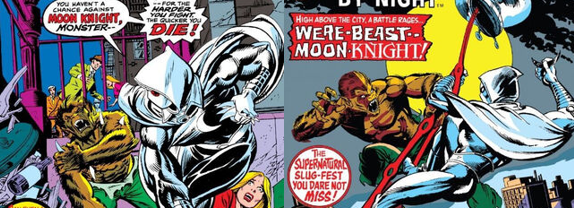
Hal wishes only to have what he has lost and is devastated when he is denied even that.

The more intimate nature of the story actually helps it to stand out in some ways, though. The focus here is on Hal’s grief and despair; he’s a man who has literally lost everything, his hometown and all his loved ones, and has been driven right to the edge and it all happened seemingly on a whim. There was no way he could have known what Mongul and Cyborg-Superman were planning, and he was in no position to stop them, so all he’s left with his survivor’s guilt coupled with his unresolved issues with his father. This is beautifully realised in Hal’s desperate attempts to hear his father say he’s proud of him, but being denied even that simple luxury because of his grief screwing with his constructs and the limitations of his power ring. Martin’s appearance here works doubly as a representation of Hal’s own insecurities; he can’t say he’s proud of Hal because Hal knows he would never say that, and even the small comforts brought by his mother and former lover offer Hal no peace or solace. The closest he comes to being happy is when he recreates Coast City; even though it’s clearly an illusion, a facsimile created by his ring, he’d much rather live in that fantasy world than have to endure with the painful and brutal reality that he’s lost everything.

Hal’s brutality forces the Guardians to release Sinestro, culminating in violent final confrontation.

Consequently, it’s entirely understandable that he lashes out at the Guardians when they come along to reprimand him. After giving his body and soul to the ideals of the Green Lantern Corps, he is denied having what he truly desires, and his grief turns to rage; this anger is directed purely at the hypocritical and self-righteous Guardians but also extends to the ideals Hal once embodied, meaning he has to fight off his own kind in order to confront his masters. Believed to be the greatest Green Lantern ever, Hal’s indomitable willpower is only augmented by his rage; this, coupled with his experience and the added power of more and more stolen power rings, make him a dangerous and formidable foe who threatens the lives of even the near-God-like Guardians. At first, Hal has no desire to fight his fellow Lanterns; he constantly rants about the Guardians’ manipulative and deceitful ways and tries to convince the others to side with him, but they’re as blinded by their loyalties as he is by his anguish and the result is a lot of Green Lanterns being left beaten, helpless, or maimed simply to fuel Hal’s newfound crusade. This culminates in easily the best part of the comic, beyond Hal’s descent into gibbering madness, the long-awaited final battle between Hal Jordan and Sinestro. This brutal fight is a fantastically realised clash that is just dripping with irony and fate. When he was just an upstart rookie, Hal saw that Sinestro was abusing his power and opposed him, forever tarnishing the reputation of the once-mightiest Green Lantern and, for years, the two were cast as moral and ethical opposites. Sinestro hungered for power and longed to rule through force and fear, and was more than willing to kill or maim those who opposed him, whereas Hal was the very embodiment of the righteous justice and heroism of the Green Lantern Corps. Now, the tables have turned; Hal is the rogue, power-mad Green Lantern and Sinestro is the last line of defence, and I find that so much more interesting than just watching Superman being beaten to death by a mindless monster. Even better is that Sinestro still underestimates Hal; he is arrogant in his belief that, despite Hal’s recent brush with darkness, he is still the same good-natured and moral individual deep down and therefore doesn’t have it within him to kill, and this proves to be Sinestro’s downfall.

“Emerald Twilight” changed Green Lantern’s status quo for a time and marked a turning point for DC.

Hal’s crossing of that line and descent into a tragic villain was so unexpected at the time. The state of DC Comics was radically upended in the early-to-mid-nineties and Hal’s transformation into the reality-warping Parallax soon became a big part of that as he sought to rewrite time itself in a desperate attempt to set right all the tragedies and mishaps that had befallen himself and his friends. Parallax was quite the intriguing villain in that he fully believed what he was doing was right, and for the greater good, and couldn’t understand why his friends kept opposing him as he had no wish to harm them. This also spelt the end for the Green Lantern Corps as we knew them…for a time. Kyle Rayner became the sole Green Lantern for a while, and was afforded slightly different abilities (he didn’t need to charge his ring and had no weakness to yellow) as well as a cool new costume, which really helped breath new life into the character and comic. DC never quite let Hal go, though, and soon enough they started to undo pretty much everything that had happened here: many of Hal’s victims were shown to have survived or were resurrected, Sinestro was revealed to have been a construct all along, and Hal both sacrificed himself to save the world and became the Spectre before being reborn, alongside the entire Green Lantern Corps, with all of his actions and time as Parallax revealed to have been due to the manipulations of a malevolent space bug. Yet, at the time, this was the status quo: The Green Lantern Corps were dead, Hal was a crazed lunatic, and we had a fun new Green Lantern, and it all kicked off here. It’s maybe not as long or as in-depth as other Dark Age tales from this time, but “Emerald Twilight” is still a significant chapter in the character’s life and well worth checking out if you fancy seeing a hero take a dramatic and tragic turn to the dark side.

My Rating:

Rating: 4 out of 5.

Great Stuff

Are you a fan of “Emerald Twilight”? If you read the story when it first published, what did you think to the dramatic change in Hal’s status quo and were you happy about it? Do you think that the story should have been expanded into a few more issues or did you prefer the more concise format? What did you think to Hal’s turn to the dark side? Do you think it was justified, and were you disappointed at how easily he dispatched the other Green Lanterns? What did you think to Hal’s turn as Parallax and were you a fan of Kyle Rayner? Did you enjoy the Dark Age of comics or were you happy to see the status quo restored? Which Green Lantern character, villain, or story is your favourite and why? How are you celebrating this pseudo-Green Lantern day today? Whatever you think about “Emerald Twilight”, and Green Lantern in general, sign up to leave your thoughts below or drop a comment on my social media.

Back Issues: Werewolf by Night #32/33

Writer: Doug Moench – Artist: Don Perlin

Story Title: “..The Stalker Called Moon Knight”
Published:
27 May 1975 (cover-dated August 1975)

Story Title: “Wolf-Beast vs. Moon Knight”
Published:
24 June 1975 (cover-dated September 1975)

The Background:
In February 1972, Roy Thomas, Jeanie Thomas, Gerry Conway, and Mike Ploog came together under the watchful eye of the legendary Stan Lee to bring Jack Russell/Werewolf by Night to readers in the pages of Marvel Spotlight. After years of being banned from publishing stories involving werewolves and other supernatural creatures, the writers enjoyed exploring these elements with characters like Werewolf by Night, who graduated to his own self-titled series in 1972. Jack Russell came from a long line of lycanthropes thanks to a complex history involving Count Dracula and a cursed tome known as the Darkhold; under the light of a full moon, Jack would become a feral, bloodthirsty beast who attracted the attention of a nefarious cabal known as the Committee. It was the Committee who were responsible for Moon Knight’s first appearance in Marvel Comics, though the silver-clad mercenary was created by Doug Moench, Don Perlin, and Al Milgrom. Inspired by pulp heroes from the 1930s like Lamont Cranston/The Shadow, Moon Knight was initially the alias of Mark Spector, a cloaked hired gun who sported weaponry in the shape of crescent moons, but his personality and background was later greatly expanded upon by the likes of Bill Mantlo, Gregg Hurwitz, and Warren Ellis. One of Marvel’s more obscure superheroes, Moon Knight has often been unfairly compared to the likes of Bruce Wayne/Batman but is actually one of their more complex and adaptable characters thanks to him suffering from Dissociative Identity Disorder, which means he exhibits a range of different, often conflicting, personality traits that lend the character towards constant reinvention. Given the darker nature of the character, and the success of his Disney+ show in 2022, and the recent live-action debut of the Werewolf, this seemed like a good time to take a look at his debut appearance and help bring the character into the spotlight a little more.

The Review:
“..The Stalker Called Moon Knight” opens with a suitably dramatic full-page spread of the titular Werewolf by Night being smashed in the face by a double-handed uppercut from the mysterious Moon Knight. I’ve never read or even encountered anything with Werewolf by Night in it before so it’s refreshing to see Jack’s internal monologue is very different from the usual diatribe from Marvel Comics; Jack speaks in conjunctions, is quite lazy with his terminology, and has a twang to his language that conjures up a Brooklyn accent. It also turns out that he’s more of a man-wolf than literally transforming into a four-legged fiend; in this regard, he’s visually more akin to Lawrence “Larry” Talbot (Lon Chaney Jr.) from The Wolf Man (Waggner, 1941) than David Kessler (David Naughton) from An American Werewolf in London (Landis, 1981). However, while Jack is able to provide coherent narration while in his feral state, when transformed into a werewolf he seems to be incapable of speech, understanding complex sentences, or any intelligence at all beyond savage instinct. Of course, anyone who’s familiar with the character probably already knows all this (and more) but this is literally the first time I’m encountering him so it’s interesting to me to understand the mechanics of his transformation. As vicious as Werewolf by Night can be when transformed, all his ferocity and augmented strength is meaningless against Moon Knight since the cloaked mercenary is garbed head-to-toe in a silver outfit that burns the Werewolf on contact (and the beast is also struggling with a broken hand when the story opens). Though enraged by Moon Knight’s tone, the Werewolf only receives further punishment when he takes a blow from the merc’s spiked gauntlet, which drives silver right into the beast’s face. Moon Knight expresses disgust and hatred towards the ferocious Werewolf, easily putting him down with a “savate kick” and then riddling his chest with silver, moon-shaped blades, and Werewolf by Night is left a beaten, confused creature unable to fight back against Moon Knight’s silver tricks or physical prowess and feeling betrayed that an emissary of the same Moon that grants him his powers should be beating him so thoroughly.

Already reeling from attacking his best friend, Jack is attacked by a ruthless, silver-clad mercenary.

So, right away Moon Knight makes an immediate impression; he’s an uncompromisingly brutal foe who attacks Werewolf by Night without mercy or hesitation. He regards the beast as nothing more than a bloodthirsty freak and his sheer merciless assault of the creature earns him the awe of the terrified onlookers (who see nothing more than another garishly-garbed vigilante attacking a fierce man-wolf) and even the begrudging kudos of Jack, who has little choice but to acknowledge Moon Knight’s skill and prowess. Hurt and struggling against his pitiless silver foe, Jack’s mind wanders back to the previous issue and the recent events that lead him to the dingy alley where he’s currently getting his furry ass kicked. Out in a blizzard in Northern California, the Werewolf had been stopped from murdering a young child by his best friend, Buck Cowan. Unfortunately, while this spared the girl, Buck was severely mauled by the Werewolf, who then reverted back to his human form after sheltering from the snowstorm. Retrieving his clothes and stumbling his way back home, Jack is distraught by his actions, which have left Buck in a coma from which he may never awaken, and he angrily lashes out at a wall (breaking his hand in the process) in shame and anguish. Tormented by the curse that transforms him into a primal beast under the light of the Moon and causes him to be a threat to friends and loved ones and innocent lives everywhere, Jack vows that his days of living as a ravenous werewolf are over but is stunned when he returns home to find Moon Knight there, ready and waiting to deliver Werewolf by Night to the malevolent Committee.

The Werewolf and Moon Knight’s brutal conflict takes them up into the sky and across the pier.

Moon Knight reveals to Jack that he is Mark Spector, a veteran of numerous conflicts, former prize-fighter and a Marine commando who now works as a soldier of fortune and mercenary. Interestingly, in Moon Knight’s recounting of the job offer from the Committee, his face is left in shadow and it’s the Committee who provide him with his trademark outfit and Moon Knight moniker (a codename Spector admits is “pretty stupid”). The Committee furnished Spector with everything he needed to subdue Werewolf by Night and promised to pay him ten-thousand dollary-doos on receipt of the Werewolf’s beaten (but still living) form. Thanks to Jack’s father holding Moon Knight off, Jack was able to beat a hasty retreat, but Moon Knight easily tracked him down using his friend Frenchie’s helicopter, which led to the brawl between Spector and the freshly-transformed Werewolf by Night in a nearby alley. The startled onlookers eventually snap out of their fugue state long enough to alert the cops, and the Werewolf finally manages to grit through his pain to land a stunning blow to his attacker; however, Spector’s assault has left the creature wounded and unable to capitalise on this brief advantage, which allows Moon Knight to bludgeon the Werewolf with a silver baton and finally knock the beast unconscious just as Frenchie hovers overhead for the pick-up (with Jack’s friend, Topaz, and sister, Lissa, as hostages for good measure). The second part of the story, “Wolf-Beast vs. Moon Knight”, picks up with Moon Knight escaping from the cops with Werewolf by Night’s prone body by use of a ladder dangling from the chopper; an errant shot from the cops wounds Spector’s shoulder, but Frenchie’s able to get them away from the gunfire and the startled crowds. Unfortunately for Moon Knight, the Werewolf regains consciousness just over the city pier and attacks Spector in a blind rage, causing them to plummet five-hundred feet to the water below. Hurt and frustrated by the Werewolf’s tenacity and refusal to go quietly, Moon Knight doubles down on his attack, landing huge haymakers to the beast’s jaw and wrestling with the lycanthrope in and out of the water.

Moon Knight is so stunned by Jack’s predicament that he has a change of heart and sets the beast free!

Eventually, however, the strain of the fight begins to take its toll and Spector starts to tire but, just as the Werewolf is about to land a killing blow, the first light of dawn hits and he painfully reverts back to his human form right before Moon Knight’s startled eyes. Moon Knight wastes no time in taking advantage of this and knocks Jack out with a boot to the face, before removing his crescent darts from the cursed man’s body and airlifting him away to his promised payday. However, despite delivering Jack, Lissa, and Topaz to the Committee, Spector is infuriated when the organisation’s head honcho insists that they wait for the next full moon to verify that Spector’s quarry is actually legitimate. When he awakens, Jack is equally incensed to find he’s been caged like an animal and that his loved ones are being held hostage by the Committee’s “emetic” head man, who reveals that he went to all this trouble to use the Werewolf’s feral nature for his own nefarious ends like a pet. Jack delivers an impassioned condemnation of all of them, especially Moon Knight, for treating him like some wild animal that needs to be locked up and vows to make them all pay right before transforming into the Werewolf, much to the glee of the Committee. Their leader finally gives Moon Knight his cash reward, much to the scathing disgust of Lissa, and everything Spector has seen and heard has been enough for him to have a change of heart. He releases Werewolf by Night from his cage and joins the beast in attacking the Committee; Moon Knight frees Topax and Lissa and then tosses the Committee’s head man to the Werewolf to get his brutal comeuppance. With all of the Committee members present presumably slaughtered and Jack’s loved ones free, Moon Knight makes a swift exit when the feral beast turns on him. However, as the Werewolf by Night stalks into the darkness once more, forever doomed to his cursed fate, Moon Knight watches on with a newfound respect for Jack and his torment and wishes his newfound (if tentative) ally well.

The Summary:
I enjoyed this a lot more than I thought I would, to be honest. With absolutely no idea who either Werewolf by Night or Moon Knight are, I really wasn’t sure what to expect; in many ways, the Werewolf has a similar situation to Doctor Bruce Banner/The Hulk in that he is powerless to resist transforming into a ravenous beast under certain conditions, but Jack’s curse is also notably different as he only undergoes the transformation when there’s a full moon and the Werewolf exhibits absolutely no intelligence beyond basic, primal instinct. Similarly, while I’ve briefly researched Moon Knight here and there, his characterisation was nothing like I expected and his first appearance paints him as more of a highly skilled and enthusiastic mercenary and, in that regard, his debut is very much in the same vein as the likes of Frank Castle/The Punisher and even Wade W. Wilson/Deadpool in that he shows up with an awesome look, spouts some witty barbs and absolutely wrecks a formidable character, but is revealed to have a strong moral code by the conclusion of the story. For those who are more familiar with the show or Moon Knight’s more recent portrayals, there are no hints towards his multiple personalities or ties to Egyptian deities; instead, he’s just a very dangerous mercenary who’s asked to don a garish costume to give him the edge against a supernatural foe. Moon Knight’s debut is at its best when the character is on the page, and especially when he’s throwing down with Werewolf by Night. This brutal clash is, unfortunately, interrupted with side stories regarding the Werewolf’s supporting cast, which is fine and I’m sure all part of a bigger pay-off for the character in the overall context of his ongoing comics, but, for me, this got in the way of the main appeal of the story. This isn’t an uncommon trick in comics books from this era (and before, and even now, to be fair) but I felt like it’s worth pointing out as both Moon Knight and the Werewolf made a visual impression on me and I was just naturally more interested to see what they were up to rather than the Raymond Coker and Victor Northrup side stories.

While depicting Jack as a tortured character, the story is at its best when the two are going at it!

Moon Knight is quite the physically gifted foe; he’s an expert in multiple martial arts and more than capable of matching the Werewolf’s feral strength blow-for-blow. Thanks to the hooded silver costume furnished by the Committee, he’s ideally placed to subdue the Werewolf, who is consistently unable to really deal much damage to Spector as just touching him causes him agonising pain, to say nothing of Moon Knight’s spiked gauntlets and crescent darts. In fairness, the core narrative on show here is nothing we haven’t seen before in multiple Hulk stories (and one I’m gonna assume crops up a lot in the pages of Werewolf by Night), which is the cliché one-two-punch of a clandestine organisation wanted to exploit a mindless creature for their own ends and a cursed individual being prejudiced against because of his monstrous alter ego. The execution is a little different, however, as, while Moon Knight is stunned to find that the Werewolf is actually a man afflicted by a devastating curse, he delivers his quarry to his employees regardless since his primary motivation is to get his ten-grand payday. It’s pretty clear, even without seeing Spector’s face, that Moon Knight is rattled by this revelation, though, and his stoic silence during Jack’s tirade against the Committee and their leader’s shameful disregard for human lives speaks volumes considering Moon Knight hasn’t been able to keep his trap shut up until that point. Ultimately, it would’ve been easy for Spector to take the money and go, or free the Werewolf and then get out of there, but he chooses not only to free the beast but also to cut Topaz and Lissa loose and then join the Werewolf in brutalising the Committee to somewhat make amends for his misguided actions. Even better, Spector keeps the blood money he earned from the Committee (which I find hilarious, for some reason), and also ends the story far more comfortable with his newfound persona as Moon Knight. Overall, this was a fun, action-packed two-part tale that cast Jack as a sympathetic figure tormented by his bestial alter ego; he’s a man who has no control over that side of himself and who just wishes to be free from his curse, but won’t back down from a fight when forced into a corner. The story also gets high praise for its fantastic introduction of a visually unique and complex new character to comicdom in Moon Knight; seeing him absolutely dominate the Werewolf in all of their encounters was a great way to sell Spector as a force to be reckoned with and depicting him as both a ruthless mercenary and a man of honour really helped to make him make an impression beyond his striking costume.

My Rating:

Rating: 4 out of 5.

Great Stuff

What did you think to Moon Knight’s debut in the pages of Werewolf by Night? Are you a fan of the titular Werewolf or, like me, did you only recently become fully aware of him because of Moon Knight’s live-action debut? What did you think to Moon Knight’s depiction here, his costume and gadgets and characterisation? Are you a fan of the character and, if so, what are some of your favourite Moon Knight stories and moments? Whatever you think about Moon Knight, feel free to sign up to leave your thoughts below or drop a comment on my social media, and be sure to check out my review of his Disney+ show!

Back Issues [Sonic CDay]: The Sonic Terminator


Developed alongside the blockbuster Sonic the Hedgehog 2 (SEGA Technical Institute, 1992), Sonic the Hedgehog CD (Sonic Team, 1993) released on this day back in 1993. Expanding upon the Blue Blur’s debut title, Sonic CD introduced Metal Sonic (one of Sonic’s most popular and enduring rivals) and Amy Rose, and is considered by many to be one of the best of the classic Sonic titles.


Story Title: “The Sonic Terminator (Part 1 to 5)”
Published: 29 April 1994 to 24 June 1994
Writer: Nigel Kitching
Artist: Richard Elson

The Background:
After Sonic the Hedgehog catapulted to mainstream success and helped SEGA to usurp Nintendo’s position at the top of the videogame industry, SEGA were quick to capitalise on Sonic’s popularity not just with videogames but also a slew of merchandise, including cartoons and comic books. About six months after Archie Comics began publishing a weird amalgamation of the Adventures of Sonic the Hedgehog (1993 to 1996) and Sonic the Hedgehog/SatAM (1993 to 1994) cartoons, United Kingdom publisher Fleetway Editions Limited began publishing “Britain’s Official SEGA Comic”, Sonic the Comic (StC), a fortnightly publication that I collected diligently until its unfortunate end. Though pulling much of its lore from the now defunct Mobius and Doctor Ovi Kintobor storyline that was prevalent outside of Japan, StC was its own beast entirely and quickly veered away from the source material to recast Sonic the a mean-spirited leader of a gang of Freedom Fighters made up of both videogame characters and anthropomorphic characters adapted from the videogames. Like the Archie comics, StC often included a few very loose adaptations of the videogames, though these were often truncated or took the very basic idea of the source material and adapted it to fit with its noticeably different lore. Their adaptation of Sonic CD was no different, renaming Metal Sonic to Metallix and introducing one of the comic’s more dangerous and persistent secondary antagonists.

The Review:
“The Sonic Terminator” begins with the dramatic and violent death of Sonic the Hedgehog! Not to worry, though, this is simply a “practice robot” that was trashed by a blindly fast, electrically-charged figure that is kept in the shadows and only vaguely hinted at. Both Doctor Ivo Robotnik (who, at this point, was directly modelled on the character’s look from Adventures of Sonic the Hedgehog) and his assistant, Grimer, are pleased as punch with the results of this final test and prepare to send their new creation out to kill the real Sonic. Speaking of whom, Sonic is currently in the Emerald Hill Zone, where Robotnik’s Troopers (basically StC’s version of Swat-Bots in that they are humanoid robots that Sonic is able to smash without holding back as, unlike Badniks, they’re not powered by woodland critters) are arresting an entire village. Despite the concerns of his fellow Freedom Fighters (Porker Lewis, Johnny Lightfoot, Amy Rose, and Miles “Tails” Prower), Sonic rushes in to save the villagers and the entire gang winds up captured as a result, much to Johnny’s chagrin. Sonic, however, retains his steadfast cocky attitude; even when they come face-to-face with Trusk, the captain of the prison ship, and are told that they are being taken directly to Robotnik’s Badnik processing plant at the Veg-O-Fortress, Sonic simply yawns with boredom.

The first two issues are more concerned with a side plot involving the Sky Pirates.

This turns out to be because Sonic has some formidable backup on hand in the form of Captain Plunder and his Sky Pirates, a group of mercenaries and…well, pirates…who Sonic encountered in the Mystic Cave Zone in a previous issue. Thanks to Captain Plunder, Trusk is captured and the prisoners are freed but Porker accidentally lets slip to Filch the Poltergeist where Sonic’s cache of Chaos Emeralds is hidden and the pirates speed off the steal the booty. However, Sonic and the gang are easily able to follow them to North Cave and a fight breaks out; although Sonic is able to incapacitate most of Captain Plunder’s crew using his Super Spin Attack and both Amy and Tails are able to fight them off with their crossbow and a rock, respectively, Captain Plunder gets the upper hand when he takes Tails hostage. This, of course, earns Tails Sonic’s exasperated disdain (not only is StC-Sonic incredibly arrogant, pig-headed, and rude, he also has a tendency to insult his closest friends and constantly degrades Tails with the nickname “Pixel Brain”. It’s actually pretty fantastic to see him be such a snarky asshole all the time) and he is forced to allow Captain Plunder to take the six Chaos Emeralds.

Metallix is immediately established as a fearsome and merciless opponent.

Amusingly, however, rather than the evil energy of the Chaos Emeralds augmenting the Sky Pirates’ disreputable demeanours, they actually have the opposite effect since they absorb evil rather than radiate it and, as a result, Sonic is easily able to retrieve the gems from the now docile (and hippy-like) thieves. This happy ending, however, is mired in the dramatic reveal of StC’s version of Metal Sonic, Metallix, which attacks the Emerald Hill Zone with destructive energy blasts from its stomach laser and demands Sonic’s presence for “extermination”. “Part 3” of the story continues this threat and finally gets around to actually adapting the story of Sonic CD by having Metallix kidnap Amy to lure Sonic the Never Lake; although Sonic is busy playing Marxio Brothers, and despite his grouchy nature, he immediately rushes over to Never Lake and is shocked to find the forest that is usually growing there is gone and that the Miracle Planet has been transformed into a mechanical hellscape. After rescuing Amy from atop a steep column of rock, he snaps at her to cut out the hero worship and tell him what’s been going on. She manages to tell him that Dr. Robotnik has chained the Miracle Planet to Never Lake and transformed it into his newest base before any further exposition is rudely interrupted by Metallix.

Metallix takes Amy to the Miracle Planet and they are trapped there, cut off from greater Mobius.

Over the course of a few action-packed panels, a fight breaks out between Sonic and his unusually loquacious doppelgänger. Metallix tosses boulders at Sonic, all of which he is able to expertly hop over and burrow through, but he is surprised by the robot’s chest laser. The two them battle so fast and so aggressively that neither Amy, nor the reader, are able to make out the action. In the aftermath, Metallix emerges from the dust and smoke as the apparent victor before collapsing into shutdown. Sonic, battered and weary, still finds the energy to insult Amy but, while he appears to have defeated his robotic counterpart, Metallix hits him with a cheap shot and takes Amy to the Miracle Planet as “live bait” and the unimpressed Sonic races off in pursuit. By the time the Freedom Fighters arrive to help, they’re already too late as the Miracle Planet disappears before their eyes, trapping all on its surface in another dimension for an entire month. On the miniature world, Sonic quickly reunites with Amy (much to his dismay) in what appears to be the Bad Future of Metallic Madness. Both characters question how Dr. Robotnik was able to convert the Miracle Planet so quickly, given that the previous month showed no signs of his influence, but their conversation (and the prospect of them being marooned there for a month) is soon interrupted by Metallix. Uncharacteristically, Sonic chooses to flee rather than fight but, as Metallix charges its laser to kill Amy, he comes flying back in with a big Spin Attack after running around the entire planet in a few seconds. Metallix, however, is able to draw additional power from the mechanical surface of the planet; this allows him to erect an electrical shield and charge up a kill shot for his prey after Sonic trips on a loose cable.

Thanks to time travel shenanigans, Metallix is soundly defeated…for now..

Sonic and Amy are saved, however, by the sudden appearance by another Sonic, this one diminutive in stature and holding a grey stone. Sonic #1 is immediately suspicious of the newcomer but Sonic #2 forces him into an energy beam that turns him into a midget as well. Sonic #2 is able to tell Sonic #1 about the grey object he’s holding; it’s the Time Stone, a relic able to transport the holder back into the past and, while Sonic #2 distracts the recovered (and now, from their perspective, gigantic) Metallix, Sonic #1 races off to the past. Arriving in what appears to be Palmtree Panic before Dr. Robotnik polluted the Miracle Planet with his machinery, Sonic’s shock over the sudden disappearance of the Time Stone gives way to his awe at the presence of a massive piece of mechanical hardware. This is StC’s version of the Robot Transporter from the game, which is in the process of transforming and polluting the environment; thanks to having been shrunk, Sonic is easily able to hop inside of the machine and remove its power source, the Time Stone. Having destroyed the machine, Sonic uses the Time Stone to travel back to the present and, in the process, becomes Sonic #2 as he saves his past-self from Metallix, gifts him the Time Stone, and orders him to race off just as he was directed in order to continue the time loop. Although Metallix attacks Sonic with all its power, the environment begins to change around them as his actions in the past catch up to the present; as a result, not only is Dr. Robotnik’s influence erased from the Miracle Planet and Sonic returned to his normal height but Metallix is wiped from existence and the story ends with Sonic facing an entire month alone with Amy.

The Summary:
Now remember, I read Sonic the Comic religiously as a kid; for me, it was one of three influential factors into my fandom for Sonic (the others being the cartoons and, of course, the games themselves) so there is not only a lot of nostalgia there whenever I revisit the comic but quite a bit of bias as I was a big fan of the original stories StC told, its characterisations, and the way they included some elements from the videogames. As a result, I remember enjoying “The Sonic Terminator” as a kid but, as an adaptation of Sonic CD, it’s definitely lacking in many areas. Perhaps the biggest drawback to the story is that it spends two issues messing about with a side plot involving Captain Plunder. At the time, each story in StC was about five pages long so right away the writers have wasted ten pages of story on something that has nothing to do with Sonic CD, though it also appears as though the writers and artists had very little to work with when putting this story together.

Metallix steals the show and comes across as a formidable new villain for Sonic.

Indeed, they must have seen the opening video and maybe a few screenshots and had a rudimentary understanding of the game but there is next to nothing from Sonic CD included beyond the absolute bare minimum. There is only one Time Stone, for example; hardly any locations from the game are used, no enemies or Badniks beyond Metal Sonic appear, and Dr. Robotnik is practically non-existent for the entire story. One benefit of this, however, is that it means Metallix takes centre stage as the primary antagonist. Unlike other interpretations of Metal Sonic, Metallix is very chatty; it taunts Sonic, constantly calculates the odds of success and failure, and comes across as a very threatening and formidable foe not only in its array of attacks and blinding speed but also in its durability. It’s not often in StC that Sonic is unable to trash his robotic foes in one hit and Metallix was certainly the most persistent enemy he has encountered at this point. Even though this story seems to spell the end of the character, Metallix would return with a vengeance later down the line as part of the Brotherhood of Metallix and would be a formidable recurring adversary for Sonic, his friends, and even Dr. Robotnik.

The story’s art is incredible and elevates it despite lacking fidelity to Sonic CD.

What really makes “The Sonic Terminator” shine is the excellent artwork from the always incredible Richard Elson. Elson was to StC what Patrick “Spaz” Spaziante was to the Archie comics and he always delivered on portraying Sonic and the other characters in such a dynamic way. His rendition of Metal Sonic is fantastic and the way he conveys Sonic’s speed is brilliant, allowing for some action-packed panels that really sell the gruelling nature of Sonic’s clash against his doppelgänger. While there isn’t much for the other Freedom Fighters to do, this is at least in keeping with the solo nature of Sonic CD and, while the story isn’t a direct one-to-one adaptation of the source material, StC pretty much never did this when producing the few adaptations they did do over the years. As a result, “The Sonic Terminator” is a great story in the StC canon and perfectly sets Metallix up as a frightening adversary (and therefore a significant story in the large StC lore) but is maybe not so great for those expecting a more literal adaptation of Sonic CD.

My Rating:

Rating: 3 out of 5.

Pretty Good

Have you ever read “The Sonic Terminator”, or any issues of Sonic the Comic for that matter? If so, what did you think of the story and the way it introduced its version of Metal Sonic? Were you disappointed by how few elements from Sonic CD were present in the story or were you just happy to see Sonic and Metallix go at it? Which of StC’s original characters was your favourite and what did you think to Sonic’s characterisation? How are you celebrating Sonic CD’s anniversary this year? Whatever your thoughts on Sonic CD, or Sonic in general, feel free to leave a comment below.

Back Issues [Spidey Month]: The Amazing Spider-Man #14


Easily Marvel Comic’s most recognisable and popular superhero, unsuspecting teenage nerd Peter Parker was first bitten by a radioactive spider and learned the true meaning of power and responsibility in Amazing Fantasy #15, which was first published in August 1962. Since then, the Amazing Spider-Man has featured in numerous cartoons, live-action movies, videogames, action figures, and countless comic book titles and, in celebration of his debut and his very own day of celebration, I’m dedicating every Friday of August to talk about everyone’s favourite web-head!


Story Title: “The Grotesque Adventure of the Green Goblin”
Published: 9 April 1964 (cover-dated July 1964)
Writer: Stan Lee
Artist: Steve Ditko

The Background:
In 1962, Marvel Comics editor and head writer Stan Lee followed up on his success with the Fantastic Four with Spider-Man; his debut in Amazing Fantasy #15 proved to be one of Marvel’s best selling titles and Spider-Man’s popularity led to him getting his own solo title barely a year later and he quickly amassed one of the most colourful and memorable rogues galleries in all of comics. Easily one of Spider-Man’s most devious and iconic enemies is the Green Goblin; although a number of people have assumed this elf-like guise, the most famous face behind the mask is Norman Osborn, industrialist and father to Peter’s best friend. Stan Lee’s initial pitch was very different from what the Green Goblin turned out to be, and he continued to clash with artist Steve Ditko over the character’s true identity. Although his identity was initially a mystery, the Green Goblin would go on to be a central figure in many of Spider-Man’s most prominent storylines and a recurring figure in Spidey’s life both in and outside of comics.

The Review:
According to the issue’s first splash page, the Green Goblin came about after a concentrated effort by the Marvel writing staff to deliver “the greatest 12¢ worth [they] can” and wastes no time in introducing readers to “a really different villain” by opening with the shadowy wrongdoer hard at work in his high-tech basement laboratory. There, the mysterious Green Goblin puts the finishing touches to his “flying broomstick”, a rocket-powered flying device that completes his fearsome, colourful costume. With his look complete, the Green Goblin meets with the Enforcers (Montana, Fancy Dan, and Ox), a trio of the city’s most notorious gangsters, and coerces them into working for him to defeat Spider-Man (who previously got the Enforcers arrested some time prior to this story) by intimidating them with sparks shot from his fingers. Strangely, the Green Goblin’s plan involves offering struggling filmmaker B. J. Cosmos the chance of a lifetime: a sure-fire action movie with the Green Goblin and the real Spider-Man as the stars! We then catch up with Peter Parker, who’s in a far better position, socially at least, than usual; not only did he get a 100% score in his last exam, but his intelligence earns him the admiration of Liz Allen, who not only coos over him but actually stands up to Eugene “Flash” Thompson when the football star continues to mock Peter for his lack of physical acumen. Peter’s surprise at seeing Liz leap to his defence and joy at seeing Flash taken down a peg or two is cut short when he hears news of the Green Goblin flying around the skies of Manhattan, so he quickly dashes off to confront the garishly garbed goblin as Spider-Man. Rather than getting into a fist fight, however, the Green Goblin tells Spidey about the movie opportunity and, despite his better judgement, the web-head goes to check it out and finds that the filmmaker is willing to pay him $50,000 to star in a movie that pits him against the Enforcers and the Green Goblin.

The mysterious Green Goblin offers Spider-Man the chance to make bank on a Hollywood movie.

Despite the fact that the last time he cashed in on his spider powers, Peter learned a harsh lesson about using his abilities responsibly, Spider-Man actually agrees and signs a contract since the cash would allow him to provide for his beloved Aunt May. Although receptionist Betty Brant isn’t best pleased at her man socialising with Hollywood starlets, and Aunt May worries about him making a big trip out to California, Peter is not only given license to get out on his trip but even assigned to cover the movie shoot by editor J. Jonah Jameson, thus promising even more profit from the gig. Upon arrival, Spider-Man is amazed at B. J.’s make-up effects and doesn’t suspect that anything’s amiss (so much for his much-lauded spider-sense…), but quickly learns that he’s blundered into a trap when the Enforcers attack him during a “rehearsal”. Spider-Man’s agility and spider-sense help him to largely avoid the trio’s attacks, but he’s several disorientated when the Green Goblin tosses stun grenades at him and deftly avoids his web shooters thanks to his…*sigh*….rocket-powered broomstick. This gives the Enforcers the opportunity they need to dog-pile him, pummelling him mercilessly and leading to a common sequence where Peter musters all of his spider strength to throw them off and then whips up a “man-made dust storm” to temporarily blind his foes. The story then jumps back over the New York to find Aunt May already writing a letter to her nephew, Liz again standing up for Peter to Flash, and Betty continuing to suspect that Peter’s cheating on her over in Hollywood; I guess the point of this is to show that the never-ending drama in Peter’s life continues to churn over even when he’s not around, but the leaps in logic these characters make never fails to astound!

Of course the Hulk randomly shows up! I mean, why not?!

Thankfully, the story quickly returns to Spider-Man’s plight; the web-slinger takes cover in a nearby cave to catch his breath and ends up being trapped inside by, and with, the Enforcers and the Green Goblin. One by one, Spider-Man picks off the Enforcers; he nabs Montana, webs up Fancy Dan, and knocks out Ox with a single punch to the jaw, but the Green Goblin is not so easily ensnared thanks to burning away Spidey’s web net with his broomstick. As if things weren’t already complicated enough, who else should randomly appear in the cave but Doctor Bruce Banner’s enraged alter ego, the Incredible Hulk! Naturally, the Hulk attacks Spider-Man on sight and goes on a rampage, much to the Green Goblin’s glee. When Spider-Man’s attempts to reason with the Green Goliath fall on deaf ears, he’s forced to rely on his agility to avoid the Hulk’s attacks, stunned to see the beast tear through his webbing, and succeeds only in almost breaking his hand when he wallops the Hulk in the face! Realising that he can’t reason with or out-fight the Hulk, Spider-Man puts his health (and life) at risk by tricking the Hulk into smashing the boulder and freeing them from their confinement.

Spider-Man must settle for having survived as he’s left out of pocket and clueless to the Goblin’s identity.

Now back out in the open and able to swing again, Spider-Man turns his attention back to the Green Goblin; however, he’s too weak to properly overpower the Goblin’s broomstick and ends up falling to the water below. When he spots the Hulk heading back into the cave, Spider-Man is duty-bound to rescue the Enforcers before the Green Goliath can find and hurt them, and flees the scene to confront B. J. over his business associates. B. J. is aghast that the army would arrest his stars, but quickly hits on the genius idea of trying to sign the Hulk to an exclusive contract as a replacement antagonist. When Spidey arrives to talk about his fee, the web-slinger is left out of pocket due to the film being cancelled and given just enough money to cover his trip back to New York. Rather than be concerned about the Hulk being free out in the desert or question his willingness to sell his abilities out for fame and fortune, Peter returns to the city and ponders where and when the mysterious Green Goblin will strike next. Speaking of Spidey’s fiendish new foe, the story ends with the Green Goblin returning to his lair and lamenting his failure to destroy the web-spinner and position himself as the new head of a worldwide criminal syndicate. Still, the experience (and the unexpected appearance of the Hulk) teaches the Green Goblin the valuable lesson that one can never think of everything, but he consoles himself in his anonymity and resolves to strike even harder in his next criminal escapade.

The Summary:
Um…okay, so…Marvel claim, right from the first page of the story, that the Green Goblin will be this big, impressive, unbelievable new foe for Spider-Man and the fiend’s big debut plot is to trick Spider-Man into signing on the a film so the Green Goblin and his unimpressive goons can try and beat him up. I mean, as far as villainous plots go, it’s hardly tossing your girlfriend off a bridge or murdering countless innocents! While the Green Goblin would eventually live up to his hype and become arguably Spider-Man’s most dangerous villain ever, you’d never know it from this first issue; and you can’t even say that Marvel didn’t know how to debut new Spidey foes at the time as Doctor Otto Octavius/Doctor Octopus made a much more impressive debut that same year some months prior and he came across as a far more formidable foe.

Considering how important he would become, the Green Goblin makes an inauspicious debut.

Just about the only thing that the Green Goblin has going for him is the question of his true identity; when he’s not wearing his mask, his face is constantly obscured or in shadow and I can imagine this was incredibly intriguing at the time as it was uncommon for us readers to not know who Spidey’s villains were behind their colourful costumes. Rather than flying his iconic glider, the Green Goblin straddles a ridiculous rocket-power broomstick and tosses stun grenades instead of his trademark pumpkin bombs; he doesn’t seem to exhibit any superhuman powers, and yet is able to intimidate the Enforcers just by causing some sparkles to fly from his fingers (an ability that doesn’t show up again this issue and appears to have no actual function). The Green Goblin barely even fights with Spider-Man; instead, he sets the Enforcers against him, and these three are incredibly underwhelming characters. Sure, Ox is a brute and Montana has his trusty lasso and I guess Fancy Dan is supposed to be quite agile, but they’re never really portrayed as an actual threat even when they have the numbers advantage.

The Hulk completely overshadows the Green Goblin and only adds to the mess of the issue’s plot.

Then there’s the nonsensical inclusion of the Hulk! Now, I get it; Marvel loved to cram in random cameos from their other characters into stories at the time, and it’s incredibly possible that there’s more context for his appearance in his own comic, but all he really does is completely overshadow the Green Goblin and the main plot. Not only that, but Peter acts really out of character here; he signs up for a movie deal without hesitation despite his vow to use his powers responsibly rather than for personal gain and is not only easily duped by the Green Goblin but is spider-sense is unreliable, at best, at warning him of the obvious dangers around him. The action is pretty good, to be fair, but then it always is in Spider-Man comics; ultimately, this is a good showcase for Spidey as you get to see him hold his own against the Hulk, but the entire selling point of the story was the conflict between Spider-Man and the Green Goblin and we get so little of that that the Goblin may as well have not been in the story at all. This is the very definition of style over substance; the Green Goblin is mysterious and colourful but hardly makes a great first impression and the story is full of filler, nonsense, and overshadowed by the Hulk. This could have been a cool opportunity to have this strange, maniacal imp-like villain torment Spider-Man and constantly give Spidey the slip but, instead, we get this weird plot about him duping him with a movie deal, and then Spidey just checks out of there rather than trying to chase after him, resulting in an inauspicious first appearance for someone who would become one of Spider-Man’s most dangerous foes.

My Rating:

Rating: 2 out of 5.

Could Be Better

What are your thoughts on the Green Goblin’s inauspicious debut? Were you a fan of the villain at the time or did he win you over in a different story (and, if so, which one?) What did you think to Peter’s willingness to sign up for a movie deal and shirk his responsibilities? Who is your favourite Spider-Man villain and why? What did you think to the Hulk showing up in this story? Whatever your thoughts on the Green Goblin, sign up to share them below or leave a comment on my social media and be sure to check back in next Friday as Spider-Man Month continues!