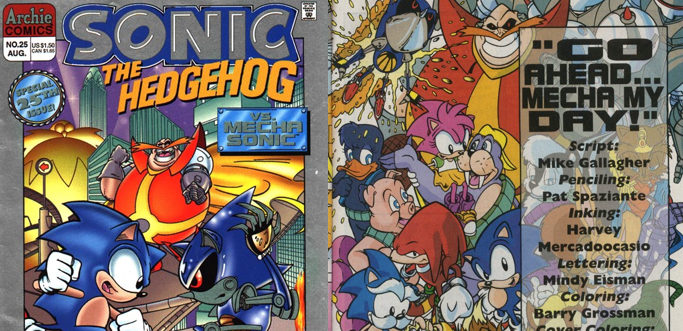
Back Issues [Sonic CDay]: Sonic the Hedgehog #25


Developed alongside the blockbuster Sonic the Hedgehog 2 (SEGA Technical Institute, 1992), Sonic the Hedgehog CD (Sonic Team, 1993) released on this day back in 1993. Expanding upon the Blue Blur’s debut title, Sonic CD introduced Metal Sonic (one of Sonic’s most popular and enduring rivals) and Amy Rose, and is considered by many to be one of the best of the classic Sonic titles.


Story Title: “Go Ahead…Mecha My Day!”
Published: August 1995
Writer: Mike Gallagher
Artist: Patrick Spaziante

The Background:
SEGA were quick to capitalise on Sonic’s popularity once he catapulted to mainstream success and helped them to usurp Nintendo’s position at the top of the videogame industry. Following Nintendo’s success with DiC, SEGA licensed a series of cartoons that were soon accompanied by a four-part miniseries published by Archie Comics. Archie’s Sonic the Hedgehog comics went on to become the longest-running videogame comic book ever and, amidst continuing the adventures of the Knothole Freedom Fighters, the Archie comics weaved in storylines, characters, and elements from the videogames, often changing them to fit their unique narrative. Although a mechanical version of Sonic had featured in Archie’s comics prior to this story (and many more would follow over the years), Sonic’s most recognisable robotic duplicate debuted in the comic’s twenty-fifth issue as part of a loose adaptation of Sonic CD and would go on to continuously plague the hedgehog and his allies even when IDW swept away Archie’s continuity in favour of their own.

The Review:
I didn’t grow up reading Archie’s Sonic the Hedgehog comics; as far as I know, there was no way for us to get hold of them here in the United Kingdom back in the day, so I’m not entirely sure I was even aware of them until late into my teens. I did watch Sonic the Hedgehog/SatAM (1993 to 1994) though and, like many kids from my generation I was, deeply invested in the series and frustrated when it ended on an unresolved cliff-hanger. Although the Archie comics never actually resolved this cliff-hanger and were more like a spin-off than a true continuation, they were the closest thing we’d ever get to an official follow-up to that successful cartoon and, in the years since, I’ve read through the entire Archie Comics run. It has its good points and many bad points, but I found myself enjoying it well enough, especially once they started to incorporate more elements from the source material and veer away from the comedic slapstick that muddled the narrative tone of the first fifty-or-so issues. I’ve already explored how awkward the incorporation of these videogame elements was to the series; the same was true of the UK’s Sonic the Comic (1993 to 2002) and is to be expected when you’ve gone off on your own pretty complex tangent and then have to shoe-horn in official canon into the narrative, but there’s an appeal to the series nonetheless thanks to nostalgia and my love for Sonic.

While Sonic tests Rotor’s new device, Dr. Robotnik plans to lure him into a deadly trap.

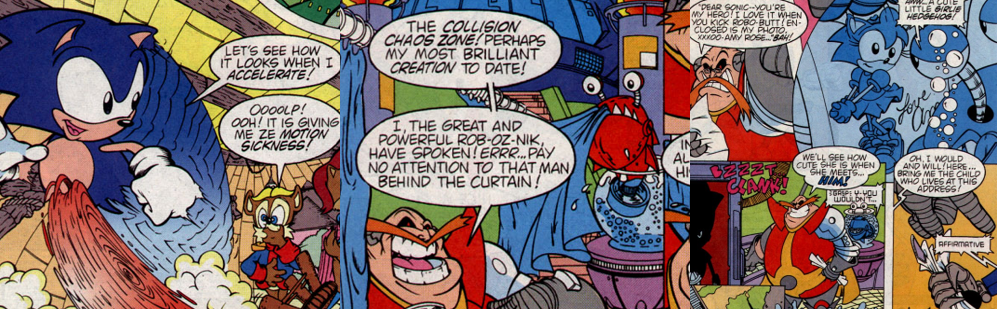
“Go Ahead…Mecha My Day!” (great pun, by the way) begins with Sonic impatiently enduring the hooking up of a video camera to his sneaker; developed by Knothole’s resident mechanic and tinkerer, Rotor the Walrus, the “Sonicam” sends a direct feed back to the Freedom Fighter’s computer so they can keep track of where Sonic is and any potential dangers they need to be aware of. Princess Sally Acorn, leader of the Knothole Freedom Fighters, is particularly pleased with this new technology given that a “new Zone portal” just opened up and is in need of exploration. Sally’s fears about this situation are well founded as it turns out that the Collision Chaos Zone is the creation of Mobius’s mad cybernetic dictator, Doctor Robotnik. However, while he looks like the SatAM Dr. Robotnik, at this point Archie’s version still has quite a bit of his bombastic and foolish variant from the Adventures of the Sonic the Hedgehog cartoon (1993); this means he breaks the fourth wall, chuckles maniacally to his bumbling Badniks, and lacks the grim menace of the SatAM version. However, there’s enough of that interpretation of the character in Dr. Robotnik to order his latest, most mysterious creation to kidnap Sonic’s number one fan, Amy Rose, and then issue a direct challenge to Sonic, daring him to test his speed and skill in his Collision Chaos Zone to rescue Amy. Naturally, Dr. Robotnik plans to stack the deck against Sonic by having his long-suffering, snivelling nephew and head minion, Snivley, struggle into an elaborate Robotnik costume and burn up the road behind Sonic to force him into an even deadlier trap.

Racing to save his friends, Sonic is confronted and challenged by his metallic doppelgänger.

Naturally, Sonic wants to leap into action right away; determined to prove himself and to rescue one of his greatest fans, he thinks nothing of jumping head-first into such an obvious trap, such is his confidence. However, Knothole is a democracy and, as a result, he’s forced to heed to Sally’s more level-headed orders; to get a better sense of what dangers lie ahead, Sally has Miles “Tails” Prower fly on ahead to scope out the area…and he’s immediately captured by Dr. Robotnik’s Swatbots. Fed up with waiting, Sonic races out to the Zone portal and, despite Dr. Robotnik struggling with his lines, is brought abreast of the escalating hostage situation; thanks to the Sonicam’s slow-motion function, Sally and Rotor are able to look in as Sonic races through the bizarre environment while Snively incinerates the path behind him, all to force Sonic into a confrontation with Mecha-Sonic (also referred to without the hyphen). Oddly, Mecha-Sonic’s dialogue seems to indicate that the two have met before, but this was the character’s first appearance; however, it wasn’t uncommon for the videogame’s events to happen off-panel and between stories throughout Archie’s run, even though that doesn’t really align with the narrative presented here, making this allusion confusing, at best. Anyway, Mecha-Sonic challenges his rival to prove his speed in a race through the Stardust Speedway Zone, with Tails and Amy as the prize and Snively pursuing them in Dr. Robotnik’s craft

Sonic’s speed is too much for Mecha-Sonic and Dr. Robotnik’s plot is easily foiled.

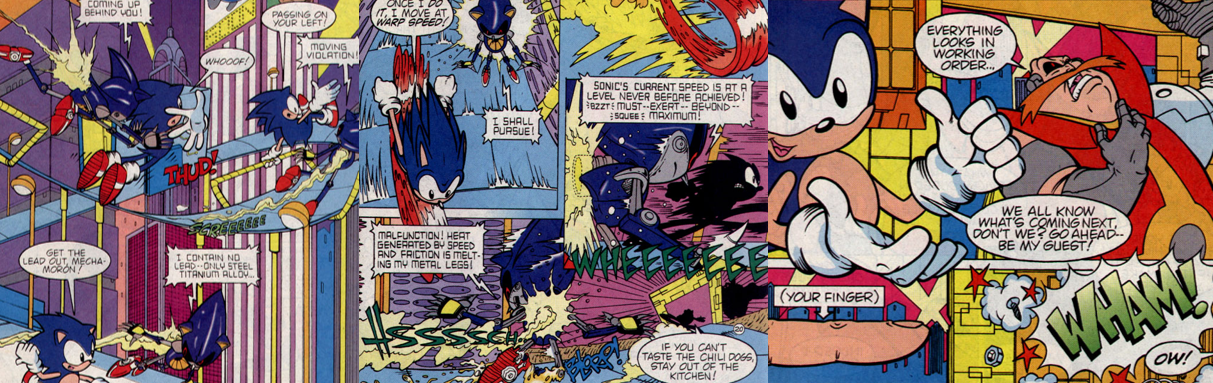
Of course, Sonic takes the bait and “engages” with Mecha-Sonic, much to Dr. Robotnik’s glee; while Amy wails at the engagement pun and Rotor scrambles to account for interference from the Stardust Speedway Zone, we’re treated to a nice two-page spread of the two rivals exchanging taunts and shoving past each other in a pretty neck-and-neck dash through the Zone, which is brought to life by the unrivalled Patrick “Spaz” Spaziante and is certainly faithful both to the level layout from the videogame and the anime sequences that accompanied it. However, Sonic has no idea that Dr. Robotnik has set up a failsafe at the finish line; a massive weighted door that will crush Sonic when he passes under it (which Dr. Robotnik demonstrates by crushing Crabmeat, though this doesn’t kill the woodland critter tapped within him since that wasn’t really a thing in this continuity). Although Sonic gains the lead, Mecha-Sonic uses holograms and environmental hazards to distract and trip him for an unfair advantage, meaning tensions are high as they race down the final stretch. Here, Sonic debuts his new “Figure Eight Super Peel-Out” for a burst of acceleration that pushes him into “warp speed” and Mecha-Sonic summarily melts itself in half by overexerting its thrusters. Sonic is even spared a gruesome end thanks to the timely intervention of Princess Sally but, when Dr. Robotnik throws a tantrum over the loss, volunteers to give the dictator a chance to squash him. When Sonic easily dodges out of the of the trap, he invites Dr. Robotnik to inspect the mechanism for faults and then encourages the reader (represented by a literal on-panel finger) to activate the trap and crush the cyborg madman beneath it. The comic the ends with Tails and Amy free, Dr. Robotnik squashed under his own trap, Mecha-Sonic left sparking on the racetrack, and the heroes celebrating the comic’s first twenty-five issues.

The Summary:
I went to great pains at the start of my review to try and prepare you for the fact that Archie’s Sonic comics weren’t exactly known for their 100% fidelity to the source material when they started adapting more elements from the videogames into their plot but, even considering that, “Go Ahead…Mecha My Day!” is even less of a Sonic CD adaptation than its Sonic the Comic counterpart. Both plucked only the most iconic elements of the videogame (Amy, Metal Sonic, and parts of the environments) and shoe-horned them into their unique narrative, choosing to focus more on the battle between Sonic and Metal Sonic than the time travel plot. While the Sonic the Comic adaptation benefitted slightly from being a multi-part story told over a few issues, both adaptations have about the same level of substance thanks to the first two parts of the story simply setting up for Sonic’s adventures on the Miracle Planet. This location doesn’t even appear here, however; instead, we get two of Sonic CD’s more recognisable areas (Collision Chaos and Stardust Speedway) but they’re presented as being “creations” of Dr. Robotnik, existing in another dimension, of sorts, rather than being on the Little Planet. The Time Stones are also completely absent, as are any elements of time travel or Dr. Robotnik’s plot to conquer the Little Planet, meaning the plot is all about the race between Sonic and “Mecha-Sonic” to rescue Amy (and Tails).

It’s a bit slapstick and barely has anything to do with Sonic CD but at least the art is nice.

Even when you get past the fact this this isn’t really an adaptation of Sonic CD, “Go Ahead…Mecha My Day!” is a bit weak overall; the story’s far too short, Dr. Robotnik lacks the menace of his SatAM counterpart, and there’s never really a sense of danger even when Mecha-Sonic makes its appearance. Like in the Sonic the Comic version, Mecha-Sonic can talk; here, it seems to have been programmed to ape Sonic’s snarky attitude as much as his speed as the two trade quips and grandeur during their confrontation. Though it demonstrates none of its videogame’s other powers, Mecha-Sonic is shown to be a wily antagonist and fully prepared to cheat to gain an advantage, but it’s ultimately handicapped by its mechanical construction and thus falls apart when it tries to match Sonic’s near-limitless speed. Still, the art used to render Mecha-Sonic and the race is impressive; Spaz was always Archie’s best artist when it came to Sonic and he does a great job on the title character, his robotic rival, and Dr. Robotnik. Given that it takes place in this quasi-SatAM continuity, the story also features appearances from the Knothole Freedom Fighters; Tails wasn’t yet the genius mechanic we know him today so Rotor fulfils that role and his Sonicam keeps them up to date with Sonic’s situation while Antoine D’Coolette is simply there to spout nonsense and oppose Sonic out of spite. Since she was always portrayed as Sonic’s equal in the field, it’s obviously Sally who drops in to lend a hand in the finale, emphasising the camaraderie that was so important to this interpretation of Sonic, though it’s made explicitly clear that he didn’t actually need any help. In the end, this was a decent enough story with lots of great art and fun, engaging action but it’s let down by its brevity, the awkward goofiness permeating throughout it, and the fact that it basically has nothing to do with Sonic CD beyond some extremely basic elements.

My Rating:

Rating: 3 out of 5.

Pretty Good

Have you ever read “Go Ahead…Mecha My Day!”, or any of Archie’s Sonic the Hedgehog comics? If so, what did you think of the story and the way its focus on the race between Sonic and Metal Sonic? Were you disappointed by the lack of any other elements from Sonic CD? Which of Archie’s original characters was your favourite and what did you think to their award-winning run? How are you celebrating Sonic CD’s anniversary this year? Whatever your thoughts on Sonic CD, or Sonic in general, feel free to leave a comment below.

Back Issues: Blue Beetle (2006) #1-3

Story Title: “Blue Monday”
Published: May 2006
Writers: Keith Giffen and John Rogers
Artist: Cully Hamner

Story Title: “Can’t Go Home Again”
Published: June 2006
Writers: Keith Giffen and John Rogers
Artist: Cully Hamner

Story Title: “The Past Is Another Country”
Published: July 2006
Writers: Keith Giffen and John Rogers
Artist: Cynthia Martin

The Background:
I wouldn’t begrudge modern readers of DC Comics if they didn’t know who Dan Garret was. The creation of Charles Nicholas Wojtkoski, the very first Blue Beetle featured prominently in Charlton Comics and is pretty much all but forgotten in the legacy of the character. Hell, I wouldn’t be too surprised it Garret’s successor, genius inventor Theodore “Ted” Kord, didn’t ring a bell; in 1966, Steve Ditko reimagined the Blue Beetle but, despite his tenure on Justice League International and making waves through his friendship with Michael Carter/Booster Gold, Ted never really rose beyond the ranks of a D-list hero and is generally remembered for being shockingly and graphically executed on-panel in the build-up to the universe-shaking Infinite Crisis (Johns, et al, 2005 to 2006). Indeed, even a big Ted Kord fan like myself has to acknowledge the mainstream impact of his successor, Jaime Reyes, easily the most recognisable incarnation of the Blue Beetle to date; Jamie has appeared in videogames, cartoons, and in live-action, both on television and even his own feature film. A noted Latino superhero, Jaime was created by Keith Giffen, John Rogers, and Cully Hamner and debuted in the pages of Infinite Crisis before appearing in his own self-titled comic book two months later. Jaime separated himself from his predecessors not just in his more diverse background and his youth, but also by actually deriving superhuman powers and abilities from a techno-symbiotic alien scarab infused to his spine, making him theoretically the more competent of the three Blue Beetles, though this was counterbalanced by his lack of experience and control with the scarab. Jaime has been a part of DC’s premier superhero team, the Justice League, as well as the Teen Titans, fought extraterresital threats and struggled to figure out his powers, and is generally regarded as one of DC’s best legacy characters in recent years.

The Review:
As mentioned above, Jaime made his first appearances in the epic, universe-shattering Infinite Crisis. Specifically, Jaime made a very brief cameo in Infinite Crisis #3 (Johns, et al, 2006) where, in the midst of the mainstream DC universe being rocked by incursions from disgruntled heroes from previous, destroyed worlds, young Jaime just happened to stumble across the glowing, mysterious scarab just sitting out in the open. Jaime returned in Infinite Crisis #4 (ibid), where he was stunned to find Booster Gold and Skeets searching his bedroom for the scarab, which would allow him to reveal the forces of Bruce Wayne/Batman’s renegade artificial intelligence, Brother Eye; although initially amazed to find such a prominent, corporate sponsored hero in his bedroom, Jaime was soon aghast to find that the scarab had fused itself to his spine. When Booster Gold brought him to the Batcave in Infinite Crisis #5 (ibid), Jaime’s life changed forever as the scarab, sensing danger, encompassed his body in a sleek, form-fitting armoured suit unlike any sported by his predecessors. Although very much out of his depth, Jaime found himself in space alongside some of Earth’s greatest heroes in Infinite Crisis #6; his suit unsettled Green Lantern John Stewart’s semi-sentient power ring and he was so overwhelmed by the confusion and stakes of their mission that he had to receive a pep talk from Batman, of all people. Although he couldn’t begin to understand the nature of the scarab, Jaime found the suit had a mind of its own; as soon as the heroes got close enough to Brother Eye’s cloaked satellite, the suit sparked to life and exposed it, leading to a massive battle to decide the fate of all universe, a fight that Jaime was spared since the suit promptly teleported him out of there, against his will, to get away from the Green Lanterns present.

Jaime’s teenage troubles are compounded by the scarab and the mysterious Posse.

Jaime’s solo comic bounces between the present, where he returns to Earth, and the past, which focuses on providing Jaime with more backstory than “confused young kid suddenly gifted superpowers”. He’s a talented high schooler from El Paso, Texas whose free time is spent mediating the constant bickering between his friends, workshy Paco Testas and fastidious aikido student Brenda Del Vecchio. This provides a little more context behind Jaime’s random discovery of the scarab, which he stumbled upon while his friends were squabbling and took home without thinking much about it. At home, Jaime’s mother, nurse Bianca, despairs of his constant quarrelling with his annoying little sister, Milagro and has him take lunch to his father, Alberto, who owns a garage in town. Although Jaime wishes to help his hard-working father, Alberto encourages him to both study and enjoy being a kid while he has the time. That evening, after accidentally stepping on the scarab, Jaime awakens to find himself talking a strange alien language and a similar text glowing on his palm, which he chalks up to being a dream, an explanation Brenda and Paco encourage, but he’s spooked when he crosses path with a strange girl without any eyes who speaks to him in riddles. Jaime’s friends were less than helpful with his predicament; Paco is convinced that Jaime’s seeing ghosts and Bianca’s suggestion that he take the scarab to someone to analyse is no help since it’s vanished. They’re left dumbfounded when he spots the goth chick, Probe, and her tattooed associate, Damper, hanging around the school and he promptly vanishes from sight when he gets close to them thanks to Damper’s ability to cloak their presence with his “mojo”. Jaime’s confused by them; it doesn’t help that they talk in riddles and he has no idea what’s going on, but their curiosity turns to anger when Probe’s attempt to mentally.. well, probe…Jaime sees her being first blocked and then suffer a painful seizure.

The scarab’s armour brings Jaime undue attention and lashes out uncontrollably.

After trying, and failing, one more time to convince Alberto to let him help out, Jaime found himself set upon by Damper and three of his cohorts – the bloated Scour, diminutive Thump, and alluring Bonita – a group of street-level metahumans calling themselves the “Posse”. While the others want to take a more direct approach at making Jaime pay for hurting Probe, and Damper even subtly threatens Jaime’s family, Bonita attempts to subdue him using a combination of pheromones and feminine wiles. Luckily for the captivated Jaime, the scarab’s instincts kick in and he finds himself shielded by his alien armour, which gives him the means to fight back against them, though entirely beyond Jaime’s control, and the scarab can even detect that Bonita is pregnant. As mentioned, these three issues also chart what happened after Jaime dramatically crashes back to Earth. He was immediately attacked by hot-headed Green Lantern Guy Gardner and, since Jaime had no idea how his suit works or what it’s capable of, he was entirely at the scarab’s mercy as it instinctively formed shields, energy-based weapons, and even wings to fend off Guy’s relentless assault, all while Jaime expressed terror and confusion at the entire situation. Jaime’s inexperience allowed Guy to pound him into the dirt and drove him to beg for mercy, and Guy was horrified to find that his ring drove him to attack and almost kill a kid. This showed that scarab is perceived as such a threat by the ring that it drove Guy into a temporary bloodlust, almost driving him to the point of murder, which he claims is something he’s not known for (which is odd as I could’ve sworn Guy’s more volatile nature had seen him kill before…). After Guy left, Jaime was wracked with pain as the suit retracted into the scarab, which has painfully bound itself to his spine, and was left naked in the desert trying to figure out how to tell his mother what happened.

Jaime is stunned to find he lost an entire year of his life during Infinite Crisis.

Although he was helped by a kindly gas station attendant with some clothes, food, and a ride, Jaime was constantly bothered by the scarab’s alien voice in his head (which, amusingly, sounds like his mother); however, his troubles were only compounded when he got home to find out that he’d been gone for an entire year! This means that Jaime has no choice but to come clean to his family about where he was and his new abilities; however, his suit terrifies Milagro and Bianca was so convinced that he was dead that she refuses to believe that Jaime and the Blue Beetle are one and the same. Alberto, who now requires a cane to walk, is somewhat more understanding and sympathetic, explaining the grief they all went through thinking he was dead, but promises to talk to her on his behalf. Overwhelmed by it all, Jaime flies off and tries to get a grip on his powers but is amazed by the sensory overload and destructive abilities of his alien armour. While he doesn’t understand it and is still acting on instinct, the scarab is able to bring up a holographic compass that leads him to Paco at the Mexican border and allied with Damper. The Blue Beetle arrives in time to shield them from agents of “La Dama” and, during the fight, Jaime constantly berates his armour for being too violent but manages to fly Paco out of there. While Jaime doesn’t approve of Paco’s association with the Posse, he’s even more shocked to learn that Brenda almost died after her abusive father beat her and that she’s moved in with her wealthy aunt after he died in a car accident. Although Jaime earns a good punch to the gut for causing her to worry about his safety, the three friends are happy to be reunited, though they’re left blissfully unaware that Brenda’s aunt is the mysterious La Dama who’s been targeting the Posse…

The Summary:
Make no mistake about it, Jaime Reyes is a very different Blue Beetle compared to his predecessors. I admittedly haven’t read too much of any of the Blue Beetles but my understanding has always been that Dan Garret and Ted Kord were completely normal human beings who took the iconography of the scarab and themed their crimefighting careers after it. Until Jaime’s introduction, I had no idea that the scarab was alien in origin, alive (in at least a techno-organic sense of the word), or capable of being such a versatile and visually interesting piece of symbiotic armour. Indeed, Jaime’s tenure represented a massive paradigm shift for the concept of the Blue Beetle; not only was he now a teenage kid with teenage dramas, he was in possession of a volatile alien weapon whose origins and capabilities were a complete mystery since they’d never been seen or associated with the character before, essentially meaning the Blue Beetle concept was reconfiguring into something entirely new, not unlike how the Green Lantern concept was significantly altered between Alan Scott and Hal Jordan.

Jaime’s personality and supporting cast are as intriguing as the mystery behind the alien armour.

What works for me in these three issues is the dynamic between Jaime and his supporting cast; he’s a smart kid, capable of speaking multiple languages and applying himself at school, and also a good kid, volunteering time and again to help his father out and pulling his weight at home. However, he also has some snark, particularly with his bratty little sister, and he describes himself as Brenda and Paco’s “babysitter” since he’s often forced to be the voice of reason when they get into it. I really enjoyed the banter between the three of them; it’s a friendship dynamic that really grounds the character to contrast his relatively normal and mundane lifestyle with the chaos of his newfound superhero life. I also enjoyed the relationship between Jaime and Alberto; a physically tough but empathetic father, Alberto works hard to provide for his family but still encourages Jaime to live his life, so it’s all the more jarring when Jaime returns home to find his father a shell of his former self and his family still grieving from his presumed death. While there are a few fights in these issues and they’re exhilarating enough thanks to the colourful and kinetic art style, the main conflict here is between Jaime and the scarab, which latches itself to him and almost immediately turns his life upside down, sweeping him away on an outer space adventure and unwittingly stealing a year of his life, as well as constantly bombarding him with alien language symbols, and bizarre weaponry.

Jaime represented a fun and visually interesting new direction for the Blue Beetle concept.

Obviously, these are just the first three issues of an ongoing story; the exact nature of the Posse, their issues with La Dama, and the changes faced by Jaime’s supporting cast are no doubt developed over the course of subsequent issues, but there was enough here to have me invested in Jaime and his world. I really like the mystery of the volatile relationship between the scarab and the Green Lantern Corps; we saw glimpses of this in Infinite Crisis and it would become a whole cosmic drama later on, but it really helps to flesh out that there’s always been more to the Blue Beetle than we could ever has suspected. Jaime is admittedly no fighter; he panics in battle and generally tries to talk his way out of situations rather than engage since he’s not acquitted for the superhero life, but the scarab is more than capable of compensating for that. Not only does it cover him in a sick looking beetle-themed armour, but it sprouts wings, enhances his senses, shoots lightning-like energy, augments his strength, and forms shields and all sorts to protect him…and fight back. Jaime is constantly overwhelmed by the armour and its insistence on violence, elements that again I’ve never associated with the Blue Beetle before. Jaime is a reluctant superhero, overwhelmed by what’s happening to him, and a potentially dangerous individual as he cannot control his abilities. In many ways, the scarab’s attachment to him is framed as a metaphor for puberty as his body undergoes strange and often violent changes. I guess hardcore fans of the Blue Beetle might have been turned off by how wildly different the character and concept are with Jaime at the helm, but I think they’re changes for the better. They result in a visually interesting character, one with an appealing personality and strong supporting cast, and increase the Blue Beetle’s appeal by adding all this mystery, lore, and potential to the concept. I really enjoyed this three-issue arc and would absolutely like to read on a bit more and find out more about what happened during his one year absence, what the story of the Posse is, and how it all ties in with La Dama, and to witness Jaime’s growth into his newfound role and abilities.

My Rating:

Rating: 4 out of 5.

Great Stuff

Are you a fan of Jaime Reyes? What did you think to his introduction and springboard to prominence in Infinite Crisis? Did you enjoy these first three issues and the changes to the Blue Beetle concept? What did you think to the scarab’s new abilities and its relationship with the Green Lantern Corps? Were you intrigued by the Posse and the one year gap introduced here? What did you think to Jaime’s supporting cast? Which incarnation of the Blue Beetle is your favourite and what are some of your favourite Jamie Reyes stories and moments? Whatever you think, drop a comment below or on my social media and be sure to check out my other Blue Beetle content.

Back Issues [Spidey Month]: The Amazing Spider-Man #50


Easily Marvel Comic’s most recognisable and popular superhero, unsuspecting teenage nerd Peter Parker was first bitten by a radioactive spider and learned the true meaning of power and responsibility in Amazing Fantasy #15, which was published in August 1962. Since then, the Amazing Spider-Man has featured in numerous cartoons, live-action movies, videogames, action figures, and countless comic book titles and, in celebration of his debut and his very own day of celebration, I’m dedicating every Saturday of August to talk about everyone’s favourite web-head!


Story Title: “Spider-Man No More!”
Published: 11 April 1967 (cover-dated July 1967)
Writer: Stan Lee
Artist: John Romita Sr.

The Background:
Considering Spider-Man’s debut almost didn’t happen, it’s pretty ironic that Stan Lee and Steve Ditko‘s angst-ridden teenage superhero would go on to become the flagship character of Marvel Comics. Over the years, Spider-Man has been involved in some of Marvel’s most celebrated, and notorious, story arcs, and the troubled wall-crawler is often depicted battling his own personal woes as often as one (or more) of his colourful rogues. In 1967, he faced one of his most trying challenges when, burdened by J. Jonah Jameson’s hate campaign, Peter walked away from his responsibilities as a superhero in one of the character’s most influential stories, which also introduced readers to one of the most notorious Marvel villains, Wilson Fisk/The Kingpin.

The Review:
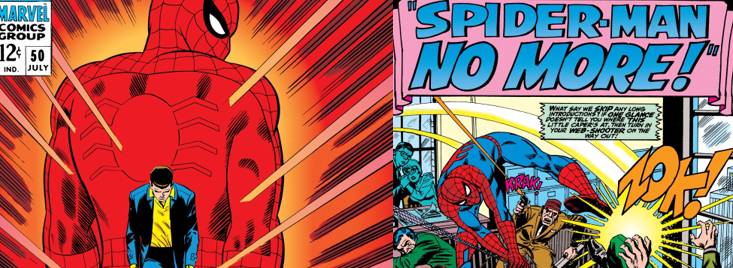
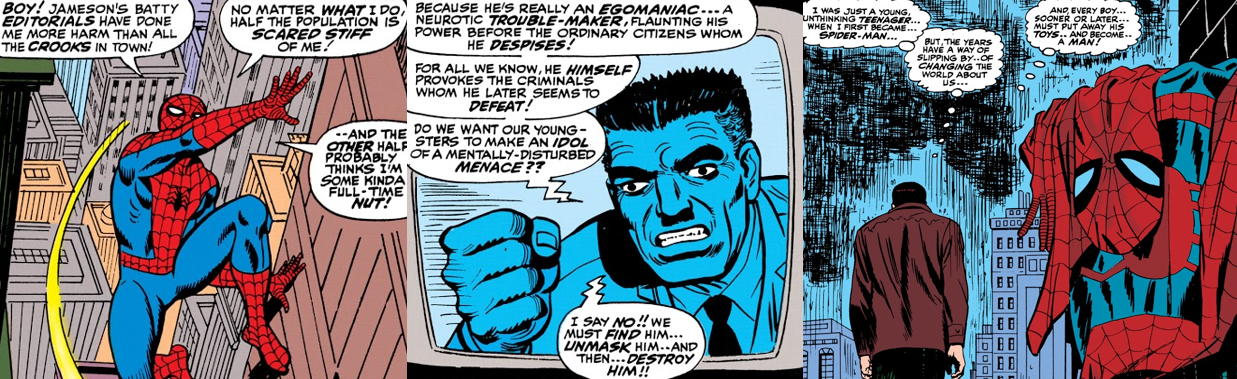
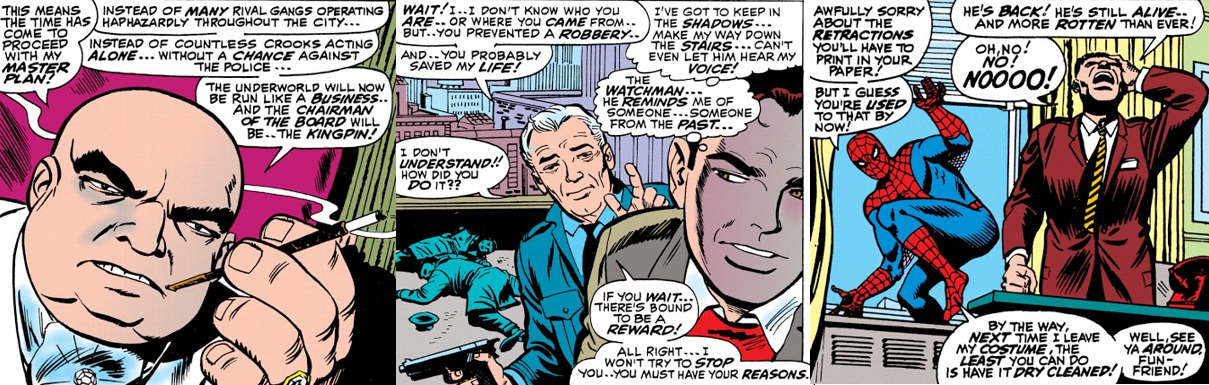
“Spider-Man No More!” kicks off with a bang courtesy of a visually stunning full-page splash from one of comic’s greatest artistic talents, John Romita, who practically wrote the book on how dramatic and spectacular Spider-Man’s depiction should be. With absolutely no context at all, we’re thrown right into the action as Spider-Man tackles a group of armed thugs who are in the process of pulling off some kind of heist. As is commonplace in sequences like this, the crooks are stunned at Spidey’s superhuman agility, which allows him to easily dodge bullets, and completely powerless against his superhuman spider strength, which easily allows him to shrug off even their combined assault and render them all unconscious with a few hard-hitting blows. However, despite saving the day in magnificent fashion, Spider-Man is met with fear and suspicion by one of the employees he saved, and he swings away cursing the efforts of grouchy Daily Bugle editor J. Jonah Jameson at painting him as a crazed masked maniac. Thanks to Jameson’s editorials, half of New York City is either terrified of him and thinks he’s just as bad as the many colourful supervillains in town and the other half thinks he’s mental, which he can’t help but be bothered by considering the populace celebrates other costumed superheroes like the Fantastic Four and the Avengers. Peter’s woes that, no matter what he does or how hard he tries, the public hates him more and more are only added to when he returns to his apartment and learns from his friend and roommate, Harry Osborn, that his beloved Aunt May has fallen ill. We’re not told what, exactly, May has been stricken by, however; she’s simply had “another attack” and been left bedbound. Naturally, Peter blames himself for his aunt’s condition; after all, if he’d been at home rather than putting his life on the line for his own sense of self-gratification, he would’ve been able to get there faster and he’s burdened by his unreliable nature due to his superheroics.

Burdened by his woes and Jameson’s smear campaign, Peter gives up his costumed identity.

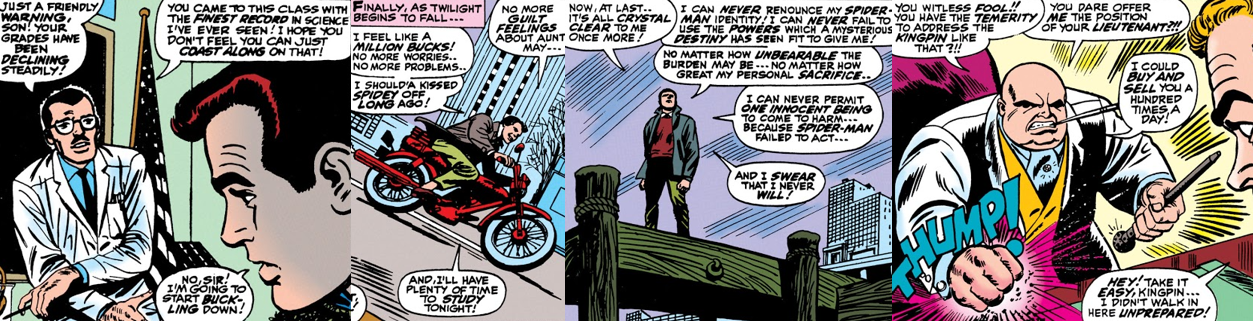
Beating himself up and already blaming himself for not being there for the only family he’s ever known and has left, Peter’s unable to concentrate on his studies, which directly translates into him struggling through a test the next day and receiving a kindly warning from his Physics teacher, Professor Miles Warren, about his steadily declining grades and that his once-impressive science record won’t allow him to coast along unless he puts in the work. To make matters worse, Peter’s so troubled by his aunt’s health and his failing grades that he’s forced to turn down a genuine offer from beautiful socialite Gwen Stacy, which only further adds to his woes as he kicks himself for not having the time or enthusiasm to find out if the likes of Gwen or seemingly scatter-brained Mary Jane Watson are really interested in him or have more depth to their personalities. Peter’s even had to turn down a fantastic job working for Harry’s dad, Norman Osborn, because he has to keep his evenings free in case Spider-Man is needed, and his troubles reach boiling point when he turns on the television and is faced with a malicious rant from Jameson painting Spider-Man as a neurotic trouble-maker who provokes villains for his own ego. Jameson’s so sure that Spider-Man is a menace to society that he offers a whopping $1000 reward for the capture and conviction of the web-slinger and Peter reaches his breaking point. Realising that his colourful alter ego has brought him and those around him nothing but pain, Peter begins to think that Jameson is right, that he’s been swinging all over town out of some childish, selfish desire for attention, and dramatically dumps his costume, and the identity of Spider-Man, in the trash once and for all.

As the Kingpin seizes power, Peter is reminded of his responsibilities and returns to action once more.

Of course, Jameson is overjoyed when a small boy delivers him Spider-Man’s costume and that his smear campaign has worked, publishing his victory on the front page to a largely incredulous New York City (it’s actually endearing how his readers see it as nothing more than a publicity stunt and actually show support for Spider-Man). Peter follows up his decision by quitting as Jameson’s lackey, much to his comical outrage, though the publisher delights in bragging about his triumph and proudly displays Spider-Man’s costume in a trophy cabinet in his office. Meanwhile, the city falls into anarchy as the Kingpin takes the opportunity to consolidate the city’s various mobsters and gangsters under his direct supervision, organising them in a way they’ve never been before and leading to a flurry of crimes, all of them in broad daylight, that threaten to tax the city’s police department to their limit. Peter, however, is having a whale of a time; no longer having to devote his time and energy to crimefighting, he’s finally able to socialise with Gwen, dote on his recovering aunt, and catch up on his studies. He’s even giving serious thought to taking up Norman’s job offer once Aunt May is fully recovered but, while he catches himself in the act of responding to the news of a robbery at the welfare office, he instinctively acts without hesitation when he sees a watchman being set upon by armed thugs. Chastising himself for going back on his promise so quickly, Peter is devastated when he realises that the kindly old watchman has the likeness of his beloved Uncle Ben. All at once, the pain and guilt of his irresponsibility catch up to the troubled teenager as he relives his childhood and his failure to us his great powers responsibly, which directly caused his uncle’s death, and he realises that it’s his burden, his duty, to set aside his personal woes and use his superpowers for the benefit of others to atone for that loss. Thus, he breaks into Jameson’s office, recovers his costume, and pranks the editor with the promise of flooding the city with more Spider-Men before swinging off into the city rejuvenated once more.

The Summary:
If you came into “Spider-Man No More!” expecting fast-paced, hard-hitting action and to see Spider-Man pummelling goons and supervillains galore, then you’re probably going to be disappointed. Instead, in keeping with the story being published in The Amazing Spider-Man’s fiftieth issue, what we have here is a deep dive into Peter’s troubles and a new spin on detailing exactly why he’s cursed to set aside friends and even family to save lives as Spider-Man. It’s not uncommon for comics, especially Spider-Man stories and tales from this era, to constantly rehash a character’s origin but I think it’s used to good effect here and almost makes The Amazing Spider-Man #50 a kind of starting off point for new readers. Thanks to being overwhelmed by his aunt’s failing health, his non-existent social life, his declining grades, and Jameson’s smear campaign, Peter has lost sight of his mission and fallen into a depression so deep and so dark that the only solution he can think of is to literally and figuratively ditch his costumed identity in one of comic’s most iconic panels. We see the effect this has on Peter right away; no longer does he have to shun Gwen or Mary Jane or his studies since he has the time and focus to think about things other than crimefighting or swinging off to help with the next emergency. He can be there for May, relax with his science books, and apply himself in far more productive ways, literally turning his frown into a smile as he happily goes about his daily business without the burden of Spider-Man weighing him down. Peter even takes a great deal of pleasure in quitting from the Daily Bugle, a job that has always underpaid and underappreciated him, and is perfectly happy to let the city police handle  the escalating crime way sweeping across the town.

Peter’s joy at rediscovering his life is short-lived since Spider-Man’s powers will always be needed.

While New Yorkers are troubled by Spider-Man’s absence, the Kingpin sees it as a fantastic opportunity and makes an impact with his plan to consolidate the disparate gangs and criminals into something more akin to a business, with him as the chairman of the board. Though he doesn’t physically get involved in the action, he showcases his threat when Farley Stillwell tries to get in on the action and quickly makes a name for himself in the criminal underworld through his organisational skills and lofty goals. Although Peter is quick to chastise himself for reverting to type so quickly, he reasons that he had no choice but to act when he saw the watchman’s life in danger, and this brings back a flood of memories that we’re all keenly aware of but which serve as a stark reminder to the troubled youth that he has an obligation to use his gifts responsibly, regardless of the cost to his social life or his own desires. Having been reminded of his life’s mission, and perhaps feeling a sense of closure at having saved his uncle’s doppelgänger, Peter immediately returns to action as Spider-Man; though the story doesn’t resolve how he’s going to juggle his friends, family, and studies, it can be assumed that he’s at least more at peace with his duel identity for the time being and more than ready to make up for lost time. Overall, there’s a reason “Spider-Man No More!” is one of Spider-Man’s most celebrated adventures; what it lacks in action, it makes up for in interpersonal drama and a character study of everyone’s favourite web-head and the story is perhaps the quintessential reminder of the heavy burden Peter must carry lest he fail to use his gifts responsibly and indirectly cause more death or heartache. It’s a tragic tale, to be sure, but also one that encapsulates everything Spider-Man is; he sets aside his personal desires for the greater good and, even when he does take the time to be selfish for a change, his inherent need to help others will always win out, which is a message we could all stand to learn from.

My Rating:

Rating: 4 out of 5.

Great Stuff

Are you a fan of “Spider-Man No More!”? Where would you rank it amongst Spider-Man’s many other stories and moments? What did you think to Peter’s troubles and his decision to quit being Spider-Man? Do you think Peter was maybe a little too angst-ridden and could’ve found a better way to balance his duel identities? What did you think to the Kingpin’s plot to unite the city’s criminals? Do you think the resolution to Peter’s anguish was a bit rushed or did you enjoy that he got to save his uncle’s proxy? Would you say that Spider-Man is an egomaniac and a menace or do you think he’s a benefit to the city? How are you celebrating Spider-Man this month? Whatever your thoughts on Spider-Man, and “Spider-Man No More!”, share them below or drop a comment on my social media and be sure to check out my other Spider-Man content!

Back Issues: Captain Atom #83

Story Title: “The New Blue Beetle”
Published: November 1966
Writers: Steve Ditko and Gary Friedrich
Artist: Steve Ditko

The Background:
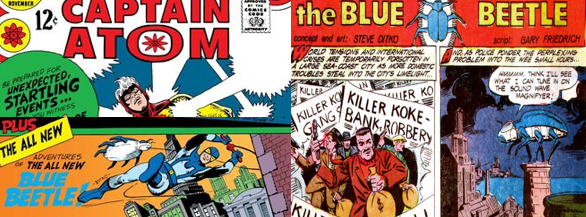
In 1939, comics readers were introduced to Dan Garret, a policeman who fought crime in a suit, fedora, and domino mask as the Blue Beetle, a shameless knock-off of Britt Reid/The Green Hornet created by Charles Nicholas Wojtkoski and who eventually found his way into the pages of Charlton Comics. Given the time period, where pulp crimefighters were beginning to be overtaken by more theatrical costumed superheroes, Garrett is often forgotten in the legacy of the Blue Beetle, especially when comparing his impact to that of his immediate successor. In 1966, the legendary Steve Ditko reimagined the Blue Beetle as genius inventor Theodore “Ted” Kord during the “Silver Age” of comics books, where many superheroes with given new origins and powers to fit the then-modern age. Despite debuting in a back-up feature and never rising above the status of a lower tier crimefighter, Ted gained far greater mainstream exposure thanks to his tenure on Justice League International and friendship with Michael Carter/Booster Gold; Ted even went toe-to-toe with Doomsday, unlike many of his more powerful comrades, and was even shockingly and graphically executed on-panel during the build-up to the universe-shaking Infinite Crisis (Johns, et al, 2005 to 2006). While still a relatively obscure character in the DC hierarchy, Ted is often regarded as one of the best incarnations of the Blue Beetle and he’s featured far more prominently in ancillary media compared to his predecessor, including multiple animated appearances and even appearing in live-action in the tenth series of Smallville (2001 to 2011).

The Review:
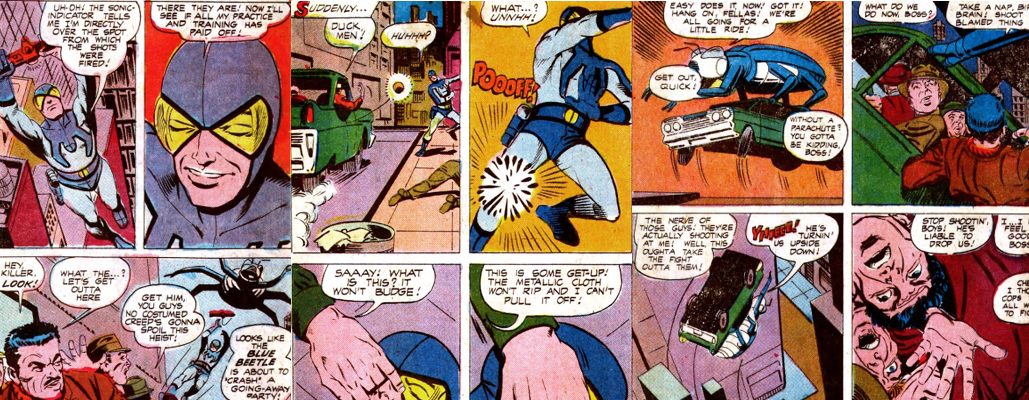
Similar to this predecessor, Ted Kord’s debut outing as the Blue Beetle begins not only with him already in the bug-themed guise of a masked crimefighter but also in the midst of a crime wave sweeping his city as the “Killer Koke Gang” make headlines for their many violent robberies. Unlike Dan Garret, however, Ted Kord’s Blue Beetle is tripped out on technology; he already has a massive, beetle-shaped hovercraft from which he can tune into sound waves throughout the city in search of trouble. When he picks up the sounds of gunshots from a nearby bank, the Blue Beetle flies into action, literally, guiding his craft through the night sky, though he strangely chooses to drop out of the craft and pilot it while hanging beneath it from a handle and wire. Although his monologue shares that he’s put in many hours of training, this is also still the Blue Beetle’s first field test and taste of real-world action; he’s so nervous about it that he almost clips a nearby building, but his presence certainly serves to put the wind up Killer Koke and his thugs.

Despite a minor setback, Ted Kord has a successful first night as the new Blue Beetle.

The Blue Beetle comes swinging in, fists flying, easily dispatching Killer Koke’s men with a deftness and skill despite their superior numbers and weaponry. Just as he’s feeling the thrill of the action, though, one of the goons tosses…some kind of spherical explosive…at the Blue Beetle’s knee, which manages to knock him unconsciously. Luckily for Ted, the thugs can’t get his mask off to learn his true identity and they’re scared off by a single cop before they can finish him off. When he comes to, the Blue Beetle assumes they fled because he was too much for them…even though he clearly saw one of them tossing that thing, whatever it was, at him. He summons his flying craft and makes a swift exit, praising his technology and prowess the entire time. Thanks to his amazing craft, the Blue Beetle is easily able to catch up to Killer Koke and his goons, literally snatching their car off the ground and depositing them, rattled and humiliated, at police headquarters. Although Killer Koke claims that the Blue Beetle was really behind it all, the cops are unconvinced and take them away, and the story comes to an end with the Blue Beetle name-dropping Dan Garret, suggesting a relationship between the two, and again praising the genius of his technology, such as the lock underneath his chin that kept him from being unmasked, and expressing excitement for his next crimefighting adventure.

The Summary:
I really didn’t think much of Dan Garret’s first outing as the Blue Beetle and, sadly, the trend continues here. Thanks to the immortal Steve Ditko, the art is at least much more palatable this time around; I’ve always liked Ted Kord’s Blue Beetle costume and, despite how corny it is with its overt bug theme, it’s at least more on brand with his masked persona that the suit-and-fedora combo of his predecessor. Ted Kord goes one step further than Dan Garret by having a massive beetle-shaped craft that doubles as a base of operations and his transport around town; it also leans into his branding and gives him an edge not shared by many other superheroes, who are more likely to utilise cars or motorcycles before jumping in a flying contraption. Having said that, though, it is all incredibly goofy; there’s nothing wrong with that, of course, and it makes for some fun visuals and concepts, but it’s just a bit weird seeing this massive metallic beetle rocketing through the city and scooping up cars. Similar to his predecessor, we learn almost nothing about this new Blue Beetle; we don’t even learn his true name in this story, much less delve into the relationship he may or may not have with Dan Garret or his motivations behind taking up the Blue Beetle mantle.

Despite his fancy new gimmick, Ted’s debut is barely any better than his predecessor’s.

Again, I’m okay with that, not every first appearance needs to be an origin story after all, but it does mean that Ted’s first appearance is more about expositing his technology than anything else. There’s still a sense of relatability to him; he appears to have no superhuman powers, starts the story itching to put his training to the test and nearly costing himself dearly because of it, and, for all his obvious fighting skill, he’s still flawed enough to be rendered unconscious by…whatever that thing was that was thrown at him. Killer Koke and his gang are just regular street-level mooks; they’re violent bank robbers and that’s about it, warm bodies for the Blue Beetle to beat up and prove himself against, and he’s very happy with how his first night went, despite nearly being unmasked, because he was smart enough to put a clasp on his cowl. I think it actually might’ve been better to showcase him using more gadgets in his fight rather than his fists to truly separate him from Dan Garret and lean into him being a more technologically-inclined crimefighter. As is, we’re presented with a guy who clearly has the time, means, and money to go out busting bank robbers with a fancy suit and craft but little that makes him stand out from other, similar costumed heroes. I’ve always been a fan of Ted Kord’s and he’s always been quite a goofy character, so I don’t want to begrudge his first appearance too much, but it’s surprising he was able to excel as far as he did after such a mediocre first outing.

My Rating:

Rating: 2 out of 5.

Could Be Better

What did you think to Ted Kord’s debut as the Blue Beetle? Were you stunned by how different he was, visually and in concept, to Dan Garret? What did you think to his costume and mechanical bug craft? Were you disappointed by ineffectual Killer Koke and his gang were and do you know what that thing was they threw at Ted? Which incarnation of the Blue Beetle is your favourite and what are some of your favourite Ted Kord moments? Whatever you think to the Blue Beetle, share your thoughts below or on my social media and be sure to check out my other Blue Beetle content across the site.

Back Issues: Mystery Men Comics #1

Story Title: “The Coming of the Blue Beetle”
Published:
August 1939
Writer: Will Eisner
Artist: Charles Nicholas

The Background:
Something I’ve always found fascinating about the history of DC Comics is just how many of their characters and concepts originated elsewhere; Billy Batson/Shazam might be a DC mainstay now but he started life in Fawcett Comics, for example, and even heavy hitters like the Justice Society of America were published under the All-American Publications banner before being bought by, or rebranded, to DC Comics. This is also true of the very first Blue Beetle, Dan Garret; created by Charles Nicholas Wojtkoski, the Blue Beetle was one of many costumed adventurers who would come to be featured in the pages of various comic books published by Charlton Comics and, in his earliest incarnation, was a domino-masked pulp crimefighter rather than a superhero. In fact, the character’s look and origin was almost a composite of the likes of Kit Walker/The Phantom and Denny Colt/The Spirit, which isn’t too surprising given that comic icon Will Eisner allegedly assisted with Garret’s first adventures. Initially appearing under Fox Comics publications, the otherwise powerless Blue Beetle would be taken on by Charlton Comics and play a significant, if often forgotten, role in the legacy of his successors. Indeed, Dan Garret is sometimes all but forgotten about whenever the subject of the Blue Beetle comes up since, like other Golden Age heroes, his influence was surpassed by his Silver and Modern Age equivalents. As a result, he’s rarely featured, referenced, or even acknowledged within DC Comics, let alone in ancillary media but, since his modern day successor has since made his live-action debut, I figured I would revisit Garret’s first appearance and examine the origins of this often overlooked character.

The Review:
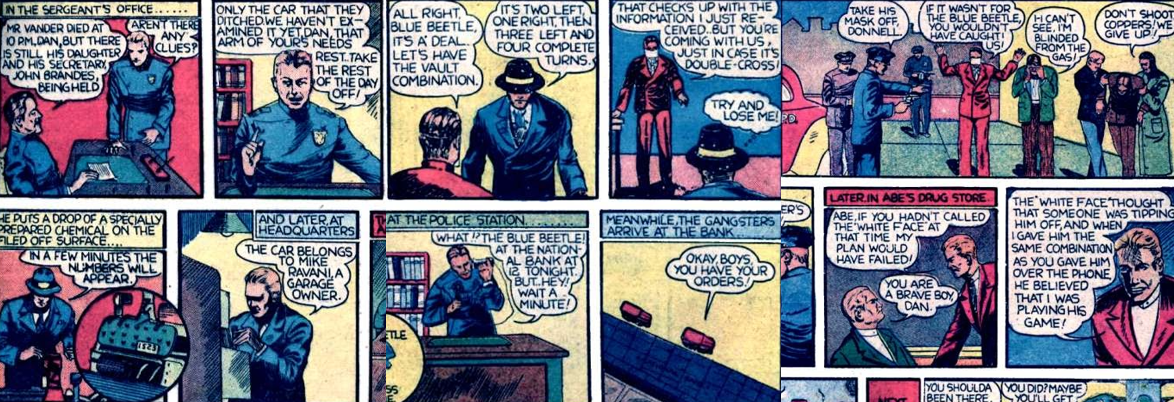
Dan Garret is just your normal, everyday beat cop in a normal, everyday city where bankers like Mr. Vander are kidnapped in broad daylight. Indeed, poor old Dan was just minding his own business, patrolling his beat, when he was suddenly fired upon from a car. Although he takes a slug to the shoulder, Dan still has the presence of mind to fire back, but he’s unable to stop the speeding car, out of which is thrown an elderly man. Despite the pain from his injury, Dan tends to the man, who turns out to be the aforementioned Mr. Vander, a banker who was kidnapped by the “White Face Gang” alongside his daughter and his secretary, John Brandes. While Dan miraculously recovers from his wound between panels, Mr. Vanders isn’t so lucky; the sergeant informs Dan that the banker died later that evening, though the cops were able to recover the gang’s car. Rather than rest up as his sergeant suggests, Dan inspects the vehicle. Although the car’s serial number has been filed off, a “drop of specially prepared chemical” reveals the number and that the car belongs to a certain garage owner named Mike Ravani.

When a banker’s daughter is kidnapped, flatfoot Dan Garret investigates as the Blue Beetle!

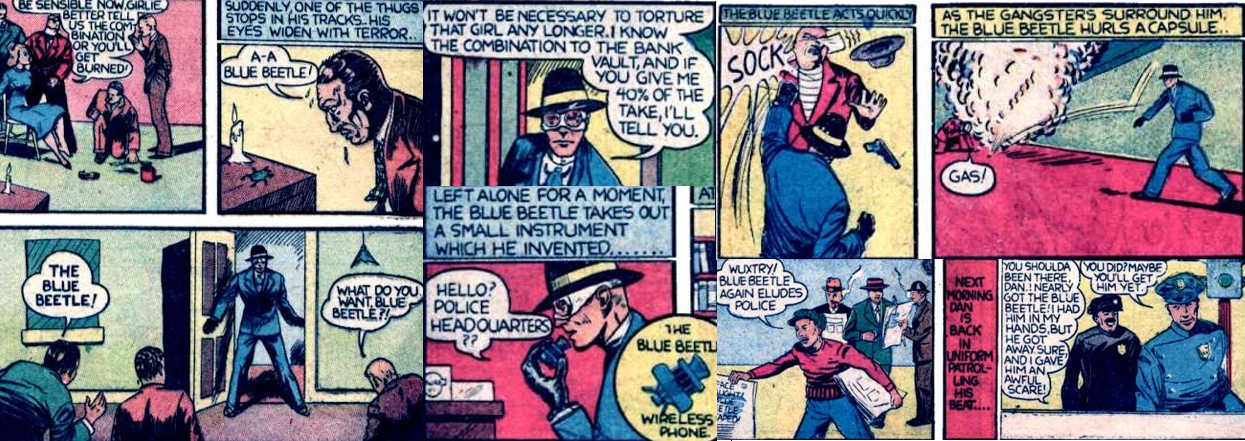
Later that same evening, the Vanders girl is being tortured across town in Ravani’s garage by a group of thugs, who threaten to set her ablaze if she doesn’t tell them the combination to her father’s bank’s vault. One of the thugs spies an ominous sight, however: a blue beetle, the calling card of the titular suit-and-fedora-clad vigilante. Rather than rushing in and beating the gang to a pulp, the Blue Beetle is able to spare the girl from further torture by offering to tell them the combination to the vault in exchange for a 40% cut. Despite the fact that he’s a mysterious masked manhunter, the gang agrees to the offer; though they’re smart enough to take the Blue Beetle with them, they inexplicably leave him alone long enough to place a call to police headquarters using his special wireless phone. Consequently, when the White Face Gang break into the bank, the cops are there to get the jump on them; the Blue Beetle then punches one out, blinds another with a gas capsule, and then flees in his car as the gang is arrested. Their leader is unmasked to reveal it was John Brandes all along in a twist that really doesn’t make all the much sense as it can’t have been difficult for Mr. Vanders’ secretary to learn the safe combination. Things get even more confusing as Dan owes his plan’s success to his friend, drug store owner Abe, who apparently houses his Blue Beetle gear and called the White Face Gang to confirm the Blue Beetle’s combination…? I don’t really understand it, personally. Anyway, the gang is arrested, and Dan returns to work, where one of his colleagues tells him all about how he came so close to nailing the elusive Blue Beetle…even though they never actually had a hope in hell as he was long gone by the time they arrived.

The Summary:
Well…this was pretty awful. It’s strikingly similar to the first appearance of Bruce Wayne/Batman, something that shouldn’t be too surprising considering Batman’s pulp roots and Bob Kane’s talent for plagiarism. While the quality of these scans isn’t great, the artwork is fitting for the era; by which I mean it’s grainy, messy, low on detail, and a bit confusing with all the high contrasting colours and such. To be fair, the story does a decent job of introducing us to Dan Garret; he’s just a normal, everyday bloke but he tends to others even while wounded and takes it upon himself to tackle criminals…even though there’s no suggestion that the police are baffled by the kidnapping and no reason given as to why he’s adopted a masked persona. Like many pulp heroes, the Blue Beetle has a fancy car and a base of operations (though we never see it in detail) and a confidante who shelters and supplies him (though we learn nothing about him except that he’s an old friend and runs a drug store).

A confusing story featuring a Green Hornet rip-off that fails to impress on almost every level.

The Blue Beetle’s attire here is a simple blue suit, black fedora, and white domino mask that looks like he’s wrapped a handkerchief around his eyes! In fact, there’s little to separate the Blue Beetle from Britt Reid/The Green Hornet when it comes to his overall appearance and the down-to-earth nature of his crimefighting methods. His iconography, the Blue Beetle, is visible on his chest and apparently is left as a calling card to announce his arrival, though it’s not clear how he got this into the gang’s garage nor is it explained why Dan has chosen this motif for his masked persona, which only lends more weight to the argument that he’s a Green Hornet rip-off. The Blue Beetle also employs smoke pellets to blind his foes, packs a mean right hook, and carries a miniature wireless phone that’s quite ahead of its time, indicating that he’s surprisingly well funded and intelligent for a simple beat cop. However, the story falls apart very easily for me; I don’t get why Brandes would have to resort to kidnapping and murder for his crime, or how Abe’s call to the gang aided the plan. It’s also weird that the Blue Beetle is seen to be a known vigilante, yet the White Face Gang take him at his word when he offers to help, almost as if he’s some underworld figure. I don’t have any answers to that; all I know was that this was a very confusing and an extremely disappointing first outing for the Blue Beetle that paints him as a forgettable knock-off rather than a memorable pulp hero.

My Rating:

Rating: 1 out of 5.

Terrible

Have you ever read the first appearance of Dan Garret’s Blue Beetle? If so, what did you think to it? Was there anything about this strip that impressed you or do you agree that the Blue Beetle was a rather underwhelming presence? Are you able to explain the plot and what the hell happened with Abe and Brandes’ plan, because it didn’t make much sense to me…? Who is your favourite pulp hero? Would you like to see more from Dan Garret or do you prefer a different Blue Beetle and, if so, who is it? I’d love to know your thoughts on the Blue Beetle down in the comments or on my social media, so feel free to share them and be sure to check out my other Blue Beetle content.

Back Issues [Spider-Man Day]: The Amazing Spider-Man #3


Easily Marvel Comics’ most recognisable and popular superhero, unsuspecting teenage nerd Peter Parker was first bitten by a radioactive spider and learned the true meaning of power and responsibility in Amazing Fantasy #15, published in August 1962. Since then, the Amazing Spider-Man has featured in numerous cartoons, live-action movies, videogames, action figures, and countless comic book titles and, following this celebration of his debut, I’ll be dedicating every Saturday of August to talk about everyone’s favourite web-head!


Story Title: “Spider-Man Versus Doctor Octopus”
Published: 9 April 1963 (cover-dated July 1963)
Writers: Stan Lee and Steve Ditko
Artist: Steve Ditko

The Background:
After achieving incredible success with the Fantastic Four, Marvel Comics editor and head writer Stan Lee sought to capitalise on this with a teenaged superhero for younger readers to identify with. Inspired by a fly climbing up his office wall, Lee created Spider-Man (emphasis on the hyphen) and turned to artist Steve Ditko to settle on the character’s final design. Although Marvel publisher Martin Goodman disliked the concept and relegated the story to the final issue of Amazing Fantasy #15, the comic was one of Marvel’s best selling titles at the time and Spider-Man’s popularity led to him getting his own solo title barely a year later. Undeniably, Spider-Man has since fought some of the greatest and most memorable villains in comicdom, with many of Spidey’s most famous being co-created by Stan Lee. Three issues into The Amazing Spider-Man, Lee dreamed up a new supervillain for the webslinger, a crazed scientist with four mechanical arms grafted to his body simply out of a desire to offer something new and randomly settling on an octopus for inspiration. Since his debut in this issue, Doctor Otto Octavius has become one of Spidey’s most notorious and formidable villains; he not only handed Spider-Man his first defeat, but formed a cabal of villains to hound the web-slinger, almost married his beloved Aunt May, and even once switched bodies with Peter to become the “Superior Spider-Man”. Doc Ock has also been a recurring villain outside of the comics, often acting as a final boss or prominent antagonist in numerous Spider-Man videogames, and being a central villain in Spider-Man cartoons, to say nothing of Alfred Molina’s much-praised turn as the character in live-action.

The Review:
“Spider-Man Versus Doctor Octopus” begins with a pretty typical night in New York City; three mooks are wheeling a giant, cast-iron safe through a warehouse and in the process of stealing the vault when they’re startled by the appearance of everyone’s friendly, neighbourhood Spider-Man! As he was prone to doing from time to time, Spider-Man startles the crooks by projecting his spider-symbol onto the wall to put the wind up them and then makes short work of the three with his incredible spider strength. As Spidey waits for New York’s finest to show up and deal with the thieves, Spidey muses about how he’s run out of real competition and longs for an opponent who can actually put up a fight against his superhuman strength, a wish that he’s soon going to regret as, at that moment on the outskirts of the city, one of his greatest foes is about to be created! The scene shifts to an atomic research centre where genius nuclear physicist Doctor Otto Octavius has made a name for himself not just through his ground-breaking research but also in the development and utilisation of a unique mechanical harness which effectively grants him four additional, robotic arms that allow him to perform experiments no other scientist could dream of from a position of complete safety. While his peers have given him the nickname “Doctor Octopus” and regard him with a mixture of awe and ridicule, Otto is concerned only with his work and, early on, already shows signs of mania as he relishes in the benefits of his arms, which have made him the master of radiation.

Doc Ock’s mechanical arms allow him to manhandle Spider-Man and seize a nuclear facility.

However, tragedy strikes the workaholic scientist when the facility randomly explodes, leaving him not only permanently brain damaged (though we have no basis for comparison between this pre-accident personality and his post-accident one as they both seem very similar) but also fuses his mechanical arms to his body from the “radiation”. When Otto awakens, he’s eager to return to his work and, when the doctors insist that he lay down and rest, assumes that they’re jealous of him and actively keeping him from his research. His desire to escape is realised by his arms, which now obey his mental commands rather than being manually operated, and he basks in his newfound physical abilities. Naturally, cantankerous Daily Bugle editor, J. Jonah Jameson, wants pictures of the injured scientist yesterday so budding freelance photographer Peter Parker heads off to get the photos no-one can as Spider-Man. However, when he crawls his way up to Otto’s room, he’s stunned to see that the scientist, now embracing his nickname of Dr. Octopus, has gone mad with power and taken a few hostages so he can whip up some experiments. Spider-Man swings in to save the day, but Doc Ock is unimpressed by his quips and spider strength and even gives the web-head the shock of his life when he snaps his webbing, overwhelms him with his many arms (bitch slapping him in the process) and tosses him from the room like he was nothing. The shock of suffering his first real, unequivocal defeat runs deep for Peter, who suffers a crisis of confidence that leaves him powerless to stop Doc Ock from returning to the atomic research centre and easily taking command of the “brain centre”, granting him untold (if vague) power.

Peter bounces back from his defeat to out-think and defeat his multi-armed new foe.

To demonstrate his superiority, Doctor Octopus destroys part of the facility and rebuilds it to his specifications, setting up electronic barriers and barricades to create an impenetrable fortress; though it’s unclear what his ultimate goal is, it’s enough to put the wind up “the foremost brains of the nation’s armed forces”. Stuck in a deep depression, Peter feels lost and helpless, sleepwalking his way through school and envious of Johnny Storm/The Human Torch’s powers and confidence. However, Johnny’s address to the school makes Peter realise that defeat is inevitable and that the key is to never give up, which Peter takes to heart and finds his passion once more. Ready and raring for round two, Spidey easily infiltrates Doc Ock’s fortress, dodging his many traps and hazards thanks to his superhuman reflexes and spider sense, and dodging the mad scientist’s electronic eyes long enough to use his brains not brawn to whip his own scientific solution to his multi-armed foe. Confident of his unmatched power, Doc Ock opts to attack Spider-Man directly and is impressed when the web-slinger disables two of his arms with a chemical concoction that fuses them together. However, Doc Ock remains a deadly threat thanks to his flailing arms and surprising speed so, rather than trying to fight them off or fight through them, Spidey allows himself to be lured closer to his foe and relies on his superhuman strength and durability to withstand Doc Ock’s assault and lay him out with a single, well-timed knockout punch. Relieved to have ended the threat, Spidey takes no chances and thoroughly webs the dangerous madman up for the military police to find, then drops by Johnny Storm’s hotel room to thank him for his help, leaving the flaming teenager baffled since he has no idea what Spidey’s talking about.

The Summary:
Interestingly enough, “Spider-Man Versus Doctor Octopus” was actually the first Spider-Man story I ever read as a kid (or, at least, it’s the one I have any memory of reading first) and, as a result I grew up perceiving Doctor Octopus, rather than the likes of Norman Osborn/The Green Goblin, as Spider-Man’s greatest nemesis. Revisiting the story now, I’m actually surprised at how enjoyable it is; Marvel Comics from the sixties can be a bit hit and miss, bogged down by dated dialogue and traditions or full of bizarre and off-putting artwork, but “Spider-Man Versus Doctor Octopus” is actually a pretty simple and effective story that shows Spidey dealing with the shock of being so handily defeated. Though often a conflicted and heavily burdened character beneath the mask, one of Spider-Man’s greatest assets has always been his unmatched physical confidence and love of aggravating his opponents with quips and jokes so to see him overpowered, smacked about like he was nothing, and cast aside like a mere annoyance was pretty startling at the time. It’s no surprise that Peter takes the defeat to heart, and he even contemplates ending his superhero career since his confidence has been shaken so badly, and it’s only through a conveniently relatable speech from fellow superhero the Human Torch that he’s able to find the motivation to suit back up for the rematch. I also enjoyed that his solution was to use his own scientific acumen as much as his incredible spider strength to best his new foe as it’s always cathartic when the very thing his peers mock him for contributes to him defeating a supervillain.

Doc Ock’s goals may be vague, but his intelligence is more than a match for Spider-Man!

Of course, the standout of the story is Doc Ock himself and much of the story revolves around him and his mad ambitions for power. We don’t really learn anything about Doc Ock except that he’s a genius scientific mind and the accident has driven him to the point of obsessive madness; we never get a sense of who he is before the accident to compare with how it affects his mind and it’s not made clear what his endgame is in taking over the atomic research centre beyond the ambiguous threat of him having access to the strange and dangerous power of nuclear energy and radiation which was rampant in comics at the time. Radiation is such a mysterious and powerful element that it not only granted Spider-Man his powers, but also fused the mechanical arms to Otto’s body and drove him mad with the physical abilities they afford him; responding to his mental commands, the arms can extend, allow him to clamber up walls, easily manhandle his foes, and allow him to perform multiple tasks at once through sheer force of will. The arms are so versatile, dexterous, and powerful that they can even hold back Spider-Man’s superhuman strength, strike fast enough to test even his vaulted spider sense, and can break his webbing with ease. However, behind the arms, Doc Ock is simply a man; one filled with a burning desire for power and determined to prove his superiority by any means, but a man nonetheless, and nowhere is this more evident than in the ease at which Spidey punches him out once he gets close enough. Consequently, Doc Ock is a supervillain who relies on his genius, fractured intellect and his formidable arms rather than having an inherent superhuman durability, which contrasts his daunting threat with an emotional and physical vulnerability to create a villain who is visually interesting and fully capable of out-thinking and out-fighting Spider-Man.

My Rating:

Rating: 4 out of 5.

Great Stuff

What are your thoughts on Doctor Octopus’s first appearance? Were you a fan of the villain and his unique powers or did you find him to be a bit shallow and ridiculous? What did you think to Spidey’s defeat and crisis of confidence and his solution to besting Doc Ock? Were you a fan of the Human Torch’s cameo or did you think it was a bit forced? What are some of your favourite Doc Ock stories and moments? How are you celebrating Spider-Man Day today? Whatever your thoughts on Spider-Man and Doctor Octopus, leave them below and be sure to stick around for more Spider-Man content!

Back Issues: Secret Invasion

Published: June 2008 to January 2009
Writer: Brian Michael Bendis
Artists: Leinil Francis Yu

The Background:
In January 1962, legendary duo Stan Lee and Jack Kirby introduced Marvel Comics readers to the Skrulls, a race of warmongering shape-shifters who have long hounded Marvel’s heroes, particularly the Fantastic Four, by assuming their identities and powers. Experimented on by the all-mighty Celestials and launching aggressive campaigns against both the Earth and their hated enemies, the Kree, the Skrulls have been at the forefront of numerous Marvel stories over the years in addition to featuring as villains in various videogames and animated ventures before making their live-action debut, in a decidedly different manner, in Captain Marvel (Boden, 2019). Perhaps one of their most prominent storylines was the Secret Invasion arc that ran through these eight issues and multiple tie-ins and spin-offs; the brainchild of writer Brian Michael Bendis, Secret Invasion had not only been hinted at for some time and was heavily advertised as a means of changed up the perception of legacy Marvel characters and even return some to mainstream publication. Reviews of the storyline were mixed, with some noting that it was an anti-climatic Marvel event and others praising the marketing and artwork while criticising the religious undertones and spotty dialogue. Still, an adaptation of the story made its way into the Avengers: Earth’s Mightiest Heroes cartoon (2010 to 2012) and it also formed the basis of a six-episode, live-action series of the same name on Disney+.

The Review:
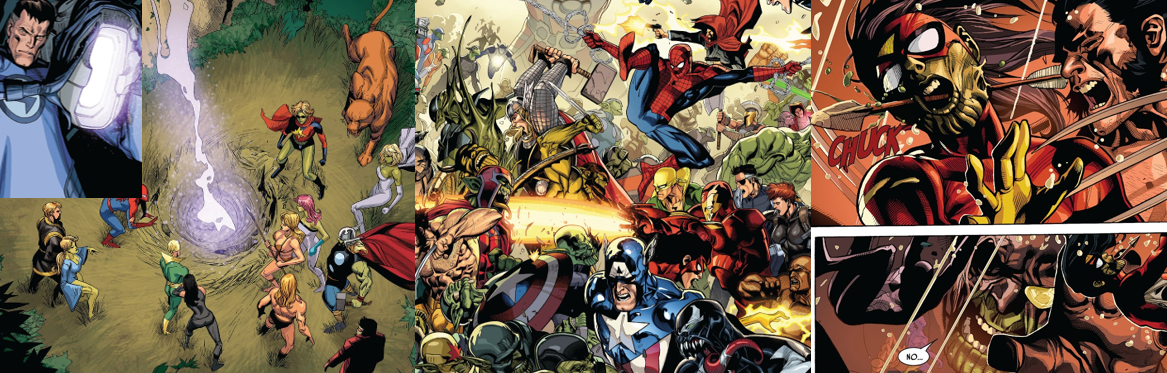
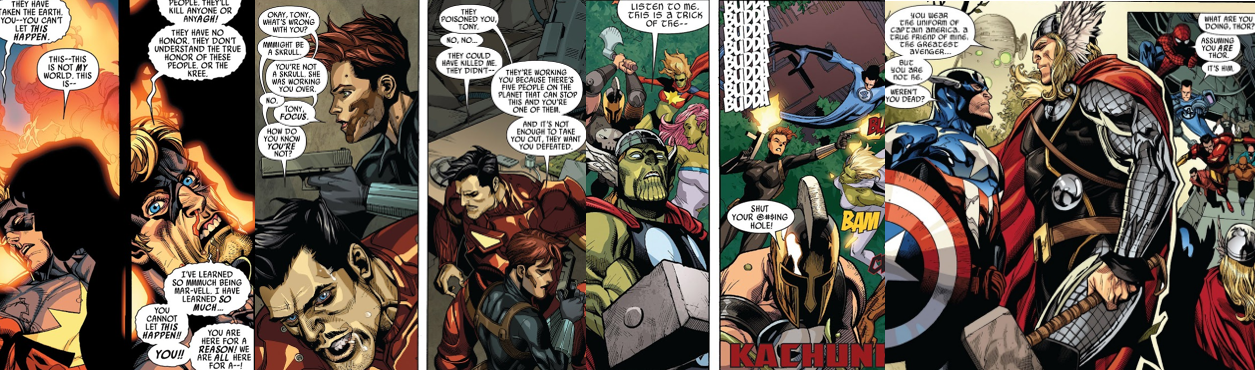
This eight-issue event series begins “years ago” after the destruction of the Skrull throneworld, a cataclysmic, prophesied event that leads the few survivors back to their queen, Veranke, who kicks the story’s narrative in motion by seeding Skrull agents throughout our world. It took years for this to be uncovered, and it was revealed in dramatic fashion when it turned out that the resurrected assassin Elektra Natchios was a Skrull in disguise, a revelation that alerted Tony Stark/Iron Man (then the conceited and self-righteous director of the Strategic Hazard Intervention Espionage Logistics Directorate (S.H.I.E.L.D.) following the game-changing events of Civil War (Millar, et al, 2006 to 2007)) to the depths of the Skrull’s infiltration. Recognising that even his armour’s sensors can’t be trusted to identity friend from foe, Stark drafts in his allies – Doctor Reed Richards/Mister Fantastic and Doctor Henry “Hank” Pym/Yellowjacket – to perform an autopsy in an attempt to figure out how the Skrull was able to remain completely undetected to technology, magic, and Mutant probing. Conveniently enough, a Skrull ship chooses this exact moment to come crashing into Earth’s atmosphere and make landfall in the Savage Land, taking Iron Man away from the operating room so he can investigate. Concerned that this could be the full-scale invasion they fear, Jessica Drew/Spider-Woman calls in the renegade “New” Avengers (those who refused to sign up to the ludicrous Superhero Registration Act in Civil War), which leads to Luke Cage/Power Man, Peter Parker/Spider-Man, James “Logan” Howlett/Wolverine, Danny Rand/Iron Fist, Clint Barton/Ronin, and Maya Lopez/Echo subduing Black Widow/Natasha Romanova and stealing her Quinjet to beat Iron Man and his government-sanction Mighty Avengers – Iron Man, Spider-Woman, Black Widow, Carol Danvers/Ms. Marvel, Janet van Dyne/The Wasp, Ares, Simon Williams/Wonder Man, and Robert “Bob” Reynolds/The Sentry – to the crash site. Both sets of Avengers are aware of the potential Skrull threat, which drives an even greater wedge between them as not only are the Secret Avengers being actively hunted by their former comrades, but they can’t even trust each other to be who they say they are.

While the Skrulls cripple Earth’s defenses, the fractured Avengers battle their classic counterparts.

After being brought down by one of the Savage Land’s rampaging dinosaurs, the New Avengers prepare to open up the crashed ship, but they’re intercepted by the Mighty Avengers, with Iron Man immediately trying to arrest them and Luke Cage obviously telling him and his jumped-up thugs to go kick rocks. Iron Man’s attempt to keep the rogue superheroes from overstepping the mark are scuppered when Timothy “Dum Dum” Dugan and his trusted butler, Edwin Jarvis, unexpectedly sabotage not only the orbiting the Sentient World Observation and Response Department’s (S.W.O.R.D.) satellite base but also Stark’s armour and S.H.I.E.L.D.’s Helicarriers and bases, effectively disabling the armoured Avenger and crippling the superhero community’s resources and communications. Additionally, maximum security prisons the Raft and the Cube are suddenly hit by mass breakouts and Mar-Vell/Captain Marvel and Susan Storm/Invisible Woman disable the villainous Thunderbolts and the rest of the Fantastic Four, with each of these supposed heroes flashing ominous eyes and assuring their victims that “He loves [them]”. Meanwhile, a Skrull armada bares down on Earth and Mr. Fantastic finds himself reduced to an elasticated mess right as he figures out the key behind the Skrull’s newfound undetectability, the victim of a shot from Pym, who’s revealed to also be the Skrull Citri Noll! Momentarily setting aside their differences to get Tony Stark to aid, the two Avengers groups are startled when a slew of classic-styled, currently deceased or long-changed superheroes emerge from the Skrull ship; Captain Steve Rogers/Captain America, the Vision, Thor Odinson, Doctor Jean Grey/Phoenix, Doctor Henry “Hank” McCoy/The Beast, Wanda Maximoff/Scarlet Witch, Jessica Jones/Jewel, Emma Frost/The White Queen, and Barbara “Bobbi” Morse/Mockingbird appear alongside classic versions of Spider-Man, Power Man, Wonder Man, Iron Man, Hawkeye, Ms. Marvel, Wolverine, and the Invisible Woman. Naturally, a tense showdown ensues in which both groups assume the other are Skrulls in disguise; guys like Wolverine, Spider-Man, Emma Frost, and the Vision struggle to get any kind of reading on their counterparts beyond sensing their distrust while Ronin is stunned to see his former flame, Mockingbird, alive and well but, despite Ares trying to convince his allies that it’s a trap, tensions boil over and an all-out brawl kicks off!

As more characters enter the fray, internal distrust is as rife as the escalating war with the Skrulls.

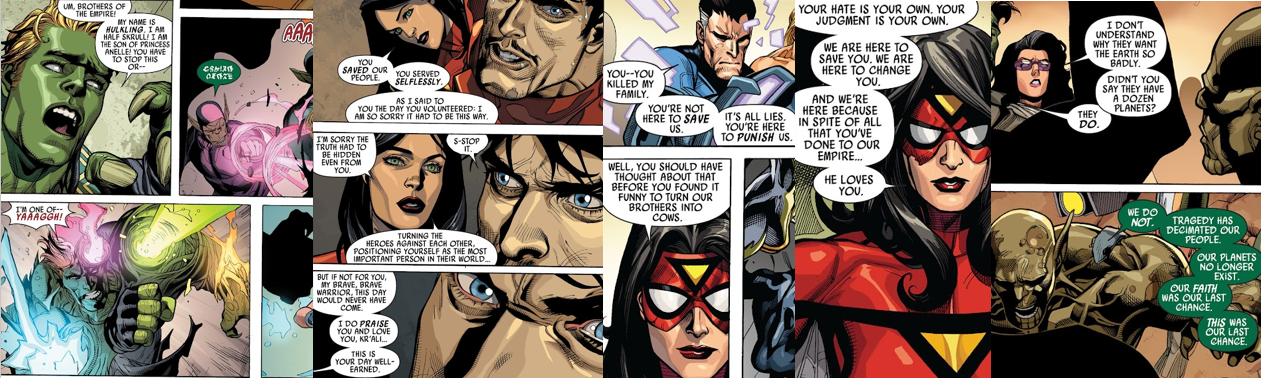
With Stark in agony from the alien virus that’s crippled his armour, Ms. Marvel flies him to safety as the others duke it out; the two Spider-Men trade quips and punches, the Vision uses the Sentry’s fear of his destructive and malevolent alter ego, the Void, to disable his God-like power, and Ronin steals his counterpart’s weapons to subdue their attackers but the arrival of a raging Tyrannosaurus rex disrupts the fracas. Trampled to death by the dinosaur, the classic Spider-Man and Hawkeye are revealed to be Skrulls, and Wolverine intuits that the Skrulls are setting them against each other to wipe out any resistance to their invasion plan. However, when he tries to eviscerate Mockingbird, Ronin intervenes and questions her; she’s adamant that she’s not a Skrull and even reveals personal information that only she and Clint would know, which is enough to convince him to trust her. This offers Luke Cage the hope that the Cap and Iron Man aboard the ship are the real deal, which would certainly explain Stark’s recent manic behaviour and allow the recently deceased Cap to still be alive, but Wolverine’s far from convinced. Meanwhile, back in New York City, a portal opens up and a whole slew of Avengers-inspired Super-Skrulls attack; there’s Skrulls combining the powers of various X-Men, a Fantastic Four Super-Skrull, one that’s a mixture of Spider-Man villains, and even an Illuminati hybrid, meaning the Young Avengers – Eli Bradley/Patriot, Dorrek VIII/Hulkling, Billy Kaplan/Wiccan, Tommy Shepherd/Speed, Kate Bishop/Hawkeye, and their mentor, the Vision – are completely overwhelmed despite Hulkling’s efforts to talk down their attackers with his royal status. Thankfully, they receive some back-up in the timely arrival of fledgling superheroes, the Initiative – Joseph Green/Gauntlet, Rachel Leighton/Diamondback, Cassandra “Cassie” Lang/Stature, David Alleyne/Prodigy, Anthony Masters/Taskmaster, Geldoff/Proton, Z’Reg/Crusader, Jimmy Santini/Batwing, Fahnbullah Eddy/Gorilla Girl, Wallace Jackson/Red 9, Delilah Dearborn/Geiger, Melee, Andrea Roarke/Sunstreak, and Alexander Ellis/Annex. Though the Skrull forces prove ruthlessly formidable, and the Vision is lost in the battle, even more help arrives when the Secret Warriors – Colonel Nick Fury, Yo-Yo Rodriguez/Slingshot, Daisy Johnson/Quake, Alexander Aaron/Phobos, J.T. Slade/Hellfire, Jerry Sledge/Stonewall, and Sebastian Druid/Druid – add yet more names and the bodies to the chaotic artwork and conflict.

Heroes and villains set aside their differences to take the fight to the invading Skrull army.

The Skrull threat is doubled thanks to the distrust between the world’s heroes, with even Nick Fury abandoning Ms. Marvel because of her alien DNA. Meanwhile, as a weakened Stark desperately attempts to repair his armour, Spider-Woman reveals herself to be the Skrull Queen, Veranke, and tries to convince him that he’s a Skrull agent so deep undercover that he’s forgotten his true nature. Before her poison (both literal and figurative) can take hold, Black Widow causes her to flee and Stark reveals that the key to victory lies with Mr. Fantastic, who’s currently being tortured aboard a Skull ship. Thankfully, S.W.O.R.D. director Abigail Brand bluffs her way onto the ship and flushes the Skrull into space to rescue him; Reed then fashions a device that exposes the Skrulls’ real forms, arriving just in time to stop another conflict in the Savage Land and revealing not only that the classic Emma Frost, Invisible Woman, Thor, Ms. Marvel, and Jessica Jones are Skrulls but that Mockingbird is as well, enraging Clint. The real Thor transports everyone to New York for a final confrontation, which even the Watcher, Uatu, shows up to observe and also sees Parker Robbins/The Hood’s criminal syndicate and Doctor Norman Osborn’s Thunderbolts pitch in with the nearly-incomprehensible brawl. While Mr. Fantastic and Iron Man try to take out Veranke (still disguised as Spider-Woman) to demoralise the Skrulls, the Wasp targets Citri Noll, who apes Pym’s Giant-Man form, though it’s Stature and the assassin Bullseye who end up taking him out. Iron Man is forced to withdraw so he can sort out his messed-up armour, Fury’s forces save Mr. Fantastic from being torn apart by multiple Skrulls posing as the Invisible Woman, the real Jessica Jones joins the fray, and Kate Bishop ends up gravely injured amidst the chaos. Although Wolverine tries to take out Veranke, the bio-electrical powers she stole from Spider-Woman keep him at bay, meaning it’s an arrow through the face courtesy of the vengeful Ronin that ultimately subdues her.

Although the Skrulls are defeated, the general distrust in Stark allows Osborn to seize power!

With Veranke compromised, Citri Noll activates a device that causes Janet to enlarge uncontrollably and unleash a chemical agent designed to kill humanity and Skrulls alike. With no other choice available, Thor whips up a hurricane with his magical hammer, one so powerful that is destroys the enlarged Janet and dissipates the weird black spots that threaten everyone’s lives. Although Wolverine seeks to make Veranke pay for Janet’s death, it’s Norman Osborn who gets the kill shot, then Iron Man finally gets his shit together and leads an all-out assault on the remaining Skrull ships, with the now disillusioned and leaderless armada being easy pickings. Iron Man also frees everyone the Skrulls impersonated since the shape-shifters conveniently needed the original versions alive in order to make the deception more convincing, meaning Elektra and Mockingbird return to “life”, Reed is finally reunited with his family, and the true versions of the likes of Spider-Woman re-join society. Unfortunately, this also means that Jessica Jones left her and Luke’s baby, Danielle Cage, in the care of the Skrull-Jarvis, a plot thread left unresolved in this story. Although recent tensions are eased in the aftermath and ensuing celebration, there’s an unshakable sense of hesitation given how long the Skrulls had been a part of Earth’s society and superhero community; Thor also condemns Stark’s recent actions and refuses to associate with him. Thanks to having publicly executed Veranke, Osborn is able to manipulate the President of the United States into equally losing faith in Stark, his methods, and his technology; the President thus ousts Stark as director of S.H.I.E.L.D. and names Osborn as the new overseer of any and all superhuman and defensive measures under a new organisation, H.A.M.M.E.R., unaware that this is exactly the opportunity the scheming madman and his Cabal of allies (Emma Frost, Doctor Victor Von Doom/Dr. Doom, The Hood, Prince Namor McKenzie/The Sub-Mariner, and Lady Loki) were waiting for.

The Summary:
Now, I am by no means an expert on the Skrulls; I know of them, primarily as an antagonistic, shape-shifting race of aliens who are almost constantly at war with the Kree and getting into scuffles with the Fantastic Four, but they’re generally on the periphery of most Marvel stories I’ve read. Secret Invasion is probably, to date, their most prominent story, at least in my experience, and it definitely adds some nuance to them that I didn’t expect. Normally, I see them as a warmongering race who live to conquer through both subterfuge and force but, here, they’re motivated by a fanatical devotion to their God (the “He” they keep referring to) and their invasion is seen almost as divine intervention. The Skrulls swamp television screens with their pseudo-religious propaganda, hijacking every telecommunications device across the globe and assuming the guise of various political figures, celebrities, and superpowered monarchs like Erik Lehnsherr/Magneto and Dr. Doom, and insist that they’re there to bring glory to our world and that their might cannot be opposed. Given the strength of their invasion and that their Super-Skrulls have mimicked the combined powers of many of Marvel’s heroes, it’s perhaps not surprising that Marvel’s ridiculously fickle citizens embrace their alien overlords, though this scene showcases that the Skrulls aren’t simply defending themselves or there to usher in a new age for mankind as they claim and are hell-bent on conquering the planet.

Having lost everything, the Skrulls throw themselves at Earth with fanatical desperation.

This campaign is spearheaded by their queen, Veranke, a figure of worship for the Skrulls and who has placed herself on the frontline, earning the trust of Tony Stark by posing as Spider-Woman and becoming privy to many of Earth’s defences. Stark even reflects on his role in the invasion and the shame he feels about not recognising the threat sooner in a show of guilt that was somewhat uncharacteristic of him at this time; this is a man who was so blinded by his belief that superhumans needed to register with the government that he actively fought and imprisoned his fellow heroes and abandoned many of them, and his morals, in favour of an uncompromising, borderline fascist mentality that only led to further conflict and resentment Indeed, Veranke revels in the irony of having twisted Earth’s technology and heroes towards her agenda, something she was easily able to do thanks to Stark being so dead-set about forcing or punishing his peers to register their true identities and powers. However, as much as Veranke likes to preach that hers is a Holy mission, she’s actually equally motivated out of revenge, specifically against Mr. Fantastic and the Fantastic Four after they tricked a contingent of Skrulls into believing they were cows decades prior. Since the Skrull home world has been lost and their once-prosperous empire lies in ruins, the Skrulls follow her without question and throw everything they have at Earth; they’re even willing to give their lives in the process, and in a last-ditch effort of mutually assured destruction, only to be defeated and left dejected. Veranke’s death leaves the Skrulls directionless and all their once-formidable might is as nothing; those that survive are left demoralised as they saw this as their last chance at survival and glory. Thus, Veranke’s quest for vengeance and conquest leaves her people devastated and more worse off than ever as a sizable portion of their armada is destroyed and the last thing they had in all the universe, their faith, is also shattered by their defeat.

The Skrulls are so deeply entrenched that the already frayed heroes are strained to breaking point.

I’m generally not a fan of imposter storylines; it’s a tired cliché and one that quickly outstays its welcome, but it actually works quite well in Secret Invasion. Many of the Skrulls seem to be completely unaware of their true nature; the Mockingbird-Skrull believes that she’s the real deal right up until the end and is begging Clint to listen to her even as he attacks her in a rage. This is also true of Captain Marvel, who believed so strongly that he was the deceased former hero that he couldn’t bring himself to kill and was convinced by Norman Osborn, of all people, to turn on his race; he even died begging the Kree warrior Noh-Varr/Marvel Boy to carry on the fight in his stead, so complete was his conditioning. It’s not revealed exactly how the Skrulls have the memories they do but it’s one of the big reasons why so many of them went undetected; however, many of the Skrulls posing as classic Avengers continued to believe they were the real deal after their true nature was revealed rather than immediately attacking the heroes in service of their God, which definitely paints much of this conflict in a morally grey area. The Skrulls pick the perfect time to strike the Earth; its heroes are divided and at war with each other and easy to manipulate, and seeing the return of dead heroes like Captain America, Mockingbird, and Captain Marvel, as well as the original version of Iron Man, only fuelled the flames of conflict between them thanks to Stark’s actions during Civil War leading to many deaths, including Captain America’s. It would’ve been so easy to explain away Stark’s recent actions as being the work of the Skrulls but, interestingly, that doesn’t turn out to be the case and, similarly, Cap’s death isn’t immediately undone with the presence of his classic counterpart. Instead, we’re left with a world where Stark is still shouldering the burden of his actions and where Cap’s mantle has been taken up by his friend, James Buchanan “Bucky” Barnes; there are no quick-fixes in this story to explain away the events of Civil War and there isn’t really a sense that bridges have been mended by the end of it as distrust is still rife and the status quo remains unchanged.

A decent story with some interesting wrinkles but a bit overstuffed and manic at times.

Ultimately, I quite enjoyed this story; it’s hard to read as an eight-issue standalone as you need some knowledge of prior Marvel events, especially Civil War, and it’s clear that there’s a lot of additional story and conflict in supplementary collections and books, but the narrative works just as well if you only read these eight issues. I enjoyed seeing the Mighty and New Avengers be forced to set aside their differences when faced with their classic counterparts and the reveals of which characters were Skrulls, even if none of the major players were aliens in disguise. The quasi-religious bent to the Skrull invasion was an interesting twist, as was them siphoning and combining the powers of Marvel heroes into an army of Super-Skrulls, and the art was pretty consistent and easy to follow throughout. Unfortunately, the biggest issue I had with Secret Invasion was the sheer number of characters jammed into it; it was hard to keep track of it all at times and it’s obvious that teams like the Young Avengers, Thunderbolts, and Secret Warriors all had bigger parts to play in spin-off stories, but I think they could’ve been downplayed a little here. There’s a Skrull-Galactus with absolutely no context or consequence to the story and even Uatu shows up, which is generally a short-hand to indicate that the events are of cosmic importance but, again, it doesn’t actually factor into the story in a meaningful way. Stark spends most of the arc out of action thanks to the Skrull virus messing up his armour, which is great for leaving him vulnerable and in pain and unable to participate in the wider conflict but then he just shows up in an older armour with a throwaway line for the finale. Similarly, Thor just pops in out of nowhere, formally prominent characters like Wolverine and Spider-Man get lost in the shuffle, and late appearances from Jessica Jones and Norman Osborn are simply there to set up the next big Marvel events and stories. Overall, it was pretty enjoyable and not as much of a mess as some Marvel events, but the action got a little too chaotic at times and there were too many characters wedged into these issues, which I think would’ve been far stronger if they’d focused on, say, eight or ten main characters and then just showcased the others in supplementary materials.

My Rating:

Rating: 3 out of 5.

Pretty Good

Did you enjoy Secret Invasion? Were you shocked to find out which characters were Skrulls in disguise? Were you hoping that some of the classic Avengers would turn out to be the real heroes? Which of the teams featured was your favourite? Did you think there were too many teams and characters in the story and which of the spin-off books did you enjoy? What did you think to Veranke, the pseudo-religious slant to the Skrulls, and the Skrull invasion? Were you also frustrated by Tony Stark’s characterisation during this time, or did you enjoy seeing Marvel’s heroes in dispute? What are some of your favourite Skrull-centric stories? Whatever your thoughts on Secret Invasion, feel free to share them below or leave your thoughts on my social media.

Back Issues: Fantastic Four #45-47

Writer: Stan Lee – Artist: Jack Kirby

Story Title: “Among Us Hide… The Inhumans”
Published:
9 September 1965 (cover-dated December 1965)

Story Title: “Those Who Would Destroy Us”
Published:
12 October 1965 (cover-dated January 1966)

Story Title: “Beware the Hidden Land!”
Published:
11 November 1965 (cover dated February 1966)

The Background:
In 1961, Stan Lee and Jack Kirby came together to introduce comics readers to the Fantastic Four, a dysfunctional family of superheroes created as a direct response to DC Comics’ Justice League of America. While the exact circumstances behind the team’s creation has been contest by both creators, Lee and Kirby’s partnership not only popularised the “Marvel Method” of writer/artist collaboration but also impressed readers with their characters’ real and relatable humanity, essentially birthing Marvel Comics as we know it today. Over the years, numerous characters and concepts that would be pivotal to Marvel Comics would debut in the pages of Fantastic Four, and one of the most contentious of these were the Inhumans. Debuting a couple of years after Lee and Kirby’s similar concept, the X-Men, the Inhumans were first introduced as antagonists to Marvel’s First Family before being expanded to include an entire race of superpowered beings under the lordship of the Inhuman Royal Family. The result of Kree experimentation, the Inhumans were granted their incredible powers and often monstrous appearances by a substance dubbed “Terrigan Mist” and took the dysfunctional family dynamic and unsettlingly aesthetic of both the X-Men and Benjamin Grimm/The Thing and dialled it up to eleven for their colourful and wacky cast of characters. Following their three-issue debut story, the Inhumans graduated to a short-lived solo title and have gone on to be prominent fixtures in Marvel Comics. Their leader, Blackagar Boltagon/Black Bolt, has served on the omniscient supergroup the Illuminati, an Inhuman girl was involved in an ongoing romance with Johnny Storm/The Human Torch, and the species has been at the core of numerous domestic and cosmic wars against both humans, fellow superheroes, and themselves. Perhaps their most infamous legacy, however, comes from that time when Marvel actively tried to downplay the X-Men in favour of the Inhumans, a plan that ultimately backfired when their foray into live-action proved to be a rare misfire for Marvel Studios.

The Review:
Our three-issue saga begins with Marvel’s First Family in a spot of bother; a gigantic android gargoyle known as Dragon Man has kidnapped Susan Storm/The Invisible Girl and allowed the mysterious Tomi Shishido/Gorgon to take off with Medusalith Amaquelin/Medusa, a founding member of the Fantastic Four’s evil counterparts, the Frightful Four. In the fracas, Gorgon caused Doctor Reed Richards/Mister Fantastic and the Thing to be buried beneath the stone rubble of an entire building; however, thanks to Mr. Fantastic’s incredible (and unnerving) elasticity and the presence of the Human Torch, all three are carried to safety and given the precious moments needed to gather their wits and catch their breath after the devastating attack. Reed doesn’t waste any time and sends Johnny ahead to search for Sue and he quickly locates her being carried away by the gruesome gargoyle. Although his flaming projectiles have no effect on the beast, a burst of white-hot nova light temporarily blinds Dragon Man but, before the Human Torch can go to town on the creature, Sue talks him down and demonstrates her ability to tame Dragon Man by talking to him as she would a child, and thus the team are reunited without issue.

After taming Dragon Man, Johnny is besotted by the mysterious Crystal and led to a hidden sanctuary.

Well, not entirely. While Medusa’s Frightful Four cohorts wallow in prison, a restless Johnny hits the streets after his current flame, Dorrie Evans, turns him down. There, he just happens upon a gorgeous redhead and is instantly smitten; however, when he attempts to approach her, a gale-force wind knocks him flying, which only further arouses his…well, let’s just go with “curiosity”. The next day, as the team begin shuffling around their gigantic (and nonsensical) Kirby-machines and equipment to make room for Dragon Man, Johnny is too distracted by thoughts of the redhead to offer any assistance, which earns him an ear-bashing from Sue and Ben that riles the lovelorn youth so much that he heads out to the streets once more. Hanging around near where he saw the girl like an absolute creep, he pursues her relentlessly, even as piles of wood explode into flames to stop him and despite her begging to be left alone lest “they” learn she was seen. However, when she sees his ability to control and burst into flames, she assumes that he’s “of us” and immediately stops running to chat, share her name (Crystal), and strike up a friendship. Naturally, Johnny plays along just to get close to her, but even he’s astounded when she introduces him to her friend, a gigantic slobbering dog called Lockjaw who not only loyally follows her everywhere but opens a set of massive hidden doors using a “force ray” from his antennae. Eager to introduce Johnny to her “family”, Crystal leads him into an elaborate sanctuary built for her and her race by the mysterious Black Bolt. Along the way, Johnny is introduced to the deftly powerful Karnak Mander-Azur, who’s strong enough to shatter a block of marble with one karate chop and swift enough to toss any assailant before they can move.

The team race to Johnny’s aid and are tossed about by the powerful Black Bolt!
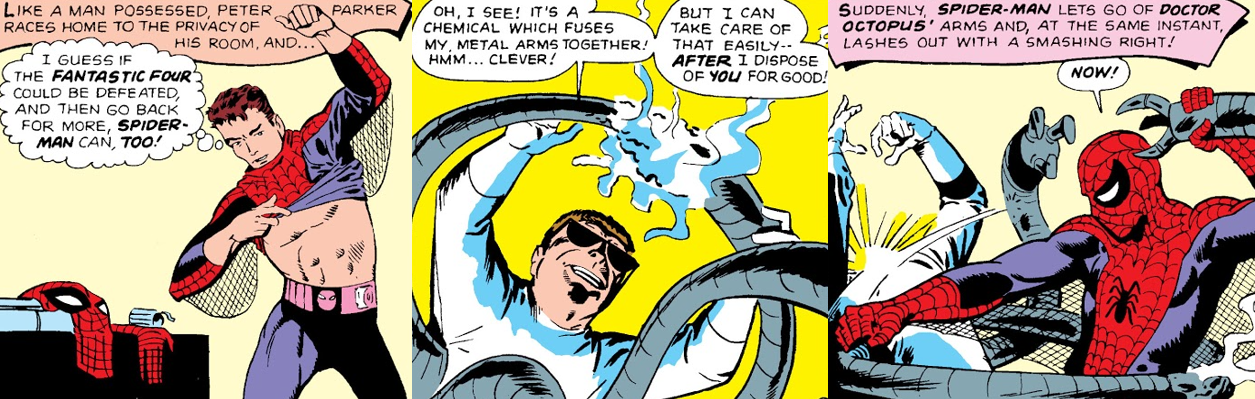
Although Johnny’s impressed, his awe and confusion soon turn to horror when he spots Gorgon and Medusa amongst the other strangers, whom he correctly assumes are a race of super-powered beings. Despite Medusa (revealed in the chaos to be Crystal’s sister) pleading with her peers to spare Johnny from harm, Gorgon knocks him from his feet with one stomp of his foot and the lizard-like Triton conjures a glass wall to trap him and then attempts to douse his body with water. Acting swiftly, Johnny bursts into flame and manages to escape through the unprotected ceiling, signalling his teammates with a flaming 4 in the sky and interrupting their efforts to calm down the raging Dragon Man with a tranquiliser gun. Spotting the alert, Reed, Sue, and Ben leap into action using a bizarre flying motorcycle seemingly cobbled together from pipes! This “Airjet-Cycle” may not be much compared to the Fantasti-Car but it’s fast enough to carry them to Johnny’s location, where he warns them of the strange “Inhumans” protecting Medusa. The four venture ahead, unaware of their foes watching them from above; thankfully, the Thing’s strength is enough to repel Karnak’s projectile but the four are stunned when the Inhumans’ enigmatic and much-revered leader, Black Bolt, bursts onto the scene. Black Bolt immediately asserts himself by staggering the hardy Thing with one blow and proving fast enough to sidestep Johnny’s attack thanks to the wing-like appendages under his arms. Though he braces for Black Bolt’s next blow, the Thing learns that their foe is as skilled as he is powerful as he’s able to throw even his rock-hard weight without issue.
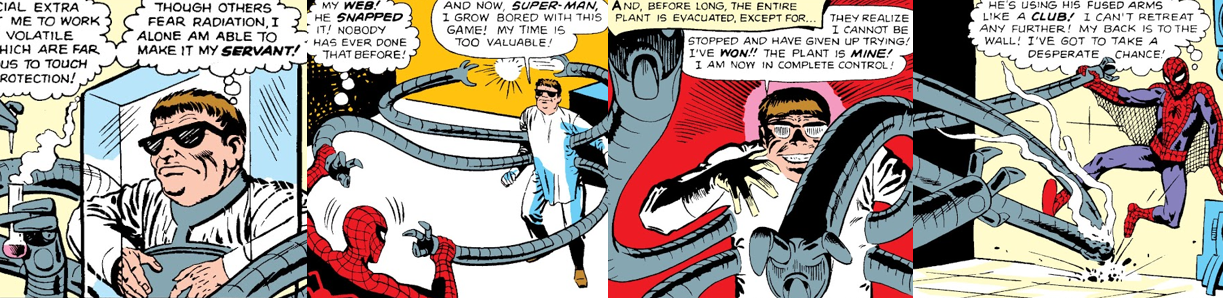
The threat of the Seeker drives the Inhumans to fight with all their might.

Reed, Sue, and Ben regroup, and two things come to light: one is that Black Bolt hasn’t uttered a single word since he arrived and the other is Reed’s suggestion that he’s drawing power from the strange tuning fork-like antenna on his forehead. Whilst searching for Johnny, Reed is pounced upon by Triton; the scaly-man-monster’s attempts to keep the Inhumans hidden are foiled, however, when Reed discovers that Triton’s suit is actually a special moisture bag that allows him to survive outside of water. With his water supply ruptured, Triton panics, lashes out, and desperately stumbles into the nearby water to keep himself from suffocating. Karnak launches a counterattack but, when his well-trained blows are repelled by Sue’s invisible force field, Gordon sends the two flying into the air with a ground-shaking stomp. While fighting with Reed, Triton lets slip about an enemy of theirs known as “The Seeker”; while Reed and Sue ponder the threat of the Inhumans and the mystery of the Seeker, the story shows that this individual captured Triton from the water and then led an assault on the Baxter Building to get his hands on the unconscious Dragon Man. Armed with his “Universal Control Rod” and commanding a legion of followers, and with a mighty airship at his command, the Seeker is determined to round up any and all Inhumans and orders his men to search the city for more while he heads back to base with his newest prisoners. Meanwhile, back in the city, the Thing presses his attack against Black Bolt, taking his shots and throwing all of his weight behind his blows, but Black Bolt is able to subdue the hot-headed rockman with his “master blow”, a shot that would have spelt death for the Thing were it not for his super tough exterior and Black Bolt running out of energy at the precise moment he was about to land the finishing strike. The sudden reappearance of the teleporting Lockjaw keeps Ben and Johnny from pursuing Black Bolt and Gorgon continues to keep Reed and Sue off balance with his hefty stomps, but the Inhumans abruptly retreat when Crystal brings word that Triton has been captured by the Seeker. Despite Crystal’s desperate attempts to say goodbye to Johnny before they flee, the strange group make a run for it, for without Black Bolt’s might they would be helpless against the Seeker.

The Seeker reveals his motivations and a brief origin for the mysterious Inhumans.

Medusa’s pleas to leave Crystal behind so that she can live a normal life amongst the humans are unheeded and Johnny arrives just in time to see the Inhumans teleported away by Lockjaw’s power; while Johnny’s strong affection for Crystal is weird and has little merit considering he knows basically nothing about her, Reed is determined to uncover the Inhuman riddle and takes the team back to the Baxter Building, where he reviews security footage of the Seeker’s attack and whips up a probe to take after the villain. Speaking of whom, the Seeker is seen gloating before Triton and expositing his desire to imprison his entire race within the “Great Refuge”; he also orders Dragon Man disposed of or released since he’s not an Inhuman and proves more than prepared for the Fantastic Four’s attack, easily trapping them within a bonkers circular device and keeping them under the watchful eye of his guards. The Seeker then regales the Fantastic Four with the origins the Inhuman race; they enjoyed the benefits of a highly advanced technological society while humans still hid in caves and, through the use of impossible advanced genetics, birthed an entire Inhuman species, each with superhuman abilities. However, the Inhumans fled to the Great Refuge when humans evolved the means to persecute them, and the Seeker has been rounding up his fellow Inhumans ever since to keep them from being attacked by humanity. It’s at that moment that Dragon Man comes to and goes on a rampage, swatting aside the Seeker’s guards and rampaging through the city, leaving Triton suffocating outside of his water bubble. Sue’s compassion for the Inhuman wins over Reed, who orders Johnny and Ben to find and subdue Dragon Man while he and Sue tend to Triton; the pressure of worrying about the destruction Dragon Man could cause sees Reed bark orders at his wife, but they’re able to encase him in a forcefield filled with water. The Seeker is impressed, but no less determined to continue his mission as per the orders of “Maximus the Magnificent”. As Ben and Johnny tangle with Dragon Man, they just so happen to crash through the wall of Alicia Masters’ apartment; Ben endures incredible punishment in a bid to keep his blind love from being hurt and begs her to flee, but also finds the strength needed to finally stagger Dragon Man and leave him wide open for a barrage of the Human Torch’s ultra-violet rays, which finally subdues the beast.

Though quickly deposed, Maximus remains determined to wipe out the human race.

The Seeker arranges for Triton to be transferred to a new water tank moments before the strain of maintaining her forcefield becomes too much for Sue; however, the Seeker demands the two leave since Inhuman affairs don’t concern them. This is the second time Reed admonishes Sue for “sounding like a wife” and yet the Seeker’s logic is infallible: his orders come from the Inhuman ruler and the Fantastic Four have no legal right to interfere, so Reed reluctantly leaves but not before planting a homing device on the Seeker’s ship and remaining so determined to track the Seeker to the Great Refuge that he coldly ignores Sue’s pleas. Black Bolt and the others materialise in the Great Refuge; it seems Johnny’s not the only one who’s ridiculously in love as Crystal cannot stop banging on about the Human Torch despite the fact that they’re all facing the wrath of their ruler, Maximus. Speaking of whom, the garishly attired Maximus offers nothing but anger and reprisals for the group and orders his “Alpha Primitives” to be set upon them while he prepares to use his “Alpha Weapon” to conquer the human race, even though this will surely mean the death of Black Bolt, his own brother! The savage, ape-like Alpha Primitives attack and, in an effort to protect his people and his beloved (if clueless) Medusa, Black Bolt doesn’t hesitate to tackle them head-on. However, even his mighty power cannot hope to fend all off all of Maximus’s greatest assassins but, luckily, the other Inhumans realise that they also have superpowers and can help out as well; although Gorgon cannot use his mighty stomp without fear of hurting his friends, Medusa’s flailing locks and Karnak’s uncanny ability to hit the weak spot of any target are enough to push back the swarming enemies. Maximus then enters the fray, commanding a stop to the violence and feigning friendliness and claiming to have ruled with honour since assuming the crown in Black Bolt’s place. While there’s some question about whether the incident which cost Black Bolt his voice (and the crown) was accidental or not, Medusa is duty-bound to marry her king but the sight of seeing her in his brother’s arms proves too much for Black Bolt to bare and he suddenly yanks the ornate crown from Maximus’s head and claims it as his own. In Inhuman society, this is apparently enough to officially be declared the ruler; even if it wasn’t, Maximus is wily enough to realise that his cunning is little compared to his brother’s power and the support of his allies. Thus, Maximus silently chooses to hang onto his “Atmo-Gun” and bide his time, faking loyalty and admiration for Black Bolt until the time is right for him to strike.

Incensed that Black Bolt may be swayed by the four’s pleas, Maximums activates his machine…

Meanwhile, tensions are high between the Fantastic Four; Sue tries to be the voice of reason and calm everyone down with some hot chocolate but Ben is too worked up over Alicia and Johnny can’t get Crystal out of his head. Feeling spurned by the group, Sue does the only logical thing she can think of; she fusses with her hairdo in a bid to make Reed realise that she’s not “one of the boys” (because marrying her wasn’t enough to prove that…) Their drama is thankfully interrupted when Johnny spots a man flying around outside and Ben is easily able to follow the strange Inhuman and land their aeroplane right on top of the Great Refuge. In the midst of this dangerous and unknown situation, Sue decides to turn herself invisible and damn near cause the three to go into full-blown panic stations just to show off her new hairdo, proving herself to be the same scatter-brained bimbo she always was at this time! While the group struggle with their issues and the dangerous terrain, Maximus continues to play coy with his fellow Inhumans over his intentions and yet he cannot deny his desire to rule over the inferior humans. Spotting the four’s troubles outside, Crystal rushes into the arms of her beloved, but the two groups soon threaten to come to blows when Black Bolt intercepts them. Reed demands a parlay and, through Medusa, Black Bolt decrees that the Fantastic Four may leave without quarrel providing they never reveal the location of the Great Refuge, while Reed counters with the belief that the Inhumans have hidden away for no reason for far too long and could make a home for themselves amongst humankind. While the tensions and the debate rages, Maximus storms into the city, enraged at the very idea of Black Bolt being swayed into thinking the humans aren’t a threat, and casually activates his Atmo-Gun against even the Seeker’s advice! Although the Atmo-Gun sends out vibrations across the Earths atmosphere that will spell the destruction of humanity, the exact nature and extent of its threat is left ambiguous for now as the Fantastic Four face an even greater and more present threat to the world starting from the next issue…

The Summary:
I haven’t really had much experience of the Inhumans, if at all; I would even go as far as to say that this is the first story I’ve read where they’re a major part of the plot, so I wasn’t really sure what to expect from the Inhumans saga. The story goes to great lengths to explain how the race are different from Mutants; they were explicitly created through science and genetic-engineering for one thing, and their powers are even more wild, for the most part, but principally the difference is that fact that they’re so isolated and mysterious. Mutants like the X-Men are all over the place, prancing around in colourful costumes and showcasing their powers for the world to see and fear, but the Inhumans have been in hiding for centuries and are only now being identified as this new superpowered race (hough in reality they’re about as complex as Mutants, the Kree, and Asgardians thanks to Marvel having a very predictable storytelling methodology during this time). We don’t get to learn too much about the Inhumans, their society, or their way of life but that would all be fleshed out later; we known they live in a monarchy, one based presumably on birthright and where the right to rule can be challenged at any time, and that they have elaborate and advanced weaponry and technology at their disposal, though we don’t really see too much of that here as the story is more focused on their powers.

Each of the Fantastic Four are insufferable and pompous in their own way.

I’m having a hard time working out which of the Fantastic Four I was most annoyed with throughout this story. Reed is a sexist, dismissive, pompous jerk half the time, constantly belittling his wife and enforcing a patriarchal rule in the guise of competent and rational decision-making. He’s all business when they’re out in the field and expects his orders to be obeyed without question; upon encountering the Inhumans, his first thought is to assess and contain any possible threat but, by the end, he’s advocating for them to come out of the shadows and re-join the world despite knowing full well how despicable humanity has treated Mutants (and each other) in the past. The Thing was his same hot-headed, antagonistic self for the most part; he traded barbs with Johnny and delighted in testing his mettle against Karnak and Black Bolt but was thrown off his game the minute that Alicia was put in danger, revealing a vulnerable side to be sure but also just adding to the relationship angst so prevalent throughout this story. Sue was a royal pain in the butt as ever; she’s such a paradox at this time as she constantly fusses and admonishes the others (especially Johnny) and yet yearns to be accepted, trusted, and seen as a valuable member of the team. Indeed, she plays a pivotal role throughout; she’s able to subdue Dragon Man, fends off Gorgon and Karnak’s attacks while Reed is powerless to oppose them, and even saves Triton’s life despite Reed’s constant reprimands. And yet, she craves attention; even amidst a life-or-death situation, she wants Reed to stop and admire or compliment her and she seems just as incapable of setting aside her vanity as he is his scientific curiosity, making for some irritating moments. But the worst of the bunch is easily Johnny; instantly falling in love with Crystal upon first sight, despite him having a girl on the go, he pouts and mopes about and constantly whines about her safety or never being able to see her despite having known her for a day, at most. Even when he learns that she’s an Inhuman, he refuses to acknowledge that she’s anything other than human, showing he really doesn’t get her in the slightest, and yet she’s equally smitten by him simply because…I dunno, he’s cute? Persistent? Can burst into flames? Their romance is one of the most contrived in all of Marvel and really could’ve benefitted from more time, like if Crystal had been a side character for a few issues before this.

It’s fitting that the Inhumans are the most intriguing aspect of this story arc.

Still, the whole point of this story is to introduce Marvel readers to the Inhumans, and, in that regard, it does pretty well. What better way to prove the strength and capability of your new race of superbeings than by having them go toe-to-toe with Marvel’s First Family, and come out on top quite often? Long-time Marvel readers will already be aware of Medusa and Gorgon, whose tendril-like hair and superhuman strength had already been a headache for the Fantastic Four, but they’re joined by some formidable allies in this story. Although Crystal doesn’t demonstrate any superhuman capabilities, meaning she’s always in need of protection, her faithful friend Lockjaw proves to be a key component in teleporting the Inhumans from place to place and entering their hidden sanctuary. The sanctimonious Karnak boasts of being able to pinpoint the weakness of anything, living or otherwise, to strike with precision blows; although he’s not able to pierce Sue’s forcefield, he proves a more challenging adversary than the blunt and inefficient Gorgon. Triton seems like he might be quite powerful, but we never really get to see what he’s capable of since he’s constantly on the verge of suffocating to death, and the same goes for Maximus and the Seeker, who favour subterfuge and technology, respectively (though also in near equal measure). Even in his first appearance, Maximus has much in common with Loki Laufeyson; both covet the throne, seek to rule, have a silver tongue, and rely on minions to do their dirty work, though Maximus is portrayed as being more explicitly unstable since he dares to activate the dreaded Atmo-Gun and is fully willing to wipe out all of humanity. Thankfully, the Inhumans’ greatest asset is their rightful ruler and leader, the stoic Black Bolt; depicted as being fast as lighting and just as powerful, Black Bolt makes an immediate impression with his iconic costume and his ability to battle the ever-lovin’ Thing to a standstill. Although we learn little about him, we see that he is besotted with Medusa, as brave as he powerful, and a noble Inhuman deep down since he’s willing to let the Fantastic Four go at the end. As a showcase for the Inhumans, this arc works quite well; it suffers from a lot of the same handicaps as other Marvel stories, to be sure, but there’s a lot of mystery and unanswered questions raised by the Inhumans and a fair amount of appeal behind the likes of Black Bolt even though the relationship drama really bogs the narrative down.

My Rating:

Rating: 3 out of 5.

Pretty Good

What did you think to the debut of the Inhumans? Were you put off by the relationship drama or is that something you find appealing in the Fantastic Four’s stories? Which of the four team members is your favourite and why? What did you think to the Inhumans, the depiction of their powers and society, and which of the group was your favourite? Can you name some of your favourite Inhumans stories and moments? Whatever you think about the Inhumans or the Fantastic Four, go ahead and let me know by leaving a comment down below or on my social media.

Back Issues: Sgt. Fury and his Howling Commandos #1

Story Title: “Seven Against the Nazis!”
Published: 5 March 1963 (cover-dated May 1963)
Writer: Stan Lee
Artists: Jack Kirby

The Background:
Over its many decades of existence, Marvel Comics has produced some of the most colourful and memorable characters in the entire industry. There was a time, generations ago, when comic books hadn’t quite found the niche they have today, leading to pulp tales, surreal horror-themed publications, and war comics. War tales were bolstered by spandex-clad heroes like Captain Steve Rogers/Captain America, who encouraged readers to buy war bonds and support their fighting troops overseas, leading to quite the booming period in Post-War America. For Marvel Comics, it was the legendary duo of Stan Lee and Jack Kirby who were responsible for creating some of their most popular characters through their unique “Marvel Method” of writer/artist collaboration, but it might surprise you to know that Nicholas “Nick” Joseph Fury, the eyepatch-wearing, cigar-chomping agent of super-spy agency Supreme Headquarters, International Espionage and Law-Enforcement Division (S.H.I.E.L.D.), actually came about as the result of a bet between h and his publisher, Martin Goodman, that Lee and Kirby could sell a comic with a ridiculous title like Sgt. Fury and his Howling Commandos. The racially and ethnically diverse titular squad would be led by a tough, no-nonsense sergeant as a more adult counterpart to DC Comics’ Boy Commandos, though Fury would be rebranded as more of a James Bond-type figure just two years after this debut appearance and is perhaps more famous for his association with S.H.I.E.L.D. and his duplicitous (and often contentious) dealings with Marvel’s superhero community. Although Nick Fury has featured in cartoons, videogames, and even got his own much-maligned live-action feature, he has been largely supplanted by his more recognisable African-American variant; General Nick Fury featured in Marvel’s comparatively short-lived Ultimate line of comics, where his design was based on Samuel L. Jackson, who would go on to portray a version of the character in the Marvel Cinematic Universe.

The Review:
The first couple of pages of Sgt. Fury and his Howling Commandos #1 are spent introducing us to the titular team of battle-tempered soldiers: we have “six foot two […] steel-muscled, iron-nerved” Sgt. Nick Fury who’s built a reputation for being one of the most feared men in the Army; Jonathan Juniper/Junior, the “cheerful eager-beaver” who’s “fast as a panther and just as dangerous”; Robert Ralston/Rebel, an ex-jockey who’s “tougher than his small size makes him appear”; Corporal “Dum-Dum” Dugan (whose real name isn’t revealed here), a former circus strongman garbed in a bowler hat; Gabriel Jones/Gabe, a proficient trumpet player; actor Dino Manelli; and scrappy, moustachioed mechanic Izzy Cohen. Rather than then jump into showing us these seven colourful characters interacting or showcasing their personalities and skills, the story switches to a French underground communications centre where two members of the French resistance, Pierre and Henri, scramble to warn the Howling Commandos of the Nazi’s latest plans. Although Henri is wounded and the two are captured, Henri successfully sends the message via Morse code, and it reaches the attention of executive officer “Happy Sam” Sawyer. Sawyer isn’t optimistic about the message, which requests that his Howling Commando division be sent in to rescue the leader of the French resistance, but the fate of Operation Neptune (or “D-Day”, as it’s most commonly known) is at hand so, while it might be a suicide mission, he orders Sgt. Fury to get his team ready. An abrasive, aggressive, stone-faced commander, Sgt. Fury goes to round up his troops, who are practising their manoeuvres in a most extreme way: Dum Dum is firing live ammo over their heads from a mounted machine gun as they crawl across a mine field! Sgt. Fury puts a stop to their “fun”, but his commandos relish the opportunity to get out into the field and go up against the Nazis, even if the odds are stacked against them; they’re so gung-ho that they even believe that they outnumber the Nazis!

The grizzled Howling Commandos embark on a suicide mission to rescue an important ally.

However, for all their macho bravado, the Howling Commandos’ plane is set upon by a squadron of Luftwaffe, forcing the troop to parachute to the ground (though Dum Dum is inexplicably able to take out one of the German planes with a well-aimed grenade toss). The soldiers reach a French town occupied by Nazis and, true to their name, the group fire upon the enemy, with Sgt. Fury taking out a tank-full of Nazis single-handily with his own grenade, all while howling with glee! The blast injures Sgt. Fury; though he’s too stubborn to rest, he, Dum Dum, and Junior are forced to take cover from the Nazi retaliation. Luckily, Dino, Rebel, and Izzy rig up a “king-sized Molotov cocktail”, which they hurl at the advancing troops and set their other tank ablaze. The Nazis quickly shower the Howling Commandos with bullets, pinning them down but not injuring or killing a single one of them; still, they’re helpless to fight back, so it’s up to the French resistance to bail them out by killing their attackers off-panel. Rebel and Izzy then steal the Nazi uniforms and Dino dresses up in the coat and cap of a Nazi officer, which is a disguise and performance good enough to convince the other Nazis to withdraw, thus saving Sgt. Fury and the others. Though wounded, Sgt. Fury is as pig-headed and determined as ever to complete his mission, but their saviours rightly point out that they haven’t a hope in hell without the underground’s help, and they’ll only assist them if they save the rest of the townsfolk from being executed by the Nazis. Still in disguise as “an imperious Nazi Ubergruppen-Feuhrer” Dino easily fools the firing squad, and the Commandos and the underground’s superior numbers, and firepower, quickly see the Nazis surrendering; Izzy then steals their truck and the allies climb aboard towards Louivers, where the ludicrously-named underground leader Monsieur LaBrave is being held captive in a Nazi-controlled fortress.

Sgt. Fury shrugs off death to turn the tide and give the Allied Forces the edge on D-Day.

Though beaten and weary, LaBrave refuses to give in to his torture and reveal the plans for the D-Day assault; pressured by Adolf Hitler himself to get the information by any means necessary under pain of death, the Nazi General Von Ritzik hands over the interrogation to the feared Gestapo, who immediately kidnap LaBrave’s daughter and threaten to harm her if he doesn’t co-operate. Luckily, the Howling Commandos and their French ally (later named Marie) are closing in on the heavily-fortified Louivers; despite his injuries and the insanity of launching a daylight campaign, Sgt. Fury refuses to wait until dark or let himself or any of his soldiers rest for the coming battle and his stubborn, bull-headedness briefly raises the ire of Dum Dum. Posing as an old farmer pulling a cart of produce, the soldiers easily slip past the enemy guards and destroy their arsenal with a “holocaust” of an explosion! This diversion is enough to allow them to storm the fortress, where Gabe and Junior bravely hold back the advancing troops so the others can continue on the mission. When Junior is jumped by Nazis in his attempt to take out the machine gun placement laying down supressing fire in the courtyard, Sgt. Fury simply crawls along the cobblestone ground on his belly and chucks a bundle of dynamite at the Nazis, seemingly perishing in the blast as he’s buried under a pile of rocks. Although Marie turns her tears into an angry wrath and Dum Dun pushes on with the same dogged determination as his fallen commander, the two of them are soon captured and lined up alongside their comrades, and LaBrave, before another firing squad. It turns out that Marie is actually LaBrave’s daughter and that he was almost tricked into giving up their cause for her safety; however, now that she is actually there, the Gestapo threatens to shoot her before his eyes if he doesn’t spill the beans. Fortunately, Sgt. Fury is alive and well and comes bursting out from his tomb guns blazing! Galvanised by seeing their grim commander alive, the Howling Commandos easily fend off the Nazis and capture General Von Ritzik, who secures them save passage down to the coast so he can be shipped back to the Allies, and the story ends with the teaser that this victory gave the Howling Commandos and their allies the edge they needed in the subsequent D-Day assault.

The Summary:
So, here’s a fun fact: this is both the first issue of Sgt. Fury and his Howling Commandos and the first solo Nick Fury story I’ve ever read! I don’t think that’s much of a stretch of the imagination to believe, though, as Nick Fury is generally more of a background player or a supporting character in other Marvel stories and, quite frankly, that’s how I prefer him. This is a Nick Fury at the peak of his curmudgeonly ways; war has made him little more than a gruff bull who charges head-first into battle with no time for sentiment, rest, or even to tend to his own injuries. He’s hard on his soldiers, who are equally hungry to mix it up with the Nazis, and even harder on his enemies, who he attacks with little to no quarter. He expects nothing but total commitment from his men because that’s what he’s willing to give; he doesn’t care how stacked the odds are or how suicidal his missions are, he just wants to go in (and out) in a blaze of glory, chomping his cigar, firing off bullets, and ranting at his Nazi enemies as he goes down. He’s every bit the opposite of Captain America’s more righteous attitudes, but that makes sense as Sgt. Fury represents the hardened soldier on the front lines, one constantly forced to endure the dirt worst of conflict for the greater good, and thus Sgt. Fury embodies the indomitable American fighting spirit, one that will spit in your face and walk through Hell just to put down one more no-good Nazi.

The gruff Sgt. Fury stands out from his mostly bland and underutilised fellow soldiers.

While I see a lot of parallels between Sgt. Fury and Ben Grimm/The Thing (both in their demeanour and their stony appearance), it’s a good thing that he stands out so much as his other Howling Commandos aren’t afforded such a luxury. It’s interesting that so much time is spent introducing each soldier and their basic characteristics as there aren’t many opportunities for them to shine in this story; Dum Dum is said to be a former circus strongman but exhibits no feats of strength and instead is portrayed as being a slightly less harsh version of Sgt. Fury, which leads them to butt heads a couple of times despite their deep respect for each other. Gabe is said to be quite the musician but never gets the chance to showcase this, the closest Izzy gets to using his mechanical skills is in commandeering a Nazi vehicle, and Junior is all excited about getting to blow shit up at the start of the story but ends up never getting the chance to actually use any explosives. Of them all, it’s Dino and Dum Dum who get the most chances to shine; Dum Dum makes an immediate impression with his stocky stature, thick moustache, and trademark hat but also appears to be half-crazed since his training methods are literally life or death for the Howling Commandos! Yet, when in the field, it’s Dum Dum who suggests they wait for the cover of darkness and tend to their wounds, only to be chewed out by his aggressive superior! Dino’s acting background comes into play when he disguises himself as a Nazi commander, but the story presents this in such a way that I would argue anyone could’ve done just as good a job as all he does is prance around in the uniform and bark orders in German; it’s not like he infiltrated the enemy and led them astray, or anything. Still, as disappointing as it is that most of the Howling Commandos don’t get the chance to do more than show off their fighting spirt and tenacity, it’s not entirely unexpected (there are seven main characters, after all) and they come off a lot better than Marie, who isn’t even named until right at the end of the comic and, for all her gumption, is still depicted as being more emotional compared to her war-hungry male counterparts.

All of the Nazi’s forces and power are little consequence to the fighting American spirit.

Surprisingly, Sgt. Fury and his Howling Commandos makes an effort to portray the Nazis as a genuine threat; their sheer numbers and evil intentions loom over the story like an oppressive cloud, driving Sgt. Fury and his allies on since they know how important this mission is to the larger war effort. While Adolf Hitler is portrayed as a braying, childish brat, he’s only included as a cameo and his soldiers are more than capable of dominating entire towns, threatening woman and children alike, and delight in lining up innocents and enemies before a firing squad. However, while they are a clearly superior force, their numbers and weapons are nothing compared to the Howling Commandos; the troop’s reputation as crazed maniacs proceed them and still the Nazis are easily foiled by the crowing soldiers, who blow up their planes, tanks, and munitions stores with barely a sweat. Even when the Nazis have them pinned down, the Howling Commandos take no damage; at one point, it seems like Gabe and Junior are being left for dead (Sgt. Fury even acknowledges that they have no chance against the Nazis) but no, they’re fine. The worst offender of this, however, is the titular, grouchy Sgt. Fury himself; not only does he shrug off the injuries he suffers from a grenade blast, but he’s also eventually revealed to be little more than dishevelled after being caught in another blast and buried under a pile of rocks! Again, this speaks to his tenacity, but I do wonder if killing off one of the Howling Commandos or at least treating their wounds more seriously would have helped reinforce the team as tough, but human and relatable, soldiers on the front lines. While I’m generally not a big fan of Jack Kirby’s more outlandish artwork, it actually worked really well in this war-time setting; everything has a gritty realism to it, though there are still some fun comic book moments peppered throughout, and the comic does a decent job of representing the violence and bloodshed of war even though a lot of the killing is either implied or takes place off-panel. In the end, this was a decent enough story, full of bravado and patriotic vigour, but I think it’ll strike more of a chord with fans of war comics than casual readers.

My Rating:

Rating: 3 out of 5.

Pretty Good

Have you ever read Sgt. Fury and his Howling Commandos #1 or any of its subsequent issues? Are you a fan of Nick Fury and, if so, what are some of your favourite stories of his? Which of the Howling Commandos is your favourite and would you have liked to see their individual talents showcased more here? Are you a fan of war comics? Which version of Nick Fury do you prefer and why? Whatever your thoughts on Nick Fury, leave them down below or comment on my social media, and go check out my other Marvel content across the site.

Back Issues: Fantastic Four #2

Story Title: “The Fantastic Four Meet the Skrulls from Outer Space!” (includes “Part 2: Prisoner of the Skrulls”, “The Fantastic Four Fight Back!”, and “The Fantastic Four…Captured!”)
Published:
28 September 1961 (cover-dated January 1962)
Writer: Stan Lee
Artists: Jack Kirby

The Background:
In 1961, Marvel Comics readers were introduced to the Fantastic Four (Doctor Reed Richards/Mister Fantastic, Susan Storm/The Invisible Girl, Ben Grimm/The Thing, and a new version of the Human Torch, Johnny Storm), a dysfunctional family of superhumans just as likely to trade blows with each other as they were with their enemies! While the story of their creation has been disputed, the collaboration between writer Stan Lee and artist Jack Kirby popularised the “Marvel Method” of comic creation and this all-too-human “First Family” of superheroes went on to introduce characters and concepts that would forever influence Marvel Comics in the decades that followed. The first of these premiered in the team’s second issue and took the form of shape-shifting aliens known as Skrulls; also created by Lee and Kirby, these malicious, reptilian war-mongers have been a prominent antagonistic force in Marvel Comics ever since. Not only have they menaced the Fantastic Four and other superheroes through their sheer numbers, devastating technology, and copied their powers with their various “Super-Skrull” variants, they also engaged in a horrific war against the Kree, tried to surreptitiously invade Earth, and have popped up in cartoons and videogames as enemies of the Foursome and other Marvel heroes over the years.

The Review:
Our story begins with the Thing swimming far out to sea towards a “lonely Texas Tower”, which I’m just going to call an oil rig going forward. The Thing dives under the waves and shreds one of the oil rig’s support legs, causing the entire structure to topple into the water and forcing the workers to race to safety in lifeboats, where they spot the Thing swimming away and rightly assume that he caused the wreckage. The story then cuts to a jewellery store, where Sue has gone all dressed up to have a look at a particularly large and ridiculously expensive gemstone; plucking the sparkling jewel up, she promptly turns invisible and makes off with the gem, leaving the store owner and the inept guards baffled. Next, the unveiling of a priceless statue of solid marble is reduced to molten slag by the Human Torch and Mr. Fantastic uses his disturbingly stretchy arms to shut off all the power n New York City. The gleeful Foursome meet up to congratulate each other on their evil deeds but, as if something wasn’t already a miss, their overly expository dialogue reveals that they committed these acts not using their superpowers, but by means of technology: the Thing had a concealed detonator in his wrist (why it needed to be concealed beyond fooling the reader is beyond me as no one saw him beneath the sea), the Invisible Girl actually reduced her size rather than turn invisible, the Human Torch made use of anti-gravity gear and a low velocity thermal bomb, and Mr. Fantastic simply used his inherent physical abilities since he, like the other three, is actually a form-changing Skrull! The four imposters shift to their natural forms as goblin-like, reptilian aliens and revel in their actions, which have caused the media and public to turn against the Fantastic Four and therefore allowed the impending Skrull invasion to take place unopposed!

When the Fantastic Four are framed by the Skrulls, they take drastic measures to lure out their foes.

The actual Fantastic Four are off in a secluded lodge having a bit of vacation time hunting in the woods when they learn of what’s happened; while Johnny is confident that Reed will figure out who’s been impersonating them, the news report triggers the Thing, who briefly blows his lid and is ready to fight the entire human race in his mindless rage. When Reed tries to calm him down, the Thing just launches into a tirade lamenting his existence and becomes so consumed by the need to lash out that he starts to sound like Doctor Bruce Banner/The Hulk, it’s very uncharacteristic and odd to see but presumably the Thing’s personality hadn’t quite been worked out at this point. Reed assumes full responsibility for the Thing’s aggressive demeanour; after all, as his obligatory recap of their origin reminds us, he is responsible for Ben being reduced to a rock-covered monster, though none of this brings them any closer to figuring out a plan of action, meaning they’re easily surrounded and captured by the United States military. The Fantastic Four surrender peacefully and are locked up in special cells said to be capable of containing their awesome powers, though this is, of course, just an excuse to pad the story out with visual reminders of what they’re capable of: Sue easily slips out of her cell when the guards foolishly open the door to provide her with food (!), Johnny rips up the flooring to find an air vent, Reed disturbingly squeezes himself out through a single loose rivet, and Ben simply smashes his way out with brute strength in no time at all. They flee in a stolen helicopter and reconvene at one of their “many secret apartment hideouts”, where Johnny and Ben almost come to blows over which one of them will willingly sabotage a space shuttle launch to draw out their doppelgängers. Ultimately, the Thing’s rage is quelled, and the Human Torch attacks the launch site and finds himself picked up by the Skrull impersonators; Johnny learns of their alien nature and plans for world conquest and signals for his teammates, who arrive just as Johnny is facing certain destruction at the Skrulls’ hands.

The Skrulls are easily warded off, the Four are cleared, and their impersonators duly punished.

Thanks to Sue tripping one of them, Reed disarming another, and Ben’s brute strength, the Skrull are subdued and willingly spill the beans when they see the extent of the Thing’s rage towards them; the Skrulls explain that there’s a Skrull invasion fleet waiting to attack and Reed decides that their only course of action is to turn the tables on their doppelgängers by commandeering their shuttle (which is disguised as a water tower) and heading up to the city-sized mothership to try and destroy the fleet. There, they masquerade as their impersonators and tell tales to the Skrull Commander about the might of not just the Fantastic Four, but Earth’s monstrous forces, giant ants, and weaponry hidden in the atmosphere. Incredibly, not only does this dupe work, convincing the Skrull Commander to pull back the entire fleet, but the Fantastic Four are also able to avoid having to shift back to their Skrull forms with a flimsy excuse and are even awarded for their bravery when they volunteer to stay behind and remove all traces of the race from the planet. However, as the Fantastic Four are left to drift back to Earth, the shuttle happens to pass through the same radiation belt that gifted them their powers, which inexplicably returns the Thing to his normal, human form! Upon exiting the shuttle, though, they are immediately placed under arrest and Ben’s joy at finding himself human once more is immediately undone when he just turns back into the Thing within a space of a few panels. Although the police chief refuses to listen to Reed’s explanations, he and the other cops are suitably convinced when they’re attack by a giant snake, a bulbous, spiky-rock-monster-thing, and a large vulture. The Fantastic Four easily subdue these three Skrulls and are exonerated by the flustered police chief; as for the Skrulls, Reed opts not to kill them or take the chance of locking them up or to trust that they can exist amongst humans peacefully as they claim and instead decides to hypnotise them into spending the rest of their lives believing that they’re cows!

The Summary:
Generally speaking, I really don’t enjoy stories where characters or heroes are framed for crimes by an impersonator; I find they can be very repetitive and frustrating, but I actually think “The Fantastic Four Meet the Skrulls from Outer Space!” was quite a fun twist on the concept. It’s interesting that the Skrulls regard the Fantastic Four as the sole threat to their invasion plan; everything they do is geared towards removing the Fantastic Four from the battlefield by ruining their reputation, something that’s ridiculously easy to do in Marvel Comics thanks to their fickle civilians. I actually quite enjoyed that Johnny and the others barely even bat an eyelid when they find out that they were being impersonated by goblin-like aliens; they just took it in stride and it’s only their second issue and Marvel hasn’t even had a chance to think up some of the bizarre cosmic shit that they’re known for! Another positive was that Sue didn’t get written like a complete airhead in this issue; sure, she barely did anything except trip a few people, but at least she wasn’t being shallow or idiotic or getting yelled at by Reed. This issue also spent a good deal of time showing how combustible the relationship between the Fantastic Four can be, particularly Johnny and Ben, who argue and almost come to blows a few times throughout the story. It also placed a great emphasis on the agony and despair Ben feels about being trapped in a grotesque, rocky hide. While his characterisation is a bit suspect at times and he’s written to almost evoke the Hulk on more than one occasion with his mindless rage, this aspect of the character, that he feels ostracised and tormented by his appearance, has become a defining trait of the Thing’s personality over the years so it was interesting to see it being spotlighted here, even if it’s set off with little provocation.

While the Skrull’s aren’t much of a threat, the story does a good job of fleshing out the title characters.

This led directly into him clashing with the more laidback Johnny, which in turn allowed Reed and Sue to be further fleshed out as the cooler heads and parental figures of the group while also exploring the guilt Reed feels for causing Ben’s condition. While I was okay with the recap of their origin as it tied into this and didn’t take up much space, the brief detour where they’re captured by the military was a bit of a waste, especially as we could’ve seen them battling the shape-shifting Skrulls instead. The Skrulls are depicted as patient and methodical; their plan isn’t to directly engage the Fantastic Four, but see to it that the world turns against them and does the work for them, though this plan is riddled with holes if you actually stop and think about it. If the Fantastic Four are their only threat, why don’t the Skrulls just use their massive fleet to attack New York City, obliterating their enemies in the process? Also, we don’t really get to see much of the Skrulls abilities or threat here; sure, they can mimic the Fantastic Four’s appearances and abilities and turn into monstrous creatures, but they’re easily defeated and their commander is duped with just a few photos and wild stories, severely diminishing whatever threat they might pose. It’s a bit of a shame, as they have a fun design and it would’ve been cool to see them showcase their power and technology in a proper fight, but it does sell the Fantastic Four as being both intelligent and physically capable. Overall, this was a pretty fun and surreal tale; it helped to flesh out the characterisation of the Fantastic Four both individually and as a group, gave them a chance to showcase a bit more of their powers and personalities, and introduced an intriguing alien race that would eventually be depicted as a far more capable menace than what is seen here. The art was colourful and popped nicely, even if the Thing and the Human Torch still look a bit basic here, and the writing was actually pretty good for a change so I’d definitely say that I enjoyed “The Fantastic Four Meet the Skrulls from Outer Space!” more than I expected.

My Rating:

Rating: 3 out of 5.

Pretty Good

Have you ever read “The Fantastic Four Meet the Skrulls from Outer Space!”? What did you think to it? Were you impressed by the first appearance of the Skrulls or do you agree that they weren’t presented as much of a threat? What did you think to the characterisation of the Fantastic Four here? Which of the four team members is your favourite and why? Are you a fan of imposter stories? What are some of your favourite stories that include the Skrulls? Whatever you think about the Fantastic Four and the Skrulls, go ahead and leave a comment down below or on my social media, and be sure to check out my other Fantastic Four reviews on the site.