Game Corner [Asterix Anniversary]: Asterix & Obelix: Slap Them All! 2 (Xbox Series X)


Asterix the Gaul first debuted on 29 October 1959 in the French/Belgium magazine Pilote. Since then, Asterix has become a popular and enduring character as his stories have been translated into over a hundred languages across the world.


Released: 17 November 2023
Developer: Mr Nutz Studio
Also Available For: Nintendo Switch, PC, PlayStation 4, PlayStation 5, Xbox One, Xbox Series S

The Background:
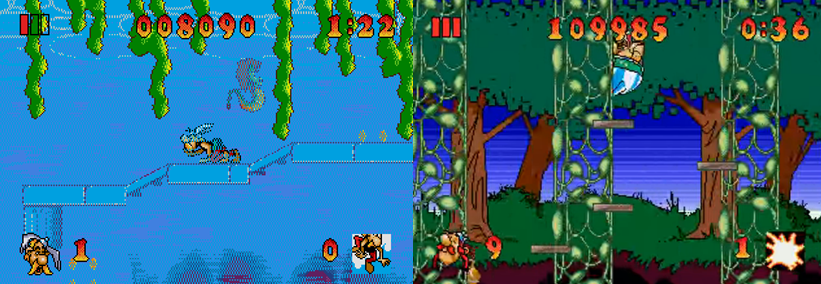
Within ten years of his debut in the pages of Pilote, the first Asterix book came to the silver screen as a feature-length animation and, alongside numerous animated and live-action Asterix films, we’ve seen multiple Asterix videogames. His first outing released on the Atari 2600 in 1983, though I’m more familiar with his SEGA-based outings and impressive arcade venture. While this game never received home console port, it eventually gained a spiritual sequel in Asterix & Obelix: Slap Them All! (Mr Nutz Studio, 2021), a visually impressive title that offered action-packed arcade action. Surprisingly, this was followed by a sequel two years later, one that added a few new gameplay mechanics and environments to the existing engine. Unfortunately, while Asterix & Obelix: Slap Them All! 2 was still praised for its visuals, reviews criticised the same tedious beat-‘em-up gameplay and noted that it was barely distinguishable from the first game.

The Plot:
When the Lutetia Eagle, the precious golden emblem of the Roman legions, is stolen and an innocent man is blamed, Asterix and Obelix travel ancient Gaul to discover the true culprit.

Gameplay and Power-Ups:
Like its predecessor, Asterix & Obelix: Slap Them All! 2 is a 2D, sidescrolling arcade-style beat-‘em-up. As before, players can either go it alone as either Asterix or Obelix or team with a friend to fight Romans across over fifteen stages. Sadly, no additional characters were added and Asterix and Obelix are almost unchanged from the previous game. You still jump with A and throw a quick, basic attack with X that can easily be mashed for simple combos. Tapping or holding Y throws your special attack, either a unique charged punch or charged uppercut. Obelix has a unique axehandle smash and slams into the ground with his butt when you press Y while jumping while Asterix spins about and stuns nearby enemies. You’ll see some distinction when using B, too, which sees you pick up sandals for points or food for health or grab enemies. Asterix can only grab smaller enemies and is limited to swinging them over his head or throwing them, while Obelix can also grab larger enemies, slap their faces, and pound them into the ground. Holding the Right Trigger blocks incoming attacks, double tapping left or right sees you dash, and you can now pick up and throw barrels with B. The “Slap” mechanic from the first game is gone and special attacks no longer consume energy. Instead, a new energy meter fills as you attack, and can expend it when it’s partially or completely full.
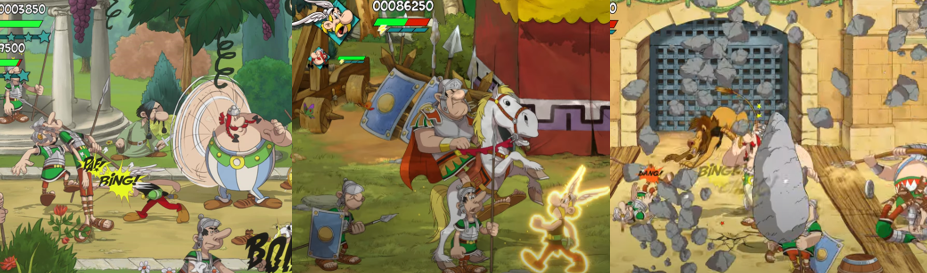
Aside from two new mediocre combat mechanics, gameplay is the same if not less than before.

When it’s partially full, the Left Bumper engages “Fury” mode. In this state, your character is faster and stronger, and this mode last for as long as you have meter energy. When it’s full, the Right Bumper unleashes your “Ultimate” attack, which sees Asterix dash across the screen at high speed and Obelix cause menhirs to fall, taking out (or severely damaging) all enemies. When playing with a friend, you can revive them with B but, when playing alone, you switch character with the Left Trigger. If one is defeated, you can continue as the other but you’ll have to restart the stage if both are defeated as there are still no checkpoints. Therefore, I still recommend playing as one character until you’re forced to swap, smashing crates and tables to collect Sestertii for points and apples or roast boar for health. As before, there are no weapons to use and some gameplay mechanics are missing (there are no races or timed events this time). Instead, gameplay variety is limited to some branching paths, climbing ladders or cliffs, and some destructible elements, which is a bit of a shame. Sometimes, you’ll be asked to go to the left, which is unusual for a beat-‘em-up; other times, you’ll enter caves and avoid falling boulders and such. Otherwise, it’s the same tedious beat-‘em-up action as before. You can smash tables, spiked barriers, battle across logs and bridges, and smash down doors and rocks, and you’re again forced to constantly pummel large waves of enemies. There are three difficulty settings, with the number and aggression of enemies increasing on harder difficulties, but the points don’t do anything except display your “hiscore” for each stage and there are no collectibles or Easter Eggs beyond various cameos.

Presentation:  
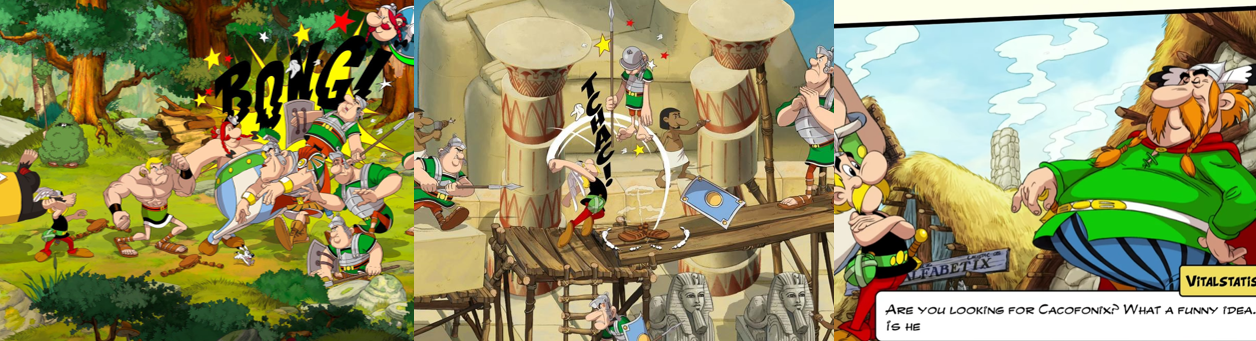
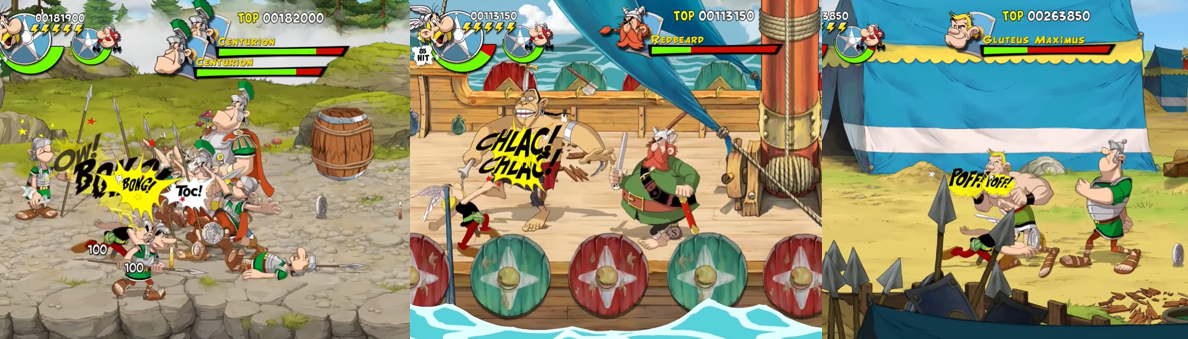
Asterix & Obelix: Slap Them All! 2 retains the gorgeous, hand drawn style of the first game and is again five-star visual experience. Asterix and Obelix mirror their animated ventures and sport a range of animations, from bursting into the scene to celebrating at the end of a stage. They once again offer quips and observations, though they’re largely recycled from the first game; however, there is more voice acting and cutscenes to advance to admittedly weak story. Cutscenes use the in-game graphics and large portrait art, resembling a motion comic and sadly restricting certain actions like platforming and knocking over trees to create bridges to non-playable sequences. While the game’s music is still a letdown, comic book sound effects still punctuate the slapstick action and enemies showcase the same cartoonish animations. Backgrounds are filled with fun visuals, from the bustling Gaulish village and its recognisable characters to obscure cameos from the likes of Codfix. Wild boar, birds, and other animals scatter as you progress, Roman legions and weapons line the backgrounds, and you’ll see the pirates’ wrecked ship and Romans frozen in the frigid wastelands of the Norman region. Dogmatix also accompanies you on your journey, though purely as a cosmetic companion, and you’ll see the Romans’ dirty laundry drying, the streets clogged with carts, the markets of Lutetia bustling with life, and constantly avoid incoming chariots or Romans carrying large battering rams.
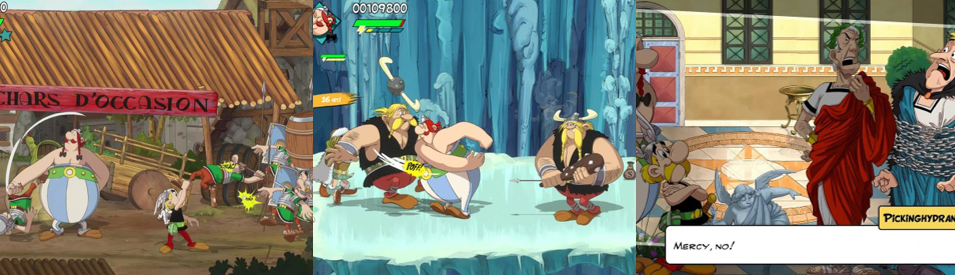
Though still a visual treat, the visual variety is lacking and much is recycled from the last game.

Sadly, the environments are largely indistinguishable from the first game. You begin, as always, in the Gauls’ village and spend a lot of time in the surrounding forest and woodlands, fighting through a nearby Roman camp and battling across cliffsides. A few stages are themed around the road to Lutetia, which is mostly cobblestone countryside and docks. The city itself is fun, but painfully restricted and recycles the arena stages from the last game, and I was again left disappointed by how mundane the game’s environments are when Asterix is known for his colourful, globe-trotting adventures. Sure, you’ll tear apart an inn full of reprobates, explore underground caverns, and marvel at the aurora borealis and frozen landscape when battling the Normans, but it’s disappointing that these games have less visual variety than Konami’s arcade title and don’t visit places like Egypt, Spain, or India. You do explore the ruins of the Mansions of the Gods, though this merely amounts to some Graeco-Roman architecture dotted about the environment. Gluteus Maximus returns, in a boxing ring no less, and you’ll battle Redbeard and his pirates on his wrecked ship. You also battle through the marble halls and treasure rooms of the Edifice, but I honestly struggled to tell the game’s environments apart from its predecessor’s. There are some drizzle, rain, snow, and day and night elements and I liked the skulls skewered on sticks in the Viking village, but the game plays things far too safe and appears more like downloadable content than an entirely original adventure.

Enemies and Bosses:
Sadly, this extends to the game’s repertoire of enemies as well, which are largely recycled from the first game. Sure, it appears like there’s more onscreen at once (helped by the many narrow areas) but it’s disappointing there wasn’t more variety. You encounter the same Romans as before, from disposable minions to fatter variants, slender spear tossers, and bigger, tougher ones who block your attacks. Some Romans hide in bushes and tree stumps, chucking poisonous potions to stun you; others carry battering rams or attack with swords; and they’ll even fight with other enemies when the game mixes up the enemy types. These include the usual assortments of pirates and brigands who race at you with their fists flailing, toss daggers, or wield nunchakus and axes. Larger, armoured gladiators also reappear, again armed with tridents and a speedy dash. Lions crop up in the arena and the hulking Normans naturally show up in their homeland. They’re joined by a smaller archer variant, there’s a smaller dual-bladed pirate variant, and Nubian fighters also show up, with some enemies sporting a wake-up attack that can be especially aggravating. The barbarian-like Belgians can be a real pain with their club swings and fast reflexes, horses will kick from stables, and it’s easy to be pummelled if you’re caught in a corner or trapped between large groups of enemies, which can be very frustrating.
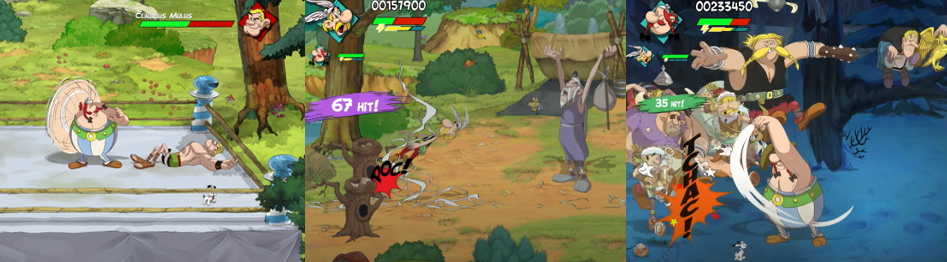
Bosses are more disappointing than ever since most are simple gauntlets or returning enemies.

Unfortunately, Asterix & Obelix: Slap Them All! 2 still relies on throwing seemingly endless waves of enemies at you to close most stages. A recurring boss is the returning Centurian variant who charge on horseback and mule kick you before resorting to their swords. Gluteus Maximus challenges you to a rematch in a boxing ring, Redbeard battles you alongside Clovogarlix (the unscrupulous rogue who’s your main target for most of the story), and you also rematch Olaf Timandahaf. While you often battle multiple centurions, larger Romans, Normans, and hulking gladiators alongside these and other bosses, they seem much easier than before, folding like paper on “Easy” mode (though you must defeat all enemies, not just the boss, to win). You’ll encounter Prolix the Soothsayer a few times, with him first eluding you and then conjuring lightning bolts as you battle waves of enemies before he seemingly randomly falls. Similarly, the mysterious thief pops up now and then, evading you throughout the story and then collapsing after one hit and some giant Vikings attack in their village. Although this game doesn’t end with a mind-numbing gauntlet against its toughest enemies, you must still endure a coliseum bout in Lutetia and the final battle isn’t against the game’s main bad guy, Pickinghydrangus, but instead a swarm of enemies, making for an equally lacklustre finale.

Additional Features:
There are thirty-two Achievements in Asterix & Obelix: Slap Them All! 2, with a whopping eighteen awarded for clearing the entire game. You get two Achievements for performing each character’s Ultimate attack, one for entering Fury mode, one for picking up sandals, and one for clearing any stage without switching character. More Achievements are earned for performing every move for each character in a single stage, finishing one without eating food, and for collecting food with your health is full. Despite having three difficulty settings and a co-op mode, there are no Achievements tied to either of these and the game once again lacks any substantial extras. Beating the game unlocks a level select and that’s it; there’s no boss rush, no alternate costumes or skins, and no concept art. It’s as barebones as the first game, which is really disappointing considering there seems to be less in this one that in its predecessor!
The Summary:
When I saw the first trailer for Asterix & Obelix: Slap Them All! 2, I thought it looked incredibly similar to the first game. I could see the animations, enemies, and voice clips were recycled, to say nothing of the environments. Sadly, playing it reveals that this is very much the case. It’s not that it’s bad; like the last game, it’s a perfectly functional arcade-stye beat-‘em-up, but it’s just so barebones! Sure, a lot of the repetitive aspects have been toned down but mechanics like the racing sections and timed challenges have been removed and the bosses feel dumbed down, requiring little strategy beyond relentlessly attacking them and strategic use of the new Fury and Ultimate attacks. These were…okay, but hardly worth a full price game. It’s so weird as Justforkix features in the story, so why not make him a playable character or a skin for Asterix? Why not add menhirs to Obelix’s moveset, or temporary power-ups? Why not add mini games or new elements, like battling across boats on raging waters or through the skies on a magic carpet? Instead, it’s the same trees and forests and repetitive environments with little variation beyond blocking paths with oxen and carts. Asterix & Obelix: Slap Them All! 2 feels like a throwback to when the likes of Capcom would churn out game after game with little changes between them, only it’s worse because so much has been recycled. There is so much variety in the locations, characters, and enemies in the Asterix books and almost none of it is represented here, meaning the best Asterix beat-‘em-up experience is still an arcade game that’s nearly thirty years old and inaccessible beyond emulation! I was tempted to knock off a star since the game doesn’t expand on its predecessor in any meaningful way but, in the end, it’s the same fun but limited experience and that’s sadly all I can say about this otherwise visually impressive title.

My Rating:

Rating: 3 out of 5.

Pretty Good

Have you played Asterix & Obelix: Slap Them All! 2? If so, how do you think it measures up against its predecessor? Did you enjoy the new attack options? Were you disappointed to see so many elements recycled from the last game? What is your favourite Asterix videogame, story, or adaptation? Whatever your thoughts on Asterix & Obelix: Slap Them All! 2, or Asterix in general, feel free to leave a comment below and check out my other Asterix content across the site.

Back Issues [Asterix Anniversary]: Asterix the Gaul


Asterix the Gaul (and his best friend Obelix) first debuted on 29 October 1959 as a serial in the French/Belgium magazine Pilote. Since then, the plucky Gauls have gone on to have many adventures in comic books, videogames, and feature-length productions and Asterix himself has become a popular and enduring character in his native France and around the world as Asterix’s stories have been translated into over a hundred languages across the world.


Story Title: “Asterix the Gaul” (French: “Astérix le Gaulois”)
Published: 29 October 1959 to 14 July 1960
Writer: René Goscinny
Artist: Albert Uderzo

The Background: 
After years of struggling to find work as a comic strip writer, René Goscinny met reluctant artist Albert Uderzo while working for the World Press agency in 1951. The two worked on many projects over the next ten years before they created an instant hit in the pages of Franco-Belgian comics magazine Pilote with Asterix, a plucky Gaulish warrior who battled invading Roman forces alongside his wacky friends. The idea came about through a brainstorming session between the two. Inspired by the mostly overlooked Gaulish period in French history, the two were enthused at the potential and relished infusing the stories with as many puns as they could. After being serialised in Pilote, Asterix’s first adventure was released in a single volume, the first of an annual series, until 1997 when Goscinny tragically died. Although he continued solo for a while, Uderzo eventually signed the rights over to a new generation of creators so that Asterix’s stories could continue. Since then, Asterix has become an incredibly popular character all over the world, selling nearly 400 million books, and has been adapted into videogames, toys, and both live-action and animated features (the first of which was, fittingly, an adaptation of this very story). 
The Review:
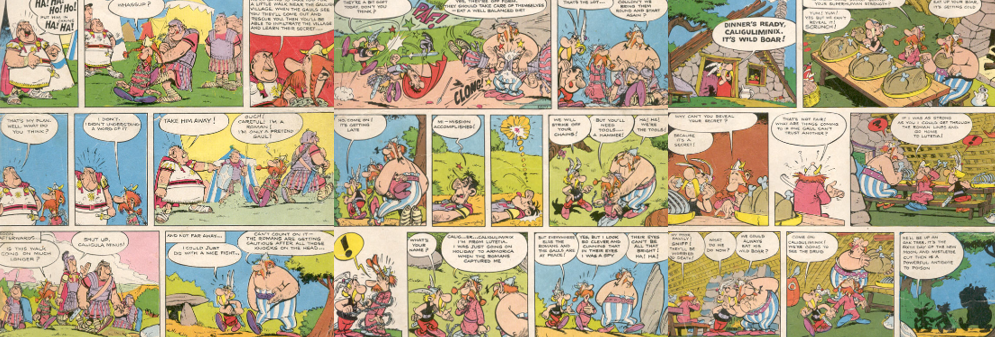
If you’ve ever read an Asterix book or watched one of the movies (or even played one of the games), you’ll know there’s always a little introduction piece that sets the scene for the story and the world of these books. Asterix the Gaul is, naturally, the first instance of that and expands upon this paragraph of text in its first few panels. The year is 50 B.C. and ancient France (known as “Gaul”) has been conquered by the Romans. In the face of such overwhelming military might, Gaulish chiefs like the legendary Vercingetorix (literally) lay their arms at the feet of the power-hungry Julius Caesar and “peace” reigns throughout conquered Gaul. However, while the Romans have laid claim to the entirety of ancient France, one small village of indomitable Gauls refuses to surrender. Baffled by the Gaul’s stubborn nature, Caesar sets up four Roman camps (Aquarium, Totorum, Laudanium, and Compendium) to surround the village and orders repeated attacks, only for his troops to be bested time and again by brave warriors such as our titular hero, Asterix, and his hulking friend, Obelix. Over a dinner of piping hot roast boar, Asterix laughs off the Roman threat, which he and his fellows constantly repel thanks to the magic potion brewed by their druid, the venerable Getafix. As luck would have it, Asterix is due his daily dose of the potion so he and Obelix pay Getafix a visit. Getafix cooks up a batch of the magic potion, whose recipe is a closely guarded secret amongst his kind and one sip of which bestows incredible superhuman strength, but only for a short time. Since he fell into a cauldron of potion as a baby and drank the entire batch, Obelix is permanently empowered and is denied any potion out of fear for his safety, though he believes the druid is treating him unfairly.

Crismus Bonus sends Caligula Minus in to discover the Gauls’ secret.

At Compendium, the camp centurion, Crismus Bonus, is enraged that four of his soldiers could be so easily bested by one measly Gaul and vows to discover the secret of their superhuman strength. However, the Gauls strength is so feared that volunteers to infiltrate their village are scarce. Thus, Crismus orders his troops to play musical chairs to decide on a volunteer, and poor Caligula Minus loses out. Since his only options are to act as a spy or be roasted alive, Caligula reluctantly agrees to be disguised as a Gaul, much to the amusement of his peers, and paraded through the forest as bait for the Gauls. Luckily, Asterix and Obelix just so happen to be strolling through the forest looking for a fight. They don’t suspect a thing and make short work of Caligula’s “captors”, rescuing him and bringing him back to their village to keep him safe, where he gives his name as “Caliguliminix”. Caligula is astounded by the Gaul’s village, where everyone (even the children) is armed and ready to fend off Roman attacks. He’s welcomed by the village chief, Vitalstatistix, and amazed to see that the Gauls use their bare hands to temper metal, deliver menhirs, and lug around giant carts full of felled trees. While eating with Asterix and Obelix, Caligula enquires about the secret to their strength and produces crocodile tears when Asterix initially refuses to share their secret. Deciding to help their fellow “Gaul”, the duo take him to Getafix, who’s equally convinced to help when Asterix and Obelix guilt-trip him into it to get Caliguliminix back “home” to his “family”.

Asterix arrives to rescue Getafix but decides to stick around and have some fun with the Romans.

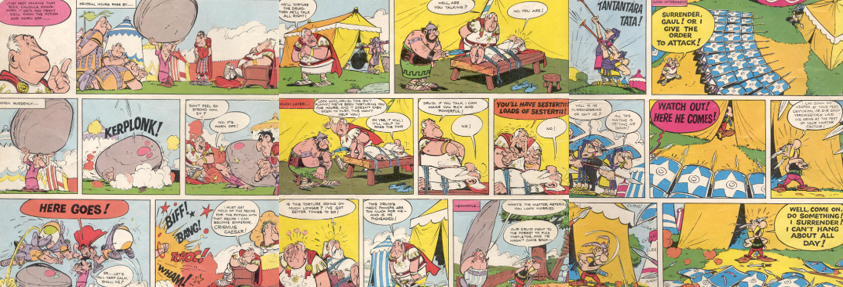
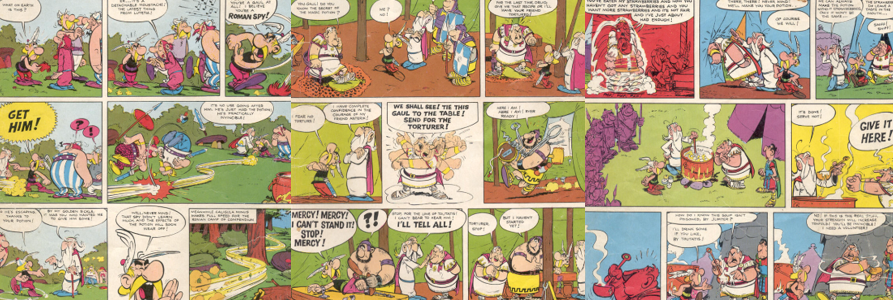
Though initially uncertain of the potion’s effect, Caligula revels in his ability to manhandle a giant boulder, but learns the hard way that the potion only makes one super strong, not invulnerable. His cover is quickly blown when his fake moustache is pulled off during a traditional Gaulish dance and he blasts back to Compendium at super speed before the Gauls can stop him. Back at Compendium, Caligula excitedly reveals the secret to Crismus and demonstrates the potion’s power, first by beating up a bunch of soldiers and then holding a large boulder over his head. Despite the Gauls stating that the potion’s effects are only temporary, it takes “several hours” before Caligula returns to normal. As the soldiers take their revenge for their earlier beating, Crismus dreams of stealing the potion for himself to usurp Caesar and orders his troops to kidnap Getafix when he goes into the woods for ingredients. When Getafix refuses to divulge his secret, Crismus straps him to a table and subjects him to the horrific torture of…having his feet tickled by a feather! Yet, the druid holds his resolve, even when Crismus tries to bribe him with “Sestertii”, the currency of the era. Concerned about Getafix’s welfare, Asterix searches the forest and comes across an ox dealer with a quandary: if he sells his oxen, he won’t be able to pull his cart. He’s so grateful to Asterix for providing him with a solution (selling his cart and keeping the oxen) that he gladly gives the Gaul a lift to Compendium after revealing he saw a druid being taken there in chains. After sneaking through the camp, Asterix first overhears Crismus’ plan to overthrow Caeser with the aid of his number two, Marcus Giantonicus (though the two secretly plan to betray each other), and then discovers Getafix. Rather than rescue the druid, though, Asterix decides to have some fun with the Romans and promptly surrenders to them, winding up in chains alongside his friend.

The Gauls make fools of the Romans and are set free by Caesar’s grace.

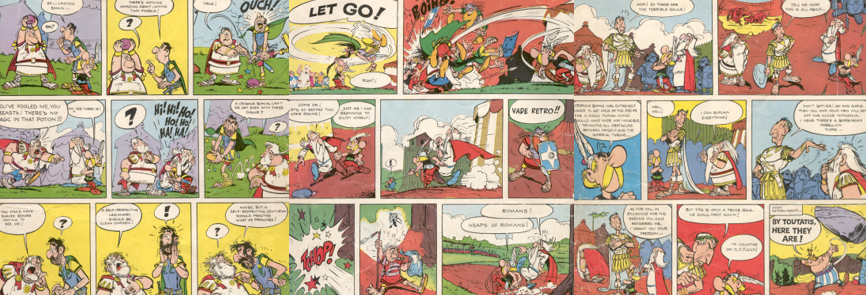
When Asterix refuses to speak, Crismus brings in his overly enthusiastic torturer and prepares to loosen Getafix’s tongue by having him witness his friend’s suffering. However, when Asterix comically pleads for mercy at the torturer’s merest touch, Getafix finally caves and requests to go into the forest for ingredients. After making fools of his escort, Getafix insists that he needs strawberries to complete the potion. Despite them being out of season, Crismus orders his troops to go find some and, days later, one soldier returns with a tiny (and expensive) punnet…only for Asterix and Getafix to scoff the lot and demand more! Driven to tears by frustration and rage, Crismus is ecstatic when Getafix whips up the potion regardless and forces the ox dealer to try it in case it’s poisonous. Since the Romans are reluctant to take another bashing, Asterix volunteers to test the man’s newfound strength and summarily drops to the ground as though the “sky had fallen on [his] head”. The ox dealer leaves, dreaming of profiting from his great strength, and Crismus and his troops greedily devour the potion, convinced of its potency, only to find it’s caused the hair of their heads and faces to grow uncontrollably! The duo tease Crismus with their lackadaisical attitude and hair-related puns, but promise to make an antidote. After another amusing trip to the forest, Getafix makes a big cauldron to cure the hair problem and a small pot of real magic potion for Asterix. Once they’ve had their antidote, Crismus orders his troops to attack, only for Marcus to summarily manhandled. Although the Gauls find themselves surrounded when they leave the camp and Crismus delights in his pending victory, they’re all stunned when Julius Caesar himself shows up for an update. After learning of Crismus’ ambitions, Caesar banishes him to out Mongolia and allows the Gauls to go free, though both promise to continue their vendetta.

The Summary:
As big a fan of Asterix as I am, I have to say that I’ve never been a big fan of this book, or the character’s early tales. The artwork is a little off; it’s less cartoony and more “sketchy” than in later stories, and the characters aren’t quite themselves yet. The most obvious example is Obelix, who’s less of a simple-minded, brutish oaf and more a morose bystander who doesn’t get much of anything to do here. The same is true for all the villagers who aren’t Asterix and Getafix; the only other one who stands out is Cacofonix, whose musical arts aren’t appreciated (unless they want to dance and then they’re all for it). I don’t say this to knock Asterix the Gaul; it’s the first story so obviously I don’t expect every character to be fully fleshed out and it’s true most of them become one-note caricatures as the books continue on, it’s just a little jarring when compared to later stories. Still, much of the patented Asterix humour is here; that means puns aplenty, especially in the characters’ names, and some fun fisticuffs. However, there’s a lot of padding here: the characters visit Getafix and pop into the forest more times than the story needs, repeating a lot of the same gags (like Getafix pricking himself on his sickle) and demonstrating the potion’s abilities in scenes that not only read the same, but look the same, too. It is essential, of course, for showcasing the effects of the magic potion to the Romans and the reader, but I do wonder if a bit of visual variety wouldn’t have worked better than seeing characters lift rocks over their heads all the time (though I do admit that the payoff – “I’ve done it! I’m a superman!” – always makes me giggle).

Though not infallible, Asterix is presented as a capable and shrewd warrior.

Much of the story is focused, fittingly, around establishing Asterix as a character. Not only is he a capable fighter, but he’s shown to be cunning, mischievous, and intelligent, too. He could’ve easily rescued Getafix and stormed out of Compendium, but he chose to stick around and have some fun with the bungling Romans, making fools out of them with needless tasks, mockery, and Getafix’s hair growth potion. He’s shown to be shrewd enough to sneak into the camp and adaptable enough to tattle on Crismus to Caesar, thereby ensuring his and Getafix’s safe return to the village and the first of many feasts. However, he’s not perfect; he’s as fooled as anyone else by Caligula’s Gaulish disguise and decides to help his fellow “Gaul” despite the village keeping their potion a closely guarded secret. While this doesn’t really result in any immediate consequences for the village beyond the Romans discovering the source of their strength is a potion and thus targeting Getafix, it does show that even the insightful Asterix makes mistakes, which the druid calls him out on. While I much prefer these stories to have a bit more Roman bashing, there’s some fun to be had in Asterix the Gaul. I liked the wild strawberry chase Asterix sends them on and him and Getafix messing with Crismus, and the book nicely lays the foundation for what would become long-running gags for the next seventy-odd years and, while I prefer other Asterix stories, this is still a highly recommended read.

My Rating:

Rating: 3 out of 5.

Pretty Good

What did you think to Asterix’s first story? Did you like the less cartoony art style of his earlier adventures? Were you disappointed that Obelix and the others didn’t have more to do or did you like the way the story established Asterix’s character traits? Which of the puns was your favourite? How are you celebrating Asterix today and what are your favourite books or moments of his? Whatever your thoughts on Asterix, please leave a comment below  and go check out my other Asterix content!

Game Corner [Asterix Anniversary]: Asterix and the Great Rescue (Mega Drive)


Asterix the Gaul (and his best friend Obelix) first debuted on 29 October 1959 as a serial in the French/Belgium magazine Pilote. Since then, the plucky Gauls have gone on to have many adventures in comic books, videogames, and feature-length productions and Asterix himself has become a popular and enduring character in his native France and beyond as his stories have been translated into over a hundred languages across the world.


Released: November 1993
Developer: Core Design
Also Available For: Game Gear and Master System

The Background:
It didn’t take very long at all for the French comic book series Asterix to make the jump from the comics and into other media; the first Asterix book was adapted into a feature-length animation in 1967 and both animated and live-action Asterix films have been pretty consistent over the years. Similarly, there have been a number of Asterix videogames; the first of these was released for the Atari 2600 in 1983 and one of my absolute favourites was Konami’s arcade game from 1992. Growing up, I had a lot of fun playing Astérix (SEGA, 1991) on the Master System, a colourful and entertaining little platformer that I’ve yet to finish ever thirty years later, and figured that the Mega Drive title would be a good investment. Asterix and the Great Rescue was developed by Core Design, the team behind the classic SEGA title Chuck Rock (Core Design, 1991), and was met with mixed reviews upon release. With today also being the birthday of the SEGA Mega Drive, I figured it was the perfect time to put this game in and see how it holds up compared to its 8-bit counterpart.

The Plot:
The year is 50 BC. Gaul is entirely occupied by the Romans. Well, not entirely… One small village of indomitable Gauls still holds out against the invaders and life is not easy for the Roman legionnaires thanks to the Gauls’ magic potion, which gives them superhuman strength. Like in many Asterix videogames, the Romans kidnap the village druid, Getafix, to stunt the village’s supply of magic potion so their bravest warriors, Asterix and Obelix, set out to rescue Getafix and teach those crazy Romans a lesson.

Gameplay:
Asterix and the Great Rescue is a 2D, sidescrolling action platformer in which one player gets to pick between Asterix and Obelix before each journey across six Levels to rescue the druid Getafix from the Romans. Disappointingly, unlike in the majority of Asterix videogames, there’s very little actual difference between Asterix and Obelix; both characters move at the same plodding speed, have the same amount of health, jump at the same height, and have exactly the same special abilities. Indeed, the only discernable difference I could identify is that Obelix’s hit box is larger (due to his characteristic girth) but it’s not like Asterix’s is that much smaller. You can customise the game’s controls from the main “Options” menu but the default setup is functional as is. Players can jump with A, attack with a punch with B, and use a “Special Weapon” with C. Pressing up on the directional pad (D-pad) in conjunction with C allows you to pick from four different Special Weapons while pressing down on the D-pad allows you to crouch and crawl to avoid incoming projectiles.

Rooms can be short but also painfully frustrating at times.

Sadly, considering the characters’ and comics’ focus on madcap fighting, combat is extremely disappointing and limited here; there are no jumping attacks, your punches have a pathetically short range, and the only additional combat option available to you is that you can hold down B to perform a series of rapid punches while moving to take out groups of enemies faster. Asterix and the Great Rescue is constructed in a strangely confusing way; there are six Levels, each split into four “Huts” and each Hut has up to three “Rooms”. The wording is very confusing as you’re not necessarily inside of a hut or a room as you might think but what it actually boils down to is six levels, four worlds, and up to four zones in each world and I guess the developers thought it would be “fun” to supplant this usual videogame terminology with terms from the comic book. While six Levels might not seem a lot, the game is actually surprisingly long; the Rooms are generally short sprints asking little more from you than to travel to the right, bashing enemies, and reaching the goal (“magic elixir” for Asterix and a roast boar for Obelix) but you’ll also be tasked with finding keys, performing some tricky jumps, or navigating some confusing areas.

Your biggest obstacles are the time limit, hit boxes, and obtuse nature of the gameplay.

Your greatest enemy in each Room will be the time limit; every Room has a time limit that is anywhere from less than a minute to two minutes of game time and, if you fail to reach the goal before the time runs out, you’ll lose a life and have to restart from the beginning of the Room. There’s very little room for error in some of these Rooms and, if you mess up or take too long, then that’s just too damn bad as there are no checkpoints. Thankfully, you can acquire extra lives by earning enough points or stumbling upon a beating heart pickup. You start each game with three lives and three credits and, when you lose all of your lives, you’ll be given the option to cash in a credit and continue from the start of the last Room you played but, if you use up your credits, it’s game over. After clearing each Level, you get a password to jump to later in the game, which is helpful, but the damage you sustain throughout the game carries over to each Room, which is extremely frustrating, and you’ll find an abundance of bottomless pits as you progress, which mean instant death.

Gameplay is very inconsistent, being ridiculously easy one minute and frustratingly difficult the next.

Gameplay in Asterix and the Great Rescue is extremely inconsistent and frustrating; generally you just have to fight your way to the goal but other times you have to dodge bursts of fire, press switches to progress further, dodge falling blocks or incoming boulders, or hop around moving or temporary platforms to get through the Room. This can be extremely frustrating as some enemies are too small to hit, others take multiple hits to defeat, and it’s not always clear what you have to do in order to progress; all too often, platforms will suddenly drop underneath you, animals or bridges will collapse after carrying you across gaps, and you’ll need pixel-perfect timing to reach far away platforms. You’ll also need to hop across lava pits, make a number of blind jumps, contend with murky water that slows you down, teleport across Rooms using special statues, or use a series of bubbles, springs, and catapults to travel higher and further. Spikes, thorns, spiked balls, flames, and rotating platforms all compound matters, making avoiding damage extremely difficult even when playing on “Easy” mode, where enemies are less frequent and aggressive. Thankfully, there’s no knockback from taking damage but my experience was that my character would simply keel over and die more often than not since their hit box is so big that it’s extremely difficult to avoid being hit (especially when you get dropped literally right into the path of oncoming enemies in some Rooms).

Graphics and Sound:
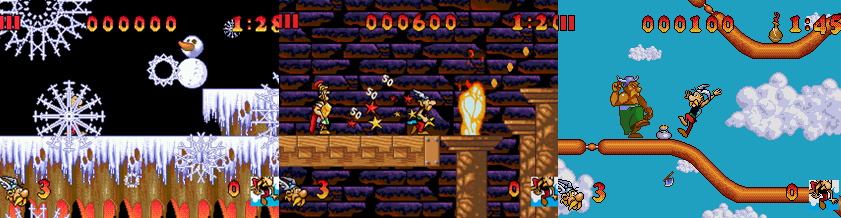
Asterix and the Great Rescue has a lot of promise but doesn’t quite manage to deliver in terms of its graphics. Sprites are colourful and faithful to the comics, for example, but not especially big or full of animation frames; there are no idle animations, for instance, and neither Asterix, Obelix, or their enemies exude the same charming humour as they do in the comics or even the Master System game. Environments can similarly be very hit and miss; the Gaulish village is beautiful to behold but little more than a tutorial to learn the basic controls. Occasionally, you’ll see familiar Asterix characters like Unhygienix in the background but he’s wildly out of proportion compared to the avatar’s sprites. Other times, the background will be quite sparse (a simple night sky) or somewhat detailed but then it’ll also look really crude (especially in the Forest and Rome levels). There are a lot of different environments to explore, however. You’ll travel from the Gauls’ village, cross the dock, enter a Roman camp, explore a dense forest and jump through the treetops and past gigantic spider’s webs, battle through dungeons in Germany, hop across clouds and birds and wander around stages made out of Frankfurters, pass through an ice Room (with some impressive snowflake effects falling over the screen) on the way to a Roman galley, and finally jump and fight through water ruins, an ornate garden, a lavish banquet hall, and the coliseum in Rome.

Levels are quite varied and can be quite bit but they’re hampered by the constant ticking clock.

All of these are locations that will be familiar to any Asterix fan but, for most videogame players, will seem very by-the-numbers for the average platformer and full of clichés such as weighted switches, temporary platforms, and rising or moving platforms. A lot of the time it can be difficult to tell where you need to go as you can sometimes pass through certain walls but not others, despite them both looking the same, and you’ll need to experiment with your Special Weapons in order to progress (if you have enough time left to figure that out, of course). I did experience a bit of slow down at times, which is quite ludicrous as there’s rarely a lot happening on screen, and some graphical hiccups here and there. The music is quite jazzy, however; it’s not especially varied but it’s decent enough, and certainly far better than the game’s sound effects. The game’s story is told through text and a recreation of the map of the invaded Gaul, all of which will be more than familiar to any Asterix reader. Though the game’s title screen leaves a lot to be desire, each Level is proceeded by a pretty nice still picture of the famous duo but you’ll have to wait for the final screen on the game for anything resembling any kind of impressive sprite art and even then it’s basically just a partially animated still.

Enemies and Bosses:
As any self-respecting Asterix fan might expect, your primary enemies in this game will be the Romans. Roman soldiers charge at you with spears, march along in groups wielding swords, toss spears at you from above, and gold-armoured Centurions will also show up to try and skewer you as you progress. These are all pulled straight from the comics and even include Roman’s hiding in tree disguises; most of them will go down in just one hit but the more rotund and golden Romans will take two to three hits. You’ll also have to content with woodland critters scurrying and flying your way, axe-throwing Germans, German maidens who explode when you get too near, mermaids and sea creatures, archers whose arrows stay on screen way too long, Romans trying to jab you from beneath with their swords, spiders and other bugs, dogs, and even hatchlings trying to take a bit out of your ass. By far the worst obstacle is the mule-kicking horses who will send you flying clear across the screen; I swear you need as much luck as you do skill to time your jumps past those assholes!

It makes sense to be fighting Romans but Cacofonix is a strange choice for a boss

Each Level culminates in a boss battle, the first of which is, oddly, against the village bard Cacofonix (I know he’s an annoyance in the comics but to make him a boss seems a bit extreme). Cacofonix stands in one spot atop his tree hut and spits musical notes at you from his lyre and can only be damaged by hopping on top of one of village chief Vitalstatistix’s shield bearers and tossing rotten fish at him. It takes a lot of hits to finally put the bard down so, again, your biggest enemy here is the time limit as it’s pretty easy to avoid his musical notes by standing in the right spots. The second boss fight sees a Roman encampment firing rocks at you; these must be hit back over and over again until the camp finally surrenders to your might. After this, a Roman soldier awaits you on a log and will instantly force you to your death unless you mash A, B, and right as fast as possible to knock him off instead but, of course, the game never tells you any of this so it is easy to simply fail time and time again.

After besting many enemies, the last two Levels culminate in battles against large, voracious animals!

The final Room of Germany has you desperately outracing a rising sea of red and taking out enemies as you make your way up to a goal which, again, is more a test of your skill and patience with the game’s controls than any sort of actual combat. On the Roman Galley, you’ll be attacked by a gigantic alligator (or is it a crocodile?); simply hop up onto the platforms to avoid the creature’s snapping jaws and then jump down to smack him in the head but watch out for his massive hit box clipping your avatar. The finale sees Julius Caesar set two vicious tigers against you in the Coliseum; these will randomly pop in and out of archways under Caesar’s view box and must be smacked whenever they appear and hopped over to avoid damage. Like all of the game’s bosses, though, this is simply a test of patience and landing hits before you get a time out and the bosses are, by far, the least challenging aspect of the game.

Power-Ups and Bonuses:
There are numerous items to pick up and collect in Asterix and the Great Rescue; you’ll find gold coins, bags of coins, and Roman helmets, all of which will add to your score and bring you one step closer to an extra life. You can also replenish your health either partially or fully by collecting pieces of roast chicken or a chalice, respectively, and you can grab a sickle for a brief period of invincibility or a bomb to enter “Mega Attitude Mode”, which increases your speed and strength so you can blast through enemies and obstacles.

Special Weapons are useful but limited and you won’t always have to to backtrack for more ammo.

The main thing to keep an eye out for, though, are the gourds that you’ll find scattered throughout each Room. These will give you ammo for your Special Weapons and will respawn when you move the screen a little bit. Your Special Weapons are essential to your progress but it’s not always abundantly clear where or when you have to use them (such as the first screen of Rome where you’re seemingly trapped but actually have to blast a wall that doesn’t appear to be destructible). The Fireball adds a ranged attack to your arsenal and can be used to destroy certain blocks, hit targets, or deactivate certain traps; the Ice Block (which is actually a cloud) creates a temporary platform to allow you to reach higher areas or cross spike or lava pits safely (if you can get the angle of the throw right…); the Disguise covers you in a series of vines and flowers so that enemies will walk right past you; and Levitation allows you to (chunkily) float about using the D-pad to avoid spikes and reach higher or further areas. 

Additional Features:
There’s not really much else on offer in Asterix and the Great Rescue beyond the single-player experience; there’s no two-player simultaneous play, meaning that the only way for two players to play is to take it in turns, and no real benefit to playing as either of the two main characters. You can tackle the game on a harder difficulty setting and try to get your name at the top of the high score table but the game is so tough anyway that I wouldn’t recommend it. There aren’t even any decent cheats for the game as the password system is simply for jumping to the game’s levels so you’ll probably be done with this game after one playthrough or session.

The Summary:
Boy, was I disappointed with Asterix and the Great Rescue. Once again, I as met with a 16-bit iteration of a videogame that pales in comparison to its bright, humourous, and fun 8-bit counterpart; you know it’s bad when even the Master System’s game gives Asterix and Obelix different abilities and playstyles and has more gameplay variety. Honestly, I can’t even say that this game looks good as, compared to other games of a similar genre that came out at the same time, Asterix and the Great Rescue looks and sounds like 1989 Mega Drive title rather than a 1993 release. Clunky, awkward controls, a rubbish combat system, confusing and frustrating gameplay, and just a complete lack of entertainment and engagement make Asterix and the Great Rescue an extremely disappointing title that saves itself from a one-star review simply because I am a big fan of the comics and characters but, honestly, I wouldn’t recommend anyone actually bother playing this letdown of a game.

My Rating:

Rating: 2 out of 5.

Could Be Better

What did you think to Asterix and the Great Rescue? How do you think it compares to other Asterix videogames and games of its genre? Did you enjoy the title and feel I’m being too harsh on it or do you agree that it was a frustrating and disappointing mess of a game? Which character, book, or movie is your favourite? How are you celebrating Asterix and Obelix’s anniversary, and the release of the Mega Drive, this year? Whatever your thoughts on Asterix, feel free to leave a comment below or on my social media.

Game Corner: Asterix & Obelix: Slap Them All! (Xbox Series X)

Released: 25 November 2021
Developer: Mr Nutz Studio
Also Available For: Nintendo Switch, PC, PlayStation 4, PlayStation 5, Xbox One, Xbox Series S

The Background:
Less than ten years after debuting in the pages of Pilote, the first Asterix book was adapted into a feature-length animation and animated and live-action Asterix films have been pretty consistent ever since. Similarly, we’ve seen a number of Asterix videogames, with the first being released for the Atari 2600 in 1983 and a large part of my childhood spent playing Astérix (SEGA, 1991) on the Master System as opposed to its flawed Mega Drive counterpart. Although Asterix dabbled in all sorts of genres, from real-time strategies to action/platformers and mini game collections, perhaps the most suitable format has always been the classic sidescrolling beat-‘em-up. Sadly, while Konami’s 1992 arcade title looked and played really well, it was unnecessarily restrictive, and was never ported to home console ports, a flaw this spiritual sequel somewhat rectified despite physical versions of the game being difficult to come by. Sporting hand-drawn graphics and gameplay specifically designed to evoke the arcade games of old and the original comics, Asterix & Obelix: Slap Them All! was met with generally positive reviews, which praised the visual style and fidelity to the source material. Though the tedious combat and lack of content was criticised despite the short, sharp fun offered by the game’s emphasis on action, it still received a sequel.

The Plot:
The year is 50 BC. Gaul is entirely occupied by the Romans save for one village of indomitable Gauls. With the Romans expanding their campaign across the ancient world, Asterix and Obelix, embark on a globe-trotting adventure to fight them off wherever they may be.

Gameplay:
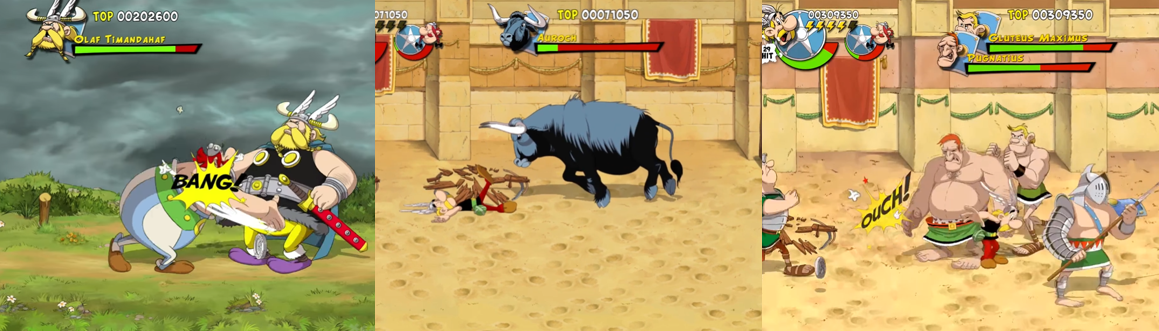
Asterix & Obelix: Slap Them All! is a 2D, sidescrolling beat-‘em-up that emulates the classic arcade brawlers of yesteryear. Players can choose to go it alone as either Asterix or Obelix, or team up with a friend for some couch co-op action, which sees them bashing Romans and other baddies across the ancient world in six chapters (referred to as “Acts”) Fundamentally, Asterix and Obelix have the same range of motion and attack options available to them, but there are a couple of differences. Both can jump with A and attack enemies with X; successive presses of X will see each of them pull off a combo, building up your “Slap” counter and allowing you to amass greater and greater combo strings, and you can perform a jumping attack by pressing X in mid-air (though this can be a little inaccurate against smaller foes). You can block incoming attacks with the Right Bumper, dash across the screen and clear away enemies by double tapping the direction you’re facing, press B to pick up health items or grab enemies, and Y pulls off a special attack. This is one area where the characters differ: if you hold Y as Asterix, he’ll pull off a spinning top-like attack for a bit and pressing Y in mid-air will see him performing a jumping variation of this move. Obelix, however, can pull off a slower, far more powerful combo of punches by pressing Y and stun enemies with a huge butt stomp with A and Y. All of these special attacks, blocking, and even dashing consume energy, represented by lightning bolts under your health meter. Energy automatically refills as you attack and defeat enemies, however, but you still need to be careful about how and when you pull off your special attacks. Pressing up and Y or down and Y will see both characters uppercut their enemies or slam the ground, respectively, and each has different options for grabbing and throwing: pressing A and Y together allows Asterix to swing enemies over his head and tapping B sees him fire them across the screen, while Obelix can tap X to slap them about, tap Y to slam them on the ground, or launch them across the screen with B.

Pummel enemies, race through barricades, and smash everything in this mindless brawler.

You can switch between Asterix and Obelix at any time with the Left Bumper, however there is a short delay as each character performs an intro animation, which can leave you vulnerable to attack, and there’s distinct differences between the two: Asterix is smaller, more agile, and a little weaker whereas Obelix is stronger but slower and a far bigger target. Those playing with a friend will be disappointed to learn that there are no team moves in this game, though there’s no friendly fire option either; the game also lacks a timer, but the life system is a little wonky. The mission ends if either Asterix or Obelix’s health is drained, meaning you’ll need to restart from the beginning of the stage; there are no checkpoints, no revive system, and you can’t simply continue on as the other character, meaning it’s best to play through the majority of the stage as one and switch to the other when it’s safe, making sure to swap to whoever needs any health pick-ups you find. Pretty much the whole game is a simple beat-‘em-up; you start on the left side of the screen and travel to the right, bashing any enemies that cross your path. It quickly becomes very tedious, especially as the game’s Acts are proceeded by brief interludes where you’re in the forest, storming a Roman camp, or battling pirates on their ship in environments that change very little as the game progresses. Occasionally, you can explore other paths for goodies and barricades, rocks, or catapults to smash for extra points; you’re also tasked with climbing ladders, cliff faces, and vines as well as smashing down doors on a handful of missions. Gameplay is broken up a little bit by a couple of different racing sections; one has you rapidly tapping A to beat your friend or Roman gladiator Gluteus Maximus in a foot race, and the other sees you holding X as you automatically race through the forest hunting boar and smashing through barricades, barrels, and Romans. One mission gives you sixty seconds to destroy all the barrels in the pirates’ cargo hold; you get another timed mission in Act VI, where you’re given one minute and forty seconds to destroy all the catapults and barrels across the Roman landscape. Finally, you’ll be tasked with fighting your way to, into, and through various Roman camps between Acts; these mostly all amount to the same thing, however, though there are a couple of occasions where you’re placed on a static screen and asked to fend off waves of enemies as they try to storm the village or other allied settlement.

Graphics and Sound:  
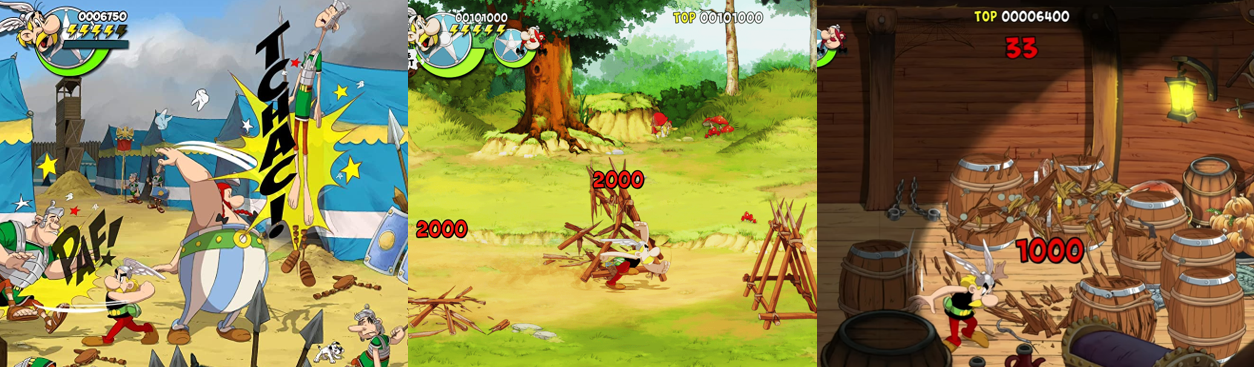
If there’s one thing Asterix & Obelix: Slap Them All! has going for it, it’s the game’s graphics; sporting a beautiful hand drawn style that perfectly captures the spirit of the comic books and apes the look of the feature-length animations, the game is lovely to look at. Asterix and Obelix are full of life; each has idle animations, different walk cycles, and a range of reactions and animations when attacking or being hurt. They’ll both drop a few quips and lines here and there as you plough through enemies (oddly, they seem to have British accents, which is strangely common in Asterix adaptations), though voice acting is restricted to a few clips and a very brief bit of narration between Acts. The game’s music is equally forgettable; there’s some jaunty, fitting tunes but nothing massively spectacular, which is a shame as it would’ve been nice to have some memorable music to hum along to as you’re bashing through countless enemies. Comic book sound effects punctuate the action, which absolutely nails the slapstick violence of the source material; you can uppercut Romans out of their sandals with a loud PAF!, charge through them at superhuman speeds and send their shields flying, and some enemies have fun defeat animations where their weapons break over their heads or their pants fall down. Just about the only complaint I have about the sprites is that they get very repetitive very quickly; there are a few different types of enemies, but you’ll have encountered the majority of them within the first few missions and the game doesn’t always take advantage of its globe-trotting narrative to deliver new enemy types (there are no unique enemies in Corisa or Egypt, for example).

As beautiful as the game is, environments and enemies repeat far too often, offering little visual variety.

This is true of the environments as well; while they’re equally beautifully and are also ripped straight from the source material, there’s only so many times you can fight through the same forest, ship, and beach before things start to get a little tedious. In this regard, the original arcade title does a far better job of keeping things visually interesting because it simply dropped you in a new area that altered as you fought through it; here, the Acts are broken down into missions, so you have to traverse a forest, then cross a stone pathway or bridge, then fight on a ship, then across a beach, then maybe up some cliffs (which may or may not have some mist effects), and into a Roman camp in practically every single mission. It smacks of padding, unfortunately, and it takes too long for the game to mix things up by spiriting you away to Egypt, where you’ll fight through pyramid construction sites and dark tombs. To be fair, some of these areas do get a bit of a visual change up; you’ll battle on different ships and different times of day, forests and rural landscapes are eventually interspersed with Roman trappings like roads, villas, and columns, and you’ll find yourself fighting through jails and in the sands of the arena in due time…it just takes a while to get there. The game’s cutscenes are a mixture of static images and written dialogue, animated sequences with a bit of voice acting, and motion comic-like sequences; they’re okay and they tell truncated versions of some classic Asterix stories, but I think I would’ve preferred more sprite-based cutscenes just so we could’ve had a little more visual variety in the onscreen characters.

Enemies and Bosses:
As you might expect from an Asterix videogame, your primary enemies will be the Roman forces that have swept across ancient Europe. Romans came in all shapes and sizes, from smaller legionnaires to plumper ones with swords and gaunt variants who annoyingly toss spears at you from a distance or perform a melee attack up close. Eventually, the Romans try and get a little clever and hide in bushes and tree stumps, jabbing at you with swords and spears from each, and bring in a bigger brute who can block your attacks and cannot be thrown but their greatest asset is their sheer numbers. Asterix & Obelix: Slap Them All! certainly doesn’t shy away from filling the screen with enemies for you to plough through and, if you’re not quick enough, it’s easy for your enemies to whittle your health down and force a restart. I was surprised, and disappointed, that the game didn’t include the chunkier gold-armoured Roman commander, any Roman formations, or enemies on horseback (though you do have to dodge speeding chariots and bulls on a couple of occasions). Other enemies include a persistent gang of pirates and brigands; the former sport more elaborate weapons, such as axes and nunchakus, while the latter are capable of charging across the screen with their fists thrashing in an unblockable attack that also damages other enemies. Much later into the game, you’ll also encounter armoured and armed gladiators in the game’s fighting arenas who also race across the screen and attack you with tridents, and even lions, though you’ll only encounter the hulking Normans in Act II and they all unfortunately look the same.

Sadly, you’ll be facing these same bosses over and over, with little to differentiate them.

Bosses are few and far between and easily one of the game’s biggest let downs as the game reuses and recycles five of the bosses over and over, with little variation between them. The first boss you’ll fight is a Roman Centurion who pretty much sets the standard for all of the game’s bosses; they’re too big to grab or throw, often block your attacks, sport a health bar, and are accompanied by endless reinforcements, the remainder of which you must take out to complete the mission. The Centurion is fought five times throughout the game, usually inside of or outside of the Roman camps, with Act III and Act IV forcing you to battle two at once, but again I would’ve liked to see them be more visually distinct. Additionally, they’re not too difficult to defeat; they attack with a sword combo and can defend against your attacks, but they’re a pretty big target and easy to just spam a combo on over and over until they’re bested. You’ll also fight the pirate captain, Redbeard, a bunch of times. He’s a little bit more formidable as he performs a wake-up attack every time you knock him down, so you need to remember to jump out of the way after you’ve sent him flying. This fight is changed up a little on two occasions; one where there isn’t any health pick-ups on the ship and another where you fight him on a beach instead of that same damn ship. Another boss you’ll encounter a couple of times is Gluteus Maximus; this proud gladiator challenges you to a race on two occasions and then engages you in hand-to-hand combat alongside other bosses on two others. In a fist fight, Gluteus is actually pretty tough; he has a good block and a fast punching combo, so it’s better to use jump attacks, your special attacks, and stay on the move when fighting him.

Unique bosses are in short supply as the game prefers to just throw more of the same at you.

Thankfully, there are some visually unique bosses to fight, though you can pretty much use the same tactics you use against all of the others to best them. Olaf Timandahaf might look intimidating but he’s no different from the Centurion except he uses a sword (which can get stuck in the ground) and performs a rhino-like charge. Similarly, the Auroch you fight in Act III is probably the easiest boss battle as there aren’t any other enemies to distract you and you simply jump over it when it charges and pummel it at every opportunity. Pugnatius, a man mountain of a Roman enforcer, pops ups in Act V; though he sports a clubbing punch and a double-handed clap attack, he’s very slow and a massive target so he only really becomes a threat when he teams up with Gluteus as the final bosses of the game. Before you reach that point, though, you need to fight through a whole bunch of gladiators, lions, brutish Romans, and the sadly underutilised Insalubrius, a whip-wielding gladiator who pummels you with punches if you get too close. Pugnatius and Gluteus form quite the formidable duo for the finale, especially as they’re backed up by other large enemies, but it’s not a massive stretch of your skill to isolate one or even attack both with a combo and I was a little disappointed that there wasn’t a more visually distinct enemy to face in the end. The lack of a chariot race and other recognisable Asterix baddies bad the game’s bosses needlessly repetitive; I don’t expect to go one-on-one with Julius Caesar, but I was a little disappointed that the game didn’t crib more enemy types from the various Asterix comic books.

Power-Ups and Bonuses:
As you battle through the game’s environments, you’ll come across a number of barrels that can be smashed apart to yield coins; coins and bags of sestertii also drop from enemies and all add to your score, though there’s very little incentive to collect these beyond earning an Achievement. Smashing barrels also uncovers apples, legs of meat, and roast boar to refill your health but there are no other power-ups to find here. There’s no invincibility, no allies to call in, no temporary buffs to your strength or defence, and no weapons to pick up. Obelix doesn’t even use his trademark menhir and the only way you’ll drink magic potion is by switching to Asterix, who automatically swigs from a gourd before a fight.

Additional Features:
There are thirty Achievements up for grabs here, with six automatically being awarded after clearing each Act and four given for besting the game on the different difficulty settings. There are four difficulty settings (Easy, Medium, Hard, and Hardest), but you’ll be swamped by enemies on even the “Medium” difficulty mode, which makes for a very chaotic an action-packed experience. If you’re struggling, the game allows you to lower the difficulty whenever you like, but the majority of its Achievements are earned by playing on at least “Medium”. You’ll get an Achievement for clearing a mission with each character, performing all of the duo’s attacks in a single mission, and for starting a mission in co-op (but, oddly, not for clearing the game in co-op). If you get the combo counter over six-hundred you’ll snag some G too; other Achievements pop from landing forty hits with Asterix’s spinning attack, destroying objects within a time limit, knocking over or uppercutting a certain number of enemies, and clearing a mission without being hit. Mostly, they’re all pretty do-able but, again, it feels like there could’ve been more done here, such as scattering pick-ups throughout the game or allowing you to spend your coins on concept art or alternate costumes or something. Instead, the only think you unlock by beating the game’s story is a freeplay mode that lets you replay any mission; there’s no gallery, no concept art, and no other unlockables on offer. This is a shame as a boss rush, some kind of endless arena mode, or even a versus mode where you replay the races or fight with a friend would’ve been nice but the only incentive to replay the game is to beat your high score or clear the game on the harder difficulty settings.

The Summary:
I was really excited, and surprised, when I learned of Asterix & Obelix: Slap Them All!, which just kind of came out of nowhere as I hadn’t heard anything about it or seen any advertising or anything. As a massive fan of the franchise, the arcade game, and classic arcade beat-‘em-ups, I was equally taken by the game’s artistic style and direction. Certainly, this is probably the most faithful Asterix game I’ve ever played; the format really lends itself to a brawler like this and it’s definitely fun ploughing through endless waves of Romans and pulling off the duo’s iconic moves. I liked how the game adapted a bunch of classic Asterix stories, but I question the inclusion of some; there’s very little to distinguish Corsica from Spain, for example, so it would’ve been nice to journey to America or India to mix things up a bit. Equally, I was surprised by the length of the game; I expected it to be a short beat-‘em-up but the game is unnecessarily padded with its rural jaunts, pirate ships, and the storing of Roman camps. This wouldn’t be so bad if they were changed up a little, with other Gauls aiding you or a stronger visual identity to each camp, but they’re basically the same environments with the same enemies and bosses. By the time this game came out, there were thirty-nine Asterix stories to pull from, with numerous visually interesting and distinct enemies to use as inspiration, but Asterix & Obelix: Slap Them All! plays things way too safe in this regard. It plays well, for the most part, but combat and gameplay quickly becomes very repetitive as there’s nothing to collect or unlock, little incentive to explore, and you’re just bashing up the same enemies over and over again. It’s a shame as the game really does look beautiful and perfectly captures the slapstick violence and humour of the source material, but the original arcade game, for all its faults, offered a lot more variety and was way less monotonous. Similarly, there are other arcade-style beat-‘em-ups out there for modern consoles that offer more incentive to play through additional characters, modes, and unlocks, meaning Asterix & Obelix: Slap Them All! comes across like an ambitious, but limited, budget title (and it’s not even that, as they’re charging over £30 for this as a digital title and nearly £40 for a physical copy!)

My Rating:

Rating: 3 out of 5.

Pretty Good

Have you played Asterix & Obelix: Slap Them All!? If so, what did you think to it and which of the two characters was your favourite to play was? Did you enjoy the game’s visual presentation and combat? What did you think to the more repetitive aspects, such as the recycled enemies, locations, and bosses? Were there and character or stories you would’ve liked to see included in the game? What is your favourite Asterix videogame, story, or adaptation? Whatever your thoughts on Asterix & Obelix: Slap Them All!, or Asterix in general, feel free to leave a comment below.

Mini Game Corner [Asterix Anniversary]: Astérix (Arcade)


Asterix the Gaul (and his best friend Obelix) first debuted on 29 October 1959 as a serial in the French/Belgium magazine Pilote. Since then, the plucky Gauls have gone on to have many adventures in comic books, videogames, and feature-length productions and Asterix himself has become a popular and enduring character in his native France and around the world as Asterix’s stories have been translated into over a hundred languages across the world. I may be a day early in celebrating this anniversary as it coincides with the release of the SEGA Mega Drive but I’ll take any excuse to talk about Asterix’s amusing escapades.


Released: 1992
Developer: Konami

A Brief Background:
It wasn’t long before the French comic book series Asterix made the jump off the panels and into other media; the first Asterix book was adapted into a feature-length animation in 1967 and Asterix cartoons and live-action films have been pretty consistent over the years. Similarly, there have been numerous Asterix videogames; the first was released for the Atari 2600 in 1983 and I had a lot of fun growing up playing Astérix (SEGA, 1991) on the Master System. One of my absolute favourites to play whenever I spotted it in seaside arcades was this cracking, colourful arcade title from Konami, one of the most prominent developers in the industry at the time. Sadly, Astérix was never ported to home console ports, but the game is fondly regarded as one of the most fun-filled, action-packed arcade titles, and it received something of a spiritual sequel in 2021.

First Impressions:
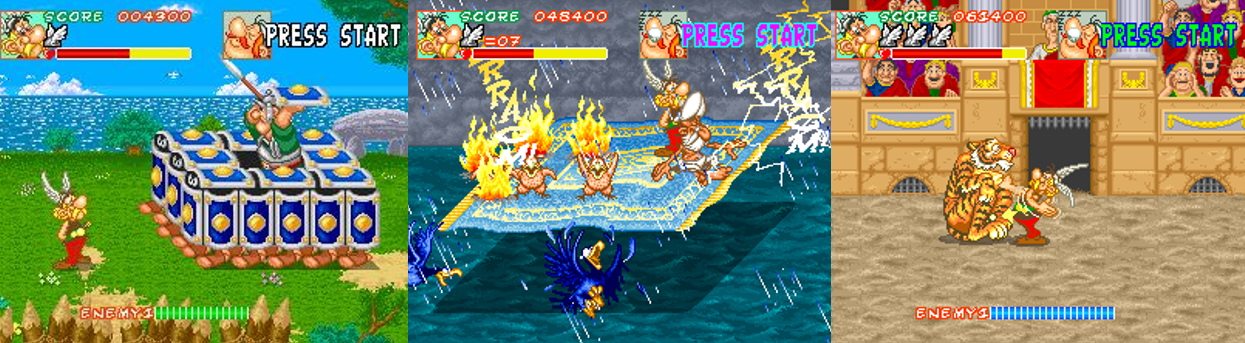
Astérix is a super colourful, super vibrant sidescrolling beat-‘em-up in which players can freely choose to play as either Asterix or Obelix (or team up as both) and journey across seven stages, each one lovingly recreated from some of the tenacious Gaul’s most memorable adventures, ploughing through Romans and collecting their helmets to score points. Controls couldn’t be simpler; you move with the joystick, attack with one button, and jump with another. Both Asterix and Obelix can dash, perform a running and jumping attack, and will slap Roman’s silly, or kick or toss them away, when they get up close and personal.

Journey through some memorable locations bashing Romans all over the ancient world.

The differences between the two characters are largely negligible; Asterix is smaller and slightly more agile, but Obelix doesn’t exactly seem slowed down by his girth. One difference between the two you’ll immediately notice is that Obelix begins with a menhir in hand, as is his trade, which appears to be the one instance in the game where you can wield a weapon (albeit temporarily). Both characters will also receive a brief power-up when loyal puppy Dogmatix wanders onto the screen with either a gourd of magic potion for Asterix or a crispy roast boar for Obelix; collecting either will send them into a brief frenzy that sees them immune to all attacks and taking out every onscreen enemy in short fashion, though this is only for a very short time. Players can restore their health by eating fruit or stealing a kiss from Panacea, who wanders to and fro in each stage, and swing from vines to take out enemies. You get two lives per credit and, while there’s no time limit, Cacophonix’s musical notes will damage you if you linger too long. Perhaps the oddest thing about Astérix, though, is that you do not have unlimited continues; even if you input ninety-nine credits, you’ll eventually run out of chances to spawn back in and be left with nothing else but your high score and beginning the game all over again.

The game is absolutely gorgeous and perfectly captures the look and humour of the comics.

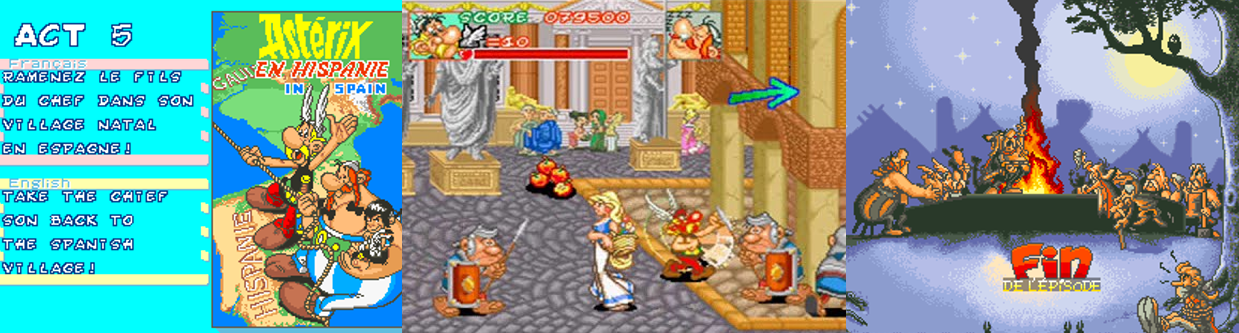
As fulfilling and entertaining as the beat-‘em-up gameplay is in Astérix, however, the game excels in its visual presentation; more so than any other 2D Astérix videogame, this sadly forgotten arcade title pops with bright, cartoony graphics that are ripped straight from the original comic books. Sprites are large, fantastically detailed, and full of fun little animations; Romans can be rapidly slapped across the face, slammed by their ankles, and twirled around in the air just like in the comics, a bunch of cartoony sound effects punctuate the action, and there’s even a little bit of voice acting and onscreen text (in both English and French) to help tell the story. Stages are proceeded by both sprite-based cutscenes and comic book panels to track the pair’s journey to Rome, and you’ll be able to play a chariot race as a bonus stage for extra points. While enemy variety quickly begins to suffer (you’ll see the same Roman infantry and generals in every stage), they’re all exactly as they appear in the comics and can even be seen hiding in tree stumps and riding horses. Each stage also includes additional hazards and enemies, such as rolling rocks, mischievous Egyptians, and disreputable pirates; you’ll also battle a boss at the end of each stage, with a group of Roman’s gathered into the tortoise formation awaiting you at the end of the first stage and the mind-controlling Iris opposing you in Egypt,

My Progression:
I’ve played Astérix before, both in the wild as a child and thanks to the gift of emulation, and have always been thoroughly impressed with its graphics, gameplay, and fidelity to the quirky humour and adventures of the source material. The attention to detail here is astounding, even compared to other licensed videogames from the time, and it pleases me no end to see these fun-filled and colourful characters brought to life so well. While I’ve always enjoyed the platforming and puzzle-based mechanics of many Astérix videogames, the concept lends itself incredibly well to the simplicity of a sidescrolling beat-‘em-up and the game’s stages are packed full of gorgeous sprite work, things to see and interact with, and short enough to play through in action-packed bursts.

While there’s loads of locations, I wasn’t able to actually finish the game due to the credit system.

Having said that, though, Astérix is stunted somewhat by the fact that you cannot simply feed coins into it until you plough through to the ending. I can’t recall ever playing an arcade title that restricts you in such a way, meaning that even when you emulate the game you can’t just blindly charge ahead and just press a button to jump back into the action. Instead, your continues are strangely limited, which unfortunately limits your progress in a way that I have never encountered in an arcade title before, and that means that I rarely manage to get past (or even to) the pirate ship stage. On this particularly playthrough, I struggled to make it through Egypt before losing all my chances, which was a shame as I was hoping that the different ROM files I had available would allow me to just carry on like normal. However, if you are able to best the ever-increasing waves of cartoony and bombastic enemies thrown your way, you’ll eventually battle across the high seas in boats, zip through the air on a magic carpet, race along in a mine cart, and finally find yourself battling the game’s toughest enemies in Julius Caesar’s Colosseum.

Astérix is a quality sidescrolling beat-‘em-up that you may never have played, or even heard of. Sadly, this is one of a number of arcade-exclusive titles that never saw the jump to home consoles, and that’s a crying shame as this would’ve been a blast to play in the 16-bit era. While the game doesn’t really offer anything beyond the stand two-button combat you’d expect from an arcade title and is seemingly lacking in a few areas (a life-draining special attack and weapons amongst them), it excels in its absolutely gorgeous visual presentation to perfectly capture the look, feel, and humour of the source material. It’s just a shame that I can’t just keep pumping in credits to charge on through to the ending, but I always enjoy loading this one up when I have some time to kill. Have you ever played Astérix’s arcade adventure? If so, how do you think it compares to other Asterix videogames and beat-‘em-ups of the time? How far have you been able to make it in the game, and which of the stages was your favourite to play through? Which character, book, or movie is your favourite? How are you celebrating Asterix and Obelix’s birthday this year? Whatever your memories or opinions of Asterix, feel free to sign up and drop them below or leave a comment on my social media.

Movie Night [Asterix Anniversary]: Asterix: The Secret of the Magic Potion


Asterix the Gaul (and his best friend Obelix) first debuted on 29 October 1959 as a serial in the French/Belgium magazine Pilote. Since then, the plucky Gauls have gone on to have many adventures in comic books, videogames, and feature-length productions and Asterix himself has become a popular and enduring character in his native France and around the world as Asterix’s stories have been translated into over a hundred languages across the world. I may be a day early in celebrating this anniversary as it coincides with the release of the SEGA Mega Drive but I’ll take any excuse to talk about Asterix’s amusing escapades.


Released: 5 December 2018
Director:
Louis Clichy and Alexandre Astier
Distributor:
Société Nouvelle de Distribution/Altitude
Budget:
Unknown
Stars:
Ken Kramer, C. Ernst Harth, John Innes, Fleur Delahunty, and Michael Shepherd

The Plot:
In 50 B.C. ancient France (then known as Gaul), has been entirely conquered by Julius Caesar (Mark Oliver) and his army of Romans…except for one small village of indomitable Gauls given superhuman strength by the druid Getafix’s (Innes). However, when Getafix starts to worry about his mortality, he embarks on a quest across Gaul, accompanied by the village’s most powerful warriors, Asterix (Kramer) and Obelix (Harth), in search of an heir.

The Background:
Asterix was created by writer René Goscinny and artist Albert Uderzo in 1959 and first appeared in Pilote before being collected into a single volume. Since then, the duo produced volumes on an annual basis until 1997, when Goscinny tragically died; after continuing solo for a while, Uderzo eventually signed the rights over to a new generation of creators so that Asterix’s stories could continue. Since then, Asterix has been an incredibly popular character the world over, selling nearly 400 million books and has been adapted into a series of animated, and live-action, features. The first, Astérix the Gaul (Goossens, 1967), was produced with Goscinny and Uderzo’s input and the two were heavily involved in subsequent productions. Nine animated features were produced between 1967 and 2014, where the animation made the jump from 2D to 3D with Asterix: The Mansions of the Gods (Clichy and Astier, 2014), which was France’s highest-grossing animated film of that year. Asterix: The Secret of the Magic Potion followed about four years later; based on an original story by Astier, the film made over $2 million on its opening night and eventually grossed over $46 million.

The Review:
Asterix: The Secret of the Magic Potion begins with Getafix out in the forest cutting ingredients for his magic potion with a golden sickle; he’s a sprightly, lively old man, hopping and jumping all over the place and handling his sickle with an effortless pizazz. Unfortunately, his luck runs out and he takes a particularly nasty fall from a treetop. Having seriously injured his ankle, Getafix is despondent and angry at his stumble and decides to search out a young successor in order to pass down his greatest secret; since the secret can only be passed from one druid to another, this means Getafix must leave the village to seek out his heir. Getafix’s decision to seek out an heir worries both Asterix and the village chief, Vitalstatistix (Don Brown), as they’re concerned that Getafix is giving up too easily and that a new druid will misuse the magic potion. To allay their fears, Getafix suggests that Asterix and Obelix accompany him to ensure that his chosen successor uses the magic potion as wisely as he and that their village can continue to resist the Roman invasion.

Getafix’s injury causes him to a crisis of confidence, much to Asterix’s chagrin.

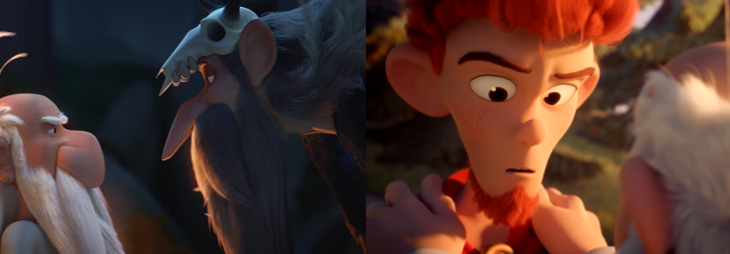
Getafix’s mission is opposed by the malevolent druid Demonix (Shephard), a practitioner of forbidden magic who greatly resembles Prolix from Asterix and the Soothsayer (Goscinny and Uderzo, 1972) and is capable of conjuring will-o’-the-wisps to hypnotise and manipulate others. His power is so frightful that he’s even able to freeze the mighty Obelix in his tracks like a statue Demonix is disgusted that Getafix has wasted his magic potion on his village and wishes to take the secret from himself to satisfy his desires for power and glory. To facilitate this, he strikes a deal with Caesar that will see him manipulate the promising young druid Cholerix (Michael Adamthwaite) in order to learn the secret of the magic potion. After forcing Cholerix to mage the potion, Demonix augments it further and consumes it, becoming a super-powered sorcerer and threatening not only the Gauls but the Romans as well with his vast powers.

Demonix’s plot to learn Getafix’s secret sees him manipulate the young druid Cholerix.

Getafix is dismayed to find that all the young druids he meets are either charlatans or incompetents and, as a result, he’s excited at the potential Cholerix. Although Cholerix initially rejects Demonix’s advice, he falters when standing before his peers and potential mentor and decides to conjure Demonix’s useless spell and, in the process, impresses Getafix. However, Cholerix is almost immediately dismayed at Getafix’s choice as he knows he basically deceived the druid and is forced to brew up the magic potion before Demonix’s eyes in order to save the village from being destroyed by the Romans.

Pectin impresses with her curiosity, gumption, and inventiveness.

Asterix is enraged to discover that a young girl from the village, Pectin (Delahunty), has stowed away in Getafix’s cauldron; despite women being forbidden from the Forest of the Carnutes, Getafix is impressed with Pectin’s ingenuity and craftsmanship and allows her to accompany him to the druids’ gathering in disguise as a boy. Her presence and curiosity is the perfect way to coax exposition out of the druids (in the form of a traditional, hand-drawn animation) regarding Getafix’s past with Demonix and she proves instrumental in thwarting Deominx after he consumes his augmented magic potion, proving herself to, potentially, be worthy of taking Getafix’s place someday.

The Nitty-Gritty:
Asterix: The Secret of the Magic Potion is full of little gags and slapstick comedy, mainly revolving around fights and the physical pratfalls the many characters get into; the routine of village life and the Roman garrisons is amusingly introduced to the tunes of Dead or Alive’s ‘You Spin Me Round (Like a Record)’, with characters performing their everyday actions in tune to the beat of the song. As is the case with many Asterix stories, there’s an ongoing rivalry and animosity between Unhygienix (Jason Simpson) and Fulliautomatix (Scott McNeil), a gang of pirates continuously run afoul of the Gauls even when they’re safely out at sea, the Romans are generally portrayed as being reluctant warriors who are in fear of the Gauls’ strength, and the Gauls using chickens to fly in and attack the Romans. There’s also a running gag in the film that the druids can speak and understand the snorts and grunts of boars; indeed, boars themselves play quite a large role in this animated and are far more prominent than they usually are, getting into all kinds of scrapes and hijinks similar to Scrat from the Ice Age films (Various, 2002 to present).

As there are a lot of characters in the film, some inevitably get reduced to mere comic relief.

There’s a great number of characters in the film, more so than usual since Gettafix’s search takes him all over Gaul. However, all the village men (except for Cacofonix (Cownden)), decide to follow along with the quest to add some additional comic relief to the film through their tendency to argue and brawl with each other at the slightest provocation. Although the village is left only in the care of the women and Getafix’s limited magic potion reserves, the Gaulish women are, as always, more than capable of holding their own against the Roman forces, who are ordered to attack again and again to exhaust their reserves. The druids also get a lot of play in the film; their gathering is little more than a piss-up and the druids misunderstand the boar’s message and think Getafix has just brought them all together for a big party and Getafix is stunned to discover that the druids’ age-old traditions of passing information only through word of mouth has given way to “crib notes”.

Rather than focus on Asterix and Obelix, the film is much more about Getafix and a group effort.

When Getafix’s search initially proves fruitless, Asterix loses his temper; he’s annoyed that Getafix has let such a simple stumble throw him so completely and, in an amusing outburst, hands his helmet, dagger, magic potion, and status as the village’s top warrior over to Geriatrix (Ron Halder) in order to make his point and storms away. This does, however, allow him to stumble upon Demonix’s plot to collaborate with the Romans but he basically disappears from a big chunk of the film after he’s helplessly bound and gagged. Even when he’s rescued, he’s just one part of an unsuccessful team effort between the Romans and the Gauls to take down the gigantic, invincible, and super-strong Demonix and, in the end, it is Getafix’s resourcefulness and magic that saves the day. It’s a bit unusual to watch an Asterix film where Asterix ends up having such a small role but the bulk of the story revolves around Getafix and his shaken self-confidence so I guess it makes sense but Asterix and the Big Fight (Grimond/Weiss, 1989) was a very Getafix-heavy film and that still placed Asterix in a prominent role in its narrative.

The Summary:
Asterix: The Secret of the Magic Potion is a very fun and entertaining little romp. While I preferred the traditional, 2D animation of the previous films, the computer-generated characters are gorgeous to look at, full of life and little details and character quirks that really make them lively and amusing. It’s not one of the more action-packed Asterix stories, and it’s a little disappointing how small a role Asterix and, especially, Obelix play in the plot but it’s got a lot of funny little moments and gags peppered throughout it and really captures the quirky spirit of the comic books. As a lifelong Asterix fan, it’s heart-warming to see the character is still so popular and beloved that he continues to be relevant in a crowded genre and there’s clearly been a lot of care and attention put into bringing these unique and memorable characters to life. The story is pure Asterix and feels reminiscent of many of the books but also manages to stand out on its own merits through its distinctive visual and narrative flair and I’d say it’s definitely worth a watch for fans of the source material and should keep both kids and parents sufficiently amused with its wackier moments.

My Rating:

Rating: 3 out of 5.

Pretty Good

Have you seen Asterix: The Secret of the Magic Potion? If so, what did you think to it? Are you a fan of the CGI Asterix films or do you prefer the traditional, 2D animated features? Which character, book, or movie is your favourite? How are you celebrating Asterix and Obelix’s birthday this year? Whatever your thoughts on Asterix, feel free to leave a comment below.