Back Issues [Sonic2sDay]: Sonic the Hedgehog’s Buddy: Tails


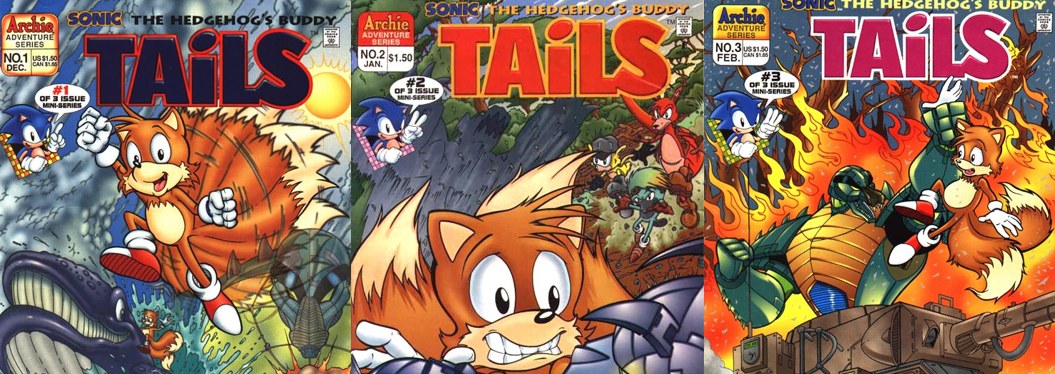
In anticipation of Sonic the Hedgehog 2 (SEGA Technical Institute, 1992), SEGA dubbed November 24, 1992 “Sonic 2sday”. Accordingly, this is a great excuse to celebrate Sonic’s faithful sidekick, Miles “Tails” Prower, who debuted in that title.


Writer: Michael Gallagher – Artists: Mike Gallagher and Dave Manak

Story Title: “Southern Crossover” (Part One to Three)
Published: October 1995 (cover-dated: December 1995) to December 1995 (cover-dated: February 1996)

The Background:
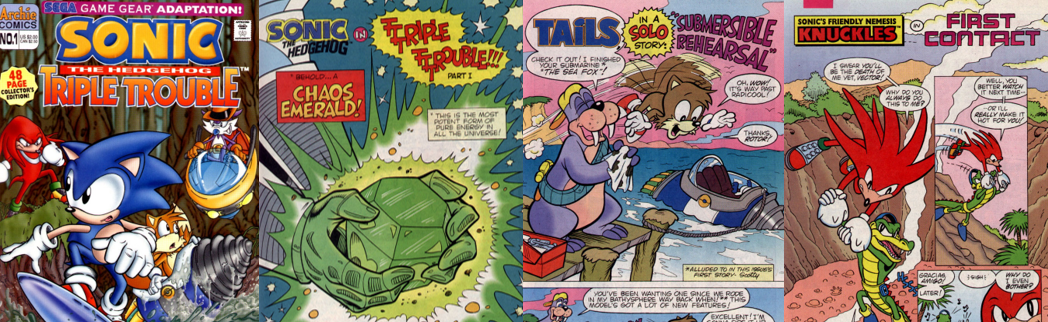
Thanks to an aggressive marketing campaign and being bundled with the all-powerful 16-bit Mega Drive, Sonic the Hedgehog was the blockbuster success SEGA needed to usurp Nintendo from the top of the videogame industry. Despite a tumultuous developmentSonic 2 surpassed this success, selling 400,000 copies in its first week, 6 million units during the Mega Drive’s lifespan, and increasing SEGA’s slice of the home console market by 40%Widely praised and highly regardedSonic 2 also debuted Tails, Sonic’s kid sidekick, who was created by Yasushi Yamaguchi. Resembling the mythical kitsune and devoted to his super-fast hero, Tails became a well regarded staple of the Sonic franchise, becoming one of the few of Sonic’s supporting cast to get his own divisive solo outings. He was also the second to receive a solo mini series published by Archie Comics, who produced the popular Sonic the Hedgehog comics in the United States, which were heavily based upon Sonic’s cartoon adventures. Though spinning off from Archie’s loose adaptation of Sonic the Hedgehog: Triple Trouble (Aspect, 1994), Tails’ three-issue miniseries set the groundwork for his greater role in Archie’s comics, which reimagined him as a character of great destiny.

The Review:
Tails’s one and only Archie-published miniseries begins with the young, two-tailed fox drawing by the docks. It seems Tails likes to write and draw his own comic books that paint him as a mild-mannered (and “handsome”) youngster who secretly operates as “Captain Super Fox-Man”, a superpowered “Avenger of Evil” who’s just as capable (if not more so) as his older Freedom Fighter cohorts. While filing his art, Tails thumbs past a list of supplies he acquired during a previous battle against the tyrannical Doctor Ivo Robotnik and his agent, Fiona, a “false fox” who betrayed him. His’ paperwork proves that Dr. Robotnik is building a satellite operation somewhere on Mobius and the fox cub is determined to find it by himself and prove how capable he is. Thus, Tails quickly hides the document from Princess Sally Acorn, leader of the Freedom Fighters and essentially his substitute mother. The two admire the Sea Fox, a nifty little one-man submarine built for Tails by Rotor the Walrus after Archie’s Triple Trouble adaptation. Although Sally forbids Tails from piloting the Sea Fox, he’s seemingly happy tinkering with it and playing make-believe but secretly fumes at being treated like an infant. Consequently, when Sally leaves for an important meeting, Tails takes the Sea Fox out to sea, having secretly filled the tank and embarked on solo ventures before, adamant to show that he’s not a helpless child. Elsewhere, the maniacal Dr. Robotnik oversees the final preparations on his gigantic blimp, trashing one of his SWATbots with his bare hands when the machine asks to check the ship’s inventory against the supply list stolen by Tails. Dr. Robotnik plans to fly supplies to his regional robo-underboss in the Southern Hemisphere (specifically, the nation of Downunda), as part of his grand plan for global domination, cloaking the dirigible to make it undetectable unless one is directly beneath it.

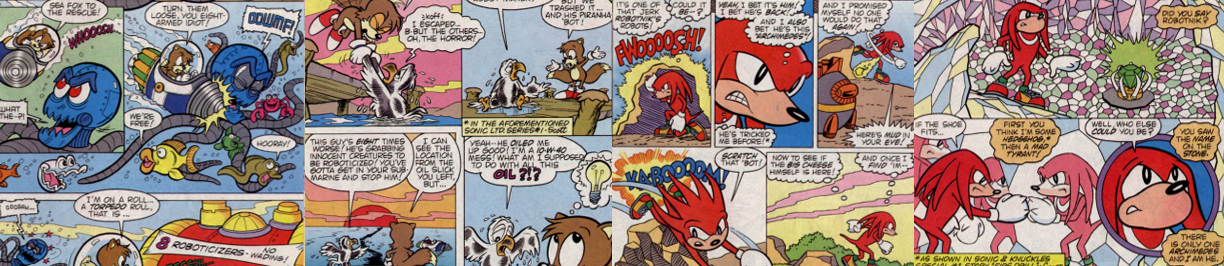
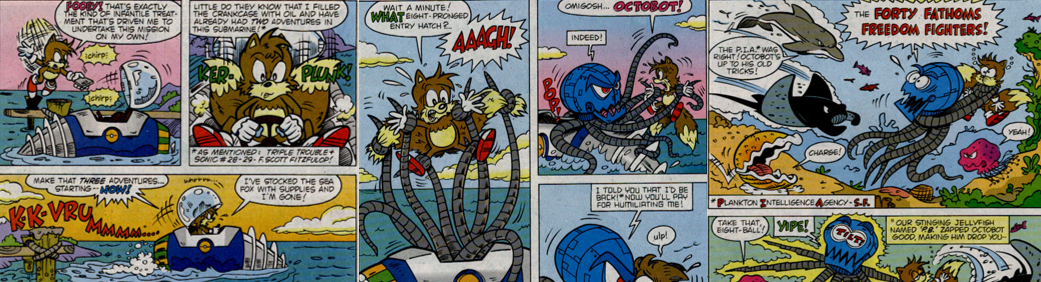
Determined to prove himself as a hero, Tails is overwhelmed  by the vengeful Octobot while at sea.

This odd flaw means Tails easily spots the blimp while searching the high seas for signs of the rotund dictator. While investigating a dark patch on the water’s surface, Tails is stunned to find his quarry is in the sky and flies up to investigate. After glimpsing the blimp’s destination, Tails is attacked by SWATbots, just barely recovering in time to trap them in a water vortex with his propeller-like twin tails. However, when Tails returns to the Sea Fox, he’s ambushed by Octobot, a mechanical octopus in charge of Dr. Robotnik’s underwater robotization factory and out for revenge after Tails humiliated him in the Triple Trouble special. After scuttling the Sea Fox, Octobot drags Tails into the dark depths, causing Tails to black out. Outraged that his blimp was so easily spotted, Dr. Robotnik chastises his forces and calls his robo-underboss, a mechanical crocodile named Crocbot, for an update. Thrilled that he’ll soon receive enough supplies to pollute the landscape, Crocbot orders his robotic winged dingoes to patrol in anticipation of the blimp, then loudly boasts of his plans to reprogram Dr. Robotnik’s SWATbots to aid him in overthrowing his master and conquering the world for himself! Luckily for Tails, he wakes up on the back of a massive blue whale named Fluke. His confusion is short-lived as a friendly manta ray named…well, Ray…fills him in on what happened. As Tails was being dragged underwater and nearly drowned, Octobot was suddenly attacked by the “Forty Fathoms Freedom Fighters” (Ray, P.B. the Jellyfish, Bottlenose the Dolphin, and Bivalve Clam). Despite Octobot fighting back by spraying ink, he was shocked by P.B., tackled by Bottlenose, and ultimately flattened by Fluke (though the Sea Fox was totalled). Grateful, Tails immediately enlists the Forty Fathoms Freedom Fighters in expediting his trip to Downunda, with Fluke and Ray only too happy to help and allow Tails to embellish the details in his comic books.

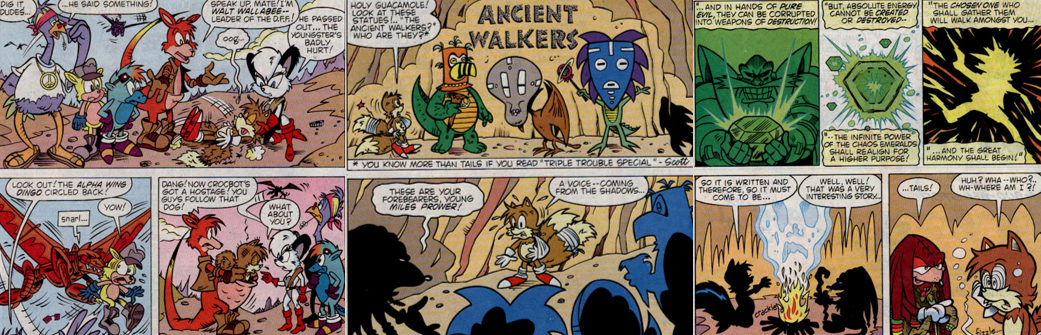
Rescued in Downunda, the injured Tails learns he’s been chosen for a higher, as-yet-unknown purpose.

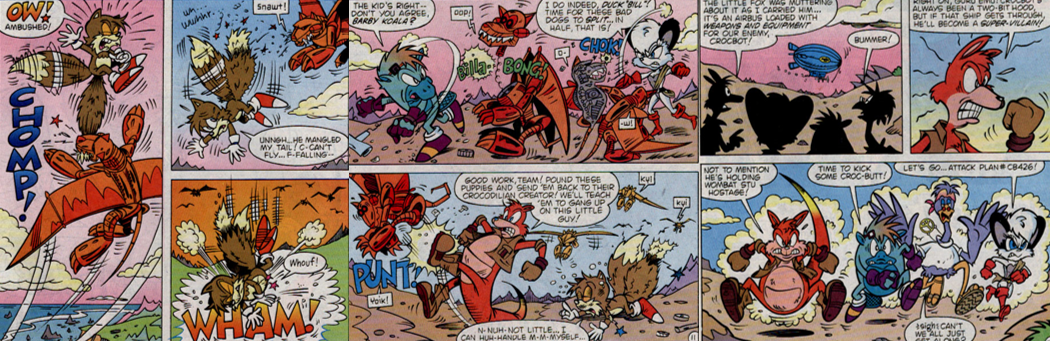
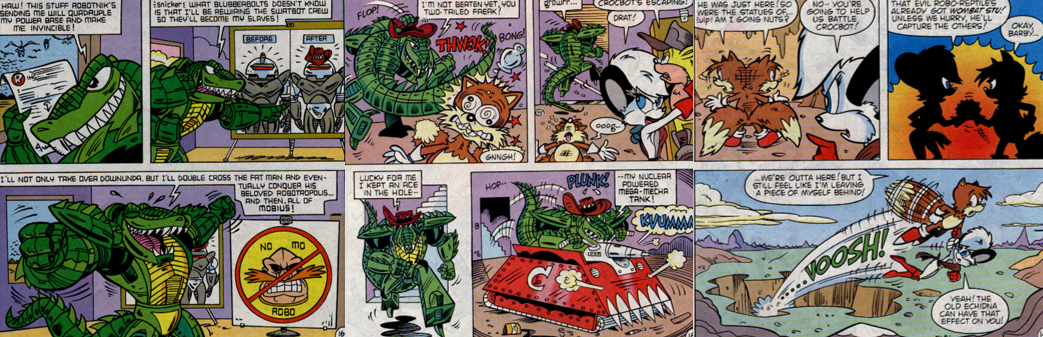
Upon arriving, Tails is immediately detected by Crocbot’s security systems, who dispatches his robotic Wing Dingoes to intercept him. Although Tails puts up a good fight and even takes a few of the robots out, he takes a bite to a tail and crashes to the ground, too injured to fly and barely staying conscious. Tails is thus rescued again, this time by the Downunda Freedom Fighters led by Walt Wallabee and Barby Koala, Wombat Stu, the peace-loving hippy Guru Emu, and Duck “Bill” Platypus. While they’re busy tending to the unconscious Tails, the group is ambushed by the Alpha Wing Dingo, who swoops in and kidnaps Wombat Stu! Walt quickly orders the others to pursue their teammate while he hops away with Tails in his pouch to get the young fox help. After halting communications with Dr. Robotnik to keep his master from seeing the state of his damaged Wing Dingoes, Crocbot initially lashes out in frustration and then gleefully clamps Wombat Stu to a torture rack. Crocbot then assures Dr. Robotnik that all is ready and ends the call, watching with relish as Wombat Stu’s allies approach his base (amusingly modelled after the Sydney Opera House) just as the blimp arrives. Walt rejoins his teammates and gives an update from Tails that catches them up with the plot and they race towards Crocbot’s base to keep him from being bolstered by Dr. Robotnik’s weapons. Tails wakes up at the Downunda Freedom Fighters’ base at the bottom of a giant crater, his tail bandaged and his arm in a sling, and discovers statues of the Ancient Walkers, mystical beings from Mobius’s past who Tails learned of in the Triple Trouble special. He’s then approached by Athair, the wizened and cantankerous great-grandfather of Knuckles the Echidna, who gives the injured fox cub a lecture on ancient history.

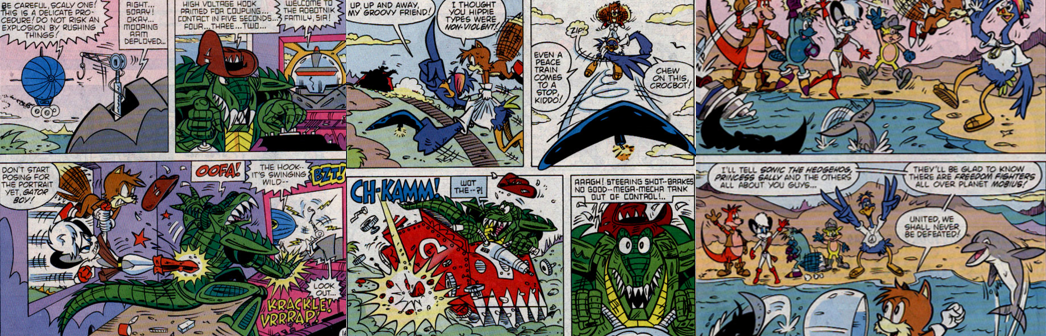
Tails and his new friends successfully thwart Crocbot’s ambitions and vow to defy Dr. Robotnik.

Generations ago, Athair’s echidna ancestors were so busy building elaborate, highly advanced cities across Mobius that they failed to spot a comet heading for their capital city, Echidnapolis, until it was too late. Though the echidnas levitated Echidnapolis and a chunk of their land to safety, creating what was then known as the Floating Island, the comet devastated Mobius. Though Tails tries to leave, frustrated with Athair’s riddles and eager to help his newfound friends, the Ancient Walkers come to life and insist he learn more. Thus, Tails learns of how life evolved on Mobius, how dinosaurs once ruled, and how the planet was struck by the Chaos Emeralds in prehistoric times. Many worshipped or tried to harness their powers over the millennia, often being corrupted by their desires. However, it’s said that a “Chosen One” would one day unite the many Chaos Emeralds to bring about the “great harmony”, a destiny Athair believes the Ancient Walkers have bestowed upon Tails! After coming out of a trance to find his wounds healed, Athair gone, and Barby crashing in after Crocbot’s gigantic C.D. Rom Ram attacks the Downunda Freedom Fighters, Tails reluctantly shrugs off his strange experience and goes to help. Although the massive robotic ram beats on the Downunda Freedom Fighters, it’s easily destroyed by one of Walt’s “bomberangs”, frustrating Crocbot and distracting him from helping the blimp to dock. When Tails and Barby attack him, Crocbot mangles the controls and the blimp dramatically goes down in flames along with his plans to usurp Dr. Robotnik. With Barby distracted rescuing Wombat Stu, Crocbot hits Tails with his mechanical tail and leaps into his “nuclear powered Mega-Techa Tank” to escape. Determined to end Crocbot’s threat, the normally pacifistic Guru Emu borrows a bomberang and, assisted by Tails, sends Crocbot careening down a canyon to an explosive end. After tearfully turning down an offer to join the Downunda Freedom Fighters, Tails is overjoyed when the Forty Fathoms Freedom Fighters return with his repaired Sea Fox. Though he’s sad to say goodbye to his new friends, Tails heads home emboldened by the knowledge that Freedom Fighters exist all over Mobius.

The Summary:
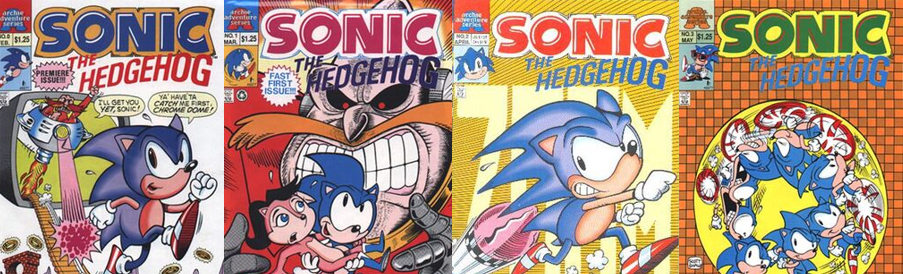
I’ve read every single Sonic and Sonic-adjacent comic published by Archie Comics and I’m starting to think that Michael Gallagher may be my least favourite artist, especially from these early days. His work, while capturing the same cartoonish vibe as the cartoons that influenced these comics, can’t compare to the likes of Patrick “Spaz” Spaziante, who had a hand in the miniseries’ covers, which promise a tale of excitement and adventure that sadly isn’t reflected in the pages. We’re still in that weird time when Archie’s comics were more slapstick and cartoonish, meaning we get painful puns, borderline plagiarism presented as homage (particularly in Tails’ comic book fantasises), and childish villains who spend more time shouting than being a threat. It’s a gripe of mine that Archie’s Sonic comics took so long to establish their identity and move away from simplistic stuff, like the Ancient Walkers being cartoonish statues in a bland cave, and nonsense original characters who, while visually interesting, can’t compete with SEGA’s iconic creations. Indeed, the two sets of Freedom Fighters Tails encounters in Downunda leave a lot to be desired and don’t live up to their potential. I feel the writers should’ve focused on the Downunda Freedom Fighters and fleshed them out more if they were going to have such a large role. Perhaps they could’ve been forced from Downunda by Crocbot and operated out of a seaside cave, biding their time to counterattack when they spotted Tails in danger and rescued him alongside Fluke. Then we could’ve seen these new guys in action sooner and learned more about them, something greatly needed since they totally steal Tails’ spotlight!

Sadly, Tails’ solo venture is usurped by forgettable (if visually interesting) original characters.

Not yet the young genius and tech-savvy inventor we know today, Tails is frustrated at being thought of as a helpless kid and regularly defies Princess Sally by taking the Sea Fox out on adventures. Sadly, we don’t get to see the Sea Fox in action as it’s scuttled by Octobot and Tails’ hopes of downing Dr. Robotnik’s blimp solo are quickly dashed when he’s constantly overwhelmed and is either close to drowning or unable to fly because he’s outnumbered, outpowered, and outmatched. Therefore, Tails must be rescued by two sets of largely forgettable Freedom Fighters, I like the visual variety of both groups and it’s always fun when the comics anthropomorphise unique creatures like jellyfish or wallabies, but I don’t know who any of these guys are. What’s their backstory? How did they get into the Freedom Fighter game? What are their personalities beyond wanting to protect the world and hating the dictator and his robotic minions? Honestly, this would’ve been a great opportunity to team Tails up with Ray the Flying Squirrel and even Mighty the Armadillo but, as I mentioned, the story would’ve greatly benefitted from trimming down these original characters. I would’ve had Walt, Barby, Stu, and Fluke, with Atahir as their wise mentor. Make Walt the pacifist who’s forced into violence, Barby the tactician, Stu the hot-head, and Fluke the laidback muscle who carries them across the ocean. Then, use these extra panels to contrast them with the Knothole Freedom Fighters, showing how they accept Tails and don’t mollycoddle him. Indeed, perhaps they’d be compelled to help Tails based on Athair’s foreknowledge of his apparent destiny as the “Chosen One”, perhaps even leading them to revere him as a messiah figure, thus making his decision to return home more of a struggle since Tails would’ve found acceptance and the chance at a greater destiny amongst them.

Strangely, the story’s more concerned with toppling Crocbot than exploring Tails’ destiny…

Instead, Tails is hurt, the Downunda Freedom Fighters take over, and we’re left with a dull history less about things that barely seem connected to Tails. Rather than waste time recapping the echidna downfall, why not focus on the Chaos Emeralds, their influence on others, and the “Chosen One” prophecy? Tails barely seems interested in Athair’s story and doesn’t dwell upon the Ancient Walkers’ words after leaving with Barby, making me question what the point of dedicating all that time to it was beyond sowing the seeds for future plot threads. I quite liked Crocbot, however; he’s got a fun, unique design and I liked how he spoke with an Australian accent and sought to usurp Dr. Robotnik. However, he barely does anything and leaves all the heavy lifting to his Wing Dingoes and flees at the first sign of trouble. Crocbot later returned to plague our heroes again, but he doesn’t get a good showing here as he wastes time monologuing to Wombat Stu rather than torturing him and breaks down in tears when he accidentally destroys Dr. Robotnik’s blimp, making for a particularly weak villain. Honestly, I think Sonic the Hedgehog’s Buddy: Tails missed a trick by not turning to his Game Gear games for inspiration. Tails Adventure (Aspect, 1995) released around the same time this miniseries so it might’ve been unrealistic to expect an adaptation, and Tails’ Skypatrol (Japan System House/SIMS, 1995) may have released earlier in 1995 but it was exclusive to Japan at the time. Still, Archie could’ve gotten design documents and some information on both from SEGA, certainly enough to cobble together an adventure that pitted Tails against Witchcart and/or the Battle Kukku Empire to at least use more game-accurate villains in his solo adventure. Still, this was decent enough and showed that Tails was definitely ambitious for his age, but I think it says a lot that young Miles never got another solo series from Archie Comics…

My Rating:

Rating: 3 out of 5.

Pretty Good

What did you think of Tails’s first and only solo miniseries from Archie Comics? Were you disappointed that so much of the story was dominated by original characters? Which of the two sets of new Freedom Fighters was your favourite? Would you have liked to see elements from Tails’s Game Gear titles incorporated instead? What did you think of Crocbot and the idea of Tails having a greater destiny? What are some of your favourite Tails moments from the Archie Comics? How are you celebrating Tails and “Sonic 2sday” this year? Whatever your opinion on Tails, or Sonic 2 in general, drop a comment below and go check out my other Sonic content.

Back Issues [Sonic Month]: Sonic the Hedgehog #0-3


Sonic the Hedgehog was first introduced to gamers worldwide on June 23 1991 and, since then, has become not only SEGA’s most enduring and popular character but also a beloved videogame icon. Thus, in keeping with tradition, I’m dedicating some time to celebrate SEGA’s supersonic mascot.


Writer: Michael Gallagher – Artist: Scott Shawl

Story Titles: “Don’t Cry for Me, Mobius!” and “Oh No–Robo! No-Mo’ Mobo!”
Published: 24 November 1992

Story Titles: “Run, Sally, Run!” and “Something Fishy”
Published: March 1993

Story Title: “A Crowning Achievement”
Published: April 1993

Story Titles: “Sonic Flashback!” and “Why Ask Spy?”
Published: May 1993

The Background:
SEGA wasted little time capitalising on Sonic’s massive popularity once he became a mainstream success and single-handedly caused them to usurp Nintendo’s position at the top of the videogame industry. Following in the footsteps of Nintendo’s success with DiC, SEGA’s mascot soon debuted on the small screen with two concurrent cartoons, the most popular of which was the simply-titled Sonic the Hedgehog (1993 to 1994), also known as “SatAM”. SatAM recast Sonic as the point man for the Knothole Freedom Fighters, a team based on his Animal Friends from the source material, and Doctor Robotnik as a terrifying, semi-cybernetic dictator. SatAM’s darker tone clashed with the slapstick approach of its sister-series, but Archie Comics awkwardly mashed both together for this four-part miniseries, the genesis of what would become the longest-running comic series based on a videogame. In the years since, Archie Comics would expand on their convoluted lore, shoe-horning in more and more videogame characters, until a ridiculous lawsuit spelled the beginning of the end for the comics, with the license then taken up by IDW and an all-new, game-adjacent continuity.

The Review:
When I was a kid growing up in the UK, Archie’s Sonic the Hedgehog comics were a complete oddity. I never even heard of them until I picked up a trade paperback collection of this original miniseries. Though they offered little in the way of a resolution to SatAM’s unresolved cliff-hanger, they were the closest thing to an official follow-up. While they had many flaws and became ridiculously convoluted, things started relatively simply with this oddball miniseries, which has the overall look and cast of SatAM but strangely incorporates some elements (particularly the cartoonish slapstick) of Adventures of Sonic the Hedgehog (1993). Sonic, Miles “Tails” Prower, Princess Sally Acorn, and their colourful friends and enemies live on Mobius, a world whose natural beauty has been tainted and corrupted by the maniacal Dr. Robotnik. “Don’t Cry for Me, Mobius!” begins with the mad doctor chasing Sonic throughout the countryside and trying to splatter him with his super sticky “mega-muck”. While Sonic easily outruns Dr. Robotnik’s Egg-O-Matic, he appears to be trapped by, of all things, a simple Caterkiller. This is a ruse to lure Dr. Robotnik closer as Sonic avoids a splatter of mega-muck, destroying the Caterkiller and leaving Dr. Robotnik covered in his own goop. Sonic then breaks the fourth wall and invites the reader to follow him to Knothole Village, the hidden refuge of the Freedom Fighters, where he meets with Tails (Sonic’s biggest fan and budding sidekick), Boomer the Walrus (the mechanic and tech support who wasn’t quite yet known as Rotor), and Princess Sally (the team’s leader who sports a decidedly different colour scheme and is exasperated by Sonic’s brazen attitude). Sonic and Sally’s awkward mutual attraction is interrupted by fusspot Antoine D’Coolette, who alerts them to a leak that could potentially reveal their location.

Sonic and his friends gleefully fight to free Mobius from Dr. Robotnik’s mad tyranny.

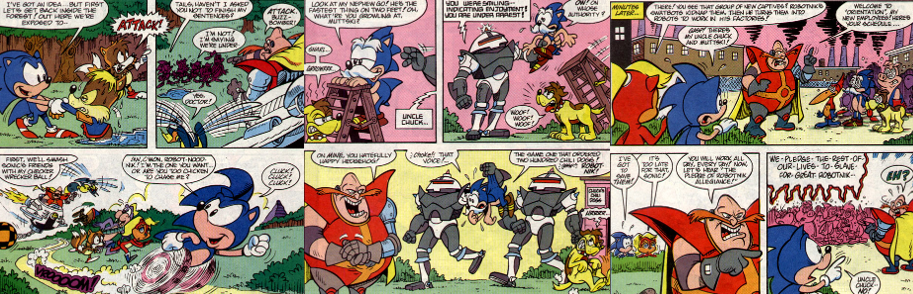
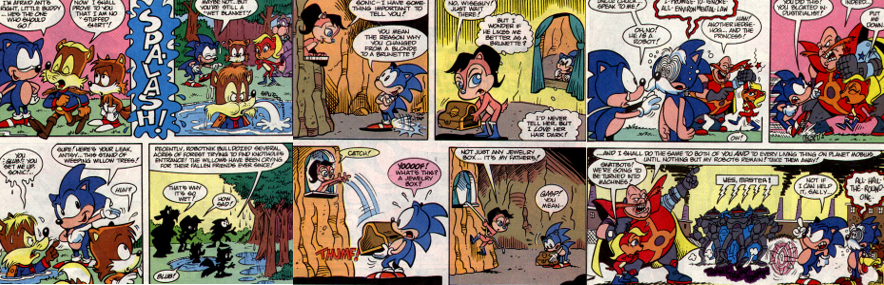
The Freedom Fighters head topside to investigate, exposing themselves to Dr. Robotnik’s spy satellites, and discover the cause is a growth of literal weeping willows driven to tears by Dr. Robotnik’s destructive actions. Eager to crush his hated enemy, Dr. Robotnik leaps into his wrecking ball machine and attacks alongside his Buzzbomber. Sonic leads them to a nearby well but briefly panics when he can’t immediately grab a power boost from the Power Rings within. Once he grabs one, he uses its strange magical powers to flip Dr. Robotnik’s wrecking ball, smashing his ship and forcing him to flee back to Robotropolis, his heavily industrial cityscape. We then get our first taste of how things got to be this way in “Oh No–Robo! No-Mo’ Mobo!”, a flashback story which shows that Sonic was once the delivery boy for his Uncle Chuck’s chili dog stand. The two literally jump for joy when a call comes in for two hundred chili dogs and Sonic gleefully speeds away to deliver the order, leaving Chuck and their beloved pet, Muttski, to be apprehended by Dr. Robotnik and his SWATbots, who’ve covertly conquered the land without the hedgehogs realising it. Sonic’s delivery brings him to Robotropolis and sees him almost crushed by a wrecking ball courtesy of Cluck, Dr. Robotnik’s robotic bird. Realising he’s been duped, Sonic races back to his family and finds SWATbots destroying the chili dog stand. After trashing the robots, Sonic heads back to Robotropolis to save his family and bumps into Princess Sally, an idealistic squirrel girl who’s also trying to rescue her family. Thanks to Sally’s insight, Sonic soon finds Uncle Chuck and Muttski but is dismayed to see they’ve been turned into robots (strangely drawn as though they’re merely hypnotised) and forced to work as Dr. Robotnik’s slaves. When Sonic angrily confronts Dr. Robotnik and futily tries to reason with his uncle, he’s attacked by more SWATbots and forced to flee with Sally to the “Great Forrest” and readily accepts her offer to join her band of rebels.

Sally’s secretive nature and Sonic’s reckless attitude lead our heroes into some slapstick peril.

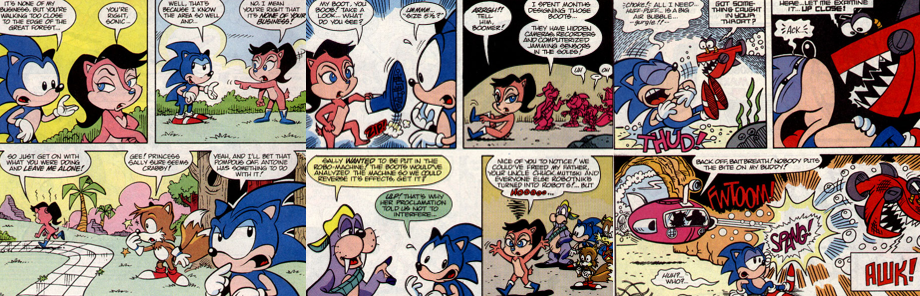
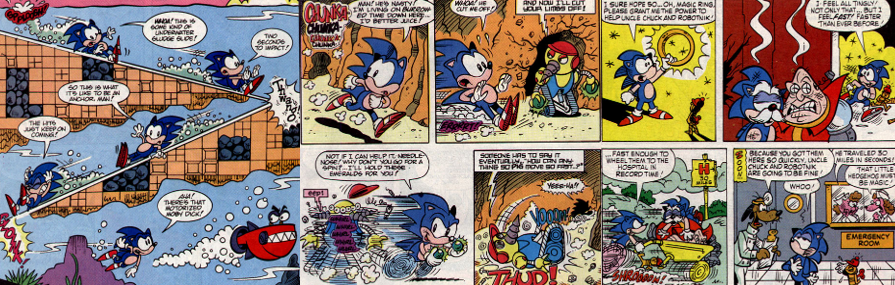
“Run, Sally, Run!” sees Sonic perturbed when he passes by Princess Sally as she’s wandering dangerously close to the edge of the forest and is angrily told to stay out of her business. Believing Antoine is behind her foul mood, Sonic races to Knothole and discovers that Sally has arranged to meet with Dr. Robotnik to negotiate the return of her father, King Maximillian Acorn, and that no one is to interfere. Naturally, Sonic (joined by Antoine and Tails) races to intervene but Sally chastises them and demands that they not follow her. Though they again plan to disregard this, the three are suddenly trapped within a cage and, while Sally is confident that the meeting is legitimate, she’s aghast when Buzzbomber drops her right in Dr. Robotnik’s lap and she’s hauled away to the “Robo-Machine”. Naturally, Sonic burrows out and into Dr. Robotnik’s lair, rescuing her, smashing the Robo-Machine, and dashing Sally back to Knothole. Unfortunately, Sally’s unimpressed by the “mucho-macho-squad”, whose reckless actions meant she couldn’t use Boomer’s special boots to analyse and reverse the Robo-Machine’s effects, leaving Sally enraged and Sonic embarrassed all because she couldn’t just explain the situation to them. Whilst relaxing with a spot of fishing in “Something Fishy”, Sonic accidentally hooks a Jaws Badnik and narrowly avoids being chomped to pieces like the dock he’s standing on. Diving into the lake (with no fear of the water), Sonic discovers not just Dr. Robotnik’s polluting pipes but also his waterproof robot maker. Though Sonic avoids being fed into the machine, he almost drowns and is only saved by the timely intervention of Boomer and Tails, who arrive in Boomer’s bathysphere craft. While the damaged Jaws limps off to report to its master, Sonic smashes the robot maker and returns to dry land with his friends, his appetite for seafood now lost.

Sonic journeys across land, air, and sea to recover the magical Freedom Emeralds.

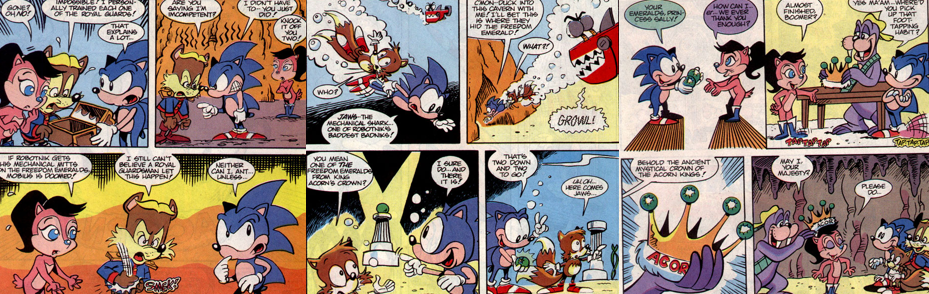
By “A Crowning Achievement”, Sally has switched to a brunette (a look Sonic secretly likes and which Sally secretly hopes he likes) and presents Sonic with her father’s jewellery box, which contains the legendary “Freedom Emeralds”. Despite their name, the jewels are actually pearl-like spheres set onto an elaborate crown, King Acorn’s family heirloom that Sally hopes will bestow her with magical powers. In preparation for her coronation, Sally has Antoine and his Royal Guard guard the box, but they’re all stunned to find it empty and the crown missing. After almost coming to blows over the incident, Sonic and Antoine suspect one of the guardsmen to be a robot spy. Using his super speed, Sonic sets off the sprinkler system and exposes the spy, who reveals he delivered the crown (and Knothole’s location) to his master before promptly self-destructing. Thanks to Sonic’s “Warp Sonic Speed”, Knothole (and our heroic hedgehog) are spared a gruesome fate, and Sally orders him and Antoine to retrieve the crown. Begrudgingly, the two pursue Dr. Robotnik’s blimp using a hot air balloon. Though Antoine’s forced to bail when they’re attacked by Bat Brains, Sonic bounces across the Badniks and pops the blimp with his patented Sonic Spin Attack, retrieving a Freedom Emerald in the process. Learning from a busted SWATbot that Dr. Robotnik plans to hide the Freedom Emeralds across Mobius, Sonic races underwater (with Tails accidentally in tow) and finds another Freedom Emerald at the same cavern from “Something Fishy”, easily defeating Jaws once more. While Sonic easily snags a third gem from a passing SWATbot, he’s dropped into a confrontation with Burrobot. Despite the robot’s terrifying burrowing power, it’s still no match for Sonic’s speed and is relieved of its Freedom Emeralds. Trapped in an underground maze, Sonic runs himself to exhaustion searching for the exit before having the genius idea to burrow upwards. Naturally, he conveniently pops out in Boomer’s workshop, finally restoring the crown and bolstering the Freedom Fighters’ morale, though Dr. Robotnik, angered at being absent for the story, vows to have his revenge.

After a weird dream, Sonic infiltrates Dr. Robotnik’s lair with a flimsy robot disguise.

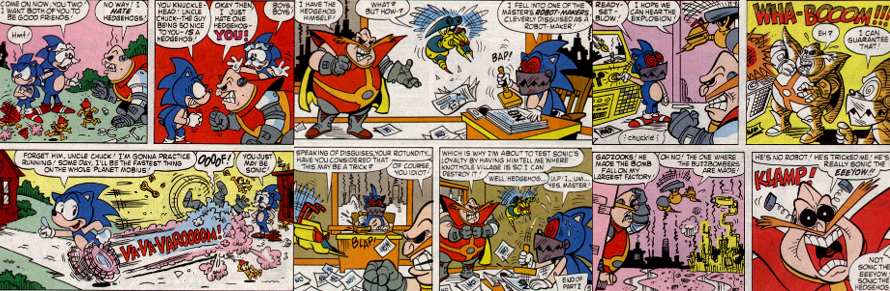
“Sonic Flashback!” sees Sonic forced off a cliff by a two-pronged attack of Crabmeats and the tried-and-tested wrecking ball. Knocked loopy, Sonic has a weird dream where he and Dr. Robotnik grew up together, revealing that Uncle Chuck created the magical rings to boost Sonic’s speed. Chuck despairs of his nephew’s disdain for “Little Robotnik”, an orphan boy who tinkers with mechanical toys and aspires to take over Chuck’s farm. Unwilling to entertain “Robbie’s” attitude, Sonic speeds off and Chuck ends up crashing his tractor into the barnyard (and Robbie) thanks to Robbie sabotaging the vehicle to make his toys. Boosted by the magical ring, Sonic gets them to a hospital in record time but Robbie, incensed at Chuck’s reckless driving, builds an even bigger robot out of Chuck’s appliances and attacks the hedgehogs. Luckily, Sonic easily rescues his uncle and reduces the robot to scrap with a hose pipe, then he wakes up and gets back to fighting Dr. Robotnik for real. In “Why Ask Spy?”, Princess Sally has Sonic slap on a mechanical jaw and some scary contact lenses to masquerade as a robot. After convincing Tails that Sonic is a threat, Sonic successfully infiltrates Dr. Robotnik’s lair, convincing the dictator that he stumbled into one of his devious traps and was transformed into a mindless slave. Disregarding Buzzbomber’s concerns, the gleeful doctor orders Sonic to lead him to Knothole and is thankfully saved from betraying his friends when he instead volunteers to investigate a disturbance at the Crab Factory. There, Sonic reconvenes with Sally and Antoine and also discovers Uncle Chuck diligently assembling Crabmeats. After a run-in with the robotic Muttski fires Sonic up, he gets a measure of payback by tricking Dr. Robotnik with his disguise once more and dropping a bomb on the Buzzbomber factory to deliver a significant blow to the dictator’s operation. Interestingly, Sonic justifies this by saying he doesn’t want to bomb his uncle’s factory and possibly kill him but seems to have no consideration for the slaves working in the other factory.

The Summary:
Issues 0 to 3 of this miniseries also devote a few pages to some shorter stories, pin-ups, and gags to bolster the narrative. Issue 0 sees Princess Sally lament to loss of her literal family tree, gives a rundown of Sonic’s different levels of speed (categorising three as “Ultra-Sonic”, “Super-Sonic”, and “Hyper-Sonic”, with no relation to Sonic’s similarly named forms), introduces readers to Dr. Robotnik’s other Badnik minions, and gives a quick explanation of Sonic’s iconic sneakers (which were created for him by Uncle Chuck in this continuity). Issue 1 showcases Sonic’s speed by having him blow Boomer’s mind with a game of baseball, play tennis with himself, and go through his family album (with him being too fast for the camera each time), offers a two-page pin-up of the heroes and villains, and sees Boomer give examples of slower creatures to have a pop at politicians. Issue 2 sees the writers poke fun at other comics by offering ten reasons why readers should pick Sonic the Hedgehog over the likes of DC and Marvel (ironically, guest stars, fancy covers, a motion picture, and character deaths would all come to pass). It also includes two one-page stories, one detailing the versatility of his spines and one demonstrating that Sonic’s faster than the speed of sound (something amusingly noted in issue 0 where the editor points out that the “Zoom” sound effect will arrive “later this week”). Gags and skits such as these tie into the miniseries’ slapstick nature; signs, sight gags, and puns are plentiful in these four issues, placing Sonic the Hedgehog firmly as a book for little kids. There are some more mature themes behind all the cartoonish action, such as a strong anti-pollution message, negative portrayals of bullying and xenophobia, and a strong sense of justice, but it’s all very light-hearted and carefree, with the characters rarely in peril since Sonic can just magically solve every issue with his Spin Attack, magic ring, or by easily fooling his enemies.

Although the miniseries echoes SatAM, its characterisations are all over the place.

Fans of SatAM will probably be disappointed to find that the miniseries merely takes visual cues from that series. We have the same cast of characters in similar situations, but it’s far goofier than in SatAM. The tone is far closer to Adventures of Sonic the Hedgehog, with Dr. Robotnik more a bumbling blowhard than a menacing tyrant, his minions being snarky and foolish robots easily fooled by drawings, and Sonic performing nonsensical feats like magically turning Dr. Robotnik’s machine against him or setting off sprinklers by literally burning rubber. Sonic’s characterisation is a weird mish-mash of Adventures and SatAM, showcasing his arrogance and smart mouth but also seeing him be awkward around Sally, whom he has an obvious crush on. Sally is far more annoying here than in SatAM, barking orders and deliberately misleading her allies only to berate them for acting in her best interests. She’s a strong-willed leader who isn’t afraid to join the fight and is far from a damsel in distress, but her polarising personality make her more of a hinderance than an asset. Boomer and Antoine aren’t featured much, but we do see that Sonic respects Boomer and detests Antoine, seeing him as a “sap” who lacks the fortitude and ability to fight Dr. Robotnik. Tails is very much like his Adventures counterpart, depicted as Sonic’s biggest fan and excitedly following him into danger, but, like in SatAM, Sonic isn’t handcuffed to him and Tails is depicted more like the team’s mascot than a capable Freedom Fighter. Characters like Snively and Bunnie Rabbot are strangely absent, meaning Dr. Robotnik is more reliant upon his blundering SWATbots and Badniks. Like in Adventures, the game-accurate Badniks are given bizarre personalities and depicted as fiercely loyal, but ultimately stupid minions who may briefly get the upper hand against Sonic but are always sent packing by the story’s end.

What few recognisable elements there are are lost beneath a strange interpretation of the concept.

Interestingly, the miniseries attempts to delve into the backstory of Mobius and what life was like before Dr. Robotnik took over. It’s obviously very different from what SatAM and later comics would depict and is thus very rushed and disappointing. It’s fun seeing Sonic interact with Uncle Chuck and Muttski, but Dr. Robotnik’s takeover is completely glossed over and Sonic’s past with Sally is reduced to simply bumping into each other while searching for their families. Most egregiously, the miniseries takes a literal, outdated definition of the term “robot” and depicts Dr. Robotnik’s slaves more like hypnotised slaves than mechanical automatons. Despite being bolstered by clearly robotic SWATbots and Badniks, the Mobians Dr. Robotnik enslaves have no robotic appendages (except, bizarrely, for Muttski) and the roboticization process is as far removed from SatAM as everything else beyond a surface level similarity. The miniseries also ham-fistedly includes game-accurate elements, such as Dr. Robotnik’s wrecking machine and his Badniks, though the writers seem to have no idea how the Golden Rings (or SatAM’s Power Rings) work. It’s as though the writers were shown the pilot episodes of Adventures and SatAM and given a brief description and some visual cues of the games, then told to just do whatever they like. Consequently, while the miniseries is fun at times and probably very appealing to younger readers, it doesn’t exactly capture the spirit of either cartoon or the source material. Instead, it’s a weird amalgamation of different elements and half-baked interpretations of already drastically different adaptations. While the artwork is serviceable, mirroring early episodes of SatAM, it’s not enough to bolster the appeal of this miniseries. It’s amazing to me how complicated and dramatic Archie’s Sonic comics became in the years following this publication; compare these issues with ones from just a few years later and it’s like night and day! Ultimately, it’s fun to revisit these early days but I think Archie’s Sonic comics benefitted by abandoning their ties to the 90’s cartoons and creating their own narrative, making these a fun, if childish, curio more than anything.

My Rating:

Rating: 2 out of 5.

Could Be Better

Have you ever read the original Archie Sonic the Hedgehog miniseries? What did you think the way it mashed together elements from the cartoons and videogames? Were you disappointed that it took a more slapstick approach or did you enjoy these early issues as a kid? Which of Archie’s original characters was your favourite and what did you think to their award-winning run? How are you celebrating Sonic the Hedgehog this year? Whatever your thoughts on Archie’s Sonic comics, or Sonic in general, feel free to leave a comment below.

Back Issues & Knuckles: Sonic the Hedgehog #13


With the release of Sonic the Hedgehog 3 (SEGA Technical Institute, 1994) on this day in 1994, gamers were introduced to Knuckles the Echidna. This mischievous, dreadlocked antagonist was created by Takashi Yuda and is my favourite of Sonic’s supporting cast so excuse me while I celebrate his debut today (every Sunday in February!)


Story Title: “This Island Hedgehog” (Part 1 and 2)
Published: 16 May 1994 (cover-dated: August 1994)
Writers: Mike Kanterovich and Ken Penders
Artist: Dave Manak

The Background:
When Sonic the Hedgehog made his dramatic videogame debut in 1991, he was an immediate hit thanks to SEGA’s aggressive marketing campaign seeing his debut title being bundled with the Mega Drive. Sonic the Hedgehog 2 (SEGA Technical Institute, 1992) expanded his popularity and, suddenly, Sonic merchandise was suddenly everywhere! He was included not only in the Macy’s Day Parade, but in cartoons and numerous comic books. Following the initial four-part miniseries, which combined narrative elements of Sonic’s cartoon adventures, Archie Comics published what would become the longest-running videogame comic book of all time. In time, to better capitalise on Sonic’s continued popularity, Archie also produced various Sonic spin-off comics, with the Knuckles the Echidna sister series being the most prominent. Long before writers like Ken Penders lumbered Knuckles with a convoluted lore and launched a bitter lawsuit that forever changed Archie’s Sonic comics, Knuckles debuted in this issue as one of Archie’s many loose videogame adaptations.

The Review:
Sonic and his perennial kid sidekick, Miles “Tails” Prower, first encounter Knuckles, the last of the echidna race and guardian of what was then known as the Floating Island, completely by chance. While flying through the skies of Mobius in search of Doctor Ivo Robotnik’s “hovercraft”, the two stumble upon a mysterious island in the sky. Interestingly, unlike in Fleetway’s comics, the two have no knowledge of the Floating Island and can thus only speculate how it stays afloat, with Sonic guessing (correctly, it turns out) that it’s held aloft by one of the (many) Chaos Emeralds. As the two come in to land to investigate further, unaware that they’re being watched by a mysterious, spike-fisted individual, their biplane is knocked from the sky by a literal “unwelcome mat” and Tails is forced to air-lift the duo to the ground. With no choice but to investigate further to find some way back to Knothole Forest, Sonic and Tails venture into a close approximation of Angel Island Zone and are attacked by an “Assaulting Batter Blimp” (essentially the “Fire Breath” mech from Sonic the Hedgehog 3, but with a far less intimidating white paint job). Assaulted by the blimp’s flame bursts, Sonic is randomly shielded by “some sort of energy shield” (visually similar to his Insta-Shield ability, though Sonic seems unaware of how this happened) and forced to dive into the nearby water. Caught in an inescapable current and blasted past spikes and through crumbling walls in what I guess is supposed to be Hydrocity Zone (but which looks more like Labyrinth Zone), the duo find themselves blacking out from the strain and the force of the suction. They awaken in a dark room with their arms and legs bound and are stunned when they’re greeted by Knuckles, who steps from the shadows and introduces himself as the island’s guardian.

After Sonic and Tails prove their innocence, Knuckles joins them in fighting Dr. Robotnik.

Knuckles also reveals that he’s formed a friendship with Dr. Robotnik, who’s fed him lies about the two’s intentions to steal the island’s Chaos Emerald! Dr. Robotnik observes the events with glee alongside his long-suffering right-hand and nephew, Snively, and reveals that he’s misled the naïve echidna in order to steal the Chaos Emerald for himself to recharge his hovercraft. Having successfully duped Knuckles, Dr. Robotnik sits back and watches as the echidna’s riled up by Sonic and Tails’s defiant attitude. Still, Knuckles offers to give them ten minutes to get off the Floating Island before he hunts them down like wild dogs. While Sonic and Tails instead resolve to use the time limit to prove their innocence, Dr. Robotnik berates Knuckles for not finishing off the “jewel thieves” when he had the chance. Thus, Dr. Robotnik moves up his schedule and, after snatching the Chaos Emerald from his minion, Crabmeat, prepares to enact his dastardly plot. Angered that Sonic and Tails are still hanging around, Knuckles takes a short-cut to the Chaos Emerald and is horrified to find it’s been swiped from its simple stone pedestal. When Sonic and Tails arrive immediately after, Knuckles realise that he’s been duped and demands to be taken to Dr. Robotnik. The three arrive just as the semi-cybernetic dictator is preparing to take off and, after swiping the gem, reduce his SWATbot guards to scrap metal. However, Dr. Robotnik manages to elude them by powering up his hovercraft (how he does this without the Chaos Emerald is beyond me) and awkwardly escaping across the sea. To thank his newfound allies, Knuckles gathers the pieces of Sonic’s trashed plane so Sonic can reassemble it at super speed and then sees the two off, sure that it won’t be the last time their paths cross.

The Summary:
My first observation about this story is that the art is pretty atrocious. A lot of it was back then in the Archie comics as their artists opted for a more cartoony approach to these characters, one that emulated the cartoons that inspired them, yes, but which was also somewhat dumbed down and a far cry from SEGA’s official artwork. Most of this criticism is aimed towards Knuckles, who looks decidedly off-model here. Judging by the poses he strikes and the limited exploration of Sonic 3’s environments, I wouldn’t be surprised if the writers and artists only had access to limited materials to produce their story. It seems like they had footage or screenshots of Angel Island Zone (at least Act 1) and Hydrocity Zone and images of Knuckles, and that was it as this story explores even less of the Floating Island than in the Fleetway adaptation! As was the style at the time, “This Island Hedgehog” is seemingly more concerned with awful puns and pop culture references than emulating the source material. While the “unwelcome mat” was kind of funny, ““plane” crazy” was very cringe, Tails’s reaction when Sonic says they should “hit the drink” probably went over most kids’ heads, and “cute” references to Super Mario and the 1960s Batman television show just come across as corny. Sonic’s “energy shield” really bugged me since it appears out of sheer convenience to save him from being roasted, is never seen again, and never gets explained. Again, it’s like the writers just watched some footage of Sonic 3 and had no idea how the Insta-Shield works, making its inclusion even more egregious than how Fleetway handled it. Couple that with the Master Emerald and Hidden Palace Zone shrine being reduced to a simple, run-of-the-mill Chaos Emerald and a pile of rocks, and that Dr. Robotnik’s plot is to power up his hovercraft rather than the Death Egg, and you have a very poor representation of the source material, even by Archie’s standards!

More focused on bad art and worst puns, this story is a poor showing for Knuckles and Sonic 3.

I wish I could say that Knuckles, at least, comes off well, but it’s a bit of a mixed bag, to be honest. I liked that he was kept hidden, seen as merely a fist and speech bubbles for most of Part 1, and that he was shown to be responsible for the traps and pitfalls that deter Sonic and Tails. His reveal was somewhat dramatic, but a far cry from how he made an immediate impact in Sonic 3 and his impactful introduction to Sonic in Sonic the Comic. I will say, though, that I liked Knuckles’ more relaxed way of speaking (he often drops g’s from his words) and that he gave Sonic and Tails a fighting chance to leave the island, showing he has some pride and honour despite being duty-bound to protect his home. He’s still easily fooled by Dr. Robotnik (though we’re not seen how) and quick to assume Sonic and Tails are jewel thieves based on paltry evidence, but he’s also seen to be quite eloquent and intelligent rather than a meathead. However, in saying that, we don’t get to see any of Knuckles’ abilities here: he’s not seen gliding, digging, or climbing and never throws a punch. Sure, he and Sonic trash some SWATbots but the action is obscured by sound effects and dust, so there’s no indication of his physical strength…again, almost as though the writers only had promotional art to work from. Knuckles does part on far friendlier terms with Sonic and Tails than in most adaptations, however, but is a far cry from the character he should be. The story is also an extremely weak adaptation of Sonic 3, serving only to touch upon the most basic of elements and leave the door open for further adventures. Perhaps if Archie has spread the story out across a few issues, or dedicated this entire issue to Sonic dealing with Knuckles rather than wasting pages with a back-up story, things might’ve been different but, as is, this is probably the worst comic book adaptation of Sonic 3 I’ve ever read!

My Rating:

Rating: 1 out of 5.

Terrible

What did you think to Knuckles’ first appearance in Archie’s Sonic comics? Were you also disappointed by how poorly he and Sonic 3 were represented here? What did you think to Dr. Robotnik’s drastically reduced plot for the Chaos Emerald? Which of Archie’s Knuckles stories and/or characters was your favourite and why? Are you celebrating Knuckles’ debut this month? Whatever you think about Archie’s Sonic comics, and especially Knuckles, leave a comment down below and let me know, support me on Ko-Fi, and check out my other Knuckles content!

Back Issues & Knuckles: Sonic Quest


Following a highly anticipated release, bolstered by an extravagant marketing and release schedule, Sonic the Hedgehog 2 (SEGA Technical Institute, 1992) not only improved on every aspect of its influential predecessor but also became the second best-selling SEGA Mega Drive game of all time. Expectations were high for the equally-anticipated third entry, a game that ended up being so big that SEGA split it in two, birthing perhaps the greatest 2D Sonic adventure in the process.


Writer: Michael Gallagher – Artist: Manny Galan

Story Title: “The Death Egg Saga Book One: Scrambled”
Published: September 1996

Story Title: “The Death Egg Saga Book Two: Poached”
Published: October 1996

Story Title: “The Death Egg Saga Book Three: Over Easy”
Published: November 1996

The Background:
When Sonic the Hedgehog blasted onto the videogame scene in 1991, he was an immediate hit thanks to his debut title being bundled with the Mega Drive and SEGA’s aggressive marketing campaign. His popularity exploded with Sonic the Hedgehog 2 (SEGA Technical Institute, 1992), however, and Sonic merchandise was suddenly everywhere; not only did he feature in the Macy’s Day Parade and in cartoons but he also starred in a number of comic books. Following the initial four-part miniseries, which mashed together narrative elements of Sonic’s cartoon adventures, Archie Comics began regular publication of what would become the longest-running videogame comic book ever. In time, to capitalise on Sonic’s continued popularity, a number of spin-off comics were produced, including limited issue releases such as this one designed as adaptations of various Sonic videogames. While the videogame lore often clashed with Archie’s unique continuity, and later led to a series of convoluted retcons, these did introduce popular franchise characters like Knuckles the Echidna into the comics and helped to broaden Archie’s continuity.

The Review:
Since I wasn’t able to get my hands on Archie’s Sonic comics over here in the United Kingdom, I’ve always had a bit of a fascination with them, despite how complex their narrative eventually became with a whole mess of original lore and characters clogging up the pages. Still, one of the first priorities for me when these comics were collected in mini volumes was to pick up the “Death Egg Saga”, which was published in one of those Sonic the Hedgehog Select collections, primarily because Sonic 3 & Knuckles is my favourite of the classic Sonic games but also because I was intrigued to see the Death Egg, and Knuckles, looped into Archie’s quasi-continuation of the notoriously popular Sonic the Hedgehog/SatAM cartoon (1993 to 1994). For context, “The Death Egg Saga” picks up shortly after the long-lost King Maximillian Acorn was finally rescued from the Zone of Silence after being trapped there around about the same time Doctor Ivo Robotnik conquered Planet Mobius. While the Freedom Fighters celebrated their liege’s return, this would come to upset the balance of power and focus of their crusade against Dr. Robotnik as the out of touch King Acorn undermined the authority of his daughter, Princess Sally Acorn, and favoured the likes of the abrasive Geoffrey St. John over Sonic. Consequently, the story begins with St. John (one of my least favourite Archie characters) skulking around the Freedom Fighter’s hidden haven, Knothole Village, at the crack of dawn; he’s spotted by Sonic and the two get into a war of words that almost comes to blows before Sally intervenes and reveals that her father is slowly losing his mind and body to a bizarre crystalline infection.

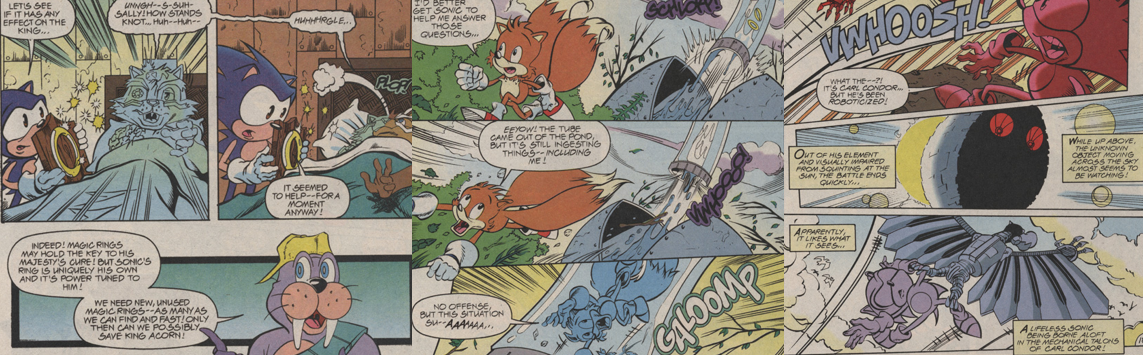
When Sonic and Tails look for Magic Rings to help the King, they stumble upon the Death Egg!

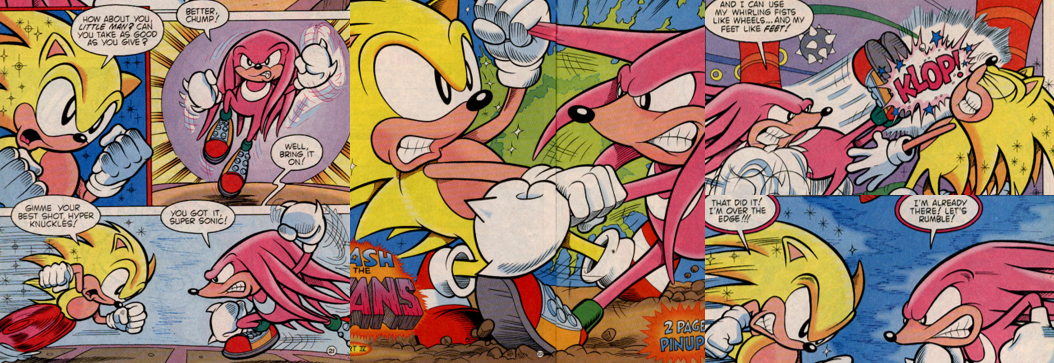
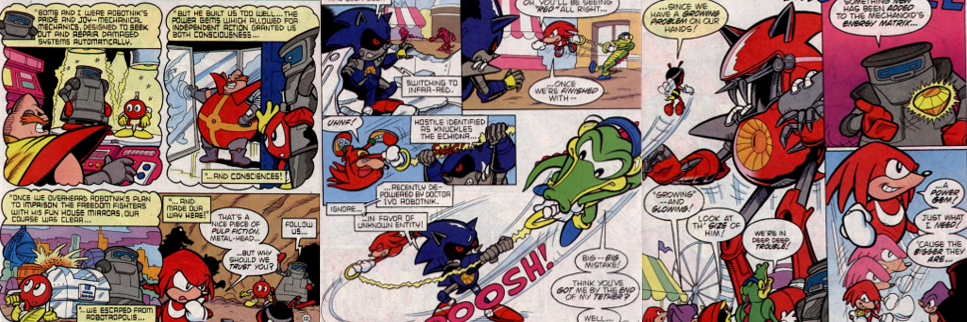
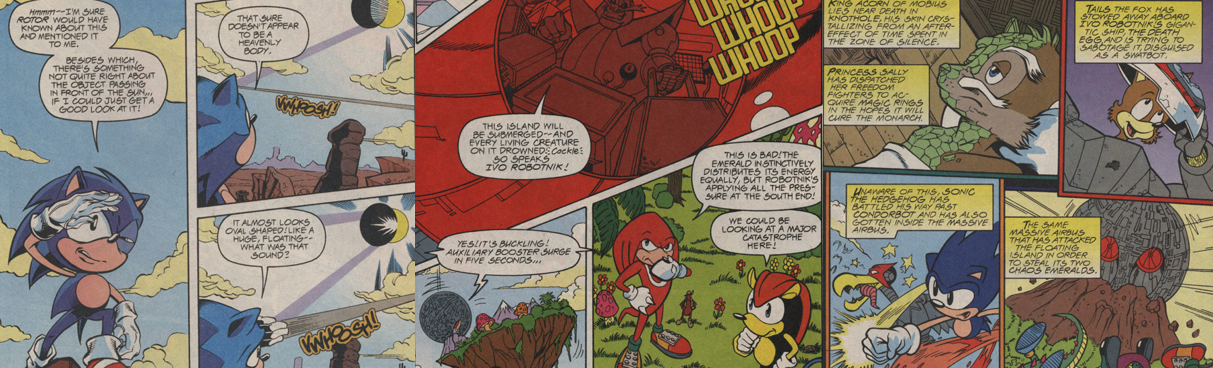
As best as Knothole’s resident physician, Doctor Horatio Quentin Quack, can figure, this is a result of the King’s extended stay in the mysterious Zone of Silence; in order to keep the Freedom Fighters from panicking, King Acorn’s condition has been deemed top secret and Sally orders St. John to stand guard over the King while they explore their options. Their trusty mechanic and science expert, Rotor the Walrus (occasionally called “Boomer”), is at a loss but rookie Freedom Fighter Miles “Tails” Prower hits upon a possible solution when he observes that the King’s crystalline skin resembles the texture of Chaos Emeralds. This prompts Sonic to retrieve his recently-acquired “one-billionth Magic Ring” to try and use its Chaos Emerald powers to reverse King Acorn’s condition, though it proves to be a fleeting solution. Rotor theorises that the Ring is unique to Sonic and suggests gathering as many others as possible to try again, prompting Sally to send Bunnie Rabbot and Antoine D’Coolette out to the mysterious Lake of Rings in the forest and Sonic and Tails to the Ring Grotto outside Robotropolis, Dr. Robotnik’s industrial, mechanical city. This area has been irrevocably changed and damaged following a recent fight between Super Sonic and Hyper Knuckles, and Dr. Robotnik’s attacks, and the two are stunned to find the Ring Grotto has been sealed beneath an impenetrable steel dome. Sonic leaves Tails to watch over the area while he races off to recruit a bruiser named Carl Condor to help bust it open, and the young fox-boy is shocked when the dome suddenly opens up and the Grotto’s entire supply of Magic Rings is sucked up into the clouds courtesy of a giant vacuum tube, which also takes Tails along with it! At the Mobian Cliffs, Sonic is shocked by a sudden and unnaturally faster solar eclipse, almost as if something artificial were crossing the Sun’s path, and horrified to find that Carl has been robotocised; caught off-guard, Sonic is rendered unconscious by the mechanical vulture and carried into the sky towards an ominous, egg-shaped superstructure.

Knuckles and the Chaotix are aghast when the Death Egg tries to submerge the Floating Island!

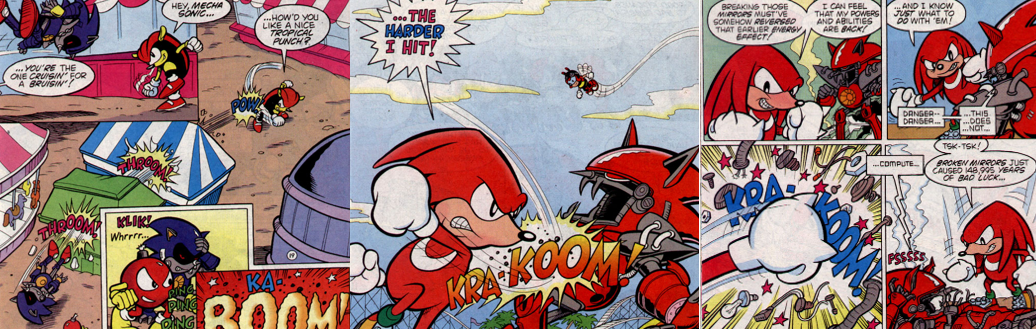
This is, of course, the Death Egg, Dr. Robotnik’s newest and most dangerous creation. After leaving his nephew and whimpering subordinate Snively in charge of overseeing Robotropolis’s reconstruction (a position he immediately and amusingly abuses), the cybernetic dictator revels in his glory as he powers up the Death Egg with the Magic Rings and prepares to use it to roboticise every living thing on the planet! However, while the Magic Rings ensure that the Death Egg is effectively invulnerable to external attack, Dr. Robotnik still needs a Chaos Emerald to bring the station to full power; additionally, he sucked up some unwanted additional weight that’s keeping it from reaching its proper orbit, but has no idea that Tails is in amongst the trees and debris. Thinking quickly, Tails jams himself into the discarded wreckage of a disobedient SWATbot so he can explore the space station undetected, while Sonic escapes the talons of the Condorbot and defies the laws of physics to pinball his way onto the Death Egg just as Tails jettisons the crap that was weighing it down. With the Death Egg scrambling their communications signal and the King’s condition worsening, Dr. Robotnik guides the Death Egg towards the Floating Island (as it was then known), which naturally attracts the attention of the island’s hot-headed guardian, Knuckles. Swooping up to intercept the Death Egg, Knuckles is hit by a laser blast from the satellite’s “eye”; luckily, this simply stuns him and he falls into the arms of his friends, the Chaotix (Mighty the Armadillo, Vector the Crocodile, Charmy Bee, Espio the Chameleon and…*sigh* Archimedes the Fire-Ant). The group watch as Dr. Robotnik drops a squadron of gigantic Burrobots to dig up the island’s Chaos Emeralds, which they race to stop to keep the island from plummeting from the sky. While the Chaotix attack the massive drilling mechs, Sonic tears his way through the Death Egg but arrives too late to keep Dr. Robotnik from ramming the satellite into the Floating Island! The Chaos Emerald is able to keep the island aloft, but the sheer weight and thrust of the Death Egg causes it to tip to one side and forces it into the sea below!

Thanks to repurposing Dr. Robotnik’s mechs, Sonic and Tails are able to destroy the Death Egg.

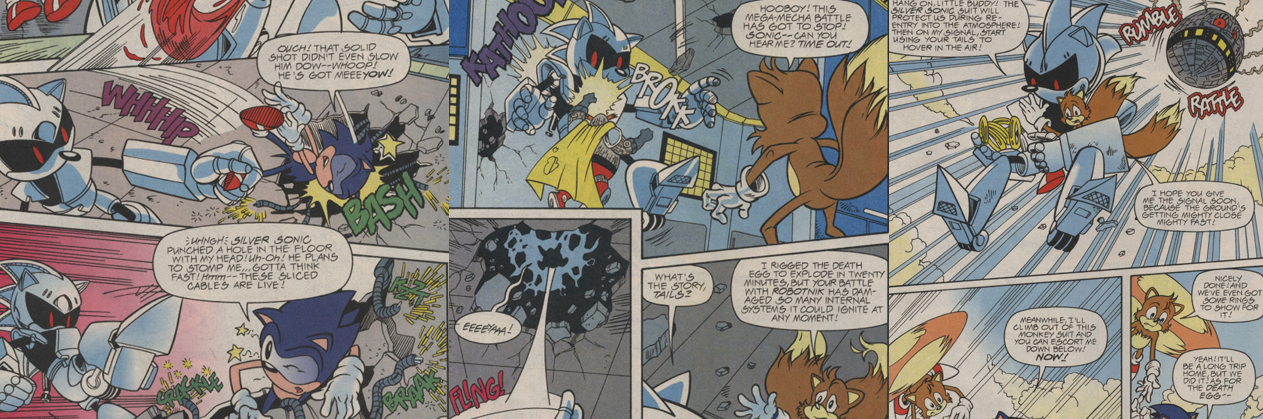
Naturally, Sonic leaps into action, only to end up attacking Tails by accident. To make matters worse, Dr. Robotnik shields himself from Sonic’s attack with a thick wall of plexiglass and then chokes him out with a spew of poisonous gas. Luckily, Tails recovers from his assault and uses his SWATbot suit to break through Dr. Robotnik’s defences and destroy his control panels, saving Sonic from suffocation and sending the satellite uncontrollably hurtling into space. Thanks to a “stabilising field” built into his “Gravi-Gauntlet”, Dr. Robotnik staves off the sudden drag of inertia and escapes to his auxiliary control room; he then sics a massive robotic Sonic doppelgänger on the two. While a far cry from his sleeker, more popular counterpart or even Sonic’s more versatile Mecha Sonic form, this “Silver Sonic” has the muscle and armour to shrug off Sonic’s attacks and manhandle (or should that be hoghandle?) him with punches, kicks, and slams but proves disappointingly susceptible to an electric shock from some conveniently-placed severed cables. Despite the failure of his Silver Sonic, Dr. Robotnik resorts to another back-up plan, donning his “most sophisticated battle armour ever”, the Eggs-O-Skeleton, which augments his physical strength by drawing power from the Death Egg itself! Sonic evens the odds by (…somehow…) commandeering Silver Sonic’s mechanical body and battling the rotund dictator on equal ground. The melee escalates but, ultimately, Sonic hurls Dr. Robotnik up through the ceiling and out of the Death Egg; during the fight, Tails was somehow able to rig the Death Egg to explode and the two beat a hasty retreat, swiping the stolen Magic Rings and making it safely to the surface before the Death Egg’s destruction (which, while somewhat anti-climactic on paper, is “seen and felt” all around the planet). While Snively faces the wrath of his uncle and master and the mad cyborg swears revenge upon Sonic and the Freedom Fighters, Sonic and Tails race back to Knothole to see if the Rings will cure the King, which is a plot thread left unresolved in this miniseries.

The Summary:
As ever, one of the main appeals of Archie’s attempt at a Sonic 3 & Knuckles adaptation is the artwork; Archie Comics, especially at this time, did a great job of emulating the character designs and locations seen in SatAM, with Patrick “Spaz” Spaziante being their standout artist. Manny Galan is no slouch here, though, and there are times when his version of Sonic evokes the character’s more dynamic and streamlined Japanese presentation; Archie’s original characters, like St. John, don’t fare too well but SEGA’s characters all hold up quite nicely, though I’m not massively onboard with the artistic shortcuts taken to basically show Sonic and Knuckles flying simply because they need to get up to the Death Egg. Everything is still early Archie, though, meaning the Floating Island doesn’t look that great, the Death Egg has an ugly and needlessly “busy” design, and there’s an element of daft childishness in some areas as the comic still hadn’t quite shaken off the influences from SatAM’s more slapstick sister series. As if often the case, the first few pages are bogged down with recapping the events from previous issues and even prior Archie stories, but it’s not too invasive.

While there’s some decent build up to the Death Egg, it feels secondary to King Acorn’s plight.

The biggest issue with Sonic Quest is that it’s not much of an adaptation of Sonic 3 & Knuckles. Much like in their other videogame tie-ins and those seen in Fleetway’s publications over here in the UK, Archie’s writers pick and choose elements from the videogames to incorporate, almost as if they were drip-fed footage and details of SEGA’s upcoming games rather than being privy to full details ahead of time. Thus, elements of Sonic 3 & Knuckles are spread out across different stories and one-offs, such as introducing Knuckles and even the Chaotix before the Death Egg. While the Death Egg is at the centre of Sonic Quest, it’s not really the narrative focus; the satellite doesn’t appear until the end of issue one and is destroyed before it can really do anything other than steal some Magic Rings, blast Knuckles, and almost submerge the Floating Island. On the plus side, the story does a great job of building the threat of the Death Egg; hiding it, seeing it on computer monitors, and especially the “eclipse” sequence all add to the anticipation of the space station’s big reveal and it’s portrayed (on paper) as being a serious threat as it’s allegedly capable of roboticising the entire planet. However, since it lacks a Chaos Emerald, it cannot actually do this and it’s one attack is enough to simply stun Knuckles, significantly diminishing its menace. I think the story would have benefitted from being five or even six issues long and seeing Dr. Robotnik successfully attack the Floating Island with the battleship and steal a Chaos Emerald to robotoicise large areas of Mobius, which would have greatly raised the stakes of the narrative.

Things pick up when Silver Sonic appears but the story wastes a lot of its more interesting elements.

As presented, Sonic Quest doesn’t even require Sonic to begrudgingly join forces with his hot-headed rival; Knuckles’ involvement is more of a glorified cameo and, while he and the Chaotix do fend off the gigantic Burrobots, he does nothing to help destroy the Death Egg. Indeed, since Sonic and Tails do all the work from inside the space station and sabotage its controls, there was never any danger of Dr. Robotnik acquiring a Chaos Emerald so Knuckles could’ve been entirely absent from the story. Additionally, we don’t really get a sense of the interior of the Death Egg; we only see a few corridors and rooms, with the bulk of the story taking place in a confined control room, and the main concern of the plot is more about getting the Magic Rings to cure King Acorn, with the Death Egg presented as more of an inconvenience since that’s where the Rings are being held. Things pick up a bit once Dr. Robotnik unleashes Silver Sonic but, while I enjoyed this fight and the artwork here, this mechanical monstrosity is defeated with a ridiculous amount of ease, exhibits no personality, and is somehow easily controlled by Sonic after it’s defeated. Even the showdown between Sonic and Dr. Robotnik ends up being quite disappointing; not only is Dr. Robotnik’s Eggs-O-Skeleton a weak design and a poor substitute for his more imposing Death Egg Robot, we never get a sense of what he’s capable of while wearing it beyond “being stronger” and he’s easily trounced by Sonic piloting the remains of Silver Sonic. There’s almost an intriguing element to this in the panels where Sonic is so fixated on ending Dr. Robotnik that he briefly considers risking his life, but it’s swept under the rug by a quick word from Tails and wouldn’t really resurface until the comic’s fiftieth issue. In the end, this was an enjoyable three-issue adventure; the art is good, the writing isn’t too hammy, and there’s some fun visuals whenever the Death Egg is looming over the Floating Island. However, it just reads like another Archie Sonic adventure; the Death Egg should’ve been a massive event, one stretching across multiple issues, but just comes across as another of Dr. Robotnik’s many maniacal schemes. As soon as we see it, it’s destroyed without really doing anything except threatening the Floating Island, something easily solved by Tails being a bit trigger happy, and there’s never a sense that this is truly the final victory for Dr. Robotnik in his war against the furries. It’s a shame, really, as this could’ve been a great way to build bridges between Sonic and Knuckles or even have the Chaotix team up with the Freedom Fighters, but it just comes across as a throwaway tie-in with little impact on the ongoing narrative beyond finding a cure for the King.

My Rating:

Rating: 2 out of 5.

Could Be Better

Did you enjoy Sonic Quest? Did you collect the miniseries when it first released or, like me, did you pick it up in a later collection? What did you think to the depiction of the Death Egg? Do you agree that it was neutered compared to the videogames or were you impressed with its appearance? Were you disappointed that Sonic and Knuckles didn’t team up to fight at and by how easily it was brought down? What did you think to Silver Sonic and Dr. Robotnik’s Eggs-O-Skeleton armour? Which of Archie’s videogame tie-ins was your favourite? How are you celebrating the anniversary of Sonic 3’s release today? Please feel free to share your memories of Archie’s Sonic comics and Sonic 3 & Knuckles below or on my social media.

Back Issues [Sonic CDay]: Sonic the Hedgehog #25


Developed alongside the blockbuster Sonic the Hedgehog 2 (SEGA Technical Institute, 1992), Sonic the Hedgehog CD (Sonic Team, 1993) released on this day back in 1993. Expanding upon the Blue Blur’s debut title, Sonic CD introduced Metal Sonic (one of Sonic’s most popular and enduring rivals) and Amy Rose, and is considered by many to be one of the best of the classic Sonic titles.


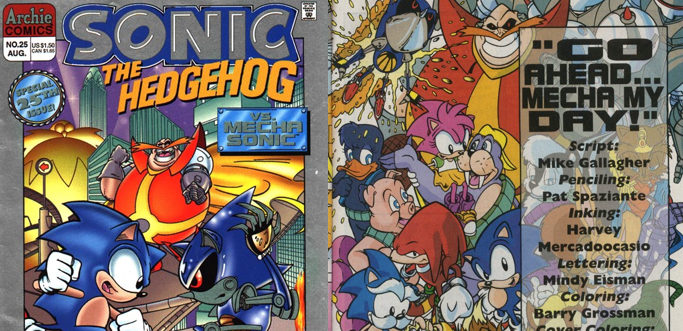
Story Title: “Go Ahead…Mecha My Day!”
Published: August 1995
Writer: Mike Gallagher
Artist: Patrick Spaziante

The Background:
SEGA were quick to capitalise on Sonic’s popularity once he catapulted to mainstream success and helped them to usurp Nintendo’s position at the top of the videogame industry. Following Nintendo’s success with DiC, SEGA licensed a series of cartoons that were soon accompanied by a four-part miniseries published by Archie Comics. Archie’s Sonic the Hedgehog comics went on to become the longest-running videogame comic book ever and, amidst continuing the adventures of the Knothole Freedom Fighters, the Archie comics weaved in storylines, characters, and elements from the videogames, often changing them to fit their unique narrative. Although a mechanical version of Sonic had featured in Archie’s comics prior to this story (and many more would follow over the years), Sonic’s most recognisable robotic duplicate debuted in the comic’s twenty-fifth issue as part of a loose adaptation of Sonic CD and would go on to continuously plague the hedgehog and his allies even when IDW swept away Archie’s continuity in favour of their own.

The Review:
I didn’t grow up reading Archie’s Sonic the Hedgehog comics; as far as I know, there was no way for us to get hold of them here in the United Kingdom back in the day, so I’m not entirely sure I was even aware of them until late into my teens. I did watch Sonic the Hedgehog/SatAM (1993 to 1994) though and, like many kids from my generation I was, deeply invested in the series and frustrated when it ended on an unresolved cliff-hanger. Although the Archie comics never actually resolved this cliff-hanger and were more like a spin-off than a true continuation, they were the closest thing we’d ever get to an official follow-up to that successful cartoon and, in the years since, I’ve read through the entire Archie Comics run. It has its good points and many bad points, but I found myself enjoying it well enough, especially once they started to incorporate more elements from the source material and veer away from the comedic slapstick that muddled the narrative tone of the first fifty-or-so issues. I’ve already explored how awkward the incorporation of these videogame elements was to the series; the same was true of the UK’s Sonic the Comic (1993 to 2002) and is to be expected when you’ve gone off on your own pretty complex tangent and then have to shoe-horn in official canon into the narrative, but there’s an appeal to the series nonetheless thanks to nostalgia and my love for Sonic.

While Sonic tests Rotor’s new device, Dr. Robotnik plans to lure him into a deadly trap.

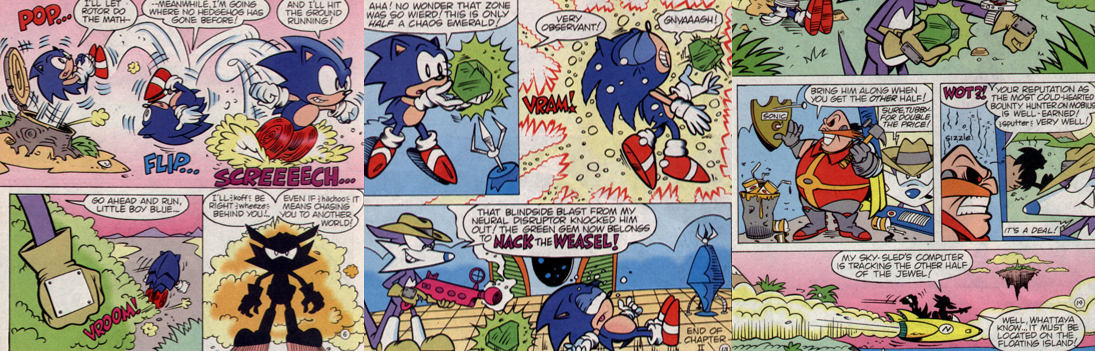
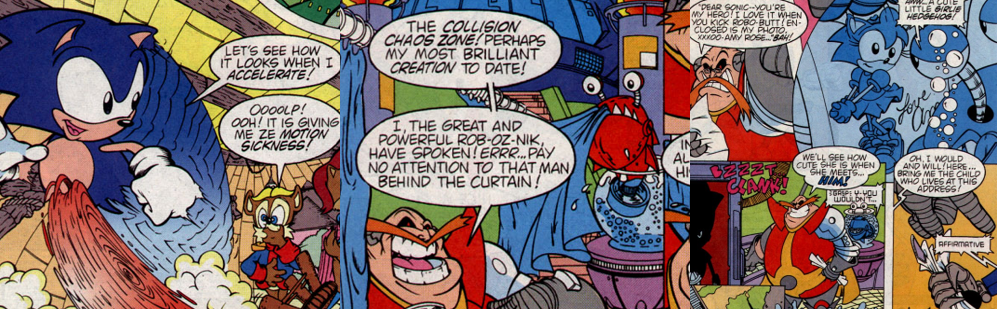
“Go Ahead…Mecha My Day!” (great pun, by the way) begins with Sonic impatiently enduring the hooking up of a video camera to his sneaker; developed by Knothole’s resident mechanic and tinkerer, Rotor the Walrus, the “Sonicam” sends a direct feed back to the Freedom Fighter’s computer so they can keep track of where Sonic is and any potential dangers they need to be aware of. Princess Sally Acorn, leader of the Knothole Freedom Fighters, is particularly pleased with this new technology given that a “new Zone portal” just opened up and is in need of exploration. Sally’s fears about this situation are well founded as it turns out that the Collision Chaos Zone is the creation of Mobius’s mad cybernetic dictator, Doctor Robotnik. However, while he looks like the SatAM Dr. Robotnik, at this point Archie’s version still has quite a bit of his bombastic and foolish variant from the Adventures of the Sonic the Hedgehog cartoon (1993); this means he breaks the fourth wall, chuckles maniacally to his bumbling Badniks, and lacks the grim menace of the SatAM version. However, there’s enough of that interpretation of the character in Dr. Robotnik to order his latest, most mysterious creation to kidnap Sonic’s number one fan, Amy Rose, and then issue a direct challenge to Sonic, daring him to test his speed and skill in his Collision Chaos Zone to rescue Amy. Naturally, Dr. Robotnik plans to stack the deck against Sonic by having his long-suffering, snivelling nephew and head minion, Snivley, struggle into an elaborate Robotnik costume and burn up the road behind Sonic to force him into an even deadlier trap.

Racing to save his friends, Sonic is confronted and challenged by his metallic doppelgänger.

Naturally, Sonic wants to leap into action right away; determined to prove himself and to rescue one of his greatest fans, he thinks nothing of jumping head-first into such an obvious trap, such is his confidence. However, Knothole is a democracy and, as a result, he’s forced to heed to Sally’s more level-headed orders; to get a better sense of what dangers lie ahead, Sally has Miles “Tails” Prower fly on ahead to scope out the area…and he’s immediately captured by Dr. Robotnik’s Swatbots. Fed up with waiting, Sonic races out to the Zone portal and, despite Dr. Robotnik struggling with his lines, is brought abreast of the escalating hostage situation; thanks to the Sonicam’s slow-motion function, Sally and Rotor are able to look in as Sonic races through the bizarre environment while Snively incinerates the path behind him, all to force Sonic into a confrontation with Mecha-Sonic (also referred to without the hyphen). Oddly, Mecha-Sonic’s dialogue seems to indicate that the two have met before, but this was the character’s first appearance; however, it wasn’t uncommon for the videogame’s events to happen off-panel and between stories throughout Archie’s run, even though that doesn’t really align with the narrative presented here, making this allusion confusing, at best. Anyway, Mecha-Sonic challenges his rival to prove his speed in a race through the Stardust Speedway Zone, with Tails and Amy as the prize and Snively pursuing them in Dr. Robotnik’s craft

Sonic’s speed is too much for Mecha-Sonic and Dr. Robotnik’s plot is easily foiled.

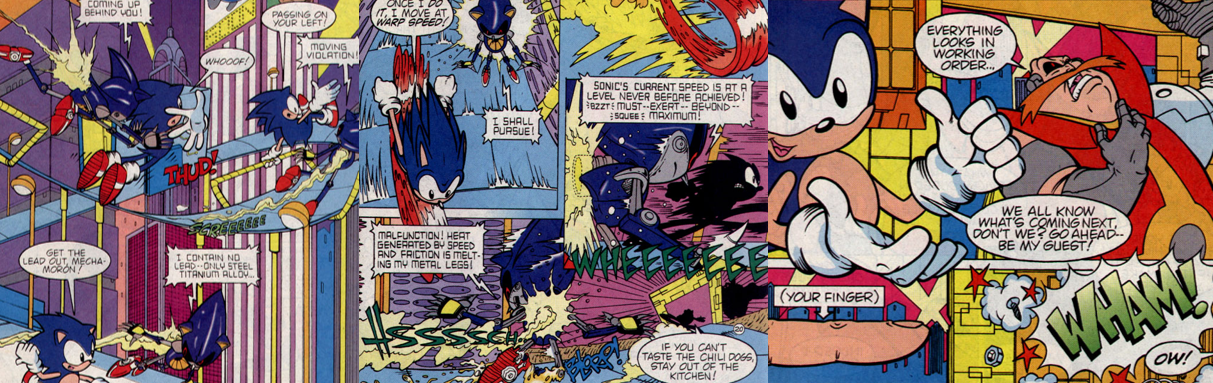
Of course, Sonic takes the bait and “engages” with Mecha-Sonic, much to Dr. Robotnik’s glee; while Amy wails at the engagement pun and Rotor scrambles to account for interference from the Stardust Speedway Zone, we’re treated to a nice two-page spread of the two rivals exchanging taunts and shoving past each other in a pretty neck-and-neck dash through the Zone, which is brought to life by the unrivalled Patrick “Spaz” Spaziante and is certainly faithful both to the level layout from the videogame and the anime sequences that accompanied it. However, Sonic has no idea that Dr. Robotnik has set up a failsafe at the finish line; a massive weighted door that will crush Sonic when he passes under it (which Dr. Robotnik demonstrates by crushing Crabmeat, though this doesn’t kill the woodland critter tapped within him since that wasn’t really a thing in this continuity). Although Sonic gains the lead, Mecha-Sonic uses holograms and environmental hazards to distract and trip him for an unfair advantage, meaning tensions are high as they race down the final stretch. Here, Sonic debuts his new “Figure Eight Super Peel-Out” for a burst of acceleration that pushes him into “warp speed” and Mecha-Sonic summarily melts itself in half by overexerting its thrusters. Sonic is even spared a gruesome end thanks to the timely intervention of Princess Sally but, when Dr. Robotnik throws a tantrum over the loss, volunteers to give the dictator a chance to squash him. When Sonic easily dodges out of the of the trap, he invites Dr. Robotnik to inspect the mechanism for faults and then encourages the reader (represented by a literal on-panel finger) to activate the trap and crush the cyborg madman beneath it. The comic the ends with Tails and Amy free, Dr. Robotnik squashed under his own trap, Mecha-Sonic left sparking on the racetrack, and the heroes celebrating the comic’s first twenty-five issues.

The Summary:
I went to great pains at the start of my review to try and prepare you for the fact that Archie’s Sonic comics weren’t exactly known for their 100% fidelity to the source material when they started adapting more elements from the videogames into their plot but, even considering that, “Go Ahead…Mecha My Day!” is even less of a Sonic CD adaptation than its Sonic the Comic counterpart. Both plucked only the most iconic elements of the videogame (Amy, Metal Sonic, and parts of the environments) and shoe-horned them into their unique narrative, choosing to focus more on the battle between Sonic and Metal Sonic than the time travel plot. While the Sonic the Comic adaptation benefitted slightly from being a multi-part story told over a few issues, both adaptations have about the same level of substance thanks to the first two parts of the story simply setting up for Sonic’s adventures on the Miracle Planet. This location doesn’t even appear here, however; instead, we get two of Sonic CD’s more recognisable areas (Collision Chaos and Stardust Speedway) but they’re presented as being “creations” of Dr. Robotnik, existing in another dimension, of sorts, rather than being on the Little Planet. The Time Stones are also completely absent, as are any elements of time travel or Dr. Robotnik’s plot to conquer the Little Planet, meaning the plot is all about the race between Sonic and “Mecha-Sonic” to rescue Amy (and Tails).

It’s a bit slapstick and barely has anything to do with Sonic CD but at least the art is nice.

Even when you get past the fact this this isn’t really an adaptation of Sonic CD, “Go Ahead…Mecha My Day!” is a bit weak overall; the story’s far too short, Dr. Robotnik lacks the menace of his SatAM counterpart, and there’s never really a sense of danger even when Mecha-Sonic makes its appearance. Like in the Sonic the Comic version, Mecha-Sonic can talk; here, it seems to have been programmed to ape Sonic’s snarky attitude as much as his speed as the two trade quips and grandeur during their confrontation. Though it demonstrates none of its videogame’s other powers, Mecha-Sonic is shown to be a wily antagonist and fully prepared to cheat to gain an advantage, but it’s ultimately handicapped by its mechanical construction and thus falls apart when it tries to match Sonic’s near-limitless speed. Still, the art used to render Mecha-Sonic and the race is impressive; Spaz was always Archie’s best artist when it came to Sonic and he does a great job on the title character, his robotic rival, and Dr. Robotnik. Given that it takes place in this quasi-SatAM continuity, the story also features appearances from the Knothole Freedom Fighters; Tails wasn’t yet the genius mechanic we know him today so Rotor fulfils that role and his Sonicam keeps them up to date with Sonic’s situation while Antoine D’Coolette is simply there to spout nonsense and oppose Sonic out of spite. Since she was always portrayed as Sonic’s equal in the field, it’s obviously Sally who drops in to lend a hand in the finale, emphasising the camaraderie that was so important to this interpretation of Sonic, though it’s made explicitly clear that he didn’t actually need any help. In the end, this was a decent enough story with lots of great art and fun, engaging action but it’s let down by its brevity, the awkward goofiness permeating throughout it, and the fact that it basically has nothing to do with Sonic CD beyond some extremely basic elements.

My Rating:

Rating: 3 out of 5.

Pretty Good

Have you ever read “Go Ahead…Mecha My Day!”, or any of Archie’s Sonic the Hedgehog comics? If so, what did you think of the story and the way its focus on the race between Sonic and Metal Sonic? Were you disappointed by the lack of any other elements from Sonic CD? Which of Archie’s original characters was your favourite and what did you think to their award-winning run? How are you celebrating Sonic CD’s anniversary this year? Whatever your thoughts on Sonic CD, or Sonic in general, feel free to leave a comment below.

Back Issues & Knuckles: Sonic’s Friendly Nemesis: Knuckles


With the release of Sonic the Hedgehog 3 (SEGA Technical Institute, 1994), gamers were introduced to Knuckles the Echidna. This mischievous, dreadlocked antagonist was created by Takashi Yuda and his debut was made all the more impressive by virtue of the fact that Sonic 3 was too big to fit on one cartridge, which meant that Knuckles was the first of Sonic’s supporting characters to co-star in a main series videogame when Sonic & Knuckles (ibid) was released on this very day in 1994.


Writers: Mike Kanterovich and Ken Penders – Artist: Art Mawhinney

Story Title: “Rites of Passage, Part One”
Published: May 1996

Story Title: “Rites of Passage, Part Two”
Published: June 1996

Story Title: “Rites of Passage, Part Three”
Published: July 1996

The Background:
When Sonic the Hedgehog blasted onto the videogame scene in 1991, he was an immediate hit thanks to his debut title being bundled with the Mega Drive and SEGA’s aggressive marketing campaign. His popularity exploded with Sonic the Hedgehog 2 (SEGA Technical Institute, 1992), however, and Sonic merchandise was suddenly everywhere: not only did he feature in the Macy’s Day Parade and in cartoons but he also starred in a number of comic books. Following the initial four-part miniseries which mashed together narrative elements of Sonic’s cartoon adventures, Archie Comics  began regular publication of what would become the longest-running videogame comic book ever. In time, to capitalise on Sonic’s continued popularity, a number of spin-off comics were produced, with one of the most prominent being the Knuckles the Echidna sister series. What began as a simple enough three issue miniseries soon expanded into a convoluted lore that eventually became the subject of a bitter lawsuit between Archie and writer/artist Ken Penders that forever changed the way subsequent Sonic comic books were handled.

The Review:
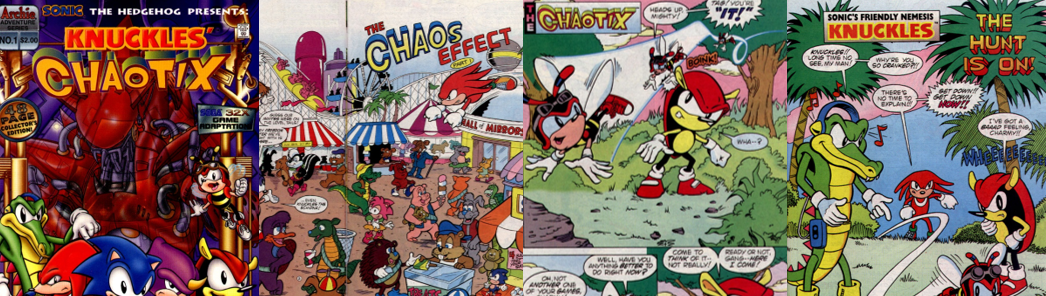
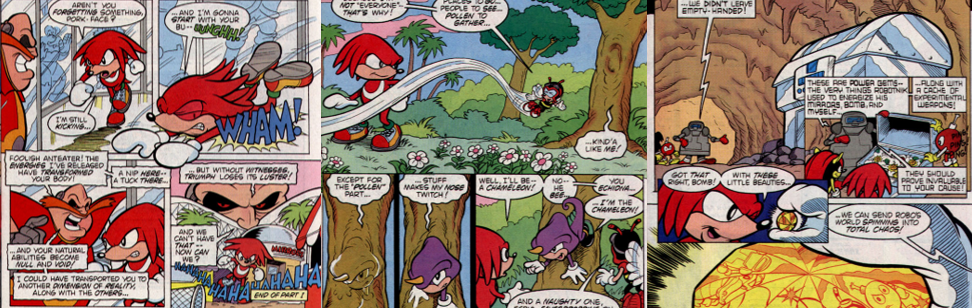
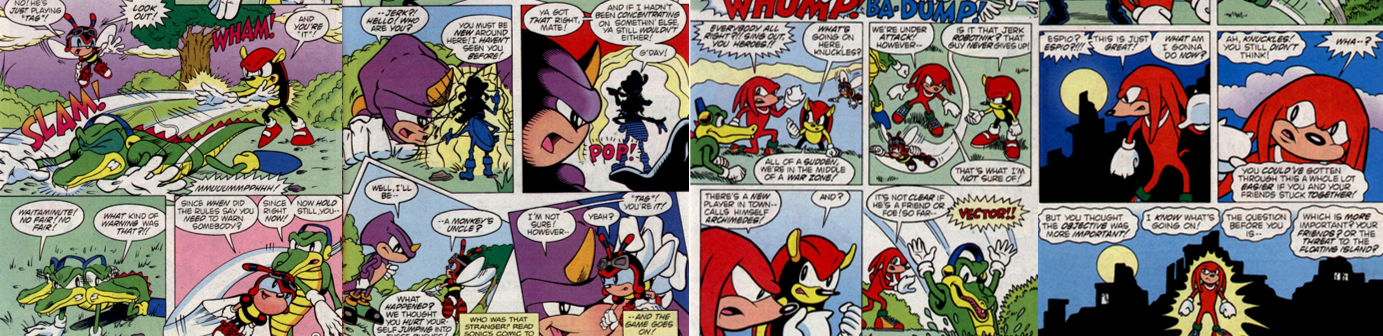
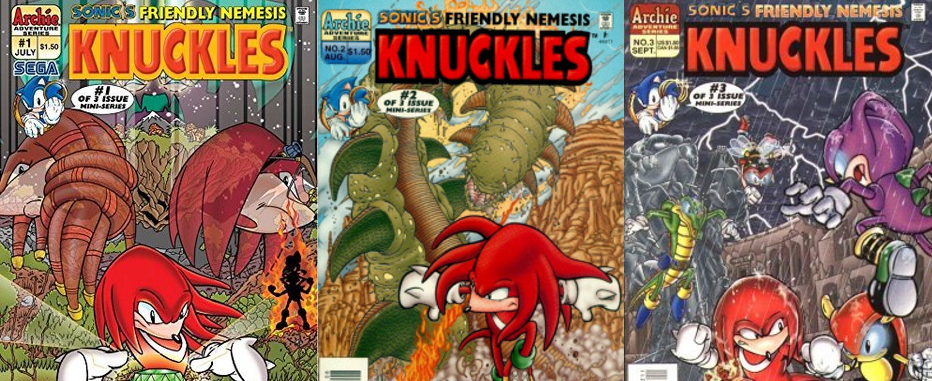
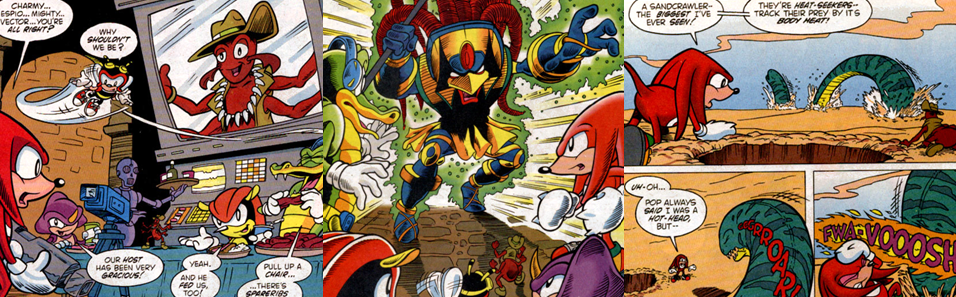
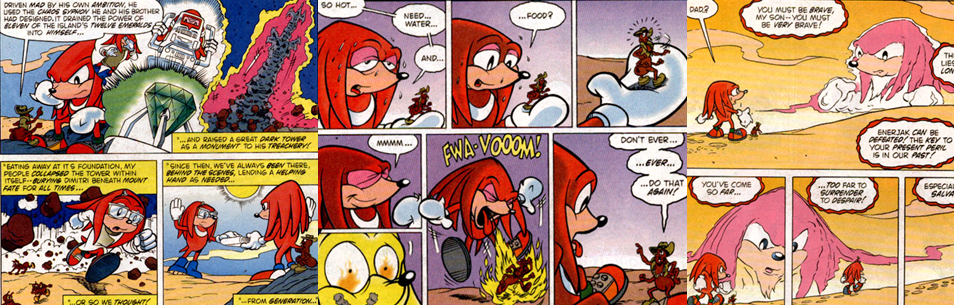
Sonic’s Friendly Nemesis: Knuckles begins by first promoting the “mystery of Archimedes” and then giving a very brief rundown on Archie’s take on Knuckles, the downfall of the Echidna society, and his floating home. In these early appearances, Angel Island was known by the Western name of Floating Island and, in Archie Comics especially, was held aloft through the power of just the one Chaos Emerald (and not even the Master Emerald at this point) and incredibly advanced technology. With the Echidna’s long gone, nature has reclaimed much of the island, leaving it in disarray and causing long-forgotten secrets to be buried. Knuckles pays a visit to Mount Fate in search of his missing friends, Mighty the Armadillo, Vector the Crocodile, Espio the Chameleon, and Charmy Bee (collectively known as the Chaotix), who he strongly suspects are being held captive there by the mysterious Archimedes. Archimedes has been making Knuckles’ life a bit of a misery in recent issues and stories, taunting him with riddles about his past, and led Knux to discover that, generations ago, the Echidna brothers Edmund and Dimitri tried to use the Chaos Emerald to return Floating Island to Mobius and, in the process, Dimitri became the evil entity later identified as Enerjak, the “Harbinger of Chaos”. The entire experience caused the Echidnas to renounce technology in all its forms and bury their secrets away beneath Mount Fate and, when Knux arrives, he finds that the chamber is well guarded by a number of electronic lasers, booby traps, and other obstacles specifically designed to keep out (or kill) any intruders.

Knuckles’ reunion with Chaotix is cut short by the sudden appearance of the all-powerful Enerjak.

As Knuckles explores his surroundings, he arms himself with a concussive blaster (because that’s what I always think when I think of Knuckles: guns!) and forces his way into the grand observatory at the heart of the temple…only to find that his friends are being treated to a glorious spread as guests of Archimedes, who is revealed to be a weird-looking anthropomorphic fire-ant (yeah…I don’t know, either). Considering all of the games, subterfuge, and questionable behaviour shown by Archimedes, Knuckles is understandably enraged and demands answers but any hostilities between the two are interrupted by the arrival of Enerjak, who broke free from his prison when Knuckles triggered Mount Fate’s traps. Although Knuckles dismisses the Pharaoh-esque madman as a fraud, Enerjak boasts the incredible, unmatched power of eleven Chaos Emeralds (Archie Comics had an almost incalculable number of the gems at the time) and proves his power (and to be more than a match for the combined might of Knuckles, Chaotix, and Archimedes) by overpowering them all, taking Chaotix captive, and blasting Knuckles and Archimedes to the blazing hot desert of the Sandopolis Zone. As the two begin the bleak, day-long journey across the outback, they are attacked by a giant sandcrawler. However, the beast is easily defeated and turned into late-night kebabs for the two when Archimedes uses himself as bait (and his ability to teleport) to trick it into colliding head-first with a stack of rocks. Afterwards, Archimedes regales Knuckles (and bores the shit out of me…) with the story of how his people watched as the Echidnas harnessed the power of many Chaos Emeralds to move the entire city of Echidnapolis out of the path of an incoming comet (why they didn’t just evacuate is beyond me) thanks to the fire-ants performing the “ground-breaking ceremony” to effectively birth Floating Island. Archimedes then recounts, in a little bit more detail, how Dimitri later fashioned the “Chaos Siphon” to absorb the power of eleven Chaos Emeralds and ended up burying himself in the process.

Stuck in the boiling desert, Knux is subjected to endless exposition and visions of his father.

Since then, generation after generation of Echidnas were named Guardian of the Chaos Emerald and the fire-ants watched over them, testing them with a rite of passage to ensure that they would be read to combat threats such as Enerjak. While Knux and Archimedes resolve to work together to face Enerjak, they still need to cross the boiling desert; in his desperate hunger, Knux amusingly tries to eat Archimedes and ends up getting his mouth burned as a result. Later, while succumbing to the heat, Knuckles has a vision of his long-dead father, Locke, who does his best Mufasa (James Earl Jones) impersonation and gives him not only the resolve to continue onwards but also a cryptic clue as to how to defeat Enerjak: “The key to your present peril is in our past!” After reinvigorating himself at a mysterious oasis, Knuckles and Archimedes forge onwards towards Nekronopolis, a mighty city erected by Enerjak’s vast Chaos powers. The city, which Enerjak has built as a dark and corrupt reflection of Echidnaopolis, is home to an army of disposable mechanical minions (known as “Mecha-Nauts”) and Enerjak’s imposing citadel. Knuckles decides that the best approach is to tackle the Mecha-Nauts head on, which earns him Archimedes’ disapproval until he reveals that it was part of a plan to lure the machines to a gate so that he could crush them all (or, at least, a lot of them) in one move. However, while they manage to get into the citadel with a minimum of fuss, inside he is confronted by the Chaotix, who have been brainwashed by Enerjak’s magic and attack the two on his command. The fight (which includes a timely reference to The Mask (Russell, 1994) and even, surprisingly, The Shadow (Mulcahy, 1994), two films that both released in the year prior to this issue) goes poorly for the Chaotix; despite them having the numbers advantage, Knuckles and Archimedes are able to hold them off, forcing Enerjak to intervene and render them both unconscious using his powers (kind of making controlling the Chaotix a waste of time…) With Knuckles and Archimedes helpless against Enerjak’s powers, the would-be tyrant recaps his origins again just in case we didn’t realise how he came to be what he is.

Enerjak’s power may be awesome but the fight ends unresolved.

Despite acknowledging that the Guardian and his newfound fire-ant companion are the only two who could possibly oppose him, Enerjak prefers to boast and monologue rather than destroy them while he has the perfect opportunity. Indeed, Knux goads him into releasing them from his energy field, which gives Archimedes the opportunity to contact his fellow fire-ants. While Knuckles creates a distraction by taunting Enerjak and absorbing the brunt of his anger, Archimedes is able to teleport them out of danger so that Knux can (literally) get the drop on him and, though stunned to learn that he is Knuckles’ great-uncle, Enerjak attacks with a ferocity that is only matched by his augmented strength. Still, the two are relatively evenly matched, potentially because Knuckles has successfully goaded Enerjak into a straight-up fist fight and continues to chastise his great-uncle for his selfish ways and lack of honour. Their fight is cut short when Enerjak’s citadel suddenly transforms into a rocket and blasts into space; Knuckles and Archimedes escape thanks to the efforts of the fire-ants and Chaotix are freed from their pointless mind control. In the aftermath, despite Knuckles not really learning anything from him or really acting in a way that’s that impressive, Archimedes gives Knux his respect. Although Enerjak escaped to live to fight another day, the group is victorious and decide not to worry too much about the mysterious happenings that they experienced along the way (such as the oasis disappearing and the aforementioned rocket) but the story concludes with the revelation (to us) that Locke is actually alive and actively monitoring and assisting Knuckles from a hidden, high-tech bunker.

The Summary:
Jesus, what a slog. I’ll be the first to admit that Knuckles is my absolute favourite Sonic the Hedgehog character and I remember being so excited when he debuted in Sonic the Comic (1993 to 2002) and to learn that he was a prominent feature in the Archie comics, which were seen as kind of a continuation/parallel to Sonic the Hedgehog/SatAM (1993 to 1994). Knuckles the Echidna was one of the longest-running spin-off of the Archie Sonic comics, which is a testament to the character’s appeal and popularity, but every time I read his solo run I can’t help but be astounded at how boring and preposterous it is. I don’t usually lark to harp on about this sort of thing but my God is the art terrible in these issues! The covers, drawn by the always amazing Patrick “Spaz” Spaziante, are the best part of the artwork in this miniseries as, while Knuckles generally looks kind of okay, a lot of the characters just look really weird and disproportionate. I can kind of understand it as the majority of the Chaotix are really weird character designs already but Archimedes and the rest of the fire-ants just look ugly, man. Environments are very bland and nonsensical as well and all three issues suffer from the same artistic inconsistency that plagued the Archie Sonic comics for about fifty issues or so. There are, however, some impressive moments in the issues, though. In the rare instances where Knuckles is gliding or in action, he looks suitably bold and striking and, while Enerjak’s design is a bit “busy”, he looks pretty distinct and intimidating and I love how he has all this Egyptian-inspired apparel on his armour. Thanks to having absorbed the powers of eleven Chaos Emeralds, he can fly, wields Chaos energy, and is able to render targets under his control or unconscious and seems to have enhanced durability and strength, and can even erect a fully-functional city and robot minions in just a few panels.

Enerjak has a striking design and is certainly powerful but this was a poor outing for him.

Yet, the exact limits of his powers remains a mystery; he is regarded as a bogeyman-type figure by Archimedes and, as we learn, the reason why the Echidnas eventually renounced technology and he’s certainly a maniacal force but the story ends before we really get to delve into exactly what he wants. And that’s interesting because Sonic’s Friendly Nemesis: Knuckles is about 75% dialogue and exposition. Look, I get it; you can’t assume that people who read issue two or three will have read issue one but every issue starts with a bit of swirling text recapping the previous issue’s events so I really don’t think it was necessary to recap the (literal) rise and fall of Echidna society or Enerjak’s origin three Goddamn times! Sure, have Archimedes explain the fire-ant perspective on it all and introduce the idea of Dimitri there and yeah, Enerjak could share his perspective as well, but they’re largely the same and it just felt like needless filler. Add to that the fact that neither Knuckles nor Archimedes ever shuts up and constantly narrates his every thought and action and you have a story that is more a chore than a thrill to get through, which is a shame as I find Enerjak to be a compelling villain and his slug-fest with Knuckles was gearing up to be something good. It doesn’t help that Archie constantly shoe-horned the Chaotix into Knuckles’ stories, bloating the cast to kind of make it like an alternative to Sonic and the Knothole Freedom Fighters and, considering how useless the Chaotix were in this miniseries, it might’ve been better to omit them entirely and focus solely on Knuckles (and Archimedes, I guess, even though I am not a fan of the character) and his efforts to prove himself a worthy Guardian and oppose Enerjak’s ambitions.

My Rating:

Rating: 2 out of 5.

Could Be Better

Have you ever read Sonic’s Friendly Nemesis: Knuckles? Did you pick the issues up when they were first released and, if so, what did you think about Knuckles’ first spin-off? What did you think to Archie’s introduction and characterisation of Knuckles and the increasingly-complex depiction of the Echidna society? Were you a fan of Archimedes and Enerjak? Did you like the Chaotix being Knuckles’ running buddies? Which of Archie’s Knuckles stories and/or characters was your favourite and why? Are you celebrating Knuckles’ big day today? Whatever you think about Archie’s Sonic comics, and especially Knuckles, leave a comment down below and let me know.

Interplay: Sonic Adventure

Interplay

One of the great things about adaptations, and adaptation studies, is that they both:

“[continue] to expand and become more inclusive […] it is increasingly difficult to determine a cohesive theory that accounts for the division between adaptation and other intertextual modes: allusions, plagiarisms, remakes, sequels, homages, mash-ups, appropriations, and the list goes on” (Dicecco, 2015: 161)

This quote sums up perfectly what makes adaptation studies so interesting; adaptations can be anything and are restricted only by the scope of your imagination and your commitment to researching the links between media.

While researching the theories of Nico Dicecco (and his contemporaries) during my PhD, I chose to focus on the adaptation of videogames into movies, television shows, cartoons, and comic books. This was primarily because it’s a lot easier to talk about media that is adapted into film and there hadn’t really been any serious research into videogame adaptations at that time. I’ve previously talked about how my studies into the Sonic the Hedgehog (Sonic Team/Various, 1991 to present) franchise revealed that Sonic the Hedgehog Spinball (Polygames/SEGA Technical Institute, 1993) heavily influenced multiple Sonic adaptations over the years but there has been another Sonic videogame that has made multiple jumps to other media.

SonicAdventureLogo

Today, I’m once again returning to one of my favourite Sonic videogames, Sonic Adventure (Sonic Team, 1998), Sonic’s first real foray into 3D gameplay and a title that focused on multiple characters and gameplay mechanics, a far deeper narrative than the franchise had experienced in a videogame before, and functioned as both a consolidation of Sonic’s competing iterations and a “soft reboot” for the franchise, due its use of  “slight changes to be made without having to completely scrap the franchise and start over” (Bancroft, 2015).

SonicAdventureVariety
I can’t praise this game’s variety enough!

Coming after a long absence from a main series Sonic title (and at a time when SEGA were almost haemorrhaging money thanks to failures like the Mega-CD and SEGA 32X), Sonic Adventure became “the best-selling Dreamcast game of all time, with almost two and a half million copies sold”. (Pétronille and Audureau, 2012: 70). It reinvigorated the Sonic franchise in a way that I think has been forgotten over time; while the game may have had its flaws, it successfully revitalised Sonic and led to a string of successful sequels and follow-ups. While these weren’t enough to curb SEGA’s financial woes, the success and impact of Sonic Adventure led to a shift in Sonic’s gameplay, narrative, and aesthetic direction; rather than racing along a 2D plane, players now ran along at break-neck speeds in fully 3D environments that were designed more like rollercoasters. Sonic was now “Taller, slimmer and somehow spikier”, his friendliness replaced with “an anime-style cool” (Jones, et al, 2011: 31), and his narrative was far darker and more mature than his bright, psychedelic 2D titles. Perhaps the most significant impact of Sonic Adventure came through Sonic Team eventually stripping away all other playstyles to focus purely on Sonic’s speed, an aspect that largely led to the development of the Boost-orientated gameplay of modern Sonic titles.

InterplaySAOVAAdv
Surely this can’t be a coincidence?

One thing to note before I delve into the main focus of this article is how the adaptation process appears to have worked both ways with Sonic Adventure. Many elements from Sonic the Hedgehog: The Movie (Ikegami, 1996) are recognisable in Sonic Adventure, such as Tails’ workshop on South Island, the appearance of cities and structures that mirror those of our world, and a lot of Doctor Robotnik’s (Edwin Neal) personality and technology. For me, the Sonic OVA is clearly a precursor to Sonic Adventure’s attempt to leave behind Mobius and show him as an adventure-seeking teenager in a world not too dissimilar to our own (though I still pray for the day when his characterisation matches the snarky attitude of his OVA counterpart). Sonic Adventure didn’t just impact Sonic’s videogames, however; by 1999, Archie’s Sonic the Hedgehog comic books had developed into a continuation of the fan favourite Sonic the Hedgehog (1993 to 1995, more commonly referred to as “SatAM”) cartoon, infusing characters and events from the videogames into its narrative. With this in mind (and, possibly, in keeping with SEGA’s desire to create a homogeneous version of Sonic), it was inevitable that Sonic Adventure would feature in these comics before long.

InterplaySARoboEggman
Robo-Robotnik soon replaced his organic counterpart as “the Eggman”.

Sonic Adventures’ influence began slowly but, in keeping with the increasingly-convoluted narrative of the comics at the time, was complex to the nth degree. First, the Archie team crafted an elaborate story to explain why Sonic now looked like his Sonic Adventure counterpart: ‘Retro Activity’ (Bollers, et al, 1999) not only showed how Sonic transformed from his pudgy, classic look to this edgier aesthetic by racing against a destructive energy beam so fast that he cycled through his various Super forms, but it told this story backwards! If you thought that was bad, though, the lengths they went to to explain Robotnik’s transformation into his Sonic Adventure counterpart, Doctor Eggman, were even worse! So, in ‘Endgame, Part 4: For Whom the Bell Tolls’ (ibid, 1998), Sonic finally destroyed Robotnik forever in a fight to the death involving his latest doomsday weapon, the Ultimate Annihilator. However, it is dramatically revealed in ‘I Am the Eggman!’ (ibid, 1999) that Robotnik has returned…in the form of his fully-robotic, alternate-universe counterpart, Robo-Robotnik. Though seemingly destroyed in that story, the issue ends with Robo-Robotnik downloading his consciousness into a body that is identical to his Sonic Adventure design; “Eggman” (for a long time “The Eggman”) would quickly become a derogatory nickname used to describe Robotnik until the madness was smoothed over by massive continuity changes much later down the line. The Sonic Adventure tie-in officially began with ‘The Discovery: A Sonic Adventure Tie-In’ (ibid), in which Sonic and the Knothole Freedom Fighters first learn about the “hidden city of the ancients”. Robotnik also learns of an ancient beast known as “Perfect Chaos” hidden within not the Master Emerald (…as that was where Mammoth Mogul was imprisoned) but the “Black Emerald”. Unearthing the Black Emerald in the Mysterious Cat Country, Robotnik discovers that it is severely depowered and promptly leads and assault on Floating Island to smash the Master Emerald in order to repower the Black Emerald.

InterplaySAAdventureBegins
Two issues in and I’ve already lost the plot!

After being denied the chance to accompany the Freedom Fighters, Amy Rose uses the magical “Ring of Acorns” wish herself into a more mature body in the follow-up story, ‘If Wishes Were Acorns’ (ibid), one that (you guessed it) is identical to her Sonic Adventure appearance. The Freedom Fighters then travel to the hidden city, which is located beneath an island (that is an almost exact replica of the OVA’s South Island) and accessed via a Mystic Ruins mine cart. A back-up story, ‘Swallowing Trouble’ (Penders, et al, 1999), introduces Archie’s readers to Big the Cat; his peaceful existence is disrupted when Froggy (who articulates through thought bubbles) swallows a piece of Chaos, grows a tail, and is promptly kidnapped by E-102γ (also known simply as “Gamma”). In the next issue, ‘City of Dreams’ (Bollers, et al, 1999) shows Sonic and friends exploring the hidden city, which is Station Square from the videogame and populated entirely by humans (who are different from “Overlanders”, the mostly-extinct human-like species that once waged war on Mobius), and sustained by an “artificial environment” (…that includes a sky, apparently).

InterplaySAVsChaos0
Things pick up with this Sonic’s battle against Chaos 0.

While they end the story making good progress in establishing diplomatic relations with the humans, the two back-up stories show Robotnik sending his E-series robots out to find more Master Emerald fragments to empower Chaos and Amy rescuing an injured bird from ZERO. Interestingly, while Archie bent over backwards to explain the characters new look, they simply have Amy’s Piko-Piko Hammer appear out of thin air with no explanation; even she is shocked to see it! Things finally pick up in the next issue’s ‘Night of Chaos!’ (ibid), which recreates (with amazing fidelity) the first encounter and battle between Sonic and Chaos 0. The back-up stories introduce Tikal to the story, as she relates to Knuckles her history (meeting and befriending Chaos and the destruction of her tribe when her father, Pachamac, tried to forcibly take the seven Chaos Emeralds from its shrine), how Robotnik finalised Chaos’ 0 form by infusing it with Froggy, and recreates the beginning of Gamma’s story by showing it pass a training drill and release Amy and her bird friend (here clearly identified as a Flicky) after overcoming its programming and gaining a modicum of sentience.

InterplaySAArchiePC
Archie recreated Perfect Chaos’ birth in stunning detail.

Archie followed this up with a 48-page ‘Super Sonic Special’ that rapidly told Sonic Adventure’s familiar story beats: Sonic, Miles “Tails” Prower, and Knuckles battle Chaos 2 and 4 after Robotnik feeds it shards of the Master Emerald; Big, Sonic, Tails, and Knuckles end up on the Egg Carrier; there’s a tussle with Gamma (where Amy spares it from destruction) and they fight Chaos 6, destroying the Egg Carrier in the process. The adaptation continues in the next regular issue; in here, Knuckles discovers “the Eggman” unconscious in the Mystic Ruins and Chaos, still alive, blasts through the land as a tornado, absorbing the six Super Emeralds, and transforms into Perfect Chaos, flooding Station Square (and attaching itself to the Power Siphon that control’s the city’s environment) exactly as it does in the opening and Super Sonic story of Sonic Adventure. Perfect Chaos destroys the Egg Carrier then, after learning a bit more from Tikal, Sonic uses the Emerald’s to transform into Super Sonic and engage Perfect Chaos. It’s around about at this point that the story stops creating its own dialogue and starts lifting lines directly from Sonic Adventure but, considering the quality of Archie’s writing back then, I would necessarily say that this is a bad thing. The story finally comes to a conclusion in issue 84’s ‘Perfect Chaos’ (Penders, et al, 1999), in which Super Sonic struggles to subdue Perfect Chaos while Knuckles overcomes his fear of water and uses his immense strength to restart the city’s power generator (tapping into his latent Emerald powers for the first time, which would later significantly change his appearance and powers). This, coupled with Super Sonic’s attack, is enough to revert Perfect Chaos back to Chaos 0. At peace once more, Chaos and Tikal return “to the Zone [where they] belong” and the threat is finally ended (…once again glossing over the untold death and destruction in Station Square).

InterplaySAArchieLore
Archie lore was dense enough before they wedged in Sonic Adventure.

Archie’s Sonic Adventure adaptation is one of the few times they actually crafted a long-running narrative out of a videogame story; normally, they just produced one-shots or sort stories that briefly (and very loosely and awkwardly) spliced the game’s story into their own convoluted narrative. The incorporation of Sonic Adventure’s narrative was especially difficult given that several key elements had to be changed due to them clashing with Archie’s lore; Chaos’ origin and imprisonment, for one, and the weird way they introduced Station Square for another, to say nothing of how the entire Echidna backstory struggled to fit in with the messed up narrative crafted by the notorious Ken Penders. Nevertheless, this was, perhaps, the closest Archie Comics got to a straight-up, beat-by-beat adaptation of a videogame; they made it easier on themselves in the future by generally just adapting the opening portions of a game and leaving a dialogue box that said something like “Play the game to find out the rest” and then vaguely referring to the game’s events in subsequent stories. Here, though, we got lines from the game, locations, notable boss battles, and hit almost every story beat from the game no matter how at odds it was with the world Archie had created for their version of Sonic.

InterplaySASTCFearChange
Chaos cripples with its fear aura and alters Sonic’s look.

Over here in the United Kingdom, Fleetway’s Sonic the Comic (1993 to 2002, referred to as “StC”) was a little late to the party with their Sonic Adventure adaptation; like Archie, Fleetway had established their own, separate lore for Sonic and his friends, one that “felt” closer to the videogames but was still distinctly separate from it. Previously, their adaptations of Sonic videogames had tended to be multi-part stories that took the game’s characters and the vague outline of its plot and applied them to their unique narrative and Sonic Adventure was no different. The arc began in issue 175’s ‘The Coming of Chaos!’ (Kitching , et al, 2000), in which Sonic and his friends race out to confront StC’s version of Chaos 0 in Metropolis City Zone. This battle, which is a truncated version of the first boss fight with Chaos 0, showcases that StC’s Chaos exudes an aura that cripples its foes with feelings of utter dread. Headstrong and arrogant as always, Sonic attacks Chaos head-on regardless and manages to fend it off but is left with glowing green eyes and jagged spikes. In the following issue, it is revealed that Robotnik’s assistant, Grimer, unleashed Chaos in the hopes of destroying Sonic and his friends and shaking Robotnik out of the slump he had found himself in after multiple defeats. However, Robotnik reveals that Chaos is truly uncontrollable and that, by setting it free, Grimer has “doomed the entire planet”.

InterplaySASTCJohnny
Defeating Chaos extracts a heavy price.

Meanwhile, Sonic’s tech buddy Porker Lewis arrives; he’s (somehow) discovered that it’s made up of Chaos energy and has whipped up a device to defeat it but Sonic, already weakened from his earlier tussle with the creature, is unable to fight through its fear-inducing aura to complete the process. Luckily, Johnny Lightfoot steps in to lend a hand but, while he succeeds and Chaos is seemingly defeated, he dies in the process! Yep, a kids comic actually killed off a beloved, long-time character and not just any kids comic, a Sonic comic! Up until this point, death had largely been a stranger to StC’s stories; characters were used as batteries for Robotnik’s Badniks or turned to stone, or trapped for all eternity (…for a while), but they had never died before! StC hammered home that Johnny was actually, really, 100% dead in the following issue, where the guilt and shame of having recklessly led his friends into danger causes Sonic to quit the entire thing. However, Chaos reappears the Floating Island’s Emerald Chamber, now able to talk and state its intentions: it claims ownership of the Chaos Emeralds and desires to absorb their power. Knuckles is left with no choice but the jettison the Emeralds in the following story, ‘Splash-Down!’ (ibid), which causes the Floating Island to crash and sink into the sea. There’s an interesting wrinkle here where Knuckles, despondent at his actions, resigns himself to facing the same fate as his ancestral home and has to be coerced by Amy (and a good knock on the head) to avoid killing himself.

InterplaySASTCTikal
Tikal raised new questions about StC-Knuckles…

Also in this story, rather than going through a whole complicated mess involving robotic counterparts and body swapping, Robotnik simply…puts on a jacket so he resembles his Sonic Adventure design. I find this doubly amusing and ironic considering the lengths StC went to to show Robotnik transforming from his classic design to his Adventures of Sonic the Hedgehog (1993) look. Oh, and Sonic just…comes back at the end of the story, ready to jump into the fray once more. In the next issue’s story, ‘Out of Time!’ (Kitching, et al, 2000), Porker continues to obsess over Sonic’s green eyes and the Chaos energy he apparently absorbed from battling Chaos. This turns out to be a pretty big deal as Sonic is the only one who can see Tikal when she suddenly appears and promptly zaps him 8,000 years into the past. This (and the subsequent issue) is also where StC loops Sonic Adventure’s lore into their own narrative regarding Knuckles’ past; we learn not only that Knuckles existed in the distant past (a plot thread that wouldn’t be resolved until StC was continued online) but also that the extra-dimensional Drakon Empire (who had previously attempted to invade Mobius) were involved in Chaos’ origin. After defeating a Drakon Prosecutor, revealing the heavily-armoured warriors to be mutated fish in armoured shells, Sonic chats with Tikal’s father, “Pochacamac”, who reveals that the Echidnas stole the seven Chaos Emeralds (and the Master Emerald) from the Drakon Empire after they invaded the Echidna’s sacred Emerald Mines and infused the gems with their patented Chaos energy.

InterplaySASTCChaosOrigin
StC gave Chaos a completely new origin.

During a battle with Drakon Prosecutors in which a stray energy blasts hits the Emeralds and causes their powers to surge out of control, the Drakon Sonic had previously defeated is released from its prison and fuses with the Emeralds to transform into Chaos. Sonic attempts to get revenge for Johnny in the following issue but is transported back to the future in order to weaken Chaos enough for past Knuckles to do…something to imprison Chaos. Sonic returns to the present just as Chaos arrives at Robotnik’s mountaintop fortress, where Robotnik gathered the Chaos Emeralds in order to lure it in…though he does this merely to have a front row seat to the end of not only Sonic and his friends, but the entire world. All hope seems lost in ‘Perfect Chaos!’ (ibid) when Chaos absorbs the power of the Chaos Emeralds and transforms into Perfect Chaos (which actually more closely resembles Chaos 6) until a severely weakened and dying Super Sonic arrives. How, I gave Archie flack for how complicated some of their stories were so I guess it’s only fair to deviate here to explain this a bit. In StC, Sonic absorbed a huge amount of Chaos energy a long time ago; this lay dormant in him for years and, whenever under extreme stress or driven to severe rage, he would transform into Super Sonic. StC Super Sonic was an uncontrollable, rage-filled, super-powered demon with maniacal eyes who could shoot energy blasts, fly at incredible speeds, and was all-but-invulnerable. However, Sonic’s friends eventually found a way to separate Super Sonic from him and imprisoned the demon within a time dilation of sorts. Super Sonic did eventually escape but the effort drained his power so much that he eventually lost his memory and became a confused, but harmless, individual.

InterplaySASTCFinale
Chaos, and Super Sonic, are both defeated, ending both the story and StC.

Sonic’s fears regarding his demonic counterpart are realised in the finale of the Sonic Adventure arc, ‘Point of no Return!’ (ibid), in which Super successfully drains Perfect Chaos of all its energy and regresses it back to a harmless Drakon fish. The Chaos energy returns Super’s memories and powers and he attacks everyone, intending to kill them all, and begins to drain the life energy out of Sonic. However, Super’s friend, Ebony, uses her magical powers to fuse Super and Sonic back into one being again. Grimer quits Robotnik’s employ, disgusted at his lackadaisical attitude to what looked to be the end of the world, and the story ends with Sonic and his friends triumphant. Sadly, the Sonic Adventure arc would be the last time StC ran original Sonic stories in their comics; for a while, the comics had consistently largely of reprints of old stories, even though the writers could have done what Archie did and used the extra pages to tell back-up tales to expand the story rather than rushing through everything in the main Sonic strips.

InterplaySASTCRushed
StC didn’t really give these guys anything to do in this arc…

Compared to the Archie adaptation, StC’s interpretation of Sonic Adventure is not only rushed but has some pretty weak connections to its source material. The characters never visit any of the locations from the game, Chaos is significantly different (though, in some ways, better; its “fear aura” was a nice inclusion with a lot of potential), Big is reduced to a throwaway, one panel cameo, Gamma doesn’t appear at all, and neither Tails or Amy have anything near the significance of the roles they played in the game. While Knuckles plays a vital part, he’s far more hands-off than in Archie (and the videogame), and Robotnik barely features at all (though this does make sense considering where the character was, mentally, at the time). If Fleetway had been able to use every page of their issues to tell this story, it probably would have landed much better; while I don’t doubt that they still would have sought to slot Sonic Adventure’s canon into their own as best as they could, at least e could have seen a five page back-up story featuring Knuckles, or Big, or anyone. Instead, it’s a very poor effort; StC did a pretty good job of telling stories heavily influenced by the videogames in the past but, by the point, the comic was on its last legs so I guess we were lucky to get anything.

InterplaySASXChaos0
Sonic X weaved the game’s story into its lore and mixed it up a bit.

Chaos would go on to sporadically appear in Archie Comics as it continued on, even when the license switched over to IDW Publishing, but it also notably appeared in Sonic X (2003 to 2006) when the anime did its own six-part adaptation of Sonic Adventure. Before I get into that, though, I just want to briefly mention Sonic Underground (1999), the oft-lambasted follow-up to SatAM that, for all its faults, at least featured Knuckles (Brian Drummond). There’s a couple of points in the series where characters refer to “Chaos” as being the destructor of Mobius and, in ‘New Echidna in Town’ (Boreal, et al, 1999) Chaos Energy transforms Dingo (Peter Wilds) into a mindless beast, Chaos Dingo, who takes on a malleable form. While this link to Sonic Adventure is tenuous at best (made all the more so by Sonic Underground’s dramatic departure from all Sonic lore), it’s still an interesting connection to make. Despite looking fantastic due to its anime aesthetic, Sonic X was a bit of a disappointment when it first started for a variety of reasons: Sonic (Jason Griffith) is largely lethargic, preferring to spend his days taking naps or smelling flowers, and all of his iconic friends are pushed to the side to make way for Chris Thorndyke (Michael Sinterniklaas) and a host of other human characters forced into the show when Sonic and the others are transported from their world to Earth. However, for me at least, things started to pick up near the end of the first season and with the episode ‘Pure Chaos’ (Kamegaki, 2004), which kick-started the Sonic Adventure saga with Froggy swallowing a Chaos Emerald, Dr. Eggman (Mike Pollock) launching the Egg Carrier, and Sonic and Knuckles (Dan Green) battling Chaos 1 and 2. Straight away, Sonic X is ahead of the curve simply by including Big in a role more suited to his videogame story and, like Archie, the series sticks quite close to the source material.

InterplaySASXBosses
Sonic X featured almost all of Sonic Adventure‘s bosses.

The adaptation continued in the following episode, ‘A Chaotic Day’ (Kamegaki, 2004), which focuses a bit more on Knuckles’ side of the story, detailing how Chaos broke out of the Master Emerald and his search for its shards, which also brings him into contact with Tikal (Rebecca Honig). Sonic and Tails (Amy Palant) then battle both Chaos 4 at Eggman (in the Egg Hornet) at the Mystic Ruins (in what is a pretty faithful adaptation of the same boss battles from Sonic Adventure) before pursing Eggman to his Egg Carrier. They crash, as in the game, and Amy (Lisa Ortiz) and Cheese the Rabbit (Rebecca Honig) are attacked by ZERO, who kidnaps Amy and the birdie, Lily (Sayaka Aoki). Amy and Gamma’s (Andrew Rannells) stories are the primary focus for the next episode, ‘A Robot Rebels’ (Kamegaki, 2004), in which Gamma kidnaps Froggy right after Chris helps Big to rescue him and he subsequently frees Amy after suffering a bit of a short circuit at the sight of Lily just like in the videogame. Similarly, Amy convinces Sonic to spare Gamma and Knuckles recovers the last piece of the Master Emerald in the following episode, and, though Eggman successfully uses Froggy’s tail and Chaos Emerald to transform Chaos into Chaos 6, Sonic and Knuckles (randomly sporting his Shovel Claws) defeat it. The episode ends with the finale of Tails’ story, in which Eggman launches a missile at Station Square and he must gather his courage and self-sufficiency in order to disarm it (though he doesn’t battle the Egg Walker).

InterplaySASXGamma
Gamma’s tear-jerking story is told from start to finish.

‘Revenge of the Robot’ (ibid) primarily wraps up Sonic and Gamma’s stories from the game: Gamma travels through the locations of Sonic Adventure deactivating its robotic brethren and freeing the Flicky’s trapped within (which is considerably easier than in the videogame) and eventually destroys  itself and its older “brother”, E-101β “Kai” (Andrew Rannells) to reunite with its Flicky family. While Sonic does go on to defeat Eggman and his Egg Viper, Chaos obtains all seven Chaos Emeralds, transforms into Perfect Chaos, and floods Station Square in the final episode of the saga, ‘Flood Fight’ (Kamegaki, 2004). Up until this point, Chris’s involvement (and the involvement of his extended family and friends) was largely painless and unobtrusive. The changes this, however, as the destruction brought upon Station Square has a significant impact on the lives of Sonic’s new human friends and, wouldn’t you know it, it is Chris who supplies with the last Chaos Emerald he needs to transform into Super Sonic. Unlike in the videogame and the Archie Comics adaptation, Super Sonic defeats Perfect Chaos with hardly any issue at all in Sonic X; while Perfect Chaos had never looked bigger or badder, resembling more a water-based version of Biollante, and packs some serious firepower, it is defeated and reverted back in Chaos 0 with very little effort. To be fair, though, Sonic X’s Super Sonic was always far more powerful than his other incarnations, being more of a God-mode than a power-up. Still, Chaos is defeated and returns to the Master Emerald with Tikal, at peace once more. Station Square is left in ruins and, while the anime also glosses over the death and destruction the flood must have caused, subsequent episodes dealt with (or, at least, referenced) the restoration process.

InterplaySASXFaithful
Sonic X told the entire game’s story, giving everyone their due.

Like the other adaptations of Sonic Adventure discussed here, Sonic X incorporates the game’s narrative into its own unique lore but, in a twist, includes characters like Cream and Rouge the Bat (Kathleen Delaney) who debuted after Sonic Adventure. However, even these videogame characters have smaller roles than Chris and his cohorts; given that Chris was obsessed with following Sonic everywhere and putting himself in danger, this isn’t too surprising but, honestly, their inclusion and involvement is no more or less, better or worse, than those of the Archie and StC extended cast. However, Sonic X’s Sonic Adventure saga is easily the closest, most faithful adaptation of the source material of these three; Archie Comics came close bit their impenetrable lore meant that too many compromises had to be made. Both comic adaptations focused more on Chaos than other bosses and events, but Sonic X includes almost everything from the videogame, giving plenty of time to each of the game’s six characters and adapting their stories with a high degree of fidelity. It even streamlined and improved the story in many ways, such as having characters team up against Chaos’s various forms and improving the appearance of Perfect Chaos.

InterplaySASAStory
Sonic Adventure told a complex, interweaving Sonic story for the first time.

Sonic Adventure has been a rich source of adaptation, second only to Sonic Spinball. Aside from the more direct adaptations I’ve talked about here, stages, bosses, and narrative themes from the game cropped up in many subsequent Sonic titles. Unlike Sonic Spinball, I feel like this is probably because of the game’s story; this was the first time Sonic and his friends and enemies had a real voice in the videogames and the first time Sonic Team tried to tell a deep, overarching story. Add to that the influence that Sonic Adventure’s gameplay and aesthetic choices had on Sonic’s canon and future release and it’s not hard to see why. The only thing that hampered each of these adaptations was their attempts to shoe-horn the videogame narrative into their existing lore, rather than using the general story and themes of the game and threading it through in a more natural way. While Archie Comics and StC had good reasons for this, Sonic X had every opportunity right from the beginning of its run to properly prepare and lay the groundwork for its eventual videogame adaptations and, instead, it was happy to waste time focusing on Chris, his idiotic behaviour, and having Sonic be this bland, lethargic goody-too-shoes rather than a snarky, hyperactive adventurer.

Which of these three Sonic Adventure adaptations was your favourite? How did you find Archie’s writing at the time? Do you remember Sonic the Comic? What were your thoughts on Sonic X and Chris? Drop a line below and stick around for more articles in the future.

Interplay: Sonic the Hedgehog Spinball

Interplay

Among many things, adaptations can be described as being:

“An acknowledged transposition of a recognizable other work or works […] A creative and an interpretive act of appropriation/salvaging [or] An extended intertextual engagement with the adapted work” (Hutcheon, 2006: 80).

The great thing about adaptation is that it can be literally anything; it’s restricted only by the scope of your imagination and your commitment to researching the links between media. When I studied the writing of Linda Hutcheon (and many others like her) as part of my PhD, I chose to focus on the adaptation of videogames into movies, television shows, cartoons, and comic books.

There were two reasons for this: a) Because it’s a lot easier to talk about media adaptations like these and b) Because there hadn’t really been any real, serious research into videogames as adaptations. During my studies, though, I came across a curious statistic: of all the videogames that make up the entirety of the Sonic the Hedgehog (Sonic Team/Various, 1991 to present) franchise, there is one that stands out as having had the most adaptations and it’s probably not one you were expecting…

Today, we’re talking about Sonic the Hedgehog Spinball (Polygames/SEGA Technical Institute, 1993), a spin-off of the main Sonic the Hedgehog franchise. Spinball was the first Sonic title to truly embrace the pinball-like gameplay mechanics of the series popularised by the Spring Yard and Casino Night Zones.

Rather than being a fast-paced action/platformer, Sonic Spinball sees Sonic’s running speed scaled back and his bouncing speed boosted up as he trades running through loops for being flicked about inside a giant, pinball-like fortress created by Doctor Ivo Robotnik (now more commonly referred to as Doctor Eggman). Robotnik’s Veg-O-Fortress is made up of four stages, each one containing numerous Chaos Emeralds (unlike most Sonic games, Spinball’s multiple Emeralds are all blue). Using the flippers and a variety of gameplay gimmicks, Sonic must retrieve the Emeralds and battle the mad Doctor himself in a number of massive and increasingly difficult boss battles. In the Bonus Stages, Sonic operates an actual pinball and attempts to free his friends from Robotnik’s capsules. Other than that, the game offered little despite having some funky tunes and a charming aesthetic; the controls were clunky (Sonic feels unnaturally heavy and awkward), the stages were large and vibrant but it was often difficult to tell where you needed to go or what you had to do, and there’s very little incentive to play again except to beat your high score. Yet, Sonic the Hedgehog Spinball has been adapted into other media and forms more times than any other Sonic title; right off the bat, the game was ported to the Master System and Game Gear, for one thing, but, more than that, the game formed the basis of plots for Sonic’s cartoons, comic books, and other ancillary media.

Just controlling Sonic in this spin-off title can be a chore.

At the time, Sonic was in the middle of his first (and, arguably, most prominent) surge in popularity; bundling Sonic the Hedgehog (Sonic Team, 1991) with the Mega Drive saw the console sell over fifteen million units during its American debut (Pétronille and Audureau, 2012: 39) and catapulted SEGA’s speedy mascot to the stratosphere. SEGA immediately followed this up with Sonic the Hedgehog 2 (SEGA Technical Institute, 1992) and, just like that, Sonic was everywhere. Not content with a gigantic Sonic balloon in the Macy’s Day parade, SEGA capitalised on Sonic’s popularity; Sonic appeared on every piece of merchandise imaginable and that, of course, included cartoons. Nintendo had seen significant success in this area in the past and, seeking to usurp their rival once more, SEGA turned to DiC Entertainment. The concept was spearheaded by producer Robby London, who recognised Sonic’s charisma and appeal but struggled with the “elusive and impenetrable” story of the videogames (Jones, et al, quoting London, 2011: 29). This isn’t particularly surprising as, while Sonic typically has an extremely simple premise (hedgehog hero destroys robots to save woodland friends), differences between the Japanese and American versions saw dramatically different versions of Sonic presented across the world.

SpinballSatAM.PNG
Spinball included a lot of influences from SatAM.

Regardless, after bringing in Jaleel White to voice the character, DiC produced a pilot episode that was largely comprised of slapstick comedy and was deemed to be unsuitable for ABC’s Saturday morning slot. Undeterred, DiC made the extraordinary decision to instead produce two Sonic cartoons: one for weekdays and one for Saturday morning. This is how we ended up with Adventures of Sonic the Hedgehog (1993) and Sonic the Hedgehog (1993 to 1995, more commonly referred to as “SatAM”) airing simultaneously; one emphasised slapstick comedy and the other was decidedly much darker and serious in tone. For a time, these two cartoons were often closely associated with each other; this was mainly due to the Archie Comics series in the US initially mixing characters and concepts from both shows together rather than picking one as its basis (eventually, however, they settled on SatAM) but this can also be seen in Sonic Spinball. Sonic not only encounters Cluck, Doctor Robotnik’s (Jim Cummings) mechanical pet that briefly appeared in both SatAM and Archie’s comics, in the Toxic Caves, but must also free Princess Sally (Kath Soucie), Bunnie Rabbot (Christine Cavanaugh), Rotor (Mark Ballou), and Antoine Depardieu (Rob Paulsen) during the game’s Bonus Stages.

SpinballStC.PNG
I still have no idea how the hell Robotnik did this!

This would be the first and only time SatAM’s characters would appear in a Sonic videogame; given that, unlike Dr. Robotnik’s Mean Bean Machine (Compile/SEGA Technical Institute, 1994), Spinball appeared to be a straight forward spin-off of the main Sonic series, their inclusion only served to further muddy the waters as to the coherency of SEGA’s flagship franchise. To further confuse matters, it was the Adventures depiction of Robotnik (Long John Baldry), rather than SatAM’s, who appeared on the cover art for Spinball’s Game Gear port. Indeed, while Archie eventually restructured its Sonic comics into a continuation of SatAM, it was Adventures’ Robotnik who seeped into other Sonic media and became the default depiction of the dastardly Doctor in storybooks and comics for many years. This was most prominently seen (at least in the UK) in Sonic the Comic (1993 to 2002, referred to as “StC”) where, in issue twenty-two, Doctor Robotnik inexplicably transformed from the rotund antagonist seen in the videogames into “that weed from the rubbish cartoon series” (Fielding, 1995: 32; Kitching, et al, 1994: 1 to 7). While SatAM is often lauded as a significant influence to many for its darker, more adult themes, Adventures is often overlooked for its fidelity to the wacky nature of the videogames due to its childish humour. Of the two, only Adventures incorporated the game’s iconic theme song and more accurately depicted certain gameplay mechanics, such as Special Stages, Golden Rings, and Chaos Emeralds. Yet, don’t let that fool you: Adventures is a full-on acid trip most of the time and, despite pulling some inspiration for the source material, only ever adapted the plot of one videogame: Sonic the Hedgehog Spinball.

Robotnik’s plans often involve an impractical, giant pinball machine.

‘Attack on Pinball Fortress’ (Butterworth, 1993) saw Sonic, Miles “Tails” Prower (Christopher Welch) join forces with Sergeant Doberman (Phil Hayes) and one of Adventures’ more amusing reoccurring characters, Wes Weasely (Michael Donovan), when Robotnik threatens Mobius with a gigantic Stupidity Ray housed within his Pinball Fortress. When the group infiltrates the Pinball Fortress, they are knocked about by giant flippers and into other gigantic recreations of cliché pinball machines before they encounter Boss Scorpion, a massive robotic scorpion that Robotnik uses to try and thwart the heroes. Obviously, this fails and it isn’t long before the robot is devoured by lava and Robotnik’s plot is thwarted. As an adaptation of Sonic Spinball, ‘Attack on Pinball Fortress’ is very bare-bones; it’s almost as if the writer, Bob Forward, was given a few pieces of concept art and nothing more as the episode has next to nothing to do with the videogame beyond the vague concept of a pinball-themed fortress and a giant scorpion. Yet, as basic an adaptation as ‘Attack on Pinball Fortress’ is, it’s got nothing on ‘Game Guy’ (Myrick, 1994), an episode of SatAM that sees Sonic trapped within a pinball-themed game right at the conclusion of the episode, which mostly concerns Sonic and Sally being at odds over the appearance of another Freedom Fighter, Ari (Dorian Harewood). Ari betrays Sonic but, when Robotnik nearly uses his giant pinball table to suck Sonic into the Void, he sacrifices his freedom to not only save Sonic but lead the Freedom Fighters towards other allies. Literally the only thing in ‘Game Guy’ that comes from Sonic Spinball is the giant pinball-themed trap that Robotnik nearly bests Sonic with, but then this was par for the course for SatAM, which was concerned more with environmental messages than adapting plots from the videogames.

SpinballArchie.PNG
Archie Comics sure loved their puns…

Things begin to look up, however, in ‘The Spin Doctor!’ (Gallagher, et al, 1994), the official Sonic Spinball adaptation featured in issue six of Archie’s Sonic the Hedgehog. Here, Sonic and the Freedom Fighters lead a random assault on Robotnik’s factory, only to be informed (via a hand-written note) that he has moved his base to Mount Mobius. Racing there without hesitation, Sonic finds the Veg-O-Fortress and is immediately attacked by (you guessed it) giant pinball flippers and bounced across lava. Racing up the pinball tracks and into the fortress, Sonic battles both Scorpius and Rexxon in the Toxic Caves, defeating them with ease. Sonic then ends up in the Lava Powerhouse, where Hip and Hop help lead him to a bunch of captive Mobians but giant plants force Sonic into a final Showdown…which consists entirely of Robotnik launching him out of the fortress using a giant spring. ‘The Spin Doctor!’ is little more than a glorified advertisement for Sonic Spinball; there’s just enough of the game’s premise, first stage, and other recognisable elements to inspire young kids to buy and play the game but not much else that directly links to it. Archie had a habit of doing adaptations of this kind; typically, they would produce a story that ended with the instruction to readers to play the videogame to find out the rest, despite the games and the comics being wildly inconsistent and at odds with each other. Other times, like this, they would attempt a very loose adaptation but be more concerned with servicing their own, unique narrative over anything.

SpinballStCSpinball2.PNG
There’s not much to link this to the game….

Elements of this story were relegated to extremely minor roles or cameos; Scorpius, Hip, and Hop (two characters that serve only to launch Sonic into the Lava Powerhouse in the videogame) were amongst them but, while Mount Mobius did show up (and erupt) in the ‘Heart of the Hedgehog’ two-parter (Fingeroth, et al, 2000), the Veg-O-Fortress never appeared again. Finally, there’s ‘Spinball Wizard’ Millar, et al, 1996) from StC. In this story, Tails, disheartened at his lack of fan mail, attempts to drum up some support by cleaning up the Casino Night Zone and ends up being captured in Robotnik’s Spinball Murder Machine which is, wouldn’t you know it, a giant pinball table. Rushing to the rescue, Sonic is bounced around by flippers and seemingly defeated until Tails manages to free himself and use Robotnik’s “Hedgehog-crushing super pinball” (literally just a giant pinball…) to destroy the generator that powers the machine. And…that’s it. I mean, I gave Archie some flack over their adaptation but ‘Spinball Wizard’ is only very, very loosely drawing from Sonic Spinball; you could even argue it’s simply adapting elements of Casino Night Zone into its plot but I’m including it simply for the name of Robotnik’s machine. To be fair, StC was often fast and loose with its adaptations as well; they also favoured their own unique narrative over being slavish recreations of their source material. But we’re not quite done yet because a rollercoaster at Alton Towers was once rebranded as Sonic Spinball between 2010 and 2015. As you might have guessed, the rollercoaster has a pinball theme and, as part of its Sonic rebrand, featured red and blue tracks, songs from the videogames, and even commentary from Roger Craig Smith, Sonic’s current voice actor. So, just what was it about Sonic the Hedgehog Spinball that meant it formed the basis of so many adaptations? It was, even at the time, only ever an average title and far from the rich narrative resource as Sonic the Hedgehog CD (Sonic Team, 1993) or Sonic the Hedgehog 3 (Sonic Team/SEGA Technical Institute, 1993) yet these two latter videogames were only given the most basic of lip service and SatAM and didn’t factor into Adventures at all.

Spinball surprisingly cropped up in many adaptations.

Perhaps it was the simplicity of the concept: Sonic bounces around like a pinball in comics and cartoons anyway, so maybe it’s easier to literally stick him into a giant pinball machine than have him race a robotic version of himself or go head-to-head with Knuckles the Echidna? Other anime and cartoons managed to include these two elements, however, and quite successfully in some cases, so it does remain a source of wonder (if not outright confusion) that Sonic Spinball, of all Sonic games available at the time, should be returned to and adapted so often. A large part of the explanation probably can be traced back to Sonic’s growing popularity at the time; Sonic Team USA had invested a considerable amount of time, effort, and money into rebranding Sonic for his US debut and crafting an entirely unique backstory that was completely different to the one found in Japan (and quite separate from the one in the UK, as well). Sonic Team, SEGA, and DiC seemed to see Sonic Spinball as a natural bridge between the videogames and the cartoons; they were certainly enthusiastic about the tie-in enough to insert their cartoon characters into the videogame and onto the art work (Hazeldine, 2014: 35). Perhaps there was no need to mine other Sonic titles; Sonic’s popularity didn’t begin to wane until the end of 1996 and, by then, both cartoons had finished producing new episodes, Archie’s comics and StC were content with forging their own narratives, and Sonic was firmly established as a successful and popular videogame icon in the cultural consciousness. Sonic X (2003 to 2006) would later produce surprisingly faithful adaptations of both Sonic Adventure (Sonic Team, 1998) and Sonic Adventure 2 (Sonic Team USA, 2001), while also loosely adapting Sonic Battle (Sonic Team, 2004) and appropriating many elements from Sonic Heroes (Sonic Team USA, 2003) and Shadow the Hedgehog (SEGA Studio USA, 2005). These all saw adaptations in Archie’s comics and StC (except for the latter four, at least officially, as StC had ceased publication by that point) but no other Sonic the Hedgehog videogame can boast as many adaptations as Sonic the Hedgehog Spinball, a largely average and arguably insignificant spin-off that nevertheless defined the golden age of Sonic across all forms of media.

SpinballRollercoaster
Sonic Spinball even made it to the real world!

What do you think about Sonic Spinball and its adaptations? Can you think of any other videogames that received undue attention in other media? Leave a comment below and join me next time for more interplay.