Screen Time: That ’70s Marvel Cinematic Universe

Superheroes may dominate television screens these days, but it all started back in the seventies. Long before the Marvel Cinematic Universe (MCU) took cinemas by storm and drummed up enough cash to sink a small cruise liner, Marvel Comics had ventured into live-action adaptations of their comics books by licensing their properties to studios like CBS and Universal Television. This produced the iconic Incredible Hulk (1977 to 1982) television show that firmly entrenched the Green Goliath in the cultural consciousness and produced tropes that became synonymous with the character for years to come.

You wouldn’t like him when he’s angry…

However, The Incredible Hulk wasn’t the only live-action adaptation of a Marvel Comics property to be produced in the seventies; in fact, there were so many productions (or, at least, so many Marvel characters) around this time that a version of the MCU can be seen to have existed long before Iron Man (Favreau, 2008) graced cinema screens. So, today, I’m going to take a quick look back at some of these productions and have a chat about the MCU we very nearly saw come together back in the days of Pink Floyd, frayed jeans, and mullets…
70sMarvel

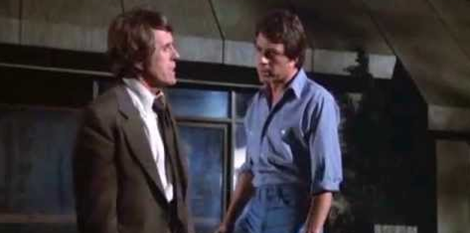
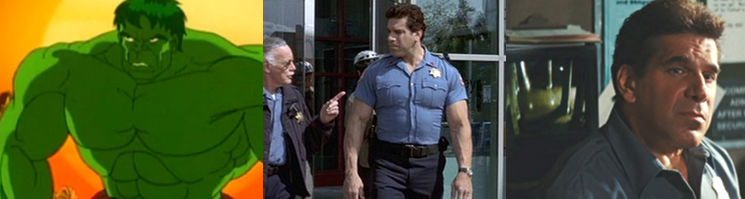
As I mentioned, The Incredible Hulk kicked all of this off; starring Bill Bixby as Dr. David Bruce Banner, the show depicted a scientist recklessly experimenting on himself with gamma radiation in a bid to unlock the hidden strength and potential of the human body. When he absorbs too much gamma radiation, moments of stress and anger cause him to transform into the green, bestial Hulk (Lou Ferrigno), a creature of limited intelligence, immense rage, and incredible strength.
70sMarvelMcGee
McGee relentlessly hounded Banner.

Believed dead at the Hulk’s hands, Banner is forced to wander around the country in search of a cure, helping those in need with both his intelligence and the strength of the Hulk when pushed too far, all while being relentlessly pursued by reporter Jack McGee (Jack Colvin). The show was famous for coining the phrase: “Don’t make me angry. You wouldn’t like me when I’m angry”, which has since become so synonymous with the character that it has appeared in most Hulk adaptations. Equally popular was both Bixby’s portrayal of Banner as a wandering nomad, desperate to cure himself of his alter ego and return to normal life, and Ferrigno’s portrayal of the Hulk (a role that Arnold Schwarzenegger auditioned for and that originally went to mammoth actor Richard Kiel).
70sMarvelFerrigno2
Ferrigno always had a place in Hulk adaptations.

Ferrigno has since become so associated with his role as the Hulk that he went on to not only voice the character in the animated Incredible Hulk (1996 to 1997) television series but also collaborated with Mark Ruffalo in voicing the Hulk in the MCU and cameoed in both Hulk (Lee, 2003) and The Incredible Hulk (Leterrier, 2008), a movie that was heavily influenced by the ‘70s television show. If there’s any downside to the show, and Ferrigno’s performance, it’s that they both popularised the notion that the Hulk is a feral, growling creature rather than a semi-to-impressively articulate individual. While Stan Lee himself may have signed off on this at the time (“I had the Hulk talking like this: “Hulk crush! Hulk get him!” […] that would have sounded so silly if he spoke that way in a television show” (Lee, quoted in Greenberg, 2014: 19 to 26)), I feel this was more a case of Lee signing off on anything for the licensing revenue. This portrayal even carried over into the MCU, where the Hulk was capable of rudimentary speech (one or two growling lines here and there) but did not properly articulate until Thor: Ragnarok (Waititi, 2017); to compare, Bradley Cooper was snarking up cinema screens as Rocket Raccoon in Guardians of the Galaxy (Gunn, 2014) before Hulk was allowed to properly talk.
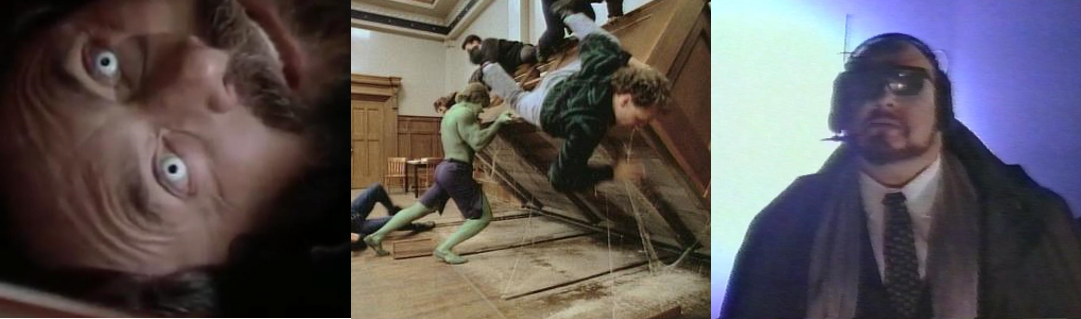
The Incredible Hulk returned with a bang.

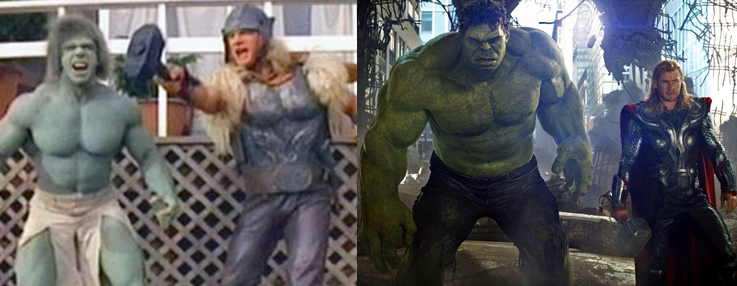
In any case, The Incredible Hulk ran for eighty episodes before finally coming to an end on 12 May 1982. Banner’s adventures, however, continued in the made-for-television film The Incredible Hulk Returns (Corea, 1988). While the TV show shied away from including any Marvel characters aside from Banner and the Hulk, much less his fellow Marvel cohorts, The Incredible Hulk Returns featured two of the most unlikely inclusions you could imagine given the show’s relatively rounded approach to its source material. After successfully suppressing the Hulk for two years, Banner’s idyllic life is turned upside down when an old student of his, Donald Blake (Steve Levitt), seeks him out. Right as Banner is on the cusp of finalising a potential cure in the Gamma Transponder machine, Blake reveals that he discovered an enchanted hammer in Norway that, upon his command, releases the mighty immortal warrior Thor (Eric Kramer) from Valhalla.
70sMarvelHulkThor
I honestly can’t tell the difference…

When Thor upsets Banner, he briefly battles with the Hulk and damages Banner’s the Gamma Transponder, but the two (three, I guess) are forced to work together to stop criminals from stealing Banner’s research and harming his life interest, Dr. Margaret Shaw (Lee Purcell). In the end, while Shaw is rescued, Banner is forced to destroy a vital component to the Gamma Transponder and, with the Hulk’s presence catching McGee’s attention, promptly returns to the road to seek out a new cure for himself. When I was a kid, I never got the chance to watch The Incredible Hulk, so one of my first exposures to it was with The Incredible Hulk Returns, which I found to be hugely enjoyable largely because of the thrill of seeing the Hulk in live-action and the banter between Blake and Thor. Rather than transforming into Thor, as in the comics, Blake instead brings Thor forth with the hammer and is charged with guiding him in life and in the fulfilment of a number of heroic deeds so he can take his place at Odin’s side in Valhalla. It’s absolutely mental, especially as a continuation of the TV show, but Kramer is so much fun as the loud-mouthy, arrogant, meat-headed Thor that you can’t help but smile when he’s onscreen, especially when he’s drinking and fighting in a bar or battling with (and alongside) the Hulk.
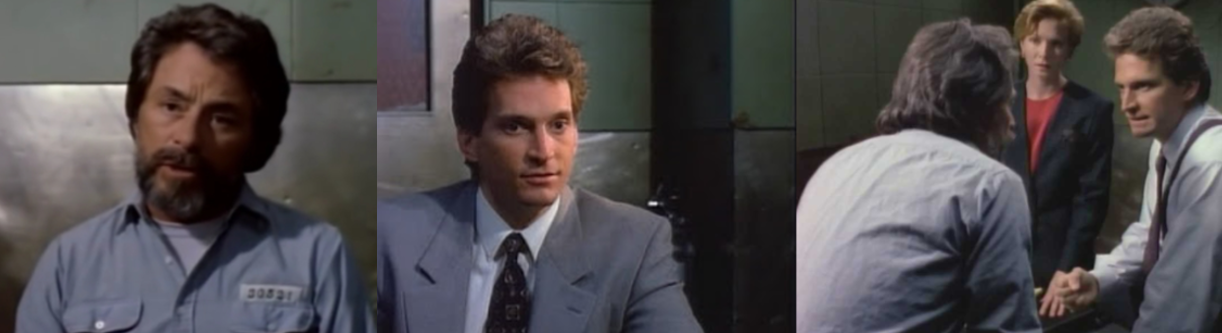
Banner forms a kinship with Daredevil.

I said I never really watched the show but, in truth, my first ever exposure to the Bixby and Ferrigno team was the follow-up movie, The Trial of the Incredible Hulk (Bixby, 1989), in which Banner, now a desolate soul who’s lost all hope, wanders into a city and, after disrupting a mugging on an underground train, is wrongfully imprisoned. As luck would have it, his appointed attorney is none other than Matt Murdock (Rex Smith), a blind lawyer who also patrols the streets at night as the black-clad vigilante Daredevil. Murdock is pursuing evidence against Wilson Fisk (John Rhys-Davies), an entrepreneur whom Murdock (rightfully) believes is a dangerous crime boss. While Banner is content to stay safely locked up in jail, the idea of being put on trial causes him to Hulk out and, eventually, team up with Murdock/Daredevil in bringing Fisk to justice.
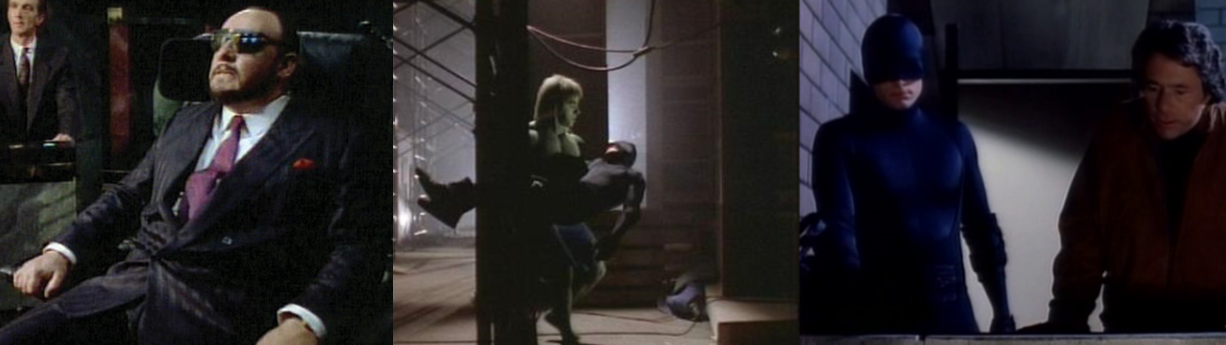
John Rhys-Davies was great as Fisk.

The Trial of the Incredible Hulk is notable for a couple of reasons; it features Stan Lee’s first-ever live-action cameo in a Marvel production, it heavily adapts elements of Frank Miller’s iconic run on the Daredevil comics, and the titular trial only actually takes place in a nightmare Banner has while imprisoned. Nevertheless, Rhys-Davies is exceptional as Fisk; he’s never referred to as the Kingpin onscreen but that doesn’t stop him being a cool, calculating puppet master of a villain; his eventual escape (in a God-damn rocket ship!) is a loose end that was never tied up as the final TV movie, The Death of the Incredible Hulk (Bixby, 1990), chose to bring an end to the Incredible Hulk series and did not feature any additional Marvel characters.
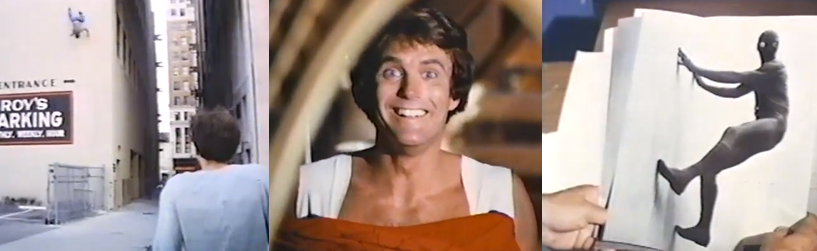
Hammond was a decent Peter Parker…and he had a great stunt double.

Hulk wasn’t the only one to get his own live-action TV show though; after the feature-length pilot, Spider-Man (Swackhamer, 1977), proved popular, Marvel’s web-head got his own thirteen episode series in the form of The Amazing Spider-Man (1977 to 1979). In addition, episodes of the show were edited (“cobbled”, is probably a better word) together into two made-for-television movies, Spider-Man Strikes Back (Statlof, 1978) and Spider-Man: The Dragon’s Challenge (ibid, 1981), both of which (along with the pilot) are the only exposure to this show I’ve had. The Amazing Spider-Man starred Nicholas Hammond as Peter Parker (with the show’s stunt co-ordinator, Fred Waugh, taking the role of Spider-Man, which was pretty obvious given their wildly contrasting size and builds) and, if you thought that this show took more from the source material than The Incredible Hulk then you’re going to be woefully disappointed.
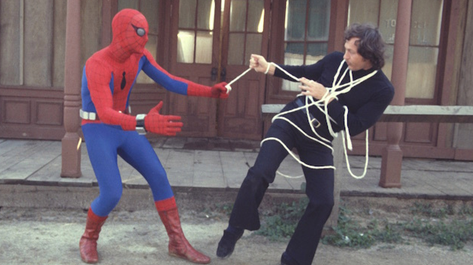
70sMarvelSpiderFights
I mean…they did the best the could…

Jonah Jameson (played by both David White and Robert F. Simon) featured quite prominently but Robbie Robertson (Hilly Hicks) and Peter’s Aunt May (Jeff Donnell) only appeared in the pilot episode and, though Spidey tussled with hypnotists, terrorists, and gangs, he never once butted heads with any of his colourful rogues gallery. Spidey (and Parker) also initially ran afoul of Police Captain Barbera (played with gruff, loveable glee by Michael Pataki), but this character was sadly dropped for the show’s second season. The Amazing Spider-Man was an ambitious project, especially for the seventies; Spider-Man is a character who requires a lot of effects and stunt work to pull off correctly and is arguably far more dependent on modern computer effects than the likes of even the Hulk. As a result, while the show featured an incredibly faithful recreation of Spidey’s origin, costume, and web shooters and did its best to portray Spidey’s wall-crawling and web-slinging through wires, pulleys, and other camera tricks, the show always came across as being far more absurd than its Universal counterpart.
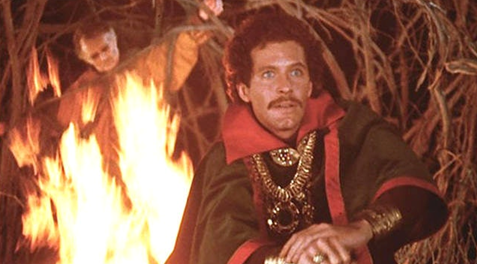
70sMarvelDrStrange
For whatever reason, Doctor Strange got a movie too.

There was more to come from Universal Television, however, as they also produced a Dr. Strange (DeGuere, 1978) made-for-television movie that featured Peter Hooten in the title role (I guess Tom Selleck was unavailable…) and Jessica Walter as Morgan Le Fay. This one’s especially obscure and many have probably never heard of or seen it; it actually got a DVD re-release in 2016, coincidentally around the same time as Doctor Strange (Derrickson, 2016) was released in cinemas. Interestingly, Stephen Strange is portrayed as a psychiatrist rather than a physician and stumbles into his destiny as the Sorcerer Supreme when Le Fay possesses one of his patients, Clea Lake (Eddie Benton). The movie also featured other recognisable faces from the source material, such as Wong (Clyde Kusatsu) and the Ancient One (Michael Ansara), which is already a bit of a leg up on the Hulk and Spider-Man outings. What scuppered Dr. Strange, though, was, again, the fact that it was produced at a time when special effects simply were not up to the task of doing the character justice. It also didn’t help that the film was criticised for being overly long and boring and lacking any real urgency. In all honesty, there really isn’t much to see here that’s worth you rushing out to watch except the novelty of seeing a C-list character like Strange get a live-action movie well before his time.
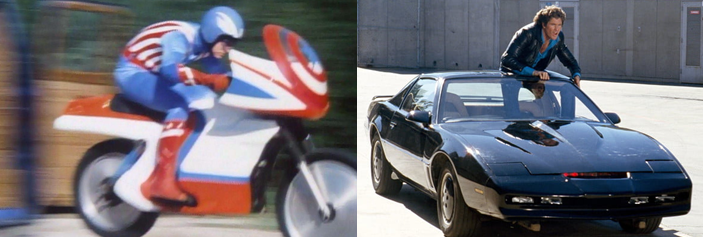
70sMarvelCapBikeKITT
Yeah, I don’t think K.I.T.T. had anything to worry about…

CBS also had one another Marvel character to offer the seventies; Captain America (Holcomb, 1979) brought the star-spangled Avenger to life on television screens and…dear Lord, is this a sight to behold! Reb Brown starred as Steve Rogers, a former marine-turned-artist living in the present day whose patriotic father was known as “Captain America”. After he’s nearly killed by an attempt on his life, he’s inexplicably chosen to be administered with the super-serum F.L.A.G. (Full Latent Ability Gain), which turns him into a superhuman. He then decks himself out in a horrendous version of the Captain America costume and takes to the streets on a modified super-cycle so massively over-the-top with gadgets and features than even K.I.T.T. would blush! Luckily, by the end and the sequel, Captain America II: Death Too Soon (Nagy, 1979), Rogers adopts a more faithful version of the costume and uses his abilities to oppose the plans of General Miguel (inexplicably played by Christopher Lee!), who desires to create a dangerous chemical. I’m actually far more familiar with the equally-lambasted Captain America (Pyun, 1990), which is still a guilt pleasure of mine. Nevertheless, both films were released on DVD and, while Dr. Strange was lost to the mists of time and obscurity, these films appear to have at least partially influenced the MCU as Cap (Chris Evans) does favour a motorcycle (but, to be fair, so did the comics Cap…).
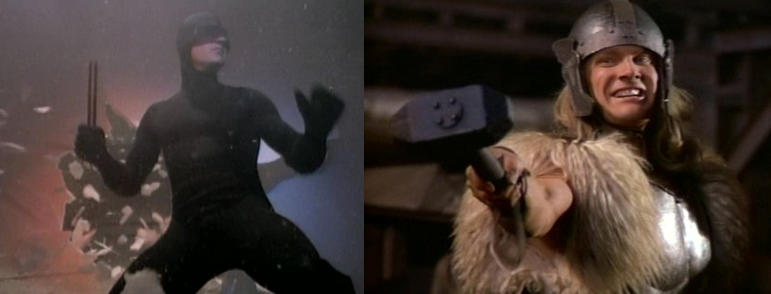
70sMarvelDaredevilThor
I would’ve watched a show with either of these two in.

Both The Incredible Hulk Returns and The Trial of the Incredible Hulk introduced Thor and Daredevil with the intention of setting them up for spin-off shows of their own but, for a variety of reasons, this never came to be and that’s a bit of a shame. Smith is no Charlie Cox but, while his Murdock was quite dull and boring, he gave a pretty good turn as Daredevil and it would probably have been easier and far cheaper to produce a Daredevil TV show than a Hulk or even Thor one. Similarly, I love the portrayal of Thor in Trial; sure, he doesn’t look or act anything like his Marvel Comics counterpart, but it could have been pretty fun to see him tossing fools around, getting into bar fights, and learning lessons in humility on an episodic basis. One thing that is equally unfortunate about all this is that the inclusion of Thor and Daredevil really took a lot of the focus off of Banner and the Hulk; sure, in the show, he was often a supporting player in a bigger story and other character’s lives, but these movies devoted so much of their runtime to pushing and establishing their new characters that it’s easy to forget that Banner and Hulk are even in them. The Death of the Incredible Hulk rectified this, but at the cost of killing both characters off in what was, while emotional (as a child, anyway), probably the lamest way imaginable.

70sMarvelTeamUp
All these guys co-existed at about the same time…

Unfortunately, there hasn’t been much love shown to The Amazing Spider-Man over the years; it’s never been released on home media outside of a few VHS tapes and, while Hammond appears to have been the basis for Parker’s design in the Spider-Man (1994 to 1998) animated series, he’s never returned to the character or the franchise again, not even for a quick cameo or a voice role (though I’m hoping the sequel to Spider-Man: Into the Spider-Verse (Persichetti, Ramsey, and Rothman, 2018) will rectify that). Interestingly enough, there were apparently talks in 1984 to produce a movie that would see Spider-Man cross paths with Banner and the Hulk, with Spidey even donning the black costume during the film. There were, apparently, also talks of an additional made-for-television Hulk movie, The Revenge of the Incredible Hulk, which would have seen Banner (somehow) revived and forced to recreate the accident that turned him into the Hulk (or be reborn as the Hulk with Banner’s intellect, depending on what you read) but neither of these ideas ever came to fruition and were ultimately halted when Bixby sadly died in 1993.
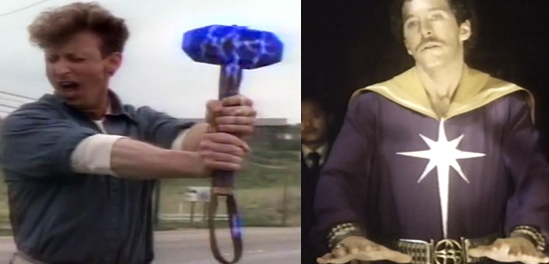
70sMarvelMagic
Magic linked these shows together, however tenuously.

However, none of this changes the fact that, sometime around 1978 to 1979, there were all these Marvel characters running around on television screens at about the same time, all produced by two studios and, in some cases, airing on the same networks. What this effectively means, then, is that it’s easy to imagine an alternative world where negotiations never broke down and the shows and movies proved popular enough for Spider-Man to crossover with the Hulk and, by extension, interact with Thor and Daredevil. So, what if…? What if there were a threat so big, so far beyond petty street crooks and one-note villains that these heroes would be forced to band together? Dr. Strange was heavily steeping in magic and mysticism, which was already (however unfitting) be proven to be a part of The Incredible Hulk’s world; hell, even The Amazing Spider-Man dabbled in the paranormal at times.
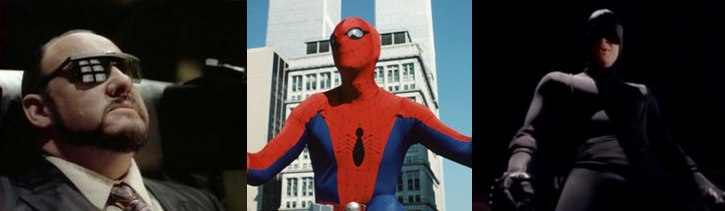
70sMarvelFiskVigilantes
It’s easy to image these guys existing in the same place and time.

Perhaps the threat would involve Fisk waging a war against Daredevil and all costumed heroes? The city is never named in The Incredible Hulk Returns but it could easily be New York City, the same New York City that Spider-Man swings around in. Perhaps this would be a chance to do a supervillain team-up, of sorts, between Fisk and Le Fay or to introduce other classic Marvel villains, such as Loki and the Red Skull. I would have loved to have worked Nick Fury (David Hasselhoff) into this imaginary Marvel team-up but it’s difficult to do that seeing as Bixby died in 1993 and Nick Fury: Agent of S.H.I.E.L.D. (Hardy, 1998) didn’t release until 1998 but what if…? What if Bixby hadn’t suffered from cancer, or had beaten the disease and Banner had been resurrected in The Revenge of the Incredible Hulk? Perhaps we would have seen a version of the Professor Hulk or Grey Hulk personas, one that merged the brawn and the strength together, and Fury could have banded these heroes together to fight a common enemy.
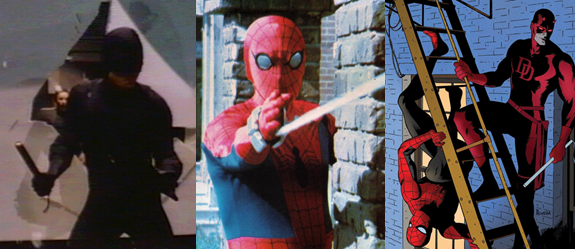
70sMarvelSpideyDaredevil
Spidey and Daredevil often work well together.

Personally, though, I would have preferred to see Banner and Hulk as they were portrayed in the television series; Bixby would have been the veteran actor who held this team up together and I would have limited his Hulk outs to two or three occurrences. Have him be the team’s moral compass, the hesitant advisor who learns to reconcile with his enraged alter ego through working with the other heroes. Murdock, as the older of the two, could have also acted as a kind of mentor to Spider-Man as the two are often portrayed as friends in the comics and have a lot in common with their “everyman” approach to super heroism. While the effects would not have allowed us to properly see the two swing across the New York rooftops, I think they could have cobbled together enough to produce some semi-decent, maybe even slightly acrobatic, fight scenes between the two.
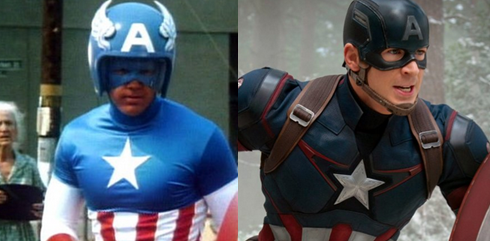
70sMarvelCapCompare
These guys are worlds apart.

You’d obviously think that Captain America would be the natural leader of this group but, remember, this isn’t the war-tested superhero we all know and love and I am not proposing an Avengers movie; Brown’s Cap is more of a secret agent, an enhanced super soldier who hasn’t nearly a fraction of the combat experience that Cap is usually known for. Because of that, I’d imagine him as the public face of the group and (in the absence of S.H.I.E.LD.), a source of the group’s intelligence resources. Perhaps Cap prefers to work alone and he has to learn to work with a group, rather than tackling everything head-on.
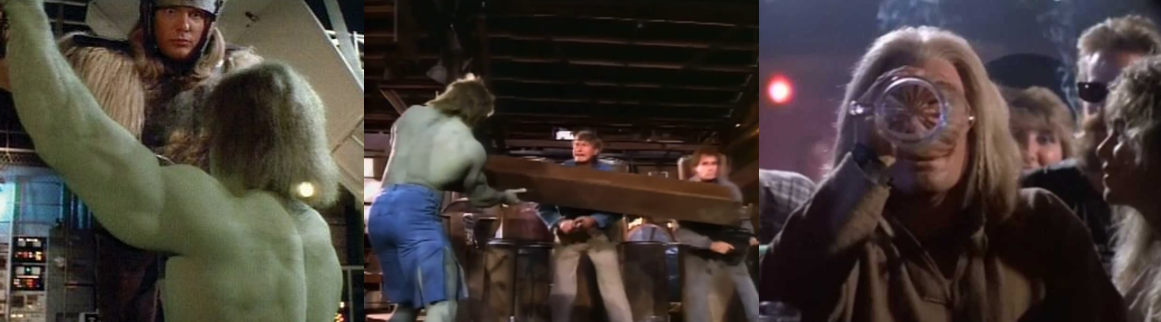
Thor still had a lot to learn about humility.

Instead, I’d have Doctor Strange be the de facto leader of the team by virtue of his age and power as the Sorcerer Supreme. His arc, perhaps, would have revolved around him needing to shift his focus from the bigger picture to factoring in the smaller issues that his peers face on a daily basis, effectively making himself both a public figure of the superhero community and improving his interpersonal skills. And then there’s Thor (and Blake, of course); Thor would be the group’s hot-headed jock, the guy who runs in, hammer swinging, trying to fix every problem with brute strength. This team up would be the perfect opportunity to teach Thor proper humility, to accept that he must work alongside mortals and lead by example rather than being a blundering buffoon. While he learned some of this in The Incredible Hulk Returns, it was clear that there was more to tell with his story and, perhaps, this team up and his learning of humility would be the final heroic act that would earn him his place in Valhalla, allowing Blake to, however sorrowfully, begin his life anew.

70sMarvelConclusion

In the end, for as hokey and cringe-worthy as a lot of these seventies Marvel shows were, it does disappoint me that we never got, at least, to see Spider-Man, Hulk, and Banner crossover onscreen. There was a lot to like about each of these, from the impressively realised costumes to the heart-felt emotion, to even the woeful action scenes and I would honestly have loved to see all of these characters come together to battle a common enemy. What do you think about Marvel’s television show and movies from the seventies? Do you have fond memories of The Incredible Hulk? Do you also wish that The Amazing Spider-Man would get a release on DVD? Perhaps you hated the monotony and ridiculousness of these shows. Whatever your opinion, leave a comment below and get in touch.

Movie Night: Pokémon: Mewtwo Strikes Back – Evolution

MewtwoEvolutionLogo

Released: July 2019
Director: Kunihiko Yuyama and Motonori Sakakibara
Distributor: Toho
Budget: $27 million
Stars: Sarah Natochenny, Michele Knotz, Bill Rogers, Ikue Ōtani, James Carter Cathcart, Michele Knotz, Dan Green, and Kōichi Yamadera

The Plot:
Cloned from the genetic material of the rarest Pokémon of all, Mew (Yamadera), and enraged at his mistreatment at the hands of humans, the Psychic Pokémon Mewtwo (Green) lures Ash Ketchum (Natochenny) and his friends to its island to witness its plan to enact revenge against all humanity.

The Background:
No doubt you are familiar with Pokémon (Nintendo/Creatures/Game Freak, 1995 to present), a role-playing videogame for Nintendo’s Game Boy and handheld consoles that, with no exaggeration, took the world by storm back in the late nineties. Everyone who was anyone rushed out to buy a copy of Pokémon: Blue Version or Pokémon: Red Version (ibid) back when they first released and, before long, kids everywhere were hooked on the seemingly never-ending stream of multimedia merchandise released by Nintendo. Chief amongst these was the still-ongoing Pokémon (1997 to present) anime series which, while somewhat removed from its videogame source material, nonetheless enthralled kids everywhere and, perhaps inevitably, led to the production of a feature-length animated movie, Pokémon the First Movie: Mewtwo Strikes Back (Yuyama, 1998). Then, for whatever reason, the decision was made, in the midst of a soft reboot to the Pokémon film series and anime alike, to remake this iconic movie entirely through the use of computer-generated imagery (CGI), resulting in this modern twist on what is, in my opinion, still the best Pokémon movie ever made thanks, largely, to the power of nostalgia.

The Review:
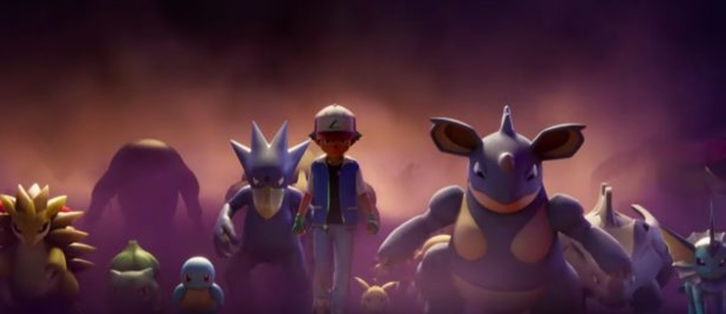
Basically, Evolution is exactly the same story as its predecessor but with a few noticeable changes; the most obvious is, of course, the CGI animation but other things, such as dialogue changes, narrative changes, and changes to the music, all help to freshen up the original movie. The opening scenes are largely the same (but, once again, the film skips the prologue that sees Mewtwo make friends with other clones who heartbreakingly die right before his eyes) as Mewtwo is cloned from a single cell of Mew and, unimpressed with the motivations behind his creation, destroys the facility in which it was created and kills all the scientists who birthed it.

MewtwoEvolutionRevenge
Mewtwo swears revemge against humanity.

Summarily manipulated by Giovanni (Ted Lewis), the evil leader of Team Rocket and the mastermind behind its creation, Mewtwo’s rage against humanity leads it to organise a Pokémon tournament in order to build an army of clone Pokémon to “strike back” against the world that treated him so badly. In the middle of their journey through Kanto, Ash, Brock (Rogers), Misty (Knotz), and Pikachu (Ōtani) receive an invitation to Mewtwo’s island and, after braving a storm it created, immediately take umbrage to Mewtwo’s twisted world view and rally a group of trainers, their Pokémon, and even their long-time enemies from Team Rocket, Jesse (Knotz), James (Cathcart), and Meowth (ibid), in opposing Mewtwo’s plans.

MewtwoEvolutionOppose
Ash vehemently opposes Mewtwo’s plans.

Let me state first of all that, unapologetically, I absolutely love Pokémon the First Movie; I still remember going out of my way to purchase a bootleg VHS tape of the film back in the day before finally getting a legitimate copy from a car boot sale. As much as I’ve enjoyed subsequent Pokémon movies, nothing beats the nostalgia of revisiting the original film. It may have some flaws, largely based around the numerous changes made when dubbing the film into English that made Mewtwo far less sympathetic, but I will defend it to this day simply because it came right at the peak of Pokémon’s popularity for me; Pokémon: Gold Version and Pokémon: Silver Version (Game Freak, 1999) were due to be released around that time and the hype was real concerning brand new Pokémon, to say nothing of finally seeing Mewtwo in all its glory (it had been teased in several episodes of the anime prior to the movie’s release), much less going head-to-head with Mew, which was the most elusive of game secrets at the time due to their being no legitimate way to catch it outside of Japan.

The Nitty-Gritty:
Thankfully, Evolution doesn’t really alter that much from the original film, meaning that the only thing you’re really missing out on is the gorgeous anime aesthetic from the original. The CGI looks good on the Pokémon but the human models look a little…off, like they’re made of plastic, which gets a bit distracting at times.

MewtwoEvolutionBattles
A lot of the battles have been improved and expanded upon.

Additionally, there were a few odd choices made here; dialogue is altered significantly, to the point where it feels much closer to the original Japanese dialogue (if that makes sense) but then, about halfway through, the dialogue changes and is almost exactly the same as in the original film (Mewtwo’s closing monologue, for example, is pretty much word-for-word). There’s also the criminal decision to supplant the original dub score with a new one (those who preferred the Japanese score will likely be thankful for this, however) and completely remove Blessid Union of Souls’ ‘Brother My Brother’ from the epic final clash.
MewtwoEvolutionTears
Ash’s sacrifice still hits in the feels…

One change I did appreciate, however, was the complete remove of the “tears of life” sub-plot; in the original, Ash and the others are fed a nonsense story about Pokémon tears being able to restore the dead to life, which was completely missing from the original Japanese version. While this did bring a lot more context to Ash’s resurrection in the film’s climax, it never sat well with me in the original as it always felt wedged in there.
MewtwoEvolutionChanges
Evolution features some welcome alterations to the original.

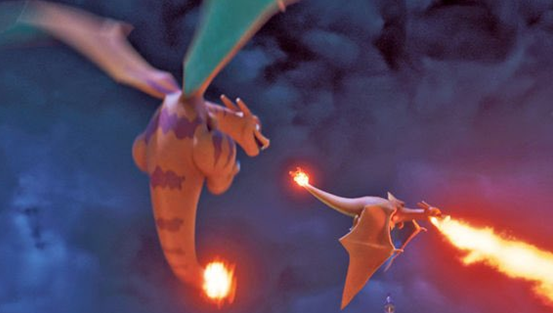
Similarly, Mewtwo’s mechanical suit gets on hell of a bad-ass upgrade, Team Rocket’s amusingly ridiculous disguise as Viking sailors, of all things, is removed completely (and for the better), and minor niggles like Pokémon being referred to incorrectly have been addressed. There are also some improvements made through this remake, as well; the ambiguity surrounding Mewtwo’s motivations that was explicit in the original Japanese release is far more prevalent here than in the original dub, for one thing. Some of the battles also receive a makeover, such as Ash’s initial battle during the iconic Pokémon theme song and the battles between the cloned start Pokémon and their biological counterparts.

MewtwoEvolutionSUmamry

The Summary:
In the end, Pokémon: Mewtwo Strikes Back – Evolution is a nice little update to a childhood favourite; it adds in a lot of subtle story beats that were missing, beefs up some of the battles and content, and adds a fresh coat of paint to a classic. Yet, at the same time, it feels incredibly redundant; beyond the CGI overhaul and a few of these alterations, there’s not much new happening here and, considering the fact that the Pokémon movies are completely removed from the anime, it feels a bit weird to have this suddenly released upon us. A big factor into my final score comes down to my unconditional love for the original movie but even I kind of feel like much of the same could have been accomplished by releasing a high-definition, digitally remastered version of the original movie with all of the cut content restored alongside the recording of a new dub and the option to watch in the original Japanese.

My Rating:

Rating: 4 out of 5.

Great Stuff

What did you think of Pokémon: Mewtwo Strikes Back – Evolution? Do you think it is a good tribute to Pokémon the First Movie: Mewtwo Strikes Back or do you, perhaps, not share my fondness for that movie? Whatever the case, feel free to share your Pokémon thoughts and memories in the comments.

Movie Night: Sonic the Hedgehog (2020)

SonicMovieLogo

Released: February 2020
Director: Jeff Fowler
Distributor: Paramount Pictures
Budget: $81 to 95 million
Stars: James Marsden, Ben Schwartz, Tika Sumpter, and Jim Carrey

The Plot:
Small town cop Tom Wachowski’s (Marsden) life is turned upside down when Sonic (Schwartz), a superfast hedgehog with an insatiable curiosity and the means to travel between worlds, is targeted by the megalomaniacal Doctor IvoRobotnik (Carry).

The Background:
Back in the nineties, in the middle of the escalating Console War between Nintendo and SEGA, the videogame industry was changed forever when Yuji Naka and Naoto Ohshima dreamed up the idea of the superfast hedgehog that would become their mascot and most profitable franchise for years to come. Sonic has seen his fair share of adaptations; he’s been a hot air balloon, on t-shirts, featured in comic books, and has, most prominently, had more than a handful of ventures into animation. Every time Sonic is adapted from one form of media to another (and, it seems, almost every time a new Sonic videogame is released) something is altered, however subtly, about his appearance, backstory, or mannerisms, making for one of the most iconic and, yet, convoluted videogame mascots ever made. Aside from the gorgeous original video animation (OVA), Sonic the Hedgehog: The Movie (Ikegami, 1996), Sonic has had to settle for cameos in movies until now. After a disastrous first trailer and initial design that saw Sonic look like some weird mutant human/monster hybrid thing, Jeff Fowler and Paramount delayed Sonic the Hedgehog to redesign the titular hedgehog for his first big screen, live-action debut.

The Review:
Raised in secret on a far away world, Sonic is forced to flee his home through the use of dimensional Golden Rings; arriving in Green Hills, Montana, where he spends the next ten years living in isolation out of the fear that his super speed will draw attention to him and force him to flee once again.

SonicMovieBlackout
Sonic accidentally draws attention to himself…

Sonic spends most of his time observing Tom Wachowski and his wife, Maddie (Sumpter), and longing to be a part of society and make a real friend. When his speed powers unintentionally cause a massive blackout in Green Hills, the US military bring in Doctor Robotnik to investigate the disturbance.

SonicMovieRoadTrip
Nothing like a good, old-fashioned road trip with a twist!

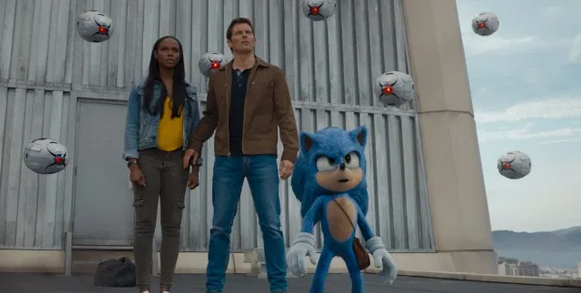
Spooked by the incident, Sonic reluctantly decides to leave his home but accidentally drops his bag of Golden Rings through a dimensional portal, where they land in San Francisco. Unable to find his way there, Sonic and Tom team up on a road trip to retrieve the Rings, all the while being pursued by Robotnik and his deadly robotic drones. Going into Sonic the Hedgehog, I wasn’t expecting anything more complicated than a by-the-numbers family-friendly kid’s movie; I was unimpressed that Paramount opted for a live-action/CGI hybrid film rather than a full-on CGI movie in the style of a Disney/Pixar production (or the amazing CGI cutscenes of modern Sonic videogames) and, upon seeing Sonic’s ruinous first design, I was ready to write the entire movie off, which was rather distressing for me given that I have been a life-long Sonic fan. Instead, Sonic the Hedgehog is a really fun (and funny) little romp; Sonic’s characterisation has been tweaked slightly and, rather than the “hedgehog with attitude” or the cocky, confidant superhero of the videogames, he is a lonely, curious, hyperactive little creature who longs to belong in a world and is struggling to control his great speed and with his desire to use his powers for a greater purpose.

SonicMovieHumans
Sonic’s human cast does a far better job than I expected.

His interactions with Tom are charming and whimsical. Marsden is no stranger to films or roles such as this and, yet, he is the perfect actor to portray an everyman character who longs for a greater challenge beyond his mundane, everyday life. To my great surprise and delight, the two quickly form an odd couple friendship that grows throughout the film and there isn’t one of those clichéd moments where they argue and fall out and have to rebuild their friendship.

SonicMovieRobotnik
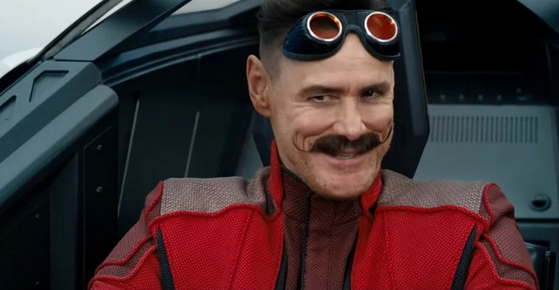
Jim Carrey steals every scene he’s in, it’s fantastic!

Surprising no one, the real star of the show here is Doctor Robotnik; Jim Carrey is back at his scenery-chewing, maniacal best as he perfectly encapsulates the Doctor’s madcap, zany megalomania and slowly degenerates further and further into both madness and a more recognisable version of his videogame counterpart. Do I think he would have been just as good in a fat suit and acting alongside a cast of CGI characters? Sure, but that doesn’t stop his performance being a delight. Sonic the Hedgehog is part comedy, part road trip, part quasi-sci-fi/fantasy action; Sonic himself provides much of the jokes and action, but Carrey is no slouch in either department either thanks to his wacky personality and his incredibly adaptable machines. As with all Sonic adaptations, Sonic the Hedgehog weaves in numerous references to the source material; there’s a loving recreation of the character’s traditional home, South Island, nods to iconic Zone names, and even a few musical cues from the videogames. Arguably, the film could have gone further with these and weaved iconic boss themes into a motif for Robotnik but it definitely feels as though the movie was concentrating on establishing a new version of Sonic and bringing in additional videogame elements in a future sequel.

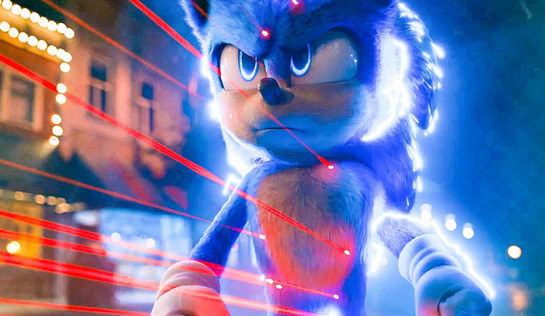
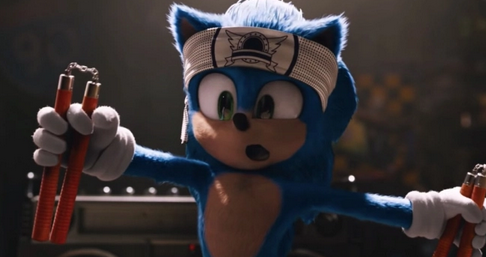
SonicMovieSonic
Sonic’s redesign looks great.

As it stands, though, Sonic the Hedgehog was a surprisingly good time; all the characters were fun and enjoyable and the film avoided a lot of the clichés that movies of this type often fall back on. It may not be the best videogame adaptation but it’s more than a worthy successor to Pokémon: Detective Pikachu (Letterman, 2019) despite featuring only one fully-realised CGI character largely through its whimsical charm and is surprising amount of restraint as it focuses on telling its own unique Sonic story rather than overloading the film with elements from the videogames.

The Nitty-Gritty:
As with most Sonic adaptations, Sonic the Hedgehog feels the need to include, and place special emphasis on, the Golden Rings that form the life energy of the videogames. Rather than being the source of Sonic’s power, or a power boost for him, here they act as dimensional gateways, which isn’t a million miles away from the function the Big Rings perform in Sonic videogames.

SonicMovieGags
There’s some charming humour at work here…

Going into the film, I was concerned that they were pushing the Rings as Sonic’s “super power” rather than his super speed but, luckily, that wasn’t actually the case. Instead, Sonic’s speed seems to have some mystery behind it. His childhood guardian, Longclaw (Donna Jay Fulks) seems to be hiding, and protecting, Sonic not just because of the power of the Rings (which seem to be her possession rather than his) but also because of his speed, which (alongside the way his super speed is presented as a quasi-power-up at dramatic times) makes me think we might see a connection between Sonic’s speed and the Chaos Emeralds in a future sequel.

SonicMovieRobotnik2
Robotnik only has time for machines…

Speaking of future sequels, and Longclaw, perhaps the biggest surprise for me was that, in the opening moments, Sonic and Longclaw are attacked by a group of masked echidnas after they spot Sonic using his super speed. This was a fun and unexpected inclusion and raises a lot of questions for future sequels, especially with Robotnik being marooned on a mushroom-filled planet and vowing revenge. Unfortunately, I had the big mid-credits reveal spoiled thanks to Twitter but, suffice it to say, Sonic’s long-time friend Miles “Tails” Prower (Colleen Villard) shows up looking for Sonic, setting up both future films and spin-offs in this world.

SonicMovieSummary


The Summary:
Sonic the Hedgehog was way better than it had any right to be. The overhaul of Sonic’s design alone makes the film worth the price of admission but, alongside that and some clever references to the videogames, the film is a fun, charming little family action/comedy that brings a new dimension to Sonic’s character and lore. Sonic and Jim Carrey are the clear stars of the show but there’s plenty here to enjoy. I feel that, if we do get a sequel, we will see the filmmakers take things a little further and delve a little deeper into Sonic’s more familiar mythology now that they’ve established their version of the character and I am honestly looking forward to seeing this version of Sonic (and, especially, Robotnik) return in the future.

My Rating:

Rating: 3 out of 5.

Pretty Good

Interplay: Sonic the Hedgehog Spinball

Interplay

Among many things, adaptations can be described as being:

“An acknowledged transposition of a recognizable other work or works […] A creative and an interpretive act of appropriation/salvaging [or] An extended intertextual engagement with the adapted work” (Hutcheon, 2006: 80).

The great thing about adaptation is that it can be literally anything; it’s restricted only by the scope of your imagination and your commitment to researching the links between media. When I studied the writing of Linda Hutcheon (and many others like her) as part of my PhD, I chose to focus on the adaptation of videogames into movies, television shows, cartoons, and comic books.

There were two reasons for this: a) Because it’s a lot easier to talk about media adaptations like these and b) Because there hadn’t really been any real, serious research into videogames as adaptations. During my studies, though, I came across a curious statistic: of all the videogames that make up the entirety of the Sonic the Hedgehog (Sonic Team/Various, 1991 to present) franchise, there is one that stands out as having had the most adaptations and it’s probably not one you were expecting…

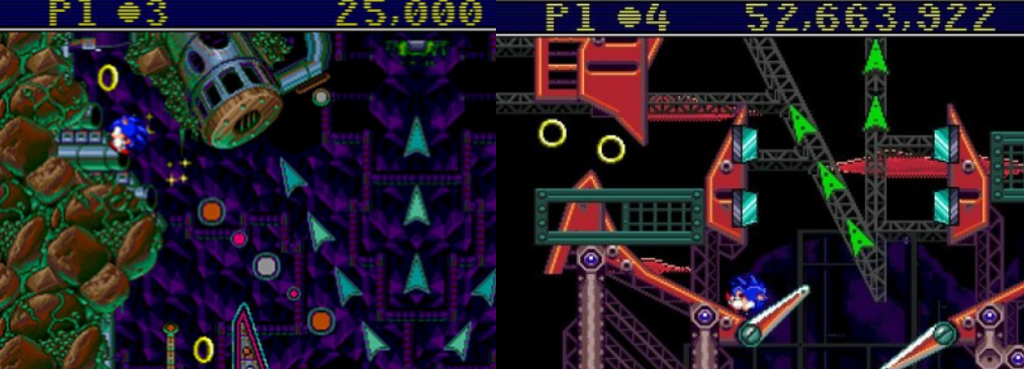
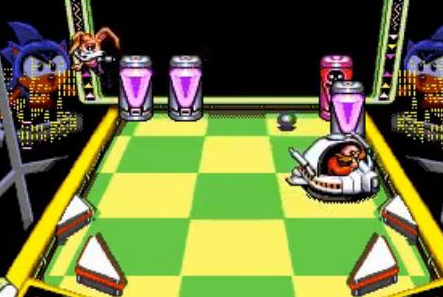
Today, we’re talking about Sonic the Hedgehog Spinball (Polygames/SEGA Technical Institute, 1993), a spin-off of the main Sonic the Hedgehog franchise. Spinball was the first Sonic title to truly embrace the pinball-like gameplay mechanics of the series popularised by the Spring Yard and Casino Night Zones.

Rather than being a fast-paced action/platformer, Sonic Spinball sees Sonic’s running speed scaled back and his bouncing speed boosted up as he trades running through loops for being flicked about inside a giant, pinball-like fortress created by Doctor Ivo Robotnik (now more commonly referred to as Doctor Eggman). Robotnik’s Veg-O-Fortress is made up of four stages, each one containing numerous Chaos Emeralds (unlike most Sonic games, Spinball’s multiple Emeralds are all blue). Using the flippers and a variety of gameplay gimmicks, Sonic must retrieve the Emeralds and battle the mad Doctor himself in a number of massive and increasingly difficult boss battles. In the Bonus Stages, Sonic operates an actual pinball and attempts to free his friends from Robotnik’s capsules. Other than that, the game offered little despite having some funky tunes and a charming aesthetic; the controls were clunky (Sonic feels unnaturally heavy and awkward), the stages were large and vibrant but it was often difficult to tell where you needed to go or what you had to do, and there’s very little incentive to play again except to beat your high score. Yet, Sonic the Hedgehog Spinball has been adapted into other media and forms more times than any other Sonic title; right off the bat, the game was ported to the Master System and Game Gear, for one thing, but, more than that, the game formed the basis of plots for Sonic’s cartoons, comic books, and other ancillary media.

Just controlling Sonic in this spin-off title can be a chore.

At the time, Sonic was in the middle of his first (and, arguably, most prominent) surge in popularity; bundling Sonic the Hedgehog (Sonic Team, 1991) with the Mega Drive saw the console sell over fifteen million units during its American debut (Pétronille and Audureau, 2012: 39) and catapulted SEGA’s speedy mascot to the stratosphere. SEGA immediately followed this up with Sonic the Hedgehog 2 (SEGA Technical Institute, 1992) and, just like that, Sonic was everywhere. Not content with a gigantic Sonic balloon in the Macy’s Day parade, SEGA capitalised on Sonic’s popularity; Sonic appeared on every piece of merchandise imaginable and that, of course, included cartoons. Nintendo had seen significant success in this area in the past and, seeking to usurp their rival once more, SEGA turned to DiC Entertainment. The concept was spearheaded by producer Robby London, who recognised Sonic’s charisma and appeal but struggled with the “elusive and impenetrable” story of the videogames (Jones, et al, quoting London, 2011: 29). This isn’t particularly surprising as, while Sonic typically has an extremely simple premise (hedgehog hero destroys robots to save woodland friends), differences between the Japanese and American versions saw dramatically different versions of Sonic presented across the world.

SpinballSatAM.PNG
Spinball included a lot of influences from SatAM.

Regardless, after bringing in Jaleel White to voice the character, DiC produced a pilot episode that was largely comprised of slapstick comedy and was deemed to be unsuitable for ABC’s Saturday morning slot. Undeterred, DiC made the extraordinary decision to instead produce two Sonic cartoons: one for weekdays and one for Saturday morning. This is how we ended up with Adventures of Sonic the Hedgehog (1993) and Sonic the Hedgehog (1993 to 1995, more commonly referred to as “SatAM”) airing simultaneously; one emphasised slapstick comedy and the other was decidedly much darker and serious in tone. For a time, these two cartoons were often closely associated with each other; this was mainly due to the Archie Comics series in the US initially mixing characters and concepts from both shows together rather than picking one as its basis (eventually, however, they settled on SatAM) but this can also be seen in Sonic Spinball. Sonic not only encounters Cluck, Doctor Robotnik’s (Jim Cummings) mechanical pet that briefly appeared in both SatAM and Archie’s comics, in the Toxic Caves, but must also free Princess Sally (Kath Soucie), Bunnie Rabbot (Christine Cavanaugh), Rotor (Mark Ballou), and Antoine Depardieu (Rob Paulsen) during the game’s Bonus Stages.

SpinballStC.PNG
I still have no idea how the hell Robotnik did this!

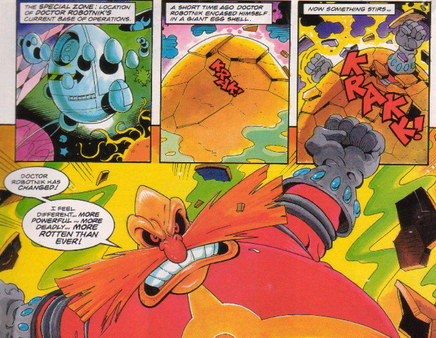
This would be the first and only time SatAM’s characters would appear in a Sonic videogame; given that, unlike Dr. Robotnik’s Mean Bean Machine (Compile/SEGA Technical Institute, 1994), Spinball appeared to be a straight forward spin-off of the main Sonic series, their inclusion only served to further muddy the waters as to the coherency of SEGA’s flagship franchise. To further confuse matters, it was the Adventures depiction of Robotnik (Long John Baldry), rather than SatAM’s, who appeared on the cover art for Spinball’s Game Gear port. Indeed, while Archie eventually restructured its Sonic comics into a continuation of SatAM, it was Adventures’ Robotnik who seeped into other Sonic media and became the default depiction of the dastardly Doctor in storybooks and comics for many years. This was most prominently seen (at least in the UK) in Sonic the Comic (1993 to 2002, referred to as “StC”) where, in issue twenty-two, Doctor Robotnik inexplicably transformed from the rotund antagonist seen in the videogames into “that weed from the rubbish cartoon series” (Fielding, 1995: 32; Kitching, et al, 1994: 1 to 7). While SatAM is often lauded as a significant influence to many for its darker, more adult themes, Adventures is often overlooked for its fidelity to the wacky nature of the videogames due to its childish humour. Of the two, only Adventures incorporated the game’s iconic theme song and more accurately depicted certain gameplay mechanics, such as Special Stages, Golden Rings, and Chaos Emeralds. Yet, don’t let that fool you: Adventures is a full-on acid trip most of the time and, despite pulling some inspiration for the source material, only ever adapted the plot of one videogame: Sonic the Hedgehog Spinball.

Robotnik’s plans often involve an impractical, giant pinball machine.

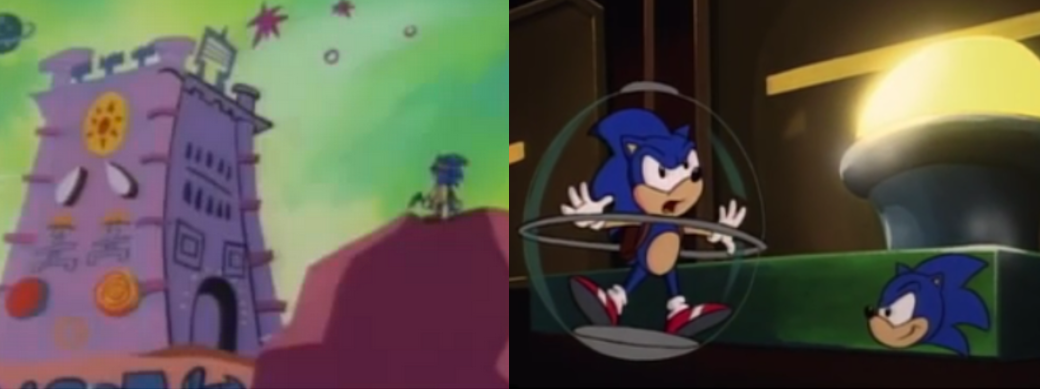
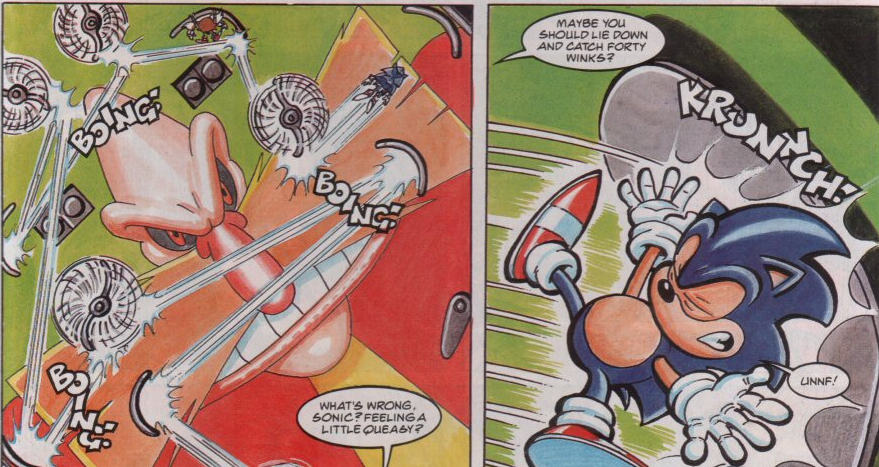
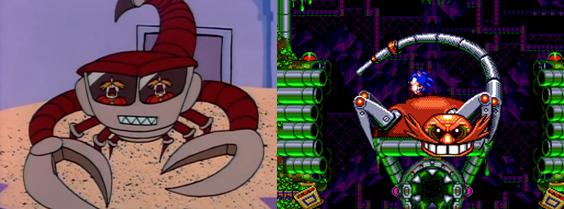
‘Attack on Pinball Fortress’ (Butterworth, 1993) saw Sonic, Miles “Tails” Prower (Christopher Welch) join forces with Sergeant Doberman (Phil Hayes) and one of Adventures’ more amusing reoccurring characters, Wes Weasely (Michael Donovan), when Robotnik threatens Mobius with a gigantic Stupidity Ray housed within his Pinball Fortress. When the group infiltrates the Pinball Fortress, they are knocked about by giant flippers and into other gigantic recreations of cliché pinball machines before they encounter Boss Scorpion, a massive robotic scorpion that Robotnik uses to try and thwart the heroes. Obviously, this fails and it isn’t long before the robot is devoured by lava and Robotnik’s plot is thwarted. As an adaptation of Sonic Spinball, ‘Attack on Pinball Fortress’ is very bare-bones; it’s almost as if the writer, Bob Forward, was given a few pieces of concept art and nothing more as the episode has next to nothing to do with the videogame beyond the vague concept of a pinball-themed fortress and a giant scorpion. Yet, as basic an adaptation as ‘Attack on Pinball Fortress’ is, it’s got nothing on ‘Game Guy’ (Myrick, 1994), an episode of SatAM that sees Sonic trapped within a pinball-themed game right at the conclusion of the episode, which mostly concerns Sonic and Sally being at odds over the appearance of another Freedom Fighter, Ari (Dorian Harewood). Ari betrays Sonic but, when Robotnik nearly uses his giant pinball table to suck Sonic into the Void, he sacrifices his freedom to not only save Sonic but lead the Freedom Fighters towards other allies. Literally the only thing in ‘Game Guy’ that comes from Sonic Spinball is the giant pinball-themed trap that Robotnik nearly bests Sonic with, but then this was par for the course for SatAM, which was concerned more with environmental messages than adapting plots from the videogames.

SpinballArchie.PNG
Archie Comics sure loved their puns…

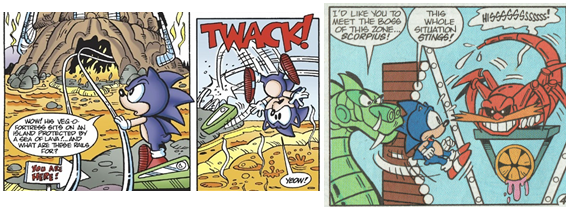
Things begin to look up, however, in ‘The Spin Doctor!’ (Gallagher, et al, 1994), the official Sonic Spinball adaptation featured in issue six of Archie’s Sonic the Hedgehog. Here, Sonic and the Freedom Fighters lead a random assault on Robotnik’s factory, only to be informed (via a hand-written note) that he has moved his base to Mount Mobius. Racing there without hesitation, Sonic finds the Veg-O-Fortress and is immediately attacked by (you guessed it) giant pinball flippers and bounced across lava. Racing up the pinball tracks and into the fortress, Sonic battles both Scorpius and Rexxon in the Toxic Caves, defeating them with ease. Sonic then ends up in the Lava Powerhouse, where Hip and Hop help lead him to a bunch of captive Mobians but giant plants force Sonic into a final Showdown…which consists entirely of Robotnik launching him out of the fortress using a giant spring. ‘The Spin Doctor!’ is little more than a glorified advertisement for Sonic Spinball; there’s just enough of the game’s premise, first stage, and other recognisable elements to inspire young kids to buy and play the game but not much else that directly links to it. Archie had a habit of doing adaptations of this kind; typically, they would produce a story that ended with the instruction to readers to play the videogame to find out the rest, despite the games and the comics being wildly inconsistent and at odds with each other. Other times, like this, they would attempt a very loose adaptation but be more concerned with servicing their own, unique narrative over anything.

SpinballStCSpinball2.PNG
There’s not much to link this to the game….

Elements of this story were relegated to extremely minor roles or cameos; Scorpius, Hip, and Hop (two characters that serve only to launch Sonic into the Lava Powerhouse in the videogame) were amongst them but, while Mount Mobius did show up (and erupt) in the ‘Heart of the Hedgehog’ two-parter (Fingeroth, et al, 2000), the Veg-O-Fortress never appeared again. Finally, there’s ‘Spinball Wizard’ Millar, et al, 1996) from StC. In this story, Tails, disheartened at his lack of fan mail, attempts to drum up some support by cleaning up the Casino Night Zone and ends up being captured in Robotnik’s Spinball Murder Machine which is, wouldn’t you know it, a giant pinball table. Rushing to the rescue, Sonic is bounced around by flippers and seemingly defeated until Tails manages to free himself and use Robotnik’s “Hedgehog-crushing super pinball” (literally just a giant pinball…) to destroy the generator that powers the machine. And…that’s it. I mean, I gave Archie some flack over their adaptation but ‘Spinball Wizard’ is only very, very loosely drawing from Sonic Spinball; you could even argue it’s simply adapting elements of Casino Night Zone into its plot but I’m including it simply for the name of Robotnik’s machine. To be fair, StC was often fast and loose with its adaptations as well; they also favoured their own unique narrative over being slavish recreations of their source material. But we’re not quite done yet because a rollercoaster at Alton Towers was once rebranded as Sonic Spinball between 2010 and 2015. As you might have guessed, the rollercoaster has a pinball theme and, as part of its Sonic rebrand, featured red and blue tracks, songs from the videogames, and even commentary from Roger Craig Smith, Sonic’s current voice actor. So, just what was it about Sonic the Hedgehog Spinball that meant it formed the basis of so many adaptations? It was, even at the time, only ever an average title and far from the rich narrative resource as Sonic the Hedgehog CD (Sonic Team, 1993) or Sonic the Hedgehog 3 (Sonic Team/SEGA Technical Institute, 1993) yet these two latter videogames were only given the most basic of lip service and SatAM and didn’t factor into Adventures at all.

Spinball surprisingly cropped up in many adaptations.

Perhaps it was the simplicity of the concept: Sonic bounces around like a pinball in comics and cartoons anyway, so maybe it’s easier to literally stick him into a giant pinball machine than have him race a robotic version of himself or go head-to-head with Knuckles the Echidna? Other anime and cartoons managed to include these two elements, however, and quite successfully in some cases, so it does remain a source of wonder (if not outright confusion) that Sonic Spinball, of all Sonic games available at the time, should be returned to and adapted so often. A large part of the explanation probably can be traced back to Sonic’s growing popularity at the time; Sonic Team USA had invested a considerable amount of time, effort, and money into rebranding Sonic for his US debut and crafting an entirely unique backstory that was completely different to the one found in Japan (and quite separate from the one in the UK, as well). Sonic Team, SEGA, and DiC seemed to see Sonic Spinball as a natural bridge between the videogames and the cartoons; they were certainly enthusiastic about the tie-in enough to insert their cartoon characters into the videogame and onto the art work (Hazeldine, 2014: 35). Perhaps there was no need to mine other Sonic titles; Sonic’s popularity didn’t begin to wane until the end of 1996 and, by then, both cartoons had finished producing new episodes, Archie’s comics and StC were content with forging their own narratives, and Sonic was firmly established as a successful and popular videogame icon in the cultural consciousness. Sonic X (2003 to 2006) would later produce surprisingly faithful adaptations of both Sonic Adventure (Sonic Team, 1998) and Sonic Adventure 2 (Sonic Team USA, 2001), while also loosely adapting Sonic Battle (Sonic Team, 2004) and appropriating many elements from Sonic Heroes (Sonic Team USA, 2003) and Shadow the Hedgehog (SEGA Studio USA, 2005). These all saw adaptations in Archie’s comics and StC (except for the latter four, at least officially, as StC had ceased publication by that point) but no other Sonic the Hedgehog videogame can boast as many adaptations as Sonic the Hedgehog Spinball, a largely average and arguably insignificant spin-off that nevertheless defined the golden age of Sonic across all forms of media.

SpinballRollercoaster
Sonic Spinball even made it to the real world!

What do you think about Sonic Spinball and its adaptations? Can you think of any other videogames that received undue attention in other media? Leave a comment below and join me next time for more interplay.

Movie Night [Christmas Countdown]: Shazam!

ShazamLogo

Released: 5 April 2019
Director: David F. Sandberg
Distributor: Warner Bros. Pictures
Budget: $80 to 100 million
Stars: Asher Angel, Zachary Levi, Mark Strong, Jack Dylan Grazer, Grace Fulton, and Djimon Hounsou

Plot:
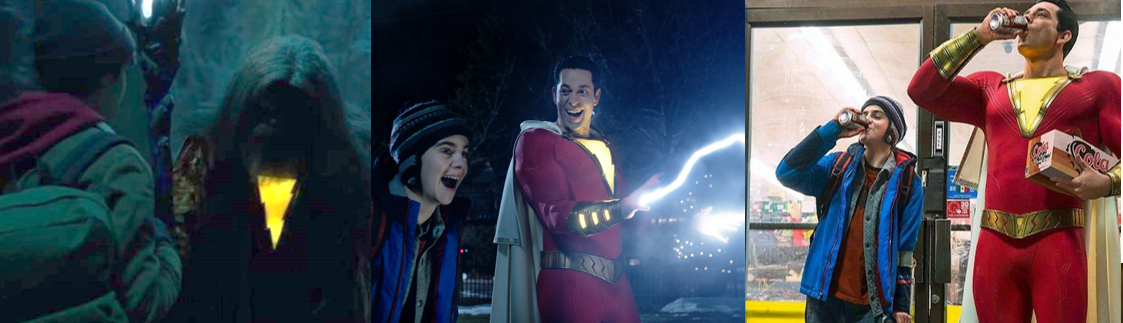
Billy Batson (Angel), an abandoned boy searching for his missing mother, is suddenly bestowed with magical superpowers, transforming him into an adult superhero (Levi) with the mindset of a teenager. When Doctor Thaddeus Sivana (Strong) attains equal power through possession of the seven Deadly Sins, Billy is suddenly faced with putting aside his personal issues and becoming a fully-fledged superhero.

The Background:
Following the success of Clark Kent/Superman and Bruce Wayne/Batman, Fawcett Publications sought to establish their own colourful superheroes, each sporting the powers of Greco-Roman Gods, before Ralph Daigh combined them into one superpowered entity to directly oppose Superman initially dubbed “Captain Thunder” and transformed by writer Bill Parker and artists C.C. Beck and Pete Costanza into Captain Marvel. Although legal issues dogged the character even after Fawcett was absorbed into DC Comics, Captain Marvel was joined by a colourful extended family and even enjoyed some success in adaptation with a live-action television show back in the seventies. Development of a big-screen adaptation can be traced back to the early-2000s, when Peter Segal was attached to direct and the first rumblings of Dwayne “The Rock” Johnsons interest in playing Teth-Adam/Black Adam came about. When production stalled, Segal left the project and Shazam! fell into Development Hell for a while as Warner Bros. tried to establish their own cinematic universe. The project came back to life in 2014, with Johnson still involved, though he was soon given a spin-off project while director David F. Sandberg casting Zachary Levi in the title role and tackling the concept asBig (Marshall, 1988) but with superpowers”. Levi underwent a physical transformation and worked closely with his child co-star, Asher Angel, to portray the World’s Mightiest Mortal. Following a favourable response to the film’s first teaser trailer, Shazam! went on to make $366 million at the box office, making it a reasonable success. Critical response was overwhelmingly positive; reviews praised the comedic aspects and performances, and colourful visuals and heartfelt messages, though some noted issues with the tone and finale. Regardless, Shazam! was a big hit amidst the mess that is the DC Extended Universe; not only was a sequel announced not long after the film’s release but the Rock finally got his long-awaited Black Adam movie, though any hopes of a showdown between the two would be quashed with Shazam!’s sequel.

The Review:
Shazam! was released at a time when the DCEU was in a very chaotic flux; it’s not much better these days, to be fair, but back in 2019 we were still in the murky depths of the whole “Release the Snydercut” movement that saw a very vocal and very toxic splinter cell of “fans” decry anything and everything that wasn’t spearheaded by Zack Snyder. Consequently, I’ve seen discussions online trying to claim Shazam! isn’t canon to the DCEU films that came before it simply because Superman (Ryan Hadley) is wearing a blue suit instead of a black one…like he couldn’t just change his bloody costume! Well, I’m sorry to tell you but, at this point, Shazam! is more canon than the bloated and over-rated Zack Snyder’s Justice League (ibid, 2021) and different superheroes in the same shared universe can have different tones to their movies; if you don’t want to look at Marvel’s movies for proof of this, maybe try comparing Man of Steel (ibid, 2013) to Wonder Woman (Jenkins, 2017) and then each of those to Suicide Squad (Ayer, 2016) and Aquaman (Wan, 2018), four films that most definitely are a part of Snyder’s flawed vision of DC’s most famous characters. For me, Shazam! represented a shift towards telling more light-hearted, comic-accurate, and action-packed stories that focused on getting to the heart of these beloved characters rather than muting and saturating them or making them unnecessarily grim; Snyder extremists may lose their nut when Batman (Ben Affleck) mercilessly slaughters people and swears like he’s Frank Castle/The Punisher, but that’s not true to Batman’s character at all so I saw Shazam! as a bit of a course correction for the DCEU towards a less ridiculously serious take on these characters.

Streetwise Billy pushes everyone away in pursuit of his missing mother.

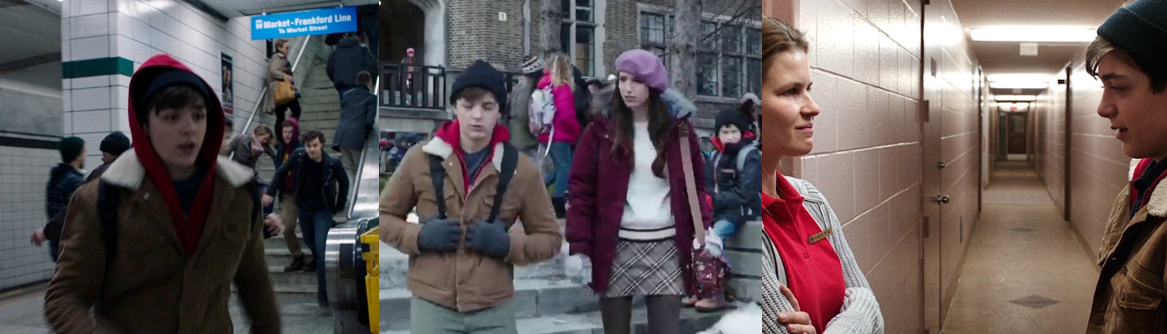
I feel it’s important for me to point out that I haven’t read any of the New 52 comics featuring Billy/Shazam’s altered background and extended family; I’m vaguely aware that his origin and situation were changed and updated somewhat, but I’m much more familiar with his classic comics and his appearance throughout the mid-nineties as a budding kid reporter and the “Big Red Cheese” who goofed about on the Justice League International team. I was therefore amused and intrigued to find Billy portrayed not a newspaper boy living on the streets with aspirations of working in radio, but instead as a streetwise orphan with a reputation for causing trouble with both his foster families and the cops and businesses of Philadelphia. Billy is a lot more in common with young John Connor (Edward Furlong) in that he resents being placed in the care of others, prefers to rely on his own wiles to get by, and frequently scams his way into police databases to track down his birth mother, Marilyn (Caroline Palmer), who he became separated from at a carnival ten years previously. Although he’s a rebellious kid who actively rejects assistance and affection for others, there’s a real tragedy to Billy; he believes he has a “real” family and mother out there waiting for him, refuses to entertain the notion that Marylin isn’t interested in finding him, and is desperate to be reunited with her and feel that sense of belonging once more. Unfortunately for him, he’s only fourteen and therefore legal mandated to be placed into foster care; having run away from good families before and been rejected because of it, he’s placed into the care of the lovable Víctor (Cooper Andrews) and Rosa Vásquez (Marta Milans), who shelter a whole troupe of foster kids of all ages. Since he’s a self-sufficient kid who doesn’t see the point in connecting with others because he’s trying to get back to his real mother, Billy is unimpressed by the Vásquez’s friendliness and the mixture of personalities in their household.

Billy revels in the power and freedom offered by his superpowered alter ego.

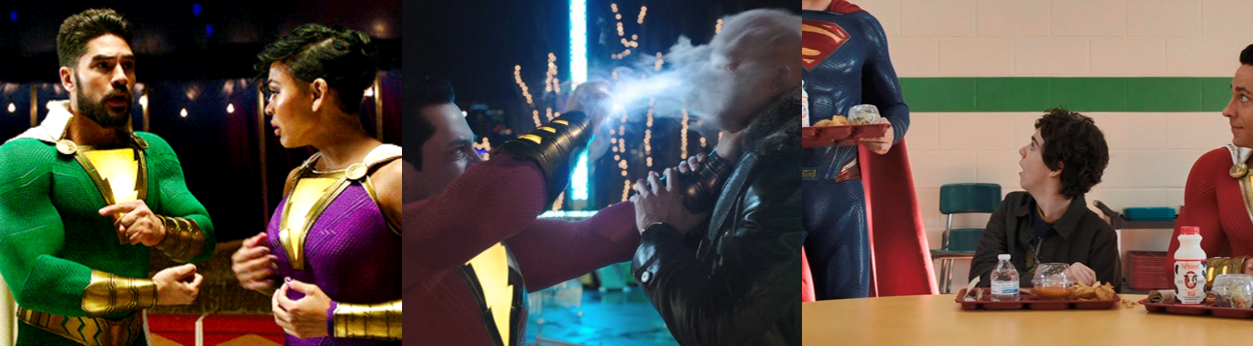
As in the source material, Billy is approached by the aging wizard Shazam (Hounsou), here depicted as a desperate demigod seeking to pass his great powers on to a suitable heir before his time ends. Djimon Hounsou is a great choice for this role; his gravely voice oozes a perfect mixture of menace, authority, and despair. Burdened by the guilt of having misplaced his trust in a previous Champion and witnessing the deaths of his fellow Council of Wizards, the Wizard is determined that his next Champion be pure of heart in order to fend off the influence of the Seven Deadly Sins (Steve Blum, Darin De Paul, and Fred Tatasciore) but is forced to rely on the reluctant Billy after the Seven Deadly Sins are freed from their prison. By speaking the Wizard’s name, Billy is transformed into an adult form sporting one of the best and most comic-accurate costumes ever put to cinema; the effort sees the Wizard crumble to ash but empowers Billy with the wisdom of Solomon, the strength of Hercules, the stamina of Atlas, the power of Zeus, the courage of Achilles, and the speed of Mercury. Whenever he utters his name, Billy becomes a boy trapped in a man’s body, leading to many humorous moments such as him struggling to navigate the world now he’s a six-foot, musclebound man, him learning the alcohol usually tastes terrible, and his awkward attempts to exude authority as a superhero. Zachary Levi shines in the role, though it can’t be overlooked that Billy seems to act more immature as Shazam than he does as a kid, somewhat negating whatever influence the Wisdom of Solomon is supposed to have on him; however, I would chalk this up to the freedom and power offered by his adult form and superpowers and it results in some of the film’s best moments as he and Freddy Freeman (Grazer) test Shazam’s limits, try to think up a suitable superhero moniker, and attempt to become social media celebrities by recording his feats of power and heroism.

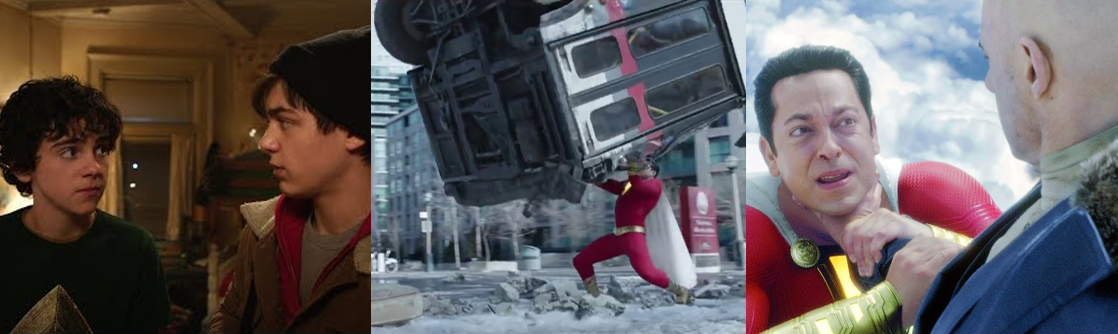
Freddy encourages Billy’s growth from a super celebrity into a capable superhero.

The Vasquez house shelters five kids of various ages, including avid gamer Eugene Choi (Ian Chen), the enthusiastic, the overly affectionate and chatty Darla Dudley (Faithe Herman), introverted workout aficionado Pedro Peña (Jovan Armand). While Darla steals every scene she’s in with her endless excitement and Billy can’t help but be taken by her childish positivity, it’s cripple Freddy Freeman and academic prodigy Mary Bromfield (Fulton) whom Billy spends the most time with. A superhero fanboy who’s constantly wearing Justice League t-shirts, showing off his Superman memorabilia, and rattling off Justice League statistics and abilities as Billy explores his powers. While Freddy’s nonstop chatter quickly exasperates Billy, the self-styled loner can’t help but step in when the snarky Freddy is set upon by a couple of douchebag jocks; Freddy’s a bit of an odd duck, one who sports a dark sense of humour, chatters incessantly, and struggles to maintain his boundaries. It’s lucky for Freddy that Shazam’s powers are so formidable as he doesn’t hold back in putting him through his paces; he actively encourages armed thugs to shoot him in the face, secretly sets him on fire, and delights in watching him barrel into buildings and fall from great heights in his attempts to fly. Eventually, however, a rift forms between them that only grows wider when Billy chooses to goof off as Shazam rather than show appreciation for Freddy’s assistance; even Eugene and Pedro question Shazam’s heroism as he’s more concerned with grifting and showing off. Although Shazam’s able to pull off and impressive physical feat and save a busload of civilians from certain death, Freddy chastises him for causing the accident in the first place and chews him out for not appreciating how lucky he is to have such incredible powers.

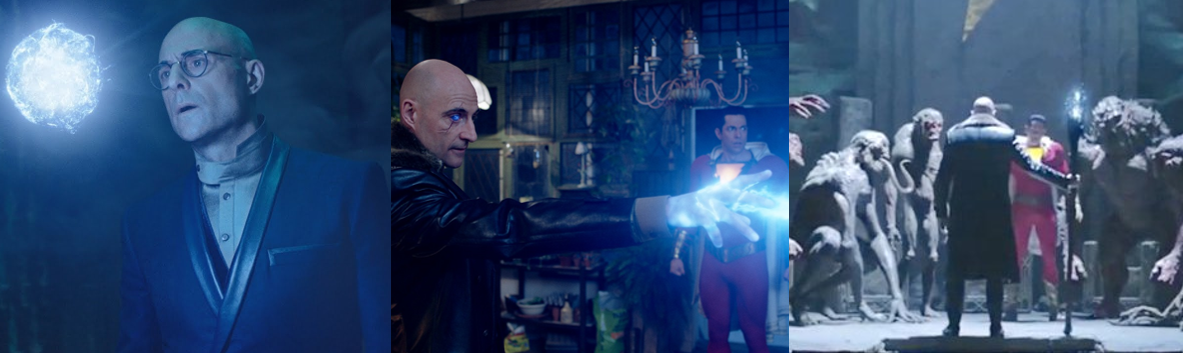
Though empowered by the Seven Deadly Sins, Dr. Sivana covets the Wizards gifts most of all.

Billy is put to the test, however, by Dr. Sivana, who we first meet as a little boy (Ethan Pugiotto) suffering emotional abuse at the hands of his strict father, business tycoon Mr. Sivana (John Glover), and his obnoxious older brother, Sid (Landon Doak). Although seemingly a more playful and less repugnant individual compared to his domineering elders, young Thaddeus is a perfect cause of nurture over nature; when he’s magically transported to the Rock of Eternity and offered the chance to become the Wizard’s Champion, he’s easily swayed by the influence of the Seven Deadly Sins, who offer him the power he needs to prove his strength to his father by claiming the Eye of Sin rather than the Wizard’s staff. Deemed unworthy because of his impure heart, young Thaddeus is rejected by the Wizard and his subsequent outburst causes a car crash that sees his father paralysed from the waist down and sets the boy on a lifelong quest to research the Wizard and his other rejected attempts to find a Champion in order to force his way back into the Rock of Eternity, confront the Wizard’s rebuff, and become the vessel for the destructive power of the Seven Deadly Sins. Largely represented as grotesque gargoyle-like creatures comprised of rock and smoke, the Seven Deadly Sins imbue Dr. Sivana with power to rival that of Shazam, which is a far cry from the mad scientist he was in the original comics but, as I understand it, is more in-line with his New 52 counterpart and allows Dr. Sivana to pose a physical challenge to the titular demigod. Composed, spiteful, and revelling in his dark powers, Dr. Sivana is the polar opposite of Shazam, who takes far longer to reconcile his immaturity with his magical adulthood and to realise the potential of his superpowers; it’s telling that Dr. Sivana can both fly and throw more effective punches in their first encounter, such is the benefit of his lifelong quest for the Wizard’s power, and he doesn’t hesitate to use every advantage at his disposal, even threatening Billy’s foster family, to add Shazam’s power to his own.

The Nitty-Gritty:
Some of you reading this may question why I’ve included Shazam! in my Christmas Countdown series considering it’s not a “typical” Christmas movie. Well, for me, the reason is very simple: the film is largely set around the festive season, Christmas songs, trees, and lights are all over the place, as is snow and a general sense of festive anticipation in the air and, while Christmas might not be at the heart of the narrative, this is enough for me to justify it being a Christmas movie. Plus, why not take the opportunity to slap on a fun or enjoyable film around Christmas even if it isn’t a focal point of the movie? A common criticism I have of early Shazam! comics is the depiction of the Rock of Eternity; it would take some decades for artists to render it in a way that felt both grandiose, fantastical, and foreboding and to not simply have cartoonish writing all over the walls to explain to kids what was happening. Thankfully, Shazam! addresses this issue, depicting the Rock of Eternity as a cavernous labyrinthine temple home to the aging Wizard and seven thrones where his peers once sat. The Seven Deadly Sins are also entombed there and, while they do have their name sand natures etched into their rocky surfaces, they’re far more monstrous and impressive than in those early comics; the Rock of Eternity is also home to various other magical doorways and artefacts that effectively lay the groundwork for future films, villains, and characters.

When his perfect memory of his mother is shattered, Billy turns to his foster family for support.

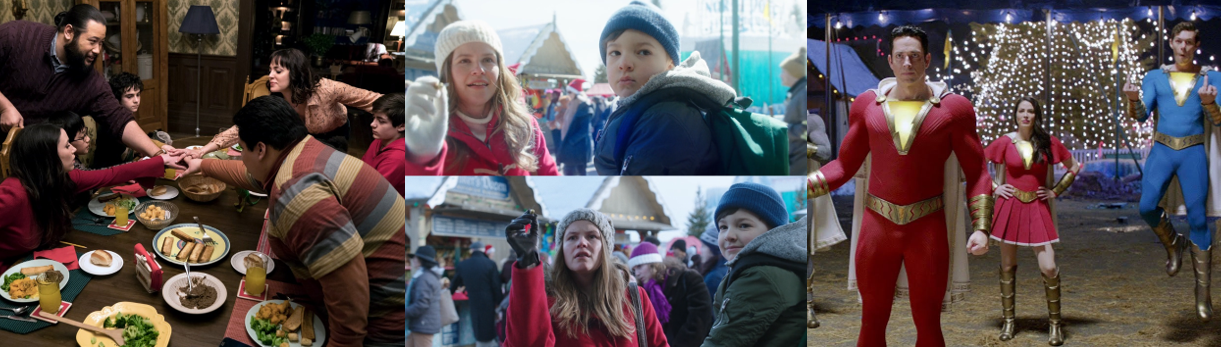
Family plays a central role in the film; as indicated, the influence of Mr. Sivana and Sid has a lasting effect on Dr. Sivana’s nature and life, with every action he takes in his quest for power, both magical and otherwise, motivated by a need to prove himself worthy and superior to his father and older brother. Billy holds his last memories of her close in his heart, remembering her as a kind-hearted and loving mother who did her best and gifted him with a compass so that he could always find his way, and he both dreams and actively rehearses what he’ll say when they’re reunited after they got lost in a bustling crowd. It’s therefore all the more heart-breaking when Billy does eventually track her down and learns not only that his memories of this event were skewed by his childish perception, but that Marylin chose to abandon him as she couldn’t cope with the pressure of being a mother. Asher Angel absolutely sells Billy’s dejection at this revelation as he realises that his whole life has been a lie, that this perfect memory and vision of a loving mother was far from the actual truth, and that his mother dropped him at the first chance she got rather than try to live up to her responsibilities. Despite his earlier reservations, this means that Billy comes to recognise the importance of his true family; while he’s spent much of the film pushing others away and only reluctantly accepting Freddy’s help in discovering the limits of his superpowers, the Vásquez’s and their foster kids have been nothing but warm, welcoming, and understanding to Billy. When he first meets them, the family is coming to terms with Mary’s impending departure for the California Institute of Technology (CalTech), a move which is encouraged but also a subject of sadness, especially for the emotional Darcy. After saving her as Shazam, Billy relates his belief that family is for those who can’t take care of themselves and encourages her to make it on her own and, similarly, early on, refuses to say grace over dinner or join hands with his foster family. However, when Dr. Sivana threatens his adopted family, Shazam agrees to hand himself over in exchange for their lives, finally seeing himself as their brother, and later turns to his adopted siblings for help by sharing his magical powers in much the same way as Victor and Rosa share their love.

Alongside his superpowered family, Shazam defeats Dr. Sivana and finds his place at last.

Although their power is primarily embodied through Dr. Sivana, the Seven Deadly Sins make a hell of an impression, delivering some disturbing PG violence that’s more than on par with the explicit brutality of previous DCEU films. Dr. Sivana barely flinches when his assistant (Lotta Losten) turns to ash before his eyes, launches Sid (Wayne Ward) out of a window, and unleashes the monstrous Seven Deadly Sins upon his father and his board members, whom they slaughter with an unexpected malice for an otherwise kid-friendly film. Although he can easily manhandle Shazam thanks to his composed nature, Dr. Sivana covets the Wizard’s magic above all and takes advantage of Freddy’s very public relationship with Shazam to hold his foster family hostage in exchange for Shazam’s powers. Their loyalty to Billy sees the kids come to his aid and reveals a glaring weakness in Dr. Sivana’s otherwise formidable powers; he becomes more vulnerable as the Seven Deadly Sins expel from his body, so Billy shares his powers, transforming his foster siblings into their own adult, superhero forms to divide the Seven Deadly Sins and weaken Dr. Sivana. While it’s convenient that Lady Shazam (Michelle Borth), Shazam Jr. (Adam Brody), and the others are all able to master their abilities faster than Billy, it leads to a fun and explosive finale as Freddy revels in finally having the superpowers he’s long idolised, Pedro Shazam (D. J. Cotrona) marvels at his physical stature and finally finds his confidence, Eugene Shazam (Ross Butler) delights in spouting videogame catchphrases to match his powers, and Darla Shazam (Meagan Good) retaining her childish exuberance. Although the Seven Deadly Sins and the Shazam Family are technically evenly matched in their strength and durability, Shazam’s able to render Dr. Sivana powerless by goading Envy into leaving his body. He then saves Dr. Sivana from certain death and forcibly extracts the Eye of Sin from his head, imprisoning the Seven Deadly Sins once more, though Dr. Sivana is approached by another potential villainous ally, the hyper-intelligent caterpillar Mister mind (David F. Sandberg) while languishing in prison. Having now found a safe, loving home and family to share his life and powers with, Billy chooses to stay with the Vasquez’s, joins them in their family traditions, and establishes himself and the other Shazams as the new keepers of the Rock of Eternity. He’s even able to bolster Freddy’s credibility at school by joining him for lunch as Shazam and alongside an awkwardly-framed Superman (seriously, it would’ve been just as good, if not better, to show Superman from behind and floating outside the window).

The Summary:
It can be difficult to craft a truly original superhero origin movie; even I’ll admit it’s usually better to fast-track or skip the origin entirely, especially for more well-known superheroes, but Shazam does a great job of establishing its world and Shazam’s powers through well-paced exposition and different means. Rather than opening with a voiceover explaining everything to us and then having that information repeated later, we see the conflict between the Wizard and the Seven Deadly Sins and how that influences Dr. Sivana and, when Billy first gets his powers, he’s completely clueless how to use them and is forced to turn to superhero nut Freddy for help. Seeing the kids become their own magical superheroes was a blast as all the adult actors equally conveyed their thrill at their newfound abilities and I really enjoyed the film’s humour, especially in the man-child personification of Shazam and his not being able to hear Dr. Sivana’s villain monologue. Seeing Billy grow from a damaged loner to truly accepting his foster family and his newfound powers was a charming development after the utter gut-punch delivered by his mother; Mark Strong was, ever, a deliciously scene-stealing villain and I absolutely loved the costume design and presentation of the film. Infused with exactly the right balance of action, comedy, and heart that’s often sorely lacking in the DCEU, Shazam! is a hugely enjoyable romp that’s got just enough Christmas spirit laced throughout it to justify an annual watch every festive season regardless of how much of a hard-on you have for Snyder’s grim and gritty perversion of DC’s characters.

My Rating:

Rating: 4 out of 5.

Great Stuff

Did you enjoy Shazam!? Are you a fan of the comic books and, if so, were you happy with the way it adapted the source material? What did you think to Billy’s characterisation, his mother’s true nature, and his acceptance of his foster family? Which of his siblings was your favourite and did you enjoy seeing them get a share Shazam’s power? What did you think to Dr. Sivana and the Seven Deadly Sins? Are there any Shazam characters, villains, or story arcs you’d like to see adapted one day? Do you prefer the grim and gritty DCEU or its more light-hearted side? Whatever your thoughts on Shazam!, feel free to drop them below or leave a comment on my social media.


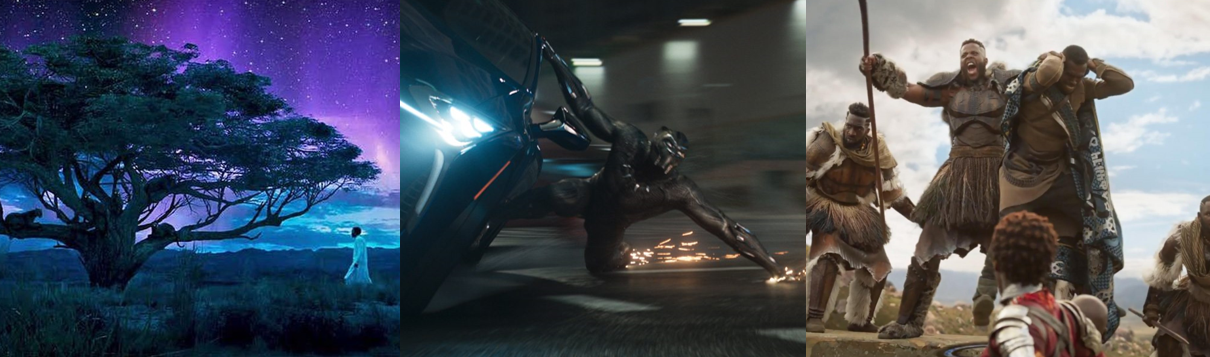
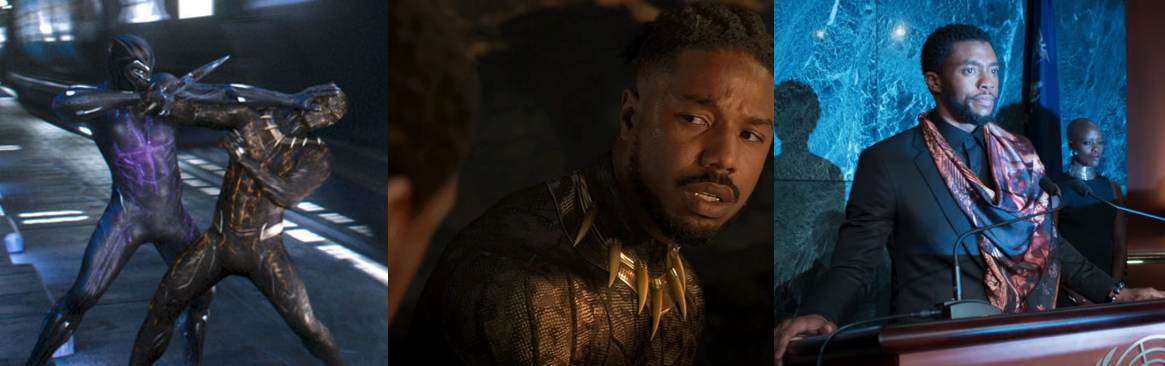
Movie Night: Black Panther

BlackPantherLogo

Released: 16 February 2028
Director: Ryan Coogler
Distributor:
Walt Disney Studios Motion Pictures
Budget: $200 million
Stars:
Chadwick Boseman, Michael B. Jordan, Lupita Nyong’o, Danai Gurira, Letitia Wright, Winston Duke, and Martin Freeman

The Plot:
After helping to bring his father’s killer to justice, Prince T’Challa (Boseman) assumes the mantle of the Black Panther is crowned king of the hidden kingdom of Wakanda. However, his reign is challenged by his cousin, N’Jadaka/Erik Stevens (Jordan), now a brutal mercenary known as Killmonger who seeks to overthrow T’Challa and begin a global revolution using Wakanda’s advanced technology.

The Background:
Having co-created Marvel Comics’ First Family of superheroes, the Fantastic Four, Stan Lee and Jack Kirby introduced a number of additional characters and concepts in the pages of the foursome’s adventures, with T’Challa/The Black Panther being one of the most prominent since he was the first black superpowered character in comic books. The Black Panther went on to feature in a critically acclaimed series, join the Avengers, and featured in a number of pivotal Marvel events and politically charged storylines. The Black Panther also saw some exposure outside of the comic books, featuring in the 1994 Fantastic Four cartoon and his own Marvel Knights motion comic series, but a live-action adaptation had been in the works since 1992. Back then Wesley Snipes was attached to the role and became heavily involved with the project, which repeatedly stalled throughout the nineties and failed to get off the ground into the early 2000s. Snipes was forced to bow out of the film by 2010 due to his conviction for tax evasion and, ironically, the very next year Marvel Studios head honcho Kevin Feige pushed the movie into production, though it would be some six years before the film would properly take shape. Chadwick Boseman won the title role after outlining his plans for the character, making his debut in Captain America: Civil War (Russo and Russo, 2016), though the world was shocked and saddened to learn of his death some years later and that he had been battling cancer throughout his MCU tenure. Director Ryan Coogler aimed to make Black Panther a personal, progressive showcase of a sovereign nation that put the spotlight squarely on African-American actors and important messages of racial equality. Accordingly, the production design, sets, and costumes pulled from a variety of cultural influences from Sub-Saharan Africa to mix the traditional with a wash of science-fiction, with this latter aspect being the realm of the numerous visual effects studios employ to bring Wakanda to life. Black Panther proved a massive financial success; it grossed nearly $1.350 billion worldwide and was universally lauded by critics. Reviews praised the film’s refreshing presentation, the performances, and the sheer visual spectacle but, more than anything, Black Panther was praised for tackling themes of racial oppression and depictions. Following Boseman’s untimely death, Feige announced that the role wouldn’t be recast and that Black Panther’s sequel would move the concept into a different direction to ensure a lasting legacy for the beloved performer.

The Review:
One of the things I love about the MCU is the way they’ve always strived to not be completely dependent on the same characters over and over; while Warner Brothers struggle to utilise any DC Comics characters that aren’t Bruce Wayne/Batman or Clark Kent/Superman, Marvel Studios have been seeding, introducing, or debuting new characters and superhero icons all throughout the MCU to help keep things fresh, expand and enhance their interconnected cinematic universe, and lay the foundation for future crossovers. This has also helped to keep the MCU diverse and dabble in portraying different cultures and types of characters, despite what some naysayers will say about the narrative tone most MCU films take. It’s not surprise, then, that Black Panther proved to be quite a monumental release; we’d seen black superheroes before, of course, most famously Eric Brooks/Blade (Wesley Snipes), but never before had a super film gone so in-depth at portraying an African society, tackling the issues of slavery and oppression felt by the Black community everywhere, or in establishing a fictional African-American culture as one of the most formidable forces in superhero cinema. It can be tough to rewatch Black Panther knowing not only that Chadwick Boseman was battling cancer throughout it but also that he has since passed on; I might not be the most knowledgeable Black Panther fan out there, but his performance really inspired me to want to read more Black Panther stories to explore the character.

Afforded superhuman abilities as the Black Panther, T’Challa must now step into the role of king.

My knowledge and experience of the Black Panther isn’t as learned as with other superheroes but he’s definitely been on my radar over the years, often popping up in Marvel cartoons and crossovers I’ve watched and read. Still, my expectations were simply to have a good time with the film and learn a little more about T’Challa as a character; in Civil War, T’Challa was a soft-spoken, honourable, and fiercely loyal man driven to vengeance after his father, King T’Chaka (John Kani) was killed. His arc was about realising that revenge is all-consuming and that there’s a better, more purposeful path he (and anyone, for that matter) can take, even if it means allowing reprehensible villains to live so they can be brought to justice for their actions. In Black Panther, T’Challa’s focus shifts towards the burden of the crown; not only must he stand as Wakanda’s greatest warrior and protector but he must also assume the role of a leader to his hidden nation, one he accepts out of a strong sense of duty and fiercely fights to earn by defeating challenger to the throne and tribal rival M’Baku (Duke) in ritual combat. T’Challa has an easy coolness to him that makes him warm and relatable; he can easily shift from a more light-hearted demeanour to being a warrior and a king and he’s afforded a great sense of vulnerability from the revelations he learns in this film, his feelings for Nakia (Nyong’o), and the times when he’s forced to fight without his powers. Thanks to a mysterious heart-shaped herb, T’Challa is granted superhuman strength and reflexes; these, along with his highly advance Vibranium suit, allow him to defend his nation as the Black Panther, but he’s forced by tradition to have his powers removed by Wakandan shaman Zuri (Forest Whitaker) in order to prove his right to the throne through his natural guile and abilities. luckily, T’Challa is more than up to the challenge and is equally determined to maintain the pretence that Wakanda is a struggling Third World nation in order to keep the wider world from learning of their Vibranium and the true extent of their advanced technology. Ruling not through force or oppression, T’Challa has an extremely relaxed and approachable demeanour; he goofs around with his tech-savvy and enthusiastic younger sister, Shuri (Wright), and makes efforts to extend the hand of peace to all of Wakanda’s nations despite M’Baku’s desires for the throne. However, he’s reluctant to open Wakanda’s borders and share their technology and resources with the world given that, in the past, outsiders have sought only to take the Vibranium for themselves, by force more often than not, and use it for nefarious ends.

T’Challa is surrounded by strong, loyal, and very capable allies, most of whom are female.

This is a view not readily shared with Nakia, T’Challa’s former flame and a “War Dog” from Wakanda’s River Tribe; at the start of the film, Nakia is out in the world fighting to help those less fortunate. Her time in the outside world as one of many undercover Wakandan agents brings her a deeper knowledge of the suffering and neglect that is happening all over the globe, especially to those in Third World nations, and she actively encourages T’Challa to set aside tradition and share Wakanda’s resources and advances with those in need. Others within T’Challa’s close-knit circle aren’t as open to this idea, however; his mother, Ramonda (Angela Bassett), and Zuri are both deeply entrenched in the centauries-old traditions of their nation, though only Zuri has witnessed first-hand the lengths Wakanda will go to to keep their true nature a secret. T’Challa’s loyal bodyguard and commander of Wakanda’s formidable Dora Milaje forces, Okoye (Gurira), is quite blunt in her stoic distrust and dismissal of “outlanders”. Although his most trusted lieutenant, she’s duty-bound to accept Killmonger as her king when he assumes the throne but her loyalty to T’Challa sees her, Shuri, Ramona, and Nakia forming something of a rebellion against Killmonger’s tainted rule. Shuri, who may very well rival Tony Stark/Iron Man (Robert Downey Jr.) in terms of scientific acumen and arrogance, relishes the opportunity to aid Everett Ross (Freeman), the Central Intelligence Agency (CIA) liaison to Wakanda, after he’s injured and in using her advanced technology to help break James Buchanan “Bucky” Barnes’ (Sebastian Stan) brainwashing from his days as the Winter Soldier. An energetic and somewhat rebellious young girl, Shuri is far more comfortable in street wear, mocking Wakanda’s traditions, and tinkering in her lab; Shuri outfits T’Challa with his gear, including a fancy brand-new fancy Black Panther suit comprised of Vibranium nanotechnology and capable of absorbing and distributing kinetic impact. She’s also able to use hologram technology to remotely drive a Lexus from their lab and, later, even contributes to the final battle against Killmonger and his fellow extremists to safeguard her nation, proving she’s a patriot at heart.

Allied with Klaue, Killmonger is one of the MCU’s most driven and relatable villains.

Eccentric South African arms dealer Ulysses Klaue (Andy Serkis), now sporting a plasma cannon hidden in a fake arm after his encounter with Ultron (James Spader), returns, now allied with Killmonger, a mercenary with a thing for anime whose entire torso is covered in self-inflicted tribal scars that showcase his bloodthirsty nature. A patient, learned, and driven individual, Killmonger is actually T’Challa’s cousin, N’Jadaka, who was abandoned decades ago after T’Chaka was forced to kill his own brother, N’Jobu (Sterling K. Brown), after stealing Vibranium alongside Klaue to give power back to oppressed Black people. Just as T’Challa continues to honour his father’s ways, so too does Killmonger seek to use his claim to the throne to acquire the technology and weapons needed to give Black people a fighting chance for the first time. T’Challa is devastated to learn that his father’s ways caused him to grow up without his cousin, and twisted Killmonger into a figure of hatred and radical action, ad his reign as king is tested when Killmonger betrays and kills Klaue and bursts into the Wakandan throne room to challenge his cousin. T’Challa’s reluctance to pursue and kill Klaue, and his alliance with White outsiders, causes some friction between him and his closest friend and ally, W’Kabi (Daniel Kaluuya), who readily accepts Killmonger and backs him as king for his more forthright demeanour. Killmonger’s prowess is enough to not just best T’Challa but also to seemingly kill him; he then sets about destroying the heart-shaped herb to cement his legacy as the one and only king of Wakanda and orders arming the thousands of Wakandan spies across the world so that repressed Black people everywhere finally have the means to seize power for themselves. Michael B. Jordan is a real standout here, and Killmonger represented a turning point for MCU villains; while, yes, he does end up donning his own Black Panther costume (more of a Golden Leopard) and he does disappear for a large chunk of the movie, Klaue more than fills the void as a side villain, and the justifiable chip on his shoulder from the oppression of his people and his separation from Wakanda due to the actions of T’Chaka makes his motivations not only believable and relatable, but deeply personal not just for T’Challa but for oppressed minorities everywhere.

The Nitty-Gritty:
As soon as Black Panther begins, you can tell that this is a very different film to the usual MCU offerings. In the build up to Avengers: Infinity War (Russo Brothers, 2018), Marvel Studios definitely doubled down on world-building, character pieces, and smaller scale films with far reaching potential in recent years. However, Black Panther doesn’t just separate itself through a highly advanced society built purely around the marriage of technology and tradition, but also by tackling the subject of race of oppression in our society, making it an extremely relevant and politically-charged film. Now, I’m just a regular, run-of-the-mill White guy, so Black Panther’s appeal and messages hit a little differently for me; I remember the first time I saw it and thinking how I maybe wasn’t the target demographic since its running theme of the oppression of ethnic minorities hasn’t affected me as it would, say, the Black community. It’s not my place to comment on this strife as I haven’t had to experience it but it’s telling that Killmonger is widely regarded as one of the best and most well-rounded MCU villains. In truth, he’s more like an anti-hero, a dark opposite to T’Challa who is just as loyal and dedicated to his people and his cause but in a way skewed more towards a violent uprising. And, honestly, why not? His people (“brothers and sisters”, as he calls them) have suffered atrocities for generations; his personal vendetta against Wakanda for abandoning home and, in his mind, selfishly hoarding their technology perfectly aligns with a very understandable need to strike back at a world that has shown nothing but contempt for “minority” races. In another life, it’s entirely possible that Killmonger could’ve been a force for good and positive change within Wakanda, and T’Challa even has a respect and sympathy for what’s he’s been through, his suffering and his cause, but Killmonger would rather die free as a martyr than even consider being a prisoner.

A mixture of technology, tradition, and warrior spirit make Wakanda a prosperous nation.

The main thrust of the film is to set up Wakanda ahead of Infinity War and you really get a good sense of their society, one built on tradition and respect as much as the technological wonders afforded by their massive stockpile of Vibranium. Wakanda’s true nature is a secret to all; not even Everett Ross is aware of his advanced they are thanks to a protective, holographic shield around the mainland and a major plot point throughout the film is the lengths Wakanda’s royal family have gone to to maintain their secrecy out of fear of their Vibranium being misused. This is at the centre of both T’Challa and Killmonger’s stories and shapes both of their perspectives throughout; T’Challa comes to realise that Wakanda needs to change and put their resources to good use and Killmonger has no hesitation about perverting those same resources to incite an all-out revolution. While so much of Wakanda is rooted in tribal rituals, from their structures to their traditions and their attire, the nation is bolstered by highly advanced technology that more than rivals Stark’s. Black Panther utilises a suit of almost magical nanotechnology, one that forms over his entire body at his convenience and makes him functionally invincible since it can absorb and unleash kinetic energy. Wakanda’s tech is so advanced that they’re entirely self-sufficient, Shuri can create energy-based weapons in gauntlets and shields and such, and they’re able to heal critically wounded people with ease, to say nothing of their futuristic craft that boast cloaking technology, electromagnetic pulse devices, and fly at incredible speeds. Although Wakanda is a largely peaceful and united nation, there are ripples in the water; W’Kabi is suspicious of T’Challa’s dealings with the outside world and T’Challa’s rule is challenged by M’Baku, whose animalistic and antagonistic Jabari tribe has distanced themselves from the luxuries enjoyed by mainstream Wakandan society. Though noticeably different from his comic book counterpart, Man-Ape, M’Baku is a fantastic addition to the film; he and his tribe have little interest in helping those who they feel look down on them. M’Baku’s proud nature and disapproval of T’Challa’s reign resulted in some powerful moments, such as him dismissing Everett Ross and even restoring T’Challa to life and power despite their rivalry. While he initially has no interest in helping T’Challa further than that, M’Baku is a man of honour who recognies Killmonger’s threat, leading to an unlikely and enjoyable alliance between the Jabari and the Dora Milaje after Okoye finally chooses loyalty to T’Challa over loyalty to the throne.

T’Challa’s gifts and the ways of his people afford him both great strength and conviction.

While traditions and technology are very much at the forefront of Wakanda, Black Panther is also rooted in spirituality; not quite the cosmic or more tradition magic seen in the MCU before, this spirituality is more supernatural and natural, imbuing the heart-shaped herb with properties that bestow superhuman abilities and allowing T’Challa to converse with his father’s spirt on the Ancestral Plane. We’ve seen since how the MCU has really taken the concept of multiple Gods and afterlives and really ran with it, but it all started here, in a kind of meditative wrapping that showed a deep connection to oneself and the lineage that had come before. This spirituality and belief in ages-old traditions is tested when Killmonger reveals T’Chaka’s shady past, but still heavily informs T’Challa’s character; he loves his homeland and will do anything to protect it, whether that’s shielding it from thieves like Klaue or opening Wakanda’s borders to provide aid to the oppressed. This spirituality also informs many of the film’s fight scenes; there’s a serene grace to the Black Panther, who moves with a deft agility that makes him an extremely effective combatant even without his costume. Okoye and the Dora Milaje favour more traditional weapons, but ones augmented by Shuri’s tech; in Wakandan hands, spears and shields before advanced weapons requiring years of training and physical skill to wield as their form and function is rooted in traditional tribal weaponry. They also have futuristic vehicles and energy-based weapons, which allow even the likes of Shuri to hold their own in battle and allow Black Panther to have a unique visual flair to its action and fight scenes. Even when undercover in a casino in Busan, the film separates itself from its MCU predecessors by first infusing a James Bond influence and then showcasing Okoye’s swift and brutal spear-play. Klaue might not pose the physical threat that Killmonger represents but his despicable nature, cruelty, and unsettling artificial arm cannon make him a reasonable secondary threat; he’s mainly there as a loose end and a means to an end to grant Killmonger entry into Wakanda but still manages to cause T’Challa trouble during an incredible car chase through Busan. Twisted by Killmonger’s influence, W’Kabi defends his new king’s designs for Wakanda, even to the point of clashing not just with the Dora Milaje but with his own wife, Okoye, allowing Black Panther to conclude with a suitably dramatic large-scale conflict that even sees Everett Ross put his life on the line to stop Killmonger from taking Vibranium weapons out of the country.

Despite some dodgy CGI, the film’s ending hits hard and changes Wakanda’s ways forever.

Forshadowing the large-scale battles we’d see in the next two Avengers movies, Black Panther ends with two big action set pieces: one pitting those loyal to T’Challa against Killmonger’s fanatics (including armour-clad rhinos and Vibranium weapons galore) and another, far more personal fight between the two would-be kings. As impress as all these sequences are, however, it can’t be denied that the CGI falters somewhat here; Black Panther and Killmonger don ridiculously similar costumes and their fight is largely realised through rubbery CGI characters against the dark and overly visually complex Vibranium mines. While I get the idea of Killmonger wanting to take T’Challa’s place (literally and figuratively) and claim his mantle, I think his default appearance was suitable enough and it would’ve been better to lean into that for his “costume” so that they could be more easily distinguishable. Still, if you can overlook that, their final clash is quite the intense affair; with Killmonger threatening to pervert everything Wakanda stands for, and having already proven himself T’Challa’s equal and better without the benefits of superhuman powers or technology, this is as much a clash of ideals as it is fists. In the end, T’Challa’s greater experience with Wakanda proves to be the difference maker as Shuri’s able to disrupt both of their suits to put them on equal ground and allow T’Challa to outmanoeuvre Killmonger and deliver a mortal wound. Sharing his own experiences with revenge and sympathetic to his cousin’s plight, T’Challa offers mercy but Killmonger refuses, opting to witness his first Wakandan sunset and die peacefully rather than be incarcerated. T’Challa takes the whole experience to heart, however, and works to make amends for Killmonger’s cause and harsh upbringing; he establishes and outreach centre in the United States and reveals Wakanda’s true nature to the world at the United Nations with the promise of sharing their resources with those in need. To exemplify just how beneficial Wakanda can be to even the most tortured individual, a post-credits scene shows Bucky (affectionately referred to as the “White Wolf”) being gifted a new Vibranium arm, now firmly on the road to recovery. It’s a bittersweet ending knowing that we’ll never get to see Chadwick reprise his most iconic role, and considering all the hardship Killmonger and others like him have had to endure over the generations, but one that sends a message of hope and positive change for all repressed peoples.

The Summary:
We’d seen a lot from the MCU when Black Panther came out and were on the cusp of some ground-breaking and game-changing events, and yet it still managed to make one hell of an impression. At the base level, it’s a beautiful film to look at and really captures the allure and mysticism of Africa; Wakanda is such a unique place, like a slice of cosmic, futuristic utopia amidst the wrappings of nature and centuries-old tradition, marrying tried-and-tested ways and beliefs with highly advanced technology. T’Challa is no slouch either, being an affable and alluring hero who it’s easy to root for; he’s gifted great power and capable of great things, but remains loyal and true to himself, never cracking under the burden of responsibility to backing down from a challenge, while still remaining level-headed enough to use diplomacy wherever possible. Naturally, a standout was Killmonger, probably the MCU’s most complex villain yet; his commentary on the oppression of ethnic minorities remains sadly all-too relevant even in modern society and he’s easily the most interesting and multi-faceted of Marvel’s dark doppelgängers. Ultimately, Black Panther is a very different superhero film, one that is as much about world building and politics as it is about kick-ass action sequences and spectacular special effects and sets. T’Challa, who has evolved from a revenge-obsessed renegade into a self-assured, prideful leader of a nation, was a welcome addition to the MCU and had such potential as a worthy leader of the Avengers. The final act of the film is maybe a little rushed, with perhaps two or three too many plot lines being mashed into the narrative, but it never feels like the pacing is off. The goes to great lengths to set Black Panther up as a diplomat who is not against suiting up and fighting against injustice when it rears its ugly head, but also to establish Wakanda and its people as a force to be reckoned with going forward no matter who assumes the Black Panther’s mantle.

My Rating:

Rating: 4 out of 5.

Great Stuff

Did you enjoy Black Panther? How do you think it holds up compared to other MCU films and as an adaptation of the character? What did you think to the film’s visual presentation and fight scenes? How did the depiction of racial oppression affect you, if at all? Where would you rank Killmonger amongst the hierarchy of MCU villains? Who would you like to see become the new Black Panther? Whatever you think about Black Panther, feel free to share your thoughts and memories of Chadwick Boseman in the comments below or on my social media.