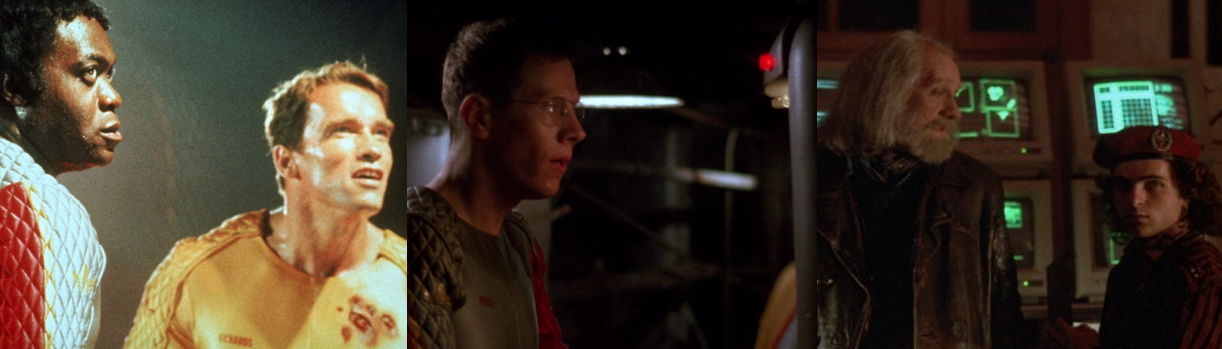
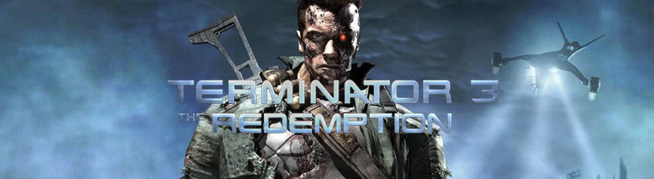
Game Corner: Terminator 3: The Redemption (PlayStation 2)

Released: 9 September 2004
Developer: Paradigm Entertainment
Also Available For: GameCube and Xbox

The Background:
Perhaps unsurprisingly, the Terminator franchise (Various, 1984 to 2019) has a long history with videogame adaptations; every film in the franchise has been adapted to at least one videogame over the years and the series even crossed over with RoboCop (Verhoeven, 1987) back in the day. Since producers and movie studios bent over backwards to get a third film made (and since big-budget movies usually always had a videogame tie-in at the time), it’s perhaps also not much of a surprise that Terminator 3: Rise of the Machines (Mostow, 2003) was accompanied by not one, but three videogame adaptations courtesy of Atari. Paradigm Entertainment developed Terminator 3: The Redemption at the same time as Black Ops Entertainment was working on Terminator 3: Rise of the Machines (ibid, 2003) and used photographs of the film sets to help create their game world. Even after Terminator 3 failed to impress, Atari pushed forward with The Redemption and even gave Paradigm more time to work on the game, which the developers aimed to make as fast-paced and action-packed as they could to differentiate it from its counterparts. Judging from the reviews, this appears to have paid off as critics found the game an overall improvement over its predecessor; however, while reviews praised the game’s action-packed content and graphical appeal, its difficulty and linearity were criticised, and the general consensus was that the game was far more appealing as a rental rather than a purchase.

The Plot:
In the year 2032, humanity has been pushed to the brink of extinction in a war against the malevolent artificial intelligence known as Skynet. After John Connor, the leader of the human Resistance, is killed by a T-850, the Terminator is reprogrammed and sent back in time to protect John’s younger self from an all-new Terminator, the T-X/Terminatrix

Gameplay:
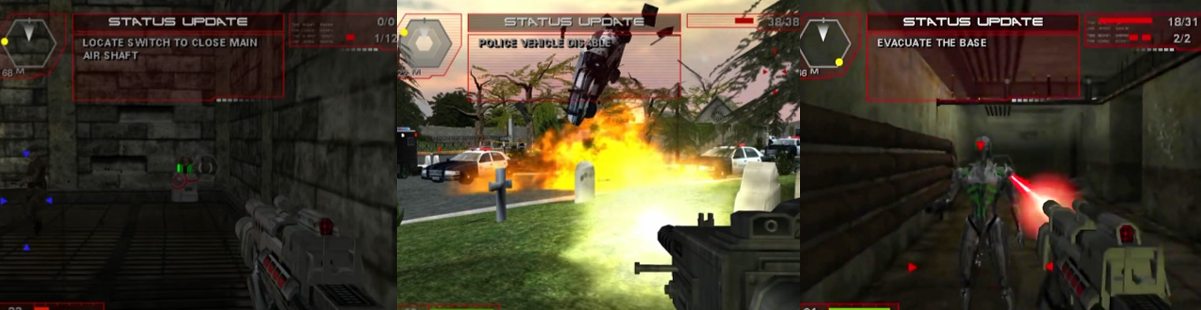
Unlike its predecessor, Terminator 3: The Redemption is a third-person action shooter with a focus on combat, both gun and melee, and chasing and driving sequences. Straight away, the contrast between the two games is thus evident; whereas Terminator 3: Rise of the Machines was a middle of the road first-person shooter that was top-heavy with its content, The Redemption has a far more balanced pace to its narrative and gameplay structure, though it still falls into the same traps of repeating gameplay loops over and over. Once again, you’re placed into the role of the reprogrammed T-850 from the film the game is based on and tasked with clearing a number of missions across four chapters, though this time you’re afforded unlimited ammunition by default and there’s no division between the shooting and melee sections. The game’s controls can be configured to your liking and this aspect is nicely weaved into the story; by default, the Terminator can take command of turrets and cannons or leap to other vehicles with Triangle (oddly labelled “acquire”), activate its trademark red-hued vision to identify allies and other targets for a limited time with Circle, grab enemies or put the brakes on its current vehicle with Square, and unleash a limited number of combos with X. Different combinations of X and Square will see you pull off various grabs, punches, and slams to the T-900s that cross your path. While I rarely found myself relying on the hand-to-hand combat, it’s a quick way to take out enemies compared to just blasting them and you’ll be using X to shoot, toss, and kick Terminators off your vehicle or into your line of fire when you’re at a turret. The Terminator can fire its current weapon with R1 and reload with R2 (though I found no practical use for this), L1 fires an alternate shot (usually allowing you to dual-wield or fire a charged plasma shot or missile), and, in an inexplicably confusing addition, L2 allows you to control the quips and one-liners the Terminator’s says by functioning as a dedicated “speak” button. Finally, the Select button switches between camera angles, pressing in the right stick allows you to switch targets, and you won’t need to worry about pressing a button to accelerate when in a vehicle as you simply use the left stick to move about.

Run around blasting Skynet’s forces or give chase on a variety of vehicles in this action-heavy title.

Terminator 3: The Redemption also includes a very rudimentary upgrade system; by destroying enemies and clearing missions, you’re awarded Terabytes (TB), and you’ll receive more TB for clearing missions quickly, something you can track with the game’s heads-up display (HUD). TB allows you to upgrade the Terminator’s recharge time (though I’m not sure what that means…) and the length, damage, and charge of its thermal vision, none of which I found to be particularly useful; TB also unlocks bonuses in the game’s ‘Extras’ menu. By pausing the game, you can review the Terminator’s combos, trade TB for other upgrades, and review your mission objectives, which are provided before the start of each chapter. Within the first few missions, though, you’ll have experienced everything The Redemption has to offer: typically, you’re tasked with following a linear path, gunning down the same mechanical enemies in waves either with your weapons, combos, or turrets. Then, you’ll either jump onto the back of a jeep or a Future Killer/FK Tank and chase down some kind of target, blasting at its engines and other enemies and “acquiring” replacement vehicles when your health is running low. Sometimes, these sections see the vehicle racing towards the screen and you blasting at pursuing enemies and switching lanes with the left stick but, generally, you’re bombing along through wrecked highways and streets. Next, you’ll be prompted to jump to a circling helicopter and blasting at targets with a mini gun or rocket launcher in a kind of auto/rail shooter section, and maybe you’ll be tasked with chasing down the T-X in a ridiculously outclassed vehicle with no indication of how far away it is except for an ever-decreasing reticule and a countdown showing you how close you are to imminent failure. These latter sections are by far the worst parts of the game; the T-X rockets away in a supped-up sports car, leaving you to dodge hazards and pursing police cars, taking shortcuts through dirt roads, fling over trains, and through power plants and scrapyards in a desperate bid to catch up only to be met with failure again and again because you snagged a part of the environment or couldn’t tell where you needed to go. Failure in a mission means restarted all over again from the beginning; there are no checkpoints here and the only way to replenish the Terminator’s health is to find “charge points”, which basically goes against my ingrained gaming experience that tells me to stay away from raging blasts of electrical current.

Some missions are needlessly frustrating and include an aggravating difficulty curve.

I opened this review by saying the game’s pace is improved over its predecessor and that is technically true; some missions are shorter or longer than others but it’s nowhere near as unbalanced as in the last game, but it’s still not great to experience. Often, your objectives are somewhat vague and it’s not clear that you are racing against a time limit or have a limited window of success; you’ll be racing along, taking ramps and desperately trying to stay on higher paths on your slippery FK Tank blasting at a Skynet carrier and then suddenly be met with a mission failure screen because it got “out of range”. Similarly, when John Connor and Kate Brewster drive a plane through aircraft hangers and runways trying to get to Crystal Peak, you need to fend off the T1 tanks and proto-FK drones (and, bizarrely, T-600s) attacking their craft and it can get very chaotic very quickly if you don’t keep an eye on the plane’s health bar. There are two missions where you’re racing around a cemetery in a hearse; one sees you driving around in a circuit shooting the T-X away when it attacks and trying to ram into a Special Weapons and Tactics (S.W.A.T.) van, which you do by taking alternate paths on the circuit. The other mission sees you driving along the freeway as the T-X drops onto the wrecked hearse; you need to shoot it with X and then use the brake, power slide (also Square), and environment to shake it off until the mission just ends. There’s also a couple of missions where you’re flying along on a hijacked FK Hover, frantically dodging pipes, pistons, and fans and shooting at bombs and other targets; you won’t know not to venture down the wrong path until you make a split-second decision to take a lower path only to be met with immediate failure as your temperature gets too high. Overall, the game is far more action-packed than its predecessor, with a lot more variety crammed into its gameplay, but it relies far too much on repeating the same gameplay loops and the difficulty of some missions is absolutely unforgiving; this may explain why The Redemption lacks the traditional difficulty settings as the game is already pretty tough to get through at times.

Graphics and Sound:  
Initially, I was again surprised by how good Terminator 3: The Redemption looks; since it retells the events prior to and during the film in its own way, it again relies on CG cutscenes to relay its story and, for the most part, these look pretty good. The game rarely uses the janky, marionette-like in-game graphics for cutscenes, which is good, and the CG scenes often recreate, recontextualise, or bleed into scenes from the movie, with The Redemption being much smarter about which movie clips it uses and when (it even includes the film’s actual ending this time), though again it does use these to skip over large parts of the story in different ways. For example we see a truncated version of the Terminator’s rescue of John and Kate at the vets, their visit to the cemetery, and Skynet’s rampage through Cyber Research Systems (CRS) but we don’t get to play these moments; instead, we’re dropped in after they’ve occurred, which is fine as the focus is generally on action-oriented gameplay but it again smacks of a rushed production as the game skips over plot points that were pivotal to the movie’s story. Additionally, The Redemption suffers a bit in the music and sound department; the iconic Terminator theme is largely absent, though the game makes a big show of including George Thorogood and the Destroyers’ “Bad to the Bone”, playing not just in the scene where the Terminator takes the stripper’s clothes but also over the end credits. While Arnold Schwarzenegger, Nick Stahl, and Kristanna Loken all provide what can generously be called their likenesses (the CG cutscenes do not do them justice at all), none of them return to voice their characters, with the Terminator’s Arnold soundalike sound particularly awful.

The game looks pretty good and does a better job of recreating, and deviating, from the film than its predecessor.

Otherwise, the in-game graphics are pretty good; once again, the highlights are the Future War sections, which are probably the best seen in the series at that point. You’ll battle and race through destroyed streets, airports, and buildings, passing the remains of the Hollywood sign, wrecked skyscrapers, and war-torn streets as dark (and, at one point, red) clouds loom ominously overheard lit up by lightning flashes. This is starkly contrasted by the mechanical precision of Skynet’s bases, such as the Time Displacement Chamber, which is now a heavily fortified complex full of tunnels, reactors, and sprawling corridors. Once the Terminator is sent back through time, you’ll spend a bit of time racing through the desert highways outside San Francisco, recreate the Terminator’s chase to and away from the T-X’s crane truck through the bustling city streets, battle through the airport to get John and Kate to safety, and again make your final stand at the Crystal Peak outpost. Similar to how the last game included a flashback to the Future War in the middle of the movie’s events, The Redemption briefly derails its story by having the T-X send the Terminator to an alternate future using a particle accelerator; in this even bleaker, more nightmarish timeline, John and Kate are dead and the Terminator must make its way back to the past by commandeering a gigantic FK Titan, rolling over T-900s and blasting towers and buildings with its cannons, before bringing down an equally huge aircraft carrier amidst the tumultuous skies. Sadly, as detailed and impressive as many of the game’s environments are, I did notice a fair amount of graphical pop-up and, of course, you have to deal with the PlayStation 2’s noticeable load times.

Enemies and Bosses:
As ever, you’ll be battling against the marauding forces of Skynet for the majority of The Redemption. T-900 endoskeletons, now redesigned into something a little more familiar to the classic Terminator design, litter the post-apocalyptic wasteland of the future; not only do they fire the iconic phase plasma rifles, but they can also crawl along the floor to grab at your feet after being separated from their torsos, though they’re noticeably much easier to destroy than in the last game. FK Hovers and FK Tanks also crop up, blasting at you incessantly, though you can commandeer the latter and make liberal use of turrets for the former, which is usually essential when Skynet’s forces attack in waves. When you travel to the past, you’ll have to contend with police cars and S.W.A.T. offers chasing and shooting at you, but these are brief distractions that only pop up in a couple of missions; as in the film, the Terminator is forbidden to kill these people but, unlike in the last game, it seems The Redemption is content to throw up a notification that you’ve not taken a human life rather than end your mission if you’ve been too trigger happy. CRS’s proto-Terminator machines also become an obstacle, with drones and those awesome T1 Tanks attacking you and your allies, and you’ll also need to fend off and destroy the vehicles that the T-X sends your way using its nanotechnology.

While the game shines in big, action-packed sequences, the T-X encounters are finnicky and unfulfilling.

As in the last game, however, boss battles are so few and far between in The Redemption that they may as well not even be a thing. Typically, you’ll need to chase after and destroy or disable a large target, be it a Skynet control module, an FK Bomber, or attacking the engines of a massive FK Carrier. Tougher machines more akin to the aerial Hunter Killers (HKs) also pop up here and there, requiring you to target their engines to bring them down, and larger mechs sporting plasma cannons and flamethrowers await on the FK Carrier but these are treated more like harder enemies rather than boss battles. There is a point where you need to take on an indestructible FK Guardian to return to the past, though you’re simply stomping around on your own Guardian and firing proximity beams at the machines to accomplish this. Your most persistent foe is, of course, the T-X, who you encounter multiple times but only face in a one-on-one situation in the finale. The first encounter sees you frantically taking every shortcut possible to try and intercept the T-X before it reaches John and Kate; then you’re fending off its nano-controlled vehicles to blow out the tyres on its crane truck, before desperately trying to blast it and the crane’s controls as it pursues you, which is an extremely finnicky mission. The T-X attacks Kate when she’s in a S.W.A.T. van and repeatedly jumps to your wrecked hearse during the cemetery missions but it’s easily fended off with a few shots and trips into a wall, before it attacks using a Harrier jet as John and Kate are escaping CRS. Here, it fires plasma blasts and a barrage of missiles but it’s not too taxing to shoot these out of the sky and blast away until it’s sent crashing out of the sky. Finally, the T-X endoskeleton and the battle-damaged T-850 square off at Crystal Peak; this time, though, the T-X is completely indestructible and your goal is to destroy the jeeps, helicopters, and tank guns it commands to attack John and Kate as they open blast doors. You can shoot the door panels to slow it down but, if it gets too close to them, it’ll fry them alive and any vehicles you don’t destroy will slow down their progress so you can’t make too many mistakes. Even if you succeed, you then need to blast at the guns it takes over to slow it down so you can slowly hobble over to it and finish it off in a cutscene, which can also be difficult as your only direction is “Acquire T-X”, which could literally mean anything.

Power-Ups and Bonuses:
Terminator 3: The Redemption is one of the strangest third-person games I’ve ever played. Your weapons have unlimited ammunition, so you never need to pick up ammo or ammo crates, and the only way you can heal is to find electrical charge points, so there are no fuel cells or health kits. Defeated enemies thus don’t drop anything and only award TB, but this also means that you can’t acquire or switch weapons as you play. Instead, the Terminator is given specific weapons for each mission, generally a phase plasma rifle in the Future War and a shotgun or machine gun in the past, though you also get to use a grenade launcher and chain gun. You can “acquire” vehicles and turrets, however, which sport more entertaining weaponry; TK Tanks haver laser cannons that also unleash an energy pulse, the more powerful (but also slipperier) TK Vipers have even more explosive armaments, and you can make liberal use of the gigantic cannons and turrets on the TK Carrier, TK Titan, and TK Bomber to absolutely demolish both enemies and the environment, which is where the game is at its most fun.

Additional Features:
As mentioned, playing through the story and acquiring TB will automatically unlock bonuses in the ‘Extras’ menu; these range from a few movie clips and pieces of concept art to a slow-mode, a useless instant death option and the absolutely game-breaking “deathstare” that destroys anything you target. You can also input some button codes while viewing the credits to unlock all of the game’s missions and chapters, grant yourself invincibility, and give yourself all upgrades; there’s no indication that these codes have worked, however, until you return to the main menu or load up a game and, while invincibility is helpful in the game’s tougher sections, it’s not going to help you if you’re too slow to chase down or destroy your targets. Strangely, The Redemption also includes a co-operative mode that changes the game into a two-player rail shooter, which is probably more fun than the standard gameplay to be honest. Otherwise, there’s nothing else on offer here; you can replay any mission from the main menu to earn extra points to unlock everything, but there are no other difficulty modes, there isn’t much to unlock, and the game can get so repetitive that it’s not really worth playing through again.
The Summary:
The difference between Terminator 3: The Redemption and Terminator 3: Rise of the Machines is like night and day; it’s clear that the game’s title has a double meaning, referring not just to the reprogrammed cyborg but also Atari’s attempts to make up for their last game and the developers definitely put a lot more effort into The Redemption’s gameplay and variety. I really appreciated the fast-paced, action-packed moments of The Redemption; the Terminator feels like an unstoppable force as it mows down Skynet’s mechanical minions and commandeers vehicles to lay waste to even more, and the game is at its best in big, action-oriented shooting sections. The addition of a melee system was nicely implemented in the rare cases when things get up close and personal, but could easily have been replaced by a one button counter system; similarly, I’m not sure what the purpose of the upgrade system was since it barely affected my gameplay experience. Sadly, it’s not perfect; the chase sequences were awful at times and the game really doesn’t make it clear what you’re supposed to do in a lot of its sections, resulting in unnecessary failure, made all the worse by the lack of checkpoints. In the end, it’s clearly the superior of the two PlayStation 2 Terminator 3 games but not by much; there’s still plenty here to turn you off and, again, there are far better third-person action/shooters out there. Ironically, I feel like a combination of both games could’ve resulted in something a bit more enjoyable; combined first-person sequences with third-person moments and the best parts of each game could’ve been the key but, instead, we’re left with two lacklustre tie-ins to an awful Terminator movie. If you put a gun to my head and made me pick which I prefer, it’d be this one, but I won’t be playing it ever again so that’s not much of a compliment.

My Rating:

Rating: 3 out of 5.

Pretty Good

Have you ever played Terminator 3: The Redemption? If so, did you prefer it compared to the previous adaptation? Which of the game’s missions was your favourite? Did you enjoy the fast-paced action of the game? Were you disappointed by the lack of weapons and bosses? Did you also struggle in the chase sequences? What did you think to the change in the story part-way through? Which parts of the game frustrated you the most? What’s your favourite Terminator videogame and how are you celebrating Judgement Day this year? Whatever your thoughts on Terminator 3, and the Terminator franchise, feel free to leave a reply down below or drop a comment on my social media.


Movie Night [Spidey Month]: Spider-Man 2.1


Easily Marvel Comics’ most recognisable and popular superhero, unsuspecting teenage nerd Peter Parker was first bitten by a radioactive spider and learned the true meaning of power and responsibility in Amazing Fantasy #15, August 1962. Since then, the Amazing Spider-Man has featured in numerous cartoons, live-action movies, videogames, action figures, and countless comic book titles and, in celebration of his debut and his very own day of celebration, I’ve been dedicating every Saturday of August to talk about everyone’s favourite web-head!


Released: 17 April 2007
Originally Released: 30 June 2004
Director: Sam Raimi
Distributor: Sony Pictures Releasing
Budget: $200 million
Stars: Tobey Maguire, Alfred Molina, Kirsten Dunst, James Franco, J. K. Simmons, and Rosemary Harris

The Plot:
Although he has saved countless lives as Spider-Man, Peter Parker’s (Maguire) personal life is falling apart due to his double life. Lovesick for Mary Jane Watson (Dunst) and tormented with guilt, Peter’s powers begin to fail him just as he faces his greatest challenge yet when renowned scientist Doctor Otto Octavius (Molina) becomes a four-limbed madman following a freak accident. When “Doctor Octopus” endangers lives, Peter is forced to reconcile his two lives in order to save the city, and the woman he loves, once again.

The Background:
Fittingly, given that his debut issue became one of Marvel’s best selling titles at the time, Spider-Man became so popular that he was ideally placed as Marvel Comics’ flagship character; the wall-crawler starred in numerous team-up titles, videogames, cartoons, and even a live-action series in the seventies, but his cinematic debut was constantly delayed by script and legal issues. Thankfully, director Sam Raimi and Sony Pictures Entertainment finally brought the character to life in Spider-Man (Raimi, 2002), which was an incredible critical and commercial success, but, while a big-budget sequel was almost immediately greenlit by the studio, Spider-Man 2 nearly underwent a major recast after star Tobey Maguire suffered a back injury. Although Jake Gyllenhaal was pegged to replace Maguire in the title role, Tobey recovered and returned to the franchise, which saw him go up against Alfred Molina as Doc Ock. A big fan of the comic books, Molina was excited to win the role and threw himself into it, relishing the chance to play a sympathetic villain with a sardonic sense of humour and even naming and playing pranks with his four prosthetic limbs on set.

After decades of legal issues, Spider-Man’s big-screen debut was a massive success.

Doc Ock’s arms were created by Edge FX and were a mixture of practical puppetry and visual effects. To improve upon the first film’s web-slinging antics, a specially-constructed “Spydercam” was employed to zip through the city and more accurately create the illusion of speed and excitement throughout the entire film, rather than just the final swing sequence. Following a number of script ideas, Raimi worked closely with the screenwriters to alter Doc Ock into a more sympathetic figure and to incorporate elements from the classic “Spider-Man No More!” (Lee, et al, 1967) story. Considering that Spider-Man 2 is often regarded as one of the greatest superhero movies ever made, and far exceeded its predecessor in terms of storytelling and visual effects, the film actually made less than the first at the box office (though a $789 million worldwide gross is anything but a failure!) Critics heaped praise upon the film; Molina, especially, was highlighted for his magnetic performance and the engaging plot regarding Peter’s personal drama was praised as much as the visual effects. Still consistently cited as one of the best sequels and superhero films ever, Spider-Man 2 was followed not just by a videogame adaptation and a third instalment, but was also re-released on home media (with twenty minutes of additional footage and some alternate cuts incorporated into the film) close to the Spider-Man 3’s (Raimi, 2007) release and Molina would later reprise his iconic role in the Marvel Cinematic Universe.

The Review:
While I remember there being a great deal of hype surrounding Spider-Man, I actually don’t remember the same being true for the sequel; this isn’t to say that it wasn’t massively anticipated by many, myself included, I just can’t really remember it as much as I was a little older and distracted by other concerns at the time. I know the initial trailer hit pretty hard, and it was exciting to see Doc Ock being brought to life, especially as he’s always been my favourite classic Spider-Man foe. Growing up reading the limited comics I had access to and watching the Spider-Man cartoon (1994 to 1998), I’d actually had little exposure to Norman Osborn/The Green Goblin, and it wasn’t until Raimi’s first movie that I fully understood how big an impact Osborn had had on Spidey’s life. Consequently, though, I had always seen the calculating, ruthless Doc Ock as Spidey’s greatest villain; he handed the wall-crawler his first defeat, brought together the Sinister Six, and always seemed to crop up in the comics and videogames I was exposed to (potentially because Osborn was dead at that point). Still, back then, superhero movies were really starting to break through to the mainstream, and Spider-Man 2 was an exciting prospect given how well the first one had gone down, and the film immediately recaptures the feel and atmosphere of the last movie by once again utilising the great Danny Elfman for the opening title sequence (and even catching viewers up to speed using paintings by the amazing Alex Ross to recap key moments of the last movie).

Burdened by the weight of his responsibilities and the stress of his life, Peter’s powers begin to fail him.

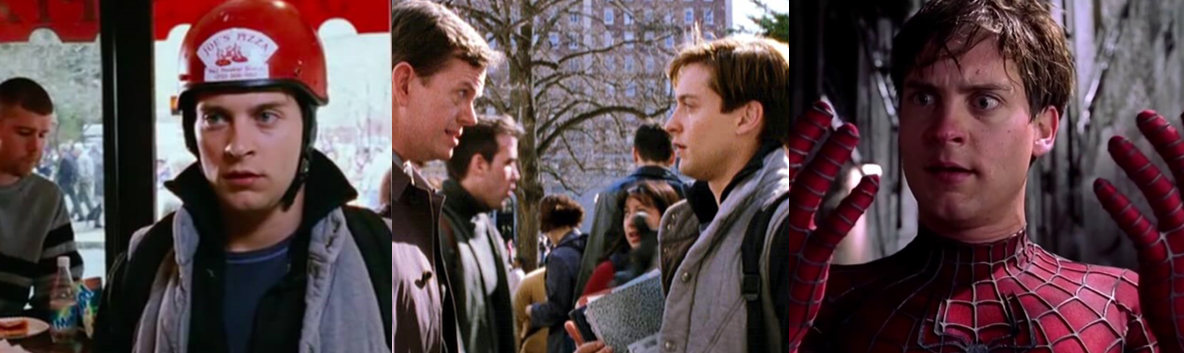
As in the first movie, Spider-Man 2 opens with a bit of narration from Peter Parker, who’s in a pretty bad place here; having chosen to walk away from M. J. and live a life of responsibility, forsaking his own selfish needs in order to honour the memory of his beloved Uncle Ben (Cliff Robertson), Peter is tormented by M. J.’s vacant, staring visage from atop a giant billboard and pines for her every day, martyring himself for the choice he was forced to make. No longer living in his childhood home in Queens with his doting Aunt May (Harris), Peter lives in a crummy little apartment in the middle of the city that is cramped, dirty, falling apart, and right next to the train line. The door sticks, there’s a communal bathroom, and he’s constantly hounded by his landlord, Mr. Ditkovitch (Elya Baskin) for rent, which he can barely afford to pay as he has recently lost his job as a pizza delivery boy and is constantly being shafted on payment for his photos of Spider-Man (and other notable events in the city) by Daily Bugle editor-in-chief J. Jonah Jameson (Simmons). While Peter was often angst-ridden and burdened by bad luck (“Parker Luck”, as he called it) in the comics, the whole world is out to get him here; he can’t keep up with his college assignments, people are constantly barging into him, he’s cockblocked by an obnoxious usher (Bruce Campbell), and he can’t even walk out of a supply cupboard without stuff falling on him. The amount of hardship he faces in this one movie is almost absurd, and is equalled only by his desperate pining for M. J.; he desperately wants to tell her the truth but can’t risk endangering her life, and is equally unable to quell Harry Osborn’s (Franco) hatred of Spider-Man to preserve Norman’s memory. Peter’s also still carrying the guilt of having indirectly caused Uncle Ben’s death, and it’s only after sharing this with Aunt May that his outlook begins to change. And just in time, too, as all this stress is not only causing a rift between him and the few friends he has but also cancelling out his spider-powers. Since Tobey has organic webbing, this is an interesting way to do the old “run out of web fluid in mid-air/mid-fight” trope, but the depiction is quite inconsistent; potentially an allegory for sexual inadequacy and clearly a manifestation of his troubles, Peter’s powers only short out when the script says so, meaning he’s denied even the freedom offered from retreating to web-slinging.

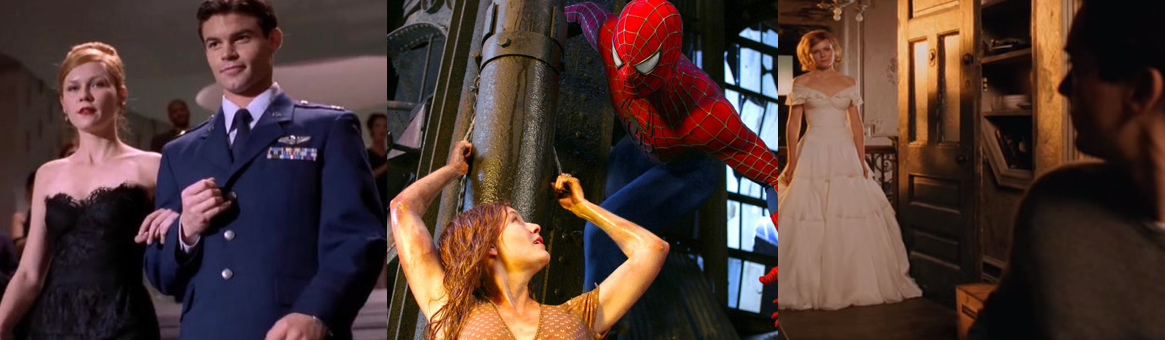
Though she has a hunky astronaut, M. J. can’t deny her feelings and chooses Peter after learning the truth.

Just as Peter pines after M. J. on a daily basis, almost to an uncomfortable degree, so too is M. J. constantly distracted by him; Harry claims that she is “waiting for [him]”, but, regardless of his love for her, Peter continues to keep her at arm’s length and to avoid discussing his feelings for her. Although she’s clearly still in love with him, M. J. is doing a far better job of moving on (or, at least, hiding) from those feelings; she not only has a billboard but has landed her dream job with a part in The Importance of Being Earnest, A Trivial Comedy for Serious People (Wilde, 1895) and even gotten herself a ruggedly handsome astronaut (of all things), Colonel John Jameson (Daniel Gillies). John is barely a character at all and simply there to deliver another gut punch to Peter; M. J. clearly isn’t that into him, despite accepting his proposal, as she’s constantly yearning for Peter and waiting for him to admit his feelings for her. However, she’s also increasingly frustrated by Peter; despite him claiming to be her greatest friend and confidante, he’s been absent and unreliable, and she’s driven to the edge when he breaks his promise to see her play. Otto offers Peter some advice in trying to explain things to M. J., which leads to him awkwardly blurting out random poetry excerpts to her, and he inadvertently ends up alienating her so much that she’s fully prepared to settle for John, even briefly entertaining the idea that she was wrong about Peter and that John is Spider-Man. All of M. J.’s frustrations and concerns are completely swept away once she sees the truth she’s known all along and Peter clearly explains that he can’t risk being with her because of his responsibilities, but she ultimately chooses to face those dangers with him so that they don’t have to deny themselves. M. J. is a bit underwhelming here, to be honest; I’ve never really been a big fan of Dunst in the role and, while she has a feisty side, the script doesn’t really do her character any favours. It gets a bit worse in hindsight as she blows up at Peter in the next film for kissing a girl but she’s here making out with (and presumably having sex with) her hunky boyfriend, while trying to coax the truth out of Peter instead of just demanding that he be honest with her. She also ends up as a screaming hostage once more, and it’s telling that even Aunt May has more fight in her when captured by Doc Ock than the object of Peter’s affections.

Harry, consumed with vengeance, is stunned to discover Peter and Spider-Man are one and the same!

Peter’s life is further complicated by his strained relationship with Harry; despite struggling through school in the first film, Harry has done pretty well for himself in the intervening time, becoming head of special projects as OsCorp and funding Otto’s fusion research in a bid to live up to (and surpass) his father’s lofty ambitions. However, having seen Spider-Man with his father’s body at the conclusion of the first film, Harry assumes that Spidey killed his dad and has been harbouring a deep-seated vendetta against the wall-crawler ever since. Even when Spider-Man saves his life, Harry isn’t swayed in his opinion, and his lust for revenge even drives him to turn against Peter in a bitter, drunken rage in one of the film’s most dramatic and upsetting moments. An extended scene included in this version sheds a little more light on Harry’s mindset, as he believes that Peter either knows who Spider-Man is or is protecting him from reprisals since he earns money from the masked vigilante, and he compares his desire to see Spider-Man dead to the bloodlust Peter must feel towards the man who killed Uncle Ben, thus painting Harry as a dark mirror of the titular hero. Frustration and grief get the better of Harry after Otto’s experiment is a disaster, and he unleashes a vicious, heart-breaking tirade against his best friend for choosing his livelihood over his best friend. Harry’s obsession only grows when Spider-Man is believed to have quit after his discarded costume is discovered, and he’s so consumed by vengeance that he partners with Doc Ock to draw Spider-Man out by having him target Peter in exchange for supplying the mad scientist with the Tridium he needs to complete his fusion experiment. With Spider-Man helpless before him, Harry prepares to deliver the killing blow and is stunned into a near maddening disbelief to find his best friend behind the mask, shattering his perception of reality and the people around him and leaving him susceptible to the manipulative influence of his father’s vengeful spirit.

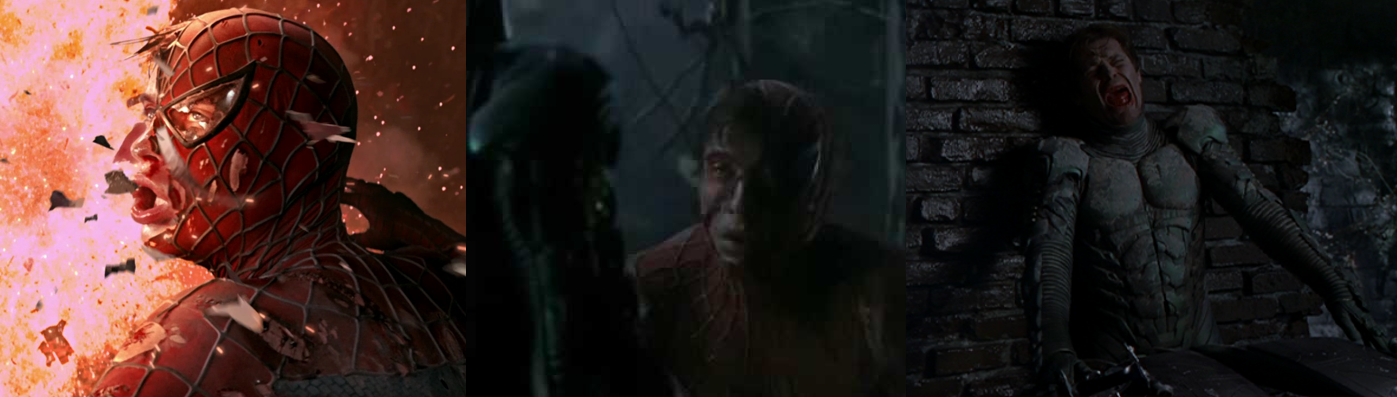
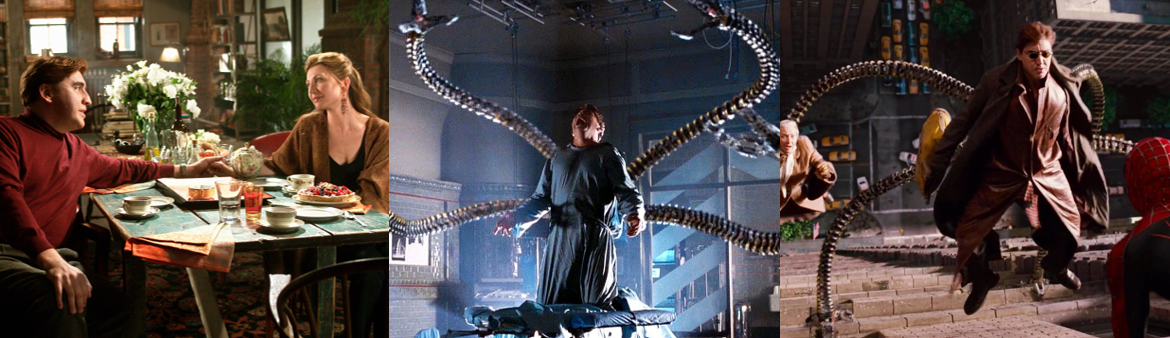
A science experiment gone awry transforms kindly Dr. Octavius into the twisted, sardonic Doc Ock.

Of course, Spidey’s most tangible threat in the film is Doc Ock himself; beginning as a kindly mentor and hero of Peter’s, Otto is a far cry from the malicious, power-hungry mad scientist from the comic books. Although initially reluctant to interrupt his work by entertaining Peter’s questions, especially given he’s aware of Peter’s assumed laziness, Otto quickly finds a kinship with Peter based on their mutual appreciation for science. A likable, fatherly figure, Otto is absolutely besotted with his beloved wife, Rosie (Donna Murphy), and emphasises to Peter the importance of using his great potential and intelligence for the good of mankind. Despite his unparalleled scientific mind, Otto is also a romantic at heart and encourages Peter not to bottle up his love and emotions lest they make him sick, though both he and Rosie stress that love requires a lot of hard work from both parties. Otto’s life work is to provide the world with clean, renewable energy using a Tridium-based fusion reaction; Otto is so convinced of the safety and importance of his experiment that he generates an artificial sun in the middle of New York City, confidant that his four mechanical limbs will allow him to stabilise the resultant reaction and give him his moment of glory. Of course, everything goes hideously wrong when his machinery malfunctions, which not only results in Rosie being killed but Otto’s mechanical appendages being fused to his spinal column. Awakening in a confused state, Otto finds himself susceptible to the arms’ artificial intelligence after his inhibitor chip is destroyed; as they’re programmed to create and stabilise the experiment, the arms influence him towards robbing banks and committing crimes to rebuild the reactor at an abandoned pier rather than drown himself in the river in his grief. Christened Doctor Octopus (“Doc Ock”) by Jameson, Otto becomes a twisted, power-hungry maniac who completely abandons all of his former principals and puts innocent lives in danger thanks to the influence of his arms. He not only tries to kill a train-load of New Yorkers but even takes Aunt May and M. J. as hostages and battles Spider-Man with a devious glee, constantly frustrated by the web-slinger’s interference and determined to kill him so he can be left in peace. Doc Ock’s story is functionally similar to that of Norman’s in the first film (both were mentor and father figures turned to evil by science), but the execution is unique enough to stand out from his predecessor; he stomps around in broad daylight, his identity is never in question, and his ultimate goal isn’t to prove his physical superiority, but to prove his intellectual superiority and complete his life’s work by any means necessary.

While Jonah delights in Spidey’s misfortune, Aunt May and Ursula offer Peter some much-needed support.

As haunted by M. J. and his many doubts and problems Peter is, his guilt over indirectly causing Uncle Ben’s death basically dictates his entire life. The only reason he’s denying his true feelings is because his interpretation of Ben’s final teaching was that he had an obligation to put his powers to good use, a life lesson that is reinforced by Otto and his position of scientific acumen. However, all of the stress caused by his conflicting duality sends Peter’s power son the fritz; his webs stop firing, he can’t always stay stuck to walls, and he begins wearing his glasses again as his eyesight fails. Concerned for his physical welfare, he consults a doctor, who offers the prognosis that the issue is psychological rather than physical, and, with the weight of the world pressing down upon him thanks to Jameson’s smear campaign, Peter rejects his responsibilities in a dream-like conversation with his uncle’s spirit. Upon being brought Spider-Man’s discarded suit, Jameson is overjoyed that his efforts to besmirch and belittle the wall-crawler have met with success, but he’s forced to admit that Spider-Man was a hero when Doc Ock kidnaps M. J., thus leaving John distraught, though Peter delights in upstaging the cantankerous editor once he gets his shit together. He’s helped in this regard by an honest exchange with Aunt May; given that the film takes place on the two year anniversary of Ben’s death, May is in a fragile place, which is only exacerbated by her inability to keep up the payments on their family home. Burdened by his guilt, Peter shares a version of the truth of that fateful day to her; though initially horrified, she forgives him and stresses the importance of doing the right thing. It’s heavily implied in this exchange that May is aware of Peter’s dual nature and, though neither explicitly admit it, he’s relieved that her encounter with Doc Ock and subsequent rescue from Spider-Man has turned her opinions on the web-spinner around. After giving up his suit, Peter applies himself fully to his social life and academic work, finally earning him the praise of his teacher, Doctor Curt Connors (Dylan Baker), and he later finds some support in Ursula (Mageina Tovah), the daughter of his landlord, who clearly has a crush on him and brings him a moment of quiet reprieve in a moment of absolute despair. This extended cut adds a few additional scenes, most of which are alternate takes and longer sequences that don’t really add too much to the existing story, though one of the most notable additions is a hilarious scene where Jameson hops around his office garbed in Spider-Man’s discarded suit and a discussion between M. J. and her friend where it’s revealed she accepts John’s proposal primarily because of her father’s abusive nature.

The Nitty-Gritty:
Given that it’s a Spider-Man movie, Spider-Man 2 is primarily focused on exploring themes of guilt and the weight of responsibility; Peter drives himself into the ground trying to save everyone he can and live up to his uncle’s expectations, to the point where he neglects his life outside of the costume. Not only is he failing at school and to make money, he’s letting everyone around him down, which only adds to his feelings of despair; his friends are starting to resent and distrust him because of his absent nature and, while he’s desperate to do more and to apply himself better, he can’t shake the call to action. Even something as simple as delivering pizzas or getting to the play is interrupted by a disturbance of some kind, whether it’s kids playing in the street or a high-speed car chase, and Peter doesn’t even let himself relax when he’s in his crummy apartment as he sits there tuning into the police radio band to find ways for him to help. This ever-mounting struggle to find the right balance between his wants and his responsibilities is the primary cause for his failing powers; losing his webs, wall-crawling, spider-sense, and strength only adds to Peter’s confusion and frustration as the freedom afforded to him by being Spider-Man also becomes a closed door. Once he decides to quit, that weight is immediately lifted but his brief moment of happiness is shattered when he’s unable to save a life from a house fire, thus hammering home that he is capable of great things and thus must exercise great responsibility.

Both Spider-Man and Doc Ock look fantastic, and Ock’s arms make for exciting fight sequences.

Surprisingly, Tobey’s spider-suit is basically the same design as before; normally, superhero sequels go out of their way to change the character’s costume to make more toys but, aside from popping a little more and a few tweaks to the mask, muscle suit, and other minor details, it remains consistent with the first film. Thanks to the movie not having to spend an hour or so setting up Peter’s origin, we get much more Spider-Man action here and the aforementioned Spydercam really delivers some dynamic web-slinging shots. As ever, Peter has an annoying tendency to lose or remove his mask so that we don’t miss out on the emotional impact scenes and events have on him; this is, as always, hit or miss as Tobey favours a vacant, doe-eyed stare throughout most of the film and the regularity that he is unmasked gets ridiculous at times, regardless of how dramatic or thematically relevant these scenes are. While audiences will forever decry the Green Goblin’s outfit in the last film, I don’t think I’ve ever seen anyone complain about Doc Ock’s depiction here; garbed in a trench coat, hat, and glasses, Doc Ock cuts a simple but intimidating figure and it really is impressive how Molina projects the weight and movement of his mechanical limbs. The arms are extremely versatile, able to stretch out and grab things in their claws, light Ock’s cigar, and even sporting a nasty looking spear-like appendage. While Otto can control and influence the arms, the destruction of the inhibitor chip allows them to act independently of him, but their goal is not only to create and sustain a fusion reaction but also to protect Ock at all costs. Swinging and whipping everywhere, the tentacles cause Spider-Man a great deal of difficulty in getting to Doc Ock and make him a constant threat as they can perform multiple tasks and endanger many lives all at once. One of their most memorable sequences is when they lash out while Otto is unconscious, slaughtering the doctors that try to remove them in scenes that harken back to Raimi’s time as a horror filmmaker as we see fingernails being ripped off and screaming bodies being tossed all over the place. Indeed, Rosie’s horrific death (though not seen onscreen it’s pretty clear she was practically decapitated) and many shots of the arms are created using practical effects, puppetry, and first-person perspectives just like those seen in his Evil Dead films (Raimi, 1981 to 1992) and their threat is matched by Otto’s obsession with holding “the power of the sun in the palm of [his] hand”.

Spider-Man and Doc Ock’s battles are a spectacle, and Spidey performs incredible feats to save lives.

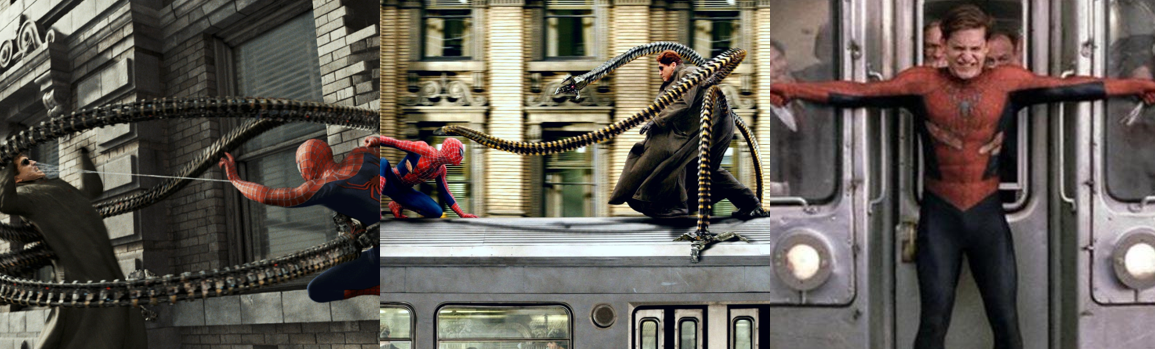
The versatility of Doc Ock’s arms really do make for some of the best fight sequences in any Spider-Man film; despite the armaments and manoeuvrability of the Green Goblin’s glider, Spider-Man’s fights never really kicked into that higher gear as the filmmakers were still working out how to create the special effects necessary to shoot these sequences (something that the third film greatly improved upon), but Spider-Man 2 more than makes up for this with scenes depicting Spider-Man and Doc Ock battling up the sides of buildings and on top of a speeding train. While it’s true that any one of Spidey’s repeated blows to the non-superpowered Doc Ock should have immediately ended the multi-limbed menace, I can forgive this as it’s really exciting to see Spidey have to dodge and flip around the tentacles and fight through them while on the side of a building or whipping around a bank. I can also forgive the convenience of Doc Ock robbing the same bank that Peter and May happen to be at because it leads to him clambering up the sides of buildings with May and his bags of loot, tossing better (and more sadistic) quips than Spider-Man himself, and showing just how dangerous and adaptable his mechanical limbs are as they can hoist him up, absorb impact damage, and deflect Spidey’s blows at every turn. Obviously, the most thrilling action scene is the train sequence, which sees Spider-Man first using his webs to save the civilians Doc Ock causally tosses away, battling him on the exterior of the speeding train carriages, and then using all of his fantastic strength to literally force the out of control train to a stop. Full disclosure, though…I’ve always found this sequence to be a little over the top; the physics and logistics of it seem a little outside of Spider-Man’s range and more like something Clark Kent/Superman would do, but it undeniably makes for a brilliantly dramatic sequence as it shows that Peter will literally push himself to exhaustion and beyond his limits to save lives. The passengers are so grateful to him that they promise not to share that they’ve seen his face, moved by how young and brave he is, and Spidey only adds to his heroic card by basically trading his life for theirs when Doc Ock returns for him.

Thanks to Ock’s sacrifice, the city is saved, but Harry poses a looming threat…

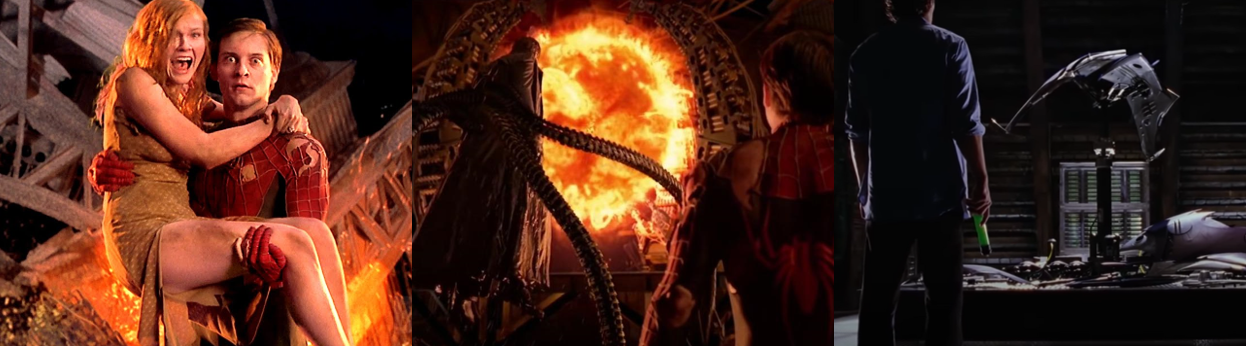
After having a taste of happiness, Peter begins to believe that he can finally offer M. J. his true feelings but, after realising that he can’t deny the great responsibility bestowed upon him, he’s forced to walk this suggestion back and once again pretend that he’s not in love with her. However, his spider powers truly return in full force after Doc Ock inexplicably kidnaps M. J. to force Peter to lure Spider-Man out for a final confrontation. As many have mentioned, it’s damn lucky that Peter is Spider-Man and that his spider-sense kicked in at that exact moment or else Doc Ock’s errant taxicab would have squashed them both and Harry would’ve indirectly killed his two best friends. When he discovers that Peter and Spider-Man are one and the same, Harry is stunned, to say the least, and heartbroken by the belief that his best friend apparently killed his father. However, Peter manages to convince Harry to reveal Doc Ock’s location in order to rescue M. J. by stressing that there’s more at stake than their personal problems (though a quick “No, he was a madman who tried to kill me” might’ve gone a long way…) Thus, once again, Spider-Man has to save M. J. from a supervillain, though she’s much sassier here than last time, where she was little more than a screaming wreck. Enraged at Doc Ock’s actions, which not only threaten the entire city but have put first Aunt May and then M. J. in the line of fire, Spidey delivers a massive beatdown, once again taxing himself to the limits to shield M. J. from a falling girder and finally revealed the truth to her after removing his mask again. To be fair, this time Peter voluntarily unmasks in a desperate attempt to appeal to Otto’s humanity; thoroughly beaten, Otto snaps out of his insanity upon seeing the face of his protégé and surrogate son and realises that his arms have perverted everything he once stood for. With the fusion reaction threatening to suck the city into it like an artificial black hole, Otto exerts all of his willpower and humanity in a tragic sacrificial effort to drown the artificial sun and redeem himself, once again delivering a startling message of the dangers of scientific exploration and arrogance to Peter. Despite coming to terms with the fact that he can never be with M. J. as he’ll always be Spider-Man, Peter is delighted when she ditches John at the altar to be with him and triumphantly swings off to attend to an emergency with M. J.’s blessing. However, unbeknownst to either of them, Harry is tormented by a vision of his dead father and stunned to stumble upon a hidden laboratory containing a cache of Norman’s Green Goblin apparel, and potentially the means to exact his revenge against his former friend…

The Summary:
Even today, after all the Spider-Man films we’ve had over the years, Spider-Man 2 remains a highly praised entry in the franchise and has long been the gold standard that all other Spider-Man films are measured by. It’s really not too hard to see why; like all great sequels, Spider-Man 2 takes everything that worked in the first film and provides not only more of the best aspects but improves upon them at every turn. The interpersonal drama is heightened, the action and fight sequences are much more exciting and visually impressive, and Spider-Man’s web-slinging is a sight to behold thanks to the innovative camera techniques pioneered in this film. While some of the performances still leave a lot to be desired, the visual spectacle more than makes up for it and Alfred Molina’s brilliantly nuanced portrayal of Doctor Octopus carries the acting quality to a new level, allowing Tobey Maguire to focus on embodying Peter’s utter despair and anguish. Most importantly, Spider-Man 2 does a wonderful job of balancing all of its narrative elements; Peter’s struggles with his dual life and his failing powers are perfectly juxtaposed with Doc Ock’s menace, and it never feels like there’s too much going on. I’d argue that the only main character to suffer is Mary Jane, simply because I would prefer to see more agency from her, but I loved seeing Harry’s obsession send him into a downward spiral of revenge that parallels Otto’s degradation from kindly father figure to sadistic, megalomaniacal villain. If you’re going to watch Spider-Man 2, be sure to pop in this extended version as the few extra minutes add a little more spice to the sauce, so to speak, and the film remains as entertaining as ever, even in the face of the more visually impressive and narratively faithful Marvel Studios movies. My only regret is that some of the lingering plot points were poorly addressed in the third film, but that definitely doesn’t diminish Spider-Man 2’s appeal and it remains in the top tier of the web-slinger’s live-action films to this day.  

My Rating:

Rating: 5 out of 5.

Fantastic

Are you a fan of Spider-Man 2? Where does it rank for you against the many other Spider-Man movies? Did you enjoy the extended sequences offered in this version of the movie? What did you think to Peter’s many struggles in the film and which of the fight sequences was your favourite? Were you a fan of Alfred Molina’s portrayal of Doc Ock and were you excited to see him return to the role? What did you think to Harry’s character development and were you excited at the prospect of him taking up his father’s legacy in the third film? Do you think the film still holds up or do you prefer other filmic interpretations of the character? Whatever your opinion on Spider-Man 2, leave a comment and thanks for joining me for Spider-Man Month!

Game Corner: Terminator 3: Rise of the Machines (PlayStation 2)

Released: 11 November 2003
Developer: Black Ops Entertainment
Also Available For: Game Boy Advance, Mobile, and Xbox

The Background:
The Terminator franchise (Various, 1984 to 2019) has quite a long history with videogame adaptations; every film in the franchise has been adapted to at least one videogame over the years and the franchise even crossed over with RoboCop (Verhoeven, 1987) back in the day. Considering the rigmarole that went into getting a third film off the ground, and the fact that big-budget movies were generally always accompanied by a videogame tie-in during this time, it’s perhaps not surprising that Terminator 3: Rise of the Machines (Mostow, 2003) was accompanied by not one, but three videogame adaptations to help push the film towards its $433.4 million box office. After acquiring the licensing rights, Atari set Black Ops Entertainment to work on the PlayStation 2 and Xbox versions of the game, and worked closely with special effects maestro Stan Winston and star Arnold Schwarzenegger to design the game’s visual aesthetic and narrative aspects. Although Terminator 3: Rise of the Machines garnered generally favourable reviews, critics felt that it was a rushed, bug-ridden, and graphically inferior title that relied too heavily on its license rather than offering a challenging and entertaining gameplay experience.

The Plot:
In the post-apocalyptic future, where humanity wages war against the malicious Skynet and its robotic Terminators, Kate Brewster reprograms one of their infiltrator units to help storm the Time Displacement Chamber. Realising that a new Terminator, the T-X/Terminatrix, has been sent back to kill future leader John Connor, Kate sends the Terminator back to ensure the ultimate victory of the human race.

Gameplay:
Terminator 3: Rise of the Machines is a first-person shooter (FPS) in which players are placed into the role of the titular Terminator, the T-850 model portrayed by Arnold Schwarzenegger in the dire movie of the same name, and tasked with defending and ensuring the future of humanity across twenty-two missions, with the majority of the game’s action taking place in the post-apocalyptic wasteland of the Future War. The game’s controls are fully customisable to suit your needs, but the default settings work well enough and same pretty standard for an FPS title: the left stick moves you about, the right is used for aiming and strafing, and the R1 and R2 triggers fire your weapon’s primary and secondary functions, respectively (with most weapon’s secondary function being a melee attack that’s all-but useless until Mission 16, and even then I never used it). L1 allows you to lock onto the nearest target, which greatly aids with the game’s many firefights, while L2 lets you jump, which I also rarely had a use for as the Terminator struggles to clear anything but small debris. Triangle and Circle and left and right on the directional pad (D-pad) allow you to clunkily cycle through your weapons, Square reloads, and X lets you activate switches. You can press in the right stick to display your mission objectives (which are also available from the pause menu), the left stick to centre your view, and perform a 360o turn by double clicking the left stick. Finally, pressing Select switches to the classic red Terminator vision, which lets you see in infrared (useful when smoke clouds the screen), search for ammo, supplies, and targets, and displays your health, ammo, and the weaknesses and status of nearby allies and enemies.

Fend off Skynet’s forces with your weapons and engage with Terminators in clunky one-on-one brawls.

These are the controls you’ll be dealing with for the majority of the game and, for the most part, you’ll be stomping your way through war-torn wastelands and environments from the third film, blasting at Skynet’s forces and activating the odd switch here and there to progress further. However, Terminator 3 has a second gameplay style that’s exclusively used in boss battles; here, the game switches to a 2.5D brawler and has you awkwardly exchanging blows and throws with other Terminators. In these moments, the controls change functions: Triangle sees the Terminator kick at its foe, X throws a punch, Circle will throw them, and you can hold down Square to block. Sequential presses of Triangle and X will unleash limited combo attacks and pressing X or Circle in conjunction with D-pad inputs will allow you to perform stronger strikes or different throws, and you can also perform a dash attack by double tapping towards your opponent. Sadly, these sections aren’t very compelling and simply serve to showcase how awkward Terminator-on-Terminator fights can be, and this is also the extent of the gameplay variety. It seems at a couple of points like you might partake in some driving or chase sequences but that isn’t the case. Instead, you’ll just be wandering about turning Skynet’s forces into junk and exchanging blows with other cyborg foes and the game rarely demands too much from you. Terminator 3 tries to make navigation easier with an onscreen radar that points you in the direction of your current objective, but it doesn’t display anything else (like allies, enemies, or pick-ups); you can view a larger, more useful map from the pause screen, but you can’t move while looking at it, making it functionally useless. While mission objectives aren’t too taxing and generally amount to clearing out all enemies, locating allies, throwing switches, or destroying consoles, it can be difficult to figure out where you’re supposed to go or how you’re meant to progress as the environments are quite bland, confusing, and your objectives aren’t always readily understandable as you’re not given much direction.

Mission objectives don’t get too complex until you’re forced to spare human lives.

By this, I mean you’re occasionally asked to destroy all Skynet forces; this objective pops up when you enter a new area, so you might think you just need to clear out the machines stationed there, but the objective is actually to destroy all machines in the level, meaning you have to backtrack to hunt down any enemies that passed you by prior to getting that objective. Sometimes, you’re given a time limit to complete objectives, such as escaping areas before they explode; this can be tricky as it’s not always clear where your escape route is, and the Terminator’s jump is so janky that it’s easy to get stuck on the subway tracks and fail that particular mission a few times before you figure out how to jump up and throw the switches needed to escape. Other times, you can commandeer a laser turret to mow down waves of Terminators, Future Killer/F/K tanks and flying machines, or Skynet’s transport carriers. In some instances, you need to use heavier weaponry to blast through walls; other times, you need to re-route power to elevators or destroy consoles and tubes to disable security systems and keep Terminators from spawning, activate switches to extend bridges, destroy Skynet’s turrets and refuelling stations, or defend Resistance fighters as they escape to safety or bring down defensive systems. One mission flashes back to prior to the opening mission and has you controlling the T-850 as it mows down Resistance fighters, destroys their cannons, and infiltrates their base alongside other Terminators, though sadly its confrontation with John is relegated to a cutscene. Once you hit Mission 13, you’ll find yourself in the past and actually playing through key moments from the movie; missions become shorter and far less focused on gunfire and destruction as you need to rescue and protect John and Kate from local authorities and the T-X. When in the past, the Terminator has different weapons on hand and will fail its mission if it kills even one person, so you can’t just go in all-guns blazing any more. You’ll also need to keep an eye on John and Kate’s health bars, run around finding the parts necessary to repair a helicopter, find access cards, and battle past rampaging proto-Terminators to acquire access codes and such.

Graphics and Sound:  
I was surprised to find that, for the most part, Terminator 3 doesn’t look too bad; PlayStation 2 games, particularly licensed ones, tend to look a little janky and suffer from long load times but, while the latter is true of Terminator 3, the former isn’t and the game does a decent job of recreating the post-apocalyptic Future War of the Terminator films, locations and characters from the movie, and with its overall presentation. One feature I did like as that the game’s environments suffer damage from bullets, laser blasts, and explosions; it’s nothing ground-breaking and isn’t used all that much, but it’s cool to see blast marks and burns from combat and helps to make the world a little more immersive, though you cannot kill your allies so this kind of dispels those efforts. While you only see the Terminator in cutscenes, it resembles Arnold and has a couple of different looks depending on which time zone you’re in; when you stand idle for a bit, the Terminator will play with its gun, the game has reload animations, and the Terminator offers commentary when picking up items, eliminating targets, or completing objectives. Arnold lends his likeness and his voice to the title, which the game inexplicably tries to sell as the “first time” this has ever happened despite Arnold’s T-800 being playable in all of the Terminator 2: Judgment Day (Cameron, 1991) videogames; while it seems as though Nick Stahl also voices John, it certainly doesn’t sound like Claire Danes came back to voice Kate, and the T-X is rendered completely mute throughout the game.

Although dated, the game doesn’t look too bad, though suffers from graphical repetition.

While Terminator 3 faithfully recreates the dire wreckage of the Future War, this doesn’t necessarily lend itself to a visually enthralling gameplay experience. Everything is suitably dishevelled, destroyed, and bleak, with skyscrapers sporting gaping holes, playgrounds, petrol stations, and buildings reduced to ashen rubble, debris strewn everywhere, and ominous dark clouds broiling overhead. However, it’s very easy to get lost in such a dark and drab environment; even navigating the sewers or the Resistance bases and hovels, which are ripped right out of The Terminator (ibid, 1984) can be a bit of a chore as everything looks the same and it’s no joke when you have to backtrack to hunt down a switch or missed Terminator to destroy. Enemies also leave a lot to be desired, with the Terminators sporting weird colour schemes and appearing quite different to the classic endoskeleton, though Skynet’s headquarters and the Time Displacement Chamber help to break up the dark visuals of the main game. Once you’re in the past, you’ll visit key areas from the movie, such as the vet where Kate works, battling the T-X atop the crane truck, the Cyber Research lab, the cemetery, and Crystal Peak but these missions are so short and end so abruptly that you don’t get too much time to take in their visuals. The game does feature the iconic Terminator theme, more so than the movie it’s based on, and includes clips from the movie as cutscenes, though these rapidly skip over huge chunks of the story, potentially interesting gameplay sections, and cause the game’s last few missions to feel rushed, incomplete, and inconsequential compared to the Future War sections. Other times, CG cutscenes advance the story or recreate the movie’s ending, with elements from the film slightly altered as a result, and these hold up pretty well, certainly much better than the marionette-like in-game graphics of other cutscenes.

Enemies and Bosses:
Since you’re playing as the reprogrammed Terminator, your primary enemies in this game will be the forces of Skynet, which run rampant in the Future War and sport laser armaments. Your most common enemies will be other Terminators, the T-900s, which appear as endoskeletons sporting either a green, yellow, or red colour scheme that indicates their strength and the weapons they’re carrying. Green are the weakest, yellow are a bit tougher and wield two guns, and red are the toughest and carry Skynet Assault Cannons; however, I found all of the T-900s to be surprisingly tough to put down, even with the game’s stronger weapons, and they’re quite resistant to small-arms fire and even explosives. The F/K series is comprised of small, medium, and larger aircrafts and tanks not unlike the more traditional Hunter-Killer/HK machines seen in the first two Terminator movies; while your faster or more powerful weapons are your best bet to destroy these, you might want to make use of nearby turrets for the larger variants. Skynet also employs turrets, both on the ground and on the ceiling, spider-like rovers, and you’ll encounter the larger tanks seen in the movie while in Cyber Research labs. At one point, you’ll be mowing down Resistance forces, who are much easier to kill than their mechanical enemies and, when you initially travel to the past, you’ll also have to fend off local police and Special Weapons and Tactics (S.W.A.T.) officers. These guys wield pistols, shotguns, and machine guns and, if you shoot at them too much and kill even one, the mission is over. Similarly, if they kill either John or Kate, the mission also fails so you need to be sure only to injure them enough for them to surrender or run away and blow up their vehicles to cause them to scatter.

The game’s handful of bosses are limited to this awkward brawling gameplay.

Boss battles are disappointingly limited in Terminator 3; F/K machines are often positioned as mini bosses, of sorts, requiring you to take out Skynet’s larger aircraft, tanks, and transports using heavier machinery or a nearby turret, but you won’t be taking on a gigantic HK tank or aircraft like in other Terminator games. Hell, even the Time Displacement Chamber is protected only by Skynet’s standard forces rather than an actual defensive grid, meaning you generally have to settle for eliminating the same enemies over and over until the mission ends. When you do get to a legitimate boss battle, the game switches to its clunky and unfulfilling 2.5D combat perspective and forces you to engage in an awkward fist fight; the first time you do this, it’s against a fellow infiltrator unit that demonstrates the same limited attacks as you. It’ll block, throw kicks and punches at you, and toss you about with various slams, all while taking on battle damage as you whittle down its health bar. It’s not until about eight missions later that you get to face another boss in a similar fashion, and this is the first of four encounters with the T-X. Each one takes place in a different area and the T-X gains additional attacks in each encounter and is even reduced to its endoskeleton in the final battle at Crystal Peak. The T-X is easily the toughest foe in the game; faster and with more diverse attacks than you, it’s easy to get caught in a combo as she kicks, punches, and slams you through walls. The T-X can perform spinning kicks, slam you off the environment, fire an energy blast, stomp your face into the ground, send a shock through your system by piercing your head, and even blast you in the face with her flamethrower arm. However, as long as you throw your guard up and mash the attack buttons, landing throws when you can, you can triumph without too much effort, though you never get the pleasure of a satisfactory conclusion as all of these encounters end with the two clumsily locked in a grapple while the game loads the next cutscene or oddly placed movie clip.

Power-Ups and Bonuses:
Terminator 3 is an FPS title, so naturally there’s a fair amount to pick up and use in the game. You can carry multiple weapons at once, though there’s no option to dual-wield any of them and there’s a long and annoying delay when switching weapons. The Terminator can fight with its bare hands, but that’s not really recommended, and has access to a variety of explosive projectiles, including grenades, C4, and even its own hydrogen fuel cell that is often used to open up new paths. There are nineteen weapons on offer here, with different weapons being used in the past and the future (eight in the past and eleven in the future), and you should recognise some of them from the films. You’ve got a pump-action shotgun, a gas powered grenade launcher, and a mini gun, just like in the second film, but also a rocket launcher and .30 cal machine gun as in Terminator 3. The best and flashiest weapons are in the Future War sections, where you wield phase plasma rifles, lightning guns, electromagnetic pulse weapons, mini rocket launchers, and the Skynet Assault Cannon. Unfortunately, none of the weapons really impressed me; there’s a wide variety but none of them have any real “kick” to them. Many feel next to useless, have long reload times, or carry limited ammunition, though it is fun discovering secondary fire functions, such as charged or electrical projectiles. Naturally, you can also find ammo boxes strewn around the environment and enemies will drop weapons and ammo; fuel cells will also replenish your health and you can even find extra continues here and there, though I’m not sure of their use as the game simply forces you to restart a mission upon failure so these seem redundant to me.

Additional Features:
As you complete Terminator 3’s missions, you’ll unlock a number of items in game’s ‘Special Features’ menu; these include concept art, movie scenes, CG cutscenes, movie clips, and behind the scenes videos. None of it is all that interesting, especially if you’ve watched the behind the scenes features of the movie, but it’s nice to see your efforts rewarded at the end of every mission. While exploration generally leads you to ammo or health, there are two classic Atari arcade cabinets to find throughout the game, Missile Command (Atari, 1980) and Centipede (ibid, 1981), which you can then play at any time in the Special Features. Terminator 3 has three difficulty settings (Easy, Normal, and Hard), with the strength and accuracy of the game’s enemies increasing on higher difficulties, but it doesn’t seem as though the game’s unlockables are tied to the harder difficulty modes. Once you finish the game, you can replay any mission, though there’s not much incentive for this unless you missed one of those arcade games or want to beat it on a higher difficulty. There’s no multiplayer component here either, though you can make use of some super helpful cheat codes to grant yourself invincibility, infinite ammo, all weapons, and to unlock all missions, among other bonuses.

The Summary:
Expectations are always low for videogame adaptations of movies, and the Terminator franchise has struggled a little when it comes to being translated into a gaming experience, but Terminator 3: Rise of the Machines ended up being a strictly mediocre time. In some areas, it performs surprisingly well; having Arnold’s voice and likeness ends a level of legitimacy to the game, as does the Terminator theme and some surprisingly detailed recreations of locations and environments from the movie, but all the presentation in the world means nothing if the gameplay isn’t compelling. This is where Terminator 3 falters; it’s little more than a bog-standard FPS title with the Terminator branding slapped onto it; there are certainly better FPS titles on the PlayStation 2, and even on prior console generations, so there’s not much incentive to play Terminator 3 over one of those. The implementation of brawling sections is certainly ambitious, but the execution is clunky and unfulfilling. Similarly, the decision to focus most of the game on Future War sections rather than the events of the film results in a very rushed presentation near the end; missions in the past are ridiculously short, the use of movie clips to skip over the story smacks of laziness, and the lack of interesting machines to fight or bosses to battle really hurts the game’s replayability. In the end, if I’m being fair, it’s certainly not the worst game out there but the ingredients were there for a slightly more enjoyable time and this just ended up phoning it in way too much for me to really recommend it.

My Rating:

Rating: 2 out of 5.

Could Be Better

Have you ever played Terminator 3: Rise of the Machines? If so, did you enjoy it? Which of the game’s weapons was your favourite? Did you enjoy that most of the game was set in the Future War or were you annoyed that it didn’t more directly adapt the events of the movie? Were you disappointed by the lack of bosses and what did you think to the combat sections? Did Arnold Schwarzenegger’s likeness help sell you on this game and, if not, what is your favourite Terminator videogame? How are you celebrating Judgement Day later this month and which Terminator movie is your favourite? Whatever your thoughts on Terminator 3, and the Terminator franchise, feel free to leave a reply down below or drop a comment on my social media.

Movie Night: Teenage Mutant Ninja Turtles: Mutant Mayhem

Released: 2 August 2023
Director: Jeff Rowe
Distributor: Paramount Pictures
Budget: $70 to 80 million
Stars: Nicolas Cantu, Micah Abbey, Shamon Brown Jr., Brady Noon, Ice Cube, Ayo Edebiri, and Jackie Chan

The Plot:
After years of being sheltered from the human world, four mutated turtle brothers embark on a quest to be accepted as normal teenagers by the people of New York City through acts of heroism. With the aid of their new friend April O’Neil (Edebiri), they target a mysterious crime syndicate, but trouble arises when an army of mutants is unleashed upon them!

The Background:
Created by Kevin Eastman and Peter Laird as a violent pastiche of comic book tropes, the Teenage Mutant Ninja Turtles (TMNT) achieved mainstream success with their toys and cartoons. After this translated into cinematic success, the TMNT became semi-regular staples on the silver screen; however, their box office potential began to wane over time, with their under-rated second and fourth outings receiving mixed reviews, their third being universally panned, and Michael Bay’s monstrous reimaginings being equally lambasted. Yet, the TMNT continued to flourish in various popular animated ventures and rights holders Nickelodeon were eager to bring the characters back to the big screen, so they partnered with Seth Rogan and Jeff Rowe to craft a new incarnation of the popular franchise. A life-long TMNT fan, Rogan aimed to emphasise the “teenage” aspect of the TMNT, which resulted in actual teenagers voicing the characters for the first time. Rogan was impressed by the cast’s camaraderie and much of the voice acting took place in group sessions to allow for more natural interactions between the characters, who were brought to life by over 120 animators at Mikros Animation and Cinesite. Inspired by the kinetic, comic book visuals of Spider-Man: Into the Spider-Verse (Persichetti, Ramsey, and Rothman, 2018), director Rowe wanted the animation to resemble concept art and imperfect comic book sketches to tie into the teenage focus. The TMNT were redesigned to be less bulky, have teenage frames and apparel, and the film’s many mutant characters were given exaggerated designs to reflect their individual personalities. Upon release, Teenage Mutant Ninja Turtles: Mutant Mayhem was met with widespread critical acclaim: critics praised the performances as much as the visuals and found it to be a reinvigorating revival of the long-popular franchise. Grossing over $180 million at the box office, Teenage Mutant Ninja Turtles: Mutant Mayhem was accompanied by a tie-in videogame, a spin-off animated series, and a sequel was also greenlit soon after.

The Review:
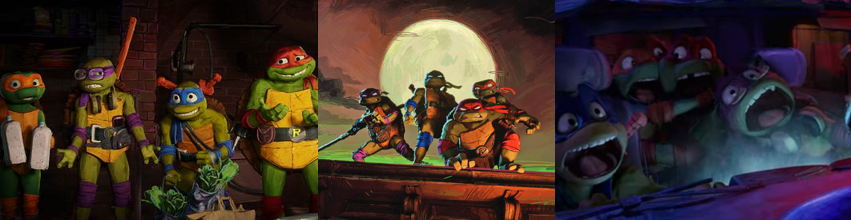
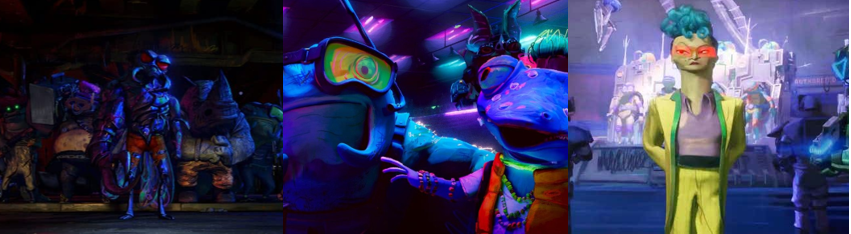
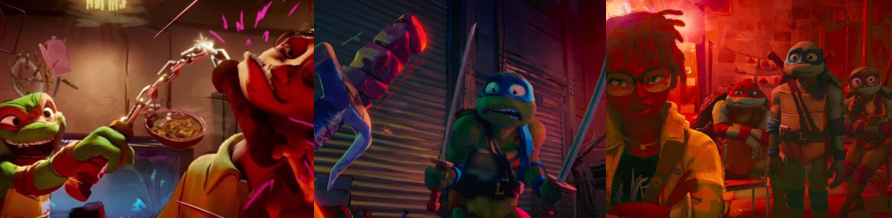
As is always the case when it comes to TMNT adaptations, Mutant Mayhem alters the TMNT’s origin story and the backstory of the mysterious ooze that transforms them, but in a way that touches upon many different iterations of the TMNT. The film begins with Doctor Baxter Stockman (Giancarlo Esposito) being hunted by mercenaries hired by his former employer, Cynthia Utrom (Maya Rudolph) of the Techno Cosmic Research Institute (TCRI), after he went rogue and stole the mutagenic ooze he was developing for them after forming a disturbingly familial bond with his animal test subjects, specifically the young mutant housefly who takes the name Superfly (Cube). Having felt ostracised and alone his whole life, Stockman planned to create a family of his own using the ooze but was left dead when TCRI attacked, which left Superfly to rescue his “siblings” and a stray cannister of ooze to fall into the sewers and mutate both Master Splinter (Chan) and the TMNT. Like in Michael Bay’s TMNT films, Splinter is once again just a normal street rat who comes to care for the infant turtles and decides the best way to protect them is to train them in ninjutsu, this time using YouTube videos and kung-fu movies rather than being a mutated ninja master or having learned from a ninja. Personally, I continue to find this a disappointing inclusion; it calls into question why the five are as skilled as they are when they’re simply mimicking what they see onscreen and I feel like it’s a bit weird to leave out Splinter’s legitimate martial arts background considering how bonkers the concept is in general and how hard this film otherwise runs with the surreal nature of the source material, to the point where the city is seemingly overrun with bombastic mutants.

The TMNT dream of being accepted by the outside world and being normal teenagers.

The TMNT are also very different to how I’ve seen them before; while they look very familiar and sport different body sizes relating to their capabilities (Raphael (Noon) is the biggest, Michelangelo (Brown Jr.) is the smallest and has braces, for example) and largely conform to the roles you’d expect (Leonardo (Cantu) leads and Donatello (Abbey) does machines, in the sense that he’s always got his headphones on), they’re characterised as teenagers, which is surprisingly rare in the history of the franchise, which often portrays them more as accomplished and responsible fighters who make the most of their downtime, with Mikey generally shouldering much of the comic relief. Here, they’re all very immature and easily distracted, especially by the outside world; they’re also largely untested outside of training and their own wild imaginations and develop confidence in their ninja abilities as the film goes on. Unlike in nearly every TMNT iteration before, there’s little in the way of internal conflict between them; Leo’s brothers mock and judge him for his strict adherence to Splinter’s mandate that they stay out of sight, but he’s easily swayed into straying off mission to see movies or enjoy the perks of the surface world, and his traditional rivalry with Raph is re-framed simply as an extension of the four ragging on each other for their flaws. The TMNT are lively, jovial, and squabble like bickering teenagers a lot of the time, making them as animated and kinetic as the film’s visually stunning art style; they are united in their love for their father and desire to please him but also in their longing to be normal teenagers and be accepted by humans, which they believe they can achieve if they perform heroic deeds to show that they’re not monsters. Overall, I found that the TMNT worked as a group, but individually had few chances to stand out: Raph is said to be full of rage but we rarely delve into this beyond a few instances where he delights in fighting, Donnie is more concerned with the apparent uselessness of his bo staff than he is with technical wizardry, Mikey is actually a little less goofy here since all the TMNT adopt many of his characteristics, meaning it’s Leo who edges out his brothers somewhat. He’s conflicted between his desire to live up to Splinter’s expectations and his yearning to join his brothers in revelling in the human world and this is only escalated when he instantly develops a crush on April. Yet, the film does a fun job of showing the TMNT grow and become more capable as a fighting unit as the film goes on, and this is reflected in Leo’s growing confidence as a leader even if his brothers give him a hard time over it.

Despite Splinter’s distrust of humans, the TMNT find a friend and ally in April.

As ever, the TMNT are sheltered and mentored by Splinter, now an overprotective father figure who has developed a severe hatred and mistrust of humans and the surface world. Having been shunned and ostracised his whole life, Splinter had never experienced love or affection until he stumbled across the mutated turtles and he’s desperate to hold onto that since, as he says, his boys are all he has. Since he knew how much the TMNT wanted to be a part of the outside world, Splinter took the baby TMNT up there only to be attacked and nearly killed by panicked New Yorkers. Thus, he resolved to keep them safe in the sewers and train them in ninjutsu to avoid being spotted when out for groceries, and Splinter’s characterisation is framed to mirror both Stockman’s relationship with his fledgling mutants and Superfly’s aggressive desire to create a world where he and his siblings won’t have to worry about being hounded by xenophobic humans. Although a bit overbearing and strict at times, Splinter truly loves his boys and wants what’s best for them and tries to appease their curiosity in his own way, but he’s powerless to stop them getting caught up in trying to prove themselves to humanity with the help of their human friend, April. A budding teenage reporter, April relates to the TMNT since she’s also been labelled and targeted after a comical blunder saw her vomit on-camera, so she’s desperate to turn her popularity around with a big story. Although she accepts them, she admits that others probably wouldn’t but is driven to document and aid their efforts in tracking down and apprehending Superfly since she wants to be popular and accepted, motivations that she later comes to realise are as selfish as the TMNT’s, yet they both resolve to do the right thing anyway since that’s what’s morally correct, regardless of whether people love or hate them for it.

Superfly and his crew plot to make mutants the dominant species to fight back against the likes of TCRI.

New York City is in the grip of a crime wave; news outlets are alive with reports of the mysterious Superfly orchestrating a series of robberies, but no one’s ever seen his face, not even the underlings the TMNT pummel for information. The TMNT are thus stunned and massively in over their heads when they find that Superfly is a monstrous mutated housefly and commands a crew of wacky and sadly underutilised mutants. Initially hyperactive Mondo Gecko (Paul Rudd) and Wingnut (Natasia Demetriou), wannabe singer Ray Fillet (Post Malone), meat-heads Bebop (Seth Rogan) and Rocksteady (John Cena), Aussie bruiser Leatherhead (Rose Byrne), slobbering cockroach Scumbug, and the forgettable Genghis Frog (Hannibal Buress) are painfully loyal to Superfly’s plan, to the point where they willing chase down the TMNT when they steal a vital component to his machine that he plans to use to mutate every animal on Earth. At first, Superfly and his crew embrace the TMNT as “cousins” and the TMNT even bond with some of his mutants, with Mikey and Mondo especially getting very close, but the TMNT cannot subscribe to Superfly’s plot to enslave, devour, and eradicate humanity, earning the mutated fly’s ire. Like Splinter, Superfly tried to rejoin society with his crew, only to be met with violence and bigotry, but he’s taken Stockman and Splinter’s distrust of society to a genocidal level and is determined to create a utopia for mutants by making them the dominant species on the planet. He sees this as the only way to protect his siblings from the likes of TCRI, who continuously hound the mutants in a bid to recover and replicate Stockman’s research by “milking” the mutants so they can create an army of genetically altered anthropomorphic soldiers. Superfly and Splinter’s paranoia about this comes to pass when the TMNT are briefly captured while trying to foil Superfly’s plot, but primarily exists to setup a later conflict in a future film and to forge a trust between Splinter and April that sees them uniting alongside Superfly’s easily turned crew to oppose the streetwise gangster in the finale when his plan sees him transformed into a kaiju-sized menace.

The Nitty-Gritty:
I’ve always been a big TMNT fan. I had the toys, watched the cartoons, played the videogames, and loved the original live-action movies (well…the first two, at least). When it comes to translating the TMNT to the cinema screen, I’ve come to regard animation as the best option; I loved Jim Henson’s super impressive practical suits and animatronic heads and would really like to see what modern technology could do with these traditional effects today, but animation allows for a near-infinite number of possibilities for the TMNT. Because of this, I’ve always held TMNT (Munroe, 2007) in high regard even if the plot was a little middling at times and the TMNT weren’t very visually distinct as it did such a good job of bringing them to life thanks to being entirely animated. I’m also a big fan of the frenetic visuals of the Spider-Verse films so I was intrigued when Mutant Mayhem was first announced, and even more so when I saw the big names attached to the project and teenagers being cast in the title roles for the first time. The TMNT have been reinvented numerous times over the years so it’s nothing new to me to see them and their supporting cast looking or acting different, and the film definitely does a really good job of paying homage to many aspects of the TMNT’s history, from the original Mirage comics to the ever-popular 1987 cartoon to the timeless 1990 live-action movie. This is best evident in the TMNT’s appearance; they mix aspects of the cartoons and toys into their designs (including the letters on their belts) and imagine themselves as stoic, silent ninjas much like in the original comics, yet their personalities are wildly different from both, allowing the film to present a new take on a long-running franchise.

The film has a fun and kinetic visual style that’s like a comic book come to life!

As ever, a primary theme of Mutant Mayhem is of family; Splinter and Superfly are motivated to protect their kin out of genuine concern for their welfare and prepare them to fight against inevitable xenophobia, and the TMNT and Superfly’s crew are both tight-knit groups, thought obviously the TMNT get more focus. Indeed, I do feel like Superfly’s crew could’ve been scaled down to just four mutants to give them more personality and better reflect the thematic parallels between Splinter and the TMNT as most of the crew don’t get to do much (Ray Fillet just sings his name over and over, I could barely understand Bebop and Rocksteady (who strangely turn good!), and Genghis Frog and Leatherhead may as well not be there). On the plus side, they do add to the film’s impressive visuals; the influence from the Spider-Verse films is strong here but Mutant Mayhem has a visual style all its own with this kinetic and eye-popping sketchbook-like aesthetic. Mutant Mayhem resembles a comic book come to life, or a new form of Claymation, and it really helps to give this new version of the TMNT a memorable and engaging appearance; when the TMNT fight, it’s with a fast-paced, frenetic action that gets more refined and methodical as their prowess and confidence improves, and every frame is a burst of colour, action, and creative lighting. The fights are subtly brutal at times, too; the TMNT and Splinter use weapons primarily defensively, but there were a couple of frames where it seemed like Leo, Raph, and Splinter had killed some of their attackers, which I appreciate as much as the film’s darker undertones regarding xenophobia and Superfly’s plans for humanity. Superfly himself cuts a monstrous figure at the best of times and his crew are suitably disturbing to behold, though sadly the film doesn’t give much depth to their personalities. While you could argue there’s more to his crew than meets the eye as they reveal that they only agreed to his plan as they saw no other option and readily accept a less destructive alternative, I’d say it comes across as quite rushed and the film could’ve spent more time showing the TMNT having a positive influence on Superfly’s crew if there were less mutants crammed into the brisk runtime, despite how amazing they look in this striking animation.

The TMNT and their newfound allies defeat Superfly and integrate into a grateful society.

So, yes, the TMNT reject Superfly’s plan and try to foil his plot but end up captured by Cynthia and TCRI; thanks to April, the four are rescued by Splinter and they gain more allies when they offer Superfly and his crew a place amongst them in the sewers. Unable to let go of his destructive need to avenge his “father’s” death, Superfly angrily lashes out at his siblings and activates his machine, only for the mutant’s combined might to force it (and him) into the river. Strangely, rather than this resulting in an army of mutated undersea creatures, this transforms Superfly into a gigantic concoction of marine life and fly; already a nigh-unstoppable force before he became a Godzilla wannabe, Superfly becomes a threat to the entire city when he adds more mutated animals to his form and rampages through the streets in a lumbering, ecstatic assault against humanity. This exposes the mutants to the world and sees them all branded as monsters but, luckily, April is literally able to swallow her fears and convince New York that the TMNT and their allies are there to help, resulting in civilians offering Splinter aid when he’s injured by Superfly. Since the only way to stop Superfly is to drop one of TCRI’s anti-mutant solutions into his raging blowhole, the mutants all work together with each other and the helpful civilians to get past Superfly’s vast bulk, stomping feet, and endless supply of vehicular projectiles to end his threat. In the aftermath, the TMNT are celebrated as heroes and accepted into society just as they dreamed; their newfound allies find a home with them in the sewer, Splinter forms a bizarre relationship with Scumbug and fully supports his boys enrolling in high school, where they’re popular fixtures amongst their peers and help restore April’s reputation. While things end well for the mutants, they’re unaware that Cynthia is monitoring them from afar and so determined to discover the secrets of their mutation that she’s willing to employ the services of an ominous mercenary in bladed armour. It’s also worth pointing out that Cynthia’s last name is Utrom, which is the race that Krang is from; her appearance and voice even mirrors that of Krang and his robot body, strongly suggesting we’ll be seeing a reimagining of the Krang/Oroku Saki/Shredder alliance, though I do wonder if the Shredder can have the same impact on the TMNT given the revisions to their origin presented in this film.

The Summary:
Teenage Mutant Ninja Turtles: Mutant Mayhem is a fun, action-packed, visually stunning reimagining of the popular franchise that I think young kids will really enjoy. There’s enough references to the cartoons, toys, and other iterations of the TMNT to appeal to older viewers and hit that nostalgic sweet spot, but much of the presentation, dialogue, and humour is geared towards appealing to a new demographic. Luckily, this is one of the best versions of the TMNT put to screen; I really enjoyed how youthful they sounded, how energetic and enthusiastic they were, and their interactions with each other. I liked that they didn’t fall out and that the film avoided the usual clichés like Raph and Leo clashing over his leadership, but I did feel like their individual personalities weren’t as fleshed out as normal; they adopt so many of Mikey’s characteristics that he loses some of his individuality, Donnie doesn’t get much to do beyond realising the potential of his bo staff, and I would’ve liked to see Raph’s impulsive rage emphasised more. On the plus side, the voice work is amazing, especially with the titular brothers; they bicker and banter and interact like real teenage siblings, though at times they talk over each other a little too much and some of their jokes may become dated quite quickly. The rest of the voice cast is also pretty good; I liked Splinter being reimagined as a paranoid, overprotective father, which was juxtaposed with Superfly so well that it almost made up for robbing him of his usual legitimacy as a master martial artist. Again, though, I do think there were too many mutants on Superfly’s team; they were all very one-dimensional and seem to have been included to sell new toys and appeal to that nostalgia factor I mentioned earlier, which is a shame as there was potential for more thematic parallels between Superfly and, say, Mondo, Leatherhead, Wingnut, and Ray Fillet as dark mirrors to Splinter, Mikey, Raph, Donnie, and Leo, respectively. Luckily, the visuals, frenetic action, and overall presentation makes for a very enjoyable package; there’s a lot of colour, jokes, and engaging animation to make this one of the most entertaining TMNT films in recent memory, but I do think it was a little rushed and overstuffed at times so hopefully the next film keeps things more focused.

My Rating:

Rating: 4 out of 5.

Great Stuff

What did you think to Teenage Mutant Ninja Turtles: Mutant Mayhem? Did you like the animation style or do you prefer more traditional animation? What did you think to the TMNT, their personalities and interactions, and do you agree that they needed more time to shine? Do you think there were too many mutants in the film? What did you think to the thematic parallels between Splinter and Superfly? Did you like the changes made to the lore and how do you think this will impact the Shredder’s inevitable inclusion? What’s your favourite TMNT movie or adaptation? Whatever your thoughts, please leave a comment below and check out my many other TMNT reviews across the site!

Movie Night [Thor’s Day]: The Incredible Hulk Returns


In August 1962, Stan Lee, Larry Lieber, and Jack Kirby introduced readers of Marvel Comics (specifically Journey into Mystery) to Thor Odinson, God of Thunder and mightiest of the Asgardian deities. Through associations with Marvel’s premier super team, the Avengers, and a number of cosmic, mythological adventures, Thor has become another of Marvel’s most successful and versatile. Being as it’s the first Thursday (or “Thor’s Day”) of the month, what better way to celebrate the God of Thunder than to take a look back at his live-action debut!


Released: 22 May 1988
Director: Nicholas Corea
Distributor:
New World International
Budget:
Unknown
Stars:
Bill Bixby, Lou Ferrigno, Steve Levitt, Eric Kramer, Lee Purcell, Tim Thomerson, and Jack Colvin

The Plot:
For two years, Doctor David Banner (Bixby) has been able to keep his monstrous alter ego, the Hulk (Ferrigno) at bay. Banner’s hopes to rid himself of the Hulk once and for all with his Gamma Transponder are interrupted by a former student of his, Donald Blake (Levitt), and Thor (Kramer), the brutish Norse God of Thunder under Blake’s control. When mob boss Jack LeBeau (Thomerson) threatens to pervert Banner’s research, he reluctantly teams up with Blake and Thor to ensure that his machine doesn’t fall into the wrong hands.

The Background:
Long before the creation of the Marvel Cinematic Universe (MCU), Marvel Comics had a decent amount of success with live-action adaptations thanks to the iconic Incredible Hulk television series (1977 to 1982). The show, which coined the memorable “Don’t make me angry. You wouldn’t like me when I’m angry” line, aired eighty episodes before finally concluding on 12 May 1982 and forever entrenched the Green Goliath in the cultural consciousness thanks to standout performances by star Bill Bixby and Lou Ferrigno, who would go on to voice the character for years to come. About six years after the end of the series, the first of three made-for-television movies was produced, intended as a backdoor pilot for a Thor spin-off. The Incredible Hulk Returns was, apparently, a ratings success, which justified the production of the next two television features.

The Review:
So, if you’ve been following my website for a while and reading my previous reviews of the Incredible Hulk’s made-for-TV movies, you might’ve noticed that they’re a bit out of order. This actually reflects how I watched them as a kid, since I actually saw The Trial of the Incredible Hulk (Bixby, 1989) first, though it’s pretty clear right from the beginning that this film is meant to be take place two years after the end of the show. This is most obvious not just from the film’s title, but the inclusion of the classic opening sequence, narrated by Ted Cassidy, which gives a (very) brief rundown on the premise of the show. After experimenting on himself with Gamma radiation in an effort to unlock the hidden superhuman strength within all of us, Doctor David Banner finds himself transforming into a green-skinned beast whenever angered or panicked. Banner is believed to be dead, and this “Hulk” is pegged as the culprit, and the doctor has been forced to go on the run in a desperate attempt to find a cure for his condition, all while reporter Jack McGee (Colvin) relentlessly hounds him at every turn to try and get the scoop on the Hulk.

Banner’s chance for a cure is ruined by the surprise interruption of Blame and his magic hammer.

The Incredible Hulk Returns glosses over basically everything that happened in the show and picks up some two years later; Banner, using the fake name of “David Bannion”, lives a relatively stable and happy life with his long-term girlfriend, biogeneticist Doctor Margaret “Maggie” Shaw (Purcell). Though plagued by nightmares of his monstrous condition, Banner has finally found a happiness that had long eluded him; although he’s told a version of the truth to Maggie (he summed the whole situation up as a long period of “self-destructive behaviour”), he’s managed to hide the true extent of his secret from her and politely refuses to move in with her permanently to protect her lest his other half emerge. Maggie’s influence on Banner is immediate; not only is he content with her, but the Hulk has laid dormant for two years because of her positive influence on him, and it’s out of love for her that he works on his latest cure so he can fully commit to this new life. Banner has found a modicum of success as a scientist for the Joshua Lambert Research Institute, where he’s the brains behind the “Gamma Transponder”, a machine that promises to deliver unlimited, clean, renewable energy while also ridding Banner of his monstrous affliction. Much to chagrin of his employers, Joshua and Zachary Lambert (John Gabriel and Jay Baker), Banner refuses to take the spotlight or be publicly acknowledged for his work, not just because he insists that it was a team effort but also to avoid being recognised by the likes of McGee when he’s so close to a cure. Following a public unveiling of the institute’s most promising technological marvel, Banner wastes no time in activating the Gamma Transponder to rid himself of the Hulk. As is his nature, he is meticulous about this, recording what essentially amounts to a farewell message to Maggie and his colleagues in case the worst should happen, and emphasising that the machine can do everything he promised and so much more. Unfortunately, his experiment ends before it can even begin when a shady character grapples up into the lab and interrupts the procedure. This turns out to be a former acquaintance of his, Donald Blake, who sought to confirm that his old mentor was still alive and ask for his help in solving a very unique problem he has.

Blake can summon and command Thor, who must perform heroic deeds to ascend to Valhalla.

A far cry from the crippled doctor of the comics, Blake is a young and irresponsible figure, who often got into trouble as a student and acts without thinking of the consequences, Blake has been fixated on Norse mythology and culture his whole life but has never been able to explain why, so he signed on as the team doctor for a hazardous excursion into the frigid Norse mountains as a way to scratch that itch. Drawn towards a cave by pure instinct, Blake stumbled upon the tomb of a Viking warrior king known as Thor, who was denied entrance into Valhalla until he had paid a penance for a lifetime of arrogance. Blake discovered a Viking warhammer laying next to the skeletal remains of the warrior and, upon seizing it, was stunned by the arrival of Thor, reborn into the living world, following a flash of lightning and the rumble of thunder. Interestingly, Banner completely forgets about his experiment to indulge Blake in his story, but is sceptical that his old student truly brought a long-dead Viking warrior back to life. and rightfully so; The Incredible Hulk was always a very grounded show, with the only fantastical element being the titular green-hued beast, so the introduction of actual, real magical elements is as jarring to Banner as it is to the audience. Unfortunately for him, his scepticism leads to disaster as Blake calls forth Thor and Banner is stunned to find the brutish Norse warrior king is not only real, but dangerous in his arrogance and brash nature. Rather than Blake and Thor being one and the same, as in the comics, they are two completely separate individuals here; just as Blake is bound to the hammer, Thor is tied to him, duty-bound to follow Blake’s directions in a bid to fulfil his heroic quota and appease Odin so he can finally rest. Although he’s not as fantastical as his comic book counterpart, Thor possesses incredible superhuman strength but, despite wishing to perform heroic deeds, he’s impulsive and a stranger to the ways of the modern world.

Thor proves a valuable, if hot-headed, ally to the Hulk in battling their gangster foes.

Thor sees Banner as a “warlock”, the Hulk as a “troll”, and cars as “metal chariots” and is used to his demands for food, drink, and revels being met without question; frustrated at being little more than Blake’s slave, Thor wishes to live, to indulge himself, and craves the rush of battle. While this means his impetuous nature triggers Banner’s first transformation into the Hulk in two years, he delights in clashing with the Hulk, but is stunned when the Green Goliath shrugs off his attacks, and even electrified blows from his hammer. In a moment of hubris, a combination of shock, respect, and fear, Thor changes tries to befriend the beast after seeing the extent of his rage and fighting prowess, and humbly affords the proper respect and consideration towards Banner in subsequent scenes. Irritated by Blake’s interference and influence, to say the least, Banner guilt-trips him into sticking around rather than just running away after all the trouble he’s caused. In this way, Banner forces Blake to stop avoiding responsibility, or constantly shifting the blame to Thor, which ties into Thor’s earthly mission to encourage Blake to step up and be more heroic. While Blake is something of a burden to Banner, and Thor’s lumbering oafishness causes more than its fair share of trouble, Banner’s life is only compounded when McGee sees the newspaper report on the lab incident and immediately sets out to sniff out any news of the Hulk. McGee is small fry compared to Zach Lambert, however, who hires Cajun mobster Jack LeBeau (Thomerson) to steal the Gamma Transponder in a bid to screw over his domineering older brother and profit from the machine. Unfortunately, LeBeau’s men are thwarted in their attempt by the Hulk, and he thus decides to target Maggie instead; despite the best efforts of the Hulk and Thor, Maggie, already reeling from discovering Banner’s secret, is kidnapped from her beachfront home after a surprisingly engaging helicopter attack. LeBeau and his goons aren’t really much more than the stereotypical gangsters, but they’re given a bit of an edge with their Cajun accents and willingness not only to take Maggie as a hostage but also to kill Zach when he starts to get cold feet. Zach’s motivations are a bit weak (he wanted to have something for himself after being handed everything by Josh) but things quickly spiral out of his control when LeBeau goes into business for himself. LeBeau’s actions are enough to properly get the Hulk and Thor on the same page, and for Blake to see the potential for good Thor has, so as a plot device it ticks enough boxes for some last-act action and to crush Banner’s dreams of finally curing himself but none of the antagonists ever really pose a physical threat to either superhumans despite their greater numbers and being reasonably well armed.

The Nitty-Gritty:
Like I said, The Incredible Hulk has always been very grounded and focused more on science than mystical elements, so the introduction of Thor really does change the perception of the show in interesting ways. Obviously, the team up between Thor and the Hulk is nowhere near the grand spectacle of the MCU, but his presence definitely pushes the show more towards its comic book roots than ever before. It ties perfectly into Banner’s ongoing, desperate search for a cure; just as his efforts were thwarted time and time again in the show, his best effort to date is not only accidentally sabotaged by Thor but forever denied him due to the events of the film, and Banner is forced to return to his old, wandering life by the end. Along the way, though, he’s at least able to help impart some wisdom to Blake, who begins the film directionless and desperate in his own right but destined for greatness since he literally commands the power of a God, he just lacks the confidence and compunction to truly accept that destiny. Sadly, this comes at the expense of Banner’s cure, and his newfound life; this remains the closest Banner would ever get to a sense of normalcy, and in many ways he might have been better off using Maggie as his calming influence rather than constructing an elaborate machine that could be used for nefarious purposes, but it’s the tragedy of the character to be doomed to a life of hardship and to put his intelligence, and unique condition, to work aiding others rather than himself.

Alongside a fair amount of action and Hulk-outs, Thor’s boorish nature provides some humour.

As in every instance when I return to The Incredible Hulk, it’s the Green Goliath himself who provides the bulk of the action and spectacle. Lou Ferrigno excels in the role, which actually requires a little more nuance than just growling and looking hench as fuck! since the Hulk is now joined by a fellow boisterous muscleman. The initial fight between the Hulk and Thor might boil down to a lot of posturing and posing, but there’s some decent stuff there considering the limitations of the time and budget; the lightning effects when Thor arrives and leaves and tosses his hammer are crude but they get the point across, and the Hulk is even show lifting the Viking warrior up and tossing him aside, humbling the would-be Thunder God. Thor himself steals the show for me; sure, Kramer is garbed in a pretty cheap looking outfit and spouts some cheesy dialogue, but it works for the character’s raucous nature. Thor is a born and bred, battle-tested warrior from a very different time, when men fought and revelled and threw themselves in the glory of battle, and he’s frustrated that all Blake wants to do is discuss the nature of their relationship and destiny. Blake is moved by a poignant soliloquy from Thor in which the Viking expresses the pain and despair of having lost everything he knows and cursed to lay dead, and yet fully conscious, between worlds, and the two bond during one of the film’s most entertaining moments when Blake takes Thor to a biker bar to indulge his vices. Thor adds a much appreciated comedic element to the narrative, downing pitchers of beer, being a carefree and impulsive character, and even posing as David Bannion when McGee comes calling in a hilarious moment. Again, this does detract from the Hulk somewhat, who is noticeably absent in the middle part of the film, but Banner more than carries his own weight as he’s forced to neutralise the Gamma Transponder to keep it from being perverted into a weapon, thus destroying his best chance at a cure.

Banner loses his best hope of a cure and walks away from his idyllic new life in search of a new hope.

After Maggie is kidnapped and held to ransom, Banner has no choice but the dismantle the Gamma Transponder, erase all of the computer records, and destroy the machine’s most vital component to keep it from being weaponised. He and Blake then head to the agreed meeting place with the intention of rescuing Maggie, but things quickly become complicated when Josh shows up, grief stricken by Zach’s death, and triggers another transformation into the Hulk. This means that The Incredible Hulk Returns has a fair few Hulk-outs packed into it, which is actually quite surprising given how often the show (and these feature-length adventures) liked to focus on Banner’s personal dramas. It also means that the film concludes with the Hulk and Thor storming through LeBeau’s men, easily shielding themselves from their gunfire and overpowering them with their superior physical strength; even Blake gets in on the action, completely disregarding whatever hypocritic oath he may or may not have taken to gun down one of the mobster’s goons. Despite LeBeau taking Maggie at gunpoint, the Hulk cuts quite the intimidating figure, meaning he’s easily able to snatch the gun from his hand and subdue LeBeau by wrapping him up in a metal pipe. Although they’re victorious, Banner’s life has been irrevocably changed by the events; while McGee faces ridicule for his obsession chasing monsters, his presence and the publicity surrounding it all scares Banner off. While Blake and Thor make peace with each other and head out to do some good in the world, Banner is forced to leave Maggie and his idyllic life behind and hit the road once more, once again cursed to endure his hardship alone.

The Summary:
The Incredible Hulk Returns is easily my favourite of the Incredible Hulk’s three feature-length adventures; although my experience with the television show is still very limited, I feel this one is a bit more legitimate in  a lot of ways since it retains the opening sequence, Jack McGee features in it, and it has the same kind of atmosphere as the show. However, it also introduces fantastical elements to the otherwise grounded narrative, elements that don’t crop up again and make this a really unique entry in the show. I can see why some would find the Hulk sharing the screen with Thor, of all people, a little jarring but I find it incredibly enjoyable; Thor is a boorish, loud-mouthed, arrogant warrior who is massively out of place in every scene he’s in and it’s endlessly entertaining as he’s central to many of the film’s comedic and action-orientated moments. The Hulk is massive and eye-catching as always, performing a number of impressive physical feats and more than meeting his match with Thor who, despite being a little underpowered compared to the source material (much like the Hulk), still makes a visual impact. It’s cool seeing them onscreen together, fighting, roaring, and revelling in their battles, and this is nicely juxtaposed with the disappointing shattering of Banner’s new life. Clearly, the focus is on establishing the relationship dynamic between Blake and Thor, but Banner’s decision to destroy his only hope of a cure for a greater good and heading back on the road is very familiar to anyone who’s watched the show before. I think there’s a fair amount to like here, and Bixby holds his own against his less subtle screen partners to deliver a poignant reintroduction to the character, who’s doomed to forever be burdened with his monstrous alter ego.

My Rating:

Rating: 3 out of 5.

Pretty Good

Have you ever seen The Incredible Hulk Returns? What did you think to the introduction of Thor into the show’s continuity and did you enjoy Kramer’s performance? Were you sad to see that Banner had to walk away from his new life? What did you think to the relationship between Thor and Blake and would you have liked to see a spin-off show focusing on them? How are you celebrating Thor’s debut this month, if at all? I’d love to hear your thoughts on Thor in the comments or on my social media so feel free to drop me a line.

Movie Night: The Running Man (1987)

Released: 13 November 1987
Director: Paul Michael Glaser
Distributor: Tri-Star Pictures
Budget: $27 million
Stars: Arnold Schwarzenegger, María Conchita Alonso, Yaphet Kotto, Marvin J. McIntyre, Erland Van Lidth, Jesse Ventura, and Richard Dawson

The Plot:
Following worldwide economic collapse, the United States has become a totalitarian police state whose populace is pacified by Damon Killian’s (Dawson) The Running Man, a game show where criminals fight for their lives from sadistic maniacs. After escaping prison following a frame-up, Ben Richards (Schwarzenegger) is forced to compete in the game and, in the process, assist a resistance movement in revealing the horrible truth behind The Running Man.

The Background:
By 1982, Stephen King has established himself as the undisputed king of the horror novel; Carrie (King, 1974) became be a runaway success, especially after the accompanying adaptation, The Shining (ibid, 1977) became his first hardback bestseller, and The Stand (ibid, 1978), as epic as it was, proved to merely be a precursor to King’s sprawling Dark Tower series (ibid, 1982 to 2012). King also wrote a under the pseudonym Richard Bachman, both to publish more books per year and to test whether his success had been a fluke or not, and The Running Man began life as a Bachman book. The story, a dystopian thriller in a world where the economy has collapsed, was first published in 1982 and King claimed to have written it in just a week! Producer George Linder became obsessed with the book and its premise and was easily able to acquire the film rights since it wasn’t yet public knowledge that Bachman was King’s alias. After the success of The Terminator (Cameron, 1984), Arnold Schwarzenegger shot to superstardom as the premier action star in Hollywood, and screenwriter Steven DeSouza tweaked the script to accommodate the Austrian Oak, who in reality had very little in common with is literary counterpart. He also greatly expanded upon the game show aspects of the novel, but the film’s production was troubled by directors constantly dropping from the project and Schwarzenegger disapproved of Paul Michael Glaser’s filming style. With a $38.1 million box office, The Running Man was a modest financial success; reviews were somewhat mixed, with Dawson’s performance, the film’s satire, and Arnold’s range and physicality drawing praise despite the mindlessness of the action. A life-long favourite of mine, The Running Man recently gained additional exposure thanks to its accurate predictions of the future and the 2025 remake but, since today is Arnold’s birthday, this is the perfect time to revisit this fantastic, action-packed sci-fi classic.

The Review:
It’s hard for me to say, since I don’t really remember all that well, but The Running Man may very well have been my first exposure to Stephen King; at the very least, it was one of my first, and it came at exactly the right time in my life since I was already a big fan of Schwarzenegger’s work from the late eighties to early nineties. The film takes places in the far-off future of around 2018 where the world has become a dystopian police state following a massive economic collapse. Censorship runs rampant and the people are controlled by the media and their governments; generally, they’re satiated by an influx of violent media, such as the life-or-death game show The Running Man, but riots and pockets of resistance continue to spring up, so the government employs more “direct methods” to quell the uprising. Ben Richards begins the film as the part of the system; he starts off as a helicopter pilot for the police force sent in alongside a group of armed officers to investigate a food riot in Bakersfield, California. Richards is aghast when his superior officers order him to open fire on the unarmed crowd and refuses to comply; for his moral stance against gunning down woman and children, he is not only overpowered and knocked out by his comrades but also framed for the ensuring slaughter, earning him infamy as “The Butcher of Bakersfield” and a stint in the Wilshire Detention Zone.

After being framed for a massacre, Richards is forced into fighting for his life on The Running Man.

After eighteen months in a harsh labour camp, his life in the hands of the government that betrayed him thanks to the explosive collar clipped around his neck, Richards has grown into a jaded man who has no time for politics or the steadily declining shithole that the world is becoming. All he cares about now is getting out and reuniting with his brother so he can flee the country, and he joins forces with William Laughlin (Kotto) and Harold Weiss (McIntyre) to stage a brawl and overthrow the armed guards long enough to deactivate the controlling mechanism for their collars and allow a mass escape. Richards remains aligned with the two, who are associates of the Resistance, long enough to have his collar removed but has no interest in getting caught up in resistance leader Mic’s (Mick Fleetwood) efforts to highjack the ICS network satellite and broadcast the true extent of the government’s deception to the unsuspecting masses. Richards is a man of action who has been burned once too often by those who only talk of changing the world; believing that no-one is willing to act on their words, he’s ready to walk away from the world but finds himself targeted by Killian, the charismatic host of The Running Man, who is so inspired by Richards’ physicality and notoriety that he employs every means at his disposal to intercept Richards as he’s trying to flee to Hawaii with the feisty Amber Mendez (Alonso), a composer for the network who Richards was forced to take hostage to keep such an arrest from happening. Initially defiant, Richards is coerced into taking part on the show when Kilian threatens to have Weiss and Laughlin take his place, only to be double-crossed when his friends are dumped into the wreckage of Los Angeles, which comprises the game zone, but his defiance is only fuelled by his desire to fight his way out of the situation and make Killian pay for his part in defaming and endangering him and his buddies.

The feisty Amber ends up competing as well when she learns that the media has been lying to the masses.

After his escape, Richards heads to the city to meet up with his brother, only to find that Edward’s apartment is now owned by Amber after he was taken away for “re-education”. Like Richards, Amber begins the film as an employee of the system; she has had some success composing songs for the ICS network, but is also hiding a few secrets of her own as she has music from the censor list and black-market clothing in her apartment. Richards uses this knowledge to effectively blackmail her into accompanying him to Hawaii, but he also requires her to go with him since, without his brother to help him, he needs her money and travel pass in order to get out of the country. Despite Richards’ massive stature and the ease at which he overpowers her, Amber is a spirited and bold young woman in her own right; she goes along with Richards’ plan, throwing insults and taunts his way wherever possible, and takes the first chance she gets to hit him in the dick and alert airport security to his presence. Like the rest of the ignorant masses, Amber fully believes that Richards is a dangerous and psychotic killer, but her opinion of him (and ICS) changes when she sees that the specifics of his arrest at the airport have been greatly exaggerated to include him having assaulted and killed airport personnel. Her suspicions raised, Amber snoops around the ICS offices and finds that the original unedited video record of the Bakersfield Massacre, but is caught in the act and thrown into the game zone after Killian besmirches her on air with scathing accusations. Although she’s absolutely in over her head, and little more than a screaming, complaining wreck when in the game zone, Amber remains an entertaining character; she constantly winds Richards up with her babbling and naïvety and actually ends up proving quite useful when Weiss has her memorise the uplink code so that Mic can hack into the network satellite. Furthermore, she’s instrumental in Richards’ name being cleared in the finale, and even learns to take care of herself, rather than constantly being saved by Richards, by the time the bulbous Dynamo (Van Lidth) tries to sexually assault her during the film’s climatic firefight.

Much to his chagrin, Richards’ allies are fixated on exposing the government.

While Richards has little interest in politics or fighting against the system, the same can’t be said of Weiss and Laughlin; Laughlin, a former schoolteacher, despairs for the state of the country’s youth as ICS run their propaganda twenty-four hours a day and brainwash them into signing up to serve as part of the violent polices state that oppresses free speech and art. Laughlin’s anger at ICS, and this situation, makes him quite a volatile character; he and Richards start a fight to distract the guards in the labour camp at the start of the film and he explodes with rage when Eddie Vatowski/Buzzsaw (Gus Rethwisch) attacks Richards out in the game zone. This despite the fact that Laughlin was somewhat suspicious of Richards; while Weiss is adamant that their musclebound ally has been framed by the government, Laughlin isn’t so sure since Richards was once a part of the same system he’s fighting against and isn’t “one of [them]” (as in, he’s not a member of the Resistance). Still, Laughlin is fiercely loyal to both his cause and his friend, which ultimately proves to be his undoing as he puts himself in harm’s way to keep Richards from being skewered by Buzzsaw’s chainsaw and ends up dead as a result. Deeply touched by his friend’s sacrifice, this is the turning point for Richards, who vows to bring the uplink code to Mic, despite his scepticism, to honour his friend. Sadly, Weiss doesn’t fare all that well either; the less physically capable of the three, he’s easily manhandled by Professor Subzero (Professor Toru Tanaka) and constantly at risk since he’s unable to simply fight his way through with brute force. Weiss remains fixated on finding the network uplink out in the game zone which, coupled with his weaker physical stature, leads to him being electrocuted to death by Dynamo. Luckily for him, he’s able to teach Amber to memorise the uplink code before he dies, which she then gives to Mic so that the Resistance can finally hack into the ICS network. Although he’s critical of Mic’s Resistance, not just because of the extent of ICS’s influence but also Mic’s use of kids like Stevie (Dweezil Zappa) in his makeshift army, Richards relishes the chance to arm up and lead them in storming The Running Man studio to broadcast the truth of ICS’s malevolent nature and end Killian’s disruptive influence over the audience.

Killian is a charismatic game show host who casually manipulates lives and the media for his ratings.

Speaking of Killian, this guy is one slimy, charismatic, and underhanded individual. Played with absolute relish by career game show host Richard Dawson, Killian is a cold-hearted showman who delights in the adulation of his rowdy audience and is focused only on increasing The Running Man’s ratings by any means necessary. Since The Running Man is “the number one show in the whole, wide world” and the most direct means by which the government can influence and control the masses, Killian wields an incredible amount of power and regularly flouts his influence by manipulating the justice department (or going directly to the President of the United States’ agent) to find viable candidates for his show and thus increase his ratings. Unimpressed with the physical stature and uncharismatic screen appeal of the potential candidates on offer, Killian uses all of his resources and influence to get approval to put Richards on the show, and then goes the extra mile by threatening his friends to force him to undergo the horrific and invasive medical treatments necessary before dumping them all into the game zone. While the protagonists desperately fight for survival out in the desolate wasteland, Killian shines as the captivating host of the show; he engages with his audience (especially his “number one fan”, Agnes McArdle (Dona Hardy)) with a flirtatious and magnetic banter, encouraging them to pick their favourite Stalker to chase after the contestants and awarding them their prizes for participating. However, Killian becomes increasingly frustrated not just by Richards’ continued victories over the Stalkers but also by his increasing popularity, which sees the masses cheering and betting on him rather than favouring the Stalkers. Luckily for Killian, he has a crack media team on hand to not only doctor video footage to incriminate his contestants but also to stage Amber and Richards’ deaths using a very early representation of CGI facial mapping after Richards vehemently turns down Killian’s offer to become a Stalker himself.

The violent and sadistic Stalkers are worshipped by the masses and famed for their brutal kills.

The Stalkers make up the primary physical threat faced by our main characters; essentially a gaggle of bloodthirsty wrestlers kept under ICS’s payroll with the specific purpose killing contestants in the most gruesome ways to pop a higher rating. Cheered and idolised by the masses, the Stalkers are more than celebrities; they’re heroes, each of which have their own dedicated fanbase and odds of winning based on their experiences on the game show, and the audience is stunned into silence to see them being offed one at a time by Richards, especially as a Stalker has never been killed before. Although Captain Freedom (Ventura) is technically the first Stalker introduced, he’s basically been reduced to being a mascot for the network, and is insulted when Killian denies him the “code of the gladiators” for his eventual fight against Richards. Consequently, Captain Freedom is denied actually participating in the show as much as he is his time to host his workout show or share his insights during the broadcast, which leaves him resentful of his employers. The first Stalker to actually enter the fray is Professor Subzero, a huge Japanese sumo wrestler who attacks our heroes with a razor-sharp hockey stick and meets his ends when Richards garrottes him with a piece of barbed wire. Buzzsaw and Dynamo enter the game as a tag team of sorts, with the chainsaw wielding Buzzsaw having the most impact of all of the antagonists thanks not just to the sadistic pleasure he derives from slicing his prey with his chainsaws but also because he kills Laughlin and is subsequently executed by Richards by having his beloved chainsaw cut through his groin. Not that Dynamo is any slouch either; he murders Weiss and makes an immediate impression with his ludicrous light-up outfit, operatic singing, and little armoured car that he tries to run down Richards with. Initially, Richards spares Dynamo’s life after he’s left helpless beneath the wreckage of his vehicle, but he is later electrocuted to death by Amber after he tries to assault her, bringing his perverse designs to an end. Finally, Killian sends in Fireball (Jim Brown) to immolate Richards and Amber but, despite the benefits afforded to him by his jetpack, his fireproof suit, and his trusty flamethrower, Fireball is easily dispatched by Richards using a road flare after a brief, tense game of cat and mouse.

The Nitty-Gritty:
I’d just like to take a moment to praise the stellar work by composer Harold Faltermeyer; The Running Man’s gloriously over the top action, satirical cynicism, and dystopian world are only bolstered by a thumping synthetic beat that hits perfectly during every punch, kill, or contemplative scene. Even now, the bombastic main melody will often pop into my head and it’s just a really fun, energetic score that gets the blood pumping every time it kicks in. Considering it was made in the late-eighties, The Running Man is a startlingly accurate portrayal of modern society; not only do we have voice-activated conveniences at home that control our lights and appliances, but we have absolutely become blinded to the conflicts and politics of the wider world in favour of consuming media, and governments make no bones about using said media to control us in both subtle and explicit ways. Obviously, The Running Man favours the more explicit path for the purposes of entertainment; the prison Richards finds himself in is an absolute hellhole where the inmates are worked to death, watched over by armed, masked stormtroopers, and unable to leave lest their heads be blown off by explosive collars! Furthermore, the government is more than willing to employ lethal force to quell food riots and spin the situation in their favour by pinning such incidents on patsies like Richards. The United States government has a controlling interest in The Running Man television show, using it as a backdoor solution to eliminate political insurgents, and even those who manage to beat the game are executed offscreen but presented as heroic victors to help boost the ratings.

Schwarzenegger is never short of a cutting quip to taunt his dismembered opponents in this film.

The Running Man is filled with examples of black humour, from Killian’s laughably bad adverts for Cadre Cola (“It Hits the Spot!”) to lethal game shows like Climbing for Dollars and the price of a Coca-Cola having shot to $6, The Running Man is indicative of a biting satire regarding consumerism and media consumption that was so crucial to sci-fi classics at the time. Of course, a great deal of the film’s humour also comes from Schwarzenegger; while the Austrian Oak falters somewhat here and there with his line delivery in this one, The Running Man is chock full of some of his most amusing one-liners and character moments, from stabbing his court appointed attorney (Kenneth Lerner) in the back with a pen after he rattles off all kinds of nonsense legal mumbo-jumbo, his vow that “[he’ll] be back” to Killian (whose reply, “Only in a rerun”, isn’t to be sniffed at either) and his many quips while interacting with and after dispatching each of the Stalkers (“Hey, Christmas Tree!”, “He had to split”, and “What a hot-head!” spring instantly to mind). For me, though, the standout moment comes when Richards, enraged at the loss of his friends, turns down Killian’s request to sign up as a Stalker and promises to “ram [his fist] into [Killian’s] stomach and break [his] Goddamn spine!” Alongside Schwarzenegger’s trademark wit, we have a decent variety of action and fight scenes on offer thanks to the different Stalkers; Professor Subzero attacks the group in an enclosed ice rink, Buzzsaw and Dynamo strike out in the wasteland, and Fireball chases Richards and Amber through an abandoned building. More often that not, Richards can’t simply rely on throwing punches at his opponents as they’re pretty huge guys in their own right, heavily armed, and some wear protective armour or ride motorcycles, meaning he has to think up some creative ways to subdue them and finish them off, such as ripping out Fireball’s fuel line and tossing a flare at him and overpowering Buzzsaw to drive his chainsaw up into his crotch!

Richards storms the studio, gives Killian some karma, and becomes the unlikely face of a revolution.

Interestingly, one of the film’s more brutal fight sequences doesn’t technically involve Richards; thanks to Killian’s aide, Tony (Kurt Fuller), using digital trickery, Captain Freedom fights and kills two stand-ins to stage Amber and Richards’ deaths in order to quell the support the latter is gaining from the viewing public. Thankfully, Mic intercepts the two before Killian can have them hunted down and killed off-camera and Richards volunteers to lead the Resistance in storming The Running Man broadcast, ensuring that the film culminates in a massive firefight between the Resistance and the ICS armed guards. Thanks to being caught off-guard, the guards are picked off by Richards and the others, who help get the majority of the panicked audience to safety, and Richards is left alone with Killian after his mistreated head of security, Sven (Sven Thorsen), leaves him in the lurch. Clearly not a physical match for Richards, Killian falls back on his silver tongue and desperately pleads with the grim-faced former cop for mercy since Killian is simply trying to appease the masses with violent entertainment. However, his appeals fall on deaf ears and Richards seals him up in one of the rocket-powered pods that so violently deposits contestants into the game zone and sends the deceiving game show host careening to a fiery death. By this point, however, the truth of the Bakersfield Massacre has been revealed and Richards has won over the viewing audience for being a “bad motherfucker”, meaning that Killian’s death is celebrated across the city. With the head of the snake effectively removed, The Running Man (and the large television screen in the city centre) goes off air for, presumably, the first time ever and the film ends with a definite sense that the people have not only found a new hero to idolise in Richards but will no longer allow themselves to be so absolutely controlled by the media and the oppressive government.

The Summary:
I haven’t read The Running Man, so I really can’t comment on the film’s fidelity to Stephen King’s original text, but I do have to say that I’ve always wanted to give it a read based on my affection for this adaptation. I might be blinded by nostalgia and my love for Arnold Schwarzenegger films, but I absolutely love The Running Man. It’s not completely flawless thanks to some spotty line delivery and most of the action taking place in a pretty bland, dark location, but I think it holds up surprisingly well even after all this time. It helps that it’s not an overly elaborate sci-fi tale, so there are no flying cars or complicated special effects here; it’s simply a darker, somewhat realistic representation of a possible future society that has been oppressed by an overbearing government following near-total economic collapse. The film shines in its excess of machismo; Schwarzenegger is at his most quippy here, overpowering and outmatching his beefy opponents with pun after pun and filling out his skin-tight spandex outfit wonderfully. The Stalkers might be soulless, sadistic modern-day gladiators, but they stand out thanks to being visually distinct and each having their own unique, vicious ways of attacking the contestants. Of course, the real star of the show is Richard Dawson as Killian, the two-faced game show host who is jovial and engaging in front of the cameras and a cold-hearted tyrant backstage, which makes him an impeccable mastermind for Schwarzenegger to go up against. The Running Man continues to be culturally relevant as time goes on thanks to modern day technology not being a million miles away from what’s seen in the film, and our continued obsession with meaningless gameshows, media, and increasingly violent entertainment. For me, this makes The Running Man a clever satire amidst a top-notch sci-fit action film that means it only takes on more meaning, and gets more entertaining, as you get older and appreciate all the different layers at work in what many probably write off as just another mindless Schwarzenegger flick.

My Rating:

Rating: 5 out of 5.

Fantastic

What do you think to The Running Man? How do you think the film holds up to others in the same genre and what would you rank it against Arnold’s other films? Have you read the original book and, if so, how do you think the film holds up as an adaptation? What did you think to Schwarzenegger’s many quips? Which of the Stalkers was your favourite? Are you surprised at how accurate The Running Man was at predicting the progression of society? Were you a fan of Richard Dawson’s performance? How are you celebrating Schwarzenegger’s birthday today and what is your favourite Schwarzenegger film? Whatever you think, go ahead and leave your thoughts below.

Screen Time: Secret Invasion

Air Date: 21 June 2023 to 29 July 2023
Director: Ali Selim
Network: Disney+
Stars: Samuel L. Jackson, Ben Mendelsohn, Kingsley Ben-Adir, Don Cheadle, Emilia Clarke, Olivia Colman, and Cobie Smulders

The Background:
January 1962 saw legendary duo Stan Lee and Jack Kirby introduce the Skrulls to Marvel Comics readers. This race of warmongering shape-shifters have long hounded Marvel’s heroes but are perhaps best known not just for their long-standing conflict against the Kree but also the divisive Secret Invasion story arc (Bendis, et al, 2008 to 2009), an eight-issue story accompanied by multiple tie-ins and spin-offs that detailed a lengthy and aggressive infiltration of Earth’s mightiest heroes, Following their live-action debut in Captain Marvel (Boden, 2019), the Skrulls have appeared sporadically throughout the Marvel Cinematic Universe (MCU) but took centre stage in this series, which MCU head honcho Kevin Feige claimed would impact future MCU productions. The series was also produced as a means to explore the potential of Nick Fury (Jackson), a character mainly utilised in a supporting or administrative role, and evoke the atmosphere of classic Cold War/espionage thrillers (rather than load the narratives with superpowered imposters) by playing into the paranoia and distrust of the original storyline. Although Secret Invasion received heavy backlash for utilising AI for its opening title sequence, the series was praised for its darker, more mature direction; the tension and drama evoked through the narrative was equally praised, as was Jackson’s performance, though some found Secret Invasion to be a dull and tedious affair.

The Plot:
Nick Fury, former director of the Strategic Homeland Intervention, Enforcement, and Logistics Division (S.H.I.E.L.D.) returns to Earth to investigate and intercept a faction of shape-shifting Skrulls who have infiltrated all aspects of human life and society.

The Review:
Secret Invasion is a six-part miniseries that takes its title from the action-packed Marvel event of the same name. In many ways, the plot of this series is what I originally envisioned would permeate the MCU when Captain Marvel’s first trailer dropped. Before the movie recast the Skrulls as sympathetic refugees, I imagined we’d see an extended plot concerning their infiltration of human society throughout Marvel’s movies, however that didn’t actually happen. On the one hand, I was glad of this as plots like that annoy me for how cliché they are but, on the other hand, it’s resulted in this miniseries that takes that basic concept and significantly downplays its scope to deliver what’s actually more of a character inspection of Nick Fury than a significant shake-up of the MCU status quo. At first, though, it seems like this isn’t the case; the opening sequence of the series sees recurring MCU side character Everett Ross (Martin Freeman) pursued and killed by Talos (Mendelsohn), revealing him to have been a Skrull in disguise, and this same episode ends with frequent Avenger ally Maria Hill (Smulders) dead and Fury himself publicly blamed for her murder thanks to the actions of Skrull revolutionary Gravik (Ben-Adir). However, although Colonel James “Rhodey” Rhodes/War Machine (Cheadle) co-stars, now working as an advisor to the United States President Ritson (Dermot Mulroney), he’s the only Avenger-level inclusion in Secret Invasion, which reframes the paranoia and subterfuge of the source material into less of a colourful classic of bombastic superheroes and more of a political thriller in the same vein as Captain America: The Winter Solder (Russo and Russo, 2014) and The Falcon and the Winter Soldier (Skogland, 2021). In fact, this last comparison is startlingly apt as much of Gravik’s plot to wipe out humanity and the motivations of his Skrull loyalists is reminiscent of Karli Morgenthau (Erin Kellyman) and her Flag Smashers; the show even has a similar visual style and focus on grounded and practical explosions, again keeping things gritty and intriguing but perhaps at the cost of being a visually engaging, unique, or exciting narrative.

Nick Fury takes centre stage, showcasing a more nuance and vulnerable side to his character.

Fury returns to Earth after being absent for some time; he’s spent what’s said to be years out in deep space aboard the S.A.B.E.R. space station, working with Skrulls to establish an outer space defence network for the Earth. However, what he’s really been doing is hiding; ever since returning from the Blip, Fury is noted to have changed. His age is constantly brought up, and even he admits that the years he spent gone have caused him to lose more than a step or two; his appearance is dishevelled for most of the series, meaning it’s a thematic celebration when he visits one of his many gravesites and retrieves his iconic eye patch and coat, and much of the series focuses on exploring Fury in a way we’ve never seen before. Far from the influential spy of spies, Fury is recontextualised as a simple agent who got lucky; Talos tears into Fury, telling him that he owes his entire career to the information and assistance offered to him by the many Skrulls who agreed to act as his eyes and ears in return for a safe haven and we get to see a far more nuanced and vulnerable side to Fury. Specifically, flashbacks and de-aging effects show him in his younger days, forging an alliance with Talos and the Skrulls and even falling in love with the Skrull Varra (Charlayne Woodard), who takes the form and life of Priscilla and eventually marries him. Feeling a deep sense of obligation and respect towards the Skrulls, Fury promised to find them a new home in return for acting as his personal spy network, but was unable to deliver on this promise, infuriating Gravik and many of his followers, and therefore Fury has a personal stake in outing the Skrull infiltration since he’s largely responsible for their antagonism towards humans. Fury and Talos were united in their belief that the Skrulls would be accepted by humanity if they were willing to compromise; if they defended the Earth and kept their true selves hidden, they would be safe and able to thrive, but many came to resent having to hide themselves and joined Gravik in scheming to wipe out humankind. While Fury’s main concern is safeguarding the world, he maintains the belief that Skrulls and humans can co-exist throughout the series and constantly pleads with Gravik to end his vendetta despite how personal he makes their conflict. Ultimately, it’s a much deeper characterisation of Fury; we see him more relaxed, less authoritative, incredibly vulnerable, and relying on a handful of trusted allies to curb Gravik’s threat before it’s too late, while exploring how utterly broken he was following the Blip and his inability to prevent such a disaster.

Talos sacrifices everything to campaign for human/Skrull relations, which inspires G’iah.

One of the best aspects of Secret Invasion is the relationship between Talos and Fury; since their first adventure, the two became close friends and were united in their love of humanity and the belief that the Skrulls need to work together with humans to be accepted and safe. Unfortunately, there’s a bit of resentment between them in Fury’s absence; Talos is frustrated that Fury refuses to open up to him about his near-death experience and feels slighted that Fury would use his people to his own ends, but they maintain a begrudging mutual respect since they both know they need each other to oppose Gravik. Talos is grieving the loss of his wife, Soren (Sharon Blynn), at Gravik’s hands, his ousting from the Skrull council in favour of Gravik’s more fanatical ways, and the fracturing of his relationship with his daughter, G’iah (Clarke), who’s signed up to Gravik’s cause both to spite her father and because she resents having to hide away. Talos’s motivations in stopping Gravik are thus as multifaceted as Fury’s; his personal vendetta against Gravik sees him explode in a violent and uncharacteristic rage on more than one occasion and he’s left heartbroken and frustrated when G’iah continues to give him the cold shoulder even after she learns the truth about Gravik and his plan and decides to work against him from the inside. Talos is convinced that the Skrulls will be accepted by humanity if they prove themselves through heroic deeds, so much so that he teams up with Fury to defend President Ritson from Gravik’s attack and ends up fatally wounded as a result. Although the series initially makes it a bit unclear, this sees Talos killed before he can reconcile with G’iah and leaves Fury devastated; on the plus side, G’iah connects with Priscilla, who performs a traditional (if sadly intimate) funeral for her father and his death is enough to push G’iah into fully standing against Gravik, if only to get revenge. Spirited and forthright, G’iah is also young, brash, and quite bratty; she joins with Gravik mainly out of spite and continues to subscribe to the belief that the Skrulls deserve their own home rather than to hide amongst people who hate and fear them. However, the sheer magnitude of Gravik’s plot is enough to shake her faith in his deals, especially as he becomes more unstable; to that end, she’s forced to expose herself to Gravik’s “Super-Skrull” machine to grant herself additional superpowers to both survive his reprisals and confront him in the final.

Gravik feels slighted by Fury and, alongside his followers, is determined to destroy humanity.

Though also young and headstrong, Gravik is equally passionate and violent in his beliefs; recruited into Fury and Talos’s cause from a young age, Gravik initially carried out his orders without hesitation, killing in the name of Fury and his people in the firm belief that Fury would find them a home. However, as the years passed, the guilt and the blood on his hands mounted up, and Fury became increasingly absent, meaning bitterness and resentment took root in Gravik and turned him against all humans, but especially Fury, whom he sees as the embodiment of humankind and against whom much of his aggression is targeted. Gravik goes to great lengths to mess with Fury, having his followers impersonate people close to Fury and even assuming his form to frame him for Hill’s murder, all to show the world that this legendary figure is a fallible, untrustworthy, broken-down old man. As much as he desires power, granted to him by both the Skrull Council and Doctor Rosa Dalton’s (Katie Finneran) work in constructing his Super-Skrull machine, Gravik wishes to break Fury’s spirit, have him witness both his greatest failure and the death of his people, and then kill him for going back on his word. To facilitate this, Gravik has placed his followers in key roles within the world’s superpowers and is stoking the flames of conflict between the United States and Russia from a glorified refugee camp dubbed “New Skrullos” and sitting in a deeply irradiated area of Russia, where his people are safe from reprisals and live simple lives as farmers or take more active roles as soldiers. However, Gravik’s desire for revenge sees him place the settlement right in the line of fire and willing to sacrifice (or out-right execute) his own people to achieve victory, something many of his followers are unable to speak out against thanks to his ruthlessness and being imbued with various superpowers from his experiments. Undeniably, Gravik’s chief agent in encouraging President Ritson to strike back against Russia is Rhodey, who’s revealed to be a Skrull in disguise; an arrogant, pompous sellout, Rhodey continually dismisses Fury’s claims of a Skrull invasion and takes great pleasure in both firing him and labelling him a criminal and constantly gets in Ritson’s ear about the Russian/Skrull threat against the United States, bringing the world on the brink of annihilation simply through choice words and evidence supplied by Gravik himself. Naturally, this doesn’t end well for Rhodes; like many of the rebellious Skrulls loyal to Gravik’s cause, he’s ultimately killed to prevent this catastrophe, but Gravik’s followers are more than willing to give up their lives if it means dying as their true selves rather than pretending to be something they’re not.

The Summary:
Oddly, Secret Invasion’s episodes get shorter as the series progresses, starting at around an hour and going as short as just over half an hour, indicating to me that there wasn’t as much story as other Marvel shows. Episode two was the longest at nearly an hour, while most episodes (including the finale) were less than forty minutes. Indeed, I wonder if this could’ve been a two-hour streaming film or cut down to four episodes if some of the padding, like Priscilla, was omitted. Priscilla definitely adds new layers to Fury’s character; there was never a hint that he was married or had much of a personal life before, but here we get to see his secluded home, his loving and equal relationship with Priscilla, and see him as more of a man, all masks cast aside. Naturally, their relationship isn’t perfect; Priscilla also notes a change in Fury and has even been somewhat swayed to Gravik’s cause in her husband’s absence, ultimately causing their relationship to fall apart until they reconcile in the finale. Again, this allows for a looser, less uptight characterisation for Fury but it somewhat bogs down the series; I wonder if expanding on his relationship with Hill might’ve been a better option, or perhaps spending more time developing his past with MI6 agent Sonia Falsworth (Coleman), an unnervingly polite and yet surprisingly devious ally of his who is happy to blatantly torture and murder Skrulls to get information on Gravik’s plot. Even saying that makes me wonder what the point of Falsworth really was when the show could’ve easily slotted Valentina Allegra de Fontaine (Julia Louis-Dreyfus) into this role to explore her vaguely defined relationship with Fury and offer to help G’iah in the finale for her own unscrupulous ends.

Themes of trust, race, and political intrigue are rife in this gritty, if small-scale, thriller.

Still, I did enjoy Fury’s characterisation here; his interactions with Talos, in particular, Priscilla, G’iah, and even Gravik show a man who’s been worn down by secrets, conflict, and bigotry and is striving to find a way for humanity to co-exist with extraterrestrial beings in a mutually beneficial way, even if it means compromises on both sides. He openly plays the race card when talking with Rhodey in an attempt to convince him to believe him, reinstate him, and take the Skrull threat seriously only to be met with hostility, and likens the Skrull’s displacement to the same persecution his people went through in the past (and even today). This adds an extra layer onto his motivations for helping the Skrulls as he feels a kinship to them, but he couldn’t help but use their unique shape-shifting powers to his benefit to ensure global security. As Talos mentions, this makes Fury quite the hypocrite since he had no problem exploiting the Skrulls for a “good” reason, making him thematically similar to Gravik, who exploits them for a “bad” reason. Rather than have the Skrull campaign against the Earth be religiously motivated and their people impersonate key superhero figures, Gravik and his followers are entrenched within the world’s governments and want to destroy humanity to claim the Earth for themselves. With a million displaced Skrulls hiding on Earth, many have every right to fear for their lives and to resent having to hide themselves, which sees those loyal to Gravik branding Talos as weak and a traitor, sentiments largely echoed by G’iah until she reluctantly comes to see how extreme Gravik’s plot has become. While Secret Invasion is built around the fundamental question of trust, there are very few Skrull reveals that surprised me or made me care; I think everyone assumed Rhodey would be a Skrull, though I wasn’t expecting Ross to be one until he showed up in the first episode, and everyone else who’s shown to be a Skrull is a new character for the show to avoid messing up the status quo, which is predictably restored in the finale when the real Rhodey and Ross are rescued by G’iah since the Skrulls conveniently need to keep their hosts alive to better maintain their façade and leech off their memories, experiences, and personalities.

Ultimately, Gravik’s plan is foiled but the Skrull presence is perceived as a nationwide threat.

On the one hand, I do like that Secret Invasion opted for a more grounded, gritty thriller story; it would be unrealistic to expect some of the MCU’s biggest names to appear and be revealed as Skrulls and the intimate nature of the narrative helps to make things more personal and raw. Car chases, explosions, and fire fights feel more visceral and real as, mostly, the series has two feet firmly on the ground if you ignore the sparing use of shape-shifting aliens. When the Skrulls do utilise their powers, or more fantastical elements like Extremis or that holographic-mask technology are employed, it’s treated as a big deal since, for the most part, we’re just following two old blokes trying to coerce or beat information out of people. However, a lot of this is done away with in the last episode; by then, G’iah has already gained additional powers from Gravik’s machine and Gravik himself uses the “Harvest” to gain the powers of all the Avengers and multiple of superpowered and alien entities to become a Super-Skrull. This means the ending comes down to a big ol’ fist fight between G’iah and Gravik and Fury and Falsworth exposing Rhodey’s true nature to the baffled and horrified President Ritson. One is an overly elaborate CGI punch-up that ends in anti-climactic fashion and the other is tense showdown that ends with the Rhodey-Skull dead because of his own hubris and President Ritson so rattled by the Skrull invasion that he openly declares war against all Skrulls, leading to a brief montage of trigger-happy bigots gunning down suspected Skrulls whether they’re innocent or not. This leads Fury and Priscilla (who reassumes her Skrull name and form) to return to S.A.B.E.R. to negotiate a peace treaty with the Kree and Falsworth offering G’iah the resources to fight back against Ritson’s campaign, essentially ending the series where it started with Fury off-world, Skrulls in hiding, and tensions high within the world’s governments. Sadly though, as much as I liked the peek into Fury’s private life and seeing him take centre stage, Secret Invasion felt like a mixed bag to me. Although Gravik’s plot is to kickstart World War Three, the stakes never felt very high and it was difficult to care when characters died as they were either expendable, had outlived their usefulness (Hill), were revealed to still be alive (Ross and Rhodey), or their deaths were strangely rushed to the point where I’m sure they’ll be revealed to be fake later (Talos). The relationship and banter between Fury and Talos was great, I enjoyed Gravik’s impassioned speeches and maniacal bent, and it’ll be interesting to see where Super-Skrull G’iah factors into the MCU going forward but this felt like a series you could easily skip over without missing anything and I’ll be surprised if it actually has any lasting impact on the MCU since it goes to such lengths to restore the status quo by the end.

My Rating:

Rating: 2 out of 5.

Could Be Better

What did you think to Secret Invasion? How do you think it compares to the source material and Marvel’s other Disney+ shows? What did you think to the deeper dive into Nick Fury’s characterisation and personal life? Did you enjoy his relationship with Talos and kinship with the Skrulls? What did you think to Talos and G’iah’s resentment towards him? Were you impressed with Gravik and his plan or did you find it a bit too derivative? What did you think to what few Skrull reveals we got, and would you have preferred to see this narrative stretched out throughout the MCU rather than rushed in a miniseries? Whatever you think about Secret Invasion, feel free to drop a comment below or share your thoughts on my social media pages and don’t forget to check out my other MCU reviews across the site!

Screen Time: Inhumans

Air Date: 29 September 2017 to 10 November 2017
UK Network: Sky One
Original Network: ABC
Stars: Anson Mount, Serinda Swan, Iwan Rheon, Isabelle Cornish, Ken Leung, Eme Ikwuakor, and Ellen Woglom

The Background:
In 1965, the legendary duo of Stan Lee and Jack Kirby expanded upon their earlier work with the X-Men with an entire race of superpowered beings, the Inhumans, initially antagonists to Marvel’s First Family, the Fantastic Four. Brought about as a result of of Kree experimentation with “Terrigen Mist”, the incredible and often monstrous Inhumans have been at the forefront of some of Marvel’s most contentious storylines but gained a new level of infamy when the publishers unsuccessfully and bizarrely tried to have them replace the far more popular and mainstream X-Men. Development of a live-action Inhumans adaptation can be traced back to 2011 and Marvel Cinematic Universe (MCU) mastermind Kevin Feige initially planned for the team to feature in a big-screen movie that would expand the scope of the MCU in new directions. The first seeds of this were planted in the spin-off television show, Agents of S.H.I.E.L.D. (2013 to 2020) but, while the planned movie was soon removed from Marvel’s line-up, Feige remained hopeful that the property would come to life in some form or another. This eventually came to pass in shape of an eight-episode series headed by showrunner Scott Buck, who immediately set about stripping the Inhumans of many of their more recognisable traits and making unpopular decisions regarding the tone and direction of the show. With the first two episodes airing in cinemas courtesy of IMAX, Inhumans sought to tell a more grounded family drama but was notable for both being the first television show to include an entirely CGI character and altering the character’s costumes into something far more sterile and ruining the presentation and characterisation of Inhuman Queen, Medusa (Swan). The $3.5 million IMAX gross of the debut episodes was considered a failure, but this was nothing compared to the critical mauling the series received from reviews; critics slammed the show’s execution, its lack of exciting action, and its overall presentation, though Anson Mount’s performance as Blackagar Boltagon/Black Bolt was generally praised. The failure of the show led to plans for a second season being scrapped and the Inhumans quietly disappeared from the MCU until fairly recently, and rumours of a reboot for the concept continue to circulate online.

The Plot:
Having fled persecution on Earth, a group of Inhumans founded the secret settlement of Attilan on the Moon under the rule of the Inhuman Royal Family. Jealous and slighted at having never developed the same fantastic powers as his peers, Maximus (Rheon) leads an uprising that sees the Inhuman leader, Blackagar Boltagon/Black Bolt (Mount), and his Royal Family trapped on Earth and desperately fighting to return to Attilan to put a stop to Maximus’s power-hungry schemes.

The Review:
Inhumans came out at a weird time in Marvel history; at this time, Marvel Comics made a conscious effort to downplay the X-Men and the Fantastic Four, splitting up and neutering both groups to try and scupper 20th Century Fox’s film franchises to force a deal where those characters could appear in the MCU. The Inhumans thus became very prominent in Marvel Comics, a decision that was met with considerable backlash not because the characters are bad, per se, but more because they were trying to replace two of Marvel’s most popular and iconic teams and they weren’t as compelling as either. I was confused by this decision, but then I’ve never been a die-hard fan of the Inhumans; for me, they’ve cropped up in numerous Fantastic Four comics and that’s about it. I’ve not read much, if any, of their adventures but I was intrigued at the announcement that they’d be getting a movie, and the attempt to incorporate the Inhumans into the MCU in Agents of S.H.I.E.L.D., something subtly alluded to in Inhumans as many, even random humans, are aware of the Inhumans thanks to their recent appearances after the water supply was contaminated by Terrigen Mist. Accordingly, Inhumans are actively hunted by some when they appear, mainly out of fear but also to cut them open and understand their strange powers. This perceived fear and distrust of Inhumans is made explicit right from the first scene of the show, in which a recently transformed girl (Nicola Peltz) is chased by armed soldiers and unceremoniously killed as she flees. Inhuman fishman Triton (Mike Moh) arrives to offer her safety and sanctuary in Attilan, only to fail to save her and be presumed dead, and his death is a major inciting incident in the narrative of the show.

A stoic ruler who must contain his destructive powers, Black Bolt learns to view his relationships differently.

Triton was sent to Earth on the orders of his king, the stoic and perpetually silent Black Bolt, specifically to help Earth-born Inhumans as they are remnants of those left behind after their society fled to the Moon. In a show full of questionable performances and decisions, Anson Mount is one of the highlights; while he only wears a vaguely comic-accurate costume on a couple of occasions (including a crappy little leather-like crown), he conveys a great deal of emotion and character despite being rendered silent due to the destructive nature of his voice. Black Bolt is widely believed, and continuously stated, to be the most powerful and dangerous of all the Inhumans; even the feared living weapon Mordis (Bridger Zadina) pales in comparison as the slightest whisper from Black Bolt could destroy all of Attilan. Consequently, Black Bolt is a man of intense focus; as a child, young Black Bolt (Lofton Shaw) had no interest in being king, much to the chagrin of his morally dubious parents, King Agon (Michael Buie) and Queen Rynda Boltagon (Tanya Clarke). Black Bolt was overcome with grief and feared by his people after accidentally vaporising his parents and it was only the affection of young Medusalith Amaquelin-Boltagon/Medusa (Victoria Isabella Piemonte) that gave him the motivation to master his powers within a specifically constructed chamber. Bonded in their mutual grief, as Medusa had also lost her parents, the two eventually married and became much revered rulers of Attilan, with Black Bolt gaining a reputation for safeguarding his people through a strict policy of secrecy to shield them from Earthly eyes. Due to the nature of his powers, Black Bolt communicates through stern looks, body language, a version of sign language, and relies on the adult Medusa (Swan) as an interpreter. The series is strangely reliant on this, and other characters translating Black Bolt’s “words”; I would’ve liked to see subtitles being used to avoid this as it can be a bit awkward when characters repeat what he’s signed back to him just for our benefit. Black Bolt’s sign language is also entirely unique; few others can understand his “words”, so he’s shit out of luck when his eventual arrival in downtown Honolulu causes a stir and leads to his imprisonment. Despite the fact that he could easily escape prison at any time with his voice, Black Bolt largely co-operates with his incarceration, a fact made even stranger given how quick he was to lash out when the cops tried to subdue him. Black Bolt is an Inhuman of many layers; he secretly colluded to fake Triton’s death in order to force Maximus’s hand and is openly criticised by Locus (Sumire Matsubara) for perpetuating Attilan’s caste system, which sees those with useful, beautiful powers living in luxury and everyone else being forced to toil in the Terrigen mines.

Though rude and utterly unlikeable, Medusa eventually campaigns for positive change for the Inhumans.

Indeed, despite her loyalty to Black Bolt and her love of Attilan, Medusa eventually comes to speak out against the system. When we first meet her, Medusa is the alluring right-hand woman of the king who is traumatised when Maximus kicks off his coup d’état by shaving her hair and forcing her and the rest of the royal family to flee to Oahu. Though a strong and forthright woman who’s more than capable of defending herself, Medusa’s authority is openly criticised by Maximus, with whom she has a tumultuous relationship. We’re told on many occasions that the two used to be close friends, to the point where Medusa unsuccessfully attempts to talk him into halting Attilan’s destruction in the finale, though we’re never given much insight into their past so it almost feels like it was shoe-horned in since Black Bolt can’t speak. Similarly, surprisingly little time is spent dwelling on Medusa’s relationship with her younger sister, Princess Crystal Amaquelin (Cornish); there’s a brief flashback showing Medusa comforting young Crystal (Leila Bootsma) and that Medusa’s always had responsibilities and someone to care about, and she’s later unexpectedly cool with Crystal’s friendship with young farmer Dave (Chad Buchanan). However, Medusa’s screen time is largely spent debating and contrasting with enthusiastic Louise Fisher (Woglom), a scientist from the Callisto Aerospace Control Center who teams up with Medusa after tracking the Inhumans’ arrival. While all of the Inhumans are strangely baffled by Earth, Medusa initially cares only about reuniting with Black Bolt and making Maximus pay; this leads to her having little regard for Earth customs and sees her demanding money from an ATM machine simply because of her royal status in much the same way as Black Bolt simply strolled out of a clothing shop without paying. Though used for comedic effect, this makes her seem stupid and rude; it doesn’t make sense for any of them to be this confused since we saw the Inhumans monitoring Earth, yet she just openly steals from people and is overly rude and aggressive towards Louise. Medusa forces Louise to co-operate by holding a gun on her, is constantly ungrateful and impatient and even ditches Louise once she manages to pinpoint Black Bolt’s location. They have many heated discussions about Attilan’s caste system, a system Medusa’s own parents spoke out against and were killed for trying to change; she thus initially finds idealism to be overrated but comes to be changed through her time with Louise and Locus’s eventual death, which sees her going from wanting Maximus dead to literally begging Black Bolt to set a better example. Upon learning of Black Bolt’s deception and his secret war bunker, Medusa chastises him for keeping her in the dark; her time on Earth makes her realise that she wants to have a greater say in Attilan society as his equal, not just his interpreter, though it’ll take more than a brief bit of despair over her shaved locks and her awkward attempts to learn humility to make me sympathise with such an unlikeable character.

With Karnak’s powers on the fritz, Gorgon’s more blundering nature comes in handy.

While Black Bolt blunders his way around and Medusa begrudgingly finds herself relying on Louise for help, their cousins, Karnak Mander-Azur (Leung) and Gorgon Pentragon (Ikwuakor), end up mixed up in their own side adventures. While we rarely see Black Bolt’s power and Medusa’s is forcibly stripped from her, Karnak’s unique ability to “see the flaw” in anything and predict outcomes so accurately that it’s almost as if he can see the future is a central point of his narrative as this character who always sees what’s coming takes an unforeseen tumble and hits his head, throwing his powers out of whack and making him doubt himself and his usefulness. Conversely, Gorgon is the meat-headed captain of the royal guard; his childish nature and preference to go charging head-first into any situation are a constant aggravation to Karnak and see him almost drown upon arriving on Earth and forced not only to rely on a group of surfers – including Holo (Ty Quiamboa), Makani (Kala Alexander), and Pablo (Albert Ueligitone) – for aid but also learn the value of foresight and planning, two things he normally relies on Karnak for. While this alliance is short-lived as Gorgon doesn’t want to be responsible for the deaths of his newfound friends, Karnak is irrevocably changed by his unreliable powers and the influence of Jen (Jamie Gray Hyder), a kindly Earth woman who treats his wounds and teaches him to relax. The kindest of the three cannabis farmers who initially take Karnak hostage, Jen finds Karnak alluring; she’s captivated by his tattoos and stories of Gorgon and the Moon and their relationship quickly develops into a romance. Her influence has a profound effect on him, changing him from being dismissive of sexual encounters to being appreciative of them and infusing his cold, analytical nature with a sense of compassion. While this astounds his fellow Inhumans, it also leads Karnak to making uncharacteristically rash decisions; when Gorgon is killed defending the group, Karnak openly defies Black Bolt and Medus (and strict Attilan law) to put his friend through a second Terrigenesis, a purely selfish act reunite him with his aggravating cousin and which results in Gorgon being restored to life but sporadically overcome with a mindless rage.

Crystal, like the other Inhumans, is changed by her time on Earth and encounters with humans both good and bad.

Although Crystal is the youngest of the Inhumans and rarely uses her elemental powers, she serves an important use as she’s able to have her gigantic pet dog Lockjaw instantly teleport people around. There’s a brief subplot where she’s held hostage by Maximus, who subtly threatens Lockjaw and her family unless she agrees to spread his influence across Attilan, but she easily fools him and flees to Oahu with Lockjaw to reunite with Medusa, only to end up falling in with Dave after he accidentally injures Lockjaw with his quad bike. Interestingly, when with Dave, Crystal takes on characteristics of a sheltered and spoiled princess, one who’s used to getting her way and has never been touched by a human; their relationship fulfils a dual role of teaching her not to be so uptight and showcasing that not all humans are as dangerous as she has been taught. Naturally, because they’re both young and attractive, they also end up smooching and Crystal ends the series wishing to live a normal life with this bland, if kind-hearted, young man, a decision Medusa is happy to support since she too comes to regard humans more favourably. In fact, the Inhumans find a surprising number of allies on Oahu; Gorgon just happens to fall in with a bunch of former soldiers who are not only aware of Inhumans but willingly put their lives on the line to aid him, but the standout is obviously Louise. Having lived her whole life dreaming of visiting the Moon so she can scatter her father’s ashes there, she’s captivated by Medusa and the Inhuman race but quickly comes to question their caste system and treatment of their enemies. Of course, not every human is so willing to aid them; Reno (Michael Trotter) is immediately suspicious of Karnak and tries to kill him out of jealousy, a crusade picked up by Tua (Mark Medeiros) after he murders Reno for his disloyalty. Then there’s Doctor Evan Declan (Henry Ian Cusick), a scientist conducting extensive Inhuman research on Maximus’s payroll, though he’s unaware of the truth behind his benefactor. Dr. Declan is a curious character; he aids Black Bolt, facilitating his escape from prison alongside fellow Inhuman Sammy (Olo Alailima) and agrees to help him in exchange for some blood tests. While he’s clearly been experimenting on Inhumans, he doesn’t make any aggressive moves towards them and is instead fascinated by the different physiology; his research is vital to Maximus, who plots to use it to undergo Terrigenesis for a second time and gift himself powers, and Dr. Declan seems happy to help both sides simply out of sheer scientific curiosity, which results in him being killed during Gorgon’s rampage.

Maximus has a forked tongue but leaves the dirty work to his loyal flunkies.

Though he’s firmly pigeon-holed as the antagonist of the series, Maximus is actually something of a revolutionary; carrying a lifetime of resentment towards his brother and father, Maximus is unique among the Inhumans in that Terrigenesis rendered him a mere human and he was only spared a lifetime in the mines because of his royal blood. Maximus openly and routinely criticises Black Bolt’s decisions; he fully believes that the humans will inevitably one day discover them and destroy them once they do and challenges the caste system, earning himself a small but vocal following of Inhumans wishing to rise above their allotted stations. Sporting a silver tongue and prone to elaborate monologues, Maximus seeks to twist every situation in his favour, against the ruling class, or into a veiled threat; he subtly suggests that the royal family have caused death and chaos and fled, assumes the throne in their absence, and sets about abolishing the caste system and conscripting the miners into becoming soldiers to hunt down and kill his family. While he’s no fighter, having failed to learn even basic self-defence from Gorgon, Maximus is an accomplished manipulator and politician; however, his doubters are everywhere, not just because he’s a lowly human but also because he threatens to change Inhuman society in ways that would be disruptive to the genetic council. Because of the threats, disloyalty, and political minefield of his coup, Maximus frequently manipulates Bronaja (Ari Dalbert) into sharing his prophetic visions of the future; while these can be vague, they’re enough for him to intercept a rebellion, kill insurgents and betrayers, and stay one step ahead on most occasions. When he needs more direct action, Maximus employs the services of Auran (Sonya Balmores), a cold-hearted assassin capable of regenerating, to first kill and then capture his family so that he can make better use of Dr. Declan’s research. Although fiercely loyal to Maximus, Auran comes to realise her mortality and turn away from his cause as the series progresses and is at constant odds with Mordis, an Inhuman who emits destructive energy blasts from his face. Mordis’s snarky attitude and rivalry with Auran actually lends the series some much-needed appeal and he’s a surprisingly interesting character; like Black Bolt, he has vast destructive potential, but he was simply locked up and forgotten about because he wasn’t of royal blood and would rather dramatically kill himself than be locked up again. Although Maximus states is plot is based around changing Attilan’s archaic society and allowing them to begin a new life on Earth, by force if necessary, it’s really just a cover for his selfish desire for the throne and to become Inhuman; this obsession not only saw him manipulate young Black Bolt into killing their parents but also endangers the entire city. Ultimately, though he proved to be an unstable and unfit ruler, Maximus does see his dream achieved; the Inhumans migrate to Earth to start over as equals, but Maximus doesn’t get to be a part of this as he’s sealed away in a bunker by his brother and left to rule over the remnants of Attilan alone on the Moon.

The Summary:  
I will say that one thing Inhumans has going for it is its Earth setting; setting the series in and around Hawaii offers a unique visual setting unlike anything seen in the MCU at the time but, in many ways, I think it might’ve been better to just set the show on Earth, with the Inhumans scattered around the globe, and do flashbacks showing their time in Attilan and have the finale take place there because, for a hidden, technologically advanced city on the Moon, Attilan is a massive disappointment. Attilan lacks the grandiose architecture and fantastical visuals of Asgard or Wakanda; everything is made of cold, grey stone, resulting in a lacklustre and cheap presentation akin to old sci-fi television serials. While this may have been a conscious choice, or dictated by the budget, it comes across as lifeless and uninspiring compared to Jack Kirby’s original artwork. I may not always be the biggest fan of his complex and colourful machinery and environments, but a least they popped on the page and impressed; nothing about Attilan impresses and it screams low budget, minimalist, and low quality, three things the MCU was and still is definitely not known for. This extends to the Terrigen Mist ceremony (which, like Attilan, is disappointingly barebones and small-scale), Callisto’s dull warehouse interiors, and the stark emptiness of Attilan’s unimpressive throne room, dining room, courtyard, and bunker. While Maximus notes that the city is small and crammed with too many people, even the streets resemble a backlot or claustrophobic set rather than a thriving cityscape and there’s little appealing or alien about Attilan. Similarly, the costume design and effects are more miss than hit; while Medusa’s hair and wig aren’t great (especially when animated) and her purple dress does her no favours, Black Bolt’s attire looks pretty good, if a bit of a half-hearted attempt to reproduce his comic book outfit. Though Karnak has simple facial tattoos, Triton has some decent enough prosthetics going on, but Gorgon’s hooves mysteriously appear and disappear with no explanation and Crystal barely showcases any of her powers. Lockjaw looks pretty good, considering he’s a massive slobbering bulldog; yes, he obviously looks quite cartoonish, and the teleport effect isn’t great, but I think that’s to be expected of such a ludicrous character and CGI effect.

Sadly, the visuals, effects, and costumes all fail to impress and just come across as cheap.

The show’s action sequences also fail to impress; thanks to the Inhumans spending most of the show scattered across Hawaii and unable to use their powers for one reason or another, we’re denied any grandiose or mind blowing spectacles and are left to rely on car chases, simple fistfights, and shootouts more often than not. Black Bolt, Medusa, and Karnark showcase a blunt efficiency in their movements, easily overpowering and besting multiple armed foes either with their hands or their hair, but these pale in comparison to action sequences seen in the likes of Agents of S.H.I.E.L.D., which is really saying something. Much of the heavy lifting is performed, fittingly, by Gorgon and Auran; Gorgon favours a ground-trembling foot stomp and tossing foes around with his brute strength, which is in stark contrast to Auran’s swifter, more precise fighting style and I enjoyed seeing them clash but these fights were always in boring environments and over far too quickly. Karnak’s action scenes are the most visually interesting and have so much potential; we see him engaging with foes in hypothetical scenarios and learning the most efficient way of dispatching his enemies, but his powers are on the fritz for the entire show, so we rarely get to see this or are simply treated to him being knocked out from behind. The show makes a big deal about the destructive nature of Black Bolt’s voice but we never really get to see this in action; there’s a ludicrous scene of him accidentally atomising his parents, he sends a police car flying which is strangely treating like a huge deal in a world where literal Gods walk amongst us, and he ultimately buries Maximus with a simple whisper but his powers are never showcased to the fullest extent, meaning all that build up was for nothing. Mordis offers some consolation for this, frequently blasting away with his energy beams, but we’re even denied the spectacle of a huge explosion during his and Gorgon’s death scene and, similarly, whatever potential there was in Medusa’s hair or Crystal’s elemental powers is undone simply because the plot and budget demand it, meaning these superhuman characters are more likely to hold people at gunpoint, something hardly befitting their colourful nature.

The focus on human/Inhuman relations and the budget sadly overshadows the family drama.

There’s a general theme of the Inhumans being out of their element and learning new things about themselves and humanity, but it really doesn’t make much sense; we literally see the Inhumans observing Earth and yet, when they arrive, they have no concept of money, our society, no respect for our laws, and little understanding of humans beyond them being dangerous. This results in Black Bolt looking like a complete moron when he wanders about the city and is spirited from place to place; he’s silent and alien in nature but he’s not an idiot and it’s really jarring to see him, Medusa, and Crystal suddenly act like entitled assholes when that wasn’t the case on Attilan. We never even got much of a sense that they were anything but beloved and respected monarchs; we see them freely walking among the people and going out of their way to safeguard the city, and it’s only later that we’re told about the caste system and how awful Attilan can be for those with less desirable or attractive gifts. Since he’s been genetically transformed into a lowly human and his only gift is his forked tongue and unquenchable pursuit of power and adoration, Maximus seeks to change this system, to give the lower caste a chance to shine and take what they want by force. However, perhaps again due to the budget, we see very little of this and most of Maximus’s time is spent trying to win over the genetic council before he just kills them all, being overly reliant on Bronaja’s sketchy visions, and flip-flopping on whether he wants his family dead or alive. Despite being a silent role, Mount does a good job here, but I feel like he’s not in it as much as he could be; instead, Medusa seems to have a larger role and she’s a pretty awful character, and Crystal’s performance is probably the weakest of all involved. Karnak had some interesting development but it’s robbed of a lot of its potential as we never get to see his powers (or any of their powers) showcased in a visually interesting way; we’re just told stuff about them and then they’re forced to adapt to their new situation. Maximus was clearly the standout in terms of intrigue and acting; however, while there’s a central conflict between Black Bolt and Maximus, this really should have been given more focus. While Iwan Rheon is certainly giving it his all and is almost Shakespearian in his performance, Thor Odinson (Chris Hemsworth) and Loki Laufeyson (Tom Hiddleston) they are not. They should be akin to these two, but the production and budget just doesn’t allow it, and they share very little screen time together so we’re mainly informed of their animosity and relationship through other characters, flashbacks, and their individual moments.

Whatever potential the show had was undone by a lacklustre presentation and low budget.

This is a problem faced by the entire show. The Inhumans is a concept that has the potential to be as visually interesting and grandiose as the X-Men, Thor, and the Eternals; Attilan should have been as memorable and impactful as Asgard or Wakanda but, instead, it’s just a series of dull sets. Nothing in Attilan is interesting to look at; they have fancy communicator devices but they don’t incorporate visuals or holograms so they’re useless whenever anyone calls Black Bolt, which is weird as we clearly see the do have this technology. They’re protected by an invisible shield and yet idiots like Gorgon go out and steal flags and smash rovers; they can teleport anywhere they like but only if Lockjaw is at full strength or living wall Eldrac (Moses Goods) feels like cooperating. They’re supposed to be this advanced civilisation, yet the Terrigensis chambers look like shit and they’re more likely to use guns than their powers, and their society is more primitive and backwards than ours since it’s based completely around having impressive and wonderful powers; anything else and you’re in the mines, meaning Maximus is completely right in his pursuit and our “heroes” look pretty awful. Thankfully, Maximus is an unlikeable asshole in all the right ways, so I never found myself rooting for him; but then I wasn’t rooting for the royal family, either. Instead, I was just bored. Inhumans should have been a movie, there’s no question about that; afforded a bigger budget and a two-hour runtime, we could have had something at least more pleasing to look at, if not actually enjoyable. As is, though, it comes across as being cheaper and more half-hearted than an episode of Agents of S.H.I.E.L.D.; arguably, the Inhumans were realised far better there and maybe Inhumans would’ve worked better if some its plots and characters had been woven into Agents of S.H.I.E.L.D. and then spun-off into a ninety-minute feature or something. Instead, what we’re left with is what basically amounts to a contractual obligation; there’s some good performances here, and I’m glad Anson Mount revisited his role later (even if he was still treated like a joke), but it’s hard to care about Inhumans when even Marvel Studios clearly didn’t give a crap about it. There’s a reason this is buried away on Disney+ and was never released on home media and you’re better off just skipping this one and watching Eternals (Zhao, 2021) instead, which really is saying a lot.

My Rating:

Rating: 2 out of 5.

Could Be Better

What did you think to Inhumans? Do you agree that it’s one of the most disappointing ventures in the MCU or did you actually enjoy it? What did you think to Anson Mount and Iwan Rheon’s performances? Were you disappointed by the poor visuals, costumes, and action sequences? What did you think to the themes of the Inhumans finding humility and the depiction of their society? Are you a fan of the characters and, if so, what did you think to the show as an adaptation? How did you react to Marvel’s attempts to increase the exposure of the Inhumans at the time? Would you like to see the Inhumans return to the MCU or do you think it’s better to just ignore them? Whatever your thoughts, drop a comment below or let me know on my social media.

Movie Night: Spider-Man: Across the Spider-Verse

This review has been supported by Chiara Cooper.
If you’d like to support the site, you can do so at my Ko-Fi page.

Released: 2 June 2023
Director:
Joaquim Dos Santos, Kemp Powers, and Justin K. Thompson
Distributor:
Sony Pictures Releasing
Budget:
$100 million
Stars:
Shameik Moore, Hailee Steinfeld, Oscar Isaac, Jason Schwartzman, Jake Johnson, Daniel Kaluuya, and Brian Tyree Henry

The Plot:
Miles Morales/Spider-Man (Moore) is at a crossroads in life when his multi-dimensional friend and crush Gwen Stacy/Spider-Woman (Steinfeld) re-appears, now part of a sprawling society of Spider-People led by Miguel O’Hara/Spider-Man 2099 (Isaac). However, Miles is forced to pick between his world and his family when Doctor Jonathan Ohnn/The Spot (Schwartzman) threatens both, bringing him into conflict with the Spider-Society.

The Background:
Back in 2011, writer Brian Michael Bendis made the bold decision to kill off Peter Parker/Spider-Man in the pages of Ultimate Spider-Man (2000 to 2011) and replace him with a younger character, Miles Morales, an African American youth of Puerto Rican descent. Though this caused much controversy at the time. Miles quickly became a popular character and branched out into cartoons, videogames, and even the mainstream Marvel continuity (“Earth-616”). After the poor reception of The Amazing Spider-Man 2 (Webb, 2014) saw Spider-Man incorporated into the Marvel Cinematic Universe (MCU), Sony pushed forward with Spider-Man-adacent films separate from the MCU, including the visually spectacular Spider-Man: Into the Spider-Verse (Persichetti, Ramsey, and Rothman, 2018), a Miles-centric story that became a critical and commercial success. Production of a sequel began immedately after the release of the first film and the plan was always to expand upon the multiverse concept in the sequel, which would necessitate splitting the sequel into two parts. The film greatly built upon the concept of multiple Spider-People, writers Phil Lord and Christopher Miller were encouraged by infamous Spider-Man producer Avi Arad to include the Spot as an antagonist, and different art and animation styles were painstakingly incorporated to make each character unique. After being delayed due to the COVID-19 pandemic, Spider-Man: Across the Spider-Verse opened to a massive $563.1 million worldwide gross and universal praise; critics loved the visuals and action-packed adventure and the road seems clear for subsequent sequels and spin-offs.

The Review:
It’s probably not too surprising to say that I really enjoyed Spider-Man: Into the Spider-Verse. While I don’t always agree or like that a street level superhero like Spider-Man is so often at the epicentre of massive multiversal stories, it was a breath of fresh air as both a superhero and animated film. The visual storytelling on offer was nothing short of spectacular and I think it went a long way to cementing in the minds of the mainstream audience that there is more than one Spider-Man out there. That groundwork is taken to the nth dimension in the highly anticipated sequel, which picks up with Miles just over a year after the last movie and finds him a little older, a lot more confident with his spider powers and unique abilities (such as his electrical “venom sting” and camouflage ability), and generally pretty beloved by the citizens of New York City. He has a working relationship with his father, soon-to-be Captain Jefferson Morales (Henry), who remains ignorant of his son’s dual identity, and has made a name for himself as the heroic friendly neighbourhood Spider-Man. Unfortunately, as is often the case for Spider-Man, this success doesn’t translate to every aspect of his life; despite his high grades, his absence from school has been noted and he’s under pressure to take his first tentative steps into adulthood, something made all the more difficult for him not just because of his responsibilities as Spider-Man but his guilt about lying to his parents about his extracurricular activities and the smothering he receives from his doting mother, Rio Morales (Luna Lauren Vélez), who struggles as much as Jefferson with how quickly Miles is growing and the fear of losing him to the wider world.

Miles and Gwen reconnect, only for him to realise the multiverse harbours great hardship.

Because of this, Miles feels very alone; while his roommate (and only friend), Ganke Lee (Peter Sohn) knows his secret identity, he’s mainly just a cameo and refuses to be Miles’ “guy in the chair” and, since Miles doesn’t dare reveal himself to his parents, he’s left pining for Gwen and internalising a lot of his issues, particularly his grief for his beloved uncle, Aaron Davis/The Prowler (Mahershala Ali),. His only true freedoms come from his artwork and his web-slinging; Spider-Man offers Miles a freedom unlike anything else and allows his confident, snarky attitude to rise to the forefront, but this ends up biting him the ass when he treats newly turned supervillain the Spot like an afterthought, causing the former physicist to exponentially increase his power to avenge himself on Spider-Man. Miles initially thinks very little to the Spot, especially when Gwen suddenly reappears in his life; the film’s opening delves much deeper into Gwen’s own tragic backstory, which saw her isolate herself from others after the death of her best friend, Peter Parker (Jack Quaid), after he’d transformed himself into a lizard-man. Since her father, Captain George Stacy (Shea Whigham) blames Spider-Woman for Peter’s death, Gwen is similarly unable to properly open up to her dad and, when he first meets Spider-Man 2099 and the enigmatic Jessica Drew/Spider-Woman (Issa Rae), she’s granted an opportunity to leave her world behind rather than face her pain. Although it’s fairly clear that Gwen has missed Miles as much as he has her, she remains guarded; her duties to the Spider-Society dictate that she has to keep her distance from Miles, but she can’t help reconnecting with him since he’s the only friend she has in the entire multiverse, despite all the new allies she’s made. Her affection for him drives her to hide the Spider-Society’s true purpose from him since he’s destined to rise through horrible tragedy, yet she can’t help but admire his enthusiasm and desire to do the right thing, saving everyone whenever possible, even in the face of overwhelming odds.

Miles’s disregard of the Spot is nothing compared to the wrath of the ruthless Spider-Man 2099.

This is just one of many reasons why Miles follows Gwen through an interdimensional portal to Earth-50101, where they encounter the free-spirited and confident Pavitr Prabhakar/Spider-Man India (Karan Soni). Joined by Gwen’s fellow Spider-Society member, the anarchist and anti-authoritarian Hobart “Hobie” Brown/Spider-Punk (Kaluuya), the four team up to tackle the Spot once more after he escapes, realises the vast potential of his organic dimensional portals, and seeks to add to his power by absorbing energy from particle accelerators across the multiverse. While the Spot might be a deranged, deluded villain who struggles with his often-unpredictable powers, his confidence and mania grow alongside his powers, transforming him into a nightmarish creature capable of ripping entire timelines to shreds. A strange bond links him to Miles, allowing the young Spider-Man to see glimpses of the future and act accordingly; however, this is the catalyst that brings him under the scrutiny of Spider-Man 2099 since Miles interfered with a “canon event”, a life-altering moment in Pavitr’s destiny that was fated to make him a greater hero. The consequence of altering this sees Pavitr’s world threatened by a raging black hole, something Spider-Man 2099 has witnessed happen first-hand after he innocently replaced a version of himself and was forced to watch his surrogate family and timelines vaporise before his eyes as a result. Thanks to his connection to the Spot, Miles realises that his father’s death is set to be his canon event and his natural instinct is to save him, only to be imprisoned and threatened by Spider-Man 2099 and the majority of the Spider-Society since they cannot allow one life to threaten the delicate tapestry of the titular Spider-Verse. A stoic, aggressive, and driven individual, Spider-Man 2099 is absolutely relentless in his pursuit of Miles; he has no compunction about ordering the entire Spider-Society to pursue him when he escapes and tries to break him, mentally and physically, rather than allow him to risk his entire world. His ruthless pursuit casts Spider-Man 2099 as much of a villain as the Spot; though he maintains that he’s doing what’s necessary to keep the multiverse stable, his actions have caused great personal tragedy for countless Spider-People, though many of his followers (including Miles’ mentor, Peter B. Parker (Johnson), and Gwen) are strangely onboard with Miguel’s methods since it’s deemed necessary to birth greater heroes.

The Nitty-Gritty:
This questionable morality is as much at the heart of Spider-Man: Across the Spider-Verse as its ruminations of life, responsibility, and adulthood. The film is surprisingly complex in its portrayal of Miles’ relationship to his parents; both feel they’re losing him since he’s becoming a young adult and are frustrated by his obvious lies, and Miles equally is torn between wanting to share himself with them and the fear that they won’t understand. Gwen witnessed this rejection first-hand when her father initially reacted in horror at finding out Spider-Woman was his daughter and was inspired by Miles to return to her father and reconcile with him since she’s tired of running from her path and feeling alone and is struggling with her actions since joining the Spider-Society. Both Miles and Gwen feel alone and like they have no one to confide in, but only Miles feels ostracised from everyone; his friends, family, and even the wider Spider-Verse since Gwen is cagey about their recruitment specifics, and he seems to be the only Spider-Man not part of the team. This is because he hasn’t had his canon event yet, but the film’s a little iffy on that: here, it seems to be the death of a police captain that spurs the Spider-People on, yet Miles lashes out at the various Spider-People for letting down the teachings of their uncles and both Miles and Gwen already suffered tragic losses that you’d think would be catalyst enough for their growth as heroes. I do think that the reveal of the Spider-Society’s true purpose should’ve been handled differently as it’s weird to me that so many Peter Parkers were willing to let even one person die, no matter the stakes, and I wonder if it would’ve been better to reveal that Spider-Man 2099 had been deceiving all of them.

The film’s stunning visuals allow each Spdier-Person to stand out amidst various bizarre universes.

As intense and thought-provoking as the character interactions and themes of the movie are, Spider-Man: Across the Spider-Verse excels in its visuals. The film takes the unique frame rate and cartoonish, comic book-stylings of the first movie and ups the ante to make every Spider-Person feel unique. Gwen’s world is rendered very differently from Miles’s, being mostly pastels and having an almost brushstroke effect; Spider-Punk animates jerkily, like a living piece of Sex Pistols artwork, and the attention to detail in the animation, background details, and little things like thought boxes and sound effects popping up onscreen really add to the exhilarating, pop art appeal of the film. There are some gorgeous shots here, too, such as when Miles and Gwen sit upside down and gaze upon the inverted city, rain and night effects are used for fantastic dramatic detail, and I especially enjoyed how 2099 was brought to life as a sprawling, high-tech utopia above ground and a dark, depressing, neon-spawned underbelly below. This translates into the web-slinging, which is easily the best we’ve ever seen from a Spider-Man movie since the action is only limited to the animator’s imagination. All the Spider-People web-sling and fight differently, with the pregnant Jessica Drew doing her best Akira (Otomo, 1988) on her motorcycle and spewing webs from her fingertips, Spider-Punk leaping into battle with a guitar, and Pavitr incorporating a little wooden accessory into his webbing. For me, the standout in this regard was Spider-Man 2099; as morally reprehensible and ruthless as he appears, his fighting style and web-slinging are a force to be reckoned with. Utilising energy webs and sporting both talons, fangs, and bladed appendages alongside his bad-ass suit, Spider-Man 2099 is more feral than the other Spider-People and carves a swath of destruction in his pursuit of and attack upon Miles. Although clearly outmatched, Miles manages to elude and survive even Spider-Man 2099 thanks to being an “anomaly”; the spider that bit him wasn’t even from his Earth, making him unpredictable (and, for Miguel, potentially dangerous) and accounting for his ability to fend off multiple, more experienced Spider-People and exercise a moral integrity that’s sadly abandoned many of his counterparts.

An exhilarating cliff-hanger sees Miles’ attempts to save his dad, and his world, in jeopardy.

This all comes to a head when Miles frantically uses Spider-Man 2099’s elaborate, spider-based machine to return home, desperate to save his father’s life and keep his world from being consumed by the Spot’s wrath, only to find that he’s been deposited on the wrong Earth. This is quite the twist for both Miles and Gwen, who followed him to try and help, and doubly so since Miles actually found the courage to reveal his dual identity to his mother, only to be stunned to find that his uncle is alive and well in this world, which lacks a Spider-Man since its spider bit him instead. Here, Miles finds himself strung up and held at the mercy of his uncle and his Earth-42 counterpart (Jharrel Jerome), a bad kid who has taken up the mantle of the Prowler. With Spider-Man 2099 and his lieutenants scouring the multiverse to find Miles and keep him from saving his father’s life, Gwen reconciles with her father and recruits her own band of Spider-People to help Miles and end the film on a massive and exhilarating cliff-hanger. I can’t say that I saw this twist ending coming at all; the film is so enjoyable to watch that I would’ve happily sat through another hour of it, and things were really ramping up at the end so it’s exciting to imagine where the next part will go and seeing Miles reunite with his friends from the first movie. The entire film is stuffed with cameos from Spider-People from all across the multiverse, including live-action cameos from the likes of Andrew Garfield and Donald Glover (as an alternative version of the Prowler), persistent voice cameos from J.K. Simmons as J. Jonah Jameson (proving beyond a shadow of a doubt that J.K. just is Jonah in every dimension), and references to both past and current versions of Spider-Man (the recent multiverse shenanigans of the Marvel Cinematic Universe are mentioned at one point). It never feels glorified or out of place, to be fair, and it’s fun spotting and following some of these background Spider-People, though again I do find it odd that so many subscribe to Spider-Man 2099’s logic. There was a point where Miguel is seen injecting himself with something, and Miles points out how he’s more like a vampire than a spider, so I wonder if this’ll factor into the next film, perhaps revealing that Miguel is actually his brother, Gabriel, or someone like Morlun. There’s also the threat of the Spot to wrap up, too; I liked how he was driven to prove himself, just like Mils, but went to destructive extremes and I’m sure that’ll result in a spectacular final showdown involving more than a few Spider-People!

The Summary:
I was blown away by Spider-Man: Across the Spider-Verse. I expected it to be a visual treat but it overdelivered in this regard; I loved how all the Spider-People looked and felt very different, even if just in small ways, to really emphasise that all these different versions are just as valid and “real” as the other. You could spend hours going through every frame looking for cameos and little details, like frames of animation and visual quirks, and still not catalogue everything on offer here; at times it’s almost underwhelming, but it results in easily the best visually impressive Spider-Man action we’ve ever seen in cinema. At then, alongside all that, there’s a really heartfelt and relatable story of a kid trying to find his place in the world, somewhere to belong, and mature into adulthood. I really felt for both Miles and Gwen here and enjoyed how they had such a strong connection together, and it was harrowing seeing him being excluded from even her world because of things he wasn’t yet experienced enough to understand. I loved how Spider-Man 2099 was so tortured by his mistakes that he’s hell-bent on ensuring that no other worlds die because of a Spider-Person’s selfishness; it made his motivations very understandable and contributed to his manic aggression, but also made for a compelling antagonistic character. The Spot may be a joke, but he becomes a force to be reckoned with throughout the movie and I’m excited to see how he’ll be brought down and the further clash of webs and ideals between the various Spider-People. While I took issue with so many Peters and Peter proxies signing up to Miguel’s harsh philosophy, it doesn’t take away from how stunning this movie is as a piece of art. Spider-Man: Across the Spider-Verse has raised the bar not just for Spider-Man movies, but for the animation genre itself and, while I would still like to step away from multiverse shenanigans in Spider-Man movies, it’s hard to deny how incredible impressive and well-executed this film is.

My Rating:

Rating: 5 out of 5.

Fantastic

Did you enjoy Spider-Man: Across the Spider-Verse? What did you think of the different animation styles of the various Spider-People? Which of the alternative Spider-Man was your favourite? What did you think to Miles’ struggles? Do you agree with Spider-Man 2099 or do you think that the other Spider-People are betraying the core concepts of their characters? What other Spider-People would you like to see in the next film? Whatever your opinions on Across the Spider-Verse, go ahead and drop them in the comments and be sure to check out my other Spider-Man content across the site!

Movie Night: The Flash

This review has been supported by Chiara Cooper.
If you’d like to support the site, you can do so at my Ko-Fi page.

Released: 4 November 2022
Director: Andy Muschietti
Distributor: Warner Bros. Pictures
Budget: $200 to 220 million
Stars: Ezra Miller, Sasha Calle, Michael Keaton, and Ben Affleck

The Plot:
After realising the true extent of his superspeed, Barry Allen/The Flash (Miller) travels back in time to prevent the death of his mother, Nora (Maribel Verdú), and ends up breaking the timeline and teaming up with an alternative version of Bruce Wayne/Batman (Keaton) in order to set things right.

The Background:
After the Marvel Cinematic Universe became an unstoppable juggernaut, Warner Bros. scrambled to craft their own cinematic universe with Man of Steel (Snyder, 2013); despite the presence of acclaimed superstar Ben Affleck and reaping a hefty box office, Batman v Superman: Dawn of Justice (ibid, 2016) divided many and Warner Bros. got cold feet regarding Snyder’s vision for the DCEU. This resulted in two different versions of the big Justice League movie but, even though the future of DC’s live-action universe is questionable and a planned team-up between the Flash and Victor Stone/Cyborg (Ray Fisher) fell apart, development of a solo Flash movie continued onwards. Of course, the Scarlet Speedster is no stranger to adaptation, having been brought to life in numerous cartoons and live-action portrayals, most notably by John Wesley Shipp, Michael Rosenbaum, and Grant Gustin, and the character has often been at the epicentre of reality-bending “Crisis” events, but I don’t think anyone expected the Flash’s first solo feature to feature multiverse shenanigans. However, after taking the reins of the film, director Andy Muschietti set about not just returning Keaton to his iconic role, but also bringing back Ben Affleck to finish up his Batman tenure and introducing a version of Supergirl (Calle) to the DCEU. The aim was to both introduce the multiverse to the DCEU and streamline the continuity to address the negative criticism aimed at Warner’s prior efforts and, although the production was mired by an unfortunate on-location accident, COVID-19 delays, and Ezra Miller’s bizarre behaviour. In thw end, The Flash made $271.3 million at the box office and wasmet with generally positive reviews; most of these focused on Keaton’s return as Batman and the balance of emotion and humour, though the special effects and messy narrative drew some criticism and the future of the speedster was thrown into question when James Gunn came onboard and announced plans to reboot the DCEU.

The Review:
The Flash is one of the last holdouts of the DCEU as it existed for about ten years. It’s a film that has been so much development strife that I’m surprised it even got made and has always been something of an anomaly. On the one hand, producing solo movies for DC characters after their big team up is certainly one way to catch up to and separate themselves from the MCU, as is producing darker, grittier movies but that didn’t exactly last long, did it? I was actually onboard with the idea of each DCEU solo film featuring a team up between two of their characters to help speed things up, but my faith in The Flash was tainted by three very specific things. The first was Ezra Miller, who I’ve never really enjoyed in the role as he acts more like Bart Allen/Impulse than the more methodical Barry; the second was the decision to prey on nostalgia by bringing back Michael Keaton rather than actually try to solve the DCEU’s bonkers multiverse by resetting into Robert Pattinson’s new world; and the third was the bizarre decision to have the Flash’s first solo outing be an adaptation of Flashpoint (Johns, et al, 2011), a universe-altering event that not only ushered in one of the worst DC runs of all time for me but also painted Barry as a selfish and misguided man who broke the multiverse for the worst. I’ve talked about this a few times, but I don’t necessarily hate the idea of the multiverse, I just think it’s the sort of thing you should build up to, not rush into before we’ve had a chance to connect with the existing characters, and some of these issues are certainly present in The Flash.

Socially awkward Barry is astonished when his selfishness beaks the timeline.

The tone of the movie is established right off the bat as we catch up with Barry, still a forensic scientist and still as neurotic as ever. In a way, I understand Ezra’s portrayal of Barry as a constantly agitated, awkward social recluse; for him, even mundane tasks take too long and he’s constantly jittery thanks to the Speed Force, which allows him to run superhumanly fast, even up walls and in defiance of gravity, and to vibrate his molecules so he can pass through solid objects. However, Barry was clearly more than a little maladjusted before he got his powers; flashbacks tohis childhood show young Barry (Ian Loh) obsessing over numbers and quandaries and struggling to focus on one task at a time. Barry’s social skills haven’t improved all that much since his time with the Justice League; he talks rapidly and about absolute nonsense, goes off on tangents, and generally seems incredibly uncomfortable in social situations, even more so when gorgeous reporter Iris West (Kiersey Clemons) tries to approach him and his immediate assumption is that she’s looking for an exclusive comment regarding his wrongly imprisoned father, Henry (Ron Livingston). Barry’s been tormented by his mother’s death and championing his father’s innocence since he was a kid, and it’s heavily implied that a lot of his neurosis is due to losing his mother to a random murder, to the point where he’s constantly driven to use any means necessary to prove his father’s innocence and haunted by his grief. Thus, when he realises (or remembers, depending on your perspective; both appear valid here) that he can effectively time travel using the Speed Force, Barry can’t help but use his abilities to save his mother despite Bruce Wayne/Batman’s (Ben Affleck) warning that meddling with time, even in minor ways, could be disastrous.

Barry’s time travel shenanigans see him confronting the worst of himself to make things right.

At first, Barry is elated to see that one small change sees him having a happy childhood with both his parents; however, after a demonic figure knocks him out of the Speed Force, he accidentally winds up in 2013 rather than the present day. Again, this is fine at first as he reconnects with his parents, but he’s soon forced to tackle his younger, even more obnoxious and aggravating self and realises that he’s altered time in such a way that Young Barry won’t get his powers unless he intervenes. This is a great way to show the Flash’s origin in a unique way, but it predictably results in Barry losing his powers because of Young Barry’s stupidity and then having to desperately try and train his younger self to realise the scope of his super speed when General Zod (Michael Shannon) and his forces have come seeking Kal-El (Henry Cavill) and Barry learns that his actions have somehow robbed the world of metahumans. Barry’s interactions with Young Barry teach him some valuable lessons about how annoying he can be; his younger self is ridiculously excitable even before he starts flashing about with reckless abandon and takes his life and happiness for granted, which frustrates Barry almost as much as seeing how his selfishness has “broken” the timeline. Young Barry is confused by the entire situation and mainly stoked to suddenly have awesome powers and be hanging around the Batcave; he’s like a kid with a new toy when he borrows the Flash suit and learns that he’s destined to be a superhero, but he hasn’t had to deal with loss like his older, alternate self and so treats the missions as more of a game. Over the course of the movie, the gravity of the situation eventually sinks in; the Barrys have a relationship akin to squabbling siblings, which is quite endearing when they’re not being annoying or aggravating characters, and Young Barry’s eventual determination to both prove himself and prevent his newfound friends from dying serves as a crucial wake-up call for Barry to realise that he needs to let go of his past and his pain in order to save the entire multiverse.

The undo the damage he’s caused, Barry turns to an older, alternate version of Batman.

Although the Justice League are absent from Barry’s meddling, he’s relieved to learn that Bruce Wayne and the Batman still exist, so he coerces Young Barry into travelling to Wayne Manor to recruit Bruce’s help in locating Superman, the only one powerful enough to oppose Zod. Barry’s stunned to find the manor once again in disarray and Bruce an elderly recluse, and even more shocked to see he’s an entirely different person! This Bruce is conveniently as clued in on multiverse theory as Barry’s Bruce and explains (using pasta as a metaphor) how Barry’s actions have caused changes all throughout time as time isn’t linear and instead intersects at multiple points. Though intrigued by Barry’s story, Bruce refuses to actively help; his Gotham City has become one of the safest places in the world and outgrew the need for a Batman, which apparently was enough for him to give up his crusade both in and out of the suit. However, he can’t help but listen in as Barry uses the Batcomputer to locate Superman and, inspired by Barry’s dedication to saving a world that isn’t even his, he decides to suit up and help out. Though older and jaded, Batman is no less capable; he has a wealth of gadgets on hand to help them break into the Russian facility where Superman’s pod is being held and is surprisingly a far more capable fighter in his twilight years than at his peak. Keaton was a selling point of the film (and for many, I’m sure) and, while I was annoyed that we went backwards rather than forwards with the character, it’s a blast to see him back in the suit and assuming a proactive mentor role. Keaton definitely steals the show (thanks in no small part to his upgraded suit (despite the poor cowl), assortment of other suits, and snippets of Danny Elfman’s theme) and Batman finds his passion again in aiding Barry’s quest, to the point where he’s willing to sacrifice his life to save the world.

The traumatised Supergirl ends up being the best shot at opposing General Zod’s mad ambitions.

Barry’s goal for much of the film is to find Superman. He’s convinced that Superman will be able to defeat Zod as before, thus saving the world and allowing him to live in a timeline with both his parents. Like him running to Batman, much of this can be attributed to displacement; he screwed up and knows it, and his kneejerk reaction is to “fix” it like he tried to with Nora. However, when he finds that it’s not Superman but an emaciated Kara Zor-El/Supergirl (Calle), he doesn’t hesitate to help her and, despite her having every reason to hate humanity after they made her suffer in a cage for years, she’s compelled to aid him after witnessing Zod slaughter humans without mercy. Kara is instrumental in helping Barry regain his powers when Bruce’s makeshift device fails on him, finally restoring Barry to full power, and she’s driven into a rage when she learns that Zod intercepted her infant cousin’s pod and killed him in his relentless quest to restore Krypton to prominence. As much as I enjoyed seeing Michael Keaton back in action, I went into The Flash equally as excited for Supergirl; Sasha looks gorgeous in the suit and plays the role (essentially substituting for Superman from Flashpoint) really well. She’s suffered greatly not just at the hands of humanity but in losing her world and initially has no interest in helping Barry; like Bruce, she’s inspired by him and his selfless nature and desire to undo his mistake and throws herself into the battle against Zod, and she proves to be the catalyst for an emotional showdown between the two Barry’s. Surprisingly, The Flash doesn’t really have a main antagonist; on paper, it’s Zod and the Kryptonian threat but really the main villain is time and Barry himself. Stopping Zod is seen as the primary goal to course correct this new timeline, and he proves to be as ruthless as ever as he cuts down anyone in his way, including the fledgling Supergirl, and proves such an insurmountable threat that Young Barry becomes obsessed with reversing time again and again to find a way to stop him and save Batman and Supergirl from falling in battle.

The Nitty-Gritty:
A principal theme in The Flash is of dealing with loss; it’d be difficult for anyone, much less the socially awkward Barry, to come to terms with the traumatic loss of their mother and subsequent imprisonment of their father, and dealing with this loss and the frustrating lack of evidence in favour of his father is very much at the heart of Barry’s motivations not just as a superhero, but in this film. This, as much as anything, is perhaps why he relates so closely to Bruce; while he resents being a glorified janitor for the Justice League, he connects with Bruce over their shared pain but is far too reckless and impulsive to heed his advice regarding meddling with time. However, Barry is switched on enough to recognise when he’s screwed up but it takes him much of the movie to realise that he can’t just “fix” things as easily as he would like, and he literally comes face to face with his neurotic obsession with undoing the bad when Young Barry realises the potential of the Speed Force. Although both are driven to do good things, Young Barry is inexperienced and less adjusted compared to his counterpart, and Barry’s hardly setting a high standard for responsibility here as it is! Still, the entire reason the alternate Bruce and Supergirl agree to aid Barry is by seeing that he has a drive towards protecting others, despite his flaws as a character.

While some effects are a bit dodgy, The Flash is visually impressive, especially the costumes.

I think a major issue with The Flash is the same thing that was present in his previous appearances; there’s nothing new happening here for the character. His plight about Nora and Henry has been expertly tackled in The Flash (2014 to 2023), as was the Flashpoint story, parallel worlds, and alternate characters. I understand that many audiences might not have watched the show so these aspects would be new to them, but the presentation of Nora’s death isn’t as compelling as in the comics or TV show since it isn’t attributed to a dark mirror of the Flash. Similarly, Iris may as well not even be in the film since she doesn’t really do anything and is basically a glorified cameo, as cute as she is and despite the potential she has for a future relationship with Barry. On the flip side, the presentation of the Flash’s powers is generally quite visually exciting; sure, we’ve seen the super slow-motion speed scenes before but never with a character saving a bunch of babies plummeting from a collapsing hospital. I quite like how destructive Barry’s speed and lightning can be; he now sports a sleek, comic accurate suit that glows when he channels the Speed Force and monitors his “energy” (basically a recurring gag where he stuffs himself full of carbs to refuel) and Barry has far better control over his speed, but Young Barry still has the wild, destructive blue lightning and is constantly getting into scrapes as his clothes burn up. Similarly impressive are the new Batsuits and Bat-gadgets and Supergirl’s eye-watering suit; Keaton’s Batman also flies and fights with a grace never seen before, and I was impressed by good his and Affleck’s stunt doubles performed in their new suits. I also enjoyed the depiction of the Speed Force and time travel; we get a bit of spaghetti-fication as Barry travels faster than light and, within his bubble, he can view multiple timelines at once and engage with them as he likes, though Ezra continues to have a weird weightlessness to him and the strangest running stance I’ve ever seen.

With the sake of his friends, and the multiverse, at stake, Barry makes the ultimate sacrifice.

Devoid of his powers, Barry has no choice but to rely on Batman and his exasperating younger self for much of the middle film. Young Barry proves a poor student but, to be fair, he has a lot of pressure suddenly thrust upon him and lacks the years of training Barry has (which we get a glimpse of with another flashback that shows the proto-Flash was also in Metropolis when Zod invaded). Given how dire Zod’s threat is, Barry risks his life being struck by lightning once more to regain his powers and his substitute Justice League fly into battle against the Kryptonians. However, even with Supergirl and Batman’s amazing Bat-toys, it’s an unwinnable battle; no matter how hard Young Barry tries, he can’t prevent Batman and Supergirl being killed in the battle and his obsession with trying to prevent it horrifies Barry when he sees the damage it causes both to Young Barry and the multiverse. Within the Speed Force, Barry sees a bevvy of cameos (including deepfakes of Christopher Reeve, Helen Slater, and Nicolas Cage and archival footage of Adam West and George Reeves but, oddly, no cameo from Grant Gustin) as worlds and timelines collide and are destroyed by his increasingly manic double. Young Barry’s obsession then takes physical form when the demonic entity reappears and is revealed to be an older version of Young Barry, one who’s spent untold years desperately trying to find a way to succeed and has become so corrupted by this notion that he doesn’t care about the damage he’s causing. Finally learning that he needs to let go and restore the timeline, Barry resolves to undo his actions, thus dooming his mother; although Young Barry is aghast by this, he’s so disgusted by dark doppelgänger that he sacrifices his life to save Barry, thus erasing himself and the Dark Flash. After a heartfelt, incognito goodbye to his mother, Barry resets time but, apparently having learnt nothing about temporal causality, can’t himself from making another minor change. This is enough to see Henry acquitted for his crimes and apparently restores the world to normal…if you don’t count Bruce Wayne being changed once more, this time into George Clooney and ending the movie on a hefty sigh rather than truly restarting or rebooting the DCEU as I expected.

The Summary:
I was sceptical about The Flash. I’m not a fan of Ezra Miller or his portrayal of the character, I feel it came out way past the point where it could’ve actually been meaningful, I definitely was miffed that it was skipped right to Flashpoint rather than focusing on the Flash’s rogues, and I questioned the heavy reliance on Michael Keaton’s return as Batman. I grew up with Keaton; he was an excellent Batman and set a standard for others to follow but bringing him in just seemed like such a blatant trick to get people to see this film that I was sure it would be terrible. Thankfully, despite these issues being the case, that wasn’t true, and I enjoyed it more than I expected. Barry is, however, a fundamentally awful and often unlikeable character because of how whiny, awkward, and ungainly he is; I did like seeing him interact with his younger self and realising how obnoxious he can be, and the character arc of him learning to let go of the past was executed well, even if it was very derivative. The film suffers a bit from some wonky special effects (the deepfakes were especially unnerving) but mostly delivers some fun visuals with the Flash’s powers and I loved the practical suits used in the film. It was awesome giving Keaton one last crack at the character, but I can’t help but feel like The Flash missed an opportunity to properly re-align the DCU. Instead, the message here, again, is that the multiverse exists, and everything is canon as it’s all connected, which is fine, but I honestly prefer the focus to be on one singular continuity. Still, The Flash was quite fun and had some thrilling action scenes, especially those involving the Bat-actors’ stunt doubles. The primary themes of the film landed well, too, even if Barry just seems like a selfish, petulant child most of the time, and I was glad (and surprised) to find that it just about managed to hold its head above water amidst all the clarified cameos and references.

My Rating:

Rating: 3 out of 5.

Pretty Good

Did you enjoy The Flash? Were you disappointed that it skipped to Flashpoint or were you simply won over by the cameos? Do you enjoy Ezra Miller’s portrayal of the character and what did you think to the relationship between Barry and Young Barry? Were you excited to see Michael Keaton return or did you think it was weird how the only character who changed faces was Bruce Wayne? Who’s your favourite version of the Flash and where do you see the DCEU going next? Whatever your thoughts, please leave a comment below or on my social media.