Game Corner [Back to the Future Day]: Back to the Future: The Game: 30th Anniversary Edition (Xbox One)


In Back to the Future Part II (Zemeckis, 1989), Marty McFly (Michael J. Fox) travels to October 21, 2015, which is known asBack to the Future Day” to celebrate the franchise and science.


GameCorner

Released: 13 October 2015
Originally Released: 29 September 2011
Developer: Telltale Games
Also Available For: Mobile, Nintendo Wii, PC, PlayStation 3, PlayStation 4, Xbox 360

The Background:
The Back to the Future trilogy is one of the most beloved, iconic, successful, and influential film trilogies, and science-fiction movies, of all time. Sitting in a rare category where each film is as good, if not better, than the last, the trilogy made over $960 million in worldwide gross and has seen numerous adaptations in comic books, cartoons, and other media. For years, talk and rumours of a sequel and reboot have, thankfully, been shot down by both co-writer Bob Gale and co-writer and director Robert Zemeckis. Despite this, a pretty decent animated series and a series of comic books could have been seen as the official continuation of the films until Telltale Games secured the license to create videogames based on some of Universal Pictures’ most successful film franchises. With Gale brought onboard as a story consultant and reworking several of Zemeckis’ original concepts for Part II, the game has been stated to being the closest to a fourth film fans can expect but also taking place in an alternative timeline in the Back to the Future multiverse. With Christopher Lloyd returning to voice his iconic character Doctor Emmet “Doc” Brown and even Michael J. Fox popping up in a cameo appearance, Back to the Future: The Game featured music ripped straight from the films and an extremely faithful recreation of the trilogy’s distinct visual aesthetic despite its cartoonish graphical style. The game was originally released in five individual, downloadable episodes before being collected in a physical edition and, a little later, re-released for the next generation of consoles with Thomas F. Wilson returning to lend his voice to this updated release. Though the game was eventually delisted after the closure of Telltale Games, it received generally positive reviews upon release and, despite some reservations about certain aspects and mechanics of the game, it was Telltale’s most successful title prior to the release of The Walking Dead: The Game (Telltale Games, 2012).

The Plot:
Six months after the events of Back to the Future: Part III (Zemeckis, 1990), Doc Brown has gone missing and is presumed dead. However, when his DeLorean time machine randomly reappears in 1986, Marty McFly travels back to 1931 to find his old friend and bring him home only to run into Doc’s younger self, his own father as a youth, and inadvertently create a dystopian alternative timeline that the two must work together to repair to finally return back…to the future.

Gameplay:
Back to the Future: The Game places you firmly in the role of Marty McFly, the young protégé of crackpot scientist “Doc” Emmet Brown. As Marty, you’ll explore various locations and time periods in the fictional town of Hill Valley, interacting with both new and familiar Back to the Future characters, solving rudimentary puzzles, and obtaining and using items to progress the plot further. Telltale Games were famous for creating digital adventures games, essentially interactive movies, rather than traditional action-orientated videogames. My experience with their titles has, so far, been limited to playing free episodes of some of their other titles and Back to the Future: The Game is the first time I’ve sat down and played one of their games from start to finish.
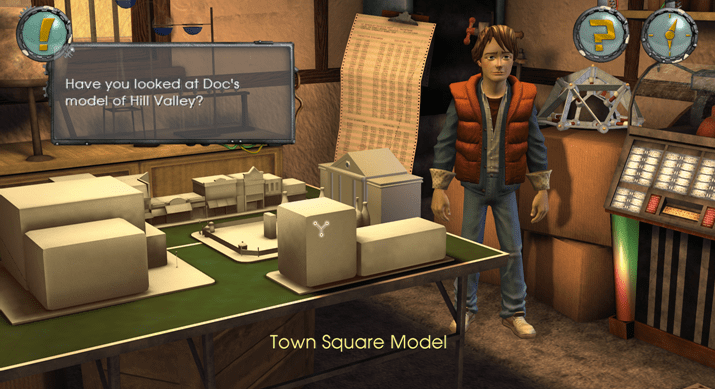
Player interactions seems more of an emphasis than in other Telltale Games.

Interestingly, Back to the Future: The Game plays very differently from the Telltale Titles I’ve played before; unlike titles like Batman: The Telltale Series (Telltale Games, 2016), Back to the Future features much more emphasis on exploration and player movement over quick-time events or altering the story through a variety of responses. Sadly, though, the game’s controls are quite stiff and clunky; Marty plods around like wading through thick sludge and, while you can hold B to “run”, you’ll never move much faster than a sluggish pace. Considering the game is a glorified point-and-click adventure rather than an action-packed game, this isn’t a massive issue except that the game’s dodgy camera and some awkward map layouts can make it more of a chore to control Marty than it needs to be and I found myself getting unnecessarily turned around or confused thanks to the camera’s positioning or stuck on parts of the environment.
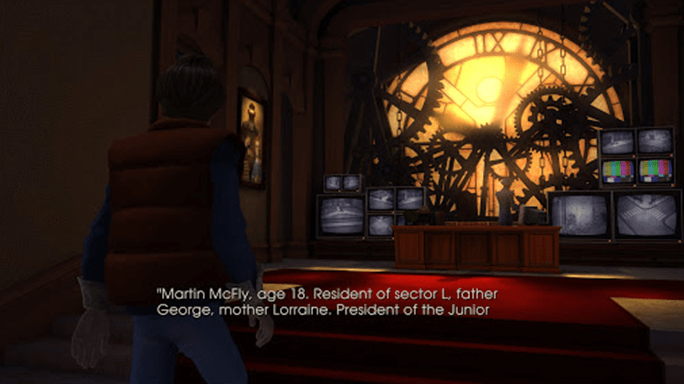
Sadly, you can’t skip cutscenes, which can make repeated playthroughs tedious.

As the game was originally released in five separate chapters, this collected edition is similarly divided in such a way; from the main menu, you can select any chapter at any time and begin a new game as you wish but you’ll need to make liberal use of the game’s save function if you want to earn all of the game’s Achievements with a minimum of fuss as there’s no way to jump to different parts of each chapter. This also affects the game’s replayability as there’s no way of skipping cutscenes or quickly advancing through story elements, which can make subsequent playthroughs far more tedious than they need to be and make gameplay frustrating when you’ve made a mistake and have to sit through entire cutscenes or lines of dialogue with no way of skipping them.
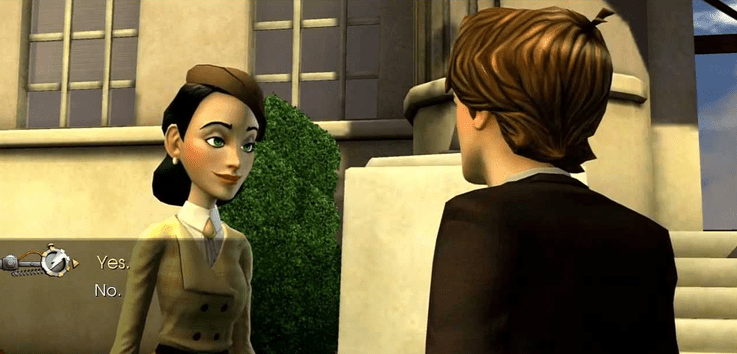
It can be amusing to try out different dialogue options and items just for the hell of it.

As far as I can tell,  unlike other Telltale Games, there’s no way to really “lose” when playing Back to the Future: The Game; even if you fail to figure out some puzzles or events, you won’t get a traditional game over screen and can simply continue until you get the right sequence or choose the right dialogue option. It can be amusing to select the wrong option and see how characters react or to try and use various items on other characters or parts of the map as Marty, or other characters, will generally have something funny to say or will chew you out for being stupid. The bulk of Back to the Future: The Game’s “action” is made up of character interactions and interacting with the various detailed environments you find yourself in. You can talk to and interact with pretty much everything, learning more about these familiar and new characters and the various timelines Marty ends up in, which can be fun and interesting. Generally, you’ll pick up subtle hints and tips by talking to certain characters but you can also enable or disable in-game hints and mission objects to give you a vague idea of where you need to go and what you need to do. Because of this, it can sometimes be a little difficult to figure out exactly what it is you need to do; you can take your time and explore multiple options at your leisure but, if you’re chasing Achievements, you might want to use a guide as there are a lot of missable Achievements in this game and it can be tiresome having to play through the majority of one of the game’s five chapters just to get to the part you need.
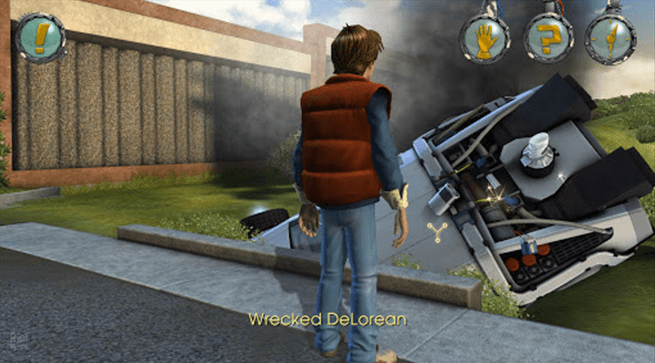
It can be awkward to target people and items with the game’s clunky controls.

Compounding the issue is that the game’s interface is quite clunky at times; you can access your inventory at any time with X. From here, you can examine items and place them into your hands to use on other characters or your environment but, oddly, items will automatically remove themselves from your hands after a few seconds, which gets very annoying as you might find an item you need to use has randomly vanished from your hands right as you need to use it. Similarly, it can be difficult to interact with characters and other elements thanks to the game’s clunky “targeting” system; as you wander around, points of interest will be automatically highlight so you can interact with them but your point of interest might suddenly switch as you get closer, meaning you talk to the wrong person at the wrong time. By holding down the R trigger, you can see every element in the immediate area highlighted and use the right analogue stick to select the one you want but I found this to be equally awkward and clunky and that it was generally easier to just position myself near where I needed to be and edge myself closer to my intended target.
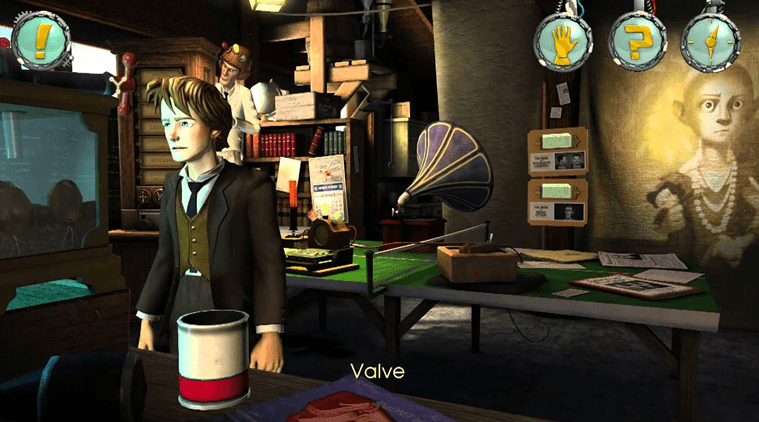
Some of the game’s puzzles are needlessly obtuse and annoying.

Even without these issues, some of the game’s puzzles can be needlessly frustrating; most are a simple case of talking to the right people to learn what you need or where to go but others involve pressing panic switches at the right time, selecting items around your environment to distract other characters, or finding certain items to convince a character to help you. While most of them boil down to a simple case of trail and error, and some are quite fun (like getting into a play-off against Marty’s rival and recreating his iconic and elaborate guitar performance from the first film), others are extremely complex or annoying. In particular, you’ll be required to listen out for certain code words from Doc’s younger self to correctly make rocket fuel (which must be done flawlessly to earn an Achievement), tediously manipulate your environment to create an incriminating Mind Map, or rescue your younger father with as little disruption as possible.

Graphics and Sound:
Like all Telltale Games, Back to the Future: The Game utilises a distinctly cartoony visual aesthetic that takes the general likeness of the franchise’s iconic characters and transforms them into amusing and charming caricatures of themselves. It’s a unique aesthetic, to be, sure and, while it does work for this style of game, characters can tend to look a little…off, at times, plodding and jerking around like marionettes and looking quite basic. I also noticed a few oddities and graphical glitches at times, such as items not breaking like you might realistically expect, background elements glitching out, or items and graphics randomly vanishing from cutscenes.
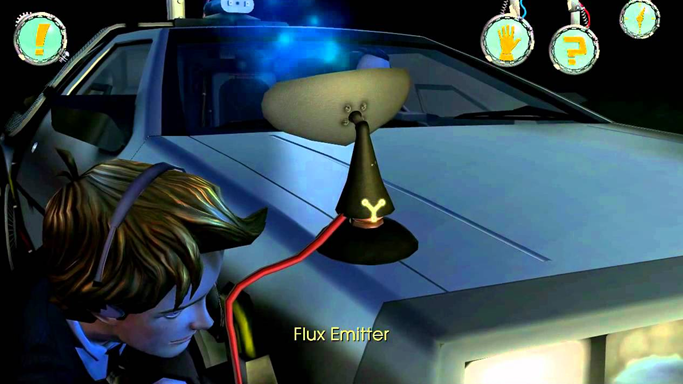
The graphics and aesthetic are decent if a bit bland at times.

The game’s environments can be quite bland, at times, but all the iconic locations you remember from the films are here: Marty’s house, Doc’s lab, and, of course, the iconic clock tower and town square. While the maps and environments aren’t especially large, they are varied in that you can enter different buildings in different chapters to learn more about different characters, and there’s generally a lot to do, see, and interact with despite how empty and lifeless some of the locations can be. It’s simple but largely very effective and, thanks to the game visiting new time periods (mainly 1931 and another alternative timeline), adds new wrinkles to the lore of the franchise.
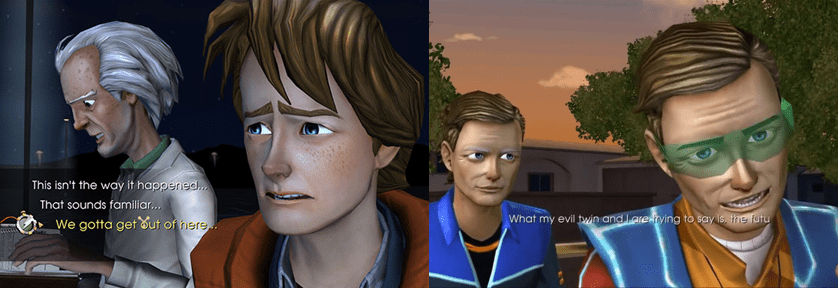
The game’s soundtrack and voice acting elevate it and add to its appeal.

Honestly, my only real complaint with the game’s visual style is that Marty takes his appearance largely from the first movie; I don’t know why it is that so much Back to the Future merchandise only ever seems to recreate his attire from the first film rather than giving him a new look but it’s a little disappointing so I was glad to see him dress in period-appropriate clothing as the story progressed. Of course, what really makes Back to the Future: The Game an attractive prospect is the top-notch voice acting (A.J. Locascio does a great Michael J. Fox impression, Lloyd is fantastic as always as Doc (if noticeably aged in his gravelly delivery), and Fox himself even crops up in the game’s final chapter for a voice cameo) and the soundtrack, which is largely comprised of Alan Silvestri’s iconic score from the movies. It’s just a shame, then, that a lot of the game’s dialogue is muted or drowned out by the music or sound effects, meaning you may need to adjust the audio settings from the main menu.

Enemies and Bosses:
Given the nature of the game, there aren’t traditional enemies or bosses as in other videogames; instead, as per the plot, you will be stopped or obstructed by numerous characters who require you to say the right thing, bring them certain items, or you to perform a certain action before they will help you or let you pass. As you might expect, you’ll run into Biff Tannen and his various ancestors and incarnations throughout the game’s story. His father, mobster Irving “Kid” Tannen is one of the game’s primary antagonists while you’re back in 1931. You’ll need to work with Marty’s father to get Kid arrested, lie to him about your credentials as a mobster, and set up an elaborate series of events to burn him out of a high-rise window as he shoots at you with a Thompson machine gun. After Marty and Doc inadvertently alter their future, you’ll also have a confrontation with Biff and his newly-acquired brothers, dodging swings from their baseball bats until you can get them all in position to be electrocuted.
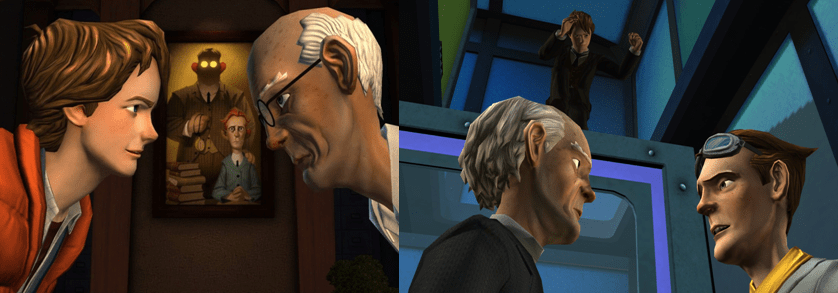
Citizen Brown is an antagonistic version of Doc who plots to keep his timeline intact.

After altering the past in 1931, Marty crash-lands in an alternative version of his present in which Hill Valley is a veritable utopia thanks to a stringent police state lorded over by none of than a heavily altered version of Doc, known as “Citizen Brown”. While Marty is able to win Doc over and make him see that his dreams have been perverted by his new wife, Edna Strickland, this version of Doc later grows directly antagonistic when he has second thoughts about restoring Marty’s timeline. This leads Marty into directly opposing his friend and mentor to ensure that Doc’s younger self stays on the path towards science rather and societal correction.

Edna comes in many forms and is the game’s primary antagonist and all-around pain in the ass.

As a result, the game’s primary antagonist turns out to be Edna Strickland, a seemingly harmless character in the game’s first chapter who ends up manipulating Doc’s brilliance into brainwashing the “hooligans” of Hill Valley into being more law-abiding and docile civilians. So committed against sin and vice is Edna that it leads her to not only burn down the local speakeasy, setting in motion the events of the game’s plot, but also stealing the time machine and accidentally erasing Hill Valley from existence. When Doc and Marty travel back to 1876 to confront her, they must manipulate her fragile state of mind to learn the date and time of her arson to set things right, which ultimately leads to the player having to set up an elaborate trap involving sand bags and a chandelier to end her misguided plot.

Power-Ups and Bonuses:
As an interactive movie, there aren’t really any power-ups in the traditional sense of the word to be found. Instead, as you interact with others and further the plot, you’ll acquire a variety of items to be used in specific situations. Some of these will need to be handed to Doc’s faithful dog, Einstein, to progress the story or set up distractions and events you need to move the plot along, others will need to be brought to specific characters to convince them to help you or otherwise alter their destinies.

Additional Features:
There isn’t really much else to Back to the Future: The Game; as mentioned, there are a number of Achievements to acquire, with a lot of them being easily missed without a guide, which is probably where the bulk of your next playthrough will be concentrated. Don’t get me wrong, the game’s story (essentially a new take on the familiar story beats of the original trilogy) and the voice acting is entertaining enough to warrant another playthrough but, as you can’t really affect characters in the same way as in other Telltale Games, there isn’t as much incentive to try different dialogue options as in the studio’s other releases. The 30th Anniversary Edition of the game also comes with a behind the scenes video…that can no longer be viewed as the servers and Telltale’s website have long been shut down. I would have expected this edition of the game to come with, at least, a gallery of concept and development art but apparently this was too much to ask for and you simply get a questionably improved version of the base game.

The Summary:
Your enjoyment of Back to the Future: The Game will most likely depend on how enjoyable you find glorified point-and-click adventures and your level of patience. It’s not an especially hard or lengthy title (each chapter takes maybe an hour or so, depending on how you get on with the game’s vague hints and fetch-quests), nor or is an especially attractive or complex game, but it’s a fun enough distraction for what it is, with far more required of the player than other Telltale Games I’ve played. What elevates the game is, of course, the voice acting and the level of fidelity it has to its source material. As a continuation of the trilogy’s storyline, the game works incredibly well, advancing each character’s story while still exploring new, unseen avenues into their pasts and characterisation. Like Ghostbusters: The Video Game (Terminal Reality/Red Fly Studio, 2009), Back to the Future: The Game is a worthy continuation of a beloved franchise that is let down only by some graphical and gameplay hiccups and, perhaps, the genre of game the films have been adapted into. Had the game, perhaps, mixed up some of its methodical pace and adventure aspects with a few more action-orientated sections (like actually driving the DeLorean or taking part in one of the iconic chase scenes) and had some actual branching pathways, it might have been even better but, as is, it’s an inoffensive and decent enough little game.

My Rating:

Rating: 2 out of 5.

Could Be Better

Did you ever play Back to the Future: The Game? If so, what did you think of it? Did you find any oddities or get scuppered by the odd camera and control scheme? What did you think of its plot and attempts to continue the Back to the Future trilogy? Which Telltale Game, or Back to the Future film, is your favourite and why? How are you celebrating Back to the Future Day today? Whatever you think about Back to the Future, feel free to share your thoughts in the comments below.

Movie Night: Wonder Woman

Released: 15 May 2017
Director: Patty Jenkins
Distributor:
Warner Bros. Pictures
Budget:
$120 to 150 million
Stars:
Gal Gadot, Chris Pine, Danny Huston, Elena Anaya, Connie Nielsen, Lucy Davis, and David Thewlis

The Plot:
Before taking the mantle of Wonder Woman, Princess Diana of Themyscira (Gadot) was an Amazonian warrior raised in seclusion on an island paradise. However, when American pilot Steve Trevor (Pine) crashes on their shores and brings awareness of a worldwide conflict, Diana finds herself compelled to leave her home and take up arms in a bid to destroy the God she believes is responsible.

The Background:
Created by psychologist William Moulton Marston to be a symbol of the superiority of the female gender, Princess Diana of Themyscira/Wonder Woman has been a firm staple of DC Comics since her debut appearance in All Star Comics #8. With her origins heavily drawing from Greek mythology, Wonder Woman has been portrayed as a warrior and an ambassador for peace and, alongside Clark Kent/Superman and Bruce Wayne/Batman, makes up DC’s “Trinity” as a prominent figure on DC’s super teams, the Justice Society and Justice League of America. Wonder Woman’s popularity has spread outside of the comic books, too; Lynda Carter famously portrayed the character in the seventies television show, cementing Wonder Woman as a pop culture icon, and a big screen live-action adaptation had been wallowing in development hell for decades before Gal Gadot made her first surprise appearance in Batman v Superman: Dawn of Justice (Snyder, 2016). Following that dramatic debut, production of a solo film for the character that would act as a prequel to the larger DC Extended Universe (DCEU) finally got underway and released to widespread critical acclaim. The film was also a massive box office success and made over $820 million in worldwide revenue, which all-but-guaranteed the production of a sequel, and galvanised the character as a feminist icon for an entirely new generation. Since tomorrow is “Wonder Woman Day”, this seems like as good a time as any to shine a spotlight on one of DC Comics’ most popular and influential characters.

The Review:
Wonder Woman begins in the present day, between the end of Batman v Superman and the start of Justice League (Whedon/Snyder, 2017), and is framed by Diana’s narration concerning her past after having a photograph of her time in the First World War sent back to her by Bruce Wayne (Ben Affleck). From there, the film flashes back over a hundred years into the past and to the secluded island paradise of Themyscira where we see a young Diana (Lilly Aspell), emulating the ways of her warrior sisters and yearning to begin her training as a warrior. Diana’s mother, Queen Hippolyta (Nielsen) is vehemently against Diana becoming a fighter; instead she wishes that Diana would be better served learning the ways of peace and tolerance. To emphasise the foils of war and conflict, she tells Diana a harrowing story of Zeus’s son, the warmongering Areas, influencing the hearts and minds of man into bloodshed and his subsequent slaughter of the Greek pantheon. After defeating Ares, Zeus created Themyscira with his dying breath to shield them from the outside world so that their natural ways of peace and love could prosper far away from the easily manipulated ravages of Man.

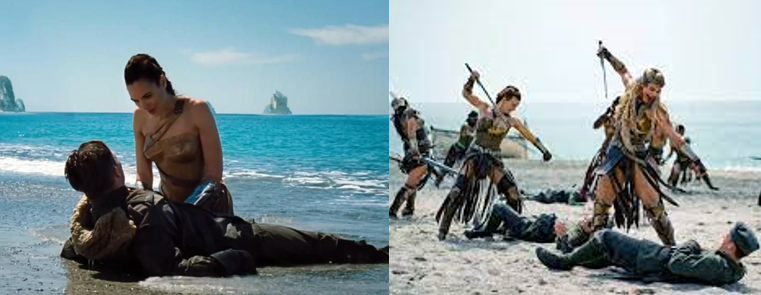
Diana’s curiosity at Steve’s presence turns to rage when German forces kill her aunt.

Hippolyta also shows Diana the ancient sword, Godkiller, a weapon only the fiercest of Amazons could hope to wield. Despite her mother’s wishes, the young Diana (Emily Carey) is inspired by the stories of battle and glory and secretly trains with her aunt Antiope (Robin Wright) in the ways of the warrior. Antiope is finally able to convince Hippolyta to train Diana “harder than any Amazon before her” to make her powerful enough to stand against Ares when he inevitably finds her. However, while Diana (now played by the gorgeous Gadot) becomes a fierce warrior thanks to this rigorous training, her powers (mainly tied to her magical gauntlets) make her unpredictable and dangerous. It is while lamenting these issues that Diana rescues Steve Trevor after his plane crash-lands in the waters around Themyscira; this action not only brings a man onto the hidden island for the first time since its creation (which is of immediate curiosity and interest to Diana) but also the greater worldwide conflict currently gripping the globe as German forces invade Themyscira in pursuit of Steve. Although the Amazonians fend off and defeat the invaders, they suffer heavy losses thanks to the German artillery and, in the battle, Diana’s beloved aunt Antiope is killed. It’s a great scene to showcase the warrior ways of the Amazons and their incredible prowess with swords, bows and arrows, and to give Diana a personal reason to leave the island and get involved in the War, while also showcasing that, as powerful and skilled as the Amazons and even Diana are, they are not invulnerable.

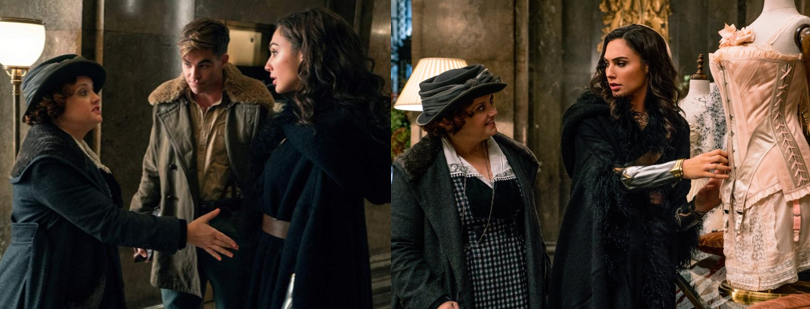
Diana is puzzled by “man’s world” and the film’s comedy comes from her being an outsider.

Angered at Steve’s presence and the invasion of men, Hippolyta interrogates him using the magical Lasso of Hestia, which compels him to reveal the truth; in the process, and despite attempting to resist, he reveals that he is a spy for the Allied Forces who discovered a plot by General Erich Ludendorff (Huston) to develop a potent and deadly new strain of mustard gas using the research of the disfigured Doctor Isabel Maru/Doctor Poison (Anaya). This story not only establishes the film’s two main antagonist but also Steve’s conviction and bravery as he goes against his orders to steal Maru’s notebook to warn the Allies of Maru’s weapons. Convinced that this World War is the product of Ares’ return, Diana defies her mother’s wishes once more and arms herself with the Godkiller sword, ceremonial armour, and the magical lasso to accompany Steve back to London. This gives the film a chance to be a bit more playful as Diana is a fish out of water in the modern world; confused and intrigued by men, their society and their ways, she’s puzzled by the simplest of things (watches, ice creams, consumerism, romance, vehicles, revolving doors, and the like) and her interactions with Etta Candy (Davis) really give Gadot a chance to shine and add some depth and personality to Diana’s character. She’s a character of great love, curiosity, and conviction but also naivety; even on Themyscira she is something of an outsider, believing fully in the Amazons’ destiny to defend the world from evil and stop Areas, and her character development includes not just becoming wiser in the world of man but also in the ways of her own world and she is forced to learn, the hard way, that the world’s conflicts are far more complicated than the machinations of one singular being, even a God like Ares.

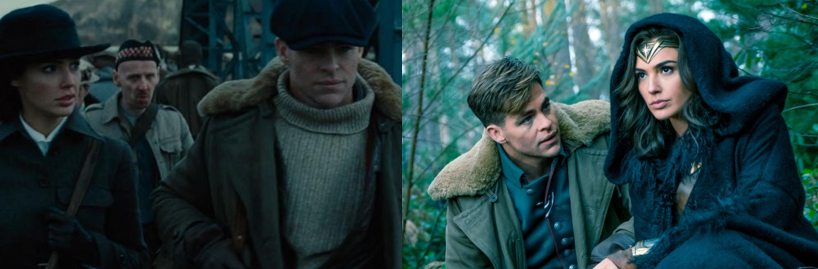
Steve Trevor has seen a lot in his time and is focused on the big picture.

Steve is similarly intrigued by Diana; obviously, he has a near-instant attraction to her (and, truth be told, she to him) and marvels at her island and her convictions but, as charming and charismatic as he is, he is also somewhat world-weary. Having witnessed first-hand the atrocities of war and the folly of man, he believes that all people are capable of unspeakable acts out of their pure nature rather than the influence of a supernatural being, which is a harsh lesson he is forced to teach Diana. Similarly, Diana is disturbed by Steve’s focus on the big picture and adherence to staying on mission, which leaves innocents suffering the cost of the war, but his reasons are perfectly valid and believable: the War is horrendous and brutal and his focus cannot be on saving every single person, only trying to stop the most direct threat and he remains a likable and appealing character thanks to Pine’s fantastic charisma and onscreen chemistry with Gadot and, even in the face of Diana’s amazing abilities he is able to hold his own as a soldier and a hero.

Lundendorff and Maru are real threats but war-time politics are also an obstacle.

Similarly, Huston is as captivating as always in the role of Ludendorff, a brutal German general who enforces his will through strict corporal punishment and high expectations. Thanks to Mau’s potions and elixirs, he is granted a degree of superhuman strength and heightened aggression and Maru herself is a sadistic and hideously alluring villain whose experiments with chemistry produce a gas capable not just of choking the life out of those exposed to it but also eating through protective gear like gas masks. As real and credible as their combined threat is, however, it is the politics of war and society that prove the greatest hurdle in the early going as Sir Patrick Morgan (Thewlis) and others in the upper echelon are more concerned with agreeing an armistice with the Germans than proactively moving against them. Interestingly, the German forces are depicted as desperate, running low on resources, and on the verge of agreeing to the armistice and, disgusted by their weakness and unable to simply give up on the conflict, Ludendorff assassinates them in order to strike his decisive blow against the Allies. This leads to Steve recruiting a rag-tag team of misfits to head to the Front Line and take out Ludendorff’s chemical facilities; despite them being a little rough around the edges, his group is made up of some colourful characters: Sameer (Saïd Taghmaoui), a smooth-talking French spy; Charlie (Ewen Bremner), an expert sharpshooter with a drinking problem and traumatised by his experiences in war; and the Native American smuggler Chief Napi (Eugene Brave Rock), who initially refuses to take sides in the War given everything his people lost colonisers. With these allies, and surreptitious assistance from Morgan, they are able to reach the Western Front for one of the film’s breakout sequences: with the Allies pinned down by gunfire, Diana boldly steps into No Man’s Land to deflect the gunfire and take the enemy trench and, in the process, not only liberate a village from the Germans but also share an intimate moment with Steve.

The Nitty-Gritty:
One of the most memorable aspects of Wonder Woman’s debut in Batman v Superman was her stirring orchestral theme, which her solo movie beautifully expands upon to turn it from a bad-ass battle theme into a rousing, heroic melody that punctuates Diana’s evolution as a character and her actions throughout the film. Given the film’s period setting, there is also a great deal of commentary on the role of women in society at the time; Diana is confused and insulted by man’s opinions and treatment of women, having grown up in a warrior society where woman are strong and independent, and brings (through her words but also simply by her appearance and actions) these principals to the wider world long before they really became a talking point.

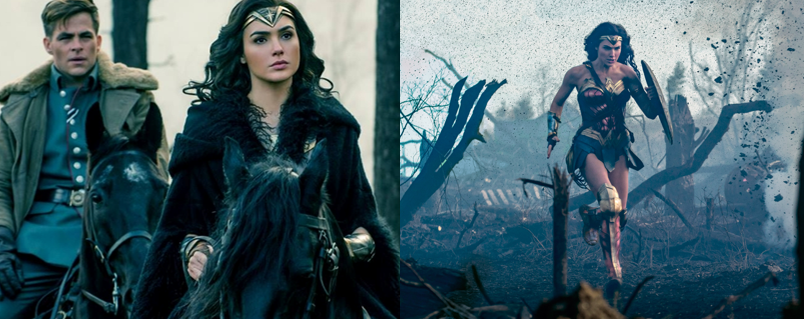
Costume design is on point and Gadot looks breathtaking as Wonder Woman.

Wonder Woman shines in its visual aesthetic and costume design; Themyscira is a beautiful environment and full of interesting little elements and a rich lore that is only hinted at in the film. This is, however, largely for the best as Wonder Woman is more focused on the greater conflict of the First World War, meaning it is full of period-accurate costumes, technology, and bleak depictions of the folly and futility of warfare. Amongst these drab and depressing elements, and against the smoke-filled hustle and bustle of London, Diana stands out wonderfully in her amazingly realised and faithful costume. Wonder Woman’s outfit is often one of contention but the DCEU version of the character brought her classic look to screen in the best way possible by infusing it with realistic elements of Greek armour and it’s honestly one of the best and most accurate comic book costumes ever made.

Diana is obsessed with killing Ares to “free” men from his evil and distraught to learn the truth.

The film’s themes of warfare and suffering are potent thanks to its setting; while there are obvious comparisons to be made to Captain America: The First Avenger (Johnston, 2011), Wonder Woman is a very different film to that one and these comparisons are superficial, at best. Instead the focus is on Diana trying to acclimatise to man’s world and her total dedication to ending Ares’ threat; initially, she believes that Ares has taken Ludendorff’s form in order to spread chaos and devastation and is horrified to learn that her mother and Steve were both accurate in how easily men can be corrupted by their own evils and destructive impulses. This by itself would have made for a striking theme about the inherent evil that we are all capable of but, of course, Wonder Woman is a blockbuster superhero film that needs to end with Diana realising her destiny as the “Godkiller” and battling Ares (revealed to have been Morgan all along). As exciting and thrilling as this conclusion is, since it finally allows Diana the chance to showcase the full extent of her powers, it is kind of a shame that Ares is a vague and ominous threat for the majority of the film rather than actually being a tangible antagonist for us to learn about. In fact, we learn very little about Ludendorff or Maru, who are both criminally underused despite giving really good performances. However, it does serve the overall message of the film and the harsh lesson that Diana is forced to learn about human nature; when Ares finally reveals himself to Diana, it is at her lowest moment and he tempts her into joining his cause and destroying humanity but Diana’s convictions to her cause remain steadfast and are further emboldened when Steve comes to exemplify man’s capacity for good by sacrificing himself to end Maru’s threat just as Diana kills Ares once and for all.

The Summary:
Honestly, I didn’t expect to like Wonder Woman as much as I did; I like the character and enjoy her involvement in team-up comics but have never been a massive Wonder Woman fan but the film won me over with its fantastically realised themes of war, and, sacrifice. The First World War setting was an inspired choice and really gave Diana a chance to see first-hand the atrocities of man and the complexities of human nature. Obviously, both her world and Steve’s world came to be true to a degree, with Ares ultimately revealed to have been influenced the human antagonists and inspiring the tools necessary for war, and this merging of these two separate worlds was wonderfully realised in the characterisations of Steve and Diana and their growing relationship over the course of the film. While I would have preferred Ares to be a more tangible threat throughout the film rather than a surprise twist at the end, I cannot fault the movie for its direction, cinematography, or presentation; there’s just as much heart and humour at work in the film alongside some stunningly realised action sequences that portray Wonder Woman as both beautiful and formidable and Gadot does an impressive job of giving some real depth and tragedy to Diana’s character that help to inform her portrayal and overall character arc in Batman v Superman and subsequent DCEU films.

My Rating:

Rating: 4 out of 5.

Great Stuff

What did you think to Wonder Woman? Do you feel it deserved all the praise that it got? What did you think to Gal Gadot and Chris Pine’s performances, the characterisations of Diana and Steve, and their relationship? Did you enjoy the themes at work in the film and the “fish out of water” aspects? Did you see the Ares reveal coming and would you have preferred that the antagonists got a bit more time to shine or were you satisfied with the film overall? What are some of your favourite Wonder Woman stories, characters, and moments? How are you celebrating Wonder Woman Day tomorrow? Whatever your thoughts on Wonder Woman, leave a comment below and check out my review of the sequel.

Game Corner: The Evil Within (Xbox One)

Released: 14 October 2014
Developer: Tango Gameworks
Also Available For: PC, PlayStation 3, PlayStation 4, Xbox 360

The Background:
Shinji Mikami joined Capcom in 1990 and worked on a number of successful handheld, 8- and 16-bit titles during his first six years with the company. In 1996, though, Mikami developed the first Resident Evil (Capcom, 1996) videogame, which not only popularised the “survival-horror” subgenre but was an incredible success upon release. Since then, Mikami spearheaded or was heavily involved in Resident Evil’s sequels and spin-offs, including taking over as director of Resident Evil 4 (Capcom Production Studio 4, 2005) and changing the direction of the franchise. However, by 2010, Mikami had left Capcom to develop new properties and titles under Tango Gameworks; the first of these was The Evil Within (known as Psycho Break in Japan), a title which Mikami aimed to return to the roots of the survival-horror genre, which had become increasingly actionorientated over the years. Despite some criticism regarding technical issues, The Evil Within was received rather favourably; while some struggled with the game’s difficulty and convoluted plot, the atmosphere and horror elements were notably praised. The game was also the second-best selling game in the United Kingdom upon release and earned an even more highly regarded sequel in 2017.

The Plot:
After arriving at a brutal massacre, Detective Sebastian Castellanos is pulled into a distorted world full of nightmarish locations and horrid creatures after pursuing a mysterious, seemingly supernatural hooded figure known as Ruvik. Trapped with limited resources and relentlessly hunted, Sebastian is left to fight for his survival and uncover the mystery of Ruvik and the horrific world Sebastian’s found himself trapped in.

Gameplay:
The Evil Within is a survival-horror videogame very much in the style of Resident Evil 4 in many ways; my experience with the Silent Hill franchise (Konami/Various, 1999 to 2014) is sadly limited but, from the bit I’ve played of the first game, The Evil Within is clearly heavily borrowing from the more nightmarish and twisted reality of Silent Hill than the virus-heavy narrative of the Resident Evil franchise. Like in Resident Evil 4, you have full 3600 control of your character and the camera rather than being restricted by tank controls and set camera angles, and you’re also given much more options in terms of combat. You can melee attack with Y using your fists or bottles, interact with the environment with A, burn bodies and pools of gasoline with your limited supply of matches with B, aim with LT and shoot your weapons with RT, reload with X, and spring with LB. you can’t hold the sprint trigger down for too long, though, as you’re hampered by a stamina meter and Sebastian will be left vulnerable and out of breath if you run for too long.

Sneak past enemies or creep up behind them to pull off an instant kill move.

One of the big mechanics of The Evil Within is the sneaking and stealth-based gameplay that is pushed as a big thing in the first few chapters of the game’s story and then all but vanishes for the bulk of the gameplay as you’re given more ammo and weapons, before rearing up again near the finale of the game. You can use RB to sneak around when enemies are nearby and a helpful eye-themed “Enemy Alertness” icon will let you know when enemies are unaware of you or actively searching for you. When the eye widens, you should sprint out of site or hide inside a nearby locker or wardrobe until the danger has passed but be careful as enemies will pull you out of your hiding place if they see you try to hide. Still, if you manage to sneak up behind enemies, you’ll be able to pull off an instant kill move with a press of the A button but I found enemies become very aware of your presence even when you’re being super stealthy so this was often quite tricky to pull off. As much of the game is seeped in an unsettling darkness, you can also use your lantern by pressing in the left analogue stick to light the way but this will also attract nearby enemies (though, again, this becomes less of an issue hen you gain more resources).

Set your weapons and healing items to the D-pad for quick use and take advantage of any backup.

Like all great survival-horror titles, The Evil Within excels in building a horrific, foreboding atmosphere thanks to its unsettling, often gruesome visuals and twisted, reality-bending narrative. To help with this, the heads-up display (HUD) is extremely sparse to increase your immersion in the game’s horrifying locations and narrative. You’ll see your health, stamina, and currently-equipped weapon and ammo and that’s about it unless you’re joined by one of Sebastian’s partners, like Joseph Oda, who often help you out with some additional firepower. If they’re attacked, you can fend off their attackers and heal them by holding down A (which helpfully doesn’t waste your own healing resources). You can set your weapons and healing items to the directional pad (D-pad), which helps you to quickly switch weapons or replenish your health without going into the inventory wheel, which slows the in-game action to a crawl but doesn’t pause it completely and can thus leave you vulnerable.

Puzzles are few and far between in The Evil Within but are suitably macabre (and a bit unfair, at times).

Interestingly, The Evil Within is surprisingly light on puzzles, labyrinthine environments, and the use of keys and other items to progress. Occasionally, you’ll have to acquire a key to open a door or work your way through a grim and grimy location avoiding instant death traps, fending off enemies, and running from Ruvik as you try to open a central door, but these moments are few and far between. Instead, The Evil Within is a much more linear game than its forefathers, meaning that you’re not afforded a map this time around. For the most part, this isn’t an issue but it wouldn’t have hurt to have a map available since a lot of the environments are a bit grey, dark, and look alike so it can be easy to get turned around sometimes. As a result, though, you never really have to worry about pushing statues or getting a bunch of extraneous items or combining them together and, instead, will be more focused on blasting enemies or bashing their heads in than worrying about jewels. However, when puzzles do crop up, they’re fittingly gruesome: you’ll have to insert probes into brains while looking at nearby diagrams and listening to audio tapes, press the right buttons on surgery tables to avoid being skewered and reveal a hidden exit, sneak past wire traps and rush through spiked traps, and shut off valves of steam or activate flames to get past certain areas, and turn a few dials here and there in order to progress, take out enemies, or free your comrades.

You’ll need to constantly watch out for traps and hazards that threaten to skewer or explode you.

During Chapter 11, though. you’ll also have to shoot down corpses hanging above the flooded streets in order to distract and swim past a monstrous creature, which can get pretty tense as your window of opportunity is very small, and you’ll also be chased by chainsaw-wielding berserker’s and suddenly ensnared in traps that you must shoot or run out of or face a grisly end. Indeed, traps and hazards such as these are one of the most recurring dangers in the game; these are dotted around every location, springing up on you when you least expect it and often skewing you or blowing you into bloody chunks with little warning. Many of these will result in instant death, requiring you to retry from your last save point, but others can be disarmed by holding A, sneaking up on them, or pressing A at the right time in a small mini game. Disarming traps such as these will net you additional junk (which you can also acquire by smashing crates and such), which is used in the game’s (thankfully) extremely limited crafting system to create ammo for your “Agony Bolt” crossbow. You’ll also find Green Gel in jars and bubbling on the floor after you defeat enemies; be sure to grab this whenever you see it as you’ll need it to upgrade Sebastian’s abilities and weapons in the game’s haunting save areas.

Graphics and Sound:
Honestly, The Evil Within is quite a bland game in many ways; much of the environments take place in such uninspired locations as a hospital, sewer, grimy caverns, and gothic laboratories, meaning that a lot of the colours are subdued and feature a lot of black, grey, and brown. However, the game excels in the use of lighting and a perverse, macabre atmosphere that really adds to the sense of dread and tension in every area. Things may look perfectly normal one minute and then, very quickly, become warped either by Ruvik, Sebastian’s apparently fragmenting mental state, or the presence of certain enemies.

Environments are forboding and ominous, if a bit drab and interchangeable at times.

Bodies, bloodstains, and gore are in abundance in almost every area you visit; you’ll find dismembered corpses, flickering lights, smashed up areas and some truly disturbing labs and operating theatres that more closely resemble torture chambers or slaughter houses. Sebastian’s journey takes him through a variety of locations, all of which are generally seeped in a thick, ominous darkness or carry an menacing sense of dread thanks to the carnage that surrounds him or the use of screams and ambient sounds (mostly haunting, almost taunting voices). There’s also some cool weather effects on display; rain splatters on the screen, wind blows through trees and grass, and environments twist and change as Ruvik bends them to his will with often devastating effects.

Much of the game draws visual inspiration from Resident Evil, Silent Hill, and other horror franchises.

When The Evil Within breaks free from restrictive corridors filled with barbed wire, wreckage, and corpses, it really starts to feel much more unique amongst other survival-horror videogames; you’ll wander through the castle-like ruins of weird mish-mash of cultures, venture through a city that is constantly shifting and changing and collapsing around you like something out of Inception (Nolan, 2010), but you’ll also recognise a number of the tropes and references to Resident Evil along the way. The hospital and laboratories of the game, for example, are very reminiscent of Umbrella’s facilities, as is the mansion you eventually explore; you’ll also spot a few familiar typewriters but the game also evokes imagery from Silent Hill through its narrative and horror franchises like The Ring (Various, 1991 to 2019) and Hellraiser (Various, 1987 to present) in its enemy designs.

Sebestian might not be the most compelling character but he’s thrust into some horrific situations.

While the game’s use of music and ambient sounds is pretty good, if uninspiring at times, it’s the lapses in sound and use of ominous groaning or wails of some unspeakable eldritch abomination that really add to the game’s unsettlingly atmosphere. The voice acting is okay, for the most part, but kind of reminds me of the B-movie delivery of games like The House of the Dead (SEGA AM1, 1996) and even the original Resident Evil while still treating the events of the game with a grim seriousness that further emphasises that its meant to be unsettling and disturbing rather than thrilling or cheesy. Sadly, thanks to the nature of the game’s narrative, the plot is all over the place; much of the narrative is focused on Sebastian trying to figure out the mystery of Ruvik while the world literally falls apart around him and questioning his sanity but it turns out to be this weird, pseudo-virtual reality environment of sorts that really isn’t elaborate don all that much in the game’s cutscenes or dialogue. Instead, you’ll have to root through the many mysterious and ominous documents and the comments of non-playable characters (NPCs) around you to get a better idea of what the hell is actually going on which, while creating a bit of a disconnect between me and Sebastian’s plight, I found did lend to the nightmarish appeal of the game as it was literally like playing through some ghastly nightmare where nothing makes sense and the world is full of shrieking, gabbling zombie-like creatures and unspeakable horrors and gore.

Enemies and Bosses:
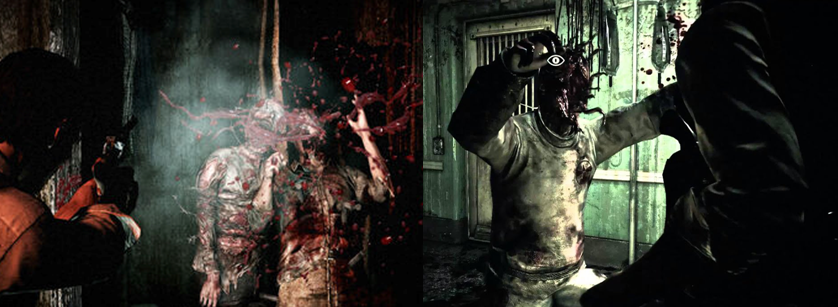
As you desperately plough your way through the game and try to figure out just what the hell is going on, you’ll find yourself besieged by a number of grisly creatures that literally come to life before your eyes as corpses stagger upwards, seemingly innocent blood stains burst free with screaming ghouls, and enemies burst apart into freakish abominations. The most common types of enemy you’ll encounter are known as “The Haunted”; these dishevelled reanimated corpses are like a cross between zombies, Cenobites, and the Las Plagas enemies of Resident Evil 4 and will stagger and rush at you in a blind fury looking to take a bite out of your neck. They’re also capable of attacking as a group and with weapons such as knives, crossbows, and even guns, and will eventually don body armour and wield machine guns, shotguns, Molotov cocktails, and can even activate traps by pulling levers. Thankfully, they go down relatively easily, especially after a few shots to the head, but you’re also encouraged to burn their bodies upon defeat to avoid them springing to life once more.

Ghastly, zombie-like enemies will rush at you and attack using edged weapons, explosives, and even firearms!

The haunted come in all shapes and sizes, including much bigger and more rotund enemies who can tank your shots, ones who rush at you in a suicide run, and even ones that appear invisible until the moment before they strike. You’ll also have to contend with some disturbing little baby versions of the Haunted that seep out through walls and drop from the ceilings, but these are easily dispatched with your melee attacks. You’ll also encounter far larger versions (who are best avoided rather than tackling directly unless you have some heavier weaponry on hand) and the disgusting AlterEgo variants who shamble about the place, take far more damage to defeat, and puke up viscera onto you when they got close to you!

The game’s bigger, more dangerous sub bosses will require your more powerful weapons to put down.

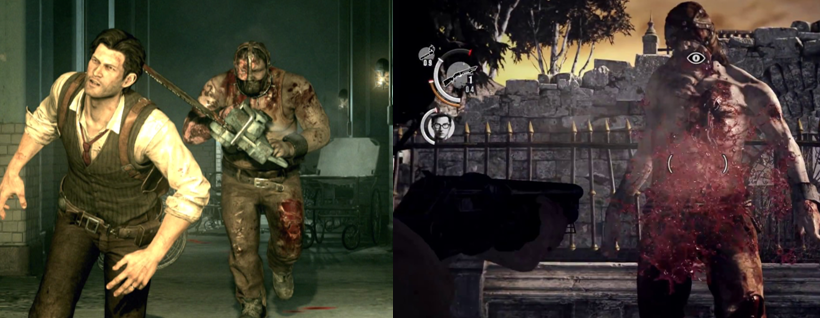
Such larger, more grotesque enemies serve as The Evil Within’s mini bosses; the first enemy you encounter, for example, is the chainsaw-wielding Sadist who cannot be harmed. Instead, you have to frantically run from him and sneak around him to avoid being sliced in two but, later in the game, you’ll encounter these brutes as mini bosses in increasingly confined areas; thankfully, by then you’ll be packing a shotgun and some explosive weaponry so they’re not too difficult to put down as long as you keep away from the wild swing of their chainsaws. Similarly, while exploring Cedar Hill Church, you’ll have to fight past the misshapen, monstrous formally conjoined twins Neun and Zehn, who rush at you and try to smash you into a bloody puddle in a confined area. Luckily, Joseph is on hand to offer support with a sniper rifle and you can use your more powerful weapons to slow them and finish them off one at a time.

The Keepers are similar to Pyramid Head but are much easier to put down…with the right weapons…

Another prominent sub boss, of sorts, is the Keeper; these hulking creatures wield meat cleavers and pursue you with a screen-distorting effect and dropping barbed wire mine traps on the floor. Because their heads are protected by a metal safe, the only way to kill these bastards is to aim for the ample chests but, quite often, killing one will simply cause another to spawn out of nearby safes, which can also spring to life and attempt to attach to your face. As a result, a mixture of stealth and tactics are advised when facing the Keepers, which can often be avoided altogether and mainly serve as a formidable distraction while you try to shut off steam valves and progress further.

The Amalgam Alpha was a horrendous boss figh, especially when it enters its second phase and eats you!

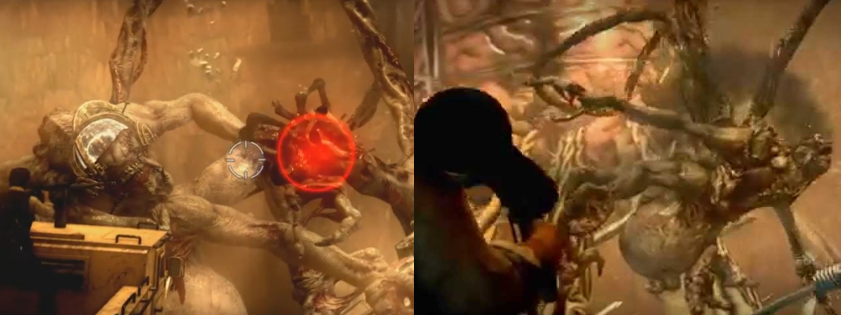
As you might expect from the man behind Resident Evil, you’ll also have to battle a number of bizarre and monstrous creatures to progress; one, the Sentinel, is a giant wolf-like creature transformed into a hideous monstrosity and which likes to hide in nearby bushes before pouncing on you and trying to bite your face off. Another is Quell, a massive octopus-like creature that attacks you in the sewers and likes to hide in pipes and grab you with its tentacles; when it does, you have a small window to shoot its face to damage it and save yourself from a gruesome end. Easily the most prevalent and annoying, however, is the Amalgam Alpha creature, which appears to be an eldritch, nightmarish spider/scorpion hybrid that rampages through an underground car park and was, easily, the toughest and most annoying boss fight of the game. This thing is really big and its weak point (an eye on either its tail or within its gaping mouth) can be really tricky to hit; luckily, the car park is full of ammo and other resources but you’ll have to be quick on your feet to avoid its super frustrating instant kill move.

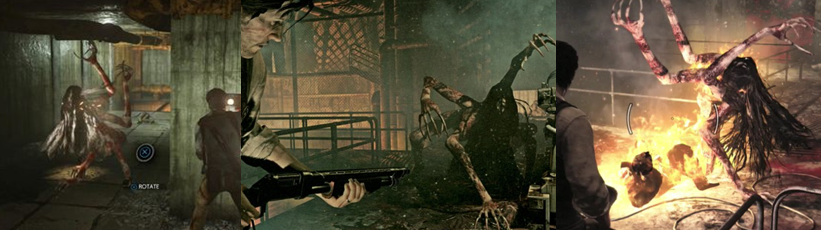
Laura is a shrieking, persistent threat best staved off with fire and avoided lest she pummel you to death!

As Ruvik remains elusive for most of the game, the most prominent antagonist you’ll face for most of the game is Laura, an onryō-like girl who emerges, shrieking and wailing, from bubbling bloodstains in certain parts of specific chapters and scuttles after you like a spider, instantly smashing your head in if she gets a hold of you. You’ll encounter Laura three times over the course of the game and she gets more aggressive and difficult to face each time: in the first encounter, you simply have to run around a corner and set alight a pool of gasoline to scare her off but you’re then forced to battle her in an incinerator room. Here, she demonstrates her ability to teleport and emerge from nearby corpses so you’ll have to make sure that you burn these and arm yourself with nearby torches to stave her off but the only way you’ll defeat her is to trick her into spawning inside of one of the incinerators and pulling the lever. The last battle against her is even worse as it has multiple stages that see you fending her off by shoot levers on pipes to spew fire at her and desperately making your way towards an elevator before she can grab you. While it is possible to do her in using nearby flame traps and your conventional weapons, it’s worth coming back after you’ve unlocked the rocket launcher to make these fights easier as she’s basically indestructible otherwise.

You’ll battle Ruvik’s monstrous final form without fear of exhausting your precious resources.

Finally, there’s the primary antagonist himself, the mysterious Ruvik, who is apparently the mastermind behind all of the game’s events. Occasionally, Ruvik will spawn into a location and begin to chase you; if this happens, my advice is to run as fast as you can and hide in a wardrobe or under a bed until he disappears as he’ll explode you into bloody chunks otherwise. Later, you’ll encounter Haunted who assume his guise, who can be easily put down without much trouble, and the entire final chapter of the game is dedicated towards making your way to a final confrontation with Ruvik. Here, he merges with the Amalgam Alpha to become the Amalgam, a Lovecraftian beast that you must run from as it chases you up the side of a building before commandeering a machine gun and a rocket launcher to finish him off for good. In this final boss fight, you don’t need to worry about expending your ammo or running around in a panic; you simply have to move to the left or right to avoid his claws, aim for his head, and try not to miss withy our rockets. Eventually, you’re given a split second to shoot the final bullet at Ruvik’s exposed head but it’s okay if you miss as the autosave point is right before this section so take your time and put an end to him for good by stomping on his exposed brain.

Power-Ups and Bonuses:
As you explore the many nightmarish environments of The Evil Within, you’ll find a lot of junk and helpful items to pick up, especially if you smash open crates and open up any drawers or cupboards. You’ll acquire syringes and medical kits to restore your health (these latter will also briefly extend your health at the cost of a few seconds of disorientation), ammo for your weapons, matches, and Green Gel. You’ll want to grab as much of these as you can (be sure to reload your weapons and cycle through your Agony Bolt variants to stockpile as much ammo as possible) in order to have the best chance of success in combat.

In addition to the usual firearms, your Agony Bolt can fire a number of different arrows.

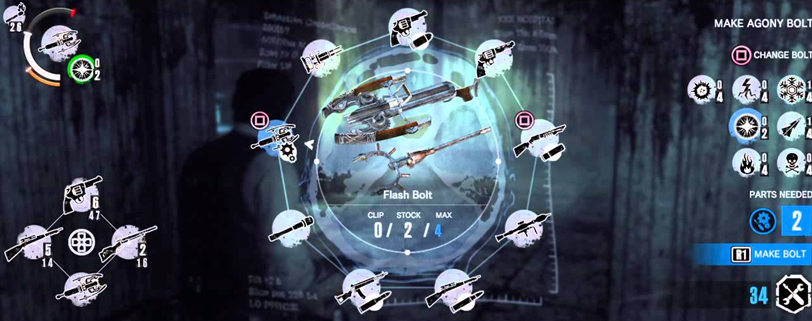
Sebastian is afforded all the usual weapons you should expect from a survival-horror videogame; begins with a simple pistol but soon acquires a shotgun, the aforementioned Agony Bolt, a sniper rifle, and even a magnum as the game progresses. These can usually be found in attaché briefcases so be sure to explore your environments fully to get your hands on more weapons and ammo, and Sebastian can also make use of nearby bottles to throw at and bash enemies with, pipebombs, and explosive barrels (which he can also awkwardly kick around to best destroy enemies). In addition, the Agony Bolt can shoot multiple different types of arrows, from explosives to freezing blasts to stun shots, all of which can be either found in the environment or crafted with a simple press of a button from the inventory menu.

Find Green Gel to upgrade Sebastian’s abilities, ammo, and weapons.

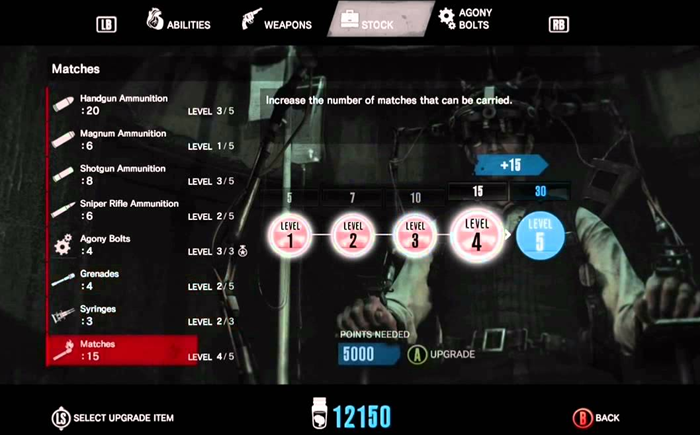
At numerous points throughout each chapter, you’ll find mysterious cracked mirrors that transport you to the save room. Here, you can use any keys you find from breaking special statues to open up lockers and access some extra ammo and also use your Green Gel in a very ominous looking chair. This allows you to upgrade Sebastian’s abilities, such as his maximum health and stamina and melee damage output, and weapons, allowing you to increase your maximum ammo capacity, reload time, accuracy, and overall effectiveness for each weapon. It’s worth stockpiling Green Gel and spreading it wisely to increase Sebastian’s health and the amount of matches he can carry while also focusing on each weapon at a time; I favoured upgraded the shotgun and saved that for the more troublesome enemies but you may prefer to upgrade the Agony Bolt or sniper rifle.

Additional Features:
There are forty-one Achievements on offer in The Evil Within, many of which require a bit more strategy to unlock than simply clearing every chapter. Indeed, almost every chapter of the game has a specific requirement to unlock an Achievement, such as defeating a Sadist with a stealth kill, surviving an onslaught of enemies without Joseph being hurt, or killing Laura rather than simply outrunning her. You’ll also get Achievements for more mundane things, such as stealth killing five enemies in a row without being discovered, upgrading weapons and skills, or killing a certain number of enemies in specific ways, as well as finishing the game on higher difficulties or without any Green Gel upgrades.

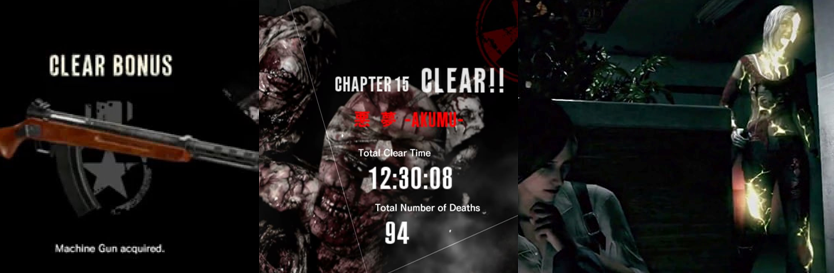
Clear the game to unlock bonus weapons, new difficulty levels, or purchase the DLC for extra story content.

The game has four difficulty settings, with two available right from the start; while you can lower the difficulty at any time, you can’t raise it and, after finishing the game, you’ll unlock additional weapons to use in the ‘New Game+’ mode, which allows you to replay any chapter on the difficulty you cleared it on. You’re also given 50,000 Green Gel points to spend and unlock a model viewer but, annoyingly, your rocket launcher and machine gun have limited ammo, meaning you can’t just plough through the game’s chapters willy-nilly. Still, it does give you the edge in tracking down any statue key, map pieces, and documents you missed the first time through and working toward 100% completion. There are also a couple of expansion packs available to download that add an extra thirty Achievements to the game in addition to expanding upon the story with new playable characters and enemies to battle. I haven’t actually bought this, however, so it’s not my place to comment upon it but the game was appealing enough that I may explore this extra content later down the line (or if there’s a sale on).

The Summary:
The Evil Within certainly was a disturbing head-trip of a videogame; very little about it makes sense as you play it, with the events appearing to be the result of Sebastian slowly going insane but eventually being revealed to be the results of some bizarre experiment that, even now, I’m a bit unclear on. The result is a very unpredictable and gameplay experience full of unsettling imagery and enemies, gore, and ghastly creatures of all shapes and sizes that pull from a variety of other media and horror elements and mash them together in a truly nightmarish and ominous videogame that maintains a constant sense of dread and anticipation as you’re never quite sure what’s going to happen next as Sebastian is battered and tossed all over the place through a constantly shifting nightmare world.

While it can be annoying and tedious, the game does a great job of conveying a macabre and ominous dread.

Having said that, though, there were a few flaws in the game. It’s not always immediately clear where you need to go as environments tend to look the same (especially in chapters set within the hospital or similar locations), some of the boss battles and enemies were ridiculously unfair thanks to them having one-hit kill moves in their arsenal (something I’m always frustrated by), and expanding Resident Evil’s save rooms out to a whole area was a bit laborious at times when I just wanted to quickly save without having to trudge about in the slowly-dilapidating hospital foyer. Still, it was a harrowing experience, one that really conveyed a tangible sense of dread and horror; Sebastian might not be the most compelling or dynamic character but his “Everyman” persona worked well with the increasingly insane and macabre things he was faced with and it was nice to feel that sense of foreboding menace once again, even if the game does veer more towards action than survival-horror thanks to you have just enough ammo and resources to get through each chapter rather than having to constantly worry about inventory management.

My Rating:

Rating: 3 out of 5.

Pretty Good

Are you a fan of The Evil Within? Did you enjoy the game’s ominous atmosphere and mind trip of a story or was it too derivative for you? What did you think of Sebastian as a protagonist, his supporting cast, and Ruvik as the main antagonist? Did you enjoy all the allusions and references to other survival-horror videogames and horror media or do you feel like that got in the way of the game’s more unique qualities? Would you like to see more from the Evil Within franchise? Which survival-horror videogame or franchise is your favourite and why? Whatever your thoughts on The Evil Within, or survival-horror in general, drop a comment down below.
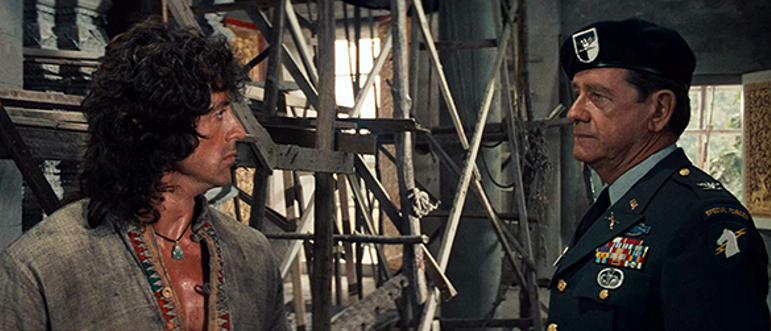
Movie Night: Rambo III

Released: 25 May 1988
Director: Peter MacDonald
Distributor: TriStar Pictures
Budget: $58 to 63 million
Stars: Sylvester Stallone, Richard Crenna, Kurtwood Smith, Marc de Jonge, and Spiros Focas

The Plot:
Three years after the previous film, events in Vietnam, former United States Army Special Forces soldier John J. Rambo (Stallone) has settled in a Thai monastery. Finally content, he refuses to assist his former commander, Colonel Sam Trautman (Crenna), in assisting Mujahideen tribes in Afghanistan against Soviet forces. However, after Trautman is captured, Rambo immediately agrees to undertake a solo rescue on the condition that he will be disavowed in the event of capture or death.

The Background:
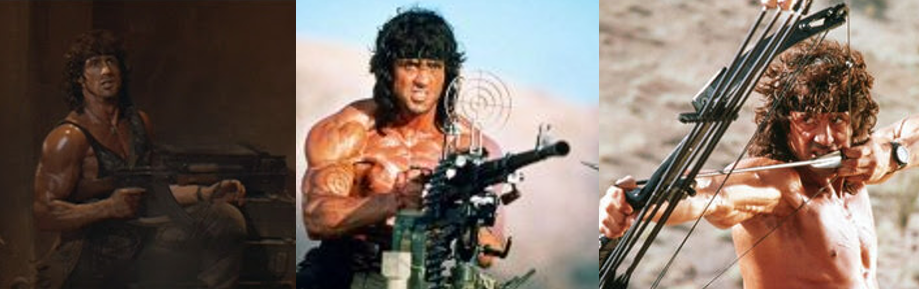
The impressive box office success of First Blood (Kotcheff, 1982) led to the even more financially successful Rambo: First Blood Part II (Cosmatos, 1985), which transformed the character from a tormented Vietnam veteran and into an explosive, one-man army of an action star. This time around, Stallone was even more hands-on with the production of the film as he not only helped write the script but also hired Russell Mulcahy as the direct…and then promptly dismissed him after creative differences. Sadly, this time around, Rambo III was a box office disappointment after grossing just $89 million (which, while slightly more than First Blood, was a massive drop compared to the sequel). Although Rambo III was also met with mixed reviews, it was the most violent action film ever made at the time and its ludicrous body count was only surpassed by its eventual follow-up.

The Review:
Having witnessed first-hand the treatment and abuse he receives in his home country, and having extracted a measure of revenge upon Vietnam for his experiences during the war, Rambo is, understandably, quite disillusioned and reluctant to be a part of “normal” society and has, instead, retreated to Thailand. Here, he desperately attempts to reconcile his two sides (the side that wants peace and the side that craves conflict) by helping to reconstruct and repair a Thai monastery and earning money for the monks by participating in brutal underground fights.

Despite seeing how badly war affected Rambo, Trautman encourages him back into the fight.

Tired of war and content with his newfound life, Rambo is dismissive and uninterested when Trautman and United States field officer Robert Griggs (Smith) arrive with a new mission for him. This is in stark contrast to the previous film, where Rambo signed up to Trautman’s mission (though somewhat begrudgingly) in order to rescue prisoners of war from the same torture he endured and face his demons in familiar surroundings. It’s also a far cry from Rambo’s emotional breakdown at the end of First Blood, where he defiantly declared that “Nothing is over!”; now, he declares that his war is over and that he’s finally at peace. Trautman, however, sees through his claims and believes that Rambo is hiding and denying his true self; it’s an interesting exchange based on their experiences in the previous films, where Trautman was sympathetic towards Rambo’s plight and claimed to have “made” him. Now, his argument is that Rambo was always this way and he (as in Trautman) simply pointed him in the direction of the enemy and, rather than trying to talk Rambo out of fighting, he actively encourages him to “come full circle” and be the soldier that has brought him so much pain and suffering.

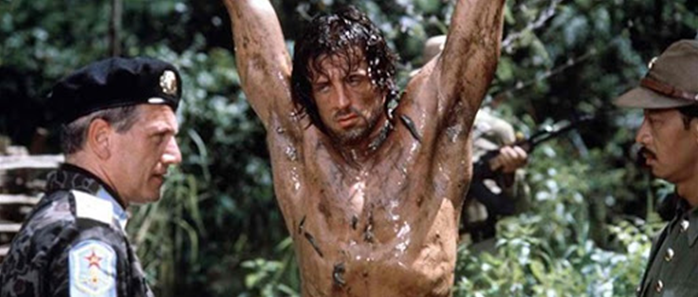
Trautman is captured and tortured by Soviet terrorists.

However, Rambo refuses and, honestly, after everything we’ve seen from him, I can’t say that I blame him. But, without Rambo by his side, Trautman is captured by Soviet forces. When Griggs informs Rambo of this, Rambo immediately volunteers to go in, alone and off the books; this time around, at least, Rambo is told upfront that the government will deny any official knowledge of the mission and leave him to be tortured and killed so there’s no subterfuge or deception regarding this mission. Rambo’s motivation for volunteering is based purely out of the loyalty and respect he still feels for Trautman and his mission takes him to Afghanistan and in conflict with the Soviet forces, led by Colonel Alexei Zaysen (Marc de Jonge) and Sergeant Kourov (Randy Raney).

Zaysen and Kourov have different approaches that make them a significant threat.

Zaysen is largely similar to Lieutenant Colonel Sergei T. Podovsky (Steven Berkoff) from the last film; enigmatic and threatening, he attempts to intimidate Trautman with his eloquence. Trautman, however, is defiant and contemptuous towards Zaysen and his unwinnable war against the rebellious Mujahideen even while enduring ruthless torture at the hands of Zaysen and Kourov. Zaysen is very much the cool, calculating commander who only gets involved with the dirty work when his prisoners are held at his (or Kourov’s) mercy but grows increasingly frustrated by Rambo’s interference and disruption while Kourov is the more sadistic and brutal of the two and acts as Zaysen’s muscle.

Rambo’s greatest allies are, again, his grit, adaptability, and unmatched skills in warfare .

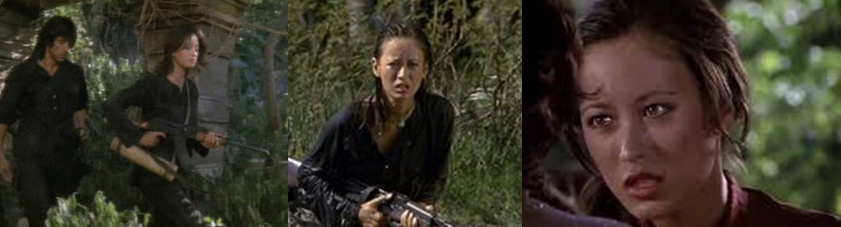
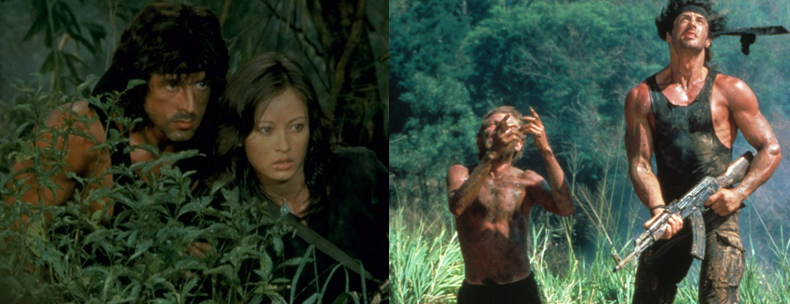
Thanks to the presence of the Mujahideen, Rambo is, again, not entirely alone in his campaign but, intimidated by the Soviet’s power and numbers, the tribe are reluctant to help Rambo beyond informing him of the general layout of the Soviet base. Indeed, for his initial assault on the base, Rambo is joined only by his guide, Masoud (Focas), and a young Mujahideen boy, Hamid (Doudi Shoua); the two join him against his wishes and it is through their inexperience that we get so see how cagey Rambo is, as he spots traps they don’t. Once again, Rambo’s greatest advantage for most of the film is his stealth, which allows him to enter the base undetected (by hiding up in the rafters and clinging on the bottom of a tank!), acquire weapons, and plant a number of explosive charges throughout the base to deal significant damage.

The Nitty-Gritty:
Similar to the second film, Rambo III wastes little time in reacquainting viewers with Rambo and his newfound life but, again, builds towards its more explosive and action-packed moments. A great deal of time is spent dwelling in the Mujahideen village and watching as Rambo learns their ways and customs; apparently, Rambo has the time to waste talking with Masoud and Hamid and participating in the tribe’s odd (and, if we’re honest, quite cruel) idea of sport rather than formulating a reasonable plan of attack and, as a result, it’s no surprise when the village is suddenly attacked and destroyed by the Soviet’s attack helicopters. As a means to further add to Rambo’s motivation, this isn’t quite as effective as the brief romance from the last film; he’s gained a greater appreciation for the simple life and the ways of the innocent, for sure, but this attack mainly exists to explicitly show how persecuted the Mujahideen are and as an excuse to add to the film’s incredibly-high body count.

Rambo has transformed into a full-blown, mindless action hero for his third outing.

Once the killing starts in earnest, Rambo III almost descends into a parody of the high-octane action films of the time; casting aside all attempts at stealth and subterfuge, explosions and gunfire fill the screen as Rambo wages his largely one-man war and the Soviet forces being blown all over the place and running head-first into a hail of bullets while Rambo stands completely still and out in the open. The firefights actually remind me a lot of Commando (Lester, 1985) in that way and you can’t tell me that the ridiculous conclusion of that film, where musclebound hero John Matrix (Arnold Schwarzenegger) literally mows down hundreds of miscellaneous bad guys in very much the same way, wasn’t an influence on Rambo III’s absurd action scenes.

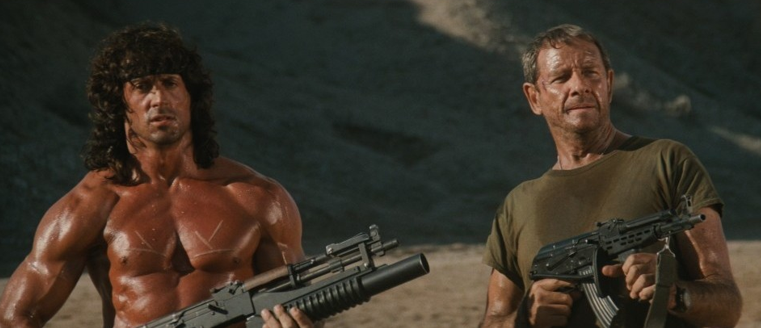
When teamed up with Trautman, Rambo is suddenly dropping quips and one-liners!

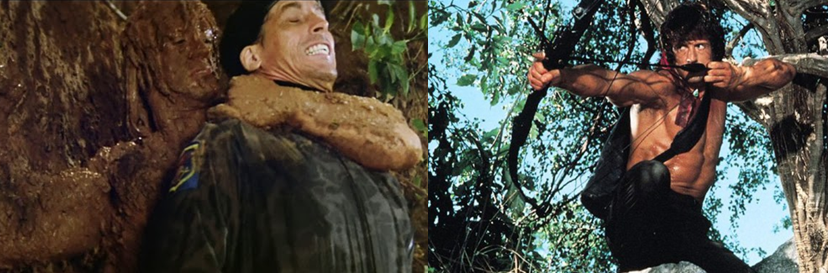
Nowhere is this more explicit than in Rambo’s brutal fist-fight with Kourov; a mute mountain of a man, Kourov poses a significant physical challenge for Rambo and results in the most visceral and brutal fight scene of the film as Rambo manages to not only knock Kourov down a pit with an impressive spinning kick but also breaks his neck and blows him up with a grenade! To top this elaborate death, Rambo III ends with an explosive and ludicrous showdown with Zaysen; with Zaysen piloting a gunship and Rambo at the controls of a tank, Rambo III ends with one of the more unique vehicular firefights I can recall and yet, as a massive fan of Commando and mindless action, I’m okay with this. Seeing Rambo completely unhinged and gunning down or blowing up countless bad guys is very thrilling and it’s even more exhilarating to see him and Trautman finally in the thick of it together. Previously, Trautman was little more than Rambo’s friend and publicist and, while he said that he had been in the midst of all the horrors of Vietnam in First Blood, we only saw Rambo’s time as a victim or torture or out in the field so it’s nice (well…not “nice” but refreshing, maybe?) to see Trautman getting his hands dirty rather than being safely out of harm’s way. Even more surprising is the banter between the two when they’re out in the field; Rambo had a few little quips here and there in the second film but he’s full of little snarky comments this time around which, while amusing and help to cement the unique bond between these two, do feel a little out of character for the normally tormented and focused Rambo.

The Summary:
In a lot of ways, Rambo III is very similar to Rambo: First Blood Part II but lacking even the small amount of nuance and subtext that film had compared to the first. Everything has been dialled up to eleven this time around, transforming Rambo from a haunted, persecuted veteran and into another snarky action hero. With more explosions, more bullets, and a far greater body count that the previous film, Rambo III is almost a parody of the second film and it definitely feels as though Stallone was trying to compete against other over the top action films of the time. As a fan of the genre, I’m okay with this as mindless, explosive action and gun fights are always fun but it can’t be denied that something has been lost in emphasising these aspects. Although Trautman accuses Rambo of denying his true self by hiding in Thailand, it’s pretty obvious that Rambo is much more at peace at the start of the film and perfectly happy to have left behind his war and put his skills to use in building, rather than destroying, while indulging his more animalistic sides in stick fighting. In a lot of ways, it makes very little sense for Trautman to even want to deny Rambo the peace he’s found and I can’t help but feel like the film might have landed a little better if Trautman had never visited Rambo to ask for his help and we’d spent a little more time getting an idea of Rambo’s mentality so it meant a little more when he found out that his friend was in trouble.

My Rating:

Rating: 3 out of 5.

Pretty Good

Are you a fan of Rambo III? How do you feel it holds up today, especially compared to the first two films and the sequels? Were you disappointed that the film emphasised violence and action more than its predecessors or were you a fan of its glorious excess and action tropes? What did you think to Trautman’s extended role? Would you have liked to see more of Rambo’s new life to make his decision to return to war more meaningful? Which Rambo film is your favourite? Whatever you think, feel free to leave a comment below and be sure to check out my other Rambo reviews.

Screen Time: Swamp Thing

Air Date: 31 May 2019 to 2 August 2019
UK Distributor: Netflix
Original Network: DC Universe
Stars: Derek Mears, Crystal Reed, Andy Bean, Will Patton, Virginia Madsen, Kevin Durand, Maria Sten, and Jeryl Prescott

The Background:
Although the monstrous swamp creature known as Swamp Thing first appeared in July 1971, the character is best known for his Alec Holland incarnation, though both characters were created by writer Len Wein and artist Bernie Wrightson. Not to be confused with a similar swamp monster published by Marvel Comics, the Man-Thing, Swamp Thing has long been personified as the protector of the “Green” and all environmental life. Considering how obscure the character is, Swamp Thing has quite a lucrative history in adaptation; he received two live-action horror/comedies in the 1980s, a spin-off live action series, a cartoon, and often crops up in animated ventures and videogames. Development of a new horror series based on the character began in 2018; ostensibly produced to provide more content for DC Universe, DC’s now-defunct video-on-demand streaming service. Existing in a separate continuity to other DC live-action shows, Swamp Thing was cancelled almost as soon as it began airing because of creative differences and financial concerns, which killed any plans for follow-up seasons and spin-offs. Despite this, Swamp Thing was generally very well received and the popularity of the show, in addition to the character’s very brief cameo in the Crisis on Infinite Earths crossover (Various, 2019 to 2020), has left the vague lingering hope that Swamp Thing might be integrated into the “Arrowverse” in the same was as Matt Ryan’s John Constantine.

The Plot:
When a deadly illness hits a small town in Louisiana, Doctor Abby Arcane (Reed) is sent to investigate and begins to suspect that disgraced scientist Alec Holland’s (Bean) research may be related to the outbreak. However, in the midst of her investigation into shady businessman Avery Sunderland (Patton) and the mysteries of the nearby swamp, Alec is suddenly killed but appears to live on as a monstrous swamp creature.

The Review:
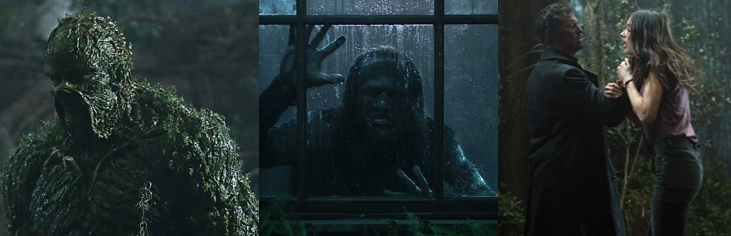
All throughout Swamp Thing, the swamp is treated as a dark, ominous force that stalks intruders and actively hunts those who venture within it, no matter their intentions. Thanks to the dumping of mutagen accelerator, the swamp is alive, malevolent, and brutally kill those who invade its depths, and its influence has begun to spread into the nearby town of Marais, causing a debilitating virus known as the “Green Flu”. The town is understandably disturbed by the virus but also believes that the swamp, their primary source of income, is responsible and is striking back at those who would seek to destroy or damage it. Local businessman Avery Sunderland, who has brought prosperity to the town, is fascinated by the swamp after witnessing its power as a boy when his father, Burritt (Steve Wilcox), was murdered by the swamp for attacking one of its trees was when Avery was a boy.

Abby is puzzled by the Green Flu, which appears to be connected to Alec’s research.

The mysterious plague brings Abby back to Marais, her hometown; she’s a pretty, smart CDC doctor who immediately and affably takes charge of the hospital staff and the organisation of a response team but is haunted by memories of her childhood in Marais. Though stumped by the potency of the disease, which mutilates its victims with swamp life and roots and is capable of reanimating corpses into violent planet creatures, Abby’s investigation is aided Alec Holland, a quirky and mysterious but brilliant biologist who clearly knows more about the infection than he’s letting on. His research focuses on dangerous mutagens, which he has identified growing and mutating out in the swamp, and he explicitly demonstrates to Abby that the swamp is growing aggressively and malevolently and causing the disease. Although unsure of Alec’s odd demeanour, he and Abby quickly pool their talents; a quick Google reveals to Abby Alec’s sketchy past, which saw him disgraced after manipulating data to prove his theories, but instead of arguing, they bond over their past mistakes and remain focused on figuring out the Green Flu. During their efforts, they are horrified to witness the swamp’s malevolent effects but, right when they are on the cusp of figuring out how the Green Flu came about, Alec is suddenly shot and killed.

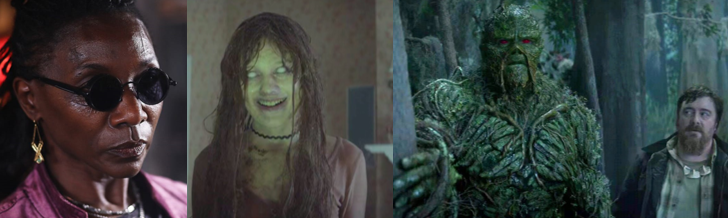
Swamp Thing isn’t the only thing brought to monstrous life by the swamp’s malevolent forces.

In his place is a large, monstrous bog monster (the titular Swamp Thing) that emerges from the swamp in a confused and agonised daze and, for a brief period, has a strange connection to Susie Coyle (Elle Graham), a young girl infected by the swamp. Susie is able to sense Swamp Thing’s emotions and even see through his eyes, to an extent, which causes her a great deal of distress, nightmares, and to leave the hospital in search of Swamp Thing. There, she witnesses two of men dumping the mutagen, a particularly brutal murder, and Swamp Thing violently attack and kill one of the men, Munson (Micah Fitzgerald), using the roots and branches of the swamp. Now able to communicate with the swamp and other plant life (known as the “Green”), Swamp Thing is functionally immortal as he’s able to almost immediately heal from any injury and has no need for his plant-like organs. Thanks to Swamp Thing’s unique connection to the swamp, Abby is able to suppress the Green Flu but this also alerts him to a foreboding, oncoming Darkness that has spread death and devastation throughout the swamp. When the Darkness manifests as the Rot, it reanimates Munson’s body into a zombie-like creature who spews and controls insects and goes on a killing spree until Swamp Thing defeats it. He’s also instrumental in curing and counteracting an infection that spreads from the Darkness and causes this exposed to see disturbing, nightmarish visions of their worst fears that lead them to violently injure and kill themselves and others in a frenzied panic.

Maria regresses when Abby returns to town and soon descends into mania and insanity.

Abby’s return to Marais causes quite a stir for many characters; for her childhood friend, Matt Cable (Henderson Wade), who is now a police officer, she reawakens his childhood feelings for her. These drive him to accompany her into the swamp and to aid with her search for Alec, much to the chagrin of his mother, Lucilia (Jennifer Beals), who is also the town sheriff. Resentful and distrustful of Abby, Lucilia dissuades Matt from helping Abby, believing her to be nothing but trouble who will just break his heart, but, when Matt learns that Lucilia is little more than a corrupt official who has lied about his true parentage and been covering up evidence of Avery’s wrongdoings, he begins to consider transferring to a different department. Lucilia, who murders without a thought to protect her son, is driven to conspiring against Avery when she discovers that he manipulated his son into killing Alec, an action that ultimately dooms her to further betrayal and murder. Like Lucilia, Avery’s wife, Maria (Madsen), is extremely perturbed by Abby’s return; blaming Abby for the death of her daughter, Shawna (Given Sharp), Maria is cold and hostile towards Abby and demands that she leave the moment her work in Marais is done. Having struggled with alcoholism after Shawna’s death, Abby’s return causes Maria to regress; she takes to sleeping in Shawna’s death and turns to local blind fortune teller, Nimue Inwudu/Madame Xanadu (Prescott) for comfort, only to be driven to both violence and near madness by Shawna’s vengeful spirit, which possesses Susie and attempts to kill both Maria and Abby. Fully aware of Avery’s transgressions, and having grown weary of him using her wealth to her own ends, she cuts him off and, after conspiring to kill him, appropriates Avery’s research for her own to enter into an alliance with Nathan Ellery (Michael Beach) and the shadowy Conclave Group. Abby also reconnects with another of her friends, Liz Tremayne (Sten), a local reporter who believes that uncovering the truth behind Avery’s shady operation will be her big break. At every turn, even after encountering Swamp Thing, Abby confides in Liz and is met with nothing but unconditional support as Liz takes every opportunity to aid Abby in her efforts to help Alec, solve the mysteries of the swamp, and expose Avery’s true nature.

The supernatural and the macabre are pivotal aspects of Swamp Thing‘s appeal.

Liz’s investigative abilities not only help to lead Abby to Swamp Thing after he is captured by the mysterious Conclave Group but also leads her to Daniel Cassidy (Ian Ziering), an former stuntman and actor who found fame as a live-action version of the superhero Blue Devil and runs a video rental store where Alec lived and worked. Unable to leave Marais due to a supernatural force, Daniel is compelled to assist Abby by the mysterious Phantom Stranger (Macon Blair), who bound him to Marais some time ago, even when this leaves him comatose and trapped in the town. Supernatural elements such as these are a pivotal aspect of Swamp Thing: Xanadu finds her visions and psychic abilities augmented by the dark forces growing in the swamp, Shawna’s ghost spirit torments Maria and Abby, and Alec’s presence haunt Abby, the show, and Swamp Thing himself. The ghosts of his former life echo in Swamp Thing’s dreams alongside disturbing visions of numerous dead bodies, which the Phantom Stranger explains are actually the memories of all the events the trees and the swamp and the Green have witnessed over the centuries. The Phantom Stranger encourages Swamp Thing to hold on to the humanity still in his heart and soul and to embrace his newfound connection to the Green, which allows Abby the see the truth about Shawna’s death, but it is through his continued relationship with Abby that Swamp Thing finds his most potent connection to his humanity. Desperate to find out what happened to him and return him to normal, Abby reconnects with Alec in the episode “Brilliant Disguise” (Ostrander, 2019), which sees him temporarily reassume his human guise thanks to a mysterious flower. Here, Alec reveals the true extent of the Darkness and the Rot and believes that he has been transformed into a warrior to combat these malevolent forces and, accepting his new destiny, reluctantly asks her to leave and move on with her life.

With Maria committed, Avery ends up little more than a murderer infected by the swamp’s darkness.

Of course, the dark forces in the swamp aren’t the only things Swamp Thing has to content with in the show; Avery’s dumping of the mutagen accelerator was meant to bring him more opportunities for profit and expansion but, after witnessing the power of the swamp and seeing what Alec has transformed into, he begins to manipulate the situation back into his favour. A disreputable and manipulative individual, he Avery regularly engages in extramarital relations with Lucilia (which ultimately turn Maria against him) delivers thinly veiled threats to Abby and Liz when they continue to poke their nose into his business, and purposely exploited Matt to eliminate Alec when he got close to discovering Avery’s plot. A slick and deceptive individual, he’s even able to trick Swamp Thing into trusting him and doesn’t hesitate to twist the narrative in his favour wherever possible, including having his wife committed to a mental hospital and threatening friend and foe alike. I found Avery to be quite an intriguing character and he had a lot of complex layers to him; though both he and Maria were heartbroken at Shawna’s death, Maria’s reaction is far rawer and more aggressive, and Avery is much more accepting of Abby. Rather than blaming her for Shawna’s death, he sees her as a surrogate daughter and regrets not defending her in the past and there’s a genuine sense that he cares for her even when he’s clearly primarily concerned with his own self interests. A master manipulator, he’s able to prey upon Maria’s fragile state of mind and lingering fears about Susie’s health into continuing his funding in order to improve the image of their family in the eyes of the public and the investors. Despite being betrayed by all those around him and having lost everything, Avery remains adamant in his ability to bounce back from his losses out of a pig-headed belief that the town is reliant upon his generosity and influence. With Maria reduced to a mindless shell of her former self, and having learnt that he is Matt’s true father, he attempts to rekindle his relationship with Lucilia only to be adamantly rebuked by her after everything he’s done to her and Matt.

Thanks to Woodrue’s invasive experiments, Swamp Thing is dismayed by the truth about his origins.

Although Lucilia reconciles with Matt, she doesn’t live to see that through as Avery stabs her from the backseat of her car and dumps her body, and the car, in the swamp. By the end, he’s been reduced from an affluent and influential industrialist to a cold-blooded, remorseless killer; he mysteriously spits up a piece of the swamp, hinting that he may have been infected by the Rot. Avery also forges an alliance with Doctor Jason Woodrue (Durand), an unorthodox biogeneticist with an unhealthy obsession with plants who was responsible for creating Avery’s mutagen accelerant and causing the plague. While Woodrue is incredulous since the swamp’s very nature invites disease, Avery is unimpressed with Woodrue’s efforts, which were supposed to allow him to profit and have, instead, brought an unwelcome amount of attention and death to his doorstep. Woodrue is both in admiration of the aggressiveness and potency of the Green Flu and the swamp but also determined to stay support his wife, Caroline (Selena Anduze), as she suffers from early-onset Alzheimer’s disease. Like Abby, Woodrue is astounded by Swamp Thing’s genetic make-up and the regenerative capabilities and, upon discovering evidence of Swamp Thing’s existence, convinces Avery to provide him the resources to hunt down and capture the creature, alive, for further research. Ever the opportunist, Woodrue willingly betrays and allies with each of the Sunderland’s in his desperate bid to find a cure for his wife’s condition; to that end, Ellery provides Woodrue with the proper facilities to continue his research and is instrumental in luring Swamp Thing into a trap to freeze him with nitrogen blasts. Subjected to an invasive examination more akin to an autopsy and subdued by special lights, Swamp Thing is horrified when Woodrue discovers that he has no nerve or pain receptors (despite the fact that he clearly reacts to injury), can survive without any internal organs, and his theory that Alec’s consciousness was merely absorbed by the swamp and given a humanoid form by its mutagenic properties. Disturbed by Woodrue’s claims, Swamp Thing returns to the swamp after being rescued and is devested when he retrieves Alec’s mangled corpse from its depths, confirming that he is merely an autonomous plant creature possessing the shadow of Alec’s consciousness. Thought despondent at this discovery, Abby insists that Swamp Thing is imbued with Alec’s heart and soul regardless and, after mercilessly slaughtering Ellery’s men in retaliation for the suffering they caused him, he is bolstered by Alec’s sprit and Abby’s devotion to stay in the swamp and find a new path for himself against the coming Darkness.

The Summary:
I really enjoyed Swamp Thing; at only ten episodes long, the show is paced incredibly well and the structure is just about perfect; it never feels like there’s any filler and everything flows naturally and nicely and with a real purpose. The show’s emphasis on dark, gritty horror really makes it stand out against other superhero shows and it does a really good job of explaining its unique lore and introducing just enough intrigue to keep you hooked; the supernatural elements are seen as equal parts mysterious and dangerous and beautiful and alluring, and the ominous presence of the oncoming Darkness was a fascinating inclusion that I’m sad to see has not been resolved in the Arrowverse as of late. In many ways, it feels like the showrunners should have tried to slightly rewrite the concept to refer to the destructive anti-mater wave that was the subject of the Crisis on Infinite Earths crossover but I remain hopeful that Swamp Thing’s loose ends will be addressed in some way, shape or form at some point.

Swamp Thing excels in its fantastic and creative use of practical and special effects.

One of the most appealing aspects of Swamp Thing is how well it utilises its special effects; the swamp, a living, largely malevolent being in and of itself, writhes and squirms through a mixture of practical and special effects that reanimates dead bodies with a sickening burst of ever-growing and malicious tentacles but nowhere is its influence more impressively realised that in Swamp Thing himself. Brought to life through the power of an impressive practical suit and augmented by animatronics and just the right amount of CGI, Swamp Thing is both impressive and horrific in his appearance thanks to an abundance of dark lighting, shadows, and well-framed shots but he also impresses when seen in full lighting. It seems like the showrunners wisely put a great deal of Swamp Thing’s budget into the titular creature, which results in them creatively cutting corners when it comes to Blue Devil. Sadly, we never get to see a clear shot of Blue Devil, who slaughters the Conclave’s goons through the power of frenetic and blood-soaked editing; to be fair, though, this does work to emphasise the brutality, horror, and mystery of Blue Devil. Performances are strong throughout Swamp Thing; Crystal Reed is a fantastically alluring lead actress, carrying just the right mixture of gumption, intelligence, and empathy. She feels a tremendous amount of guilt over her part on Shawna’s death and is both heartbroken and desperate to try and help Alec after he’s transformed into Swamp Thing. Similarly, while she’s little more than a supporting character, there’s a surprising amount of depth to Liz; I was very pleased to see that the two never fell out or had any interpersonal drama and were simply two close friends who supported each other no matter what, even in the face of their own deaths.

Sadly, as good as Swamp Thing was, its loose ends probably won’t be tied up any time soon.

I was impressed with Durand’s range for his portrayal of Woodrue, who is continually torn between his work and his wife just as Swamp Thing is torn between his humanity and the creature he has become, and his descent into insanity and villainy was all the more affecting because he wasn’t just some over the top comic book villain. I was similarly intrigued by Patton’s performance as Avery; a deceitful, manipulative character who always has the upper hand, he fought and clawed against his descent from his lofty position and always had another scheme, another option, at hand to try and turn things to his advantage. The only real issue I had, in fact (apart from the show being cancelled) was that Susie seems like she’s going to be important but basically disappears from the show after a few prominent episodes and her connection to Swamp Thing is not as pivotal as it seems at first. Honestly, it’s a real shame that Swamp Thing was cancelled almost as immediately as it started as it was very entertaining as a horror/mystery show and was a very different type of comic book adaptation. The show was also packed with some clever additions and references to the wider DC universe; Adrienne Barbeau, who starred in the first live-action movie, makes a cameo appearance as the CDC’s new assistant director, the Phantom Stranger was a surprising and welcome inclusion, and the show even does a good job of bringing Blue Devil to life when Daniel eventual transforms into an actual, fire-breathing demon. The show even ends on a massive cliff-hanger when Woodrue, driven to madness by his wife’s accidental overdose and his obsession with curing her, ingests Swamp Thing’s organs and transforms himself into the Floronic Man.

My Rating:

Rating: 5 out of 5.

Fantastic

Were you a fan of Swamp Thing? Did you enjoy the show’s emphasis on horror and practical effects or was a bit too obscure and dark for you? What did you think to the Swamp Thing suit and effects and Derek Mears’ performance as the character? Which of the show’s characters and sub-plots was your favourite and did you enjoy the inclusions of names like the Phantom Stranger and the Blue Devil? How well do you think the show did at adapting the source material and were there any characters and plots you would have liked to see included in the show? Were you disappointed that Swamp Thing was cancelled and would you like the see the character and the show’s loose ends tied up in the Arrowverse? Whatever your opinions on Swamp Thing, leave your thoughts down below.
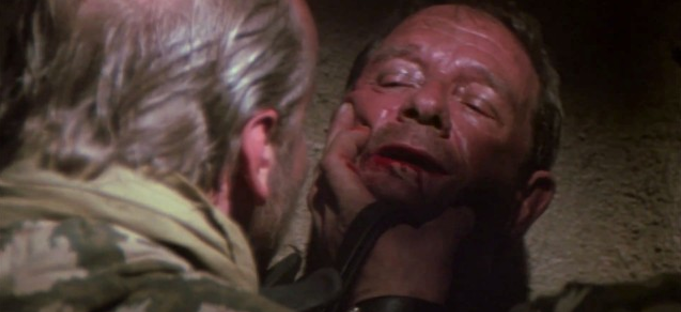
Movie Night: The Void

Released: 22 September 2016
Director: Steven Kostanski and Jeremy Gillespie
Distributor: D Films
Budget: $82,510 (minimum)
Stars: Aaron Poole, Kathleen Munroe, Daniel Fathers, Mik Byskov, and Kenneth Welsh

The Plot:
Deputy Sheriff Daniel Carter (Poole) brings an injured man to a hospital to treatment and is soon trapped inside by a hooded group of psychopaths. When Vincent (Fathers) and Simon (Byskov) violently enter the building looking to kill Carter’s patient, the few occupants find themselves under threat from horrific creatures that dwell within the hospital’s dark catacombs and tangled up in a doctor’s twisted desire for immortality.

The Background:
I don’t quite recall exactly how The Void came to my attention; it was probably including on one of WhatCulture’s many lists that I routinely watch on YouTube in an attempt to discover new avenues of horror or science-fiction that may have otherwise passed me by. Regardless, The Void was crowdfunded by directors Steven Kostanski and Jeremy Gillespie after the latter was inspired by overhearing fellow director Guillermo del Toro’s desire to see a fresh filmic take on the works of H. P. Lovecraft. Having amassed a small budget to cover the cost of their creature effects, and following a difficult shoot, the low-budget production made its debut at Fantastic Fest on 22 September 2016, its Canadian premiere at the Toronto After Dark Film Festival in the following October, and, while a limited release only saw it make just under $150,000 at the box office, the film received strong reviews for its gruesome practical effects and bleak tone.

The Review:
I went into The Void with few expectations and little to go on other than that it seemed to be a low budget horror affair in the vein of the likes of H. P. Lovecraft and came out it if relatively surprised. It wasn’t what I expected it to be (the misleading box art and posters, which hint towards an otherworldly beast of some kind, didn’t help) but once I got over that and caught on to the film’s basic premise and brand of mindfuckary it proved to be a decent enough experience. Is it perfect? Of course not, but then few films ever really are. When it comes to low budget horror, though, I am satisfied as long as the acting isn’t too corny, the film isn’t full of shaky cam and piss-poor lighting, and that it uses what resources it has well. Thankfully, The Void ticks all these boxes since it’s not filmed as a found footage movie and isn’t full of annoying handheld camera movements and it makes effective use of lighting and darkness to create just enough tension and horror rather than bathing the film in a sea of black.

Carter is a decent enough protagonist and is something of a flawed, but relatable, hero.

As for the acting…well, it’s serviceable enough. It’s hard to expect much from a cast of unknowns (well, they’re unknown to me, at least, with the exception of Ellen Wong) but the handful of actors we do have do a decent enough job at conveying enough emotion and personality to help drive the plot forward, Aaron Poole makes for a pretty believable and relatable everyman; he’s constantly living in the shadow of his hero cop father, tormented by the loss of his child, and constantly on the back foot despite his best efforts to calm the situation and take charge. While he does appear somewhat ineffectual and comical at times (it seems he’s getting attacked and/or knocked out every five minutes in the film’s first half), this largely serves to make his character more human and vulnerable; Carter isn’t some flawless action hero, he’s just a regular cop in an extraordinary and terrifying satiation who is trying to do his best and I think that comes across quite well.

Allison is a competent and capable character in her own right.

Supporting Carter are his ex-wife, Allison Fraser (Munroe), and a handful on staff at the hospital who are largely just innocent bystanders and/or cannon fodder for the film’s gruesome monsters. Like Carter, Allison is a relatable and likeable enough character; clearly she still has feelings for her ex and they have unresolved issues after their child’s still-birth and she is oftentimes exasperated by his stubbornness and the loose ends they have yet to tie up but she is surprisingly cool under pressure and proactive, rushing off to get pain relief for the pregnant Maggie (Grace Munro) despite the danger and trying to calm tensions as the rise.

There might be more to Vincent but he remains a hard-ass regardless.

Opposing Carter and his fellow victims are not just a group of nameless, faceless hooded figures with knives but also Vincent and Simon, two hot-headed and potentially dangerous individuals who burst into the hospital to kill James (Evan Stern) because of a previous run-in with him and the aforementioned hooded assailants. Though Simon was injured and cannot talk, he grows to become the more humane and level-headed of the two but, honestly, I gravitated a bit more towards Vincent as the film’s reluctant hero. He never truly fulfils this role, however, remaining a loud-mouthed, confrontational, self-absorbed asshole for the majority of his screen time even as he’s sacrificing himself to give Simon a chance to escape. Such aggressive anti-heroes are commonplace in life-or-death situations seen in horror films but, while Vincent does begrudgingly agree to help Carter, he never quite steps into the role of a true hero, which is a shame but, at the same time, has a certain realistic undercurrent to it.

The Void goes out of its way to keep things as vague and horrific as possible.

The film’s premise is pretty simple but is made far more complex by The Void’s commitment to keeping things as vague and unexplained as possible. Even when Dr. Richard Powell (Welsh) is revealed to be responsible for the carnage that has unfolded and is expositing his motivations, it’s all very cryptic and vague and left largely up to the viewer to interpret. Ultimately, it doesn’t really matter; it’s one of those situations where the horrific and impossible has happened and the film’s characters, like us, just have to deal with it as best as they can. They are besieged by maniacal hooded figures, betrayal and mistrust, an ever-warping reality, and some truly ghastly looking creatures and, in the end, the primary concern becomes one of survival rather than exposition.

The Nitty-Gritty:
As I said, I went into The Void expecting a slightly different movie; I imagined it to revolve more around characters drawn into some ancient and demonic cult who wish to conjure some grotesque creature from beyond out world but, instead, it’s kind of a siege move as our protagonists are trapped inside of a hospital and unable to escape, left at the mercy of the creatures that prowl its dank catacombs. The majority of The Void’s budget was apparently spent on developing the film’s practical creature effects and it really pays off; there are no computer-generated monstrosities here, just good, old-fashioned rubber and latex and large, man-made fiends that are disgusting to look at and terrifying in their design. What’s better is that The Void’s monsters vary; the first one we see is this weird, tentacle-spewing, almost insect-like human/monster hybrid but Powell’s experiments have birthed all kinds of abominations, from chewed up torsos to zombie-like corpses.

Powell returns to life in a decaying, monstrous, undead form.

After suffering a fatal stab wound, Powell dies but, thanks to his experimentations with what is presumed to be the occult or some kind of similar, ancient dark magic, he returns to life undead and changed, determined to use the techniques he learned from the titular Void to bring his deceased daughter’s soul back to life. In his undead form, Powell is far more than a bloodied, unfeeling zombie; he mutilates his own flesh and skin but remains articulate, intelligent, and focused the entire time, offering the survivors their deepest desires if they but willingly join his cause. However, while being united with dead loved ones or gaining the power of immortality may be tempting, Powell’s methods are…questionable, at best, and their results are macabre to say the least. First of all, those he experiments on are violently torn apart and transformed into grotesque monstrosities that live only to devour human flesh with their tentacles. Thus, when he offers to restore Allison’s unborn child, she is exploded into a vine-like eldritch nightmare than Carter is forced to put out of its misery with an axe and, when he successfully brings his own daughter back to life, it is as a hulking, bestial affront to life than crushes skulls beneath its weight.

The Void excels once its horrific creatures rampage throughout the hospital.

In the end, The Void leaves the viewer with more questions than answers; it’s never made clear how Powell discovered the dark other realm he draws his power from, or quite what it is he found in there. There is simply the terrifying suggestion that there is more to the world, the reality, that we know and that death can lead to a monstrous rebirth in the right circumstances. Carter, dying from a fatal stab wound and determined to ensure that Powell’s threat is forever destroyed, doesn’t hesitate to tackle the insane doctor into the unknowable Void, sacrificing himself to close the demonic realm off from ours and leaving it up to the viewer to interpret just what all those triangles and nightmarish imagery means.

The Summary:
The Void was a suitably thought-provoking and disgusting little mind-fuck of a movie. Its premise is pretty simple and cliché, to a degree, but elevated by the quality of its practical effects and the more obscure elements it pulls from the work of writers like H. P. Lovecraft. In a world where CGI largely dominates, it’s refreshing to see more traditional methods being used for creature and special effects; it gives The Void far more appeal for its imagery and monsters alone, though these aren’t necessarily enough to elevate the entire movie up to where it potentially wishes to be. In the end, it’s a decent enough horror film that picks and chooses some of the more macabre and obscure elements of horror fiction that succeeds at being both repulsive with its gore and creature effects and at keeping the audience guessing about what is really going on but it can’t be denied that there are better movies out there that achieved the same goal in much more satisfying ways.

My Rating:

Rating: 3 out of 5.

Pretty Good

Have you ever seen The Void? If so, what did you think of it? Did you appreciate the film’s practical creature effects or do you think the film was aiming a little too high and overreaching a bit in its scope? Do you have a favourite monster/horror film? If so, what is it and why? Can you think of any other horror films that evoke the work of H. P. Lovecraft? Whatever your thoughts, feel free to leave a comment below.
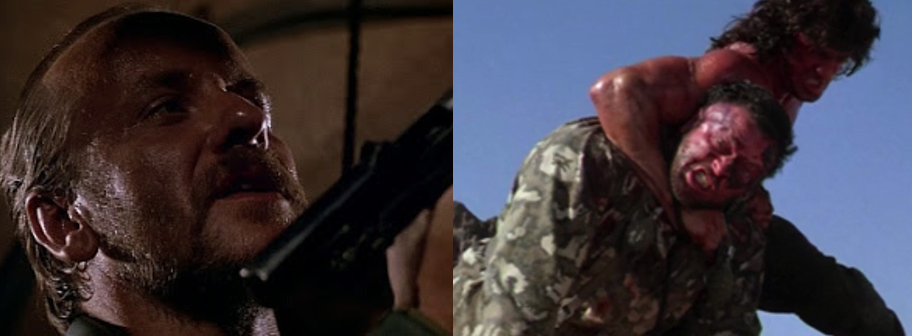
Movie Night: Rambo: First Blood Part II

Released: 22 May 1985
Director: George P. Cosmatos
Distributor: TriStar Pictures
Budget: $25.5 million
Stars: Sylvester Stallone, Charles Napier, Julia Nickson, Steven Berkoff, and Richard Crenna

The Plot:
Three years after the events of the first film, in Hope, Washington, former United States Army Green Beret John J. Rambo (Stallone) is released from a federal prison by his old commander, Colonel Sam Trautman (Crenna). Rambo is assigned the task of confirming reports of U.S. prisoners of war (P.O.W.s) in Vietnam in exchange for a pardon but is quickly forced to once again rely on his extensive combat training after being betrayed by corrupt governmental bureaucratic Marshall Murdock (Napier).

The Background:
After the spectacular box office performance of First Blood (Kotcheff, 1982), a sequel was all-but-inevitable. Initial ideas for the sequel revolved around partnering Rambo up with a sidekick, rumoured to have been played by John Travolta, and legendary movie director James Cameron even came on board to write the film’s script. However, while Cameron was able to capture the more action-orientated focus of the sequel, which plastered Rambo’s name front and centre, Stallone once again stepped in to handle to more meaningful, political subtext of the film. Similar to the first film, Rambo: First Blood Part II was met with mixed reviews; critics were unimpressed with the film’s violence and excess, its lack of poignant commentary and subtlety compared to the first film, and for being a step back for portrayals of foreign threats. And, yet, Rambo: First Blood Part II absolutely smashed it at the box office, making over $300 million (thus making it the most profitable of all the Rambo movies) and propelling the character into mainstream pop culture the very definition of a “breakout sequel”.

The Review:
When we re-join Rambo in Rambo: First Blood Part II, he’s toiling away breaking rocks in a prison labour camp; having accepted his lot, and his punishment, he feels safe and secure inside of the prison. However, when Trautman offers him a highly dangerous reconnaissance mission with the potential promise of a Presidential pardon, he accepts the proposal in the hopes of actually being able to “win this time”. In Thailand, he meets with Murdock, who summarises Rambo’s storied and decorated career and even sympathises with him since he’s a former soldier himself; Murdock debriefs on the specifics of the mission, which is to go into Vietnam, completely alone, to find evidence of P.O.W.s.

Murdock turns out to be a corrupt bureaucrat who cares nothing for those stuck in ‘Nam.

Rambo is ordered not to engage the enemy as a follow-up strike team will handle the extraction and is afforded a great deal of equipment and technological backup…all of which is rendered completely mute when he’s forced to separate himself from all of his equipment to avoid being torn apart during his drop into the jungle. Although Murdock comments on Rambo’s stoic demeanour, Trautman continues to have the utmost faith in Rambo even though Rambo remains unconvinced that Vietnam has changed since he was last there and spots a flaw in Murdock’s backstory. Ultimately, Rambo’s suspicions about Murdock are quickly shown to be true as he’s incredulous to the ill-advised Vietnam war, is determined to pull out after the thirty-six-hour mission time is up, and sabotages Trautman’s attempt to rescue Rambo. A corrupt bureaucrat, Murdock merely wished to sweep all the rumours of P.O.W.s under the rug with a convenient patsy and is perhaps the most significant threat due to his betrayal that leaves Rambo at the mercy of the film’s more sadistic villains.

Rambo is betrayed and left captive at the combined forces of the Soviets and the Vietnamese.

It turns out that the Vietnamese forces, led by Captain Vinh (William Ghent) and Lieutenant Tay (George Kee Cheung), are in league with the Soviets, led by Lieutenant Colonel Sergei T. Podovsky (Berkoff) and his right-hand man, the stoic and barbaric Sergeant Yushin (Voyo Goric). When Rambo is captured during his botched extraction, he finds himself at Podovsky’s mercy and once again enduring unspeakable trauma. However, fuelled by his anger at Murdock’s betrayal, Rambo is able to not only endure this torture but also escape from his captors in dramatic fashion before waging a veritable one-man war against the combined forces of the Vietnamese and the Soviets.

Through Co, Rambo’s humanity is explored in greater depth…but it’s not to last.

Since he had to ditch his equipment during the drop, Rambo is immediately left with little more than hits wits and his trademark hunting knife to see him through. This time around, however, he’s joined on the ground by Co Bao (Nickson), a Vietnamese freedom fighter who arranges safe passage for him up the river. While Trautman continues to talk up Rambo’s unparalleled skills and fortitude, interactions between Rambo and Co explore his humanity and mentality; weary of conflict and the world, the world nevertheless only makes sense to Rambo out in the field and he begrudgingly prefers to be back in the fray if only to be able to recognise his enemy. Although Co fights for similar reasons as Rambo (out of duty and loyalty), she is far more idealistic and naïve than he but still a very capable warrior in her own right and even saves Rambo after he is captured by Podovsky.

Rambo’s skills are made all the more impressive through his adaptability and deadliness.

In First Blood, we saw how adaptable and capable Rambo was and his ability to survive in the wild and subdue his opponents through non-lethal methods; this time around, these aspects are downplayed greatly but are still evident in decidedly different ways. Rambo favours a bow and arrow, for example, in order to make less noise and adopts a sneaky, stealthy approach to his rescue effort and fighting skills to pick off the Vietnamese and Podovsky’s men. However, given that he’s now in the midst of a war zone, all pretence is dropped and we get to see just how skilled of a soldier he is; Rambo shoots arrows through guys’ heads, blasts them to bloody chunks with a shotgun, and brutally stabs them to death with his big ol’ knife, proving to be every bit the remorseless and fierce killer Trautman sold him as in the first movie.

The Nitty-Gritty:
Right from the start, Rambo: First Blood Part II is a very different film to First Blood; there’s very little time wasted in the early going and Rambo is dropped into Vietnam within the first fifteen minutes. However, despite being a much more action-orientated film, Rambo: First Blood Part II’s pace is largely similar to that of the first film and, while the body count is much higher, the action escalates over time and continues to primarily focus on Rambo’s guerrilla tactics rather than just being a nonstop, action-packed extravaganza.

The first chance he gets, Rambo disregards his mission to save the P.O.W.s.

This isn’t entirely surprising and is telegraphed during Rambo’s meeting with Murdock; Rambo is appalled at his orders not to attempt a rescue and, whether due to his own previous experiences as a P.O.W. or because of his suspicions about Murdock, he immediately disregards the reconnaissance mission to rescue one of the P.O.W.s, Banks (Andy Wood), and it’s pretty obvious the Rambo always planned on rescuing the P.O.W.s just as much as he relished the idea of getting a measure of revenge against the Vietnamese forces.

Rambo unleashes all of his pent-up aggression to wage a one-man war against his enemies.

Rambo’s mission is much more personal this time around thanks, firstly to him being betrayed by his own government and, secondly to Tay’s killing of Co right as the two began to explore their mutual attraction. Already fuelled by his traumatic experiences in the Vietnam War, these betrayals and losses and being surrounded by enemies on all sides only drive Rambo to fight harder and more aggressively. He cakes himself in mud, fires explosive arrows at enemy encampments from afar (and makes Tay pay for his actions with a similar arrow), and eventually commandeers a Soviet attack helicopter (after a particularly brutal fight with the indomitable Yushin) to rain unrelenting fire down upon his enemies.

Rambo makes an emphatic statement for all soldiers and P.O.W.s by threatening Murdock.

In the end, Rambo: First Blood Part II delivers an exciting and explosive finale as Podovsky and Rambo engage in a helicopter chase and firefight; Rambo, again displaying how smart and cagey he is, feigns defeat and death to fool Podovsky into hovering in range of a fatal rocket strike and he’s able to carry all the remaining P.O.W.s to safety, leaving Vietnam little more than a smouldering mess. Returning to the base, Rambo then confronts Murdock, destroying his office in an iconic hail of gunfire and demanding that he find and rescue the remaining P.O.W.s held in Vietnam before delivering a sobering monologue and walking off the an uncertain future.

The Summary:
At its heart, Rambo: First Blood Part II is the ultimate redemption story, especially for Rambo; in the first film, he was haunted by his memories and experiences in Vietnam and was on the razor’s edge of sanity and humanity. Now, far more jaded and disillusioned, he’s given the chance at serving once again and helping to rescue fellow soldiers from the same situation and, in the process, dropped right back into the meatgrinder. However, as dangerous and cunning as Rambo was on home soil, he’s (as Trautman says) right at home in the thick of it all and, thanks to his incredible skills and volatile nature, is able to extract a measure of revenge for all the atrocities he suffered in Vietnam. While the body count is higher and the action is bigger, the film retains the same visceral, bleak undertones as the first and delves a little deeper into Rambo’s psyche to explore his vulnerability a little bit more. A patriot at heart, he’s perfectly willing to put his life on the line for his country and his fellow man but all he wants in return is a little respect and gratitude. It’s not a massive part of the film’s plot but this is clearly a story about a man confronting his demons and, while Rambo might lament conflict and be tired of all the killing and chaos, he’s still a savage and wily soldier when pushed into action and this is emphasised even more here since he’s actually in a war zone so he doesn’t have to worry about pulling his punches. In the end, it’s maybe lacking a little of the nuance of the first film but I’d say it’s just as good, if not better in some ways because of the brutality and more explosive nature of the action.

My Rating:

Rating: 4 out of 5.

Great Stuff

What did you think to Rambo: First Blood Part II? How do you feel it holds up today, especially compared to the first film and the sequels? Were you disappointed that some of the nuance of the first film was lost in favour of a far higher body count or do you think the sequel compliments the first in providing Rambo the chance at confronting his demons? What did you think to the brief romantic sub-plot and to seeing Rambo’s skills in the field? Which Rambo film is your favourite? Whatever your thoughts, leave a comment below and be sure to check out my review of the third film.

Movie Night: No Time to Die

Released: 30 September 2021
Director: Cary Joji Fukunaga
Distributor: United Artists Releasing / Universal Pictures
Budget: $250 to 301 million
Stars: Daniel Craig, Rami Malek, Léa Seydoux, Lashana Lynch, Ben Whishaw, Ralph Fiennes, Jeffrey Wright, and Christoph Waltz

The Plot:
Five years after the capture of Ernst Stavro Blofeld (Waltz), super spy James Bond/007 (Craig) has retired from active service to be with his love, Doctor Madeleine Swan (Seydoux). However, when he his old friend Felix Leiter (Wright) asks him to investigate a missing scientist, Bond is brought violently back into the world of betrayal and terrorism when he is pitted against terrorist Lyutsifer Safin (Malek).

The Background:
James Bond, the charming and sophisticated MI6 agent with a license to kill, is the creation of former navy intelligence officer-turned-writer Ian Fleming. As beloved as his 007 novels were, the character was forever immortalised through the late, great Sean Connery, who would be just one of many actors to portray the superspy in perhaps the most successful cinematic franchise of all time. In 2005, amidst much unwarranted controversy, Daniel Craig assumed the iconic role for a gritty, modern reboot of the long-running franchise; Casino Royale (Campbell, 2006) was a massive critical and commercial success and effectively revitalised the series after it had become stagnated. Much to the chagrin of Craig, who became increasingly disillusioned with the role, more successes soon followed, with Skyfall (Mendes, 2012) surpassing Casino Royale’s achievements and Spectre (ibid, 2015) earning rave reviews. Development of the twenty-fifth Bond film began in 2016, with director Danny Boyle initially attached to the project before he bowed out over script concerns. Cary Joji Fukunaga came onboard in 2018 and the film’s title was announced in 2019 but the jury was out over whether Craig would reprise his role. Although Craig eventually signed on to No Time to Die, he stated that the film would be his last go-around as 007 and the script was tailoured to reflect this sentiment. As with al of Craig’s Bond movies, No Time to Die was set to feature a sequential narrative from the previous films and included a number of returning cast and characters; like all great Bond movies, filming took place all around the world and included a number of spectacular stunt sequences. The film’s release was repeatedly delayed due to the Covid-19 pandemic but No Time to Die finally released in the United Kingdom on September 30th to largely positive reviews that emphasised Craig’s performance and the film’s action sequences while criticising the film’s lengthy runtime, and a final worldwide gross of almost $775 million.

The Review:
No Time to Die kicks off with one of the most longest, if not the longest, pre-title sequences in any James Bond film that basically serves a number of purposes; first, we get to see a flashback to Madeline’s childhood where, as a young girl (Coline Defaud), witnessed her mother being brutally gunned down by Safin, a psychotic killer with a bit of a limb and sporting an unsettling Noh mask. Safin’s motivation here is actually somewhat relatable as Madeline’s father, Mister White (Jesper Christensen), killed Safin’s entire family as part of a Spectre assassination. Although Madeline and Bond have retired to Italy to be together, leaving behind Bond’s tumultuous life, but are still haunted by the ghosts of their respective pasts; Madeline promises to reveal this part of her past to Bond after he makes peace with his former love, Vesper Lynd (Eva Green), and in process unwittingly sets Bond’s paranoid into overdrive as he is summarily attacked by Spectre agents, led by Primo/Cyclops (Dali Benssalah), and he separates himself from Madeline to both keep her safe and because he feels he can’t trust her. The film then jumps to five years later, Bond has set himself up in Jamaica and is so far off the grid that MI6 has assumed that he has died. However, when Spectre agents kidnap scientist Valdo Obruchev (David Dencik) to weaponise the devastating “Heracles” virus that MI6 chief, Gareth Mallory/M (Fiennes) developed off the books to specifically target and eliminate individuals while negating collateral damage, both MI6 and the Central Intelligence Agency (CIA) are understandably perturbed at the implications of this virus being in the wrong hands. When M discovers that his darkest secret has been dug up for the world to see, he becomes very cagey and snippy with his employees Eve Moneypenny (Naomie Harris), Q (Wishaw), and Bill Tanner (Rory Kinnear) and demands that Obruchev and his research be retrieved as quickly and surreptitiously as possible. Bond is begrudgingly brought into the investigation by CIA operative Felix Leiter, whom he embraces as an old friend; having been absent from the last two Bond movies, it’s great to see Felix make a comeback, if only briefly, and it’s just one of many heartwarming moments in the film that help humanise Bond, with Bond even referring to Felix as his brother at one point.

Bond is drawn back into espionage after appearing to be betrayed, only to find he’s been replaced.

Bond doesn’t truly return to his former, violent life until he crosses paths with Nomi (Lynch), a no-nonsense, militaristic agent who, in case you couldn’t guess, has replaced Bond as the new 007. The two initially have a frosty relationship, with Nomi brushing off Bond’s advice and experience and basically continuing on her mission with little regard for Bond’s presence. While Bond played it fast and loose with the rules and regulations, Nomi is all business and follows her orders without questions, making for a less glamorous but strikingly efficient spy, but her heckles are raised when M ends up reinstating Bond as an active 00 agent following a tense and heated confrontation between the two. The more they work together, however, a mutual respect develops between the two, to the point where Nomi requests that Bond regain his 007 number (his actual new 00 number is never revealed), and any concerns that Nomi is being setup to replace James Bond in future films are largely dashed as she never takes the spotlight away from Bond and she largely exists as a competent support character for Bond. Bond has a number of other allies helping him both officially and unofficially; when Bond agrees to help Felix, he is partnered with the lovely and excitable Paloma (Ana de Armas), a CIA agent on her first assignment who’s more than capable of kicking ass even while in a very revealing silk dress. Paloma helps Bond infiltrate a mass gathering of Spectre agents, which is revealed to be a trap setup by Blofeld to kill bond using Heracles, however all of Spectre end up being killed instead when Obruchev reprograms the nanobots to target the Spectre agents, which was a bit of an anti-climatic end to one of Bond’s most notorious and iconic evil organisations. After arguing with M over Heracles, Bond works independently to find out more information about the virus and concludes that he needs to gain access to Blofeld; to do this, he asks Moneypenny and Q for help, and they’re able to help him hack into a bionic eye used my Primo to reveal crucial information that gets Bond reinstated at MI6. Q actually plays a surprisingly big role in the film as he’s out in the field on more than one occasion and even communicates with Bond and Nomi through their earpieces in the finale, which is something I’ve never seen in a Bond film before. It does lead to an amusing moment where Q prepares to walk Bond through a complex procedure to open up the blast doors and allow Safin’s base to be bombarded with a missile assault and Bond simply frantically presses every button and pulls every lever.

Safin makes an immediate impression before becoming a bit of a cliché, fanatical villain.

The main villain of the film, Safin, is largely absent for much of the film and left as this mysterious, unknown third party. Instead, most of the film’s early going is focused on the remnants of Spectre, which Blofeld is secretly controlling while being locked up and isolated in prison. He’s been able to do this because he’s been diagnosed as clinically insane and spends his days muttering and mumbling in his cell and refuses to talk to anyone except his psychiatrist, Madeline. This leads to an awkward reunion between Bond and Madeline, and a tense reunion between Bond and his adopted brother; Blofeld delights in taunting Bond and having outwitted him, and the irony that the two now have a common enemy as Safin is specifically targeting Spectre agents and Blofeld himself to get his revenge. Unfortunately, we don’t really get to see too much of Blofeld here, and I continue to be unimpressed with Waltz’s performance as the character, which just a little too quirky and unhinged for my tastes considering how refined the character usually is. Safin picks up some of the slack in this regard, appearing to echo classic bond villains such as Doctor Julius No (Joseph Wiseman), Karl Stromberg (Curt Jürgens), and Hugo Drax (Michael Lonsdale) in his soft-spoken, unsettling menace and sporting a disturbing skin condition. Safin is motivated to kill all of Spectre after they caused the death of his family, but his plot shifts to worldwide mass murderer after he acquires Heracles, which escalates his favoured method of using plants for a variety of nefarious purposes into reshaping the world into his own image. When he’s first introduced, Safin is clad in a white snowsuit and wearing an expressionless mask, resulting in a twisted visage as he hunts down the young Madeline, and the entire sequence is framed like a slasher horror film; however, when Safin finally returns later in the film, he’s set aside his mask and is just another disquieting, unhinged Bond villain in a suit with delusions of grandeur.

The Nitty-Gritty:
One of the most highly anticipated traditions of any James Bond film is the title sequence, in which the chosen song for the film plays over images of scantily-clad women, guns, and other obscure imagery tangentially related to the film. No Time to Die not only brings back the iconic gun barrel sequence (which also gets a call-back later in the film when Bond shoots an assailant down a curved tunnel) but the title sequence even recalls the very first title sequence of the series by bringing back the multiple circular dots that blared at the screen in the opening of Dr. No (Young, 1962), before descending into the usual iconography of guns firing and images of the main actors looking morose. It’s a pretty decent title sequence but for one crucial element; the title song itself, “No Time to Die”, by Billie Eilish. Now, admittedly, I am not a fan of Eilish; I find her music grating, depressing, and uninspiring, but I went into this willing to set aside these prejudices (after all, I’m not fan of Adele or Sam Smith and their Bond themes were pretty good) and remained unimpressed. I just don’t think the song really works; it never properly kicks into a higher gear and just sets a bleak, miserable tone for that the film doesn’t really reflect. The song really should have been a celebration of Bond’s life and emphasised this being the end of an era, and instead just conveys the same dullness of your average gloomy Billie Eilish song. Thankfully, some of these themes of it being a celebration of all things Bond and the end of Craig’s time as the character are revisited throughout the film; Louis Armstrong’s “We Have all the Time in the World” plays in the beginning and ending of the film, which is a nice (if unexpected) call-back to On her Majesty’s Secret Service (Hunt, 1969), and even had me half-expecting to see Madeline gunned down by one of Blofeld’s agents as she and Bond are racing through Italy.

Armed with his most iconic gadgets and teamed with beautiful allies, Bond is as effective as ever.

Additionally, Bond drives his iconic Aston Martin DB5, which is outfitted with all of the classic gadgets of old, and there’s even a touching tribute to Judi Dench and Bernard Lee as portraits of them adorn the walls of MI6. I actually really love the call-backs to classic Bond aesthetics that finally got reintroduced to the series in Skyfall, such as the door to M’s office (and the office itself) while still keeping things grounded in the current times with modern technology. We even get a spin on Bond’s classic watch gadget as Q furnishes him with a watch capable of emitting a short-range, high-frequency electromagnetic pulse that pays off beautifully in offing Primo (but is apparently unable to affect the nanobots coursing through Bond’s bloodstream, which is where I expected the gadget to really come into play). As mentioned, the film’s opening is starkly different to those of other Bond films not just for its length but also for the way its short, which mirrors a slasher horror film, with Safin even appearing and being portrayed as an unsettling masked home invader. Safin’s casual brutality is mirrored in Bond’s ruthlessness; both characters are completely at ease with killing (even executing) others in the line of duty, and Safin even proposes that the two are more alike that they may seem at first glance. Interestingly, the idea that Bond has “lost a step” due to his advancing age, injuries, and being out of action for so long is largely cast aside here; it could have been revisited once he meets and works alongside Nomi but, instead Bond is running, fighting, and chasing down bad guys with very few signs of having slowed down. If anything, Bond’s more effective and brutal than ever; he’s easily able to evade Primo and his mercenaries by leaping from a bridge with only a precarious wire for support, races across Italy on a motorcycle, has a series of brutal fistfights that continue to highlight Craig’s Bond’s adaptability when brawling, and the film is punctuated by a number of car chases against both jeeps and a helicopter to help keep things exhilarating. Yes, it’s a long film, even for a Bond movie, but all Bond movies are quite long and it never really felt like it was dragging all that much; I could see a few scenes and even characters being trimmed and maybe cutting back on some of the sweeping establishing shots, but overall I was quite satisfied with the length of the film and the amount of action packed in between its slower, more poignant moments.

Blofeld manipulates events from his prison cell before being unceremoniously offed by Safin.

Many Bond films become so iconic because of their villains, and as ever there’s a number of bad guys bumping around in No Time to Die; Primo stands out for his bulging bionic eye, but is mainly just Spectre’s main henchman and gets very little to do beyond cropping up to cause Bond headaches throughout the film. Bond’s focus shifts towards tracking down CIA operative Logan Ash (Billy Magnussen) after he proves to be a double-agent working for Spectre; Nash, a nervous and overly enthusiastic agent, plays a pivotal role in the film’s early going when his betrayal leads to the tragic death of Felix and it’s incredibly cathartic seeing Bond brutally brush the slimy little weasel under a jeep. Obruchev is the living McGuffin of the film, being a slightly neurotic Russian scientist who at first seems to be reluctantly assisting Spectre and Safin and soon turns out to enjoy his work on the nanobots a little too much, meaning he more than deserves his gruesome dip into an acid bath at Nomi’s hands.  And then there’s Blofeld, the ultimate puppet master of the film who continues to torment his stepbrother even while locked up; their interaction is a bevy of emotions, with Bond flipping between eccentricity and seething rage, leading to him choking Blofeld while spitting “Die, Blofeld!” Although Bond pulls back at the last minute, and gets berated by Tanner for losing control of his emotions, Blofeld is revealed to have died thanks to Bond unknowingly being exposed to nanobots specifically programmed to kill the Spectre head honcho, which was a death as anticlimactic as it was predictable (we see Madeline spraying herself with Safin’s nanobots, and Bond grab her wrist, prior to Bond choking Blofeld). Safin’s plot involves the use of Heracles, a vast array of nanobots that can be set to kill specific targets by programming them with DNA; once they’re inside your body, they’re there for ever and will pass from host to host until they reach their intended target, and Safin even has Obruchev modify them to kill the bloodline of the target as well. M’s direct involvement in this project casts an ugly shade of grey on the character, leading him into conflict with Bond and driving him to use every resource available, even at the expense of keeping the Prime Minister out of the loop and the world on the brink of war, just to eradicate Heracles once and for all. Safin’s jump from wanting revenge against Spectre to destroying most of the world’s population is quite the leap, but he is fully prepared to do this and has more than enough resources to pull it off; how he has these resources isn’t really explained (I guess he appropriated them from Spectre?) but he does sport a suitably ominous repurposes World War Two base as his headquarters and apparently has a background in using poisonous and otherwise toxic plants in his research. This only bolsters his nanobot technology and, while he is far from a physical threat to Bond, actually ends up making him Bond’s most formidable adversary ever as he’s able to infect Bond with nanobots that make his touch lethal to Madeline, effectively destroying any hope he could have of a normal life with her in the process.

To ensure the safety of his love, his child, and the world, Bond makes the ultimate sacrifice.

The movie may not have time to die, but the characters certainly do! As mentioned, Felix is the first to go in an emotionally charged scene that sees Bond desperately trying to haul his friend’s injured body to safety and then being forced to watch him die right in front of his eyes after he succumbs to Nash’s gunshot. Much of his immediate motivation revolves around wanting to avenge and honour Felix’s death, though I do think it might have had even more impact if Felix had joined Bond and Paloma on their mission (or even, dare I say it, replaced Paloma entirely) just so we could have seen the two interacting a little bit more and working together in the field. Blofeld also lives to die another day as, despite Bond’s best efforts to ensure that he has a long and unhappy existence rotting away in prison, Safin succeeds in offing the Spectre head through his proxies. I wasn’t exactly blown away by Waltz’s performance in the role, but I do have a fondness for the character’s iconography and impact on the franchise, so it was a bit disappointing to see him brought in as a Doctor Hannibal Lecter-type (Anthony Hopkins) character only to be killed off in anticlimactic fashion. Finally, believe it or not, No Time to Die actually has the balls to kill off the iconic superspy! All throughout the movie, Bond experiences and cheats death at every turn (he survives at least two explosions at close range with minimal damage beyond impaired hearing) and has been assumed dead for at least five years, but No Time to Die finds the character in a position where he’s finally achieved a sense of happiness that he had been searching for since the days of Casino Royale. However, his past haunts him so much that he immediately believes that Madeline has betrayed him, which costs him valuable time with her, and the two quickly rekindle their romance once they reunite, but, more crucially, means he misses out on experiencing fatherhood as he finds Madeline has sired his child, Mathilde (Lisa-Dorah Sonnet). While she’s initially stated to not be his, it’s pretty obvious that she is, even to Bond, and he makes it a priority to rescue her, and Madeline, from Safin after he and Nomi infiltrate his base to shut down his operation. While successful, Bond is injured by multiple gunshots and drawn into a physical altercation with Safin, which sees him brutally snap the terrorist’s arm but being infected with nanobots that will kill Madeline and Mathilde if he touches them. After executing Safin, Bond is forced to stay behind on the island and open the blast doors so that the military’s missile strike will destroy the facility, bidding a heartfelt farewell to Madeline before being killed in the bombardment. In the aftermath, his life and sacrifice are toasted by M, Nomi, Q, and Moneypenny while Madeline prepares to regale her daughter with stories of her father. I kind of suspected that this might happen given the trailers and Craig’s desire to step away from the role, but also thought that the character would simply fake his death to finally retire from his violent life and be succeeded by Nomi, but the film actually went all-in with finishing off the character in perhaps the most dramatic way possible that hit with an impact I honestly wasn’t expecting.

The Summary:
No Time to Die is another strong effort in the Daniel Craig-era of James Bond movies; since his Bond films have all largely been sequential, it’s definitely advisable to be somewhat familiar with his previous outings as the character since the entire film is framed as a celebration of Bond’s life and career and a swansong not just to Craig but the character itself. Never before has a James Bond film positioned the renowned superspy in such an uncharacteristic position where he is largely retired from active service and focused entirely on living a normal life as the world passes him by, and his return to action seems to reinvigorate not just the character but those around him as well, with many of his allies excited to be working alongside him once again. Safin starts off as a strong and visually intriguing character, before descending into cliché Bond villainy and plotting to destroy the world for tenuous reasons, and Blofeld’s big return may be largely squandered but these issues are largely secondary compared to the continued character study into Bond’s emotional journey. Craig’s Bond is probably to most developed and complex of all the Bonds since we’ve witnessed his tumultuous and tragic evolution into an impassive spy and his struggle to reconcile his duty with his desire to lay down his guns, and all of this culminates in his stunned discovery that he has a child out their in a world and something more tangible worth fighting, and dying, for. The execution of Bond’s ultimate end may not land well for some; yes, it’s overly dramatic and reminded me of the overblown farewells modern-day Doctor Who actors give when they leave the role, and leaves a lot of questions regarding the series going forward. Will they recast and reboot again, or will they try and continue the story in this world with Nomi as the new 007? It’s hard to tell, and the film may end up being overshadowed by being “the one where Bond dies”, but I felt that it was an emotional and poignant journey and end for the character, and that the film was a strong and enjoyable outing throughout, and I’m excited to see where the series goes next if they do recast.

My Rating:

Rating: 4 out of 5.

Great Stuff

Have you seen No Time to Die? If so, what did you think to it and where would you rank it against other James Bond films, especially Daniel Craig’s earlier efforts? What did you think to Safin, his characterisation and his plot, and Blofeld’s brief return? Were you impressed by Nomi and would you like to see her get her own solo film as 007 going forward? Which of the character’s deaths was the most surprising and memorable for you and what did you think to the decision to kill Bond off? Are you pissed off that I spoiled the entire film rather than dancing around the plot? What is your favourite James Bond film and who would you like to see cast in the role someday? Whatever you thought about No Time to Die, sign up to leave a comment below or leave a response on my social media.

Back Issues: Resident Evil (2009)

BackIssues

Issue One
Story Title:
“One if by Land, Two if by Space…”
Published: May 2009
Writer: Ricardo Sanchez
Artists: Kevin Sharpe, Jim Clark, et al

Issue Two
Story Title:
“Dirty Jobs”
Published: June 2009
Writer: Ricardo Sanchez
Artists: Kevin Sharpe, Gabe Eltaed, and Randy Mayor

Issue Three
Story Titles:
“If You Meet the Zombie on the Road…” and “Holiday Sugarman: Special Operations Agent”
Published: January 2010
Writer: Ricardo Sanchez
Artist: Jheremy Rapaak

Issue Four
Story Titles:
“Ich Bin Ein Schlechtes Genie…” and “Mina Gere: Special Operations Agent”
Published: May 2010
Writer: Ricardo Sanchez
Artist: Jheremy Rapaak; Al Barrionuevo

Issue Five
Story Title:
“The Bio-Weapons of Urador”
Published: July 2010
Writer: Ricardo Sanchez
Artist: Jheremy Rapaak

Issue Six
Story Title:
“Schafft Chaos Und Lasst Die Kriegshunde Los”
Published: February 2011
Writer: Ricardo Sanchez
Artist: Jheremy Rapaak

The Background:
As I’ve detailed previously, WildStorm comics first published a five issue anthology series based on the first two Resident Evil videogames (Capcom, 1996; 1998). Resident Evil: The Official Comic Magazine featured stories and characters, both primary and secondary, from the videogames and fleshed out the lore surrounding the Raccoon City outbreak and the malevolent Umbrella Corporation’s experiments with the Tyrant Virus (T-Virus) and the Golgotha Virus (G-Virus). While many of these events have since been rendered non-canon, WildStorm also went to the trouble of creating a number of original characters, who were revived for a subsequent four-issue series, Resident Evil: Fire and Ice, published between 2000 and 2001. This series focused on the hitherto-unknown Special Tactics and Rescue Service (S.T.A.R.S.) Charlie team and was, honestly, pretty terrible compared to WildStorm’s previous efforts. With Resident Evil 5 (ibid, 2009) having been released earlier in the year, WildStorm returned to the franchise with another six-issue series, simply titled Resident Evil, that featured an entirely new creative team and was marketed as a prequel to Resident Evil 5 despite its events also being rendered non-canon almost immediately.

The Review:
Our story begins exactly where you would expect a Resident Evil story to start…in space. Thanks to some expository text boxes, we discover that the President of the United States has been made aware of some illegal bio-organic weapons (B.O.W.) research being conducted onboard the Joint Nations space station, so he authorises a shuttle to be sent up to investigate. The investigation is assisted by rookie agent Mina Gere of the Bioterrorism Security Assessment Alliance (B.S.A.A.) who, after arriving on the space station, discovers no response from the crew and that the station has suffered a non-lethal hydrogen leak. Much of Mina’s backstory is later revealed through a two-page backup story that details that she was arrested for hacking into the Federal Bureau of Investigation’s (F.B.I.) most wanted and added her school principal’s name to the last as an April Fool’s joke. After choosing to enlist rather than go to prison, she excelled during her training with the Marines and as part of an experimental space combat unit, all of which made her an ideal candidate to join the B.S.A.A.

Of course the story begins in space, just like every classic Resident Evil story.

Her deployment to the space station is her first official B.S.A.A. assignment and she immediately lives up to her reputation by dispatching a Licker with her “shotgun pistol” that fires special “flechette loads” to keep her from accidentally depressurising the space station with an errant shot. Investigating the space station further, Mina confirms that the space station has suffered an outbreak of the T-Virus after they conducted experiments by exposing “Cnidaria” samples to the virus and that they launched satellites containing a G-Virus sample down to Earth before the station went offline. The danger to her is still very present, however, as not only do zombies roam the station but a monstrous, tentacled creature is also looming within, absorbing everything it touches, being completely immune to her gunfire, and Mina postulates that the creatures (and the virus) will evolve and mutate further thanks to the lack of gravity. This, apparently, rules out sucking the creatures into space so Mina fights her way past the zombies and escapes into space (and the safety of the space shuttle) after setting the space station to explode.  

Maybe if Holiday spent less time quoting philosophy he wouldn’t have lost his team…

The story also follows the B.S.A.A. Alpha Team, lead by Holiday Sugarman (a Barry Burton lookalike of sorts with an annoying penchant for quoting the literary greats and historical figures) who are dispatched to the hostile territory of Grezbekistan to contain a B.O.W. outbreak caused by one of these satellites. When the team are suddenly over-run with what appear to be Las Plagas, Holiday has no choice but to kill his own team after they are eviscerated by the creatures. This leaves him alone against the rampant creatures and hunted by a larger alpha who more closely resembles Doctor William Birkin’s “G” form. Holiday conveniently stumbles upon a weapon cache when trying to outrun the creatures which, even more conveniently, also includes a rocket launcher that allows him to hurt the “G” creature. Figuring out that all of the lesser B.O.W.s feel the pain of the Alpha, Holiday leaps in and stabs it repeatedly in its exposed brain with his trusty knife and causes all of his pursuers to die as a result. As his evacuation team flies in to retrieve him, he ensures that the mission wasn’t in vain by busting out a flamethrower and destroying all traces of the infected in the area.

While neither are happy about their partnership, it’s clear that they both need each other’s expertise.

Holiday doesn’t get much time to rest on his laurels, though, as he’s told that Giesel Industries made the satellite and is ordered to head to Übelandia, partner with Mina, and investigate further. Holiday is unimpressed with the assignment, believing it’s a waste of his time and is even more perturbed at the nothing of partnering with a “little [girl] who [has] no business in the field”. In Übelandia, Mina and her partner, Cruz, find a lone survivor, a terrified young girl, in a village on the way to Fritz Giesel’s estate and are summarily attacked by a hoard of zombies. Luckily, though, the three manage to fight their way to a jeep and escape without injury rather than trying to fight them all off but Mina’s insult at being assigned a partner after how capably she performed without one on the space station quickly takes a back seat in terms of priorities when the little girl suddenly attacks Cruz, biting him on the arm before she’s executed by Mina. This incident is used by her commanding officer, Espinoza, to emphasise how Mina is inexperienced and that partnering with Holiday, despite his rough and pig-headed demeanour, will help her to gain valuable experience. On his way to rendezvous with Mina, Holiday’s internal monologue reveals that much of his demeanour comes from the death of his daughter, Summer, who has many similarities to Mina. The exact specifics of his backstory are further elaborated on in a short, two-page backup story, which reveals that he gave up his former life as a teacher to become something of a mercenary before settling down with his wife and daughter in Raccoon City. The zombie outbreak took their lives and saw him return to action as a member of the B.S.A.A.; angered that men like Giesel caused the death of his daughter, Holiday made a vow to bring all of those responsible to justice.

Despite some obstacles and disagreements, the two reach Giesel’s estate and meet his supposed nephew.

Upon the two meeting, they immediately air their grievances at being partnered with a “greenie” and a “babysitter”, respectively, but the two are able to fill in the gaps in each other’s knowledge (Mina has intel on the local area, the unrest between Übelandia and Urador, and the use of viral agents in the region and Holiday has more combat and field experience, not to mention being more seasoned overall). When their jeep is suddenly ambushed by zombies, Holiday thins out much of the infected heard by blowing up the vehicle with a grenade launcher (or, more specifically, a “tank buster” that fires a “depleted uranium armor piercing casing with a high-energy explosive core on a short delay”). Impressed by the weapon, Holiday quickly switches to plan B when Mina’s request for an air evacuation is denied and the group salvage what they can and prepare to make their way on foot instead. Upon reaching Giesel’s estate, Holiday and Mina disagree on how to get past Giesel’s massive armoured doors; Holiday wants to blow them with C4 but Mina manages to talk their way in more peacefully by stating their intentions to Giesel’s nephew, Neurmann (or “Neu” for short). Neu takes the team on a tour throughout his uncle’s elaborate estate, which more than resembles the Spencer Mansion from the first game and the various estates from Resident Evil 4 (Capcom Production Studio 4, 2005). Impressing with his eccentric demeanour, Neu leads the team into Giesel’s greenhouse where they are attacked by mutated plants, zombies, and infected apes, much to Neu’s giddy pleasure.

Although suffering heavy losses from B.O.W.s, Mina takes out the Tyrant using a knife and a grenade.

While a number of their team are skewered and dismembered by the plant or ripped to shreds by the apes, Holiday and Mina manage to lead themselves and the few survivors to safety and, under Holiday’s supervision, immediately set about setting up a narrow kill zone to fight their way out using the remainder of their resources in clever combination with the supplies in the surrounding environment. This plan works but, again, Neu is more excited by their victory than troubled since he also has a Tyrant (the Ubersoldat prototype) at his command! Holiday’s improvised “fertiliser bomb” only causes the Tyrant to mutate into a more monstrous form but Mina proves her worth and her ingenuity by having the team distract the creature with gunfire so she can slice it open and blow it apart with a grenade. Still undeterred by these events, Neu watches the team through a series of monitors and prepares to send more B.O.W.s their way. Still, despite being beset by more infected apes and even Hunters, the team are able to shoot their way to Neu’s control room…only to helplessly watch he fly away to safety on a biplane. Thanks to Mina’s hacking skills, though, the team are able to locate a B.O.W. manufacturing depot that is, of course, hidden beneath a Ziggurat pyramid in Urador and that the local villages were attacked by B.O.W.s as a demonstration for the local fascist dictator, Del Valle. As the entire area has been overrun with zombies and B.O.W.s, Espinoza is unable to spare a helicopter or any backup for Holiday and his team but authorises them to pursue Neu by any means necessary.

While Holiday struggles against Giesel, Mina and the others place explosives while fending off B.O.W.s.

While searching for more intel, Mina discovers that Neu has used T-Virus-based gene therapy to enhance his “metabolic function [and increase his] regenerative capabilities” and that Neu is Fritz Giesel but enhanced and restored to the prime of his life. The team take what they can salvage and head out on an armour-plated truck to rendezvous with a supply drop; along the way, Mina explains that the B.O.W.s have been fitted with an explosive charge to execute them if they ever become a threat to their masters. Loading up with heavy ordinance, the team begin a co-ordinate attack strategy on the pyramid (which is guarded by Hunters and Cerberuses) and manage to sneak in using a combination of sniper rifles and stealth. Inside, the team splits up; Holiday follows Del Valle in a bid to get to Giesel and Mina leads the rest of the team in planting explosive charges throughout the facility, which greatly resembles the hi-tech laboratories and facilitates from Resident Evil 5. Holiday is surprised by Giesel, who sets his Überhund B.O.W.s (basically albino Cerberuses that don’t appear to be much of a threat compared to the Hunters or Tyrants) against his team while he personally deals with Holiday. Absorbing bullets like they were nothing and exhibiting superhuman strength, Giesel easily overwhelms Holiday and has him at his mercy while Mina and the others place the remainder of their charges (ensuring that the finale as the trademark final countdown that accompanies basically all Resident Evil videogames) and fend off the Überhund.

Thanks to his enhancements and mutations, Giesel keeps coming but is finally defeated by Holiday.

Although Holiday is able to incapacitate and then execute Giesel using an “infrasonic weapon” that causes his organs to explode from the inside out, Mina discovers that Giesel planted B.O.W.s all across Übelandia and rigged them to remotely activate if the facility were destroyed. While Holiday guards the door, Mina works to disable the “No Go” signal before the explosives detonate; while the two are injured in the explosion, she is successfully able to cause the implants to detonate rather than activate, stopping the B.O.W.s from being unleashed across the country. However, Giesel suddenly returns, now mutated into a “G”-like Tyrant and attacks Holiday; although he shrugs off their bullets and instantly regenerates from even a shotgun blast to the head, he is finally put down for good when Holiday uses his trusty knife to slice his head off. In the aftermath, while Mina recovers from her concussion, Holiday reveals that the documents they recovered from the facility show that Neu was a clone of Giesel and that the real Giesel is not only alive and well but publically absolved of any involvement in the events of the story. However, it’s not a total loss; Del Valle was summarily executed by the Uradorian military and the entire experience sees Holiday and Mina forge a strong bond, partnership, and friendship.

The Summary:
If there’s one area where Resident Evil excels, especially compared to Fire and Ice, it’s in the artwork; the art is much more in line with WildStorm’s first Resident Evil comic book series, with Holiday featuring a bulky build similar to Chris Redfield’s from Resident Evil 5 and Mina (and the other females) being very curvy and sexy but still bad-ass in their demeanour and ability, like Claire Redfield and Jill Valentine. Sadly, zombies and other B.O.W.s don’t benefit from the comic’s otherwise impressive art style as they take a backseat in the narrative. When zombies, Las Plagas, and other B.O.W.s do show up in a mindless hoard to be gunned and knifed down while ripping chunks of flesh from their prey, which is where the art fails to properly do them justice. When the more monstrous B.O.W.s like the Lickers, Hunters, and Tyrants appear, however, they are used sparingly and with dramatic effect but are still reduced to slightly tougher cannon fodder like in WildStorm’s other efforts. I’ve never really understood this; you’d think in a comic released to coincide with the more action-orientated Resident Evil 5 that the B.O.W.s would make more of an impact or be a bit more formidable but it really doesn’t take much for Holiday or Mina to survive a Tyrant’s attack and put them down using heavy weapons or even just their knives and grenades.

Holiday and Mina might be one-note characters but at least they have names and some personality.

The story is also a little weak; it’s great that it focuses on Mina and Holiday but, even with their little backup stories, they’re largely one-note characters given a bit more personality through their frosty relationship but even this is largely put to one side as the two work together to reach the same goal. They are surrounded by numerous other characters, very few of which are named; even those that avoid being eaten or killed and actually play a more pivotal role in the story largely go unnamed and are just there to provide backup or be killed. Again, I find it very odd that these comics always leans towards a squad as the games generally only focus on two or maybe four characters in a survival situation and I think this story might have benefitted more from Mina and Holiday being the lone survivors after their team is wiped out at Giesel’s hands in, say, issue two. Speaking of Giesel, he’s this really elaborate, over the top German, a mad scientist type whose motivations are geared more towards his own self-interests (and amusement) and lust for power and superiority rather than anything else. He’s kind of an amalgamation of Birkin and Albert Wesker but, for all his eccentricities, is a shadow of those more iconic villains; for one thing, he’s dispatched stupidly easily, even in his Tyrant form, and he wastes time gloating and toying wit his prey rather than actually being a significant threat. One thing that is really underdeveloped is that he seems to have a vendetta against Holiday, specifically, but it’s not really shown why; sure, Holiday is actively hunting him and opposing him but so is Mina and the rest of their team but Giesel remains fixated on Holiday alone.

It’s bloody and action-packed but still doesn’t do much with the license and misses the mark at times.

In the end, it was a pretty good story; way better than Fire and Ice and more coherent than the anthology format seen in Resident Evil: The Official Comic Magazine but let down byfocusing a little bit too much on trying to inject some life and personality into these characters rather than some good, old-fashioned gory zombie action. A resident Evil comic seems like it’d be really easy to do; you tell stories of ordinary people trying (and, possibly, failing) to survive against zombies and B.O.W.s or follow iconic characters as they clear out a facility and battle one or two super tough B.O.W.s that require a bit more than a few bullets or one shot to put down, or maybe even follow ordinary Umbrella scientists as they experiment on animals and humans. And, yet, WildStorm’s efforts always seem to miss the mark just a little bit; it’s not quite horror, it’s not quite action, it’s not quite a mystery, it’s not quite a battle for survival, and it does very little to really add to the lore of the Resident Evil mythos. This particular comic actually doesn’t do that bad a job of expanding upon the world seen in Resident Evil 5, which is dramatically different to that seen in the first game, but I think maybe tying into that game with a story involving Chris, Jill, and Wesker and the development of the viral outbreak seen in that game might have been better and more enjoyable.

My Rating:

Rating: 3 out of 5.

Pretty Good

Did you ever read Resident Evil? If so, what did you think to it and how do you feel it holds up compared to WildStorm’s other Resident Evil comics? What did you think to the new characters and villains introduced in this story? Did you like the art work and the use of B.O.W.s or do you think the comic could have emphasised these elements, and others from the videogames, a bit better? What is your favourite piece of Resident Evil media apart from the videogames and do you think a Resident Evil comic book could work in a different format? Whatever you think, feel free to leave a comment below.
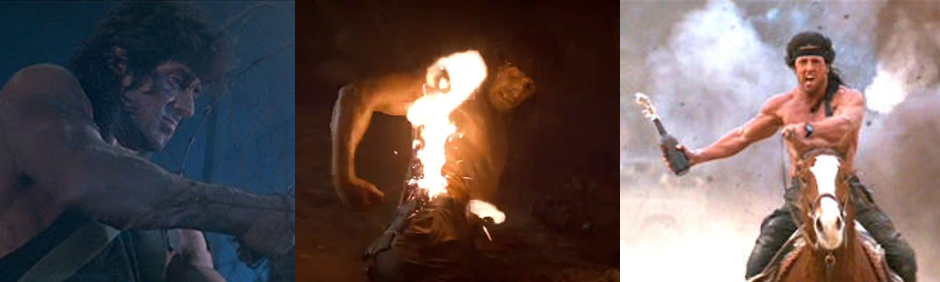
Movie Night [Global James Bond Day]: GoldenEye


To celebrate the release of Dr. No (Young, 1962), the first film in the long-running series of James Bond movies (Various, 1962 to present), October 5th is officially recognised as “Global James Bond Day”. Today, this franchise stands as the longest-running franchise ever and the character is one of the most recognised and popular movie icons of all time.


Released: 17 November 1995
Director: Martin Campbell
Distributor: MGM/UA Distribution Co. and United International Pictures
Budget: $60 million
Stars: Pierce Brosnan, Sean Bean, Izabella Scorupco, Famke Janssen, Alan Cumming, and Judi Dench

The Plot:
In the midst of an administrative shake-up at MI6, renowned super spy James Bond/007 (Brosnan) in drawn into a confrontation with a rogue 00 agent who plans to use a satellite weapon known as “GoldenEye” to cause a global financial meltdown.

The Background:
James Bond, Agent 007 of MI6, was created by writer Ian Fleming in 1953 and was heavily based upon his time and experiences as a navy intelligence officer. Following a very strange, comedic adaptation of his works, James Bond was popularised by Sean Connery’s immortal and iconic portrayal of the character, which kick-started an unparalleled cinematic franchise. However, in the late-eighties/early-nineties, the franchise had stalled somewhat. Plans for a third picture for then-current Bond Timothy Dalton fell through thanks to legal issues and, by the time production of the seventeenth Bond film was ready to begin, Dalton had resigned from the role since he couldn’t commit to multiple films. Of course, every generation has their James Bond and, as a result, Pierce Brosnan was finally cast in the role and became the Bond for my generation. The character, and the film’s story (the first not adapted or inspired by from an existing Fleming text), was also updated to then-modern times and largely disregarded the previous films long before franchise reboots were really a well-known trope of cinema. With a worldwide gross of over $350 million, GoldenEye was a phenomenal box office success and effectively revitalised what had been a dormant franchise. GoldenEye was also a a critical hit and impressed with its contemporary sensibilities. Of course, while the film is still fondly remembered, it had a lasting impact thanks to the Nintendo 64 videogame adaptation, GoldenEye 007 (Rare, 1997), which is largely regarded as one of the best videogame adaptations, if not one of the greatest videogames, of all time.

The Review:
Unlike a lot of Bond movies, GoldenEye’s cold open actually plays into the films larger plot. The movie begins nine years ago with Bond and his partner and friend, Alec Trevelyan/006 (Bean), infiltrating a facility in Russia. This establishes, first and foremost, their unique relationship, which is base don a lot of witty banter and sayings, and Bond’s hatred of Colonel Arkady Grigorovich Ourumov (Gottfried John) after Ourumov executes 006 in cold blood. It’s a thrilling opening sequence, shot in such a way as to slowly acclimatise us to this new Bond (we only see Brosnan’s face after he has infiltrated the facility, building up tension to the reveal of the new actor) and to show that he’s just as bold, witty, and adaptable as ever as he’s able to commandeer a motorcycle and a plane and even pull himself out of what is obviously a deadly free fall.

Bond’s methods and attitude may be seen as antiquated but they’re no less effective.

When we pick up with Bond nine years later, MI6 is in the midst of an administrative shake-up. The new M (Dench) is a woman and is generally perceived by Bond and some of his co-workers (specifically Bill Tanner (Michael Kitchen), M’s chief of staff) to be unfit for the job due to her predication for statistical analysis rather than Bond’s more traditional, proactive methods of action. Their relationship is frosty, at best, and openly explored in a candid discussion between the two in which M confronts Bond over his judgements and isn’t afraid to tell him exactly what she thinks of him. To M, Bond is a “relic of the Cold War” whose methods are out-dated and borderline dangerous in the modern age of espionage. However, by airing their grievances to each other, they develop a mutual respect and admiration in which Bond appreciates M’s candour and M puts her trust in Bond to do what he does best and investigate the GoldenEye satellite. Indeed, Bond’s methods are a significant plot point in the film. H seduces the girl sent to psychologically evaluate him due to his lack of interest in MI6 protocol and his tendency to shoot first, ask questions later, and bulldoze into any situation, wrecking vehicles in the process, is frequently chastised by Natalya Simonova (Scorupco). Indeed, even for KPG figureheads like Valentin Zukovsky (Robbie Coltrane) criticise Bond for continuing to live in the past and work for MI6. Yet, as you might expect, Bond’s unique approach to his work, despite him continually being a “sexist, misogynist dinosaur” gets results and, despite his critics, he is capable of subterfuge and investigatory techniques as well, as seen in his investigation into the Tiger Helicopter and Xenia Onatopp’s (Janssen) links to the Janus Syndicate, all of which are based on his instincts but turn out to be valid lines of enquiry.

While not a typical Bond Girl, Natalya shines through her intelligence and headstrong nature.

During Bond’s investigation of the devastation at Severnaya, he inevitably crosses path with Natalya, a programmer from the Severnaya facility who witnessed Ourumov and Xenia killing all of her co-workers, firing the weapon, and stealing the GoldenEye firing key for the remaining satellite. Unlike a lot of Bond Girls, Natalya is just a regular and, comparatively, unremarkable young woman. She’s basically a civilian, one who is scared out of her wits during the attack and continuously disgusted with the killing. She also questions Bond’s motives and his cold, clinical approach to his work and, as a result, provides a brief glimpse into his more vulnerable, human side. However, while she is somewhat lacking in fortitude and is held hostage a bit too often for my liking, Natalya is an extremely capable and intelligent Bond Girl: she is headstrong, ordering Bond about at various points and forcing him to take her along on his mission. Her technical ability is directly responsible for tracking the location of Janus; and, thanks to her experience with the satellite, she’s able to reprogram and reposition it even despite the snide remarks regarding her ability by her former colleague, the lewd and reprehensible Grishenko (Cumming).

Xenia and Ourumov represent the Janus Syndicate and are sadistic killers.

Of course, Natalya isn’t the only Bond Girl in the film. Xenia is quite a unique femme fatal for Bond; shrewd, alluring, and intelligent, she’s no mere henchwoman and is, instead, a highly sexually charged and dangerous adversary capable of seducing men into bed and crushing their ribs with her powerful thighs. She’s also a sadist who revels in the thrill of killing, literally getting off on it at various points throughout the film, and is more than a match for Bond as an intellectual and physical opponent. The Janus Syndicate is rounded out by Ourumov himself; a traitor to his own country, Ourumov aspires of being the next “iron man of Russia” and is an abrasive, egotistical man. However, while he seems slightly unhinged at the best of times and is a pivotal antagonist in many ways, Ourumov is reduced to little more than a henchman for Janus who uses his military rank and position to acquire the GoldenEye access codes.  

Bond’s former friend and partner turns out to be a traitor looking for vengeance for his people.

As for the headman of the Janus Syndicate, the film goes out of its way to paint the arms dealer and terrorist as a mysterious and enigmatic figure who hasn’t been seen and about whom very little is known except for the fact that he’s a “Lienz Cossack”. Of course, it turns out to be Alec Trevelyan, who faked his death but has been left horribly scarred on one side of his face after being caught in the explosion at the facility. After witnessing the cruel treatment of his people and the deaths of his family after the British betrayed them following the Second World War, Alec has been scheming for years to take revenge for this betrayal, beginning with infiltrating MI6 and culminating in a plan to destroy the British economy. Of course, Bond isn’t exactly without a degree of support during his mission. As always, Q (Desmond Llewelyn) is on hand to talk Bond through his new gadgets (nothing massively fancy; a belt that fires a high tension wire and an exploding pen, though Q Branch is full of fun little gags and mishaps in the background) and share some banter with him. Rather than being supported out in the field by long-standing Bond ally Felix Leiter (Various), Brosnan’s Bond is aided by Jack Wade (Joe Don Baker), who is a far more jaded and pragmatic CIA operative, and is able to convince Valentin to lead him to Janus by “[appealing to] his wallet”.

The Nitty-Gritty:
If there’s a downside to GoldenEye, especially for long-time James Bond fans, it’s probably the lack of any real car-based shenanigans. Bond never gets to use any of the gadgets and gizmos Q briefs him on in his fancy new BMW and, aside from the opening car chase against Xenia, there’s no real traditional car chases or car-based action. I don’t really mind this, though, to be honest as I’m not really a car guy and my enjoyment of a film isn’t predicate don the presence of a car chase.

Bond’s mission is a lot more grounded than usual but no less global in its scope.

Plus, GoldenEye more than makes up for it was Bond’s exhilarating and highly amusing jaunt through St. Petersburg in a tank! Following a thrilling escape from the archives, Bond is forced to commandeer a Russian T-54/T-55 tank to pursue Ourumov (who has taken Natalya hostage) through the streets of St. Petersberg. It’s very much a “Bond Moment” but, like much of the film, isn’t quite as over the top as some of Roger Moore’s antics (though I’m fairly certain one man can’t drive a tank in the way that Bond does) and culminates in Bond successfully bringing Janus’ armoured train base to a halt with a single shell. In true Bond tradition, GoldenEye’s plot takes Bond all over the world; Bond’s mission takes him to Monte Carlo, Russia, and Cuba, with all three destinations being starkly contrasted to each other (he spends the majority of his time in Monte Carlo in a casino, St. Petersberg is portrayed as a cold (if architecturally beautiful) country still recovering from the Cold War, and Cuba is a lush, luminous jungle). Similarly, GoldenEye is full of practical stunts and effects, from model shots used during the destruction of the Severnaya base and the raising of Janus’s antenna cradle to actual tanks, trains, and other vehicles all being involved in explosive sequences that lend a real credibility and gravitas to Bond’s otherwise extravagant actions. In fact, the only effects scenes that are a bit questionable are Bond’s dive into the plane at the start of the film and the shot of Boris’s flash-frozen form when he meets his fitting end.

Xenia’s aggression, physicality, and thighs of steel make her a formidable opponent for Bond.

Action is paced out wonderfully, though, with plenty of shoot-outs and a fights taking place to spice things up and Bond even escaping from an impossible death trap within a helicopter. While I still don’t get why that random deckhand attacked Bond on the frigate, the towel gag afterwards always makes me laugh, and the many confrontations between Bond and Xenia are a particular highlight. Thanks to his misogynistic nature, Bond has no compunction about fighting a woman, though Xenia’s physicality and aggression is enough to put him on the back foot; in the end, he’s able to bring her to a fitting end by causing her to be crushed to death against a tree.

Janus was probably Bond’s most personal villain yet due to his close relationship with 007.

Though Bond drops a characteristically witty quip regarding this, and many of the other events in the film, GoldenEye is one of the more personal missions for Bond. Taking his name from the two-faced Roman God, and having worked alongside 007 for years, Janus is a cold, calculating, and deeply personal villain for Bond. Thanks to his background as a Lienz Cossack, Janus has a propensity for deception, betrayal, and lies and it’s clear that Bond is deeply affected by Alec’s treachery even as he tries to compartmentalise his feelings on the matter. Alec is, effectively, Bond’s dark reflection and he knows exactly how to hurt him, which buttons to press, and how to counteract his methods, immediately taking his watch, defusing his mines, and fully aware that Bond’s Achilles’ Heel is his affection for women. All of this culminates in a fittingly brutal and visceral final fight between the two as they match each other blow for blow and shot to shot (Alec even taunts Bond with the claim that he (as in Alec) was “always better”) during their climatic chase/fight across the antenna cradle. Ever since he revealed his identity to Bond, Janus continually questions Bond’s unwavering loyalty to the mission and his country rather than his friend and, in the end, Bond emphatically drops his old comrade-in-arms to his death not for England but out of personal vindication for himself.

The Summary:
GoldenEye was the first Bond film I ever watched all the way through and that is solely because of my enjoyment of the videogame adaptation. I had been aware of Bond before GoldenEye but never been that interested in the franchise but GoldenEye changed all that with its slick, stylish, and entertaining presentation and story. Brosnan was the Bond of my generation and, even now, I consider him to be one of the best; charming, sophisticated, and extremely witty, his Bond was like an amalgamation of all of his predecessors as he had the same charisma and wit as Moore but could also be gritty and rugged like Connery and Dalton (…he was also a man, like George Lazenby). The subtext of Bond being an antiquated resource whose time has long since passed is interesting and is used to juxtapose Bond’s unique, somewhat blunt approach to his work against more modern, technologically orientated times. Sadly, this plot point didn’t really appear in Brosnan’s subsequent Bond films but it did crop up again in later Daniel Craig movies and is an intriguing inclusion since it shows that, while all the technology and resources of the modern age are useful, nothing beats the good, old-fashioned, hands-on approach. GoldenEye excels through its polished presentation, memorable theme song and score, and some tremendous performances all around; Sean bean makes for an equally charismatic and vicious antagonist, one far more personal than the majority of Bond’s previous villains, who serves as a dark reflection of Bond since he was his friend, partner, and is fully aware of all of MI6’s training and protocols to make him more than a match for 007. Action and stunts are far more subdued this time around, which helps to ground the film and reintroduce Bond as a more serious and realistic character and franchise while still being over-the-top and fun throughout. Endlessly quotable and entertaining from start to finish, GoldenEye remains one of my favourite Bond films (possibly my absolutely favourite) and was a fantastic return to prominence for the character and the franchise.

My Rating:

Rating: 5 out of 5.

Fantastic

Are you a fan of GoldenEye? Where does it rank against the other James Bond films for you? What did you think to Pierce Brosnan’s debut and portrayal of the character? Did you like the casting of Judi Dench as M and the subtext regarding Bond’s outdated ways and attitudes? What did you think to Sean Bean’s inclusion as the villain and his inevitable death? Did you ever play the videogame and, if so, how do you think it works as an adaptation of the film? Which Bond actor, film, story, villain, or moment is your favourite? How are you celebrating Global James Bond Day today? Whatever you think about GoldenEye, or James Bond in general, feel free to leave a comment down below.