Horror Prompts’ Gillian Church is hosting another horror drabble challenge: 31 prompts for 31 creepy tales throughout March. This time, we can decide on the length of the piece but I’m sticking to the 100-word default.
Can you do it?
The Prompt: Clover
The Submission: Jonesy tore through the weeds and grass, ripping up handfuls of clovers and soggy dirt in a frantic search for any trace of the mushroom.
He wrenched at roots, tearing his fingernails in his desperate search. He was rapid, frothing, a fiery ache in his stomach at the desire to experience the unmitigated euphoria offered by the fungi.
He didn’t give two shits about Mark; the idiot just couldn’t stomach the pressure. Jonesy had barely batted an eyelid when he’d seen his friend shrivel to a corpse and turn to dust before his eyes.
All he wanted was another taste.
What did you think to the prompt for today’s drabble challenge? Did you submit anything for it? Have you ever written any flash fiction before? I’d love to know what you think to my snippets and writing prompts, so feel free to sign up and let me know what you think below or leave a comment on my Instagram page. You can also follow Gillian Church to take part in her Weekly Writing Prompt challenge.
Horror Prompts’ Gillian Church is hosting another horror drabble challenge: 31 prompts for 31 creepy tales throughout March. This time, we can decide on the length of the piece but I’m sticking to the 100-word default.
Can you do it?
The Prompt: Green
The Submission: When I got married, I never expected to be arguing about the colour of the walls!
She wanted green, but I wanted turquoise. Apparently, not agreeing with her made me the most unreasonable person ever to live.
In her outburst, she hurled insults at me that I thought cut deeper than any knife but, as I plunged the blade into her, that turned out not to be true.
The crimson spray splattered across the walls; in her agony, she left streaks of gore staining the room.
In that moment, I realised we were both wrong: red is much more fitting.
What did you think to the prompt for today’s drabble challenge? Did you submit anything for it? Have you ever written any flash fiction before? I’d love to know what you think to my snippets and writing prompts, so feel free to sign up and let me know what you think below or leave a comment on my Instagram page. You can also follow Gillian Church to take part in her Weekly Writing Prompt challenge.
Released: 2 May 2008 Director: Jon Favreau Distributor: Paramount Pictures Budget: $140 million Stars: Robert Downey Jr., Jeff Bridges, Terrence Howard, Gwyneth Paltrow, and Shaun Toub
The Plot: Billionaire industrialist and arms manufacturer Anthony “Tony” Stark (Downey Jr.) finds himself humbled after his own weaponry leaves him near death. Captured and forced to make weapons for the terrorist group the Ten Rings, Stark instead constructs a suit of armour and, upon escaping, resolves to put his genius intellect and resources to good use as Iron Man.
The Background: The development of a live-action Iron Man movie can be traced back to 1990, with stars Nicholas Cage and Tom Cruise both once attached to the titular superhero, but the various scripts and film rights languished in development hell for nearly fifteen years with nothing to show for it. Once the film rights reverted to Marvel, the publisher created Marvel Studios and, encouraged by their success at licensing their more popular characters, began developing movies based on their remaining properties. The first of these was Iron Man; the film’s armours were created by legendary special effects maestro Stan Winston and actor/director Jon Favreau was drafted to direct the film and immediately saw the story as being one of redemption and reinvention. Nowhere was this emphasised more than in the casting of Robert Downey Jr. in the title role; Downey, whose career and life had been in a downward spiral, shot to superstardom after being cast and almost immediately became the linchpin of the Marvel Cinematic Universe (MCU) that Iron Man kicked off. Against all expectations, Iron Man was an unprecedented success; it made nearly $590 million at the box office and received rave reviews. Its success led not only to a two sequels but also a slew of other MCU movies and easily the most successful series of superhero movies in modern times as the MCU dominated cinemas over the next ten years and beyond.
The Review: Iron Man opens in the war-torn deserts of Afghanistan to the tunes of “Back in Black” by AC/DC; here, we find billionaire industrialist, investor, and consummate playboy Tony Stark sharing some bants with some American soldiers. Stark’s jovial, boastful mood is rudely interrupted when the convey is suddenly attacked, all of his detail killed, and he is caught in the blast from one of his own Stark Industries missiles while trying to message for help. Tony finds himself injured and held hostage by Raza (Faran Tahir), the leader of the terrorist organisation known as the “Ten Rings”, and, from here, we flash back in time some thirty-six hours for a quick recap on Tony’s life. Heralded as a genius, philanthropist, and American patriot, Stark was orphaned as a teenager and, at age twenty-one, took the reigns of his father’s company.
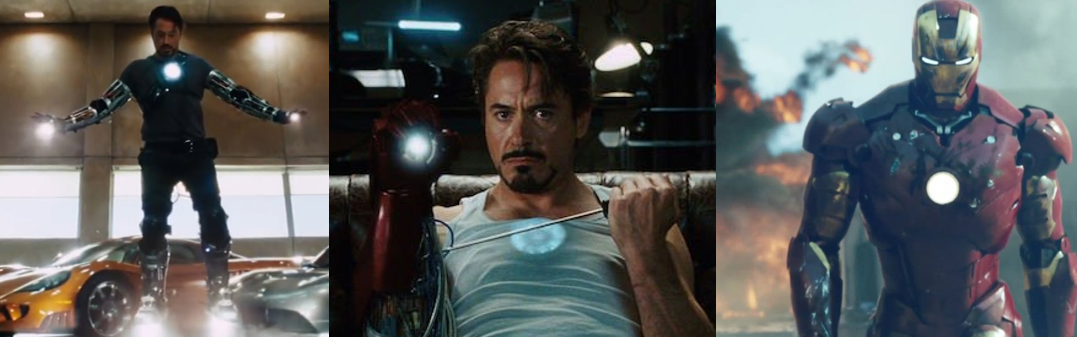
Focused on his new mission, Stark works to perfect his armour and right his wrongs.
Stark is touted as an acclaimed keeper of the peace though his advanced and innovative weapons technology but, for all his genius, he is aloof and bored with such trivialities as receiving awards or really stopping to think about the moral implications of his actions and would much rather be playing craps at Caesar’s Palace and picking up random woman, even reporters who brand him the “Merchant of Death”. Tony is an impulsive and easily distracted individual who simply does rather than thinking since he is so smart that he is often a few steps ahead of everyone else and prefers to be tinkering with his vast collection of cars and in his personal workshop in his grandiose house rather than remembering things like birthdays and keeping his appointments, all while putting himself, his father, and his company on a pedestal for the world-changing technologies his weapons manufacturing has produced and funded.
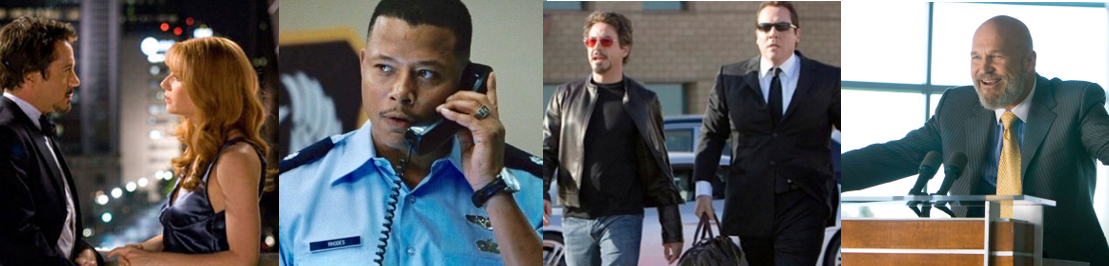
Stark’s nearest and dearest react to his impulsive attitude in different ways.
Tony’s lackadaisical, self-centred attitude may win over the general public and be a hit with the women but it grates against his closest friends, such as his chauffeur, Howard “Happy” Hogan (Favreau), Obadiah Stane (Bridges), and Colonel James “Rhodey” Rhodes (Howard), who are left to make excuses in his stead. None are left with more trash to clean up, however, than Stark’s personal assistant, Virginia “Pepper” Potts (Paltrow), who constantly finds herself having to chase after him for decisions, signatures, and directions relating to Stark Industries. Each of these characters deals with Tony’s childish ways differently; Happy is happy to indulge Stark’s whims and play along on the sly, Rhodey chews Stark out for disrespecting himself (and Rhodey) with his attitude, Pepper is exasperated by his ways but endures them out of loyalty and a mutual attraction between the two, and Stane is seemingly perfectly happy for Tony to do as he wishes since his brilliant mind helps keep him, and the company, extremely profitable. The attack in Afghanistan forces Stark to witness first-hand the consequences of his actions; trapped in a dingy cave and kept alive by a car battery and some cables, Stark is about as far from his faithful artificial intelligence, Just A Rather Very Intelligent System (J.A.R.V.I.S; Paul Bettany), as he can possibly get.
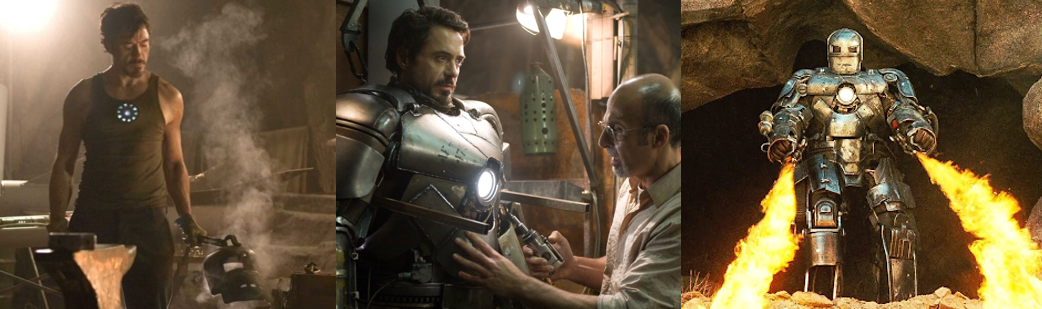
With limited resources, Stark builds his first suit of armour to fight his way to freedom.
His cellmate, Ho Yinsen (Toub), brings him up to speed with his predicament; shrapnel from the missile is lodged dangerously close to Stark’s heart and only the electromagnet imbedded in his chest is keeping him alive. The Ten Rings demand that Stark construct for them an arsenal of his famed “Jericho Missile” and he is subjected to constant torture when he refuses. Horrified to see the terrorists are wielding his weaponry, Stark resolves instead to build a miniature version of his famed “Arc Reactor”, a clean energy device that will more effectively stave off death and plot their escape. What follows is an incredible sequence where, torn away from his luxuries and faced with the cold reality that he has been causing death and destruction across the world, Stark sets to work constructing a powerful exoskeletal suit of armour to fight his way out of the terrorist camp. This is a fantastic scene that shows Stark’s adaptability and ingenuity and that he is a formidable foe even without the benefits of modern technology; with a few scraps, his unmatched intellect, and some old-fashioned welding techniques, Stark is able to fool his captors long enough to complete the suit, a clunky, grey monstrosity with just enough power to fight past the guards and blast away to safety. Sadly, Yinsen sacrifices himself to cover Stark when the suit is powering up; with his dying breath, he begs Stark not to waste his life and, humbled by his experiences and Yisnen’s sacrifice, Stark takes his revenge on his captors and resolves to end all weapons manufacturing once he is recovered by Rhodey.
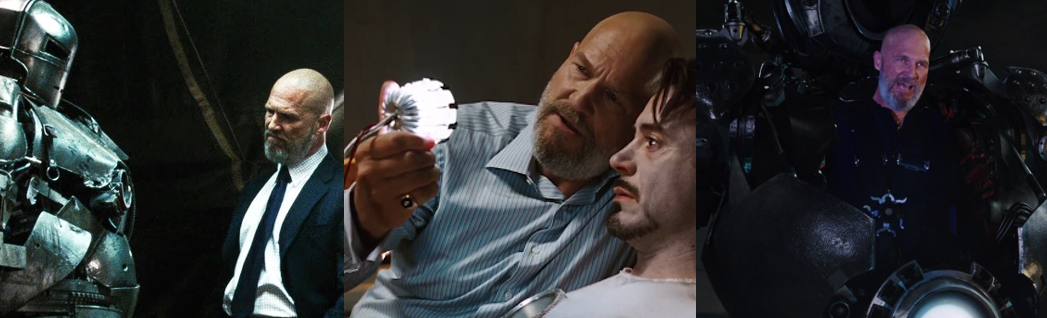
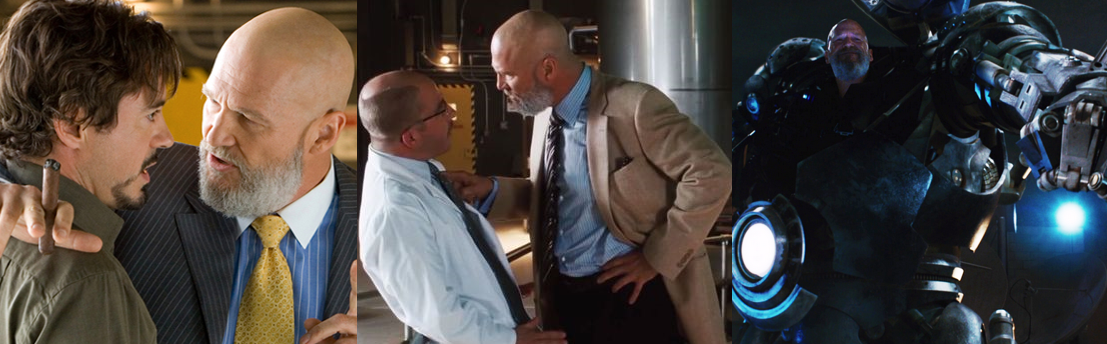
Stane turns on Stark in order to steal his Arc Reactor and armour technology for himself.
Haunted by his experiences in Afghanistan, Stark is angered at his weapons and technology being misused by terrorists and, after a few trials and working out some kinks, finally perfects his armour design into a sleek red-and-gold suit that rockets through the sky, fires missiles and Repulsor Rays, and is fully connected to all available networks and communication devices thanks to J.A.R.V.I.S. Stark wastes no time in attacking Ten Rings sites, freeing those subjugated to their terrorism with extreme prejudice and, in the process, attracts the attention not just from the U.S. military but also Agent Coulson (Clark Gregg) of the mysterious Strategic Homeland Intervention, Enforcement, and Logistics Division (S.H.I.E.L.D.), who wishes very much to “debrief” Stark on the particulars of his escape and extra-curricular activities. Although having shifted his focus onto a more honourable goal Stark remains as arrogant and obnoxious as ever after becoming the “Iron Man”; both Pepper and Rhodey despair at him when they discover what he’s been up to and believe that he is self-destructing but the truth is that his experiences have finally given him something worth living and working for. His actions, however, have far-reaching consequences; Stark is devastated to discover that Stane ordered the hit on him as the two were depicted as being firm friends up until that point. When Stane then steals Stark’s Iron Man technology and garbs himself in a bigger, more menacing exosuit as the Iron Monger, the stage is set for an epic showdown full of personal animosity between the two armoured men.
The Nitty-Gritty: Even now, Iron Man remains almost timeless in its presentation; thanks to a fantastically old-school method of blending live-action suits with high-quality CGI, the film holds up incredibly well and is just as good now as it was the first time I saw it in cinemas. A rocking soundtrack full of classic heavy metal tracks and a rousing, industrial theme only serve to punctuate the special effects and the whole film seems to have been made with the actors given free reign to ad-lib their dialogue as interactions and banter are all incredibly natural and amusing. Indeed, Stark’s sudden declaration of “I am Iron Man” was an ad-lib and, with that one line, largely dictated the course for the MCU, which generally treats it superheroes like celebrities rather than falling back on the “secret identity” cliché. While I am perfectly happy to see secret identities in superhero films, it was massively refreshing to see a comic book movie buck that trend and made Iron Man even more memorable in the long run.
I was shocked to see Bridges as part of the cast and he steals every scene he’s in!
One thing that makes Iron Man stand out is the quality of the actors; both Iron Man and Batman Begins (Nolan, 2005) changed the game, as far as I am concerned, by featuring high-quality actors like Morgan Freeman and Michael Caine. I remember being incredibly surprised that Jeff Bridges was a part of this film; almost unrecognisable as Obadiah Stane, Bridges is a charismatic, bombastic father-figure who both nurtures and tries to temper Stark’s genius and impulsive nature. His delivery and magnetism steal every scene he’s in and, yes, it’s probably a littler derivative that Stark’s first adversary was basically a dark mirror of himself but Bridges is such a gem that it’s effortlessly entertaining even if it is at the expense of Iron Man’s more famous foes. Stane constantly exudes an odd sense of menace even before he’s incapacitating people with his little ear gadget; when one of his techniciansis unable to miniaturise the Arc Reactor technology, Stane simply disables Stark and rips it right from his chest in order to power his own massive suit. Upon donning the Iron Monger armour, Stane immediately becomes obsessed with its power and as drunk on the feeling of freedom and empowerment as Stark is on his own self-adulation (and alcohol, half the time), which ultimately becomes his downfall as he becomes irrationally fixated on taking his frustrations out on a weakened Iron Man. Seeing Stane suited up in the massive Iron Monger armour was pretty fantastic and it serves a stub-plot of the film, and the entire MCU, of Stark confronting his past and overcoming it and his unresolved issues with his father.
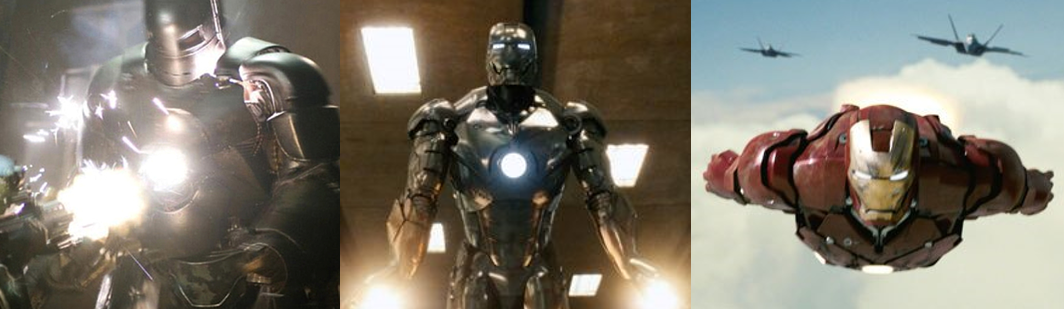
Thanks to a combination of practical and special effects, the armours look incredible.
All of this leads me to the biggest draw of the film: the suits themselves. Even now, it is absolutely bad-ass to see the original Mark I clunker of a suit in action which is made all the more visually impressive by just how much of it was actually a practical suit of armour. Stark follows this up with the all-silver Mark II suit, which he wears to test out the limits and capabilities of his Arc Reactor technology (and, in the process, discovers the suit’s tendency to ice up when breaching the upper atmosphere). The final red-and-gold suit is as close to a live-action Iron Man armour you could ask for and looks like one of Adi Granov’s illustrations has literally sprung to life. Iron Man even solves the problem faced by a lot of masked superheroes by switched to a view from inside of the Iron Man helmet so that we can still see Stark’s face and stay emotionally connected to the character even when he’s in full armour and Iron Man is made all the more interesting since we see Stark building, testing, and perfecting the armour and because he constantly remains adaptable and flawed throughout the film. Finally, there are the hints towards a much larger world. I remember watching Iron Man for the first time and never twigging that Coulson worked for S.H.I.E.L.D. since the acronym isn’t used until right at the end of the film and feeling like an idiot when they finally dropped the organisation’s name. Look closely in the background of one scene and you’ll see that Stark has Captain America’s shield in his workshop, Rhodey very nearly jumps into the Mark II suit for himself at one point, and the film ends not just with Stark’s impulsive declaration that he is Iron Man but also a visit from Nick Fury (Samuel L. Jackson), director of S.H.I.E.L.D. Again, I remember hearing rumours of this cameo back in the day and specifically waiting for the credits to finish to see if it was true and being absolutely blown away by the implications of the “Avenger Initiative” but I could never imagine what Iron Man would set in motion for superhero cinema (and cinema in general).
The Summary: My experiences of Iron Man were extremely limited when the film first came out; I enjoyed watching his cartoons and saw him pop up in a few comics from time to time but, for me, he was definitely a low-tier Marvel superhero and I think it’s fair to say that’s true for a lot of people and the general audience at the time. Iron Man, however, changed all of that; more than that, it changed the superhero genre forever and brought some big names, big money, and big audiences to see these films in a way that no one could have predicted and which certainly hasn’t been replicated since. Even without the larger MCU to help bolster it, Iron Man is a hugely enjoyable science-fiction/superhero romp full of charismatic actors, impressive performances, amusing banter and dialogue, and top-notch special effects. Iron Man may have been a massive gamble for Marvel Studios, and may have been eclipsed by other, bigger films in the MCU, but it’s not to be underestimated. Even at the time, I remember sensing that I was witnessing something very special, something very different from other superhero films, and I’m happy to say that neither time nor repeated viewing has diminished Iron Man’s appeal in any way.
My Rating:
⭐⭐⭐⭐⭐
Rating: 5 out of 5.
Fantastic
What do you think about Iron Man? How did you find it as a story and as an origin for ol’ shellhead? Do you think it still holds up to this day? What did you think to the cast and the performances in the film? Were you a fan of the film’s special effects and soundtrack? What did you think to the use of Obadiah Stane as the film’s villain? What was your reaction when Nick Fury walked out of the shadows and when Stark admitted to his dual identity? What are some of your favourite Iron Man characters or stories? Where does Iron Man rank in your hierarchy of comic book characters? Are you doing anything to commemorate Iron Man’s debut appearance and, if so, what is it? Either way, I’d love to hear your thoughts on Iron Man so leave a comment below.
Horror Prompts’ Gillian Church is hosting another horror drabble challenge: 31 prompts for 31 creepy tales throughout March. This time, we can decide on the length of the piece but I’m sticking to the 100-word default.
Can you do it?
The Prompt: Sunrise
The Submission: The survivors crawled from their bunker, weak from starvation, their eyes partially blinded by the glaring sunrise. The city lay in ruins all around them; buildings were smouldering remains, cars were flaming wrecks, and the torn remains of bodies littered the wreckage. As they stumbled into the rubble of the civilised world, their elation at having survived was short-lived as a hoard of croaking, malformed creatures marched ominously towards them, blasting with heat rays that seared limbs from bodies and ripped open chests upon impact. The survivors tried to run, but radiation poisoning made them easy prey to their invaders.
What did you think to the prompt for today’s drabble challenge? Did you submit anything for it? Have you ever written any flash fiction before? I’d love to know what you think to my snippets and writing prompts, so feel free to sign up and let me know what you think below or leave a comment on my Instagram page. You can also follow Gillian Church to take part in her Weekly Writing Prompt challenge.
Horror Prompts’ Gillian Church is hosting another horror drabble challenge: 31 prompts for 31 creepy tales throughout March. This time, we can decide on the length of the piece but I’m sticking to the 100-word default.
Can you do it?
The Prompt: Thaw
The Submission: “How th’fuck’d we miss this?!” Dawson growled, shaking his head.
The body contorted into an anguished scream; the eyes were hollow and dead, the fingers that remained clawing for purchase, the skin cracked and flaking. Ice had bleached the corpse a deathly pale blue and the officers were afraid to handle it in case his limbs snapped off.
“C’mon, Chief,” Teddy reasoned. “Y’know this place’s a graveyard until the ice thaws.”
Dawson grumbled, chipping a chunk off the corpse’s calf with a frustrated kick. “That’s th’third one this week! People need to be more careful where they dump their shit!”
What did you think to the prompt for today’s drabble challenge? Did you submit anything for it? Have you ever written any flash fiction before? I’d love to know what you think to my snippets and writing prompts, so feel free to sign up and let me know what you think below or leave a comment on my Instagram page. You can also follow Gillian Church to take part in her Weekly Writing Prompt challenge.
Story Title: “The Riddler” Published: 23 August 1948 (cover-dated October 1948) Writer: Bill Finger Artist: Dick Sprang
The Background: After Clark Kent/Superman proved to be a massive success in their Action Comics title, National Comics Publications wanted more superheroes under their banner and charged Bob Kane with creating a new masked crimefighter. Thanks to the long-suppressed influence of artist Bill Finger, Bob Kane’s concept of a “Bat-Man” not only became one of DC Comics’ most popular characters but also a mainstream cultural icon. Over the years, the Batman has matched wits against many colourful supervillains, with some of his most memorable challenging his reputation as the world’s greatest detective, and perhaps none have tested his intelligence more than Edward Nashton, a.k.a. Edward Nygma, a.k.a. The Riddler. Another creation of Bill Finger (alongside artist Dick Sprang), the Riddler has confounded Batman for over eighty years and has earned a reputation as one of the Dark Knight’s most devious and intelligent enemies. Brought to life with delicious relish by the late, great Frank Gorshin, the Riddler has played an integral role in Batman adaptations for years, overwhelming players with riddles and collectibles, seeking to suck the brain waves out of Gotham City, provoking anarchy as a twisted serial killer, and being at the forefront of some of Batman’s greatest stories.
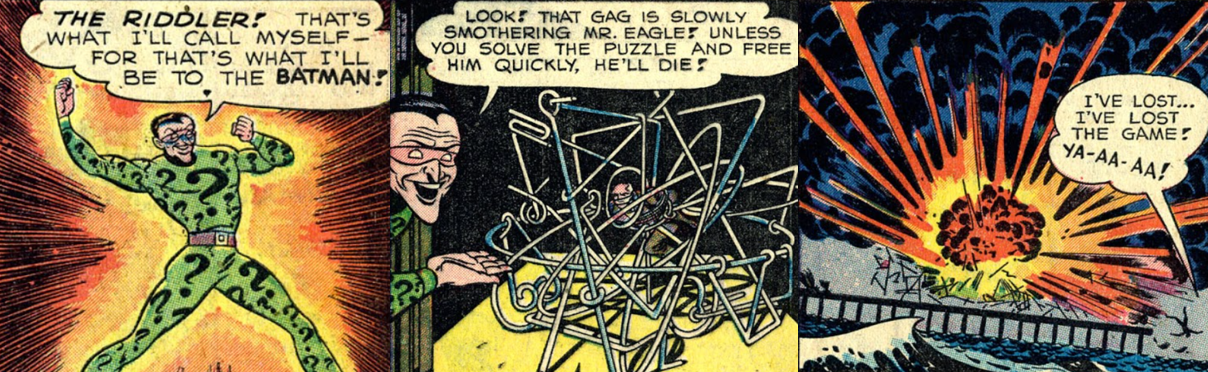
The Review: Our story begins by giving us some backstory on Bruce Wayne/Batman and Dick Grayson/Robin’s newest confounding criminal as we flash back to the youth of the Riddler, known here as Edward Nygma and shown to be a conniving little creep even as a schoolboy. When his teacher sets the class an assignment to complete a jigsaw puzzle to win a prize, Nygma cheats by taking a picture of the completed puzzle using his “flash camera” and continuously humiliates his class mates by challenging them to solve puzzles and using slight of hand and other underhanded tricks to showcase his supposed skill. As he grows into adulthood, Nygma becomes an accomplished con man, fooling and cheating the general public out of their money as “E. Nygma – The Puzzle King”, but grows bored of the lack of challenge his cheating ways bring him. He becomes so sure of his genius and talent with puzzles that he decides to test his abilities against not just the police, but the Batman himself, donning a garish question mark-themed costume and taking the name of the Riddler for the first time.
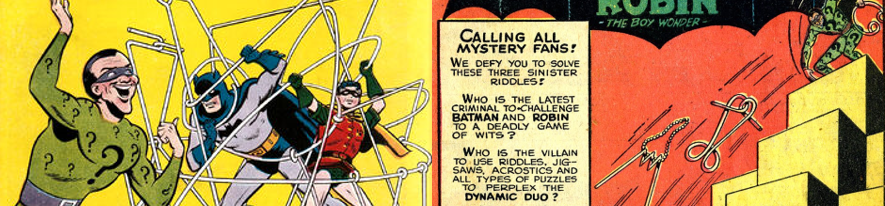
The Riddler bamboozles Batman and Robin with his deceitful riddles.
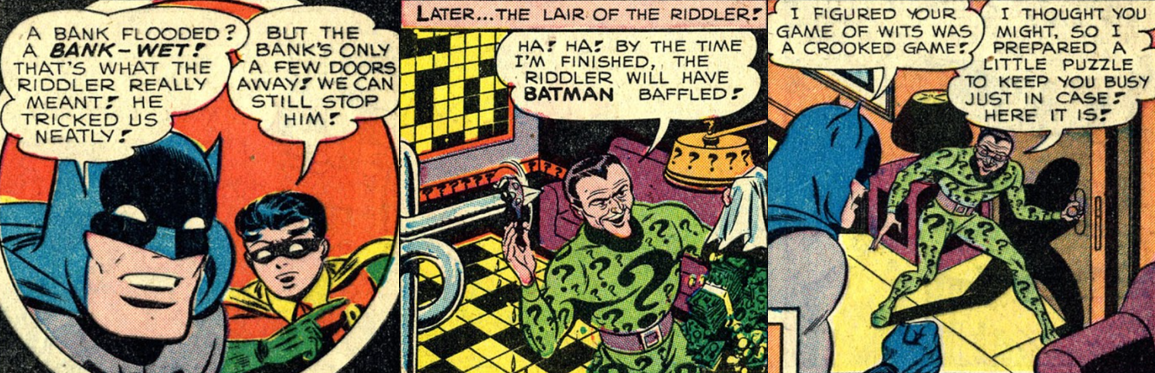
The Riddler’s first heinous act is to commandeer a massive advertising billboard that features a crossword theme and challenge Batman and Robin to learn a clue regarding his planned crime. Within two panels, Batman and Robin decipher the solution to the Riddler’s crossword and accordingly head to the Basin Street Banquet. However, when they blunder in hoping to apprehend the crook, they find the city’s upper class safe and sound and are stunned to learn that the Riddler tricked them with word play and actually flooded a nearby bank (“bank-wet”). The Riddler floods the bank’s underground vaults using a water main and robs the bank after easily figuring out the combination to the vault, and is safely washed away to safety using the sewers. Bamboozled by the Riddler, Batman is doubly determined to nail his newest adversary, who delivers a massive jigsaw puzzle to Police Commissioner Jim Gordon at police headquarters. Batman has the police transport the giant jigsaw to the football stadium and directs them, via loudspeaker and microphone, in solving it to determine that the Riddler plans to target the Eyrie nightclub atop a skyscraper. The Dynamic Duo head to the Eyrie later that night, and Batman sends Robin in alone, where the Boy Wonder is left to see Gotham’s socialites party away with no sign of the Riddler.
Batman comes up with an inspired solution to escape the Riddler’s death trap.
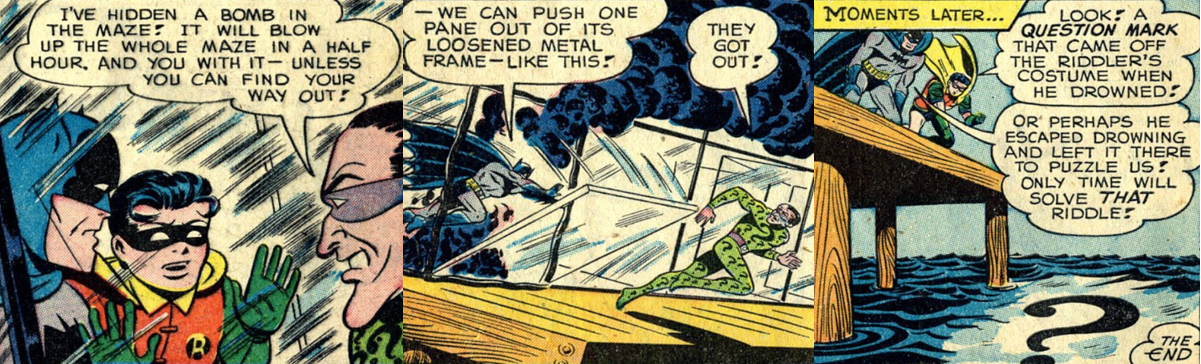
It turns out that the Riddler actually meant that he was planning to rob the home of Harrison Eagle, a millionaire collector, but this time Batman is smart enough to figure this out and interrupt the Riddler…though he is momentarily stunned by the Riddler’s gas bomb and the puzzle master is able to slip away as Batman is forced to break apart an elaborate steel rod trap before Harrison Eagle suffocates to death. Riding high on his momentum, the Riddler’s next conundrum is a little more direct and dangerous to the general public as he sends a truck careening through the streets carrying a massive corncob and a devious riddle: “Why is corn hard to escape from?” Luckily, Batman and Robin are on hand to halt the out of control vehicle with the Batmobile, and Batman deduces that the solution is “maize”; or, more specifically, the big glass “maze” at the Pleasure Pier amusement park. Despite arriving in time to spot the Riddler fleeing into the glass maze, having robbed the park, the Dynamic Duo find themselves trapped in the translucent labyrinth and left at the mercy of the Riddler, who has planted a bomb in the maze that is set to go off in half an hour! Although the glass is shatter-proof, Batman marks their route using the “diamonds on [his] badge” but, when they reach the exit, they find it closed up and the Riddler watching them as time ticks down. Batman comes up with the unlikely ingenious plan to pile up rolls of carpet against the glass panel and set it alight; the heat expands the glass just enough for Batman to force the pane open, but the Dynamic Duo are left with no time to apprehend the villain as they have to dive for cover to avoid perishing in the Riddler’s explosion. Trapped on the edge of the pier, the Riddler is flown into the sea, cursing his failure, and leaves behind only a question mark where he landed and the lingering riddle of whether he drowned or escaped to bewilder the Dark Knight another day.
The Summary: I was pleased to find that the Riddler’s conundrums weren’t as simple as they first appeared; Batman and even Robin easily decipher the Riddler’s clues, only to be fooled by the master of puzzles thanks to wordplay and deceit, as is his speciality. Thanks to his devious ways, the Riddler is able to make fools out of the Dynamic Duo and get away with bags full of loot, and his victories only spiral his superiority complex into overdrive. Crucially, however, it’s important to note that the Riddler eludes capture, and Batman, at every turn; even when Batman is upon him, Nygma slips away using a smoke bomb and endangering an innocent man’s life. The Riddler constantly stays one step ahead, and traps the Dynamic Duo within the glass maze, and is only undone because his hubris demands that he lord it over his adversaries. However, even in defeat, he remains ultimately victorious as he eludes capture, imprisonment, and consequences for his crimes, and is even afforded the luxury of being assumed dead so he can carry out more elaborate crimes at a later date.
A colourful tale, and villain, that is as ridiculous in its execution as you’d expect from the time.
“The Riddler” is certainly a colourful and whimsical debut for one of Batman’s most notorious and clever adversaries; Edward Nygma is presented as an arrogant and deceptive little creep who cheats and uses underhanded tactics to bamboozle others with his supposed genius when, in actuality, he’s just a liar and a con man. Having cheated his way to victory countless times over the years, his narcissism is exacerbated by an inflated sense of accomplishment to the point where he’s no longer satisfied with duping the general masses and wishes to pit his “skills” against the Gotham police and the ultimate challenge: The Batman. Ultimately, “The Riddler” is a wholly ridiculous but fun little tale from Batman’s Golden Era, one that is more about presenting a quick, colourful tale that taxes Batman in a new way with a bombastic new villain, but I can’t say it’s the most memorable or influential story of Batman’s early years. It’s fun seeing the absurd means that the Riddler delivers his puzzles, and to see him outwit Batman on technicalities and semantics, and the bizarre ways that Batman gets out of his predicaments during this time is always amusing, but there are definitely better Batman stories from this era – and Riddler tales – to find.
My Rating:
⭐⭐
Rating: 2 out of 5.
Could Be Better
Have you ever read “The Riddler”? What did you think of the Riddler’s debut and the puzzles he threw Batman’s way? Did you correctly solve the Riddler’s conundrums or were you also outwitted by his deceptive ways? What are some of your favourite Riddler stories? Which interpretation of the Riddler, whether animated, pixelated, or live-action, is your favourite? Whatever you think about the Riddler, sign up to share your thoughts below or leave comment on my social media, and be sure to check back in next Saturday for more Batman content!
Horror Prompts’ Gillian Church is hosting another horror drabble challenge: 31 prompts for 31 creepy tales throughout March. This time, we can decide on the length of the piece but I’m sticking to the 100-word default.
Can you do it?
The Prompt: Fledgling
The Submission: The commander observed the fledgling hunter with a stoic expression. The young one had showed promise in the past but hesitated once the blade was in his hand and the prey was cowering before him.
“Finish it,” he ordered, reading his staff to execute the youngling should he fail to comply.
The youth steeled himself and made a precision strike, spilling the prey’s insides over the cell floor, and the commander relaxed his shoulders. The youngsters were untested, but the bloodsport was undeniably innate. Even the most inexperienced would relish hunting live prey on that desolate mudball known as Earth.
What did you think to the prompt for today’s drabble challenge? Did you submit anything for it? Have you ever written any flash fiction before? I’d love to know what you think to my snippets and writing prompts, so feel free to sign up and let me know what you think below or leave a comment on my Instagram page. You can also follow Gillian Church to take part in her Weekly Writing Prompt challenge.
Horror Prompts’ Gillian Church is hosting another horror drabble challenge: 31 prompts for 31 creepy tales throughout March. This time, we can decide on the length of the piece but I’m sticking to the 100-word default.
Can you do it?
The Prompt: Ruminant
The Submission: Iris couldn’t believe her ears; she couldn’t be dead. That was crazy! She still had so much life left to live, and to think she’d be snuffed out by Roger, of all people. But Grandma Beth had greeted her, told her what’s-what, and she’d been dead for fifteen years now.
Dejected, Iris lingered in the house she’d called home, unable to interact with anything or anyone save for a brief chill in the air. When she saw Roger bring another girl home, her rage boiled; in that moment, Iris rejected becoming a mere ruminant and vowed to make him pay.
What did you think to the prompt for today’s drabble challenge? Did you submit anything for it? Have you ever written any flash fiction before? I’d love to know what you think to my snippets and writing prompts, so feel free to sign up and let me know what you think below or leave a comment on my Instagram page. You can also follow Gillian Church to take part in her Weekly Writing Prompt challenge.
So, for no better reason than “Mar.10” resembling Mario’s name, March 10th is widely regarded as being “Mario Day”, a day to celebrate Nintendo’s portly plumber, an overalls-wearing mascot who literally changed the videogame industry forever and shaped the home console market of the nineties. To commemorate Mario Day this year, March is once again “Mario Month” and I am spending every Thursday of this month celebrating everyone’s favourite Koopa-flattening plumber.
Released: 2011 Originally Released: 21 April 1989 Original Developer: Nintendo R&D1 Also Available For: Game Boy
A Brief Background: In 1989, Nintendo were preparing to release their handheld console, the Game Boy, a machine that would go on to pretty much define portable gaming. To coincide with this release, they needed fun, appealing titles to attract players and Super Mario was the obvious candidate given how wellSuper Mario Bros. (Nintendo EAD, 1985) had sold some years prior. The first game in the series not to feature the input of Mario’s creator, Shigeru Miyamoto, the game was also significantly shorter and smaller than its home console counterpart. While this has been reflected in reviews, Super Mario Land sold over 18 million copies, kickstarting an entire sub-series for Nintendo’s portly plumber that was exclusive to its handheld devices. Naturally, it was eventually ported to the Nintendo 3DS Virtual Console with some minor revisions, which is the version I’ll be looking at today.
The Review: Though functionally the same game as Super Mario Bros., there’s plenty of differences between that game and its handheld counterpart to help Super Mario Land stand out…and not all of them are good, to be honest. Like its bigger brother, Super Mario Land is a 2D sidescrolling platformer in which players control Mario as he runs, jumps, and blasts his way through four distinct Kingdoms. While the game sacrifices a lot in terms of length and graphical quality, Mario actually controls far better in his Game Boy debut than in his more famous title; for one thing, he’s far less slippery, which is a Godsend as it’s much harder to slip and randomly fall off platforms down a bottomless pits and to your death. Mario can still jump, bouncing off enemies’ heads and gaining more height and momentum as he does so and from running by holding down the B button, and he feels like he has a bit more weight to him; not enough to make him plummet like a rock like some of his contemporaries but also not so little that he goes flying off the screen. The game is simplicity in itself; you start on the left side of the screen and run and jump to the right, taking out enemies, collecting Coins for points and extra lives, and taking your chances down the game’s various pipes to find hidden areas full of these aforementioned Coins. As in pretty much all Mario games, and most videogames at the time, you’re also racing against a time limit and can protect yourself from death by bashing blocks to randomly unearth a collectable Super Mushroom, which will transform you into Super Mario.
Despite its understandable simplicity, the game’s Kingdoms are distinct and varied.
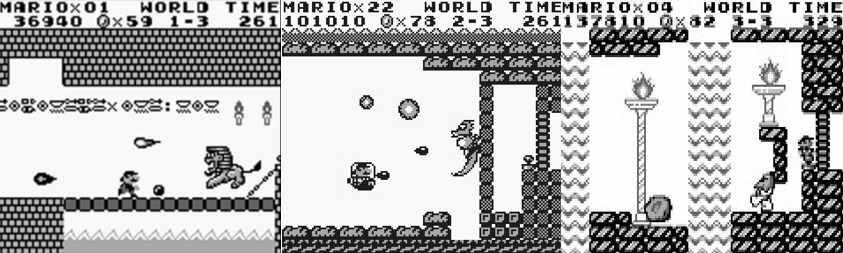
While Super Mario Land has only four stages, referred to as “Kingdoms”, it mixes up its gameplay significantly from other Mario games of the time with the inclusion of two autoscrolling shooter stages; one has you piloting the “Marine Pop”, the other the “Sky Pop”, a cute little submarine and bi-plane, respectively. While autoscrolling stages can be a pain in the ass, and it easy to get crushed to death if you don’t blast blocks quickly enough, these are actually quite fun and it’s just a shame that the developers didn’t program a couple more stages like these in there to help keep things interesting. Additionally, rather than jump atop a flagpole at the end of each Kingdom, Mario exits each stage by entering a doorway; if you direct him to the top exit, you’ll be taken to a Bonus Game where you can earn anywhere between one and three extra lives or a power-up by stopping the fast-moving ladders. Extra lives are rather plentiful overall, to be honest, meaning you generally have an abundance of chances to tackle the games more troublesome and difficult sections, which usually involve making a few tricky jumps over an endless void, jumping to moving platforms, and using rolling boulders to safely cross spiked platforms.
Mario’s new vehicles really help to spice up Mario’s classic platforming action.
As you explore and bop blocks through the game’s Kingdoms, you’ll collect a number of Coins; collect one hundred and you’ll be awarded with an extra life, which can also be found sporadically throughout the game (this time in the form of a heart). Mario’s chief power-up in this game is the Superball, which allows him to toss a projectile similar to the Fire Flower but with the added bonus of the Superball bouncing around the screen to damage multiple enemies and even collect Coins, though you can only ever throw one at a time. If you take a hit while holding a Superball, you’ll revert right back to little Mario, but you can also grab Stars for a temporary period of invincibility. Unlike other Mario games of the time, you cannot play as Luigi or any character other than Mario; as a result, the primary additional features you’ll find in this game are the aforementioned autoscrolling and bonus stages. However, after you beat the game for the first time, you’ll unlock a “Hard Mode” that adds additional enemies to the game’s Kingdoms and, after clearing that mode, you’ll unlock a stage select feature. Otherwise, the 3DS version also allows you to create one save state to dramatically reduce the game’s difficulty and challenge (I remember owning this game as a kid and never being able to clear the Easton Kingdom but, thanks to the 3DS’s save feature, I beat the game in about an hour without really trying that hard).
The game renders its many familiar and unique enemies as best as possible.
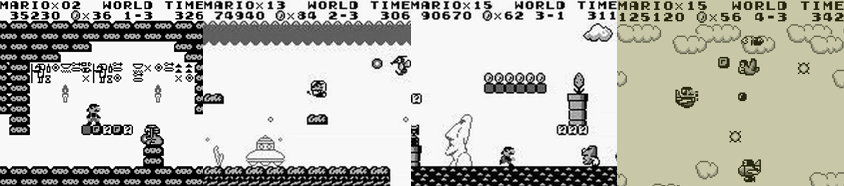
Given that it was a launch title for the Game Boy, a handheld console not exactly known for being the most powerful or graphically interesting amongst its peers despite its immense popularity, it’s important to set your expectations quite low for Super Mario Land. Graphics are painfully simple and monochromatic, with Mario helpfully standing out thanks to his iconic cap and moustache as, without these, he may as well have just been Mr. Game & Watch. The game’s enemies, for all their variety, don’t exactly fare much better but, thankfully, the bosses are much bigger and more indicative of the superior sequel. Similarly, while each of the game’s four Kingdoms feels distinct, they’re not exactly teeming with detail; most opt for a plain, empty background with some simple elements (pyramids, mountains, clouds, Easter Island-like heads and the like) and an abundance of blocks, platforms, and pipes. As you progress through each Kingdom, the stages take on more distinctive and detailed environments, such as exploring inside a pyramid, with hieroglyphics etched into the background layer, or traversing the block-and-platform-ample mountaintops of the Chai Kingdom. The game also separates itself from its bigger brother by having a mostly unique soundtrack; some familiar Mario tunes are present but, for the most part, Hirokazu Tanaka’s music is distinctive enough if a little off-brand for what the franchise was known for at the time. Super Mario Land also features around thirty different enemies, most of which are distinct to each of the game’s four Kingdoms and many of which return from, or are directly inspired by, enemies encountered in the bigger, better Mario titles. As such, you’ll be stomping on Goomba heads, blasting Piranha Plants as they pop out of pipes, and knocking Bullet Bills out of the air but will run into a devious little trap after smacking a Koopa Trooper as their shells now explode a few seconds after they are defeated!
Bosses might look tough but they’re easy to get past if you don’t feel like fighting them.
As mentioned, each Kingdom features their own distinct enemies: you’ll encounter spear-throwing Bunbuns and fireball-spitting Gaos in the Birabuto Kingdom; a variety of skeletal fish and fireball-spitting aquatic enemies in the Muda Kingdom; spiders and sentiment rocks and Easter Island heads in the Easton Kingdom; and zombie-like Pionpi, deadly chickens, and relentless bi-planes in the Chai Kingdom. Each Kingdom concludes in a boss battle that is, in essence, the same as battling Bowser in Super Mario Bros. but much more varied: you’ll encounter a fireball-spitting, jumping sphinx-like lion, a large, fireball-spewing seahorse, and a rock-throwing sentient Easter Island head rock monster. Regardless of the arena or differing environment or the attacks the bosses use, your tactics pretty much stay the same until the final showdown with Tatanga: avoid their projectiles and either blast at them with Superballs or dodge behind them to take them out with a switch at the cost of some bonus points. You’ll battle Tatanga in the Sky Pop but, before you can fight him, you’ll have to take out Biokinton, a chicken-throwing cloud that bounces around the screen. Afterwards, Tatanga rises into the sky, incessantly firing cannonballs from his Pagosu warship. While easily the toughest boss of the game, Tatanga’s shots are easy to avoid once you spot their pattern and, while he can absorb more shots than his counterparts, he still goes down fairly easily to allow Mario to literally rocket away with the true Princess Daisy.
The Summary: It’s easy to forget about Super Mario Land; not only is its sequel worlds better in every way but so is the far more memorable and popular Super Mario Bros. It’s a great little burst of fun and a decent enough distraction for short car journeys but it’s not really got much to it, even for a Game Boy launch title or a product of its time. Still, this was the first Mario title I ever played so I have a decent amount of nostalgia for it and finally beating it after all these years was cathartic, though I’d still rather play the sequel of one of Wario’s many spin-offs on the same console.
My Rating:
⭐⭐
Rating: 2 out of 5.
Could Be Better
What are your memories of Super Mario Land, if any? How do you feel it holds up compared to Super Mario Bros. or the other Mario Game Boy titles? What was your first ever Game Boy title and which is your favourite? Whatever your thoughts on Super Mario Land, Mario, and or the Game Boy in general, feel free to leave a comment below.
Horror Prompts’ Gillian Church is hosting another horror drabble challenge: 31 prompts for 31 creepy tales throughout March. This time, we can decide on the length of the piece but I’m sticking to the 100-word default.
Can you do it?
The Prompt: Speech
The Submission: Ted awoke to find himself bound tightly to a chair; barbed wire chewed into his wrists and ankles and a piercing, numb pain throbbed from his left ear. Eyes blurry, he saw he was in a musty, filthy garden shed. An array of rusty tools were spread across the nearby workbench.
The door creaked open and Ted saw his captor enter. Ted tried to speak and half-gagged as a geyser of warm blood burst from his lips and something heavy and leathery dropped from his mouth. As his vision steadied, Ted heaved when he saw it was his severed tongue.
What did you think to the prompt for today’s drabble challenge? Did you submit anything for it? Have you ever written any flash fiction before? I’d love to know what you think to my snippets and writing prompts, so feel free to sign up and let me know what you think below or leave a comment on my Instagram page. You can also follow Gillian Church to take part in her Weekly Writing Prompt challenge.















 Dr. K's Waiting Room
You must be logged in to post a comment.