Mini Game Corner [May the Fourth]: Star Wars Episode I: Jedi Power Battles (PlayStation)


May 4th is known the world over as Star Wars Day thanks to being one of the most fitting and amusing puns ever devised (“May the Fourth be with you” in place of the traditional “May the Force be with you”). The first and most popular of what can easily become a three day celebration of the influential science-fiction series, the day stands as the perfect excuse for Star Wars fans to celebrate the beloved franchise in various ways.


Released: 4 April 2000
Developer: LucasArts
Also Available For: Dreamcast and Game Boy Advance

A Brief Background:
Almost immediately following its 1977 debut, George Lucas’ science-fiction “space opera” became a massive multimedia juggernaut that expanded to include sequels, prequels, spin-offs, novels, videogames, comic books, and more. After wrapping up his Original Trilogy, Lucas was hesitant to return to the franchise, but the success of the “Expanded Universe” books led to a revived interest in Star Wars and Lucas not only produced “Special Edition” versions of the Original Trilogy in 1997 but also the divisive first chapter in his Prequel Trilogy, Star Wars: Episode I: The Phantom Menace (Lucas, 1999). Despite many lacklustre to average reviews, the film made over $1 billion at the box office and was accompanied by a huge marketing campaign. All these new toys, books, and comics were joined by ten different videogame adaptations released across numerous platforms, though this is the one I most remember playing as my friends and I used to muck about with it back in the day. The developers of Jedi Power Battles used paper cut outs to design the layout and features of the game’s environments and strived to give each character their own unique appearance, abilities, and lightsaber colours. Although numerous fixes and improvements were made to the subsequent Dreamcast version, this version of the game was received rather poorly; reviews criticised the game’s high level of difficulty and awful controls, though the co-op mechanics and arcade-style gameplay was highlighted as a positive.

First Impressions:
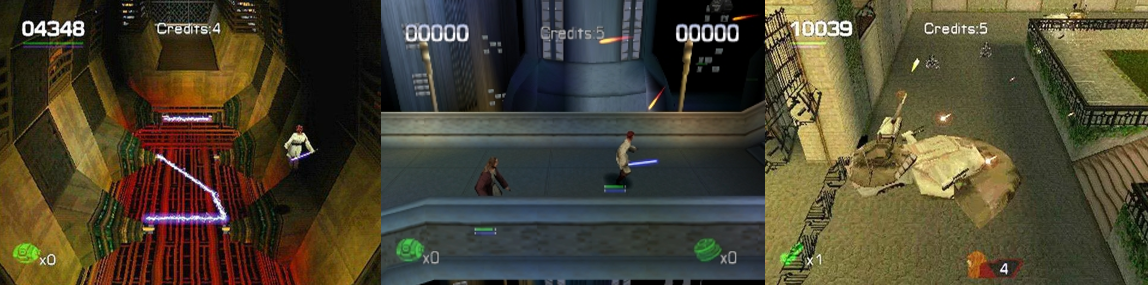
Star Wars: Episode I: Jedi Power Battles is a 2.5D, arcade-style hack-and-slash adventure game that includes a little light puzzle solving, some aggravating platforming sections, and a touch of role-playing functionality. Up to two players can play at any one time, which can be useful for taking on the droid army of the Trade Federation but can cause some serious gameplay issues; for one thing, players share the Credit pool, so your game can end pretty quickly if you get defeated too many times. You also have to be mindful not to stray too far behind; if you linger or get left behind when your friend gets too far ahead, you’ll lose a life, and the game will end that much faster. Players can pick from five Jedi characters – Obi-Wan Kenobi, Qui-Gon Jinn, Mace Windu, Adi Gallia and Plo Koon – who all share the same basic control scheme. There are five control schemes to pick from, but the default sees you using Square, Triangle, and X to swing your lightsaber horizontally, heavily, or vertically, respectively, and Circle being used to jump and double jump. There aren’t any jumping attacks here, but you can string together combos using Triangle, X, and Circle and you can also run by holding R2. If you hold L1, you’ll block incoming attacks; tapping it will deflect laser bolts, which is a great way to defeat faraway enemies but keep an eye on your block meter as this depletes (and automatically fills) over time. You can lock on to the nearest enemy with R1, which also sees you circle that enemy and perform a dodge roll but be sure to disengage the lock on if you’re near an edge or hazard as you’re likely to get hurt or lose a life.

Team up with a friend to double the frustration and difficulty of this clunky hack-and-slash game.

Holding L2 allows you to use each character’s four unique Force powers; this also depletes a meter, and you’ll need to grab power-ups to replenish it, and these powers allow you to perform short, defensive, long-range, and special attacks by holding L2 and pressing Triangle, Circle, X, or Square. To start with, Obi-Wan has a saber dash and tosses a thermal detonator, Qui-Gon unleashes a shockwave to send enemies flying and tosses a pulse grenade, Mace Windu protects himself with a saber shield and also tosses a thermal detonator, Adi Gallia can mesmerise foes and protect herself with an energy shield, and Plo Koon has a saber cyclone attack and stim pack. As you defeat enemies, you’ll gain “Jedi Points”; defeating enemies with style, different combos, or with a variety of attacks rewards more Jedi Points while attacking protocol droids or local Naboo wildlife costs you points. These points are tallied up at the end of each level and can be traded in to extend your health or Force meter and also award new combo attacks and Force abilities, though the game doesn’t list these anywhere, so you’ll just have to remember or make a note of them. Finally, you can also find some helpful power-ups dotted around; beyond the usual health and Force-restoring items, you can grab an extra Credit, hit checkpoints for when you inevitably die, add a special item (like the thermal detonator) to your inventory, extend or power-up your lightsaber, and either refill all your meters or halve them for an added challenge. There are two difficulty modes to pick from, “Easy” and “Jedi” mode; I tried “Easy” and the game still presents quite a challenge. While regular battle droids go down pretty easily, their coloured variants are surprisingly tough and they can send you flying with melee attacks up close or absolutely wreck you with laser bolts from afar if you’re not careful!

Hazards, tough enemies, and annoying platforming sections drag down this ugly-looking title.

The presentation on offer here is pretty good by 2000 PlayStation standards; we get the traditional Star Wars opening and story scroll, pixelated screenshots from the movie, and a full score that is ripped right from John Williams’ orchestral suite. After being treated to a CG opening sequence that strangely places the five main characters in a black void, you’ll behold some of the ugliest polygonal representations of these characters ever created; I don’t begrudge Jedi Power Battles too much for this as this is genuinely what a lot of games looked like back then and, to be fair, the character models don’t look too bad once you’re playing the game and the camera isn’t zoomed in on their blocky faces. They don’t have any idle animations, but their combat moves are pretty swift and satisfying; it’s a shame, then, that the controls are so awkward. Despite allowing analogue control, the game feels very clunky; if you’re not locked on to a target, you’ll swing wildly (and slowly) at thin air and, when you are locked on, you’re trapped in one-on-one combat with the target and vulnerable to other enemies. Where the game really falls apart, though, is in the platforming; in the first stage (a pretty decent recreation of the Trade Federation’s battleship), you’ll need to jump across gaps in bridges, avoid electrified floors and hazards, and hop across pistons. In the second stage, the jungles of Naboo, you need to jump up giant mushroom-like platforms and across large branches and treetops, which is especially difficult to do because of the immovable camera. It can be very difficult to judge where you are and how far away things are from you; while characters do grab ledges to give you some leeway, it’s all too easy to just slip off to your death, be shot out of the air, or miss-time a jump and have to start all over. Gameplay is mixed up a little in the second stage, where you must run away from the Trade Federation’s droid carriers amidst a stampede of dinosaur-like creatures towards the camera in a shameless rip-off of Crash Bandicoot (Naughty Dog, 1996). The game’s environments, while detailed and very true to the movie, are very ugly at times; again, this is just how games were back then but it’s a bit of sensory overload at times as textures warp around you and the game world struggles to stay in one piece.

My Progression:
As I mentioned, I’ve played Jedi Power Battles before in my youth; it was a long time ago but I knew I wanted the game in my PlayStation library once I started seriously collecting for the console, so I was excited to get into it and sure that I’d be able to finish the game one way or another. I picked Qui-Gon Jinn on “Easy” mode and got to work and, to start with, things weren’t too bad; when you’re running through corridors slicing up droids, the game is quite fun. But then you see the gaps, experience the awful jumping mechanics, and see how the game’s graphics are used against you; there’s one point where it looks like you need to jump between these electrical currents, but you actually need to jump along the side of the screen and will die if you drop down, which isn’t clear at all. Later, your path is blocked by some Droidekas, but they’re actually not that difficult to defeat, and you need to battle through some control rooms full of destructible elements to get to the hanger. After avoiding dropping to my death, I battled two bosses; the first was a large droid with two long, spiked arms and a platform for a head and the second was a droid ship that flew around firing lasers at me on a small gantry as droids distracted me. The first was definitely a challenge; the droid is quite large, and it can be hard to outrun or jump over its charge and spindly arms, but the hardest part of the second boss was dispatching the battle droids before they could ruin my chance to parry the bolts back at the ship.

Sadly, the game proved too frustrating for me to experience its later levels and battles.

Things fell apart in the second level, though; after being trampled to death in the opening stampede, I managed to get to safety and was charged with “protecting” Jar Jar Binks, who you’ll spot flailing about in the backgrounds. Before you can do that, though, you have to wade through a small army of battle droids (or, as I did later, simply race past them as it’s faster!) and take to higher ground. This was extremely frustrating as it was really hard to jump to the mushroom platforms; if you fall from too high up even in this section, you’ll die, to say nothing of being pummelled, blasted, or falling as you traverse the higher path. This sets you back quite a bit but there is an extra life you can snag before the mushroom tree, effectively giving you infinite continues; once you pass it, you enter a cave and must battle a giant worm creature. This thing appears to only be vulnerable on its underside, but it spits out these homing projectiles that can stun lock you, slams into the ground, and spins around with a tail attack. Deal enough damage and it retreats to the side and spits out small termite-like creatures, but this was where I had to call it a day as the worm just decimated my health bar in seconds and I didn’t want to have to play through the frustrating jungle section to try it again. It’s a bit of a shame as well because I know that later levels of the game represent other aspects of the movie, such as infiltrating the Naboo capital, utilising vehicles, and battling Darth Maul. There are also additional characters you can unlock after completing the game, such as the aforementioned Darth Maul and even Queen Padmé Amidala (who plays differently since she doesn’t have any Jedi abilities). Unfortunately, there are no passwords or cheat codes to help with progression in this game, doubling frustration and disappointment; once all your Credits are exhausted, you have to replay the last stage from the beginning, which is very tedious with the stunted camera and janky controls, all of which meant that I was barely able to limp through the first mission let alone even consider trying to conquer the Naboo jungles again!

I waited for years to play Star Wars: Episode I: Jedi Power Battles again; I had fond memories of it from my youth and was really excited to get into it, but it seems that my memories were tainted by time. Although the game has a bombastic score and aspects of the lightsaber combat are exciting, it looks atrocious, even by PlayStation’s standards, and the controls are sluggish and awkward. This probably wouldn’t have been so bad if it had been a mindless hack-and-slash with simple push/pull puzzles and a bit of jumping, but placing such a great emphasis on platforming when your depth perception and game engine are already frustrating is just asking for trouble. The game offers quite the challenge, even on “Easy” mode and even more so in two-player; just targeting and attacking an enemy without being blasted by another or slipping to your death is hard enough, to say nothing of the needless limitation on continues and messed up controls. It’s a shame as I was really looking forward to slicing my way through a fun melee title, but I don’t think I’ll be coming back to Jedi Power Battles any time soon. But perhaps you’ve beaten it without any issues. Perhaps I’m missing something, like playing as a different character or not sucking so hard? Maybe you know of a better Episode I­-branded videogame? Whatever the case, there’s a comments section below and my social media is always open to hear your thoughts, good or bad, so feel free to share them and go check out my other Star Wars content!

Game Corner [National Superhero Day]: Marvel: Ultimate Alliance 2 (Xbox 360)


In 1995, Marvel Comics created “National Superhero Day” and, in the process, provided comics and superhero fans the world over with a great excuse to celebrate their favourite characters and publications.


Released: 15 September 2009
Developer: Vicarious Visions
Also Available For: Nintendo DS, Nintendo Wii, PC, PlayStation 2, PlayStation 3, PlayStation 4, PlayStation Portable (PSP), Xbox One

The Background:
Few videogame publishers are as closely associated with Marvel Comics than Activision, who have been spearheading adaptations of some of Marvel’s most popular characters since 2000. Of course, these weren’t all smash hits but some of their titles are counted as being among the best outings for the likes of Peter Parker/Spider-Man and the X-Men. In 2004, Activision teamed with Raven Software and achieved big success with X-Men Legends, a team-based brawler that mixed role-playing elements and co-op gameplay, and its sequel, so the two expanded to incorporate the larger Marvel universe with Marvel: Ultimate Alliance (Raven Software, 2006), a sadly delisted title that was met with generally favourable reviews. For the sequel, Activision turned to Vicarious Visions, who developed the game engine for the first game, and tweaked the gameplay to focus on team-based “Fusion” attacks to encourage players to experiment with different character combinations. Rather than tell an original story like the first game, or deliver on the many optional endings for Marvel: Ultimate Alliance, the sequel drew inspiration from the controversial “Civil War” story arc (Millar, et al, 2006 to 2007) that saw Marvel’s heroes divided over a governmental registration act, though the game was met with positive reviews. The action-packed gameplay and branching storyline were particularly praised, though some decried the stripped down roleplaying mechanics; the game was also delisted in 2020 and it would take just under ten years for another developer to produce a third entry.

The Plot:
After a series of devastating attacks on the United States, the American government passes the Superhero Registration Act (SRA), forcing all super-powered individuals to act under official regulation, to reduce the chaos that results from their battles. The superhero community is left divided; Tony Stark/Iron Man and his followers champion the Act while Steve Rogers/Captain America and his oppose it, but the two warring factions soon find themselves battling a new enemy that threatens global peace. 

Gameplay:
Like its predecessor, Marvel: Ultimate Alliance 2 is a team-based brawler with limited roleplaying mechanics, exploration options, and puzzle elements. Players can (eventually) assemble a team of four from a roster of around twenty-five characters, many of which return from the last game alongside some newcomers, though your options are limited by story-mandated restrictions and the decision you make partway through to side with the Pro-Registration side or the Anti-Registration side. Regardless of which character you pick, your basic combat and control mechanics remain the same: tapping A executes a light attack while B throws a heavy attack; you can hold B to charge up a stronger strike and mix these together to form basic combos, such as a pop-up attack to break an opponent’s guard. X lets you activate doors and consoles, grab anything from crates to cars to toss at enemies, pull shields off foes and even grab enemies to pummel or throw them to their doom. Y lets you jump; press an attack button in mid-air and you’ll crash to the ground with a slam and press Y again for a double jump or to web-sling, fly, or dart along on a glider or ice bridge depending on who you’re playing as. The Left Bumper allows you to block incoming attacks or dodge out of the way by wiggling the left stick at the same time; there are also times when you’ll need to hit LB to deflect incoming projectiles. The Right Bumper allows you to heal yourself or your allies or revive a fallen comrade as long as you have a Heal Token in stock; these are found scattered across each location, usually spawning in during boss encounters or after defeating enemies, and you can hold up to two at a time.

Characters boast new superpowers and can combine abilities in devastating Fusion attacks.

Although up to four players can play Marvel: Ultimate Alliance 2 simultaneously; you can also play alone with some competent A.I. companions and freely switch to another character using the directional pad when playing solo. You can press in the right stick for a handy arrow to point you to your next objective or bring up the game map from the pause menu. Each character as a life and stamina bar; the former is filled when you collect red Health Orbs or level-up and the latter fills automatically, and each character also comes equipped with their own Super Powers, which you activate by holding the Right Trigger and pressing A, B, X, or Y. Many of these are shared across characters, but with a unique flare to each; Spider-Man can web enemies towards him, for example, while Matt Murdock/Daredevil homes in with his grapple cane, but both can lash at foes with their whip-like weapons. Most characters tend to have a ranged attack (Johnny Storm/The Human Torch’s flaming projectiles, Iron Man’s Repulsor blasts, Ororo Munroe/Storm’s lightning strikes, etc) and a clearing attack (Doctor Bruce Banner/The Hulk’s ground pound, Doctor Reed Richards/Mister Fantastic’s tornado spin, and Remy LeBeau/Gambit’s kinetically-charged card barrage, etc), but some also have abilities that buff either their attacks or their team (Doctor Jean Grey/Phoenix can automatically revive characters or add fire damage to her attacks, Danny Rand/Iron Fist’s “Healing Hand” technique heals him, and Captain America can temporarily reduce the damage he takes, for example). Not only can these be improved by earning experience points (XP) and levelling-up and spending “Ability Points” (AP) in the character menu, but you can now combine powers for powerful “Fusion” abilities. As you dish out damage, you’ll build up the Fusion Meter and you can store up to two Fusion Stars at once and combine powers by holding the Left Trigger and pressing either A, B, X, or Y to team up with one of your allies. This produces various effects depending on the combination but, again, many of them are very similar and only made unique by the way the characters team up. For example, you can perform the iconic “Fastball Special” by combining James “Logan” Howlett/Wolverine, Daredevil, Iron Fist, and Mr. Fantastic with bruisers like the Hulk, Ben Grimm/The Thing, or Mac Gargan/Venom. Venom, Hulk, and the Thing can also do a dual stomping attack and you’ll be able to suck enemies in with tornados from the likes of Storm and Thor Odinson while adding elemental attacks to these twisters with the Human Torch and Phoenix.

Puzzles and objectives are simpler than ever and dialogue trees give the illusion of dramatic discord.

No matter the combination of characters, you’ll be prompted to tap A to increase the radius, target specific enemies, or hit successive foes to score extra points and unlock additional abilities and buffs for your characters. Tapping or holding X is also the most common way you’ll be solving the game’s puzzles; generally, you’re tasked with clearing out all nearby enemies and then activating a console or door with X, but sometimes you’ll need to push or pull amplifiers and giant batteries to power up (or down) generators or pass through barriers, rip off control panels, or destroy projectors. Other objectives include destroying anti-aircraft guns, defeating certain enemies, activating consoles in the correct order, and moving stone columns around to unlock doorways and paths, and some missions also contain optional objectives (such as destroying weapon stockpiles or teleporter pads) that net you additional rewards. Additionally, while you’re often told over your comms that you need to act quickly, only certain objectives actually carry a time limit (you’re given less than six minutes to defeat certain bosses, dispose of bombs, or escape collapsing facilities, for example) and you’re often given options to pick from in dialogue trees that will earn you buffs for being “aggressive”, “diplomatic”, or “defensive”. However, as near as I can tell, this doesn’t really alter the story or your character relationships like picking between Pro- and Anti-Reg, which will restrict the characters available to you and alter both the bosses and mission objectives you’re given (protecting or destroying a Strategic Hazard Intervention Espionage Logistics Directorate (S.H.I.E.L.D.) convoy, for example, or raiding or defending a S.H.I.E.L.D. base). Other missions will see you joined by an additional fifth character (technically not a non-playable character as many, like Captain America and Nick Fury, are playable) who will provide support; however, you can’t select them during gameplay, and you’ll still be met with failure if all four of your team are knocked out.

Graphics and Sound:  
There’s been a decent graphical upgrade between Marvel: Ultimate Alliance and its sequel, namely in the sense that the game is far less dark than before and environments are a little more varied, though the same issues with things becoming repetitive and visually dull persist despite how many additional destructible elements have been added. The game starts in Latveria and sees you infiltrating both the castle town, with its many statues of dictator Doctor Victor Von Doom, and Dr. Doom’s main castle, a location that featured in the last game and is now far more linear and less confusing. This is true of all of Marvel: Ultimate Alliance 2’s locations; it’s very rare that’ll you’ll need to explore off the beaten track, mazes and repeating areas are pretty much non-existent, and everything is much more straightforward this time around, which is great in the sense that levels tended to drag on a bit and be frustrating in the first game but disappointing as you don’t have much to do in, say, Wakanda, except follow a straight path taking out enemies and gun placements and simply walking past the waterfalls, jungles, and tribal trappings in the background. Additionally, Marvel: Ultimate Alliance 2 is way less fantastical; there are no trips to Atlantis, Asgard, or Hell here and, instead, you have to make do with such inspiring locations as…downtown, the rooftops of Hell’s Kitchen, train tracks, and high-tech facilities. Some, like Phineas Mason/The Tinkerer’s lab, T’Challa/The Black Panther’s throne room, and the Negative Zone prison are actually visually very interesting but, for the most part, this is a far more grounded affair, and the game loses a lot of its madcap appeal as a result since the focus is on the more grounded struggles of the Civil War.

While the characters and cutscenes look good, the game is noticeably less visually interesting than its predecessor.

This disappointment is also felt in the game’s soundtrack, which once again opts for very generic, military-esque tunes and rock-inspired beats that serve only to make the mindless gameplay all the more tedious. The voice acting and cutscenes are a lot better this time around; there’s still an obvious graphical difference between pre-rendered cutscenes and in-game graphics, but there’s more focus on character interactions and debating the merits of the SRA. Characters will continue to offer commentary during gameplay, with Wade W. Wilson/Deadpool regularly breaking the fourth wall and characters alerting you when they’re on low health, plus you sometimes get bonuses and additional dialogue if you have certain characters speak to each other. Character models seem better this time around, though; the animations used to bring their powers to life feel more unique and tailored to each hero, though it is disappointing (though, at the same time, understandable) that the same Fusion animations are recycled for certain team-ups. Once again, you’ll be operating out of various hub worlds, like Stark Tower and the White Star base, where you can chat to other characters and find collectibles, and performing certain deeds during gameplay will net you extra costumes (though, sadly, each character only has one this time around). Unfortunately, though, you won’t be treated to as many bizarre and wacky Easter Eggs or endings as before; you only really get one game-changing choice to make here, meaning there are only two endings to see, which is a shame as I really enjoyed all the different consequences of your actions in the first game and how it led to more replay value, whereas here you’re limited to picking Pro- or Anti-Reg.

Enemies and Bosses:
A slew of disposable goons will be set against you throughout Marvel: Ultimate Alliance 2, from Dr. Doom’s soldiers and robots to S.H.I.E.L.D. forces and the nanite-controlled minions of “The Fold”, a rogue A.I. that springs up in the game’s final act to reunite the warring superheroes. Regardless of who you’re fighting, you’ll come across the same recycled enemy tropes again and again: gun-toting soldiers, grunts with shields, ones who block your attack or inflict elemental statuses on you (such as burning, electrocution, and poisoning), and larger mechs. Helicopters will need to be taken out by tossing their grenades back at them, enemies will fire missiles and rockets at you; some have swords, some need to be stunned with your charged attack, some are shielded, and some toss explosive barrels your way. You’ll also have to watch for flame-spitting turrets, laser guns imbedded in walls, loose wires, and flaming hazards that’ll need a dose of coolant (or Bobby Drake/Iceman’s ice powers) to get past. It all gets very repetitive very quickly; the basic enemies aren’t much of a threat to you with your various powers and abilities but can quickly whittle your health down as they start mixing and matched and increasing in number, with more enemies onscreen than the last game and many of them being called in to boost or interrupt the many mini and main boss battles that you’ll have to contend with throughout the story. Like the last game, a who’s-who of Marvel’s most obscure and memorable villains are encountered throughout the game’s three acts, many of which crop up again, often in tandem with other villains.

The Tinkerer, Lucia von Bardas, and the damn Titanium Man represent a dramatic difficulty spike.

The first supervillain you’ll face is Max Dillon/Electro, who teleports around a church in a burst of electricity, performs an electrical blast attack, and can recharge his powers at the capacitors dotted throughout the area. After that, you’ll come up against Bentley Wittman/The Wizard and Steven Hudak/The Scorcher, with the former capable of erecting a shield and the latter roasting you with flame blasts, but your first real boss battle is against the Tinkerer. The Tinkerer stomps about in a large, spider-like tank mech that fires homing missiles, stamps the ground and sets it aflame, and sweeps that area with a laser blast. He’s also supported by an endless swarm of robotic minions, but you can use these to build up your Fusion Meter to target the Tinkerer’s legs and turn his mech into scrap metal. The Shocker/Herman Schultz’s stunning pulses must then be endured to rescue Carol Danvers/Ms. Marvel, then you’ll have your first of many encounters with the scythe-handed Eric Williams/Grim Reaper, one of the most recurring mini bosses who’s actually pretty tough thanks to his fast speed and quick, targeted slashes. Electro, the Scorcher, the Shocker, and the Wizard all reappear during the chaotic battle against cyborg Lucia von Bardas, which takes place on the deck of a ship. You’ll need to avoid her blasts and destroy the four cannons in each corner of the deck, which is easier said than done as Lucia defends three of them with flaming jets and you’ll have to contend with her supervillain bodyguards. Lucia also rains bombs from the sky, protects herself (and her minions) with energy shields, regularly hovers out of reach, and compounds the entire fight with a time limit. In the last part of the game’s first act, which takes part in Washington, D.C., you’ll have to do battle with Deadpool (who teleports about and riddles you with uzi bullets) and hit a bit of a brick wall when you go up against the mysterious Titanium Man. At first this isn’t so hard (he sends you flying, slows you with a pulse, and showers you with a laser spread) but things get much tougher in the second phase, where he turns invisible, is bolstered by minions and floating cannons, sends out loads of annoying vortexes, and there are no checkpoints during this battle, making it all the more frustrating.

While Bishop and Deathstrike can be aggravating, the Yellowjacket boss fight was actually pretty fun.

After this, you’ll be forced to pick a side and this alters the characters you pick and fight against; I went with Anti-Registration (because, frankly, the was the right choice all along) so I’ll primarily talk about those bosses. First up is a scuffle with Natalia Romanova/The Black Widow, who keeps you at bay with her pistols, cartwheel kicks, and grenades, and your first battle with Colonel James Rhodes/War Machine, who’s basically a mirror of Iron Man and attacks with a rocket-powered punch and missiles, though both are pretty easy fights here, especially compared to the one against Lucas Bishop. Your energy attacks will actually heal the grenade-toting Bishop, so try to focus on physical attacks, but you’ll deal the greatest damage against him if you attack and destroy the terminals he plugs himself into. This actually gets pretty tricky as you have to hit three power terminals to cause feedback, then hit four nodes on other terminals to stop him regaining health, and finally hit all six nodes when he draws energy from the middle of the terminals, all while avoiding his rushes and shockwave attacks. In comparison, Melissa Gold/Songbird is a bit of a joke since all you have to worry about are her pink sonic waves, but the difficulty ramps up again when you butt heads with Yuriko Oyama/Lady Deathstrike, who attacks with her Adamantium claws like a whirling dervish. Though the Thing saves your ass, you’ll have to contend with S.H.I.E.L.D.’s soldiers and robots in the second phase; Deathstrike will repair these mechs, so it pays to quickly take them out, but that’s not easy thanks to her speed and aggression. Thankfully, this is followed by a fun and visually interesting fight against Doctor Henry “Hank” Pym/Yellowjacket, who pounds and slaps at you in his gigantic form; you need to attack his massive fists to build up your Fusion Meter and stun him, only then can you unleash a Fusion attack to deal big damage to him, though you’ll have to watch for his double-fist slam and the minions who swarm the rooftops. When in the unstable chemical plant, you’ll have a quick run-ins with Bullseye (who I had no issues with despite his triple-shot projectile), Simon Williams/Wonder Man (who’s also not too hard despite teleporting about the place and sporting powerful melee attacks), and even an unexpected alliance between Jennifer Walters/She-Hulk and Mark Raxton/Molten Man that sees you avoiding the former’s jumping slams and the latter’s flame bursts.

You’ll face different bosses depending on which side you choose, which also impacts the game’s difficulty.

You’ll also contend with a more formidable version of War Machine and have a brief fight with Iron Man (who’s basically the same as War Machine but with fancier laser attacks) before he tags in Mr. Fantastic (who’s actually a bit of a pain thanks to his stretchy limbs bursting up from the floor and his tornado spin). Iron Man and Mr. Fantastic prove quite the double team when you battle them together; even with Captain America on hand to help and with victory coming by defeating Iron Man alone, this can be a tough fight as Mr. Fantastic sometimes glitches and perpetually spins in place and Iron Man flies around the arena sending energy projectiles your way. Finally, you’ll need to help Nick Fury dispose of some bombs while fending off a joint attack from Doctor Norman Osborn/The Green Goblin and Venom; the former flies around dropping grenades or tosses pumpkin bombs in your face while the latter attacks with their tendrils and even webs up the bomb disposal vent and commandeers the Goblin’s glider! On the Pro-Reg side, you’ll have to quell Eli Bradley/Patriot after your betrayal, fend off Jessica Drew/Spider-Woman rather than Black Widow and Hercules instead of Wonder Man, as well as tangle with Nathanial Summers/Cable, who proves highly resistant to damage, constantly teleports about the place, and forces you to rely on your standard attacks and super powers since there are no minions to help build up your Fusion Meter. Ritchie Gilmore/Prodigy, Angelica Jones/Firestar, Tandy Bowen/Dagger, Piotr Rasputin/Colossus, and Jamie Madrox/Multiple Man also crop up, with the latter being quite the obstacle if you don’t have the right teammates, while Tom Foster/Goliath takes Yellowjacket’s place. Instead of fighting War Machine, Mr. Fantastic, and Iron Man, you’ll take on Iron Fist, Luke Cage/Power Man, and Captain America, with this latter fight complicated by plumes of fire and the Cage and Cap being able to pull off Fusion attacks!

After battling numerous foes, you’ll need all your powers to defeat the nanite-infused Nick Fury.

Before you enter the Negative Zone prison,  Commander Maria Hill hands over a key card without issue and Robbie Baldwin/Penance is subdued and recruited after a brief fight. Terrance Sorenson/Equinox proved much tougher thanks to the nearby turrets and his health-draining elemental attacks, and you’ll battle the nanite-infected Grim Reaper, Bullseye, and Molten Man to rescue Luke Cage and Firestar. To escape the prison with the nanite samples, you’ll take on the combined might of David Cannon/Whirlwind, Karla Sofen/Moonstone, and Rachel Leighton/Diamondback; though Captain America and Iron Man help out, this can be a frustrating fight as Whirlwind is constantly spinning about and minions are always spawning in but focusing on one mini boss can help mitigate the danger. While in Wakanda, you’ll fight off Alexander Summers/Havok (whose concussive powers are bolstered by nearby vibrational pillars), the combined threat of Hulk-clone Rick Jones/A-Bomb and Vance Astrovik/Justice (who shields his nanite ally), and once again deal with the duo of Green Goblin and Venom, this time in the Black Panther’s throne room and with a wider, more versatile space for them to avoid your attacks (though having a flame-orientated character or buffs will help against Venom). Wonder Man and Spider-Woman guard the entrance to the Fold’s Iceland base, with both proving tougher than before, while She-Hulk, Firestar, Colossus, and Whirlwind await inside guarding amplifiers. You’ll also battle the Tinkerer again here; this time, he’s almost constantly shielded by the Fold’s enhanced elites, who you’ll need to destroy in order to deal damage to the mad inventor, though the sheer influx of enemies can make this a gruelling prospect. Finally, after battling on a rising elevator and reaching the top of the Fold’s amplifier tower, you’ll fight the nanite-infected Nick Fury. Using a coloured holographic projection, Fury emulates the powers of other characters and bosses to constantly keep you on your toes; he strikes with lightning, sends out energy pulses, rapidly moves and teleports all over the place, creates duplicates, absorbs and projects energy, blasts out a stream of light, and causes the ground to erupt in flames. Although a frustrating and long-winded bout, this was actually easier than some other bosses; switch characters to whoever’s closest, unleash your rapidly-filling Fusion Meter, and remember to deflect his projectiles when prompted and you should emerge victorious without having to expend a single revive, which is more than I can say for the damn Titanium Man!

Power-Ups and Bonuses:
As mentioned, combat yields XP that levels you and your team up; all characters level-up regardless of whether you use them or not, but levelling-up alone isn’t enough to power-up your team. You need to spend AP boosting their four superpowers and all four will only be unlocked by levelling-up; thankfully, AP is easily earned by beating enemies, rapidly tapping A during Fusion attacks, and smashing crates and other onscreen destructibles. Each character also has “Passive” abilities that can be upgraded in the character menu; many of these are locked to a specific side, so you’ll never have full access to all abilities in a single playthrough, and they provide buffs such as raising your chances of landing a critical hit, allowing more frequent use of your powers, regenerating health, reducing damage, and increasing the stamina you gain. Defeating mini bosses and bosses also rewards you with medals that provide additional “Boosts”; you can manually or automatically equip up to three of these at a time to increase your health, teamwork, resistance to or ability to inflict elemental attacks, and other similar bonuses. It also pays to utilise your comic book knowledge; if you make a team comprised entirely of X-Men or the Fantastic Four, for example, you’ll get an additional boost to aid you. Finally, extra rewards are on offer for performing three “Heroic Deeds” per character; these range from defeating fifty enemies, performing specific Fusion attacks, or using certain superpowers and will unlock a new costume or ability for each character, as well as being a fun aside.

Additional Features:
There are fifty Achievements to snag in Marvel: Ultimate Alliance 2, with sixteen being tied to the story mode alone, though you’ll need to do two playthroughs and experience both the Pro- and Anti-Reg missions to earn them all. You’ll also earn Achievements for completing missions in co-op mode, clearing the game on “Legendary” difficulty, performing ten Fusions with a friend, earning high scores from Fusions, unlocking costumes, collecting boosts, and finding the various dossiers and audio logs scattered throughout the game. You’ll unlock additional characters not just through the story mode, but also by collecting Asgardian Ruins, pieces of the M’kraan Crystal, and Gamma Regulators; some characters’ alternate costumes also act as skins, such as General Thaddeus “Thunderbolt” Ross/Red Hulk and Eddie Brock/Venom. You’ll also find simulator discs scattered about that once again let you take on special simulator missions from the game’s hub worlds, can put your Marvel knowledge to the test in various trivia games for more XP, and will be given the option of starting a new game, with all your unlocks and stats, but at the cost of your existing save file. There is no option to replay previous missions as far as I can tell so you’ll need to start over if you missed anything. I’d also advise making use of the manual save function as often as possible, especially before you pick a side so you don’t have to start right from the beginning to see the other side of the story. If you were lucky enough to own this game before it got delisted, you can also expand the roster with some downloadable characters, like Cletus Kasady/Carnage and Erik Lehnsherr/Magneto, though this feature is obviously unavailable these days; additionally, other versions of Marvel: Ultimate Alliance 2 include console-specific characters, like Eric Brooks/Blade.

The Summary:
I was always hesitant about getting into Marvel: Ultimate Alliance 2, simply because of my hatred for the diabolical Civil War storyline. Even with that bias to one side, I wasn’t impressed that the sequel stripped back the story and scope of the franchise so much; the first game arguably tried to do a bit too much and touch base with a bunch of different locations and characters in the Marvel universe, but at least it embraced the bonkers spirit of the source material and wasn’t as blinkered as the sequel. I really missed the unpredictability at the first game; here, the only replay value is in picking a different side, especially as all characters are available to you in the finale, so all you’re really left with is the new-fangled Fusion mechanic. Sadly, this isn’t as good as the game makes it out to be; once you’ve seen a handful of them, you’ve basically seen them all and they weren’t as impressive as I had hoped. I also wasn’t a big fan of some of the character choices and the lack of extra skins, though overall I think I preferred the gameplay and combat; it’s still mindless and tedious and gets old really quickly, but at least the different superpowers felt a little more dynamic this time. While I have no complaints about the game’s linearity since it made it faster to play, it is a shame that exploration has been cut way back this time around and that many of the level-up and customisation mechanics have been stripped down. Once again, the game’s biggest issue is cramming so much into it; it’s great for a Marvel fan but it does impact the enjoyment and memorability of the mini bosses since a lot of them are just the same thing over and over with the same tactics used to overcome them. Overall, I feel Marvel: Ultimate Alliance 2 is no better or worse than the first game: I miss the different gameplay mechanics and visual variety of the first game, but the sequel feels a bit more refined and focused; I don’t like how grounded and restricted it is, but the graphics and ability options are a step up. I think the best thing to do (if you can afford it) is have both and play them back to back for a complete experience but if I honestly had to pick which one was better, I’d go with the first one since I’m much more inclined to play it and see what wacky endings I can earn rather than seeing the SRA repealed or lessened by the end of this game.

My Rating:

Rating: 3 out of 5.

Pretty Good

Have you ever played Marvel: Ultimate Alliance 2? If so, how do you think it compares to the first game? Which side did you pick and who made it into your team? What did you think to the new Fusion mechanic and the changes to the roster? Were you disappointed that the boss battles were still mostly tedious exercises and that the scope was scaled so far back? Did you ever complete all the Heroic Deeds and simulator missions? How are you celebrating National Superhero Day today? Whatever your thoughts, leave a comment below or on my social media, and be sure to check out my other superhero and comic book content across the site!

Movie Night [Alien Day]: Alien³: The Assembly Cut


Audiences were first introduced to the horrific, biomechanical Xenomorphs in the classic science-fiction horror film Alien (Scott, 1979), in which an unsuspecting cargo crew investigates a beacon on the barren world of LV-426. Thus, the 26th of April is widely celebrated as “Alien Day”, a day to celebrate one of the greatest sci-fi/horror franchises ever created.


The Assembly Cut

Released: 2 December 2003
Originally Released: 22 May 1992
Director: David Fincher
Distributor: 20th Century Fox
Budget: $50 to 60 million
Stars: Sigourney Weaver, Tom Woodruff Jr., Charles S. Dutton, Charles Dance, Ralph Brown, Danny Webb, and Lance Henriksen

The Plot:
After facing her fears and escaping a planet full of hostile aliens, Lieutenant Ellen Ripley (Weaver) finds herself marooned on Fiorina “Fury” 161, a prison colony inhabited solely by violent male inmates who have found God. Ripley’s heartbreak at the loss of her adopted family soon turns to a desperate battle of survival when a bipedal Xenomorph (Woodruff Jr.) forces Ripley into a final confrontation.

The Background:
In 1979, Dan O’Bannon and Ronald Shusett’s “Jaws (Spielberg, 1975) in space” concept was given life by director Ridley Scott as Alien, an unexpected commercial success that is now widely regarded as one of the greatest movies of all time. Although the film was a financial success, it took seven years for a sequel to emerge; helmed by James Cameron, Aliens (ibid, 1986) weathered a troubled shoot to become an even greater critical and commercial success and perhaps the most influential entry in the franchise. Naturally, the studio was eager to capitalise with a third film but the franchise producers were so eager to avoid being repetitive that Alien³ became one of the most troubled productions in cinema history. They were so eager that the studio released a misleading teaser that implied Alien³ would be set on Earth, despite being unable to settle on a script. Ideas involved another action-orientated adventure and a planet made entirely of wood and home to a group of monks. Star Sigourney Weaver also had her own ideas about the direction and execution of the film, which was eventually helmed by up-and-coming director David Fincher, who came onboard without a script and had his vision continuously undermined by the studio. Since Stan Winston wasn’t available, the film’s visual effects were handled by Tom Woodruff Jr.’s Amalgamated Dynamics; per Fincher’s instructions, the Xenomorph was redesigned into a bipedal creature brought to life using a traditional suit and a rod puppet that was optically composited into the film. Considering how chaotic production was, it’s amazing that Alien³ performed as well as it did; it made just shy of $170 million at the box office but was met with mixed reviews. Many franchise names, and even the director, disowned the film, though this Assembly Cut has been regarded more favourably and it has since gained a cult following. Despite her best attempts, Alien³ wouldn’t be the end for Weaver or the franchise as sequels and spin-offs inevitably followed and Alien³ was also accompanied by a few videogame tie-ins and later dramatically re-envisioned in a comic book series that explored the unproduced screenplay ideas.

The Review:
It was certainly a tough task to follow-up the claustrophobic, atmospheric horror of Alien; switching things up into an action-oriented approach was a fantastic idea, and Aliens was still able to retain the same gritty, gory horror while delivering a surprisingly cathartic experience for the unlucky Ripley. As if waking up to find that she’s missed out on fifty-seven years of her life wasn’t bad enough, Ripley also awoke to find that her daughter had died in the interim and the desolate planet LV-426 had been terraformed into the perfect breeding ground for the nightmarish Xenomorphs. It’s often difficult for me to pick a favourite between Alien and Aliens, though I tend to favour the latter as I find I can just put Aliens on anytime and be easily satisfied whereas I think Alien demands a little more of your attention. I can certainly understand the divisive nature of Alien³; in many ways, the franchise could’ve comfortably ended at Aliens for some time, or spun off to include a different set of characters, and I remember not really being the biggest fan of the third entry when I was a kid. It was slow, dull, a bit boring, and difficult to look at and lacked the punch of the second film, but I’ll admit that my opinion of Alien³ has changed as I’ve gotten older, to the point where I now consider it to be an under-rated entry in the franchise.

Having lost everything, Ripley faces a prison full of violent men and another Alien menace!

Alien³ opens shortly after the end of Aliens, with Ripley and her adopted family safe and sound in cryosleep. Well…not quite “safe” as it turns out that, somehow, a Facehugger or two slipped aboard the Sulaco (presumably the Xenomorph Queen found the time to lay a couple of eggs before being blown out of that airlock…) and…also somehow…their acidic blood caused an electrical fire. To safeguard the sleeping crew, the ship’s computer ejected them, but the escape pod doesn’t exactly have the smoothest ride and crash lands so badly that all but Ripley are killed on impact. In keeping with her never-ending nightmare, Ripley thus awakens to find herself alone once again; her substitute daughter, Rebecca “Newt” Jorden (Danielle Edmond) drowns in her cryotube, Corporal Dwayne Hicks (Michael Biehn) is torn apart on impact, and the already heavily damaged android Bishop (Henriksen) is left little more than scrap metal. Shaken, injured, and sick from the sudden awakening, Ripley is absolutely devastated by these losses, but also deeply concerned when she spots an unmistakable acid burn in the escape pod. To the annoyance of the prison warden, Superintendent Harold Andrews (Brian Glover), and the curiosity of resident disgraced former surgeon Jonathan Clemens (Dance), Ripley insists on performing an autopsy to determine the cause of Newt’s death and tossing the bodies into the furnace to ensure her fears of Xenomorph infection are allayed. From there, Ripley’s left to pick up the pieces of her fractured life; she shaves her head to avoid lice and finds herself as the only woman in a facility inhabited entirely by unstable, God-fearing inmates. Thankfully, her battles against the Xenomorph have hardened Ripley to the point where she wanders the prison without fear and is more than capable of holding her own; having lost everything she loves, there’s also a sense that Ripley has all-but given up on caring for her own safety, but when her fears are realised and a new Xenomorph stalks the dark, dank corridors, she immediately reassumes her role as the driving force behind ending its threat.

The prison staff are next to useless, meaning Ripley must rely on volatile inmates for aid.

Once she learns of the Xenomorph’s presence, Ripley is frustrated to find little to no help from the facility’s staff; Andrews, already aggravated by her presence, angrily dismisses her claims of an alien’s existence and his right-hand man, the intellectually stunted Francis Aaron (Brown), lacks the authority, confidence, and intelligence to properly handle the threat once Andrews is killed in spectacular fashion. As the inmates are far outside normal jurisdiction and left to their own devices, without the distractions and temptation of a woman, Ripley naturally turns a few heads; Leonard Dillon (Dutton), the deeply religious figurehead of the inmates, is offended by the upset Ripley threatens within their carefully-maintained ecosystem, and yet doesn’t hesitate to defend her when some of his “brothers” attempt to attack and rape her despite him openly admitting to be a “murderer and rapist of women”. Left there to rot, the inmates turned to religion and have been anxiously awaiting salvation and judgement from their God; they take their religion very seriously, though Andrews maintains that they are still dangerous despite the fragile peace that exists there. Clemens is an exception among the inmates; formally a surgeon, he was incarcerated after becoming addicted to morphine and causing the deaths of several patients. When the others decided to stay, he also remained, believing he still had a penance to pay and having grown attached to the facility and its reprobates. He’s ordered by Andrews to keep an eye on Ripley and is constantly frustrated at her stubborn refusal to divulge the truth about the Xenomorph; while she may not trust him with her history, Ripley trusts his medical expertise and grows close enough to him to forego any messing about and share a bed with him, though he unfortunately falls victim to the Xenomorph the next morning and before he can learn the truth about her.

With her surrogate family dead, Ripley’s new allies are interchangeable, dangerous inmates.

Although we never learn the exact nature of many of their crimes, Fury 161 is said to be home to some truly reprehensible inmates. Unfortunately, due to poor lighting and them all having shaved heads and wearing similar attire, it can be difficult to tell the characters apart, especially once they start frantically blundering around in the prison’s dark corridors to lure the Xenomorph into a series of traps. One inmate who stands out, particularly in this version of the film, is Walter Golic (Paul McGann), a half-crazed mass-murderer who becomes obsessed with the Alien after encountering it in the tunnels. Believing it to be a divine dragon that speaks God’s will to him, Golic is driven to murder his fellow inmates in order to release the Xenomorph after they risk their lives to trap it, only to be unsurprisingly killed by the creature for his efforts. Another prominent inmate is Robert Morse (Webb), a selfish and cynical individual best known for his explosive reaction to Andrews’ death and for suddenly becoming a main character right at the end of the film when, with Dillon having become dinner for the Alien, he’s the only one left to help Ripley dispatch of the Xenomorph. While the inmates may be largely interchangeable and forgettable, their greasy, oily, disgusting appearances, leering glances, and volatile nature create a foreboding atmosphere, especially for Ripley, who can barely trust the few tentative allies she has let alone a bunch of desperate, unpredictable criminals. Thankfully, the remains of a friendly face are about to offer Ripley some answers and solace; she manages to get Bishop back online long enough to learn of the Alien’s presence on the Sulaco and that Weyland-Yutani are well aware of the creature, though this reunion is bittersweet as she forced to literally pull the plug to put her friend out of his misery.

It’s a shame the rod puppet looks so terrible as the Alien actually holds up quite well otherwise.

As Fury 161 is so rundown and the planet’s surface is so dangerous, there’s no hope of escape and little chance of survival since the facility is full of dark, maze-like corridors, rusted ventilation systems, and lacks any weaponry for the inmates to use, meaning Ripley has to fight just to mount any kind of offense against the Alien. Unlike its predecessors, this Xenomorph is smaller and more bipedal since it’s born from a dog (or ox, in this version of the film). It scuttles across walls and ceilings, spits acid, and attacks from the shadows like a wraith, lending credibility to it as a divine beast there to judge the convicts. Since the computer and surveillance systems are shot, Ripley has no way to track the creature; her experience with the species means she can take a wild guess at where it can be found and allows her to direct the terrified and ill-equipped inmates in luring the creature into a trap using torches, but their efforts to permanently entrap or dispose of it are constantly thwarted by either their fundamental lack of resources or the foolishness of inmates like Golic. This time around, however, Ripley is functionally immune to the Xenomorph threat since it turns out she was the one who was impregnated with a Chestburster while in cryosleep; and not just any Chestburster, but a Queen Chestburster, meaning the Alien refuses to attack her and largely ignores her. Unfortunately, this is nothing less than a living nightmare for Ripley; having fought the Xenomorphs for as long as she can remember, she’s now doomed to give birth to their next matriarch and is so rocked by this revelation that she practically begs Dillon to kill her to spare her the agony of the Alien’s birth. Despite the atrocities he’s no doubt perpetrated in the past, Dillion is a survivalist by nature and spares Ripley to utilise her expertise and immunity to increase their chances against the Xenomorph, though he promises to grant her a quick painless death once the “dragon” has been destroyed.

The Nitty-Gritty:
If there’s a word to describe Alien³ it’s definitely “bleak”. Three of the four characters we became invested with throughout Aliens are unceremoniously killed off right at the start, Ripley’s left bald and in constant danger, and the environment is so depressing and visually ugly that it’s easy to be put off by Alien³. It’s certainly a severe right-turn after the bombastic action/horror of the last film and the lived-in claustrophobia of the first, but that doesn’t mean it’s bad. I actually like that every time Ripley wakes up, she’s lost a little bit more and gotten further from home and is forced to adapt to a new situation to combat the never-ending nightmare of the Xenomorphs. This time, she’s clearly exhausted from the entire ordeal; she’s numb to conventional threats like tumultuous weather and dangerous inmates and seemingly ready to lay down and die even before she learns of the parasite she’s carrying. Although she only just adopted the role of a bad-ass warrior and mastered the art of handling the standard-issue Pulse Rifle, Ripley is frustrated by the lack of resources on Fury 161, which are barely capable of producing fire let alone offering them any kind of hope against the ravenous creature. Even worse, Ripley’s attempts to keep Weyland-Yutani from coming to the facility and finally getting their hands on a live Xenomorph are met with failure when Aaron refuses to warn them off in hopes of finally escaping the drudgery of his duties.

The Assembly Cut places added emphasis on the film’s bleak, dreary, claustrophobic atmosphere.

Fury 161’s desolate and worn-down appearance really lends a sense of desperation to the film; it’s technically not that different from the enclosed corridors and oppressive locations in the last two films, but I can understand how it might lack the same visual variety since so much of it has this rusty, industrial look that makes trying to tell one corridor from the other as difficult as figuring out the differences between the inmates. This version of Alien³ differs in a few ways from the theatrical version, mainly in the depiction of the Xenomorph’s birth, an extended sequences where the inmates manage to briefly capture it before Golic goes nuts, and a slightly revised ending, but the bulk of the content remains the same as what was shown in the cinema. For me, this is the superior version of the film as it feels meatier and hits a bit harder thanks to the extra scenes. Unfortunately, neither version of Alien³ can make up for the God-awful special effects used to bring the Alien to life; a lot of the time, it’s the traditional man in a suit but, more often than not, it’s an awful digital composite of a rod puppet shot against a blue screen. As a result, the Alien often seems to be poorly-dated CGI and sticks out like a sore thumb; its lighting is all wrong and it just looks far too cartoony to be scary and these effects really downgrade the film’s overall appeal. Thankfully, the filmmakers utilised a fisheye lens for many shots seen from the Xenomorph’s perspective so we’re spared this effect, but I find a first-person shot to be a pretty cheap compromise. It’s a shame, as there are some impressive effects on offer here; Bishop is brought to life using a highly detailed animatronic, there’s a particularly devastating explosion effect that thins out many of the inmates, and the Alien suit looks great, especially when it comes face-to-face with Sigourney Weaver, it’s just a shame that all these positives are undermined by some awful optical effects.

After killing the Alien, Ripley sacrifices herself to keep the creature out of the Company’s hands...

As sick as she was after recovering from the crash, Ripley’s condition only worsens as she pushes herself harder throughout the film; while the Xenomorph refuses to harm her, the Chestburster causes her constant pain and fatigue, and even her tentative immunity puts her at risk when the Alien is backed into a corner. With Weyland-Yutani breaching the prison with a containment team to take ownership of Ripley, the embryo inside her, and the ravenous Xenomorph, Ripley, Dillon, and Morse frantically lure the creature into the moulding facility so they can drown it in molten hot lead. Thanks to Dillon’s sacrifice, this plan actually works; the creature is drenched in lead and, after being exposed to water from the overhead sprinklers, explodes from thermal shock, finally ending its threat. Unfortunately, there’s no time for celebration as an exhausted Ripley is suddenly confronted by “Bishop II” (also Henriksen), who claims to be the designer of the Bishop android and attempts to talk Ripley into willingly surrendering to Weyland-Yutani in the hopes of safely extracting the Chestburster from her and the promise of a normal life. However, Ripley isn’t so easily swayed; convinced that the new Bishop is also an android and that the Company doesn’t have her best interests at heart, she rejects his offer and has Morse position her over the prison furnace. Although Bishop II appears to be human, Ripley isn’t convinced, even when Aaron is gunned down after finally finding his backbone, and willing submits herself to the fire. Unfortunately, this version of the film omits the Chestburster’s appearance and Ripley embracing it as she’s consumed by the flames but the emotional impact of the moment remains as poignant as ever. In her last moments Ripley chooses defiance and to meet her end on her own terms, denying the Company their goal and taking her hated enemy to the grave with her…for about two-hundred years, at least.

The Summary:
I completely understand the hate and vitriol aimed at Alien³; those who were hoping to see Ripley, Newt, Hicks, and Bishop working as a surrogate family against a new Alien threat, or being left alone to live a relatively happy life offscreen, would be understandably disappointed with this bleak, depressing tale of grief, loss, and desperation. As a kid, I also struggled with Alien³; it lacked the action-packed machismo and bombastic punch of the second film and the nerve-wracking horror of the first and was an ugly, desolate, mean-spirited piece of cinema that seemed to be going out of its way to twist the knife into long-time franchise fans. However, my opinion has changed over the years, especially after learning about how much trouble went on behind the scenes, and now I rate Alien³ quite highly. It’s still beneath the first two, and probably at the bottom end of the original four films, but I’ve come to really appreciate the grim tone and sense of despair that permeates this moody little slice of sci-fi horror. There are few characters to root for, some terrible special effects, and there’s a definite sense of confusion regarding the tone and direction of the piece, but it’s surprising how well Alien³ holds up despite all of this. This may very well by Sigourney Weaver’s best, most emotional performance as the tormented Ripley and served as an unexpected, definitive end for (this version of) the character. I really enjoy the new dynamic between her and the Alien, and seeing her being completely unfazed by other more mundane threats, as well as some of the more colourful, if reprehensible, supporting characters. I definitely think Alien³ is with re-evaluating, especially this far superior Assembly Cut of the movie; it might not be on par with its predecessors, but there’s definitely a lot to like here if you take it for what it is and consider it the final, dark chapter in Ripley’s long nightmare.

My Rating:

Rating: 3 out of 5.

Pretty Good

Are you a fan of Alien³? Which version of the film do you think is better and how do you think it holds up against the other entries in the franchise? Were you annoyed that Newt and Hicks were unceremoniously killed off? What did you think to the vile all-male population of Fury 161; were you able to tell the inmates apart? Did you enjoy the bleak tone and Ripley’s final battle against the Xenomorph? What did you think to the effects and the tone of the movie? Were you a fan of Ripley’s final sacrifice? Which of the Alien movies is your favourite and why, and how are you celebrating Alien Day this year? Whatever your thoughts, feel free to leave them below or drop a comment on my social media.

Back Issues [Crossover Crisis]: Freddy vs. Jason vs. Ash: The Nightmare Warriors


In April 1985, the first issue of the ground-breaking Crisis on Infinite Earths (Wolfman, et al, 1986) released and saw the temporary destruction of the “Multiverse”. To celebrate this momentous event, I’m discussing multiversal crossovers in an event I dubbed “Crossover Crisis”.


Published: August 2009 to December 2009
Writers: Jeff Katz and James Kuhoric
Artist: Jason Craig

The Background:
Although it is regarded as one of the best slasher properties around, Paramount Pictures became embarrassed with their Friday the 13th franchise (1980 to present) and sold (some of) the rights to rival studio New Line Cinema back in the early-2000s. This led to the long-awaited clash between Friday’s iconic killer, Jason Voorhees (Various) and New Line’s Freddy Krueger (Robert Englund) after years in Development Hell. Despite mixed reviews, Freddy vs. Jason’s (Yu, 2003) box office gross of nearly $117 million made it he most profitable entry in either franchise and naturally led to talks of a sequel. Unfortunately, these fell apart due to rights issues surrounding fellow horror icon Ashley “Ash” Williams (Bruce Campbell), but the three horror heavyweights did meet up in Freddy vs. Jason vs Ash (Kuhoric, et al, 2007 to 2008) courtesy of WildStorm and Dynamite Entertainment. Based on Jeff Katz’s film treatment, Freddy vs. Jason vs. Ash proved successful enough to warrant a follow-up the following year that was originally envisioned as a twelve-issue story before being scaled back. Katz returned to co-write the story, which he envisioned as a massive conclusion to the Freddy vs. Jason trilogy and a love letter to all three franchises. Fellow writer James Kuhoric was adamant about ensuring all the returning characters felt familiar to series fans, with special emphasis put on the clash of personalities between Ash and Tommy Jarvis. The two also sought to redesign Jason, giving him a Grim Reaper-like visage, and make the most of the unrestricted nature of the new format to show more over-the-top kills on a much larger scale. Although some saw The Nightmare Warriors as an improvement on the first crossover due to its larger scale, it was also criticised for being somewhat mindless and predictable and for struggling to juggle not just the titular horror icons but its extended cast of characters.

The Review:
The Nightmare Warriors opens twenty-four hours after the end of Freddy vs. Jason vs. Ash, with undead killer Jason Voorhees still trapped under the bumper of Ash Williams’ beloved Oldsmobile, still with a machete blade where his left hand once was, and still missing his trademark hockey mask, beneath the frigid depths of Crystal Lake. Cursed with eternal unlife by the Necronomicon Ex Mortis, Jason is compelled to return to the world of the living at the urging of his mother, Pamela, though it’s once again dream demon Freddy Kruger assuming Pamela’s form to reactivate Jason and set him against Ash for besting them in the previous crossover. At that same moment, a group of government agents, led by Director Gordon Russell, arrive to secure the area, intent on securing the Necronomicon for themselves, deeming its power to open rifts and raise demons more enticing than the unkillable Jason. Within mere panels, his team find and thaw out the book and spirit it back to base, while a separate team dives into the lake to retrieve Jason and nullify him. Unfortunately for the frogmen, Jason bursts to life and slaughters them all, shrugging off their bullets and high-powered shock lancers and dicing them to bloody pieces, then retrieves the remains of his mask and heads out to find Ash at this “mother’s” bidding. Spreading of Ash, the story jumps over the Franklin, Michigan and ahead six months; Ash’s narration once again brings us up to speed on his life: after defeating Freddy and Jason, he and surviving girl Caroline (or “Carrie”) settled down into suburbia, despite the dramatic age gap between them. Their domestic bliss is interrupted by the first of many returning faces when Doctor Maggie Burroughs (also known as Katherine Kruger, Freddy’s daughter and noted child counsellor) drops by. Since the events of Freddy’s Dead: The Final Nightmare (Talalay, 1991), Maggie has been working with another prominent Elm Street character, child psychiatrist Doctor Neil Gordon, to identify special “focal magnets” for the supernatural who can combat dark forces.

Ash initially refuses Maggie’s offer to join the other survivors, as the Pentagon resurrects Freddy.

Although she’s come to the right place, given Ash is the “Chosen One”, Ash has given up his Deadite-slaying ways and has no interest in joining their crusade to preemptively target the dark evils of the world and Maggie leaves empty handed. Ash heads out on a beer run, blissfully ignorant to the fact that Jason is tearing into his house and attacking Carrie. Although she desperately fights back, she’s no match for Jason and her head ends up cooking on the barbecue. On the drive back, Ash catches wind of this when he gets a vision of Freddy – not unlike the visions suddenly striking Stephanie Kimble, “Dream Master” Alice Johnson, and her teenage son, Jacob – between the panels, but he arrives too late to help and is pegged as a murderer by Carrie’s family. As a mysterious individual watches on, Ash fights off Carrie’s dad and makes a run for it as the cops arrive, hopping on the first train out of there to go find Maggie. Although Maggie seems to sense her father’s return, she allays the fears of her lover, Neil, since they’re protected by the dream-blocking powers of Hypnocil. She also assures their two psychic recruits, Rennie Wickham and Tina Shepherd, that they have nothing to fear and excites them with the prospect of new recruits joining their cause. Neil, however, isn’t completely sold on Maggie’s plan, especially after seeing a similar group of survivors butchered by Freddy in the past, but Maggie convinces him with her words (and her allure) that the survivors of Freddy and Jason’s rampages are special, crucial, to stopping such monsters. Their new recruits turn out to be Alice, Jacob, Stephanie and her father, Steven Freeman (referred to as “Stephen”). Just as they arrive, Stephanie suffers a massive seizure, bombarded by visions of Jason, who adds a bunch more bodies to his kill list when he follows Ash. Meanwhile, at the Pentagon, Director Russell and his team’s hard work translating the Necronomicon with some pretty futuristic technology sees them return Freddy to the real world, now fully mortal and free of his burns. Although Freddy gives Director Russell the run-around and plays coy, he gives them enough to confirm the book’s power and Russell orders a strike team to intercept Jason, who’ve they’ve tracked to Maggie’s house.

As the group struggles to co-exist, Freddy is joined by a revitalised Jason and a sadistic Maggie!

Jason makes a dramatic entrance shortly after Ash arrives looking to avenge Carrie’s death; Stephen’s incredulity about the entire thing turns to abject terror at the sight of Jason, who unceremoniously caves his head in, but the others are saved when the mysterious onlooker, Tommy Jarvis, bursts in to spirit them away in his jeep. The strike team arrives soon after and subdues Jason with sleeping gas, bringing him into custody at last. Chastising their efforts and clashing egos with Ash, Tommy warns about Jason’s brutality and power and begs them to leave it to him given his past experience, but Maggie won’t hear of it. She touts Rennie’s empathic power and each of the group reveals some of their past experiences with both killers and their special abilities, such as Alice sporting dream-based powers and Tina being somewhat telekinetic, and Ash naturally boasting off his Deadite-slaying past. Maggie desperately calls for he and Tommy to set aside their egos and focus on using the Necronomicon to put both monsters down for good, stating that her father oversees the project to research it, but the group remains divided. At the Pentagon, Jason is wheeled into a Deadite holding cell and once again falls prey to Freddy’s influence. Somehow possessing the Necronomicon’s power along with his dream powers, Freddy brags of his plot to use Russell to finish what he started in Freddy vs. Jason vs. Ash. Although Jason still wants to kill Freddy, he’s convinced to join forces with Freddy mentions Tommy’s name and Freddy uses the magic words – “Klattu! Verata! Nikto!” – to restore, repair, and upgrade Jason’s body and mind, turning him into Freddy’s long-haired, dual-machete-wielding General. Later that evening, Ash and the others (sans Tommy, Stephanie, and Jacob) enter the Pentagon using Maggie’s credentials and are immediately locked up on Director Russell’s orders despite their warnings about Freddy. As Ash questions Maggie’s relationship with Russell, she’s brought to Freddy, who can freely shift between a normal human and his burned form and has physically merged with the Necronomicon, effectively making him a God. In a dramatic moment, Maggie murders Russell with Freddy’s glove and reveals that she’s been working with Freddy the whole time, the two apparently in a very sexual incestuous relationship.

As Jason leads the Deadite army, Freddy kidnaps Jacob and spreads fear and death through the nation!

Although Neil believes it to be some kind of brainwashing, Maggie goes the whole hog and kills him and Rennie, rechristening herself Kathryn Kruger and being transformed by Freddy into a claw-handed murderess. Thanks to Tina’s psychic powers, Ash and the others are alerted to the betrayal just as the Pentagon goes on high alert after Jason leads the Deadite army in a jail break. Although desperate for some payback, Ash is convinced to flee by Tina and Alice; when he tries to retrieve the Necronomicon, he’s attacked by a claw-wielding machine controlled by Freddy but a combination of Tina’s psychic powers and Ash’s bravado brings it down. Tommy is aghast to see Jason leading the medieval dead on a killing spree throughout the nation’s capital, though his attempts to stop the masked killer are for naught as he’s quickly captured by a couple of bat-like Deadites and brought to Freddy, leaving Jason and the Deadites free to carve up congress. Back at the Stabe Hotel, Jacob is seduced by Stephanie in a nightmarish ruse by Freddy, who binds and tortures him until he cries for his mother. Sensing his plight, Alice uses her powers to transport herself, Ash, and Tina into Jacob’s nightmare, but they’re unable to keep Freddy from kidnapping Jacob and challenging them to confront him at the White House. Thankfully, they’re able to put Stephanie back together in the dreamworld and save her life, though the experience of being skinned alive in the nightmare leaves her traumatised. At the White House, the Deadites hold off the military and the cops and allow Freddy to address the nation, first using the guise of President George W. Bush and then reverting to a less despicable visage, his own burnt form, to dictate his “No Kid Left Alive” policy and declare war on the children of America.

When Freddy sets Stephanie and Kathryn against his enemies, Alice passes her powers to Jacob.

Ash galvanises Alice, Tina, and Stephanie and they gear up to go rescue Jacob; they find Washington swarming with Deadites and blood raining from the skies and their resolve falters when Alice chastises Ash’s plan of simply fighting their way to victory. Luckily, the military arrive and cause a big enough distraction; their wholesale attack upon the Deadites and Freddy’s focus on repelling their forces allows Ash and the others to slip past the undead defences, but the distressed Stephanie is lost when she wanders off and has her untapped Voorhees blood awakened by Freddy’s influence, turning her into a mindless killer like her…I wanna say uncle?…that sees her don her own hockey mask and set out to fulfil her birthright and kill Jason. In the Oval Office, Freddy brags of his superiority to the captive Tommy but, annoyed by the kid’s defiance, prepares to kill him when Jason intervenes, wanting the kill for himself. This is again enough to turn the two against each other; Freddy orders Kathryn to kill Jason and the two get into it, with Kathryn cutting chunks out of Jason and even impaling him on a flagpole, but the fight is interrupted when Ash comes crashing in in a tank, crushing Kathryn and blowing Freddy clear out of the Oval Office with a cannon shot. As Ash and the others rescue Tommy and Jacob, Freddy literally pulls himself together out on the lawn where he’s confronted by Alice; when Freddy mocks her chances and boasts of his immortality, she allows herself to be killed since she has a terminal disease, but her death passes her Dream Master powers to Jacob and releases the spirits of the original Dream Warriors and Freddy’s mother, Amanda. Suitably empowered, Jacob and the Dream Warriors dispatch of Freddy’s Deadite forces, bringing Freddy to his knees in defeat once more.

Tommy and Ash set aside their differences to defeat Freddy and Jason once more.

However, as Amanda prepares to bring Freddy’s soul to be judged by the Almighty, Freddy drops the ruse and guts Jacob; Ash and Tommy clash one last time as they try to get their priorities straight and ultimately agree to let Tommy have his wish to be the one to finish Jason off. Tommy attacks Jason with all his anger and strength but is, of course, physically outmatched by the revitalised killer; drawing strength from all the pain and death Jason has caused, Tommy pummels him with a rock but falters when he sees Jason’s unblemished face. The normally silent monster utters the words “Yew… daie!” and leaves Tommy with a shoulder injury and facing certain death. Luckily, Stephanie impales Jason with two machetes to the back, distracting him long enough for Tommy to behead him with a massive shard of glass and triumphantly hold up his severed head. As Tina desperately tries to stop Jacob from bleeding out, Freddy feasts upon both the souls of the Dream Warriors and of Jason himself; Ash thrusts the Necronomicon into Neil’s hands and demands he find a passage to end the nightmare and buys him time by battling Freddy once more but all hope seems lost as Neil can’t read the book’s language. However, the spirit of his former lover, Nancy Thompson, arrives to help and, together, they speak the cursed words, opening another vortex. Although Freddy’s power is such that he can resist the portal’s pull, the Dream Demons (revealed to be dwelling within the Necronomicon) express outrage at his failures and remove his powers, leaving him vulnerable to one last quip from Ash and a shotgun to the chest, which sends him flying into the vortex. Nancy and Neil share a tearful farewell and, as the nation recovers, a victorious Ash and Tina share a completely random kiss and he parts ways with Tommy with a mutual respect. However, Jason’s body disappears from the battlefield and the story ends in Springwood, 1964, where a random cop caught in the Necronomicon’s vortex blindly signs Freddy’s arrest warrant, apparently changing Freddy’s past despite him laughing from the clouds? It’s a bit confusing, if I’m honest.

The Summary:
Freddy vs. Jason vs. Ash: The Nightmare Warriors suffers from a lot of the issues that plagued the last crossover; the story is a bit of a mess, with twists and turns that pop up seemingly at random just to drag the story out to six issues, and with some underdeveloped themes and conflicts. Like, I must have missed when the Pentagon conjured enough Deadites to need a prison for them, and I’m not sure why Director Russell thought he could manipulate Freddy so easily, plus it’s really out of character for Maggie to suddenly be so on her father’s side that she not only kills in his name but is turned on by his affections. The art is also quite inconsistent again; it picks up from issue four but there are a lot of instances where the artist is again simply copying shots from Freddy vs. Jason and I had a hard time recognising a lot of the returning characters. Stephen looks more like a scowling Marshall Mathers III/Eminem than his film counterpart, I kept mixing Stephanie, Rennie, and Alice up and I just don’t think enough was done to visually make them stand out from each other. Alice, for example, should be far older than she’s portrayed here, which would’ve helped. I genuinely forgot Jacob was even in this until he was kidnapped, and I can’t say I cared much for Tommy’s characterisation; get him being gung-ho about wanting to end Jason, but I like to think he would see the benefits of joining forces with the so-called “Nightmare Warriors”. I did enjoy seeing him clash with Ash; I genuinely think the story might’ve been stronger with more focus on those two being an odd couple pairing and placing more emphasis on the Ash/Tina relationship since she randomly kisses him at the end despite there being no chemistry between them prior to that.

The interactions between Ash and the returning characters is the best part of this bloated crossover.

Ash is a little different here than in Freddy vs. Jason vs. Ash, at least initially. He’s settled down with Carrie and is happy to leave his past behind, but he’s brought back into the fight when she’s killed by Jason. Unlike the opening of the last crossover, I enjoyed this death since Carrie lasted a little longer and her death pushed Ash into joining up with Maggie and gave him a greater personal stake in the battle against Freddy and Jason. It’s not one that’s fully realised since Ash tangles more with Freddy, which I get as it’s fun seeing them trade insults as well as blows, but he doesn’t really fight with Jason all that much and, unlike the last crossover, there’s no three-way dance between them this time. Ash is also a little more contentious this time around; he clashes with Tommy, of course, but also aggravates Alice with his misogynistic attitude and inability to think of a plan beyond just ploughing through what’s in front of him. The Deadites get a little more play this time around, with Jason leading the medieval dead and them chattering away as they’re killing and being killed, but they primarily exist to be cannon fodder for the military, Ash, and the Nightmare Warriors. Speaking of whom, I did enjoy seeing these surviving characters return, even if they’re not as strong or visually interesting as the Dram Warriors. The only really useful one was Tina, and even she just blasted doors open and levitated stuff; Alice only became useful by dying and even then Jacob was attacked before he could finish offing the Deadites, meaning the returning characters were more like fan service than anything else.

More gore, more fan service, and more action doesn’t necessarily amount to a better story.

I don’t mind this; a story titled Freddy vs Jason vs. Ash should be heavy on the fan service, after all, but it does mean this story is even more bogged down with exposition than the last one as we need a recap on what everyone’s been up to since their last appearances. As before, Jason trumps Freddy in terms of kills; he hacks, bludgeons, and slaughters too many people to count here and it’s just as gruesome and glorious as you could ask for, but he is also once again relegated to being Freddy’s minion. At least this time he gets a visual upgrade and even speaks, but he doesn’t seem any more intelligent and the plot point of Stephanie “becoming a Voorhees” amounts to a mere distraction. Although the story makes a dramatic show of Jason’s beheading, we know he isn’t really dead as “only a Voorhees” can truly kill him and, as Pamela states, he can “never die”. Freddy is basically the same as in the last story, being a master manipulator but sporting incredible (and ill-defied) dark powers thanks to the Necronomicon. Having absorbed the book into himself, he can freely manipulate the waking world as he does the dream world but does little with this except send Jason and the Deadites on a killing spree, bring his enemies to him to absorb their souls and power, and mock his foes rather than just kill them. Seeing him take on Bush’s guise and revel in his Godhood was fun, and the story is far more creative with his powers and his dialogue, and I really liked seeing him reduced to a snivelling wretch after being stripped of his power. However, I still don’t really get the ending and I think The Nightmare Warriors confused itself by trying to be bigger and more grandiose than any other film in the franchises. Ultimately, it’s more enjoyable than the last crossover due to the fan service, cameos, and increased gore and action, but still falls short of being anything other than a novelty read for fans of these three horror staples.

My Rating:

Rating: 3 out of 5.

Pretty Good

Did you enjoy Freddy vs. Jason vs. Ash: The Nightmare Warriors? How do you think it compares to the last crossover between these three? What did you think to the returning characters and the fates that befell them? Did you like seeing Jason get an upgrade and Freddy become all-powerful? What was your interpretation of the ending? Which film in the three franchises is your favourite? What other horror crossovers would you like to see? Drop a comment below or on my social media to share your thoughts and feel free to check out my other reviews of both franchises, and the rest of my Crossover Crisis content!

Back Issues [Dare-DAY-vil]: Daredevil #170-172


Blind lawyer Matt Murdock first made his debut in Daredevil #1 in April of 1964 and was co-created by writer/editor Stan Lee and artist Bill Everett, with input from the legendary Jack Kirby. While perhaps not as mainstream as characters like Peter Parker/Spider-Man, Daredevil has become one of Marvel Comics’ greatest creations and has featured in a number of ancillary media and merchandise, included a questionably-received big-screen adaptation in 2003 and a critically-successful Netflix series. Still, he’s one of my favourite Marvel characters so today is a great excuse to pay homage to the “Devil of Hell’s Kitchen”.


Writer: Frank Miller – Artists: Frank Miller and Klaus Janson

Story Title: “The Kingpin Must Die!”
Published: 3 February 1981 (cover-dated May 1981)

Story Title: “In the Kingpin’s Clutches”
Published: 3 March 1981 (cover-dated June 1981)

Story Title: “Gangwar!”
Published: 24 March 1981 (cover-dated July 1981)

The Background:
In the 1960s golden age for Marvel Comics, Stan Lee teamed with legendary names like Steve Ditko and Jack Kirby to create some of their most iconic superheroes. On 1 April 1964, Stan Lee and artist Bill Everett presented their most challenging hero yet in Matt Murdock/Daredevil, who would go on to become one of Marvel’s most popular and enduring characters thanks, in a big way, to the efforts of writer/artist Frank Miller. In 1970, the then up-and-coming Miller joined the book with issue 159 and soon took over writing and illustrating, spearheading some of Daredevil’s most influential stories. It was under Miller’s watch that Wilson Fisk, the mammoth Kingpin of Crime, became one of Daredevil’s most hated enemies; created by writer Stan Lee and artist John Romita Sr. and first debuting in the pages of The Amazing Spider-Man, the Kingpin was patterned after actor Robert Middleton and known as much for his conniving ways as his intimidating bulk. A complex character whose ruthlessness was matched only by his love for his wife, the Kingpin has become one of Marvel’s most iconic villains but is especially noted for his intense rivalry with street-level vigilantes like Daredevil, Spider-Man, and Frank Castle/The Punisher. The Kingpin has appeared prominently outside the comics, too, generally as a boss in various Marvel videogames, a notable antagonist in various animated ventures, and in live-action, delivered with charm, menace, and significant screen presence by the likes of the late Michael Clarke Duncan and Vincent D’Onofrio.

The Review:
This three-issue arc begins with Daredevil sprinting through New York City, attracting the awe of the locals, to question noted streetwise bum Turk Barrett at Josie’s seedy bar. Although Turk makes a desperate escape attempt, Daredevil brings his getaway to a violent end and learns from him that the city’s top crime bosses have put out a hefty $5 million contract on the Kingpin, the mysterious and powerful mogul who once ran the underworld like a business but has since retired to Japan. There, Fisk is sequestered in a huge mansion with his own private guard and regularly showcases his physical abilities by besting the finest martial arts experts with precision and power, explodes with rage whenever anyone mentions his former life, and desperately keeps his questionable past and tendencies from his beloved wife, Vanessa. Since Fisk is due to sell out his former colleagues in return for clearing his name and $7 million, Vanessa heads to New York to enlist the legal aid of Matt Murdock and his partner and best friend, Franklin “Foggy” Nelson, offering them $200,000 to represent Fisk in court. Before Matt can agree, their office is attacked; in the confusion, Matt investigates as Daredevil and confronts the man responsible, Bruno, a seemingly semi-cybernetic former hitman with a firearm in place of his left hand. Daredevil easily bests Bruno but is stunned when his accidentally severs Daredevil’s grapple line and fatally plummets to the street below. Realising that mob are hiring any assassin they can to do their dirty work, Daredevil prepares to intercept his old foe, Lester/Bullseye, before he can be recruited but is delayed by cantankerous police lieutenant Nick Manolis, who reveals that Vanessa was kidnapped during the action. Released on a technicality (a brain tumour created just enough reasonable doubt about his previous murderous actions), Bullseye is furnished with a swanky new costume and demands $10 million to kill the Kingpin, but gleefully jumps at the chance to battle his hornheaded rival when Daredevil shows up to confront him.

As if Bullseye wasn’t bad enough, Daredevil must deal with the Kingpin’s return to town.

Having previously saved Bullseye’s life, Daredevil feels a responsibility to keep him from wasting it with his violent ways, but Bullseye simply attacks with throwing stars, his confidence and aim better than ever now he’s no longer sick. Despite landing a glancing blow with a pistol, Bullseye’s unable to land a kill shot thanks to Daredevil’s superhuman reflexes; however, Bullseye is so embittered towards his foe and so determined to best and kill him that he sends ol’ hornhead flying out of a window! Although Daredevil saves himself with his grapple hook, Bullseye severs the line, sending Daredevil plummeting to the ground; thankfully, he uses a passing flagpole and crumbling gargoyle to slow his descent just enough to land safely (if painfully) into a passing garbage truck. Rumours of the Kingpin’s return spread through the criminal underworld, leading the mob to kidnap and torture Louie the String for information. Before he succumbs to his injuries, Louie leads them to an explosive trap on Staten Island, where the Kingpin laments returning to his former violent ways but vows to turn New York City into an all-out warzone if it means seeing his enemies suffer and die and return his love to him. To that end, the Kingpin and his underling, Lynch, systematically target the mob’s goons and demand Vanessa’s safe return, with Fisk even stating he’s willing to negotiate to end further bloodshed. Although Bullseye is secretly unimpressed by the bickering mobsters, the city’s crime lords believe they have the upper hand as long as they have Vanessa and order Bullseye to send word that they’ll trade her for all the dirt Fisk has on them, further raising his ire at being reduced to a mere errand boy. Recovering from his fall and unable to find any leads, Daredevil assumes the guise of “Shades” and starts asking questions about Vanessa at Josie’s bar, causing him to get jumped by the local goons. However, after easily fending them all off, he impresses Turk and block-headed grunt Grotto enough to earn an audience with the big man himself and is led into a dingy sewer.

While the Kingpin proves a formidable threat in combat, he’s devastated by his wife’s death.

Matt is silently in awe of the Kingpin’s aura, finding that he more than lives up to his reputation as an intimidating presence; gathering himself, Matt claims to be a hitman from Ohio and offers his services, further impressing by jamming a goon’s gun with a pen without looking. Immediately afterwards, another of the Kingpin’s underlings arrives and, before dying from poisoning, delivers the mob’s demands for the exchange. Although Lynch is excited to see Fisk return to power and straighten out the disorganised underworld, Fisk has no interest in returning to his former life; he simply wants Vanessa back, leading Lynch to question if he’s lost his edge. However, Fisk demonstrates his vindictive cruelty when he finds “Shades” has broken into his vault; ready to kill him, the Kingpin is stunned when Daredevil attacks from the darkness. Although Daredevil makes jokes about Fisk’s weight, his swagger is shaken when he realises that the Kingpin is solid muscle; Daredevil’s speed and agility give him the edge in the fight, but every blow to the Kingpin’s rock-hard body wracks ol’ hornhead with agony and he soon tires himself out trying to damage the mammoth mogul. Thus, the Kingpin knocks Daredevil unconscious with a single blow and orders Turk and Grotto to tie him up and drop him into the city’s drainage system. Fisk then heads out to make the exchange, fully aware that the mob have set up a trap and turning the tables on them by incapacitating everyone in the vicinity – including Bullseye – with a high frequency sonic burst. However, as Fisk rushes to rescue his beloved wife, he’s stunned when someone triggers a mortar, causing the construction site to collapse. Though he survives being buried under all the girders and debris, Fisk is heartbroken when he can’t find Vanessa’s body and is suitably motivated to avenge her death by reassuming his former position and targeting his opposition without mercy. Thanks to his radar sense and sheer force of will, Daredevil avoids drowning and heads back to Josie’s bar to interrogate Turk again to catch up with the plot. Meanwhile, Fisk sets himself up in a subterranean stronghold and sends his few men out to disrupt the mob’s deliveries, turning the disparate crime lords against each other through a series of calculated attacks and stealing their cash and armaments. When Turk informs him of Daredevil’s survival, Fisk orders Lynch to move the files and set up an ambush, only for the goons to be attacked by Daredevil and lose the files; however, he’s humiliated to find he was duped by a briefcase full of newspapers!

Bullseye and Daredevil’s violent fight ends with the Kingpin manipulating himself back into power.

Bullseye takes advantage of the mob’s panic to demand a further $5 million to help them out, then hits up a bunch of small-time scumbags to learn the Kingpin’s location only to fall for another of the Kingpin’s traps. The Kingpin then confronts Bullseye and his mob employers, swaying Bullseye to his side and intimidating the mobsters into outing themselves to the cops. Afterwards, Fisk turns the full brunt of his rage on Lynch since it was he that set off the mortar and killed Vanessa to push him into returning as the Kingpin, so Fisk mercilessly breaks Lynch’s limbs and beats him to death as recompense. Fisk then gathers the city’s crime bosses to announce his takeover, only for them to be spooked when the skyscraper’s lights suddenly go out. Realising Daredevil is to blame, Fisk sends Bullseye to deal with him and the two fight once more, with Daredevil driven to make the assassin pay for all the lives he’s taken after Daredevil fought the urge to leave him to die before an incoming train. Relieving Bullseye of his weapons and discarding his billy club, Daredevil lunges for his foe, intent on making him feel the full force of his guilt and anger, but Bullseye fends off his furious assault by making use of his own weapon and smashing the vigilante in the face with a brick. Their brutal melee sees them land blow after blow, crash through a brick wall, and ends with them both choking the life out of each other, Bullseye determined to prove he’s better than his enemy and Daredevil seemingly willing to die alongside his foe. In the end, Bullseye passes out from the pressure, but Daredevil’s victory is short lived as the Kingpin and his goons arrive, armed and surrounding him. However, rather than gunning him down, Fisk gives Daredevil the files he has on the city’s crime lords and requests that he deliver them to the district attorney to have them arrested and allow Fisk to solidify his stranglehold over the criminal underworld once more. Although Daredevil considers making a desperate escape, the Kingpin advises against it; he even allows the Man Without Fear to take Bullseye as “a courtesy” and gives Daredevil no choice but to accept the offer as it will buy the city a brief period of peace while Kingpin works to reorganise and strengthen the fractured mob. Thus, Daredevil is forced to accept the offer and leaves, taking little solace in having brought Bullseye down and the story ends with a return to the city’s dank sewers, where a dishevelled and seemingly amnesiac Vanessa waders in search of money and food.

The Summary:
Daredevil’s first encounter with the Kingpin is quite the thrilling and intricate tale; while it starts off innocently enough, with Daredevil trying to get to the bottom of a disturbing anxiety in the criminal underworld, it quickly escalates as the Kingpin is forced to resume his violent former ways. While I’m not a big fan of Frank Miller’s sketchy artwork, he did some great work when working on Daredevil; most panels and characters are seeped in an inky darkness, giving a dark, moody edge to the story that contrasts with both Daredevil’s bright outfit and generally flippant demeanour and with his other, more colourful peers. The story focuses on a grittier, more violent subsection of the Marvel universe, one where mobsters are gunned down, blown up, and poisoned on the regular and gang warfare is constantly at risk of breaking out due to the fractured state of the criminal underworld. I enjoyed seeing the crime bosses struggle to keep their shit together; it took seemingly everything they had just to be in one room long enough to hire their assassins and I liked how they squabbled like children and were depicted with an arrogant sense of entitlement that slowly deteriorated into abject denial as the Kingpin’s power grew. It was fun seeing Bullseye grow disgusted by their bickering and disorganised ways and watching them crack as they lost their money, power, and men to the Kingpin. While it didn’t lead to all-out gang war, there were some striking instances of violence on the streets and around the city that showed not just how sadistic Bullseye is but how ruthless the Kingpin can be when he’s out for blood.

Evenly matched and equally hatful of each other, Bullseye and Daredevil have an intense rivalry.

Daredevil is caught right in the middle of this; there’s little time for Matt Murdock or his private life here, with just a few panels hinting that Foggy is going through some personal troubles and showcasing Matt’s latest relationship. His focus is solely on confronting and stopping the Kingpin, and on settling the score with Bullseye. I liked the sense of guilt Daredevil carries here; previously, he had the opportunity to leave Bullseye to die but chose to save him, a decision he openly regrets since Bullseye refused to change his ways and just kept on killing, meaning Daredevil feels directly responsible for those deaths. His confrontations with Bullseye start with him trying to reason with the assassin and turn to a murderous rage as Bullseye kills and tortures his way throughout the arc, switching his allegiances to whoever has the most money and power and desiring only to prove himself superior to his hornheaded foe. Bullseye’s abilities are showcased greatly here; he never misses except when fighting Daredevil, fuelling his pride and anger, and he’s highly adaptable, able to make use of throwing stars, knives, guns, and even Daredevil’s billy club with an almost superhuman deftness. Though a sadist, Bullseye is highly intelligent; he knows when to shut up and listen, when to switch sides, and is very aware of Daredevil’s tricks and abilities, meaning he does a great job of holding his own against his hated enemy. Daredevil’s abilities are constantly demonstrated both in visual form and through the narration boxes; he swings, moves, and fights with a superhuman swiftness, appearing as a constantly-moving blur at times, and has a force of will beyond most normal men as he pushes himself to escape from drowning, easily fights off numerous larger and armed foes without breaking a sweat, and makes good use of his billy club and enhanced senses to save himself and track down his prey. At the same time, he’s not depicted as infallible; he runs into a few dead ends, forcing him to assume a new disguise, interrogate Turk, and even talk to hookers for leads, and he takes his fair share of punishment not just when fighting Bullseye but also when battling the Kingpin.

The Kingpin is a callous, passionate, and highly intelligent antagonist whose wrath knows no limits.

This is a great arc for introducing readers to the threat that the Kingpin poses. A calculating, vindictive, and extremely savvy businessman, Wilson Fisk is as devious as they come, regularly setting up traps and always thinking one step ahead of his enemies. Yet, despite his reputation as the Kingpin of Crime, Fisk is absolutely besotted by Vanessa, to the point where he swears off crime, moves across the globe, and forsakes his former life, even being willing to name and shame his former associates to clear his name and start a new life as a loving husband. He’s drawn back into the fray entirely against his will thanks to the machinations of his aid, Lynch, and, though he regularly laments having to welch on his promise to Vanessa, Fisk returns to his former ways with a looming menace and cold-hearted cruelty that’s matched only by his ferocious power and quick temper. Having only heard of the Kingpin as an urban legend, Daredevil is completely caught off-guard when he finds the Fisk’s bulbous form is pure, rock-hard muscle; the Kingpin is practically impervious to pain and injury, easily shrugging off bullet wounds and Daredevil’s best shots and breaking limbs and pummelling his enemies to death with ease. This arc does a masterful job of stablishing how intelligent and intimidating the Kingpin can be, forcing Daredevil to assist his eventual return to power to end with a tainted and grey-hued victory for the Man Without Fear, and I’d say these are essential issues to read for anyone who’s a fan of Daredevil, the Kingpin, and their complex and violent relationship.

My Rating:

Rating: 4 out of 5.

Great Stuff

Have you ever read this three-issue arc? If so, did you like the way it depicted Daredevil’s first encounter with the Kingpin? What did you think to the Kingpin, his begrudging return to power, and the way his motivations were showcased? Did you enjoy the brutal fights between Daredevil and Bullseye? What did you think to the depiction of the mob and Daredevil’s helplessness against the Kingpin? What are some of your favourite Kingpin stories and how are you celebrating the Man Without Fear this month? I’d love to know your thoughts so feel free to share them in the comments below or on my social media, and be sure to check out my other Daredevil content.

Mini Game Corner: Alien³: The Gun (Arcade)

Released: 1993
Developer: SEGA

A Brief Background:
The Alien franchise (Various, 1979 to present) has certainly had a long and complicated history with videogame adaptations that includes real-time strategies, crossover titles, survival/horror experiences, and a fair number of first-person shooters. Similar to how director James Cameron more than met the challenge of delivering a sequel to Ridley Scott’s commercial and highly influential Alien (ibid, 1976), Konami produced a popular arcade port of Aliens (Cameron, 1984) that came to be regarded as one of the best games in the franchise. However, Konami lost the rights to the Aliens license by the time the divisive third film was released; hampered by production woes, delays, and script problems, it took some time for Alien³ (Fincher, 1992) to become a cult favourite for many fans. It was, however, accompanied by two videogame adaptations, the first being a decent, if confusing, run-and-gun adventure, and the second being this arcade-exclusive rail shooter. In many ways a precursor to SEGA’s later success with the House of the Dead series (SEGA/Wow Entertainment, 1996 to 2022), Alien³: The Gun was lauded as one of the best light gun shooters around at the time, one that successfully merged the atmospheric horror elements of the film with the action-packed enjoyment of a rail shooter.

The Review:
I’m tackling my review of Alien³: The Gun a little differently to my other game reviews; it’s still going to be a shorter review because of how short the game is, but I did finish it so I want to go over my thoughts in a little more detail and give it a proper rating. The first thing I need to say is that the game’s title is pretty ridiculous; yes, Alien³: The Gun tells you everything you need to know but could they really not have come up with something a little more interesting and exciting for a subtitle than just The Gun? Secondly, I emulated this game and the ROM I played was a little buggy; elements like the heads-up display (HUD), aiming reticule, foreground, and background would often be invisible or appear corrupted, which was a bit of an issue but I was still able to power through the game thanks to the gift of unlimited credits. Finally, Alien³: The Gun is an Alien³ game only in the sense that it takes place on Fiorina “Fury” 161 and contains locations and Xenomorphs that mirror the film, but it’s actually more like a sequel to the movie and has far more in common with Aliens than the third movie. Rather than playing as Lieutenant Ellen Ripley, you and a friend take on the role of two United States Colonial Marines charged with investigating the Sulaco and cleaning up the rampant Xenomorph infestation on Fury 161, though movie stills are used at certain points to convey story beats like the Alien’s demise from the end of the film. Your standard issue pulse rifle has two basic fire modes; the first is a rapid-fire function tied to a firepower meter and the second sees you tossing out a limited supply of grenades (or “bombs”) to clear all onscreen enemies. If you simply hold down the trigger, you’ll run out of firepower and be left vulnerable as the game automatically moves you through the various corridors and locations; when you input a coin to continue, your bombs will clear a path for you and you acquire a flamethrower to mix things up or restore your health by shooting supplements.

You’ll gun down swarms of Aliens in a game whose action is closer to Aliens than Alien³.

Your main objective is to survive each stage of the game, wipe out any Xenomorphs, robots, or androids in your path, and take out the boss waiting at the end of the stage. There are five stages but, at various points, you’re asked to pick a floor or door or need to shoot through a door to reach a different area, which leads to different routes, thus adding a bit of replay value to the game. You start off on the Sulaco, which is now infested with Alien eggs; Facehuggers leap at the screen and Xenomorph warriors scuttle about on the floors, walls, and ceilings, slashing at you and being left a quivering mess of green goo as you blast off their limbs. Sentry turrets also take shots at you, dead bodies are everywhere, and you’ll be treated to the familiar squeals of defeated Aliens and a few voice samples as you progress. While the Sulaco is obviously based on the location seen in Aliens, right down to the cryo-sleep chamber, the rest of the game’s stages take place either on the storm-swept surface of Fury 161 or in the prison and refinery on the planet. You’ll blast through the mess hall, infirmary, tunnels, and furnace as you go but watch out for the prisoners; not only do you need to avoid shooting them, but you’ll also have to try and save them when Aliens grab them from the vents. Other memorable moments from Alien³ are also surprisingly recreated, such as the scene where the inmates use themselves as bait to trap the Alien in the corridors (they even explode like in the movie), you encountering a Xenomorph in the bowels of the prison, and a final confrontation with the Alien in the lead works. The amount of enemies or prisoners you killed and the damage you took is tallied up at the end of each stage; do well and you’ll gain a higher rank and score higher on the high score table, though this is mainly for bragging rights.

Alien variety is a bit lacking, and nowhere is this clearer than in the final, unimpressive boss.

Although Alien³: The Gun doesn’t feature any of the recognisable music from any of the films, the action comes thick and fast; since it’s a rail shooter, you’re given very little time to breathe and, unlike other light gun games, there’s no cover or reload options so you’re left ploughing ahead into the claws of swarms of Aliens. Weyland-Yutani androids and robots pad out the enemies you’ll encounter, and you’ll see other Alien variants, such as bipedal ones like in Alien³ and “warrior” Aliens like those from Aliens and even Chestbursters (with some even exploding out of the chests of the prisoners!) Each stage ends with a boss battle that basically amounts to you being guided around an enclosed space and blasting at a larger foe until their health bar is depleted; the first boss you’ll face is the “Super Face-Hugger”, a bigger variant that scuttles about, pops back up time and time again no matter how much it appears to be dead, and spits acid at you. After escaping the flaming wreckage of your shuttle and braving the harsh landscape of Fury 161, which is swarming with Aliens and salvage robots, you’ll battle a massive tank-like vehicle. Target its cannons and turrets and it’ll eventually detach and hover in the sky shooting missiles at you! After passing through a pitch-black area with your infrared goggles, you’ll fight a larger Alien drone at the prison entrance. This critter is pretty fast and agile for such a big bugger; it also slashes at you, whips you with its tail, and charges at you with a headbutt and basically sets the standard for the subsequent Alien boss fights. You’ll battle Alien³’s bipedal creature, the “Super Dogburster”, in the bowels of the prison; this one also charges at you and likes to hide behind the many pillars but has the added threat of spitting purple goop from afar to damage you and briefly obscure your vision. After surviving the tunnels, you fight another large Alien by the lead works; this time, you’re stuck in place but it’s pretty simple to stun-lock the Alien until it flees. You catch up to it at the blast furnace and must unload everything you have to force it into the lead works; though it appears defeated, it’ll claw its way back out and you’ll need to shoot the pipes overhead to rapidly cool it and finish it off. After that, you have one last challenge to beat and, thankfully, it’s not a Xenomorph Queen! Instead, you’re confronted by an “unidentified man” (who I assume is Bishop II from the movie) who unloads on you with a flamethrower after learning that you destroyed all the Aliens; simply shoot at him until he stops getting up and you’ll earn yourself a bit of text to wrap things up and a place on the high score table.

The Summary:
I love a good, action-packed light gun game; they’re mindless fun but, sometimes, that’s exactly what you want and Alien³: The Gun certain delivers in this regard. Unfortunately, like its home console cousin, Alien³: The Gun is a little restricted by being associated with the Alien³ movie. It’s pretty obvious that this is an Aliens game dressed up to resemble Alien³; you have all the same weapons, sound effects, and even a few locations from Aliens featuring prominently against the background of Fury 161 to bolster Alien³’s far more subdued and bleak narrative. I can understand that, as it’s hardly exciting to make an action-shooter based on a movie with only one Alien in it, but it begs the question of why anyone thought a videogame adaptation of the slower, more contemplative Alien³ was a good idea. Still, that aside, this is a really fun game; it’s painfully short and light on additional weapons and such, but there’s some great attention to detail sprinkled throughout. You can blast off Alien limbs, destroy many parts of the environment (both for fun and to damage foes), and it’s interesting that the developers added in a limited branching path system; it doesn’t change the game that much, but it adds replay value, if nothing else. The Aliens are fun to blast into smithereens, the weather effects on the planet’s surface add a bit of atmosphere, and I enjoyed how aspects of the film were recreated, especially in the mess hall and candle-lit corridors. The bosses could’ve had a little more variety, for sure; as much as I applaud the game for not wheeling out an Alien Queen, it feels like Alien³: The Gun has less Alien variety than other Alien videogames from around this time and plays things a little too safe by just offering bigger, scarier versions of the Xenomorph. In the end, there are obviously better rail shooters out there, but you could do a lot worse than giving Alien³: The Gun a shot; of all the Alien³ videogame adaptations, it’s the best (though not the most faithful) simply for its brevity and the fast-paced, explosive action it offers.

My Rating:

Rating: 3 out of 5.

Pretty Good

Have you ever played Alien³: The Gun? If so, how do you think it compares to the home console adaptation of Alien³? Were you disappointed to see the bleak, atmospheric Alien³ adapted into an all-action shooter? Which of the branching paths did you take and what did you think to the boss variety on offer here? Are you a fan of Alien³? While Alien videogame is your favourite and how are you celebrating Alien Day this year? Whatever you think about Alien³: The Gun, or Alien³ in general, share your thoughts below or drop a comment on my social media, and go check out my other Alien reviews across the site.
Back Issues [Crossover Crisis]: Freddy vs. Jason vs. Ash


In April 1985, the first issue of the ground-breaking Crisis on Infinite Earths (Wolfman, et al, 1986) released and saw the temporary destruction of the “Multiverse”. To celebrate this momentous event, I’m discussing multiversal crossovers all throughout April in an event I dubbed “Crossover Crisis”.


Published: November 2007 to March 2008
Writers: James Kuhoric and Jeff Katz
Artist: Jason Craig

The Background:
Despite being regarded as one of the best slasher franchises, Paramount Pictures became embarrassed with their association with the Friday the 13th films (Various, 1980 to present) and eventually sold (some of) the rights to rival studio New Line Cinema. This meant that the long-awaited showdown between Friday’s iconic killer, Jason Voorhees (Various), and New Line’s Freddy Krueger (Robert Englund) could finally emerge from years of Development Hell. Freddy vs. Jason (Yu, 2003) received mixed reviews but its nearly $117 million box office gross made it the most profitable entry in either franchise and talks of a sequel inevitably came up. Unfortunately, no follow-up emerged on the silver screen, primarily because the main idea involved including horror icon Ashley “Ash” Williams (Bruce Campbell) and no deal could be reached. We did, however, see these three horror heavyweights tangle in not one but two limited edition comic books published by WildStorm and Dynamite Entertainment, who had been regularly publishing Ash’s comic book adventures for some time. Based on Jeff Katz’s film treatment, Freddy vs. Jason vs. Ash was praised for its covers and artwork and for its incorporation and expansion of all three franchises, though it was criticised for being somewhat predictable. Nevertheless, as alluded to, it was followed up by another clash between the three some two years later, one that sought to weave in even more lore from the franchises but was also met with somewhat mixed reviews.

The Review:
Our story begins five years after the events of Freddy vs. Jason and is narrated by the loquacious wit of Deadite-slaying, S-Mart employee Ash Williams, who not only relates that Crystal Lake has once again reverted back to its “Forest Green” moniker but is also now home to “Super Mega Ultra S-Mart”. Ash recaps what happened in the movie (unstoppable, undead killer Jason Voorhees was resurrected by dream demon Freddy Kruger and the two battled to the death at Camp Crystal Lake when Jason’s murderous ways defied Freddy’s wishes), and then reintroduces us to the two survivors of that epic showdown, Will Rollins and Lori Campbell (referred to as “Laurie”, for some reason), who have inexplicably returned to Forest Green because Laurie can’t shake the feeling that Freddy and Jason are still alive. Of course, basic horror movie odds state that this is a bad idea; both Will and Ash point out that it’s a bad idea, but Laurie won’t be dissuaded and, with snow caking the landscape, they investigate the remains of Camp Crystal Lake. Naturally, Laurie finds blood at the site and, moments later, is horrified to see Will’s eviscerated corpse strung up from the rafters, his entrails spilling to the floor. Hysterical and panicked, Laurie desperately tries to channel her survivor’s instinct, the special qualities that Ash bitterly remarks make such individuals special, attacking Jason with a buzzsaw and chastising his mindless killing, only to end up with a machete to the face as Ash sadly comments that, for better or for worse, the only true “chosen one” is him. Jason takes his newest victims back to his shack, where his beloved mother’s severed head has been joined by Freddy’s, a memento of his victory in Freddy vs. Jason. As we saw at the end of the film, Freddy’s spirit survived and, once Jason enters the shack, he’s immediately forced into a lucid dream state where he relives his childhood torment. He’s enraged when he finds Freddy nailing his mother, but Pamela soothes him, as ever, and convinces Jason that his new “daddy” not only wants to protect him from bullies but can also make him a “normal little boy” like he’s always wanted; all Jason has to do is go back to his childhood home and dig up the Necronomicon Ex Mortis that’s buried there.

With our survivors unceremoniously offed, a similar plot begins that sees Ash thrown into the mix.

With our returning characters summarily killed off, the story jumps over to the Forest Green S-Mart to introduce a new batch of horny, cliché teens; four slackers more interested in making crude dick jokes, pulling pranks on their supervisor, and giving oddball customers the brushoff. The four – Jarvis, Raoul, Davey, and Caroline (or “Carrie”) – are unimpressed to learn that a “senior housewares domestic engineer” is coming in to whip them, and the entire store, into shape for the holiday season. Of course, this is the “Chosen One” himself, Ash Williams, still sporting his robotic hand and embittered by both the influence the Necronomicon has over his life and the losses he’s suffered because of it. Still, he finds solace in kicking Deadite ass whenever they show up and the hope that he’ll one day get to destroy the book once and for all. Ash immediately puts the moves on some teens hanging around outside the S-Mart; as he’s reprimanded for his tardiness and shown around by the manager, the teens wander into the path of the lurking Jason, his vision twisted by Freddy’s influence and driving him into a killing frenzy. The screams attract Ash, and the cops, who immediately target Ash for being an out-of-towner but are forced to release him when the manager vouches for his innocence. Despite the event, Ash gets to work, unimpressed by the store’s presentation and the kids’ lethargic attitude and naivety regarding the dark forces lurking in the shadows. Naturally, Raoul and Jarvis mock his doomsaying demeanour, but Carrie is intrigued by his stories of cursed books and demons; just as he shares more of his experiences, she also clues him in on the local legend of Jason Voorhees, unaware that Jarvis and Raoul are listening in. When Raoul jumps in wearing a hockey mask and brandishing a tomato sauce-splattered hockey stick, Ash nearly kills him before Jarvis intervenes, further increasing the animosity between them and the unimpressed Ash. His mood lifts, however, when he not only sees the S-Mart sells the impressive “Chain Lightning” chainsaw but also when sultry Bree strokes his ego, convincing him to buy supplies for her camping trip, only to ditch him once he’s finished loading up her fancy sports car.

Ash searches for the Necronomicon, unaware that Freddy and Jason are also hunting it.

Meanwhile, Freddy urges Jason to continue towards his goal but the hulking killer can’t help but slaughter a group of carollers he spots in the forest along the way. Wouldn’t you know it, though, Bree and her shit-kicking friends are spending the night in the old Voorhees mansion, unaware that Jason is prowling outside. Ash rolls up soon after on the trail of the Necronomicon and immediately heads to the fruit cellar, ignoring the commotion upstairs as he assumes it’s just the kids getting laid (though it’s actually Jason ripping them to bloody pieces), and finally locating the book just before realising there’s a madman on the loose inside. Ash races upstairs and finds Bree, half naked and in shock, and uncomfortably slaps a kiss on her before delaying Jason with a shotgun blast and making a run for his Oldsmobile. With Bree in hysterics and the car refusing the start, Ash deflects Jason’s machete with his robot hand and is forced to bail when the monster wrecks his beloved car. Thankfully, Carrie suddenly runs Jason down as he’s throttling our hero and all three of them get to safety, much to Freddy’s anger. In Jason’s subconscious, where the hulking killer is little more than a terrified child, Freddy reiterates his mission to retrieve the book and gives Jason license to kill anyone who gets in his way, learning Ash’s name from the depths of Jason’s admittedly empty mind. Ash, Bree, and Carrie head to S-Mart, where Raoul and Jarvis are getting high, and Ash again chews the kids out for being macho assclowns. As Ash desperately searches for a solution in the pages of the Necronomicon, Jason waltzes through the front door and goes on a delightfully gory killing spree, forcing Ash to reload and rearm himself with his trademark chainsaw.

With Freddy’s threat now apparent, Ash comes up with a plan to destroy both undead killers.

Round two between Jason and Ash goes slightly more in Jason’s favour, with Ash being comically battered around the shop, incapacitating him enough for Jason to tear out Bree’s throat and retrieve the book. While the survivors regroup, now convinced of Jason’s threat and Ash’s abilities, Jason brings the book back to his shack and Freddy reads those immortal words – “Klaatu! Verata! Nikto!” – and returns to the waking world once more. Ready to spread a new kind of nightmare with the book’s power, Freddy leaves, considering the two even, but surprisingly makes good on his promise to “fix” Jason. Ash and the others head to Carrie’s place where they take stock of the situation, with Ash even referring to Jason as a Deadite and the group agreeing that “someone” must be manipulating him; but, with little else to go on, they turn in for the night. Thus, Ash finds himself dreaming of being back in the cabin; he even has his old hand for all of five panels before Freddy’s claws burst from it. As before, he races to the work shed and severs the razor-fingered limb with a chainsaw and wry commentary, only to be stunned when his blood forms into tiny, mocking Freddys and then a full-size Freddy, who introduces himself to Ash and then, strangely, states his plan to have Ash and the kids bring him the Necronomicon despite the fact that he already has it. Regardless, Ash fights Freddy off and forces himself awake, discovering that whatever happens in a dream happens in the real world, which is bad news for Davey as he’s pummelled to death by dodgeballs in his nightmare. Relishing his returning strength, Freddy orders Jason (now little more than his obedient lackey) to go kill them so he (as in Freddy) can properly read the book, while Ash has the kids round up some supplies from the S-Mart before heading back to the Voorhees estate. Ash’s plan is for them to stay awake, lure out Jason, and bury him under his own house using explosives; he arms himself with Chain Lightning, steals “some sugar” from Carrie, and heads inside, leaving the others to carry out their part of the plan.

Although supposedly smarter, Jason chooses to defy Freddy, who’s obsessed with the Necronomicon.

Unfortunately for the dumbstruck Raoul and Jarvis, Jason is a bit smarter now and doesn’t fall for their trap; he even taunts them with a finger wag before advancing on them. In the house, Ash is surprised to find Freddy manifested in the real world, suffering a shoulder wound for his arrogance, and even more stunned to find Freddy has already read from the book and enacted his plan to dominate both the waking and the dream worlds. Transforming to his demonic form and conjuring both ethereal Dream Demon spirits and miniature claws, Freddy prepares to cut Ash down but is surprisingly – and bafflingly – interrupted by Jason, now wielding two machetes, who randomly decides to turn against Freddy for no reason. Still, Freddy’s more than willing to oblige and conjures the demonic corpses of Jason’s many victims to swarm the hockey masked killer, with many familiar faces (even some who weren’t Jason’s prey) making a welcome return. Despite their numbers, and Freddy running him through with his own machete, Jason refuses to go down without a fight, but Freddy’s attention is soon turned to Ash when he finds the “Chosen One” has swiped the book during the commotion and made a run for it. In the forest, Ash is attacked by demonic trees and crows but quickly asserts himself with his chainsaw and shotgun, stumbling upon the bludgeoned remains of Raoul and Davey soon after. He’s relieved to find Carrie survived, however, but they’re forced to take shelter in the Voorhees house when the enraged Dream Demon looms over them from the clouds in an awesome visual. Ash frantically searches through the Necronomicon for the passage that will banish Freddy and Jason to the Deadite realm and discovers sketches of the two in the book’s pages, lending more credence to the “Jason is a Deadite” philosophy and only exacerbating Ash’s anger towards the book and all the suffering it’s caused. Ash entrusts the book, and the scared words, to Carrie and prepares to hold the two killers off, only to wind up tangling with Freddy’s nursery rhyme kids and watching, helplessly, as Carrie is taken away by Freddy in a recreation of the end of the original Nightmare on Elm Street (Craven, 1984).

After a long and bloody battle, Freddy and Jason are seemingly defeated once more…

Of course, Ash easily fights these apparitions off but, more surprisingly, Carrie is inadvertently saved from Freddy’s leering lusts by Jason. While he’s no match for Freddy’s God-like power, Jason is still switched on enough to snatch the book from Carrie before she can read the magic words, forcing Ash to blow his hockey mask (and half his rotten face) off to protect her. Ash then literally disarms Jason to retrieve the book, but Jason simply jams his machete blade into the stump and swats Ash out of the house, through a window and into unconsciousness, as the estate collapses on him and Freddy, leaving Carrie to run for her life when the demonic Freddy bursts forth demanding his book. After savouring the chase, Freddy gleefully mocks her by cutting himself in a perversion of the Holy Communion and reclaims the book, only for Jason to suddenly return and, despite Freddy’s taunts and impressive light show, splits his head in two with his machete. Naturally, Freddy quickly recovers, freezes Jason with a puff of bloody air, and prepares to use the Necronomicon to send him far away. Just then, Ash comes barrelling in in his bizarrely repaired Oldsmobile and runs Freddy down before beating the piss out of him and blowing his nuts off with his shotgun. Ash’s bravado is nullified when a recovered Jason enters the fray and causes Ash to slip into the icy waters of the frozen Crystal Lake. Freddy duplicates himself to momentarily overwhelm Jason and their fight is interrupted (…again…) by Ash, who breaks free from the ice and blows a hole in Jason’s chest and takes a swipe at Freddy with his chainsaw, only to be quickly overpowered and manhandled by their supernatural strength and powers. Luckily, Carrie finally gets her shit together and reads the passages, opening a vortex that sucks Freddy into the Deadite realm. Although Jason manages to resist the vacuum, he’s forced back to the depths of Crystal Lake by Ash’s Oldsmobile but, regardless, the threat is summarily ended. However, while he revels in this victory, Ash expresses scepticism that the two – and the Evil Dead – can ever truly by defeated and, indeed, the final panels not only show that Jason is alive in the frozen Crystal Lake but that the Necronomicon also foreshadows a future confrontation between the three!
The Summary:
Oh my, is this story quite the glorious mess! First of all, I have to say, while the covers are indeed striking, the interior artwork widely fluctuates between issues and is often almost incomprehensible. Although Will and Lori barely resemble their film counterparts, Ash, Freddy, and Jason are all rendered exactly as they appear in their films, almost to a fault as Jason Craig blatantly copies poses and images from Freddy vs. Jason in some panels. Sometimes, characters are depicted in a quirky, exaggerated manner almost on the verge of caricature; others, they’re a mass of angles and colours and blobs and things appear very rushed. You can guess which style works best for the story. Second, there’s the writing; Ash’s narration is a nice touch and is a unique way to fill in any blanks and to convey his overriding character arc of being this cursed “Chosen One”, but the narrative is kinda all over the place at times. Will and “Laurie” return only to be killed off right away, the new characters are dull and simply there to add to the body count, and a lot of the writing annoyingly pokes fun at the tropes of the Friday the 13th franchise rather than embracing them. I can’t help but feel the story might’ve been better served by having Will and Lori survive; maybe they also work at the S-Mart and they could’ve delivered some of the exposition, and died due to the power boost Freddy and Jason receive here. Instead, we’re left with a couple of jock dickheads and some slutty girls who mock Ash at first and then fall for his charms as soon as the bodies start piling up.

Ash’s bravado sees him underestimate his foes, and their connection to the Necronomicon.

Speaking of which, Ash is depicted quite fittingly here; he’s both bitter and tortured and snarky and proactive, openly telling his horror stories to anyone who’ll listen even when there’s no context or reason for him to and immediately jumping into action whenever a threat emerges. He’s never short of a quip or biting remark and bombards both his undead enemies and his smarmy teenage cohorts with snappy insults whenever he can; he also makes sure to spout all his familiar catchphrases, often when slicing and dicing, and comes up with a decent enough plan to get rid of the two monsters, even if he does underestimate their abilities. Yet, he’s also a complete moron; he easily falls for Bree’s deception, arrogantly assumes he can best Freddy and Jason since he’s killed Deadites before, and is easily distracted by whichever shapely piece of ass is in his view at that moment. The best parts of the story are when he’s matching wits with Freddy, with the two trading more barbs than blows, and going toe to toe with Jason, with Ash’s unique abilities giving him just enough edge to at least hold his own against Jason’s superior strength. Similar to Freddy vs. Jason, Freddy is more of a manipulative presence here; weakened, he must manipulate Jason once again, often using the form of his beloved mother, to restore his power and, consequently, claims only one victim in the entire story. Yet, his threat is constantly emphasised; the Necronomicon promises to increase his power a thousandfold and enables him to bring his dream powers to the real world, and nowhere is this more apparent than in him assuming his demonic visage about halfway through the story. Unfortunately, only the reader is truly aware of Freddy’s threat for the majority of the book; characters are naturally only aware of Jason since he’s a local legend, though this doesn’t diminish Freddy’s importance since he constantly pops up to chastise Jason or make lewd advances towards the characters before enacting his diabolical plan.

Despite some gruesome kills and seeing the three go at it, the story is lacking in key areas.

Of the three, Jason kinda gets a little shafted. Sure, he builds up an impressive kill count here and delivers the story’s most gruesome moments (his wholesale slaughter of the S-Mart customers and employees is a notable highlight), but I didn’t like that he was reduced to Freddy’s pawn once he delivered the Necronomicon. Freddy supposedly reenergised Jason’s brain cells with the book, but we see little evidence of this; sure, he’s a bit smarter and seems a little more aware of what’s happening, but it’s not enough for me to say he’s never shown that level of intelligence before. It’s also incredibly baffling to me that Jason just randomly turns on Freddy; there’s no explanation for this and it just comes across as a bit forced and a way to avoid coming up with a good reason to have them fight again. The fights between the two, and three, characters are pretty good; they’re surprisingly evenly matched despite Jason’s supernatural strength and Freddy’s increased powers and their battles are generally interrupted by characters waking up or interjecting themselves, but there was some meaty, bloody action whenever they got into it. Sadly, I’m not sure it’s enough to really elevate this story; it’s a fun glimpse at what could’ve been in a potential Freddy vs. Jason sequel, but I definitely think another pass was needed at the script and a few of the issues needed addressing. Primarily that the story really is just a retread of Freddy vs. Jason but with elements from the original Evil Dead films (Raimi, 1981 to 1992) thrown in, but also…Freddy has the Necronomicon so why does he need Ash the others to get it? Why does the story flip-flop between calling it Forest Green and Crystal Lake? How did Ash know the Necronomicon was at the Voorhees house? Still, I liked the visual of Crystal Lake covered in snow, the callbacks and references to each film and certain events from each franchise, and the visual of the three going at it, I just think it needed a little bit more to really elevate it to must-read territory.

My Rating:

Rating: 3 out of 5.

Pretty Good

Did you enjoy Freddy vs. Jason vs. Ash? What did you think to the artwork and the characterisations? Were you disappointed that Will and Lori were offed so quickly? Did you like the connection between the Necronomicon and Jason’s origin? Would you have liked to see these three horror icons tangle on the big screen? Which film in the three franchises is your favourite? What other horror crossovers would you like to see? Drop a comment below to share your thoughts and feel free to check out my other reviews of both franchises, and the rest of my Crossover Crisis content!

Movie Night [National Anime Day]: Death Note Relight 1: Visions of a God


15 April has been designated National Anime Day to celebrate the stylistic genre, which achieved mainstream success thanks to animators like Osamu Tezuka.


Released: 31 August 2007
Director: Tetsurō Araki
Distributor: Madhouse
Budget: Unknown
Stars: Brad Swaile, Alessandro Juliani, Brian Drummond, Shannon Chan Kent, and Chris Britton

The Plot:
In the Shinigami realm, the mischievous Ryuk (Drummond) regales his fellow Death Gods with tales of his time in the human world, specifically the complex game of cat-and-mouse between Light Yagami (Swaile), who used Ryuk’s killer notebook to punish criminals, and the eccentric “L” (Juliani), a detective determined to bring Light’s alter ego, “Kira”, to justice.

The Background:
Death Note (stylised as “DEATH NOTE”) was a manga created by author Tsugumi Ohba and illustrated by Takeshi Obata that began as a very broad and basic concept regarding Shinigami and a series of strict rules. Ohba and Obata developed a system where they would draft storyboards alongside their editor; Ohba visualised the panels during his downtime and Obata was apparently afforded a great deal of creative freedom for his artwork. Published in Weekly Shōnen Jump between 1 December 2003 and 15 May 2006, Death Note was incredibly successful and widely praised for its art, compelling characters, and complex plots and was so popular that it received an equally well-regarded thirty-seven episode anime between 3 October 2006 and 26 June 2007 and two highly praised live-action, Japanese adaptations. To coincide with the end of the anime, two feature-length specials were produced that retold the story, with new footage linking the condensed format. Many have criticised the films for simply existing as a recap of the anime and a shameless cash-grab, ones that might do a good job of telling a more concise story but ultimately have little appeal for those that have already watched the entire anime series.

The Review:
If you’re familiar with the anime version of Death Note, then Death Note Relight may hold few surprises for you; the bulk of the special’s runtime is made up of re-edited scenes and sequences from the anime, recontextualised into a condensed version of the story that acts as both a celebration of the anime and a fantastic way to digest its first twenty-six episodes or so. Death Note Relight is framed as a flashback, of sorts, a tale told by Ryuk to another, unnamed Shinigami (Unknown) who is bored of their realm and wishes to hear stories of Ryuk’s time on Earth before heading there himself. Although unimpressed by the Shinigami’s gift of a rotten apple, Ryuk agrees to share his tale and the story quickly introduces us to budding criminologist Light Yagami who, angered by the various injustices sweeping the world, vowed to stamp out crime and change society for the better using the titular Death Note, a notebook from the Shinigami world that allows the writer to kill and alter the lives of any names written in its pages, in order to become a God of a new world order.

Using Ryuk’s Death Note, Light executes criminals in order to establish a new world order as “Kira”.

A genius prodigy, Light found himself easily bored in classes and by his academic success; although his curiosity was aroused when the Death Note randomly fell from the sky to the campus grounds, he believed the notebook to be a sick prank but couldn’t help himself from trying it out based on the helpful instructions written inside. Realising that the notebook was legitimate, Light soon found himself consumed by a murderous need to punish evildoers everywhere, and quickly overcame his horror at Ryuk’s appearance, apparently ready to face the consequences of his actions with a blasé arrogance. However, even Light was stunned to find that Ryuk approached him not to punish him, but to enjoy the show, with the only consequences of using the notebook being that Ryuk himself would take Light’s life when the time came and the would-be God would be trapped in purgatory afterwards. Despite these warnings, Light continues to use the Death Note to punish those he deems guilty and quickly becomes renowned as a bringer of justice, with his followers dubbing him “Kira” and praising his actions and swift brutality. Although he isn’t happy with the pseudonym, Light can’t help but be pleased by the following he builds and the influence he’s already having, but his joy is short-lived when he’s publicly challenged by the secretive and equally intelligent private detective “L”. Slighted by accusations of his methods, Light doesn’t hesitate to try and kill L, switching from a twisted sense of moral justice to a manic desire to prove his superiority over his newfound rival, even if it means murdering lawmen or those who dare to speak out against his divine actions.

The eccentric L’s suspicions about Light are accurate but he’s frustrated by a lack of evidence.

Naturally, Kira’s actions quickly attract the attention of the International Criminal Police Organisation (ICPO), who were so confused and frustrated by the random series of heart attacks and murders of criminals that they quickly embrace L’s input despite his controversial methods and odd behaviour. An enigmatic figure whose deductive skills are as legendary as his arrogance, L both shocks his colleagues, including Light’s father, detective superintendent Soichiro Yagami (Britton), and impresses Ryuk with his ability to outsmart Light using body doubles, aliases, and distorted voices. Soichiro and his staff are stunned to find that L (who allows them to address him as “Ryuzaki”) is an emaciated, pale, soft-spoken young man with a penchant for sweet treats provided by his handler, Watari (French Tickner). Regardless, L exhibits near-superhuman insight into the Kira murders; simply by observing Kira’s methods, L accurately deduces Kira’s personality and basically everything about him except for how he executes his victims and his true identity. Naturally, volunteers are few and far between since many quit the case to avoid being targeted by Kira, leaving L with Soichiro and a handful of his most loyal officers at his disposal and L somewhat alienates even these men when he proposes closely monitoring them and their families since he suspects that Kira is closely linked to the police department. This leads to surveillance cameras being placed around the Yagami house and public messages being broadcast to try and flush Kira out but, thanks to Ryuk, Light is fully aware of this and goes to great lengths to continue his studies and his vigilante actions while appearing to be just a fastidious student. Though impressed by this, L remains convinced that there’s more to Light but is frustrated by a lack of evidence, and ultimately agrees to officially bring Light into the investigation when the even more dangerous “Kira II” appears.

Guided by Rem, Kira fanatic Misa will do anything, even kill and shorten her life, to earn Light’s love.

At first, Light is fairly routine in his approach to the Death Note and is content to allow his victims to die of simple heart attacks; however, once he learns of the police investigation into Kira, he starts to become more elaborate and complex in his methods. He threatens Federal Bureau of Investigation (FBI) agent Raye Penbar (Michael Adamthwaite) and his family with death to learn the names of every FBI agent assigned to the case (and then kills him anyway), which sets his fiancée, Naomi Misora (Tabitha St Germain), on a path of vengeance against Kira. A coincidence of fate sees Light cross paths with Naomi, whose attempts to protect herself with a fake name fail spectacularly when Light emotionally manipulates her into trusting him with her true name, thereby allowing him to compel her to kill herself through the Death Note’s power. Thanks to the Death Note’s ability to alter the lives and destinies of those written in it, Light covers his tracks and picks off both criminals and police officers alike to continue operating as Kira, but even he lacks the “Shinigami Eyes” that Kira II, beloved celebrity Misa Amane/Misa-Misa (Kent), possesses. A Kira fanatic who believes so strongly in his work that she’s willing to indiscriminately murder police officers and anyone who dares to speak against Kira, Misa owes her life to the diminutive Shingami Gelus (Michael Dobson), who broke a cardinal rule of his kind and saved her life at the cost of his own; out of loyalty to Gelus, Rem (Colleen Wheeler) guides and protects Misa on her quest to join forces with Kira. Thanks to the Shinigami Eyes, she’s able to seek out Light and pledges to follow his every word if he agrees to be her boyfriend, even entrusting him with her Death Note and happy for him to use her however he sees fit out of appreciation for him, as Kira, unwittingly punishing the man who killed her parents.

The Nitty-Gritty:
The Death Note Relight films are, so far, my only exposure to the anime version of the manga and, from what I’ve seen, there’s certainly enough visual impetus to check out the anime; in fact, the only reason I haven’t yet is simply due to lack of time. The animation and level of detail in Death Note Relight is truly astounding, however; the Shinigami realm, in particular, is a notable highlight. A realm of desolate darkness, gothic architecture, and a veritable bone graveyard as far as the broiling grey clouds allow you to see, the realm is a bleak, nightmarish landscape where the Shinigami sit around, toiling with boredom and unable to find a decent meal. The human world is equally impressive; there’s a fantastic use of lighting and shadows, especially whenever Ryuk appears or Light’s obsessive demeanour is explored, which effectively showcases that Light is seeping further and further into the darkness of the Shinigami world he more he experiments with the Death Note’s capabilities and the more his morality deteriorates. This is also emphasised in the constant framing of eyes; L’s are always half-open and shrouded in shadow, either due to poor natural light or his mop of hair, while Light’s dramatically change colour to an ominous purple-red whenever he’s conspiring to kill to revelling in his sadistic form of justice.

Even the impressive and aloof Shinigami end up subjected to Light’s malicious machinations…

As ever, the most visually impressive and thematically intriguing aspect of Death Note, for me anyway, are the Shinigami; Ryuk appears as a towering, gaunt, gothic figure, never blinking and with a permanent shark’s grin on his face. He observes and comments upon Light’s actions with an unbiased glee, delighting in Light’s murderous actions, and becomes deeply invested in the game of cat-and-mouse between him and L simply because it provides him with a source of amusement for the first time in ages. However, while Ryuk follows Light about, hovering over his shoulder unseen by anyone who hasn’t touched the Death Note, he certainly doesn’t play favourites; he can see the names and life span of others with his Shinigami Eyes but only offers to share this gift in exchange for half Light’s natural life, and rarely offers Light any assistance simply because he finds it amusing to see how Light deals with each obstacle in his path towards Godhood. However, Light coerces the omniscient Shinigami’s assistance in locating the surveillance devices placed throughout his house by threatening to deny Ryuk his beloved apples, which have the same addictive properties to Shinigami as alcohol and cigarettes, showcasing that even a God of Death isn’t beyond Light’s scheming. Ryuk is contrasted by Rem, the skeletal, androgynous (but clearly more recognisably female) Shinigami who has vowed to protect Misa in Gelus’s place. Unlike Ryuk, Rem is far more protective of her Death Note handler; she reluctantly wipes Misa’s memory when she’s held in captivity, threatens to kill Light if he doesn’t find a way to rescue her, actively intervenes to protect her when she infiltrates the Yotsuba Group, and reveals to L and the other officers that Light has been fooling them with fake rules. Rem is horrified both when Misa further shortens her lifespan by dealing with Ryuk and when she realises that Light has manipulated events to take her out of the equation, forcing Rem to kill to keep Misa alive, destroying herself as a result and galvanising Light’s sense of superiority over even the Shinigami.

The intriguing dynamic between Light and L remains despite the special rushing through certain events.

Due to Death Note Relight being comprised of snippets and key moments from the first twenty-six episodes of the anime, there are some issues with the special’s pacing; while I’m familiar with the general story thanks to the live-action films and anyone who’s watched the anime would be able to follow along without much issue, the uninitiated may be put off by how the special breezes through certain aspects of the story, jumping from beat to beat to recap the most narratively important aspects of the anime. Consequently, there’s a disconnect regarding Light’s character, for example; we don’t really get to see him before he acquires the Death Note, which means he appears far more malevolent and self-centered rather than tragic and morally corrupt. A lot of L’s initial mystery is quickly swept aside when Ryuzaki reveals himself so he can work more effectively with Soichiro’s task force, and even Misa’s introduction feels a little rushed considering how important she is to the second half of the story. Regardless, the essential intrigue of Light’s descent into egomaniacal obsession and his tense back and forth with L remain in Death Note Relight; both know so much about each other and yet so little, specifically their true identities, either of which would result in ultimate victory for the other. Light gains a significant advantage when he agrees to team with Misa, but his attempts to manipulate events so he can discover L’s real name are compounded by L’s suspicions about him, which means Light can’t just arrange L’s death without incriminating himself, and L’s incarceration of Misa since she’s far less adept at covering her tracks than Light.

Light’s manipulations put him on track to becoming the God of the new world.

This would spell victory for L if Misa didn’t willingly forfeit her ownership and memories of the Death Note in order to protect Light; however, L is baffled when Light willingly allows himself to be incarcerated and briefly succumbs to despair after his deductions seem incorrect. When Light suddenly changes his demeanour after giving up his own memories as part of a complex plot to manipulate events in his favour, a brief scuffle breaks out between the two that ends with Light being chained to L and uncovering a link between Kira and the Yotsuba Group, which has profited from the killings perpetrated by Light’s patsy, Kyosuke Higuchi (Andrew Kavadas). Higuchi plots to use the Death Note to take over Yotsuba and coerce Misa into marrying him and, when he’s apprehended following an action-packed car chase, L and the others finally learn about the Death Note and the presence of the Shinigami. L is so stunned by this that he completely misses that Light has undergone another dramatic change after reacquiring the Death Note; regaining all of his memories, Light revels in his victory and intellectual superiority, though his plot to murder L stumbles when Misa’s unable to recall L’s true name, forcing her to reduce her lifespan even further to earn Light’s love and respect. Just as L attempts to test the rules of the Death Note, he’s aghast when Watari suddenly dies of a heart attack and all their data is deleted thanks to Rem, who sacrificed her existence to ensure Misa’s safety. Rem also writes L’s name in the Death Note, killing the eccentric and tragic detective and awarding Light ultimate victory. Light plays the part of an enraged, grieving victim well but, once the mourners disperse from L’s grave, Light descends into maniacal laughter; he boasts of his triumph and superiority over his rival and promises to entertain Ryuk further with the creation of his new world. The special comes to an end with Ryuk ruminating over Light’s perceived Godhood and wishing the unnamed Shinigami well in his search for excitement on Earth after all his experiences with Light.

The Summary:
As I mentioned at the beginning of this review, I just don’t have the time or motivation to sit down and watch every episode of the Death Note anime, especially if I was to put together an in-depth review. So, for me, Death Note Relight 1: Visions of a God is a fantastic way to experience the general sense of the anime’s story in a relatively painless two hour stint. I make this distinction only because it can’t be denied that the story suffers a bit from the re-edit; if I were to go into this completely blind, I might find some of the characters a bit one-dimensional, the lore of the world a little undercooked, and the pacing a bit suspect as the story jumps between a series of barely-connected events without much cohesion. However, I am initiated so this isn’t a massive issue for me and all the things I love about Death Note are here, from Light’s unbearable smugness, L’s quirky demeanour, and the always impressive Shinigami. The moral implications of the Death Note and Kira’s actions aren’t delved into too deeply (he’s simply seen as a murderer who needs to be stopped, regardless of who he’s targeting), robbing Visions of a God of some of Death Note’s normal nuance, but the character study and dynamic between Light and L is still fascinating to watch. The sequences are all gorgeously animated as well, with fantastic use of atmosphere and a hard rock soundtrack to give even tense dialogue a bit of a punch, and it ends on a cliff-hanger that’s just enticing enough to encourage a watch of the second part. Overall, I think there’s a lot to like here for die-hard and casual Death Note fans alike but Visions of a God is a must-have for anyone who’s a fan of the series but doesn’t want to waste an entire weekend binge-watching the anime.

My Rating:

Rating: 4 out of 5.

Great Stuff

What did you think to Death Note Relight 1: Visions of a God? Did you think it was a bit pointless considering the entire story was told in the anime series or did you enjoy the condensed story? What did you think to Light, his campaign against crime, and his tense rivalry with L? Which of the Shinigami is your favourite and how would you use a Death Note? What was your introduction to anime and how are you celebrating National Anime Day today? Whatever your thoughts on Death Note, or anime in general, feel free to share them in the comments or on my social media.

Wrestling Recap: Raven vs. Terry Funk (Barely Legal ’97)

The Date: 13 April 1997
The Venue: ECW Arena; Philadelphia, Pennsylvania
The Commentary: Joey Styles
The Referee: John Finegan
The Stakes: No disqualification singles match for the ECW World Heavyweight Championship

The Build-Up:
Back in the nineties, the then-World Wrestling Federation (WWF) and World Championship Wrestling (WCW) were the undisputed “Big Boys” of the professional wrestling scene, vying for television ratings and poaching talent on a weekly basis, but Extreme Championship Wrestling (ECW) stood out as an alterative product to its mainstream rivals. Initially founded as Eastern Championship Wrestling in 1992, the company was re-branded by wrestling guru Paul Heyman in 1993 and soon established a cult following with the rabid Philadelphia crowd at the ECW Arena. While best known for its violent and controversial matches and content, ECW also delivered pure wrestling and was instrumental in inspiring the WWF’s “Attitude Era” and giving future wrestling stars a stage to hone their craft. Prior to 1997, ECW primarily hosted non-televised supercard events from the ECW Arena but that all changed when Heyman negotiated a deal to air their first pay-per-view, Barely Legal, on this day in 1997. Easily one of ECW’s biggest stars was Raven, a morose manipulator who was seemingly the embodiment of grunge, whose later rivalry with Tommy Dreamer delivered some of the company’s most intense storylines. At the time, Raven was reigning as the ECW Champion and had been embroiled in a deeply personal feud with the Sandman over the belt, while also dealing with issues with his stablemate, Stevie Richards. Richards had faced Raven’s wrath after costing him the ECW Championship at Ultimate Jeopardy the previous year; though Raven had regained the belt from the Sandman, tensions continued to brew between he and Richards until the latter finally snapped, turned on his leader, and broke away from Raven’s “Nest” of followers. Although Richards had previously come up short against Raven in a championship bout, he and the Sandman got another chance to face Raven for the belt at Barely Legal when they tangled in a triple threat match with the legendary hardcore icon Terry Funk, with the winner of that contest getting to face Raven in the main event of ECW’s first-ever pay-per-view event.

The Match:
As difficult as it was for to watch even WWF and WCW programming as a kid, it was pretty much impossible for me to watch ECW as I have no idea if it was even shown on Sky TV back in the day. So my exposure to the product has always been through their competitors showing up in the WWF and from videogames and documentaries produced around this time, but I distinctly remember watching the bout between Tazz and Jerry “The King” Lawler from Unforgiven 2000 and being shocked when a raggedy guy interjected himself into the match, hit Lawler with a DDT, and helped Tazz secure the victory. Of course, years later I would find out that Raven’s time in the WWF paled in comparison to his runs in ECW and even WCW, but Raven was always one of my favourite wrestlers simply because of his look. Before getting into the match that’s the subject of this review, I think it’s only fair to talk a little bit about the three-way dance that preceded it. This was a triple threat elimination-style match between the Sandman, Terry Funk (who found himself in that match thanks to his protégé, Tommy Dreamer, graciously stepping aside to allow his mentor the chance to challenge for the championship), and “Big Stevie Cool” Stevie Richards (who was accompanied by his newfound friends, the “Blue World Order” (bWo), one of wrestling’s most successful parody groups). After the Sandman’s ridiculously long entrance and shenanigans with alcohol, the match started with the three exchanging chops and a short-lived alliance between Funk and the Sandman that ended in emphatic fashion when the Sandman randomly brought a ladder into the match. Not only did Funk get blasted in the face by the ladder, he also clambered up it for a Moonsault, the damn thing was sent catapulting into the audience courtesy of the Sandman(!), and Funk used the ladder to repeatedly knock down both his opponents with an airplane spin.

Following a grueling three-way dance, a bloody and battered Funk was easy prey for Raven.

The three brawled viciously, though it was the elderly Funk and the upstart Stevie who took the brunt of the damage, with the latter eating a nasty-looking piledriver, getting buried under the ladder, and finally eliminated from the match following a double powerbomb from Funk and the Sandman. This was the Sandman’s cue to whip out a length of barbed wire that had reams of streamers from a previous match stuck to it, but Funk quickly used the weapon against the Sandman, lashing his bare back repeatedly. Undeterred, the Sandman wrapped the barbed wire around his body and repeatedly splashed into Funk, tearing both of them up in the process, but ultimately it was Stevie who was the deciding factor in the match’s end as he returned to the ring, hit a Superkick on the Sandman (who was blinded by a garbage can) and allowing Funk to get the victory off a Moonsault. Battered and exhausted, Funk was given exactly zero time to prepare for his championship match as Raven immediately entered the ring and clobbered Funk with the ECW Championship. Raven then set up a chair in the ring and smacked Funk head-first into it with a drop toehold before delivering a massive chair shot to the downed Funker’s head, turning his face into the literal crimson mask. Raven continued to dominate his helpless challenger, ramming his face into the canvas and pummelling the punch-drunk hardcore legend before awkwardly suplexing a table onto him on the outside of the ring. After a brief struggle, Raven then set another table up between the ring and the metal barricade; he laid Funk over it and then crashed himself through his opponent, and the table, with a running dive from the inside of the ring to the outside!

Thanks to the timely intervention of Tommy Dreamer, the elderly Terry Funk dethroned Raven.

Although a doctor continuously tried to see to Funk’s injuries, Raven simply knocked him down with a punch, rolled Funk back into the ring, and called for his followers. Reggie Bennett attacked Funk with a terrible sit-out powerbomb and Raven took to the microphone to taunt his long-time rival Tommy Dreamer, who had been doing guest commentary; although Dreamer had refused to get involved since he wanted his mentor to win through his own efforts, the interference and Raven’s words were enough to trigger Dreamer. Despite a sneak attack from Big Dick Dudley, Dreamer reversed a chokeslam into one of his own and sent the tie-dyed terror crashing through a stack of tables piled up near the commentary area. Dreamer then took out the rest of Raven’s Nest and nailed Raven with a jumping DDT off an Irish whip attempt, whipping the crowd into a frenzy. Although Raven kicked out of the subsequent pin attempt, Funk immediately caught the champion with an inside cradle, which was enough to keep the champion down for the three count, awarding Funk the victory and the ECW Championship. Exhausted and covered in blood, the fifty-three-year-old hardcore icon celebrated in the braying crowd alongside an emotional Tommy Dreamer, and the strained elation of Joey Styles. Even for ECW, this match was cluttered and chaotic; Funk was clearly gassed after the previous match and got basically zero offense in on Raven, only winning because Dreamer made the save. This did play into the story being told, that being that Raven’s arrogance and mind games saw him dismiss Funk’s threat and be more focused on riling up Dreamer, which ultimately cost him despite him dominating the entire match. The ending seemed to be a bit of a botch as the bell rang when Funk covered Raven off the Dreamer DDT but the crowd didn’t seem to care; they were too busy losing their minds over Funk’s big victory, so I’d say it was a mess, but a reasonably enjoyable mess.

The Aftermath:
Despite all the rigmarole of even getting a network to air the event, Barely Legal 1997 proved to be successful enough that pay-per-views became a regular occurrence for the upstart ECW. A few months later, in August, they aired Hardcore Heaven but, by that point, much of the landscape had changed. Although Terry Funk successfully defended the ECW Championship against the likes of Raven, the Sandman, and “The Franchise” Shane Douglas, he was ultimately defeated by the “The Homicidal, Suicidal, Genocidal, Death–Defying Maniac” Sabu in a brutal barbed wire match at the Born to be Wired supercard event. He challenged for the belt again at Hardcore Heaven in another three-way dance but ultimately came up short and later left the company, celebrated for his achievements, in one of his many infamous “retirement” matches. Raven’s issues with Funk, Dreamer, and Richards would continue up until June, where Dreamer defeated his rival and banished him to WCW for about three years. Although Raven never quite reached the same level of main event status in WCW, he made a considerable impact as a mid-card player with his newest stable, the Flock. He briefly returned to ECW in 1999 to team up with Dreamer before jumping ship to the WWF; after the WWF rebranded to World Wrestling Entertainment (WWE), all three men would eventually be involved in the WWE’s various revivals of the ECW brand in some form or another and Raven would continue to cross paths with both Dreamer and Funk during his stints in Total Nonstop Action (TNA) and various independent promotions.

My Rating:

Rating: 3 out of 5.

Pretty Good

What did you think to the ECW Championship match between Raven and Terry Funk? Who did you want to see win the match at the time? Were you a fan of Raven’s time in ECW? What did you think to Terry Funk being the ECW Champion? Were you invested in the ongoing issues between Raven and Tommy Dreamer? Did you watch ECW back in the day and, if so, who were some of your favourite wrestlers and what were some of your favourite matches and moments? Whatever your thoughts, feel free to leave them below or drop a comment on my social media and be sure to check out my other ECW content across the site!

Mini Game Corner: Alien³ (Mega Drive)

Released: October 1992
Developer: Probe Software
Also Available For: Amiga, Commodore 64, Game Boy, Game Gear, Master System, Nintendo Entertainment System (NES), Sega Genesis, Super Nintendo Entertainment System (SNES)

A Brief Background:
Over the years, the Alien franchise (Various, 1979 to present) has had a long and complicated history with videogame adaptations; from pixelated garbage to first-person shooters, real-time strategies and crossover titles, to survival/horror experiences. Just as director James Cameron more than met the challenge of following up on Ridley Scott’s financially successful and highly influential Alien (ibid, 1976), so too did Konami produce a popular arcade port of Aliens (Cameron, 1984) that is widely regarded as one of the best games in the franchise. Unfortunately, Konami lost the Aliens license by the time the divisive third film hit cinemas; fraught with production issues, delays, and script troubles, Alien³ (Fincher, 1992) might not have been as critically or commercially successful as its predecessors, but in time it became a cult favourite for many fans and it spawned two videogame adaptations: this multi-platform run-and-gun adventure and an arcade-exclusive rail shooter the following year. Unlike its contentious source material, Alien³ was quite well received at the time; reviews praised the presentation and fidelity to the movie, as well as its arcade-style gameplay though some did struggle with the troublesome controls and music.

First Impressions:
At first glance, Alien³ seems to share many similarities with the Aliens (Konami, 1990) arcade game; the visuals, especially the sprites, onscreen text, and environments, are strikingly similar and Ripley even wields many of the weapons featured in that game. However, the moment you actually start playing the game, you realise that it’s an entirely different beast, one that has a bit of an identity crisis. For starters, as mentioned, Ripley is armed to the teeth; she’s got the iconic Aliens pulse rifle, a flamethrower, a grenade launcher, and regular grenades, making her decidedly more formidable than she was in the source material, where the entire point was that she and the inmates had to come up with out the box solutions to deal with the resident Xenomorph. Secondly, and most crucially, the game isn’t just a mindless run-and-gun; instead, you’re given a strict time limit to complete a specific objective in each stage and reach the exit, and the game’s locations take on a far less linear, much more labyrinthine structure that closely mirrors the panic and claustrophobia of the movie. Ripley is tasked with rescuing inmates and destroying the Xenomorph infestation, objectives that are somewhat aided by the onscreen Aliens-style motion tracker and the various vents and ladders that help her to get around each location.

Although heavily armed, Ripley’s greatest challenges are the timer and maze-like levels.

Alien³ utilises a simple control scheme, but one I had to shuffle about a bit; by default, A switches your weapon, B jumps, and C fires, but I swapped fire to A and switch to C as that was more comfortable for me. You can pick between one and nine continues, but these are actually how many lives you have, and whether you want to play on Easy, Normal, or Hard mode. I chose nine lives and the Easy difficulty and still found the game to be quite challenging; the timer is a constant headache, meaning you need a lot of trial and error to find the optimal route around each stage, something that is hampered by dead ends, hazards (such as fans and my pet hate, fall damage), and the Xenomorphs. Aliens will crawl out of the ground and along the ceilings and walls, dropping on you and charging at you, though you thankfully don’t have to worry about them constantly respawning or acid damage. Later, Facehuggers apparently also show up and you have to shake them off with the directional pad, though I never saw any in my playthrough. You’ll occasionally have to make some blind jumps to avoid slippery slopes or make use of moving platforms to reach new areas, as well as activating consoles to open doors (or simply blowing them open with a grenade). If you fail to rescue all of the prisoners in time, a gory scene plays out showing them, and Ripley, succumbing to their Chestbursters, and you’ll have to replay the entire stage from the start all over again, which is a real pain in the ass.

My Progression:
As I said, Alien³ has a bit of an identity crisis. Judging by Ripley’s weaponry and the way the Aliens are presented, it seems like the developers wanted to make something more akin to the action-orientated Aliens but were stuck adapting the most recent movie. The game impresses quite well with its arcade-style graphics; Fury 161 is recreated nicely, including a wasteland up top and different layers within, and Ripley has a basic alternative pose when left idle. Each stage is preceded by a drooling Alien face and the music is quite jaunty, which is at odds with the bleak source material but helps keep you engaged in the action. Sadly, the gameplay and steep difficulty curve are where Alien³ falls apart; the time limit is way too tight and health and ammo pickups are so scarce that it’s a chore just getting through even the first stage. I was just about able to tank my way through to the third stage, where the layout just became too confusing to continue and I was forced to quit.

Sadly, the game’s difficulty, stringent timer, and lack of passwords make progression a chore.

This wouldn’t be a problem if Alien³ incorporated a password system, but it doesn’t; there are cheats out there, but I couldn’t get any of them to work so I’m not sure if I’ll ever progress further into the game, especially as you can’t seem to earn extra lives or continues. Looking ahead, the game sees Ripley venturing into the blood-stained medical wing, a cargo area and butchery also feature, and the game even includes an Alien nest that is, again, visually ripped straight out of Aliens. Xenomorph eggs pop out Facehuggers, slime drools from above, and various ridge-headed versions of the Xenomorph act as “Level Guardians”, spitting acid, jumping about the place, making use of higher platforms, and players will need to fend off two at once in a large industrial area in order to get their final score tally and earn the extremely lacklustre text ending in with Ripley simply leaves the prison without any repercussions. I’m surprised that the developers resisted the urge to have Ripley fight an Alien Queen, as is often standard for Alien videogames, though these boss battles seem to increase in difficulty simply because the area you battle them in increases in size, giving them more places to hide and surprise you with some acid projectiles from behind the prominent foreground images.

Alien³ is a  strange entry in the franchise to adapt into a videogame, and it seems like the developers shared this philosophy; there’s a reason why the game has more in common, in terms of action and gameplay, with the Aliens arcade game than the actual movie on which it’s based and that’s the fact that Alien³  would work much better as a point-and-click adventure or a survival-horror style title, two genres that probably wouldn’t have been successful at the time or on the Mega Drive. It’s not a bad game, really, it’s just the difficulty curve is way too steep; either the game needed a password system or the timer needed to go, but without either it’s a real test of your skill and patience to get anywhere beyond the first few stages. I liked the level of detail, even though things were a bit stiff and janky at times (Ripley sometimes struggled to go down ladders), and the use of gore when you inevitably mess up. The lack of enemy variety was a bit of an issue, though; Alien games, especially  around this time, tended to go a bit bonkers with Alien variants but Alien³ plays things way too safe. In the end, it was a largely forgettable and disappointing experience for me, especially as it could’ve been so much more if the Aliens arcade game had simply been ported instead. Still, maybe I just suck; maybe you actually really enjoyed this game. Maybe you had no issue rescuing all the prisoners and navigating the maze-like levels. Or, maybe, you prefer a different Alien³  videogame, or a different Alien game entirely. Whatever your thoughts and feedback, feel free to drop a comment below or on my social media and be sure to check out my other Alien content on the site.