Game Corner: Jurassic Park 2: The Chaos Continues (Xbox Series X)

Released: 22 November 2023
Originally Released: November 1994 (SNES), February 1995 (Game Boy)
Developer: Carbon Engine
Original Developers Ocean Software
Also Available For: Game Boy, Nintendo Switch, PlayStation 4, PlayStation 5, Super Nintendo Entertainment System (SNES), Xbox One, Xbox Series S

The Plot:
When BioSyn (or a power outage) cause trouble on Isla Nubar, the island site of Jurassic Park, palaeontologist Doctor Alan Grant either goes it alone or teams up with tactical sergeant Michael Wolfskin to subdue the genetically engineered dinosaurs and escape alive.

The Background:
Michael Crichton’s bestselling 1993 cautionary tale about a chaotic dinosaur theme became a blockbuster critical and commercial hit that spearheaded many now-standard CGI techniques. Alongside an aggressive merchandising campaign, Jurassic Park (Spielberg, 1993) was accompanied by toys, comics, and multiple videogame adaptations released on different consoles. While BlueSky Software developed the Mega Drive adaptations, Ocean Software handled Nintendo’s efforts after securing the license for an undisclosed six-figure sum. Their three releases received widespread praise and, while readers and audiences had to wait two years for Crichton and Spielberg to produce a sequel, gamers got a far faster turnaround when Ocean produced a standalone sequel just one year later. The Game Boy and SNES titles had slightly different stories and mechanics, and both received mixed reviews. While the SNES obviously had better graphics and sound, the simplicity of the Game Boy version was praised, especially compared to the high difficulty and awkward controls of the SNES version. Both games were basically lost media for decades until they were included in a modern re-release to celebrate the movie’s 30th anniversary, alongside modern quality of life features, to largely thankful and positive reviews.

Gameplay and Power-Ups:
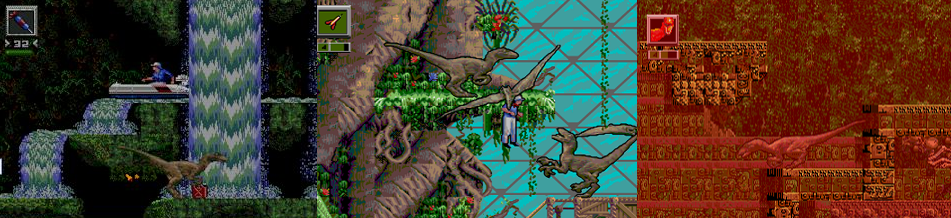
Jurassic Park 2: The Chaos Continues is a sidescrolling shoot-‘em-up that acts as a non-canon continuation of the original movie and its videogame adaptations. While the SNES version is more obviously framed as a return to Isla Nubar thanks to the presence of Biosyn, both can be seen as re-dos of the movie and its videogames since they don’t stray too far from the gameplay mechanics previously seen. While only the SNES version offers different difficulty modes, both see you jumping with A (defying gravity with a higher jump the longer you press the button in the Game Boy version) and shooting with X. Y and B also shoot in the Game Boy version and both versions allow you to rapid fire by holding the button, though this will charge your cattle prod in the SNES version and deplete most of your ammo here, too, save for your weakest lethal weapon and cattle prod. In the Game Boy version, you can switch to grenades by pressing the ‘View’ button; you can’t move and throw them but you have an unlimited supply. You switch weapons with the Left and Right Bumpers in the SNES version, LB cycles through lethal ammo types (such as a machine gun and shotgun spread) while RB cycles through non-lethal options, like tranquilizer darts. All enemies disappear regardless of which ammo you use but there’s a counter that ticks down when you kill any dinosaur that’s not a Velociraptor or what could loosely be described as a boss. Kill too many dinosaurs and your game ends, so be sure to cycle back and forth between lethal and non-lethal options. This crutch isn’t present in the Game Boy version; it’s an all-out platform shooter as Dr. Grant blasts dinosaurs with his unlimited shotgun! Both games also allow you to crouch and shoot, shoot while jumping, and shoot upwards and diagonally, though you must collect ammo in the SNES version by pressing down on the ammo item. This is also how you’ll collect the rare first-aid kits lying about Isla Nublar. These, and the odd 1-up, are automatically collected in the Game Boy version, which also incorporates a scoring system, though only the SNES version allows for a two-player co-op mode.
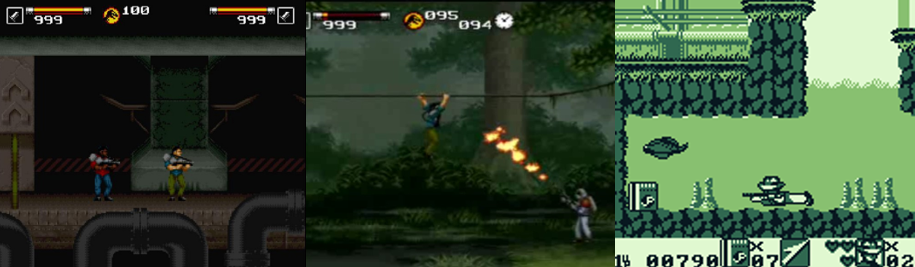
Blast your way past dinosaurs, grabbing vines, racing a timer, and collecting key cards to progress.

While the Game Boy version uses a lives system, you only get one shot to beat the SNES version. If you’re killed, you restart the mission from the beginning, with no checkpoints or continues or passwords to help. Although the Game Boy version follows a linear narrative, tasking players with guiding Dr. Grant through four stages (called “Zones”) with two levels and a boss battle each, the SNES version lets you freely pick a mission. Each mission has two screens of action and ends in an “Emergency” mission, where you must run around the maze-like environment disarming bombs, tracking down a spy, powering up a generator, and similar tasks against a very tight time limit. The labyrinthine nature of the levels doesn’t help with this. You’ll climb up ladders and jump between them, desperately pressing up and down (when you can even see the arrows!) to enter doors or change screens, with no idea of where you’re going or where you’ve been. These timed missions were some of the worst parts of the SNES version as the enemies respawn when you switch screens and the human enemies can be particularly aggravating, meaning it’s very easy to get lost and then be pummelled to death by grenades. While some of the Game Boy version’s Zones have multiple paths, reached by either hopping up branches or platforms or taking moving platforms, the levels are understandably much smaller and far more linear. Sometimes, you’ll venture underwater, tapping A to swim and attacking prehistoric fish with your harpoon; others, you’ll jump between conveyor belts or over spiked pits. Thankfully, these and other pits aren’t typically insta-death hazards in either version, though your character takes fall damage in 16-bit and must deal with a rather large hit box in monochrome. While you use overhead vines and poles to cross gaps in the SNES version, you can’t move and shoot when up there. Conversely, the Game Boy version requires you to search for a set number of JP Magnetic Cards. The exit will only open when you find them all, as indicated on the heads-up display, so you may need to backtrack to find them. Most of them are just out in the open; others fall from the sky. Zone 3-2 has you searching for 54 cards, but they’re helpfully collected in groups so it’s not as intimidating as it first seems.
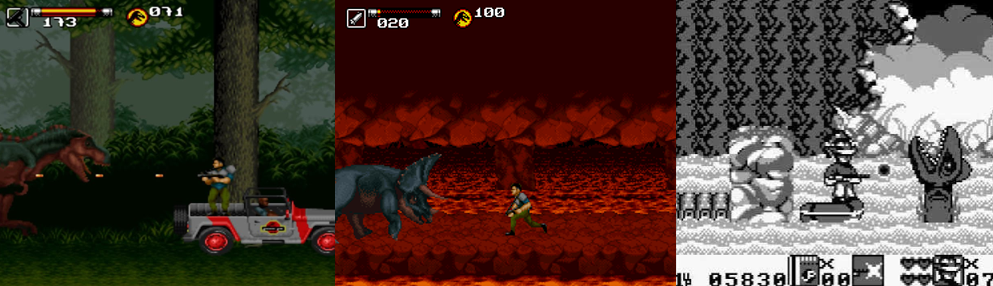
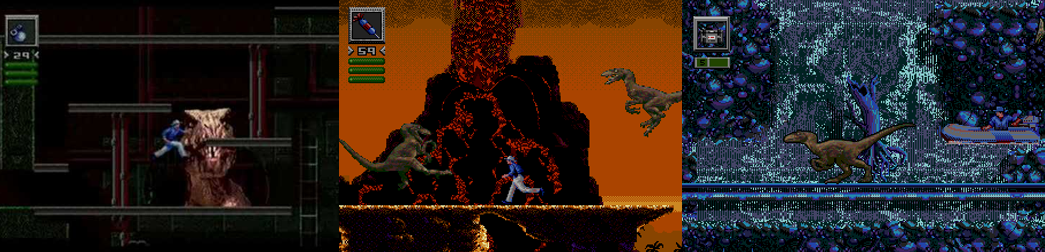
Don’t be fooled by the decent visuals: both games are tough and aggravating in different ways.

Stage hazards are also a concern in both versions. Flame bursts, loose electrical wires, steam vents, miniature exploding volcanoes, and falling boulders can sap your health if you’re not careful. Platforming is more of a priority in the Game Boy version and much simpler thanks to the chunky sprites and Dr. Grant’s floaty jump. On the SNES, it’s easy to fall through the environment, miss ladders, and drop into lava thanks to the annoying enemy hoards. You must navigate a volcanic maze to place a bomb then out-run the explosion, locate a wounded ally, shoot switches, and defend Gallimimus in the SNES version. When faced with a time limit, you’re better off eschewing non-lethal ammo and avoiding enemies wherever possible, especially if you’re not consulting a guide to navigate the looping mazes. The Game Boy version offers two bonus areas where you’re pursued by a Tyrannosaurs rex. It’s instant death if the T. rex touches you, so you must waddle away from her, hopping to platforms and structures and collecting the JP Magnetic Cards for an extra life. You’ll also be back on the rapids in the Game Boy version, where the water instantly kills you if you fall while jumping to wooden bridges but is no concern when you’re on a raft and blasting prehistoric fish. While you do race away from a T. rex at one point in the SNES version and the game also culminates in a vehicle section, this latter mechanic only appears if you’re playing on “Medium” or higher. This means that you’re stuck in a continuous loop of run-and-gun action and frantic races against the clock, desperately hoping the poisonous gas doesn’t sap your remaining health or you don’t miss any power supplies. At one point, you’re destroying giant fans to avoid being skewered; in another mission, you’re scaling a cliffside to repair an antenna. Other times, the ground crumbles beneath your feet, mines explode when you least expect it, or you must destroy boulders to progress, all while frantically hoping you haven’t doubled-back on yourself!

Presentation:
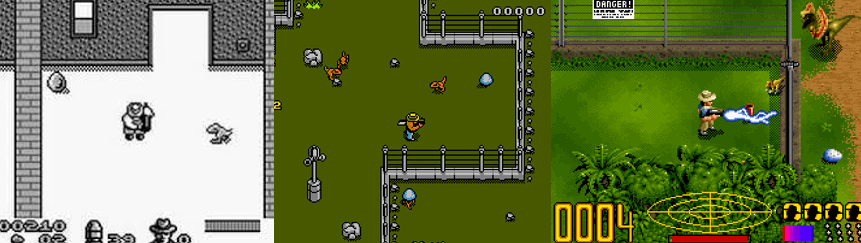
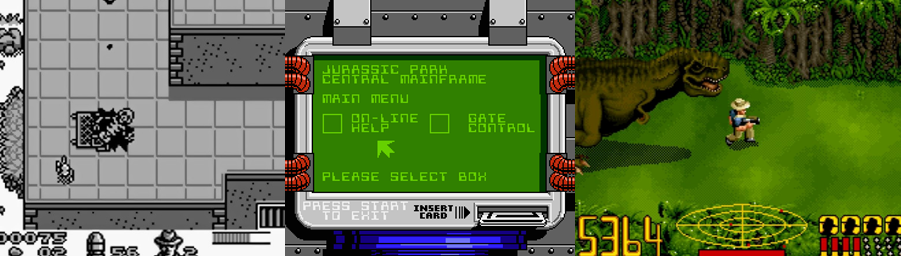
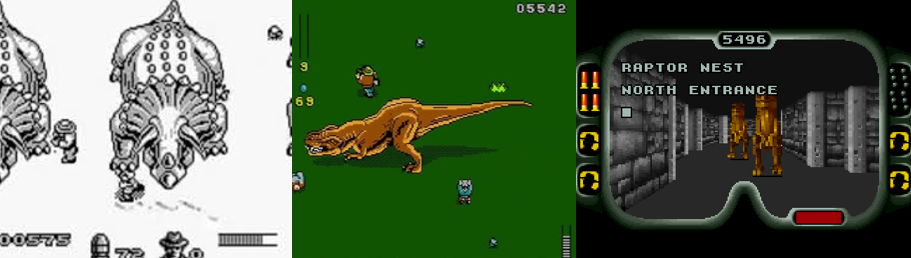
It’ll be no secret that the SNES version wins in this regard. However, the Game Boy version is pretty impressive considering the hardware, especially compared to the previous Jurassic Park game on the system. It begins with a nice pixel-art recreation of the big gates, the first Zone features Dr. Grant’s vehicle in the background, and there’s some decent sprite art introducing each Zone. Dr. Grant is a big, surprisingly animated sprite. While this means he has a large hit box, I enjoyed seeing him pump his shotgun with every shot and look around warily when left idle. Sadly, only the bosses match Dr. Grant’s quality in the Game Boy version, with regular enemies appearing disappointingly gaunt and basic. While the Game Boy version’s backgrounds and environments are obviously much more basic, they do a decent job of recreating the visuals from the film. I recognised the electrical fences, towers, and dinosaur paddocks and it was at least easy to see where I was and what I was doing. The SNES version nicely trumps the Mega Drive’s two sidescrolling run-and-gun efforts, featuring dense jungles, a touch of parallax scrolling in the valley, and more appealing sprite work. While the art direction does make Dr. Grant completely unrecognisable and I’m not sure what the purpose of mapping a dramatic pose to the Y button was, he has a lot of fun animations, particularly when climbing ladders or crossing vines. The dinosaurs also fare a lot better, making it even more of a shame that there isn’t a large variety of them and we simply get palette swaps of ‘raptors for the most part. While neither game uses the iconic Jurassic Park score, the Game Boy version includes some awesome arcade-style music and the SNES incorporates the dinosaur’s roars and noises from the movie. The bigger ones, like the T. rex and Triceratops, are also beautifully detailed (if off colour). The Game Boy version does okay when bringing to life larger dinosaurs for its boss battles, but its T. rex is incredibly ugly and its ‘raptors are strangely stretched.
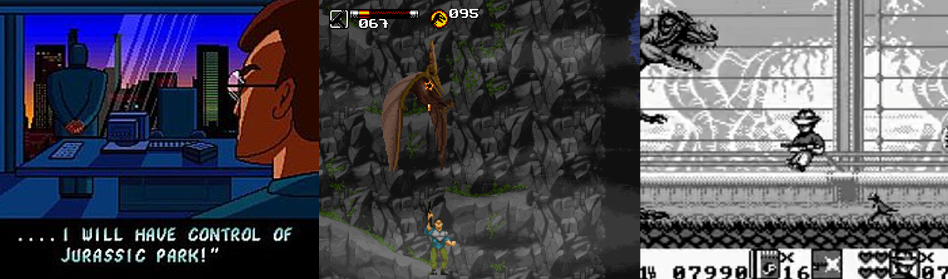
While the SNES’s visuals are impressive, the Game Boy does pretty well despite its limitations.

While larger dinosaurs simply blink out of existence or explode in the SNES version, they feature defeated poses in the Game Boy version, which is a fun touch, alongside a health bar so you can actually tell that you’re hitting them, which is a real issue on the SNES. Unfortunately, both games suffer when it comes to their environments. Sticking very close to the same ideas as the previous 8- and 16-bit games, both versions see you exploring the jungle (with various parts of the park, such as the gigantic electric fences, in the background), caves, a valley, and various InGen facilities. These are painfully generic in both games but even more so in the Game Boy version, where the hardware can’t do much beyond render some giant trees. There are some unique aspects to this game, such as algae-infested waters and the aforementioned rapids, but even this latter inclusion is similar to what we saw in the previous games (including hungry Brachiosaurs). While the SNES obviously benefits from greater processing power, sporting none of the admittedly rare sprite flickering seen in its handheld counterpart, it does force you to venture through the same jungle environment again and again. The interior locations are also recycled far too often, becoming indistinguishable from each other no matter how many pipes and vats and generators the developers sneak in. I like the incubators and Jurassic Park signage seen in the backgrounds, and that we get to revisit the Gallimimus valley. However, this is a strictly on-foot section and lacks the fast-paced action of the same area in Jurassic Park: Rampage Edition (BlueSky Software, 1994). I’m not sure why every Jurassic Park game has to feature a volcano, but this might be the worse one yet. The lava seems very disconnected, and it lacks the detail of the misty jungle. The cliffsides were okay, especially when they sported snow and you could see into the horizon, but they were very samey, just like the interiors, with little indication of where you need to go. The SNES version is bolstered by an animated introduction that also features voice acting, though this detail is strangely missing from the ending.

Enemies and Bosses:
As I mentioned above, neither version of Jurassic Park 2 impresses with its dinosaur selection. Dilophosaurus returns as a common enemy, standing stationary and spitting in all directions, while giant wasps, Pterodactylus, Dimorphodon, and Pteranodon fill the skies across each game. The Pteranodons are particularly aggravating on the SNES, endlessly spawning around the cliffsides, while their larger mothers simply flap around near their nests posing little threat. While you can take out the Gallimimus on the SNES, you’re meant to avoid them and off BioSyn’s soldiers to save the creatures. While Compsognathus are a constant headache on the SNES, you’ll find weird-looking Archaeopteryx, Hypsilophodon, and Parasaurolophus on the Game Boy, with the former jumping at you for extra annoyance. The underwater sections see you blasting prehistoric fish, trilobites, and anemone while baby Triceratops occasionally appear on land. On the SNES, you’re primarily faced with Velociraptors and Oviraptors, which leap at you and often attack in groups. Coming in different colours and proving quite durable, the ‘raptors fiercely defend their nest, but I found it best to jump over them and keep the fire button held down. The SNES version features exclusive human enemies to contend with. Not only will workers toss wrenches at you, scientists whip out pistols, and suited BioSyn executives dog your progress, their soldiers will be a greater threat than the dinosaurs most times. While the basic grunts just run about or stand in place, others can shoot in all directions or toss grenades, which are a bitch to avoid! Their bazooka soldiers are easily dispatched by crouching and shooting, a tactic that will serve you well against their flamethrower units. However, these bastards have a long reach and can roast you when you’re on ladders or hanging from pipes, meaning it’s always a pain in the ass when humans show up.
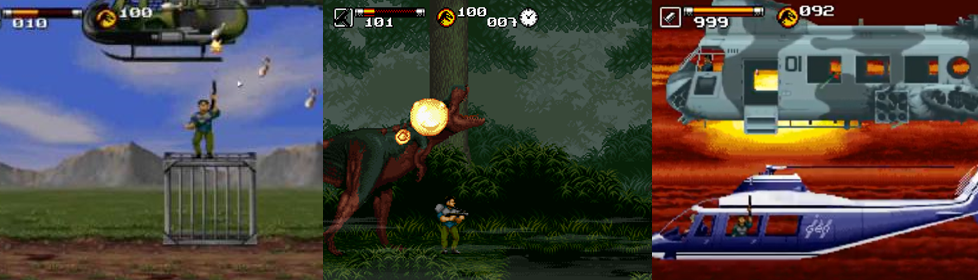
Sadly, the SNES version favours human boss battles over dinosaur threats.

While BioSyn’s armoured troops only pack a pistol, they can move, fire in all directions, and crouch and shoot, which can be annoying. You’ll also have to battle a larger enemy commander twice; this muscle-bound boss packs a flamethrower/machine gun combo and tanks even your best shots. Your best bet is to lure him in, blast him with your strongest shots, and back away, chasing him when he retreats. BioSyn’s attack chopper carpet bombs the Gallimimus valley, eventually swinging a dinosaur cage at you and peppering the screen with bullets and bombs. If you’re playing on “Medium” or higher, you’ll attack BioSyn’s bomber from an Ingen helicopter, firing in different directions with the face buttons and targeting the plane’s mini gun and launchers. True to its name, the bomber drops bombs but also fires homing shots, two projectiles that are extremely hard to avoid since your chopper is such a large, unwieldy target. The SNES version mainly throws bigger or more aggressive regular dinosaurs at you as pseudo-bosses, such as the Triceratops that guards the final explosive and must be lured in to charge and fend off, preferably with your shotgun. The T. rex chases you at one point, with you only able to force her back with your shots and jump to safety at the end. If you play on at least “Medium”, you’ll battle the T. rex in a fight to the death. Though big and slow and limited to a simple bite, it takes a shit load of your strongest shots to put her down. She chases you to a precipice, which will sap your health if you drop, and you’re also battling a tight timer. You must switch to your strongest shot and target her head, either by jumping or shooting diagonally, forcing her back to create space and jumping away to avoid being eaten. Since the T. rex doesn’t register damage, you’ll only know you’ve won when she explodes (naturally), which took me a fair few tries.
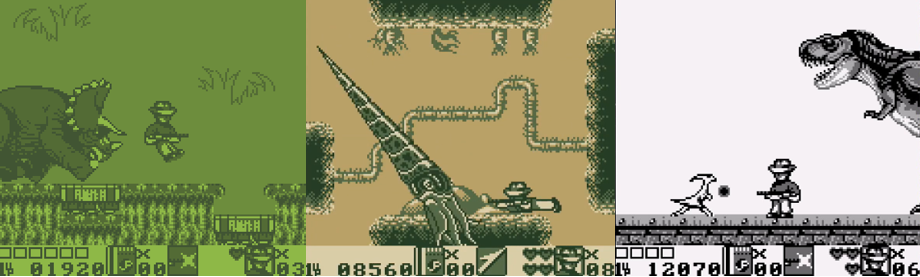
The Game Boy version’s bosses may be simple, but they’re big and at least they’re there!

The Game Boy version features far more traditional boss battles, with you battling a larger dinosaur at the end of each Zone. The first boss you face is a mummy Triceratops that stomps back and forth across the screen. You must dive into one of the nearby holes, duck down, and toss grenades at her. When the platform in the hole rises, you must dash to the other one to continue the assault, easily avoiding damage for the most part if you keep your head down. The Pteranodon is a bit more of a threat. This giant, bat-like dinosaur swoops down from either side of the top of the screen, dropping a boulder that’s a pain to avoid unless you race to the opposite side of the screen. Her smaller minions will attack after, though they’re easily taken out as you’ve been blasting them since Zone 1-1. The Game Boy version does offer one unique boss battle, one that takes place underwater and sees you attacked by a “Cephalosaure”. This giant, spike-headed squid darts in like an arrow from each corner of the screen, proving a large target that can be difficult to avoid because of the awkward swimming controls. Smaller, snail-like enemies will swim down after each pass but this is quite easy to hit, especially if you stay away from the centre of the screen. Oddly, the Velociraptor is fought between Zone 4-1 and 4-2, charging, hopping, or prancing in from either side of the screen. You can use the small block platforms to jump over them and they’ll try and bite you up close, but they’re not too difficult to avoid. On two occasions, you’ll be pursued by the T. rex, which cannot be killed and will instantly kill you if you so much as graze her. You must run from her, hopping between wooden scaffolding and taking out Compys, but you get to face her one-on-one in a painfully bland final battle. The T. rex stomps back and forth, occasionally charging, and takes a bite out of you up close. Dimorphodon come in to distract you, but this is actually your opening to pummel away at the T. rex’s head until she collapses in defeat.

Additional Features:
While the Game Boy version is the only one with a score system and final score, there is no high score table and the SNES version is the only one with a two-player mode and different difficulty options. Both games end with lacklustre congratulatory text, but you’ll only battle the T. rex and BioSyn’s bomber by playing the SNES version of at least “Medium”. The Jurassic Park: Classic Game Collection includes fun extras like each game’s soundtrack, different filters and borders, and the life-saving rewind and save state feature that greatly eases the pain of the SNES version’s difficulty. This version of the collection also has fourteen Achievements for you to earn, with two earned for these games, specifically. You’ll get an Achievement for beating the SNES version on any difficulty, and another for being it on “Hard”, so I advise just playing on “Hard” to snag them both. You got one Achievement on the Game Boy version for defeating the Velociraptors and another for clearing the game, which is a touch disappointing as there’s no incentive to shoot every enemy or play with a friend.
The Summary:
I was optimistic about Jurassic Park 2: The Chaos Continues, especially the SNES version, as it was developed after five other videogame adaptations of the movie so surely the developers would’ve learned a few things about what works and what doesn’t. Technically, that is true as the game focuses much more on run-and-gun action, allowing you to blast dinosaurs and humans to your heart’s content while also encouraging you to merely stun most dinosaurs to maintain some semblance of preservation for the resurrected creatures. Visually, the game may be the best looking of the 16-bit Jurassic Park titles, but for some of the lacklustre backgrounds and the lack of originality in the locations. The gameplay loop does get frustrating very quickly, however. Even before mentioning the aggravating timed sections, including looping doors and paths without a map or any clear indication of where you need to go was a baffling and frustrating decision. Combined with the timed sections and you only getting one chance to beat the mission, this makes for a shameless handicap to force kids obsessed with the blockbuster movie to rent the game again and again. While the Game Boy version is more basic, smaller, and very less visually impressive, the music is fantastic and the simpler shoot-’em-up gameplay was far more appealing. I quite enjoyed searching for the JP Magnetic Cards and blasting the butt-ugly dinosaurs, though the hit boxes and mediocre levels did let it down, especially as the sprite work on the boss was pretty impressive. While there is a lot to like in each game, and some technical improvements that make them better than their predecessors, I think Jurassic Park 2 still misses the mark no matter which version you play. Neither offer anything new, especially compared to their predecessors or other similar games, and again just make me wish we’d had one ultimate 16-bit Jurassic Park release that had combined all the best elements from each game instead of leaving us with average tie-in games where we have to cherry pick the best parts.

Game Boy Rating:

Rating: 2 out of 5.

Could Be Better

SNES Rating:

Rating: 3 out of 5.

Pretty Good

What did you think to the Nintendo-exclusive Jurassic Park sequels? How do you think they compare to each other, and the previous Jurassic Park titles? Which of the two was your favourite and were you glad that they were ported to modern consoles? Were you also annoyed by the SNES version’s maze-like environments and the large hit boxes in the Game Boy version? What did you think to the Game Boy version’s bosses and the timed missions of the SNES version? Which Jurassic-inspired videogame is your favourite? How are you celebrating Dinosaur Day this year? Whatever your thoughts on these Jurassic Park videogame sequels, or dinosaurs in general, leave them below, support me on Ko-Fi, and check out my other dinosaur content!

Game Corner: Jurassic Park / Jurassic Park: Rampage Edition (Xbox Series X)

Released: 22 November 2023
Originally Released: 10 August 1993 (Jurassic Park), 28 September 1994 (Rampage Edition)
Developer: Carbon Engine
Original Developers BlueSky Software
Also Available For: Mega Drive, Nintendo Switch, PlayStation 4, PlayStation 5, Xbox One, Xbox Series S

The Plot:
After sabotage releases the genetically engineered dinosaurs of the Jurassic Park theme park, palaeontologist Doctor Alan Grant and an opportunistic Velociraptor battle to escape the island.

The Background:
In 1993, Michael Crichton’s bestselling cautionary tale about a dinosaur theme park turned into a hazardous environment was adapted into a critical and commercial blockbuster that spearheaded many CGI techniques we still see in Hollywood. Bolstered by an aggressive merchandising campaign, Jurassic Park (Spielberg, 1993) was accompanied by numerous toys, comics, and multiple videogame adaptations released on different consoles. While Ocean Software developed games for Nintendo’s consoles, SEGA partnered with BlueSky Software for their Mega Drive adaptation, consulting palaeontologist Robert Bakker and museums to bring the dinosaurs to life. The developers used Silicon Graphics computers, stop-motion techniques, and materials used to make the film to create the sprites and environments, as well as pulling elements from Crichton’s novel for additional levels. Jurassic Park sold 250,000 copies in its first week and impressed with its visuals and gameplay. Bolstered by this success, and the strength of the film’s merchandising, SEGA commissioned a revamped version for the following year, one that received mixed reviews for, while it improved many elements, it was also seen as a bit of a rehash. Both games were essentially lost media for decades until they (and five others) were finally re-released on modern consoles to celebrate the movie’s 30th anniversary, alongside modern quality of life features, to largely thankful and positive reviews.

Gameplay and Power-Ups:
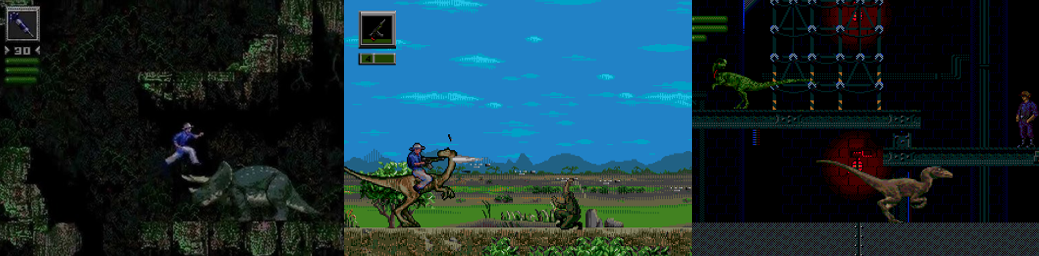
Unlike the games of the same name released for Nintendo’s hardware, the two Jurassic Park adaptations released for the Mega Drive are sidescrolling platformers almost akin to a run-and-gun. Although the Rampage Edition is technically a very different game, to me it’s more of a do-over than a sequel so I’m lumping these two together as many of the features and gameplay are the same in both. Both titles see players picking between three difficulty settings (“Easy”, “Normal”, and “Hard”) and selecting a playable character. Yes, while Nintendo’s games stuck you with Dr. Grant and his surprising arsenal of weapons, SEGA let you play as the unexpectedly athletic palaeologist or a Velociraptor. Both characters explore the same locations, though the ‘raptor has less stages in Jurassic Park and must also contend with park security trying to stop her in both games. The controls for both are the same between versions: Dr. Grant fires his current weapon with A (able to fire upwards and diagonally in both), jumps with B, and switches weapons with X. Unlike in Nintendo’s games, Dr. Grant’s weapons all consume ammunition in Jurassic Park, even his taser shot (which increases in power the longer you hold X). In the Rampage Edition, Dr. Grant has an infinite supply of weak tranquilizer darts, though these permanently put down every regular enemy. Dr. Grant can also sprint to clear gaps, clamber up ledges, climb ladders, ropes, vines, and chains, and monkey his way across overheard wires and handholds (when you can spot them). The ‘raptor is geared more towards melee and fast-paced running and controls a little differently between versions. In both, she bites with X, kicks with her taloned foot with A, leaps high with B, and dashes ahead if you hold up on the directional pad. Pressing down an X in Jurassic Park lets her eat Procompsognathus to regain health (a necessary mechanic as she’ll constantly lose health as you play), down and A launches a flying kick, and up and B sees her leap even higher! In the Rampage Edition, you still eat Compys but this doesn’t seem to restore health, holding X sees the ‘raptor continuously bite, a tail swipe had been added to her melee attack, and she performs a ludicrous spin jump by double pressing B.

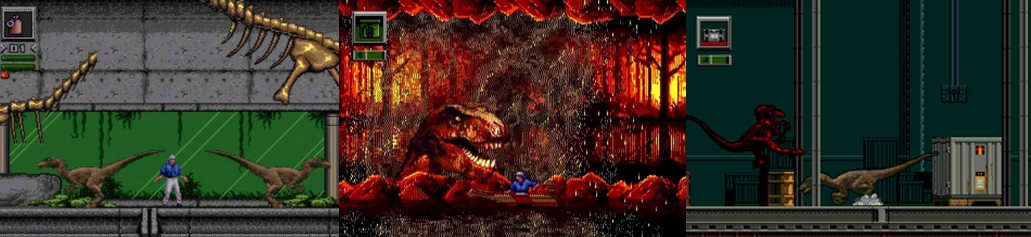
Run, jump (and gun) as the strangely athletic Dr. Grant or consume everything in sight as the ‘raptor.

Both games see you start with three lives and incorporate a password system and rudimentary island map before stages to show you where you are on Isla Nubar. While you thankfully don’t need dinosaur eggs in either game, Jurassic Park closely mirrors the Nintendo titles and the movie in its locations and players collect eggs, test tubes, and other items for points in the Rampage Edition. Dr. Grant acquires similar weapons to the Nintendo titles in both games: in Jurassic Park, you mainly fire different coloured tranquilizer darts, but you can also grab gas grenades, flashbangs, concussion grenades, and rockets. It’s worth noting, however, that none of these weapons, even the rockets, kill the dinosaurs; instead, they’re rendered unconscious for a short time. This isn’t the case in the Rampage Edition, where Dr. Grant cuts down dinosaurs with a shotgun, submachine gun, grenades, a flamethrower, and a rocket launcher! Dr. Grant can also ride certain dinosaurs, such as the stampeding Gallimimus to rush through the savannah and the hulking Triceratops, normally a docile creature unless provoked, to crash through walls. The ‘raptor kicks these walls down and also opens doors, just like Dr. Grant, though she gains a special power-up in the Rampage Edition. Consume three lysine crates and the ‘raptor enters a brief “Raptor Rage”, becoming invincible and killing enemies with a touch. Like some of the Nintendo titles, Dr. Grant also uses a motorboat, a mechanic far more enjoyable in the Rampage Edition. In Jurassic Park, you collect fuel cannisters to keep the boat moving (though there’s no gauge showing your fuel level) and must either speed up or slow down to avoid being killed when going over the waterfalls. In the Rampage Edition, there’s no need for fuel and no fear of falling to your death. Similarly, the hypersensitive fall damage handicap has been removed from Dr. Grant in this game and your health is restored with each new stage.

Dr. Grant must fight dinos and gravity to survive, while the ‘raptor can go on an unstoppable tear.

While Jurassic Park is a fairly standard platformer, requiring little more of Dr. Grant than to hop to platforms, subdue dinosaurs, and avoid falling to his death or getting skewered on spikes, things get very troublesome very quickly. You’ll be moving crates to reach higher areas, climbing electrified cables, crawling through vents, and dodging falling boulders. By far the hardest thing about this game is the fall damage, which chips away at Dr. Grant’s health from small drops and even slides, and that Dr. Grant instantly dies if he falls into even shallow water. This is rectified in the Rampage Edition, though you must still avoid electrified water (hopping to crates to avoid being fried) and quickly clamber up ladders to avoid drowning when the cargo ship floods. When in Jurassic Park’s pumping station, players must press up to activate switches and open or close passages and turn valves to shut off steam, while the ‘raptor pounces between tunnels to avoid drowning. Dr. Grant must also attack swimming Brachiosaurus’ to cross gaps in Jurassic Park and watch for crumbling and temporary ground in both games, as well as contend with aggressive Pteranodon’s carrying him to their nest in the Rampage Edition. Stages like this and the Raptor Rapids are technically easier for the Velociraptor but are deceptively difficult in different ways. It’s frustratingly easy to get lost in both stages, which are a maze of foliage and rushing water, respectively. While the checkpoint signs point you in the right direction, it’s not always clear which way you need to go, especially as Dr. Grant doesn’t act as your end goal like in Jurassic Park. Similarly, the Velociraptor has less stages in Jurassic Park and traverses environments a little differently. When in the visitor’s centre, for example, the ‘raptor doesn’t need to enter the ceiling vents until later in the stage. The Rampage Edition allows players to pick which stage they wish to challenge and allows Dr. Grant to fly about on zip wires, while both characters hop to weighted and moving platforms in this version and engage in far faster, more arcade-style gameplay.

Presentation:
Both games have very similar presentation and a few things in common. Like the Nintendo games, neither uses the classic Jurassic Park theme and each stage is accompanied by generic-ass music, with the Rampage Edition leaning more towards rock and Jurassic Park featuring more recognisable dinosaur sounds. Both feature more detailed title screens, with the Rampage Edition adding more animation and background effects, and the Jurassic Park font is used for the menus and pause text. No other characters from the movie appear in either game, not even Lex and Tim Murphy, and both games utilise a combination of text and still or partially animated sprite art to advance the story between stages and relate the ending. Dr. Grant is a relatively detailed and lively sprite in both; he has an idle animation where he looks around anxiously and whips out his gun and he hops and climbs about with more vigour than Sam Neill showed in the film. Like in Nintendo’s games, all that’s left of him is his hat when he’s eaten and you see his skeleton when he’s zapped, which is a nice touch. The Velociraptor is a larger sprite, meaning she’s a much bigger target, and is suitably unwieldy despite how fast she is and the strange amount of platforming she does. She snaps and grooms herself and echoes her rivals in the way she eats her prey. I did like spotting enemy ‘raptor eating carcasses, Compys popping from eggs, and the odd blood splatter throughout the Jurassic Park facilities. Jurassic Park closely replicates locations from the films and follows a similar stage pattern to the Nintendo games, taking players through the park, a river, a volcanic region, and ending up at the visitor’s centre. Unfortunately, Jurassic Park’s graphics are really unsightly a lot of the time and the game performs poorly when there’s a lot onscreen, leading to annoying slowdown and garish visuals as the oddly prerendered backgrounds glare at you.

While Jurassic Park has more recognisable locations, the Rampage Edition looks and plays better.

The Rampage Edition corrects this, featuring far more detailed and lively backgrounds. Sure, we see a volcano erupting in Jurassic Park and some rudimentary smoke effects, but the Rampage Edition has far more depth and detail to its backgrounds. The sprites, which have been slightly redesigned, also stand out a lot better thanks to a black outline, though this effect also made them appear more amateurish to me. Stages are much longer in the Rampage Edition and often feature a maze-like structure, especially for the Velociraptor, and destructible elements, such as walls, pipes, and floors. You don’t get to revisit the visitor’s centre or any of the bunkers in the Rampage Edition, but there is a long stage dedicated to the cargo ship, which features a rudimentary rain and lightning effect on deck and far better water effects than in Jurassic Park. While I preferred the waterfalls and rapids in Jurassic Park, the Rampage Edition impressed with its Aztec-inspired ruins, which see players hopping up blocks and sliding down pyramids, and dense aviary, with its Pteranodon nest and obscuring foliage. While the volcano and odd colour palette applied to Jurassic Park’s rapids were off-putting, the visitor’s centre made up for it. Like in the film, it’s partially under construction and you must head up into the vents to bypass dinosaurs, pass through the incubator room, and end up in the main foyer, with giant banners and dinosaur skeletons on display. Similar bones appear in other stages, such as Triceratops skeletons and even human remains, which was a surprise, and there was an interesting curve effect applied to the pumping station stage. While Jurassic Park features a large Tyrannosaurus rex sprite, it recycles the same animations over and over and, though the T. rex is only seen once in the Rampage Edition, this game performs far better than its predecessor. There’s no slowdown, no sprite flicker, and more enemies and obstacles onscreen at any one time. While this can be chaotic and hazardous for the Velociraptor and cause some of Dr. Grant’s stages to feel endless, the performance upgrade, better visuals, and more action-orientated focus makes it an easier title to pick up and play.

Enemies and Bosses:
Like their Nintendo cousins, these SEGA titles include only a handful of dinosaurs but the majority of them are ripped directly from the movie. This means you’ll be fending off tiny, voracious Compys (gobbling them as the ‘raptor to keep her health up in Jurassic Park), blasting spitting Dilophosaurus’, and tangling with aggressive Velociraptors, who pounce, clamber up ledges, and often attack in packs (in Jurassic Park’s canyon stage, I even saw one “play dead”!) Triceratops also appear, though they’re docile unless provoked; Dr. Grant can even climb over and ride them. These beasts can trample the ‘raptor and whittle her health down in streams but can be killed just like anything else she encounters. While human opposition is unique to the ‘raptor in Jurassic Park (and they wield similar weapons as Dr. Grant, including a taser and grenades), both characters contend with them in the Rampage Edition. Poachers, mercenaries, and park staff dog your progress, tossing grenades, blasting along in their own motorboats, camping out up high, and easily overwhelming even the ravenous Velociraptor when she’s caught between numerous enemies and projectiles. Pteranodons also appear in both games, swooping from the skies and annoyingly carrying Dr. Grant away in the Rampage Edition, and Triceratops will wander about at times, but that’s about it for enemies, unfortunately. There are, of course, other hazards to worry about. The explosive boxes and crates from the 8-bit Nintendo games return to mess up your day and you must be quick to avoid sliding into spikes, drowning in water, or being immolated by boiling lava. While the Velociraptor must worry about bottomless pits, Dr. Grant must be careful not to drop from almost any height as he’ll take damage or die, something made more aggravating by platforms having unreliable hit detection and the graphics not making it clear which platforms are solid or not.

Sadly, both games continue the trend of having only a couple of mediocre bosses.

Like the Nintendo games, both titles are sadly light on bosses. There are technically only four boss battles between the two games, and one of those is pushing it. When playing Jurassic Park as Dr. Grant, the T. rex will crash through or appear as a hazard in a couple of stages. When she does, she’ll bite a chunk off your health or eat you whole if you get too close, so you must carefully navigate around her or stun her with your more powerful shots to slip past, which can be tricky when the environment gets in the way. Sadly, that’s it for the T. rex in the first game as she doesn’t appear in the final stage or as a big boss battle. Instead, Dr. Grant is faced with two invincible Velociraptor at the finale. Instead of wasting your time and ammo trying to kill them, target the pins holding up the dinosaur skeletons to make them collapse on the two dinosaurs, like at the end of the movie. Similarly, the Velociraptor only has one boss in Jurassic Park (though one aggravating guard in the visitor’s centre ceiling vent was a close second) as she faces Dr. Grant in the same area. Players must avoid Dr. Grant’s smoke grenades and taser and attack the boulder on the right, which again causes the dinosaur bones to collapse, scaring Dr. Grant off and allowing the ‘raptor to escape to the mainland. In the Rampage Edition, Dr. Grant doesn’t encounter the T. rex until the final stage; this time, you’re in a motorboat, racing through a flooded cavern. The T. rex chases from the mid-background, snapping her jaws and trying to eat you, so fend her off with your shotgun or other weapons until the stage abruptly ends and Dr. Grant escapes. The Velociraptor battles a lazy red hued palette swap in the cargo hold of the docked ship. This ‘raptor has all the same abilities as you but primarily attacks with its spin jump. While it’s difficult to gauge if you’re doing any damage, just stay back and strike whenever you see an opening, eventually putting the red ‘raptor down and again allowing your ravenous dinosaur to escape to civilisation.

Additional Features:
Though you collect items for points in the Rampage Edition, there is no high score table and nothing to gain from finding all the items in each stage. Both games allow you to alter the difficulty for an added or lesser challenge and toggle the music (and sound effects in the Rampage Edition) but, sadly, there are no two-player options here. This is disappointing as it would’ve been cool to at least feature a one-on-one duel mode to pit Dr. Grant against the Velociraptor. You also don’t get anything for beating the games on their hardest difficulty and there are still no options to play as other characters, something that could’ve at least been addressed in the Rampage Edition since it improved so many other aspects. As you’d expect, the Jurassic Park: Classic Game Collection includes each game’s soundtrack, various borders and filters, and the life-saving rewind and save state features that make both games a breeze. It also includes fourteen total Achievements, with two earned for each of these games. Sadly, the criteria are the same for both: simply beat each game twice, once as Dr. Grant and once as the Velociraptor, and you’ve done it.

The Summary:
I was hesitant about playing these two games. I picked up Jurassic Park: Rampage Edition for my Mega Drive library some time ago but never sat down with it beyond a quick mess about in the aviary, a confusing and cluttered stage that told me I’d need to put more time and effort into the game. Thankfully, playing them is far less intimidating with the quality-of-life features included in the Jurassic Park: Classic Game Collection, easily allowing me to rewind past mistakes and power through tricky sections. Still, the difficulty curve is readily apparent in both games. These are obviously games designed to cash-in on the movie’s popularity and encourage repeated rentals. Unlike the Nintendo games, however, these two are much more user friendly and adopt a far simpler gameplay style. This is further refined in the Rampage Edition, which is a full-on run-and-gun at times and focuses almost entirely on fast-paced, action-orientated, arcade action. I much preferred this pace and found the Rampage Edition the better experience overall, but I think a mash-up of the two would be the perfect compromise as Jurassic Park features far more recognisable locations from the movie. Adding the Velociraptor as a playable character was a fun and interesting way for SEGA’s games to stand out, but I did find her to be clunky and awkward at times. It’s weird how much focus is placed on platforming as the ‘raptor, even in the Rampage Edition, where you’re also blasting through as an untouchable predator. I’m glad I didn’t have to search all around for eggs, but a little more depth would’ve been nice; many stages just seem to randomly end and the lack of boss battles was very disappointing. Still, I liked a lot of the visuals (even if Jurassic Park’s were painfully garish and unsightly at times) and the light puzzle elements. Ultimately, I’d say the Rampage Edition is the better of the two but, really, we needed one game that combined all the best elements of both (and the Nintendo titles) to create the definitive old-school Jurassic Park adaptation.

Jurassic Park Rating:

Rating: 2 out of 5.

Could Be Better

Rampage Edition Rating:

Rating: 3 out of 5.

Pretty Good

What did you think to the Jurassic Park videogames released on the Mega Drive? How do you think they compare to each other, and Nintendo’s releases? Which of the two was your favourite and were you glad that they were ported to modern consoles? Did you enjoy playing as the Velociraptor? Were you a fan of the Rampage Edition’s faster pace? What is your favourite Jurassic-inspired videogame? How are you celebrating Dinosaur Day this year? Whatever your thoughts on SEGA’s Jurassic Park videogames, and dinosaurs in general, leave them below, support me on Ko-Fi, and check out my other dinosaur content!
Game Corner: Jurassic Park (Xbox Series X)

Released: 22 November 2023
Originally Released: June 1993 (NES), August 1993 (Game Boy), October 1993 (SNES)
Developer: Carbon Engine
Original Developers: Ocean Software (Game Boy / NES); Ocean of America (SNES)
Also Available For: Game Boy, Nintendo Entertainment System (NES), Nintendo Switch, PlayStation 4, PlayStation 5, Super Nintendo Entertainment System (SNES), Xbox One, Xbox Series S

The Plot:
When an act of sabotage releases the genetically engineered dinosaurs of theme park Jurassic Park, palaeontologist Doctor Alan Grant must fight to curb the outbreak and escape the island.

The Background:
In 1993, director Steven Spielberg took Michael Crichton’s bestselling cautionary tale about a dinosaur theme park thrown into chaos and gave us Jurassic Park, a critical and commercial blockbuster that pioneered many of the CGI techniques we still see in Hollywood. Bolstered by an aggressive merchandising campaign, Jurassic Park inspired a wave of toys, comics, and numerous videogames, with multiple adaptations releasing alongside the film. Although games were also published for SEGA’s consoles, having made a name for themselves with their arcade tie-ins to other film releases, Ocean Software made the Jurassic Park games for Nintendo’s consoles after securing the license for an undisclosed six-figure sum. The developers were provided with numerous resources from Universal Pictures to recreate the visuals and likenesses of the film, utilising the Super Nintendo’s “Super FX” chip and ambitious texture mapping techniques to create first-person sequences on the 16-bit console. All three versions received widespread praise for their graphics, with the SNES version impressing with its large scope, though its first-person sections were criticised and the Game Boy’s more simplistic nature was noted. After decades of being essentially lost media, these three games (and four others) finally came to modern gamers in celebration of the movie’s 30th anniversary, courtesy of Limited Run Games, alongside modern quality of life features, to largely thankful and positive reviews.

Gameplay and Power-Ups:
These three Jurassic Park adaptations have a lot in common. They’re all top-down adventures set on Isla Nublar during the events of the film; they all have you control Dr. Grant; and they all centre around a mad search for numerous Velociraptor eggs. The only thing that really separates them, on paper, is the hardware they’re on, hence why I’m lumping all three into one review. Unlike in the movie, where Dr. Grant can only run and use his dinosaur expertise to outthink the reborn creatures, players are armed in these games. Dr. Grant carries a firearm that fires an electrical taser shot to stun smaller dinosaurs in the Game Boy and NES titles but is largely ineffective against bigger dinosaurs. In the SNES version, this weapon pushes back and eventually subdues the Dilophosaurus but it’s far too weak against the hyper-aggressive Velociraptors. However, you must also use it to power-up gears to create bridges and open the park’s electrified fences. Dr. Grant can also jump but he’s hardly an athlete. He can barely hop over Compsognathus’, brambles, and electrified flooring but you won’t be jumping to platforms or anything. The controls change between games, but all three see you switching your shot with the Xbox’s ‘View’ button. Dr. Grant can pick up more formidable, but limited, ammunition strewn around the park, including a bola shot, near useless smoke grenades, a shotgun, and a grenade launcher. In the SNES version, you can carry two of these shots at once alongside your taser shot, and the ammo respawns when you enter the park’s  buildings. Search hard enough and you’ll also find health kits and extra lives and, exclusive to the NES version, a temporary invincibility. Be cautious when collecting items in the Game Boy and NES versions, however, as many of them are boobytrapped to blow up in your face. Players get points for every dinosaur they dispatch and earn extra lives with enough points, and you’re also given a handful of continues should you lose all your lives, though each game must be beaten in one sitting.

Remember when Dr. Grant collected eggs and shot grenades at dinosaurs? It’s all recreated here!

Dr. Grant’s goal is to search the island for numerous ‘raptor eggs. These are essential in the Game Boy and NES versions, to the point where you can’t access buildings or progress until you’ve found all in each area. Collecting them all in these versions spawns a key card, though it’s not always clear which door you need to take so you’ll need to experiment a bit, which is tricky as the enemies respawn in these versions. Enemies don’t respawn in the SNES version, but the map is far bigger and you’ll be backtracking more. The only consolation is that you don’t need the eggs to access buildings, but you will be hunting high and low for identification cards to access computer terminals and locked doors. These terminals appear in each version but they’re far more detailed and prominent on the SNES, where you need the correct access to reboot the park’s security systems, unlock specific gates, radio the boat and the mainland, and access the ‘raptor pen and infested nest. Each game tasks you with destroying this nest using a nerve gas bomb; there are three bombs and three nests in the Game Boy and NES version and one aggravating labyrinth and one bomb on the SNES, found on the lowest level of the docked ship. When playing on the Game Boy and NES, players also control a life raft, dodging Dilophosaurus spit and swimming Brachiosaurus, while SNES players must dodge stampeding Gallimimus and dash into alcoves to avoid being trampled by a gigantic Triceratops. The Game Boy and NES versions also task you with rescuing Lex and Tim Murphy from a herd of Triceratops and a voracious Tyrannosaurus rex, with the Lizard King popping up on the main map on the SNES and the kids reduced to mere cameos as just two of many annoying pop-ups that completely obscure the screen. If you lose a life, you thankfully respawn right where you fell with all your ammo and inventory intact, which is useful, though the lack of passwords makes me wonder how anyone beat the SNES version without save states.

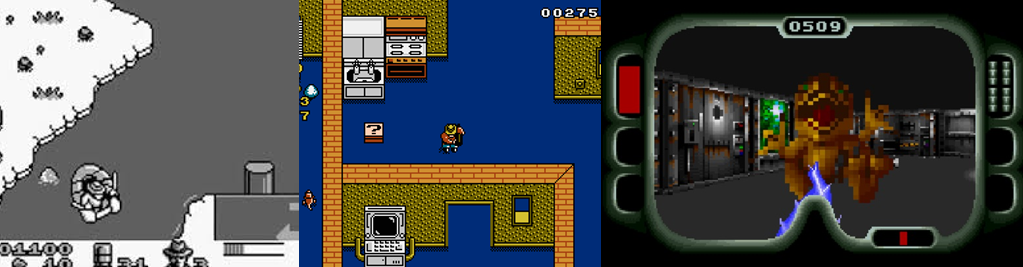
Each version has mildly unique sections, but the FPS parts are the worst of them all.

While the Game Boy and NES versions are essentially mission-based games that task you with collecting eggs and key cards and surviving each location, they also include some maze-like elements. The buildings and caves loop and turn you about, throwing miniature volcanoes and electrical pylons in your way and timing your escape from the ‘raptor nests before your bomb takes you out. Though the SNES version encourages you to exit the nest as quickly as possible, you appear to have unlimited time to escape, which is good as the nest is easily the most confusing area in the game. And that’s saying a lot considering all the interior locations are frustrating mazes that, surprisingly, switch the game to a first-person shooter (FPS). Clearly designed to showcase the SNES’s Mode 7 feature, these sections are slow, tedious slogs around repetitive locations with no clear indication where you need to go. You’ll be hunting for batteries to power your night vision goggles, grabbing ID cards to open doors and access terminals, powering up a generator and fiddling with the park’s systems, and taking elevators to sub-levels to explore further. Eventually, you’ll activate the park’s motion sensors, finally giving that obnoxious circular sprite on the heads-up display a purpose, and gain additional security clearance. This means you go back and forth between utility sheds, the visitor’s centre, the ship, and the ‘raptor pen desperately trying to remember where you couldn’t access the first time around. One mission sees you either wiping out the Velociraptors or blocking their entry with a wooden box, while another tasks you with destroying all the dinosaurs that’ve infested the ship. You must clear each mission in the SNES version to proceed; even if you have the right ID card, the game blocks you if you haven’t finished a mission. Of course, there’s no way to track your progress; the computer terminals help to a degree, but it’s limited to listing your ID card inventory and security clearance level.

Presentation:
Obviously, we’re working on a sliding scale between these three games. The SNES version is going to look the best, the NES version is passable, and the Game Boy version is…let’s say “quaint”. The NES version doesn’t make the best first impression; you can argue that the large T. rex sprite art is ambitious, but it just looks ugly. Ironically, it fares better on the Game Boy, where my expectations are much lower, though only the SNES version includes a detailed title screen of the film’s logo. In the Game Boy and NES versions, Mr. D.N.A. gives you an overview of your objectives. This is absent in the SNES version, but large, annoying text boxes regularly pop up to give you hints and the game’s bookended by Mode 7 effects applied to the island. The Game Boy and NES versions have extremely jaunty and fun chip tune soundtracks that remind me of Ocean’s arcade efforts. The SNES version opts for more subdued, ambient tunes, the ominous sounds of dinosaurs, and a handful of sound bites, though none of the games use the film’s iconic soundtrack or dinosaur roars. The SNES also performs far better; unlike its inferior cousins, I saw no instances of screen tearing, sprite flickering, or slowdown. These issues were rife on the NES version and also cropped up on the Game Boy version when too much was happening at once, though all three have a problem with the sprites having large hit boxes.

Each game faithfully recreates the movie, but the SNES version is the obvious standout.

Isla Nubar is represented on a reduced scale in all three games but is still surprisingly recognisable in the Game Boy and NES versions. You’ll start outside the iconic park gates in all three and explore the lush grasslands and forests surrounding the visitor’s centre, venture into the ‘raptor pen, and explore the nearby caves. Unlike its cousins, the SNES version portrays Isla Nubar as one big world map, with forests, streams, buildings, and recognisable locations all on one big, interconnected map rather being separated by missions as in the other two games. On the NES, the landscape changes colour and layout with each mission, introducing different buildings, forests you can pass through, containment fences, and rugged, hazardous mountain peaks. On the SNES, you venture up a cliffside many times as you revisit the docked ship again and again, will drown if you fall in the water, and must power up gears to progress. The helipad is your goal in all three games, though it’s only a separate region on the SNES and this version is the only game to accurately recreate the visuals of the film. Without a doubt, the overworld graphics are the best part of this version, featuring lush vegetation and detailed and colourful sprites, though the Game Boy version does boast surprisingly detailed sprite art recreating events from the movie. The SNES banks heavily on its FPS sections which, in my opinion, was a mistake as the game slows to a crawl and the visuals look pixelated, ugly, and repetitive. While the game recreates recognisable interiors from the film, every corridor looks the same. Some are ugly and grey, some are bronze and have nautical trappings, some are a light blue, and others are pitch-black, but everything looks the same so it’s easy to get lost. The sub-levels of the ‘raptor pen were the best parts, though, as you can see foliage through the windows, but these sections were a chore to play through. I really wish the developers had limited themselves to two or three FPS sections and used a traditional sidescrolling platformer perspective, like the Mega Drive titles, for the others, just for some variety.

Enemies and Bosses:
Jurassic Park is as disappointingly light on dinosaurs, though most of the creatures showcased in the movie make an appearance in all three games and you can even view an encyclopaedia of the creatures on the Game Boy. As you collect eggs, you’ll be relentlessly attacked by tiny Compsognathus. These aren’t much of a threat, but they do get annoying, so it was satisfying turning them into puffs of smoke with the cattle prod in the SNES version. Meganeura, prehistoric dragonflies, also appear in the SNES version alongside the easily spooked Gallimimus, who stampede and whittle your health to nothing if you’re not careful. Pachycephalosaurus also appear exclusively in the SNES version, attacking with an annoying headbutt if you get too close, though you’ll only see the gigantic, swimming Brachiosaurus, wandering Dimetrodon, and leaping Ichthyosaurus in the Game Boy and NES versions. One of the most common enemies you’ll face across all three games is the Dilophosaurus, rancid creatures who spit from afar and lurk in the game’s butt-ugly FPS sections (where they, like the ‘raptors, explode when shot, no matter what ammo you use). Equally, you’ll battle more than a few Velociraptors in all three games. Incredibly aggressive and often striking in twos, these creatures burst from trees and bushes and stalk the corridors of the SNES’s FPS sections. While enemies respawn seemingly endlessly in the Game Boy and NES versions, they’ll be down for the count on the SNES, especially in the FPS sections, except for the Velociraptors. You must also be wary of brambles, rushing streams, electrical bolts, falling boulders, and erupting volcanos. Those annoying explosive boxes will be your biggest enemy in the Game Boy and NES versions, though, and really got to be a pain in the ass after the first few caught me off-guard.

The Game Boy and NES versions may have dull bosses, but at least they have boss battles.

Oddly, considering the Super Nintendo’s greater processing power and the impressive nature of its sprite work, bosses only appear in the Game Boy and NES versions and, even then, they’re not that impressive. You must rescue Tim from the stampeding Triceratops in both versions, weaving between the gigantic beasts and trying to avoid their huge hit boxes in sections that I have no idea how anyone beat back in the day. You must endure this section twice in both versions, with Tim’s lagging speed often costing you and the creatures appearing in specific, much more manageable sections on the SNES. When the T. rex appears here, your only option is to run or momentarily stun her with tranquilizer darts, though you’re more likely to be left squirming in her jaws if you try and fight her. In the NES version, you battle the T. rex directly twice. The first time, you must rescue Lex from her, and the second time you must rescue Lex and Tim, with both being rooted to the spot by fear and easily chomped by the Lizard King if you don’t catch her attention. The T. rex is impervious to damage unless her head is lowered, but you must be quick as she’ll stomp over and eat you (or one of the kids) whole otherwise, and her hit box is predicably large, so you’ll have a hard to avoiding being hit. In the Game Boy version, this fight is turned into a desperate dash to the left-side of the screen, though thankfully there’s no risk of being trampled and her bite is easy to avoid. You must push the T. rex back with some shots and then usher Lex towards the exit, desperately trying to not get caught on the boulders scattered across the path. There is no final battle against the T. rex in the Game Boy version, making the finale disappointingly anti-climactic compared to the NES version, and no bosses at all in the SNES version. The closest you get are the many encounters with the Velociraptors, who pounce from the bushes and prowl around the corridors of the game’s interiors, which is a shame as I would’ve loved to see a proper rendition of the T. rex fight.

Additional Features:
The NES version is the only one of the three to offer a two-player option (presumably with players taking it in turns between lives), though all three offer a high score table for you to try and get your name on. Each game ends in the most lacklustre way possible, with simple text congratulating you, though you get to wander around the credits in the lesser versions. The Jurassic Park: Classic Game Collection offers a few fun extras, such as each game’s soundtrack, various filters and borders, and a rewind and save state feature that makes each game, but especially the SNES game, much easier. Each game also comes with a map, which is super helpful until you play the SNES version, where the developers didn’t include maps for the FPS sections! The collection naturally has some Achievements for you to earn; fourteen in total, with two earned for each game included. While you obviously get an Achievement for beating each game, an additional Achievement is assigned to each and tied to different objectives. You get an Achievement for starting the generator in the Game Boy version, saving Lex from the T. Rex in the NES version, and finding all eighteen ‘raptor eggs in the SNES version.

The Summary:
I’ve long admired the SNES version of Jurassic Park. I believe I played a port of it on the Amiga as a kid and I’ve always been captivated by the overworld graphics. Truly, the game is gorgeous to behold, and the 16-bit recreation of the film’s visuals is incredibly impressive. The foliage, the buildings, and the dinosaur sprites, especially, are all visually appealing, let down only by the lack of John Williams’ iconic score. Well, that and the awful FPS sequences. Believe me, I get the appeal of showcasing the Super Nintendo’s processing power, but these sections are slow, ugly, and a chore to play. It might not’ve been so bad if you didn’t have to keep backtracking to these areas again and again, each time getting more confused about where you’ve been and where you’re going. The Game Boy and NES titles are much simpler in this regard, being simple mission-based games rather than an odd mixture of action and adventure like their SNES counterpart. Yet, while the NES version tries, the Game Boy struggles to replicate its cousins. Sprite flickering and screen tearing are real problems in both, but this genre didn’t translate well to the Game Boy. Perhaps switching to a sidescroller would’ve been better, though I did like the subtle differences in the T. rex boss fight and the sprite art between missions. The tedious collecting wore out its welcome very quickly in both versions and is only marginally better on the SNES, where you still need to find them all but have a bigger map to explore. The SNES version is let down by those annoying pop-up boxes, a lack of boss battles, and no password feature, meaning the sprawling adventure must be beaten in one sitting. This is a laborious task even with the Classic Game Collection’s save state feature, so I have no idea how players managed it back in the day. In the end, I’d say the only one worth playing is the SNES version based on the overworld’s eye-catching visuals but, realistically, the NES version is probably the easiest for repeat playthroughs. What we really needed was one version that incorporated the best of all three games but, as is, there’s some fun and frustration to be had regardless son which game you play.

Game Boy Rating:

Rating: 1 out of 5.

Terrible

NES Rating:

Rating: 2 out of 5.

Could Be Better

SNES Rating:

Rating: 3 out of 5.

Pretty Good

What did you think to the Jurassic Park videogames released for Nintendo’s consoles? How do you think they compare to SEGA’s releases, and to each other? Which of the three was your favourite to play and were you pleased to see them made available for modern consoles? What did you think to the FPS sections and the tedious egg hunting? Did you ever beat the SNES version back in the day and, if so, how? Which Jurassic-adjacent videogame is your favourite? How are you celebrating Dinosaur Day this year? Whatever your thoughts on Nintendo’s Jurassic Park videogames, and dinosaurs in general, leave them below, support me on Ko-Fi, and check out my other dinosaur content!
Screen Time [Captain Picard Day]: Star Trek: Picard (Season Two)


As seen in the Star Trek: The Next Generation (1987 to 1994) episode “The Pegasus” (Burton, 1994), the crew and children of the U.S.S. Enterprise-D celebrates “Captain Picard Day” on Stardate 47457.1, which roughly translates to June 16th. While they bewilder Captain Jean-Luc Picard (Patrick Stewart) with drawings, I see it as a good excuse for some more Picard and Next Generation content.


Season Two

Air Date: 3 March 2022 to 5 May 2022
Network: Paramount+
Stars: Patrick Stewart, Alison Pill, Jeri Ryan, Michelle Hurd, Santiago Cabrera, Brent Spiner, and John de Lancie

The Background:
After the disappointing critical reception of Star Trek: Nemesis (Baird, 2002) cancelled plans for further films focused on the popular Next Generation cast, the Star Trek franchise (1966 to present) shifted to other shows and a lauded reboot series. After the franchise saw a resurgence, showrunner Alex Kurtzman pushed to revisit Captain Jean-Luc Picard. Alongside writer/director Akiva Goldsman, Kurtzman convinced Stewart to return to his famous role for Star Trek: Picard (Various, 2020), a highly successful venture that proved popular enough to warrant a second season, as was always intended. Afforded an unprecedented $20.4 million in tax credits by the California Film Commission, season two was developed back-to-back with season three, though filming briefly stalled due to the COVID-19 pandemic. Aiming to continue exploring Picard’s character and mortality, the writers chose not only to revisit the mysterious Q (de Lacie) but also drew inspiration from Star Trek IV: The Voyage Home (Nimoy, 1986) for its time travel plot. Once it started streaming, season two of Star Trek: Picard proved quite popular and the overall critical reception was very positive. Reviews praised the exploration of Picard’s character and the performances and the execution of the introspective narrative. Though some found season two to be derivative of previous Star Trek stories, it proved successful enough to build anticipation for the third and final season one year later.

The Plot:
After returning to inspire a new age of prosperity in the United Federation of Planets, Admiral Jean-Luc Picard and his allies are unexpectedly deposited in a dystopian timeline by the malevolent Q and must travel to the 21st century to not only restore reality, but also face their personal demons.

The Review:
As a lifelong fan of the Next Generation show and movies, I was excited when Star Trek: Picard was  announced. As much as I enjoyed the rebooted movies, I’ve not really been that interested in the Star Trek shows that have come out since as they all explore a pre-Next Generation timeline, something I think has been done to death. Star Trek: Picard represented a unique opportunity to return to the main timeline and see how the universe had changed since Star Trek: Nemesis, but I was surprised to find Picard bitter and alone, familiar characters changed and somewhat jaded, the once tolerant and righteous Starfleet a stubborn and destructive xenophobic regime, and an overall unsettling bleakness to the franchise. Many characters (including Picard) dropped curses with surprising regularity and harboured a resentment towards Picard that needed to be mended over the course of the season. Season one primarily focused on Picard’s age, his failing health and sense of mortality, and his efforts to assist Soji Asha (Isa Briones), the “daughter” of his old friend, Lieutenant-Commander Data (Spiner), cobbling together a new rag-tag crew and ending up in a new synthetic body, seemingly ready for new adventures in the cosmos. Season two begins with Picard back on his family vineyard but still very much involved with Starfleet, having regained his passion now they’ve stopped ostracising synthetics like Soji. This vigour is only further reinvigorated since his crewmates Cristóbal “Chris” Rios (Cabrera), Doctor Agnes Jurati (Pill), Raffaela “Raffi” Musiker (Hurd), and surrogate son Elnor (Evan Evagora) have all joined (or rejoined, in some cases) Starfleet. Rios is now Captain of Picard’s first commission, the USS Stargazer, and Elnor celebrated as the first-ever fully Romulan Starfleet graduate.

Thanks to Q’s machinations, Picard is forced to confront his past traumas while fighting for reality.

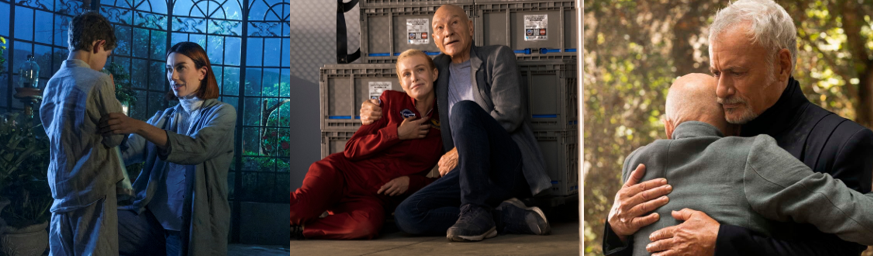
Despite being cured of his fatal illness and gaining a synthetic body, Picard enjoys all the ailments that come with his advanced age. This includes doubts and a resistance towards forming long-term romantic engagements despite the advances of his Romulan housekeeper, Laris (Orla Brady). As long-lived as Picard is, his old Enterprise confidante Guinan (Whoopi Goldberg) remains on hand to offer sage advice, and much of the show is focused on Picard learning to let go of his past and embrace his humanity and the happiness offered by love. Indeed, this is later revealed to be Q’s primary motivation. Although he initially appears as a malevolent figure, a sanctimonious, pompous, malicious demigod seeking to further “test” Picard (and the human race) by forcing him to witness a dystopian timeline where he’s a genocidal madman, Q’s newfound mortality drives him to help Picard face some haunting demons from his past in his own unique way. This season reveals that, as a boy, Picard (Dylan Von Halle) witnessed his abusive father, Maurice (James Callis), drive his loving mother, Yvette (Madeline Wise), to suicide. Q’s manipulation – and Picard’s jaunt to 2024 – force him to see his mother suffered from an unspecified mental illness that made her paranoid and unstable, ultimately driving her to suicide. This event shaped Picard’s entire life, driving him to protect others, stand against injustice, and seek out the truth. However, it weighs heavily on Picard’s conscience and his journey of self-discovery – and forgiveness – is as important as his quest to undo Q’s damage and restore the timeline.

The time travel jaunt sees Picard’s crewmates discovering new aspects to their personalities.

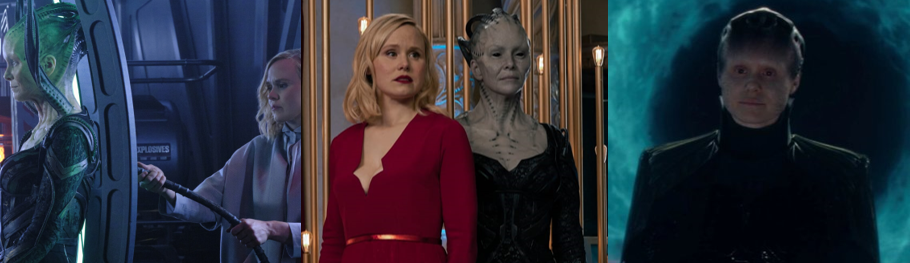
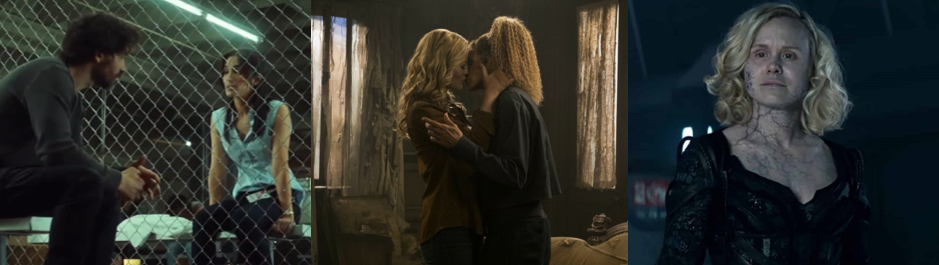
Although they scattered across the galaxy after the first series, Picard’s new crew is reunited by his long-standing nemesis, the Borg. When a gigantic and mysterious Borg craft calls for a parlay, Picard is asked to negotiate, an unusual situation which former Borg Seven of Nine (Ryan) lends her own understandably biased opinion on. Captain Rios is unable to resolve this unexpected situation, however, thanks to Q’s intervention, which sees Picard’s crew deposited in a dystopian alternate timeline where only they retain memories of the way things should be. In this dark world, non-human life is conquered, enslaved, eradicated, and publicly executed by the Confederation of Earth, with Seven (as Annika) as the President and Picard as her military commander. We don’t spend too long in this timeline but it’s enough to establish how awful it is compared to the real world and give Seven a strange euphoria as she finds herself truly human for the first time in decades. When the crew travel to 2024 to undo Q’s interference, Seven explores her newfound humanity. She’s far more cautious, especially compared to hot-headed Raffi, and showcases genuine motion for a change. Seven and Raffi’s partnership leads to some of the show’s most interesting and engaging action sequences and banter as they bicker over the best course of action and balance each other’s different methods towards saving and securing the timeline. This results in them growing so close that they share a kiss by the end, which felt a little out of left field for me. Similarly, the trip to the past has radical implications for Rios, who finds himself separated from his friends and defending Doctor Teresa Ramirez (Sol Rodríguez), her son Ricardo (Steve Gutierrez), and her clinic from overly aggressive immigration officers, falling for her in the process and finding a true home and family for himself at the same time.

The Borg Queen manipulates Agnes, but soon develops a genuine connection with her.

I was happy to see that Picard is treated much better in this season. Not only does Starfleet treat him with the respect he deserves, but his crew now defer to his wisdom and admire his tenacity. However, there are some wrinkles to this: since the incapacitated Borg Queen (Annie Wersching) is their only hope of saving the future, the crew risk their lives to save one of their most dangerous enemies and coerce her into helping them. This results in Elnor’s death as Picard is forced to prioritise saving the Queen over his former ward. This briefly earns him Raffi’s resentment and, though she soon focuses on the mission, much of her aggression stems from this loss and she’s as haunted by Elnor’s death as Picard is by his own past. Concurrently, Agnes is haunted by her past actions. Although she, like Rios, takes solace in her surrogate family, she can’t help but feel alone and somewhat lost, no matter how hard she tries to help. While the others search 2024 for the elusive “Watcher”, Agnes is left on their damaged craft with the weakened Borg Queen, with whom she’s forced to partially assimilate herself with to direct her team. This leads to the Borg Queen emotionally manipulating Agnes, tempting her with full assimilation to give her the sense of belonging she so desires before infiltrating her mind and her personality. This turns Agnes into a secondary antagonist for the last few episodes as the Borg Queen hijacks her body and creates an imperfect Borg army for herself in a bid to take advantage of her unique position and usher in a new age of Borg dominance. This is prevented not just by the intervention of Agnes’ friends but also Agnes asserting her personality over the Borg Queen, ultimately resulting in them merging into a new entity that heads out into the galaxy to create a new sub-species of Borg, one defined by individuality and co-operation rather than emotionless dominance.

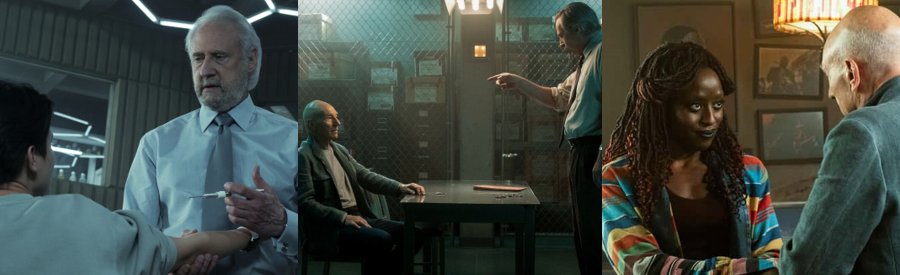
Picard needs the reluctant help of a young Guinan to stop Soong and escape Agent Wells.

Considering how much time season one spent focused on Soji and established her importance to Star Trek lore, she’s basically a non-factor in season two, appearing only very briefly and not even joining the crew for their time travel adventure. Isa Briones appears more prominently in 2024 as Kore Soong, the human (if genetically created) daughter of Doctor Adam Soong (Spiner), the ancestor of the man who would one day create Data. Soong acts as the primary antagonist after his genetic research is lambasted, his funding revoked, and his attempts to cure Kore of her debilitating and fatal genetic illness fail. This drives him to desperation and near madness, allowing Q to offer him the chance to build a legacy in the future by preventing the Europa expedition, thereby creating the dystopian timeline briefly visited at the start of the series. When Kore rejects him after she discovers her true origins, Soong’s perfectly happy to indulge his latent psychotic urges by aligning with the Borg Queen and targeting not just Picard and his allies but also Picard’s ancestor, troubled astronaut Renée Picard (Penelope Mitchell), whose death will usher in Soong’s oppressive legacy. Although Picard galvanises Renée’s spirit and counters Q’s psychological abuse m, his mission is jeopardised by xenophobic Federal agent Martin Wells (Jay Karnes), a man convinced that the Earth is threatened by aliens. Luckily, just as Picard is guided through his own personal traumas by Talinn, Laris’ ancestor who has spent years observing and protecting Renée, so too is he assisted – and ultimately coerce Wells into assisting him – by the young Guinan (Ito Aghayere), a jaded and outspoken younger woman ready to give up on humanity before meeting Picard. This melting pot of motions is only exacerbated by Q. Disgusted by humanity and believing they need to be constantly tested, his sights are firmly set on Picard as the bastion of human determination, Q takes every opportunity to try and break Picard’s spirit and spitefully set time itself against him. This is his misguided way of teaching Picard to embrace the past and move forward stronger for everything he’s suffered through, a test that Picard comes to appreciate, even embracing the dying Q as an old friend before they’re returned to their original timeline, changed but, presumably, stronger despite their losses.

The Summary:
Considering the focus of season one, I was surprised that season two is largely set in 2024 and is, essentially, a remake of Star Trek IV: The Voyage Home spliced with the main plot of Star Trek: First Contact (Frakes, 1996). I didn’t expect this, and I’m not entirely sure how much I enjoyed it. I liked the callbacks to The Voyage Home: the abrasive bus punk (Kirk Thatcher) returns, some of the dialogue (especially Rios’s) is revisited, as is his relationship with Teresa, and many of the plot points are repeated, such as the cloaked ship and Picard and Guinan’s capture. However, I think it might’ve been better to spend half the season in the dystopian future, exploring that world and giving the cast more time to play dual roles (Stewart, especially, revels in masquerading as his militant counterpart). Spending so much time in 2024 makes season two feel decidedly less visually impressive, though does allow for some introspective character development for all involved, especially Picard, who’s forced to relive, confront, and ultimately come to terms with his traumatic past. Equally, as mentioned, Seven explores her humanity in ways we’ve never seen before. I also liked the twist given to Agnes, where she becomes a semi-willing vessel for the Borg Queen, but there’s ultimately not much in season two that we haven’t seen in those aforementioned movies or previous time travel and character-centric episodes of Star Trek.

Some character arcs didn’t land for me or felt undercooked due to lack of focus.

The major themes of season two are confronting the past, finding a place in the present, and embracing the potential of the future. While Rios has found himself as a Starfleet captain and sees Picard as a father figure, he only truly feels a sense of belonging once he settles in 2024 and bonds with Teresa and Ricardo. Although this is his primary (and, arguably, only) character arc in the season, it doesn’t get much of the spotlight. Rios feels a kinship to them out of gratitude, respect, and a sense of injustice after seeing how aggressively they are targeted by immigration officers, but I still felt like his decision to stay in the past was a bit rushed and that the three didn’t connect much despite their obvious chemistry. I felt the same way about the apparent romantic relationship between Seven and Raffi. I must have missed the bisexuality of these characters in the last season and I was more focused on the fun contrast of personalities they exhibited here, so their sudden kiss surprised me as I thought the point of their partnership was to see their personalities grow. Seven conveys much more emotion and her arc is focused on her hatred of the Borg and euphoria at finally being human, culminating in her accepting her renewed Borg implants when Agnes uses the Borg Queen’s technology to save her life and considering a career in Starfleet upon returning to the main timeline. Raffi’s arc is primarily one of revenge: she’s incensed and haunted by Elnor’s death, meaning Seven acts as a counterbalance to keep her emotions in check, but Raffi’s conflicted by the finale as she can’t kill the Borg Queen without losing Agnes. Although I found it surprising that Agnes fell under the Borg Queen’s sway considering all Picard’s advice and her own experiences in the Queen’s consciousness, it makes sense given her personal insecurities and the Queen’s machinations. Their relationship becomes surprisingly mutually beneficial, however, as Agnes enjoys the power and sense of belonging offered by the Borg Queen and the Queen comes to see friendship, co-operation, and emotion as a strength rather than a weakness. This ultimately sees them become a new gestalt entity that hints at a Borg partnership with Starfleet to protect the universe from an unspecified threat.

Though an intriguing dive into Picard’s character, season two fell a little flat for me.

Unlike season one and season three, season two is less a Next Generation reunion and more a character study of its titular protagonist and his crewmates. Yet, there’s time for a quick cameo by former ensign Wesley Crusher (Wil Wheaton), who offers Kore a place with the Travellers, Guinan, and even a new role for Brent Spiner, who’s given another chance to showcase his range as he portrays another maniacal and dangerous Soong variant. As expected, this is Picard’s show, through and through. Freed from his bitterness, but no less burdened by guilt and past trauma, Picard is determined to restore the timeline and thwart Q’s diabolical plot but is surprised to learn new discoveries about himself through Q’s final test. Although vehemently opposed to the demigod throughout the show, Picard ultimately expresses gratitude to his old frenemy and ensures he doesn’t meet his end alone since Q’s actions, though questionable, allowed Picard to accept that his past and opens his eyes to a future with Laris and an alliance with Agnes’s Borg contingent. Ultimately, however, I can’t say that season two is any better or worse than the first. The potential of these new characters and the direction of this season is somewhat squandered by the plot, which is simply a rehash of The Voyage Home, and the season seems to have been engineered to write out many of Picard’s newfound crew rather than bring them closer together. It was a fascinating exploration of Picard, and an interesting twist on the Borg dynamic, but fundamentally lacking in terms of visuals and offering something more explicitly new for long-time Star Trek fans.

My Rating:

Rating: 3 out of 5.

Pretty Good

What did you think to the second season of Star Trek: Picard? Were you disappointed that the plot rehashed The Voyage Home or did you enjoy the time travel jaunt? Did you like that Rios stayed in the past, that Agnes became the Borg Queen, and the evolution of Seven’s character? Were you happy to see Q return and by the revelations into Picard’s childhood? What threat do you think is posed by the transwarp conduit? How are you celebrating Captain Picard Day this year? Whatever your thoughts on Star Trek: Picard, let me know in the comments down below.

Movie Night [Friday the 13th]: Friday the 13th Part VII: The New Blood


Long considered an unlucky day due to superstitions involving the number thirteen and religious connotations, Friday the 13th is equally well-known as a long-running series of slasher movies. As a result, this is clearly the best opportunity to take a look at the Friday the 13th (Various, 1980 to 2009) horror series and to commemorate this unlucky and dreaded date.


Released: 13 May 1988
Director: John Carl Buechler
Distributor: Paramount Pictures
Budget: $2.8 million
Stars: Lar Park Lincoln, Kane Hodder, Kevin Blair, Susan Jennifer Sullivan, Susan Blu, and Terry Kiser

The Plot:
Unwittingly resurrected by traumatised, psychically-endowed Tina Shepard, decomposing serial killer Jason Voorhees (Hodder) renews his killing spree, only to match his brute strength against Tina’s psychic powers.

The Background:
Following the success of John Carpenter’s Halloween (Carpenter, 1978), which popularised the “slasher” sub-genre, Friday the 13th (Cunningham, 1980) proved a surprising box office success. Despite producer/director Sean S. Cunningham distancing himself from the resulting franchise, which has been beset by negative reviewsFriday the 13th Part 2 (Miner, 1981) and Friday the 13th Part 3 (ibid, 1982) were financial successes. Still, embarrassed by the franchise, Paramount tried to bring it to an end with Friday the 13th: The Final Chapter (Zito, 1984). However, its financial success led to Friday the 13thA New Beginning (Steinmann, 1985), a disastrous experiment that saw Jason’s resurrection the following year. Despite a modest box office and mixed reviewsFriday the 13th Part VI: Jason Lives (McLoughlin, 1986) is now considered one of the best entries. Initial ideas for the seventh film included a potential crossover with Freddy Krueger (Robert Englund), though Paramount and New Line Cinema couldn’t agree on how to best execute this and it would be some fifteen years before audiences saw this come to fruition. Instead, associate producer Barbara Sachs leaned towards the idea of granting the “Final Girl” telekinetic powers not unlike those of Carrie White (Sissie Spacek). Friday the 13th Part VII: The New Blood marked the first appearance of fan favourite Kane Hodder as Jason Voorhees, setting a record for the longest uninterrupted onscreen controlled burn in Hollywood history and debuting one of Jason’s most horrific and iconic looks. With many explicitly gory scenes cut during post-production, The New Blood performed about the same at the box office as its predecessor and received largely negative reviews. Fans of the franchise, however, treat the film more fondly, regarding it as one of the better entries, and its poor reception didn’t stop Paramount producing an eighth instalment the following year.

The Review:
Seven movies into the slasher franchise and Jason Voorhees has become more than a rumour; he’s a legend. The long-dead “Crazy” Ralph (Walt Gorney) returns as an unseen narrator to give a quick rundown of Jason’s previous hits and misses, which have seen the “death curse” of Crystal Lake translate into “Jason Voorhees’ Curse”, with no mention of his mother or the tragedy that befell him as a child. It’s interesting that Crystal Lake is even called that here since such a big part of the previous movie revolved around the locals renaming the area “Forest Green” to disassociate themselves from Jason and his memory. Now, it’s just back to Crystal Lake with no explanation, which is odd. Even stranger is that no one stops our new crop of victims from hanging around the cursed lake and no one, save the pushy and manipulative Doctor Chris Crews (Kiser), is even aware of Jason. To be fair, it’s not stated how much time has passed since the ending of Jason Lives and the present day of The New Blood. It could’ve been years, so maybe the residents felt comfortable believing Jason was long gone. The New Blood takes a similar approach to The Final Chapter with the landscape of Crystal Lake and its forest, showing residential cabins placed around the lake, such as Tina’s childhood getaway and the cabin Nick Rogers (Blair) and his friends rent to surprise his cousin, Michael (William Butler). I would’ve liked to see The New Blood double down on this and have these be the same buildings from The Final Chapter, renovated and available to rent to bring some tourism to the local community. This doesn’t appear to be the case and nothing is mentioned about the town or what’s happened between Part VI and Part VII, meaning the New Blood title doesn’t just refer to Jason’s newest crop of victims but also the narrative, as the film’s almost like a soft reboot of the series in some ways.

Traumatised Tina finds her unique gifts being manipulated by the shifty Dr. Crews.

The New Blood adds some additional lore to Crystal Lake with its opening flashback, which shows young Tina (Jennifer Banko) fleeing to the lake to escape her parents’ constant arguing. Having witnessed her alcoholic father, John (John Otrin), strike her mother, Amanda (Blu), little Tina took a boat onto the lake and wailed her anguish and hatred to her father. Unfortunately for Tina (and John), her heightened emotional state triggered her unpredictable psychokinetic powers, causing John to fall into the lake and drown/be crushed be debris. The trauma of witnessing this and the guilt from having caused her father’s death scarred Tina, leading to her spending most of her life in therapy and in a psychiatric hospital under the care of Dr. Crews. Although Tina’s visibly uncomfortable at returning to Crystal Lake and Amanda is desperate to hide her concerns behind blind optimism, the Shepards return to their family cabin in what’s stated to be a last-ditch attempt to help Tina overcome her trauma. However, Dr. Crews is far more concerned with exploring and documenting Tina’s psychic abilities, badgering her into working herself into a state so she’ll perform parlour tricks for his camera. While he justifies this by saying that her powers and vivid delusions are manifestations of her guilt and thus intrinsically linked, it definitely seems like he’s less concerned with her wellbeing and more concerned with attained some kind of accolade for discovering her psychic powers. Annoyed when Tina gets distracted by Nick and his friends and frustrated by Tina’s reluctance to adhere to his demands, Dr. Crews constantly belittles Tina and waves away her panic when she starts seeing visions of dead bodies and accidentally reanimates Jason while remembering her father’s death. At her wit’s end and desperate to bring her daughter some peace, Amanda puts all her faith in Dr. Crews and is thus enraged to find that he’s been using and manipulating Tina, even more so when Dr. Crews decides Tina’s a lost cause and threatens to have her committed. While she struggles with her guilt and is noticeably uneasy around other people, Tina can’t help but be attracted to nice-guy Nick, who encourages her to socialise with his friends, takes an interest in her past and her feelings, and reacts with shocked amazement rather than horror and ridicule when her powers caused chaos and disruption.

Nice guy Nick is surrounded by largely forgettable or overly exaggerated victims.

Disturbed by her visions of death and Jason, Tina constantly tries to warn those around her and is repeatedly shot down. Dr. Crews refuses to entertain her wild claims as anything other than delusions and the catty Melissa Paur (Sullivan) openly mocks her, to the amusement of her otherwise disinterested friends, in a desperate attempt to discredit Tina so she (as in Melissa) can have Nick to herself (despite him quite bluntly stating that he doesn’t even like her!) Nick’s a bit of a bland do-gooder on the surface; he’s tall and ruggedly handsome but there isn’t much to him. He says he ran with a bad crowd and is trying to turn his life around, but he’s mainly there to offer Tina some affection outside of her family and to try (and fail) to shield her from Jason. His friends, however, are as painfully one-note as all the Friday the 13th victims, focused mainly on sex, skinning dipping in the freezing cold lake, drinking, and getting high. There are a few standouts from this largely cliché group, as ever: Eddie McCarlo (Jeff Bennett) fancies himself a science-fiction writer and regularly bores and freaks out his friends with his bizarre imagination, Robin Peterson (Elizabeth Kaitan) is a perky little stoner in contrast to shy Maddy Paulson (Diana Barrows) but doesn’t hesitate to put her friend down so she can claim clumsy stoner David Peabody (Jon Renfield) for herself, and Ben MacNeal (Craig Thomas) is having undisclosed issues with his girlfriend, Kate Pataki (Diane Almeida). The film tries to give Maddy an empowering moment when, in an effort to defy Robin’s claim that she needs “little touch-up work”, Maddy defiantly…goes and touches herself up with make-up. She then wanders outside calling for David as though expecting him to be in the dark forest and is unceremoniously killed. I quite liked Eddie, who is seduced by Melissa to try and make Nick jealous and storms out after she rejects him in an amusing scene, though the others are mostly forgettable and simply there to be eye candy and add to the kill count.

Jason looks more horrifying than ever and utilises some bizarre weapons.

The New Blood sees the debut of Kane Hodder as Jason Voorhees, and boy does he embody the role in an instant! Sporting one of Jason’s most disturbing and iconic looks, the hulking Hodder stalks the forests and darkness of Crystal Lake with an enraged determination, as though Jason is royally pissed off at being disturbed by Tina. Now degenerated into a rotting, skeletal form and sporting a cracked mask and heavy chain around his neck, Jason appears more inhuman than ever and seemingly savours the hunt, never breaking from a brisk stride and as happy to stalk, taunt, and slowly off his victims as he is to crash through windows or catch them unawares. Jason sports an uncanny ability to sneak up on people, even when they’re barely looking the other way, and to get ahead of his fleeing victims, to say nothing of shrugging off nails, bullets, and blunt trauma thanks to functionally being a zombie. Exhibiting superhuman strength powerful enough to plunge his hand through chests and crush heads, Jason is surprisingly gentle with Nick in the finale, preferring to simply toss and throw him aside rather than crush his rib cage. Jason sports various weapons in The New Blood, from spiked implements, large kitchen knives, and even a party horn that he rams into Kate’s eye. This is taken to almost comical levels when Jason pursues Dr. Crews and Amanda through the forest and he attacks with a bizarre bladed implement, prompting Dr. Crews to use Amanda as a human shield! This respite is short-lived, however, as Jason soon comes after him with a motorised bench saw like he’s Leatherface (Various) or something! I have no idea where Jason got these weapons from or why he discards them, and we’re denied a decent look at the damage since the film’s butchered by cuts. Jason slices throats, hacks off heads, and leaves victims strewn around the forest to scare Tina but is visibly puzzled by the girl’s inexplicable psychic powers. Jason thus becomes fixated on Tina, not just because she’s the “Final Girl” but also because he sees there’s something different about her. Tina gives Jason a run for his money, tangling him up with nearby roots, electrocuting him, and causing his hockey mask to shatter so we get a good look at his gruesome, rotting visage.
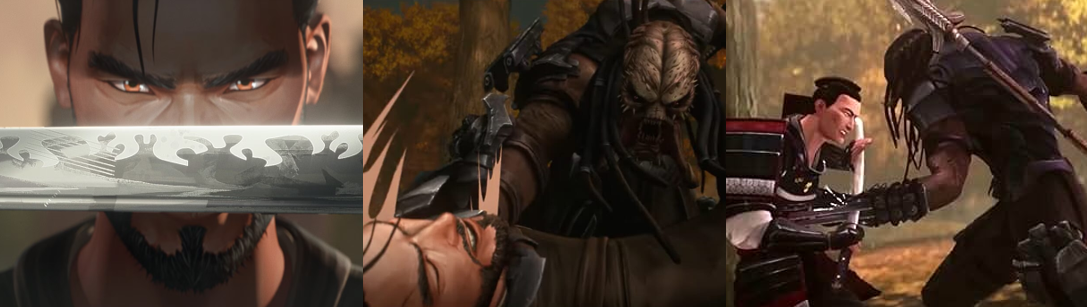
The Nitty-Gritty:
Jason Lives marked a turning point for the Friday the 13th franchise. From the moment Jason was brought back as an undead killer, all bets were off and the series leaned more heavily into the supernatural for the following sequels. This wasn’t necessarily a bad thing; the formula was getting stale, after all. However, it’s still a bit weird to suddenly see psychic powers in this world. Tina is obviously a stand-in for Stephen King’s Carrie, a disturbed and emotionally distraught young woman who cannot control her powers, much less understand them. Tina’s ability to move objects with her mind is directly tied to her emotions, something Dr. Crews regularly manipulates just to see them in action. Tina’s also cursed with a degree of clairvoyance; she has visions of people’s deaths but is always too late to save them and is haunted by delusions of Jason that have her questioning her sanity. This makes Tina wary to be around others since her powers can be chaotic and they earn her scorn, fear and hatred even when characters have no reason to think it was Tina who caused Melissa’s necklace to break. Tina’s powers are seemingly limitless; she can combust matches, smash open floorboards, move roots and electrical wires, and even resurrect the dead if she concentrates hard enough. Sadly, her powers also appear really feeble. The only reason Jason doesn’t just snap her in two is because the script says he must stand there gawping at her while Tina flings nails at him, douses him in gasoline, and hangs him from the ceiling. Indeed, when Jason gets his grubby mitts on her, Tina’s largely helpless and dependant on Nick to save her cute ass. The technology just wasn’t there to make Tina’s powers look threatening enough to Jason, who was made to look like a chump during their “fight”, and it makes for a very poor substitute for a throwdown between Freddy and Jason. Perhaps if Tina’s powers had been more pyrokinetic things might’ve been different but, as is, her abilities seem more bizarre than formidable and make The New Blood one of the stranger entries in the franchise.

While some of the kills are good or even iconic, Tina’s psychic powers are pretty lamely realised.

It’s also one of the most butchered. Sure, we get some great shots of Jason’s spine, skull, and bones sticking out from his ragged clothes and the effects used on his ghastly face are top-notch (it may very well be the best Jason look ever!) but this doesn’t excuse the disappointingly bloodless kills. This is doubly disappointing as there are some creative weapons and methods at play in The New Blood, with Jason resorting to simple stabbing and tossing people to their deaths alongside more elaborate means of killing, such as launching an axe into Russell Bowen’s (Larry Cox) face and stabbing Maddy with a scythe. The movie’s not entirely bloodless, of course: we see severed heads and blood splatters and a lot of time is spent lingering on the mangled corpses of Jason’s victims. In a way, this is a bit more horrific than if we’d seen the deaths in detail since your imagination can fill in the blanks…but Dr. Crews was such a dick, I wanted to see him get shredded by that weed-wacker! I liked that Jason didn’t simply go around swinging a machete and tried a few different things here, even if some of his kills largely amounted to the same thing (David may as well have been stabbed by a machete, for example, same with Amanda, especially as Jason discards that unique weapon). Of course, the most memorable kill in The New Blood is Judy Williams’ (Debora Kessler). Her and her boyfriend, Dan Carter (Michael Schroeder), are a couple of randoms Jason attacks while camping (an odd choice given these roles could’ve been filled by some of Nick’s friends). He plunges a fist though Dan’s back and snaps his neck and then drags Judy from their tent while she’s still in her sleeping bag. Hauling her across the brambles, Jason slams her against a tree, snapping her spine and leaving her a horrified, bloody mess. It’s a simple, exceedingly brutal kill that stands as one of the best in the franchise. Naturally, we also get a bit of sex and nudity here, far more than in Jason Lives but still less than I’d like. Despite being a horny little she-devil, Melissa never gets any action and has to settle for an axe to the head, though Robin, Kate, and Sandra Casey (Heidi Kozak) all get a chance to get naked and have some sexy times before being butchered.

When Jason proves to be unstoppable, Tina summons her dead father to take care of business.

Unable to convince anyone that her visions are real and desperate to help her mother, Tina drags a confused Nick all through the forest and the cabin trying to find Amanda before it’s too late. She discovers newspaper clippings about Jason in Dr. Crews’ drawer and realises he knew she was telling the truth about “the man in the lake” and has been trying to gaslight her into thinking she’s crazy. Unfortunately, Tina’s unable to save her mother and Nick finds the cabin empty, save for Eddie’s slaughtered corpse and a disbelieving Melissa. His friends are just hanging around in the forest, though, their bodies on display to lure Tina back into the cabin, where Jason attacks. Although Nick tries to fight the monster off, he’s tossed aside like nothing and, grief-stricken and enraged, Tina finally unleashes her full power. Using her destructive psychic powers, Tina shatters Jason’s mask, hanging him by a cord, and drops him into the basement. When he drags her down with him, Tina douses him in gasoline and sets him on fire, with her and Nick barely escaping the house before it inexplicably explodes. They’re relief is short-lived, however, as Jason reappears on the docks, sporting no evidence of being set on fire or caught in an explosion. Though Nick tries to fend him off with a gun, Jason is unfazed and closes in for the kill. Hurt and desperate, Tina summons all her power and, unbelievably, causes her father (who’s looking remarkably well for a guy trapped underwater for years) to burst up from the lake. John’s clearly agonised spirit wraps a chain around Jason’s neck and drags him back into the cold depths, ending the film on a bit of an anti-climax as Tina and Nick are rescued by emergency services. Quite why John’s body was still in the lake is beyond me. Tina “felt” him earlier, but it turned out to be Jason and I don’t see why her father’s body couldn’t have been recovered after he fell in when she was a child. I guess it’s supposed to be a call-back to the first and third parts, but it felt quite lame and cartoonish in execution, much like Tina’s powers.

The Summary:
Friday the 13th Part VII: The New Blood is a bit of a disappointment for me. A lot of this has to do with my fondness for the previous film, which is still one of my favourites; nostalgia gives Jason Livs an edge that The New Blood lacks. I tried to cut it some slack on this viewing, but there are a lot of elements that don’t work for me. As much as I liked the score from Jason Lives being recycled, it felt quite repetitive and the weird, jingly, fairy tale music used when Tina used her powers got old fast. I quite liked Tina, even though she was a bit bland and pure. I liked the struggle she faced with her guilt and her powers and she had some cute chemistry with Nick, despite him being a white-meat good guy. It was nice that he just accepted Tina and gave her unconditional encouragement and affection. Dr. Crews and Melissa made for interesting secondary antagonists. While Melissa was ridiculously one-note, she was such a conniving bitch, making her comeuppance well deserved. I would’ve liked to see Dr. Crews’ motivations explored a bit more: maybe he could’ve been trying to profit from Tina, or purposely using her to resurrect Jason for some reason. Nick’s friends were alright, but largely forgettable and full of dumb decisions. The group offered nothing we hadn’t seen in every Friday the 13th movie prior to this one and we were even denied the satisfaction of some gory kills since The New Blood has been hacked to death worse than Jason’s victims! I fully believe The New Blood is highly rated purely because of Kane Hodder’s performance and unique appearance as Jason, the bizarre weapons he uses, and that sleeping bag kill. These elements are far more memorable than the lame-ass psychic powers and the weak-ass showdown between Jason and Tina, where the formally menacing Jason just stands around and lets her make him look like a fool. Jason’s look is incredible here, almost unmatched, and seems to be where all the time and budget went. It’s such a shame as the concept had a lot of potential and I liked the suggestion that Tina was descending into madness because of her abilities and visions. The execution was lacking and hampered by the technology of the time, however, and the gory effects are completely wasted as the film cuts away before we can see them in all their glory. I appreciate the effort to try and do something new, but I think The New Blood needed another go-around at the scriptwriting stage. Jason looks great, better than ever, but it’s not enough to keep this one from being pretty dull at the end of the day.

My Rating:

Rating: 3 out of 5.

Pretty Good

Is Friday the 13th VII: The New Blood one of your favourites of the franchise? What did you think to Tina, her trauma, and her bizarre psychic powers? Which of Nick’s friends was your favourite and which death scene were you most disappointed by? Do you agree that the sleeping bag kill is one of the franchise’s most iconic? What did you think to Jason’s look and his showdown with Tina? Is Kane Hodder your favourite Jason actor Are you watching a Friday the 13th movie today? Whatever your thoughts on Friday the 13th (the movie, franchise, and day), leave them down below, support me on Ko-Fi, and check out my other horror content.

Movie Night: Predator: Killer of Killers

Released: 6 June 2026
Director: Dan Trachtenberg
Distributor: Hulu / Disney+
Budget: Unknown
Stars: Lindsay LaVanchy, Damien Haas, Louis Ozawa, Rick Gonzalez, Michael Biehn, and Britton Watkins

The Plot:
In this interconnected series of shorts, a bloodthirsty Viking warrior (LaVanchy), a battle-weary ninja (Ozawa), and a hot-shot pilot (Gonzalez) are forced to fight to the death after besting three separate Predators (Watkins) throughout history.

The Background:
What started as a high-budget B-movie that had Jean-Claude Van Damme running around a jungle in a bug suit eventually became a box office success when Predator (McTiernan, 1987) released on this day in 1987. Though praised as one of the best of its genre, Predator was followed by a troubled and financially stunted sequel in Predator 2 (Hopkins, 1990). Despite positive reviews, it took twenty years before Predators (Antal, 2010) revived the series with a back-to-basics approach. Though a minor hit, hopes for a direct sequel were quashed in favour of a soft reboot, though The Predators (ibid, 2018) divisive response saw the franchise take a hiatus despite its respectable box office. After 20th Century Fox was purchased by the Walt Disney Company in 2017, director Dan Trachtenberg and screenwriter Patrick Aison returned the franchise to its roots with Prey (Trachtenberg, 2022), a surprise hit that promised big things for the franchise. Indeed, while Trachtenberg was busying himself with a Predator-centric follow-up, he also spearheaded this separate project, an anthology film inspired by hyper-violent and stylised anime. Released exclusively on Disney+ and Hulu, Predator: Killer of Killers was met with overwhelmingly positive reviews that praised its visual design, varied stories, and intriguing expansion of the lore.

The Review:
Predator: Killer of Killers came somewhat hot off the heels of the surprise success of Prey, which successfully rejuvenated the Predator franchise after years of ups and downs. It seems my desperate call for new Predator stories set in unique time periods and locations has finally been answered as Predator: Killer of Killers takes place in the frigid wastelands of Scandinavia, the beautiful landscape of ancient Japan, in the midst of the Second World War, and finally on an alien world that could very well be the Yautja home world. Yes, after years of me fighting against it, the term “Yautja” is now undeniably canon thanks to the film’s opening quote from their codex. While I’m sure long-time fans of the extended Predator media are glad to see this, I can’t say I’ve ever been a fan of this name and would prefer the species went unnamed or were referred to as “Hunters” or “Predators” and the like. Still, I’m really glad we’re finally seeing the Predators being used in new settings and time periods as there’s so much potential for that to see how different people combat the Yautja threat depending on their technology or understanding of the alien foe. Indeed, to two of our main characters, the Yautja are seen as devils or demons rather than an extraterrestrial force, which is understandable given when they encounter them. Predator: Killer of Killers adopts a framing device where each of the main characters are trapped on a Yautja transport ship taking them to a gladiatorial arena for the finale, though this is primarily used as interludes between each story and to show who’s the main character of each segment. Finally, Predator: Killer of Killers uses subtitles when appropriate, particularly throughout “The Sword” and the final segment, where the characters talk exclusively in their native tongue even if we’ve heard them speak English before. I liked this aspect as it added some authenticity to the film, and each character, and I liked that their words weren’t translated for us beyond subtitles despite the characters wearing explosive translation collars.

Ursa’s quest for revenge sees her turning her rage against a vicious, hulking Predator.

The first segment, “The Sheild”, is set in Scandinavia, 841 and follows Viking warrioress Ursa as she leads her son, Anders (Hass), and their battle hungry clan into battle against the Krivichs to avenge the death of Ursa’s father, Einar (Doug Cockle), at the hands of the Krivich chieftain, Zoran (Andrew Morgado). While Anders is keen to make his mother proud, this is his first expedition so he’s understandably a little rattled at the sheer wanton destruction and violence his clan, and his vengeful mother, heap upon the Krivichs. Thus, he freezes when presented with his first kill, both out of fear and concerns for his place in Valhalla should he kill an unarmed man, though Ursa has no hesitation in cutting their prisoner in half after learning Zoran’s location. Unaware that a Yautja ship has dropped off a Predator to hunt the ruthless Vikings, Ursula shares the story of Einar’s death with Anders, which saw young Ursa (Cherami Leigh) consumed by anger and vengeance from a young age and determined to avenge her father, wearing his bloody handprint with pride despite initially being too overwhelmed by grief to function. So righteous is Ursa’s quest that she storms Zoran’s heavily fortified fortress alone, cutting through and bludgeoning many of his men single-handedly before her warriors (and Anders) join the fray. Using her sharpened, splintered dual shields, Ursa severs limbs and slaughters Zoran’s troops to confront the chief in his throne room. Despite Ursa’s rage, Zoran openly mocks her, disrespecting her in front of her men and leading to Anders beheading him for his insolence. Before Ursa can comment, the hulking Warlord Predator decloaks before them, naturally startling the Vikings and easily brutalising them with its superior speed, strength, and bionic hand appendage. Anders successfully wounds the Warlord with a spear, leading Ursa to leap to this defence, only for the Predator to bring the whole fortress down with a single concussive blow. Its helmet damaged by Ursa’s attack, the Predator stalks her on the brittle, frozen water, though she eventually traps and seemingly kills it by improvising with an anchor and turning its own weapon against it. Despite her victory, the exhausted and wounded Ursa is distraught when Anders succumbs to his wounds and dies in her arms.

Brothers Kenji and Kiyoshi must set aside their differences to battle a common foe.

“The Sword” is set in Japan, 1609 and follows twin brothers Kenji and Kiyoshi Kamakami, bright and optimistic youngsters who are forced to duel to determine which of them is strong enough to succeed their father, a stoic and demanding samurai warlord. Though Kiyoshi shares Kenji’s reluctance, he ultimately attacks with a sudden viciousness, forcing the hurt and heartbroken Kenji to flee. Upon his father’s demise twenty years later, Kiyoshi adopts his grim persona and succeeds to the throne, ceremonially burning his father’s corpse and ringing the bells to indicate the succession. This attracts Kenji’s attention, with him gearing up to confront his brother for his betrayal using the ninja skills he cultivated while living in exile. As a Predator watches with curiosity, Kenji stealthily subdues Kiyoshi’s guards and infiltrates his old homestead, utilising shuriken and a chained weapon to overwhelm his foes. When the alarm is raised, Kenji’s forced to take a more direct and violent route, cutting his brother’s personal guard down with his katana using a smoke bomb for cover. With a mere glance and a glare, they match swords once more as the Predator observes, with Kiyoshi’s straightforward samurai skills being somewhat outmatched by Kenji’s shinobi deviousness as Kenji utilises various weapons to press his attack. Still, the brothers are largely evenly matched, especially as Kiyoshi dons his father’s samurai outfit throughout the fight. Still, Kenji gets the upper hand and symbolically scars his cheek, just as Kiyoshi did when they were younger, then sheathes his sword rather than deliver a killing blow. Stunned when Kiyoshi apparently plummets to his death, Kenji’s ambushed by the Predator, who cuts down a bunch of Kiyoshi’s guards with its spear, katana-like blade, and fancy spring-loaded chains. Forced from the pagoda, Kenji utilises his ninja skill to hide, flee, and even launch surprise attacks on the cloaked Yautja, who relentlessly pursues him across the rooftops. Driven to the moat, Kenji’s amazed to find his brother alive and, though skewered by the Predator’s wrist blades, Kiyoshi joins his brother against their mutual foe. Despite the Predator’s great strength and explosive gadgets, Kiyoshi stabs it through the neck and the brothers injure and then dramatically cut the Predator in two with dual sword strikes, though Kiyoshi dies after making peace with his brother.

World War Two pilot Torres finds his aviator skills tested by a Predator with a taste for war.

The third segment, “The Bullet”, starts in Florida, 1941 and finds free-spirited John J. Torres dreaming of being a pilot, much to the chagrin of his down-to-earth mechanic father (Felix Solis). Though Torres gets his wish, it comes from being drafted into the United States Navy and, one year later, Torres puts both his dreams and his practical skills to use when he impresses with his dad’s mechanics knowledge. Frustrated at being grounded by Captain Vandenberg/Vandy (Biehn), Torres is bewildered when one of their squadrons is decimated by a mysterious aircraft. While Captain Vandenberg leads a squadron to investigate, Torres inspects the alien, harpoon-like device stuck into one of the plane’s engines and is stunned when it suddenly activates and flies off, dragging an engine behind it on a chain. Despite Torres’ best efforts, he’s unable to warn the squadron of the greater threat in the skies around the Atlantic, so he commandeers a battered old fighter plane (the titular “bullet”) and goes to warn them. Though they take out the opposing squadron, Vandy’s planes are suddenly attacked by a decloaking Yautja craft, whose one-eyed pilot easily rips apart Vandy’s planes. With his wing burning, Torres makes a desperate climb to fix the damage while the remaining planes provide cover fire. Despite their bravery and aerial skill, the pilots are no match for the Predator’s technology, with one shredded by an energy net. After sorting out his plane, Torres regroups with Vandy and correctly theorises that the Predator can only see heat, so they make a desperate gamble and lure the ship as high as they can. With the alien ship closing in, Vandy bravely sacrifices himself to buy Torres the time to swing behind the blinded ship and take out one of its engines. Enraged, the alien pilot pursues Torres through the city streets, struggling to get a lock on and being drawn into a Naval skirmish. After the cannon fire heavily damages the alien ship, Torres tricks the Predator into firing, blowing his parachute and turning its massive harpoon against it to finally bring the craft down, though Torres is abducted after the war while working in his father’s garage.  

The Nitty-Gritty:
Predator: Killer of Killers is a fitting homage to everything that makes the Predator franchise so good, with Benjamin Wallfisch offering a fresh take on Alan Silvestri’s classic “Predator” theme, infusing it with a darker edge befitting of his horror roots, and the Yautja technology is very similar to previous films. Each segment follows radically different main characters, with Ursa being a venge-seeing Viking warrior, Kenji wishing to get a little payback against his brother, and Torres dreaming of being a heroic wartime pilot. While they’re all from very different backgrounds and have very different skills, with Ursa attacking first and asking questions later, Kenji largely laying down his sword, and Torres desperately trying to keep the peace and escape, they share a unique bond in their shared experiences with different Yautja. These Predators were as different as the protagonists are from each other, of course, with the Warlord being a bulky fighter, Kenji’s adversary favouring stealth, and the pilot attacking from a space craft. All three were ultimately outwitted by their foes turning their technology against them, however, with even the pilot’s systems and numerous armaments proving useless without a clear target. Ursa’s story is one of violence and vengeance, with her soul being consumed by both for years, while Kenji has no desire to fight any more and Torres just wants them to join forces against a common foe. Ursa is driven to a suicidal madness by the end, wishing only to die in glorious combat to reunite with her son in Valhalla, and even Kenji is completely at peace with meeting his end to be reunited with Kiyoshi. Torres’ infectious demeanour ultimately wins both over and they learn to take up arms once more against their shared enemy, with the ultimate message being that human tenacity, adaptability, and co-ordination is what makes us such a compelling target for this warrior species.

We finally get to see some visually distinct Predators in unique environments and time periods.

Predator: Killer of Killers employs a stylised, jerky, comic book-esque animation style that’s very similar to the Spider-Verse movies (Various, 2023 to present) and Teenage Mutant Ninja Turtles: Mutant Mayhem (Rowe, 2023). If this animation style isn’t for you, you may struggle with the film but I think it worked really well. It’s not as frenetic and overstylised those movies, but it accentuates the violence and action with a comic book-style aesthetic that I find really appealing. The character models also reminded me of the exaggerated models used in TMNT (Munroe, 2007), though they’re far more varied, nuanced, and detailed here. For the most part, human characters are rendered in a stylish but ultimately realistic way, being proportionate to their size, with only Kenji and Kiyoshi seeming to defy gravity in their agile nature. The Yautja, however, are the extreme opposite, presented as towering, monstrous beasts who defy explanation and live up to their description as “devils”. The Warlord Predator, for example, is a massive brute far beyond any hunter we’ve seen before and the pilot is a grizzled, battle-scarred veteran who reminded me of Commander Kruge (Christopher Lloyd). The stealthier Predator who attacks the Kamakamis is probably the closest to a regular Yautja in the film and even he boasts chain-like weapons and a more samurai-styled appearance. The Grendel King, however, takes the award for most elaborate and intimidating Predator design, sporting full-on tusks, elongated dreadlocks that appear to be Xenonorph tails, and showcasing a ferocity far beyond his peers. There’s some fun new Yautja technology on show here, including miniature explosive devices, the Warlord’s concussive arm device, and the pilot’s energy net. Predator: Killer of Killers gives us a taste of the Predator ship’s combat skills, which is very refreshing, with the pilot utilising a devastating harpoon weapon that essentially frames the dog fights as old school Naval battles. There’s also some gruesome gore on display here, with characters being sliced in half, heads and limbs being lopped off, and blood splattering everywhere, which was glorious to see to sell how vicious both the Predators and their prey are.

Rather than fight to the death, the three survivors team to fight and escape the Grendel King.

“Final Battle” reveals that Ursa, Kenji, and Torres were placed into suspended animation after being abducted. Thanks to the language barrier and his cell mates being largely anti-social, Torres struggles to communicate with the two, though they’re soon brought to a gladiatorial arena on a scorching hot alien world. There, they encounter another elder Predator that Ursa dubs the “Grendel King” who, thanks to the translation collars fitting around their necks, commands them to fight to the death for the honour of facing him in tribal combat. The three are furnished with fitting weapons, with Torres gifted Captain Raphael Adolini’s (Bennett Taylor) pistol, and are threatened with having their heads exploded by their collars if they refuse to fight. Naturally, Ursa attacks first, determined to prove herself the “killer of killers”, but Kenji defends Torres and refuses to fight, urging the others to join forces against their captors. While Torres struggles to load Adolini’s pistol and Kenji desperately defends himself against Ursa’s savage attack, the Grendel King unleashes a massive alien beast that promptly swallows Torres whole! Enraged after seeing Anders’ likeness in Torres, Ursa attacks the creature alongside Kenji on the outside while Torres desperately stabs it with a Predator’s severed gauntlet arm from the inside. Together, they successfully kill the creature, much to the Grendel King’s amusement, but the suicidal Ursa only agrees to join forces with them upon seeing Torres alive. Having disabled their collars and commandeered a Yautja hoverbike, Torres flies his new allies to the Grendel King, who overpowers them with little effort, suffering only superficial wounds as Torres tries to figure out the Yautja ship’s controls. Just as the Grendel King is preparing to finish off his foes, Torres activates the ship, sending the brutish Predator flying. However, as they limp to safety, Kenji’s right arm is severed by the vengeful alien’s spear and the ship is anchored by a harpoon cable. Thus, Ursa slides down the chain to destroy the launcher, allowing herself to be recaptured so they can escape but eschewing her father’s ways by demanding they not avenge her. Though she mocks the Grendel King’s efforts, he orders his forces to pursue the escapees and has Ursa returned to suspended animation, where she’s stored alongside thousands of others…including Naru (Amber Midthunder).

The Summary:
Predator: Killer of Killers was another pleasant surprise after the fun return to form the franchise enjoyed with Prey. I’ll admit that I was a bit dubious at first by the idea of an animated anthology movie, but I enjoyed the framing device of these three characters triumphing over separate Predators and being brought together to earn the right to fight the Grendel King. This was a new wrinkle in the Predator lore that adds new layers to Predators, which already revealed that the Yautja abduct the best of the best (or worst of the worst) to hunt for sport. The animation style might not be for everyone, but I think it did a great job of presenting these visually arresting Yautja as incredible, monstrous beings that are so far beyond our understanding. Put simply, Predator: Killer of Killers makes the Yautja scary again as we see them absolutely decimate anyone who gets in their way, ripping them to pieces and deftly wielding incredible alien technology repurposed into practical weaponry. It thus takes a very special individual to overcome them, and our three main characters certainly fit that bill as they use their individual strengths to endure and overcome the alien threat, largely by turning their strengths and technology against them. I really enjoyed that we got three different time periods for the Predators to play around in, showing how the distinctly different hunters approach their unique environments and prey, and the ways the main characters react to and tackle them. Framing each segment as a character driven piece that happens to feature an alien hunter was a great choice as it allows you to connect with each character and for them to stand out against each other, with the finale showing how their vastly different personalities clash but ultimately result in victory once they come together. Even if you don’t like the animation and can’t connect with the characters, there’s some fantastic Predator action here. Each one is distinct and uses different tactics and weaponry and we get a glimpse into a different aspect of their society and overall lore. Honestly, I wouldn’t be against seeing a couple more films like this to explore this aspect of Yautja society and tie up a few loose ends in the franchise, and Predator: Killer or Killers just reinforced how much potential there is for more stories in this world.

My Rating:

Rating: 4 out of 5.

Great Stuff

Did you enjoy Predator: Killer of Killers? Which of the characters and segments was your favourite? What did you think to the animation style and the visual design of the new Predators? Are you a fan of the Yautja name or do you prefer the species to go unnamed? What did you think to the gore and how each character overcame their alien foe? Would you like to see more anthology films like this for the franchise? Which of the Predator films is your favourite and how did you celebrate Predator Day this year? Whatever your thoughts on Predator: Killer of Killers, feel free to leave a comment below, check out my other Predator reviews, and donate to my Ko-Fi to suggest future Predator content.

Game Corner: RoboCop: Rogue City (Xbox Series X)

Released: 02 November 2023
Developer: Teyon
Also Available For: PC, PlayStation 4, PlayStation 5, Xbox One, Xbox Series S

The Background:
Although RoboCop’s (Verhoeven, 1987) surprising success saw it followed by big screen sequels, a cartoon, and a live-action television show, these were largely met with mixed to negative reviews. While the R-rated franchise all-but flopped as a kids’ cartoon, RoboCop did fairly well in arcades back in the day. Unfortunately, the videogame adaptation of RoboCop 3 (Dekker, 1993) performed about as well as its source material. RoboCop fared better when battling another iconic cyborg, something only further evidenced when an attempt to reinvigorate the cyborg cop on then-modern consoles flopped hard back in 2003. The near universal negative reception for Titus Interactive Studio’s RoboCop meant players had to wait twenty years for another first-person shooter (FPS) adaptation of the franchise, one courtesy of Teyon, the developers behind Terminator: Resistance (2019), the first halfway decent Terminator videogame in ten years (at the time). For RoboCop: Rogue City, Teyon worked closely with Metro-Goldwyn-Mayer and publisher Nacon to ensure the game was faithful to the original film and captured the dark satire of the franchise, even bringing back Peter Weller to reprise his iconic role. In contrast to fast-paced FPS titles, director Piotr Latocha lobbied to recreate Weller’s robotic, methodical movements and emphasise RoboCop’s “Prime Directives” as much as action-packed shooting. Reaching 435,000 players in its first two weeks, RoboCop: Rogue City received mostly positive reviews that praised the fidelity to the movies and layered gameplay mechanics, while criticising the pacing and noticeable glitches.

The Plot:
Transformed into a cybernetic police officer after being murdered on the job, Alex Murphy/RoboCop finds his efforts to police the increasingly lawless streets of Detroit compounded by a plot by megacorporation Omni Consumer Products (OCP) to mass produce cyborg cops.

Gameplay and Power-Ups:
RoboCop: Rogue City is an FPS title in which players assume the role of the titular cyborg police officer and play through a mission-based narrative that includes gunfights, a smidgen of detective work, and a dash of role-playing elements. There are four difficulty settings to pick from the outset and a fifth unlocked once you clear the game, with enemies being tougher and dishing out more damage on the higher difficulties. Players can also pick between two control schemes, but I stuck with the default settings that saw me aiming with the Left Trigger, shooting with the Right Trigger, and punching thugs in the face with the Right Bumper. X reloads your weapon and is used to interact with the environment, with players holding X to open doors and OCP supply crates and pressing it to talk to non-playable characters (NPCs) or pick up ammo, various incriminating evidence, and supplies like OCP Recovery Charges. You hold B to restore your health with these, storing three at the start and eventually carrying up to five once you’ve upgraded RoboCop’s skill tree. Similarly, you can interact with fuse boxes to restore RoboCop’s health. Also, once you’ve unlocked the correct upgrade, you can dash at enemies with A and engage a temporary shield to reduce incoming damage with B. X also grabs and throws objects at enemies; everything from computer monitors to chairs, tables, motorbikes, and sledgehammers can be grabbed and tossed, which is a lot of fun. Naturally, you can grab and toss scumbags as well! RoboCop is armed with his signature Auto 9 (which has infinite ammo), can pick up one additional weapon, and you switch between the two with Y. You can press in the left stick to change RoboCop’s clunky walk to an ungainly trot and the right stick to activate a night vision filter, though I found this wasn’t utilised much and an infrared mode would’ve been far better. The directional pad changes the firing mode of your weapon with up, activates a disabling shockwave (with the right upgrade) with down, and brings up either your “Skills” or inventory menu with left and right, respectively.

Blow away street scrum with RoboCop’s array of weapons and upgrade his Skills for more options.

A great deal of RoboCop: Rogue City focuses on shooting, with players blasting punks in the face (or crotch) and splattering their brains across the walls or dismembering their limbs. RoboCop can grab a handful of largely generic additional weapons to help with this, liberating them from enemies or grabbing them from nearby caches. You can grab another pistol and a high-impact .50 Cal that would make Dirty Harry smirk, two combat shotguns that are awesome for close-quarters combat, a couple of submachine guns and assault rifles that can fire a bit wildly, and heavy-duty machine guns lifted from turrets. RoboCop also gets a sniper rifle, the Cobra Assault Cannon from the first film, a rocket launcher, and a grenade launcher, with these latter four being some of the most powerful weapons. That power comes with a trade-off, though, such as low ammunition and long reload times. RoboCop always has his trusty Auto 9, however, which can eventually be upgraded with computer chips. These come in different configurations and can even be spliced together to create newer, more powerful chips. When applied to the Auto 9 motherboard, they increase the gun’s ammo capacity, reload speed, damage, spread, and armour piercing ability to make the Auto 9 even more formidable. RoboCop’s dash ability allows him to charge into enemies and his shockwave can be upgraded to cause damage rather than just stun. You can also shoot explosive barrels, mines, gas cannisters, motorbikes, and vehicles to take out large groups of enemies with explosions and many of these can be thrown for the same effect (though be careful as you’ll also take damage from the explosion, especially if your barrel is shot when you’re carrying it!) Sometimes, you can shoot parts of the environment to get an edge in gun fights, such as dropping scrap metal onto enemies, and RoboCop will occasionally be backed up by fellow police officers. Anne Lewis, rookie Ulysses Washington, and even an Enforcement Droid-209 (ED-209) will provide cover fire in certain missions. When fighting alongside the ED-209 or the Special Weapons and Tactics (SWAT) team, you’ll engage in an “Efficiency Test” and be challenged to get more kills that your rivals to gain more XP in your post-mission evaluation.

Rescue hostage, scan clues, and choose responses wisely to earn XP and improve your reputation.

Many times in your adventure, you’ll be asked to “breach” doors or walls, causing RoboCop to burst through and take out any enemies on the other side in a slow-motion sequence. These sections often involve hostages, who’ll be executed if you’re not quick enough, which will cost you in your post-mission evaluation. Despite being bulletproof and an unstoppable cyborg cop, RoboCop isn’t invincible and his health drops as he sustains gunfire or is hit by grenades and rockets. Thankfully, there are many checkpoints in RoboCop: Rogue City and, as you gun down punks, collect evidence (documents, drugs, stolen items, and such), and enforce the law throughout Detroit, you’ll earn experience points (XP). When you get enough XP (or find OCP Skill Disks), you’ll gain a “Skill Point” to upgrade RoboCop’s eight skills. This not only unlocks the dash, shockwave, and shield abilities but also allows RoboCop to enter a “bullet time” mode by holding the Left Bumper, hack enemy turrets, decrease the damage he receives, automatically reload upon connecting with a punch, ricochet shots off specific panels, and automatically regenerate health over time. RoboCop must also solve crimes and you must thus upgrade his “Scanning” and “Deduction” skills to help with this. By holding LT, RoboCop scans the environment for clues and these upgrades make this easier and faster. They also increase the XP you gain and mark important locations and items on your map, a generally useful overview of the immediate area that’s largely superfluous since there’s a helpful onscreen compass on the heads-up display (HUD) and an objective list in the pause screen. Upgrading RoboCop’s “Engineering” skill allows him to open locked safes and better scan the environment to complete optional objectives. However, this isn’t a requirement and you can often find alternative means, such as picking up a manual, to accomplish the same task. Players are also given dialogue options when talking with certain NPCs and picking different answers changes RoboCop’s relationships with these characters, altering the ending depending on his political stance, his leniency towards informants, his conduct towards Washington, and the answers he gives psychologist Doctor Olivia Blanche. Upgrading your “Psychology” skill helps with these moments, allowing you to earn more XP, though there’s little benefit to picking the “right” answer beyond seeing different reactions.

RoboCop’s primary objectives are accompanied by secondary and menial tasks.

It’s actually comical how many menial tasks the cops stationed at Metro West give RoboCop to do. When Lewis is shot, RoboCop’s asked to gather signatures for a get-well card; when the line of civilians coming in to complain gets unwieldy, RoboCop is asked to help with their problems; and, when a fellow cop is found dead, RoboCop helps Officer Cecil place a memorial photo on the wall. RoboCop can choose to aid or scupper Washington’s career, assist or derail reporter Samantha Ortiz, has regular briefings with the cantankerous Sergeant Warren Reed, and will be clearing out lockers, testing weapons at the shooting range, and fixing power outages throughout the station. When on the streets, RoboCop has a primary objective tied to that mission (investigating an arcade that sells drugs on the side, checking out a familiar steel mill, confronting OCP executive Max Becker regarding his cyborgs, and more) alongside numerous secondary objectives. You can issue tickets to cars illegally parked and to graffiti artists (who’ll spraypaint colourful anti-RoboCop graffiti in retaliation), and help solve a murder tied to a seemingly faulty MagnaVolt car security system. RoboCop visits apartment buildings to deliver bad news and goes to see Lewis when she’s in her coma, works with Washington to locate a missing cat, investigates a potentially shady garage, begrudgingly assists Nuke addict “Pickles” in a video store, defuses in a hostage situation at the courthouse that’s eerily reminiscent of the first movie, and delves into a malicious “Afterlife” facility to uncover OCP’s latest crazy scheme. All throughout the game, RoboCop experiences glitches courtesy of main bad Wendell Antonowsky, who screws up RoboCop’s programming with a chip. This sees the environment change around you; enemies appear and disappear and you’ll flashback to Murphy’s death and his family home as RoboCop struggles to get his shit together. All these disparate plot threads come together in the game’s final missions, where Detroit descends into all-out chaos and you must revisit every location and NPC you’ve encountered previously to help save them from fires or from the gangs running rampant in the streets.

Presentation:
Without a doubt, RoboCop: Rogue City is the best looking RoboCop game we’ve ever had (so far, anyway). It shouldn’t be surprising given Teyon’s attention to detail in Terminator: Resistance, but the game recreates the visuals and atmosphere of the first two movies with an impressive fidelity. The game is bookended by Media Break segments hosted by Casey Wong (who also appears on various radios found throughout the game) that recapture the dark satire of the first film and the likenesses of Peter Weller, Nancy Allen, Robert DoQui, and Dan O’Herlihy bring returning characters to life. The game reminds me of Ghostbusters: The Video Game (Terminal Reality, 2009) in that it primarily evokes the first movie while acting as a follow-up to RoboCop 2 (Kershner, 1990) and a prelude to RoboCop 3. Thus, Metro West is ripped straight from the first movie (including the check-in desk, locker room, RoboCop’s maintenance area, the shooting range, and the garage) and the cops all wear the same uniforms featured in that movie. RoboCop is also modelled after his chrome silver look rather than his glistening steel blue and the game revisits key locations from the first movie, including the steel mill where Murphy was executed and the OCP headquarters, which includes the cylindrical lifts and an exact recreation of the board room. References to RoboCop 2 are included, however: players collect Nuke for XP, a standee of RoboCop 2 appears during Becker’s presentation, and the Urban Enforcement Droids (UEDs) are modelled after one of OCP’s failed RoboCop 2 experiments. This all gives the game a great deal of legitimacy as an official continuation of the original movies, something only bolstered by Weller reprising his role and little touches, such as RoboCop occasionally twirling his gun and incorporating Basil Poledouris’ iconic RoboCop theme throughout the action. While it’s great to have Weller back, though, I was a little disappointed by how…robotic…his performance was, even more than usual, as though he phoned it in a bit during the recordings.

Despite some visual hiccups, the game recreates many recognisable elements in impressive detail.

When out on a mission, RoboCop finds himself on the mean streets of Detroit, a restricted sandbox-like environment with a few locations you can enter and elements you can interact with. You’ll revisit the same area multiple times, but it does change as you progress, shown in day, at night, and in the midst of a full-scale riot that sees the streets filled with punks, fires raging, and chaos everywhere. You’ll pop into a few buildings to talk to NPCs, solve crimes, or gather evidence, occasionally engaging in a violent shoot out, though most of this takes place either away from the city centre or in specific buildings, such as a hidden drug lab in the arcade. RoboCop ventures into the Channel 9 building when the “Torch Heads” hijack their broadcast, investigates the steel mill where he died (recreating the area where Murphy was gunned down and the pool where he confronted Clarence Boddicker), glitches out in an abandoned shopping mall (causing mannequins to disturbingly shift about), and assists prison guards during a chaotic riot at the city prison. When the action kicks in, you’ll find much of the environment is destructible. Glass shatters, monitors explode, and walls break apart from bullets and explosions. You can use the environment for cover (though high-calibre weapons will quickly destroy these) and blood, bodies, and evidence are scattered everywhere. Unfortunately, there are some negatives to the presentation: RoboCop has no reflection or physical model, textures tend to warp or struggle to load, and there are obvious parts where the game drags out elevator rides or dialogue exchanges to load the next part. Paradoxically, RoboCop: Rogue City impresses in the endgame when every enemy you’ve encountered (including an ED-209) roams the anarchic city streets causing chaos with no visible slowdown or performance issues.

Enemies and Bosses:
There are two main gangs in RoboCop: Rogue City: The Torch Heads and the “Street Vultures”. You’ll encounter both in different missions and gun down many of their disposable members, all of whom scream in agony when you blast off their limbs and yet never hesitate to engage RoboCop when he appears. They wield various weapons, from pistols to machine guns, which you can acquire after putting them down, and often attack in large groups in restrictive corridors. Enemies will take cover and run about, certain variants will call for backup, and many toss grenades. Luckily, you can shoot these as they’re being prepped or are in mid-air to take out large groups, but you must aim for the legs when rushed by goons in body armour and carrying sledgehammers. The Street Vultures tend to ride around on motorcycles, crashing into you and shooting at you, though you can explode their rides to thin out their numbers. The goons get a new coat of paint during the prison riot, arming themselves with shotguns and more powerful weapons, and they’ll often take hostages or assume sniping positions on rooftops. You must also watch for suicidal punks who rush you with lit gas cannisters and, as you progress, you’ll clash with Antonowsky’s more formidable mercenaries. These guys are more heavily armoured, shielding themselves from headshots and carrying stronger assault rifles, sniper rifles, and even the Cobra Assault Cannon. Bolstered by tougher commanders, these mercs can be tough to deal with in large groups as they’ll shrug off your punch and even explosions, though all the enemies you encounter are surprisingly resilient when shot. RoboCop also tangles with Becker’s UEDs, relentless cyborgs cobbled together from stolen bodies that constantly shoot out you, pour from doors, and even try to skewer you with a charge! If you blow off their heads, they’ll become confused and attack their allies, which is helpful. It’s also advisable to upgrade RoboCop’s “Engineering” skill to hack enemy turrets as they’ll catch you in a crossfire and cut you down.

After destroying a bunch of ED-209s, players ultimately (and surprisingly) re-enact the finale of RoboCop 2.

You’ll often fend off waves of enemies, sometimes combinations of them, forcing you to think more strategically, take cover, and utilise RoboCop’s abilities to survive. Becker tests his UEDs against RoboCop, forcing you to battle waves of the inferior cyborgs in an enclosed space. You’ll also take on a legion of them when they go rogue during Becker’s EXPO presentation, with their forces bolstered by an ED-209! Later, heavily armed mercenaries and UEDs block your path to apprehending Antonowsky, and every enemy you’ve faced takes to the streets for a riot in the endgame. However, there are a handful of more traditional boss battles, with you battling ED-209 on multiple occasions. Each fight takes place in different locations but the strategy remains the same: stay on the move, grab nearby weapons and explosives to use against the machine, and take advantage of any like OCP Recovery Charges you find. ED-209 is slow and a big target but incredible powerful; it fires a machine gun arm and rockets, which you can anticipate by the laser sight, and is only vulnerable by targeting the “mouth” on its “head”. When battling ED-209 at the EXPO and on the streets, you can make short work of them with the rocket launcher and, especially, the Cobra Assault Cannon. While Antonowsky is disappointingly taken care of in a cutscene, the game ends with a surprising recreation of RoboCop 2’s finale as RoboCop battles the “Old Man”, who died earlier in the game but has his brain/consciousness implanted into RoboCop 2! RoboCop 2 is a multi-stage boss with no checkpoints between phases and is a massive difficulty spike. The only way to damage it is by targeting the Nuke cover on its chest; there are very few OCP Recovery Charges and additional weapons to aid you and the cyborg is heavily armed. It fires its machine gun attachment (smacking you clear across the room with a punch from it), fires rockets that drop the fight to lower floors, charges at you, grabs you and shoves a taser attachment in your face, and represents the game’s toughest challenge, not least because it can only be damaged in the final phase when the Old Man’s face pops out from its head.

Additional Features:
Players can snag twenty-seven Achievements in RoboCop: Rogue City, earning nine simply by completing the game as they pop when you finish each mission (and the entire game). You also get Achievements for shooting an enemy in the groin, hacking a turret, adding a chip to the Auto 9, and fully upgrading one (but not all) of RoboCop’s Skills. You must search around a bit for a couple of Achievements, which are tied to hidden rooms or require you to find a manual (or upgrade RoboCop’s “Engineering” skill) to access hidden areas. You get another Achievement for receiving an A grade, one for blowing up a moving motorbike, and another for solving a murder. Despite the game having multiple difficulty settings, there are no Achievements for clearing the game on the harder settings, so just play on “Easy” and enjoy the ride. The hardest Achievements, for me, are scoring 250 points on the shooting range (I barely hit the 200 mark) and clearing out Becker’s UEDs in under ten minutes, a mission you should be able to retry at your leisure if you can find the right save file. Clearing the game unlocks “New Game Plus”, where all your upgrades and such carry over, and “There Will be Trouble” mode that makes enemies tougher. Another playthrough is advised if you want to see the different ways the game can turn out in the end, such as who gets voted as mayor, what happens to Washington, and RoboCop’s quest for basic human rights. Otherwise, there are the nine Skills to upgrade (which probably will require multiple playthroughs) and numerous optional objectives to complete, though the only reward for this is XP to boost those same Skills.

The Summary:
Without a doubt, RoboCop: Rogue City is the best RoboCop game I’ve ever played. The first-person shooter genre is a perfect fit for RoboCop, a traditionally clunky character who doesn’t fit into the traditional action/platformer genre. Despite some struggles with loading textures and everyone resembling lifeless puppets at times, the game looks and performs really well, something only bolstered by its visual fidelity to the movies, especially the first one. I was glad to see RoboCop 2 referenced during the game as well, though I do feel the balance between the two could’ve been better, and even the teaser for RoboCop 3 as the game leads right into the start of that movie. While I would’ve liked to see better variety in RoboCop’s weapons and the ability to use his data spike as an attack, the Auto 9 was satisfying to use. Heads pop off, blood splatters everywhere, and the shooting action is fun and engaging as the environment and bosses take battle damage and you cause carnage in the pursuit of justice. Speaking of which, I enjoyed patrolling the streets and enforcing the law; though it was a bit weird seeing RoboCop’s peers as him to help with menial tasks, it tied into the overarching idea that he’s accepted as a human and fellow officer by his peers. While Wendell Antonowsky was a bit of a weak main villain and the RoboCop 2 fight came out of nowhere, I enjoyed the further exploration of RoboCop’s humanity and the different missions, both big and small, presented to the player. It’s a bit shallow at times, lacking a lot of replay value and bonus content, but RoboCop: Rogue City is a very enjoyable celebration of the first film, and the franchise overall, that finally allows players to experience what it means to be the cyborg law enforcer.

My Rating:

Rating: 4 out of 5.

Great Stuff

Did you enjoy RoboCop: Rogue City? Were you disappointed by the lack of boss battles or did you enjoy tackling the many ED-209s? What did you think to the different tasks RoboCop was asked to help with? Did you every fully upgrade RoboCop’s Skills? What did you think to the visual fidelity to the first movie? Which RoboCop movie and/or videogame is your favourite? Drop your thoughts the comments and go check out my other RoboCop reviews across the site!

Movie Night [Ghostbusters Day]: Ghostbusters (2016)


Throw on your proton pack and get ready to bust some ghosts because June 8th is officially “Ghostbusters Day”! Ghostbusters (Reitman, 1984) was first released on this day back in 1984 and has become a major pop culture franchise that includes comic books, a popular cartoon and line of action figures, and videogames.


Released: 15 July 2016
Director: Paul Feig
Distributor: Sony Pictures Releasing
Budget: $144 million
Stars: Kristen Wiig, Melissa McCarthy, Kate McKinnon, Leslie Jones, Chris Hemsworth, Neil Casey, and Andy García

The Plot:
Estranged friends and physicists Doctor Erin Gilbert (Wiig) and Doctor Abby Yates (McCarthy) team with engineer Doctor Jillian Holtzmann (McKinnon) and transport employee Patty Tolan (Jones) to investigate a spate of ghost sightings across New York City, creating both chaos and controversy.

The Background:
Originally conceived by Dan Aykroyd as a project for himself, Eddie Murphy, and John Belushi, Ghostbusters came into being when director Ivan Reitman, writer/actor Harold Ramis, and Bill Murray joined the project. A critical and financial success, it was followed by an under-rated sequel that both underperformed financially and was met with mostly negative reviews, Rumours of a third movie circulated for decades, often stalling due to Murray’s reluctance to return and Aykroyd’s ambitious scripts being too costly to produce. After everyone got on the same page for Ghostbusters: The Video Game (Terminal Reality, 2009), plans for a third movie regained traction, however Murray continued to veto scripts and Columbia Pictures eventually decided on a complete reboot rather than a sequel. Initially marketed as a soft reboot set in the same continuity and later distinguished by its tagline, “Answer the Call”, the new Ghostbusters would feature an all-female lead cast, a decision that effectively killed the film for many audiences. After the leads and cameos for many of the original cast (including, bizarrely and hypocritically, Murray) were secured, Sony Pictures Imageworks produced 1700 visual effects shots for the film, which also included some more traditional, practical effects. Unfortunately, controversy surrounding the casting, its status as a reboot, and claims that director Paul Feig failed to conduct reshoots saw Ghostbusters underperform at the box office. While some reviews praised it as a fun time with some entertaining performances, others criticised the overreliance on CGI and uninspired script. In the end, the vocal negative reaction and undue racial and sexual backlash towards the film killed any plans for a sequel. While the characters lived on in IDW’s comics, Columbia Pictures opted to ignore the film and produce a legacy sequel to the original five years later.

The Review:
Rather than being a legacy sequel or a re-quel, as the original trailers first suggested, this version of Ghostbusters is a complete reboot with an all-new cast, though all the principal names from the original movies appear in cameo roles and the film does follow a similar narrative structure. Erin starts the movie on the cusp of earning tenure at Columbia University and desperate to impress department head Doctor Harold Filmore (Charles Dance) with her capability and professionalism. She’s thus very perturbed when Ed Mulgrave Jr. (Ed Begley Jr.) shows up with a copy of her previous co-authored musings on the paranormal and asks her to investigate ghost sightings at the allegedly haunted Aldridge Mansion after an employee (Zach Woods) is attacked following a tour. Ashamed of her past dealings with the supernatural and wishing to shut down any further publications of the book to secure her teaching position, Erin’s forced to confront her co-author and former friend, the loud and obnoxious Abby Yates. While the two were best friends in high school and Abby was the only person who believed Erin was haunted by the ghost of her mean old neighbour as a child, the two have grown distant in recent years and Erin is exasperated that her old friend would republish their work just to get some extra revenue for her research. Unlike Erin, who abandoned the paranormal to focus on physics, Abby never gave up researching and pursuing the supernatural and her interest is only encouraged by her partner at the Kenneth P. Higgins Institute of Science, enthusiastic engineering physicist Jillian Holtzmann. Together, they’ve assembled a mess of prototype gadgets and gizmos to detect, subdue, and (eventually) capture ghosts, all while going under the radar of the institute’s dean, Thomas Shanks (Steve Higgins). However, after Erin reluctantly accompanies the two to the Aldridge Mansion and they’re attacked by its resident malevolent spirit (Bess Rous), all three lose their jobs when their frantic, indistinct footage goes viral, forcing them to relocate to a cramped apartment space above a Chinese restaurant since they can’t afford the outrageous rent for the more familiar firehouse.

Four misfit women come together to investigate and capture the ghosts suddenly haunting New York.

Despite having no income, Holtzmann continues to tinker with their equipment, dreaming up a clunky prototype proton pack and additional weapons, all scavenged from whatever resources they can get their hands on and the equipment they liberate from the institute. With her distinguished career in tatters, Erin has no choice but to team with the two to establish themselves as bona fide paranormal researchers, though her reluctance is swayed when goofy hunk Kevin Beckman (Hemsworth) shows up to be their receptionist. Despite noted supernatural debunker Doctor Martin Heiss (Bill Murray) publicly discrediting the “Ghostbusters” (a name Erin begrudgingly comes to accept), lonely and explosive transport employee Patty Tolan comes to the team after sighting a ghost (Dave Gruber Allen) in the subway. This leads to the perfect field test for Holtzmann’s new gear, which successfully ensnares the spook and encourages her to make the weaponry smaller and more accurate, as well as cooking up a containment unit to capture a ghost for them to study. Amazed by the experience, Patty joins the team and provides them with overalls to keep them from being slimed by the ghosts’ ectoplasm and even provides them with a vehicle, a hearse borrowed from her uncle (Ernie Hudson) that Holtzmann repurposes into something more akin to Ecto-1. The team is kept surprisingly busy as more ghost sightings are called in, and are troubled and confused by strange, burned-out devices at each location, leading to a very public display of their abilities at a heavy metal concert that sees them successfully capture a ghost and become overnight celebrities. This earns them the attention of Mayor Marth Bradley (García), who reveals that they (and Homeland Security) and well aware of the supernatural threats and cautions the group that they’ll be publicly labelled as fraudsters despite his office acknowledging their contributions to the situation. Undeterred, the Ghostbusters continue their research, continue to get calls, and continue to pay their bills and build more accessories for their actions, presumably eating into their savings since none of them have a family home to remortgage.

Rowan’s mad plot sees him unleash ghosts upon the city and become a gigantic spirit!
This minor plot point aside, I have to say that I enjoyed the rapport between the four leads. I could’ve done with less toilet humour from the always obnoxious McCarthy (who’s clearly been given license to ad-lib a lot of her lines, leading to some awkward moments) and the two cringe-inducing musical numbers, but the four had great chemistry. I must’ve missed how she and Abby fell out but their issues are quickly worked out within the first fifteen minutes as Erin is swept up in Abby and Holtzmann’s paranormal research. Holtzmann was a great standout for me; I loved how wacky and enthusiastic she was. Patty was also great, being loud and having a down-to-earth attitude that made for some fun comedic moments. It definitely felt like the four bounced off each other well and were left to do their own thing with the material, and I liked that they didn’t bog down the runtime with immature disagreements or love triangles. Kevin is mostly played as a bumbling idiot who can’t work a phone properly but is easy on the eyes (for Erin, at least), while even Mayor Bradley acknowledges their good work despite having to discredit them to keep ghosts a secret. They’re very real, however, and being actively summoned through devices built and placed by doomsayer Doctor Rowan North (Casey), a socially maladjusted man who’s been convinced by a horde of malevolent spirits that the world needs to be “cleansed” by breaching the barrier between the living and the dead. He plants these devices along “ley lines” to break down the barriers, and ultimately crosses over himself when he commits suicide after being confronted by the Ghostbusters, an act that only increases his power as his spirit possess first Abby and then Kevin. Far from seeking to bring forth an Eldritch God, Rowan wishes to unleash the spirits of the dead upon the world and trigger an apocalypse, leading to a string of ghosts to rum amok through Times Square in a surprisingly impressive CGI finale that evokes both the original movie and the cartoon with some off the ghosts’ wacky designs.

The Nitty-Gritty:
Although I was surprised by how much I didn’t mind this version of Ghostbusters, it is strange to me that the filmmakers went for a full-blown reboot rather than trying to tie it into the original canon. This is doubly confusing by the cameos from returning actors as Patty could have easily been Winston Zeddemore’s niece, Erin could’ve been the daughter of one of the other original Ghostbusters, and Mayor Bradley’s line about the paranormal being covered up could easily have been used to explain why the Ghostbusters have been defunct for so long. I just find it odd, especially as Extreme Ghostbusters (1997) and the later legacy sequels showed that a generational story could work in this universe. To its credit, though, Ghostbusters does do things a little differently. For starters, we spend more time with them field testing their equipment and Holtzmann puts together a bunch of different gadgets for them to use, including ghost-busting grenades and a glove accessory, though sadly I felt their new uniforms left a lot to be desired and Ecto-1 is largely an afterthought until the finale despite boasting its own armaments. Secondly, the team have to earn their firehouse by saving the city, meaning they’re working in cramped quarters for the entire film and the team seem far less adept with their cobbled together equipment, often being knocked on their asses or flung through the air for comedic value. This isn’t to say that they’re incompetent, but it’s interesting that these Ghostbusters are more likely to flip out in excitement and appear like raving lunatic compared to their more subdued predecessors. I was glad that the film didn’t fall back on crude, man-hating humour but the toilet humour and musical numbers were a bit weird. The movie seems to be trying to force comedy where the original so effortlessly executed it, and it doesn’t always land. Hemsworth is funny in his role and there were some good moments between the leads, but often it felt like this was more accidental than intended. I liked that the four come together much faster than the original four, allowing a lot of screen time and personality for each, though we learn more about Erin than any of the others until Holtzmann’s surprisingly emotional toast in the finale.

The team’s gadgets, rapport, and the film’s ghosts were surprisingly entertaining.

This Ghostbusters also veers into the horror aspect in surprising ways. Obviously, there’s no blood or gore but the ghosts are pretty horrific here, appearing as looming, intimidating spectres that roar and spew ectoplasm and loom from dark corners. The subway ghost (apparently the victim of the electric chair) was surprisingly menacing, as was the gargoyle that terrorises the heavy metal concert and gives Ozzy Osbourne a scare. In fact, the ghosts and the special effects were really impressive here, even though there are obvious moments where the film was pandering to the 3D craze of the time, potentially because the filmmakers are mixing real actors and practical effects with the CGI. Fan favourite Slimer (Adam Ray) even briefly shows up and the Ghostbusters tackle a spectral balloon parade during the final act, eventually being squashed and almost suffocated by an inflatable Mr. Stay Puft. These balloon ghosts were really fun and reminded me of the old cartoon, as did the barrage of malicious spirits Rowan unleashes upon Times Square. While it’s kind of crazy that the ghosts attack one at a time rather than using their obvious superior numbers and powers, this is an impressive showcase of the Ghostbusters’ teamwork, camaraderie, and Holtzmann’s gadgets as they evaporate spirits all over the place. They tackle a skeletal pilgrim, a towering, monstrous corruption of Uncle Sam, and innumerable wicked spirits in an all-action showcase the original film could only dream of. It’s a good thing these special effects work so well as Ghostbusters is crammed full of some of the most egregious product placement I’ve ever seen, to the point where it’s almost painful, to say nothing of its parade of cameos. It’s nice to see the original actors show up but it’s also kind of a slap in the face since they dragged their feet on making a third movie, only to later return to their roles anyway. It just makes me wish the film had been a legacy sequel, or an offshoot following a new team in a new city.

Despite Rowan’s army and girth, the Ghostbusters are victorious and finally legitimise themselves.

As the Ghostbusters investigate the spate of hauntings and slowly build their confidence in tackling and trapping ghosts, they discover strange devices not unlike their proton packs at each location. Together, the four figure out that they’ve been placed at ley lines, with Erin and Abby theorising they could weaken the barriers between life and death. This is exactly what Rowan hopes to do having grown despondent by humanity and society’s treatment of him and having made contact with the malevolent spirits seeking to “pester” the living with unspeakable tortures. Ignored and mistreated by those around him, Rowan easily places his devices and grows increasingly aggravated by the Ghostbusters’ interference, before dramatically killing himself so he can possess Abby and wreck their equipment. He then upgrades to hijacking Kevin’s body to enact the final stage of his plot, the activation of a large device that, similar to the first film, unleashes a hoard of ghosts upon New York City. When the Ghostbusters’ frantic warnings are met with scorn and dismissal, they suit up to tackle the threat directly, subduing Rowan’s army and confronting him in Times Square. There, he toys with them, promises to bring about the end of days, and eventually corrupts their iconic logo to become a Kaiju-sized apparition and go on a rampage not unlike Gozer the Destructor’s (Paddi Edwards/Slavitza Jovan) as a gigantic Mr. Stay Puft and the opening sequence of the old cartoon. Though their proton packs are useless against the creature, the Ghostbusters trick Slimer into driving Ecto-1 into the swirling vortex Rowan conjured, turning it into a giant ghost trap and sucking him in. Though Rowan tries to drag Abby down with him, Erin rescues her and the team are heralded as saviours, despite Mayor Bradley continuing to downplay the paranormal threat. In the aftermath, the Ghostbusters finally move into the iconic firehouse and further upgrade their operation thanks to secret funding from city officials, constructing a containment unit and a device to monitor spooky sound waves, alerting the team to a potential threat named “Zuul”…

The Summary:
After years of hearing nothing but negativity about the Ghostbusters reboot and being sure that I would hate it due to a combination of Melissa McCarthy and what would surely be an obnoxiously anti-male stance, I was surprised by how much I enjoyed this film. While it teases appealing to the lowest common denominator with some of McCarthy’s painfully unfunny toilet humour, the film shows some surprising restraint in its all-female approach, characterising the leads not as sex-starved bimbos or wacky nuts obsessed with their genitals but as kooky, enthusiastic, and ultimately good natured individuals who come together as a team and family to save the city. While I’m not a fan of McCarthy, I did enjoy Abby’s sisterly relationship with Erin and Holtzmann, whose energy and mad scientist aesthetic was a constant stand out. Patty was also great, bringing a grounded rawness to the team and I really enjoyed the banter with the four, who all appeared as equals and to have a deep respect for each other, even if they drive each other crazy at times. While the film hits many of the same notes as the original, I liked that it changed things just enough to stand on its own, from the different equipment, the bumbling receptionist, and the main villain. Rowan’s threat was palpable by the end and I really liked the depiction of and the variety in the ghosts, who were surprisingly creepy even when they were charging at the screen for a jump scare. While I would’ve much preferred this was a legacy sequel or a spin-off to better utilise all those cameos, I do think Ghostbusters gets a bad rap that isn’t fully justified and that perhaps things would’ve been different if it had been a legacy sequel, allowing these characters to return in future films. As is, it’s obviously not as good or as iconic as the original but nostalgia is a big part of the original’s appeal and I think there’s enough here to allow this Ghostbusters to work as a comedy/horror for a new generation.

My Rating:

Rating: 3 out of 5.

Pretty Good

What did you think to the Ghostbusters reboot? Were you disappointed that it wasn’t a legacy sequel or do you think it works better as a standalone film? Which of the new characters was your favourite and did you like their rapport and new gadgets? What did you think to the ghosts and the bigger, action-packed finale? Did you enjoy IDW’s continuation of this universe? Which Ghostbusters film or project is your favourite and how are you celebrating Ghostbusters Day today? Whatever your thought about the Ghostbusters reboot, drop a comment below, support me on Ko-Fi, and go check out my other Ghostbusters content.

Movie Night: Non-Stop

Released: 27 January 2014
Director: Jaume Collet-Serra
Distributor: Universal Pictures / StudioCanal
Budget: $28 to 50 million
Stars: Liam Neeson, Julianne Moore, Scoot McNairy, Corey Stoll, Nate Parker, and Jason Butler Harner

The Plot:
United States Air Marshal Bill Marks (Neeson) must set aside his personal demons to save a transatlantic hijacked by vengeful terrorists seeking recompense for the September 11 attacks.

The Background:
Taken (Morel, 2008) was a surprising critical and financial success that was not only followed by two largely substandard sequels and a short-lived prequel television series, but also reinvigorated Liam Neeson’s career by recasting him as an aging action hero. As if inspiring a slew of similarly-themed movies wasn’t enough, Taken also saw Neeson star in a bunch of similarly low-budget ventures in a bid to recapture the magic of that movie. One of these was the action/thriller Unknown (Collet-Serra, 2011), which teamed Neeson with Spanish-American horror director Jaume Collet-Serra for the first time and which also resulted in notable success. Thus, Neeson was eager to reprise their working relationship with Non-Stop, a thriller that tied into very real fear about flying and acts of terrorism against the United States after the tragic and horrendous events of 9/11. Working closely with the same Special Forces trainers who work with real Air Marshals, Neeson sought to make the action as gritty and realistic as possible, resulting in some minor injuries for the eager actor. Meanwhile, Collet-Serra relished the challenge of filming on a single, enclosed set, though the script was heavily reworked to capture the vibe of fear and mistrust he wished to evoke. Despite garnering a mixed reaction from critics, Non-Stop proved a decent box office success and Neeson’s performance was praised, despite the film’s more ridiculous moments. Although there was talk of a sequel, nothing has materialised yet. Still, since today is Liam Neeson’s birthday, this seems like a good excuse to revisit it.

The Review:
Non-Stop follows a routine day in the life of morose Air Marshal Bill Marks, a man haunted by his past and who has isolated himself from his peers, friends, and family, preferring a good smoke and a glass or two of whiskey over socialising or confronting his issues. As if still grieving for his young daughter, who tragically died of leukaemia when she was five, and the break-up of his marriage wasn’t bad enough, Marks is irritated that he must board a transatlantic flight to London and stay in the United Kingdom for three days. This leads to a heated call to his supervisor and Marks being especially grouchy and dismissive of his fellow passengers, such as computer whiz Zack White (Parker), the overly chatty Tom Bowen (McNairy), and even his fellow Air Marshal, the condescending Jack Hammond (Anson Mount). In fact, just about the only people Marks isn’t rude towards are Becca (Quinn McColgan), a young girl travelling alone to meet her father, Nancy (Michelle Dockery), a flight attended with whom Marks is already familiar (enough that she brings him a bottle of water when he orders a gin and tonic), and fellow passenger Jen Summers (Moore), who comforts Marks when he shows distress and displeasure as the plane takes off. I can relate to that; flying is an awful experience and it’s comforting knowing a guy as seasoned in air travel as Bill Marks still gets anxious during take-off. Marks eases his anxiety with a ribbon from his daughter, a keepsake from her vast collection of “magic” ribbons that he desperately clutches to remember her and to help with the transition. He also makes sure to regularly visit the toilet and have a cheeky smoke, blocking the vents with some duct tape, and stays in contact with the plane’s pilots, Captain David McMillan (Linus Roache) and co-pilot Kyle Rice (Harner), to ensure the flight is relaxed and smooth. Though he engages with Jen, Marks mostly just wants to be left alone and limits his interactions, though even he can’t help but be hyper aware of his surroundings and attentive to those around him, watching with envy as young couples smooch, brushing past Zack when he holds up the checking in line, and generally keeping a profile to blend in as an ordinary passenger.

Gruff Marks faces a race against time to locate a terrorist on a transatlantic flight.

Marks is therefore annoyed and disturbed when he suddenly receives a series of vague threats on his fancy little phone that demand a hefty ransom to be paid in exchange for the lives on the plane. Since Marks is working from a secure, Federal line, he initially suspects Hammond of playing a prank on him and angrily confronts him, only to be brushed off as paranoid and the victim of an elaborate hoax. However, Marks takes the threat very seriously and, with just twenty minutes to identify who’s behind the texts before a passenger is killed, recruits Nancy and Jen to watch the security monitors and identify potential suspects. As Marks texts the unknown number, with the messages cleverly popping up onscreen for our benefit, he’s shocked when Hammond appears to be a suspect and angrily confronts him in the cramped toilet. When the crooked Air Marshal first tries to bribe Marks and then frantically fights him, Marks has no choice but to break Hammond’s neck to keep the plane from being compromised by an errant gunshot. After finding a stash of cocaine in Hammond’s briefcase, Marks alerts the Transport Security Administration (TSA), only for Agent Marenick (Shea Whigham) to reveal that Marks is their chief suspect not only after his threatening call to his supervisor but by the hijacker’s account number being listed in Marks’ name. Thus, Marks receives no support from Marenick, who orders him to stand down and begins negotiating with him as though he’s a terrorist, even ordering Captain McMillan to relieve Marks of his badge and gun. Undeterred, Marks takes Hammond’s firearm and continues his surreptitious investigation, eventually fingering Bowen after he reveals he was paid to engage with Marks at the airport. Although Agent Marenick insists that Bowen is clean, Marks manhandles and detains him before the shocked passengers, raising the suspicions of New York cop Austin Reilly (Stoll) and even alienating Jen when she asks too many questions. When Captain McMillan is suddenly and fatally poisoned and Marks’ next suspect also suddenly dies from anaphylactic shock, the situation worsens when video footage from the passengers paints Marks as a paranoid, dangerous man with nothing to lose who’s accosting passengers, searching them at gunpoint and under the guise of some higher authority, while plotting to bring the plane down as some kind of statement.

Marks’ erratic behaviour raises suspicion amongst the passengers and crew.

Considering how paranoid and terrified September 11 left the United States, in particular, the passengers, led by Reilly, grow increasingly concerned and incensed, especially when Marks forces them into one cabin and searches his chief suspects, coming up empty handed each time. Thanks to Jen chatting to Zack, Marks finds a potential solution with a computer virus, only for it to lead to bankruptcy attorney Charles Wheeler (Frank Deal) who, as mentioned, is killed by a poisoned dart. Investigating this leads Marks to briefly suspect Jen, who convinces him of her innocence by sharing how she nearly died and is facing a sudden death from a heart condition, and Marks loses Kyle’s support when Royal Air Force (RAF) jets force the plane to redirect to Iceland due to the perceived threat. After discovering a time bomb in Hammond’s briefcase, Marks desperately prepares for the worst-case scenario and is suddenly jumped by the terrified passengers, who are determined to overwhelm their apparent hijacker and keep from being killed like the unfortunate souls in 9/11. However, an unexpected assist from the bound and scared Bowen sees Marks released and he delivers an emotional tirade to the plane, admitting his flaws and insisting that he’s trying to save them, regardless of the damage to his reputation, winning them over and seeing even Reilly and Zack help pack the briefcase bomb against the rear-end of the plane to reduce the damage from the inevitably explosion. Marks is equally aided by Doctor Fahim Nasir (Omar Metwally), who faces racial profiling from the other passengers, especially when he’s let into the cockpit to attend to Captain McMillan, and faces an uphill battle first keeping the situation quiet and under control and then dealing with the accusations about his chequered past.

The Nitty-Gritty:
This paranoia and fear is palpable in Non-Stop, one of many post-9/11 movies that dealt with the fallout from that horrific event and the way the world changed as a result. Following the hijacking of those planes, Air Marshals became more prominent and were charged with identifying and subduing potential risks, though the capability and suitability of such agents is specifically being questioned by the hijackers in this film. Marks is the perfect candidate to be put to the test given his violent past, unpredictable nature, and withdrawn personality, which paint him as an unstable individual, something not helped by his gruff attitude and demanding nature. Almost everything he says and does is easily taken out of context when filmed by the passengers and in his conversations with Agent Marenick, despite Marks insisting he’ll surrender himself once they land and demanding that the plane be lowered to even out the pressure once the bomb explodes. As someone who abhors air travel, I appreciated Non-Stop’s depiction of flying, especially the traumatising take-off, the buffeting of turbulence, and the concern whenever there’s a technical glitch. I loved that Marks hates flying and is deeply uncomfortable while taking off and when in the air, and the use of such claustrophobic and restrictive sets. Marks is a big dude and seems to struggle in such a confined space, which leads to some thrilling and impactful close quarters combat that’s very visceral and raw. It was very tense seeing everyone packed like sardines in a can, and watching Marks desperately try to spot the perpetrator and constantly being restricted by the environment. It also doesn’t help that the few allies he has grow frustrated with his stern demeanour and suspicious behaviour, with the pilots and cabin crew gradually losing faith in him until it’s revealed he really is on their side and that there’s a very real threat that requires everyone to chip in to defend against. This leads to an inspirational moment of co-operation as prejudices and paranoia are set aside and everyone works together to lower the risk faced to them all, even with the threat of being shot down looming from the jet fighters.

Marks wins over the crew and saves the plane, despite a rough landing!
After learning that video footage of his wild actions has gone viral, Marks demands to review the video and sees that Bowen slipped an incriminating phone to Wheeler while being detained. This makes Marks realise all-too late that he had the right guy all along. This grievous error leads to Reilly being held hostage and then injured by a gunshot, and Marks attacked by Zack, who’s revealed to be Bowen’s partner. Bowen, who was left traumatised when the September 11 attacks not only revealed the failings of the air security system but also killed his father, signed up to fight against those who perpetrated the attacks, only to return home and find things were no different and had actually gotten worse since Air Marshals are so unpredictable. Bowen aimed to frame Marks and force the United States to tighten their air security laws, thus preventing further attacks and ensuring the safety of innocents, and convinced Zack to help him with the promise of a big payoff for them and other veterans, though Bowen is fully prepared to go down with the plane. This gives Marks the chance to try and convince Zack to help by disarming the bomb, leading Bowen to wound his partner with a gunshot, though a sudden descent from Rice allows Marks to overpower and dramatically kill the misguided Bowen. When Zack attacks with a knife, Marks delivers an awesome retort and fights him with nothing but his grizzled bare hands and an oxygen mask, a conflict that ends when Marks shoves Zack into the path of the bomb’s explosion. With the plane being torn apart from g-force, Rice struggles to maintain control and execute a messy landing, one that sees part of the plane torn off and Marks and Jen desperately dragging Becca to safety. In the end, the plane grinds to a halt and the shellshocked passengers quickly disembark, with the media now labelled Marks a hero and even Agent Marenick giving him his props. Marks also earns the gratitude of the injured Reilly and emotional Becca, before presumably leaving to spark up a relationship with Jen and keep hold of the hansom money now sitting in that bank account.

The Summary:
Given how poorly received the Taken sequels were, I’ve long said that I wished Liam Neeson’s character, Bryan Mills, had been placed in other thrilling scenarios, with each film in the franchise having a different title and a handful of shared characters, not unlike the Dirty Harry series (Various, 1971 to 1988). Therefore, I’ve always felt one of the biggest disappointments about Non-Stop is that it wasn’t a substitute for Taken 2 (Megaton, 2012), with the premise being rewritten to place Mills in this situation. As much as I enjoy the movie, I feel this would’ve made it a lot more interesting and engaging, though the role of Bill Marks does give Neeson a chance to showcase his range. Unlike Mills, Marks is a dejected and haunted man, a self-confessed alcoholic who’s isolated himself since he was (understandably) too afraid to watch his little girl suffer and die. He’s a gruff, grizzled man who makes demands without thinking and is so determined to safeguard lives that he doesn’t care if he gets branded as a terrorist and a hijacker. This costs him valuable time and the trust of the passengers and crew, making his uphill battle even harder since he bullies his way through the situation, desperate to resolve it as quickly as possible, and ends up having to win over the justifiably unnerved passengers to make progress. Non-Stop does a great job of capturing the nervousness of air travel following 9/11 and the fear of those around us. This leads to racial prejudice as even Marks is suspected because he’s of Irish descent, and plays right into Bowen’s hands since he believes the system is fundamentally flawed and requires a dramatic example to change it. Non-Stop is much more of a thriller than an action piece, with Marks constantly against the clock and desperately trying to find his man, though the brief spurts of action are very engaging thanks to the claustrophobic sets and the setting limiting gun fire. Liam Neeson carried the film with his intense, cantankerous performance but he’s supported by some decent character actors, such as Corey Stoll and Nate Parker. I can’t say that Non-Stop is a film I put on all the time and I wouldn’t necessarily rank it that highly in Liam Neeson’s filmography, but it’s an under-rated action/thriller that definitely holds its own, and I imagine it especially hits the mark for those affected by 9/11 or who are still afraid to fly!

My Rating:

Rating: 3 out of 5.

Pretty Good

Did you enjoy Non-Stop? What did you think to Liam Neeson’s performance as a more tortured soul? Would you have preferred to see it reworked into a Taken sequel or do you think it works as a standalone piece? What did you think to tense game of cat and mouse and Marks’ struggle to find his man? Did you find the close-quarters setting suitably unnerving? How did 9/11 impact you and what are your thoughts on Air Marshals? How are you celebrating Liam Neeson’s birthday and what is your favourite Liam Neeson film? Whatever your thoughts, feel free to leave them below, support me on Ko-Fi, and check out my reviews of other Liam Neeson films on the site.

Movie Night [RoboCop Day]: RoboCop (2014)


To celebrate the release of this very movie on home media, June 3rd was declared “RoboCop Day” in the city of Detroit, providing the perfect excuse to celebrate RoboCop each year.


Released: 5 November 2014
Director: José Padilha
Distributor: Sony Pictures Releasing
Budget: $100 to 130 million
Stars: Joel Kinnaman, Michael Keaton, Gary Oldman, Jackie Earle Haley, and Abbie Cornish

The Plot:
Wounded by a car bomb, top cop Alex Murphy (Kinnaman) is transformed into a cyborg enforcer, or “RoboCop”, by Doctor Dennett Norton (Oldman) in a bid for OmniCorp CEO Raymond Sellers (Keaton) to bypass governmental law forbidding him to sell his militarised technology on American soil.

The Background:
In 1987, director Paul Verhoeven took Edward Neumeier and Michael Miner’s satirical commentary on 1980s commercialisation and media and gave us RoboCop, a modest critical and commercial success. RoboCop 2 (Kershner, 1990) released to mixed reviews and a lower box office but the franchise was essentially killed off with RoboCop 3 (Dekker, 1993), a universally panned, kid friendly affront to the violent satire of the first film. While RoboCop limped along in cartoons, toys, and low budget, made-for-television affairs, talks of a remake began circulating back in 2005/2006. Darren Aronofsky was initially tapped to direct but financial concerns saw the project repeatedly stall, leading to José Padilha taking his place and desiring a new, contemporary direction for the concept. Although Michael Fassbender and Russell Crowe were courted, Joel Kinnaman won the lead and the project immediately came under scrutiny when numerous media outlets criticised the new design for the title character, which was more akin to the Bat-suit featured in the Dark Knight trilogy (Nolan, 2004 to 2007). Padilha was said to be frustrated by the project and studio interference and, though RoboCop performed surprisingly well at the box office, reviews were largely unimpressed. Judged as inferior to the original, RoboCop as criticised for its dumbed-down take and uninspired execution. Though some praised the cast and the ambition on offer, plans for a sequel were cancelled in favour of a legacy sequel, which also soon fizzled out in favour of a proposed streaming series.

The Review:
The world of RoboCop is strikingly similar to ours, like in the original movie, though set a little further in the “near future”. In this depiction of 2028, OmniCorp is making headlines with their robotic peacekeeping corps, led by tactician Rick Mattox (Haley), which have been successfully sold to and utilised by the United States military in numerous overseas ventures. Made up of drones, humanoid robots (EM-208s), and larger Enforcement Droid-209/ED-209 automations, these efficient and pragmatic robots are reported to have spared countless American lives and been instrumental in “pacifying” foreign markets. At least, this is what the extremely biased, right-wing, ultra patriot Pat Novak (Samuel L. Jackson) regularly touts on his Novak Element television show. Far from the breezy, light-hearted nature of Media Break, The Novak Element aggressively criticises Senator Hubert Dreyfus (Zach Grenier), whose bill forbids the use of drones and robots on American soil, and champions OmniCorp CEO Raymond Sellers as a “true patriot” who’s being held back from bringing the same peace and prosperity to the American people. Dreyfus’s objections are pretty simple: a robot cannot be held accountable and feels no emotion about life, and is therefore unqualified to take a life. While this is a commendable moral position to take, it is interesting, confusing, and hypocritical that Dreyfus is seemingly unconcerned about the lives taken by the EM-208s, however this is a recurring element in this version of RoboCop. Novak repeatedly shuts down any discussions that go against his pig-headed beliefs, Sellers is sold as a visionary who’s protecting America’s interests, but the primary concern of everyone (even if their opinions differ) is on safeguarding American lives and championing the United States as the greatest country in the world. However, the American public is split right down the middle when it comes to having robot peacekeepers walking their streets, largely because they (like Dreyfus) don’t agree that an automaton should have the power to end an American’s life.

Murphy’s distraught when he’s transformed into a cyborg cop to appease a greedy CEO.

Despite OmniCorp making huge profits from their overseas ventures and the prosthetic research conducted by their chief scientist, Dr. Norton, Sellers is frustrated by Dreyfus’s bill and eager to capture a majority stakehold on domestic soil. Thus, to circumnavigate the specific wording of Dreyfus’ bill, Sellers brings in Dr. Norton and Tom Pope (Jay Baruchel) and Liz Kline (Jennifer Ehle), OmniCorp’s heads of marketing and legal affairs, respectively, to cook up a new “product” by placing a man inside a machine and therefore appease concerns. Although OmniCorp have a range of critically injured candidates and amputees to choose from, Dr. Norton rejects them on the basis that they lack the psychological strength to endure what’s essentially a horrendous full body prosthesis. Lucky for them, the perfect candidate lands in their laps when driven and determined cop Alex Murphy is horrifically injured in a car bomb courtesy of notorious drug dealer Antoine Vallon (Patrick Garrow). Like in the original film, we spend a bit of time with Murphy prior to his accident to get a sense of his character and learn that he detests crooked cops and is fixated on bringing down Vallon, even if it means going against the orders of his commanding officer, Karen Dean (Marianne Jean-Baptiste). Suspecting that Vallon has eyes and ears within the Detroit police department, Murphy limits his trust to his partner, Jack Lewis (Michael K. Williams) and is devastated when their unauthorised undercover operation ends with Lewis in hospital from a gunshot. Unlike in the original film, we see Murphy interacting with his wife and son, Clara (Cornish) and son David (John Paul Ruttan), seeing that Murphy’s a doting father and still has a close relationship with Clara, even if it seems strained by his work. Clara’s thus devastated to learn of Murphy’s critical condition, which would leave him deaf, partially blind, paralysed, and maimed, and covered in severe burns. It’s therefore out of sheer love and desperation (and a little coercion from OmniCorp) that Clara consents to have Murphy transformed into a cyborg, with Dr. Norton personally overseeing Murphy’s recovery. In easily the film’s most horrific scene, Murphy is horrified to learn what he’s become and almost demands to be put out of his misery, but Dr. Norton convinces him to keep going, if only for the sake of his family.

Murphy struggles to adjust to his newfound life, which brings him much pain and heartache.

This version of RoboCop delves a lot deeper into the emotional and psychological turmoil faced by Murphy after his transformation. Stripped of 98% of his human anatomy and understandably distressed by his somewhat monstrous appearance, Murphy demands to never again be seen without his suit and battles depression, doubt, and sly persecution from Mattox, who scoffs at the idea of compromising a machine’s efficiency with organics and a conscience. Despite Dr. Norton’s pride in his work and faith in Murphy’s abilities, it turns out Mattox is right: murphy’s human instincts make him dramatically less efficient than the EM-208s. Unimpressed by what he sees as RoboCop’s “imperfections”, Sellers demands a workaround so he can sell RoboCop as a sleek, sexy, impressive product and Dr. Norton’s therefore forced to implant a new chip into Murphy’s brain. Now, when his visor goes down, RoboCop’s artificial intelligence takes over, though Murphy believes he’s in full control, thus appeasing Sellers and completely undermining the entire point of the project since it’s still a machine pulling the trigger. Then, to make matters even more laughable, Dr. Norton and his team decide the best time to upload the entire criminal database and internet access into RoboCop is right before his public unveiling, causing Murphy to have a seizure and forcing Dr. Norton to intervene again. This time, Murphy is practically lobotomized and little more than a cold, calculating machine with a human face (…and hand). Effectively reduced to the pragmatic, directive-compelled RoboCop of the first film, Murphy ignores social graces and his family in favour of hunting down Detroit’s most wanted. However, when Clara begs Murphy to come home and assuage David’s anxieties, Murphy’s human nature overrides his programming and drives him to get back on mission. Specifically, he accesses CCTV and other archives to not only uncover corruption in the police department that extends to Chief Dean, but also solve his own murder and finally bring Vallon to justice, though this defiance naturally leads him on to a collision course with OmniCorp.

While Vallon is forgettable, Sellers and Mattox are bolstered by strong performances.

Far from a scheming conglomerate full of well-dressed executives looking to profit from Detroit’s misery, the new Omni-Consumer Products (OCP) is largely embodied by Raymond Sellers. A visionary entrepreneur, Sellers is a silver-tongued salesman who arrogantly ignores focus group feedback and pushes his own agenda for RoboCop, reasoning that people don’t know what they want until they get it and that simply placing a man in a machine and removing his humanity will silence his doubters and increase OmniCorp’s profits. Played with the perfect balance of charisma, smarm, and slimy superiority, Keaton presents Sellers as an industrious and charitable businessman who’s genuinely offering people a second chance through Dr. Norton’s robotics work and safeguarding American lives with his machines. However, behind all that is a corporate magnate who cares only about increasing his already considerable wealth. He makes promises to Clara that Murphy will be returned to them and then denies her access to him, threatening legal action if she speaks out; he disregards Dr. Norton’s frankly genius work and putting a career cop inside a machine in favour of stripping away Murphy’s instincts; and doesn’t hesitate to order RoboCop’s destruction once he’s outlived his usefulness. Indeed, when Murphy regains his humanity, Sellers simply spins a story about how Murphy’s suffered a psychotic break and his machine programming has turned him into a killer, despite such a story only working against the deployment of automations in the streets! While Sellers is eventually forced to get more hands on when he basically kidnaps Clara and David, Mattox isn’t afraid to test himself and his EM-208s against RoboCop. Derogatorily referring to Murphy as “Tin Man” and openly criticising him at every turn, Mattox relishes proving his superiority over RoboCop but is ultimately and ironically, undone by Murphy’s very human ally, Lewis. I enjoyed Mattox far more than Vallon, a crime boss who’s infiltrated the police department and whose grudge against Murphy causes RoboCop’s creation. A far cry from the wicked Clarence Boddicker (Kurtwood Smith), Vallon is basically an afterthought. There’s almost no catharsis when RoboCop catches up with him and I would’ve much preferred Mattox being given an expanded role as the one who injured Murphy to kick-start Sellers’ scheme.

The Nitty-Gritty:
Though RoboCop also has a distinctly loud and on-the-nose political agenda, it focuses all its satire into Pat Novak. RoboCop comments upon America’s perceived superiority over the rest of the world, the media’s flagrant bias towards far-right thinking, and touches upon prejudices. These are largely embodied by Mattox, who’s the only one who voices criticism of RoboCop, but also extends towards the foreign nations brought under heel by OmniCorp’s technology. RoboCop has always juggled themes of “man vs. machine” and questions regarding the human soul, and these elements return in this remake, where Murphy’s adjustment to his transformation is at the forefront. Unlike in the original films, where it’s ambiguous how much of Murphy is alive or just memories in RoboCop, this film explicitly states that Murphy is still alive and functioning, just without his biological body. His brain is now partially cybernetic, giving him unprecedented access to criminal databases, CCTV, and augmenting his strength and reflexes, but he’s not a “ghost in the machine”: he’s Alex Murphy with a full body prosthesis. Thus, Murphy reluctantly agrees to test his newfound cybernetic armour against the EM-208s and to reunite with his family, though he remains incredibly self-conscious and uncomfortable with his appearance. Although this RoboCop isn’t bound by directives, he can be remotely shut down and even have his will suppressed through procedures and programming, turning him into a stoic robot who effortlessly hunts down criminals. Yet, Murphy’s humanity and emotions are powerful enough to break this programming, reasserting his personality and compelling him to avenge his woes upon Vallon and confront the corruption in the police department. Despite him callously ignoring them, Clara and David remain devoted to Murphy and are distraught by OmniCorp’s lies. Placing additional emphasis on Murphy’s family was a nice touch, though he keeps his distance even before Dr. Norton suppresses his emotions simply because he’s uncomfortable in his new body and would much prefer to be dead. It isn’t until the finale, after reaffirming his humanity, that Murphy comes to accept his new life and be more comfortable around his loved ones.

The film relies more on slick visuals and emotional drama than over-the-top gore and action.

If you’re hoping for the same action-packed gore and gleeful cussing of the original, then I’m afraid you’ll be disappointed by this distinctly toothless remake. Murphy is caught in a car bomb rather than shot to pieces and RoboCop primarily fires a high-powered taser gun rather than blowing limbs off. RoboCop’s biggest action scenes also take place either in a virtual simulation or against automatons, severely reducing the film’s body count until Lewis joins him in busting up Vallon’s operation. On the plus side, RoboCop’s suit looks fantastic. While, at times, the illusion is lost, particularly when Sellers demands a black paint job, the initial suit is an impressive modern reimagining of the original. I particularly like the futuristic visor and the depiction of RoboCop’s helmet, which was the one inconsistency in the previous films, and Kinnaman’s movement in the suit. While he’s not as stiff and robotic as Peter Weller, Kinnaman still echoes some of that performance, especially when Murphy first wakes up and acclimatises to the suit. Once the AI takes over, RoboCop moves with a beautiful, fluid grace that shows the ghost of what this film wanted to be. While RoboCop rides around on an awesome motorcycle and sports an influx of visual aids, his black suit is really unfitting and makes him look ridiculously generic. He just looks like Christian Bale’s Bruce Wayne/Batman a lot of the time, which in turn makes the suit look fake and plastic-y. RoboCop does boast some impressive visual effects, however. The EM-208s look amazing, especially marching through the streets and when sparring with RoboCop, and the prosthetics seen in Dr. Norton’s lab are really well realised. The most impressive effect is saved for the unsettling scene where Murphy sees the full extent of his injuries, which have left him simply the remains of a head, a set of lungs, and a single hand. While the ED-209s lack the personality and clunky build of the original, they’re still an impressive walking tank and it was fun to see a troop of them in action overseas, and standing in RoboCop’s way in the finale. Sadly, RoboCop plays it far too safe regarding its action, sucking out all the gory fun and replacing it with a dull pace that really causes the film to drag. It doesn’t even use Basil Poledouris’ iconic score, save for the opening titles, favouring music by Pedro Bromfman that’s as generic and forgettable as the rest of the film.

Murphy ultimately overcomes not his programming and OmniCorp’s robots to assert himself.

After Murphy’s breakdown sees Dr. Norton suppress his emotions, RoboCop becomes a hit with consumers and the public, finally giving Sellers the sway to challenge the Dreyfus Act. However, when Clara gets through to Murphy and his humanity forces its way back into the spotlight, Sellers cuts his ties with the project and orders Mattox to destroy RoboCop, ready to sell the idea that Murphy suffered a psychotic break and died from a seizure. To keep Clara from publicly criticising OmniCorp, Sellers brings her and David in to the deliver the news, confident that he’s swayed Dr. Norton by promising to further fund his research, only for the remorseful doctor to betray him, remove Mattox’s ability to shut Murphy down, and reveal the truth to Clara. While Murphy is furious at Dr. Norton for having lied to him, he forces his way past ED-209s and Mattox himself, suffering tremendous damage in the process thanks to Mattox’s superior firepower. Thanks to the intervention of his fellow officers, particularly Lewis, RoboCop reaches the rooftop, where Sellers is preparing to escape (while still playing the benevolent role with Clara and David). Unfortunately, Murphy’s programming won’t allow him to arrest or harm Sellers, who openly taunts him, threatening to kill Murphy and his family and pointing out that Murphy can’t do anything to stop him since he’s “just a robot”. Despite the incredible pain and the forcefulness of his programming, Murphy asserts enough will to fatally shoot Sellers at the same time as the devious executive shoots him. It’s a very different ending to the original, where Murphy confidently confronted OCP’s executives and asserted himself. Here, Murphys “dead or alive, you’re coming with me” line barely makes any sense and, since he’s only kept from acting because of Mattox’s special wrist bands. It might’ve been better if Clara or David had rushed Sellers to rip this from him and give Murphy the chance to fire. Regardless, Murphy is repaired and placed back in a more fitting suit, now having accepted himself and ready to embrace his newfound life. Pat Novak, however, is incensed that a “Motherf*****” like Dr. Norton is walking free after he spoke out against OmniCorp to keep the Dreyfus Act alive, though he remains adamant in his belief that America is the greatest country in the world and that, one day, her citizens will see sense and allow robots to keep the peace through good, old fashioned fascist oppression.

The Summary:
I’ve been a fan of RoboCop since I was a little kid, when I first saw the movie and was wowed by its over-the-top gore and fantastical main character. As big a fan as I am of the sequel, even I have to admit that the franchise basically peaked with the first movie and it’s been downhill ever since. Thus, I was somewhat curious when the remake was announced and went to see it opening week simply because I’d never had the chance to see a RoboCop film in the cinema before. Unfortunately, RoboCop is as disappointing now as it was back then. The thing about remakes is, you kinda need to do something different with the concept to make it stand out, otherwise it just feels like a needless rehash. RoboCop tries to do something different by focusing more on Murphy, his struggle to adapt to his new life, and his family turmoil, but it’s lost beneath a middling plot, forgettable characters, and a truly uninspired design for the character. It’s such a shame as the suit does look good and Kinnaman moves really well in it, but then they paint it black and it becomes the most generic thing I’ve ever seen. As if lacking the gratuitous violence, blood, and cursing wasn’t bad enough, RoboCop is almost completely devoid of satire save for Pat Novak and the underlying hypocrisy of OmniCorp’s motivations. Admittedly, these elements have a scary relevance in modern times, where bias right-wing media spreads fear and hatred, but all the elements that made RoboCop fun have been as stripped away as Murphy’s body. I didn’t mind the deeper dive into Murphy’s acclimation to his new abilities, but the pacing flip-flopped all over the place between his emotions (or lack thereof). It’s almost criminal how unfulfilling Murphy’s vendetta against Vallon was and how wasted Mattox was by comparison. Hayley and Keaton stole the show here, playing their roles with joyful relish, but Kinnaman is no Peter Weller and this is no RoboCop. As a standalone sci-fi concept, it’s decent enough, but it’s called RoboCop and fails to be anything but a surface level rehash of the original film, with none of the fun or enjoyable elements to make it an instant classic or anything more than a footnote in the history of sub-par remakes.

My Rating:

Rating: 2 out of 5.

Could Be Better

Did you enjoy the RoboCop remake? Were you disappointed by how toothless it was? What did you think to the focus on Murphy’s emotional struggle and his family? Did you also find the film dragged or did you enjoy the slick action? What did you think to the new suit and RoboCop having a human hand? Which RoboCop movie is your favourite? How are you celebrating RoboCop Day today? Whatever you think about the RoboCop remake, feel free to drop your thoughts below, support me on Ko-Fi, and be sure to check out my other RoboCop content!