Movie Night: Avengers: Endgame

Released: April 2019
Director: Anthony Russo and Joe Russo
Distributor: Walt Disney Studios Motion Pictures
Budget: $356 million
Stars: Robert Downey Jr., Chris Evans, Mark Ruffalo, Chris Hemsworth, Scarlett Johansson, Jeremy Renner, Don Cheadle, Paul Rudd, Karen Gillan, Bradley Cooper, and Josh Brolin

The Plot:
Three weeks after the Mad Titan, Thanos (Brolin), acquired the six Infinity Stones and snapped his fingers, the Avengers are desperate to set the world right after watching their friends (and half the universe’s population) disintegrate from reality. When Tony Stark/Iron Man (Downey Jr.) and Nebula (Gillan) return to Earth and Scott Lang/Ant-Man (Rudd) returns from the Quantum Realm, the Avengers pull together every resource available to bring Thanos to justice.

The Background:
After decades of superhero films existing in self-contained bubbles, Iron Man (Favreau, 2008) set the stage for the incredible success of Avengers Assemble/The Avengers (Whedon, 2012) and the MCU becoming an unstoppable multimedia juggernaut. The MCU’s flagship characters then reunited in Avengers: Age of Ultron (ibid, 2015), which received mixed reviews despite being a box office success. Marvel embarked on their most ambitious venture yet, a two-part Avengers film heavily inspired by from the classic Infinity Gauntlet (Starlin, et al, 1991) story arc. Avengers: Infinity War (Russo and Russo, 2018) was an astronomical financial success, critically and commercially, and filming of the follow-up began immediately. With the title initially kept under wraps, a multitude of complex CGI shots and visuals from numerous effects studios were employed for this the biggest and most emotionally MCU movie yet. Rumours ran rampant about the production, which was kept tightly under wraps, even down to the marketing campaign. This paid off gang busters when Avengers: Endgame released and briefly became the highest-grossing movie of all time with a worldwide box office gross of just shy of $2.800 billion! Like its predecessor, Avengers: Endgame was met with universal acclaim; critics lauded the emotional journey of the film, the performances and character arcs, and the climatic conclusion to the first ten years of the MCU. The release of Avengers: Endgame heralded a new direction for the MCU, one that dealt with the fallout of the film and expanded the MCU into new directions with new characters, though some have questioned whether the MCU can ever match the hype and success of this period.

The Review:
Avengers: Infinity War was certainly a hell of an experience. Even I wasn’t sure if it would actually go through with Thanos snapping his fingers, and the emotional fallout from that bleak, dramatic ending had everyone reeling and speculation running rampant about how this would be resolved. I was under the impression that this would come through an exploration of Doctor Stephen Strange’s (Benedict Cumberbatch) willingness to give up the Time Stone. I was expecting we’d see him lead a team of heroes trapped within the Soul Dimension (an aspect that isn’t explored or even raised here) in tandem with the heroes spared by the Snap (or “Blip” as it would later be termed). When the first rumours of time travel appeared, speculation only increased as fans scrambled to explain why this would be necessary, but Endgame establishes early on that Thanos’s second act after achieving his goal was to destroy the Infinity Stones to ensure his victory. Ultimately, I was quite satisfied with the narrative Endgame provided. I always thought that it was fitting that the original six Avengers were spared erasure to help bring things full circle, but I’m still surprised that the film not only jumped ahead five years to show a world devastated by change and loss but that the MCU chose not to undo this. It probably would’ve cleared up a lot of issues and constant explanations and references to the Blip if Endgame had seen Doctor Bruce Banner/The Hulk (Ruffalo) use the Infinity Gauntlet to wind time back, restored the lives lost but also keeping the lives gained in the process. Or if Tony had perhaps willingly sacrificed his young daughter, Morgan (Lexi Rabe), for the sake of the entire universe. But I think it definitely indicated a massive change in the status quo of the MCU…even if things got back to normally pretty quickly, all things considered.
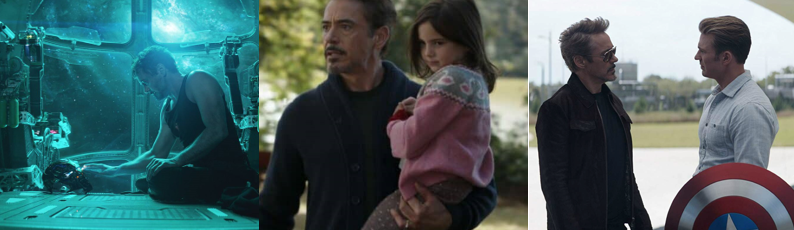
Haunted by defeat, Tony’s priorities shift towards safeguarding his daughter by any means necessary.

Endgame immediately explores the devastating fallout of the Avengers’ defeat and foreshadows its dramatic and emotional finale by finding Tony drift in space alongside Nebula. Although she’s still stoic and aggressive, it’s clear Nebula is deeply affected by the loss of her sister, Gamora (Zoe Saldaña), and her reluctant adopted family, the Guardians of the Galaxy. While Nebula naturally bottles these feelings up, Tony sees his end coming. Realistic and ready to die after being worn down by his survivor’s guilt and desperate need to defend the Earth at all costs, he records a farewell message to Virginia “Pepper” Potts (Gwyneth Paltrow) and prepares to meet his end….only for them to be rescued and returned to Earth by Captain Carol Danvers/Captain Marvel (Brie Larson). However, returning to Earth brings little solace for Tony; deeply traumatised at witnessing his protégé, Peter Parker/Spider-Man (Tom Holland), disintegrate before his eyes (to say nothing of his other teammates and the crushing weight of defeat), Tony lashes out at former ally Captain Steve Rogers/Captain America (Evans) and refuses to join the expedition to confront Thanos, having lost the will to fight. Not that it would’ve made much difference given that Thanos guarantees his actions cannot be undone, but Tony instead chooses to focus on his family. In the five year gap, he has a daughter and settles down with Pepper, his priorities shifting from the lives of everyone else to the lives of his family. Thus, when Cap, Scott, and Natasha Romanoff/Black Widow (Johansson) come calling looking for Tony’s scientific input on their bonkers “time heist” idea, Tony initially scoffs at the suggestion, though he has let go of his animosity towards Steve in the interim. Still, ever the scientist, Tony can’t help but be intrigued and, upon running a few simulations based on Scott’s Quantum Realm data, quickly devises a means to navigate the dimensional vortex and effectively allow travel through time and space. Realising that they now have a very real shot at regaining the Infinity Stones and undoing Thanos’s devastating actions, Tony agrees to re-form the Avengers and don his iconic armour once more but on the very specific proviso that Morgan’s safety and existence is ensured. It’s a dramatic culmination of Tony’s character arc; he went from a selfish, womanising arms manufacturer to a snarky, egotistical superhero, to risking losing everything to safeguard the Earth from otherworldly threats, to literally sacrificing himself to not only bring back those lost, but ensure his daughter grows up in a world that hasn’t been crippled by loss.
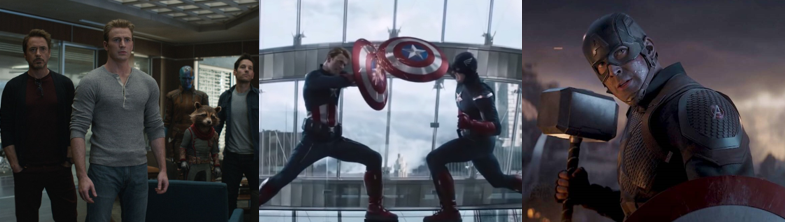
Cap’s fighting spirit galvanises the team and sees him standing against incredible odds.

While Tony falls into despair and then devotes himself to his family to cope with the tragedy, Cap is initially adamant to make Thanos pay for his actions. When Carol and Rocket Racoon (Cooper) pinpoint Thanos’s location, Cap’s first thought is, appropriately, to avenge their losses. Unfortunately, Cap’s forced to face a heavy reality: there’s no way to undo what’s happened so, instead, he devotes himself to offering counselling and trying to help everyday folk pick up the pieces of their lives. With most of the world’s governments apparently gone, Natasha and the remnants of the Avengers apparently still fight to maintain order across the world, but there’s a clear sense that they’re just desperately holding on to what little they have left. However, Scott offers them hope through a clunky form of time travel. Despite outlandish science being outside his wheelhouse, Cap eagerly reassembles the Avengers and galvanises them to travel back to key moments in their past to reacquire the Infinity Stones and set things right. Steve teams with Tony, Scott, and Banner and revisits the battle for New York. Although Banner convinces the Ancient One (Tilda Swinton) to lend them the Time Stone, they’re unable to secure the Space Stone when Loki Laufeyson (Tom Hiddleston) steals it, forcing Cap and Tony to pay a further visit to 1970 to restock on Pym Particles and reacquire the Space Stone. Here, not only does Tony finally reconcile with his father, Howard Stark (John Slattery), in an amusing and poignant way, but Cap finally lays eyes on his old flame, Peggy Carter (Hayley Atwell) for the first time in a hundred years. Cap is devastated when the team returns to find Natasha was lost in the pursuit of the Soul Stone, but continues to soldier on with the plan, focusing solely on the restoration of the world. Despite this being far from a traditional fight, Cap stands against nature – and time – itself, betting everything on the slim chance that they can succeed. Although clearly burdened by defeat, he continues fighting and encourages everyone around him to do the same no matter how bleak the odds. This is, of course, explicitly demonstrated in the climactic finale. When the younger Thanos violently attacks the Avengers and lays waste to his allies, Cap grits his teeth and stands tall in in the face of what appears to be an inevitable end and his faith is rewarded not only in the dramatic arrival of his much-needed backup and proving himself worthy to wield Mjölnir, but in finally walking away from the fight and have a life of his own.
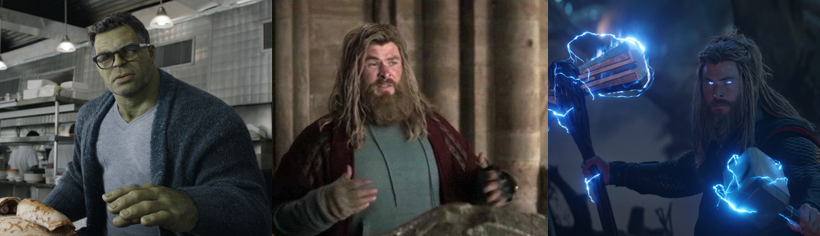
Hulk is smart now, while Thor has succumbed to self-despair and desperately seeks redemption.

Two characters fundamentally altered between Infinity War and Endgame are the Hulk and Thor Odinson (Hemsworth). While I do agree that it’s a shame we never get to see Banner and the Hulk finally reconcile their differences and come together as one united entity (a “Smart Hulk”, if you will) and I definitely would’ve preferred to see this in the finale of Infinity War as originally intended (though tweaked with the united Banner/Hulk being portrayed as grey), I’m satisfied with the explanation we got and both film are already so stuffed with characters and plots that it could have bogged things down. Now a far calmer and intelligent being, the Hulk sees his brutish ways as “gratuitous” and instead puts his mind to work trying to figure out time travel in Tony’s absence. He’s primarily here as exposition and a bit of comedy relief but I liked how everyone just accepted his new normal, that he proved pivotal in reversing the Blip by being the only one strong and capable enough to handle the destructive power of the Infinity Stones (retroactively suggesting that the Hulk was fated to exist for that very reason), and he’s a key factor in convincing Thor to rejoin the Avengers. No one shoulders the burden of failure more than Thor; this once proud and arrogant warrior is reduced to a depressed, out of shape, drunken king of New Asgard all because he failed to land a killing blow on Thanos. Even decapitating Thanos brings him little catharsis as it changes nothing, and Thor clearly struggles with both survivor’s guilt and costing the lives of untold billions. He sees the time heist at a shot at redemption, a personal mission to prove that he’s still worthy of being the Mighty Thor, but is largely seen as a hinderance since he’s so wracked by grief and guilt that he struggles to keep his emotions in check. It’s only after a pep talk from his beloved mother, Frigga (Rene Russo), and the knowledge that he can still wield Mjölnir, that bolsters his self-worth, though Thor is so desperate to undo his mistake that he practically begs to bring everyone back with Tony’s gauntlet, despite the fact that the effort would probably kill him. Ultimately, Thor’s redemption comes in the most fitting way: on the battlefield. I liked how Thor doesn’t snap back to being a super-buff warrior in the finale; I think it was important to show that he was still carrying the burden of his failures even as he cut down foes with both Mjölnir and Stormbreaker, and there’s a definite sense that he rediscovers himself in battle with Thanos and through the loyal support of his friends and allies.
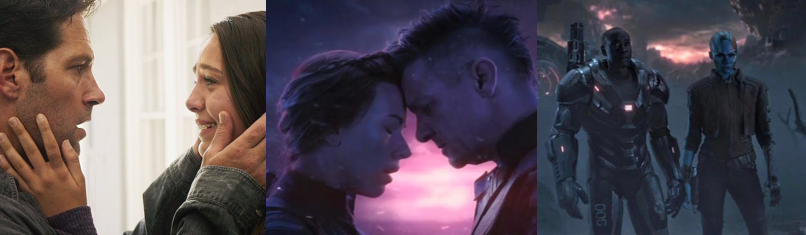
Each of the Avengers has an emotional and personal stake in the desperate time heist.

Although they either didn’t get too much to do or missed out entirely on the events of Infinity War, Endgame allows fellow Avengers Natasha, Ant-Man, Clint Barton/Hawkeye (Renner), and Colonel James “Rhodey” Rhodes/War Machine (Cheadle) play key roles in the time heist. Indeed, without Scott (and that one-in-a-billion rat), the Avengers would never have reacquired the Infinity Stones since it was only his knowledge and insight into the Quantum Realm that allowed Tony to crack time travel. Scott continues to be in awe of working alongside his idols, but even his chirpy demeanour is tested by the Blip. He arrives in a world where millions have perished and his daughter, Cassie (Emma Fuhrmann), is now a teenager but he remains as optimistic as ever about their chances of success, even if you can tell that he’s clinging to hope as desperately as the others. The same can’t be said of Hawkeye; after witnessing his wife and children disintegrate before his eyes, Barton spends the next five years going on a killing spree, murdering crime bosses and those he deems unworthy of being spared with a cold-blooded precision as “Ronin”. Although he’s clearly scarred by his losses, his loyalty to Natasha sees him join the time heist in a last-ditch effort to restore the world, but his character has been given an obvious edge. Now sporting a frankly ridiculous mohawk and an array of tattoos, Hawkeye is more than willing to sacrifice his life for the Soul Stone when directed by the enigmatic Johann Schmidt/The Red Skull/The Stonekeeper (Ross Marquand). What follows is a test of the two’s loyalty and friendship and a desperate and emotional battle to save the other while restoring countless lives. The two literally fight to give up their lives for the Soul Stone, willing to die for their friends and family, but ultimately Barton is left carrying the burden of Natasha’s selfless sacrifice and finding a way to live with his dark deeds. Rhodey finds himself teamed up with Nebula; as reliant upon his armour as she is on her cybernetics, the two find some surprising common ground and working with the Avengers definitely helps to soften both her and Rocket and make them more open to co-operation. Their jaunt to retrieve the Power Stone from Peter Quill/Star-Lord (Chris Pratt) has dire consequences, however, when a past version of Thanos is alerted to their presence. This not only sees Nebula face off against her less morally inclined past self and brings a past version of Gamora into the main timeline, but sees Thanos renew his campaign for the Infinity Stones using knowledge of the future!
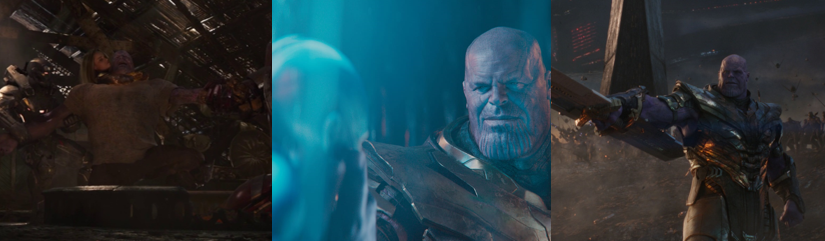
Despite being killed, Thanos comes across time to plague the heroes once again.

Indeed, Endgame is largely unique among MCU films in that the battle is already lost at the start and the heroes are mostly fighting against intangible foes: grief, loss, guilt, and time being chief among them. While Carol leads them in confronting Thanos at the start, he’s no longer a threat and doesn’t even try to fight them. Injured from his actions and content with his victory, he simply mocks their attempts at revenge and meets his end victorious. While in New York, Cap, Scott, Banner, and Tony are mainly tasked with avoiding their past selves in true Back to the Future Part II (Zemeckis, 1989) fashion, though Cap does have a brief scuffle with his past self that sees even him exasperated by his can-do attitude. The Stonekeeper could be classified as a threat but he’s simply a messenger for the Soul Stone; the real threat comes from having to sacrifice a loved one to acquire the Stone, similar to the Ancient One’s warnings that the Avengers must return the Infinity Stones or risk the destruction and collapse of other, alternate timelines. However, when that past version of Thanos learns of his fate and orders the evil version of Nebula to travel to the future, the Avengers’ compound decimated by Thanos’s ship, Sanctuary II, the return of his monstrous army and his “children”, the Black Order, and Thanos himself back on Earth with victory within his grasp. I’ve seen it suggested that there’s less emotional catharsis in seeing the Avengers battle this version of Thanos since he technically isn’t the one who wronged them, but I don’t think this really matters all that much. There’s little difference between the two Titans except one died knowing he had achieved his goal and the other was determined to expedite his goal after learning of his victory. Perhaps because of this foresight, Thanos is far more aggressive and less honourable than his counterpart. Rather than offering to spare those he respects or aiming to wipe out half of life so that people can learn to appreciate what they have, Thanos now aims to completely rewrite history in his image. To that end, this Thanos takes to the battlefield in a way his counterpart avoided. Garbed in gleaming armour and wielding a massive double-bladed sword, Thanos is positioned as the ultimate threat, regardless of which timeline he’s from, since the Avengers know full well how destructive he is. Indeed, Thanos’ threat truly shines in the finale, where he not only goes toe-to-toe with Cap, Iron Man, and Thor but also shows his wiles and raw strength by matching blows with Captain Marvel, fuelled the entire time by his obsession for victory and unrivalled power.

The Nitty-Gritty:
As mentioned, grief, loss, and time are key themes in Avengers: Endgame. While the film doesn’t linger or go into massive amounts of depth exploring how the Blip has affected the world, it effectively conveys the desolation and loss through some eerily silent aerial shots, Cassie’s overgrown and dishevelled neighbourhood, the monument erected to those lost, and through the way each character deals with their failure. At the time, it definitely shook things up to jump ahead to a world left in ruins by Thanos, and even though even I will admit that the potential of this was largely undone and sadly played for laughs in subsequent films, it really works in the context of this movie to hammer home just how devastated everyone is, which in turn drives their mission to defy the laws of physics and set things right. Endgame makes sure to lay the rules for time travel out as plainly as possible. Thanks to Scott and Tony, characters can navigate the Quantum Realm and travel to the past using Pym Particles, but anything they do in the past will not change the present because time isn’t a straight line, but a multiverse of different pathways. Yet, removing the Infinity Stones will cause the collapse of those branches, meaning the Avengers have a moral obligation to return them when they’re done. Like most time travel stories, it’s not perfect and has some holes in it but I think it works to sell the idea that you can’t just go back in time and kill Thanos to set things right. Banner very emphatically explains that time just doesn’t work that way and it’s a great way to place importance of the “main” timeline and add some additional tension to the heist since they risk other timelines while saving theirs.
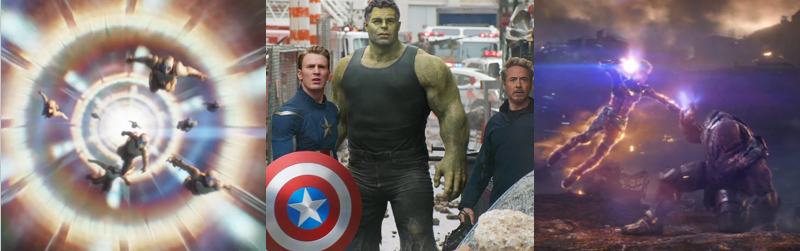
Endgame explores new levels of these characters and then goes all-out with an action-packed finale.

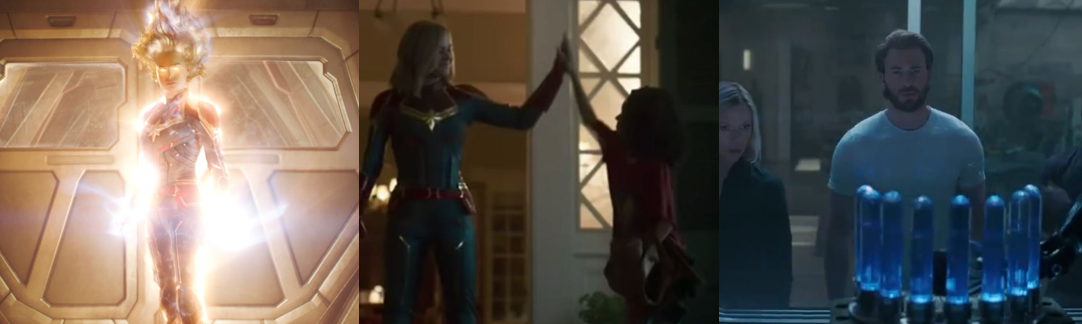
In many ways, Endgame is a far more grounded, subdued character study compared to Infinity War. Thus, bombastic, action-packed scenes give way to exploring the emotional fallout from the Blip and how each character has been changed by their defeat. That isn’t to say that action and big CGI sequences aren’t here, though; it’s just more a fight for redemption and against those intangibles I mentioned than against a singular foe, for the most part. You would never know it but the Avengers’ time suits are all entirely CGI; their stark white and uniformity unites the team in a way we haven’t seen before and allows them to safely navigate the chaotic Quantum Realm and avoid being physically altered by the timestream like Scott is during Banner’s test run. While in the past, the team revisit the Battle of New York, now expanded to show that the Ancient One and the Sanctum Santorum were also fending off the Chitari and what happened after the Avengers defeated Loki, where Cap uses his knowledge of Hydra’s infiltration of the Strategic Homeland Intervention, Enforcement and Logistics Division (S.H.I.E.L.D.) to his advantage. This, and their later trip to 1970, allows for some fun cameos from Alexander Pierce (Robert Redford), Brock Rumlow (Frank Grillo), and even a de-aged Doctor Henry “Hank” Pym/Ant-Man (Michael Douglas), complete with retro helmet. The rest of the time heist is spent revisiting key moments from previous MCU films, recreating and reframing certain events from a new perspective, before the massive climactic battle at the end. One thing I enjoyed about the time heists, and the film in general, was seeing characters like Rocket and Nebula interact with the Avengers and become part of the team. In the spirit of pooling all available resources, Natasha directs a joint effort of every remaining superhero to try and maintain order, but her focus is squarely on the Earth. The rest of the universe is dealt with by Captain Marvel, who sadly misses out on joining the time heist but more than makes up for it with her dramatic entrance during the finale. Since she’s the most powerful hero in MCU, she easily wipes out Sanctuary II and ploughs through the aliens before going one-on-one with the Mad Titan himself. Although a bit arrogant in her abilities, Carol more than backs this up with her incredible power. Indeed, it’s shown that she probably could’ve wrestled the Infinity Gauntlet from Thanos had he not had the wherewithal to use the Stone’s individual powers to fend her off, meaning that even Captain Marvel’s might required the support of her teammates to wrestle the gauntlet from the Mad Titan.
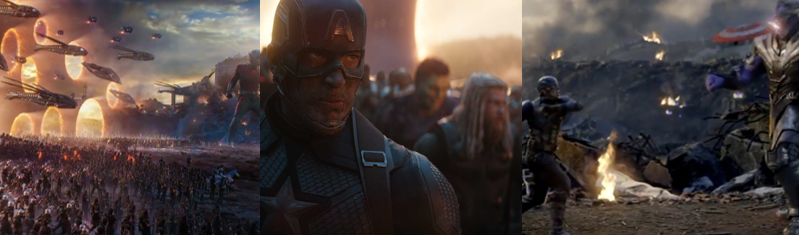
Cap’s resolve is bolstered by the emotional and dramatic return of his restored allies.

The remnants of the Avengers come together with a simple goal: to retrieve the Infinity Stones from the past, insert them into a nanotech gauntlet, and undo the Snap with a snap of their fingers. Although Thor pleads to perform this, the Hulk is the only one capable of surviving the act, and the film really sells the reveal of his success as a strange anti-climatic event…at first. Cap, Iron Man, and Thor are too busy fighting for their lives against Thanos and his army to focus on much else. Each one has a personal and emotional stake in the battle and each one falls to Thanos’s power, regardless of how hard they fight. Thor, especially, leaps head-first into the bout and ends up at the mercy of Thanos, desperately calling to Mjölnir…only for the hammer to fly into Cap’s waiting hand! Seeing Cap wield Mjölnir and attack Thanos with renewed vigour drew a rare cheer from the audience when I saw Endgame and is easily one of the most memorable moments in the entire MCU, but it’s quickly followed by one of the most emotional. Left as the last man standing and ready to go down fighting, Cap is suddenly stopped when he hears his friend, Sam Wilson/The Falcon (Anthony Mackie) in his ear. Relief and emotion sweep through Cap as he beholds a series of magic portals. Through them step his allies, friends, and teammates old and new, restored and ready to fight. It’s a sweeping, cinematic, incredibly powerful sequence jam-packed with cameos, from the Ravagers to Howard the Duck (Seth Green), and little moments, like Scott reuniting with Hope van Dyne/The Wasp (Evangeline Lilly), Wanda Maximoff (Elizabeth Olsen) angrily confronting and nearly killing Thanos, Star-Lord’s ill-fated reunion with Gamora, Tony unashamedly embracing Spider-Man, and a fun scene where the various female heroes of the MCU come together to clear a path for Captain Marvel. This climatic battle is an absolute wet dream for any Marvel fan. It’s the literal culmination of a ten-year journey for the MCU and I always spot different things each time I watch it, but the entire battle is made even sweeter by Cap finally uttering that rallying war cry: “Avengers Assemble!” While I would argue that we definitely should’ve heard this before this moment, this doesn’t take away from how powerful that moment was or just how amazing it was (and still is) to hear it and see all the MCU’s heroes battling alongside each other.

Tony’s sacrifice defeats Thanos and clears the path for a new generation of heroes.

Despite all these heroes, and Captain Marvel’s last second save, Thanos proves true to his word; no matter what’s thrown at him, he seizes the gauntlet and appears to be truly “inevitable”. However, just as he’s about to snap his fingers again, Iron Man leaps in for one last attack and steals the Stones away from Thanos! His body wracked with cosmic energy, struggling to contain the immense power, Stark utters his famous line once more – “I am Iron Man!” – and obliterates Thanos’s army with a snap of his fingers. Thanos, startled to see his army disintegrate around him, can only watch on and slump down with quiet defeat, accepting his end as nobly as possible. Sadly, this victory is bittersweet as the effort fries Tony’s body and mind and leaves him a babbling, near-lifeless wreck. Peter, Rhodey, and Pepper gather around him to say their goodbyes and Pepper tearfully gives him permission to finally rest, and death finally catches up to Tony amidst his friends and family. While I would’ve loved to see the scene where his comrades all take a knee kept in the film, the emotional weight of Tony’s sombre funeral delivers as strong a message. Everyone that was close to him gathers in quiet gratitude and respect to honour his sacrifice and take comfort in each other, and it’s a hell of a way to close the book on the character that kickstarted the emotional rollercoaster that is the MCU. Of course, it doesn’t end there; as the heroes go their separate ways and prepare for their next steps, Cap steps back into the Quantum Realm to make good on Banner’s promise to return the Infinity Stones. After sharing a heartfelt farewell to his old friend, James Buchanan “Bucky” Barnes/The Winter Soldier (Sebastian Stan), it initially seems like Steve has gotten lost in the timestream. However, Bucky and Sam spot a old man (Evans/ Patrick Gorman) sitting nearby who’s revealed to be Cap, age finally having caught up with him, who chose to take a leaf out of Tony’s book and settle down with Peggy. He gifts his shield and Captain America identity to Sam and reflects happily on his life, finally at peace with the world. While there’s a lot of debate and disagreement about the specifics of this, I really don’t care. Whether Cap lived in an alternate time or the main timeline, it makes no difference and the entire point was to finally give him some peace and happiness, which I think is conveyed beautifully, and to pass the torch to a new generation of heroes.

The Summary:
It’s amazing to think how massive Avengers Assemble was and how incredibly the MCU built upon it with Avengers: Infinity War. It’s so rare to see a film franchise have such longevity and build such intrigue for its next entry, but the buzz surrounding Avengers: Endgame was so real that I was practically frothing at the mouth to see how the story would be wrapped up. Rather than going bigger and more explosive, Avengers: Endgame focuses on the original six Avengers and the remnants of their group and explores new depths to their characters. Each is affected by their defeat in different ways and embodies that failure in ways that make them so much more vulnerable and relatable. I loved how they all came together, united in grief and in their determination to put things right, “whatever it takes”, and how the time heist gave us fresh new interactions between them. Sure, time travel is a bit of a cliché solution and some of its aspects are a bit wonky under close supervision, but I’m okay with that as the purpose was to celebrate what came before and sow the seeds for the MCU’s future, which was set to be very different based on the new status quo established here. Honestly, Avengers: Endgame is worth a watch for the emotional and action-packed finale alone. Even now, it never fails to give me goosebumps and bring a tear to my eye since it’s such a fantastic culmination of everything that came before and a satisfying, if bittersweet, end to these beloved characters. Avengers: Endgame could have easily collapsed under its own narrative, the weight of expectation, and the high standards set by its predecessor and the MCU in general. Instead, with a poignant heart at its core, riveting action, and some genuinely moving moments amidst its big action set pieces, Avengers: Endgame is a fantastic endnote for the first ten/eleven years of Marvel movies.

My Rating:

Rating: 5 out of 5.

Fantastic

What did you think to Avengers: Endgame? Were you satisfied with how it wrapped up the ending of Infinity War or would you have liked to see it take a different direction? What did you think to the five-year time jump and the way this was handled in subsequent films? Did you like the depiction of time travel here? What was your reaction when those portals opened, when Cap picked up Mjölnir, and to Tony’s dramatic death? Have you been happy with the MCU film we’ve seen since Endgame or do you think it peaked here? What are some of your favourite Avengers stories, characters, and villains? Whatever your thoughts about Avengers: Endgame, and the Avengers in general, leave a comment below or on my social media and be sure to check out my other Marvel content across the site.


Game Corner: Resident Evil VII: Biohazard (Xbox One)

GameCorner
ResiEv7Logo

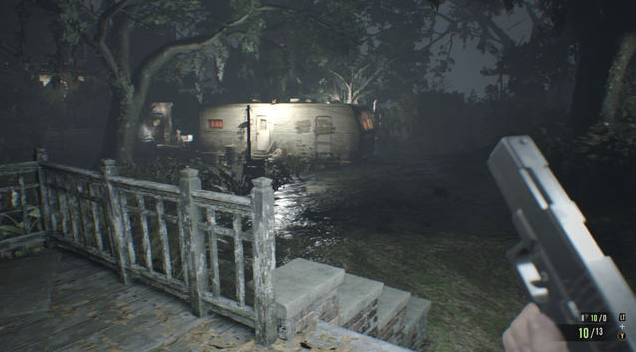
With Resident Evil VII: Biohazard (Capcom, 2017), I’ve finally reached the end of the big pile of Resident Evil ibid, 1996 to present) titles I got for Christmas. I was making decent progress in the game but kept getting distracted with life, work, and other games but, now that I’ve finally finished one of the most lauded Resident Evil titles ever made, the question is: does the game live up to the hype? After the absolute, balls-to-the-wall action-heavy approach they turned the franchise into in Resident Evil 6 (ibid, 2012), Capcom decided to answer their critics and bring the survival-horror aspects of Resident Evil back to the series but with a twist: this time, it’s in first-person!

ResiEv71stPerson
Not gonna lie but I struggle with first-person perspective…

This was a bit of a hurdle for me right off the bat as, traditionally, I don’t really get on too well with first-person videogames, primarily because I don’t like being attacked from behind and I find them to be uncomfortable to play at times. Like, I enjoy the dread and constant tension the perspective offers here and in other, similar games but, when you’re just trying to have a bit of a casual play, it can be draining to be constantly on edge and first-person perspective can hamper controls, combat, and camera angles at times.

ResiEv7BakerFamily.PNG
The charming Baker family invite you to dinner…

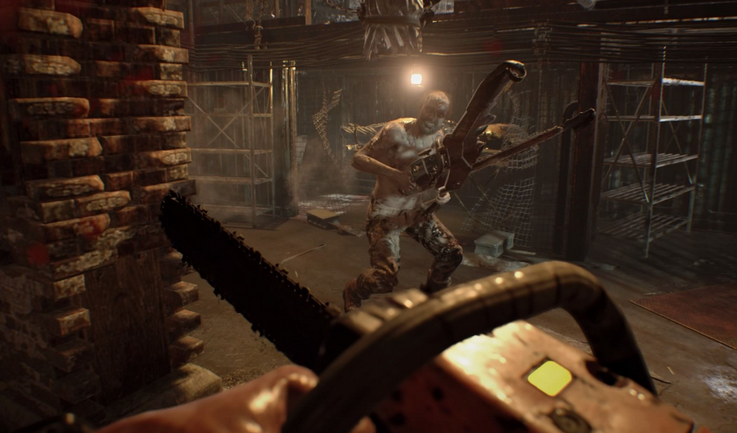
However, Resident Evil VII: Biohazard utilises its new perspective to great effect as players take on the role of Ethan Winters; unlike other Resident Evil protagonists, Ethan’s just…a guy…nothing special. He’s been drawn to an abandoned house in search of his wife, Mia, who has apparently taken a bit of a turn for the worst. After he’s attacked and has his hand cut off, Ethan is left at the mercy of the mental Baker family, a bunch of messed up back-water hillbillies who make the Texas Chain Saw Massacre’s (Hooper, 1974) family look normal. With his hand reattached by staples (…just go with it) and forced to cobble together items to survive and find a way out of the booby-trapped house, Ethan is relentlessly pursued by Jack Baker, who smashes through walls and attacks without mercy, repeatedly coming back from severe trauma and injury to torment you again and again as he absorbs blows, shrugs off bullets, and your supplies dwindle away to nothing.

ResiEv7Molded.PNG
The Molded are viscious buggers, far from your typical zombie fodder!

As Ethan progresses, solving puzzles, battling the bullet-sponge monstrosities known as the “Molded”, and exploring the Baker’s estate, he comes across Zoe Baker, who offers to help cure Mia by developing a serum to combat the infection that has warped her family. The source of the infection turns out to be a young girl, Eveline, who can control the minds of others, and Ethan is eventually forced to battle her in her monstrous final form. Resident Evil VII: Biohazard is unlike every other Resident Evil title before it. Sure, some tropes remain (Item Boxes, herbs, having to manually save (though using a cassette player rather than a typewriter), limited supplies, and a claustrophobic atmosphere) but, aside from some brief last minute (literally the very last minute) references to the previous titles, this looks and plays like an entirely different game. It’s a shocking departure, even more so than when the series switched to an over-the-shoulder, slightly more action-orientated approach in Resident Evil 4 (Capcom Production Studio 4, 2005); it seems that, every time Capcom wants to spice up their survival-horror franchise, a dramatic shift into another genre generally does the trick as long as there’s some restraint placed on the player to emphasise the survival aspects.

ResiEv7Eveline.PNG
Things get very large and very ugly by Resident Evil VII‘s end…

Resident Evil VII: Biohazard definitely emphasises this aspect as supplies are criminally low; it’s not really enough to have a herb anymore as it’s far more beneficial to also pick up some Chem Fluid to restore more health (as in other recent Resident Evil titles, this can be done with the touch of a button). This extends to ammo as well, as Ethan can combine different objects to create more, or new, ammo combinations. However, there’s never enough to truly feel comfortable in combat; the Molded take multiple shots (even from a good, old fashioned shotgun blast), forcing you to think strategically about when to fight, when to flee, and how to plan your route around enemies when a swarm turns up. Resident Evil VII: Biohazard’s bosses have quite a bit of variety; you start off desperately battling to survive as Jack Baker relentlessly attacks you with an axe or a chainsaw, progress to blasting a giant, slimy creature with the traditional giant red eyes, and end up blasting an enormous, pissed off woman right in the face. The first-person perspective makes these boss battles particularly intense as it doesn’t lend itself to the game’s limited combat; it’s tough to see where a boss is when its scurrying around you, even tougher to get a good shot off, and tricky to pull off sudden, quick-time event-like moments when you’re busy trying to get your vision lined up.

ResiEv7LucasTrap.PNG
Trust nothing when it comes to Lucas’ escape rooms…

Once you’re made it through the main campaign, you can take on a variety of additional modes. Not A Hero follows series staple Chris Redfield (once again completely redesigned and working for the now-benevolent Umbrella Corporation) as he battles through the game’s last area to (what else!) a secret laboratory while End of Zoe follows Joe Baker, a slightly more hinged member of the Baker family who uses his apparently-superhuman strength to smash apart Molded and find a cure for Zoe. You can also race against the clock and blast the Molded to feed Jack in Jack’s 55th Birthday, face death again and again in the impossibly-difficult Ethan Must Die, and take on a few other similar survival modes. Despite its dramatically new approach, Resident Evil VII: Biohazard feels a lot like the original Resident Evil in many ways, mainly in its atmosphere and aesthetics. Like the original title, doors are arbitrarily locked by themed keys, Ethan must solve puzzles to open new areas (or to escape death traps set-up by Lucas Baker that more than resemble the Saw (Various, 2004 to present) films), and combat is an intense, strategic action.

ResiEv7Horror.PNG
You’re never short on horror in Resident Evil VII.

It was an interesting experiment by Capcom to use the restrictive first-person perspective to enforce the survival-horror aspect in a new, exciting way; it’s not exactly unique, as there’s lots of first-person games that take a similar approach, but it definitely worked to shift the franchise back towards survival-horror. Having played this before and after Resident Evil 2 (Capcom R&D Division 1, 2019), it’s clear that Capcom took a lot of the lessons they learned in developing Resident Evil VII: Biohazard and applied them to their remake. While I doubt that Capcom would ever use them in a full game again, I actually wouldn’t be averse to seeing first-person sequences return in future Resident Evil titles (maybe as side quests similar to the videotape flashbacks seen in this game); however, the important thing here is that the tense, atmospheric horror is retained and, given how well Capcom did in applying this atmosphere to Resident Evil 2, we should hopefully be in for some gory, engaging, terrifying Resident Evil titles once more thanks, largely, to Resident Evil VII: Biohazard.

My Rating:

Rating: 4 out of 5.

Great Stuff

Movie Night: Hellboy (2019)

HellboyLogo

Released: April 2019
Director: Neil Marshall
Distributor: Lionsgate
Budget: $50 million
Stars: David Harbour, Milla Jovovich, Ian McShane, Sasha Lane, and Daniel Dae Kim

The Plot:
Hellboy (Harbour), a demonic paranormal investigator for the Bureau for Paranormal Research and Defence (B.P.R.D.), is the only thing standing between the ancient sorceress, Nimue (Jovovich), being resurrected and leading the forces of darkness into all-out conquest over the human world.

The Background:
Created in 1993 by noted writer/artist Mike Mignola, Hellboy is quite a unique and intriguing comic book character; a demon entity with a giant stone hand, filed-down horns, and a big-ass hand cannon, he is noted as being the world’s greatest paranormal detective and investigates, and fights against, the forces of evil. Of course, we’ve seen the character adapted by Guillermo del Toro and portrayed to fantastic effect by Ron Perlman back in 2004. Although we got a sequel in 2008, talks on a third instalment stalled and, eventually, died out, leading to this grittier, bloodier reboot.

The Review:
Hellboy is a chaotic, frenetic movie that blasts along at a mile a minute, rarely taking any time to catch its breath or take a moment to think about what is going on. While this does make for a loud (very loud; at times, the music drowned out the dialogue), action-packed slug-fest, it does make the movie far more exhausting than its 2004 counterpart. However, this version separates itself by being full of gore, violent action, and foul language, which definitely ups the movie’s fun factor. The movie opens with some narration from Professor Trevor Bruttenholm (McShane), who quickly runs through the story of the Blood Queen Nimue while we see it happening onscreen; this is one of those cases where a a prologue exists simply to spell out the plot for the audience as, later in the film, Hellboy obviously has to be told the same story so he knows what’s going on and I end up just asking why we couldn’t skip the opening narrative and just splice that footage in to the later exposition.

HellboyCast
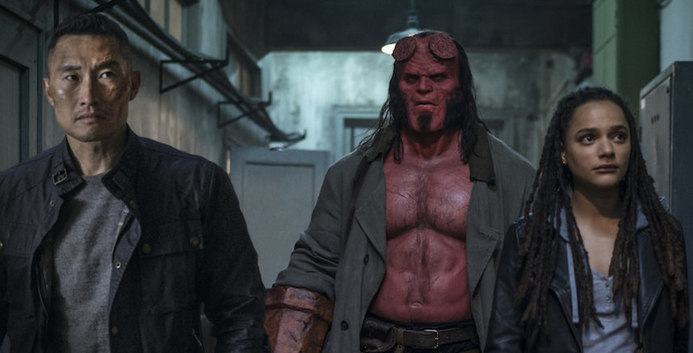
Hellboy wisely introduces some new character’s from the comic lore.

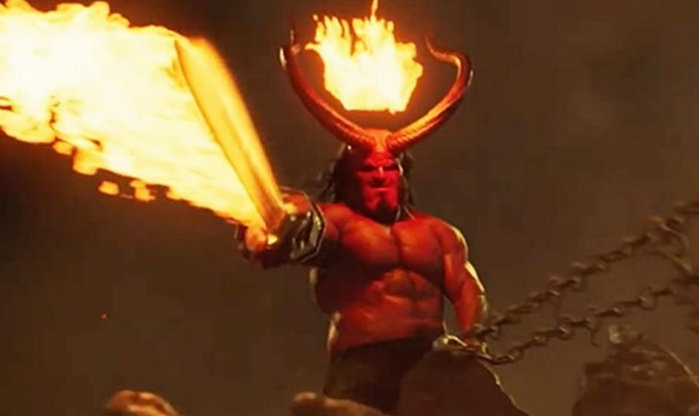
After that, we jump-cut to Tijuana, where Hellboy is unable to save a friend of his (a fellow B.P.R.D. agent) and, just as he’s trying to deal with the guilt of that, we jump-cut to Colorado, where Professor Bruttenholm sends Hellboy on an assignment to help out the Osiris Club with an outbreak of giants in England. So then we jump-cut to England for an exciting action scene where Hellboy fights giants; it’s around here that the actual plot starts to come together as, at every turn, Hellboy is told rumours of an approaching evil, his role in the apocalypse, twists, turns, betrayals, and so many sudden location shifts as Hellboy prepares for the resurrection of the Blood Queen. As perfect as Ron Perlman was as Hellboy, David Harbour is a fantastic replacement; gruff, sarcastic, and conveying a lot of conflicting emotions, he is less of a child-like goof but still portrays the character as enjoying his violent job and beating up bad guys. The make-up and effects on Hellboy are top notch, and clearly have had the most effort put into them; compared to Perlman, Harbour is bigger, more battle-hardened (scars pattern his face and body) but just as poor a shot and quick to enter a fight. I don’t really know the Hellboy comics very well at all but we still don’t see much evidence to support Hellboy’s status as the world’s greatest paranormal investigator; he’s more a hit-first-ask-questions-later kind of demon and, though there are some wrinkles in his portrayal, he’s pretty much the same character from del Toro’s films.

HellboyNimue
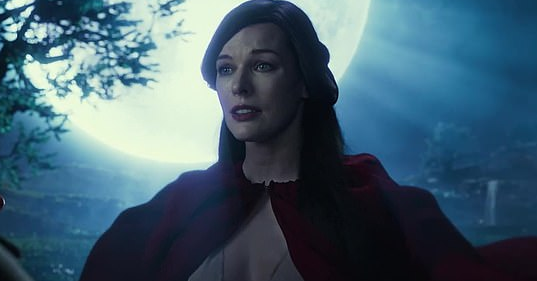
Once again, Milla Jovovich is little more than a plank of wood.

Supporting him are the always-great Ian McShane, who is a far more gruff and pragmatic version of Professor Broom, Alice Monaghan (Lane), a telepath of sorts who can talk to and summon spirits, and Ben Daimio (Kim), a UK-based B.P.R.D. agent who, despite hiding a big secret, hates all the world’s monsters and is prepared to eliminate Hellboy if he proves to be a threat. They’re okay; there’s far more friction between Broom and Hellboy given that Hellboy discovers his true origins for the first time in this movie; Alice is serviceable enough and helps to humanise Hellboy, while Daimio undergoes the most character development as he begrudgingly learns to tolerate Hellboy’s existence during the course of the movie. Nimue is quite the antagonistic force; in addition to being effectively immortal, she can command the forces of darkness and bring about plagues through sheer force of will. She’s a constant shadow hanging over the film and actual shows up quite a bit, too; she’s also willing to concede her throne to Hellboy, given his destiny to be the destroyer of worlds. However, a lot of her threat and menace is diluted by Jovovich’s trademark wooden acting; as always, she is an emotional void, despite moments of emotion, and she just seems like a puppet dancing around onscreen.

HellboyGruagach
Gruagach is a fun antagonist who needed more screen time.

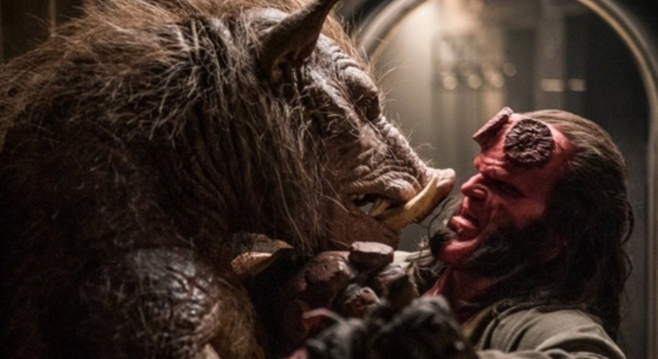
Nimue’s desires are facilitated mainly through her right-hand…man…Gruagach (Stephen Graham and Douglas Tait), a half-man, half-pig who pretty much steals the show whenever he shows up thanks, in large part, not only to his gruff voice (which is full of personality) and his sympathetic motivations, but also due to him mostly being portrayal through practical effects. When he is onscreen with Nimue, she suddenly seems a lot more interesting and my only regret is that there isn’t more interaction between him and Hellboy as the film constantly throws other threats and obstacles in Hellboy’s path. Hellboy also features a booming soundtrack, though it does drown a lot of the dialogue out, as I mentioned earlier; this is something to note as Hellboy is a gruff-spoken character, Harbour has a gruff voice, and the make-up is obviously difficult to act through so it can be he hard to hear Hellboy’s snappy dialogue when the soundtrack is in full force. The effects are good, for the most part; the creature effects are clearly inspired by del Toro and the practical effects all look great. Some of the CGI lets the film down though, particularly around Nimue, her powers, her minions, and when Daimio reveals his true nature. The shots of hell seen in the trailer are very well done, though, and Hellboy looks great, and it’s helped that the movie blasts along way too quickly for you to really take in how good, or bad, a lot of the effects can be.

The Nitty-Gritty:
If you’ve seen the trailers, or Hellboy (del Toro, 2004) then you already know one of the film’s biggest spoilers, which is that Hellboy embraces his role as Anung Un Rama and, also, that he ultimately rejects his fate as the bringer of the apocalypse by breaking his horns. He is forced into doing this by the death of a loved one (this time it’s Broom) and talked out of it by being reminded of his humanity (also by Broom, as a spirit, in this film). It’s a bit too samey, unfortunately, as was the flashback to Hellboy’s origin, which differed only in that Broom was at Hellboy’s summoning in order to kill him and decided to raise him as a son and weapon against evil instead…which was somewhat implied in del Toro’s movie. The trailers did do a decent job of hiding Daimio’s true nature, however; it was heavily implied that he was a werewolf of some kind and it turns out that he can turn into a beast that resembles a sabretooth tiger. This doesn’t fully happen until the film’s climax, however; probably because the effects are not very good at all and he’s not onscreen in this form for very long.

HellboyApocalypse.PNG

Hellboy is betrayed and stabbed in the back, literally, at almost every turn, adding to the film’s chaotic nature. Yet, amidst all of this, Hellboy presents the idea that Hellboy is half-human, half-demon and that his human lineage stretches all the way back to King Arthur. This means that Hellboy is the true ruler of England, for one thing, and (conveniently) the only one capable of wielding the legendary Excalibur (the one blade that can kill Nimue). I don’t know if this is a thing in the comics but it felt a bit contrived and convoluted for me; the entire movie is this mish-mash of exposition and senseless action and then, suddenly, Hellboy is destined to be the descendant of King Arthur while also being destined to bring about the apocalypse. O much prefer Hellboy being a down-to-Earth kinda guy who rejects his demonic heritage to do good out of his own volition and not because “fate” says he will. Like any good comic book movie, Hellboy features a few post-credits scene; two set-up a potential sequel, especially with Baba Yaga (Emma Tate and Troy James) swearing revenge against Hellboy and Hellboy, Alice, and Daimio discovering Abe Sapien’s water tank; in another, Hellboy is randomly consoled by the ghost of the legendary Nazi killer Lobster Johnson (Thomas Haden Church).

The Summary:
Hellboy is a bombastic mess of a movie, to be honest. It’s loud, jumps all over the place, and never stops to let you catch up. The movie is full of foul-language and gratuitous violence, which really adds to its chaotic nature; unlike del Toro’s movies, this Hellboy doesn’t hold back and goes balls-deep with the violent nature of Hellboy’s work and life. While you can argue that the violence and gore is simply there just to be there, it really makes the film’s over-the-top premise and action far more enjoyable and allows this film to distance itself from its predecessors. I enjoy a mindless action movie as much as the next guy and am al for switching my brain off and watching some mindless violence, but Hellboy’s rapid editing and frantic pace soured me at the start. Similar to Suicide Squad (Ayer, 2016), Hellboy tries to cram way too much in at the start and then has multiple flashbacks to each character’s origin as they are introduced that interrupts the plot and makes things more convoluted than it needed to be; I think a cold-open and dialogue concerning Hellboy’s origin would have been enough. However, there is something to like about Hellboy; the effects are good, Harbour is great as the titular character, and the action and violence are loud and fun. Unfortunately, the film doesn’t seem to be tracking well and doesn’t look like it’ll turn much of a profit, if any, so we may never get to see a sequel iron out some of the film’s issues but, to its credit, Hellboy goes for the jugular right from the start and doesn’t let go even after the credits have rolled.

My Rating:

Rating: 3 out of 5.

Pretty Good

Movie Night [Christmas Countdown]: Shazam!

ShazamLogo

Released: 5 April 2019
Director: David F. Sandberg
Distributor: Warner Bros. Pictures
Budget: $80 to 100 million
Stars: Asher Angel, Zachary Levi, Mark Strong, Jack Dylan Grazer, Grace Fulton, and Djimon Hounsou

Plot:
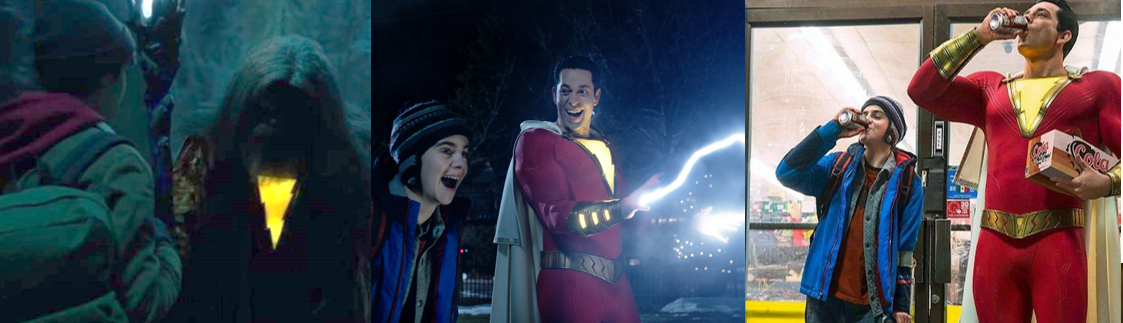
Billy Batson (Angel), an abandoned boy searching for his missing mother, is suddenly bestowed with magical superpowers, transforming him into an adult superhero (Levi) with the mindset of a teenager. When Doctor Thaddeus Sivana (Strong) attains equal power through possession of the seven Deadly Sins, Billy is suddenly faced with putting aside his personal issues and becoming a fully-fledged superhero.

The Background:
Following the success of Clark Kent/Superman and Bruce Wayne/Batman, Fawcett Publications sought to establish their own colourful superheroes, each sporting the powers of Greco-Roman Gods, before Ralph Daigh combined them into one superpowered entity to directly oppose Superman initially dubbed “Captain Thunder” and transformed by writer Bill Parker and artists C.C. Beck and Pete Costanza into Captain Marvel. Although legal issues dogged the character even after Fawcett was absorbed into DC Comics, Captain Marvel was joined by a colourful extended family and even enjoyed some success in adaptation with a live-action television show back in the seventies. Development of a big-screen adaptation can be traced back to the early-2000s, when Peter Segal was attached to direct and the first rumblings of Dwayne “The Rock” Johnsons interest in playing Teth-Adam/Black Adam came about. When production stalled, Segal left the project and Shazam! fell into Development Hell for a while as Warner Bros. tried to establish their own cinematic universe. The project came back to life in 2014, with Johnson still involved, though he was soon given a spin-off project while director David F. Sandberg casting Zachary Levi in the title role and tackling the concept asBig (Marshall, 1988) but with superpowers”. Levi underwent a physical transformation and worked closely with his child co-star, Asher Angel, to portray the World’s Mightiest Mortal. Following a favourable response to the film’s first teaser trailer, Shazam! went on to make $366 million at the box office, making it a reasonable success. Critical response was overwhelmingly positive; reviews praised the comedic aspects and performances, and colourful visuals and heartfelt messages, though some noted issues with the tone and finale. Regardless, Shazam! was a big hit amidst the mess that is the DC Extended Universe; not only was a sequel announced not long after the film’s release but the Rock finally got his long-awaited Black Adam movie, though any hopes of a showdown between the two would be quashed with Shazam!’s sequel.

The Review:
Shazam! was released at a time when the DCEU was in a very chaotic flux; it’s not much better these days, to be fair, but back in 2019 we were still in the murky depths of the whole “Release the Snydercut” movement that saw a very vocal and very toxic splinter cell of “fans” decry anything and everything that wasn’t spearheaded by Zack Snyder. Consequently, I’ve seen discussions online trying to claim Shazam! isn’t canon to the DCEU films that came before it simply because Superman (Ryan Hadley) is wearing a blue suit instead of a black one…like he couldn’t just change his bloody costume! Well, I’m sorry to tell you but, at this point, Shazam! is more canon than the bloated and over-rated Zack Snyder’s Justice League (ibid, 2021) and different superheroes in the same shared universe can have different tones to their movies; if you don’t want to look at Marvel’s movies for proof of this, maybe try comparing Man of Steel (ibid, 2013) to Wonder Woman (Jenkins, 2017) and then each of those to Suicide Squad (Ayer, 2016) and Aquaman (Wan, 2018), four films that most definitely are a part of Snyder’s flawed vision of DC’s most famous characters. For me, Shazam! represented a shift towards telling more light-hearted, comic-accurate, and action-packed stories that focused on getting to the heart of these beloved characters rather than muting and saturating them or making them unnecessarily grim; Snyder extremists may lose their nut when Batman (Ben Affleck) mercilessly slaughters people and swears like he’s Frank Castle/The Punisher, but that’s not true to Batman’s character at all so I saw Shazam! as a bit of a course correction for the DCEU towards a less ridiculously serious take on these characters.

Streetwise Billy pushes everyone away in pursuit of his missing mother.

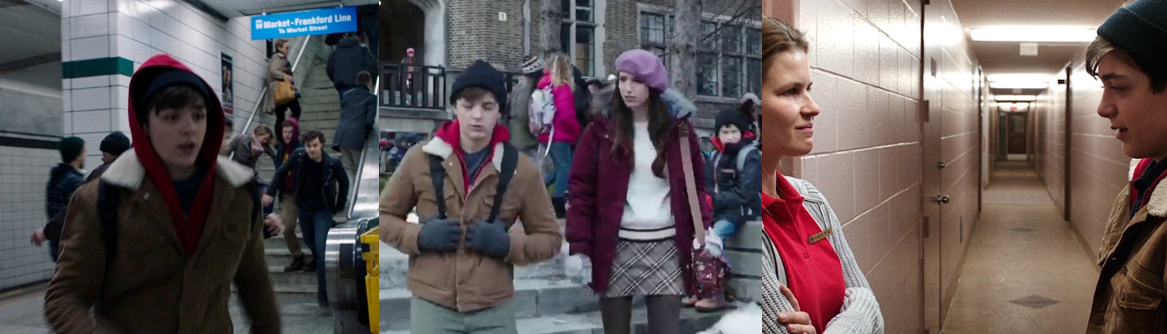
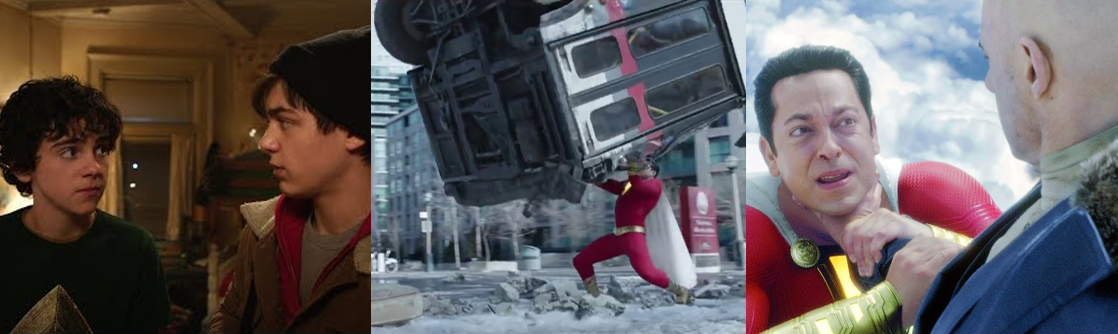
I feel it’s important for me to point out that I haven’t read any of the New 52 comics featuring Billy/Shazam’s altered background and extended family; I’m vaguely aware that his origin and situation were changed and updated somewhat, but I’m much more familiar with his classic comics and his appearance throughout the mid-nineties as a budding kid reporter and the “Big Red Cheese” who goofed about on the Justice League International team. I was therefore amused and intrigued to find Billy portrayed not a newspaper boy living on the streets with aspirations of working in radio, but instead as a streetwise orphan with a reputation for causing trouble with both his foster families and the cops and businesses of Philadelphia. Billy is a lot more in common with young John Connor (Edward Furlong) in that he resents being placed in the care of others, prefers to rely on his own wiles to get by, and frequently scams his way into police databases to track down his birth mother, Marilyn (Caroline Palmer), who he became separated from at a carnival ten years previously. Although he’s a rebellious kid who actively rejects assistance and affection for others, there’s a real tragedy to Billy; he believes he has a “real” family and mother out there waiting for him, refuses to entertain the notion that Marylin isn’t interested in finding him, and is desperate to be reunited with her and feel that sense of belonging once more. Unfortunately for him, he’s only fourteen and therefore legal mandated to be placed into foster care; having run away from good families before and been rejected because of it, he’s placed into the care of the lovable Víctor (Cooper Andrews) and Rosa Vásquez (Marta Milans), who shelter a whole troupe of foster kids of all ages. Since he’s a self-sufficient kid who doesn’t see the point in connecting with others because he’s trying to get back to his real mother, Billy is unimpressed by the Vásquez’s friendliness and the mixture of personalities in their household.

Billy revels in the power and freedom offered by his superpowered alter ego.

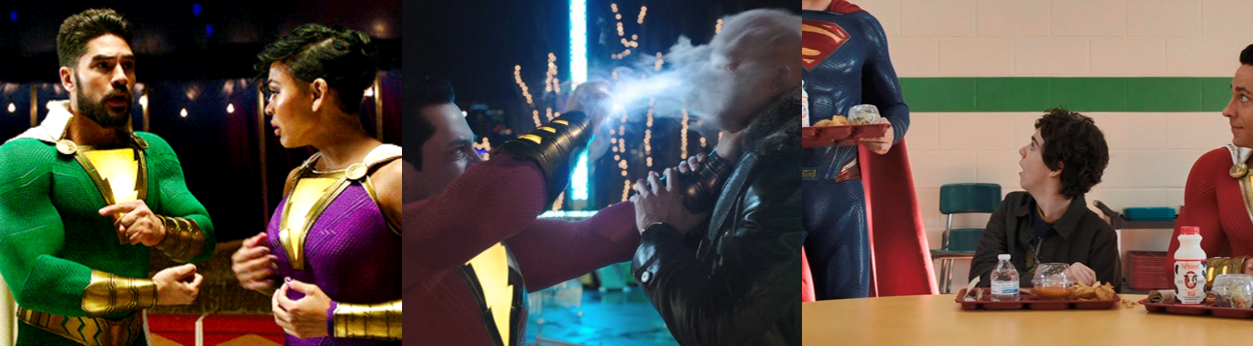
As in the source material, Billy is approached by the aging wizard Shazam (Hounsou), here depicted as a desperate demigod seeking to pass his great powers on to a suitable heir before his time ends. Djimon Hounsou is a great choice for this role; his gravely voice oozes a perfect mixture of menace, authority, and despair. Burdened by the guilt of having misplaced his trust in a previous Champion and witnessing the deaths of his fellow Council of Wizards, the Wizard is determined that his next Champion be pure of heart in order to fend off the influence of the Seven Deadly Sins (Steve Blum, Darin De Paul, and Fred Tatasciore) but is forced to rely on the reluctant Billy after the Seven Deadly Sins are freed from their prison. By speaking the Wizard’s name, Billy is transformed into an adult form sporting one of the best and most comic-accurate costumes ever put to cinema; the effort sees the Wizard crumble to ash but empowers Billy with the wisdom of Solomon, the strength of Hercules, the stamina of Atlas, the power of Zeus, the courage of Achilles, and the speed of Mercury. Whenever he utters his name, Billy becomes a boy trapped in a man’s body, leading to many humorous moments such as him struggling to navigate the world now he’s a six-foot, musclebound man, him learning the alcohol usually tastes terrible, and his awkward attempts to exude authority as a superhero. Zachary Levi shines in the role, though it can’t be overlooked that Billy seems to act more immature as Shazam than he does as a kid, somewhat negating whatever influence the Wisdom of Solomon is supposed to have on him; however, I would chalk this up to the freedom and power offered by his adult form and superpowers and it results in some of the film’s best moments as he and Freddy Freeman (Grazer) test Shazam’s limits, try to think up a suitable superhero moniker, and attempt to become social media celebrities by recording his feats of power and heroism.

Freddy encourages Billy’s growth from a super celebrity into a capable superhero.

The Vasquez house shelters five kids of various ages, including avid gamer Eugene Choi (Ian Chen), the enthusiastic, the overly affectionate and chatty Darla Dudley (Faithe Herman), introverted workout aficionado Pedro Peña (Jovan Armand). While Darla steals every scene she’s in with her endless excitement and Billy can’t help but be taken by her childish positivity, it’s cripple Freddy Freeman and academic prodigy Mary Bromfield (Fulton) whom Billy spends the most time with. A superhero fanboy who’s constantly wearing Justice League t-shirts, showing off his Superman memorabilia, and rattling off Justice League statistics and abilities as Billy explores his powers. While Freddy’s nonstop chatter quickly exasperates Billy, the self-styled loner can’t help but step in when the snarky Freddy is set upon by a couple of douchebag jocks; Freddy’s a bit of an odd duck, one who sports a dark sense of humour, chatters incessantly, and struggles to maintain his boundaries. It’s lucky for Freddy that Shazam’s powers are so formidable as he doesn’t hold back in putting him through his paces; he actively encourages armed thugs to shoot him in the face, secretly sets him on fire, and delights in watching him barrel into buildings and fall from great heights in his attempts to fly. Eventually, however, a rift forms between them that only grows wider when Billy chooses to goof off as Shazam rather than show appreciation for Freddy’s assistance; even Eugene and Pedro question Shazam’s heroism as he’s more concerned with grifting and showing off. Although Shazam’s able to pull off and impressive physical feat and save a busload of civilians from certain death, Freddy chastises him for causing the accident in the first place and chews him out for not appreciating how lucky he is to have such incredible powers.

Though empowered by the Seven Deadly Sins, Dr. Sivana covets the Wizards gifts most of all.

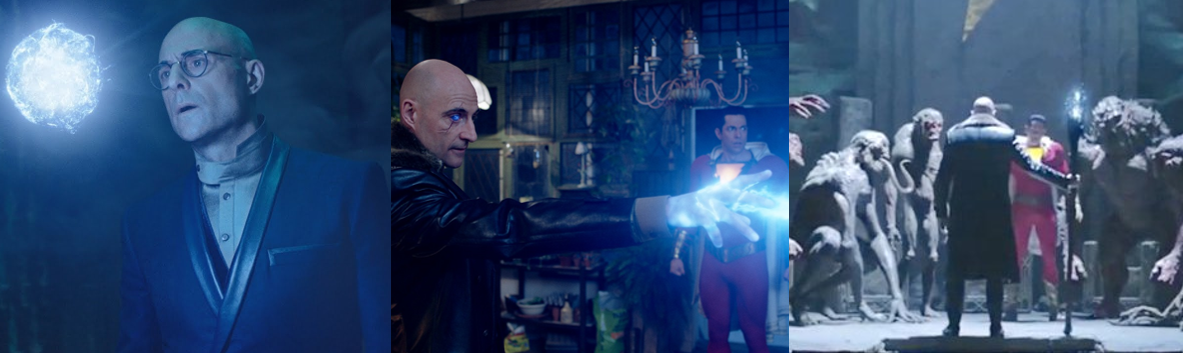
Billy is put to the test, however, by Dr. Sivana, who we first meet as a little boy (Ethan Pugiotto) suffering emotional abuse at the hands of his strict father, business tycoon Mr. Sivana (John Glover), and his obnoxious older brother, Sid (Landon Doak). Although seemingly a more playful and less repugnant individual compared to his domineering elders, young Thaddeus is a perfect cause of nurture over nature; when he’s magically transported to the Rock of Eternity and offered the chance to become the Wizard’s Champion, he’s easily swayed by the influence of the Seven Deadly Sins, who offer him the power he needs to prove his strength to his father by claiming the Eye of Sin rather than the Wizard’s staff. Deemed unworthy because of his impure heart, young Thaddeus is rejected by the Wizard and his subsequent outburst causes a car crash that sees his father paralysed from the waist down and sets the boy on a lifelong quest to research the Wizard and his other rejected attempts to find a Champion in order to force his way back into the Rock of Eternity, confront the Wizard’s rebuff, and become the vessel for the destructive power of the Seven Deadly Sins. Largely represented as grotesque gargoyle-like creatures comprised of rock and smoke, the Seven Deadly Sins imbue Dr. Sivana with power to rival that of Shazam, which is a far cry from the mad scientist he was in the original comics but, as I understand it, is more in-line with his New 52 counterpart and allows Dr. Sivana to pose a physical challenge to the titular demigod. Composed, spiteful, and revelling in his dark powers, Dr. Sivana is the polar opposite of Shazam, who takes far longer to reconcile his immaturity with his magical adulthood and to realise the potential of his superpowers; it’s telling that Dr. Sivana can both fly and throw more effective punches in their first encounter, such is the benefit of his lifelong quest for the Wizard’s power, and he doesn’t hesitate to use every advantage at his disposal, even threatening Billy’s foster family, to add Shazam’s power to his own.

The Nitty-Gritty:
Some of you reading this may question why I’ve included Shazam! in my Christmas Countdown series considering it’s not a “typical” Christmas movie. Well, for me, the reason is very simple: the film is largely set around the festive season, Christmas songs, trees, and lights are all over the place, as is snow and a general sense of festive anticipation in the air and, while Christmas might not be at the heart of the narrative, this is enough for me to justify it being a Christmas movie. Plus, why not take the opportunity to slap on a fun or enjoyable film around Christmas even if it isn’t a focal point of the movie? A common criticism I have of early Shazam! comics is the depiction of the Rock of Eternity; it would take some decades for artists to render it in a way that felt both grandiose, fantastical, and foreboding and to not simply have cartoonish writing all over the walls to explain to kids what was happening. Thankfully, Shazam! addresses this issue, depicting the Rock of Eternity as a cavernous labyrinthine temple home to the aging Wizard and seven thrones where his peers once sat. The Seven Deadly Sins are also entombed there and, while they do have their name sand natures etched into their rocky surfaces, they’re far more monstrous and impressive than in those early comics; the Rock of Eternity is also home to various other magical doorways and artefacts that effectively lay the groundwork for future films, villains, and characters.

When his perfect memory of his mother is shattered, Billy turns to his foster family for support.

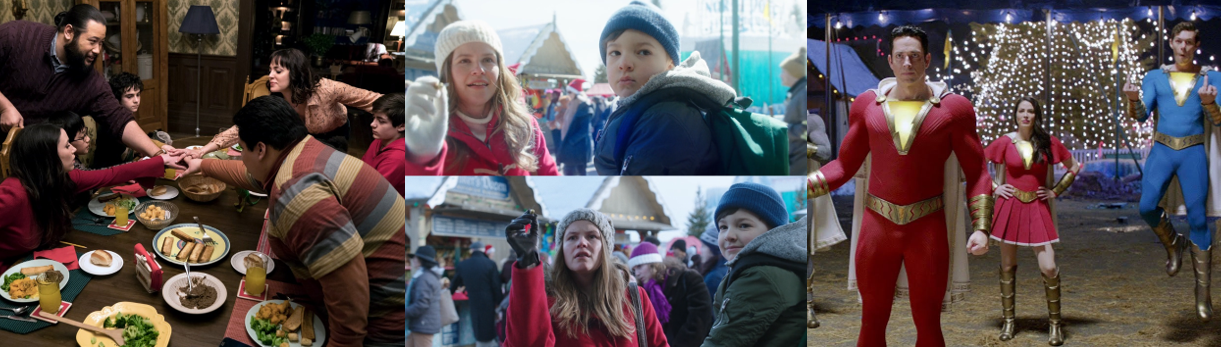
Family plays a central role in the film; as indicated, the influence of Mr. Sivana and Sid has a lasting effect on Dr. Sivana’s nature and life, with every action he takes in his quest for power, both magical and otherwise, motivated by a need to prove himself worthy and superior to his father and older brother. Billy holds his last memories of her close in his heart, remembering her as a kind-hearted and loving mother who did her best and gifted him with a compass so that he could always find his way, and he both dreams and actively rehearses what he’ll say when they’re reunited after they got lost in a bustling crowd. It’s therefore all the more heart-breaking when Billy does eventually track her down and learns not only that his memories of this event were skewed by his childish perception, but that Marylin chose to abandon him as she couldn’t cope with the pressure of being a mother. Asher Angel absolutely sells Billy’s dejection at this revelation as he realises that his whole life has been a lie, that this perfect memory and vision of a loving mother was far from the actual truth, and that his mother dropped him at the first chance she got rather than try to live up to her responsibilities. Despite his earlier reservations, this means that Billy comes to recognise the importance of his true family; while he’s spent much of the film pushing others away and only reluctantly accepting Freddy’s help in discovering the limits of his superpowers, the Vásquez’s and their foster kids have been nothing but warm, welcoming, and understanding to Billy. When he first meets them, the family is coming to terms with Mary’s impending departure for the California Institute of Technology (CalTech), a move which is encouraged but also a subject of sadness, especially for the emotional Darcy. After saving her as Shazam, Billy relates his belief that family is for those who can’t take care of themselves and encourages her to make it on her own and, similarly, early on, refuses to say grace over dinner or join hands with his foster family. However, when Dr. Sivana threatens his adopted family, Shazam agrees to hand himself over in exchange for their lives, finally seeing himself as their brother, and later turns to his adopted siblings for help by sharing his magical powers in much the same way as Victor and Rosa share their love.

Alongside his superpowered family, Shazam defeats Dr. Sivana and finds his place at last.

Although their power is primarily embodied through Dr. Sivana, the Seven Deadly Sins make a hell of an impression, delivering some disturbing PG violence that’s more than on par with the explicit brutality of previous DCEU films. Dr. Sivana barely flinches when his assistant (Lotta Losten) turns to ash before his eyes, launches Sid (Wayne Ward) out of a window, and unleashes the monstrous Seven Deadly Sins upon his father and his board members, whom they slaughter with an unexpected malice for an otherwise kid-friendly film. Although he can easily manhandle Shazam thanks to his composed nature, Dr. Sivana covets the Wizard’s magic above all and takes advantage of Freddy’s very public relationship with Shazam to hold his foster family hostage in exchange for Shazam’s powers. Their loyalty to Billy sees the kids come to his aid and reveals a glaring weakness in Dr. Sivana’s otherwise formidable powers; he becomes more vulnerable as the Seven Deadly Sins expel from his body, so Billy shares his powers, transforming his foster siblings into their own adult, superhero forms to divide the Seven Deadly Sins and weaken Dr. Sivana. While it’s convenient that Lady Shazam (Michelle Borth), Shazam Jr. (Adam Brody), and the others are all able to master their abilities faster than Billy, it leads to a fun and explosive finale as Freddy revels in finally having the superpowers he’s long idolised, Pedro Shazam (D. J. Cotrona) marvels at his physical stature and finally finds his confidence, Eugene Shazam (Ross Butler) delights in spouting videogame catchphrases to match his powers, and Darla Shazam (Meagan Good) retaining her childish exuberance. Although the Seven Deadly Sins and the Shazam Family are technically evenly matched in their strength and durability, Shazam’s able to render Dr. Sivana powerless by goading Envy into leaving his body. He then saves Dr. Sivana from certain death and forcibly extracts the Eye of Sin from his head, imprisoning the Seven Deadly Sins once more, though Dr. Sivana is approached by another potential villainous ally, the hyper-intelligent caterpillar Mister mind (David F. Sandberg) while languishing in prison. Having now found a safe, loving home and family to share his life and powers with, Billy chooses to stay with the Vasquez’s, joins them in their family traditions, and establishes himself and the other Shazams as the new keepers of the Rock of Eternity. He’s even able to bolster Freddy’s credibility at school by joining him for lunch as Shazam and alongside an awkwardly-framed Superman (seriously, it would’ve been just as good, if not better, to show Superman from behind and floating outside the window).

The Summary:
It can be difficult to craft a truly original superhero origin movie; even I’ll admit it’s usually better to fast-track or skip the origin entirely, especially for more well-known superheroes, but Shazam does a great job of establishing its world and Shazam’s powers through well-paced exposition and different means. Rather than opening with a voiceover explaining everything to us and then having that information repeated later, we see the conflict between the Wizard and the Seven Deadly Sins and how that influences Dr. Sivana and, when Billy first gets his powers, he’s completely clueless how to use them and is forced to turn to superhero nut Freddy for help. Seeing the kids become their own magical superheroes was a blast as all the adult actors equally conveyed their thrill at their newfound abilities and I really enjoyed the film’s humour, especially in the man-child personification of Shazam and his not being able to hear Dr. Sivana’s villain monologue. Seeing Billy grow from a damaged loner to truly accepting his foster family and his newfound powers was a charming development after the utter gut-punch delivered by his mother; Mark Strong was, ever, a deliciously scene-stealing villain and I absolutely loved the costume design and presentation of the film. Infused with exactly the right balance of action, comedy, and heart that’s often sorely lacking in the DCEU, Shazam! is a hugely enjoyable romp that’s got just enough Christmas spirit laced throughout it to justify an annual watch every festive season regardless of how much of a hard-on you have for Snyder’s grim and gritty perversion of DC’s characters.

My Rating:

Rating: 4 out of 5.

Great Stuff

Did you enjoy Shazam!? Are you a fan of the comic books and, if so, were you happy with the way it adapted the source material? What did you think to Billy’s characterisation, his mother’s true nature, and his acceptance of his foster family? Which of his siblings was your favourite and did you enjoy seeing them get a share Shazam’s power? What did you think to Dr. Sivana and the Seven Deadly Sins? Are there any Shazam characters, villains, or story arcs you’d like to see adapted one day? Do you prefer the grim and gritty DCEU or its more light-hearted side? Whatever your thoughts on Shazam!, feel free to drop them below or leave a comment on my social media.


Game Corner: Tomb Raider: Definitive Edition (Xbox One)

GameCorner
TombRaiderLogo

I’m going to kick this off with a revelation: I’ve never actually played a Tomb Raider (Core Design/Eidos Interactive/Square Enix, 1996 to present) videogame from start to finish. As I’ve alluded to in the past, I didn’t have the luxury of being able to afford every videogame console as a kid so I picked the Nintendo 64 while others were playing PlayStation; I did play the original Tomb Raider (Core Design/Eidos Interactive, 1996) for about twenty minutes (and wasn’t massively impressed by its controls, sparse environments, or graphics) and I think I have either Tomb Raider: Legend (Crystal Dynamics/Eidos Interactive, 2006) or Tomb Raider: Underworld (ibid, 2008) downloaded on my PlayStation 3 but I instantly lost interest in it moments after first playing it. However, when my friend gifted me Tomb Raider: Definitive Edition (Crystal Dynamics/Square Enix, 2014) for the Xbox One, I was intrigued not just because I felt I had skipped an important franchise in videogame history but also because I had heard good things about it and that it played similar to the Batman: Arkham (Rocksteady Studios/WB Games Montréal/Warner Bros. Interactive Entertainment, 2009 to 2015) franchise (I guess the Assassin’s’ Creed (Ubisoft, 2007 to 2018) series is a better comparison but I haven’t played them either…).

TombRaiderSurvive
Lara’s lost and alone in the wilderness…

Tomb Raider is, if you couldn’t guess from the title, a complete reboot of the franchise in which Lara Croft (and her fellow explorers) journeys to Yamatai, a lost island off the coast of Japan, to find evidence of the mythical Sun Queen, Himiko. Unfortunately, Yamatai is protected by violent supernatural storms, which sinks Lara’s ship and separates the survivors across the island. Isolated and hunted by the island natives, Lara is forced to adapt to her surroundings to find food, shelter, and warmth and then take up arms against the violent Solarii Brotherhood, who wish to make a sacrifice to the Sun Queen. Gameplay takes the form of a third-person perspective as players guide Lara throughout her diverse and varied environments; initially, Lara is relatively incapable and struggles to get through the jungles, cliffs, and shanty towns dotted around the island but, once she obtains a pickaxe and a make-shift bow, she soon becomes an accomplished rock climber, forager, and survivor.

TombRaiderKiller
Lara overcomes her aversion to killing pretty quickly…

Lara is forced to fashion a bow and arrows in order to hunt wildlife for food (though this is merely a plot mechanic; Lara’s health automatically regenerates when she finds cover or avoids damage) but a huge dramatic moment is made of the first time she picks up and fires a gun in self defence. Shaken by the ordeal of having to kill to survive, you’ll soon find yourself blasting fools in the face with a shotgun and stabbing guys through the neck with arrows without mercy. Lara is able to explore her environments to find various helpful items to improve her progress: salvage and weapon parts can be used to upgrade and enhance her weapons, completing various trials and performing certain objectives and actions will award Lara experience points that she can spend on upgrades to improve her hunting and survival skills, and she can find various treasures and documents scattered across the island to unlock Achievements.

TombRaiderTombs
There are tombs to raid but they’re more of a distraction.

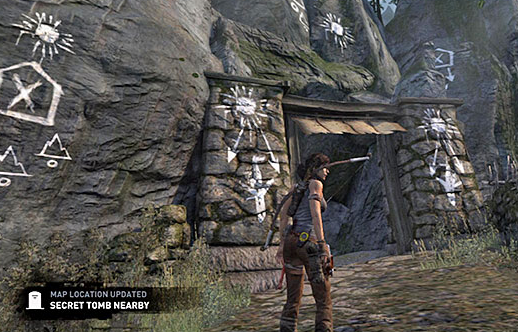
There are also some hidden tombs to be found, which reap greater treasures and experience points; you’ll get a notification when one is near and they’re usually easily identified by nearby markings and drawings. Each tomb tests Lara’s abilities with a few simple puzzles, which involve lighting things, jumping across gaps, and manipulating the environment with her various tools. While they are a fun diversion they are just that, a diversion, and the game’s title is actually somewhat misleading as the actual raiding of tomb’s is not even secondary to the game’s plot; it’s a side-mission, one barely given any prominence or relevance at all. Instead, the game pushes the plot revolving around the Sun Queen; when one of Lara’s ship-mates is captured by the Solarii, Lara has to go and rescue her to stop her being possessed by Himiko’s spirit and bring and end to the storms that prevent anyone from leaving the island. She faces betrayal and further trials along the way but, by the time you reach the final area of the game, you’ll be more than levelled up and ready to face the waves of enemies that come at you.

TombRaiderInstincts
Lara’s “instincts” give her the edge over her enemies.

Like Batman, Lara is able to use her “instincts” to scan her environment for treasures, intractable objects, and locate enemies that she can combat in a variety of ways: the bow is good for stealth but Lara can also sneak up on enemies for stealth kills. She only has access to one gun throughout the game until the very end, when she acquires a second and ends up as the battle-hardened, experienced hunter/survivor we know as Lara Croft, but this can be upgraded into a rapid fire Magnum. She also obtains a shotgun and an assault rifle (which can somehow also be upgraded into a grenade launcher…) to mow down enemies and use her pickaxe for melee attacks and instant kills. Enemies are reasonably varied; some will attack with machetes and dynamite, others use assault rifles, while bigger enemies are shielded by Samurai armour, meaning Lara must dodge their attacks to strike from behind. This is facilitated via quick-time events, which also appear at various moments when Lara must run to escape flooding areas, collapsing areas, or her many (many) tumbles down hills and cliffs. It was a little difficult getting the timing right for a lot of these quick-time events as the button doesn’t appear onscreen right away but you soon get the hang of it and will be dodging enemies and blasting them with a clip full of bullets before long.

TombRaiderQTE.PNG
Quick-time events help keep things engaging.

Lara is also adept at jumping, climbing, and swinging; she can leap pretty far and climb up roped surfaces, jump from rock face to rock face with her pickaxe, and even end up shooting roped arrows to ride her pickaxe down to new areas. Jumping across rocks can be tricky due to the camera angle being just slightly off but, as long as you press X and time it right, you can make most jumps without any issues. You can bring up the map at any time to see what goodies you’re missing in each area; every area of the island has a bunch of stuff to find that will help you out and unlock Achievements. Lara can also make camp at various points; this will save the game, allows her to fast travel around the map (how, exactly, is never explained…). Upgrade her abilities and weapons, and write in her journal like a geek. You can also switch her outfit here, though none of them are that great to be honest and there’s no option for her classic green vest and hot pants outfit.

TombRaiderMulti.PNG
Yeah…I won’t be unlocking her any time soon…

Tomb Raider also comes with a multi-player component, though I’m not entirely sure why. In it, players can select one of the many characters featured in the story mode (though, ironically, Lara can only be unlocked after you level-up enough) and take part in deathmatches, rescuing survivors, or retrieving batteries whilst being hunted. As with all online modes, I found this to be chaotic and confusing; I was constantly picked off with frustrating ease, barely ever saw who was killing me, and contributed very little to the match but this is more due to me not really liking online deathmatches and I’m sure if you’re actually good at these modes then there’s enjoyment to be had here. The entire point of this game appears to be to bring Lara to rock bottom and build her up; some of this is dampened by a lot of her ship-mates constantly telling her that she “can do this” because she “is a Croft”, as though having that last name automatically means she can scale a cliff side and kill a God…but she can, and she does, after enduring some harsh trials and learning to do whatever it takes to survive. Along the way, she becomes comfortable with killing to stay alive and looting treasure for her own benefit and, by the end, is noted to have changed a lot and committed to the life of a scavenger and survivor rather than a simple naïve explorer.

TombRaiderAdapt.PNG
Lara’s experience shapes her into the character we all know.

This makes Tomb Raider quite an engaging experience; you really feel like you are becoming this survivor as you learn new tactics and figure out the best ways of clearing out rooms of enemies and solving puzzles. Every area teaches you something new, introduces new elements, and asks you to adapt and, by the time you’re done and you’re back-tracking to other locations to find stuff you missed, no obstacle will be too great for your fully-upgraded weapons and abilities. Overall, I enjoyed Tomb Raider; it wasn’t necessarily difficult to play through and complete and getting all the upgrades was pretty easy, with only a bit of back-tracking required at the end of the game. There is some replayability in the multiplayer and in the challenges you’ll find in each area but no real post-game story or additional modes that require a further playthrough. Nevertheless, for the first Tomb Raider game I’ve ever played from start to finish, this was a great experience, though I suspect this is largely due to the tight, polished gameplay of this particular title compared t its predecessors.

My Rating:

Rating: 3 out of 5.

Pretty Good

Movie Night: Captain Marvel

Released: 8 March 2019
Director: Anna Boden and Ryan Fleck
Distributor: Walt Disney Studios Motion Pictures
Budget: $152 to 175 million
Stars: Brie Larson, Samuel L. Jackson, Ben Mendelsohn, Jude Law, Lashana Lynch, and Annette Bening

The Plot:
It’s the mid-nineties in the MCU and, across the galaxy, Kree super soldier Vers (Larson) is embroiled in a war against the shape-shifting Skrulls. When the Skrull campaign brings Vers to Earth, she encounters a young Nick Fury (Jackson) and embarks on a journey to recover a mysterious light-speed craft that also reveals the truth about her past as an Air Force pilot.

The Background:
Thanks to a 1953 lawsuit over Fawcett Comics’ superpowered champion, Billy Batson/Captain Marvel, Marvel Comics acquired the trademark to the name “Captain Marvel” in 1967. Originally a superpowered Kree warrior, Stan Lee and Gene Colan’s often-underused Mar-Vell famously died from cancer in 1982 and was followed by a number of successors, with easily the most prominent being Carol Danvers, who become a top-tier female superhero. Although development of a Carol Danvers-led Captain Marvel script can be traced back to 2013, and she very nearly made it into Avengers: Age of Ultron (Whedon, 2015), the critical and commercial success of Wonder Woman (Jenkins, 2017) undoubtedly influenced Kevin Feiges desire to produce a strong, female-led superhero film for the MCU. After a number of challenges regarding her powers, delays, and potential meddling from some less-than-progressive executives, Brie Larson was joined by directors Anna Boden and Ryan Fleck and the film finally got underway. The script made alterations to the character to avoid comparisons to the Green Lantern Corps and present a different type of origin story. Since Carol was pushed as the MCUs most powerful character, and we live in a disappointingly intolerant world, Larson faced an undue and sickening amount of backlash, though all involved were determined to present Carol as someone who draws strength from her femininity. With Samuel L. Jackson also cast, complex de-aging techniques were used to render him twenty-five years younger in place of a body double, and the film was dedicated to the legendary Stan Lee, who died during production. Despite the best efforts of misguided haters to scupper the film, Captain Marvels $1.128 billion made it a big hit at the box office; reviews also largely praised the film, particularly Larsons performance and the blend of nuance, action, and emotion in the narrative. Captain Marvel went on to make an impression in Avengers: Endgame (Russo and Russo, 2019) and cameoed in adjacent spin-off series Ms. Marvel (Various, 2022) before returning to screens in a sequel.

The Review:
Captain Marvel is another of Marvel’s colourful characters who I know very little about; Mar-Vell was long dead by the time I started reading comics and I believe the mantle was in the hands of Monica Rambeau when I got into the medium. Still, I was somewhat aware of Mar-Vell and his time sharing a body with perennial sidekick Rick Jones, and I knew of Carol Danvers as she was occasionally mentioned as being in a coma (or something similar) following an encounter with the X-Man Anna Marie/Rogue, but I wasn’t very familiar with the character prior to the announcement of Captain Marvel. This wasn’t much of a problem for me as I was interested to see a powerful female hero introduced in her own solo movie and I had expected that the film would set the stage for bigger things in the MCU since we were right on the cusp of Avengers: Infinity War (Russo and Russo, 2018) at the time and Marvel’s then-recent acquisition of 20th Century Fox had my imagination running wild over the possibilities of introducing the shape-shifting Skrulls to the MCU. I can fully understand the argument that Natasha Romanoff/Black Widow (Scarlett Johansson) should’ve led the first female-orientated superhero film in the MCU given that she was already an established Avenger by 2019; hell, I would’ve liked to see a film centred around her, Clint Barton/Hawkeye (Jeremy Renner), Nick Fury, and Agent Phil Coulson (Clark Gregg) that explored into their pasts and the formation of the Strategic Homeland Intervention, Enforcement, and Logistics Division (S.H.I.E.L.D.), especially after the events of Captain America: The Winter Soldier (Russo and Russo, 2014). Sadly, it took some time for Black Widow to get her own solo film, but I didn’t mind Captain Marvel beating her to that accolade as she was framed as being a game-changer in the MCU hierarchy and it made some narrative sense given how the MCU was pushing towards cosmic adventures in Phase Two and Three.

Having devoted her life to the Kree cause, Vers is stunned to discover her origins as an Air Force pilot.

Captain Marvel starts with Carol out in the galaxy with no memory of her true identity and already a formidable superpowered warrior. Believing herself to be a Kree soldier named “Vers”, she sees herself as a peacekeeping hero in an increasingly chaotic universe and wouldn’t question her past if she didn’t possess a broken dog tag that gave her her name or dream of a life she doesn’t remember. This uncertainty about her true past and nature makes her powers dangerous and unpredictable; under the tutelage of Yon-Rogg (Law) of Starforce, she is pushed to overcome her weaknesses and be a stoic, unflinching soldier. Vers and Yon-Rogg have a mutual respect for one another and enjoy regular sparring sessions, but he’s riled by her cavalier attitude; she would rather make flippant remarks and wind him up than learn to control her strange energy-based powers, a formidable ability she believes was bestowed upon her by the Kree but one that Yon-Rogg feels she is overly reliant on and which she’s told can be removed from her at any time. Despite the volatile nature of her powers, her impulsive nature, and her offhand attitude towards authority, Vers is a key member of Starforce; led by Yon-Rogg and commanded by the Supreme Intelligence (Bening) – the artificial intelligence that governs Kree society – the team is comprised of sniper Minn-Erva (Gemma Chan), marksman Att-Lass (Algenis Pérez Soto), powerhouse Bron-Char (Rune Temte), and swordsman Korath (Djimon Hounsou). While Ronan the Accuser (Lee Pace) is seen as more of a blunt instrument, bombing targets from afar with his mighty fleet, Starforce goes in at ground level for high-risk infiltration missions. Vers’ dedication to her team and the Kree is without question until she’s captured by Skrull soldiers and subjected to their mind probe, which provides glimpses of an entire life on Earth in which Carol fought to earn her rightful place in the sky as an Air Force pilot. Although initially believing that the Skrulls have implanted false memories into her head, she’s nonetheless left stranded on Earth after escaping their ship and forced to join forces with a young Nick Fury to locate an experimental light-speed engine and its creator, Doctor Wendy Lawson (Bening), a recurring figure in Vers’ dreams, before the Skrulls. Along the way, Vers is stunned to discover that her dreams are memories of her former life on Earth, one that was suppressed by the Kree, and is devastated to learn that the dogma she’s devoted her life to has all been based on a lie.

It’s great seeing Fury take his first steps towards defending the Earth, despite his goofiness.

It’s great to see Coulson back in the MCU; while I appreciated that his death was a significant emotional trigger to galvanise the Avengers, I always felt like he’d been offed too soon, but equally disliked that his death was undone in Agents of S.H.I.E.L.D. (2013 to 2020), even if that show is now considered non-canon. Coulson doesn’t have a huge role here; he’s simply a fledgling S.H.I.E.L.D. agent still earning Fury’s trust and is mostly relegated to comedy relief, but it was nice to see him and get a sense of how he entered Fury’s inner circle. When the Skrulls attempt to order S.H.I.E.L.D. agents to take in Fury dead or alive for colluding with Vers, Coulson immediately senses something isn’t right and chooses loyalty over orders, something which no doubt Fury kept in mind in the years since. It’s even better to delve into Fury’s past; rather than being the all-knowing director of S.H.I.E.L.D., Fury is an active field agent whose perception of the world is upended by Vers, who confirms the presence of alien life (and antagonists) and thus sets Fury on the path to preparing Earth’s defences. A pragmatic and proactive individual, Fury is careful about who he trusts but stands against injustice in all forms; naturally, he’s dismissive of Vers’ claims of an alien invasion since he’s never encountered aliens or superheroes before but he dedicates himself to assisting the Skrull refugees once the truth is uncovered. This mission takes him not only across the country but into space, giving Fury a crash-course in advanced technology and introducing him to the vast and dangerous cosmic threats out in the galaxy through artifacts like the Tesseract. However, as great as it is to see a younger, far less jaded Nick Fury in action, he’s a bit too much of a goof at times. I’m happy for him to go ga-ga over a cute kitty cat, for example, but randomly singing, laughing, and joking seems contrary to his character and I can only assume that he saw some serious shit between this movie and The Avengers/Avengers Assemble (Whedon, 2012). Also, yes, I was a little disappointed that Fury lost his eye from an errant scratch from Goose (Reggie, Archie, Rizzo, and Gonzo), this weird cat-alien “Flerken” that swallows objects whole using tentacles, rather than this injury either being left a mystery or attributed to something a little less comedic.

Although framed as the villains, the Skrulls are simply trying to escape the oppression of the Kree.

Thanks to the Kree, Vers (and the audience) believes that the shape-shifting Skrulls are the film’s antagonists; depicted as terrorists who can assume the form of anyone they see, they can only mimic ( or “sim”) the most recent memories of their hosts, raising Fury’s suspicions about S.H.I.E.L.D. director R. Keller (Mendelsohn). Their invasive probing of Vers details they plan to acquire Dr. Lawson’s light-speed drive to aid in their warring ways, but it turns out that Talos (ibid) and his wife, Soren (Sharon Blynn), are actually refugees who were being aided by Dr. Lawson (actually renegade Kree scientist Mar-Vell), who wished to spirit them to safety after the destruction of their home world at the hands of her race. As Keller, Talos adopts a very strait-laced and bureaucratic demeanour but, in his true Skrull form, he’s much more laidback and speaks with an Australian twang that makes him an affable personality. There’s a tragedy to Talos, who simply wants to be reunited with his people and escape the conflict, and he’s depicted as a simple man driven to extremes in order to free his people, though the blood on his hands is nothing compared to the oppressive nature of the Kree. After being subjected to the Skrull mind probe and finding herself stranded on Earth, Vers’ dreams manifest in real life as her memories bubble to the surface and, seeing a link between her dreams and Project: Pegasus, Vers and Fury head to Louisiana to meet with Captain Maria Rambeau (Lynch), the last person who saw Dr. Lawson alive. Vers is stunned when Maria and her young daughter, Monica (Akira Akbar), recognise her as their old friend, Captain Carol Danvers, an Air Force pilot presumed dead six years ago. Despite being shocked at her wingman’s return, Maria and Monica fill in some of the gaps in Carol’s memory, revealing she was a test pilot for Dr. Lawson, a woman she greatly admired (hence why the Carol sees her when she communes with the Supreme Intelligence). Carol’s entire life philosophy turns on its head when Talos and Soren play black box audio of her plane being shot down, revealing she was charged by Dr. Lawson to carry on her work and ended up being supercharged when she tried to keep the energy core out of Yon-Rogg’s hands. Although robbed of his prize, he chose to take the amnesiac Carol as compensation and indoctrinate her into the Kree way of life in order to manipulate her powers to expand their ruthless campaign against the Skrulls.

The Nitty-Gritty:
Captain Marvel balances a few different genres really well; it starts as a space-epic and, whenever cosmic elements arise, very closely echoes the look and feel of the Guardians of the Galaxy films (Gunn, 2014 to 2023); when Vers crash-lands on Earth and teams up with Fury, it becomes a road trip, buddy-cop take on Thor (Branagh, 2011) as Vers is a super powerful fish-out-of-water. Also, this is a nostalgia trip back to an era very close to my heart, the good old nineties; as such, period accurate fashion, arcade machines, and many references to the Grunge music scene are commonplace. These elements are sometimes a bit in your face (Vers crashes into a Blockbuster, walks around in a Nine Inch Nails t-shirt, and struggles to navigate the thankfully long forgotten realm of dial-up internet) but, generally, they act simply as a backdrop and framing device. Using the nineties is a nice change of pace as well, since all the nostalgia seems to revolve around the eighties these days, and explores a previously unknown time in the wider MCU. For the most part, all these elements come together really well; despite all the negativity I read about Larson and her being a stoic, unemotional robot in the trailers, Vers is actually a very emotive and charming character who makes jokes and quips at the expense of her teammates (and to the frustration of Yon-Rogg) and has a very dry sense of humour most of the time. Larson also expresses Carol’s conflicting emotions about her past and the revelations she uncovers really well, turning sadness and guilt into focused anger. Honestly, I shouldn’t even have to be commenting on this, as trailers are just that…trailers, they show only glimpses of a movie and the characters so to judge Larson completely on the trailers is laughable, especially considering there are plenty of trailers in the MCU that show characters just frowning or being stoic and serious.

The manipulations of the Kree turn Carol from their greatest asset into a formidable threat.

Although I enjoyed seeing the return of Korath and Ronan, their characters don’t get much screen time and I do feel like the film missed a trick by not swapping Bron-Char out for Ronan to expand his character and his prejudices more. I’m not massively upset about this as the focus is on Carol rather than Starforce, but again it feels like they could’ve just had Vers, Yon-Rogg, and Korath be an elite three-person team and had more time to develop their characters instead of pushing four of them to the side. On the plus side, I was very surprised by how well the Skrulls came off, especially as their characterisation is very different from the source material; although they can still shape-shift and are clearly capable of defending themselves, the Skrulls are recast as oppressed and clearly innocent parties in the Kree/Skrull war. Although this initially seemed to lessen the Skrull threat in the MCU, we’ve since seen that antagonistic Skrulls do exist so, while my prediction that they would be an ongoing threat throughout Phase Four wasn’t quite on the money, they’re still portrayed as a surprisingly nuanced race. I’m no Jude Law fan but he did pretty well in this role; he played the smarmy, self-assured leader of Starforce very well and I enjoyed the playful chemistry between him and Vers, which borders on respect, attraction, and frustration due to her impulsive nature and his more pragmatic sensibilities. Carol’s relationship with Fury is somewhat similar; she enjoys toying with him and boasting of the Kree’s reputation as “noble warrior heroes” but he’s so intrigued by aliens that he willingly joins her in her investigation into Project: Pegasus despite the constant injury to his left eye. Similarly, Vers chooses to rescue Fury when the Skrulls target him despite Yon-Rogg’s orders, thus establishing a trust between the two that sees her return to Earth to answer his emergency call and her first concern being his welfare.

Whether on Earth or in space, the film is bolstered by some impressive action and effects.

Although much of the action takes place on Earth, Captain Marvel is full of impressive visual and practical effects; Starforce (and Captain Marvel) reap the benefits of this through some fantastic costume design, which translates Captain Marvel’s outfit to the big screen in immaculate detail and even includes some nods to her other colour schemes when she decides to abandon her Kree colours. Although the Flerken’s effects are a little dodgy, the perfect balance between practical and visual effects bring the Skrulls to life and transform the actors into distinctly different characters, and the progression of de-aging technology is frankly astounding even now (even if Jackson’s age is betrayed during his more active moments). Between the road trip and detective work, there are some pretty solid action sequences; thanks to Goose’s true nature as a weird Lovecraftian alien-monster and Maria’s piloting skills, Carol’s allies are able to contribute to the finale, which sees Fury acknowledge Talos as a friend and ally and Maria take on Minn-Erva in an awesome dogfight sequence that takes more than a little inspiration from Independence Day (Emmerich, 1996). The opening sequence on the foggy world of Torfa shows how ruthless Starforce are when engaging the Skrulls and perfectly establishes the latter’s ability to mimic the appearances of others, and we even get to see just how capable and tenacious Vers is when she resists the Skrull mind probe and fights them off even with her hands and feet bound. Indeed, it should be no surprise that the titular heroine benefits the most from the action sequences; not only does Carol done a fantastically comic accurate suit but she’s capable of some amazing feats with her cosmic powers, which allow her to fire energy blasts, fly, and make her superhumanly durable. Her tenacity for chasing down her enemies is one of her most defining characteristics; highly suspicious of all since she’s been conditioned to believe the Skrulls are her mortal enemy, she has no compunction about attacking old women in broad daylight, leading to a fun action sequence on a train. Even before Carol obtained her unparalleled cosmic powers, she was a skilled enough pilot to engage with a Kree starship but, once she unlocks her true power, Carol makes short work of her former teammates with her concussive energy blasts and cuts through Ronan’s entire armada like it was nothing, effectively establishing her as one of the most powerful superhuman forces in the MCU.

After discovering her true potential, Carol goes full Super Saiyan and vows to protect the galaxy.

After having her memory jogged by the black box recording, Carol leads Talos to the cloaked ship in Earth orbit and it’s discovered that the energy core that allowed Mar-Vell to create her light-speed energy is none other than the Tesseract. More importantly, Talos is finally reunited with his wife and child but their lives, and those of the other Skrull refugees, are immediately threatened by Yon-Rogg and Carol’s former Starforce teammates. Thanks to an inhibitor chip suppressing her cosmic powers, Carol’s forced into a confrontation with the Supreme Intelligence where the xenophobic brutality of the Kree is exposed for her to witness, and to fight against. The Supreme Intelligence’s attempts to break Carol’s spirit only galvanises her when she realises that every time she ever got knocked down, she got back up for more, and this fighting spirit spurs her to reclaim her human name, break her bonds, destroy her inhibitor chip, and finally realise the full extent of her powers, which sees her adopt a golden hue almost akin to a Super Saiyan. Having witnessed the awesome extent of Carol’s true power, Yon-Rogg attempts to goad her into battling him on equal ground but, in a fantastic subversion of expectations, she simply knocks his ass down and refuses to rise to the bait. Finally reconciling her past with her present, Carol ships Yon-Rogg back to the Kree home world and vows not only to end their warring ways but also to find the Skrulls a new home away from further conflict. Before heading out into the galaxy, Carol bids farewell to Maria and Monica and hands Fury the modified pager device seen at the end of Avengers: Infinity War, for use “in emergencies only”. His eye opened to impending cosmic threats, Fury begins outlining defensive measures for the world, dubbing it the “Avenger Initiative” after Carol’s call-sign, which brings the MCU full circle and emphasises Carol’s influence in the wider MCU. As for post-credits scenes, the first is a mid-credits scene in which Carol drops in on the survivors from Avengers: Infinity War and the second is a relatively lacklustre sequence in which Goose coughs up the Tesseract on Fury’s desk.

The Summary:
There was a lot of toxic backlash surrounding Captain Marvel when it first released; I’m not entirely sure what the perception of Brie Larson and her performance is now as it’s been a while since we’ve seen her in the MCU, but I was pleasantly surprised with how her solo film turned out. As a mixture of the first Guardians of the Galaxy and Thor, Captain Marvel separated itself not just by introducing a strong, new female hero into the MCU but in its nineties setting and shedding new light on Fury and Coulson’s early S.H.I.E.L.D. days. I thought Brie Larson was great; she played Vers as an arrogant and proud warrior and contrasted this wonderfully with Carol’s more conflicted but no less determined humanity and I enjoyed her interactions with her supporting cast, which showed her to be a very nuanced character fully capable of cracking jokes, smiling, and applying herself in a fight. Obviously, Captain Marvel is framed primarily as a female-led film with a feminist agenda about females being powerful and independent but it wasn’t as in your face as some haters would have you believe; Vers is mostly portrayed as an equal among men, especially on Earth, and is only ever seen as less due to her inability to control her powers and emotions. This is primarily beaten into her by Yon-Rogg, a character who isn’t exactly a bastion of emotion and righteousness, and gives her an oppressive male force to rally against but it’s telling that the Supreme Intelligence takes the form of a strong, manipulative, and ruthless woman, with both attempting to force Carol into bending to their will by trying to degrade and control her. I enjoyed that Captain Marvel framed itself fun buddy-cop movie with science-fiction influences and action sequences but also that it told a relatable story of a strong-willed female overcoming the odds and standing up against injustice, whether it’s against her or a race of shape-changing refugees or pits her against one of the galaxy’s most formidable armadas and I really hope Marvel double-down on Carol’s importance to the hierarchy of the MCU, especially on the cosmic side of things.

My Rating:

Rating: 4 out of 5.

Great Stuff

Did you enjoy Captain Marvel? What did you think to Brie Larson’s performance and Carol’s characterisation in the film? Were you surprised that the Skrulls were changed to be a less antagonistic threat? Did you see Yon-Rogg’s heel turn coming? What did you think to Carol’s power level and seeing her go full Super Saiyan at the end? Would you have liked to see a little more from Ronan and Starforce? Were you disappointed by the way Fury lost his eye and what did you think to the film’s de-aging effects? To share your thoughts on Captain Marvel, whatever they may be, drop them below or leave a comment on my social media and be sure to check out my other Captain Marvel content.

Talking Movies: Marvel Studios’ Fantastic Four

Talking Movies
F4Logo

Those who actually read my articles may recall that, some time ago, I wrote a piece discussing some ideas for the inevitable integration of the X-Men into the Marvel Cinematic Universe since Disney reacquired the rights after their big purchase of 20th Century Fox. In all honesty, bringing in the X-Men is probably one of the hardest tasks faced by Marvel Studios given the popularity and mainstream awareness of the existing movie franchise. As detailed in my piece about films that desperately need a remake, I believe that it would be comparatively easier to bring in a new version of Marvel’s first family of superheroes, the Fantastic Four, and that this should be the main goal following the conclusion of Avengers: Endgame (Russo Brothers, 2019). The Fantastic Four are, obviously, no strangers to live-action adaptation; Roger Corman infamously co-produced, but never released, the extremely low-budget The Fantastic Four (Sassone, 1994) back in the nineties, Tim Story’s Fantastic 4 (2005) and Fantastic 4: Rise of the Silver Surfer (ibid, 2007) actually saw the light of day but came under a lot of criticism for some of the effects, tone, casting, and the handling of Galactus, while Josh Trank’s 2015 grim and gritty reboot, Fant4stic, was beset by studio interference, an oddly serious tone, and a dramatically altered interpretation of Doctor Doom (Toby Kebbell). Having seen each of these adaptations, I can say that each does have its fair share of problems but there are some positives to be found as well.

F4Movies
The Fantastic Four have certainly had their fair share of movies.

The Fantastic Four is probably the closest to the 1960s version of the characters; the Four are bathed in cosmic rays and obtain their superpowers, wear very comic-accurate costumes (to a fault, as they literally just look like Halloween costumes), and Doctor Doom’s (Joseph Culp) origin, abilities, and appearance are probably the closest to the comics out of all three adaptations. Also, while every other effect in the film was cringey to the point of embarrassment, Ben Grimm/The Thing (Michael Bailey Smith/Carl Ciarfalio) was phenomenally realised in a practical, semi-animatronic costume similar to those seen in Teenage Mutant Ninja Turtles (Barron, 1990). Fantastic 4, while suffering from the tired depiction of Victor von Doom (Julian McMahon) as a suit-wearing businessman and some questionable casting (Ioan Gruffudd isn’t bad as Reed Richards/Mr. Fantastic but also isn’t that great and Jessica Alba was woefully miscast as Susan Storm/Invisible Girl, a fact made all the more prevalent by the gratuitous shots of her in her underwear rather than emphasising her intelligence), was basically saved by Michael Chiklis and Chris Evans, whose chemistry as the Thing and the Johnny Storm/Human Torch, respectively, are well worth the price of admission. Rise of the Silver Surfer improved on the lacklustre finale of its predecessor and, while Galactus was little more than a formless space-cloud, at least the movie tried to do Galactus when it could have just as easily gone down a safer, more boring route. The Silver Surfer (Doug Jones/Laurence Fishburne) was also realised extremely effectively, looking great and being a powerful yet empathetic character; while tying his powers directly to his board did weaken him somewhat compared to his comic counterpart, it simplified matters considerably. Oh, also, the Fantasicar is in this and looks amazing!

F4Family

When the first trailers for Fant4stic hit, I was actually quite excited as it looked like it was going to be a more grounded, scientific, realistic interpretation and its trailers, look, and marketing reminded me a lot of Interstellar (Nolan, 2014). I also heard a lot of negative reviews surrounding the movie and went into it expecting this dull, boring, disjointed mess of a film but found myself surprisingly enjoying it. For one thing, the cast is much better; Kate Mara is a far better fit for Susan Storm (though the fact that she doesn’t actually go on the mission with the others is a problem), Miles Teller is also far more suitable, portraying Reed as a somewhat awkward but determined and enthusiastic young genius, and Michael B. Jordan was absolutely brilliant as Johnny Storm because of his natural charisma and totally proved that race shouldn’t always be a factor when casting these characters. On the flip side, Toby Kebbell is quite underwhelming as Doom and Jamie Bell really didn’t have the physical stature to properly fit the role of Ben Grimm, though I did like the CGI used to create the Thing. One of the things that separate the Fantastic Four from other superheroes is that they are a family; their strengths lie completely in their unity and, while each are powerful and talented separately, the idea has always been that the four of them together are a formidable unit. Tim Story’s movies emphasised the “dysfunctional family” dynamic of the team quite well; though miscast, as I said, Sue acts as the “mother” to the team, being the voice of reason and logic and intervening in arguments; Johnny and Ben are the bickering children who are just as likely to fight each other as other threats; and Reed is the level-headed, hyper-intelligent “father” of the group, though Gruffudd rarely exuded the charisma, confidence, or intelligence you might expect from such a character. This ended up being a theme in Fant4stic, with the team officially forming at the film’s climax and staying together out of a true sense of friendship that developed over months of working together after being introduced as strangers. Reed and Ben were close as kids but, once Reed becomes part of Franklin Storm’s (Reg E. Cathey) interdimensional project, he leaves Ben behind and forms a fast friendship with Johnny, which is an interesting twist as Johnny is generally treated as a kid brother by Reed.

F4Doom
Doom’s always been a bit…obsessed, to say the least…

Also at the heart of the team’s story is their complicated relationship with Doom; all three interpretations portray Doom as a former colleague and rival to Reed but only The Fantastic Four and Fant4stic delve into their friendship. Reed and Doom are supposed to be equally matched in their intelligence and separated only by Doom’s megalomaniacal ego and lust for power, which is generally realised in his live-action adaptations; The Fantastic Four’s Doom descends into one-note revenge and a desire to conquer the world while Fant4stic-Doom, similar to Fantastic 4­-Doom, revels in his newfound power and desire to use it to subjugate others and prove he is the better man than Reed. In the films, Doom’s motivations are generally further bolstered (or diluted, you might argue) by his attraction to Sue; Fantastic 4-Doom proposes to her and actively pursues her simply because she is unobtainable, making his motivations much less threatening. Even in Rise of the Silver Surfer there is a suggestion that he seeks to obtain the Surfer’s powers simply to displace Reed in Sue’s life. Personally, I don’t like this addition to Doom’s motivations; I think it’s enough to have Doom be this selfish, egotistical madman who desires power and more power and to prove that he is superior to Reed and, by extension, his extended family. With their acquisition of 20th Century Fox, Marvel Studios now has the opportunity to bring the Fantastic Four into the Marvel Cinematic Universe; with the Four come some of Marvel’s greatest characters and villains, including Doom, Silver Surfer, Namor, Annihilus, and Galactus and their significance in the greater Marvel universe cannot be understated, with Reed being an integral member of the Illuminati and the team being the force that drives away Galactus’ threat.

F4NegativeZone.PNG
Perhaps the Fantastic Four have been trapped in the Negative Zone for a while?

Unlike the X-Men, bringing in the Fantastic Four can be a relatively simple affair; one of the things I liked about Fant4stic was that the team travelled across dimensions, rather than into space, to acquire their powers. Either approach is fine to me because the main thing here is that the Four are explorers and scientists first and adventurers and superheroes second, so you could very easily have the Fantastic Four return from an excursion into the Negative Zone, either by design or having been trapped there by Doom. That way you can establish that the characters and the Baxter Building have existed in the MCU for some time but they have either been away or lost for some time, similar to how Carol Danvers/Captain Marvel (Brie Larson) was introduced to the MCU. There are, however, a few ways you could portray the team; Marvel Studios could take inspiration from Fant4stic and Ultimate Fantastic Four (Various, 2004 to 2009) and have the Four be in their mid-teens. Perhaps Reed is a genius savant and Doom is his former teacher, embittered by Reed’s intellect and youth, or maybe they were peers driven by a friendly rivalry that turned sour. It’s definitely a route to go down if you want longevity from the actors and characters and to maintain some of the youthful vigour Tom Holland brings to the MCU as Spider-Man.

F4Reed
Reed gives an opportunity to bring in another seasoned actor to the MCU.

However, I would actually go the alternate route, especially as I’m hoping for the majority of the X-Men to be teens at Xavier’s School for the Gifted as in X-Men: Evolution (2000 to 2003), and use this as an opportunity to bring some older actors into the roles and have a few more seasoned voices of authority to be peers with Doctor Strange (Benedict Cumberbatch) and Black Panther (Chadwick Boseman). This puts me in a bit of a bind, as I already had Pierce Brosnan eyed for Magneto, but he’d be equally great as Reed; in another time, I would have also said Bruce Campbell, but he maybe doesn’t have the acting gravitas I envision for Mr. Fantastic, though maybe Bradley Cooper would be a good fit (and it’d give him a chance to be seen onscreen in a Marvel movie) or even Nathan Fillion, if he isn’t going to appear as Simon Williams/Wonder Man any time soon.

F4StormGrimm
Definately need someone young and sexy for Torch and gruff but loveable for the Thing.

I previously suggested Zac Efron for Johnny Storm, which I think I’ll stick with; a young, cut, utterly handsome hot-head is just the sort of thing the Human Torch needs. He also needs to have good chemistry with the Thing, who I would hope to either be some Hulk-level top-quality CGI or a combination of a practical suit and CGI; I would also keep Ben as the Thing the entire time, meaning Marvel only need to bring in a quality actor to voice the role, like they did with Rocket Raccoon. I previously, somewhat jokingly, suggested Danny DeVito, mainly because of his accent, but maybe Brad Garrett or Dean Norris would be equally good fits.

F4DoomActors
Doom needs a deep, booming, theatrical voice and presence.

As for Sue, I’m at a bit of a loss; perhaps a Jessica Chastain, Amy Adams (if she’s really done with DC movies), or Emily Blunt, if Marvel could get her. I’m not too good at casting females, to be honest, but I definitely think Marvel would be better off looking for a Kate Mara than a Jessica Alba (someone like Felicity Jones, maybe) as Sue doesn’t need to be some drop-dead gorgeous bombshell; she should be smart and sophisticated and have good chemistry with Reed. Similarly, for Doom, you want an actor who won’t be a one-and-done as, unfortunately, Hugo Weaving was; Red Skull should be a much bigger presence in the MCU but Weaving’s comments and attitude seem to have prevented that, and Doom should definitely be a massive threat to the MCU, hopefully similar to Marvel’s version of Magneto. I would push to only see Doom unmasked in a flashback to his time as Reed’s peer, meaning you either need an actor willing to be behind the armour for the entire movie or cast a decent stunt man (bring in Doug Jones, maybe) and an ominous voice actor; off the top of my head, though, I would love to see Tony Todd play the role due to his menacing stature and haunting, raspy voice, though Peter Mensah or Sterling K. Brown would be just as fitting.

Pretty sure the Skrulls will be a big deal going forward.

I would also take quite a bit of inspiration from Captain Marvel (Boden, 2019), especially as that film is bringing the Skrulls to the MCU. At this point, I am hoping that the Skrulls play a significant role in the next phase of Marvel movies, with mid- and after-credit sequences and subsequent movies revealing that certain characters are actually Skrulls in disguise and that the shape-shifters have been secretly invading the Earth in the Four’s absence. Marvel’s Fantastic Four movie could initially take place some time after Captain Marvel, in the late-nineties, with the Four discovering the Skrull invasion or their home planet on an excursion and being left stranded there when their gateway/module explodes. Upon their return, the Four (who would perhaps assume Doom died in the explosion) would use their resources to prepare for the invasion, or fight back against it, only to find that Doom is alive and well and lording it up in Latveria, where his dimensional gateway (a combination of technology and magic) has been allowing the Skrulls to come to Earth over the intervening years. Doom would reveal that he discovered the Skrulls first and struck a bargain with them and that he sabotaged the Four’s gateway; when the Four confront him, they could battle the Super-Skrull (a nice thematic parallel as they essentially have to battle themselves and their own powers) and, upon defeating Doom, find that it was simply a sophisticated robotic decoy and that not only is Doom still out there, but countless Skrulls have infiltrated the human race. Admittedly, this is very thin and doesn’t really delve into how the Four get their powers; maybe they obtain them during their time in the Negative Zone or on the Skrull planet, perhaps even through Skrull experimentation? Either way, I definitely feel Marvel’s Fantastic Four should show that the Skrulls are still at large if only to set up towards a Secret Invasion (Bendis, et al, 2008 to 2009) style conclusion to the whole Skrull storyline in a New Avengers movie.

F4Namor
Namor could be a great role for an Asian actor.

Following this, and with the Four playing key roles in a New Avengers movie, a Fantastic Four sequel could juggle a few famous Fantastic Four plots; aside from the obvious return/revelation that Doom is still alive, perhaps Sue is pregnant and ultimately gives birth to Franklin Richards to actually get that Power Pack movie off the ground? Also, it would be a great opportunity to bring in Namor; given how successful Aquaman (Wan, 2018) was, though, I wouldn’t be averse to seeing Namor in the first of Marvel’s Fantastic Four films and end with the revelation of Doom’s existence/survival. Namor is quite the complex and layered anti-hero and would introduce a whole new world to the MCU while still tying in with the introduction of Mutants; I’d also use Namor as a chance to bring in an Asian actor for the role, like Donnie Yen or Lee Byung-hun. Anyway, the second Fantastic Four movie would also have a sub-plot whereby Reed is constantly monitoring or noticing a strange energy spike crossing the globe and the post-credits scene would show that this is, of course, the Silver Surfer. I’d then have the Silver Surfer appear in this fashion across every subsequent Marvel movie; perhaps, during the films, there would be news reports, headlines, clear spoken dialogue referring to craters appearing, ecological changes, power shortages, and sightings of a strange silvery alien. Definitely, though, I would take a page out of previous Marvel movies and have a few post-credits stingers showing the Surfer preparing various sites and, finally, summoning Galactus to Earth. This would culminate in what I’m going to title Avengers: Doomsday (perhaps New Avengers: Doomsday), a movie that would feature the Silver Surfer as the main antagonist for the first third, Doom for the second (after he drains the Surfer’s powers and uses them for his own ends, possibly in league with other villains), and Galactus for the last two thirds. If anyone can pull off a decent Galactus it’s going to be Marvel Studios, who made Thanos (Josh Brolin) one of their greatest threats and are generally really good at bringing their comic characters to life in a way that is believable and also faithful to the source material.

F4Galactus

Part of me feels like it would be a disservice to Galactus to resolve his threat in one movie, even one that involves most the MCU’s greatest heroes, especially as one of Marvel Studios’ more questionable decisions was to limit Ultron (James Spader) to one appearance. At the same time, though, I don’t really want to see a two part Avengers movie again as it would be too much of a repeat of what Marvel Studios did with Thanos so, instead, building Galactus (through the Silver Surfer) through multiple movies and the two Fantastic Four movies would allow for a much greater payoff in Avengers: Doomsday. Plus, Galactus doesn’t really have any minions for the heroes to fight so it’d be much more about how they are supposed to defeat this giant, God-like being that is sucking the Earth dry. All-in-all, the Fantastic Four would be a great addition to the Marvel Cinematic Universe and offer a lot of opportunities for new characters, new heroes and villains, new worlds and new technology, and to include some more seasoned, mature actors to bring a sense of maturity and authority to the MCU. Having Reed Richards (and Professor X if Marvel also bring in the X-Men) also allows for a potential, movie-spanning arc involving the Illuminati and opens even more doors for new stories to tell. The Fantastic Four also really deserve a good crack of the whip as all of their live-action adaptations have been lacking and I know that Marvel Studios would be able to present them in the proper way; plus, if it gives us a really good, menacing, sinister, and complex villain in Doctor Doom then all the better!

Game Corner: Resident Evil 6 (Xbox One)

GameCorner
ResidentEvil6Title.PNG

So there’s been a bit of a delay in my playing and completing of the Xbox One Resident Evil (Capcom, 1996 to present) titles due to life and the release of Resident Evil 2 (Capcom R&D Division 1, 2019) but I finally played through and completed Resident Evil 6 (Capcom, 2012). Resident Evil 6 is the culmination of the more action-orientated approach the series took from Resident Evil 4 (Capcom Production Studio 4, 2005); while Leon S. Kennedy went solo in that title and played babysitter to the otherwise-useless Ashley Graham, players were forced to constantly play in co-op, either with a friend or with a questionable AI, in Resident Evil 5 (Capcom, 2009), a title which also upped the action-centric focus of the franchise.

ResidentEvil6Stories
Chris and Leon get into a bit of a dick-measuring contest…

Resident Evil 6 continues down this route but expands upon it in numerous ways; the most obvious is the amount of playable characters available. Players can choose from four campaign modes, three of which follow the same mechanic of the Resident Evil: Revelations(ibid, 2012; 2015) games and lumber classic Resident Evil characters with a new companion. Players can pick between playing as Leon and Helena Harper of the Secret Service agent, Chris Redfield and BSAA grunt Piers Nivans, Albert Wesker’s son, Jake Muller, who teams up with the returning Sherry Birkin, now a member of the Division of Security Operations, or go it (mostly) alone as Ada Wong. Each character has their own narrative to follow and, as you play through each campaign, you will visit the same locations as other characters, though sometimes at different times, encounter some of the same enemies, and interact with the other character’s stories at various points. This results in perhaps the most complex and connected Resident Evil story ever; you’ll play a lot of the story events out of order so it’s only by playing through each campaign will you truly get a sense of what’s going down.

ResidentEvil6Outbreak
Things go to hell when another virus is unleashed…

Essentially, though, it’s the same Resident Evil storyline you’re familiar with only with everything ramped up to eleven and taken to the extreme; a terrorist group known as Neo-Umbrella, apparently under the direction of Ada, develops a brand new virus, the C-virus, and unleashes it at various locations across the globe, causing people to turn into zombies, grotesque mutations, or enter a chrysalis and become these weird, insect-like creatures. Each of the characters pursues different goals in service of ending this threat: Leon and Helena find themselves framed for the murder of the President (who had become a zombie) by Neo-Umbrella affiliate (and National Security Advisor) Derek Simmons and fight to reveal Simmons’ role in the whole conspiracy; Chris and Piers relentlessly pursue Ada after she wiped out their platoon; Jake finds himself recruited by Sherry to bring down Neo-Umbrella because he happens to be carrying the anti-virus to the C-Virus in his blood and they are pursed by Neo-Umbrella’s Usantank; and Ada sneaks around aiding the other characters at various points, obtaining data and information, and uncovering the origins of her imposter.

It’s quite the twisting narrative, to be sure. To differentiate each campaign, the characters all receive slightly different HUDs, weapons, and melee attacks; Leon can duel wield pistols, for example, while Jake can switch to an unarmed mode to pummel enemies. Every character can use melee attacks, however, to stun enemies and set them up for instant kill moves or knock downs but these all drain a stamina meter that can only be filled by standing still. Disappointingly, and somewhat strangely, Jake has this meter and I didn’t really notice it refilling faster than any other characters; I kind of expected Wesker’s son, who is portrayed as this tough, semi-superhuman badass, to have an unlimited stamina meter, especially as he has less weapons to begin with. Another slightly annoying aspect of the weaponry is that the knife is back to being an equippable weapon, so you can’t shoot enemies and then switch to slashing and stabbing with a simple shoulder button press like in Resident Evil 4 and 5, which seems like a step backwards to me.

ResidentEvil6HUD
The HUDs look different but the gameplay is mostly identical.

Also a step backwards is the inventory interface; while other Resident Evil titles favour a grid-like system that clearly displays all your items and weapons, Resident Evil 6 opts for a linear interface that makes selecting a weapon far more time consuming, switching to a sub-weapon (like a grenade) feel very rushed, and forces you to combine herbs into pills and then store them in a pill case. While this means you can recover health at the push of a button, the entire interface makes it very difficult to juggle your inventory; I was playing for most of Leon’s story before I realised that the inventory isn’t unlimited, which it appeared to be, so you have to be constantly reloading every weapon and combining those herbs, which gets especially complicated when your pill case can only hold so much. All this serves to slow the gameplay down quite a bit, at points, or make combat very stressful as you’ll be desperately scrolling through the inventory to select a different weapon or combine your herbs so you can heal. This is also quite complicated and time consuming as, when you press the button to eat a herb pill, your characters will enter into a short animation where they pop the pill out and swallow it and you’ll only regain health once this animation is complete; I was killed quite a few times during this animation, which was very frustrating. Also frustrating is that pressing the button only restores one block of health; you’ll need to press it multiple times to recover enough health to actually have an impact on your gameplay.

ResidentEvil6Partners
Your partner is actually quite useful for taking out enemies.

Luckily, your partner is always on hand to aid you in these times of crisis; while you can’t swap and change items like in Resident Evil 5, the partner AI will still come over and help you if you get knocked down and are near death and their ammo appears to be unlimited, which can be useful in tough battles. What isn’t useful, though, is how unbelievably weak all of the characters are; it’ll only take a few bites from a zombie to sap all of your health to one measly block; enemy gunfire and attacks also have a really annoying habit of knocking you to the floor, forcing you to crawl around on your back trying to unload a shot and get to safety. The enemies are quite varied, which is nice; you’ll get the usual zombies, of course, but some of the weirder mutations, similar to those seen in the Revelations games, have deadly weaponry merged into their anatomy, like a particularly nasty chainsaw-armed asshole. Similar to Revelations 2, though, a lot of the intermediate and advanced enemies have seemingly unblockable one-shot kill attacks (I say “seemingly” as it may depend on how much health you have; if you have more than one block, you might be able to fight back in a quick-time event), which is made more annoying by the unskippable and overly long death scenes that accompany these enemies.

ResidentEvil6QTE
Resident Evil 6 loves a good quick-time event…

There are some new enemy variations at work here, too; there’s one enemy that will burst from its chrysalis as a swarm of insects, which is one of the more annoying and tougher enemies as you have to either chuck an incendiary grenade at it or wait until the big bug appears and hope you can kill it before the smaller bugs swarm over you and drain all your health. Comparatively, the boss battles are much less of an annoyance; they are long and consist of multiple stages and elements, but they generally boil down to a simple tactic of keeping your distance, shooting at the big glowing eyes/boils/similar weak spots, and let your partner do a lot of the shooting. Unfortunately, the enemies all tend to be bullet sponges; in Resident Evil 5, I found I could blast away with reckless abandon and there would always be more than enough ammo to find to keep going but Resident Evil 6 really cuts down on the resources. While I appreciate this as a fan of the classic Resident Evil videogames, it does kind of run contrary to the game’s heavily action-orientated approach; how are you expected to blast through hoards of enemies when your ammo drains away like nothing and the drop-rate is so low? Resident Evil 6 tries to compensate for this not only with the aforementioned melee attacks, which can be useful for conserving your ammo, knocking down enemies, and landing an instant kill, but also in its overabundant use of quick-time events (QTEs). Literally anything could be a QTE in this game; while I don’t recall too many happening in cutscenes like in Resident Evil 4, there are plenty at work in the videogame proper here. Grabbed by an enemy? Waggle the control stick! Being chased by a boss on a mine cart? You better press X and A together to duck under those low-hanging planks of wood! Tackled by a bigger enemy or brought another boss to its knees? Better hit that A, X, or R-trigger and then mash away at X to pummel them! It’s kind of fun in some cases, like when Leon is desperately trying to pilot a helicopter through China, but it’s a lot more fun to do a similar mission with Ada, where she can fire the helicopter’s weaponry.

ResidentEvil6Cutscenes
A story this big and complex needs a lot of cutscenes…apparently…

Resident Evil 6 also really loves its cutscenes; you’ll sit and watch a cutscene filled with some suitably-dramatic tension or an impossible situation and then maybe take two steps forwards and another cutscene will happen. Similarly, you’ll be tasked with defeating a boss and struggling to take aim with the game’s janky sniper rifle controls and then suddenly a cutscene will interrupt you and you’ll realise that you wasted your ammo on the first couple of stages of the battle as all you really need to do is trigger the cutscene and survive to the final stage of the fight. Don’t get me wrong, I found the story interesting and complicated but it got very annoying to be constantly interrupted with the explosive arrival or return of a massive enemy or another twist in the tale. Also, call me crazy, but I don’t see the gameplay benefit of forcing me to walk sl-low-ly from one point to a door just to trigger another cutscene; just show Chris entering the building in the damn FMV! As in Resident Evil 4 and 5, Resident Evil 6 features numerous autosave points and adopts a chapter-based structure; each character’s story is split into five chapters and each chapter is maybe the length of two of Resident Evil 5’s, making casual play a bit more of a chore this time around. At the end of each chapter, you’ll get a medal based on how well you performed, maybe earn a dog tag (which can be customised and used as your gamer profile banner, I assume), and will be able to use the points you earn to buy new skills to equip. Again, though, this is a limited system; unlike previous Resident Evil titles, you can’t upgrade, improve, or buy new weapons between chapters and can only assign three skills at a time.

ResidentEvil6Modes.PNG
There’s a lot of online modes in Resident Evil 6.

There are bunch of skill slots available, though, and you can switch between them in-game, but being able to equip only three at a time does make the entire skill tree a bit pointless. I would have much preferred being able to upgrade certain things, like weapon accuracy or melee effectiveness, for each character rather than being forced to equip better ammo pick-ups or infinite ammo as a skill. Like many of the other Resident Evil titles of this era, there are some additional modes available; the “Mercenaries” mode returns, where players to survive as long as possible against waves of enemies across the game’s various maps. In “Onslaught” mode, two players battle against waves of enemies while “Predator” pits up to six players against the Ustanak and “Survivors” is more of a classic death match set-up. I’ve only really played a bit of the Mercenaries mode as I have no desire to be depressingly owned by twelve-year-olds over the internet but I can’t say any of these extra modes hold much appeal for me. Unlike other Resident Evil titles, there aren’t really many incentives for completing the single-player campaign. You’ll get an extra scene at the end of everyone’s credit rolls, unlock New Game+ to play with the weapons and items you’ve previously acquired, and eventually unlock the ability to equip infinite ammo for various weapons but there are no additional costumes to unlock except for in the online modes. There are Serpent tokens hidden throughout each location that you can shatter to unlock concept art and the like, and you can play through each campaign again as the partner character, if you really want to play as Sherry again, and there are obviously a lot of Achievements to unlock, but I really missed unlocking extra costumes and weapons after a playthrough. I heard a lot of crap about Resident Evil 6 but I didn’t really believe it; I figured I would be happy to be playing as Leon once again and returning to his Resident Evil 4 style of gameplay but, ironically, Leon plays very differently to how he did in that game. Instead, every character feels and plays like they’re from Resident Evil 5; much more tactile, combat-focused, and relying on a bunch of over-the-top, QTE-heavy melee attacks to dispatch enemies. I was a bit confused, to be honest, as I figured Resident Evil 6 was going to mash together the Resident Evil 4 and 5 playstyle, the more first-person-shooter approach taken by Resident Evil: Operation Raccoon City (Slant Six Games/Capcom, 2012), and an entirely new, melee-centric playstyle.

ResidentEvil6HAOS
Don’t even get me started on this fucking thing!

This seemed like the perfect time to mash together the older, more popular style of gameplay with Capcom’s newer, faster, FPS approach but…that’s not what has happened here. Instead, every character is essentially exactly the same, which doesn’t offer a lot in the way of variety; obviously, the Resident Evil characters were never that different in the original titles but that was more due to hardware limitations. Resident Evil 6 can’t really use that excuse, though, and really should have tried to make the characters more distinct in the way they play. In the end, I did enjoy Resident Evil 6 but it was much more of a slog to get through than any of the other titles; as annoying as I found the Revelations games, at least their chapters and missions were short and could be played in a casual burst. Here, everything is an annoyance; you’ll constantly be sent flying, knocked to the floor, run out of ammo and resources, wrestle with QTEs, die a lot, and probably get sick of seeing the same boss enemies crop up again and again and again. I found it much more enjoyable to focus on one campaign at a time and leave a little gap between starting the next campaign, which is a bit of a shame as I didn’t feel as fatigued playing through the campaigns in the previous games.

My Rating:

Rating: 2 out of 5.

Could Be Better

Game Corner: Mortal Kombat 11 Guest Characters

GameCorner
MK11GuestLogo.PNG

I’m a bit late with this but NetherRealm Studios’ Mortal Kombat 11 will be coming later this year and, as with every Mortal Kombat, fans have immediately started asking several questions: What characters will be returning? What new characters will be included? What will the story be? What new, or returning, gameplay mechanics can we expect? Just how brutal will the Fatalities be? And, of course, the question of guest characters. After the inclusion of Freddy Krueger in Mortal Kombat (ibid, 2011), Mortal Kombat X (ibid, 2015) featured four guest characters from outside the franchise: Jason Voorhees, Leatherface, Alien, and Predator. This may have been a bit of overkill; I would argue that it would have been enough to just have Alien and Predator and that the other two DLC spots could have gone to some classic Mortal Kombat characters but it does set a tone for what we can potentially expect from Mortal Kombat 11.

The question of guest characters has been brought up to me in conversations about the videogame so I figured I would talk about a couple of characters I’d really like to see turn up as DLC in Mortal Kombat 11.

MK11GuestIt.PNG
Pennywise would be my first choice.

The first is Bob Gray, better known as Pennywise the Dancing Clown, the eponymous “It” from Stephen King’s classic 1986 novel. Honestly, I would argue that it’s extremely likely that we could see Pennywise in Mortal Kombat 11 as NetherRealm Studios is a subsidiary of Warner Bros. Interactive Entertainment, which is itself a subsidiary of Warner Bros., the studio behind It: Chapter One (Muschietti, 2017), It: Chapter Two (ibid, 2019), and Stephen King’s It (Wallace, 1990). As a result, the rights shouldn’t be any more of an issue than they were to get Freddy or Jason into the game. While it’d be nice to bring in Bill Skarsgård to voice the character, NetherRealm Studios would most likely do what they did with Freddy and simply have It chuckle, roar, and growl as It attacks. Given that Mortal Kombat 11 is set to bring back character variations, which allows each character to have three slightly different playstyles, each one associated with a different costume, I would hope to see NetherRealm Studios continue what they did with Leatherface when it comes to Pennywise’s variants.

MK11GuestItVariations
Seeing It’s different looks would be an essential inclusion.

Each of Leatherface’s variants was modelled on a different outfit from one of the Texas Chainsaw Massacre (various, 1974-2017) movies. Since DLC characters tend not to have the same amount of additional costumes as regular fighters, I’d do the same for Pennywise; have one variation be modelled after Pennywise’s 2017 look, one after his 1990 look, and one more closer to his depiction in the books (a shiny, silver suit with big orange pompoms and a bow tie, as illustrated above by Mikael Quites).

Make use of Pennywise’s warped sense of humour.

Next, for Pennywise’s general moveset and depiction, I see Pennywise as a very grounded all-rounder. It would have an average jump height, speed, and recovery and could clash at opponents with claws, fangs, and tentacles. I would look back to what NetherRealm Studios did with Shang Tsung in Mortal Kombat and the Joker in their Injustice titles (NetherRealm Studios, 2013; 2017), specifically in Injustice 2, where the Joker was depicted as a nightmarish clown. Just imagine seeing Pennywise morph through some different forms or holding a balloon (or a bunch of balloons) in front of Its face while taunting Its opponent, perhaps while munching on a child’s arm. Pennywise’s special moves could be as varied as you want; I remember being really disappointed with how limited, boring, and weak Freddy’s special moves were in Mortal Kombat and NetherRealm Studios really made up for this with Mortal Kombat X’s guest characters.

Mesmerise a foe or just chew on their flesh!

Pennywise could warp from one side of the screen to another in a cloud of orange smoke or a burst of orange light, stun or screw up an opponent’s controls with a Deadlight Gaze similar to Quan Chi’s Trance from MKX, and chomp away at the opponent’s face and neck with those big old vampire teeth like Mileena’s Pounce from MKX or Reptile’s Fatality from Mortal Kombat 4 (Midway Games, 1997). I’d also like to see Pennywise dart towards the opponent with spider legs like in the 2017 movie and similar to D’Vorah’s attacks, maybe summon a bunch of drowned dead kids to hold the opponent in place, and grab the opponent whilst spewing toxic bile over them in Its Leper form. I would avoid using balloons in any of Pennywise’s moves and save them for the intro and outro animations but I guess It could use them as explosive traps to propel the opponent into the air.

MK11GuestItFatality
You can’t have Pennywise and not do the Spider…right?

As for the X-Ray moves, I’d like to see Pennywise morph into a gruesome variant of the Frankenstein Monster and the Mummy and perform a move similar to Jason’s Back Breaker/Tight Squeeze and have It crush the ribcage of the opponent, and use those razor-sharp fangs to crush the opponent’s shoulder blade. For Pennywise’s Fatalities, you have to go back to the Spider-It; take inspiration from the 1990 version, yes, but I would also either incorporate anything used in It: Chapter Two (if this form even appears) and both the Alien’s Killer Queen Fatality and Scorpion’s transformation from Mortal Kombat 4. Have Pennywise contort and twist into a giant, crazed spider; have It impale the opponent through the chest/stomach, tear their upper body off, and then drop their still screaming form into its salivating jaws.

MK11GuestItFatality2
The Deadlights could melt foes to their bones!

It’s other Fatality could be based on the depiction of the Deadlights in It: Chapter One; have Pennywise grab the opponent and Its head split open, mesmerising the opponent so they float up to the Deadlights that then melt the flesh off their bones similar to Nightwolf’s Ascension Fatality from Mortal Kombat. Brutalities are generally quite standard but you could have Pennywise rip the opponent’s head or limbs off and start gnawing away, slice the opponent’s legs off at the knees with Its spider legs, maybe toss a balloon at the opponent’s face that explodes in a burst of Deadlights and has the opponent’s head explode. As for Pennywise’s story and ending…well, these are never that strong or defined for Mortal Kombat’s DLC fighters; Pennywise’s status as a transdimensional being means that It could easily be sucked into the Mortal Kombat universe and want to compete for chance to dine on new fears and new flesh. Its ending would simply be to accumulate the power necessary to spread Itself over the multiverse and feast for all eternity, or perhaps even eat Itself to death, or, maybe, some kind of hint towards King’s interconnected multiverse.

MK11GuestSpawnSoul.PNG
Spawn’s no stranger to being a guest fighter.

The other guest character I think is perfectly suited to Mortal Kombat is, of course, Spawn. If he hadn’t already appeared in Injustice 2, I would have also suggested Hellboy but Spawn also has a high probability of appearing as Todd McFarlane, the character’s creator, has all-but-guaranteed that his violent anti-hero will make the cut later this year. While McFarlane is known for blowing a lot of smoke when it comes to his most popular creation, it cannot be denied that Spawn would be a great fit for Mortal Kombat; Spawn was also previously a guest fighter in the Xbox version of SoulCalibur II (Project Soul/Namco, 2002) so a lot of his moveset could be drawn from that title. His story would also be just as simple as him being transported across dimensions and fighting to get back home, though I’d have his ending be suitably dire and angst-ridden, like he ends up displacing Malebolgia and becoming an evil despot intent on conquering the multiverse.

MK11GuestSpawnMoves.PNG
Spawn’s brute strength and magic could pummel foes.

Spawn also has a few distinctive looks that could be used for his variations; the classic Spawn look is a must, as is his tattered-and-torn look, and maybe Medieval Spawn, Angel Spawn, the Redeemer, or some other look could be incorporated into his last variant. Spawn could emerge through a hellfire portal like Freddy, or simply teleport himself in a burst of Necroplasm, and you could even bring in the legendary Keith David to reprise his much-lauded role as the character’s voice artist. Spawn is a great opportunity to carry over some of the superhero-stylings of Injustice 2 thanks to his vast and varied moveset; Spawn could do variants of Superman’s Flying Punch, Lockdown Launch, and/or Rising Grab while teleporting in a manner similar to Scorpion, use his cape to float over the battlefield and launch himself down at opponents, and blast out energy bolts or beams (similar to Doctor Fate) that could set the opponent on fire.

MK11GuestSpawnMoves2.PNG
Go back to Kratos for an idea of Spawn’s moveset.

Spawn also has the added bonus of being well-known for his cape and chains; he could incorporate a Cape Parry similar to Batman’s, or wrap his opponents up in it like Sindel used to with her hair, and whip his chains around in a flurry like Takeda in MKX, Kratos in Mortal Kombat, and Scarecrow in Injustice 2. Spawn is also known for using heavy-duty firearms so could bust out a machine gun or rocket launcher like Jax did in MKX, or these could possibly be saved for his grabs and throws.

MK11GuestSpawnFatality.PNG
Spawn should definately send his foes to Hell!

For his X-Rays, Spawn could grab his opponent’s head in both hands and crush their skull, or use his chains to draw them in close and snap their joints. I did have an idea for one Fatality that, similar to the Killer Queen, would see Spawn summon Malebolgia but, rather than repeat myself, I think it might be better to do something like the stage transition from Injustice: Gods Among Us and Cyborg’s Super Move from Injustice 2, which sees the opponent launched to Apokolips and assaulted by Darkseid and Parademons, respectively, only replace Apokolips with hell similar to that seen in Scorpion’s Fatalities/outros and Darkseid and the Parademons with Malebolgia, the Violator, and other Hellspawn.

MK11GuestSpawnFatality2.PNG
Spawn’s powers would allow for some gruesome Fatalities.

As for his second Fatality, Spawn could wrap his cape around the opponent’s head and suffocate them, or crush it, but that’s a bit lame; perhaps something similar to Reptile’s Weight Loss Fatality from Mortal Kombat or Scorpion’s Super Move from Injustice: Gods Among Us would be better and a good way to reincorporate some brutal moves previously used by other characters in other games. I’d also look back to Kratos, Takeda, maybe even Kabal for inspiration for Spawn’s Brutalities, which could be anything from detonating a grenade or energy blast in an opponent’s mouth to tearing their limbs off with his chains. In the end, Mortal Kombat 11 is sure to have its fair share of guest characters; for me, drawing from horror movies and violent superheroes/comics is a great starting point as certain characters just fit the franchise. NetherRealm Studios might seek to incorporate faces more familiar to their franchise, which I wouldn’t be adverse to (I’m looking at you, Rain!), or to other franchises (perhaps Chucky or Michael Myers, maybe even someone really obscure like Pumpkinhead!) but, for me, using Pennywise makes sense as It is a natural inclusion, is basically owned by the studio already, and has a big movie coming out this year so it all ties together as a marketing move, and Spawn is as natural an inclusion as someone like Hellboy or Kratos. You’d be hard pressed to find a more violent anti-hero, who still retains a lot of the popularity he had in the mid-nineties, without alienating the kids who might force their parents to buy them this super-gory game just because Batman has been included.

Time will tell who will make the cut but let me know in the comments what you think of these picks, who you would like to see show up, and your opinion of guest characters and Mortal Kombat in general.

Game Corner: Resident Evil 2 (2019; Xbox One)

GameCorner
ResEv2Logo.PNG

I had a plan. It was a simple plan. I would buy up all the videogames I hadn’t yet played for Xbox One at a rate of about one a month, complete them, maybe review them, and get as many Achievements as possible, all so that I could justify buying Resident Evil 2 (Capcom R&D Division 1, 2019) on release day. As you have gathered, that plan got a bit side-tracked as I ended up with every single Resident Evil title for Xbox One; though I managed to get through four of these (I didn’t actually do a review of Resident Evil 4 (Capcom Production Studio 4, 2005)…my bad), I’ve had to put the last two on the back-burner to play this highly anticipated game. And it really was highly anticipated, especially by me. Resident Evil 2 (Capcom/Rockstar San Diego/Factor 5, 1999) was my gateway into the franchise; an essential purchase during my Nintendo 64 days and I used to waste entire weekends blasting through the different story modes as quickly as possible thanks to the infinite health and ammo cheats made available in the N64 version. I had an equally enjoyable time with the GameCube remake of Resident Evil (Capcom, 2002) and segued into playing the titles without the aid of cheats but the question remained as to whether I would actually be any good at the Resident Evil 2 remake without infinite health, ammo, and factoring in the new graphics, layout, and over-the-shoulder perspective.

ResEv2LeonClaire
Safe to say these two have had better days…

Resident Evil 2’s story is largely unchanged from the original; rookie cop Leon S. Kennedy and college student Claire Redfield arrive in Racoon City just as the entire population is turned into zombies due to exposure to the Umbrella Corporation’s new G-Virus. Taking shelter in the police station, both characters are pursed by a hulking Tyrant variant (“Mr. X”), encounter a constantly mutating creature (“G”), and run into various other characters as they try to survive the horror and escape the city with their lives. First of all, as you may have heard, read, or seen, Resident Evil 2 is an incredibly gorgeous creation; graphically, the game has no equal right now and the characters, environments, and creatures of the franchise have never been more realistic and frightening. The game’s use of light is fantastic; there’s hardly any areas of the game fully lit, so Leon and Claire are dependant on their torch to scan their environment for resources and enemies.

ResEv2Graphics.PNG
Tension is high as you explore your envionment.

This makes simply exploring rudimentary areas incredibly tense in a way that is so beyond the original game’s fixed camera angles; this tension is expanded further through the winding, claustrophobic nature of the environments. The police station has very few open areas and those it does have are either poorly lit or eventually become hazardous when Mr. X comes plodding along; the cell area, sewers, and laboratory are all equally closed in, meaning that you’re never quite sure what will be waiting around the next corner. Resident Evil 2 is a fantastic return to form when it comes to item management and conservation of resources; fresh off of three of the more modern titles, the sudden return to having very little in the way of ammo and health was jarring. Leon and Claire have a very limited inventory, so you’ll want to make use of the magic Item Boxes and multiple pouches to expand your inventory wherever possible. You should also take every opportunity to combine herbs and gunpowder for additional ammo as you’ll definitely need it in the game’s later stages. Because of this, you can’t just run around blasting zombies like fish in a barrel; the game actively discourages this as these zombies are built to last! A headshot may, if you’re very lucky, result in a one-hit kill but, nine times out of ten, you can empty an entire clip into a zombie’s head and it’ll still get up and keep coming for more. Discretion is definitely the better part of valour in Resident Evil 2 but you’ll be forced to make some tough choices when Mr. X starts chasing you through pitch-black corridors filled with zombies or Lickers!

ResEv2MrX.PNG
Don’t even try fighting this guy; just run, quickly!

Fortunately, there are other methods at your disposal; you can board up windows to stop zombies breaking into the station and counterattack any enemy with a knife, flash grenade, or hand grenade. These can also be used as regular weapons but the knife won’t last forever, so you can’t just go stabbing away without a care in the world. None of these weapons have a hope of killing Mr. X, though; unlike in the original game, he can only be momentarily stunned and will pursue you, even through doors, until you manage to give him the run-around.

ResEv2G
Use your wits to out-manuevure “G” and blast his weak spot!

You’ll also encounter a few boss battles, mainly against different forms of “G”; in the more modern games, these may have included quick-time events or button mashing sequences but, here, you are forced to go old school, dodging his attacks and waiting for the right moment to shoot his massive eyeball. It’s an exhilarating return to form as you’ll only have yourself to blame for not conserving your ammo or stocking up on healing items. Other boss battles, such as the one against the giant alligator and when you face “G” in the sewer, require you to set traps to win the day to help mix things up, while disgusting G-Virus monsters take the place of the giant spiders and appear as tougher enemies in the sewers.

ResEv2Puzzles.PNG
A myriad of puzzles will test your skills.

Also returning from the original game, but greatly expanded upon here, are the classic Resident Evil puzzles; as a former museum, the police station is full of weird shit, items, and mysteries that you’ll have to find, solve, and piece together in order to progress. One thing that is a bit odd is that, unlike every single Resident Evil title ever, you do not automatically discard items or keys once they’re no longer needed; instead, you have to do this manually, which is the only negative thing I have to say about the game and it’s purely because this has never been necessary in the past, but it’s an extremely minor complaint really. Navigation is pretty easy thanks to the map screen, which clearly shows you rooms you’ve been in, doors that are locked, and other points of interest, though it doesn’t hold your hand like some of the later titles and you’ll be required to use your brain and remember the layouts pretty well to get around obstacles or Mr. X and reach new areas. There’s a lot of variety at work in the game; at certain points, you’ll switch to playing as either the mysterious Ada or the adorable Sherry, both of whom play very differently to each other, not to mention Leon and Clear. Completing the game also unlocks variant costumes (including classic attires) and the “Second Run” mode, which tells the story from a different perspective, swaps around a lot of the item locations, and features different boss battles. Completing the game on each of these playthroughs is essential to battling the true final boss and seeing the game’s true ending; it’ll also unlock the “Fourth Survivor” mode, where you take an Umbrella commando through an infested police station, and the “Tofu Survivor” mode (…where you play as a piece of tofu) makes a welcome return.

ResEv2Unlocks.PNG
If you want the best, you’ll have to be at your best!

You can also unlock in-game models, concept art, Achievements, and even infinite weapons if you dare take on some of the game’s more challenging options. Resident Evil 2 has three difficulty settings: Assisted (aim assist, weaker enemies, health recovers a little bit), Standard (no aim assist, no health regeneration, normal-strength enemies), and Hardcore (no aim assist, no health regeneration, tougher enemies, Ink Ribbons are needed to save at Typewriters, no auto-save points…basically the classic Resident Evil formula, meaning all of us old school gamers must be Hardcore by default!). To get the best weapons and reap the best rewards, you’ll be required to beat the game under a strict time limit on Hardcore mode but, with trial and error (or a handy online guide), you will find that the game can be beaten in under three hours. However, this doesn’t make Resident Evil 2 any less desirable to play; the tension and atmosphere alone are worth the price of admission as the game finally returns the franchise to its survival-horror roots. Newer gamers may struggle with this; enemies don’t drop gold or resources, you can’t punch boulders, and there’s very little hand-holding throughout the game. Either you stay sharp and be smart with your resources and pick your battles, or you get injured, waste your ammo, and die in short order, just like in classic Resident Evil tradition. Resident Evil 2 is nothing less than a masterpiece, from the graphical quality of the game to its gore, soundtrack, and the amazing job it does staying faithful to the original title, and the time period it was made, while still bringing everything a quantum leap forward using modern gameplay mechanics and capabilities. The game is a solid five-star effort and I can only hope that, going forward, Capcom leans more towards this formula for future Resident Evil titles and away from their more action-orientated approaches.

My Rating:

Rating: 5 out of 5.

Fantastic