

Released: 24 June 2008
Developer: Krome Studios
Metacritic Scores: 44 /2.8
Also Available For: PlayStation 3 and PlayStation Portable (PSP)
Quick Facts:
Having brought his trademark gothic art style to both independent and mainstream comics, monster-loving artist and comic creator Mike Mignola got his big break in 1993 with the distinctively Lovecraftian Hellboy, whose first live-action venture became an instant cult classic. Hellboy’s first jump to videogames was a poorly reviewed bomb and, despite roping in the creative forces behind the first feature films, The Science of Evil didn’t fare much better and was almost universally lambasted for its poor graphics and gameplay.
Gameplay and Power-Ups:
Hellboy: The Science of Evil is a third-person hack-and-slash (more of a “bash-and-smash” thanks to Hellboy’s signature Right Hand of Doom) that primarily follows Hellboy’s quest to track down a malicious witch but which features flashbacks to his earlier cases and run-ins with Nazi forces and ends with him confronting crazed Nazi commandant Herman von Klempt at his gothic castle. While the developers may have hoped to make something akin to the Devil May Cry (Capcom/Ninja Theory, 2001 to present) and God of War franchises (Various, 2005 to 2024), they instead lumbered players with a repetitive brawler that features no skill tree to expand upon, few collectibles, and a far too short campaign mode that drags out its runtime with mindless brawling and dodgy platforming. Players make Hellboy (or his allies, fishman Abraham “Abe” Sapien and pyrokinetic Elizabeth “Liz” Sherman in the co-op multiplayer mode) jump with A (holding it to jump higher and tapping it to clamber over ledges) and attack with X (for quick, light strikes) and Y (for heavier strikes or hold it for charged “Boom” attacks that stun enemies). You can dive roll by pressing A and X together (though its use as a dodge is negligible), perform a jumping strike or ground pound (at the cost of some energy), and grapple with the Right Trigger. You can then pummel and toss enemies or instantly kill them with B if you have enough energy. If knocked down, you must tap Y to recover and you must also do this if you respawn after a death. There are no lives here and plenty of checkpoints, and Hellboy’s health automatically refills after a short time (or if you perform a jumping ground slam). Smashing enemies or the environment sees you collecting blue energy to fill your meter, which lets you instantly kill enemies and perform some moves, and you’ll extend this meter by finding artefacts in each area.
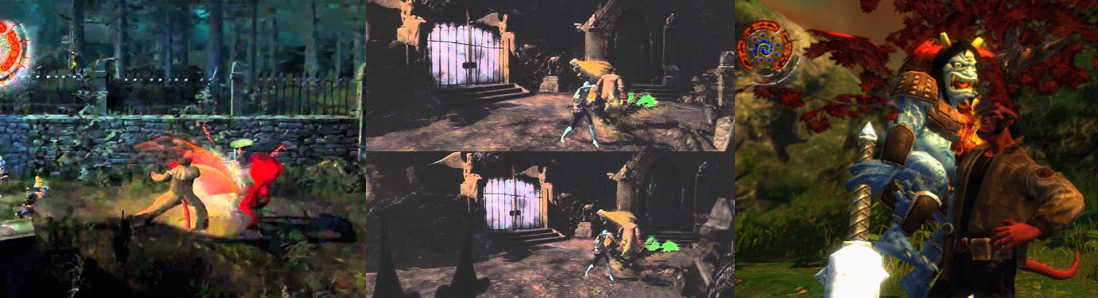
You shoot Hellboy’s versatile handgun, the Samaritan, with the Left Trigger. Although you can freely aim with the right stick, I wouldn’t recommend this as the aiming reticle is as tricky and unreliable as the grapple, which often failed to register my inputs. Hellboy can shoot lots of ammo types, with some being more effective against certain enemies, from regular rounds and the shotgun-like shots to grenades, flame rounds, and magic crystals. You cycle between these with the Left Bumper and collect ammo from crates dotted (or hidden) about, repeatedly tapping RT until your ammo is full. When your energy is full, you can enter “Hellmode” by pressing in both control sticks. This temporarily boosts your speed and attack power or unleashes a flaming shockwave, though I found this to be relatively useless as it doesn’t last long. Hellboy can also grab various weapons (barrels, stone slabs, massive warhammers, drainpipes, swords, and such) to use or throw at enemies. Though these are great for crowd control, can light lanterns or defeat certain foes, and will stun larger enemies, they break pretty quickly. Performing your grapple finish on certain enemies disarms them, gifting you a unique weapon like a machine gun or an exploding round, and you can execute a few basic combos by mashing different combinations of X and Y. However, most enemies take a hell of a beating and continuously swarm the area, to the point where I often felt like the game was glitching. Different enemy types attack each other, which is helpful, and a friend can help you out in the co-op mode, but combat becomes very tedious very quickly as it’s primarily slow, uninteresting punching. It might’ve been nice if you gained experience points to trade in for some fun new moves, like spewing hellfire or some kind of spinning attack, or could upgrade Hellboy’s Hellfire mode to see him go on a rampage as Anung Un Rama. Instead, you’re left with the same moveset for the whole game, with Hellboy acquiring new ammo and little else.
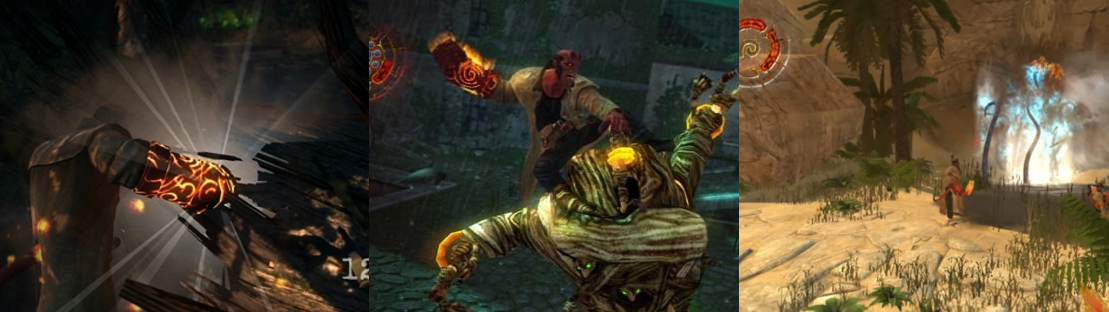
There are no difficulty modes here, though you can enable “friendly fire” to make co-op more frustrating interesting. The game is divided into six chapters, each containing a handful of sub-chapters and asking you to follow a fairly linear path. Along the way, you’re beset by enemies you can largely ignore unless a “ghost barrier” blocks your way. In these instances, you must defeat all nearby enemies to dispel the barrier. Other times, you must cut through ghost tentacles with a special crystalline sword or blast them with your crystal rounds. Occasionally, you activate levers to open gates, stop toxic gas spewing into the arena, or create new walkways. You do this by holding RT and tapping X, which is the go-to method for every “puzzle”. Spot a glowing wall? RT+X to smash through it. Path blocked by fallen trees, rocks, or stalled vehicles? RT+X to clear them. Need to ring a giant bell or push over a column to make a path? RT+X. You get the picture, I’m sure. The game gives the illusion of offering side quests by having Hellboy interact with corpses who ask him to do a task for them to open gates or doors. These generally amount to smashing up some enemies and, you guessed it, holding RT and tapping X. Cursed graves endlessly spawn enemies in the first chapter, but they’re easily destroyed with exploding Bambini heads. Enchanted coffins also appear here, though your “release” ammo will remove their threat and allow you to RT+X to open them for such rewards as…nothing or some ammo. While platforming challenges are light, they’re annoying due to the useless camera, which often switches to different perspectives and angles to screw up your controls. Chapter two introduces the lantern mechanic, where you must light torches and get rid of gnarled roots blocking your path, but this is more aggravating than fun as you must often backtrack for torches. Chapter four also sees you hurling frog monsters down pits to light torches and open gates.
Presentation:
I was somewhat optimistic about Hellboy: The Science of Evil when I heard Marco Beltrami’s Hellboy (Del Toro, 2004) theme on the main menu and saw that Ron Perlman, Selma Blair, and Doug Jones were reprising their film roles. However, the game has a very confused identity and isn’t sure if it’s a movie tie-in, a spin-off from the comics, or something else entirely. While Hellboy looks and sounds like he does in the film, this world seems very different and closer to the comic books, being full of witches, ghosts, zombies, and other supernatural threats. While Hellboy’s stone arm lights up and even bursts into flame, and he adopts different outfits for each chapter, he has no idle poses and repeats the same one-liners and nonsensical statements throughout the game. There are no pre-rendered cutscenes and, strangely, barely any story. There’s some text between chapters and a handful of cutscenes that use the in-game models, but I was very confused about what was happening as there’s no real introduction, chapters abruptly end and jump to the past with little explanation, and the game essentially has no ending, either, as Hellboy’s just blasted into the water after defeating the final boss and the credits roll! I didn’t play in co-op so I have no idea if Abe and Liz appear in cutscenes, but it seems like they don’t, which is weird, and the story felt very disconnected and slapped together to me. This was a shame as it could’ve taken more inspiration from the source material or even retold key moments from the first movie to better tie things together. While the game performs relatively well, I did have some odd moments where the camera got stuck, Hellboy wouldn’t build energy, and the music cut out or oddly looped.
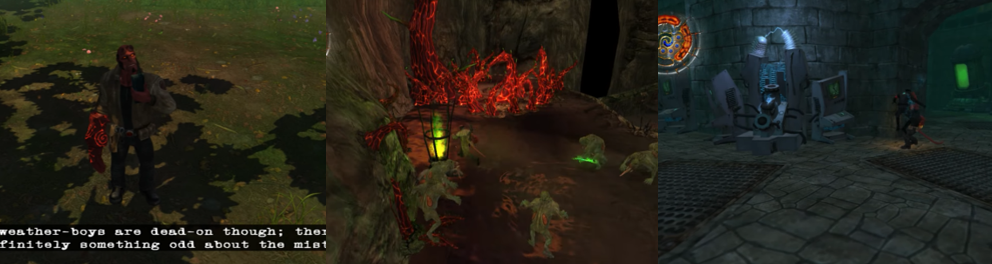
While you visit various locations and time periods in Hellboy: The Science of Evil, they’re all very drab and repetitive but I give the game kudos for evoking the dark, gothic aesthetic of the comics over the slightly more polished and sci-fi-esque presentation of the first film. You begin in the Carpathian Mountains of 2007 Romania, smashing your way through a mausoleum and emerging in a crooked, foreboding graveyard full of crypts, gravestones, gnarled trees, and dishevelled woods. A cauldron of bats often swarms in doorways or as you enter new areas, which serve as the calling card of the crazed witch Hellboy’s pursuing, and you’ll find crypts home to loquacious skeletons, a sentient gate who demands a password, and flame pits in dank caverns. Chapter two flashes back twenty-three years to a misty forest in Japan, where Hellboy follows a magical kitsune, encounters a mysterious, isolated monk who offers some exposition, and follows snaking cobblestone paths and fights through a bamboo forest. Pagodas are dotted about and this is where you experience how destructible much of the environment is, though it largely amounts to building your energy meter and discovering the odd collectible. Chapter three returns you to Romania, depositing you in an abandoned village beset by a thunderstorm. I liked the rain effect and lightning flashes and fighting in the narrow streets and on the precarious rooftops in this area. You also detour through a house to encounter a tortured suicide victim and eventually land in some dank catacombs home to disgusting frog monsters. This sewer-like area is alive with slimy egg sacs and razor-sharp tentacles (which helpfully target enemies), scurrying rats, and vaguely Lovecraftian statues. Chapter five flashes back to 1967 Tunisia, where you battle Nazi zombies in the ruins of an archaeological dig, smashing apart their camps, odd crystalline growths, and crashing through ruins. You end up in von Klempt’s gothic castle, a distinctly Mignolaian setting full of 1930s style laboratory equipment, Nazi paraphernalia, and the leftovers of their atrocious experiments with the occult.
Enemies and Bosses:
While there are only a handful of enemy types in Hellboy: The Science of Evil and the game is more likely to toss mini bosses at you and quickly make them regular enemies than wow you with big, action-packed boss battles, most enemies are somewhat unique to their chapter to give each setting a distinct personality (though they all show up in chapter six). At first, you’re beset by pigmy-like Bambinis, mischievous little imps who toss their explosive heads and scamper all over you. They’re relatively harmless unless they clamber onto your back; I had trouble working out how to throw them off before they drained my health. A slightly bigger variant wielding a chain also shows up and the Bambinis chip away at you as you face a pack of werewolves (though these guys look more fearsome than they are and simply swipe, howl, and bite). In Japan, you battle spear-carrying kabuki warriors (whose weapons can be stolen to light lanterns) and encounter troll-like oni, who guard against your attacks, bash your head in with their large metal clubs., and push you back with a sonic blast. You also battle katana carrying demons who swipe and charge with their blades. These guys introduce a mechanic where you must stun them, grapple them, and hit Y to counter their attacks, mash X to pummel, and finish them off with B when prompted. This strategy works on the giant Bambinis (who tackle you, toss exploding Bambini heads, and grab you and throw you into walls), the horned frog monsters, and the cybernetically enhanced apes you later encounter. You fight frog monsters in the sewers (through they’re easily tossed onto spikes) and various Nazi zombies. These guys can take a hell of a beating in chapter five and wield machine guns, electrifying blade arms, grenade launchers, and even these weird, steampunk-esque buzzsaw weapons!
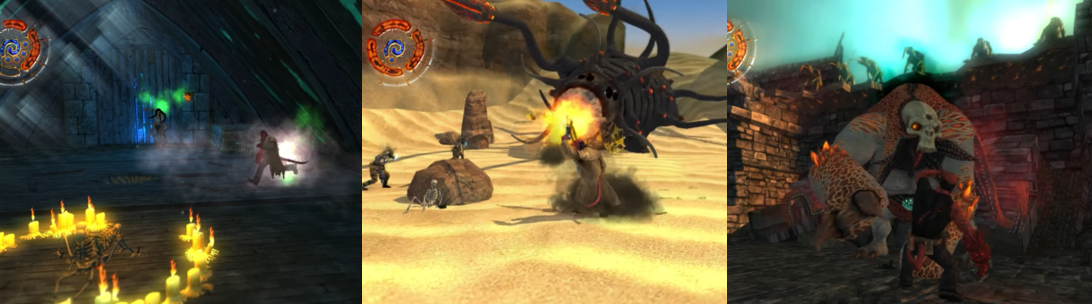
Hellboy constantly encounters a witch in Romania. Each encounter takes place in a different arena but is essentially the same, with her always teleporting as a cloud of bats and tossing exploding Bambini heads. You must throw these (or other objects) back to send her packing and, in the final battle with the witch, you chase her to the rafters and finally corner her in the church attic, where you can get close enough to hit her. Hellboy’s hounded by a volatile cyborg ape…thing in chapter two and is trapped inside a pagoda with it at the chapter’s end. The large ape is deceptively fast with its leap and charge and has a hell of a reach thanks to its mechanical arms (which it fires and swings on chains). If you get too close, it grabs you and throws you about and, instead of fighting it, you attack pillars to drop down a few floors and eventually bring the whole structure down on it. Variations on this enemy appear in chapter six, with one surprising you on a narrow castle wall (however, I fled back and it seemed to despawn!) Chapter four ends with you dispatching some frog monsters and their horned giants, eventually destroying the central chamber of their lair, while chapter five culminates in a more aggravating boss battle against a large, Lovecraftian worm-thing. In the first phase, you must avoid the Nazis swarming the chamber and toss crystals at its mouth when it roars, then use RT+X on the nearby pillars to blast it with lasers. In the second phase, ignore the Nazis and attack with your unbreakable flaming sword, dodging its whipping tentacles to put it down. The game’s final boss is a demon unleashed by von Klempt that’s essentially fought like other giant enemies. You must stay away to avoid being pounded or eaten and dodge its erratic mouth laser, using any nearby debris to stun it or unloading with combos and your gun. Eventually, it’s joined by frog monsters and toxic gas and you must grab von Klempt’s floating cybernetic torso to finish it off, but this was a lacklustre end to a disappointingly mediocre game.
Additional Features:
There are twenty-seven Achievements in Hellboy: The Science of Evil, with one awarded each time you complete a chapter. You can also kill twenty-five enemies with different weapons for some more, kick fifty Bambini heads for another, and toss fifty enemies onto spikes for another. Every chapter hides a hidden artifact and finding each nets you another six Achievements (then a seventh for finding them all). Fall off a cliff twenty times for an Achievement and invent time travel to go back to when Xbox Live was a thing to snag two more for finishing a multiplayer chapter with Ape and Liz. Artifacts and lore that boost your energy gauge are hidden in each chapter and playing through the game unlocks behind the scenes extras, interviews, and artwork. Completing each chapter unlocks it for you to replay from the main menu and finishing the game allows you to replay the main campaign with all the extra energy and ammo you’ve found. Although there was downloadable content planned where you’d play as Lobster Johnson and Achievements were programmed for this, it never released (not that you’d be able to get it now, or that I imagine it would’ve been that good!)
Final Thoughts:
I’m a big fan of the Hellboy movies, and the character (despite not having read many of his adventures) so I was excited to get into Hellboy: The Science of Evil. Since it’s only tangentially related to the films and released soon after the first movie, I had high hopes it’d avoid the stigma of movie tie-in games. Unfortunately, this really was one of the most disappointing, barebones, cash grab licensed games I’ve ever played. There’s barely any story here and no effort put into any of the cutscenes or even the script, with Ron Perlman muttering statements that seem strangely disconnected to what’s happening and the game seemingly failing to tie into the films or the comics. While Hellboy looks great and the environments are okay, evoking both the movie and Mike Mignola’s distinctive art style, nothing interesting happens with the character or where he goes and the game just feels like a series of events loosely tied together. The combat is so boring and gets old super fast. With no skill tree or additional combos or attacks to learn, Hellboy feels underpowered and frustratingly limited. If the developers were aiming for something akin to a Devil May Cry or God of War title then they missed the mark by a wide margin with the slow, lumbering combat and unsatisfying gunplay. The puzzles were a joke, with every solution to any problem simply being to hold RT and tap X until you win. The quick-time-event-like moments with bigger enemies and bosses were as finnicky as the camera angles and the grab, leading to some frustrating moments. The bosses were laughable as well, with only one offering something more than what you’d get from a larger enemy, and the collectibles and replay value were sub-standard, at best. I’d say this one’s only worth playing if you can get it cheap (a tall order these days) but you’re better off sticking to the Devil May Cry or God of War games for a satisfying hack-and-slash adventure.
My Rating:
Terrible
Are you a fan of Hellboy: The Science of Evil? If so…why? Were you disappointed that the game didn’t have more to do with the movies and comics? Would you have liked to see more unlockable combos and attacks? Which of the bosses and ammo types as your favourite? Did you ever play the game in co-op? Which Hellboy videogame is your favourite? Leave me a like and drop a comment below, then donate to my Ko-Fi to suggest more Hellboy content for the site.


One thought on “Game Corner: Hellboy: The Science of Evil (Xbox 360)”