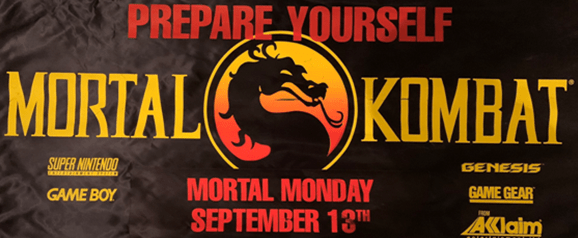
To celebrate the simultaneous worldwide release of Mortal Kombat (Midway, 1992) on home consoles, 13 September 1993 was dubbed “Mortal Monday”. Thus, it’s only fitting that to celebrate this influential fighting series every September 13th.

Released: 8 May 2026
Director: Simon McQuoid
Distributor: Warner Bros. Pictures
Budget: $80 million
Box Office: $75.2 million
Rotten Tomatoes Scores: 65% / 89%
Quick Facts:
The success and controversy of Mortal Kombat saw producer Lawrence Kasanoff produce both cult hits and disappointing lows. After years in limbo, Mortal Kombat returned to the big screen with a lukewarm reboot that nonetheless saw cast and crew up for a sequel. Determined to address fan feedback, the filmmakers opted for a more faithful adaptation, though reviews remained mixed.
The Review:
I’ll be the first to admit that I’m biased towards the 1995 Mortal Kombat film (I did write about it for my PhD thesis, after all). However, I’m a big Mortal Kombat fan and was excited to see a new version of it after years of stop/start projects and small screen ventures. Unfortunately, I wasn’t very impressed with the 2021 reboot, mainly because the story was so choppy, the tournament was absent, and the characters weren’t as appealing as the 1995 version. To make matters worse, despite the franchise’s massive roster and already painting fan favourite Johnny Cage as the “Everyman” outsider in 1995, the 2021 film chose to craft a brand-new audience surrogate, Cole Young (Lewis Tan), an athletic but sadly bland character who could’ve easily been Johnny Cage with just a few script tweaks. Mortal Kombat II aimed to address these issues, and more, and you can tell it’s aiming to be closer to the source material right from the start as the intro and titles mimic the opening of its videogame namesake. More areas from the games are also recreated (though through jarringly obvious green screen), fights are occasionally presented in a way that apes the videogames, and series co-creator Ed Boon makes a gratuitous cameo as a bartender. Having stifled manipulative Outworld sorcerer Shang Tsung’s (Chin Han) attempts to sabotage Earthrealm’s warriors in the last film, Lord Raiden (Tadanobu Asano) has moved his chosen fighters to his sky temple to prepare for the generational Mortal Kombat tournament that will determine the fate of humanity. However, also thanks to Shang Tsung, Raiden is one fighter down as Shaolin monk Kung Lao (Max Huang) died in the last film, so he and Lieutenant Sonya Blade (Jessica McNamee) head to Hollywood to recruit a new fighter.
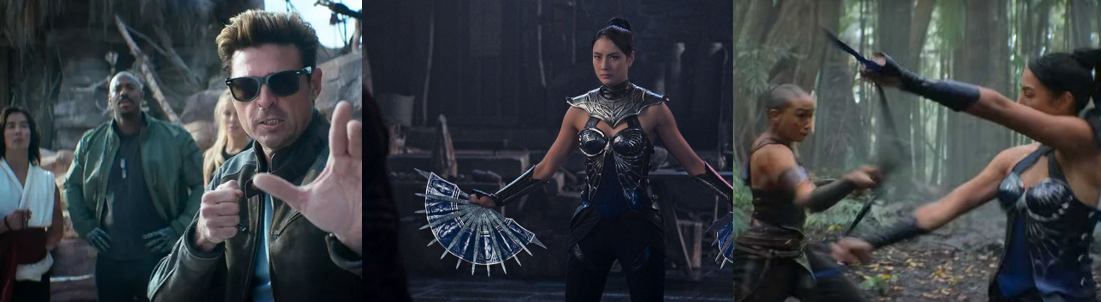
So, right away there’s some issues. Mortal Kombat ’21 ended with Cole heading to Hollywood to recruit Johnny Cage (Karl Urban), but this film opens with the tournament mere hours away and the washed-up action star still attending conventions rather than fighting. This means we must suffer through a janky, rushed, and frankly insulting first twenty minutes or so as Cage is brought up to speed with the plot. Considering Raiden and the others gave Sonya and Cole such a hard time in the last movie for not carrying the Elder God’s mark or being unprepared for the tournament, they’re oddly far more lenient on Cage, who’s wracked with self-doubt as his glory days are behind him and hilariously incredulous to Earthrealm’s plight. Once he learns that Mortal Kombat is a fight to the death, Cage bows out, only to be forced into fighting anyway because that’s apparently what happens now. While Karl Urban seems a better fight for Kano, he’s one of the few highlights of this film and perfectly captures Cage’s snarky attitude, prima donna arrogance, and bombastic scepticism. It was odd, however, seeing him go from reluctantly fighting Princess Kitana (Adeline Rudolph) to literally running in fear of Baraka (CJ Bloomfield) and suddenly shift from being incapable of fighting to being very competent sometimes in the same fight. Despite being the focal point of the film’s marketing, Cage shares the main character role with Kitana, an Edenina princess forced to serve as tyrannical emperor Shao Kahn’s (Martyn Ford) daughter/assassin who has secretly been conspiring with Raiden to defat Outworld. Having witnessed her father, King Jerrod’s (Desmond Chiam) brutal slaughter and her mother, Queen Sindel’s (Ana Thu Nguyen) enslavement by Shao Kahn, Kitana has every reason to oppose the emperor, not least to liberate her people, which causes conflict between her and her loyal bodyguard, Jade (Tati Gabrielle). Between the two of them, Cage and Kitana present narrative arcs far more compelling than anyone else’s though it is strange that these new films shift the focus away from long-time franchise protagonist Liu Kang (Ludi Lin).
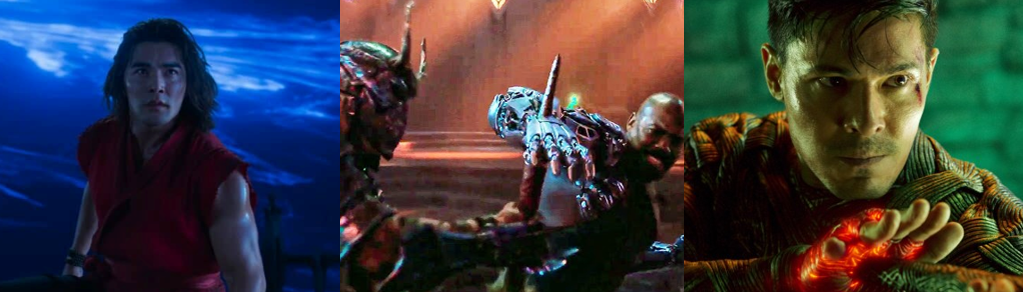
Indeed, we’re two films in and we know very little about Liu Kang other than he was raised/trained by Raiden and is desperate to save his brother, Kung Lao’s corrupted soul. He’s a pure-hearted fighter and said to be the best of Earthrealm’s warriors, but he has no interaction with Kitana beyond a few respectful bows and glances, meaning his entire arc is centred on trying to help Kung Lao. Liu Kang has little personal rivalry with Shang Tsung or Shao Kahn beyond him wanting to save his realm and few meaningful interactions with Cage either, which is also true of Major Jackson “Jax” Briggs (Mehcad Brooks), Sonya, and Cole. These four only have superficial depth thanks to the previous film; we learn nothing new about them, and they accept Cage so easily that it makes the entire previous film’s plot redundant. Jax and Sonya remain fiercely loyal to each other and are even willing to spare Jade to maintain Raiden’s relationship with Kitana, but there’s no romantic sub-plot between Sonya and Cage. In fact, Liu Kang, Jax, and Sonya are more apt to mock Cage and his fighting skills, which amusingly bites them when Baraka is won over by Cage’s theatrical and unorthodox fighting style. Despite his role in the last movie and being the ancestor of legendary fighter Hanzo Hasashi/Scorpion (Hiroyuki Sanada), tough-skinned cage fighter Cole is pushed far into the background here. There’s a passing mention of his wife and daughter and he’s seen to be as committed to defending Earthrealm as the others, but the spotlight is so far off him it’s almost insulting. With him largely absent from the marketing and so reviled by fans, it’s no surprise that Cole is offed in the tournament, but the execution left a bitter taste in my mouth. For starters, Cole is matched up against the newly invincible Shao Kahn (who really shouldn’t be fighting in the tournament if you ask me). Cole’s unceremonious death is thus a foregone conclusion, but his so-called friends barely react to their loss and are laughing and joking about Cage soon after, with Cole quickly forgotten. And like yeah, I wasn’t a fan of his, but I think he deserved better than that!
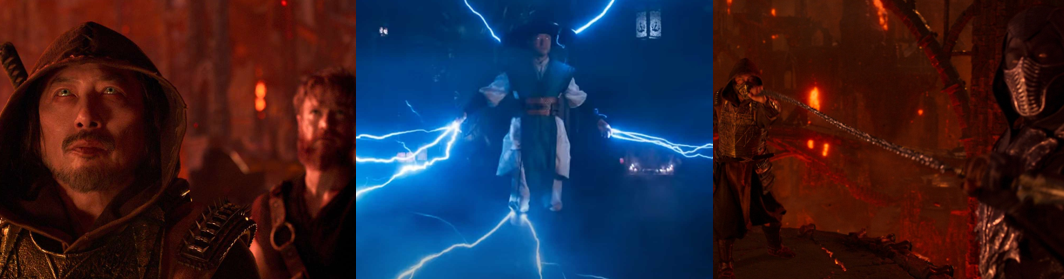
Despite his garb being closer to his videogame counterpart, Tadanobu Asano continues to disappoint as Raiden. He lacks the stature, gravitas, and charisma of Christopher Lambert and feels like a very weak and ineffectual Thunder God. His character is noticeably and jarringly softened here, with him being much more amicable towards Cage than he was to Cole or Sonya, and the film adds a fatherly slant to his relationship with Liu Kang and Kung Lao. Raiden’s placed in mortal danger here as Shao Kahn has necromancer Quan Chi (Damon Herriman) resurrect foul-mouthed mercenary Kano (Josh Lawson) to acquire the amulet of the fallen Elder God, Shinnok. The corrupted Kung Lao then slices Raiden’s throat to empower the amulet, which gifts Shao Kahn near-immortality and ties Earthrealm’s fate directly to Raiden’s. Although he still doesn’t sport his bionic eye (despite Quan Chi saying they’ll “build him a new one”), Kano remains a highlight. As crude and quick-witted as ever, Kano relishes the chance to get back in the fight but quickly grows tired of Outworld’s desolate offerings and double-crosses the evildoers. Once Kano’s teamed with Johhny Cage, the fil really hits its stride (which sadly come sin the third act) as the two make for a fun duo, scouring the hellish Netherreealm in search of Hasashi and the resurrected Bi-Han (Joe Taslim), formally Sub-Zero (and never referred to as Noob Saibot despite obviously being him) who safeguards Shinnok’s amulet. Sadly, Kano comes in far too late to help with the film’s paper-thin plot or the elevate the frustratingly one-dimensional characters. Equally, the film decides to sideline Sindel, who starts as an avid defender of Edenia and is then seemingly corrupted (presumably by Quan Chi’s dark magic) into Shao Kahn’s bride before being abruptly killed by Sonya and then randomly reappearing so Shao Kahn can interrogate Kitana. Considering how important Sindel usually is to Shao Kahn’s plots and Kitana’s character, it’s bizarre to see her be an afterthought. Jade gets more screen time and relevance as she’s torn between her friendship with Kitana and her loyalty to Shao Kahn!
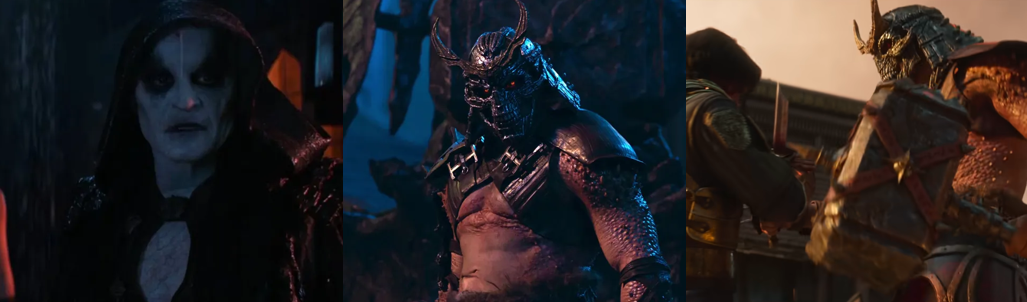
While I wasn’t a fan of Chin Han’s Shang Tsung in the last film (he’s not even comparable to Bruce Locke, let alone the immortal Cary-Hiroyuki Tagawa), I was equally frustrated and disappointed to see him side-lined in the sequel. Shang Tsung faces no repercussions for his defeat and loses with little authority and menace he had as he’s reduced to the emperor’s underling. It doesn’t help that the movie brings in Quan Chi to resurrect and corrupt fallen fighters, a role that Shang Tsung probably could’ve filled without much issue. On the plus side, Shao Kahn is presented as a monstrous, intimidating figure of unimaginable power even before he gains Raiden’s God-like power. Constantly garbed in intimidating armour, a skull-like helmet, and wielding a devastating battle axe, Shao Kahn is a brutal and menacing villain made even more threatening by his loquacious demeanour. He’s not some mindless despot or a mewling man-child with daddy issues; he’s a cold, calculating villain who isn’t afraid to get his hands dirty. Crucially, Shao Kahn is seen to be vulnerable despite his stature. He looks like he could easily crush anyone in his path but every fight he’s in is framed in a way that gives his opponent a chance to win as they score glancing blows or even kill shots, only for the emperor to either shrug it off or instantly heal thanks to Shinnok’s amulet. Sure, we don’t get any depth to him or backstory and he’s as simple a character as “big evil bad guy who wants to conquer everything”, but I liked that he wasn’t needlessly killing off his underlings, that he gave his opponents a fighting chance, and that he embodied the character so appropriately. Any time Shao Kahn appeared, you knew some shit was gonna go down and it was very effective seeing people cower and bow to his sheer might, while also sowing the seeds of dissension as Sahng Tsung clearly covets the emperor’s throne and power.
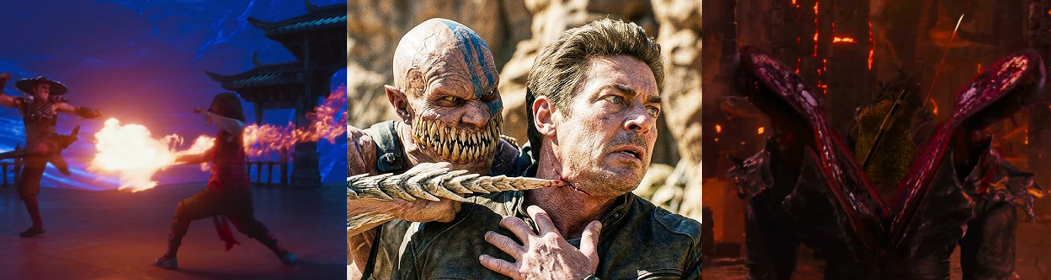
In keeping with the previous film, Mortal Kombat II places a greater focus on its fights and gore than the plot of the characters. On paper, this makes sense and is fine enough for certain audiences, but I miss the heart and the characters of the 1995 film, which also boasted some impressive martial arts. We get a sense of the kind of action star Cage was thanks to some footage of his dreadful action movies, which is fun, but again this is oddly translated into his fights as Cage is just as likely to cry foul and ask for a stunt man despite being a legitimate fighter. The tournament finally features here, with characters being teleported to recognisable locations like the spike-ladened bottom of the pit, the ominous portal bridge, and the acid pits for their fights. Weirdly, the film insults our intelligence by having magic flames go out when fighters are defeated and recycles many of the same locations (the ransacked Edenian town square, for example), but it makes up for this by going all-in with the characters’ special moves. Liu Kang’s tossing fireballs and flaming kicks, Sonya fires her rings, Jax is fully comfortable with his bionic arms, and Kano relishes blasting fools with his eye laser. Naturally, given her prominence, a lot of focus is placed on Kitana’s razor-sharp fans but Jade’s staff gets a lot of time in the spotlight, too. Since Cage repeats Cole’s arc from the last movie, he doesn’t gain his green aura until the finale, but he still punches Baraka in the dick and impresses with his unorthodox fighting. Sindel represents every pre-teen gamer by spamming her banshee scream, leading to Sonya impaling her on the pit’s spikes, and Shao Khan even darts in with his patented shoulder charge. Without a doubt, the film’s best fight sequence is the throwdown between Liu Kang and his revenant brother, with Kung Lao now tossing a gnarly buzzsaw hat that ultimately proves his bloody undoing. Still, before that, the two put on a hell of a physical spectacle as Li Kang desperately tries to reason with his brother before vowing to find a way to free him.
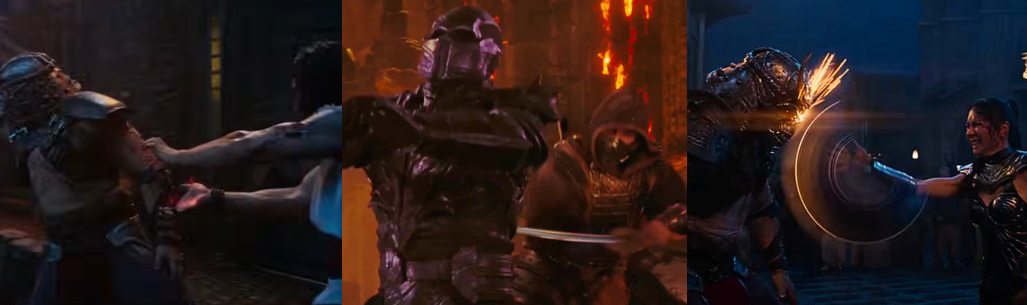
This fight’s closest competition come sin the finale, when Cage and Kano recruit Scorpion’s help and battle Bi-Han and his gooey double alongside the ninja-like spectre. It’s always great seeing Scorpion and Sub-Zero clash, though Bi-Han was given even less characterisation than before, sported all new shadow-based powers, and appeared far too late to be as relevant as he could be. While that fight’s going on, Liu Kang and Sonya fight Shao Kahn to rescue the strung-up Kitana, since Jax was also killed by the emperor. This fight also goes a bit south as Liu kang is surprisingly killed, though he accepts his fate as he realises his true destiny was to reunite with Kung Lao in the afterlife. With Sonya down and clearly no match for Shao Kahn, it’s left up to Kitana to oppose the emperor and avenge her father. Unfortunately, despite her obvious fighting talent, Kitana’s hindered by Shao Kahn’s newfound immortality, thus linking her fight to the Netherrealm clash. Luckily, with Scorpion and Jade’s help, Cage and Kano overcome Bi-Han and his double and destroy Shinnok’s amulet, right as Shang Tsung (who randomly pops up after a lengthy absence) is poised to killed Raiden. With the amulet destroyed, Raiden’s returned to full power and Shao Kahn is made mortal, allowing Kitana to disarm and subdue Shao Kahn, unmasking him before her subjugated people and ending him by slicing his head into pieces with her fans. Immediately hailed as Edenia’s queen, Kitana encourages her people to stand and relish their newfound freedom, with Cage later embellishes to impress Baraka and his clan. Having found a new purpose in life, Cage not only follows through on his promise to tutor the Tarkartans but joins Raiden and the others in beginning a new quest. With the captured Quan Chi in tow, Cage and the others set out to rescue their deceased friends, though Sonya vows to kill Kano (again…) once this goal is achieved.
Final Thoughts:
I went into Mortal Kombat II with low expectations. I recently rewatched the 2021 reboot before it and was surprised by how annoyed by it I was, with it’s awful pacing, poor character development, and focus on gore over story. Mortal Kombat II was always going to have an uphill battle because of that, and I really felt like it was weighed down by the reboot’s decisions. Unfortunately, rather than address these in a meaningful way, Mortal Kombat II throws Johnny Cage in our face like a play toy and shunts everyone, not just Cole, to the background, making the last film feel even more redundant as this is the movie that one should’ve been! Luckily, Karl Urban is great as the conceited Cage and I really enjoyed the focus on Kitana, who carried the emotional weight of the barebones plot. Kano also helped with this, but he appears far too late to help as much as he could, same with Scorpion (who I would’ve thought would’ve appeared after Cole’s death…) and Bi-Han. It was great to see Shao Kahn done justice on the big screen, and I did like seeing Quan Chi come back, as overused and unnecessary as he was, and of course the fights and gore were great…when they appeared. I honestly felt like the gore and Fatalities were underplayed this time, and that the tournament again felt very secondary. It lacked the scale seen in the 1995 movie, for one thing, even with the game-accurate locations, and the plot was more focused on Shinnok’s amulet (which Shao Kahn rally didn’t need as he was already unstoppable) rather than more interesting elements, like Sindel and her relationship with Kitana, or Shang Tsung’s aspirations, or the feud between Scorpion and Bi-Han. Ultimately, I give this film the edge over the last one as this is what I wanted to see from the 2021 reboot, but Mortal Kombat II was disappointing to me. it was far too rushed at the start, retread a lot of the same ground, side-lined or underdeveloped returning characters, and was so obviously trying to placate us with fan service that it became insulting.
My Rating:
Pretty Good
Did you enjoy Mortal Kombat II? Were you also annoyed that Cole Young and the other fighters were side-lined? Did you enjoy Karl Urban’s performance as Johnny Cage? Were you surprised to see Kitana take the spotlight? Which of the fights was your favourite? Did you also find the film rushed and messy Wat are your hopes for a third film? How are you celebrating Mortal Kombat today? Whatever your thoughts, leave a comment below and donate to my Ko-Fi if you want to see more Mortal Kombat content on the site.


One thought on “Movie Night [MK Day]: Mortal Kombat II”