
Released: 22 December 1932
Director: Karl Freund
Distributor: Universal Pictures
Budget: $196,000
Stars: Boris Karloff, Zita Johann, David Manners, Edward Van Sloan, and Noble Johnson
The Plot:
Mummified for attempting to resurrect his dead lover, Egyptian high priest Imhotep (Karloff) reanimates when his tomb is disturbed and sets about wooing Helen Grosvenor (Johann) under the guise of an Egyptian historian.
The Background:
In 1922, British archaeologist Howard Carter and his, benefactor Lord Carnarvon, discovered the tomb of ancient Egyptian pharaoh Tutankhamun, uncovering a cache of riches and an elaborate sarcophagus that wowed and inspired generations. Producer Carl Laemmle Jr. was also inspired by this event, and the so-called “Curse of the Pharaohs” and commissioned story editor Richard Schayer to find a novel for a Mummy-centric horror movie to mirror Universal Studios’ previous success at adapting Dracula (Stoker, 1897) and Frankenstein; or, The Modern Prometheus (Shelley, 1818). Schayer and writer Nina Wilcox Putnam discovered Alessandro Cagliostro’s Cagliostro, a nine-page treatment with some similarities to Arthur Conan Doyle’s The Ring of Toth, which was then retooled by screenwriter John L. Balderston into The Mummy. Taking inspiration from ancient, real-world figures, Balderston’s script became cinematographer Karl Freund’s first gig as a director in America and saw Boris Karloff flex his acting muscles in the title role. Still, Karloff endured a lengthy and uncomfortable make-up process as Jack Pierce transformed him into a desiccated corpse, slathering his face with cotton, collodion, and spirit gum and wrapping him in linen bandages treated with acid and burnt in an oven! While the film’s historical accuracy was debated, The Mummy was a modest box office success met with mixed reviews that has since been regarded as a classic horror for its unique blending of romanticism and horror. The film inspired a few loose sequels and spin-offs before being expertly reconfigured into a highly regarded blockbuster adventure in 1999 (which also spawned sequels and some questionable spin-offs). Although that goodwill was undone by an ill-fated remake in 2017, the visual of an undead creature wrapped in bandages has been an enduring horror figure regardless.
The Review:
The Mummy begins in 1921, where archaeologist Sir Joseph Whemple (Arthur Byron) uncovers Imhotep’s sarcophagus alongside his assistant Ralph Norton (Bramwell Fletcher). While the two are excited to examine the find, Whemble’s friend and colleague, Doctor Muller (Van Sloan), warns that the sarcophagus carries a terrible curse, which Whemble scoffs at, but Dr Muller insists is a warning of the wrath of the ancient Egyptian Gods. While the two wax philosophical, Norton opens the tomb and discovers Imhotep’s surprisingly well preserved remains, the priest having been mummified alive (rather than having his “viscera” removed) for some terrible affront, alongside the “Scroll of Thoth.” Despite Dr. Muller’s warnings, the curious Norton reads from the scroll, unintentionally awakening Imhotep, who lurches to life, swipes the scroll, and leaves Norton so out of his mind that he eventually dies laughing in a straitjacket. The film then jumps ahead some ten years to find Whemple’s son, Frank (Manners), following in his now deceased father’s footsteps, digging for ruins in Egypt alongside Professor Pearson (Leonard Mudie) but having nothing to show for it but a lot of wasted money and a few trinkets. Frustrated and disheartened, the two prepare to leave when they’re visited by the enigmatic and mysterious “Ardath Bay”, Imhotop’s dishevelled but largely human pseudonym, who points them to the long-lost tomb of Princess Ankh-es-en-Amon (Johann). Although they’re initially sceptical, the two are overjoyed when their enthusiastic (but surely underpaid and overworked) dig team uncover the tomb, though Frank is mildly scorned that their discovery is claimed by the Cairo Museum as per the terms of their contract. In contrast, Professor Pearson is overjoyed, welcoming their mysterious benefactor to the museum and holding Ardath Bay in high regard despite his odd demeanour and superstition about being touched and digging up his people’s dead.
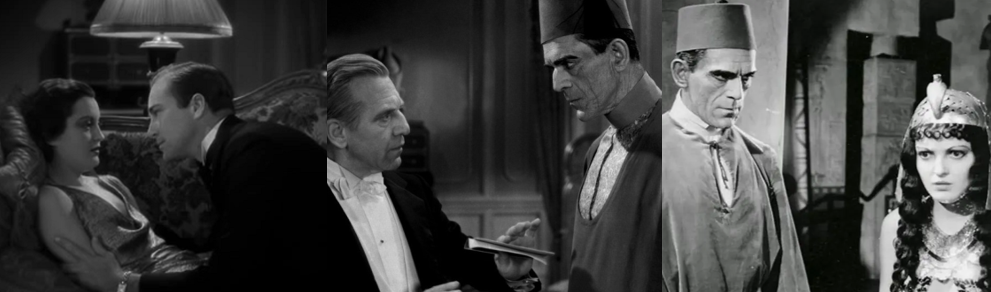
Whemple returns to Cairo to bask in the find and Frank is soon enamoured by the beautiful half-Egyptian Helen, a patient of Dr. Muller’s, who suddenly becomes entranced when Imhotep mutters an incantation over a cauldron to show him the reincarnation of his lost love, Ankh-es-en-Amon. Mumbling a language she couldn’t possibly know, Helen is compelled to answer Imhotep’s call, only to be stopped by a locked door and promptly faint, with little to no recollection of what happened. Transfixed by the girl, Frank promptly flirts with her with his stories of how they discovered and unwrapped Ankh-es-en-Amon’s tomb, only for Helen to react with distaste for his sacrilege and somewhat mock him for being smitten by a rotting corpse. While this is somehow enough to earn him a snog, the two are horrified to learn that a museum guard was murdered and that the Scroll of Toth (which Whemple somehow recognises despite him never seeing it) was discovered with the body. While Frank and Muller suggest burning the cursed object, they’re interrupted by Ardath Bay, who’s immediately captivated by Helen and her striking resemblance to his long-dead lover, entrancing the confused girl with the faded memories of her past life. Suspicious of Ardath Bay, Frank and the others confront and quiz him, compelling him to reveal his true identity and to demand the scroll or die (a strange demand considering he had the scroll) and showcasing his ability to hypnotise anyone with Egyptian blood as he brainwashes their Nubian servant (Johnson). Although Whemple resolves to burn the scroll, Imhotep watches from his cauldron and commands the Nubian to intercept him, murdering the old man but ultimately fooling no one with some burned newspaper. Unable to resist Imhotep, Helen returns to the museum and, while spellbound, learns of her past like in ancient Egypt.
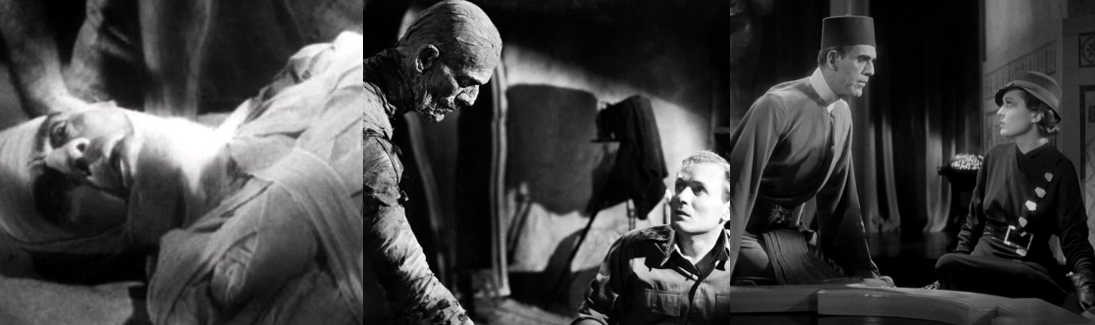
Back in the day, Imhotep was besotted by Ankh-es-en-Amon but heartbroken when she died of some illness. Defying the Gods and her father, “Pharoh” Amenophis (James Crane), Imhotep stole the Scroll of Thoth but was buried alive with it when his scheme to resurrect her was discovered. Though Helen’s conflicted, she begs Frank to confine her to her room, terrified of what might happen, leading Imhotep to further manipulate his underlings to reunite his love’s soul with her reincarnated body. Luckily, Boris Karloff provides an enigmatic performance as the titular mummy as this was a chore to sit through. While Imhotep gives Karloff the chance to showcase his range, he’s hardly a terrifying force, even when a decomposing figure, and comes across more like a bored narcoleptic who watches events from his cauldron and threatens people with his scarab ring. The film is more of a bizarre love story, with Imhotep professing a timeless love that he’s carried throughout a restless death and which has seemingly allowed Ankh-es-en-Amon to resurrect throughout the ages. Though Frank can’t compete with Imhotep’s lovelorn declarations, he’s at least alive and doesn’t look like a dried-out sultana so Imhotep plots to kill him, thus removing his rival and any doubt in Helen’s heart. Helen seems into both men, even though she barely knows Frank and Imhotep essentially hypnotises her to make her docile and thus vulnerable for him to kill and perform some mumbo-jumbo to return Ankh-es-en-Amon’s soul to her restored body. While Imhotep seemingly murders those in his way, he seems quite careless as he lost the Scroll of Toth and was forced to demand it. Equally, he’s held at bay (Ardath Bay, you might say…) by a protective amulet and prefers to let the Nubian do all his busy work since he must sit around mumbling incantations, spying on people, or creeping them out with his odd appearance and behaviour.
The Nitty-Gritty:
While I don’t believe for a second that the production filmed in Egypt, I was impressed by the sets and interiors, which are filled with Egyptian artifacts to sell the illusion. Many may not be historically accurate, and the flashback to 1800 BC isn’t very convincing, but there was a clear attempt to make things look a little more elaborate than most Universal Monsters movies. I also appreciated the surprising violence, with a convincing spear impalement and Imhotep describing how the slaves and soldiers present for his burial were executed, and that the film incorporated music (though sporadically) to punctuate dramatic moments. I wish I could say more about Karloff’s make-up but it’s not really that impressive as Imhotep mostly looks drawn and wrinkly. When he’s a desiccated corpse, things are more impressive, but I think a gaunt dummy would’ve been more effective than slathering Karloff in make-up and prosthetics that barely appear for that long. Rather than shambling about as a withered corpse wrapped in tattered bandages, Imhotep waltzes about in a fedora as Ardath Bay, conjuring spells and directing his minions, making him more of a warlock than a mummy. His horror comes from his supernatural abilities, which are limited to hypnotism (and further limited to only affecting those with Egyptian blood). He showcases no superhuman strength or wizardry, instead being a letch who relentlessly pursues, mesmerises, and manipulates others, meaning The Mummy is more about the fear of being controlled than the fear of some ancient creature.
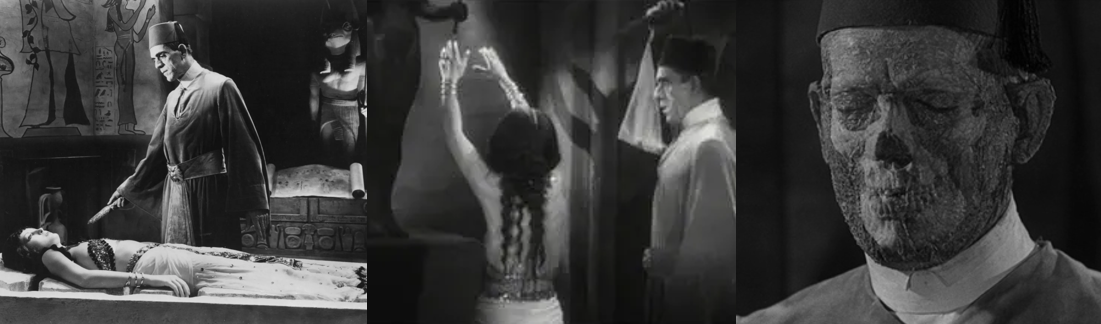
Confined to her room and watched like a hawk, Helen’s condition worsens the more she’s kept from Imhotep and the more he tries to reach her with his curses. Luckily, Frank is stupid enough to remove his amulet and take a nap, barely saving himself from Imhotep’s killing curse but nonetheless powerless to keep the Mummy from bewitching Helen. When Helen reaches the museum, her personality has been replaced by Ankh-es-en-Amon, though Imhotep still plans to murder Helen with the most unconvincing dagger I’ve ever seen and then reading from the Scroll of Toth to return Ankh-es-en-Amon’s soul to Helen’s body, allowing them to rekindle their love as undead mummies. Surprisingly, Ankh-es-en-Amon resists this, wishing to inhabit Helen’s young and supple body, and Helen’s personality also struggles against the Mummy, though neither can resist Imhotep’s hypnotic power. After being revived, Frank and Muller rush to Helen’s aid, only to be held back by Imhotep’s spooky scarab ring. This distraction is enough for Ankh-es-en-Amon to beg the Goddess Isis for aid. Incredibly, this works and the statue of Isis lurches to life, pointing an ankh at Imhotep that dispels his power over the Nubian and burns the Scroll of Toth. This also causes Imhotep to (somewhat) rapidly rot and turn to a mere skeleton, clattering to the floor. If you thought this was an abrupt end, the film then doubles down by suddenly cutting to black and the end credits after Frank calls to Helen to return to her body. Admittedly, it’s potentially left ambiguous whether this worked as it could’ve just as easily been Ankh-es-en-Amon who woke up, but I was so bored and annoyed by the film that I really didn’t care and was glad that it was finally over!
The Summary:
My God, this was a chore to watch. I’ve seen The Mummy before and didn’t remember it being this bad, but it really is one of the most boring Universal Monsters movies I’ve seen. I’ve never been the biggest fan of the concept, despite my love for Egyptian superstition and history, but The Mummy really impressed with its sets, attention to detail (historical accuracy be damned), and overall presentation. Sure, we never get a proper look at Cairo or any exteriors, but the interiors and artifacts and such really sold the illusion for me. It’s a shame it’s filled with a bunch of stupid-ass characters who are little more than walking clichés. Zita Johann captures the camera with her beauty, effortlessly showcasing Helen’s confusion and allure, though I would’ve liked to see more of Ankh-es-en-Amon’s personality and how it differed from Helen’s. Frank was just kind of there and I honestly got some of the male leads mixed up as I struggled to sit through this one, though it was amusing seeing them all rendered ineffectual and the day being saved by both a woman and a Goddess. Boris Karloff stole the show with his acting and range, rather than being buried under heavy make-up, but I found the titular Mummy to be a weak and ineffectual character. He wasn’t scary (unless you’re afraid of being hypnotised), he didn’t really do anything (any kills that could be attributed to him were offscreen), and he was defeated with ridiculous ease. Even if you view The Mummy as a bizarre love story rather than a horror, it falls apart under close scrutiny thanks to a questionable script, bone-headed characters, and the concept running out of steam early on. It’s such a shame as there could’ve been something really special here but there aren’t even any impressive make-up effects or chilling moments to salvage this one and it’s easily the most forgettable of the Universal Monsters movies, in my opinion, and far surpassed by the 1999 remake.
My Rating:
Terrible
Do you think I was too harsh on The Mummy? Perhaps you’re a fan of this one; if so, why? Were you disappointed that Imhotep wasn’t more monstrous or did you enjoy seeing Boris Karloff’s range? What did you think to the presentation of the film and the depiction of ancient Egypt? Were you entranced by the love story angle or did you also find the film a slog to sit through? Which version of the Mummy is your favourite and how are you celebrating Halloween this year? Share your thoughts on The Mummy in the comments, check out my other horror reviews, and donate to my Ko-Fi if you want to see more Mummy reviews.

 Dr. K's Waiting Room
2 thoughts on “Movie Night: The Mummy (1932)”