

Released: 19 October 2004
Originally Released: 2 April 2004
Director: Guillermo del Toro
Distributor: Columbia Pictures / Revolution Studios[
Budget: $60 to 66 million
Stars: Ron Perlman, Selma Blair, Doug Jones/David Hyde Pierce, Rupert Evans, Karel Roden, and John Hurt
The Plot:
Raised by the kindle Professor Trevor Bruttenholm/Broom (Hurt) to be a paranormal investigator, unruly half-man, half-demon Hellboy (Perlman) finds his dramatic life upended when immortal warlock Grigori Rasputin (Roden) conspires to bring about the apocalypse.
The Background:
After years of bringing his trademark dark, moody art style to both independent and mainstream comics, monster-loving artist and comic creator Mike Mignola got his big break in 1993 with Hellboy, a character he evolved over time into distinctively Lovecraftian comics and spin-offs. Long-time fan and celebrated auteur Guillermo del Toro campaigned for years to bring the character to the big-screen with Ron Perlman in the role, forming a close relationship with Mignola when the artist consulted on Blade II (del Toro, 2002), with production finally starting after that film’s critical and commercial success. Largely inspired by Hellboy’s debut story, del Toro tweaked both his origin and characterisation to focus on Hellboy being torn between right and wrong and add a tragic romanticism to his character. Jake Garber brought Hellboy to life with some impressive make-up and prosthetics, which required Perlman to spend at least four hours getting kitted out, while Rick Baker designed his prosthetic stone hand and the CGI was handled by Tippett Studios. David Hyde Pierce provided the voice of Abe Sapien but refused to take credit or be associated with the marketing out of respect for Doug Jones’s physical work while Spectral Motion handled the many practical effects used to bring Mignola’s distinctive art to life. Though it attracted criticism for its controversial title its $99.8 million gross made it a box office bomb, Hellboy became an instant cult classic. Reviews praised the fun action, horror-adjacent visuals, and Perlman’s engaging performance, while criticising some of the characterisations. This Director’s Cut released to home media the same year, offering a little over ten minutes of additional footage, a critically and commercially successful sequel followed four years later, but plans for further entries stalled and, much to the dismay of many, led to some comparatively inferior reboots.
The Review:
Much like Hellboy’s first story, “Seed of Destruction” (Mignola, et al, 1993), Hellboy begins near the end of the Second World War. In fact, Hellboy quite faithfully recreates and expands upon the circumstances which led to Hellboy coming to our world, with a young Professor Broom (Kevin Trainor) joining an Army regiment to intercept a Nazi ritual off the coast of Scotland. While the Army is understandably sceptical of the “parabnormal”, Professor Broom’s fears are realised when they find zealot warlock Rasputin in the midst of merging arcane magic with the Third Reich’s advanced technology alongside his lover and devout right hand, Ilsa Haupstein (Bridget Hodson), and Adolf Hitler’s top assassin, the mute, semi-undead Karl Ruprecht Kroenen (Ladislav Beran). Although Rasputin successfully opens a portal to a nightmarish realm beyond our understanding, where the Lovecraftian terror known as the Ogdru Jahad slumber, the Allies interrupt them and successfully close the portal, seemingly killing Rasputin and Kroenen in the process. However, while the portal was open long enough to bring through a tiny demon child. Though startled by the demon’s unsettling appearance, the regiment stands down when Professor Broom proves he’s just a curious and frightened little boy and he’s soon adopted by both the troop and the “unready father”, nicknamed Hellboy and spending the next sixty years secretly working to stop supernatural threats as part of the Bureau for Paranormal Research and Defense (BPRD). While Professor Broom ages in that time, Hellboy is said to be barely out of his twenties and is presented as both an urban legend and unruly child who constantly yearns to be in the public eye, shaving his horns to “fit in” and being grounded whenever he breaks out of the BRPD’s super-secret facility.
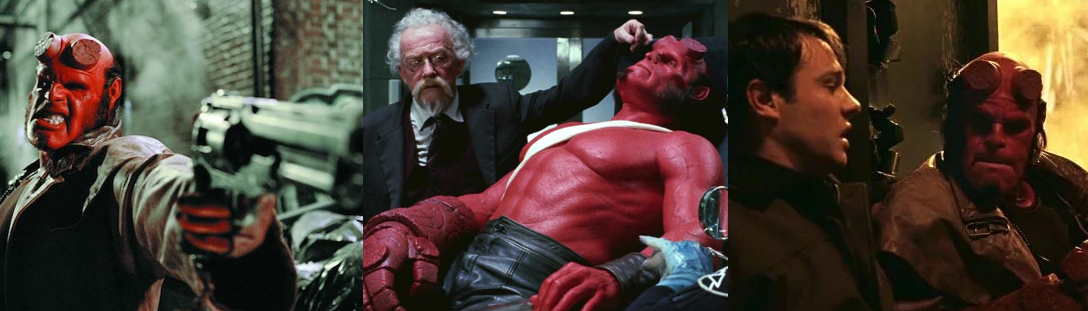
While Professor Broom is exasperated by Hellboy’s irresponsible nature, Federal Bureau of Investigation (FBI) director and BRPD liaison Thomas “Tom” Manning (Jeffrey Tambor) is tired of doing damage control whenever Hellboy makes headlines and eager to shut the “freak show” down. Realising that his time is running short and concerned that Rasputin and his followers are making a return, Professor Broom recruits FBI agent John Myers (Evans) to take over as Hellboy’s caretaker, confidant, and mentor, casting Myers as our audience surrogate and earning him much distrust and resentment from the unimpressed Hellboy. Presented as a cat-loving, physically imposing and nigh-superhuman figure, Hellboy is fireproof, extremely durable, and well versed in the mystic arts. While he’s a lousy shot with his massive handgun, the “Samaritan”, he loads it with special rounds and carries numerous trinkets, charms, and reliquaries to ward off curses and such. Yet, Hellboy is restless and stubborn, eager to be amongst the public and refusing backup, even from long-time allies like merman-like Abraham “Abe” Sapien (Jones/Pierce) and Agent Clay (John William Johnson), the closest he has to friends. Though deeply ashamed whenever he disappoints his father, Hellboy is snarky and constantly gives Myers a hard time for being a glorified nanny while also being recklessly confident that he can overcome any foe. To be fair, he’s usually right but Hellboy’s arrogance sees him constantly run afoul of the bestial Sammael (Brian Steele), leading to him being beaten up a fair bit, having eggs laid in his forearm, and the deaths of a BRPD squad, much to Manning’s disgust. Having known no other life than the BRPD, Hellboy sees it as “[his] job” to protect the innocent and regards any risk worthwhile to stop monsters and demons from threatening others. While he’s crushed when Abe and Clay are seriously wounded because of his actions, Hellboy lashes out at Manning and Myers, seeing them as threats to both his livelihood and his ego.
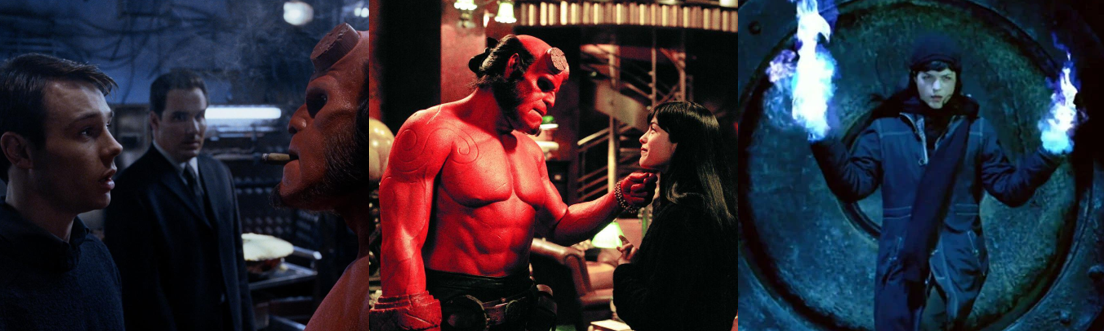
As tough as Hellboy is, his emotions often get the better of him. Indeed, he often escapes from the BRPD to visit Elizabeth “Liz” Sherman (Blair), a troubled pyrokinetic and former BRPD agent who committing herself to an asylum. It’s obvious that Hellboy is madly in love with Liz, but he struggles to articulate these emotions and often makes a fool of himself, descending into a bitter jealousy when Myers gets close to Liz initially to convince her to return and then because he also develops feelings for her. Traumatised by her unpredictable pyrokinetic abilities, Liz chooses the discomfort and security of an asylum over the BRPD largely because it helps her control her abilities and because she wants to fit in, not be surrounded by monsters who remind her that she’s a freak. This draws her closer to the boyish, everyman Myers but she can’t help but be pulled towards Hellboy, who she largely sees as a sibling but clearly has an attraction to since he’s so devoted to her. Abe councils Hellboy, trying to help him move on and using his telepathic and empathic powers to give him advice, but Hellboy’s stubborn nature sees him desperately find the words to express his love for Liz. As awesome as Perlman’s performance is as Hellboy, Jones impresses as the unnerving Abe, who moves like liquid in water and uses his clairvoyance to offer valuable insight. Sadly, Selma Blair lets the trio down, appearing bored and delivering her lines with a distinct lack of emotion. While this does tie into her adopting a stoic guise to keep her powers under control, it makes for a distinct lack of chemistry between her and Hellboy that isn’t helped by some dodgy CGI flame effects.
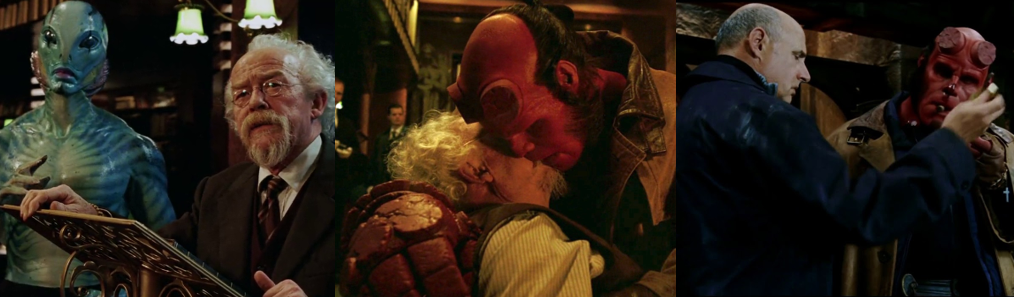
As far as I can tell, Myers has no comic book counterpart and sticks out like a sore thumb. Clay has far more charisma and already has a rapport with Hellboy and the others, so it would’ve been much more interesting to follow a day in his life for the first twenty minutes or so than be stuck with the forgettable Myers, who only exists to give Professor Broom someone to exposit to. As you’d expect, the late, great John Hurt excels as Hellboy’s strict, but fair, father figure. Commanding a wealth of paranormal knowledge and experience, Professor Broom is committed to protecting the world from supernatural threats and sees Hellboy not only as the bridge between the two worlds, but also as the saviour of humankind. This is why he’s so disappointed whenever Hellboy goes off half-cocked. Knowing that he hasn’t got much time left, Professor Broom works to ensure that Hellboy will be both cared for and helped stay on the straight and narrow. His fears about Rasputin again turn out to be true when the BRPD investigates the museum break in that kickstarts the plot, leading to Hellboy’s many run-ins with Sammael, Agent Clay’s ill-fated confrontation with Kroenen, and Professor Broom’s discovery of a message leading them to Moscow. Professor Broom is the. confronted by the mad mage and his clockwork assassin, afforded a brief glimpse of the apocalyptic future Hellboy is destined to bring about, but fearlessly defies Rasputin, ready to face his death. Naturally, Hellboy is devastated by his father’s murder, falling into a brief depression, but willingly joins the BRPD strike team, stomaching Manning’s antagonistic demeanour to get a chance to settle the score and surprisingly finding himself in the hostile director’s debt after finishing off Kroenen, the two developing a mutual respect that again dwarfs Myers’ inclusion.
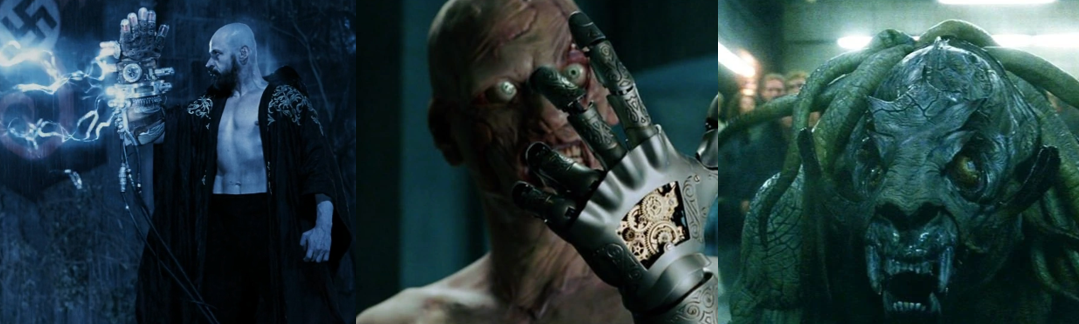
As in “Seed of Destruction”, Hellboy’s primary antagonist is the mad warlock Rasputin, a mysterious and functionally immortal wizard granted incredible dark magic by the Ogdru Jahad. Using an ancient tome and bizarre Nazi science, Rasputin almost achieves his goal of unleashing the “Seven Gods of Chaos” before he’s stopped by the Allies. Death is a mere inconvenience for Rasputin, however, thanks to his eternally youthful and equally immortal followers, who return their master to life with a blood sacrifice and willingly follow him in resurrecting Sammael, a ferocious beast whom Rasputin empowers to resurrect twofold each time it falls. Eager to capture Hellboy, knowing that his stone hand is the key to unleashing the Ogdru Jahad, Rasputin keeps Hellboy occupied and drive him towards his elaborate mausoleum in Moscow to complete his ritual. Returning from death more powerful, and with more of the Ogdru Jahad’s influence in him, Rasputin is a malicious, cold-hearted villain who nonetheless shows respect towards Professor Broom and permits him a merciful death. Though Ilsa doesn’t get much to do beyond lusting after her master and following his every whim, Kroenen makes a hell of an impression with his wind-up body, deft skill with blades, and intimidating masked visage. A heavily scarified, zombie-like figure, Kroenen easily cuts down groups of armed foes (though largely bloodlessly) and seems to delight in murdering anyone who gets in his way, easily fooling the BRPD by playing dead and killing those closest to Hellboy. Hellboy primarily tussles with Sammael and its kin throughout the film, finding the creature ruthless and as pig-headed as him thanks to its supernatural ability to rapidly heal and resurrect upon death. A slobbering, voracious beast who pounces upon its prey, Sammael tears through the BRPD, injures Abe, and constantly dogs Hellboy in some fun, action-packed fights.
The Nitty-Gritty:
My knowledge and experience of Hellboy may be lacking since I mainly know him from the films, but as far as I’m aware Hellboy sticks somewhat close to the source material while also diverging in numerous ways. For starters, Hellboy is presented as an urban legend, one Manning is keen to keep under wraps, rather than being the “World’s Greatest Paranormal Investigator”. This acts as the backbone for much of the plot and Hellboy’s arc, with him eager to get into the spotlight and relishing showing off before the public. Secondly, Hellboy changes Hellboy’s relationship with Liz, giving him a long-standing crush on the apathetic pyromaniac and presenting a largely humorous side plot of him sabotaging Myers when he gets close to Liz. Ironically, Hellboy asks Myers for help in articulating his feelings and Myers reluctantly offers him advice, despite his own feelings for Liz. Ultimately, Professor Broom’s death gives Hellboy the courage to admit his devotion to Liz, understanding that his demonic visage reminds her that she’s different and she’s looking for someone who makes her feel normal, seemingly stepping aside in favour of Myers while still vowing to always be there for her. Thirdly, Hellboy places far greater emphasis on Hellboy’s relationship with Professor Broom, who was offed pretty quickly into “Seed of Destruction.” Here, we see the dynamics of the unlikely father/son relationship, with Professor Broom despairing of Hellboy’s reckless antics and this brutish demon reduced to an ashamed child whenever his father gives him a disapproving look. It’s a great twist and makes Professor Broom’s death even more of a blow since we see how close they are, best showcased when Professor Broom refuses to learn Hellboy’s true name from Rasputin since he already knows what to call him: son.
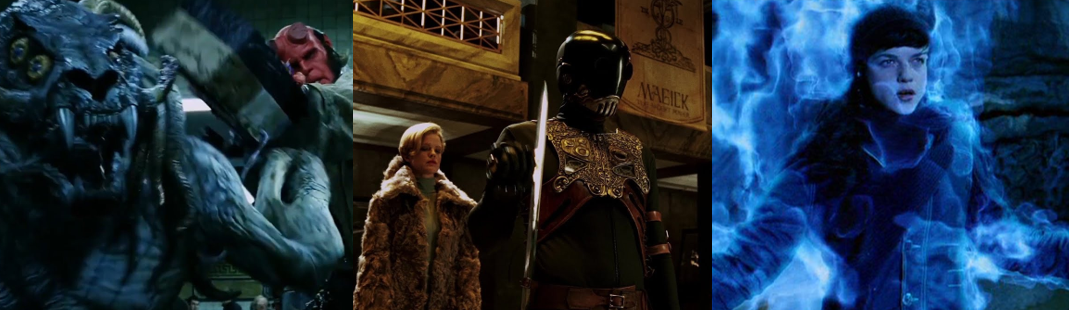
While Hellboy’s personality may be noticeably different from the source material, painting him as an arrogant and rowdy teenager who pointedly refuses help and must learn to grow up, Ron Perlman delivers a fantastic performance. He nails every nuance of Hellboy’s characterisation, which sees him be sarcastic, enraged, and lovelorn throughout the film. despite clearly being swamped by uncomfortable make-up and prosthetics, Perlman’s emotions still shine through, and I’ve always been a fan of his gravelly delivery. Hellboy looks incredible, sporting a sledgehammer-like stone fist and prehensile tail, crashing through walls and wrestling his foes into submission. While the CGI does the practical effects a disservice, making Hellboy and Sammael unfortunately cartoonish at times, the practical effects more than make up for it. Hellboy and Sammael demolish a subway station, crash through stone walls in a hidden cavern, and tear through the busy night-time streets, with Hellboy flipping a car to protect Myers and Sammael eventually being smushed by a subway train. Kroenen equally impressed in his appearances, slinging his blades around with superhuman dexterity and cutting foes down with a supernatural efficiency. When his true, gruesome form is revealed, it’s a hideous and wholly practical sight that makes me want to know more about this bizarre half-zombie. Practical effects also take centre stage when Hellboy resurrects the desiccated corpse of Ivan Kilimatovich (Unknown), a skeletal torso who guides them through Rasputin’s boobytrapped mausoleum. While many of the hazards contained within are equally practical, such as the heavy doors and crumbling bridge, much of the danger is lost when the obvious CGI rears its head, but it’s all good fun for the most part. The Director’s Cut largely splices deleted and slightly extended scenes back into the film, giving us a scene where Ilsa gifts Rasputin artificial eyes, showing Liz has a touch of OCD and adding a bit more depth to her time with Myers, but there’s nothing all that substantial added.
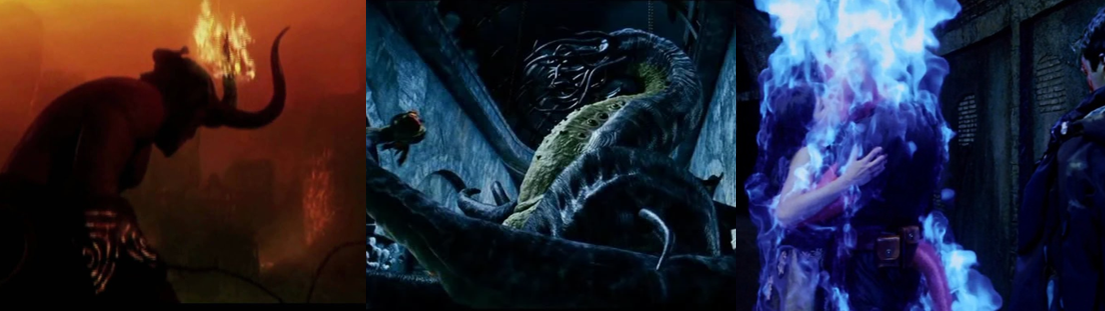
Journeying to Moscow to avenge Professor Broom and stop Rasputin’s maniacal scheme, Hellboy buries the hatchet with Manning after they work together (somewhat) to finish off Kroenen, impaling him on spikes and trapping him under a giant gear. While all the BPRD agents who accompany them are lost to the mausoleum’s booby-traps, Liz destroys Sammael’s nest with a burst of unbridled fury. However, this leaves her and the others weakened, easily allowing Rasputin to capture them. Even Hellboy is rendered powerless by a heavy trap that can only be unlocked by saying his true name, which he’s compelled to do when Rasputin maliciously sucks out Liz’s soul. Defeated and disheartened, Hellboy reluctantly whispers his name (“Anung Un Rama”) and undergoes a horrific transformation, his horns growing out and a flaming crown appearing on his brow. He then willingly uses his stone hand to free the Ogdru Jahad from their crystalline prison and have them begin to manifest amidst a blood moon. However, just as he’s about to unlock the final seal, Hellboy’s brought to his senses by Myers, who begs him to remember his father’s teachings, leading him to break his horns and mortally wound Rasputin with them, having chosen to be a man rather than a demon. Though the Ogdru Jahad are prevented from invading, Rasputin’s death frees a spawn of theirs, the gigantic, tentacled Behemoth, that Hellboy tackles alone after make amends with Myers. Thankfully, Hellboy brought a grenade belt, which he uses to blow the beast to bloody chunks. Heartbroken by Liz’s death, Hellboy whispers a threat to those “on the other side” to let her go or face his wrath, prompting her swift resurrection and the two to finally embrace as lovers. Myers, having earned Hellboy’s trust, delivers the film’s closing narration about nature versus nurture, echoing Professor Broom’s opening narration, though Manning is left waiting impatiently to be rescued!

The Summary:
Although I had no idea who Hellboy was when I first saw this film, I was intrigued by the premise, its ludicrous main character, and the promise of a fun, action-packed supernatural adventure. Indeed, the only reason I am a fan of Hellboy is because of this movie, which is still a favourite of mine. Sure, I have some issues with Myers (he makes for a painfully bland audience surrogate), Linda Blair’s performance (if it’s meant to be this way, it really misses the mark), and some of the dodgy CGI, but the pros far outweigh the cons. Hellboy has a great tongue-in-cheek sense of humour that makes the title character a joy to watch since he’s such a smart ass doofus, while also delivering some decent action sequences that have stood the test of time thanks to top-notch practical effects. The make-up and prosthetics are fantastic, with Hellboy, Abe, and Sammael all having a very tangible and tactile quality to them. Little touches like Abe’s blinking, his malformed hands and gills, and Sammael’s bone-wrenching healing add so much life to these characters, to say nothing of how imposing and impressive Perlman appears under all that getup. Although Hellboy’s characterisation is noticeably different from the comics, it works really well in this context, giving him a meaningful and surprisingly emotional character arc as he learns to focus on the big picture and stop messing around while also accepting help from his allies. I loved his father/son relationship with Professor Broom, his dynamic with Manning, and even appreciated his devotion to Liz, despite their lack of chemistry. Mignola’s art and Lovecraftian inspirations were brought to life wonderfully here, with the Ogdru Jahad being horrifically bizarre, vivid colours popping when necessary and heavy, ominous shadows being used effectively where possible. It’s got some flaws, for sure, but Hellboy is still an extremely enjoyable romp that doesn’t really get talked about all that much these days, which is a shame as there’s a hell of a lot to like here.
My Rating:
Great Stuff
Did you enjoy Hellboy’s big-screen debut? What did you think to Ron Perlman’s performance, his appearance, and the changes made to Hellboy’s character? Did you also find Myers a dull audience surrogate and the chemistry lacking between Hellboy and Liz? Were you happy with the way the film adapted elements from the comic books? Which Hellboy adaptation is your favourite? Share your thoughts on the first Hellboy movie in the comments and donate to my Ko-Fi to suggest more Hellboy content for the site.

 Dr. K's Waiting Room
2 thoughts on “Movie Night: Hellboy: Director’s Cut”