
Sonic the Hedgehog was first introduced to gamers worldwide on June 23 1991 and, since then, has become not only SEGA’s most enduring and popular character but also a beloved videogame icon. Thus, in keeping with tradition, I’m dedicating some time to celebrate SEGA’s supersonic mascot.


Released: 19 December 2002
Developer: Dimps / Sonic Team
Also Available For: Nintendo Wii U (Virtual Console, Japan only)
The Background:
After a lengthy development process and a conscious effort to create a mascot iconic enough to challenge Super Mario, SEGA’s initial success with Sonic the Hedgehog exploded into mainstream popularity with Sonic the Hedgehog 2 (SEGA Technical Institute, 1992). This was followed by the spectacular Sonic 3 & Knuckles (ibid, 1994) a game too big for one cartridge, but, oddly, one of the best Sonic games led only to many disappointing spin-offs. Following Sonic’s well received jump to 3D, numerous delays, blunders, and costly decisions saw SEGA withdraw from the “Console War”. Alongside ports of their games for other manufacturers, SEGA teamed with Dimps for Sonic Advance (2001), 2D throwback to the classic games that became a best-seller for the Game Boy Advance renowned for its visuals and gameplay. Having solidified SEGA ’s new relationship with Nintendo, development of a sequel was said to have started immediately following the first game. Sonic Advance 2 built upon the existing engine and sought to make a more action-orientated, faster title. The game saw the debut of a brand new character, Cream the Rabbit, who was specifically designed for younger players, and it also went a long way to popularising the “Boost” mechanics of later games. A commercial success, Sonic Advance 2 was praised for its cartoonish sprites, catchy soundtrack, and replay value. While its difficulty deterred some players, Sonic Advance 2 is largely regarded as one of the best Sonic titles and it was followed by a third game just two years later.
The Plot:
When Doctor Eggman vies for the legendary Chaos Emeralds and tricks Knuckles the Echidna into helping him, Sonic the Hedgehog and his friends – Miles “Tails” Prower, Amy Rose, and newcomer Cream the Rabbit – race to end his latest scheme for world domination.
Gameplay and Power-Ups:
Sonic Advance 2 takes the basic engine and core mechanics of the first game, which was already an interesting mash-up of the 2D and 3D gameplay, and expands upon them to create a high-octane, action-packed 2D sidescroller that puts a great deal of emphasis on blasting along at high speeds while holding right on the directional pad. The controls, already heavily borrowed from the 2D games, thus remain relatively unchanged: you can still jump with A, performing a Spin Attack in the process to bust Badniks and power-up pods, perform your character’s signature moves with B, and execute various mid-air “tricks” by pressing B or the Right trigger in mid-air off springs and ramps. Pressing up or down scrolls the screen vertically and pressing down and A charges a Spin Dash, allowing you to blast ahead (even as Amy this time). Although there are five playable characters to pick, each with their own special moves to slightly alter their gameplay, only Sonic is available at the start. The others are unlocked by playing the story mode and, in Amy’s case, by collecting all seven Chaos Emeralds with the four main characters. You play through seven main levels (referred to as “Zones”), each with two stages (or “Acts”) and a dedicated “Boss Attack” stage, with two additional Zones unlocked when certain criteria are met. As ever, Golden Rings are your lifeline; as long as you have at least one, you’ll survive enemy attacks. Every Act is played against a ten-minute time limit, with you losing a life once this expires, though you can disable this from the “Options” menu. You can also switch between “Easy” or “Normal” mode from this menu, though this simply reduces the hits that bosses take to defeat, and select different language options, something far more relevant this time since there are more cutscenes and text dialogue than before. As you might expect, you can also grab various power-ups as you play: you’ll get a 1-up (also from collecting 100 Rings), 5, 10, or a random number of Rings, a shield (and a magnetic variant to attract Rings), a temporary invincibility, and a new power-up that instantly puts you at maximum speed (though is, essentially, a variation on the classic speed up power-up).
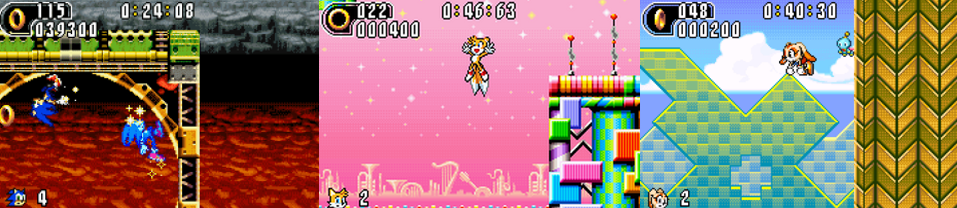
Much of this is carried over from Sonic Advance and the same is true of your character’s abilities. Each one plays a little differently, which can alter how difficult the game is. Tails and Cream, for example, can fly, easily avoiding the many pits that spell Sonic’s doom. Every returning character sports the same special moves as in Sonic Advance, with Sonic performing his Insta-Shield by pressing A twice, sliding ahead with B, and executing a fairly useless mid-air dash and Homing Attack when in mid-air. Sonic can also now bounce to the ground by pressing B in mid-air, similar to his bounce ability from Sonic Adventure 2 (Sonic Team USA, 2001) and almost as a precursor to the Drop Dash. Tails flies, as normal, and takes out enemies with a tail swipe with B, Knuckles glides and climbs walls and executes a three-punch combo with B and also now drills downwards when you press B in mid-air. Previously the most unique and difficult character to use, Amy now has a Spin Attack and Spin Dash just like her friends, meaning she’s a far more viable character this time (if you can unlock her!) She still swings her Piko-Piko Hammer with B, dives ahead, and uses it to attack aerial enemies. Every character can also grind on various rails, grab overhead poles, swing from vines and such, and blast ahead at break-neck speeds after building momentum. Flying off ramps sees you pull off mid-air tricks, which are essential to clear bottomless pits and reach higher areas and can spell your doom if you fail them. Since every character essentially adopts Sonic’s super-fast gameplay, there are far less opportunities to use their unique special moves beyond flying and gliding and each one loses a lot of their appeal as a result. There is a mild saving grace in newcomer Cream, however. Essentially the “Easy” mode character, Cream can fly like Tails (though seemingly for less time) and, crucially, fire her Chao companion, Cheese, like a homing shot with B. This absolutely decimates bosses and even surrounds her with a protective barrier when used on the ground, making Cheese the go-to choice for the game’s tougher Zones and bosses.
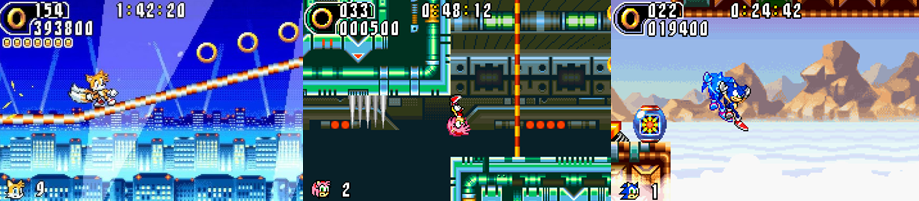
Sonic Advance 2 structures its Zones like high-speed races and obstacle courses; the “rollercoaster” aesthetic has never been truer than in this game as rails, ramps, loops, springs, and boost pads litter every environment. There is still the occasional instance of water, putting you at risk of drowning, though you’re far more likely to run across the water than sink into it. Moving and temporary platforms also still appear, often placed at the end of solid ground to screw up your jumps, as do slopes, poles, destructible elements, and bouncy surfaces. This latter gimmick is most prevalent in Music Plant, which has you bouncing around on keyboards and cymbals, while Hot Crater is more about overhead rails and annoying spikes. While things start familiar enough in Leaf Forest (functionally an amalgamation of the classic Green Hill Zone and Green Forest) and Ice Paradise is like a fancy do-over of the previous game’s Ice Mountain, things take a turn for the worst in Sky Canyon. Bottomless pits, poor hazard placement, and tricky jumps appear before this point, but Sky Canyon really ramps them up, hiding ramps and springs and platforms behind clouds and forcing you to make split-second decisions at high-speeds that will quickly drain your pathetic stock of lives. It’s very easy to miss jumps or overshoot your landing, or to plummet to your death since you often drop through rails rather than landing on them. This continues in Techno Base and Egg Utopia, which borrows gimmicks like the light-based bridges and topsy-turvy gravity from Sonic 3 & Knuckles’ Death Egg Zone and marries them with rails and pits, pits, pits! Sonic Advance 2 quickly conditions you to “hold right to win” with its emphasis on speed; Badniks are few and far between and everything is geared towards propelling you ahead at incredible speeds. It’s thus incredibly frustrating to settle into this mindless gameplay loop and fall down an endless chasm, get skewered by spikes, or miss a ramp or a rail and drop to your death.
Presentation:
If there’s one area where Sonic Advance 2 truly excels, it’s the visuals. Again, there’s a reason I used these sprites and backgrounds when made sprite comics; they’re so vivid and detailed and really bring the characters to life like never before in 2D. While Sonic Advance 2 features some recycled animations from the last game, every character has loads more frames of animation either in their poses, tricks, or when performing basic functions. Every main Act starts with your character taking their marks and getting ready to race ahead as a countdown ticks place, they’re followed by shadowy afterimages when at top speed, and their run cycles are vastly improved as the game ditches the classic “rubber band legs” animation to more closely emulate the 3D games of the time. This racing aesthetic continues when you finish an Act as you’re no longer passing a signpost or reaching a Goal Ring; instead, you run through a finish line and your character poses while running and your score is tallied. While the introductory cutscene is nothing special (and is actually worse than in Sonic Advance since it just focuses on the island, Sonic Advance 2 utilises a map screen for its stage select that’s almost an exact copy of Sonic Adventure 2’s, and includes bigger, more detailed and cartoonish sprite art for its cutscenes. As you clear Zones, Sonic rescues his friends, chatting with them and unlocking them to be played, though these cutscenes only appear when playing as Sonic and only once. Once you’ve cleared the game, you can’t view them again and the game is irrevocably changed. Cream is no longer held hostage when you fight the EggHammerTankII and Dr. Eggman pilots the Egg Saucer on subsequent playthroughs, as opposed to Knuckles. While the Game Boy Advance sound system is still grating, Sonic Advance 2 features far catchier tunes and more musical variety than its predecessor. Bosses and Acts have differing tracks and game’s more frustrating moments are somewhat alleviated by the jaunty music, with Ice Paradise being a particular highlight.
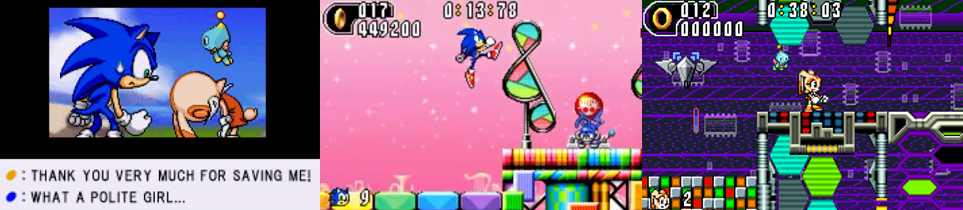
Although Sonic Advance 2 doesn’t exactly break the mould with its Zone aesthetics, the presentation is far better than its predecessor. Sonic Advance had a rather blurry, pixelated, bland look that’s been completely overhauled into a smooth, sleek, almost plasticine-like aesthetic. Admittedly, this can make some of the foregrounds more generic and the Zones do suffer from being far more linear, with ramps and long raceways being predominant, but there’s no denying the graphical upgrade. Sonic Advance 2 also borrows more from Sonic Adventure 2 for its overall presentation, especially in Zones like Leaf Forest and Sky Canyon, with the latter basically being a 2D version of Rail Canyon. Given the game’s emphasis on speed, ramps, springs, loops, and boost pads are common gimmicks in each Zone, somewhat robbing them of their individuality, though unique gimmicks can still be found (however sporadically) amidst the cheap-ass pits and hazards. Hot Crater, a mechanical base built into a volcano, features overhead rails, a heat effect to the background, and hooks to fling yourself upwards. Music Plant is a garish slice of ridiculousness that looks like it’d fit right in in Zool: Ninja of the Nth Dimension (Gremlin Graphics, 1992) and begins an annoying trend in Sonic games of this era of featuring an overly kiddified level. Ice Paradise has a Christmas theme to its soundtrack, features a bustling city in the background, flurries of snow, and big neon signs, giving the impression of a ski slope. Sky Canyon is a mess of pits and vertical columns, featuring windmills, those fans from Starlight Zone, and balloons to carry you up. Techno Base is a mess of hexagons, lights, lines, and vulgar colours; it’s essentially a new version of Cosmic Angel Zone from Sonic Advance, though with digitized spikes and some pinball mechanics. Egg Utopia is essentially a 2D version of Final Rush/Final Chase mixed with the Death Egg Zone, featuring rails between different areas of the space station set against the background of space, a gravity gimmick that has you running on the ceiling, cannons, and spiked balls. This aesthetic is carried over to XX, which is simply an autorunner (like all the game’s bosses) gauntlet before the final showdown, while True Area 53 takes place in the void of space with the Earth in the background.
Enemies and Bosses:
No doubt due to the game’s focus on fast-paced action, Badniks are few and far between in Sonic Advance 2. The game would rather surprise you with spikes or bottomless pits than have you free critters from robotic shells, something further emphasised by the lack of capsules at the end of each Act. When Badniks do appear, they’re generally awfully placed to screw up your jumps or tricks and send you plummeting to your death, and they’re largely recycled throughout each Zone. Some of their designs may be familiar to long-time Sonic fans, though: the Geji-Geji aren’t too dissimilar from Caterkillers, the Circues are reminiscent of the monkey-like Kikis, Flickey is literally a robotic version of Flicky, and the Buzzers return wholesale from Sonic Advance. Kikis hide in trees and toss coconuts like in the 3D games and like their predecessor, Coconuts; Spinners return from the 3D games and can be bounced on to cross gaps; and little robot mice scurry about on the ground. Mechanical penguins launch themselves across the snow like Penguinators, clown-like robots swing their own Piko-Piko hammers, and large robotic hammerheads await in the waters at times. Each one releases a woodland critter and adds to your score tally, but they’re mainly there to get in your way and are such a non-factor that it’s easy to be blindsided by them. The E-100 “ZERO”-like Robot Guard also appears, relentlessly pursuing you in Special Stages, sapping your Rings and kicking you out of the stage if it touches you. Having somehow been tricked by Dr. Eggman, Knuckles is battles you in your first playthrough, piloting the Egg Saucer at the end of Sky Canyon, though his presence doesn’t change anything except the cockpit sprite.
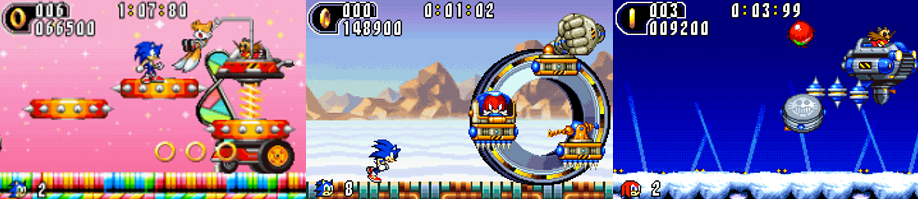
Therefore, you’ll be battling Dr. Eggman’s newest machines at the end of each Zone. Unlike in Sonic Advance, every single boss battle is an autoscroller that sees you constantly running on an endless loop, snagging Rings and timing attacks and compensating for the knockback and the tougher “pinch” mode, which can get so aggravating that it’s often easier just to cheese the bosses with Cream. Things start off familiar enough with the EggHammerTankII, an upgrade from Sonic Advance that also attacks with a giant hammer but this time it can extend its reach. While the hammer is a large hazard to avoid, this isn’t too tricky. The Egg Bomber Tank is a bit trickier as you can only attack its cannon in the first phase; the main body can only be attacked in the second phase, and both see you avoiding bouncing, explosive cannonballs. Though functionally simple, the autoscrolling gimmick makes the Egg Totem a bit difficult since it’s hard to get up to speed and hop to its spiked platforms to hit the cockpit. Each platform sprouts turrets that must be destroyed to clear the field of projectiles and they also move quiet erratically to screw up your jumps. The Aero Egg also causes problems as its bombs have wide splash damage and you can only attack it by bouncing off its tail platform (unless you just aggressively fire Cheese). Things can get very frustrating against the Egg Saucer as the laser cannon has a wide range and the robotic hand can instantly kill you with its slap attack! Your best bet is to take out the cannon and hang back, way back, running in whenever the cockpit spins into view.
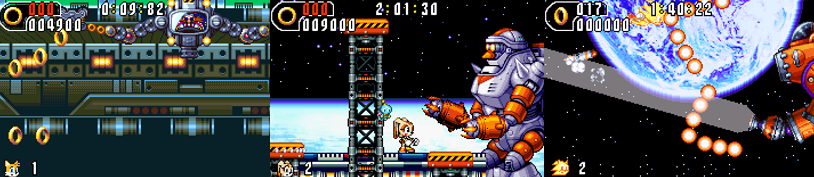
The Egg-Go-Round was much easier in comparison. This machine flies along on a rail and is protected by four platforms, two that sprout spikes and two that fire projectiles. It can be tricky avoiding these but it’s a hell of a lot easier to ram the cockpit than the Egg Saucer. The Egg Frog is a different matter entirely, though. This boss incorporates the Egg Utopia’s gravity gimmick, hopping to the floor and ceiling and dropping carpet bombs that are very difficult to avoid. While you can switch to the floor and ceiling by holding up and down, the Egg Frog’s hit box is so large and the window of opportunity so small to hit it that it’s better to just give up and use Cheese to decimate it. Similar to the last game, XX features a boss rush…but this time its against all the bosses you previously fought! Though they take less hits to defeat, the only checkpoint occurs after defeating the EggHammerTankII and this gruelling prospect means you’ll likely be low on lives and/or Rings by the time you reach the Super Eggrobo Z, a modified version of Sonic Advance’s true final boss. This giant mech takes up the entire right-side of the screen and fires its claw arms (which can be destroyed) and a sweeping laser from its eyes. Platforms will raise, allowing you to attack its main weak spot (the head) but also putting you at risk of being skewered or crushed against the ceiling spikes. After a few hits, the mech’s attacks increase but, again, you can make a joke of it by using Cream, destroying Dr. Eggman’s newest space station and treating you to a character-specific ending. However, this isn’t the true final boss. Collect all seven Chaos Emeralds with the four main characters and you’ll be taken to true Area 53 where, as Super Sonic, you battle perhaps Dr. Eggman’s most visually disappointing final mech ever, an unnamed, worm-like cannon. I’ve never battled this boss, but you’re limited, as ever, by your Ring count and must bash its missiles back at it, watching for the mech’s freeze ray and suck attack while also avoiding projectiles and dealing with its invisibility gimmick.
Additional Features:
Just like in the classic games, you can challenge Special Stages to collect the seven legendary Chaos Emeralds, which unlocks the game’s true final boss and ending. Unfortunately, if you thought Sonic Advance’s hidden springs were a pain in the ass, let me introduce you to the “Special Rings”. Seven of these are hidden in each of the main Acts and all seven must be collected to enter the Special Stage. If you lose a life in the Act, you’ll lose all the Special Rings you collected and you probably won’t be able to backtrack to get them, especially as Sonic, since many are hidden in hard-to-reach areas. If you somehow find them all, you’re taken to a large, pseudo-3D checkerboard arena and must race around collecting Rings, gaining multipliers and utilising boost pads, all while the Robot Guard chases after you. Because of how difficult the Special Rings are, I’ve never entered a single Special Stage and have therefore never collected even one Chaos Emerald, which is extremely frustrating as a life-long Sonic player. To make matters worse, you must beat every Special Stage with the four main characters to unlock Amy Rose, a needlessly obtuse criteria for a character who was available by default in the last game. Sonic Advance 2 also includes a time attack mode and a Tiny Chao Garden, where you raise and play with Chao and even transfer them to and from the 3D games, though you’ll only unlock this after collecting the seven Chaos Emeralds with a single character. Similarly, you can unlock a boss rush by beating the game with three characters and all seven Chaos Emeralds, which you’d think would invite replayability but instead makes me want to tear my hair out since entering the Special Stages is so ridiculously difficult. You can also play a single- or multi-pack multiplayer mode, racing to the finish or collecting Rings against other players and utilising the additional Attack, Brake, Confusion, and Warp power-ups to gain an advantage.

The Summary:
The visual upgrade between Sonic Advance and Sonic Advance 2 is as startling as the differences between the first two Sonic games. Where one was colourful and fun but handicapped by a slow, meandering pace, the sequel is both brighter, slicker, and much faster and more action-packed in its design. Sonic Advance 2 brings its characters to life like never before with some truly incredible, amusing, and charming sprite work. The animations are great, making the game resemble its 3D counterparts and a cartoon, and the upgrade to the environments makes everything pop so much more. Things are a little tame at times and the Zones can be annoyingly linear, but this ties into the focus on high-speed gameplay. Unfortunately, this approach does hamper the gameplay somewhat since everyone blasts ahead at full speed like Sonic, meaning their individual playstyles fall further to the wayside. This wouldn’t be so bad if the game didn’t throw bottomless pits, annoyingly placed enemies and hazards, and cheap deaths at you in a paper-thin attempt at increasing the game’s challenge. Pits definitely should appear in Sky Canyon and difficult sections should definitely appear by the end, but scattering them throughout every Zone really stunts my enjoyment as you must either memorise the Act layouts or have split-second reactions to make unfair jumps. While I enjoyed the bosses, the autoscrolling mechanic got old fast and I didn’t appreciate the boss gantlet in XX. I think the autoscrollers would’ve worked better if it had only be used, say, three times. I did like the emphasis on story and how the bosses changed because of it, but not that these changes were undone upon beating the game. It’s also maddening that the Special Stages, Amy Rose, and true final boss are all-but inaccessible thanks to the irritating Special Ring mechanic and the fact you need to get the Chaos Emeralds with every character. I liked Cream, she was cute and fun and made the bosses a joke, and the visuals still blow me away, but the difficulty curve is a nightmare. Because of all this, I can’t rate Sonic Advance 2 higher than the original, even if it is technically and visually a better game since my enjoyment is constantly soured by my inability to experience everything it has to offer.
My Rating:
Pretty Good
Are you a fan of Sonic Advance 2? How do think it compares to the original and the third game? What did you think to Cream and her boss-breaking powers? Were you a fan of the increased emphasis on speed? What did you think to the reliance on bottomless pits and boost pads? Did you ever collect the Chaos Emeralds and unlock Amy…and, if so, how? Which of Sonic’s Game Boy Advance titles is your favourite and how are you celebrating Sonic’s anniversary this year? Whatever your thoughts on Sonic Advance 2, leave a comment below and go check out my other Sonic content!

 Dr. K's Waiting Room
2 thoughts on “Game Corner [Sonic Month]: Sonic Advance 2 (Game Boy Advance)”