
So, for no better reason than “Mar.10” resembling Mario’s name, March 10th is widely regarded as being “Mario Day”, a day to celebrate Nintendo’s portly plumber, an overalls-wearing mascot who literally changed the videogame industry forever and shaped the home console market of the nineties.


Released: 20 October 2023
Developer: Nintendo EPD
The Background:
Following the collapse of the videogame industry from a slew of overpriced consoles and mediocre titles, Nintendo revitalised the landscape with Super Mario Bros. (Nintendo EAD, 1985). Once the “Console Wars” of the mid-nineties ended, Nintendo and their famous mascot became an innovative and reliable staple of the videogame industry. After successfully transitioning into 3D gaming, Nintendo continued to pay homage to Mario’s 2D roots with hit 2.5D titles. Shiro Mouri, director of New Super Mario Bros. U Deluxe (Nintendo EAD, 2012), returned to develop Super Mario Bros. Wonder and he and his team worked without a deadline, allowing them far more freedom to develop new ideas. Producer Takashi Tezuka suggested implementing a gimmick that would alter the game’s locations in fun and wacky ways, birthing the “Wonder Flower” mechanic, and features and accessibility options were implemented to make the game appealing to players of all ages. A live commentary feature was scrapped early on, long-time Mario voice actor Charles Martinet was replaced for the first time following his retirement, and Mouri also personally lobbied for Princess Daisy to be included so girls (specifically his daughters) would have more playable options. Super Mario Bros. Wonder was met with widespread acclaim; critics adored the gameplay innovations and responsive controls, and it sold 4.3 million units in its first two weeks alone.
The Plot:
While visiting the Flower Kingdom, Mario and his friends are stunned when Bowser, King of the Koopas, steals the Wonder Flower, turns himself into a giant flying fortress, and wreaks havoc throughout the kingdom. Our heroes thus travel across this new land to gather the Royal Seeds and stop their nemesis.
Gameplay and Power-Ups:
Like its 2- and 2.5D predecessors, Super Mario Bros. Wonder is a 2.5D action platformer, albeit one that gives players twelve characters to pick from and offers four player co-op, both on- and offline. Players journey across the Flower Kingdom collecting golden Coins (100 of which will grant a 1-Up), stomping on Goombas, and leaping to flagpoles to clear the six main stages (known as “Worlds”) alongside Prince Florian, a caterpillar-like character who pops out when you’re idle and chimes in during cutscenes. Regardless of which character you select, they all control the same with the exception of Yoshi, who can flutter jump by holding A (giving you a bit more airtime to clear gaps) and eats enemies and spits them back out with B. Otherwise, you can pick from two control schemes and choose to play with or without motion controls. The setup I chose saw me jumping or swimming with A (holding it to jump higher), running and picking up certain objects (like Koopa shells) by holding B (releasing it to launch my item upwards or straight ahead), and ground pounding by pressing ZL in mid-air to squash enemies and break blocks. Y brought up an emoji wheel to communicate to other players and X either placed a standee (used to revive players in co-op) or spawned an item balloon when I had one saved up. Pressing R performed a spin jump and jumping against walls and vertical surfaces performed a wall jump. You can also hold down when on slopes to slide into enemies, and pressing the L and R triggers together in co-op sees you become a ghost to float around stages. Also, you can jump atop and ride Yoshi players in multiplayer and press B to perform your special attacks when you have a power-up item.
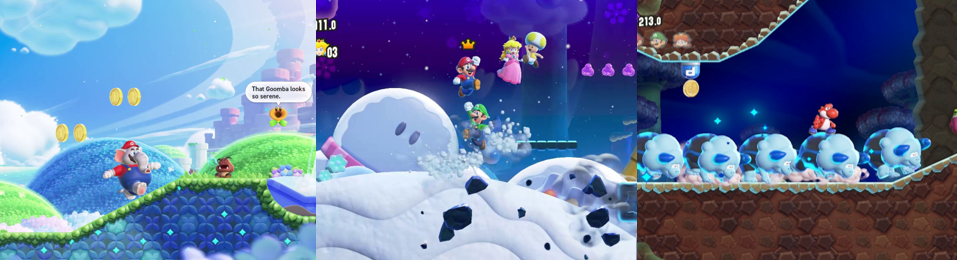
As you might expect, grabbing a Super Mushroom allows your character to grow and take an extra hit and break certain blocks. Get hit when in your small form and you’ll lose a life, respawning either at the beginning of the stage or from the last checkpoint you touched. Touching a checkpoint automatically causes you to grow if you’re small, rare green mushrooms grant extra lives and Fire Flowers let you toss fireballs to defeat enemies and melt ice blocks. Blue Coins appear when you hit P Switches, POW blocks defeat all onscreen enemies and break all visible blocks, and Super Stars make you invincible for a short time and add a somersault to your jump. This is all very familiar but Super Mario Bros. Wonder does add in three new power-ups. The Bubble Flower sees you throw bubbles to trap and defeat enemies and make temporary platforms, the Drill Mushroom lets you dig into floors and ceilings to reach new areas, and the Elephant Fruit transforms you into a rotund elephant that smacks enemies with its trunk and sprays water to cause various effects whenever you enter a fountain. If you have one power-up active, you’ll store the next one as a bubble, which is very useful as an extra chance to bypass tricky areas, and you can even commandeer Lakitu’s cloud or ride Missile Megs and Ancient Dragons to clear gaps. Wonder Flowers are the game’s biggest new feature and temporarily alter the game’s environments or your character’s appearance to mix things up. You’ll see Warp Pipes come to life, adopt a top-down perspective, float around in zero gravity, race to collect Wonder Tokens, ride along stampeding enemies, get chased by King Boo, and even explore in near darkness when the Wonder Flower is collected. These also transform you into new forms, such as a Goomba (stunting your jump but allowing you to safely cross spikes), a Biyon (stretching your character considerably), a Hoppycat (increasing your jump height), a floating balloon, granting you the Metal Cap power-up, and allowing you to stick to walls and ceilings as a Wubba, amongst other effects. These effects are sometimes timed but will last until you find a Wonder Seed or clear the stage and really add to the visual variety and mix up the gameplay as you never know what effect the Wonder Flower will have.
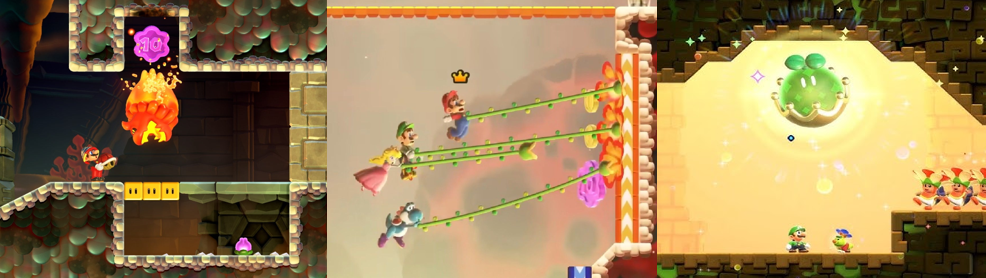
Sadly, this variety doesn’t extend to the playable characters as much as I’d like. Luigi jumps higher and has less traction than the others, Toad seems to have floatier jumps, and the Yoshis and Nabbit are invulnerable to damage (but can still lose lives), but Princess “Peach” Toadstool doesn’t have her glide ability and I question the logic behind having three Toads and four Yoshis rather than putting in Wario and Waluigi. Still, the game does allow for some character customisation in the form of “Badges”, which are either bought using the new purple Flower Coins (with three 10-Flower Coins hidden in most stages) and by conquering bite-sized Badge Challenge levels. You can equip one Badge at a time and each one grants different buffs or abilities, such as allowing you to glide by holding R, adding to your wall jump, increasing your running or swimming speed, and allowing you to snag platforms with a vine. Other abilities are more passive, such as allowing you to sense nearby collectibles, giving you a one-time save from instant-death traps like pits and lava, or turning every power-up into a specific item. You can also earn “Expert” Badges that further increase your running speed and add a limited double jump, turn you invisible (actually more trouble than it’s worth), add a spring to your step for added jump height, or allow you to hear strange voices. While it’s fun challenging for and collecting the Badges, I stuck with the Parachute Cap for my entire playthrough bar one or two exceptions as it was far more useful to add a short glide to my arsenal than anything else. You can also spend your Flower Coins on new standees (which are randomised), 1-Ups, Wonder Seeds, and paying off the local Poplins to repair bridges or smash rocks to create shortcuts and open new areas on the overworld. Furthermore, if you search hard enough, you’ll not only uncover new stages to challenge but also meet Captain Toad, who’ll gift you some Flower Coins, alongside visiting the locals to get Wonder Seeds or be told of regional issues caused by Bowser’s influence.
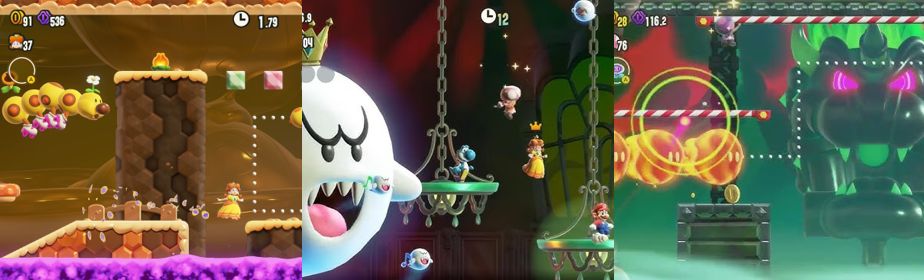
While Super Mario Bros. Wonder contains many of the same gimmicks and mechanics you’d expect from a Super Mario title (platforming, taking Warp Pipes, smashing blocks, climbing vines, sliding on ice, and dodging fireballs are all common tropes recreated here), the game is structured more like an obstacle course than ever before. You’ll be taking Warp Pipes to the foreground and background, pushing pipes and blocks to clear paths, entering doors and taking leaps of faith, hopping to moving, spinning, and temporary platforms, and dashing across zip lines to reach new areas. Like many Super Mario games, there are often hidden exits to find (generally by collecting or avoiding Wonder Flowers), you’ll need to face Boos to stop them in their tracks or lure them into the light to destroy them, and bottomless pits, boiling lava, and toxic gunk will instantly end your run if you’re not careful. You must also avoid giant spiked balls, lure Bulrushes and Konks into smashing through blocks, outrun shadowy enemies who relentlessly chase you, time your jumps to avoid being hit by Hoppycats, stay out of reach of Maw-Maws so they eat enemies instead of you, and hold B to unzip the background, unwrap Mumsys, and send Revvers dashing. Sometimes, you’ll grab keys to open doors; others, you’ll be climbing or shimmying across striped poles. Often, you’ll touch Wow Buds to spawn Coins or cause platforms to appear, move, or sway. Balloons must be popped, balloon-like enemies need to be carefully bounced across to clear gaps, and rhythm platforms and mushroom trampolines will have you timing your jumps to progress higher. You’ll also cross hazards in rolling wheels or on rafts made from dinosaur fossils, and transport to the clouds using Propeller Flowers. Timer Switches activate block platforms for a short time, Bowser’s ship fires from the background, you’ll ride an out-of-control avalanche, race against Wiggler, and battle through autoscrolling sections on Bower’s battleships, dodging Bullet Bills and flame bursts that’ll test your reaction times. The difficulty spike is pretty fair, and each stage has a star difficulty to alert you to the challenge on offer. Things never get too tricky and you can always purchase additional lives from the shop, though the game does ramp up as you progress and offer incredibly tough missions up in the Special World.
Presentation:
Super Mario Bros. Wonder is, in a word, gorgeous. 2.5D Mario has never looked or played better than here, with the game performing incredibly well throughout and the action never slowing down. It helps that most stages are bite-sized obstacle courses and that there’s a lot happening in every stage. Talking Flowers are everywhere, offering encouragement, calling for help, or commenting on the effects of Wonder Flowers. These, as mentioned, alter the stages so drastically that it’s almost like having two versions of most stages at times. They’ll be plunged into darkness, surreal colours bombard the player, and a kaleidoscope of bizarre and amusing effects spawn once you touch them, making for an enjoyable twist on the tried-and-tested formula. Mario and his friends might not play as differently as I’d like but they’re full of life and personality. Chattering through gibberish and pantomime movements, they hop and explore like never before, with caps flying off as you jump or fall or being swiped when you enter pipes. Your Elephant form squeezes through narrow passageways and Prince Florian pops out whenever you’re left idle or finish a stage. The game takes into account which character you’re playing as, too, with character-specific hidden blocks appearing in stages, personalised flags appearing at checkpoints and end goals, and the in-game text referring to whomever you’re controlling at that time. The music is as catchy and whimsical as ever; classic Super Mario tunes return, as you’d expect, as end of stage and power-up jingles but also for bonus stages and boss battles. The story is light-hearted and secondary to the action, for the most part, but just different enough to be unique. Peach isn’t a damsel in distress, for example, Bowser’s ominous ship form looms in the centre of the overworld, and you’re even actively searching for lost Poppins when you explore the Fungi Mines.
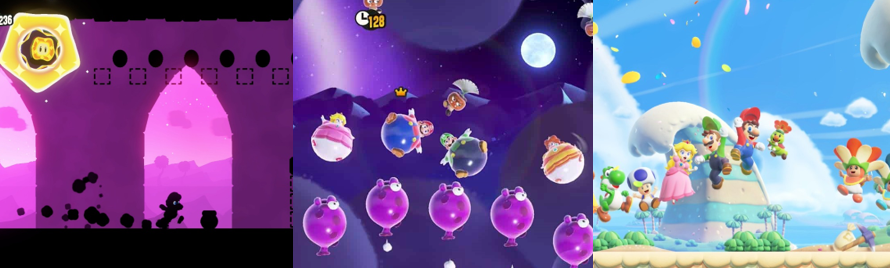
While Super Mario Bros. Wonder doesn’t break the mould that much when it comes to its stage designs, everything looks great and there are a lot of stages on offer in each World, with each sporting a unique and interconnected overworld. Things start relatively familiar in Pipe-Rock Plateau, where Warp Pipes are prevalent and you’ll be bouncing from Hoppos, before taking a turn for the surreal in Fluff-Puff Peaks. With the action mostly up in the clouds, you’ll be adding to your temporary platform in “Cruising with Linking Lifts” and slipping on icy platforms as you make way for Pokipedes on their set paths. Shining Falls adds an isometric aesthetic to its overworld and offers unique platforming challenges as the Hoppycats copy your jumps, the Anglefish fly from different directions, and you race along at high speeds on Zip Tracks. The Sunbaked Desert sees new stages appear from the arid sands as you explore or open by performing tasks on the overworld, and its stages have a tangible Arabian theme. You’ll be exploring a door maze in the Shova Mansion, gatecrashing the Ninji’s jump party, and exploring pyramid-like tombs for goodies. Things take an ominous turn in the Fungi Mines, where toxic clouds and goop lurk amongst haunted mansions and destructive rifts in the fabric of reality. The Deep Magma Bog overworld is not only the most menacing yet but also a maze of tunnels and paths. Its stages are volcano themed and feature dinosaur bones, fireballs, and flaming enemies who rush from the walls. As you explore the overworld, Kamek occasionally spawns huge Bowser-themed battleships not unlike those seen in Super Mario Bros. 3 (Nintendo EAD, 1988). Here, the game becomes an autoscrollers and you’re forced to avoid numerous hazards and destroy the central core, which doubles as a baddy maker. Finally, simple cutscenes and interactions with the locals pepper the action, with the game concluding with an all-out frenzy to get the highest score during the credits as recycled (now non-lethal) hazards fly past.
Enemies and Bosses:
Many of Mario’s most recognisable enemies make a return in Super Mario Bros. Wonder. Goombas will snooze in stages and wander or float about, Piranha Plants of various sizes pop up from pipes to bite you or spit fireballs, green and red Koopas trot about or flutter in the air, Bullet Bills blast across the screen, Boos shy away from your gaze, and Hammer Bros toss hammers in an annoying arc, as ever. Mechakoopas patrol Bowser’s battleships and castles, Pokeys wander the desert, Lakitus drop Spinys, Thwomps try to crush you, and Cheep Cheeps swim about underwater to get in your way. These are joined by some new enemies, with some offering different mechanics. The Babooms, for example, shoot fireworks that can be used to defeat enemies above you. Blewbirds fire their beaks, which then become platforms, Bloomps can be bounced on to clear gaps, Bulrushes can be ridden, and Wonder Hoppins can be tricked into smashing through the stage to make new paths. Mumsys must be unwrapped by grabbing their handle, Noknoks masquerade as doors, Renketsu Search Killers offer themselves as temporary, explosive platforms, and Skedaddlers spit seeds and run off with collectibles. Shovas push pipes and blocks about, Smogrins lurk near tricky jumps, you can swing across gaps by grabbing Tailys, and Wubbas will cut through sticky goo that slows you down. Spikes, flame bursts, electrical sparks, giant balls, toxic gunk, and crushing pistons are persistent hazards, with you often bouncing from enemies to avoid them or luring nearby foes into unwittingly aiding you.
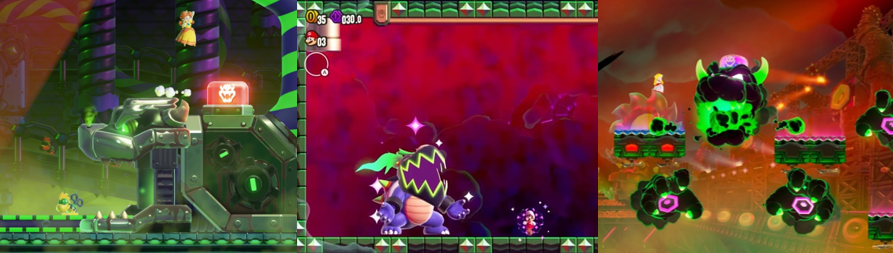
Sadly, Super Mario. Bros Wonder is disappointingly light on unique boss battles, a trend I’ve noticed in a lot of 2- and 2.5D Mario adventures. While larger variants of certain enemies do exist (King Boo being the most memorable), they’re more like chase sections rather than boss battles. The Mecha Makers are close to a boss in that you have to avoid hazards on the conveyer belt and smash the big red button to down Bowser’s battleships, but that’s being generous. Since Bowser’s busy being a giant, living ship, you’ll instead battle Bowser Jr. to clear four of the six main Worlds and retrieve the Royal Seeds and remove Bowser’s defences. Each battle against Bowser Jr. is a two-stage affair, with the first simply having you avoid his shell spin, jumps, and occasional fireball. After one hit, he transforms into Wonder Bowser Jr. and alters the terrain and your abilities somewhat. In the first fight, either you or he will change size; in the second, the rising and falling platforms alternate between being ice or jelly; in the third, water floods the arena (either above or below); and, in the fourth, Wonder Bowser Jr. distracts you with clones and by having you fight in the dark. While these fights can be tricky without any power-ups on hand, it only takes a couple of hits to defeat Bowser’s kid and his attack pattern doesn’t change much. You never battle Kamek, which is a shame, and Bowser Jr. is ultimately done in for good in a cutscene, which is also disappointing. After braving Bowser’s Rage Stage, you’ll face off against Castle Bowser in a somewhat harrowing, multi-stage final fight. In each phase, Castle Bowser spawns more hands to rain flaming Piranha Plants or to try and slam you. You must time your jumps to gain a boost from the rhythm blocks to either dispose of the hands or smack the weak spot under his chin, which he shields with his extra hands. As the battle progresses, Castle Bowser retreats to the background and fires larger Piranha Plants that can be tricky to dodge, alternates the floor to screw up your jumps, and tosses big, spiked balls that bounce around the arena. Power-ups are occasionally deposited as well and, after enough hits, a big button appears on Castle Bowser’s head that you must propel up to to end to his latest mad scheme.
Additional Features:
As mentioned, there are three 10-Flower Coins to find the game’s main stages and you’re encouraged to snag the top of every flagpole. Like the collection of Wonder Seeds, these statistics are recorded on your save file, though they appear to have no other function other than bragging rights (and, in the case of Flower Coins, allowing you to buy items). You must search high and low for every Badge Challenge and hidden sage if you want to earn every Badge in the game and enough Wonder Seeds to progress through the story. You can easily review each stage from the main map and jump to any stage where it shows you’ve missed anything, though you’ll need a guide or to pay attention to the overworld to spot when stages have secret exits. Bonus levels appear that bombard you with Coins, you can take a break by searching for Flower Tokens or taking out enemies across various arenas, and you can hunt across each map in search of Captain Toad. Eventually, you’ll unlock the Special World, where ten additional, super tough stages await, each one themed after the main Worlds and remixing hazards and enemies in new, challenging ways. Clear them all and you’ll gain access to a new Poplin House and earn yourself a congratulatory message and the Sound Off? Badge, though personally I couldn’t even clear one of the Special World’s stage…so good luck to you! Finally, of course, you can tackle any of the game’s stages in multiplayer, vying for Coins, power-ups, and a high score at the end, though I wasn’t able to play this so I can’t say how good or bad it is.
The Summary:
While I usually prefer Mario’s 3D adventures due to his 2D outings being slippery and unfamiliar to my SEGA-hardened gaming skills, I’ve really enjoyed his 2.5D titles and was blown away by Super Mario Bros. Wonder. Visually, the game is such a treat to behold; I loved all the little, goofy details and the whimsical (yet familiar) nature of the Flower Kingdom. I loved the callbacks to Mario’s previous adventures, with some returning gimmicks and mechanics, and the new abilities were a real treat. While the Bubble and Elephant forms weren’t that special, the Wonder Flower mechanics really helped to inject new life into the tried-and-tested Mario formula. I loved how unpredictable it was, how it reimagined stages and decades old fixtures like Goombas and Warp Pipes in fun new ways, and how it bombarded you with such an array of visually interesting mechanics. The new Worlds were also very enjoyable; I liked how the stages were short obstacle courses that never outstayed their welcome. The level of challenge was just right, with the game being upfront about when things get trickier and the onus being on the player to have the right skills accumulated or Badges equipped. The Badge mechanic was a little wasted on me but may have more appeal in multiplayer, and I was disappointed by the poor variety of the boss battles. There really was no excuse not to have Kamek be a boss fight at least once and I do think the developers sell the franchise short by not doing more with the likes of King Boo. Similarly, the character selection could’ve been better; I don’t get why Wario and Waluigi are always shafted or why Peach and Princess Daisy don’t have unique attributes. These negatives are mere nit-picks, however, to the overall enjoyment and fun on offer in Super Mario Bros. Wonder. It really does feel like a brand-new addition to the classic games and I liked how it provided just enough of a spin on the usual formula to be a wholly unique and accessible experience.
My Rating:
Fantastic
Did you enjoy Super Mario Bros. Wonder? How do you feel it compares to other Mario titles, specifically the previous 2.5D Super Mario games? Which of the playable characters was your go-to and were you disappointed that they didn’t have more unique playstyles? What did you think to the new power-ups and the Wonder Flower mechanic? Were you disappointed by the lack of variety in the boss battles? Did you ever conquer the Special World? How did you celebrate Mario’s birthday this year? Whatever your thoughts on Super Mario Bros. Wonder, feel free to share them below and be sure to check out my other Mario content!

 Dr. K's Waiting Room