
So, for no better reason than “Mar.10” resembling Mario’s name, March 10th is widely regarded as being “Mario Day”, a day to celebrate Nintendo’s portly plumber, an overalls-wearing mascot who literally changed the videogame industry forever and shaped the home console market of the nineties.


Released: 10 April 2019
Originally Released: 3 June 1986
Developer: Nintendo
Original Developer: Nintendo R&D4
Also Available For: Famicom Disk System, Game & Watch, Game Boy Advance, Game Boy Color, Nintendo 3DS, Nintendo Wii, Nintendo Wii U, Super Nintendo Entertainment System (SNES) Classic Edition, SNES
The Background:
After the videogame industry crumbled following an influx of overpriced consoles and mediocre titles, Nintendo effectively saved the industry with the blockbuster success of Super Mario Bros. (Nintendo EAD, 1985). However, despite that game’s success, the development of its sequel is one of the most bizarre stories in all of gaming; Super Mario Bros. 2 (Nintendo R&D4, 1986) released in Japan a year later and was basically a remixed version of the first game, one that was much harder and therefore ran the risk of alienating Western gamers. Thus, Nintendo of America thought it more prudent to reskin whimsical Mario clone Yume Kōjō: Doki Doki Panic into an official Super Mario Bros. videogame and were rewarded with a critically acclaimed best-seller. As for the original Super Mario Bros. 2, it also proved a best-seller in Japan, one that became notorious for its high level of difficulty and obscurity as the “black sheep” of the franchise. It would be some seven years before Western gamers got to officially experience the game when it was re-branded as The Lost Levels and given a 16-bit makeover for Super Mario All-Stars (Nintendo EAD, 1993). Since then, the game as been included in subsequent ports and re-releases (including the Nintendo Switch Online service, which I’m reviewing here), but has never lost the stigma as being one of the most difficult games of its era.
The Plot:
The Mushroom Kingdom has been invaded by Bowser, King of the Koopas, and his Koopa Troopa army. After Bowser transforms the citizens into inanimate objects and kidnaps Princess Toadstool, Mario and Luigi set out across the hazardous Mushroom Kingdom to rescue the princess from his clutches!
Gameplay:
If you’ve played the original Super Mario Bros. then you’ll know exactly what to expect from The Lost Levels. Players are given four save files, two control schemes, and two characters to pick from, Mario and Luigi. You can’t swap between the two after picking one and their basic controls are what you’d expect: I chose control scheme “Type B”, which mapped jump to the A and Y buttons and the dash function to B and X. You can hold down the dash button to run faster, which enables you to clear greater gaps and even jump higher, something that’s absolutely necessary in this game since large, bottomless, instant death gaps are plentiful and you’ll need to make precise jumps with very little room to manoeuvre to blocks that are just out of reach. As ever in 2D Super Mario games, traction can be an issue; it’s not uncommon for Mario to simply slip off platforms and blocks to his doom because of his momentum and this issue is exacerbated when playing as Luigi, who slips all about the place but can also jump higher and further and fall slower than his big brother. Your basic goal is also exactly the same as in Super Mario Bros.: race against a timer towards a flagpole at the end of each World and battle against one of Bowser’s fakes in a suitably ominous and hazardous castle before having a final showdown with the Koopa King.

So far, everything’s very familiar but you’ll notice the enhanced difficulty and skill required from the moment you start World 1-1; obstacles and enemies are far more plentiful compared to the first game and you’ll be required to perform all manner of frustrating actions, such as perfectly timing running jumps across death pits, ducking to slide under narrow passages, and avoiding a myriad of hazards, including fire bars (including much longer variants and ones crammed into cramped corridors), leaping Cheep-Cheeps, and the game’s newest hazards on the block, the Poison Mushroom and upside-down pipes containing hungry Piranha Plants. Platforms and blocks are often hovering over death pits and bodies of water, with many either collapsing beneath you, being much smaller than you’d expect, or tricky to jump to. You can make use of springs to rocket out of frame and cross larger gaps, and a wind gimmick for the same effect, but it’s incredibly difficult to judge how to use and control these mechanics, especially with all the enemies onscreen. You’ll also have to make use of Koopa Paratroopers and Bullet Bills to gain an extra boost to higher or further areas, navigate coral reefs full of enemies (including fire bars), and make use of shortcuts using vines and pipes to pick up Coins for extra lives that you most definitely will require to succeed. By far the worst aspect of much of the game’s platforming is how precise you need to be; you often need to dash and jump across multiple blocks and platforms, sometimes from a complete standstill, to progress, or awkwardly drop down to lower platforms or pipes, which is incredibly frustrating as you’re just continuously falling to your death over and over. Not only that but invisible blocks will often box you in or drop you to your death and many of the castle stages loop around, requiring you to somehow intuit (or guess through trial and error, or just use a guide like I did) that correct path, all while desperately trying to not get hit or killed before reaching the boss.

You’ll often be riding small platforms across wider gaps, bopping on enemies or hopping over blocks to continue onwards, or making use of weighted platforms to gain a bit of extra height for a tricky jump. Some Worlds contain a long stretch of broken bridges, with Cheep-Cheeps flying in all over the place to hurt or indirectly aid you with an extra boost. You’ll need to run and jump beneath Piranha Plants, duck at the last second and in tight corners to avoid being hit by fire bars, and even encounter enemies and hazards in bizarre places (like Bloopers being outside of the water and Koopa Troopas being in the water!) If you found Super Mario Bros. too easy, then The Lost Levels is the game for you! Almost every World plays like some kind of nightmarish debug mode or test stage, with every hazard and enemy in Mario’s then-limited library dotted haphazardly around every screen to sap you back to your base form or steal another of your lives. Mario can only take one hit before reverting to his small form, whether he has a Fire Flower or not, and extra lives aren’t exactly plentiful; because of the Poison Mushroom’s threat, you’re better off relying on Coins for extra tries but I am honestly astounded that anyone was able to play through this game back in the day without the benefit of the Switch’s save states and rewind features. Since you can’t go back (unless you’re in a looping level), you’re often stuck with very little room to charge up a jump and the sheer amount of trial and error required to beat even the earlier stages is almost laughably frustrating. You’ll need to hop from spring to spring, barely being able to judge where you’ll land and often just bouncing pathetically or slipping to your doom, get smacked in the face by a Hammer Bro or a Bullet Bill if you run too far ahead, and the amount of times I got stuck, the timer racing down, trying to hop up to blocks just out of reach was endlessly annoying. You really need to flawless with your jumps and the way you bounce off enemies; underwater, things are generally a lot easier as you just have to swim past hazards but even then you have to be careful not to get sucked below the screen, meaning The Lost Levels offers a challenge beyond what I think even the most hardened NES players were used to back in the day.
Graphics and Sound:
Thanks to the 16-bit coat of paint offered by Super Mario All-Stars, The Lost levels looks fantastic; there’s a whimsical, fairytale-like quality to everything and Worlds are bolstered by traditional Super Mario overworld, underground, underwater, and castle themes. Although Mario and Luigi can’t look up, their sprites are big and chunky so you never lose track of them and they always stand out against the backgrounds, which is where much of the game’s appeal came from for me. Worlds have been remixed not just in their difficulty and enemy and hazard placement, but their visuals as well; grass sprouts from the ground, snow covers the landscape, many Worlds now take place at night beneath a blanket of blinking stars, and you’ll see smiley faces on hills and clouds scrolling past lazily as you frantically avoid enemies and obstacles. It’s everything you’d expect from this era of Super Mario; flag poles raise as you reach your goal (Mario even throws up a peace sign to celebrate), coral weeds ripple underwater, and you always know when time is about to run out or you’ve picked up a power-up.
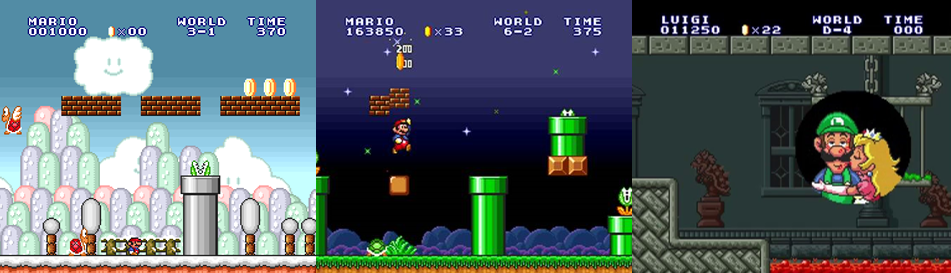
The variety on offer in the game’s Worlds is, however, sadly lacking; you’ll see the same handful of environments repeated again and again, just with different configurations of enemies. This means a lot of those night skies and snow, vaguely mushroom-shaped hills, and waterfalls and rapids beneath random assortments of platforms but it does mean you’ll encounter tougher and more annoying enemies like the Hammer Bros. and Bullet Bills in places you might not expect. The best environments, at least visually, are the castles; you’ll see portraits of Bowser, staircases, and big wooden doors in the backgrounds, flashes of lightning through the windows, and be assaulted by lava and other fire hazards. Another great environment is when you head up into the clouds, which is very whimsical, or the few occasions when you spot Goomba columns and looming castles in the background. The game runs nice and smoothly, meaning many of my pratfalls were down to my lack of skill, but is completely devoid of any story. However, to compensate for this, you’ll spot different enemies revealing themselves as posing as Bowser and rescue a bunch of different Toads in each castle, with their animations and skylarkings helping to numb the pain you feel each time you realise the princess is in another castle and you have another gauntlet to endure. When you do finally rescue Princess Toadstool, you’re rewarded with a nice bit of sprite art of Mario getting a kiss and then challenged to continue on to even harder Worlds, where the placement of enemies, platforms, and hazards becomes even more ridiculous!
Enemies and Bosses:
Every enemy for Super Mario Bros. returns here, but in new and surprising configurations that can make even basic enemies like Goombas and Koopa Troopas more dangerous. For example, these guys might spawn in on stairs or walk on destructible blocks above you, meaning you can accidentally drop them down to your level, often boxing you in with them, and they can appear near firebars, Bullet Bills, or other hazards and tricky areas to trip you up and act as additional boosts for your jumps. You need to be especially careful with Koopa Troopas as they will right themselves when hit or their shells will come flying back at you, but this is useful for taking out bigger groups of them and other enemies. Way more enemies appear onscreen at any one time here than in Super Mario Bros., as evident in the Worlds where Cheep-Cheeps constantly leap out from water or the void, Koopa Paratroopas fly about, and Lakitu hovers overhead. Lakitu is at his dirt worst here, dropping Spineys and getting in the way of your jumps and springs and you can’t even steal his cloud for an advantage. Buzzy Beetles also cause a problem as they can’t be defeated with your regular jump, Worlds are often littered with Bullet Bills firing both high and low to constantly keep you guessing and on your toes (or to act as a makeshift bridge across gaps, if you’re feeling brave) and I rarely saw a pipe that wasn’t hiding a Pihana Plant!

The most prominent enemies you’ll encounter, though, are the excess of Hammer Bros. that now populate many of the Worlds; sometimes there’s just one, sometimes two or three, but they’re always annoying as they hop up and down blocks and toss a whole mess of hammers at you. If you have a Fire Flower or a Super Star then they’re much easier to deal with but, without these, you’ll need to strategically run underneath them and bump the block they’re standing on, risk a hit to just get away, or time your runs or jumps to get past them, which can be tricky. Additionally, you’ll also face Bowser at the end of each castle; however, these are all fakes except for the final boss of Worlds 8-4 and D-4. As ever, there are two ways to defeat Bowser and his fakes: either run under him when he jumps or jump over him when you can to hit the axe and drop him to his doom or plug away with fireballs if you have a Fire Flower. Bowser’s strategies are very predictable and repetitive, but no less dangerous; you’ll see his fireballs long before you encounter him and these can be tricky to avoid when there’s a fire bar, low ceiling, or blocks restricting the arena. Eventually, Bowser will toss hammers at you like a Hammer Bro, making him even tougher without a Fire Flower, and you’ll have to battle his fakes as sub-bosses in Worlds 8-4 and D-4, which can also be quite the challenge without a Fire Flower. Bowser’s sprite is also quite large, and he tends to hop about and move back and forth, meaning you might take a hit trying to get past him, but you can easily do that to defeat him with no trouble at all in almost every encounter.
Power-Ups and Bonuses:
Sadly, there’s nothing new on offer here; you can pick up Coins scattered throughout every World and hidden in “bonus” areas and grabbing 100 will grant you an extra life. Occasionally, you’ll find 1-Up Mushrooms in blocks to also get an extra try, but make sure you’re not fooled by the damaging Poison Mushroom. You can also find Super Stars to make yourself temporarily invincible, which is great for barging through waves of enemies, but your most useful power-up to have on hand is the Fire Flower. This makes the Hammer Bros. and bosses a breeze and gives you a much needed edge, but be careful not to accidentally blast a Koopa Paratroopa you need to reach a higher area. I have to say, though, that it’s a bit of a shame that there wasn’t at least one new power-up to go alongside with the Poison Mushroom and add a little more variety to the aggravating gameplay.
Additional Features:
At first glance, The Lost Levels is as barebones as Super Mario Bros.; there’s no two-player option here, despite Luigi’s presence, and your main option for experiencing a different game is to switch to the green-clad plumber. However, many Worlds continue hidden paths to bonus areas containing Coins and acting as shortcuts, and there’s even a few Warp Zones you can use to skip ahead to later Worlds. Although I was sometimes able to break through the ceiling and bypass some underground levels, I never actually found any Warp Zones in my playthrough, meaning I was dumped into World 9 after rescuing Princess Toadstool and tasked with taking on an even tougher challenge. What follows are five new Worlds (World 9 and World A to D) that contain even more random, hazardous, and downright despicable enemy and obstacle placements. If you manage to best the main game, these will push you to breaking point as you need to spring-jump over bodies of water, cross small elevator platforms, and make even more insane jumps to reach the flagpole. More Hammer Bros. and fake Bowsers await you here as well to really pile on the challenge and I was surprised by how the game just kept going and going! However, I have to say again that the Switch’s rewind and save state feature is the only reason I pressed forward; the amount of times I had to rewind certain jumps and sections showed me that I wouldn’t have a chance without these features so I honestly have no idea how anyone played this or the NES original back in the day as it’s just excruciating difficult!

The Summary:
I was really anxious about playing Super Mario Bros.: The Lost Levels. Of all the 2D Super Mario games, it’s the one I’ve played the least and considering how much I struggle with the gameplay and mechanics of the original Super Mario Bros., I wasn’t exactly relishing tackling a much harder challenge. I can totally understand why The Lost Levels didn’t make it out of Japan as Super Mario Bros. 2; not only is it insanely difficult compared to the first game, there’s just not enough different about it. For me, the game would work much better if it were scaled down a little and incorporated into Super Mario Bros. as the second, harder game mode for experienced players. I can imagine a lot of gamers might’ve been disappointed to find that this version of Super Mario Bros. 2 was just the first game remixed, recycled, and ramped up to be ball-breakingly hard and I’m glad that it’s become more of a curio than a staple of the series. The Lost Levels is a treat to look at; I love the 16-bit overhaul and the little touches here and there, but again I think more could’ve been done to make it a stronger alternative to other 2D Mario games, such as an additional power-up, maybe a bit more variety in the bosses and Worlds other than just re-skins, or just allowing players to swap between Mario and Luigi between Worlds. Ultimately, your enjoyment of The Lost Levels depends entirely on how good you are at Super Mario Bros. but I’d wager even competent players will struggle to beat the game’s maddening levels and hazards. Because of this, I definitely recommend playing a version of the game such as this with the quality of life safety nets they offer, but can’t really recommend it beyond that unless you feel like having your skill as a Mario gamer put to the ultimate test.
My Rating:
Could Be Better
Are you a fan of Super Mario Bros. The Lost Levels? Do you prefer it to the US version of Super Mario Bros. 2? What did you think to the difficulty and challenge on offer here? Were you disappointed by the lack of new power-ups? Did you manage to beat the game without rewind or save state features? How are you celebrating Mario’s birthday this year? Whatever your thoughts on Super Mario Bros. The Lost Levels, feel free to share them below or drop a comment on my social media and be sure to check out my other Mario content!

 Dr. K's Waiting Room
I’m not necessarily a fan of The Lost Levels, and I definitely haven’t beaten the game, but I often find myself drawn to it when I’m bumbling through the Mario games on Switch.
LikeLike
The rewind feature definitely helps make it more enjoyable.
LikeLike