
On 21 February 1986, The Legend of Zelda (Nintendo EAD, 1986) was first released in Japan. The creation of legendary game designer Shigeru Miyamoto and Takashi Tezuka, The Legend of Zelda launched one of Nintendo’s most popular franchises. This year, I’m dedicating every Wednesday to Nintendo’s most famous silent protagonist, Link and his vast and enduring fantasy world of sword and sorcery.


Released: 16 January 2019
Originally Released: 14 January 1987
Developer: Nintendo
Original Developer: Nintendo R&D4
Also Available For: Famicom Disk System, Game Boy Advance, GameCube, Nintendo 3DS (Virtual Console), Nintendo Entertainment System (NES), NES Classic Edition, Nintendo Wii, Nintendo Wii U
The Background:
The brainchild of designer Shigeru Miyamoto, The Legend of Zelda purposely emphasised exploration and experimentation based on Miyamoto’s childhood love of exploring forests and caves. Selling well over 6.5 million copies, the game was a massive success and has been widely recognised as one of the greatest adventure games ever made. A sequel was released the very next year, one that proved to be one of the more divisive titles in the franchise for abandoning almost all of the original’s gameplay mechanics, This, however, was Miyamoto’s intention all along; he assembled an all-new team for Zelda II and infused traditional role-playing game (RPG) mechanics with both the adventuring gameplay of the first game and the sidescrolling action of the likes of Super Mario Bros. (Nintendo R&D4, 1985) and CastleVania (Konami, 1986). Emphasising tactical combat, obscure dialogue, and levelling-up to improve your abilities, Zelda II was a stark contrast to the first game but, surprisingly, this didn’t impact its sales or reception at the time. The game sold nearly 4.40 million copies worldwide and was apparently met with positive reviews for its unique presentation, expansion of the formula, and challenging gameplay. However, while many consider it a hidden and underappreciated gem in the series, Zelda II retains a largely negative reception; interestingly, while Miyamoto returned to the familiar top-down formula for the far more successful sequel, Zelda II went on to influence the franchise’s larger narrative and jump to 3D. The game has been re-released multiple times, though never with any enhancements beyond save states and rewinds, to allow new generations of players to form their own opinions of this black sheep of the franchise,
The Plot:
After saving the kingdom of Hyrule, fated hero Link must embark on a new quest to awaken Princess Zelda’s slumbering ancestor by placing six crystals in six temples, all while contending with monstrous forces seeking to revive the Dark Lord, Ganon, using Link’s blood!
Gameplay:
Zelda II: The Adventure of Link is a 2D action/adventure game in which players assume the role of the titular green tunic-clad protagonist and journey across the fantasy land of Hyrule, which is divided into forests, deserts, caves, and towns, searching for six crystals to revive a sleeping princess. At first glance, things are somewhat similar to the last game; you’re given three save files which you can name (though this name isn’t reflected in the in-game dialogue) and dropped into the game world after a bit of story text for context. However, as soon as you take control of Link, the differences between the first and second games become immediately apparent; firstly, Link begins in Zelda’s throne room in a traditional sidescrolling format like Super Mario Bros. This comparison becomes increasingly apt as you play with the controls and progress through the game; pressing B or X will see Link swipe with his sword, unleashing his patented Sword Beam when at full health, while A jumps! Jumping?! In a Zelda game? Outrageous! Link can also crouch (though less to duck beneath projectiles and more to perform a low attack) and holds a shield that will defend against some incoming ranged and melee attacks, but that’s it for his options at the start of the game. As soon as you leave the throne room, the game suddenly switches to a top-down view, but one markedly different to that of the first game; rather than presenting an action-oriented overworld, Zelda II takes more inspiration from traditional RPGs like Final Fantasy (Square, 1987) this time, with a few interactable elements and swarms of random battles appearing on the map.

Yes, as you move around the overworld, little black monsters will randomly appear and make a beeline for you; if you come into contact with them, you’ll be warped to a sidescrolling section where you’ll either have to battle past enemies, simply walk offscreen, hop between platforms and over hazards, or collect special items to exit to the overworld. The enemies you face are determined by the sprite that touches you, the area you’re in, and how far into the game you are; touching a Bot-like enemy usually puts simpler enemies in your path, but touching a larger monster will spawn a greater challenge. Sometimes, these sidescrolling sections are mandatory to progress; you’ll randomly be deposited into a lava-filled cave, onto a bridge swarming with Bago-Bagos, or into a haunted graveyard and will have to fight your way out to move on. Defeating enemies will usually (but, annoyingly, not always) award experience points (EXP); yes, like other RPGS, Link must now gain EXP to level-up and increase his attack, health, and magic, all of which is essential for overcoming the game’s more challenging enemies and bosses. Occasionally, you’ll find Point Bags (either out in the open or dropped by defeated enemies) which will give you an EXP boost, and conquering each of the game’s Palaces will automatically award you with a free level. Link can level-up to a maximum level of eight and you’ll be able to select whether its your health, magic, or attack that’s increased each time you level-up, but the amount of EXP you need to level-up increases each time so it’s definitely worth defeating as many enemies as you can and grabbing all the Point Bags you see to get stronger faster. If you were paying attention there, you’ll have seen I mentioned magic; Zelda II introduced magic to the franchise, though it’s used a little differently than you might think. Each town Link visits shelters a wise old man who will freely teach you a spell (though sometimes you need to perform tasks, such as talking to specific non-playable characters (NPCs) or jumping down chimneys, to reach the old man). Pressing + brings up your list of spells and displays how many points they cost to use; you can then press – to perform the spell, though you can only perform them in sidescrolling sections, and the effects will only last for as long as the screen you’re on. Spells range from reducing the damage you take to changing your Sword Beam into a fireball and increasing your jump height and they’re absolutely essential for clearing the game’s Palaces.

The first game is notoriously obtuse, rarely giving you much guidance about where to go and what to do, and Zelda II tries to address this by placing more emphasis on interacting with NPCs but, unfortunately, mistranslations muddy the water and leave you either with nonsense vagaries or out-right lies. In each of the game’s towns, Link can talk to NPCs for “hints” or have his health and magic restored, though some NPCS are actually enemies in disguise! There are also times when you need to perform fetch quests or talk to specific NPCs to gain new items or access to new areas; it’s again all annoyingly vague so I’d recommend just cutting out the middleman and using a guide right from the start. All the walkthroughs and level-ups in the world can’t help you when it comes to the game’s difficulty, though; while Zelda II is light on puzzles, requiring little more than the acquisition of keys and the use of certain items on the overworld, its Palaces are often sprawling mazes filled with instant-death lava or water and frustrating enemies, many of whom either take multiple hits to defeat or can resist your Sword Beam, making it useless a lot of the time. While enemies won’t respawn screen to screen, some come in seemingly endless swarms, others are invisible or invincible without certain items or spells, and others are placed in cramped hallways, making attacking and avoiding their attacks extremely aggravating. Perhaps because he’s not used to hopping over platforms, Link’s momentum is a bit janky here, meaning it’s easy to slip or bounce into death pits, and he also flies back upon taking damage, easily costing you a life. Yes, Zelda II also uses a life system; you start with three lives and, when they’re drained, you’re given the option to save your game or continue, which will return you to North Castle or the start of the current Palace, respectively, reducing your current accumulated EXP to zero in the process. While I can just about forgive a lot of the game’s oddities, the combat is awful here; since many enemies block your Sword Beam, you’ll be relying on jumping slashes to attack them, and Link’s range of attacks is sadly limited even after he gains new sword abilities, meaning combat is often as much of a chore as the tricky platforming and insane difficulty spikes peppered throughout the game.
Graphics and Sound:
Fundamentally, Zelda II is graphically superior to the last game; the sidescrolling sections allow for greater detail in the sprites, particularly Link, and more detailed backgrounds than in the last game. Depending on where you are, you’ll load into various different areas on the overworld, from swamps that restrict your walking speed, to forests and traditional caves. The game’s Palaces share the same Roman-inspired aesthetic, featuring bricks and columns and statues and elevators, but each has a different colour palette and utilises its labyrinthine nature in different ways, such as incorporating crumbling platforms, destructible or falling blocks, lava pits, hidden drops, or pits that lead to lower areas. While Link looks more impressive than in the last game, he has no idle poses and his animation frames are severely limited; his sprites change when you acquire new moves or utilise certain spells, but he’s still limited by the NES hardware so he’s little more than a clunky lug here. Indeed, Zelda II may have been a little too ambitious for the time as the game’s performance struggles noticeably when enemies swarm on the overworld and when there are multiple sprites onscreen in the sidescrolling sections. Sprite flickering, slowdown, and even some glitches are surprisingly commonplace, which is odd considering how well made the first game was and how simplistic so much of the game is. Zelda II even struggles in the various towns, when NPCs wander around, going in and out of houses, to say nothing of the haunted graveyards and hazardous bridges, and you’ll see a lot of sprite tearing and performance issues when battling against the game’s bosses, too.

On the plus side, Zelda II includes some chirpy and memorable tunes; the main Zelda theme is here, of course, and the main Palace and boss themes are fun little earworms (which is good as you’ll be hearing them again and again). Sound effects like Link’s Sword Beam and blocking projectiles and nice and clear, too, and there’s a decent amount of variety in the game’s locations, if not in the Palaces, which are very copy/paste even with their different colour schemes. Occasionally, you’ll find areas on the overworld where you need to use certain items, either manually (like the hammer and flute) or automatically (like the raft), and there are even some hidden paths and tiles that lead to Point Bags, Magic Jars, or upgrades to your health or magic bar. Although Zelda II emphasises interacting with NPC, dialogue is extremely limited and littered with mistranslations; thankfully, you can simply hit B to skip dialogue without missing out on the benefits, such as having your health restored. Cutscenes are basically non-existent here; there’s a little animation on the title screen, some story text, and some flashing visuals when you defeat a boss, but that’s basically it until you reach the final Palace. Zelda II is one of the few Zelda games where series antagonist Ganon doesn’t appear at all (unless you lose all your lives and then he’ll taunt you from the Game Over screen) and it also doesn’t feature Link’s iconic secondary weapons like the boomerang or bow and arrow, meaning things get very basic and repetitive very quickly.
Enemies and Bosses:
A wide variety of monstrous beings will dog Link’s progress in the game’s sidescrolling sections and Palaces, many of them new and unique to this game (as far as I can tell). We’ve got the standard bat-, bird-, snake-, spider-, and jelly-like cannon fodder that swoop, spit, and pounce about, annoying skeletal fish that leap out from water and spit projectiles, and ghostly eyeballs and floating heads that swarm the screen endlessly, bobbing about and decimating your health bar in seconds. It’s not long before you’re challenged by more frustrating enemies; Moblins, Iron Knuckles, Lizalfos, and Stalfos quickly become commonplace, defending against your Sword Beam and attacking with daggers, swords, maces, tridents, and even jump attacks. It can be difficult to land hits on them since you’re reliant on your jumping attacks and their projectiles can be incessant, making them frustrating encounters even when you’re at a higher level. This threat is escalated by the likes of the Doomknockers, Fokkas, Fokkerus, and various teleporting wizards; these guys will hop about, toss a barrage of axes or flames, and need the use of a spell in the latter’s case to even defeat. Toss in the barrage of damage sponge Bubbles, expendable Wosus, fireball-spitting statues, and worm-like creatures and it quickly becomes an uphill battle getting past even the simplest of areas as you have to avoid attacks or switch up your playstyle to overcome the enemies before you.
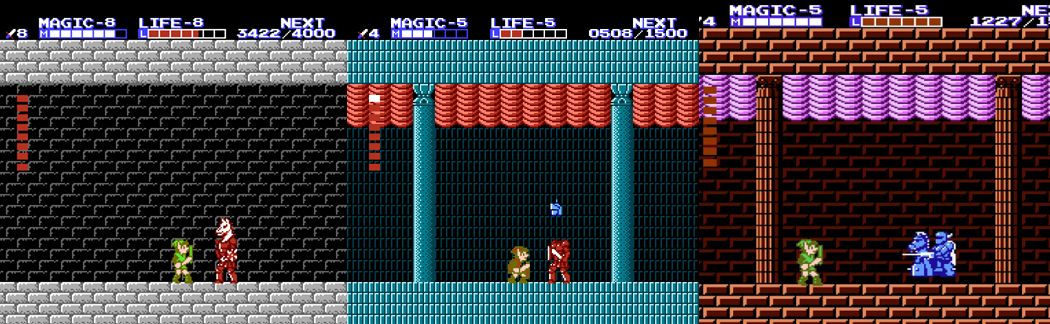
Seven crystals in seven Palaces means, you guessed it, eight bosses to overcome in Zelda II, including the game’s true final boss. This time around, the bosses all have a life bar, similar to the Mega Man series (Capcom, 1987 to present), and drop a key after being defeated, which unlocks the Palace exit. The first boss you encounter is the horse-headed Mazura, whose armour protects him from all your attacks and whose swinging mace will decimate you if it makes contact. Your best bet here is to avoid being backed into a corner and activate your Shield spell to reduce the damage you take since you’ll need to use jumping slashes to hit his only weak point, his head. You’ll use these same tactics against the second boss, Jermafenser, a massive armour-clad knight whose head will detach after a few hits! However, Jermafenser is a bit of a joke; your shield will block his projectiles and, by this point, you should have the downward thrust, which makes short work of him, meaning the journey through Death Mountain and battles against the aggravating Dairas is more of a challenge! The third boss you encounter, Rebonack, is essentially a blue Iron Knuckle on a mechanical horse. He’ll charge across the screen and try to skewer you with his lance, meaning you need to time a downward thrust to rob him of his steed, after which you simply need to block, jump, or duck to defend against his barrage of daggers and attack his head as you would a normal Iron Knuckle. What makes Rebonack unique, though, is that you battle him again later in the game as he appears twice more as a mini boss in Three-Rock Palace, though he’s even easier in these encounters since you’re more powerful at that point. When you reach the Great Palace, you’ll also encounter another mini boss-like enemy, a Giant Bot that splits into several regular Bots upon being hit and slows the game to a crawl as a result.
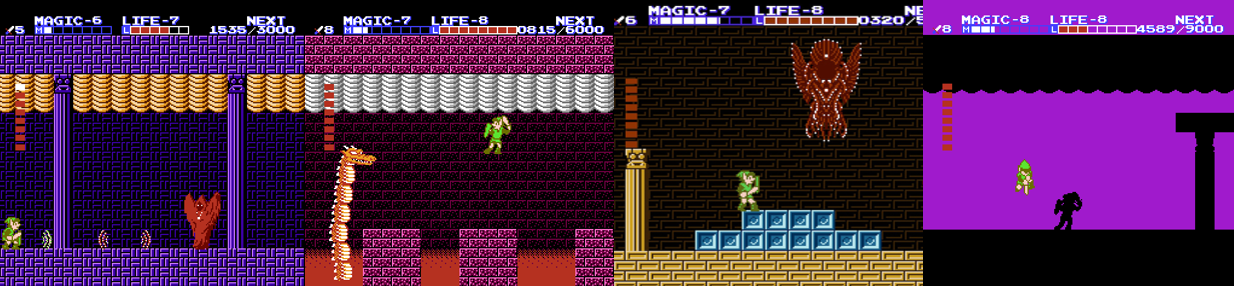
Journeying through Maze Island Palace will see Link clash with the wizard-like Carock, which is essentially a larger Wizzrobe variant. Because of this, battling it is extremely easy as you can simply activate the Reflect spell and crouch down in a corner; Carock will teleport about firing energy waves at you, but Reflect will send them right back, killing it in seconds. In comparison, the hulking Gooma is more of a challenge; slow and lumbering and wielding a spiked, chained ball, this monster requires a lot of patience as you use the Jump, Shield, and Life spells to avoid and endure his attacks and land hits to his torso. The dragon-like Barba was probably a lot harder in the original game but is made a lot easier with the Nintendo Switch’s rewind feature; it randomly rises from one of three lava pits to spew easily-voidable flame breath at you, so you need to be in the right spot to attack its head when it appears, which is easy to do when you can rewind the game on the fly! The penultimate boss, Thunderbird, poses the most significant challenge; not only must you reach it with a full magic bar since you need to cast Thunder to make it vulnerable, but it floats about spitting endless fireballs and can only be damaged by hitting its face. Once you defeat it, you’ll go straight to the final room and boss, with the damage and magic you lost fighting Thunderbird carrying over. Thankfully, the final boss, Dark Link, can be a bit of a let down; while Link’s shadow copies all his sword attacks and blocks yours with his shield, you can crouch or stand in the corner and easily cheese him, making the final challenge extremely anti-climactic considering how tough the rest of the game is.
Power-Ups and Bonuses:
Unlike most Zelda games, Zelda II doesn’t include Rupees or shops and defeated enemies will not drop hearts to refill your life meter. The only way to restore Link’s health is to find a fairy on the overworld or in a sidescrolling section, level-up, visit an NPC at a town, or find a Heart Container, meaning you’ll mostly be relying on spells like Shield and Life to help reduce damage and restore your health. On the plus side, NPCs will aid you for free, though you’ll sometimes have to jump through some hoops to reach the old man and helpful knights who provide new spells and attacks. Although Link doesn’t get to use iconic sub-weapons like the bombs or hookshot, he can acquire items in each Palace to aid his quest; many of these are passive, automatically activating once you acquire them, such as the candle, raft, boots, key, and magic cross. These automatically light up dark areas, reveal hidden enemies, allow you to traverse streams or bodies of water, and open every door in the game unlike items like the hammer, flute, handy glove, which are activated on the overworld in the case of the former and powerup your sword attacks in the case of the latter to let you smash blocks.

Link is taught eight spells throughout the game that are required to conquer the Palaces. Some are more tactical than others; for example, you don’t have to cast Shield or Life if you’re skilled enough to defeat enemies and bosses with little to no damage, and I only cast Spell a few times in dungeons swarming with Girubokkus and Moas since it turns them (and many other enemies) into harmless Bots. However, you absolutely will need to cast Jump to increase your jump height and reach new areas, you’ll need Fairy to transform into a tiny fairy and bypass larger gaps, and Fire and Reflect are both necessary to defeat certain enemies. Thunder, the most powerful spell in the game, will obliterate all onscreen enemies but it costs so much to use that I only employed it against Thunderbird since that’s the only time it’s unavoidable. Link can also learn two additional sword attacks, the downward and upward thrust, which are super useful for defeating enemies beneath and above him, though it’s not going to help you against Iron Knuckles and other similar enemies, which is annoying. Finally, in addition to finding Point Bags and magic jars, you’ll occasionally come across Link Dolls that will grant you an extra life, though this is sometimes detrimental as it means wasting more time just trying to save the game.
Additional Features:
As is tradition for the Zelda franchise, numerous Heart Containers can be found all across Hyrule; acquiring these will refill and extend your health bar, and you only need to find one to do this rather than four or five like in other games. Additionally, Magic Containers will do the same thing for your magic bar, so it’s worth exploring a bit to find these, even if it means battling more enemies. As alluded to earlier, some NPCs will only help you after you’ve performed certain tasks or spoken to certain characters; there’s a mirror, water, and kidnapped child to find in order to learn certain spells, Link will need to use Jump and Spell to reach certain houses or unearth areas, and you’ll need to use the flute and hammer on the overworld to eliminate otherwise impassable monsters or reveal hidden areas. Finishing the game allows you to save and alters your save file; selecting it will begin the game anew, with all your spells and level-ups intact, though you’ll have to find all the items and beat all the Palaces again. You can skip to this game by selecting the “SP” version from the Nintendo Switch Online menu, and of course you can abuse the rewind and save state feature to make the game a bit less challenging, but it’s still a tough experience even with these quality-of-life features.

The Summary:
I put off playing Zelda II: The Adventure of Link for years; I purposely downloaded it for the Nintendo Wii just to play it years ago but never actually sat down with it until this playthrough, and even then I was very reluctant after all the negativity surrounding it. Unfortunately, I have to say that the criticism this game often gets is entirely justified; it’s such a radical departure from the first game that it’s almost like a completely different game, and the challenge it offers is neither fun or rewarding. Things start out okay enough, but the difficulty spikes dramatically once you reach Death Mountain (the second area of the game, I might add!) and then becomes wildly inconsistent after that. Sometimes you’ll be bombarded with small, annoying enemies and projectiles or forced to fight tricky enemies like Iron Knuckles in narrow hallways, and other times rooms will be largely empty or contain simple platforming sections. I wasn’t a fan of the basic overworld, the aggressive random battle system, or the switch to a sidescrolling perspective; this only works in small doses in Zelda games and the NES just isn’t capable of giving Link the range of movement or attack options required to best utilise this perspective. I didn’t mind the level-up mechanics, or the use of spells, and grinding wasn’t too much of a slog for me unless I was battling Iron Knuckles, but the spells were quite mundane and circumstantial, and I missed using other weapons and solving puzzles. Instead, the game relies on mazes, vague hints, and trial and error to nudge you along, making for a confusing and aggravating experience as I don’t like referring to a walkthrough when I’m playing games. I liked the music, and aspects of the graphics, and the bosses were visually quite impressive, if mostly ridiculously easy compared to what you go through to reach them. Ultimately, I don’t think you’re missing out if you’ve never played this one; it’s a curious oddity in the franchise, one that’s easily skipped over in favour of the more enjoyable sequels, but it could provide some enjoyment for nostalgic gamers seeking to relive the days when videogames were unnecessarily difficult.
My Rating:
Could Be Better
Have you ever played Zelda II: The Adventure of Link? Were you put off by the changes to the gameplay and mechanics, or did you enjoy that it mixed up the formula? What did you think to the game’s difficulty and use of RPG mechanics? Did you struggle to work out where to go and what to do? Which of the game’s spells and bosses was your favourite? What did you think to the final boss? Would you like to see Zelda II remade or a return to this style of game for the franchise? How are you celebrated The Legend of Zelda this month and where games are your favourite? Whatever your thoughts, leave a comment below and maybe check out my other Zelda content.

 Dr. K's Waiting Room
3 thoughts on “Game Corner [Zelda Month]: Zelda II: The Adventure of Link (Nintendo Switch)”