Game Corner: Castlevania II: Belmont’s Revenge (Xbox One)

CV2BRLogo

Released: May 2019
Originally Released: July 1991
Developer: Konami Digital Entertainment/Konami Industry Co. Ltd
Original Developer: Konami
Also Available For: Game Boy, Game Boy Color, Nintendo 3DS, Nintendo Switch, Nintendo Wii, Nintendo Wii U, PC, and PlayStation 4

The Background:
So far, since I started working my way through the Castlevania Anniversary Collection, I’ve realised two things: first, Castlevania II: Simon’s Quest (ibid, 1987) was easily the worst of the Castlevania titles released on the Nintendo Entertainment System (NES) and, second, Castlevania: The Adventure (ibid, 1989) was a disappointingly frustrating debut for the series on the Game Boy. Yet, despite this, Konami returned to everyone’s favourite monochrome handheld in 1991, just a few months before the release of the fantastic Super Castlevania IV (ibid, 1991). By this time, the Game Boy had finally made the jump to colour and developers were actually able to put its limited capabilities to good use, even as its lifecycle began to wind down, but does Castlevania II: Belmont’s Revenge manage to outperform it’s handheld predecessor or is it more of the same, exasperating gameplay?

The Plot:
Fifteen years after defeating Count Dracula in Castlevania: The Adventure, Christopher Belmont, of the renowned Belmont family of vampire hunters, is forced to take up his legendary whip, the Vampire Killer, and confront Dracula once again after the Count’s evil spirit corrupts both Christopher’s son, Soleil, and erects four castles to consolidate his power once more.

Gameplay:
Castlevania II: Belmont’s Revenge is a 2D, sidescrolling action/platformer in which players once again take control of Trevor and Simon’s ancestor, Christopher Belmont. Luckily, age has actually improved Christopher’s performance rather than slowing him down as, while he still limps along in the trademark Belmont shuffle, his jumping mechanics are vastly improved over those seen in Castlevania: The Adventure. Now, when you jump, you no longer plummet like a stone or feel as though you’re constantly fighting against gravity in a losing battle; he still jumps backwards (often to his death) when hit and platforming can still be a tricky business, but it’s far better than in the last game, finally bringing the controls back on par with…the first Castlevania (ibid, 1986).

CV2BRWeapons
Battle with the whip or the returning sub-weapons!

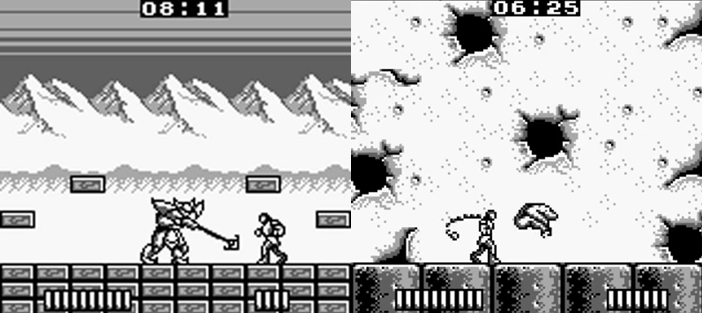
Christopher once again battles with his whip, the Vampire Killer, which can again be upgraded to be both longer and to shoot fireballs as in the last game. Unfortunately, he can still only attack in the direction he is facing, meaning you’ll have to jump or use ledges to dispose of airborne enemies…or make use of the game’s sub-weapons. Yep, conspicuous by their absence in their last game, sub-weapons return here and, while we only get two of them, they’re the two I’ve used the most in the series thus far (the Holy Water and the axe). As always, you can whip candles to collect hearts, which once again act as the ammo for your sub-weapon due to the debut of meat into the Game Boy series; however, in my playthrough, I never actually found a single piece of health-restoring meat and had to settle for cheesing save states and having my health bar refilled after besting each of the game’s bosses. Like in the last game, you can also grab coins to increase your score and 1Ups to earn extra lives, and this game also features the debut of the traditional door transitions from one area to another, again bringing it more in-line with its NES counterparts. Castlevania II: Belmont’s Revenge is a notable return to form for the Castlevania series in that, of the two Game Boy titles, it is the one that most closely replicates its NES counterparts. Yet, like its predecessor, the game is still short on stages; you’ll visit four castles (Cloud, Rock, Crystal, and Plant), each of which can be selected in any order from the main menu. While it doesn’t really matter which order you take on the castles, each has different enemies and gameplay mechanics to overcome. Take on the Plant and Crystal castles, for example, and you’ll be tasked with travelled from the right-side of the screen to the left, which goes against almost every instinct in my body. I found Rock Castle to be the best one to start with as it has the easiest boss, enemies, and level layout, while Cloud Castle was one of the hardest takes to the inclusion of the Night Stalker enemy. Regardless, once you’ve cleared the four castles, a fifth, Dracula’s Castle, rises up and presents the game’s toughest challenge.

CV2BRRope
Belmont’s Revenge is all about the ropes.

Like its predecessor, Castlevania II: Belmont’s Revenge is an extremely vertically-orientated videogame; Christopher clambers up and down ropes, rather than taking staircases, to reach higher and lower areas of each castle. Luckily, as he’s often once again faced with walls of spikes looking to impale him, he can now quickly slip down a rope to quickly clear these obstacles, but he’ll also be tasked with jumping from one rope to another, which can be a tricky task. The biggest hindrance to this is that Christopher won’t jump from his rope if he doesn’t have a clear path so you’ll have to make sure to manoeuvre Christopher beyond the edge of the stage or risk taking damage. As part of this, Christopher can now use spider webs to clear gaps; spiders will descend and ascend down a web line and you’ll have to use your weapons to kill them, leaving yourself a series of lines to jump to. As with all Castlevania games, the enemies respawn, so, if you mess up, you can just respawn the spiders by walking a little off-screen so you can try again. The breaking and collapsing platforms of Castlevania: The Adventure also make a return; you’ll again have to contend with Big Eye’s exploding and destroying bridges though, for the most part, you’ll simply drop to a marshy layer below. While this does slow your forward momentum, it’s still preferable to dropping to your immediate death. Rather than hopping from one collapsing platform to another, as in the last game, Christopher is now faced with blocks of crystal; when he lands on them, the block starts to crack; wait too long to make your move and the block will shatter, dropping Christopher to his death, meaning it’s best to plan ahead a bit and hop to safety as soon as possible. Thankfully, the auto-scrolling sections and abundance of instant-death spikes of Castlevania: The Adventure have been ditched; you’re still asked to make some difficult jumps, will have to contend with spiked platforms, and you’ll have to frantically slide away from some spiked walls but it’s nothing like in the last game.

CV2BRTraps
Each castle features its own traps and hazards.

Instead, you’ll now be faced with massive weighted spikes that must have their central column destroyed in order for you to pass by safely; a similar mechanic was present in Castlevania: The Adventure but its far more prevalent here and you’ll have to risk taking some damage to use the weight’s height to reach a rope before the weight drops too low. Plant Castle also uses a blackout feature at one point; whenever you destroy a candlestick in this section, the entire background and foreground will go pitch-black, meaning it’s usually best to avoid destroying the candlesticks unless you’re confident of where you’re walking and/or jumping. Cloud Castle tweaks the rope-based mechanics of the title by having gears turn the ropes up and down in intervals; since touching the gears is liable to drain your health quite quickly, it’s best to jump from rope to rope as quickly as possible. You’ll also jump to ropes weighed down by spiked balls; as you jump to these, the weights will shift and you’ll also be at risk of taking damage from spikes or the gears unless you jump to safety. All of these gameplay mechanics and obstacles are ramped up to eleven by the time you reach Dracula’s Castle, fitting as this is the game’s most difficult level by far. However, despite some tricky platforming and the presence of some truly annoying enemies, Castlevania II: Belmont’s Revenge is far less merciless than its predecessor. Since Christopher no longer drops like a stone every single time he tries to clear even the smallest gap, it’s far easier to navigate through the game’s handful of castles which, while still limited compared to other Castlevania titles, are also much bigger than in the last game.

Graphics and Sound:
Castlevania II: Belmont’s Revenge is still a Game Boy title so you can’t expect too much here but, unlike the last game, this title actually features a decent level of detail in each of its environments. Crystal Castle features a Greco-Roman aesthetic in the background and an abundance of semi-transparent crystal platforms and blocks, Rock Castle is dotted with cracks and holes for rats to leap out at you and resembles a cave-like dungeon, Plant Castle seems coated in moss and/or slime and features a quagmire-like swamp beneath its destructible bridges, and Cloud Castle (fittingly) has mountains in the background and is full of gears and pulleys. Dracula’s Castle begins with a fairly elaborate gated courtyard filled with statues, progresses to a rock-like dungeon, and culminates with a stained-glass throne room lined with chandeliers, portraits, and large paned windows. It’s all very elaborate and nicely detailed, giving each area is own unique look and feel, yet not being so detailed that you can’t see the sprites.
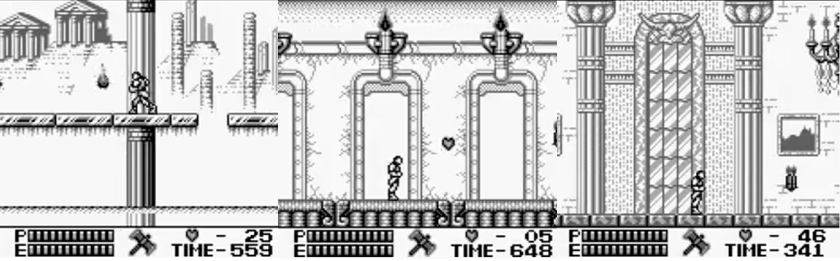
CV2BRGraphics
Belmont’s Revenge has some varied and nicely detailed environments.

Speaking of which, both Christopher and his enemies look pretty much the same as in the last game; classic, blocky little 8-bit sprites are the order of the day but, thanks to the game better balancing its limited colour palette and backgrounds, it’s much easier to see where Christopher is at any time…except when you’re forced to travel right to left, which always confuses my line of sight. Similar to Castlevania: The Adventure, the Castlevania Anniversary Collection only offers a black-and-white, monochrome, or colour filter rather than the more detailed gradients offered by the original Game Boy Color version but, despite this, the game is noticeably faster and suffers from less (if any) sprite flickering. Unlike its predecessor, Castlevania II: Belmont’s Revenge also features a few limited cutscenes; after clearing the four castles, Dracula’s abode dramatically rises on the map screen and, each time you visit a castle or an area of Dracula’s Castle, you’ll be treated to an animation of Christopher heading there. Additionally, after defeating later bosses, you’ll actually get some dialogue boxes pop up that give some context to the game’s events, which was a nice (and surprising) touch. Similarly, the game features a fairly decent and catchy soundtrack; not only does each castle have its own theme, when you progress far enough into the castle the music will switch to a more ominous tune to help keep things interesting as you play.

Enemies and Bosses:
Every enemy from Castlevania: The Adventure makes a return in this sequel, meaning you’ll still be going up against giant eyeballs, sloppy Mud Men, annoying crows, and pizza-spitting globby monsters. The Under Mole boss from the last game is recycled as the regular rat enemies, which leap out at you from holes just like that boss did, and the last game’s worst enemy, the Night Stalker, returns more frustrating than ever as it is nigh-impossible to dodge his flying sickles without taking damage. There are some new enemies on offer here as well, though; there’s a giant bat that, when destroyed, results in two smaller, regular bats buzzing around you until you take them out as well; skeletons make their Game Boy debut, here clambering up and down and jumping to and from ropes erratically whilst throwing bones at you, and you’ll also have to contend with jellyfish-like enemies who soak up damage like a sponge and drain your hearts when touched. Perhaps the most interesting new enemy is the Cave Snail; these are dormant until you make the lights go out in Planet Castle, when they’ll unfurl and plod towards you. They’re not the most difficult, exciting, or sexy enemy but it’s an interesting gameplay mechanic, if nothing else. Aside from the Night Stalker, you may also have difficulty whenever you face off with the dagger-throwing Lizard Men but, once you learn their pattern, it’s pretty easy to safely avoid them as they hop around chucking daggers at you.

CV2BRBosses
Belmont’s Revenge has some massive bosses.

Bosses in Castlevania II: Belmont’s Revenge are a step up from the last game in terms of their size, variety, and threat; while the armoured Iron Doll, statue-like Twin Trident, and teleporting wizard Dark Side aren’t too much of a challenge, you’ll also face the two-headed Angel Mummy, which is a skeletal creature that has fused to a wall, takes up the entire right-side of the screen, and launches both boomerang-like energy waves and fireballs at you, making it perhaps the most difficult of the regular bosses. The Bone Dragon can be a bit of a bastard as well; this is where the auto-scrolling comes back with a vengeance and you’ll be forced to lumber ahead so that you can avoid the dragon’s bony body, spiked tail, and land a few hits to its big ugly head.

CV2BRDracula
Those spheres make this battle with Dracula one of the toughest so far.

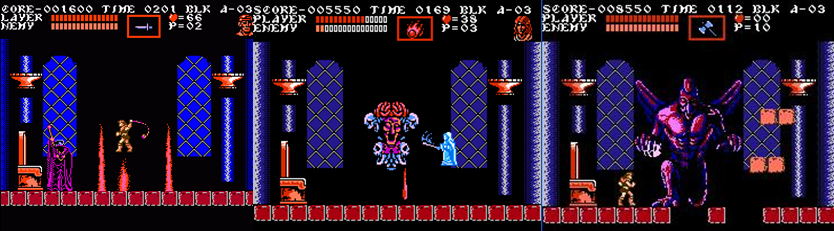
Once you reach Dracula’s Castle, you’ll have to battle Christopher’s son, Soleil, who has been possessed by Dracula’s corrupting influence. The toughest boss of the game so far, Soleil not only throws daggers across the screen that can rain down on you, he attacks with his own whip and can absorb a great deal of punishment. Luckily, his pattern is quite easy to predict so you can pre-emptively toss Holy Water at him to damage him when he’s standing still and get a few hits in with your whip at the same time. After freeing Soleil, Christopher goes on to battle Count Dracula once more in an area strikingly similar to the one they fought in in Castlevania: The Adventure (another nice call-back). While Dracula only has the one form this time around, he’s far tougher than before as, this time, he surrounds and protects himself with a series of spheres, blasting them out in a spiral pattern as he teleports around the spiked-lined arena. As always, you can only damage his head and, due to the nature of his teleportation animation and the aforementioned spheres, you have a very limited window to land a hit and get to safety. As a result, the axe is a must-have item for this boss as it allows you to get into a safe position and still hit Dracula without risking the jump to a higher platform but, even then, this was one of the hardest of the 8-bit Dracula boss battles for me.

Power-Ups and Bonuses:
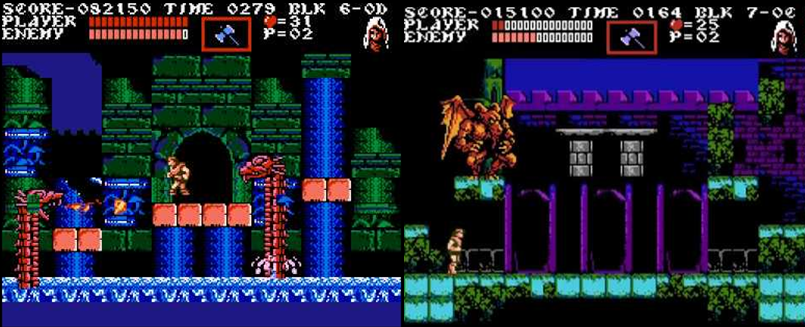
Everything for the last game makes a return here, meaning the Christopher can still throw fireballs out of his whip once it’s fully powered up. These do feel slightly nerfed than in Castlevania: The Adventure, though, as they’re slower and can’t be thrown successively (this, however, does seem to have improved the game’s sprite flickering and performance). You also get the axe and the Holy Water as sub-weapons, which is a welcome return, and, while you could complain about the lack of other Castlevania sub-weapons, they’re not needed thanks to the versatility of Christopher’s whip.

Additional Features:
Like pretty much every Castlevania videogame, Castlevania II: Belmont’s Revenge features a “Hard Mode” that, as the name suggests, offers a greater challenge. Unlike its predecessors, though, the only way to play the game’s Hard Mode is by inputting a password as beating the game simply leaves you in the “The End” graphic. Passwords can also be used to jump to the game’s various stages and bosses and grant extra lives, but don’t offer any other benefits; there’s no way to play as Soleil, for example, which is a bit of a shame. Furthermore, the Castlevania Anniversary Collection bestows upon you an Achievement after you clear the game, allows you to make liberal use of the save state feature, and apply different frames and display options to customise the game’s appearance to your liking.
The Summary:
Castlevania II: Belmont’s Revenge is a dramatic step up from its predecessor; featuring far more detailed and varied environments, the return of classic Castlevania tropes like the doors to new areas and sub-weapons, and proving that the Game Boy is more than capable of producing a worthy counterpart to its NES cousins. Honestly, this is the Castlevania Game Boy title we should have gotten in the first place as, rather than being a frustrating, subpar experience, Castlevania II: Belmont’s Revenge is actually relatively decent to play simply due to the fact that you don’t plummet to your death every time you jump. With far larger and layered stages, more visually striking and challenging boss battles, and a difficulty curve that is based on your level of skill and ability rather than simply (literally) weighing you down with slowdown, sprite flickering, and sloppy physics, it’s still far from surpassing its NES equivalents but Castlevania II: Belmont’s Revenge is a decent enough Castlevania title, especially for a Game Boy game.

My Rating:

Rating: 2 out of 5.

Could Be Better

What did you think about Castlevania II: Belmont’s Revenge? Do you agree that it showed that Castlevania: The Adventure was capable of so much more or do you still rank it low on the totem pole of Castlevania titles? What was your favourite Game Boy title? Whatever your thoughts about Castlevania II: Belmont’s Revenge, or Castlevania, in general, drop a comment below and check out my other Castlevania reviews.

Back Issues: Resident Evil: Fire and Ice #4

BackIssues
REF&I4Title

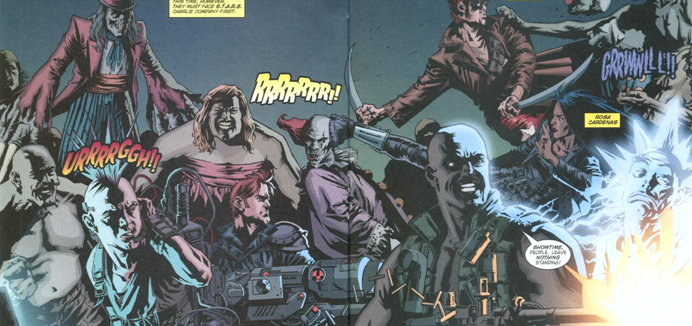
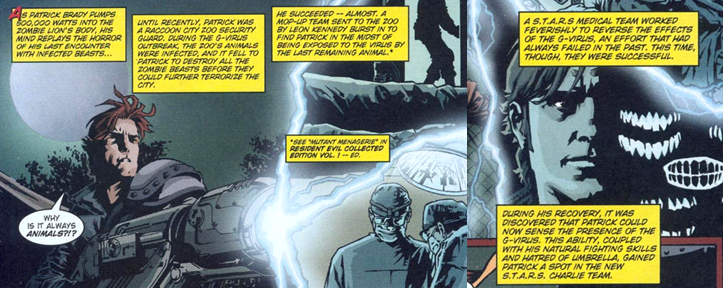
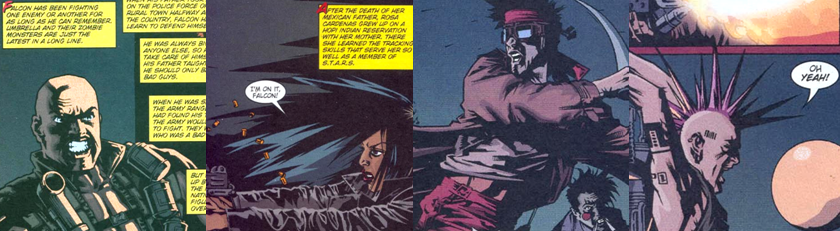
Well, we’re in the last week of October and Halloween is this weekend. If you’ve been following my blog this month, you’ll know that, as a means to generate some fitting content for the season, I’ve been taking a look back at Resident Evil: Fire and Ice, a four-issue comic book series published by WildStorm between 2000 and 2001. This series was a follow-up to their previous five-issue mini series, Resident Evil: The Official Comic Magazine, and focused on an entirely new group of characters, the hitherto-unknown Special Tactics and Rescue Service (S.T.A.R.S.) Charlie team, rather than telling interludes, side stories, or truncated versions of the first two videogames. Charlie team was made up of a bunch of one-dimensional, impractically attired characters who looked like they had just stepped out of the worst comics of the nineties: led by the muscle-bound Falcon, who looks and acts like an extra from Predator (McTiernan, 1987), the team consists of newcomer and munitions expert Raquel Fields (who is hiding a mysterious infection following a zombie attack), the shady hacker Jesse Alcorn, Patrick Brady (a former zoo keeper able to sense G-Virus monsters), the anti-authority Australian Quan Williamson, and the Mexican quasi-Native American Rosa Cardenas (whom it is implied Quan has a crush on but who actually has feelings for Brady…).

REF&I4Copter
Quan fixes up a means to save his team mates from Whitlam’s clutches.

This final issue rejoins Quan in the Alaskan mountains (Charlie team split into two sub-teams to investigate two Umbrella laboratories and run into a few troubles, to say the least, almost immediately upon arrival); he discovers the remains of an Umbrella surveillance minicopter, which he uses to spy on Dexter Whitlam, Klaus, and Mr. Venk, the Umbrella scientists and operatives who have captured Rosa and Brady and are preparing to subject them to Whitlam’s experimental new X-Virus.

REF&I4Whitlam
And that’s it for Dexter Whitlam. What a waste of time and effort.

Whitlam, who we first met as a misguided youth who stole a sample of Umbrella’s G-Virus, transformed himself into a violent “G”-type monster, and was summarily recruited to Umbrella by Klaus after (somehow) being cured, is now all grown up and has transformed into a semi-cybernetic mad scientist. He was one of WildStorm’s more interesting and layered original characters, an insight into the type of person Umbrella likes to have on staff and put to work on their experiments. So, of course, he is incinerated on page three by the exploding minicopter, bringing him to a sudden (if impressive) end.

REF&I4Infection
Though saved, Brady and Rosa are revealed to have been infected with the X-Virus.

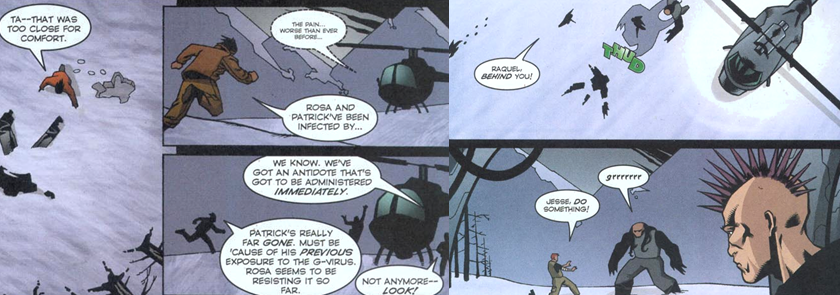
Free from their captivity, Rosa and Brady are reunited with Quan and immediately get their asses handed to them by Mr. Venk. Venk actually puts up more of a fight and gets a better showing than popular Resident Evil creatures like the Lickers and the Tyrant but, in the end, he is dispatched with a judo throw that ends with him impaled on the bloody stump of Klaus’ hand. However, as they make their mistake, Brady reveals that Whitlam succeeded in infecting them with some of his X-Virus, leaving a gloomy shadow over their otherwise joyous reunion. Back in Mexico, Falcon, Jesse, and Raquel take a jeep to a helicopter, where they spot the cactus plants arranged in a biohazard symbol. In a further nod to the series’ original Japanese name, they mention that the facility’s computer labelled their new virus as “Biohazard” and, dropping in for a closer look, discover that Umbrella placed a vial of the antidote into one of the cacti plant…because of course that was where you would leave the antidote to a deadly virus!

REF&I4Flight
After dispatching their pursuers, the team begin their long flight from Mexico to Alaska.

As he is lifting her back into the chopper, Jesse again acts a little shady, insisting that Raquel hands her the antidote and, in the brief scuffle, spills half of it. Just as Raquel expresses her concerns over Jesse’ competency, they are set upon by an Umbrella attack ‘copter; however, Raquel makes short work of it with her handy-dandy rocket launcher and the team prepare to fly to Alaska.

From Mexico.

They’re going to fly from Mexico to Alaska in a helicopter! That’s over 3,500 miles! Most choppers are only good for about 400 miles before needing to refuel and, if you’re thinking they flew to an airport to refuel or switch vehicles, you’re wrong because they show up a few panels later to rescue their team mates and, judging by the background, it’s still the same day!

REF&I4XFight
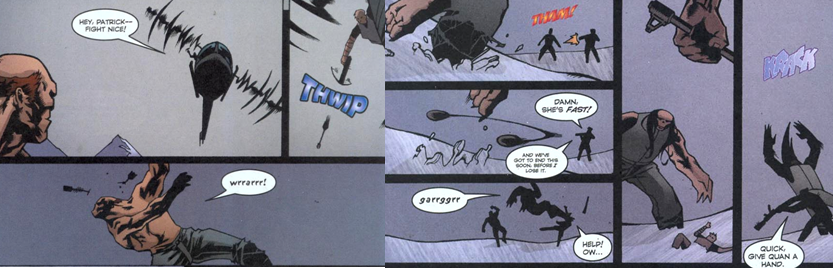
The other team arrives and they desperately try to subdue their mutated allies.

Speaking of the other team, Quan is forced to stop when, part-way through their trek back to the helipad, Brady begins to undergo a dramatic and painful metamorphosis into a really lame looking Mr. X/Tyrant-like creature. Falcon’s team arrives just in time to stun Brady with a crossbow (yeah…a crossbow, perhaps the weakest and most useful weapon in the Resident Evil series) but Rosa suddenly transforms into a similar, hulking creature and the team tries to subdue them non-fatally so that they can be administered with the antidote.

REF&I4Jesse
Jesse reveals his true colours…and then immediately dies.

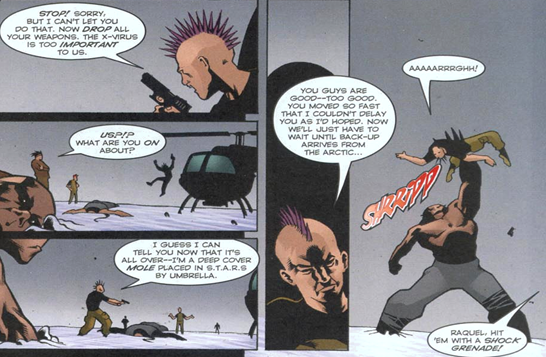
Raquel manages to tie up Brady with some bolas and Falcon puts down Rosa using the snowmobile but, right as they’re about to get the antidote, Jesse reveals his true colours and, holding the two at gunpoint, reveals that he’s actually a deep cover mole placed in S.T.A.R.S. by Umbrella. This might have been surprising if the last two issues hadn’t made it abundantly clear that there was something very fishy about Jesse and it’s rendered completely redundant as Jesse is immediately skewered and killed by the monstrous Brady.

REF&I4Finale
Brady is put down and Rosa is, apparently, cured. It’s hard to really tell.

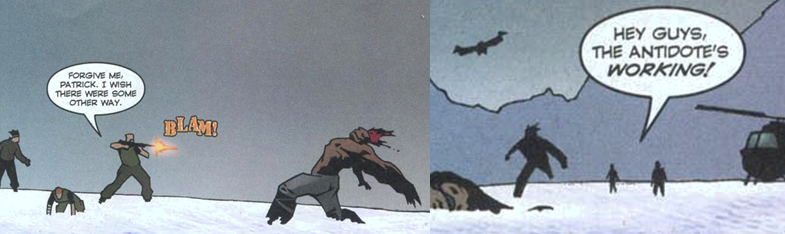
Raquel injects the antidote into Rosa but Brady wakes up before he can receive it and Falcon is forced to put him down with a single shot to the head; on the plus side, the antidote takes hold in Rosa and returns her to normal (though we don’t actually see this on panel). Just as it seems like our heroes have survived, however, it is revealed that yet another shady Umbrella operative (or…maybe it’s Klaus? It’s not really made clear) who monologues that, actually, everything went almost exactly according to Umbrella’s plan as Charlie team eliminated “the rogue agent Dexter Whitlam”, killed one of their own, and Raquel’s infection will ensure that the whole team is dead before they ever get a chance to land and the issue just…ends.

REF&I4Brady
None of Brady’s potential or plot threads are capitalised on.

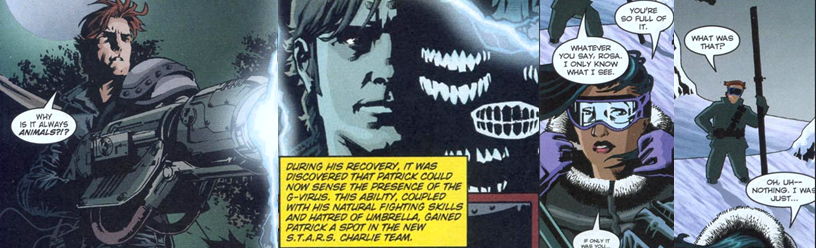
So…what was the point of that sub-plot about Brady being able to sense the G-Virus as a result of being cured of the virus? That literally doesn’t crop up once throughout the entirety of Fire and Ice when it really could have been a useful feature that made him a relevant part of the team, or perhaps helped him to resist the X-Virus. Instead, he has this ability but does nothing with it, wields a massive, bad-ass electric cannon and is stated to be a formidable fighter (despite being nothing more than a zoo security guard), falls and hits his head, and then gets turned into a sasquatch-like thing, and summarily shot in the head. Nothing even comes of the poorly executed hint that Rosa is attracted to Brady.

REF&I4Labs
The two labs seem to be working on different things? Or the same things? I can’t tell!

It all just comes crashing to the ground in this final issue; since when was Whitlam a “rogue agent”? He was directly recruited by Umbrella and was using their existing viruses and resources to fashion a new, more powerful and deadly virus; that definitely sounds like something they would do, and want, but then it doesn’t even pay off as I’m not seeing anything in the mutations Brady and Rosa undergo that makes the X-Virus better than the G-Virus or even the Tyrant-Virus (T-Virus). Neither seem anywhere near as vicious or resilient as the Tyrants or the “G” monstrosities of the videogames; I know that WildStorm liked to really neuter Umbrella’s monstrosities, with even Mr. X and William Birkin’s “G” being put down with disappointing ease, but these X-Virus creatures are even more of a joke. Not only that, issue one made it sound as though the Alaskan and Mexico laboratories were working on two separate projects and viruses. Instead, apparently, their “rogue agent” was working on the X-Virus in Alaska, which was also known as “Biohazard” in Mexico (…for some reason) and also produced an antidote…that was also in Mexico. Unless “Biohazard” is supposed to be the antidote? The issue isn’t written to support this, though, and instead it seems like Whitlam developed one virus with two names and stashed the antidote thousands of miles away for no real reason. If the X-Virus was really supposed to be the successor t the T- and G-Viruses, why even make an antidote in the first place?

REF&I4Raquel
Raquel’s mutation only matters when the plot says it does.

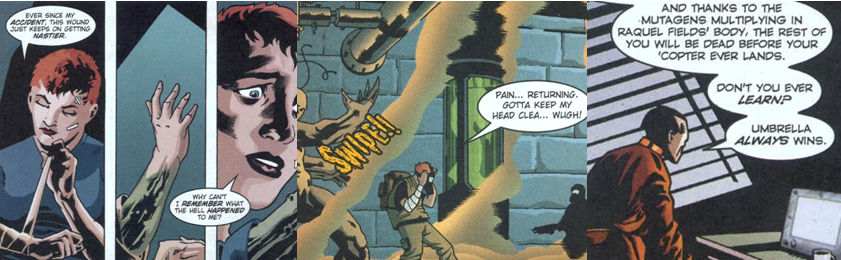
And then there’s Raquel. All throughout Fire and Ice, a big deal is made of her mysterious infection (which, I assume, she got from her brief appearance at the start of issue one and is a result of her being infected with the G-Virus) but, again, nothing comes from it. Her skin changes colour, taking on a strange green hue, she grows a bony protrusion that she immediately cuts off, she suffers from headaches (but only when it’s dramatically appropriate), and then the series winds up with the threat that she’s going to transform into…something…and kill her team mates. I was expecting her to mutate into something and battle with the X-Virus monsters but…she doesn’t and, as a result, this whole plot point is a giant waste of time that adds nothing to the story, is never resolved, and leaves more questions than answers. Say what you will about Alice (Milla Jovovich) in Paul W. S. Anderson’s Resident Evil movies (2002 to 2016), at least her mutation actually factors into the plot and the movie’s action sequences.

REF&I4Characters
None of the characters really stood out for me.

Jesse’s heel turn is as obvious as the nose on your face and immediately amounts to nothing as he is killed right away; it’s not like he destroys the antidote and forces Charlie team to kill both Brady and Rosa, he just stands in the way for a moment and then gets stabbed from behind. Neither Falcon or Quan end up becoming fully-developing characters, but then this is par for the course of Fire and Ice. When I reviewed Resident Evil: The Official Comic Magazine, I talked about how I wanted to see WildStorm focus more on telling a continuous story issue by issue rather than a whole bunch of vignettes and half-assed adaptations but, man, was I wrong. Their writers were no better at telling a month by month story with their own original characters than they were with Resident Evil’s more recognisable characters and, as I mentioned before, this time there’s no impressive, gory artwork to save the series. As a companion piece to Resident Evil: The Official Comic Magazine, I guess Fire and Ice works well enough at fleshing out (or, at least, putting more of a spotlight on) some of WildStorm’s minor characters and maybe the team were planning on publishing a third mini series to wrap up all their loose ends but it definitely doesn’t read or seem that way. Instead, WildStorm again squandered their pages and efforts on one-dimensional, action, horror, and move clichés and archetypes, and somehow manages to tell a four-issue story without ever really getting into who these characters are, what their motivations are (besides being angry and quick to violence), or actually crafting a story that made logical sense.

REF&I4Covers
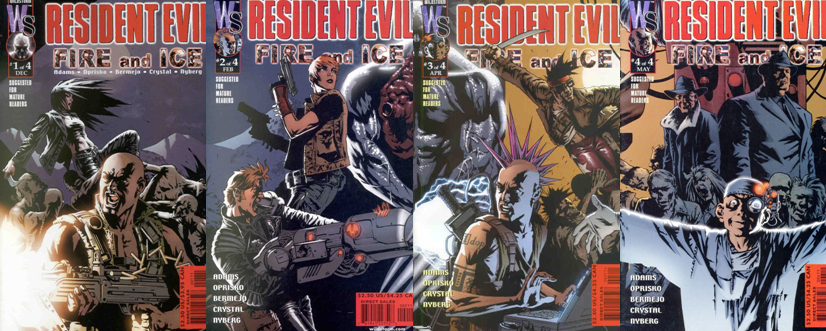
It’s pretty cool how the covers all form one giant picture, though.

Like Resident Evil: The Official Comic Magazine, Fire and Ice was eventually collected into a trade paperback which, like Resident Evil: Collection One (Various, 1999), is currently out of print but, unlike that collection, generally sells for about £40 to £60 rather than £60 to £200. They also returned to the franchise and published a prequel to Resident Evil 5 (Capcom, 2009) between 2009 and 2011 but, after reading Fire and Ice, I can’t say I’m too excited about covering more of their Resident Evil comics later down the line. If WildStorm ever re-released their original Resident Evil comics, including Fire and Ice, into one affordable collection then maybe, maybe, as one complete package these comics might hold up slightly better but, as is, I wouldn’t worry about trying to add these to your Resident Evil collection, no matter how big a fan you are, as there’s really nothing on offer here.

My Rating:

Rating: 2 out of 5.

Could Be Better

Did you ever read Fire and Ice? What did you think of Charlie team and WildStorm’s original characters? Do you agree that the artwork in these issues is a massive step down from WildStorm’s earlier efforts, and that WildStorm bungled their time with the franchise, or do you have fonder memories of their efforts than I do? Which piece of ancillary Resident Evil media is your favourite? Thanks for coming back each week for my review of Fire and Ice; are there any other Resident Evil games or adaptations you’d like to see me cover? Whatever you think, leave a comment below and have a great Halloween.

Game Corner: Castlevania: The Adventure (Xbox One)

CVALogo

Released: May 2019
Originally Released: October 1989
Developer: Konami Digital Entertainment/Konami Industry Co. Ltd
Original Developer: Konami
Also Available For: Game Boy, Game Boy Color, Nintendo 3DS, Nintendo Switch, Nintendo Wii, Nintendo Wii U, PC, and PlayStation 4

The Background:
Understandably, it seemed like Nintendo had a rule of sorts back in the day: If a title was successful on the Nintendo Entertainment System (NES) then it was getting a port, or some kind of sister release, on the Game Boy…and Castlevania (Konami, 1986) was no different. Back then, of course, Nintendo’s Game Boy was quite the popular bit of kit; even after SEGA released their technically superior Game Gear in 1990, the Game Boy was still the go-to handheld gaming device. However, Castlevania: The Adventure (not The Castlevania Adventure, as the title seems to suggest) was an early Game Boy title and, as such, is largely subpar even compared to the NES Castlevania but is it still capable of telling a halfway decent Castlevania story or does it crash and burn in all its monochrome glory?

The Plot:
A century before Simon Belmont’s adventures in Castlevania, his ancestor, Christopher Belmont, took up the legendary whip, the Vampire Killer, and went on his own journey to confront the dreaded Count Dracula.

Gameplay:
Castlevania: The Adventure, despite its title, is a 2D, sidescrolling action/platformer in which players take control of Christopher Belmont. However, just like Trevor and Simon in the series’ NES titles, Christopher is a clunky, heavy lump of meat; he trudges forwards as if walking through soggy mud, has very slow reaction times, jumps backwards upon taking damage, and has some of the most awkward jumping mechanics I’ve ever seen, to say nothing of in the Castlevania series. When you press the jump button, Christopher does a pitiful little hop; holding it allows him to jump higher and, when combined with a direction, theoretically allows him to clear gaps…but he has a hell of a hard time doing this. Generally, when you try and clear a gap, Christopher prefers to drop like a stone to his death, meaning you can burn through your limited lives quite easily just trying to jump across a small gap. Like his counterparts, Christopher wields the Vampire Killer, a whip that you can upgrade to first make it longer and then, revolutionarily, spit out a fireball. Each time Christopher takes damage, he loses a portion of health and his whip downgrades one level, meaning you may struggle with later enemies and bosses if you take too much damage.

CVAWhip
Christopher’s whip can be upgraded to shoot fireballs!

Due to the limited power of the Game Boy, Christopher cannot pick up sub-weapons in this game, meaning that you’re heavily reliant upon the whip’s fireball mechanic. This also means that, for the first time in the series, picking up a heart actually replenishes your health! Whipping candles also allows you to pick up coins for extra points (being granted an extra life upon every 10,000 points) and, on the rare occasion, a 1Up that gives you an extra life. And you’ll definitely need to grab these when you see them as Castlevania: The Adventure is one tough cookie, probably the most difficult of the 8-bit Castlevania’s so far. This is primarily due to three prominent gameplay mechanics: the first is the game’s use of breakable and falling platforms. In one particular area, you can destroy Big Eye’s, which explode upon being attacked and take out a section of a bridge. In many other areas, Christopher must jump from one platform to another but, upon landing, the platforms will almost immediately drop, meaning you have to have pitch-perfect timing to even attempt a clumsy jump to the next platform. The second is the game’s use of looping sections; at times, you’ll be faced with the choice of taking a higher or lower path, usually using a rope. Castlevania: The Adventure loves to have you climbing up and down ropes, for some reason, rather than climbing stairs, making for the most vertically-orientated Castlevania title thus far. Sometimes, though, you’ll simply loop around again and again because you’re supposed to take the other route; this isn’t so bad but it’s compounded by the game’s timer, which continually counts down at the top of the screen, and, of course, the fact that the game’s enemies respawn when you leave an area.

CVASpikes
You’ll be outrunning a lot of instant-death spikes!

The third and most annoying element is the game’s use of auto-scrolling sections. The game only has four stages so, to make the third stage more difficult and annoying (and, no doubt, to pad the game out by sapping you of all your lives), the stage sees Christopher being inexorably chased by a wall of spikes. You have to climb up ropes and make tricky jumps across gaps (and on to falling platforms) to escape the rising spikes and then rush to the left past enemies and jumping from rope to rope as the spikes chase you from the right. It’s a tense, frustrating section of the game that pretty much lasts for the entirety of the third stage; the fourth and final stage might be lined with instant death spikes but at least they don’t force you to plod along as fast as Christopher’s heavy ass can take him (which is not very fast at all). Unlike every other 8-bit Castlevania title, Castlevania: The Adventure is a cruel, mercilessly cheap little platformer; no matter how good your skills are, the game’s plodding pace and insistence on having Christopher drop like a stone every time you press the jump button means that you are, more often than not, going to die at least once per stage when playing this game. Perhaps this is the reason why the game doesn’t have many enemies (well, that and the Game Boy’s lack of processing power…) and is quite generous with its health and 1Ups because the moment you try and hop across a gap, you’re probably going to plummet to your doom regardless of your skill level.

Graphics and Sound:
As a Game Boy title (and a very early Game Boy title at that), Castlevania: The Adventure is, understandably, quite bland. Each of the game’s four stages is unique in its presentation, which is honestly surprising as it would have been so much easier for the developers to have the entire game take place inside Dracula’s Castle. Instead, you’ll journey through a gloomy graveyard, a haunted forest, and different areas of the Count’s spike-filled castle, which helps keep the game visually interesting stage by stage.

CVAGraphics
Castlevania: The Adventure looks quite good…in colour…

As for the game’s sprites, Castlevania: The Adventure actually does a pretty decent job of replicating the aesthetics of its 8-bit counterpart; unfortunately, the Castlevania Anniversary Collection only offers the original, black-and-white version of the title, which is a shame as the Game Boy Color version is much easier on the eyes. Even with the Collection’s colour filter, Christopher struggles to stand out from his surroundings and enemies and the game suffers from slowdown and blurriness, which leads to some noticeable sprite flickering, all of which only makes the difficult platforming even more frustrating. Surprisingly, the game has quite a decent little soundtrack; each area has its own catchy themes (with the first stage’s “Battle of the Holy” being a standout track), which, again, is surprising as I would have understood if the developers had just used one or two tracks throughout the game.

Enemies and Bosses:
Castlevania: The Adventure manages to separate itself from its 8-bit counterparts by featuring a few different enemies; sure, you’ll still have to contend with bats and variations of the crows and fireball-spitting bone pillars, but, rather than being faced with waves of skeletons, zombies, and axe-throwing knights, you’re faced with some unique foes. Christopher battles giant eyes that explode on contact, the shuffling Creeper, variations of the mud men (who don’t split into pieces and are more like the old zombie enemies), annoying little worms that can curl into balls to attack you, and perhaps the game’s most annoying enemy, the Night Stalker. Like the axe knights, the Night Stalker tosses a projectile at you (in this case a sickle) either up high or down low; what makes this guy so annoying, though, is that the sickle will circle around and you’ll have to either awkwardly try and jump over it or desperately try to duck under it in time, meaning the fireball whip is highly recommended against these guys.

CVABosses
The game’s bosses aren’t much of a threat, even when they appear as regular enemies.

As the game only features four stages, you’ll only have to battle four bosses, none of which are particularly difficult. The game throws a wrench in the works by having Gobanz, the armour-clad boss of the first stage who can repel your fireballs (they won’t hurt you though) and wields a retractable spear, pop up as a regular enemy in the final stage but, as long as you attack his head from a distance, he’s not much of a threat. The game even cheaps out a bit by having the Under Mole simply be a gauntlet against a near-endless wave of the creatures but it’s pretty simple to stay completely safe from danger and destroy them as their pattern is pitifully predictable.

CVADracula
Though he has two forms, Dracula is a bit of a pushover here.

The game’s most difficult bosses are easily the Death Bat and the two-stage finale against Dracula. After you destroy Dracula’s human form, he’ll transform into a giant bat and send three smaller bats out to damage you; this battle also takes place over a pit of spikes but, for the most part, its pretty simple to camp out on a platform for both bosses and deal some decent damage before dodging or switching your position, meaning their actual threat is minimal, at best.

Power-Ups and Bonuses:
Whip at candlesticks and you may produce an orb; collect one to make the Vampire Killer longer and another to have it shoot fireballs. You can also grab a Cross to receive a generous invincibility but that’s about it for power-ups. Collect coins for points; you’ll get an extra life for every 10,000 points and, the more enemies you destroy, coins you collect, and faster you beat a stage, the more points you’ll receive as a bonus. Otherwise, that’s pretty much all there is.

Additional Features:
As is a tradition in the Castlevania series, once you defeat Dracula and sit through the game’s credits, you’ll be deposited back into the first stage only, this time, you’ll be playing in “Hard Mode”. Every time you beat the game, you replay it again and again, with the enemy’s dishing out greater and greater damage each time for an added challenge. Unfortunately, there is no password system for this title, though you are given an infinite number of continues if (well, when) you run out of lives. As with all titles in the Castlevania Anniversary Collection, you can earn an Achievement for clearing the game, use save states to cheese the game’s difficulty save your progress, and apply different frames and display options (but, sadly, there’s no colour option).

The Summary:
Castlevania: The Adventure does a decent enough job of recreating the look and feel of the first Castlevania while doing just enough (literally the bare minimum) to stand out as its own title. However, most of the features that make this game unique are the most frustrating parts of the game; omitting the sub-weapons makes the game so much tougher as you really need the fireball whip but you’ll lose it the moment you take damage and the game’s janky controls and insistence on making jumping as difficult as possible means it’s very difficult to jump and whip and clear a gap while collecting an item that much harder. With only four stages, a handful of bland enemies, and four of the franchise’s easiest boss encounters, Castlevania: The Adventure clearly struggles to get the most out of the Game Boy. As an early release, though, it was clearly hampered by the fact that other developers hadn’t yet found ways to working around the handheld’s limited capabilities and, as we have seen, the Game Boy is perfectly capable of producing decent 2D sidescrolling titles so it stands to reason that Castlevania: The Adventure could have been so much more than a slow, clunky title with a penchant for having you plummet to your death at every press of the jump button.

My Rating:

Rating: 1 out of 5.

Terrible

Did you ever play Castlevania: The Adventure on the Game Boy? Do you give the game a pass (or, at least, some slack) because it was a Game Boy title or did you think Nintendo’s handheld was capable of producing a much better Castlevania title? What was your favourite Game Boy game back in the day? Whatever you think about the game, or Castlevania, in general, leave a comment below and check out my other Castlevania reviews.
Back Issues: Resident Evil: Fire and Ice #3

BackIssues
REF&I3Title

It’s October and Halloween is right around the corner and what better way to mark the occasion and bring some extra views of any self-respecting content creator’s blog than by taking a look back at Resident Evil: Fire and Ice, a four-part comic book series published by WildStorm between 2000 and 2001. WildStorm had previously published a five-issue mini series that told interludes, heavily truncated recaps of the first two Resident Evil videogames, and introduced a whole slew of minor characters and original creators to what was, at the time, a far less complex lore. The Fire and Ice comics continue with this premise, ditching the anthology format to follow the hitherto-unknown Special Tactics and Rescue Service (S.T.A.R.S.) Charlie team, consisting of the heavily muscled team leader Falcon, newcomer and munitions expert Raquel Fields, and a whole bunch of one-dimensional nineties throwbacks with more diversity than you can shake a stick at: we’ve got the anti-authority Australian Quan Williamson, Patrick Brady (a former zoo keeper now endowed with minor superpowers), Mexican quasi-Native American Rosa Cardenas (whom it is implied Quan has a crush on but who actually has feelings for Brady…), and the somewhat unhinged tech-savvy Jesse Alcorn.

REF&I3Traps
Falcon’s team runs afoul of traps as sophisticated as quicksand and some darts!

After splitting into two sub-teams, issue three rejoins Falcon’s team in Mexico where, you may remember, Falcon, Raquel, and Jesse managed to track down an Umbrella laboratory in Mexico. As they approach the pyramid-like structure, however, they fall victim to some of the oldest, most clichéd desert-based traps in the business: quicksand and darts! All that was missing was a pit of spikes with skewered skeletons and a rolling boulder and the writers would have nailed every cliché in the book.

REF&I3Door
Who needs a hacker anyway?

Narrowly escaping, Jesse states that he’s unable to crack the code on the entrance because of the sheer number of possibilities; he reckons it would take his computer “days” to break into the facility, which Raquel gives him some grief about. And rightfully so; I mean, what good is a damn computer hacker when they can’t even do the one job you bring them along for? Luckily, Raquel actually remembers that she’s good with explosives in this issue and simply blows the door open; if only that was an option in the videogames!

REF&I3Licker
WildStorm deals the Licker a short hand once again.

Upon entering the pyramid, Jesse is immediately attacked by a Licker, further cementing himself as perhaps the most useless member of Charlie team so far. In true WildStorm fashion, the Licker is barely shown and easily dispatched by Jesse’s far more competent team mates and the three make their way deeper into the facility, where they not only discover Umbrella’s scientists cooking up new horrors in giant, gunk-filled tubes but also, inexplicably, spot Rosa and Brady held in captivity (this is presumably on some kind of monitor but, like last issue, the art isn’t very clear and makes it seem as though Falcon spots the two in the next room).

REF&I3Plot
Whitlam has created a newer, better virus…but you can’t see it yet!

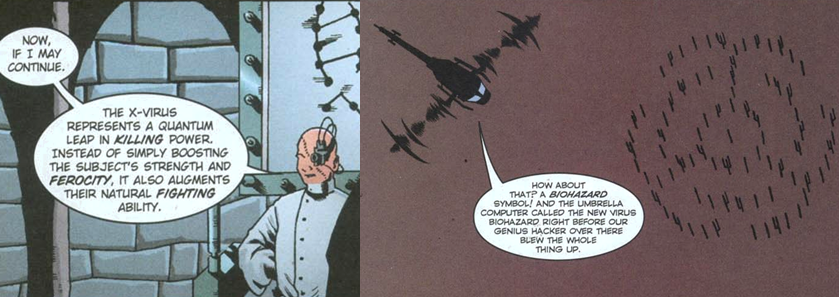
Back in Alaska, Rosa and Brady are being held captive in a dungeon-like cell after the events of the previous issue saw them attacked and captured by Umbrella agents Klaus and Mr. Venk in Alaska and Quan alone out in the frozen wastes of the Alaskan mountains. Quan rushes back to their last known location and finds only a radio transceiver that fell from Brady’s pocket in the last issue and allows him to listen in as the now grown-up (and, apparently, somewhat cybernetic) Dexter Whitlam monologues to Rosa and Brady about his evil plan. Building upon the work of William Birkin and refining the best aspects of both the Tyrant-Virus (T-Virus) and G-Virus, Whitlam reveals (much to Klaus’ chagrin) that he has crafted a new virus, the X-Virus, which he claims represents “a quantum leap in killing power” and boosts the victims strength, ferocity, augments their “natural fighting ability”, and renders them virtually unstoppable. He also reveals that, up until this point, the characters haven’t yet encountered anything actually infected with the X-Virus; the G-creatures were merely created to find suitable subjects for the X-Virus and, as Rosa and Brady were, somehow, the only two test subjects to not only survive but also kill two of the G-creatures, Whitlam believes that they will make ideal candidates for a dose of X-Virus.

REF&I3Tyrant
A Tyrant breaks free and goes on a brief rampage.

Back in Mexico, and spurned on by the impending threat to the lives of their team-mates, Falcon’s team renders all of the Umbrella scientists unconscious with a gas bomb and moves to retrieve the data from their computers (assuming Jesse can hack in, of course) but, somehow, a Tyrant breaks free from its captivity and goes on a rampage. Partially stunned by the pain from her mysterious infection, Raquel is easily tossed aside and, with Jesse cowering under a table, this leaves Falcon to face the beast alone with only his shotgun. This is WildStorm, though, and they have never quite been able to portray Umbrella’s fearsome bio-organic weapons as the formidable threats they are in the videogames, particularly the Tyrant, and this is no different. It simply walks towards Falcon, who unloads shot after shot until he blasts a hole through its head and then fires a few more shots just to be on the safe side, proving once again that, in these comics, a Tyrant is a mere inconvenience more than a life-threatening menace.

REF&I3Tyrant3
At least time it took a rocket launcher to finally put the Tyrant down…

While attempting to locate an antidote to the X-Virus on the lab’s computer, Jesse accidentally activates the obligatory self-destruct sequence and the three barely make it out alive. The Tyrant emerges from the flames but, again, it’s just an inconvenience as Raquel has all the time in the world to load up a rocket launcher and blast it to pieces while barely breaking a sweat.

REF&I3Art
What is it with this art? Why does the Tyrant look so bad?

The issue ends with the sub-team stranded in the desert, surrounded by cactus plants shaped in a biohazard symbol, with no way to reach their comrades. It also ends with a dangling plot thread as, when Falcon admonishes Jesse for risking their lives, Jesse acts very shifty and claims that the self-destruct was merely an unavoidable accident. Like the last issue, the artwork really lets this issue down. The whole series, so far, has lacked the polish and visceral gore of Resident Evil: The Official Comic Magazine, which suffered from similar writing issues and problems with the portrayal of recognisable Resident Evil characters, creatures, and tropes but at least had some decent gore to look at. Here, though, everything is so bland and simple and dull; even the Tyrant looks like a cheaply-drawn knock-off and there’s even less sense of threat or danger even with the inclusion of a Tyrant and the compulsory ticking clock that has become a staple of the Resident Evil series.

REF&I3Characters
Fire and Ice‘s characters are a bland bunch of one-dimensional clichés.

Again, it doesn’t help that there’s very little to really keep us invested in WildStorm’s original characters; I can’t say that Fire and Ice would be better if the likes of Jill valentine, Barry Burton, and Chris Redfield replaced Charlie team but at least we’d be able to fill in the gaps about their personality and backstory. Here, we don’t really know anything about these characters beyond a quick introduction in issue one and some one-dimensional characterisation in these subsequent issues. It’s nice that WildStorm were able to give some of their minor characters more of a spotlight but Whitlam is just the clichéd mad scientist archetype, Falcon looks and acts like he stepped right off the set of Predator (McTiernan, 1987), and the rest of them are just a bunch of holdovers from the “Dark Ages” of nineties comic books. The next issue is the last in this series and it feels like I’ve learned very little to nothing about these characters and nothing of any real note has actually happened, and that’s a shame considering how WildStorm fumbled their last Resident Evil comic series.

My Rating:

Rating: 2 out of 5.

Could Be Better

Do you agree or do you feel I’m being too harsh on WildStorm and the Fire and Ice series? Do any of the characters stand out to you? Which Resident Evil character is your favourite, either from the games, comics, books, or movies? Which piece of ancillary Resident Evil media is your favourite or would you like to see produced? Drop a comment down below and come back next Tuesday for my review of the fourth and final issue of WildStorm’s Fire and Ice miniseries.

Academic Publications

After three years of studying English Studies at the University of Bedfordshire, I decided to pursue post-graduate studies at DeMontfort University in Leicester. After completing my Master’s degree, I spent the next five years working towards a PhD in the field of Adaptations and, as part of that, published the following works.

In the December 2012 issue of the Journal of Adaptation in Film & Performance, you’ll find my article “Aggressive action, Oedipal inaction and incessant procrastination: The genre conventions of Hamlet”, in which I discuss four different screen versions of Hamlet.

If you’re studying film or adaptations, you can also find this article on reference sites like ResearchGate, EBSCOhost, and the World Shakespeare Bibliography.

The culmination of five years of my life, “Interplay: The Adaptive Contexts of Videogame Adaptations and Franchises Across Media” is a huge 80,000 word thesis in which I discuss the history of videogames, videogame adaptations, and attempt to construct an academic language in which to talk about this unique genre of filmmaking using some of the most famous (an infamous) examples).

New Sonic Adventures

NSALogo

New Sonic Adventures was a series of sprite comics I made between 2002 and 2006 and published online using Tripod and Angelfire sites. As a life-long fan of the Sonic the Hedgehog franchise, I had always yearned to tell my own Sonic stories and to present my own version of events surrounding Sonic and his ever-growing cast of characters. As a child, this was realised through numerous crude-to-mediocre drawings and comics but, after seeing the wide variety of sprite comics out there, I eventually turned to using sprites to realise my vision. Making a sprite comic isn’t easy, and I learned more tricks and became better at it with each comic I made. My earliest attempts were hampered by my limited knowledge of picture software and limited tools. As a result, I would type up scripts in Word and then use Paint to put everything together.

My first comic was restricted by the fact that I was new to the process, young, and stupid (I didn’t even know about the transparency function in Paint, meaning that I had to fill in the blank white spaces around every sprite!) However, as I progressed, the process became faster and easier and I ended up using Word tools and Jasc Paint Shop Pro to create more complex effects and flourishes to subsequent entries. I also started to piece together my own backgrounds and sprite art; as new Sonic characters were being introduced faster than the sprite community was willing to create new sheets of sprites, I would be forced to create sprite characters from very limited work available in order to progress my narrative. What began as quite a simple concept that sought to mash together all aspects of Sonic’s complex different interpretations soon spiralled out of control into an entirely different interpretation of the character, one that became far removed from the source material despite my initial aims to be more true to it than other adaptations. My comics became influenced by anime (particularly Dragonball Z and the first Pokémon movie), movies (the Matrix trilogy and Star Wars saga, for instance), and other sources to eventually take on a life all of its own.

Eventually, as time wore on and my priorities turned elsewhere, I drew my series to a close with one final comic. However, I had ideas mapped out for a whole series of spin-offs and continuations and even completed two whole parts and a sizeable third of a whole new entry in the series, including a website and commentary, but never finished the project or made it available online as I focused on my academic achievements. Still, I was able to finish the series with a conclusion and even revisited my first two entries and applied some of my more advanced techniques to make them more professional and presentable and to address some continuity issues in those early entries. Although I don’t promote the series at all any more, I’d still like to use this page to showcase what was once a big project in my life.

BFTCE

The first entry in the series, Battle for the Chaos Emeralds, provides a unique origin for Doctor Ivo “Eggman” Robotnik and, drawing from Sonic the Hedgehog, Sonic the Hedgehog 2, Sonic the Hedgehog 3, and Sonic & Knuckles, tells the first adventure of Sonic and Tails as they meet Knuckles for the first time and team up to stop Robotnik from turning his Death Egg against their home. Some time later, I produced a revamp of this comic with the Remastered Emerald Edition, in which I applied my now-well-crafted sprite comic techniques and made the comic far more presentable.

TTSS

This was followed by the four-part Time Stone Saga, which was inspired by Sonic the Hedgehog CD, Knuckles’ Chaotix, Sonic 3D: Flickie’s Island, Sonic the Hedgehog: Triple Trouble, Sonic Advance, and Sonic Advance 2. This comic saw me switch to using the Advance sprites for the main characters, which were much easier to edit and allowed for far more emotions and actions, and utilise a sequential narrative format that saw Sonic, Tails, Knuckles, and their friends split up into four separate quests to retrieve the legendary Time Stones before Robotnik can use their power for evil. Again, I later revamped all four parts with the Remastered Time Stone Edition, which, again, corrected many of my earlier errors and also provided additional material.

PC

The third entry, Perfect Chaos, was where my series really started evolving into its own entity as I mashed together the narratives of Sonic Adventure and Sonic Adventure 2 to introduce Shadow to the series. Faced with the team-up between Robotnik, Metal Sonic, and Shadow, Sonic and his friends must attempt to stop them from resurrecting an ancient evil, Chaos, and destroying the world.

TCRS

I then returned to the sequential format with the four-part Chaos Ring Saga, which is where the Dragonball Z influences really start taking prominence. After learning of the ancient Chaos Rings, Robotnik seeks to gather them and regain control over the planet with their power. Sonic, Tails, and Knuckles race to find them first and awaken their latent Chaos Emerald powers before running a deadly gauntlet of Robotnik’s most fearsome creations.

SH

The five-part Sonic Heroes saga sought to return the series to a more simplistic, less-convoluted narrative that was closer to the videogame source material. In this loose adaptation of the titular videogame, Team Sonic, Team Rose, Team Chaotix, and Team dark are each lured into a trap by Robotnik that sees them come face-to-face with the deranged robotic menace, Metal Sonic.

SBMR

Sonic Battle: Metal Ragnorak continues and ultimately concludes this narrative; inspired by Sonic Battle and Sonic Advance 3, with strong influences of the Matrix trilogy, Sonic is forced into a final confrontation with his metallic doppelgänger that sees an army of Metal Sonics lay siege to his home and the fate of the planet placed in an intense confrontation between Super Metal Sonic and Super Sonic.

SL

Finally, the series draws to a close with Sonic: Liberty where, in true Return of the Jedi fashion, Eggman has rebuilt his Death Egg satellite and is preparing to transform the entire planet into a mechanical monstrosity. Faced with this world-ending threat, Sonic, Tails, and Knuckles must align with some unlikely allies to realise their destiny and end Robotnik’s threat once and for all.

TOS

But it doesn’t end there! A series of spin-offs expand the series beyond the main entries and bring life to this unique Sonic continuity:

After being introduced in Perfect Chaos, the backstory and continued adventures of Shadow are explored in the Tales of Shadow series: Chaos Control explores how Shadow first came to be in ancient times and his first confrontation with the unstoppable Chaos; Marooned details how Shadow has been operating between the events of Battle for the Chaos Emeralds and the Time Stone Saga to orchestrate some key events in the series; The Return of Chaos details the discovery and devastating first appearance of the mysterious Gizoid, Emerl, and sees the immortal Shadow team up with his biomechanical clone to tackle the renewed threat of Chaos and its disastrous confrontation with Emerl; finally, Residual Chaos sees Shadow battle the merciless Wechidna and tells the final tragic story in Shadow’s life.

Probably the comic I’m least proud of, Chaotix: Roots explores the origins and first meetings of the Chaotix Detective Agency as Vector, Espio, Mighty, and Charmy team-up with Ray to escape the clutches of a renegade bounty hunter.

Finally, Sonic Battle: I, Metal tells the story of the series up to the point of Sonic Battle: Metal Ragnorak entirely from the perspective of Metal Sonic, allowing for not only a unique take on the events that have transpired but also an in-depth look into exactly how Metal Sonic gained sentience and formulated a complex plan to finally gain the power needed to face his biological counterpart equally.

If you’d like to learn more about sprite comics, or even create your own, try visiting websites like the Spriter’s Resource or the Shyguy Kingdom. I’m not sure how active the community is any more; back when I first started, it was really vocal, busy, and rampant but progress on new sprites and sprite projects seemed to die out over time. However, the resources are out there if you look hard enough.

Game Corner: Super Castlevania IV (Xbox One)

CV4Logo

Released: May 2019
Originally Released: October 1991
Developer: Konami Digital Entertainment/Konami Industry Co. Ltd
Original Developer: Konami
Also Available For: Nintendo 3DS, Nintendo Switch, Nintendo Wii, Nintendo Wii U, PC, PlayStation 4, and Super Nintendo Entertainment System (SNES)

The Background:
So, thanks to the Castlevania Anniversary Collection, I recently found out that Super Castlevania IV is actually a remake of Castlevania (Konami, 1986), though the US version of the game positions itself as a sequel to Castlevania II: Simon’s Quest (ibid, 1987). Either way, though, Super Castlevania IV (a grandiose title I adore as it implies there was a “regular” Castlevania IV), is widely regarded as one of the best (if not the best) entries in the entire Castlevania series thanks to its tight controls, gameplay mechanics, soundtrack, and, of course, sporting some of the most impressive 16-bit graphics ever seen. Despite the fact that I grew up playing the Mega Drive, I’ve probably played Super Castlevania IV the most out of all the classic Castlevania games thanks to emulators and the SNES Classic Edition. Of all the games available on the SNES Classic, this is one of the only ones I actually took the time to play and beat so I was excited to jump back into it as part of the Castlevania Anniversary Collection.

The Plot:
When the immortal vampire Count Dracula threatens the land, Simon Belmont, of the legendary Belmont family of vampire hunters, takes up the feared whip of his ancestors, the Vampire Killer, and journeys into Dracula’s castle to end this threat.

Gameplay:
Super Castlevania IV is a 2D, sidescrolling action/platformer that once again casts players in the role of Simon Belmont. Unlike every Castlevania I’ve played as part of this marathon, though, Simon actually controls well in this game. And not just “well”; his control is superb and unparalleled to his predecessors thanks to the 16-bit power of the SNES. For the first time, you can properly control Simon as he jumps and he doesn’t feel like he has weighted lead in his boots. As always, he attacks with the Vampire Killer, a whip that can be upgraded to a chained variant within the first few minutes of play. However, unlike in all previous Castlevania games, players can now attack in eight different directions! This means Simon can attack airborne enemies much easier thanks to his upwards and diagonal attacks and while also making short work of those beneath him. Additionally, by holding down the attack button, the whip goes limp, acting as a shield of sorts and can be manipulated by the player to damage enemies.

CV4Whip
The whip is at its most versatile in Super Castlevania IV.

Simon can also use the whip to swing across gaps and, of course, to destroy candles to acquire the traditional Castlevania sub-weapons, hearts (the ammo for his sub-weapons), and bags of gold for extra points. In a nice change of pace, he can also acquire a small health boost from chicken drumsticks also found in these same candles (as well as being able to find the odd pot roast by smashing breakable walls). While you can break through some walls to find hidden areas, or will often find power-ups and bonuses hidden away in the game’s stages, the branching path system of Castlevania III: Dracula’s Curse (ibid, 1989) is gone, replaced by a far more linear progression system, but the game’s various stages are so large and varied that I wasn’t even bothered. The game also does away with the frustrating auto-scrolling sections of Castlevania III and replaces them with far simpler (though no less exhilarating) sprints across crumbling platforms and walkways.

CV4Mode7
Mode 7 allows backgrounds and sprites to dynamically rotate and expand.

The majority of Super Castlevania IV is spent fighting your way towards Dracula’s Castle rather than journeying through it as in the original Castlevania. This takes Simon through some stunning and varied environments, each of which is populated by the usual traps, ghouls, and ghosts of the Castlevania series but also bolstered by some impressive graphical elements. You’ll go through gate doors in chain fences to explore the background of a stage, swing across gaps, leap across swinging chandeliers, and contend with a rotating background thanks to the SNES’s “Mode 7” capabilities. This graphics mode was further employed not only to rotate certain parts of levels in dynamic fashion, but also bolsters some of the boss battles; Simon will encounter the biggest, most complex bosses of the series so far in this game and they’re made all the more impressive by the way they expand or contract thanks to the added power of the SNES. As always, a lot of Simon’s quest will involve him travelling through gothic environments; luckily, platforming has never been better. Simon still flies backwards upon being attacked, which can still send him careening down bottomless pits or into deadly spikes, but the flexibility of Simon’s attack range makes it far easier to strike enemies while making tricky jumps. Additionally, it’s much easier to ascend and descend staircases in this game than in Castlevania III; there was no accidental plummeting to my death when trying to do something as simple as going down stairs in this game and, even better, Simon can even “moonwalk” and is far less open to attacks when on stairs thanks to the flexibility of his whip.

Graphics and Sound:
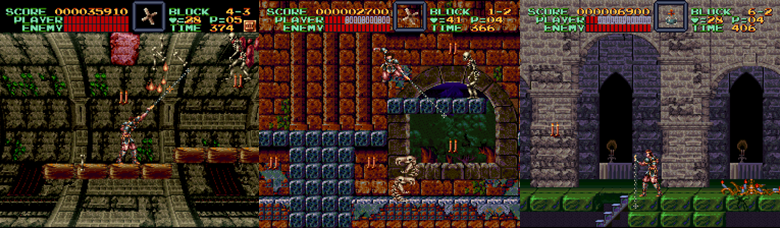
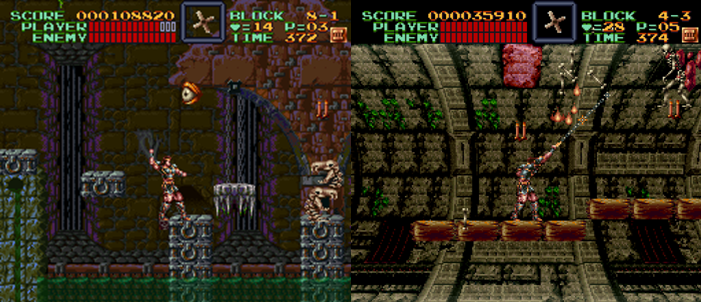
Unsurprisingly, Super Castlevania IV was the best the series had ever looked at that point. Crisp, highly detailed sprites and environments are the order of the day as the game takes full advantage of the SNES’s vastly improved graphics power and colour palette. Backgrounds are alive with animation and additional elements, enemies pop out from behind background obstacles, and Simon and his gothic surroundings are finally fully realised in fantastic detail.

CV4Graphics
The game can handle multiple enemies and/or effects with only minimal slow down.

Thanks to the added power of the SNES and the Mode 7 graphics, the game can handle multiple enemies and projectiles on screen at once; though there is, admittedly, some slow down in some areas with more graphical effects than others (the rotating corridor springs to mind), it’s nowhere near as bad as in the 8-bit titles and there’s never any sprite flickering here. As for music, Super Castlevania IV has some of the most memorable tunes in the series. Even better, by the time you reach Dracula’s Castle, the game will bust out 16-bit renditions of classic 8-bit tracks like “Vampire Killer” and “Bloody Tears”. The added power of the SNES really bolsters the creepy, gothic atmosphere of the game, allowing for weather and sound effects to punctuate the catchy, energetic soundtrack.

Enemies and Bosses:
Being as it was intended as a remake of Castlevania, all of the classic and traditional Castlevania enemies make their 16-bit debut in Super Castlevania IV. Simon primarily contends with skeletons; some will just walk back and forth, some pop out from the background, some throw bones at him, some leap at him and attack with whips, the red variants can reform after being destroyed, and the gold variants are tougher to destroy. He’ll also be swarmed by bats, Medusa Heads, knights who attack with lances or throw axes at either Simon’s head or crotch, and mud men who break into progressively smaller variants the more you attack them. There are some new enemies to content with here, however; the amusingly named “Mr. Hed” (which is a bloodied, disembodied horse’s head that attacks like a Medusa Head), ghosts, floating, severed hands, possessed caskets and dinner tables, and swarms of vipers that spontaneously spawn at Simon’s feet at the most inappropriate times. You’ll also contend with frogs and bothersome little gremlins, who jump around erratically, annoying little hedgehog-like creatures that roll into spiked balls, dogs that rush at you at high speed, and even enemies that emerge from the walls and scenery to grab or injure you.

CV4Boss2
Some bosses are tougher than others, though at least Death has a more forgiving attack pattern.

Super Castlevania IV’s bosses that range from ridiculously easy (like the skeletal horseman from the first stage and the giant bat made entirely of gold coins from the ninth stage), the visually impressive (the massive golem Koranot, which grows so large it fills the entire screen), and the down-right frustrating (I’m looking at you, Slogra!) You’ll also notice that a lot of the bosses from past Castlevania games return here, rendered in all their 16-bit glory: we’ve got twin-headed, fire-breathing dragons, Frankenstein’s Monster, the Medusa Queen and, of course, the Grim Reaper. Unlike in the 8-bit titles, though, while Death is one of the more troublesome bosses, it is much easier to attack and dodge his scythes and he has a clear attack pattern this time around, making it a challenging encounter but not one I wanted to rage-quit over. Before you can even face Dracula, you’ll have to endure a gauntlet of three bosses: Solgra (who is a massive pain in the ass until you learn to dodge, duck, and jump out of his wide-reaching attacks and hit box), Gaibon (a gargoyle-like creature who, despite having a second, faster form, is a joke compared to Solgra), and the aforementioned Grim Reaper. While you might think that this will leave you at a disadvantage for the final boss, there is a well-known hidden staircase just before this battle where you can refill your health and hearts to give you a fighting chance.

Watch out for Dracula’s lightning attack and fry his ass!

As always, Dracula’s weak spot is his head; this time, however, he initially teleports across this throne room in beams of light and attacks with a spread of fireballs. With the boomerang, you can increase your chances of hitting his weak spot and concentrate on using Simon’s limp whip to block these projectiles; once you’ve done enough damage, Dracula spawns two flaming skulls that follow Simon around. You can destroy them relatively easily but still have to be wary of their splash damage; luckily, though, unlike other Dracula fights, you’ll be able to pick up a little bit of health during this battle, increasing your chances. You’ll also need to use the limp-whip technique to shield yourself from a smaller fireball that blasts projectiles in a circular motion and, after you’ve damaged Dracula enough, he’ll assume a more demonic visage and try to fry you alive with four columns of lightning. Standing between them, you can attack his head and, when his health is depleted, the morning sun will break through the castle windows and destroy the Count.

Power-Ups and Bonuses:
All the standard Castlevania power-ups and pick-ups are available here; you can upgrade Simon’s whip three times, acquire the ability to throw two or three sub-weapons in quick succession, destroy all enemies on screen with the Rosary, and briefly turn invincible. All the same sub-weapons return in Super Castlevania IV in exactly the same way you’d expect; this time around, I favoured the axe and the boomerang and had little use for anything else. Honestly, I’m a little disappointed that Konami didn’t take the opportunity to bring in some new sub-weapons or Simon’s fire whip but I guess they were more concerned with tightening up Simon’s controls and gameplay and taking advantage of the SNES’s increased graphical power than changing their tried-and-true combat mechanics.

Additional Features:
As with previous Castlevania titles, Super Castlevania IV employs a password system to allow you to return to a saved game after a game over; additionally, once you finish the game, you’ll automatically return to the first stage with your score, lives, hearts, and last-used sub-weapon intact to take on the game’s “Hard Mode”. You can also earn an Achievement on the Xbox One Castlevania Anniversary Collection for finishing the game and apply the same frames and display options as the other games in the collection. In a way, it’s disappointing that Super Castlevania IV doesn’t offer more in terms of replayability (there are no additional characters or even helpful codes to input beyond the level passwords), but I would still rather come back to this title again and again than any of the previous 8-bit games (with, perhaps, the exception of Castlevania III).

The Summary:
With its tight controls and impressive 16-bit graphics, Super Castlevania IV finally allows the series to live up to the ambition it was striving for in Castlevania III and the game more than earns the its reputation as an absolute classic of the 16-bit era. I enjoy the first and third Castlevania’s but it was obvious that Konami had ambitions for their franchise that Nintendo’s 8-bit consoles just couldn’t realise; thankfully, the SNES changed that and we finally got a Castlevania game that looked, sounded, and (crucially) controlled the way they always intended. Every bit of praise you’ve heard for Super Castlevania IV is deserved; graphically, it’s on another level. It builds atmosphere brilliantly thanks to its gothic, moody environments, music, and aesthetic and the game’s difficulty builds just as naturally. All the familiar tropes and mechanics that made the Castlevania series work prior to this game are present, meaning you still have to watch out for sudden tumbles to your doom and the game requires only your very best platforming skills, making for a rewarding and thoroughly enjoyable romp through the haunted hallways of Dracula’s infamous castle.

My Rating:

Rating: 5 out of 5.

Fantastic

What did you think of Super Castlevania IV? Where do you rate it in the Castlevania series? What were your favourite games on the SNES? Whatever your thoughts on Castlevania, drop a comment below and check out my other Castlevania reviews.

Back Issues: Resident Evil: Fire and Ice #2

BackIssues
REF&I2Title

It’s October, which means it’s Halloween and it’s the duty of every content creator to do some kind of horror-themed content. As a result, I’m taking a look back at WildStorm’s second series of Resident Evil comic books, the four-issue Fire and Ice series published between 2000 and 2001. This time around, WildStorm have ditched the anthology format in favour of a continuous, original story revolving around a bunch of original characters, the hitherto-unknown Special Tactics and Rescue Service (S.T.A.R.S.) Charlie team. Last issue, Falcon’s Charlie team made short work of a circus full of infected zombies and were introduced to a new team member, munitions expert Raquel Fields, who is hiding a hideous mutation on her arm. Having recovered a disk naming two Umbrella facilities (one in Alaska and one in Mexico), the team has split into two and the last issue ended with Falcon’s sub-team face-to-face with a literal Day of the Dead south of the border…

REF&I2Dissension
There’s a bit of dissension in the Alaska team…

Issue two opens in Alaska with the second sub-team (the knife-wielding Australian Quan Williamson, former zoo security guard turned semi-superhuman bad-ass Patrick Brady, and team leader Rosa Cardenas) riding snowmobiles down the frigid mountains of Alaska. There’s a little bit of dissension in the early going as Quan, whom we were informed through a few dialogue boxes and brief snippets of his backstory has a bit of a problem with authority, takes umbrage with Rosa’s orders. However, a stern word from her is enough to quell that and he heads out while a monstrous bear watches on.

REF&I2Raquel
Raquel lops off her bony growth, which is clearly the best solution…

The story then jumps back to Mexico where Falcon’s team (including newcomer Raquel and tech-savvy Jesse Alcorn) open fire on the legions of zombies in an ironic perversion of the Day of the Dead festival. Oddly, despite Raquel being the munitions expert, it is Jesse who prepares a bomb while Raquel covers him; however, while doing so, she discovers a strange, bony growth coming out of her arm and decides the best way to deal with it is to chop it off with a meat cleaver! Meanwhile, back in Alaska, Brady tries to allay Rosa’s concerns over Quan’s absence by theorising that he has a crush on her; she dismisses this, however, and suggests, in a near-inaudible whisper, that she would be more interested if Brady had a crush on her. We’re only on the second issue, guys, are we really doing this sort of thing? I guess it’s an easy, cliché, artificial way of creating some kind of investment in these characters so we care more when their lives are in jeopardy or they get infected or die but it just kind of comes out of nowhere as I’m not really seeing anything that suggests any kind of sexual tension or attraction between any of these characters.

REF&I2Puzzle
Once again WildStorm awkwardly shoe-horns in the puzzle aspects of the videogames.

Anyway, they are interrupted by some kind of flying creature; it’s not really revealed what it is but it’s apparently threatening enough for the two to rush back to their snowmobiles to get their weapons. However, they are stopped in their tracks when they find they are surrounded by large, monstrous bears and bipedal walruses whales, and even a particularly fearsome looking penguin! Back in Mexico, Raquel blows the explosives but gets into it with Jesse when he inexplicable runs towards the explosion rather than staying clear (honestly, the artwork doesn’t make it massively clear what’s going on in these panels). Falcon quells the dissension and gets the team back on track towards their primary goal (…pretty sure we just saw that with the other sub-team…). Raquel draws Falcon’s attention to a particular piece of artwork in one of the ruined houses that bares a set of runes that Falcon says match up with those identified by Jill Valentine and Chris Redfield from the Spenser Mansion. This despite the impossibility of even spotting such a small, insignificant set of etchings and Jesse scoffing at the importance of the painting.

REF&I2Lab
They couldn’t have just driven straight there?

The clue leads the team to Umbrella’s laboratory, a temple-like structure somewhere in Mexico, and while I like the attempt to call back to the puzzle solving elements of the videogames…the team had a disk of data that led them to Alaska and Mexico. They acquired it from Umbrella so why were they just knobbing around in town rather than going directly to the lab? Why did they need to find an obscure clue to lead them to the obviously ominous structure? It just feels like they could have driven through the Day of the Dead festival and fought those zombies on the way to the lab and weaved the puzzle elements in some other way, like opening the entrance or something.

REF&I2Brady
Brady knocks out a monstrous whale and then stupidly trips and knocks himself out!

The story jumps back to Alaska, where Quan has just finished setting up the “evac helipad” (which just looks like some lights stuffed into the snow) when he gets called back to assist Rosa and Brady with their situation. It turns out that whatever has infected these animals hasn’t just allowed whales and walruses to walk on land but also allows penguins to fly (so I guess the thing that flew at them earlier was a penguin, then…). Thankfully, my earlier criticisms regarding Brady’s suitability as a S.T.A.R.S team member comes to the forefront here as, though he’s able to blow the leg off a mutated wolf…thing and knock out a whale with the butt of his gun, he stupidly trips and falls in an effort to save Rosa from being beaten and skewered to death by a bear and walrus. As he falls, he smashes his face on an ice-hard rock but it only stuns him; in other comics and media (and in real life) this would probably kill him but I guess Raccoon City puts a lot of funding and effort into training and toughening up their zoo security guards.

REF&I2Callbacks
Klaus and Venk return from WidStorm’s previous mini series.

Luckily, a mysterious individual and his sharp-shooting comrade, Mr. Venk, tranquilise the creatures and load them, and the S.T.A.R.S. team members, into their van to transport them back to preserve Whitlam’s research. If you’ve read WildStorm’s original Resident Evil: The Official Comic Magazine, or my weekly reviews of each issue of that series, you’ll recognise the names and faces being tossed around in these last few panels: the unnamed, monocle-wearing man is Klaus; he and Mr. Venk appeared in WildStorm’s original comic series where they recruited the troubled youth Dexter Whitlam (who had transformed to and from a “G”-like creature using a stolen sample of Umbrella’s G-Virus) to Umbrella in issue five.

REF&I2Art
This issue’s art is bland and lacking the gore that made the first mini series bearable.

I quite enjoy how this series allows WildStorm to expand upon the roles of the original characters they created to fit into the Resident Evil lore; as I mentioned last week, none of these characters are particularly engaging or visually interesting thanks to them holding on to a lot of the worst one-dimensional clichés of comic books of the nineties (bulging muscles, a disdain for authority, and a penchant for leather and violence) but I’d much rather see these minor characters getting a bit more of the spotlight than WildStorm creating even more uninspired original characters. What lets this issue down, though, is the artwork; the art wasn’t particularly striking in the first issue but it’s even worse here. While Lee Bermejo (who would go on to much bigger and better things at DC Comics) and Shawn Crystal make decent use of shadows and lighting, the creatures are bland, boring, and rendered very gloomy; it’s not always clear what’s attacking the characters or what is going on, and everything looks painfully simple and dull. It also doesn’t help that the issue doesn’t really have any of the blood, guts, and gore that the original mini series showcased; the macabre spectacle tends to salvage the lacklustre writing of WildStorm’s Resident Evil comics and, without it, we’re left with these clichéd, one-dimensional characters who are trying way too hard to look, sound, and act tough rather than exuding the effortless cool and charisma of Resident Evil’s most popular characters.

My Rating:

Rating: 2 out of 5.

Could Be Better

Are you familiar with WildStorm’s Fire and Ice Resident Evil comic books? What are your thoughts on the plot and characters so far? Which obscure or forgotten Resident Evil videogame or character would you like to see expanded upon in other media? Do you have a favourite piece of ancillary Resident Evil media? Drop a comment down below and come back next Tuesday for my review of issue three.

Game Corner: Castlevania III: Dracula’s Curse (Xbox One)

CV3Logo

Released: May 2019
Originally Released: December 1989
Developer: Konami Digital Entertainment/Konami Industry Co. Ltd
Original Developer: Konami
Also Available For: Family Computer Disk System (Famicom), Nintendo 3DS, Nintendo Entertainment System (NES), Nintendo Switch, Nintendo Wii, Nintendo Wii U, PC, and PlayStation 4

The Background:
After dramatically altering the straight-forward action/platforming of the original Castlevania (Konami, 1986) with the awkward and frustrating Castlevania II: Simon’s Quest (ibid, 1987), Konami went back to the drawing board for the third outing and, thankfully, opted to return to the formula that worked so well in the original game. What resulted was one the more well-regarded titles in the series; Castlevania III made up for a lot of the failings of the second game by not only ditching the role-playing elements of Castlevania II but also featuring the unique ability to ally with one of three other additional characters, each with their own strengths and weaknesses, and being able to switch to them on the fly, and also offering branching paths for the player to take. I was primarily aware of Castlevania III’s due to Castlevania: Symphony of the Night (Konami Computer Entertainment Tokyo, 1997), which continued the story of Alucard and directly referred to the events of the third game, and its influence on Bloodstained: Curse of the Moon (Inti Creates, 2018), which was, basically, a spiritual successor to Castlevania III. After being unimpressed with Castlevania II, however, I was happy to just return to the tried-and-true gameplay of the original Castlevania.

The Plot:
A prequel to the original Castlevania, Castlevania III sees Simon Belmont’s ancestor, Trevor, arming himself with the legendary Vampire Killer whip and battling the dark forces of Count Dracula. On the way, he teams up with one of three new characters, each with their own motivations for confronting Dracula and, together, they journey to end Dracula’s curse.

Gameplay:
Ditching the role-playing elements of the second game, Castlevania III is, once again, a 2D sidescrolling action/platformer; this time, however, players assume the role of Trevor Belmont, Simon’s ancestor. This doesn’t really alter the core gameplay that greatly, though; it seems clunkiness runs in the Belmont family tree as Trevor is just as stocky, weighty, and cumbersome as his successor, and also attacks enemies with the same whip and sub-weapons as Simon. What is new, however, is that the game offers the player the chance to take different paths at various times; the path you choose leads you to encounter not only different enemies and obstacles, but also an encounter with one of three additional playable characters. Trevor can team up with the sorceress Sypha Belnades, the acrobatic Grant DaNasty, or the dhampir Alucard and, at the press of a button, the player can (sl-ow-ly) switch over to controlling this character. While none of them can use sub-weapons, they each have their own abilities that, like the Vampire Killer, can be upgraded to deal more damage.

CV3Gameplay
Trevor’s allies each have their own strengths and weaknesses.

Unlike in Bloodstained: Curse of the Moon, you can only team Trevor up with one of these characters and they all share the same health bar and heart counter. They each have their own strengths and weaknesses, as well: Sypha attacks with a magic wand and can, eventually, unleash magical attacks upon her enemies but isn’t much for jumping; Grant can cling to walls and ceilings but is limited to stabbing at enemies from close range; and Alucard tosses fireballs and can transform into a bat to avoid enemies and obstacles entirely but this drains your hearts considerably. Yes, the hearts are back once again; luckily, there’s no need to waste them buying weapons and upgrades this time. Instead, you once again use hearts as your ammo and replenish your character’s health by breaking walls and finding pot roasts. As in the original game, the player is also fighting against a time limit, though I found this to be quite generous and never actually experienced a time over. Castlevania III offers far more instances of auto-scrolling than its predecessors; more than once, you’re tasked with out-racing a rising or falling screen, all while respawning enemies wait to swarm you at a moment’s notice. Jump too soon and you’ll die, either from plummeting to your death or touching the equally deadly top of the screen, but you’re not always safe on platforms either as Castlevania III loves to have blocks crumble beneath you or flip around to stab you with deadly spikes.

CV3Platforming
Castlevania III places greater emphasis on tricky platforming.

Such areas are often accompanied by broken staircases and fireball-spewing pillars; rather than taking the time to destroy these, its far better to watch their patterns and time your jumps to avoid them entirely. This is made all the more troublesome by the fact that it seems far more difficult to climb up and down stairs in this game; previously, I experienced no real issues with this mechanic but, in Castlevania III, I constantly found myself slipping down a bottomless pit rather than going down stairs as I intended. It doesn’t help that going down stairs seems a lot more troublesome than going up, and Castlevania III is far more vertically layered than its predecessors. There’s a couple of other obstacles to contend with here as well, most notably the rotating gears in the clock tower and the swinging pendulums that you must jump to (while avoiding erratic bats) to reach the final staircase to Dracula’s throne room. The path you choose will determine which enemies and obstacles you’ll come up against, lending the game a much greater degree of replayability than its predecessors as you can experiment with different paths and different characters on each playthrough.

Graphics and Sound:
Castlevania III is a far more ambitious title than its predecessors; there are a variety of environments here, and even Dracula’s castle has received an upgrade in its details, obstacles, and colour palette. This makes the game far more detailed and ambitious than previous Castlevania titles, which can make it difficult to spot your character’s sprite against some of the more meticulous backgrounds, especially as some areas of the game start you on the right-hand side of the screen, rather than the traditional left.

8-bit Castlevania has never looked better.

Thankfully, the game seems a lot more stable than its predecessor but is still, clearly, pushing the limits of its 8-bit hardware. There is far less slow down and sprite flickering than in Castlevania II but it is still present, mainly because the enemies constantly respawn in most areas and, when these areas are filled with other obstacles or moving elements, the game can struggle a bit with rendering everything but it’s nowhere near as noticeably or obtrusive as in Castlevania II. Castlevania III features easily the most ambitious soundtrack of the series so far; composer Hidenori Maezawa helped to create a custom VRC6 coprocessor to provide the game with five extra sound channels, effectively doubling the sound channels available in the Famicon version. While this had to be downgraded slightly for the NES version, Castlevania III still features some of the most memorable tracks and versions of Castlevania’s iconic themes, resulting in one of the most impressive 8-bit soundtracks of the time.

Enemies and Bosses:
Like Simon, Trevor will battle a slew of gothic and supernatural enemies and bosses, many of which featured prominently in the first game; he’ll come up against skeletons (who throw bones, wield swords, or reassemble themselves), the always-annoying bats, crows, and Medusa Heads, and giant spiders (who spit out smaller spiders this time, rather than webs…) Trevor also battles against swarms of zombies, fishmen (who hide underwater and attack with fireballs), and axe-throwing knights but he’ll also encounter some decidedly tougher enemies; flying, shield-wielding gargoyles, hunchback-like goblins who bounce around the screen, and mud men, for example.

CV3Bosses
Castlevania III‘s bosses more than make up for Castlevania II‘s.

While Castlevania II largely abandoned boss battles, Castlevania III brings them back in full force…but makes the equally disappointing mistake of repeating many of these battles. You’ll battle the Cyclops and Mummy more than once (which is a shame as these are relatively simple or annoying fights, respectively) and battle new versions of the Queen Medusa, Giant Bat, and Frankenstein Monster. However, you’ll also battle against the Skull Knight and the two Water Dragons; while this first battle is easy enough, the latter is made all the more difficult by the fact that it’s pretty easy for your character to take a hit and be sent careening to the deadly water below.

CV3Bosses2
You’ll have to defeat Grant and Alucard to recruit them.

To recruit Grant and Alucard, you’ll first have to defeat them in battle. Similarly, you’ll also have to fight against a doppelgänger of your character; even if you switch characters during this fight, the double switches accordingly, meaning you can’t just tank Sypha with Trevor’s superior attacks. I found this to be one of the more difficult boss battles in the game, easily up there with Death’s first form and the gauntlet against two Mummies, a Cyclops, and the demonic Leviathan. After being a pitiful shell of his former self in Castlevania II, the Grim Reaper returns with a vengeance here; not only do you have to battle him and his maniacal scythes in a startlingly accurate repeat of the fight in Castlevania, you’ll also have to fight Death’s second form. Luckily, however this is simply a giant floating skull that spits scythes at you and isn’t too difficult…providing you survived Death’s first form with enough health!

CV3Dracula
Dracula now has three forms to contend with!

Similarly, Dracula is now a far more formidable foe; this time, you’ll face the Count in a three-stage boss battle. In the first, he surrounds the player with pillars of fire, spawning a third right underneath you; in the second, Dracula’s becomes a floating mass of blood-spitting heads; for his final form, Dracula becomes a gigantic, demonic background element who zaps at you with laser bolts and manipulates the ground. As in the first game, Dracula’s only weak point is his head, meaning it’s best to have the axe for this boss fight; the most difficult thing about Dracula’s first form is making sure you have enough room to manoeuvre between the pillars of fire to avoid the third pillar. The second form isn’t too bad but it’s best to run underneath it so you don’t get cornered. The final form is pretty simple but, like the Water Dragons, is made more annoying and difficult by the presence of bottomless pits. Despite this, though, it’s pretty easy to dodge the Count’s attacks and lob axes at his head until he’s finished.

Power-Ups and Bonuses:
Each character can upgrade their attacks to deal more damage, as is the Castlevania tradition; it’s worth noting that, if you’ve upgraded the Vampire Killer and switch to your partner character, the upgrade won’t carry over and you’ll have to grab the upgrades for your partner as well. This is very much encouraged; I partnered with Sypha for my first playthrough and never upgraded her attacks, meaning she just uselessly smacked skeletons with her stupid little wand. When I switched to Alucard, I upgraded his fireball and it became a very handy spread of fireballs, so it’s best to upgrade each of your characters. All the sub-weapons from the first Castlevania return as well; this time, I found the axe the most useful as there seems to be more flying enemies, or enemies placed above you, or more uses for this compared to the Holy Water.

Additional Features:
Like its predecessor, Castlevania III features a password system, which allows players to continue their game after a game over. Inputting certain player names and passwords will also grant you extra lives, allow you to skip to certain levels with different partners, or jump to the game’s “Hard Mode”. Yep, like the first game, once you clear Castlevania III and view one of the game’s four different endings (each of which is pretty positive, in comparison to Castlevania II’s endings) and the game’s credits, you’ll be plonked right back into the first stage in Hard Mode. As you’d expect, enemies deal more damage to you in this mode and, while some are missing, you’ll encounter tougher enemies a lot sooner. The Xbox One Castlevania Anniversary Collection has four Achievements available for this game, one for finishing the game with each of the game’s partners and one for finishing it with just Trevor, and the same features available for the other games in the collection (save states, frames, and display options).

The Summary:
After Castlevania II turned the franchise on its head with its annoying day/night system, barren castles, and reliance on obscure clues and role-playing elements, Castlevania III is a fantastic, and much welcome, return to form. Unlike the sequel, this prequel takes everything that worked in the first game and improves upon it; there are branching paths, more playable characters, more options available to you, and vastly improved environments. It’s clear that Castlevania III is pushing the NES to its limits and is an extremely ambitious title for an 8-bit system; Konami would go on to improve upon many of these elements in later, graphically-superior games in the series, but it all started here. The bosses are better, the environments are more interesting and varied, the characters add some much-needed variety and, despite the same janky controls that plagued these earlier Castlevania titles, this is clearly the best of the 8-bit Castlevania games and, thanks to the different paths and character options available, offers far more replayability than its predecessors.

My Rating:

Rating: 4 out of 5.

Great Stuff

What did you think about Castlevania III: Dracula’s Curse back in the day? Did you play it on the NES back in the day? Which of the four characters did you prefer? Whatever you think about the game, or Castlevania, in general, leave a comment below and check out my other Castlevania reviews.
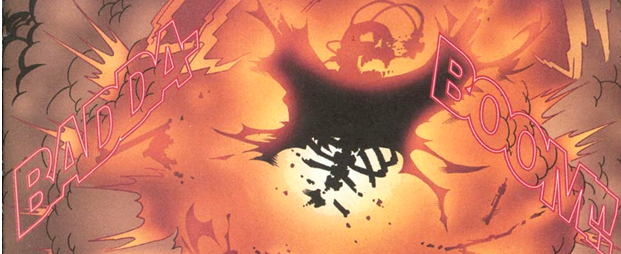
Back Issues: Resident Evil: Fire and Ice #1

BackIssues

Earlier this year, in a shameless attempt to grab more views around the release of the slightly disappointing Resident Evil 3 remake (Capcom, 2020), I did a weekly review of a five-issue comic series based on Capcom’s popular survival horror franchise which was published between 1998 and 1999. Given that, at the time, there were only two Resident Evil titles to work from, with the third still in production, Resident Evil: The Official Comic Magazine didn’t have a lot of material to work with and, whether through a direct mandate from Capcom or a conscious decision on the part of its creative team, largely decided against including direct adaptations of the source material and, instead, preferred to tell spin-offs, side stories, and interludes. Most of these, honestly, didn’t really add much, if anything, to the series lore; we saw what happened in the diner moments before Claire Redfield arrived in Raccoon City, for example, and follow Jill Valentine, Chris Redfield, and Barry Burton on a zombie slaughtering tour across Europe and Leon S. Kennedy fight giant, mutated bat creatures but a lot of it fell far from the mark.

REF&I1Title

Honestly, Resident Evil: The Official Comic Magazine was at its best when it was telling recapped, truncated, or heavily modified adaptations of the first two games and was saved from mediocrity by some truly stunning and gory artwork. Although the series was short-lived, WildStorm revisited the Resident Evil franchise with a four-issue follow-up series published between 2000 and 2001 that, as it’s Halloween this month, I’ll be looking into. The Fire and Ice series focused entirely on original characters, some of whom even return from Resident Evil: The Official Comic Magazine, and featured many of the same writers and artists as that first five-issue series, so it’ll be interesting to see if WildStorm have better success this time around with their original characters and stories than they did last time or if they’ll spew out more drivel like Jill inexplicably battling with a werewolf.

REF&I1CharlieTeam
Fire and Ice introduces us to a third S.T.A.R.S. arm, Charlie team.

Issue one opens up with the hitherto-unknown Special Tactics and Rescue Service (S.T.A.R.S.) Charlie team battling against circus freaks infected with the Umbrella Corporation’s infamous G-Virus. The team, led by Falcon, consists of the knife-wielding Australian Quan Williamson, the high-kicking Rosa Cardenas, the tech-geek Jesse Alcorn, and Patrick Brady, who lugs around a comically large energy blasting bazooka.

REF&I1Brady
From simple security guard to highly-train, semi-superhuman S.T.A.R.S. member.

If Brady sounds familiar, it’s because he appeared in Resident Evil: The Official Comic Magazine where he was a simple security guard at the Raccoon City Zoo; although he managed to survive against a hoard of infected zoo animals, he was bitten by an infected prairie dog and exposed to the G-Virus. Luckily, he was saved by Leon (…because of course he was) and a S.T.A.R.S medical team were able to reverse the G-Virus effects (…despite the fact that they had failed in every other attempt). Somehow, as a side effect, Brady could also “sense the presence of the G-Virus” which, alongside his “natural fighting skills” (I mean, he was a security guard so I guess he had some training but I doubt it’s anything like Leon or Chris’s. Plus, I remember him panicking and running a lot in his first appearance…) got him a spot on Charlie team.

REF&I1Intros
Charlie team is…colourful, if nothing else.

After filling us in on Brady’s story, the comic then spends the next few pages introducing us to the rest of the team: Falcon, a muscle-bound archetypal action hero who seems like Terry Crews before Terry Crews was a thing and also briefly appeared in Resident Evil: The Official Comic Magazine, is a former Army Ranger who was betrayed by his superiors and framed for an unexplained “international incident” before being inexplicably recruited by S.T.A.R.S. Rosa Cardenas is a bad-ass goth chick; a Mexican raised on a Hopi Indian reserve who is proficient in “tracking skills” who has a personal grudge against Umbrella and their experiments after her mother was killed in the aforementioned diner during the Raccoon City outbreak. Quan Williamson is not only Australian but also of “Thai descent” who left behind his promising academic career and his love of vehicles and machinery because of his natural aversion to authority and his desire to form a band, though his life was forever changed after he witnessed Leon’s fight against the aforementioned bat-men. The violent and slightly unhinged Jesse Alcorn also has a disdain for authority bordering on the psychotic as he used his “amazing computer skills” to hack in NORAD and nearly caused a nuclear war, after which he was given a choice: life in prison or join the S.T.A.R.S. Charlie team.

REF&I1Umbrella
Falcon is angered that Umbrella were waiting for them and specifically name him.

By this point, you might have noticed a common thread being weaved throughout the members of Charlie team: not only are they somewhat reminiscent of Task Force X (known by their more colourful title as the Suicide Squad) from DC Comics, each of them has either briefly featured on WildStorm’s previous Resident Evil comic series or has some link, however tenuous, with an existing and popular Resident Evil character. This reminds me very much of the way Paul W. S. Anderson would rope in popular Resident Evil characters like Jill Valentine (Sienna Guillory), Carlos Olivera (Oded Fehr), Claire and Chris Redfield (Ali Larter and Wentworth Miller), and Leon Kennedy (Johann Urb) into his later Resident Evil movies (2002 to 2016) simply to give their approval to Alice (Milla Jovovich), the all-action star of his film series. As in those films, this association does very little to endear me to these original characters as all it does is make me wish I was watching (or reading about) the actual Resident Evil characters rather than these knock-offs. Frustrated by the onslaught of circus freaks and animals looking to tear their throats out, Falcon gives the order for the team to deploy a series of bombs and blow the whole circus to cinders. In the aftermath, they discover a mortally wounded Umbrella employee who, with his dying breath, not only hints that Umbrella were aware and prepared specifically for Charlie team’s arrival but also drops Falcon’s name, sending him into a rage.

REF&I1Raquel2
Raquel is assigned to a sub-team but is hiding a mysterious infection.

Back at their headquarters, Falcon introduces the team to their newest member, munitions export Raquel Fields, who essentially acts as the audience surrogate for the remainder of the issue as Falcon gives a brief introduction to his team members and then delves into a full-two page spread recapping the events of the first two Resident Evil games and detailing Charlie team’s overall mission goal: to track down, and put down, Umbrella once and for all. Although she claims to have missed the opening mission due to being knocked out in a training session, it turns out that Raquel is undergoing a severe mutation from a wound she sustained that she is going to great lengths to keep hidden from her team-mates. Having acquired a disk from the Umbrella agents at the circus, the team is then split into two sub-teams to investigate Umbrella’s laboratories in Alaska and Mexico, where they are apparently working on developing new viral strains. Rosa is placed in charge of Quan and Patrick in Alaska while Jesse, Raquel, and Falcon head south of the border; it’s this scene that really hammers home just how militaristic S.T.A.R.S. actually is; this was briefly shown in Resident Evil: The Official Comic Magazine but, generally, especially in the original Resident Evil videogames, the team always seemed to be more like a black ops arm of the Raccoon City police department rather than an extension of the U.S. military (even though they clearly had ties to the military).

REF&I1Cliffhanger
The issue ends on a cliffhanger with a literal Day of the Dead!

The issue ends on a cliffhanger as, when Falcon and the others arrive in Mexico, they discover that the annual Day of the Dead festival has become a literal Day of the Dead as the townsfolk are actually flesh hungry zombies! The final page of the issue is a teaser for issue two (which hints at a Tyrant but…well, we’ll see) and a quick blurb from editor Jeff Mariotte introducing readers to this new mini series.

REF&I1Action
The action is loud and bloody…when it actually happens.

Disappointingly, the first issue of Resident Evil: Fire and Ice contains more exposition than action; it reminds me of the first issue of Resident Evil: The Official Comic Magazine, which was more interested in retelling events than actually showing us them directly and creating tenuous links to characters we know and love from the videogames. However, when the action does kick in, it’s just as bloody and explosive as ever and the artwork is decent enough, for the most part, but the character designs are extremely derivative and very nineties for a comic released in 2000. Each character is decked out in bulging muscles or impractical leather and buckle-clad outfits, wielding massive weapons and sporting such impractical accessories as eye goggles and a Mohawk. Visually, it allows you to easily tell each character apart, which is especially helpful when you’re dealing with original characters, but none of them exude the simple aesthetic of the earlier Resident Evil characters who didn’t need anything more lavish than practical, military-grade hardware and gear.

My Rating:

Rating: 2 out of 5.

Could Be Better

Did you read Fire and Ice when it first released? If so, what did you think of Charlie team? Did you ever read the earlier Resident Evil comics published by WildStorm? Which Resident Evil videogame or character would you like to see a comic book series about? Do you have a favourite piece of ancillary Resident Evil media? Drop a comment down below and be sure to check out my review of issue two.