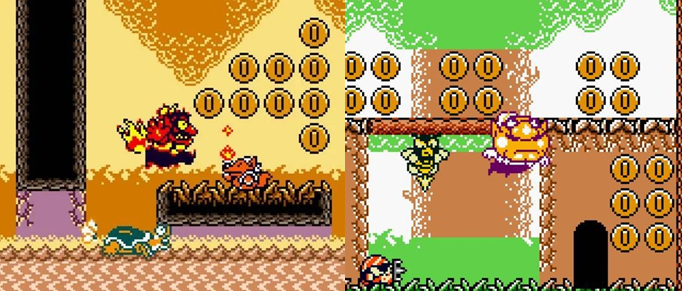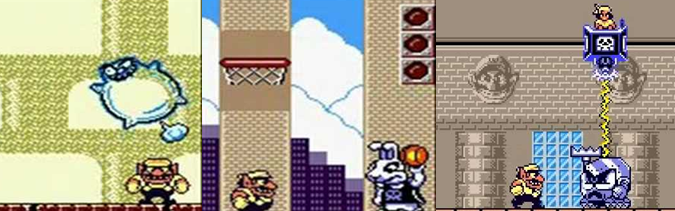
Game Corner [Mario Month]: Wario Land 4 (Nintendo Switch)


So, for no better reason than “Mar.10” resembling Mario’s name, March 10th is widely regarded as being “Mario Day”, a day to celebrate Nintendo’s portly plumber, an overalls-wearing mascot who literally changed the videogame industry forever and shaped the home console market of the nineties.

Released: 14 February 2025
Originally Released: 21 August 2001
Developer: Nintendo R&D1

Also Available For: Game Boy Advance, Nintendo Switch 2, Nintendo Wii U (Japan Only)
Metacritic Scores: 88 / 8.8

Quick Facts:
Designed by Hiroji Kiyotake to symbolise Nintendo R&D1’s displeasure at being denied the chance to create original videogames, Mario’s dastardly doppelgänger first appeared in Super Mario Land 2: 6 Golden Coins (ibid, 1992). Wario then usurped Nintendo’s portly plumber as the face of Mario’s handheld sub-series, leading to three highly regarded portable adventures. Wario Land 4 restricted Wario to an ancient pyramid and incorporated “Metroidvania”-like exploration alongside more traditional platforming mechanics compared to its previous two games. A strong seller, Wario Land 4 was met with widespread acclaim as reviews praised the replay value, colourful and lively graphics, and balanced challenge, though the lack of true innovation was noted.

Gameplay and Power-Ups:
Like its predecessors, Wario Land 4 is a 2D, action-orientated platformer in which players take Mario’s despicable lookalike through an ancient pyramid, navigating a simplistic hub world to take one of four passages and explore four worlds in each, tackling a boss at the end to obtain treasure from the pyramid. Players get two save files and, for the first time in the Land series, a health bar, represented by hearts. Wario can partially or completely refill his health by defeating enemies and collecting Little Hearts to fill a meter, Hearts for a full heart, or smashing special treasure chests for a Full Health Item. Wario’s abilities are largely retained from the previous titles, with him jumping with A (jumping higher the longer you hold the button) and charging at enemies, destructible objects, and treasures chests with B or X. You can hold down the Left or Right trigger to charge ahead, ploughing through most enemies and blocks, perform a leaping charge, butt stomp by pressing down in mid-air, swim by tapping A, and roll into a ball to crash through small tunnels by holding down on slopes. Enemies can be stunned by bumping them, allowing Wario to automatically pick them up. If you hold down B, you can charge a throw, with Wario tossing whatever he’s holding higher and further the longer you hold it down, which is great for smashing blocks, hitting ! switches, or opening certain doors by tossing shapes. Players climb ladders, use warp pipes, and jump to small or moving platforms to progress, earning points for every enemy defeated and the gems they collect. Blue and Red Crystals are plentiful but you’ll want to explore and experiment to collect the Diamonds hidden in each world. Some blocks can only be destroyed with a fully charged dash or by performing a ground pound from way up high. Wario must frantically return to the entrance warp upon activating a Frog Switch, giving him up to ten minutes to do so before the bomb explodes, robs him of some treasure, and returns him to the hub world.
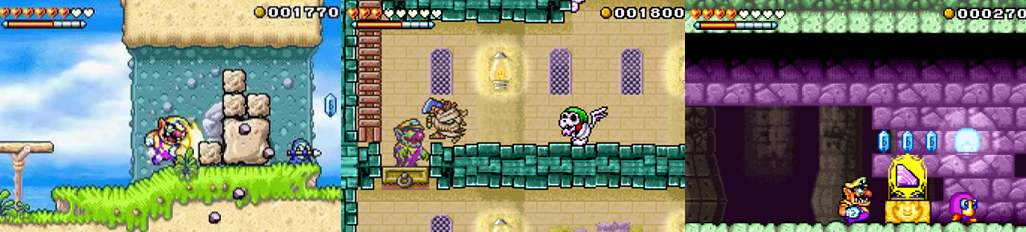
Blast and transform your way through worlds to find the Jewel Pieces needed to progress.

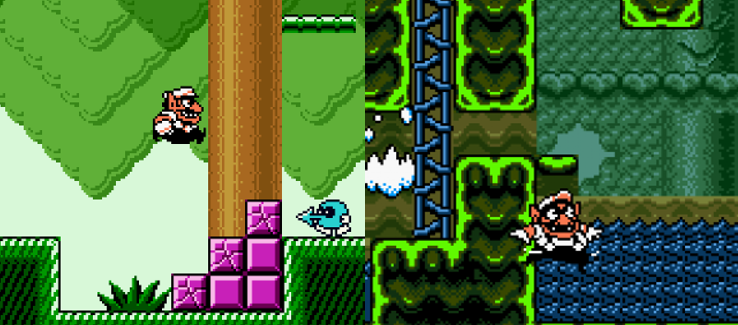
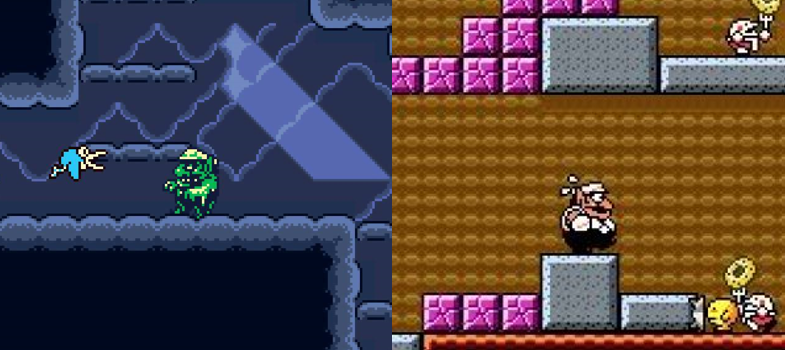
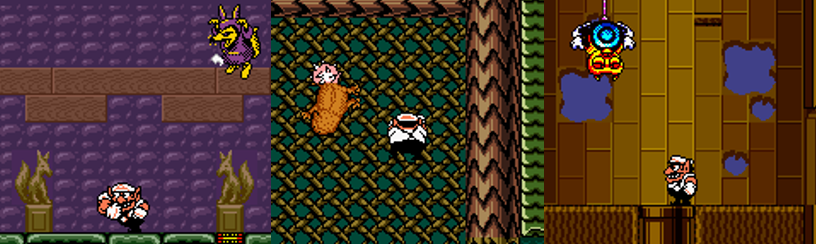
Although Wario can now take damage and fail his quest if he runs out of hearts, he can still be transformed by certain enemy attacks and environmental factors. When consuming food, Wario becomes fat and heavy, easily crashing through blocks and shrugging off attacks. When pricked by a Beezley, Wario inflates like a balloon and floats until he hits a ceiling, floating higher by tapping B, while bubbles force him through water and rapids if you’re not careful. Flames set Wario on fire, causing him to run around in a panic and eventually become consumed, destroying Bonfire Blocks in the process. Similarly, he becomes a snowball when hit with falling snow, rolling down hills and crashing through Snowman Blocks as he goes. When crushed, Wario flattens and awkwardly floats down shafts and through tiny gaps and, when hit by a Yeti’s sneeze, he freezes and flies back. If hit by a Menhanmā’s hammer, Wario becomes a spring, leaping high into the sky and through any blocks by pressing A, becomes a shambling, gloopy zombie when hit by a Skeleton Bird, falling through any platforms as he goes, and transforms into a bat upon touching a Minicula, allowing him to fly by tapping A. While some of these are temporary, others are cancelled out upon touching water or light sources, and they seem far more situational compared to the last two games. I was disappointed that no new transformations appeared and that the transformations aren’t as interesting as it’s usually pretty simple to figure out how to use them. Similarly, while players can uncover hidden doors by exploring and smashing blocks, most worlds are quite linear, with alternate paths generally being quite obvious and leading to the same collectibles. Wario must find four coloured Jewel Pieces in every world and escape with the ghost-like Keyzer to open doors in the hub world’s passages, meaning you either need to explore thoroughly the first time through or return the world to find what you missed. This can be a bit annoying and basically forces you to 100% every world, which can be a chore, especially when Jewel Pieces are only accessible after hitting the Frog Switch and opening new paths.
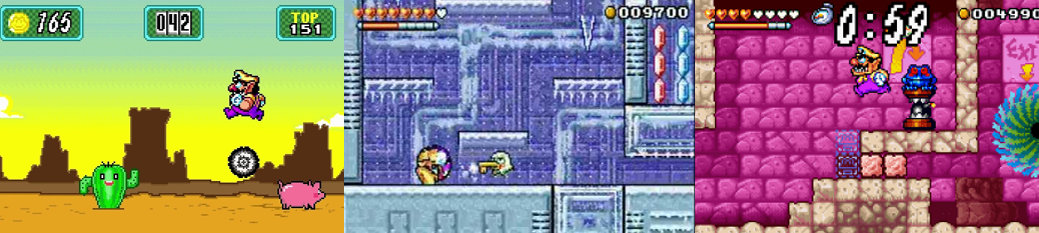
Despite the mini games and variety, the gameplay loop is tedious and simplistic.

As you explore, you come across mini challenge rooms where you must toss archaeologist Arewo Shitain-hakase past obstacles or at switches to earn additional Diamonds, and you can play three mini games to earn Coins. These see you timing swings of a baseball bat, playing an endless runner, and matching Wario’s face. The Coins earned are used in the Item Shop prior to each boss fight, gifting you powerful, automatically triggered items that reduce or decimate the boss’s health. Otherwise, worlds offer some surprising variety as they’re themed around jungles, temples, factories, and deserts rather than sticking to the Egyptian pyramid aesthetic. Some worlds are notably maze-like, like the looping 40 Below Fridge, which has you rolling about as a snowball to access new passages, and Hotel Horror, which is a haunted hotel maze of doors and ladders. Wildflower Fields has you scaling giant beanstalks, Pinball Zone forces you to throw multiple Chomp Balls into Pinball Tulips to unlock doors, and Doodle Woods sees a floating Hoggus spawn enemies with its drawings. A pirate ghost kidnaps Keyzer in Crescent Moon Village, pistons and conveyor belts litter the steampunk-esque Curious Factory, and you’ll be swimming through underwater passages in Mystic Lake. Flying carpets carry you through the sky in Arabian Night, you must stop the chance wheels at the correct places in The Big Board to gain transformations and open paths, and you hop to swinging, vine-like platforms in the rainswept Monsoon Jungle. The challenge is relatively fair, with most enemies and hazards being more of an annoyance, but the difficulty comes in searching for the Jewel Pieces and Keyzer and racing back to the entrance warp before the timer runs out. Temporary platforms, tricky jumps, and alternate paths both help and hinder this task, but the gameplay loop gets a bit tedious very quickly since you must find all the Jewel Pieces and Keyzer to progress. This means there’s less emphasis on collecting loot and exploring for hidden treasure than in previous games, less focus on the transformations, and more focus on replaying worlds until you’ve found what you need to progress.

Presentation:
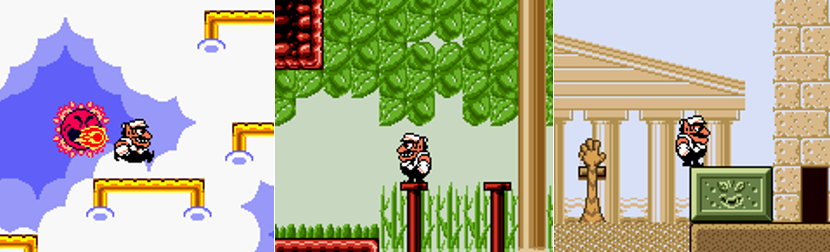
Without a doubt, Wario Land 4 is the best-looking game in the series so far. Wario is more animated and expressive than ever, spouting phrases as he succeeds or takes damage and performing various idle poses, such as pumping iron or skipping rope. He even flails about in water and has never looked better when transformed into a zombie or set on fire, which makes it all the more bizarre, disappointing, and frustrating that the game’s story is practically non-existent. Even the Game Boy Color games featured cutscenes and some dialogue, but all we get here is some shots of Wario blasting about in his muscle car, finding the pyramid, and opening its doors. The ending tries to compensate for this by offering large sprite art renditions of Wario’s victories over the bosses, but it’s too little too late and I was very disappointed to see that the story didn’t get more emphasis. Similarly, it’s quite unfortunate that Wario’s stuck inside a pyramid for the entire game, visiting worlds by leaping into warp portals rather than exploring an ever expanding and changing island or larger hub world, things that even the first game did much better. The music was equally forgettable, with none of the tunes really sticking in my head, an annoying jingle playing every time you transform, and the environment and soundtrack warping and distorting when you’re ordered to “Hurry up!” after activating the Frog Switch. It’s a shame as there are some fun, comical moments, like a cameo from Mr. Game & Watch and the various items being wheeled out to attack the bosses, who are all large and disturbing. It might’ve been nice to include some sections where you barrel along in Wario’s muscle car, or to bring back the hats from the first game, or to see Wario properly exploring the pyramid rather than just hobbling to each passage and walking through samey-looking hallways each time.
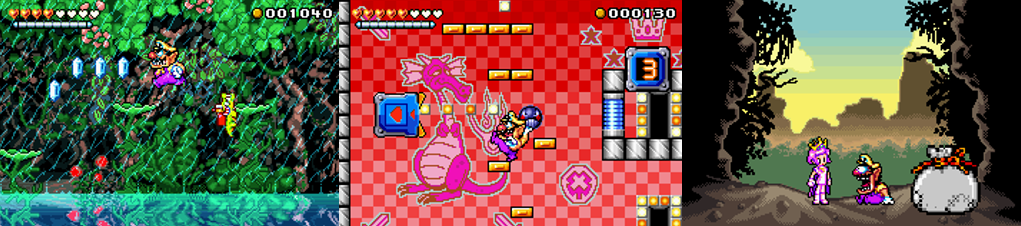
Despite Wario Land 4 being a visual treat, the lack of focus on story hurts it.

And yet, there’s a fair amount of variety in Wario Land 4, with each passage sporting various environments to explore, each one somewhat related to a specific theme. The Emerald Passage is themed around nature, for example, meaning you explore a palm tree seaside, a flower field, a sprawling lake, and a stormswept jungle. The Ruby Passage is themed around industry, placing you in an industrial factory, a toxic landfill akin to a sewer or junkyard, a freezing fridge with lots of slippery platforms and snow, and a pinball-themed maze. The Topaz Passage is themed around toys, with the first world literally being a toy chest, the second being a toy village, the third being a stationary-themed woods that would fit right in with a Yoshi title, and the final world seeing you knock over and outrace dominos before they block off paths and doors. The Sapphire Passage is themed around horror and ghosts, with you exploring a haunted village, a night-time Indian city, a fiery cavern full of lava and flaming geyser, and a labyrinthine hotel that’s so full of spookies and mysteries that Wario should’ve called Luigi for help! The final area, the Golden Passage, lands you right on the Frog Switch and gives you 9:30 to reach the ending, running a gauntlet of all the enemies, obstacles, and gimmicks you’ve encountered before and utilising each of Wario’s transformations to progress. This world is a golden-bricked environment with falling chandeliers that transitions to a stone temple and features drops to rushing water that loop you around if you’re not careful. None of Wario Land 4’s worlds are particularly innovative or original and they feature less alternative paths and rewards compared to the last three games, making them far more linear save for a few instances where you must search a little harder for missing Jewel Pieces. I liked that they remained visually distinct from other Super Mario games, featuring few gimmicks and aspects from those games, but it would’ve been nice to see them play more into Wario’s strengths and transformations, and maybe feature more collectibles to unearth by exploring.

Enemies and Bosses:
As far as I can remember (it has been a while and I don’t care to dig too deep into it), Wario Land 4 features an all-new line-up of baddies, though some fulfil similar functions, like Menhanmās squashing you with their hammers and Kaentsubos and Pig Head Statues setting you on fire. The most common enemies are the Goomba-like Marumen, who simply wander back and forth, while the Shy Guy-like Spear-Mask prod you with spears and the masked Totsumen charge you. Spikys need flipping over with a ground pound to attack their underbellies, Shieragutchi spring from the seabed, and Goggley-Blades cut through the water to try and skewer you. Bow Balloons and Beezley’s turn you into Puffy Wario, Ringosukī apes toss apples to help or hinder you as Fat Wario, and Skeelton Birds can send you plummeting through platforms if their spit turns you into a zombie. Men’onos and their mummified variants charge with axes, harmless caterpillars slither around the Wildflower Fields, mole-like creatures ram into you, and large sea monsters pop from holes in the background of Mystic Lake. Various robots patrol the Ruby Passage worlds, such as an armoured mech that tosses its head and a robotic bird that flies at you, while miniature toy Wario’s litter the Topaz Passage worlds. They’re joined by spear-wielding Dice, a strange hybrid of a pig and a snail, and ballerina pigs spawned by Hoggus. Bowlers toss boulders in the Fiery Cavern before being turned into Yetis when the world freezes, bats flitter about in Arabian Night, and a large pirate ghost lingers in the background of Crescent Moon Village, being harmless until they spot Keyzer, whom they abduct on sight. There are six bosses to contend with in Wario Land 4, with four being fought in whatever order you tackle the Passages in and the first fought to clear the Entry Passage, each being significantly damaged by the item your purchase, and each fought against a timer.
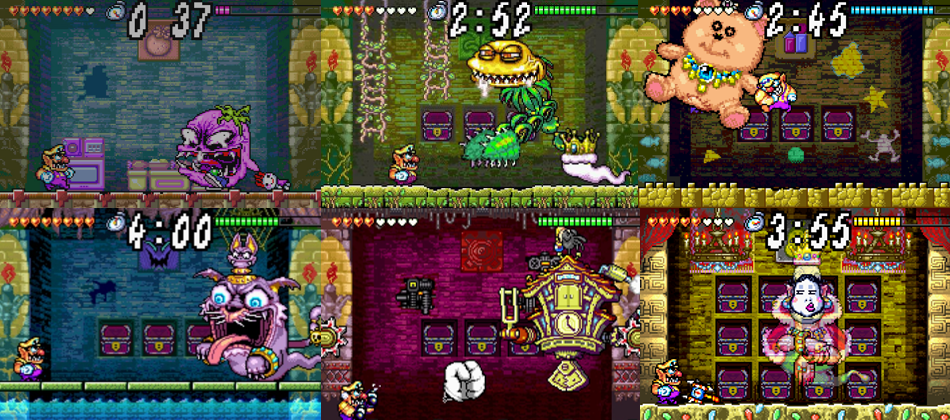
Six surreal, monstrous bosses offer a decent challenge beyond just ramming into them.

The first is a monstrous eggplant that wanders back and forth in an enclosed arena, assisted by smaller minions and eventually turning feral after enough hits. At first, you must ram its face but, when it goes mad, you must hop over it to finish it off from behind. After waking Cractus, you must climb the nearby ladders to avoid its chomping mouth and spiked leaves, butt stomp its head as it passes under you. After a few hits, it spews bile that transforms you into a zombie, adds homing jabs to its arsenal, and floats around more erratically. I fought Aerodent next, a giant inflatable bear controlled by a mouse ghost. You must avoid the pin enemies it drops and hit its glowing feet to expose the mouse, ramming it to deal damage, dodging the flames it drops and desperately trying to land multiple hits in a small window. Catbat was somewhat similar in that you must ram the cat on its head, avoiding its spiked furballs and using the waves it spews to get closer, eventually butt stomping its head to finish it. Finally, I fought Cuckoo Condor, potentially the toughest of the regular bosses. This giant cuckoo clock bird-thing grabs you in its talons and drives you into the spiked wheels on either side of the arena and tosses buzzsaws, which can also be electrified. You must quickly ram its claw to hit the boss, then frantically grab the eggs it drops before they spawn explosive chicks, and toss them at just the right angle to deal damage. The final boss is a multi-phase battle with the Golden Diva, which tosses you about with is Kabuki-like masks, shields itself with a fan, drops green enemies, spawns a rubber ball, conjures black eggs and explosive chicks, and drops a spiked hammer. You must ram, grab, or use each of these to deal damage, either by tossing them or springing into her face, eventually stunning her when she destroys the ground to reveal spikes and butt stomping her head.

Additional Features:
There are four Jewel Pieces in each world and each must be collected to unlock the boss doors. You must also find Keyzer or else you can’t access each subsequent world in the Passage. Every world also hides a CD, unlocking a music track for the Sound Room, and hides hidden challenge rooms where you toss about Arewo Shitain-hakase to snag extra loot. The game can be played on “Normal” or “Hard” from the start, which affects how much health you start with and even the placement of Jewel Pieces and treasure. Beating the game on “Hard” unlocks the extra challenging “S-Hard” mode, and all bosses are revived once you finish the game, allowing you to battle them again and best your time and replay previous worlds to find those missing CDs. You can waste a few hours grinding the mini games to earn extra Coins and try out the different items against the bosses, and you’ll get different endings depending on the difficulty you play and how fast you defeat the bosses, depicting Wario with more or less loot and driving different vehicles. This version of the game also allows you to rewind the action and create save states, significantly reducing the challenge and making it a bit easier to hunt for Jewel Pieces and Keyzer or undo any mistakes.

Final Thoughts:
I was really excited to get into Wario Land 4 since I’ve been a huge fan of the series since Wario’s debut. I was expecting it to be like the last two and feature multiple paths, lots of treasure, and tricky puzzles focusing on Wario’s bizarre transformations. Instead, I got a relatively simple platformer that significantly reduced the focus on these transformations, making Wario more vulnerable and not even offering any new power-ups for him. Sure, you still have to explore the worlds but nowhere near to the extent as before, with most alternative paths being fairly obvious and offering little reward since your treasure barely matters this time around. All that matters are those damn Jewel Pieces and Keyzer, crutches that force you to linger in worlds or replay them just to progress to the boss, which really soured the experience for me. I think it should’ve been mandatory to have one or the other, then have the other gimmick used to unlock bonus areas or challenges. Instead, you can just ignore everything and focus only on collecting those, eliminating much of the appeal in exploring and figuring out the game’s far simpler puzzles. While Wario Land 4 looks fantastic and is a visual treat, this gameplay loops really stifled my enjoyment. The race back to the beginning and to defeat bosses added some tension but also seemed like a forced gimmick to artificially up the challenge, and the minigames were uninspired and boring, which is a shame as the items you buy are quite fun. I was really disappointed by the lack of focus on the story, the linear nature of the narrative, and that Wario was stuck inside a pyramid, even if the worlds have some decent variety. Ultimately, as gorgeous as Wario Land 4 is, I feel it doesn’t live up to its deeper and more complex predecessors, offering far less replay value and being a disappointingly lacklustre title instead of the definitive Wario Land experience.

My Rating:

Rating: 3 out of 5.

Pretty Good

Ae you a fan of Wario Land 4? How did you think it compared to the other Wario Land videogames? Were you disappointed by the smaller scale of the game and the forced collection of Jewel Pieces? What did you think to the graphics and bizarre bosses? Were you also surprised to see there were no new transformations and less focus on treasure hunting? Did you ever beat the game on S-Hard mode? Would you like to see more of Wario or do you think he’s better suited as a side character? How are you celebrating the Super Mario franchise this month? Whatever your thoughts on Wario, feel free to drop a comment below, support me on Ko-Fi, and check out my other Wario reviews.


Game Corner: Wario Land 3 (Nintendo 3DS)

Released: 2 May 2012
Originally Released: 21 March 2000
Developer: Nintendo R&D1
Also Available For: Game Boy Color

The Background:
After his debut in Super Mario Land 2: 6 Golden Coins (ibid, 1992) Mario’s dastardly doppelgänger, Wario, quickly usurped Nintendo’s portly plumber as the face of Mario’s handheld sub-series. After the critical and commercial success of Wario Land II (ibid, 1998), Wario’s adventures continued on the Game Boy Color, a long-awaited colour upgrade to Nintendo’s popular handheld console. Wario Land 3 continued the tradition of expanding upon its predecessors, featuring far more emphasis on backtracking, exploration, and experimentation and would be the last in the series to release before Nintendo released the technically-superior Game Boy Advance console. Still, Wario Land 3 was a much-lauded success upon release and was eventually brought to the Nintendo 3DS Virtual Console some twelve years after its debut, which is the version I’ll be looking at today.

The Plot:
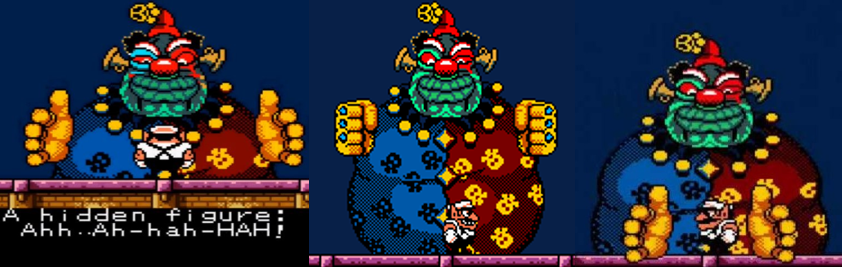
After Wario’s plane crash lands in a dense forest, he stumbles upon a mysterious cave and is sucked into a magical music box . An enigmatic hidden figure beseeches Wario to find five other music boxes to free him from his imprisonment and, excited at the prospect of finding more rare treasure, Wario dutifully sets out to satiate his lust for riches.

Gameplay:
Like its predecessors, Wario Land 3 is a sidescrolling action/platformer in which players take control of Wario, Mario’s mischievous and greedy lookalike. As in Wario Land II, Wario is functionally immortal; though he takes significant knockback from enemy attacks, he cannot ever be killed and faces no consequences for being attacked except being knocked from a platform or into another hazard. As a result, the player never needs to worry about replenishing Wario’s health or lives or being penalised for being attacked as long as they are patient enough to climb back up to where they were when they were knocked back. Wario begins the game noticeably less capable than in previous titles; he can still jump (shocking, I know!) and can barge into enemies with a shoulder charge but he can no longer pick up enemies and throw them…at least, not from the start. Instead, Wario must find power-ups in coloured treasure chests hidden throughout the game’s many levels to reacquire many of his usual skills, such as the butt stomp and the ability to pick up and throw enemies. Wario can, however, still roll into a ball when pressing down on a slope or coming off a zip-line to pass through narrow passageways.

Wario needs to re-learn some of his patented and basic abilities from the last games.

The main objective of the game is to visit each of the twenty-five levels found at each compass point on the overworld; each one contains four coloured keys and four chests of the same colour which house treasures, power-ups, and key items. Wario must collect each one to open up new areas of the overworld and progress further; this means that each level must be revisited multiple times with Wario’s new abilities and new areas opened up with the treasures and each compass point will only be fully accessible once all treasures have been collected. This makes the game much bigger and more confusing than even its predecessor, which featured branching story paths depending on the choices you made during gameplay; here, you constantly have to backtrack to old levels in order to open up new ones and, someti s, key items will affect multiple levels at once. Thankfully, Wario can return to the mysterious figure in the Temple at any point for a hint on which level to go to, though it’s up to the player to figure out what’s changed in that level or which of Wario’s new abilities needs to be used to progress. The game’s overworld is split between the four compass points (North, South, East, and West) and Wario can quickly travel to each one by pressing the “Select” button on the overworld. From here you can also check on which treasures you have acquired, reactivate key items to remind yourself of where to go, and, eventually, trigger the game’s day and night cycle (which, otherwise, automatically switches to one or the other every time you finish a level, with the time of day also affecting the levels in certain ways).

You’ll need all the Coins you can find to beat the annoying golfing mini games.

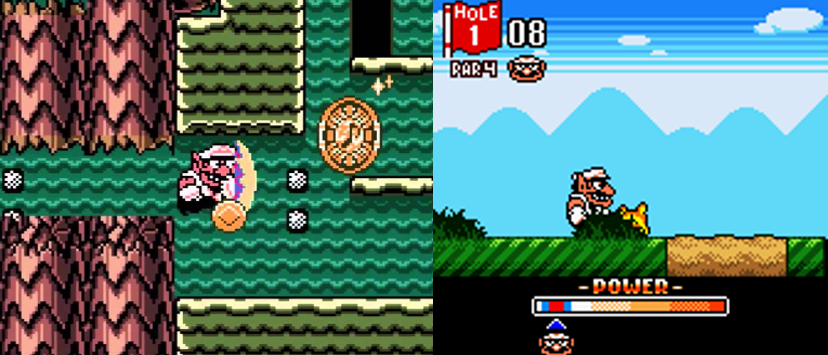
Within each level, you can also find a number of Coins, including eight large Musical Coins; unlike previous games, though, the amount of Coins you have doesn’t affect the game’s ending and Wario’s capacity is capped at 999 Coins. Instead, Wario uses Coins to play a number of hidden golf mini games found in each level, which is necessary to open previously blocked paths and find more keys and chests. The golf mini games help to break up the gameplay a bit but is needlessly frustrating when you first play it since you’re not really given any direction on what to do. Basically, by moving the screen to the right, you can see where Wario’s shot will land on the field; you need to press A and then quickly press it again when the slider reaches a power level high enough to avoid getting stuck in water, lava, or the rough grass and then quickly press it again when it hits the blue area of the slider to take your shot. You get four shots at hitting the Para-Goom and, if you fail to sink it in the goal, you’ll have to pay some more Coins to try again. When I first played this, I was frustrated by the finicky controls and vague directions but, once you play it a couple of times, it’s not so hard to get the timing down and the 3DS’s save state feature really helps speed the process up.

Wario’s “Reactions” will allow him to find more treasure and reach new areas.

As in the previous game, Wario can still change forms when hit with certain attacks; these will briefly alter Wario in strange and amusing ways to help him break through previously impassable blocks, reach higher areas, or pass through small spaces and figuring out how to use these different transformations (or “Reactions”, as the game calls them) is key to finding all the keys, chests, and Musical Coins. When in a level, you can also save your progress at any time, see which keys you currently hold, which chests you’ve opened, how many Musical Coins you’ve collected, and even return to the overworld map all with an appreciated ease. Compared to the last two Wario Land games, Wario Land 3 is much more difficult and time consuming; thanks to the abundance of backtracking and vague hints, it can be very difficult to know where you need to go and what you need to do. Thus, you are encouraged to experiment; if you see something blocking your path, try using all of Wario’s abilities as some will affect the obstacle or possibly even destroy it. When exploring a level for the first time, try to take note of your surroundings and out of reach areas as you may need to return later with different abilities to access these parts of the level, and be sure to visit the Temple if you ever forget the levels your key items have affected or opened up. For the most part, though, I found Wario Land 3 best played in short bursts of about an hour or so tackling each level in turn as they opened up or changed rather than trying to slog through it in extended sittings, which may have contributed to my more annoying experiences with the game as it never seemed to end.

Graphics and Sound:
Wario Land 3 was easily the best looking entry in the series at that point; thanks to being made exclusively for the Game Boy Color, the game is full of bright, vibrant colours that really pop out at you. While Wario is actually a little more subdued in his colouration, appearing almost monochrome, this actually helps him to stand out against the colourful backgrounds and, as you’d expect, he’s full of life and character, falling asleep if left idle for too long and scratching his butt when left halfway up a ladder. There is a lot of level variety on offer in Wario Land 3; each compass point of the map is home to at least six different levels and, rather than each compass point having a fixed theme, every level looks different and has different gimmicks contained within.

Levels are more varied, detailed, and colourful than ever and change as you progress.

You’ll explore standard platforming levels such as forests, deserts, volcanoes, and ice levels but also explore ruins, swamps, towns, castles, and caves. Each one has at least two different colour palettes thanks to the day/night cycle and, though they start off relatively small and restrictive, each one is quite large, with many different layers and areas to explore as you gain new abilities and affect the overworld. Wario Land 3 has a bit more emphasis on story this time around, with short cutscenes playing whenever Wario acquires a new item to show how it has affected the overworld map. When you find new power-ups, a short tutorial will play showing you how to use Wario’s new ability (which can be revisited at any time from the pause menu) and there are a few instances of dialogue, primarily from the hidden figure, to relay the game’s simple plot. As you’d expect from a Mario/Wario title, the soundtrack is suitably chirpy and catchy, though I can’t say that it really made much of a lasting impression on me.

Enemies and Bosses:
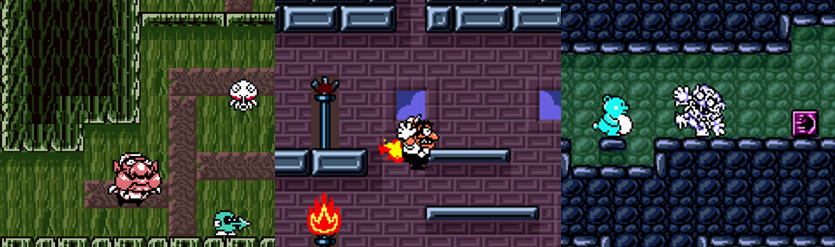
Since the game’s plot does not involve the Black Sugar Gang this time around, you’re faced with a whole slew of all-new enemies, many of which behave very similar to those from the last two games. Accordingly, you’ll come across spear-wielding Spearhead’s who will prick you with their sharp weapons, Para-Gooms who descend from the air and shield themselves with spiked umbrellas, puffer fish-like Haridamas which sprout spikes when they get close, and annoying birds that fly across the screen and stun you but can make for a boost to higher areas if you can time your jump correctly. You’ll also come up against a bunch of enemies that will change Wario’s form with their attacks or abilities; Appleby and Doughnuteers throw delicious apples and doughnuts your way, Fire Robota’s spout flames, Hammer-bots relentlessly try to squash you with their giant hammers, floating jellyfish try to sting you, and Zombies constantly spring out when it’s most inconvenient to hurl their heads at you. For the most part, these enemies are placed in or near areas where you’ll need the accompanying Reaction to progress further but, equally as often, they’re simply placed to be annoying so if you don’t need a specific transformation be sure to avoid them.

Often, the direct approach is insufficient to defeat Wario Land 3‘s bosses.

Wario has a tough battle ahead of him this time around as he must battle eleven different bosses in his quest for the five magical boxes; because of the nature of the game, though, it’s entirely possible to battle these bosses out of order depending on what abilities you have and key items you’ve found, which can mix up subsequent playthroughs of the game. With the exception of the final boss, each of Wario Land 3’s bosses requires three hits to defeat and, like in the last game, each one will expel you from the boss arena if you get hit or mess up, changes up their attack patterns as the fight progresses, and requires quite a bit of skill on your part to defeat. The Doll Boy, for example, sits atop a totem pole tossing hammers at you; you must avoid these and destroy his totem pole to bring him down to ground level then frantically avoid his hammer swings to jump on his head and finish him off with a shoulder barge. Similarly, Wormwould pops out of the ground to spit rocks at you that will send you tumbling off the platform if they hit you so you need to use your ground pound on his head before he gets the chance. Each boss is unique and requires different strategies to get around their attacks; Wolfenboss has to be knocked out of the air by ricocheting a Kuri at the right angle, for example, while Mudee is fought while you’re clinging to a net and requires you to time a ground pound onto its body while avoiding its spiked tail. Anonster, meanwhile, can only be brought down to ground level by throwing its own web balls up at it, which can be tricky because it’s hard to judge the angle of your throw.

Wario’s final challenge is a gigantic, demonic clown that is actually capable of killing him.

Some bosses are more unique and frustrating than others, though: Jamano plunges the arena into darkness, forcing you to quickly navigate around the small area hitting four skulls to bring the exorcising light and Wario needs to avoid Helio’s infectious stings and ground pound a pump to inflate and explode the boss. Easily the two most frustrating bosses, for me, though were Pesce and Shoot; Pesce, a weird rat/piranha hybrid, can only be defeated by poisoning it with mouldy cheese but it’s really tricky to time the dropping of the cheese so the damn thing actually eats it. Shoot is similar to Dunk from Wario Land II in that you must beat him at a ball-based game, in this case football. You need to avoid being squashed by Shoot but it’s not made clear exactly how you’re supposed to smash him into the goal; the easiest way I found was to lure him near to the goal (but not too near) and then barge him when he’s bouncing in the air as I could never get him into the goal when the goalie was stunned by a ground pound. After finding all five musical boxes, Wario returns to the hidden figure, who reveals himself to be a demonic clown entity and the game’s final boss. This is the only time in the game that you can get a game over as Wario will instantly be defeated if the clown grabs a hold of him. You need to jump over, or duck under, his hands and stun his fists with a ground pound and then jump and throw the fist into the clown’s face four times to win. Honestly, the most difficult part of this boss was getting the timing of my attacks and jumps right as his fists swing at you pretty fast and it’s easy to lose your grip on the stunned hand if you’re not fast enough.

Power-Ups and Bonuses:
As mentioned before, Wario can acquire upgrades for his abilities and relearn classic skills from various treasure boxes. This includes an upgrade to his shoulder attack and ground pound to break through tougher blocks, being able to charge up an enemy before throwing it to throw it higher and further, the ability to swim (and then swim through currents), smashing objects from below, and performing a high jump by pressing up and jump at the same time.

Many of Wario’s Reactions return from Wario Land II and function in the same way.

Wario also assumes a number of different forms upon being hit with certain attacks or encountering certain hazards. Many of these return from Wario Land II, such as Fat Wario (who destroy enemies by touching them and can smash through special blocks), Fire Wario (who, after running around with his butt on fire for a while, eventfully becomes engulfed in flames to break through special blocks), Flat Wario (who is small enough to squeeze through tiny gaps but extremely difficult to control, with the game forcing you to desperately try and float him through gaps in vertical areas), Zombie Wario (who passes through thin platforms when jumping on them), and Puffy Wario (who relentlessly float upwards until he hits a ceiling or block). You can also become Ice Skatin’ Wario when frozen (more of a hindrance than a help), Snowball and Ball o’ String Wario to become an unstoppable ball and break through special blocks, Bouncy Wario (helpful to reach high areas but difficult to control), Bubble Wario (which can let you pass through directional currents to reach goodies but is often just an annoying hazard), Invisible Wario to get past Seeing-eye Doors, and Vampire Wario. This last one is pretty cool as you become a Dracula-type figure and can turn into a vampire bat by pressing B and fly up to new areas but, since this latter mechanic is the only useful thing about this Reaction, I’m not sure why Wario doesn’t just become a bat by default.

Additional Features:
There are one hundred treasures to find in Wario Land 3; you’ll need all of Wario’s abilities and certain key items to find them all as some are not only hidden in previous levels but also in hidden levels on the overworld map. Thankfully, you don’t need to find them all to complete the game and you don’t get a different ending for having them all but collecting all one hundred does unlock a time attack mode. There are also, as mentioned, eight large Musical Coins to be found in each level; collecting all of these opens up a fourth golf mini game if you just can’t get enough of that particular gem. Of course, if you’re playing the 3DS version of the game, you can also make liberate, unapologetic use of the save state system to make the game a little easier on yourself.

The Summary:
Wario Land 3 really surprised me; I kind of expected the series to get a bit simpler as it progressed but, if anything, the Land sub-series just got bigger and more ambitious as it went on. This is easily the biggest of this sub-series both in terms of graphics and its scope which is great for a classic handheld title and I can’t fault the game for being packed full of content but…man, is this a long, convoluted game. Wario Land 3 really kicked my ass as I went into it expecting quick, easy, pick-up-and-play gameplay and was, instead, forced to constantly backtrack and explore all over the game’s vast overworld and numerous levels. This was great for expanding the depth and range of the sub-series and makes for an addictive and engaging handheld experience; I tried to limit my play time to short bursts of a few hours or so but often found myself getting sucked into the game as I tried to track down one more treasure chest or unlock one more level for my next session.

My Rating:

Rating: 3 out of 5.

Pretty Good

Have you ever played Wario Land 3 before? How did you find it compared to the other Wario Land videogames? Were you a fan of how big the game was and its emphasis on backtracking and exploration or did you find it maybe to be a bit too ambitious for its own good? What are your thoughts on Wario as a character and his wacky sub-series? Would you like to see more of him and his unique gameplay mechanics or do you think he’s better suited as a side character relegated to mini games? Whatever thoughts you have on Wario and Wario Land 3, feel free to drop a comment below.

Game Corner: Wario Land II (Nintendo 3DS)

GameCorner
WarioLand2Logo

Released: 2012
Originally Released: February 1999
Original Developer: Nintendo R&D1
Also Available For: Game Boy Color

The Background:
Super Mario Land 2: 6 Golden Coins (Nintendo R&D1, 1992) didn’t just blow its predecessor out of the water in terms of graphical and gameplay improvements, it also introduced the gaming world to one of my favourite characters of all time Wario, Mario’s evil doppelgänger, for the first time. While it would be some time before Wario made the jump to a main Nintendo console, and before he was relegated to simple mini games and cameo appearances, Mario’s evil twin thrived on Nintendo’s handhelds. First, he usurped the Super Mario Land franchise with Wario Land: Super Mario Land 3 (ibid, 1994), which led to a slew of sequels on Nintendo’s handheld systems.

The Plot:
After besting Captain Syrup and her Black Sugar Pirates, Wario is rudely awakened one day to find his castle has been flooded and ransacked by Syrup and her goons; enraged, he sets off to recover his loot and get his revenge.

Gameplay:
Wario Land II is a sidescrolling, 2D action/platformer; players control Wario as he journeys across a variety of worlds, collecting Yellow Coins and dispatching enemies with Wario’s patented Dash Attack and Ground Pound. Wario controls almost exactly as he did in the last game; he can jump on most enemies to stun them so he can pick them up and throw them, or just barge them with his Dash Attack. However, the knockback from enemy attacks is a considerable frustration; not only do you lose vital Coins, you also bounce back quite a way, which can be extremely annoying and lead you to drop to lower levels. What sets Wario Land II apart from its predecessor, and other Mario videogames, is Wario’s inability to die; when hurt by enemies or traps, Wario will lose some of the Coins he has gathered or be transformed into one of a number of different forms.

WarioLand2Forms
Rather than dying, Wario is transformed, allowing access to new areas.

These transformations are essential to navigating the different worlds Wario travels to and uncovering Wario Land II’s numerous secrets; hidden in every world is a piece of treasure, which Wario must earn by matching panels. As with its predecessor, finding the doors to these treasure rooms is no easy feat and Wario must navigate through some tricky puzzles and traps in order to find every piece. Once a world is completed, the player can also earn a Picture Piece to complete a map to the pirate’s treasure by completing a number-matching game. Wario Land utilised a map hub world similar to Super Mario Land 2 but Wario Land II is far more linear…or so it would seem. In actuality, there are many branching paths the player can take as they play; even inaction at the start of the game will lead Wario to different worlds and treasures. Once you finish the game, you gain access to the Treasure Map, which details all the different paths, allowing you the chance to recover the entirety of Wario’s missing loot and reach the true finale.

Graphics and Sound:
Wario Land II represents a time far removed from the basic, unremarkable presentation of Super Mario Land (ibid, 1989); characters and levels are brought to life through large, charming sprites that are a far cry from the first game’s monochrome offerings.

WarioLand2Graphics
Everything looks and sounds pitch-perfect here.

There are a lot of familiar sounds here that return from Wario Land, all of which add to the quirky, slightly off-kilter nature of Wario and his world. Nintendo walked a fine line between familiar and unique but executed this perfectly so that playing Wario Land II is unlike playing any other Mario title from that era and yet recognisable enough so that anyone who played its predecessor will feel right at home with familiar sights and sounds.

Enemies and Bosses:
Many of Wario Land’s generic enemies return here (such as the boomerang-wielding D.D and the Pirate Gooms) but there’s plenty of new and unique baddies to encounter; there’s a little mole cook who will fatten Wario up, pirate pecans who spit fish at you, zombies, and a fishing penguin who lures you in with fake Coins.

WarioLand2Bosses
Wario Land II has some weird-ass bosses on offer.

As for bosses, Wario Land II doesn’t disappoint and continues the tradition Super Mario Land 2 started with having big, oddball bosses; Wario will face off against the likes of a giant snake, a basketball-throwing rabbit, a giant dinosaur-like bird, and Captain Syrup herself. Though they can usually be defeated with a few well-placed bops to the head, each boss has a specific attack pattern and various phases; many will blast Wario out of the boss room entirely, forcing you to trek back around and start again or require a certain method to injure them (like dunking them through a basketball hoop or blasting lava at them).

Power-Ups and Bonuses:
In Wario Land, Wario controlled very similar to Mario; when hit, he reverted to a smaller form and he collected Power Up Pots to can new abilities. As mentioned above, though, Wario Land II ditches the traditional power-ups in favour of some truly weird transformations.

WarioLand2Conditions
Each transformation has its own benefits.

Certain enemy attacks will trigger a transformation in Wario that is necessary to reach other areas of each world and hidden secrets; Wario transforms into a burning ball of fire when set alight, becomes a zombie to drop to lower levels, or swells up to balloon-like proportions to reach higher levels, amongst other transformations. Part of Wario Land II’s gameplay is figuring out which enemies trigger a transformation and how to use that transformation in each area. It’s only by utilising all the tools at Wario’s disposal that players will be able to conquer each world, all the different branching paths, and access the secret final chapter, which is a time attack challenge through Syrup Castle.

Additional Features:
Collecting all the treasures in the game and completing the Picture Piece map doesn’t just allow you access to Syrup Castle, though; it also unlocks Flagman D-D, a remake of the Game & Watch mini game Flagman (Nintendo, 1980). This inclusion, and Wario Land II’s increased use of mini games compared to its predecessor, could be said to foreshadow Wario’s later preference towards mini games rather than fun little action platformers like this.

WarioLand2Conclusion

The Summary:
Wario Land II takes everything you knew from its predecessor and changes it just enough to deliver a unique gaming experience; appearing far more linear, the game hides many secrets and branching paths in a far more subtle way compared to Wario Land, meaning the no two players will have the same gameplay experience. Fittingly, Wario feels heavy and cumbersome; unlike Mario, he’s not build for precision platforming, which may be why Wario Land II substitutes such gameplay for simple puzzles, mazes, and alternative routes accessed by Wario’s transformations. Yet, at the same time, there seems to be a slight lack of polish to Wario Land II that can make some sections and bosses battles needlessly frustrating. However, the unique aspect of being immortal and changing forms to reach new areas, coupled with the chirpy tunes and big, quirky sprites make this a joy to play as no challenge presented by Wario Land II ever feels game-breaking or impossible.

My Rating:

Rating: 3 out of 5.

Pretty Good

What are your memories of Wario Land II, if any? Do you like Wario and, like me, wish he would return to a more prominent position? What was your favourite of the Super Mario titles on the original Game Boy? Leave a comment below and share your thoughts.