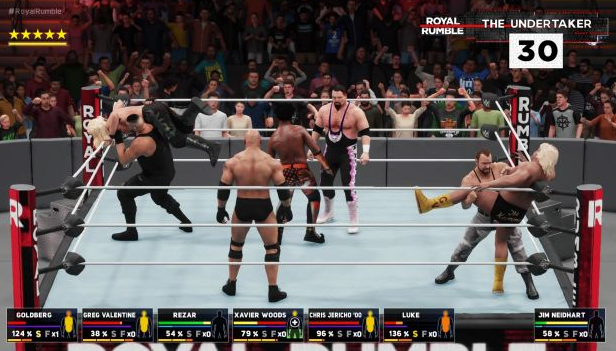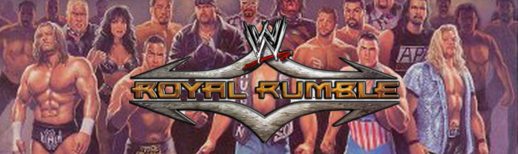
Wrestling Recap: Royal Rumble 2001

The Date: 21 January 2001
The Venue: New Orleans Arena; New Orleans, Louisiana
The Commentary: Jim “J.R.” Ross and Jerry “The King” Lawler
The Stipulation: Thirty man over the top rope battle royale for a WWF Championship opportunity at WrestleMania
Notable Competitors: “Stone Cold” Steve Austin (Winner), Jeff Hardy (#1), Rikishi (#30), Kane (Most Eliminations), and Drew Carey (Celebrity Competitor)

The Build-Up:
Since 1988, World Wrestling Entertainment (WWE) has brought fans Royal Rumble. The brainchild of the legendary Pat Patterson soon evolved into one of the most exciting events of the year as the winner of the titular over-the-top-rope battle royale would go on to challenge for the World Heavyweight Championship at WrestleMania. Following arguably their best ever year of business in 2000, which had seen the rise of new stars like “Y2J” Chris Jericho and Kurt Angle, the coronation of The Rock as then-World Wrestling Federation (WWF) Champion, and the return of white-hot competitors like Steve Austin and the Undertaker, the WWF took a commanding lead in the ratings war that would see them dominate the industry and anticipation was high for upcoming WrestleMania X-Seven. Heading into the event, five competitors were spotlighted as the odds-on favourites to win: the aforementioned Steve Austin (who had made a dramatic return after being away from the ring for over a year), The Rock (who had recently lost the WWF Championship to Kurt Angle), the Undertaker (simply because of his legendary status), Kane (primarily because of his recent momentum), and the newly-evil Rikishi, who had adopted a mean streak and be propelled into a questionable main event run after it was revealed he helped injure Austin and who had earned the right to enter the match last. The big question heading into the event was whether Kane and the Undertaker were in cahoots; although they’d fought earlier in the year, they had seemingly reforged their alliance in the weeks leading up to the Royal Rumble, and whether WWF Chairman Vince McMahon was seriously going to let comedian Drew Carey put his life on the line by competing in the match!

The Match:
This was peak WWF for me; I was finally able to watch WWF programming thanks to a deal they struck with Channel 4, meaning I was actually able to tape and watch this Royal Rumble event on Sunday night. I was really into everything that was happening at the time, especially the on-again, off-again issues between Kane and the Undertaker, Austins big return, and The Rock’s toppling of Triple H and the McMahon-Helmsley regime. It seemed as though everything the WWF produced was a guaranteed win at the time, with new stars, blockbuster main events, and stellar in-ring action and drama captivating audiences, especially me, and it’s largely because of this time (and this, my first real Royal Rumble match) that I became a life-long fan of wrestling. The match began with Jeff Hardy, one half of the high-flying Hardy Boyz who had electrified audiences with their death-defying antics, taking on Bull Buchanan, the stern-faced muscle of the infamous Right to Censor group, who were universally hated for their grating siren music and for opposing violent and risqué content. Although Jeff valiantly tried to topple and outpace the bruiser, Buchanan’s power and surprising agility saw Jeff taking quite a beating until, conveniently, he was joined in the ring by his brother, Matt. The two immediately teamed up to dump Buchanan over the top rope and then, after a respectful fist bump, began going at it (though, as The King rightly pointed out, it would’ve made more sense for them to work together until the end of the match). After a short exhibition between the two, they paused their fight to intercept Faarooq, one half of the Acolytes Protection Agency (APA), who picked up where Buchanan left off with the power game and very nearly tossed out Jeff before falling victim to a Twist of Fate/Swanton Bomb combination and being thrown out of the ring. The Hardyz celebrated by stripping off their shirts (much to the delight of the audience) and going at it again until the fastest two minutes went by and Drew Carey sauntered out, tracksuit and all, slapping hands with the fans as Matt and Jeff took each other out of the match.

Kane was the undeniable highlight, featuring in comedy spots and dominating the in-ring action.

Basking in the adulation of the crowd, Drew’s jovial demeanour was immediately quashed when Kane came to the ring; barely able to continue his excitement, Drew hilariously tried to buy Kane off but promptly eliminated himself from the match after Raven rushed the ring and attacked Kane, sparing the comedian from taking a Chokeslam. Raven came equipped with a kendo stick, kicking off an entertaining impromptu hardcore match as the competitors started bashing each other with plunder and weapons in keeping with the madcap hardcore division. Raven quickly realised he needed these weapons to withstand Kane’s power, blasting him in the face with a fire extinguisher before being attacked by Al Snow, who jumped to gun to extract a measure of revenge against Raven for taking him out of action a few weeks previous. Al Snow went to town, smashing both men with a bin lid and rolling a bowling ball right into Raven’s crotch! Al Snow and Raven soon set aside their differences to keep Kane at bay with metal bins Perry Saturn joined the fight, targeting Kane’s leg, and the competitors ganged up on the Big Red Machine to beat him to the canvas. The hardcore fun continued as the “Lethal Weapon” Steve Blackman rushed the ring with his escrima sticks, attacking everyone in sight, and Grand Master Sexay danced his way into the match. However, Kane got so pissed off with everyone going after him that he went on a rampage and smashed everyone with a bin, clearing the ring in seconds in impressive fashion, only to be met by the Honky Tonk Man! The self-proclaimed greatest Intercontinental Champion of all time cut a promo in the ring and started signing his song, but Kane was having none of it; he bludgeoned the Honkey Tonk Man with his own guitar and tossed him from the ring with a shake of his head for another memorable comedy spot. Things really started to get serious when The Rock rushed the ring and went right for Kane; however, despite the unanimous crowd support and a flurry of strikes, The Rock was quickly overpowered by Kane, who pressed his advantage after taking a quick breather while The Rock made short work of Buchanan’s Right to Censor teammate, the Goodfather. Every time The Rock tried to build some momentum, Kane shut him down; even Tazz racing to the ring was of little consequence as Kane unceremoniously eliminated him within seconds!

Things slowed in the middle until the Big Show and the Undertaker spiced things up with their power.

Kane’s attempt to eliminate The Rock saw the People’s Champion finally start to mount a comeback, but both men were down when Bradshaw (also of the APA) entered the match, allowing the brawler to take immediate advantage. The Rock joined Bradshaw in working over Kane, but Bradshaw ended the alliance in emphatic fashion almost as quickly, flooring The Rock with a clothesline, which in turn earned him a Spinebuster in retaliation which allowed Kane to return to a dominating position. Albert, formally of the tag team T&A, then joined the fight, adding more meat to the match; Kane and Bradshaw briefly teamed up to know the big man down as the match slowed down a little for some brief elimination spots and clubbing offense. Hardcore Holly was out next and joined the lower-carders in trying to eliminate their main event competition; The Rock was able to hold on to the bottom rope but Kane was downed by Albert’s impressive bicycle kick, which very nearly was enough to see him eliminated. K-Kwik was out next and immediately got on the wrong side of Albert; the Right to Censor’s Val Venis hit the ring, followed by the European Champion, William Regal, and Albert’s former tag team partner, Test, to really pad out the middle portion of the match with a lot of rope-hugging, stomping, and miscellaneous grappling in the corners. Test tossed out Regal before going after Albert and then targeting Kane and The Rock continued to find himself absorbing punishment or in a precarious situation despite all his pre-match talk of dominating the match. Things finally got interesting when the Big Show made a dramatic return to th company after an extended absence; the Big Show made his presence known by wrecking everyone with huge Chokeslams before tumbling out of the match courtesy of The Rock. Enraged, the Big Show pulled The Rock under the ropes and sent him crashing through the announce table, effectively eliminating The Rock from the match for some time. Crash Holly entered the ring and the remaining competitors ganged up on Kane once more but he was saved by his brother, the Undertaker, who rode down on his motorcycle and officially solidified his rekindled alliance with Kane by fending off his attackers. The reunited Brothers of Destruction then launched every competitor from the ring and teased a fight before being interrupted by poor Scott 2 Hotty! Despite the horror of the fate that awaited him in the ring, Scotty bravely slid through the ropes and was manhandled, planted with a double Chokeslam, and tossed from the ring like he was a piece of trash.
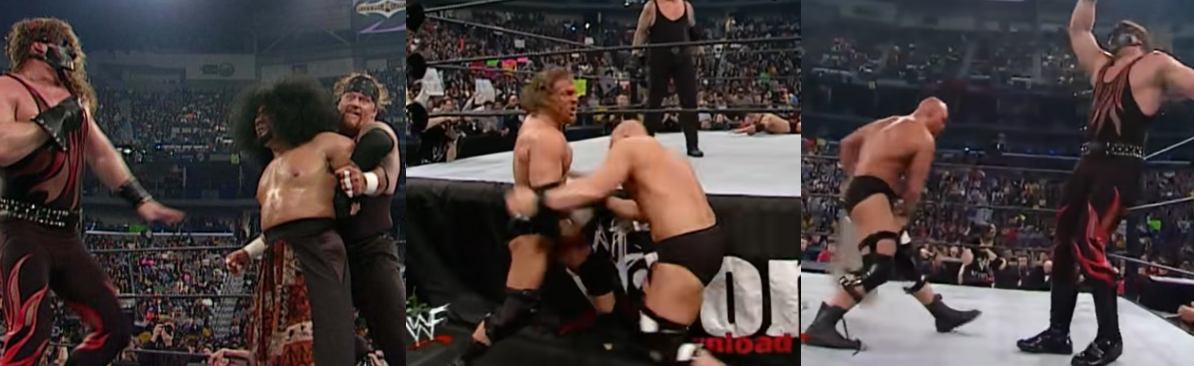
Neither Haku’s return, Triple H’s attack, or Kane’s impressive performance could keep Austin from victory.

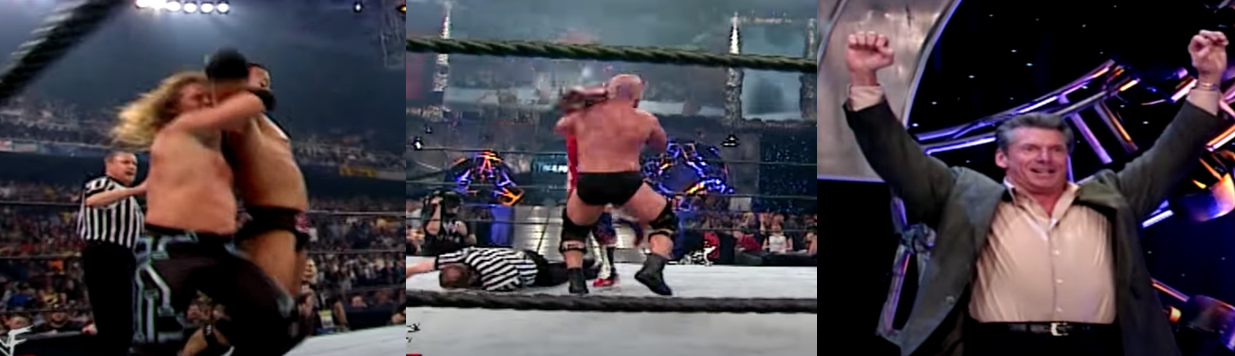
The Brothers of Destruction were then denied the chance to put their newfound partnership to the test against Steve Austin as Triple H attacked Austin during his entrance; earlier in the night, Austin had cost Triple H the WWF Championship in his match with Kurt Angle as part of their ongoing rivalry so the slighted Triple H assaulted the Texas Rattlesnake, busting him open and battering him around the aisleway as The Rock returned to the ring to take a beating from Kane and the Undertaker. As referees desperately forced Triple H off Steve Austin’s bloody, battered body, “The One” Billy Gunn hit the ring and the Brothers of Destruction were momentarily scuppered by the returning Haku, who entered to near silence as many (including myself) didn’t know the notorious former Meng. The final entrant, the sour-faced Rikishi, was attacked by Steve Austin, who then stormed the ring and assaulted everyone before Rikishi sent the Deadman tumbling out with his impressive side kick. Rikishi then tried to crush his cousin with his immense ass, but The Rock countered with a low blow and sent the big man out of the match, leaving the final four as The Rock, a bloodied Steve Austin, a heavily fatigued Kane, and, oddly, Billy Gunn. Why Gunn was chosen over the Undertaker or even Rikishi I don’t know but it was a moot point as he was launched from the ring by Austin within seconds so he could have an electric stare down with The Rock. Although The Rock came out on top when they traded blows, he couldn’t hit the Rock Bottom and ate a Stone Cold Stunner, but the People’s Champion was able to recover when Austin got distracted kicking Kane in the balls. A Rock Bottom shut Austin down but, when The Rock tried to heave Austin out, Kane came up from behind and shoved both men from the wring. While it seemed like the Big Red Machine had won, Austin had managed to hold on; although a Chokeslam seemed to do in Austin, Kane got distracted going for the Tombstone Piledriver and got another kick to the balls as a result. Austin then hit the Stunner and absolutely decimated Kane with repeated chair shots to the head, staggering the Big Red Machine and ultimately forcing him from the ring to award Austin his third Royal Rumble win and a first-class ticket to the main event of WrestleMania X-Seven!

The Aftermath:
Although the match meandered in the middle, with the ring filling up with disposable bodies, the 2001 Royal Rumble is largely regarded as one of the best of its kind; Kane’s mammoth stint and dominating performance wouldn’t be toppled for some thirteen years and his reward was a fun match at WrestleMania X-Seven that saw him capture the Hardcore Championship and an extended push alongside his brother throughout 2001. Rather than facing Rikishi and Haku at WrestleMania X-Seven alongside his brother, the Undertaker fought and defeated Triple H and went on to become a primary figure in the resulting “Invasion” storyline. Although he didn’t win the Royal Rumble, The Rock found himself in the main event of WrestleMania X-Seven when he recaptured the WWF Championship the following month at No Way Out. In the weeks leading up to their epic second WrestleMania clash, tensions would rise between Austin and The Rock, especially after WWF Chairman made Austin’s wife, Debra, The Rock’s manager. However, no one could have foreseen that Austin would brutalise The Rock and forge an unholy alliance with McMahon at WrestleMania X-Seven to regain the WWF Championship, kickstarting an ill-advised but somewhat entertaining heel turn for the Texas Rattlesnake that saw him become an unhinged egomaniac who turned his back on friend and foe alike during the Invasion storyline.

My Rating:

Rating: 4 out of 5.

Great Stuff

Did you enjoy the 2001 Royal Rumble match? Do you think it deserves the praise it gets or do you find it a bit dull in the middle portion? Who was your pick to win and what did you think to Kane’s phenomenal performance? Which of the returns did you think was best and did you know who Haku was? What did you think to the hardcore brawl? Were you excited for WrestleMania X-Seven at the time? Who’s your pick to win this year’s Royal Rumble? Whatever you think about the 2001 Royal Rumble, and the match in general, drop a comment below or on my social media and check out my other wrestling content across the site.

Wrestling Recap: Team WWF vs. Team Alliance (Survivor Series ’01)

The Date: 26 November 1987
The Venue: Richfield Coliseum; Richfield Township, Ohio
The Commentary: Jim “J.R.” Ross and Paul Heyman
The Referee: Earl Hebner
The Stipulation: Ten-man elimination tag team match to decide the fate of both organisations
The Competitors: Team WWF (WCW Champion The Rock, Chris Jericho, The Undertaker, Kane, and The Big Show) and Team Alliance (WWF Champion “Stone Cold” Steve Austin, WWF Hardcore Champion Rob Van Dam, Kurt Angle, Booker T, and WCW Owner Shane McMahon)

The Build-Up:
During its many decades as the dominating force in sports entertainment, World Wrestling Entertainment (WWE) has created some of the industry’s most successful competitors, changed the face of pay-per-view entertainment, and delivered genre-defining match types and wrestling cards. In 1987, the then-World Wrestling Federation (WWF) successfully gambled on WrestleMania then, as the National Wrestling Alliance (NWA) was due to broadcast Starrcade over the 1987 Thanksgiving weekend, WWF chairman Vince McMahon strong-armed many cable companies into airing his showcase of ten-man elimination tag team matches, the Survivor Series, or risk losing out on WrestleMania IV. By 2001, some of the WWE’s biggest events had taken place at the event and, this year, it was chosen as the final battle between the WWF and the alliance of World Championship Wrestling (WCW) and Extreme Championship Wrestling (ECW). The WWF and WCW had gone head-to-head in a ratings war since 1996 but, by 2001, WCW faced bankruptcy and, in a shocking moment, the McMahon purchased WCW and the “Monday Night Wars” came to a surprising end. After attempts to keep WCW alive on WWF television fell through, the WWF began a storyline where WCW joined forces with ECW (also now owned by McMahon) and attempted to “invade” the WWF as the “Alliance”. Unfortunately, as many of WCW’s top names sat out their high-paying contracts, the WWF was forced to rely on lesser names and, all too soon, the angle was more about McMahon feuding with his kids, Shane and Stephanie, and the increasingly paranoid Steve Austin holding onto his WWF Championship. More and more WWF guys joined the Alliance, including one-time saviour Kurt Angle, Chris Jericho slowly turned heel in his quest for gold, and even Austin seemed to consider jumping ship as the angle wore on. Eventually, with viewers and audiences turning away from the product, the decision was made to ditch the entire thing with this “Winner Take All” elimination match that would decide which organisation would prevail. Initially, Vince himself was scheduled to compete on Team WWF but he named the Big Show as his replacement and went about sowing the seeds of dissension throughout the Alliance in the lead up to this premature end to what should have been one of the biggest and longest angles in wrestling history.

The Match:
Considering I wasn’t really able to watch much wrestling as a kid, let alone truly be a part of the Monday Night Wars, I was deeply invested in the Invasion storyline at the time. I was pissed when Austin turned heel at Invasion and became a paranoid, self-deluded, cowardly asshole who was obsessed with the WWF Championship. Although the Alliance was missing key figures like the New World Order (nWo), Goldberg, and Sting and had dramatically repackaged top WCW stars like Diamond Dallas Page and Booker T into heels, I was well into their attempts to tear down the WWF. Unfortunately, far too many WWF guys jumped ship for no reason, but I’m not here to re-book this angle, I just wanted to say I was into it, delighted to see these fabled WCW and ECW stars on television, and extremely invested for this match. The build-up was quite good; things weren’t all hunky-dory on Team WWF as Jericho had been feuding with the Rock over the WCW World Heavyweight Championship and, to make matters worse, the Alliance won all but two matches on this Survivor Series card, meaning the stakes were further escalated heading in, something Vince was sure to emphasise backstage when he riled up his competitors with a stirring speech. The match kicked off with its two biggest stars, Austin and the Rock, trading blows; the two went at it in the corner but Austin gained the upper hand with a Lou Thesz Press and an elbow drop for the first near fall. Austin pressed his advantage using his knee braces, but the Rock ducked under a clothesline and hit a Lou Thesz Press and a taunting elbow of his own to rapturous applause and a pin attempt that was broken up by Shane. Thanks to Shane’s interference, the Rock was helpless as Austin tagged in Booker T, who had ridiculously been painted as a poor copy of the Rock during the Invasion storyline when, realistically, the two had barely anything in common!

Things got off to a heated start and only escalated as Shane constantly interrupted pin falls!

Booker laid in some chops but got quickly taken down with a big clothesline for a near fall that was again interrupted by Shane, but the Rock was still easily able to tag in Jericho, who lit up Booker with some chops and planted him with a flapjack. Jericho didn’t press his advantage, however, meaning RVD was able to tag in; of all the new faces from this time, RVD was clearly the most dynamic and popular, so much so that even J.R. had to mention it. RVD showcased his athleticism by nipping up, leapfrogging the charging Jericho, and rolling across his back in a beautiful sequence but, not to be outdone, Y2J answered with a lovely spinning heel kick. RVD showed his cunning by holding the ropes and avoiding a dropkick; he followed up with a slick cartwheel moonsault for a two count. However, when RVD backflipped out the corner and went for a hurricanrana, Jericho countered and locked on the Walls of Jericho; once again, Shane put a stop to this, which also allowed Booker T to tag in. However, Booker got cold feet when Kane (sporting a weird alternative version of his bad-ass vest attire) also tagged in and gladly allowed Kurt Angle to take his place. Angle (who had recently made Kane tap out) tried using his speed to avoid Kane’s power but ended up launched into the corner and assaulted by a flurry of strikes; Kane then whipped him to the opposite corner and crashed in with a clothesline and simply sat up after eating a big German Suplex. Stunned, Angle went for the strikes and ended up taking a sidewalk slam and Kane’s huge flying clothesline off the top. Shane again broke up the pin, so Kane tagged in his big brother, the Undertaker, who also manhandled Angle and then switched his attack to Booker when Kurt made a desperate tag.

The Big Show’s brief rampage was shut down by a finish-fest and, naturally, Shane scoring the pin!

The Undertaker easily knocked Booker down with a big boot and scored a big leg drop for another pin attempt that was again interrupted by Shane; J.R. was getting as annoyed as the WWF competitors, the crowd, and me by Shane’s constant meddling. The Undertaker worked over Booker T’s arm and hit his trademark “Old School” rope walk strike and an arm take down that ended in an armlock on the mat. Shane’s interference allowed Booker to not only kick out of a pin but also tag Austin back in; Austin went right at his old foe, stomping a mudhole in the corner as the crowd sang “What? What? What?” over and over in what is still one of the most annoying chants in wrestling. The Undertaker avoided Austin’s running rope attack and then hit another Old School, only for Shane to break up the pin once more; Team WWF was so riled up that the referee had to hold them back, allowing Team Alliance to work the Undertaker over in their corner and bringing Kurt Angle back into the ring. Angle weathered the Undertaker’s assault and hit a neckbreaker for a near fall but fell to a DDT after missing out on a German Suplex. The Undertaker then made the hot tag to the Big Show, who went on a rampage somewhat neutered by J.R.’s observation that the Big Show often makes big dumb mistakes! RVD illegally charged the ring and ate a clothesline and a standing military press for his efforts; the Big Show then smacked up Team Alliance and went for the Chokeslam but Angle was able to fight out and hit the Angle Slam! Booker T followed up with the Scissors Kick and the Spin-A-Roonie before tagging in RVD, who came crashing down with a Five-Star Frog Splash. Shane then tagged in to hit his big top-rope elbow drop and, naturally, got the pin fall to eliminate the biggest man from the match.

Some eliminations were quite lacklustre as it came down to a four-on-two disadvantage for the WWF.

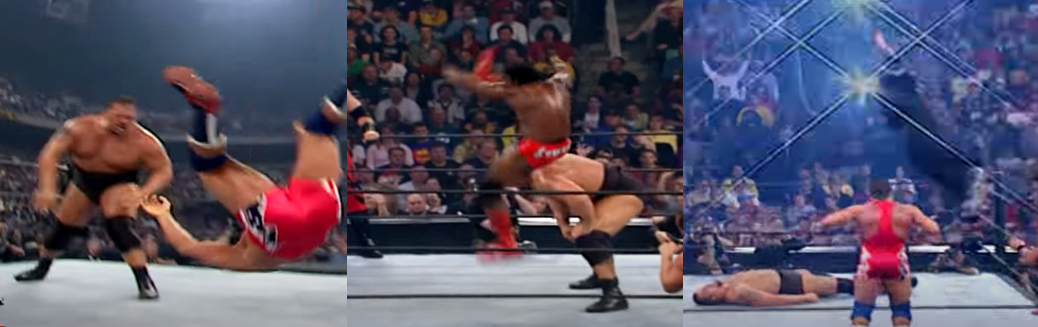
Thankfully, Shane immediately got his comeuppance as the Rock beat the hell out of him and then tagged Kane back in so he could drill Shane with his trademark One-Arm Chokeslam. The Undertaker followed up with a Tombstone Piledriver, and then Jericho finished Shane off with a Lionsault to finally get him out of the match. Jericho and Angle then went at it; although Y2J won the early advantage with a sick butterfly backbreaker, Austin broke up his pin attempt, allowing Angle to take him down and bring Booker T back into the fold. However, after three consecutive scoop slams and an elaborate knee drop, Booker switched with RVD; RVD landed a kicking combination but his corner shoulder thrusts were countered into a near fall off a roll up. Jericho tagged Kane back in; Kane brought the power and even caught RVD’s fist mid-swing and planted him with a powerslam, fought off Booker T’s interference, and shrugged off the Five-Star Frog Splash. However, as Kane readied a One-Arm Chokeslam, Booker T nailed a Harlem Sidekick; as a brawl broke out, RVD caught Kane with a sidekick off the top rope that was somehow enough to score him the three count. This pissed the Undertaker off so much that he beat up the opposition single-handedly; Snake Eyes and the big boot left Angle primed for the Last Ride but a distraction from Booker T allowed Austin to plant the Undertaker with a Stone Cold Stunner and drape Angle’s lifeless form over him for another elimination! Bolstered by their four-on-two advantage, Booker T attacked the Rock once more, scoring with another Harlem Sidekick but almost being pinned off a desperation DDT and a Samoan Drop, with both pin attempts broken up by Austin. Out of nowhere, the Rock then whipped Booker into Angle and anti-climactically eliminated Booker T with a simple roll-up (your five-time WCW Champion, everybody!) RVD took his place and worked the Rock over with some kicks, before a top rope slam bought the Rock the time to tag in Jericho. A flying forearm, shoulder tackle, and a running neckbreaker scored Y2J a near fall; however, although he managed to land on his feet when RVD countered the Lionsault, Jericho couldn’t avoid a spinning kick. RVD then glanced Jericho with the split-legged moonsault (J.R. postulates that Jericho “got a knee up”) and then ate a pin from the God-awful full-nelson faceplant Jericho was trying to get over as a finisher at this time (I believe it was called the Breakdown…) to even the odds. Things broke down into a brawl again but Angle and Jericho soon paired off in the ring while Austin assaulted the Rock on the outside; after wearing Jericho down with a chin lock and some stomps, Angle tagged in Austin, who planted Y2J with a superplex for a two count.

Despite Jericho’s actions, the WWF (and Vince) came out on top thanks to Angle’s last-second assistance.

An awkward miscommunication off an Irish whip eventually saw Austin switch with Angle. However, when Angle went for a German Suplex, Jericho rolled through and briefly applied the Ankle Lock to a massive ovation; although Angle escaped, he was visibly limping when he tagged out. Austin and Angle continuously tagged in and out but Jericho eventually made the hot tag and the match picked up again as the Rock tied Angle in the Sharpshooter; this surprisingly caused an immediate tap out and an aghast Paul Heyman to almost have a coronary! Austin, the last man standing for his team, Austin countered a diving crossbody and traded Walls of Jericho attempts with Y2J. Although he got his knees up to counter a Lionsault, Austin’s top-rope double axehandle didn’t hit and he barely kicked out after Jericho landed a missile dropkick. However, another awkward exchange saw Austin take Jericho out; although Austin and the Rock immediately rekindled their rivalry, Jericho spitefully planted the Rock with the Breakdown, completing his heel turn and earning him the admonishment of the Undertaker. Thankfully, the Rock was still able to kick out; when the Rock tried a comeback, he was launched outside and smashed off the ring post and the steel steps. Back in the ring, Austin’s spinebuster led to the Rock being trapped in a Sharpshooter that had Paul Heyman screaming for a repeat of the Montreal Screwjob; when the Rock reached the ropes, Austin tried to nail him with the WWF Championship and ended up in the Sharpshooter as well! The Rock countered a Stunner with one of his own, but couldn’t capitalise thanks to a low blow and interference from Alliance referee Nick Patrick. Austin took advantage to nail a Rock Bottom and was so incensed when the Rock kicked out that he took it out on Nick Patrick and forced Earl Hebner back into the ring. After the Rock ate a Stone Cold Stunner, the match seemed to be over; however, Kurt Angle suddenly nailed Austin with the WWF Championship! The Rock then hit the Rock Bottom and finally pinned Austin to eliminate him, win the match, and put the Alliance out of business. As the Alliance reacted in anguish and shock, Vince sauntered out to bask in his victory to really hammer home his superiority.

The Aftermath:
Considering how overbooked and chaotic this match was, it’s weird that Angle’s last-minute turn always comes across a little flat to me. Vince had hinted that he had tipped the odds in his favour prior to the match but I always felt like the execution was lacking. The next night on Raw, Vince rechristened the WCW Championship the “World Championship” and prepared to reward Angle by stripping Austin of the WWF Championship and giving it to his mole; however, the status quo of the WWF finally returned to normal by the decree of “The Nature Boy” Ric Flair, who returned to the WWF as a part owner after buying Shane and Stephanie’s shares in the company, turning Austin face again and Angle heel. The World Championship situation culminated in a tournament at the next month’s event, Vengeance, which saw Chris Jericho defeat both the Rock and Austin to become the first-ever Undisputed Championship and go on a disastrous main event run that ended with him dethroned by a returning Triple H. Every member of the Alliance eventually became part of regular WWF programming; some won their jobs at Survivor Series, others were quietly repackaged, and some were forced to kiss Vince’s ass on national television. Other WCW names, such as Eric Bischoff, the nWo, and Rey Mysterio, soon joined the company and the bloated roster eventually led to a brand split that also saw the WCW Cruiserweight Championship and United States Championship adopted by the company. Despite his emphatic victory, Vince never passed up an opportunity to reshape history in his favour or bury WCW; while ECW had an anniversary show and even a short-lived and catastrophic revival, WCW was rarely given its due unless it suited Vince’s purposes and has mainly been evoked to maintain the trademark on their pay-per-views and unique match types.

My Rating:

Rating: 4 out of 5.

Great Stuff

What did you think to this “Winner Take All” elimination match? Did you ever doubt that the WWF would come out on top? Who would you have preferred to see on Team Alliance? Were you annoyed at Jericho’s actions and how easily some guys were eliminated? Did you see Angle’s turn coming or were you expecting a different end to the match? What did you think to the Invasion storyline and how would you have improved it? Would you like to see WCW get more credibility or do you think it’s better off dead? Who were some of your favourite WCW competitors and what would your dream WWF vs. WCW team be? What are some of your favourite Survivor Series matches and moments? Whatever you think about the Survivor Series 2001 main event, feel free to share your thoughts below or leave a comment on my social media.

Wrestling Recap: Undertaker vs. Mankind (King of the Ring ’98)

The Date: 28 June 1998
The Venue: Civic Arena; Pittsburgh, Pennsylvania
The Commentary: Jim “J.R.” Ross and Jerry “The King” Lawler
The Referee: Tim White
The Stakes: Hell in a Cell match between heated rivals

The Build-Up:
The Undertaker had been a force of nature within the World Wrestling Federation (WWF) ever since debuting as part of the “Million Dollar Man” Ted DiBiase’s Million Dollar Team on this day at the 1990 Survivor Series. Over the years, the Deadman built up an impressive list of rivalries with some of wrestling’s most talented, and notorious, names, and one of his strangest and most bloodthirsty foes was Mick Foley. Foley, who had made a name for himself as the “King of the Deathmatch” and putting his body on the line in hardcore matches in Extreme Championship Wrestling (ECW) and World Championship Wrestling (WCW) as Cactus Jack, debuted as Mankind on 1 April 1996 and one of his first feuds was against the Undertaker. The two battled in the first-ever Boiler Room Brawl and the Undertaker’s long-time manager, Paul Bearer, even allied with Mankind back in the day, a partnership which was reignited after Kane made his dramatic debut and began targeting his older brother. Mankind became embroiled in the ongoing feud between the Undertaker and Kane, which included an on-again/off-again partnership between the Brothers of Destruction but, with Kane booked to challenge for “Stone Cold” Steve Austin’s WWF Championship at this same event, the Undertaker looked to end to his rivalry with Mankind in the second-ever Hell in a Cell match. The Undertaker had, of course, been involved in the first Hell in a Cell match the previous year; the structure, a wire-mesh cage with a roof and a locked door, was, at the time, regarded as the WWF’s most dangerous match ever and this match went a long way to not only cementing Foley as an absolute madman (whose career was noticeably shortened by this match) but evoking an unrivalled sense of danger surrounding the Hell in a Cell thanks to both men, but particularly Foley, putting their bodies on the line for the sake of our entertainment.

The Match:
It has to be said that there wasn’t a massive amount of build-up towards this match; instead, it was more like the WWF had pressed “Play” after pausing the Undertaker/Mankind rivalry for a while, and the main reasoning behind Foley wanting to put the Undertaker through hell was because the Deadman had attacked Paul Bearer, who was managing Kane at the time, who Mankind referred to as “Uncle Paul”. Indeed, even Foley later admitted that a big part of the reason for his ridiculous stunts in this match came because the feud didn’t have much momentum behind it and the Undertaker was currently dealing with a broken foot, so Foley was worried that the match would suffer as a result. This (and the anticipation for the main event) may explain why Mankind entered to next to no reaction from the crowd, but they soon perked up when Foley tossed a steel chair up to the roof and then clambered up the chain link wall to await the arrival of the Undertaker, which perfectly played into the mental instability of the Mankind persona as hyped up by J.R. and The King on commentary. The Undertaker received a far more rapturous response from the crowd upon the sound of his gong alone and, despite his broken foot, followed his rival up to the cell roof.

While the match started on top of the cell, it wasn’t long before Foley was crashing off (and through) the structure!

With the chain link roof buckling under their combined weight, the two exchanged blows and Mankind immediately landed chair shots to the Undertaker’s back. Looking to end his undead opponent early, Mankind prepared to deliver a suplex to the Deadman but the Undertaker fought back with his patented strikes, which knocked Foley loopy, then sent Mankind right off the roof and crashing through the announce table below! J.R.’s response summed up this heinous, absolutely insane spot perfectly: “Good God almighty! Good God almighty! They’ve killed him!” and one look at Foley’s prone body amidst the table debris makes it hard to argue with this statement! The crowd went absolutely bonkers, electrified by the unforeseen moment, and even the Undertaker later admitted that he was certain Foley was dead. If this were to happen in today’s climate, J.R. and The King’s declaration that the match was over would probably be true and this basically stopped the proceedings for about ten minutes as referees, doctors, Vince McMahon, and even hardcore legend (and Foley’s friend and mentor) Terry Funk rushed out to tend to Foley. No matter how many times you watch the replay (and it’s shown again and again to buy the guys time), it never fails to make an impact (literally and figuratively) as Foley’s body plummets right off the top and absolutely decimates the announce table. However, halfway up the entrance ramp, Mankind clambered to his feet, shoved aside the WWF personnel, and scrambled back up to the top of the cell for more! The Undertaker obliged by Chokeslamming Foley through the cell roof! Mankind landed with an almighty thud and had his face smashed by the errant steel chair, which caused a tooth to come out of his nose! This second fall was completely unexpected for everyone involved and, for the second time in the match, Foley was legitimately believed to be dead by everyone present. Terry Funk, Sergeant Slaughter, and WWF referees desperately tried to revive Foley and buy the two time to recuperate; Funk even took a Chokeslam from the Deadman that literally slammed him right out of his shoes(!) to give Foley a couple more seconds to get back in the game and, beyond all expectations, the match continued for about another ten minutes despite Mankind continually crumbling like a sack of potatoes from the Undertaker’s lightest touch. Again, this would never happen today; the match basically gets back on track, with the cage door being locked and the two continuing to fight, despite the fact that Foley is severely concussed and probably has some internal injuries.

The brutality of the match was unlike anything anyone had seen in the WWF before and cemented Foley’s legacy.

J.R. and The King continued to express shock and awe at just how physically tough and reliant Mankind was, and Foley proved to have a little fight left in him as he interrupted the Undertaker’s signature rope walk to send the Deadman crashing crotch-first to the ring ropes and then made himself a meme with his bloodied smile. Staggered, limping, and favouring his ribs, Mankind knocked the Undertaker to the outside but was in too much pain to lift the steel steps. The Undertaker, however, had no such qualms and repeatedly rammed the steel steps into Foley’s arms and head at ringside! Somehow, Mankind dodged the Undertaker’s torpedo dive through the ropes, causing the Deadman to crash head-first into the cell, and then grated the Undertaker’s already lacerated forehead against the chain link wall to really get the crimson flowing. Mankind then hit the Undertaker with a Pulling Piledriver onto the steel chair, but ‘Taker kicked out at two so Mankind delivered a leg drop onto the steel chair after laying it across the Undertaker’s bloodied face, but was again frustrated by a two count. The Undertaker then got dropped by Mankind’s signature Double-Arm DDT and Foley pulled out a bag of thumb tacks(!) and sprinkled them everywhere, much to the commentators’ shock and the crowd’s delight! Mankind delivered shots to the Undertaker’s head, sending the Deadman teetering, only to be shut down by the last reserves of the Undertaker’s strength. Mankind resorted to applying the Mandible Claw to try and cause the Undertaker to black out, which resulted in Foley clambering behind the Deadman and ultimately sealing his fate as the Undertaker staggered to his feet and dropped Mankind, back-first, right onto the thumb tacks! With dozens of the sharp pins sticking into this flesh and tattered clothes, Mankind walked right into a Chokeslam onto the tacks and, finally, mercifully, was put down with a Tombstone Piledriver. For their efforts, the crowd gave both men (but particularly Mick Foley) a standing ovation and filled the area with applause as doctors and WWF officials were finally able to attend to Foley’s battered, bloody body but, in a final show of guts and perseverance, Foley refused to be stretchered out and was instead assisted to the back by Funk and Slaughter to a standing ovation.

The Aftermath:
As impossible as it may be to believe considering the horrific abuse they suffered in this match, neither Mankind nor the Undertaker were done on this night; both men ended up interfering in the main event, which saw Kane emerge as the WWF Champion after Steve Austin got busted open, and two months later Mankind was back in a Hell in a Cell match as he faced his former partner one-on-one on an episode of Raw is War. Foley’s injuries in this match were substantial and greatly contributed to the softening of his Mankind character, who eventually became a loveable goofball and enjoyed a successful tag team run alongside The Rock before Foley was given the company’s biggest prize and, eventually, made plans for his in-ring retirement. As for the Undertaker, he shifted into the main event picture soon after, forming an alliance with Kane and targeting Steve Austin and the WWF Championship before eventually getting back into it with his brother. This wouldn’t be the last time the Undertaker and Mankind met in the ring, either; they fought on Raw is War two nights later, battled over the WWF Tag Team Championships, and were included in multi-man championship (or contender) matches throughout 1998 and 1999. While Foley would later end his lengthy and storied career in another Hell in a Cell match, this particular contest would be one of the defining moments of his career; while the actual in-ring work was somewhat pedestrian, the match impressed on sheer spectacle alone and has been evoked (for better or worse) in video packages, hype for the brutality of the match concept, and in subsequent Hell in a Cell matches.

My Rating:

Rating: 4 out of 5.

Great Stuff

What did you think to the battle between Mankind and the Undertaker in Hell in a Cell? How would you rate it against their other matches and against Hell in a Cell contests? What was your reaction when Mankind went sailing off the top of the cage? Do you think the match should have ended right there, or after Foley’s second fall? How are you celebrating the Undertaker’s debut this year, what are some of your favourite matches and moments from his long and distinguished career, and what dream match would you have liked to see him involved in? Whatever your thoughts, drop a comment below and or let me know what you think about the Undertaker on my social media.

Wrestling Recap: Undertaker vs. CM Punk (WrestleMania NY/NJ)

The Date: 7 April 2013
The Venue: MetLife Stadium; East Rutherford, New Jersey
The Commentary: Michael Cole, John Bradshaw Layfield/JBL, and Jerry “The King” Lawler
The Referee: Mike Chioda
The Stakes: Singles match with the Undertaker’s WrestleMania winning streak on the line

The Build-Up:
The Undertaker had been a force to be reckoned within the World Wrestling Federation (WWF) ever since his dramatic debut as part of the “Million Dollar Man” Ted DiBiase’s Million Dollar Team on this day at the 1990 Survivor Series. After a year without any televised losses, the Undertaker was named the number one contender to Hulk Hogan’s WWF Championship belt and his victory over the Immortal One cemented the Deadman as a main event star for decades. While the WWF changed and rebranded, eventually becoming World Wrestling Entertainment (WWE), the Undertaker grew as a character and a spectacle; transforming from a largely mute, undead monster into a Satanic overlord, a bad-ass biker, and the conscious of the WWE, the Undertaker’s legendary career came to be synonymous with his uncanny ability to secure wins on the grandest stage of them all, WrestleMania. By this, the twenty-ninth WrestleMania, the Undertaker had twenty victories at the Showcase of the Immortals, having put away hated rivals such as Kane, Triple H, and the “Heartbreak Kid” Shawn Michaels among others. In recent years, his opponents specifically sought a match against him at WrestleMania seeking to snap this winning streak but few were able to make this into such a personal vendetta than CM Punk. After winning the right to face the Undertaker, CM Punk immediately set about disrespecting the memory of William Moody, who had portrayed the Undertaker’s long-time manager Paul Bearer and who had recently passed away. Alongside his own manager, Paul Heyman (who also had a storied history with the Deadman), CM Punk regularly called out the Undertaker, stole the Deadman’s mystical urn, and even dumped its contents over Big Evil in the lead up this match, which was the closest that CM Punk ever got to main eventing a WrestleMania.

The Match:
Before the match can even begin, there are two things that need to be gotten out of the way first: the first is another of the WWE’s excellently-produced video packages that not only works as a touching tribute to the late, great Paul Bearer but also does a fantastic job of telling the story of this heated feud up until that point and really painting CM Punk as an absolutely reprehensible dick. Since the Undertaker wasn’t around each week to help build towards the match, CM Punk fell back on his unparalleled mic skills to taunt and mock both the Deadman and Bearer specifically to wind the Undertaker up since a count out or disqualification would still count as a loss and all he was concerned about was getting that win and tarnishing the Undertaker’s winning streak. The second, and biggest thing to get out of the way, are the competitor’s entrances; by this point, the Undertaker’s appearances at WrestleMania had become a spectacle all unto themselves and his entrances often went on as long as some wrestling matches! This year was no different as the Deadman’s entrance ran around five minutes long and saw him slowly, ominously stalk his way to the ring in a shroud of smoke while shadowy figures clutched at his feet in a truly spinetingling visual! However, the Undertaker wasn’t the only one to get a big entrance this year as Living Colour played CM Punk down to the ring with a live performance of “Cult of Personality”, though of course Michael Cole and his cohorts couldn’t be stopped from offering pointless and distracting commentary once the two were in the ring.

Cm Punk’s early strategy involved goading and disrespecting the Undertaker to wind him up.

As soon as the bell rang, the two went for each other, both with their hands up and looking for an opportunity to land a strike or a grapple. CM Punk, the quicker and smaller of the two, goaded the Undertaker by dodging a strike, slapping him in the face, and slipping out of the ring in order to put a quick beating on the Deadman after a short chase. Although the Undertaker tried to manhandle Punk into the corner, he easily slipped away and continued to taunt the Undertaker, kicking himself free of a Chokeslam attempt and ended up eating a big boot to the face and being unceremoniously dumped to the outside for his troubles. On the outside, the Undertaker beat CM Punk around the barricade before whipping him into it and smashing his face off the announcer’s table. The Undertaker stripped the table down and then rammed CM Punk spine-first into the ring post before rolling him back into the ring to deliver his patented leg drop across the ring apron. Once they were both back between the ropes, the Undertaker pressed his advantage, pounding on CM Punk in the corner and intimidating the referee for chastising him; working over CM Punk’s left arm, the Undertaker went for his “old school” rope walk but CM Punk jerked him off the top rope with an arm drag and, despite the pain in his arm, stomped on the Undertaker while the Deadman was down and hit a walk rope of his own in a blatant show of disrespect before landing a side Russian leg sweep and going for the first pin of the match.

CM Punk pressed his advantage at every opportunity using his quickness and agility.

Obviously, the Undertaker kicked out; the match then slowed a bit as CM Punk locked in a ground-based submission so the two could catch their breath (while also giving Paul Heyman a chance to shout encouragement and taunts to both men, respectively) before the Undertaker went back to his game plan of beating CM Punk in the corner. This backfired on the Deadman, though, when he missed a running boot and injured his knee in the process, which allowed CM Punk to kick him out of the ring and land a big diving axehandle from the top rope to the outside. Back in the ring, CM Punk scored a two-count off a neckbreaker but his attempts to work over the Undertaker’s arm got cut off by the Deadman’s trademark strikes. Again, CM Punk scored a two-count off another quick neckbreaker and slapped on a choke hold, all while Paul Heyman shouted encouragement about him being “one second away” from victory. The Undertaker battled his way up to a vertical base and hit a suplex to throw CM Punk off, then crotched his arrogant opponent on the top rope when CM Punk tried to hit another rope walk. A single punch to the jaw sent CM Punk careening to the outside again but Paul Heyman threw himself in the Undertaker’s path to stop the Deadman doing his signature dive to the outside, almost getting Chokeslammed off the apron in the process, which allowed CM Punk to recover and hit a clothesline off the top rope for another two-count. Weary (and possibly a little out of it), the Undertaker left himself wide open in the corner for a running knee and got taken down with a clothesline, which set CM Punk up for his patented Diving Elbow Drop.

Both men survived some big moves and signature offense from their opponent.

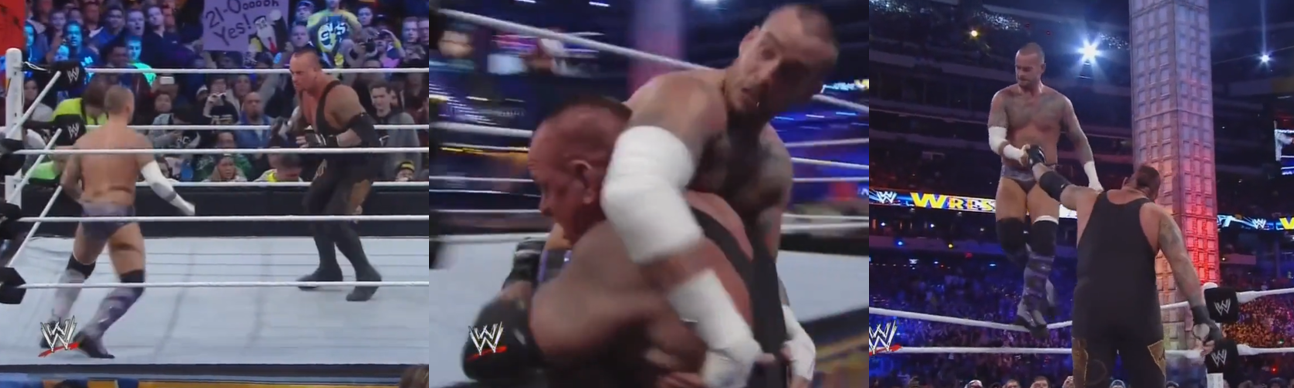
Again, the Undertaker kicked out at two, so CM Punk prepared to hit his finishing move, the Go-To-Sleep/GTS; however, the Undertaker slipped off CM Punk’s shoulders, grabbed him by the throat, and hit a massive Chokeslam for his first near-fall of the match! The two then got into a slug fest that quickly went in favour of the Undertaker, who again pummelled Punk in the ring corner with strikes, a running attack, and his signature Snake Eyes manoeuvre but CM Punk weathered the storm and surprised the Deadman with a kick for another two-count. CM Punk then sent the Undertaker to the outside again with a clothesline and went back to the announcer’s table, which he just narrowly avoided being powerbombed through when he slipped out of the Last Ride. With the Undertaker lying prone across the table, CM Punk hopped to the top rope and hit another Diving Elbow Drop…though the table didn’t break on impact. CM Punk was aghast when the Undertaker beat the referee’s count, however, and made it back into the ring before a count of ten; distraught (and hurt following his awkward landing on the table), CM Punk was easily wrapped up in the Undertaker’s Hell’s Gate submission move. Punk, however, used his technical expertise to turn it into a pinning attempt, and then wrapped the Undertaker up in the Anaconda Vice that, for all its drama, mainly served to give the Undertaker a chance to catch his breath again. Soon enough, the Undertaker was on his feet and going for another Chokeslam but CM Punk wriggled free and hit a glancing GTS that the Undertaker completely no-sold and powered through to hit a Tombstone Piledriver out of nowhere! Incredibly, CM Punk kicked out at two, much to the delight of Paul Heyman and the crowd, who began to chant “This is awesome!”

Even an urn shot couldn’t stop CM Punk being planted with the Tombstone and becoming a statistic.

Another slugfest followed; however, when the Undertaker went for the Chokeslam, Mike Chioda was sent sprawling by an errant shot, which allowed CM Punk to smash the Deadman in the back of the head with the urn and avoid the Last Ride once again. CM Punk’s decision to mock the Undertaker with his signature pin cost him almost as much as the referee’s long count, however, as the Undertaker kicked out at two, driving Punk into a frustrated frenzy at his opponent’s refusal to stay down. The two then countered each other’s attempts at hitting their finishing manoeuvres before the Undertaker scooped CM Punk into a second Tombstone Piledriver and secured his incredible WrestleMania winning streak for another year. Showered by the adulation and respect of the crowd, the Undertaker than retrieved his urn and delivered one last tribute to his friend and manager while the announcer’s refused to keep their mouths shut and let the moment speak for itself. Ultimately, while the match was very good, I couldn’t help but feel like it didn’t quite kick into gear; the story was very traditional, with the in-ring action building and escalating to both men’s strengths and their tropes (the conniving little guy against the veteran big man) but it just felt like something was missing. Maybe if CM Punk had used some more underhanded tactics, given the Undertaker a bit of a run-around, or if the Undertaker could have had a couple of big bursts of energy it would have helped but it’s still a perfectly entertaining and acceptable match and I think the crowd probably would have bought Punk winning, though it never really seemed like he was going to as he didn’t get much of a chance to hit any big moves beyond those diving elbows.

The Aftermath:
This match put an end to the feud between CM Punk and the Undertaker; the next night on Raw, a distraught CM Punk came out to address how his historic run with the WWE Championship got cut short and he was denied the WrestleMania main event in favour of the Rock and John Cena. He and Paul Heyman eventually had a falling out when Heyman returned to the side of his old client, Brock Lesnar, turning Punk face in the process. On that same episode of Raw, Roman Reigns, Dean Ambrose, and Seth Rollins (collectively known as “The Shield”) attacked the Undertaker as he tried to pay tribute to Paul Bearer once more. He was saved by his brother, Kane, and Daniel Bryan (known as “Team Hell No”) and the three of them went on lose to the newcomers and the Undertaker’s vaulted WrestleMania winning streak was finally broken at the next year’s WrestleMania in a pretty disappointing match against Brock Lesnar.

My Rating:

Rating: 4 out of 5.

Great Stuff

What did you think to the contest between CM Punk and the Undertaker at WrestleMania? How would you rate it against the Undertaker’s other WrestleMania matches? Were you a fan of CM Punk disrespecting Paul Bearer’s memory to get heat for the match? Do you think the match should have been the main event bout of the night? How are you celebrating the Undertaker’s debut this year? What are some of your favourite matches and moments from his long and distinguished career? What dream match would you have liked to see him involved in? Whatever your thoughts, sign up to drop a comment below and or let me know what you think about the Undertaker on my social media.

Game Corner: WWE Legends of WrestleMania (Xbox 360)

Released: 20 March 2009
Developer: Yuke’s
Also Available For: Mobile and PlayStation 3

The Background:
On March 31st, 1985, Vince McMahon changed the face of the wrestling landscape forever by bringing together the biggest names in wrestling (alongside a number of celebrity guests) for the very first WrestleMania, a pay-per-view extravaganza that became the hottest event of the calendar year for World Wrestling Entertainment (WWE). The WWE has a long and storied history with videogames that can be traced all the way back to the very first videogame ever produced baring the initials of their previous moniker of the World Wrestling Federation (WWF), MicroLeague Wrestling (MicroLeague/Various, 1987). A number of releases made their way to various home consoles and even arcades over the years, with the format slowly evolving to include more and more wrestlers and match types, but the WWE’s foray into digital entertainment largely hit its stride in the late-nineties when Asmik Ace Entertainment, AKI Corporation, and THQ joined forces to produce popular titles for the Nintendo 64 and Yuke’s took their first tentative steps into the SmackDown sub-series (2000 to 2003). Many of the games produced during this time and by these developers are considered to be some of the best wrestling games ever made and, by 2009, the WWE was represented by the multi-platform SmackDown vs. Raw series (Yuke’s, 2004 to 2011), a series which was largely regarded as mostly hit and miss in terms of value for money and year-on-year improvements. Still, the series was profitable enough to convince Yuke’s to attempt a few additional WWE videogames, with Legends of WrestleMania being one of them; pushed intro production to coincide with WrestleMania 25, and focused far more on nostalgia and giving players the chance to relive and redefine some of the company’s biggest moments, Legends of WrestleMania was met with largely lacklustre reviews that took issue with its presentation and control mechanics.

The Plot:
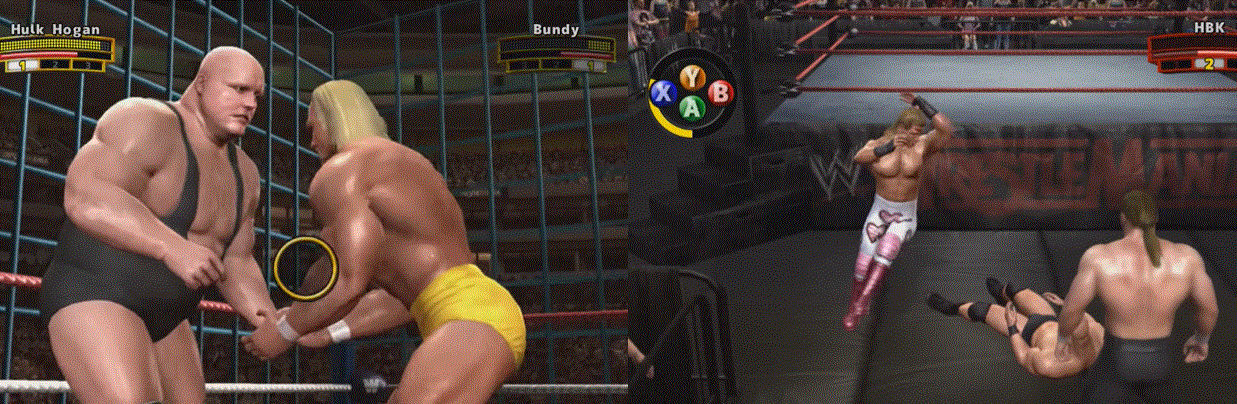
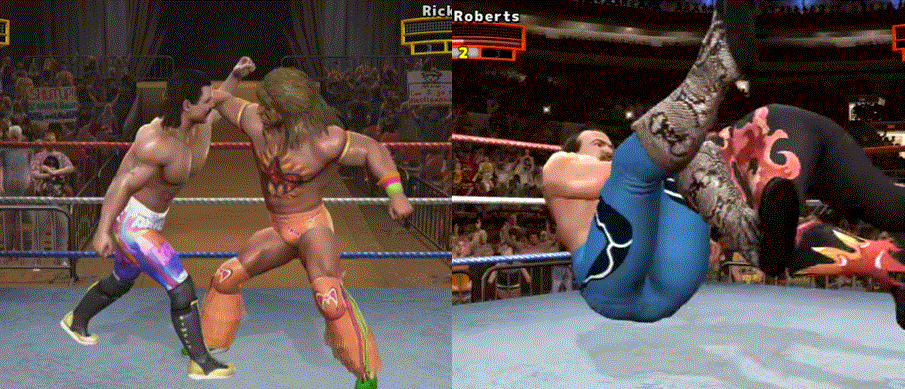
Take control of a WWE Legend and relive some of the biggest WrestleMania moments of all time, such as Hulk Hogan’s legendary clash with Andre the Giant and Bret “Hitman” Hart’s bloody showdown with “Stone Cold” Steve Austin, or rewrite and redefine history by playing these matches, and others that never took place, from the perspective of the loser (or another WWE superstar).

Gameplay:
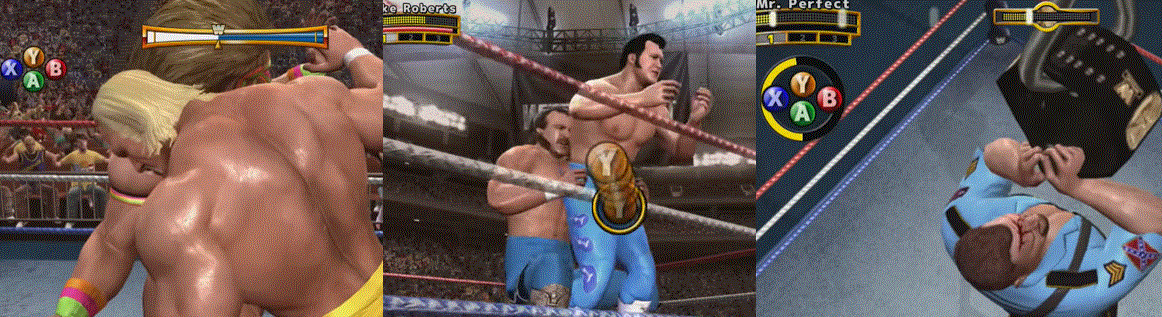
WWE Legends of WrestleMania is a wrestling title that gives players the chance to select from a roster of thirty-eight WWE Legends and pit them against each other in a series of matches, many of which will be immediately familiar to fans of the WWE or anyone who’s played one of Yuke’s WWE videogames before. Unlike many of the SmackDown! videogames, the focus here is much more on fast-paced, arcade-style action rather than simulating a real-life wrestling match, which has both positive and negative impacts on the gameplay. Players can move their Legend using either the left analogue stick or the directional pad (D-pad); having grown up playing the likes of WWF No Mercy (Asmik Ace Entertainment/AKI Corporation, 2000), I generally prefer to use the D-pad for these games (and most fighting games) as it feels more intuitive, but there’s little benefits from favouring one or the other. You can double tap towards or away from your opponent to run, but I had extremely minimal success with this; in most WWE games, running is mapped to one of the shoulder buttons, making it quick and easy to use, but that’s not that case here so the majority of my matches were slower, clunkier affairs as a result.

Gameplay is heavily based around QTEs and button mashing.

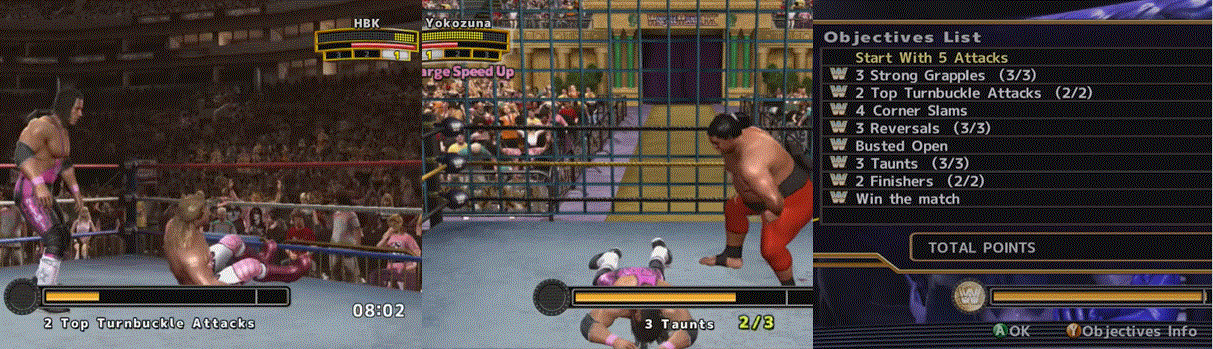
You can throw a strike at your opponent with X; land a few in quick succession to perform a simple combo or hold X to charge up a powerful strike, with both knocking them to the mat and leaving them prone for a leg or elbow drop or other ground-based offense. Grappling is performed with A; again, you can either tap it for a quick, weak grapple, or hold it for a stronger grapple, and use a directional input in conjunction with A to perform different moves (though your move pool is quite limited). As you attack and mix up your offense, you’ll build up a “Chain Meter”; as it reaches three different levels, you’ll gain access to more powerful grapples, with your finisher being unlocked at Level 3 and performed by pressing X and A together. Successfully landing attacks drains your opponent’s health meter and weakens them for either a pin or submission; submission moves are generally locked in when the opponent’s on the mat and see you mashing buttons to wear your opponent down, or you can pin them with B. If either of these things happen to you, you’ll need to mash buttons or full a circular meter to hit a small target in order to stave of the attack or kick out of the pin attempt.

While reversals can be tricky to pull off, finishers are a matter of hitting onscreen button prompts.

You’ll need to mix and match your offense in order to build up your Chain Meter (though simply mashing X can work just as well), and you can sacrifice a chunk of it by taunting with B and Y and gaining temporary buffs. This can all be a little clunky but it generally works quite well; what doesn’t work quite as well is the game’s reversal system. Rather than map counters to a shoulder button, WWE Legends of WrestleMania has them performed by pressing away from your opponent and Y or holding Y to block. I found this to be incredibly unreliable, as my Legend would often just step backwards or even run away, and I really don’t understand why this wasn’t just mapped to the Right Bumper. Unlike the majority of other wrestling games, WWE Legends of WrestleMania heavily relies on button mashing, button inputs, and quick-time events (QTES); you can’t even Irish Whip your opponent without a QTE flashing on the screen and many of the event matches in the WrestleMania Tour mode start, or are punctuated by, QTE sequences that see you mashing or hitting buttons in a test of strength, chain grapple, and other similar sequences. This also extends to the finishers; after pressing X and A, you’ll need to hit the QTE prompts to land your finisher sequence and do the maximum amount of damage, which is certainly unique but it comes at the cost of severely limiting the amount of finishers available in create-a-wrestler mode

There’s not much to differentiate the wrestlers but managers add a little spice to the matches.

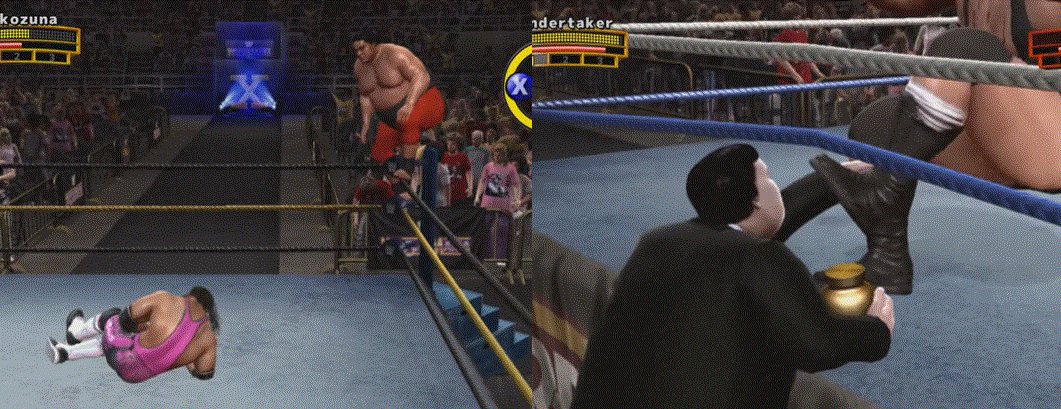
Contrary to other wrestling videogames; there isn’t really a weight class or detection system in WWE Legends of WrestleMania; playing as King Kong Bundy is largely the same as playing as Shawn Michaels, but there are some notable exceptions. For example, while Mr. Perfect can body slam and lift the likes of Yokozuna without issue, some Legends are noticeably more nimble than others and some superheavyweights struggle with climbing cage walls and are limited in their aerial offense. Some wrestling games like to lump their roster into categories and assign them abilities that play to their strengths, but that isn’t the case here so the majority of the roster’s differences are reflected in their move pool: Jimmy “Superfly” Snuka isn’t going to be quite as technically adept as Ric Flair but it’s not as though the Undertaker exhibits any supernatural abilities that other big men, such as the Big Boss Man, have. One major aspect of the game is the presence of managers; the likes of Paul Bearer and “The Mouth of the South” Jimmy Hart can accompany Legends to the ring and can interfere on your behalf at the cost of your current Chain Level, which makes them super useful when they’re in your corner and quite the hindrance when they’re in your opponent’s.

All the standard match types are available, with plenty of button mashing and QTEs sprinkled about.

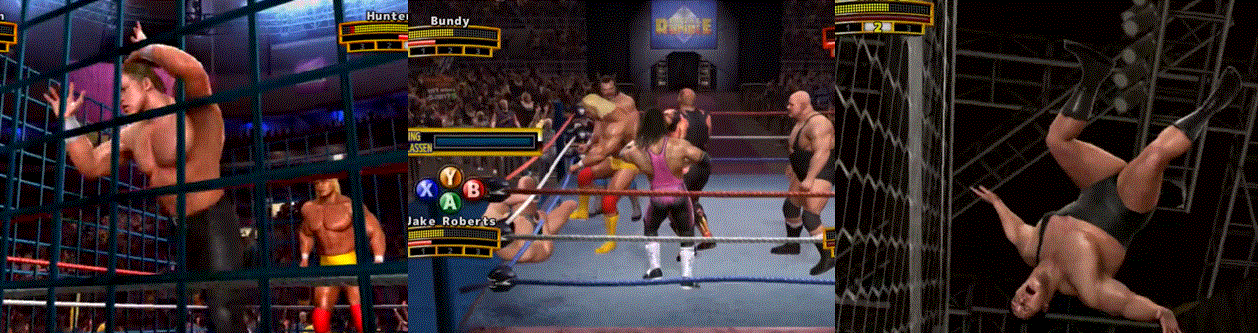
Wrestling matches have all the standard options you might expect; you can set the difficulty level of the CPU in the options, manipulating the computer’s use of strikes and reversals and such, and customise win conditions (such as turning pin falls and disqualifications on or off and changing the amount of time you can spend outside of the ring). There’s also a number of additional match types on offer that will be recognisable to fans of wrestling games, with most featuring a twist in the game’s new engine and mechanics that mostly boil down to button mashing. You’ll need to mash buttons to either escape from, or prevent your opponent from escaping, a cage or break up a pin fall in a tag team match, for example. Similarly, you’ll find finishers disabled in the Royal Rumble match (there aren’t even special Royal Rumble finishers like in other games) and you’ll instead have to mash buttons to try and force your opponent out of the ring or save yourself from elimination. These components are less prominent in Hell in a Cell and ladder matches, however; you can start Hell in a Cell on top of the structure, which is a nice touch, and can throw your opponent through the cage wall or down to the ring using environmental grapples. Ladder matches are actually much more enjoyable than in other wrestling games I’ve played; you pick up a ladder (or any weapon) by double tapping B and a helpful glowing target shows you where to set it up and climbing and retrieving a championship belt is quite simple compared to other wrestling titles. Retrieving a weapon from under the ring can be a little trickier, though, as can utilising the ringside area or battling into the crowd or up the aisleway, as it requires you to hit A in specific areas around the arena, which can be difficult thanks to the janky controls. You’ll also find such staples as Iron Man matches and Last Man Standing matches on offer here, which are fun ways of mixing up the gameplay, but there’s nothing to really set the game’s matches or gameplay apart from other wrestling titles and very few of these appear in WrestleMania Tour.

WrestleMania Tour sees your reliving, rewriting, and redefining classic matches.

Speaking of which, you’ll be given three single-player options here: “Relive” (where you recreate specific WrestleMania matches), “Rewrite” (where you tackle other WrestleMania matches from the perspective of the historical loser), and “Redefine” (which features unique “dream matches”). Each of these matches is proceeded by a short hype package that features clips from real-life wrestlers and the matches and feud between the competitors, and you’ll be given a series of optional objectives to fulfil in order to earn points. These range from performing a certain number of attacks, grapples, counters, and finishers, winning the match, performing taunts, winning pre-match sequences, and more specific environmental situations (such as winning Chain Grapple sequences, slamming your opponent through an announce table, or grappling up near the entrance). Earning points fills a meter and, once it fills high enough, you’ll earn a medal that will award you with unlockable match types, attires, and more. There’s nothing to gain from playing WrestleMania Tour on anything other than the easiest difficulty, with the computer’s abilities completely neutered in your favour, beyond personal pride so you may as well manipulate the game’s settings to make things easier for you. This mode is also probably the best part of the game as it lets you recreate some iconic WrestleMania moments and matches, and meeting the objectives can be fun, but things quickly get quite frustrating if you’re trying to earn all the medals and monotony sets in quite fast as there’s not much variety in terms of the match types (there are no multi-man matches in this mode, for example) beyond the odd cage or ladder match and you can completely ignore the objectives if you like since winning is all that really matters.

Graphics and Sound:
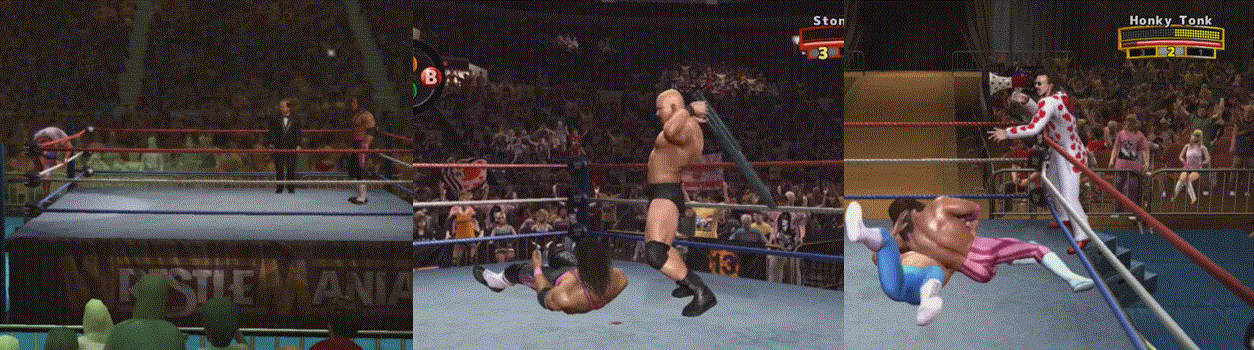
Wrestling games can be a bit hit and miss when it comes to their graphics, especially with their in-game character models. WWE Legends of WrestleMania favours a slightly exaggerated, action figure-like aesthetic for its Legends, which is typically common when bringing the WWE’s old school superstars to life, and for the most part this actually looks a lot better than in some of the SmackDown! titles. This is primarily because WWE Legends of WrestleMania is largely consistent with its presentation, rather than fluctuating wildly between hyper realistic and massively off-model. Notably, however, you won’t find any female Legends or superstars on offer here, and there’s no on-screen referee either, which is a pretty big step back for me.

While character models look pretty good, the camera and arenas leave a lot to be desired.

The number of arenas on offer isn’t exactly much to shout about either. There’s very little variety on offer as you can only fight in WrestleMania arenas; there is a Royal Rumble arena, however, (and ironically you can only ever fight a Royal Rumble match in this arena) but there’s no Raw, SmackDown!, or other pay-per-view arenas on offer. The crowds are as sub-standard as ever, sporting signs and attire tied to their favourite superstars and parting to allow you to fight over the barricade (though essentially acting as barriers to keep you enclosed), but entrances have been a bit neutered. The game does offer the old-school gondola entrances, which is kind of cool, and recreates the old-school name plates and presentation of the pre- and early-“Attitude Era” of the WWE. Unfortunately, however, the presentation does take a bit of getting used to; the camera is very zoomed in, meaning that your Legends take up a lot of screen space and this can make it a little difficult to be fully aware of your surroundings. The camera is prone to wild swings and odd positioning, which is very annoying, and there’s a noticeable delay between button presses and executing grapples, making for a much more deliberate and slower pace to the game. Though I eventually learned to live with these niggling problems, it did take me a while to adjust to the presentation and gameplay style of the game.

Video clips add some historical context but the commentary continues to be mundane and predictable.

The inclusion of video clips and real-world footage adds to the drama and intrigue of the WrestleMania Tour mode, but these are nothing you haven’t really seen before in a wrestling title. The same goes for the entrance videos and music, which is all pretty much as you’d expect (with a few inconsistencies here and there, such as the Big Boss Man utilising his Attitude Era theme), and this extends to the in-game commentary. Provided by the legendary duo of Jim Ross and Jerry “The King” Lawler, the commentary is basically exactly the same as in the SmackDown! series, though there are some specific new sound clips added in to refer to the game’s roster and the rivalries on offer in WrestleMania Tour. I don’t play these games for in-depth commentary or crowd reactions but even I was astounded by how cheap and lazy these aspects were here. The same can be said of the create-a-wrestler options, which offers clothing, body, and hair options all ripped straight from the SmackDown! games but actually have less to offer in some respects: there’s less naming options available, less moves, less finishers, and even less clothing options as everything is geared towards meeting the old-school aesthetic and altered gameplay mechanics of the title.

Enemies and Bosses:
Being a wrestling title, every single in-game Legend is potentially your enemy; however, as mentioned, it’s not really necessary to play as or fight against each of the game’s roster in order to learn their strengths and weaknesses. Once you’ve played as and against a couple of the Legends, you’ve pretty much experienced all of the variety the game’s conflicts have to offer; your biggest hurdle will be getting the timing of the weird reversal system down, but you can circumnavigate this by just attacking your opponent head-on with strikes and landing strong grapples as and when they unlock. Guys like Bam Bam Bigelow might look big and intimidating, and the Honky Tonk Man might be the ultimate opportunist, but it’s not like you have to worry about character-specific abilities so what works against one will work against all as long as you can hit the QTE prompts when your opponent does get the drop on you.

Meeting objectives is pretty simple until Steve Austin butts heads with the Rock.

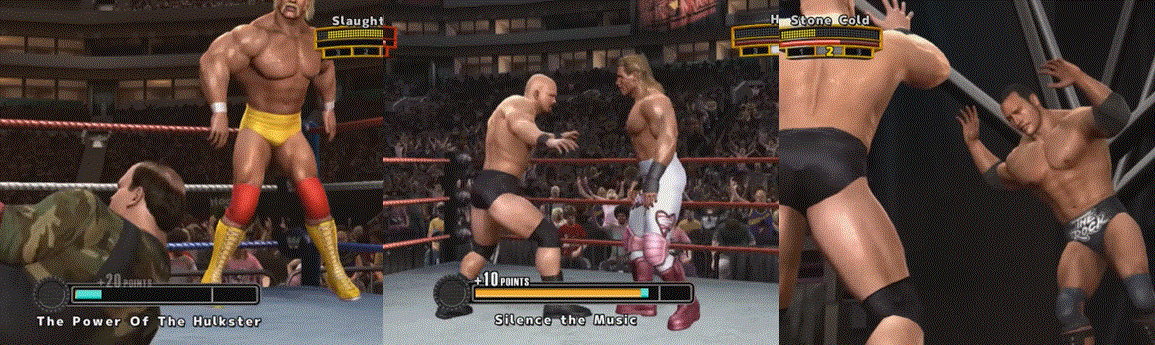
In the Relive portion of WrestleMania Tour, you’ll have to battle against specific opponents in recreations or classic WrestleMania matches; this means you’re forced into assuming the role of the historical victor, or loser, of specific matches. One of the most recurring playable characters in this mode is, of course, Hulk Hogan, who must take on King Kong Bundy in a steel cage, and Andre the Giant and the Ultimate Warrior in recreations of their iconic matches. As long as you win your matches, you’re fine, but you’ll need to meet a certain amount of objectives to earn your medal; this includes stuff like kicking out of a pin attempt, causing the opponent to bleed, or winning with a specific move. As you play through these matches, the amount and difficulty of the objectives will increase; I first noticed them becoming more complex in the classic clash between Steve Austin and Bret Hart, which requires you to attack Austin’s leg five times, fight into the crowd, utilise a steel chair, and win with the Sharpshooter but the difficulty severely ramps up for Relive’s final match. This is a recreation of Austin’s WrestleMania XV bout against the Rock; to achieve this medal, you need to meet every single objective, which can be extremely laborious as one of your objectives is reversing the Rock Bottom, to say nothing of all of the many environmental grapples you need to hit on the outside of the ring. I definitely recommend turning the game’s difficulty level and sliders all the way down in your favour and making liberal use of the health regeneration taunt to increase your chances in this match.

Objectives get even simpler in Rewrite and Redefine, meaning the medals are pretty simple to earn.

In Rewrite, you tackle different WrestleMania matches in the role of the historical loser and must fulfil different objectives in order to change history. Since you’re rewriting the outcome of these matches, these objectives are far less demanding and start off as simple stuff like performing and reversing grapples, taunting, and hitting a finisher and don’t really get more complex than landing more attacks, performing more taunts, maybe making the opponent bleed, and performing multiple finishers and reversals. Honestly, these matches were an absolute breeze, with even Bret and Shawn’s infamous WrestleMania XII Iron Man match providing little challenge beyond a ten-minute time limit. This carries over to Redefine, though the matches and competitors at least have a little more variety; here, you can pick which Legends you want to play as and will witness the likes of Andre and Giant and Big John Studd in a Hell in a Cell match and Mr. Perfect and the Big Boss Man in a ladder match. Redefine culminates with a dead simple no disqualification match between the Undertaker and King Kong Bundy that might have a lot of objectives but they’re nothing compared to the Austin/Rock match (boiling down to stuff like hitting five moves in a row at the start, two top rope moves, three reversals and taunts, and two finishers, which is still laborious but nowhere near as frustrating as in that aforementioned match).

Power-Ups and Bonuses:
There are a few options available to you during matches to help turn the tide in your favour; you can toss your opponent to the outside of the ring and interact with the steel steps, announce tables, and barricades to deal more damage to your opponent and, when your opponent is positioned correctly, pull weapons out from under the ring to bust them open or beat them down. When near the aisleway, you can clunkily force them up to the entrance way where there are often other environmental grapple points on offer that let you choke your opponent with wires, toss them into the stage dressing, and even make use of a drum kit but there’s no backstage brawling here. As your Chain Meter builds up, you gain access to taunts that can provide you with temporary buffs; these include regenerating your health, upping your speed and durability, and making reversals easier to pull off for a limited time. Managers can also provide many of the same temporary buffs and also attack or distract your opponent to give you the edge in matches, though utilising these will cost you part of your meter so you’re often asked to pick between receiving a temporary buff or earning your finisher.

Additional Features:
There are a mere nineteen Achievements on offer in WWE Legends of WrestleMania, which is astoundingly low for a wrestling title. Achievements are primarily tied to obtaining medals in WrestleMania Tour or making and using a created wrestler but you can also earn them by winning matches using only grapples or with other specific moves. Sadly, in a game featuring so many WWE Legends, there aren’t more fun or notable Achievements; for example, you can use Hogan to slam Andre all you like in the WrestleMania III arena but it won’t pop a “Unstoppable Force” Achievement. As you play, however, your win/loss record and other statistics are recorded in the “Hall of Fame”, which is good for the statisticians out there, but there’s no way to compete for championships outside of the WrestleMania Tour mode, no create-a-pay-per-view mode, general manager mode, or even WWE Universe mode so you’re basically limited to exhibition matches and the WrestleMania Tour. Well, not entirely; there is also the “Legend Killer” mode. Here, you use a created wrestler to take on six tiers, comprised of ten back-to-back singles matches and culminating in a showdown with one of six WrestleMania Legends. You’ll earn experience points (EXP) by winning matches, and even more for mixing and matching your gameplay style as you play, which you can spend upgrading your created wrestler’s attributes and earning more Achievements. The create-a-wrestler mode is basically the same as in the SmackDown! series, including many of the same hair and clothing options as in those games and you can also fully customise their entrance or even create a tag team, though there’s very little incentive without a Universe mode. While there’s no downloadable content on offer here, you can transfer basically the entire male roster of WWE SmackDown vs. Raw 2009 (Yuke’s, 2008) if you have a save file for that game on your system, which greatly expands the amount of moves and finishers available to you. While this is a cool feature, and something I wish WWE games would implement more often, it doesn’t equate to much more than adding modern superstars to the roster (which really doesn’t mean all that much as you can’t play as them in WrestleMania Tour).

The Summary:
I do enjoy a bit of a wrestling title, and quickly and easily nabbing a few Achievements, and as a big wrestling fan I enjoy revisiting some of the classic wrestlers of the past but WWE Legends of WrestleMania is a quite a bare-bones title. You can see everything the game has to offer in an hour or so and plough through the main story campaign in an afternoon; the Legend Killer mode might take a little longer but it’s hardly going to take up all your time and attention like a General Manager or Universe mode. The gameplay is a bit jarring at first thanks to the odd camera perspective and the plodding, clunky, QTE-heavy nature of the mechanics, but pretty easy to master and, before long, you’ll be winning matches in no time at all, meaning the game quickly gets boring. Yes, there’s a few other match types on offer but there’s little incentive to play these as you can’t compete for belts and I can’t imagine it’s that much fun to play against other human opponents, either. The create-a-wrestler is more lacklustre than ever and there’s a strange lack of focus on guys like the Undertaker, and some notable omissions from the roster (neither Kane nor Mankind are available, for example), though the ability to transfer the roster from WWE SmackDown vs. Raw 2009 is a neat touch. Ultimately, it’s not bad if you pick it up cheap but probably not really worth keeping in your collection once you’ve mined all of the Achievements. I appreciate the developers trying something a little different but this clearly isn’t a Triple-A title and is really only for fans of the rock ‘n’ wrestling era of the then-WWF. If you’re really in the mood for an arcade style wrestling game from around this time, you’d potentially be better off playing something like WWE All Stars (THQ San Diego, 2011).

My Rating:

Rating: 2 out of 5.

Could Be Better

Are you a fan of WWE Legends of WrestleMania? Did you like that the developers actually tried to do something a little different with this release or did the dumbed down gameplay put you off? Which of WrestleMania Tour’s matches was your favourite and did you ever achieve Legend Killer status? What did you think to the finisher system and the abundance of QTEs? How did you find the create-a-wrestler mode and were you disappointed by the lack of WWE Universe in this title? Were there any classic WWE superstars you felt were missing from the game and which of the available Legends was your go-to character? How are you celebrating WrestleMania’s anniversary this year and what’s your favourite WrestleMania moment? Drop your thoughts below by signing up or leave a comment on my social media to let me know what you think about WWE Legends of WrestleMania and check back for more wrestling content throughout the year.

Wrestling Recap: Hogan vs. Undertaker (Survivor Series ’91)

The Date: 27 November 1991
The Venue: Joe Louis Arena; Detroit, Michigan
The Commentary: Gorilla Monsoon and Bobby “The Brain” Heenan
The Referee: Earl Hebner
The Stakes: WWF Championship match

The Build-Up:
The Undertaker made his debut on this day at the 1990 at the 1990 Survivor Series as a heel; aligned with Ted DiBiase’s Million Dollar Team and eventually partnered up with the repulsive Paul Bearer, the Undertaker was portrayed as a zombie-like force of nature who was impervious the pain, implacable by nature, and apparently at the whim of a mysterious urn wielded by his manager. Hulk Hogan, meanwhile, was several months into his third run as the World Wrestling Federation (WWF) Champion, having defeated Sergeant Slaughter earlier in the year at WrestleManiaVII. However, thanks to mostly being booked into squash matches, the Undertaker went unpinned (on television, at least) for a year and this impressive statistic was enough to plug him in as Hogan’s next opponent in what was billed as Hogan’s “Gravest Challenge” to date.
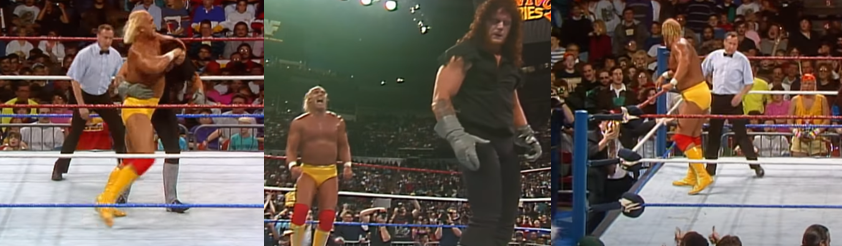
The Match:
Rather than preceding the match with one of their trademark promo packages, this particular match is preceded by a couple of pre-taped promos from each of the competitors; Hogan, basically, has taken offense to the Undertaker and Paul Bearer’s threat to bury the hopes and dreams of all the Hulkamaniacs but ‘Taker stoically threatens that Hulkamania has had its day and is long overdue for a burial.

Hogan’s bombastic showboating soon gave way to slow, plodding offense.

During his characteristically enthusiastic entrance, Hogan made a point to upturn and demolish the casket that was placed at ringside but the Undertaker maintained his stoic demeanour and remained unimpressed with Hogan’s showboating and simply set out to do what he promised: destroy Hulkamania. Unfortunately, given that it was 1991 and early ‘Taker (as well as Hogan’s limitations), this meant a lot of slow, plodding offense and an abundance of headlocks, face and beck chokes, and slow, measured strikes from the Undertaker.

Bearer’s interference and the Undertaker’s indomitable nature kept Hogan on the back foot.

Hogan, of course, was all about the superhuman energy and resolve; even though he spends the majority of the match on the back foot and seemingly unable to actually hurt the Undertaker, he continually came back time and time again even after having his head slammed off the steel ring steps and being choked by an electrical cord. Of course, Hogan had the crowd firmly in his corner right from the beginning of the match and they exploded into cheers whenever Hogan mounted some offense and showered the arena with boos every time Bearer got involved behind Hebner’s back.

Undertaker’s moveset back then mainly consisted of dull choke and claw holds.

A far cry from the later brawling and high-impact offense of his later years, the Undertaker’s plan of attack mainly consisted of punches, clotheslines, and full-face chokes; his gameplay, apparently, was to wear down Hogan and drain him of his much-vaulted energy and, every time he pressed his advantage with a Claw Hold or similar move, ‘Taker would turn to Bearer to draw power from the mysterious urn, his eyes rolling into the back of his head, and my interest and excitement draining right along with Hogan’s vigour.

Hogan’s comeback meant nothing once Flair snuck in a steel chair to give ‘Taker the win.

Of course, as relentless and dominating as the Undertaker was, Hogan is still Hogan; jacked up (and blown up) to the nines and full of passion, Hogan completely no-sold the Undertaker’s Tombstone Piledriver to mount his trademark comeback. This onslaught was enough to stagger the Undertaker and drive him to his knees but, right as Hogan looked to be setting up for the finish, Ric Flair sauntered down to ringside to distract Hogan. Flair then slid a steel chair into the ring, which the Undertaker summarily Tombstoned Hogan onto, and the match ended with the Deadman being crowned the new WWF Champion to the chagrin of Monsoon, the delight of Heenan, and a brief cheer from the crowd.

Sadly, it’s every Hogan match ever and even has a screwy finish to keep him looking strong.

It’s not an especially long of exciting match, to be honest; it’s basically every Hulk Hogan match you’ve ever seen as Hogan takes a beating, pulls out sly heel moves and tactics, and spends the majority of the match either on his back or taking a beating because he’s too gassed to work a long, involved match and is simply building up for his characteristic comeback. The story was far more interesting than the actual in-ring content as ‘Taker was more about slow, boring offense and shrugging off attacks and Hogan was only ever really good for pumping up the crowd and hitting his signature moves; the entire match was about a clash of ideals and wills and the potential death of Hulkamania but, whereas Hogan was able to overcome all his previous challenges, he failed to overcome his “Gravest Challenge”. However, he arguably only lost the match due to Flair’s interference and looked set to for a win before Flair distracted him, tainting the Undertaker’s iconic first championship win in true Hogan fashion, which is a shame as the Undertaker looked so dominant throughout the match and this should have been a clean win. Still, at least it’s a short match; the WWF was a very different time back then and, while I respect Hogan and his impact on the industry, I can’t say I’ve ever been a fan of his in-ring work and he didn’t seem to have a lot of chemistry with ‘Taker, who was worked a very premeditated and limited style thanks to his commitment to the zombie aspects of his character.

The Aftermath:
Hulk Hogan and the Undertaker faced off in a rematch less than a week later at This Tuesday in Texas, which Hogan, of course, won and, by WrestleMania VIII, both men were embroiled in entirely separate feuds and the Undertaker would not win the WWF Championship again until WrestleMania 13 some six years later. Despite both being in the company at the same time for many years following this match, the two never crossed paths again and would not face off in a championship match until Judgment Day in 2002, when the Undertaker defeated Hogan (then billed as Hollywood Hulk Hogan) for the Undisputed World Wrestling Entertainment (WWE) Championship.

My Rating:

Rating: 1 out of 5.

Terrible

What did you think to the contest between Hulk Hogan and the Undertaker at the 1991 Survivor Series? How would you rate it compared to their other bouts and which of their feuds, matches, and moments is your favourite? Were you a fan of the Undertaker’s when he debuted and were you hyped for his showdown with the Immortal Hulk Hogan? Which of the two were you rooting for, given Hogan’s incredible popularity and the Undertaker’s dominant first year? How are you celebrating the Undertaker’s debut this year, what are some of your favourite matches and moments from his long and distinguished career, and what dream match would you have liked to see him involved in? Whatever your thoughts, drop a comment below and let me know what you think about the Undertaker.

Wrestling Recap: Kane vs. Undertaker (WrestleMania XIV)

The Date: 29 March 1998
The Venue:  FleetCenter; Boston, Massachusetts
The Commentary: Jim “J.R.” Ross and Jerry “The King” Lawler
The Referee: Jack Doan
The Stakes: Semi-main event, personal rivalry between siblings

The Build-Up:
In the entire history of the World Wrestling Federation (WWF), and perhaps all of wrestling, there is, arguably, no greater and more tumultuous story than the history between Kane and the Undertaker. The Deadman had embarked on a reign of terror ever since his debut at the 1990 Survivor Series event, seemingly under the control or influence of a mysterious urn wielded by his revolting manager, Paul Bearer. However, the Undertaker’s relationship with Bearer soured after Bearer turned his back on the Deadman in favour of Mankind. In retribution, the Undertaker used his supernatural powers to blast Bearer in the face with a fireball at In Your House 14: Revenge of the ‘Taker but was tormented by Bearer’s subsequent claims that the Undertaker’s younger brother, Kane, had actually survived the fire that claimed the lives of their parents and was looking for revenge. These claims turned out to be all-too-true when, right as the Undertaker was about to defeat his long-time rival in the first-ever Hell in a Cell match on October 5th, 1997 (the day after my twelfth birthday, which sadly clashes with Global James Bond Day) at Badd Blood: In Your House, the lights went out, ominous organ music played, and a gigantic man garbed in red and black stormed the ring, literally tearing the cell’s door off, ignited the ring posts, and planted the stunned Undertaker with his own finishing manoeuvre, the Tombstone Piledriver as Kane made his shocking debut. Mute, superhumanly strong, and seemingly impervious to pain, Kane immediately embarked on a path of destruction in a bid to goad his brother into a match; the Undertaker, however, constantly refused to fight his brother but was finally pushed too far after Kane and Bearer attacked him at the 1998 Royal Rumble event. The two placed him inside a casket and setting it ablaze, seemingly killing the Undertaker, but the Deadman made another of his trademark dramatic returns and, now, was begrudgingly ready to face his brother, one-on-one, at WrestleMania XIV.

The Match:
As you might expect, given the dramatic and destructive conflict between the Undertaker and Kane and the convoluted backstory between the two, the match is preceded by another of the WWF’s fantastic video packages highlighting Bearer’s claims that “Kane is alive!” and Kane’s breath-taking debut at Badd Blood .The emphasis of the hype package is primarily on Bearer’s obsession with using Kane to extract revenge against the Undertaker and the Deadman’s refusal to fight his own flesh and blood; one thing that’s actually very interesting about this feud, even here in its early days, is that both men are kind of portrayed as tweeners. Neither man is really a face or a heel as ‘Taker is clearly being targeted, so the fans are reluctant to boo him even though he inadvertently killed his parents, and Kane was just too bad-ass, too alluring, and too impressive for people to truly boo him. Instead, it seems tensions were palpable for their inevitable conflict and everyone totally bought into the ridiculous story, suspending disbelief to simply enjoy the supernatural elements of their story and watch two massive guys go at each other after weeks and weeks of build-up. Nowhere is this unusual face/dichotomy more evident than during Kane’s entrance, where he famously stalked to the ring surrounded by flames and red lighting and delivered a Tombstone to Pete Rose, who had spent a couple of minutes insulting the crowd, their city, state, and baseball team. This, seemingly, signalled that Kane was actually a babyface despite everything that he had done leading up to this match, but then he switches right back into being more of a heel in his assault of the Undertaker. Like I say, Kane and the Undertaker was basically beyond the usual clichés of “good” and “evil”; they simply were and did whatever they wanted, whenever they wanted to, to whomever they felt like and people cheered regardless because it was always entertaining to see what these two big, beefy, semi-supernatural men would get up to next.

Kane’s power and strength impressed, especially in the early going.

Of course, the Undertaker made a suitable dramatic and ominous entrance; flanked by several torch-carrying druids, the Deadman slowly stalked to the ring following a bolt of lightning and garbed in a gothic, almost vampire-like caped outfit and sporting a temporary black teardrop tattoo on his face. Kane, however, showed no signs of intimidation (or any emotion at all, considering his face was entirely obscured by his iconic mask, but you can feel his boiling, brewing anger thanks to Jacobs’ fantastic body language and subtle gestures) leading to an iconic face-to-face stare down between the two before the Undertaker broke the tension with a big right hand and a furious assault in the ring corner. However, a common theme throughout the match, especially in the early going, is Kane’s indomitable power and ability to answer, and counter, the Undertaker’s offense at every turn; he manhandles the Undertaker on numerous occasions, overpowering him, reversing his attempts to whip Kane into the ropes and the corners, and quickly takes control of the early stages of the match by brutalising the Undertaker with his superior physical power. Kane even showed off his impressive agility by springboarding off the ring ropes to knock the Undertaker to the outside at one point, though the Undertaker was no slouch in this department either as he uncharacteristically hopped up onto Kane’s shoulders form an awkward-looking Facebuster-type move and, later, dove right over the top rope and crashing through the Spanish announce table in what looked like one hell of a crash landing!

After a nasty dive through the announce table, the Undertaker and Kane traded Tombstones!

All throughout the match, Paul Bearer is a constant presence; standing at ringside, he continuously shouts encouragement and directions to Kane and taunts to the Undertaker. As the fight inevitably tumbled to the ringside area, Bearer distracted the referee so that Kane could bring the steel steps crashing down across the Undertaker’s spine. This, and similar assaults, allowed the Undertaker to truly take control of the match as he slowly, methodically, beat the Undertaker into submission, with Bearer getting a few shots in on the Deadman at every opportunity. Kane, however, allowed hubris and his emotion and obsession with hurting the Undertaker potentially keep him from winning the match as he pulled the Undertaker up from a potential three count following a Chokeslam. Kane, however, presses his advantage after ‘Taker crashes through the announce table and was prepared to finish his brother off with his patented Diving Clothesline but was enraged when the Deadman kicked out of the pin and the two ended up trading punches before Kane overpowered the Undertaker and reversed his Tombstone attempt into a Tombstone of his own! ‘Taker, however, kicked out to a surprisingly mild reaction from the crowd (the silence that followed suggests a degree of shock at this event since Tombstone kickouts weren’t as overplayed and highly anticipated as they would become in later years). Undertaker got his second wind following this and, with Kane finally showing signs of fatigue, was able to plant his brother with a Chokeslam and then returned the favour with a Tombstone…only for Kane to kick out!

It took three Tombstones to put Kane away and ‘Taker didn’t look like a winner after the match!

Despite being on the defensive for the majority of the match, J.R. constantly points out that the Deadman is making every effort to cover up from Kane’s punches and suggests that he may be playing a long game and banking on Kane tiring himself out with his furious and relentless assault. While this means that he has to endure what J.R. claims is the most brutal and physically dominating attack than he has ever experienced, this turns out to be the case and the result is a fantastic showcase for Glenn Jacobs’ popular masked character as Kane looks like an instant superstar thanks to all of the offense he gets in and the dominating position he is in throughout the entirety of the match. Nowhere is Kane’s tenacity emphasised more than in the closing minutes of the match; having kicked out of the first Tombstone, Kane continued to sit up, to get to his feet, and to stalk his brother and, despite eating another Tombstone, simply would not stay down until ‘Taker hit a third and final Tombstone to finally put his brother away. However, Kane and Paul Bearer ended up standing tall as Bearer put the boots to ‘Taker after the bell rang and Kane delivered a massive Tombstone Piledriver to his brother onto a steel chair to emphatically send the message that the Undertaker may have won the battle…but the war was far from over!

The Aftermath:
The feud between the Undertaker and Kane was far from over following this match; the two would clash again the very next month at Unforgiven: In Your House in the first-ever Inferno Match, which Kane, again, would lose. The two would eventually go their separate ways and even formed a tentative alliance that saw the Undertaker help Kane to defeat Stone Cold Steve Austin for the WWF Championship at the 1998 King of the Ring event and become embroiled in Vince McMahon’s ongoing feud with Austin over the championship throughout the summer. The two continually crossed paths as both reluctant allies and bitter rivals throughout 1998, with Kane slowly turning babyface and Undertaker turning heel in the process thanks to numerous twists and turns in their storied relationship. Such drama would follow both men throughout their subsequent careers as they continually switched allegiances and alternated between being one of the most dominant duos in the entire industry and being two of the bitterest rivals but, no matter what form their appearance or relationship took, you could always be assured of an absolute spectacle whenever Kane and the Undertaker share the ring together.

My Rating:

Rating: 4 out of 5.

Great Stuff

What did you think to the contest between Kane and the Undertaker at WrestleMania XIV? How would you rate it compared to their other bouts and which of their feuds, matches, and moments is your favourite? Were you a fan of Kane’s when he debuted and were you hyped for his first match against his brother? Which of the two were you rooting for, given the tumultuous nature of the storyline? How are you celebrating Kane’s debut this year, what are some of your favourite matches and moments from Kane’s long and complex career, and what dream match would you have liked to see him involved in? Whatever your thoughts, drop a comment below and let me know what you think about Kane.

Game Corner: WWE 2K18 (Xbox One)

GameCorner
WWE2K18Logo

As may already be evident, I have a long-standing preference for the WCW and WWF videogames released by AKI/THQ back in my youth; however, another WWF videogame series I have been particularly fond of and spent many hours and days of my childhood playing has been the WWF SmackDown! series released by THQ and Yuke’s on Sony’s PlayStation in 2000. Eventually, this series evolved into the WWE SmackDown! Vs. Raw franchise, which was released on multiple consoles between 2004 and 2010. I believe I came into this series with WWE SmackDown! vs. Raw 2008 Featuring ECW (Yuke’s/Amaze Entertainment/THQ, 2007) and bowed out with WWE SmackDown! vs. Raw 2011 (Yuke’s/THQ, 2010) as, by this point, it was pretty clear to me that I was simply purchasing the same videogame every year with additional wrestlers, some new match types, and minor improvements to the graphics and gameplay. As a result, I decided to buy a new title every two years or so and, after enjoying WWE ’13 (ibid, 2012) and deciding that WWE 2K15 (Yuke’s/Visual Concepts/2K Sports, 2014) was far too stripped back on features to justify the price tag, I settled on getting WWE 2K14 (ibid, 2013) and biding my time.

WWE’s videogames eventually aped the yearly formula of the FIFA series.

As a result, I have not bought or played a new videogame in 2K Sports’ WWE 2K series for about four years now, and with good reason; as the series made the jump to the Xbox One and PlayStation 4, reviews and feedback ranged from resoundingly negative to mediocre displeasure as 2K Sports apparently removed many expected gameplay mechanics and features in what was nothing less than a blatant attempt to sell features seen in previous PlayStation 3-era titles as being “new”. Despite the additions of never-before-seen superstars such as Sting, AJ Styles, and Samoa Joe, I decided to wait it out until the release of WWE 2K18 (ibid, 2017) to give the series a chance to iron out these kinks and to create an ironic sense of symmetry given that the last title I played was WWE 2K14. As such, it took me a little while to become accustomed to WWE 2K18’s control scheme; previously, these titles allowed you the option of controlling your wrestler with the directional-pad (or “D-pad”) and taunting with the analogue stick, which is my preferred control scheme given how it mirrors that of the AKI/THQ titles.

WWE2K18Submission
WWE 2K18 loves these little wheels of death!

However, WWE 2K18 does not allow you to change the control scheme, meaning that I was forced to control my wrestler with the left analogue stick and taunt using the D-pad which, for an old school player like myself who dislikes change, took some getting used to. One of the other main reasons I prefer D-pad control is that I find it easier to direct and aim my opponent during running attacks or Irish whips; I find the analogue stick makes such aiming harder as the stick is more sensitive. WWE 2K18 also features some new mini games which replace the ones I had grown accustomed to in WWE 2K14; when being pinned, for example, you now have to press X on a little wheel rather than stopping a little bar that bounces back and forth. This is actually a lot trickier than it sounds as it seems the videogame is set up to make kicking out of pins harder than before to, I guess, allow for more “realistic” matches. Additionally, there is no longer the “Breaking Point” submission system; instead, there’s either a tricky mini game involving the analogue stick or you must mash one of the four action buttons when they appear onscreen. I went with the button mashing option but have found that winning a match by submission is not as easy as it used to be, potentially because you can no longer select a match to be either quicker, normal, or epic; this, and the improved attribute system, means that you are forced to work for your submission victory.

WWE2K18Triple
Suffer enough damage and you’ll roll from the ring to take a break.

Other gameplay changes can be seen in multi-man match; now, when you or another player receives enough damage, they automatically roll out of the ring and you must mash buttons to fill up a bar and re-enter the match. It sounds good on paper and, again, appears to be tooled towards making matches more “realistic” but I found it more annoying than anything else as you could end up stuck on the outside and lose the match. This mechanic carries over into ladder/TLC matches as well, making them considerably more frustrating than usual as you incur far more damage much faster in these matches so you’ll spend a lot of time mashing buttons to get back into the matches. Also, in ladder/TLC matches, you no longer pull down the belt of briefcase using the right analogue stick; instead, you have to play a little mini game where you must fill up segments of a circle by rotating a ball into a small hole using the right analogue stick. It’s fun but quite distracting; I found myself concentrating more on the mini game than the match and, if you get interrupted with only a couple (or, even worse, one) segments left to fill, you are almost guaranteed to lose the match as the next wrestler to play the mini game will probably complete the circle while you’re busy mashing buttons to get back into the match.

WWE2K18TLC
Multi-man TLC matches are still the worst.

The Royal Rumble match is also noticeably different and, technically, more difficult; rather than hitting buttons in a quick-time event as in WWE 2K14, you now have to mash a button when trying to eliminate an opponent. Honestly, I’ve played a couple of these matches and never once eliminated anyone using the button-mashing mini game no matter what their health and stamina. I found the best way to eliminate wrestlers was the tried-and-true Royal Rumble finisher, clotheslining them out of the ring or countering a run attack, or by exploiting a glitch where, if you whip the opponent onto the apron and quickly punch them repeatedly, they simply fall from the ring.

WWE2K18Rumble
I struggled to legitimately eliminate anyone in the Royal Rumble…

As I always found ladder, TLC, and Royal Rumble matches tedious any way, these gameplay changes don’t bother me that much; you are not forced to play these matches and, on the whole, I would just avoid them. Some good changes have been made to tables matches, though; every time you hit your opponent with or into a table, it fills up a break meter and, once it’s full, you can smash the opponent through it using some new and expanded options. 2K Sports have also introduced a carry system, similar to the one from WWE SmackDown! vs. Raw 2007 (Yuke’s/THQ, 2006), which allows you to smash your opponent off the ropes, turnbuckles, apron, and other objects. They’ve also brought back in-crowd fighting, to a degree, allowing you to smash your opponent through (or hit them over) the barricade at ringside or toss them from the stage area to fight in little areas near the crowd.

WWE2K18Universe
Universe mode is back, bigger and better than ever.

Although create-a-story and create-a-finisher are no longer options, WWE 2K18 is still full to the brim with creation options. I honestly spent maybe five days or so setting everything up the way I wanted it and creating wrestlers, entrances, victories, shows, and teams in the expanded Universe mode. As before, Universe mode allows you to create a show, place wrestlers and championships on the show, and then create monthly pay-per-view events for that show. I like to recreate the product as closely as possible so I created a Raw, SmackDown! Live, and NXT brand (with 205 Live and Main Event as minor shows) and, for all the Legends and duplicate wrestlers, a WCW Monday Nitro brand (with some crossover between them all). You can create more than one Universe at a time but I prefer to have it all in one place rather than jumping backwards and forwards all the time; I then moved every pay-per-view event to their correct calendar month and also created some additional pay-per-vews for my NXT and Nitro brands; this is extremely in-depth, allowing you to choose from a whole bunch of preset or created arenas (with scene transitions, an array of screen filters, a bunch of different referees, and more).

WWE2K18Materials
There are loads of colour and customisation options.

You can still create your own championship belts as well, if that’s your thing; given how many old school belts are in the videogame, I don’t tend to do much with this, though. Instead, my focus was on the massively deep create-a-wrestler mode; created wrestlers look more realistic than ever before and you can choose from a whole bunch of options, from wrinkles to scars, facial and body hair, eye colour, veins, muscle definition, and even how much body oil your created wrestler has! There are also a whole load of attire options, including blank attires that you can customise as you desire and also pre-set attires worn by the featured roster; you can change not only the colour of these attires but also the material type, which allows shirts and jeans and the like to be leather, take on a metallic hue, or even glow in the dark! Finally, there are far more options for names for your created wrestler this year and the in-game commentary team will refer to your created wrestler by these throughout their matches.

WWE2K18Store
Apparently you can put a price on greatness.

Although there are many WWE and superstar-related images available to you in this mode, there are noticeably less options for body tattoos this years, unfortunately. This is where the Community Creations option will come into play; you are able to upload images to the 2K Sports website and transfer them into the videogame, meaning you can search in the WWE 2K18 for a whole bunch of professionally-designed images, logos, and tattoos to apply to your created wrestler. You can also download created wrestlers created by others to account for those wrestlers omitted from this years roster, though you are limited to twenty downloads a day and cannot download created wrestlers that feature aspects from wrestlers you’ve yet to unlock or purchase. Speaking of which, WWE 2K18 features an in-ring store mode, as is the norm for this series now. As you play matches, you are awarded virtual currency based on how many stars your match scored; the more stars you get through move variety, countering, and such, the more currency you earn. You can then spend this in the store to unlock Legends, and additional arenas and championships and, make no mistake, this is the only way to unlock this extra content. Previously, in WWE 2K14 at least, you could unlock new wrestlers by playing the 30 Years of WrestleMania mode but, here, you can only do this by purchasing them.

You can do this by playing any match in any mode and, also, through the MyPlayer mode, which is the career mode of the videogame. You have to create a wrestler, using far more limited tools and options, and work your way through training and wrestling on NXT before being called up to the main roster. You can make some limited decisions to decide whether you are a Company Man (a heel) or a Fan Favourite (a face). In my playthrough, I was initially called up to Raw and forced to lose a bunch of matches, so I jumped to SmackDown! Live, where I won the United States Championship, Money in the Bank ladder match, and Royal Rumble match and am currently feuding with Triple H and the Authority on the path towards the WWE Championship. Along the way, you can partake in side quests to earn rewards (new moves, attire, and currency), make a signature t-shirt to earn some extra cash, and perform in-ring promos and run-ins.

WWE2K18MyPlayer
You’ll need to pay to get the most out of MyPlayer mode.

Overall, this mode is quite enjoyable but, honestly, it’s a poor substitute for a Road to WrestleMania-type of mode. There are a lot of load times and some noticeable frame drops; you are also forced to walk/run from the garage to the producer and back every single week, which begs the question why they bothered putting in the free-roaming backstage area at all rather than just have a set-up similar to the PlayStation 3-era titles where you had a locker room with a phone and just did everything through text. There are some inconsistencies; I was regularly teaming with Sami Zayn then, randomly and with no explanation, my partner suddenly became Fandango. I was also once asked by Tius O’Neil to attack Primo Colón one week but, when I couldn’t find him, ended up attacking Kassius Ohno. There are also a lot of times when you do more promos than matches, when the match objectives aren’t completely clear (the Money in the Bank match springs to mind), and when your matches end due to interference more often than not but, these issues aside, it’s a pretty decent mode, though I found it more enjoyable and profitable to play Universe mode more than anything.

It’s interesting that the load times for the MyPlayer mode are so atrocious as, normally, they’re not that bad; matches in Universe mode load much faster than in WWE 2K14. I learned from some of my mistakes in WWE 2K14 and don’t have nearly as many custom arenas or created wrestlers, which may help with this, and also towards limiting crashes. WWE 2K14 would crash all the time, usually after a match but sometimes before one, and it was very frustrating. I have had a few crashes in WWE 2K18 but, as the matches and the videogame loads up a lot faster, it’s not as annoying. One bug that is annoying is, when downloading a created wrestler, attached logos and images will sometimes not download, meaning you’re left having to either find them separately or with an incomplete created wrestler/attire.

I haven’t played WWE 2K18 online yet, mainly because I don’t have Xbox Gold or whatever you need to do that but also because online players are trolling, move-spamming sons of bitches; also, the learning curve for timing reversals and having competitive but enjoyable matches that I actually won was quite steep. Sometimes, you’ll have a match and be in complete control and all the opponent has to do is a couple of moves and you can’t recover, then you get hit with one finisher and its over. A good feature, though, is that miss-matched opponents (like Braun Strowman against Kalisto) often trigger a squash match, where you gain full momentum and a finisher after your first hit and win the match in seconds for a decent payday.

WWE2K18STINGS
All the Sting you could ever want!

The roster in WWE 2K18 is as deep as you could want; there are some noticeable omissions from NXT but, otherwise, everyone you could want and more is in the videogame alongside some decent and surprising Legends. Hulk Hogan and Yokozuna are gone but Vader and the Big Boss Man are back; there are some crazy instances of numerous duplicates, such as five (five!) versions of Sting and separating Finn Balor and his Demon King attire (though the Demon King does still act as an alternative attire to regular Balor) but, mostly, there’s some good inclusions this year. The soundtrack, apparently “curated” by the Rock, is mostly miss rather than hit, with the only decent track being a radio edit version of Disturbed’s Down With the Sickness, though a similarly-edited version of Limp Bizkit’s Rollin’ is used as the entrance theme for Undertaker ’00 despite this particular version of Undertaker’s biker gimmick actually being more associated with You’re Gonna Pay. The in-game commentary is all-new, at least for me anyway, including the three-man team of Michael Cole, Corey Graves, and Byron Saxton; mostly, it is far better than what I experienced in WWE 2K14 but there still times when they refer to women as “guys”, talk inanely about things not even relevant to the match in progress, or ask each other questions that are never answered.

WWE2K18Balor
Graphically, WWE 2K18 is very impressive.

Overall, WWE 2K18 is a challenging and enjoyable affair; Universe mode is bigger and more expansive than ever, with shorter load times and significantly less crashes and glitches (so far), and the star rating system does make it feel as though each match is important and worth something. MyPlayer suffers a bit (though admittedly this may also be because I don’t want to waste my virtual currency upgrading the MyPlayer character unless I absolutely have to as I want to unlock the Legends) but is, otherwise, fun enough for what it is. I would have also liked to have seen, at least, Showcase matches similar to previous titles or themed around a wrestler (this year’s pre-order bonus, Kurt Angle, for example, or Shawn Michaels, or even the cover star, Seth Rollins) to assist with the unlocking of extra content. Creation options are deep and versatile; you can waste hours and even days crafting the perfect created wrestler (I know I did!) or downloading extra attires and wrestlers to fill out the already impressive roster. I am glad that I waited for 2K Sports to add in many of the features they previously omitted and refine their current-generation gameplay engine as it seems to have paid off; matches are far more realistic and challenging than in WWE 2K14, where I could win with a minimum of effort, which is good once you’re used to the control scheme and what is expected of you, if admittedly somewhat detrimental to those who just want to pick it up and play a quick match without any obligation to simulating a real-life WWE match. Based on my experience with this title, I will probably wait until WWE 2K20 for my next entry into the series as I would never recommend anyone buys these titles on a yearly basis but, if like me, you’ve been away from the series for a while, I would definitely recommend picking this one up.

My Rating:

Rating: 4 out of 5.

Great Stuff