
Released: 4 October 2024 (Hey, that’s my birthday!)
Director: Todd Phillips
Distributor: Warner Bros. Pictures
Budget: $190 to 200 million
Stars: Joaquin Phoenix, Lady Gaga, Brendan Gleeson, Catherine Keener, and Harry Lawtey
The Plot:
Two years after killing Murray Franklin (Robert De Niro) on live television, Arthur Fleck/Joker (Phoenix) is incarcerated at Arkham State Hospital, experiencing musical madness through a shared delusion with Joker fan Harleen “Lee” Quinzel (Gaga).
The Background:
The Joker has been a staple of DC Comics for decades and is inarguably Bruce Wayne/Batman’s greatest foe. Created by Bill Finger and Bob Kane, the “Clown Prince of Crime” first appeared in 1940 and has been responsible for many tragedies in the Dark Knight’s life, including the death of Jason Todd/Robin and the crippling of Barbara Gordon/Batgirl. The Joker has also appeared in live-action many times: Cesar Romero famously refused to shave his moustache for the role in the sixties, Jack Nicholson set a new standard in Batman (Burton, 1989), Heath Ledger received a posthumous honour for his incredible turn in The Dark Knight (Nolan, 2008), and Jared Leto’s screen time was significantly cut from Suicide Squad (Ayer, 2016). A standalone Joker movie was initially planned to spin out from Suicide Squad before numerous blunders saw Warner Bros. shift towards an unrelated interpretation of the character. Filmed on a modest budget, Joker (Phillips, 2019) was the first “R” rated DC Extended Universe movie and an unprecedented critical and commercial success, despite its protesters and controversy. Though planned as a standalone and the first in a series of darker, more experimental DC films, star Joaquin Phoenix personally lobbied for a follow-up after dreaming up the premise of a musical sequel. After briefly considering a Broadway show and unanimously deciding against transforming Arthur Fleck into a traditional criminal mastermind, Phoenix and director Todd Phillips developed the musical concept further, bringing in Lady Gaga as a new version of Harley Quinn that required her to change her approach to singing. The musical numbers were performed live, which proved an editing nightmare for Philips, who was given an extraordinary level of autonomy over the project, which ultimately failed to replicate the financial success of its predecessor. Reviews were equally far more scathing this time around; indeed, while Phoenix ’s performance was praised and Lady Gaga was seen as underutilised, many questioned the use of musical numbers and criticised the pacing and tedious, plodding narrative. In the wake of James Gunn rebooting DC’s live-action ventures, it seems our time with this alternative Joker is over not just because of these factors but also because Phillips stated he was finished with the character and this fictional world.
The Review:
I’m proudly in the minority of people who didn’t care much for Joker. Even it had somehow been a decent film, in my opinion, I still would’ve found it annoying to have an alternative version of the Joker running around in a Batman-less Gotham City. As a psychological thriller that made you question the sanity and reliability of its narrator, it was okay; but I would still rather watch the vastly superior American Psycho (Harron, 2000) for that fix. Either way, Joker: Folie à Deux (ridiculous title, by the way) picks up two years after the first movie and finds a heavily emaciated, largely silent Arthur Fleck committed to Arkham State Hospital, where he’s routinely harassed, abused, and mocked by bullish guards like Jackie Sullivan (Gleeson). While Joker ended with the suggestion that some of the film’s events were part of Arthur’s twisted imagination, Joker: Folie à Deux confirms that he did kill five people (actually, it’s six, but it’s not common knowledge that he killed Penny Fleck (Frances Conroy), his overbearing and abusive mother), with Murray Franklin’s live execution inciting a riot and a gaggle of clown-themed protestors calling for Arthur’s release. Despite finding his true self and experiencing a euphoric empowerment by embracing his psychotic urges, Arthur is a broken shell of his former self. Lethargic and largely mute, he’s easily bossed around by the guards and kept under the whim of his daily medicines. Jackie and the others regularly taunt him, forcing him to kiss other inmates and rewarding him with cigarettes whenever he tells one of his bad jokes, but the strong, confident, self-assured Joker is absent in the early going of the film (and, truthfully, for much of it). Arthur’s so mellow that his lawyer, Maryanne Stewart (Keener), is working to convince him, a jury, newly elected assistant district attorney Harvey Dent (Lawtey), and basically anyone who’ll listen that the meek Arthur and his psychotic Joker are distinctly different personalities. Her goal in aiding him, in trying the change the public’s opinion of him as some crazed murderer or a martyr to the lower classes, isn’t to prove he’s innocent, of course, since he absolutely is guilty of murder. Instead, she wants to show the tragedy behind his childhood, the mitigating circumstances around his killings, and prove that he’s a disturbed individual who needs real medical help, not to be caged in a veritable torture chamber or sent to the electric chair for actions outside of his control.
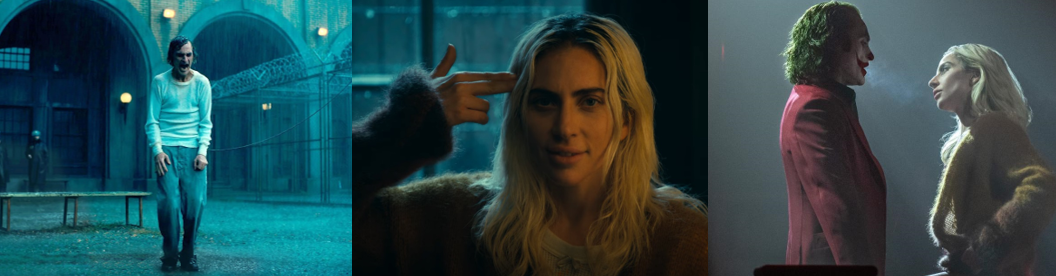
Arthur is largely apathetic about all this. He endures his daily torment and routine without so much as a peep and does his best to go along with Maryanne’s plan, taking solace in his fantasy world where he imagines his life as a classic Warner Bros. cartoon, relives the trauma he suffered at the hands of others and his mother, and seemingly longs for the feeling of empowerment he felt when he embraced his Joker persona. All this changes, however, when he passes through B Wing, a low security section of Arkham housing non-violent inmates, and catches the eye of Lee Quinzel. When Jackie arranges for Arthur to participate in the same musical therapy class as Lee for good behaviour, Arthur finally opens up to this self-professed Joker fan. Instantly enamoured by Arthur and having been inspired by his actions, Lee claims to have struck out against her own abusive family and landed herself in the nuthouse after burning down her apartment building. The two grow closer as Lee professes her admiration and love for the ideal Arthur embodied when he killed Murray Franklin and Arthur, love starved and craving attention, falls head over heels for her in return. The two express themselves through song almost constantly, either in Arthur’s warped imagination or, seemingly, for real. As in the first movie, it’s not always clear when things are real or not, though many of the musical numbers take place in Arthur’s head. These imaginary sequences are also the only times Arthur shows his violent side, braining and beating people to death with footstools and mallets, and are seemingly his new way to work through his pain and frustration and emotion. Unlike Arthur’s obsession with his neighbour, Sophie Dumond (Zazie Beetz), Lee is quite real. Others see and acknowledge her, though it’s debatable whether she really did blag her way into his cell to seduce him and much of her character is called into question when Maryanne reveals that Lee lied about her past to get closer to Arthur. Indeed, rather than being a downtrodden and forgotten member of the lower classes like him, Lee comes from money, is studying psychiatry, and willingly committed herself to meet him, reframing the usual Joker/Harley dynamic as she’s the one subtly influencing him to coax out what she sees as his “true” self.
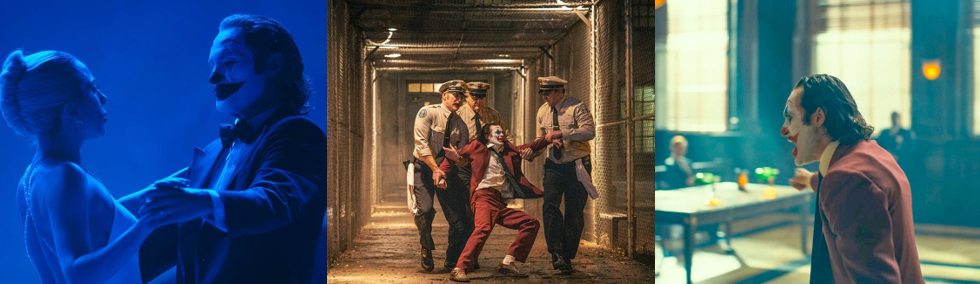
Lee’s influence sees Arthur become bolder, more confident, regaining the spark that took Gotham’s crooks and destitute by storm. A parade of supporters surrounds the courthouse during his trial, which is broadcast live since he’s such a high-profile killer, and witnesses testify against Arthur’s mental state. Encouraged by Lee to embrace his status as a cult symbol, Arthur snaps and fires Maryanne and opts to represent himself, donning the Joker makeup and persona once more and strutting around the courtroom ranting about his shitty life. By his own admission, however, Arthur knows nothing about the legal system, resulting in him mocking his traumatised former co-worker Gary Puddles (Leigh Gill). These moments, and where Arthur is wailing or uncontrollably cackling in despair, are where Phoenix excels in the role. I’ve never liked the idea of a definitive origin for the Joker, but he certainly brings his A-game in personifying Arthur’s depressing bleakness and Joker’s manic insanity. For the most part, Lady Gaga does well enough as a heavily revised version of Harley Quinn. After she checks out of Arkham, we’re told that Lee campaigns on Arthur’s behalf and she slowly adopts more clown-ish makeup and mannerisms in support of him. When she’s not singing (and she sings all the damn time), she’s an intriguing character, one who I would’ve liked to see more from. She seems to want Arthur to embrace his Joker persona and lead his followers in some kind of revolution (to “build a mountain”, as they say) but it’s not clear why or what their ultimate goal is rather than simply sticking it to “The Man” and unapologetically being true to oneself. Arthur’s main antagonist is himself, as ever; he’s riddled with insecurity, feelings of abandonment and helplessness, and is thus depends on Lee for emotional support. However, while he relishes frolicking around like Foghorn Leghorn, Arthur’s outbursts and rantings see him anger Jackie and the other guards. While the Arkham inmates and Joker’s supporters cheer and applaud his antics, the guards mercilessly beat and seemingly sexually assault him, with Jackie even throttling Arthur’s fellow inmate, Ricky Meline (Jacob Lofland), for being a little too outspoken in his rambunctious support.
The Nitty-Gritty:
Despite some confusion in the marketing and various interviews, Joker: Folie à Deux is very much a musical. Even before Arthur meets Lee, his fantasies favour belting out Frank Sinatra and, after they get closer, this only increases, to the point where almost every conversation becomes a musical number. I like musicals; I’m not against the idea of a musical. I like the idea that Arthur’s warped imagination has evolved to where he retreats into musical fantasy. However, I don’t think it was executed well here and it became very tedious. It seems the only reason these musical numbers is because of Lady Gaga’s stunt casting as Harley Quinn (sorry, “Lee”), and I definitely feel it would’ve been more impactful to just have three or four of these numbers. Indeed, it bothered me that Arthur was suddenly so into singing when surely his fantasy should be being a stand-up comedian or a talk show host like his former idol? Either way, it was physically exhausting seeing mundane conversations turned into songs and it got tired very quickly. While the first half of Joker: Folie à Deux mostly examines a beaten-down Arthur as he shuffles through daily torment in Arkham and his blossoming relationship with Lee, the second half is a courtroom drama, where Arthur’s very presence causes controversy even before he’s prancing around in his clown makeup. Personally, I found the courtroom stuff more interesting, but it was also a joke. The idea that anyone would acquit Arthur when thousands of people saw him commit murder on live television is laughable, to the point where Dent seemingly only endures the circus to bolster his career using the publicity. Things seem to turn a corner when Arthur represents himself as Joker, finally standing tall as a taunting, unhinged figure and stirring up a fresh wave of support from the incels who worship him as a martyr. However, beneath the makeup and the façade is lowly old Arthur Fleck, a damaged man who struggles to live up to expectations. Dent argues that Arthur is faking his mental illness and Arthur’s brief euphoria at reassuming his Joker guise soon comes crashing down following Jackie’s assault, leading him to openly denounce his persona, admit to his wrongdoings, and essentially criticise not just those who support him, but the myriad audiences who hailed Joker a subversive hit.
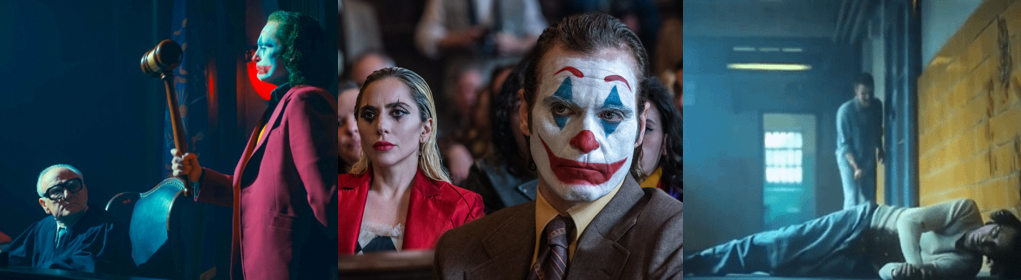
Indeed, Joker: Folie à Deux appears to be taking all the goodwill of the first movie’s success and purposely flushing it down the toilet. Arthur is taken right back to square one, being pushed around and bullied like a feeble, pathetic child and his number one supporter, Lee, is shown to be a deluded, obsessed super fan who encourages Joker’s outbursts with no real end goal in mind. His anonymous supporters rally for him but mostly use the Joker persona as an excuse to lash out, attack the police and government, and commit petty crimes. They’re not trying to overthrow the elite or get equality; they just want an excuse to act like assholes. After seeing how traumatised Gary is and suffering Jackie’s malicious abuse, Arthur snaps again and the empowerment he rediscovered leaves him. His public denouncement of Joker sees Lee leave in disgust and either kill herself or bluntly reject him, depending on which scene you want to believe is real. As the jury delivers their unanimous guilty verdict, the courthouse is attacked, leaving Dent mildly wounded on one side of his face, and Arthur escapes. He’s briefly picked up by some Joker fanatics, who desperately try to shield him in hopes of inciting a revolution, only to be astonished when he flees in fear, wanting no part of their movement. After Lee rejects him, Arthur is immediately and easily apprehended and dragged back to Arkham, ending the film right where he started: a small, broken, screwed up little man facing the death penalty. However, when he’s called to see a visitor, Arthur is stopped by a fellow inmate (Connor Storrie), one of many who gleefully watched Arthur’s trial and supported his manic actions. Disgusted that the lauded Joker is nothing but a worthless nobody who doesn’t appreciate his following, the inmate spitefully tells Arthur a joke and then repeatedly shanks him, mutilating his own face with a Glasgow smile as Arthur bleeds out on the floor and, presumably, dies.

The Summary:
I didn’t care for Joker. I thought it was largely pointless and meaningless since we’d never see this version of the character in the larger DC extended universe and the idea of doing a Joker movie without Batman seemed like a waste of time to me. I’ll admit, it was a decent, gritty, psychological thriller but…it wasn’t the Joker. Joker: Folie à Deux hammers that home explicitly; by the end, it’s obvious that Arthur Fleck was never supposed to be the Clown Prince of Crime and was, instead, the catalyst for psychotic copycats to spread terror and discord. This wouldn’t be a bad concept if the movie was actually good. Maybe if it had taken some time to explore how Arthur’s actions influenced people, perhaps shown us more of Gotham from Lee and Dent’s perspectives and juxtaposed them with Arthur cackling it up in Arkham, I could’ve endured the obnoxious musical numbers. Alas, this isn’t the case and the film instead devotes itself to stripping away everything people loved about the first film except the performances, and even those are called into question by the tedious singing. I didn’t like the idea that Arthur regressed while in Arkham; he ended Joker on a high but it took the obsession of a woman to get him back in gear, which made him seem weak and lack agency. Lady Gaga may as well have been an entirely different character; she’s as removed from Harley Quinn as Arthur is from Joker. In that regard, the idea makes perfect sense but it’s hardly providing a quintessential adaptation of these two popular characters. What really bugs me about these Joker films is how some audiences will grow up or go around thinking that this is what Joker and Harley should be, when the actual intent seems to be the exact opposite. But, by messing with our expectations and presenting this weird, poorly paced, nonsensical musical, Joker: Folie à Deux wastes more of my time than I would’ve liked. It’s not clever or saying anything new; indeed, much of its runtime treads the same ground as the last film. The singing is annoying and gets in the way of the story, and any potential of seeing Arthur truly embody the Joker persona is done away in favour of trolling audiences. I’d love to know where the $200 million budget went on this titanic insult of a film. Still, hopefully now that Arthur is dead we’ve seen the last of his “Joker” and we’ll never have to worry about this terrible incarnation of the character ever again.
My Rating:
Terrible
Did you enjoy Joker: Folie à Deux? If so…why? Name one thing you enjoyed; I dare you! What did you think to Lady Gaga’s version of Harley Quinn? Were you disappointed that Arthur didn’t truly embrace his Joker persona? What did you think to the musical numbers? Are you glad Arthur was shanked in the end or are you insane and think this is the best Joker ever? What are some of your favourite Joker-centric stories over the years? Whatever you think, good or bad, about Joker: Folie à Deux, drop a comment down below and let me know your thoughts.



















 Dr. K's Waiting Room
You must be logged in to post a comment.