Movie Night [Sci-Fanuary]: The Running Man (2025)


January celebrates two notable dates in science-fiction history: “National Science Fiction Day” on January 2 to coincide with the birth of world renowned sci-fi writer Isaac Asimov, and 12 January being when Arthur C. Clarke’s HAL 9000 was created. Accordingly, I dedicate January to celebrating sci-fi in all its forms.

Released: 14 November 2025
Director: Edgar Wright
Distributor: Paramount Pictures

Budget: $110 million
Box Office: $68.6 million
Rotten Tomatoes Scores: 63% / 78%

Quick Facts:
Famed as the undisputed king of the horror novel, Stephen King also adopted the pseudonym Richard Bachman to publish additional books like The Running Man (1982), which became a celebrated Arnold Schwarzenegger vehicle in 1987. Director Edgar Wright saw the chance to remake the story as a passion project and aimed to stick closer to the source material. Wright and star Glen Powell thus ensured that Ben Richards would be portrayed as an “Everyman” rather than an action hero, while Industrial Light & Magic contributed to the visual effects and Schwarzenegger gave Powell his “full blessing”.

The Review:
As a lifelong Arnold Schwarzenegger fan, I’m obviously a big fan of The Running Man (Glaser, 1987). However, that movie isn’t very faithful to the original novella, though the basics are still there. Despite how poor many remakes of classic eighties films can be, I was therefore very excited about this new adaptation, which sticks much closer to the book and thus stands apart from the previous film. As in the 1987 movie and the book, The Running Man is set in a dystopian near future where the United States has become an authoritarian police state that placates its population with non-stop, often lethal gameshows on “FreeVee”. While the top 1% live in lavish luxury in massive hi-tech skyscrapers and barely pay attention in their self-driving cars, working class Joes like Ben Richards (Glen Powell) live in squalor in the slums of Co-Op City. While FreeVee broadcasts game shows where the desperate dregs of society risk their lives for cash, civilians are constantly monitored, tracked, and abused by the corporate media networks who have usurped regular government. In this world, healthcare is all-but inaccessible to Richards, who’s forced to work menial, high-risk and low-pay jobs just to get by while his wife, Sheila Richards (Jayme Lawson), works around the clock as a waitress, forced to endure lewd remarks and patrons just to help cover their bills. For Richards, life is made doubly hard as he’s been blacklisted for his insubordinate attitude, which manifests as a sarcastic, biting wit, spontaneous anger at injustice, and him daring to care about the health and safety of his co-workers. Time and again, Richards has been punished for sticking his neck out for others, finally losing his most recent job for speaking out about the poor radiation controls that threaten to make the workers sterile.
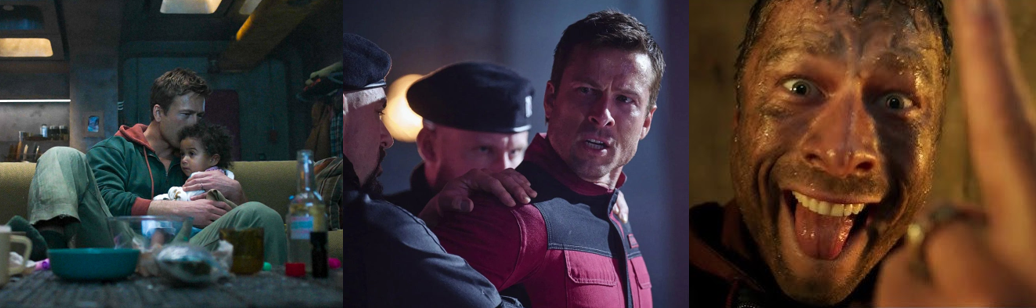
Desperate, rage-filled Richards risks his life in a violent reality show to better provide for his family.

At his wit’s end, with his toddler daughter Cathy Richards (Alyssa and Sienna Benn) suffering from the flu, Richards is forced to try out for one of the network’s game shows, confident that he can earn enough money on one of the less dangerous shows to at least get Cathy some decent medicine. Richards excels at the physical and mental tests he’s put through, showing himself to be a physically capable, resourceful, and intelligent contestant, though his rage and misanthropy at years of being downtrodden see him forced to sign-up to the network’s most dangerous show: The Running Man. Though reluctant as no contestant has ever survived, Richards is ultimately convinced to sign on after meeting slick producer Dan Killian (Josh Brolin), who takes a shine to Richards’ blue-collar background and outspoken nature and even gives him an advance to coerce him. Naturally, Sheila is horrified to learn that Richards will be hunted across the world for the next thirty days, earning cash for each day he survives, each “Hunter” he kills, and constantly at risk of being exposed by bloodthirsty civilians looking to be rewarded for snitching. Though won over by Killian’s silver tongue, Richards is immediately screwed when Running Man host, Bobby Thompson/Bobby T (Colman Domingo), brands him a dangerous criminal and broadcasts falsified information about him and his fellow runners, Jenni Laughlin (Katy O’Brian) and Tim Jansky (Martin Herlihy). Taking advantage of the $1,000 bursary and twelve-hour head start, Richards takes Killian’s advice to “stick with his people” to heart and immediately heads to underground forger Molie Jernigan (William H. Macy) to get some fake identification and supplies. Richards hides in a seedy hotel, following the show’s rules by sending in increasingly frustrated and angered videos of his progress, which are eventually also doctored to portray him as a psychopath when really he’s trying to warn the public about various injustices perpetrated by the network.
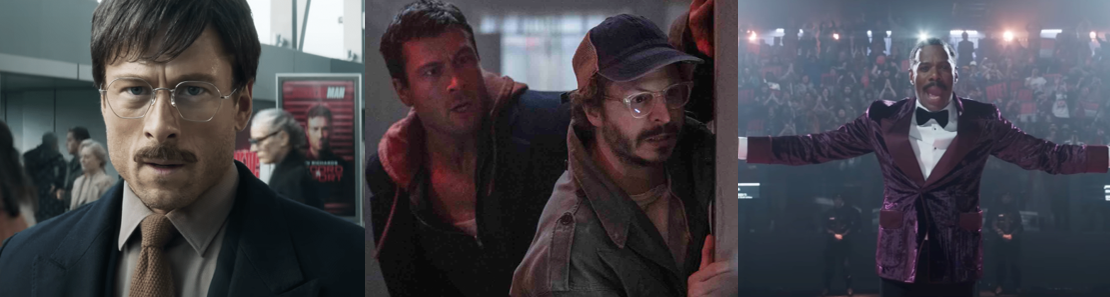
While on the run, Richards becomes the unwitting “initiator” of a much-needed revolution.

While Richards is impressively cut here, he’s not a man-mountain like Arnold and gets beaten, bloodied, dirty, and exhausted from constantly being on the run and fighting for his life. Glen Powell makes for a fantastic “Everyman” figure and perfectly captures Ben’s manic energy and tumultuous emotions, with him openly resisting being branded as a martyr by similarly downtrodden folks like Bradley Throckmorton (Daniel Ezra) and Elton Parrakis (Michael Cera) and wishing only to ensure his family’s safety. While Jansky and Laughlin don’t last long, burning through their cash or being far too public, Richards keeps his head down and is aided by Co-Op’s underclass, who reveal the true extent of the network’s propaganda and lies as they’re actively poisoning or killing the populace and either ignoring it or making a show of it. Throckmorton, who anonymously posts videos warning of this, smuggles Richards to Derry, Maine, where he’s further aided by Parrakis, an extreme anti-network activist who believes Richards can spark a violent resistance. The public soon favour Richards, spray-painting “Richards Lives” messages and cheering him as he gets closer to victory, though Elton’s dementia-addled mother (Sandra Dickinson) scuppers the plan to shelter Ben in their fortified home and transport him to a secret underground bunker to wait out the remaining time. While reluctant to be the figurehead of a revolution and alarmed at how crazed some of his allies are, Richards is disgusted by the foul treatment they’ve suffered and enraged when they are executed by association, driving him to embrace his role as a social anarchistic and take unsuspecting citizen Amelia Williams (Emilia Jones) hostage in the finale to show the world just how corrupt the network is.
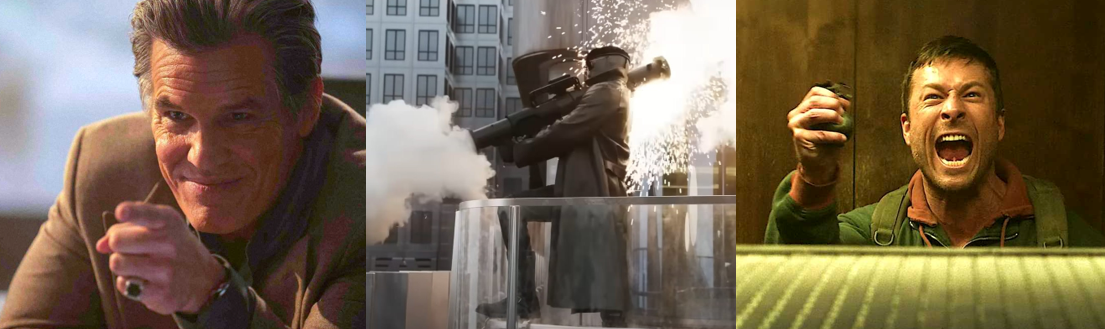
Directed by Killian, Richards is relentlessly hounded by the sadistic McCone and his Hunters.

Rather than being hunted by colourful and outlandish, muscled-up “Stalkers”, Richards is constantly hounded by the Hunters, an elite group of network assassins led by the mysterious Chief Evan McCone (Lee Pace), the masked icon of The Running Man. While Killian assures Richards that his tapes can’t be traced in the interest of fairness, Richards quickly learns this is a lie (not that the network needs the extra edge as they have eyes and ears everywhere). Despite his best efforts, Richards barely gets a moment to rest as the Hunters advance on each of his locations, haunting Ben’s dreams with paranoid nightmares of himself and his friends and family being slaughtered. Thanks to his quick thinking and wariness, Richards escapes death each time but often by sheer luck, as McCone almost ends him with an errant grenade and Throckmorton’s car is shot up as he smuggles Ben out of Boston. Often disguised as civilians, the Hunters deploy floating cameras to record their kills, waiting for Killian’s cue to make each execution public. When Richards proves as resourceful and stubborn as Killian hoped, Bobby T is forced to spin a narrative of the Hunters being patriotic family men slaughtered by a desperate criminal, which encourages the more susceptible and trigger-happy civilians to target Richards. These antagonists play a much lesser role than in the 1987 film though, as The Running Man takes a page out of King’s book by focusing more on Richards, his desperate attempts to survive, and the social injustices he uncovers. Parrakis jumps at the chance to fry the network’s goons and bludgeon them with his boobytraps, while Richards refuses to play Killian’s game and execute the helpless Frank (Karl Glusman). McCone is a relentless tool of the network, dispassionately torturing and killing his way to his target, whom he grows increasingly frustrated with as Richards refuses to die and is favoured by Killian, who actively protects Ben at times to further boost his ratings.
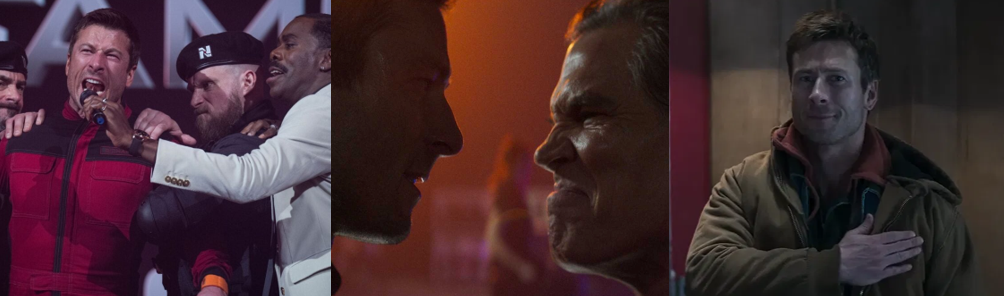
Outspoken Richards defies the odds and not only survives, but inspires the people to revolt.

This comes to a head when the injured and desperate Richards forces Amelia to drive him to an airfield, bluffing his way onto a jet by claiming to have a powerful explosive. Killian humours Richards, ordering McCone to unmask and stand down so Richards can board the plane before revealing that they’re aware of his bluff. Incredibly, Killian offers Richards the chance to replace McCone and become the star of an all-new show, pitching him a redemption arc so he can cash-in on his newfound superstardom. To motivate Richards to kill McCone and the flight crew, Killian shows him footage of McCone and the other Hunters murdering Ben’s family, driving Richards into an uncontrollable rage that sees him kill the crew and get into a brutal, bloody brawl with McCone, who’s revealed to be a former runner from the show’s first season who took a similar deal after surviving for twenty-nine days. Though grievously wounded, Richards is aided by Amelia after she’s horrified to learn the truth about the network. Ben allows to escape with the only parachute and, facing either being shot down or remote piloted by Killian, tries again to warn the public about the network but is replaced by another incriminating deepfake and seemingly killed. I was honestly shocked that the film retained even this much of the book’s ending, which has unnerving parallels to 9/11, but honestly somewhat disappointed that they didn’t go all-in with a bleak ending that nevertheless inspired true change for this totalitarian world. Still, encouraged by Throckmorton, the public refuse to believe their saviour has died and pro-Richards rallies increase in volume and violence, with even Bobby T walking away from Killian after witnessing the raucous crowd. Emboldened by Richards and the ever-increasing evidence of network deception, the public finally come together in a violent rebellion that sees them trash the Running Man set and Richards, alive and well, publicly execute Killian before reuniting with his family, who also survive in this version of the story.

The Summary:
I had a good feeling about The Running Man from the moment I saw the first trailer. I could tell right away that it was going to be very different to the 1987 film and closer to the source material, and it absolutely was, almost to its detriment at times. Unlike the 1987 film, this version suffers a bit with some pacing issues. Some parts are a bit rushed, then it slows down a bit, then some obvious re-recording of lines is looped in, which can be a bit distracting. However, this was still an enjoyable romp that’s very different from Edgar Wright’s usual work. Glen Powell excelled in the lead role, conveying the perfect balance of manic energy, heart, and underdog (and physical!) appeal that make Richards a fun character to root for. He’s desperate to save his family and wary of helping others but is a decent man deep down who reluctantly inspires a revolution. While the Hunters can’t hold a candle to the 1987 Stalkers, I liked that Richards was constantly looking over his shoulder and against the odds when McCone zeroed in on him. While Killian and Bobby T are somewhat underutilised, this Running Man is firmly focused on Richards and his fight for survival in a hazardous and untrustworthy authoritarian dystopia, and it’s endlessly entertaining and harrowing to watch him narrowly avoid death by the skin of his teeth. I was amazed that the ending stuck so close to the book and somewhat relieved that the film opted for a happier ending, despite how much of a gut punch a bleak ending would’ve been after some of the comical action that had preceded it. Ultimately, The Running Man is a very different beast from its predecessor with a slightly different agenda but, by sticking closer to the source material and delivering explosive action and thought-provoking satire, it more than stands on its own two feet as an entertaining film rather than being derivative or inferior.

My Rating:

Rating: 4 out of 5.

Great Stuff

Did you enjoy this adaptation of The Running Man? Are you glad that it stuck closer to the book or do you prefer the colourful excess of the 1987 film? Did you enjoy Glen Powell’s portrayal of Richards as a down-trodden everyman? Were you disappointed that McCone and Killian didn’t play a larger role, or did you prefer the focus on inspiring a revolution? Does it disturb you that dystopian futures are essentially now our reality? Which Stephen King book is your favourite and how are you celebrating sci-fi this month? Let me know your thoughts in the comments and donate to my Ko-Fi to fund more reviews like this.

Movie Night: The Running Man (1987)

Released: 13 November 1987
Director: Paul Michael Glaser
Distributor: Tri-Star Pictures
Budget: $27 million
Stars: Arnold Schwarzenegger, María Conchita Alonso, Yaphet Kotto, Marvin J. McIntyre, Erland Van Lidth, Jesse Ventura, and Richard Dawson

The Plot:
Following worldwide economic collapse, the United States has become a totalitarian police state whose populace is pacified by Damon Killian’s (Dawson) The Running Man, a game show where criminals fight for their lives from sadistic maniacs. After escaping prison following a frame-up, Ben Richards (Schwarzenegger) is forced to compete in the game and, in the process, assist a resistance movement in revealing the horrible truth behind The Running Man.

The Background:
By 1982, Stephen King has established himself as the undisputed king of the horror novel; Carrie (King, 1974) became be a runaway success, especially after the accompanying adaptation, The Shining (ibid, 1977) became his first hardback bestseller, and The Stand (ibid, 1978), as epic as it was, proved to merely be a precursor to King’s sprawling Dark Tower series (ibid, 1982 to 2012). King also wrote a under the pseudonym Richard Bachman, both to publish more books per year and to test whether his success had been a fluke or not, and The Running Man began life as a Bachman book. The story, a dystopian thriller in a world where the economy has collapsed, was first published in 1982 and King claimed to have written it in just a week! Producer George Linder became obsessed with the book and its premise and was easily able to acquire the film rights since it wasn’t yet public knowledge that Bachman was King’s alias. After the success of The Terminator (Cameron, 1984), Arnold Schwarzenegger shot to superstardom as the premier action star in Hollywood, and screenwriter Steven DeSouza tweaked the script to accommodate the Austrian Oak, who in reality had very little in common with is literary counterpart. He also greatly expanded upon the game show aspects of the novel, but the film’s production was troubled by directors constantly dropping from the project and Schwarzenegger disapproved of Paul Michael Glaser’s filming style. With a $38.1 million box office, The Running Man was a modest financial success; reviews were somewhat mixed, with Dawson’s performance, the film’s satire, and Arnold’s range and physicality drawing praise despite the mindlessness of the action. A life-long favourite of mine, The Running Man recently gained additional exposure thanks to its accurate predictions of the future and the 2025 remake but, since today is Arnold’s birthday, this is the perfect time to revisit this fantastic, action-packed sci-fi classic.

The Review:
It’s hard for me to say, since I don’t really remember all that well, but The Running Man may very well have been my first exposure to Stephen King; at the very least, it was one of my first, and it came at exactly the right time in my life since I was already a big fan of Schwarzenegger’s work from the late eighties to early nineties. The film takes places in the far-off future of around 2018 where the world has become a dystopian police state following a massive economic collapse. Censorship runs rampant and the people are controlled by the media and their governments; generally, they’re satiated by an influx of violent media, such as the life-or-death game show The Running Man, but riots and pockets of resistance continue to spring up, so the government employs more “direct methods” to quell the uprising. Ben Richards begins the film as the part of the system; he starts off as a helicopter pilot for the police force sent in alongside a group of armed officers to investigate a food riot in Bakersfield, California. Richards is aghast when his superior officers order him to open fire on the unarmed crowd and refuses to comply; for his moral stance against gunning down woman and children, he is not only overpowered and knocked out by his comrades but also framed for the ensuring slaughter, earning him infamy as “The Butcher of Bakersfield” and a stint in the Wilshire Detention Zone.

After being framed for a massacre, Richards is forced into fighting for his life on The Running Man.

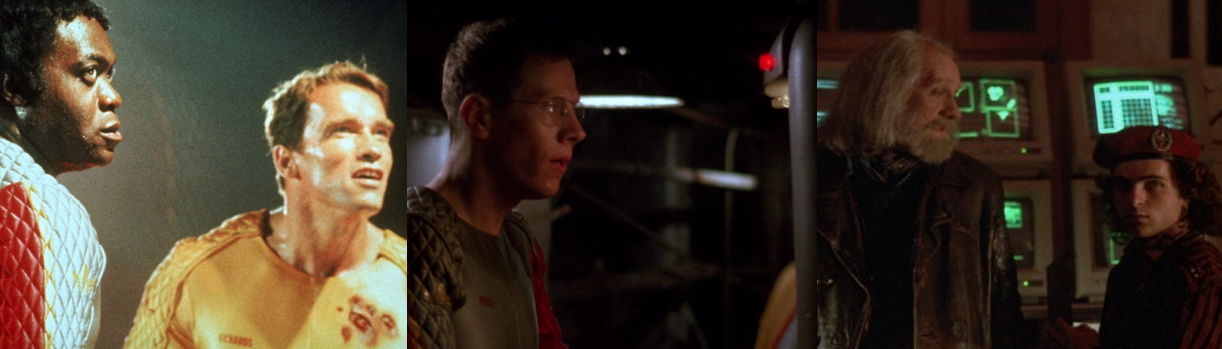
After eighteen months in a harsh labour camp, his life in the hands of the government that betrayed him thanks to the explosive collar clipped around his neck, Richards has grown into a jaded man who has no time for politics or the steadily declining shithole that the world is becoming. All he cares about now is getting out and reuniting with his brother so he can flee the country, and he joins forces with William Laughlin (Kotto) and Harold Weiss (McIntyre) to stage a brawl and overthrow the armed guards long enough to deactivate the controlling mechanism for their collars and allow a mass escape. Richards remains aligned with the two, who are associates of the Resistance, long enough to have his collar removed but has no interest in getting caught up in resistance leader Mic’s (Mick Fleetwood) efforts to highjack the ICS network satellite and broadcast the true extent of the government’s deception to the unsuspecting masses. Richards is a man of action who has been burned once too often by those who only talk of changing the world; believing that no-one is willing to act on their words, he’s ready to walk away from the world but finds himself targeted by Killian, the charismatic host of The Running Man, who is so inspired by Richards’ physicality and notoriety that he employs every means at his disposal to intercept Richards as he’s trying to flee to Hawaii with the feisty Amber Mendez (Alonso), a composer for the network who Richards was forced to take hostage to keep such an arrest from happening. Initially defiant, Richards is coerced into taking part on the show when Kilian threatens to have Weiss and Laughlin take his place, only to be double-crossed when his friends are dumped into the wreckage of Los Angeles, which comprises the game zone, but his defiance is only fuelled by his desire to fight his way out of the situation and make Killian pay for his part in defaming and endangering him and his buddies.

The feisty Amber ends up competing as well when she learns that the media has been lying to the masses.

After his escape, Richards heads to the city to meet up with his brother, only to find that Edward’s apartment is now owned by Amber after he was taken away for “re-education”. Like Richards, Amber begins the film as an employee of the system; she has had some success composing songs for the ICS network, but is also hiding a few secrets of her own as she has music from the censor list and black-market clothing in her apartment. Richards uses this knowledge to effectively blackmail her into accompanying him to Hawaii, but he also requires her to go with him since, without his brother to help him, he needs her money and travel pass in order to get out of the country. Despite Richards’ massive stature and the ease at which he overpowers her, Amber is a spirited and bold young woman in her own right; she goes along with Richards’ plan, throwing insults and taunts his way wherever possible, and takes the first chance she gets to hit him in the dick and alert airport security to his presence. Like the rest of the ignorant masses, Amber fully believes that Richards is a dangerous and psychotic killer, but her opinion of him (and ICS) changes when she sees that the specifics of his arrest at the airport have been greatly exaggerated to include him having assaulted and killed airport personnel. Her suspicions raised, Amber snoops around the ICS offices and finds that the original unedited video record of the Bakersfield Massacre, but is caught in the act and thrown into the game zone after Killian besmirches her on air with scathing accusations. Although she’s absolutely in over her head, and little more than a screaming, complaining wreck when in the game zone, Amber remains an entertaining character; she constantly winds Richards up with her babbling and naïvety and actually ends up proving quite useful when Weiss has her memorise the uplink code so that Mic can hack into the network satellite. Furthermore, she’s instrumental in Richards’ name being cleared in the finale, and even learns to take care of herself, rather than constantly being saved by Richards, by the time the bulbous Dynamo (Van Lidth) tries to sexually assault her during the film’s climatic firefight.

Much to his chagrin, Richards’ allies are fixated on exposing the government.

While Richards has little interest in politics or fighting against the system, the same can’t be said of Weiss and Laughlin; Laughlin, a former schoolteacher, despairs for the state of the country’s youth as ICS run their propaganda twenty-four hours a day and brainwash them into signing up to serve as part of the violent polices state that oppresses free speech and art. Laughlin’s anger at ICS, and this situation, makes him quite a volatile character; he and Richards start a fight to distract the guards in the labour camp at the start of the film and he explodes with rage when Eddie Vatowski/Buzzsaw (Gus Rethwisch) attacks Richards out in the game zone. This despite the fact that Laughlin was somewhat suspicious of Richards; while Weiss is adamant that their musclebound ally has been framed by the government, Laughlin isn’t so sure since Richards was once a part of the same system he’s fighting against and isn’t “one of [them]” (as in, he’s not a member of the Resistance). Still, Laughlin is fiercely loyal to both his cause and his friend, which ultimately proves to be his undoing as he puts himself in harm’s way to keep Richards from being skewered by Buzzsaw’s chainsaw and ends up dead as a result. Deeply touched by his friend’s sacrifice, this is the turning point for Richards, who vows to bring the uplink code to Mic, despite his scepticism, to honour his friend. Sadly, Weiss doesn’t fare all that well either; the less physically capable of the three, he’s easily manhandled by Professor Subzero (Professor Toru Tanaka) and constantly at risk since he’s unable to simply fight his way through with brute force. Weiss remains fixated on finding the network uplink out in the game zone which, coupled with his weaker physical stature, leads to him being electrocuted to death by Dynamo. Luckily for him, he’s able to teach Amber to memorise the uplink code before he dies, which she then gives to Mic so that the Resistance can finally hack into the ICS network. Although he’s critical of Mic’s Resistance, not just because of the extent of ICS’s influence but also Mic’s use of kids like Stevie (Dweezil Zappa) in his makeshift army, Richards relishes the chance to arm up and lead them in storming The Running Man studio to broadcast the truth of ICS’s malevolent nature and end Killian’s disruptive influence over the audience.

Killian is a charismatic game show host who casually manipulates lives and the media for his ratings.

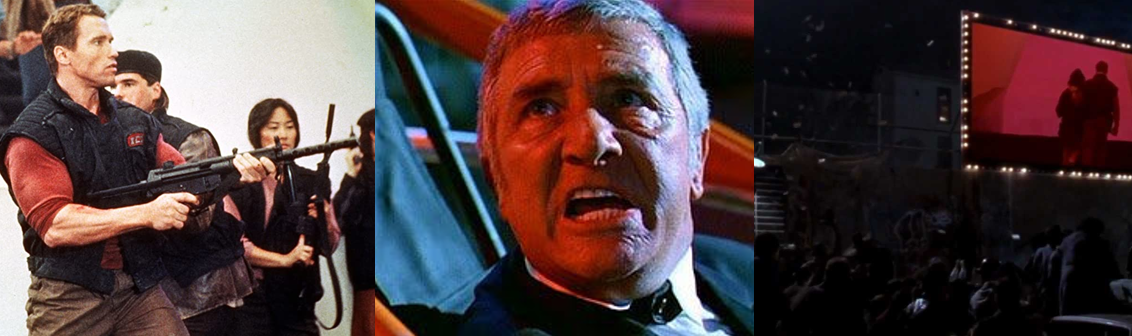
Speaking of Killian, this guy is one slimy, charismatic, and underhanded individual. Played with absolute relish by career game show host Richard Dawson, Killian is a cold-hearted showman who delights in the adulation of his rowdy audience and is focused only on increasing The Running Man’s ratings by any means necessary. Since The Running Man is “the number one show in the whole, wide world” and the most direct means by which the government can influence and control the masses, Killian wields an incredible amount of power and regularly flouts his influence by manipulating the justice department (or going directly to the President of the United States’ agent) to find viable candidates for his show and thus increase his ratings. Unimpressed with the physical stature and uncharismatic screen appeal of the potential candidates on offer, Killian uses all of his resources and influence to get approval to put Richards on the show, and then goes the extra mile by threatening his friends to force him to undergo the horrific and invasive medical treatments necessary before dumping them all into the game zone. While the protagonists desperately fight for survival out in the desolate wasteland, Killian shines as the captivating host of the show; he engages with his audience (especially his “number one fan”, Agnes McArdle (Dona Hardy)) with a flirtatious and magnetic banter, encouraging them to pick their favourite Stalker to chase after the contestants and awarding them their prizes for participating. However, Killian becomes increasingly frustrated not just by Richards’ continued victories over the Stalkers but also by his increasing popularity, which sees the masses cheering and betting on him rather than favouring the Stalkers. Luckily for Killian, he has a crack media team on hand to not only doctor video footage to incriminate his contestants but also to stage Amber and Richards’ deaths using a very early representation of CGI facial mapping after Richards vehemently turns down Killian’s offer to become a Stalker himself.

The violent and sadistic Stalkers are worshipped by the masses and famed for their brutal kills.

The Stalkers make up the primary physical threat faced by our main characters; essentially a gaggle of bloodthirsty wrestlers kept under ICS’s payroll with the specific purpose killing contestants in the most gruesome ways to pop a higher rating. Cheered and idolised by the masses, the Stalkers are more than celebrities; they’re heroes, each of which have their own dedicated fanbase and odds of winning based on their experiences on the game show, and the audience is stunned into silence to see them being offed one at a time by Richards, especially as a Stalker has never been killed before. Although Captain Freedom (Ventura) is technically the first Stalker introduced, he’s basically been reduced to being a mascot for the network, and is insulted when Killian denies him the “code of the gladiators” for his eventual fight against Richards. Consequently, Captain Freedom is denied actually participating in the show as much as he is his time to host his workout show or share his insights during the broadcast, which leaves him resentful of his employers. The first Stalker to actually enter the fray is Professor Subzero, a huge Japanese sumo wrestler who attacks our heroes with a razor-sharp hockey stick and meets his ends when Richards garrottes him with a piece of barbed wire. Buzzsaw and Dynamo enter the game as a tag team of sorts, with the chainsaw wielding Buzzsaw having the most impact of all of the antagonists thanks not just to the sadistic pleasure he derives from slicing his prey with his chainsaws but also because he kills Laughlin and is subsequently executed by Richards by having his beloved chainsaw cut through his groin. Not that Dynamo is any slouch either; he murders Weiss and makes an immediate impression with his ludicrous light-up outfit, operatic singing, and little armoured car that he tries to run down Richards with. Initially, Richards spares Dynamo’s life after he’s left helpless beneath the wreckage of his vehicle, but he is later electrocuted to death by Amber after he tries to assault her, bringing his perverse designs to an end. Finally, Killian sends in Fireball (Jim Brown) to immolate Richards and Amber but, despite the benefits afforded to him by his jetpack, his fireproof suit, and his trusty flamethrower, Fireball is easily dispatched by Richards using a road flare after a brief, tense game of cat and mouse.

The Nitty-Gritty:
I’d just like to take a moment to praise the stellar work by composer Harold Faltermeyer; The Running Man’s gloriously over the top action, satirical cynicism, and dystopian world are only bolstered by a thumping synthetic beat that hits perfectly during every punch, kill, or contemplative scene. Even now, the bombastic main melody will often pop into my head and it’s just a really fun, energetic score that gets the blood pumping every time it kicks in. Considering it was made in the late-eighties, The Running Man is a startlingly accurate portrayal of modern society; not only do we have voice-activated conveniences at home that control our lights and appliances, but we have absolutely become blinded to the conflicts and politics of the wider world in favour of consuming media, and governments make no bones about using said media to control us in both subtle and explicit ways. Obviously, The Running Man favours the more explicit path for the purposes of entertainment; the prison Richards finds himself in is an absolute hellhole where the inmates are worked to death, watched over by armed, masked stormtroopers, and unable to leave lest their heads be blown off by explosive collars! Furthermore, the government is more than willing to employ lethal force to quell food riots and spin the situation in their favour by pinning such incidents on patsies like Richards. The United States government has a controlling interest in The Running Man television show, using it as a backdoor solution to eliminate political insurgents, and even those who manage to beat the game are executed offscreen but presented as heroic victors to help boost the ratings.

Schwarzenegger is never short of a cutting quip to taunt his dismembered opponents in this film.

The Running Man is filled with examples of black humour, from Killian’s laughably bad adverts for Cadre Cola (“It Hits the Spot!”) to lethal game shows like Climbing for Dollars and the price of a Coca-Cola having shot to $6, The Running Man is indicative of a biting satire regarding consumerism and media consumption that was so crucial to sci-fi classics at the time. Of course, a great deal of the film’s humour also comes from Schwarzenegger; while the Austrian Oak falters somewhat here and there with his line delivery in this one, The Running Man is chock full of some of his most amusing one-liners and character moments, from stabbing his court appointed attorney (Kenneth Lerner) in the back with a pen after he rattles off all kinds of nonsense legal mumbo-jumbo, his vow that “[he’ll] be back” to Killian (whose reply, “Only in a rerun”, isn’t to be sniffed at either) and his many quips while interacting with and after dispatching each of the Stalkers (“Hey, Christmas Tree!”, “He had to split”, and “What a hot-head!” spring instantly to mind). For me, though, the standout moment comes when Richards, enraged at the loss of his friends, turns down Killian’s request to sign up as a Stalker and promises to “ram [his fist] into [Killian’s] stomach and break [his] Goddamn spine!” Alongside Schwarzenegger’s trademark wit, we have a decent variety of action and fight scenes on offer thanks to the different Stalkers; Professor Subzero attacks the group in an enclosed ice rink, Buzzsaw and Dynamo strike out in the wasteland, and Fireball chases Richards and Amber through an abandoned building. More often that not, Richards can’t simply rely on throwing punches at his opponents as they’re pretty huge guys in their own right, heavily armed, and some wear protective armour or ride motorcycles, meaning he has to think up some creative ways to subdue them and finish them off, such as ripping out Fireball’s fuel line and tossing a flare at him and overpowering Buzzsaw to drive his chainsaw up into his crotch!

Richards storms the studio, gives Killian some karma, and becomes the unlikely face of a revolution.

Interestingly, one of the film’s more brutal fight sequences doesn’t technically involve Richards; thanks to Killian’s aide, Tony (Kurt Fuller), using digital trickery, Captain Freedom fights and kills two stand-ins to stage Amber and Richards’ deaths in order to quell the support the latter is gaining from the viewing public. Thankfully, Mic intercepts the two before Killian can have them hunted down and killed off-camera and Richards volunteers to lead the Resistance in storming The Running Man broadcast, ensuring that the film culminates in a massive firefight between the Resistance and the ICS armed guards. Thanks to being caught off-guard, the guards are picked off by Richards and the others, who help get the majority of the panicked audience to safety, and Richards is left alone with Killian after his mistreated head of security, Sven (Sven Thorsen), leaves him in the lurch. Clearly not a physical match for Richards, Killian falls back on his silver tongue and desperately pleads with the grim-faced former cop for mercy since Killian is simply trying to appease the masses with violent entertainment. However, his appeals fall on deaf ears and Richards seals him up in one of the rocket-powered pods that so violently deposits contestants into the game zone and sends the deceiving game show host careening to a fiery death. By this point, however, the truth of the Bakersfield Massacre has been revealed and Richards has won over the viewing audience for being a “bad motherfucker”, meaning that Killian’s death is celebrated across the city. With the head of the snake effectively removed, The Running Man (and the large television screen in the city centre) goes off air for, presumably, the first time ever and the film ends with a definite sense that the people have not only found a new hero to idolise in Richards but will no longer allow themselves to be so absolutely controlled by the media and the oppressive government.

The Summary:
I haven’t read The Running Man, so I really can’t comment on the film’s fidelity to Stephen King’s original text, but I do have to say that I’ve always wanted to give it a read based on my affection for this adaptation. I might be blinded by nostalgia and my love for Arnold Schwarzenegger films, but I absolutely love The Running Man. It’s not completely flawless thanks to some spotty line delivery and most of the action taking place in a pretty bland, dark location, but I think it holds up surprisingly well even after all this time. It helps that it’s not an overly elaborate sci-fi tale, so there are no flying cars or complicated special effects here; it’s simply a darker, somewhat realistic representation of a possible future society that has been oppressed by an overbearing government following near-total economic collapse. The film shines in its excess of machismo; Schwarzenegger is at his most quippy here, overpowering and outmatching his beefy opponents with pun after pun and filling out his skin-tight spandex outfit wonderfully. The Stalkers might be soulless, sadistic modern-day gladiators, but they stand out thanks to being visually distinct and each having their own unique, vicious ways of attacking the contestants. Of course, the real star of the show is Richard Dawson as Killian, the two-faced game show host who is jovial and engaging in front of the cameras and a cold-hearted tyrant backstage, which makes him an impeccable mastermind for Schwarzenegger to go up against. The Running Man continues to be culturally relevant as time goes on thanks to modern day technology not being a million miles away from what’s seen in the film, and our continued obsession with meaningless gameshows, media, and increasingly violent entertainment. For me, this makes The Running Man a clever satire amidst a top-notch sci-fit action film that means it only takes on more meaning, and gets more entertaining, as you get older and appreciate all the different layers at work in what many probably write off as just another mindless Schwarzenegger flick.

My Rating:

Rating: 5 out of 5.

Fantastic

What do you think to The Running Man? How do you think the film holds up to others in the same genre and what would you rank it against Arnold’s other films? Have you read the original book and, if so, how do you think the film holds up as an adaptation? What did you think to Schwarzenegger’s many quips? Which of the Stalkers was your favourite? Are you surprised at how accurate The Running Man was at predicting the progression of society? Were you a fan of Richard Dawson’s performance? How are you celebrating Schwarzenegger’s birthday today and what is your favourite Schwarzenegger film? Whatever you think, go ahead and leave your thoughts below.