Back Issues [Crossover Crisis]: Crisis on Infinite Earths


Cover-dated April 1985, the first issue of this ground-breaking event precipitated the destruction of the “Multiverse” in favour of a unified DC canon. Though DC returned to this concept again and again, that doesn’t change how influential this massive crossover was and what better way to celebrate than with a “Crossover Crisis” of my own?


Published: 3 January 1985 (cover-dated: April 1985) to March 1986 (cover date)
Writer: Marv Wolfman
Artist: George Pérez

The Background:
In Showcase #4 (1956), writer Robert Kanigher and artist Carmine Infantino debuted Barry Allen/The Flash, the successor to Jay Garrick, who was established as an alternative version of the Fastest Man Alive. This concept was taken to the next level when Barry and Jay met face-to-face, revealing an infinite number of parallel worlds. Regular crossovers between the likes the Justice Society of America and the Justice League of America soon followed, allowing alternative heroes and various stories to exist simultaneously. Over time, writers like Mark Wolfman became frustrated with this concept, which made keeping track of continuity difficult and it was hard for both writers and readers to connect with the stories. Wolfman initially pitched a reader guide to simplify the DC universe, which then evolved into a sprawling tale of multiversal destruction seen as a risky proposition as it meant erasing all continuity and starting from scratch to attract new readers. Such an event was unprecedented and DC spent two years laying the foundation for this Crisis, hiring researchers to document every character and event in their library and bringing in George Pérez to illustrate, with the artist excited at the idea of illustrating every DC character. Crisis on Infinite Earths became a bestseller for DC Comics and was heralded as a turning point for both the publisher and the industry. The fallout saw every DC character rebooted, with Clark Kent/Superman notably being reimagined as a more grounded character and Wally West taking over as the Flash, though Carter Hall/Hawkman was irrevocably damaged for years as DC struggled to reconcile certain elements of his character. Praised as the greatest comic book crossover in history, the event popularised massive, cosmic crossovers and DC revisited this concept numerous times in subsequent years. The event was even adapted into an ambitious and well received television event and an impressive three-part animated feature.

The Review:
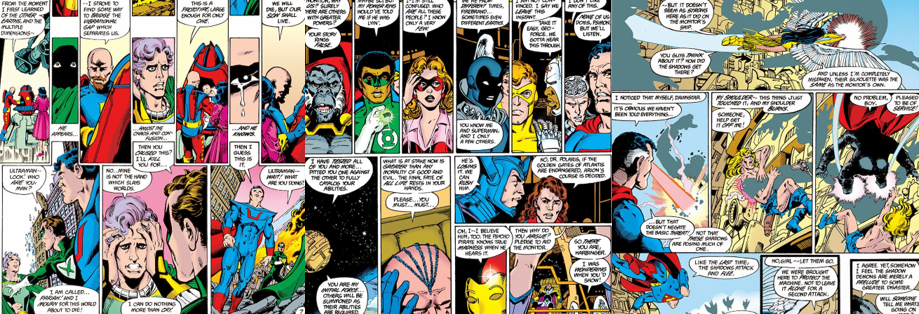
Confused by the concept of the multiverse? Well, Crisis on Infinite Earths has you covered, to a degree, as it opens with (and features throughout) narration and exposition from the tragic Kell Mossa/Pariah. In the beginning, before there was light and life, there was only darkness. Then, from nowhere, came a single light that grew and expanded and finally exploded in “pain [and] relief” as the multiverse was born. The idea is infinite parallel realities all co-exist at once, separated by vibrational planes, though this is noted to not have been the intention when the light burst into being. The story the shifts to one such Earth where the hooded, weeping Pariah witnesses the destruction of not only that world, but the entire reality, at the hands of an all-encompassing white light. As entropy erases everything it touches, Pariah begs to be taken with it, sparing him his grim fate, only to be teleported away as the universe meets its destructive end. We then jump to Earth-3, home of the Crime Syndicate, an evil alternative version of the Justice League. There, Harold Jordan/Power Ring and Clark Kent/Ultraman desperately try to stop the cataclysmic natural disasters springing up across their world as the anti-matter wave approaches. While Thomas Wayne Jr./Owlman and Jonathan Allen/Johnny Quick lament their helplessness against such awesome power, the world’s only superhero, Alexander Luthor, watches helplessly as lifelong enemies like Diana/Superwoman are devoured by the anti-matter wave. With no way to save his world, Alexander rushes to be with his wife, Lois, and baby son, Alexander Luthor, Jr. In a parallel to Superman’s iconic origin, the baby is loaded into a specially prepared rocket and spirited away to Earth-1 as his world dies.
With all universes at risk of annihilation, the Monitor assembles a team of heroes and villains.

The mysterious Mar Novu/The Monitor observes this from his orbiting, spherical space station alongside Lyla Michaels/Harbinger, whom he sends to recruit Earth’s greatest heroes and villains to stop the pending Crisis. Harbinger recruits King Solovar from Gorilla City, Dawnstar from the 30th century Legion of Super-Heroes, Danette Reilly/Firebrand from Earth-2 1942, Ted Kord/The Blue Beetle from Earth-4, and Roger Hayden/Psycho-Pirate from present-day Earth-2. She returns Psycho-Pirate’s emotion manipulating Medusa Mask and coerces him into quelling Louise Lincoln/Killer Frost’s bloodlust and bringing both her and Ronnie Raymond and Professor Martin Stein/Firestorm to the cause. Though Harbinger is possessed by a Shadow Demon when recruiting Ahri’ahn/Arion the Sorcerer, he joins the other recruits, including Kal-L/Superman, John Stewart/Green Lantern, Neal Emerson/Doctor Polaris, Victor Stone/Cyborg, Simon Jones/Psimon, and Todd Rice/Obsidian. With tensions running high, the group are attacked by Shadow Demons, which seem impervious to physical, mental, and energy-based attacks. While the likes of the Blue Beetle can only run and Firestorm struggles with Killer Frost’s newfound affections, Obsidian and the arrogant Dr. Polaris put their shadow- and magnetism-based powers to good use. The Monitor halts the attack and introduces both himself and the threat to their universes. Weakened by the spread of anti-matter and facing suspicion from his assembled forces, the Monitor reveals that he’s judged them as the best hope of protecting five devices spread across the different eras that he hopes will halt the anti-matter wave. Meanwhile, reality is warped across the multiverse: in prehistoric times, Anthro the Cave-Boy is as astonished to spot a futuristic city amongst the wilds as Querl Dox/Brainiac-5 is to see mammoths stampeding through the 30th century. Half a galaxy away on Oa, the Guardians of the Universe prepare to summon their entire Green Lantern Corps to meet the threat, only for a mysterious voice to corrupt the Central Battery and trap them in a stasis beam. On Earth-1, Bruce Wayne/Batman is busy confronting the Joker during his latest crime spree and is astonished when an emaciated, confused Flash suddenly appears babbling about the end of the world and begging for help before disintegrating before the Dark Knight’s eyes!
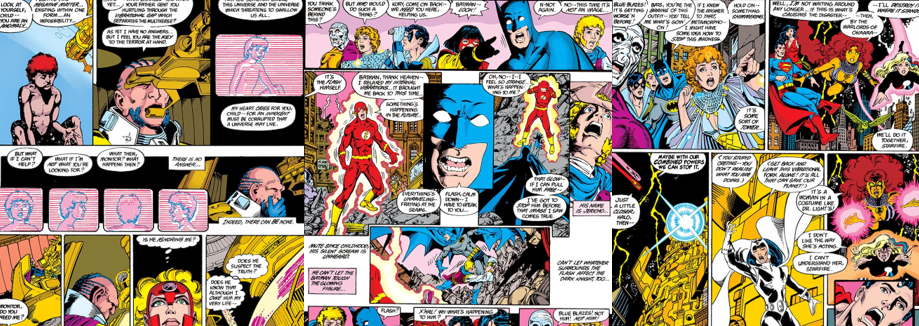
As the Crisis worsens, the Monitors prepares Alexander and a new Dr. Light to face the threat.

On the post-apocalyptic Earth-AD, Kal-L, King Solovar, and Dawnstar meet Kamandi, the last boy on Earth, and discover the Monitor’s device, a towering, golden Cosmic Tuning Fork that’s immediately (though only briefly) attacked by Shadow Demons. Arion, Obsidian and the Psycho-Pirate watch over another tower in Atlantis, only for the Psycho-Pirate to be transported to a dark realm and coerced into turning against the Monitor just as Harbinger secretly conspires with that same dark force. Oblivious, the Monitor experiments on the rapidly aging Alexander Luthor, Jr., an impossible merger of matter and anti-matter who potentially holds the key to defeating the anti-matter spread, whom Harbinger’s dark master wants destroyed before he can threaten his schemes. Meanwhile, in the far future of Earth-1, the Flash races to keep his world from being torn apart from natural disasters but is forced to vibrate at super-speed to escape death. This same anti-matter energy arrives on present-day Earth-1, much to the horror of the Teen Titans, who desperately try to both halt the destructive wave and save lives alongside Batman and Superman. As Linda Lee/Kara Zor-El/Supergirl does the same, Barbara Gordon/Batgirl gives in to self-doubt, and John Constantine arrogantly believes it’ll all work out, Vril Dox/Brainiac coldly observes the events concludes that, if he’s to survive, he must team up with Lex Luthor. While defending a Cosmic Tuning Fork from both Nazi forces and Shadow Demons in 1942 Markovia, the Blue Beetle discovers the mysterious Scarab fused to his suit is lethal to the shadowy entities but is wounded before he can put this to good use and returned to his world by the Monitor to spare him. Back on Earth-AD, the skies turn red and King Solovar succumbs to his wounds while Cyborg, Firebrand, John Stewart, and Psimon team up with some local heroes (including Jonah Hex) in 1879 to defend another tower, only to be as overwhelmed by anti-matter as the far-flung future of the Legion of Super-Heroes. Elsewhere, the terrified heroes of Earth-6 blame Pariah for the looming threat, to no avail (though Pariah does save Tashana/Lady Quark to ease his suffering). While the unseen villain forcibly recruits the Red Tornado, the Monitor activates an “ion-based energy ray” to empower Doctor Kimiyo Hoshi, transforming her into the new Doctor Light and sending her to defend his tower on Earth-1.
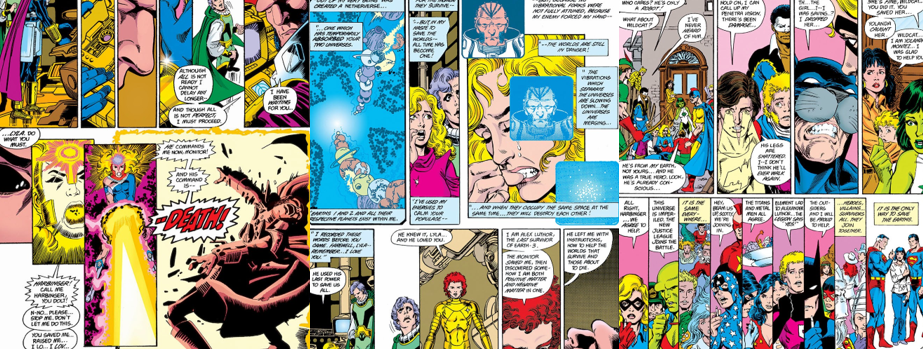
Following the Monitor’s death, his champions are convinced to unite and save the remaining Earths.

When the heroes attack her, believing she and the tower caused the entropy, Superman quells the fighting, though things take a turn when the Shadow Demons combine into one gigantic, terrifying entity in each era. Even Princess Diana Prince/Wonder Woman’s hopes of recruiting her Amazonian sisters fail. When Pariah berates the Monitor for not doing more to intervene, he reveals just how weak he’s become and then nobly faces his end at Harbinger’s hands. Distraught, Pariah weeps as Earth-1 and Earth-2 are finally consumed; confused to find his strength hasn’t increased as a result, the dark villain delights in having the Psycho-Pirate torture the Flash. Depowered, Lyla is distressed by her actions but a pre-recorded message from the Monitor reveals that his death allowed his essence to empower his Cosmic Tuning Forks and create a “netherverse”, a pocket dimension to keep Earth-1 and Earth-2 safe. After giving the Monitor an appropriate burial, Lyla, Pariah, and the now teenage Alexander Luthor, Jr. gather both world’s champions on the Monitor’s satellite to merge all existing realities into one lest all worlds and realities be lost. Since there are some doubters, Alexander has them witness the Red Tornado be forcibly transformed into a being of pure, primal force, one easily subdued by sorcerers like Kent Nelson/Doctor Fate and Zatanna Zatara (though Ted Grant/Wildcat’s legs are shattered during the fracas). Thus, even the most sceptical agree to defend their worlds, only for the satellite to disintegrate courtesy of the event’s big bad, the Anti-Monitor! Fleeing to the emptiness of limbo, Alexander moves to save Earth-4, -S, and -X, only for Harbinger to subdue him and take his place. While Yolanda Montez continues Wildcat’s legacy on Earth-2, the Freedom Fighters and the Monitor’s agents come to blows on Earth-X when the Psycho-Pirate, his powers augmented by the demonic Anti-Monitor, stirs fear and hatred amongst them. Similarly, on Earth-1, Billy Batson/Captain Marvel and his siblings mindlessly attack Supergirl and Wonder Woman, though the fighting ends when Harbinger forces Earth-4, -S, and -X into the netherverse alongside Earth-1 and Earth-2, exhausting her incredible powers but dooming them to be slowly merged together.
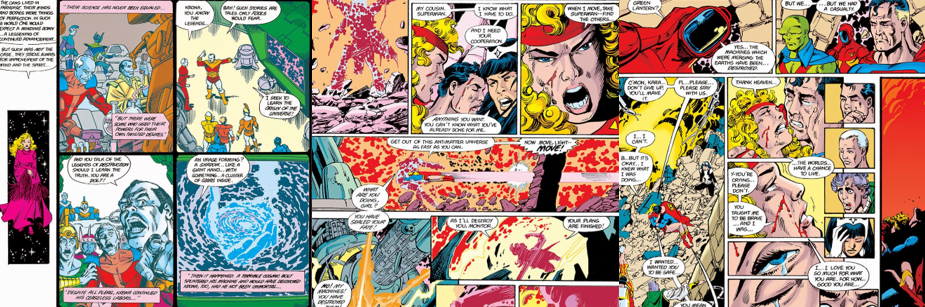
After Lyla relates the Anti-Monitor’s origin, Supergirl sacrifices herself to try and destroy him.

Thus, Lyla, Pariah, and Alexander assemble Earth-1’s Superman, Earth-2’s (Kal-L), Captain Marvel, the Blue Beetle, Lady Quark, and Uncle Sam and reveal that, ten billion years ago, the Oan scientist Krona dared to seek the beginning of the universe, witnessing a giant hand clutching a star cluster. This caused a cosmic fracture, creating not just the multiverse, but an anti-matter universe and a counterpart to Oa, Qward. After banishing Kronoa, the Oans created peacekeeping forces like the defective Manhunters and the Green Lantern Corps but were fractured by a civil war, birthing the Controllers. Amidst the fighting, the Monitor and his evil, anti-matter counterpart came into being. The Anti-Matter conquered Qward and created the Shadow Demons to spread his influence throughout the anti-matter universe before waging war against the Monitor upon sensing his presence. Evenly matched, they were rendered unconscious for nine billion years before being awoken by the misguided Pariah, once a celebrated healer and scientist who also investigated the origin of the universe. Pariah’s world paid the price, and he was damned to live forever and watch all worlds die, though the Monitor also saw him as instrumental in saving all reality. Alexander uses his unique matter/anti-matter powers to create a dimensional tear to the anti-matter universe, which Pariah leads the heroes to the Anti-Monitor’s vast stone fortress. Enraged that the Psycho-Pirate is too drained to corrupt them, the Anti-Monitor has his stronghold attack, injuring the usually invulnerable Kal-L. Dr. Light and Superman discover the Anti-Monitor’s solar collector but are attacked before they can destroy it and halt the merger of the Earths. Hearing her cousin’s agony, Supergirl flies to Superman’s aid, brutally beating the villain in a rage and chastising his disdain for life, tearing through his protective armour. Furious, the Anti-Monitor prepares to explode with all his energy and, in a last-ditch effort to destroy him, his machine, and save everyone, Supergirl tackles him, destroying his machine but being fatally blasted. As the Anti-Monitor’s deteriorating, incorporeal form slinks away, Superman mourns his cousin’s death and vows to kill the Anti-Monitor. Kal-L calms his counterpart and they escape, and a memorial service is held on Earth-2, where Superman pays homage to Supergirl, vowing to remember her and fight in her name. Despite the loss, the five worlds are saved; similarly, the Green Lantern Corps free their masters and almighty Darkseid wisely cloaks Apokalips from the Anti-Monitor’s gaze. However, the Anti-Monitor reconstitutes himself on his ship, where the Flash is imprisoned, and prepares a counterattack from Qward.
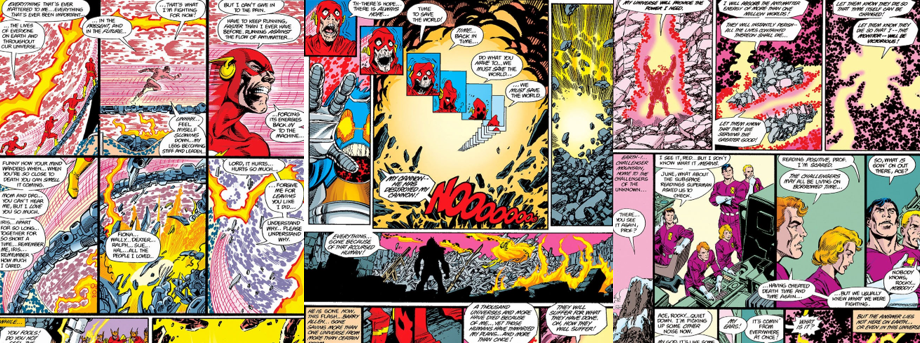
Despite the Flash’s noble sacrifice, the Anti-Monitor gains God-like power from his anti-matter universe.

Though saved, the five worlds are still overlapping, causing anomalies and damage to each while  the Anti-Monitor oversees the creation of the anti-matter cannon, which he plans to use to obliterate the worlds. Just as the Psycho-Pirate feels his powers return, the Flash escapes and angrily attacks the sadistic villain, forcing him to turn the Anti-Monitor’s slaves against their master as a distraction. Though stunned to find the anti-matter cannon is powered by concentrated anti-matter and realising that destroying it would kill him, the Flash bravely circles the weapon’s core to turn its destructive energy back on it. Staving off the agony with memories of his loved ones, the Flash runs fast enough to move back in time (explaining his earlier, sudden appearances). Though Barry successfully destroys the weapon, it costs him his life. Enraged, the Anti-Matter absorbs the anti-matter universe, literally sucking the life out of over a million worlds to feed his lust for power and vengeance, an act so awesome that it’s detected by both the Challengers of the Unknown and the embodiment of the Lord’s wrath, Jim Corrigan/The Spectre. In the face of multiversal destruction, the Guardians of the Universe offer Guy Gardner the chance to become a Green Lantern once again and, when all but one of them are all slaughtered by a sudden explosion, Guy vows to avenge them as their champion. The Brainiac/Luthor team then recruit dozens of villains to strike while the remaining Earths are weak and in disarray. As time runs amok on Earth-1 and Alexander, Lyla, and Pariah address the United Nations, the villains make their move, having conquered Earth-4, -S, and -X, encasing them within impenetrable barriers, and threatening to destroy the remaining worlds. Lyla and Jay recruit a reluctant Wally West/Kid Flash to breach the barrier with the cosmic treadmill, though neither Luthor or Brainiac care much about their losses since they still possess the power to destroy everything. However, the Spectre ends the hostilities by revealing that the Anti-Monitor still lives and plans to corrupt the flow of time and formation of life by travelling to the dawn of time.
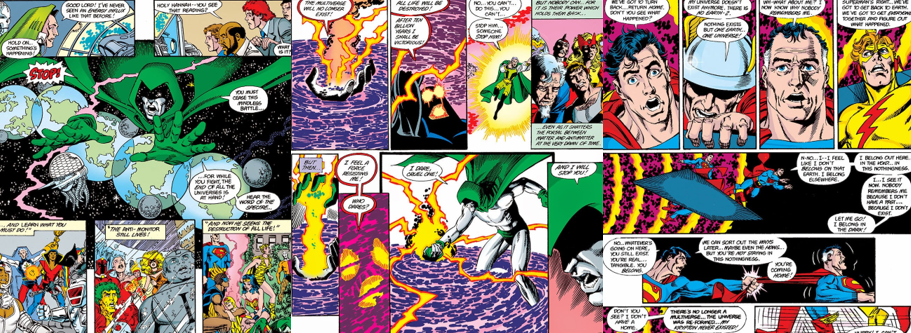
The Spectre demands co-operation, resulting in a singular world being created.

With the villains back on side, Kal-L bids an emotional farewell to his wife, Lois Lane, to join the counterattack, alongside a surprising newcomer: the Superboy from Earth-Prime (a fictional approximation of the real world where he’s the only superhero). After a rousing speech from Uncle Sam, heroes and villains alike pool their technology and powers to travel to the dawn of time and confront the anxious Anti-Monitor. The Anti-Monitor reveals that he, not Pariah, was responsible for the destruction of Pariah’s world after he took advantage of Pariah’s experiments to rebuild his power, absolving the tragic figure of his sins. Now grown to immense proportions, the Anti-Monitor withstands the assault of those assembled (with guys like Batman offering only support), absorbing their life energy to add to his power and allowing his hand to be the one that shapes all reality, as witnessed by Kronoa. His grasp is intercepted by the Spectre and the combined magic of the unified sorcerers, reducing the battle to a literal arm wrestle between the Anti-Monitor and the Spectre. Thanks to their bickering, Luthor’s underlings fail to kill Kronoa before he can cause the creation of the multiverse and the Anti-Monitor, and all seems lost. However, following a blinding light and the literal shattering of all time and space, Kal-L awakens on present-day Earth to find he’s on the same world as his Earth-1 counterpart. Sharing the same fragmented memories, Superman explains that time seems to be healing (albeit wonkily) and that elements of multiple Earths have been merged into one. For example, everyone knows Supergirl died but not how, the Flash is presumed vanished, and Earth-2’s Keystone City and Jay Garrick now live on this Earth. Jay, Wally, and the Supermen use the cosmic treadmill to discover Earth-2 is missing. Realising that the multiverse no longer exists, Superman has to force his older counterpart to return rather than throw himself into the endless void in despair. With the cosmic treadmill irreparably damaged, Wally assembles everyone at Titans Tower, discovering guys like Captain Marvel, Superbody-Prime, Uncle Sam, and the Earth-2 Dick Grayson/Robin also exist on this world, where they’re all shocked to see Harbinger alive and powered back up. The refugees are despondent and horrified to learn their worlds, pasts, and many loved ones are gone thanks to “cosmic irony” as Harbinger explains that there is now one Earth with one coherent timeline that folds their disparate lives into its flow, sending Kal-L into a crazed distress at having lost his wife and home.
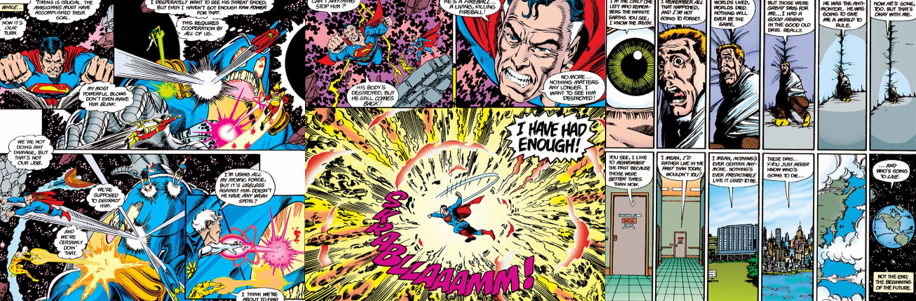
A final, all-out assault ends the Anti-Monitor and starts the universe anew, with some casualties.

After questioning the imprisoned Lex Luthor, Batman, Jason Todd/Robin, and Alexander confirm that, while some duplicates remain and some lives were restored, others weren’t and only those who present at the dawn of time remember the multiverse. Just as they’re processing this, the skies turn red and the world suddenly shifts to the anti-matter universe, where the titanic, disembodied Anti-Monitor still lives! Though incensed by their efforts, the Anti-Monitor congratulates them for handing him his first defeat in ten billion years and then decrees that they must all die. Wally’s shock at his mentor’s death is mirrored by the abject panic that sweeps the civilians following the Anti-Monitor’s threat, which doubles when the Shadow Demons kill Don Hall/Dove, Helena Wayne/Huntress, and Tula Marius/Aquagirl. While the sorcerers remove the Shadow Demons, Harbinger assembles one last effort to stop the Anti-Monitor on Qward. Though the Anti-Monitor is too large and powerful to be damaged, Harbinger has Dr. Light absorb the star feeding him power, weakening him enough for Alexander to breach the villain’s armour. With the threat seemingly ended by a combined energy blast, Alexander struggles to return Earth home and the Anti-Monitor absorbs his exiled Shadow Demons to rise again and vaporise Wonder Woman. Rather than see anyone else die, Kal-L tackles the Anti-Monitor, believing he’s got nothing to lose, and Alexander and Superboy-Prime are trapped with him. Though Darkseid, watching from Apokalips, strikes a fatal blow through Alexander’s eyes, the Anti-Monitor refuses to die, so Kal-L delivers a final strike that obliterates the tyrant. Faced with the pending destruction of the anti-matter universe, Kal-L and Superboy-Prime prepare to meet their end only for Alexander to teleport them, alongside Kal-L’s Lois, to a pocket dimension. In the aftermath, Wonder Woman returns to the clay that forms Themyscira, her Earth-2 counterpart is welcomed among the Gods, the dead heroes are memorialised, and Wally assumes the Flash mangle. Confined to Arkham Asylum, the Psycho-Pirate is dubbed a raving lunatic since he’s the only one who remembers the multiverse and the catastrophic events of the Crisis.

The Summary:
Whew, there’s a lot happening in Crisis on Infinite Earths. There’s a reason I’ve put off reviewing it for so long, and why I rarely revisit it. It’s a very dense and complex story, full of exposition and cameos and faces both obscure and iconic. As a celebration of DC’s rich history and characters, it’s hard to find much better than Crisis on Infinite Earths, which stuffs just about every costumed character, hero or villain, into its dense twelve issues! My hat’s off to George Pérez; it must’ve been painstaking to sketch all these group shots, action sequences, montages, and dramatic events. Equal praise to Marv Wolfman as I can’t imagine how difficult it was to make sense of all these different worlds and come up with a cohesive way to explain, link, and destroy them all. In the end, the solution was simple: pure, destructive, unstoppable entropy. It’s fitting that the anti-matter wave is depicted as a blinding white light that erases everything it touches, for it symbolically represents a blank page or an artist’s eraser, indicating that these colourful and convoluted worlds are being literally wiped clean for a new status quo. Our guide through most of this is Pariah, a tragic figure doomed to watch each world die as penance for kick-starting the events that follow. Immortal but seemingly powerless to intervene, all he can do is shout desperate warnings and is powerless to rescue anyone and constantly met with aggression, suspicion, and accusations. He’s merely a pawn in a much larger game, however, much like Harbinger, who acts as an all-powerful emissary of the Monitor and deliver exposition in his stead. A conflicted individual burdened with the knowledge that she will betray and murder the man to whom she owes her life, Harbinger, nevertheless works to uphold the Monitor’s legacy and bring together heroes and villains alike to stand against his dark counterpart.
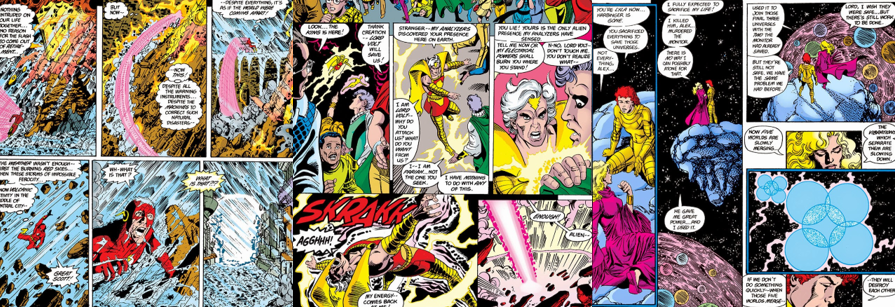
The Anti-Monitor’s power sends shockwaves through the multiverse and those who’ve witnessed it.

The dreaded inevitability of death is a focal point in Crisis on Infinite Earths. When the anti-matter wave hits, heroes and villains set aside their differences and use all their powers and resources to either stop it or save people from its destructive touch. Even the abhorrent Crime Syndicate find themselves fighting to save their world and Ultraman willingly enters the wave to die on his terms. Even before the wave arrives, the worlds are shaken to their core by natural disasters; volcanoes, tsunamis, and ominous, crackling red skies precipitate the disaster as much as Pariah. Perhaps no character is more synonymous with the coming destruction than the Flash; thanks to his super-speed, he ends up travelling through time, arriving before the likes of Batman and Wally as an omen of what’s to come and taking on an appearance that resembles Death itself. The Anti-Monitor echoes this in his design; though shrouded by his all-powerful armour, he sports a skull-like visage and dark, piercing eyes. Commanding demonic shadows, he’s very much the embodiment of Death and his lust for utter annihilation drives him to snuff out all life and light. Sadistic to the core, he employs the Psycho-Pirate to foster fear and hate, turning his would-be opponents against each other and causing countless more deaths. His ruthlessness seemingly knows no boundaries as he gleefully corrupts Harbinger, relishes the death of his counterpart, and nonchalantly obliterates his rebellious slaves without a second thought. His power and cruelty are so great that even the mighty Darkseid is driven to hide rather than confront him, striking when the villain is at his most vulnerable and largely avoiding the greater conflict. For all his God-like power, the Anti-Monitor still relies on technology; his merger and destruction of worlds can be halted or stopped by Cosmic Tuning Forks or destroying his solar collector. Indeed, it’s only after his massive, world-ending cannon is destroyed that the Anti-Monitor eschews all other methods and absorbs the entire lifeforce of the anti-matter universe into himself to literally take matters into his own hands.
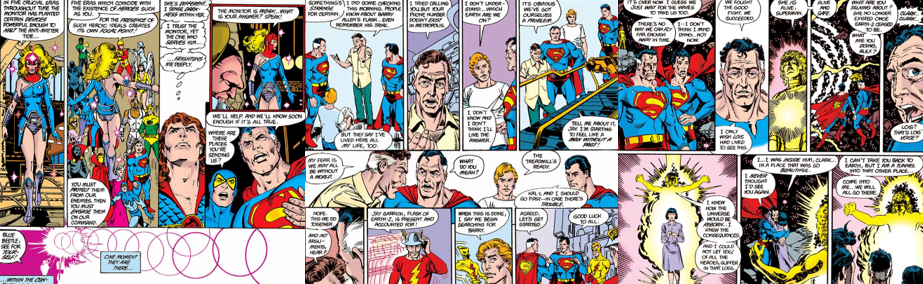
The Supermen anchor the story, leading the assembled champions in battle and saving all reality.

There is no one central character in Crisis on Infinite Earths. Instead, it’s a team-up story through and through, meaning some of your favourites may be sidelined. In some respects, I don’t mind this; Batman outright admits how useless he is against the Anti-Monitor and it’s clear only beings of incredible power can stand against him. Yet, the Blue Beetle is said to be pivotal in opposing the villain, the Red Tornado is briefly said to be incredibly important, and Lex Luthor comes close to co-ruling five entire worlds and even leads the charge to assassinate Kronoa. The Earth-2 Superman, Kal-L, is often at the heart of the conflict, leading the others and inspiring confidence, as is his Earth-1 counterpart. It’s therefore more tragic seeing Superman’s grief-stricken reaction to his cousin’s death; holding Supergirl in his arms, the Man of Steel briefly forgets his morals and vows to kill the Anti-Monitor as recompense. This is but one of the unforgettable deaths featured in Crisis on Infinite Earths as the Flash sacrifices himself to deal a critical blow to the Anti-Monitor, making a martyr of himself for decades before DC made the bone-headed decision to revive him. There’s an odd dichotomy in Crisis on Infinite Earths; these alternative worlds and characters co-exist and are even folded into one by the end. Rather than wiping everything away and starting afresh by the conclusion, the story clunkily has the survivors forget key events and weaves characters like Captain Marvel and the Justice Society into a unified timeline. This works for me as I prefer a coherent narrative, but it essentially means Crisis on Infinite Earth takes place mid-way through the early years of the post-Crisis reboot and reimaginings like John Byrne’s Superman stories happen before and during this event, rather than after it.
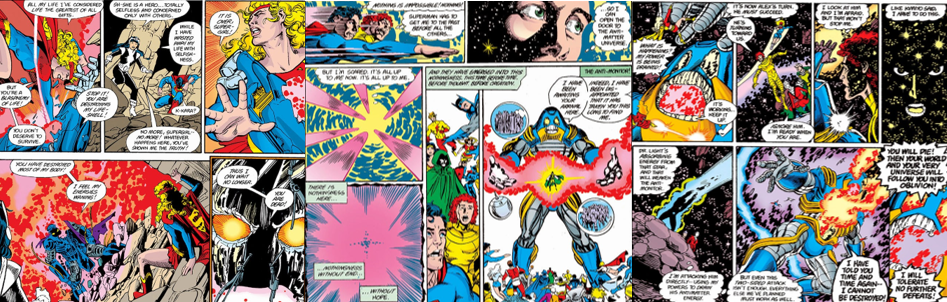
Worlds lived, worlds died, and the DC Universe was never the same…for about twenty years…

These days, Crisis on Infinite Earths may be a lot for modern readers to take in. Many of its characters and concepts are either forgotten, wildly different, or have been done to death thanks to the multiple reality-altering events that followed (many specifically to address loose ends from this story). At the time, though, I’d wager many long-term DC readers appreciated the cameos and call-backs weaved into the story. I’m glad DC devoted twelve issues to the story and didn’t rush it, but it does get repetitive and convoluted as it drags on. The secondary threat of Brainiac and Luthor directing a team of villains to conquer the five worlds, for example, could probably be skipped or relegated to a tie-in comic. Similarly, the defending of the Cosmic Tuning Forks isn’t very interesting and doesn’t really add to the story since we barely see any action around this, the Shadow Demons are too powerful to be interesting, and it’s all negated by the Monitor’s death. In this respect, I think the event could’ve been cut down to eight or ten issues and still been just as effective, especially as many Earths and characters feature as quick cameos to be obliterated. The remaining five Earths are said to be the most important, which is a little disrespectful to those that perished by the Anti-Monitor’s hand and a bit of an insult to any fans of those worlds. I liked seeing new heroes rise during the chaos, like a new Dr. Light (who was an aggressive bitch throughout), Wildcat, and Guy being Green Lantern again, though it falls a little flat when you know the canon is going to be altered after this to return the status quo. I liked the Anti-Monitor’s design and his characterisation as a reprehensible being who craved only power and destruction, but it was hard to get a sense of his power and limitations. One minute he’s weakened by giant towers, then his armour is containing his energy, and then he’s being powered by a black sun despite having absorbed the lifeforce of his anti-matter universe. Still, the unification of heroes and villains to oppose him was fun to see, the sacrifices and determination were poignant, and the weaving together of a singular continuity, while flawed, was ambitious and visually engaging to behold.

My Rating:

Rating: 4 out of 5.

Great Stuff

Have you ever read Crisis on Infinite Earths? What did you think of this unprecedented mash-up of DC’s various worlds and characters? Which parallel world was your favourite and were you upset to see destroyed? What did you think to the Anti-Monitor, his vast power and his stubborn refusal to die? Were you shocked to see Supergirl and the Flash die so dramatically? Do you agree that the story dragged on a bit by the end? Which of the subsequent Crisis events was your favourite and what are some of your favourite cosmic events? Drop a comment below to share your thoughts about Crisis on Infinite Earths and feel free to check out my reviews of other notable crossovers.

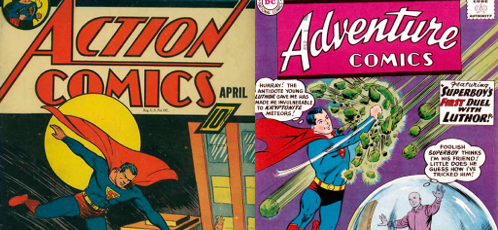
Back Issues [Superman Day]: Action Comics #23 / Adventure Comics #271


In 2013, DC Comics declared the 12th of June as “Superman Day”, a day for fans of the Man of Steel the world over to celebrate Clark Kent/Kal-El/Superman, the superpowered virtue of “Truth, Justice, and the American Way” who is widely regarded as the first ever costumed superhero.


Story Title: “Europe at War (Part II)””
Published: April 1940
Writer: Jerry Siegel (credited as “Jerome Siegel”)
Artist: Joe Shuster

Story Title: “How Luthor Met Superboy!”
Published: April 1960
Writer: Jerry Siegel (credited as “Jerome Siegel”)
Artist: Al Plastino

The Background:
Jerry Siegel and Joe Shuster, sons of Jewish immigrants, first met in 1932 at Glenville High School. By the time they were sixteen, they were already accomplished comics creators and, in 1933, they thought up their first concept for a superman with “The Reign of the Super-Man”. This story depicted a bald mad scientist who attempted to dominate others with his telepathic powers. Though a far cry from the most influential fictional character in American history, the duo would revisit the concept of a bald mad scientist in 1940. Originally known only as “Luthor”, Alexander “Lex” Luthor would evolve beyond his relatively childish reasons for hating the Man of Steel and become Superman’s arch-nemesis. While Kryptonite might weaken or kill Superman, Doomsday and Darkseid might pummel him, and Vril Dox/Brainiac might threaten his adopted world, Lex Luthor has become infamous for pitting his mind against the Man of Steel. Whether a scheming industrialist with seemingly unlimited resources, an egomaniacal megalomaniac, or enjoying the power of the United States Presidency, Luthor has created robots, patsies, mech suits, and even cheated death itself and had a brief stint as a superhero, all with the aim of acquiring the power to either humble, humiliate, or destroy his alien foe. As Superman’s most complex and enduring villain, Lex Luthor is a staple of any Superman adaptation. Clancy Brown and Michael Rosenbaum are considered two of the finest to portray the character, though it was Gene Hackman who set a high standard for all future portrayals of DC Comics’ most conniving criminal mastermind.

The Review:
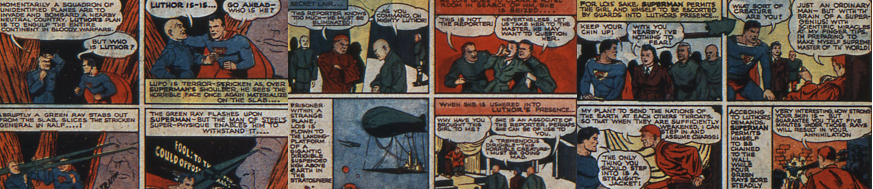
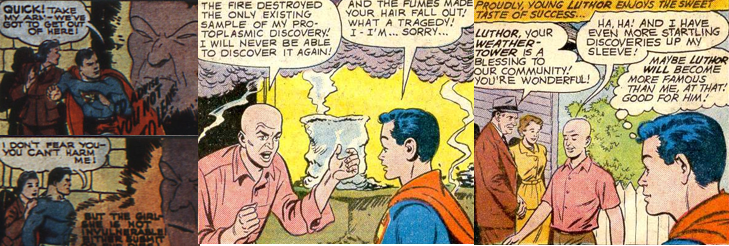
The first appearance of a dangerous maniac named Luthor occurred in the second part of the “Europe at War” storyline. As established in the previous issue, the “lesser nation” of Galonia was suddenly attacked by Toran and reporters Clark Kent and Lois Lane were sent to cover the conflict as war correspondents. While sailing to Luxor, Clark was stunned to find beautiful actress Lita Laverne was a spy working alongside the Toranian Council of War to target the neutral vessel. Action Comics #23 picks up with the Man of Steel defending Belgaria from incoming shells before he (as Clark) and Lois meet with bald General Lupo, who’s confident that the war will end soon as a contingent of Toran officials are on their way to peacefully negotiate. Clark switches to Superman and flies ahead to take some photos of their arrival, only to witness the convoy be destroyed, which causes hostilities to renew. After sending an update to the Daily Star, Clark questions General Lupo, who insists that the Galonians would never be so deceitful, only to then make a suspicious phone call, completely unaware of Clark’s super-hearing. Suspicious, Superman trails General Lupo to a mountain range, where he disappears into thin air! Using his incredible strength, Superman rips open the mountainside and discovers a hidden passageway, where General Lupo is transfixed by a huge slab of rock, which bursts into hypnotic lights and a commanding face. General Lupo is astonished when Superman confronts him and, though he fears his disembodied master, desperately begs off being smushed against a wall and reveals that the mysterious “Luthor” is orchestrating events to engulf both nations in bloody warfare. 

Superman is perplexed by the mysterious Luthor, who plots to take over the word through chaos.

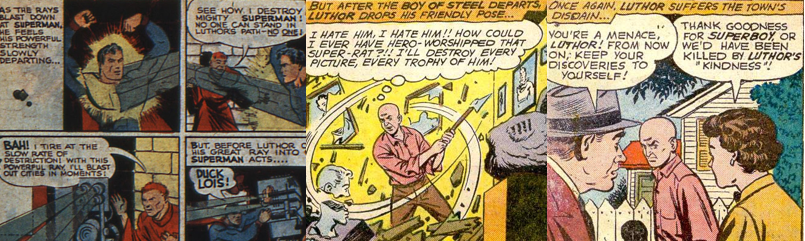
However, when Superman demands to know who “Luthor” is, green lasers suddenly burst from the wall-face and “[slice] the General in half”! Naturally, Superman is immune to the attack; he destroys the cave and escapes just in time to spy Luthor’s bombers flying overhead. He then destroys them all using his super strength and a mounted gun before warning both sides (as Clark) about Luthor’s machination. Although they don’t believe him since he has no proof, this brings him to Luthor’s attention, who orders Clark eliminated to keep him from talking. Conveniently, Lois happens to be looking for Clark in his hotel room, so Luthor’s minions grab her instead, transporting her to Luthor’s secret base, which is suspended from a gigantic dirigible “high above” Earth’s atmosphere! Although unimpressed that his goons failed him so badly, Luthor – a red-haired despot in a matching robe – nevertheless interrogates Lois, only to be met with confusion and sarcasm. While in her cell, Lois notices that her guard, a surly bald man, isn’t under Luthor’s hypnotic influence. She then threatens to expose him to Luthor unless he informs Clark about her capture and the guard is so terrified of his leader’s reprisals that he readily agrees. After reading the note, Clark flies into action as Superman, takes out a couple of guards, and bursts through a brick wall to rescue Lois. However, when Luthor threatens to harm Lois, Superman readily submits to parlay with the maniac, who describes himself as having the “brain of a super-genius” and plans to use his “scientific miracles” to plunge the world’s nations into conflict, weakening them so that he can assume control.

Superman is revealed to have known Luthor as a youth when he adventured as Superboy.

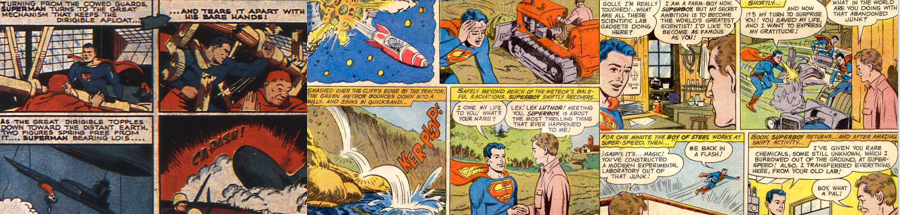
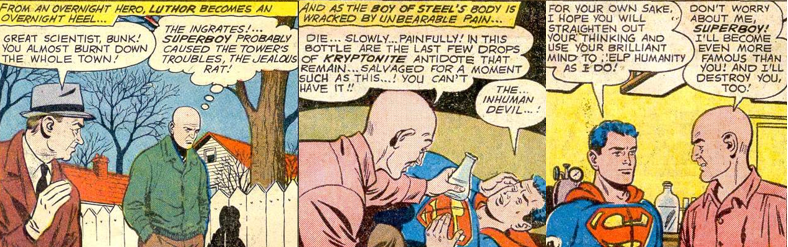
Luthor demonstrates his ability by strapping Superman up and bombarding him with an intense concentration of rays. However, Luthor grows tired of this and prepares to finish Superman off with a burst of deadly exposure, only for Superman to suddenly break free, turn the machine against Luthor’s underlings, shrug off its effects, and destroy the machine. After unsuccessfully trying to barter for his life, Luthor is equally unable to keep Superman from trashing the dirigible’s controls, sending it (and, presumably, all its inhabitants) crashing to the ground in a fiery blaze. The sight of the dirigible’s destruction is enough proof for the nation’s representatives to believe Clark’s story and the conflict comes to a peaceful resolution, with Clark praised for breaking the scoop and Lois eagerly awaiting her next encounter with the dashing Superman. Although Superman clashed with Luthor many times after this, it would take nearly twenty years to delve into Luthor’s origins, a story that took place during Superman’s youth in Smallville, Kansas, as Superboy. In this story, the young Lex Luthor has just moved to Smallville and, being the friendly youth that he is, Superboy flies in to say hello. Conveniently, a Kryptonite meteor lands right next to the Boy of Steel and immediately begins weakening him. Luckily, Luthor and his trusty tractor are on hand to save Superboy and the two quickly become friends. Luthor is a Superboy fanboy, as evidenced by his shrine to the young superhero, and a budding scientist, with ambitions to become a world-famous scientist. In gratitude for his help, Superboy builds a modern laboratory for his new friend using nothing by junk metal and his super speed and strength, which he fills with rare Earth materials for Luthor to experiment with. Although Superboy expresses caution since the chemicals are unknown and Luthor’s young and inexperienced, Luthor promises to be careful and the two part as friends, with Superboy owing his life to Lex and Luthor astounded to have befriended the Boy of Steel. Luthor wastes no time in getting to work, feverishly working with the chemicals over a period of weeks and producing a crude protoplasmic lifeform that he’s so excited by that he immediately sets to work coming up with a Kryptonite antidote so his new buddy won’t ever have to worry about that pesky substance threatening his health. 

Embittered after a lab accident, the once-kindly Luthor turns against his former friend.

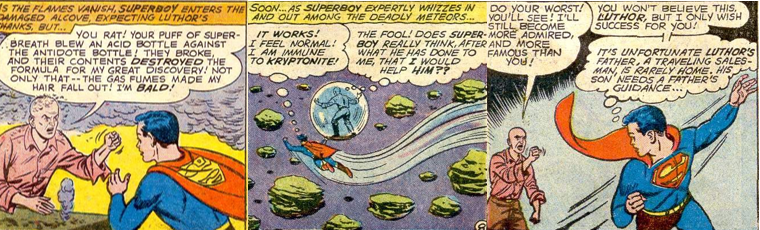
Luthor retrieves the meteor from the lake, takes a few samples, and creates the antidote in no time at all. However, in his excitement, he accidentally knocks over a chemical flask that starts a toxic fire in his lab. Luckily, Superboy happens to be passing by and hears Luthor’s screams for help; he uses his super breath to put out the flames, accidentally blowing a jar of acid against the antidote and destroying it. To make matters worse, the gas fumes caused Luthor to go bald and destroy his weird protoplasmic creature, destroying all his hard work. And, while Superboy is apologetic and insists it was an accident, Luthor accuses him of being jealous of his genius and purposely sabotaging him, instantly flipping from a kindly boy to an embittered youth in the blink of an eye. Superboy offers to help him rediscover his experiments, and insists he’d never harm the boy who saved his life, but Luthor’s having none of it. He feigns sorrow to get rid of Superboy and then flies into a rage, destroying his Superboy memorabilia and plotting to avenge himself on the Boy of Steel with the last sliver of protoplasm. The next morning, Luthor has Superboy drink the “antidote” and then accompany him into space, protected by a space-globe Superboy brought along, to observe its effects. At first, Superboy is delighted to find he’s no longer vulnerable to the Kryptonite meteors floating around in space, completely unaware that they’re actually “Fool’s Kryptonite”, a ruse even Krypto the Superdog can see from a mile away. As soon as they return to Earth, Luthor spitefully reveals it was all a ruse and that the antidote is only temporary and vows to be more admired, and more famous, than Superboy, who flies away despondent and commenting that Luthor needs “a father’s guidance”.

When his attempts to outshine Superboy fail, Luthor resorts to attempted murder.

Some weeks later, Luthor approaches Smallville’s mayor with a fantastic invention, a weather-tower to keep the town perpetually warm by reflecting the sun’s rays, and the mayor is so impressed by his pitch that he approves it immediately. Both Superboy and the townsfolk are in awe and admiration of Luthor’s ingenious invention, which spares them the bitter chill of winter, and Superboy quietly wishes his former friend all the success in the world, harbouring no ill-will towards him. However, young Clark is alarmed when he notices that his adopted parents – Jonathan and Martha Kent – suffer from the intense heat. He’s even more startled when he sees the weather-tower is causing fires to break out all over the town, endangering its people, so he uses his freeze breath to cool the construction down, which effectively destroys it. Smallville’s populace are less than thrilled and openly mock Luthor in the street for putting their lives at risk with his crazy inventions, which he bitterly blames on Superboy. To atone, Luthor toils away for many months and produces seeds that promise to near-instantly produce fruit trees for the local farmers; although people are sceptical, they’re astounded when Luthor’s claims come true, but their elation soon turns to horror when simple rain turns the trees into marauding giants! Superboy deals with the issue, chalking it up to carelessness on Luthor’s part rather than maliciousness, but Luthor’s reputation is further tarnished and his hatred for Superboy only grows. This sees him unearth the Kryptonite meteor and lure the Boy of Steel into a trap and taunt the dying Superboy with the only antidote to his slow, painful death. In his arrogance, Luthor fails to remember Superboy’s super-breath, which allows him to suck up the antidote vial and save his own life, but Superboy chooses to consider them even rather than acquiesce to Luthor’s demands to be arrested. Out of respect for the friendship they once had and believing that Luthor could be a force for good, Superboy lets Luthor go, with the obsessed youth swearing to not only surpass the Boy of Steel’s popularity but destroy him in the process! 

The Summary:
Let’s tackle each story in turn here, shall we? “Europe at War (Part II)” is a typically Golden Age Superman story, featuring simplistic dialogue, illustrations, and concepts. Part of me enjoys this simpler time, when fantastical things were just taken as the norm and superhero plots were both grounded and almost comical in their content, such as Superman threatening to bash General Lupo against a rock wall and presumably casually murdering countless of Luthor’s minions. It’s amusing to read as I find myself questioning why Clark warned of Luthor’s threat in his civilian guise, rather than as Superman, and seeing him use a machine gun rather than his heat vision since he didn’t have his full gamut of powers at that point. The core concept of “Europe at War (Part II)” actually has some legs to it: two nations being manipulated into all-out war with spies, heroes, and villains on both sides, and the mysterious Luthor pulling the strings behind the scenes and offering a challenge Superman can’t settle with his fists since he needs to get to the root of the problem. Unfortunately, a lot of its concepts are left ambiguous or flat-out forgotten; apparently, Luthor can hypnotise people into following his every command, yet he only demonstrates this power once and doesn’t think to use it on Lois or Superman (or the nation’s leaders). Not to mention that Luthor’s secret base is an elaborate castle suspended from a dirigible, but no one noticed it, and why was that one bald guard immune to Luthor’s control? It’s not explained, but the number of prominent bald henchmen at Luthor’s command makes me wonder if that particular guard was actually the real Luthor and the red-haired leader was merely a patsy. 

Neither story provides a particularly engrossing or accurate portrayal of Luthor.

And then we have “How Luthor Met Superboy”, a story that’s more influential than you think since it’s basically the inspiration for the entire series of Smallville (2001 to 2011). This is such a weird story that it almost reads like an elaborate dream sequence or fantasy story that recasts Superboy and Luthor as the best of friends thanks to a ridiculously convenient Kryptonite meteor (and don’t even get me started on the influx of similar meteors in near-Earth space!) People often criticise Superman for being infallible and unrelatable, but Superboy is the kindest, most trusting, and most understanding youth you’ll ever meet! He sees the best in Luthor all throughout the story, never once saying or thinking a bad word against him until he (as in Superboy) is dying at the young scientist’s feet and even then Superboy’s first act after saving himself is to forgive his former friend and hope that he turns his obsession to good deeds. It almost descends into parody as the story progresses, with Superboy genuinely believing that Luthor is trying to do good and has met with misfortune, and Luthor equally refusing to even think that he could be to blame for anything since he’s so embittered towards Superboy. It’s so strange seeing Luthor flip from a kindly boy to a venge-seeking maniac after the fire. Like, I get being mad at losing all your work and your hair but it’s a bit of a leap to blame Superboy. I think the implication is that the strange chemicals and toxic fumes altered Luthor’s mind in some way, though that’s not really explicitly stated (or even implied in the story text), but I think Luthor’s elaborate plot to cruelly taunt Superboy with the promise of a Kryptonite cure and to oust his popularity, to say nothing of his quick temper following the accident, go a long way towards suggesting that. 

Though amusing footnotes, both stories are fantastical nonsense unbecoming of Luthor.

Truthfully, neither story really gives the best impression of Luthor. It can be argued that the “Luthor” present in “Europe at War (Part II)” isn’t even Lex Luthor since he has hair, for one thing, and possesses hypnotic abilities. Sure, it could be a wig and his scientific acumen could account for the hypnosis and other inconsistencies, but he doesn’t really exude “Lex Luthor” energy and seems to simply be a maniacal, supervillain-esque third party for Superman to flex his muscles against once he stops his elaborate plot. “How Luthor Met Superboy” tries to flesh out Luthor’s character by providing him with a semi-sympathetic backstory and emotional connection to his hated nemesis, but ultimately reads like a non-canon adventure as I’m pretty sure no stories prior to his every hinted at the two knowing each other as youths. It is interesting seeing Luthor as an arrogant young scientist who idolises Superboy and is inspired to be a great scientist because of the Boy of Steel, it’s just a shame that the execution falters. Ultimately, Luthor’s hatred comes from losing his hair, rather than genuinely building towards a resentment towards Superboy or Luthor’s ego getting the better of him. Like, what was up with that protoplasmic creature? That could’ve factored into things, showing that Luthor is messing with things he doesn’t understand and his inability to recognise his limits and failings. Like, I would’ve maybe had Luthor build his weather-tower and plant those seeds before he loses his hair, so that when they go bad and Superboy has to intervene it adds to his growing bitterness towards Superboy for “stealing his thunder”. In the end, both stories can be largely ignored in the grand scheme of things and you wouldn’t be missing anything. They’re historical footnotes and amusing curios in Lex Luthor’s history, but you can simply skip to stories like “The Man of Steel” (Byrne, et al, 1986), “Birthright” (Waid, et al, 2003 to 2004), “Lex Luthor: Man of Steel” (Azzarello, et al, 2005), or “Secret Origin” (Johns, et al, 2009 to 2010) for better, more concise, and more in-depth explorations of Luthor and his complex relationship with Superman. 

Action Comics #23 Rating:

Adventure Comics #271 Rating:

Rating: 1 out of 5.

Rating: 2 out of 5.

Terrible

Could Be Better

Have you ever read these Luthor-centric stories? Do you like the idea of the two having been childhood friends? What are some of your favourite Luthor moments and stories? How are you celebrating Superman Day today? Whatever you think, feel free to share your opinion and thoughts on Superman in the comments below.

Game Corner [Robin Month]: Young Justice: Legacy (Xbox 360)


In April of 1940, about a year after the debut of arguably their most popular character, Bruce Wayne/Batman, DC Comics debuted “the sensational find of [that year]”, Dick Grayson/Robin. Since then, Batman’s pixie-boots-wearing partner has changed outfits and a number of different characters have assumed the mantle as the Dynamic Duo of Batman and Robin have become an iconic staple of DC Comics. Considering my fondness for the character and those who assumed the mantle over the years, what better way to celebrate this dynamic debut than to dedicate every Monday of April to celebrating the character?


Released: 19 November 2013
Developer: Freedom Factory Studios
Also Available For: Nintendo 3DS, PC, and PlayStation 3

The Background:
After debuting in the pages of The Brave and the Bold #54 in 1964, the Teen Titans had a relatively consistent presence throughout the 1960s and 1970s and acted as a way for DC Comics to appeal to younger audiences. The team arguably achieved their greatest mainstream success when writer Marv Wolfman and George Pérez breathed new life into the concept by introducing many characters who are now synonymous with the team but I actually became a fan of the group after reading the adventures of their later contemporaries, Young Justice. Although functionally similar to the Teen Titans, Young Justice brought together the then-modern incarnations of their predecessors, who had long since grown up and assumed other identities. Created by Todd Dezago, Todd Nauck, and Lary Stucker the team operated between 1998 and 2003 before disbanding (most likely so that DC Comics could captalise on the success of the Teen Titans cartoon (2003 to 2006)) before reuniting in 2019. Some four years after Teen Titans ended, the Young Justice concept was evoked for a new DC animated series that ran from 2010 to 2013 before finally receiving a long-awaited revival in 2020. Young Justice’s critical acclaim and popularity also led to the development of this videogame adaptation; unfortunately, the game suffered delays, ports to other consoles were cancelled, and it released to mainly negative reviews.

The Plot:
Taking place in the five-year gap between season one and season two of the cartoon, Young Justice sees the titular team joining forces against the combined might of “The Light”, a cabal of supervillains with intentions to take over (or destroy) the world.

Gameplay:
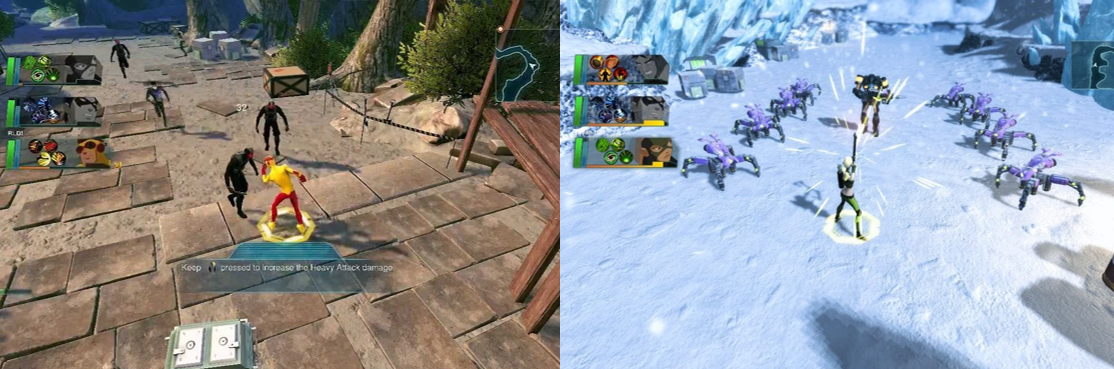
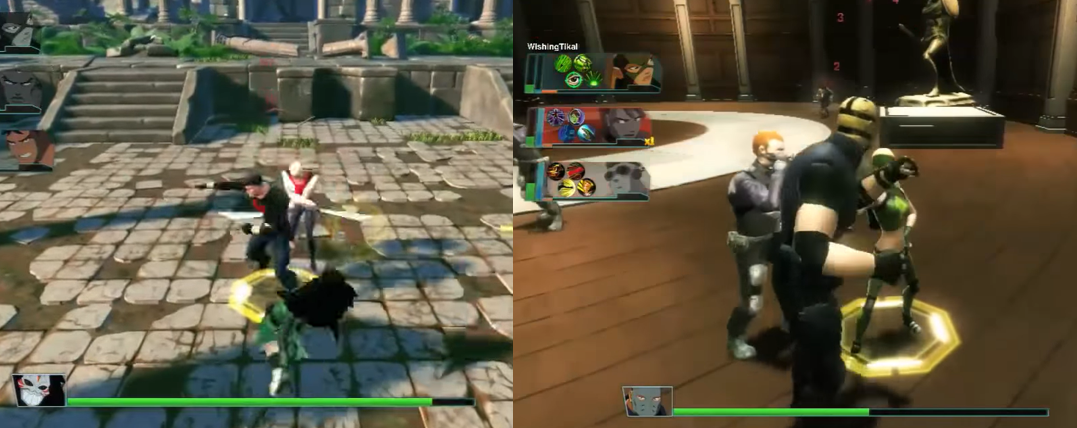
Young Justice: Legacy is a team-based beat-‘em-up with very light puzzle elements that sees players form a team of three (why it isn’t four is beyond me…) characters from a roster of twelve and fight their way through fifteen missions. If you don’t have one or two friends to play alongside, you can switch between the three characters with a press of left or right on the directional pad and, when you’re not playing as them, the computer will take over and batter any nearby enemies with a reasonable amount of competence. When selecting a team for the game’s main campaign, you’re unable to alter the story-based team leader, which can mean that you’re stuck with a character you don’t really like and limits the customisation options available to you, but that doesn’t really matter as, essentially, every single character plays the same way. Tapping X performs a light attack while pressing Y performs a heavy attack (you can also hold Y to charge this up) and you can mix up these button presses to perform a few clunky combos (although it has to be said that you can easily just run past the vast majority of the game’s enemies and not get bogged down in the monotonous combat). You can jump with A and certain characters can fly (more of a hover) with a subsequent press of A, perform an awkward dash with B that can help you move a little faster or dodge incoming attacks, hold the Left Trigger to block, and pick up and throw objects with B and X, respectively.

Combat is laborious and characters don’t really feel that different from each other.

Each character has four superpowers available to use; these are performed by holding the Right Trigger and pressing either X, Y, A , or B and can be performed as long as the blue bar on the heads-up display is full. This bar fills up over time and you’re able to pull off such ranged attacks as tossing Batarangs, shooting arrows, throwing fireballs, and blasting enemies with water, area blast attacks that may stun or knock back enemies, cast a healing spell or boost your attack, defence, and energy consumption, or freeze enemies, compel them to attack their allies, or turn your character briefly invisible. As you defeat enemies, you’ll build up your character’s “Hero Boost” meter; once it’s full, you can pull off a Hero Boost than defeats or heavily damages all onscreen enemies by holding RT and pressing the Right Bumper or build up all three characters’ bars and unleash a massive “Squad Boost” attack by holding RT and pressing the Left Bumper. Sadly, every character has the same Hero Boost attack and animation, which really limits the distinctiveness of each character beyond their individual superpowers. Combat in Young Justice: Legacy is mind-numbingly simple; as you run through painfully linear environments, you’ll be set upon by a near-endless supply of goons, all of whom might look a bit different area to area but basically attack in the same ways and can be put down with a bit of mindless button-mashing (or, as I said, avoided completely in some instances).

Combat is broken up by simple puzzles and a few tedious tasks.

Opportunities for exploration are limited; sometimes you can (and have to) smash through rock walls to access secret areas that lead to some collectibles or control panels and such but you won’t really find multiple paths through stages or areas that can only be accessed by certain characters and/or team combinations. The game also tries to mix things up with some extremely simple puzzles; these generally involve smashing something, usually a generator, activating a console to open a door, or pushing something big to activate bridges, open doors, or reach new areas. Stages are super linear but there’s a helpful mini map on screen at all times to point you in the right direction and you can look up your current objectives with a press of the ‘Back’ button but, while missions are split into three sub-missions at a time, the game’s monotony is made all the more frustrating by a serious lack of checkpoints. While you can’t pick anything up to refill your health, it will automatically refill once all onscreen enemies have been defeated and, if an ally is knocked out, you can revive them by pressing B. You can select from two difficulty settings (Normal and Hard) which, obviously make the game’s enemies a bit tougher and what-not but it can be extremely aggravating to get knee-deep into a mission only to have your health drained to nothing by instant-kill laser traps. Some stages are full of environmental hazards like this, such as flames and spikes from the floor and large statues that come to life as you progress through rooms. Other missions also prove unnecessarily frustrating, such as forcing you to clear out all onscreen enemies in a time limit (bizarrely without an onscreen timer to gauge your progress), rescue hostages, defend John Stewart/Green Lantern while health-sapping debris and waves of enemies attack you, avoid enemy-spawning search lights, smash engines or generators while avoiding missile-shooting turrets, or push forklift trucks to avoid being taken out by snipers.

Graphics and Sound:
I should stress here that I haven’t ever seen the cartoon that Young Justice: Legacy is based on but the game opts to use a variation of cel-shaded graphics to recreate the look of its source material and, for the most part, this works…unless you’re watching the game’s cutscenes. When playing the game, thanks to the skewed, top-down perspective, the lack of detail and rigidity of the character models isn’t as noticeable since you’re so focused on combat and the perspective is quite zoomed out but, when the game tells its story, characters are all very flat and kind of resemble lifeless puppets more often than not. While the main characters look fine for what they need to be, the enemies aren’t so great; you’ll fight the same goons and robots over and over, which all gets very monotonous very quickly.

Character models are okay but environments and cutscenes are a bit bland and stilted.

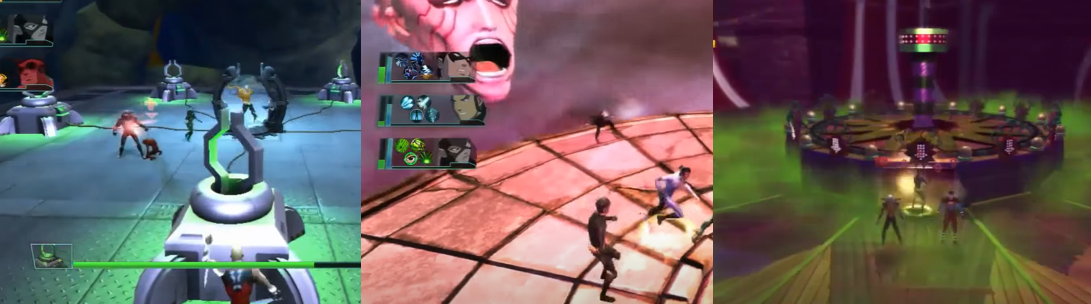
Environments are surprisingly big considering how linear and empty they are; there’s usually a lot of open room to manoeuvre and you’re rarely forced to fight down boring, narrow grey corridors. You’ll visit places like Siberia, Santa Prisca, Gotham City, and battle on LexCorp hovercrafts, all of which provide a decent amount of visual variety to the game. It’s just a shame, then, that there’s very little opportunity to explore; you can go off the beaten path but will often find only a dead end or useless boxes to smash, and there’s no opportunities to platform or utilise specific character powers outside of combat. At one point, Edward Nygma/The Riddler challenges you to solve a light-based puzzle in a neon-drenched sewer system-made-funhouse, which is quite a unique area, but there’s really not that much on display here to keep you that engaged, which only adds to the game’s repetitiveness. The music and sound effects are equally bland but, while the game appears to utilise the same voice cast from the cartoon, this is actually to its detriment; characters will spout the same quips and lines over and over again and I was about ready to snap the disc in half after hearing Dick Grayson/Nightwing moan about being “whelmed” all the damn time!

Enemies and Bosses:
A slew of generic goons will dog your progress in every mission. After playing through the first stage, you’ll basically have encountered every enemy the game has to offer as they simply get swapped out with different character models in each mission. You’ll battle teleporting, sword-wielding members of the League of Shadows, a variety of robots (Spider Bots and larger, more humanoid robots being the most common), Bane and David Hyde/Black Manta’s mercenaries, and the Riddler’s baton and shotgun-wielding goons throughout the game’s story. Things get interesting in the game’s final missions, where you’ll battle a larger mech, fight against mummies, and come up against gigantic statues that deal massive damage and get jumped by an assortment of enemies in enclosed areas.

Cheshire and Sportsmaster require a hit-and-run strategy to whittle down.

Each mission culminates in a boss fight against at least one member of the supervillain cabal known as The Light; the first mission ends with you battling Jade Nguyen/Cheshire, who teleports around the arena in a puff of smoke and throws projectiles your way but, while she’s the toughest enemy you’ll have faced at that point, she leaves herself wide open for an attack when she pauses to setup an explosive device and isn’t too difficult to whittle down as long as you keep moving, attacking, and reviving as necessary. This strategy basically applies to every boss but will become abundantly clear when you battle the second boss, Lawrence “Crusher” Crock/Sportsmaster. Sportsmaster is accompanied by a seemingly endless supply of goons, all of whom cause a massive headache when you’re trying to dodge Sprotsmaster’s health-sapping spinning and charge attacks. Thankfully, though, these enemies are finite and, if you quickly take them all out, you can focus on battling Sportsmaster using hit-and-run and ranged attacks.

Many of the bosses cannot be attacked directly and must be stunned first.

In Siberia, you’ll fight Crystal Frost/Killer Frost as Spider Bots attack you; Frost can’t be attacked head-on as she hides atop an ice column and blasts ice attacks at you, so you need to destroy her platform to knock her down and then beat on her before she can build a new one. Cameron Mahkent/Icicle Jr. takes over the ice-based duties for the next boss battle, where he teams up with Sportsmaster. You can utilise the same tactics to take out Sportsmaster and it’s best to focus on one enemy at a time; Icicle Jr. is different from Killer Frost in that he can freeze you and encases himself in an ice sphere that refills his health. After defeating them, you’re faced with a harrowing mission where you must battle through rooms of annoying enemies with no checkpoints and no refillable health as Clark Kent/Superman holds back an incoming avalanche, which was one of the most aggravating parts of the game on my first playthrough. Afterwards, in Santa Prisca, you’ll battle against Bane who, again, requires a little more strategy; when pumped full of Venom, Bane is invincible and you need to lure him into charging the nearby columns to stun him. He also busts out a big ground pound attack and can bash your brains in if you get too close for too long, so again it’s best to hit and run and use ranged attacks to whittle him down.

While you can bypass Black Manta, Psimon and Riddler require a more hands-on approach.

Next up, you’ll have a tough battle where you must disable Black Manta’s submarine; the game doesn’t make it massively clear how you do this but basically you have to fight off Black Manta’s goons and push these red bars near the large generators to overload his sub, all while avoiding his instant-kill lasers by taking advantage of the big metal shields that rotate around the arena. After that, you’ll fight Black Manta himself; make sure you avoid his massive eye beams but don’t worry about fighting him or his goons as you can simply attack and destroy the shield generators to end the fight that way. While at Haly’s Circus, you’ll have to fight through waves of enemies in a mini gauntlet before battling with Doctor Simon Jones/Psimon, who spawns in mirror versions of your team (who seem to randomly stun and defeat you without really landing any attacks) and then rains massive red energy lasers into the arena but if you simply mash the attack button, he’ll go down pretty easily. Finally, you’ll have to do battle with the Riddler, who randomly spawns bombs, poison gas, goons, and other hazards into the arena. To defeat the Riddler, simply ignore everything and attack and destroy the panels on his big circus-wheel-thing in perhaps the game’s easiest (if tedious) boss battle.

The final boss battle just goes on and on and even contains a game-breaking glitch!

The game ends with a gruelling and aggravating multi-stage fight against Klarion Bleak/Klarion the Witch Boy, Mark Desmond/Blockbuster, and the eldritch beast known as Tiamat. While Klarion and Blockbuster aren’t too difficult to best (simply lure Blockbuster into Klarion’s meteor attack to stun him and then beat on him until he goes down), the fight against Tiamat feels like it’s never-ending! In the first phase, he blasts the arena with water attacks that will basically kill you in one or two hits and he can only be damaged when he dips down into the water. In the second phase, he shoots a massive mouth laser at you and tries to swipe and squash you with his claws and fists; after avoiding his attacks, pummel the limb with everything you have until his health is drained. In Tiamat’s final phase, he flies about above you and comes crashing to the ground, unleashing a devastating series of attacks that will leave you “whelmed” in seconds. The only way to damage him is to attack the minions that spawn into the arena; after defeating two, you’ll build up your Hero Boost and you must unleash your Squad Boost to damage Tiamat, and then attack him immediately afterwards to whittle him down even more. This is easily the most frustrating boss battle in the entire game because of how tough Tiamat is; make sure to bring a healer like Zantanna Zatara or M’Gann M’orzz/Miss Martian or else you’re gonna have a bad time but be warned as there’s an almost-game-breaking glitch in this fight that can see the enemies stop spawning in, leaving you unable to finish the fight and forcing you to quit the game and try again but, thankfully, there are save points between each phase of this finale.

Power-Ups and Bonuses:
As you defeat enemies, you’ll gain experience points (XP) that will cause you to level-up; each character has different statistics that affect how much health, power, and energy that have and levelling-up allows you to increase the power and range of each character’s superpowers. You can also find crates in stages and earn “Hero Points”, which can be spent on Wayne Industries upgrades, two of which can be equipped to each character after being purchased and will increase your melee or weapon attacks, energy consumption, and a host of other stats. Thankfully, these Hero Points seem to be shared amongst every character; so, if you have ten Hero Points, you can spend them upgrading Tim Drake/Robin’s superpowers and then switch out to Kaldur’ahm/Aqualad and spend the same ten Hero Points upgrading him, too. Sadly, though, there are no pick-ups on offer; yes, you can pick up and throw boxes and barrels and such, but you can’t pick up weapons or power-ups during gameplay, making smashing all those boxes pretty pointless.

Additional Features:
Young Justice: Legacy comes with forty-eight Achievements for you to earn; many of these pop simply by playing the main campaign and defeating a certain number of enemies, the game’s bosses, and finishing the game on Normal or Hard. You can also snag some G by destroying crates, finding collectibles, or playing the game in co-up but there are also some stage-specific Achievements, such as avoiding searchlights in the Gotham City docks and solving a puzzle in a certain way. Every stage in the game has a few collectibles to find; these include dioramas, additional costumes for the game’s characters, and journals left behind by Roy Harper/Red Arrow. Playing through the campaign on Normal and Hard will see you unlocking additional characters, which is always nice, and there are four additional characters available to purchase as downloadable content if you like the sort of thing. Also on offer are an array of challenges; while these can only be played in single-player, these will pit you against ten waves of enemies that progress in difficulty, or have you battling against a time limit and you’ll unlock additional challenges and stages by playing the story mode. You can also view character biographies, concept art, and take part in a quiz that will test your knowledge of the cartoon to earn points.

The Summary:
I wasn’t expecting much from Young Justice: Legacy except some mindless, arcade-style beat-‘em-up action; I’ve played team-based, top-down fighters like this before and been perfectly satisfied with them but I have to say that this game is just a repetitive, tedious, aggravating experience from start to finish. There’s a decent amount of characters on offer and some of them have more appeal than others, but they all essentially play exactly the same way. Since they lack character-specific super moves, you may as well just pick anyone and it’s ridiculous how you can just run past enemies to progress or simply look away from the screen and mash the X button to win. There’s very little actual skill or intelligence needed for this game, which would be fine if it was actually fun but it really isn’t; it’s dull and down-right infuriating at times, with some bland bosses, linear and empty stages, and very little incentive to replay the game beyond mopping up any missed Achievements.

My Rating:

Rating: 1 out of 5.

Terrible

Have you ever played Young Justice: Legacy? If so, what did you think to it? What character and team combination was your favourite? What did you think to the combat and gameplay and which of the game’s missions and bosses was your favourite? Were you a fan of the cartoon and, if so, do you think the game did a good job of recreating the action and energy of the show? Would you like to see more videogames based on Young Justice and/or the Teen Titans? Feel free to share your thoughts on Young Justice: Legacy, and Young Justice, down in the comments.