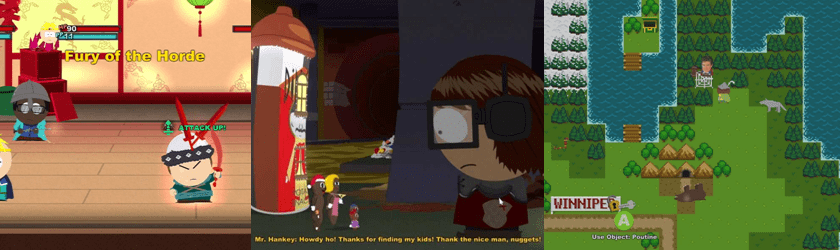
Screen Time: South Park: “Cartman Gets an Anal Probe” (S1: E1)

Season One, Episode One: “Cartman Gets an Anal Probe”

Air Date: 13 August 1997
Director: Trey Parker
UK Network: Channel 4
Original Network: Comedy Central
Stars: Matt Stone, Trey Parker, Mary Kay Bergman, Franchesca Clifford, and Isaac Hayes

The Background:
In 1992, Matt Stone and Trey Parker took some glue, construction paper, and an old 8 mm film camera and created The Spirit of Christmas, a short animated film in which four young boys accidentally bring to life a killer snowman. A Fox Broadcasting Company executive then commissioned the duo to create a follow-up short, Jesus vs. Santa, in 1995, which quickly became one of the first viral videos and led to the commission of a full series. Allegedly produced on a budget of $300,000, “Cartman Gets an Anal Probe” was a laborious process for the duo, who used the same traditional stop-motion techniques as their earlier shorts to bring their vulgar humour to life. The episode took about three months to complete, and about ten minutes of the story ended up being cut, and received poor results from test audiences. Comedy Central took a chance on the concept, however, based on the previous shorts and the duo’s previous shorts, and “Cartman Gets an Anal Probe” was heralded as a huge success despite complaints over its toilet humour and crass content. Since then, the hand-animated techniques have given way to computer animation that replicates the construction paper aesthetic of the duo’s early work, and South Park has become a popular and successful cultural phenomenon, with the creators now able to produce episodes within just a few days to stay on the pulse of current events.

The Plot:
While hanging out at the bus stop before school, Eric Cartman (Parker) tells his friends about a nightmare he had about being abducted by aliens. Although reluctant to believe the incident actually happened, he begins sprouting an extraterrestrial probe from his anus, sending his friends into a panic when Kyle Broflovski’s (Stone) brother, Ike (Clifford), is abducted by alien Visitors (Parker).

The Review:
South Park made an impression right from the start with its mock advisory warning at the start of each episode and jaunty little opening theme song; I especially enjoyed how the show would eventually change up the intro, adding new characters and updating the animation techniques and even aging up and altering some of the characters (even if you couldn’t always tell on sight alone). The episode proper opens with our four main characters – “big boned” foul mouth Eric Cartman, Jewish Kyle Broflovski, troubled everyman Stan Marsh (Parker), and poor Kenny McCormick (Stone) – happily singing at the bus stop before being interrupted by Kyle’s oddly shaped baby brother, Ike. This evidently isn’t the first time Ike has followed Kyle to the bus stop, so he’s pretty annoyed at his persistence; so much so that Kyle swiftly sends his brother packing with a good ol’ kick up the ass! Right away, the four kids stand out; they each look and sound different, with Cartman being the most vulgar (referring to Ike as a “dildo” despite not actually knowing what that is) and Kenny’s voice and face being constantly obscured by his trademark orange parka. While Cartman might not know what a dildo is, Kenny does; in fact, Kenny would go on to exhibit a working knowledge of such sexual topics far beyond his years, even if we never clearly hear what he says, though Kyle’s habit of playing “Kick the Baby” would largely be forgotten following this. Cartman is feeling the effects of a lack of sleep, brought about by a terrible nightmare where he was abducted by aliens the kids dub “Visitors”. He dreamt that the grey-skins took him up to their spacecraft and conducted bizarre, invasive experiments on his rectum. Although Cartman is insistent that the whole thing was a terrible dream (after all, his mum did say so), Kyle and Stan insist that he had an actual encounter with alien lifeforms, who have been known to abduct people and mutilate cows.

Cartman refuses to believe he’s been fitted with an anal probe, even after Ike is adducted and Kenny is killed.

While Cartman nervously laughs this off as them attempting to scare him, he’s stunned when their friend and school cook, Jerome “Chef” McElroy (Hayes), drives past and gives a picture-perfect description of the aliens Cartman saw in his “dream” and describes, in disturbing detail, the anal probes they like to forcibly insert into their victims. Thanks to his friends constantly ragging on him about it, Cartman stubbornly refuses to believe that aliens are real (even when he starts literally farting flames from his ass!) so, when Kyle is thrown into despair when he sees Ike being abducted by two Visitors, he receives little sympathy from his friend and even less from the cantankerous school bus driver, Veronica Crabtree (Bergman). While the town’s then-sole police officer, Officer Barbrady (Parker), turns a blind eye to the rampant mutilation of cows, reports of unidentified flying objects (UFOs), and military vehicles being spotted all over town (completely missing a Visitor luring a whole herd of cows away right before his eyes), Kyle is stuck enduring his school day, terrified for his brother and the fate that awaits him when his father (as opposed to this overbearing mother, Sheila (Bergman)), finds out that he (as in Kyle) didn’t look after Ike. Unfortunately for the young Jew, his teacher, Herbert Garrison (Parker), refuses to excuse Kyle from class even when he politely asks Mr. Garrison’s puppet companion, Mr. Hat (ibid), for permission to leave. Chef initially tries to cheer Kyle up with a song about making love, but flies into action when he learns of Ike’s abduction and pulls the fire alarm so the boys can get out of school. This reaction is motivated by his assumed knowledge of the Visitors and also a strange mechanical device that spontaneously emerges from Cartman’s flaming ass and suggests that the aliens are trying to communicate. Cartman remains adamant that this is all part of an elaborate prank by his friends, even when a signal from the alien spacecraft causes him to suddenly break into a cheery rendition of “I Love to Singa”. Kyle, however, lets his anger get the better of him and demands (by screaming down Cartman’s ear) that the aliens return his little brother; consequently, a UFO hovers down and blasts at them when Kyle defiantly throws a rock at their ship. The projectile sends Kenny flying right into the path of a stampede of terrified cows, but it’s Officer Barbrady’s car that finally does in the muffled youth.
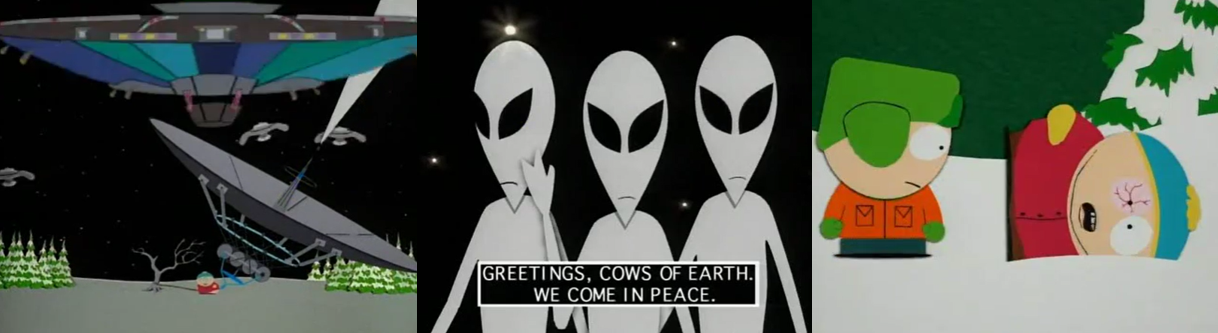
It turns out the Visitors simply wanted to make peace with Earth’s bovine population….

Despite this, Cartman remains unconvinced; he even refuses to believe that Kenny’s actually dead (even when Kyle pulls the boy’s head off and rats start eating his corpse) and storms off home to his mother, Liane (Bergman), and the delights of a “chocolate chicken pot pie” and Cheesy Poofs. Although Kyle pleads with Stan to help him out, Stan has problems of his own; he’s been invited to meet his crush, Wendy Testaburger (Bergman), at Stark’s Pond after school but he’s so besotted with and nervous around her that he can’t help but explosively vomit whenever she speaks to him. Kyle begrudgingly accompanies him and ends up interrupting their date when Wendy is enthralled by his story of alien abduction; much to Stan’s dismay, they end up going to get Cartman to use him as bait to lure out the Visitors rather than making “sweet love” as Chef encouraged. Cartman thus ends up tied to a tree in the middle of a forest and encouraged to keep farting until a massive alien satellite dish emerges from his ass and signals the Visitors. Kyle delivers an impassioned plea to the Visitors to return Ike, having learned that he really values the little squirt, but, when they completely ignore his appeal, he flies into a foul-mouthed rant that finally sees Ike released from their ship. The Visitors then reveal their true intentions for coming to Earth were to make contact with the cows, whom they have determined are “the most wise and intelligent” species on the planet and that their mutilation was all a mistake on the part of a severely apologetic Visitor named Carl. After leaving the cows with a special device that allows them to compel people to break into song and dance, the aliens leave, taking Cartman with them. The next day, Cartman is unceremoniously dumped back to Earth at the bus stop, where his friends are waiting, suffering from a bout of pinkeye and continuing to deny that the Visitors were real, or that he was ever abused by their unusual experiments.

The Summary:  
I’ve been a huge fan of South Park since it first aired; I can’t really remember how we first came to learn from it, but it must’ve been from TV spot and adverts for its impending debut on late-night TV over here. Interestingly enough, “Cartman Gets an Anal Probe” somehow wasn’t the first episode of the show I saw; instead, it was “An Elephant Makes Love to a Pig” (Parker, 1997). Quite how I missed the first four episodes of this massive cultural phenomenon are beyond me, but I was a kid at the time so probably distracted by videogames and hormones. Regardless, as a big fan of The Simpsons (1989 to present) and Beavis and Butt-Head (1993 to 1997; 2011), I was enamoured by this crude cartoon with its vulgar content, hilarious use of censored swear words, and surreal concepts but, as I revisit the series from the very start, it’s hard to deny that this first episode is a little rough around the edges. Obviously this applies to the animation style, which is very jerky and lacks the polish of later (and more recent) episodes, but it also applies to the voice acting and characterisation, though I can accept all of this as it was a pilot episode meant to kick-start the series and pretty much all of these issues were addressed throughout the first season and beyond. I’ve always found South Park’s crude presentation part of its appeal; there’s something inherently amusing to see these characters awkwardly shuffle about the place, seeing the UFO’s shadow against the background, and Ike’s oddly-shaped head flapping about this place (this was, of course, long before it was revealed that Ike was Canadian). There’s a clear amount of effort put into bringing this episode to life using these laborious methods and, while the characterisations aren’t quite as we know them now and many of the voices aren’t quite as refined, the core elements that would dictate the course of the next few seasons and later be so cleverly subverted are all here. One of the most obvious examples of this is Liane Cartman; while she’s clearly an enabler and an overly doting mother as she would be characterised as later in the show, she has a little more backbone here as she not only lets in Cartman’s friends after he explicitly tells her not to but also snaps at him to not “be difficult” when he initially refuses to indulge their alien fantasies.

While the show would outgrow some of its gags, many of this episodes jokes set the tone for the first series.

“Cartman Gets an Anal Probe” also introduces us to just how wacky South Park’s inhabitants can be; Mr. Garrison is clearly unstable, banging on about how Christopher Columbus was the “Indian’s” best friend and discovered France and projecting a far more sinister persona through his puppet, and Chef is constantly breaking into song and asides about sex. One of the most amusing aspects of this episode for me is Ms. Crabtree’s selective deafness; this means that when the boys mutter insults at her, they have to come up with amusing soundalikes like “rabbit’s eat lettuce” to throw her off. Equally amusing is the subplot involving Officer Barbrady’s attempts to round up the missing cows; Barbrady would sadly be pushed to the side as South Park expanded and progressed, but I always enjoyed his cluelessness and it always cracks me up seeing the cows lining up to escape town on a train and the conductor (Stone) warning them not to use their “cow hypnosis” on him. Of course, a recurring theme in this episode is Cartman’s adamant refusal that he’s been abducted and experimented on by aliens; even when he sees a crop circle in his image, he dismisses it as being Tom Selleck rather than him, which is just scratching the surface of how toxic and stubborn the little psycho would become. Kyle and Stan have always been largely interchangeable characters but there’s enough to make them stand out; from Kyle’s concerns for his brother (a focal point of the episode) to Stan’s crippling vomiting whenever Wendy is around, the boys certainly do have a lot to deal with even when aliens aren’t invading their town. While Kenny is the least developed of the four, he still stands out since you can’t hear anything he says, he’s got a hell of a dirty mind, and he’s left dead before the episode’s end. Overall, “Cartman Gets an Anal Probe” is a fun first outing for the crassest mountain town on television; while it’s rough around the edges and subsequent episodes in even the first season are stronger in terms of jokes, presentation, and narrative, this first episode still makes an impression and, if anything, is refreshing to revisit since it’s before the cast ballooned out and the scope of the show started to focus more on political and social commentary.

My Rating:

Rating: 3 out of 5.

Pretty Good

Did you enjoy Cartman Gets an Anal Probe”? What did you think to it, and South Park in general, when it first aired? Which of the four main characters is your favourite and why? Do you prefer the cruder animation on show here? Would you like to see some of the elements introduced here return to the show? What are some of your favourite characters, episodes, and moments from South Park? How are you celebrating South Park’s anniversary this year? No matter what your thoughts on South Park, I’d love to hear from you so feel free to drop your comments below or leave a reply on my social media.

Movie Night: South Park: Bigger, Longer & Uncut

Released: 30 June 1999
Director: Trey Parker
Distributor:
Paramount Pictures/Warner Bros.
Budget:
$21 million
Stars:
Trey Parker, Matt Stone, Mary Kay Bergman, and Isaac Hayes

The Plot:
After seeing the new Terrence and Philip movie, the kids of South Park cause controversy when they freely spout a whole slew of new swear words and profanity. This leads to Kyle Broflovski’s (Stone) mother, Sheila (Bergman), becoming so outraged that she pushes for all-out war against Canada! However, the situation escalates when, after dying, Kenny McCormick (Stone) uncovers a plot between Saddam Hussein (ibid) and Satan (Parker) to use these events as a catalyst to bring an age of darkness to the entire world!

The Background:
Back in 1992, Matt Stone and Trey Parker created a crude animated film using only glue, construction paper, and an old 8mm film camera. After being commissioned to create a follow-up short, the pilot episode first aired on this day in 1997 and a full series soon followed, which saw the duo joined by a team of around seventy employees. The duo also switched to replicating their cardboard cut-out style with computers, and the popularity of the show’s first season led to discussions of a feature-length production in 1998. Right off the bat, Stone and Parker made it clear that a feature-length film would have to be R-rated and eventually got this wish even after studio executives tried to sway them to tone things down. The filmmakers used a variety of additional computer effects to help the film stand out from its television counterpart, something further bolstered by the duo’s decision to make the film a musical, though production was made tense due to several battles with producers and executives regarding the film’s tone and marketing. Despite its vulgar humour, South Park: Bigger, Longer & Uncut released to widespread critical praise and earned over $83 million at the box office, making it the highest-grossing R-rated movie until it was knocked from its perch about sixteen years later.

The Review:
Man, I was so hyped for this film as a kid; funnily enough, though, I don’t actually remember if I knew that it was a musical until I was sitting in the cinema with my friend and the opening sequence started. As surprising as this may have been, it definitely didn’t put me off and only added to the film’s charm. Considering how popular and notorious South Park was when the film released, it’s unlikely that many audiences went into it without at least some knowledge of the show, its crude humour, and its colourful cast of characters and yet the film helpfully introduces us to the snowy, quiet, and apparently unassuming town with its opening song (“Mountain Town”) and by having Stan Marsh (Trey Parker) tour through the streets recruiting his friends to the cinema event of their lives, Terrance Henry Stoot (Matt Stone) and Phillip Niles Argyle’s (Parker) Asses of Fire. Fans of the show will remember Terrence and Phillip from the season episode “Death” (Stone, 1997), which actually contained a similar sub-plot to this movie; the duo (sometimes depicted as crudely animated cartoon characters) are a couple of vulgar Canadian comedians known for foul language and toilet humour but they’re heroes to the South Park kids.

The kids pick up some new curses but Stan is preoccupied by Wendy’s new flame.

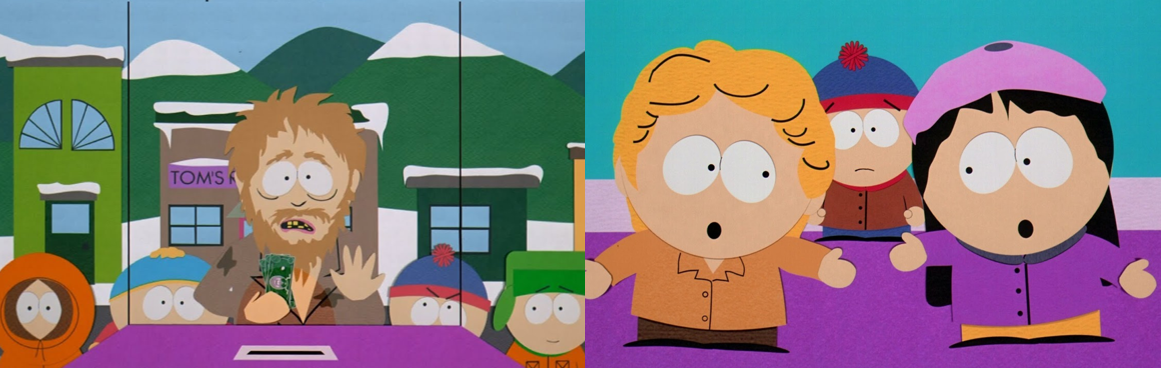
This opening song not only introduces the four main characters but also sets up many of the themes of the movie; Stan’s mother, Sharon (Bergman), sings about Stan’s pure-hearted innocence, Kenny’s mother, Carol (ibid), chastises him for skipping church to see the film and warns him that he’ll have to answer for Satan for his actions, and Kyle’s overbearing and controlling mother forces him to not only lie about where he’s going to avoid upsetting her further but to also take his adopted baby brother Ike (Various) along with them. Of course, Eric Cartman (Parker) doesn’t have to worry about his mother, his family, or money troubles like his friends since he emotionally manipulates his kind-hearted and doting mother, Liane (Bergman), with his callous and demanding persona but even he can’t get past the movie rating laws that forbid them from seeing Asses of Fire due to being underage. Stan, however, bribes a homeless man to pose as their legal guardian and get them into the film, which is a typical nonsense Terrence and Phillip affair of fart jokes and baloney but with the added bonus of including a whole new array of uncensored swear words and insults for the kids to pick up (“Uncle Fucka”). While the adults in the audience are horrified by the vulgarity, the kids are captivated and waste no time in impressing their fellow kids with their new vocabulary. Stan, however, is disheartened to find his long-time crush and on-again/off-again girlfriend, Wendy Testaburger (Bergman), has latched on to newcomer Gregory (Parker), an eloquent and sophisticated transfer student who appeals to her sensible and rational mindset.

Following Kenny’s death, Sheila rallies the town against Canada and their vulgar humour.

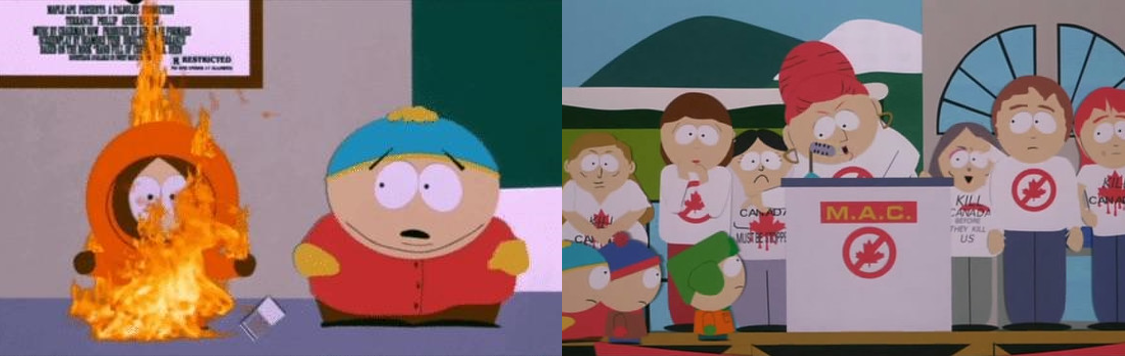
To try and win her back, Stan goes to Jerome McElroy/Chef (Isaac Hayes) for advice but the smooth-talking womaniser accidentally informs him that the best way to make a woman like him is to “find the clitoris”; since Stan is too young to understand this, he believes that this is more of a spiritual quest and begins a sub-plot revolving around him trying to decipher Chef’s words and win back Wendy’s affections. Thanks to the kids, though, the rest of their class bribes their way into Assess of Fire and, before long, they’re all singing and quoting lines from the film (with the exception of the sensible Gregory and Wendy). Stan, Kyle, Cartman, and Kenny’s blatant use of swears horrifies their teacher, Herbert Garrison (ibid), and sees them sent to the school councillor, Mister Mackey (ibid), and lands them in hot water with their mothers. Although Mr. Mackey tries to dissuade the children from swearing (“It’s Easy, M’Kay”) and the school places a ban on Terrance and Phillip apparel, the kids continue to sneak into the film at every opportunity and Asses of Fire becomes a huge hit all across the country despite concerns that its content is ruining America’s youth. This all comes to a head when the kids try to recreate a scene from the film and, in the process, Kenny burns himself to death trying to light his fart. For Sheila, this is the final straw; not only do the mothers ground their kids for two weeks but she takes her opposition to the movie, and all of Canada, to the next level by reorganising the Parent/Teacher Association into Mothers Against Canada (M.A.C.) and vehemently opposing any and all Canadian products and imports in the town (“Blame Canada”).

The arresting of Terrence and Phillip and war against Canada turn out to be signs of Satan’s return.

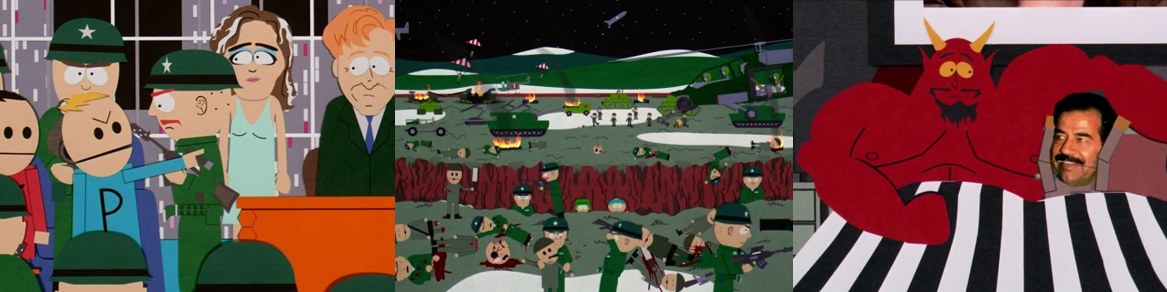
After paying off Conan O’Brien (Brent Spiner), Sheila then has Terrence and Phillip arrested for corrupting America’s youth; when the American ambassador (Stone) refuses to let the duo go and insults his Canadian counterpart (Parker), Canada responds by bombing and killing the Baldwin family and before long an all-out war between America and Canada is declared, with Sheila positioned as President Bill Clinton’s (ibid) chief advisor and Terrence and Phillip set to be executed as war criminals. While Kyle is angered at Cartman’s views on his mother (“Kyle’s Mom’s a Bitch”), the kids agree that they have to do something to stop their mothers and the war (“What Would Brian Boitano Do?”) and so unite the town’s kids under the banner of “La Resistance”. While they struggle to come up with a practical plan, Gregory leads them to Christophe/The Mole (Parker), who helps them to infiltrate the United Service Organisations (USO) show where the duo are set to be executed. Their motivations are only bolstered when Cartman is visited by Kenny’s ghost, who warns that this is all playing into an age-old prophecy that will allow Satan to rise up and bring devastation to the world. Having been denied entrance into Heaven, Kenny’s soul is cast down to the fiery depths of Hell where he finds Satan in a toxic relationship with former Iraqi dictator Saddam Hussein. While Satan is trying to focus on his opportunity to finally have his time in the sun (“Up There”) and wants more from their relationship, Saddam is an egotistical and self-centred schemer who’s focused only on sex. Although Kenny tries to convince Satan to leave his abusive partner, Saddam is easily able to emotionally manipulate Satan’s good nature (“I Can Change”) and, when the war culminates in Terrance and Phillip’s deaths despite the best efforts of La Resistance, he immediately usurps Satan’s position to steal the spotlight as the new dark ruler of the world.

The Nitty-Gritty:
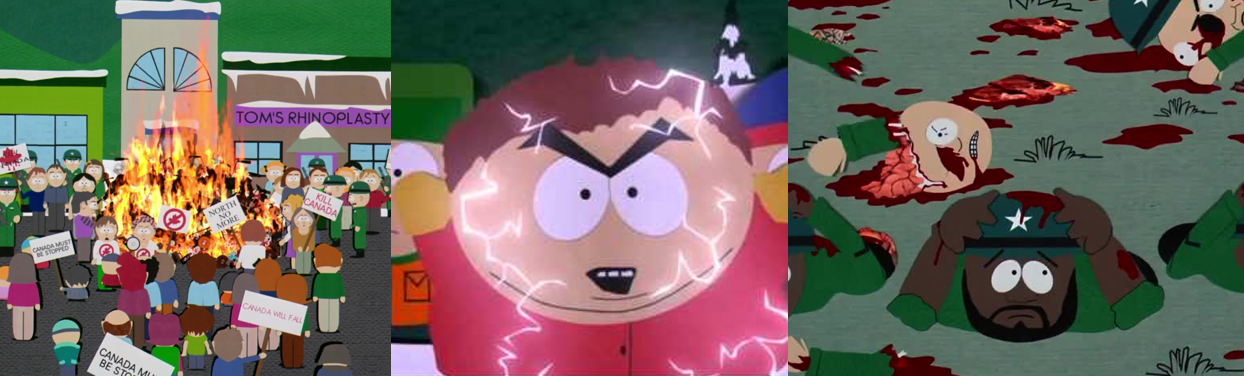
As you might expect from South Park, the film is full of crude humour, sight gags, and ridiculous jokes; we see this right from the start as Cartman accuses Terrence and Phillip of having crappy animation and the kids are immediately seen jerking along in stilted movements. Cartman shines even brighter during his big solo where he complains about Kyle’s mother, his little gag with the microphone where he tells Mr. Garrison to suck his balls never fails to amuse, and he even absurdly tries to beat Kenny’s flames out with a stick! Kenny’s botched operation is similarly hilarious as Dr. Gouache (George Clooney) and his attendants slice his charred corpse up, beat him with a hammer, and accidentally replace his heart with a baked potato! The film also dips into comical satire with the “March of War” promotional video, Kyle randomly tapping keys on his computer to “re-route the encryptions” and get a message to the town’s kids (Cartman’s insistence on advertising that they’ll have punch and pie is a riot), and while Chef only has a small role he’s perfectly placed to lampoon the army’s notorious racism. Although created solely for the film, Christophe proves to be a true highlight; a foul-mouthed atheist with a dodgy French accent, the Mole provides some of the best and most absurd lines of the film with his rants about God, his mother (who stabbed him with a coat hanger while still in the womb!), and his “butt for” gag that are matched only by the wacky levels of blood and violence during the final conflict between the American and Canadian armies.

M.A.C.’s campaign against Canada quickly escalates to bigotry, a special chip, and all-out war.

In true South Park fashion, the reaction to a vulgar film is suitably over the top and comical; all of the town’s adults are outraged that their children have become “corrupted” by Terrence and Phillip and resort to more extreme measures when their attempts to ground their kids fail. In addition to burning all Canadian paraphernalia and causing all Americans of Canadian descent and blood to be sent to death camps, M.A.C. employs the services of Doctor Vosknocker (Eric Idle) to create the “V-chip”, an electronic device that is implanted into Cartman against his will and delivers a painful electric shock any time he speaks a swear word. As if these extreme methods weren’t bad enough, Sheila’s commitment to opposing the vulgarity of Asses of Fire expose her as an all-out racist; as Kyle says, she even forgets that her adopted son is Canadian and not only takes every opportunity to attack the physical characteristics of Canadians (which are exaggerated in the film’s animation) but to wage all-out war against them. She’s so obsessed with blaming and punishing everyone else, that she’s willing to put countless lives at risk in a senseless and bloody war simply because of a few swear words, which is just another fantastic example of how clever South Park’s social commentary can be as it parodies how extreme parents and social groups can be when opposing things they believe to be morally questionable.  

Thanks to Kenny, Satan overcomes his dependency on Saddam and the town is saved.

As a result of Sheila’s pompous and fanatical ways, Satan comes across as a far more sympathetic and relatable character; while you can kind of see where Sheila’s coming from, she quickly goes to unbelievable extremes to persecute Canadians under the façade of protecting her son that it makes her thoroughly unlikeable, whereas Satan simply longs to escape his aeons of banishment to the netherworld and claim the world as his own. Not only that, it’s clear that he’s a sensitive and introspective demon who’s being manipulated by Saddam Hussein; when he spreads his army of darkness across the world and begins his reign of terror, he specifically states that it’s in reaction to Sheila’s bigotry and that the world must pay for her actions but he’s quickly pushed aside by Saddam’s own desire for power and conquest. Initially unable to work up the courage to stand against Saddam, Satan finally frees himself from his lover’s toxic influence after seeing him unsuccessful try and fool Cartman with the same lies he used on Satan earlier and, in gratitude for Kenny’s help in seeing Saddam for what he truly is, Satan agrees to restore the world and the lives lost prior to the war. Unfortunately, this means that Kenny has to go back too and, in a surprisingly poignant moment, he reveals his face for the first time and bids a fond farewell to his friends and ascends to Heaven as peace and understanding returns to the world (“Mountain Town (Reprise)”).

The Summary:
Even after all this time, my love and appreciation for South Park: Bigger, Longer & Uncut remains unchanged; it’s as fun, entertaining, and poignant to me now as it was back when it first came out, when the hype and excitement about South Park was at its most palpable. Indeed, the one complaint I have about the film is that it came maybe a little too soon in the show’s lifecycle, meaning that later breakout characters like Leopold Stotch/Butters (Stone), Tweek Tweak (ibid), Jimmy Valmer (Parker), and Timmy Burch (ibid) either don’t feature (due to not being created yet) or have extremely minor roles. This, however, is a revisionist criticism and does absolutely nothing to reduce my enjoyment of the film; by recycling a few of the gags from the show’s first two seasons and expanding upon the premise, South Park: Bigger, Longer & Uncut proves to be as thought-provoking and surprisingly touching as it is vulgar and controversial. Many like to criticise South Park for appealing to the lowest common denominator with its immature jokes and crude humour but the showrunners often lace their episodes with commentary of modern society and media and the film is no different; by parodying the extreme reaction to vulgar content, the film holds a mirror up to South Park’s own critics and shows how there are things that are far worse than some naughty language. Add to that the legitimately funny jokes, the tight writing, a whole slew of catchy songs, some fun new characters, and the moving reveal of Kenny’s face and you’ve got an extremely humorous, witty, and touching animated feature that I enjoy just as much now as I did all those years ago when I first saw it at the cinema.

My Rating:

Rating: 5 out of 5.

Fantastic

Did you enjoy South Park: Bigger, Longer & Uncut? Were you a fan of the musical approach and, if so, which of the songs was your favourite? Which of the kids is your favourite and did you enjoy Kenny’s side plot in Hell and Cartman’s troubles with the V-chip? Were you a fan of the film’s satire on the extreme reaction to bad language in films and cartoons? Do you agree that Canada isn’t a real country? Would you have liked to see a sequel made that included some of the show’s later breakout characters? How are you celebrating South Park’s anniversary this year? No matter what your thoughts on South Park: Bigger, Longer & Uncut, or South Park in general, I’d love to hear from you so feel free to leave a comment below by signing up or on my social media.
Game Corner: South Park: The Stick of Truth (Xbox One)

GameCorner

Released: 13 February 2018
Originally Released: 4 March 2014
Developer: Obsidian Entertainment
Also Available For: Nintendo Switch, PC, PlayStation 3, PlayStation 4, Xbox 360

The Background:
Back in 1992, Matt Stone and Trey Parker took some glue, construction paper, and an old 8 mm film camera and created The Spirit of Christmas, a short animated film in which four young boys accidentally bring to life a killer snowman. A Fox Broadcasting Company executive then commissioned the duo to create a follow-up short, Jesus vs. Santa, in 1995, which quickly became one of the first viral videos and led to the commission of a full series airing on Comedy Central. Originally entirely hand-animated, the duo (now joined by team of around seventy employees) soon switched to replicating their cardboard cut-out aesthetic using computers and managed to produce episodes within just a few days to stay right on the pulse of current events. Since then, South Park has expanded not just in its animation and cast but also into a whole host of other media, however South Park’s history with videogames has been…tumultuous, to say the least. Unlike previous games inspired by the show, The Stick of Truth was created with the direct involvement of Stone and Parker, who insisted that this new title actually mirrored the look of the show and would be a role-playing adventure game that utilised the duo’s script and ideas.

South Park had a number of videogame spin-offs, most of them ugly and pretty bad.

Unfortunately, however, the game ran into difficulties after THQ (who had agreed to help work on the game) filed for bankruptcy in 2012; the rights to the game were then bought by Ubisoft, who delayed the game’s release date to make significant changes to its direction. South Park: The Stick of Truth finally released in March 2014; although the game was heavily censored in Europe, it became the best-selling game available within its first week of release here in the United Kingdom and, by February 2016, had shipped over five million copies. Reviews were generally favourable, despite some criticism of the game’s mechanics, but the game performed well enough to earn a sequel in 2017. I, personally, first played through The Stick of Truth on the PlayStation 3 and loved its simple, yet surprisingly deep mechanics, its graphical fidelity to the source material, and its outrageous sense of humour so I jumped at the chance to cash-in a free download code for the Xbox One version to relive the original title in all its sardonic glory.

The Plot:
A new kid has moved to South Park and quickly finds himself drawn into a fantasy role-playing game the kids are playing involving control of the all-powerful “Stick of Truth”. However, after an alien spacecraft crash-lands in the small mountain town and toxic waste from the ship begins infecting citizens and wildlife, the new kid and his newfound friends suddenly find themselves embroiled in a very real fight for their very lives!

The Gameplay:
South Park: The Stick of Truth is a 2.5D, sidescrolling action/adventure game with heavy elements of role-playing mechanics and an emphasis on story, character interactions, side quests, and acquiring new weapons, armour, and buffs. When you first start the game, you’re tasked with creating your avatar, the otherwise-entirely-silent “New Kid”; here, you’re given a few options to customise the New Kid’s hair, skin tone, clothing, and other elements before you’re thrust into the game’s story and tasked with exploring the quiet little mountain town of South Park.

Customise your avatar and choose from four classes, each with their own unique abilities.

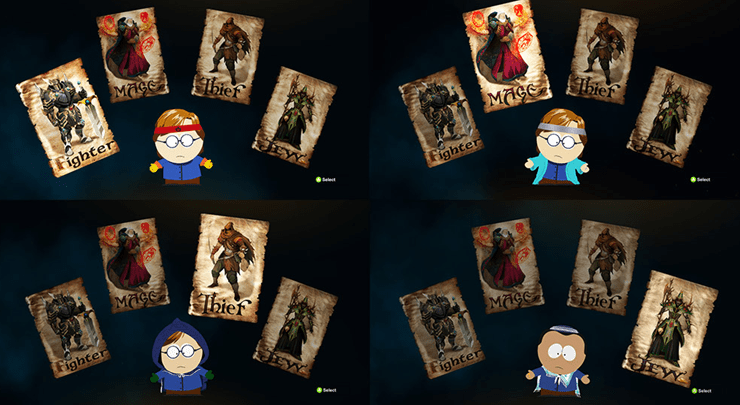
Luckily, you live next door to one of my favourite characters in the series, Butters Stotch, who introduces you to Eric Cartman and the game the kids are playing; a role-playing fantasy game very much inspired by the likes of Dungeons & Dragons. As a result, you’re quickly asked to pick from one of four classes: Fighter, Thief, Mage, and Jew. While each has its own specific abilities, positives, and negatives, weapons and armour and such aren’t limited to each class so you can pick a Fighter and still focus on Mana-based attacks like a Mage if that’s your bag. However, unlike in the sequel, you cannot switch or mix and match classes in this game so, once you pick a class, you’re locked into it for the rest of the game.

Be sure to explore thoroughly before a new day starts or else you might miss collectables.

Stick of Truth divides its story up into days, rather than chapters; you’re free to explore the town as much as you wish but certain areas and houses and such are either locked or barred off until you complete story quests, side quests, or learn new fart-based magic. As a result, it’s entirely possible to explore a good percentage of the town on the first day, meeting people and getting side quests going, uncovering loot and as much as you possibly can before night falls and you enter certain areas that can’t be revisited. This means it’s advisable to explore every inch of your environment in case you miss something because you might not be able to go back and grab it when the sun rises.

Combat is a simple, but surprisingly deep, affair.

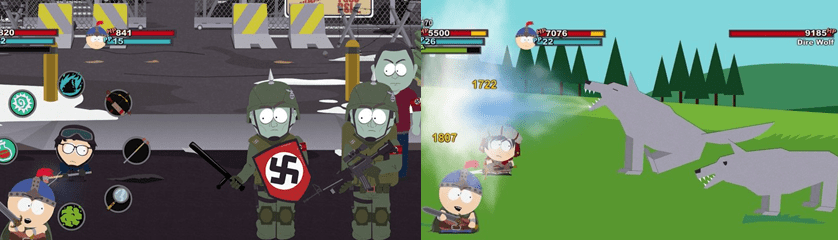
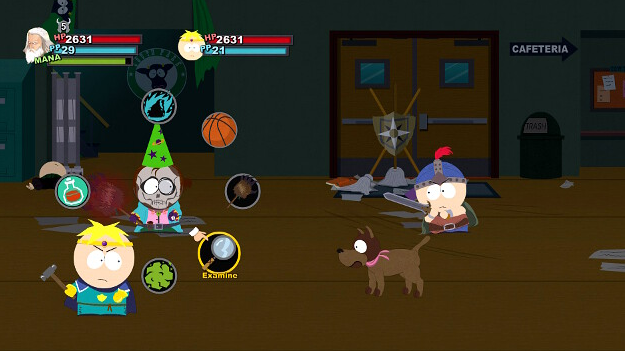
The game has a difficulty slider for you to utilise but there are no Achievements associated with playing the game on a harder mode so the only reason you’d turn this is up is if you found the game’s combat too easy. And, to be fair, that’s entirely possible; as you explore, you’ll come up across fellow kids, rabid dogs, drunken vagrants, and Nazi zombies (you know, the usual) around town; you can easily bypass them but then you won’t earn experience points (EXP) or level-up. Luckily, though, you can strike them on the overworld to gain an advantage in combat. Battles take place on a traditional 2.5D battlefield and are entirely turn-based; you can wait as long as you like to take your turn without fear of being attacked, which is nice, and can select your character’s abilities or use an item as well as cast magic or attack, meaning you generally always have the advantage. Battles usually boil down to selecting an attack and pressing either A, X, Y, rotating the analogue stick, mashing buttons, or a combination of all of these elements to land attacks. Before you strike, your weapon will flash; pressing the right button at this time will unleash a stronger attack, or allow a combination of moves to be performed. It’s pretty simple to get the hang of and you can buff your attacks with equipment patches and farts to deal additional damage.

Each of your buddies has their own attacks and abilities to help you in and out of battle.

Generally speaking, though, combat comes down to how easily you adapt to the wheel-based menu (which can be a bit janky at times) and how accurate you are at pressing A; when an enemy attacks, you’ll have a small window to press A to defend yourself and reduce the damage done to you or keep yourself safe from status effects. This window can be very small at times so you’ll need to have your wits about you but, luckily, you are joined by a number of buddy characters in battle who have abilities and capabilities of their own (or act as a punching bag, if necessary). Butters, for example, can heal you without you having to waste an item, while Kenny McCormick continuously resurrects after death and Kyle Broflovski can increase your attack power. Additionally, you can switch your buddy at any time in battle at the cost of a turn, instantly allowing you to have a fresh buddy ready to lend a hand.

You can inflict multiple status effects on your enemies to aid you in battle.

Combat is simple to learn, easy to master, and fun to experience; with patches and perks, you can make your character incredibly overpowered in a very short period of time, dealing multiplier status effects to your enemies (such as bleeding, burning, and grossing them out), regenerating health (HP) or Power Points (PP), and dealing additional damage or upping your abilities or defences. It’s pretty easy to double up these effects with the natural abilities of your weapons to wipe out your enemies, even when they armour up or reflect and deflect your ranged or melee attacks.

Interact with your environment to take out enemies quickly and efficiently.

The New Kid has quite a few resources at his disposal to make things even easier as well; often, you can shoot or fart on objects in the overworld to either damage or defeat enemies and you can learn various types of fart-based magic to open up new areas or aid you in battle. These are sometimes cumbersome, however, as they require some tricky or imprecise movements of the right analogue stick to pull off and are made even more inconvenient by the fact that your Mana Meter doesn’t automatically refill after a battle like your HP and PP. This means that you have to buy and consume Mana-restoring food to keep it up (but not too high, lest you shit your pants in battle); luckily, though, as I said, HP and PP are restored and all status effects wiped away once a battle ends, allowing you to keep HP and PP restoring items for the more difficult boss battles.

Use your hard-found cash to buy weapons, armour, and other wares.

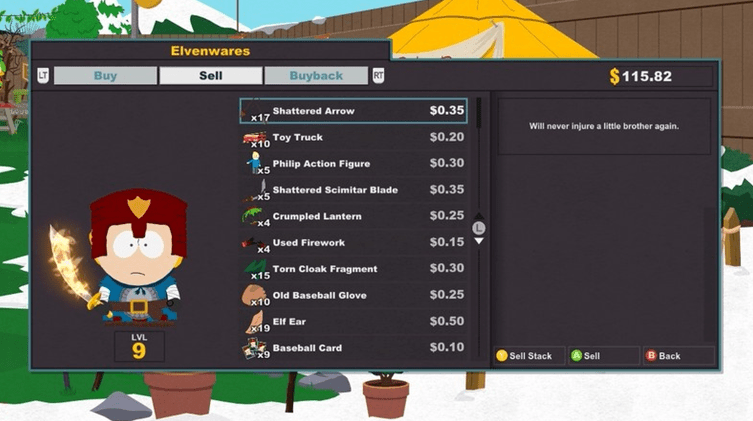
As you explore South Park, it’s recommended that you attack and interact with everything you see to find new armour, patches, weapons, items, junk, and cash. Fittingly, the game’s money is measured in small amounts; you’ll generally find a few cents lying around and resources only cost a few dollars or so but you can sell your useless junk or unwanted items to make more money. When you venture to Canada, though, you’ll have to contend with their higher prices and exchange rate but I never found myself strapped for cash or wanting for resources; if your inventory is full, you can usually return to the item chest or location and pick up whatever you couldn’t carry later on if you really want to.

The New Kid gains numerous abilities to help him progress further and access new areas.

The New Kid also gains access to a few additional abilities to help him out; when you’re abducted by aliens, you’ll get an anal probe inserted into you that allows you to access alien tech to open doors or teleport around the map. Later, when you meet the Underpants Gnomes, you’ll also gain the ability to shrink to access new areas, in addition to using the New Kid’s fart abilities and various buddies. This latter aspect was significantly expanded upon in the sequel and it can sometimes be unclear exactly what you need to do and with which buddy. The entirety of the town in accessible and faithfully recreated, though (except for Mephisto’s laboratory and the Mall…), which really adds to the game’s level of detail and fidelity and you can use Timmy to fast travel across the map (though I found myself running about the place more often than not to find more loot and level-up through battling).

Talk to, and befriend, everyone in South Park.

You’ll also gain EXP by completing the many and varied side quests that The Stick of Truth has to offer; at any one time, you can have as many as ten quests on the go at once, including those that are story-based, and you can keep track of these at all times using the New Kid’s phone and Facebook feed. Much of the game’s plot revolves around rallying others to your cause or making Facebook friends with the townsfolk so you’ll need to talk to everyone you see to gain followers and be given side quests to complete to earn EXP, get more followers, and even acquire certain iconic South Park characters as Summons to help you out in battle.

The story is as wacky and crude as you would expect from South Park.

The game’s hilarious and multi-faceted story, which involves all the familiar faces of the show and even recycles or addresses jokes and loose ends from the episodes, is just as wacky and insane as the show has become over the years; what starts as a simple (yet surprisingly elaborate) war between Cartman’s human forces and those of Kyle’s elf-kind quickly escalates into a battle against Nazi zombies and gun-toting government agents looking to destroy the town. After both groups are betrayed by Clyde, the New Kid has to travel to Canada to translate a message; this is where the game’s presentation takes a sudden and hilarious left turn as Canada is rendered through traditional 8-bit graphics, complete with an 8-bit rendering of “Blame Canada” and the Canadian national anthem. It’s a hilarious and mental detour that, sadly, doesn’t last as long as it could do (though, thankfully, you can return to Canada to fight Dire Wolves whenever you want). Ultimately, all of the kids you’ve befriended lay siege to Clyde’s elaborate dark tower and you end up having to disarm a nuclear bomb inside of Mr. Slave’s ass, battle a zombified Chef, and finally defeat Kenny after he claims the Stick as his own and transforms into a Nazi zombie himself.

Graphics and Sound:
The Stick of Truth is beautiful in its simplicity; in every respect, it looks exactly like an episode of the popular cartoon show, with the entirety of the town and its many houses, areas, and districts rendered in the finest cardboard cut-out-style 2.5D available. It’s literally like you’re playing an extended episode of the show as you’re able to visit the school, the houses of all the show’s popular characters, and the many businesses and iconic locations South Park has to offer.

The entirety of South park is recreated in stunning detail.

I honestly cannot gush about this presentation enough; too often, videogames based on cartoons (especially the South Park titles) slap an ugly, polygonal 3D effect on the presentation that ruins the game’s look and feel. Here, though, everything is just as crude and charming as in the cartoon; weapons and armour all look distinctly child-like, as though cobbled together by kids, and the way the game incorporates its more elaborate elements into the show’s aesthetic is impressive. Add to that the fact that the game not only uses music from the show but the voices of the entire cast and you’ve got a really special package and the result is a game adaptation that is more than 100% faithful to its source material, utilising so many jokes, characters, and words of dialogue that it’s actually quite mind-boggling.

Enemies and Bosses:
As you explore the town, you’ll get into fights with other kids and wild dogs in the game’s early going; these battles generally take place in a two-on-two format but you’ll face groups of about six at some points as well. Each of your enemies has similar abilities to you, meaning they can cast magic to slow you down, cause you to bleed, set you on fire, or gross you out but enemies will also enter a “Riposte” stance to automatically counter a melee attack or a “Reflect” stance to automatically parry ranged attacks. Enemies can also armour up and erect shields, which must be broken through with regular attacks before you can deal real damage, or have healers on hand to replenish their HP or remove status effects.

Enemies soon become hilariously ridiculous.

Later in the game, the townsfolk become infected with alien goo and become Nazi zombies; unlike other enemies, these guys will resurrect after a few turns, meaning you need to either end battles against them quickly our utilise attacks that hit multiple foes to clear their corpses from the field. When you reach Canada, you’ll have to contend with Dire Wolves, Bears, and Snakes, all of which are a bit more formidable than the town’s usual foes and can infect you with “Dire AIDs” if you’re not careful. Generally, though, battles against common enemies are pretty much a foregone conclusion; you’ll be so overpowered and have mastered the battle system so well that even groups of difficult enemies will be no match for you with the right setup.

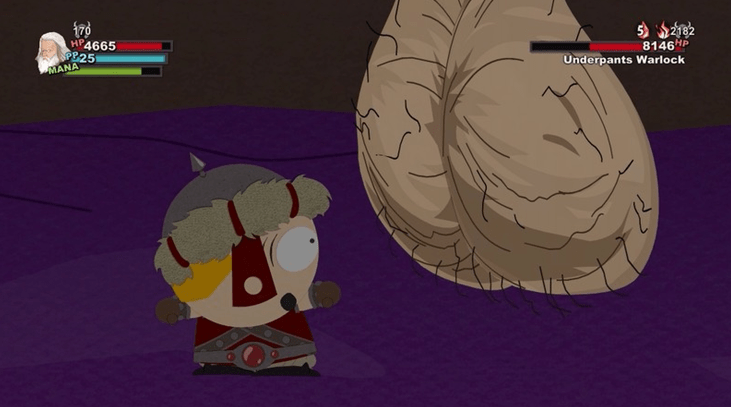
Watch out for your Dad’s swinging balls when you’re battling the Gnome Warlock!

Of course, you’ll also have to take part in a number of more challenging boss battles throughout the game’s story. Stick of Truth’s boss battles involve a lot of variety compared to regular battles and have you performing slightly more complex actions, such as resisting the sleeping effects of Jimmy Valmer’s stuttering limericks, keeping the Hallway Monitor from calling your parents, and dodging the swinging testicles of your father as you battle the Gnome Warlock.

Al Gore is a serious pain the ass as both a character and a boss.

One of the game’s more difficult and annoying bosses is former Vice President of the United States Al Gore; after a long side quest involving Gore’s vendetta against “ManBearPig”, you’ll enter a lengthy and difficult battle against Gore and his bodyguards where the former Vice President will try to put you to sleep with a presentation on global warming, up his attack and regenerate his health, and bombard you with rapid slaps all while his constantly-respawning bodyguards take shots at you. It’s a tough fight but one that can be completely avoided (though you’ll lose out on Achievements if you do skip it) and made easier by having Jimmy as a buddy. You’ll battle Al Gore again later on, this time when he is under the guise of ManBearPig, but this is a walk in the park compared to the first fight.

Despite the censoring, Stick of Truth goes above and beyond to shock and entertain.

Things continue pretty smoothly until a breakout of the Nazi zombie virus as the Unplanned Parenthood facility; here, you’ll have to battle a gigantic Nazi zombie foetus, which has a staggering amount of HP and comes alongside an umbilical cord that leeches your HP. Because of this, it is absolutely essential that you destroy the umbilical cord first and remove it from the battlefield, avoid trying to gross the foetus out (as zombies are resistant to that), and focus on chaining bleeding and burning multipliers while swapping out your buddy.

The Sparrow Prince can present a real challenge.

Later, when you venture inside of Mr. Slave, you’ll have to face another annoying boss: the Sparrow Prince. As a spirit, the Sparrow Prince is immune to the bleeding status effect and is accompanied by constantly-respawning globs of Nazi zombie bacteria. It’s not an impossible battle with the right class type and setup but it can be frustrating since the Sparrow Prince’s attacks deal high amounts of damage and hit quite quickly, making it difficult to defend yourself in time.

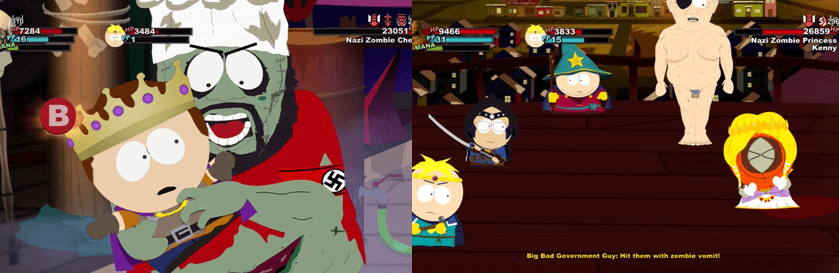
In the finale, you’ll run a gauntlet against Nazi zombie versions of your friends and allies.

The game’s finale sees you run a gauntlet, of sorts, of tough enemies in Clyde’s fortified tower and then a number of bosses, the first being against a reanimated, Nazi zombie Chef. This isn’t much of a hassle, though, and you’ll eventually face off with Kenny in quite a long-winded battle that sees your damage carry over between Kenny’s different phases and you automatically swap between buddies as the story dictates. It’s not especially difficult (especially compared to Al Gore or the Sparrow Prince) but it can get frustrating as you’re right at the end of the game but Kenny keeps getting back up and regenerating until you fart on his balls and bring the game to an end.

Power-Ups and Bonuses:
As an RPG, you obviously have access to a wide variety of weapons, armour, and power-ups to aid you in your journey. Levelling-up generally allows access to battle abilities rather than affecting your stats and the game caps your level at fifteen, though by the time you hit that you will be massively over-powered if you have equipped the right gear.

Attack up close or from afar, buffing your weapons with various patches and abilities.

You have access to two weapons: a melee weapon (swords, staffs, crutches, dildos, and the like) and a ranged weapon (dodge balls, darts, crossbows, and so forth). As you explore, you’ll find more powerful variations on these weapons, or you can buy them from various merchants about town. Each weapon comes with various buffs (such as causing an opponent to bleed, leeching HP, or powering up your abilities) can be assigned up to two equipment patches to increase your buffs further (this can add additional damage, leeching, or regenerative properties, among other options).

Weapons and armour can all be powered up to make battles a walk in the park.

Similarly, your helmet, armour, and gloves can be equally powered up by equipment patches to make your avatar quite the formidable fighter; thanks to patches and buffs, you can combine status effects and other buffs to ensure you always have the edge in battle and you can even customise the colour scheme of your equipment with various dyes.

Learning new fart magic can be a tricky task to master.

Completing side quests also nets you the ability to use Summons; while these can only be used once per game day and are useless in boss battles, they can turn the tide further in your favour if you’re struggling against certain enemies. As the story progresses, you’ll also unlock additional fart powers to use in and outside of battle; these can be awkward to learn and to use in the field, requiring vague movements of the analogue sticks to pull off, and frankly are nowhere near as user-friendly or as prominent as in the sequel.

Additional Features:
South Park: The Stick of Truth comes with fifty Achievements for you to earn, the majority of which are pretty standard fare (defeating certain numbers of enemies, completing story-based tasks, using certain attacks and so forth) but others can be easily missed or will require a bit of preparation on your part. There’s one that requires you to wear a bald cap and a goatee or ginger freckles to battle certain enemies, for example, another for completing the game without selling any items or wearing certain outfits, and even one for finishing the game without a single buddy being knocked out.

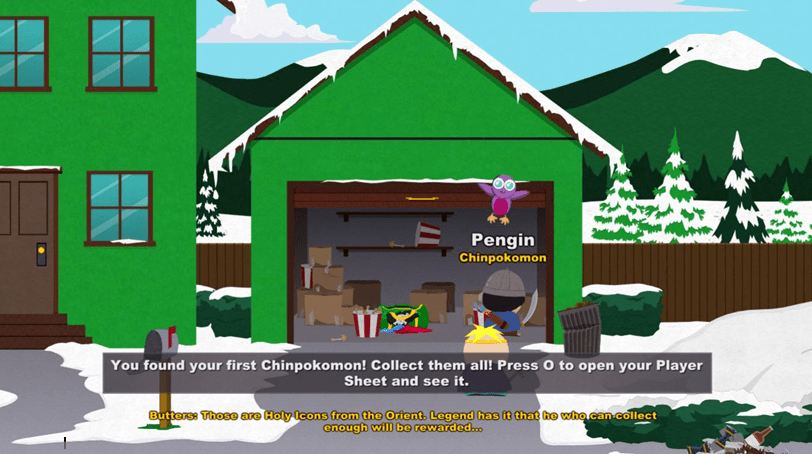
You’ll need to search high, low, and all around to find all thirty Chinpokomon.

The game is absolutely packed full of content but, unfortunately, most of this is confined to the main game rather than the post-game; as many areas become inaccessible after you complete them, you may find you have to restart from a previous save (or start a new game entirely) to find everything you need or befriend everyone in town. Scattered throughout the game are thirty Chinpokomon for you to find, for example, and 121 people to become friends with on Facebook. Talk to the wrong people at the wrong time or fail to explore your surroundings properly and you may find that you miss your one and only chance to tick these off your to-do list, meaning you’ll have to start all over again.

Side quests will take you all over town and even to the chilly mountains of Canada.

There’s so much to do around town thanks to the game’s side quests; you’ll be finding kindergarteners in a game of hide-and-seek, tracking down Mr. Hankey’s lost pooplings, ferrying messages between South Park characters, attacking Mongolian children on behalf or Mr. Kim, and you can even have surgery performed to look like David Hasselhoff! Jimbo and Ned send you on a side quest that sees you battling a number of option bosses as well, such as a rabid dog, the iconic mouse-penis, and the Canadian Barking Spider of the Queefing Caverns.

The Summary:
South Park: The Stick of Truth is a great little RPG; it’s not especially difficult, and this will probably turn off hardcore RPG players, but there’s a surprising amount of depth to its simple presentation and battle system. There’s a lot going on in the game but it never feels like you’re overwhelmed or can’t remember how to do stuff; it’s very intuitive and user-friendly, for the most part, and the story is hilariously crude and quite long.

The game won me over with its many quests, outrageous humour, and fidelity to the show.

The game’s length is padded by the sheer amount of side quests and things to do, see, and collect; it’s easy to waste a lot of your time veering away from the main story mission to beat up homeless people on behalf of the Mayor or transport messages across the length and breadth of Canada. Battles are quick and fun, requiring a bit of strategy at times but nothing that’s going to cause you game-breaking frustrations (with the possible exception of learning the “Sneaky Squeaker” from Randy Marsh), and I never found myself bored while playing. Quite the contrary, in fact, as I constantly found myself being immersed in the South Park world thanks to the game’s toptier presentation. For as long as it is, though, the game is quite short but, thankfully, the sequel offers more of the same, expanding and improving upon it where necessary and, between the two of them, both games really exemplify the right way to adapt cartoons into a videogame.

My Rating:

Rating: 5 out of 5.

Fantastic

What are your thoughts on South Park: The Stick of Truth? Did you enjoy the game or do you prefer a bit more challenge in your RPGs? Which character class did you choose, and did you side with Cartman or with Kyle when the story asked? Which parts of the game were your favourite, or least favourite, and which of the two did you prefer? Perhaps you prefer a different South Park videogame; if so, what is it, and which South Park character or episode is your favourite? How are you celebrating South Park’s anniversary this year? No matter what your thoughts on South Park: The Stick of Truth, or South Park in general, I’d love to hear from you so feel free to leave a comment below.

Game Corner: South Park: The Fractured But Whole (Xbox One)

GameCorner
SouthParkFracturedLogo

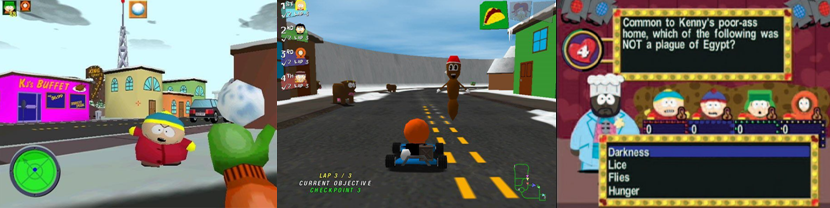
Surprising no-one, I’m sure, but I have been a big, big fan of South Park (Stone and Parker, 1997 to present) since it first started airing on television. Over the years, the show has gone from strength to strength and, even though the last couple of seasons haven’t been as good as others (the show’s fascination on giving Randy such a large role at the expense of the kids is a little annoying), I still make an effort to tune in when new episodes air and appreciate how Matt Stone and Trey Parker have tried to do new things with their controversial series to spice things up a bit. South Park has, however, had a tumultuous history when it comes to videogame adaptations. Back in the day, for some unknown reason, the show was first adapted into a first-person shooter; South Park (Iguana Entertainment/Acclaim Entertainment, 1998) allowed players to control Stan, Kyle, Kenny, or Cartman as they traversed a number of landscapes practically swamped in fog as they battled against a slew of enemies inspired by the first series of the show. It was…okay…but hardly evocative of what the series was known for. Following this, South Park dabbled with a videogame genres, including a quiz/party game in South Park: Chef’s Luv Shack (Acclaim Studios Austin/Acclaim Entertainment, 1999) and a pretty entertaining kart racer with South Park Rally (Tantalus Interactive/Acclaim Entertainment, 1999), before striking gold with the fantasy/RPG genre in South Park: The Stick of Truth (Obsidian Entertainment/Ubisoft, 2014).

SouthParkFracturedStick
Stick of Truth was a great title let down only by its length.

Stick of Truth benefitted from three very simply ideas: simple but surprisingly deep controls and turn-based gameplay mechanics, a close collaborating with Stone and Parker on the content of the title, and presenting itself as a continuation and extension of the show. If there was one thing going against Stick of Truth, it was that it was too short; I was perfectly happy with how easy the videogame was, as it meant playing through as a breeze and extremely fun, but it definitely felt like it ended a few hours too short. Luckily, Stick of Truth was received well enough to justify a sequel; it took a while but we finally saw this in the form of South Park: The Fractured But Whole (Ubisoft San Francisco/Ubisoft, 2017), which was directly tied into season twenty-one of the show. Picking up pretty much the very next day from the ending of Stick of Truth, Fractured But Whole sees the boys ditch the fantasy game they were playing in favour of creating their own superhero franchise; your avatar, the New Kid, is then drafted into Coon and Friends and charged with proving himself (or herself…) once again.

SouthParkFracturedScrambles
When Scrambles goes missing, Coon and Friends assemble!

The Coon and Friends have a simple objective: find the lost cat, Scrambles, and be the most successful superhero franchise in town. Opposing them are the Freedom Pals, who want exactly the same thing but refuse to follow Cartman’s lead, and various other enemies such as the Sixth Graders, the malevolent Crab People, homeless bums, ninjas, and waitresses from Raisens. However, due to the New Kid’s very real superpowers and mysterious origins, the kids soon become embroiled in a plot by Mitch Conner to take over the town using cat pee and end up travelling through time in order to set things right.

SouthParkFracturedMap.PNG
There’s plenty to do in South Park.

Technically speaking, Fractured But Whole isn’t much different from Stick of Truth; all of South Park is once again available to explore, with some new additions like SoDoSoPa, the Shi Tpa Town, and Mephisto’s laboratory, and some exclusions, such as the South Park Mall and Canada. The town is full of non-playable characters, including all of the recognisable and familiar faces from the show, and you are encouraged to interact with them all to gain access to side quests or take a selfie to post on Coonstagram, increase your followers, and therefore improve the reputation and reach of Coon and Friends.

SouthParkFracturedCombat
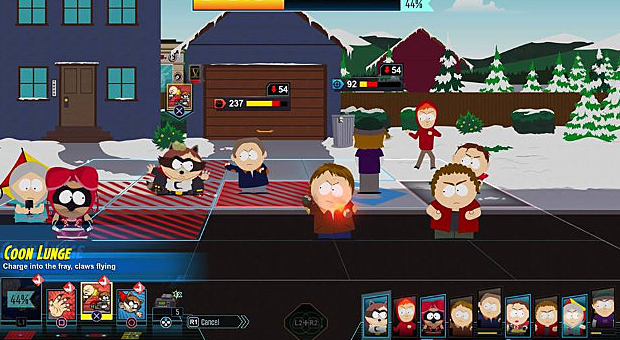
Combat now involves navigating a grid.

The turn-based mechanics of Stick of Truth return but with a twist; the awkward move wheel and restrictive battlefield are gone, replaced with a simple horizontal interface and a grid that players can freely move about. The party has also increased from two to four (or even five or six, in some cases), allowing for more varied combat, and attacks can be targeted against groups of enemies across the grid to deal additional or knockback damage. It’s a great overhaul that allows for a real sense of strategy and thought to be put into early battles; once you have levelled up enough and mastered the game, however, battling becomes less about strategy and more about using the most powerful attacks to sweep the opponent as quickly as possible. The gameplay remains as simple as before but, as with Stick of Truth, the mechanics cane be surprisingly deep. Players can pre-emptively fart on or strike enemies for a turn or combat advantage, inflict bleeding, burning, vomiting, freezing, or confusion upon opponents, and are encouraged to use a variety of different abilities to win battles. Some enemies, for example, are immune to status afflictions; some bosses cannot be attacked directly and must have enemies hit into them to damage them; and some battles involve the player being pursued by an invincible opponent.

You can mix and match from a variety of superhero classes.

As before, players can choose from a number of classes, now based on popular superhero tropes; the New Kid can be a Brawler or a Speedster, or maybe you’d prefer to be a Cyborg or a Psychic. Each brings different abilities to the combat and results in a funny little training simulation in which Cartman amends and expands upon your simple and crude backstory. Eventually, as you progress, you can dual and even multi-class, gaining access to every available class and all the moves associated with each. You can only assign three moves and one super move, however, so choosing what suits your play style is key. Battling earns you experience points, a handful of cash, items, Artefacts and DNA Strands. As you do no equip weapons like in Stick of Truth, these last two can be equipped to the New Kid to increase or decrease certain attributes (Strength, Health, etc) or affect your abilities, and those of your party, in combat. Eventually it comes down to equipping the most powerful of these but your experience may vary; I always favour boosting attack power and health over speed, but there’s plenty of choice here.

SouthParkFracturedYaoi.PNG
Gotta find those Yaoi pictures.

You can also buy and/or pick up various items and junk all around the town to be used in the game’s deep crafting system; this is where you will craft health, revives, power-ups, mission-specific items, and even Artefacts. It’s fun to explore and pick up everything you see and the cost of crafting these items decreases the more you play and the more you invest. You can search every square inch for yaoi pictures of Tweek and Craig, which replace the Chinpokomon collectables from Stick of Truth, unlock buddy assist moves to clear lava (red Lego bricks) and reach new areas, and learn new fart techniques to assist you in opening new areas, advancing the plot, or for use in combat,

SouthParkFracturedRace
You can change your profile at any time, that’s fine.

The player is given complete freedom to design their avatar from the ground up; the New Kid, silent as always, is completely customisable, from the type of hair or headwear you want to the superhero outfit and gloves. You are also tasked with filling out the character’s profile; this involves talking with Mr. Mackey at various points to determine your gender, race, phobias, and sexual orientation; while these don’t necessarily massive impact how the game is played and can be altered at any time, choosing to have a black avatar is set to be the game’s Hard mode, which is fitting for South Park’s controversial sense of humour. Fractured But Whole is a big, involved title, easily answering my desire for a long gameplay experience through the main story campaign. While the plot is arguably not as strong near the end (the finale just kind of…happens…and the game ends), the story is an enjoyable and fun experience. Just wandering around town, looting through people’s houses and playing the toilet mini game is a blast and, like before, it really is like playing an episode of the show.

SouthParkFracturedDLC.PNG
There’s some decent DLC available.

This time around, we also got some quite substantial downloadable content; not only can you unlock addition costumes and gear from Ubisoft’s Club, you can also pay to download a combat simulator and two additional story-based campaigns. One sees you uncovering a mystery at Lake Tardicaca, the other sees you battling vamp kids at Casa Bonita. Both are lengthy and involved, bringing new character classes and abilities to the entire game, and well worth the purchase. Also, if you’re lucky enough to buy the game with the code inside of it, you can download a digital copy of Stick of Truth when you purchase the title, making this a no-brainer for any South Park fan.

SouthParkFracturedCivilWar.PNG
Once again, a solid experience overall.

In the end, Fractured But Whole is everything Stick of Truth was and more. Some things are missing or not as prominent but the additions far outweigh the exclusions; the environments, characters, and writing are all classic South Park, making for an extremely fun experience, especially if, like me, you prefer your RPGs to be a brisk stroll rather than a jungle expedition. This is the way videogame adaptations or tie-ins should be produced, being as close to the source material as possible while still being accessible to all players, making for a win/win experience all around.

My Rating:

Rating: 5 out of 5.

Fantastic