Back Issues [Venom Day]: Ultimate Venom


To celebrate the release of Venom: Let There Be Carnage (Serkis, 2021), Sony Pictures declared September 27 “Venom Day”, a fitting date to shine the spotlight on one of my favourite anti-heroes, who made their first full debut in May 1998 and have gone on to become one of Marvel’s most iconic characters.


Writer: Brian Michael Bendis – Artist: Mark Bagley

Story Title: “Origins”
Published: February 2003

Story Title: “Today”
Published: April 2003

Story Title: “Inheritance”
Published: March 2003

Story Title: “Still”
Published: May 2003

Story Title: “Legacy”
Published: March 2003

Story Title: “Father’s Pride”
Published: May 2003

The Background:
In 1982, Marvel Comics’ editor-in-chief Jim Shooter purchased Randy Schueller’s illustration of a black-suited Spider-Man for a mere $200; writer Tom DeFalco and artist Ron Frenz then conceived of the costume being a living organism Spidey would acquire in the “Secret Wars” event. After he shed the parasitic symbiote, it bonded with disgraced reporter Eddie Brock and Spidey was tormented by Venom, a twisted double who proved so popular that additional symbiotes and storylines spun out of the character’s lore. First proposed by lawyer Bill Jemas, Ultimate Marvel was a secondary imprint of Marvel Comics that ran alongside the main comic line (known as “Marvel-616”) but told their most popular characters’ stories from a fresh, modern perspective to entice new readers and fans of the live-action adaptations of the time. The imprint was spearheaded by Brian Michael Bendis and Mark Bagley’s Ultimate Spider-Man series, which featured a far younger Peter Parker who encountered many of his most notorious villains while still in high school. The series proved incredibly popular, and even survived the eventual destruction of its universe in the form of Miles Morales, and offered a far different, more scientific incarnation of Venom to its universe. The six-issue “Venom” story arc proved so successful that developers Treyarch revisited and expanded upon it for their moderately successful Ultimate Spider-Man videogame (ibid, 2005), which included this version of Venom as a playable character!

The Review:
I think it’s only fair to start by saying that I was never really a big fan of Ultimate Spider-Man, or the other Ultimate comics; the art work was amazing, and I admired how writers like Bendis were able to capture natural, relatable dialogue and how the comics adopted a dynamic, real-world aesthetic. But, for me, the comics were a little too dark, a little bit extreme at times, and rushed through some of Marvel’s biggest storylines and burned themselves out too quickly as a result. The Ultimate Spider-Man comics were especially difficult for me to get into since Bendis packs so much dialogue onto the page, sometimes having a single splash page of a character talking and a good 80% of the background being dominated by a huge speech bubble. Either that or he’d have characters barely able to string sentences together, which, again, is very realistic and indicative of real-life conversations but can make reading the comics a bit of a chore as relatively simple storylines are dragged out across multiple issues simply for the sake of drama. However, having said all that, Mark Bagley is one of my favourite Spider-Man artists, so I absolutely had to seek out the “Venom” story arc to see him working on the character again and he definitely made this younger, far more flawed Spider-Man all the more impressive and dynamic with his explosive and visually engaging art.
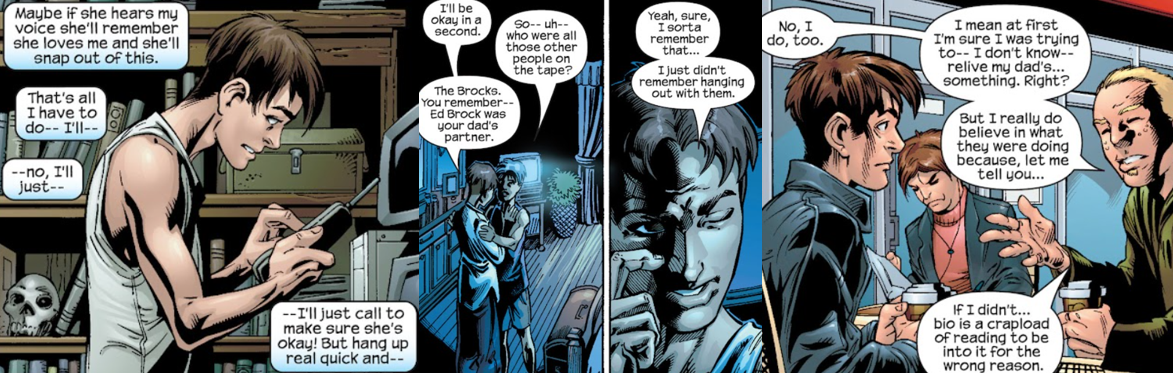
Following a painful break up, Peter reconnects with a childhood friend.

Anyway, the “Venom” arc comes at a time of great upheaval in Peter Parker’s life; already struggling with high school and the guilt of indirectly causing his beloved Uncle Ben’s death, Peter is burdened by his part in the death of heroic police captain George Stacy and has recently been dumped by his long-term friend and on-and-off girlfriend, Mary Jane Watson, since she can’t handle the pressure of worrying about his web-slinging activities (Peter’s duel identity wasn’t the best kept secret in the Ultimate comics). Peter is left devastated and wallowing in self-pity, doubt, and anger at having screwed up with M. J. While struggling with his tumultuous and self-deprecating emotions in his Aunt May’s attic, he stumbles across a box of photographs of his long-dead father, scientist Richard Parker, and a VHS tape depicting him as a small boy with his parents, his Aunt May and Uncle Ben (depicted as more of a free-spirited hippy in Ultimate Spider-Man), and the Brocks, family friends of the Parkers. Eddie Brock Snr was Richard’s partner on the “Venom Project”, while Eddie Brock Jnr was Peter’s best friend as a child; his memory jogged of his long-lost friend, Peter decides to reconnect with Eddie, who also lost his parents in the same plane crash that killed Richard and Mary Parker, and easily tracks him down thanks to the internet. Awestruck by the bustling Empire City University, Peter meets with Eddie, who’s in a bioengineering program at the university but struggling to live up to his father’s legacy thanks to the workload and the expense of university life.

In a bid to complete his father’s work, Peter finds himself garbed in a protoplasmic suit.

When Peter shares the news of his recent break up, Eddie is a little dismissive, but he’s absolutely right when he says that high school drama is nothing compared to the struggles of the bigger, wider world and he encourages Peter to not let it ruin the best years of his life. Touched by Peter sharing a copy of the video tape, Eddie takes him to a high-tech lab where he’s been working on their “inheritance”, a beaker full of black goo that represents their fathers’ life’s work. Thanks to help from Doctor Curtis Conners, Eddie has pieced together that Richard and Eddie Snr were working on a protoplasmic suit that could (theoretically) cure any disease while simultaneously enhancing the wearer’s natural physical strengths. To fund their research, Richard and Eddie Snr turned to Trask Industries, though this meant that anything they discovered or created would no longer be theirs, and Eddie theorises that they were killed when they tried to keep their project from being perverted into a weapon of war. Eddie’s sample is all that’s left, a small quantity that their fathers worked on in secret, one that was created using Richard’s own DNA and which Eddie fully believes could change the world for the better. Stunned by these revelations, Peter rekindles his friendship with Eddie, who picks him and his house mate and friend, Gwen Stacy, up after school, much to the chagrin of the conflicted M. J., who clearly still has feelings for and cares about Peter. Reviewing his father’s notes and video diaries, Peter snaps when he sees just how distraught his father was at having his research stolen or perverted and resolves to finish his father’s work by breaking into the lab as Spider-Man and taking a sample of the goo to run his own tests. However, a small drop of the liquid splatters onto his hand and a startling, agonising transformation occurs that sees Spidey engulfed by the writhing goo, encased in a monstrous cocoon of sorts, and finally emerging in a sleek, form-fitting black costume.

Peter’s elation soon turns to horror when the suit transforms into a hulking monster!

Spider-Man tests out his new duds by first rescuing a shallow, self-obsessed pop star after she’s held hostage by armed forces in her own limo and then making short work of Herman Schultz/The Shocker. The suit not only greatly amplifies Spidey’s already superhuman strength and speed but allows him to instantly heal from point-blank gun shots and fire black webbing from his fingertips and Peter revels in the power and euphoria offered by his father’s incredible invention. However, things quickly take a turn for the worst when he confronts an armed robber who shoots and kills an innocent man in front of his wife and child; overwhelmed by memories of Uncle Ben’s death, Spidey transforms into a hulking, salivating, monster that hungers for blood and drives him into a mindless rage! Peter’s sense returns in time to spare the man’s life and, horrified by the suit’s grotesque appearance and overwhelming appetite, he flees into the rainswept night, desperately trying to remove it. Luckily, his wild thrashing sees him collide with a set of power lines, which burn the suit off his body and leave him dramatically lying (butt-naked) on the grave of his dead uncle and parents. While all of this is going on, Gwen and Eddie were raving at a reggae concert; afterwards, he tries to put the moves on her and is slighted when she rightly refuses his advances since she’s only fifteen. Any further exploration of Eddie’s inappropriate lusts for the younger girl are quickly dashed when he turns on the news and sees Spider-Man’s fancy new black costume; racing back to the lab, he’s stunned to find Peter there but enraged to find that his young friend is planning to destroy their fathers’ legacy since it’s uncontrollable and dangerous.

Turns out Eddie’s a bit of a creep, and a selfish, jealous dick on top of it!

Eddie’s anger is only exacerbated when Peter reveals that he’s Spider-Man and goes on a lengthy tirade about power, responsibility, and his experiences with just a small sample of the suit. Devastated to learn that his father’s legacy is a volatile and potentially life-threatening substance, Eddie reluctantly allows Peter to take the remainder of the goo and destroy it, apparently convinced of his friend’s sincerity by the little white lie Peter tells that nobody else knows about his secret identity. However, as Gwen so astutely puts it, Eddie is a “bad guy” deep down and, soon after Peter leave, he mutters a bunch of insults at Peter, disgusted by the belief that he’s a Mutant, and willingly exposes himself to a separate sample of the protoplasm he secretly had locked away. Potentially because he lacks Peter’s spider-strength, the transformation is far more unstable and gruesome for Eddie; suffering from extreme cold and overwhelmed with an insatiable hunger, Eddie is bombarded with cruel and negative emotions, and the sheer panic at the realisation that the suit is feeding on him! By focusing on his anger and pain, Eddie is able to force the suit under some measure of control, but he quickly loses his focus when guards show up and transforms into a slobbering, clawed beast that devours people whole! Tormented by nightmarish memories, Peter finally snaps and visits M. J. and the two have a heart to heart in which he tells her that he loves her, but they far from reconcile despite her obviously still having feelings for him. Because of her intimate knowledge of Peter and his abilities as Spider-Man, she’s the only one who notices when he’s distracted by this spider-sense, which alerts him to the presence of the suit on the school grounds; chastising himself for not making sure the suit was completely destroyed, and theorising that it has some kind of “biological memory”, he races out to control it in his street clothes, completely unaware of Eddie’s fate.

Peter is left distraught when Eddie attacks him and appears to die.

Indeed, when Eddie is revealed to be within the thrashing, monstrous suit, Peter is both shocked and appalled that his old friend would willingly subject himself to the suit’s influence. Unlike the mainstream version of Venom, Ultimate Venom is a volatile and almost mindless beast; a pulsating, brutish monster with teeth and spikes dotted throughout its body and whip-like tentacles, it oddly lacks the spider symbol so associated with the character (despite this appearing on the issue’s covers and Spider-Man having it when he wore the suit…and it randomly appearing in one panel…) and is constantly consuming Eddie’s body, feasting upon and fostering his rage and dark emotions to sustain itself. Lashing out in a jealous and embittered rage, Eddie attacks Peter, easily swatting him aside and half-choking him with his tendrils, all while Peter desperately tries to talk sense into his half-crazed friend. Realising that Eddie is out of control and that the suit is simply mimicking his spider abilities and driving him into a murderous fury, Peter leads Ultimate Venom away from the school grounds, lamenting the friends and loved ones he’s lost to “this super hero crap” and wondering whether the suit drove Eddie crazy or if he was always like that deep down. Regardless, they clash on a rooftop, quickly plummeting through some power lines and to the streets below. With Eddie stunned, the suit tries to overtake Peter once more, with Eddie’s distorted rambling claiming that the suit has to kill Peter in order to be whole since Eddie isn’t strong enough to sustain it. The timely arrival of New York’s finest see both peppered with gun fire, which drives Ultimate Venom back towards a live power line and, in a flash of light, apparently incinerates both the suit and Eddie before Peter’s eyes in suitably anti-climatic fashion. Naturally, Peter is also fired upon and, wracked with guilt and pain, he retreats home and ends the story exactly where he started: distraught and in utter anguish at having lost another friend and ruined his life even more thanks to his duel identity.

The Summary:
So, yeah, Ultimate Venom does suffer from some of those negatives that I find off-putting about the Ultimate Spider-Man comics; there’s a lot of dialogue, much of it rambling and disconnected, with at least one page being Peter babbling on and on to Eddie, which really isn’t all that interesting to see or read since we already know everything he’s saying and it just seems like padding. Any time Richard and Eddie Snr are discussing their work, you can expect a whole bunch of speech bubbles to be dotted all over the pages and panels, and there are a few instances where characters are completely static and art work is repeated between panels with the characters just saying different things. It’s a weird one for me as, like I say, I do appreciate and admire the way Bendis captures real, natural, often haphazard character dialogue but sometimes it’s a bit much. One thing that both works for and against the Ultimate comics is how cinematic they often are; panels and events are presented very much like a movie, showing rather than telling in some instances, and then snapping back to a massive exposition dump, with dynamic and exciting action sequences and visuals to help keep things interesting. On the plus side, Ultimate Spider-Man is arguably, subjectively, easier to read than some of the comics from the sixties and seventies since they’re not bogged down with outdated dialogue and such (though there is some of that here, particularly in Gwen’s dialogue) and the presentation is far more energetic, but I can understand why some people don’t really care of these comics as they’re very angsty, teen drama like a high school show.

Peter is definitely full of angst, which sadly limits his Spidey action.

Anyway, that aside, there’s a decent amount to like here; the art, especially, is incredible. Mark Bagley did some of his best work on Ultimate Spider-Man and really makes this younger, more troubled teenaged Spider-Man visually distinct from his mainstream counterpart not just in his haircut but in the physical depiction of Spidey as this gangly, inhuman superhero. Unfortunately, Bagley seems to struggle a bit with faces; a lot of the characters look the same, facially, and there’s a noticeable lack of Spider-Man in this arc. He only suits up a couple of times, and he’s only in the black suit for one issue! This is what I mean by Ultimate Spider-Man rushing through things; 616-Peter had the black suit for four years before its true nature was revealed and, at that point, he was in his early twenties. Here, Peter’s still in high school and has already had impactful encounters with some of his most memorable villains, and he’s in the suit for what seems like only a few hours before it tries to consume him, and he frantically rids himself of it. I’ve read a lot of mainstream Spider-Man stories and Peter is absolutely known for being riddled with guilt, pressure, and angst but his Ultimate counterpart is far more dramatic and melancholy; he’s driven into a self-deprecating, morose depression after M. J. dumps him (which I can totally relate to) and has been pushed to the edge by recent events, which cause him to recklessly experiment with the goo and thus almost be killed when the suit goes mental on him. Realising that he’s made a serious mistake and heartbroken to find that his father’s life’s work is volatile and dangerous, Peter immediately backpedals and tries to make everything right by destroying his dad’s research, which means exposing himself to Eddie and desperately trying to convince his childhood friend to go along with this despite how difficult the truth is to hear.
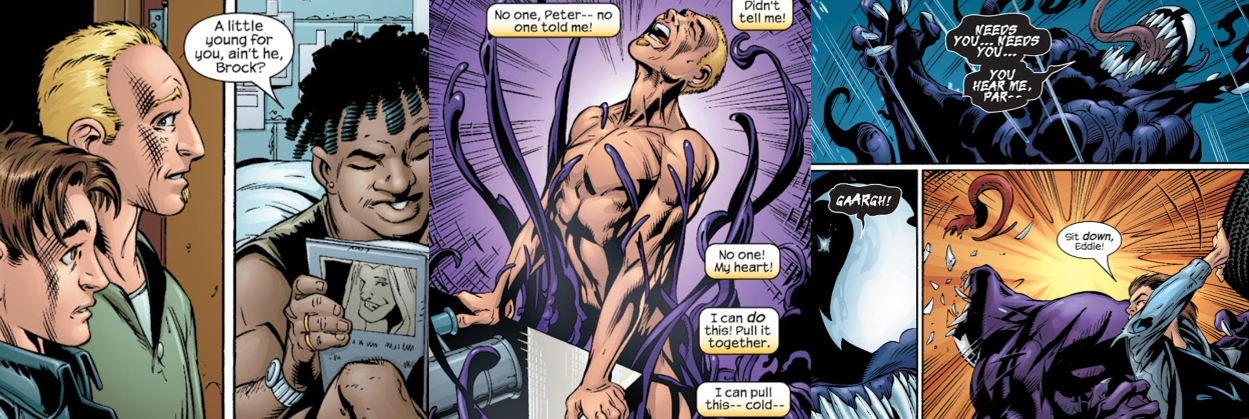
Eddie’s a bit of a weirdo, but Ultimate Venom is nothing more than a mindless beast.

Eddie himself is quite different here. A scientist rather than a discredited reporter, he’s a slender hipster who seems to have really valued his friendship with Peter and who is absolutely fixated on completing his father’s research so that his legacy can live on. There are some red flags raised when it comes to Eddie from the moment Peter meets him at his dorm room, which is a bit of a mess for one thing and shared with another student who has nothing good to say about Eddie. The exact depths of his depravity aren’t revealed until later, however, when he flirts with Gwen and tries to kiss her, then spitefully calls her a tease and dismisses her after she understandably rejects him. Although Peter defends his friend and believes that he’s a good person deep down, this incident is enough to convince Gwen otherwise, and it turns out she’s absolutely right as he’s a bit of a depraved, disturbed young man; bigoted towards Mutants (like most of the Ultimate universe) and ridiculing Peter’s naïvety, Eddie maliciously exposes himself to the goo simply to both prove Peter wrong and to assume the power he described for himself. Instantly, however, Eddie is consumed and driven to madness by this extremely removed version of Venom; little more than a voracious, cancer-like substance, Ultimate Venom is more an amplifier of emotions and abilities than it is a symbiotic life form and simply drives Eddie to confront and devour Peter in order to sustain its unstable and monstrous form out of an innate need for self-preservation rather than any kind of twisted vendetta. This results in a creature that is more of a hulking, primeval brute rather than a sadistic villain looking to make Peter’s life a living hell, though there are some similarities in that Ultimate Venom has apparently copied Spider-Man’s abilities. Ultimately, however, it’s more like a protoplasmic clone of Peter, one spewing teeth and tentacles and going on insatiable rampage, spouting nonsensical accusations and threats but being a far less interesting and layered character in its own right since it’s just a parasitic lifeform that overtakes Eddie.  

My Rating:

Rating: 3 out of 5.

Pretty Good

Have you read Ultimate Spider-Man’s “Venom” arc? What did you think to this new depiction of Venom? Were you a fan of the changes made to Eddie’s character and his more disturbing nature? Were you also disappointed that Peter’s time in the black suit was cut so dramatically short and that he didn’t fight Ultimate Venom as Spider-Man? Did you enjoy the Ultimate comics, specifically Ultimate Spider-Man and, if so, what were some of your favourite moments from those comics? What is your favourite Venom story and how are you celebrating Venom Day today? Whatever your thoughts on Venom, feel free to leave them below.


Game Corner [Spidey Month]: Spider-Man 2 (PlayStation 2)


Easily Marvel Comics’ most recognisable and popular superhero, unsuspecting teenage nerd Peter Parker was first bitten by a radioactive spider and learned the true meaning of power and responsibility in Amazing Fantasy #15, which was first published in August 1962. Since then, the Amazing Spider-Man has featured in numerous cartoons, live-action movies, videogames, action figures, and countless comic book titles and, in celebration of his debut and his very own day of celebration, I’ve been dedicating every Saturday of August to talk about everyone’s favourite web-head!


Released: 28 June 2004
Developer: Treyarch
Also Available For: Game Boy Advance, GameCube, Mac-OS X, N-Gage, Nintendo DS, PC, PlayStation Portable, and Xbox

The Background:
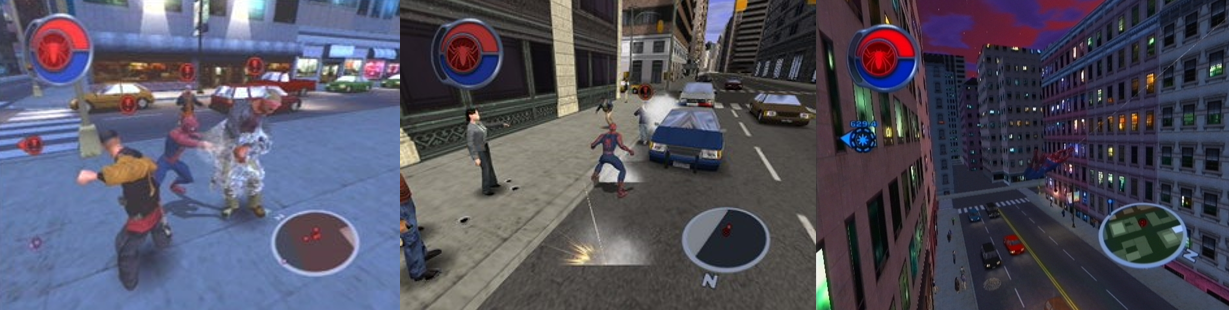
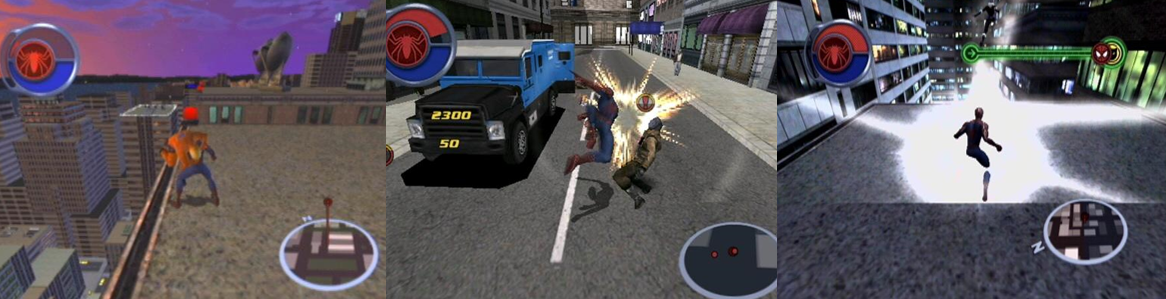
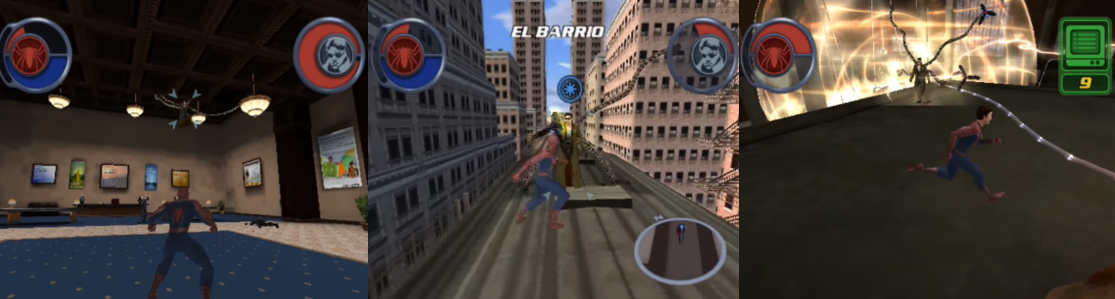
Back in the day, it seemed like every single cinema release was accompanied by a videogame adaptation, whether they warranted it or not. Naturally, considering his popularity, Spider-Man has a long and varied history with videogame adaptations across numerous platforms, and developers Treyarch began development of a tie-in to Spider-Man 2 (Raimi, 2004) soon after the success of the first movie. No strangers to the wall-crawler, Treyarch sought to dramatically improve upon their previous efforts by incorporating a large populated recreation of New York City, expanding on the film’s story, and placing a heavy emphasis on Spider-Man’s web-slinging. The new system, which utilised ray casting to automatically map infinite points where players could attach webs to swing from, was developed by designer Jamie Fristrom and has long been the subject of praise amongst fans of the videogame, and the character. Indeed, Spider-Man 2 has been met with a surprising amount of positivity for a videogame tie-in; while some of the more repetitive aspects were criticised, reviews praised the combat and controls, seamless open world and mission variety, presentation, and even the minigames. Even in the face of its bigger, more graphically impressive successors, Spider-Man 2 is often lauded as one of the character’s greatest videogame outings; the praise for this game is so great that I was actually a little intimidated to try it out for this review, which is my first time actually playing it.

The Plot:
Two years after the events of the first game, Peter Parker is struggling with his personal life and his responsibilities as the superhero Spider-Man. Unable to ignore the threat posed by criminals and supervillains alike, Peter’s social life begins to suffer, but his powers are put to the ultimate test when renowned scientist Doctor Otto Octavius becomes a four-limbed madman and threatens the entire city!

Gameplay:
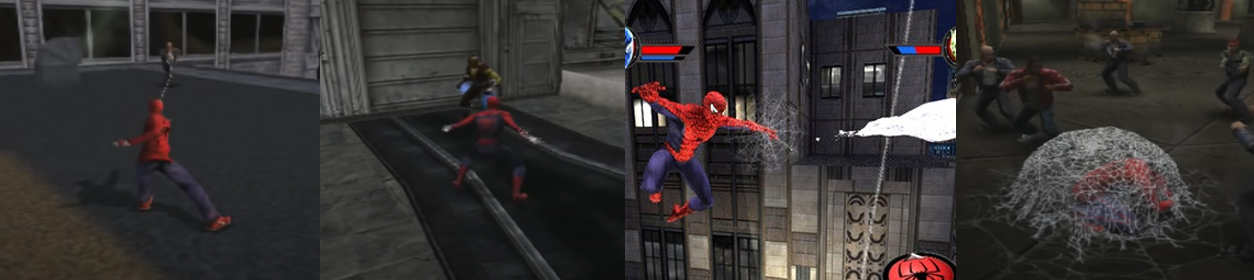
In a change of pace from its predecessor, and basically every Spider-Man title released up until that point, Spider-Man 2 is an open-world adventure in which you’re given free reign to use all of Spider-Man’s amazing abilities throughout one of the largest and most faithful digital recreations of New York City ever seen at that time. Unlike the previous game, which was basically a reskinned version of Neversoft’s fun but limited 2000 adaptation of the web-slinger, Spider-Man is hardly ever trapped in an enclosed environment and thus a primary focus of Spider-Man 2 is on swinging around the city, stopping random crimes and helping non-playable characters (NPCs) with various issues. Thankfully, Spider-Man is more than equipped to handle everything the game has to throw at him, and the controls and combat options have been revised to accommodate this new focus. Spider-Man can attack enemies or interact with objects and NPCs with the Square button; successive presses in conjunction with directional inputs and the Triangle and Circle button will see him pull off combos, often involving webbing and tossing his enemies, and you’ll awkwardly home in on the nearest enemy when in air combat as well. You can stick to walls by pressing Circle, which is also used to evade incoming attacks and bullets whenever Spider-Man’s spider sense goes off (as indicated by his glowing head); this also fills up your “Spider Reflexes” meter and allows you to execute a counter attack but I found evading (and the combat in general) to be a little clunky and haphazard at times, especially as even New York’s most common thugs can take quite a beating and even block against your attacks. Triangle shoots a web; holding the button will temporarily tie enemies up, pressing up and Triangle fires a ball of impact webbing, and you can even use your webs to disarm foes, though it’s next to useless against most bosses and mechanical enemies. Spider-Man jumps with X; pressing it twice performs a double jump and you can hold the button to charge a big jump and executing a jump at the apex of a web sling is crucial to covering vast distances when swinging about. Holding down L2 sees Spidey spring or get a boost to his swing, Triangle (and in conjunction with Circle) will allow you to pick up injured NPCs or grapple thugs, and you can press down to lock-on to nearby targets.

Combat is much improved but the highlight of the game was the ground-breaking web-slinging.

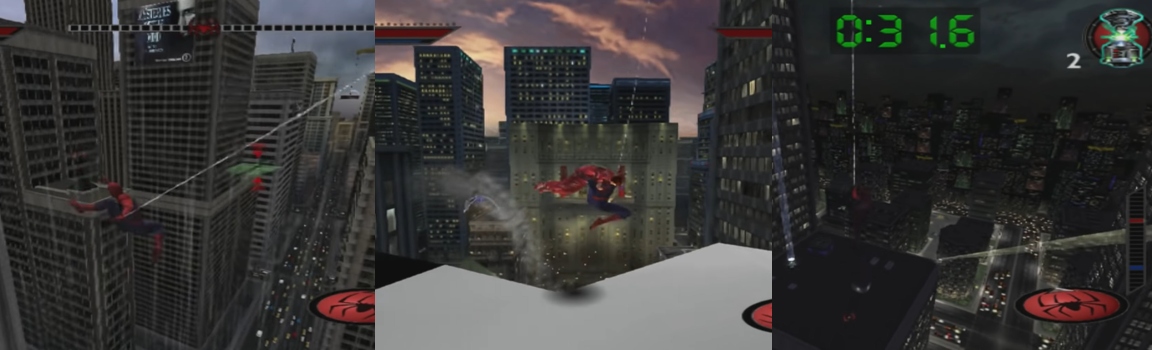
Once the aforementioned meter has a bit of blue in it, you can press L1 to activate your Spider Reflexes, which effectively functions as a form of bullet time, slowing down the action until the meter depletes or you press L1 again and allowing you to better dodge and attack enemies. The meat and potatoes of the game, though, is in the web-slinging; the game offers two options for this, “Easy Swinging” and “Normal Swinging”, with the latter requiring more input from the player to direct Spider-Man’s swings. Either way, R2 sees you throwing a web and swinging through the city but, unlike in every other Spider-Man game before this, you can only web-sling when there are buildings or suitable purchase holds nearby. This means you’ll see Spider-Man veer to the left or right as he shoots webs at the nearest building and allows for the most realistic and innovative web-slinging ever seen. Spider-Man can also eventually web-zip by pressing L2 and R2 together to quickly cover flat distances and you can easily speed through the skyscrapers by attaching to buildings and gaining extra height with your jumps, though you can’t clamber up your web as you swing as in other games, which can make chasing through the city a bit frustrating at times. Equally annoying are the number of dead ends and the various heights of the city’s buildings, which can interrupt your flow; thankfully, the onscreen mini map is a great help for getting around and spotting crimes in progress, side missions, and directing you towards your next story-based objective. You can review these at any time from the pause menu and expand the map out by pressing ‘Select’; this displays the current time and all landmarks and places of note, but sadly doesn’t include the option to place waypoints so you still have to manually read the map and follow the onscreen indicators to get to objectives. Spider-Man 2 is split into chapters, beginning with a simple and in-depth tutorial where Bruce Campbell’s disembodied and snarky voice teaches you the fundamentals of gameplay. To progress through the story, you need to complete story-based objectives; generally, this amounts to following the compass to a certain place in the city to advance the story or confront a boss, but you’ll also need to earn “Hero Points” and acquire new abilities from the various shops dotted across the city.

There’s always someone in peril, or a crime to stop, or a race to be had.

Hero Points are earned from stopping crimes, rescuing civilians, completing time trial races, and other similar distractions; it’s a bit annoying that the game effectively grinds to a halt while you work to obtain the required Hero Points, but you get a fair amount for each side quest you complete and it’s not as if you’re short on things to do. It seems someone’s being mugged or needs help every thirty seconds, and you’ll often stop a burglary only for a child to lose their balloon across the street or an armoured car be attacked a block over. Sometimes, you’ll help an NPC only to be jumped by a gang of thugs in a sneak attack; other times, criminals will hijack vehicles to make a quick getaway and you’ll need to chase them down and land on top of the car, which can be tricky unless you lock-on to it. Once on the roof, you need to pound away with Square and dodge their bullets with Circle until they’re forced out for a fistfight and, as the story progresses, you’ll find burglars and shoot outs often culminating in one of these chase sequences. You’ll also run into Felicia Hardy/Black Cat numerous times throughout the story; each time you do you need to chase after her as she leaps and grapnels around the city, which can be aggravating as she makes erratic turns and it’s difficult to stay on the rooftops. Similarly, you’ll need to chase after Dr. Octopus when he makes an escape in a helicopter and can take on timed challenges where you must race through rings, and the game’s pretty unforgiving, slapping you with failure if you even remotely fall behind or stay too far. More often than not, you’ll face a timer as you race to story-based locations, with the final race to Dr. Ock’s lair being the tightest of them all, or be asked to deliver pizzas and swing over to specific points on the map or skyscrapers to automatically take pictures, or will have to quickly crawl up buildings to rescue civilians in danger or falling, or quickly take injured civilians to the hospital. There’s quite a lot to do in this regard, and it’s fun to pop over to the Daily Bugle and change to Peter Parker in the men’s toilets, but the variety of these side missions soon wears thin as you repeat the same cycle of requests over and over but with more enemies or a tighter time limit.

Graphics and Sound:  
It’s obvious that a lot more time and effort went into Spider-Man 2 compared to its predecessor; most videogame tie-ins suffer from a rushed development schedule, and this is often reflected in their length, variety, and presentation but Spider-Man 2 does pretty well in all three regards. Spider-Man’s character model is much improved compared to the last game, with far more animations when he’s web-slinging and battering crooks on the streets; Spidey even runs along buildings when he swings close, can perform a variety of mid-air tricks with well-timed jumps, and NPCs will even automatically dodge out his way and throw insults at him when he runs or swings through the streets. Sadly, the enemy models and NPCs don’t fare nearly as well; you’ll see the same polygonal faces and voices repeated over and over, but it’s hard to begrudge this as this was symptomatic of the games of this era. What I can’t defend, however, is the soundtrack and voice acting; once again, the game opts for a soundalike to Danny Elfman’s iconic Spider-Man score that just doesn’t work as well and suffers from awkward looping or disappears entirely for no reason. Only a handful of the movie’s actors returned to voice their polygonal counterparts as well; while Alfred Molina continues to shine as Dr. Octopus, both Tobey Maguire and Kirsten Dunst sound bored to death recording their lines, though I did enjoy that Spider-Man throws quips and monologues to himself as you play. When the character models are used for in-game cutscenes, the game also falls apart under close scrutiny, though the higher quality cinematics fare much better, despite the rubbery appearance of the models, and I liked how the film’s events were recreated but also altered and expanded upon here, even if sub-plots like Peter losing his powers were dropped.

It’s lucky for the ropey cutscenes and voices that the digital recreation of New York is so good.

Naturally, the game’s biggest selling point is the sprawling and bustling recreation of New York; all the landmarks you associate with the city are present and accounted for, alongside recreations of locations from the films such as Peter’s apartment, the Daily Bugle building, Dr. Octopus’s pier lair, and the pizza parlour (though relocated and redesigned here). Not only can you web-sling across the city without any noticeable slowdown or load times, the game also includes a day and night cycle and the story is geared towards pushing you to visiting new areas, such as Roosevelt Island, the Statue of Liberty (accessible only by hitching a ride on a helicopter or using Mysterio’s UFO-like drones), Central Park, and Oscorp. 90% of the game takes place outside amidst the city skyscrapers; traffic and pedestrians mingle around down below, crime is rampant, and the enemies you encounter even change as the story progresses. While you can only enter a handful of buildings, those that you can offer some rewards, such as interacting with the Daily Bugle staff for tasks or purchasing upgrades. The handful of other times you’re forced into a warehouse or an open-air stadium, it’s for a close-quarters boss battle or to take on one of Mysterio’s challenges, meaning the only interior of any real note is Mysterio’s madcap “funhouse” that sees you venturing into a hall of mirrors and through upside-down environments. The thrill of swinging through New York is definitely palpable but I’d be lying if it doesn’t lose its appeal pretty soon; with no options for fast travel and only one real collectible on offer, there’s not really much to see beyond the digital recreation of the city or to do beyond stopping the same crimes over and over.

Enemies and Bosses:
As you swing about the city in your colourful underoos, a gaggle of the dregs of society will inevitably crawl out of the woodwork to cause trouble in the streets. New York is rife with purse snatchers, bank robbers, and armed gangs who love to rob armoured cars and get into shoot-outs with the cops or hijack passing cars and you’ll get to beat the ever-loving piss out of them all multiple times. Most enemies you encounter will simply try to bash your head in, but others have crowbars and bats or can guard against your attacks, requiring you to execute a counter after dodging their attacks. The worst are those armed with guns as Spider-Man doesn’t do too well when riddled with bullets, so it’s best to either disarm them, web them up, or try to take them out early, which can be easier said than done when you’re literally surrounded by enemies on all sides. Eventually, New York will also be attacked by Mysterio’s robotic drones, which fly about the place and blast at you with lasers; these can be tricky to hit as mid-air combat is actually less refined than in the previous game in many ways, though that weird homing function comes in handy here. Herman Schutlz/The Shocker’s goons also end up terrorising the citizens as well, firing high velocity blasts to send you flying, and all of the game’s enemies except the robots can take quite a beating before they go down. You’ll also have to contend with three mech-wearing goons in one particular mission that sees Spidey and Black Cat gate-crash an auction. This mission is one of the game’s toughest, on paper, due to the sheer number of bullets, enemies, and explosions happening all around you but an easy way to get past it is to simply swing about back and forth overhead; eventually, the mechs will take each other and most of the other enemies out, leaving you to pick up the scraps.

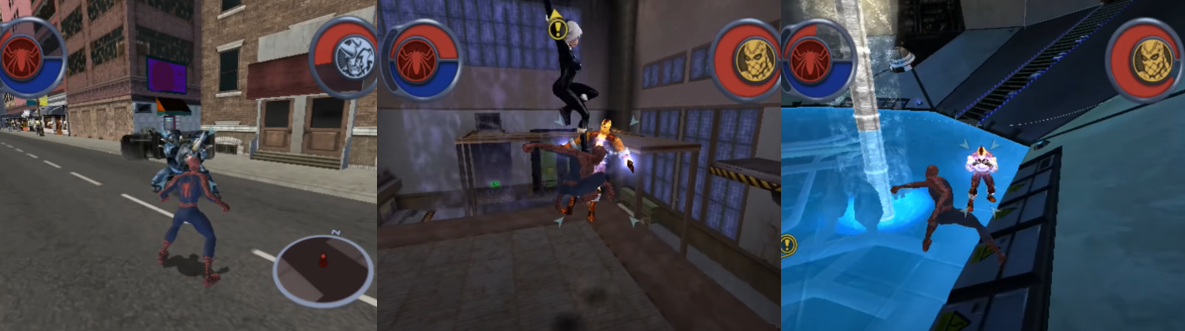
After tangling with the Rhino, Black Cat lends a hand in two annoying battles with the Shocker.

Disappointingly, though, Spider-Man 2 only contains four actual bosses, but you’ll face some of them more than once, at least. The first one you battle is Aleksei Sytsevich/The Rhino as he’s in the middle of a bit of thievery; the Rhino is too powerful to take on head-first so you need to rapidly tap Circle to avoid his swings or dodge his charge, both of which will leave him dizzy and vulnerable to a good pummelling. Instead of fighting Black Cat, you’ll chase her across the city (so many times that it got legitimately annoying for me) to encounters with the Shocker, who you’ll battle twice alongside Black Cat. The first fight takes place inside a warehouse and sees the Shocker blasting himself about the place, constantly staying on the move and making himself a difficult and annoying target. When you do get close to him, you only have time to rattle off a quick combo before you need to get the hell away from him to avoid his huge concussive blast, which sends you flying. The Shocker’s blasts are also used to keep you at bay, he shrugs off your webbing, and is joined by some goons in this fight, which quickly becomes laborious because of the hit and run tactics. Sadly, you’re forced to repeat these in the second encounter, which takes place in an even smaller, enclosed arena where the Shocker is protected by a shield. You need to head up top, dodging his blasts when your spider sense goes off, and activate whatever console is opposite from the one Black Cat is at to lower his shield. These weird blasts of water (or energy, I couldn’t tell) form platforms in the middle of the arena, giving the Shocker the high ground, but the same strategy as before is needed to whittle his health down. Eventually, Black Cat will shut his shield down for good, meaning you’re on the home stretch, but she doesn’t really seem to actively do damage to him when she’s attacking him.

Mysterio’s “tests” prove to be frustrating test of your patience.

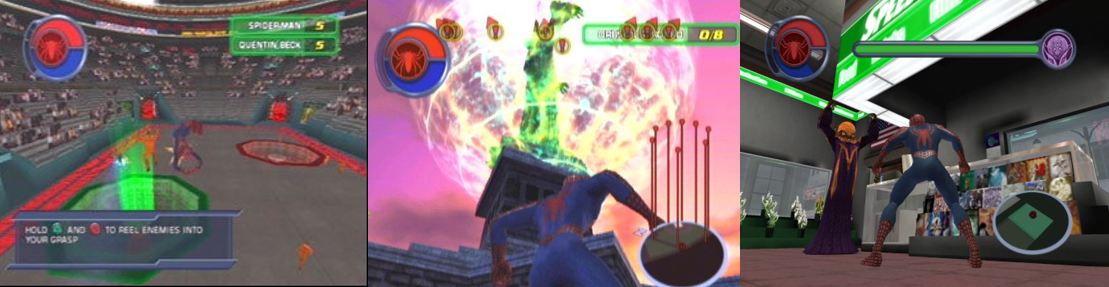
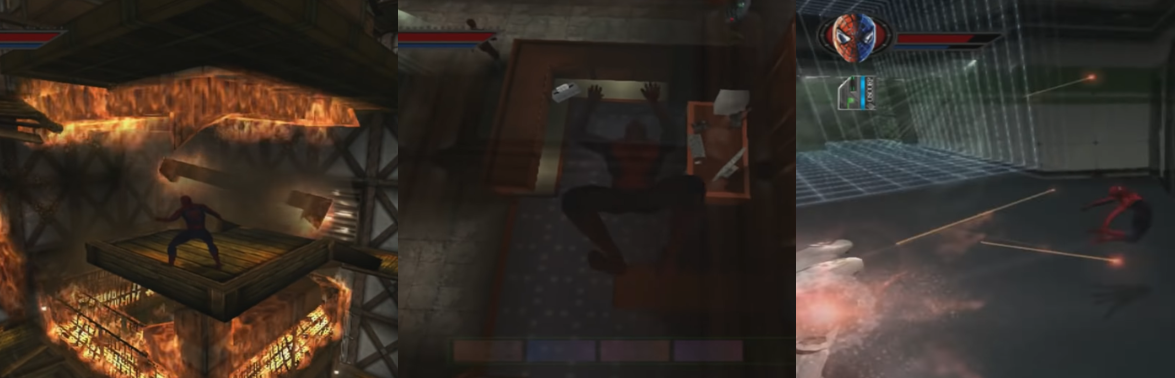
Easily the game’s more persistent enemy is Mysterio; when you first face him as plain old Quentin Beck, he challenges you to a series of “games” in an effort to prove Spidey’s a fraud, which involves you grabbing and tossing goons into green highlighted pits faster than him in a game of human basketball and then clambering about on elevated, moving, and twisting platforms trying not to get hit by his laser cannon. The second time, he swarms New York with his UFO-like drones and takes hostages at a theatre; this was an annoying section as you have to fend off his drones, watch out for a flaming floor, and battle a brief time limit to rescue everyone there but it’s nothing compared to when he encases the Statue of Liberty in an elaborate mechanical construction to resemble an alien attack. I was tearing my hair out at the finnicky controls as I webbed my way over the Lady Liberty and fell countless times into the water to be washed ashore and have to start all over, and near enough lost my rag when tasked with destroying the eight orbs surrounding Mysterio’s machine to expose the “brain”. Eventually, I was somehow able to gain enough height to get up there and take them all out and then get up to where the brain is before the orbs could respawn and dispel the illusion, but it was a pain in my ass, for sure. Afterwards, you track Mysterio to his apartment and hidden funhouse lair, where you have to fend off a swarm of twisted Spider-Man clones to find a hidden exit in his hall of mirrors and shut down his hologram. Finally, Mysterio shows up in the flesh later in the game to rob a deli; this was actually really amusing as the game loads in this ridiculously long and layered health bar and makes it seem like it’s going to be this long and epic showdown but all you have to do is punch him once and Mysterio folds like a paper plane.

Thanks to his thrashing limbs and raging machine, Doc Ock proves an aggravating and formidable foe.

Finally, there’s the main man himself, Dr. Octopus, who you encounter four times throughout the game. The first encounter is during the mishap with his fusion experiment and is one of the most frustrating parts of this or any other game; the reactor is going crazy, sending out intermittent energy bolts that you must dodge the second your spider sense goes off as these pulsating waves of energy that not only do massive damage (three hits is usually enough to kill you) but send you flying across the screen! Through a combination of luck, timing, and the patience of a saint, you need to dodge past all this shit and hit four consoles to power the machine down, but this almost had me rage-quitting right then and there. Next, you’ll fight Dr. Octopus and his grenade launching goons at the bank, which establishes the strategy you’ll need to best him in all encounters; you need to dodge his tentacles and then quickly fire a web to pin each one down and leave him vulnerable to attack, but this is very hard to do and he’s easily able to grab you, slam you about, toss you around, and beat you to death in just a few hits. After chasing his helicopter and rescuing Aunt May from the train tracks, you’ll battle Doc Ock on the roof of a train just like in the film…eventually, because first you need to battle the game’s controls and camera to actually get on the damn train! Here, it’s more of the same and actually a little easier than the last encounter except for the fact that Doc Ock can toss you off the train if he grabs you. Finally, it’s the worst of both worlds at his pier lair as Doc Ock relentlessly chases you, protected by a shield generated from his rampaging machine and able to spam-beat you to death in the blink of an eye if you don’t constantly keep moving, dodging, and webbing him up. You need to deactivate nine consoles scattered about the lair, with one high above and one down below near the instant-death water, all while avoiding the electrical bolts, the thankfully less damaging but no less annoying energy waves, and Doc Ock himself. Once you finally take care of that, you’ll go one-on-one with him again where you’ll need to be super fast on the dodge and webs to stop his relentless thrashing tentacles and avoid being tossed into the aforementioned water, but once you land a good few combos he finally goes down for good.

Power-Ups and Bonuses:
In the spirit of the movie upon which it is based, Spider-Man has an infinite supply of webbing in Spider-Man 2 so you never need to worry about collecting extra web cartridges, though the game does lack some of the fancier web-based moves potentially as a result of this. Every time you defeat a wave of enemies in side missions, they’ll drop some health to fully restore your health bar, but these won’t be present in boss encounters, which can make them all the more frustrating. Additionally, while there are “secrets” to be found around the city, they simply grant a few more Hero Points so there’s no pick-ups to boost Spidey’s abilities. Instead, you’ll gain new buffs, tricks, combos, and such by spending Hero Points in the many shops scattered around the city; these increase the speed of your swing, add fancy moves to your jumps, and add a little more flourish to your combos but I found little use for most of them and got along pretty well just mashing Square and peppering in the odd Circle and Triangle here and there.

Additional Features:
As mentioned, there are many secrets dotted around the city; these are pretty hard to find, and I only stumbled upon three or four by chance but they do allow access to a couple of new moves. There are also some races and timed challenges you can take on for more points, and which probably count towards you achieving the list of “Awards” offered by the game (though most of these are story-based). Although there are some options available to you to change the game’s display, sound, and control scheme, there are no difficulty settings here, no costumes to unlock (though you do get to play as Peter and unmasked Spidey in the story), and no additional characters or modes to unlock or play as even using cheats. The best on offer here is a code to award you a bunch of Hero Points and upgrades, making this a significant step down not just from the last game but Neversoft’s previous efforts with their many additional costumes and modes. However, after you clear the game, you’re dropped back into a free roaming mode and are free to stop crimes until the end of time across the city; you can also purchase access to the Battle Arena where you can not only battle the game’s bosses in endurance fights but also face off with a secret additional boss, Calypso Ezili/Calypso, though I’ll leave it up to you to decide if this is actually worth your time.

The Summary:
All I’ve heard since 2004 is how great Spider-Man 2 is; it either tops or is included in so many “best of” lists for videogame tie-ins and superhero videogames that I knew I had to get it once I started building my PlayStation 2 library, even though I am primarily against videogame tie-ins unless I’m trying to increase my Gamer Score. The difference between this and the last game, and other Spider-Man games before it, is immediate and reinforced throughout; the sheer size of New York City and the number of crimes to stop is very impressive for the time and never before has a videogame so perfectly captured the rush of being Marvel’s famous web-slinger. The drama and crime even interrupts the story on numerous occasions, really throwing you into Spidey’s troubled shoes, and the web-swinging mechanics definitely live up to all the hype. The versatility and accessibility of swinging through the city was unparalleled at the time and perfectly recreates the speed and exhilaration of the web-slinging seen in Sam Raimi’s films. Sadly, the combat doesn’t really live up to this, being clunky and oddly unbalanced at times even when you manage to land a dodge and a counter. Naturally, character models and cutscenes haven’t aged too well, but I can forgive that; what I can’t forgive is how empty, repetitive, and frustrating parts of the game can feel. It’s great having all of New York to explore, but there’s not a lot to see and you’ll be stopping the same crimes over and over, which can get very old very quickly. I would’ve liked to see comic book covers and other collectibles scattered about to unlock costumes and concept art, but there’s none of that here, meaning there’s little incentive to explore. The few bosses there are can also be annoying; I got so sick of chasing after Black Cat, being tossed about like a ragdoll by the Shocker and Dr. Octopus’s bloody machine, and being mullered by bullets, to say nothing of that God-awful encounter with Mysterio at the Statue of Liberty. The game was also a lot shorter than I was expecting, with the gameplay padded out by the story forcing you to acquire Hero Points to load in the next chase, battle, or cutscene, and I found myself just feeling relieved when the game was over. Overall, I can certainly see why the game was so beloved at the time and is so highly regarded; it still holds up pretty well, despite some obvious flaws, and was the most immersive Spider-Man game at the time, but it’s obviously been overshadowed by better, more polished Spidey title sin the years since.

My Rating:

Rating: 3 out of 5.

Pretty Good

Have you ever played this beloved tie-in game? What did you think to the open-world gameplay and web-slinging mechanics back in the day? Do you think Spider-Man 2 still holds up today or were you also frustrated by some of its more tedious features? What did you think to the battles against Mysterio, the chases against Black Cat, and the encounters with the Shocker? Were you disappointed by the lack of unlockables and additional gameplay options? Which Spider-Man videogame or movie adaptation is your favourite? Head down below to share your thoughts and memories of Spider-Man 2.

Screen Time [Venom Day]: Spider-Man (1994): “The Alien Costume” (S1: E8-10)


To celebrate the release of Venom: Let There Be Carnage (Serkis, 2021), Sony Pictures declared September 27 “Venom Day”, a fitting date to shine the spotlight on one of my favourite anti-heroes, who made their first full debut in May 1988 and have gone on to become one of Marvel’s most iconic characters.


Season One, Episodes Eight to Ten:
The “Alien Costume” Saga

Air Date: 29 April 1995 to 13 May 1995
Network: Fox Kids Network
Stars:
Christopher Daniel Barnes, Hank Azaria, Roscoe Lee Browne, Don Stark, Jim Cummings, and Edward Asner

The Background:
Given that Marvel’s resident wall-crawling hero proved to be popular enough to receive his own self-titled comic book barely a year after his blockbuster debut, it’s perhaps no real surprise that Peter Parker/Spider-Man has featured in a number of cartoons over the years. Nowadays, it seems like Spidey gets a new cartoon every other day of the week but, when I was a kid, his 1994 to 1998 cartoon was a must-watch piece of weekly entertainment. Produced by Saban following their success with the X-Men animated series (1992 to 1997), Spider-Man (or Spider-Man: The Animated Series) was a fresh and fun adaptation of many of the web-head’s greatest adventures, even if it was a little hampered by some unnecessary censorship. Given that I was super into Venom at the time, it’s no surprise to me that the cartoon’s introduction and depiction of the character rank as some of its best episodes; so popular were Venom at the time that they were introduced in the first three-part saga of the series (and well before the creators adapted the “Secret Wars” comic) and even returned for a two-part follow-up a year later.

The Plot:
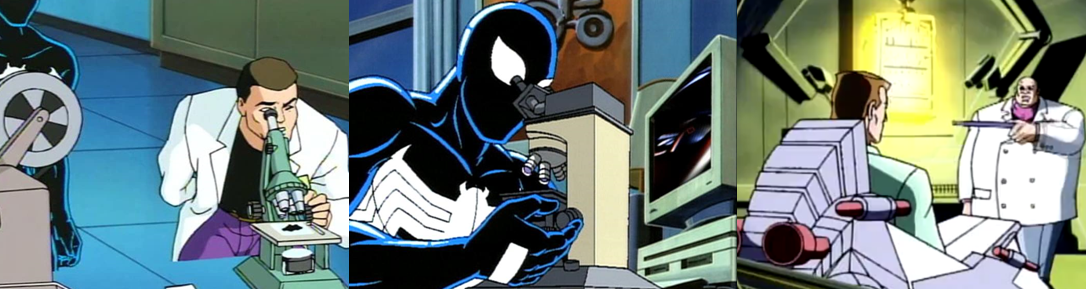
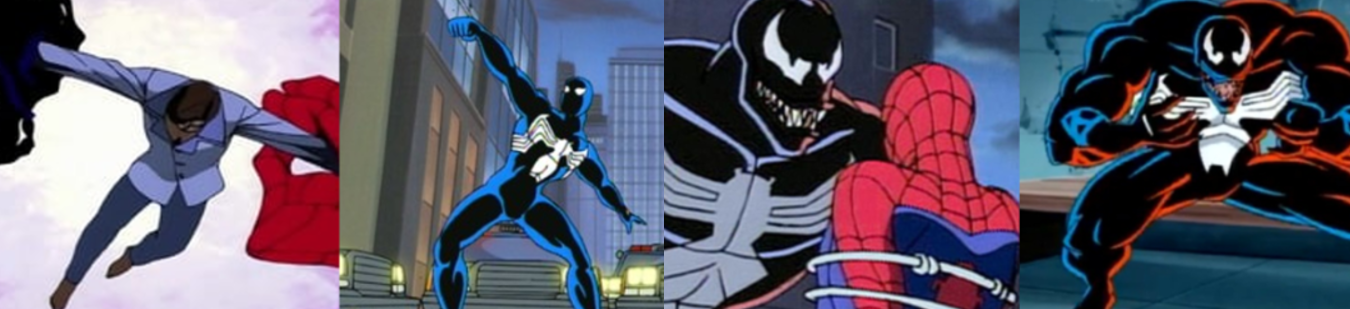
After rescuing astronaut Colonel John Jameson (Michael Horton) from a shuttle crash, Spider-Man (Barnes) finds his costume and abilities augmented by a mysterious black goo. When Wilson Fisk/The Kingpin (Browne) sends a number of super-powered goons to retrieve the “Promethium-X” Jameson brought back to Earth, Spidey finds his aggression and character altered by the suit, which is revealed to be a symbiotic organism! After ridding himself of it, Spidey is confronted with one of his worst foes imaginable with the symbiote bonds with disgruntled reporter Eddie Brock (Azaria) and transforms them into Venom!

The Review:
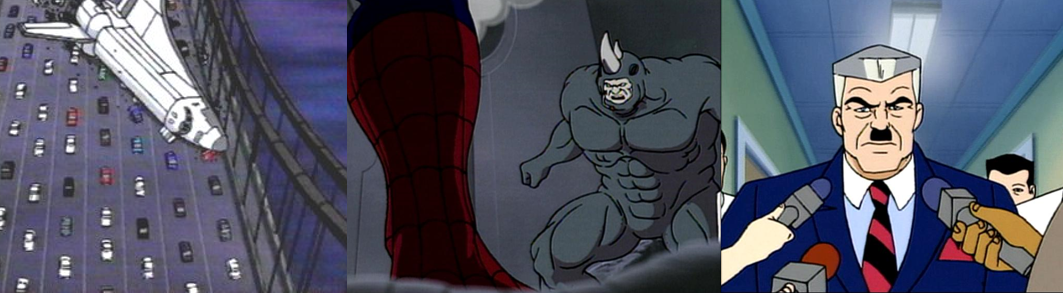
The “Alien Costume” arc begins with astronaut John Jameson digging up a mysterious black rock from the surface of the Moon; after narrowly escaping a Moonquake, he makes it back to the shuttle and his return to Earth with the newly-discovered isotope, Promethium-X, attracts the attention of the Kingpin since it promises to be more powerful and valuable than Plutonium. However, John’s return is hampered when the rock secretes a seemingly-sentiment, tar-like substance that attempts to consume the astronauts and leaves the shuttle on a collision course with New York City!

The shuttle crash and the acquisition of Promethium-X forms the central conflict of the arc.

Despite the imminent danger, Kingpin’s lead scientist, Alistair Smythe (Maxwell Caulfield), assures him that the shuttle will land without causing any damage to the city so he (as in the Kingpin) contacts Aleksei Sytsevich/The Rhino (Stark) to retrieve the Promethium-X once the shuttle makes its emergency landing on the George Washington Bridge. There, he comes into conflict with Spider-Man and, thanks to his superior size and strength and the shuttle’s precarious position, is able to best the wall-crawler and make off with the isotope. Although he saves John and his co-pilot, Peter is aghast when he is fingered as the one responsible for stealing the Promethium-X thanks to John’s incoherent rambling, his father J. Jonah Jameson’s (Asner) unrequited hatred for Spider-Man, and disgraced photographer Eddie Brock selling J. J. pictures that incriminate the web-head. Having been introduced in previous episodes as an embittered man desperate to regain his job at the Daily Bugle, Brock jumps at the chance to capitalise on Jameson’s hatred of Spider-Man with his photos.

The black suit overtakes Spider-Man and augments his strength and negative emotions.

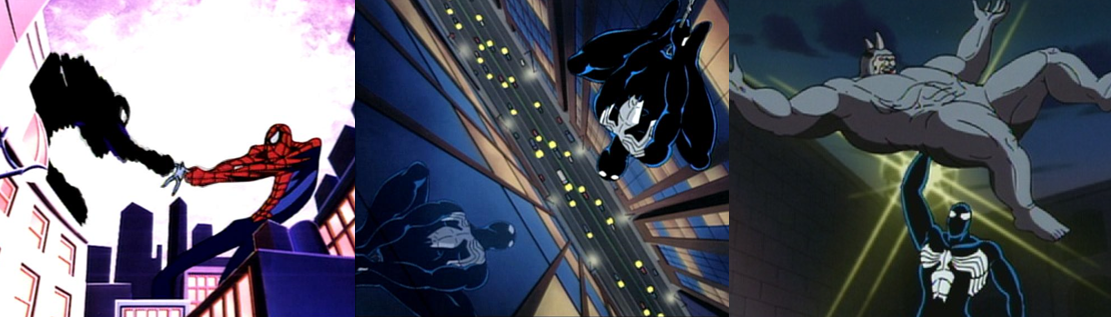
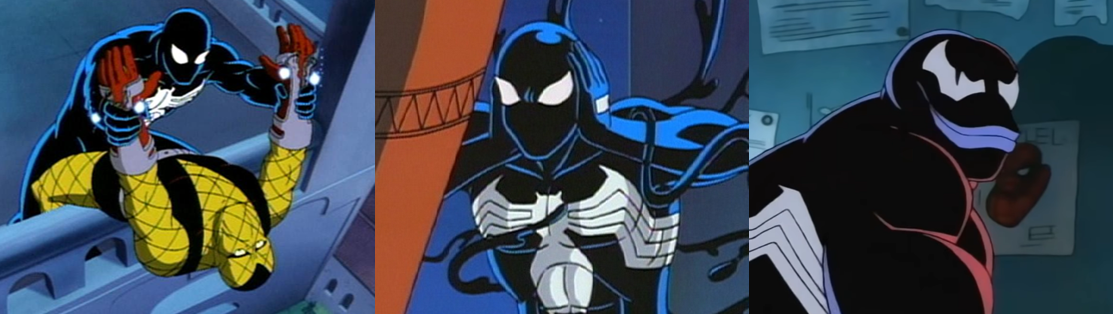
This results in Jameson placing a $1 million bounty on Spider-Man’s head, forcing Peter to lay low. However, while he sleeps, the mysterious black substance from the shuttle is revealed to have attached itself to his costume and, following a harrowing nightmare, the goo overtakes Peter, who wakes to find himself garbed in a sleek black costume that dramatically augments his speed and strength. Overwhelmed at the suit’s capabilities, Spider-Man discovers he can now shoot organic webbing and change his appearance by simply thinking about it, but it quickly becomes apparent that the alien substance is also affecting his personality. Far more confident than ever before, even Spider-Man’s voice is slightly altered when he’s wearing the black suit, making him sound tougher and more aggressive than usual. Equally quick to anger, Peter threatens Eugene “Flash” Thompson (Patrick Labyorteaux), snaps at his doting Aunt May (Linda Gary), and comes close to killing destroying the Rhino after handily dominating their rematch. Although he manages to get a hold of himself, Peter’s demeanour continues to degrade into an enraged fury as he is hounded at every turn thanks to Jameson’s bounty; his overconfidence and anger causes him to become sloppy, however, and he learns the hard and painful way that the alien costume is vulnerable to high-intensity sonic waves. Spider-Man does himself few favours when he confronts Brock and Jameson, threatening them in the Daily Bugle and driving him to visit his friend, Doctor Curt Connors (Joseph Campanella), to find out more about the suit.

While Spidey disregards Connors’ advice about the symbiote, he uses to science to outwit the Kingpin.

As you might expect, Connors reveals that the suit is actually a living, alien symbiote that is seeking to permanently bond with Peter. Although he stresses the very real danger of the alien costume, Connors is unable to convince Spider-Man to remove to suit since he needs it to recover the Promethium-X. When John corroborates Spider-Man’s story of a guy in a rhino suit, Jameson angrily lays into Brock for lying to him, fires him, and is begrudgingly forced to withdraw his bounty on Spider-Man. Embittered by this development, Brock’s mood is further soured when he is also evicted from his apartment and when he is targeted by the Kingpin, who sends Herman Schultz/The Shocker (Cummings) after him to tie up the loose ends from the shuttle robbery. After saving Brock from being blasted into dust, Spider-Man tracks the Shocker to Smythe’s laboratory and finally recovers not only proof of his innocence from Brock’s apartment but the Promethium-X from Smythe. While the Kingpin was more concerned with selling the rock to the highest bidder, Spider-Man takes the time to properly investigate the Promethium-X and discovers that, while it is incredibly powerful and dangerous, its radioactive half-life is ridiculously small, which results in the Kingpin being left humiliated and with an inert rock in his possession.

After ridding himself of the symbiote, Spidey unknowingly births his greatest foe: Venom!

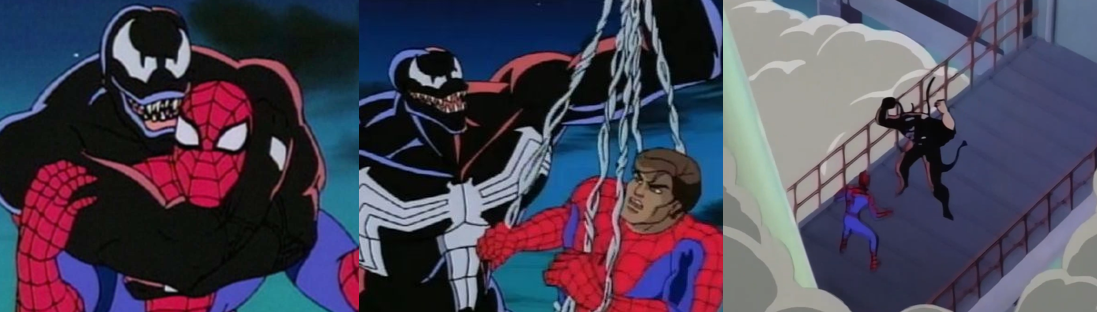
However, Spider-Man’s tumultuous emotions are driven to the edge when Smythe lures him to a bell tower by taking John hostage in order to recover the isotope; overcome with rage, Spider-Man destroys the Shocker’s gauntlets and is seconds away from doing the same to the mercenary before memories of his beloved Uncle Ben remind him that “with great power comes great responsibility”. Guilt-ridden and desperate to be rid of the alien suit, Spider-Man frantically tries to remove the symbiote but his efforts prove useless until he takes advantage of the church bell to cause the creature enough pain to separate itself from his body. However, Brock (who followed Spider-Man in a desperate attempt to extract a measure of revenge against the well-crawler), finds himself enveloped by the injured and enraged creature as he hangs helpless beneath the church bell. The result is a muscular, embittered, monstrous union of man and symbiote, Venom, who vows to destroy Spider-Man for ruining both of their lives. Venom makes their presence known as Spider-Man is settling the score with the Shocker and the Rhino on a rooftop; Venom actually saves Spider-Man just as he’s about to be destroyed simply to have the honour for themselves. In the process, Venom proves to be far stronger than Spider-Man, immune to his spider sense, privy to his secret identity, and possessing all of his physical and superhuman abilities but augmented thanks to Brock’s rage and workout routine.

Overwhelmed by Venom’s superior strength, Spidey is left relying on his wits to triumph.

Hopelessly outmatched, Spider-Man is left physically overpowered; his attempts to appeal to Brock’s better nature fall on deaf ears and Spidey finds himself at Venom’s mercy. Venom threatens to target, and reveal Spider-Man’s identity to, Peter’s loved ones and even leaves him dangling over a rooftop without his mask on at one point! Narrowly escaping with his identity intact, Peter is stalked by Brock at every turn and starts seeing Venom everywhere; with no choice but to take the fight to his foes, Spider-Man taunts Brock with newspaper clippings of his failures and baits Venom into following him across the city to the launch of another shuttle at a military base outside of New York. There, the two have a final confrontation up the support gantry that ultimately ends with the symbiote being driven from Brock’s body when the shuttle launches. Spider-Man then webs the writhing creature to the shuttle, sending it back into space, and leaves Brock in police custody, finally free of his alien nightmare… for the time being.

The Summary:
As much as I enjoyed, and still enjoy, the 1994 Spider-Man cartoon, there are some elements of it that obviously haven’t aged too well. The video transfer to DVD isn’t the best and the animation can be a little jerky at times. The editing is quite rushed here and there, meaning that episodes can quickly gloss over and bounce around certain scenes despite being fully capable of telling a well-paced story at other times, and there is a bit of dodgy CGI and the music gets very repetitive. Still, these concerns are largely minor and can be said of almost any cartoon produced in the nineties (or ever, for that matter) and, for the most part, the episodes are bright, action-packed, and well animated. Fittingly, the animation and presentation benefits Spider-Man the most of all the characters in the cartoon; vibrant and athletic, Spider-Man is a very dynamic character in the cartoon and capable of many superhuman feats despite not being allowed to throw a punch. Peter, despite closely resembling Nicholas Hammond, oddly looks bigger than his web-slinging counterpart but Spider-Man is expressive and vibrant throughout. The depiction of his black suit is equally top-notch; one of the arc’s stand-out scenes is Peter’s disturbing nightmare where Kaiju-sized versions of the black and classic costumes battle over Peter’s soul and he’s left hanging upside down in the middle of the city garbed in the sleek, sexy black suit. “The Alien Costume” may also be the first instance of the symbiote augmenting Spidey’s superhuman abilities and characteristics as this didn’t really happen in the original comics (at least not to the extent as it does in other media) and the three episodes definitely set the standard for Peter’s struggles with the symbiote going forward.

Spidey looks great, despite some dodgy animation, and Venom benefits from the multi-part arc.

Brock’s introduction is handled far better in the cartoon compared to the comic since he was actually introduced, and featured, in a handful of episodes prior to these three; angry and bitter, he’s been the victim of a string of bad luck and bad decisions that cause him to grow increasingly resentful of Spider-Man. Consequently, his transformation into Venom empowers him, driving him even more maniacal thanks to the symbiote’s power and abilities. Unlike in the comic books (at least at the time of these episodes), the symbiote is revealed to be incredibly old, well-travelled, and possessing knowledge of the wider universe and numerous worlds, indicating that it’s far more than just a near-insane parasitic lifeform. Venom looks fantastic in the cartoon, sporting their trademark fangs, talons, and long tongue as well as a hulking physique and a distorted, monstrous voice that, again, set the standard for how Venom are portrayed outside of comics. The episodes also do a pretty decent job of portraying C-grade villains like the Rhino and the Shocker as formidable threats; thanks to the influence of the black suit, Spider-Man’s anger and emotions are constantly in flux throughout the arc and are only exacerbated by the duo’s tenacity. Still, once Venom enters the picture, they make all other villains irrelevant; possessing knowledge and physical abilities that make them superior to Spider-Man in every way, Venom plays mind games with Peter, taunting and stalking him and overwhelming him both physically and emotionally. Just like in their first comic book encounter, Spider-Man is forced to use his initiative and wiles to outsmart his maniacal foes rather than trying to match them blow-for-blow. The end result is a far grander conclusion to their confrontation since Spidey utilises a shuttle launch rather than simply wielding a sonic blaster, which is a fittingly dramatic (if temporary) end to Venom’s threat as their story started in space and technically ends in space.

My Rating:

Rating: 4 out of 5.

Great Stuff

What did you think to the “Alien Costume” arc? Did you watch Spider-Man when it first aired or did you discover it later, perhaps on Disney+? What did you think to the depiction of Spider-Man’s black costume and how it influenced his powers and personality? What did you think to Venom’s depiction in the cartoon? What is your favourite Venom story or adaptation? How are you celebrating Venom’s dramatic debut today? Whatever your thoughts on Venom, feel free to sign up to leave them below or drop a reply on my social media.

Game Corner [Spidey Month]: Spider-Man (PlayStation 2)


Easily Marvel Comic’s most recognisable and popular superhero, unsuspecting teenage nerd Peter Parker was first bitten by a radioactive spider and learned the true meaning of power and responsibility in Amazing Fantasy #15, which was first published in August 1962. Since then, the Amazing Spider-Man has featured in numerous cartoons, live-action movies, videogames, action figures, and countless comic book titles and, in celebration of his debut and his very own day of celebration, I’ve been dedicating every Friday of August to talk about everyone’s favourite web-head!


Released: 16 April 2002
Developer: Treyarch
Also Available For: Game Boy Advance, GameCube, PC, and Xbox

The Background:
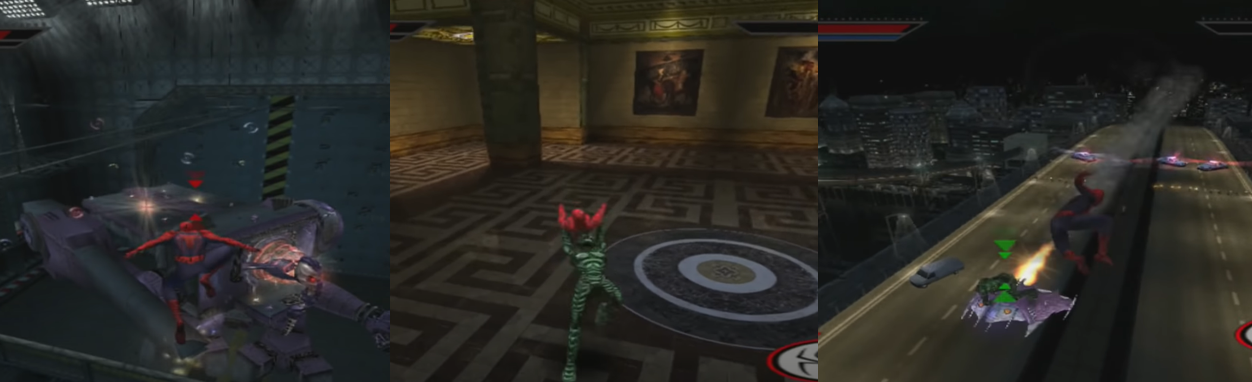
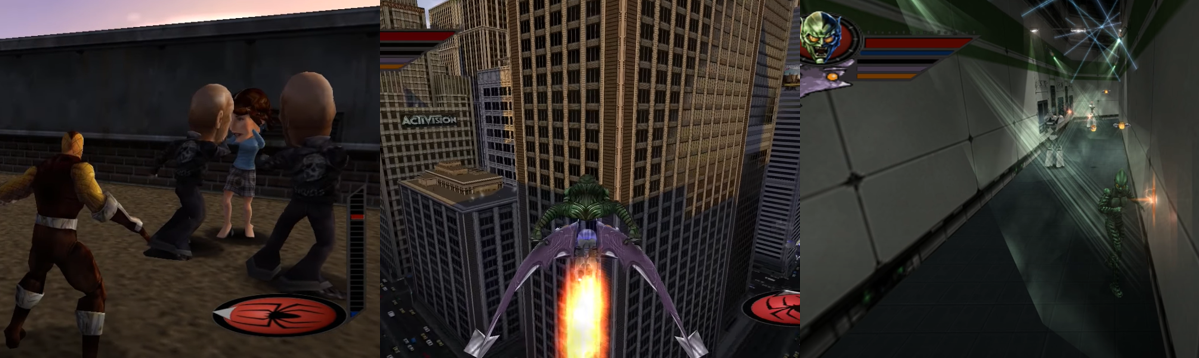
There was a time when it seemed like every single cinema release had to be accompanied by a videogame adaptation; big-budget movies, especially, were often released alongside a hastily created videogame tie-in that often failed to properly capture the spirit of the film they were based on. As the flagship character of Marvel Comics, Spider-Man has a long and varied history with videogame adaptations across a variety of platforms so it was perhaps no surprise that Sam Raimi’s 2002 live-action $825 million blockbuster would be accompanied by a videogame tie-in. To be fair, Spider-Man benefitted from that fact that it was developed by Treyarch, who had previously had success with the character; indeed, much of Spider-Man’s combat and level progression was based on Treyarch’s previous Spider-Man game. This was reflected in the game’s reception as Spider-Man became the fifteen highest-selling videogame of 2002 and enjoyed high scores across all platforms. While some reviews criticised the game’s claustrophobic indoor sections and short length, it was generally regarded as the best Spider-Man videogame at the time of release. I remember buying the game for the GameCube after seeing the movie, having been won over by the game’s trailer and the film itself, but being underwhelmed by it after playing it to completion so I’m curious to see how it holds up today after the success of Spider-Man’s subsequent videogames.

The Plot:
After being bitten by a genetically-enhanced arachnid, high school senior Peter Parker finds himself endowed with the proportional strength and agility of a spider, and, when his beloved Uncle Ben is killed due to his irresponsibility, Peter puts his spider powers to good use as a masked crimefighter. After failing to capture and study this “Spider-Man”, who overcomes a variety of costumed menaces and robots, Doctor Norman Osborn transforms himself into the web-slinger’s most dangerous threat yet: the maniacal Green Goblin!

Gameplay:
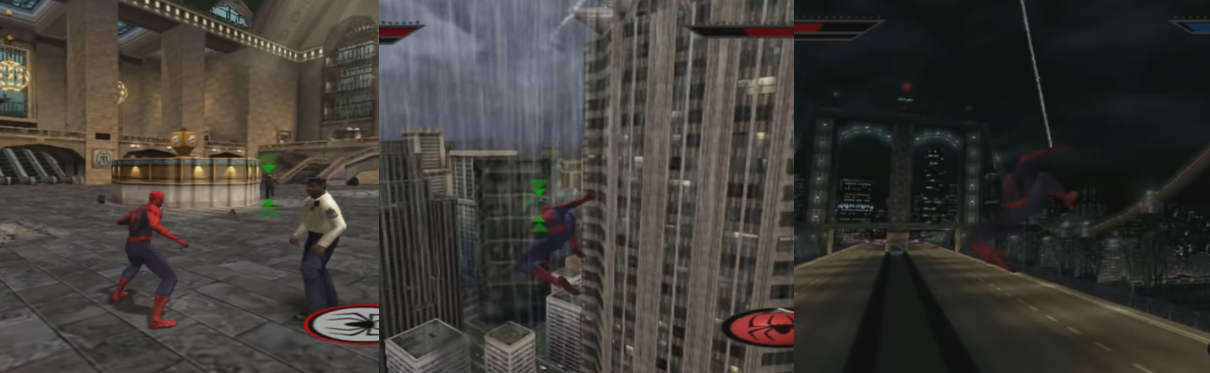
Spider-Man is a third-person action game with a primary focus on beat-‘em-up action but which also includes a fair amount of web-slinging and a little bit of awkward stealth and extremely simplistic puzzle solving. As you might expect, players assume command of Peter Parker; the game begins right after Uncle Ben has been shot and at the very beginning of his crimefighting career as Spider-Man, and players are given a number of standard options when it comes to combat: X lets you jump and you can press it again in mid-air for a double jump, while Square throws a punch and Circle unleashes a kick. You can mix and match these button inputs to execute quick combo attacks (which you can review from the pause menu), and pressing either button near certain objects will allow you to pick up and throw them at your enemies. Of course, it’s not all about beating up random thugs across the city; at any time, you can press R2 and Spider-Man will start slinging webs (yes, they just attach to nothing, get over it) and won’t stop until you press X or slam into a wall. You can hold down R2 to speed up your web-slinging, though this does limit your turning ability, and you can press R1 to quickly zip upwards or straight ahead on a web zip-line; you can also press L1 to lock onto enemies, which is super useful when you’re swinging around and asked to attack enemies in mid-air.

Spidey can use his webs to attack his enemies but, unlike in the film, is limited by web fluid.

Spider-Man will automatically save himself with his webs if you fall while traversing the city rooftops and will automatically climb walls when close to them, though you can press the left analogue stick to enter a crawling state and the camera does tend to get very jerky and annoying when you’re clambering around on walls and ceilings as your perspective can get turned around pretty easily. If you’ve played the fantastic Spider-Man (Neversoft, 2000), you’ll be immediately familiar not only with Spider-Man’s combat and web-slinging but also with his web-based attacks. Pressing Triangle sees Spidey shoot out a quick web, but holding it allows him to web enemies up; if you press up, down, left, or right on the left analogue stick (or directional pad, if that’s your preference), Spider-Man will send out a high-impact ball of webbing, yank his foe towards him, wrap his hands in webbing to increase his punching power, or create a web dome to shield himself and send enemies flying with a press of X. You can also switch to different control styles that see you utilise the other face buttons for these commands, but you’ll find that these web attacks consume your web fluid (represented as a blue bar under your life meter), which is very strange considering Spidey had organic webbing in the film. Spider-Man can also dodge incoming attacks by using the left stick in conjunction with X to hop out of danger, though I found this to be awkward at best and unreliable at worst, and you can even press in the right analogue stick to look around and set your target for a zip-line.

Web-slinging sections see you using the compass to chase villains, rescue civilians, and disarm bombs.

All of these controls and gameplay mechanics can be reviewed in an optional tutorial mode, where the legendary Bruce Campbell snarkily talks you through all of Spider-Man’s abilities, and you’ll find question mark hints occasionally dotted around levels to help you out as and when. Like the 2000 game, Spider-Man is basically divided into two distinct gameplay styles: one sees you out in the city, swinging about the place, and the other sees you confined inside buildings. When out in the city, you’ll need to make use of a compass to navigate towards your next objective or keep track of your current target; you need to use this in conjunction with a Height Meter that shows your position compared to that of your objective, which can be a very clunky system as it’s not always clear where you need to go. Basically, just follow the compass direction until it flashes white, and then try to orientate yourself up or down to get to where you need to go, but invariably your compass will be absent when inside buildings. When web-slinging around the city, you’ll be tasked with hunting down thugs and putting a beating on them until you find information on where you need to go, racing after a target as they fly away from you, hunting down bombs or taking out robotic drones (often against a tight time limit), rescuing civilians from harm, and using your webs to secure water towers, bridges, and other objects to stop them from hurting civilians. When trying to keep track of a specific target, you really need to make use of the lock-on feature or else it’s very easy to lose sight of them and thus fail the mission; I also found that spamming Triangle was the fastest way to actually attack enemies in mid-air, but of course this will drain your web fluid. Luckily, the pick-ups that refill your health and web fluid will respawn so you can swing back over and grab them if you need to, but this will cost you time and probably see you fail your objective. Checkpoints in Spider-Man are few and far between; you can only save your progress after completing a level and, if you die or fail your mission, you’ll have to restart from the beginning of the level, which can lead to you repeating frustrating sections again and again.

Spidey must crawl and fight around claustrophobic interiors using a clunky stealth mechanic.

When confined to the interior of buildings, the game introduces a clunky stealth element; when Spider-Man is in certain shadows, the face on his heads-up display will turn dark blue and he’ll be hidden from enemies. This is essential to safely sneaking past cameras and enemies in many levels; though you won’t fail the mission if you’re spotted, an alarm will be raised and mechanical Super Soldiers will relentlessly chase after you, forcing you to quickly zip away and find a shadowy area to wait out the alarm. One of the most common tasks when in these claustrophobic areas will be heading through or acquiring keys to unlock doors; these doors can be difficult to identify as the areas are so bland and boring, and the enemies holding the key tend to be a little tougher than the usual mooks. Other times, you’ll need to use X to activate consoles, sometimes in a certain order, acquire codes from active PCs, web-zip past steam vents or through laser trip wires, and zipping up into vents to awkwardly crawl around and progress further. These levels also have much more focus on grounded beat-‘em-up combat, but the game quickly emphasises that discretion is the better part of valour and you’ll be tasked with deactivating security walls and laser traps in order to progress a little safer. The game comes with a number of different difficulty modes that obviously make enemies tougher and increase the game’s challenge; completing the game on higher difficulties also allows you to unlock additional content, which can be further unlocked by acquiring points for your combat, stealth, and level-completion strategies.

Graphics and Sound:
Obviously, Spider-Man is a videogame tie-in that came out on the PlayStation 2, so you can’t expect super high-quality in-game or cutscene graphics. However, Spider-Man is reasonably impressive and I can see why people would have considered it the best Spider-Man videogame at the time; New York City is rendered as a large map and even subject to rain and lightning storms and rendered in both day and night-time depending on the level you’re playing. However, it’s not a sprawling open world with numerous side quests or non-playable characters to interact with; although you can see traffic moving down below, you can’t go down to street level and the city is basically completely lifeless save for thugs, bosses, and a few civilians in need of rescue.

Environments can be quite bland and lifeless but some shine through weather and lighting effects.

The interiors are where the game really fails to impress, however; you’ll explore such dynamic and exciting areas as…a bland warehouse, the sewers and subway tunnels, and the high-tech Oscorp building. This latter is easily the most visually impressive and interesting of all of the game’s environments, inside or out; while it is a bit confusing as every area looks grey and bland, it’s given some variety with some blinking lights, laser traps, and different rooms containing consoles and power generators. Another interesting area is a bank, though you’re only really in here for one boss battle, and you’ll even be treated to a very mediocre interpretation of the balloon parade from the film, which includes a single inflatable panda bear and a sequence where you crash down through skylights while battling the Green Goblin, and of course conclude the game in a showdown on the Queensboro Bridge.

Cinematics are quite blurry and the awkward in-game cutscenes are quite laughable.

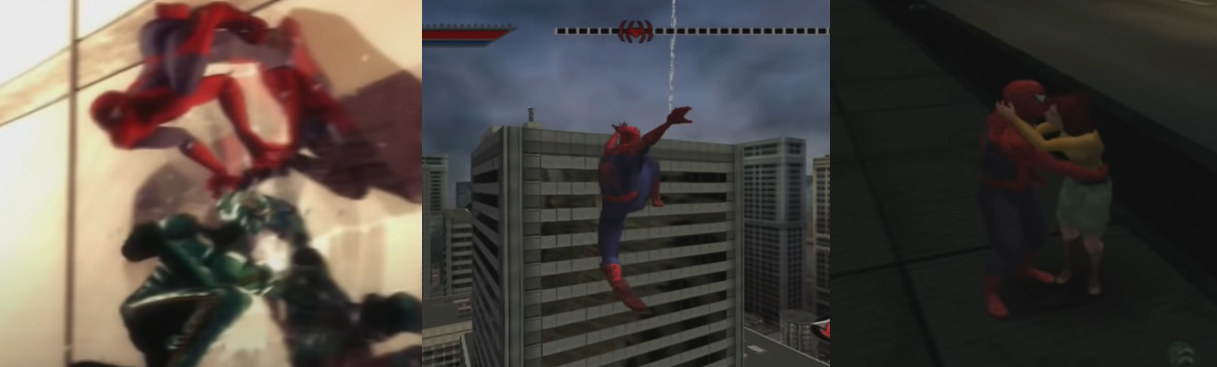
While the game’s thugs and enemies aren’t much to shout about, being largely generic and unimpressive, Spider-Man is rendered quite well despite every character model appearing as a stiff mannequin. Spidey does little hops and flips when climbing over ledges, assumes comic-accurate poses when left idle, and even busts out fancy animations when web-slinging that closely emulate the film. The game uses both pre-rendered and in-game graphics for its cutscenes, with the pre-rendered ones obviously being the more impressive of the two; the in-game models don’t even move their mouths and the voice acting is more miss rather than hit. Tobey Maguire, especially, sounds more wooden and awkward than ever, especially when trying to deliver quips as Spider-Man, and the game is sadly completely lacking Danny Elfman’s awesome and iconic score. The music that does play during levels is generally suitable enough, if a bit generic, but it does clumsily and noticeably loop, which just screams of low production values, and of course you’ll be faced with the long load times symptomatic of that era of videogaming.

Enemies and Bosses:
Spider-Man is faced with a number of nameless, faceless, disposable goons as he swings around the city and tries to use his powers responsibly; at first, he’s tasked with tracking down Uncle Ben’s killer, who here is interpreted as part of the Skulls gang, so you’ll be beating up unscrupulous street thugs in the early going. Some of these have pistols to defend themselves with, and they’ll also put up a block to defend themselves against your attacks. These thugs get a reskin as guards working for Oscorp who must largely be avoided and webbed up to stop them from raising the alarm and bringing in the Super Soldier robots. Wile Osborn’s miniature Spider Slayers are annoying robotic enemies who zip around on claw-like lines and try to roast you alive, these Super Soldiers are a massive pain in the ass. They relentlessly hunt you down, blasting at you with explosive bolts that are near-impossible to avoid, and the levels can be so restrictive that you’re better off just restarting the level rather than trying to desperately find shadows to hide from them.

After tracking down his uncle’s killer, Spidey must avoid the Shocker’s blasts in the city sewers.

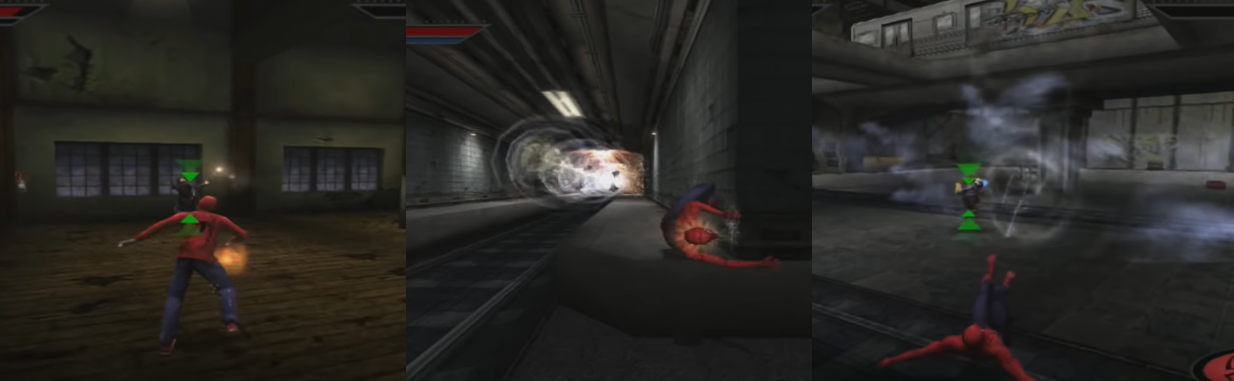
Spider-Man’s first mission is to hunt down Uncle Ben’s killer; after beating up a bunch of his fellow gang members, Spidey finally tracks him down and faces off with him, only to be blasted full-force in the face over and over by the murderer’s shotgun! The killer sets a precedent for the game’s boss battles in that he, like all of the other bosses, is spry and tough enough to shrug off, dodge, and no-sell all of your web attacks except for the web-hands, so you’re best bet is to zip up to the ceiling and stay out of his sight, blasting at him with your impact webbing or dropping down to deliver a beatdown when he’s suitably confused. After a quick side quest where you swing around towards red balloons to take snapshots of Spidey for the Daily Bugle, you’ll need to rescue security guards being threatened by Herman Schultz/The Shocker. Once they’re safe, you’ll pursue him into the sewers and subway tunnels, where he’ll send blasts of concussive sound at you that you’ll need to dodge using your web-zip; this isn’t too much of a challenge to overcome and, afterwards, you’ll get to face him in combat. The Shocker launches projectiles of sound at you and can protect himself with a devastating whirlwind of damaging soundwaves, but was actually easier for me to pummel into submission than Uncle Ben’s killer.

After making short work of the Vulture, you must defend and then subdue the maniacal Scorpion.

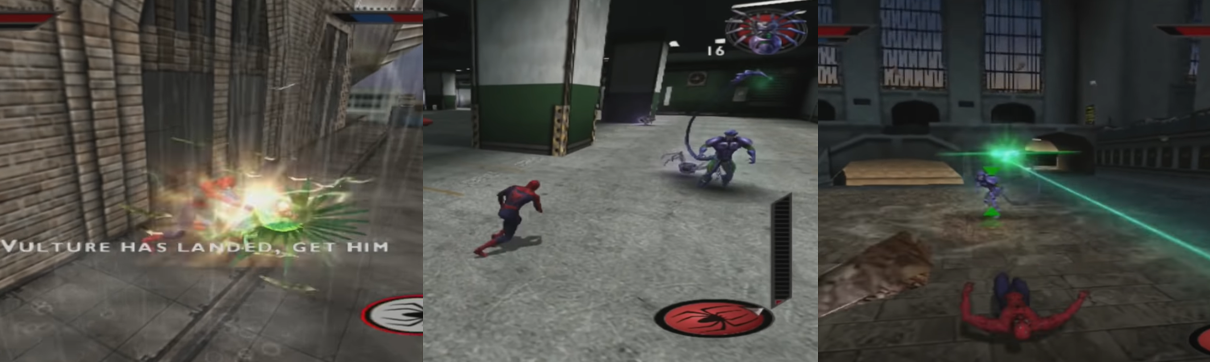
Spider-Man’s next test comes when Adrian Toomes/The Vulture robs a bank; Spider-Man first chases after the Vulture by progressing vertically up a tower that catches fire and sees you slipping through holes and under stairs to zip your way upwards, then you need to chase after him as he flies away through the city and puts citizens at risk. Finally, the two face off in the skies around the Chrysler Building as rain and lighting fill the arena; Spidey must fire webbing at the Vulture while avoiding his charges and attacks in order to force him to land so he can put a beating on him, making him the easiest boss of the game by far. Afterwards, Spidey crosses paths with MacDonald “Mac” Gargan/The Scorpion, who just randomly appears out of nowhere; at first, you’ll need to protect him from Oscorp’s miniature spider-bots but then he turns against you and forces you to fight him. This is quite a tough fight even on Easy mode as the Scorpion leaps and scrambles all over the place, blasting at you with his tail, and grappling with you whenever you get close to him. It’s best to keep your distance and fire off impact webbing from afar, and then dodge his attacks so you can hit a few combos on him and put him down. Fittingly, the Green Goblin is the game’s most recurring villain and, though you won’t encounter him face-to-face until you’re halfway through the game, he more than makes up for it in his appearances; the first time you face him, you need to avoid his glider attacks and missiles and rescue Mary Jane Watson from the aforementioned panda balloon before battling him head-on.

As annoying as Oscorp’s mech is, the Green Goblins persistence and aggression is even worse!

Whilst on his glider, the Green Goblin is basically a tougher version of the Vulture as he flies around tossing pumpkin bombs and firing bullets and missiles at you, forcing you to fire off your webbing or striking at him when he comes close. Afterwards, you’ll have to chase after him and web up parts of the environment that he damages, before forcing him through a skylight for some ground combat. These fights are easily the toughest of the game as the Green Goblin bombards you with pumpkin bombs, blinds you with flashbangs, and can easily choke the life out of you and snatch you out of the air. Your best bet is to stick near the respawning health power-up, dodge his combos and hit some of your own, and blast him with impact webbing whenever you can. Afterwards, you’ll be forced to swing across the city against a time limit disarming his bombs, which is an annoying mission thanks to the janky compass and drones flying around the city, then destroy fifty of his Razor Bats before taking a detour through Oscorp and battling a giant mech. Before you can attack this directly, you’ll need to desperately swing around the enclosed arena destroying shield generators and being pummelled by missile turrets, constantly spawning drones, and avoiding the mech’s gigantic laser. Thankfully, there’s plenty of pick-ups in the area and the mech goes down pretty easily with a few web shots once the shield is lowered. Afterwards, you’ll have to chase after the Green Goblin as he flies off with Mary Jane and tosses explosive traps in your way, before finally facing off with him on the Queensboro Bridge. After getting Mary Jane to safety, you then need to repeat the same tactics as in the first couple of fights against him but now in the same battle; swing around firing webs at him to ground him and then dodge his melee attacks to land a few combos, but watch out for his big bomb blast attack. By this point, you should know how to dodge and go grab a pick-up when needed, and I know I found finishing the Green Goblin off actually easier than the first fist fight with him. After you end him, Mary Jane awkwardly gives Spider-Man a big ol’ snog on top of his mask while they stand over the lifeless body of Peter’s best friend.

Power-Ups and Bonuses:
Unlike in pretty much every modern videogame, Spider-Man is not blessed with regenerating health; as a result, you’ll need to pick up red and red-and-blue Spider Icons to restore half or all of your health. Also, like in the 2000 game, Spider-Man can run out of web fluid so you’ll need to grab blue and blue-and-silver Spider Icons to refill this bar. As mentioned, I find this an odd inclusion as Spider-Man had unlimited organic webbing in the movie but I guess it makes sense to keep him from being too overpowered. Luckily, these restorative pick-ups respawn after a while so if you find yourself struggling against a particular boss, you can usually backtrack or swing back around to collect a pick-up and keep yourself from losing a life. If you search around your environments, you’ll also find gold Spider Icons that will unlock additional combos to add to your repertoire, but that’s about it in terms of power-ups; you don’t earn experience points and can’t upgrade any of Spider-Man’s abilities or pick up temporary power-ups, meaning you basically end the game exactly as you started it but with maybe a few additional combos.

Additional Features:
If you visit the game’s ‘Gallery’, you’ll be able to view movies and artwork for the game, and you’ll be able to revisit any level you’ve cleared from the main menu as you progress. As mentioned, you’ll receive points every time you clear a level; these are awarded for your combat variety, stealth, and the amount of damage you take. Once you hit a certain number of points, you’ll automatically unlock some additional content from daft stuff like big hands and feet and exaggerated ragdoll physics to skins for Spider-Man, such as his wrestler outfit and acclaimed artist Alex Ross’s rejected design for the movie suit. You can also unlock a Peter Parker skin and enter cheat codes to play as guys like the Shocker and other enemies, though they all play the same as Spider-Man and don’t change the story in any way.

There are a number of cheats and unlockables, including a fully playable Green Goblin!

However, if you beat the game on the “Hero” difficulty, you’ll unlock the ability to play as Harry Osborn under the guise of the Green Goblin! This eliminates the pre-rendered cutscenes and alters the plot somewhat as this story picks up after the conclusion of the game and sees Harry take up his father’s mantle to research his death, and gives you access to an entirely new set of abilities. The Green Goblin can’t web-sling or climb walls but, with a press of R2, you’ll hop onto his glider and can rocket around the place at will; you can fire bullets, missiles, and bombs while on the glider, but your weapons will overheat in time so you’ll need to wait for them to cool down. On the ground, the Green Goblin’s melee attacks are the same as Spider-Man’s but, in place of webs, you have access to pumpkin bombs and Razor Bats and can race around on rocket boots like a madman to send enemies flying! Honestly, this was an incredible addition to the game and is a great way to encourage a second playthrough that adds an extra layer of challenge to the game as the Green Goblin can’t hide in the shadows, but can jump on his glider to blast enemies with missiles even when inside the most claustrophobic environments!

The Summary:
I remember being so hyped for Spider-Man’s first big-screen adventure, and so won over by the trailer for the videogame that ran before the film, that I went out and bought this for the GameCube that same week (if not that same day). I also remember finishing it pretty quickly, and this second playthrough was no different; as is the case with almost every videogame tie-in to a movie, Spider-Man isn’t an especially long game; levels aren’t built to allow exploration and are incredibly linear, so all you’ll have to worry about is trying to cope with how bland and similar the areas can look in each level. There’s also not a huge amount really asked of you; maybe you need to activate a console here and there, or input a code to open a door, or rescue a civilian, but these instances are few and far between and the game soon falls back into a routine of either web-slinging or clunky stealth sections. “Clunky” is the best way to describe this game; Spider-Man controls like he thinks he should be using tank controls, the camera and mechanics make web-slinging and wall-crawling very cumbersome at times, and your combos and dodging abilities are severely limited, making everything quite basic and monotonous. This may explain the game’s short length, as it’s over before it can become truly mind-numbing, but some levels are more frustrating than others; the stealth system is poorly implemented and it’s disappointing to see Spider-Man restricted to claustrophobic interiors rather than free to swing around the city. Basically, the game is a reskin of the 2000 Spider-Man title but stripped back in terms of bonuses, unlockables, and variety; there’s some fun to be had here, mostly in how cheesy the dialogue and cutscenes are, but you’re not really missing much if you skip this one for one of the many other Spider-Man games available even on the PlayStation 2.

My Rating:

Rating: 2 out of 5.

Could Be Better

Have you ever played the videogame tie-in to Spider-Man? Which console did you buy it for and were you impressed with it back in the day? What did you think to the web-slinging and combat mechanics? Which of the enemies added to the game was your favourite and would you have liked to see the likes of the Vulture and the Scorpion in Raimi’s films? What did you think to the game’s stealth gameplay and the unlockables on offer? Which Spider-Man videogame or movie adaptation is your favourite? Sign up to leave a reply below or drop a comment on my social media to share your thoughts on Spider-Man.