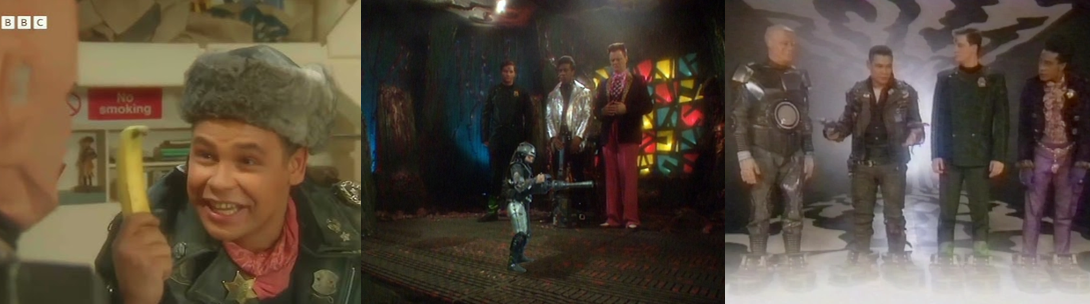
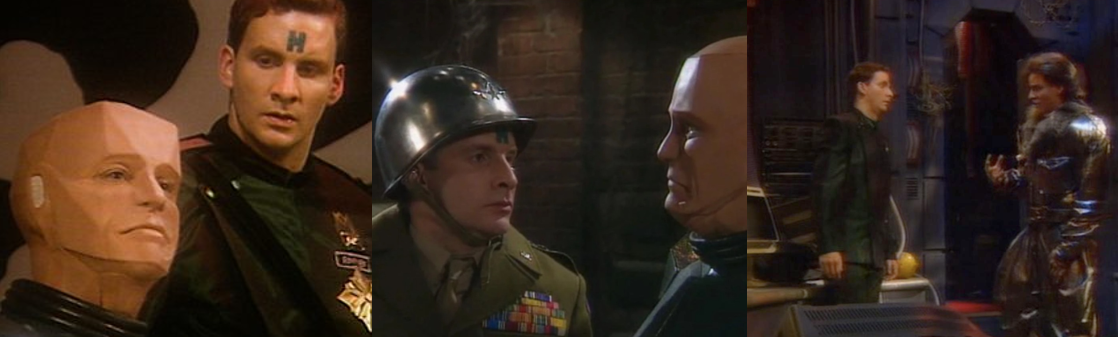
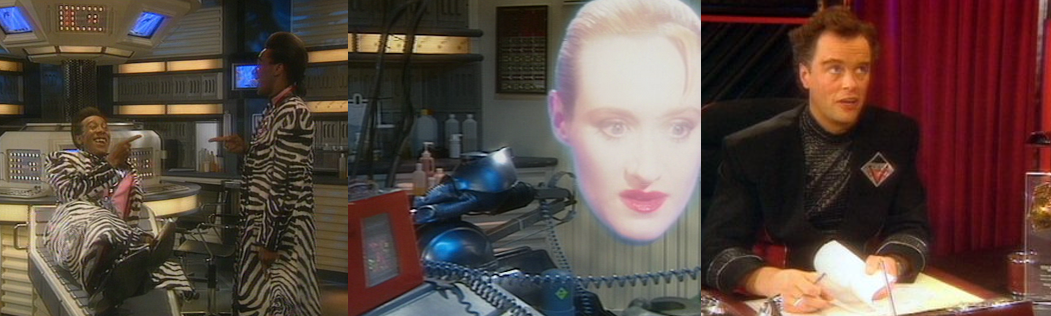
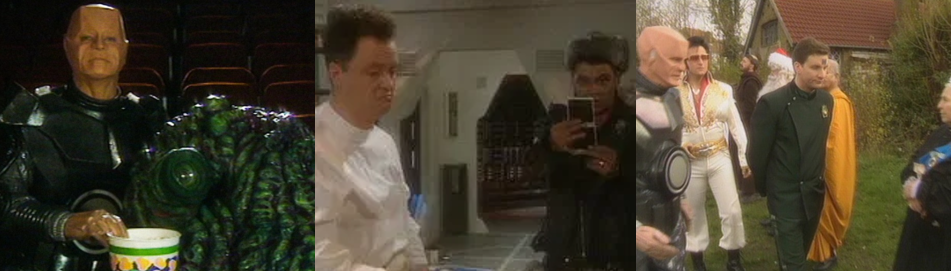
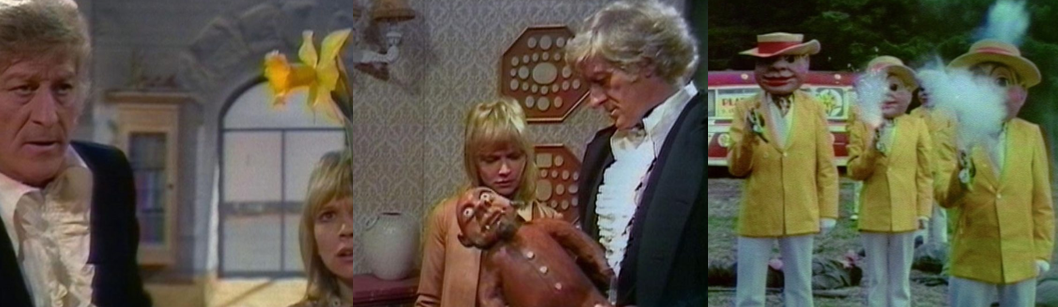
Screen Time [Gazpacho Soup Day]: Red Dwarf (Series Four)


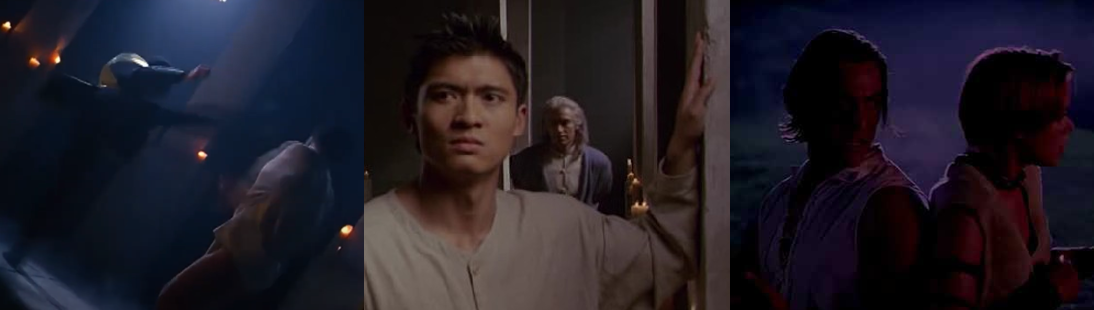
In the episode “Me2” (Bye, 1988) of the classic British science-fiction comedy show Red Dwarf (1988 to 2020), it is revealed the Arnold Rimmer’s (Chris Barrie) last words were “Gazpacho soup!” and that he celebrated November 25th as “Gazpacho Soup Day” after a traumatising visit to the Captain’s Table.


Series Four

Director: Ed Bye
Air Date: 14 February 1991 to 21 March 1991
Original Network: BBC2
Stars: Chris Barrie, Craig Charles, Danny John-Jules, Robert Llewellyn, and Hattie Hayridge

The Background:
Back in the eighties, Rob Grant and Doug Naylor, influenced by Dark Star (John Carpenter, 1974) and The Hitchhiker’s Guide to the Galaxy (Adams, 1978; Bell, 1981), created the sci-fi comedy Dave Hollins: Space Cadet for BBC Radio 4. This was the prototype for Red Dwarf, though the duo initially struggled to sell their vision despite prioritising character and comedy over genre. Once the show was picked up, impressionist Chris Barrie and Liverpudlian “punk poet” Craig Charles took the lead roles, and singer and dancer Danny John-Jules and sardonic stand-up comedian Norman Lovett rounded out the cast. Red Dwarf finally aired in 1988 and, despite viewing figures dropping in the first series, strong audience feedback saw the BBC approve a second series. Afforded a greater budget, Grant and Naylor expanded their premise and, now that Red Dwarf had established its audience, series two was more successful. Now firmly considered a cult hit, a greater budget saw a complete redesign of the sets for the third series, where Robert Llewellyn and Hattie Hayridge joined the cast. With series three widely regarded as one of the best of the show’s entire run, production shifted to Shepperton Studios, giving the cast time to rehearse and tweaking the series lore to better align with the books. Though never revamped with the same controversial digital overhaul as its predecessors, series four was also widely acclaimed, with “Dimension Jump” proving one of the best episodes, and Red Dwarf continued to be consistently popular even after Grant and Naylor parted ways.

The Plot:
Last human Third Technician Dave Lister (Charles), his hologrammatic supervisor, Second Technician Arnold Rimmer (Barrie), a humanoid cat (John-Jules), service mechanoid Kryten (Llewellyn), and neurotic computer Holly (Hayridge) are lost three million years into space. Their journey home sees them encounter a shape-shifting lifeform, endure trial by an automated space station, encounter Rimmer’s charismatic double, and visit a world populated by waxwork androids.

The Review:
While the first series was a shaky start for this classic sci-fi sitcom, Red Dwarf hit its stride with the second and third series, with the latter especially paving the way for this fourth series. Series four thus features the same introduction and sets, with Lister and Rimmer still bunking in the officers’ quarters and the crew still utilising the iconic ship-to-surface vehicle Starbug for most jaunts away from the ship. While Red Dwarf largely avoids aliens, man-made Genetically Engineered Lifeforms (GELFs) and killer mechanoids known as “simulants” are much more prominent here. Series four also dabbles in alternate timelines and time anomalies (which were equally important later on), space stations, and teleportation, expanding the lore while still focusing on character dynamics. While they still can’t stand each other, Lister and Rimmer are far more amicable now, with their antagonism shifting to Rimmer being unnecessarily boring, piteous, or down-right maniacal. While Rimmer bores Lister with stories of his Risk campaigns and either micromanages every situation or proves useless due to both cowardice and being an intangible hologram, Lister still tries to spare his feelings when Rimmer discovers them sneaking out to go fishing in “Dimension Jump”. Rimmer also objects to using the DNA modifier to turn Lister superhuman potentially as much out of concern for his safety as doubts about Holly’s capability to work the strange machine. Still, Rimmer jokes about leaving Lister as a chicken, mocks him about his petty criminal past in “Justice”, and criticises Lister’s mad plan to get drunk and play pool with planets in “White Hole” as a foolhardy disregard for Holly’s super genius calculations.

More of Lister’s background is revealed as he works to help Kryten and combat the crew’s new threats.

“Justice” tells us a bit more about Lister’s unruly childhood where he was coerced to steal cars and beds from hotels. Lister also relates how he went condom fishing in the canal and drastically alters established continuity as he now dated First Console Officer Kristine Kochanski (Clare Grogan) rather than lusting after her, with him being so cut up by their breakup that he envied a squirrel. When Lister meets Camille, he sees a mirror of him (Suzanne Rhatigan) that somewhat resembles Kochanski, according to the credits, but this isn’t mentioned in the episode. Still, Lister’s immediately eager to bed her and is frustrated to learn she’s a pleasure GELF who induces instant love. Lister later considers options to hide his “space mumps” to be more attractive for Barbra Bellini, only to again be robbed of any female companionship when a psychotic simulant (Nicholas Ball) emerges from her cryogenic pod. Eager to help Kryten to be independent, Lister continues to encourage him to break his programming, tutoring the mechanoid in how to lie and insult others. Similarly, Lister helps Kryten adjust to being a human when his DNA is transmogrified but, after being horrified by pictures of Kryten’s penis and his struggles with human anatomy, Lister eventually encourages his friend to embrace his true self. Lister’s very adamant about this, which is why he’s reluctant to become a vaguely familiar superhuman to battle the horrific vindaloo monster (Paul McGuinness). However, his belief that everyone should be true to themselves doesn’t extend to Talkie Toaster (David Ross), whose chirpy demeanour and obsession with toast drive Lister mad, and he’s disgusted when Rimmer leads the free-thinking wax-droids in “Meltdown”. Believing the wax-droids have developed a self-awareness that makes them “practically people”, Lister opposes Rimmer’s mad plot to live out real-life wargames but is ultimately helplessly as Rimmer causes all the wax-droids to be destroyed.

Rimmer’s all over the place here, though we do meet his charismatic counterpart.

Rimmer gets a few spotlights this series, though his personality flip-lops quite unpredictably. In “Camille”, he’s the first to encourage Kryten to date the titular GELF (Judy Pascoe) despite her monstrous appearance, he successfully works with and directs the crew in docking with the presumably alien vessel in “D.N.A.”, and often showcases a take-charge attitude, even if he is overbearing. Yet, simultaneously, Rimmer mocks Lister’s criticisms of being human, refuses to be switched off to give Lister and the Cat a few more months to live, and goes insane when visiting Wax-World since it gives him the chance to live out his Risk days. When visiting the Justice World penal colony, Rimmer is stunned when he’s incarcerated for accidentally killing the Red Dwarf crew and equally insulted when Kryten’s defence plea paints him as a buffoon with delusions of grandeur who naturally shouldered the guilt since he took his lowly job so seriously. Series four also introduces Rimmer’s charismatic and awe-inspiring counterpart, “Ace” Rimmer, a hot-shot test pilot who’s everything Rimmer wishes he was. Consumed by petty jealousy, Rimmer makes a fool of himself accusing Ace of being gay and trying to pull pranks on him, bitter that Ace got the breaks he missed out on, only for it to be revealed that Ace was held back as a child and forced to toughen up. Ace and Rimmer couldn’t be more different as one is confident, complementary, and capable and the other is next to useless and so despised by his crew that they try to sneak off without him. Indeed, Ace is so disgusted by his counterpart that he alters his dimension hopping mission to try and find another version of himself that’s more pathetic, only for the ending crawl to reveal he failed in this endeavour.

While the Cat doesn’t have much to do, Holly gets a fun spotlight and the actors are given more leeway.

While the Cat doesn’t get a spotlight episode and is again more of a third wheel, he often chips in insults towards Rimmer and gags regarding his grooming habits. The crew are frustrated when he keeps unplugging the console in “D.N.A.”, Lister is terrified when the Cat’s curiosity transmogrifies him into a chicken, and the Cat amuses when his broken leg sees him worry more about his colour co-ordination than his health. The Cat’s awareness of pop culture is far greater this series and he feels more integrated into the crew despite not having a dedicated plot. I loved that his perfect mate was himself and him encouraging Lister to power electrical appliances with a bicycle in “White Hole”, and his utter despair when faced with the gallows in “Meltdown”. While there’s less for Holly to do than ever thanks to Kryten largely acting as technobabble exposition, she still gets her time in the sun by swooning at the sight of Ace and questioning whether she has any desires as she didn’t see anything special when meeting Camille. “White Hole” is built around Kryten’s efforts to cure Holly’s computer senility, a bizarre computer virus that’s made Holly quirky, forgetful, and unreliable. Thanks to experiments with Talkie Toaster Kryten boosts Holly’s intelligence but a miscalculation dramatically reduces her lifespan to under four minutes. Holly’s brief delight at being a genius again is shattered by the aggravating toaster and this revelation, which sees her shut herself and all non-essential systems down, leading to curse exchanges between her and Rimmer as the crew try to figure out what’s happening and solve the problem of the white hole. The actors also get a chance to showcase different personalities in “Dimension Jump”, with Lister being a competent mechanic, the Cat a caring priest, Holly a horny receptionist, and Kryten recast as Ace’s equally horny commander, all of them as besotted by Ace as the regular crew are fed up with Rimmer.

Kryten benefits from being the focus of many episodes and cements his place on the show.

Kryten gets the most spotlight here. We saw in series two that Lister hated the idea of the mechanoid being subservient and constantly pushed Kryten to follow his own dreams. Series four revisits this, with Lister encouraging him to lie and be insulting so he can be more human. While Kryten eventually succeeds, he stutters when insulting Rimmer but, by the end of “Camille”, has been so through the wringer of emotion that he can lie and offend at will. While he delights in unleashing a barrage of insults at Rimmer as time unravels in “White Hole”, this doesn’t represent much of a status quo change for Kryten as he’s still a courteous and respectful servant. Indeed, he’s largely powerless to stop Rimmer in “Meltdown” and even obeys his orders due to his programming. However, Kryten does showcase more independence, piloting Starbug and explaining the white hole when Holly’s offline. Kryten also takes the spotlight in “D.N.A.” as he unexpectedly becomes human. At first, he’s elated to be living his dream but quickly finds he doesn’t understand his limited senses. Desperate to remain optimistic, he insults his “second class” origins and spare body parts, experiencing wild mood swings as he struggles to adapt, ultimately realising he was happier as a mechanoid. While Camille fakes being in love with others, she seems to genuinely fall for Kryten, to the point where she wants to abandon her “husband”, Hector (Rupert Bates), to be with him and only agrees to leave when she sees that Kryten is doing what’s best for her, even if it causes him pain. Kryten proves indispensable in “Justice”, compiling a case that, while insulting to Rimmer, exonerates the hologram of any true guilt, and showcases some medical proficiency (though he still needs Ace’s help with the Cat’s broken leg). Equally, Kryten cobbles together the matter transporter after discovering it in the ship’s research laboratories, quickly figuring it out and encouraging its use. Moments like these largely explain Holly’s diminished role as Kryten is much better suited to delivering exposition while also being physically integrated into the crew, and I really enjoying his struggles to apply Lister’s teachings here.

The Summary:
On paper, series four has a lot going for it. It matches series three’s visuals (even recycling Starbug footage as much as Red Dwarf model shots) and continues many themes of previous episodes, mainly involving Kryten and his independence. The crew venture to new or redesigned areas of the ship, such as the science lab, medical bay, and space dock, with each giving off a dark, industrial aesthetic. While the crew only visit alien worlds once (twice, if you count the crashlanding in “Dimension Jump”), Wax-World is painfully restricted. As if recycling grainy footage from Gappa: The Triphibian Monster (Noguchi, 1967) wasn’t bad enough (though it is referenced as a joke in the episode), many events happen offscreen (sure, it’s funny hearing Winnie-the-Pooh get executed but it might’ve been nice to see it) and it always looks like they’re shooting in someone’s back garden and on quiet country lanes. Many episodes also have disappointing endings. “Camille” sets a high standard with its emotional parody of Casablanca (Curtiz, 1942), though things quickly go downhill from there. “D.N.A.” isn’t bad, I guess, with the miniature RoboLister enjoying the remains of the vindaloo monster, but “Justice” ends with a bizarre rant from Lister about free will and the nature of justice and “Dimension Jump” has a weird coda where Rimmer plays Hammon organ music. This really wasn’t necessary as the ending text explaining how pathetic Rimmer is in the wider multiverse was enough and it feels like the writers just couldn’t decide how these episodes should end. I did like seeing the time anomaly fade out behind the crew in “White Hole” and Kryten taking advantage of the opportunity to roast Rimmer, but it does make me wonder why the crew didn’t continue their intelligence experiment upon the timeline being reset.  

The series leans into monster-of-the-week territory to present some fun new villains.

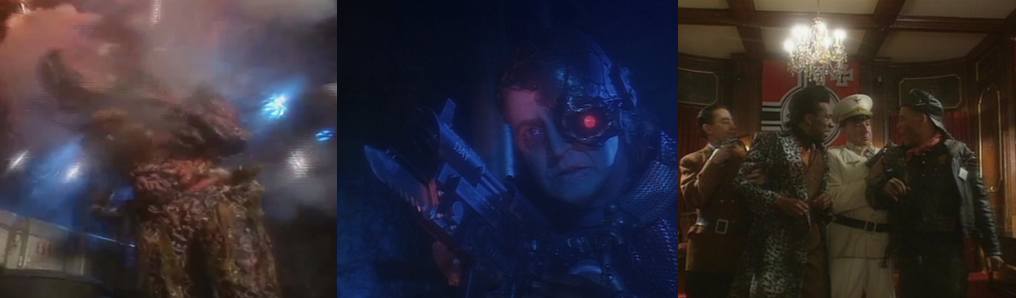
Series four leans more into “monster-of-the-week” territory than ever. The show’s still not using aliens (though the DNA ship is initially thought to be alien and certainly looks it, with its bio-organic interior and multilingual DNA modifier) but happily evoke them through the hideous, blob-like GELF Camille. Although she looks grotesque and causes some emotional turmoil, Camille can’t help that she becomes the object of a person’s desire. She seems to genuinely connect with Kryten but sees that he’s right that she belongs with Hector, who could potentially cure their condition. “D.N.A.” leans into horror with a ghastly three-headed corpse and the rampaging vindaloo monster, which shrugs off bazookoid fire and is only stopped by a vindaloo’s natural enemy: larger! The crew’s guilt is turned against them in “Justice” as the Justice Computer (James Smillie) scans them for any criminal acts and judges them accordingly. Justice World is a fascinating environment that uses robotic boots to ferry visitors around and includes a nigh-magical “Justice Zone”, where criminal acts are inflicted upon perpetrators. Lister learns this the hard way when he tries to commit arson but later uses it to his advantage to fight the simulant, who’s shot, stabbed, and eventually choked to death when he tries to kill Lister and the strange karma field inflicts the damage on him. The simulant makes for a memorable villain, taking the potential shown by the psychotic Hudzen-10 (Gordon Kennedy) and ramping it up to eleven with his devious nature and sadistic demeanour. Artificial lifeforms also pose a significant threat in “Meltdown”, with history’s most feared and ruthless evildoers waging war against celebrities, pacifists, and intellectuals to utilise their wax. Adolf Hitler (Kenneth Hadley) and Emperor Gaius Caesar Augustus Germanicus/Caligula (Tony Hawks) lead the charge in this campaign, mercilessly melting the resistance’s best fighters and punishing Lister when the Cat’s insolence denies them knowledge of the matter transponder.

Despite some memorable moments and characters, I’ve always found series four lacking.

Despite its awful ending, “Dimension Jump” is my favourite episode of this series. It showcases some new model work and environments and introduces the alluring Ace Rimmer, a charming and awe-inspiring version of Rimmer who’s so attractive, brave, and kind-hearted that everyone swoons at his feet. Despite this, he remains humble and affable, reading to sick children and giving props to the engineers who give him the means to be the best. Even with a broken arm, Ace doesn’t hesitate to help the scuttled crew, braving a raging storm to fix Starbug’s engine alongside “Skipper”, though even he cannot stomach how disappointing and pathetic his counterpart is. I also really enjoyed “White Hole”, which starts with some fun antics with Talkie Toaster, shifts gears to a survival situation after Holly’s forced offline, and then explores temporal anomalies and has Lister launching a thermo-nuclear device for a one-in-a-million shot! “Camille” and “D.N.A.” were great showcases for Kryten, establishing some changes to his programming and allowing him to explore new emotions, though this is largely distilled into a “lie mode” going forward. It’s a shame there wasn’t more for the Cat to do and that Holly’s role is further lessened, but I enjoyed a lot of the extra depth given to the characters and their relationships. They’ve clearly become a dysfunctional surrogate family, enduring each other most of the time, genuinely connecting on rare occasions, but often winding each other up. When the chips are down, though, the crew come together to help each other, even if reluctantly, defending Rimmer despite his aggravating nature and Lister even betraying his morals if it means killing a vindaloo monster. However, I still feel something’s lacking here even if there are still a lot of laughs. Maybe it was the lack of visual variety in the locations, maybe the abrupt endings or bizarre narrative choices (the space mumps thing really doesn’t add much), but series four always feels like a small step back from series three and that’s a shame as there are a lot of good moments to be found.

My Rating:

Rating: 3 out of 5.

Pretty Good

Do you think I’m being too harsh on series four of Red Dwarf? Did you enjoy seeing Kryten take the spotlight and the exploration of his emotions? Which of the threats featured in this series was your favourite? Were you a fan of Ace Rimmer? Which episode of this series was your favourite? How are you celebrated Gazpacho Soup Day today? Drop your thoughts on this series of Red Dwarf in the comments, go check out my other Red Dwarf content, and donate to my Ko-Fi to support more reviews like this.

Screen Time [Doctor Who Day]: Terror of the Autons


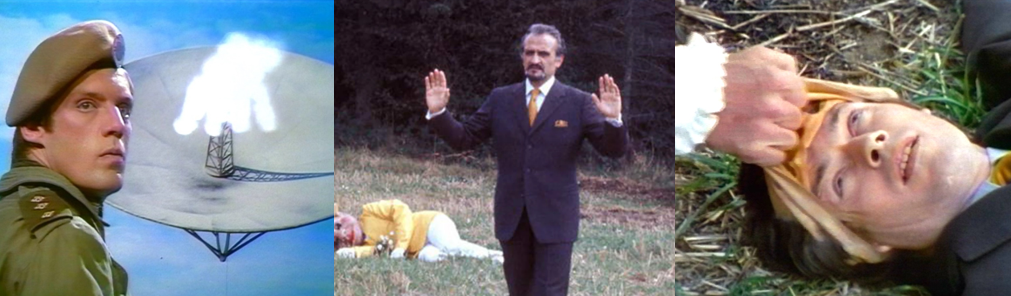
On this day in 1963, the longest-running and most successful science-fiction television series ever, Doctor Who, first aired. Since then, the rogue Time Lord has gone through numerous incarnations, travelled throughout the entirety of time, and is widely celebrated as one of the most iconic and recognisable mainstream cultural icons.


Season Eight, Serial One: “Terror of the Autons”


Director: Barry Letts
Air Date: 2 January 1971 to 23 January 1971
UK Network: BBC One
Stars: Jon Pertwee, Katy Manning, Roger Delgado, Nicholas Courtney, Richard Franklin, and Michael Wisher

The Background:
Back in 1963, BBC Head of Drama Sydney Newman commissioned a show to appeal to both children and adults to fill a gap in the BBC’s schedule. Thanks to writer Cecil Webber and a successful debut episode, Doctor Who wowed audiences with its historical, scientific, and fantastical stories. While the titular Time Lord changed faces over the years and was eventually banished to Earth as a cost-saving measure, he still opposed numerous evil forces, with perhaps the Doctor’s most personal, persistent, and most devious enemy yet making his debut during this time. Created by producer Barry Letts and script editor Terrance Dicks, the Master (Various) was intended to be the “Professor James Moriarty” to the Doctor’s “Sherlock Holmes”, a dark opposite to the benevolent Time Lord who was as wicked as the Doctor was righteous. “Terror of the Autons” was wellregarded and the Master continued to plague the Doctor during this era and beyond. Constantly escaping death, scheming, and seeking to destroy his foe, the Master would return time and again (even when it made little logical sense) and has cemented his place as the Doctor’s archenemy, second only to the Daleks.

The Plot:
While trapped on Earth and assisting the United Nations Intelligence Taskforce (UNIT), the Third Doctor (Pertwee) opposes an alien invasion instigated by his fellow renegade Time Lord, the Master (Delgado).

The Review:
“Terror of the Autons” takes place when the Doctor was exiled to Earth as punishment by his race, the enigmatic and officious Time Lords, for disregarding their rules about interfering in time and space. While he still has access to and operates out of this TARDIS, the machine no longer functions and his knowledge of how to make it work has been forcibly removed by the Time Lords. The Doctor busied himself as a scientific advisor for UNIT, assisting the uptight and exasperated Brigadier Lethbridge-Stewart (Courtney) with the many bizarre threats conveniently faced by humanity during this time. In between these adventures, the Doctor worked tirelessly on the TARDIS, only to repeatedly fall short, contributing to his rather cantankerous mood in this serial. Indeed, when we first catch up with the Doctor, he’s briefly infuriated when UNIT trainee Josephine “Jo” Grant (Manning) interrupts him, mistakenly extinguishing what she sees as a fire and ruining his work. Although the Doctor’s attitude toward Jo cools as he both composes himself and is softened by her innocent and kindly demeanour, he’s initially unimpressed by her presumptuousness and lack of qualifications and experience. Still, Jo’s eager to  impress on the Doctor as his new assistant and the Brigadier insists that the Doctor must take her on (especially as he’d been complaining about needing an assistant) or dismiss her himself. Like many of the Doctor’s companions, Jo’s main role is to ask questions and get into trouble, and be a pretty face for him to rattle off his thoughts. She’s even attacked by one of the Auton’s living dolls and threatened by the Master in the finale when he tries to retrieve his own TARDIS’s dematerialisation circuit from the Doctor.

Joined by a new assistant, the exiled Third Doctor investigates the bizarre Auton threat.

Begrudgingly pulled from his work and saddled with Jo and Captain Mike Yates (Richard Franklin) constantly badgering him, the Doctor investigates the theft of an energy unit and discovers technician Albert Goodge (Andrew Staines) mysteriously (and comically) shrunken down and stuffed into his lunchbox. The Doctor’s curiosity is further piqued when Adelphi (David Garth), a fellow Time Lord, warns him of the Master’s presence on Earth. The Doctor quickly realises that the Master is in league with the Nestene Consciousness (a cephalopod-like energy being) and is creating Autons (plastic robots and automations) to prepare for their invasion. While investigating a local plastics factory to find the Master, Jo is unwittingly hypnotised by the Master and almost sets off a bomb in UNIT headquarters, though she cannot offer the Doctor any insight due to suffering amnesia once freed from the Master’s spell. Despite him being furious at her for disobeying him, the Doctor is reluctantly grateful when Jo rescues him when he’s captured by the brainwashed Luigi Rossini (John Baskcomb) while searching the Master’s TARDIS. Despite narrowly evading a rabid mob, a gaggle of Autons, and his frustration at discovering the Master’s dematerialisation circuit is incompatible with his TARDIS, the Doctor consoles himself with the knowledge that he has effectively stranded his old foe by stealing the component. The Doctor then investigates the strange dolls and plastics recovered by UNIT, piecing together through his keen mind and the Master’s remote attacks that the Master’s using short-wave radio transmitters and heat to activate inconspicuous everyday objects to target 450,000 people and sending the country into disarray ahead of the Nestene Consciousness’s arrival. It’s clear that the Doctor is relishing the battle of wills with his murderous counterpart, even when baffled by certain events or outraged by the senseless violence, as it gives him the opportunity to test his mettle against a foe every bit as inventive as he is, yet one with a distinct lack of morals.

While the Brigadier’s used to the Doctor’s ways, it takes Jo some time to impress the Time Lord.

While the Doctor is somewhat dismissive of Jo, Mike treats her very well, happy to have another witness to the Doctor’s wild state and impulsive behaviour. Mike seems to have a crush on Jo as he hangs around her a lot and even saves her from one of the Master’s killer dolls. As ever, the Brigadier continues to be both awe-struck and irritated by the Doctor, who rarely treats him, his men, or their technology with any respect, regularly criticises their militaristic attitudes (and mankind’s tendency towards conflict), and compulsively disregards UNIT procedure. Indeed, the Brigadier insists on accompanying the Doctor to the plastics factory, organising his troops to corner the Master, co-ordinates an airstrike with the Royal Air Force, and even joins the Doctor in confronting the Master in the radio telescope control room. Despite having encountered the Autons and other strange alien threats before, and his familiarity with the Doctor and his ways, the Brigadier remains a somewhat sceptical, by-the-book military commander frequently baffled by the Doctor’s eccentric nature. Still, the Brigadier trusts the Doctor enough to ask his opinion (and for his help) and to act when the Doctor advises, even if the threat is something inconspicuous like ugly toy dolls. The Brigadier also saves the Doctor from being throttled by the Master’s living phone cord and even calls off the airstrike when he spots the Doctor and Jo being taken hostage. Although she doesn’t make a great first impression, Jo eventually impresses the Doctor with her affable personality, her fearless nature, and her unexpected skills of escapology. She almost dies when inspecting one of the Auton daffodils, however, to say nothing of how easily the Master enthrals her. However, she largely follows the Doctor’s lead and helps in her own way, eventually causing him to accept her as his new assistant.

While the Auton threat is laughable, the Master shines as a delightfully devilish villain.

Honestly, the Auton threat is pretty laughable, even by classic Doctor Who standards. The faceless, plastic robot men look cheap and ungainly despite their surprisingly violent concealed hand cannons. The Master’s bizarre toy dolls and laughable inflating chair are almost as comical as his plot to kill thousands with plastic daffodils and the strange and obvious green screen to show scale when he’s bringing Autons to life in the plastics factory (as if there wasn’t a warehouse they could shoot in!) The Autons are largely lifeless, yet still know when they’re beaten, something the Master refuses to accept. They’re also the pawns of the Nestene Consciousness, which is built up as a fearsome entity but ends up being a vague distortion effect. Luckily for me, the main threat is the devious Master, a scheming, charismatic Time Lord who hypnotises the weak-willing with a glare and shrinks foes to death with his Tissue Compression Eliminator. The Master is the anthesis of the Doctor, gleefully killing where the Doctor protects, manipulating where he collaborates, and desiring power where the Doctor champions peace. The Master easily coerces Rex Farrel (Wisher), taking over his plastics factory to create Autons while posing as “General Masters”. If his silver tongue fails, the Master simply hypnotises or kills to get what he wants, sure that the Nestene Consciousness will reward him. Every bit as intelligent and charismatic as the Doctor, the Master relishes pitting his intellect against his foe, desiring first to kill the Doctor and then watch him suffer, before realising that the Nestene Consciousness will view him as expendable once it arrives. Still, though stranded and defeated, the Master flees after using Farrel as a patsy, ensuring future encounters between him and the Doctor.

The Summary:
The Third Doctor has always been a favourite of mine, largely thanks to the novelisations of his adventures I read as a kid and because his stories were the first to get re-runs back in the day. He’s a very energetic and intelligent incarnation who doesn’t suffer fools gladly and who is clearly frustrated at being stranded on Earth. This gives the Third Doctor a unique disposition as he clearly loves Earth and enjoys working with UNIT and the Brigadier, but he misses his freedom and is clearly tetchy at being stranded. This causes him to lash out irritably at times, labelling the Brigadier a “fool” and admonishing him for saddling him with Jo while also unable to turn down the chance to investigate strange occurrences. While it was undeniably disappointing to limit the Doctor Earth, I really enjoy the relationship between him and the Brigadier, with them getting on each other’s nerves and having very different moral and ethical perspectives and yet still defending the greater good. I enjoy seeing the Doctor in a lofty position at UNIT and his banter with Mike and Jo, who are amazed by his abilities and compelled to help. This was Jo’s debut episode, so she’s not especially fleshed out and is little more than a naïve, pretty face, but she did okay. While she tried to impress with her credentials and almost got killed a couple of times, her kind personality, bravery, and adaptability eventually won the Doctor over. Still, it might’ve been nice to give her more to do, something more relevant to the plot, like being a plastics or materials expert or maybe a coroner? I’m not sure, exactly, but just a little something extra to help her stand out beyond her doe-like eyes and naive enthusiasm.

Sadly, the main plot is quite scatter-brained and the Autons are more comical than menacing.

There’s a distinct charm to these classic Doctor Who episodes, which cobble together aliens and technology on a shoe-string budget and always earn points for creativity, even if the execution is handicapped by the time period. “Terror of the Autons” is especially unimpressive in this regard, however, simply because the Autons are so basic and boring. They’re basically lame Cybermen, plodding about and exhibiting superhuman strength and dangerous weaponry, but failing to inspire the same fear as the Daleks or the Cybermen. There’s some potential in their life-like skin masks, but this aspect is poorly implemented (which is a shame as it could’ve led to them impersonating the Brigadier or Mike or even the Doctor!) The Master’s plot to create dolls, daffodils, and killer chairs is especially bonkers and seems like a waste of time. Why not create Auton duplicates of key personnel to spread discord or even access the antenna array or those weapons the Doctor’s so against? Instead, the Master offs people with ravenous inflatable chairs and toy dolls, an oddly elaborate plot considering he can simply brainwash most people or shrink them to death with his little gizmo. It doesn’t help that the Nestene Consciousness is barely seen but is talked about with such fear and reverence that it can’t help but be disappointing when it appears as a static mess. I’m not expecting anything too elaborate, of course, but some kind of masked face superimposed on the sky would’ve been better, I think. I was impressed by the body count in “Terror of the Autons” and the Master’s plan for mass murders, but the execution was so bizarre that it felt like the writers were just making stuff up as they went along according to whatever props they had lying around backstage at the BBC.

Thankfully, the Master lives to fight another day and hopefully appear in better stories.

Thankfully, “Terror of the Autons” limps along through Jon Pertwee and Roger Delgado’s enigmatic performances. I wonder if making the Doctor a bit tetchy was a conscious decision to show that he has a mean streak like the Master, who fully embraces his dark side and matches the Doctor’s charm and sophistication with a murderous impulse. While he enjoys killing and seeks the destruction of the Earth, the Master’s not above subterfuge and generally tries to win over his victims before resorting to his hypnotic glare or shrink ray. This is probably because his hypnotism isn’t reliable, with the elder Farrel (Stephen Jack) resisting and the Master’s other victims shaking off his influence with enough time and distance. The Master’s plot may be extremely convoluted but this appears to be a purposeful decision as he enjoys manipulating those around him like chess pawns and pitting his intellect against the Doctor’s controlling others just to exert power and threatening the Doctor from afar just to get one up on him. Their showdown at UNIT headquarters is a great meeting of the minds as the two perfectly balance each other, the Master savouring having his foe on the back foot and not above threatening the Doctor’s friends to get what he wants. Ultimately, however, the Master’s most concerned with saving himself and sets aside his hatred of the Doctor to do so, slipping away like a coward. Roger Delgado shines as the quintessential standard barer for the Master, being every bit the Moriarty to the Doctor’s Holmes, something clearly evoked in their dialogue with each other. This aspect carries “Terror of the Autons” to a three-star rating and even that’s being generous as it’s somewhat of a disservice that such a fantastic villain is saddled with such a ridiculous plot.

My Rating:

Rating: 3 out of 5.

Pretty Good

Did you enjoy the Master’s debut in “Terror of the Autons”? Was the Third Doctor your favourite incarnation? What did you think to the dichotomy of pitting the Doctor against an intellectual rival? Do you agree that Jo needed a little more to do here? What are your opinions on the Autons and the larger plot of their invasion? Which incarnation of the Master is your favourite? How are you celebrating Doctor Who Day today? Let me know your thoughts on Doctor Who and the Master’s debut in the comments, check out my other Doctor Who reviews, and donate to my Ko-Fi to suggest future episodes for me to cover.

Screen Time: Agatha All Along

Air Date: 18 September 2024 to 30 October 2024
Network: Disney+
Stars: Kathryn Hahn, Joe Locke, Aubrey Plaza, Debra Jo Rupp, Sasheer Zamata, Ali Ahn, and Patti LuPone

The Background:
Created by the legendary writer/artist duo of Stan Lee and Jack Kirby, aged witch Agatha Harkness first appeared in Marvel Comics back in 1970 and has been at the forefront of many magical adventures, tutoring Wanda Maximoff/The Scarlet Witch and often associated with the mystical Darkhold tome. After becoming an unprecedented cinematic success, the Marvel Cinematic Universe (MCU) expanded into television ventures through the Disney+ streaming service. WandaVision (Shakman, 2021) was one of their first and most successful efforts for its exploration of Wanda’s (Elizabeth Olsen) fractured mental state and fun exploration of television eras. The miniseries also introduced Katherine Hahn as a radically different version of Agatha Harkness, one who became a breakout character thanks to her catchy theme song. After WandaVision head writer Jac Schaeffer signed a three-year television deal, he repeatedly suggested Agatha in his pitches, prompting MCU head honcho Kevin Feige to sign off on a dark comedy Agatha-centric spin-off that was to be the second part of a loosely connected trilogy. Initially titled Agatha: House of Harkness, the show underwent numerous title changes before eventually settling on Agatha All Along as a metatextual joke. A team of writers were assembled to offer further insight into Agatha’s character, casting her as a manipulative anti-hero through whom they could further satirise television genres and expand upon the supernatural aspects of the MCU by drawing from popular culture. With many effects realised through practical means and boasting another popular earworm, Agatha All Along sparked much debate over its inclusion of Lady Death and bringing back actors from WandaVision. Agatha All Along attracted 9.3 million global views in its first week and was widely regarded as one of the better MCU streaming shows. Reviews praised the focus on character relationships, Agatha’s theatrical (yet nuanced) performance, and its depiction of queer characters. While some criticised the show’s repetitive formula and bloated premise, the overall reception was very positive and Hahn was enthusiastic about reprising her role in future MCU projects.

The Plot:
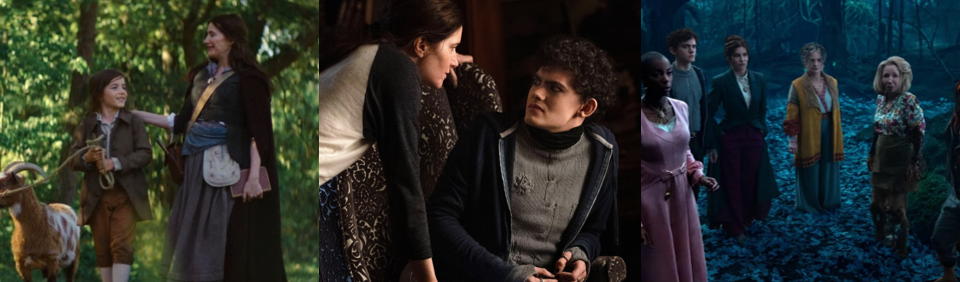
Three years after being trapped by a spell, witch Agatha Harkness (Hahn) escapes and travels the mythical “Witches’ Road” to regain her powers alongside a new coven of witches.

The Review:
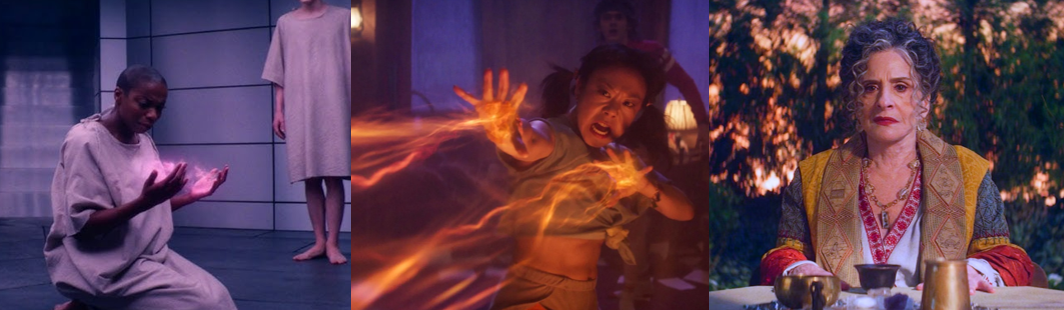
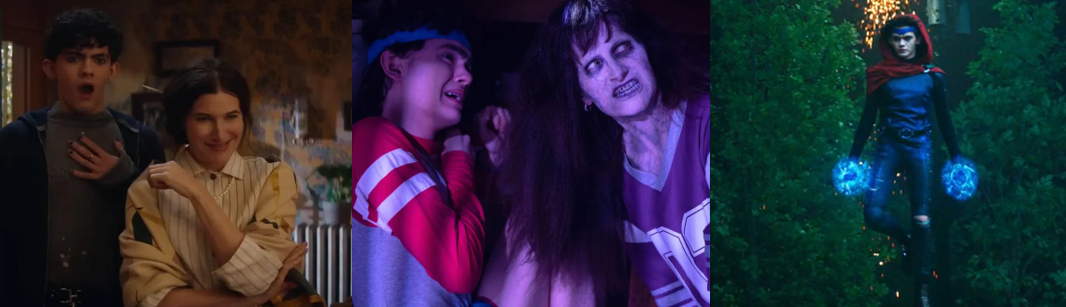
Much like WandaVision, Agatha All Along begins in something of a fantasy world, with Agatha living a crime drama fantasy as “Detective Agnes O’Connor” that the residents of Westview tolerate and even encourage to keep her placated. While Agnes of Westview only lasts for the first episode, “Seekest Thou the Road” (Schaeffer, 2024), the spirit of WandaVision is further evoked when Agatha and her coven journey across the Witches’ Road and revisit the 1960s, 1970s, and 1980s, dressing accordingly and even dealing with supernatural elements not dissimilar from The Exorcist (Friedkin, 1973) and Sam Raimi’s Evil Dead films (1981 to 1992). Enchanted by Wanda as recompense for her heinous actions, Agatha spends three years believing herself to be a tough, no-nonsense Westview detective called to solve a murder frustrated by Federal Agent Rio Vidal (Plaza). While Agnes begrudgingly shares her theories with Vidal, the agent appears coy, questioning her lifestyle choices and her ties to Westview, adding to Agnes’s frustration and unease. This is only exacerbated when Agnes almost pieces together that the victim’s book was the Darkhold, a mythical tome that corrupts anyone it touches. When questioned by Vidal over pizza and beer, Agnes as a mind blank regarding her life outside of Westview and cannot remember why she hates Vidal beyond Agnes being naturally abrasive. After apprehending a teenage thief (Locke) who breaks into her house searching for the “Road” and unnerves Agnes with an incantation, Agnes’s true memories finally return (with some prodding by the mysterious Vidal). Incensed that Wanda has taken her powers, Agatha scuffles with Vidal, seemingly a fellow witch who begrudgingly allows Agatha to regain her full strength for a more competitive battle but alerts the venge-seeking “Salem Seven” to Agatha’s location.

After a lifetime of killing witches, Agatha forms a new coven to travel the Witches’ Road.

Though initially dismissive of “Teen” (whom she comes to regard as a “pet”), Agatha’s intrigued when she cannot learn his name or anything about him due to a “glamour” cast by a magical sigil. Impressed that Teen broke the Scarlet Witch’s curse, Agatha uses him as a chauffeur and he enthusiastically joins her in recruiting a new coven to walk the Witches’ Road, a legendary pilgrimage that promises power to those who overcome its trials. Agatha All Along reveals that Agatha has a horrendous reputation as a witch killer not just because she sacrificed her coven and mother, Evanora (Kate Forbes), but also because she actively murdered her fellow witches alongside her reluctant son, Nicholas Scratch (Abel Lysenk). “Maiden Mother Crone” (Monteiro, 2024) reveals that Agatha provoked other witches into attacking her, allowing her to drain their magic and lifeforce, and the miniseries repeatedly states that Agatha is largely responsible for the negative reputation associated with witches, who were generally kind and compassionate before Agatha inspired lynch mobs to hunt them down. Consequently, Agatha encounters resistance when recruiting her coven, with Lilia Calderu (LuPone), Jennifer “Jen” Kale (Zamata), and Alice Wu-Gulliver (Ahn) only signing up because they’ve also lost their powers or become shells of their former selves. While Teen is very supportive of Agatha and enthusiastic about the quest, the others are sceptical, unified only by their mutual dislike of Agatha and their desire to regain their powers. Since Agatha claims to have walked the Witches’ Road before, they’re forced to defer to her experience, only to find her reluctant to participate in many of the trials and constantly withholding key information from them, leading either to their deaths or dissension as the journey becomes more perilous. Indeed, Agatha knows far more than she’s letting on, constantly manipulating events to suit her grander plan, though she does become very protective of Teen, primarily because he reminds her of her lost son.

While the Witches’ Road spells doom for the coven, they briefly benefit from their time with Agatha.

While Lilia has no interest in joining the coven and is content as a fortune teller, Jen runs a successful (if dubious) skin care business, and Alice is perfectly happy believing the Witches’ Road is merely a fairytale that made her mother (Elizabeth Anweis) a rock star and led to her death, the three begrudgingly join the coven to regain their magic and out of curiosity regarding the Road. Each is chosen according to the legendary “Ballad of the Witches’ Road”, which calls for witches proficient in different magics, and each has their craft testing by the Road. Jen, who was accidentally bound by Agatha a hundred years ago, is pushed to cobble together an antidote in “Through Many Miles / Of Tricks and Trials” (Goldberg, 2024) and even saves Teen’s life after he’s injured conjuring the winged demon that’s cursed Alice’s bloodline. Alice learns that her mother performed “The “Ballad of the Witches’ Road” to protect her from this curse and gets to put it to rest before unexpectedly dying trying to save Agatha. Equally, the Road gives Lilia the chance to finally feel a sense of belonging after being left despondent at failing to save her previous coven with her clairvoyancy, which sees her experience time in a non-linear way and therefore appear crazy. The one outlier is Agatha’s kindly neighbour, Sharon Davis (Rupp), returning from WandaVision, who’s duped into joining the coven and dies during their first trial since they’re too busy squabbling to work together. She’s replaced by Vidal, an unpredictable and sadistic green witch who refuses to elaborate on her true relationship with Agatha, which is repeatedly depicted as frosty. Although the group are largely suspicious of each other, particularly the enthusiastic Teen and the untrustworthy Agatha, they soon bond, sharing stories of their personal tragedies and regrets, resulting in Jen being distraught when Lilia sacrifices herself in “Death’s Hand in Mine” (Schaeffer, 2024).

Initially supportive of Agatha and enduring the Road’s trials, Teen’s true power comes to the forefront.

Much of the miniseries revolves around the mystery of Teen, a talented but inexperienced witchling who carries a pocketbook of spells and is eager to travel the Road to gain ultimate power. Agatha is intrigued by his true nature and becomes very attached to him, pleading with Jen to save him in “If I Can’t Reach You / Let My Song Teach You” (Goldberg, 2024), but ultimately unable to deny her selfish nature. Like Agatha, Teen gets a spotlight episode in “Familiar by Thy Side” (Monteiro, 2024) that reveals he’s more than just a familiar face from WandaVision. Originally William Kaplan, Teen died in a car crash caused by Wanda’s Westview Hex and was possessed by the soul of her son, Billy. However, Kaplan awoke with amnesia and to find he could read minds, finding only worry in the heads of his parents (Maria Dizzia and Paul Adelstein) and living the next six years with no idea of who he really was. Supported by his boyfriend, Eddie (Miles Gutierrez-Riley), Kaplan meets with traumatised former Westview resident Ralph Bohner (Evan Peters) and learns of Wanda, her kids, and Agatha, realising what happened and believing that the Witches’ Road could lead him to his twin brother, Tommy (Jett Klyne). Thus, Teen breaks into Agatha’s house where she was living out her cop drama fantasy and deceives her into letting him tag along, unaware that she suspected his true identity when the Witches’ Road turned out to be real and not a con she’d made up. Though protected by Lilia’s sigil, Teen’s powers are unstable, manifesting when his emotions are at their peak, yet Agatha sees the potential in him to wield the same destructive powers as his mother. While Teen comes to resent and reject Agatha, refusing to trust her and renouncing the Witches’ Road, her tutelage allows him to locate Tommy’s soul and bind it to a dying boy, resurrecting him somewhere in the world. Teen also embraces his dual identity and even receives a glow up in “Follow Me My Friend / To Glory at the End” (Monteiro, 2024), wearing a variation of his Wiccan costume and coming to Agatha’s aid against Death.

Death easily eclipses the forgettable Salem Seven with her alluring and psychotic charisma.

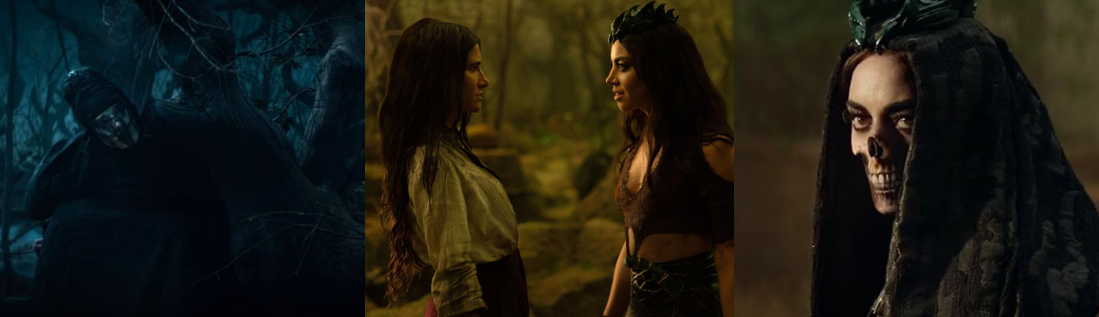
While Agatha is pursued by the twisted, malformed Salem Seven throughout the miniseries, they’re a minor nuisance, at best. A monstrous hive mind comprised of the children of Agatha’s first coven, they occasionally accost the group across the Witches’ Road before being killed by Liana’s sacrifice. The Witches’ Road also causes the coven a lot of grief, forcing them to complete trials based around dubious riddles, which sees them cobbling together an antidote, summoning and destroying the demon plaguing Alice, and battling the spirit of Agatha’s vengeful mother, who possesses Agatha and encourages the coven to leave her deceitful ass behind. Despite her faults, the coven sticks by Agatha to see the journey through, only for her villainous behaviour to repeatedly bite them since she can’t help but be selfish and abrasive. Liana’s tarot reading reveals that Vidal is actually the personification of death, who’s depicted as a terrifying figure with a job to do. Having had a past sexual relationship with Agatha, Death is more compassionate towards her than others, “gifting” Agatha six years with her son and demanding Billy’s life in exchange for Agatha’s as he’s an insult to the natural order. Though Agatha initially delivers on this promise, she’s convinced to sacrifice herself since Billy reminds her of her son and dies protecting him, knowing her spirit would return. In truth, the true enemy in Agatha All Along is Agatha herself as she spent centuries draining the magic and life from her fellow witches, deceiving them with stories of the Witches’ Road only to dupe them into attacking her. When the Witches’ Road suddenly became real thanks to Billy’s unpredictable magic and vivid imagination, Agatha adapted and fostered the myth, manipulating events to gain the power she so lusted after. However, Agatha’s horrified when Billy tries to banish her to the afterlife since she cannot face her son and, somewhat remorseful for her past deeds, agrees to help him find Tommy as promised.

The Summary:
Agatha All Along acts as the perfect companion to WandaVision and Doctor Strange in the Multiverse of Madness (Raimi, 2022), being coy about Wanda’s fate and showing the effect her actions had on others. Indeed, Westview remains fearful of the Scarlet Witch, choosing not to say her name or interfere with Agatha’s eccentricities since they all suffered greatly at both their hands. Ralph is especially scarred by his time as Agatha’s puppet, reduced to a paranoid hermit who sells tales of his experiences to Reddit users. While Teen never regains William’s memories and largely puts on a front to keep his parents from worrying about him, he also doesn’t acknowledge Wanda as his mother and is simply looking to discover who he is. That Teen is a queer character with a clear goth fixation only adds to this, painting him as an outcast in his own skin who’s just trying to belong. Teen believes that reuniting with Tommy will fill the void in his life but, while he’s elated to locate Tommy’s soul, he’s torn at having to nudge Tommy into the body of a recently drowned boy. Indeed, Billy is horrified to learn that he subconsciously created the Witches’ Road, making him responsible for Alice, Liana, and Sharon’s deaths. Agatha tries to alleviate his guilt by stating that she was going to kill them anyway and pointing out that he technically saved Jen, who regains her magic and confidence and flies off to an uncertain future, but it’s the search for Tommy that really gives Billy a sense of focus by the end. Though he’s the son of her enemy, Teen has a significant impact on Agatha as she sees him as a surrogate son and she repeatedly keeps him out of harm’s way across the Road. While this is for her own selfish ends, she goes out of her way to help him in “Follow Me My Friend / To Glory at the End” and ultimately choses to die in his place after initially being happy to hand him over to Death.

Travelling the Witches’ Road is perilous but nonetheless brings the coven together in entertaining ways.

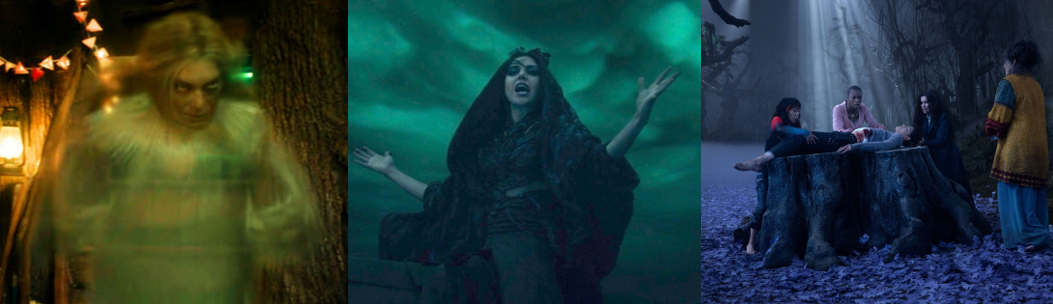
I was happy to see Agatha All Along lean into the horror genre, presenting a unique take on witches (that they’re naturally kind-hearted and only have a bad reputation because of Agatha) and finally bringing Lady Death into the MCU, casting her as a necessary companion to those who have passed, a spurned lover, and a sadistic psychopath. The clear influence of classic horror films is felt throughout the miniseries, with possessed characters bending, contorting, and scurrying in unnatural ways, the coven messing around with a Ouija board, and introducing ghosts to the MCU. The miniseries also draws upon fairy tales and classic cinema, which subconsciously influence Billy’s interpretation of the Witches’ Road, and tells a heart-warming story of these down-and-out misfits coming together for a common cause. Each of the coven has been wronged by Agatha, either directly or indirectly, and each is looking to gain something from the Road. Poor Sharon is the exception, whisked along with the promise of adventure and being poisoned and constantly dismissed by Agatha after her death. While Alice also ends up dead, she dies protecting someone and finally exorcises her literal demons, though she’s initially dismayed at not getting to live free from the curse. Jen and Liana greatly benefit from the pilgrimage, finally regaining their confidence and their abilities, with Liana finally feeling like she belongs after being alone for so long. Each has heard of the Witches’ Road thanks not just to Alice’s mother’s popular song but the story being popular among the witch community, and each finds themselves tested by the increasingly dangerous and obtuse trials presented to them. The Witches’ Road is a perilous place that constantly pushes the coven onwards and shows them their worst fears, forcing Agatha to be confronted by her past misdeeds and exposing her deceitful nature for all to see.

Scheming, deceitful Agatha seemingly seeks atonement by the conclusion of this enjoyable miniseries.

Katherine Hahn stole the show as Agatha, being just the right level of theatrical and dramatic and slowly depicting Agatha’s desperation manifest in aggression and spite as the miniseries progressed. A despicable, selfish character, Agatha seeks only more power and relishes stealing from others, leading them on with stories of the Witches’ Road and caring little for integrating into the witch community (or any society). It’s not made clear why she’s driven to kill, but she doesn’t stop, even when raising Nicholas, and seemingly turns her grief against her kind after he’s taken from her. Bitter and twisted, she’s perfectly happy to manipulate anyone she can and easily adapts to any situation to turn it to her advantage, encouraging stories about her and flaunting her feared reputation. Agatha All Along avoids descending into a big CGI light show battle, emphasising the futility of fighting Death, and instead hinges its confrontations and finale on interpersonal drama and overcoming physical and emotional challenges. The visual identity of the miniseries was captivating, fully committing to its horror aspects and presenting a twisted forest full of dangers and surprises. I liked that the witches couldn’t use their magic and had to come up with different ways to pass their trials, and that Agatha was forced to manipulate events when Billy conjured the Witches’ Road. Even dying was part of her plan, with her continuing on as a spirit and seemingly committed to atoning for (some of) her past by guiding Billy to Tommy and even honouring her coven. It was fun spotting all the references to classic horror films, and enjoying the different variations of “The Ballad of the Witches’ Road”, and learning more about how witches function in the MCU. The miniseries shines most in the way the characters interact, begrudgingly forming a coven and learning to work together and care for each, bickering the entire time and bringing a lot of energy to the show. I’m interested to see what’s next for Agatha and Billy and how this all pays off in the wider picture of the MCU, but I’d be more than happy to see future miniseries for both and in this world going forward.

My Rating:

Rating: 4 out of 5.

Great Stuff

Did you enjoy Agatha All Along? What did you think of Katherine Hahn’s performance and the additional lore afforded to Agatha? Which of the coven was your favourite and did you guess that there was more to Teen and Vidal? What did you think of the Witches’ Road and the way Agatha fostered the legend for her own ends? Were you disappointed that there wasn’t a more spectacular fight between Agatha and Death? Would you like to see more from these characters, and are there any specific Agatha Harkness stories and moments you’d like to see in the future? Whatever your thoughts on Agatha All Along, leave them below, check out my other Marvell content, and donate to my Ko-Fi to fund more reviews like this.

Screen Time [MK Day]: Mortal Kombat: Conquest: “Warrior Eternal” (E: 1/2)


This image has an empty alt attribute; its file name is mortalmonday.png

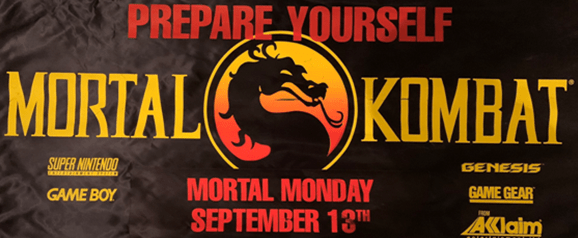
To celebrate the worldwide home console release of Mortal Kombat (Midway, 1992), 13 September 1993 was dubbed “Mortal Monday”. While I’m a day late this year, I always enjoy taking some time to celebrate this influential fighting series.


Episode 1 and 2: “Warrior Eternal”

Director: Oley Sassone
Air Date: 3 October 1998 and 10 October 1998
UK Network: Channel 4
Original Network: The WB Network / Turner Network Television (TNT)
Stars: Paolo Montalban, Daniel Bernhardt, Kristanna Loken, Bruce Locke, Jeff Meek, Chris Casamassa, and Jennifer Renton

The Background:
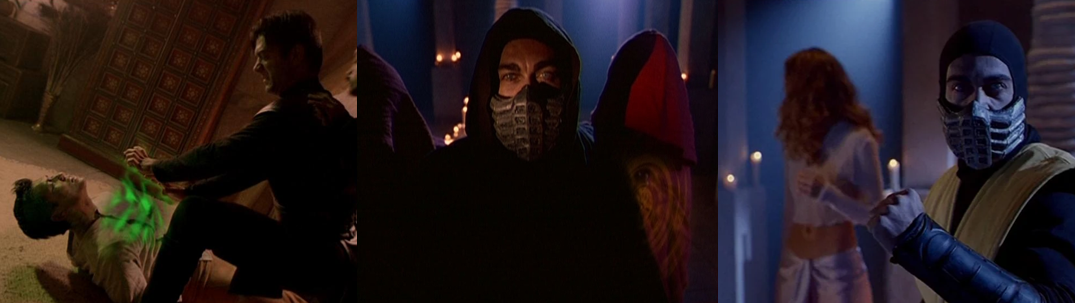
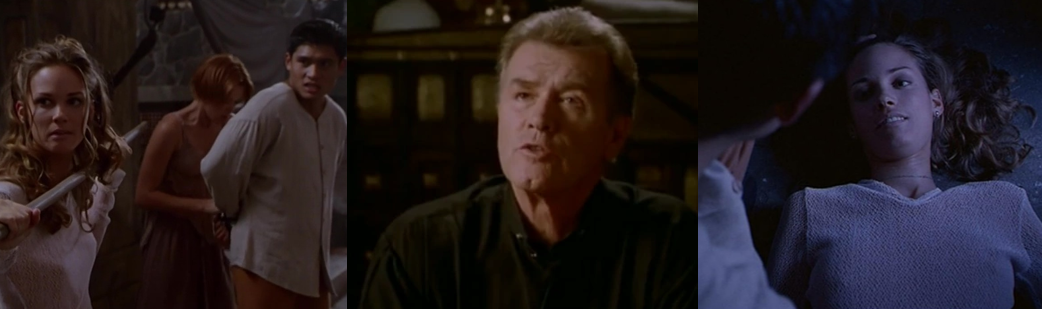
During the nineties, competitive fighting games took arcades by storm thanks to the many versions of Street Fighter II: The World Warrior (Capcom, 1991). Seeking to compete with Capcom, developers Ed Boon and John Tobias took inspiration from movies like Enter the Dragon (Clouse, 1973), Big Trouble in Little China (Carpenter, 1986), and Bloodsport (Arnold, 1988) to create an ultra-violent tournament fighter that changed the genre with its simple fighting mechanics and ultra-violent content. Development of a live-action Mortal Kombat began with producer Lawrence Kasanoff, who envisioned the venture as a multimedia franchise. Unfortunately, while he and director Paul W.S. Anderson delivered a surprisingly profitable cult hit, Mortal Kombats (ibid, 1995) reputation was tarnished by its laughably bad box office bomb of a sequel. However, Mortal Kombat: Annihilation (Leonetti, 1997) wasn’t the end of Kasanoff’s endeavours as this criminally under-rated and short-lived prequel series aired between 3 October 1998 and 22 May 1999. Though its schedule was often sporadic, Mortal Kombat: Conquest eventually followed episodes of World Championship Wrestling’s WCW Monday Nitro, resulting in cameos by WCW wrestlers, though the show ended on a frustrating cliff-hanger apparently due to its budget. Still, the series developed a cult following and was a spotlight for actors like Daniel Bernhardt and Kristanna Loken, some actors and sequences from the movies returned for the series, and Mortal Kombat: Conquest seems to have been subtly referenced in the franchise’s modern iterations.

The Plot:
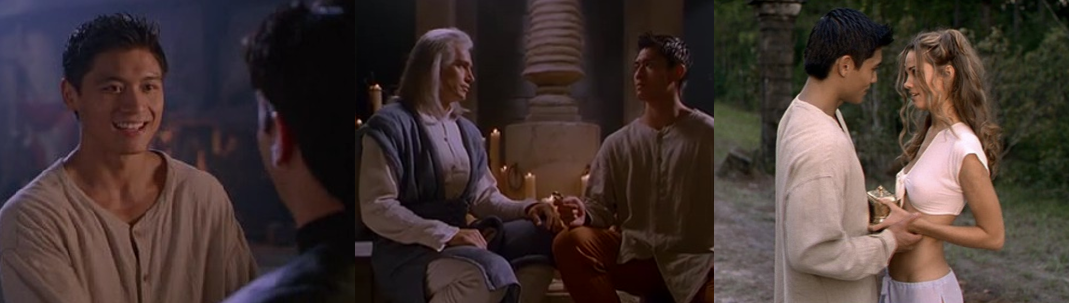
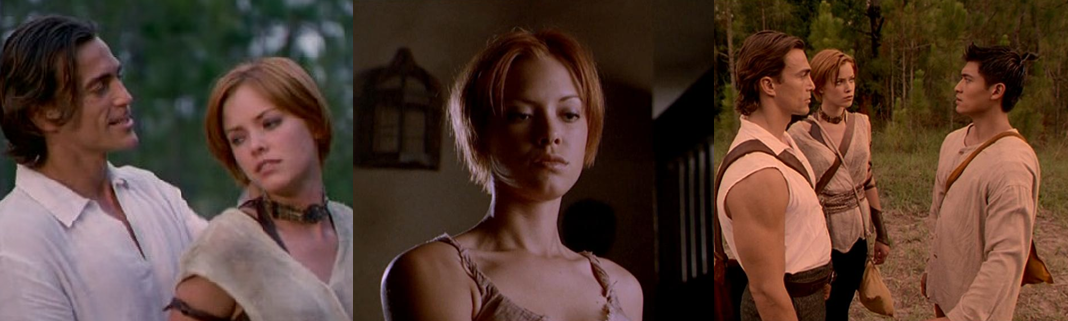
Centauries ago, after safeguarding Earthrealm in a life-or-death tournament called “Mortal Kombat”, Kung Lao (Montalban) seeks a normal life with his love, Geneviere “Jen” Reyland (Renton). However, when fate and scorned sorcerer Shang Tsung (Locke) intervene, Kung Lao must team with an exiled guard and a thief to prepare for the next tournament.

The Review:
“Warrior Eternal” is the two-part pilot of Mortal Kombat: Conquest a prequel to the first two live-action movies that I watched diligently as a kid. We can tell right away that it’s a prequel not just because it’s set “centuries ago, in a time of darkness and fury” but because it presents younger versions of iconic Mortal Kombat characters Shang Tsung and Shao Kahn (Meek), Emperor of the all-conquering Outworld, but also liberally uses footage from those movies for establishing shots. Footage of Outworld and the Temple of Light establish this is the same continuity and, while they’re generally just random shots or short clips, it’s kind of fun to see shots of the Temple of Light repurposed here. It’s also clear that this is a prequel since we’re following the Great Kung Lao, distant ancestor of Liu Kang (Robin Shou), as he prepares to decide the fate of Earthrealm in the latest Mortal Kombat tournament. A humble man who’s been trained since birth to become the greatest Shaolin warrior, Kung Lao is described as the “best” Earthrealm has to offer and his mentor, the Thunder God Rayden (Meek), even says that, physically, no fighter can match him, a claim tested here and throughout the series. Naturally, Kung Lao is as aware of the realms and Mortal Kombat, and the otherworldly dangers of Outworld, as his fellow monks. While the city of Zhu Zin is close to the Temple of Light and many of its people are respectful of their monks and warriors, and even aware of Mortal Kombat, just as many remain ignorant and mock Kung Lao’s beliefs. Baron Reyland (John Reilly) is the embodiment of this, believing Kung Lao isn’t worthy of his daughter since the monk doesn’t place value in material or financial matters, showcasing that Kung Lao may be a knowledgeable warrior and deeply spiritual character, but he’s somewhat out of place with the world he fights so valiantly to protect.

Friendly champion Kung Lao is torn between his destiny and his heart after a lifetime of combat.

Unlike Outworld’s forces, Kung Lao has no supernatural power and is simply at the peak of physical and spiritual ability. While he still has a lot to learn, his commitment to protecting his loved ones and his sheer force of will see him resist even Shang Tsung’s soul-stealing magic and push him to overcome even insurmountable odds. Yet, Kung Lao is often conflicted, doubting himself and his abilities, and initially rejects Rayden’s demands that he prepares the next generation of fighters to compete in Mortal Kombat. Kung Lao is haunted by visions of a disastrous future where his people (and Earthrealm) are slaughtered and he’s pummelled by a barely distinguishable CGI mess (presumably Goro). Despite these visions, Kung Lao resists his destiny to be with Jen, who’s apparently drawn to his belief that all life as sacred (even monsters like Shang Tsung), making him the opposite of her father. Kung Lao shows respect even to Shao Kahn and makes a point to take a higher path, being humble in his victory and even sparing Shang Tsung even though it comes back to bite him. Kung Lao is friendly to all, having befriended the baron’s guards, Takeda (Casamassa) and Siro (Bernhardt), and even stepping in to spare Taja (Loken). While Siro is incredibly overprotective of Jen, Kung Lao pacifies him with compliments but is obviously blinded by his love when he praises her playful sparring. This also sees Kung Lao lie to her regarding his visions since he wishes to shield her from such things. Kung Lao’s outraged when Baron Reyland denies his wish to marry Jen and resolves to abscond with her, hopeful to flee his nightmarish visions and be truly happy. However, he makes peace with the baron in his final moments but is annoyed for dismissing Rayden’s advice, and sparing Shang Tsung, when Jen’s life is endangered. Kung Lao’s understandably devested when Jen dies but finds solace in knowing she’s gone to a better place and in dedicating himself to training new fighters alongside Siro and Taja, just as Rayden encouraged.

Meek impresses in his dual role as the wise-cracking Rayden and menacing Shao Kahn.

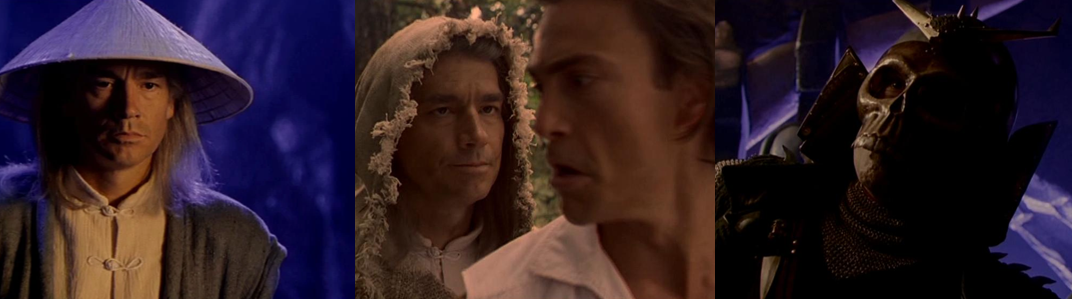
Like the movies, Rayden is presented as a mentor figure, while also giving a rundown on the Mortal Kombat tournament and the different realms that resembles the speeches his big-screen counterpart gave. Though he’s an aloof Thunder God with an odd sense of humour, Rayden directly oversaw Kung Lao’s training and gives him many pointers. However, Rayden is forbidden from directly interfering in mortal affairs, especially Mort Kombat, unless the unseen Elder God’s vaguely defined “rules” are broken, as the entire point is that mortals must defend their worlds. Often cryptic and mysterious, Rayden gives just enough hints, often pushing people where they need to be and surreptitiously manipulating them as required. Rayden sees things in very different terms to mortals, however, despite his clear love and affection for them. For him, it’s a simple choice of duty that Kung Lao accepts the responsibility of being Mortal Kombat champion and that the perks of being effectively immortal and serving the greater good outweigh fleeting love and friendships. Still, though exasperated with Kung Lao, Rayden understands his affection for Jen and helps point him find Scorpion by encouraging Kung Lao to figure out his visions. Jeff Meek pulls double duty as Shao Kahn, a menacing figure also handicapped by the Elder Gods’ rules since he cannot directly invade or attack Earthrealm without dire consequences. A master manipulator, shrewd warrior, and cunning strategist, Shao Kahn is constantly thinking up ways to bend or get around these rules, using hidden portals and third-party assassins and mercenaries and thus give Outworld the edge. Although not quite a petulant, childish figure like his movie counterpart, Shao Kahn is prone to fits of rage and mood swings that see him switch from morose and bored to spiteful and angered on a dime. Though he admires Shang Tsung’s ambition, Shao Kahn is a demanding, ruthless, and spiteful emperor, banishing Shang Tsung to the cobalt mines for his failure and deeply humiliated by Kung Lao’s victory.

The humiliated Shang Tsung plots his revenge from the desolate cobalt mines.

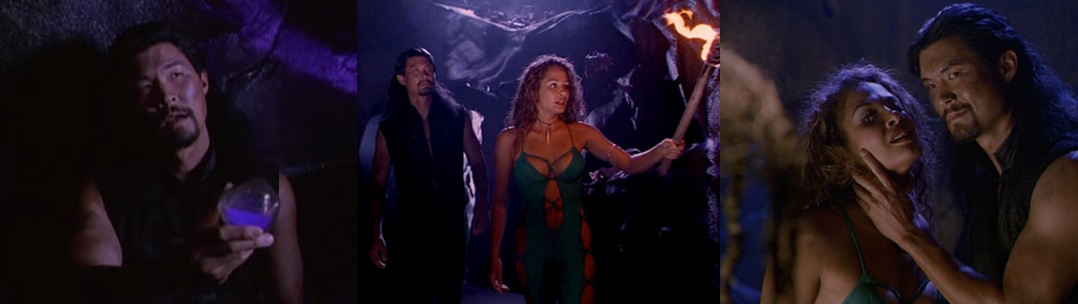
However, in these first two episodes, Shao Kahn is merely a puppet master as he sets in motion many of the events and standards the series will follow. Shang Tsung stars as Shao Kahn’s loyal servant and greatest warrior, with aspirations of ruling alongside his emperor. However, he loses favour when he’s humbled and humiliated by Kung Lao, who shows him mercy, perhaps the greatest dishonour Shang Tsung could face. Shang Tsung’s disgrace and lust for revenge runs deep as he preyed upon Kung Lao’s insecurities and used his decades of fighting experience to put the Shaolin warrior on the ropes, only to be publicly defeated for the first time in who knows how long. Despite knowing Shao Kahn better than perhaps anyone, Shang Tsung begs for death rather than endure the constant torture inflicted upon him following his failure. Shao Kahn cruelly grants a reprieve by banishing the sorcerer to the cobalt mines, though the sorcerer’s powers aren’t negated there like the other inmates. While there, Shang Tsung aligns with the scheming Vorpax (Tracy Douglas), who’s immediately enticed by Shang Tsung, seeing him as a chance to escape. Although Shang Tsung is immune to her charms, asserting dominance over her, he’s convinced to bring her under his heel to get his revenge. Shang Tsung believes he’ll regain Shao Kahn’s favour if he kills Kung Lao and steals his soul. He thus uses black magic to bargain with the soul trapped within a scorpion and have it infect Takada, casting Scorpion as the first of many minions to target the Mortal Kombat champion.

A radically different version of Scorpion steals the show with his malicious actions and fighting skill.

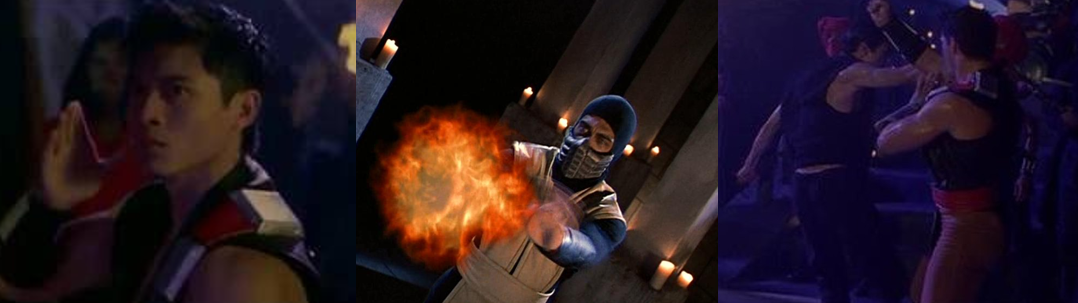
With Shao Kahn brooding in his palace and Shang Tsung confined to the cobalt mines, franchise favourite Scorpion acts as the primary antagonist here. Despite Mortal Kombat: Conquest set well before Hanzo Hasashi was born, it would’ve been folly not to include one of the most popular characters so the show dreams up a brand-new origin for Scorpion. To be fair, we never got any exposition about him in the films so it’s not really contradicting anything there. In this context, Scorpion was a deadly warrior confined to a real scorpion and stolen by Shao Kahn from a conquered realm. Thanks to Shang Tsung, Scorpion possesses Takada, one of the baron’s guards. While Takada was friendly with Kung Lao, he becomes a vindictive villain once consumed by Scorpion’s wicked demeanour. Mortal Kombat: Conquest gives Chris Casamassa a chance to flex his acting muscles alongside his physical ones, portraying Takada as a genial and loyal friend and Scorpion as a spiteful and cruel warrior. Sure, his line delivery is overly theatrical (“I’m going to kill you, Kung Lao” always makes me chuckle), but his fighting skills more than make up for it. Scorpion gains a new ability here to bring others under his sway, enchanting the Shaolin monks to give Siro and Taja someone to fight in the finale. Scorpion still has his snake-like spear-thing, which looks worse than ever and is easily dispatched by Kung Lao, though it’s okay as the Kung Lao/Scorpion fisticuffs are a highlight of these episodes. Scorpion even pulls off his teleport punch and creates ripples that impact the entire series – and Kung Lao’s life – by murdering Jen with a shitty looking fireball, returning to plague our heroes a few times despite inexplicably dropping into Hell (or the Netherrealm) upon defeat.

Despite her pretty face, the best thing Jen can do is die since she’s atrocious to watch.

If there’s a weak link in Mortal Kombat: Conquest, it is and has always been Jennifer Renton’s atrocious acting. Sure, she’s pretty enough but her delivery is robotic and impassionate and it’s legitimately painful whenever she’s on screen. Jen is extremely familiar with her bodyguard, Siro and Jen jumps at the chance to elope with Kung Lao for true happiness, which at least emphasises that she’s not as materialistic as her father. Jen surprisingly gets physical when she works with Taja to free Kung Lao and holds her father at spear-point, heartbroken at him forcing her to choose between the two men she loves. Jen’s recklessness costs her in the end, though, when she tries to interfere in Kung Lao’s fight with Scorpion and gets herself killed, ultimately gifting him the trading post to use as his base for the series. The greedy, cantankerous Baron Reyland operates from this central hub for trade and business in Zhu Zin, and cares only for profit and the power associated with money, believing his little empire to be more important than matters of life and death for the entire realm. When Kung Lao asks for his blessing, Baron Reyland treats the conversation like a trade dispute, criticising Kung Lao’s lack of financial prospects, despite being “well aware” of Mortal Kombat and its stakes. Baron Reyland demands Kung Lao abandon his faith or be forever denied access to his “property” (Jen), even threatening to have him executed if he persists. Thus, already angered at Siro’s betrayal and Jen’s rebelliousness, the baron praises Takada in apprehending Kung Lao and seemingly relishes ordering his execution. Baron Reyland is affronted when Jen and Taja save Kung Lao, disgusted and amazed at his daughter’s betrayal, but is offended when Takada employs sorcery to subdue Kung Lao. This proves to be the baron’s undoing as he’s impaled during the scuffle, though he makes amends with Kung Lao as he dies so…all’s well that ends well, I guess?

Although they get off on the wrong foot, the three protagonists eventually find common ground.

Finally, Kung Lao crosses paths with two characters who stick by him throughout the series: prideful and devoted bodyguard Siro and scrappy thief Taja. Siro is constantly at Jen’s side and, wishing only the best for her, allows her to leave with Kung Lao and humbly admits his betrayal to his master, taking his banishment despite the crippling blow to his pride and professional stature. An outspoken sceptic, Siro’s uncomfortable when visiting the Temple of Light with Jen and thus amazed when “Takada” leaps from the trading post without breaking his legs. Siro immediately gets off on the wrong foot with Taja when she and her cohorts attack him and Jen at the Temple of Light, with Siro easily besting the gorgeous thief and locking her up. However, Siro sets this aside following his encounter with Rayden and teams with Taja and Kung Lao to rescue Jen. Like Kung Lao, Siro is heartbroken at Jen’s death and despondent about his future before finding new meaning in aiding Kung Lao. Taja is equally cynical but more because of her harsh life stealing and fighting for survival. Defiant even when apprehended by Siro, Taja relies on her smart mouth when physically overpowered or shackled, visibly disgusted at being the baron’s slave and his advances towards her. When she learns of Kung Lao’s pending execution from an incognito Rayden, Taja’s compelled to intervene to ensure her own survival and out of gratitude for him sparing her life. Taja’s not afraid to fight dirty but pays her debts, quickly befriending Jen and showing regret at her harsh life and resorting to thievery, while also seeing it as the reality of her situation, confiding in Kung Lao that she dreams of the kind of luxuries Jen enjoys. Her insight into the baron’s dungeon serves Kung Lao well, as does her stealthier approach to situations as opposed to simply going in half-cocked. The experience changes Taja for the better, giving her an opportunity to do something useful with her life and, despite her doubts, she volunteers to aid Kung Lao in preparing for the next tournament.

The Summary:
I’ve always been a fan of Mortal Kombat: Conquest. It’s cheesy in just the right ways, with a lot of action and some fun reinterpretations of the videogame characters and their lore. Having said that, these aren’t the best episodes of the short-lived series. This makes sense in a way as they’re primarily designed to establish the characters, the show, and its format: Shao Kahn is a looming threat, Shang Tsung plunders the mine for new opportunities for revenge, and our three protagonists face constant battles both to gel as a team and define their destinies. This is all nicely laid out here but there are also some oddities. Kung Lao successfully defends Earthrealm and is charged with preparing for the next tournament, which isn’t for a “generation” (approximately twenty and thirty years). The Elder Gods decree that Kung Lao won’t age, but does that extend to his allies? I guess so, but I feel like the series might’ve benefited from taking place building to the next tournament. Kung Lao questions why Rayden can’t teach the new fighters and this is a great point as Rayden himself states that he’s guided Kung Lao’s training, and Kung Lao was trained to become as good as he is by the Order of Light, so all he really has to offer is first-hand insight into fighting Outworld’s forces, something I’m sure others could impart. Still, while Zhu Zin is obviously a set, it’s always bustling with extras thanks to being a market town and the restricted space is masqueraded (or, at least, justified) quite well. Also, although the violence of the videogames is again severely toned down, there’s still a fair bit of death and danger here. While this is largely embodied by Shang Tsung and Scorpion, who reduce people to ash or murder them with fireballs, Kung Lao’s not to be trifled with either as he’s not above killing when necessary.

Despite some dodgy CGI, the visual references and impressive fights help the show stand out.

Regardless, Mortal Kombat: Conquest also evokes the movies with its intro sequence and the techno-beat soundtrack that punctuates each fight, and by including some interesting references the source material. Costume design remains as accurate to the videogames as in the first movie. Though it’s disappointing Kung Lao only dons his Mortal Kombat II (Midway, 1993) look for a brief scene and Rayden also ditches his iconic hat, I liked Rayden’s robes, Scorpion looks exactly as he did in the first movie, and Shang Tsung closely resembles his Mortal Kombat II appearance. It honestly doesn’t and wouldn’t make sense for Kung Lao to don that outfit anyway as that’s what his successor wore, but it would’ve been nice to mix up Kung Lao’s wardrobe by bringing it back, especially as they went to the trouble of making it. Shao Kahn veers towards cosplay at times, perhaps explaining why he only wears his helmet for one scene. He cuts an intimidating figure (even more so considering it’s Meek in a dual role) and I like the shattered skull mask he wears, but he can look a little goofy at times. Outworld is expanded to include Shao Kahn’s cold and empty throne room and the dingy cobalt mines, which rob anyone not from Earth of their supernatural powers. Jeff Meek shines as Rayden, channelling Christopher Lambert’s playful spirit of and marrying it with the demeanour of an exhausted teacher. While he admires human spirit and encourages free will, Rayden impresses the importance of preparing for the next tournament upon Kung Lao and, when he insists on defining his own destiny, Rayden assumes the guise of a beggar to manipulate Siro and Taja into helping Kung Lao escape from Baron Reyland. Rayden knows exactly how to manipulate Siro, questioning his integrity and insulting his pride to push him back to Zhu Zin to aid Kung Lao. Bruce Locke equally steals the show by channelling Cary-Hiroyuki Tagawa’s energy and menace to present Shang Tsung is a ruthless and vicious fighter who delights in stealing souls and is consumed with the need to avenge himself.

The ambitious fights counterbalance some cheesy moments and drama to lay the foundation for the show.

While the visual effects are often cartoonish, they’re clearly secondary to more traditional displays of martial arts and stunt work. Although the actors partake in each episode’s fights as much as possible, with Bruce Locke and Daniel Bernhardt putting in more of the work (thanks, largely to the latter’s unique stature and legitimate martial arts background), obvious stunt doubles are used for each fight, with Kristanna Loken noticeably being supplanted. While it’s jarring to edit close ups of the actors to sell the illusion, the fights are very well choreographed, with Christopher Leps, Marcus Young, J.J. Perry, and others bringing a grace and tactile believability to each. The battle between Kung Lao and Shang Tsung reflects the animosity between the two, with Shang Tsung growing increasingly frustrated and Kung Lao exuding the speed and precision that made him Earthrealm’s finest. Even when saddled with perhaps the fakest sword I’ve ever seen, Daniel Bernhardt shines, largely because you recognise that the actor is performing many of his stunts and fights. Siro isn’t as slick and graceful as Kung Lao but exudes physical power, having great reach with his kicks (his flying kick being particularly impressive), even if he is out of his depth against more otherworldly opponents. Though she lacks Kung Lao’s skill and Siro’s raw power, Taja is a scrappy fighter who uses underhanded tactics and is seemingly fearless. Kung Lao’s battles with Scorpion are an obvious highlight, with Casamassa bringing an aggression to Scorpion that paints him as a force to be reckoned with, even more so when tossing his snake-like appendage about (not a euphemism). It’s good that the action is so impressive as the drama between Kung Lao and Jen really drags these episodes down, largely because they lack chemistry and Renton’s awful performance. The sting of these scenes is eased by Meek’s theatrical performance as Shao Kahn, his dry sense of humour as Rayden, and a fun energy to the episodes. I got the sense everyone was having a good time and trying their best to start something, and the framework is definitely here, it would just take a few episodes to be as good as it could be.

My Rating:

Rating: 3 out of 5.

Pretty Good

Were you a fan of Mortal Kombat: Conquest back in the day? If so, what did you think to these first two episodes? Do you think I was too harsh on Jennifer Renton or do you agree that she was terrible? Which of the three main characters was your favourite and did you enjoy their chemistry? Were you surprised that Jeff Meek played two roles? What did you think of Scorpion’s new origin? Would you like to see a revival of Mortal Kombat: Conquest, or a new TVG show? How are you celebrating Mortal Kombat today? Whatever you think about Mortal Kombat: Conquest, leave a comment below, go check out my other Mortal Kombat content, and sign up to my Ko-Fi to suggest other Mortal Kombat: Conquest episodes for me to cover.

Screen Time: Loki (Season Two)

Season Two

Air Date: 5 October 2023 to 9 November 2023
Network: Disney+
Stars: Tom Hiddleston, Owen Wilson, Sophia Di Martino, Ke Huy Quan, Wunmi Mosaku, and Jonathan Majors

The Background:
While Marvel Studios expanded into television ventures with the likes of Agents of S.H.I.E.L.D. (2013 to 2020) and various Netflix productions, the launch of streaming service Disney+ led to MCU godfather Kevin Feige producing various content to further explore the continuity of the MCU. Although Marvel Studios somewhat flooded the market with shows and movies, the first season of Loki (Herron, 2021) was met with critical acclaim for its characterisations and unique narrative. Since Tom Hiddleston’s portrayal of Norse God of Mischief Loki Laufeyson has been consistently popular over the years, a second season was all-but inevitable, especially considering the first ended on a massive cliff-hanger. Principal directors Justin Benson and Aaron Moorhead were excited to tackle the mischievous outcast and further explore Loki’s unlikely position as the saviour of the multiverse. While the writers strived to showcase new layers to Loki and the show’s returning characters, they faced an uphill battle in addressing lingering plot threads regarding Jonathan Majors’ multiple characters after he was accused of all kinds of wrongdoings and caused Feige to rejig the plans for Majors’ Kang the Conqueror. Still, the season aimed to dive deeper into the weirder side of the MCU while still focusing on character-driven stories, explore Loki’s emotional turmoil, and further set the stage for upcoming MCU projects. Released weekly on Disney+, Loki’s second season was widely praised for its bittersweet conclusion, the culmination of Loki’s selfless character arc, and the compelling performances.

The Plot:
Uncontrollably warping through time, an alternate version of Loki (Hiddleston) attempts to reunite with his female “time variant”, Sylvie Laufeydottir (Di Martino), and warn the Time Variance Authority (TVA) of the threat posed by variants of “He Who Remains” (Majors).

The Review:
If you’re anything like me and haven’t watched Loki’s first season since it originally aired, you’re in luck as season two opens with a helpful recap, largely narrated by the sentient artificial intelligence Miss Minutes (Tara Strong), that summarises the key events of the first season. Namely, the deceptive nature of the TVA (whose members are variants from destroyed (or “pruned”) timelines) who’ve had their memories continually wiped) and Loki and Sylvie’s climactic confrontation with He Who Remains. This saw Sylvie impulsively murder the enigmatic overseer, plunging the “Sacred Timeline” into chaos as the one coherent timeline diverged into an infinite number of strands. The first season saw this version of Loki, plucked from the peak of his villainous arc, transformed from a mischievous and self-centred antagonist into a reluctant hero, one who came to care for his allies at the TVA, particularly Mobius M. Mobius (Wilson). The first season concluded with Loki deposited in a version of the TVA where no one remembers him and a variant of He Who Remains is now immortalised as the founding father of the TVA. Since no one remembers him and Loki is renowned as a troublemaker, the TVA initially seeks to apprehend and prune him, forcing him to frantically flee through their offices since the time-displaced TVA has safeguards that negate his magic. As if this wasn’t bad enough, Loki finds himself painfully warping to different points in time where the TVA either remember him or don’t, something that should be impossible within the TVA but appears to be a result of one of the many temporal paradoxes and incursions peppering this season. Unfortunately, Loki’s “time slipping” is essentially resolved by the end of the first episode, “Ouroboros” (Benson and Moorhead, 2023), thanks to a time paradox Loki initiates that sees forgotten TVA technician Ouroboros/OB (Quan) cure Loki’s ailment using a “Temporal Aura Extractor”.

Despite being pulled through time, Loki is determined to help and defend his friends at all costs.

This desperate gamble, which sees Mobius brave a cosmic storm and approach the wildly unstable “Temporal Loom”, only succeeds because Mobius risks his life for his friend and Loki willing prunes himself from every timeline, stabilising his condition and allowing him to return to work alongside Mobius. However, Mobius is sceptical of Loki’s warnings about He Who Remains, an enigmatic variant whose death kick-started the catastrophe that threatens the TVA (and all reality) as he has a nigh-infinite army of variants waiting to wage war on time itself. Although Hunter B-15 (Mosaku) convinces the fractured TVA council (left in disarray after Ravonna Renslayer’s (Gugu Mbatha-Raw) betrayal) not to eradicate the branching timelines and thus sparing other variants of losing their worlds like they did, the TVA is largely unconvinced of the larger threat posed by He Who Remains, even after Loki dramatically reveals that he’s deceived them all. While dealing with He Who Remains is Loki’s top priority, he’s also desperate the safeguard Sylvie from the warmongering General Dox (Kate Dickie) and her chief agent, Hunter X-5 (Rafael Casal), who dismiss Hunter B-15’s arguments and launch a devastating attack on the splintering timeline before they’re apprehended. Distressed at the way their relationship fell apart over their disagreement concerning He Who Remains, Loki’s keen to make amends and recruit Sylvie to his cause, only to find her bitter at the TVA, angry at his loyalty to the organisation, and content to live a mundane life as a McDonald’s employee. This season really showcases how much Loki has changed as he’s extremely loyal to Mobius, makes fast friends with OB, and sees that the TVA saves more lives than it ends and is a necessary function to defend against He Who Remains. While interrogating Hunter X-5 (who abandons his mission to become successful actor “Brad Wolfe”), Loki takes the high ground when his moral stance is questioned and even councils Mobius when he lets Brad get under his skin, having learned to empathise with others and prioritise saving lives over taking them.

Though Loki and Sylvie clash, her perspective motivates Loki to take his rightful place at the End of Time.

While Loki’s still mischievous at times, using his powers of illusion to subdue Brad and then colluding with Mobius to threaten Brad into giving up Sylvie’s location, he demonstrates incredible patience, enduring Mobius’s more relaxed approach to field work, OB’s eccentricities, and Sylvie’s pig-headedness all to try and reason with them. When the likes of Brad and Renslayer call out Loki’s hypocrisy, he admits to having done bad things and experienced jealousy and rage in the past but is seemingly committed to doing good now. However, during his desperate attempt to time slip back to the TVA and prevent the Temporal Loom from exploding, Sylvie forces Loki to admit that, deep down, he’s motivated by a selfish desire to not be alone, leading him to briefly abandon his cause. Loki’s despair at his friends forgetting him and his desperate needs to assemble their variants in “Science/Fiction” (Benson and Moorhead, 2023) is palpable, with him being both frustrated and hurt when they forget him and enduring centuries of time slipping to try and save them all. When his efforts are doomed to fail, a chance comment by Sylvie sees Loki return to the citadel at the End of Time to endure another doomed time loop as Sylvie’s past self refuses to listen to reason and he cannot bring himself to kill her. Ultimately, Loki’s given the same choice as in season one: maintain the Sacred Timeline or risk total annihilation. While Sylvie advocates for free will, even if it means everyone dying, Mobius relates the burden of making sacrifices for the greater good. Thus, rather than risk his friends, Loki destroys the Temporal Loom and rearranges the disparate timelines into something more stable, a tree-like structure resembling Yggdrasil, with himself at the centre. While he previously admitted his fear of being alone, Loki gratefully assumes his duties with a content smile, having finally found his place as a more benevolent overseer of the many timelines.

Even variants of Loki’s beloved friends anchor him and drive him to safeguard all timelines.

While Mobius initially has no idea who Loki is, his memories quickly return in fragments and he’s soon following his instincts and bringing Loki to OB and risking having his skin peeled off by the Temporal Loom to help his friend. Though still distracted by jet skis, we get a few extra layers to Mobius this season as he adamantly refuses to peek into the many timelines and see the life he was denied by He Who Remains, being content with his job and enjoying it. However, after Loki encounters Mobius’s jet ski salesman variant, Brad, a single dad who’s awestruck that he’s essential to saving reality, Mobius eventually decides to take a break from the TVA. After plunging the Sacred Timeline into chaos, Sylvie retreats to 1982 and lives a content, if mundane, life as a McDonald’s employee. Adamant that she can handle any variants of He Who Remains, Sylvie angrily refuses to help Loki or the TVA, believing that free will is more important than anything. While Sylvie begrudgingly aids Loki despite this, she’s forced to join his group when her beloved timeline is spaghettified by the exploding Temporal Loom, yet still believes she was right to kill He Who Remains. Loki’s also aided by Casey (Eugene Cordero), a technician who helps Loki and Mobius track their targets, Hunter B-15 (who’s determined to stop haphazardly pruning timelines and thus horrified when Renslayer murders General Dox and her followers), and newcomer OB. An enthusiastic and quirky technician, OB wrote the TVA guidebook after being inspired by Victor Timely (Majors), who was in turn inspired by the same guidebook after being gifted it by Renslayer to turn him into He Who Remains, creating a paradox. Even OB’s unsuccessful sci-fi writer variant Doctor A.D. Doug is instrumental in helping Loki by cobbling together a crude TemPad and helping him master his time slipping. OB also spends what’s said to be centuries working with Timely to teach Loki about particle physics. Though this plan ultimately fails no matter how hard or fast Loki tries to utilise the “Throughput Multiplier” as the Temporal Loom is incapable of handling infinite timelines, the influence of Loki’s friends has a profound impact on him and he willingly gives up his personal freedom to safeguard their lives.

While Dox and Renslayer present immediate dangers, Timely is potentially a more destructive threat.

While Loki is terrified of the imminent danger posed by the variants of He Who Remains, they’re a very vague and ominous existential threat, one not seen in this season. Thus, the danger posed by the stubborn General Dox initially takes priority. Although Loki and Mobius apprehend Dox and her loyalists after working over Brad, they’re too late to stop her destroying most of the timelines. Encouraged by Judge Gamble (Liz Carr), Hunter B-15 attempts to find common ground with General Dox to safeguard the TVA, only for her and her loyalists to be gruesomely executed by Renslayer for refusing to join her. Brad does join Renslayer and Miss Minutes but immediately regrets it and ultimately turns on her soon after, finally feeling remorse after spending the entire season being a complete asshat. Renslayer forms a shaky alliance with Miss Minutes, hopping to 1893 to try and coerce Timely into joining with them, only for the eccentric Timely to ditch them since he’s so against a partnership and rightfully horrified when Miss Minutes reveals she’s in love with his counterpart. Spurned by Timely’s refusal and him choosing to assist Loki, Renslayer and Miss Minutes renounce He Who Remains, especially after Renslayer learns that she was once his commander and was discarded by him, to wage their own campaign against the TVA. Loki’s horrified upon seeing Timely, who shares the same visage as He Who Remains, and at the stuttering con artist’s potential to become He Who Remains, but soon defends the bumbling scientist and even respects him for braving the cosmic storm. Though a con man, Timely has a grand imagination and, inspired by the TVA guidebook, has the potential to become what Loki and Sylvie fear most. Ultimately, even Sylvie recognises that Timely isn’t the same man and he proves he’s committed to doing the right thing, even if it costs him his life. When trying to prevent the destruction of all reality, Loki confronts He Who Remains again, learning that he perfectly planned for all eventualities and that the risk of multiversal war remains as strong as ever. However, Loki’s sheer determination to find another way and ensure everyone gets the chance to thrive wins out, with the reorganised TVA shown to be actively hunting the variants of He Who Remains and presumably ending whatever threat they pose to the MCU.

The Summary:
Loki’s second season picks up right where the first one ended but presents a narrative under constant pressure from a few existential threats. Obviously, the danger posed by the unseen variants of He Who Remains is most pressing, and one Loki is eager to guard against, but it’s largely a non-factor here, especially compared to the imminent danger posed by the Temporal Loom. I initially believed season two who revolve around Loki’s sporadic time slipping but this is sadly cured by the end of the first episode. It does make a dramatic return by the finale, “Glorious Purpose” (Benson and Moorhead, 2023), to depict Loki repeating the same loop over and over for centuries, desperately trying to speed up OB’s plan and failing each time. While this is a great way to emphasise Loki’s newfound sense of devotion to his friends and commitment to saving countless lives, it is strange that he didn’t think to time slip further back sooner. There are some fun paradoxes in this season due to this mechanic, though, with Loki jumping to the future, where the TVA is moments from destruction, encountering himself at different times throughout the season, and quickly building a friendship with OB by consulting with him in the past and those memories aiding Loki and Mobius in the present. Unfortunately, this gimmick isn’t sustained throughout the season and, despite many characters glancing at their alternative timelines, we don’t explore many variant realities here. Loki spends all of “Science/Fiction” in one, only for his primary plan to fail and for desperation to drive him to reliving the same moments, kind of making this episode a waste even if it does finally give us the imagery of Owen Wilson on a jet ski.

While the character moments are on point, Timely was an aggravating addition.

The performances were as captivating as ever in this season. I particularly liked the friendship between Loki and Mobius, with Loki insisting on sitting his friend down and discussing his feelings over a slice of pie, being exasperated by his more cerebral approach in the field, and bickering about which of them should brave the cosmic storm and install the Throughput Multiplier. Mobius is explored a little more here, determined not to look into his other timelines out of fear that they will be better or worse than the life he’s devoted himself to, and Loki shows genuine affection towards him to show how far he’s progressed as a character. This extends to the standout character of the series, OB, whose infectious demeanour steals every scene and quickly makes him an ally Loki fights to protect. Sylvie is very different this time around, being somewhat jaded and content to lay down her arms unless challenged. She opposes Loki’s moral high ground and offers an extreme perspective on events but is ultimately an advocate for free will and willing to make any sacrifice to ensure people have that right. If there’s a weak link here, it’s Jonathan Majors, whose oddball, stuttering, bungling Timely really drags down every scene he’s in. I liked that he was a conman who sold faulty inventions and that he constantly switched his allegiance depending on what was best for him, but his eccentric personality and overly theatrical delivery quickly became grating. He does surprisingly showcase a great deal of bravery and fortitude, however, even earning Loki’s respect when he risks his life to save reality and ultimately chooses to take a different path to avoid becoming He Who Remains. Although Renslayer is more of a bit part this time, I liked how bitter and twisted she was and the rivalry between her and Miss Minutes, who both vie for Timely’s affections. I would’ve preferred Renslayer to play a larger role as a dual antagonist alongside Miss Minutes, perhaps with them replacing Brad in some way, as she felt like an afterthought by the end.

Despite some compelling moments, this season failed to live up to its potential in my eyes.

While Loki’s second season certainly looks the part and delivers some stirring character moments from the title character, who finally fulfils his “glorious purpose” and finds his place in reality, I did find it lacking. The entire season is essentially a do-over of the first season’s finale, with it all boiling down to the same choice between killing He Who Remains and risking war or maintaining the lie/sanctity of the Sacred Timeline. As Loki effectively ends up taking the place of He Who Remains and overseeing the newly formed timelines, I can’t help but feel like the show could’ve been reorganised to take the best episodes and ideas and present them as a ten-episode series that makes the same point. I was hoping this season would be about an unstable, time slipping Loki bouncing around the infinite multiverse encountering variants of He Who Remains and trying to prevent his creation. Instead, it was largely a race against time to find ways to repair and stabilise the Temporal Loom, with each approach failing because Loki is seemingly doomed to fail, especially at being anything but a villain. These aspects are where Loki shined the most, the ways it presented new aspects of Loki’s personality. I loved how he encouraged Brad’s criticism and seemingly veered towards his villainous ways when interrogating him, and that Loki constantly takes a higher path, offering support to his friends when they lose control and constantly trying to empathise with others. This season is, however, let down somewhat by the lack of variety in the time periods visited, with most of the action happening in the increasingly chaotic TVA, and failing to explore the multiverse as widely as I’d hoped. As a character-driven season, it’s pretty fascinating, but many of the narrative beats are recycled from the last season. Loki’s encounter with He Who Remains isn’t that much different to last time and, while its bittersweet to see Loki replace He Who Remains, it feels like all this madness could’ve been avoided if he’d just done that in the last season. Still, season two did a good job tying up some loose ends and giving many of these characters a satisfying send off, I just think it had the potential to be even better.

My Rating:

Rating: 3 out of 5.

Pretty Good

Did you enjoy the second season of Loki? Were you happy to see Loki evolve into a more heroic and balanced character? Did you also enjoy the friendship he shared with the likes of Mobius and OB? Were you also disappointed that the time slipping aspect was downplayed? Did Victor Timely also annoy you and what was your reaction when Loki finally took the place of He Who Remains? Drop your thoughts on Loki below, check out my other Asgard-adjacent content, and donate to my Ko-Fi to fund more reviews like this.

Screen Time [Captain Picard Day]: Star Trek: Picard (Season Two)


As seen in the Star Trek: The Next Generation (1987 to 1994) episode “The Pegasus” (Burton, 1994), the crew and children of the U.S.S. Enterprise-D celebrates “Captain Picard Day” on Stardate 47457.1, which roughly translates to June 16th. While they bewilder Captain Jean-Luc Picard (Patrick Stewart) with drawings, I see it as a good excuse for some more Picard and Next Generation content.


Season Two

Air Date: 3 March 2022 to 5 May 2022
Network: Paramount+
Stars: Patrick Stewart, Alison Pill, Jeri Ryan, Michelle Hurd, Santiago Cabrera, Brent Spiner, and John de Lancie

The Background:
After the disappointing critical reception of Star Trek: Nemesis (Baird, 2002) cancelled plans for further films focused on the popular Next Generation cast, the Star Trek franchise (1966 to present) shifted to other shows and a lauded reboot series. After the franchise saw a resurgence, showrunner Alex Kurtzman pushed to revisit Captain Jean-Luc Picard. Alongside writer/director Akiva Goldsman, Kurtzman convinced Stewart to return to his famous role for Star Trek: Picard (Various, 2020), a highly successful venture that proved popular enough to warrant a second season, as was always intended. Afforded an unprecedented $20.4 million in tax credits by the California Film Commission, season two was developed back-to-back with season three, though filming briefly stalled due to the COVID-19 pandemic. Aiming to continue exploring Picard’s character and mortality, the writers chose not only to revisit the mysterious Q (de Lacie) but also drew inspiration from Star Trek IV: The Voyage Home (Nimoy, 1986) for its time travel plot. Once it started streaming, season two of Star Trek: Picard proved quite popular and the overall critical reception was very positive. Reviews praised the exploration of Picard’s character and the performances and the execution of the introspective narrative. Though some found season two to be derivative of previous Star Trek stories, it proved successful enough to build anticipation for the third and final season one year later.

The Plot:
After returning to inspire a new age of prosperity in the United Federation of Planets, Admiral Jean-Luc Picard and his allies are unexpectedly deposited in a dystopian timeline by the malevolent Q and must travel to the 21st century to not only restore reality, but also face their personal demons.

The Review:
As a lifelong fan of the Next Generation show and movies, I was excited when Star Trek: Picard was  announced. As much as I enjoyed the rebooted movies, I’ve not really been that interested in the Star Trek shows that have come out since as they all explore a pre-Next Generation timeline, something I think has been done to death. Star Trek: Picard represented a unique opportunity to return to the main timeline and see how the universe had changed since Star Trek: Nemesis, but I was surprised to find Picard bitter and alone, familiar characters changed and somewhat jaded, the once tolerant and righteous Starfleet a stubborn and destructive xenophobic regime, and an overall unsettling bleakness to the franchise. Many characters (including Picard) dropped curses with surprising regularity and harboured a resentment towards Picard that needed to be mended over the course of the season. Season one primarily focused on Picard’s age, his failing health and sense of mortality, and his efforts to assist Soji Asha (Isa Briones), the “daughter” of his old friend, Lieutenant-Commander Data (Spiner), cobbling together a new rag-tag crew and ending up in a new synthetic body, seemingly ready for new adventures in the cosmos. Season two begins with Picard back on his family vineyard but still very much involved with Starfleet, having regained his passion now they’ve stopped ostracising synthetics like Soji. This vigour is only further reinvigorated since his crewmates Cristóbal “Chris” Rios (Cabrera), Doctor Agnes Jurati (Pill), Raffaela “Raffi” Musiker (Hurd), and surrogate son Elnor (Evan Evagora) have all joined (or rejoined, in some cases) Starfleet. Rios is now Captain of Picard’s first commission, the USS Stargazer, and Elnor celebrated as the first-ever fully Romulan Starfleet graduate.

Thanks to Q’s machinations, Picard is forced to confront his past traumas while fighting for reality.

Despite being cured of his fatal illness and gaining a synthetic body, Picard enjoys all the ailments that come with his advanced age. This includes doubts and a resistance towards forming long-term romantic engagements despite the advances of his Romulan housekeeper, Laris (Orla Brady). As long-lived as Picard is, his old Enterprise confidante Guinan (Whoopi Goldberg) remains on hand to offer sage advice, and much of the show is focused on Picard learning to let go of his past and embrace his humanity and the happiness offered by love. Indeed, this is later revealed to be Q’s primary motivation. Although he initially appears as a malevolent figure, a sanctimonious, pompous, malicious demigod seeking to further “test” Picard (and the human race) by forcing him to witness a dystopian timeline where he’s a genocidal madman, Q’s newfound mortality drives him to help Picard face some haunting demons from his past in his own unique way. This season reveals that, as a boy, Picard (Dylan Von Halle) witnessed his abusive father, Maurice (James Callis), drive his loving mother, Yvette (Madeline Wise), to suicide. Q’s manipulation – and Picard’s jaunt to 2024 – force him to see his mother suffered from an unspecified mental illness that made her paranoid and unstable, ultimately driving her to suicide. This event shaped Picard’s entire life, driving him to protect others, stand against injustice, and seek out the truth. However, it weighs heavily on Picard’s conscience and his journey of self-discovery – and forgiveness – is as important as his quest to undo Q’s damage and restore the timeline.

The time travel jaunt sees Picard’s crewmates discovering new aspects to their personalities.

Although they scattered across the galaxy after the first series, Picard’s new crew is reunited by his long-standing nemesis, the Borg. When a gigantic and mysterious Borg craft calls for a parlay, Picard is asked to negotiate, an unusual situation which former Borg Seven of Nine (Ryan) lends her own understandably biased opinion on. Captain Rios is unable to resolve this unexpected situation, however, thanks to Q’s intervention, which sees Picard’s crew deposited in a dystopian alternate timeline where only they retain memories of the way things should be. In this dark world, non-human life is conquered, enslaved, eradicated, and publicly executed by the Confederation of Earth, with Seven (as Annika) as the President and Picard as her military commander. We don’t spend too long in this timeline but it’s enough to establish how awful it is compared to the real world and give Seven a strange euphoria as she finds herself truly human for the first time in decades. When the crew travel to 2024 to undo Q’s interference, Seven explores her newfound humanity. She’s far more cautious, especially compared to hot-headed Raffi, and showcases genuine motion for a change. Seven and Raffi’s partnership leads to some of the show’s most interesting and engaging action sequences and banter as they bicker over the best course of action and balance each other’s different methods towards saving and securing the timeline. This results in them growing so close that they share a kiss by the end, which felt a little out of left field for me. Similarly, the trip to the past has radical implications for Rios, who finds himself separated from his friends and defending Doctor Teresa Ramirez (Sol Rodríguez), her son Ricardo (Steve Gutierrez), and her clinic from overly aggressive immigration officers, falling for her in the process and finding a true home and family for himself at the same time.

The Borg Queen manipulates Agnes, but soon develops a genuine connection with her.

I was happy to see that Picard is treated much better in this season. Not only does Starfleet treat him with the respect he deserves, but his crew now defer to his wisdom and admire his tenacity. However, there are some wrinkles to this: since the incapacitated Borg Queen (Annie Wersching) is their only hope of saving the future, the crew risk their lives to save one of their most dangerous enemies and coerce her into helping them. This results in Elnor’s death as Picard is forced to prioritise saving the Queen over his former ward. This briefly earns him Raffi’s resentment and, though she soon focuses on the mission, much of her aggression stems from this loss and she’s as haunted by Elnor’s death as Picard is by his own past. Concurrently, Agnes is haunted by her past actions. Although she, like Rios, takes solace in her surrogate family, she can’t help but feel alone and somewhat lost, no matter how hard she tries to help. While the others search 2024 for the elusive “Watcher”, Agnes is left on their damaged craft with the weakened Borg Queen, with whom she’s forced to partially assimilate herself with to direct her team. This leads to the Borg Queen emotionally manipulating Agnes, tempting her with full assimilation to give her the sense of belonging she so desires before infiltrating her mind and her personality. This turns Agnes into a secondary antagonist for the last few episodes as the Borg Queen hijacks her body and creates an imperfect Borg army for herself in a bid to take advantage of her unique position and usher in a new age of Borg dominance. This is prevented not just by the intervention of Agnes’ friends but also Agnes asserting her personality over the Borg Queen, ultimately resulting in them merging into a new entity that heads out into the galaxy to create a new sub-species of Borg, one defined by individuality and co-operation rather than emotionless dominance.

Picard needs the reluctant help of a young Guinan to stop Soong and escape Agent Wells.

Considering how much time season one spent focused on Soji and established her importance to Star Trek lore, she’s basically a non-factor in season two, appearing only very briefly and not even joining the crew for their time travel adventure. Isa Briones appears more prominently in 2024 as Kore Soong, the human (if genetically created) daughter of Doctor Adam Soong (Spiner), the ancestor of the man who would one day create Data. Soong acts as the primary antagonist after his genetic research is lambasted, his funding revoked, and his attempts to cure Kore of her debilitating and fatal genetic illness fail. This drives him to desperation and near madness, allowing Q to offer him the chance to build a legacy in the future by preventing the Europa expedition, thereby creating the dystopian timeline briefly visited at the start of the series. When Kore rejects him after she discovers her true origins, Soong’s perfectly happy to indulge his latent psychotic urges by aligning with the Borg Queen and targeting not just Picard and his allies but also Picard’s ancestor, troubled astronaut Renée Picard (Penelope Mitchell), whose death will usher in Soong’s oppressive legacy. Although Picard galvanises Renée’s spirit and counters Q’s psychological abuse m, his mission is jeopardised by xenophobic Federal agent Martin Wells (Jay Karnes), a man convinced that the Earth is threatened by aliens. Luckily, just as Picard is guided through his own personal traumas by Talinn, Laris’ ancestor who has spent years observing and protecting Renée, so too is he assisted – and ultimately coerce Wells into assisting him – by the young Guinan (Ito Aghayere), a jaded and outspoken younger woman ready to give up on humanity before meeting Picard. This melting pot of motions is only exacerbated by Q. Disgusted by humanity and believing they need to be constantly tested, his sights are firmly set on Picard as the bastion of human determination, Q takes every opportunity to try and break Picard’s spirit and spitefully set time itself against him. This is his misguided way of teaching Picard to embrace the past and move forward stronger for everything he’s suffered through, a test that Picard comes to appreciate, even embracing the dying Q as an old friend before they’re returned to their original timeline, changed but, presumably, stronger despite their losses.

The Summary:
Considering the focus of season one, I was surprised that season two is largely set in 2024 and is, essentially, a remake of Star Trek IV: The Voyage Home spliced with the main plot of Star Trek: First Contact (Frakes, 1996). I didn’t expect this, and I’m not entirely sure how much I enjoyed it. I liked the callbacks to The Voyage Home: the abrasive bus punk (Kirk Thatcher) returns, some of the dialogue (especially Rios’s) is revisited, as is his relationship with Teresa, and many of the plot points are repeated, such as the cloaked ship and Picard and Guinan’s capture. However, I think it might’ve been better to spend half the season in the dystopian future, exploring that world and giving the cast more time to play dual roles (Stewart, especially, revels in masquerading as his militant counterpart). Spending so much time in 2024 makes season two feel decidedly less visually impressive, though does allow for some introspective character development for all involved, especially Picard, who’s forced to relive, confront, and ultimately come to terms with his traumatic past. Equally, as mentioned, Seven explores her humanity in ways we’ve never seen before. I also liked the twist given to Agnes, where she becomes a semi-willing vessel for the Borg Queen, but there’s ultimately not much in season two that we haven’t seen in those aforementioned movies or previous time travel and character-centric episodes of Star Trek.

Some character arcs didn’t land for me or felt undercooked due to lack of focus.

The major themes of season two are confronting the past, finding a place in the present, and embracing the potential of the future. While Rios has found himself as a Starfleet captain and sees Picard as a father figure, he only truly feels a sense of belonging once he settles in 2024 and bonds with Teresa and Ricardo. Although this is his primary (and, arguably, only) character arc in the season, it doesn’t get much of the spotlight. Rios feels a kinship to them out of gratitude, respect, and a sense of injustice after seeing how aggressively they are targeted by immigration officers, but I still felt like his decision to stay in the past was a bit rushed and that the three didn’t connect much despite their obvious chemistry. I felt the same way about the apparent romantic relationship between Seven and Raffi. I must have missed the bisexuality of these characters in the last season and I was more focused on the fun contrast of personalities they exhibited here, so their sudden kiss surprised me as I thought the point of their partnership was to see their personalities grow. Seven conveys much more emotion and her arc is focused on her hatred of the Borg and euphoria at finally being human, culminating in her accepting her renewed Borg implants when Agnes uses the Borg Queen’s technology to save her life and considering a career in Starfleet upon returning to the main timeline. Raffi’s arc is primarily one of revenge: she’s incensed and haunted by Elnor’s death, meaning Seven acts as a counterbalance to keep her emotions in check, but Raffi’s conflicted by the finale as she can’t kill the Borg Queen without losing Agnes. Although I found it surprising that Agnes fell under the Borg Queen’s sway considering all Picard’s advice and her own experiences in the Queen’s consciousness, it makes sense given her personal insecurities and the Queen’s machinations. Their relationship becomes surprisingly mutually beneficial, however, as Agnes enjoys the power and sense of belonging offered by the Borg Queen and the Queen comes to see friendship, co-operation, and emotion as a strength rather than a weakness. This ultimately sees them become a new gestalt entity that hints at a Borg partnership with Starfleet to protect the universe from an unspecified threat.

Though an intriguing dive into Picard’s character, season two fell a little flat for me.

Unlike season one and season three, season two is less a Next Generation reunion and more a character study of its titular protagonist and his crewmates. Yet, there’s time for a quick cameo by former ensign Wesley Crusher (Wil Wheaton), who offers Kore a place with the Travellers, Guinan, and even a new role for Brent Spiner, who’s given another chance to showcase his range as he portrays another maniacal and dangerous Soong variant. As expected, this is Picard’s show, through and through. Freed from his bitterness, but no less burdened by guilt and past trauma, Picard is determined to restore the timeline and thwart Q’s diabolical plot but is surprised to learn new discoveries about himself through Q’s final test. Although vehemently opposed to the demigod throughout the show, Picard ultimately expresses gratitude to his old frenemy and ensures he doesn’t meet his end alone since Q’s actions, though questionable, allowed Picard to accept that his past and opens his eyes to a future with Laris and an alliance with Agnes’s Borg contingent. Ultimately, however, I can’t say that season two is any better or worse than the first. The potential of these new characters and the direction of this season is somewhat squandered by the plot, which is simply a rehash of The Voyage Home, and the season seems to have been engineered to write out many of Picard’s newfound crew rather than bring them closer together. It was a fascinating exploration of Picard, and an interesting twist on the Borg dynamic, but fundamentally lacking in terms of visuals and offering something more explicitly new for long-time Star Trek fans.

My Rating:

Rating: 3 out of 5.

Pretty Good

What did you think to the second season of Star Trek: Picard? Were you disappointed that the plot rehashed The Voyage Home or did you enjoy the time travel jaunt? Did you like that Rios stayed in the past, that Agnes became the Borg Queen, and the evolution of Seven’s character? Were you happy to see Q return and by the revelations into Picard’s childhood? What threat do you think is posed by the transwarp conduit? How are you celebrating Captain Picard Day this year? Whatever your thoughts on Star Trek: Picard, let me know in the comments down below.

Screen Time [May the Sith]: Obi-Wan Kenobi


While May 4th is known the world over as Star Wars Day, many also choose to extend the celebrations of the course of three days, with one of them being the “Evil Star Wars Day” of May 6th (as in “Sith”).


Air Date: 27 May 2022 to 22 June 2022
Network: Disney+
Director: Deborah Chow
Stars: Ewan McGregor, Vivien Lyra Blair, Moses Ingram, Rupert Friend, Jimmy Smits, and Hayden Christensen/James Earl Jones

The Background:
In 1977, George Lucas introduced audiences to his pulp sci-fi “space opera” with Star Wars (or Episode IV: A New Hope), which became a near-immediate phenomenon not just at the time, bit for generations. Star Wars achieved this not just through toys, videogames, comics, and novels, but Lucas returning the franchise to the big screen with a prequel trilogy. Though largely seen as inferior to the Original Trilogy thanks to an overreliance on CGI and some questionable performances and dialogue, the Prequel Trilogy was financially successful and has since earned a generation of apologists, with Ewan McGregor’s portrayal of Obi-Wan Kenobi attracting much praise. Accordingly, after Disney acquired the franchise and began producing a new trilogy and spin-off films, talk of an Obi-Wan venture circulated after McGregor expressed interest in reprising the role. Though initially planned as a feature film, the project was re-tooled into a six-episode miniseries after the financial failure of Solo: A Star Wars Story (Howard, 2018) and the critical acclaim of the Disney+-exclusive series, The Mandalorian (2019 to 2023). Eager to explore a more downtrodden version of the titular character, McGregor was ecstatic to be working with Hayden Christensen once more. Christensen leapt at the chance to don the iconic helmet once more and the two were digitally de-aged for a flashback sequence. Pitched as a story about Obi-Wan confronting his past, Obi-Wan Kenobi also explored Princess Leia’s childhood and straddled a fine line between telling its own story and staying true to established canon. Premiering as the most-watched Disney+ original series (at the time) and also one of the most pirated shows, Obi-Wan Kenobi received critical acclaim that praised McGregor’s performance and the emotional reunion between Obi-Wan and Darth Vader. While the action and old-school atmosphere were also praised, some plot elements were ridiculed and the show was criticised for relying too heavily on nostalgia. Still, despite some horrendous racist reactions, the award-winning show was accompanied by a tie-in comic series and McGregor was optimistic about reprising the role again in the near future.

The Plot:
Ten years after the destruction of the Jedi and the rise of the Galactic Empire, former Jedi Master Obi-Wan Kenobi (McGregor) hides on Tatooine. When called to rescue Princess Leia Organa (Blair), Obi-Wan is drawn into a confrontation with his former Padawan, Anakin Skywalker, now the ruthless Sith Lord: Darth Vader (Christensen/Jones).

The Review:
Obi-Wan Kenobi is a six-part miniseries set some ten years after Revenge of the Sith. Accordingly, the malevolent Galactic Empire dominates the galaxy, enforcing martial law across numerous worlds, stationing their nameless, faceless Stormtroopers to harass and intimidate the populace, and ravaging the natural resources of every world they control. Life is tough for many ordinary civilians as they’re either persecuted, deprived of basic needs such as food and credits, or brainwashed into believing that the Empire is a benevolent organisation bringing order to the galaxy. Thus, we see a few different ends of the spectrum in Obi-Wan Kenobi, with friendly, ordinary civilians like Freck (Zach Braff) praising the influence of the Empire, downtrodden, forgotten Clone Troopers (Temuera Morrison) left begging in the streets, senators like Bail Organa (Smits) trying to politically influence opinion away from the Empire, and Imperial offers like Tala Durith (Indira Varma) being disgusted by the Empire’s tyrannical ways. To make matters worse, Emperor Sheev Palpatine’s (Ian McDiarmid) oppression of the Jedi Order saw not only Jedi and their Younglings mercilessly slaughtered by Clone Troopers as part of “Order 66”, but the continued hunting and eradication of any surviving Jedi or Force-sensitive individuals by Darth Vader and his determined, ruthless Inquisitors. While Darth Vader and his cohorts, who were once Jedi before turning to the Dark Side, successfully identify their prey, either by intimidating, threatening, or out-right killing the locals, their true quarry, the elusive and titular Obi-Wan Kenobi, has eluded them for ten years. Like many Jedi, Obi-Wan has accomplished this not only by hiding away on a backwater planet (in this case, Tatooine) but by suppressing his Force abilities. When confronted by desperate Jedi survivor Nari (Benny Safdie) in “Part I”, Obi-Wan strongly advises him to follow his example, literally burying his former life in the desert and refraining from helping others with the Force, advice that Nari doesn’t heed and results in his public execution.

Haunted by his past, a reluctant Obi-Wan ventures out to protect Leia and confront his greatest failure.

Traumatised by the horrific events that saw his former Padawan, Anakin Skywalker, be seduced by the Dark Side and slaughter his fellow Jedi, Obi-Wan has hidden away on Tatooine, taking the “clever” alias “Ben” and eking out a menial living, with only Owen and Beru Lars (Joel Edgerton and Bonnie Piesse) aware of his true identity. Although Obi-Wan regularly attempts to commune with the spirit of his old master, Qui-Gon Jinn (Liam Neeson), he receives no answer, largely because he’s lost his connection to the Force after a decade of suppressing his abilities and after seeing first-hand the downfall of the Jedi Order. Haunted (literally and figuratively) by the screams and suffering of his former Padawan, Obi-Wan is a shell of his former self who uses his promise to watch over Anakin’s son, young Luke Skywalker (Grant Feely), as an excuse to stay hidden, despite Owen warning him to stay away lest he fail the boy as he failed his father. However, when Reva Sevander (Ingram), an ambitious Inquisitor known as the Third Sister obsessed with gaining Darth Vader’s favour, hires bounty hunters to kidnap young Princess Leia, Obi-Wan is forced back into the fight at the desperate request of Bail, Leia’s adopted father and Obi-Wan’s old Republic ally. While he’s hesitant to answer the call, feeling old and useless and afraid of drawing undue attention, Obi-Wan ultimately agrees since Leia, as Luke’s sister, is just as important to any future hope of opposing the Empire. Thus, Obi-Wan leaves Tatooine with only his wiles and some rusty Jedi tricks to guide him. Obi-Wan finds himself in a galaxy that’s largely lost its way, full of disreputables like fake Jedi Haja Estree (Kumail Nanjiani), bounty hunters like Vect Nokru (Flea), and meek civilians afraid of Darth Vader’s wrath. While Obi-Wan carries his lightsaber, he mostly favours a blaster and avoids using the Force lest he compromise his position. However, he is ultimately forced to take up both to safeguard Leia and defend the innocent, finding that the spark of hope is still alive, if faded, in the unruly galaxy.

Headstrong Leia defiantly resists torture and restores Obi-Wan’s hope for the future.

Because of Obi-Wan’s reluctance to use the Force, the stubborn, adventurous, headstrong Leia is initially very wary of him. Already something of a spoiled and reckless child, Leia finds politics boring and desires to find her own path, but is incredibly defiant and brave even when faced with the likes of the Third Sister. Leia never stops to fight back, resisting her captors at any opportunity, and is incredibly insightful. She has a unique way of reading people, even after only just meeting them, and isn’t afraid to speak her mind. Having lived a sheltered life on Alderaan, Leia is naïve to the dangers of the galaxy and walks head-first into situations thinking the best of everyone, confident that she can charm or talk her way out of most situations. Her surprisingly intuitive demeanour impresses Obi-Wan, as she’s wise beyond her years in many ways, but he’s also quick to shield her from growing up too fast and being exposed to violence before she’s ready to put her feisty spirit to good use as a natural leader. Leia and Obi-Wan’s relationship is a true highlight of Obi-Wan Kenobi; I loved her inquisitive nature and how she criticised him at times. It’s also heartbreaking to see Obi-Wan’s reaction to her, as she reminds him of Padmé Amidala (Natalie Portman) in mind, body, and spirit, bringing further pain to the wizened Jedi Master since he was unable to keep Padmé from Anakin’s destructive downfall. Adorable and enthusiastic, Leia relishes the chance to be on an adventure, though recognises that she’s in over her head and caused trouble by disobeying her parents. She eventually bonds with Obi-Wan, querying his sullen demeanour and learning of the tragedies he’s witnessed, and also connects with Tala, who inspires her rebellious attitude. Leia’s stubbornness sees her defy even the Third Sister’s cruel interrogation; resisting the Inquisitor’s attempts to probe her mind with the Force, Leia refuses to sell out her allies even when faced with torture. Similarly, Leia comes to care for Obi-Wan so deeply that she begs Tala to help him when he chooses to face Darth Vader to cover her escape, and eventually sets herself on the path to forging her own identity as a diplomat and a fighter thanks to Tala’s sacrifice and Obi-Wan’s influence, especially as he passes on knowledge of her true parents.

Obi-Wan’s traumatic past with Anakin sees him reluctant to trust his new allies.

While Obi-Wan is faced with danger at every turn, he gains some notable allies in his quest. Naturally distrustful following his traumatic past, Obi-Wan initially tries to keep a low profile and sway suspicion with flimsy cover stories. However, after the Third Sister puts a bounty on his head, Obi-Wan’s forced out of the shadows and to slowly reconnect with the Force and his lightsaber, which means making new allies to escaping Darth Vader and the Inquisitors. His first port of call is Haja, a con man who fakes being a Jedi for credits but who’s inspired by meeting a real Jedi to aid Obi-Wan, eventually watching out for Leia as the Jedi Master confronts Darth Vader. Despite seemingly leading him on a wild goose chase, Haja also puts Obi-Wan in contact with Tala, a disillusioned Imperial officer trying to atone for the blood on her hands by secretly smuggling Jedi and other Imperial targets to safety through an underground resistance network known as “The Path”. Tala’s Imperial authority guides Obi-Wan through the Fortress Inquisitorius to rescue Leia, where he discovers, to his horror, the preserved corpses of slain Jedi in the temple. It’s through Tala that Obi-Wan meets Kawlan Roken (O’Shea Jackson Jr.) and reaffirms his status as a defender of the innocent since Obi-Wan willingly surrenders to cover their escape, though Tala is unfortunately killed during the Imperial assault in “Part V”. Obi-Wan’s reluctance to trust others stems not just from his need to stay hidden, but also from being burned by Anakin’s betrayal. The wonders of modern de-aging technology provide a flashback to Obi-Wan’s younger days, when he duelled with the upstart Anakin and tried to emphasise the need to temper his aggression and desire to prove himself in favour of defending others. Thanks to competent writing and direction, Hayden Christensen gets a chance to shine as the conflicted Anakin, who’s torn between showing his superiority and obeying his master. Despite Anakin’s exuberance in the duel, the two are painted as close brothers, making the pain of Anakin’s turn only sting more. This feeds into Obi-Wan’s guilt and the fear he feels whenever Darth Vader is present since Obi-Wan doesn’t want to see the monster his former protégé has become, much less be forced to kill him.

Reva’s ambition to punish Darth Vader is mirrored in Vader’s obsession with destroying Obi-Wan.

While all Jedi are relentlessly hunted by the Inquisitors, Obi-Wan is specifically targeted by the Third Sister against the orders of the Grand Inquisitor (Friend) and her rival, the Fifth Brother (Sung Kang). While the Grand Inquisitor enjoys a good monologue, intimidating locals into giving up any Jedi amongst them, the Third Sister prefers a more direct approach, publicly executing and maiming people to force the Jedi out. Constantly reprimanded for her reckless ways, the Third Sister’s ambition to impress Darth Vader by delivering his former master sees her seemingly kill the Grand Inquisitor and take his place, gaining Darth Vader’s favour and leading the operation to hunt Obi-Wan down. Reva’s ambition is seeped in hatred of both the Jedi and her dark master since, as a Youngling (Ayaamii Sledge), she witnessed Anakin’s massacre and has pledged to destroy him. Obi-Wan initially sways her into allying with him, providing her with the distraction to attempt an execution, only for Darth Vader to grievously wound her thanks to the surviving Grand Inquisitor. Desperate, the Third Sister heads to Tatooine to slaughter Luke and his family but ultimately spares the boy when she realises she’s in danger of becoming the same monster as Anakin. Strong in the Force and wielding red lightsabers, the Inquisitors inspire fear through their mere presence. This is, surprisingly, echoed in the Stormtroopers, who are far more competent and menacing than usual, especially due to their sheer numbers and Obi-Wan’s rusty Jedi skills. These skills are tested when Obi-Wan inevitably crosses paths with Darth Vader, with the Dark Lord slaughtering and torturing innocents to bait his old master and humbling Obi-Wan during their first, brutal encounter. Here, Darth Vader toys with his prey, dragging Obi-Wan through fire to inflict a measure of the same pain he caused him. In their second encounter, Obi-Wan is far more confident and capable, though Darth Vader’s fury, raw power, and tempered skill still overwhelmed him. After being buried beneath a cave-in, Obi-Wan fully regains his connection to the Force and bombards Darth Vader with debris, damaging his mask and breathing apparatus and leading to a dramatic confrontation between the two. Here, Obi-Wan is distraught to see his scarred former pupil is beyond salvation and, after Vader takes credit for killing Anakin, Obi-Wan leaves him to his suffering, now fully convinced that Anakin Skywalker is dead and that only Darth Vader remains.

The Summary:
As a big fan of Ewan McGregor’s performance s Obi-Wan Kenobi, I’m ashamed at how long it took me to get to his long-awaited self-title series. McGregor shines as the haunted, wary former Jedi Master, easily slipping right back into the role and further echoing Alec Guinness’s original portrayal of the character as an older, wiser, and far less physically capable character. In Obi-Wan Kenobi, Obi-Wan is tormented by guilt and PTSD, haunted by nightmares of Anakin’s downfall and weighed down by his failure to save his apprentice, which he believes cost the lives of countless innocents and Jedi. When Bail calls, Obi-Wan insists that he’s not the right man for the job and, to be fair, he’s not completely wrong. Constantly called out for his age and initially struggling so much to call upon the Force that it exhausts and even pains him, Obi-Wan is a far cry from the confident, commanding General he once was. However, this old dog still has a few tricks up his sleeve. He’s handy with a blaster and some of his Jedi training still remains in a fist fight, allowing him to survive most scuffles, even if he lacks the finesse he once had. He’s somewhat overconfident when he first faces Darth Vader, though it’s more that he’s forced into a lightsaber duel to protect Leia and other innocents. His form is sloppy and weak, as criticised by Darth Vader, and Obi-Wan surely would’ve died if not for Tala’s timely intervention. Though he’s still a step behind his twisted opponent in his second encounter, Obi-Wan is much more formidable and regains much of his former strength through both their duel and the closure given to him by Darth Vader’s assertion that Anakin is dead. This, as much as rediscovering his compassion for others and seeing the flame of hope still flickering in the galaxy, brings Obi-Wan enough inner peace to finally strengthen his connection to the Force. This allows him to commune with his long-dead master, Qui-Gon, effectively laying the foundation for Obi-Wan’s later adventure with the Rebellion.

Obi-Wan Kenobi gives returning actors a chance to revisit their characters and relationships.

As great as Obi-Wan was here, Obi-Wan Kenobi goes a long way to making up for some of the Prequel Trilogy’s many shortcomings. Jimmy Smits gives a magnetic performance as the concerned and desperate Bail, who has a lovely relationship with Leia where he encourages her mischievous ways as well as a brotherly bond with Obi-Wan that sees him turn to the burned-out Jedi in his time of need. We get more of an idea of how devastating Order 66 was, not just through Obi-Wan’s nightmares but Reva’s descriptions and flashbacks, which depict Anakin as a monster who turned on his own people and mercilessly slaughtered children. This memory is as traumatic for Reva as it is Obi-Wan, fuelling her hatred of the Jedi for allowing it to happen and of the Dark Lord for committing the act. Obi-Wan Kenobi brings Hayden Christensen back not just as a digitally de-aged Anakin but as Darth Vader, bolstered by an AI-rendition of the late, great James Earl Jones’s booming voice. Depicted as a scarred, maimed tyrant, Darth Vader relentlessly pursues Obi-Wan even against other, more pressing concerns. He fuels the Third Sister’s lust for power by promoting her under pain of death if she fails and doesn’t hesitate to strike her down when she tries to assassinate him. When confronting Obi-Wan, Darth Vader is disgusted by the state of his master and easily overpowers him, relishing the chance to inflict pain upon the one he blames for his condition. Although I don’t mind Hayden, he was always a weak-link in the Prequel Trilogy; however, Obi-Wan Kenobi proves this was largely because of the awful direction and script he was saddled with. Here, Anakin is a twisted and embittered man consumed by anger and vengeance. Seeing his helmet damaged, his voice box malfunctioning, and the pure animosity in his eyes as he denounces both Obi-Wan and his former life is a truly stirring (if familiar) moment that goes a long way to make up for George Lucas’s clunky dialogue.

Obi-Wan’s dramatic journey sees him rekindle his connection to the Force and the wider galaxy.

Though Obi-Wan relies more on his blaster and his wits, Obi-Wan Kenobi features some decent chases, action scenes, and space battles. The show primarily goes out of its way to depict Stormtroopers as a true threat, which I really enjoyed, and to hammer home how desperate the situation is for the few remaining Jedi and those who would oppose the Empire. The lightsaber action is as thrilling as we saw in the Prequel Trilogy, now given an extra edge through the Inquisitors’ lust to eliminate all Jedi and Darth Vader’s desire to make his former master suffer. Not only that, but I really enjoyed Leia’s portrayal here. She echoes both her mother and her older self in her stubborn, outspoken nature and I enjoyed the dichotomy of her as a naïve but rebellious child who wanted an adventure but was strong enough to resist torture. Her relationship with Obi-Wan was equally adorable and emotional as Leia only causes Obi-Wan further pain because of his failures. These see him become obsessed with watching over Luke, whom Owen aggressively shields to keep him from taking even a single step down the same path his father took. Obi-Wan’s reluctance to leave the boy and embark on some damn, fool adventure turns out to be just what the downtrodden former Jedi needed since Leia shows him that there’s hope for the future. This is only further emboldened through Obi-Wan’s interactions with Tala and Roken, rebellious spirits who place themselves in mortal danger to save who they can and are principal figureheads in the fledgling Rebellion. Forced to literally confront his past, his demons, and his greatest failure, Obi-Wan rediscovers himself and accepts that Anakin is truly lost, ending the miniseries in a stronger position to prepare for the future since he’s no longer haunted by the past. Overall, I really enjoyed Obi-Wan Kenobi. It’s a bit wonky in some ways since I never suspected that Obi-Wan left his exile on Tatooine much less had an encounter with Leia or a rematch with Darth Vader, but the miniseries is clearly positioned as a love letter to the Prequel Trilogy and, in that respect, it succeeds. With fantastic performances from the new and returning cast, there’s a lot to like here and it does a great job of further bridging the gap between the two trilogies and sowing the seeds for future appearances of the likes of the Skywalkers, the Inquisitors, and the Dark Lord himself.

My Rating:

Rating: 4 out of 5.

Great Stuff

Did you enjoy Obi-Wan Kenobi? Were you excited to see Ewan McGregor and Hayden Christensen return to their iconic roles? What did you think to Obi-Wan’s character arc and his depiction as a traumatised former Jedi? Did you enjoy the brutal rematch between him and Darth Vader or did it irk you to see them interact prior to the Original Trilogy? What did you think to Leia, her gusto and bravado, and the allies they made in their journey? Are you a fan of the Inquisitors? Would you like to see other character-specific Star Wars spin-offs? I’d love to see your thoughts on Obi-Wan Kenobi in the comments below, so drop them there, support me on Ko-Fi, and go check out my other Star Wars content.

Screen Time & Knuckles: Knuckles


With the release of Sonic the Hedgehog 3 (SEGA Technical Institute, 1994) in February 1994, gamers were introduced to Knuckles the Echidna. This mischievous, dreadlocked antagonist was created by Takashi Yuda and is my favourite of Sonic’s supporting cast so I dedicated every Sunday to Rad Red!


Air Date: 26 April 2024
Network: Paramount+
Stars: Idris Elba, Adam Pally, Rory McCann, Scott Mescudi, Ellie Taylor, and Cary Elwes

The Background:
As one of the main players in the aggressive Console War between Nintendo and SEGA, Sonic has seen his fair share of adaptations over the years, starring in multiple comic books and cartoons, but various legal and creative issues kept Sonic from the big screen (beyond an awesome original video animation (OVA)). However, once Paramount Pictures acquired the franchise rights, it produced a surprising critical and commercial hit. Sonic the Hedgehogs (Fowler, 2020) success was followed by an equally successful sequel, one that not only incorporated more elements from the videogames but also cast Idris Elba as Knuckles the Echidna. Having also featured prominently in comic books and some cartoons, Knuckles was pegged for a spin-off live-action/CGI hybrid series during Sonic 2’s development. Elba reprised his role and the producers approached the series with the same care and attention as they would a big screen venture. Set between Sonic 2 and Sonic the Hedgehog 3 (Fowler, 2024), the series was pitched as a buddy comedy in the same vein as the first movie. The various visual effects studios thus strived to recreate the same quality of CGI effects seen in the movies (though a hilarious Knuckles puppet was incorporated on-set to give the actors room to improvise). All six episodes dropped the same day on Paramount+ and Knuckles became both the most watched Paramount+ original series and kids/family title ever at the time. Knuckles was met with largely positive reviews as critics enjoyed the fun atmosphere and thrilling action, though it was noted to be derivative of the first movie and lacking in creativity. While a second series hasn’t officially been discussed, Idris Elba and Sonic 3 co-star Keanu Reeves did express interest in doing a team-up series in the future.

The Plot:
Having relocated to Earth, Knuckles embarks on a journey of self-discovery after agreeing to train dim-witted Deputy Sheriff Wade Whipple (Pally) to be an echidna warrior, only to run afoul of an aggressive mercenary (McCann) seeking to steal his power.

The Review:
After being duped by the megalomaniacal Doctor Ivo Robotnik (Jim Carrey), Knuckles, the last of the warrior-like echidna race, joined forces with Sonic the Hedgehog (Ben Schwartz) and Miles “Tails” Prower (Colleen O’Shaughnessey) to defeat the mad scientist and safeguard the all-powerful Master Emerald. In the aftermath, Knuckles chose to stay on Earth and formed a bond with the two akin to a brotherhood, with all three staying at the Wachowski residence in Green Hills, Montana. However, while Sonic and Tails enjoy simply relaxing and enjoying the beauty and comforts afforded by Earth, Knuckles is restless and constantly in search of his next glorious battle. Already somewhat naïve and proud, Knuckles struggles with Earth customs and takes almost everything at face value; when workmen come to renovate the Wachowski home, Knuckles attacks, thinking they’re intruders. Similarly, when Sonic advises him to “make himself at home”, Knuckles constructs an iron throne and sets up a combat arena to test the family dog, Ozzie (Unknown), against his mortal enemy, the mailman (Brian Yansen). This proves a step too far for family matriarch Maddie (Tika Sumpter), who grounds Knuckles and leaves him questioning his place in this new world. While enduring his exile in the attic, Knuckles pleads with the ancient echidna spirits to show him the way and is visited by the spirit of Chief Pachacamac (Christopher Lloyd), here portrayed not as a wise echidna leader rather than an arrogant and destructive warmonger. Pachacamac directs Knuckles to train a protégé in the ways of their warrior tribe so that the echidna race can live on, if only in spirit, and points him towards Wade Whipple, the bumbling Deputy Sherrif who recently lost his place on his local bowling team and is struggling with his sense of self-worth. What follows is, honestly, very much a retread of the first Sonic movie (a buddy comedy/road trip where the two main characters learn the value of friendship and their self-worth while battling a madman with a penchant for mechs), but presented with such whimsical, light-hearted fun that I couldn’t help but chuckle throughout.

Knuckles embarks on a quest to train Wade as an echidna warrior and pass on his life skills.

Thanks to its six-episode format, Knuckles delves much deeper into the titular echidna’s character and past. Stated to be the last of his kind and having lived much of his life alone, bouncing between worlds with his cache of Golden Rings, Knuckles isn’t used to having his feet on the ground and constantly tests his incredible strength and warrior skills in both obstacle courses and self-imposed missions. Although he’s initially sceptical, Knuckles takes training Wade very seriously and constantly gives him pointers on how to improve his confidence and be a better warrior, even if Wade’s ultimate goal is to capture a bowling championship in Reno, Nevada. Knuckles even feeds Wade lines when Wade confronts his superstar father, “Pistol” Pete Whipple (Elwes). However, while Knuckles boasts super strength, the ability to glide and dig, and can easily fight his way out of most situations, Wade is far less capable, relying more on dim-witted luck and slapstick buffoonery in combat situations. Thus, he’s easily apprehended by dramatic bounty hunter (and captain of Wade’s bowling team) Jack Sinclair (Julian Barratt). However, while held captive in Sinclair’s electrified cage in “The Flames of Disaster” (Taccone, 2024), Wade endures an incredibly amusing “low-budget rock opera”, courtesy of Pachacamac and some elaborate pantomime costumes, which delves into Knuckles’ tragic backstory. When Giant Owls eradicated the echidna tribe and left young Knuckles alone after killing his father (Andy Heath), Knuckles embarked on a perilous quest to confront what appears to be Iblis and harness the “Flames of Disaster”, a fighting spirit that engulfs his massive fists in flames. Despite rejecting Sonic’s notion that he’s found a home and a family, Knuckles is fiercely loyal to his friends and goes out of his way to help Wade whenever he gets into a bind. This devotion goes both ways, however, as, when Knuckles is captured by renegade Guardian Units of Nations (G.U.N.) agents Mason (Mescudi) and Willoughby (Taylor), Wade resolves to rescue his friend despite being hopelessly outmatched by their superior weaponry. As is his way, Wade envisions a fantasy where he concocts an elaborate rescue attempt only to fumble with his fireworks and to work the duo’s quill-empowered mech glove, barely surviving when Mason attacks him and only succeeding by pure luck. However, in keeping with his optimistic nature, Wade sees even a flawed victory as a win, a philosophy that wins over the proud echidna.

Bumbling Wade must overcome his insecurities and family troubles to seize personal glory.

There are a couple of unavoidable downsides to Knuckles and the first one is that the show is primarily more focused on Wade’s growth into a more confident character. Troubled by abandonment issues and constantly clashing with his loud-mouthed sister, Federal Bureau of Investigations (FBI) agent Wanda (Patterson), Wade struggles with his self-worth since he constantly seems to be making a mess of things. Fully aware that his estranged father will be bowling in Reno, Wade hopes to not only prove his worth as a bowler but to reconcile with his father, who’s initially warm and reciprocal to these feelings but soon proves be every bit the arrogant and self-centred “schmuck” that Wade’s mother, Wendy (Stockard Channing) describes him as. Wade’s much closer to his mother, who welcomes Knuckles into her home in “The Shabbat Dinner” (Trost, 2024) and connects with his troubles due to her Jewish heritage. It’s through spending time with “Mother Whipple” and connecting with Wade’s childhood memories that Knuckles becomes more invested in their shared quest and Wade’s desire to be accepted by his father, a goal he’s doomed to fail since Pete willing sells not only Wade but his wife and daughter out to Mason and Willoughby simply to capture his twenty-eighth bowling championship. While Wade may not be much of a warrior, physically, he makes up for it with an enthusiastic gusto and an overactive imagination. Fully aware of his flaws, Wade vows that he’d never abandon his loved ones like his father and proves true to his word in “What Happens in Reno, Stays in Reno” (Banker, 2024) as he tricks Mason and Willoughby into thinking he’s betrayed Knuckles but is, in fact, in constant communication with his friend. Pachacamac’s vision quest also gives Wade the fortitude to overcome Sinclair, humbling his former best friend and relieving him of his coat, bike, and an all-too-familiar cowboy hat that Wade gifts to Knuckles for helping him realise his true worth.

These three are poor substitutes for Dr. Robotnik but they do their part, such as it is.

Another area where Knuckles somewhat disappoints is the villains. Since Dr. Robotnik is presumed dead, we’re mainly left following Mason and Willoughby, two disgruntled G.U.N. agents who have been secretly selling the alien’s quills and G.U.N.’s technology to another former G.U.N. castoff, “The Buyer”. A former underground fighter with a deep love for his mother, Mason relishes the chance to go toe-to-toe with Knuckles and mostly treats Wade as an afterthought, a miscalculation that costs him each time and ultimately ends with him and Willougby being banished to places unknown through the Golden Rings. Frequently exasperated by her partner’s theatrical nature, Willoughby is more concerned with delivering on their promises to the Buyer since she has no desire to be punished by G.U.N. or killed by the mercenary for their failures. The two go to any lengths, including easily threatening Pete and holding Wendy and Wanda hostage to coerce Wade into delivering Knuckles but, despite their formidable weapons and mech harnesses, the two are about as effective as Team Rocket. As for the Buyer, he’s said to have been a former engineer who built weapons and technology for G.U.N. before they started working with Dr. Robotnik. After Dr. Robotnik went bananas, G.U.N. scrubbed any ties to the madman, including the Buyer, who was left scratching and clawing a living on the black market. Thanks to Mason and Willoughby providing him with quills from the aliens, the Buyer has pieced together some formidable tech, resulting in weapons that give even a regular human a fighting chance against Knuckles. Thus, the Buyer’s deep desire is to match his finest creation against the proud echidna warrior. He realises this dream in the series finale, attacking Knuckles with a bizarre, tentacled mech just as Wade out-bowls and humiliates his father. Similar to the finale of the first Sonic movie, Knuckles is initially overwhelmed by the Buyer’s mech and drained of his power, leaving Wade to step up with the madman’s own technology and deliver an impassioned speech about friendship and fighting spirit. This reignites Knuckles, allowing him to wield the Flames of Disaster once more, and sees him and Wade defeat the Buyer and claim the bowling trophy as a team.

Knuckles and Wade’s journey sees them find their purpose against tragedy and heartbreak.

I say these are two “issues” with Knuckles only because Mason, Willoughby, and the Buyer are poor substitutes for Dr. Robotnik and Agent Stone (Lee Majdoub). It might’ve been better to have Agent Stone take the spotlight and sell the quills and the doctor’s tech to Mason and Willoughby. They then could’ve piloted a refurbished mech from the first movie in the finale and taken centre stage as the primary threat, with the rest of the Buyer’s screen time and limited characterisation being absorbed by the far more interesting and enjoyable Sinclair. These are minor issues, to be fair, since the main purpose of Knuckles is to tell an enjoyable side adventure for the titular echidna. The villains are secondary and are treated as such, being external obstacles for both to overcome just as they overcome their insecurities or reluctance to settle down. Knuckles retains the same high-quality of digital effects for its alien characters and fight scenes, with Sonic and Tails popping up in cameo roles and a beautifully designed version of Pachacamac adding additional comedy and wisdom to the show. For the most part, the narrative is heavily borrowed from the first movie but incorporates a father/son dynamic to the main plot that allows it to stand out. Wade’s relationship with his family is complicated; while he may get on well with his mother, Wendy still despairs of his lack of enthusiasm for Jewish traditions and his constant bickering with Wanda. Wendy is deeply concerned when she sees Wade and Pete building bridges, warning that his theatrical father cares only for the spotlight and is a natural deceiver. Wade disregards this since he’s desperate to reconnect with his father, which only strengthens Wade’s loyalty to Knuckles when Pete betrays him. While Knuckles is loyal to his friends, it’s more out of obligation since he swore an oath; he doesn’t feel at home in Green Hills and isn’t used to being in one place. He’s glad for the chance to pass on some of his warrior knowledge and to learn more about Earth, constantly baffled by our customs but curious about subjects like the Jewish faith. The journey ultimately sees Knuckles learn that he has a new home and a stable family (two, in fact, since he’s equally adopted by the Whipples), things he cares for so deeply that he taps into the Flames of Disaster, a power boost too strong for even the Buyer’s heavily armed mech.

The Summary:
I’d heard conflicting reports about Knuckles that mostly criticised it for being too focused on Wade and too derivative of the first movie. It’s true that Knuckles starts strong with the first episode, “The Warrior” (Fowler, 2024), in which we get a cool training sequence in Knuckles’ obstacle course and appearances by Sonic and Tails, but I think it carried this momentum through really well in subsequent episodes. It helps that I’m a big fan of the character and Idris Elba’s portrayal, and that Knuckles is only six episodes long, so it breezes by. I think harkening back to the first movie for some of the narrative and thematic beats was a good idea. Sonic the Hedgehog had some flaws, for sure, but it did a surprisingly good job of reinventing the character for his big-screen debut and who doesn’t love a buddy comedy/road trip? Knuckles is bolstered by some fun needle drops and an adorable opening paper craft animation, and some fun references for franchise fans. When re-enacting Knuckles’ childhood in a comically ill-fitting costume, Wade races through hills and loops, collecting Golden Rings and even bashing Badniks, to say nothing of Knuckles recontextualising one of the series’ most atrocious videogames and bestowing the Flames of Disaster to Knuckles to make him even more unique. Of course, the most obvious Easter Egg is Knuckles’ hat, styled exactly like his OVA counterpart’s, alongside deep cut, obscure references such as Knuckles being partial to grapes. Sure, it would’ve been nice to see Rouge the Bat, Agent Stone, or maybe even Fang the Hunter take the place of the three villains but I didn’t have much of an issue with Mason, Willoughby, and the Buyer since they fulfilled the functions requires of them by the script and added a decent amount of personality to their roles when they could. Sinclair’s overly dramatic delivery trumped them all, for sure, however, which is why I would’ve liked to see Julian Barratt get more screentime.

An enjoyable show with some fun Easter Eggs, action, and amusing performances.

While I’m not the biggest fan of Wade’s, he acquits himself well here. He’s a flamboyant and comically bungling character, often lost in fantasy or getting in over his head and suffering pratfalls as a consequence, but he’s got a hell of a heart and never backs down from a challenge even when he’s severely outmatched. I liked that him and Knuckles got along and never fell out; the twist that Wade and Knuckles had their earpieces in was a great way to avoid a cliché falling out and resolution after the conclusion of “Reno, Baby” (Banker, 2024). Knuckles seems genuinely invested in Wade right from the start and even more so after bonding with his mother, and Wade gives his all to try and make Knuckles proud, even if he sometimes misses the point or falls on his ass. None of the episodes felt like filler, which was a relief, though I naturally favoured any scenes with Knuckles in since he’s such an adorable little nitwit at times. Each episode had a decent balance of action, drama, comedy, and pathos, with the human characters mostly offering wry commentary when things go amiss (such as Mason being embarrassed when his mother calls mid-fight) and Knuckles struggling to understand simple concepts like CDs, fast food, and not smashing baddies through walls. Knuckles absolutely continues the momentum from the movies, giving the titular echidna a chance to mirror Sonic’s own journey to acclimatise to his new world and giving him a purpose to help him settle. Given his tragic backstory, it’d be easy for Knuckles to be a sullen, brooding loner but he’s more looking for action, glory, and to bring honour to his tribe, both his long-dead civilisation and his newfound family. While the series is obviously catered more towards a younger audience, I’m okay with that as the action was thrilling and the performances were strong throughout. Cary Elwes shined with his pompous, theatrical character and I thought the running commentary throughout the bowling tournament was terrific. In the end, I was pleasantly surprised by Knuckles as I was expecting a more uneven viewing experience but it was a blast to watch and kept me entertained throughout, so I’d highly recommend it if you’re a fan of the movies.

My Rating:

Rating: 4 out of 5.

Great Stuff

Did you enjoy Knuckles? What did you think to the Flames of Disaster being repurposed into an ability of his? Were you disappointed that it borrowed so heavily from the first Sonic movie or did you enjoy the buddy comedy format? What did you think the the antagonists, specifically the Buyer? Which of Sonic’s supporting cast would you like to see get a similar spin-off series? How did you celebrate Knuckles this month? Whatever you thought about Knuckles, comment below, drop me some love on Ko-Fi, and go check out my other Knuckles content!

Screen Time [Sci-Fanuary]: I Am Groot (Season One and Two)


January sees the celebration of two notable dates in science-fiction history, with January 2 christened “National Science Fiction Day” to coincide with the birth of world renowned sci-fi writer Isaac Asimov. HAL 9000, the sophisticated artificial intelligence of Arthur C. Clarke’s seminal 2001: A Space Odyssey (1968), was also created on 12 January. Accordingly, I am dedicating January to celebrating sci-fi in all its forms.


Season One and Two

Air Dates: 10 August 2022 and 6 September 2023
Director: Kirsten Lepore
Network: Disney+
Stars: Vin Diesel, Trevor Devall, James Gunn, Fred Tatasciore, Bradley Cooper, and Jeffrey Wright

The Background:
Created by Stan Lee and Larry Lieber, the original version of Groot was a far cry from the loveable tree-monster who won the hearts of audiences in Marvel Studios’ Guardians of the Galaxy films (Gunn, 2014 to 2023). Vin Diesel’s surprisingly nuanced performance made the character a household name and Marvel wisely capitalized on the cute appeal of Baby Groot with a series of animated shorts to bolster Disney’s new streaming platform. Seeking to hearken back to a simpler time in Disney animation, when short-form storytelling didn’t rely on much dialogue, director and head writer Kirsten Lepore was inspired by her son when exploring Groot’s childhood. She also met with Guardians of the Galaxy director James Gunn to explore Groot’s mischievous characterisation. Though Gunn questioned the canonicity of the shorts, Lepore was open to producing more episodes since she and Marvel Studios had plenty more ideas to pull from. Despite the character’s limited vocabulary, Vin Diesel returned to record new “I am Groot” lines and Bradley Cooper even recorded a cameo as Rocket Raccoon. The second series revisited ideas pitched for the first and featured a cameo by Jeffrey Wright as Uatu the Watcher that injected some comedy into the otherwise stoic overseer. The show also recycled the Baby Groot CGI model created by Luma Pictures and Lepore took inspiration from the original Star Wars trilogy (Various, 1977 to 1983) when suggesting designs for Baby Groot’s supporting cast. When it first streamed, I Am Groot was the third highest streaming series in America and both seasons were widely praised for its adorable main character, quirky humour, and playful nature.

The Plot:
Baby Groot (Diesel) takes the spotlight in a series of shorts exploring his adventures growing up, getting into trouble among the stars, and deciding the fate of the entire multiverse!

The Review:
I Am Groot is a CGI animated series of shorts made for little kids. Each episode last about five minutes and features very little dialogue, consisting primarily of Baby Groot’s many different inflections of “I am Groot”. Therefore, they don’t take too much time to watch and it’s easier and fairer to just lump both seasons together into one review. Series one begins some time after Baby Groot first sprung to life in his little plant pot on the Eclector. He’s just a sapling but he still needs care and attention, which is provided to him by a couple of automated robots, who routinely water and tend to him. However, he’s growing so quickly that he cracks his pot, causing the robots to replace him with a sturdier bonsai plant. Naturally, Baby Groot isn’t impressed with this and attacks his replacement, causing both their pots to break from a fall. Luckily, Baby Groot survives and finds he’s got legs, allowing him to take his first steps and get into more mischief. He even makes it up to the bonsai plant by befriending it afterwards, and this caring side to Baby Groot is revisited a couple of times in the show. For example, Groot discovers a colony of ant-sized Grunds living under a rock on an alien world in “The Little Guy”. While Baby Groot initially enjoys toying with them as a God-like figure, he’s stunned when they showcase advanced technology and bombard him with laser fire! While protecting himself in the foetal position, the terrified Baby Groot accidentally farts out a leaf, much to the delight of the Grunds, who immediately devour the offering. Inspired, Baby Groot quickly forgets the attack and gathers up armfuls of leaves to feed the colony, only to accidentally step on them and back away nonchalantly (though the Grunds are actually fine). Similarly, in series two’s “Are You My Groot?”, Baby Groot adopts a strange alien bird, playing with it and feeding it his snacks. Groot’s fondness for the bird and enjoyment of being a surrogate parent are juxtaposed by his annoyance with the bird’s clingy nature and constant pooping. However, Baby Groot still sheds a tear when the bird finds its siblings and flies off with its bulbous, equally quirky mother.

Baby Groot both causes and finds mischief, though always in the spirit of good-natured fun.

In “Groot’s Pursuit”, Baby Groot’s awoken by a mysterious clanging and bravely investigates, hoping to get a good night’s sleep. Though his initial search turns up nothing, he fails to notice a mysterious liquid goop from a broken vial until he’s surprised by the Iwua (Devall), a shape-shifting alien who’s just as mischievous as Groot. Indeed, the Iwua impersonates Groot, leading to a dance-off that Groot thoroughly enjoys until the Iwua first criticises his technique and then reveals its true form, leading to Groot tricking the creature into an airlock and ejecting it into space. In “Groot Takes a Bath”, Baby Groot enjoys some relaxation time in a mud bath, only to find the mud causes his leaves to sprout wildly. Though initially horrified, Groot returns to the mud bath again and again as he grooms himself different hairstyles, outfits, and looks, each time saddened to find the leaves wilt within moments. Eventually, he uses up all the mud, leaving him saddened. When a local bird laughs at his misfortune, glad to see the cheeky little baby tree get his comeuppance after his fun kept the bird awake, Groot improvises and trims the bird’s feather to fashion himself a stylish scarf. Series one ends with Groot’s literal “Magnum Opus”, a meticulously crafted drawing of him and his friends and family, the Guardians of the Galaxy, as they appeared during his emotional sacrifice at the end of the first film. Baby Groot’s so determined to bring the piece to life that he scours the ship for items, including a clipping from Rocket Racoon’s (Cooper) tail and samples from the ship’s fuel cells. This creates a glittery explosion that not only finalises his titular masterpiece but also tears a hole in the Eclector, one Baby Groot adeptly begins sealing with duct tape when Rocket comes to investigate all the noise. Though alarmed that Groot has caused the ship to both flood and catch fire, Rocket’s outrage is quickly quashed when he sees the picture, which warms his heart even as he’s sucked into the hole and rescued by Baby Groot’s extendable arms.

At times, Baby Groot’s hijinks put both him and the entire universe in danger.

While searching for new batteries for his videogame controller, Baby Groot pulls himself from his pit of snacks and roots around in Rocket’s treasure trove of stolen items, eventually slapping a prosthetic nose to his face and gaining a sense of smell. Amazed, he explores these new sensations but quickly ditches the appendage when he returns to his filth with his batteries and is disgusted by the stench. Though he’s tempted to grab a brush and clean the place up, Baby Groot decides it’s better to just toss the nose away and get back to his game, content to sit in the mess. In “Groot’s Snow Day”, Baby Groot explores a snowy planet and builds a snowman. Deciding his frosty friend would look better with a few modifications, he ransacks the Milano and stuffs the snowman with cybernetic enhancements, unwittingly bringing it to life. The robotic snowman immediately attacks with its lasers and heads to the ship, intent on spreading further destruction, though Groot seemingly destroys it by launching a well-timed snowball at a compromised engine part lodged in its head. Groot then searches high and low for some credits to get himself a sweet treat from a passing ice cream ship, awestruck by its flashing lights and assortment of frozen goodies. After many pratfalls, Baby Groot finally gathers some coins and is left despondent when the ship moves on. Desperate, he commandeers a space capsule and gives chase, ultimately crashing through the ice cream ship and gifting him as many treats as he could want. Finally, the Watcher (Wright) observes and narrates Baby Groot’s exploration of an ancient tomb said to contain a sacred seed that will bring peace and prosperity to the universe. Despite the Watcher’s best efforts, Baby Groot continually puts himself in danger and gets distracted from his quest, preferring to desecrate the tomb and take a nap. By the time he finally spots the seed, Groot’s more interested in retrieving his ball, causing the seed to be consumed by lava and the temple to crumble. However, the Watcher consoles himself with the understanding that the prophecy was a metaphor and that Groot, emerging from the rubble with fresh leaves sprouting, was the “seed” that would rise from the temple.  

The Summary:
I had a good time with I Am Groot. Obviously, your expectations need to be quite low considering it’s primarily aimed at kids, but I enjoyed Baby Groot’s pratfalls and adventures. As ever, Vin Disel does a great job of making “I am Groot” convey so many different meanings. Baby Groot expresses curiosity, sadness, anger, and even affirms his own identity with these three words, showing caring, mischievous, lazy, and poignant aspects of his personality. The entire show is shot from Groot’s perspective (not literally, of course; I mean at his level), not unlike the classic Tom and Jerry cartoons (1940 to present). We never see any of the other Guardians of the Galaxy save for an obscured cameo of Drax the Destroyer in the shower and Rocket’s heart-warming appearance in “Magnum Opus”, though the crew are obviously around as someone’s flying the ship and visiting all these worlds. It might’ve been fun to hear some of the crew shouting or talking off-camera, reacting to Groot’s antics or just giving a bit more life to the ship, but the framing purposely keeps things at Baby Groot’s level to suggest that he gets up to all these adventures on the regular, largely without anyone noticing. As a sapling, Baby Groot is still understanding himself and the universe; he can stretch his limbs at will but is surprised when he sprouts leaves, for example. He learns as he goes, like any child would, and takes pleasure in simple things, like relaxing in a mud bath or eating ice cream. He still enjoys a dance and gets shirty when the Iwua offers him tips and we see the origin of what would become a teenage obsession with videogames as he sits in a fetid pit chomping on snacks and ignoring his personal hygiene.

Unbeknownst to his family, Baby Groot is getting into all kinds of mischief.

Baby Groot also shows a passion for creativity and construction; he cobbles together all sorts of random items to spruce up his picture and (literally, if unexpectedly) bring his snowman to life. These talents seem to be borrowed from Rocket, who’s forever scrounging away parts and putting together outrageous devices, and it shows that Groot is influenced by his adopted family. This also fosters a caring side to him; he’s driven to feed both the Grunds and the weird little bird that imprints on him and is genuinely upset when he thinks he’s crushed them and his adopted baby returns to its kin. A highly volatile and emotional little sapling, Baby Groot lives a life of extremes; he’s super excited to see the ice cream ship pass by, grows increasingly frustrated at failing to find any coins, and is so desperate to get a treat that he collides with the ship at full speed! If you listen to the all-seeing, all-knowing Watcher, you’d be fooled into thinking that Groot is some prophesised hero destined to usher in a golden age for the universe. However, he’s just a cheeky little tree-boy who enjoys playing his games, bouncing his ball, and doodling, even if his work accidentally endangers his family or defiles an ancient tomb. The Watcher is convinced that the seed is pivotal to the safety and security of the universe and comically aghast when Baby Groot fails to recognise this, and is ultimately forced to reinterpret the prophecy since, like Rocket, the Watcher cannot stay mad at the adorable little sapling. Ultimately, I Am Groot is worth checking out if you’re a fan of Groot and the Guardians of the Galaxy, but obviously will have more appeal to little kids, who will no doubt relate to and enjoy Baby Groot’s mischievous antics. It’s fun getting a sense of what these characters do when no one’s looking and how they interact with the world around them, and Baby Groot is a cute little bugger you can’t help but fawn over. The show’s not going to give the Minions anything to worry about any time soon, but it’s a fun enough distraction to have on in the background as a break from Marvel’s increasingly high stakes action and there’s no shame in that.

My Rating:

Rating: 3 out of 5.

I Am Groot

I am Groot? I am Groot, I am Groot? I am Groot, I am Groot, I am Groot? I am Groot? I am Groot? I am Groot? I am Groot, I am Groot? I am Groot, I am Groot, I am Groot? I am Groot? I am Groot?

Screen Time [Sci-Fanuary]: M.O.D.O.K.


January sees the celebration of two notable dates in science-fiction history, with January 2 christened “National Science Fiction Day” to coincide with the birth date of the world renowned sci-fi writer Isaac Asimov, and HAL 9000, the sophisticated artificial intelligence of Arthur C. Clarke’s seminal 2001: A Space Odyssey (1968), being created on 12 January. Accordingly, I am dedicating all of January to celebrating sci-fi in all its forms.

Air Date: 21 May 2021
Directors: Eric Towner and Alex Kamer
Network: Hulu / Disney+
Stars: Patton Oswalt, Aimee Garcia, Ben Schwartz, Melissa Fumero, Wendi McLendon-Covey, Jon Daly, and Beck Bennett

The Background:
Created by Stan Lee and Jack Kirby, George Tarleton, the “Mental Organism Designed Only for Killing”/MODOK first appeared in the pages of Tales of Suspense back in 1967. The deranged, cybernetic would-be conqueror has been a thorn in the side of numerous Avengers and a mainstay of Marvel videogames, though he’s had a tumultuous life on the big and small screen. While I best know the character from his appearances in the 1990’s Iron Man cartoon, most mainstream audiences probably best know him from his infamous appearance in Ant-Man and the Wasp: Quantumania (Reed, 2023). Before that debacle, MODOK received his own adult animated series on Hulu, the first in what was planned to be a bunch of adult animated series before his fellow “Offenders” were summarily cancelled. A stop-motion production in the style of the similarly-themed Robot Chicken (2005 to present), M.O.D.O.K. was well-received upon first airing. Though some found it incomparable to its peers, most reviews praised the vulgar tragicomedy for its workplace humour and entertaining performances. Unfortunately, neither the generally positive reactions or a Golden Trailer Award nomination were enough to produce a second season and M.O.D.O.K. was cancelled after only one season.

The Plot:
After failing to conquer the world, MODOK (Oswalt) loses control of Advanced Idea Mechanics (A.I.M.) when it goes bankrupt and schemes to regain his position while dealing with a failing marriage and a mid-life crisis.

The Review:
M.O.D.O.K. is an adult stop-motion animated series in the same visual style of Robot Chicken, a show I haven’t watched all that much but have enjoyed its zany take on pop culture. However, I used to watch The Adam and Joe Show (1996 to 1999) as a kid and that regularly included segments featuring stuffed toys and action figures, so it’s a style I’ve always enjoyed. M.O.D.O.K. skews more towards the action figure aesthetic; this is especially evident in scenes where MODOK and A.I.M. attack Avengers Tower and battle Anthony “Tony” Stark/Iron Man (Jon Hamm), who’s styled after the Toy Biz “Marvel Super Heroes” action figure. Considering how painstaking stop-motion animation is, I’m surprised by how long each episode is, with each clocking in at around twenty-five minutes; though it’s my understanding that the animation studio, Stoopid Buddy Stoodios, used elaborate puppets during filming. The result is a very surreal animation style that perfectly matches the bizarre nature of the show, which is much cruder and ruder than the average Marvel production. M.O.D.O.K. features blood, violence, a touch of body horror (both in MODOK’s unsightly appearance and in a Fly-like (Various, 1957; 1958 to 1989) genetic monstrosity), and some swears, thus firmly setting it as a more adult-orientated show. Additionally, and most prominently, M.O.D.O.K. tackles adult themes such as divorce, mid-life crises, and navigating an increasing unstable workplace undergoing corporate mandated overhauls to be more politically correct and accommodating. As enjoyable as it is to see characters have half their faces melted off, blood and guts burst on the screen, and MODOK’s long-suffering (but endlessly enthusiastic) henchman Garfield “Gary” Garoldson (Sam Richardson) get his arm blown off just for standing in the wrong place at the wrong time, it’s the domestic drama where M.O.D.O.K. really shines. There’s an unexpected pathos laced throughout the show as MODOK desperately attempts to win back his frustrated wife, Jodie Ramirez-Tarleton (Garcia), and the approval of his kids, aspiring supervillain Mental Entity Living to Induce Seriously Sinister Anarchy/Melissa (Fumero) and endlessly jovial Lanky Organism Undeniably Irresistible and Syphilitic/Lou (Schwartz).
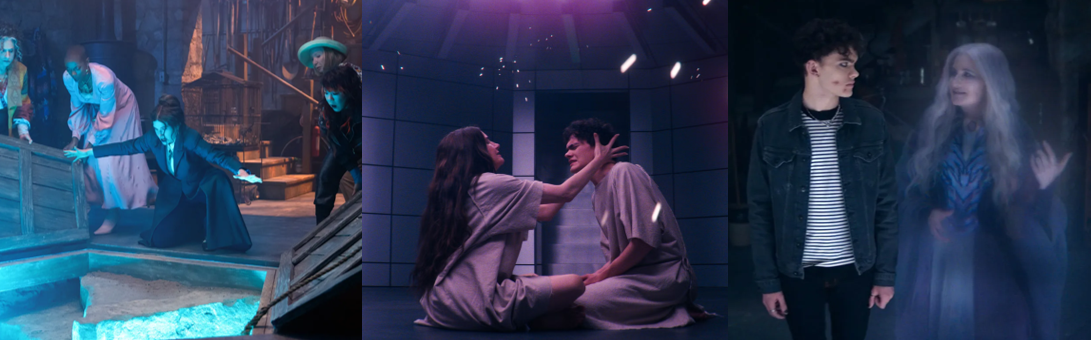
The once-fearsome MODOK is reduced to squalor by his failing company and family life.

MODOK’s family is acutely aware of his evil deeds; it’s hard for them not to be since the only thing he talks about at home is himself, how superior he is, and spinning disastrous failures into overblown wins just because he stole Iron Man’s boot. MODOK’s obsession with destroying the Avengers and conquering the world stems from his childhood, where he was relentlessly bullied for his big head and supervillain-level genius. However, his loving mother (Unknown) encouraged his ambition and he continuously experimented on himself with science and cybernetics in a bid to take over he world and “improve” it with his own twisted version of a utopia. Unfortunately, MODOK’s preoccupation with this goal has caused him to neglect his family: he barely acknowledges Jodie’s success as a self-help guru or her upcoming book launch, Melissa resents him for embarrassing her and not acknowledging her opinions, and Lou, though seemingly cheerful, is hiding his own insecurities behind a happy-go-lucky façade and an amateur interest in stage magic. When MODOK’s reckless spending pushes A.I.M. to the brink of bankruptcy, MODOK’s forced to sell to young, socially aware Austin Van der Sleet (Bennett), owner of tech company GRUMBL, who, despite his assurances, makes so many changes to A.I.M.’s corporate structure that MODOK is eventually reduced to a mere mailman. His frustrations see his marriage crumble; realising they no longer have anything in common, Jodie demands a divorce and kicks MODOK out, forcing him to live in squalor with the family’s underappreciated robot slave, the Super-Adaptoid (Daly). When MODOK’s begging and pleading for a second chance fail, he and Gary break into the Strategic Homeland Intervention, Enforcement and Logistics Division’s (S.H.I.E.L.D.) headquarters and steal a time machine, desperate to undo a past mistake and take Jodie to a Third Eye Blind concert to rekindle their love. However, the attempts fails when she’s angered at him using the jaunt to also try and assassinate Austin and he inadvertently creates the show’s overarching villain when his ineptitude angers his past self and displaces him from time after he shatters the time machine’s Chrono Crystal.

MODOK’s long-suffering wife and daughter come to resent his selfish attitude.

Jodie’s frustration with MODOK is well founded; he’s an egotistical, selfish, obnoxious braggart who causes chaos wherever he goes. At work, MODOK is largely idolised by A.I.M.’s mostly nameless and faceless beekeepers; MODOK shows he cares for them when he begs Austin to keep them employed, but also treats them as disposable pawns when enacting his plans. Jodie feels a degree of the same disregard, constantly feeling second fiddle to MODOK’s greater aspirations, and forces a separation so she can get her life in order. When she starts dating Simon Williams/Wonder Man (Nathan Fillion), Jodie sees her stock and fame skyrocket due to the sordid publicity surrounding Wonder Man and she shamelessly embraces it. She manipulates both Wonder Man and MODOK to promote her book, coldly using the limelight-loving superhero for her own ends, and even injects Lou with a serum to give him a peanut allergy to give him a personality flaw, showing why she’d fall for a supervillain in the first place. It’s clear Jodie and MODOK still have feelings for each other (when trapped in the past, they grow old and rekindle their feelings, only to be erased from time) but they struggle to reconcile even for the sake of their kids. Melissa, though a female copy of MODOK, is actually very popular and has aspirations of being a supervillain but is continuously let down by him ignoring her input. She expertly teaches him how to psychologically manipulate others during a work conference, only for him to default to a grandiose plan for hero worship by opening a portal to the Broodworld. She works hard to give him a makeover, but he ruins his new look by brawling with Wonder Man. It’s doubly frustrating for Melissa considering she’s the most pragmatic of the family. Indeed, when faced with discovering which of them are murderous robot doubles created by Arcade (Alan Tudyk), Melissa doesn’t hesitate to slaughter their doppelgängers either on a whim or by closely watching their body language and behaviour.    

MODOK’s struggles to regain A.I.M and be taken seriously are compounded by his family life.

Lou is the black sheep of the family. Whereas MODOK and Melissa and even Jodie can be cruel, cold-hearted, and manipulative in their own ways, Lou is kind and jovial, without a care in the world. Not confined to a floating machine like his sister and father, Lou’s free to express his boundless energy, seemingly finding the good in every situation, no matter how dire. The only concern he seems to have is about his upcoming Bar-Mitzvah, and even then he just wants to perform magic for his audience; a desire so great that it drives him to chase after his props when MODOK callously transports them to Asgard. There, he earns the awe and loyalty of the goblin-like Kodolds, setting him against his father but ultimately aiding him in escaping death when he learns the MODOK is just trying to protect him from possible humiliation. While his family love him, Lou’s mostly perplexing to them; he finds a kindred spirit in outcast, sullen goth Carmilla Rappaccini (Zara Mizrahi) and gains a brother when he befriends his robot duplicate, but an overriding concern of MODOK and Jodie’s is that Lou is hiding his pain behind his magic. MODOK’s attempts to be a good father, win back Jodie, and regain control of A.I.M. see him turning to lower-tier supervillains for assistance when big shots like Samuel Sterns/The Leader (Bill Hader) and Doctor Nathanial Essex/Mister Sinister (Kevin Michael Richardson) turn him away. Begrudgingly relying on the Super-Adaptoid for company and transport, MODOK forms a crew consisting of David Angar/Angar the Screamer (Bill Hader), Antonio Rodriguez/Armadillo (Dustin Ybarra), Bruno Horgan/The Melter (Eddie Pepitone), Marion Pouncy/Poundcakes (Whoopi Goldberg), and Alvin Healy/Tenpin (Chris Parnell) to steal Captain Steve Rogers/Captain America’s shield and curry favour. Naturally, this goes hideously awry when the D-listers get distracted by their own personal dramas and incompetence, and when they abandon MODOK after learning he was manipulating them. However, MODOK comes to sympathise with the downtrodden villains and they agree to storm Avengers Tower, only to fall asleep on the trip and the Melter to die from excitement.

MODOK’s abrasive nature creates his own villains and even angers a past version of himself.

MODOK’s abrasive personality and disregard for his underlings means he has many enemies beyond the likes of Iron Man, even within his own company. Most notably, he’s constantly challenged at work by Monica Rappaccini (McLendon-Covey), an A.I.M. scientist whose genius matches, or many even surpasses, that of MODOK. Initially excited to be hired as another disposable beekeeper since she idolised MODOK, Monica slowly came to resent him when he not only undermined her inventions but also took credit for her killing an unnamed Avenger. Monica’s frustrations with MODOK’s leadership lead to her betraying him and siding with Austin, fooling the cybernetic villain with her jelly-like doubles and taking his place as A.I.M.’s “Scientist Supreme”. Despite her lofty position, Monica becomes paranoid when MODOK seemingly embraces his new position as a mailman, but ends up partnering with him when he sells a controlling share of A.I.M. to Iron Man and sets up A-I-M-2 with Gary once it’s revealed that Austin’s masters, a sentient, alien corporation known as the Hexus, plans to brainwash the world with their new GROME device. The exact opposite of MODOK, Austin is an overly friendly and accommodating boss who insists his employees take regular breaks, vacations, and relaxation time. Claiming to idolise MODOK, Austin repeatedly tolerates his abusive behaviour until he’s caught stealing from the company, but eventually turns on his alien masters when they order him to dispose of his beloved dog, though being on the same side doesn’t stop him from being run down by Gary. The show’s ultimate villain is MODOK himself, literally and figuratively. A younger version of him becomes displaced from time and, angered at MODOK’s failures, conspires with the likes of Arcade to kill his family and set MODOK towards world domination. Calling himself “The Anomaly”, this younger MODOK shows his older self that his plans are destined to fail unless his family dies. While MODOK cannot bring himself to sacrifice the ones he loves and is determined to have it all, the Anomaly is not so morally inclined and murders his wife and children, creating a dystopian future where MODOK rules all. However, when he exhausts the energy of the Chrono Crystal and the life of his younger counterpart, the sullen dictator vows to find a way to bring his family back and retain his supreme position, ending the show on an unresolved cliff-hanger.

The Summary:
Though not set in the Marvel Cinematic Universe (MCU), M.O.D.O.K. is clearly influenced by it in many ways. Avengers Tower, for example is basically a carbon copy of the MCU’s version and Iron Man is a snarky asshole like in the films. Other characters, like MODOK’s crew and the assorted villain cameos, are styled more after their comic book counterparts. Even S.H.I.E.L.D.’s uniform is modelled after the comics and A.I.M.’s employees are all rendered anonymous by their comic accurate beekeeper outfits. MODOK, though, is ironically more akin to his later MCU counterpart than the source material. Rather than being a frothing, maniacal supervillain, he’s an insecure, angry, petty cyborg lashing out at the world around him. MODOK is seen as a lesser-tier villain, even more so than in the 1990’s Iron Man cartoon where he was a glorified henchman; he’s not allowed in the supervillain club and ends up slumming it with D-list villains. When MODOK approaches Iron Man with an offer to buy A.I.M., the armoured Avenger initially believes he’s there for a fight and downplays MODOK’s threat, despite the rotund villain sporting various dangerous weaponry such as buzzsaws, claw arms, and his iconic brain blasts. Thus, just as his kids seek his approval and the likes of Gary and the Super-Adaptoid long to be recognised for their significance, so too does MODOK strive to be acknowledged as a (or the) superior being. His plots and ambitions are lofty and often exceed his grasp, causing him to steal technology from others or claim ownership of victories that weren’t his own. Constantly, desperately seeking approval and acceptance, he initially plans to save a party of investors from the Brood then quickly takes credit for the party-loving Ciegrimites who arrive instead. He manipulates an army of Asgardians into attacking the Kobolds since his systems have been damaged and ends up bleeding out when his younger counterpart fatally wounds him, only to be begrudgingly saved by Melissa.

Episodes are full of lewd comedy, bloody violence, and a surprising pathos.

Many episodes have great moments in them, either spontaneous scenes of violence, workplace gags where MODOK is taken to human resources, or emotionally charged explorations of MODOK’s fragmented family life. “The M.O.D.O.K. That Time Forgot!” was a pivotal episode not just for exploring MODOK and Jodie’s past but also for introducing the younger MODOK, who isn’t held back by the domestic drama that befuddles his elder’s life. The plot twist of the Ciegrimites being so party hard that they literally dance people to death was fun, but I really enjoyed watching Melissa teach her dad how to emotionally manipulate people into seeking validation from him, and Monica’s desperate attempts to get out of using her corporate-mandated vacation time in “If Bureaucracy Be… Thy Death!”, which also showed how low MODOK will stoop to be seen as a great villain. “This Man… This Makeover!” showed a darker side to Jodie, who becomes consumed by the fame being associated with Wonder Man brings her and her book, to the point where she disregards Wonder Man’s very real feelings for her and manipulates MODOK into embracing his base instincts just to make headlines. “O, Were Blood Thicker Than Robot Juice!” promises a reconciliation for the family, only to reveal that Jodie, Melissa, and Lou have been replaced by Arcade’s robots. Arcade then forces them to fight to the death against multiple robotic duplicates, a fight easily won by the real family not because they know each other so well, but because Melissa eagerly resorts to violence. I loved the satirical take on corporate greed that comes to the forefront in “What Menace Doth the Mailman Deliver!”, where the Hexus’ plot to control and conquer the world is seen as a heinous by-product of their dislike of Austin’s puppy. This episode also commentated on society’s dependence and love for smart technology like Alexa by having the GROME brutally murder people when activated. The show ends with a surprisingly emotional gut punch in the aptly named “Days of Future M.O.D.O.K.s”, where MODOK’s forced to see that the only way he’ll conquer the world is if his family dies before his eyes. He’s complicit in this and is brought no joy at being the undisputed master and ruler of the world, but is sure to torture the Anomaly to death to both see glimpses of his family and make him pay for making him endure such a loss.

A bizarre and entertaining show bolstered by its toy-like animation and characters.

Thus, MODOK’s characterisation may irk fans of the character. He’s a very co-dependent, egotistical narcissist, one who takes his family for granted and demands adulation without really earning it. The juxtaposition of this gruesome supervillain cackling away with his minions and bludgeoning his enemies retreating to suburban mundanity is amusing. MODOK’s efforts to destroy his enemies and retake his company are seen as equal to his attempts to win the favour of his kids and deal with his messy divorce, casting him as a desperate and clingy villain whose knee-jerk reaction is to blast his way out of every situation. Eventually, he embraces his wife’s teachings and tries to turn his life around, then braves Arcade’s death trap to save them when they’re replaced by robot doubles, ultimately refusing to kill them but, paradoxically, also not trying to save them when they’re targeted by the Anomaly. I loved the biting wit and satire at work in the show, and the explosive violence. Seeing the dolls get torn to shreds, guts and gore splattering everywhere, was really fun and the occasional swears really hammered home that this was a different sort of Marvel project. The animation was commendable, with the dolls and puppets showcasing a lot of personality, none more so than MODOK, expertly brought to life by Patton Oswalt as an insecure, unpredictable villain burdened by time and family life and desperate to make his mark on history. It’s a shame the show was cancelled without a proper resolution as the door was left wide open for more episodes. There were many plot threads left dangling that promised greater things in another season and plenty of places for the characters to go, especially as M.O.D.O.K. wasn’t afraid to explore surreal, colourful, and obscure aspects of the Marvel Universe. I really enjoyed the marriage of suburban drama with violent, over-the-top comic book action; seeing MODOK struggle to adapt to corporate policy and appease his children was as enjoyable as his fight for world domination. He might not be a completely faithful rendition of the character, but he’s endlessly more interesting here due to how complex and layered he is, with the show emphasising that he can be a serious threat if given sufficient motivation.

My Rating:

Rating: 4 out of 5.

Great Stuff

Did you enjoy M.O.D.O.K.? What did you think to his characterisation as a struggling family man and villain? Did you enjoy the animation style and the various cameos spliced throughout the show? What did you think to Austin, Hexus, and the satirical commentary on corporate synergy? Which of MODOK’s family was your most or least favourite, and did you enjoy the family drama? Would you have liked to see another series, or at least a resolution to the ending? What are some of your favourite MODOK stories? Share your thoughts on M.O.D.O.K. in the comments and then go check out my other sci-fi content on the site!