Screen Time [Sonic CDay]: Sonic the Hedgehog: “Blast to the Past” (S2: E17/18)


Developed alongside the blockbuster Sonic the Hedgehog 2 (SEGA Technical Institute, 1992), Sonic the Hedgehog CD (Sonic Team, 1993) released on this day back in 1993. Expanding upon the Blue Blur’s debut title, Sonic CD introduced Metal Sonic (one of Sonic’s most popular and enduring rivals) and Amy Rose, and is considered by many to be one of the best of the classic Sonic titles.


Season Two, Episode 17 and 18:
“Blast to the Past”

Air Date: 1 October 1994 and 8 October 1994
Director: Ron Myrick
US Network: ABC
UK Network: Channel 4
Stars: Jaleel White, Kath Soucie, Jim Cummings, Tahj Mowry, Lindsay Ridgeway, Tim Curry, and William Windom

The Background:
Sonic the Hedgehog took the videogame industry by storm thanks to SEGA’s aggressive marketing campaign. Sonic the Hedgehog (Sonic Team, 1991) was a huge success and Sonic’s popularity exploded after the release of Sonic the Hedgehog 2. Suddenly, Sonic was everywhere: not only was he included in the Macy’s Day Parade but he also made the jump to television with two concurrent cartoons. After seeing the success that DiC Entertainment had producing cartoons that were effectively little more than half-hour advertisements for Nintendo’s videogames, SEGA of America partnered with DiC to develop an animated series for their super-sonic mascot. To help sell their pitch to ABC, DiC signed Jaleel White for the title role but ABC believed their original slapstick pitch was unsuitable for a Saturday morning slot. Undeterred, producer Robby London simply developed an entirely separate Sonic cartoon for the prime Saturday morning slot, giving audiences two very different Sonic cartoons, each with their own tone and animation style. While Adventures of Sonic the Hedgehog (1993; 1996) emphasised over-the-top, memeworthy, slapstick humour, Sonic the Hedgehog (or “SatAM”) was a far darker take on the franchise. Though both cartoons awkwardly collided when Archie Comics published Sonic comic books, the majority of Adventures’ influence was eventually stripped away in favour of those from SatAM and Adventures is generally regarded less favourably than its darker counterpart. For many, SatAM was a defining aspect of their childhood and impressed with its more mature themes. Although it exhibited only questionable fidelity to the source material, SatAM did, occasionally, include elements from the videogames, with this two-part story being one of the most notable examples.

The Plot:
In a bid to stop Doctor Robotnik (Cummings) from conquering the Planet Mobius, Sonic the Hedgehog (White) and Princess Sally Acorn (Soucie) use the legendary Time Stones to travel back in time, only for an error to land them right in the middle of the dictator’s life-changing coup d’état.

The Review:
When I was a kid, I used to watch Adventures of Sonic the Hedgehog religiously. Every Sunday morning (as I recall; it might’ve been Saturday…), I would sit and watch it, usually record it, and delight in seeing Sonic’s slapstick antics. Then, one morning, something was different. The entire tone and cast of the show had changed; suddenly, Sonic wasn’t dressing up in ridiculous costumes and acting like a super-fast version of Bugs Bunny (Mel Blanc/Various) and Dr. Robotnik (Long John Baldry) wasn’t a comical, bumbling buffoon. Instead, Sonic was the point man in an outnumbered resistance movement against a far darker, semi-cybernetic dictator. Miles “Tails” Prower (Christopher Stephen Welch; Bradley Pierce) was completely absent in the first episode I watched, “Sonic Boom” (Sebast, 1993), and the bright, zany world of Adventures was replaced with a grim, polluted hellhole. It was a jarring change for me, but I loved Sonic so I quickly adapted. It helped that SatAM opened with an absolutely jamming theme song and that a lot of its presentation was very close to what was happening in Sonic the Comic (1993 to 2002) at the time, and that the visual style of the show and Sonic’s battle against this far more malevolent Dr. Robotnik were so compelling.

Desperate to defeat Dr. Robotnik, Sonic and Sally seek out the legendary Time Stones.

Although SatAM’s second season would later include concurrent narratives, and there was always an ongoing theme of the Knothole Freedom Fighters desperately opposing Dr. Robotnik’s regime, “Blast from the Past” is the only two-part story arc in the series. The first part opens, as many episodes do, with Sonic, Sally, and some unnamed Freedom Fighters on a covert mission in the polluted hellscape known as Robotropolis. Although a brash and reckless egomaniac, Sonic is instrumental to the Freedom Fighters; he’s classified as “Hedgehog: Priority One” by Dr. Robotmik’s SWATbots (Frank Welker), which immediately deviate from their regular patrols to chase him. While this creates enough of a distraction for their unnamed allies to sabotage Robotropolis’s main power grid, their friends are captured and taken to Dr. Robotnik’s citadel, and summarily roboticized. Although the jovial dragon Dulcy (Cree Summer) tries to alleviate the guilt Sonic and Sally feel for this loss by pointing out that all the planning and moxie in the world can’t oppose Dr. Robotnik’s resources or malice, Sonic can’t help but wish they’d fought back harder when Dr. Robotnik first took over, even though they were only five years old back then. Dulcy suggests that they use the legendary Time Stones to travel back in time and fulfil this wish. Sceptical, an exasperated Sally initially shoots down the plan as she believes the Time Stones and their equally mythological home, the Floating Island, are nothing more than a fantasy, to say nothing of the moral and scientific dangers of violating the time stream. However, Sally reluctantly agrees when the clumsy Dulcy reveals that she once crashed into the Floating Island, but she remains sceptical until Dulcy braves a tumultuous storm and crashes the three on the fabled island. Rather than being home to Knuckles the Echidna and the Master Emerald, the Floating Island is represented as a much smaller land mass that houses an ornate palace guarded by two stone gargoyles. Sonic outraces the guardians and causes them to vanish by running himself and Sally off the island. After being rescued by Dulcy, the two enter the palace and navigate a confusing M. C. Escher-esque labyrinth before being confront by the owl-like Keeper of the Time Stones (Curry). Despite Sonic’s blockheadedness, Sally solves the Keeper’s riddle (the answer is “time”) and the Keeper explains how to use the Time Stones’ power.
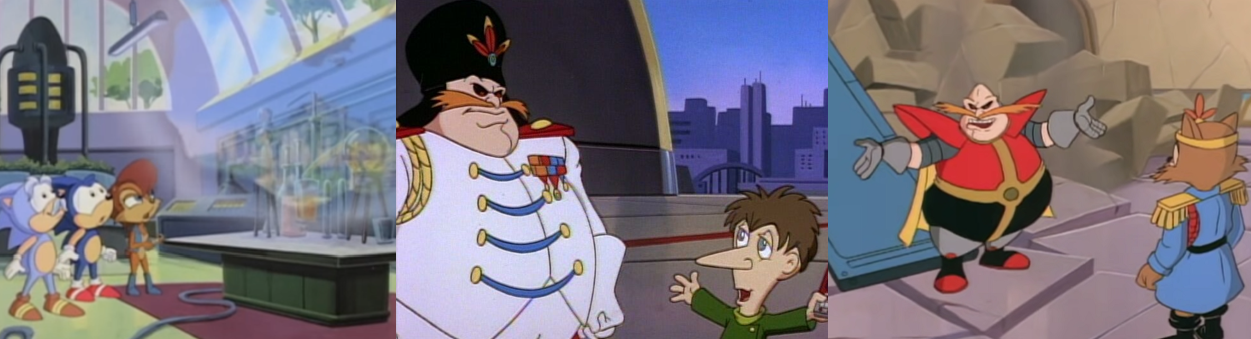
Unfortunately, Sonic and Sally are too late to stop Dr. Robotnik enacting a destructive coup d’état.

However, despite Sonic’s best attempts to focus only on the palace fountain in Mobotropolis circa 3224, his mind wanders to chili dogs, throwing off their arrival. The two are overwhelmed to find their home lush and verdant and alive, but even more stunned when their younger selves (Mowry and Ridgeway, respectively) wander by. It turns out that Sonic never really grew out of his childish, arrogant ways as his younger self delights in gobbling down chilli dogs and boasting of his super speed, much to the chagrin of the younger princess. Sonic and Sally go straight to Sonic’s beloved uncle, genius inventor, and loveable father-figure Sir Charles “Chuck” Hedgehog (Windom) and reveal the impending threat to the city. Back in this time, Sally’s father, King Maximillian Acorn (Curry), ruled a thriving, technologically robust city thanks to support from his Grand Vizier, Julian. Julian helped Mobotropolis win the “Great War” with his machinery, earning him a promotion to Minister of Science, though he secretly conspires with his long-suffering nephew, Snively (Charlie Adler), to take over Mobotropolis using not only the decommissioned war machines but Uncle Chuck’s Roboticizer machine. As shocked as Sonic and Sally are to discover that Uncle Chuck invented the nightmarish device, Uncle Chuck is horrified to learn this his invention (which was created to help old people “live longer”) is to be perverted into a tool for evil. Although they initially stay avoid their younger selves, they inevitably meet; introducing themselves as “Alicia” and “Juice” and presented as distant cousins, the Sallys despair of their childish antics and Sonic is stunned to find that his younger self is actually faster than him! However, their fun is interrupted by the realisation that they’ve arrived on the eve of Julian’s destructive coup d’état. Uncle Chuck has Sally’s nanny, Rosie (April Winchell), take the kids to safety in Knothole then introduces Sally to her father. Understandably emotional given that her father has been trapped in the “Void” for most of her life, their heartfelt reunion convinces King Acorn to trust Uncle Chuck’s warnings about Julian. Unfortunately, they’re too late to intercede; Julian reprograms the city’s robotic defences to recognise his commands and sends them to capture the inhabitants, including the young Sonic and his friends, before storming into the king’s throne room. Now garbed in his iconic red outfit, Julian rechristens himself Doctor Robotnik, and Mobotropolis “Robotropolis”, much to the anger and horror of Sonic and his friends.

Although they humiliate Snively, Sonic and Sally are faced with a race against time to salvage the timeline.

After a brief recap, part two picks up with Uncle Chuck disabling the SWATbots and causing a distraction so that Sonic can speed Sally to safety. However, they’re quickly imprisoned alongside their younger counterparts and forced to watch from their cell as Dr. Robotnik’s massive mechanical blimp, the Destroyer, spreads a polluting cloud over Mobotropolis that instantly kills all plant life, transforms the once idyllic landscape into a mechanical hell, just like before. Thanks to the schematics of Dr. Robotnik’s citadel on her pocket computer, Nicole (Soucie), Sally directs Sonic in burrowing them to safety, though Dr. Robotnik arrogantly dismisses the potential threat since he’s already imprisoned 80% of the population. Unfortunately, Sonic and Sally are too late to save their younger selves; since their very existence is threatened by this, the two buy themselves some time by having Nicole cause a brief power outage in the Roboticizer. To amuse himself in the meantime, Dr. Robotnik takes great pleasure in banishing King Acorn to the Void, an extradimensional portal where he once banished his rival, the sorcerer Ixis Naugus (Michael Bell). Luckily, the power outage allows Sally to download the machine’s schematics for future reference, but things are exacerbated when they spot the Destroyer heading for the Great Forest and threatening Knothole and, once again, their futures. Faced with a ticking clock, the two blast away to intercept the Destroyer, earning Snively’s ire by stripping him of his hair with a sonic boom and briefly stopping to rescue Dulcy’s mother, Sabina, from Dr. Robotnik’s forces.

Although they fail to save Mobius, Sonic and Sally’s jaunt isn’t a total loss and renews their fighting spirit.

Using a Power Ring for a speed boost and his anti-gravity sneakers, Sonic rockets himself and Sally up to the Destroyer, where even Sonic’s breezy demeanour is strained by Dr. Robotnik’s inexhaustible forces. Luckily, Sabina fends them off and brings the Destroyer crashing to the ground, so Sonic and Sally race back to Robotropolis to save their younger selves. Sadly, Sonic fails to prevent his defiant uncle’s roboticization, meaning his younger self has to endure the horror of watching the only family he has be transformed into a mindless robotic slave, though Sonic assures the grieving boy that Uncle Chuck will be restored in time. Sonic and Sally get the kids to safety and, in the process, Sonic earns Dr. Robotnik’s boundless fury by not only mocking and defying him, but also roboticizing his left arm. After teaching the younger Sonic a thing or two about trashing robots, the kids are brought to Rosie and spirited to the safety of Knothole. Before she goes, Sally makes Rosie promise to never leave the village to avoid her becoming another of Dr. Robotnik’s minions in the near future. With Dr. Robontik’s full force closing in, Sonic and Sally use the Time Stones to return to the future, infuriating the newly-crowned dictator. Although Sonic believes the entire escapade was a waste of time since they never changed the past like they intended, Sally is bolstered by the odds now that they have the Roboticizer plans, and Sonic is left nursing a migraine when he tries to understand how Rosie is still in Knothole…despite being right there when Sally told her not to leave.

The Summary:
I’ll be the first to admit that reviewing “Blast to the Past” as an adaptation of Sonic CD is a bit of a monumental stretch. To be honest, the tangential link was enough of an excuse for me to talk about SatAM, one of a handful of cartoons that defined my childhood. While, on the surface, there doesn’t appear to be much of a relation between the two, they actually have a fair amount in common: obviously, the Time Stones appear (though in a vastly different format) and Sonic travels through time (again, in a very different way to Sonic CD), but there’s also shared themes of pollution and time paradoxes at work in the episodes. Sonic and Sally travel to the past, where Mobius and Mobotropolis especially were free from pollution and war, in an attempt to stop Dr. Robotnik before he can rise to power. When they fail in this endeavour, the once lush and thriving landscape becomes a dark, grimy, mechanical hellhole (a “Bad Future”, if you will) and we clearly see the consequences of their time travel onscreen just like in Sonic CD’s gameplay. Again, that might seem like a stretch, but you have to remember how few inspirations SatAM took from the source material. While I was disappointed that we never got Knuckles, the Chaos Emeralds, Metal or Super Sonic in the series (especially the first two in these episodes), it was still fun to see gameplay elements adapted to fit the context of this dark and mature series.

While things get very bleak very quickly, the time travel plot showcases our hero’s vulnerable sides.

“Blast from the Past” is easily one of the strongest arcs of SatAM. For the first time, we get to see what life was like before Dr. Robotnik took over. We’re so used to seeing Knothole and the Great Forest being the one bastion of nature in an otherwise ransacked, almost post-apocalyptic world that it’s extremely poignant to see Sonic and Sally react in awe when they walk the streets of the thriving Mobotropolis once more. The episodes give both characters a chance to show some vulnerability; this wasn’t uncommon in SatAM given how bleak their situation was, but it’s heart-warming (and breaking) to see Sonic reunited with his unroboticized uncle and Sally finally reunited with her beloved and long-lost father. It was also quite fun seeing Sonic and Sally interact with their younger selves; their personalities haven’t changed much over the years, with Sonic being impulsive and Sally being more restrained, but the younger Sonic makes an impression by outpacing his elder (and even referring to Sonic as “old”) and breaking down in tears when his cherished uncle is roboticized before his eyes. Although characterised as a brash, headstrong, and snarky speedster, Sonic showcased some surprising emotional depth in SatAM and “Blast to the Past” emphasises that beautifully. We see his anger at Dr. Robotnik’s heinous actions, his desperation to save the future, and the guilt he feels at having potentially screwed up their best chance of saving the world before it goes to hell. Although functionally unstoppable and capable of physics-bending feats, Sonic isn’t beyond fatigue or weakness. Mainly, this is realised in his inability to sit still, focus, or think of or work to a plan, which is why he and Sally work so well together as she does the thinking and he does the fighting (though she’s perfectly capable of holding her own in a pinch, too).

Dr. Robotnik is at his most malicious in SatAM and this two-parter showcases his rise to power.

As ever with SatAM, the star of the show is the reprehensible Dr. Robotnik. Never before or since has the rotund dictator been portrayed as such a malevolent and spiteful force (well, maybe in Sonic the Comic and obviously in the Archie comics…). SatAM-Robotnik was a serious threat, even when he was doing more comical stuff or being humiliated by his foes. Thanks to his incredible resources and relentless craving for power and conquest, Dr. Robotnik delights in subjecting his captives to the Roboticizer and turning them into his mindless, obedient slaves. Abusive towards his long-suffering nephew, Dr. Robotnik cares only about himself and his insane lust for power. Despite his prominent position of trust and authority alongside King Acorn, Dr. Robotnik has grander designs for himself and easily takes what he wants by force, without any real resistance. This oppressive, suffocating malevolence makes battling Dr. Robotnik an uphill, almost unwinnable battle even when Sonic has the speed and power advantage, and even time on his side as in this two-parter. Ultimately, Sonic and Sally’s efforts to prevent Dr. Robotnik’s coup d’état are met with failure but they are bolstered enough to continue fighting after remembering what they’re fighting for. While Rosie ironically didn’t actually show up in future episodes, “Blast to the Past” led to the creation of the De-Roboticizer and the Freedom Fighters’ attempts to restore Dr. Robotnik’s victims to normal. So, yeah, while it may have almost nothing to do with Sonic CD and vastly reimagines the Floating Island, “Blast to the Past” is still an enjoyable and significant two-part arc. SatAM remains one of the most influential Sonic canons and is still heralded as one of the best cartoons of the nineties. While it wasn’t exactly true to the source material and has, in my view, since been surpassed, I can’t deny my love for the series, especially darker and more introspective episodes like these two, so I’m always happy to return to the series and relive my youth.

My Rating:

Rating: 4 out of 5.

Great Stuff

Did you enjoy “Blast to the Past”? Were you disappointed by how few elements from Sonic CD were present in the story or were you just happy to see videogame elements incorporated into SatAM? Did you enjoy SatAM as a kid? What did you think to the depiction of Dr. Robotnik’s rise to power? Which of SatAM’s original characters was your favourite and what did you think to Sonic’s characterisation in the show? How are you celebrating Sonic CD’s anniversary this year? Whatever your thoughts on Sonic CD, or SatAM in general, feel free to leave a comment below or on my social media.


Interplay: Sonic Adventure

Interplay

One of the great things about adaptations, and adaptation studies, is that they both:

“[continue] to expand and become more inclusive […] it is increasingly difficult to determine a cohesive theory that accounts for the division between adaptation and other intertextual modes: allusions, plagiarisms, remakes, sequels, homages, mash-ups, appropriations, and the list goes on” (Dicecco, 2015: 161)

This quote sums up perfectly what makes adaptation studies so interesting; adaptations can be anything and are restricted only by the scope of your imagination and your commitment to researching the links between media.

While researching the theories of Nico Dicecco (and his contemporaries) during my PhD, I chose to focus on the adaptation of videogames into movies, television shows, cartoons, and comic books. This was primarily because it’s a lot easier to talk about media that is adapted into film and there hadn’t really been any serious research into videogame adaptations at that time. I’ve previously talked about how my studies into the Sonic the Hedgehog (Sonic Team/Various, 1991 to present) franchise revealed that Sonic the Hedgehog Spinball (Polygames/SEGA Technical Institute, 1993) heavily influenced multiple Sonic adaptations over the years but there has been another Sonic videogame that has made multiple jumps to other media.

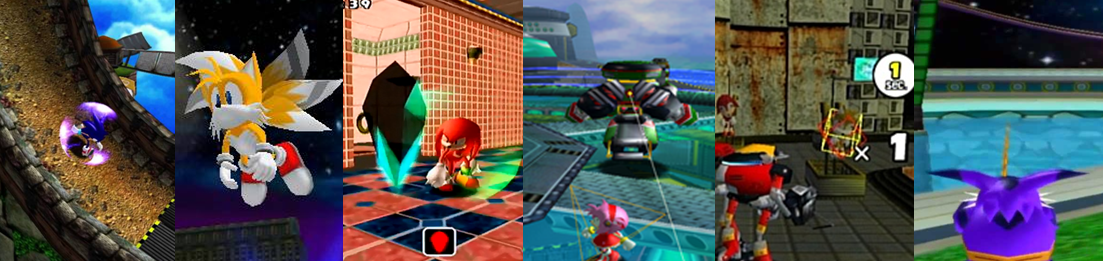
SonicAdventureLogo

Today, I’m once again returning to one of my favourite Sonic videogames, Sonic Adventure (Sonic Team, 1998), Sonic’s first real foray into 3D gameplay and a title that focused on multiple characters and gameplay mechanics, a far deeper narrative than the franchise had experienced in a videogame before, and functioned as both a consolidation of Sonic’s competing iterations and a “soft reboot” for the franchise, due its use of  “slight changes to be made without having to completely scrap the franchise and start over” (Bancroft, 2015).

SonicAdventureVariety
I can’t praise this game’s variety enough!

Coming after a long absence from a main series Sonic title (and at a time when SEGA were almost haemorrhaging money thanks to failures like the Mega-CD and SEGA 32X), Sonic Adventure became “the best-selling Dreamcast game of all time, with almost two and a half million copies sold”. (Pétronille and Audureau, 2012: 70). It reinvigorated the Sonic franchise in a way that I think has been forgotten over time; while the game may have had its flaws, it successfully revitalised Sonic and led to a string of successful sequels and follow-ups. While these weren’t enough to curb SEGA’s financial woes, the success and impact of Sonic Adventure led to a shift in Sonic’s gameplay, narrative, and aesthetic direction; rather than racing along a 2D plane, players now ran along at break-neck speeds in fully 3D environments that were designed more like rollercoasters. Sonic was now “Taller, slimmer and somehow spikier”, his friendliness replaced with “an anime-style cool” (Jones, et al, 2011: 31), and his narrative was far darker and more mature than his bright, psychedelic 2D titles. Perhaps the most significant impact of Sonic Adventure came through Sonic Team eventually stripping away all other playstyles to focus purely on Sonic’s speed, an aspect that largely led to the development of the Boost-orientated gameplay of modern Sonic titles.

InterplaySAOVAAdv
Surely this can’t be a coincidence?

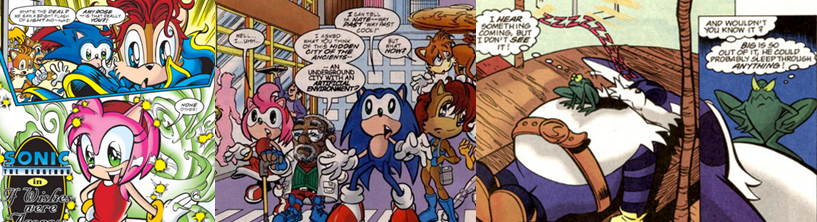
One thing to note before I delve into the main focus of this article is how the adaptation process appears to have worked both ways with Sonic Adventure. Many elements from Sonic the Hedgehog: The Movie (Ikegami, 1996) are recognisable in Sonic Adventure, such as Tails’ workshop on South Island, the appearance of cities and structures that mirror those of our world, and a lot of Doctor Robotnik’s (Edwin Neal) personality and technology. For me, the Sonic OVA is clearly a precursor to Sonic Adventure’s attempt to leave behind Mobius and show him as an adventure-seeking teenager in a world not too dissimilar to our own (though I still pray for the day when his characterisation matches the snarky attitude of his OVA counterpart). Sonic Adventure didn’t just impact Sonic’s videogames, however; by 1999, Archie’s Sonic the Hedgehog comic books had developed into a continuation of the fan favourite Sonic the Hedgehog (1993 to 1995, more commonly referred to as “SatAM”) cartoon, infusing characters and events from the videogames into its narrative. With this in mind (and, possibly, in keeping with SEGA’s desire to create a homogeneous version of Sonic), it was inevitable that Sonic Adventure would feature in these comics before long.

InterplaySARoboEggman
Robo-Robotnik soon replaced his organic counterpart as “the Eggman”.

Sonic Adventures’ influence began slowly but, in keeping with the increasingly-convoluted narrative of the comics at the time, was complex to the nth degree. First, the Archie team crafted an elaborate story to explain why Sonic now looked like his Sonic Adventure counterpart: ‘Retro Activity’ (Bollers, et al, 1999) not only showed how Sonic transformed from his pudgy, classic look to this edgier aesthetic by racing against a destructive energy beam so fast that he cycled through his various Super forms, but it told this story backwards! If you thought that was bad, though, the lengths they went to to explain Robotnik’s transformation into his Sonic Adventure counterpart, Doctor Eggman, were even worse! So, in ‘Endgame, Part 4: For Whom the Bell Tolls’ (ibid, 1998), Sonic finally destroyed Robotnik forever in a fight to the death involving his latest doomsday weapon, the Ultimate Annihilator. However, it is dramatically revealed in ‘I Am the Eggman!’ (ibid, 1999) that Robotnik has returned…in the form of his fully-robotic, alternate-universe counterpart, Robo-Robotnik. Though seemingly destroyed in that story, the issue ends with Robo-Robotnik downloading his consciousness into a body that is identical to his Sonic Adventure design; “Eggman” (for a long time “The Eggman”) would quickly become a derogatory nickname used to describe Robotnik until the madness was smoothed over by massive continuity changes much later down the line. The Sonic Adventure tie-in officially began with ‘The Discovery: A Sonic Adventure Tie-In’ (ibid), in which Sonic and the Knothole Freedom Fighters first learn about the “hidden city of the ancients”. Robotnik also learns of an ancient beast known as “Perfect Chaos” hidden within not the Master Emerald (…as that was where Mammoth Mogul was imprisoned) but the “Black Emerald”. Unearthing the Black Emerald in the Mysterious Cat Country, Robotnik discovers that it is severely depowered and promptly leads and assault on Floating Island to smash the Master Emerald in order to repower the Black Emerald.

InterplaySAAdventureBegins
Two issues in and I’ve already lost the plot!

After being denied the chance to accompany the Freedom Fighters, Amy Rose uses the magical “Ring of Acorns” wish herself into a more mature body in the follow-up story, ‘If Wishes Were Acorns’ (ibid), one that (you guessed it) is identical to her Sonic Adventure appearance. The Freedom Fighters then travel to the hidden city, which is located beneath an island (that is an almost exact replica of the OVA’s South Island) and accessed via a Mystic Ruins mine cart. A back-up story, ‘Swallowing Trouble’ (Penders, et al, 1999), introduces Archie’s readers to Big the Cat; his peaceful existence is disrupted when Froggy (who articulates through thought bubbles) swallows a piece of Chaos, grows a tail, and is promptly kidnapped by E-102γ (also known simply as “Gamma”). In the next issue, ‘City of Dreams’ (Bollers, et al, 1999) shows Sonic and friends exploring the hidden city, which is Station Square from the videogame and populated entirely by humans (who are different from “Overlanders”, the mostly-extinct human-like species that once waged war on Mobius), and sustained by an “artificial environment” (…that includes a sky, apparently).

InterplaySAVsChaos0
Things pick up with this Sonic’s battle against Chaos 0.

While they end the story making good progress in establishing diplomatic relations with the humans, the two back-up stories show Robotnik sending his E-series robots out to find more Master Emerald fragments to empower Chaos and Amy rescuing an injured bird from ZERO. Interestingly, while Archie bent over backwards to explain the characters new look, they simply have Amy’s Piko-Piko Hammer appear out of thin air with no explanation; even she is shocked to see it! Things finally pick up in the next issue’s ‘Night of Chaos!’ (ibid), which recreates (with amazing fidelity) the first encounter and battle between Sonic and Chaos 0. The back-up stories introduce Tikal to the story, as she relates to Knuckles her history (meeting and befriending Chaos and the destruction of her tribe when her father, Pachamac, tried to forcibly take the seven Chaos Emeralds from its shrine), how Robotnik finalised Chaos’ 0 form by infusing it with Froggy, and recreates the beginning of Gamma’s story by showing it pass a training drill and release Amy and her bird friend (here clearly identified as a Flicky) after overcoming its programming and gaining a modicum of sentience.

InterplaySAArchiePC
Archie recreated Perfect Chaos’ birth in stunning detail.

Archie followed this up with a 48-page ‘Super Sonic Special’ that rapidly told Sonic Adventure’s familiar story beats: Sonic, Miles “Tails” Prower, and Knuckles battle Chaos 2 and 4 after Robotnik feeds it shards of the Master Emerald; Big, Sonic, Tails, and Knuckles end up on the Egg Carrier; there’s a tussle with Gamma (where Amy spares it from destruction) and they fight Chaos 6, destroying the Egg Carrier in the process. The adaptation continues in the next regular issue; in here, Knuckles discovers “the Eggman” unconscious in the Mystic Ruins and Chaos, still alive, blasts through the land as a tornado, absorbing the six Super Emeralds, and transforms into Perfect Chaos, flooding Station Square (and attaching itself to the Power Siphon that control’s the city’s environment) exactly as it does in the opening and Super Sonic story of Sonic Adventure. Perfect Chaos destroys the Egg Carrier then, after learning a bit more from Tikal, Sonic uses the Emerald’s to transform into Super Sonic and engage Perfect Chaos. It’s around about at this point that the story stops creating its own dialogue and starts lifting lines directly from Sonic Adventure but, considering the quality of Archie’s writing back then, I would necessarily say that this is a bad thing. The story finally comes to a conclusion in issue 84’s ‘Perfect Chaos’ (Penders, et al, 1999), in which Super Sonic struggles to subdue Perfect Chaos while Knuckles overcomes his fear of water and uses his immense strength to restart the city’s power generator (tapping into his latent Emerald powers for the first time, which would later significantly change his appearance and powers). This, coupled with Super Sonic’s attack, is enough to revert Perfect Chaos back to Chaos 0. At peace once more, Chaos and Tikal return “to the Zone [where they] belong” and the threat is finally ended (…once again glossing over the untold death and destruction in Station Square).

InterplaySAArchieLore
Archie lore was dense enough before they wedged in Sonic Adventure.

Archie’s Sonic Adventure adaptation is one of the few times they actually crafted a long-running narrative out of a videogame story; normally, they just produced one-shots or sort stories that briefly (and very loosely and awkwardly) spliced the game’s story into their own convoluted narrative. The incorporation of Sonic Adventure’s narrative was especially difficult given that several key elements had to be changed due to them clashing with Archie’s lore; Chaos’ origin and imprisonment, for one, and the weird way they introduced Station Square for another, to say nothing of how the entire Echidna backstory struggled to fit in with the messed up narrative crafted by the notorious Ken Penders. Nevertheless, this was, perhaps, the closest Archie Comics got to a straight-up, beat-by-beat adaptation of a videogame; they made it easier on themselves in the future by generally just adapting the opening portions of a game and leaving a dialogue box that said something like “Play the game to find out the rest” and then vaguely referring to the game’s events in subsequent stories. Here, though, we got lines from the game, locations, notable boss battles, and hit almost every story beat from the game no matter how at odds it was with the world Archie had created for their version of Sonic.

InterplaySASTCFearChange
Chaos cripples with its fear aura and alters Sonic’s look.

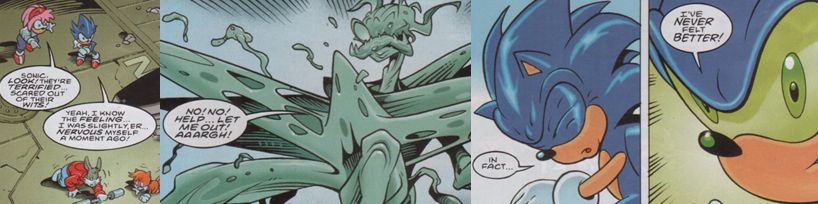
Over here in the United Kingdom, Fleetway’s Sonic the Comic (1993 to 2002, referred to as “StC”) was a little late to the party with their Sonic Adventure adaptation; like Archie, Fleetway had established their own, separate lore for Sonic and his friends, one that “felt” closer to the videogames but was still distinctly separate from it. Previously, their adaptations of Sonic videogames had tended to be multi-part stories that took the game’s characters and the vague outline of its plot and applied them to their unique narrative and Sonic Adventure was no different. The arc began in issue 175’s ‘The Coming of Chaos!’ (Kitching , et al, 2000), in which Sonic and his friends race out to confront StC’s version of Chaos 0 in Metropolis City Zone. This battle, which is a truncated version of the first boss fight with Chaos 0, showcases that StC’s Chaos exudes an aura that cripples its foes with feelings of utter dread. Headstrong and arrogant as always, Sonic attacks Chaos head-on regardless and manages to fend it off but is left with glowing green eyes and jagged spikes. In the following issue, it is revealed that Robotnik’s assistant, Grimer, unleashed Chaos in the hopes of destroying Sonic and his friends and shaking Robotnik out of the slump he had found himself in after multiple defeats. However, Robotnik reveals that Chaos is truly uncontrollable and that, by setting it free, Grimer has “doomed the entire planet”.

InterplaySASTCJohnny
Defeating Chaos extracts a heavy price.

Meanwhile, Sonic’s tech buddy Porker Lewis arrives; he’s (somehow) discovered that it’s made up of Chaos energy and has whipped up a device to defeat it but Sonic, already weakened from his earlier tussle with the creature, is unable to fight through its fear-inducing aura to complete the process. Luckily, Johnny Lightfoot steps in to lend a hand but, while he succeeds and Chaos is seemingly defeated, he dies in the process! Yep, a kids comic actually killed off a beloved, long-time character and not just any kids comic, a Sonic comic! Up until this point, death had largely been a stranger to StC’s stories; characters were used as batteries for Robotnik’s Badniks or turned to stone, or trapped for all eternity (…for a while), but they had never died before! StC hammered home that Johnny was actually, really, 100% dead in the following issue, where the guilt and shame of having recklessly led his friends into danger causes Sonic to quit the entire thing. However, Chaos reappears the Floating Island’s Emerald Chamber, now able to talk and state its intentions: it claims ownership of the Chaos Emeralds and desires to absorb their power. Knuckles is left with no choice but the jettison the Emeralds in the following story, ‘Splash-Down!’ (ibid), which causes the Floating Island to crash and sink into the sea. There’s an interesting wrinkle here where Knuckles, despondent at his actions, resigns himself to facing the same fate as his ancestral home and has to be coerced by Amy (and a good knock on the head) to avoid killing himself.

InterplaySASTCTikal
Tikal raised new questions about StC-Knuckles…

Also in this story, rather than going through a whole complicated mess involving robotic counterparts and body swapping, Robotnik simply…puts on a jacket so he resembles his Sonic Adventure design. I find this doubly amusing and ironic considering the lengths StC went to to show Robotnik transforming from his classic design to his Adventures of Sonic the Hedgehog (1993) look. Oh, and Sonic just…comes back at the end of the story, ready to jump into the fray once more. In the next issue’s story, ‘Out of Time!’ (Kitching, et al, 2000), Porker continues to obsess over Sonic’s green eyes and the Chaos energy he apparently absorbed from battling Chaos. This turns out to be a pretty big deal as Sonic is the only one who can see Tikal when she suddenly appears and promptly zaps him 8,000 years into the past. This (and the subsequent issue) is also where StC loops Sonic Adventure’s lore into their own narrative regarding Knuckles’ past; we learn not only that Knuckles existed in the distant past (a plot thread that wouldn’t be resolved until StC was continued online) but also that the extra-dimensional Drakon Empire (who had previously attempted to invade Mobius) were involved in Chaos’ origin. After defeating a Drakon Prosecutor, revealing the heavily-armoured warriors to be mutated fish in armoured shells, Sonic chats with Tikal’s father, “Pochacamac”, who reveals that the Echidnas stole the seven Chaos Emeralds (and the Master Emerald) from the Drakon Empire after they invaded the Echidna’s sacred Emerald Mines and infused the gems with their patented Chaos energy.

InterplaySASTCChaosOrigin
StC gave Chaos a completely new origin.

During a battle with Drakon Prosecutors in which a stray energy blasts hits the Emeralds and causes their powers to surge out of control, the Drakon Sonic had previously defeated is released from its prison and fuses with the Emeralds to transform into Chaos. Sonic attempts to get revenge for Johnny in the following issue but is transported back to the future in order to weaken Chaos enough for past Knuckles to do…something to imprison Chaos. Sonic returns to the present just as Chaos arrives at Robotnik’s mountaintop fortress, where Robotnik gathered the Chaos Emeralds in order to lure it in…though he does this merely to have a front row seat to the end of not only Sonic and his friends, but the entire world. All hope seems lost in ‘Perfect Chaos!’ (ibid) when Chaos absorbs the power of the Chaos Emeralds and transforms into Perfect Chaos (which actually more closely resembles Chaos 6) until a severely weakened and dying Super Sonic arrives. How, I gave Archie flack for how complicated some of their stories were so I guess it’s only fair to deviate here to explain this a bit. In StC, Sonic absorbed a huge amount of Chaos energy a long time ago; this lay dormant in him for years and, whenever under extreme stress or driven to severe rage, he would transform into Super Sonic. StC Super Sonic was an uncontrollable, rage-filled, super-powered demon with maniacal eyes who could shoot energy blasts, fly at incredible speeds, and was all-but-invulnerable. However, Sonic’s friends eventually found a way to separate Super Sonic from him and imprisoned the demon within a time dilation of sorts. Super Sonic did eventually escape but the effort drained his power so much that he eventually lost his memory and became a confused, but harmless, individual.

InterplaySASTCFinale
Chaos, and Super Sonic, are both defeated, ending both the story and StC.

Sonic’s fears regarding his demonic counterpart are realised in the finale of the Sonic Adventure arc, ‘Point of no Return!’ (ibid), in which Super successfully drains Perfect Chaos of all its energy and regresses it back to a harmless Drakon fish. The Chaos energy returns Super’s memories and powers and he attacks everyone, intending to kill them all, and begins to drain the life energy out of Sonic. However, Super’s friend, Ebony, uses her magical powers to fuse Super and Sonic back into one being again. Grimer quits Robotnik’s employ, disgusted at his lackadaisical attitude to what looked to be the end of the world, and the story ends with Sonic and his friends triumphant. Sadly, the Sonic Adventure arc would be the last time StC ran original Sonic stories in their comics; for a while, the comics had consistently largely of reprints of old stories, even though the writers could have done what Archie did and used the extra pages to tell back-up tales to expand the story rather than rushing through everything in the main Sonic strips.

InterplaySASTCRushed
StC didn’t really give these guys anything to do in this arc…

Compared to the Archie adaptation, StC’s interpretation of Sonic Adventure is not only rushed but has some pretty weak connections to its source material. The characters never visit any of the locations from the game, Chaos is significantly different (though, in some ways, better; its “fear aura” was a nice inclusion with a lot of potential), Big is reduced to a throwaway, one panel cameo, Gamma doesn’t appear at all, and neither Tails or Amy have anything near the significance of the roles they played in the game. While Knuckles plays a vital part, he’s far more hands-off than in Archie (and the videogame), and Robotnik barely features at all (though this does make sense considering where the character was, mentally, at the time). If Fleetway had been able to use every page of their issues to tell this story, it probably would have landed much better; while I don’t doubt that they still would have sought to slot Sonic Adventure’s canon into their own as best as they could, at least e could have seen a five page back-up story featuring Knuckles, or Big, or anyone. Instead, it’s a very poor effort; StC did a pretty good job of telling stories heavily influenced by the videogames in the past but, by the point, the comic was on its last legs so I guess we were lucky to get anything.

InterplaySASXChaos0
Sonic X weaved the game’s story into its lore and mixed it up a bit.

Chaos would go on to sporadically appear in Archie Comics as it continued on, even when the license switched over to IDW Publishing, but it also notably appeared in Sonic X (2003 to 2006) when the anime did its own six-part adaptation of Sonic Adventure. Before I get into that, though, I just want to briefly mention Sonic Underground (1999), the oft-lambasted follow-up to SatAM that, for all its faults, at least featured Knuckles (Brian Drummond). There’s a couple of points in the series where characters refer to “Chaos” as being the destructor of Mobius and, in ‘New Echidna in Town’ (Boreal, et al, 1999) Chaos Energy transforms Dingo (Peter Wilds) into a mindless beast, Chaos Dingo, who takes on a malleable form. While this link to Sonic Adventure is tenuous at best (made all the more so by Sonic Underground’s dramatic departure from all Sonic lore), it’s still an interesting connection to make. Despite looking fantastic due to its anime aesthetic, Sonic X was a bit of a disappointment when it first started for a variety of reasons: Sonic (Jason Griffith) is largely lethargic, preferring to spend his days taking naps or smelling flowers, and all of his iconic friends are pushed to the side to make way for Chris Thorndyke (Michael Sinterniklaas) and a host of other human characters forced into the show when Sonic and the others are transported from their world to Earth. However, for me at least, things started to pick up near the end of the first season and with the episode ‘Pure Chaos’ (Kamegaki, 2004), which kick-started the Sonic Adventure saga with Froggy swallowing a Chaos Emerald, Dr. Eggman (Mike Pollock) launching the Egg Carrier, and Sonic and Knuckles (Dan Green) battling Chaos 1 and 2. Straight away, Sonic X is ahead of the curve simply by including Big in a role more suited to his videogame story and, like Archie, the series sticks quite close to the source material.

InterplaySASXBosses
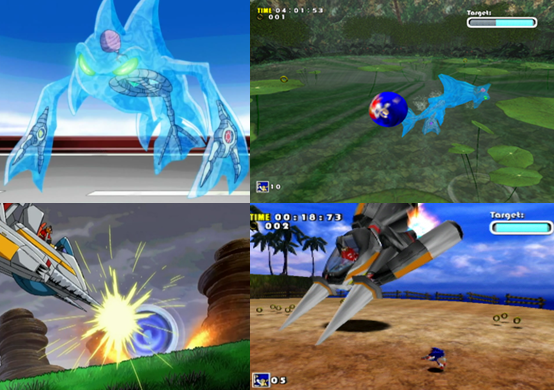
Sonic X featured almost all of Sonic Adventure‘s bosses.

The adaptation continued in the following episode, ‘A Chaotic Day’ (Kamegaki, 2004), which focuses a bit more on Knuckles’ side of the story, detailing how Chaos broke out of the Master Emerald and his search for its shards, which also brings him into contact with Tikal (Rebecca Honig). Sonic and Tails (Amy Palant) then battle both Chaos 4 at Eggman (in the Egg Hornet) at the Mystic Ruins (in what is a pretty faithful adaptation of the same boss battles from Sonic Adventure) before pursing Eggman to his Egg Carrier. They crash, as in the game, and Amy (Lisa Ortiz) and Cheese the Rabbit (Rebecca Honig) are attacked by ZERO, who kidnaps Amy and the birdie, Lily (Sayaka Aoki). Amy and Gamma’s (Andrew Rannells) stories are the primary focus for the next episode, ‘A Robot Rebels’ (Kamegaki, 2004), in which Gamma kidnaps Froggy right after Chris helps Big to rescue him and he subsequently frees Amy after suffering a bit of a short circuit at the sight of Lily just like in the videogame. Similarly, Amy convinces Sonic to spare Gamma and Knuckles recovers the last piece of the Master Emerald in the following episode, and, though Eggman successfully uses Froggy’s tail and Chaos Emerald to transform Chaos into Chaos 6, Sonic and Knuckles (randomly sporting his Shovel Claws) defeat it. The episode ends with the finale of Tails’ story, in which Eggman launches a missile at Station Square and he must gather his courage and self-sufficiency in order to disarm it (though he doesn’t battle the Egg Walker).

InterplaySASXGamma
Gamma’s tear-jerking story is told from start to finish.

‘Revenge of the Robot’ (ibid) primarily wraps up Sonic and Gamma’s stories from the game: Gamma travels through the locations of Sonic Adventure deactivating its robotic brethren and freeing the Flicky’s trapped within (which is considerably easier than in the videogame) and eventually destroys  itself and its older “brother”, E-101β “Kai” (Andrew Rannells) to reunite with its Flicky family. While Sonic does go on to defeat Eggman and his Egg Viper, Chaos obtains all seven Chaos Emeralds, transforms into Perfect Chaos, and floods Station Square in the final episode of the saga, ‘Flood Fight’ (Kamegaki, 2004). Up until this point, Chris’s involvement (and the involvement of his extended family and friends) was largely painless and unobtrusive. The changes this, however, as the destruction brought upon Station Square has a significant impact on the lives of Sonic’s new human friends and, wouldn’t you know it, it is Chris who supplies with the last Chaos Emerald he needs to transform into Super Sonic. Unlike in the videogame and the Archie Comics adaptation, Super Sonic defeats Perfect Chaos with hardly any issue at all in Sonic X; while Perfect Chaos had never looked bigger or badder, resembling more a water-based version of Biollante, and packs some serious firepower, it is defeated and reverted back in Chaos 0 with very little effort. To be fair, though, Sonic X’s Super Sonic was always far more powerful than his other incarnations, being more of a God-mode than a power-up. Still, Chaos is defeated and returns to the Master Emerald with Tikal, at peace once more. Station Square is left in ruins and, while the anime also glosses over the death and destruction the flood must have caused, subsequent episodes dealt with (or, at least, referenced) the restoration process.

InterplaySASXFaithful
Sonic X told the entire game’s story, giving everyone their due.

Like the other adaptations of Sonic Adventure discussed here, Sonic X incorporates the game’s narrative into its own unique lore but, in a twist, includes characters like Cream and Rouge the Bat (Kathleen Delaney) who debuted after Sonic Adventure. However, even these videogame characters have smaller roles than Chris and his cohorts; given that Chris was obsessed with following Sonic everywhere and putting himself in danger, this isn’t too surprising but, honestly, their inclusion and involvement is no more or less, better or worse, than those of the Archie and StC extended cast. However, Sonic X’s Sonic Adventure saga is easily the closest, most faithful adaptation of the source material of these three; Archie Comics came close bit their impenetrable lore meant that too many compromises had to be made. Both comic adaptations focused more on Chaos than other bosses and events, but Sonic X includes almost everything from the videogame, giving plenty of time to each of the game’s six characters and adapting their stories with a high degree of fidelity. It even streamlined and improved the story in many ways, such as having characters team up against Chaos’s various forms and improving the appearance of Perfect Chaos.

InterplaySASAStory
Sonic Adventure told a complex, interweaving Sonic story for the first time.

Sonic Adventure has been a rich source of adaptation, second only to Sonic Spinball. Aside from the more direct adaptations I’ve talked about here, stages, bosses, and narrative themes from the game cropped up in many subsequent Sonic titles. Unlike Sonic Spinball, I feel like this is probably because of the game’s story; this was the first time Sonic and his friends and enemies had a real voice in the videogames and the first time Sonic Team tried to tell a deep, overarching story. Add to that the influence that Sonic Adventure’s gameplay and aesthetic choices had on Sonic’s canon and future release and it’s not hard to see why. The only thing that hampered each of these adaptations was their attempts to shoe-horn the videogame narrative into their existing lore, rather than using the general story and themes of the game and threading it through in a more natural way. While Archie Comics and StC had good reasons for this, Sonic X had every opportunity right from the beginning of its run to properly prepare and lay the groundwork for its eventual videogame adaptations and, instead, it was happy to waste time focusing on Chris, his idiotic behaviour, and having Sonic be this bland, lethargic goody-too-shoes rather than a snarky, hyperactive adventurer.

Which of these three Sonic Adventure adaptations was your favourite? How did you find Archie’s writing at the time? Do you remember Sonic the Comic? What were your thoughts on Sonic X and Chris? Drop a line below and stick around for more articles in the future.