Mini Game Corner [Turtle Tuesday]: TMNT: Turtles in Time Re-Shelled (PlayStation 3)


The first issue of Kevin Eastman and Peter Laird’s Teenage Mutant Ninja Turtles (TMNT) was published in May 1984. Since then, the TMNT achieved worldwide success thanks not only to their original comics run but also influential cartoons, videogames, and wave-upon-wave of action figures.


Released: 10 September 2009
Developer: Ubisoft Singapore
Also Available For: Xbox 360

A Brief Background:
Back in the late-eighties and early-nineties, the Teenage Mutant Ninja Turtles (or Teenage Mutant Hero Turtles for us Brits) took kids by storm long before Mighty Morphin’ Power Rangers (1993 to 1996) and Pokémon (1997 to present) dominated playgrounds. Kids were as transfixed by the Teenage Mutant Ninja Turtles (1987 to 1996) cartoon (a toned down version of the far darker Mirage Comics) as they were by all the toys and videogames. While Konami’s original TMNT arcade game set the standard for some of the franchise’s most influential gaming ventures, the equally beloved sequel, Turtles in Time (Konami, 1991), wowed gamers both in the arcades and at home. So beloved was Turtles in Time that license holders Ubisoft decided to atone for the mediocre reception of their TMNT (Munroe, 2007) tie-in game (Ubisoft Montreal, 2007) with a digital-only, cel-shaded Turtles in Time remaster for home consoles. Sadly, despite impressing with its new coat of paint, Re-Shelled was met with mixed reviews. Critics praised the online functionality and multiplayer but were left disappointed by the difficulty and lack of replay value, and the game was sadly delisted when Ubisoft lost the TMNT license in 2011, never to be seen again.

The Review:
I’ve reviewed the original arcade release of Turtles in Time before, including its Super Nintendo port and the heavily altered version that came to the Mega Drive, so this review will be a bit shorter and focus on what’s similar and different rather than being massively in-depth as, fundamentally, Re-Shelled is the same game as Turtles in Time but with a new coat of paint. Turtles in Time Re-Shelled is a 2.5D arcade-style beat-‘em-up, just like the original, in which up to four players battle across nine stages, from the streets of New York City to the prehistoric past and the far future, bashing seven kinds of shit out of waves of robotic and rainbow-coloured Foot Soldiers and taking on some of their most recognisable enemies in a bid to recover the Statue of Liberty from their archenemies, Krang and Oroku Saki/The Shredder. After selecting your difficulty level and altering some of the usual in-game settings, you pick your character. Each Turtle has different attributes, though perhaps not in the way you’d expect (Raphael is strangely the fastest while Donatello is the toughest, for example), and different weapons that change their special moves and their reach in combat. While Re-Shelled now allows you to attack in eight directions rather than the original’s two, the TMNT’s abilities aren’t that varied. You attack with Square, pulling off simple combos with subsequent button presses, jump with X (executing a jump attack when in the air), press X while running for a dash attack, and pull off an energy-draining special attack with Triangle. This ranges from a lacklustre spin kick for Raph, a wide sword swipe for Leonardo, and a screen-crossing pole vault for Don, with Raph and Michelangelo really drawing the short straw in this aspect. Health is replenished by pizzas scattered throughout each level and you can temporarily enter an invincible spin mode when you grab some pizza power to clear out any enemies, though I never played this game with a friend so I can’t say if there are any team attacks.
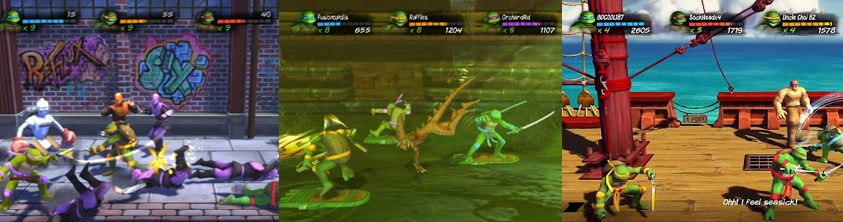
The classic TMNT arcade game got a cel-shaded glow up that retains much of the original mechanics.

As before, you can also grab and slam Foot Soldiers or hurl them at the screen, which is always fun, and hit barricades, traffic cones, explosive items, and fire hydrants to help with crowd control. Some onscreen hazards like wrecking balls can also damage enemies, but you must watch out for loose planks, spiked mines, crushing gates, and freezing panels as they’ll all hurt you and momentarily slow you. The TMNT’s recovery time is a bit of a joke; if you get knocked down, it takes a while to get back up, which caused me to get pummelled when fighting Leatherhead. You’re given nine lives on “Easy” mode and the game autosaves as you play, allowing you to continue where you left off or jump to any completed stage in “Quick Play” mode. If you’re feeling extremely sadistic, you can take on the “Survival” mode, which challenges you to finish the entire game with just one life, something I wouldn’t recommend. The TMNT battle an assortment of colourful Foot Soldiers, including blue variants with swords and axes, green ones who fire arrows, and yellow ones who carry bombs. They swarm the screen, occasionally jumping from the background and comically struggling with their hoverboards, but are easy cannon fodder. The Technodrome’s robotic forces are a bit more annoying, teleporting in and stunning you with energy blasts, as are the various hulking Rock Soldiers who stomp around with massive cannons or girders. You’ll visit all the same locations from the original game, with a familiar enough remixed soundtrack and the enjoyable voices of the 2003 to 2009 voice cast keeping you entertained, though cutscenes are limited to simple motion comic-like sequences with a sprinkling of text and voice acting.
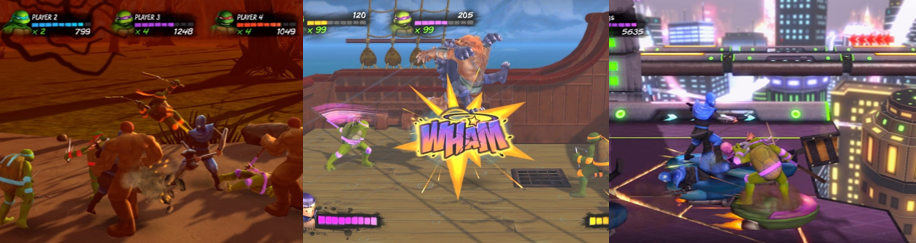
The new visuals work, for the most part, but the game is distinctly barebones at times.

Graphically, the game looks pretty decent. It uses a cel-shaded art style somewhat akin to a mixture of the classic cartoon, the aforementioned 2003 revival, and the original comics, but a lot of the colour and vibrancy is lost in some levels. When things are brighter and more open, like in Alleycat Blues or Bury My Shell at Wounded Knee, the game pops quite admirably. While the TMNT have only limited idle poses, they celebrate with vigour when clearing a stage and show a lot of personality when hurt by stage hazards, and I really liked the comic book-style sound effects that appeared with every attack. Stages have a decent amount of detail and depth, including graffiti, Krang’s giant robot body, a bubbling lava pit within a dark cave, a neon-drenched futuristic city, and a speeding Old West train carrying crates and circus supplies. It’s basically everything from the original game, but with a 2.5D twist. Very little has been added to each environment and there’s been no attempt to add new elements like additional power-ups or even bosses from the Super Nintendo version. At times, the gameplay feels very sluggish and unresponsive. The TMNT are both slippery and very heavy, awkwardly performing dive attacks and lumbering around and then breaking into a sprint, which can mess up your attacks. As before, it’s not all mindless button mashing; two stages are autoscrollers where you race around on surf- and hoverboards. This can be fun as long as you avoid the hazards and don’t try to jump attack the hovering Foot Soldiers, respectively (just use your regular attacks, it’s oddly much more accurate). Additionally, this is a bit of a barebones package as, while you can earn Trophies and tackle harder difficulties, there are no new skins, characters, or features to unlock, which actually puts it a step behind the Super Nintendo version.
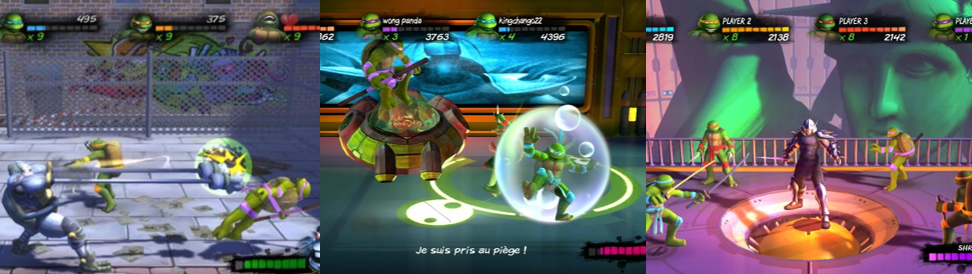
Bosses are largely unchanged and simple, until you reach the formidable Shredder.

For me, the highlight of the game are the titular foursome and the bosses they encounter at the end of each stage. These are the same as in the arcade version, unfortunately (so you won’t see Slash in Prehistoric Turtlesaurus, for example), and can be beaten fairly easily on “Easy” if you stay on the move and land quick combos. Doctor Baxter Stockman battles you in his fly form in Big Apple, 3.A.M. flying overhead and firing an uzi or his weird goo gun. Again, it’s better to just use your ground combos than to try and land jumping attacks, especially when he’s on the ground. Metalhead comes crashing in at the end of Alleycat Blues, sporting extendable arms and a rocket kick, but he’s quite slow and clunky so you can easily overwhelm him. Sewer Surfin’ sadly retains the gauntlet against the Xenomorph-like Pizza Monsters rather than the more impressive Rat King; simply jump-kick them when they pop from the water and you’ll soon be warped to the past by the Shredder. Cement Man is where the boss difficulty ramped up a bit for me; he turns to goo and slimes about the place, which can quickly whittle down your health. Similarly, the duo of Tokka and Rahzar can be troublesome, especially alone, as they can charge, swipe, and grind at you with a spinning shell attack. As mentioned, Leatherhead was a bit of a pain for me; not only does he toss and stab with daggers but he spams this scuttle move that can stun lock you if you don’t jump over him fast enough. In comparison, the fights against Krang are much easier. His robot body is easily attacked in Neon Night Riders, despite his rocket kick and double-hand slap, and his regular form is simple enough to combo to death in Star Base, though his teleport is annoying and I did struggle to avoid being smashed into a pancake by his slam. You’ll face the Shredder in the finale; armed with a sword and some mystical energy, he can seemingly regenerate his health, kick and swipe at you, levitate and fire projectiles, and unleashes an energy burst if you get too close. He’s by far the toughest boss, tanking damage like a brick wall, but you can get into a good routine of jumping in, landing a quick combo, and jumping away without too much trouble.
The Summary:
I was genuinely upset when I finally said goodbye to my PlayStation 3 as it had my copy of Turtles in Time Re-Shelled installed on it. When the game first released, it was the only affordable way to experience the arcade classic and I had a lot of fun playing it then, and for this review. I’m a big fan of the TMNT and arcade beat-‘em-ups so there’s a lot to like in Re-Shelled in that regard as it plays just like an arcade beat-‘em-up, warts and all, and nicely updates the original to then-modern times in a way that I think works pretty well. Sadly, it is a bit of a barebones experience and there’s barely anything new added to the game beyond its cel-shaded glow up. It’s lacking additional features, unlockables, and gameplay modes, and I was disappointed not to see elements from the Super Nintendo version incorporated to further expand on the original game. While it’s perfectly fine to play, the gameplay is clunky and chaotic at times, especially the controls. It’s hard to judge where your attacks will land and how fast you’ll move, meaning I couldn’t decide if it was better to use the directional pad or the analogue stick, and it’s easy to get caught by attacks and hazards because of how haphazard the controls can be. Ultimately, this was a great alternative for players at the time; Turtles in Time wasn’t readily available to play so this was a decent compromise. Since then, Turtles in Time has been re-released and I’d definitely recommend picking up the Cowabunga Collection (Digital Eclipse, 202) for the definitive Turtles in Time experience (although, honestly, I would’ve liked to see this included in that collection as well, just for the sake of game preservation).

My Rating:

Rating: 3 out of 5.

Pretty Good

Did you ever play Teenage Mutant Ninja Turtles: Turtles in Time Re-Shelled? How do you think it compares to other TMNT videogames and the original versions? What did you think to the new graphics and voices? Which of the characters was your go-to and which of the game’s bosses was your favourite? Would you like to see this game re-released? Which of the four Turtles is your favourite (and why is it Raphael?) Whatever your thoughts, I’d love to see your memories of Turtles in Time down in the comments!

Mini Game Corner [X-Men Day]: X-Men (PlayStation 3)


To commemorate, the culmination of their long-running and successful X-Men movies, 20th Century Fox declared May 13th as “X-Men Day”, a day to celebrate all things Mutant and X-Men and celebrate Marvel’s iconic collection of superpowered beings who fight to protect a world that hates and fears them.


Released: 14 December 2010
Originally Released: 31 January 1992
Developer: Backbone Entertainment
Original Developer: Konami
Also Available For: Arcade, Mobile, and Xbox 360

A Brief Background:
After Stan Lee and long-time collaborator Jack Kirby introduced the X-Men in 1963, Mutants have featured prominently not only in Marvel Comics but also in videogames. The first X-Men videogame was essentially a vertical shooter on the Nintendo Entertainment System, but the characters saw their greatest early success in arcade ventures and team-based brawlers. Indeed, in 1992, the arcade scene was still a popular staple of the industry and beat-‘em-ups were at the forefront of that; the biggest names in this genre were Capcom and Konami, who pumped out licensed and first-party titles and defined a generation. X-Men was one of Konami’s most celebrated efforts; based on the vastly different pilot episode of the incredibly popular X-Men animated series (1992 to 1997), X-Men’s widespread acclaim was matched only by its scarcity. The title never made it to home consoles and it would take about twenty years for it to finally be ported from the arcades. This digital-only version was praised for its nostalgia, though criticised for being far too easy, and was sadly delisted from digital store fronts in 2013 due to licensing issues and hasn’t been seen since.

The Plot:
Erik Lehnsherr/Magneto leads an all-out war against humanity with an army of Sentinels and his human-hating loyalists, the Brotherhood of Evil Mutants, even kidnapping his old friend and rival, Professor Charles Xavier/Professor X, and the X-Man Kitty Pryde/Shadowcat. It’s up to the X-Men to use their unique Mutant powers to topple Magneto’s forces, rescue their allies, and put an end to his mad schemes!

The Review:
X-Men is one of the quintessential arcade beat-‘em-ups from the heyday of the era, allowing up to six players to battle it out across eight stages beating the crap out of an unending series of robotic or animalistic enemies and vying to be top of the leaderboards. The controls are as simple as you could want from a game like this: you use Circle or Square to attack, landing a series of combos with each button press and attacks that are unique to each character, jump with X, and perform a jumping attack by pressing Circle or Square in mid-air. When enemies are on the ground, you can press Circle or Square to pound on them or press Square when close to most enemies to throw them across the screen or into other enemies for good crowd control. Unfortunately, there’s no dash attack here and few other attack options available beyond pressing Triangle to unleash your character’s Mutant power, which will drain a bit of your health or cost you a “Mutant Orb”. These attacks are unique to each character and will wipe out all enemies on screen, but have some limitations; James “Logan” Howlett/Wolverine and Scott Summers/Cyclops’s Mutant powers are great for clearing what’s right in front of you but you’ll want to pick Kurt Wagner/Nightcrawler of Piotr “Peter” Rasputin/Colossus if you want to target enemies all around you. Unlike other beat-‘em-ups, there are no weapons to get, no crates or barrels to smash, and no interactive objects to aid you (there are no explosive barrels here, for example); hell, there aren’t even any health pickups to find. Supposedly, the Japanese version of the game does have them, and other pick-ups that are dropped by defeated enemies, and I didn’t see one when I did a quick check after my first playthrough.

Plough through endless robotic enemies using the X-Men’s uncanny Mutant powers!

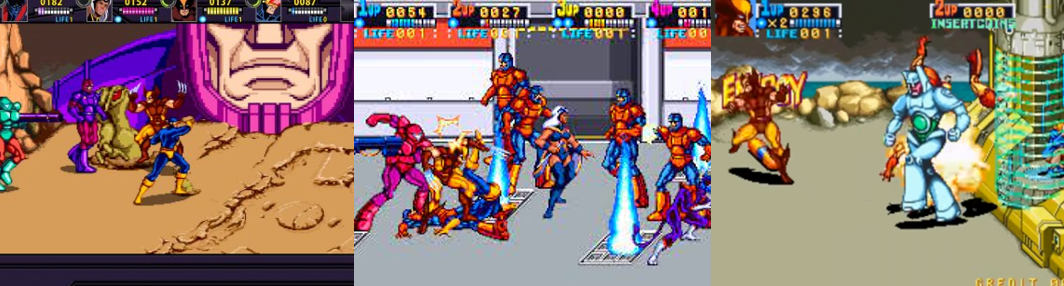
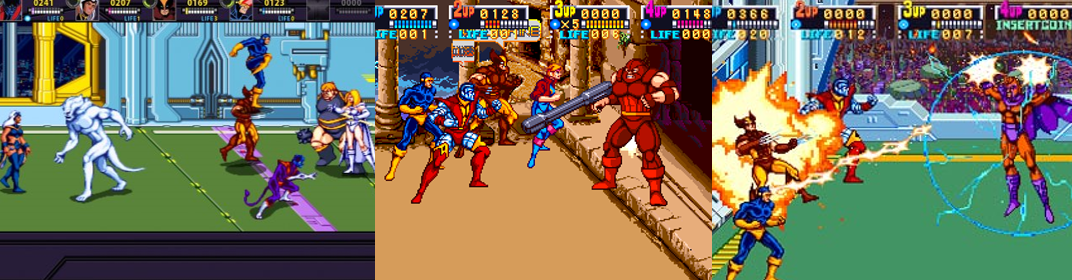
Indeed, despite its much-deserved reputation as one of the greatest arcade games of all time, there’s not much that makes X-Men particularly innovative. Its appeal comes down to the enjoyable mindlessness of its action, the colourful visuals, and the atrociously entertaining voice acting. The goal here is little more than to travel from the left side of the screen to the right, ploughing through disposable enemies until you reach the boss of each level. You’ll need to watch out for hidden turrets, cliff drops and lava pits, and a bunch of palette-swapped Sentinels who throw rocks, detach their hands, or fire projectiles. They’re joined by bulkier robots armed with cannons who fire missiles, low fireballs, or high laser shots, lizard men who attack with their tails or breathe fire, and even anthropomorphic mud and plant monsters and robotic arms, though these enemies are constantly recycled and become quite samey quite quickly, even when they’re riding in on trucks or these weird gun-toting cyborgs on treadmills. The environments are a bit hit and miss, too; the opening city is suitably wrecked, there’s a thunderstorm raging in the background of the cave stage, you’ll see the Giant Sentinel, X-Jet, and the captured Professor X and Kitty in other stages, but few levels were as visually interesting as the wild jungles of Island M and lava-filled dangers found in “The Trap”. You’ll be transported up and down lifts, as is expected in a beat-‘em-up, but won’t really be battling a host of enemies in these sections; there is one part where you’re confronted by a missile-spewing wall, but you don’t actually have to destroy it, and the only character with anything close to an idle animation is Wolverine, who sheathes and unsheathes his claws when left standing (but don’t linger too long or the game will punish you with an explosive death!)

Magneto’s monstrous Mutant minions are itching to welcome you to die!

Yet, the character and enemy sprites are big, colourful, and evoke both the comic books and the pilot of the animated series. The story, paper-thin as it is, is related through large, partially animated cartoon-esque sprite art and in-game graphics, with Raven Darkhölme/Mystique’s deceptive tricks and the Brotherhood’s explosive, boastful entrances being as notable a highlight as Professor X’s many words of wisdom. Of course, one reason X-Men is so fondly remembered is the awful dialogue, lovingly recreated here so as not to rob us of such meme-worthy statement as “X-Men! Welcome to die!”, “Magneto is in another place”, and “You’re dead, X-Chicken!” In terms of bosses, X-Men doesn’t offer much in the way of challenge or strategy and you can generally get by with a simple technique of jumping in for an attack, landing a quick combo, and jumping out of harm’s way, maybe landing a special attack if you have a spare orb or enough health. This is established from the first encounter with St. John Allerdyce/Pyro and is largely true of all bosses: they’ll burst into the scene, taunt you (leaving themselves vulnerable to an early attack), and use their various powers to whittle down your health. While Pyro is quite nimble and spams screeching flame projectiles and roasts you with a flame burst, Fred Dukes/The Blob is much slower, plodding about and landing big punches or swings with his spiked mace, causing the screen to shake when you knock him down for a few seconds, and tanking your hits. A version of the Wendigo is also fought, with it pouncing at you and performing a head grab/throw combo shared by subsequent bosses, such as Nimrod, another large, clunky, slow boss who’d rather waste time taunting you than attacking in an interesting way. Cain Marko/The Juggernaut is similarly large and cumbersome but makes up for it with a screen-crossing charge and a huge cannon that fires a large blast across the screen. There are also a couple of mini bosses to contend with, such as the mental bolt-throwing Emma Frost/White Queen, a battle against three Egyptian statues, several Pyro clones, and additional encounters with all previous bosses when battling through Asteroid M. You’ll fight Magneto twice; the first time, it’s Mystique in disguise and he/she’s limited to punches and kicks but defeating her sees you battle the true Magneto. This is the toughest fight yet thanks to his impenetrable shield, but his attacks are still limited to slightly faster and very powerful punches and kicks. He also likes to mock you, though, so you can get in a good combo in those moments, and you’ll be immediately trust into another playthrough after the ending and credits roll when playing the American version of the game.

Colourful visuals and fun bosses were offset by some repetitive backgrounds and enemies.

Yes, this version of X-Men allowed you to pick between the American and Japanese versions; the main difference between the two was that you get a free, non-health-sapping Mutant Orb after every boss in the American version, but you start each new life with one in the Japanese version, and there’s apparently more to pick up from defeated enemies in that version, too. X-Men also allowed for local and, at one time, online multiplayer, allowing up to six players to fight together like in the arcade days of old. You can head into the “Options” menu and turn smoothing on or off, set whether you want a wallpaper to fill in the gaps around the action, show or hide the in-game timer used for speed runs and such, change the screen size, and change where the player’s health and lives and score are displayed. Every time you clear a stage, it’s unlocked to select for next time, allowing you to pick up where you left off or freely jump to any level. While you strangely can’t change characters when you die (or, at least, I wasn’t able to; there was no way when the continue countdown appeared and the option was greyed out on the pause menu), you do get unlimited credits and you can test your skills on three difficulty stings: Normal, Hard, and Hardcore, with even more enemies swarming the screen on the harder settings. X-Men had twelve Trophies for players to earn, with Trophies popping when you used a Mutant power five times, earned at last 250 points in one game, completed it on Expert difficulty, and defeated Pyro without using your Mutant powers. Tougher challenges included beating Magneto with every playable character, finishing the game in 25 minutes or less, and being fooled by Mystique in a six-player game (which I achieved by mapping all six characters to one controller). Otherwise, that’s it; there are no skins, no new characters to unlock, and no additional game modes here; just the classic arcade machine in all its punchy, ridiculous, and colourful glory.

The Summary:
It’s such a shame that X-Men got delisted and hasn’t been made widely available for download since 2013; almost as much of a shame that it never came to home consoles back in the day and we were stuck with all those mediocre X-Men platformers. It’s a really fun game that ends just as things are about to become too repetitive and mindless, with a surprising amount of variety to each character despite the lack of pickups and power-ups. Each character plays a little differently (Nightcrawler is fast and has lots of elaborate attack animations while Colossus is much slower and bulkier, for example) and has some fairly good special attacks, though the lack of team-based moves and temporary power-ups is a bit of a shame. Similarly, the environments are quite bland and uninspired, especially compared to other beat-‘em-ups and even the colourful sprites on offer here. Considering the vast library of X-Men characters and enemies, there’s very little enemy variety (potentially because it’s more appropriate to have players smash up robots than people) and, while the bosses make up for this, there’s not much strategy to defeating them. I liked that there was a lot of voice samples used here, and in the engaging tunes, and the quality of the cutscenes was very much like a cartoon, which was very fitting considering the source material. Although X-Men doesn’t offer anything new to the genre and is, in many ways, inferior to other titles that don’t have the luxury of such a big licensing name being attached to them, it’s a short burst of entertaining fun that’s best enjoyed with a couple of friends. I’m really hoping Konami work out some kind of deal to make this accessible to new players sometime soon so I can revisit it again, maybe as a collection of titles or something, and add in some additional materials like concept art, the option for HD graphics, and maybe a couple of extra characters and game modes. If you missed out on playing this version of the game, which is nevertheless the definitive version, there’s always the Arcade1Up cabinet or…you know…emulation, the latter of which I’d highly recommend as this is a great game that should be more easily available to play despite its lack of core features.

My Rating:

Rating: 4 out of 5.

Great Stuff

Were you lucky enough to play X-Men when it came to PlayStation 3 and Xbox 360? Have you ever played it out in the wild? Which character was your favourite and were you surprised by Magneto’s polite welcome to die? Do you agree that the levels and features were a bit sparse, or do you think there was just enough here to compensate? Would you like to see X-Men more widely accessible for modern gamers? What’s the worst (or best) videogame tie-in you’ve ever played? Which X-Men videogame is your favourite and how are you celebrating X-Men Day today? Whatever you think about X-Men, and arcade games in general, feel free to share your thoughts below or leave a comment on my social media.

Game Corner: The Simpsons (PlayStation 3)

Released: 8 February 2012
Originally Released: 4 March 1991
Developer: Backbone Entertainment
Original Developer: Konami
Also Available For: Arcade, Commodore 64, MS-DOS, Xbox 360

The Background:
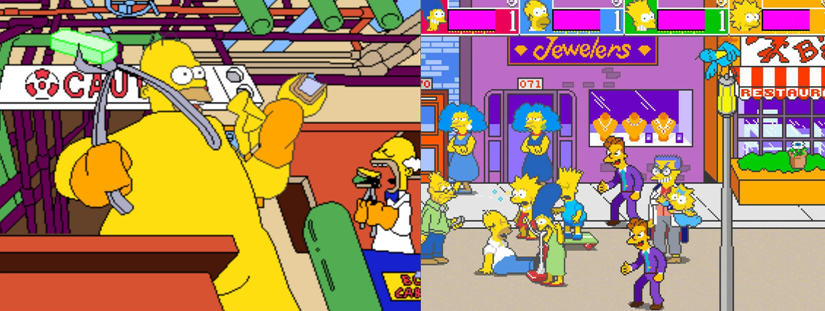
The Simpsons began life as a series of short cartoons created by Matt Groening for The Tracey Ullman Show, with Groening hastily naming each of the family members after himself and his own family and the characters coloured yellow by colourist Georgie Peluse simply because it was deemed amusing. In 1989, Groening was approached by a team of production companies to produce a series of half-hour episodes focusing on his dysfunctional family for the Fox Broadcasting Company. Groening jumped at the chance to produce an alternative to the “mainstream trash” that was currently airing and The Simpsons eventually premiered in late 1989. The show became a multimedia juggernaut after “Bartmania” gripped the nation; in addition to the long-running series, The Simpsons featured in every piece of merchandise imaginable, from action figures and comics to videogames. While the majority of these early videogames are notoriously poor, one stood out for its high quality graphics and addictive beat-‘em-up gameplay and that was the arcade game produced by Konami. It was surprising how well the developers adapted the Simpsons concept to a sidescrolling beat-‘em-up however, while the game was somewhat restricted by the relatively short run of the show at the time, what really gave the game its prestige was its obscurity. I’ve been lucky enough to play this out in the wild over the years so, naturally, I jumped at the chance to get it when it was finally re-released on the PlayStation Network in 2012; sadly, the game has since been delisted, meaning there is no easily accessible way to play this classic beat-‘em-up title, but Whacking Day seems like a great excuse to revisit it nonetheless.

The Plot:
Whilst out shopping, the Simpsons accidentally bump into Waylon Smithers as he is stealing a giant diamond for his employer, the greedy and malicious Charles Montgomery Burns. When the diamond lands in Maggie’s mouth, Smithers kidnaps her and the Simpsons are forced to pursue him to rescue her.

Gameplay:
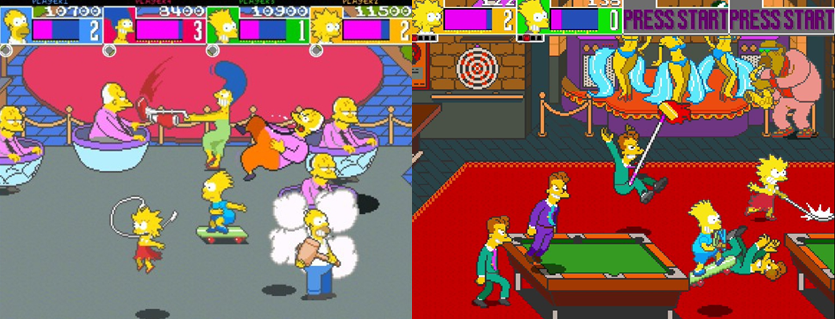
The Simpsons is a 2D, sidescrolling beat-‘em-up in which up to four players travel from the left side of the screen to the right through a variety of familiar Simpsons locations while pummelling wave-upon-wave of goons and other assorted enemies. Unlike some four-player beat-‘em-ups, any player can select any character and you’ll even be able to pull off unique double team moves with each member of the Simpsons family. There are four characters to choose from (Bart, Homer, Marge, and Lisa) and, though each one controls exactly the same, it does seem as though each one has slightly different pros and cons and each one attacks in a slightly different way.

Gameplay is incredibly simple, utlising only two buttons and a variety of attack animations.

For example, Bart and Lisa are smaller and faster, making it easier to manoeuvre around the screen and to avoid enemy attacks, while Homer and Marge are much taller and slower. Bart glides along on his skateboard, which he also uses to attack enemies; Lisa skips around using a skipping rope (which she also uses to attack); Homer attacks with his fists (and seems to have the shortest range as a result); and Marge whacks enemies with her vacuum cleaner, giving her the longest reach but a slightly slower attack than, say, Bart or Lisa. Gameplay couldn’t be simpler: you just move to the right and attack enemies until you reach the end of the stage where you’ll battle a boss. There are no special moves or complicated button presses and combos to worry about here; X jumps and Square attacks and that’s pretty much it. You can perform jumping attacks and each character has a unique combo attack (Bart whirls around like a spinning top and Homer flails his fists in a frenzy, for example) that is performed by simply mashing X but you can’t grab or throw enemies and there’s no dash function but you can pick up and throw items and objects at enemies.

Gameplay is briefly broken up by some good, old-fashioned button mashing.

While 99% of the game is a mindless, monotonous beat-‘em-up, The Simpsons livens things up not just with its bright, cartoony graphics, quirky features, and sound bites but also through its level variety and a couple of Bonus Stages. The first of these has you mashing buttons to pump up a balloon and the second has you doing the same thing to slap your character back to consciousness. It’s not much, and the computer-controlled opponents are ridiculously hard to beat, but it helps to break things up a little bit. The quirkiness of the game helps with that, too. Since the game was made so early in The Simpsons’ lifespan, much of the show’s characterisations and format had yet to be properly established. As a result, Smithers is a maniacal villain and many of the obscure and fleeting inclusions from the show (such as the bear, Homer’s dreamland, Princess Kashmir, and Professor Werner von Brawn) are much more prominent over characters like Abe Simpson, Milhouse Van Houton, and Otto Mann (who all show up in brief cameos to drop off weapons or health items) and some (like Kent Brockman) are missing entirely in favour of numerous cameos by Groening’s rabbit, Binky. Still, similar to Teenage Mutant Ninja Turtles (Konami, 1989), cartoony slapstick and a vibrant aesthetic keep the game enjoyable to look at and play: characters will fly at the screen when smacked by doors, use speech bubbles to shout at you to wriggle the joystick when enemies grab them, and the game does a decent job of recreating certain locations from the show even if some are a little more obscure than others (such as Krustyland and Springfield Butte).

Graphics and Sound:
The Simpsons is a bright, vivid, and lively beat-‘em-up full of big, colourful sprites, cartoony effects, and a decent amount of detail packed into every animation and location. Each character has several frames of animation, even when standing idle; they’ll quickly grow impatient with you if you leave them too long and often speak using both sound bites and word balloons. Additionally, when attacking or being attacked, each character has many frames of animation that allows them to attack in a flurry, be sent tumbling backwards, or return to life in the guise of a superhero.

The game’s selection of Simpsons locations is a little questionable at times.

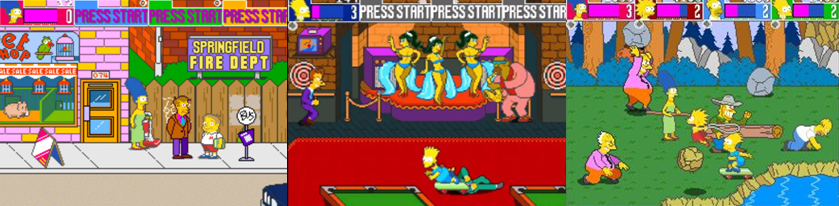
Considering, as I mentioned before, how early into the show’s run the game was produced, stage variety is commendable…if a bit wacky, at times. Stage one is, naturally, the streets of Springfield but, while you’ll pass by the Noiseland Arcade and the Rusty Barnacle, other prominent locations from the iconic Simpsons introduction and various episodes are missing. Similarly, Krustyland is quite different to how it appears in the show and appears to be more like an amusement part, Moe’s Tavern is greatly expanded into something more like a casino and a strip club, and Springfield Butte appears to only be included because a handful of early Simpsons episodes occasionally ventured into the wilderness outside of the town. Things get really surreal when you visit Dreamland on stage six, which features all kinds of weird background elements and brief inclusions of what I would consider to be more prominent Simpsons landmarks (like the school and the Simpsons’ home).

Motion comic-like cutscenes and in-game graphics recreate the look and feel of the show.

While many of the stages are quite short and relatively barren, the game packs in a bunch of cameos and little details here and there: Howie walks out of the arcade (and will smash you into the screen if you get too close); frogs hop around in the cemetery; and various supporting characters (from Sherri and Terri to the original design for Sideshow Bob and even obscure characters like Doctor Marvin Monroe) show up to drop off health or power-ups. The Simpsons does a great job of recreating the look and feel of the early episodes of the show and this is helped all the more with the game’s commendable recreation of the iconic Simpsons introduction (which includes a brief rundown on each playable character) and theme tune. The game’s plot, such as it is, is told through the use of both motion comic-like cutscenes and in-game graphics, with a few sound bites thrown in here and there. This allows for a surprising amount of non-playable characters (NPCs) to briefly appear onscreen at once and a few amusing little animated sequences to play out, such as your characters getting swept over a waterfall, Smithers blowing himself up, and Maggie placing her dummy into the unconscious mouth of Mr. Burns.

Enemies and Bosses:
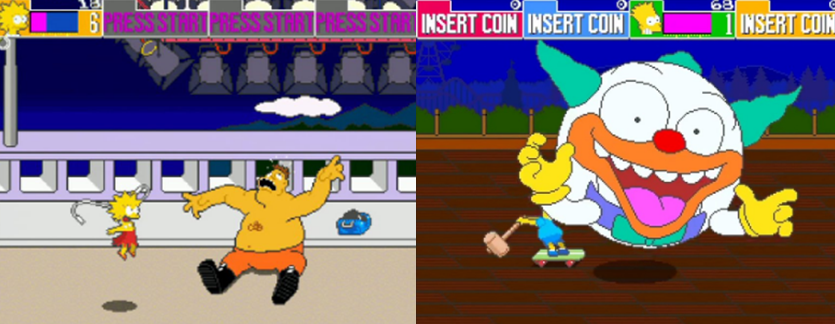
As you embark on your journey, you’ll battle against a seemingly endless wave of men in suits whose sole mission in life is to pummel you to death. Some of these also throw their hats at you or wield brooms or other weapons; they’re also capable of grabbing you to drain your health and get progressively aggressive as the game goes on. You’ll also battle fatter enemies, who can attack in teacups or throw boulders at you, and enemies will drop from trees dressed as ghosts and toss bombs at you in the cemetery. There are also a handful of unique and quirky enemies to contend with, some of which act as mini bosses of sorts: in stage one, for example, you’ll have to fight past a fireman, Binky and fake Krusty the Clown’s regularly crop up in Krustyland, zombies burst out from the cemetery grounds, you’ll encounter Bigfoot a number of times at Springfield Butte, and Channel 6 even has you fighting ninjas and a laser-spewing robot!

The first two bosses ask little more from you that a bit of dodging and relentless attacking.

Easily the most surreal enemies are found in Dreamland; here, you’ll encounter anthropomorphic donuts and saxophones, Marge heads made of clouds, and nuclear technicians who continue to attack you even after you knock their heads off! As mentioned, most of the game’s stages end with a battle against a gigantic boss; these are generally pretty easy and all come down to a simple case of dodging and piling on the attacks. The first boss, Professor Werner von Brawn, fills most of the screen and attacks with punches and belly flops (but his trunks have a nasty tendency to fall down, leaving him vulnerable to your attacks) while the second boss is a gigantic Krusty balloon that tries to slap at you and rains bombs down onto the arena.  In each case, though, victory comes from simply utilising any weapons dropped off before the fight, using your jumping attacks, and relentlessly pounding away until they are defeated.

Later bosses mix up their attacks and get a bit of back-up to make things a little more challenging.

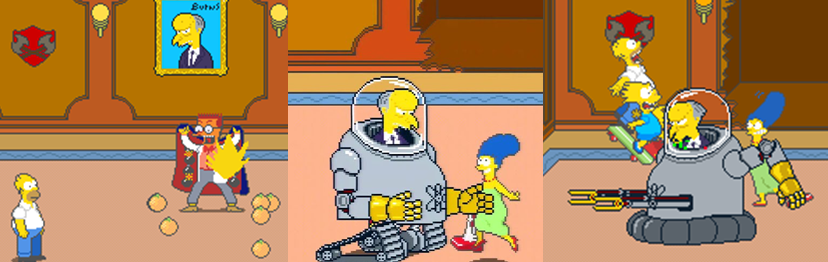
Stage three doesn’t actually have a proper boss battle but, at the end of Moe’s Tavern, you’ll have to fight a cracked-up DJ who punches at you and breathes fire! However, his tendency to stop and taunt makes him an easy fight, as is the giant fake bear that awaits you at the end of Springfield Butte. The hardest thing about this boss is that it surprises you by bursting out of a cave, which can cause you to get hit by logs, and boulders rain down into the area, which can be annoying. Similarly, the large Kabuki Warrior who awaits you at the end of the Channel 6 stage is made more cumbersome by his long reach (thanks to his spear) and the fact that he conjures a ninja or two to distract you during the fight. Dreamland, however, ends with a particularly annoying and tough boss battle against a huge anthropomorphic bowling bowl that attacks in four different phases: in the first, it simple rolls and bounces around; in the second, it grows arms to bounce higher; the third sees it grow legs and shoot bowling pin missiles; and the fourth and final phase sees it grow one large, stretchy arm to swipe at you. It’s quite a laborious boss battle, especially considering that every boss before this was relatively short and simple, but is just a taste of things to come.

A tough battle against Smithers and Mr. Burns awaits you at the finale of the game.

When you reach the Springfield Nuclear Power Plant, you’ll simply walk right through the stage and into Mr. Burns’ office for the final battle, which is preceded by a fight against Smithers. Smithers attacks with his cape and maniacally dashes around the office tossing bombs at you. Thankfully, you can throw some of these back at him and he goes down relatively quickly as long as you can get near him and avoid being chargrilled by his bombs and death animation. Defeat him, though, and Mr. Burns bursts through the wall in his mech suit for another four-phase boss fight. At first, Burns attacks with retractable pincer-like arms and spits out the odd nuclear bomb, then he rises up onto treadmill-like feet and starts shooting missiles at you. In his third phase, he switches to a hovercraft-like base and adds a spiked rod attack and, in the fourth phase, having had his exosuit smashed off throughout the fight, Burns simply resorts to bouncing around the screen and scattering bombs everywhere. This is definitely a fight made easier with another player or in Free Play mode as Burns is a damage sponge and can easily smack the life out of you in just a few hits.

Power-Ups and Bonuses:
As in any self-respecting beat-‘em-up, the Simpsons have a variety of options when it comes to restoring their health; NPCs will drop off burgers, hot dogs, donuts, pie, and roast chickens and you can also shake apples from trees, each of which will allow you to keep fighting a little longer. Some of these can also be found right before boss areas so, if you’re low on health, it’s worth picking them up. Similarly, you’ll find and be gifted a variety of weapons throughout each stage; one of the most prominent is the slingshot, which allows you to fire a limited number of projectiles at your enemies, but you can also grab bowling balls, a hammer, bar stools, brooms, bottles, drink cups, and even Snowball II, Santa’s Little Helper, and the original design of the Space Mutants to launch at enemies.

Additional Features:
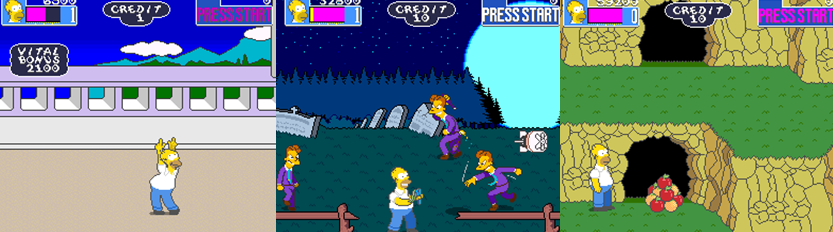
The Simpsons has twelve Trophies for you to earn, each of them actually requiring a bit of skill and effort on your part as they task you with reaching certain stages, acquiring a certain number of points in specific game modes, or teaming up with other plays on- or offline. The difficulty of these varies quite a bit; it’s not much to ask you to finish the game four times, once with each character, but finishing the game in thirty minutes or less or on the “Expert” difficulty with limited continues is a bit of a tall order. When playing this version of the game, you are presented with a variety of gameplay options. You can choose to play in “Free Play” mode (which gives you unlimited continues), “Survival” mode (which gives you one life an no continues), “Team Quarters” (where you share forty continues), and “Quarters” mode (which gives you ten continues).

The Japanese version of the game adds a couple of extra features here and there to spice things up.

You can then select between Easy, Normal, Hard, and Expert difficulty modes (with enemies increasing in number and difficulty the higher the setting), select any stage you like (though, as I finished this game a long time ago, this may need to be unlocked so I forget if it’s available right from the start), view characters and artwork in the gallery, apply different borders and screen settings, and have access to a sound test. You can also choose to play the Japanese version of the game, which differs somewhat from the worldwide release. For one thing, it adds the nuclear bomb item to certain stages, which allows you to clear the screen of enemies. It also allows you to use weapons in mid-air, ups the power of the slingshot, adds a “Vital Bonus” score at the end of every stage, allows you to increase your health beyond its limit, and adds a number of different enemy, item, and NPC placements within every stage which can help mix up subsequent playthroughs.

The Summary:
The Simpsons is not an especially deep or feature-laden arcade title; the lack of special moves, relative emptiness of the stages, the enemy variety, and the short length of the game all, arguably, make it somewhat inferior to other arcade beat-‘em-ups released around the same time. Yet, thanks to its colourful graphics, quirky animations, and simple pick-up-and-play formula, it’s a classic of its genre through and through and easily one of the most enjoyable beat-‘em-ups out there. Of course, much of its appeal comes from nostalgia and its rarity but none of that detracts from the fact that it’s a blast to play and never outstays its welcome. A sidescrolling beat-‘em-up may not necessarily be the first genre that springs to mind when you think of The Simpsons but it works really well here; even though the show was still in its early days, the game does a great job of capturing the spirit of The Simpsons and including a number of cameos and call-backs to the show. It’s a shame that The Simpsons wasn’t more commercial available through ports to home consoles and that this particular version has been delisted from online stores as it’s a great way to waste an hour or so and the additional features and options help to spice the experience up. It was a great little package for a long-forgotten game and I can only hope that, one day, it’ll reappear on the Xbox so I can experience it all over again.

My Rating:

Rating: 3 out of 5.

Pretty Good

Are you a fan of The Simpsons? Have you have played this game out in the wild or did you first experience it through emulation or the PlayStation and Xbox ports? Which of the playable characters was your favourite? How do you feel the game holds up today, especially compared to other beat-‘em-ups? Would you like the see the game re-released again or do you think it’s better left in obscurity? What is your favourite Simpsons game? Do you have a favourite character, episode, or moment from the show? How are you celebrating Whacking Day today? Whatever your thoughts on the world’s most famous yellow family, feel free to leave a comment below and be sure to check back in for more Simpsons content!