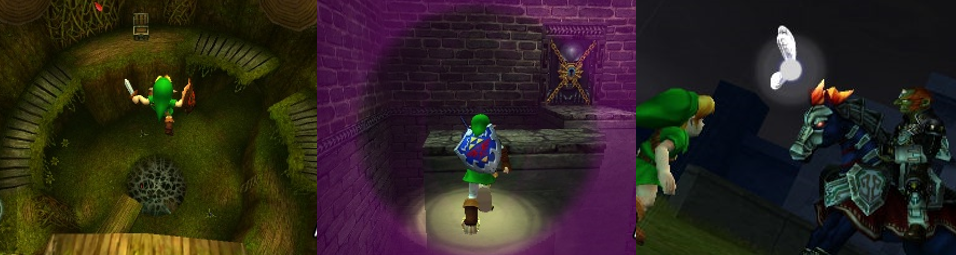
Game Corner [Zelda Month]: The Legend of Zelda: Majora’s Mask 3D (Nintendo 3DS)


On 21 February 1986, The Legend of Zelda (Nintendo EAD, 1986) was first released in Japan. The creation of legendary game designer Shigeru Miyamoto and Takashi Tezuka, The Legend of Zelda launched one of Nintendo’s most popular franchises. This year, I’ve been dedicating every Friday to Nintendo’s most famous silent protagonist, Link and his vast and enduring fantasy world of sword and sorcery.

Released: 13 February 2015
Originally Released: 27 April 2000
Developer: Grezzo
Original Developer: Nintendo EAD
Original Version Also Available For: GameCube, Nintendo 64, Nintendo Switch, Nintendo Wii, Nintendo Wii U  

The Background:
An instant classic upon release, The Legend of Zelda (mostly) went from strength to strength as the concept was refined and expanded throughout Nintendo’s handheld ventures and 16-bit era. Following a long development period, the franchise made a phenomenally successful jump to 3D with The Legend of Zelda: Ocarina of Time (Nintendo EAD, 1998). Following its success, Nintendo originally sought to create a remixed version for the ill-fated 64DD peripheral, which would eventually become the “Master Quest” version of the game. Designer Eiji Aonuma was unenthusiastic about this, so series creator Shigeru Miyamoto challenged the team to create an entirely new 3D Zelda adventure using Ocarina of Time’s assets in just one year. Aonuma recruited designer Yoshiaki Koizumi to adapt his concept of a time loop gameplay mechanic; Koizumi also (literally) dreamt up the idea of the impending threat of a falling Moon. Realising that Ocarina of Time’s players would be a little older, Aonuma purposely aimed for a bleaker, more melancholy tone for the game, which was bolstered by the Expansion Pak that allowed the game to run much smoother and boast more complex visuals compared to Ocarina of Time. The Legend of Zelda: Majora’s Mask was a critical and commercial success; reviews praised the new gameplay mechanics and it quickly gained a reputation as one of the darker, more sombre entries in the franchise. Following a handful of re-releases, and the success of Ocarina of Time’s 3D remake, Nintendo and Grezzo immediately began work on giving Majora’s Mask the same treatment. Alongside graphical improvements, the team purposely aimed to make Majora’s Mask 3D more accessible and included numerous quality-of-life features that were criticised by some. Despite this, the game received positive reviews praising the updated visuals, mechanics, and new elements and the game retained its status as one of the franchise’s most under-rated entries.

The Plot:
After saving Hyrule and being returned to his childhood, Link is jumped by a Skull Kid and has his horse, Epona, stolen. Pursuing the thief to the bizarre world of Termina, Link must manipulate a three-day cycle to stop the possessed sprite from destroying the land.

Gameplay and Power-Ups:
The Legend of Zelda: Majora’s Mask is a 3D action/adventure game that’s built upon the same game engine as its predecessor, Ocarina of Time, and therefore shares many of the same controls, gameplay mechanics, and features. In a rarity for the franchise, players control the same Link is in the previous game, though returned to his child body (and you can change his name when starting a new file) and exploring a bizarre new land filled with many familiar, but noticeably different, characters. Link’s goal is simple: he has three days to stop the possessed Skull Kid from destroying Clock Town and all of Termina with a giant, nightmare-fuelled moon. To do this, players journey to four areas adjacent to Clock Town, tackle the dungeons (or “Temples”) found there, and defeat the bosses within to awaken the Four Giants, the only beings physically capable of pushing back the Moon. However, your mission is compounded by the ever-present time limit, the drama and side quests of the various non-playable characters (NPCS) Link meets, and the numerous magical masks he obtains along the way. Link’s abilities will be immediately familiar to any returning Ocarina of Time players: A sees you talk to NPCs, open chests, and interact with the environment while B lets you attack with your sword, swiping, stabbing, and even jumping when used in conjunction with A. The Left Trigger activates “L-Targeting”, allowing you to lock on to enemies, NPCs, and other targets and expands your attacking options by letting you raise your shield to deflect attacks and projectiles with the Right Trigger, side hop, backflip, and leap into action.
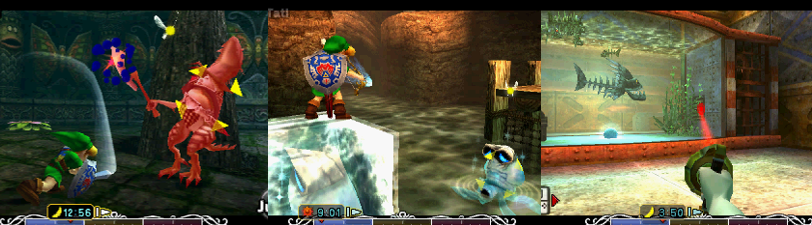
Though a child, Link is as competent as he was as an adult with his weapons and items.

You assign different weapons and items to the X and Y buttons, while other items are assigned to the I and II slot on the touchscreen for easy use. By default, your trusty ocarina and, later, the Pictograph Box are selectable from the top and bottom left of the touchscreen, which is also where you’ll find your map, health (represented as hearts), magic meter, and item and mask menu. Though a child, Link eventually acquires many weapons he utilised as an adult. These are found within the game’s Temples and are often necessary to defeat the mini boss and main boss within, as well as being used to solve various puzzles. You can acquire the Hero’s Bow and a variety of elemental arrows, allowing you to attack enemies from afar, hit switches, burn objects, and create ice platforms where indicated. Bombs and Bombchus are used to blow upon walls and discover secrets, Deku Sticks allow you to light torches, Deku Nuts briefly stun certain enemies, and you can snag on to certain targets and parts of the environment with the Hookshot to cross gaps or bring items to you. Magic Beans can be planted to create platforms to new areas, the Lens of Truth will reveal hidden paths and secrets while draining your magic, and you can capture life-restoring Fairies or store various potions in one of Link’s many bottles. Players can also strengthen their sword by following a specific side quest; though the Razor Sword is only temporary and will eventually dull, it can be further (and permanently) upgraded to the Gilded Sword. Similarly, you can earn yourself the massive Great Fairy’s Sword and obtain the light-reflecting Mirror Shield, and eventually purchase large Powder Kegs to destroy larger boulders. Link can also expand his inventory with bigger quivers, bomb bags, and wallets. Though you lose all your Rupees and ammo stock whenever you travels back in time, you can bank your Rupees in Clock Town and will find plenty of ammo by cutting up grass and defeating enemies.
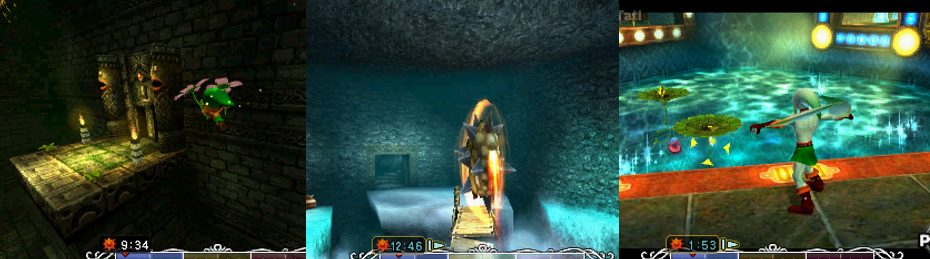
Link’s masks afford him unique new abilities, though the controls can be finnicky and clunky.

The Ocarina of Time is again used to manipulate the flow of time. You’ll need to travel back in time multiple times as you’ll get a game over once you reach the end of the third day. Luckily, you can speed up and slow down the flow of time to give yourself more time to complete tasks or jump to specific time periods to complete side quests. Other ocarina songs warp you to the various Owl Statues across Termina, where you can also manually save your game, call Link’s trusty steed, Epona, once you rescue her, access certain Temples, and heal disturbed or unquiet spirits to obtain new masks. Majroa’s Mask big gimmick is the mask system; Link will assume three distinct forms (a Deku Scrub, a Goron, and a Zora) throughout the game, each with different playstyles and lacking his traditional weapons. Deku Link is small and spritely, spitting bubbles from his nose and using Deku Flowers to launch into the air and temporarily fly about like a helicopter. Goron Link is big, slow, and powerful, smashing foes with his fists, slamming the ground, and barrelling along in a spiked ball to cross gaps. Zora Link is sleek and agile, easily cutting through water, walking across the seabed, and tossing boomerang-like fins from his arms. Well, I say “easily” but Zora Link can be finicky to control, often ploughing into walls and being a pain. Each of these forms has their own musical instrument in place of the ocarina and is used not just in their main Temple, but to solve other puzzles and complete side quests, such as purchasing Deku deeds, competing in high-speed, aggravating Goron races, and racing against beavers. Link’s other masks all have special abilities, too, such as the Bunny Hood doubling his running speed, the Blast Mask exploding like a bomb, the Great Fairy’s Mask attracting Stray Fairies, and the Captain’s Hat allowing you to command Stalchildren. The Stone Mask renders you functionally invisible, the All-Night Mask keeps you awake, and the Giant’s Mask transforms Link into a hulking giant for a kaiju-esque boss battle. With the exception of the three main masks, all these masks are optional and obtained through side quests, but it pays to acquire them all to make your life (and the endgame) so much easier.
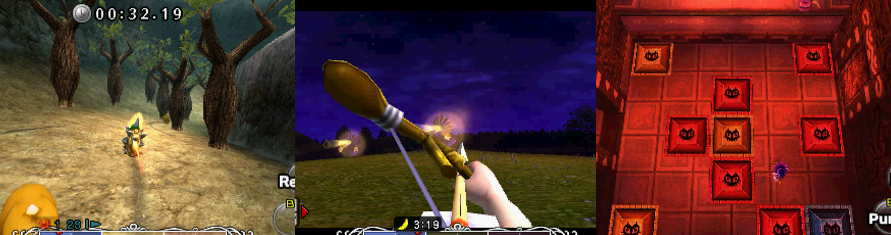
Termina is full of NPCs, mini games, and side quests that will reward you handsomely.

Termina is full of NPCs, all of whom have different thoughts on the current situation and different issues to deal with. Over the course of the three days, you’ll interact with them several times, with key events being recorded in your handy-dandy Bomber’s Notebook so you can keep track of what’s going on and when. This functionality is great for new players and for people like me, who like to efficiently complete the game’s side quests as quickly as possible. Because of the time travel and three-day loop, you’ll repeat certain events and trigger certain cutscenes multiple times, requiring you to rescue old ladies and injured witches, follow shady characters, and retrieve certain items to complete side quests. Many side quests are ongoing, requiring multiple steps (such as reuniting Anju and Kafei, which will take you right up to the last minute of game time and sees Link and Kafei working together to solve switch-based puzzles in Sakon’s hideout) or occur at specific times (such as the surreal defence of Romani Ranch against alien invaders!) Other quests are more low-key, such as using the Bremen Mask to engross little chicks, defending Cremia’s milk delivery from the Gorman Brothers, besting the various shooting galleries and fishing holes, and delivering fish to the Marine Research Lab. Other side quests can be quite involved, such as reuniting the frog choir, using all of Link’s transformations to form a band, digging up treasure with Dampé, and challenging the mini bosses to a rematch. You’ll also be using all your weapons and skills in Gold Skulltula Houses, taking pictures with your Pictograph Box, visiting Gossip Stones, and answering the Keaton’s quizzes. Your reward for these endeavours is either a new mask, a Piece of Heart to extend your maximum health, a bottle, or some Rupees, all key items to assist your adventure.
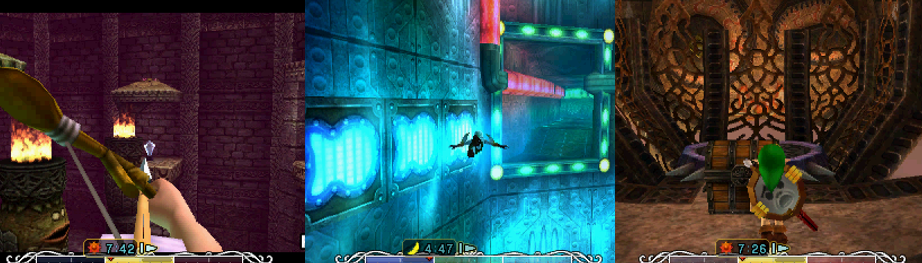
The four Temples are packed with new and familiar puzzles and fitting gimmicks.

Each Temple houses not just a new weapon and the usual map and compass, but fifteen Stray Fairies which must be freed and collected, usually by enticing them with the Great Fairy’s Mask. Find them all and you’ll earn Link’s patented Super Spin Attack (hold B to charge up a magic-draining spin attack), double your magic meter, increase your defence, and earn the aforementioned powerful (if unwieldy) Great Fairy’s Sword. It’s worth collecting these as you explore the Temples to avoid having to return later. Time is always against you in Majora’s Mask, so be sure to play the Inverted Song of Time to stave off Termina’s inevitable doom. Though the game only has four Temples, getting to them is a task in itself: Link must follow cheeky monkeys and sneak into the Deku Palace, feed and soothe the Goron Elder’s son and then use the Lens of Truth and Goron Lullaby to bypass the Biggorn protecting Snowhead Temple with a blizzard, mess about finding seven Zora Eggs to summon a giant turtle to reach the Great Bay Temple, and battle through the undead minions of Ikana Canyon and scale up a puzzle-landed rockface to reach the Stone Tower Temple. While each contains many recycled elements from Ocarina of Time (torches, switches (timed or otherwise), climbable and destructible walls, etc), each also boasts a maze-like structure and fitting gimmick. Woodfall Temple is full of poisonous water and large gaps you must fly over as Deku Link, Snowhead Temple features both lava and ice, ramps to careen over and weighted switches to pound as Goron Link, and a large central pillar that needs to be brought down to reach the boss. The Great Bay Temple is, obviously, water-based, featuring a maze of rushing currents, jet streams, and propellers. You must use the Ice Arrows to create platforms and solve puzzles and pay attention to the helpful colour-based indicators to know where new paths have opened up. The Stone Tower Temple is two dungeons in one, featuring a gimmick where you flip the area upside down to access new areas, light-based puzzles using the Mirror Shield, and plenty of opportunities to use the Elegy of Emptiness to create a soulless duplicate of Link to press down switches. As you’d expect, each Temple also contains a mini boss, a warp point, numerous small keys to open locked doors, and a big Boss Key to access the Temple guardian.

Presentation:
Even in its original Nintendo 64 incarnation, Majora’s Mask had Ocarina of Time beat hands down when it comes to visuals. Although the game always had a bit of a blurry look thanks to it taxing the console (and the Expansion Pak) to its limits, the graphical upgrade was apparent right away in something as simple as Link actually having his sash and his jumping animations being more dynamic. In the 3DS version, the visuals are as improved as they were in Ocarina of Time 3D, reducing the blur in favour of clarity, adding more emotion to Link’s face, and allowing players to immerse themselves in the world (and induce a headache) with the 3D slider. At first glance, Majora’s Mask seems like a smaller sandbox to its predecessor; you spend a lot of time in one central location and there are only four Temples, after all. However, the opposite quickly proves to be true; not only are there more NPCs onscreen at any one time, their personalities, positions, and roles change across the three-day cycle, adding an unexpected level of depth and emotion to this bizarre adventure. In addition to a day and night cycle and each area of Termina sporting different weather effects and seasons, the world is far more diverse than before. Great Bay, for example, is a vast beach home to the Pirate’s Cove, Gerudo Lagoon, and Zora Cape, a coral-like town that puts Zora’s Domain to shame. Similarly, the Southern Swamp sees Koume and Kotake offer a boat ride through the sweltering foliage, a confusing monkey-filled maze, and the nigh-impenetrable Deku Palace, where the woodland folk don’t take kindly to strangers.
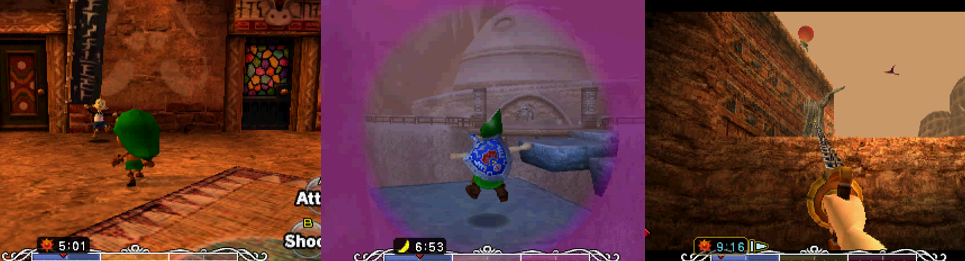
Termina is a diverse land with many areas to explore and environmental effects.

Easily the most impressive area, for me, was Snowhead Mountain. Like Zora’s Domain, Termina’s Goron population have been crippled by inclement weather; in this case, a raging blizzard. Snow and ice covers the environment and the weather has claimed many Goron lives and hides many secrets but, unlike in Ocarina of Time, the snow will melt when you best Snowhead Temple, just as the Southern Swamp with become more habitable. Sadly, travelling back in time undoes these actions and you’ll need to beat the Temple bosses again to re-restore the lands, but just the fact that you can undo the damage done to Termina and see NPCs celebrating in their newfound lives adds so much more gravitas to the game. It compels you to journey on and assist more NPCs, which rewards you with more lore and items, and makes Termina so much richer compared to the more stagnate Hyrule in Ocarina of Time. Ikana Canyon is a desolate, dangerous area filled with undead monsters, rolling rocks, an abandoned village, and the forgotten ruins of Ikana Castle, with its light-based puzzles and spooky inhabitants. The Stone Tower that leads you to the Stone Tower Temple is quite the feat, requiring you to scale it in various creative ways, all before you even flip the Temple on its head to tackle it upside down. Even exploring Termina Field is an adventure in itself; all sorts of respawning enemies lurk in the grasslands, and you can visit the observatory, Romani Ranch, and discover numerous hidden areas all by experimenting with your weapons, mask abilities, and exploring the rich and detailed world. Although the Song of Soaring, Bunny Hood, and Goron abilities make traversal simple, you can rescue Epona and race around on her as Young Link to tick off another desire from Ocarina of Time (though I admit that I rarely used her since she can’t access every area).
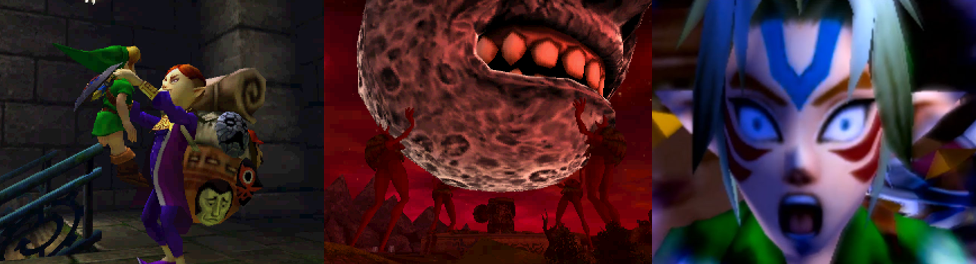
This is easily one of the darkest and most bizarre Zelda adventures.

Majora’s Mask is easily one of the most bizarre and bleak Zelda adventures. Right from the beginning, the story starts with a melancholy tone, with Link wandering the lands in search of Navi, only to have his horse and ocarina stolen by the Skull Kid and his mischievous fairy companions, lost in a strange land, and transformed into a Deku Scrub! Like in Ocarina of Time, Link is partnered with a fairy, but Tatl is no Navi; she’s rude, obnoxious, and rarely gives much help when searching for an enemy’s weak spot. Over the course of the game, the two find common ground as Tatl’s concern for her friend and her brother, Tael, grow, and Link’s courage is called upon again to aid the aggressive and slightly demonic Happy Mask Salesman in retrieving Majora’s Mask. Most interactions take place using the in-game engine and simple text boxes, but horrific (thankfully skippable) cutscenes play every time you put on a transformation mask, suitably dramatic cutscenes play when Temples rise up or NPCs are laid to rest to increase Link’s abilities, and you’ll get helpful reminders when day turns to night turns to day and the countdown to destruction looms closer. Speaking of which, the grim-faced Moon looms ominously overhead, growing closer and closer and causing small earthquakes. NPCs become more fearful or flee as the game progresses, and woe befall anyone who lets the timer runs out and must watch the Moon obliterate the land! While many of the assets, models, and elements are recycled from Ocarina of Time, they’re all much improved, with characters constantly on the move and doing their own thing, which you can track with the Bomber’s Notebook. Many musical cues and tracks return as well, though the Termina Field Overture is far more bombastic and engaging for me, and each area boasts a fittingly twisted soundtrack that’s both familiar and unique. The 3DS version changes up the presentation a bit, redesigning the countdown timer, area intros, and tidying up the graphics and assets to really make the colours pop, add helpful guidelines to certain areas, and even mixes up the puzzles and locations of certain items.

Enemies and Bosses:
In keeping with the recycling of Ocarina of Time’s assets, Majora’s Mask returns many enemies from the previous game, such as the shield-sucking Like Likes, bat-like Keese (also in fire and ice variants), crab-like Tektites, Poes, Wolfos, crow-like Guays, Peahats, Octoroks (and their larger cousins), Deku Babs, Lizalfos and Dinolfos. Anyone who’s played Ocarina of Time will know how to tackle these enemies, which usually comes down to firing arrows or strategic use of L-Targeting, and the same is largely true of many of the new enemies featured here. You’ve got your normal, smaller foes like beetle-like Hiploops, electrical Dragonflies, Giant Bees, and skeletal fish, but you’ll also contend with strange foes like the Dexihand, Eyegore, and Goron-like Nejirons. Snappers are best taken out by lying in wait in a Deku Flower and exploding up beneath them; snowball-tossing Eenos are susceptible to Fire Arrows; the various ChuChus can be popped to quickly earn health and ammo; and you’re better off simply defending against or firing arrows at the “Real” Bombchus that scurry about. Some enemies will better test your swordsmanship, such as the Garos and returning Gerudos and Iron Knuckles (who attack faster and more aggressively as their armour is destroyed), while you can command the Stalchilds and even avoid or converse with Gibdos and ReDeads with certain masks. Similarly, you can bypass the Death Aros altogether with the Stone Mask, must switch to sub-weapons or play the Song of Storms when touched by a Blue Bubble, and keep an eye out for the vulture-like Takkuri flying around Termina Field to avoid having your items stolen.
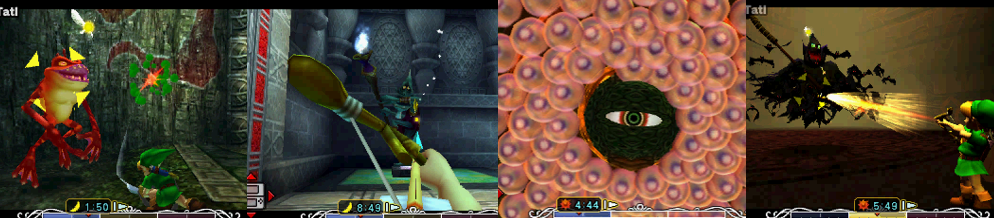
Even familiar mini bosses require a bit more strategy to overcome.

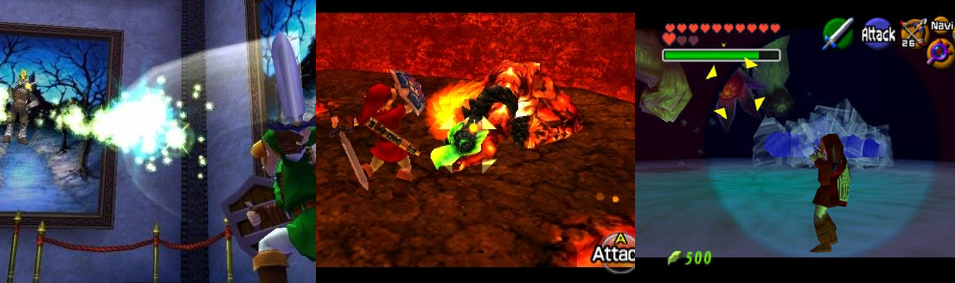
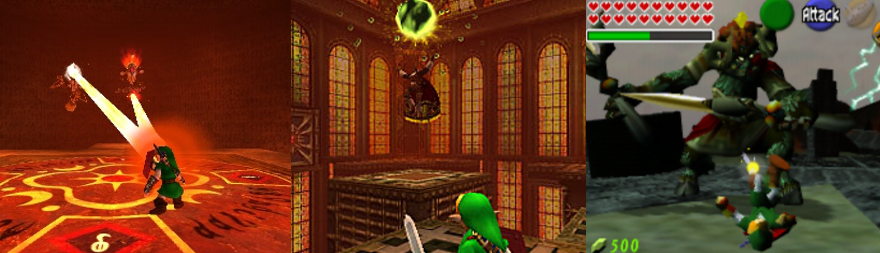
Each Temple houses at least one mini boss who must be overcome, sometimes multiple times, usually to obtain the Boss Key or the dungeon’s weapon. Many of these will be familiar not just to players of Ocarina of Time, but also long-time Zelda fans: Dinolfos and Iron Knuckles appear more than once and fit into this category, for example, but Majora’s Mask sees the return of series staples such as Wart and Wizzrobe. Wizzrobe is fought multiple times in multiple Temples, teleporting about, creating illusionary doubles, and attacking with fire or ice magic. Wart appears in the Great Bay Temple and is, as usual, a giant eye surrounded by bubbles that Link must destroy to get a clear shot at its pupil, while being mindful of it firing them as projectiles and bouncing around in a frenzy. The Gekko appears twice in the game, first riding a Snapper and attacked via a Deku Flower and then encased within a giant, gelatinous substance that must be frozen with Ice Arrows and shattered to attack the slippery devil. In the Ikana Graveyard, Link chases the gigantic Captain Keeta, fending off his lackeys and hacking the giant’s legs to get his attention. You must avoid his swipes and flaming barriers and pelt him with arrows to stun him, but the main issue here is keeping up with him so he doesn’t flee (but that’s what Hylia created the Bunny Hood for!) Stone Tower Temple is home to two more tough mini bosses: first up is the Garoa Master, a teleporting assassin who drops from the ceiling and attacks with a charge. Stay away from his attacks to strike back when his guard is lowered, and be sure to keep your distance when he’s beaten as he’ll blow himself up with a bomb! Defeating him earns you the Light Arrows, which are key to dispelling the bats protecting Gomess. Gomess attacks with a scythe that can cut through your shield, so be sure to jump-slash his exposed heart when you see an opening.
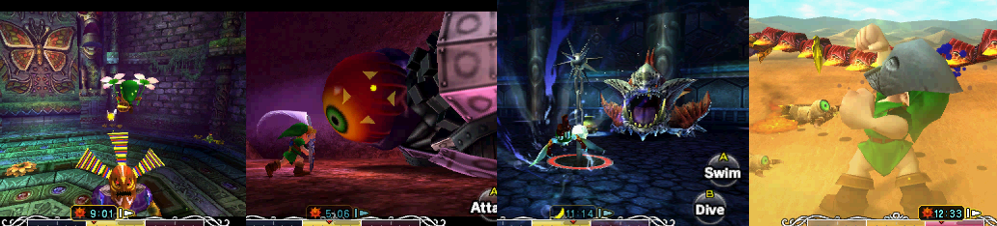
Bosses have been redesigned to have new phases and weak spots, which can be aggravating.

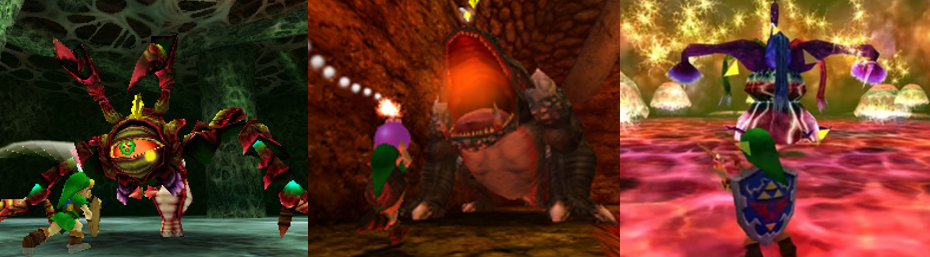
Naturally, you’ll have to best each Temple’s boss to awaken one of the Four Giants and acquire their remains. If you played Majora’s Mask on the Nintendo 64, you’ll be in for a surprise here as each boss has been fundamentally changed, somewhat simplifying them and expanding their attack patterns to allow for new ways to beat them. First up is Odolwa, a manic swordman who dances about and strikes with a gigantic blade. Originally, you’d use arrows or bombs to stun him and strike with your sword, but now you must brave being roasted alive as Deku Link to attack from above, exposing a big slimy eye that is a recurring weak spot for the 3DS version’s bosses. I always found Goht one of the more annoying bosses; the fight takes place on a never-ending track filled with ramps and Magic Jars and sees Goht gallop along, tossing bombs, causing rocks to fall, or summoning a thunder bolt. You’re encouraged to race after him as Goron Link, picking up speed to ram him and topple him over to attack his exposed eye, but you can actually just stand by the entrance and pelt him with arrows or even toss a bomb at him to speed things up. Gyorg was initially a pretty simple affair, testing your patience by having you wait on the central platform to shoot him as he jumps over then ram into him as Zora Link. Now, there’s a second phase that’s completely underwater; you must desperately avoid the mines and detach them to stun Gyorg, blasting his giant eye where possible, something made quite troublesome with the clunky swimming mechanics. Similarly, Twinmold is completely different; originally, you’d be forced to don the Giant’s Mask and attack the worm’s heads or tails with your sword while keeping your magic topped up. Now, you only earn the Giant’s Mask after pelting the boss’s first phase with arrows and must stomp about as Giant Link engaging Twinmold in a fist fight, then grab its tail when it’s stunned. Again, this is a much more aggravating boss battle because of this; Giant Link is a slow, lumbering character compared to the slipper Twinmold and your magic drains very quickly, causing the fight to drag unnecessarily.

Majora’s many forms and difficulty are rendered mute with the overpowered Fierce Deity Mask.

Once they’re all beaten, you must return to Clock Town on the final day and play the Oath to Order. This summons the Four Giants and stop the Moon from falling, but causes the Skull Kid to freak out and the demonic Majora to assume full control. You’re then transported to the strangely idyllic Moon’s surface, where you must challenge four short, troublesome obstacle courses themed around each Temple. If you’ve collected every additional mask, you can trade them all in here and gain the Fierce Deity Mask, which can only be worn in boss rooms and transforms you into a hulking adult equipped with a massive sword that fires magic-draining energy beams when L-Targeting. This is the only way I’ve battled the game’s final boss, Majora itself, which has three distinct forms: Majora’s Mask, Majora’s Incarnation, and Majora’s Wrath. You can tackle each using arrows and bombs and traditional tactics, but I never have. I simply L-Target the weird, increasingly grotesque demon and fling sword beams at it until it’s defeated. Its attacks include charging at Link like a buzzsaw, shooting a reflectable beam of fire, circling at super-fast speeds, firing energy blasts, dodging your conventional attacks, and attacking with two disturbingly organic tentacle-like whips. Majora also attacks using the boss’s remains and by summoning spiky, spinning tops and can cut through your shield if you’re not careful, but none of this is a concern with the overpowered Fierce Deity Mask.

Additional Features:
There are fifty-two Heart Pieces to find all around Termina; some are hidden in secret holes, some are up trees or require your weapons to access, some are gifted to you as rewards, and some require you to complete side quests. You’ll be dancing with the Rosa Sisters, giving a weird, disembodied hand some toilet paper, stopping a timer at exactly ten seconds, checking mailboxes, and besting the shooting galleries to acquire these helpful upgrades. Your main objective throughout the game is to acquire all the different masks, which requires interacting with all the NPCs and keeping an eye on their routines with the Bomber’s Notebook. While some masks are more useful than others, each has a specific function and will allow you to get other masks, Heart Pieces, or rewards depending on who you interact with when wearing them. Similarly, it’s worth seeking out the upgrades to Link’s sword, wallet, and items, if only to further explore the world, and making sure you bank your Rupees before resetting the three-day cycle. You’ll also find many Gossip Stones placed all over that will give you hints if you interact with them while wearing the Mask of Truth, and the Sheikah Stones return from Ocarina of Time 3D to provide you with more detailed directions if you get stuck. The manual save system has been revamped, with additional Owl Statues appearing in the game (though you can’t warp to all of them), and some of the rewards and side quests have been changed. Most notably, Link can now acquire seven empty bottles (which is, admittedly, a little excessive), with the last gifted after completing a new side quest involving the Gorman Troupe. Another new feature is the inclusion of two fishing holes, which you can either pay to use or acquire a pass to fish for various fish, though there are no rewards tied to this beyond trying to snag the legendary Lord Chapu-Chapu. Since the game resets when you go back in time, there’s no Boss Rush Mode this time around and, sadly, the developers didn’t see fit to include a mirrored Master Quest mode, though you now have three save slots instead of just two.
The Summary:
The debate about which game is better, Ocarina of Time or Majora’s Mask, is seemingly never-ending and, honestly, it’s a tough choice. Majora’s Mask is definitely a more daunting challenge; I can play through Ocarina of Time with my eyes closed but I’ve never beaten Majora’s Mask without a guide, purely because I want to complete all the side quests before facing Majora at the end and have the overpowered Fierce Deity Mask on hand. Yet, Majora’s Mask is such a step up in terms of visuals, scope, and world-building. Termina feels alive in ways Hryule does not and the stakes feel so much higher since you can see how the impending doom affects the different NPCs. The three-day cycle is as daunting as it is annoying at times, resetting all your hard work but also pushing you to restore the next area and save this bizarre land. Majora’s Mask may seem smaller due to its more focused approach, but the game and its land is as big (if not bigger) than Ocarina of Time, expanding upon and improving every element of its predecessor and really making you feel the gravitas of its bleak narrative. Link may not acquire any new weapons here, but the mask-based gameplay mixes the formula up in surprising ways, changing Link’s form and altering the way you play (even if the controls can be a struggle at times). The 3DS version makes way more changes to the original game compared to Ocarina of Time 3D and, while some (like the simplified bosses and tweaked controls) can be frustrating, the benefits outweigh these issues. The expanded Bomber’s Notebook, being able to jump to specific time periods, and the changes to side quests help make the game accessible and fresh for old and new players, in my eyes. Ultimately, I think Majora’s Mask is a dark horse of the franchise; it’s an incredibly engaging experience, packed with side quests upon side quests, and more than stands alongside its predecessor as one of Link’s finest (if surreal) adventures.

My Rating:

Rating: 5 out of 5.

Fantastic

Have you ever played the Nintendo 3DS remaster of Majora’s Mask? If so, what did you think to the graphical overhaul and additional features included? Which of the masks and many side quests was your favourite? Would you like to see this version ported to the Nintendo Switch to make it more accessible? Did you own Majora’s Mask back in the day? If so, did you ever tackle the final boss without the Fierce Deity Mask? Were you a fan of the three-day cycle? I’d love to hear your memories of Majora’s Mask so leave a comment below and go check out my other Zelda content! 

Game Corner [Zelda Month]: The Legend of Zelda: The Minish Cap (Nintendo Switch)


On 21 February 1986, The Legend of Zelda (Nintendo EAD, 1986) was first released in Japan. The creation of legendary game designer Shigeru Miyamoto and Takashi Tezuka, The Legend of Zelda launched one of Nintendo’s most popular franchises. This year, I’m dedicating every Friday to Nintendo’s most famous silent protagonist, Link and his vast and enduring fantasy world of sword and sorcery.


Released: 9 February 2023
Originally Released: 4 November 2004
Developer: Capcom / Flagship
Also Available For: Game Boy Advance and Nintendo Wii U

The Background:
After making an immediate impact upon its release, The Legend of Zelda franchise was further refined and expanded throughout Nintendo’s handheld ventures and 16-bit era, but changed forever after a successful jump to 3D with The Legend of Zelda: Ocarina of Time (Nintendo EAD, 1998). After further 3D success with the bleak follow-up, The Legend of Zelda: Majora’s Mask (ibid, 2000), Nintendo surprised everyone by adopting a cartoony, cel-shaded aesthetic for Link’s GameCube debut, The Legend of Zelda: The Wind Waker (ibid, 2002). The visuals were as widely praised as the gameplay and The Wind Waker enjoyed rave reviews, prompting Nintendo to adopt the style for further adjacent, handheld adventures. After a successful collaboration with Capcom and Flagship on The Legend of Zelda: Oracle of Ages and Oracle of Seasons (Flagship, 2001), the teams returned to develop a new Zelda title for the Game Boy Advance, a spiritual successor to The Wind Waker and The Legend of Zelda: A Link to the Past (Nintendo EAD, 1991) whose story and aesthetic mirrored a whimsical fairy tale. Development specifically focused on Link’s new ability to shrink in size, thereby opening new avenues for exploration and puzzle solving, and providing some unique new items for players. The Legend of Zelda: The Minish Cap was a best-selling title for the Game Boy Advance and was met with critical acclaim. Reviews gushed over the cartoony art style, innovative dungeon designs and puzzles, and the new shrinking mechanic, though its short length and repetitive elements were criticised. Despite winning a Game of the Year award, The Minish Cap was stuck as a ridiculously expensive Game Boy Advance exclusive for many years until finally being made available on Nintendo’s online stores.

The Plot:
Apprentice blacksmith Link accompanies his childhood friend, Princess Zelda, to the Picori Festival, where monsters are unleashed by the evil wizard Vaati. With Zelda petrified, Link teams with wise-cracking magical hat Ezlo and assists the pixie-like Minish people in restoring the legendary Picori Blade to confront the threat.

Gameplay and Power-Ups:
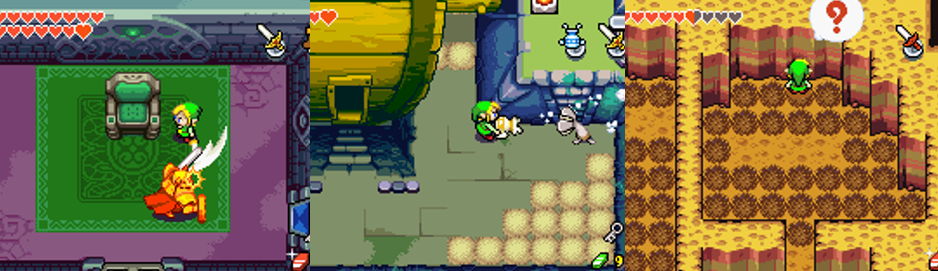
The Legend of Zelda: The Minish Cap is a traditional, 2D, top-down action/adventure game in which players take control of Link (or whatever they choose to name him), in the “toon” style of his Wind Waker counterpart, and embark on a quest to save Hyrule, and the Princess Zelda, from new sorcerer on the block, Vaati. As a Game Boy Advance title, the controls are as basic as it gets and akin to the previous handheld Zelda titles. You equip any of Link’s weapons and items to either A or B and then use that button to attack, defend, hit switches, solve puzzles, and whatever else your items are capable of. The Right Trigger performs a roll, speeding up your travel time, and also performs similar actions to A (like speaking to non-playable characters (NPCs) and opening chests). R is also the only way to open locked doors, which can be clunky as it would’ve been easier for Link to simply manually use any keys he possesses. The Left Trigger also performs a dedicated function, fusing “Kinstones” with NPCs, which I’ll detail in a bit. The + button pauses the game and brings up your inventory screen, the pretty basic map (which uncovers the more you explore and highlights notable areas), a subscreen showing how close you are to extending your health bar, total Mysterious Seashells and Tiger Scrolls, and allows you to save the game or enter “sleep” mode. As I’ll also get into in a bit, Link is joined by a hat-shaped companion, the insolent Ezlo, who constantly interrupts your gameplay to offer blindingly obvious advice that would make Navi blush. Also like Navi, you can choose to ask him for a tip by pressing -, though I’d just as soon never speak to him again. As you’d expect, Link acquires his standard sword and shield but the enigmatic Grimblade Brothers will teach additional sword techniques, such as a rolling attack, the aerial downthrust, and patented moves like the Sword Beam and Spin Attack. Some of these are more like padding, though, such as Link having to learn to attack with his sword when running with the Pegasus Boots.

Link’s traditional and new weapons are brought to colourful, cartoony life.

Many of Link’s recognisable weapons return here and function exactly as you’d expect. The bow and arrow lets you to hit eye switches and take out Eyegore statues, bombs blow up walls and discover new areas, and you can purchase a boomerang to stun targets or hit switches. This can be further upgraded into the Magical Boomerang, allowing you to manually direct it. Eventually, you can swap out the regular bombs for remotely detonated ones (though there are few benefits to this) and obtain the optional (and missable) Light Arrows for extra arrow damage. The Flame Lantern lights up dark areas, ignites torches, and burns certain enemies and spider webs. The Roc’s Cape lets you jump and glide short distances, the aforementioned Pegasus Boots let you run really fast, and the Ocarina of Wind warps you to any Wind Crests you’ve uncovered. The Minish Cap debuts three new items: the Cane of Pacci (which flips certain enemies and objects and creates temporary boosters in holes to launch you higher), the Gust Jar (which sucks up enemies, propels you across gaps when used on spring mushrooms, and turns lily pads into rafts), and the Mole Mitts (which dig through dirt). The Flippers, Grip Ring, and Power Bracelet are all passive items that don’t need to be equipped to use and let you swim and dive, climb certain walls, and pick up and toss jars and such, respectively. Link can capture life-restoring Fairies or store potions in bottles, increase his total bomb and arrow inventory with bigger bags and quivers, and also carry more Rupees by finding bigger wallets. Link’s sword is progressively empowered as you acquire the four Elements, duplicating Link into as many as four copies to push bigger blocks, step on or slash switches, and attack enemies, as well as fire a special beam that restores petrified NPCS. Finally, you can upgrade the shield into the reflective Mirror Shield, though this requires awakening a sleeping Biggoron and waiting for him to finish chewing on it.

Link’s shrinking ability doesn’t live up to its potential, and Kinstones are overused.

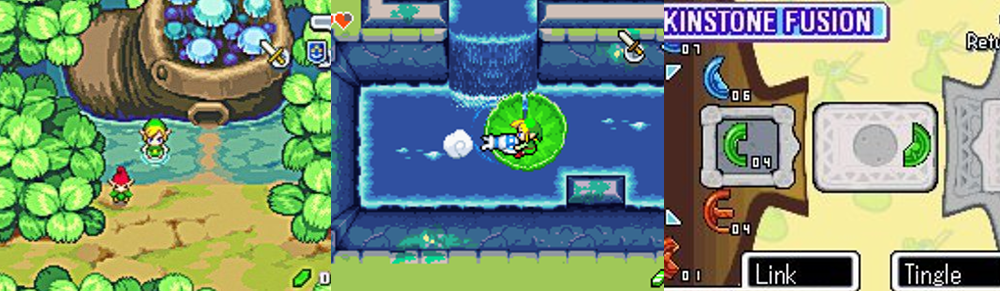
Link’s newest gimmick in The Minish Cap is the ability to shrink to microscopic size, courtesy of Ezlo’s magic. This is performed primarily at magical tree stumps and allows you to enter small holes, climb small steps and vines, and access out of the way places. When shrunk, you’ll interact with the pixie-like Picori tribe (or “Minish”) scattered throughout Hyrule (once you’ve consumed a Jammer Nut, that is) and be given additional side quests and assistance from them. In this form, Link takes more damage and his weapon usage is limited, but he can talk to animals and cross small lily pads. Occasionally, Minish Link enters Armos statues to activate or deactivate them and the action frequently zooms in to follow him up rafters, into the Minish towns, and through enlarged (from your perspective) areas, like in Honey, I Shrunk the Kids (Johnston, 1989). Apart from this, Ezlo is more a hinderance than anything; he’s obnoxious and rude and demanding and pops up to point out the obvious, severely dumbing down puzzles and interrupting the gameplay. The other big mechanic here is Kinstones; as you slash bushes, defeat enemies, and open chests, you’ll find several coloured Kinstone pieces. These are fused with certain NPCs to alter the overworld in different ways. This may involve spawning a treasure chest containing another Kinstone, or Magical Seashells, or a Big Rupee, or even a much tougher gold enemy for an additional challenge. Fusing removes vines to open new areas, parts waterfalls, drains ponds, and even spawns in NPCs for you to trade and train with. You can buy Kinstones, but they cost a lot and it’s not really worth it as you’ll inevitably find them on your travels, and none of the main variants are necessary to complete the story, though the benefits (extra hearts, Rupees, and training with the uncovered Grimblades) can be worthwhile. Specifically, fusing with Din, Farore, and Nayru spawns Lucky Butterflies which, when touched, increase your digging, shooting, and swimming speed. The only time you’re required to fuse Kinstones is when you find golden ones, such as in Cloud Tops, where you navigate a maze of clouds, floating about to find different halves of golden Kinstones to activate five propellers and be blasted up to the Palace of Winds.

I would’ve liked to see more creative use of the duplication feature in puzzle solving.

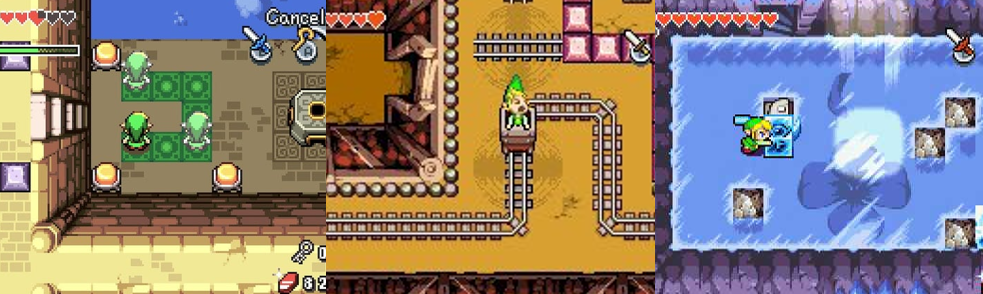
Link’s shrinking ability isn’t just used on the overworld; you’ll frequently shrink in Dungeons to reach new areas and progress. As ever, Dungeons contain a map, compass, and new weapon to aid your journey, as well as secret areas, switches, and stairways to other floors. Sometimes, you’ll drop or push blocks to lower levels; others, you’ll push levers to let in sunlight to melt blocks. Frequently, you must eliminate all enemies to open doors, or push jars or statues onto switches for the same effect, though it’s much more likely you’ll be duplicating Link to solve these puzzles. Tornados carry you across bottomless pits, moving platforms carry you across gaps, and floors are often covered in collapsing tiles, spikes, or rolling spiked logs that must be avoided. You’ll jump up to mesh bridges (and down through certain holes), hop up and across cloud platforms, push ice blocks into place, cross gaps using powerful wind blasts from propellers (in conjunction with the Roc’s Cape), and spring across chasms with the Gust Jar. There’s a giant rotating barrel in the Deepwood Shrine which must be rotated to progress, high-speed mine carts in the Cave of Flames that you redirect with switches, the Fortress of Winds is a veritable labyrinth of floors and dirt, the Temple of Droplets is a largely pitch-black mixture of ice and water, and the Palace of Winds offers the constant threat of falling to your doom. For the game’s final Dungeon, Vaati corrupts Hyrule Castle, transforming it into a monster-infested Hell filled with recycled enemies and hazards from previous Dungeons. While largely inspired by A Link to the Past and Link’s previous handheld entries, it’s in Dark Hyrule Castle where I saw some of the strongest parallels as exploring the Dungeons, battling Darknuts, and restoring the petrified NPCs was very similar to Link’s celebrated 16-bit adventure. Sadly, only two of the Dungeons are Minish-sized (the Deepwood Shrine and Palace of Droplets). Though you don’t really notice as you’re exploring these Dungeons, the developers did include larger variants of common enemies as boss battles. Still, I feel they didn’t take full advantage of Link’s new miniature perspective in these (or other) areas as the shrinking mechanic was more of a gimmick or hinderance a lot of the time.

Presentation:
I’ll be the first to admit that I never really cared for The Wind Waker’s cartoony aesthetic. It’s grown on me over time, but I much prefer the more realistic, fantasy-orientated style of Link’s other 3D adventures. However, it works really well here; probably better than in 3D. Link is super expressive; from his grunts and yells (carried over from this 3D titles) to his messy bed hair, his look of sheer panic on a runaway minecart, and the way he races around when on fire. He’s a jaunty little cartoon sprite, bobbing along and reacting to everything around him. Ezlo is very animated as well, popping up on Link’s head to react to and comment on their surroundings or the plot, and all the NPCs are similarly cartoony and fun to behold. Many will be familiar to long-time Zelda players, such as Malon (with her milk cart and nearby farm), Dampé the grave keeper, Ingo (now a real estate developer), and Gorons intent on ploughing through a rocky underpass. Many characters fuse Kinstones with you to solve a personal crisis, such as the overworked mailman, the librarian searching for lost books, and a poor man haunted by a restless spirit. The Minish Cap is a little light on new races but there are anthropomorphic characters to find, animals to chat to (as a Minish), and, of course, the gnome-like Picori tribe. These peaceful little sprites have a main village and live in little mushroom houses or up in the rafters, their homes made out of barrels, walls made of books, and heating provided by flickering candles. When Link is turned microscopic on the overworld, a helpful bubble indicates where he is. Though his actions are limited, he has full access to his arsenal when the game zooms in, casting dirt paths with the shadows of grass and blocking his path with chestnuts and such. Minish-Link must avoid cats looking to swipe him and relies on lily pads to cross water until he gets the Flippers, and you must be on the lookout for small holes, paths of flowers, and flappable objects to progress and shrink or return to full size.

The “Toon” style really suits the traditional Zelda aesthetic and brings Hyrule to life.

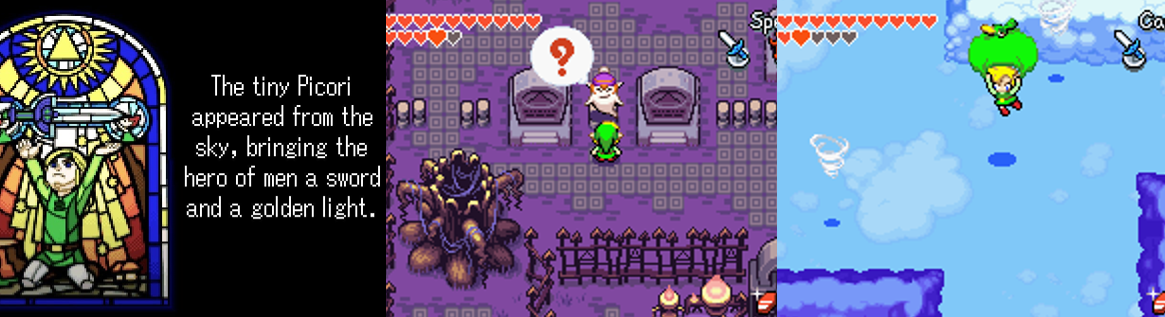
The Minish Cap’s overworld and Dungeons are heavily reminiscent of A Link to the Past, mixing locations such as ruins, a swamp, and Hyrule Castle itself with areas I’m more familiar with from the 3D games, like Lake Hylia and Lon Lon Ranch. Mt. Crenel acts as a Death Mountain substitute, featuring falling boulders, climbable walls, tornados to fly you about, and a Minish mine where Melari repairs the broken Picori Sword. Like the Swamp of Evil, Castor Wilds is a murky swamp full of thorns; you’ll need the Pegasus Boots to navigate this area, and shrink to clamber inside Armos Statues within the maze-like ruins. Finally, the Flame Lantern lights your way in the desolate Royal Valley, which contains a looping maze in its haunted forest. Aside from the Minish Village, Cloud Tops and the Palace of Winds and the Temple of Droplets impressed me the most, visually. The other Dungeons are very formulaic, despite some fun perspective and depth effects, but these three have you up in the clouds or high in the sky or navigating a frozen labyrinth, respectively, which really mixes up the formula. Dark Hyrule Castle is similar, putting an ominous spin on the palace’s ornate rooms and recycling all previous hazards, but I was disappointed that the Dungeons didn’t utilise Link’s new miniature perspective to make their visuals and layouts standout more from the likes of A Link to the Past. Instead, The Minish Cap often resembles a toon-ified version of that game, doing little to stray from the usual stone trappings of those Dungeons and being a little too familiar at times. Still, there are fun touches, like the Biggoron atop Veil Falls, the big bell in the bustling Hyrule Town, guards to sneak past, and occasional weather effects. The game’s story is all relayed though text boxes, as usual, but key events are told using stained glass murals, Wind Waker-style art is showcased in the end credits, and the sprite-based cutscenes are full of cartoony life. The music is as infectious as ever, with familiar and slightly tweaked classic Zelda tracks at the forefront (many I mostly recognised from A Link to the Past and Ocarina of Time), though new areas and Minish locations have a spirited flavour that adds to the game’s whimsical, fairytale-like charm.

Enemies and Bosses:
All of Zelda’s most recognisable enemies make a return in The Minish Cap, though redesigned to evoke the toon style of The Wind Waker. This is most evident in the Moblins, who charge with spears or fire arrows and have much more life and detail compared to past 2D Zelda titles In some cases. This ups the challenge represented by some enemies, such as the various Dark Knights you’ll encounter. These are essentially mini bosses and swarm Dark Hyrule Castle, defending against your attacks and landing powerful sword swipes and even boasting a charged thrust. Your best bet against these enemies is to hop over them with the Pegasus Boots and attack from behind, a tactic mirrored when facing the Ball and Chain Soldiers. Other enemies require strategic use of your other items, such as using the Gust Jar to suck up and fire out the annoying Peahats or pull the masks off Helmasaurs, tossing your boomerang at Sparks, or using the Cane of Pacci to flip Spiked Beetles and attack their vulnerable underbelly. Like Likes masquerade as Rupees and steal your items, Keatons and Takkuris make you drop Rupees on contact, Madderpillars (also a kind of mini boss) fly into a rage with you bop their noses and attack their tails, and you’ll even encounter Bob-ombs and Lakitus. ChuChus fry you, Floor and Wall Masters return you to the Dungeon entrance, and Octorocks and Deku Scrubs are subdued by deflecting their projectiles. Cloud Piranhas snap at you from the clouds, fake doors crush you, and Acro-Bandits leap from the ground in a swaying tower. You’ll also battle elemental Wizzrobes, who teleport about shooting ice, fire, or lightning; Stalfos leap and toss their bones at you; and Slugglas drop from above. By the time you reach Dark Hyrule Castle, rooms are filled with an assortment of these enemies. Though you can often simply bypass them, you’ll need to defeat a gauntlet of them before Vaati completes his macabre ritual to reach the petrified Princess Zelda in the finale.

Too few bosses require the shrinking mechanic, but they’re mostly big, fun challenges.

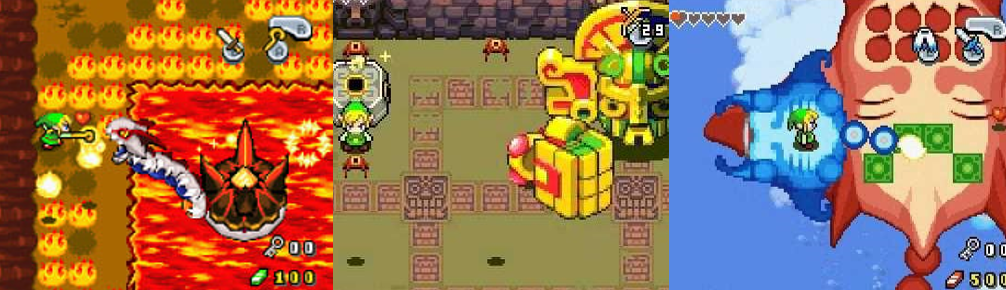
The Minish Cap is surprisingly light on bosses; four of its five main bosses guard an Element, which empowers your sword and duplicates Link, relinquishing a Heart Piece to extend your life bar. The first boss you battle is a gigantic green ChuChu; well, it’s actually a regularly sized one but you’re in Minish form, so it appears huge. A blue variant appears later in the game too, now sporting electrified skin, but the tactic of sucking at its “feet” with the Gust Jar and whacking it with your sword when it’s stunned remains the same. Next, you face the turtle-like lava dinosaur Gleek, which sits in a pool of lava and spits fireballs in a circular motion. You must run behind it and flip its shell with the Cane of Pacci to race up its neck and attack the crystal on its back. In retaliation, it rains rocks and breathes fire, making the fight more difficult as it progresses. Mazaal is the only one of the main bosses to incorporate the shrinking mechanic in. A strange, disembodied Aztec head and fists, he is stunned by shooting and slashing the jewels on his hands (which try to crush and hit you). You then shrink, enter his head, and attack the glowing pillar to deal damage. As the fight progresses, you use the Mole Mitts in his head and dodge a Shrink Ray attack from his eyes. The Big Octorok is fought in a shallow pool that it freezes, reducing your traction and making avoiding its pellets much harder. Well, I say “avoid” but you actually smack these back with your sword to stun it, allowing you to set fire to the petal on its back. This causes rocks to rain down and the Big Octorok to freak out; it also charges, spins around, and creates a smokescreen to limit visibility. Finally, the Gyorg Pair are easily the most unique boss in the game. This fight takes place in the skies of Hyrule on the back of two manta ray-like creatures. When riding the red one, you must dodge the smaller blue one and its fireballs and duplicate Link to attack the red one’s eyeballs. You then hop to the blue one, slashing its eyeballs, and repeat, watching for smaller green variants that fly past.

Vaati assumes some familiar forms in his attempt to spread darkness throughout Hyrule.

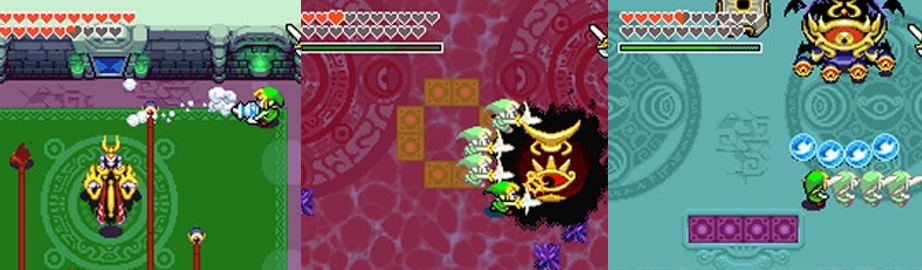
After battling past the many Darknuts that haunt Dark Hyrule Castle, you’ll finally confront the master swordsman and corrupted sorcerer, Vaati. Vaati takes many forms, one similar to Agahnim, one like Arrghus or Vitreous, and one like Nightmare’s final form, Dethl. The first form, “Vaati Reborn”, morphs him into a dangerous sorcerer protected by many small, spinning eyes. These encircle him, distracting you as he shoots fireballs, and must be destroyed to expose his big, eyeball-like weak spot. After enough hits, he encases the eyes in protective shields that must be sucked off with the Gust Jar. The eyes also fire vertical laser beams (just stand between them) and Vaati erratically teleports, making him a harder target to hit. For his second form, “Vaati Transfigured”, fought immediately after in a psychedelic landscape, Vaati takes his obsession with eyes to the next level. In this fight, you shoot arrows at the small sphere surrounding the central body to uncover four red eyeballs. You must then duplicate Link into the same formation and attack, continuing your assault when he’s stunned. However, Vaati spews destructible spiked balls and a spread of electrifying balls, which can be tricky to dodge especially considering his large hit box. After he’s defeated and Princess Zelda is revived, Dark Hyrule Castle collapses and Vaati’s true, final form, “Vaati’s Wrath” emerges. In this form, he pursues you, again firing balls of electricity, and sends his extendable claw arms under the ground to attack. When one pops up, stun it with the Cane of Pacci, shrink down, and venture inside to destroy the one real bladed eyeball amongst the fakes to literally disarm him. Repeat for the other arm and Vaati sends four electrical orbs your way from the small eyes in front of him, as well as a spread of larger orbs. To win, simply avoid the spread and duplicate Link in a line to deflect his smaller shots with your sword (the timing can be tricky), which will stun him and soon end his dreams of conquest.

Additional Features:
As you’d expect, there are forty-four Pieces of Heart to find all around Hyrule. Collecting four will extend your life bar, so they’re worth seeking out. While some are just lying in the open, others require your items to reach or are gifted by fusing Kinstones. Opening chests, defeating enemies, and cutting grass also sees you collect Magical Seashells. Unlike the similar items from Link’s Awakening, these are essentially infinite in number (though your inventory maxes out at 999) and are traded for figurines in Hyrule Town, similar to the Pictobox side quest in The Wind Waker. This is quite a time-consuming task, however, as you must speak to the proprietor, set how many Magical Seashells you wish to trade (with the percentage of a new figurine increasing the more you wager), and then pull a lever to get an egg-like capsule containing the figure. The more places you explore and the more NPCs you meet, the more figurines you can get, with your Magical Seashells being replaced by the Carlov Medal once you obtain all 136 figurines. This, in turn, opens Baris’s house, gitfting you another Piece of Heart and the Phonograph, which acts as a sound test for the game. Similar to the Magical Seashells, there are a near-infinite number of coloured Kinstones to find. Fusing with NPCs unlocks new areas and gifts rewards that aid your quest, and completing all fusions awards you with a Tingle Trophy. Clearing the game earns you a Triforce stamp on your save game file; you can have up to three of these and also change the language to suit you. Finally, the Nintendo Switch version lets you play the European and North American releases (with subtle differences between them), rewind should you make a mistake, and create save states at will, dramatically reducing the game’s already low difficulty.

The Summary:
I’ve wanted to play The Legend of Zelda: The Minish Cap for the longest time. Finding a physical copy was expensive, even unboxed, so I consoled myself with the knowledge that it would be another Zelda game that passed me by…until I upgraded my Nintendo Switch subscription and finally dug into it. Visually, the game is very impressive; colourful and lively, The Minish Cap is like playing a cartoon and I really enjoyed how it translated a Wind Waker aesthetic onto a traditional Link to the Past formula. The core gameplay is as reliable as ever; Link has some fun new toys to play with that mix things up, like the Gust Jar and Mole Mitts, though I do feel these could’ve been emphasised more. Similarly, the shrinking mechanic became tedious after a while. Generally, it’s simply anther way to get from one place to another and fuse with different NPCs rather than changing the puzzles in a meaningful way. Likewise, while the graphics represented these sections well, I think the developers could’ve done more with it, such as more bigger enemies and obstacles that meant using the duplication feature in interesting ways, rather than just hitting switches. Ezlo was also a pain in the ass, thankfully rectified in the post-game, and the Kinstone fusing got old quickly, too. This mechanic replaces traditional fetch and trading quests and is used as a shorthand for everything, limiting your exploration options and adding an element of grinding. The bosses were fun, if too few in number, but Vaati wasn’t the most enigmatic or threatening villain and the story felt uncharacteristically low stakes for a Zelda game. As a spiritual successor to A Link to the Past and the handheld games, The Minish Cap does well and the core Zelda gameplay is always enjoyable, but I don’t think this one lived up to its full potential and it ended up being more of a chore at times.

My Rating:

Rating: 4 out of 5.

Great Stuff

Was The Legend of Zelda: The Minish Cap a staple of your Game Boy Advance library back in the day? Were you a fan of the Wind Waker art style and, if so, what did you think to the way it was implemented here? Did you enjoy the shrinking mechanic and the Kinstone fusions or did they become tedious for you, too? Did you ever fuse every Kinstone and collected every figurine? What did you think to Vaati as a villain? Would you like to see the Minish return? Which Zelda game is your favourite and how are you celebrating the franchise this month? Whatever your thoughts, share them below and be sure to check out my other Zelda content on the site.

Game Corner: The Legend of Zelda: Ocarina of Time 3D (Nintendo 3DS)

ZeldaLogo

Released: 16 June 2011
Originally Released: 21 November 1998
Developer: Grezzo
Original Developer: Nintendo EAD
Original Version Also Available For: GameCube, Nintendo 64, Nintendo Switch, Nintendo Wii, Nintendo Wii U  

The Background:
I’ve talked before about how my first introduction to the Legend of Zelda series (Nintendo EAD/Various, 1986) was with The Legend of Zelda: Link’s Awakening (ibid, 1993) on the original Game Boy, but even that brief experience was enough to suck me into the hype that surrounded Zelda’s highly anticipated jump to 3D. Development of Ocarina of Time began alongside other Nintendo 64 launch titles like Super Mario 64 (Nintendo EAD, 1996) and was originally planned for the ill-fated 64DD add-on and was originally conceived to use a similar painting-based world progression as Super Mario 64. While series co-creator Shigeru Miyamoto spearheaded the development of an expansive world and versatile combat, it was director Yoshiaki Koizumi who championed the use of the Z trigger to target enemies and Takumi Kawagoe who crafted the cinematic cutscenes to convey the game’s epic narrative. Initially released alongside some limited edition gold cartridges, Ocarina of Time was a phenomenal success, regularly amassing perfect review scores. Reviews were unanimous in their praise and the game became an instant classic that has stood the test of time. Ocarina of Time was ported numerous times over the years but development of a remake for the Nintendo 3DS was first hinted at in 2010, with the team taking the time to meticulous recraft the game for a new generation of players. The project was undertaken by Grezzo, who purposely left some of the original bugs in the game as fan service and not only included but reworked the rarely-seen “Master Quest” mode to be more challenging for even seasoned players. Like the original, Ocarina of Time 3D was met with universal critical acclaim; reviews praised the graphical overhaul and timeless gameplay, and the sales and perfect scores were more than enough to justify Nintendo and Grezzo collaborating to remake its sequel.

The Plot:
Kokiri boy Link is ecstatic to finally be assigned a fairy companion. However, Navi’s presence begins a sprawling adventure that sees Link realise his destiny to oppose the evil Gerudo King, Ganondorf. To do this, Link journeys through time to collect the mystical artifacts needed to rescue Princess Zelda and confront the King of Evil in his foreboding lair. 

Gameplay:
The Legend of Zelda: Ocarina of Time 3D is a remastered version of the classic Nintendo 64 action/adventure game. Players assume the role of Link, a young elvish child in a green tunic whose name they can customise when starting a new save file, of which there are three. Link’s journey takes him all across the land of Hyrule, and through time itself, and the Nintendo 3DS version of the game makes this quest more accessible than ever thanks to some much-needed improvements to the control scheme. Although Young Link starts out with only the ability to automatically jump from ledges, crawl through gaps, lift and toss puts with A, and roll along to smash crates with the same button, he soon acquires his first sword, which is mapped to the B button. The jump to 3D vastly improves Link’s combat prowess; not only can you hold B down or rotate the control stick to unleash a Spin Attack, but Link will also swipe with a series of slashes and can even duck and jab at foes. To make combat even easier, Link is joined by a fairy companion, Navi, who will target any enemies, non-playable characters (NPCs), or points of interest with a press (or hold) of the Left bumper. You can consult Navi for advice on an enemy’s weakness, chat to NPCs from long distance, or use the control stick, B, and A to hop, back flip, and leap at enemies to deal additional damage. Once you acquire a shield, this is mapped to the Right bumper, allowing you to press and hold R to block incoming attacks (and, later reflect certain elemental beams). In place of the Nintendo 64’s C-buttons, players can now map items to the X and Y buttons or to two additional item slots on the touch screen. Similarly, Link’s ocarinas, camera controls, and inventory and map options are also displayed on the touch screen, giving you greater ease of access to everything you need. 

Link’s world, arsenal, and options have been blown open by the expansive 3D engine.

The touchscreen also displays a map of the current area, a miniature version of which also appears on the main heads-up display (HUD), though you can toggle this on and off with the directional pad; his health (represented by hearts), magic meter, and current Rupees (the currency of Hyrule) are also displayed on the touchscreen, significantly decluttering the HUD. Key items you collect to advance the narrative will appear in your ‘Gear’ menu, while equippable items appear in the ‘Items’ menu, which you can customise to suit your preference. In addition to acting as your companion and aiding you in combat, Navi will frequently chime in to remind you of the plot of where you need to head next, ask if you need to take a break, or offer other hints. This can be annoying, especially for seasoned players, as are the constant interruptions from the mysterious owl Kaepora Gaebora, who pops up throughout Young Link’s journey to offer encouragement and advice. Thankfully, you can skip through their dialogue (or ignore Navi entirely, shutting her calls down by entering new areas) with the B button, though this version of the game also includes the ability to receive “visions” from special, obnoxious Sheikah Stones if you ever find yourself stuck. Thankfully, despite this handholding, the game remains as enjoyable as ever; now a fully realised 3D world, Hyrule is large and expansive and you’re free to explore as much as possible depending on what equipment you have. Link can enter water to swim along, for example, but won’t be able to dive until he acquires the Zora Scales, Zora’s Tunic, and Iron Boots. Similarly, destructible blocks, high temperatures, and impassable bridges will block your way until you find specific items or travel through time, though you can still explore much of the overworld field and surrounding areas right from the start. 

The ocarina is part of the game’s time travel mechanic, which affords Link greater options as an adult.

One of the game’s biggest gimmicks is the titular ocarina; by touching the bottom screen, players can play magical tunes to talk to Link’s childhood friend, Saria, for more tips, warp across Hyrule, open new paths, or even make blocks appear or disappear. As you explore and talk to NPCs, such as the mysterious Shiek, you’ll learn more songs that allow you to change the environment, such as turning day to night or causing rain. Link’s quest is split into two distinct parts: first, as a child, he needs to locate the three Spiritual Stones. Then, after awakening as an adult, he can explore new regions of Hyrule in search of five Sage Medallions, all of which are necessary to first access the Temple of Time and then confront Ganon in the desolate future. Link will need to both fight, sneak, and talk his way to these goals; one of your first objectives when you leave Kokiri Forest is to sneak into Zelda’s Castle, a task accomplished only by staying out of sight of her inept guards. When in Kokiri Forest, Link will have to bypass a rolling boulder to get the Kokiri Sword and slap down some Rupees for his first rudimentary shield, before putting these weapons to the test to try and save the Great Deku Tree. Indeed, the first three dungeons lay the ground work for the puzzles and actions you will need to overcome throughout the game; you’ll be lighting Deku Sticks on fire to burn away cob webs, climbing walls and plunging to new levels, hopping to moving platforms, hitting, standing on, or weighing down switches, and defeating all enemies to acquire keys, maps, and compasses all with the goal of acquiring the dungeon’s weapon and defeating its boss. Young Link is eased into all this quite well; the challenge increases with each dungeon he enters, putting new obstacles such as a raging volcano, destructible walls, a hungry fish deity, and a stubborn Zora princess in his path. Although his options are limited as a child, Young Link is key to forging relationships in the future; you’ll only tame the wild Epona by visiting Lon Lon Ranch as a child, for example, navigating the confusing maze of the Lost Woods is far easier as a child, and it’s only by returning to the past that Link can complete a brain-melting paradox, venture into a spooky well, and acquire the Lens of Truth. 

You’ll need both Links’ attributes to beat the game’s dungeons and enemies.

After acquiring the three Spiritual Stones, Link is sealed within the Light Temple until he’s old enough to wield the legendary Master Sword. Upon waking, he’s now older and tougher, but unable to use some of his childish items like the slingshot or boomerang. Adult Link, however, has access to a far greater arsenal of weapons, in addition to NPCs taking him seriously as a hero, though this is countered by the Temples he must conquering being longer and far tougher. Adult Link will explore strange winding corridors, rescue imprisoned Gorons, continuously alter water levels, hop to invisible platforms, and redirect sunlight in his quest for the Sage Medallions, frequently having to travel back to the past to help solve specific puzzles. He’ll also need to collect Silver Rupees to open gates, dissolve red ice, pound rusted switches, lift gigantic blocks and columns, and dodge spinning blades to progress. Adult Link also has the benefit of being big enough to ride Epona, who greatly speeds up foot travel; you can call Epona at any time when in Hyrule Field and mount her with A, speeding her up with taps of A for as long as you have carrots available and clearing fences with ease. If you ever need a break from all the adventuring, there’s a fishing hole available, shooting galleries to earn Rupees and weapon upgrades, a fun (if erratic) variation on bowling, and numerous side quests to complete to keep you playing. 

Graphics and Sound:
When it first released on the Nintendo 64, Ocarina of Time was the pinnacle of what the console could achieve; a large open(-ish) world with many varied locations, a sprawling narrative, and numerous NPCs and enemies to interact with. It had a day and night cycle, with skeletal enemies and ghosts spawning at night, areas changed as you journeyed through time, and Link was at his most expressive yet, swinging his sword, shivering and sneezing, or gasping when low on health. Unfortunately, the Nintendo 64 version hasn’t aged all that well; the graphics were quickly surpassed by its successor, which fixed multiple issues with Link’s model and other textures, and the presentation was soon noticeably lacking against subsequent games, though the performance and sheer impressiveness of the original still holds up overall. This version of the game gives Ocarina of Time a much-needed graphical overhaul; not only are the menus made far more intuitive, allowing you to quickly apply tunics and boots to Link, but all the character models (especially Link’s) have been given an upgrade to be more expressive and detailed, even on the Nintendo 3DS’s smaller screen. Speaking of which, there’s obviously the option to enable the 3D features of the system, though I’d recommend leaving it off as it can really make your eyes hurt after a while and it distracts from all the funky new textures and colourful revamp given to Hyrule, the text, and basically every aspect of the game. 

Hyrule’s colourful and ever-changing locales have been given a much-needed graphical boost.

Unfortunately, this hasn’t extended to expanding upon the admittedly barren Hyrule Field; while an impressive overworld, bolstered by a triumph theme song, Hyrule Field quickly becomes annoying to cross through even with the benefit of Epona and there’s not much happening there even in the grim future. Thankfully, the game’s towns and regions make up for this, Hyrule Market, Kakariko Village, and Goron City are all bustling urban environments with lots of back alleys, houses, and nooks and crannies to explore and you’ll marvel at the beauty of Zora’s Domain and the magical wonder of Kokiri Forest. Even better, every area always has ore toit; each opens up when you acquire new equipment or return as an adult, allowing you to brave the intense heat of Death Mountain, dive to the bottom of Lake Hylia, and tackle to hazardous Gerudo Desert. Each area is full of lively NPCs, from condescending guards to overbearing monarchs and mischievous forest imps. Each will flesh out the world and offer clues, both vague and explicit, on how to progress, with some even tasking you with fetching or delivering an item for them and others, like Mido, showing outright aggression towards you. Over the course of your adventure, the lives of Hyrule’s inhabitants and the nature of the world will noticeably change; in the seven-year time jump, the grotesque Dampé will die, Hyrule Market will fall into desolate ruin, construction work will be completed, Lake Hylia will dry up, and Zora’s Domain will be irreversibly frozen. Sometimes, you can impact these events, such as restoring the waters to Lake Hylia, reducing the windmill operator to tears, and restoring the family in the House of Skulltula, and other times monuments to Ganon’s evil will remain in the world, like the deceased Great Deku Tree and boiling lava pit where Zelda’s Castle once stood. 

Dungeons are more distinct than ever and the cutscenes and models have been nicely retextured.

Link’s journey also takes him into a variety of dungeons; the first three are visually very distinct, with you exploring the cobweb-infesting insides of the aforementioned tree, venturing into a dangerous rocky cavern, and trudging through the insides of Lord Jabu-Jabu while carrying (and tossing) the self-entitled Princess Ruto. Puzzle elements such as switches, platforms, and gated areas are personalised in these dungeons and noticeably more uniform when tackling the elemental Temples as Adult Link, though these make up for this by being bigger, more challenging, and no less visually distinct. Each dungeon has a memorable theme assigned to it, whether strangely upbeat or darkly ominous, and Link must utilise all his arsenal to best them, including returning as a child to solve puzzles or acquire new items. No two Temples are the same here; you’ll be tracking down naughty Poes and pushing puzzle blocks together in the Forest Temple, hopping over lava and vertically traversing the Fire Temple to free Gorons, desperately sinking, swimming, and altering the water level in the Water Temple (something made much easier by this version’s colour-coded areas), crossing an eery river on a large barge and uncovering invisible hazards in the Shadow Temple, and using sunlight and time travel to overcome the Spirit Temple. In addition, there are many smaller challenges to overcome; you can uncover fairy fountains to gain helpful buffs, endure the frigid dangers of the Ice Cavern, sneak around Gerudo’s Fortress sniping the all-female guards from afar to rescue the construction workers, and push gravestones to uncover secrets. While characters (and especially Link) will grunt, laugh, and make rudimentary sounds, all of the game’s dialogue and story is told through text, though it’s no less engaging, and each cutscene grabs your attention, with the tale of the three Goddesses, Link’s triumphant rescue of Epona, and the emotional reunion between him and Zelda being just three standout moments. 

Enemies and Bosses:
Almost all of the franchise’s classic enemies make their 3D debut here, with Link slashing at bat-like Keese, dropping bombs to destroy crazed Armos statues, reflecting projectiles back at Octoroks, avoiding the squeeze of Wallmasters, frantically chasing down Leevers, and cutting Tekties in two. Many of Link’s enemies are memorable for their disturbing nature; Gibdos and ReDeads, for example, will shamble and crush you with their embrace, screaming to freeze you in place, while disgusting Like Likes will shallow you (and your shield and optional tunic) whole, and Cuccos will take a spiteful revenge if attacked. Many enemies are specifically designed to take advantage of Link’s new combat abilities; you’ll engage the formidable Stalfos, Lizalfos, and Dinolfos in sword combat, striking when their guard is down and defending against their sword swings, and similarly only be able to attack the Wolfos when they’re not defending against your sword strikes. Likewise, you must wait for the Skulltula’s to show their bellies to destroy them, Poes will only be vulnerable for a short time, club- and lance-wielding Mobiles cannot be attacked directly and require the use of stealth and your ranged weapons, which will also keep you from getting shocked by Biris, and be temporarily unable to use your weapons upon touching bubbles. Other enemies, such as Fire Keeze and Dodongos, can set you on fire, burning any wooden equipment you have attached, freeze you in place, or are disguised as regular objects like doors to keep you on your toes. 

Young Link’s dungons and bosses will expertly teach you ky gameplay mechanics.

Young Link will have to defeat three bosses to obtain the Spiritual Stones which, like the dungeons themselves, set a precedent for the game as they are best fought with the weapons you obtain in their lair. First up is Queen Gohma, a massive, slobbering spider-like creature that scuttles about on the ceiling, drops Gohma Larva to attack you, and lurches or drops on you. Fortunately, you can shoot a Deku Seed at her big, glaring eye to stun her, easily allowing you to destroy her with a few sword swings. King Dodongo is a little tougher as he’s much bigger and rolls around an arena with lava in the middle. When he pauses to breath fire at you, you need to toss a bomb in his mouth to stun him for an attack, with the biggest issue here being avoiding his cannonball-like rolling. After chasing a Big Octo around a rotating spiked platform and slashing at its ass, you’ll battle Barinade within Lord Jabu-Jabu. This pulsating, electrical monstrosity protects itself with Giant Biri, which must be destroyed to expose its core, and blast of electricity from its artery-like appendages. Your best bet is to hang back with your guard up and continuously toss your boomerang to take care of Barinade’s defences, then leap in sword attacks when its stunned. Later, Young Link will need to venture to the Bottom of the Well to retrieve the Lens of Truth, which is guarded by the unsettling Dead Hand, which teleports in a burst of dust and holds you in place with a field of disembodied hands while it closes in to take a bite. Similarly, Young Link will battle an Iron Knuckle in the Spirit Temple, though this fight is both slightly easier and slightly harder than battling them as an adult. It’s easier because Young Link can completely hide under his Hylian Shield, but harder because his Kokiri Sword does way less damage; you also can’t get too close as the Iron Knuckles deals massive damage with its axe, though it can be tricked into destroying nearby columns to restore your health. 

Thankfully, the versatile combat system is capable of tackling even the most monstrous bosses.

Adult Link has a far greater challenge ahead of him as he must battle five monstrous bosses to acquire the Sage Medallions, with each Temple also sheltering at least one mini boss. The four Poe Sisters will give you the runaround in the Forest Temple before leading the way to Phantom Ganon, an apparition of the King of Evil who randomly appears from paintings strewn around the arena. Pick the right painting and fire an arrow at him until he ditches his steed and then engage in a game of dead man’s volley, smashing his magical projectiles back at him to bring him to his knees, but make sure you keep your distance as these exchanges intensify very quickly. After chucking bombs at the Flare Dancer and avoiding its explosive demise in the Fire Temple, you’ll take on the fire-spewing dragon Volvagia. Volvagia will fly around the small island, diving into and bursting from pools of magma strewn about; when it does, you’ll need to avoid its flame-like whips and smash it with the Megaton Hammer, then take shelter on the climbable walls of the island as Volvagia causes rocks to rain down. In the Water Temple, you’ll have a surreal encounter with Dark Link that’s easily won with the Megaton Hammer or Biggoron’s Sword before taking on the most annoying boss of the game, Morpha. Morpha is a sentient nucleus that brings the arena water to life, sprouting tentacles that will grab and throw you into the spiked walls that line the room, and which can only be damaged by snagging to with the Longshot and pummelling it before it can hop away. After besting another Dead Hand in the Shadow Temple, you’ll battle perhaps the strangest boss of the game, Bongo Bongo, a grotesque beast that can only be seen with the Lens of Truth. This battle is made tricky by the arena floor, which will vibrate as Bongo Bongo hits it, ruining your aim as you shoot arrows at its hands to stun them or its eye to open it to a more meaningful counterattack, 

All of Link’s weapons and skills will lead him to a climatic confrontation with the King of Evil!

After overcoming another Iron Knuckles as Adult Link (revealed to be Nabooru in disguise), Link will battle Ganon’s surrogate witch-mothers, Kotake (who controls ice) and Koume (who controls fire). As they fly well out of range, you’ll need to use the Mirror Shield to reflect one element back at the other to bring them down; after enough hits, they’ll fuse together into the strangely alluring Twinrova and wield both elements. This time, you need to absorb three consecutive hits of each element on your Mirror Shield to blast them with a flame or ice burst, all while avoiding being charbroiled or frozen solid. Once you have all the Sage Medallions, the Six Sages will create a magical bridge for you to enter Ganon’s Castle, which contains mini challenges themed around each Temple, more Iron Knuckles, and a two-stage showdown with the King of Evil himself. In the first phase, you need to hang right back and avoid falling down to the lower levels as it’s a long journey back up to his throne room; Navi is useless here but you can still L-Target Ganondorf, reflecting his bolts back at him in another game of dead man’s volley that’s actually easier than when fighting Phantom Ganon as Ganondorf is largely stationary (though he does have a more powerful multi-blast attack). Damage Ganondorf enough and he’ll bring the whole castle down, forcing Link to run for safety as Princess Zelda magically opens gates, before transforming into the gargantuan, rampaging pig-beast, Ganon. This fight is ridiculously easy, though, even with the scripted loss of the Master Sword; simply roll between Ganon’s legs when he swipes at you and attack his tail with either the Megaton Hamme or the Biggoron’s Sword until you can retrieve the Master Sword. Eventually, Zelda will hold him in place with her magic, meaning all you have to do is land the final blow with the Master Sword to banish Ganondorf and restore peace to Hyrule. 

Power-Ups and Bonuses:
As ever, you can replenish Link’s health using hearts, fairies, or potions; enemies, crates, and bushes will drop hearts to restore your health bit by bit or you can assemble four Heart Containers by searching about, or gain an extra heart with each boss you defeat. Fairies and their larger variants will also restore your health and you can even capture them in one (or all, as I do) of the game’s bottles to restore some health when you’re defeated; similarly, potions will also replenish your health in the same way. You’ll also find Magic Jars to refill your magic meter, which drains as you cast spells, and Great Fairies will increase your meter just as they teach you these spells. These power-up your Spin Attack, allow you to cast a blaming attack, let you setup a mid-dungeon teleport that’s super useful in the Water Temple, and surround you with a temporary protective shield. Some weapons, like the elemental arrows, and items like the Lens of Truth also drain your magic, so use them sparingly to avoid being caught short. 

Link’s weapons, gear, and magic can all be upgraded to counter new enemies and areas.

Many of Link’s trademark items and weapons are featured here, either in chests, gifted to you by NPCs, or bought from shops. You can fire Deku Nuts and arrows with the slingshot and Fairy Bow, respectively, with the latter also able to fire flaming, freezing, and light arrows for additional damage, retrieve items, hit switches, and stun or damage enemies with the boomerang, and cross distances by latching onto special surfaces with the handy-dandy Hookshot. The Megaton Hammer will activate rusted switches, the iron Boots let you sink to and walk on the bottom of lakes, the Hover Boots let you briefly run on thin air at the cost of your traction, and you can toss bombs, let loose Bombchus, or stun enemies with a blinding Deku Nut. Link can also earn (or buy) coloured tunics to withstand extreme heat and breath underwater, dive deeper with Zora Scales, and acquire swords so powerful they need to be held with both hands. Additionally, Link can acquire three different shields and upgrade his wallet, ammo, and the range of the Hookshot by completing mini games and exploring dungeons, as well as use bracelets and gauntlets to heave large objects with ease. Secret grottos and areas can be sought out once you earn the Shard of Agony by destroying Gold Skulltulas, Link can rescue Epona from the greedy Ingo by outracing him as an adult, and Young Link can buy and plant Magic Beans that will sprout into floating leaf platforms in the future to find yet more goodies. 

Additional Features:
There are thirty-six Heart Containers to find here, which will increase your health to twenty hearts. This can then be doubled by visiting a Great Fairy outside Ganon’s Castle, who will effectively half the damage you take from enemies. There are also 100 Gold Skulltula’s hidden all over the game and they’re well worth seeking out, at least to start with, as destroying increments of ten will restore the family in the House of Skulltula and award helpful gear like a bigger wallet, the Shard of Agony, and a Heart Piece, though the final reward of a Huge Rupee is very disappointing. Both Young and Adult Link can choose to complete trading quests; Young Link’s is based around trading masks with various NPCs, sometimes being stiffed on the sale, all to acquire the Mask of Truth so he can talk to Gossip Stone, while Adult Link’s trading sequence is tougher, but yields a far better reward; by racing across Hyrule without warping, often against a tight time limit, and trading items back and forth, you can eventually acquire the unbreakable, super powerful Biggoron’s Sword that makes mincemeat of enemies and bosses. If you can’t be bothered and don’t mind wasting your Rupees, you can buy the destructible, nigh-useless Giant’s Knife instead, but this is a complete waste of time. It’s also worth completing the shooting galleries, even though the Gerudo one can be tricky due to being an auto-shooter and the tight window for landing bullseyes, as these will increase the ammo for your ranged weapons. Similarly, you can take on the Gerudo Training Ground, solving puzzles and besting enemies for keys to grab the Ice Arrows, but this is entirely optional and mainly for completion’s sake. 

Hunt down Gold Skulltulas, test yourself against the bosses, or take on the “Master Quest” challenge!

This version of the game comes with some lucrative additional features; while it unfortunately doesn’t add back in the Sword Beam or Unicorn FountainOcarina of Time 3D includes a “Boss Challenge”, accessible from Link’s house after clearing the Forest Temple, which is essentially a boss rush against all the game’s bosses against a time limit and with limited health and items. However, a far more substantial inclusion is “Master Quest”, which is unlocked upon first beating them game. Although previously included in the “limited edition” releases of The Legend of Zelda: The Wind Waker (Nintendo EAD, 2002), this much tougher version of the game has been tweaked here to mirror the entire game. “Master Quest” also noticeably mixes up the puzzles and enemy placements, offering a substantial challenge even for seasoned players as tougher enemies and more difficult puzzles appear as early as Kokiri Forest; even the Gold Skulltula locations have changed, and you can also test yourself against the “Boss Challenge” for this mode, too, which stands as a much appreciated inclusion for long-time players of Ocarina of Time. Finally, you can still teach a friendly scarecrow a custom song, win yourself a cow by racing Ingo, hunt down the Big Poes haunting Hyrule Field, try and snag the elusive Hylian Loach, and this version of the game gives the option of using the Nintendo 3DS’s gyroscopic controls (which, again, I wouldn’t recommend), and removes and changes some of the blood effects. 

The Summary:
When I was a kid, there were a handful of games everyone owned for the Nintendo 64 and Ocarina of Time was one of time. Although I’d only had a brief flirtation with the franchise when Ocarina of Time released, I knew it was a big deal as all the gaming magazines hyped it up and it was exciting to delve into this sprawling, action-packed, nuanced adventure. I replayed Ocarina of Time over and over, finding every secret and obtainable item possible, even exploring it with an Action Replay to wring more out of it. It was a seminal title, one that hooked me on the franchise forever more, and this 3DS revamp is everything the original was plus more. The graphical overhaul is very much appreciated, to the point where I’m sad that this port is stuck on the 3DS’s small screen because Ocarina of Time has never looked better. The quality-of-life features offered by the touchscreen and the additional hints are great, addressing every issue gamers had with the original version and offering even more content, including the fabled “master Quest” challenge. While I would’ve liked to see the game tweaked and expanded like its successor, Ocarina of Time 3D is still the definitive version of this classic game in my eyes. Being able to play on the go, reliving those memories and conquering those challenges and losing myself in this immersive fantasy adventure is a thrill that’s only gotten better with age. Everything from the memorable NPCs, the fun side quests, then intuitive and surprisingly deep combat, to the massive bosses, the quirky humour, and the entertaining time travel mechanics keep me as hooked now as they did as a teenager, and I still regularly plug this cartridge in to relive those memories. Honestly, you don’t need me to say it; Ocarina of Time has more than earned its flowers and all I’ll say here is that I highly recommend you add this version to your library as soon as possible, or dust off your Nintendo 64 and start a new playthrough today! 

My Rating:

Rating: 5 out of 5.

Fantastic

Have you ever played the Nintendo 3DS remaster of Ocarina of Time? If so, what did you think to the graphical overhaul and additional features included? Would you like to see this version ported to the Nintendo Switch to make it more accessible? Did you own Ocarina of Time back in the day? If so, which of the game’s bosses and dungeons was your most or least favourite? What did you think to “Master Quest”; did you manage to beat it? Which Zelda titles would you like to see remade in the future? I’d love to hear your memories of Ocarina of Time so leave a comment below or on my social media, and be sure to check out my other Zelda content across the site!