Movie Night: Ghost Rider: Spirit of Vengeance

Released: 17 February 2012
Director: Mark Neveldine and Brian Taylor
Distributor: Columbia Pictures / Sony Pictures Releasing
Budget: $57 to 75 million
Stars: Nicolas Cage, Johnny Whitworth, Violante Placido, Fergus Riordan, Idris Elba, and Ciarán Hinds

The Plot:
After selling his soul to the Devil, who’s taken mortal form as Roarke (Hinds), and being transformed into the demonic Ghost Rider, Johnny Blaze (Cage) has withdrawn from the world. However, when he’s charged with protecting Nadya and Danny Ketch (Placido and Riordan) from Roarke’s enforcer, Ray Carrigan/Blackout (Whitworth), Blaze discovers a chance to both redeem and rid himself from his nightmarish curse.

The Background:
Gary Friedrich, Roy Thomas, and Mike Ploog’s Ghost Rider first appeared in the pages of Marvel Spotlight #5 and has spearheaded many supernatural Marvel adventures since while invariably appearing in Marvel’s television ventures. After a long period in Development Hell (pun intended) Ghost Rider finally made his live-action debut with noted comic book fan Nicolas Cage portraying a quirky, damaged version of the character that left many critics disappointed. Though labelled as one of the worst films of the decade, Ghost Rider’s (Johnson, 2007) almost $230 million box office was a catalyst for a sequel, with Cage eager to explore a darker side to Blaze’s character. David S. Goyer signed on to pen the sequel, which was strangely framed as a quasi-reboot and lumbered with a far smaller budget than its predecessor. Visual effects studio Creative-Cartel took on the task of bringing the flame-headed spectre to life, producing around 850 visual effects shots and fitting Cage with an LED helmet to help perfect the lighting of Ghost Rider’s flaming skull, which was designed to express the character’s demeanour. Unfortunately, Ghost Rider: Spirit of Vengeance failed to match its predecessor’s box office or redeem Ghost Rider’s live-action career. Reviews were scathing, criticising Cage’s wacky performance, slapdash narrative, and dreadful 3D conversion. While it’s since developed a small cult following, Cage’s dissatisfaction with the film and the role scuppered any chance of a sequel and the character was eventually reacquired by Marvel in 2013.

The Review:
Ghost Rider: Spirit of Vengeance is a quasi-sequel, quasi-reboot of the franchise that picks up some years into former stunt rider Johnny Blaze’s cursed life as the titular Spirit of Vengeance. Thankfully, for those unfamiliar with the character and concept, Blaze is on hand to provide an opening narration (and a few narrative interludes) to catch us up on the story. Similar to the first film, Blaze was devastated when his father contracted terminal cancer and, in desperation, made a literal deal with the Devil to save his life. It’s not related what happened after that, just that the Devil (here given the unremarkable mortal name of “Roarke”) twisted the deal, bonding Blaze to an ancient demon that transforms him into a monstrous, flame-headed creature in the presence of evil. Haunted by this decision, and the guilt behind his selfish reasons for making it in the first place (Blaze later emotionally confesses to charismatic priest-cum-wine connoisseur Moreau (Elba) that he made the deal because he couldn’t bare to lose his father), Blaze flees halfway across the world, avoiding all human contact wherever possible. Unlike in the previous movie, where Blaze hid his tortured soul behind wacky eccentricities, Blaze is now withdrawn, socially awkward, and constantly battling against the demon that rages inside of him. Living a simple life in near squalor, he fights nightly to keep the Ghost Rider at bay. Sensitive to the light and with little interest in helping others, Blaze is initially hostile towards Moreau but is convinced to hear the bombastic priest out when he promises to take Blaze to his sacred order and have his curse finally lifted. Still, he’s naturally reluctant since he has little to no control over the Ghost Rider. The demon possesses him, seemingly taking full control of his body, and both cannot distinguish between those who are truly wicked and those who are merely misguided and has no desire to, simply relishing in violence and satiating its never-ending hunger.
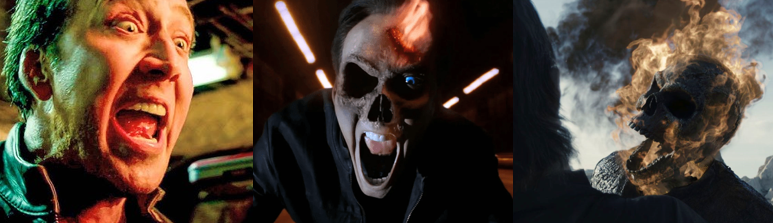
Cage is more unhinged than ever as the tortured Blaze and demonic Ghost Rider.

Later, when sheltered by Methodius (Christopher Lambert) and the other monks from Moreau’s order, Blaze learns the origins of the demon possessing him. It’s said to have once been Zarathos, the Spirit of Justice, an angel sent to defend humanity. However, Zarathos was somehow captured, tortured, and driven insane in Hell, transforming it into the unrelenting Spirit of Vengeance that now engulfs Blaze’s body. The Ghost Rider is a bizarre, disappointingly silent creature of vast, near-unlimited power. There’s little physical threat against his awesome Hell powers. He easily reduces every nameless, faceless goon to ash and cinders with his flaming chains and shrugs off bullets, relishing intimidating his prey by swaying about and striking odd poses. Exhibiting superhuman strength and durability, the Ghost Rider can transform any vehicle, no matter how big, into a flaming vessel but, of course, favours a bitchin’ motorcycle. His most powerful technique remains the Penance Stare, here changed to be the flaming demon simply screaming in his victim’s face for an awkward amount of time. Blaze says that the Ghost Rider consumes souls, but we don’t actually see that happen onscreen; his victims simply cower in fear and burst to ash, which is a bit of a disappointment. At one point, he does absorb and regurgitate a full clip of gunfire at one hapless goon, and he’s left unscathed by bazooka fire, though a desperate grenade shot by Carrigan is strangely enough to incapacitate him. Indeed, the only thing that can even stop the Ghost Rider is the word of Hell, a talent exhibited by Roarke’s unwitting son, Danny, who both commands the Ghost Rider to stop and returns his power in the finale. The Ghost Rider’s presence has clearly been infesting Blaze, driving him half mad; when the demon “[scratches] at the door”, Blaze descends into manic insanity trying to hold him at bay. He also seems to gleefully relish the demon’s incredible power as it literally bursts from him, melting his attire and transforming him into a wicked, bizarre creature said to have no conscience or morality.
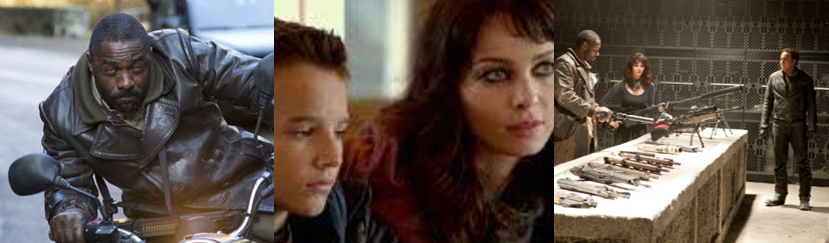
Moreau recruits Blaze to keep Nadya and Danny safe from Roarke’s evil plot.

This belief is tested when Moreau begs Blaze to help keep Nadya and Danny safe from Carrigan (and, by extension, Roarke). A Gypsy beauty once caught up in Carrigan’s world of violence and drugs, Nadya was left near death after a botched job and, in desperation, made a deal with the Devil to save her life, unaware that his intention was for her to give birth to a “vessel” for his demonic essence, essentially making Danny the Anti-Christ. Living life on the run, forced to swindle horny businessmen out of their wallets and cars, Nadya is reluctant to trust anyone and seeks only to keep Danny safe and maybe one day build a real life for him. Though a snarky teen with a chip on his shoulder, Danny truly loves his mother and actually enjoys their life as outlaws, despite him longing for a normal family life. Still, he struggles with his half-human heritage; he wants to understand the dark power within him, but both fears and is allured by it. The Ghost Rider can sense his presence, drawn to his blood and power, and Blaze tries to impress upon the boy that he doesn’t have to let his dark side define his life (hollow words considering Blaze’s own struggles with that). Devoid of a father figure, Danny quickly bonds with Blaze, seemingly enamoured by his incredible power and his whole stunt biker aesthetic but resents him for giving up the Ghost Rider at the first opportunity. This comes courtesy of Moreau, easily the most enjoyable and appealing character in the film. Also an accomplished rider, Moreau is a man of deep spiritual belief who’s also very handy in a firefight. Verbose and incorrigible, Moreau gleefully leaps head-first into battle, ready to give his life to keep Danny safe (or rescue him) and Elba’s scenery-chewing enthusiasm makes even clunky exposition scenes entertaining to watch. It’s genuinely a shame when he’s killed by Carrigan, especially as he had a lot of potential as a secondary Ghost Rider.
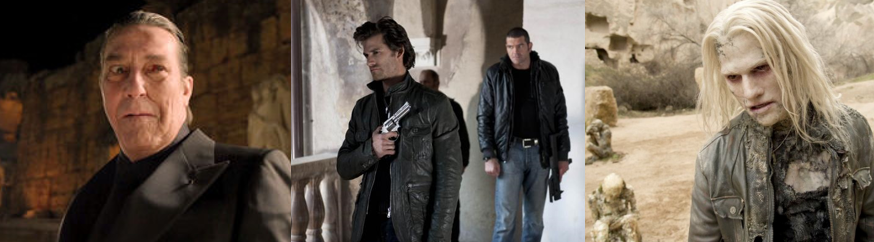
Though weak, Roarke’s power is enough to transform Carrigan into a demonic being.

Speaking of Carrigan, he spends the first act of the movie as little more than an arrogant mercenary. Since Roarke’s human body is slowly dying from the incredible power within it, he contracts Carrigan and his goon squad to do his dirty work. Carrigan has a history with Nadya, resenting her for leaving him, and knows his worth; he demands a bigger payday after barely surviving his first encounter with the Ghost Rider and ups his arsenal for the rematch. However, this leaves all his men dead and him crushed under debris, barely mustering the strength to spit an insult in Roarke’s face before dying. However, death is merely an inconvenience for the Devil and Roarke revives and transforms Carrigan into an adaptation of Blackout, here realised as a zombie-like sadist able to decay anything (unless dramatically convenient) with a touch and rapidly attack foes from a surreal shadow dimension. Unhinged, drunk with demonic power, Carrigan delights in reducing anyone in his path to agonised, decaying husks, leaving them little more than screaming skeletons, slaughtering Methodius and his monks and even killing Moreau. It seems to be the Devil’s modus operandi to birth half-demon creations capable of ending him since, like the Ghost Rider, Carrigan’s demonic power is so strong that even Roarke snaps at him when he goes to touch him, indicating that Carrigan could’ve simply killed the Devil’s mortal form and usurped his position. Lacking the gravitas of Peter Fonda and simply appearing as a broken, half-crippled old man in a suit, the Devil has never been weaker than in this film. His human body is decaying quickly since mortal forms can’t contain his power, so he’s desperate to get his hands on Danny and perform a bizarre ritual that will transfer his essence into the boy’s half-demon body. Still, the Devil exhibits an alluring presence; though he’s still unruly around him, Danny is curious to learn more about the darkness Roarke implanted in him. Roarke also clearly has the power, money, and influence to keep Carrigan and a veritable army of gun-toting minions on hand to be summarily slaughtered by the unstoppable Ghost Rider.

The Nitty-Gritty:
It’s definitely far more accurate to label Ghost Rider: Spriit of Vengeance as a soft reboot, and that really irks me. Blaze’s opening narration uses weird, animated segments to tell a truncated version of his origin when footage from the last movie could’ve easily been supplanted. He also explains how the Devil has taken many forms before, showing Roarke once masqueraded as some of history’s worst dictators (and Jerry Springer…), meaning it would’ve been easy to name-drop Mephistopheles. Instead, the film essentially distances itself from the last movie but remains irrevocably and awkwardly tied to it through Nicolas Cage’s casting. It’s a bit like when Judy Dench stayed on as “M” when Daniel Craig took over as James Bond. Like, it’s obvious it’s a new film continuity but not recasting the lead muddies the water and just has me asking why it wasn’t a straight-up sequel. The movie is also a strangely surreal affair. Whereas Ghost Rider was painfully generic and toothless at times, Spirit of Vengeance is often like an acid trip, skipping frames, using odd camera angles, and utilising a rushed editing style to frame the Ghost Rider as a terrifying, unpredictable figure. In this regard, these techniques are surprisingly effective, but it also results in a confused tone. Sometimes, it wants to be this gritty, gothic horror; other times, it’s got a camp comedic edge (mainly through Moreau’s infectious personality); and at other times, it’s a reluctant meditation on the struggle between good and evil. Nowhere is this more evident, as expected, than in Cage’s crazed performance. I get it when he’s desperately trying to keep the Ghost Rider in check, but that’s no excuse for Cage’s weird mannerisms and line deliveries. It paints Blaze as painfully awkward; he constantly struggles to console Danny and Nadya, and is definitely a man whose actions speak louder than words.
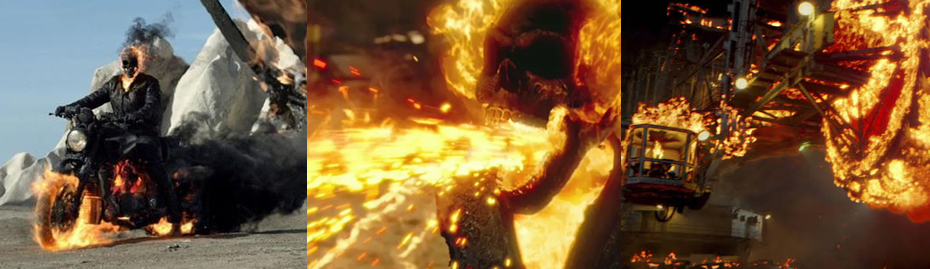
The Ghost Rider effects and action scenes look better than ever, despite his bizarre characterisation.

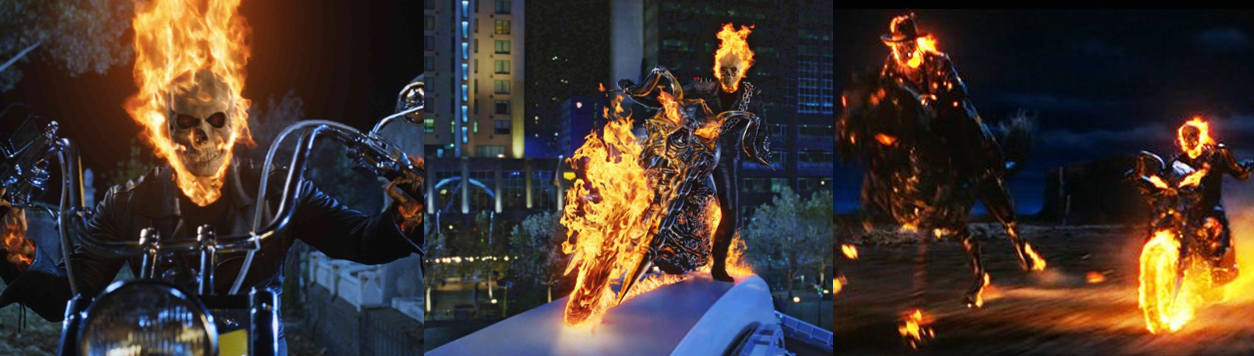
On the plus side, the Ghost Rider looks absolutely fantastic here! He looked pretty great in the last film, but the effects are way better this time around. His skull is charred and spews black smoke; his leather drips and bubbles from his intense Hellfire; and his flames are more realistic than ever. It’s like Clayton Crain’s gothic, realistic artwork has been brought to life and I loved that we got loads of sequences where the Ghost Rider is in action in broad daylight. It really is top-notch effects work that belongs in a better film and any scenes with the Ghost Rider, even when he’s acting like a complete moron, are a highlight. Of course, it helps that he’s an absolute menace; he’s so overpowered that nothing is a threat to him and he can afford to just knob about, toying with his victims before roaring in their face (…err, I mean, consuming their souls). Given the Ghost Rider’s nature, there are a fair few chase sequences here; the Ghost Rider turns cars and even a construction crane into a burning vehicle, decimating everyone in his way. Since Blaze successfully has Zarathos exorcised from his body at Moreau’s temple, he, Moreau, and Nadya are forced to use more traditional firearms and stealthier techniques to infiltrate the Uzak Gökten in the finale. Moreau acquits himself well here, throwing Roarke’s guards off with his brazen antics and openly firing upon his hooded followers. Like Methodius and the other monks, he tries to fight Carrigan and, like them, is rapidly decayed but not before delivering a defiant headbutt. Carrigan’s action sequences mostly take place in a peculiar dark dimension, where he slips up behind, outmatches, and dispatches his foes as easily as Ghost Rider incinerates them with his chains. Not to be outdone, Nadya has a lot of fight in her, even when overpowered or outmatched. She proves a crack shot with a sniper rifle, covering Blaze and Moreau’s backs, and is smart enough to flee with Danny whenever things start to get hairy for them.
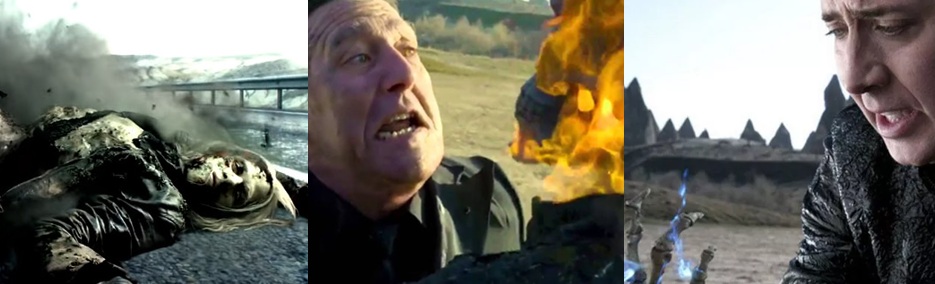
Ultimately, the Ghost Rider triumphs and regains his sanity, bringing some peace to Blaze.

Having successfully dispatched Carrigan and his goons, Blaze brings Nadya and Danny to Moreau’s sanctuary and successfully has his curse lifted. This is a two-stage process that begins with Cage hamming up Blaze’s darkest confession regarding his deal and then being bombarded by strange lights and a cacophony of visuals that, apparently, banish Zarathos from his body. Although Methodius decides it’s better to simply kill Danny to prevent the Devil’s plot, Carrigan shows up and slaughters him and the other monks, kidnapping Danny, and bringing him to Roarke so he can be sedated and forced into a strange ritual. To the chanting of his influential, hooded followers, Roarke comes close to completing the demonic transfer before he’s interrupted by Blaze and Moreau, covered by Nadya and armed with the monks’ impressive arsenal of firearms. Though Moreau is killed by Carrigan and it seems like Danny is ready to embrace his demonic heritage, the boy tricks Roarke and restores the Ghost Rider’s powers to Blaze. Now empowered to exist in daylight, the Ghost Rider aggressively pursues Roarke when he flees with Danny, finally dispatching Carrigan in anticlimactic fashion and violently sending Roarke’s vehicle end over end. His body further damaged by the crash, Roarke is left a helpless wreck before the Ghost Rider’s power. Defiant to the last, Roarke curses the day he made the deal with Blaze but is powerless to avoid being forcefully sent back to Hell by the Ghost Rider’s chain. Nadya is horrified to find that Danny has been…injured? Killed? He’s unconscious, at least…in the crash. However, conveniently, Blaze feels Zarathos’ true nature resurface, changing his flames from red to blue and restoring the angel’s sanity and power as the Spirit of Justice. This allows him to revive Danny and abruptly end the movie with him reaffirming his identity as the Ghost Rider, essentially completing the same character arc we saw in the last movie.
The Summary:
Ghost Rider somehow took one of comicdom’s most visually interesting anti-heroes and delivered a generic action flick that lost momentum halfway through and was bogged down by Nicolas Cage’s bizarre mannerisms. A toothless, impotent affair, it barely scratched the surface of what the character and concept are capable of, disappointing in it squandering its potential. Much of the same criticisms can be lobbied at this awkward re-quel, which is again hampered by too low an age rating to really bring the Ghost Rider to life and Cage is wackier than ever, screaming with a maniac glee or mumbling clumsily through every scene. However, Ghost Rider: Spirit of Vengeance has far more positives than its predecessor: the Ghost Rider looks better than ever, tearing through goons with a vicious relish and impressing whenever he’s onscreen, and Idris Elba steals the show as Moreau, clearly enjoying chewing the scenery. It’s a shame, then, that the Ghost Rider is portrayed so unpredictably. On the one hand, he’s pretty terrifying and an unstoppable force of nature; on the other, he’s lollygagging around or awkwardly screaming in people’s faces. I enjoyed Nadya and Danny’s characters; the actors gave good performances and I liked seeing the kid bond with Blaze, though I think this could’ve been emphasised more in the middle portion. Carrigan was just the right level of camp and menace; like Blaze, he’s gifted with incredible demonic power. Unlike Blaze, Carrigan truly embraces it and relishes rotting his victims, whereas Blaze is constantly at odds with his dark half’s power. However, Roarke is a massive step down from Mephistopheles. Ciarán Hinds isn’t bad, but he’s no Peter Fonda and it’s difficult to reconcile the ham-fisted retconning of the previous film. For me, I would’ve much preferred that the film was a standalone sequel that either used footage from the last movie or didn’t outright contradict it. Therefore, it’s better to treat Ghost Rider: Spirit of Vengeance as a straight-up reboot, as nonsensical as that is. Ultimately, I do think it’s the better of the two, but the flaws still keep it from being a significant improvement over the previous film thanks, ultimately, to Nicolas Cage’s ridiculously over the top performance.  

My Rating:

Rating: 3 out of 5.

Pretty Good

Do you think Ghost Rider: Spirit of Vengeance surpassed its predecessor? Do you think it’s a stronger adaptation of the source material? What did you think to Nicolas Cage’s performance this time and the retconning of the last movie? Do you agree that the Ghost Rider looks far better here? What did you think to Roarke and Carrigan and the way the Ghost Rider decimated his enemies? What are some of your favourite Ghost Rider stories and moments? Whatever your thoughts on Ghost Rider: Spirit of Vengeance, share them below and be sure to check out my other Ghost Rider content on the site.


Movie Night: Ghost Rider: Extended Cut

Released: 12 June 2007
Originally Released: 16 February 2007
Director: Mark Steven Johnson
Distributor: New Line Cinema
Budget: $110 million
Stars: Nicolas Cage, Eva Mendes, Wes Bentley, Donal Logue, Sam Elliott, and Peter Fonda

The Plot:
Motorcycle stunt rider Johnny Blaze (Cage) finds his past literally haunting him when the fiendish Mephistopheles (Fonda) calls upon a blood debt from Blaze’s youth. Transformed into the demonic Ghost Rider in the presence of evil, Blaze must hunt down Blackheart (Bentley), a rogue demon who seeks to acquire power to rival that of Mephistopheles!

The Background:
Created by Gary Friedrich, Roy Thomas, and Mike Ploog, Johnny Blaze/Ghost Rider made his Marvel Comics debut in the pages of Marvel Spotlight #5 in 1972. He graduated to his own self-titled comic about a year later and was at the forefront of many supernatural adventures in one form or another. In addition to cameo appearances in various Marvel videogames, Ghost Rider has popped up in other avenues outside of the comics; he cameod in Marvel’s nineties cartoons and an incarnation of the character later featured in a semi-prominent role in the fourth season of Marvel’s Agents of S.H.I.E.L.D. (2016 to 2017). However, development of a live-action adaptation of the Spirit of Vengeance can be traced back to 1992, when Marvel tried to shop the idea around Hollywood. In 1997, Gale Anne Hurd and Jonathan Hensleigh were attached to the project but things really took off in late-2000, when writer David S. Goyer, director Steven Norrington, and stars Jon Voigt and Johnny Depp were all associated or involved with the film in some capacity. By May 2002, Columbia Pictures had purchased the rights; all previous associates dropped out of the project and Shane Salerno was brought in to rewrite Goyer’s script, but eventual director Mark Steven Johnson did his own script soon after being hired to helm the film. Life-time superhero fan and nineties action star Nicolas Cage won the title role and chose to portray the character not as a hard-drinking bad-ass but more as someone desperately trying to come to terms with the curse hanging over his soul. The character’s visual effects were the work of Kevin Mack and Sony Pictures Imageworks, who painstakingly animated Ghost Rider’s flames on a shot-by-shot basis, with one of their most difficult and time-consuming sequences being the first horrific transformation and the digital transformation of the iconic “Hell Cycle”. With its final worldwide gross falling just shy of $230 million, Ghost Rider didn’t exactly set the world on fire (pun intended) and this was reflected in the reviews; critics were left disappointed by the film’s focus on humour rather than horror, with the dialogue and Cage’s performance drawing the most criticism, though the special effects were praised and some have since re-evaluated it as an under-rated comic book film. Despite being labelled as one of the worst films of the decade, Ghost Rider not only received this extended edition on home media but was actually followed by a sequelof sortsin 2011, that was a critical and commercial failure which, coupled with Cage’s disappointment with the role and franchise and the rights being reacquired by Marvel in 2013, dashed any plans for a third entry.

The Review:
Ghost Rider is another of those Marvel superheroes I’m not all that familiar with; unlike others like this, I can’t even say that I’ve been able to get a sense of the character and his incarnations and adventures as Marvel haven’t yet released one of their Marvel Platinum definitive collections for him and a lot of his classic collections are a bit overpriced for my tastes. I’ve always been drawn to the character, though, since he’s visually very striking and his powers and background really speak to me as a long-time fan of Al Simmons/Spawn, but the most I’ve experienced of him are his debut story and the Spirits of Vengeance: Rise of the Midnight Sons trade paperback (Cooper, et al, 2016), his appearances in Marvel cartoons and TV shows, and a few sporadic appearances in videogames. I’d love to read more of him, but I definitely wasn’t as clued up on the character as I usually am when I first went to see Ghost Rider. Hell, I wasn’t even (and still am not, really) a big fan of Nicolas Cage; I’d seen him in The Rock (Bay, 1996), Con Air (West, 1997), and Face/Off (Woo, 1997) but he never really clicked for me as an actor or personality because he always came across as being more than a little nuts. Thus, I originally went into Ghost Rider with quite low expectations; I was expecting an action-packed romp full of special effects and bonkers visuals and fights and that’s basically what the film delivers, though even I was hoping it’d lean a bit closer towards the dark connotations of the character and Ghost Rider’s more horror-themed elements.

Johnny’s deal with the Devil costs him his soul and his happiness that no amount of fame can assuage.

The film is immediately handicapped by an opening narration. I’ve talked about this a few times but this really is a cliché that’s hard to get right in cinema; it makes sense to want to clue the audience in early on to what’s going on and give some lore and context to the world being presented, but it ends up becoming redundant as Carter Slade/The Caretaker (Elliot) repeats it to Johnny later in the film so it’s just another example of narration for narration’s sake. Anyway, when we first meet Johnny Blaze, he’s just a kid (Matt Long) working as a carny stunt cyclist alongside his father, Barton (Brett Cullen). Although he enjoys the thrill of entertaining the masses with increasingly dangerous and ludicrous jumps (to the chagrin of his father, who chastises him for being a show off), Johnny is frustrated with the lifestyle and playing second fiddle to his father and is determined to leave it all behind and run away with his girlfriend, Roxanne Simpson (Raquel Alessi). When he spots a convenient letter detailing the seriousness of Barton’s cancer, however, Johnny hesitates; his concern and desperation for his father’s welfare are all the leverage Mephistopheles needs to convince Johnny into signing away his immortal soul to keep Barton from succumbing to his illness. Johnny’s elation at seeing his father rejuvenated is soon dashed when the slightest twitch from Mephistopheles causes Barton to die in a motorcycle stunt, leaving young Johnny wracked with guilt, devastated at losing the only family he has, and burdened by the debt he now owes to the conniving Devil, who promises to one day collect on his contract. Having lost everything and fearing for Roxanne’s safety, Johnny opts to abandon her and hit the road, eventually growing up into Nicolas Cage. The now-adult Johnny Blaze has become a media sensation; famous for his privacy and death-defying stunts, we catch up with him in the middle of a cross-country tour with his entourage, which includes best friend and impresario Mack (Logue). However, despite his best attempts to overcome his fear, Johnny is haunted by his past, which is annoyingly drummed home to us through constant flashbacks to events we just witnessed, as though we’d forget what happen less than a minute ago. Constantly questioning whether he’s actually as good as everyone says or whether it’s Mephistopheles’ influence keeping him successful and healthy, Johnny just about gives Mack an ulcer due to his insistence on pushing his stunts to the absolute limit to maintain his reputation as “Mister Invincible”

Johnny is cursed to transform into a flaming skeletal demon at night and in the presence of evil.

Though he forgoes alcohol and drugs, preferring to swig down cocktail glasses of jelly beans and sooth his anxiety with the Carpenters (amongst other weird traits), Johnny is a tortured soul who is forever trying to outrun the literal Devil. When he happens to cross paths with the grown-up Roxanne, he sees it as a sign that his days of living in fear are over; reinvigorated with a newfound zest for life, he regresses to a child in his attempts to impress and woo her and, despite being burned by him in the past and her better nature, the budding reporter agrees to give him a chance. However, right as he’s about to begin his new life, Johnny is approached by Mephistopheles once more; rather than claiming Johnny’s soul, Mephistopheles orders him to track down and kill his son, Blackheart, and imbues him with the power of the Ghost Rider to fulfil this mission with the promise of releasing him from his vow once the deed is done. Although Johnny has no interest in doing the Devil’s bidding, he’s horrifically transformed into a monstrous being, a leather-clad demon with a flaming skull for a head and a semi-sentient blazing motorcycle for transport. In a change of pace from most superhero movies, Johnny actually confesses to his curse and newfound duality to Roxanne but, naturally, she doesn’t believe him and he just comes across as a madman thanks to his awkward personality quirks and madcap nature. Ghost Rider is a tricky character, in many ways; a supernatural creature with near-unlimited power, it’s hard to put him in situations where he would be vulnerable, so the film lumbers him with the caveat that he can only appear at night and in “the presence of evil”. Even then, and when faced with other supernatural foes, the Ghost Rider is a formidable creature; practically impervious to pain and injury, his wounds heal abnormally fast, he exhibits superhuman strength and dexterity, and he can supernaturally ignite and extended his chain and conjure hellfire at will. His most powerful weapon is his “Penance Stare”, which forces a victim to relive all the pain and evil they’ve done and, presumably, be consumed by it. What’s not made immediately clear in the film, however, is whether or not the Ghost Rider is a separate entity from Johnny or if Johnny retains his personality when transformed. It seems like he does, and Johnny can fully recall everything he did while transformed, but other times the Ghost Rider talks and acts very differently, but there’s no mention of Zarathos in the film and the Ghost Rider doesn’t say much, so it’s a bit unclear as to what’s going on there. Even more ludicrous, however, is the part when Johnny just takes control of the “possessing spirit” after reading a single passage in one of his occult books and stating he wants control, which both skips over any kind of hardship he might have to face and undermines even the slightest but of duality between him and the Ghost Rider.

Neither Blackheart or his minions ever come across as a serious, monstrous threat.

Johnny (and the audience) are given some context through the Caretaker, a wizened and gruff old man whom Johnny stumbles upon after his first transformation. It’s the Caretaker who narrates the film and delivers the bulk of its exposition regarding Mephistopheles, Blackheart, the Ghost Rider, and the Contract of San Venganza, a binding note of a thousand damned souls which Mephistopheles covets and Blackheart seeks to acquire in order to gain the power necessary to overthrow his father. Mephistopheles is a bit of a contradiction as well; he can assume a human guise, affects the weather and environment around him simply by walking, can bargain for people’s souls, and grant unimaginable power to a human host…but is somehow rendered “powerless” to actively oppose Blackheart. Conversely, Blackheart has no such limitations; he can come and go as he pleases, lower the temperature through his sheer presence alone, drain the life and flesh from humans with a touch, and even enter hallowed ground without any consequences, to say nothing of being immune to his father’s influence while on Earth. Blackheart enlists the help of the Hidden, three Fallen Angels with elemental powers: Abigor (Mathew Wilkinson), Gressil (Laurence Breuls), and Wallow (Daniel Frederiksen), however we learn very little about them (or even Blackheart, for that matter, beyond his childish resentment towards his father and lust for power and conquest) and they mainly exist to give Ghost Rider someone to fight against. Indeed, despite Abigor being able to become practically intangible, Gressil transforming to earth and stone, and even Wallow having the advantage during an underwater skirmish with the titular Spirit of Vengeance, all three are dispatched by the Ghost Rider with relative ease (Johnny even offs Gressil mere moments after his first transformation, showing no hesitation or trouble with his newfound powers). Despite being fully aware of his father’s favouritism to the Ghost Rider, and showing a flicker of fear at the demon’s power, Blackheart is so arrogant that he expresses suprise when the Ghost Rider survives his futile attempts to kill him and bests his minions…even though he knows what the Ghost Rider is capable of so he should’ve known better. Blackheart puts up a bit more of a fight, but this is mainly because their final showdown happens at the onset of sunrise, thus dispelling the Ghost Rider curse, and because Blackheart “[has] no soul to burn”. Those who are familiar with the comic book versions of Blackheart and Mephistopheles will be left disappointed by their decidedly undemonic appearances; though both show signs of their true, monstrous nature and Blackheart eventually transforms into a dark-skinned demon referring to itself as “Legion”, neither appear as demonic forces, which is great for maintaining the actors’ likenesses and performances but not so good for matching the visually impressive Ghost Rider against similarly interesting enemies and leaves Blackheart resembling more of a try-hard emo than a menacing threat.

The Nitty-Gritty:
This extended version of the film adds a paltry nine minutes to the runtime, which mostly translates into further fleshing out Johnny’s youth and his relationship with his father but is most notable in an altered meeting between Mephistopheles and Blackheart, which changes the location and placement of the scene but basically serves the same purpose as in the theatrical cut. Even with these extra scenes, Ghost Rider doesn’t really seem to know what it wants to be; in its drive to avoid being too dark and scary, it veers way too much towards awkward comedy and bizarre inclusions. While many of these are exemplified by Cage’s weird take on the character, they’re not exclusive to him: Roxanne bizarrely takes a Magic 8 Ball to her date, but Eve Mendes fails to really impress as an interesting or forthright character and is mainly here to look hot, chew Johnny out, and be a hostage for him to rescue. To make things worse, the always-aggravating Rebel Wilson hams up her cameo like she’s the film’s comic relief (a role Mack fills wonderfully), and Blackheart’s minions are robbed of any sense of menace by their over the top performances and line delivery. Wes Bentley is equally guilty of this, with every line being delivered with a spitting, deliberate campness that completely destroys any allure and threat his character might (and should) have. However, it’s Nicolas Cage who absolutely tips Ghost Rider over the edge with his truly bonkers ideas and performance: I’ll admit, it’s refreshing to not see another alcohol-dependent, tortured character but Johnny’s reliance on sweets, pop music, and daft clips just make him seem like an absolute goofball…and he doesn’t need any help in that department! From his drawly Southern twang, his childish antics with Roxanne and the way he greets the paparazzi, to his over the top screams of anguish and joy when first transforming into the Ghost Ruder, it’s hard to really get a sense of who Johnny is since he just seems like a cartoon character on acid or hyped up on sugar, bouncing from mood to mood, dramatically pointing at people and growling “You!”, and chastising Mack for “steppin’ on Karen” or trying to talk him out of jumping over a field of helicopters. All I can say is thank God for Peter Fonda, Sam Elliot, and the underutilised David Roberts (whose Captain Jack Dolan is more of a nuisance than anything and the film arguably would’ve benefitted from replacing the police pursuit of the Ghost Rider with more development of Blackheart and his cronies); these three carry the film, playing the straight men in a glorified comedy and adding a gravitas to even the most ridiculous lines and concepts.

While the film struggles with its identity, at least the Ghost Rider’s special effects look great.

Thankfully, the film is also bolstered by its impressive special effects; although many of these suffer from a lack of polish (Blackheart’s arrival, for example, where he appears out of flaming rain and randomly screams at the camera for no reason, his minions, and the finale haven’t benefitted from age), it’s clear that all of the time, money, and energy was spent on making the Ghost Rider himself look absolutely top notch and bad-ass. Although there’s been some debate over whether Cage’s abs were real or not, Ghost Rider is easily one of the most visually impressive comic book characters on the page and on the screen; garbed in a spiked leather jacket, wielding a flaming chain, and having a flaming skull for a head, seeing him rocket down roads, leaving a trail of fire and devastation in his wake, is quite the spectacle and the flame effects still hold up pretty well. Probably as a consequence of how difficult the character was to conceive and animate, the Ghost Rider doesn’t talk much, and his action sequences tend to be very blunt; it’s all about ending things quickly, with as much visual and dramatic impact as possible, rather than having overly choreographed fight scenes or dragging things out. This works in context as the Ghost Rider certainly has the power to shrug off knives, blows, and even a truck to the face, to say nothing of leaving Gressil a charred mess of stones with a single lash of his whip. Easily one of the best parts of the film comes when Johnny is locked in a cell full of criminals, where he manhandles the lowlifes and reclaims his bike to race through the city streets in a blazing inferno while Dolan frantically tries to chase him down. This results in cool shots like Ghost Rider idling on top of the Southbank Pedestrian Footbridge, emerging from water completely ablaze, and racing up the side of a building to reel in a police chopper using his chain. This is also where he fights with Abigor; despite the fact that the Wind Elemental can become nigh-on intangible, even this creature is no match for the Ghost Rider, who easily immolates the Fallen Angel by whipping up a flaming tornado. The movie then makes a big show of revealing that the Caretaker was Carter Slade, the Ghost Rider who kept the Contract of San Venganza, and then completely squanders it by simply having him wander off to his death after accompanying Johnny to the ghost town rather than heroically die in battle with Blackheart, which kind of makes the entire reveal pointless beyond a cool shot of the two riding through the desert to a cover of “(Ghost) Riders in the Sky: A Cowboy Legend”.

Johnny bests Blackheart and then keeps the Ghost Rider power since that’s something he can do, apparently…

For all his immense power and his lofty dreams of domination, Blackheart ends up being little more than a petulant child; he’s dangerous, for sure, and even Mephistopheles fears his ambition, but he’s really only seen as a threat to humans. Although he increases Johnny’s personal stake in the plot (as if saving the world from untold eons of darkness wasn’t motivation enough) by killing Mack, Blackheart loses a lot of credibility by taking Roxanne hostage to bargain for the contract. This is especially egregious considering Carter hid the contract in the handle of his spade, so Blackheart had the means to acquire it all along and just…didn’t…because he wanted to toy with his prey rather than be a little more thorough. The movie tries to escalate things in the finale by forcing Johnny to retreat to the shadows to summon his powers, but it just ends up seeming like the filmmakers ran out of money and couldn’t render Ghost Rider in his full glory for the final showdown. Blackheart doesn’t fare much better, either; after absorbing San Venganza’s damned souls, he gains a moderately more monstrous appearance but is actually less of a threat as he’s now filled up with a thousand souls for the Penance Stare to run through, leaving him a useless, catatonic lump of wasted potential for Mephistopheles to take back to Hell and punish for being a naughty boy. Despite the fact that all Mephistopheles has done is lie, it’s surprising when the Devil actually makes good on his promise of releasing Johnny from his curse but, rather than finally be free and live the life he’s always wanted with Roxanne, Johnny inexplicably vows to wield the Devil’s power as the Spirit of Vengeance. While this is treated like some big dramatic character moment and Johnny finally embracing his destiny, it’s another of the film’s many head-scratching moments: Mephistopheles can bestow the Ghost Rider power against a person’s will but can’t remove it against their will? It’s almost as if the film’s implying that the Ghost Rider is more powerful than the Devil himself (and, in actual fact, he is since Mephistopheles couldn’t touch Blackheart on Earth!) Of course, the real reason for this nonsensical ending is to set-up a sequel, but I’d argue we could’ve still gotten that while also offering something a little bleaker. Like, have Mephistopheles betray Johnny and say he’s still bound by his contract, but Johnny could still vow to put his powers to good use and to oppose Mephistopheles wherever possible. Instead, it just seems like Mephistopheles is all bark and no bite as he just throws a temper tantrum (clearly where Blackheart gets it from…) and promptly disappears to allow his greatest and most powerful creation to wander the Earth outside of his control.

The Summary:
I think the biggest issue with Ghost Rider, even for someone like me who barely knows anything about the character, is that it’s just a bit of a disappointment from start to finish. It seems like the filmmakers thought the concept alone and Nicolas Cage’s star appeal would be enough for the film to compete against other blockbuster superhero franchises and didn’t really believe in the source material or the essence of the character’s horror roots. While I’m an advocate that 12/15-rated movies are more than suitable for most superhero properties, Ghost Rider definitely feels like it would’ve benefitted from being a smaller, more gritty horror vehicle rather than this bog-standard, over the top production. Considering the film is clearly pulling from classic horror movies like American Werewolf in London (Landis, 1981) and the Universal Horror movies, it’s a shame that it veers so far into the comedic and the absurd; everything from the acting, the soundtrack, and the overall corny nature of much of the movie constantly holds Ghost Rider back from being a more memorable picture, regardless of how good the titular character looks in the film. And he does look good, but the issue is the confusion regarding whether there’s any duality between him and Johnny, how ridiculously overpowered he is, and the vaguely defined powers of Mephistopheles and Blackheart. I can’t help but feel a smaller production, one more focused on Johnny Blaze struggling to cope with his monstrous curse, demonic alter ego, and his past mistakes while the Devil pulls his strings would’ve made for a darker, more unique horror piece but, instead, the film doubles down on its star power and visual effects rather than trying to give the Ghost Rider a tangible threat or tighten up the script. It’s definitely not the worst film I’ve ever seen, and has some fun and amusing and cool moments, but it’s far more akin to the disaster that was Spawn (Dippé, 1997) rather than a cross between The Crow (Proyas, 1994) and Constantine (Lawrence, 2005) or even something along the lines of Hellboy (del Toro, 2004), all far better movies that came out prior to this and which I feel are far more suitable to the tone of the Ghost Rider comics.

My Rating:

Rating: 2 out of 5.

Could Be Better

Did you enjoy Ghost Rider? If you’re a fan of the comics, how do you think it worked as an adaptation and what would you have changed? What did you think to Nicolas Cage’s performance in the film and the changes made to Johnny Blaze’s character? Were you a fan of the special effects, and what did you think to the villains and their minions? Can you explain why Mephistopheles has such inconsistent powers when on Earth? What are some of your favourite Ghost Rider stories and moments? Whatever your thoughts on Ghost Rider, share them below and be sure to check out my other horror-themed Marvel content!

Movie Night: Color Out of Space

Released: 7 September 2019
Director: Richard Stanley
Distributor: RLJE Films
Budget: $6 to 12 million
Stars: Nicolas Cage, Joely Richardson, Madeleine Arthur, Brendan Meyer, Julian Hilliard, and Elliot Knight

The Plot:
Nathan Gardner (Cage) and his family have moved out to his late father’s farm following his wife Theresa’s (Richardson) mastectomy. Their simple life of raising alpacas is interrupted when a strange alien meteorite lands in their garden and a strange, unquantifiable and seemingly intelligent and malevolent living colour begins to infect and infest the local wildlife, the animals, and the Gardner family in increasingly strange and horrific ways.

The Background:
Being a big fan of horror, fantasy, and Stephen King’s, it’s perhaps almost inevitable that, at some point in my admittedly-limited scope of reading, I would have heard of the works of H. P. Lovecraft. Born in 1890, Howard Phillips Lovecraft is perhaps one of horror/fantasy fiction’s most surreal and complex writers; known for conjuring nightmarish imagery and madness-inducing concepts and creatures, Lovecraft created an interconnected set of works that delved into the deepest, darkest fears of the human psyche and posited the idea that humanity is a mere speak in the grand scheme of the cosmos. In 1927, Lovecraft penned “The Colour Out of Space”, a story which he hoped would buck the trend for traditional, humanoid depictions of alien life forms. Interestingly, despite the immense mainstream success of his more notable stories, like “The Call of Cthulhu” (Lovecraft, 1926), Lovecraft considered “The Colour Out of Space” to be his favourite work and the story saw a number of adaptations over the years before director Richard Stanley began putting together this modern-day adaptation. Though planned as the first in a trilogy of films based on Lovecraft’s works, the film’s limited release and near-minuscule box office may scarper those plans despite it receiving generally positive reviews.

The Review:
If there’s one thing that might put the general audience off of viewing Color Out of Space (beyond the Americanised title), it’s the inclusion of Nicolas Cage in the lead role. Far from the blockbuster action hero he was in the nineties, Cage has somewhat reinvented himself in recent years, taking on more experimental and outlandish roles in productions with a fraction of the budget and release he is known for. Indeed, his reputation in Hollywood has become almost farcical as he brings a manic, unpredictable energy to each role he plays so you’re never really quite sure of what to expect when he shows up in a film.

Cage makes for a surprisingly relatable, ordinary man affected by an extraordinary event.

It’s fitting, then, that Cage is cast in a film based on a Lovecraftian tale; Lovecraft was notorious for conjuring up unspeakable entities that would turn the minds of us insignificant humans to a fine paste so it’s actually surprisingly remarkable foresight on the filmmakers’ part to cast the infamously kooky Cage in the lead role of Nathan Gardener. At the beginning of the film, Gardener is your typical everyman; a doting and devoted husband and father, he’s just trying to eek out a living on his father’s old farm and to return his family to some sort of normalcy after his wife’s battle with cancer. Cage brings a quiet, subdued energy to this portion of the role; you can tell he still deeply loves and cares for his wife and kids and is struggling to keep things together after all they’ve been through but he is. Nevertheless, a relatable and vulnerable character whom you buy as just a regular Dad trying to do what’s best.

Cage can always be relied upon to bring the crazy to any film he is cast in.

Things immediately take a turn into the bizarre and the surreal when the mysterious meteorite crashes into their garden; though Nathan isn’t the first to truly feel the effects of the alien Colour, he is the first to react to it, smelling a pungent stench that no others can before slowly being transformed and twisted by the influence of the titular Colour. Before long, he’s spouting all kinds of weird nonsense, exploding into unpredictable and even violent outbursts, and clearly becoming possessed by this unquantifiable alien influence to the point where he almost becomes a kind of avatar for the Colour and the closest thing the film has to a tangible antagonist.

Theresa is horrifically influenced by the presence of the Colour.

Of course, it’s not just the Nic Cage show; Joely Richardson plays his wife, Theresa, a relatively normal, everyday woman who is just trying to get back on track with her work, family, and sense of self confidence after her battle with cancer. She is, unfortunately, the first of the family to really feel the influence of the Colour, slipping into a zombie-like stupor and accidentally slicing off two of her fingers. As the Colour’s influence grows, her conversations and interactions with Nathan and the kids become increasingly disjointed and erratic but, through it all, her primary concern is for the welfare of her children (which, as I’ll discuss in a bit, turns out to be her downfall).

I really enjoyed, and believed, the chemistry between Benny and Lavinia.

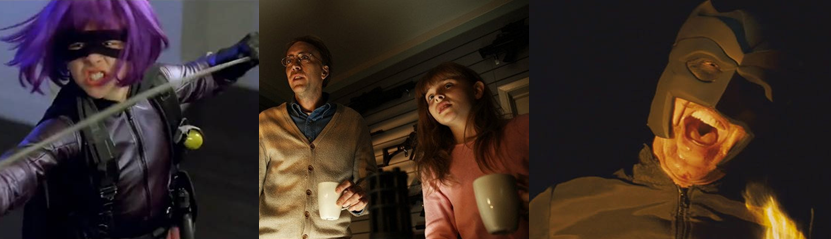
As for the Gardener’s kids, Color Out of Space features some pretty decent casting; Lavinia (Arthur) is the couple’s only daughter, a Wiccan who is just on the cusp of growing old and rebellious enough to resent her family but is still devoted enough to truly care for her younger brother, Jack (Hilliard) and have a pretty believable friendly rivalry with her older brother, Benny (Meyer). Benny is depicted as a bit of an absent-minded stoner and the young muscle of the family as he’s constantly being roped into helping his father with the farm’s course and his outrageous alpacas but, despite annoyance and apathy being etched onto his face, he never once complains or throws a tantrum over this; as with all of the Gardener’s, family unity remains at the heart of these characters, however rocky that ground might have become before the film begins. And then there’s Jack, a cute and naïve sort of kid who has a natural curiosity and a fitting child-like whimsy about him. While his older siblings comment on the Colour’s influence but don’t truly succumb to it (with the eventual exception of Lavinia), Jack is the first one to really acknowledge the Colour’s alien presence, seemingly hearing and seeing it and attempting to communicate with it. Sadly, his affection for the Colour (which he views as a kind of imaginary friend) leads him to nothing but a heartbreakingly gruesome fate thanks the Colour’s apparent malevolence (or, perhaps, naivety).

The Nitty-Gritty:
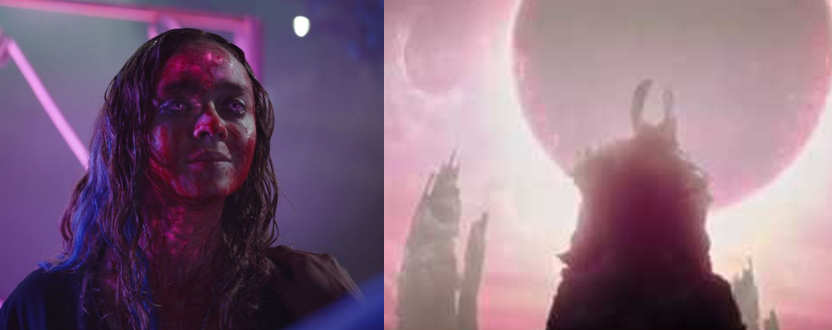
One of the things that often proves so difficult for filmmakers when it comes to adapting the works of Lovecraft is just how obscure and indescribable his many horrific creations are; perhaps, of all of Lovecraft’s monsters, the Colour is the most “unfilmable” since the written word is far better at positing a living, alien Colour that is beyond human comprehension. Film is, obviously, an inherently visual medium so a colour must be shown onscreen and I feel that the filmmaker’s realised the Colour in perhaps the best way they possibly could. Rather than a traditional alien beast, the Colour is just that; a twisted, distorted sentient spectrum of light that is at once beautiful and horrific, blinding and awe-inspiring, resembling a flash of pure light one moment and then a vortex of extraterrestrial intent the next. For the most part, the Colour is realised in an unsettling hue of purple, magenta, and pink surrounded by a clear distortion of physical reality; when it emerges from the Gardener’s well, it almost resembles a tentacled monstrosity but it is wisely never really given a true, quantifiable physical form.

Theresa and Jack suffer a horrific fate due to the Colour’s touch…

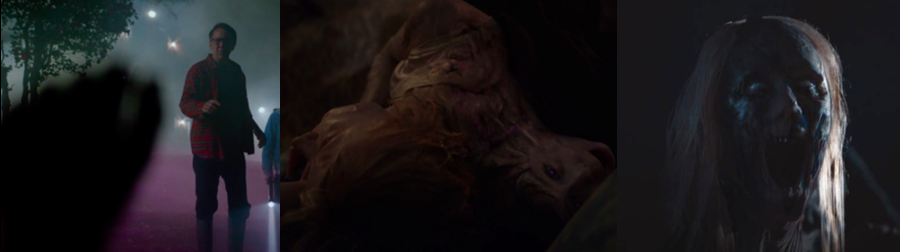
Instead, the Colour acts through the things it influences, whether that is water, plants, or animals. It affects and distorts time and space, making moments drag out or flash past in an instant, causing characters to experience aggressive mood swings and events to seemingly happen at random and with no explanation. At first, the Colour’s influence is subtle, induced trance-like states, sending the Gardener’s animals into a frenzy, and making Lavinia sick when she drinks the tainted water but, all too soon, its influence begins to take on a more malicious note. When the Colour directly interacts with other creatures, it distorts and mutates them in gruesome ways; the Gardener’s alpacas end up fused together into a squealing, nightmarish beast like something from the imagination of David Cronenberg or John Carpenter. Described as “just a colour…but it burns”, it’s as tough the Colour were attempting to figure out the life forms it has found itself living with and, since it is unable to recognise them, transforms them and the surrounding area into forms it is more accustomed to. This is directly speculated upon by another of the Colour’s victims, Ezra (Tommy Chong), who is left a hollowed out dusk that decays into fragments of sizzling colour when he is discovered.
Lavinia offers a glimpse of the nightmare hellscape the Colour calls home…

Yet it is Theresa and Jack who arguably suffer the most due to the Colour’s influence; in trying to shield Jack from the Colour, Theresa and her young son become enveloped by its light and the result is a mutilated, agonisingly disgusting amalgamation of the two that, thankfully, is masterfully never lingered on for more than a few seconds at a time. While Nathan affords his beloved alpacas a mercifully swift death, the Colour’s influence drives him mad with distraction, allowing the Jack/Theresa creature to mutate into a ghastly spider-like….thing that attacks Lavinia in a monstrous fury before finally being put out of its misery. In the end, after the Colour has claimed her entire family, Lavinia falls back on her Wiccan ways, drawing solace from her copy of the Necronomicon and attempting to cast a series of spells and prayers to shield herself and her family, this leads to her self-mutilating herself in a vain attempt to ward off the Colour but she too becomes possessed by its influence, affording us a glimpse of the nightmarishly indescribable world that the Colour originated from before it blasts its way back to the space between waking worlds, taking the Gardener’s, their farm, and most of the surrounding area with it and leaving behind a sole survivor, Ward Phillips (Knight), a visiting Hydrologist who tries to help the family and ends up traumatised by the horrific events he bares witness to.
The Summary:
I’ve read my way through my fair share of Lovecraft’s tales and, of them, “The Colour Out of Space” was indeed one of the stronger stories. Though Lovecraft’s writing can be, at times, impenetrable and obtuse, “The Colour Out of Space” told a relatively simple tale of a normal, everyday family coming onto contact with a force of nature far beyond that of human comprehension and I have to say that Color Out of Space does a commendable job of not only bringing Lovecraft’s story to life but also expanding upon it with influence form his other works. With stellar, believable performances from top to bottom and some truly incredible special effects work (both on the Colour itself and the monstrosities it creates), Color Out of Space is quite the psychological thrill-ride with plenty of gory and gruesome moments to satiate more impatient audience members. It’s one of those films that truly leaves you questioning what is beyond our world, offering little in the way of explanations for the events that unfold, and dropping normal, everyday, relatable characters into an extraordinary and terrifying situation that has a suitably bleak and thought-provoking conclusion.

My Rating:

Rating: 4 out of 5.

Great Stuff

What did you think to Color Out of Space? Did you appreciate the film’s subtle, nuance, mounting dread and atmosphere or was it, perhaps, too surreal and slow for you? Have you read the original short story, or any Lovecraft for that matter? What did you think to how the film realised the Colour and do you think it could have been done better or differently? Which Lovecraft story is your favourite and why? What other Lovecraft works would you like to see get a big-screen adaptation? Whatever your thoughts, feel free to leave a comment below.

Movie Night [Spidey Month]: Spider-Man: Into the Spider-Verse


Easily Marvel Comics’ most recognisable and popular superhero, unsuspecting teenage nerd Peter Parker was first bitten by a radioactive spider and learned the true meaning of power and responsibility in Amazing Fantasy #15, which was first published in August 1962. Since then, the Amazing Spider-Man has featured in numerous cartoons, live-action movies, videogames, action figures, and countless comic book titles and, in celebration of his debut and his very own day of celebration, I’ve been dedicating every Wednesday to talk about everyone’s favourite web-head!


Released: 14 December 2018
Director:
Bob Persichetti, Peter Ramsey, and Rodney Rothman
Distributor:
Sony Pictures Releasing
Budget:
$90 million
Stars:
Shameik Moore, Jake Johnson, Hailee Steinfeld, Mahershala Ali, John Mulaney, Kimiko Glenn, Nicolas Cage, and Liev Schreiber

The Plot:
After being bitten by a radioactive spider and gaining the proportionate strength and agility of the arachnid, Miles Morales (Moore) finds himself caught up in an elaborate plot by Wilson Fisk/The Kingpin (Schreiber) to cross dimensions. In the process, Miles is mentored by, and joins forces with, other incarnations of Spider-Man from across the multiverse while stull struggling to carve out his own identity in the role.

The Background:
In 2011, writer Brian Michael Bendis decided to kill off Peter Parker/Spider-Man and replace him with a younger character in the pages of Ultimate Spider-Man (2000 to 2011), Miles Morales, an African American youth of Puerto Rican descent, a decision which created much controversy at the time. Miles, however, soon became a popular character and appeared not just in cartoons and other merchandise but also the mainstream Marvel continuity (“Earth-616”). After the poor reception of The Amazing Spider-Man 2 (Webb, 2014) led to Spider-Man finally being incorporated into the Marvel Cinematic Universe (MCU), Sony were determined to continue producing Spider-Man films and spin-offs separate from the MCU. Writers Phil Lord and Rodney Rothman chose to focus their efforts on Miles since he hadn’t yet featured in a film and, to further separate the project, it included not only Spider-People from across the multiverse but also a distinct and intricate animation style that was as vital to the story as the music and dialogue. Spider-Man: Into the Spider-Verse received unanimous praise upon release and made over $375 million at the box office, won numerous awards, and is highly regarded as one of the best and most unique Spider-Man movies ever made. Its massive success meant that both a sequel and a spin-off were soon announced and no doubt contributed heavily to Miles’ continued popularity.

The Review:
First and foremost, Spider-Man: Into the Spider-Verse is Miles Morales’ story, even amidst all the chaos and multiverse madness permeating the plot; unlike the traditional Peter Parker, Miles’ parents are still alive and, while he struggles to adjust to boarding school and to make new friends, he’s nowhere near the social outcast Peter is often portrayed as during his teenage years. A big fan of music (though he is amusingly poor at reciting lyrics) and with an artistic flair, Miles is a slightly rebellious and resentful youth who struggles to live up to the expectations of his father, Jefferson Davis (Brian Tyree Henry), a police officer who regards Spider-Man (Chris Pine) as a menace and delights in embarrassing his son at his new school with typical dad humour. A somewhat streetwise kid who was a popular figure at his old school, Miles is largely an outsider at his more officious and pretentious boarding school; he’s uncomfortable in the mandatory uniform, feels like he doesn’t really fit in, and is intentionally trying to sabotage his future there so he can go back to his old school and his old friends. Believing that his father doesn’t really understand him or his dreams, Miles has a far closer relationship with his uncle, Aaron Davis (Ali), who encourages his penchant for street art and actually takes the time to connect with him on a more peer-to-peer level. To Jefferson’s chagrin, Miles idolises his uncle, who indirectly leads to him gaining his spider powers.

Miles’ struggles with his spider powers are directly paralleled to the onset of puberty.

Already somewhat uncomfortable in his new environment, Miles’ newfound spider powers (which are explicitly compared to the onset of puberty) only increase his agitation; he struggles to adapt to and master his abilities, gaining a far louder and more noticeable internal monologue and accidentally attaching himself to Gwen Stacy’s (Steinfeld) hair in an awkward attempt to flirt with her. Interestingly, Miles’ exploration of his abilities is a source of as much entertainment and amusement as it is an integral part of Miles’ character development; throughout the film, Miles struggles to master his powers, which seem to trigger unconsciously or involuntarily, and a massive part of Into the Spider-Verse revolves around Miles living up to the lofty expectations now placed upon him by his amazing new abilities.

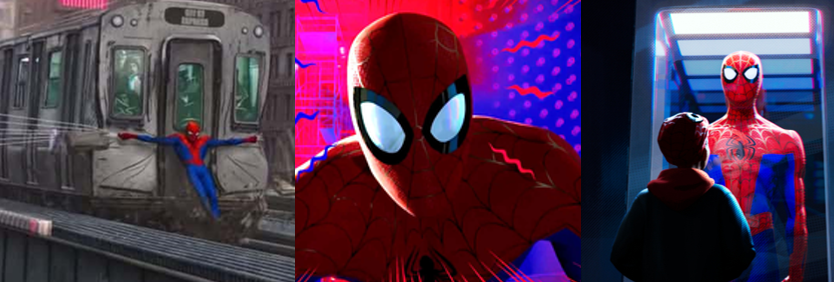
In Miles’ world, Peter is a competent, renowned, and experienced superhero.

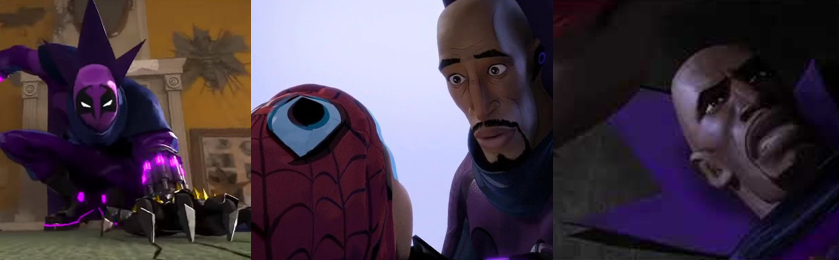
Miles lives in an alternative world that isn’t quite Earth-616 or the Ultimate universe; it’s one that draws inspiration from all over Spider-Man’s various adaptations and interpretations but one where Spider-Man is a renowned and experienced superhero. Carrying himself with the confidence of a veteran of many battles, life lessons, successes, and failures, this Spider-Man is, honestly, uncharacteristically competent in a lot of ways (he’s still married to Mary Jane Watson (Zoë Kravitz), has the full support of his beloved Aunt May Parker (Lily Tomlin), and even has a Spider-Cave full of different Spider-Suits, for God’s sake). During an intense battle with the monstrous and demonic Norman Osborn/Green Goblin (Jorma Taccone) and the slick and efficient Prowler, Peter is shocked to meet Miles, someone who shares his abilities, and vows to train him and give him the opportunities he never had when he was first starting out, such is his commitment to using great power with great responsibility.

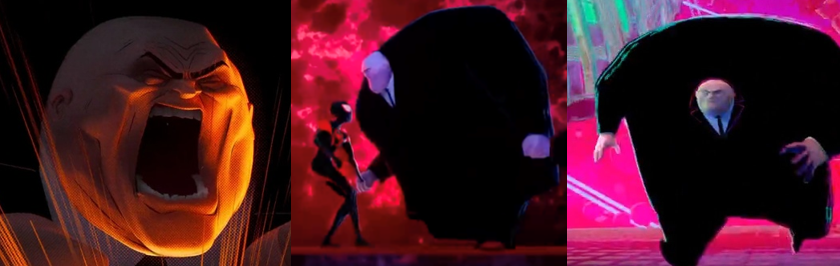
Kingpin may look ridiculous but he’s a formidable threat who killed Peter with his bare hands!

Sadly, and unexpectedly, Peter is killed right before Miles’ eyes by the Kingpin; Fisk, who blames Spider-Man for exposing his criminal deeds to the world and thus driving away his wife and son, has built a gigantic Super-Collider which he plans to use to rip a hole between dimensions and retrieve his family from another time and place. When Peter costs him this opportunity, Fisk beats him to death in a brutal and surprising scene and spends the remainder of the movie desperately trying to track down and reacquire the USB flash drive that allows the collider to work. Like Green Goblin, Fisk is a comically exaggerated version of himself, even compared to the creative flair of some comic book artists, but as preposterously absurd as Kingpin looks, his threat has, arguably, never been more tangible and brutal than in Into the Spider-Verse. Exuding unmatched power, wealth, and authority, he commands some of Spider-Man’s most notorious foes with a cold menace and is more than happy to get his hands dirty in his desperate attempt to be reunited with his family.

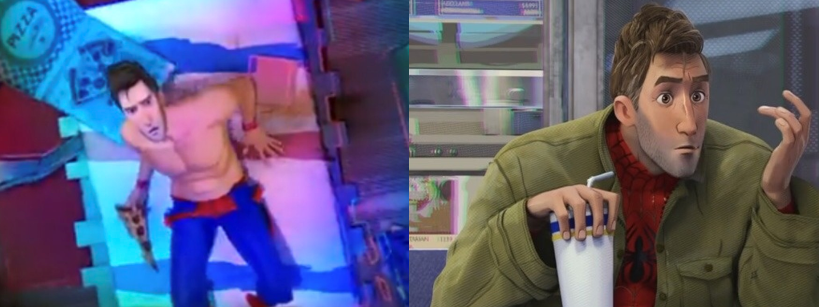
Peter B is an out of shape, world-weary version of Spider-Man who’s far from his prime.

Shaken by Peter’s death, and overwhelmed by the immense responsibility now in his hands, Miles is shocked to meet an alternative version of Peter, Peter B. Parker (Johnson), who arrived during the brief period that the Super-Collider was active. Unlike his counterpart from Miles’ world, Peter B is an out of shape, jaded, wreck of a man who has lost his way, and everything near to him, and yet, despite his crushing losses, obvious depression, and having grown weary of the power and responsibility that comes from being Spider-Man, Peter B still continues to be Spider-Man and does his best to tutor Miles in coming to grips with his powers. He’s obviously not as effective or competent a mentor than his counterpart promised to be but he does what he can regardless and is fully willing to put his life on the line to allow his fellow Spider-People to return home.

Thanks to her friendship with Miles, Gwen learns to open herself up to others once again.

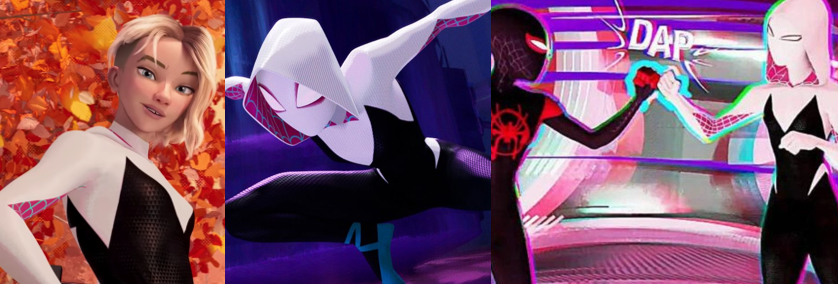
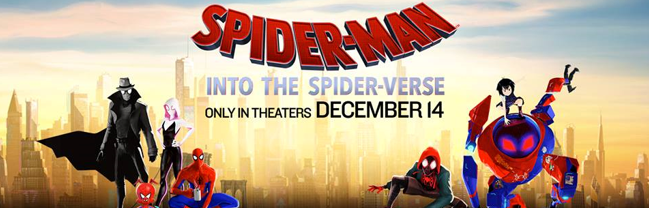
Speaking of which, Miles is also joined by a whole host of unexpected Spider-People; the first one he meets is Spider-Woman, Gwen Stacy, although he is unaware of her true identity at the time. A vastly different version of the traditional Gwen, Spider-Woman gained her powers in Peter’s place in her world and is a tough, sarcastic character who, while having a soft spot for Miles, is reluctant to open herself up to him, or anyone else, for fear of losing them. In a film arguably crowded by Spider-People, Gwen stands out by being one of the more recognisable and fleshed out characters and is, basically, a tertiary protagonist as her growing friendship with Miles is a major part of her (and his) character development. Sadly, the same can’t really be said about the rest of the Spider-Crew; Peni Parker/SP//dr (Glenn) is perhaps the least developed and expendable of the group. While she is rendered in an outstanding anime aesthetic and has a heart-warming bond with her spider mech, she’s largely inconsequential to the story and could have been spliced out with any other version of Spider-Man. Spider-Noir (Cage) and Peter Porker/Spider-Ham (Mulaney) manage to stand out a little better thanks to being rendered in monochrome and talking like a thirties gangster or being a literal cartoon character, respectively, but we don’t really learn a great deal about them and they’re mainly there to emphasise that every universe has a Spider-Man and that Spidey’s legacy and ideals are carried by a variety of characters all throughout time and space, which all directly ties into Miles’ character arc of growing into, and finally accepting, his role as Spider-Man.

The Nitty-Gritty:
Spider-Man: Into the Spider-Verse immediately sets itself apart from other Spider-Man movies not just by focusing on Miles as its main character and its cross-dimensional subplot but also by virtue of being an animated movie. Truthfully, animation suits Spider-Man down to the ground as, often, some of the more exhilarating sequences in Spider-Man movies are the computer-generated fight scenes and web-slinging moments and Into the Spider-Verse definitely uses its medium to its full advantage, featuring a unique aesthetic, comic book-like sound effects for emphasis, and even varying the frame rate to emphasise the differences between the various Spider-People and Miles’ comparative inexperienced compared to them. Humour is an important element of the film; Into the Spider-Verse is full of amusing lines, sight gags, and comedic moments that come naturally and are incredibly amusing thanks to some effortless and believable line delivery from the likes of Moore, Pine, and Johnson (Spider-Man’s quips during tough situations and battles are a notable highlight). Characters have an easy banter and sass to them that allows even the least developed of them to appear far more nuanced in the short space of time they have to shine and humour is emphasised through Miles’ inexperience with his powers, wry commentary on his increasingly chaotic situation, and the frantic nature of the action scenes and character beats.

Action and fights are colourful and frantic, ensuring no two fights are the same.

Speaking of action, Into the Spider-Verse is crammed full of some of the most impressive, intense, and frenzied action scenes in any Spider-Man movie; the freedom offered by relying on animation allows for some of the most diverse and varied web-slinging as each Spider-Person swings, fights, and moves differently. The use of music and onomatopoeia emphasises the action, which is fast-paced, memorable, and impactful thanks to the film showcasing a wide variety of Spider-Man’s rogues gallery, which includes the likes of the Green Goblin, Lonnie Lincoln/Tombstone (Marvin “Krondon” Jones III), and Mac Gargan/The Scorpion (Joaquín Cosio).

Though a vicious mercenary, Aaron’s hesitation to kill Miles costs him his life.

Apart from Fisk, though, the most prominent villains of the film are Doctor Olivia Octavius/Doctor Octopus (Kathryn Hahn) and the Prowler; while Doc Ock is a sadistic and formidable, half-crazed scientist, it is the Prowler who has the most emotional significance to both the plot and to Miles. Constantly accompanied by an ominous, animalistic theme, the Prowler is portrayed as Fisk’s top mercenary; a brutal and vicious, cat-like fighter in a sophisticated suit of armour, Prowler stops at nothing to hunt down Fisk’s missing USB drive. Miles is absolutely devastated to find that the one person he thought he could rely on in the whole world, his Uncle Aaron, turns out to be the Prowler and even more crushed when, upon discovering Miles’ identity, Aaron chooses to spare his nephew and is executed by the Kingpin as a result and dies in Miles’ arms while urging him to continue on as a hero.

Miles finally embraces his role as Spider-Man, defeats Kingpin, and returns his new friends home.

In the end, against all the odds and his own doubts and inexperience, Miles customises one of Peter’s suits (crafting an absolutely bad-ass variant in the process) and fully embraces his role as Spider-Man to confront the Kingpin and put an end to his destructive scheme. It’s a real coming of age moment for Miles, who previously could only look up in awe at Spider-Man’s legacy, and allows him to not only finally live up to the lofty expectations placed upon him by his father and the various Spider-People but also repair his relationship with his father (and his father’s opinion of Spider-Man) through his actions. With the Spider-People returned home, Miles becomes the one true Spider-Man of his world, gaining lifelong friends and a renewed sense of responsibility, confidence, and identity in the process. It’s a strikingly effective story largely thanks to how relatable and complex Miles is portrayed throughout the film, being a rebellious and well-meaning kid who is simply struggling to find his place in an ever-changing world.

The Summary:
If I’m being completely honest, I’m not really a fan of how often a street-level superhero like Spider-Man gets caught up in multiversal misadventures and meets alternative versions of himself; just like how I’m often a bit perturbed by how often Bruce Wayne/Batman has to put up with the same events, I feel like Spider-Man works better as a more grounded hero who only occasionally dabbles in cosmic-level events. To that end, I feel like Into the Spider-Verse would have been just as appealing to me, if not more so, had the multiverse elements been dropped; Peter B could have just been the version of Spider-Man in Miles’ world, Gwen could have been the same or swapped out with Cindy Moon/Silk, and the other Spider-People could have been replaced by, say, Ben Reilly or Kaine Parker and the idea of a multiverse of Spider-Man could maybe have been saved for the next movie. However, having said that, that doesn’t mean I’m not a huge fan of Into the Spider-Verse as it is; make no mistakes about it, this is a fantastic movie from start to finish, with an extremely appealing aesthetic identity and some absolutely fantastic action. It also carries a very emotional heart to its story, which is one of identity, legacy, and expectation; a coming of age story that follows a young, emotional kid who is struggling to live up to the role his mentors expect of him, Into the Spider-Verse says a lot about not only the nature of Spider-Man but also the struggles of youth and puberty. I’m glad Into the Spider-Verse did so well and I’m genuinely looking forward to the sequel delivering more of the same high-octane action and heartfelt emotion, visual flair, as well as introducing more Spider-People and, hopefully, expanding upon the brief cameo from one of my favourite Spider-Man, Miguel O’Hara/Spider-Man 2099 (Oscar Isaac).

My Rating:

Rating: 5 out of 5.

Fantastic

What are your thoughts on Spider-Man: Into the Spider-Verse? Where does it rank among the various other Spider-Man movies for you and what did you think of the artistic style and focus on Miles Morales and the other Spider-People? Which of the alternative Spider-Man was your favourite? Would you have liked to see one, or more, get a bigger role and if so, which one? What other alterative version of Spider-Man would you like to see show up in the sequel? Are you a fan of Spider-Man always having adventures with alternate versions of himself or would you prefer to see him tackling more street-level threats? Are you a fan of Miles, and what did you think to Peter’s death both in Ultimate Spider-Man and in Into the Spider-Verse? Whatever your opinion on Into the Spider-Verse, go ahead and drop a reply down in the comments and be sure to check back in next Wednesday as Spider-Man Month continues!

10FTW: Bad-Ass Movie Dads

10FTW

Being a dad in a movie is tough; often, dads are portrayed as slovenly, uncaring, even abusive individuals who care more about drinking beer, watching football, cheating on their spouses, or work than their kids. It’s a bit of a cliché at this point and also quite a bum rap, to be honest, and often seems like a case of lazy writing to have the dad be the cause of all the problems and negativity in a child’s life in a film.

10FTW: Badass Movie Dads

I suppose it makes sense, in a way; many movies involve a story about a child, son, or daughter standing up to adversity or challenging, even confronting, their neglectful parents to say nothing of the myriad of stories out there of fathers more concerned with work than the well-being of their child. Still, good movie dads do exist, even while being flawed characters in their own right, and so, seeing as today is Father’s Day, I’m going to run through ten that I consider to be amongst the most bad-ass of all movie dads…

10 Steven Freeling – Poltergeist (Hooper, 1982)

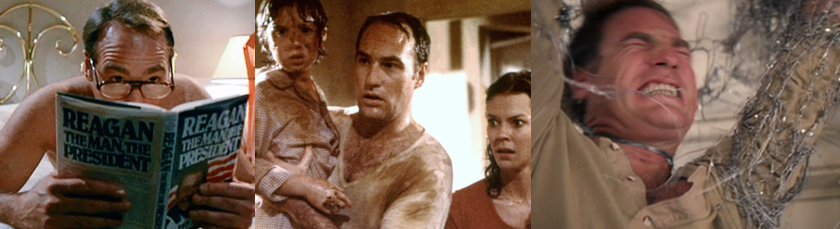
If I’m being completely honest, Poltergeist is more the story of a bad-ass mother as, throughout the film, it is Diane (JoBeth Williams) who eventually steps up after the demonic force inhabiting their house kidnaps her daughter, Carol Anne (Heather O’Rourke). Diane is the one who first feels and alerts her family to the presence in their house, she’s also far more emotionally stable despite her exhaustion and grief, and of course there’s the fact that she leaps into the “other side” to rescue Carol Anne and then has to suffer through a veritable horror show as their house is torn inside and out. Yet Steven (Craig T. Nelson) is the ever-reliable rock of the household; a bit of a goofball and perhaps (even by his own admission) too soft on his kids, he is the one who contacts a group of parapsychologists to assist them (despite his scepticism) and let’s not forget that Diane and Carol Anne never would have made it to back to the real world had Steven not been holding their literal lifeline. Despite his will weakening, Steven steps up even more in the sequel, Poltergeist II: The Other Side (Gibson, 1989), even landing what appears to be a killing blow to the malevolent Reverend Henry Kane (Julian Beck) who has been terrorising them, but, while reliability is an admirable quality, he takes the lowest spot for largely just being a supporting player (and for him and Diane sending Carol Anne away out of fear by the third film).

9 Frank – 28 Days Later (Boyle, 2002)

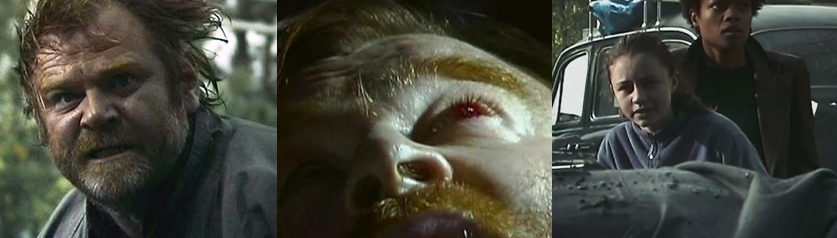
Here’s a shocking revelation for you: I’m not actually that big a fan of 28 Days Later. It starts off with such promise and with all those eerie shots of London but it’s a slow, plodding, miserable little film and the only thing I really like about it is that it made zombies faster, more aggressive, and ferocious as, for me, it otherwise wastes its potential. Still, amidst all of this we have Frank (Brendan Gleeson), a former cab driver and one of the few survivors of the infection. Initially hostile and a largely grouchy character, to say the least, Frank’s sole concern (beyond survival) is the safety of his daughter, Hannah (Megan Burns) but he soon bonds with Jim (Cillian Murphy) and Selena (Naomie Harris). Sadly, though, Frank can’t place much higher as, despite his capability as a father and a combatant, he grows complacent; in a world where the highly contagious Rage plague has turned the majority of the population into ravenous, zombie-like creatures, characters must constantly be on their guard and, for a split second, Frank lowers his. However, even while the Rage quickly overwhelms his body, his first thought is to warn Hannah back for her own safety before he is summarily put down.

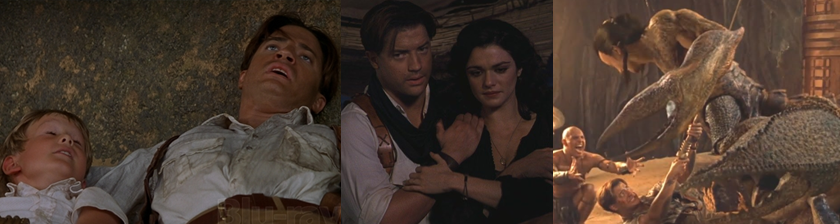
8 Rick O’Connell – The Mummy Returns (Sommers, 2001)

I miss Brendan Fraser; whatever happened to him? Arguably best known for his appearances in the Mummy trilogy (ibid/Cohen, 1999 to 2008), in which he portrayed a quick-witted and capable Indiana Jones-style adventurer, Fraser’s Rick O’Connell undergoes an interesting character arc throughout the trilogy, beginning as a disillusioned soldier and transforming from a reluctant hero motivated only by his libido to a doting father and content family man who was happy to put his adventuring days behind him. In The Mummy Returns, Rick is mortified when Imhotep’s (Arnold Vosloo) minions kidnap his smart-alecky little git of a son, Alex (Freddie Boath), and relentlessly uses every resource at his command to track Imhotep across the globe to rescue his son. Encouraging of the boy’s mischievous nature, one could argue that Alex only gets himself into a position to be kidnapped thanks to his father’s influence and their relationship has soured somewhat by the start of the third movie but that doesn’t take away from the fact that Rick travels across the world braving sea, air, and all manner of mummified atrocities to rescue his boy. When his beloved Evelyn (Rachel Weisz) is temporarily killed, we see a heartbreaking vulnerability to Rick’s usual bravado and his first action is to shield Alex from watching his mother suffer and die. Fuelled by rage and vengeance, he then takes on a now-mortal Imhotep in a fist-fight and rapidly accepts his destiny as a Medjai to deliver a killing blow to the monstrous Scorpion King (The Rock) to not only avenge his fallen wife but also as payback for putting his son in danger.

7 John McClane – Die Hard 4.0 (Wiseman, 2007)

In my experience, Die Hard 4.0 (also known by the far better title, Live Free or Die Hard) is generally not as highly regarded as its predecessors and I will always take issue with this; sure, it’s massively over the top and essentially turns the wise-cracking John McClane (Bruce Willis) into a superhero but that doesn’t make it bad. For me, it’s easily in the top three of the Die Hard films (Various, 1988 to 2013) thanks to Willis’ portrayal of McClane as weary, out of touch, and hiding a lot of his emotions behind a snarky attitude and grouchy demeanour. Now, to be fair, McClane doesn’t start the film as the greatest father; his daughter, Lucy (the always appealing Mary Elizabeth Winstead) is initially hostile towards him, refusing to call him “Dad” and preferring to take her mother’s last name. However, when she is kidnapped by Thomas Gabriel (Timothy Olyphant) as payback for McClane interfering in his “fire sale”, McClane doesn’t hesitate to throw himself into danger to rescue her, accumulating numerous injuries, enduring shots from a F-35B Lightning II, and even shooting himself in the shoulder at point-blank range to kill Gabriel. When taken by Gabriel, Lucy not only fights back at every opportunity but knows full well that her father will stop at nothing to rescue her, defiantly taking his last name and ultimately reconciling with him after seeing the lengths he would go to for her safety.

6 Darren McCord – Sudden Death (Hyams, 1995)

I feel like people don’t talk about Sudden Death enough; sure, it’s just “Die Hard on a boat” but it’s pretty decent for the most part, even with Jean-Claude Van Damme’s characteristically awkward acting and line delivery. McCord is very much like McClane, being a normal, average fire-fighter-turned-fire-inspector who has the odds against him. Though he’s much less cynical and grouchy compared to McClane, he is tormented by his failure to save a young girl from a house fire and has an extremely strained relationship with his ex wife. Similar to McClane, McCord’s relationship with his kids is a little shaky at the start of the film; Emily (Whittni Wright) views him with a heroic awe, believing him to still be a fire-fighter, while Tyler (Ross Malinger) is slightly more antagonistic and resentful. Still, he does obediently stay in his seat even as the hockey arena falls into chaos around him and Emily bravely stands up to terrorist Joshua Foss (Powers Boothe) after she is kidnapped, never faltering in her belief that her father will come to rescue her. For his part, McCord is slightly irresponsible as he leaves his young kids alone at the hockey game but more than makes up for it by taking it upon himself to disarm as many of Foss’s bombs as he can and take out the terrorists with little more than his wits, ingenuity, and some impressive kicks.

5 Damon Macready / Big Daddy – Kick-Ass (Vaughn, 2010)

Although his look and the specifics of his motivations were wildly different from his comic book counterpart, Nicolas Cage really stole the show for this awesome adaptation of the comic book of the same name (Mark Millar, John Romita Jr, et al, 2008 to 2014). Channelling the spirit of Adam West while wearing a particularly Tim Burton-esque “Bat-Suit”, Cage channelled his usual manic energy into a far more nuanced, complex performance that showed Macready to be both slightly unhinged and eerily logical. To be fair, you could argue that Macready is a pretty awful father since he pulled his daughter, Mindy (Chloë Grace Moretz) out of school and trained her to be his crimefighting partner, Hit-Girl, causing her to be more interested in elaborate knives and skewering criminals than…whatever it is pre-teen girls are into these days. However, you’d be forgetting the fact that Macready is tough but fair on Mindy, always encouraging her and pushing her to test her limits. Thanks to his training, she’s fully capable of taking out entire rooms full of armed men with ease; not only that, he also does cool stuff like purchase a whole bunch of weapons, toys, and even a jetpack. When’s the last time your dad bought you a jet pack!? Plus, there’s the fact that he continues to encourage and help his daughter even while burning to death before her eyes.

4 Harry Tasker – True Lies (Cameron, 1994)

Arnold Schwarzenegger has a bit of an iffy record when it comes to portraying dads, as we’ll see; sometimes he’s the career-obsessed type, other times he’s the overly protective type. In True Lies, he lies to his wife, Helen (Jamie Lee Curtis) and daughter, Dana (Eliza Dushku), on a daily basis to keep his true identity as a secret agent just that: a secret. As a result, and because she’s in that moody teenage phase of her life, his relationship with Dana is somewhat strained at the start of the film in that she sees him as dull and unreliable, unappreciative of the token gifts he brings her, casually stealing from his partner, Albert Gibson (Tom Arnold), and running off with her boyfriend or to her room to escape from him. However, like her mother, Dana’s entire perception of Harry is changed after she is kidnapped by terrorist Salim Abu Aziz (Art Malik) and it is her unassuming father who comes to her rescue…in a Harrier Jump Jet, no less! What makes Harry a bad-ass dad is that, when the chips are down, he drops all pretenses and shows his family exactly what he is capable of, gunning down countless terrorists and flying through city airspace just to rescue his daughter and shouldering the burden of keeping his true life from them in order to protect them. Once the secret is out, though, his relationships with both alter dramatically and they become a much more stable, contented, and united family.

3 Cameron Poe – Con Air (West, 1997)

Aaah, yes, Con Air; a ridiculously over-the-top action film, to be sure, featuring Nicolas Cage not only with an absolutely gorgeous head of hair and henched up to the nines but also sporting possibly the worst Southern draw I’ve ever heard outside of The Fast and the Furious: Tokyo Drift (Morgan, 2006). Still, as ridiculous as Cage sounds (and as ludicrous as it is that his character, a decorated Army Ranger, would be sent to prison for ten years for what amounted to a clear case of self defense, at best, and manslaughter, at worst), the film is full of equally bombastic action and performances, with John Malkovich, especially, stealing the show (and, presumably, all that scenery he chewed) as the malicious Cyrus “The Virus” Grissom. Poe stands out from the other dads on this list as he doesn’t actually meet his daughter, Casey (Landry Allbright), until the film’s conclusion; however, through his numerous correspondences with Casey, he encourages her to stay in school and listen to her mother and builds the best, loving relationship he can given his position. His entire motivation throughout the film is to get back to his daughter and, while he’s tempted to simply let things play out in order to meet that goal, his morals won’t let him stand idly by and he fights through overwhelming odds and explosions galore to not only finally meet Casey but also to teach her valuable lessons about paying for your sins and standing up against injustice.

So, I said early that Schwarzenegger has a bit of an iffy reputation as a movie dad. Well, Commando, in addition to being, perhaps, the quintessential action movie of the eighties, also showcases Arnie as one of the most devoted and bad-ass dads ever put to film. A retired Colonel, Matrix (a gloriously ridiculous name if there ever was one) is perfectly content to have put down his guns and to live peacefully amidst nature with his young daughter, Jenny (Alyssa Milano). However, when Matrix’s past (or, more specifically, the fantastically sadistic Bennett (Vernon Wells)) catches up with him and Jenny is taken as a hostage, Matrix has only around twelve hours to track Bennett down to recover his daughter. Like Poe, Matrix’s entire motivation is geared towards rescuing Jenny but, while Poe (and many of the dads on this list), must use subterfuge to meet this end, Matrix instead literally moves Heaven and Earth to find Jenny, violently dispatching of all of Bennett’s henchmen and literally walking right into a camp full of seemingly-endless, fully armed soldiers, mowing them down with such reckless abandon that he barely needs to aim or reload. Witty, determined, and possessing a razor-sharp focus, Matrix is a veritable one-man army, capable of besting anyone who stands in his way, and yet still vulnerable and human enough to be injured when dramatically appropriate and fully prepared to go to any lengths to rescue her since, as he puts it: “All that matters to [him] now is Jenny”.

I mean, honestly, could it really be any other dad? Who else but Bryan Mills (Liam Neeson) could make the top of a list like this? Like a lot of the other dads I’ve talked about, Mills is a devoted father who has left behind a violent life to focus on building a relationship with his daughter (Kim (Maggie Grace), in this instance) despite having a frosty relationship with his ex-wife, Lenore Mills-St John (Famke Janssen). Having lost his marriage, and many years of bonding with Kim, due to his work as a “preventer” for the government, Mills is a loyal, if somewhat overprotective, father who just wants to be there for Kim and to encourage her dreams of being a singer. However, when she is taken by Albanian sex traffickers, Mills puts his unique set of skills to good use; like Matrix, his entire motivation revolves around finding his daughter but Mills has even less to go on and yet, within twenty-four hours, manages to track down enough of a lead to bring him within arm’s reach of Kim’s location. Along the way, Mills dispatches anyone who opposes him with a cold, calculating efficiency; age, clearly, hasn’t dwindled his skills or resources and, for the most part, he’s still able to function at peak efficiency with very little sleep or food. Of all the dad’s on this list, Mills is the most determined and competent; every movement is premeditated, meticulously thought through, and executed with alarming proficiency and yet Mills is still humble and vulnerable enough to show real pain, fatigue, and to deliver Kim back into the arms of her mother and stepfather.

Do you agree with my list? Perhaps you have another favourite movie dad who you think should have made the cut; if so, who is it and who are some of your favourite (or least favourite) movie dads? What are you doing this year for Father’s Day? Do you have any particularly fond memories of your dad? If so, feel free to share them, and any other comments, below.