Back Issues [National Superhero Day]: Marvels


In 1995, Marvel Comics created “National Superhero Day” and, in the process, provided comics and superhero fans the world over with a great excuse to celebrate their favourite characters and publications.

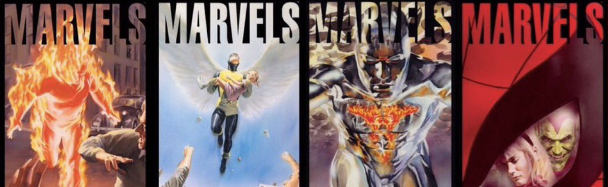
Story Titles: “A Time of Marvels”, “Monsters”, “Judgment Day”, and “The Day She Died”
Published: 9 November 1993 (cover-dated: January 1994) to 22 March 1994 (cover-dated: April 1994)
Writer: Kurt Busiek
Artist: Alex Ross

The Background:
In 1939, pulp-magazine publisher Martin Goodman created Timely Productions, expanding his reach into the increasingly popular medium of comic books. Timely’s first publication, Marvel Comics #1, was spearheaded by the first appearances of Jim Hammond/The Human Torch and Prince Namor McKenzie/The Sub-Mariner, and went on to sell over 900,000 copies. This success was followed by Captain America Comics #1 selling over a million copies just two years later, the same year that Goodman’s wife’s sixteen-year-old cousin, Stanley Lieber, was named interim editor under the pseudonym “Stan Lee”. Though superheroes declined in popularity after the Second World War, Goodman continued to publish Westerns, horror, and war comics under Atlas Comics before rebranding to Marvel Comics in 1961. Stan Lee and Jack Kirby then ushered in the “Marvel Age” of comics with the Fantastic Four, kick-starting a slew of costumed superheroes and Marvel’s distinct narrative style. These colourful heroes caught the eye of artist Alex Ross from an early age; known for his startlingly photorealistic artwork, Ross later cemented his position in the industry with Kingdom Come (Waid, et al, 1996). However, his big break came when he teamed with writer Kurt Busiek to produce this four-issue miniseries that reframed many of Marvel’s most iconic moments through the eyes of a common man. Marvels was an award-winning, widely praised miniseries that inspired a much grimmer counterpart story in 1995, a follow-up series in 2008 (though Alex Ross did not return), and a sister-series in 2021.

The Review:
Marvels followers budding photographer Phil Sheldon who, at the beginning of the story in 1939, is eager to go to Europe and make a name for himself as a war photographer. While his friend and fellow cub reporter, a youthful J. Jonah Jameson, scoffs at the futility of the war, he shares his own lofty aspirations of one day owning the Daily Bugle and making his own headlines. While Jameson heads off to cover a labour dispute, Sheldon attends a press conference hosted by noted scientist Phineas T. Horton, who unveils his revolutionary “synthetic man”, a robotic creation indistinguishable from the real thing except that it bursts into flame when exposed to oxygen. While the reporters initially mock the demonstration as an elaborate hoax, they react in horror when this “Human Torch” moves and appears sentient. Subsequent sensationalist headlines – the “power of the press”, as Sheldon puts it –   slander Professor Horton and see him bury his creation lest it prove to be a danger. While shopping for a gift for his betrothed, Doris Jacquet, Sheldon rushes to investigate a disturbance, hopeful for the big break that’ll get him shipped to Europe, only to the find the Human Torch running amok through the streets of New York City. While the ridiculously fickle New Yorkers brush the event off as an elaborate prank, Sheldon is shaken by his second sight of the flaming man and is therefore the only person to take reports of a “Sub-Mareener” seriously. Over the next few panels, both the Human Torch and the Sub-Mariner raise the ire of everyday folk with their antics, but they captivate Sheldon, who turns down the chance to cover to war to stay and follow these ever-prominent “Marvels”. As awe-struck as he is by such costumed super-men, Sheldon can’t help but question what their presence means for mankind, who suddenly seem secondary in the evolutionary chain. Thus, when the Human Torch and the Sub-Mariner inevitably come to blows in what’s likened to a battle between Gods, Sheldon shares the same fear as his fellow citizens, despite protests from the likes of officer Betty Dean, who vouches for Namor’s character.
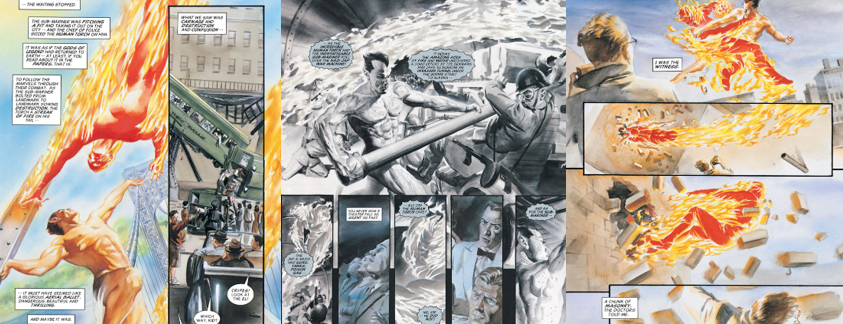
Photographer Phil Sheldon witnesses the terrifying and awesome debut of the “Marvels”.

As the two titans battle, hijacking the airwaves and causing a great deal of property damage, Sheldon is angered at them for making humanity feel so helpless. The conflict is ultimately resolved by Officer Dean, who cools the differences between the two, though Sheldon echoes the same bitterness of his peers at both superhumans escaping any punishment for their actions. In the face of his helplessness, and intuiting that such occurrences will only escalate, Sheldon reluctantly suggests pushing back the wedding and, resenting him, Doris opts to call the whole thing off until he feels more like a “man”. By winter, the press was alive with reports of Captain Steve Rogers/Captain America’s colourful adventures; kids and adults alike revelled in his Axis-smashing antics. While at the cinema, Sheldon’s musings that Cap is so accepted because he’s not perceived as a threat are given further credence when the entire audience (him included) applaud news reports of the Human Torch and the Sub-Mariner teaming up to battle the Nazis. Just like that, the Marvels are celebrated, national heroes; the public debates which of them is better and stronger and Sheldon’s perspective has changed enough to rekindle his relationship with Doris. His elevation is short-lived, however, when it’s suddenly reported that Namor has turned on the Allies and waging his own war against America, a war that sees him flood New York with a catastrophic tidal wave! The Human Torch confronts him and Sheldon’s right there to snap some pix, now revelling in witnessing such a titanic clash, only to be injured by flying debris and lose an eye in the process. Surprisingly, he feels no ill will towards the Marvels and instead chooses to focus on the bigger picture – the war and his impending wedding, specifically. After the wedding, Sheldon finally gets to cover the war in Europe and is right there when Cap, the Human Torch, Namor, and the rest of their superpowered Invaders, storm a Nazi compound, noting in a letter to Doris that the Marvels aren’t some temporary fad; they’re here to stay.
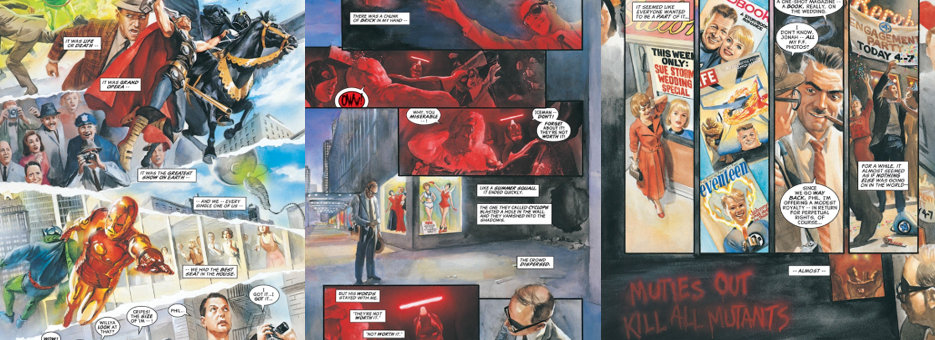
While the Avengers and Fantastic Four are celebrated, even Sheldon hates and fears Mutants.

Some decades later, an older and more experienced Sheldon is convinced to cover a battle between the Avengers and the Masters of Evil. Cap has just returned from his icy sabbatical, inspiring the awe and admiration of Sheldon and the public. By this time, sights such as Anthony “Tony” Stark/Iron Man, Thor Odinson, and Doctor Hank Pym/Giant-Man cutting through the city skyline and dwarfing mere mortals are commonplace but no less impressive. Sheldon hopes to publish a book of his photos of their heroics, convincing his publisher to take a shot on the idea based on how inspirational Marvels like the Fantastic Four are. While mulling over his opening text, Sheldon’s swept up by an angry mob who descend upon the X-Men, convinced that the Mutant teenagers tried to kill an innocent construction worker. Sharing the sentiment that the Mutants are dangerous killers, Sheldon literally casts the first stone, left shaken by the words of Scott “Slim” Summers/Cyclops (“They’re not worth it”) and pondering why Mutants illicit such hatred and distrust compared to the other Marvels. He concludes it’s because Mutants are genetically predisposed to be the next step in human evolution, thereby conjuring fears of death and redundancy in everyday folk. Ruminating these matters at home with his kids (who idolise the Marvels), Sheldon is gifted a writing assignment covering an art exhibition hosted by blind sculptress Alicia Masters. He’s also right there for when Doctor Reed Richards/Mister Fantastic announces his engagement to Susan Storm/The Invisible Girl, landing Sheldon another book deal with Jameson for every photo he takes of the colourful couple and landing him on the guest list for the wedding. With major shake-ups occurring in the Avenger’s roster and the likes of Matt Murdock/Daredevil making a splash downtown, to say nothing of the wedding drama, Sheldon almost forgets about the Mutant problem…save for the abundance of anti-Mutant graffiti plastered around town.
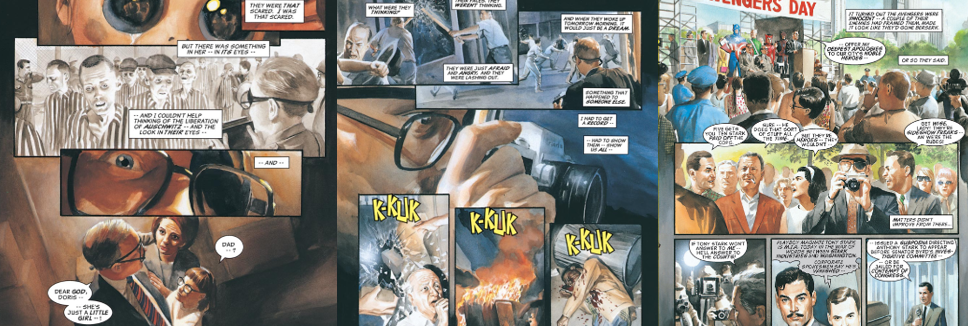
Sheldon sees the worst of humanity when the Mutant problem escalates into all-out paranoia.

Sheldon’s stunned when he returns to his quiet suburb and finds an angry mob literally grabbing pitchforks to hunt down a Mutant in the area. His first thought is his family but Sheldon’s shocked to come home and find his children sheltering a Mutant child, Maggie, a frightened little girl who’s the anthesis of everything Sheldon had so firmly believed about her species. Suddenly likening the persecution of the Mutants to the horrors of Auschwitz, Sheldon resolves to protect the girl from their friends and neighbours, who wouldn’t think twice to burn their house down to get to her. While his family keep Maggie safe, Sheldon reads up on Mutants and tries to find some way to help her, only to be met with dead ends and realise that the government wants to lock them up, at best, and execute them, at worst. Sheldon realises that the X-Men could help but falters, worrying they would remember him as another angry human, and meanders through even Reed and Sue’s wedding, his thoughts so preoccupied by Maggie’s fate. His concerns are only exacerbated when a television debate between Professor Charles Xavier/Professor X and Bolivar Trask sees the unveiling of his Mutant-hunting Sentinel machines and the outing of Professor X as a Mutant. Driven into a frenzy by fear, hated, and paranoia, an all-out riot breaks out. Sheldon’s right there, recording evidence of man’s inhumanity to man, as the monstrous Sentinels fly overhead, and is distraught to return home and find Maggie left to keep them safe and unable to comfort his kids when they worry about her safety. Within a mere two months, the fickle public begin to turn on the Marvels, holding them accountable for their actions and questioning their methods. Their primary target is Tony Stark, who bankrolls the Avengers and pays Iron Man to be his personal bodyguard, and the Avengers, who had recently been framed by evil doppelgängers. Disturbed by how sordid the Marvels have become, Sheldon throws himself into his work, determined to keep his family fed and sheltered, but unwittingly drives a wedge between him and Doris and the girls.
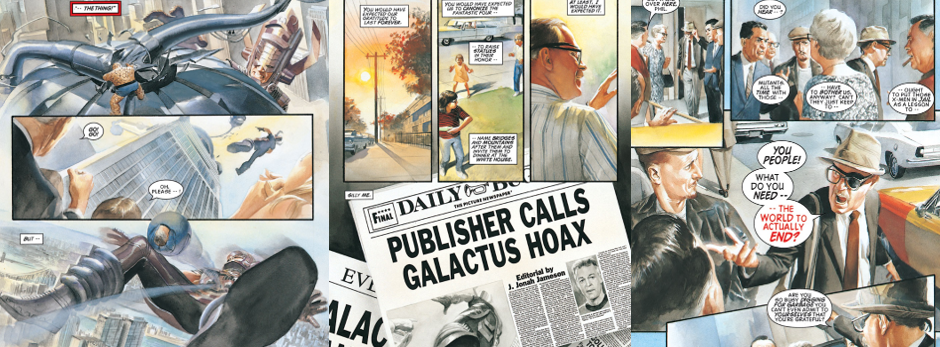
Sheldon’s incensed when the public slanders the Marvels even after they defeat Galactus.

The Marvels’ bad press is only escalated by Jameson’s personal vendetta against Peter Parker/Spider-Man and Sheldon comes to question his perception of the Marvels once more. However, he and the entire city are horror-struck when the skies burst into flames, asteroids fill the horizon, and a mysterious “Silver Surfer” arrives, seemingly heralding the onset of judgement day. Once again, despite their distrust and slander, the people must put their faith in the Marvels and be mere spectators as the Fantastic Four raced to confront the Silver Surfer, only to be dwarfed by the might and terror of the titanic Galactus! To the stunned horror of the public, the Fantastic Four lose the battle and none of their other defenders appear to help, leaving them to contemplate their end and watch, helplessly, as Galactus constructs an elaborate device around the Baxter Building. The people celebrate as the Fantastic Four and the Silver Surfer attack Galactus in full force, but Sheldon decides to leave the scene and be with his family, realising that the Marvels could fail and that he would rather be with his loved ones at the end. Luckily for him, and everyone, the Fantastic Four fend Galactus off with the Ultimate Nullifier but, rather than being celebrated as heroes, the team – and all Marvels – are further slandered by Jameson’s derogatory headlines. Sheldon’s protests fall on deaf ears and even he’s disgusted to find teenage photographer Peter Parker gleefully selling incriminating photos of Spider-Man to Jameson. His contempt for the public reaches a boiling point as Sheldon heads to cover a battle between the X-Men and Count Luchino Nefaria, snapping at them for slandering the very people, even Mutants, who save their lives. Still, by the 1970s, the public turn to his book of photographs for comfort after the Avengers are stuck in another galaxy determining the fate of all reality, begrudgingly guilty for questioning their methods. Now feeling his age, Sheldon takes on an assistant, Marcia Hardesty, though even this can’t help lighten his increasingly sour mood as he repeatedly sees the Marvels questioned, persecuted, and smeared by the courts, the public, and Jameson.
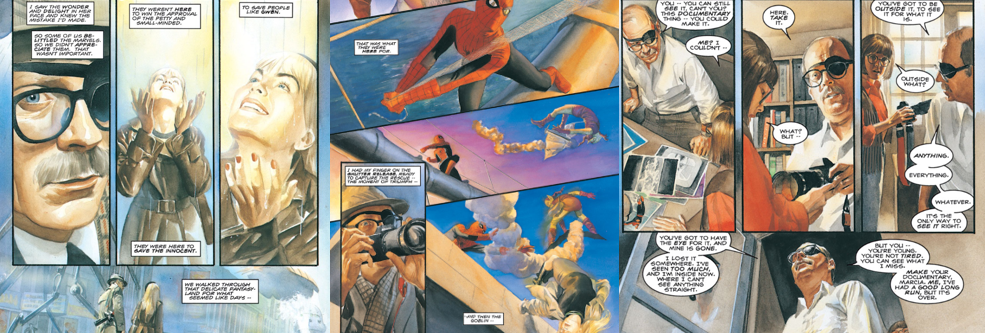
Sheldon ultimately decides to leave the awe and drama of the Marvels behind.

After the Fantastic Four again fend off Galactus, Sheldon desperately tries to turn opinion in favour of the Marvels, only to be dismissed as an overworked old man. Sheldon resolves to use his skills as a reporter to clear Spider-Man of Captain George Stacy’s death, interviewing a bystander who unashamedly blames Stacy’s death on Spider-Man. Sheldon’s as sceptical as the cops he meets with; however, while they have evidence that suggests Doctor Otto Octavius/Doctor Octopus caused Stacy’s death, they can’t prove anything without questioning Spidey. Confident that the underappreciated Marvels will handle a crisis happening at the Sun, Sheldon interviews some more people, all of whom believe Spidey’s a menace, and even questions Jameson, revealing the cantankerous publisher feels inadequate against such Marvels and is therefore determined to besmirch them, guilty or not. Jameson’s attitude makes Sheldon seriously consider an offer to write for the Daily Globe and he takes the first boat to Ryker’s Island to talk with the captive Dr. Octopus, only to find the stubborn scientist unwilling to co-operate with his inquiries. With no roads left, Sheldon visits Stacy’s daughter, Gwen, finding that, while she did initially blame Spider-Man, she no longer does. Reinvigorated, Sheldon regularly meets with Gwen; she’s with him when Namor invades New York with an army of mechanical attack craft. Rather than being terrified, Gwen marvels at their beauty and Sheldon realises that lives like hers are what the Marvels are fighting for and resolves to rework his new book into championing the heroes, flaws and all. Sheldon’s conviction turns to dread when he goes to Gwen’s to pick up some of her father’s journals and witnesses her being kidnapped by Norman Osborn/The Green Goblin. Sheldon follows in a taxi and witnesses the brutal battle between Spidey and the Goblin, sure that good would triumph over evil, and is crushed when Gwen’s knocked from the bridge and dies when Spidey tries to save her. Angered that Gwen’s death is buried under Jameson’s anti-Spidey campaign and left disillusioned by the Marvel’s failure, Sheldon loses interest in his book and grows resentful of the world moving on without a care. However, he realises that Marcia still sees the good in the Marvels and ultimately hands the assignment to her, retiring to be with his family and leaving the Marvels behind.

The Summary:
I’ve long criticised the hypocrisy of Marvel Comics’ everyday citizens. The people, especially New Yorkers, are a fickle and judgemental bunch, easily swayed by a few headlines and news reports. They can literally be dodging Galactus’ footsteps one day and then will laugh it off as a hoax the next. They can witness Spider-Man saving people from a burning building and yet fully believe Jameson’s claims that the wall-crawler started the blaze. They’ll come out in droves to cheer the wedding of Reed and Sue and applaud the star-spangled heroics of Captain America, but hurl bricks at Mutants and accuse them of all sorts in the same breath. They are a terrible, unappreciative, unreliable bunch of ingrates who don’t appreciate that these heroes put their lives on the line to save not just them, but the entire world and even the whole universe! Marvels is a perfect examination of this phenomena, with our equally culpable main character witnessing first-hand as Joe Public fear the likes of the Human Torch and the Sub-Mariner because they’re “different” and then cheer them on when they fight to defend America’s interests. Much of the public’s fickle nature isn’t just because of Jameson’s outrageous headlines, either; people, even Sheldon, feared the Marvels in the 1930s simply because of the existential threat they presented. This evolved and escalated once Mutants came along, with the species inarguably representing the next step in humanity’s inevitable extinction and thus causing the public to hate and fear them out of paranoia of being replaced (or the simple fear of death). Yet, Marvel’s civilians can never be appeased; they even turn on celebrated heroes like the Avengers for “abandoning” them and treat many of the Marvels as disposable celebrities. Their everyday, awesome feats lose their grandeur for many, who just become inconvenienced by their battles, and public opinion wildly fluctuates throughout the decades represented here as a result, even spilling over into paranoid violence when Mutants and shapeshifters become commonplace.
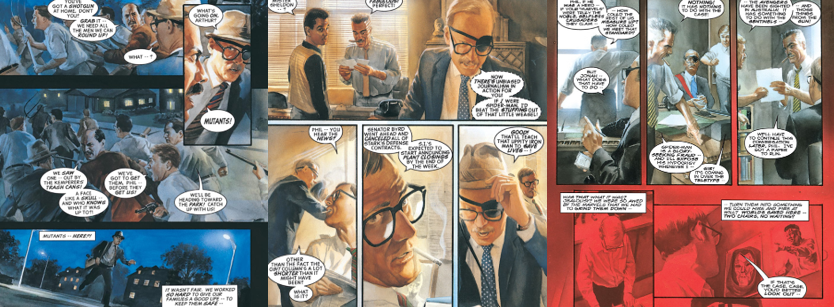
Flawed photographer Sheldon finds his awe of the Marvels tested over time.

At the heart of it all is flawed photographer Phil Sheldon. Phil’s a complex character, for sure, echoing the awe and fear of his peers at the sight of the Marvels and feeling small, insignificant, against these God-like figures. His opinion regarding the Marvels fluctuates throughout the story, with him praising and celebrating them during their “Golden Age” and profiting from their antics, never losing his faith in their good deeds even when it costs him an eye. Yet, like the public, Sheldon hates and fears Mutants. Unlike the average Joe, Sheldon contemplates why this is and realises he doesn’t really know, beyond that aforementioned existential dread. When he discovers Maggie hiding in his house, fully accepted by his well-meaning kids, he finally realises that he’s as guilty of persecution as the Nazis he once so heartily rallied against and privately defends Mutantkind. His perception changed for the better, Sheldon comes to see the worst in humanity: while they accuse Mutants of being dangerous, he sees only heroes trying to defend the innocent and angry mobs tearing their neighbourhoods apart out of sheer paranoia. Haunted my Maggie’s unresolved fate, time and weariness with the public’s everchanging opinions takes its toll on Sheldon. He remains in awe of the Marvels but focuses on them so much that he neglects his family, desperate to figure out what it is about them that distracts him so much. When Galactus arrives and the end of the world seems nigh, Sheldon realises that none of that matters; all that matters is being with the ones you love. This attitude leads into him becoming very short-tempered when people question or slander the Marvels, snapping at the unappreciative public for not realising that they owe their lives to the same people they’re dragging over the coals. Unfortunately, Sheldon lives long enough to see the best and worst of both humanity and the Marvels, realising with gut-wrenching finality that these “Gods” are as flawed as the everyday man. He comes to put all his faith in Gwen’s innocence and is thus heartbroken when Spider-Man fails to save her, but comes to see that his time with the Marvels has come to an end and that it’s time to let those concerns go to focus on what really matters.
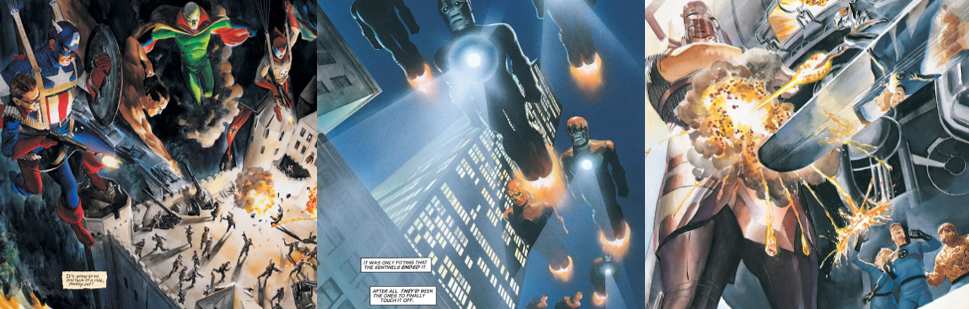
Alex Ross’s beautiful artwork brings some of Marvel’s most epic moments to glorious life.

Of course, what really makes Marvels shine is Alex Ross’s frankly gorgeous artwork. Every panel is painstakingly hand-drawn and painted to bring these colourful, outlandish superheroes to life. Unlike many of his peers, especially later in life, Alex Ross doesn’t try to reinvent these characters or make them more “realistic”; he simply presents photorealistic interpretations of their classic costumes, with the sole exception that he depicts Namor as being completely naked. This can be hit and miss; Spider-Man, for example, looks phenomenal under Ross’s penmanship but Thor and Iron Man struggle somewhat with their more outlandish designs. Still, Ross delivers some gorgeous full-page spreads, recreating Reed and Sue’s wedding, showing the battles between Namor and the Human Torch, and bringing these incredible moments to life from a street level perspective. Nowhere is this represented better than in Galactus’s arrival. Despite being faithful to Jack Kirby’s original design, Galactus cuts an intimidating and awe-inspiring figure here, towering over skyscrapers and constantly framed as though a Titan has risen from the Earth. While the story primarily focuses on Sheldon’s family life during this bout, the glimpses of the Fantastic Four and the Silver Surfer’s battle against Galactus deliver a sense of scale and realism not often seen in comics. This is further echoed in the coming of the Sentinels and Spider-Man’s battle with the Green Goblin, events where Sheldon is merely a bystander amongst the faceless masses watching history unfold, powerless to intervene. Ross fills every panel with little cameos and an amazing attention to detail, basing many characters’ likenesses off real-world celebrities and figures, and his work really makes you appreciate the craft and effort put into every panel, no matter how small. Marvels is a dramatic and compelling distillation of the first thirty-years-or-so of Marvel Comics, linking major events on a realistic timeline and giving us a glimpse at how these heroes, Gods, and villains are perceived by the common man. It’s a startlingly bleak tale at times, criticising our hypocrisy and inclination towards hatred and violence, but also an uplifting story. Sheldon, and many characters, celebrate and are inspired by the Marvels, championing them even when a small, volatile minority try to slander them. It’s the perfect snapshot of what life in Marvel’s New York City can be like and a great way to witness such iconic moments from a street-level perspective.

My Rating:

Rating: 4 out of 5.

Great Stuff

Have you ever read Marvels? If so, what did you think to it? Are you a fan of Alex Ross’s artwork? What did you think to the presentation of Marvel’s fickle public? Did you relate to Sheldon as a protagonist and enjoy his growth throughout the series? Which “Marvel” is your favourite? How are you celebrating National Superhero Day today? Whatever your thoughts, leave a comment below and be sure to check out my other superhero and comic book content.


Back Issues: Hulk #1-6

Writer: Jeph Loeb Artist: Ed McGuinness

Story Title: “Who is the Hulk?”
Published: 4 January 2008 (cover-dated: March 2008)

Story Title: “The Smoking Gun”
Published: 20 February 2008 (cover-dated: April 2008)

Story Title: “Creatures on the Loose”
Published: 23 April 2008 (cover-dated: June 2008)

Story Title: “Red Light, Green Light”
Published: 25 June 2008 (cover-dated: August 2008)

Story Title: “Rolling Thunder”
Published: 6 August 2008 (cover-dated: October 2008)

Story Title: “Blood Red”
Published: 24 September 2008 (cover-dated: November 2008)

The Background:
Created by legendary Marvel duo Stan Lee and Jack Kirby, the depiction of Doctor Robert Bruce Banner transforming into the monstrous Incredible Hulk was inspired by a story of a hysterical mother summoning superhuman strength to rescue her child and classic screen monsters Frankenstein’s Monster and Doctor Jekyll and Mister Hyde. Initially appearing as a stone-grey creature, the Hulk has appeared in many forms and at different levels of strength and intelligence over the years. We’ve seen an old, dictator-like Hulk, an intelligent gangster Hulk, a “Smart Hulk”, and even a “Devil Hulk” so why not a Red Hulk? The idea of a Red Hulk can be traced back to Kenny Johnson, producer of the popular and iconic Incredible Hulk television series (1977 to 1982), who lobbied for the colour change since red is commonly associated with rage, the Hulk’s defining characteristic, only to have his logic dismissed. However, a mere thirty-odd years later, then-Marvel editor-in-chief Joe Quesada officially introduced a red variant of the Green Goliath, one whose identity was kept a closely-guarded secret for about three years. A dangerous, intelligent, and tactically-savvy villain who grew hotter the angrier he got, the Red Hulk was eventually revealed to be Banner and the Hulk’s long-time enemy, General Thaddeus “Thunderbolt” Ross, a cantankerous military man who hounded both characters for decades. Naturally, General Ross appeared prominently in the Hulk’s ancillary media, appearing in cartoons and live-action many times, but the Red Hulk (or “Rulk” as he’s colloquially known) has not only been a card-carrying member of the Avengers but has also appeared in Hulk-centric cartoons and even unexpectedly appeared in the Marvel Cinematic Universe, courtesy of Harrison Ford.

The Review:
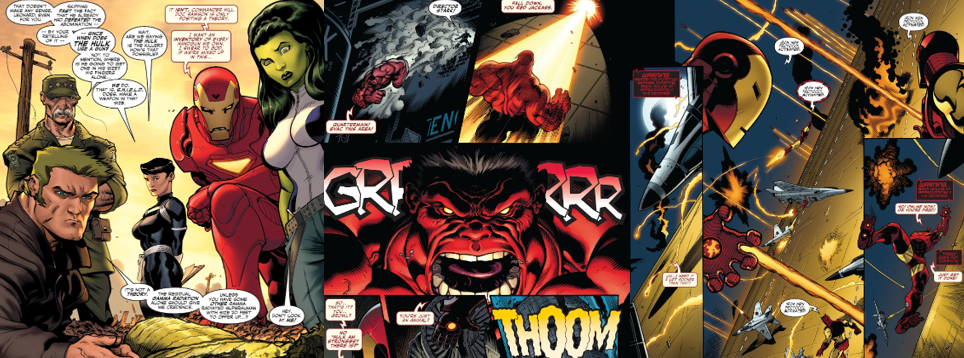
Our story begins in Russia, where Doctor Leonard Samson/Doc Samson and Jennifer Walters/She-Hulk investigate the sight of a fierce battle between the Hulk and his monstrous rival, Emil Blonsky/The Abomination. Begrudgingly, She-Hulk allows Samson to recreate the fight, deftly surmising and reenacting both character’s movements based on footprints and the surrounding devastation. It’s Doc Samson’s learned belief that the Hulk was unusually vicious, that he sought to beat the Abomination to death no matter what damage he caused in the process, and that, with his foe at his mercy, the Hulk drew a pistol and shot the creature at point-blank range. General Ross, Strategic Homeland Intervention, Enforcement, and Logistics Division (S.H.I.E.L.D.) commander Maria Hill, and S.H.I.E.L.D. director Anthony “Tony” Stark/Iron Man, who are also present, question the legitimacy of such an outrageous claim. However, when Hill reveals that S.H.I.E.L.D. does make a weapon big enough for the Hulk to fire and Doc Samson points out the residual Gamma radiation, the evidence, however unlikely, becomes difficult to ignore. She-Hulk and Samson also note that the Hulk is apparently emitting so much radiation that he’s scorching the earth with each footprint. The team’s squabbling and theorising is interrupted by Russia’s equivalent to the Avengers, the Winter Guard, led by Anton/The Red Guardian, who demand to take charge of the investigation. Despite being invited by the Russian government, the Red Guard have issue with their unauthorised personnel, like Samson, who reacts by starting a fight with the Red Guardian. Not to be outdone, Mikhail Ursus/Ursa Major, Boris Vadim/Crimson Dynamo, and Sasha Roerich/Darkstar join the fracas, with the bear-like Ursa clawing She-Hulk’s arm and Iron Man blasting the mech-armoured Crimson Dynamo right in the face. The battle is violent but short-lived as General Ross discovers a survivor, a traumatised boy who can only repeat the word “Красногоin” (or “red”) over and over.

A mysterious Red Hulk murders the Abomination and trashes the S.H.I.E.L.D. Helicarrier,

On the S.H.I.E.L.D. Helicarrier, Maria shows Stark a version of the gun used to kill Blonsky, a weapon he had no knowledge of. However, their discussion is interrupted when She-Hulk is suddenly attacked by a monstrous, Hulk-like figure. Though Stark barely glimpses the creature, he sees that it’s red, not green, and is stunned when the unconscious and badly beaten She-Hulk is dumped at his feet. Stark armours up and meets agent Clay Quartermain, who’s been injured by the monster but no less determined to bring him, and any and all Hulks, down. Iron Man’s orders are cut short when the Red Hulk suddenly tackles him through a wall. Noting the strange contradiction of a Hulk that growls like an animal but apparently wields a pistol and systematically targets a Helicarrier, Iron Man scrambles to fend off the brute’s vicious attack and deploy his spare armours to help stabilise the Helicarrier and catch the jets that tumble from it following the Red Hulk’s attack. Though his armour’s severely damaged, Iron Man is saved from a plummet by She-Hulk, who reveals that the Red Hulk wiped S.H.I.E.L.D.’s secure files with a sophisticated virus, and that the Red Hulk threatened her with an eloquence not shown to Stark. Despite Iron Man’s best efforts, the gold-plated Helicarrier crashes in a New Jersey field (with, surprisingly, no causalities). Iron Man’s attempts to formulate an effective counterattack are put on hold when Maria shows him video footage of General Ross and Doc Samson meeting with Bruce Banner, who’s held captive in the Gamma Base located in Death Valley, Nevada. The footage confirms that there is another Hulk out there, one very different from Banner’s mindless alter ego, and Banner suggests it’s someone who’s previously been exposed to high levels of Gamma radiation. However, Iron Man’s enraged when a crucial exchange between Banner and Ross is rendered unintelligible and orders Maria to clean up the recording. Later, Iron Man is brought to a meat packing plant where Agent Quartermain has been found dead alongside a severely torn, Gamma-irradiated coat belonging to Doc Samson, framing the superhuman psychiatrist as the Red Hulk.

The Red Hulk easily overpowers A-Bomb and even the rampaging Green Goliath!

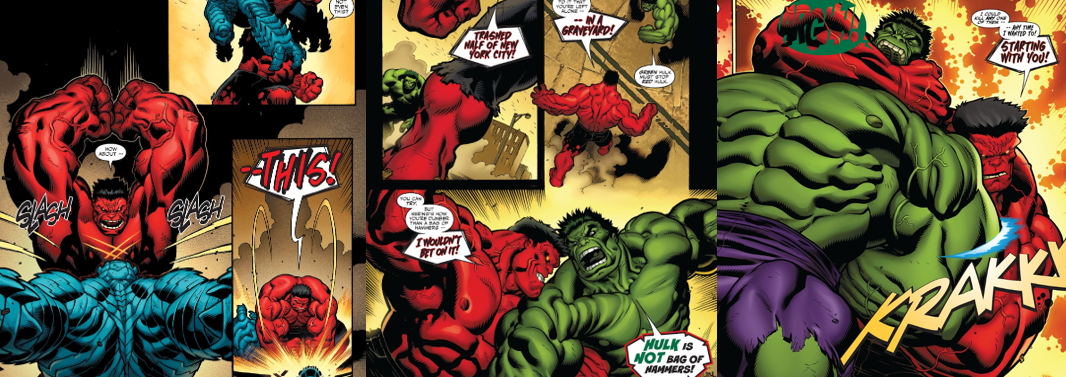
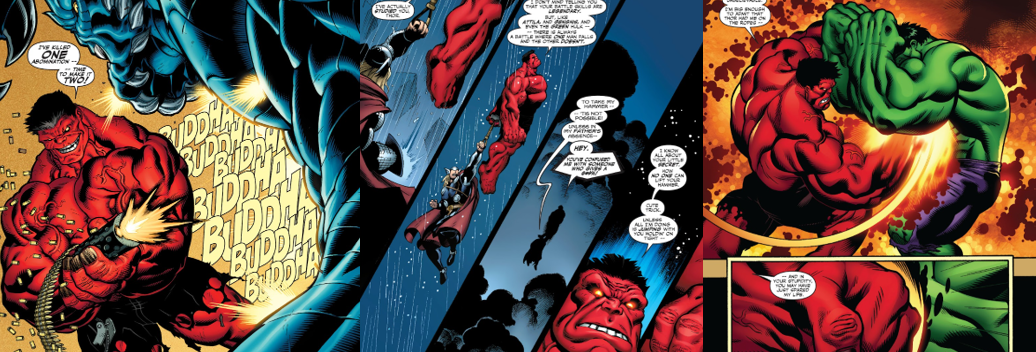
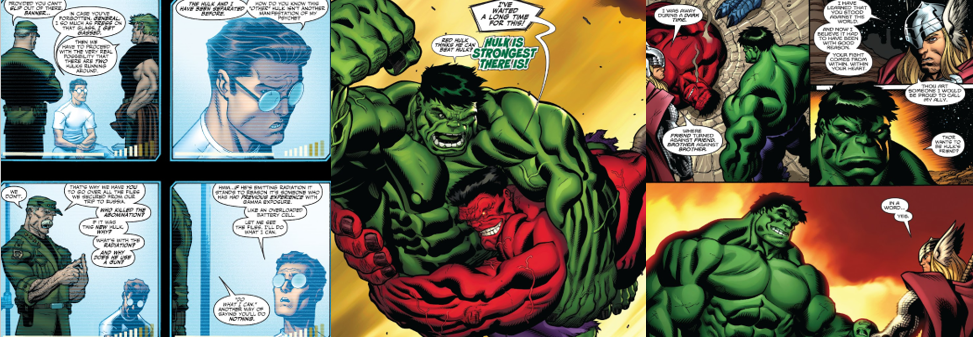
Elsewhere, the Red Hulk blindsides perennial sidekick Rick Jones outside Gamma Base, transforming him into his own Gamma monstrosity, the A-Bomb. It’s in this fight that we learn just how intelligent the Red Hulk is. While A-Bomb can only bark childish threats, the Red Hulk is goading, intelligent, and aware of his surroundings. Although Gamma Base recognises the Red Hulk as an authorised entrant, its defences fire on A-Bomb and Red Hulk takes advantage, swiping a massive cannon and taking great pleasure in riddling the armoured monster with bullets. When A-Bomb spits claims of his invulnerability, the Red Hulk gleefully tests his theory by pummelling him into the ground. The sheer force of the assault sends seismic shocks through the entire base and triggers Banner’s transformation into the Hulk when his cage attempts to gas him. As the battle rages, the base unleashes its Adamantium-taloned harpy robots (modelled after Banner’s long-time love, Doctor Betty Ross) to carry the two away. Unfortunately, the machines are no match for either monster’s strength, though the distraction separates them long enough for the Hulk to confront his red-skinned doppelgänger. Before the two can lock horns, however, the Red Hulk casually punches out Uatu the Watcher, who randomly popped up due to the significance of these two immensely powerful beings coming to blows (and, I guess, to show how tough this new Hulk is). After humbling the cosmic overseer, the Red Hulk finds the Hulk enraged by his appearance. The Hulk sees his red double an imitation and challenger to his title of “The Strongest One There Is”, a title he vehemently seeks to defend as aggressively as ever. Red Hulk, however, dives into the fight with relish, determined to make the Hulk pay for years of death and destruction, and for waging war against the entire planet after his return from Sakaar. Though the Hulk’s no longer as intelligent as his “World Breaker” persona, his strength only increases with his anger. However, the Red Hulk weathers the beating and easily grabs the Hulk’s wrist, breaking his arm and causing him to pass out.

Though he humbles Thor, the Red Hulk is outsmarted by the Hulk, his true identity left a mystery…

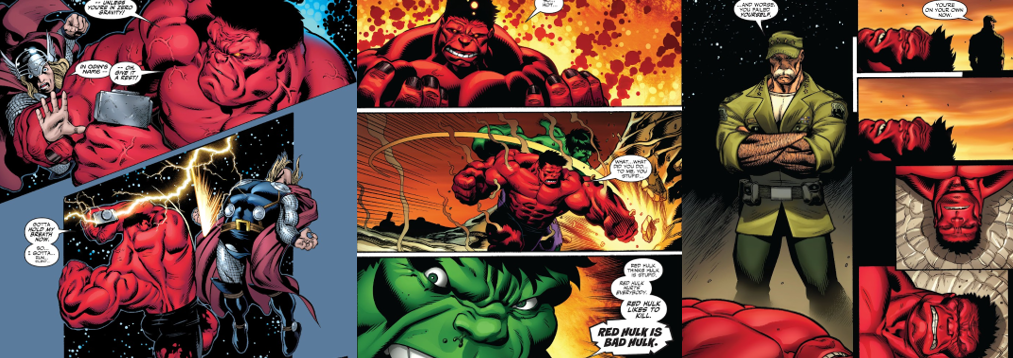
The Hulk awakens atop the Golden Gate Bridge and avoids a public execution by biting the Red Hulk’s gun. For his insolence, the Red Hulk decides to let his foe live with the knowledge that he’s not the strongest and knocks him into the bay, trigging the San Andreas fault. Thor Odinson then confronts the monster, only for the God of Thunder to be stunned when the Red Hulk shrugs off a blow from the mighty Mjöllnir. Savouring the chance to beat a God to death, the Red Hulk backs his words with blows powerful enough to draw blood and knock Thor flying. Thor fights back, not realising his foe is a different Hulk to the one he knows and is therefore left speechless when the intelligent Red Hulk gets around Mjöllnir’s enchantment by launching them out of Earth’s atmosphere. In zero gravity, the Red Hulk humbles Thor by beating him with his own hammer and dumping him on the Moon. After the Fantastic Four seemingly confirm that the Red Hulk is Doc Samson and A-Bomb pulls the Hulk from San Francisco Bay, Iron Man, She-Hulk, Ben Grimm/The Thing, Johnny Storm/The Human Torch, Prince Namor McKenzie/The Sub-Mariner, and Ares, the God of War, arrive to help save the city. While the Hulk initially rejects their assistance, he begrudgingly agrees to let them get San Francisco under control so he can confront the Red Hulk in Monument Valley. The Hulk’s efforts are aided by the returning Thor and A-Bomb, with the latter revealing the Red Hulk’s weakness (that he gets hotter the madder he gets) and restraining Thor so the Hulk can settle the score alone. Smartly, the Hulk absorbs the Red Hulk’s horrendous assault, causing the monster to overheat and grow weaker. The Hulk then asserts his dominance and knocks the Red Hulk out with a single punch. He then parts ways with Thor as friends before wandering into the desert, exhausted and reverting to Banner. However, when A-Bomb turns back into Rick and tries to reveal the Red Hulk’s identity, he’s shot in the back by Doc Samson. Both Samson and General Ross express disappointment with the Red Hulk, who they leave lying in the dirt as his eyes snap open…

The Summary:
First of all, I have to say that I love Ed McGuinness’s artwork. His work is always hyper-stylised and very bold and cartoonish, and he draws a wonderful Hulk and Hulk-like creatures, with them all being brutish monsters full of life and personality. You can tell so much about each of the Hulks in the way Ed McGuinness draws them: A-Bomb is constantly hunched over, as though weighed down by his armoured scales; the Hulk is always bulging and ready for a scrap; and the Red Hulk stands tall and confident, with a condescending smirk plastered to his face most of the time. The glue that holds this story together is the mystery of who the new Red Hulk is. At first, Doc Samson believes the Hulk is behind the Abomination’s murder. This is an odd hypothesis given he knows as well as General Ross that Bruce Banner is locked up in Gamma Base, but not one without merit; after all, Doc Samson himself once split Banner and the Hulk into separate beings. Naturally, given he was a bit of a dick around this time, Iron Man’s primary thought is to his culpability; he snaps and rages at Maria Hill about the Hulk-sized weapons S.H.I.E.L.D. developed and is desperate to ensure he can’t be held accountable for the murder. The evidence seems to ring true, but for the use of a gun and the scorched footprints, though She-Hulk remains unconvinced that her cousin was capable for such a cold-blooded act. Little moments throughout the story give some hints towards the Red Hulk’s identity, but there are numerous red herrings as well: Rick Jones, for example, seems tormented at the events, initially framing him as a suspect. We see that both Samson and Ross are authorised Gamma Base personnel, and that the base’s security recognises the Red Hulk’s iris. The garbled security footage seems to implicate Samson, as does his tattered coat, and the story even ends with the suggest that Doc Samson is the Red Hulk…until it’s revealed he’s not. But then again, General Ross is also seen standing over the Red Hulk’s unconscious body and he was right there when the Red Hulk attacked the Helicarrier, and he later turns out to be the Red Hulk! Indeed, the ending suggests more that Samson and Ross were in league with the Red Hulk, rather than being him, and I’d be interested to know or try and remember exactly how they explained how Ross and the Red Hulk could be in the same place at the same time (though it was probably a Life-Model Decoy).

The Red Hulk is an overpowered, egotistical, and incredibly dangerous Hulk.

As for the Red Hulk…well, this is a glorious showcase. Doc Samson’s intuitive nature reveals that the Red Hulk is a formidable foe, capable of beating even the super-tough Abomination into submission and fighting with a ferocity and power comparable to the Hulk. The Red Hulk is also seen to be tactically minded, launching an all-out assault against Iron Man’s fancy-pants gold Helicarrier and even wiping S.H.I.E.L.D.’s files. The Red Hulk’s intelligence is showcased in his eloquence; he delights in goading and taunting his foes as he fights them, displaying a familiarity with each and the defences of Gamma base. He repeatedly demonstrates a personal vendetta against the Hulk, first happy to frame him for murder and then delightedly besting him in a straight-up fight, even going so far as to break the Green Goliath’s arm and wish to publicly execute him. This, as he says, is payback for the Hulk’s years of death and destruction and more recent assault against the entire planet. The Red Hulk sees the Hulk as the true threat and is determined to stamp him out, but he’s also out to prove himself the superior being in mind and body. And what better way to do this than by not just beating the piss out of the Hulk and kicking him to the bottom of the San Francisco Bay, not just by punching out the Watcher, but by besting Thor in combat! Seriously, the Red Hulk is so massively overpowered it’s not even funny. Not only does he outmatch and humiliate Thor, even using insane logic to rob him of Mjöllnir, the Red Hulk completely disrespects and disregards the God of Thunder like he was nothing. A vindictive, calculating, ferocious opponent, the Red Hulk is so much than just another “Smart Hulk”. His blows have a purpose, striking at weak points and mixing pure power with tactical precision; he knows what he’s doing and enjoys doing it. His only weakness, one he doesn’t seem to realise, is that his body temperature rises exponentially when he gets mad, weakening him significantly. Well, it’s not his only weakness: he still needs to breathe, but that isn’t much of an issue considering he effortlessly trounced Thor while holding his breath.

The Hulk doesn’t care who his new foe is. He just wants to prove he’s the strongest!

The Red Hulk’s debut starts off as a showcase for the new Hulk on the block and a superpowered murder mystery. The investigation into the Abomination’s murder, the murder weapon, and the mystery of what’s happened to drive the Hulk to such an uncharacteristic action frames the first issue and a half. Once the Red Hulk makes his presence know, there’s some brief confusion as even Banner states that he’s been split in two and assumed different forms before, but then the crux of the story becomes trying to work out who this new Hulk is. Thus, everyone’s favourite Jade Giant doesn’t factor into the story for a few issues. Indeed, it’s up to the decidedly Hulk-like A-Bomb to carry the load when the Red Hulk targets him, but the action really ramps up when the two Hulks come to blows. I’m not sure what happened between Green Scar’s return to Earth and this story, but the Hulk has regressed to his mindless, child-like persona and is therefore at an initial disadvantage against his more tactile-minded doppelgänger. The Hulk’s driven to fight the Red Hulk out of a sense of pride (“Hulk is Hulk!”, after all) rather than to protect others, but his need to prove himself superior aligns with defending his few friends (such as A-Bomb) and allowing Iron Man and the others to save San Francisco. Thanks to Ed McGuiness, the Hulk-on-Hulk action is dynamic and interesting; it’s not just a senseless brawl as both Hulks weather their opponent’s onslaught to tire them out or strike when the opportunity presents itself. The Red Hulk, especially, stands out by using an enemy’s momentum against them and mixing brain with brawn, while the Hulk is naturally more savage and only tries a different tactic after seeing how dangerous his foe is. The art definitely makes his story a visually enjoyable experience and I did like the intrigue surrounding the Red Hulk. The red herrings and revelations are kind of odd knowing what I know now about the character, but it’s always nice seeing 2008-era Iron Man get his smug face smashed in and I loved that an intelligent Hulk proved to be such a threat. There’s definitely enough here to make me want to read up on what happened next with the Red Hulk and the lingering plot threat regarding Doc Samson, and the mixture of action and mystery were highly entertaining all-in-all.

My Rating:

Rating: 4 out of 5.

Great Stuff

Did you enjoy the Red Hulk’s explosive first appearance? Do you think the writers went a bit over the top in showcasing his threat, power, and intelligence? What did you think to the murder mystery sub-plot and who did you think the Red Hulk was? Were you impressed by the way the Hulk defeated his doppelgänger at the end? Which alternative version of the Hulk is your favourite? What are some of your favourite Red Hulk moments? Tell me your opinions on the Red Hulk in the comments and be sure to check out my other Marvel and Hulk content.
Back Issues [Independence Day]: The Avengers #4


First appearing in 1941, Marvel Comics’ star-spangled super soldier, Captain Steve Rogers/Captain America, has become one of Marvel’s most recognisable and celebrated characters not just for his super patriotism but also for being a prominent member and leader of Marvel’s premier super team, the Avengers. Having successfully made the jump to live-action, Cap is now a widely celebrated, mainstream superhero and, given that today is Independence Day, this seems like the perfect excuse to pay tribute to the star-spangled man with a plan himself!


Story Title: “Captain America Joins…The Avengers!”
Published: 1 March 1964
Writer: Stan Lee
Artist: Jack Kirby

The Background:
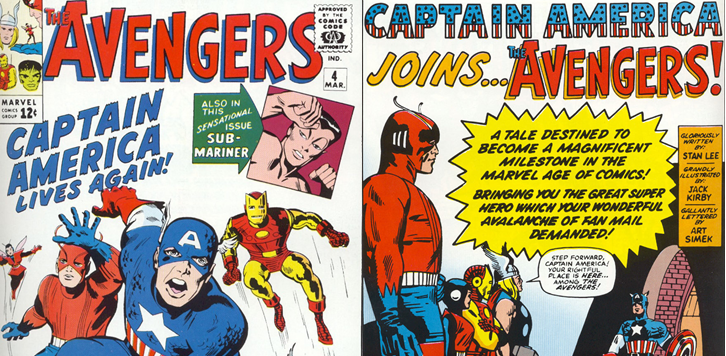
In 1941, the Second World War was well under way; Nazi Germany overtook Denmark and Norway in April 1940 and the United States finally entered the fray in 1941 to oppose the combined “Axis powers” of Germany, Japan, and Italy. Due to the ever-escalating conflict, patriotism and national pride ran rampant in America, leading to Joe Simon and the legendary Jack Kirby debuting Captain America and his kid sidekick, James Buchanan Barnes/Bucky, who took the fight directly to the enemies of America and encouraged readers to support the war effort by any means necessary. However, after the War ended, superheroes saw a decline in popularity and Captain America’s solo title was cancelled in 1954, but the character got a second chance when he was recast as a “man out of time” in this issue of The Avengers. The Avengers came about as a direct response to rival DC Comics’ Justice League of America; Martin Goodman tasked Stan Lee with bringing together Tony Stark/Iron Man, Doctor Bruce Banner/The Hulk, Doctor Donald Blake/Thor Odinson, Doctor Hank Pym/Ant-Man, and Janet van Dyne/The Wasp as Marvel’s premier superhero team. With their ever-changing roster and prominence in some of Marvel’s biggest events and stories, the Avengers became a consistent and influential presence in Marvel Comics, even more so after the Star-Spangled Avenger joined their ranks in this historic issue.

The Review:
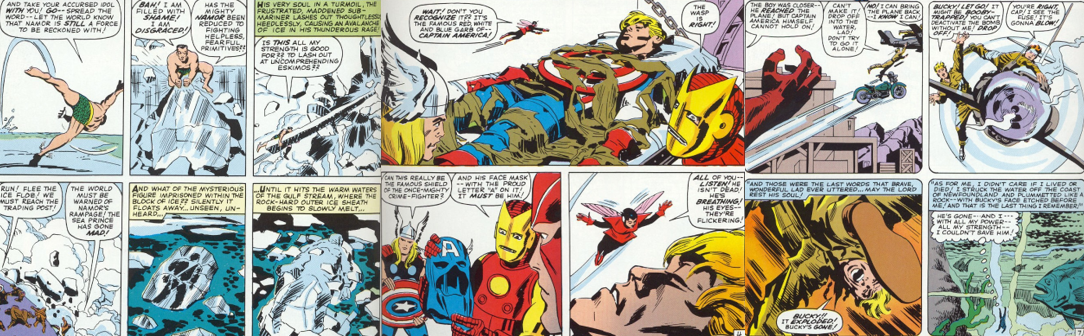
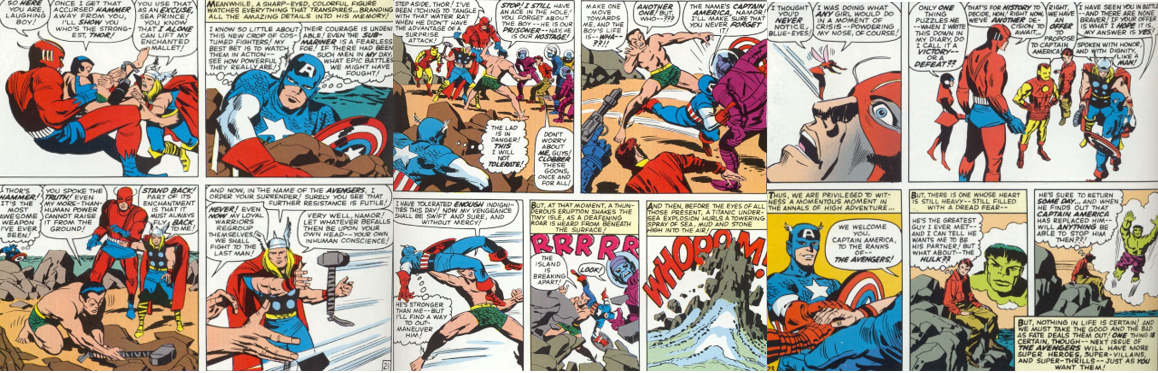
Marvel Comics always liked to hype up their stories and issues back during this time period; front covers would proclaim even the most bizarre-looking characters as being must-see events and issues generally always featured celebratory mentions of the creatives involved, and The Avengers #4 is no different. There are a couple of notable unique features in the full-page title splash for this story, though; first, a big explosive bubble of text directly attributes the return of Captain America to an “avalanche of fan mail” and a dialogue box at the bottom of the page makes sure to mention that “glorious” Stan Lee and “grand” Jack Kirby both collaborated on Captain America’s debut story, thereby lending further prestige to his return to the then-modern era of Marvel Comics. The story itself takes a little while to get started as the first page of panels is dedicated to recapping the Avengers’ battle against Prince Namor McKenzie/The Sub-Mariner and the Hulk in the previous issue; after the Hulk disappeared, Namor was forced to flee from the overwhelming odds and returned to the depths of the ocean. The sting of defeat is great for the proud Mutant but pales in comparison to the frustration he feels at being abandoned by his people after the inhabitants of Atlantis questioned his loyalty. Vowing to never stop searching for his lost people, Namor finds himself lost amidst the frozen wastes of the North Sea, where he comes across a tribe of Eskimos who worship a mysterious figure frozen in a block of ice. Interestingly, despite the Eskimos being isolated from the rest of the world, they instantly recognise “the dreaded Namor”, who wastes no time in mocking their idol and turning his anger upon them. In his rage, Namor decimates the frozen landscape, terrorises the simple folk, and hurls their frozen idol into the sea.
The Avengers are awestruck when they recover the perfectly-preserved body of the legendary Captain America!

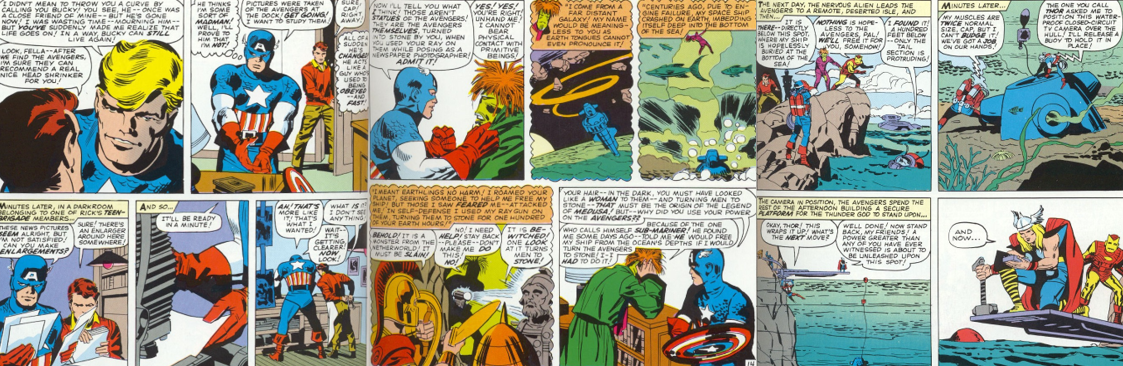
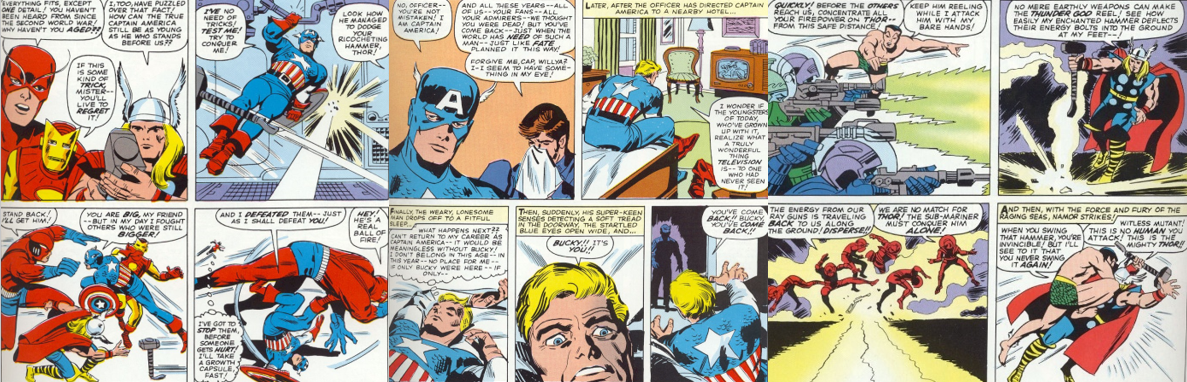
Free from the frigid temperatures of the northern climate, the ice block slowly melts and, by the time the Avengers come across it in their little submarine (I assume they were tracking Namor, that seems to make sense as to why they’d randomly be out there), the ice has completely melted, freeing the unconscious body trapped within. Giant-Man brings the body aboard and the team are stunned to find that it’s none other than the slumbering body of the legendary Captain America, a star-spangled crusader of justice so prolific that even Norse God Thor is aware of his accolades. The team’s shock at this discovery turns to panic when Cap suddenly awakens and lashes out in a confused daze, desperate to keep his kid sidekick, Bucky, from harm. Thor, Iron Man, and Giant-Man leap in to restrain the raging legend, but his madness quickly passes. Within the space of five panels, he resigns himself to the memory that Bucky is dead and reclaims his identity, shield, and mantle of Captain America. Though impressed, the Avengers are so puzzled by Cap’s youth and vigour that they suspect some kind of trick. Thus, Cap invites them to test him, easily dodging Thor’s magical hammer, overpowering even the hulking Giant-Man, and is only kept from embarrassing the group further when Wasp stops him in his tracks by challenging his chivalry. Suitably convinced that Cap is the real deal, tensions calm long enough for Cap to tell the tragic story of how he came to be encased within a block of ice. Back during the Second World War, Cap and Bucky were posing as security guards at an Army base when a mysterious Nazi figure launched an explosive-filled drone in a bid to either kill the two or rob the United States of a powerful weapon. Although Cap failed to reach the plane in time, Bucky leapt onboard and was seemingly vaporised when the plane exploded; the heartbroken Cap was hurtled into the ocean depths off the coast of Newfoundland, where he became encased in ice and effectively held in suspended animation. When the Avengers reach New York City, they’re greeted by the press, hungry for the big scoop on their battle against Namor and the Hulk, but the team are suddenly and inexplicably turned into stone statues by a flash of light! Cap missed the event since he was still inside the craft and, when he emerges topside to find everyone gone, he assumes that the statues are in honour of the colourful heroes and ventures out to explore the strange new world he’s found himself in without a second thought.

Cap tracks down the one responsible for petrifying the Avengers, an alien whom he vows to assist.

Cap is impressed by how much has changed, from clothing and fashion to the establishment of the United Nations and the upgrades to everyday vehicles, and stuns the public, who instantly recognise him as the legendary hero of World War II. Directed to a hotel by a helpful police officer, Cap briefly marvels at the wonders of television before dozing off in a troubled exhaustion. Already questioning his place in the modern age, Cap is startled to wake up and find Bucky alive and well in his hotel room…only to realise that it’s perennial sidekick and Avengers mascot Rick Jones. Concerned by the Avengers’ disappearance, Rick confronts Cap; since Cap was the last person to see them, Rick basically accuses him of being involved and threatens to set the Hulk on him if he doesn’t help find the team. This threat means little to Cap since he doesn’t know who the Hulk is and he’s still struggling with the uncanny resemblance between Rick and Bucky, but he promises to help find the team despite Rick’s rude demeanour. After reviewing the photos taken of the team by the press, Cap spies a suspicious man holding a camera-like gun and Rick wastes no time in contacting his “teen brigade” to try and find him amongst the teeming masses. Laughably, the teens come up with nothing but dead ends and false leads, but Cap finds the guy seemingly at random just by scouring the city’s rooftops. Once he spots the man he’s looking for, Cap wastes no time in springing into action and confronting him and his armed goons. Even these lowly mobsters recognise Cap and they’re easily overwhelmed by his indomitable shield, uncanny agility, and Herculean strength; while the goons quickly surrender, their leader desperately tries to turn Cap to stone with his ray gun, only to miss and be unmasked as a bizarre extraterrestrial lifeform! Unfazed by this, Cap threatens the alien (who goes unnamed in this issue but is eventually revealed to be named Vuk), who gladly tells his story to avoid being handled by “primitive beings”. Vuk crash-landed on Earth centuries ago and, encountering nothing but fear and hostility, would turn men to stone with his ray gun in self-defence, which Cap realises directly led to the myth of the hydra-haired, stone-eyed Medusa. Vuk relates that the Sub-Mariner promised to help Vuk return to the stars if he turned his weapon against the Avengers and, recognising the Sub-Mariner’s name from the past, Cap vows to help Vuk in return for undoing the damage he’s inflicted upon the Avengers.

As impressed by the team as much as they are with him, Cap helps fight Namor and joins the Avengers.

Namor witnesses these events from his deserted imperial castle using his “undersea scanner” and vows to avenge himself upon his enemies, a promise that suddenly becomes more viable when he conveniently stumbles upon a loyal troop of his elite guard. True to his word, Cap leads the Avengers in finding and freeing Vuk’s ship from the ocean depths, an act that earns them Vuk’s eternal gratitude and Cap’s admiration for the group’s unparalleled teamwork. Their victory is short-lived, however, as Namor and his elite guard suddenly attack the group; Iron Man goes toe-to-toe with Namor but his armour struggles to withstand the sledgehammer-like blows of the Sub-Mariner. In desperation, Iron Man blasts Namor with a “full [intensity] magnetic ray”, but this only grants him a temporary reprieve; with his armoured foe’s “greatest weapon” exhausted, Namor redoubles his attack, smashing a rock over Iron Man’s head and manhandling him to the ground. Momentarily powerless as he waits for his transistors to recharge, Iron Man is saved from certain death by the timely intervention of the Wasp, who Namor easily shrugs off before answering his lieutenant’s plea for help in subduing the rampaging Thor. Thanks to his mighty hammer, Thor easily holds back Namor’s forces by himself and repels the energy bolts fired at him by their ray guns, forcing Namor to leap at the Thunder God to tackle him directly. After slipping free of the Atlantean’s net and saving himself from drowning, Giant-Man returns to the fray to assist Iron Man, hurling the Atlanteans off-panel with his massive strength before rushing to aid Thor in tussling with Namor, who’s become obsessed with wrestling Mjölnir from Thor’s grasp. Watching from the side lines, Cap can’t help but be impressed by the power and courage of the Avengers and in awe of Mjölnir, a weapon so powerful that only the Mighty Thor can lift it. Although the Avengers clearly have Namor beat, the proud prince refuses to surrender and lowers himself to threatening Rick’s life. This irks Cap so much that he finally leaps into action, tackling Namor’s elite guard and briefly being overpowered by the Sub-Mariner before the tiny isle on which they’re all fighting suddenly (and conveniently) breaks apart from an undersea explosion caused by Vuk’s ship. Confident that his enemies will drown beneath the resulting waves, Namor commands his forces to retreat, unaware that the heroes easily survived by clinging to the remains of the island. Impressed by Cap’s prowess in battle, the Avengers ask him to join their little team and he gratefully accepts, but Rick is left pondering the fate of his friend and partner, the Hulk, whose rage at being “replaced” by Captain America is as sure as the inevitability that the Avengers will butt heads with the Sub-Mariner again before long.

The Summary:
I quite enjoyed “Captain America Joins…The Avengers!” I sometimes struggle with Jack Kirby’s more bizarre artwork and designs but there was none of that here (save for the Avengers’ submarine and the brief depictions of Atlantean technology), which really helped these colourful characters to stand out all the more prominently. I especially liked Cap’s brief walk around New York City and him being impressed by the advances in technology and society since his day, and the panels that took place underwater, which evoked a murky, almost alien environment. Unfortunately, paralleling this was the pretty haphazard and confusing flashback to Bucky’s final mission, where it’s a bit difficult to make out where the characters are in relation to the plane, and the depiction of Vuk, who ends up looking more like Beaker than anything remotely impressive. I also really didn’t care for the reveal that an alien was behind the Avengers’ petrification; it was weird that Cap took it in stride and that the story didn’t treat it as a big deal, and it just came out of nowhere. I think it would’ve been far better to have it be an Atlantean in disguise, maybe switch the order of events to show Namor recruiting his elite guard before the Avengers reach New York, and then Cap could just threaten the Atlantean into helping him. It’s a minor thing to complain about but that’s kind of the problem; Vuk doesn’t even get a name and it just seems so random to just insert a Medusa-like alien into the story when the primary focus is the antagonism against Namor. Normally, I’d also complain about the depiction of women and youth during this time but, aside from being a bit too rude and confrontational, I didn’t have much of an issue with Rick Jones here and I was actually very impressed by the restraint show with the Wasp. She doesn’t fawn or coo over Cap upon seeing him and actually proves quite useful in the scuffle with him and Namor…but then all that goodwill gets thrown away on the very last page where it’s revealed that the Wasp disappeared from the battle to powder her nose!
Cap impresses with his abilities and characterisation, as does Namor’s unquenchable pride.

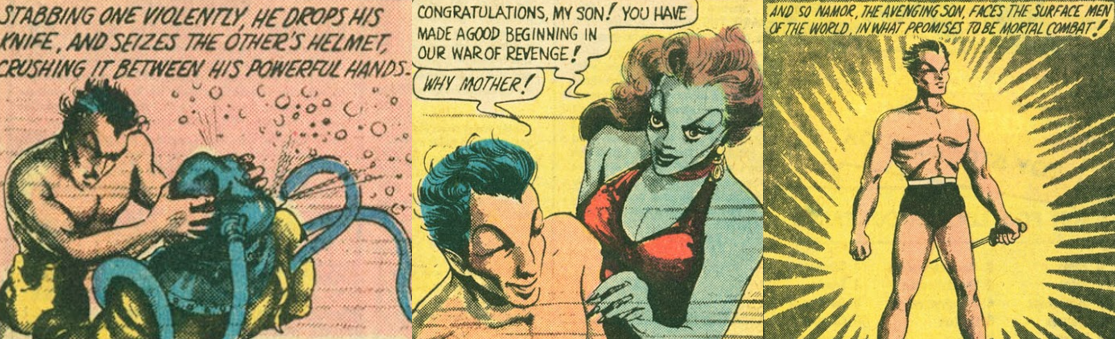
However, I enjoyed the angst of the Sub-Mariner as depicted here; Namor’s anger against he surface world has only exacerbated since his people abandoned him after questioning his loyalty due to his mixed heritage and he’s desperate not only to find his people, but to subjugate humanity to prove his superiority. There’s a tragedy to Namor that’s present even here; he lashes out at everyone and everything because he doesn’t want to be alone and craves power and adulation, but he’s tormented by being a child of both worlds and his status as a Mutant amongst even his bizarre people. Depicted as both an underhanded tactician and a formidable physical force, Namor’s threat is enough to require the attention of all the Avengers even without his elite guard and I liked how he easily overpowered Iron Man and matched even Thor’s God-like power (even if he was unable to lift Mjölnir). Of course, the true star of this story is Captain America; I really enjoyed how the issue went to great lengths to talk up Cap’s status as a legendary figure and that even randomers in the street recognised him as a hero from their youth. The Avengers are awestruck by his presence and seem delighted to not only have him amongst them, but also to test his abilities in battle, and Cap is equally impressed by the team, who he wishes could’ve been by his side during World War II. While it seems like Cap quickly regains his senses and returns to his confident and commanding persona, the story does touch upon the grief and anguish he feels at Bucky’s death and his feelings of belonging in the then-modern world. Though impressed by how far the world has come since his day, Cap briefly feels as though he doesn’t belong there, and it isn’t until he’s back in action, tracking down the Avengers’ mystery attacker and engaging with the Sub-Mariner, that he truly feels himself again. This was the perfect way to sell newcomers and sceptics on Cap’s return and make him relevant amongst his modern contemporaries and I really enjoyed how he meshed with the Avengers and their mutual respect for each other. Take out the Vuk stuff (or replace it with something better) and this would’ve gotten full marks from me, but it’s still a blast to read and one of the quintessential Avengers and Captain America stories.

My Rating:

Rating: 4 out of 5.

Great Stuff

Have you ever read “Captain America Joins…The Avengers!”? If so, what did you think of it and did you enjoy seeing Captain America join the Avengers? Was this your first exposure to Captain America, and if not what was? Were you also disappointed by the inclusion of Vuk? What did you think to the depiction of Namor and Cap’s introduction to the then-modern world? Which of the Avengers is your favourite? How are you celebrating Independence Day today? Whatever your thoughts, drop a comment below or on my social media and be sure to check out my other Captain America content across the site!

Back Issues: Secret Invasion

Published: June 2008 to January 2009
Writer: Brian Michael Bendis
Artists: Leinil Francis Yu

The Background:
In January 1962, legendary duo Stan Lee and Jack Kirby introduced Marvel Comics readers to the Skrulls, a race of warmongering shape-shifters who have long hounded Marvel’s heroes, particularly the Fantastic Four, by assuming their identities and powers. Experimented on by the all-mighty Celestials and launching aggressive campaigns against both the Earth and their hated enemies, the Kree, the Skrulls have been at the forefront of numerous Marvel stories over the years in addition to featuring as villains in various videogames and animated ventures before making their live-action debut, in a decidedly different manner, in Captain Marvel (Boden, 2019). Perhaps one of their most prominent storylines was the Secret Invasion arc that ran through these eight issues and multiple tie-ins and spin-offs; the brainchild of writer Brian Michael Bendis, Secret Invasion had not only been hinted at for some time and was heavily advertised as a means of changed up the perception of legacy Marvel characters and even return some to mainstream publication. Reviews of the storyline were mixed, with some noting that it was an anti-climatic Marvel event and others praising the marketing and artwork while criticising the religious undertones and spotty dialogue. Still, an adaptation of the story made its way into the Avengers: Earth’s Mightiest Heroes cartoon (2010 to 2012) and it also formed the basis of a six-episode, live-action series of the same name on Disney+.

The Review:
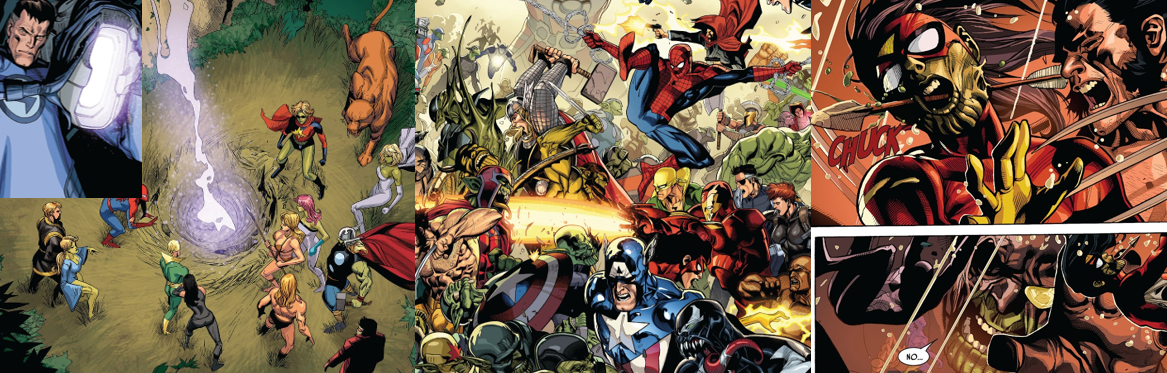
This eight-issue event series begins “years ago” after the destruction of the Skrull throneworld, a cataclysmic, prophesied event that leads the few survivors back to their queen, Veranke, who kicks the story’s narrative in motion by seeding Skrull agents throughout our world. It took years for this to be uncovered, and it was revealed in dramatic fashion when it turned out that the resurrected assassin Elektra Natchios was a Skrull in disguise, a revelation that alerted Tony Stark/Iron Man (then the conceited and self-righteous director of the Strategic Hazard Intervention Espionage Logistics Directorate (S.H.I.E.L.D.) following the game-changing events of Civil War (Millar, et al, 2006 to 2007)) to the depths of the Skrull’s infiltration. Recognising that even his armour’s sensors can’t be trusted to identity friend from foe, Stark drafts in his allies – Doctor Reed Richards/Mister Fantastic and Doctor Henry “Hank” Pym/Yellowjacket – to perform an autopsy in an attempt to figure out how the Skrull was able to remain completely undetected to technology, magic, and Mutant probing. Conveniently enough, a Skrull ship chooses this exact moment to come crashing into Earth’s atmosphere and make landfall in the Savage Land, taking Iron Man away from the operating room so he can investigate. Concerned that this could be the full-scale invasion they fear, Jessica Drew/Spider-Woman calls in the renegade “New” Avengers (those who refused to sign up to the ludicrous Superhero Registration Act in Civil War), which leads to Luke Cage/Power Man, Peter Parker/Spider-Man, James “Logan” Howlett/Wolverine, Danny Rand/Iron Fist, Clint Barton/Ronin, and Maya Lopez/Echo subduing Black Widow/Natasha Romanova and stealing her Quinjet to beat Iron Man and his government-sanction Mighty Avengers – Iron Man, Spider-Woman, Black Widow, Carol Danvers/Ms. Marvel, Janet van Dyne/The Wasp, Ares, Simon Williams/Wonder Man, and Robert “Bob” Reynolds/The Sentry – to the crash site. Both sets of Avengers are aware of the potential Skrull threat, which drives an even greater wedge between them as not only are the Secret Avengers being actively hunted by their former comrades, but they can’t even trust each other to be who they say they are.

While the Skrulls cripple Earth’s defenses, the fractured Avengers battle their classic counterparts.

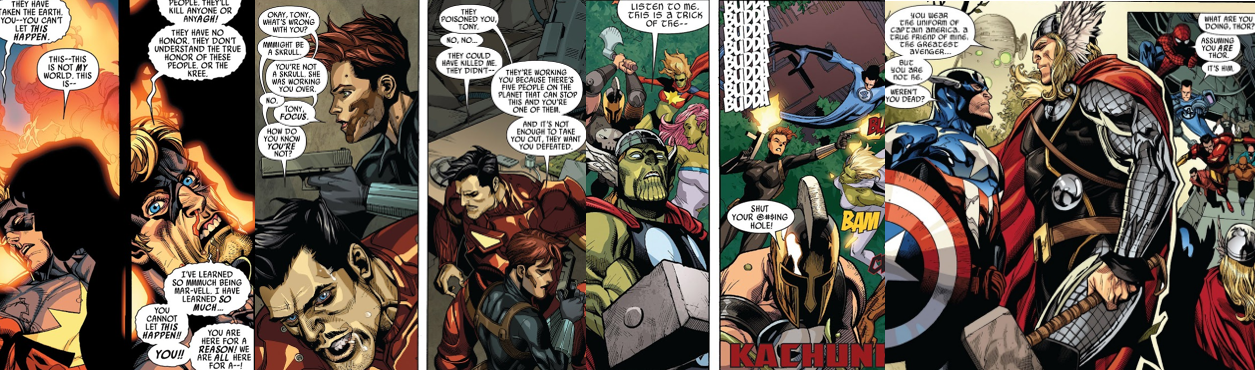
After being brought down by one of the Savage Land’s rampaging dinosaurs, the New Avengers prepare to open up the crashed ship, but they’re intercepted by the Mighty Avengers, with Iron Man immediately trying to arrest them and Luke Cage obviously telling him and his jumped-up thugs to go kick rocks. Iron Man’s attempt to keep the rogue superheroes from overstepping the mark are scuppered when Timothy “Dum Dum” Dugan and his trusted butler, Edwin Jarvis, unexpectedly sabotage not only the orbiting the Sentient World Observation and Response Department’s (S.W.O.R.D.) satellite base but also Stark’s armour and S.H.I.E.L.D.’s Helicarriers and bases, effectively disabling the armoured Avenger and crippling the superhero community’s resources and communications. Additionally, maximum security prisons the Raft and the Cube are suddenly hit by mass breakouts and Mar-Vell/Captain Marvel and Susan Storm/Invisible Woman disable the villainous Thunderbolts and the rest of the Fantastic Four, with each of these supposed heroes flashing ominous eyes and assuring their victims that “He loves [them]”. Meanwhile, a Skrull armada bares down on Earth and Mr. Fantastic finds himself reduced to an elasticated mess right as he figures out the key behind the Skrull’s newfound undetectability, the victim of a shot from Pym, who’s revealed to also be the Skrull Citri Noll! Momentarily setting aside their differences to get Tony Stark to aid, the two Avengers groups are startled when a slew of classic-styled, currently deceased or long-changed superheroes emerge from the Skrull ship; Captain Steve Rogers/Captain America, the Vision, Thor Odinson, Doctor Jean Grey/Phoenix, Doctor Henry “Hank” McCoy/The Beast, Wanda Maximoff/Scarlet Witch, Jessica Jones/Jewel, Emma Frost/The White Queen, and Barbara “Bobbi” Morse/Mockingbird appear alongside classic versions of Spider-Man, Power Man, Wonder Man, Iron Man, Hawkeye, Ms. Marvel, Wolverine, and the Invisible Woman. Naturally, a tense showdown ensues in which both groups assume the other are Skrulls in disguise; guys like Wolverine, Spider-Man, Emma Frost, and the Vision struggle to get any kind of reading on their counterparts beyond sensing their distrust while Ronin is stunned to see his former flame, Mockingbird, alive and well but, despite Ares trying to convince his allies that it’s a trap, tensions boil over and an all-out brawl kicks off!

As more characters enter the fray, internal distrust is as rife as the escalating war with the Skrulls.

With Stark in agony from the alien virus that’s crippled his armour, Ms. Marvel flies him to safety as the others duke it out; the two Spider-Men trade quips and punches, the Vision uses the Sentry’s fear of his destructive and malevolent alter ego, the Void, to disable his God-like power, and Ronin steals his counterpart’s weapons to subdue their attackers but the arrival of a raging Tyrannosaurus rex disrupts the fracas. Trampled to death by the dinosaur, the classic Spider-Man and Hawkeye are revealed to be Skrulls, and Wolverine intuits that the Skrulls are setting them against each other to wipe out any resistance to their invasion plan. However, when he tries to eviscerate Mockingbird, Ronin intervenes and questions her; she’s adamant that she’s not a Skrull and even reveals personal information that only she and Clint would know, which is enough to convince him to trust her. This offers Luke Cage the hope that the Cap and Iron Man aboard the ship are the real deal, which would certainly explain Stark’s recent manic behaviour and allow the recently deceased Cap to still be alive, but Wolverine’s far from convinced. Meanwhile, back in New York City, a portal opens up and a whole slew of Avengers-inspired Super-Skrulls attack; there’s Skrulls combining the powers of various X-Men, a Fantastic Four Super-Skrull, one that’s a mixture of Spider-Man villains, and even an Illuminati hybrid, meaning the Young Avengers – Eli Bradley/Patriot, Dorrek VIII/Hulkling, Billy Kaplan/Wiccan, Tommy Shepherd/Speed, Kate Bishop/Hawkeye, and their mentor, the Vision – are completely overwhelmed despite Hulkling’s efforts to talk down their attackers with his royal status. Thankfully, they receive some back-up in the timely arrival of fledgling superheroes, the Initiative – Joseph Green/Gauntlet, Rachel Leighton/Diamondback, Cassandra “Cassie” Lang/Stature, David Alleyne/Prodigy, Anthony Masters/Taskmaster, Geldoff/Proton, Z’Reg/Crusader, Jimmy Santini/Batwing, Fahnbullah Eddy/Gorilla Girl, Wallace Jackson/Red 9, Delilah Dearborn/Geiger, Melee, Andrea Roarke/Sunstreak, and Alexander Ellis/Annex. Though the Skrull forces prove ruthlessly formidable, and the Vision is lost in the battle, even more help arrives when the Secret Warriors – Colonel Nick Fury, Yo-Yo Rodriguez/Slingshot, Daisy Johnson/Quake, Alexander Aaron/Phobos, J.T. Slade/Hellfire, Jerry Sledge/Stonewall, and Sebastian Druid/Druid – add yet more names and the bodies to the chaotic artwork and conflict.
Heroes and villains set aside their differences to take the fight to the invading Skrull army.

The Skrull threat is doubled thanks to the distrust between the world’s heroes, with even Nick Fury abandoning Ms. Marvel because of her alien DNA. Meanwhile, as a weakened Stark desperately attempts to repair his armour, Spider-Woman reveals herself to be the Skrull Queen, Veranke, and tries to convince him that he’s a Skrull agent so deep undercover that he’s forgotten his true nature. Before her poison (both literal and figurative) can take hold, Black Widow causes her to flee and Stark reveals that the key to victory lies with Mr. Fantastic, who’s currently being tortured aboard a Skull ship. Thankfully, S.W.O.R.D. director Abigail Brand bluffs her way onto the ship and flushes the Skrull into space to rescue him; Reed then fashions a device that exposes the Skrulls’ real forms, arriving just in time to stop another conflict in the Savage Land and revealing not only that the classic Emma Frost, Invisible Woman, Thor, Ms. Marvel, and Jessica Jones are Skrulls but that Mockingbird is as well, enraging Clint. The real Thor transports everyone to New York for a final confrontation, which even the Watcher, Uatu, shows up to observe and also sees Parker Robbins/The Hood’s criminal syndicate and Doctor Norman Osborn’s Thunderbolts pitch in with the nearly-incomprehensible brawl. While Mr. Fantastic and Iron Man try to take out Veranke (still disguised as Spider-Woman) to demoralise the Skrulls, the Wasp targets Citri Noll, who apes Pym’s Giant-Man form, though it’s Stature and the assassin Bullseye who end up taking him out. Iron Man is forced to withdraw so he can sort out his messed-up armour, Fury’s forces save Mr. Fantastic from being torn apart by multiple Skrulls posing as the Invisible Woman, the real Jessica Jones joins the fray, and Kate Bishop ends up gravely injured amidst the chaos. Although Wolverine tries to take out Veranke, the bio-electrical powers she stole from Spider-Woman keep him at bay, meaning it’s an arrow through the face courtesy of the vengeful Ronin that ultimately subdues her.

Although the Skrulls are defeated, the general distrust in Stark allows Osborn to seize power!

With Veranke compromised, Citri Noll activates a device that causes Janet to enlarge uncontrollably and unleash a chemical agent designed to kill humanity and Skrulls alike. With no other choice available, Thor whips up a hurricane with his magical hammer, one so powerful that is destroys the enlarged Janet and dissipates the weird black spots that threaten everyone’s lives. Although Wolverine seeks to make Veranke pay for Janet’s death, it’s Norman Osborn who gets the kill shot, then Iron Man finally gets his shit together and leads an all-out assault on the remaining Skrull ships, with the now disillusioned and leaderless armada being easy pickings. Iron Man also frees everyone the Skrulls impersonated since the shape-shifters conveniently needed the original versions alive in order to make the deception more convincing, meaning Elektra and Mockingbird return to “life”, Reed is finally reunited with his family, and the true versions of the likes of Spider-Woman re-join society. Unfortunately, this also means that Jessica Jones left her and Luke’s baby, Danielle Cage, in the care of the Skrull-Jarvis, a plot thread left unresolved in this story. Although recent tensions are eased in the aftermath and ensuing celebration, there’s an unshakable sense of hesitation given how long the Skrulls had been a part of Earth’s society and superhero community; Thor also condemns Stark’s recent actions and refuses to associate with him. Thanks to having publicly executed Veranke, Osborn is able to manipulate the President of the United States into equally losing faith in Stark, his methods, and his technology; the President thus ousts Stark as director of S.H.I.E.L.D. and names Osborn as the new overseer of any and all superhuman and defensive measures under a new organisation, H.A.M.M.E.R., unaware that this is exactly the opportunity the scheming madman and his Cabal of allies (Emma Frost, Doctor Victor Von Doom/Dr. Doom, The Hood, Prince Namor McKenzie/The Sub-Mariner, and Lady Loki) were waiting for.

The Summary:
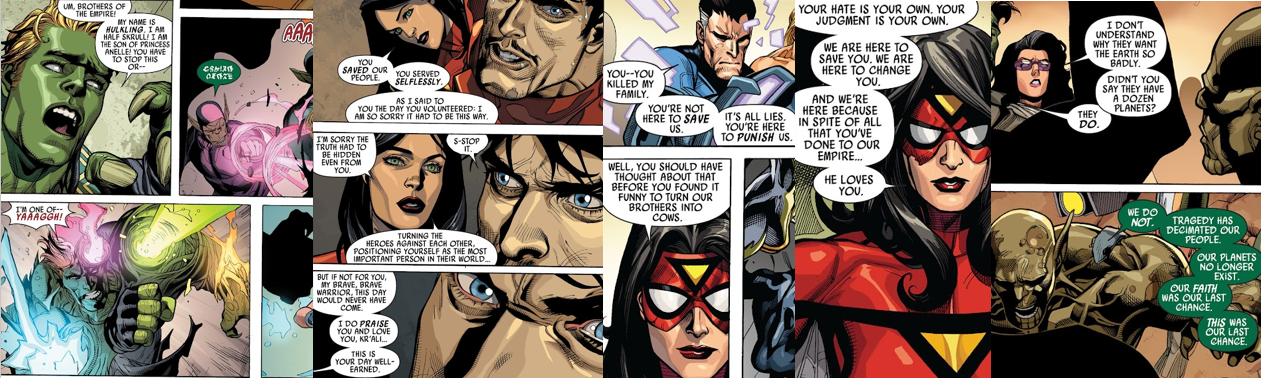
Now, I am by no means an expert on the Skrulls; I know of them, primarily as an antagonistic, shape-shifting race of aliens who are almost constantly at war with the Kree and getting into scuffles with the Fantastic Four, but they’re generally on the periphery of most Marvel stories I’ve read. Secret Invasion is probably, to date, their most prominent story, at least in my experience, and it definitely adds some nuance to them that I didn’t expect. Normally, I see them as a warmongering race who live to conquer through both subterfuge and force but, here, they’re motivated by a fanatical devotion to their God (the “He” they keep referring to) and their invasion is seen almost as divine intervention. The Skrulls swamp television screens with their pseudo-religious propaganda, hijacking every telecommunications device across the globe and assuming the guise of various political figures, celebrities, and superpowered monarchs like Erik Lehnsherr/Magneto and Dr. Doom, and insist that they’re there to bring glory to our world and that their might cannot be opposed. Given the strength of their invasion and that their Super-Skrulls have mimicked the combined powers of many of Marvel’s heroes, it’s perhaps not surprising that Marvel’s ridiculously fickle citizens embrace their alien overlords, though this scene showcases that the Skrulls aren’t simply defending themselves or there to usher in a new age for mankind as they claim and are hell-bent on conquering the planet.

Having lost everything, the Skrulls throw themselves at Earth with fanatical desperation.

This campaign is spearheaded by their queen, Veranke, a figure of worship for the Skrulls and who has placed herself on the frontline, earning the trust of Tony Stark by posing as Spider-Woman and becoming privy to many of Earth’s defences. Stark even reflects on his role in the invasion and the shame he feels about not recognising the threat sooner in a show of guilt that was somewhat uncharacteristic of him at this time; this is a man who was so blinded by his belief that superhumans needed to register with the government that he actively fought and imprisoned his fellow heroes and abandoned many of them, and his morals, in favour of an uncompromising, borderline fascist mentality that only led to further conflict and resentment Indeed, Veranke revels in the irony of having twisted Earth’s technology and heroes towards her agenda, something she was easily able to do thanks to Stark being so dead-set about forcing or punishing his peers to register their true identities and powers. However, as much as Veranke likes to preach that hers is a Holy mission, she’s actually equally motivated out of revenge, specifically against Mr. Fantastic and the Fantastic Four after they tricked a contingent of Skrulls into believing they were cows decades prior. Since the Skrull home world has been lost and their once-prosperous empire lies in ruins, the Skrulls follow her without question and throw everything they have at Earth; they’re even willing to give their lives in the process, and in a last-ditch effort of mutually assured destruction, only to be defeated and left dejected. Veranke’s death leaves the Skrulls directionless and all their once-formidable might is as nothing; those that survive are left demoralised as they saw this as their last chance at survival and glory. Thus, Veranke’s quest for vengeance and conquest leaves her people devastated and more worse off than ever as a sizable portion of their armada is destroyed and the last thing they had in all the universe, their faith, is also shattered by their defeat.

The Skrulls are so deeply entrenched that the already frayed heroes are strained to breaking point.

I’m generally not a fan of imposter storylines; it’s a tired cliché and one that quickly outstays its welcome, but it actually works quite well in Secret Invasion. Many of the Skrulls seem to be completely unaware of their true nature; the Mockingbird-Skrull believes that she’s the real deal right up until the end and is begging Clint to listen to her even as he attacks her in a rage. This is also true of Captain Marvel, who believed so strongly that he was the deceased former hero that he couldn’t bring himself to kill and was convinced by Norman Osborn, of all people, to turn on his race; he even died begging the Kree warrior Noh-Varr/Marvel Boy to carry on the fight in his stead, so complete was his conditioning. It’s not revealed exactly how the Skrulls have the memories they do but it’s one of the big reasons why so many of them went undetected; however, many of the Skrulls posing as classic Avengers continued to believe they were the real deal after their true nature was revealed rather than immediately attacking the heroes in service of their God, which definitely paints much of this conflict in a morally grey area. The Skrulls pick the perfect time to strike the Earth; its heroes are divided and at war with each other and easy to manipulate, and seeing the return of dead heroes like Captain America, Mockingbird, and Captain Marvel, as well as the original version of Iron Man, only fuelled the flames of conflict between them thanks to Stark’s actions during Civil War leading to many deaths, including Captain America’s. It would’ve been so easy to explain away Stark’s recent actions as being the work of the Skrulls but, interestingly, that doesn’t turn out to be the case and, similarly, Cap’s death isn’t immediately undone with the presence of his classic counterpart. Instead, we’re left with a world where Stark is still shouldering the burden of his actions and where Cap’s mantle has been taken up by his friend, James Buchanan “Bucky” Barnes; there are no quick-fixes in this story to explain away the events of Civil War and there isn’t really a sense that bridges have been mended by the end of it as distrust is still rife and the status quo remains unchanged.

A decent story with some interesting wrinkles but a bit overstuffed and manic at times.

Ultimately, I quite enjoyed this story; it’s hard to read as an eight-issue standalone as you need some knowledge of prior Marvel events, especially Civil War, and it’s clear that there’s a lot of additional story and conflict in supplementary collections and books, but the narrative works just as well if you only read these eight issues. I enjoyed seeing the Mighty and New Avengers be forced to set aside their differences when faced with their classic counterparts and the reveals of which characters were Skrulls, even if none of the major players were aliens in disguise. The quasi-religious bent to the Skrull invasion was an interesting twist, as was them siphoning and combining the powers of Marvel heroes into an army of Super-Skrulls, and the art was pretty consistent and easy to follow throughout. Unfortunately, the biggest issue I had with Secret Invasion was the sheer number of characters jammed into it; it was hard to keep track of it all at times and it’s obvious that teams like the Young Avengers, Thunderbolts, and Secret Warriors all had bigger parts to play in spin-off stories, but I think they could’ve been downplayed a little here. There’s a Skrull-Galactus with absolutely no context or consequence to the story and even Uatu shows up, which is generally a short-hand to indicate that the events are of cosmic importance but, again, it doesn’t actually factor into the story in a meaningful way. Stark spends most of the arc out of action thanks to the Skrull virus messing up his armour, which is great for leaving him vulnerable and in pain and unable to participate in the wider conflict but then he just shows up in an older armour with a throwaway line for the finale. Similarly, Thor just pops in out of nowhere, formally prominent characters like Wolverine and Spider-Man get lost in the shuffle, and late appearances from Jessica Jones and Norman Osborn are simply there to set up the next big Marvel events and stories. Overall, it was pretty enjoyable and not as much of a mess as some Marvel events, but the action got a little too chaotic at times and there were too many characters wedged into these issues, which I think would’ve been far stronger if they’d focused on, say, eight or ten main characters and then just showcased the others in supplementary materials.

My Rating:

Rating: 3 out of 5.

Pretty Good

Did you enjoy Secret Invasion? Were you shocked to find out which characters were Skrulls in disguise? Were you hoping that some of the classic Avengers would turn out to be the real heroes? Which of the teams featured was your favourite? Did you think there were too many teams and characters in the story and which of the spin-off books did you enjoy? What did you think to Veranke, the pseudo-religious slant to the Skrulls, and the Skrull invasion? Were you also frustrated by Tony Stark’s characterisation during this time, or did you enjoy seeing Marvel’s heroes in dispute? What are some of your favourite Skrull-centric stories? Whatever your thoughts on Secret Invasion, feel free to share them below or leave your thoughts on my social media.

Movie Night: Black Panther: Wakanda Forever 

Released: 11 November 2022
Director: Ryan Coogler
Distributor:
Walt Disney Studios Motion Pictures
Budget: $250 million
Stars:
Letitia Wright, Tenoch Huerta, Angela Bassett, Danai Gurira, Lupita Nyong’o, Winston Duke, Dominique Thorne, and Martin Freeman

The Plot:
With Wakanda in mourning after the tragic death of their beloved monarch, T’Challa/The Black Panther (Chadwick Boseman), Princess Shuri (Wright) is forced to step into the unlikely role of ruler and protector when her nation is threatened by their imperious K’uk’ulkan, Namor (Huerta), who wishes to wipe out the surface world.

The Background:
Readers of Marvel Comics’ Fantastic Four were introduced to the first-ever black superpowered character, the Black Panther, for the first time in 1966. After a Wesley Snipes-led live-action adaptation languished in Development Hell for decades, the Black Panther finally made his debut in Captain America: Civil War (Russo and Russo, 2016), setting the character up for his own critically and financially successful solo film that impressed with its performances and candid themes of racial oppression. Sadly, the character’s future was thrown into doubt when star Chadwick Boseman sadly passed away after secretly battling cancer; Marvel Studios head honcho Kevin Feige promised that the role wouldn’t be recast to ensure a lasting legacy for Boseman, surprising and devastating writer/director Ryan Coogler, who had been working with Feige and Chadwick to develop the character’s reign as Wakanda’s monarch. Rather than recast or utilise a CGI double, the script was reworked to expand upon the supporting characters and culture of Wakanda. The script also introduced Marvel’s first Mutant, Prince Namor McKenzie/The Sub-Mariner, to the Marvel Cinematic Universe (MCU), albeit with a heavily altered background; to avoid comparisons with Arthur Curry/Aquaman, the script changed Namor from a prince of Atlantis to the God-king of a hidden, underwater Mesoamerican subculture and leaning into star Tenoch Huerta’s Mexican heritage to bring the complex anti-hero to life, ankle wings and all. Switching Atlantis for Talokan, the film took visual inspiration from Mayan culture and Jack Kirby’s comic book imagery to bring Namor’s undersea kingdom to life, and employed anamorphic lenses to warp the screen with the fog of loss to reflect the cast and crew’s grief over Chadwick’s passing. Although COVID-19 didn’t affect the film’s release, a series of injuries and delays did interrupt filming and star Letitia Wright attracted some controversy after speaking out about the COVID-19 vaccination. Regardless, Black Panther: Wakanda Forever released to largely unanimous praise but reviews were a little mixed; critics praised the film as a celebration of Chadwick’s life and the individual performances but many took issue with the film’s length, worldbuilding and believed it struggled with Chadwick’s absence. Still, the film was a financial success, bringing in over $355 million at the box office and setting up not just another Disney+ spin-off but also sparking discussions for a third entry in the franchise.

The Review:
Like many, if not all of us, I was stunned to learn of Chadwick’s passing in 2020; it really did come out of nowhere and raised some uncomfortable questions about the future for the character of the Black Panther. Obviously, real world tragedies like this are more important than any fictional narrative but it was still a difficult situation for the MCU to address; a recast could anger Chadwick’s fans, ignoring his passing could be seen as disrespectful, and the question of whether anyone would accept a new character taking on the Black Panther mantle led to some pretty despicable shows of toxic masculinity across the internet despite the fact that Shuri has adopted the role in the source material. Personally, as much as I enjoyed Black Panther (Coogler, 2018), it almost felt as though it might be best to downplay Wakanda’s influence in the MCU going forward; perhaps merge any future stories into other movies, such as their upcoming Fantastic Four reboot, since the situation was so delicate. Instead, the decision was made to forge ahead and immortalise Chadwick’s legacy with a celebration of his life and to allow every involved, the creators, characters, actors, and the audience, to commemorate his life and mourn his loss collectively in this sequel. Even with this in mind, I was very surprised to see the film open on the eve of T’Challa’s death not long after the events of Avengers: Endgame (Russo and Russo, 2019); like the late Chadwick, T’Challa was stricken by a fatal illness and suffered in silence, with his condition being discovered far too late for Shuri’s advanced technology to be of any help. Indeed, she was so desperate to try and artificially recreate the mystical heart-shaped herb to cure her brother than she spent all her time in her lab and even prayed to the panther god Bast for help, only to be devastated to learn of T’Challa’s untimely passing despite her best efforts.

Wakanda mourns their loss, but none feel T’Challa’s passing more so than Queen Ramonda and Shuri.

The entire nation of Wakanda was united in mourning for their fallen king and protector; Wakanda’s traditions teach that death is simply the first step on a great journey in the afterlife, a belief that brings little solace to Shuri. With one foot planted in science and the other in spirituality, she’s conflicted over the loss, finding little comfort in the assertions of her mother, Queen Ramonda (Bassett), that T’Challa lives on in spirit around them. Instead, she’s abandoned her efforts to recreate the heart-shaped herb, believing that it and the symbol of the Black Panther are relics of the past that should be laid to rest with her brother, and has been busying herself crafting new weapons and technology for Wakanda’s all-female army, the Dora Milaje, much to the chagrin of her mother and General Okoye (Gurira). In the wake of T’Challa’s death, Queen Ramonda has had to forge on as Wakanda’s sovereign ruler; though the tribes of Wakanda are fully united and behind her, with even the hulking M’Baku (Duke) and his Jabari tribe now represented on the council, Wakanda has come under fire from the United Nations as the world’s superpowers begin to feel threatened by Wakanda’s advanced technology and exclusive access to Vibranium. Although T’Challa opened Wakanda’s borders and established a number of outreach centres across the glove to help oppressed and struggling people, Queen Ramonda resolutely promises swift and aggressive retribution against any party or nation that tries to take Wakanda’s resources (especially their Vibranium) by force, upsetting the geo-political perception of the nation and putting Wakanda at risk of all-out war.

Shuri forges new relationships to work through her grief, including protecting Riri from Namor.

Of all the returning characters, Shuri obviously receives the most obvious growth; in the first film, she was an outspoken rebel, as arrogant in her scientific acumen as Anthony “Tony” Stark/Iron Man (Robert Downey Jr.) and who openly mocked Wakanda’s traditions. Now, she’s a broken young woman struggling with a burning desire for vengeance; grief is consuming her and has hardened her demeanour, yet her moral integrity is strong enough to oppose Namor’s desire to kill scientific prodigy Riri Williams (Thorne) after she creates a machine capable of detecting Vibranium, purely on a whim, and threatens to expose the lost underwater nation of Talokan to the world. Although clearly wanting to be seen as an intimidating figure, Namor makes an effort to appeal to Shuri, bringing her to the depths of Talokan and sharing both his backstory and some of the history of his aquatic people. Believing he’s found a kindred spirit in Shuri and that she will join him in launching a pre-emptive strike against the surface world, Namor proposes an alliance while both threatening Riri’s life and promising that Talokan’s superpowered forces, further empowered by their own Vibranium weapons, are no match for Wakanda. Ultimately, Shuri chooses to protect Riri, who meant no harm and poses no threat to anyone, incurring Namor’s wrath; his attack upon Wakanda sees the capital city partially flooded, eventually evacuated, and leaves untold numbers dead, including Queen Ramonda. With this act, Namor only further stokes the raging fire burning within Shuri; having literally lost her entire family, she now finds herself promoted to sovereign ruler and having to live up to expectations that were never asked of her before, and is finally compelled to continue her research into the heart-shaped herb so that the Black Panther can live again and give her the means to take her revenge upon Namor.

In addition to fleshing out returning characters, the film introduces a new child prodigy to the MCU.

T’Challa’s passing means a greater focus on Wakanda’s supporting characters; as mentioned, M’Baku and the Jabari are now fully integrated into Wakanda society, though he remains a proud and outspoken man mountain. He’s given greater depth, however, by him assuming the role of Shuri’s protector and confidante; charged by T’Challa with providing Shuri with council, he urges her to embrace her role as Wakanda’s leader and protector while also warning against provoking endless war against Talokan and killing their God-king since this would set not only her down a self-destructive path but bring ruin to their homeland. The stoic and implacable Okoye is equally devastated by her king’s passing; as loyal as ever, she convinces Queen Ramonda to allow Shuri to accompany her to Cambridge, Massachusetts to intercept Riri, only to end up being disgraced and discharged from her duties after failing to protect them from Namor’s forces. Despite her resistance to utilising Shuri’s technology, Okoye upgrades to a superhero persona of her own by the end of the film as she and fellow Dora Milaje Aneka (Michaela Coel) make use of Shuri’s “Midnight Angel” armour in the final battle against the Talokan warriors. While Riri’s involvement in the movie is somewhat akin to the introduction of Peter Parker/Spider-Man (Tom Holland) to the MCU and has more than a few parallels to Iron Man’s origin, she quickly forms a bond with Shuri, Okoye, and Nakia (Nyong’o), with the four being united in their grief and common enemy. Since the first movie, Nakia has left Wakanda and become a schoolteacher; the pain of T’Challa’s passing was too great for her to attend his funeral, but she readily agrees to rescue Shuri and Riri from the outskirts of Talokan after Okoye’s dismissal. Everett K. Ross (Freeman) of the Central Intelligence Agency (CIA) also returns in a small role as an outside ally to Wakanda; with the United States legitimately considering going to war with Wakanda over their Vibranium, he tries to convince the Secretary of State (Richard Schiff) and CIA director Valentina Allegra de Fontaine (Julia Louis-Dreyfus) of the Talokan plot only to be arrested on charges of treason by Valentina, who’s revealed to be his ex-wife, further placing him in Wakanda’s debt. Ross is right to be concerned; Talokan is a serious threat not just to Wakanda but to the entire world. Their people’s origins are as seeped in mysticism as the Wakandans, with their ancestors being directed to the same heart-shaped herb by divine intervention, however this one was found near an underwater deposit of Vibranium and thus mutated the Talokan into a water-dwelling species.

While his enforcers aren’t very memorable, Namor is a complex and alluring anti-hero.

Establishing a fully functional city deep beneath the ocean, one seeped in Mesoamerica traditions and aesthetics, the Talokan have been ruled for centuries by their God-king, Namor, whom they refer to as “K’uk’ulkan” (or “Feathered Serpent God”). Born a Mutant, able to fly thanks to wings on his ankles and drawing both superhuman strength and oxygen from the water directly through his skin, Namor is the child of two worlds but has absolutely no love for the surface world. After witnessing first-hand the aggression of colonisers and invaders, he has prepared a dedicated and formidable water-dwelling army to strike back against humanity before they can even think about trying to raid Talokan’s depths for their resources and Vibranium. Although charming, alluring individual who makes intelligent and persuasive arguments, Namor is nonetheless an aggressive and driven warrior who’s willing to threaten not just Wakanda but also Riri’s life since he doesn’t want her creating any more machines that could expose Talokan. While the Talokans are far more tribalistic in their ways and strategies, they’re no less dangerous; they’re capable of luring targets to their deaths with a hypnotic siren’s song, boast superhuman strength and speed and Vibranium weapons, employ destructive concussive water grenades, and can both command water and travel through the sea on whales. Namor’s chief enforcers are Namora (Mabel Cadena) and Attuma (Alex Livinalli), two characters with little personality or development beyond forging a rivalry with Nakia and Okoye, respectively, but I can forgive this as the film rightfully forces on fleshing out Namor’s character. He’s a very layered antagonist, assuming more of an anti-hero role since he fights to protect his people and prove Talokan’s strength rather than simply for sheer bloodlust but, as understandable as his motives are, he still strikes a devastating blow against Wakanda and Shuri when both were already struggling with their grief and comes very close to sparking a global conflict.

The Nitty-Gritty:
As you might expect, a major theme in Black Panther: Wakanda Forever is grief. Although Wakanda celebrates death and makes a big exhibition about honouring T’Challa and seeing him off to the Ancestral Plain in glorious fashion, it’s of little comfort to Shuri. Even Queen Ramonda and Okoye, who staunchly uphold the traditions and beliefs of Wakanda to the letter, after clearly shaken by their loss, and the pain was so great that it drove Nakia away from her homeland for six years. Since she’s a scientist first and foremost, Shuri struggles to find the same comfort in her spiritualism as her mother and isn’t ready to let go of her pain, fearing that it would mean forgetting her brother or lead her to resent the entire world in her grief. Although she’s putting on the face of a strong leader, Queen Ramonda has been deeply affected by the loss of her husband and child; when Okoye delivers news that Shuri has been lost as well, the queen launches into an emotional outburst while stripping the general of her duties, showing just how deep her pain runs. Shuri’s own pain is only exacerbated by her mother’s death; although she was awestruck by Talokan and felt a kinship with Namor’s tragic childhood, she resorts to pure, unbridled vengeance after he attacks Wakanda. Her determination to see Namor dead unsettles even M’Baku, who is resolutely against killing Namor and risking a lifetime of war against Talokan’s formidable forces, yet Shuri is able to convince…no, demand…his loyalty and assistance by finally asserting herself as Wakanda’s leader and protector, showing just how far her character has grown given the hardships she’s suffered.

Namor and the Talokan deliver some of the film’s most impressive visuals and action sequences.

Black Panther impressed with its picturesque beauty and its sequel is certainly no slouch in this department; Wakanda is bathed in the red-orange glow of dusk and bustling with celebrations and tributes to their fallen king, with new aspects of their culture being highlighted as a result of this loss. Their technological acumen remains as advanced as ever; Shuri now has the capability of replicating organic life, eventually extracting the essence of the heart-shaped herb from Namor’s bracelet to repopulate the flower, and has become far more reliant on her interactive artificial intelligence, Griot (Trevor Noah), in creating new weapons and tools for her people. Riri holds her own in this area as well; like Stark, he’s able to cobble together unimaginably advanced tech from spare parts and her own initiative, building not only a machine that can detect Vibranium but also a fully-functioning (if crude) Iron Man-esque suit for herself. Astounded by the resources on offer in Wakanda, she’s able to create a much more impressive armoured suit, one that’s sleek and aerodynamic and gives her the tools to play and active role in the finale but is inexplicably taken from her by Shuri so that Riri can rediscover her origins in her upcoming Disney+ spinoff. However, as impressive as all this is, one of Black Panther: Wakanda Forever’s primary goals is on establishing the underwater nation and race of Talokan. Their city, which is reminiscent of Mayan architecture and society, is hidden deep beneath the ocean depths; unlike Aquaman’s (Wan, 2018) elaborate and fantastical representation of Atlantis, Talokan is dark, devoid of tangible gravity, and is seeped in a tribalistic mentality the sees them worship the seemingly ageless Namor like a God. Namor brings light to his kingdom through an artificial sun, has equipped them with the tools to pose a significant threat to surface dwellers, and reveals in this worship, sporting ceremonial beads and pieces of armour, comprised of Vibranium, to cut an intimidating figure. While his race is depicted with blue skin on the surface, speaking in an ancient dialect and utilising special masks to breath out of the water, Namor is freely able to come and go as he pleases and speaks a variety of languages. Namor also delivers some of the film’s best action sequences; while the majority of the action is centred on wide-scale conflict between Wakanda and Talokan, Namor darts around the sky in a really unique way, cutting through bodies and vehicles alike and is both touted, and presented, as an incredibly formidable superhuman force against which Wakanda’s armies potentially stand now chance.

Ultimately, Shuri assumes her brother’s role and leads Wakanda against the Talokan forces.

This is, of course, unless Shuri is able to synthesise the heart-shaped herb; since all of Wakanda’s supply was torched by N’Jadaka/Erik Stevens/ Killmonger (Michael B. Jordan) in the last film, their enhancing properties and the mantle of the Black Panther had remained dormant as Shuri has focused on other things. Namor’s threat leads her to finally making a breakthrough and, as Wakanda’s ruler, drinking the herb’s liquid to enter the Ancestral Plane. There, rather than meeting with her beloved family, she has an emotional confrontation with Killmonger’s spirit as he tries to foster the rage building inside of her. Indeed, upon assuming he mantle of the Black Panther, Shuri is hellbent on drawing Namor out, weakening him with intense heat, and battling him to the death to make him pay for killing her mother and endangering her people. Despite showcasing a superhuman agility and a multitude of technological armaments built into her nanotech Black Panther suit, Shuri is no match for Namor one-on-one so she works with Riri not only to perfect her Ironheart armour but also to trap Namor in a super-heated prison that will sap his strength and even the odds. While her allies battle the Talokans in the middle of the Atlantic Ocean, Namor and the Black Panther have a brutal fight in the sweltering desert that leaves the K’uk’ulkan severely dehydrated and scarred by Shuri’s talons and the young princess impaled on a pole. Through sheer force of will, she’s able to free herself, sever (or, at least, severely wound) one of Namor’s ankle wings, and force him to yield after catching him in a burst of jet flame. Queen Ramonda’s spirit is able to calm Shuri’s rage and convince her to show Namor mercy and the conflict comes to an end; however, while Namora expresses disappointment in Namor’s surrender, he insists that it’s all part of a larger plan to allow Talokan with Wakanda for an inevitable conflict against the surface world and the question of Wakanda’s position within the geo-political climate is left up for debate. Although Shuri appears to step away from her role as Wakanda’s ruler, she finally achieves a measure of peace, burning her ceremonial funeral garments and discovering a lifeline to her lost family in the surprising appearance of Nakia and T’Challa’s young son, Toussaint/T’Challa (Divine Love Konadu-Sun) and having forged new relationships with both Everett Ross and Riri Williams and a newfound level of respect for the likes of Okoye and M’Baku.

The Summary:
Black Panther: Wakanda Forever had an unenviable task; not only did it have to follow up one of the most influential and well-regarded superhero movies of all time, but it had to tackle the tragic passing of its star actor. Fittingly, the film is dedicated to Chadwick and the first part, especially, is focused on giving him a celebratory send off and allowing us to all collective mourn his passing. It’s a tall order to ask anyone, man or woman (or otherwise), to fill his shoes and I think there’s always going to be that cloud of trepidation surrounding the character going forward, but the film did a really good job of exploring that journey and those emotions through Shuri. Her development into a much more hardened and well-rounded character was great to see, and hit a lot of similar beats to T’Challa’s journey in the MCU with her learning to work past her personal grief and rage for a greater cause. The film also nicely established that the MCU can continue trucking along quite nicely by building up secondary characters; increasing the prominence of the likes of Okoye and M’Baku gives Shuri a strong support network and introducing new characters lie Riri Williams continues to expand the MCU, even if her role could’ve easily been cut from the film without impacting the narrative all that much. For me, though, the true highlight was Namor; I loved the changes they made to his backstory and how multifaceted his character and motivations were. He continues the staple of having more human and understandable villains who are more shades of grey than purely black or white and added another new visual flair to the already jam-packed variety of the MCU not just in his appearance and portrayal but in the presentation of Talokan. I think we’ll come to find Black Panther: Wakanda Forever one of the most pivotal MCU films going forward, not just for establishing these new characters but also for the way it alters the existing lore; big things are clearly brewing, and I think this will be where that all links back to. Overall, this was an enjoyable experience; it was a tasteful tribute to Chadwick and treated his memory with dignity and respect while actually tackling the subject of death head-on in a way most superhero films simply gloss over.

My Rating:

Rating: 4 out of 5.

Great Stuff

Did you enjoy Black Panther: Wakanda Forever? What did you think to the way it handled Chadwick Boseman’s passing? Were you happy to see Shuri step into the title role or would you have preferred a different character take up the mantle? What did you think to Namor, the changes made to him and the presentation of his culture and abilities? Where would you like to see Wakanda go in the future? What do you think to the building intrigue surrounding Valentina Allegra de Fontaine? Whatever you think about Black Panther: Wakanda Forever, feel free to share your thoughts and memories of Chadwick Boseman in the comments below or on my social media.

Back Issues: Motion Picture Funnies Weekly #1

Story Title: “Here Is the Sub-Mariner!” (or possibly just “The Sub-Mariner”)
Published:
April 1939
Writer and Artist: Bill Everett

The Background:
The brainchild of writer/artist Bill Everett and billed as Marvel’s first Mutant, Prince Namor McKenzie/The Sub-Mariner owes his creation to Carl Bugos’s Jim Hammond/The Human Torch. Since the Human Torch could manipulate fire, and given Everett’s keen interest in anything nautical, the writer/artist desired to create an antithesis to the flaming android who could live on land and in the sea and possessed incredible superhuman strength. Initially slated to appear in this giveaway comic, only a handful of copies of Motion Picture Funnies Weekly were produced and, when the deal fell through, Everett took the character and his story to Timely Comics, the predecessor to what we now know as Marvel Comics. Over the years, Namor has made quite the splash (pun intended) in Marvel; he’s been both a defender of and aggressor towards humanity, serving on teams such as the Invaders and the Illuminati, and had run-ins and dealings with some of Marvel’s biggest heavy-hitters, such as the Fantastic Four, with whom he has a longstanding contentious relationship with. Namor has also made appearances in Marvel’s animated ventures, generally being involved with the Fantastic Four, and, while development of a solo movie for the character has often been fraught with issues, he’s due to make his Marvel Cinematic Universe debut in Black Panther: Wakanda Forever (Coogler, 2022).

The Review:
The story of Namor, the Sub-Mariner, the “ultra-man of the deep” begins with a salvage ship, the aptly named S.S. Recovery, out at sea and investigating a wrecked ship under the ocean. Deepsea diver Rod nelson comes up from the depths and, after recovering in the decompression chamber, relates that the safe he was sent down to recover had been opened, and recently, too. As they’ve been out there for a week and seen no signs of any other ships, and there’s been no reports of any other ships in the area for three weeks, the captain has Nelson and Carley head back down there to try and figure out what, exactly, has happened, Carley goes on ahead and notices that the ship’s side hatch has been opened and, when he’s joined by Nelson, the two are stunned to spot slim, youthful swimmer in short-shorts mingling through the wreckage, apparently unfazed by the incredible pressure of the need for oxygen! The swimmer, the titular Sub-Mariner, is confused by the divers’ appearances; since they’re clad in heavy diving suits and equipment, he doesn’t recognise them as men or fish and assumes them to be some kind of hostile robot due to their vaguely mechanical appearance, the “control wires” running to their suits, and the “fire-weapon” (actually an acetylene torch to allow them to se in the murky depths) they hold. Consequently, the Sub-Mariner severs the wires, cutting Nelson and Carley off from their communications and oxygen supply, and then attacks them mercilessly, stabbing on with his knife and crushing the other’s head with his bare hands! Worried for the safety of his men, the captain sends another diver, Anderson, down to investigate but, when he gets down there, he frantically rushes to the surface upon seeing his crew mates’ bodies, unaware that he’s drawn the Sub-Mariner right to the S.S. Recovery!

Namor learns that he’s destined to led a war against all humankind!

When Anderson relates his story, the ship makes a hasty exit but the Sub-Mariner effortlessly twists its rudder and stops its propeller with his incredible strength (said to be that of “a thousand men”). Panicked, the captain desperately tries to steer the out of control ship but, unfortunately for the lives left aboard the S.S. Recovery, the Sub-Mariner forces it to crash and split in two on some rocks. Pleased with himself, the Sub-Mariner grabs Nelson and Carley’s dead bodies and speeds away to a secluded grotto by way of his winged feet. He brings his victims to a vast, chapel-like chamber where he’s met by a curious, robed, fish-like priest and boasts of his great victory over the mechanical, alien lifeforms. However, the Sub-Mariner (identified by the holy fish-thing as “Namor”) is shocked to find that his prey weren’t alien invaders or robots, but actually “Earth-men”. His mother, however, is more than pleased by his efforts; she commends him for striking a blow in the war against humans and even demands that the bodies at strewn up as an example. When Namor questions why she hates humans so much, especially as his father was an Earth-man, she relates that, while his father was a “fine man”, human beings are cruel and dangerous and almost drove their entire race to extinction. Back in 1920, Namor’s father, Commander Leonard McKenzie, led a scientific expedition out at sea and ended up unknowingly obliterating their society with depth charges and explosives. With the death toll climbing faster and faster, the elders sent Namor’s mother, Fen, to infiltrate the “white monsters” and bring an end to their actions since she most closely resembled a human. Leonard took pity on her, tried to feed and clothe her, without realising he was making her sick or that she couldn’t understand him. In time, though, she learned the language of men, and the two fell in love, all without the humans ever suspecting that she was returning to the water to stay alive and ferry back information to her people. Despite her warnings, her fellow Sub-Mariners tried to strike back and were no match for man’s weaponry, and Fen has spent the last twenty years preparing Namor, a being born of both worlds, to avenge his race on the world of man using his superhuman strength and in the name of his unduly oppressed people.

The Summary:
Jeez, well, okay…I can’t say I was expecting that! I’ve had some limited experience with Namor before; I know he’s a proud man and that he walks the line between hero and villain, someone who’s just as likely to sink half a continent as he is to save the world, but I never expected his debut story to involve him brutally murdering people and smiling about it! I have to address right off the bat that I couldn’t really find any decent scans of this issue, so the image quality probably isn’t all that great, but the artwork is actually pretty good for the time. It’s a bit crude and simple in places but it reminds me of pulp novels and comic books in its dark, subdued aesthetic; panels showing Namor underwater are really well done, with lots of blues and greens and murkiness to cast him as a frightening figure, and I really like the way Bill Everett conveys Namor’s hair when underwater and the simple, but effective, depictions of his incredible strength and speed.

Namor’s certainly formidable, but is he being manipulated by his vengeful mother…?

As for Namor himself…well, we don’t really learn too much about him in terms o his character, but there’s quite a bit related to us and that we can intuit. Interestingly, the opening dialogue box describes him as “a youth of dynamic personality…quick thought and fast action” and that’s certainly true as he doesn’t even stop to consider that the divers might be men rather than robots and just murders them without a second’s thought. We’re also told, by the narrator and by Fen, that he’s able to live on land and under the sea, fly through the air and swim rapidly through the water, and we see some pretty fantastic and startling examples of how powerful he is. He can crush a man’s skull with ease and it’s nothing for him to manhandle an entire ship and cause it to explode in spectacular fashion, to say nothing of how nimble he is underwater. At first, he seems aghast and confused as to why men are deemed his enemy, but he seems perfectly willing to carry out his mother’s wishes by the final panel after hearing how destructive humans were towards his race. It’s a bit odd, though; Fen claims Leonard was a kind man and it seems she really loved him, yet at no point did she try to get him to stop his destructive bombardment of her people. I guess having it be so that Leonard captured, tortured, and raped her would be a little too dark for this already pretty damn dark story but it definitely feels like something’s off about Fen’s story, and the narrative ends with Namor apparently ready and able to strike swift and unrelenting vengeance upon humanity, which is a daunting prospect given the glimpse we’ve seen of his power.

My Rating:

Rating: 3 out of 5.

Pretty Good

What did you think to Namor’s debut story? Were you impressed with his brutality and power? What did you think to the backstory presented here and do you think there’s more to Fen’s tale? What are some of your favourite Sub-Mariner moments and stories from the comics? Are you excited for his live-action debut? Whatever you think about the Sub-Mariner, feel free to share it in the comments or on my social media.