Movie Night: Hollow Man: Director’s Cut

Released: 25 December 2009
Originally Released: 4 August 2000
Director: Paul Verhoeven
Distributor: Sony Pictures Releasing
Budget: $95 million
Stars: Kevin Bacon, Elisabeth Shue, Josh Brolin, Kim Dickens, and William Devane

The Plot:
When ambitious scientist Doctor Sebastian Caine (Bacon) arrogantly subjects himself to his invisibility serum, his team is horrified when he descends into madness after going drunk with power.

The Background:
By 1897, British author Herbert George Wells had established himself as a prolific author in the science-fiction genre. Possibly inspired by W. S. Gilbert, Wells’ 1897 literary classic The Invisible Man captivated readers with its cautionary tale and then impressed audiences when adapted into James Whale’s ambitious and celebrated 1933 classic. Followed by a bunch of pseudo-sequels and spin-offs, The Invisible Man developed an enduring legacy in sci-fi and horror and eventually lived again, in spirit at least, when acclaimed auteur Paul Verhoeven sought to make a more “conventionally commercial” blockbuster. Writer William Goldman disliked the script but attempted to salvage it with rewrites, only for Verhoeven to ignore his input and double-down on the special effects work. Sony Pictures Imageworks and Tippett Studio developed the intricate invisibility effects, which involved compositing scenes with and without star Kevin Bacon and dressing him in a latex body suit to create a digital double. Initially absent once his character became invisible, Bacon was brought back for reshoots to give the characters someone to interact with and the actor detailed a troublesome pre-production period. With a box office gross of $190.2 million, Hollow Man was Verhoeven’s biggest hit since 1992 but was met with largely negative reviews that criticised its formulaic characters and misogynistic undertones, though the visual effects were widely praised. Accompanied by this Director’s Cut, which added about ten minutes of slightly extended scenes, and followed by a critically panned direct-to-DVD standalone sequel in 2006, Hollow Man saw the remorseful Paul Verhoeven retreat from Hollywood, though it’s often regarded as an under-rated gem.

The Review:
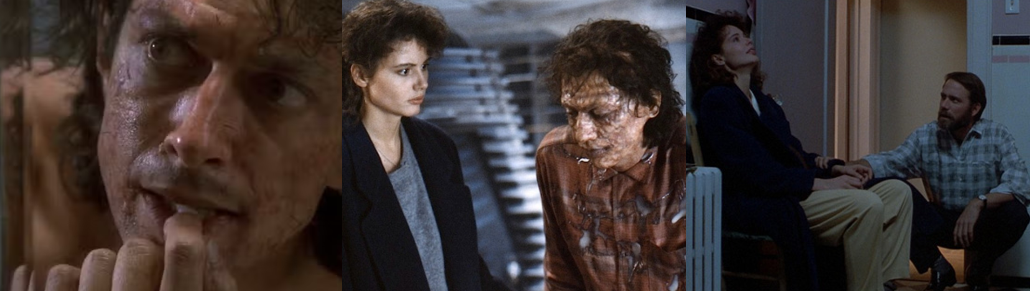
Hollow Man follows a team of scientists, technicians, and other assorted specialists developing an invisibility serum. Genius narcissist Sebastian Caine is at the forefront of the project, which was entrusted to him by his old mentor, Doctor Howard Kramer (Devane), and his team includes his ex-girlfriend, Linda McKay (Shue), and his frenemy Doctor Matthew “Matt” Kensington (Brolin). The team has already cracked invisibility, producing a startling neon blue serum that undergoes some vague irradiation process and is injected directly into the blood stream. The team have tested the serum on multiple test animals, cared for by feisty veterinarian Doctor Sarah Kennedy (Dickens), though they cannot reverse the process. While Linda and Matt embark on a love affair, Sebastian works tirelessly on the problem until he suddenly intuits the solution. Giddy with excitement, eager to claim a Noble Prize and etch his name in history, Sebastian insists on testing the formula on Isabelle (Tom Woodruff Jr.). Although the gorilla’s heart rate and blood pressure spikes wildly, the team stabilises her and she becomes visible. Emboldened by their success, Sebastian attempts to rekindle his romance with Linda, only for her to coldly shut him down due to his narcissism (though it’s clear she admires him, as do the rest of the team).

Narcissistic scientist Sebastian loses what little sanity he had to invisibility madness.

However, Linda and Matt are infuriated when Sebastian lies to the Pentagon, arrogantly wishing to be the first person to turn invisible and back. Despite their protests, Linda and Matt agree to Sebastian’s proposal and lie to the others to get them onboard, each eager to be at the forefront of the experiment. Though tense and demanding, Sebastian insists on injecting himself to protect Linda from legal repercussions and endures agonising convulsions as he slowly and painfully dissolves. Though he’s extremely sensitive to lights, Sebastian and the others are elated by the successful trial, and they endure his playful invisible antics. The first red flags occur when Sarah is unnerved by his presence, believing he sexually assaulted her, and technician Janice Walton (Mary Randle) refuses to go anywhere without her infrared goggles. Thus, they’re horrified when he reacts violently to the reversion serum before fading away again (potentially because they didn’t use the defibrillator). Sebastian’s initial excitement about being invisible quickly turns to anger and resentment as he endures days of testing, with no solution in sight, angrily lashing out at Linda and Matt when they try to help him and struggling with cabin fever. On the plus side, the team forge a latex mask to give him a physical presence, but Sebastian still storms out, much to the alarm of friendly but naïve medic Carter Abbey (Greg Grunberg).

Sebastian’s warped mind is further twisted, driving him to paranoia, anger, and murder.

Returning to his apartment, Sebastian tries to talk himself out of messing with his alluring neighbour (Rhona Mitra) before stripping down and raping her. Obviously, he keeps this to himself (though he makes allusions to Carter, who obliviously encourages him), but the team is pissed at him breaking protocol and essentially place him under house lab arrest. However, while Sebastian feigns compliance, he surreptitiously fiddles with the video camera to fool technician Frank Chase (Joey Slotnick) and sneaks out again, discovering Matt and Linda’s romance and finally snapping. His ego wounded and angrily resentful at the team, Sebastian brutally murders one of Sarah’s dogs and talks down to the others, raising their suspicions further. Linda’s sympathy evaporates when Sebastian showcases the extent of his mania, considering his condition as a “gift” that they’re jealous and fearful of. When they discover that Sebastian’s messed with the cameras, Linda and Matt come clean, enraging Sarah and driving them to ask Dr. Kramer for help, even if it means the end of their careers. Unimpressed and incensed, Dr. Kramer dismisses them and prepares to report Sebastian, only for the manic scientist to drown him in his pool. Thus, like basically every invisible man, Sebastian descends into full-blown madness. Sebastian was already an arrogant, self-absorbed asshole before he turned invisible, believing himself “God” but cabin fever and unforeseen side effects of the serum escalated his violent tendencies. Sebastian relishes the power and freedom of invisibility (“It’s amazing what you can do when you don’t have to look at yourself in the mirror”) and is willing to kill anyone who tries to stop him.

The Nitty-Gritty:
Technically speaking, Hollow Man isn’t a remake of The Invisible Man and barely resembles H.G. Well’s classic text beyond surface level similarities. However, a scientist going mad partially from an invisibility serum and going on a killing spree are all reminiscent of The Invisible Man. Like Griffin, Sebastian is wholly unlikeable from the start. Sure, there are moments of humility and humanity, mainly in his interactions with Linda, but it’s clear he only wants her because he can’t have her and wants to be seen as superior to her lover. Sebastian openly mocks Sarah and her love for animals, gets very handsy with his colleagues when invisible, and routinely berates Matt simply to prove his intellectual superiority, completely missing the irony and hypocrisy of him being as unable to crack reversion. Hollow Man is a very different film for director Paul Verhoeven. It has none of his usual satirical or visual signatures, no commentary on the media or government, and everything is presented in such a clinical and by-the-number way that it could’ve been directed by anyone. It doesn’t help that most of the film takes place in a visually boring laboratory or that it feels like Verhoeven was making a cookie-cutter sci-fi/horror simply for a pay cheque, compromising his usual signature style simply to appease studio executives and producers.

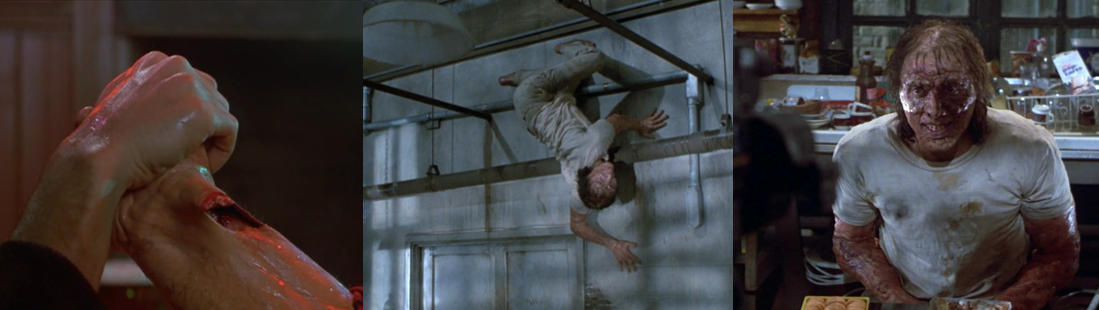
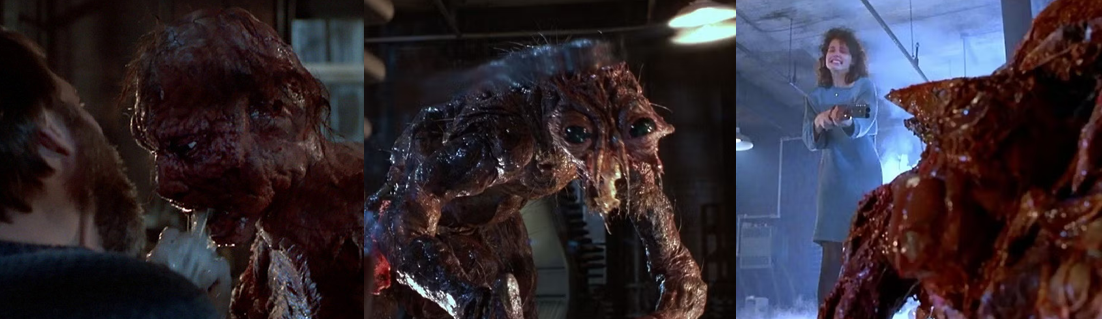
The impressive special effects largely carry this otherwise tedious horror/thriller.

Hollow Man makes up for this with its impressive visual effects. The CGI when Isabelle and Sebastian turn invisible or return (briefly, in Sebastian’s case) to visibility is extremely detailed. Sure, it makes no sense how any of the test subjects can see but that’s largely inconsequential when skeletal structures, arteries, muscle, and flesh appear or disappear before your eyes. Sebastian’s experience is noticeably more traumatic since he can articulate the pain of the process but also because it’s like his flesh is dissolving. With Isabelle, it’s the reverse and the filmmakers painstakingly show her organs and body structure reforming. While they’re occasionally cartoony, the CGI still holds up and I also enjoyed the simpler techniques used when Sebastian is invisible, like moving chairs and the others reacting to his unseen presence. Sebastian cuts an unsettling figure in his latex mask, with empty voids for his eyes and mouth, making him a true “Hollow Man” devoid of a body, soul, and eventually conscience. The invisibility effects can be somewhat inconsistent, however. When Sebastian attacks Dr. Kramer, you can clearly see Sebastian’s hair, eyes, and mouth but, other times, he appears to be bald or to have no eyes or mouth depending on what suit Kevin Bacon is wearing. While this can be distracting, the sight of Sebastian cutting through water, covered in blood, or strangling Carter from an overhead pipe is as unnerving as his incredible physical strength, which is apparently augmented by his insanity. Verhoeven’s signature gory style finally appears in the finale, where blood spurts from Carter’s neck wound, Frank takes a pole through the abdomen, and Matt suffers a sickening blow to the gut.

Linda preys upon Sebastian’s ego and lusts to get the better of him and finally end his rampage.

After killing Dr. Kramer, Sebastian prepares to erase all traces of the team and the experiment. Thus, he traps the team in the lab and picks them off one by one. Though armed with their infrared goggles and tranquilizer darts, and utilising a tracking system, the team are essentially powerless against Sebastian, who easily subdues and kills them before grievously wounding Matt and spitefully locking him and Linda in a freezer. Confident of his victory, Sebastian casually applies a semi-convincing false face and rigs a makeshift bomb with some chemicals and a centrifuge. He underestimates Matt’s tenacity (some duct tape takes care of his internal bleeding) and Linda’s adaptability as she cobbles together an electromagnetic to escape the freezer. Moments away from freedom, Sebastian is surprised by Linda, who attacks with a flamethrower, melting his disguise and making him temporarily visible from the burns. Matt makes a miraculous recovery to help in the scuffle, which sees Sebastian being electrocuted and partially restores him. Desperately clambering up the elevator shaft as Sebastian’s bomb explodes, Matt and Linda barely avoid being smushed by the elevator and are attacked by the relentless Sebastian, now reduced to a skinless, raging maniac obsessed with taking them with him. However, Sebastian’s obsession with Linda gets the better of him and he pulls her in for one last kiss, “for old time’s sake”, giving her the perfect opportunity to brace herself and release the elevator’s emergency brake, sending the egomaniacal murderer plummeting to his fiery end. The film then ends rather abruptly with Linda and the injured Matt being met by emergency services, robbing us of any kind of stinger relating to Linda’s trauma following the events.

The Summary:
I’ve always been a fan of Hollow Man, though sometimes I wonder why. The film is quite long, which doesn’t help, and the visually repetitive setting only exacerbates this issue. Perhaps if the lab had been a bit more futuristic, or if different areas had different colour schemes or themes, that might’ve helped but, as is, it gets very tedious looking at the same clinical, drab locations the entire time. The characters aren’t all that great, either. Sebastian’s a narcissistic prick with a superiority complex who elicits little sympathy and who’s already unbearable before he loses himself to invisibility madness. Elizabeth Shue seems to be trying her best but also seems bored, only coming to life when Linda has to be horny, while Josh Brolin seems somewhat miscast, despite my gravitating to his more “Everyman” persona. I liked Sarah’s feistiness and how depraved Carter was, but the team were largely forgettable and boring, meaning I don’t care much when they die. Thankfully, their deaths are quite gory and/or harrowing, but Paul Verhoeven’s signature visual and thematic style is entirely absent here, making for a confusing film that was wasted on his unique talents. The special effects are what carries Hollow Man but, while they do a bulk of the heavy lifting and are impressive, they don’t really make up for the other tiresome aspects. Yet, I find myself drawn to Hollow Man and the impressive visuals of skeletons and circulatory systems fading in and out before our eyes in painstaking detail. The invisibility effects may well be the best I’ve ever seen and they do give Sebastian a horrific aura, especially as he’s so unpredictable and aggressive. Still, I can see why people dislike this film and struggle to recommend it, but Hollow Man remains a somewhat guilty pleasure for me.

My Rating:

Rating: 3 out of 5.

Pretty Good

Are you also a fan of Hollow Man? Did you enjoy its twist on the Invisible Man formula? How impressed were you by the digital effects and the depiction of invisibility? Did you find it hard to sympathise with Sebastian and the other characters? Were you disappointed that Paul Verhoeven’s signature style was entirely absent? Which incarnation of the Invisible Man is your favourite? How are you celebrating Halloween this year? Share your thoughts on Hollow Man in the comments, go read my other horror reviews, and support me on Ko-Fi to suggest other translucent horror content.

Movie Night: The Invisible Man (1933)

Released: 13 November 1933
Director: James Whale
Distributor: Universal Pictures
Budget: $328,033
Stars: Claude Rains, Gloria Stuart, William Harrigan, Henry Travers, and Una O’Connor

The Plot:
After turning invisible with a special formula, Doctor Jack Griffin (Rains) first obsesses over a cure and then goes on a crazed rampage through a Sussex village.

The Background:
By 1897, prolific British author Herbert George Wells had quickly made a name for himself as a creative visionary and futurist, with The Time Machine (1895) laying the foundation for the science-fiction genre and The Island of Doctor Moreau (1896) inviting discourse regarding morals and ethics. Potentially inspired by W. S. Gilbert’s “The Perils of Invisibility” and allegedly starting as a short story Wells later expanded, The Invisible Man became a literary classic as a startling cautionary tale regarding the dangers of science. Development of a silver screen adaptation can be traced back to 1931 where, after their unexpected success with Dracula (Browning, 1931), Universal Studios suggested The Invisible Man as a follow-up. While producer Carl Laemmle and his son opted to prioritise Frankenstein (Whale, 1931) instead, they purchased the rights during filming (though Wells demanded script approval). Though James Whales was reluctant to direct out of fear of being typecast as a horror director, he eventually signed on and the script underwent many rewrites before shooting started. While Boris Karloff was initially set to star in the title role, stage actor Claude Rains took over for his feature film debut, where he shared the screen with some simple and innovative visual effects. Everything from simple wire tricks to layering negatives over each other sold the illusion of invisibility so well that they stood as a blueprint for modern-day green screen effects. Highly praised upon release and regarded as one of the best films of its era, The Invisible Man has stood the test of time for its ambitious visuals, stirring performances, and masterful exploration of the corruption of power. Followed by a handful of quasi-sequels and spin-offs, The Invisible Man has had an enduring legacy in sci-fi and horror, resulting in everything from under-rated sci-fi dramas, to big-budget remakes and reimaginings that were both underappreciated and evocative, to infamous comic book adaptations of his classic literary icon.

The Review:
I’m somewhat familiar with H. G. Wells’ classic sci-fi story of an invisible man terrorising a small English village, and have long been a fan of the concept and its adaptations and how they often depict an ambitious scientist meddling in things beyond him and turning to madness. The original invisible man (here given the first name “Jack”) is already a rude and demanding character when he first stumbles through the snow and into Iping looking for a room. His appearance startles the locals at the Lion’s Head since he’s covered in bandages. Despite his odd appearance and gruff nature, doting and bothersome landlady Jenny Hall (O’Connor) caters to his every whim. However, the nosey old shrew can’t help but bother Griffin, fussing over his room and catching a glimpse under his bandages, and spreading gossip to her husband, Herbert (Forrester Harvey), and the snooping locals, who believe he’s an escaped criminal. In reality, Griffin is an understudy of Doctor Cranley (Travers), who was allowed to conduct experiments in his spare time. To the suspicion of his colleague, Doctor Arthur Kemp (Harrigan), Griffin worked in secret against the open and honest code of most scientists. Indeed, Griffin’s beautiful fiancée and Dr. Cranley’s daughter, Flora (Stuart), notes that Griffin had become more withdrawn before his sudden disappearance and openly laments his departure, worrying herself sick about his health. Though Dr. Kemp uses Griffin’s actions to proposition her, he’s hilariously unsuccessful and his dislike of Griffin counters Flora’s romanticised opinion of him, strongly indicating that Griffin was previously an eccentric but nonetheless caring and compassionate man.

A mysterious and rude stranger upsets the locals of a small village with his gruesome visage.

Eager for fame and glory, Griffin experimented with the obscure drug “monocaine”, which drains colour from its surroundings. By distilling the substance and regularly injecting it under his skin, Griffin successfully turned himself invisible but fled from his laboratory and home to discover the way back to visibility in seclusion. When he reaches Iping, Griffin is irritable and quick to anger, eventually launching into a tirade after Jenny reprimands him for messing up her sitting room with his bizarre equipment. Insulted and enraged, Jenny orders Herbert to evict their guest, who desperately pleads with the landlord before angrily tossing Herbert down the stairs. The barflies fetch pompous and ludicrous Constable Jaffers (E. E. Clive), only to be amazed when Griffin dramatically reveals he’s completely invisible! While they’re shocked and powerless to catch Griffin, who half-throttles Jaffers and causes havoc in town, the unmasking and the frustration at his condition briefly unhinges Griffin’s usually ordered (if unstable) mind. Griffin delights in chaos before fleeing to Dr. Kemp, who’s stunned when Griffin calmly explains his maniacal plot for a mutually beneficial partnership so that Griffin can terrorise the world with his powers. Though hesitant, Dr. Kemp’s too terrified to resist Griffin’s demands and gives him shelter, helping him retrieve his notebooks, all while Griffin giggles about the mayhem and murder he plans to indulge to showcase his intellectual superiority. While Griffin claims to be “strong” and easily outwits the police as they mobilise to flush out the invisible man causing so much death and panic, he’s still very vulnerable as he must stay naked and out of rain, soot, and snow to remain undetected.

Despite attempts to humanise him, Griffin is largely depicted as an unhinged psychopath.

Griffin’s madness comes in waves, with him switching between reasonable (if callous) and enraged. When docile, he sees Dr. Kemp as his valued and trusted partner but, when angered, Griffin gleefully murders even his reluctant ally when Dr. Kemp calls in first Dr. Cranley and Flora and then the police. Griffin’s demeanour noticeably softens around Flora, but his madness returns when he realises Dr. Kemp has betrayed him. Griffin renews his killing spree, all thoughts of returning to visibility forgotten as he tosses men over ravines, shoves over baby carriages, and casually derails a train, killing over a hundred passengers! Regardless, Flora remains devoted to her man and near sick with worry, though Dr. Cranley’s powerless to do much but promise to help try Griffin once he’s apprehended. When the sceptical Police Chief (Holmes Herbert) is strangled to death for his ignorance, the Chief Detective (Dudley Digges) takes the threat very seriously. Unfortunately for him, his office is swamped with calls from “helpful” civilians offering outlandish solutions and all plans must be spoken privately, necessitating his men walk a giant net across his office! When Griffin vows to murder Dr. Kemp in retaliation, the Chief Detective uses the terrified doctor as bait to lure Griffin into an elaborate trap. However, despite his crazed state, Griffin easily evades the traps and follows Dr. Kemp, casually explaining how he’s going to kill him and then executing the plan, sending Dr. Kemp to a spectacularly fiery death! The invisible man’s rampage continues over several montages, with many policemen and volunteers joining the search and just as many terrified civilians barricading their doors, though Griffin constantly makes fools of them.

The Nitty-Gritty:
The Invisible Man has an edge over many classic Universal Monsters movies with its orchestral score. It also impresses with its surprising and startling body count, especially as the titular antagonist is simply one man running around in the nude. Griffin’s mood swings seemingly grant him augmented strength and he thinks nothing of murdering for his own amusement. As explicitly stated by Dr. Kemp and then reiterated in the finale, The Invisible Man is another cautionary tale of the dangers of dabbling in science. Griffin meddled in things he didn’t understand and, in his arrogance, blundered into his experiment without conducting proper research, essentially dooming himself to madness, debauchery, and ultimately death. The Invisible Man is reasonably close to the source material, recreating many aspects while bolstering Dr. Kemp’s role and altering both the title character and making his unfortunate more dramatic. The book spends more time in Iping, as I recall, while these scenes merely introduce the mystery of the bandaged stranger. Naturally, the concept of a person turning invisible and consequently losing their mind to the freedom and power originates here, with Griffin first toiling for cure and then revelling in his abilities. The process makes him unhinged and gives him an inflated sense of superiority, eventually bringing him ruin. However, Griffin seems perfectly happy to be the all-powerful, untouchable invisible man…except for having to always be naked.

Simple and pioneering filmmaking techniques alike are used to bring Griffin’s rampage to life.

Of course, the most startling way The Invisible Man stands out from its peers is its groundbreaking visual effects. Obviously, everything seen here was achieved practically using unique and clever solutions and they hold up ridiculously well. While it’s clear when a dummy has been used, you can sometimes spot wires, and there’s an odd translucent effect at times, I remain impressed and amazed by the innovation on show. There are scenes where Griffin is simply a talking shirt or has half his jaw missing that blend better than some modern-day CGI and I especially when he took and lit one of Dr. Kmep’s cigarettes with a match. Of course, many of the effects are incredibly simple, being basically actors talking to thin air or pretending to be throttled, but many sequences showcasing the invisible man’s actions were setup to avoid making things too easy. Like, when he escapes through the window, it would’ve been simpler to just show the window opening but, instead, we see the net curtain opening, an ornament set aside, and then the window opens. Other effects are simply achieved through wires, which works incredibly well and the black and white, grainy filter helps hide many of the tricks used. A fun model train and car also go down in flames during Griffin’s rampage to add a sense of danger and scale things. While later iterations relied more and more on CGI, I appreciated the simplicity and hard work that went into rendering Rains invisible. His reveal is an incredibly powerful scene where he angrily tosses his fake nose, glasses, and bandages at the gawping locals and flails like a madman, a far cry from his composed and demanding demeanour and the first true indication that Griffin is gone completely off his nut.

Griffin’s reign of terror is ultimately undone, returning his senses and flesh in time for his death.

While the Chief Detective works to apprehend the invisible man, apparently employing over 100,000 men in a widespread manhunt, he’s eluded at every turn. This is largely because Griffin easily slips past traps or patiently waits to act. While Flora renders him docile, Griffin embraces mayhem and death once the cops mobilise, never once trying to contact Flora. Initially, Griffin wants Dr. Kemp help him spread true chaos. Then, he plots to master the serum so he and Dr. Kemp can take turns indulging their destructive whims (though Dr. Kemp is aghast at this). Upon being discovered, however, Griffin simply runs amok until he burns himself out. Throughout the film, however, Griffin is seen to be exhausted and famished, constantly demanding food, rest, and a fire to warm his frozen, exposed flesh. Though he delights in killing Dr. Kemp, Griffin collapses, exhausted, in a farmer’s (Robert Brower) barn. Upon discovering the sleeping invisible man, the farmer raises the alarm, prompting the Chief Detective to capitalise on the latest snowstorm and flush Griffin out with fire. In desperation, Griffin flees into the snow, where his footprints clearly show, allowing the police to gun him down. Griffin finally reunites with Flora in the hospital where, despite the best efforts of those involved, he faces a quick and probably painful death from the bullets in his lungs. Despite this, there’s no blood and Griffin is coherent enough to make amends with Flora and realise the folly of his experiments. Griffin’s sanity is restored moments before he passes and he dramatically and ambitiously becomes visible, his wounds and death apparently flushing the serum and the madness from his system and leaving Flora distraught by his bedside.

The Summary:
Even now, The Invisible Man is my favourite of all the classic Universal Monsters movies. I think that’s because, from my perspective, the concept hasn’t been as worn out as other classic horror concepts, like Count Dracula or Frankenstein, and also because I find the film more visually impressive than many of its peers. Of course, it’s not perfect: Una O’Connor’s grating, shrieking, over-the-top performance is very obnoxious at the start and many of the later, one-note constables and supporting characters are strangely comical. There’s a fanciful nature to Griffin’s rampage, with many of his actions framed as pranks, but things nicely escalate as he first causes mischief and then amasses one of the greatest body counts of his era! While the film attempts to humanise Griffin through Flora and the descriptions of monocaine, he’s still a despicable and unstable character, being rude and demanding and then giving in to enraged outbursts when his experiments are constantly interrupted. We see little of Griffin’s more logical, compassionate side, instead seeing him flip-flop between being coldly ruthless and utterly off his rocker as he plots to cause chaos alongside Dr. Kemp. It’s a stirring, magnetic performance from Claude Rains, especially as he’s barely in the film and yet his presence is constantly felt. Of course, The Invisible Man really impresses with its ambitious and ground-breaking visual effects, pioneering practical filmic techniques that were further refined over time. I personally believe these sequences hold up extremely well, especially because of the black and white film stock, and have aged the most gracefully of all the Universal Monsters films of this era. The Invisible man also set the standard for the concept many would follow but few would as masterfully execute, and told a stirring cautionary tale about the dangers of science in a way that was at least somewhat scientifically plausible. Ultimately, while The Invisible Man is more shocking and at times amusing than scary like its peers, it’s an admirable product of its time that still makes an impression today and you’re truly missing out if you’ve slept on this classic piece of cinema.

My Rating:

Rating: 3 out of 5.

Pretty Good

Were you as impressed by The Invisible Man as I was? If you read the book, what did you think to the film’s execution of the concept? Did you like the attempts to humanise Griffin or do you prefer him as an unhinged maniac? What did you think to the visual effects used to render Claude Rains invisible and do you agree that they hold up today? Were you surprised by the large death toll? Which version of The Invisible Man, or Universal Monsters movie, is your favourite? How are you celebrating Halloween this year? Make your thoughts on The Invisible Man visible in the comments, go read my other horror reviews, and support me on Ko-Fi for more translucent horror content.

Movie Night: Blade: Trinity

Released: 8 December 2004
Director: David S. Goyer
Distributor: New Line Cinema
Budget: $65 million
Stars: Wesley Snipes, Dominic Purcell, Jessica Biel, Ryan Reynolds, Parker Posey, and Triple H

The Plot:
After being exposed and vilified by a vampire ruse, half-human, half-vampire vampire hunter Blade (Snipes) reluctantly teams with the upstart “Nightstalkers” against the resurrected Count Dracula/Drake (Purcell).

The Background:
The brainchild of Marv Wolfman and Gene Colan, Eric Brooks/Blade (an obscure and culturally problematic vampire hunter) first appeared in The Tomb of Dracula decades before a radically different version essentially birthed the modern superhero genre. Following years of development and rewrites, Blade (Norrington, 1998) was a critical and commercial hit that was followed by a divisive (if profitable) sequel about three years later. Plans for a third film were made before Blade II (Del Toro, 2002) was released, with writer David S. Goyer tapped to pen the film and Oliver Hirschbiegel initially in talks to direct. When those plans fell apart, Goyer took the big job after receiving advice from previous Blade directors Stephen Norrington and Guillermo Del Toro. Ryan Reynolds signed on, with Goyer tentatively hoping for a spin-off for his wise-cracking character, though the shoot was reportedly tense when star Wesley Snipes fell out with Goyer, refusing to talk to him or even follow basic directions. Though co-star Patton Oswalt spoke negatively of the experience, Snipes later claimed these reports were over dramatised and an elaborate ruse. Although it grossed slightly more than the first film, Blade: Trinity was widely panned for being a nonsensical mess lacking the style and substance of its predecessors and for having one of the worst onscreen renditions of Dracula. Though plans for a crossover with the Underworld franchise (Various, 2003 to 2016), the character lived on in a short-lived TV show and Snipes even reprised the role in the Marvel Cinematic Universe ahead of a complete reboot.

The Review:
Things start out normal for everyone’s favourite dhampir as he knocks off vampires and operates out of a repurposed garage/warehouse much like in the first movie. Blade is oddly baffled when a victim shrugs off silver, despite claiming to have killed 1182 Familiars, and being easily fooled by fake fangs despite his heightened senses. This costs him when bystanders witness him killing a man in cold blood and Danica Talos (Parker Posey) releases the footage, painting Blade as a psychopathic murderer and exposing him to the Federal Bureau of Investigation (F.B.I.), specifically Agent Ray Cumberland (James Remar). While Blade’s mentor and father figure, Abraham Whistler (Kris Kristofferson) returns, he’s little more than a cameo who encourages Blade to rely on others and dramatically sacrifices himself holding off Cumberland’s strike team. The normally stoic dhampir is once again anguished by the loss, which further undermines his unnecessary return in Blade II. Much of Blade’s exchanges with Whistler set up his central character arc, namely his reluctance to rely on others or accept help (which is also a bit odd considering he worked with others, and even a vampire crack squad, before and Blade II painted him as a natural leader). Though Blade openly scoffs at the idea of having friends or relying on others, Drake’s threat forces him to fall in with the Nightstalkers, who Whistler secretly organised to aid him (despite them not appearing the last time Whistler died).

Devastated by Whistler’s loss, Blade reluctantly teams with a group of upstart vampire hunters.

The Nightstalkers are an eclectic bunch of young upstarts who immediately rub Blade the wrong way, with wise-cracking Hannibal King (Reynolds) particularly grating on Blade’s nerves due to his motor mouth. Despite Blade’s very aggressive and unapologetic scepticism, though, the Nightstalkers sport state of the art tech and weapons, such as Abigail “Abby” Whistler’s (Biel) ultraviolet bow and Sommerfield’s (Natasha Lyonne) “Daystar” pathogen to wipe out the vampire species (which is doubly impressive considering she’s blind). Abby and Hannibal join Blade as the titular “trinity”, leaving Blade stunned to learn that Whistler had a secret daughter. While we never learn how close she and her father were, it’s clear she’s as haunted by her past and driven by revenge like Whistler, who wanted to destroy all vampires for torturing and killing his family. While Blade reluctantly becomes a key figure in the Nightstalkers, he also becomes a mentor for Abby, teaching her to “use” her pain and anger at the death of her friends to better aid her in battle, though she impresses with her speed and deftness and her ability to fight while listening to music. Hannibal’s fast talking, smarmy attitude clashes with Blade’s reserved personality, leading to the dhampir all-but dismissing King despite him formally being Danica’s plaything. This gives him all the motivation for hating vampires and wanting to wipe them out, something Blade can definitely relate to, though he remains adamant that the Nightstalkers need an attitude adjustment and some proper, experienced leadership. Hannibal may be a shit-talker, but he’s both extremely cut and loyal, insulting sadistic brute Jarko Grimwood’s (Triple H) manhood and bravely defying Danica, but he’s terrified of being turned back into a vampire and forced to feed his loved ones.

Parker Posey drags every scene down with her atrocious line delivery and ham acting.

Blade: Trinity shows a new side to vampire society as Familiars wage a public relations war against Blade and control the local police, placing Blade in an unwinnable and desperate situation. Danica leads her brother, Asher (Callum Keith Rennie), and Jarko, in reviving Dracula in hopes of cementing their race’s dominance. In a film full of missteps and poor ideas, Parker Posey has to be one of the worst. While she seems to be having fun and is certainly chewing the scenery with her over the top performance, she’s literally painful to watch and drags the already questionable script further down with her atrocious delivery and childish tantrums. While Triple H doesn’t fare much better, he at least has an imposing presence and some funny character quirks, such as his love for a Reaper-like Pomeranian and his heated rivalry with Blade and Hannibal, matching his brawn and smart mouth against both. While the vampires are clearly well funded and have many resources, even setting up literal blood banks to sustain them when they take over, they seem far less organised and capable, with Danica so desperately unearthing Dracula to blood can transform her race into dhampirs. Danica and Jarko hate Blade and Hannibal with a passion, the former because he’s systematically wiping out their race and the latter because he’s a smart ass who routinely insults them even when suffering brutal torture. Having previously turned and tortured Hannibal and presumably had numerous run-ins with him, Danica delights in seeing him suffer but seems to have some respect for Blade and is especially envious of his ability to walk in daylight. While Drake quickly acts in his own interests, exploring the city and toying with Blade on his own terms, Danica seems okay with this (not that she can stand against Dracula’s power) since she’s convinced Drake will turn the tide for her entire race.

Despite his impressive demonic form, Drake may be one of the worst filmic Dracula’s ever seen.

Echoing the same sense of superiority as the Pure Bloods of the previous films, Drake is said to be the first vampire, a demonic entity who’s never had to evolve who was a feared Sumerian warrior before entering a long period of hibernation after becoming disgusted by the world. However, as much as I enjoy Dominic Purcell’s work, he’s a poor fit for the role. With his stocky physique and robotic delivery, he’s very much the opposite of the Dracula legend as told by Hannibal, to say nothing of the classically trained actors who usual embody the part. While Blade: Trinity repeatedly downplays the movies and popular depictions of Dracula, Drake is fast enough to avoid bullets, exhibits superhuman strength, and is an accomplished shapeshifter. Drake strangely mimics Whistler to attack the Nightstalkers and is initially depicted as a monstrous, armoured demon overcome by “The Thirst”, a look that’s honestly more menacing and unique than his bog standard “Everyman” guise. Before he takes the lame-ass name “Drake”, Dracula is disgusted by Danica and modern-day vampires, rightly seeing them as “shadows” of their former glory. However, Drake’s convinced to begrudgingly aid them to test himself against Blade, whom he sees as the future of the vampire race and a formidable opponent. Drake is mesmerised by the modern world, it’s glorification of vampires, and how decadent and soft humanity and vampires have become. Unlike Blade, who resists the bloodlust of the Thirst, Drake gives into it at every opportunity, using it to further augment his abilities and freely feeding upon his victims to fuel his strength. Said to have the purest blood of all vampires, Sommerfield theorises that Drake holds the key to eliminating all vampires with Daystar just as Danica hopes Blade’s blood will ensure vampire survival. Thus, Blade and Drake are positioned as opposites and equals, though Dracula only ever appears as such when in his impressive, sadly little seen demonic form (which, interestingly, also sports Reaper-like fangs).

The Nitty-Gritty:
Knowing how chaotic and troubled Blade: Trinity’s production was, it’s hard not to read more into Blade’s disgust at the Nightstalkers, whom he sees as “amateurs”. Indeed, he shows more animosity towards them than he does the Blood Pack, though this may be because Whistler never told him of the “sleeper cells” he prepared to aid Blade. While the Nightstalkers are more capable than Blade gives them credit, they lack his years of experience and unique insight into fighting vampires, though they recognise this and see him as essential to the cause. It’s equally true that they’re slightly less impressive than their comic book counterparts, with Hannibal King, especially, being quite different as it was originally him, not Blade, who was a dhampir. I don’t mind this change much, mainly because I barely know Hannibal and the changes made to Blade only benefitted the character, but I can’t help but be unimpressed by Dracula, who lacks gravitas and finesse and comes across as just another formidable vampire threat for Blade. Blade: Trinity leans more into humour than its predecessors, particular through Ryan Reynolds’ obvious riffing. While I enjoy his humour and delivery, it’s constantly framed as inappropriate and awkward as no one, not even Abby, acknowledges his quips regarding Danica’s vagina fangs, pop-culture references, or Blade’s grim façade. While it’s clear Hannibal is using humour as a coping mechanism, he’s portrayed as a hyperactive little kid whom Abby keeps in check like a big-sister. Abby’s thus devastated when Drake slaughters her friends and kidnaps Somerfield’s young daughter, Zoe (Ginger “Haili” Page), channelling her grief and rage to emulate Blade’s stoic demeanour despite Zoe showing no fear even when Drake tries to intimidate her with blasphemy.

Fights are still very impressive, with Abby especially taking the spotlight with her archery skills.

Blade has some new toys here, including a fun silver-lined roped dagger and a new delivery system for his serum, alongside his usual muscle car, trademark sword, and gun. However, it’s the Nightstalkers who get all the cool gear, such as Abby sporting a silver danger in her boot, lugging around a high-tech bow that sports an ultraviolet laser and lets her shoot around corners, and a wrist-mounted dagger. While Hannibal largely relies on pistols and his smart mouth, he also busts out ultraviolent grenades and Hedges (Patton Oswalt), the Nightstalkers’ resident armourer, develops an “electronic pistol” that fires explosive silver rounds and a high-impact shotgun (similar to those used by the Blood Pack) that fires anything from stakes to heat-seeking mini rockets. While these are rarely used, and Wesley Snipes may appear more lethargic and stoic than usual, Blade continues to ooze charisma and shine in fight scenes, executing kicks and throws with a slick precision to showcase Blade’s raw power whenever the Thirst takes hold. Overall, fights are easy to follow and vampires still explode into cinders and ashes when killed. There are some fun montages of Blade, Hannibal, and Abby knocking around Familiars to get a lead on Drake and Blade frantically chases Drake through the city, leading to a tense rooftop showdown where Drake endangers a baby simply to parlay with the feared Daywalker. When Sommerfield’s research leads Blade and Abby to a vampire “blood bank”, revealing they keep braindead vagrants as a food source, they return to find Zoe and the injured Hannibal kidnapped and the other Nightstalkers dead, with Drake using the two as bait. This leads not just to the now traditional montage of Blade suiting up and preparing for battle and Abby compiling a suitable playlist, but also to Abby working through her grief by preparing her bow and practising her impressive archery skills.

Though victorious after an intense sword fight, Blade’s war is apparently far from over…

Sommerfield leaves a message asking Abby to take care of Zoe and discussing the Daystar prototype, though warns that it must be injected into Drake to work and could potentially kill Blade alongside the other vampires. Regardless, Blade and Abby take the virus (helpfully forged to be fired as an arrow) and follow Hannibal’s tracker, spreading silver dust through the facility’s air conditioning to weaken the vampires ahead of a full-frontal assault. While Blade and Abby fend off Danica’s disposable goons with their karate and toys to rescue Zoe, Hannibal struggles against the hulking Jarko while Blade gets into a swordfight with Drake, now garbed in ceremonial armour. For all the shit I’ve talked about this Dracula, this sword fight is actually really cool (despite some dodgy CGI sequences where Drake defies gravity) and nicely spliced alongside Hannibal and Jarko’s more brutal smackdown, which ends with an exhausted and overwhelmed Hannibal stuffing an explosive ultraviolet round into Jarko’s mouth and blowing him inside out. Although relishing matching swords with Blade, Drake assumes his demonic form to overpower Blade, leaving him prone for a bloody end. While Drake has the wherewithal to catch Abby’s arrow, a second shot stuns him long enough for Blade to inject the Daystar virus, which immediately reacts with Dracula’s blood to reduce all remaining vampires in the building (including Danica) to choking, rotting corpses. In his final moments, Drake commends Blade and praises him as the future of his species, using the last of his power to mimic Blade’s form to spare him future persecution. Though the wounded dhampir’s recovered by his allies, Hannibal’s final narration delivers an anticlimactic and open-ended coda that sees Blade continuing his war, suggesting that Daystar will take some time to eradicate the vampire threat.

The Summary:
While Blade: Trinity is nowhere near as bad as many would have to believe and is still a sleek, sexy, kick-ass vampire action movie, there’s no denying the drop in quality from the previous two films. While the action is as hard hitting and bloody as ever, there are some unmistakable flaws, like Blade’s stupidity regarding Familiars, the glossed over explanation of Abby’s birth, and the overreliance of Ryan Reynolds’ smart mouth humour. While I do enjoy him here, your enjoyment of Blade: Trinity may depend on if you can stomach his wise-ass jokes, which are oddly framed as awkward and childish. Personally, I much preferred Hannibal King to Abby, who showed little personality until Sommerfield’s brutal death, with the film bizarrely avoiding emphasing her heritage, how that affects Blade, and his role as a mentor to her. While the film is as stylish as its predecessors and competently presented in the same visual style, with fun, well-choreographed, and well edited fight scenes, I do question the casting of Parker Posey. She’s just awful here, hamming up every line and looking spaced out in every scene. Triple H’s physical performance was impressive, leading to a decent David vs. Goliath fight between him and Hannibal and I did like his animosity towards Hannibal, which was in stark contrast to Blade’s stoic dismissal. For me, Blade: Trinity drops the ball with its depiction of Dracula. Robbed of his aristocracy and screen presence, Drake appears as just another vampire thug unless he’s in his impressive demon form. Dominic Purcell just doesn’t have the gravitas for the role, and I would’ve much preferred he took Danica’s place, and a classically trained actor was cast as Dracula to give him a better aura of menace and refinement. Additionally, Blade: Trinity does do a disservice to the title character by having Abby, Hannibal, and the Nightstalkers eat into his screen time to set up a spinoff we never got. In the end, I think Blade: Trinity is a decent film to throw on in the background and is unfairly saddled with a negative reputation. It’s not as good as the last two and has far more flaws, but it’s decent enough, though I appreciate how many see it as disappointing end for the character.

My Rating:

Rating: 3 out of 5.

Pretty Good

Are you a fan of Blade: Trinity? How do you think it compares to the previous Blade movies? What did you think to the Nightstalkers? Did you enjoy Hannibal’s lewd sense of humour and do you agree that the film dropped the ball with Abby’s potential? Were you disappointed by Dracula’s lukewarm portrayal and did you also find Parker Posey a grating inclusion? What would you like to see from Blade in future movies? Whatever your thoughts on Blade: Trinity, share them below, check out my other Blade reviews, and donate to my Ko-Fi to suggest more Blade content.
Movie Night: Hatchet

Released: 7 September 2007
Director: Adam Green
Distributor: Anchor Bay Entertainment / Echo Bridge Entertainment
Budget: $1.5 million
Stars: Joel David Moore, Tamara Feldman, Kane Hodder, Deon Richmond, Mercedes McNab, and Parry Shen

The Plot:
During Mardi Gras in New Orleans, tourists find themselves stranded on a haunted swamp tour and discover that disfigured local bogeyman Victor Crowley (Hodder) is butchering his way through the wilderness.

The Background:
Although John Carpenter’s Halloween (Carpenter, 1978) wasn’t the first “slasher” film, it unquestionably popularised the horror sub-genre and inspired a bunch of copycats back in the day, directly birthing the equally iconic Friday the 13th franchise (Various, 1980 to present). These slashers established such famous horror tropes as hulking, silent, masked killers stalking dense woodlands, and proved incredibly popular in part because they consistently returned to these clichés. However, after decades of slashers, the genre became somewhat stale and horror explored other avenues. For first-time director Adam Green, Hatchet was an attempt to pay homage to the spirit of the genre and create a new horror icon in the malformed Victor Crowley. Inspired by ghost stories told while he was at camp as a boy, Crowley was brought to life by certified horror legend Kane Hodder, who welcomed the chance not just to portray another monstrous killer but also flex his more dramatic acting muscles in a dual role. Despite struggling to fund the film, Green secured cameos by horror royalty Robert Englund and Tony Todd and produced one of the most celebrated gorefests in all of modern horror. Initially airing at the 2006 London FrightFest Film Festival, Hatchet underperformed at the box office and received mixed reviews, but recouped its losses and found an audience on home media. While some criticised it for digging up well-worn tropes and odd comedic elements, others lauded the unapologetically brutal throwback and Hatchet inspired three more equally gory, cult favourite entries alongside a bunch of comic books, and toys.

The Review:
Hatchet immediately loses points in my estimation simply for taking place in a dark, murky, often rainswept swamp in the backwaters of New Orleans. I never find these settings all that enjoyable as they’re gloomy and off-putting. Luckily, Hatchet plays into the disgusting and confusing setting, with sceptical, unimpressed Marcus Harrison (Richmond) constantly complaining to Ben Schaefer (Moore) about being stuck in the dank swamp. Marcus feels obligated to accompany his friend on a “haunted swamp tour” since Been is struggling after recently being dumped by his girlfriend, who amusingly took off with an amateur wrestler. Marcus and their other friends bring him to Mardi Gras for a bout of booze and boobs, only for Ben to be far from in the partying mood. After learning that the enigmatic Reverend Zombie (Tony Todd) had to shut down his tours after being sued by a disgruntled tourist, the two follow his directions to Shawn Young’s (Shen) business, where he enthusiastically and theatrically takes anyone on a night-time tour through the local, forbidden swamp (though he naturally charges the pretty girls less). While Ben’s excited to experience some local flavour and something to better take his mind off his heartbreak, Marcus is very disgruntled, refusing to pay his way and barely being excited at joining aspiring porn stars Jenna (Joleigh Fioreavanti) and Misty (McNab) on the tour (even with them constantly whipping their boobs out).

Ben and Marcus are horrified when the swamp tour becomes a fight for survival against a savage killer.

I really enjoyed the banter and friendship between Ben and Marcus, with Ben even encouraging his friend to return to the party with no guilt but being genuinely happy to have him along. Ben constantly tries to see the positive in what quickly becomes a disappointing tour and a horrific situation, but makes a fool of himself with stoic local Marybeth Dunston (Feldman). Already annoyed at being stuck on the tour, Marcus is incensed when Shawn’s local knowledge, accent, and capabilities slowly deteriorate, with the inexperienced guide getting lost, messing up local legends and landmarks, and finally scuttling the boat and revealing that he has no idea of where he is or what he’s doing. This deception extends to pornographic film producer Doug Shapiro (Joel Murray), who dupes airheads Jenna and Misty into flashing their goods for his private porn collection. Luckily, friendly and enthusiastic couple Jim (Richard Riehle) and Shannon Permatteo (Patrika Darbo) help balance out the group’s duplicitous nature, happily greeting each of their fellow tourists (with Jim being especially friendly to the girls) but causing Shawn grief when they join Marcus and Marybeth in correcting his many mistakes. While Jenna and Misty are constantly bickering, Ben fails to get close to Marybeth, randomly pouring out his recent troubles while she gives him the cold shoulder. After they’re left stranded in the swamp, Jim injured from an alligator attack, the group’s panic turns to horror when Marybeath reveals the truth about local legend Victor Crowley and her true reasons for joining the tour. Namely, it was the cheapest and easiest way to investigate the disappearance of her father (Robert Englund) and brother (Joshua Leonard). Although she comes armed with a gun and knowledge about Crowley, the group is nevertheless largely helpless against the vengeful spirit, especially as they’re constantly turned around and failing to heed Marybeth’s warnings.

Though a tragic figure, Victor is a wild, brutal spirit who tears his victims apart.

As a local, Marybeth knows all about Victor Crowley, a disfigured and simple-minded boy raised in isolation by his devoted father (Hodder). Regularly bullied for his horrific appearance, Victor was kept hidden in the Crowley shack deep in the woods and cared for by his father, until some kids came to bully the boy. Their firecrackers accidentally set the shack ablaze, trapping the panicked Victor inside and, when his father tried to break down the door, Victor took a hatchet to the face and died, with his father following some ten years later. Since then, the locals shun the swamp for fear of disturbing Victor’s unquiet spirit, which roams the swamps crying for his father and savagely tearing trespassers apart. Naturally, the tourists fall back on denial even after Victor brutalises the Permatteos. Though he can be wounded and slowly and is clearly a physical being, Victor’s essentially a wraith or spirit of some kind that cannot be permanently stopped and who exhibits incredible physical strength. Victor appears out of nowhere, rips off arms and torsos, tears open heads, and is adept with various tools. Obviously, his primary weapon is a rusty, dull, bloodstained hatchet but Victor also utilises a belt sander to brutalise his victims. A hideous backwoods monster, Victor stalks his prey relentlessly, easily shrugging off Marybeth’s bullets and even being set ablaze. Victor’s wild, unpredictable nature sees him easily get the drop on each of his victims, ripping out their insides, turning their heads around, and comically splattering gore all over. While it’s easy to dismiss Victor as a knock-off Jason Voorhees, he’s an erratic and animalistic brute who showcases a caveman-like violence. Hodder pulls double duty as Victor’s father, giving him a small chance to showcase emotions beyond just rage, but throws himself into the role of the disfigured brute, who seemingly relishing getting his grubby hands on his perplexed and terrified victims.

The Nitty-Gritty:
Like Wishmaster (Kurtzman, 1997), Hatchet is a homage to the horror genre and features cameos by some bona fide horror legends. Tony Todd delivers a scenery chewing cameo as the bizarre Reverend Zombie and Robert Englund appears in the opening as Marybeth’s ‘gater huntin’ father who gets his guts ripped out by Crowley offscreen. Kane Hodder, arguably the most recognisable incarnation of Jason Voorhees, brings a crazed mania to Crowley alongside his undeniable screen presence. There’s an air of camp surrounding much of the film, with characters constantly spouting amusing lines, bickering, or turning out to not be what they presented. Shapiro, for example, duped the girls into thinking he was a porn producer but was simply a regular dude with a camera who just wanted to film titties. Jenna and Misty are constantly arguing over what one of them is the stupidest and the sexiest. Though the voice of reason, Marcus is forced to endure the dingy swamp but is the first to tap out with Victor attacks, preferring to hide up a tree and wait for help and only coerced into venturing on because he doesn’t want to be left alone. Hatchet firmly has its tongue in its cheek at times, portraying even the kills as ludicrously over the top, meaning much of its horror comes from Victor’s gruesome appearance, jump scares, and how well you can stomach gore splattering everywhere.

The gore and brutal kills are hilariously over the top and the best part of the film.

Every kill is deliciously over the top, with blood and viscera and entrails splattering across trees, Victor, and other characters. Every time Victor gets his hands on someone, I cringed as he’s so immensely powerful that he can twist Shapiro’s head completely around (and off!). Victor tends to rip the arms off his victims and throw their screaming, bleeding bodies all about, which is sadly the fate that befalls Marcus. Despite constantly urging the others to get the hell out of there, Marcus gets both arms ripped off and is smashed against a tombstone, leaving Ben so distraught that he all-but gives up running. Shawn’s attempts to fight Victor end very badly as the beast hacks off his foot and head with a shovel, Jenna gets a face full of a belt sander, wearing her jaw down to mush before being impaled on said shovel, and Misty also ends up with her head cut off. Poor Jim suffers a particularly ghastly end thanks to being slowed by his leg wound. Victor easily catches him and repeatedly hacks at his shoulder with his hatchet, finally cutting the friendly bloke diagonally in two across the torso. Shannon gets barely a minute to grieve before Victor pounces on her for the film’s most brutal kill, which sees Victor grab Shannon’s jaw and tear her head in two! Hatchet certainly impresses with how savage and unsettling its kills are, utilising practical effects in every instance and pumping its often-obvious fake bodies full of blood to spray out. It’s incredibly unrealistic and clearly an excuse to show off some gory special effects, but I welcome it as the dark lighting and frantic nature of the kills adds to their horror, and it’s refreshing to see a slasher be so uncompromisingly explicit with its kills after years of Friday the 13th movies being butchered by censorship.

Despite appearing to escape, Ben and Marybeth are attacked by the unstoppable Victor in the finale…

After her father and brother go missing in the swamp, Marybeth arms herself and joins Shawn’s tour to search for them, regardless of the danger posed by Victor, only to be distraught to find their remains. Though she shuns Ben’s awkward flirting, she’s forced to reveal the truth about Victor to the terrified survivors and try to lead them to safety, fully aware that they’re essentially doomed since Victor owns the swamps. Indeed, her knowledge proves largely useless as Victor tears them apart one by one, easily returning no matter how many times Marybeth shoots him. Theorising that the monster can conceivably be stopped, the survivors attempt to burn him alive at his old shack, only for rain to mess up their plan, resulting in Jenna, Misty, and (most sadly of all, for Ben at least) Marcus being brutalised by Crowley. Encouraged by Marybeth, Ben struggles on and gets impaled through the foot by a pole. While this roots Ben to the spot, it provides the perfect means to impale Victor when he comes charging in to finish the job, seemingly ending his threat with one final and amusing regurgitation of gore from the monster’s mutilated lips. Marybeth helps Bent to a nearby boat and the two hope to drift to safety, only for Marybeth to tumble into the dangerous, alligator-infested swamp water. Tangled in seaweed, Marybeth gratefully reaches for Ben’s hand when he tries to save her, only to be horrified by Victor’s roaring visage! Having survived their attack due to being cursed to relive the night of his death over and over, Victor clambered into the boat, tore off Ben’s arm, and used it to lure Marybeth into his clutches, ending the film on a shocking cliffhanger that’s another homage to some of the slasher greats of old.

The Summary:
Despite not being a fan of swamp settings, I do have a soft spot for Hatchet. It’s not a horror film I watch often as it can be very dark and the environment isn’t that appealing to me, meaning I often forget how fun it can be. The writing is just the right level of ridiculous and realistic, with Ben coming across as an incredibly awkward guy just trying to find his feet after a breakup and desperately hoping for the best even in a horrific situation. Marcus stole the show most of the time, bringing the right level of cynical energy and yet being unable to escape his fate, while Shawn provided many amusing moments and the Permatteos offered friendly faces amidst such disreputable people. It was a shame to see the two go, but they sure went out in spectacular fashion, beautifully emphasising Hatchet’s main selling point: the over-the-top gore! Victor Crowley makes for a decent slasher villain, being a sympathetic mongoloid unfairly bullied by the locals but driven to a murderous, unquenchable rage following his death. While his design isn’t much different from the hundreds of backwater freaks in horror films, Kane Hodder brings a manic, savage energy and Victor stands out by massacring anyone he gets his hands on! Sadly, Tamara Feldman was a bit of a weak link (it’s no surprise she was replaced by the far better Danielle Harris in the sequels) and the film’s humour may miss with some audiences. I enjoyed it but even I was a bit surprised with how oddball some of the lines and performances were. Hatchet aimed to craft a brand-new horror icon and legend and, while I wouldn’t say Victor Crowley will be topping any best-of lists any time soon, he certainly makes an impression and there was some decent world-building here, which was bolstered by some fun cameos. I’d say Hatchet is well worth your time if you’re a fan of slashers and over the top gore, or just want a fun, mindless horror film to put on in the background, though it’s true there are better alternatives out there.

My Rating:

Rating: 3 out of 5.

Pretty Good

Are you a fan of Hatchet? What did you think to Victor Crowley, his tragic backstory and his violent nature? Did you enjoy the film’s quirky sense of humour and over the top gore? Which kill was your favourite? Are you a fan of swamp settings? Which of Hatchet’s sequels is your favourite, if any? Whatever your thoughts on Hatchet, leave them below, check out my other horror content, and donate to my Ko-Fi if you’d like to see me review the other Hatchet movies.

Movie Night [00-Heaven]: Live and Let Die


October 5th is officially recognised as “Global James Bond Day” so I’m dedicating some time to revisiting some firsts in the long-running franchise.


Released: 12 July 1973
Director: Guy Hamilton
Distributor: United Artists
Budget: $7 million
Stars: Roger Moore, Yaphet Kotto, Jane Seymour, Julius W. Harris, and David Hedison

The Plot:
Renowned super spy James Bond/007 (Moore) travels to New Orleans to investigate mob boss Mister Big/Doctor Kananga (Kotto), a drug baron planning to mass distribute his particularly addictive strain of the heroin.

The Background:
MI6 agent James Bond is the creation of writer Ian Fleming and was heavily inspired by his time and experiences as a Navy intelligence officer. The unparalleled James Bond cinematic franchise famously got started with Sean Connery in the lead role before he tired of the part. Although Connery was lured back by a whopping $1.25 million deal, this was a temporary reprieve and suave Roger Moore finally took the role after finishing up with The Saint (1962 to 1969). Loosely based on the 1954 novel of the same name, screenwriter Tom Mankiewicz purposely emphasised the racial undertones of the story, inspired by the Black Panther movement and “Blaxploitation” movies of the era and to include a crocodile farm after spotting one during location scouting. Mankiewicz also worked with Moore to tweak Bond’s characterisation, making him a more light-hearted character, though it took some time for this to solidify. While Mankiewicz wanted signer Diana Ross for Solitaire, the producers cast up-and-comer Jane Seymour, while the late Yaphet Kotto reportedly had issues with the racial clichés of the script and his villain. The production was littered with issues, from Moore’s kidney stones, stuntmen being injured, and many struggling with the live snakes. Live and Let Die’s $161.8 million box office got the franchise back on track after the previous films underperformed, though some criticised Moore’s performance and the more over-the-top elements. Others praised the film’s more innovative moments and its fun chase sequences, though Dr. Kananga has been cited as one of the worst Bond villains and the comedic moments divided some. Still, Moore returned as Bond the following year and finished up with an unprecedented seven-film run as the character, and is often regarded as the best actor to ever portray the legendary super spy.

The Review:
Live and Let Die uses its opening moments to establish that something fishy is going on with Dr. Kananga, the proud and outspoken dictator of the small Caribbean nation of San Monique. Those monitoring him are killed in subtle, yet amusingly theatrical ways, prompting MI6 director “M” (Bernard Lee) to visit Bond at home and send him to New York City to investigate. Our new Bond is introduced in bed with an Italian special agent (Madeline Smith) and, most crucially, in his home, which I don’t believe we’d seen before. Moore’s Bond is a charmer and a little more comedic than his predecessors, dancing around distracting the exasperated M to keep him from spotting the girl. While M had little time for Connery’s antics, he seems visibly aggravated by Bond’s cavalier attitude. This is possibly because “Q” (Desmond Llewelyn) is uncharacteristically absent and elements of his irritated opinion of Bond have been splicing into M, especially apparent by their discussion of Bond’s fancy new magnetic watch. Thanks to a quick intervention from Miss Moneypenny (Lois Maxwell), Bond avoids any repressions and heads to New York to liaise with his Central Intelligence Agency (CIA) counterpart, Felix Leiter (Hedison), who’s been monitoring Dr. Kananga. Despite his cheerful and confident disposition, Bond is caught somewhat unawares when his driver (Joie Chitwood) is murdered at the wheel, but quickly gains control with minimal damage and even providing the registration number of a suspicious pimpmobile. So, right away we can see that Moore is capable and charismatic, greeting every situation with a wry grin and a disarming pun, but also observant and adaptable, using any means necessary to overcome danger.

Moore’s portrayal of James Bond would rather use his charm and wit than resort to violence.

While investigating the pimpmobile, Bond tails Dr. Kananga and his colourful entourage to a “Fillet of Soul” restaurant in downtown Harlem, receiving a suspicious welcome from the predominantly Black clientele and meeting the aggressive and demanding Mr. Big, a strangely deformed mobster who orders his execution. Luckily for Bond, Mr. Big’s henchmen take their sweet time marching him to his death and Bond turns the tables before pondering the situation with Felix and fellow CIA agent Harry Strutter (Lon Satton). Since Dr. Kananga has flown back to San Monique, Bond follows and is again threatened in his bugged bungalow suite, first by a snake and then by a gun-toting assassin who turns out to be fledgling CIA operative Rosie Carver (Gloria Hendry). Though she’s unsure of herself and terrified by local voodoo superstitions popularised by the mysterious, seemingly immortal Baron Samedi (Geoffrey Holder), Bond sweet talks Rosie into bed and onto his side as she’s his only link to investigating one of the MI6 murders. Thanks to a chance encounter with Mr. Big’s medium, the beautiful Solitaire (Seymour), and quickly brushing up on tarot cards, Bond is tipped off about Rosie’s duplicitous nature and his kindly (if somewhat condescending) demeanour turns sour as he threatens her for information. However, when Rosie’s killed to keep her silent, Bond’s forced to use even less gentlemanly means to seduce the naïve Solitaire, easily tricking her by stacking her beloved cards in his favour, only to be frustrated to learn that she knows nothing of Dr. Kananga’s operation and simply gives him readings to help guide his actions. Despite this, Bond clearly sees that Solitaire’s life is in danger now that she’s lost her virginity and her uncanny abilities and promises to protect her. She’s thus with him when he discovers Dr. Kananga’s priceless poppy plantation, one protected by voodoo superstitions and ritualistic killings.

While Bond’s surrounded by some kooky allies, Solitaire impresses with her naïve allure.

Although almost every Black person in the movie secretly works for Dr. Kananga/Mr. Big as an undercover operative, Bond has a fair bit of backup. Felix freely shares his findings into Dr. Kananga, and conducts damage control when Bond commandeers an aeroplane and traumatises trainee pilot Mrs. Bell (Ruth Kempf). Oddly, Felix doesn’t accompany Bond for his late-night raid of the poppy plantation, instead handing over the weapons and explosives to 007 and stoic sailor Quarrel Jr. (Roy Stewart). Quarrel Jr. provides some backstory to the island but is basically just there to drive the boat so it’s a little odd seeing him sulking around with explosives instead of Felix. Initially, Rosie seems like she’ll be a comedic foil for Bond, a clumsy, untested field agent who succumbs to his charms and grows into her own by the film’s end. However, Rosie’s soon revealed to be working for Dr. Kananga and is quickly offed (which is odd as the bullet could’ve just as easily hit Bond). After escaping from Dr. Kananga’s crocodile farm, Bond annoys Sheriff J.W. Pepper (Clifton James) and the Louisiana State Police, who scramble to chase him and his pursuers as they race around in speedboats, only to be comedically foiled time. Finally, there’s Solitaire, whom Bond is immediately entranced by and wastes no time turning her cards against her by uncovering the “Lovers” card. While Bond seems disturbed by Solitaire’s ramblings regarding the “Gods” and her “powers”, he resolves to protect her, and she willingly goes along with him since she knows Dr. Kananga will kill her once he discovers her gift is gone.

Dr. Kananga’s largely overshadowed by his more visually interesting and colourful henchmen.

Dr. Kananga is actually two villains in one, since the bombastic president doubles as a mob boss thanks to peculiar disguise, quickly revealing his dual identity to Bond. While Mr. Big is a gruff, severe mob boss, Dr. Kananga is a loquacious and mostly charming psychopath who delights in his plot to distribute his heroin free of charge to ensure his dominance over the drug trade. Dr. Kananga’s actions are guided by Solitaire’s insight, though he’s angered when Bond defies her predictions and laments having to punish her, clearly harbouring an affection for her that leans towards something more sinister as he is both enraged and betrayed to learn she gave herself to Bond and not him. Surrounded by his colourful entourage, Dr. Kananga fosters local superstition to protect his operation and spread fear, relying on the voodoo legend of Samedi to bolster his reputation and the unnerving muscle of the sadistic Tee-Hee Johnson (Harris), a brutish man with an infectious smile and a particularly nasty prosthetic arm. Tee-Hee relishes taunting Bond, bringing him to the crocodile farm to be eaten alive and gladly returning for one last shot at killing 007 in the finale. The soft-spoken Whisper (Earl Jolly Brown) crops up to lure Bond into traps and Dr. Kananga delights in executing his foes in the most theatrical way possible, even leaving Bond’s fate to a shiver of sharks rather than simply shooting him dead.

The Nitty-Gritty:
It’s undeniable that Live and Let Die is “Bond Meets Blaxploitation”. I’m no expert and probably not the best person to comment on how “appropriate” any of this is these days, but it was certainly a style at the time, and it does bring a certain uniqueness to the film. Many characters criticise Bond for wandering around Harlem and into exclusively Black territory, though the only Black characters to give him grief are those working for Mr. Big. Even then, Dr. Kananga’s henchman all have a jive and swagger to them that’s far more visually interesting than most disposable minions, spitting racially charged insults at Bond, sassing the locals, and have an air of confident cool about them that nicely contrasts with Sheriff Pepper’s bluster. I think it’s also important to note that neither Bond or Dr. Kananga exhibits a discriminatory attitude: Bond never comments on anyone’s race, seducing Rosie as eagerly as Solitaire, and Dr. Kananga gleefully makes his product available to everyone. Ironically, he also delivers a stirring tirade calling for his people to rise up and happily encourages superstition if it means deterring outsiders. These voodoo rituals probably veer on the offensive as people writhe about in loincloths carrying snakes and chanting like stereotypical depictions of island “savages”. The supernatural is treated very ambiguously, with Bond believing it a smokescreen but Dr. Kananga trusting Solitaire’s predictions, which are all seen to be true. I’m also at a loss to explain the cackling Baron Samedi, who turns to porcelain when shot and returns from death time and again, with little logical explanation beyond the presence of lifts beneath his gravesites.

Bond’s stunts and action sequences are noticeably more cartoonish in Moore’s debut.

Despite Q’s absence, Bond gets a few memorable and bizarre gadgets. His new wristwatch emits a powerful magnetic force said to be capable of stopping a bullet, but which is simply used to attract a compressed gas pellet (though Bond also uses its buzzsaw function to escape his vines). When scoping out his bungalow, Bond whips out a gadget to detect surveillance bugs then taps at another gadget at the window (though I’ve no idea why) and even uses a hang glider to reach Solitaire’s abode. While he loses his signature Walther PPK thanks to Tee-Hee’s bionic claw, Bond later blasts Dr. Kananga’s henchman with a miniaturised shotgun and proves adept with a speedboat. Sadly, this chase becomes a slapstick farce as the cartoonish Sherriff Pepper repeatedly fails to apprehend his man. This sequence quickly outlives its welcome, depicting Bond and Dr. Kananga’s henchmen blasting across grass, through a wedding, and crashing into a local’s swimming pool. Bond’s escape through Mister Bleeker’s (Stephen Hendrickson) flying school is equally outrageous, with Bond somehow outpacing his pursuers and causing them to crash just by casually driving around a Cessna 140, which the henchmen run despite having a clear shot. On the plus side, there’s very little of that awful rear projection early Bond films were so notorious for and the car chase and crashes are pretty good. I liked how subtly the pimpmobile rolled up and executed Bond’s driver, Bond’s use of an abandoned double decker bus, and the jive cab driver (Arnold Williams) who constantly obstructs Bond’s investigation. Moore’s Bond isn’t much of a fighter, however, and is more apt to walk into elaborate traps and be clobbered from behind Instead, his Bond tries to talk his way out of every situation, or at least distract his captors with dry wit, mocking Tee-Hee’s disability even as he’s at risk of having his finger…and more…severed. Moore’s Bond is extremely adaptable, however, seen to be quick thinking and using his surroundings to his advantage, including an overhead ladder, a makeshift blow torch, and hopping across crocodiles!

While Dr. Kananga’s death is ludicrous, Bond’s final fight with Tee-Hee is quite enjoyable.

After giving Bond the chance to escape, Solitaire returns to Dr. Kananga but endures his wrath for her betrayal, ending up tied to an altar to be executed in a voodoo ritual. Luckily, Bond and Quarrel Jr. show up to blow up the poppy plantation and Bond rescues Solitaire, seemingly killing Baron Samedi and descending into Dr. Kananga’s surprisingly high-tech underground hideout, which where he monitors his operation and plans to move heroin from the island. Naturally, Dr. Kananga greets Bond and Solitaire as guests and treats them to a drink before disarming them and strapping them to a winch, amused by Bond’s gadgets but even more excited to slice his arms and get his sharks in a frenzy for a fittingly theatrical and bloody execution. Cool as a cucumber, Bond surreptitiously uses his watch to snag one of his compressed gas cannisters and cut his binds, subduing the oafish Whisper and facing Dr. Kananga, who’s practically giddy at the prospect, baiting him and waving a hunting knife in 007’s face. There isn’t much to this fight, however, as Bond easily sidesteps Dr. Kananga and they tumble into the water, where the drug baron panics at the sight of his sharks, allowing Bond to stuff the cannister into his mouth and inflate him like a balloon for perhaps the most comical and ludicrous death of the entire franchise. Bond and Solitaire’s hopes for a long, relaxing train ride back to New York are dashed when Tee-Hee attacks. Despite the brute’s augmented strength, Bond’s wiles again prove the difference maker as he cuts some wires in Tee-Hee’s arm, locking him in place to be easily tossed out the window to his death. Having been bested at cards by Solitaire, Bond prepares to “test an old adage” about being luckier at love, unaware that Baron Samedi inexplicably survived and is laughing like a maniac on the front of the train…

The Summary:
Fun fact: Live and Let Die was the first of what I call the “Classic Bond” movies I watched all the way through and is the reason Roger Moore is my favourite Bond of this era. While Sean Connery was charismatic but cold-blooded and George Lazenby was just a guy pretending to be Bond, Roger Moore is a suave, charming, jovial character who’s all business when he needs to be but would rather disarm his enemies with his quick wit and make up his escape plans on the fly than shoot or fight his way out of situations. Generally, this works pretty well for him and Bond utilises some absolutely comical methods to elude and dispatch Dr. Kananga’s henchmen, but he’s just as apt to be knocked out and placed in an elaborate death trap that requires an equally over the top method to escape. Still, Moore oozes charm and fits nicely into the role, and I liked that he still had a bit of an edge to him but seemingly disliked resorting to violence. Bond’s nicely out of his depth in Harlem and San Monique, seen as a “honky”, sticking out like a sore thumb, and refusing to entertain the local superstitions. While the “Blaxploitation” aspects are probably problematic, I really liked the swagger and theatricality given to Dr. Kananga and his underlings as it made them more lively and enjoyable to watch than the usual stone-faced Russians. Jane Seymour is easily one of the most gorgeous of the Bond Girls and delivers a suitably alluring, almost childlike performance and I really enjoyed Julius W. Harris as Tee-Hee, how he relished each encounter with Bond, and continue to be fascinated by the theatrical Baron Samedi. As much as I love Yaphet Kotto, however, Dr. Kananga is a strange villain who constantly flip-flops between being sinister, aggrieved, and insane, being just as likely to delight in conversing with Bond as he is to lash out in anger. His death was ludicrous even for this film, which largely ruins every action sequence with slapstick buffoonery and cartoonish supporting characters. While I think Moore acquitted himself well in Live or Let Die, the overall plot and most of the execution is somewhat questionable, despite the jive cool that permeates the film, making this one of his more forgettable outings as the suave super spy.

My Rating:

Rating: 3 out of 5.

Pretty Good

Did you enjoy Roger Moore’s debut as 007 in Live and Let Die? How do you think he compared to his predecessors? Do you find the “Blaxploitation” angle problematic? Would you agree that Dr. Kananga has one of the worst deaths in the franchise? Do you think there is a supernatural element present in this film? Which Bond actor, film, story, villain, or moment is your favourite? How are you celebrating James Bond this October? Whatever you think about Live and Let Die, leave a comment below, check out my other 007 content, and donate to my Ko-Fi to suggest other Bond movies for me to review.

Movie Night: Candyman (1992)

Released: 16 October 1992
Director: Bernard Rose
Distributor: TriStar Pictures
Budget: $8 to 9 million
Stars: Virginia Madsen, Tony Todd, Xander Berkeley, Kasi Lemmons, and Vanessa Estelle Williams

The Plot:
While researching urban legends for her university thesis, student Helen Lyle (Madsen) learns of Daniel Robitaille (Todd), the hook-handed “Candyman”, and is tormented by his restless spirit after trying to disprove his legend.

The Background:
Volume five of visionary British horror writer Clive Barker’s Books of Blood (1984 to 1985) featured the short story “The Forbidden”. Set in Barker’s native Liverpool, the story offered a horror take on segregation and the culture of poor urban areas. After Barker caught Hollywood’s attention with The Hellbound Heart in 1987 was heralded as “the future of horror” by iconic horror author Stephen King, more of his works made the jump to the silver screen. When director Bernard Rose signed on to bring “The Forbidden” to life, he opted to radically change both the setting and Candyman’s race to comment upon inner city violence, racial issues, and the tumultuous history of the Cabrini-Green housing estate. Eddie Murphy was the original choice for the title role but, when he proved too expensive, the late, great Tony Todd fought for the opportunity, negotiating a sweet $1000 bonus for every bee sting he suffering during filming. Virginia Madsen, a friend of Rose’s then-wife, joined the project and was placed into a hypnotic trance to add to Candyman’s otherworldly allure. Todd worked closely with make-up artist Bob Keen to refine Candyman’s appearance, while bee wrangler Norman Gary supervised the nearly 200,000 real honeybees, many being stingerless new-borns. Though its $25.8 million worldwide box office made Candyman a minor hit, the film attracted controversy for its depiction of race, though reviews were largely positive. Now regarded a horror classic, Candyman was praised for its terrifying atmosphere, social commentary, and haunting score courtesy of Philip Glass. While Candyman was followed by two sequels of varying quality and a lauded 2021 half-sequel, half-remake, Candyman cemented its place in horror history and turned star Tony Todd into an enduring icon for his captivating performance.

The Review:
Set in downtown Chicago, Candyman follows semiotics graduate student Helen Lyle and her mischievous best friend, Bernadette Walsh (Lemmons), as they research urban legends. Helen and Bernadette interview undergraduate students at the University of Illinois Chicago, with most repeating versions of the same modern-day campfire story of mysterious “Candyman”. While Helen and Bernadette are as sceptical (and even mocking) as Helen’s husband, Trevor (Berkeley), who teaches a course debunking such urban legends, their interviewees firmly believe the tall tales. Many of these accounts are from second- or even third-hand information, news reports, or rumours passed between friends and the generations and growing more elaborate over time. Helen and Bernadette are fascinated that so many are convinced that the hook-handed Candyman is real, that if you say his name five times in a mirror he’ll appear to split you from groin the gullet, and have aspirations of changing the understanding of such myths. While typing her notes, Helen learns of a very real and very feared Candyman holed up in Cabrini-Green Homes, a destitute tower block run by violent gangs. While researching Cabrini-Green, Helen learns her building was also built as a cheap housing project before being turned into luxury condos, but on the cheap, so residents could easily pass between apartments using a poorly covered up hole in the bathroom. Helen theorises that Cabrini-Green is very much the same and that a local thug uses this method to sneak into people’s homes and butcher them, building a reputation for himself as a nigh-supernatural killer.

Helen’s determined to prove that “Candyman” is nothing but a campfire tale used to scare people.

Against Bernadette’s protests, Helen insists on checking out Cabrini-Green and, fooling the catcalling residents that they’re cops, they investigate the squalid tower block. Inside, Helen not only proves her theory but finds graffiti of the mythical Candyman and the ominous warning “Sweets to the Sweet”. Wary local Anne-Marie McCoy (Williams) and streetwise kid Jake (DeJuan Guy) provide eyewitness statements and further hearsay regarding the Cabrini-Green bogeyman. Anne-Marie knew Candyman’s latest victim but was powerless to help since her first priority is keeping her baby, Anthony (Lanesha Martin), safe, while Jake tells how Candyman once castrated a local “retarded” kid. While their stories are incredibly gruesome and Bernadette’s unnerved by Cabrini-Green’s hostile residents and reputation, Helen excitedly documents this evidence as it proves her theory that Candyman is a ghost story. She correctly assumes that a local gang leader (Terrence Riggins) uses a hook and exploits this myth to spread terror throughout the area, which Helen believes will change the perception of urban legends. Ironically, despite her arrogance and gusto, Helen’s surprisingly ill-informed about the real Candyman, Daniel Robitaille, and must learn his true origins from pompous scholar Professor Philip Purcell (Michael Culkin). Though captivated by Robitaille’s tragic story, Helen continues on and runs afoul of the local gangster, being brutally assaulted but fingering her assailant to Detective Frank Valento (Gilbert Lewis), effectively ending “Candyman’s” reign of terror by exposing him as a normal (if violent) man. Despite concerns about her husband’s fidelity and support, Helen heals and is excited to debunk the Candyman myth, only to find Robitaille’s unquiet spirit insulted at having his legend tarnished and herself haunted by him after she speaks his name five times into a mirror.

Candyman’s influence sees Helen pegged as violent and unstable.

Candyman skews into a supernatural thriller once Helen first encounters Robitaille’s besmirched spirit and wakes up in Anna-Marie’s apartment covered in blood, baby Anthony missing, Anna-Marie’s rottweiler decapitated, and the mother in a distraught state. The cops find Helen defending herself with a meat cleaver and naturally arrest her and Detective Valento’s formally friendly demeanour is replaced with a disgusted, demanding tone as Helen is pegged for violent assault and abduction. After enduring a humiliating strip search, Helen’s finally bailed out by Trevor, who promises to stick by her despite being strangely absent when she called for help. Unfortunately, Helen’s haunted by Candyman, who mesmerises her and promises to make them immortal by establishing a new urban legend with her as his “victim”. This is bad news for Bernadette as she’s disembowelled by the resentful spirit and Helen’s once again pegged as the prime suspect. Due to her erratic behaviour and seemingly being murderously violent, Helen is committed, tormented by Candyman’s silver-tongued visage and forced to evoke Robitaille’s name when cross examined by sceptical Doctor Burke (Stanley DeSantis). Helen desperately flees the sanitorium by posing as a nurse and returns to Trevor, only to find he’s moved in his young lover, Stacey (Carolyn Lowery), and now deathly afraid of Helen. With her life in ruins, Helen pivots towards trying to at least save baby Anthony and decides to trade her life for the baby’s to satisfy Robitaille’s desire to be re-empowered as a terrifying ghost story.

The enigmatic Candyman wishes to renew his legacy as an urban legend through mayhem and murder.

Candyman shows that young, horny, and stupid kids test the urban legend on a dare, never quite believing it was true, and pay the price. Helen’s efforts to debunk Candyman’s legend see Robitaille’s spirit manifest to correct this affront, with him haunting and partially hypnotising her to “be [his] victim” and kick-start a new urban legend. Robitaille was born wealthy and was well-educated, with a talent for art back in the late-1800s. After falling for and impregnating a young white woman, Robitaille was set upon be a lynch mob, had his right hand severed, and was stung to death by bees. Thus, the “Candyman” became a ghost story told in hushed tones and allowed Robitaille to live on in a form of immortality. Robitaille seems satisfied by this, only spilling innocent blood to further his legend, but is forced to step in when Helen causes his “congregation” doubt. Candyman appears only to those who summon him but personally haunts Helen, tormenting her and painting her as a mad woman who kills her best friend and abducts babies. Candyman brutally butchers anyone to further this assumption, turning everyone against Helen and driving her to perish along with him to spare Anthony. Graffiti of Candyman’s past shows that Helen resembles his lost love, partially explaining his obsession with her and, while the gangster who steals his name and gimmick is very human, Candyman is clearly a wraith of some kind. Appearing out of thin air, floating, mesmerising with a look and his gravelly voice, Candyman easily manhandles and slaughters his victims with his bloody hook hand, summoning bees and shrugging off Helen’s desperate attempts to fight back, even if he still bleeds and requires rest.

The Nitty-Gritty:
You can’t talk about Candyman without mentioning Philip Glass’s haunting overture. This almost religious and whimsical tune bolsters the foreboding atmosphere and adds as much gravitas to Candyman’s presence as his long, thick coat, bloody hook, and the immortal Tony Todd’s raspy, mesmerising voice. Equally, race is obviously front and centre in the titular wraith and Cabrini-Green. Obviously, I’m no expert on gentrification or segregation, but both Helen and Bernadette are aghast to learn that their fancy building was also once a glorified ghetto. Residents live in fear of Cabrini-Green, with the cops having little presence and the inhabitants are either violent gang members or terrified locals. There’s a sense that places like Cabrini-Green are both cursed (Candyman was tortured and killed there generations ago) and separated from “normal”, “polite”, white society as people actively avoid the violent area. Anna-Marie dislikes being painted as a “gangbanger” or lowlife just for living in a bad area, but the gangs certainly don’t help Cabrini-Green’s reputation as they accost any outsiders and go around killing and maiming people without punishment. Even Bernadette, an African American woman, feels uncomfortable there, more than Helen, who fearlessly and confidently (and naively) braves the danger for her thesis. Unlike the locals, who fear the gangster Candyman, Helen’s not afraid to go to the cops and finger her attacker, but even she’s disgusted by how quickly the cops (even African American detective Valento) react when a white woman is attacked there, especially as they turned a blind eye when a black woman was killed there. Obviously, Robitaille’s murder was also due to prejudice, though he doesn’t seek revenge for this or even seem that bothered by it, indiscriminately killing only to keep his legend alive.

Blood and gore are used sparingly but are brutal when they appear thanks to Candyman’s savagery.

Although Candyman opts more for an ominous tone, things do get disturbingly bloody. At first, Candyman’s appearance and his victims are largely obscured, tying into his status as an ever-shifting ghost story. As Helen learns more, the brutality and clarity of the gore become more apparent, with Jake’s story of how “Candyman” castrated a young boy being particularly unnerving due to how malicious and random the attack is. Typically, we’re treated to the aftermath of Candyman’s attacks, with Helen waking up covered in blood, Anna-Maria’s apartment and Anthony’s crib being similarly bloodstained, and even Bernadette’s gruesome death depicted offscreen and through her butchered corpse. The only death we see clearly is Dr. Burke’s, whose back is split open when Helen calls Candyman. It’s a disturbing and savage end to a character who really didn’t deserve such horrifying treatment, just like Bernadette’s death, which has a distressing sexual undertone as all we hear are her screams of agony and Robitaille’s grunting. Dr. Burke’s death is similarly sexualised, almost an act of unwanted sexual aggression, and this ties into Robitaille’s designs for Helen. He mesmerises her and effectively date rapes her before rendering her docile for a kiss. Given that Helen resembles his lost love, this sexual subtext makes perfect sense and also goes hand in hand with his desire for them to burn alive like tragic lovers. Therefore, while Candyman uses gore sparingly, the blood is thick, viscous, and unnerving whenever it appears. Much of the movie is about building a tense atmosphere and Candyman’s magnetic presence, then suddenly the score drops or Robitaille appears for a jump scare that often leads to a savage murder. It’s extremely effective, largely because of Todd’s allure and Candyman’s horrifying hook hand, and more than makes up for some dodgy moments like when he’s floating above Helen or comically flies out of a window.

After submitting to Candyman, Helen becomes an urban legend through her sacrifice.

While Helen starts with good intentions, she quickly discovers that Daniel Robitaille is very real when he confronts her. Thanks to his influence, Helen is pegged as an abductor, murderer, and crazy woman, losing her husband to a younger, perkier student and being committed for her crimes. Eventually, realising she cannot escape him, Helen resolves to at least try and save baby Anthony from a squalid apartment in Cabrini-Green. When Helen confronts Candyman, he offers to spare the boy if she submits to him, which she willingly does. However, he immediately welches on the agreement by placing Anthony beneath a pile of debris the locals were assembling for a bonfire party, forcing Helen to scramble into the wooden construct to rescue him. Unfortunately, Jake spots the hook and assumes that “Candyman” has returned. Thus, he leads a mob of Cabrini-Green’s residents in burning the pyre to finally rid themselves of their tormentor. Though Candyman restrains her in the flames, relishing the legend their deaths will birth, Helen stabs him through his bee-encrusted ribs with a flaming piece of wood and causing Candyman to combust. While thrashing in agony and heartbreak, Candyman causes the structure to partially collapse, briefly pinning Helen under a beam and setting her back and hair on fire. Despite the pain, Helen safely returns Anthony to Anna-Marie, then succumbs to her horrific burns and dies. Surprisingly, Jake, Anna-Marie, and the other residents of Cabrini-Green join Trevor at Helen’s grave to both pay their respects and put Candyman to rest. Guilt-ridden, tormented by memories of a marriage he took for granted, the distraught Trevor locks himself in the bathroom, dismisses Stacey’s concerns, and mutters Helen’s name five times in anguish. She then appears before him, now also a wraith, and orgasmically dismembers him, leaving another brutalised corpse to further the legend of the hook-handed killer.

The Summary:
While I didn’t grow up with Candyman like I did other horror franchises, it remains one of the most haunting and striking of its genre even to this day. The score and atmosphere work in tandem with Tony Todd’s eye-catching look and voice to essentially create a modern-day gothic icon not unlike Count Dracula. These comparisons are especially apt when you consider Candyman as a tragic, romantic figure and that Helen even attempts to “stake” him with a hook while he’s slumbering. Candyman tackles relatable themes like segregation and racial prejudice and uses them as a backdrop for its supernatural elements, presenting a world where there’s a clear class and race divide that breeds resentment and violence. This is the perfect kindling for Candyman’s legend, which is so prevalent that street thugs are copying his look and gimmick to spread fear. Virginia Madsen delivers a nuanced performance as Helen, going from a fearless investigator to being captivated by Candyman’s allure and descending into near madness due to his actions. Tony Todd cemented his status as a screen and horror icon with this role, presenting Candyman as a loquacious, irresistible, and horrifying figure who, unlike his killers, doesn’t discriminate when choosing victims. Candyman wishes only to live as a feared memory, only taking lives when called forth and to bolster his legend, but actively torments Helen to start a new story and help him live on. While gore is used sparingly, it makes a hell of an impact when it appears and Candyman’s kills are disturbingly psycho-sexual in their brutality. It’s a very beautiful and atmospheric film, sneaking some chilling and startling moments amidst its painfully relevant story, and remains perhaps the greatest urban gothic horror of its time.

My Rating:

Rating: 4 out of 5.

Great Stuff

Are you a fan of Candyman? If you’ve read the source material, how do you think the film works as an adaptation? What did you think to Tony Todd’s magnetic performance and the surprising tragedy behind Candyman? Did you enjoy the foreboding atmosphere and Helen’s investigation into the Candyman legend? Which of the Candyman films is your favourite? Whatever your thoughts on Candyman, feel free to share them below, check out my other horror content, and donate to my Ko-Fi if you’d like to see me cover the other Candyman movies.

Movie Night: The Mummy (1999)

Released: 7 May 1999
Director: Stephen Sommers
Distributor: Universal Pictures
Budget: $80 million
Stars: Brendan Fraser, Rachel Weisz, Arnold Vosloo, John Hannah, Kevin J. O’Connor, and Oded Fehr

The Plot:
Coerced into leading a team to the fabled “City of the Dead”, Hamunaptra, roguish former Legionnaire Rick O’Connell (Fraser) faces the wrath of cursed, undead priest Imhotep (Vosloo) after they unknowingly disturb his ancient tomb.

The Background:
When British archaeologist Howard Carter and his benefactor, Lord Carnarvon, discovered Tutankhamun’s tomb in 1922, they unearthed an elaborate sarcophagus. This inspired producer Carl Laemmle Jr. to task Richard Schayer to produce a Mummy-centric horror movie to go alongside Universal Studios’ previous success with Dracula (Browning, 1931) and Frankenstein (Whale, 1831). The result was The Mummy (Freund, 1932). a modest box office success heralded as a classic of it era. After decades of reinterpretations of this original concept, producers James Jacks and Sean Daniel pitched an updated version in the late-1980s, though Universal only agreed if they kept the budget small. Zombie godfather George Romero and horror maestro Clive Barker were initially attached to the project, which spent some time in Development Hell before the studio agreed to finance a bigger budget period piece and lifelong fan Stephen Sommers came onboard. Reimagining the concept as a romantic-adventure-horror piece inspired by the Indiana Jones trilogy (Spielberg, 1981 to 1989), Sommers cast rising star Brendan Fraser for his swashbuckling allure, while Arnold Vosloo both lost weight and put his theatre background to good use as the tortured Imhotep. While prosthetics were implemented wherever possible, $15 million of the budget was spent on cutting-edge CGI effects, such as painstakingly creating the desiccated Imhotep and an ambitious CGI sandstorm. Though criticised for its historical accuracy, The Mummy’s $818.1 million box office made it an unexpected blockbuster success praised for its action-packed narrative, adventurous spirit, and impressive special effects. Fraser was especially praised and the film was followed by two sequels, an animated spin-off, kickstarted the Rock’s acting career, and is widely regarded as one of the best adventure movies of its era.

The Review:
As this is the story of disgraced High Priest Imhotep, The Mummy opens with a flashback to ages past, narrated by the Medjai warrior later known as Ardeth Bay (Fehr), to show how Imhotep came to be cursed. It seems the horny priest couldn’t keep his hands off Pharaoh Seti I’s (Aharon Ipalé) alluring young bride, Princess Anck-su-namun (Patricia Velásquez), and the two were so besotted that they conspired to murder the pharaoh. The ever-watchful Medjai instantly acted, leading Anck-su-namun to commit suicide, believing her lover would resurrect her with the fabled Book of the Dead (not that one). Unfortunately for Imhotep and his loyal followers, the ceremony was interrupted by the Medjai, who subjected the priest to the worst fate imaginable. He was mummified alive, buried with flesh-eating scarabs, and cursed to exist in a state of limbo, not quite dead or alive. However, this punishment carried a hefty and ridiculous upside, namely that Imhotep would gain incredible supernatural powers if disturbed. He would be a living cataclysm, bringing about the fabled “Ten Plagues of Egypt” (a locust swarm, rivers turning to blood, all that jazz) and herald the end of the world. In hindsight, it seems it would’ve been far easier and less trouble to simply execute Imhotep as the Medjai then spent lifetimes guarding his tomb in Hamunaptra. Hundreds of years later, soldier Rick O’Connell stumbles upon the accursed sight while fighting a losing battle against the Tuareg. This sees Rick’s entire garrison but himself and cowardly opportunist Beni Gabor (Kevin J. O’Connor) wiped out in search of the ancient treasure buried in the long-forgotten “City of the Dead”.

Roguish Rick leads Evy and her brother on an expedition to a forgotten, cursed city.

Three years later, Rick (now a dishevelled mercenary) is imprisoned in Cairo and sentenced to be hanged by lecherous warden Gad Hassan (Omid Djalili). Luckily for Rick, he was recently pick-pocketed by unscrupulous Jonathan Carnahan (Hannah) who brings his prize to his bookish, scholarly sister, Evelyn “Evy” Carnahan (Weisz). Though intrigued and baffled by the artefact, Evy immediately recognises that it contains a map to Hamunaptra and eagerly requests to get some much-needed field experience searching for the fabled city, only for her superior, Doctor Terence Bey (Erick Avari), burns a vital part of the map, ostensibly to protect them from running off on a fool’s errand. Undeterred, Evy has Jonathan take her to the man he stole it from and, though aghast by Rick’s boorish nature, successfully barters for his freedom in return for leading an expedition to Hamunaptra. Although Rick has no love for Hamunaptra, he feels he owes Evy a debt and is obviously captivated by her beauty, innocence, and drive to prove that she’s more than a simple clumsy librarian. Evy finds herself constantly daydreaming of the spontaneous kiss she shared with Rick and excited by the adventure, seemingly naïve to any danger, excitedly explaining local legends and superstitions and identifying the best places to dig. While unimpressed by Rick’s impudence, Evy’s nevertheless besotted by him and, honestly who could blame her? Brendan Fraser excels as a gunslinging rogue and is a constant highlight, bringing a wit and determination that makes Rick an easy character to root for. Rick has fantastic chemistry with Evy, who’s essentially the exact opposite of him, and admires her determination, though he’s reluctant to face the danger after Imhotep is unleashed and only does so to keep Evy safe.

Evy’s scholarly knowledge and Ardeth’s experience help combat the malicious mummy.

While travelling to Hamunaptra, Rick finds Beni leading some well-funded and well-equipped Americans to the same location. Thanks to Beni being a snivelly little weasel and a constant screw up, Rick successfully leads Evy to Hamunaptra first and the two groups continue to try and one-up each other as they search the site. Thanks to Evy, Rick and the others uncover Imhotep’s long-forgotten tomb, though Egyptologist Doctor Allen Chamberlain (Jonathan Hyde) discovers the Book of the Dead but cannot open it without Evy’s artifact. Knowing this, Evy “borrows” the hefty tomb and reads from it, despite Rick’s objections, unwittingly reawakening an ancient evil. Imhotep’s powers immediately manifest, causing a swarm of locusts to drive both groups into the underground chambers, where Imhotep ruthlessly robs short-sighted Bernard Burns (Tuc Watkins) of his eyes and tongue before being stunned by Evy’s likeness to Anck-su-namun and procuring Benji’s services since he speaks the “language of the slaves”. Both groups are then hounded by the Mummy, who finishes off Burns and similarly absorbs the flesh from Isaac Henderson (Stephen Dunham) and David Daniels (Corey Johnson), quickly regaining confidence and power, much to the horror of the Medjai. Despite attacks by the Medjai and Ardeth’s warnings, the groups persist and struggle to comprehend what they’ve unleashed, though Ardeth eventually joins them in combatting the Mummy despite mortal weapons having little effect on the creature. Even Jonathan, largely lethargic and cowardly, steps up, gunning down Medjai and hiding amongst the brainwashed civilians once Imhotep’s powers increase and proving himself useful in the finale, despite his distinct disadvantages compared to his sister when it comes to reaching ancient hieroglyphics.

Though driven by love, Imhotep’s Biblical powers are a threat to the world.

Although Imhotep is motivated by a burning desire to reunite with his beloved, the Mummy is a fearsome and formidable adversary. He seemed to have no interest in world destruction in ancient times but happily calls forth Biblical plagues once resurrected, smiting foes with falling meteorites, siccing his undead loyalists upon those who defy him, and even manifesting a sandstorm to knock Rick from the sky after he drafts drunken, suicidal World War I pilot Captain Winston Havelock (Bernard Fox) to help rescue Evy. Despite initially awakening as a decrepit, desiccated skeleton and fearing cats (the “guardians of the underworld”), Imhotep wields awesome power, easily shrugging off bullets, ripping out organs, and sucking the flesh from his victims with a supernatural scream. Each victim restores more of him, eventually returning the glorious Arnold Vosloo to the screen, where he exudes a quiet, confident menace with a simple glance. Though Beni acts as his translator, Imhotep’s intentions are always clear through his smirk, glare, and body language, to the point where he and Rick understand each other during their tense showdown in Cairo. While it’s not emphasised much as we only see the effects of Imhotep’s actions in the nearby area, it’s stated that Imhotep will destroy the entire world once reunited with Anck-su-namun. However, the primary concern is rescuing Evy before she’s sacrificed to complete Anck-su-namun’s resurrection. Anck-su-namun is Imhotep’s greatest weakness (aside from cats…) as he constantly stops to gaze upon Evy. Evy even uses this to her advantage, kissing Imhotep to dispel his sandstorm, though he has no hesitation in ordering his undead followers to pin her down to be killed so her true love can return.

The Nitty-Gritty:
The Mummy is a great example of a remake done right as it reinterprets the 1932 original as a period-piece adventure film. The basic plot of the original film is here but mainly condensed to the opening sequence and the general threat of an undead mummy trying to resurrect his former love. Comparisons to the Indiana Jones movies are suitable, but not entirely apt. Rick is nothing like Doctor Henry Jones Junior/Indiana Jones except that they’re both rugged, capable heroes. Indeed, Indy’s academic traits are ascribed to Evy (and, to a lesser extent, Jonathan) as Rick’s knowledge comes from experience and hearsay. While the film veers towards horror, it’s noticeable light on gore. When Burns gets his eyes and tongue removed, for example, they’re merely gaping voids in his pained face and it’s always obscured when characters get their flesh melted or devoured. Still, The Mummy doesn’t need to be a gore-fest and is much more enjoyable as a more accessible horror adventure film, and it still has some unsettling visuals. Imhotep’s rotting form is quite disturbing and the flesh-eating scarabs are probably very disturbing for entomophobes. The Mummy also has a great sense of humour, especially in the banter between Rick, Evy, and Jonathan and the depiction of many action scenes. There’s a goofy quality to the mummy fights as their limbs and heads are hacked off and it’s fun seeing Rick’s completely understandable reactions, like screaming in Imhotep’s face, fleeing when his mummified hoards advance, and openly criticising poor decisions like returning to Hamunaptra, reading from the Book of the Dead, and fighting the functionally invincible Imhotep.

While some effects are better than others, there’s still a lot of fun action in this adventure.

While I have a lot of nostalgia for The Mummy, I’d be lying if the CGI has stood the test of time. At times, it works really well, generally in low lighting or alongside practical effects, and it’s clear that a lot of effort went into rendering Imhotep’s “juicy”, skeletal corpse. However, it can look quite cartoonish, especially when the lighting’s off or he appears in broad daylight, scarabs scuttling under his flesh and his jaw hanging crooked. It was pretty ground-breaking at the time, though, and they’re still impressive shots, they’ve just not aged well. Paradoxically, it’s somewhat disappointing when the alluring Arnold Vosloo returns as a CGI mummy, a big selling point, but he still showcases some supernatural abilities, such as reattaching his severed limb and turning into sand. Surprisingly, these sentient sand effects have held up really well and I love the added detail of Imhotep’s screaming, smirking face in the effect. The plagues also look great, especially the meteor shower and the disgusting boils that appear on Imhotep’s brainwashed slaves, though his mummified cronies are hit or miss. I think the budget was stretched thin by the finale and the filmmakers were a tad ambitious in bringing a dozen or so mummies to the screen. This is best evidenced when you compare Imhotep’s followers to Anck-su-namun, who looks much better (and creepier) for being a practical effect. There are some fun gunfights though, with Rick impressing with his dual pistols, constant supply of firearms, and adaptability as he wards off the Medjai and waves Evy’s cat at Imhotep. The sets are also impressive, ominous recreations of Egyptian tombs and catacombs to really give a sense of foreboding when the characters are stumbling around in the dark.

Imhotep’s plot to be reunited with his lover are undone, with Rick and Evy finding love instead.

Having hunted down the Americans, Imhotep reaches full power, recovering the Book of the Dead and kidnapping Evy so she can be sacrificed at Hamunaptra. Determined to rescue her and stop the Mummy using the fabled Book of Amum-ra, Rick drafts Jonathan, Winston, and Ardeth into helping him and successfully braves Imhotep’s storm (with some quick thinking from Evy), though Winston is lost in the crash. Since Imhotep needs time to read the incantations and return Anck-su-namun from the underworld, he conjures his mummified acolytes for a fun action sequence where Rick hacks at some mummies and Ardeth blasts them with a machine gun. After retrieved the Book of Amum-ra, Jonathan uses it to distract Imhotep, allowing Rick to free Evy, though she’s attacked by the wretched, undead corpse of Anck-su-namun as Imhotep’s soldiers prepare to finish Rick. Thanks to Evy, Jonathan gains control of Imhotep’s minions, ordering them to hack Anck-su-namun to pieces, much to Imhotep’s rage. He takes his anger out on Rick, manhandling him and preparing to throttle him, only for Evy and Jonathan to read a second incantation that sees Anubis strip Imhotep’s powers. Undeterred, Imhotep prepares to finish his foes off, only to stupidly walk right into Rick’s sword. Startled, Imhotep stumbles into a pool of tar-like liquid, where wailing spirits rapidly decompose him (though he does manage ominously state, “Death… is only the beginning.”) Though victorious, Rick and the others are forced to flee when Beni, who decided to ransack the temple, accidentally triggers a boobytrap. Despite all his flaws and misdeeds, Rick makes a valiant effort to save Beni, but he gets distracted by his haul and left behind with the scarabs. Still, our heroes escape, earning Ardeth’s gratitude, and they ride off with a haul of riches and Rick and Evy finally sharing a passionate and consensual kiss.

The Summary:
While I generally prefer the sequel, The Mummy still holds up really well. Considering how much I disliked the original film and how awful the later reboot was, this is a fun action/adventure with a lot of heart and humour mixed with some light horror elements and thrilling action. Brendan Fraser excels as roguish gunslinger Rick O’Connell, who is immediately likeable and extremely capable while still flawed and vulnerable. I loved how he was so smitten by Evy that it occasionally rattled his confidence, and how he threw himself into every situation regardless of how sceptical he was. His banter with Evy and Jonathan was a constant highlight and he’s honestly a joy to watch, as is the disgustingly beautiful Rachel Weisz, who perfectly embodies this meek but feisty academic who eventually finds the courage to speak her mind. Jonathan was a great counterbalance to them both and I was always intrigued by the mystery surrounding Ardeth Bay, who really should’ve gotten a spin-off. Arnold Vosloo makes for a deliciously menacing villain, yet one who’s still quite tragic and sympathetic since he’s motivated by love and cursed to be a horrific creature. Although I stand by my criticism of the CGI, The Mummy still boasts some impressive special effects that largely hold up and the desiccated mummy design is very well done. I liked how the film expertly balanced its accessible horror with more action-orientated elements and kept the stakes grounded, but with the suggestion that the world was also at stake. In the end, The Mummy is still a fantastic film that far surpasses the original and has stood the test of time as a hugely enjoyable romp with some memorable characters, fun action, and impressive (if, let’s be honest, dated) special effects.

My Rating:

Rating: 4 out of 5.

Great Stuff

Did you enjoy this action-orientated remake of The Mummy? Did you enjoy Brendan Fraser’s performance as the roguish Rick? Do you agree that the CGI effects haven’t aged too well or do you think they still hold up? Did you like the blossoming romance between Rick and Evy or did you find it a bit nauseating? Why do you think Imhotep wasn’t simply executed? Would you read from the Book of the Dead? Which of Mummy trilogy is your favourite and how are you celebrating Halloween this year? Let’s see your thoughts on The Mummy below, then read some of my other horror reviews and donate to my Ko-Fi for more Mummy content.
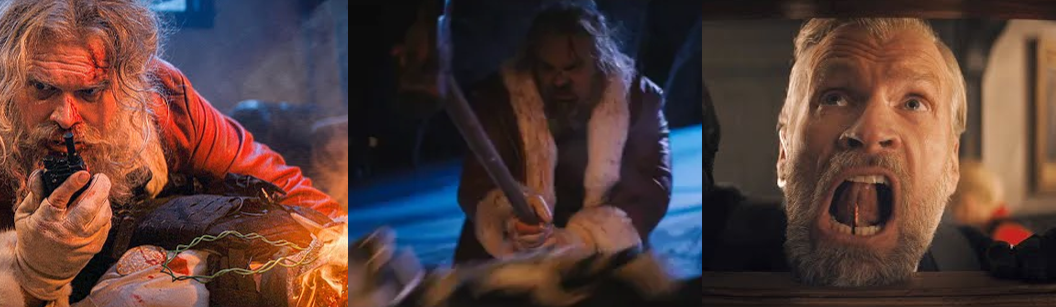
Movie Night: The Mummy (1932)

Released: 22 December 1932
Director: Karl Freund
Distributor: Universal Pictures
Budget: $196,000
Stars: Boris Karloff, Zita Johann, David Manners, Edward Van Sloan, and Noble Johnson

The Plot:
Mummified for attempting to resurrect his dead lover, Egyptian high priest Imhotep (Karloff) reanimates when his tomb is disturbed and sets about wooing Helen Grosvenor (Johann) under the guise of an Egyptian historian.

The Background:
In 1922, British archaeologist Howard Carter and his, benefactor Lord Carnarvon, discovered the tomb of ancient Egyptian pharaoh Tutankhamun, uncovering a cache of riches and an elaborate sarcophagus that wowed and inspired generations. Producer Carl Laemmle Jr. was also inspired by this event, and the so-called “Curse of the Pharaohs” and commissioned story editor Richard Schayer to find a novel for a Mummy-centric horror movie to mirror Universal Studios’ previous success at adapting Dracula (Stoker, 1897) and Frankenstein; or, The Modern Prometheus (Shelley, 1818). Schayer and writer Nina Wilcox Putnam discovered Alessandro Cagliostro’s Cagliostro, a nine-page treatment with some similarities to Arthur Conan Doyle’s The Ring of Toth, which was then retooled by screenwriter John L. Balderston into The Mummy. Taking inspiration from ancient, real-world figures, Balderston’s script became cinematographer Karl Freund’s first gig as a director in America and saw Boris Karloff flex his acting muscles in the title role. Still, Karloff endured a lengthy and uncomfortable make-up process as Jack Pierce transformed him into a desiccated corpse, slathering his face with cotton, collodion, and spirit gum and wrapping him in linen bandages treated with acid and burnt in an oven! While the film’s historical accuracy was debated, The Mummy was a modest box office success met with mixed reviews that has since been regarded as a classic horror for its unique blending of romanticism and horror. The film inspired a few loose sequels and spin-offs before being expertly reconfigured into a highly regarded blockbuster adventure in 1999 (which also spawned sequels and some questionable spin-offs). Although that goodwill was undone by an ill-fated remake in 2017, the visual of an undead creature wrapped in bandages has been an enduring horror figure regardless.

The Review:
The Mummy begins in 1921, where archaeologist Sir Joseph Whemple (Arthur Byron) uncovers Imhotep’s sarcophagus alongside his assistant Ralph Norton (Bramwell Fletcher). While the two are excited to examine the find, Whemble’s friend and colleague, Doctor Muller (Van Sloan), warns that the sarcophagus carries a terrible curse, which Whemble scoffs at, but Dr Muller insists is a warning of the wrath of the ancient Egyptian Gods. While the two wax philosophical, Norton opens the tomb and discovers Imhotep’s surprisingly well preserved remains, the priest having been mummified alive (rather than having his “viscera” removed) for some terrible affront, alongside the “Scroll of Thoth.” Despite Dr. Muller’s warnings, the curious Norton reads from the scroll, unintentionally awakening Imhotep, who lurches to life, swipes the scroll, and leaves Norton so out of his mind that he eventually dies laughing in a straitjacket. The film then jumps ahead some ten years to find Whemple’s son, Frank (Manners), following in his now deceased father’s footsteps, digging for ruins in Egypt alongside Professor Pearson (Leonard Mudie) but having nothing to show for it but a lot of wasted money and a few trinkets. Frustrated and disheartened, the two prepare to leave when they’re visited by the enigmatic and mysterious “Ardath Bay”, Imhotop’s dishevelled but largely human pseudonym, who points them to the long-lost tomb of Princess Ankh-es-en-Amon (Johann). Although they’re initially sceptical, the two are overjoyed when their enthusiastic (but surely underpaid and overworked) dig team uncover the tomb, though Frank is mildly scorned that their discovery is claimed by the Cairo Museum as per the terms of their contract. In contrast, Professor Pearson is overjoyed, welcoming their mysterious benefactor to the museum and holding Ardath Bay in high regard despite his odd demeanour and superstition about being touched and digging up his people’s dead.


Imhotep has little trouble using incantations to fool and manipulate the unsuspecting characters.

Whemple returns to Cairo to bask in the find and Frank is soon enamoured by the beautiful half-Egyptian Helen, a patient of Dr. Muller’s, who suddenly becomes entranced when Imhotep mutters an incantation over a cauldron to show him the reincarnation of his lost love, Ankh-es-en-Amon. Mumbling a language she couldn’t possibly know, Helen is compelled to answer Imhotep’s call, only to be stopped by a locked door and promptly faint, with little to no recollection of what happened. Transfixed by the girl, Frank promptly flirts with her with his stories of how they discovered and unwrapped Ankh-es-en-Amon’s tomb, only for Helen to react with distaste for his sacrilege and somewhat mock him for being smitten by a rotting corpse. While this is somehow enough to earn him a snog, the two are horrified to learn that a museum guard was murdered and that the Scroll of Toth (which Whemple somehow recognises despite him never seeing it) was discovered with the body. While Frank and Muller suggest burning the cursed object, they’re interrupted by Ardath Bay, who’s immediately captivated by Helen and her striking resemblance to his long-dead lover, entrancing the confused girl with the faded memories of her past life. Suspicious of Ardath Bay, Frank and the others confront and quiz him, compelling him to reveal his true identity and to demand the scroll or die (a strange demand considering he had the scroll) and showcasing his ability to hypnotise anyone with Egyptian blood as he brainwashes their Nubian servant (Johnson). Although Whemple resolves to burn the scroll, Imhotep watches from his cauldron and commands the Nubian to intercept him, murdering the old man but ultimately fooling no one with some burned newspaper. Unable to resist Imhotep, Helen returns to the museum and, while spellbound, learns of her past like in ancient Egypt.

Condemned for sacrilege, Imhotep is determined to be reunited with his long-dead love.

Back in the day, Imhotep was besotted by Ankh-es-en-Amon but heartbroken when she died of some illness. Defying the Gods and her father, “Pharoh” Amenophis (James Crane), Imhotep stole the Scroll of Thoth but was buried alive with it when his scheme to resurrect her was discovered. Though Helen’s conflicted, she begs Frank to confine her to her room, terrified of what might happen, leading Imhotep to further manipulate his underlings to reunite his love’s soul with her reincarnated body. Luckily, Boris Karloff provides an enigmatic performance as the titular mummy as this was a chore to sit through. While Imhotep gives Karloff the chance to showcase his range, he’s hardly a terrifying force, even when a decomposing figure, and comes across more like a bored narcoleptic who watches events from his cauldron and threatens people with his scarab ring. The film is more of a bizarre love story, with Imhotep professing a timeless love that he’s carried throughout a restless death and which has seemingly allowed Ankh-es-en-Amon to resurrect throughout the ages. Though Frank can’t compete with Imhotep’s lovelorn declarations, he’s at least alive and doesn’t look like a dried-out sultana so Imhotep plots to kill him, thus removing his rival and any doubt in Helen’s heart. Helen seems into both men, even though she barely knows Frank and Imhotep essentially hypnotises her to make her docile and thus vulnerable for him to kill and perform some mumbo-jumbo to return Ankh-es-en-Amon’s soul to her restored body. While Imhotep seemingly murders those in his way, he seems quite careless as he lost the Scroll of Toth and was forced to demand it. Equally, he’s held at bay (Ardath Bay, you might say…) by a protective amulet and prefers to let the Nubian do all his busy work since he must sit around mumbling incantations, spying on people, or creeping them out with his odd appearance and behaviour.

The Nitty-Gritty:
While I don’t believe for a second that the production filmed in Egypt, I was impressed by the sets and interiors, which are filled with Egyptian artifacts to sell the illusion. Many may not be historically accurate, and the flashback to 1800 BC isn’t very convincing, but there was a clear attempt to make things look a little more elaborate than most Universal Monsters movies. I also appreciated the surprising violence, with a convincing spear impalement and Imhotep describing how the slaves and soldiers present for his burial were executed, and that the film incorporated music (though sporadically) to punctuate dramatic moments. I wish I could say more about Karloff’s make-up but it’s not really that impressive as Imhotep mostly looks drawn and wrinkly. When he’s a desiccated corpse, things are more impressive, but I think a gaunt dummy would’ve been more effective than slathering Karloff in make-up and prosthetics that barely appear for that long. Rather than shambling about as a withered corpse wrapped in tattered bandages, Imhotep waltzes about in a fedora as Ardath Bay, conjuring spells and directing his minions, making him more of a warlock than a mummy. His horror comes from his supernatural abilities, which are limited to hypnotism (and further limited to only affecting those with Egyptian blood). He showcases no superhuman strength or wizardry, instead being a letch who relentlessly pursues, mesmerises, and manipulates others, meaning The Mummy is more about the fear of being controlled than the fear of some ancient creature.

In the end, the ineffectual Imhotep is undone by the Gods in anti-climactic fashion.

Confined to her room and watched like a hawk, Helen’s condition worsens the more she’s kept from Imhotep and the more he tries to reach her with his curses. Luckily, Frank is stupid enough to remove his amulet and take a nap, barely saving himself from Imhotep’s killing curse but nonetheless powerless to keep the Mummy from bewitching Helen. When Helen reaches the museum, her personality has been replaced by Ankh-es-en-Amon, though Imhotep still plans to murder Helen with the most unconvincing dagger I’ve ever seen and then reading from the Scroll of Toth to return Ankh-es-en-Amon’s soul to Helen’s body, allowing them to rekindle their love as undead mummies. Surprisingly, Ankh-es-en-Amon resists this, wishing to inhabit Helen’s young and supple body, and Helen’s personality also struggles against the Mummy, though neither can resist Imhotep’s hypnotic power. After being revived, Frank and Muller rush to Helen’s aid, only to be held back by Imhotep’s spooky scarab ring. This distraction is enough for Ankh-es-en-Amon to beg the Goddess Isis for aid. Incredibly, this works and the statue of Isis lurches to life, pointing an ankh at Imhotep that dispels his power over the Nubian and burns the Scroll of Toth. This also causes Imhotep to (somewhat) rapidly rot and turn to a mere skeleton, clattering to the floor. If you thought this was an abrupt end, the film then doubles down by suddenly cutting to black and the end credits after Frank calls to Helen to return to her body. Admittedly, it’s potentially left ambiguous whether this worked as it could’ve just as easily been Ankh-es-en-Amon who woke up, but I was so bored and annoyed by the film that I really didn’t care and was glad that it was finally over!

The Summary:
My God, this was a chore to watch. I’ve seen The Mummy before and didn’t remember it being this bad, but it really is one of the most boring Universal Monsters movies I’ve seen. I’ve never been the biggest fan of the concept, despite my love for Egyptian superstition and history, but The Mummy really impressed with its sets, attention to detail (historical accuracy be damned), and overall presentation. Sure, we never get a proper look at Cairo or any exteriors, but the interiors and artifacts and such really sold the illusion for me. It’s a shame it’s filled with a bunch of stupid-ass characters who are little more than walking clichés. Zita Johann captures the camera with her beauty, effortlessly showcasing Helen’s confusion and allure, though I would’ve liked to see more of Ankh-es-en-Amon’s personality and how it differed from Helen’s. Frank was just kind of there and I honestly got some of the male leads mixed up as I struggled to sit through this one, though it was amusing seeing them all rendered ineffectual and the day being saved by both a woman and a Goddess. Boris Karloff stole the show with his acting and range, rather than being buried under heavy make-up, but I found the titular Mummy to be a weak and ineffectual character. He wasn’t scary (unless you’re afraid of being hypnotised), he didn’t really do anything (any kills that could be attributed to him were offscreen), and he was defeated with ridiculous ease. Even if you view The Mummy as a bizarre love story rather than a horror, it falls apart under close scrutiny thanks to a questionable script, bone-headed characters, and the concept running out of steam early on. It’s such a shame as there could’ve been something really special here but there aren’t even any impressive make-up effects or chilling moments to salvage this one and it’s easily the most forgettable of the Universal Monsters movies, in my opinion, and far surpassed by the 1999 remake.

My Rating:

Rating: 1 out of 5.

Terrible

Do you think I was too harsh on The Mummy? Perhaps you’re a fan of this one; if so, why? Were you disappointed that Imhotep wasn’t more monstrous or did you enjoy seeing Boris Karloff’s range? What did you think to the presentation of the film and the depiction of ancient Egypt? Were you entranced by the love story angle or did you also find the film a slog to sit through? Which version of the Mummy is your favourite and how are you celebrating Halloween this year? Share your thoughts on The Mummy in the comments, check out my other horror reviews, and donate to my Ko-Fi if you want to see more Mummy reviews.

Movie Night: Hellboy: Director’s Cut

Released: 19 October 2004
Originally Released: 2 April 2004
Director: Guillermo del Toro
Distributor: Columbia Pictures / Revolution Studios[
Budget: $60 to 66 million
Stars: Ron Perlman, Selma Blair, Doug Jones/David Hyde Pierce, Rupert Evans, Karel Roden, and John Hurt

The Plot:
Raised by the kindle Professor Trevor Bruttenholm/Broom (Hurt) to be a paranormal investigator, unruly half-man, half-demon Hellboy (Perlman) finds his dramatic life upended when immortal warlock Grigori Rasputin (Roden) conspires to bring about the apocalypse.

The Background:
After years of bringing his trademark dark, moody art style to both independent and mainstream comics, monster-loving artist and comic creator Mike Mignola got his big break in 1993 with Hellboy, a character he evolved over time into distinctively Lovecraftian comics and spin-offs. Long-time fan and celebrated auteur Guillermo del Toro campaigned for years to bring the character to the big-screen with Ron Perlman in the role, forming a close relationship with Mignola when the artist consulted on Blade II (del Toro, 2002), with production finally starting after that film’s critical and commercial success. Largely inspired by Hellboy’s debut story, del Toro tweaked both his origin and characterisation to focus on Hellboy being torn between right and wrong and add a tragic romanticism to his character. Jake Garber brought Hellboy to life with some impressive make-up and prosthetics, which required Perlman to spend at least four hours getting kitted out, while Rick Baker designed his prosthetic stone hand and the CGI was handled by Tippett Studios. David Hyde Pierce provided the voice of Abe Sapien but refused to take credit or be associated with the marketing out of respect for Doug Jones’s physical work while Spectral Motion handled the many practical effects used to bring Mignola’s distinctive art to life. Though it attracted criticism for its controversial title its $99.8 million gross made it a box office bomb, Hellboy became an instant cult classic. Reviews praised the fun action, horror-adjacent visuals, and Perlman’s engaging performance, while criticising some of the characterisations. This Director’s Cut released to home media the same year, offering a little over ten minutes of additional footage, a critically and commercially successful sequel followed four years later, but plans for further entries stalled and, much to the dismay of many, led to some comparatively inferior reboots.

The Review:
Much like Hellboy’s first story, “Seed of Destruction” (Mignola, et al, 1993), Hellboy begins near the end of the Second World War. In fact, Hellboy quite faithfully recreates and expands upon the circumstances which led to Hellboy coming to our world, with a young Professor Broom (Kevin Trainor) joining an Army regiment to intercept a Nazi ritual off the coast of Scotland. While the Army is understandably sceptical of the “parabnormal”, Professor Broom’s fears are realised when they find zealot warlock Rasputin in the midst of merging arcane magic with the Third Reich’s advanced technology alongside his lover and devout right hand, Ilsa Haupstein (Bridget Hodson), and Adolf Hitler’s top assassin, the mute, semi-undead Karl Ruprecht Kroenen (Ladislav Beran). Although Rasputin successfully opens a portal to a nightmarish realm beyond our understanding, where the Lovecraftian terror known as the Ogdru Jahad slumber, the Allies interrupt them and successfully close the portal, seemingly killing Rasputin and Kroenen in the process. However, while the portal was open long enough to bring through a tiny demon child. Though startled by the demon’s unsettling appearance, the regiment stands down when Professor Broom proves he’s just a curious and frightened little boy and he’s soon adopted by both the troop and the “unready father”, nicknamed Hellboy and spending the next sixty years secretly working to stop supernatural threats as part of the Bureau for Paranormal Research and Defense (BPRD). While Professor Broom ages in that time, Hellboy is said to be barely out of his twenties and is presented as both an urban legend and unruly child who constantly yearns to be in the public eye, shaving his horns to “fit in” and being grounded whenever he breaks out of the BRPD’s super-secret facility.

Professor Broom despairs of his reckless son, who he sees as the saviour of humankind.

While Professor Broom is exasperated by Hellboy’s irresponsible nature, Federal Bureau of Investigation (FBI) director and BRPD liaison Thomas “Tom” Manning (Jeffrey Tambor) is tired of doing damage control whenever Hellboy makes headlines and eager to shut the “freak show” down. Realising that his time is running short and concerned that Rasputin and his followers are making a return, Professor Broom recruits FBI agent John Myers (Evans) to take over as Hellboy’s caretaker, confidant, and mentor, casting Myers as our audience surrogate and earning him much distrust and resentment from the unimpressed Hellboy. Presented as a cat-loving, physically imposing and nigh-superhuman figure, Hellboy is fireproof, extremely durable, and well versed in the mystic arts. While he’s a lousy shot with his massive handgun, the “Samaritan”, he loads it with special rounds and carries numerous trinkets, charms, and reliquaries to ward off curses and such. Yet, Hellboy is restless and stubborn, eager to be amongst the public and refusing backup, even from long-time allies like merman-like Abraham “Abe” Sapien (Jones/Pierce) and Agent Clay (John William Johnson), the closest he has to friends. Though deeply ashamed whenever he disappoints his father, Hellboy is snarky and constantly gives Myers a hard time for being a glorified nanny while also being recklessly confident that he can overcome any foe. To be fair, he’s usually right but Hellboy’s arrogance sees him constantly run afoul of the bestial Sammael (Brian Steele), leading to him being beaten up a fair bit, having eggs laid in his forearm, and the deaths of a BRPD squad, much to Manning’s disgust. Having known no other life than the BRPD, Hellboy sees it as “[his] job” to protect the innocent and regards any risk worthwhile to stop monsters and demons from threatening others. While he’s crushed when Abe and Clay are seriously wounded because of his actions, Hellboy lashes out at Manning and Myers, seeing them as threats to both his livelihood and his ego.

Myers makes for a dull surrogate and the chemistry between Hellboy and Liz is severely lacking.

As tough as Hellboy is, his emotions often get the better of him. Indeed, he often escapes from the BRPD to visit Elizabeth “Liz” Sherman (Blair), a troubled pyrokinetic and former BRPD agent who committing herself to an asylum. It’s obvious that Hellboy is madly in love with Liz, but he struggles to articulate these emotions and often makes a fool of himself, descending into a bitter jealousy when Myers gets close to Liz initially to convince her to return and then because he also develops feelings for her. Traumatised by her unpredictable pyrokinetic abilities, Liz chooses the discomfort and security of an asylum over the BRPD largely because it helps her control her abilities and because she wants to fit in, not be surrounded by monsters who remind her that she’s a freak. This draws her closer to the boyish, everyman Myers but she can’t help but be pulled towards Hellboy, who she largely sees as a sibling but clearly has an attraction to since he’s so devoted to her. Abe councils Hellboy, trying to help him move on and using his telepathic and empathic powers to give him advice, but Hellboy’s stubborn nature sees him desperately find the words to express his love for Liz. As awesome as Perlman’s performance is as Hellboy, Jones impresses as the unnerving Abe, who moves like liquid in water and uses his clairvoyance to offer valuable insight. Sadly, Selma Blair lets the trio down, appearing bored and delivering her lines with a distinct lack of emotion. While this does tie into her adopting a stoic guise to keep her powers under control, it makes for a distinct lack of chemistry between her and Hellboy that isn’t helped by some dodgy CGI flame effects.

Though they have their disagreements, Hellboy’s pained by his father’s death and forced to rely on others.

As far as I can tell, Myers has no comic book counterpart and sticks out like a sore thumb. Clay has far more charisma and already has a rapport with Hellboy and the others, so it would’ve been much more interesting to follow a day in his life for the first twenty minutes or so than be stuck with the forgettable Myers, who only exists to give Professor Broom someone to exposit to. As you’d expect, the late, great John Hurt excels as Hellboy’s strict, but fair, father figure. Commanding a wealth of paranormal knowledge and experience, Professor Broom is committed to protecting the world from supernatural threats and sees Hellboy not only as the bridge between the two worlds, but also as the saviour of humankind. This is why he’s so disappointed whenever Hellboy goes off half-cocked. Knowing that he hasn’t got much time left, Professor Broom works to ensure that Hellboy will be both cared for and helped stay on the straight and narrow. His fears about Rasputin again turn out to be true when the BRPD investigates the museum break in that kickstarts the plot, leading to Hellboy’s many run-ins with Sammael, Agent Clay’s ill-fated confrontation with Kroenen, and Professor Broom’s discovery of a message leading them to Moscow. Professor Broom is the. confronted by the mad mage and his clockwork assassin, afforded a brief glimpse of the apocalyptic future Hellboy is destined to bring about, but fearlessly defies Rasputin, ready to face his death. Naturally, Hellboy is devastated by his father’s murder, falling into a brief depression, but willingly joins the BRPD strike team, stomaching Manning’s antagonistic demeanour to get a chance to settle the score and surprisingly finding himself in the hostile director’s debt after finishing off Kroenen, the two developing a mutual respect that again dwarfs Myers’ inclusion.

Rasputin and his monstrous, nigh-immortal followers are fixated of ushering in the apocalypse.

As in “Seed of Destruction”, Hellboy’s primary antagonist is the mad warlock Rasputin, a mysterious and functionally immortal wizard granted incredible dark magic by the Ogdru Jahad. Using an ancient tome and bizarre Nazi science, Rasputin almost achieves his goal of unleashing the “Seven Gods of Chaos” before he’s stopped by the Allies. Death is a mere inconvenience for Rasputin, however, thanks to his eternally youthful and equally immortal followers, who return their master to life with a blood sacrifice and willingly follow him in resurrecting Sammael, a ferocious beast whom Rasputin empowers to resurrect twofold each time it falls. Eager to capture Hellboy, knowing that his stone hand is the key to unleashing the Ogdru Jahad, Rasputin keeps Hellboy occupied and drive him towards his elaborate mausoleum in Moscow to complete his ritual. Returning from death more powerful, and with more of the Ogdru Jahad’s influence in him, Rasputin is a malicious, cold-hearted villain who nonetheless shows respect towards Professor Broom and permits him a merciful death. Though Ilsa doesn’t get much to do beyond lusting after her master and following his every whim, Kroenen makes a hell of an impression with his wind-up body, deft skill with blades, and intimidating masked visage. A heavily scarified, zombie-like figure, Kroenen easily cuts down groups of armed foes (though largely bloodlessly) and seems to delight in murdering anyone who gets in his way, easily fooling the BRPD by playing dead and killing those closest to Hellboy. Hellboy primarily tussles with Sammael and its kin throughout the film, finding the creature ruthless and as pig-headed as him thanks to its supernatural ability to rapidly heal and resurrect upon death. A slobbering, voracious beast who pounces upon its prey, Sammael tears through the BRPD, injures Abe, and constantly dogs Hellboy in some fun, action-packed fights.

The Nitty-Gritty:
My knowledge and experience of Hellboy may be lacking since I mainly know him from the films, but as far as I’m aware Hellboy sticks somewhat close to the source material while also diverging in numerous ways. For starters, Hellboy is presented as an urban legend, one Manning is keen to keep under wraps, rather than being the “World’s Greatest Paranormal Investigator”. This acts as the backbone for much of the plot and Hellboy’s arc, with him eager to get into the spotlight and relishing showing off before the public. Secondly, Hellboy changes Hellboy’s relationship with Liz, giving him a long-standing crush on the apathetic pyromaniac and presenting a largely humorous side plot of him sabotaging Myers when he gets close to Liz. Ironically, Hellboy asks Myers for help in articulating his feelings and Myers reluctantly offers him advice, despite his own feelings for Liz. Ultimately, Professor Broom’s death gives Hellboy the courage to admit his devotion to Liz, understanding that his demonic visage reminds her that she’s different and she’s looking for someone who makes her feel normal, seemingly stepping aside in favour of Myers while still vowing to always be there for her. Thirdly, Hellboy places far greater emphasis on Hellboy’s relationship with Professor Broom, who was offed pretty quickly into “Seed of Destruction.” Here, we see the dynamics of the unlikely father/son relationship, with Professor Broom despairing of Hellboy’s reckless antics and this brutish demon reduced to an ashamed child whenever his father gives him a disapproving look. It’s a great twist and makes Professor Broom’s death even more of a blow since we see how close they are, best showcased when Professor Broom refuses to learn Hellboy’s true name from Rasputin since he already knows what to call him: son.

Despite some dodgy CGI, the practical effects and prosthetics are genuinely impressive throughout.

While Hellboy’s personality may be noticeably different from the source material, painting him as an arrogant and rowdy teenager who pointedly refuses help and must learn to grow up, Ron Perlman delivers a fantastic performance. He nails every nuance of Hellboy’s characterisation, which sees him be sarcastic, enraged, and lovelorn throughout the film. despite clearly being swamped by uncomfortable make-up and prosthetics, Perlman’s emotions still shine through, and I’ve always been a fan of his gravelly delivery. Hellboy looks incredible, sporting a sledgehammer-like stone fist and prehensile tail, crashing through walls and wrestling his foes into submission. While the CGI does the practical effects a disservice, making Hellboy and Sammael unfortunately cartoonish at times, the practical effects more than make up for it. Hellboy and Sammael demolish a subway station, crash through stone walls in a hidden cavern, and tear through the busy night-time streets, with Hellboy flipping a car to protect Myers and Sammael eventually being smushed by a subway train. Kroenen equally impressed in his appearances, slinging his blades around with superhuman dexterity and cutting foes down with a supernatural efficiency. When his true, gruesome form is revealed, it’s a hideous and wholly practical sight that makes me want to know more about this bizarre half-zombie. Practical effects also take centre stage when Hellboy resurrects the desiccated corpse of Ivan Kilimatovich (Unknown), a skeletal torso who guides them through Rasputin’s boobytrapped mausoleum. While many of the hazards contained within are equally practical, such as the heavy doors and crumbling bridge, much of the danger is lost when the obvious CGI rears its head, but it’s all good fun for the most part. The Director’s Cut largely splices deleted and slightly extended scenes back into the film, giving us a scene where Ilsa gifts Rasputin artificial eyes, showing Liz has a touch of OCD and adding a bit more depth to her time with Myers, but there’s nothing all that substantial added.

Hellboy ultimately rejects his demonic heritage to save the world and finally express his love for Liz.

Journeying to Moscow to avenge Professor Broom and stop Rasputin’s maniacal scheme, Hellboy buries the hatchet with Manning after they work together (somewhat) to finish off Kroenen, impaling him on spikes and trapping him under a giant gear. While all the BPRD agents who accompany them are lost to the mausoleum’s booby-traps, Liz destroys Sammael’s nest with a burst of unbridled fury. However, this leaves her and the others weakened, easily allowing Rasputin to capture them. Even Hellboy is rendered powerless by a heavy trap that can only be unlocked by saying his true name, which he’s compelled to do when Rasputin maliciously sucks out Liz’s soul. Defeated and disheartened, Hellboy reluctantly whispers his name (“Anung Un Rama”) and undergoes a horrific transformation, his horns growing out and a flaming crown appearing on his brow. He then willingly uses his stone hand to free the Ogdru Jahad from their crystalline prison and have them begin to manifest amidst a blood moon. However, just as he’s about to unlock the final seal, Hellboy’s brought to his senses by Myers, who begs him to remember his father’s teachings, leading him to break his horns and mortally wound Rasputin with them, having chosen to be a man rather than a demon. Though the Ogdru Jahad are prevented from invading, Rasputin’s death frees a spawn of theirs, the gigantic, tentacled Behemoth, that Hellboy tackles alone after make amends with Myers. Thankfully, Hellboy brought a grenade belt, which he uses to blow the beast to bloody chunks. Heartbroken by Liz’s death, Hellboy whispers a threat to those “on the other side” to let her go or face his wrath, prompting her swift resurrection and the two to finally embrace as lovers. Myers, having earned Hellboy’s trust, delivers the film’s closing narration about nature versus nurture, echoing Professor Broom’s opening narration, though Manning is left waiting impatiently to be rescued!

The Summary:
Although I had no idea who Hellboy was when I first saw this film, I was intrigued by the premise, its ludicrous main character, and the promise of a fun, action-packed supernatural adventure. Indeed, the only reason I am a fan of Hellboy is because of this movie, which is still a favourite of mine. Sure, I have some issues with Myers (he makes for a painfully bland audience surrogate), Linda Blair’s performance (if it’s meant to be this way, it really misses the mark), and some of the dodgy CGI, but the pros far outweigh the cons. Hellboy has a great tongue-in-cheek sense of humour that makes the title character a joy to watch since he’s such a smart ass doofus, while also delivering some decent action sequences that have stood the test of time thanks to top-notch practical effects. The make-up and prosthetics are fantastic, with Hellboy, Abe, and Sammael all having a very tangible and tactile quality to them. Little touches like Abe’s blinking, his malformed hands and gills, and Sammael’s bone-wrenching healing add so much life to these characters, to say nothing of how imposing and impressive Perlman appears under all that getup. Although Hellboy’s characterisation is noticeably different from the comics, it works really well in this context, giving him a meaningful and surprisingly emotional character arc as he learns to focus on the big picture and stop messing around while also accepting help from his allies. I loved his father/son relationship with Professor Broom, his dynamic with Manning, and even appreciated his devotion to Liz, despite their lack of chemistry. Mignola’s art and Lovecraftian inspirations were brought to life wonderfully here, with the Ogdru Jahad being horrifically bizarre, vivid colours popping when necessary and heavy, ominous shadows being used effectively where possible. It’s got some flaws, for sure, but Hellboy is still an extremely enjoyable romp that doesn’t really get talked about all that much these days, which is a shame as there’s a hell of a lot to like here.

My Rating:

Rating: 4 out of 5.

Great Stuff

Did you enjoy Hellboy’s big-screen debut? What did you think to Ron Perlman’s performance, his appearance, and the changes made to Hellboy’s character? Did you also find Myers a dull audience surrogate and the chemistry lacking between Hellboy and Liz? Were you happy with the way the film adapted elements from the comic books? Which Hellboy adaptation is your favourite? Share your thoughts on the first Hellboy movie in the comment and donate to my Ko-Fi to suggest more Hellboy content for the site.

Movie Night: Terrifier 2

Released: 6 October 2022
Director: Damien Leone
Distributor: Cinedigm / Iconic Events Releasing
Budget: $250,000
Stars: David Howard Thornton, Lauren LaVera, Elliott Fullam, Sarah Voigt, Kailey Hyman, and Casey Hartnett

The Plot:
After being mysteriously resurrected, the demonic Art the Clown (Thornton) stalks grieving Sienna Shaw (LaVera) on Halloween night, unaware that Sienna may hold the key to stopping his senseless slaughter for good.

The Background:
The fear of clowns (also known as Coulrophobia) is a surprisingly common trope in both horror and everyday life thanks to fictional “Evil Clowns” like Stephen King’s Pennywise and twisted killers like John Wayne Gacy. Writer director Damien Leone tapped into this fear with his short film, The 9th Circle (2008), a which included a prototype of Art the Clown (Mike Giannelli). Despite his small role, Art proved popular enough for Leone to revisit the character in his subsequent films, Terrifier (2011) and All Hallows’ Eve (2013). Seeing Art as a chance to create a truly iconic slasher villain for a modern audiences. Terrifier made a modest profit and attracted largely positive reviews that praised David Howard Thornton’s performance as Art as much as the stunning gore. Dissatisfied with some elements of the film, Leone sought to craft a truly captivating and well-rounded protagonist for the sequel, while also expanding the scope of the franchise. Despite the discomfort of her Valkyrie costume, Lauren LaVera enjoyed her time on setand worked closely with Leone to give Art a heroic counterpart. With an increased budget thanks to a successful Indiegogo campaign, Leone worked around the COVID-19 pandemic to depict a prolonged and arduous murder scene that attracted much controversy. Despite some criticisms regarding the unnecessary brutality towards women and reports of audiences vomiting or fleeing screenings, Terrifier 2 was a critical and commercial success, with reviews praising LaVera’s nuanced and appealing protagonist as much as Thornton’s continued physical commitment to the killer clown. Sweeping the 2023 Fangoria Chainsaw Awards, Terrifier 2’s success more than justified another sequel in 2024 and unquestionably established that Leone had a franchise on his hands, for better or worse.

The Review:
Terrifier 2 picks up right where the first one ended. After terrorising Miles County, Art the Clown shot himself in the head to avoid arrest, leaving a sole survivor – the horribly mutilated Victoria Heyes (Samantha Scaffidi) – confined to a mental hospital after going mad from the experience. Despite his fatal injury, Art bursts to life and attacks coroner, Seth Bolton (Cory DuVal), slicing his throat, ripping his eye out to temporarily “replace” his own, and finally bashing his head in with a surgical mallet. Garbed in a blood-soaked clown outfit, Art retrieves his bin bag full of “toys” and heads to a laundromat to freshen up, silently giggling over the bad news in the local paper and being approached by a mysterious cherub dressed almost identically to him. This “Little Pale Girl” (Amelie McLain) appears to be an unidentified demonic spirit, one only Art or those close to him can see, and it’s implied she causes his otherwise inexplicable resurrection. The Little Pale Girl appears throughout Terrifier 2, often sporting glowing eyes and imitating voices, and is seemingly a spiritual guide to the murderous mime as she encourages and somewhat directs his actions. The film then jumps ahead to the following Halloween Eve, when the fallout from Art’s killing spree is still felt throughout Miles County. Jonathan Shaw (Fullam) is strangely obsessed with Art, who’s presumed dead but also missing, to the point where he wishes to dress up as Art for Halloween, a decision his overworked and short-tempered mother, Barbara (Voigt), vehemently shoots down. Jonathan’s macabre imagination and fascination with serial killers disturbs his older sister, Sienna, though her concerns fall on deaf ears since her mother is more concerned with work and expressing her grief by scolding her children for any right- or wrongdoings.

Alluring Sienna makes for a sympathetic, relatable, and well-rounded protagonist.

The Shaws are in turmoil following the death of their patriarch, a talented artist who once envisioned his daughter as a Valkyrie warrior before succumbing to an unnamed disease. While Sienna remembers her father fondly, spending months constructing an elaborate recreation of her father’s drawing to wear to a Halloween party and “feel close” to him, it’s heavily implied that her father underwent a dramatic character change as his disease worsened. He barely knew who he was by the end and is said to be abusive towards Sienna, which perhaps is what drove him to drown his sorrows and kill himself in a car wreck. Either way, the Shaws deal with their grief in different ways: Barbara focuses on work and has a short fuse, Jonathan veers down a more morbid path, and Sienna focuses on her costume project. Having already struggled with her mental health and still relying on pills to curb her anxiety attacks and nightmares, Sienna is barely holding together; all she has is her project and the ornate sword her father gifted to her. Well, that and her friends, Brooke (Hyman) and Allie (Hartnett), who treat her like an adopted sister. While the three are close, Sienna’s condition and trauma keeps a wedge between them. She’s easily triggered by talk of gore and Brooke later chastises her for being so uptight and doom-and-gloom all the time. Sienna’s life is made more difficult by Jonathan, who lands in hot water when visions of Art and the Little Pale Girl see him reprimanded at school, aggravating his already borderline abusive mother. Haunted by ominous dreams of Art and his “Clown Café”, Sienna’s mental state is often questioned, especially when her room spontaneously combusts, to the point where few share her concerns when she sees Art in the flesh. While the main protagonists victims of Terrifier were largely forgettable, Sienna is a far more well-rounded character. Vulnerable, beautiful, and creative, she’s determined to make an impression with her costume and goes to great lengths to try and keep Jonathan safe by the finale.

Sienna rightfully gets most of the screen time, though her friends and family do add to her plight.

After going through their father’s sketchbook, Jonathan surmises that he was aware of Art and depicted Sienna as angelic warrior to combat the evil clown. Her outfit echoes this, painting her as a Valkyrie and setting her up as a flawed and suffering representation of light versus Art’s twisted evil. Focusing on Sienna and her family strife was a fantastic idea; it removes some of the grimy “Grindhouse” atmosphere of the first film but gives us someone to sympathise with and root for. Unfortunately, Allie is just kind of…there…empathetic to Sienna’s troubles but struggling to fully relate to them. Brooke is much more outspoken and reckless, snorting coke with her boyfriend, Jeff (Charlie McElveen). Still, they exude more personality than their predecessors and we care about them by proxy since they’re close to Sienna rather than simply being throwaway victims. However, Elliott Fullam seems out of his depth, portraying Jonathan as a weird, obnoxious, conflicted brat who hyperventilates his way through most scenes and spends most of his time riling everyone up or wailing on the floor. It’s clear that he and Sienna have a bond, one that’s frayed since their father died, and they come together nicely in the end when Art kidnaps the boy to lure in his sister. To be fair, it’s no wonder Jonathan and even Sienna are messed up with a mother like Amanda. She can barely hold herself together to care for her kids and is far more likely to strike them than encourage or comfort them. Amanda’s inability to keep her cool sees her literally lose her head courtesy of Art, further scarring Jonathan when he finds the clown he’s been obsessed with stuffing mashed potatoes into the remains of his mother’s head! The Little Pale Girl callously uses Sienna’s family against her, imitating Jonathan’s voice and even assuming Amanda’s form just to trap and taunt the girl, and learning of their condition only serves to further agonise the already suffering Sienna, who’s literally put through hell in order to realise her father’s destiny for her.

Art gets a supernatural, demonic edge that makes him even more cruel and sadistic than before!

While Art was previously portrayed as a disturbing but nonetheless human figure, he’s now got one foot in the supernatural. Reborn not as a zombie or some undead spirit, Art retains the same twisted sense of humour and sadistic streak as before, but we spend more time with him between kills. We see him swiping supplies from Seth’s office, washing his clothes with mirth, constructing new weapons, and express visible disgust and frustration when his prey fights back. Art becomes fixated on Sienna, possibly because they seem to share a strange mental connection (Sienna often dreams about or has visions of Art, for example). When he finally gets his hands on Sienna, Art doesn’t rip her to pieces like his other victims; he brutally beats her and leaves her alive. Indeed, Art is far more elaborate with his kills this time, stalking and taunting them with his clown-like antics and then drawing out their deaths with a cruel malice. Art is functionally superhuman now, shrugging off gunshots, spiked implements to the head, and easily ripping off limbs and through chest cavities. He remains vulnerable, however, being slowed by weapons, bleeding, and being temporarily subdued by a sawn-off shotgun. However, he returns each time, spurred on by the Pale Little Girl, and eager for his victims to scream in agony. When Jonathan lays unconscious at his feet, for example, Art is visibly disappointed and resorts to chewing on the boy’s ankle to hear his screams. As his victims scream and bawl, Art gleefully mocks them, his silent laughter and crocodile tears mirroring the very real pain and suffering of his prey, who are forced to endure more agony than appears humanly and scientifically possible. We also get a few titbits about a possible backstory for Art: he holes up in an abandoned theme park, specifically the Terrifier fun house where it’s said the Pale Little Girl died some years prior, and it’s almost implied that he was somehow brought to life by Sienna’s father’s drawings. Naturally, Terrifier 2 doesn’t go into detail with this but the Pale Little Girl’s presence, Art’s seemingly supernatural edge, and the breadcrumbs offered by Sienna and Jonathan certainly go a long way to suggest that there’s more to Art than simply being a mute, killer clown.

The Nitty-Gritty:
The visual and narrative upgrade from Terrifier to Terrifier 2 is both impressive and very welcome. While the first was a grimy, shocking piece of splatter-gore, the second is a far “cleaner” and more mainstream horror offering. However, while its indie, Grindhouse-inspired roots may have been downgraded, Terrifier 2 remains a disturbing and twisted watch. The increased budget clearly allowed Damien Leone to utilise better camera, better lighting, more elaborate gore effects, and far more visually interesting locations. I liked the gritty, back alley setting of the first film, but it did become stagnant at times and very much felt like Terrifier was merely an appetiser for what Leone and Thornton are truly capable of. Terrifier 2 opts for a suburban setting for a disturbing amalgamation of the suburban horror of John Carpenter’s Halloween (Carpenter, 1978) and the “Gallio” horror cinema. In Terrifier, the horror wasn’t so much the over-the-top gore but more the randomness of Art’s attacks; he seemingly picked victims at random and was unpredictable. That unpredictability is still present in Terrifier 2, only now locking yourself in your home isn’t enough. Art simply forces his way into Allie’s house, and the Shaw’s, brutalising his victims and cropping up in a laundromat and Halloween store without a care in the world. Art’s presence is unnerving even considering the spooky season since he acts so aloof; even him trying on goofy sunglasses and honking horns at Sienna is enough to rattle her. This is given a raw edge through Sienna’s visions and nightmares, where Art massacres a children’s television show as a figure of mirth warped into a violent psychopath. Just researching Art and seemingly being fascinated by his legend is enough to cause Jonathan to see the Little Pale Girl, though Terrifier 2 suggests there’s more to this and some mysterious link between the Shaws and Art since Barbara is incensed by the mere mention of him and Sienna is seemingly positioned as Art’s polar opposite.

Art gleefully subjects his victims to gruesome, brutal torture before tearing them to pieces!

Art is now obsessed with raking flesh and tends to target eyes, possibly because he’s missing one at the start. He pulls out Seth’s eye, stabs the Halloween store clerk (Johnath Davis) in the orbital area with a broken bottle, and slices a scalpel through Allie’s eye to start her torturous death. No one is spared Art’s wrath, even an exhausted laundromat patron (Thomas Smith) gets a broken mop jammed into his head just because he woke up! Art’s bag of tricks has been expanded; he carries corrosive acid that he tosses in Brooke’s face and a sawn-off shotgun to blow Amanda away. Art also brutalises the melting Brooke with a custom-made nail bat and other implements, used a tommy gun and blowtorch in Sienna’s dream, and even stabs Jeff in the dick and hacks it off to taunt Brooke! Art lashes Sienna and Jonathan with a barbed whip, slashes them with a scalpel, and hacks off the clerk’s head with a rusty hatchet! However, Allie takes the prize for the film’s most memorable and morbidly fascinating kill! When Art breaks into her house, he chases her to her bedroom and slashes her eye, then savagely descalps her with a pair of scissors before slicing into her back to expose her ribcage. He then wrenches off one arm, splits the other down the middle, and dumps bleach and acid over her as she whimpers, bleeding on the floor. Art then tears half her face off and mutilates her to the muscle and bone when Allie’s mother (Amy Russ) returns home. Despite being little more than a flayed corpse, Allie still has the strength to call for her mother, leaving the woman a screaming wreck as Art silent cackles away, Allie’s flesh still stuck in his teeth! It is, honestly, a painfully disturbing sequence of brutality that I just cannot turn away from. The sheer ruthless nature of Allie’s suffering trumps anything, even that kill, from the first movie and certainly suggests that Art exudes an aura that prolongs his victim’s suffering and empowers him, since he clearly gets off on their agony!

Although Sienna powers up and defeats Art, the demonic clown is reborn through his former victim…

After suffering a panic attack thanks to her condition and Brooke spiking her drink, Sienna heads home with Brooke and Jeff. However, Sienna forces them to redirect to the abandoned funfair when Jonathan calls for help. This is, however, a trap laid by Art and the Little Pale Girl. As Sienna searches for her brother, Art castrates Jeff in an attack that’ll make your eyes water and brutalises Brooke, ripping out and partially eating her heart. Although Sienna valiantly attacks Art, she gets cut up and beaten unconscious, though this is where Terrifier 2 loses much of its momentum as the final act descends into an extended chase and attack sequence where Sienna and Jonathan run around looking for each other. Art delights in cutting Jonathan with a scalpel, shrugs off having his own bat lodged in his skull, and maniacally whips both Shaw siblings, gouging their flesh and repeatedly throttling Sienna. Although Jonathan tries to help, Sienna ends up stabbed in the abdomen with her own sword and drops down a mysterious hole from which the screams of Art’s victims echo. Transported to the Clown Café, Sienna ultimately drowns in a glass chamber. While Art feasts on Jonathan’s ankles, Sienna hears his screams and is mysteriously resurrected by her father’s blade, which heals her stomach wound (though not her others) and allows her to claw out of whatever part of Hell spawned Art and the Little Pale Girl. Sienna attacks Art with the magical sword and fatally wounds him. Like the last film, Art offers no resistance to this; indeed, he not only joyfully offers his neck but also seems to nod in respect for Sienna’s strength. Full of righteous vengeance, Sienna hacks off Art’s head but is too traumatised and injured to stop the Little Pale Girl taking it. A mid-credits scene sees an agonised Victoria Heyes spewing vile liquids from her nether-regions. Drawn to the normally docile patient’s cries, Victoria’s nurse (Leah Voysey) finds she has written curses and a declaration of love to Art on the walls with her blood and faeces. Oh, and Victoria is also seemingly possessed by the Little Pale Girl, since she sports the same glowing eye…and chortles maniacally as she cradles Art’s newly born severed head!

The Summary:
Terrifier 2 certainly improves on many of the flaws and shortcomings of its predecessor. Not only is the scope widened, but the locations and effects greatly benefit from the additional budget, to say nothing of Rostislav Vaynshtok and Paul Wiley’s synth-style score. The greatest trump card Terrifier 2 has over the first film is in Sienna. Lauren LaVera captivates with a natural beauty, charismatic appeal, and sympathetic vulnerability. She may get the lion’s share of screen time and characterisation, but it greatly benefits the film and her friends, while less developed characters, still add to her plight. Terrifier 2 does a decent job of exploring how grief affects different people, from Amanda focusing on work and lashing out at her kids to Jonathan’s odd obsession with serial killers like Art. Sienna choses to focus on her artistic expression to remember the good times she had with her father and feel closer to him, honouring his memory with her attractive (but clearly uncomfortable) Valkyrie outfit. As a pure, almost angelic figure, she’s perfectly positioned as Art’s archenemy and opposite, being traumatised and insecure where he’s bold and colourful. While Art’s mystery is only deepened here, with supernatural and potentially demonic elements being weaved into his character and him showing a burning rage at times, he’s also more unhinged and brutal than ever! Terrifier 2 turns the dial up to twenty-one, never mind eleven (!), with its deranged and sadistic kills that border on torture porn. It’s shockingly gruesome seeing Art maim, hack, and assault his victims and the film certainly isn’t forgetting its Grindhouse roots in these long, uncomfortable sequences that will have you questioning your obsession with horror. While this is enough to satisfy me as a horror fan, and to rate Terrifier 2 as the superior compared to its sequel, everything about this film justifies this rating since its so much more polished compared to the original. Whereas Terrifier seemed like an expensive proof of concept, Terrifier 2 has an actual plot, a developed main character, and adds a touch more intrigue to its inhuman villain. It feels less like a random assortment of grimy, shocking gore and more like a more complete and nuanced movie. It’s still not for everyone, the third act drags a bit and squanders the momentum of the second half, and some may even be offended by its content, but Terrifier 2 was a far more enjoyable experience for me as a film and horror fan and I would highly recommend it to anyone looking to take a dive bomb into the more extreme end of the genre.

My Rating:

Rating: 4 out of 5.

Great Stuff

Do you think Terrifier 2 surpasses the original? What did you think to the additional supernatural elements given to Art? Were you also a fan of Sienna, her eye-catching outfit, and her position as Art’s reluctant opposite? What do you think is happening with the Little Pale Girl? Do you agree that the gore was far more brutal this time, or did you find it too unrealistic? Are you scared of clowns and, if so, why? Which of the Terrifier films is your favourite and how are you celebrating horror this month? Share your thoughts about Terrifier 2 in the comments, support me on Ko-Fi, and check out my other horror content!