
Released: May 1994
Developer: Virgin Games USA
Also Available For: Game Gear, Master System, Super Nintendo Entertainment System, and Game Boy
The Background:
One of the greatest things about comic books published in the nineties was that the sky was, seemingly, the limit for plots, crossovers, and all kinds of stories to be told. Thanks to Dark Horse Comics snapping up the rights to some of the biggest science-fiction/horror franchises of the time, we got to see not only the likes of Aliens vs. Predator but also the cybernetic clash you always wanted to see in a movie but never got, RoboCop Versus The Terminator (Miller, et al, 1992). Given that the comic was written some time before Frank Miller flushed his reputation down the toilet with The Dark Knight Strikes Back (2001 to 2002), the RoboCop Versus The Terminator was relatively well-written, action-packed fun. The general premise was that RoboCop’s artificial intelligence (A.I.) formed the basis of the world-killing Skynet, which sent Terminators back through time to protect him and ensure its survival. Cue a time-line hopping, reality-bending story that sees RoboCop reduced to his digital consciousness, construct a fully robotic body, and travel back in time to destroy Skynet once and for all. It’s a pretty mental comic but, like Aliens vs. Predator, a fantastic concept that, apparently, had enough legs to warrant a videogame released on a number of consoles. I had owned and played the Master System version for years but, once I set my literal come corner up in my cabin, I knew that I had to track down the superior Mega Drive version.
The Plot:
Unwittingly responsible for the creation of Skynet, RoboCop must battle from the streets of Detroit, to the offices of Cyberdyne, to a war-ravaged future eradicating the Terminator threat and freeing hostages as he goes to ensure a future free from Skynet’s influence.
Gameplay:
Like the majority of videogames based on the RoboCop (Various, 1987 to present) and Terminator (Various, 1984 to present) movies, RoboCop Versus The Terminator is a side-scrolling action shooter with light platforming elements. Unlike the Alien vs. Predator (Capcom, 1994) arcade game, this is a strictly one-player experience that sees the player control RoboCop, who must blast his way through about ten levels taking out the likes of regular street thugs and Terminator alike. As much as I love RoboCop, he’s always a terrible character to control and play as; even in the excellent RoboCop (Data East, 1987) arcade game he was a slow, plodding hunk of metal and it’s more of the same here. RoboCop lumbers his way through levels at a steady pace, hopping half-heartedly to platforms (and, amusingly, monkeying his way across lines and pipes) and struggling to dodge incoming fire. While this is obviously a realistic way to portray RoboCop (who, despite being a massive efficient combat shooter, has never been the most versatile of sci-fi cyborgs), it does mean you can’t just plough ahead guns blazing.
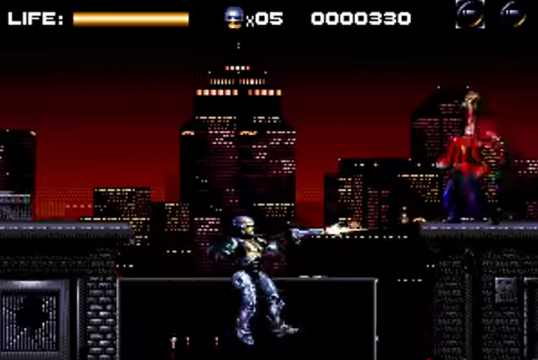
Instead, it’s best to hang back and keep an eye on enemy projectiles, ducking and hopping out of the way as best you can considering RoboCop’s massive hit box. Thankfully, many of the game’s environments are destructible and will yield all kinds of goodies, from baby food that will restore Robo’s health to extra lives and weapons. There are also loads of secret rooms to be found that hold similar rewards, encouraging exploration. RoboCop is armed with his trademark Auto-9 handgun and can fire in multiple directions; this alone is more than enough to take out most of the enemies he’ll come up against but, if you get up close to enemies, you can also punch them, and you can acquire bigger, better weapons as you make your way through the game’s levels. You can switch between these with a button press but, once your health is drained and you lose a life, you’ll lose one of your weapons until you return to the default Auto-9. the good news is that RoboCop can take a fair amount of damage and will return to action right on the spot where he fell, but the bad news is that it doesn’t take much to drain Robo’s health and there are a few occasions where environmental hazards (like vats of toxic waste or flaming pits) will instantly kill RoboCop.
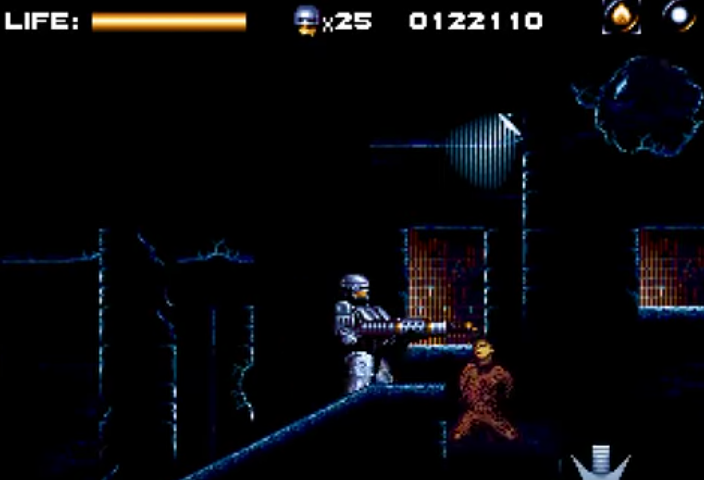
While RoboCop is generally given simple objectives (like cleaning up the streets or destroying the Terminator threat), some levels will see him having to rescue a number of hostages. Upon being rescued, a portion of Robo’s health will be restored, which is helpful; also helpful is that it doesn’t appear to be a requirement to clearing the level to rescue these hostages; when you see them, you can touch them to rescue them but I never reached the end of a level and was told I’d failed or was forced to go back and save any hostages I’d missed, so it’s more about gaining health and points than a level-clearing obligation. Yes, like pretty much every videogame ever made, there’s a nice little score tally at the bottom of the screen that’ll increase as you take out enemies, rescue hostages, and collect items. Earn enough points and you’ll gain an extra life, which you’ll need as the game ramps up in difficulty as you progress from the thug-infested streets of Detroit to the robot-infested headquarters of the killer A.I. known as Skynet. It’s around this point that you’ll struggle a bit with RoboCop’s controls, hit box, and clunkiness; Terminators of all shapes and sizes (from the traditional T-800s, to the robotic endoskeletons, to spider-like drones and wall-and-ceiling-mounted cannons) will unleash a hailstorm of projectiles your way and you’ll need all of your best weapons and skills to make it through the game’s bullet sponge of a final boss.
Graphics and Sound:
Coming off of the Master System version (which, honestly, isn’t too and compared to some Master System ports), RoboCop Versus The Terminator boasts some gorgeous in-game graphics. RoboCop and his various enemies are big, fantastically-detailed sprites; while this does mean they have large hit boxes, it makes for some impressive, arcade-quality graphics.
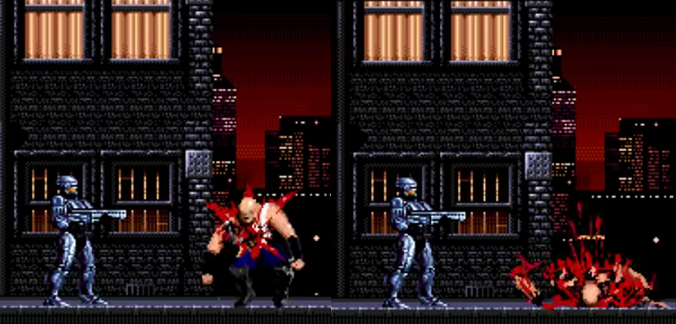
One of the most enjoyable things about RoboCop Versus The Terminator is the copious amounts of gore it contains; when you blast away thugs, they explode in a bloody mess and it’s absolutely glorious. You’ll miss these effects once the Terminators begin to take precedence as the game’s primary enemies but, even then, you’ll see the T-800’s skin degenerate until only the endoskeleton is left, which is a nice addition. Alongside a few choice sound bites from the first RoboCop movie, the game features a techno-inspired soundtrack with a lot of beats and rocking bass; there’s some odd choices, like a sultry voice blurting out “Terminator!” every ten seconds or so but, while the game doesn’t feature either of the iconic themes from the two franchises, its techno-inspired beats seem heavily inspired by both.
Enemies and Bosses:
RoboCop will initially face little resistance from the street thugs of Detroit; they’ll shoot at him, sometimes from behind windows, and get in his way but they’re small fry and easily dispatched with a single shot.
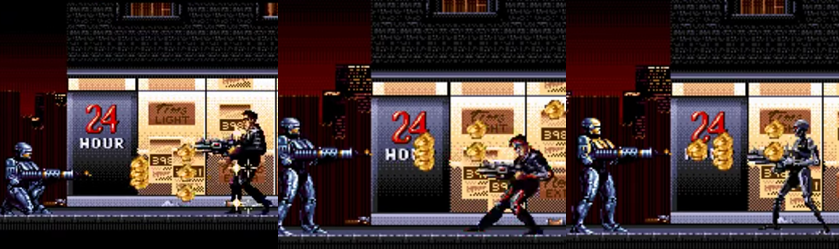
At the end of the second level, though, RoboCop comes face-to-face with a T-800 Terminator modelled closely on Arnold Schwarzenegger’s appearance from the end of the first film and the majority of the second. As a boss, this guy obviously takes more hits, degenerating from a fully clothed and skinned appearance to the iconic Terminator endoskeleton as the battle progresses. After this, similar Terminators will begin to appear as regular enemies; the Arnold models will take around three hits to put down (one to blast away the façade and two to destroy the endoskeleton) while the endoskeletons will take around two. Smaller Terminator drones also show up to spew projectiles at you as you journey deeper into the future and Skynet, but you’ll also encounter red Terminators, which are endoskeletons that take even more hits to put down.
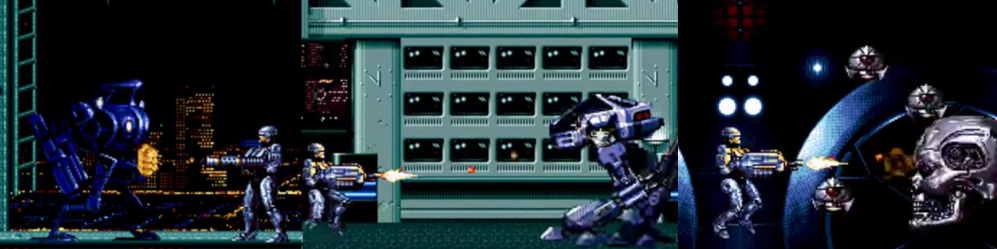
You’ll also battle some iconic RoboCop bosses, such as ED-209 and (rather inexplicably) RoboCop 2 (or “RoboCain”), each of which are guarding the facilities and offices or RoboCop’s megalomaniacal creators, Omni Consumer Products (OCP). Once RoboCop travels to the war-torn future, he’ll battle bosses such as Terminator-controlled gatling guns, super-powered endoskeletons, and Skynet itself. Skynet is represented as a giant floating endoskeleton head that tosses small drones and projectiles at you while endoskeletons march in from either the left or the right side of the screen. This final battle is, honestly, a little underwhelming (though, honestly, most of the game’s bosses are after the first few and you’ve finished with RoboCain and Ed-209); you’ll have your work cut out for you to dodge all of the projectiles it throws at you and to unload enough bullets to finally do it in but I can’t help but feel the game missed out by not including a T-1000 battle or a final boss more reminiscent of the giant liquid metal T-1000000 spider from T2-3D: Battle Across Time (Cameron, Bruno, and Winston, 1996).
Power-Ups and Bonuses:
As mentioned, there are a variety of power-ups RoboCop can collect as he explores (and destroys) each level; baby food will replenish his health, little RoboCop heads will grant an extra life, and shields will grant RoboCop a generous period of invincibility. Most notably, though, RoboCop can acquire a variety of bigger, better guns which will dramatically increase his odds of survival; we’ve got everything from a traditional three-way spread to a grenade launcher, to homing missiles and a laser pistol. You can also grab one of ED-209’s arm cannons from a rapid fire burst, which is a pretty great little bonus; you can grab one of these during the boss battle with ED-209 but they do crop up in secret rooms and other areas of the game, too,
Additional Features:
There are three difficulty settings to pick from, each one carries a different set of lives, continues, and affects the amount of damage RoboCop can take. If you play on the hardest setting, enemies will be much more aggressive and the arrows that show you the way to go will also be missing. Aside from that, the only real incentive to replay again is to find all the secret rooms. As with all great old school games like this, there are a variety of cheats you can input that will grant you a whole bunch of lives and let you pick from all the available weapons. Unfortunately, though, you can only play as RoboCop; the narrative is geared in a way where Robo is the hero and the Terminators are the enemy but it might have been nice to see a mode where you play as a reprogrammed T-800.
The Summary:
RoboCop Versus The Terminator is a blast to play; while RoboCop is a clunky and cumbersome videogame protagonist at the best of times, you really get the sense that you’re playing as RoboCop and his quick-firing weapon and variety of additional armaments more than makes up for his heavy, stilted control. It also helps that there’s not many cheap deaths here; projectiles can come at you quickly but each enemy has a specific pattern that you can learn and exploit and, given the generous amount of health and power-ups on offer, there are instances when it’s okay to plough ahead guns blazing. Some levels can be a bit of a maze but, other than that, it’s worth it for the gore and the joy of seeing RoboCop punch a Terminator right in the face.
My Rating:
Pretty Good
What did you think of RoboCop Versus The Terminator? What is your favourite RoboCop or Terminator videogame? What did you think of Frank Miller’s comic book? Do you think we missed out on seeing these two sci-fi icons clash on the big screen? Whatever you think, feel free to leave a comment below.
















 Dr. K's Waiting Room
You must be logged in to post a comment.