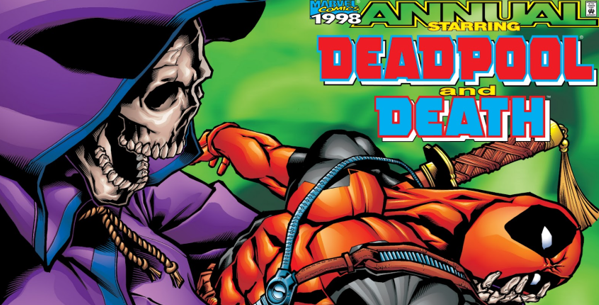
Back Issues [Deadpool Day]: Deadpool and Death Annual ’98


In February 1991, readers of The New Mutants were introduced to Wade W. Wilson, AKA the wise-cracking, fourth-wall-breaking Merc With a Mouth himself, Deadpool. Rob Liefeld and Fabian Nicieza’s sword-swinging immortal went on to become one of Marvel’s most popular anti-heroes thanks to his metatextual humour, violent nature, and massively successful live-action films. It’s perhaps no surprise that Sideshow rechristened April 1st as “Deadpool Day” to give fans of the chimichanga-chomping mercenary an excuse to celebrate all things Deadpool.


Story Title: “A Kiss, A Curse, A Cure”
Published: 13 May 1998 (cover-dated July 1998)
Writer: Joe Kelly
Artist: Steve Harris

The Background:
By the 1980s, the X-Men were established as a successful cornerstone of Marvel Comics; they were so popular that then-chief editor Jim Shooter ordered a number of X-Men spin-off books, one of which was Chris Claremont and Bob McLeod’s The New Mutants. These Mutant youngsters were eventually tutored by the time travelling Mutant Nathan Summers/Cable and rechristened as X-Force, and famously went up against Fabian Nicieza and Rob Liefeld’s Deadpool in The New Mutants #98 (ibid, 1991). Heavily inspired by James Howlett/Logan/Wolverine and Peter Parker/Spider-Man (and with numerous similarities to DC Comics’ Slade Wilson/Deathstroke the Terminator), the self-styled “Merc With a Mouth” was initially introduced as an antagonist for the Mutant team. However, Deadpool proved popular and soon made guest appearances in other Marvel Comics before receiving his own four-issue miniseries, a precursor to his ongoing solo title and his own influx of popularity once he began breaking the fourth wall. One of the character’s other defining traits is his relationship with Lady (or Mistress) Death, a cosmic, reaper-like entity whom Wade is desperately in love with. Created by Mike Friedrich and Jim Starlin, Death is most prominently known for also being the object of Thanos’s affections; his motivation for gathering the Infinity Gems and eradicating half the life in the universe was to win her love. Thanos and Deadpool clashed over their love for death more than once; in fact, it was the Mad Titan who cursed Deadpool with immortality when Lady Death chose Wade over him.

The Review:
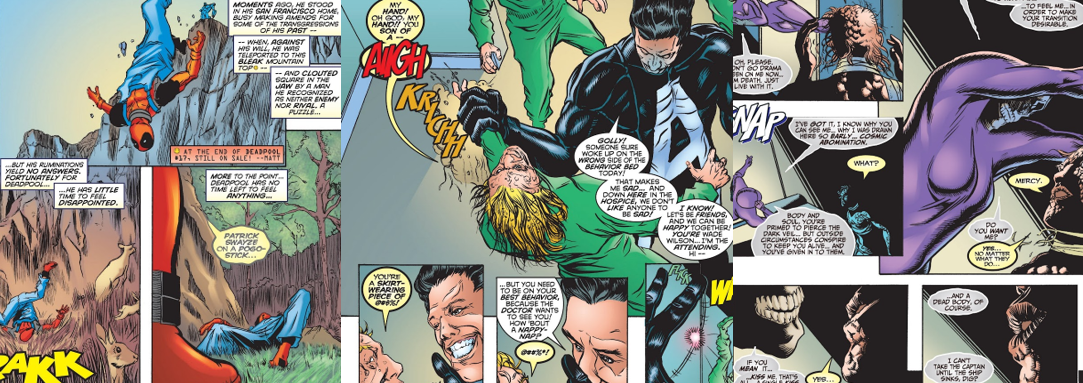
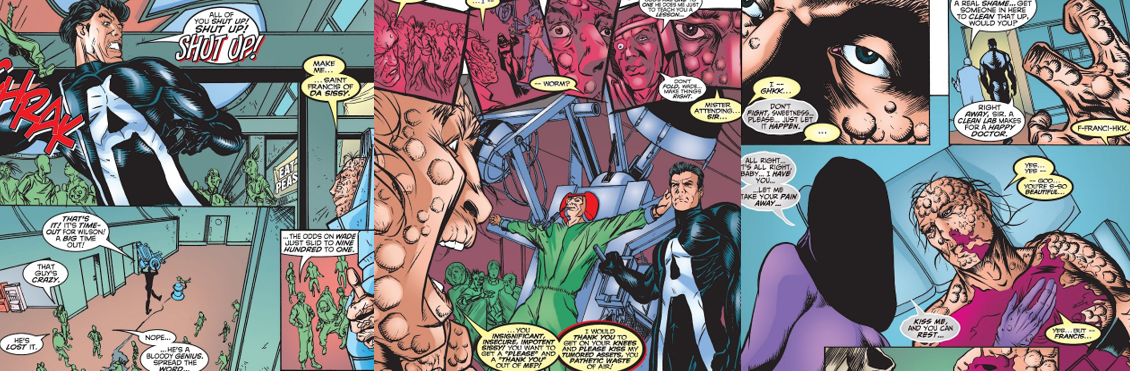
This bumper annual opens with the super chatty Deadpool unexpectedly teleporting right into the path of a closed fist; the punch sends him careening over a cliff edge where, despite this best efforts, he plummets to the ground with a sickening impact. Just moments before, Deadpool had been working to make amends for his past deeds in San Francisco, and now he finds himself literally dead of a broken neck thanks to his mysterious assailant. Deadpool’s spirit initially balks at the idea of the fall killing him, or the sudden attack being real, but is forced to confront the truth when Lady Death greets him with a passionate kiss. Despite Deadpool asking to skip the flashbacks and cosy up to Death, she silently insists on forcing him to relive his traumatic origins and the story regularly shifts between the present and the past, where mercenary for hire Wade Wilson is given a tour of the Weapon X facility, a special weapons development branch of Department K, the superhuman arm of the Canadian government. At this point, Wade is a strapping young man with a head full of blonde hair and the potential to be a valuable asset to his government, but also riddled with terminal cancer. Since Weapon X has already made a veritable Captain Canada out of James Hudson/Vindicator, the general is confident that even trash like Wade can be moulded into a superhero with their program. Wade readily agrees, awestruck by the Vindicator and with little to lose from his prognosis. However, he fails to pass the grade and, with his conditioning worsening, he’s locked up in a hospice where his fellow outcasts have such a low life expectancy that they regularly take bets on how long they will survive from their horrific and invasive experiments.

After being killed, Deadpool relives his traumatic origins and first encounter with Lady Death.

This “deadpool” carries high stakes and is championed by the semi-cybernetic Worm Cunningham; however, when Worm tries to pull that shit on Wade, the heavily scarred and slowly dying mercenary pulls a gun on him and demands to be left alone before turning the gun on himself. Before he can pull the trigger, though, the gun (and Wade’s wrist) is crushed by the sadistic, super strong Francis Fanny/A-Man, who mocks Wade and the knocks him out to deliver him to the resident doctor, Emrys Killebrew, for further experimentation. Dr. Killebrew and the A-Man are amused by Wade’s torture, especially when he begs for death, and both delight in subjecting him to unspeakable torment to make the most of his raw materials. The experience is so traumatic for Wade that his mind breaks and he grows cynical, scorns his misfortunes, and finds his body further ravaged by cancerous tumours. His mind becomes so warped that he perceives Lady Death, who lingers in his cell, intrigued by his unique imagination, and is stunned to find that he can see her. After invasively confirming that he’s not suffering from some kind of aneurysm, Death postulates that Wade is a unique being who longs to die but is being artificially kept alive against his will. Frankly, she finds the entire thing quite the turn on, as does he since Death assumes an alluring form given the amount of times he’s begged for it; thus, she promises they can be together if he finds a way to die but, despite his best efforts, he’s thwarted at every turn. He’s constantly stopped from killing himself and subjected to nightmarish experiments that bring him to the brink of death and cause him agony, yet he remains alive thanks to Dr. Killebrew’s machinations. He’s become so unkillable that his odds in the Deadpool have risen to three thousand to one, and such a risk to himself that he’s confined to a high-tech wheelchair. However, he remains determined to reunite with Death and to get the A-Man out of his way; Worm, however, doesn’t fancy his odds since the A-Man boasts enhanced strength, instincts, speed, and durability.

Wade’s defiance causes the A-Man to kill his friend just for the chance to murder the mouthy mercenary.

Worm lets slip that the A-Man hates his real name and is psychotically triggered by the merest mention of it, which is all Wade needs to rile up the brutal guard. Wade’s taunting works, sending Francis into a violent frenzy and condemning him to endure electroshock therapy. The experience is so intense and extreme that it briefly allows Wade to speak with Death once more. While he’s not truly dead, he crosses over long enough to share a dance with her, and Wade’s mockery of the A-Man not only improves his standing in the Deadpool but also offers a glimmer of hope to the other inmates. There’s a defiant fire there that wasn’t there before, but Wade angrily denies that he’s a hero; he sees the world as cruel and unfair and hope as a waste of energy, much to Worm’s disappointment. Even Death wonders if he was a little hard on the semi-cyborg but Wade insists that the only thing he cares about is being with her; others can play the role of hero, after all. Still, Wade’s attitude and the rising insubordination sees the A-Man voice his grievances to Dr. Killebrew; despite the A-Man protesting that he’s less effective if the patients don’t fear him, Dr. Killebrew is unwilling to simply dispose of Wade since his body contains information vital to his research. To get around this, and teach Wade some respect, the A-Man threatens to subject Worm to violent torture unless Wade falls in line. While Wade is torn between saving his friend and standing up to the A-Man, he ultimately chooses the latter, berating the A-Man with a tirade of insults after Worm begs him to stay defiant. This results in Worm being viciously lobotomised, giving Wade no choice to end his suffering and consequently forcing Dr. Killebrew to order Wade’s execution for killing one of his test subjects.

Wade’s desire for revenge sees him live on as Deadpool and drives him to confront his tormentor.

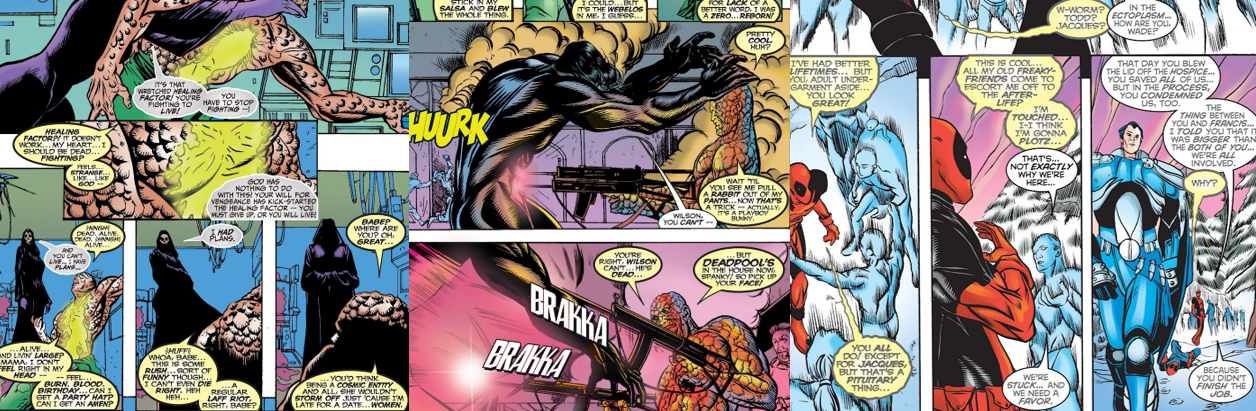
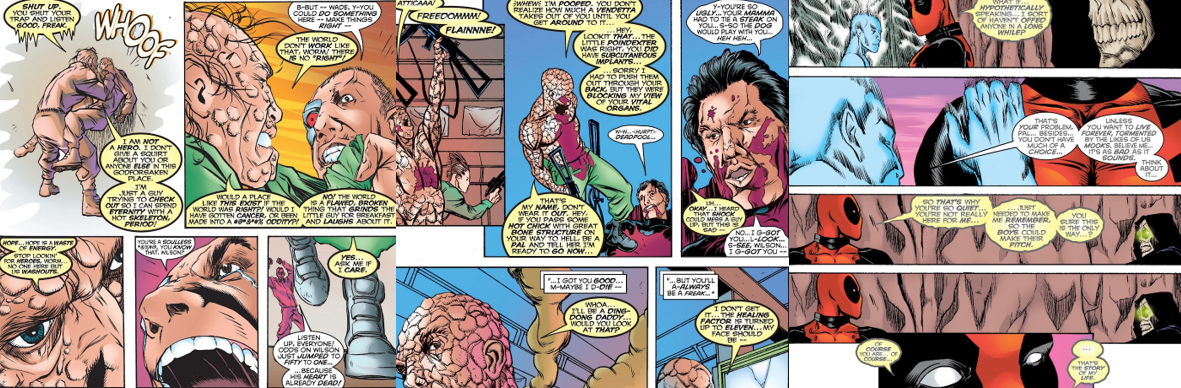
As the A-Man gleefully takes the controls of Dr. Killebrew’s elaborate murder machine, Wade vows to make them pay for what they’ve done to him, the other patients, and to Worm even as the A-Man rips his heart from his chest. Death comes to him, eager to consummate their love and begging him to let go and be with him; however, while he wishes to finally be with her, his stubborn nature and desperate need for vengeance kick-start his Mutant healing factor and force his body to repair the damage. The experience further damages his psyche but also shuts Death off from him as he drives himself forward to get revenge on his tormentors. Wade relieves some guards of their weapons and goes on a killing spree, much to the A-Man’s surprise and anger. The A-Man crushes Wade’s spine (his entire abdomen, in fact) in a rage and is left stunned when Wade painfully and sickeningly heals from the damage right before his eyes. Wade then christens himself “Deadpool” and unloads two assault rifles into his abuser but, even as he lies dying on the floor amidst the chaos of a full-blown riot, the A-Man can’t help but mock Deadpool’s heavily scarred visage, which somehow remains despite his advanced healing factor. With the A-Man dead, Deadpool calls to Death to take him but she doesn’t answer, leaving him distraught and heartbroken, which in the present he assumes is her way of causing him pain for choosing revenge over her. A silent point from Death reveals that Deadpool’s killer was none other than the A-Man, now calling himself “Ajax”, resurrected and sent to hunt down all the escapees from the hospice, The ghosts of his victims implore Deadpool to finish the job so they can move on to the afterlife and, with one last regretful kiss to Death, Deadpool spontaneously returns to life and heads out to make Ajax pay once and for all.

The Summary:
This was quite the surreal story. I believe this was the first real extended dive into Deadpool’s origins, and I recognise a lot of the elements from his first live-action movie, so that was kind of cool. While we don’t learn much about Wade’s life before Weapon X, and nothing about his time with the program since he dropped out of “hero school”, he has a reputation as being a mercenary and has a bit of sympathy to him because of his terminal disease. The main thrust of the story is to showcase just how horrific and traumatic Wade’s time at the hospice was. Wade’s unique speech patterns and manic thought boxes can be traced back to his time there, where the experiments and abuse fractured his mind and drove him to the point where he exists in this kind of limbo between life and death. That alone is alluring to Lady Death, but Wade’s crazed perspective on life also draws her attention, as does her desire to tease him with her affections. Naturally, since he longs for death, Wade finds her impossibly alluring and is desperate to be with her but he’s forever denied that thanks to a throwaway line from Dr. Killebrew about transplanting a healing factor into his ravaged body. When he finally is on the brink of death, Wade’s normally cold-hearted resolve has been replaced by a burning desire for revenge, spurning Death and close that door to him seemingly forever.

The story goes to great pains to examine the tragedy and torture that made Deadpool the man he is.

I do find this concept a little convoluted, similar to the idea that Wolverine has to literally fight off death every time he suffers a mortal injury. I think it clouds things a little and it’s simpler to just say he has a super-superhuman healing factor, but it only muddies the water if you think about it too much. While the concept of Death as a cosmic entity is proven to be real in Marvel Comics, it’s just as likely that Wade’s fracted mind is imagining her as this alluring skeleton woman and that he’s too stubborn, too powerful, and too stupid to die, despite wanting to deep down. Still, the story does a great job of humanising Deadpool and peeling back the layers behind his demented bravado; his experiences left him hating the world, cursing fate and the Gods alike, and wanting nothing more than to die, but the kindness of others and the brutality of his captors shifted him towards a different path. Dr. Killebrew and the A-Man are understandably one-dimensional characters; one’s a cackling mad scientist with no regard for his patients’ welfare and the other’s a superhuman sadist who delights in throwing his weight around and the suffering of others. I liked how Wade riled the A-Man up with insults and repeatedly calling him Francis, and that Wade became this revolutionary figure amongst the populace as a result, so the conflict was more about physical embodiments of oppression and freedom rather than an actual fist fight, which is fitting considering this extends to the physical and metaphysical aspect of Death. Ultimately, this was a decent and surprisingly tragic story designed to explain how awful Deadpool’s life has been and why he is the way he is. In that respect it worked well, and the art was serviceable enough most of the time, so it’s a good choice for anyone who’s just getting into Deadpool and wants to learn a bit more about his background and character.

My Rating:

Rating: 3 out of 5.

Pretty Good

Have you ever read Deadpool and Death Annual ’98? If so, what did you think about Deadpool’s trip down memory lane? Do you like the idea of him falling for Lady Death or do you find that aspect a bit convoluted? What did you think to the agonising torture Deadpool had to suffer and the characterisation of Dr. Killeshaw and the A-Man? Do you enjoy Deadpool’s manic sense of humour or do you find it a bit grating? What are some of your favourite Deadpool stories and moments and how are you celebrating Deadpool Day today? Whatever your thoughts on Deadpool, feel free to share them below or drop a comment on my social media.

Back Issues [Stark Sunday]: Iron Man #128


Anthony “Tony” Stark/Iron Man first lived, walked, and conquered in Tales of Suspense #39, published in March 1963 and brought to life by Marvel mastermind Stan Lee, Larry Lieber, and Don Heck. Since then, ol’ shellhead has gone through numerous different armours, had many amazing adventures, featured in numerous videogames and cartoons, and shot into mainstream superstardom thanks to an iconic, career-defining portrayal by Robert Downey Jr.  


Story Title: “Demon in a Bottle”
Published: November 1979
Writers: David Michelinie and Bob Layton
Artist: John Romita, Jr.

The Background:
Long before Robert Downey Jr. uttered the unforgettable words “I am Iron Man”, Stan Lee sought to take a character his readers would hate (a rich, military industrialist), mix in some inspiration from Howard Hughes alongside some vulnerability and personal tragedy, and make him someone they could root for. When mounting deadlines kept Lee from writing Iron Man’s debut, he turned to younger brother Larry Lieber, while artist Don Heck and the legendary Jack Kirby handled the artwork. Although Iron Man is very much a mainstream superhero these days, that wasn’t always the case, which is surprising given his prominence in cartoons and Marvel Comics. Alongside a colourful collection of villains, Iron Man has served on Marvel’s premier super team, the Avengers, swapped places with his teenaged younger self, fought against and imprisoned his fellow heroes, and even battled a sentient version of his armour! But one of Stark’s most harrowing battles came in his addiction to alcoholism; as plotted by writers David Michelinie and Bob Layton, Stark was wracked with guilt after an armour malfunction caused him to accidentally kill a foreign ambassador. Following this, Stark’s drinking increased and this is only exacerbated by the ensuing investigation and the machinations of Justin Hammer, who was behind his armour’s troubles, and caused Stark to drunkenly lash out at friend and foe alike. Considering how important and influential the “Demon in a Bottle” arc was for Iron Man’s characterisation (it’s frequently cited as one of the top Iron Man stories), it’s ironic that Layton would later state that it was never the writers’ intention to raft anything more than a new personal drama for Stark to conquer and that they had no idea how pivotal it would be to the character for years to come.

The Review:
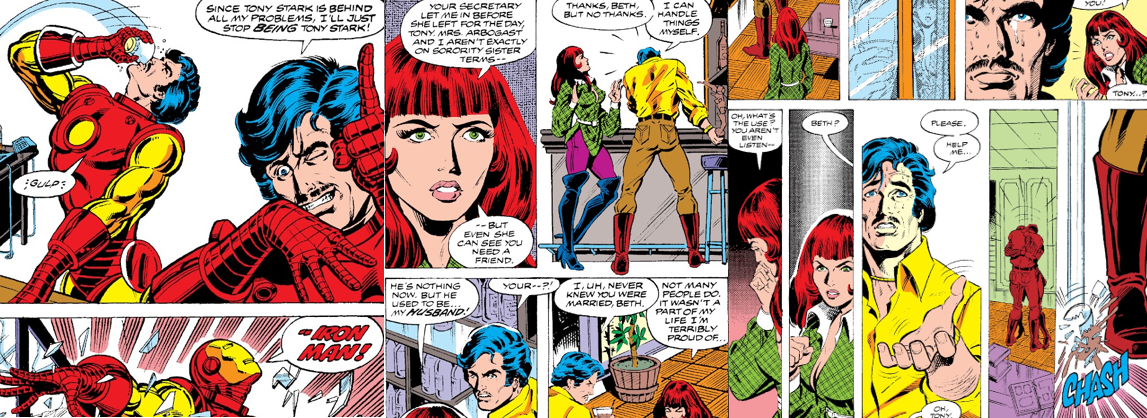
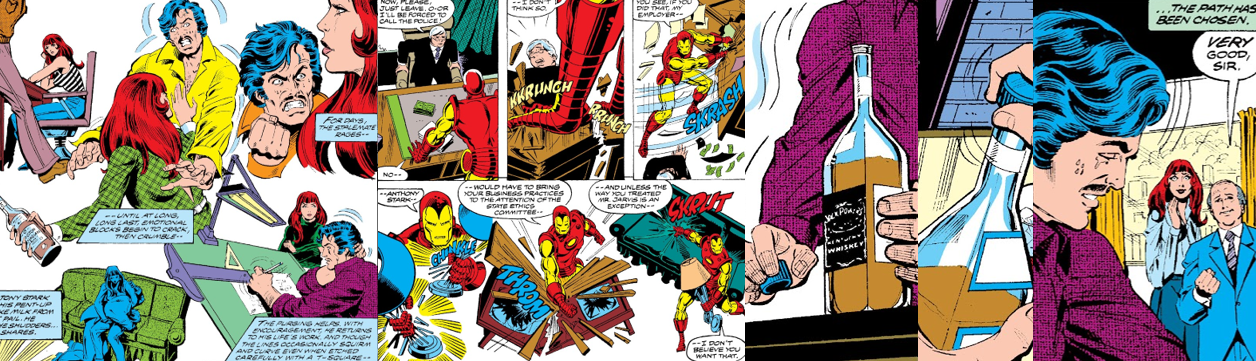
The issue begins with Stark wallowing in his office. Although he was publicly exonerated and cleared of all charges, public opinion of the Armoured Avenger (who was still believed to be Stark’s bodyguard at the time) has been shaken, as has confidence in Stark International. Already haunted by the memory of the life he took, Stark indulged in a wild night of drinking that saw him spur his love interest, Bethany Cabe, and insult his faithful butler, Edwin Jarvis, so badly that the courteous footman resigned from his employ. Sat alone, surrounded by glasses and bottles of half-finished whiskey and headlines branding his alter ego a murderer, Stark can’t help but ruminate on the status of his armoured persona. Usually, Iron Man was the perfect scapegoat for Stark’s more illicit actions but he’s forced to accept the fact that he, not Iron Man, killed a man, is causing his company to go down the drain, and scared off his loyal manservant. Terrified of losing everything he’s spent a lifetime building up, and still necking back the whiskey, Stark decides that the only solution is to give up being Tony Stark completely and devote himself to Iron Man full-time. Thus, he gulps back another shot of liquid courage and takes to the skies, drunkenly crashing through the window of his office and heading out for some action.

When his drinking starts to impact his heroics, Stark desperately asks for help to overcome it.

It’s not long before he finds it, either. A train has conveniently derailed nearby; while there are no casualties, a tanker full of chlorine gas needs getting back on track, something Iron Man decides to handle personally. However, in his inebriated state, he neglects to account for the weight ratio and the tanker plummets to the ground, spewing toxic gas into the air and causing the Armoured Avenger to be labelled a nuisance by the on-site cops. Ashamed, Iron Man flies away, angry at himself for being so careless and admonishing himself for not having designed any new armours in weeks thanks to his responsibilities to Stark International. In despair, he returns to his office to pour a fresh drink and is startled to find Bethany waiting to confront him about his addiction. Bethany can see the signs as clear as day thanks to her previous experiences with her now-ex-husband, Alexander Van Tilberg, once a charming and successful diplomat who became withdrawn and angry after becoming addicted to pills. This addiction not only caused a rift between them but also cost Alexander his life, so she’s perfectly positioned to warn Stark about the self-destructive nature of his drinking. She hits him with just the right mixture of tough love and sympathy, pleading with him to admit he has a problem and to open up to her and the few friends he has left before it’s too late. Incredibly, her words get through to him and he drops his glass to the floor and timidly asks, practically begs, for her to help him.

Despite the temptation, Stark goes cold turkey, makes amends, and is resolved to win back his company.

What follows is a harrowing montage in which Stark goes cold turkey; rather than attend meetings or seek professional help, Stark is minded by the incredibly patient Bethany, who endures his mood swings and despair over the course of several painful days. In time, Stark rediscovers his love for designing, and Bethany’s support helps him to realise that he has a lot of bridges to mend. His first port of call is the Avenger’s mansion, where Jarvis has set up home since leaving. Stark’s initial relief, and elevation, to have made amends with his faithful butler soon hits rocky shores when Jarvis reveals that he was forced to sell his shares in Stark International to pay for his mother’s medical bills; it turns out that he was scammed by a loan shark and now Stark is in danger of losing control of his company to the Supreme Headquarters, International Espionage and Law-Enforcement Division (S.H.I.E.L.D.) Although extremely tempted to turn to the bottle, Stark pushes through with all the resolve and willpower he can muster to don his armour once more and confront Mr. Benchley, the lender to whom Jarvis sold his stock. When cash fails to convince the Mr. Benchley, Iron Man trashes his office and threatens to expose his shady business ethics to the authorities, only to learn that the loan shark has already sold the stock to S.H.I.E.L.D. Returning despondent to his office, Tony moves to pour himself a fresh glass and, despite the immense urge to drown his sorrows in alcohol, Bethany’s appeal and the support of his friends ultimately wins through. The issue ends with Stark having turned his back on the booze and determined to win back control of his company with a newfound resolve, supported by Bethany and Jarvis and on the road to recovery.

The Summary:
The first thing that strikes me about this issue is the artwork; I didn’t read a lot of Iron Man as a kid as he didn’t tend to show up very often over here in the UK but what I did read was from the 1970s so I’m a bit biased towards John Romita Jr.’s rendition of Iron Man. While I prefer some of his other armours, particularly the “Silver Centurion” look or those that are more angular, Romita Jr. does a great job of updating Jack Kirby’s original design and making it seem like armour and not just flimsy fabric. Tony Stark also sports one of his best looks here outside of his later mullet, with a mop of dark hair, a sexy little moustache, and some outrageous bellbottoms, but it’s his facial expressions that win the day. Obviously, this is an extremely harrowing time for Stark; he’s at his lowest point, lost in depression, guilt, and self-doubt, and struggling to keep it all together and you really see this in the gamut of emotions etched into his features. He’s despondent, lost to a drunken joy, depressed, enraged, and literally bathed in sweat as he struggles, hands trembling, to resist taking another shot or reaching for that bottle. The text boxes do an equally masterful job of conveying, with trademark Marvel eloquence, the turmoil with Stark but a lot of these panels could’ve been left without any text and still been just as powerful, if not more so.

The story wonderfully showd the destructive effects of alcohol on Stark’s life.

Taken in a bubble, Stark’s battle with alcoholism seems to be very cut and dry; it’s important to remember that he was regularly swigging down the booze over a number of prior issues and, while this issue ends with him determined to turn his life around, it is by no means the end of his struggle and is instead the first step towards recovery. Still, I would have liked to see a little more of drunken Iron Man; the previous issues did a great job of showing drunk Tony lashing out at those closest to him and how his drinking has affected his social life, but seeing Iron Man stumble through heroics while tanked up is a startling visual. The issue plays it safe, with Iron Man’s mishap escalating an issue but one that is more inconveniently dangerous than life-threatening. Those who want to se ol’ shellhead go toe-to-toe in a fist fight while puking in his suit will be disappointed as this issue is very much an internal battle for Stark. Shaken by Bethany’s heart-breaking loss and moved by her persistent (if blunt) attempts to help him, Stark resolves to quit drinking altogether. As I touched upon, these days this would probably be rendered in a more realistic way but it’s certainly dramatic to see Stark suffering through withdrawal and sheepishly making amends with Jarvis. It’s a powerful issue, one that remains as prominent today as it did decades ago; it helps show a different vulnerability to Stark and portray him as a flawed hero, and man, as well as tackling the destructive nature of alcoholism in a way that isn’t as ham-fisted or cringe-worthy as some stories that touch upon similar issues. While it’s probably not the greatest Iron Man story ever told, it’s certainly significant and emotionally relevant to the character so it’s well worth checking out if only to experience one of the quintessential turning points in Iron Man’s long history.

My Rating:

Rating: 4 out of 5.

Great Stuff

Have you ever read “Demon in a Bottle”? What did you think to Stark’s descent into alcoholism and the way the disease was portrayed here? Would you have liked to see more of Iron Man under the influence or do you think focusing on his social life was a better idea? Do you think Stark’s alcoholism has become a bit of a cliché at this point or do you enjoy how it makes him a flawed character? Have you ever struggled with addiction? What are some of your favourite Iron Man characters or stories? Where does Iron Man rank in your hierarchy of comic book characters? Are you doing anything to commemorate Iron Man’s debut appearance and, if so, what is it? Either way, I’d love to hear your thoughts on Iron Man so leave a comment below or on my social media.

Movie Night: Madame Web

Released: 14 February 2024
Director: S. J. Clarkson
Distributor: Sony Pictures Releasing
Budget: $80 million
Stars: Dakota Johnson, Tahar Rahim, Sydney Sweeney, Celeste O’Connor, Isabela Merced, and Adam Scott

The Plot:
After a near-death experience,.paramedic Cassandra “Cassie” Webb (Johnson) begins seeing glimpses of the future revolving around Ezekiel Sims (Rahim), a superpowered businessman determined to kill three teenagers before they can kill him in the future as Spider-Women, compelling Cassie to begrudgingly discover the truth of her past and protect the girls.

The Background:
After Sam Raimi’s Spider-Man trilogy (2000 to 2007) proved a phenomenal success, Marc Webb’s reboot films proved sadly mediocre and led to an unprecedented agreement between Sony Pictures and Marvel Studios that allowed the iconic wall-crawler to appear in the Marvel Cinematic Universe (MCU) and Sony to release tangentially-connected spin-offs featuring Spidey’s villains and side characters. Encouraged by the financial (if not critical) reception of their Venom (Various, 2018 to present) movies (and seemingly undeterred after the car-crash reception of Morbius (Espinosa, 2022)), Sony not only signed off on a solo project for Sergei Kravinoff/Kraven the Hunter, but also the enigmatic clairvoyant Cassandra Webb/Madame Web. Created by Dennis O’Neil and John Romita Jr., Madame Web first appeared in The Amazing Spider-Man #210 and significantly influenced Spider-Man’s battles against multiversal forces, but is perhaps best known for her inclusion in the Spider-Man animated series (1994 to 1998), where she was voiced by Joan Lee (wife of the legendary Stan Lee). Writing began on a Madame Web feature while Morbius was still in production and saw numerous rewrites, even after director S. J. Clarkson signed on and retooled it into Sony’s first female-centric Marvel film. Producer Lorenzo di Bonaventura expressed difficulties in adapting Madame Web’s clairvoyance to the screen and emphasising secrecy surrounding the project given her relative obscurity, a fact explicitly addressed by the inclusion of other, more recognisable Spider-Women. The cast appear to have been mislead as to the status of the film in the wider MCU; this may explain the bizarre marketing campaign that saw star Dakota Johnson seemingly openly criticise the film, though she wasn’t the only one. After numerous delays, Madame Web released to scathing reviews; the film made just shy of $100 million at the box office and critics attacked the poor dialogue and script, lacklustre special effects and pacing, and the blatant false advertising regarding three of the lead characters.

The Review:
So, if I had a whole bunch of negativity towards making standalone, Spider-Man-less films about the likes of Eddie Brock/Venom and Doctor Michael Morbius, you can be damn sure that I was baffled to the point of insanity by the decision to make a solo Madame Web movie. Not only is she an extremely obscure Spider-Man character, but her depiction is generally as a wizened, blind mentor who manipulates Spider-Man like a chess piece as part of Marvel’s on-again/off-again insistence on convoluting Spidey’s origins and mythos with semi-paranormal cosmic ideas of Spider Totems and “Webs of Fate”. It’s ironic, really, as the concept could have worked a little better if Madame Web had been depicted as a Professor Charles Xavier/Professor X-type figure, mentoring and recruiting Spider-Women to oppose the Inheritors, despite my dislike for them, because at least then the focus would be on the spider-powered women and not this thoroughly unlikeable paramedic who, despite choosing a carer where she’s sworn to protect lives and being depicted as a workaholic who rushes to do that very thing, is reluctant to help the three girls targeted by Ezekiel Sims. Much of Cassie’s reluctance stems from her lingering feelings of abandonment, confusion about her true self and past, and what’s framed as an unconventional upbringing since her mother, Constance (Kerry Bishé), died during childbirth and Cassie was raised in the foster system, left with only mementos of her mother, Constance’s research into the near-mythical spiders of the Peruvian jungles, and the mistaken, childish belief that Constance cared more about her arachnids than raising her daughter. Consequently, Cassie has a bit of an abrasive edge to her; while she tirelessly works to save lives alongside her friend and partner, Ben Parker (Scott), she’s uncomfortable with receiving gratitude for this, has no idea how to act around children, and would much rather spend time in her apartment with a local stray cat than socialise with her colleagues or even Ben’s pregnant sister-in-law, Mary Parker (Emma Roberts). Her anxiety and social awkwardness is only exacerbated after she nearly drowns and is sporadically bombarded by visions of the past and near future, all framed by a mysterious web-like pattern, though she initially dismisses these visions and it takes her a ridiculously long amount of time to realise that they’re not only true, but that the fates she is witnessing can be changed.

Three girls destined for greatness must rely on Cassie’s sporadic clairvoyance to survive.

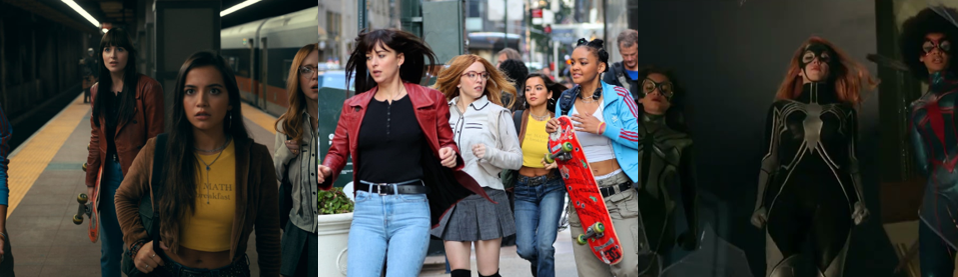
Central to her visions are four individuals – a violent killer clad in a somewhat-familiar spider-themed costume and possessing superhuman strength and spider-like abilities, and three twenty-somethings teenagers that Cassie sees horribly murdered by this assassin time and again. As fate would have it, their destinies are all intertwined and lead Cassie to encounter the three girls individually to establish some surface-level characteristics for the three that are partially developed as the film chugs along. Julia Cornwall (Sweeney) is the quiet, shy girl who’s struggling with her parents’ divorce, Anya Corazon (Merced) is both book smart (she literally wears a t-shirt proclaiming her love of “math”) and dealing with fending for herself after her father’s deportation, and skater Mattie Franklin (O’Connor) is the streetwise rude girl with a chip on her shoulder since she comes from money. The three couldn’t be more different but quickly form a genuinely enjoyable sisterhood after they’re saved by Cassie; while initially distrusting of her, they eventually come to believe in her janky clairvoyance after she saves them from Ezekiel multiple times. However, Cassie is seemingly impulsively compelled to do this, and it takes her a while to realise the responsibility she has towards the girls; she routinely abandons them, chastises them, and even jets off to Peru to investigate her origins and undergo a spiritual journey that finally teaches her that she has an obligation to protect the three with her abilities. The three girls do their best with the materials, appearing fun and likeable and adding some pathos to their characters through their shared feelings of abandonment, but the script is rarely in their favour. The same is true for Cassie, who constantly narrates her life like an idiot and acts very irrationally for a paramedic, though eventually she settles into the role of a reluctant surrogate mother and protector to the girls.

Ezekiel targets the girls to save his own life, but is a pretty weak and one-note villain.

The girls are targeted by Ezekiel since he’s been plagued by visions of his death at their hands at some point in his future. Previously working alongside Constance, Ezekiel betrayed and killed her to get his hands on a mysterious spider that granted him his amazing powers, but also cursed him with the knowledge of his impending death. In the interim, he built a vast, indistinct corporate empire and has become obsessed with finding and killing the three Spider-Women who’ve haunted his nightmares, aided by his “girl in the chair”, Amaria (Zosia Mamet), who hacks into the police database and CCTV cameras all over the city to track the girls down. It’s not made clear why the Spider-Women would hunt down and kill Ezekiel in the future, or what he’s done that makes him such a diabolic villain except one confirmed kill, but boy does he like to mumble and grumble about how badly he wants them dead and his desire to ensure he lives on! As if having all the wealth and technology he needs at his disposal isn’t enough, Ezekiel also possesses spider-like powers; he can walk and climb on walls, leap vast distances, possesses superhuman strength and reflexes, and can poison his victims with a touch, eventually causing cardiac arrest. He also seems to display some degree of clairvoyance and psychic power to rival that of Cassie, communicating to her on the astral plane at one point, and dresses in an admittedly cool looking outfit when out on the prowl. How he changes in and out of this isn’t made clear either, however, as he’s often seen wearing the form-fitting suit in one scene and then fully in his business attire in the next with no explanation, and he’s routinely humiliated by Cassie since she can anticipate his actions ahead of time. While Cassie doesn’t demonstrate the same superhuman powers, the three girls do in the frantically-edited visions of the future, though it’s unclear how, when, or why they gained superhuman powers. Ezekiel does, however, share his powers with the mysterious Las Arañas, a secret Peruvian tribe who dress in makeshift jungle attire that’s very similar to Spider-Man’s and try to save Constance when she’s wounded, delivering Cassie and then later making her realise that her mother ventured into the jungle to save her, not because she didn’t care about her. Frankly, I find this whole aspect to be borderline insulting; I hate the idea of a tribe of Spider-People and of a spider species that can grant these powers as it diminishes Spider-Man’s uniqueness, though the depiction of the spider-powered people clambering and leaping about the place is pretty good and surprisingly horrific, especially when Ezekiel is tossing bodies around in Cassie’s visions.

The Nitty-Gritty:
There’s a shared feeling of abandonment between the four female leads; all of them feel like outsiders to some degree, isolated from others and even their families since they either don’t have a parental figure, or their parents don’t seem to care about them. While their individual personalities initially clash because of their different backgrounds and current social standing, they quickly bond once they realise how much they have in common, with the three girls, especially, forming a makeshift sisterhood due to their current circumstances. Although Julia is Cassie’s most vocal supporter, they initially believe she’s either crazy or just another adult they can’t rely on and decide to go against Cassie’s warnings and fend for themselves, an action that very nearly sees them all killed by Ezekiel before Cassie intervenes. She chastises them, angry at their irresponsible and reckless actions, but struggles to give them the answers they want and to properly care for them since he’s apparently so maladjusted that she can barely stand to be around her handful of friends, much less look after three scared teenagers. Thus, she turns to Ben to shelter the girls while she tries to find answers in Peru; this turns out to be a good decision since Ben is a much more emotionally stable individual. He deeply cares for his sister and is extremely excited about being an uncle, but is also devoted to his friend and partner, to the point where he resuscitates Cassie after she drowns, begs her to socialise with his family and their colleagues, and agrees to look after the girls even though he has no idea what kind of danger they’re in. As good as Adam Scott was in the role (I particularly liked the banter he shared with Cassie, which hinted at a former attraction, and his struggles to keep up with the girls), the only reason he’s here is for fan service: yes, he’s playing the future Uncle Ben and, through him, we even see the birth of his nephew (who ridiculously goes without a name) and get hints towards his future, despite Madame Web taking place in its own separate continuity from previous Spider-Man movies. There’s also something really weird about Julia, Anya, and Mattie all being older than Peter and the frustration of the three running around in normal street clothes instead of the awesome Spider-Women suits we barely get a glimpse of in their future.

In the absence of the Spider-Women, we’re left relying on Cassie’s visions and Ezekiel’s threat.

Yes, Madame Web is another great example of Sony lying to us; the trailers and posters showcased Julia, Anya, and Mattie as fully-empowered Spider-Women but this isn’t the case at all. I guessed that we wouldn’t see them suit up until the very end, but the truth is far worse; they only wear their costumes in fleeting visions, with no explanation of how they get their powers, and the film has the gall to setup a potential sequel that actually addresses these issues, but to me it’s a dropped ball that completely derails the movie. The bulk of Madame Web is focused on Cassie’s struggles to reconcile her past and understand her newfound powers; there are numerous scenes of her witnessing snapshots of the future, meaning we get a lot of time loops and confused looks from Cassie that border on the maniacal as she tries to understand what’s happening. Primarily, though, these visions are used as fake outs; almost every time, the scene will show Ezekiel coming in, wrecking fools, and killing his targets in an almost effortless manner, only to suddenly snap back to Cassie and show her taking action to avoid this fate. It’s all very reminiscent of the Final Destination films (Various, 2000 to present), which is fitting but kind of lowers a lot of the stakes since you can just assume every violent scene or action sequence is just a vision. When Ezekiel does get a chance to fight, he’s effectively peerless; none of the protagonists have the strength or ability to go toe-to-toe with him, meaning Cassie drives a lot of cars into him and catches him off-guard with her clairvoyant powers, leaving him perplexed and looking stupid. When the Las Arañas appear, it’s all shot with an unsettling, nightmarish shaky-cam filter that makes their appearances and abilities not only difficult to pin down, but also appear needlessly cartoonish.  There are some decent effects at times, such as when Cassie takes her spiritual journey and interacts with the Web of Fate and the lingering memory of her mother, and things are surprisingly grounded for a Sony Spider-Man-adjacent movie, with Ezekiel being unable to swing from webs and more reliant on his physical abilities. This, in conjunction with his intimidating costume, does paint him as a formidable figure; he’s almost like a slasher villain at times, draining the life from his victims, breaking their limbs, and pouncing like an animal, but this persona is awkwardly juxtaposed with his pandering civilian identity, where he may as well twirl an old-timey moustache as he spouts generic villain dialogue with little charisma or conviction.

Cassie accepts her fate to defeat Ezekiel and mentor the future Spider-Women.

So, all these recent revelations help Cassie make sense of her mother’s notebooks; while she previously resented Constance’s apparent fixation on her spider research, she realises that her destiny has been intertwined with Ezekiel’s since before her birth and takes herself to Peru to find answers. There, a Las Arañas, Santiago (José María Yazpik), helps her to realise that her mother was trying to cure her of some disease and that she has a greater destiny, one that will bestow her with “great power” once she accepts the “responsibility” that comes from her abilities. Before, she saved and sheltered the girls simply because it was the right thing to do; she had little interest in watching over them or bonding with them, or of their greater destinies as Spider-Women, but her spiritual journey motivates her to actively shield them from Ezekiel’s wrath, and gives her greater control over her future sight. After rescuing them and allowing Ben and Mary to get to safety, Cassie takes the girls to a fireworks warehouse and they finally set aside their differences to set a trap for Ezekiel, planting flares all over the place to cause a series of explosions. This actually causes quite a few issues for the protagonists, however, as the explosions destroy the helicopter Cassie called in to rescue them and eventually sees Julia, Anya, and Mattie separated and facing fatal falls. Luckily, Cassie masters her powers enough to…somehow…spiritually duplicate herself long enough to help the three to safety, incurring Ezekiel’s anger. Despite him being haunted by very specific visions of his death at the hands of the three Spider-Women, Cassie changes his fate and claims that she was always the one who was destined to end him (which doesn’t seem true, but okay) and lures him onto unstable ground, eventually causing him to plummet to his death and be crushed by debris. Cassie also takes a plunge but, luckily, she taught the girls CPR earlier and they’re able to revive her, though she’s not only inexplicably left paralysed with no explanation but also winds up blinded by a stray firework. Still, she’s not bothered by this; in fact, the film ends with her happier than ever since she can now, presumably, use the full extent of her psychic powers and clairvoyance to see and understand the future and is prepared not just to take on the three as their foster mother, but to mentor them into the Spider-Women they are destined to become…effectively ending the film where it really should’ve started! Like, why not have Cassie already be infirm but fully empowered and training, say, Julia, showing their origins through flashbacks and exposition, and have Julia be the point woman in recruiting Mattie and Anya when Ezekiel, an Inheritor assassin, targets them? It could’ve been Sony’s answer to the X-Men, in a way, and even take place in the same universe as their other pointless spin-offs, and might’ve been more enjoyable because then we would’ve gotten to see the gorgeous Sydney Sweeney in their slick, form-fitting Spider-Woman costume for a lot more of the runtime!

The Summary:
I went into Madame Web expecting it to be bad based on the trailer, the disaster that was Morbius, and my dislike for the concept in general. I tried to have an open mind, however; the cast, for example, intrigued me, as did the costume design, and to be fair there is the ghost of a semi-decent idea here, it just would’ve worked better as a side plot in a Spider-Man film or reworked to have Julia Carpenter/Spider-Woman at the forefront, with Cassie as a mentor figure. Any goodwill the film might’ve gotten from its Spider-Woman costumes is flushed down the toilet since we barely get a good look at these and the girls don’t even become Spider-Women in the movie; Ezekiel’s costume and action scenes somewhat make up for this, but he’s such an ineffectual and confusing villain that it’s hard to care when he’s onscreen. The relationship between the protagonists was somewhat enjoyable; I liked how the girls bonded, their shared feelings of abandonment, and them coming together as a surrogate family, but it’s executed so poorly and, although the girls do try, they’re all hampered by a really awful script. Dakota Johnson suffers from this the most, I think; she was some weird, awkward silences and quirks and is forced to spit out some really awful dialogue and nonsensical exposition. Add to that the fact that Cassie is a weird and pretty unlikeable character, abandoning and yelling at the girls even though she’s supposed to be a paramedic and you have a main character who’s hard to relate to, a villain as flat as a piece of paper, and three boisterous young girls who are completely wasted in this travesty of a film. It’s more than a step back for the genre; Madame Web harkens back to a time when superhero movies were not only afraid to use codenames and costumes, but outright ashamed of them, delivering cookie cutter dramas that falter at the first hurdle. It’s a sad state of affairs and I have lost all hope for Sony’s future Spidey-adjacent movies, and my expectations were already at the bottom of the barrel to begin with!

My Rating:

Rating: 1 out of 5.

Terrible

Did you enjoy Madame Web? If so…what’s the matter with you? What did you think to the performances and the dynamic between the four protagonists? Were you disappointed that the girls didn’t actually become Spider-Women in the film? What did you think to Ezekiel, his characterisation, and the nonsense about the Las Arañas? Do you think a Madame Web movie could ever work, or would you rather see a Spider-Woman take the forefront? Which Spider-Woman is your favourite? I’d love to know your opinion of Madame Web, so leave a comment below and be sure to check out my other Spider-Man and Marvel content.

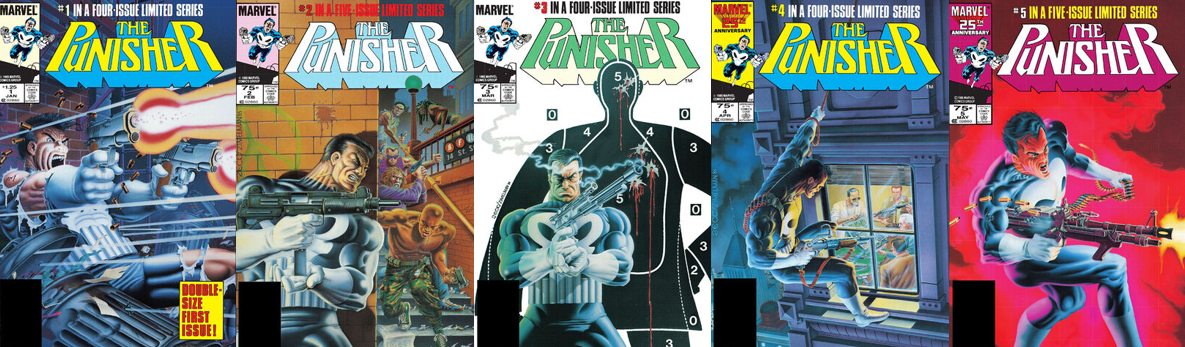
Back Issues: The Punisher #1-5

Writer: Steven Grant – Artist: Mike Zeck

Story Title: “Circle of Blood”
Published: 8 October 1985 (cover-dated January 1986)

Story Title: “Back to the War”
Published: 5 November 1985 (cover-dated February 1986)

Story Title: “Slaughterday”
Published: 10 December 1985 (cover-dated March 1986)

Story Title: “Final Solution: Part 1”
Published: 7 January 1986 (cover-dated April 1986)

Story Title: “Final Solution: Part 2”
Published: 11 February 1986 (cover-dated May 1986)

The Background:
By February 1974, Marvel Comic’s iconic teenage superhero, Peter Parker/Spider-Man, had become a mainstay of the publication following his 1962 debut in Amazing Fantasy #15. After earning his own ongoing book, The Amazing Spider-Man, the following year, he amassed quite the gallery of villains, such as Doctor Otto Octavius/Doctor Octopus, Flint Marko/The Sandman, and, of course, Norman Osborn/Green Goblin. In February 1974, Gerry Conway and Ross Andru introduced readers to the Jackal, a crazed scientist whose cloning technology eventually resulted in one of Spider-Man’s most infamous storylines, but who first employed the services of Vietnam veteran-turned-mercenary vigilante Frank Castle/The Punisher to target the web-slinger. Inspired by The Executioner (Pendleton, et al, 1969 to present), designed by Gerry Conway, and named by Marvel mastermind Stan Lee, the Punisher was such a hit that he graduated to this self-titled series. Naturally, given the Punisher’s propensity for killing his enemies, it was difficult for him to amass his own recurring antagonists but one of his most memorable foes is easily William “Billy” Russo/Jigsaw, a mutilated mobster created by Len Wein and Ross Andru who has returned time and again, defying death and fate, to torment the Punisher for nearly fifty years.

The Review:
As huge a fan of the Punisher I am I haven’t really read too much of his stuff. I like to pick up Marvel’s Platinum collections for their characters as they bring together a variety of iconic stories for their biggest names, and sadly the Punisher hasn’t yet received one of these so my experience with him is a little sporadic. Still, I love the simplicity and bleak grittiness of the hardened vigilante and find him to be an extremely compelling and layered character so I’m always glad to read his stories, especially his most influential ones. The Punisher’s first solo series begins with him locked up on Ryker’s Island, a gothic-style prison on a small isle adjacent to New York City. A conversation between warden Jerome Gerty and his aide, Tommy, gives the uninitiated a quick rundown on the Punisher’s backstory (you know the drill: Vietnam vet who turned to vigilantism after his family was killed in a mob attack) and reveals that he’s been locked up after a recent bout of drug-induced madness The warden appears to have big, potentially sinister, plans for the Punisher, whose reputation is so intimidating that all the inmates are scared stiff by his presence. All except for “The Mule”, Frank’s loud-mouthed, musclebound cellmate; unfortunately for the human ox, Frank isn’t impressed by his offer to protect him for a few favours and the Punisher quickly overpowers the Mule and forces him to do his bidding and feed him information. Considering his drug episode originated during a prior stay at Ryker’s, Frank puts the wind up Frisky Martin, one of the inmates who works in the prison cafeteria, and delights in the fear he’s causing amongst the populace. With Frisky suitably intimidated, Frank follows him to the source of the prison’s drug operation and is unsurprised to find Jigsaw peddling the wares from within the walls.

The Punisher infiltrates Ryker’s to get to the bottom of Jigsaw’s drug operation.

After making short work of Jigsaw’s goons, Frank walks into hostile territory, Block D, where the mutilated mobster living in luxury in his cell, only to find himself vastly outnumbered by the violent criminals awaiting there. Following a brutal beating, the Punisher is restrained and facing a broken glass bottle to the face as recompense for him destroying Jigsaw’s face, only for him to power his way out if it and crush Jigsaw’s hand, driving shards of glass into it. Although Jigsaw orders the guards to shoot Frank, the fracas is interrupted by Carlo Cervello, the prison’s resident mafia Don known as “The Brain” for always thinking one step ahead. Cervello reprimands Jigsaw and, to his surprise and outrage, welcomes Frank into his operation when the Punisher offers to join him in breaking out of Ryker’s. A few nights later, the plan begins and Cervello immediately double crosses the Punisher by sending his muscle, Gregario, to kill him using a homemade silencer. This cobbled together appliance is faulty, however, and the Punisher is able to outsmart “The Brain” using a simple mattress. As the escape turns into a full-blown riot, Frank lets the violence play out to whittle down the obstacles in his way before making a break for the control tower, wounding Gregario and scuppering the escape plan using the tower’s defensive measures. Cervello and Jigsaw make their way to the warden’s office where they take Gerty and Tommy hostage and demand the Punisher lays down his gun, only for it to literally backfire in Jigsaw’s face as he tried to shoot unsuitable bullets with it. When Cervello threatens to shoot Gerty, Frank calls his bluff with a cold-hearted stoicism that terrifies Cervello so much that he willingly returns to his cell.

With the Kingpin presumed dead, the Punisher incites a turf war that winds up the local mobsters.

Frank, however, tries to murder the mobster for the attempt on his life and then demands that Gerty escort him out of the prison. Although armed guards defuse the situation, Gerty vouches for the Punisher and reveals that he and Tommy work for a mysterious cartel known as “The Trust”, a well-oiled group who share Frank’s concerns regarding crime. Not only does Gerty offer to allow Frank to escape (though still a wanted man) and furnish him with his iconic skull outfit, he offers to bankroll his operation, asking only that the Punisher eradicate organised crime once he’s out. Despite his suspicions, Frank cannot say no to the opportunity to return to the war, unaware that would-be-doctor Tony Massera has been coerced by his mobster uncle, Charlie Siciliano, to take revenge on the Punisher for killing his father. Ignorant to this, the Punisher gets back to work with a bang, quite literally, by storming the office of the untouchable Kingpin of Crime himself, Wilson Fisk, only to find himself duped by a dummy and sent hurtling out of the seventy-storey building by an explosive trap. Although he slows his fall, the Punisher takes a bad landing and goes into shock, only to awaken in the lavish riverside home of the alluring Angela, who begs to assist the Punisher’s crusade, even offering her body, since organised crime left her family dead. In the aftermath, Frank ruminates on his age, the mistake that almost cost him his life, and his never-ending war; to help tip the odds in his favour, he calls Ben Urich of the Daily Bugle and reports that he assassinated the Kingpin in order to incite a mob war to fill the void, allowing him to easily take care of whoever’s left after the bloodshed. Accordingly, mobsters are offed all across the city and, desperate to avoid all-out war, Siciliano tries to broker peace amongst the disparate mobsters, completely unaware that the Punisher is listening to his every word from his kitted-out Battle Van.

Troubled by the collateral damage, the Punisher tries to stem the cycle of violence he started.

The heads of the city’s top crime families, and some of their lackeys, gather at Grand Central Station, of all places, that evening to hear Siciliano out, only to be set upon by Nolo Contendre, a hitman from Detroit. Although the Punisher is pleased by the ensuing anarchy, he wants to know who hired Contendre so he chases him down to the subway where a violent game of cat-and-mouse breaks out between the two. Frank takes a direct shot to the chest (though he’s saved by his heavy body armour) and is incensed when Contendre breaks the rules of his profession by opening fire upon civilians. Frank wounds Contendre with a knife, enraging him, and ends up decapitating the thug by kicking his head through a window, where it’s promptly taken off as the train pulls into Times Square Station. Seeing the fear in the eyes of the wounded passengers, Frank chastises his recklessness and vows to stop to the violence he has incited, only to be thrown off kilter when his van explodes before his eyes, which his Trust contact, Alaric, suggests is a sign that he needs to partner with the organisation on a more formal basis. Perhaps taking this to heart, the Punisher goes out of his way to protect mobster Tomas Santiago from an assassination attempt by rival gangster Simon Ejszaka all to set up another peace conference with Siciliano. In the interim, he opens up to Angela about the “circle of blood” that surrounds his life and she tries to convince him of the benefits of working with the Trust so he can have some support and back up, with the story revealing to the reader that the Trust not only blew up Frank’s van but also planted Angela to sway him to their cause. Ignorant to this, the Punisher spots Massera watching her building and confronts him, only for Massera to reveal he’s rooting for the Punisher since he can’t stand the violence surrounding his life, with the Punisher warning him to stay out of it or suffer the same fate as his father.

The Punisher is aghast to learn that Alaric has built an army of fake Punishers.

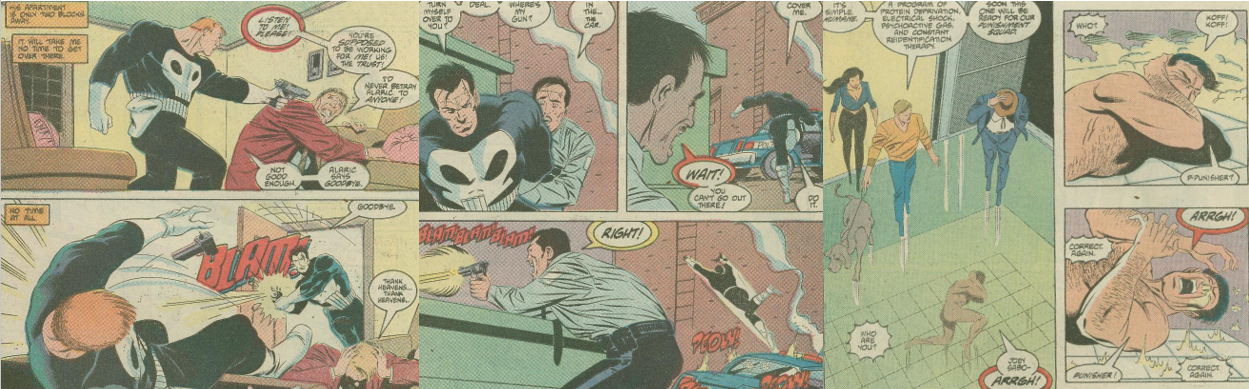
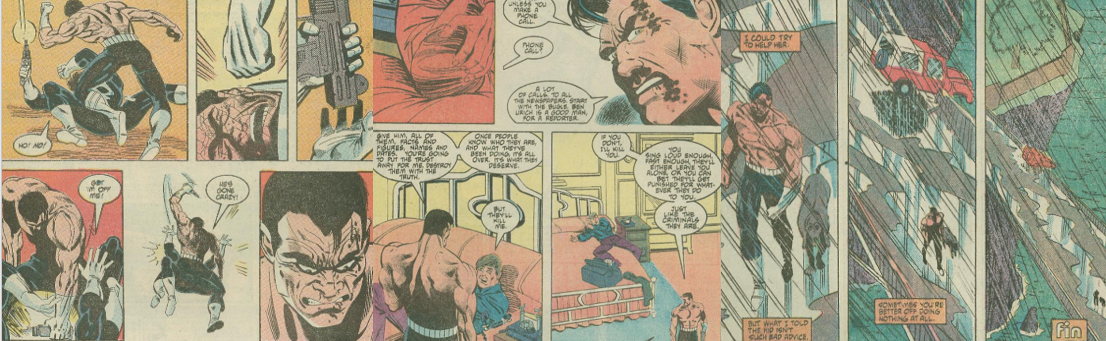
Frank pays a visit to Ejszaka and threatens him into going to Siciliano’s peace meeting and for information regarding Marcus Coriander; he then goes to visit Santiago, only for it to be revealed that Siciliano has been murdered by a fake Punisher! Although Frank puts down the faker, Santiago is killed and all the recent mob murders are revealed to have been perpetrated by Coriander and his gaggle of Punisher look-a-likes. Frank drops in on Coriander, who reveals that he formed this “Punishment Squad” to follow the Punisher’s example and disrupt the city’s criminal underworld before the Kingpin could return to power. After taking care of the fake Punishers (off-panel for maximum imagination), Frank is stunned when Coriander also opens fire on innocent civilians to cover his escape, gunning down a little girl in an experience that breaks the formally small-time crook. When the Punisher confronts him, Coriander exhibits signs of mental trauma but reveals that it was Aleric who was behind everything, right before Angela murders him and shoots the Punisher. He recovers pretty quickly, and without explanation, however (primarily because people refuse to shoot him in the head!) and returns to Ryker’s Island to talk with Gerty about the Trust, an organisation whose goals he can relate to but whose methods fly in the face of his strict moral code. There, he finds Tommy dead courtesy of another doppelgänger, whom he puts down a few blocks (and panels) later when he tracks down Gerty, threatening the warden with death unless he spills the beans on Alaric and the Trust. It turns out that Alaric has brainwashed criminals into his own personal death squad and the fear of Alaric’s reprisals, or being locked in his own prison, leads Gerty to shoot himself in the head before the Punisher’s grim-faced façade. The cops arrive at that exact moment; since the Punisher refuses to fight the police out of respect, he allows himself to be arrested, only for the Punishment Squad to arrive and try and kill them.

The Punisher callously makes short work of Jigsaw and Alaric and returns to his never-ending war.

One cop goes down but the Punisher convinces the other to uncuff him so he can kill his look-a-likes and coerce Siciliano into taking him to Alaric’s compound outside the city, where he forces his subjects to endure electroshock treatments and a special gas to condition them into thinking they’re the Punisher. Frank creates a distraction and makes his way into the compound, only to find that Jigsaw has also been brainwashed to be one of Alaric’s goons. A haymaker to the jaw is enough to undo Jigsaw’s conditioning and Frank easily hitches a ride to Alaric’s main building via a passing helicopter. Alaric begs his lover, Angela, to get to safety so he can hold off the Punisher without worrying about her and tries one last time to convince the Punisher to join his cause. When Frank stubbornly refuses, he falls into one of Alaric’s electroshock rooms and is subjected to the same brainwashing process so he can lead the Punishment Squad; thankfully, he’s able to withstand the pain of the electroshock floors, plug up his mouth, and make an explosive escape as he had all his equipment on him. His body wracked with pain and nursing several injuries, the Punisher is easy prey for Jigsaw, who delights in brutalising and taunting him, but spends too long gloating and Frank stabs him and beats him into submission. However, Frank inexplicably allows Jigsaw to live, but his actions scare off the Punishment Squad and clear the way for him to reach Alaric. Still, Alaric does a pretty good job of defending himself, surprising the Punisher and frantically beating him with the butt of his rifle, only to be sent into a desperate frenzy by the blood and violence. A stalemate of sorts occurs until Frank wounds Alaric and fends off his attack dog; again, rather than killing his enemy, the Punisher threatens him with death unless he blows the whistle on the Trust, which in itself will mean a death sentence for him when the mob come looking for revenge. Satisfied that Alaric will be punished one way or another, the Punisher leaves with his dog, only to be confronted by Siciliano; the Punisher’s able to talk him down, however, with a soliloquy about the cycle of violence and his part in it. As he leaves the compound, Angela tries to run him down and he callously leaves her to her fate after wrecking her car, heading off into the night to continue his never-ending war.

The Summary:
The first thing that strikes me about these five issues is the art work; fittingly, the Punisher’s solo series uses a far less exaggerated and comic book aesthetic (for the most part), depicting a much darker and grittier side to Marvel Comics that works perfectly with the Punisher’s more no-nonsense and violent attitude. Sure, Mike Zeck makes the Punisher a bit of a man mountain at times and Jigsaw’s face is a bubbling mess of scarred flesh but, for the most part, things are quite realistically done here. The Punisher suffers injuries, dislocating his shoulder, going into shock, and even fearing paralysis on a couple of occasions, which again speaks to his vulnerability as a character as opposed to his more virtuous and superhuman peers. He’s also far more introspective and stoic; his dialogue boxes are both “real time” narration and reflections from his war journal, which reinforces that he sees his mission as a war against all crime, and he’s not one for spouting quips or cliché puns at his victims. In fact, almost every word out of his mouth is a threat or some bleak meditation on the cycle of violence that is his life, and it goes a long way to added depth to his character and laying the foundation of what the Punisher is all about.

The Punisher is tormented by the cycle of death and violence that his life has become.

Indeed, there are many times when the Punisher laments the “circle of blood” that has surrounded his life. With nothing to lose, he’s fully committed to this cycle and he knows full well that it will end in his death and will even carry on after he died, meaning that his life’s mission is ultimately meaningless, and yet he is compelled, almost addicted, to killing criminals and saving as many lives as he can. His grim façade cracks only when there’s mention of his lost family or when he sees innocents being harmed; he’s enraged when Contendre and Alaric fire on civilians, suffering flashbacks to his family’s murder, and distraught by his part in the collateral damage, seeing himself as no different from those he’s sworn to punish. Since he’s just one man, the Punisher sets up a mob war to have the city’s mobsters to wipe each other out and make his job easier; a good plan that almost immediately goes sour. We see very little of this mob war beyond a few key gangsters being assassinated and a lot of dialogue talking about how things have escalated out of control with very little visual representation of this. Literally a few pages after he gets the ball rolling, the Punisher is beating himself up over the collateral damage as though he didn’t think anyone would get hurt in the crossfire, which is a bit ridiculous. I would’ve liked to see the gang war take place over an entire issue, with Frank coming to this realisation at the end or part-way through the next issue and then trying to stop what he started but, as presented, it’s quite rushed and nonsensical as he has to shut down his plan almost right away. Still, this was quite an intense story. I liked how each issue introduced a kind of rival for the Punisher, be it Contendre or one of the other head mobsters, and that his actions had consequences; Siciliano has a vendetta against him for killing his gangster father and, most prominently, Alaric brainwashed criminals into forming the Punishment Squad and perverted the Punisher’s skull logo specifically because he was inspired by Frank’s crusade.

Despite some weak villains, the story delves into the Punisher’s motivations and psychology.

Naturally, the Punisher guns down almost everyone who crosses his path without mercy or hesitation, meaning any kind of prolonged conflict between him and the likes of Contendre or his many look-a-likes is supplanted by a relatively quick kill from the Punisher. When his rivals put up more of a fight, the art really shines; it’s great seeing the Punisher walk into situations with no regard for his own safety and fight, beat, or gun down multiple armed assailants at once and I really enjoyed how many in the criminal underground fear him for his uncompromising mercilessness. Jigsaw is an exception to this rule; his hatred of the Punisher is so strong that it allows him to break free of Alaric’s brainwashing but his presence in the story is more of an extended cameo. It’s not entirely clear why the Punisher doesn’t kill him, either; he’s perfectly happy to kill everyone else but spares Jigsaw out of some half-assed sense of kinship given his own mental imbalance. This leaves Alaric as the story’s primary antagonist and he’s not really capable of matching Jigsaw’s visual or thematic appeal; I think the story might’ve benefitted from Jigsaw being behind the Punishment Squad and his motives being to further tarnish the Punisher’s reputation as Alaric is more of a pen pusher than a fighter. He’s reduced to a quivering wreck when he accidentally kills a little girl and before the Punisher’s fury and is only able to fight back because Frank is a bit weakened, making for a lacklustre villain. Overall, though, it’s an enjoyable Punisher story that explores his motivations and offers some introspection into his mission. There’s a sense of duty, obligation, and self-loathing to the Punisher, whose callous and grim demeanour make him stand out from other Marvel heroes and villains. He’s so committed to his cause that he’ll try and kill the Kingpin the first chance he gets and that disregard for his own wellbeing is wonderfully conveyed here. It’s not perfect but, for fledgling or casual Punisher fans, this miniseries is the perfect place to start reading.

My Rating:

Rating: 3 out of 5.

Pretty Good

Have you ever read the Punisher’s first solo series? What did you think to the deeper insight into Punisher’s character and motivation? Would you have liked to see more focus on the mob war? What did you think to the villains of the miniseries; would you have liked to see more from Jigsaw or Contendre? What are some of your favourite Punisher stories and villains? How are you celebrating the Punisher’s debut this year? Whatever you think about the Punisher, share your opinions down below.

Back Issues: The Amazing Spider-Man #210

Story Title: “The Prophecy of Madame Web!”
Published: 12 August 1980 (cover-dated November 1980)
Writer: Dennis O’Neil
Artist: John Romita Jr.

The Background:
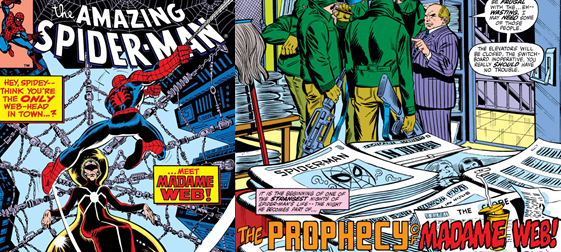
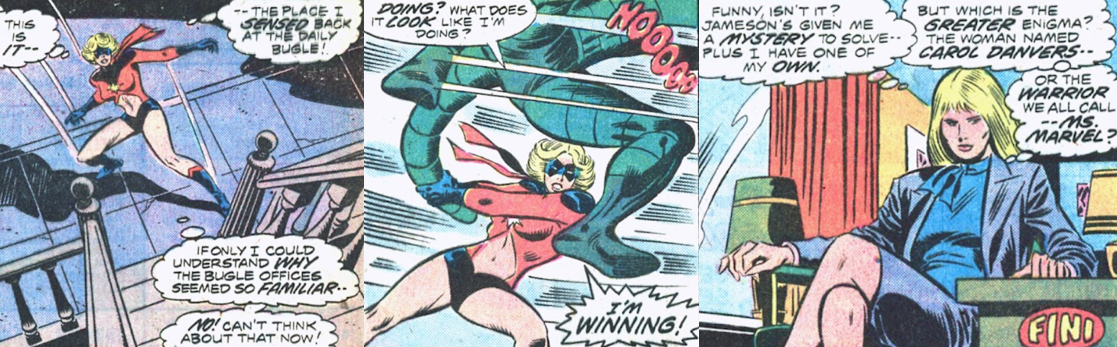
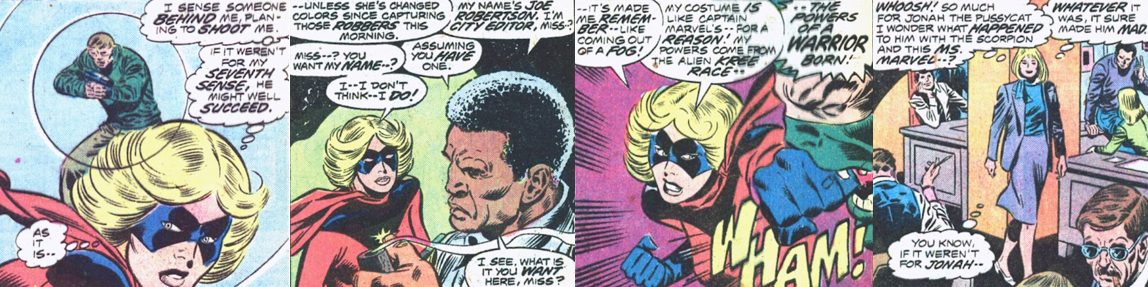
After a blockbuster success with the Fantastic Four, Marvel editor and head writer Stan Lee spearheaded one of Marvel’s best selling publications with teenage superhero Peter Parker/Spider-Man. Spidey’s popularity soon saw him headlining other comics, such as Marvel Team-Up, amassing one of the industry’s most colourful and memorable rogues galleries, and his supporting cast ballooning as Parker aged and his life became more complicated. In November 1980, The Amazing Spider-Man readers were introduced to blind, crippled psychic Cassandra Webb/Madame Web, an enigmatic figure who both tasked Spider-Man with opposing certain villains and used her clairvoyance to direct his destiny. Madame Web played a significant role once Spider-Man was threatened by outside and multiversal forces, ultimately dying at the hands of a vengeful Vladimir Kravinoff/Grim Hunter, with her last act being to pass her powers to Julia Carpenter/Spider-Man. Madame Web’s most significant portrayal, however, was in the Spider-Man animated series (1994 to 1998), where she was voiced by Stan Lee’s wife, Joan, and acted as a mysterious mentor to Spider-Man (Christopher Daniel Barnes), often frustrating him with her manipulative ways. Years later, Sony Pictures inexplicably decided the best way to capitalise on their limited library of Spider-Man characters was to produce a Madame Web live-action movie, teaming this obscure side character with a handful of Spider-Women in an attempt to subvert audience expectations.

The Review:
We begin in the basement storage room of the New York Globe, a rival newspaper to the Daily Bugle, where Robert Dockery, circulation manager for the newspaper, directs a gang of masked hoodlums whom he’s hired in a bid to seize complete control of the publication. This plot point is then put on hold as the story joins Peter Parker, who’s strolling through Chinatown alongside Debra “Debbie” Whitman, an obscure love interest of Peter’s even for me whom he met while studying at Empire State University. Peter’s surprised to learn that the normally level-headed and pragmatic Debra has booked an appointment with a fortune teller, the titular Madame Web, though Debra insists that she’s simply exploring the fascinating subject of psychic phenomena rather than being scammed by a faux clairvoyant. Although Peter enjoys teasing her over this, he’s unable to join her to see Madame Web in action as, wouldn’t you know it, he’s late for a meeting at the New York Globe. Rather than web-sling over there, Peter takes the more traditional route but is forced to switch to Spider-Man when he’s denied access to the editorial department due to a managerial mandate. This is all part of Dockery’s plot, of course. He’s taking a meeting with his senior staff and introducing them to Katrinka Janice “K.J.” Clayton, publisher of the New York Globe, a provocative woman who, until now, has been a silent partner of the newspaper. Just as she announces Dockery’s ascension to power, those masked hoodlums burst in, accost the staff members, and take Clayton hostage.  

When a publishing mogul is seemingly kidnapped, Spidey turns to a mysterious psychic for help.

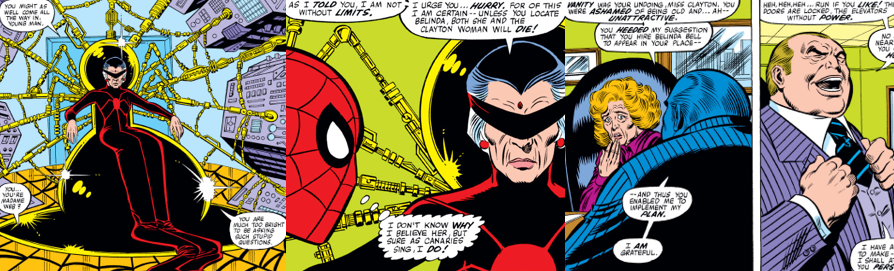
Luckily, Spider-Man was climbing up the outside of the building, so he bursts in to break up the party, easily dodging their machine gun fire with his superhuman speed and reflexes and fighting off the armed thugs even when they dog-pile him. They do, however, delay him long enough for Clayton to be kidnapped and, thanks to Dockery “clumsily” getting in his way, Spidey is a step too slow to pursue them and is unable to catch up due to a lack of windows. With no other options, Spidey decides to indulge Debra’s fantasy and pay Madame Web a visit to see if the elderly medium can help him track Clayton down. Spidey web-slings over the Madame Web’s apartment and is stunned to find she’s an elderly blind lady who’s hooked up to an elaborate web-based life support machine, created by her late husband, that sustains her so she can aid others with her gifts. She describes herself as a “soothsayer, a psychic, a witch” and claims to be capable not just of “second-sight” but fostering the psychic powers of others. Impressed by her presentation and boastful claims, Spider-Man asks for her insight into Clayton and, though she stresses that her abilities aren’t 100% guaranteed due to the nature of the paranormal, she immediately picks up that Clayton is the victim of a malicious deceit, perpetrated by Web’s own student, Belinda Bell, to be held hostage for financial gain. At Spidey’s urging, Madame Web intuits that Belinda and Clayton will perish in a horrific train crash if he doesn’t find Bell, who is his only hope of tracking down Clayton. The next scene shows that the deceit runs even deeper as Belinda was paid to impersonate Clayton and, for her assistance, she finds herself tied up in a toy store (of all places) and at the mercy of Dockery’s ruthless mercenaries. 

Thanks to Madame Web, Spidey saves Clayton, though her true nature remains a mystery.

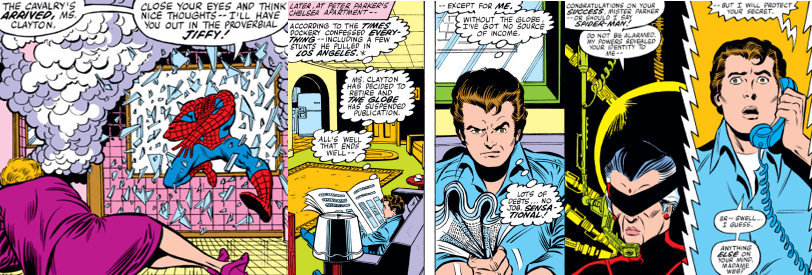
Across town at the New York Gloe, Dockery confronts the real Clayton (actually a much older woman) and openly threatens her, mocking the vanity that so easily allowed him to have her impersonated to hand control of the newspaper over to him. Confident in his victory, Dockery calls his thugs and orders Belinda’s execution, but Spider-Man arrives to save her, having deduced that Madame Web’s vision of crashing trains actually meant the toy store that Dockery owns which…is a bit of a leap but sure, okay. Once again, Spider-Man easily dispatches of the goons, burying them beneath shelving units and stock, and freeing Belinda. Angered by the betrayal and grateful for the rescue, Belinda warns Spider-Man of Dockery’s intentions towards Clayton so he races over to the New York Globe, arriving just in time to find her office engulfed in flames thanks to Dockery dousing gasoline everywhere and starting a raging inferno. Spider-Man brings Clayton to safety, setting her down outside the building just as Dockery makes a run for it, only to find his car up-ended by the web-slinger. Defeated, Dockery folds like paper and Peter later reads that he’s run similar scams before, although Dockery’s imprisonment means that Peter is now out of work (I’m not sure exactly why, surely the New York Globe is still publishing and employing staff, but then I’m unfamiliar with this period in Peter’s life so maybe his job was somehow linked to Dockery?) Before he can descend into complete despair, Peter suddenly gets a phone call from Madame Web, who learned of his dual identity through her powers; she both promises to keep his secret and reassures him that his financial woes will soon be resolved. While this sounds positive on paper, the final panel of the issue reveals that his cantankerous former boss, J. Jonah Jameson, is literally chomping at the bit to re-employ the troubled young hero! 

The Summary:
“The Prophecy of Madame Web!” was an inauspicious debut for the mysterious psychic; Madame Web herself was more of a secondary (or even tertiary) character to the main plot, which was surprisingly low-key for a Spider-Man story, involving no colourful supervillains and being a simple story of a greedy man going to extreme lengths for more power. In other Spider-Man stories, Dockery would’ve employed the services of a low-tier Spider-Man villain, someone like MacDonald “Mac” Gargan/The Scorpion, Herman Schultz/The Shocker, or even Dmitri Smerdyakov/The Chameleon either to take Belinda’s role of impersonating K.J. Clayton or masquerading as Dockery himself. Indeed, I do wonder if maybe the story would’ve been more enjoyable with a supervillain in place of Dockery’s nameless, faceless goons, who offer no physical challenge to Spider-Man and don’t even respond to his witty remarks and cheap quips. Without a colourful villain, the fights aren’t as interesting and the stakes are quite low in terms of Spidey’s safety; there’s no question he can out-punch these mercenaries, so the drama revolves around ensuring Belinda and Clayton are safe instead. This would be fine but, again, there isn’t much emphasis on them being in danger; Belinda is tied up and taunted as the mercs wait for the order to kill her, rather than just being shot right away, and Dockery goes to the effort of setting Clayton’s office on fire to stage her death as an accident rather than just shoving her out a window or gunning her down. I don’t mind a more grounded, low-stakes Spidey story – in many ways, it’s a change of pace – but the narrative here is littered with contrivances and conveniences that make it decidedly run-of-the-mill compared to other Spidey tales. 

Madame Web’s look and powers impress, but the plot is middling and forgettable.

Madame Web makes for a visually interesting character; decked out in a slick black/red dress with a spider motif, blindfolded, and hooked up to a web-like life support system, she’s got a memorable design, for sure. Although Peter dismissed her as a fraud (which is a bit odd considering Peter has chummed with the X-Men before, a team known for their psychics), she proves to be completely legitimate, though her clairvoyance is paradoxically accurate and unreliable, meaning she can only vaguely point Spidey in the right direction and stress fatal consequences should he fail. Thankfully, Spider-Man uses his head (off panel, of course) and, rather than searching every trainyard in the city, realises that Dockery owns a toy shop, which turns out to be the right location. Truthfully, though, I didn’t really like this; it felt rushed and forced and again lowered the stakes as it meant we wouldn’t be seeing Belinda or Clayton threatened by oncoming trains. The twist of Madame Web learning Spidey’s secret identity was interesting as very few characters were in on this back then and taints her mysterious aura with a potential menace as her intentions might not be as benevolent as they seem, but she’s ultimately a non-factor in this story. I have no issues believing that Spider-Man could’ve figured out where Belinda was without Madame Web’s help, making her largely superfluous. I almost wonder if it might’ve been better to have Madame Web be the linchpin of the story; perhaps she’s a true medium who’s targeted by gangsters or hosts a psychic television show and is kidnapped by a villain for a ransom, or just something a little more engaging that Spider-Man giving up pursuing the hoodlums and randomly deciding to ask for her help.  

My Rating:

Rating: 2 out of 5.

Could Be Better

Have you read “The Prophecy of Madame Web!”? If so, what did you think to it? Were you impressed by her debut, or did it fall as flat for you as it did for me? Did you like that it was a more grounded story, or would you have preferred to see Spidey tangle with a supervillain? What are some of your favourite Madame Web stories or moments? Are you excited to see her live-action debut? Whatever your thoughts on Madame Web, drop a comment below or on my social media and be sure to check out my other Spider-Man content across the site. 

Game Corner [F4iday]: Fantastic 4: Rise of the Silver Surfer (Xbox 360)


In November 1961, Marvel Comics readers witnessed four intrepid explorers be forever changed by mysterious cosmic rays. Marvel’s “First Family” of superheroes were the first of many colourful superheroes for Marvel Comics and are more than deserving of some attention today.


Released: 15 June 2007
Developer: Visual Concepts
Also Available For: Nintendo DS, Nintendo Wii, PlayStation 2, PlayStation 3

The Background:
Stan Lee and Jack Kirby’s family of dysfunctional superheroes finally made it to the big screen in 2005 after a chaotic journey; their 1994 movie was never released, but Fantastic 4 (Story, 2005) was a modest box office success despite mixed reviews and earned itself a sequel in 2007. Fantastic 4: Rise of the Silver Surfer (ibid, 2007) was also a somewhat lacklustre critical and commercial release that led to a disastrous reboot some eight years later, but it did result in another rare standalone Fantastic Four videogame being released. This was, of course, at the peak of the time when every single cinema release was accompanied by a hastily created videogame tie-in, but the Fantastic Four have had a couple of videogame adaptations in the past, the first being an obscure and obtuse text-and-image based adventure and the second being a universally derided brawler. While the Fantastic 4 videogame tie-in was published by Activision and received slightly-above-average reviews, Rise of the Silver Surfer was published by 2K Games, with this version being developed by Visual Concepts, a studio more known for their sports tie-ins, and its marketing was built around the four-player co-op, destructible environments, and “Fusion Attack System”. Sadly, the best this adaptation could hope for was mixed reviews, if that; the game was widely regarded as being another disappointingly cheap, repetitive, tie-in that failed to offer anything engaging or unique for gamers to get to grips with.

The Plot:
World-renowned superheroes and scientists the Fantastic Four find their lives interrupted when an extraterrestrial dubbed the “Silver Surfer” causes havoc with their powers and revives their old nemesis, Victor Von Doom/Doctor Doom, all while preparing the world for consumption by a cosmic being known only as “Galactus”.

Gameplay:
Fantastic 4: Rise of the Silver Surfer is a third-person, team-based brawler in which players pick from each member of the titular team (Doctor Reed Richards/Mister Fantastic, Doctor Susan Storm/The Invisible Girl, Johnny Storm/The Human Torch, and Ben Grimm/The Thing) and battle through six distinct levels ripped both from the movie the game is based on and the original source material. The game supports up to four players in simultaneous co-operative play, and players can jump in at any time to assume control a character, but a single player is more than capable of playing through the game without any difficulties thanks to a relatively competent partner A.I. and the ability to switch between the characters using the directional pad. While each character has their own superpowers that give them slightly different playstyles, they share the same basic control commands: A and X allow pull off weak and strong attacks, respectively, and you can string these button inputs together to perform simple combo attacks, Y allows you to jump (and you can do jumping attacks, naturally), while B unleashes an “area attack” or is used to grab and use objects. The Left Bumper allows you to block incoming attacks, while the Right Bumper lets you change your team’s tactics; tapping it will cycle through commands like aggressive and defensive and holding it will see your teammates form up on your current position.

Each member of the team has different attacks and special moves according to their powers.

Not only does each character have different attack animations (with the Thing favouring slow, strong punches and the Invisible Girl pulling off roundhouse kicks and spinning attacks, for example), they also have their own unique superpowers that slightly change how they play and affords them different capabilities in combat or puzzle solving. You can perform these by holding the Right Trigger and pressing A, B, X, or Y but doing so will drain your “Cosmic Meter” and you’ll need to either give this a few seconds to refill or collect “Cosmic Orbs” from downed enemies or smashed crates. Reed Richards is elastic, giving him decent reach by default but this also allows him to perform a “Periscope Punch” to hit switches or control boxes that are high up on walls or ceilings, slip through laser traps with his stretchy evade, slingshot enemies across the arena, or toss a grenade to send enemies flying. Sue can fade from sight, allowing her to temporarily slip past enemies and security cameras undetected, but she can also (oddly) use “telekinesis” to move and hurl enemies and certain objects, toss energy discs for a ranged attack, erect a shield that protects her and anyone in it, and can redirect light beams to melt crystals and solve puzzles. Johnny is the Human Torch, so naturally he bursts into flame whenever he uses his powers; this allows him to fly over energy barriers (effectively making him the only character with a double jump), toss fireballs, scorch enemies with a flamethrower attack, and protect himself with a wall of flame. The Thing just loves to fight, so he gets a super useful ground pound (seriously, I spammed this move over and over), a powerful shoulder charge, can cover himself in a temporary protective aura, and can pick up objects the others can’t (like cars and lampposts) and swing or hurl them at enemies. There are times when a specific character’s ability is required to progress, such as using the Thing to smash through boulders or Mr. Fantastic to deactivate switches, and these are marked by a silver 4 symbol and you’ll often find yourself needing to switch between a few different characters to lower barriers and open doors so you can progress.

Combine the Four’s powers or use their unique abilities to get past barriers and other obstacles.

All these super powers, in addition to some other basic, overall stats, can be upgraded at the cost of the coins dropped by enemies or found when smashing the environment, and the Fantastic Four can also combine attacks by holding down the Left Trigger and pressing the corresponding face button when close by to pull off a super-powerful, super draining “Fusion Attack” that allows for fun combinations of their abilities, like filling up Sue’s forcefield with fire to effectively create a bomb and tossing Reed’s rubbery body at enemies. While you’ll need to collect health orbs to restore your health, characters will only be temporarily knocked out if their health is completely drained; you can’t revive them, but they’ll recover after a few seconds and re-join the fight, but it is easy to get overwhelmed and see some, or all, of your team mates knocked out, leaving you frantically running around avoiding damage until they spawn back in. The game is pretty generous with its checkpoints, but that’s probably because its levels are soooo long; levels stretch on forever and consist of multiple areas, separated by lifts and doors and barriers or other obstacles you either have to activate, ride, or break through with the Fantastic Four’s powers. It’s not long before you’ve seen most of what the game has to offer, however; cave-ins need clearing with the Thing, barriers need flying over or passing through with the Human Torch and the Invisible Girl, respectively, and laser traps need stretching through with Mr. Fantastic. Often, you’ll need to activate consoles to lower lifts or open doors, or smash control boxes to disable turrets; sometimes, you’ll need to power up generators using Johnny’s fireballs, use Sue’s telekinesis to bring floating transports closer, or avoid getting too trigger happy and risk taking damage from explosive barrels.

Occasionally, you’ll need to use a solo hero to progress past obstacles or chase down the Silver Surfer.

Easily the most frustrating puzzles are found in the Himalayas, where you’ll need to smack around spherical rocks or move weird crystals to redirect light and open new ways to progress. It can be tricky figuring out which crystals to move and to where, and you’ll often have to use Sue’s shield to bounce light beams to crystals, all to ring bells so you can move on to the next area. Occasionally, you’ll control a character for a solo mission; Reed must use his evade to get through laser traps on a Russian space station, taking out turrets and enemies as he goes, while Ben gets locked into a fighting arena for a brief period. Johnny gets the majority of these sections, however, as he’s tasked with flying down rock tunnels, through the city streets and underground, blasting enemies or pursuing the Silver Surfer. These can be quite fun as you boost along with A and toss fireballs with X, dodging traffic and other hazards, but both of these abilities are tied to your Cosmic Meter, which can severely hamper you, though it’s not exactly difficult to keep up with the Surfer and pass the mission successfully. By far the worst section of all of these, and the entire game, was guiding Sue through a heavily guarded military base. This means using your invisibility to slip past security cameras and trigger-happy robots, while also destroying turrets and awkwardly using her telekinesis to smash control panels to lower barriers. There are no checkpoints in this poor attempt at a stealth section so it can be extremely frustrating to slip past the robots and turrets (which absolutely barrage you with laser fire if they spot you) and finally reach the control panel, only to fail right before the exit because you were surprised by another robot or ran out of juice for your superpowers.

Graphics and Sound:
To be fair, the in-game graphics of Fantastic 4: Rise of the Silver Surfer aren’t all that bad. Bland as all hell, for sure, but not that bad. Each character is modelled pretty closely to their live-action counterparts and feels very different to control, with the Thing being slower and heavier and the Human Torch being slipperier and more agile. When left idle, they’ll offer commentary and, honestly, I was pleasantly surprised by their banter and voice work; so often these tie-in games feature stilted, phoned-in performances, but there’s actually a lot of fun and fitting dialogue here that’s sometimes more interesting than what we saw in the movies. Sadly, this praise doesn’t extend to the pre-rendered cutscenes, which are a plasticy, ugly mess that continues this generation’s tendency to render characters as though they were action figures. The music is equally not much to shout about, being comprised of generic tunes and samples from the film’s soundtrack. The game also has very little to do with the move it’s based on; the Silver Surfer barely shows up, Galactus is mentioned but never seen, and the focus is more on enemies from the group’s comic books and Dr. Doom.

While the dialogue is okay and character models work well, environments can be a bit bland.

On the one hand, this means we get to explore far more diverse locations than we ever saw in the live-action movies; you’ll venture into a lava-filled cavern where the shapeshifting Skrulls have taken root and onto a very dark, steampunk-like Russian space station to battle against Doctor Ivan Kragoff/The Red Ghost and his genetically enhanced Super-Apes. The game does recreate some locations from the movie as well, however, specifically Sue and Reed’s rooftop wedding venue, the streets of New York City, and the military base where the Silver Surfer is held captive (although it’s vastly different from the film version, featuring electrical barriers and robotic sentries). The game also takes the team to the crystal caves and misty clifftops of the Himalayas where they have to fight off rock monsters and to the streets of Shanghai for a final showdown with Dr. Doom, and every environment features a lot of destructible elements for you to smash your way through. Unfortunately, they’re also painfully linear, so much so that the game doesn’t even provide you with a mini map or radar; despite this, it can be easy to get a little turned around as some locations are so dark and similar that it’s easy to get lost and the game gives you no indication when you’re heading in the wrong direction or where you need to go if you miss that an elevator lowered just offscreen or a door opened one screen back. Compounding matters is just how long levels are; they just go on and on, making each section a chore to play through and really stunting your motivation to tackle the game’s harder “Fantastic” mode.

Enemies and Bosses:
The Fantastic Four will wade through a number of nameless, faceless, disposable grunts as they race to track down the Silver Surfer. However, while the enemies you face in each location are visually distinct, they share many traits that quickly make them very dull and predictable, no matter how fantastical or faithful they are to the source material. You’ll fight off Skrulls, weird silvery alien…things, chicken-like robots and hovering drones, Doombots, rock monsters, and Super-Apes, many of whom can block your attacks, attack up close or from afar with pistols or missiles, or who come in larger variants that can tank your attacks. Many enemies can be picked up and thrown, and you’ll often get to hurl them off bridges or cliff edges to their immediate death, so I recommend doing this whenever possible to help with crowd control. The larger Skrull variant swings a large pillar at you while a gaggle of annoying, regular Skrulls swarm around you, but it can be useful to pummel him with Johnny’s fireballs from a safe distance. Larger rock monsters also dog your progress in the crystal caves, but the Thing is more than capable of smashing them and their smaller cousins to pieces, especially if you’ve upgraded his ground pound attack. You’ll first encounter the massively annoying turrets when on the Red Ghost’s space station; these can be destroyed with your attacks if you can get close to them, but it’s generally easier, faster, and safer to disable them by activating or destroying a nearby control box. Finally, heavily armed robots and Doombots await you in the military base and the streets of Shanghai; these are much tougher than other enemies and sport cheap long-ranged attacks, so it’s advisable to have upgraded some of your stats and abilities to help even the playing field.

Until you face Cosmic Doom, most bosses follow a simple rinse-and-repeat strategy.

When you eventually make it to the end of each location, you’ll generally have to face off with a boss. The first is Kl’rt/The Super-Skrull who sports the Fantastic Four’s powers, allowing him to perform a ground pound like the Thing and disappear from the battlefield like the Invisible Girl. Protected by an endless swam of regular Skrulls, the only way to damage the Super-Skrull is by throwing enemies or your projectiles into the huge spherical shield generator in the centre of the room; once it’s overloaded, the Super-Skrull will be stunned and be left open to your attacks, and you’ll need to repeat this tactic over and over, tediously waiting for him to reappear while fending off the endless enemies. After fighting through the strangely deserted streets of New York City, you’ll come across a large, spiked alien craft that sucks up cars and launches them at you while sending you flying with its annoying laser beam. You can throw cars back at it, and your other projectiles, to damage it, but it’s easy to get stun-locked into an annoying cycle from its projectiles. You won’t actually fight the Red Ghost, however; instead, you simply pursue him down a hallway, fending off his Super-Apes and turrets, making for a decidedly anticlimactic ending to a largely frustrating level. Similarly, you won’t battle the Silver Surfer; instead, you fight off his minions and chase after him as Johnny, first through a subway tunnel and then through an underpass, avoiding trains, traffic, and low-hanging signs and his energy-draining trail. You will, however, battle another of Galactus’s heralds, Terrax the Tamer, in the Himalayas; this massive rock-like being tosses his huge axe across the arena, which is really difficult to avoid and can leave you knocked on your ass for some time. Even worse is the fact that you have to contend with a never-ending gaggle of rock monsters and complete those annoying light puzzles to stun him so you can damage him, making this easily the most annoying and tedious boss battle in the game. Larger mechs (very much akin to All-Terrain Scout Transport (AT-ST) walkers) await in the military base, but they’re easily bypassed with your upgraded abilities, though Dr. Doom is a far more aggravating enemy. Having stolen the Silver Surfer’s near-limitless Power Cosmic, Dr. Doom flies about raining energy bolts down and the only way to damage him is to activate a nearby power generator and blast him out of the sky but, even then he can absorb and dish out a great deal of punishment, to say nothing of his massive electrical area attack, shield, and ability to shrug off your attacks. Your best bet here (and in all of these boss battles) is to quickly cycle between each character and spam your Fusion Attack, retreating to safety, when necessary, until he finally goes down.

Power-Ups and Bonuses:
Unfortunately, there aren’t any temporary power-ups to find in Fantastic 4: Rise of the Silver Surfer. Smash all the crates and boulders and what-not you like and all you’ll uncover are health and energy restoring orbs, coins, and the odd collectible. You should still smash everything you see, however, and let those coins fly into you as you’ll need them to power-up the characters and their superpowers; everything from their attack, defence, recovery and meter regeneration time to the cost, range, and impact of their individual abilities can be upgraded at the cost of these coins. Unfortunately, the cost increases as you spend, meaning you’ll need to farm and replay areas to collect all the coins you need, so you can either power characters up a little bit to make things easier to save them all up and blow them on fully upgrading a single character…or put yourself through the agony of a second playthrough.

Additional Features:
There are nineteen Achievements to earn in Fantastic 4: Rise of the Silver Surfer, with nine poppin simply for clearing each level and defeating their bosses. Oddly, there are no Achievements for playing with other players or anything fun (like, I dunno…destroying Reed and Sue’s wedding venue) or tedious (like defeating 100+ enemies). You’ll get an Achievement for beating the game on both “Normal” and the harder “Fantastic” mode, one for performing a single Fusion Attack, one for upgrading every character, and three more for finding every collectible and unlocking all the bonus content. Bonus content is unlocked by finding Fantastic 4 symbols and destroying Dr. Doom’s tiny, barely noticeable spybots; doing so will unlock cinematics, comic covers, concept art, and four alternative costumes that come with extra perks (like increasing your attack or defence by default), which is a nice touch. Once you beat the game, you can access a level select and the game restarts with all your upgrades intact, but I suspect you have to start a whole new game from the ground up if you choose a different difficulty mode. As I had no desire to play this game once I’d finished it and unlocked as many Achievements as I could, I can’t speak to that, but you could try playing with a friend or two to see if that helps improve the experience.

The Summary:
I had low expectations for Fantastic 4: Rise of the Silver Surfer; I’d not really heard much about it except the usual vague chatter about how it was another tedious, cheap tie-in to a big budget movie and, unfortunately, I can’t argue with that. Fundamentally, it’s not really that insulting; the titular foursome are all represented pretty well, even if I favoured the Human Torch and the Thing (but that’s just personal preference on my part), with some fun superpowers to experiment with using the Fusion System. I get why you’d tie this to a regenerating meter, but it drains so quickly that you’ll be relying on the lacklustre combo strings more than anything. The dialogue and expansion on the movie’s story are also quite enjoyable and the game tries to show some new and visually interesting areas, but it never quite capitalises on any of the mechanics it includes beyond the bog-standard brawling. It’s fun chasing around as the Human Torch, but these sections are very brief and don’t ask much of you than to spam A or X as often as possible and avoid obstacles, and don’t even get me started on Sue’s God-awful “stealth” section. What really drags this game down, though, is just how long and boring the levels are and the lack of replayability; the unlockable costumes are pretty good (and it’s nice to see more than one included for a change) but I really don’t think anyone will be excited to slog through this on the harder difficulty or grind to upgrade and unlock everything as it’s such a time-consuming and monotonous experience. The bosses are also a massive let down and the game misses opportunities to have you recreate scenes from the film; like, why not shorten a couple of the levels and put in a forest mission where you need to activate those generators to bring down the Silver Surfer? Or, better yet, why not include a Silver Surfer auto-racer/shooter for the climax where you fend off Galactus’s attack? Instead, we get a very rushed and cobbled together, uninspiring brawler that’s only worth a playthrough to increase your Gamer Score with some relatively simple Achievements.

My Rating:

Rating: 2 out of 5.

Could Be Better

What did you think to Fantastic 4: Rise of the Silver Surfer? Did you enjoy the Fusion Attacks and the variety of superpowers on offer? What did you think to the levels and boss battles, and were there any elements from the movie you felt were missing from the game? Did you ever unlock everything in this game? Would you like to see another, better Fantastic Four videogame some day? How have you been celebrating the debut of Marvel’s First Family this month? Whatever you think, sign up to share your thoughts on Fantastic 4: Rise of the Silver Surfer in the comments below.

Back Issues [Wolvie Wednesday]: Wolverine #1-4


When readers were first introduced to the character of James Howlett, better known by the names “Logan” and “Wolverine”, it was in the pages of The Incredible Hulk. From his first full debut in issue 181 all the way back in November 1974 to him officially joining the X-Men in 1975, the character has become one of Marvel Comics’ most recognisable and enduring superheroes, regularly featuring in solo and team comics, cartoons, movies, videogames, and countless other merchandise.


Writer: Chris Claremont – Artist: Frank Miller

Story Title: “I’m Wolverine!”
Published: 1 June 1982 (cover-dated September 1982)

Story Title: “Debts and Obligations”
Published: 29 June 1982 (cover-dated October 1982)

Story Title: “Loss”
Published: 3 August 1982 (cover-dated November 1982)

Story Title: “Honor”
Published: 31 August 1982 (cover-dated December 1982)

The Background:
In 1974, Roy Thomas, editor-in-chief at Marvel Comics, tasked writer Len Wein with creating the first Canadian superhero; a short, feisty adventurer named “Wolverine” who would be as scrappy and fearsome as his namesake. Though the legendary John Romita Sr came up with the original concept art for Wolverine and his now-iconic retractable claws, it was artist Herb Trimbe who put the finishing touches to the character’s design. In what would become a staple for Wolverine for decades, Wolverine’s past and true identity was initially quite the mystery; yet, despite claims that Wolverine was originally conceived to be a mutated wolverine cub, Wein insisted this was false and that Wolverine was always intended to be a Mutant. These days, Wolverine is established as one of Marvel’s most popular characters thanks not only to him joining the X-Men a year after his debut but also the success of his first solo miniseries courtesy of X-Men scribe Chris Claremont and legendary comic book artist Frank Miller. Largely regarded as one of Marvel’s best miniseries, Claremont and Miller’s work helped to define many of Wolverine’s now recognisable character traits, from his time in Japan, his knack for brutality, and his iconic no-nonsense attitude. The popularity of the miniseries led to an ongoing solo book from 1988 but it’s not hyperbole to say that Wolverine probably wouldn’t be as big of a star as he is today without this influential four-issue series, which would come to inform the character’s later adaptations into films, cartoons, and videogames.

The Review:
Wolverine’s first solo outing begins within him freeclimbing his way through the Rocky Mountains, back in his home soil in Canada, on “business”; as he explains in his blunt and characteristically glib dialogue boxes, he’s “the best there is at what [he] does. But what [he] does isn’t very nice”, which may very well be the first instance of him saying this iconic catchphrase. He’s there to track, hunt, and kill a ferocious grizzly bear that’s been slaughtering locals as they venture onto the mountain; thanks to his heightened senses, Adamantium laced skeleton, and innate ability to tackle even a berserker grizzly bear head-on, Wolverine easily challenges, dismembers, and kills the beast with a minimum of fuss but he’s not happy about it. Not only does he recognise that the bear is simply being true to his nature, but he also spots an illegal poison-barbed arrow in the dead beast’s back, evidence of a hunter landing a hit on the bear but not sticking around to finish it off and thus driving it into a frenzy. With seven men, three women, and five kids dead as a result, Wolverine tracks the foolish hunter to a bar some fifty-seven miles away and confronts him; riled up, the hunter picks a fight, much to Wolverine’s pleasure. Though we don’t see what Wolverine does to the man, he assures the reader that he let the hunter live…and that the bear put up a better fight. He makes sure the hunter pays for his actions in a court of law and prepares to head home to the X-Men when he spots a pile of letters on his doorstep; they’ve all been returned, unopened, from an old flame of his: Mariko Yashida, the daughter of one of the oldest and most respected families in Japan. Although the Japanese embassy tells him that Mariko was called back to Japan, her home line hangs up on him, so Wolverine takes the next flight to Japan and meets up with an old contact of his, Asano Kimura, who informs him that Mariko’s long-lost father recently returned and reclaimed his position at the head of the Yashida clan and family, thus forcing Mariko to marry.

Wolverine dishonours himself trying to fight for his love’s freedom.

Despite the fact that Mariko was obligated by ages-old traditions of duty and honour, and Asano warning Wolverine off, Logan lets his anger and emotions overrule his common sense, dons his brown and yellow outfit, and forces his way into the Yashida ancestral stronghold and confront Mariko even though Asano may be legally obligated to hunt him down as a result. After easily bypassing Yashida’s near-feral guard dogs, Wolverine scales the main tower and conveniently comes across Mariko standing beneath a gigantic, ostentatious Buddha statue; Mariko tries to brush him off, citing the same explanations of duty and honour, and even accuses him of shaming her, but he’s enraged to find her face bruised. However, Mariko calms his rage and even admits that she loves him, but is bound to the will of her father, who promised her hand to another to pay a debt. When Mariko’s abusive husband, Noburu-Hideki, interrupts, Wolverine is ready to gut him on the spot, but allows Mariko to talk him out of it, only to be briefly rendered unconscious by a barrage of poisoned shuriken. Thanks to his superhuman healing factor, Wolverine recovers and is confronted by Mariko’s father, Lord Shingen, who brands him a gaijin (a derogatory term for an outsider) and chastises his arrogance. Deeming the X-Man unworthy, Lord Shingen challenges Logan to fight for Mariko’s affection with wooden swords (bokken, here referred to as “Bokan”). Although Lord Shingen is an old man, Logan is still feeling the effects of his poisoning and is out of practice with a sword; Lord Shingen also specifically targets nerve clusters and pressure points to cause maximum pain and rile him up to the point where he abandons his toy weapon and attacks with his claws, dishonouring himself before his beloved. Despite now having a lethal edge, Wolverine never gets the chance to land a mortal or killing blow; Lord Shingen’s skill half-cripples him and leaves him abandoned, beaten and humiliated, on the bustling streets of Tokyo.

Yukio manipulates Wolverine to drive him from Mariko and into her bed.

Naturally, Logan’s immediately set upon by punks and soon drawn into an all-out ambush with the highly skilled ninjas known as the Hand by the mysterious Yukio. The Hand have the superior numbers, and even wound Yukio, but Wolverine’s Mutant abilities and enhanced bones give him the edge and he leaves them all dead. Yukio is astounded by his regenerative abilities, which she would use to destroy the Hand, a supposedly peerless ninja clan commanded by a ruthless and powerful crime lord. Due to their shared killer instinct, things quickly get heated between them, but Wolverine can’t shake the image of Mariko and walks away, much to Yukio’s despair. An interlude sees her storm into Lord Shingen’s office, revealing he hired her to win Wolverine’s trust and lure him into a two-pronged attack that will see both Logan and Lord Shingen’s rival, Katsuyori, dead at Yukio’s hand. Although Wolverine notices Yukio’s changed demeanour, a half-veiled version of the truth is enough to convince him to accompany her in confronting Katsuyori at a theatre performance. Although Logan hesitates when he sees Mariko in the crowd, he leaps into action when the actors try to assassinate the Yashidas. While Wolverine cuts his way through the ninjas, driven berserk by their attack, Yukio takes out Katsuyori with a car bomb and is delighted when Mariko expresses shock and even fear at witnessing Wolverine’s bloodthirsty berserker rage. In the aftermath, Wolverine takes solace in alcohol, Yukio’s affections, and in a random brawl, but rebukes Asano’s pleas to assist in combating the recently united Japanese underworld. After narrowly avoiding being splattered by a bullet train simply so Yukio can get a sadistic thrill, Wolverine passes out and is tormented by dreams of his lost love. While he sleeps, Yukio is accosted by the Hand, who demand she redeem herself by cutting out Logan’s heart, but she opts to fight them off instead; however, when she tries to rouse him, she’s enraged when he speaks Mariko’s name and leaves him to his stupor, cursing her foolishness for believing he could ever love anyone but Mariko.

After a bloody conflict, Logan finds himself victorious and betrothed to his beloved Mariko.

By the time Logan returns to their apartment, he’s dismayed to find Asano dead at Yukio’s hand. Finally, realising Yukio’s deception, he chases her across the rooftops of neon-drenched Tokyo and prepares to eviscerate her, regardless of their kinship, but is suddenly ensnared by roped arrows fired by the Hand. Angered at ignoring his instincts, Wolverine makes short work of the ninjas but Yukio slips away in the chaos. Determined to prove that he’s a man, rather than some mindless beast, Wolverine systematically disrupts Lord Shingen’s operation, angering the crime lord and forcing him into a rematch. After being captured, Yukio is given the chance to kill Lord Shingen in a desperate attempt to win back Wolverine’s affection after killing Asano, but she’s hopelessly outmatched compared by Lord Shingen’s strength, speed, and skill. Ultimately, she partially redeems herself when she frees Mariko from Noburu-Hideki’s abuse; unable to forgive her for Asano’s death, or repay her for saving Mariko, Wolverine simply allows her to leave so he can face Lord Shingen one-on-one. This time, Lord Shingen grabs a Muramasa katana to see if Logan is truly worthy and they engage in blood combat largely bereft of dialogue or sound effects. Although Wolverine gets impaled on Lord Shingen’s sword, this allows him to close the gap between them and end the crime lord’s life by stabbing him through the face and head with his claws (something kept off-panel but clearly implied by the artwork). Mariko is stunned by the sight; duty and honour, the two driving forces behind her entire life and unwanted marriage, dictate that she avenge her father’s death yet, despite being able to stop her and kill her even with his wounds, Wolverine chooses to do nothing. However, Mariko delivers a soliloquy about how her father’s actions brought shame to the Yashida clan; she bequeaths the sword to Wolverine and dubs him worthy not just of the blade but of the clan and her heart. Wolverine’s dialogue reveals that Marko fully planned to kill her father herself, and then commit ritualistic suicide, had Logan not emerged the victor, and the two recuperate in the mountains before sending a most unexpected invitation to their wedding to the X-Men!

The Summary:
I’m reasonably familiar with Frank Miller; I’ve read his work on Batman, Daredevil, RoboCop, and some of his original work, like 300 and Sin City and, as a rule, I’m not always his biggest fan. His writing is repetitive and atrocious most of the time, often to the point of self-parody, and his art can be ridiculously simplistic and childish in a lot of his work. Thankfully, that isn’t the case here; not only is he kept away from the script but his art is coherent and impressive, while still making great use of shadows, silhouettes, and panel positioning in a way that makes some of his later work look amateurish in comparison. The result is a very different presentation and atmosphere to the story, one decidedly at odds with the more colourful X-Men and deeply entrenched in the gritty, grounded, and realistic. The only ludicrous things happening in this miniseries are Wolverine’s status as a Mutant and the sheer number of Hand ninjas; no other Mutants appear, save for a brief cameo by the X-Men, and Wolverine opts to wear his darker, more serious costume rather than his bright yellow and blue X-Men outfit. The dialogue and writing are also far more mature than in your regular X-Men comic to take a deeper dive into Wolverine’s brutal nature, and that means getting a sense of his self-loathing, his acceptance of his animalistic side, and that he’s a well-travelled, highly experienced fighter and killer with a chequered past that we’re only just scraping the surface of.

Logan’s tumultuous love life is a primary element of this four-issue solo run.

This is explicit in the depiction of Wolverine’s relationship to Lady Mariko; while we don’t really get much sense of how they first met and their previous relationship here, it’s clear that Logan cares deeply for her (he describes her as the woman he loves on more than one occasion, to the point where he not only flies all the way to Japan to check on her but willingly dishonours himself by interjecting himself into her current situation. For her part, Mariko obviously loves Logan as well but it’s clear she’s torn; tradition, honour, and duty mean she must do as her father commands, even if it means enduring a loveless and abusive relationship, yet she also chastises Wolverine for his tardiness and for trying to force her out of her duties when he should know that she cannot disobey her father without bringing disgrace and shame upon her family. Submissive and unable to defy her father, Mariko even shuns Wolverine and his efforts to help, and is shocked by his berserker rage since, apparently, she’s never seen that side of him, hinting that she may not know him as completely as she claims. Yukio, on the other hand, is like Logan’s mirror opposite; like him, she’s a killer at heart, highly skilled, and delights in showcasing her skills through combat and death-defying situations. In this way, they’re naturally attracted to each other and make for a well-oiled unit yet, despite the passionate spark between them, Wolverine longs for the pure, innocent love he feels towards Mariko. As ever, Wolverine is torn between his animal instincts and his desire to rise above them and Mariko represents a chance for him to lay down his arms, so to speak, and have a normal life away from bloodshed and combat, and he’ll fight and kill whoever he has to just to see her happy, whether it’s with him or not.

The miniseries is a violent deep-dive into Wolverine’s complex character.

This is startlingly brought to life throughout the miniseries; it’s not often that Marvel Comics were so explicitly violent back then but there’s a fair amount of blood, death, and injury throughout Wolverine’s first solo run. Even better, this is still at a time when Wolverine wasn’t some nigh-invincible force; it’s stated repeatedly that his Mutant abilities and Adamantium skeleton mean he can endure a great deal of punishment and heal from virtually any wound, yet he’s still slowed by injury, poison, and is hurt or knocked out from attacks. Lord Shingen bests him with an ease that, these days, would never be heard of and even random mooks draw blood by piercing him with arrows or blasting him in the nose. Wolverine is almost constantly receiving deep cuts and injuries throughout the mini, which keeps things grounded and levels the playing field for his opponents. More often than not, he gives as good as he gets and leaves an incalculable number of bodies in his wake, but it takes a toll and he still needs to recover rather than his body instantly sewing itself back together so he can tank through his fights. Similarly, he’s susceptible to alcohol, stumbling about and even passing out from over drinking, and significantly weakened by Yukio’s poisons, which leave him as vulnerable to Lord Shingen’s precise and measured attacks as his heartache over Mariko. Still, his keen senses and abilities (both superhuman and artificial) make him a fearsome and formidable individual; the driving force here is the question of worthiness. Wolverine knows that he can never truly be worthy of Mariko since he’s both a killer and a gaijin, yet he fights for her regardless; he eschews tradition and respect to ensure her safety and happiness and is even willing to dishonour himself in her eyes even it means she can be free. Ultimately, she chooses to see the best in him and offer a glimpse of the happiness that’s long eluded him, and it’s easy to see why this four-issue run is so well-regarded as so much of Wolverine’s character, his motivation and the dichotomy of his personality, were established here to portray him as a fiercely loyal and driven individual, but one surrounded by death and tragedy and his own feral nature, all of which he must constantly battle to overcome to be the lesser of two evils.

My Rating:

Rating: 4 out of 5.

Great Stuff

What are your thoughts on Wolverine’s first solo run? Did you enjoy seeing him battling ninjas in Japan? What did you think to Wolverine’s depiction and characterisation here? Were you surprised at how vulnerable he was and the greater insight into his personality? What did you think to Mariko and Yukio and which of the two do you think is a better fit for Wolverine? Were you a fan of Claremont and Miller’s work with the character? How are you celebrating Wolverine’s debut this month? Whatever you think about this four-issue run, or Wolverine in general, leave a comment below or on my social media.

Back Issues: Ms. Marvel #1 (1976)

Story Title: “This Woman, This Warrior!”
Published: 5 October 1976 (cover-dated January 1977)
Writer: Gerry Conway
Artist: John Buscema

The Background:
In 1953, DC Comics sued Fawcett Comics for breach of copyright over a claim that their superpowered champion, Billy Batson/Captain Marvel, was too similar to Clark Kent/Superman, and Fawcett ceased publishing Captain Marvel comics. The trademark to the name “Captain Marvel” subsequently lapsed and, fittingly, Marvel Comics snapped it up for themselves in 1967 and began putting out regular Captain Marvel titles to retain the copyright. Originally debuting as a superpowered Kree warrior named Mar-Vell, Captain Marvel was created by Stan Lee and Gene Colan and would swap place with perennial sidekick Rock Jones using the cosmic “Nega-bands”. Mar-Vells stories werent much of a priority at Marvel, however, and, when sales flagged, Jim Starlin famously penned one of the more impactful (and surprisingly permanent) comic book deaths by having the character die from cancer in 1982. To maintain their copyright, Marvel had Mar-Vells legacy live on through a number of successors; one of whom, Carol Danvers, was a supporting character in Mar-Vells life before gaining her own superpowers. It would be over four decades before Carol assumed the mantle of Captain Marvel, however; instead, she spent a chunk of her superhero career known as Ms. Marvel, during which time she joined the Avengers and was involved in a pretty disgusting sexual assault story amongst other storylines. Widely considered to be one of Marvels top-tier female superheroes, Carol has since cemented her legacy by being portrayed as the de facto Captain Marvel in cartoons, videogames, and the unstoppable juggernaut that is the Marvel Cinematic Universe.

The Review:
Ms. Marvel swoops into action right from the word “Go!” in her “Fabulous First Issue!”, coming onto the scene of a particularly violent bank robbery occurring in broad daylight. The thieves, who are all wearing stockings over their heads, dismiss Ms. Marvel as merely “Some dame in a costume!” but soon realise she’s so much more than that; not only can she fly with ease and grace but she’s more than capable of punching out one of the crooks and making mincemeat of their getaway car by lifting it over her head and smashing it to the ground. The remaining thief tries to get the drop on her, but Ms. Marvel’s handy-dandy “seventh sense” warns her of the danger and allows her to knock the mook out with a huge haymaker. However, thieves weren’t acting alone; instead, they were muscle for the unstable superpowered villain Mac Gargan/The Scorpion, who easily takes care of the bank’s one inept guard with his formidable tail and sneaks out the back with his loot. Although the gaggle of bystanders are initially awestruck by Ms. Marvel, they soon showcase their fickle and cynical nature and, when the cops arrive to arrest the crooks, they immediately try to run in Ms. Marvel as well, though she’s easily able to evade them by taking to the air. The story then jumps over to the offices of the Daily Bugle, where cantankerous editor J. Jonah Jameson catches wind of Ms. Marvel and hits upon the idea of writing an expose on her for a new female-orientated magazine he’s creatively titled Woman.

Ms. Marvel and Carol Danvers immediately assert themselves, while Scorpion seeks to avenge himself.

He pitches the idea to Carol Danvers, though his motives are geared more towards degrading women with articles about diets and fashion and continuing his slander of superheroes with stories on New York City’s latest colourful crimefighter. Carol agrees and forcefully negotiates a weekly pay cheque of $30,000 (which seems high for a weekly salary so I assume this is actually her annual earnings); she also refuses to go along with his plan for the magazine, thereby showing more backbone than long-suffering photographer Peter Parker/Spider-Man ever would. Speaking of which, Peter just happens to be passing by with his girlfriend, Mary Jane Watson/M. J., who’s a fan of Carol’s work and stops to bend her ear. Carol takes M. J. back to her apartment, but she suffers a bout of nausea shortly after stating that she left behind her job as a security consultant at Cape Kennedy after failing to capture Captain Marvel. Meanwhile, the Scorpion makes it across town to the hidden, booby-trapped laboratory of his latest client, Professor Kerwin Korman, a former armourer for villainous groups like Hydra, who hands Gargan the keys to his lab and all its technology in return for the cash he stole. The Scorpion goes and knocks Jameson out cold in the middle of the day as part of his lifelong mission to avenge himself against his former employer since it was Jameson who trapped Gargan in his elaborate scorpion-themed armour. Although alerted to Jameson’s kidnapping by her seventh sense (which apparently extends to some form of clairvoyance), Ms. Marvel is too late to save him, so she flies over to the Daily Bugle to focus her vaguely-defined mental powers. Although the police and staff interrupt her, she gets a mental image of where the Scorpion has taken Jameson but is left rattled by the familiarity of the newspaper offices and when asked for her name.

Ms. Marvel is victorious, but both she and Carol remain unaware of their dual life.

Ms. Marvel heads over to the brownstone she saw in her mind’s eye, where the Scorpion begins lowering Jameson into a vat of acid as recompense for ruining his life. Pushing aside her concerns and her unprovoked belief that she’s a Kree warrior, Ms. Marvel overcomes Korman’s high-tech defensive systems. Facing certain death, Jameson momentarily sets aside his anti-superhero bias to beg for his life, and the ensuring brawl with the Scorpion triggers Ms. Marvel’s memories of Captain Marvel and the Kree race. The Scorpion refuses to believe Ms. Marvel’s claims and angrily lashes out, believing that she’s trying to intimidate him with a false alien lineage and durability, but her powers cannot be denied. In the melee, she not only easily manhandles the villain but also exposits how she’s suffering from amnesia and blackouts and cannot explain her past, powers, or origin, though she exhibits the strength necessary to hurl the Scorpion into his own acid and send him fleeing. Relieved at making the connection between her powers and costume to Captain Marvel, Ms. Marvel amusingly refuses to free the grouchy Jameson and takes the name Ms. Marvel for herself. Slighted, Jameson orders Carol to write a slanderous exposé on the costumed avenger; she agrees, but slyly, and heads to her fancy new office to mull over the situation. There, she ponders the blackout spells she’s been having, the significance of the name Ms. Marvel, and the mystery that is her own life, showing absolutely no knowledge of the fact that they are one and the same.

The Summary:
I was a little hesitant going into “This Woman, This Warrior!”; if there’s one thing that irks me about reviewing comic books from back in this era, it’s the characterisation and treatment of women, who are generally seen as lovelorn bimbos or dismissed as being insignificant compared to their masculine overlords. Thankfully, the story primarily has such sexist attitudes strictly restricted to derogatory remarks from anti-social crooks and the always condescending blowhard J. Jonah Jameson. Still, while his views of women may be way off the mark, at least he has the foresight to even publish a female-centric magazine and hire a woman to edit the publication, especially as he could easily just do the job himself and print whatever drivel he wanted. The aim of this story is clearly to establish that Ms. Marvel isn’t some air-headed dame; she exhibits flight, super strength, and a weird sixth sense-like ability that means she easily overpowers a regular man and tanks even the Scorpion’s best shots, so there’s no question that she’s to be taken lightly. Even more importantly, both she and her alter ego are portrayed as strong, independent, and successful women; Carol has a nice apartment, is backed by an impressive reputation, and not only negotiates an amazing salary for herself but is awarded a swanky office to go with her position.

The story went in a different direction that has you wondering what’s going on with Carol…

The only weakness either character shows is the nagging concerns about their blackouts and memory loss. Indeed, I wasn’t expecting that the story would portray the two as being unaware of their dual identity or background, which created a bit of intrigue even though the story makes it pretty obvious that the two are one and the same. I imagine anyone who had been keeping up with Captain Marvel’s adventures would find it odd that Carol had undergone such a personality shift, but also that they’d be able to piece together that her references to the Kree, her powers, and her costume clearly have been inherited from or at least have something to do with Mar-Vell. It’s the distraction of her amnesia and confusion regarding Mar-Vell that allow the Scorpion to briefly get the upper hand in their fight, thereby forcing Ms. Marvel to get her shit together to win the day. It would’ve been so easy to just have Spider-Man come swinging in to save her but, instead, we get a pretty decent moment of affirmation and self-realisation as Ms. Marvel is empowered by her legacy and uses that conviction to overpower the Scorpion. The Scorpion is generally a bit of a low-level threat but he has enough personality, presence, and backstory to work well here; he’s always trying to get back at Jameson and previous stories have showcased that he’s quite physically formidable and this familiarity makes it all the more impressive when Ms. Marvel beats him. in the end, “This Woman, This Warrior!” was an interesting story; clearly the truth behind what happened to Carol and gave her the powers and memories of Captain Marvel is revealed in a later story but there was enough here to keep me engaged and I gained a deeper insight and appreciation for the live-action adaptations of the character by reading this story.

My Rating:

Rating: 3 out of 5.

Pretty Good

What did you think to Ms. Marvel’s debut story? Did you read it when it was first published and, if so, what was your reaction to Carol’s newfound abilities? What did you think to Ms. Marvel’s portrayal and powers? Did her defeat of the Scorpion impress you or would you have preferred to see her tangle with a different foe? Which Captain Marvel is your favourite and what are some of your favourite Captain Marvel stories? Whatever your thoughts on Captain Marvel, go ahead and share them below or leave a comment on my social media and be sure to check out my other Captain Marvel content!

Movie Night: Man-Thing

Released: 30 April 2005
Director: Brett Leonard
Distributor: Sci-Fi Pictures
Budget: $5 million
Stars: Matthew Le Nevez, Rachael Taylor, Jack Thompson, Steve Bastoni, and Conan Stevens

The Plot:
New Sheriff Kyle Williams (Le Nevez) arrives in the sleepy town of Bywater, only to find the area subjected to a series of gruesome murders. As he investigates, Kyle uncovers a plot to pollute and desecrate the sacred swamp waters, and the presence of a horrific swamp creature (Stevens) looking to enact revenge!

The Background:
Due to the implementation of the Comics Code Authority (CCA) in 1954 following widespread public concern, comic book publishers like Marvel had to dance around nonsensical rules to avoid corrupting vulnerable child readers from such horrors as violence, supernatural threat, and sexual content. Consequently, publisher Martin Goodman cancelled the none-CCA-approved Savage Tales after just one issue, though it released long enough to introduce Doctor Theodore “Ted” Sallis/Man-Thing. A creation of writers Stan Lee, Roy Thomas, Gerry Conway, and artist Gray Morrow (and entirely different from DC Comics’ Alec Holland/Swamp Thing), Man-Thing has had a not insignificant impact in Marvel since his debut but, it’s fair to say, is one of their more obscure monstrous characters so it was a little surprising to see him included in Marvel’s deal with Artisan Entertainment to produce at least fifteen adaptations of Marvel properties. Development of a Man-Thing movie can thus be traced back to 2000, where the project flip-flopped between a straight-to-video and a cinematic release before the then-recent success of superhero movies like Blade (Norrington, 1998), X-Men (Singer, 2000), and Spider-Man (Raimi, 2002) made a theatrical release more financially viable. Filming took place entirely in Sydney, Australia, which producer Avi Arad later blamed for the film’s failures as Marvel Studios were unable to properly micromanage and supervise the production to ensure a higher standard of quality. A low-budget production meant that the titular creature’s screen time was often rushed, causing the impressive practical effects and suit to become mired in sub-par CGI and, while the film had a very limited theatrical release, it eventually saw the light of day on the Sci-Fi Channel and home video. Consequently, Man-Thing made a paltry $1.1 million gross and was torn apart by scathing reviews that attacked everything but the special effects. Largely forgotten these days, the Man-Thing rights eventually reverted back to Marvel Studios and, after a few subtle allusions to the character, the Man-Thing officially joined the MCU in the Werewolf by Night special (Giacchino, 2022).

The Review:
If I’m being completely honest, I barely had any knowledge of the Man-Thing prior to this movie; I think he cropped up in an issue of Howard the Duck or a Hulk comic I once read as a kid, but it could’ve just as easily been someone like Taboo or Joseph Timms/The Glob. I was slightly more familiar with his DC Comics counterpart, Swamp Thing, thanks to watching (and being unimpressed by) Wes Craven’s 1982 movie and hazy memories of his short-lived cartoon from the nineties but, suffice it to say, I was not some die-hard Man-Thing fan, and in the years since I first picked up this movie the most I’ve really experienced of the character is this movie and his debut story. Still, back when this film came out, I was intrigued by the footage I’d seen; being a big fan of monster and horror films and gory practical effects, I was well on board for experiencing a different kind of comic book movie at a time when the genre was properly moving into a “safe zone” of family-friendly action spectacle. All of this means that I had relatively low expectations, couldn’t really get worked up about any changes made to the source material, and was mildly satisfied upon my first viewing and, even now, I often chuck Man-Thing on if I’m in the mood for a gore-fest that’s not something more mainstream.

Kyle Williams is new in town and beset by local issues and a string of grisly murders.

That’s not to say that Man-Thing is very impressive, by any means; it has a definite made-for-television presentation in the camera work and the quality of the actors, with the cast made up of mostly Australian television and bit-part players, which is fine for this kind of B-movie but keeps it from living up to the standards (however low they may be) for similar films released around this time, like Doom (Bartkowiak, 2005) and Hatchet (Green, 2006), which were both B-movie horrors that were bolstered by a bigger budget, bigger stars, or from being throwbacks to the slasher genre of old. Nowhere is this more evident than in our lead character; a kind of Ben Browder knock-off, Matthew Le Nevez does what he can, but his fish-out-of-water character is nothing we haven’t seen a million times. Looking for a fresh start and a chance to prove himself in a position of authority, the new sheriff is flustered to find his hideously departed predecessor has left him only one deputy, Eric Fraser (Alex O’Loughlin), and that the town is torn between preserving the sacred swamplands of Dark Water and welcoming the profits brought in by industrialist Frederick Schist (Thompson). Still, while Fraser is amicable enough towards Kyle, there’s a degree of distrust and scepticism levelled towards him not just because he’s new in town but also because of his youth and perceived lack of experience, especially considering the many missing people and gruesome deaths in the small town. Though he’s very much a by-the-book sheriff, Kyle’s also quite fair and humble; he doesn’t want to ruffle any feathers and is eager to ensure total co-operation with his department, but is equally sympathetic towards schoolteacher Teri Elizabeth Richards’ (Taylor) attempts to oppose the desecration and pollution brought by Schist’s operation. The feisty and moralistic Teri immediately clashes with Kyle, kicking him to the dirt and winning herself a stay in the cells for her disruptive actions; however, Kyle admires her fighting spirit and soon turns to her for assistance with the swamp and the legends that permeate it. Naturally, as the two most attractive characters in the film, a mutual attraction sparks up between the two as they’re both captivated by their shared sense of moral justice and desire to do what’s right, and they find a common cause to rally against once the extent of Schist’s violent nature becomes apparent.

Local industrialist Schist has no problem killing or rolling over those who threaten his operation.

Kyle’s most pressing concern, however, isn’t local politics or superstition, but the number of violent deaths that have recently occurred in Bywater and around the Dark Water swamp. Initially, the most obvious suspect (at least, according to Schist) is Mestizo extremist Rene LaRoque (Bastoni), who has been sabotaging Schist’s facilities. Schist resents the backlash from locals and the Seminole community of Bywater since he legally appropriated all of his land from Ted Sallis, the Seminole shaman and chieftain, who then disappeared after stealing the money for himself. However, in truth, LaRoque helped broker the deal to improve things for the tribe, while Sallis was vehemently opposed to it and, in an effort to make up for his greed, LaRoque has been disrupting Schist’s operations ever since. Schist is a force to be reckoned with, however; firmly seeing himself as nothing more than an industrialist, Schist is protected by his wealth and influence and the fact that all the paperwork says he hasn’t broken any American laws. With no time for mysticism or mumbo-jumbo, Schist is concerned only with profit and expanding his empire but, while Kyle is smart enough to initially be respectful and amicable to Schist, it’s pretty clear that he’s a shady character not just through his boisterous and somewhat condescending nature but also in the startling similarity between his company logo and the Nazi swastika. Since he’s a prominent entrepreneur and wealthy businessman, Schist holds a lot of sway in Bywater; he can influence the hiring and firing of sheriffs, encourages Kyle to play the game and pursue LaRoque, and even orders people to be arrested for disturbing his building and oil digging. Naturally, he’s also an extremely ruthless and shady character; bolstered by his son, Jake (Pat Thompson), and local thugs Wayne (John Batchelor) and Rodney Thibadeaux (Ian Bliss), Schist has no problem ordering LaRoque’s death, aggressively leaning on those who get in his way, or getting his own hands dirty since he killed Sallis and photographer Mike Ploog (Robert Mammone) when they threatened his empire.

Ted Sallis is transforming into a monstrous creature that slaughters anyone who threatens its swamp.

At first, all evidence points to LaRoque being behind the sabotage and even the strange events in town, no matter how bizarre they may be; despite Teri’s insistence that LaRoque is innocent of murder, Kyle has no choice but the venture into the swamp to find him to get to the bottom of what’s going on. Of course, Schist’s operation has a far bigger threat, one that’s caused the murky swamps of Bywater to become a hazardous land and violently takes lives, such as Fraser’s, with an inhuman brutality. The region, which is seeped in mysticism and dark supernatural power, is regarded by Native Americans like Peter Horn (Rawiri Paratene) to be the “Nexus of All Realities”, a place where a malevolent spirit dwells that brutally attacks any trespassers, especially those who taint its lands. This is the force that transforms Sallis after his murder at Schist’s hands; while the locals have long believed in a swamp guardian, it’s only after Sallis’s corpse is buried in the Dark Water that this actually comes to life in the form of a hulking swamp creature the obsessive and eccentric Ploog haphazardly dubs the “Man-Thing, man!” While many scoff at such local superstitions, they still actively avoid the swamp because of how dangerous it can be, but Horn knows full well the extent of the dark magic that dwells within it. Horn explains that the angered creature seeks blood to atone for the blood spilled on its sacred land, and has determined that everyone will die, though this is a bit misleading as the creature seems satisfied once Schist’s pump is destroyed in the finale (raising the question why the Man-Thing didn’t just destroy the pump itself, especially considering it was formed right in front of it!) Although the creature shows no real signs of intelligence or humanity, appearing more a force of nature (or supernatural wrath) than anything, it’s driven to slaughter those who venture into its waters, especially any that try to desecrate its swamp. It does this through increasingly brutal means, such as tearing its victims apart, causing roots and foliage to burst from their bodies, or pumping him full of Schist’s polluting oil. Those who know fear have no chance of burning at this Man-Thing’s touch as its whipping tentacles and huge, claw-like hands are far more likely to leave its prey little more than bloody, swamp-covered remains. Even people like Plooq and LaRoque, who routinely visit and live in the swamp, and Sallis’s friends and fellow Seminole aren’t safe from the Man-Thing’s rage; the monstrous being rids its swamp of all interlopers and violatiors, friend or foe and, to make matters worse, is functionally immortal and impervious to harm, even to ancient rituals and sacrifices designed to appease its wrath.

The Nitty-Gritty:
While Man-Thing might be a decidedly low-budget (and low-brow) affair, I have to give it props for going all-in with its genre and its premise. It’s fascinating re-watching these licensed properties from before the Marvel Cinematic Universe found a winning formula in family-friendly productions that only touch upon horror or violent elements, and Man-Thing is far more a throwback to the violent, carefree slashers and monster movies of the eighties than anything else. This is evident right from the beginning thanks to a raucous sex scene out on a canoe in the wilds of the swamp that leaves busty Sarah (Imogen Bailey) a screaming, bloody mess and the frequent, barking use of curse words and dark, sticky blood effects. As you might expect, the swamp is very much a big part of Man-Thing; a dark, murky, overgrown mess of withered trees, vines, gloopy muck, and full of alligators and bugs, the swamp is unsightly and hazardous place. While Teri regards it with a great deal of affection, Horn is filled with a respect for its dark power, and Schist just wants to plunder its natural resources, Kyle is completely out of his depth when he ventures into those dark and muddy waters and the film does a decent job of presenting it as a very ominous and mysterious place. Personally, however, I have no love for swamp settings; they’re invariably murky and suffer from low lighting and green filters, all of which is true here, but you can’t really make Man-Thing without a swamp and, considering the time the film takes in building up to the Man-Thing’s first full appearance, the swamp makes for a visually unsettling compromise.

The impressive Man-Thing monster takes its brutal revenge.

Still, if there’s one thing Man-Thing has going for it, it’s the impressive and ambitious special effects. The Man-Thing itself is introduced slowly, building tension and anticipation towards its big reveal, which comes about an hour into the film’s runtime when it stalks and slaughters the Thibadeaux’s before ripping Fraser apart like an insect. Before that, we get an idea of how the creature came into being in flashbacks that resemble the grisly horror of Hellraiser (Barker, 1987) and we see the gruesome aftermath of its unique methods of killing, with Fraser left sickened by the awesome brutality (though both Kyle and coroner Val Mayerick (Brett Leonard) are surprisingly nonplussed by the mangled corpses, which have long been chalked up the alligator attacks). The creature itself is an incredibly impressive combination of a practical suit enhanced by CGI, which is the perfect blend when creating a movie monster, and it’s pretty clear that a big chunk of the budget (if not all of it) went to bringing Marvel’s monstrous swamp-man to life. A hulking beast dripping with vile vines and oozing menace, the Man-Thing easily manhandles and rips apart even the likes of Pete Horn after he tries to sacrifice himself to quell its rage, glaring at its prey with burning eyes and pursuing Kyle and Teri relentlessly for trespassing in its swamp. Determined to track down and kill LaRoque, who seeks to destroy his drilling tower in the Dark Water, Schist ventures into the swamp only to find Kyle and Teri being chased by the Man-Thing in their own attempts to get to LaRoque. Although Schist confesses to killing Sallis and wounds both LaRoque and Kyle, he ultimately meets his grisly end when the Man-Thing impales him with vine-like tentacles and pumps Schist’s own oil back into his body for a fitting and gory demise. Devoid of all humanity and fixated only on eliminating intruders, the Man-Thing turns on Kyle and Teri, forcing LaRoque to sacrifice himself by blowing up the drilling tower, taking himself and the Man-Thing with it. The blast doesn’t actually destroy the beast, however; it simply absorbs the flames and then, after seeing that Schist’s destructive influence has been driven from the Dark Water, it is reclaimed by the swampland to slumber once more until needed, allowing the injured and stunned Kyle and Teri to gingerly make their way back to what passes for civilisation in those parts.

The Summary:
For many, Man-Thing will be little more than a low-budget, made-for-television B-level monster movie that pales in comparison to other films in its genre, especially those it owes much of its horror and imagery to. For fans of the titular character, many may also be put off by how different the film is from the source material, which casts the Man-Thing as an uncompromising force of vengeful nature rather than a more sentient and complex character like I assume it is in the comics. For me, though, as a fan of gory monster movies of this type, there’s a lot to like about Man-Thing; the atmosphere, the sense of dread and horror building throughout the film thanks to the near constant darkness and the disgusting murkiness of the swamp really give the film a foreboding ambiance. Of course, the main selling point is the Man-Thing itself; kept in shadow and blending in with the trees and vines of the gloomy swamp, the creature is an extraordinary and terrifying mixture of CGI and practical effects and impresses every time its on screen, which isn’t often, and always makes an impact. Unfortunately, the acting and overall presentation is very cheap and befitting of its made-for-television status; you don’t really watch a film like this for the performances or any kind of nuance beyond one-dimensional villains, gratuitous sex and violence, and somewhat capable lead characters, and Man-Thing definitely doesn’t try to deliver anything beyond these clichés. Overall, I do feel it’s an under-rated and often forgotten Marvel film that can be fun at times, but I can see why this didn’t really make much of an impact, though I am interested in seeing how the MCU utilises the Man-Thing going forward.

My Rating:

Rating: 2 out of 5.

Could Be Better

Have you ever seen Man-Thing? Were you a fan of the film or did it leave you disappointed? What did you think to Schist and his plot to besmirch the sacred land, and the lead characters and their performances? Were you impressed by the Man-Thing’s special effects and brutal kills? If you’re a fan of the source material, what did you think to this adaptation? Whatever your thoughts on Man-Thing, leave them below and go check out my other horror content!

Back Issues: Savage Tales #1

Story Title: “…Man-Thing!”
Published: May 1971
Writer: Roy Thomas and Gerry Conway
Artist: Gray Morrow

The Background:
Following widespread public concern over gory and horrific comic-book content, New York magistrate Charles F. Murphy established the Comics Code Authority (CCA) in 1954 to protect vulnerable child readers from such horrors as violence, supernatural threats, and sexual content. This posed a problem for comic book publishers like Marvel, who had to dance around these nonsensical rules, and any comics not baring the CCA seal of approval were often seen as taboo. This, as much as anything, led to publisher Martin Goodman cancelling Savage Tales after just one issue; the series wouldn’t return to publication until Goodman left Marvel some three years later and the CCA was eventually (thankfully) phased out over time. Still, while Savage Tales was burdened by this tumultuous edict, readers were introduced to Doctor Theodore “Ted” Sallis/Man-Thing in this issue; created by writers Stan Lee, Roy Thomas, Gerry Conway, and artist Gray Morrow, Man-Thing attracted some controversy due to resembling a similar swamp-based monster hero, Alec Holland/Swamp Thing, over in DC Comics. After guest starring in other comic books, Man-Thing eventually graduated to a solo title, with writer Steve Gerber having the most significant impact with his distinctive second-person text boxes, establishing much of the character’s early lore and coining the tagline, “Whatever knows fear burns at the Man-Thing’s touch!” Despite being one of Marvel’s more obscure monster characters, the Man-Thing has had a not insignificant impact since his debut and has even been a part of superhero teams, despite his monstrous appearance. The character also popped up in small roles in Marvel cartoons and videogames over the years, and even got his own poorly received live-action adaptation in the years prior to the birth of the Marvel Cinematic Universe (MCU) before finally debuting in the MCU, after many sly allusions, in the Werewolf by Night special (Giacchino, 2022).

The Review:
Man-Thing is another obscure Marvel character who, in all my years of reading comics, I have basically never encountered in any story except for a Howard the Duck special I had as a kid. This isn’t that difficult to believe, however; over here in the United Kingdom, we were lucky to get yearly annuals and a few black and white pocketbooks and reprint comics and even those tended to focus on Marvel’s biggest names rather than obscure swamp creatures. Still, I was somewhat aware of the character prior to seeing his live-action debut, mainly because of the many obvious and hilarious jokes that can be made from his most memorable title, Giant-Size Man-Thing, but, similar to with the Swamp Thing, I remain largely unfamiliar with the character and continue to mix up their lore even now so I was somewhat intrigued to reas Man-Thing’s debut story. Our tale begins, fittingly enough, in a dark, fetid swamp were alligators (…or crocodiles, I don’t know the difference) exist as the apex predator…or they would, were it not for the monstrous, tortured soul that is the Man-Thing. Struggling to even remember its time as a man, the Man-Thing easily bests the ravenous lizards with its enormous strength, acting more on a predatory instinct than anything else, before venturing through the swamp with only the vaguest desire for food and drink.

The Man-Thing struggles to recall its past life as a human scientist changed by the swamp.

Although these concepts are quickly growing alien to the swamp monster, its feral mind is haunted by dim memories of a man, Ted Sallis, and his scantily-clad beauty, Ellen Brandt. Ellen is frustrated at being cooped up in Ted’s swamp-based laboratory, but Ted is a desperate man who’s been forced to flee to the ass-end of the world out of guilt. His research into some vaguely-defined chemical was perverted into weapons of mass destruction and he’s burdened by the many deaths these caused, which is enough to stop Ellen’s whining and for her to show her emotional (and physical) support to her man. It’s all very vague but basically Ted is waiting for a government agent, Hamilton, to meet him at his lab and take the last vial of whatever this dangerous chemical solution is. Although Ted doesn’t have the guts to destroy it (why this is I’m not quite sure), he burns the written formula and heads out into the swamp with Ellen and is startled to find Hamilton dead in his house. His horror quickly turns to dismay as Ellen betrays him, siding with the two gun-toting brutes who killed Hamilton and demanding that Ted hand over his mysterious vial so she can continue living the life of luxury she’s grown accustomed to. Enraged, Ted fights off gunmen by playing possum and speeds into the spawn overgrowth; however, with nowhere left to run and no hope left, Ted chooses to drive his car right the swamp and expose himself to his chemical solution.

The Man-Thing attacks out of pure, primal instinct.

As Ted flails around in the swamp water, the narrative finally touches upon what this chemical is; apparently, he was developing some kind of solution to turn ordinary soldiers into indestructible warriors. However, the swamp waters cause an unforeseen side effect, turning the chemical into a high unstable and volatile compound that horrifically twists and mutates Ted’s body into the lumbering, feral monstrosity that is the Man-Thing! His grotesque body unwieldy, his senses dulled, and his rational mind rapidly degrading, the Man-Thing acts only on instinct and vague memory. It attacks the gunmen ferociously, apparently choking one to death and then snapping the other’s spine across its hulking knee. Upon seeing Ellen’s screaming, terrified, trembling form, the Man-Thing hesitates; unable to explain why it chose not to simply kill her, or the feelings it felt at seeing her, the Man-Thing is equally baffled when the slightest touch of its swamp-like hands causes Ellen’s face to burn and a blistering scar to be left as a permanent reminder of her betrayal. Confused and seeking refuge in the murky depths of the swamp, the Man-Thing shuffles away, its former life as a guilt-ridden scientist fading, and with little realisation (or interest) in the fact that Ted Sallis’ dream of creating the ultimate, indestructible super solider has come true in most grotesque way imaginable.

The Summary:
“…Man-Thing!” is quite the harrowing monster story. Told entirely in black and white and featuring an omniscient narrator who conveys the hopeless tragedy of the titular swamp beast, the story is an exploration of the feral instincts and primal rage of nature unleashed on one forsaken scientist. The Man-Thing itself is largely devoid of any real character; capable only of a few strained groans, its thoughts are primarily on survival and sustenance. It haunts the swamps that provided its ghastly appearance and incredible strength and is similarly haunted by fading memories of its time as a human being. Interestingly, the narration makes a point to explain that the creature’s vision and hearing are dulled and that it senses approaching threats and reacts purely on savage impulse rather than out of a real malicious intent. Its memories of being hurt and betrayed drive it to attack, kill, and wound its would-be murderers but it’s left perplexed by these feelings, and by its burning touch, and is more akin to a child or wild animal than a rational human being.

A story of sex, greed, murder, and with a visually horrific monster on top of it all!

I find the time spent with the Man-Thing to be the most compelling, despite its lack of characterisation and personality, simply because it’s very visually appealing and a tragic, lumbering monster. In comparison, Ted Sallis is a bit of a shady bloke; we don’t really get any real insight into what he’s been up to, but his research has definitely been used to cause a great deal of death and destruction and seems to be linked to the neutron bomb. He carries a great deal of guilt and shame regarding this, but it’s not entirely clear if he was developing his super soldier formula as a means to atone for that or if he was simply trying to keep that from falling into the wrong hands as well. His emotional fragility means he’s easily manipulated by Ellen, who seduces and betrays him to try and steal his mysterious vial for herself, her motivation purely being for selfish, financial gain rather than being an outright villain or a Russian spy or something. Her betrayal was shocking, even though she’s designed to look every bit like an alluring femme fatale, and I’m glad the story avoided the cliché of her being murdered and Sallis left for dead by those seeking to pervert his vague vial of chemicals. Sallis’ transformation into the Man-Thing is as sudden and violent as it is unexpected; it’s not clear why Sallis didn’t just drink or inject the vial into himself, but the result is a terrifying swamp creature that snaps men like twigs and burns with a touch. In the end, “…Man-Thing!” isn’t really changing the formula too much; it’s a tragic tale of betrayal and science gone wrong and of a repentant scientist becoming a grotesque monstrosity, but there’s a visual and awful appeal to the Man-Thing and its plight that does inspire my curiosity to see what else it’s capable of in further stories.

My Rating:

Rating: 3 out of 5.

Pretty Good

What did you think to the Man-Thing’s debut appearance? Did you ever read Savage Tales back in the day or did you discover Man-Thing in a different way? What did you think Ted Sallis was developing and did you see Ellen’s betrayal coming? Are you a fan on Man-Thing’s monstrous appearance and characterisation? What are some of your favourite Man-Thing stories and moments? I’d love to hear your thoughts on the Man-Thing so drop them below or leave a comment on my social media.