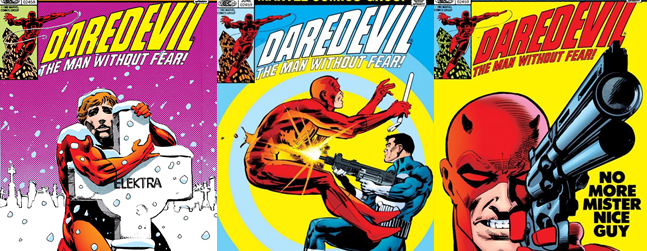
Back Issues [Dare-DAY-vil]: Daredevil #182-184


Blind lawyer Matt Murdock debuted in Daredevil #1 in April 1964 and was co-created by writer/editor Stan Lee and artist Bill Everett, with input from the legendary Jack Kirby. While perhaps not as mainstream as characters like Peter Parker/Spider-Man, Daredevil has become one of Marvel Comics’ greatest creations and has starred in a questionably-received 2003 big-screen adaptation and a critically-successful Netflix series.


Writers: Frank Miller and Roger McKenzie Artist: Frank Miller

Story Title: “She’s Alive”
Published: 26 January 1982 (cover-dated: May 1982)

Story Title: “Child’s Play”
Published: 23 February 1982 (cover-dated: June 1982)

Story Title: “Good Guys Wear Red!”
Published: 23 March 1982 (cover-dated: July 1982)

The Background:
The 1960s were a golden age for Marvel Comics, when Stan Lee teamed with the likes of Steve Ditko and Jack Kirby to create some of their most recognisable superheroes. On 1 April 1964, Stan Lee and artist Bill Everett introduced their most challenging hero yet, Matt Murdock/Daredevil, who became a popular and enduring character thank to the efforts of writer/artist Frank Miller, who spearheaded some of Daredevil’s most memorable stories. It was during Miller’s run that Daredevil first crossed paths with Frank Castle/The Punisher, a Vietnam veteran-turned-mercenary vigilante who first appeared in Amazing Fantasy #15. Inspired by The Executioner (Pendleton, et al, 1969 to present), designed by Gerry Conway, and named by Stan Lee, the Punisher was a natural foil for the more righteous and law abiding Daredevil. The two have clashed, begrudgingly teamed up, and debated their different philosophies numerous times in the years since they first met. Their memorable rivalry even made it to the silver screen when the two clashed on the streets and in the courtroom during Daredevil’s second season (Various, 2016).

The Review:
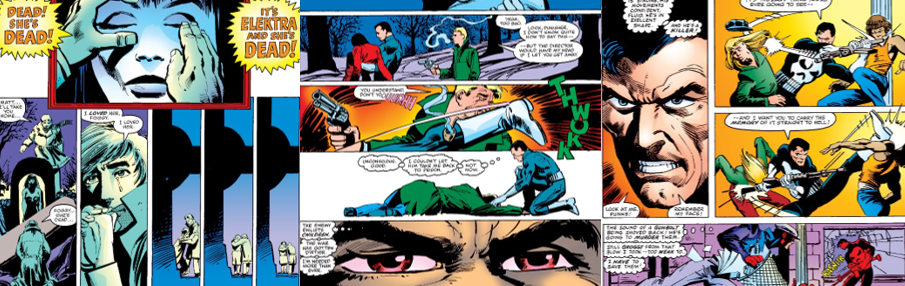
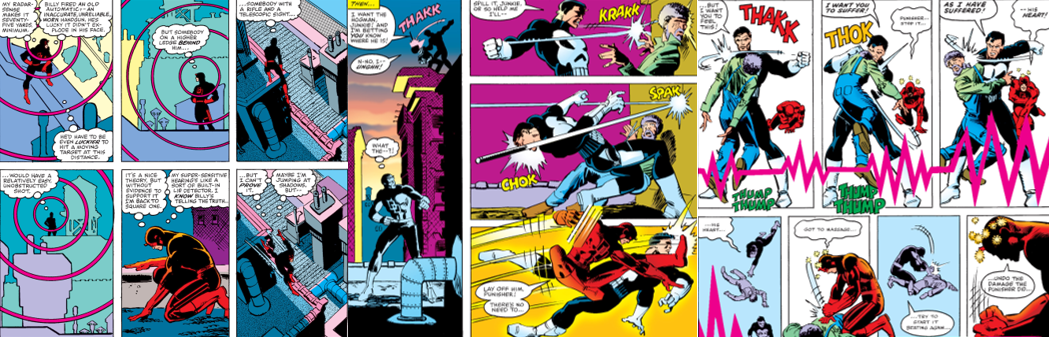
Our story begins with Matt Murdock still reeling from the recent murder of his lover, Elektra Natchios, at the hands of the sadistic mercenary, Lester/Bullseye. Despite having cradled Elektra in his arms, felt her last heartbeat, heard her death rattle, and attended her funeral, Matt awakens from a nightmare convinced that she’s somehow still alive. Overwhelmed by guilt at having not done more to steer Elektra away from the ninja organisation, the Hand, and the dark path that led to her becoming an assassin, and sure that those same ninjas taught her a way to fake her death, Matt pulls on his costume and heads out into the snow swept night to get some answers. This takes him to a “grimy underworld saloon”, where Daredevil kicks the shit out of the patrons, easily dodging their blows and bullets, and accosts one of them into revealing that Wilson Fisk/The Kingpin is holding a summit of the city’s top mobsters at midnight. Sure that the Kingpin must be trying to sell Elektra’s services, Daredevil returns to his civilian identity and has his secretary, Rebecca “Becky” Blake, go through the coroner’s report on Elektra’s body. Despite the evidence stating quite clearly that Elektra suffered mortal wounds, Matt’s convinced that the body could’ve been swapped and is so blinded by his obsession with proving that his former lover is still alive that he gives his current love interest, Heather Glenn, the cold shoulder. Indeed, it’s only when his best friend and law partner, Franklin “Foggy” Nelson, chews him out that Matt begins to question his state of mind. Across the city, in Ryker’s Island penitentiary, Frank Castle is locked up alongside the city’s scumbags. When the Punisher puts Joe Carson/Injun Joe in the infirmary, a few of his boys accost him in the showers and, despite being outnumbered by the armed assailants, the Punisher easily overpowers and kills the three. Though indifferent to his actions, the Punisher is intrigued when an emissary of the “agency” offers to get him out of prison so he can covertly intercept a shipment of narcotics, and promptly escapes via helicopter.

Matt’s obsession over Elektra’s death is compounded when the Punisher goes on a killing spree.

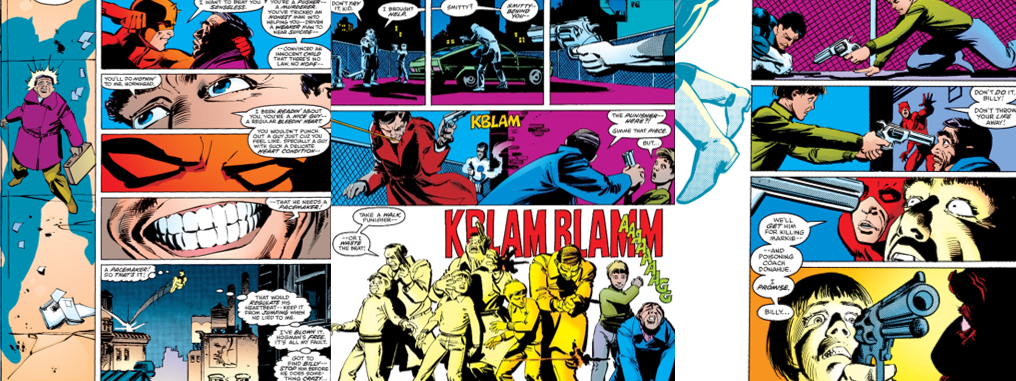
Thus, the Punisher heads to Long Island and lays in wait for the shipment. Thanks to his trip wires, tear gas, and skill with a shotgun and assault rifle, the Punisher wipes out the goons, even gunning one down after he surrenders since “war [doesn’t] take prisoners”. However, the Punisher is distraught to learn his victim was merely a child; laying out the G-man, the Punisher vows to continue his war on crime, especially if evil is corrupting children. Daredevil easily dispatches the Kingpin’s goons and confronts the rotund crime boss regarding Elektra, confusing Fisk with his accusations and eventually leaving after the Kingpin calls his bluff, confirming that Matt hasn’t completely gone off the deep end just yet. Foggy’s concerns are only exacerbated when he’s awoken in the middle of the night to learn that Matt coerced a city judge into signing an exhumation order for Elektra’s body! By the time Foggy gets to the cemetery, Matt has already frantically, feverishly dug up Elektra’s grave, only to confirm with his very hands that his lover is, in fact, dead and causing him to break down in tears in his friend’s arms. Still reeling from this moment, Matt is horrified when a young schoolgirl suddenly freaks out in the middle of a Civics class he’s attending and, convinced that snakes are crawling over her skin, throws herself out the window! Switching to Daredevil, Matt races the girl’s broken body to the hospital, only for her to succumb to her injuries thanks to the “Angel Dust” in her system. Daredevil learns from the doctor that the girl is the latest in a long line of child victims of drugs, with phencyclidine being the most common and most dangerous as it causes many horrible side effects, including psychosis, and lingers in the system for years. Donning a simple disguise (over his costume, no less), Daredevil hits the streets to try and get a lead on Peter Grunter/Hogman, one of the lead pushers of the drug, only to be attacked by drugged-up kids. Although Daredevil pulls his punches, sympathetic to their plight, he’s stunned when the Punisher appears, murders one of them with a knife, and prepares to execute the others in cold blood.

While working to prove a boy’s innocence, Daredevil clashes with the hard-nosed Punisher.

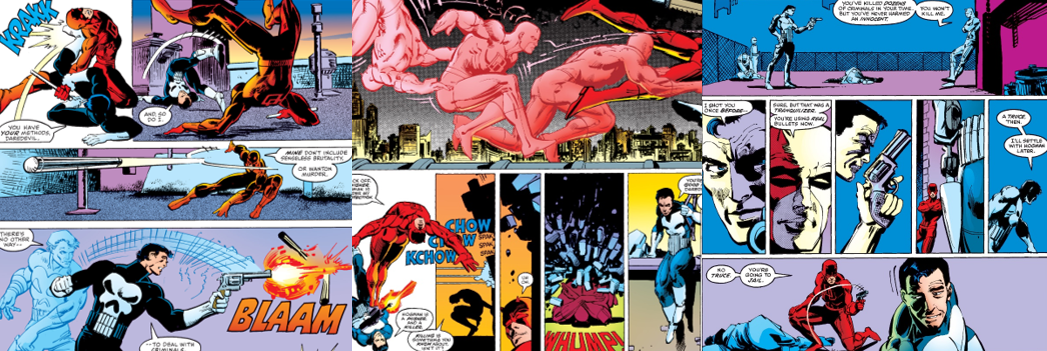
Although Daredevil keeps the Punisher from carrying out the kill, and the Punisher expresses respect for ol’ hornhead, the two are stunned when another shooter guns down one of Daredevil’s attackers. While the Punisher is indifferent, Daredevil is aghast to discover the shooter is William “Billy” O’Koren, the brother of the girl who was driven to suicide. Matt pledges to represent Billy in court, sure that he’s innocent, a hunch he all-but confirms when he returns to the crime scene. The Punisher also suspects that a more competent sniper made the shot, despite a lack of tangible evidence. Daredevil gets some intel on the Punisher from Ben Urich (who’s aware of Matt’s dual identity), who warns him against going toe-to-toe with the Punisher since he’s a well-trained, cold-blooded killer. As luck (or fate) would have it, the Punisher just so happens to be beating up a junkie on a nearby rooftop, so Daredevil intervenes, disgusted by Castle’s brutal methods, which the Punisher defends as the only way to permanently deal with criminals. While Daredevil’s quick to fight, the Punisher suggests they team up to eliminate their common enemy and, when Daredevil adamantly refuses, he spares his foe a quick death by shooting Daredevil with a tranquilizer dart. Severely weakened from the shot, Daredevil’s powerless to stop the Punisher beating his victim so badly that he suffers a heart attack. Luckily, Daredevil’s quick bout of CPR sees the junkie cling to life and point him towards a restaurant, where Daredevil finds the elusive Hogman. When Hogman’s cohorts refuse to back him up, the drug peddler is apprehended by Daredevil and the Punisher’s victim recovers to testify in court, absolving Billy of any wrongdoing, though Matt’s stunned when his super senses reveal that Hogman is also innocent of murdering his partner.

A mistake by Daredevil sees him and the Punisher battling for a boy’s soul.

After winning Heather back with a marriage proposal, Matt volunteers to represent Hogman and prove his innocence. Sure that Matt can absolve him of the crime, the arrogant Hogman stuffs his face with pasta, unaware that the stoic Punisher has taken up a sniping position on a rooftop across the street. Luckily, Daredevil is on hand to keep his client safe but, when the Punisher’s shot buries him under a pile of bricks, Daredevil again fails to apprehend the murderous vigilante. Although Matt claims to have evidence to prove that Hogman is being used as a convenient patsy by the true culprit, Billy’s coach, Patrick Donahue, he doesn’t get solid confirmation until Donahue calls him to discuss the whole operation in private. The call costs Matt dearly as he ends up giving Heather the brush off and it leads to Matt being attacked by the rabid Donahue, who’s been driven to a crazed frenzy by his own drugs! Despite the coach’s augmented strength, Matt uses his agility to put him in a choke hold and subdue him, theorising that a third party juiced Donahue up. In court, Matt successfully absolves Hogman of his crime, only to learn afterwards that the scumbag is not only guilty, but gleefully causes his returning customers to overdose to amuse himself. When Daredevil confronts Hogman, threatening to beat him to a pulp, Matt realises he’s been played for a fool as Hogman’s pacemaker screwed up his radar sense. When Billy decides to take the law into his own hands, Daredevil races to intervene, only for the Punisher to show up and subdue Hogman with some well-placed shots. Daredevil stops him from delivering the killing shot and calls the Punisher’s bluff, fully aware that he’s purposely missing and would never knowing kill an innocent person. Although the Punisher again offers a truce, he’s stunned when Daredevil subdues him with a gunshot, leaving Matt free to appeal to Billy’s better nature. His pleas get through and Billy testifies against Hogman, leaving the drug baron facing serious jail time and Matt emphasising the importance of following the law to the impressionable pre-teen.

The Summary:
I’ve talked about this before, but I’m really not a big fan of Frank Miller’s art. He’s nowhere near as bad here as he is in his efforts for DC Comics and his independent publications, but he really does draw some of the ugliest faces I’ve ever seen. His use of shadows and lighting are extraordinary, however, and he draws a very dynamic and intimidating Daredevil, something bolstered by the start darkness of night. In Miller’s hands, New York City and Hell’s Kitchen are a dark, ominous place that feels very dangerous. Violence stalks the streets, but this is taken to the next level here as Hogman sells drugs to kids, using Coach Donahue as a gofer and selling to kids at a Catholic school. Happy to cause overdoses and kill anyone who tries to speak out against him, even if they’re his partners, Hogman thinks nothing of abusing the law system and little children to come out on top. He’s practically giddy when Matt clears him of murder, only to immediately reveal that he’s “guilty as sin”, and Matt’s left humiliated since he was convinced of the villain’s innocence thanks to Hogman’s pacemaker. Matt’s a bit all over the place in these issues, reeling from Elektra’s murder and as desperate to prove that she’s alive as he is to defend Billy and keep the neighbourhood kids free from drugs. Grief hits Matt like a brick wall, causing him to descend into denial and desperation, only to be mocked by the likes of the Kingpin, push away those closest to him, and ultimately go to extreme lengths to prove his theory…only to find that Elektra is well and truly dead. This revelation seemingly snaps Matt from his malady as he’s back to normal in the very next issue and doesn’t mention Elektra again, instead turning his focus towards Hogman, the kids he abuses, and the Punisher.

Sadly, Daredevil and the Punisher don’t clash enough, physically or ideologically, for my tastes.

The Punisher pretty much steals the show here. Still portrayed as a ruthless vigilante killer, he’s largely indifferent to the world around him, as though sleepwalking through life and unconcerned about the machinations of those who would seek to release him onto the streets. Castle couldn’t care less about the scumbags he kills and only shows a shred of remorse when he’s forced to gun down a kid. Even then, rather than dwell on how his actions have cost a misguided youth their life, the Punisher refocuses his energy on taking out those responsible for putting the boy in that position in the first place. Interestingly, the Punisher has no desire to fight Daredevil; indeed, he not only purposely misses his shots but shows a great deal of respect for ol’ hornhead. The Punisher repeatedly offers to form a partnership with Daredevil, believing they’re kindred spirits who fight for the same thing against a common enemy, only to be rebuffed each time. While the Punisher is respectful towards Daredevil, Matt attacks Castle without hesitation, disgusted by his disregard for the law and the lives of his victims. It’s an interesting dichotomy since Matt, as a vigilante, is breaking the laws he so diligently serves in his civilian guise so it’s a touch hypocritical for him to lecture the Punisher on his vigilante ways. Of course, the real difference between the two is that the Punisher kills his victims whereas daredevil just beats them up and has them arrested so they can stand trial, a system the Punisher openly mocks for being flawed and broken. While Daredevil valiantly fights to defend all lives and everyone’s rights, even those of scumbags like Hogman, the Punisher takes a more direct approach, putting the two at natural odds. Unfortunately, this isn’t explored that well here; their fights are very brief, their different ideologies barely touched upon, and much of the potential of their first meeting is secondary to the main plot concerning Hogman. Therefore, these issues are important for being the first meeting between these two characters but there are far better clashes between the two out there, such as Garth Ennis’s iconic story from the early 2000s.

My Rating:

Rating: 4 out of 5.

Great Stuff

What did you think to the first meeting of Daredevil and the Punisher? Do you agree that the story didn’t quite live up to its potential? What did you think to the differences between Daredevil and the Punisher, particularly in their methods? How impactful did you find the main plot concerning kids and drugs? What are some of your favourite Daredevil and Punisher moments and how are you celebrating the Man Without Fear this month? I’d love to know your thoughts so feel free to share them in the comments below, support me on Ko-Fi, and be sure to check out my other Daredevil and Punisher content.

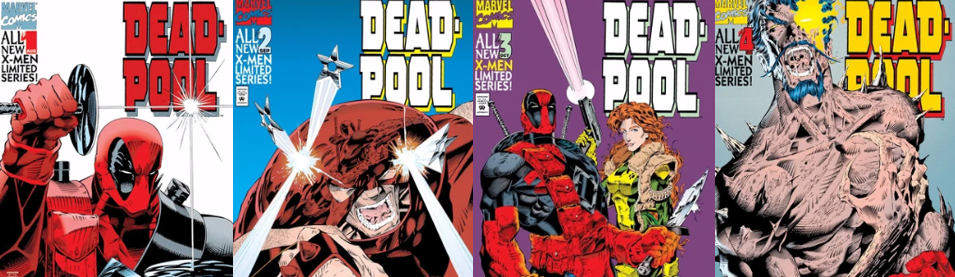
Back Issues [Deadpool Day]: Deadpool #1-4


In February 1991, readers of The New Mutants were introduced to Wade W. Wilson, the wise-cracking, fourth-wall-breaking Merc With a Mouth, Deadpool. Rob Liefeld and Fabian Nicieza’s sword-swinging immortal went on to become one of Marvel’s most popular anti-heroes thanks to his metatextual humour, violent nature, and massively successful live-action films. It’s perhaps no surprise that Sideshow rechristened April 1st as “Deadpool Day” to give fans of the chimichanga-chomping mercenary an excuse to celebrate all things Deadpool.


Writer: Mark Waid – Artists: Ian Churchill and Ken Lashley

Story Title: “If Looks Could Kill”
Published: 14 June 1994 (cover-dated: August 1994)

Story Title: “Luck of the Irish”
Published: 12 July 1994 (cover-dated: September 1994)

Story Title: “Deadpool Sandwich”
Published: 9 August 1994 (cover-dated: October 1994)

Story Title: “Mano @ Mano”
Published: 6 September 1994 (cover-dated: November 1994)

The Background:
By the 1980s, the X-Men had been established as one of Marvel Comics’ most successful publications and then-chief editor Jim Shooter was encouraged enough by their success to commission a few spin-off titles, birthing Chris Claremont and Bob McLeod’s New Mutants. These Mutant youngsters soon fell under the tutelage of the time travelling Mutant Nathan Summers/Cable, formed X-Force, and famously clashed with Fabian Nicieza and Rob Liefeld’s Deadpool in The New Mutants #98 (ibid, 1991). Heavily inspired by James Howlett/Logan/Wolverine, Peter Parker/Spider-Man, and (most infamously) to DC Comics’ Slade Wilson/Deathstroke the Terminator, the self-styled “Merc With a Mouth” proved popular enough to receive this own four-issue miniseries in 1993. The series was a relative success, prompting Marvel to sign off on a second miniseries the following year, though writer Mark Waid later distanced himself from the character’s more violent nature. This was all a prelude to Deadpool graduating to an ongoing solo title and his greater popularity as a self-aware anti-hero, and his eventual appearances in Marvel/X-Men-related videogames, a cameo appearance in the beloved X-Men animated series (1992 to 1997), and the incredible success of his live-action feature films decades later.

The Review:
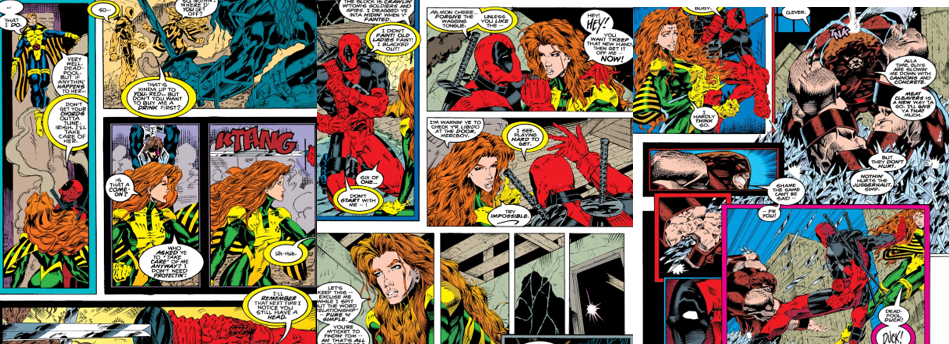
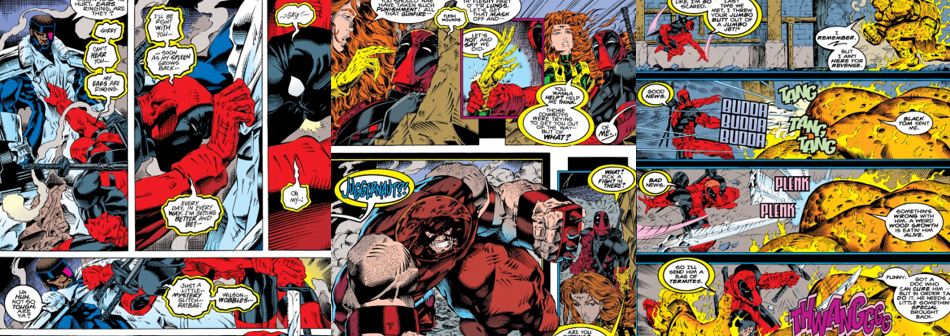
Deadpool’s second miniseries begins in a secret, heavily guarded facility where two thousand imprisoned inmates are forced to endure the agonised screaming of Thomas Cassidy/Black Tom as he sustains horrendous torture at the hands of Doctor Emrys Killebrew. Dr. Killebrew’s there to cure Black Tom of the “viral wooden growth” currently infecting his cellular structure, a procedure quickly interrupted by the explosive arrival of Cain Marko/The Juggernaut, Black Tom’s loyal (if thick-headed), brutish best friend. Though weak and in pain, Black Tom ensures the Juggernaut also grabs Dr. Killebrew and his files on cellular regeneration cases, namely one belonging to Wade Wilson. Weeks later, everyone’s favourite Merc with a Mouth is regaling patrons in a bar with stories of his recent tangle with Wolverine, removing his bandages and scarring off a girl with his tumour-riddled, scarified visage. As he downs beers, Wade shares a truncated version of his origin with the bartender, too busy dwelling on his situation and running his mouth to notice when a group of heavily armoured and well-armed mercenaries enter the bar. Though blasted by a bazooka, Wade easily recovers thanks to his advanced healing factor and opens fire, antagonising the mercs with his inane banter, though briefly slowed by a particularly gruesome close range shot to the gut. Too stubborn to go down, Deadpool continues to fight back; even being literally frozen doesn’t keep him down thanks to the unexpected arrival of Sean Cassidy/Banshee and his daughter, Theresa/Siryn, who catches Deadpool’s eye as much as their mention of Black Tom catches his attention. Since Black Tom is Banshee’s cousin, he has a vested interest in tracking him down and has been on his trail since his escape, though neither of the Irish Mutants know why their cousin targeted Deadpool. For Wade, it’s as simple as revenge since he’s tangled with Black Tom before, though all three are confused as to why Black Tom would order for Deadpool to be captured alive rather than simply ordering his assassination. On Siryn’s suggestion, Banshee reluctantly leaves to get some answers from Interpol and she chooses to stick close to Deadpool, sure that Black Tom’s goons will strike again, and immediately shuts down his lewd attempts to woo her.

Deadpool’s busted powers don’t stop him from making uncomfortable advances towards Siryn.

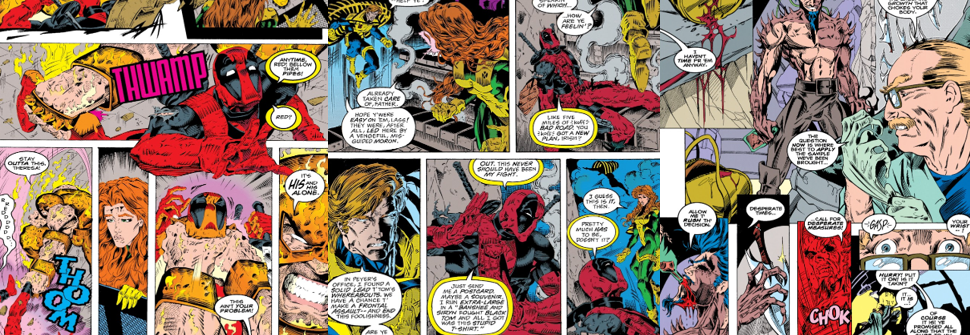
Still, as capable as Siryn is, it’s only thanks to Deadpool’s timely intervention and quick reflexes that she’s spared a sword in the back. Although Deadpool proves a master swordsman and eventually runs Black Tom’s merc through with his katana, it costs him a hand and he’s surprised to find the limb failing to instantly regenerate and himself blacking out from the pain. Siryn drags his unconscious ass to a safe spot and, when he comes to, Deadpool finally regenerates the hand but only after concentrating with all his might and enduring incredible pain. Deadpool’s concern about his slow healing factor is swept aside for further uncomfortable advances towards Siryn, who bluntly tells him that they’re partnership is simply one of convenience, and temporary. While waiting to meet with his old partner, Daniel “Danny” Peyer, Banshee recalls his time working for Interpol when Deadpool saved his ass at the cost of his career. Banshee asks Danny to help track down Black Tom and unwittingly gives Peyer the information he needs to settle his own score with Deadpool. Meanwhile, the severely suffering Black Tom is angered to see Theresa wrapped up in his business and orders his men not to engage without safely removing her from the line of fire first, causing himself incredible pain from getting so worked up. Black Tom’s affliction spreads further the more his adrenaline spikes, but Dr. Killebrew is sure that he can cure him if they capture Deadpool, a task the Juggernaut gladly takes up even though he hates to leave his sick friend undefended. Though Deadpool and Siryn take out another group of Black Tom’s men, Wade ends up being riddled with bullets when shielding Siryn and taking a nasty fall from a window. When the Juggernaut shows up, Siryn insists they make a stand in a knife factory and, though hesitant to tangle with Cain even if his healing factor was working, Deadpool showers the Juggernaut with blades in an unsuccessful attempt to stop him.

Complex relations see Deadpool reluctantly rally against Black Tom, who increases his powers!

Naturally, these simply bounce off the Juggernaut’s impenetrable hide and Deadpool ends up skewered by several blades before being saved by Siryn’s high-pitched sonic blast. Unfortunately, even molten metal doesn’t slow the Juggernaut and Deadpool’s issues are only compounded when he runs into Peyer and his men. Thinking fast, Deadpool lures the flaming-hot Juggernaut to the Interpol agents and causes them to flee, solving one problem but leaving Wade powerless to stop Cain. Though Deadpool shows no fear and keeps fighting and throwing barbs at his foe, he’s helpless against the Juggernaut’s strength. Thankfully, after a brief hesitation, Siryn saves Deadpool by bombarding the Juggernaut with her scream. Although they flee to safety, Deadpool chastises Siryn for hesitating and she reluctantly reveals that part of her still cares for Black Tom despite all the bad he’s done and that she considered letting the Juggernaut take Wade so Black Tom could be cured. This leads to a tender moment between the two where Siryn asks his real name and tries to see under his mask, only for Deadpool to scold her and Peyer to interrupt with a hail of gunfire. Although Wade gets Peyer bang to rights, he’s stopped from killing him by a convenient lack of ammo, getting himself shot a bunch of times as Peyer extracts a measure of revenge. Too stubborn to go down, Deadpool simply tanks each shot and sends Peyer plummeting off a rooftop with a punch, only for Banshee to swoop in and make the save. After chastising his former partner for acting so recklessly, Banshee offers Deadpool the chance to join him and Siryn in heading to Black Tom’s location (which he learned from Peyer’s files). Although Wade initially refuses to join them, he begrudgingly changes his mind seemingly to impress Siryn. Though enraged at the slow progress of his men, Black Tom is ecstatic when one of them returns with Deadpool’s severed hand, which Black Toom maniacally attaches to his own wrist after lopping off his hand!

Deadpool shows a surprising vulnerability and ultimately spares Black Tom for Siryn’s sake.

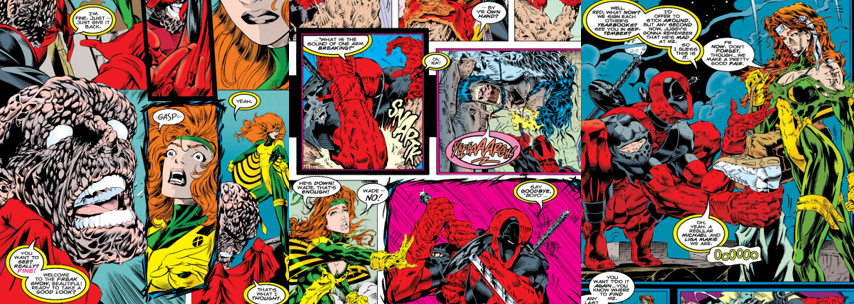
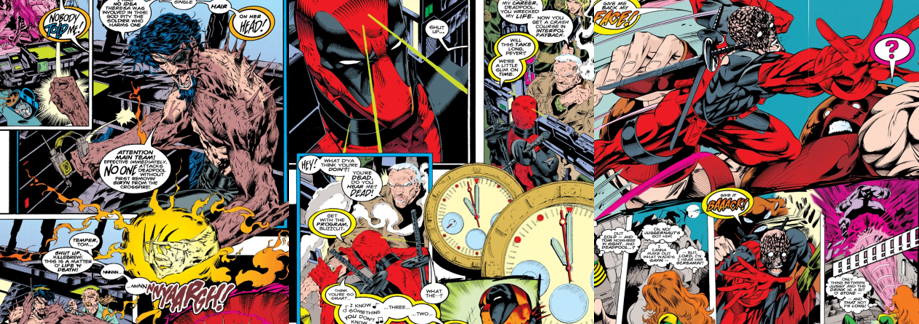
Deadpool, Banshee, and Siryn head to Bannerman Castle on the Hudson River and blast their way inside. Against Siryn’s advice, the three split up. While Banshee advises her to not get too attached to a ruthless mercenary like Deadpool, Wade stumbles upon Dr. Killebrew, the same man who turned Deadpool into an unkillable monster. Realising that Dr. Killebrew can fix his dodgy healing powers, Deadpool ignores the sounds of his friends battling Black Tom and the doctor’s snivelling begging and threatens Dr. Killebrew, only to be drawn back into the fight when Siryn crashes through the wall. Deadpool leaps into action and finds Banshee unconscious and Black Tom’s powers raging out of control. Incensed to see his hand grafted to the villain’s wrist, Deadpool desperately dodges Black Tom’s flaming energy blasts and the villain is driven mad from the pain caused from Deadpool’s cells regenerating his own. While taking cover, Deadpool is again accosted by Peyer but fools the vindictive agent into taking a blast to the face by tricking him into earning a promotion by apprehending Black Tom. Deadpool’s elation is cut short when he’s blindsided by the Juggernaut, whose massive fists accidentally tear off Wade’s mask, driving Deadpool into an insane frenzy as he desperately tries to recover his “face”. Siryn blasts the Juggernaut from the castle and retrieves the mask, finally getting a good look at Wade’s gruesome visage, though he’s stunned when she shows him kindness rather than fear. With Black Tom’s life equally threatened by the hand’s infestation, Deadpool renews his attack, breaking Tom’s arm and ready to end his foe… only to relent at the last minute and spare Black Tom for Siryn’s benefit. Deadpool then finally subdues the Juggernaut by holding Dr. Killebrew hostage and the doctor stabilises Black Tom’s condition, though Cain vows to break his friend out of whatever cell he ends up in. Wade parts ways with Siryn, with her inviting him to team up again some time, and then flees into the night with the terrified Dr. Killebrew, unaware that Peyer is still lurking in the background with a thirst for vengeance.

The Summary:
Eh… this was a bit of a slog. Let’s talk positives first, though. I enjoyed the artwork. Ian Churchill and Ken Lashley seem to be of the same school as the likes of Mark Bagley, Rob Liefeld, Todd McFarlane, emphasizing big, bold, ridiculously proportioned characters who are twisted into various physics-defying poses. It’s all very dramatic and bombastic, making for some very kinetic action sequences and memorable “hero shots” of Deadpool leaping, slashing his swords, or whipping out his pistols. Siryn is, of course, heavily sexualized; her costume is suggestively torn by the end to expose her bra and breasts and she’s no doubt suffering a great deal of back ache from her unnatural poses. Luckily, she’s written really well and isn’t some airhead or an emotional wreck. I never knew Banshee even had a daughter until reading this, though, and the two are depicted very strangely. They come across more like siblings or even lovers than father and daughter, something not helped by the fact that they look around the same age. They could’ve avoided this by making Banshee appear older, with more lines on his face or greys in his hair, or depicted Siryn as more of a teenager, smaller and slender rather than fully developed woman. This would’ve had the knock-on effect of sparing her (and the reader) from Deadpool’s lewd advances. He’s not too full on, to be fair, but it’s enough to make her uncomfortable and shut his shit down. Though she’s supposedly a fairly stoic character, Siryn does grow to respect Wade. He risks his life (literally, considering his janky healing factor) to protect her and she admires both his fighting spirit and is sympathetic towards his gruesome appearance. By the end, she’s more than happy to team up with him again and a potential romance is even hinted at, showing that Deadpool should rely more on his actions than his words to impress those around him.

Deadpool’s weaker than usual, but no less tenacious, lewd, and dangerous.

This ties into a recurring theme in this miniseries concerning Deadpool’s self confidence and his monstrous lifestyle. When we first see him, he scares off patrons with his scarified visage and he reacts with hostility whenever Siryn tries to remove his mask, before descending into Walter Kovacs/Rorschach levels of madness when it’s finally removed. He expects Siryn to react with fear and disgust, but is amazed when she shows him pity. In recounting his origin, Deadpool talks bitterly about how his terminal cancer was cured at the cost of his humanity, and he turns that bitterness and anger towards the world (or, at least, his enemies), masking his pain with a mile-a-minute banter that regularly antagonizes friend and foe alike. I’m not sure why, but Deadpool’s healing factor is on the fritz in this miniseries. It leads to some dramatic tension as Deadpool’s strategy is to throw himself head-first into a fight, shrugging off mortal wounds and coming out on top, something that costs him his hand and leaves him struggling to heal from wounds. As far as I can tell, it’s not said why this is happening to him and it is a bit inconsistent: Deadpool’s momentarily stunned from a gunshot wound but shrugs off a plummet from a window. His reflexes and skills are also unaffected by this handicap, though it does place him in a more vulnerable position and allow him to open up to Siryn and, perhaps, rediscover aspects of his humanity. Deadpool’s reputation precedes him, to the point where Banshee is reluctant to team up with him and warns Siryn against getting too attached to him since Wade is known as a cold-blooded mercenary who’s just as likely to stab them in the back as help them. However, Deadpool is clearly taken by Siryn, either legitimately or from simple lust, and not only accompanies them to Bannerman Castle despite being wounded but even temporarily forgets his own selfish desire to be cured to help Siryn when she’s manhandled by Black Tom. Deadpool’s really off his rocker here, ranting about nonsense during pitched battles and mocking his foes to throw them off-balance, overwhelming even groups of armed soldiers with his katana and guns. Though he’s no match for the Juggernaut, that doesn’t stop him trying and standing up to the brute, though this miniseries emphasises quite explicitly that much of his inane banter is to mask the pain and anger he feels at being turned into a ghastly, inhuman freak.

Juggernaut may be powerful but the story’s main antagonists aren’t believable threats.

I think what lets this miniseries down is the main villain. I’m vaguely aware of Black Tom but he’s a bit of a nobody, with weak-ass powers that can’t compare to Deadpool’s skills. Luckily for him, he’s got the Juggernaut in his pocket but, even then, Cain is just a rampaging brute and fights against him aren’t that interesting. Nothing Deadpool and Siryn throw at the Juggernaut can stop him and they’d been ridiculously outmatched even if Deadpool’s healing factor was working. Without it, we’re denied even the simple pleasure of seeing the Juggernaut tear Deadpool limb from limb and instead rely on a cat-and-mouse game. This is fun enough and shows Wade’s adaptability and certainly paints Siryn as formidable since she holds her own against the Juggernaut, but I feel more could’ve been done with these bouts. Instead, the story spends more time focusing on Danny Peyer and his childish vendetta against Deadpool for costing him his career some years ago. Peyer is just a regular guy with a gun and some soldiers; he’s way out of his league and just grinds the story to a halt. I would’ve rather seen Banshee simply pulling Interpol’s file on Black Tom and then devoted the panels wasted on Peyer to showcasing more of the Deadpool/Juggernaut fight and exploring Wade’s condition, especially as a mirror of Black Tom’s. Like Deadpool, Black Tom suffers from an affliction that’s slowly and painfully killing him (or transforming him into a tree-man? I’m not sure). His agony and desperation see him lash out and devolve into near madness after grafting Wade’s severed hand to his own, increasing his powers and finally making him a true threat but, in the end, he’s subdued with ridiculous ease because, as I said, Black Tom is a nobody. In the end, this was an okay miniseries for the Merc with a Mouth; it showcased a few more layers to his character and developed him further into the near parody of a character we know today, but it’s really just nonsensical fights. Every conversation is interrupted by some goon or another, it’s not always clear what’s happening or why, and the threat is just so low level that it feels like Deadpool could’ve ended things in one or two issues if his healing factor wasn’t mysteriously broken.

My Rating:

Rating: 3 out of 5.

Pretty Good

Have you ever read Deadpool’s second solo foray? Did you enjoy the exaggerated artwork and the violent action? What did you think to Deadpool’s characterisation, the vulnerability he displayed and his busted healing factor? Were you a fan of Black Tom or do you agree that he’s a weak villain? What are some of your favourite Deadpool stories and moments and how are you celebrating Deadpool Day today? Whatever your thoughts on Deadpool, feel free to share them below and go check out my other Deadpool content.

Back Issues [Stark Sunday]: Tales of Suspense #50


Anthony “Tony” Stark/Iron Man first lived, walked, and conquered in Tales of Suspense #39, published in March 1963 and brought to life by Marvel mastermind Stan Lee, Larry Lieber, and Don Heck. Since then, ol’ shellhead has gone through numerous different armours and shot into mainstream superstardom thanks to an iconic, career-defining portrayal by Robert Downey Jr.  


Story Title: “The Hands of the Mandarin!”
Published: 12 November 1963 (cover-dated: February 1964)
Writers: Stan Lee
Artist: Don Heck

The Background:
Back in 1963, Stan Lee decided to think up a character his readers would hate (a billionaire military industrialist), throw in some Howard Hughes and personal tragedy, and make him someone they could root for. Mounting deadlines kept Lee from writing Iron Man’s debut, so he turned to younger brother Larry Lieber, artist Don Heck, and the legendary Jack Kirby to bring the character to life. These days, Iron Man is a mainstream superhero, one who’s squared off with many colourful villains but perhaps none are more intrinsically linked to the character than the Mandarin. Created by Stan Lee and Don Heck, the supervillain was specifically designed to evoke the Doctor Fu Manchu stereotype of a mysterious and powerful Oriental menace with a maniacal list for world conquest. The Mandarin has dogged Iron Man ever since, pitting his magical ten rings against Stark’s technology time and again and even forming his own version of Marvel’s premier superhero team, the Avengers. I best know the Mandarin from his depiction in the 1990’s Iron Man cartoon (1994 to 1996), where he was brought to life with relish by Ed Gilbert and Robert Ito, but he’s consistently appeared as a boss in various Marvel videogames. However, the Mandarin’s culturally insensitive appearance and racially problematic depiction have caused some controversy. These issues saw him excised from Iron Man (Favreau, 2008) during the scriptwriting stage and his subsequent appearances have been divisive at times. Still, the Mandarin is largely regarded as Iron Man’s archenemy and one of his most complex and persistent foes.

The Review:
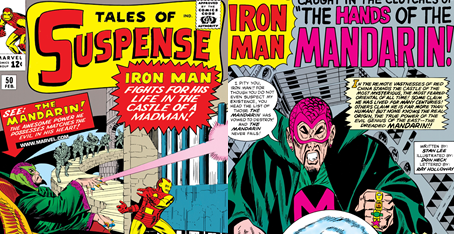
The debut of Iron Man’s greatest foe takes place in the “remote vastness of Red China”, where the legend of the mysterious sorcerer known only as “The Mandarin” has plagued the lands for years. Some say he’s immortal, others say he’s far more than human, but all fear this elusive and powerful figure. While the Mandarin is merely a legend in the Western World, the “most feared Oriental of all” is very real in his native land and lords over his underlings from his vast and technologically superior castle. The story opens with the Mandarin outraged by the arrival of military officers, “emissaries of the red Government”, stopping by unannounced. Though tempted to simply smite them on the spot for their insolence, the Mandarin decides to hear them out first and, with a mere gesture of his finger, makes his “all-seeing crystal globe” vanish and lowers the castle drawbridge so they can enter. The trio, led by General Ho Lee, are terrified of the Mandarin’s power and fear death for disturbing his hallowed grounds but have no choice but to seek an audience with him lest they be slain by their “communist overloads”. Awestruck by the Mandarin’s unbelievable power, which brings parts of the castle to life, they’re brought before the sorcerer and implore him to share his atomic knowledge with the government so that China can “menace the world with nuclear destruction”. Luckily for us, such a request angers and insults the Mandarin. He categorically refuses to share his secrets with the government since he has his own sights set on world domination. And, luckily for the military men, they’re given sixty seconds to flee and somehow escape with their lives.

Iron Man ventures into Red China to confront the feared and mysterious Mandarin.

Across the ocean, the United States military is also concerned about the Mandarin’s threat and, to that end, they enlist Iron Man to gain further intel on the mysterious dictator, who’s said to be the single greatest power in China. Iron Man’s only too willing to help, but first he must sort a few things out in his civilian identity as Tony Stark. So, he heads over to one of his weapons factories and slips out his armour and begs off an employee’s dinner he was scheduled to attend as the guest of honour. When he names his chauffeur, Harold “Happy” Hogan, as his replacement, Stark unwittingly insults one of his employees, Bill, who’s disgusted that his boss doesn’t have time for “poor stooges” like him. When his irritation gets the better of him, Bill is laid out with a left hook from Happy, who steps in to defend Stark’s honour, only to be chastised by Tony for acting so recklessly. None of that is as important as their bullish attitude leaving Stark’s secretary, Virginia “Pepper” Potts, feeling disregarded and she scolds both men for being do wrapped up in their antics that they fail to notice her new hairdo…because God forbid Marvel’s women should be written as anything but shallow and selfish characters! Anyway, a few hours later, Iron Man is dropped off on the border of Red China for what his Army cohorts believe amounts to a suicide mission. Correctly assuming that he’d be spotted by the Chinese, Iron Man ensures he slips into their nation by waiting until the last second to power up his transistor jets, fooling the painfully stereotypical soldiers into thinking the bungling democrats “cannot even make chutes [work] correctly”. Though Iron Man’s subterfuge doesn’t last long, the Mandarin’s guards are no match for his “transistor-powered muscles and jet-swift speed”. However, his reserve power levels drop dramatically due to a short circuit, meaning he must finish up quickly before he’s completely drained. Unfortunately for ol’ shellhead, he’s spotted by the Mandarin and forcibly dragged into his castle via a magnetic ray beam.

Iron Man’s forced to use his wits to counter the Mandarin’s rings and take out the madman.

Inside, Iron Man acts swiftly to avoid being crushed by the Mandarin’s wall trap and confronts the main man himself, easily shrugging off the Mandarin’s paralysis ray with his “ultra-beam chest light”. Though tricked by the Mandarin’s illusionary effects, Iron Man pits his technology against his foe’s ten mysterious rings, with the two blasting each other with high-frequency waves and proving evenly matched. Iron Man has no way to counter the near-deafening blast of sound the Mandarin hits him with, however, or the paralyzer ray the Mandarin shoots from one of his other rings, leaving the armour-clad Avenger little more than a statue. Iron Man impresses his foe by recovering faster than he’s ever seen, but the Mandarin’s resources seem limitless. With a gesture, he electrifies the walls to trap his prey and demonstrates his superhuman strength by splintering an iron bar with his incredible karate skills. The Mandarin then puts these skills to the test by throwing hands at his foe, who desperately dodges each strike and feels his power fading by the second, realising that the Mandarin tampered with his armour. To avoid being beaten to death, Iron Man frantically consults his “built-in slide-rule calculator” to calculate the trajectory of the Mandarin’s blow, which is actually a clever ruse to buy the Avenger the time to block the attack so effectively that the pain causes the Mandarin to black out. With no time or power to dismantle the Mandarin’s operation, Iron Man flees to his escape plane and makes the employee function after all, unknowingly scuppering Happy’s hopes to get in with Pepper and Pepper’s hopes to get closer to her boss. And what of the Mandarin? Well, he’s left seething in his castle with a bandaged hand plotting his next scheme.

The Summary:
So, the first thing I’m going to say is: man, do I hate this characterisation of Pepper. She isn’t just pining for Tony; she’s positively obsessed with him! She stands there, prancing around with her new hairdo and dress trying to catch his eye and, when he dares to focus on business and employee welfare, she yells at him for ignoring her! Then, she calls Happy and practically orders him to take her to the employee dinner just to make Stark jealous, relishing the compliments and adulation she receives from others and completely oblivious that Happy is in love with her. When Tony shows up at the end, she’s left fuming when a throwaway comment by Happy implies she and him are together. Of all the poorly aged characterisations of females from this era, I think Pepper comes off the worst. She’s only in the story for a few panels and comes across as an obsessive, manipulative, selfish bitch who badly needs some comeuppance. Thankfully, this is merely a small part of the story and shows just how hectic Stark’s social and business life is, especially compared to his superhero peers since he has so many more responsibilities as a businessman and employer. Indeed, when faced with his impending death at the Mandarin’s hands, Stark’s first thoughts (beyond his own end) are that Happy and Pepper won’t receive their Christmas bonuses if he’s killed! Iron Man is also a proud patriot; he eagerly accepts the assignment to enter Red China and investigate the Mandarin, even though his presence there is technically an act of war. Iron Man seems excited about confronting the dreaded Mandarin and boasts of his adaptability and technology during their fight, matching the Mandarin’s mysterious power and escaping his deadly traps while still being forced to think on his feet since his armour is low on power. In this regard, “The Hands of the Mandarin!” is a pretty good story for showcasing Stark’s tenacity. He has fancy armour and near-magical gadgets, yes, but he’s still human and must rely on his wits and cunning at times, which comes to the forefront when faced with the Mandarin’s awesome power.

Culturally insensitive and lumbered with a bad outfit, the Mandarin is surprisingly lacklustre here.

The Mandarin possesses ten mysterious rings, each said to contain a different power. We don’t see the full extent of this here, or learn of their origin, but they’re enough to keep Iron Man at bay if not out-right subdue him. The Mandarin can emit high-frequency waves, control his castle’s mechanisms, and paralyse his foe with a gesture, but we don’t see him commanding elements or anything truly impressive. As if his ten rings weren’t powerful enough, the Mandarin’s castle is one giant trap; he can electrify walls, control stone slabs, and has death traps aplenty scattered throughout. This is cool and all, but I feel like anyone can have a castle fortress; I would’ve liked to see these traps supplanted with more focus on the Mandarin’s rings. Like, instead of having Iron Man faced with crushing walls, have the Mandarin control the stones of his castle with his ring. Instead of electrifying the walls with a lever, have his ring send out lightning bolts or something. The rings are the Mandarin’s gimmick and tie into the whole technology vs. magic aspect that’s at the core of their conflict, but that’s not really emphasised here. We never learn the origins of the rings, so for all we know they’re technological in some way, and the Mandarin isn’t depicted as a sorcerer, despite his appearance. Speaking of which, the Mandarin is a…controversial figure, for sure. Exuding Fu Manchu vibes, he’s a stereotypical “Red Menace” type with his little goatee and painfully slanted eyes and clawed hands. His appearance is close to that of a demon at times but hampered by his bland outfit. Consisting of heavy green robes sporting a big, stupid violet “M” and a gaudy matching mask, the Mandarin’s appearance completely negates the very real threat he poses, which is a shame as the story goes to great lengths to build him up as this fearsome foe and then lumbers him with a truly awful outfit. We learn nothing of the Mandarin except that he’s greatly feared, quick to anger, proud, and boasts incredible, unknowable power. He has desires for world domination, sure, but doesn’t appear to have done anything towards that except amass power, yet Iron Man immediately recognises that he’s this formidable enemy to the free world. I dunno, I guess I just expected a bit more from this since the Mandarin is the quintessential Iron Man villain in my eyes, but he just came across as another madman in a castle and a “villain of the month” figure here, which was disappointing.

My Rating:

Rating: 2 out of 5.

Could Be Better

What did you think to the Mandarin’s first appearance? Would you have liked to see more of his rings and their various powers? Do you consider the Mandarin to be culturally and racially offensive? What did you think to Pepper’s characterisation and he manipulation of Happy? What are some of your favourite Iron Man vs. Mandarin stories? Where does Iron Man rank in your hierarchy of comic book characters? Are you doing anything to commemorate Iron Man’s debut appearance and, if so, what is it? Either way, I’d love to hear your thoughts on Iron Man so leave a comment below.

Movie Night: Captain America: Brave New World

Released: 14 February 2025
Director: Julius Onah
Distributor: Walt Disney Studios Motion Pictures
Budget: $180 million
Stars: Anthony Mackie, Harrison Ford, Danny Ramirez, Shira Haas, Giancarlo Esposito, and Tim Blake Nelson

The Plot:
Now shouldering the mantle of Captain America, Sam Wilson (Mackie) navigates a political minefield after an assassination attempt against President Thaddeus “Thunderbolt” Ross (Ford) threatens to spark world war!

The Background:
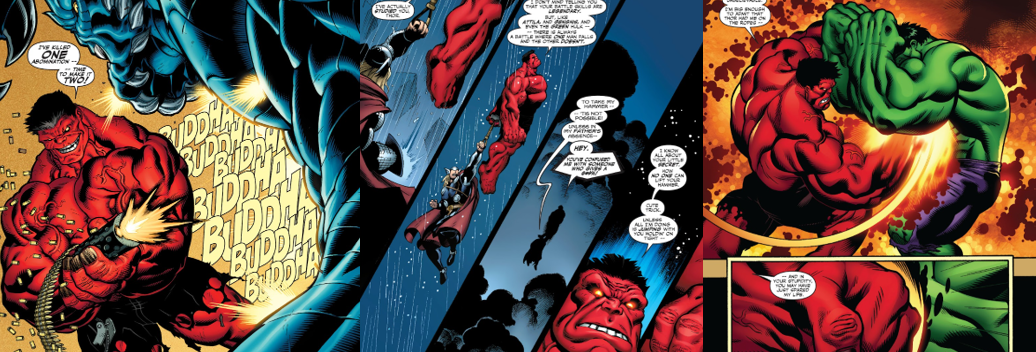
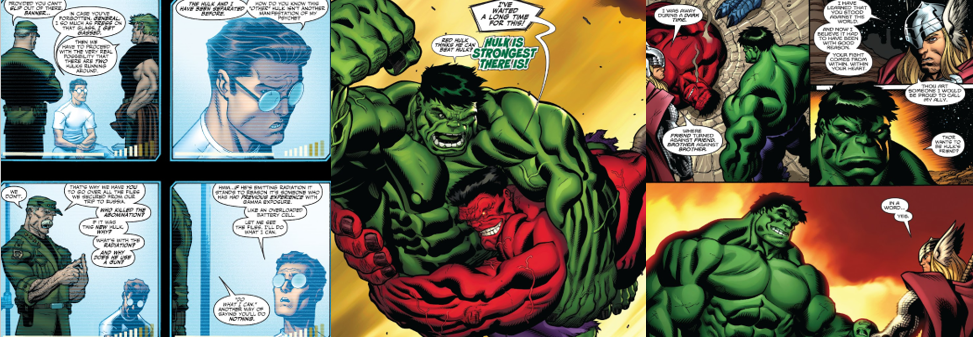
After some initial resistance, the United States finally joined the War against the “Axis powers” of Germany, Japan, and Italy in 1939. With patriotism running high in America, Joe Simon and the legendary Jack Kirby created Captain Steve Rogers/Captain America and his kid sidekick, James Buchanan Barnes/Bucky to encourage readers to support the war effort. Cap saw a resurgence when he joined the Avengers and has long found a home outside the comics, featuring in cartoons, serials, a botched big-screen debut, and three critically lauded entries in the Marvel Cinematic Universe (MCU). After Steve Rogers (and actor Chris Evans) retired from the role, MCU head honcho Kevin Feige sought to expand the MCU with Disney+ shows, with one pitch being a “buddy comedy” series focused on the dysfunctional friendship between Sam Wilson and James Buchanan “Bucky” Barnes/The Winter Soldier (Sebastian Stan). Echoing the comic books, where Sam took up the Cap mantle, The Falcon and the Winter Soldier (Skogland, 2021) was universally praised for its depiction of racism and the dynamic between the two leads. This success directly led to the production of a fourth Captain America movie, initially titled New World Order, that sought to be a more grounded political thriller. This was soon offset by the casting of Harrison Ford, who replaced the late William Hurt and was thrust into the spotlight when the film’s marketing heavily relied upon his transformation into the Red Hulk as much as commenting on real-world politics. Reshoots saw the plot shuffled round and some characters be excised, with Giancarlo Esposito given additional screentime as a trade off and placing more emphasis on the conspiracy sub-plot. Captain America: Brave New World grossed over $370 million worldwide, but was met with somewhat negative reviews that criticised the political narrative, especially in the face of real-world events. The narrative and characterisations were also called into question, with critics being divided over the visual effects, though Mackie remained hopeful for future solo ventures for the character.

The Review:
Captain America: Brave New World depicts the United States as a country in turmoil. Following the many strange, destructive, and harrowing events of the previous MCU films, the nation is more divided and afraid than ever. Thus, former “Hulk Hunter” and decorated military General Thaddeus Ross completes his evolution from Senator to President of the United States after running a successful campaign based on one, unlikely word: together. Though Ross captures the majority vote with his promises to unite Americans and repair the relationship between the American government and the country’s various costumed defenders, some still question Ross’s newfound appreciation for the Avengers and his push for unity considering his historically short fuse and previous aggression in upholding the Sokovia Accords. None are more aware of Ross’s shortcomings than Sam Wilson, the former Falcon who now operates independent of the government (yet still in a military capacity) as Captain America. Sam’s wariness of Ross’s promises is echoed by aged veteran Isaiah Bradley (Carl Lumbly), the prototype super soldier who spent thirty years locked away and being experimented on and who is reluctant for Sam to work with the government. However, Ross is eager to build bridges not just with Sam, but the entire world, especially as scientists from across the globe have discovered a rare and particularly versatile mineral (dubbed “Adamantium”) on “Celestial Island”, the remains of a titanic Celestial that tried to emerge from the Earth. The staggering potential of Adamantium is enough to have Ross set aside personal grudges and encourage the world’s governments to co-ordinate their mining efforts. He makes significant headway with this after Captain America and his enthusiastic, hacker partner, First Lieutenant Joaquin Torres/The Falcon (Ramirez), recover a stolen sample of Adamantium from Seth Voelker/Sidewinder (Esposito), an expert marksman and enigmatic leader of the Serpent Society, a group of mercenaries working for the mysterious “Buyer” to upset the political climate.

Amidst a political minefield, Sam discovers a plot to discredit the President and spark worldwide conflict.

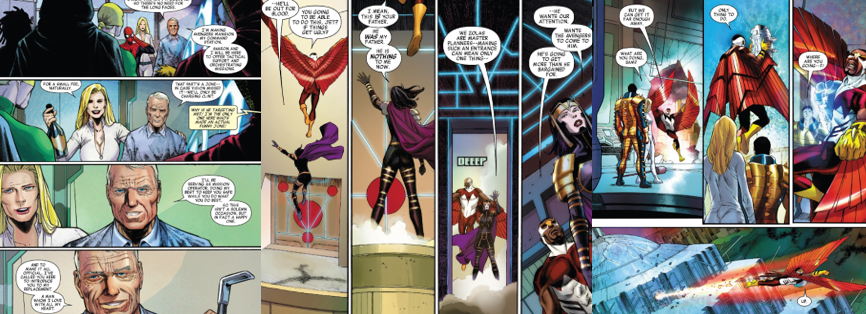
Celebrated for their heroics, Sam and Joaquin are invited to attend Ross’s special presentation on Adamantium at the White House and, eager to coax the distrustful Isaiah out of his shell, Sam invites him along. However, during Ross’s speech, Isaiah and a handful of other attendees suddenly open fire on the President, with Isaiah appearing little more than a confused old man after Sam talks him into custody. Angered by these events, Ross rescinds his offer for Sam to rebuild the Avengers and orders him not to investigate, instead handing the task to his personal security advisor, former Black Widow Ruth Bat-Seraph (Haas). Naturally, Sam disobeys this order and works with Joaquin to review security footage of the attack, learning that Isaiah and the others were compelled through a form of mind control. Sam’s investigation sees him cross paths with and apprehend Sidewinder, whose phone leads him and Joaquin to a military black site, where they find Gamma-mutated biologist Doctor Samuel Sterns (Nelson) has been held captive for over a decade. Gifted an upgraded suit by the Wakandan people, Sam is more than capable as Captain America thanks to his Vibranium wings protecting him, absorbing the impact of any attack and redirecting it as kinetic blasts. Sam has the same skills he showcased as the Falcon (skills he’s extremely protective of as he hesitates to share them with Joaquin) but has vastly improved his skill with a shield. Unlike Steve Rogers, however, Sam doesn’t have the benefit of the super soldier serum, though his suit helps dull any injuries he does receive and a pep talk from Bucky allays Sam’s doubts about his abilities after Joaquin is injured defusing a conflict between American and Japanese forces. In a nice change of pace, Sam is seemingly universally accepted in his new role; the military respect and admire him, jeopardising their careers to aid him after Ross demands he and Joaquin be apprehended. Sam’s also as charismatic and confident as Steve, easily befriending those around him and championing world peace and cooler heads over violence. Far from a naïve optimist, Sam plays his cards close to his chest and gives Ross the benefit of the doubt, but becomes determined to investigate the complex deception at work after Isaiah is imprisoned and faces the death penalty.

Sterns manipulates events to brainwash assassins and push Ross to breaking point!

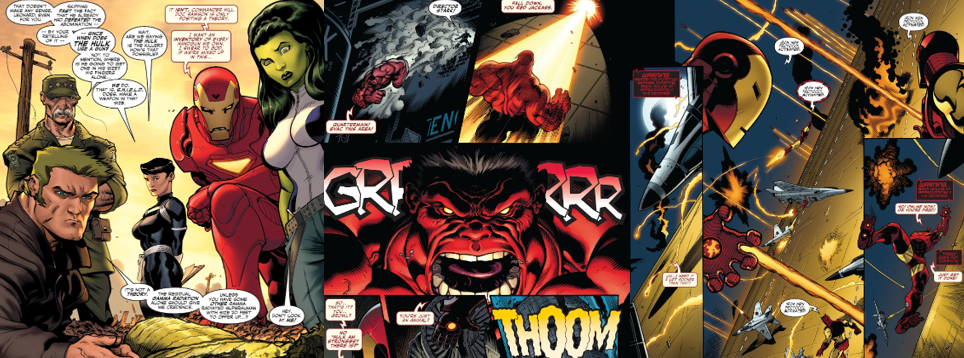
Obviously, it’s a shame that William Hurt never got to complete his story as Thunderbolt Ross but, if you’re going to recast an actor, who better than Harrison Ford to pick up the slack? Shaving his trademark moustache and campaigning on a platform of unity, Ross is desperate to convince the world that he’s a changed man. However, while he’s convinced the majority of Americans, Sam and the others remain skeptical and his estranged daughter, Doctor Betty Ross (Liv Tyler) refuses to take his calls. Eager to void conflict, Ross is adamant about pushing forward a treaty to share the Adamantium, but soon finds his temper tested after he’s shot at and accused of shady dealings by the equally sceptical Japanese prime minister, Ozaki (Takehiro Hira). Although Ross genuinely wants Sam onboard and the rebuild the Avengers to atone for his previous aggressive ways, he burns bridges with Sam over Isaiah and quickly mobilises the Navy to secure Celestial Island, his stress only compounded by Sterns’ influence and his reliance on mysterious pills. It turns out the Sam’s right to be suspicious of Ross as he worsened Sterns’ condition and used his superhuman intellect to manipulate his way to the White House, then incurred the hyper-intelligent doctor’s wrath by refusing to free him. This sees Sterns concoct an elaborate plan to discredit Ross using mind control triggers, which easily turns the President’s secret service into his unwitting soldiers and sees him escape custody. Sterns’ scheme also extends to hiring Sidewinder and kick-starting the plot, which tips the world to the brink of war and sees Sam and Joaquin desperately rushing to calm tenses between the world’s superpowers once they uncover this plot. Determined to keep his dealings with Sterns from leaking, Ross surreptitiously tries to tie up loose ends, unwittingly turning the petite Ruth’s loyalties towards Sam after she discovers evidence that Isaiah and the others weren’t in control of their actions. Though Ross was saved from certain death from a heart condition thanks to Sterns’ research, he’s been unknowingly digesting Gamma-laced pills for years, which make him quick to anger and susceptible to Sterns’ mind control, resulting in Ross transforming into a crimson-hued Hulk before a terrified press conference and forcing Sam to test his mettle in the most dangerous way possible.

The Nitty-Gritty:
Captain America: Brave New World certainly gives itself a lot of balls to juggle. It finally addresses what happened to that gigantic Celestial and lays an interesting foundation for the MCU’s version of the X-Men, finally ties up the loose end of Samuel Sterns, presenting him as an embittered puppet master looking to publicly disgrace President Ross, teases Bucky’s new life as a Congressman, and continues Sam’s evolution as Captain America. Thanks to Sam having worked through many of his doubts and insecurities in The Falcon and the Winter Soldier, Sam has fully embraced his new role here, only questioning his ability after Joaquin gets hurt. Even then, Bucky offers him some advice that gets him back on track and, while I think it’d be totally believable that a man as good as Sam could handle the super soldier serum, Sam’s perfectly capable without it thanks to his skill as the Falcon. In fact, Sam may be a little too good as he shrugs off wounds and performs nigh-superhuman feats during fights, though the film makes an effort to show him visibly exhausted from the effort. His status as a “normal” man doing the right thing contributes to the respect he earns from his peers; even Ross has a begrudging respect for Sam, even if it’s strained as the film progresses. I’m glad that Brave New World didn’t waste time questioning Sam’s ability or showing undue negativity towards him. Instead, he kicks ass as Captain America and showcases his stubborn determination as he works to clear his friend’s name, even if it goes against what the President thinks or wants. It was a shame, however, that Giancarlo Esposito was essentially wasted here. He gets a couple of action scenes and steals the show with his usual silky-smooth cool, and is presumably being set up for more later down the line, but his role got a lot of hype prior to the film so I couldn’t help but be disappointed by how small his role was in the end.

Despite some predictable elements, the film was an action-packed political thriller.

Instead, most of the film’s marketing was focused on the Red Hulk and his fight against Captain America. On the one hand, I understand this as you want to capture people’s attention and get people in the cinema to see how Sam can stand against such a creature, but it was a touch misleading since the Red Hulk doesn’t appear until the finale. Instead, most of the film is an action thriller following Sam and Joaquin as they work to uncover who’s behind Isaiah’s mind control. There’s nothing wrong with this and it makes for a decent adventure, but it’s pretty obvious that Isaiah and the others were triggered by lights and music, something we’ve seen in the MCU before (and which Sam even notes), so it’s weird that Ross was so quick to condemn Isaiah. Of course, a significant sub-plot regarding the President is his trustworthiness and it’s clear he’s hiding a lot, leading to an emotional showdown between him and Sam where Ross reveals how close he came to death and how poorly he treated Sterns. Once Sam confronts Sterns and he escapes, it’s pretty clear what’s gone down, but the key parties (Sam and Ross) remain clueless. There’s even a moment where Sterns callously murders Sam’s ally, Dennis Dunphy (William Mark McCullough), to keep him from revealing the truth of Ross’s pills to Sam…only for Sterns to relate that information to Sam shortly afterwards. While some have picked about Brave New World’s CGI and reshoots, I had a great time with the action sequences. Sam looks amazing in his new suit, which is a vast improvement over his last one, and is a whirling dervish as Captain America, cutting through the air, blasting along with his jetpack, slicing up foes with his wings, and tossing his shield in ways that would make his predecessor proud. Sam’s Wakandan enhancements make up for his lack of superhuman strength, though Sam remains vulnerable, sporting wounds and exhaustion, and yet being strong enough to turn to his allies for help and to take the high road during conflicts. Joaquin made for a fun counterpart to Sam; he’s equally talented as the Falcon and a tech whiz, but overly enthusiastic and too eager to prove himself to his hero at times. They work well together on equal terms and I enjoyed their high-speed action sequences, with Sam even proving his worth without the suit and emphasising disarming and subduing his foes rather than blindly blundering in.

Cap ultimately overcomes the odds and brings a measure of peace to the misguided President.

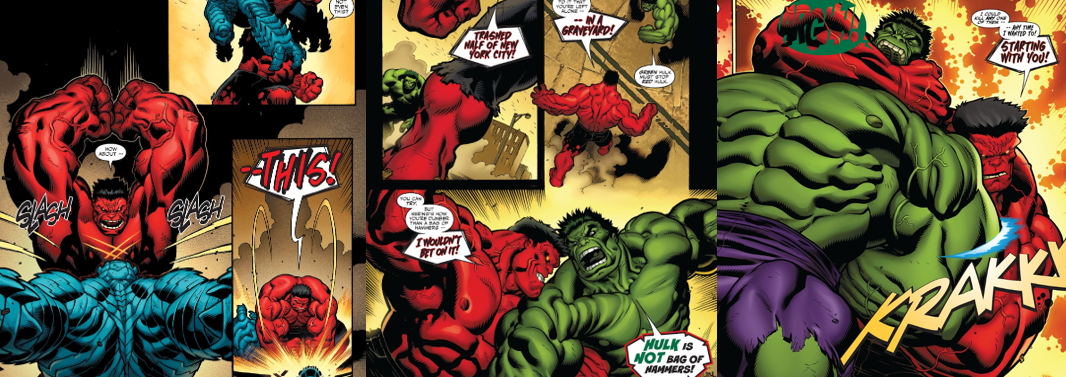
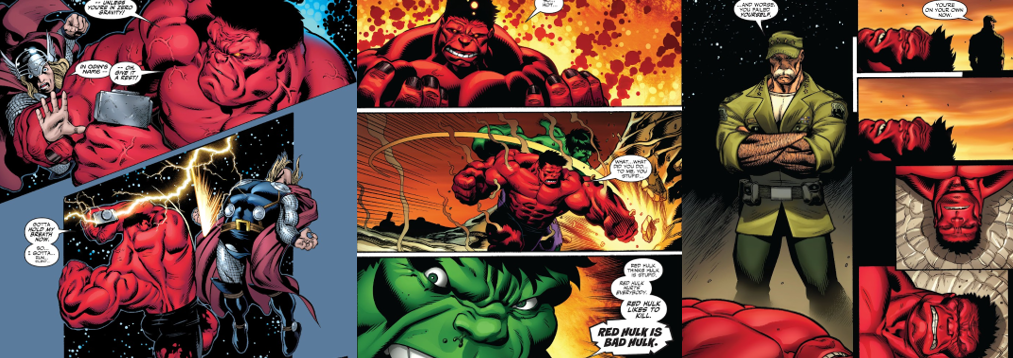
With Ruth on-side and Sam and Joaquin having discovered Sterns is mind controlling targets with light and sound triggers, Cap and Falcon barely quell a conflict between the US and Japan. Though Joaquin is severely wounded when defending Celestial Island, Sterns’ plot is ultimately scuppered and Ross’s treaty regains traction, leading Sterns with no choice but to surrender himself, arrogantly believing that Ross’s true nature cannot be suppressed. Indeed, when addressing the press outside the White House, Sterns’ pills and the stress of the whole situation (and the Sterns’ testimony to the media) see Ross lose control of his emotions. Thus, he painfully and forcibly transforms into the Red Hulk, a mindless and enraged giant who immediately goes on a rampage. Despite being hopelessly outmatched, Captain America flies into battle with the Red Hulk, barely protected by his Vibranium wings and destroying most of the White House. Remembering Ross’s wish to take his daughter to the city’s cherry blossom trees, Captain America has Ruth get the crowd to safety and leads the Red Hulk to the garden, only for the creature’s rage to boil out of control. Badly hurt and with his suit damaged, Captain America charges his remaining wing with the Red Hulk’s unbridled strength and delivers a concussive blast that momentarily puts the beast down. When the Red Hulk returns for more, Sam takes a major gamble and appeals to Ross’s humanity, finally calming the troubled President down and ending the threat. Realising the extent of his actions, Ross relinquishes his post and allows himself to be incarcerated at the Raft, where he finally reconciles with Betty. Ross and Sam part with a mutual respect and Sam’s delighted to see Joaquin on the road to recovery, especially as he’s decided to rebuild the Avengers after all, though Sam’s left rattled when the imprisoned Sterns mocks him and delivers a vague, suitably ominous warning about future threats from other worlds…

The Summary:
Captain America: Brave New World faced an uphill battle, for many reasons. Despite Sam being Captain America in the comics for years, the idea of someone else taking up the mantle is always going to irk some, especially a very vocal and toxic minority of bigots. However, Anthony Mackie takes to the role admirably, exuding a cool confidence that sees him command the screen and throw the shield with admirable gusto. I loved how Sam was presented as a friend to all, talking to people in their native language, saluting the military, and sticking to his guns, even if it means going against the President of the United States. He’s a natural leader and an efficient fighter, even without the super soldier serum, and attacks the conspiracy at work with a stubborn determinism that showcases the strength of will and loyalty that make him the right choice to be Captain America. Harrison Ford was equally captivating in the film. It’s awful that William Hurt died before he could see this arc through, but Ford really threw himself into the whole MCU circus and brought his all to this role, being gruff, commanding, and pained as the script dictated. I definitely felt like Ross was genuinely trying to make amends for his past, but he had too many skeletons in the closet, had made too many enemies, and ultimately was faced with forces beyond his control, leading to his Hulk-out. The Red Hulk looked fantastic, exuding rage and danger and delivering by far the best and most impressive CGI rendition of a Hulk yet. While it was misleading to base so much of the marketing around the character, I can see why they did it and the sequence absolutely delivered, more than making up for the wasting of Giancarlo Esposito. I was also thrilled to see Tim Blake Nelson return and deliver a suitably hammy, menacing version of the Leader, finally paying off one of the MCU’s most notorious plot threads. While the plot felt a little predictable and bare bones at times, the action and performances and nice balance of drama and comedy made up for it and resulted in a solid first solo effort for the new Captain America, who I hope to see have a prominent role as an aspirational leader in the MCU for years to come.

My Rating:

Rating: 4 out of 5.

Great Stuff

Did you enjoy Captain America: Brave New World? What did you think Anthony Mackie’s first big-screen solo outing as the character and Sam’s status as a more human version of the Avenger? Did you enjoy Harrison Ford’s performance and Ross’s attempts to turn over a new leaf? Were you satisfied with the way the film tied up loose ends regarding Sterns and the Celestial? Do you think it was misleading to put so much focus on the Red Hulk or did you enjoy his eventual appearance? Where do you want to see Captain America go next in the MCU? Whatever you think about Captain America: Brave New World, or Captain America in general, drop a comment down below, support me on Ko-Fi, and go check out my other Captain America content.

Back Issues: Captain America 22-25

Story Title: “The Tomorrow Soldier” (Part 1 to Conclusion)
Published: 2 July 2014 (cover-dated: September 2014) to 1 October 2014 (cover-dated: December 2014)
Writer: Rick Remender
Artists: Carlos Pacheco and Stuart Immonen

The Background:
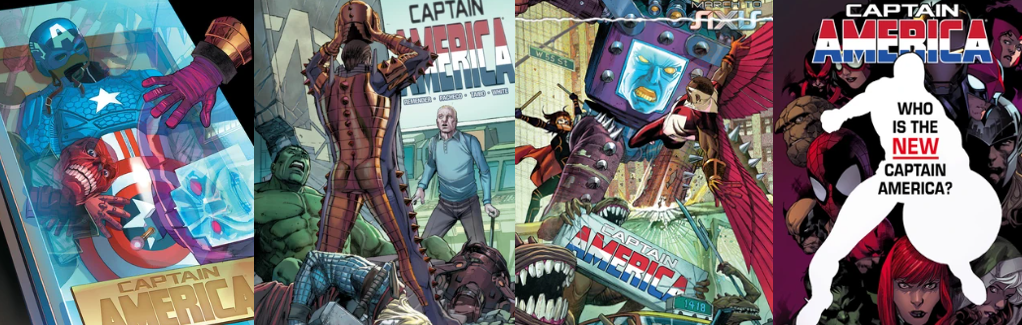
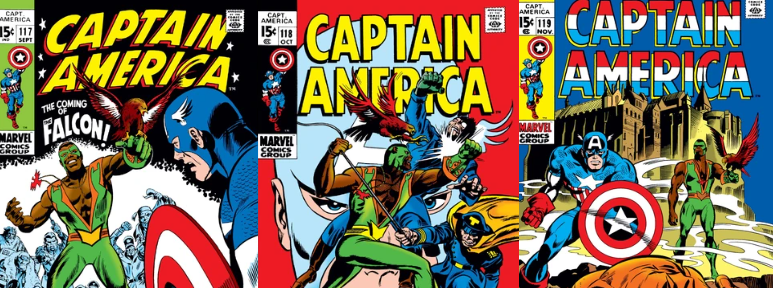
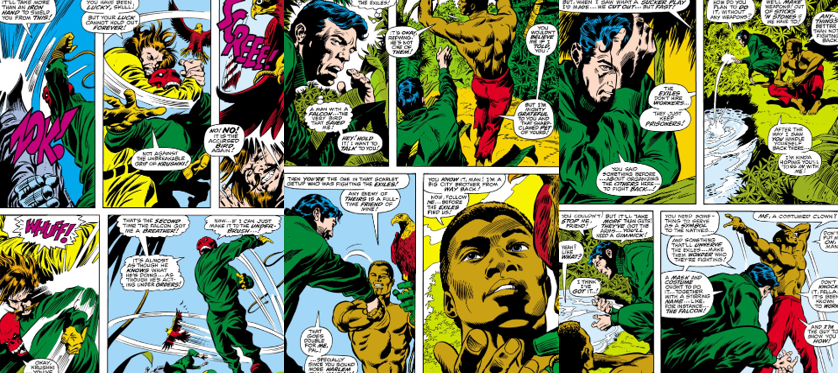
By 1941, Nazi Germany had decimated Denmark and Norway and World War Two was fully underway and, after some initial resistance, the United States joined the War against the “Axis powers” of Germany, Japan, and Italy. Patriotism and national pride was high, especially in America, during those dark days, making it the perfect time for Joe Simon and the legendary Jack Kirby to debut Captain Steve Rogers/Captain America and his kid sidekick, James Buchanan Barnes/Bucky, to encourage support of the war effort. Once the War was over, superheroes saw a decline and Captain America’s solo publication was cancelled in 1954. However, Cap got a second chance when he joined the Avengers as a “man out of time”, battling iconic villains like Johann Shmidt/The Red Skull and even opposing his fellow superheroes during a “Civil War”. After surrendering to the authorities, Cap was seemingly killed and his troubled sidekick, better known as the Winter Soldier, took up the mantle until Steve’s inevitable resurrection. However, in 2014, cybernetic supervillain Arnim Zola’s machinations saw Cap drained of the super soldier serum and rapidly aged into an old man! Thus the battle was on the see who would become the new Star-Spangled Avenger, a battle eventually won by Cap’s long-time ally, Sam Wilson/The Falcon, to much undue controversy, Created by Stan Lee and Gene Colon in 1969, the Falcon was the first Black American superhero in mainstream comic books and was specifically created to challenge social perceptions. After a lengthy career as a bit-player in Marvel Comics, Sam made headlines with his promotion, a story arc that achieved mainstream recognition due to Anthony Mackie’s celebrated portrayal of the character in the Marvel Cinematic Universe.

The Review:
Sam Wilson’s assumption of the Captain America mantle didn’t come easy, nor without drama. In the leadup to this story, Cap was kidnapped by Arnim Zola and spirited away to Dimension Z, where the mad scientist plotted to drain his super soldier serum to create a race of genetic super-beings! Cap broke free but was trapped in Dimension Z for ten years, during which time he raised Zola’s son, Ian, as his own. Though Cap eventually escaped with Jet Zola/Jet Black, Zola’s daughter, both Ian and Cap’s lover, Agent 13/Sharon Carter, were lost. Cap then spent some time working with Sam to mould Jet Black into a hero but, in a battle with former Strategic Homeland Intervention, Enforcement, and Logistics Division (S.H.I.E.L.D.) agent-turned-madman, Ran Shen/Iron Nail, Cap’s super soldier serum was neutralised and he quickly aged into frail, infirm old man! Our story picks up with Steve sequestered at Avengers Mansion, stewing over sensationalist news reports demanding accountability for Captain America and S.H.I.E.L.D.’s dangerous and destructive antics. Steve’s offered council by S.H.I.E.L.D. director maria Hill and the decidedly Samuel L. Jackson-esque Nick Fury Jr., who assure him that he saved countless lives taking down Iron Nail. Unfortunately, his shield has been left too radioactive to be returned to him and Steve’s aghast when he’s told S.H.I.E.L.D. won’t be destroying Gungnir, the weaponised, Transformer-like Helicarrier Iron Nail hijacked and threatened the United States with. Steve is so angered that he starts to wonder if the reports of corruption within the government and S.H.I.E.L.D. aren’t valid, though Fury simply explains that contingencies such as Gungnir are vital to protect innocent civilians and keep the public from being overly reliant on costumed heroes, especial as the Avengers’ roster has dwindled lately.

When Armin Zola’s mutates invade, the Avengers gain an unlikely ally in Steve’s adopted son!

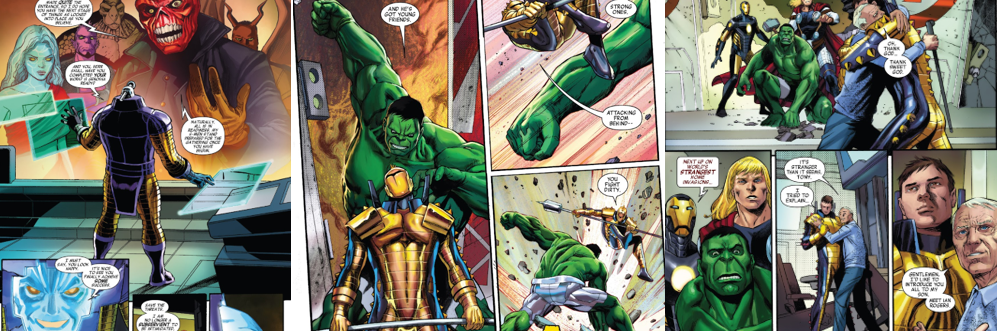
Over on the upper west side, Sam Wilson wakes up to a hell of a hangover and to find he spent the night with Jet Black! Though he’s not exactly thrilled at having crossed that line, he seems won over by her affections, but their tender moment (and the awkwardness) is interrupted when Jet spots a commotion outside. It turns out that her father, Armin Zola, is so eager for revenge that he rips open a hole in the fabric of reality and his monstrous, “hyperevolved mutates” come pouring into Central Park, followed closely by a mysterious man garbed in a spiked battle suit. Zola quickly contacts the Red Skull to co-ordinate their newest efforts in overthrowing the decadent West, asserting himself as a menacing force in his own right and seemingly earning the Red Skull’s respect with his army of mutates. While Anthony “Tony” Stark/Iron Man and Doctor Robert Bruce Banner/The Incredible Hulk work to find some way of restoring Steve’s superhuman condition, they (along with Thor Odinson and Steve himself) are alerted to the crisis via the mansion’s monitors. Steve immediately recognises the threat as Zola; Stark is incredulous but quickly convinced of the danger when the armoured mutate comes crashing through the wall. Luckily, the Hulk is around to face the stranger (with Banner having more control over the Hulk at this point). Naturally, Iron Man adopts a snarky “shoot first, ask questions later” philosophy, leading to an explosive confrontation as he and Thor try to keep the masked intruder from reaching Steve. However, the masked man easily avoids their attacks and even gets the better of Thor, running rings around them, only to be astonished by Steve’s frail condition. This distraction allows the Hulk needs to strike; ironically, though the stranger deftly evades the Green Goliath, Steve easily subdues the masked man. However, Steve is stunned when the intruder unmasks to reveal himself as Ian Ziola, now Ian Rogers, Steve’s adopted son, who was regenerated from death by one of Zola’s “bio-mass [tanks]”.

Zola manipulates events to coerce his daughter, whom the Falcon rushes to defend.

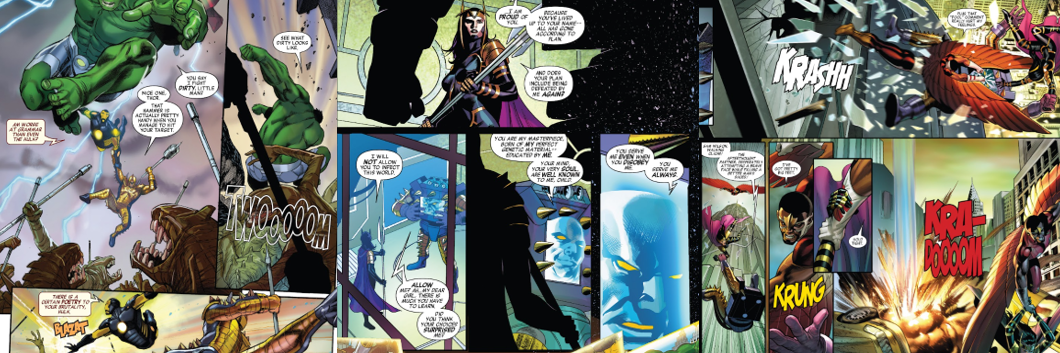
Overjoyed to see Ian alive and that he’s come to help, Steve proudly introduces him to his fellow Avengers but distraught to learn that Ian’s been fighting Zola alone for the last ten years. Steve then gets a call from the Falcon, who relays the extent of Zola’s attack: thanks to the city’s birds, Sam has seen the monsters rapidly spread throughout New York City. Jet Black then reveals she knows a way into her father’s fortified tower that may help them to stop the invasion and calls upon the Avengers to go along with her father’s plan, which is to face him head-on, to provide a suitable distraction. The Avengers readily accept, taking the fight to the ravenous, near-mindless hoards alongside their new ally, and are initially unimpressed by Zola’s forces. However, they’re soon confronted by Zola’s “hyper-mutates”, warped, monstrous copies of the Avengers that call themselves the “Unvengers”! Meanwhile, Jet Black and the Falcon easily infiltrate Zola’s tower, affirming that her allegiances lie anywhere but with her crazed father and insisting on using her position as the madman’s daughter to throw off his mutate guards. The plan works and they advance through the tower, only to find Sharon held hostage in a pitiful cell! After learning about Sharon’s predicament from Sam, Steve immediately asks Ian to leave the fight to the Avengers and go rescue her; though Sharon warns that such an act was all foreseen by Zola. When Jet confronts her father in his control room, he all-but guarantees the Red Skull that he can win her over to their side, claiming everything she’s done – even her betrayal – was also all part of his manipulative will. The Falcon breaks up the tense family reunion, tackling Zola out the window and sending him crashing to the streets below. Zola recovers near-instantly, however, his patience with his “perfect child” wearing thin, but the Falcon immediately intercepts him in mid-air.

Though the Avengers turn on Jet, Sam survives to take up the Captain America mantle.

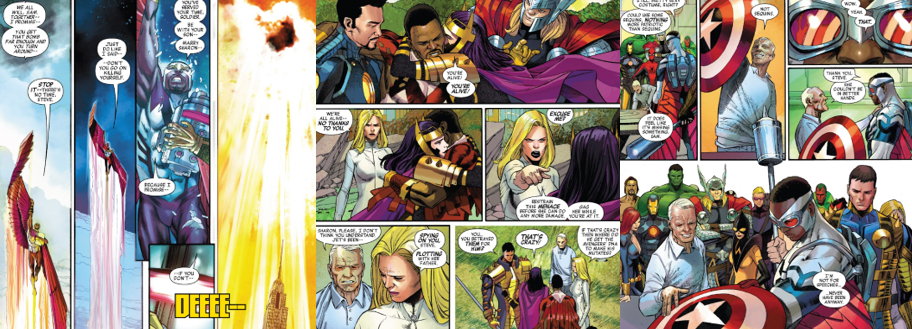
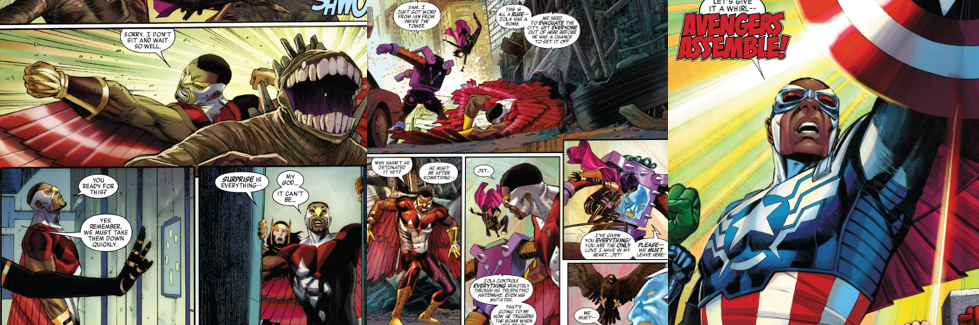
Raging at Zola for his ill treatment of Jet, the Falcon fights valiantly even as Zola smashes a bus onto the mis-matched hero. When Jet rushes to his aid and Zola sees how much she cares for the Falcon, Zola vows to murder him to rid her of such weaknesses all while hypocritically declaring his undying love for her! Thanks to Sharon, Steve warns the Falcon that Zola plans to blow up Avengers Tower, though Sam inadvertently kickstarts the detonation when he has Redwing remove Zola’s “telepathic broadcast doohickey”! When the Unvengers keep Iron Man from helping and Ian and Sharon are unable to disarm it, the Falcon bravely and selflessly grabs the bomb and flies high into the sky, bidding an emotional farewell to Steve and urging him and Sharon to enjoy their retirement with Ian before the bomb explodes in his arms. A horrified Steve thinks back to when he and Sam first met, the adversity he fought through, and how hard he worked to be a hero without any superpowers, fancy gadgets, or special serum as Iron Man sombrely retrieves the Falcon’s surprisingly intact body. Though Zola pleads with Jet Black to return to Dimension Z where she can be safe from the Red Skull’s looming threat, she angrily rebukes him. Sharon, Steve, and the Avengers gather in quiet mourning, only to be astonished when he comes to and reveals that Stark made him some Adamantium wings, which absorbed most of the blast! Though everyone’s overjoyed by this, Sharon blames Jet for Zola’s attack and accuses her of being a double agent. To Jet’s dismay, even Sam has his doubts and, when the Avengers try to restrain her to investigate, she angrily rushes to Zola’s tower, believing her father was right that her new allies couldn’t be trusted. One week later, seemingly every superhero around gathers at Avengers Mansion, where Steve announces his retirement from superheroics due to his condition (though he and Sharon plan to aid the Avengers with tactical support). He also reveals that Sam is the new Captain America and proudly hands him his shield, entrusting one of his oldest friends with his legacy, which Sam humbly accepts with a cry of “Avengers Assemble!

The Summary:
This was a difficult story to just jump into without context. A lot of modern comics are like that, with one series of mini arcs leading to the next, all of it part of a bigger picture. I get it and I accept it and I know there’s some onus on the reader to maybe get some background before diving in feet-first. However, since I’m mostly going on some background reading and what the “Previously…” recap is telling me, there were a few characters and events that I wasn’t very familiar with. Jet Black and Ian Rogers were two main examples; I knew Steve aged into an old man around this time, but I didn’t realise he took a son and a protégé as well. Consequently, Ian’s big reveal didn’t impact me as much as other, more invested readers but I think Rick Remender did a great job of conveying Steve’s shock and joy at seeing his son alive and well. I loved that Steve proudly introduced him to his surrogate family, the Avengers, and that Ian wasn’t some bitter, twisted soul looking to kill his adopted father. Instead, we got a young man who’s actually happy to see and fight alongside his father for a change, something very rare in comics. Ian meshes well with the Avengers, sporting a smart mouth and a capable agility despite his years of fighting against his maniacal father and living in a nightmarish alternate dimension. Similarly, I didn’t have much of a connection with Jet Black but I think the story did a good job of showing her as a character just trying to find her way. I liked her blossoming relationship with Sam (even if his reaction at waking up with her was a little odd) and that she willingly and selflessly opposes her father once he arrives. She does nothing except lash out against Zola, rebuking his offers and voicing her hatred of him even as he tries to win her over with his silver tongue. And, for all her efforts and hard work and personal turmoil, Jet is met with suspicion and accusations from even her own brother. Thus, she’s driven from her newfound allies and retreats back to Zola, devastated to learn that he was right and that she would never be accepted as one of them all because Sharon blew her lid and Sam barely even vouched for Jet’s trustworthiness.

For a story meant to be Sam’s crowning moment, he was strangely portrayed throughout.

Indeed, I hope subsequent issues delved into Sam’s feelings regarding this. He barely says anything when Sharon accuses Jet and gets only one panel where he seems conflicted or upset by what he sees as a betrayal. It’s a weird way to end the conflict, especially considering everyone was just mourning Sam’s loss and celebrating his survival. Sam’s selfless actions and his commitment to justice despite lacking any superpowers are the qualities that make him suitable to take up the Captain America mantle, yet this feels somewhat tarnished since he didn’t showcase any loyalty to Jet or any conviction in defending her. He stood there, stunned, and let everyone run their mouths, which doesn’t scream “Captain America” to me. In fact, this is a bit of an odd story to introduce Sam as Cap in general, really. For most of the issues, he’s not really doing anything except flying around and reporting intel to the Avengers. Sure, this is useful from a tactical standpoint but the mutates were swarming everywhere; I’m pretty sure the Avengers would’ve spotted them without him. The Falcon does take the fight directly to Zola, infiltrating his tower with Jet Black, and he does valiantly fight the cybernetic madman despite clearly being outmatched. During this fight, the Falcon also sticks up for Jet in a way he fails to do once the conflict is resolved and his fighting spirit is certainly commendable, but I feel like any hero would’ve fought just as hard in his stead. The Falcon making the sacrifice play is a great shorthand for the mentality needed to be Captain America but, again, it feels a touch hollow. Like, Iron Man was just about to take care of the bomb before he got interrupted and Sam probably wouldn’t have had to make that call if he hadn’t yanked out Zola’s broadcast device. It just felt a bit rushed and out of nowhere to me and I can’t help but wonder if maybe it would’ve been better to play things a little closer to the ground. Like, have Zola threaten to kill a group of civilians and have Sam shield them with his wings and seemingly be beaten to death, or something like that. Just something a little less random and a bit more in-line with his status as a more grounded, “human” superhero.

I liked that Steve passed on the mantle but the story felt oddly rushed at times.

On the plus side, Carlos Pacheco and Stuart Immonen do good artwork. I liked Iron Man’s darker armour and Ian’s totally nineties emo armour (I mistook him for Robbie Baldwin/Penance at first), though Jet Black felt a bit overdesigned. Similarly, while Sam’s Falcon outfit is a vast improvement over his debut costume, I can’t say I’m a big fan of his Falcon/Captain America hybrid suit. He reckons it’s “sexy” but it looks a bit of a mess to me, with miss-matching colours and a far too “busy” design. Maybe if his chest emblem was just the star, which was an extension of his weird-looking cowl, I’d like it more. I dunno, it just looks uncomfortable to wear and a pain in the ass to draw. I quite enjoyed the passing of the torch, though, in concept. I like seeing Steve rendering incapable of continuing as Captain America and retiring to a more sedentary life, though I do think Bucky is a better choice to take up the mantle. I get the idea that Captain America is a symbol of what a normal man can strive to be, but Steve was at least partially superhuman thanks to the super soldier serum. Then again, considering the Falcon survived having a bus dropped on his head, it’s safe to assume he’s more durably than Joe Public. I really like seeing all the other heroes immediately accept and endorse Sam; there was no question or objection, and he slipped into the role effortlessly. However, I feel he didn’t play a big enough role in this conflict. He fought Zola, sure, but to a standstill and didn’t defeat him; he just stopped his plan, and he lost his girl in the process. It’s a weirdly, tonally confused story for me and a strange way to usher in a new Captain America, though I was left curious to explore how Sam adapted to the role and the fallout from this adventure.

My Rating:

Rating: 3 out of 5.

Pretty Good

What did you think to Sam’s promotion to Captain America? Do you agree that this was a strange story to make that change or did you like the way it went down? What did you think to Sam’s suit, and do you like seeing him in the role? Were you disappointed that the Unvengers didn’t do more, and that Sam didn’t try harder to defend Jet Black? What are some of your favourite moments from Sam’s time as Captain America? Use the comment section below to share your thoughts and go read my other Marvel and Captain America content on the site.

Back Issues: Hulk #1-6

Writer: Jeph Loeb Artist: Ed McGuinness

Story Title: “Who is the Hulk?”
Published: 4 January 2008 (cover-dated: March 2008)

Story Title: “The Smoking Gun”
Published: 20 February 2008 (cover-dated: April 2008)

Story Title: “Creatures on the Loose”
Published: 23 April 2008 (cover-dated: June 2008)

Story Title: “Red Light, Green Light”
Published: 25 June 2008 (cover-dated: August 2008)

Story Title: “Rolling Thunder”
Published: 6 August 2008 (cover-dated: October 2008)

Story Title: “Blood Red”
Published: 24 September 2008 (cover-dated: November 2008)

The Background:
Created by legendary Marvel duo Stan Lee and Jack Kirby, the depiction of Doctor Robert Bruce Banner transforming into the monstrous Incredible Hulk was inspired by a story of a hysterical mother summoning superhuman strength to rescue her child and classic screen monsters Frankenstein’s Monster and Doctor Jekyll and Mister Hyde. Initially appearing as a stone-grey creature, the Hulk has appeared in many forms and at different levels of strength and intelligence over the years. We’ve seen an old, dictator-like Hulk, an intelligent gangster Hulk, a “Smart Hulk”, and even a “Devil Hulk” so why not a Red Hulk? The idea of a Red Hulk can be traced back to Kenny Johnson, producer of the popular and iconic Incredible Hulk television series (1977 to 1982), who lobbied for the colour change since red is commonly associated with rage, the Hulk’s defining characteristic, only to have his logic dismissed. However, a mere thirty-odd years later, then-Marvel editor-in-chief Joe Quesada officially introduced a red variant of the Green Goliath, one whose identity was kept a closely-guarded secret for about three years. A dangerous, intelligent, and tactically-savvy villain who grew hotter the angrier he got, the Red Hulk was eventually revealed to be Banner and the Hulk’s long-time enemy, General Thaddeus “Thunderbolt” Ross, a cantankerous military man who hounded both characters for decades. Naturally, General Ross appeared prominently in the Hulk’s ancillary media, appearing in cartoons and live-action many times, but the Red Hulk (or “Rulk” as he’s colloquially known) has not only been a card-carrying member of the Avengers but has also appeared in Hulk-centric cartoons and even unexpectedly appeared in the Marvel Cinematic Universe, courtesy of Harrison Ford.

The Review:
Our story begins in Russia, where Doctor Leonard Samson/Doc Samson and Jennifer Walters/She-Hulk investigate the sight of a fierce battle between the Hulk and his monstrous rival, Emil Blonsky/The Abomination. Begrudgingly, She-Hulk allows Samson to recreate the fight, deftly surmising and reenacting both character’s movements based on footprints and the surrounding devastation. It’s Doc Samson’s learned belief that the Hulk was unusually vicious, that he sought to beat the Abomination to death no matter what damage he caused in the process, and that, with his foe at his mercy, the Hulk drew a pistol and shot the creature at point-blank range. General Ross, Strategic Homeland Intervention, Enforcement, and Logistics Division (S.H.I.E.L.D.) commander Maria Hill, and S.H.I.E.L.D. director Anthony “Tony” Stark/Iron Man, who are also present, question the legitimacy of such an outrageous claim. However, when Hill reveals that S.H.I.E.L.D. does make a weapon big enough for the Hulk to fire and Doc Samson points out the residual Gamma radiation, the evidence, however unlikely, becomes difficult to ignore. She-Hulk and Samson also note that the Hulk is apparently emitting so much radiation that he’s scorching the earth with each footprint. The team’s squabbling and theorising is interrupted by Russia’s equivalent to the Avengers, the Winter Guard, led by Anton/The Red Guardian, who demand to take charge of the investigation. Despite being invited by the Russian government, the Red Guard have issue with their unauthorised personnel, like Samson, who reacts by starting a fight with the Red Guardian. Not to be outdone, Mikhail Ursus/Ursa Major, Boris Vadim/Crimson Dynamo, and Sasha Roerich/Darkstar join the fracas, with the bear-like Ursa clawing She-Hulk’s arm and Iron Man blasting the mech-armoured Crimson Dynamo right in the face. The battle is violent but short-lived as General Ross discovers a survivor, a traumatised boy who can only repeat the word “Красногоin” (or “red”) over and over.

A mysterious Red Hulk murders the Abomination and trashes the S.H.I.E.L.D. Helicarrier,

On the S.H.I.E.L.D. Helicarrier, Maria shows Stark a version of the gun used to kill Blonsky, a weapon he had no knowledge of. However, their discussion is interrupted when She-Hulk is suddenly attacked by a monstrous, Hulk-like figure. Though Stark barely glimpses the creature, he sees that it’s red, not green, and is stunned when the unconscious and badly beaten She-Hulk is dumped at his feet. Stark armours up and meets agent Clay Quartermain, who’s been injured by the monster but no less determined to bring him, and any and all Hulks, down. Iron Man’s orders are cut short when the Red Hulk suddenly tackles him through a wall. Noting the strange contradiction of a Hulk that growls like an animal but apparently wields a pistol and systematically targets a Helicarrier, Iron Man scrambles to fend off the brute’s vicious attack and deploy his spare armours to help stabilise the Helicarrier and catch the jets that tumble from it following the Red Hulk’s attack. Though his armour’s severely damaged, Iron Man is saved from a plummet by She-Hulk, who reveals that the Red Hulk wiped S.H.I.E.L.D.’s secure files with a sophisticated virus, and that the Red Hulk threatened her with an eloquence not shown to Stark. Despite Iron Man’s best efforts, the gold-plated Helicarrier crashes in a New Jersey field (with, surprisingly, no causalities). Iron Man’s attempts to formulate an effective counterattack are put on hold when Maria shows him video footage of General Ross and Doc Samson meeting with Bruce Banner, who’s held captive in the Gamma Base located in Death Valley, Nevada. The footage confirms that there is another Hulk out there, one very different from Banner’s mindless alter ego, and Banner suggests it’s someone who’s previously been exposed to high levels of Gamma radiation. However, Iron Man’s enraged when a crucial exchange between Banner and Ross is rendered unintelligible and orders Maria to clean up the recording. Later, Iron Man is brought to a meat packing plant where Agent Quartermain has been found dead alongside a severely torn, Gamma-irradiated coat belonging to Doc Samson, framing the superhuman psychiatrist as the Red Hulk.

The Red Hulk easily overpowers A-Bomb and even the rampaging Green Goliath!

Elsewhere, the Red Hulk blindsides perennial sidekick Rick Jones outside Gamma Base, transforming him into his own Gamma monstrosity, the A-Bomb. It’s in this fight that we learn just how intelligent the Red Hulk is. While A-Bomb can only bark childish threats, the Red Hulk is goading, intelligent, and aware of his surroundings. Although Gamma Base recognises the Red Hulk as an authorised entrant, its defences fire on A-Bomb and Red Hulk takes advantage, swiping a massive cannon and taking great pleasure in riddling the armoured monster with bullets. When A-Bomb spits claims of his invulnerability, the Red Hulk gleefully tests his theory by pummelling him into the ground. The sheer force of the assault sends seismic shocks through the entire base and triggers Banner’s transformation into the Hulk when his cage attempts to gas him. As the battle rages, the base unleashes its Adamantium-taloned harpy robots (modelled after Banner’s long-time love, Doctor Betty Ross) to carry the two away. Unfortunately, the machines are no match for either monster’s strength, though the distraction separates them long enough for the Hulk to confront his red-skinned doppelgänger. Before the two can lock horns, however, the Red Hulk casually punches out Uatu the Watcher, who randomly popped up due to the significance of these two immensely powerful beings coming to blows (and, I guess, to show how tough this new Hulk is). After humbling the cosmic overseer, the Red Hulk finds the Hulk enraged by his appearance. The Hulk sees his red double an imitation and challenger to his title of “The Strongest One There Is”, a title he vehemently seeks to defend as aggressively as ever. Red Hulk, however, dives into the fight with relish, determined to make the Hulk pay for years of death and destruction, and for waging war against the entire planet after his return from Sakaar. Though the Hulk’s no longer as intelligent as his “World Breaker” persona, his strength only increases with his anger. However, the Red Hulk weathers the beating and easily grabs the Hulk’s wrist, breaking his arm and causing him to pass out.

Though he humbles Thor, the Red Hulk is outsmarted by the Hulk, his true identity left a mystery…

The Hulk awakens atop the Golden Gate Bridge and avoids a public execution by biting the Red Hulk’s gun. For his insolence, the Red Hulk decides to let his foe live with the knowledge that he’s not the strongest and knocks him into the bay, trigging the San Andreas fault. Thor Odinson then confronts the monster, only for the God of Thunder to be stunned when the Red Hulk shrugs off a blow from the mighty Mjöllnir. Savouring the chance to beat a God to death, the Red Hulk backs his words with blows powerful enough to draw blood and knock Thor flying. Thor fights back, not realising his foe is a different Hulk to the one he knows and is therefore left speechless when the intelligent Red Hulk gets around Mjöllnir’s enchantment by launching them out of Earth’s atmosphere. In zero gravity, the Red Hulk humbles Thor by beating him with his own hammer and dumping him on the Moon. After the Fantastic Four seemingly confirm that the Red Hulk is Doc Samson and A-Bomb pulls the Hulk from San Francisco Bay, Iron Man, She-Hulk, Ben Grimm/The Thing, Johnny Storm/The Human Torch, Prince Namor McKenzie/The Sub-Mariner, and Ares, the God of War, arrive to help save the city. While the Hulk initially rejects their assistance, he begrudgingly agrees to let them get San Francisco under control so he can confront the Red Hulk in Monument Valley. The Hulk’s efforts are aided by the returning Thor and A-Bomb, with the latter revealing the Red Hulk’s weakness (that he gets hotter the madder he gets) and restraining Thor so the Hulk can settle the score alone. Smartly, the Hulk absorbs the Red Hulk’s horrendous assault, causing the monster to overheat and grow weaker. The Hulk then asserts his dominance and knocks the Red Hulk out with a single punch. He then parts ways with Thor as friends before wandering into the desert, exhausted and reverting to Banner. However, when A-Bomb turns back into Rick and tries to reveal the Red Hulk’s identity, he’s shot in the back by Doc Samson. Both Samson and General Ross express disappointment with the Red Hulk, who they leave lying in the dirt as his eyes snap open…

The Summary:
First of all, I have to say that I love Ed McGuinness’s artwork. His work is always hyper-stylised and very bold and cartoonish, and he draws a wonderful Hulk and Hulk-like creatures, with them all being brutish monsters full of life and personality. You can tell so much about each of the Hulks in the way Ed McGuinness draws them: A-Bomb is constantly hunched over, as though weighed down by his armoured scales; the Hulk is always bulging and ready for a scrap; and the Red Hulk stands tall and confident, with a condescending smirk plastered to his face most of the time. The glue that holds this story together is the mystery of who the new Red Hulk is. At first, Doc Samson believes the Hulk is behind the Abomination’s murder. This is an odd hypothesis given he knows as well as General Ross that Bruce Banner is locked up in Gamma Base, but not one without merit; after all, Doc Samson himself once split Banner and the Hulk into separate beings. Naturally, given he was a bit of a dick around this time, Iron Man’s primary thought is to his culpability; he snaps and rages at Maria Hill about the Hulk-sized weapons S.H.I.E.L.D. developed and is desperate to ensure he can’t be held accountable for the murder. The evidence seems to ring true, but for the use of a gun and the scorched footprints, though She-Hulk remains unconvinced that her cousin was capable for such a cold-blooded act. Little moments throughout the story give some hints towards the Red Hulk’s identity, but there are numerous red herrings as well: Rick Jones, for example, seems tormented at the events, initially framing him as a suspect. We see that both Samson and Ross are authorised Gamma Base personnel, and that the base’s security recognises the Red Hulk’s iris. The garbled security footage seems to implicate Samson, as does his tattered coat, and the story even ends with the suggest that Doc Samson is the Red Hulk…until it’s revealed he’s not. But then again, General Ross is also seen standing over the Red Hulk’s unconscious body and he was right there when the Red Hulk attacked the Helicarrier, and he later turns out to be the Red Hulk! Indeed, the ending suggests more that Samson and Ross were in league with the Red Hulk, rather than being him, and I’d be interested to know or try and remember exactly how they explained how Ross and the Red Hulk could be in the same place at the same time (though it was probably a Life-Model Decoy).

The Red Hulk is an overpowered, egotistical, and incredibly dangerous Hulk.

As for the Red Hulk…well, this is a glorious showcase. Doc Samson’s intuitive nature reveals that the Red Hulk is a formidable foe, capable of beating even the super-tough Abomination into submission and fighting with a ferocity and power comparable to the Hulk. The Red Hulk is also seen to be tactically minded, launching an all-out assault against Iron Man’s fancy-pants gold Helicarrier and even wiping S.H.I.E.L.D.’s files. The Red Hulk’s intelligence is showcased in his eloquence; he delights in goading and taunting his foes as he fights them, displaying a familiarity with each and the defences of Gamma base. He repeatedly demonstrates a personal vendetta against the Hulk, first happy to frame him for murder and then delightedly besting him in a straight-up fight, even going so far as to break the Green Goliath’s arm and wish to publicly execute him. This, as he says, is payback for the Hulk’s years of death and destruction and more recent assault against the entire planet. The Red Hulk sees the Hulk as the true threat and is determined to stamp him out, but he’s also out to prove himself the superior being in mind and body. And what better way to do this than by not just beating the piss out of the Hulk and kicking him to the bottom of the San Francisco Bay, not just by punching out the Watcher, but by besting Thor in combat! Seriously, the Red Hulk is so massively overpowered it’s not even funny. Not only does he outmatch and humiliate Thor, even using insane logic to rob him of Mjöllnir, the Red Hulk completely disrespects and disregards the God of Thunder like he was nothing. A vindictive, calculating, ferocious opponent, the Red Hulk is so much than just another “Smart Hulk”. His blows have a purpose, striking at weak points and mixing pure power with tactical precision; he knows what he’s doing and enjoys doing it. His only weakness, one he doesn’t seem to realise, is that his body temperature rises exponentially when he gets mad, weakening him significantly. Well, it’s not his only weakness: he still needs to breathe, but that isn’t much of an issue considering he effortlessly trounced Thor while holding his breath.

The Hulk doesn’t care who his new foe is. He just wants to prove he’s the strongest!

The Red Hulk’s debut starts off as a showcase for the new Hulk on the block and a superpowered murder mystery. The investigation into the Abomination’s murder, the murder weapon, and the mystery of what’s happened to drive the Hulk to such an uncharacteristic action frames the first issue and a half. Once the Red Hulk makes his presence know, there’s some brief confusion as even Banner states that he’s been split in two and assumed different forms before, but then the crux of the story becomes trying to work out who this new Hulk is. Thus, everyone’s favourite Jade Giant doesn’t factor into the story for a few issues. Indeed, it’s up to the decidedly Hulk-like A-Bomb to carry the load when the Red Hulk targets him, but the action really ramps up when the two Hulks come to blows. I’m not sure what happened between Green Scar’s return to Earth and this story, but the Hulk has regressed to his mindless, child-like persona and is therefore at an initial disadvantage against his more tactile-minded doppelgänger. The Hulk’s driven to fight the Red Hulk out of a sense of pride (“Hulk is Hulk!”, after all) rather than to protect others, but his need to prove himself superior aligns with defending his few friends (such as A-Bomb) and allowing Iron Man and the others to save San Francisco. Thanks to Ed McGuiness, the Hulk-on-Hulk action is dynamic and interesting; it’s not just a senseless brawl as both Hulks weather their opponent’s onslaught to tire them out or strike when the opportunity presents itself. The Red Hulk, especially, stands out by using an enemy’s momentum against them and mixing brain with brawn, while the Hulk is naturally more savage and only tries a different tactic after seeing how dangerous his foe is. The art definitely makes his story a visually enjoyable experience and I did like the intrigue surrounding the Red Hulk. The red herrings and revelations are kind of odd knowing what I know now about the character, but it’s always nice seeing 2008-era Iron Man get his smug face smashed in and I loved that an intelligent Hulk proved to be such a threat. There’s definitely enough here to make me want to read up on what happened next with the Red Hulk and the lingering plot threat regarding Doc Samson, and the mixture of action and mystery were highly entertaining all-in-all.

My Rating:

Rating: 4 out of 5.

Great Stuff

Did you enjoy the Red Hulk’s explosive first appearance? Do you think the writers went a bit over the top in showcasing his threat, power, and intelligence? What did you think to the murder mystery sub-plot and who did you think the Red Hulk was? Were you impressed by the way the Hulk defeated his doppelgänger at the end? Which alternative version of the Hulk is your favourite? What are some of your favourite Red Hulk moments? Tell me your opinions on the Red Hulk in the comments and be sure to check out my other Marvel and Hulk content.
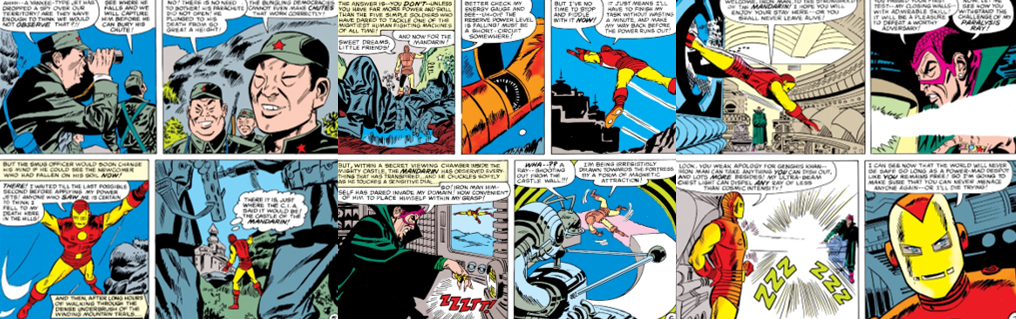
Back Issues: Captain America #117-119

Writer: Stan Lee – Artist: Gene Colon

Story Title: “The Coming of…The Falcon!”
Published: 3 June 1969 (cover-dated: September 1969)

Story Title: “The Falcon Fights On!”
Published: 1 July 1969 (cover-dated: October 1969)

Story Title: “Now Falls the Skull!”
Published: 30 July 1969 (cover-dated: November 1969)

The Background:
World War Two was in full swing by 1941. Nazi Germany had barrelled through Denmark and Norway in April 1940 and, after initially resisting joining the war, the United States entered the fray and provided much needed support against the “Axis powers” of Germany, Japan, and Italy. Patriotism and national pride was high at the time, especially in America, and it was during these dark days that Joe Simon and the legendary Jack Kirby introduced readers Captain Steve Rogers/Captain America and his kid sidekick, James Buchanan Barnes/Bucky, to encourage support of the war effort. However, after the end of the War superheroes declined in popularity and Captain America’s solo comic was cancelled in 1954. Luckily, Cap got a second chance as a “man out of time” when he joined the Avengers, reigniting his superhero career and butting heads with such iconic villains as Johann Shmidt/The Red Skull and even eventually battling his fellow superheroes. In the aftermath of this civil war, Cap was left seemingly dead and his mantle passed to his troubled sidekick, now also a superhuman figure, who operated in the role until Steve’s inevitable resurrection and, in 2014, Sam Wilson took on the mantle, to much undue controversy. Created by Stan Lee and Gene Colon, the man better known as the Falcon was the first Black American superhero in mainstream comic books. Specifically created to be a trendsetter during turbulent times, the Falcon went on to have a lengthy career in Marvel Comics, though mostly as a bit-player until his promotion into the shield-slinging role of Captain America, and has achieved mainstream recognition thanks to Anthony Mackie’s celebrated portrayal of the character in the Marvel Cinematic Universe.

The Review:
Sam Wilson’s debut in Captain America’s solo title came in the middle of a particularly trying time for the Star-Spangled Avenger. After almost having his identity made public, Cap was ambushed by his old foe, the gruesome Red Skull, who used the power of the Cosmic Cube to switch bodies with his hated enemy! As if being tapped in the body of a skull-faced Nazi wasn’t bad enough, the Cosmic Cube’s near-limitless power dumped Cap on a remote island home to the Exiles, a misfit group of would-be conquerors who hate the Red Skull with a passion. Observing through the Cosmic Cube’s omnipotent power, the Red Skull watches as the wheelchair-bound Franz Cadavus leads his venge-filled fellows in search of the one who robbed them of the Cosmic Cube’s power. When Cap crashes before them after falling from his hiding spot in a tree, he doesn’t even bother trying to explain the situation. Instead, he defends himself against Angelo Baldini and his deadly scarf, easily using his knowledge of his foe’s abilities to his advantage. Cap then uses his incredible agility to dodge Cadavus’s “murder chair” cannons, tossing sand in his eyes, and disarms Jun Ching. However, the numbers soon overwhelm the celebrated Avenger when Eric Gruning restrains him with his whip and “Iron-Hand” Jurgen Hauptmann closes in for the kill. For the observing Red Skull, the irony and glory of it all are too much to witness. Confident that his plot has succeeded, he decides not to witness his hated enemy’s final moments and turns his attention towards his greater goals.

Trapped in the Red Skull’s body, Cap nevertheless inspires young Sam to become a hero.

Consequently, the Red Skull doesn’t see the timely intervention of a falcon, later identified as “Redwing”, who distracts Iron-Hand long enough for Cap to fight him off with a swift uppercut. Redwing also helps Cap escape the iron grip of the brutish Ivan Krushki and, as Cap flees to the bushes, he notes that the bird seems to be trained, as if following orders. Cap surmises that the Exiles probably haven’t seen the Red Skull’s true face, so he removes the gruesome mask and manipulates his features with clay to move more freely around the island. In contrast, the Red Skull walks in the guise of Captain America, disgusted by the adulation and awe his appearance inspires and secretly conspiring to enslave everyone. The Red Skull revels in deceiving the masses, taking advantage of their goodwill, before deciding to further his victory against Captain America by destroying his enemy’s distinguished reputation. He is completely unaware that the Mental Organism Designed Only for Killing/MODOK and his beekeeper-suit flunkies at Advanced Idea Mechanics (A.I.M.) are working to render the Cosmic Cube they created powerless to avoid it being used against them. Back on the island, Redwing returns to his master, the jovial Sam Wilson, a lone vigilante against the Exiles. When Cap spots him, he thanks Sam for his assistance and learns that he’s a simple Harlem man who came to the long-peaceful island to organize a resistance against the Exiles. Sam relates that he had an affinity for birds since boyhood, communicating with them in a way beyond a simple animal trainer. When he unwittingly answered the Exiles’ call for a hunting falcon, Sam turned on them, unwilling to help them enslave others. While he initially laughs at Cap’s suggestion that he turn his love for falcons into a symbol, a costumed identity for the natives to rally behind, Cap soon organizes the creation of a garish outfit that will better suit his radical goals and dubs him “The Falcon”.

Despite this God-like power, the Red Skull doesn’t foresee Cap training a new ally.

Back in New York City, the Red Skull finally realises, with anger, that his protégés have failed to find or kill their quarry. Realising that Cap must’ve taken off his skull-like visage, he resigns himself to the inevitability that his enemy can’t hide forever. Yet, the Red Skull decides he’s not willing to aid the Exiles or simply blink Cap out of existence with his God-like power and thus doesn’t bother to look in on Cap or witness him bonding with his new friend, whose connection with Redwing constantly impresses the disguised Avenger. Cap teaches the Falcon the basics of superheroing…And by that I mean they spar on the beach, Cap instructing Sam how to fight properly and use an enemy’s momentum and strength against them. Sam’s experience fighting for survival on the mean streets of Harlem see him take to the training like a natural, quickly becoming stronger and more sure of himself, and Cap impresses upon him that he must embody his new identity whenever he’s wearing his awful costume. When the Red Skull is awoken by concerns of an overexcited rabble of Cap fans in the lobby of his hotel, he sees it as the perfect opportunity to discredit Cap’s name. He shouts at the hotel manager and berates the fans, spitting spiteful insults every chance he can get, and even ostracises perennial hanger-on Rick Jones, who had aspirations of becoming Cap’s new sidekick. While A.I.M. continue their experiments, Cap and the Falcon blindside the Exiles, easily besting them even though Cap’s speed and strength are lessened in the Red Skull’s body. The Falcon proves very adept, dodging Gruning’s whip and inspiring the natives to rise up and drive the Exiles into fleeing for their lives.

Ultimately, it’s A.I.M. who quash the red Skull’s dreams of ultimate victory,

Unfortunately for them, the Red Skull happened to be looking in. Angered and determined to finish his enemy and his new ally off, the Red Skull assumes his more familiar appearance and effortlessly teleports himself to Berchtesgaden Castle, where he once conspired with Adolf Hitler to conquer the world, ravenous to stage his final victory in the castle’s opulent halls. Cap and the Falcon are then violently transported halfway across the world to Berchtesgaden Castle. Though Cap bemoans getting the Falcon caught up in his ages-old rivalry with the skull-faced dictator, Sam vows to face the threat no matter the outcome, but is enraged when the Red Skull’s first act is to cage Redwing. The Red Skull feeds the Falcon’s anger and spirit, goading him into attacking so that he can repel the fledgling hero with a forcefield. Sam is then stunned when the Red Skull uses the Cosmic Cube to undo the mind and body transfer, reverting Cap to his colourful costume and rearming him once more. Galvanised by this revelation, the Falcon willing follows Cap into battle, despite the Red Skull encasing himself in a protective rocky shell and spontaneously conjuring a tidal wave that threatens to drown the two heroes. While the Falcon’s caught off-guard by such tricks, Cap warns of the Red Skull’s power and insanity, which see the villain whisk them to an arid desert. With Sam exhausted, Cap hurls his shield and, incredibly, causes the Red Skull to drop the Cosmic Cube! The two fight valiantly over the prize but, just as the Red Skull reclaims the Cosmic Cube, he watches in horror as it melts between his fingers thanks to MODOK and A.I.M. activating their “Catholite Block” and rendering the weapon inert. Despite this, the Red Skull uses the melting cube’s fading power to teleport away, leaving MODOK victorious and Cap and the Falcon to head into the sunset as triumphant new allies.

The Summary:
I’m honestly not very familiar with the Falcon. This may very well be the first story I’ve ever read where he’s a part of the plot. I’m much more aware of his film counterpart and, honestly, never thought too much of him since his gimmick is very similar to Adrian Toomes/The Vulture, another character I traditionally find lacklustre compared to other, more colourful and appealing characters. However, his appearance here was enjoyable for what it was. There are some holes in his backstory, though, that the story didn’t satisfactorily explain for me. So, he’s a bird-lover, that’s great; he can communicate with Redwing on a near-telepathic level, sure, I’m all for that. But…why did he answer the ad for a hunting falcon? I mean, I guess he just wanted to leave Harlem and I can understand that, but it’s a bit random to jet off to a secluded island on a whim. Also, why did the Exiles need a hunting falcon anyway? Sure, they’re repeatedly shown to be useless at tracking their enemies but still…a falcon? And how did they place an ad for that when they’re exiled to the island? Still, Sam’s heart is in the right place; he won’t stand for injustice, especially slavery, and is determined to encourage the remaining natives to reclaim their land. It’s obviously a very racially and politically charged motivation and character, but I think it’s a universal truth we can all agree to: slavery and mistreatment of others is bad and should be opposed. Sam embodies this ideal before Cap shows up but lacks the proper means to enforce it. He seems to operate mainly from the shadows, but Cap encourages him to stand in the spotlight as a symbol for people to believe in, not unlike he is when in full costume.

It’s a good job Sam’s such a likeable guy because his superhero costume is unsightly!

Unfortunately for Sam, Cap and the natives whisk up one of the worst costumes I’ve ever seen. God, it’s so awful, with its lime-green and brown-gold edging, it’s weird-ass cowl and strangely angled boots. Considering Cap encourages him to take inspiration from his love and use the moniker “The Falcon”, nothing about Sam’s outfit screams “Falcon” to me. He doesn’t have a bird-like cowl like, say, Katar Hall/Hawkman, doesn’t match Redwing’s gold and red/brown feathers, and doesn’t even have his now-iconic wings. Just about the only thing this outfit has going for it is its sense of native tribalism, but otherwise it’s truly a ghastly sight. Luckily, Sam’s personality makes up for it. He’s not some jive-talking street tough or a shallow Blaxploitation cliché; he’s just a regular guy from Harlem with a friendly disposition who wants to do what’s right. His time on the mean streets toughened him, sure, but there’s no sense of malice or ego. The only time he shows any anger is when Redwing is threatened and when confronted by the embodiment of xenophobic oppression. Otherwise, he’s a level-headed, affable young man who luckily turns out to be a natural when it comes to learning how to fight. In a short time, Cap teaches Sam how to defend himself, how to fight smartly, and leads him into battle against the Exiles, a fight that puts them at a disadvantage due to the group’s numbers and weapons but which the heroes ultimately triumph thanks to putting their skills to good use. This also sees the Falcon inspire the natives to rise up, though this was very rushed for me. There was never any indication that the people even know the Falcon was heading into battle that day. All they knew was that Sam was wearing a costume now, not that he’d done anything worth riling them up. Of course, Sam’s natural abilities are only half the story; Redwing gives him a memorable gimmick that helps him stand out against his peers. The bird is exceptionally well trained and intelligent, turning the tide in every battle the Falcon is involved in and proving invaluable to their cause.

The story completely wastes the potential of the Red Skull’s unlimited power.

Beyond this, the story is a bit of a mess. I love the idea of the Red Skull attaining God-like power, and the Cosmic Cube effectively allows him to do anything. He can see anything he likes at will, switch bodies with people, teleport, conjure forcefields and the elements, and is functionally untouchable as long as the cube is in his hands. Unfortunately, the Red Skull is a cackling buffoon. Rather than simply will Captain America out of existence, he swaps bodies with him and dumps him on an island, where inept forces fail time and again to do his dirty work. Rather than reshaping reality in his image, brainwashing the masses and conquering the world a piece at a time, the Red Skull parades around in Cap’s body to take advantage of their goodwill, all while ruminating about how much he hates Americans and the many ways he’ll subjugate and destroy those around him. Rather than doing this, the Red Skull plots to destroy Cap’s reputation by…being rude to people! It’s ridiculous! He doesn’t even watch what’s happening on the island until it’s too late and gets so distracted bringing himself, Cap, and the Falcon to Berchtesgaden Castle that he doesn’t think to set aside his pride and just snuff their lives out with a thought. It’s typical, cliché supervillain behaviour to assume victory, bask in your superiority, and to toy with your enemies but I expected more from someone like the Red Skull! Despite demonstrating that he can protect himself from any attack with a thought, Shmidt is disarmed by a simple throw of Cap’s shield and then he completely fails to consider that A.I.M. might be angry at him swiping their most powerful weapon, leaving him undone not by his enemy, but by his own lack of foresight. Overall, this was a decent enough introduction for Sam Wilson; his costume was awful, but I liked his attitude and his gimmick. What lets it down, though, is the nonsensical main plot regarding Cap and the red Skull switching bodies. It’s a great concept but the story completely wastes it, having Shmidt lounge around thinking nasty thoughts but squandering his great power, leaving him undone in the lamest way possible.

My Rating:

Rating: 3 out of 5.

Pretty Good

What did you think to the Falcon’s debut story? Were you as repulsed by his costume as I was? What did you think to his moxie and his gimmick with Redwing? Were you also disappointed that the red Skull squandered his potential here? What are some of your favourite moments in the Falcon’s long history? There’s a comment section down below; use it to share your thoughts and then go check out my other Marvel content.

Back Issues [Sci-Fanuary]: Tales to Astonish #13


January celebrates two notable dates in science-fiction history, “National Science Fiction Day” on January 2 and Arthur C. Clarke’s HAL 9000’s birthday on January 12. Accordingly, I’m dedicating January to celebrating sci-fi with an event I call “Sci-Fanuary”.


Story Title: “I Challenged… Groot! The Monster from Planet X!”
Published: 27 June 1960 (cover-dated: November 1960) 
Writers: Stan Lee and Larry Lieber
Artist: Jack Kirby 

The Background:
Nowadays, the lovable tree-monster Groot is all-but a household name thanks to his celebrated appearances in the Marvel Cinematic Universe (MCU), courtesy of Vin Diesel’s surprisingly complex performance considering the character simply says “I am Groot” over and over. While Groot is best known as a key member of the Guardians of the Galaxy, his first appearance was in a decidedly less heroic role. Debuting in Tales to Astonish, a science-fiction anthology series perhaps best known for introducing readers to Doctor Hank Pym/Ant-Man, this far more eloquent portrayal of Groot sought to capture and study humankind. This version of Groot later joined the Howling Commandos, a paranormal strike team working under the Strategic Hazard Intervention Espionage Logistics Directorate (S.H.I.E.L.D.) He was largely supplanted by a different member of his species, also called Groot, who first appeared in the Annihilation: Conquest event (Various, 2007 to 2008) before joining the Guardians of the Galaxy and being the inspiration for the MCU’s version of the character.

The Review:
The story of how one brave man stood up to the hulking tree-monster from Planet X, Groot, begins late one night as married couple Leslie and Alice Evans return home from a trip to the cinema. Their mundane drive through the night is interrupted when Leslie spots a brilliant luminous object falling from the heavens and crashlanding in a nearby forest. While he’s eager to check it out, Alice easily convinces him to ignore it and take her home because she’s “tired” (*wink-wink, nudge-nudge*). However, being a curious biologist, Leslie can’t help himself and goes to investigate off-panel, bringing a sample of the mysterious object to his laboratory for study. One day, Alice comes charging into the lab claiming that two of their trees (as well as some of their neighbour’s trees) are missing. Though he brushes the phenomenon off as a cheap prank, Leslie’s sure that what he saw in the forest is somehow connect and heads over there. However, when he arrives, Leslie’s astonished to find the glowing object emitting a powerful light and to witness a gigantic wooden giant, a living tree, commanding and controlling wooden objects to fly to him and add to his monstrous stature. Panicked, Leslie naturally rushes into town to warn the sheriff. Luckily, one of the lawman’s men is on hand to report that the creature is heading to town and, before long, a barricade is erected and armed men are confronting the giant.

Unassuming biologist Leslie holds the key to defeating the monstrous, tree-like Groot.

Surprisingly, the titan halts its march and addresses the townsfolk, introducing itself as Groot, monarch of Planet X, and his intentions to take the entire village back to his home world to study the Earthlings. Terrified, the townsfolk prepare to defend themselves, only for Groot to mentally command the surrounding trees to encircle the town. Its intention is that the trees will bury beneath the town’s very foundations to form a giant net that will whisk the town and all its inhabitants into space, presumably somehow sustaining them for their journey back to Groot’s world. There, he proclaims he and his kind will conduct research on them; the exact specifics aren’t clear, but the threat is enough to rile up the townsfolk. Unfortunately for them, Groot easily shrugs off their small arms fire; however, Leslie bravely steps up and claims to know the key to stopping Groot’s plot. Yet, when he immediately runs off, his peers and even mighty Groot believe him to be a coward. Since the town’s bullets and even flaming torches cannot penetrate Groot’s thick hide, there’s nothing to stop the creature enacting his plan, and even Alice chastises Leslie’s apparently cowardice back at his lab. However, she and the others are amazed when Leslie rushes back to Groot and deposits two boxes to the ground. To their shock and relief, Groot is painfully felled and killed by “the deadliest enemy of wood”, termites! With the towering goliath slain, the town is in Leslie’s debt, stunned at such a simple solution, and even Alice sees her man in a new light by the end.

The Summary:
Well, this was a bit of schlock, B-movie-level fun! The entire setup is like something ripped straight out of a Roger Corman flick and the execution is on the same level as an ambitious monster movie from the 1950s. Our main protagonist is not some muscle-headed jock or even a cop; he’s just a simple biologist, one whose wife constantly chastises him for not being a “real man”. He’s much happier with his lab equipment and studying animals and fauna, it seems, and motivated by scientific curiosity first and foremost. Leslie wants to investigate the crash site simply to see what wonders fell from beyond our world and is driven to distraction studying a sample of the glowing material. It’s not made clear what he’s looking at or what it really does; I assume it’s a small piece of what would become Groot, but the story glosses over what Leslie’s research uncovers. It might’ve been good to setup the ending in these panels; have Leslie’s study of Groot reveal the key to defeating the monstrous giant rather than randomly having Leslie pull termites from his ass. While Alice doesn’t get much to do but react to stuff and criticise her sapling husband, the town sheriff and inhabitants are certainly gung-ho. Thankfully, we’re spared any lengthy scenes of Leslie being branded a madman and the cops and townsfolk are soon grabbing guns and torches to defend themselves against Groot. However, like Alice, they see action and gusto as the true mark of bravery. Thus, they throw insults and judgement at Leslie when he seemingly flees in fear and are confused and perplexed when their weapons and moxie are nothing compared to a few termites.

The mighty Groot has come to enslave, not conquer, but poses a significant threat.

Naturally, Groot is the main reason to read this bizarre story from Marvel’s golden age. The build up towards the creature’s big reveal is both brief and tense. Due to the limited page count, there’s only so much the writers can do, but I liked that the town’s trees went missing as a foreshadowing of Groot’s reveal. Those more familiar with the heroic Groot may be shocked by this creature’s more grotesque appearance. Groot is a towering, tree-like alien who adopts a menacing stance at all times. Interestingly, though, Groot is seemingly a scientist, like Leslie. It’s there to capture and study the town, not conquer the Earth, and makes no aggressive moves towards the humans even as they fire upon it. I mean sure, it wants to wrap the town up in a ridiculous cage of trees and branches, whisk them away to Planet X, and perform God-knows-what on them in its lab, but it’s not rampaging through town, squashing people beneath its trunk-like feet, or otherwise attacking them. Yet, Groot is framed as being “unconquerable” due to its incredible size and strength. However, it’s notable that the townsfolk only have small arms and flaming torches on hand; we have no idea how heavier ordinance would’ve fared against Groot. Of course, we have no need to discover this since Groot is easily and painfully taken down and killed by a group of termites. This simple solution is straight out of The War of the Worlds (Wells, 1898; Pal, 1953) and shows how man’s ingenuity is our greatest asset, rather than brute force. A peculiar and whimsical science-fiction tale clearly inspired by 1950s B-movies, “I Challenged… Groot! The Monster from Planet X!” is notable for its early depiction of what would become one of Marvel’s most endearing characters and short enough to provide a brief bit of entertainment, but you’re not really missing much if you’ve skipped this one and I wouldn’t say it’s really worth seeking out unless you’re really curious about Groot’s understated first appearance.

My Rating:

Rating: 2 out of 5.

Could Be Better

Have you ever read “I Challenged… Groot! The Monster from Planet X!”? If so, what did you think to it? Did you enjoy the B-movie feel of the story? What did you think to Groot, its design and motivations? Were you amused by the way Leslie managed to destroy the creature? Would you like to see Marvel bring back sci-fi anthologies like Tales to Astonish? What are some of your favourite Groot stories and moments? Feel free to share your thoughts on Groot in the comments and go check out my other sci-fi content on the site.

Back Issues [Sci-Fanuary]: Tales of Suspense #93/94


January celebrates two notable dates in science-fiction history, “National Science Fiction Day” on January 2 and Arthur C. Clarke’s HAL 9000’s birthday on January 12. Accordingly, I’m dedicating January to celebrating sci-fi in an event I call “Sci-Fanuary”.


Writer: Stan Lee – Artist: Jack Kirby 

Story Title: “Into the Jaws of… A.I.M.!”
Published: 1 June 1967 (cover-dated: September 1967) 

Story Title: “If This Be… Modok!”
Published: 29 June 1967 (cover-dated: October 1967) 

The Background:
In addition to their colourful superhero efforts, Marvel Comics was once known for publishing various anthology comics. One of these was Tales of Suspense, a science-fiction anthology series that later hosted the first appearance of Anthony “Tony” Stark/Iron Man. In time, Marvel’s peerless superheroes came to be featured in two-in-one stories and it was in Tales of Suspense that readers were first introduced to George Tarleton, a technician for noted supervillain organisation Advanced Idea Mechanics (A.I.M.) who was transformed by “mutagenics” into a grotesque, deranged cybernetic head dubbed MODOK (or, “Mental Organism Designed Only for Killing”). I’m most familiar with MODOK from the Iron Man animated series (1994 to 1996), where he was voiced by the legendary Jim Cummings and served as a secondary antagonist and lackey to the show’s big bad, the Mandarin (Ed Gilbert/Robert Ito). Though most mainstream audiences are probably more familiar with MODOK’s questionable appearance and portrayal in the Marvel Cinematic Universe, he had better luck in his Robot Chicken-esque (2005 to present) animated series. Generally popping up as a boss character in Marvel videogames, MODOK has been a pretty significant villain in the comic books, tangling with various Avengers, directing A.I.M. towards world conquest, aggressively pursuing the Cosmic Cube, and eventually upgrading himself to a far superior form.

The Review:
The entire crux of this two-part story centres around Captain Steve Rogers/Captain America’s efforts to rescue Nick Fury, the gruff and tumble top agent of the Supreme Headquarters, International Espionage and Law-Enforcement Division (S.H.I.E.L.D.) spy organisation. To accomplish this task, Cap was forced to place the one woman he loves, the mysterious Sharon Carter/Agent-13, in mortal peril and, as this story opens, he’s hell-bent on avenging himself against, A.I.M., the group responsible for it all. Outfitted with a suitably Kirby-esque breathing apparatus, Cap follow his radar to a set of underwater coordinates provided to him by Fury, eventually locating A.I.M.’s massive submarine base deep beneath the ocean. Unfortunately for the star-spangled hero, the “eyes of MODOK are everywhere” and A.I.M.’s bee-suit-wearing operatives easily spot him, blasting him with knockout gas and bringing him aboard, where he’s held to a table by “sheer magnetic force” and told stories of MODOK’s dreams of world conquest. Though Cap’s mind is working a mile a minute to think of some way to escape, he’s relieved when Agent-13 is revealed to be alive. Although she makes a big show of chastising him for stupidly risking his life to rescue her, Agent-13 secretly releases his magnetic trappings with her convenient “anti-polar coveralls” when she leans in for a kiss. Though A.I.M.’s soldiers try to blast Cap, he easily and effortlessly dispatches them, much to Agent-13’s amazement, and rushes to retrieve his iconic shield.

Cap and Agent-13 infiltrate A.I.M.’s submarine base to learn the truth about MODOK.

A.I.M.’s scientists are conducting a series of test on the indestructible weapon, marvelling at its unique properties and preparing to present their findings to their mysterious master, MODOK. Naturally, Cap and Agent-13 get to them first, beating up the scientists and reducing their lab to flaming wreckage. Cap then follows Agent-13’s lead in taking cover to avoid A.I.M.’s shock troopers and agrees to stick around and help her complete her mission. Namely, discovering who or what MODOK is to better determine and combat his threat. MODOK’s authority is so absolute that A.I.M.’s troopers dare not speak against him or the strange circumstances that transformed their greatest weapon into their oppressive master, especially as his disembodied voice orders their death for failing him so completely. Watching from the shadows, the two heroes eagerly await MODOK’s big reveal but are suddenly attacked by a shock trooper. Cap bravely takes the shot, ending up paralysed as a result. His sacrifice is largely in vain since Agent-13 refuses to flee and is easily captured and brought before MODOK’s large viewscreen, where she’s dropped through the floor in dramatic fashion. Although an A.I.M. soldier is prepared to finish Cap off, one of his peers stays his hand since only MODOK can issue such an order. Angered, the soldier speaks of rebelling against their master and, though his fellows are sceptical of their chances against MODOK’s supreme power, they’re convinced to go along with an elaborate scheme to have Captain America defeat their oppressor to save his ally.

MODOK’s awesome power terrifies even A.I.M. and sees him fatally betrayed.

Thus, Cap is also teleported to another location to confront MODOK. Though freed from his paralysis, Cap is immediately felled by MODOK’s “brain beam” and approached by the man himself, a massive cybernetic head with tiny arms and legs that floats about! Once a “human guinea pig” for A.I.M.’s experiments, he has come to rule the organisation with his vast power thanks to his comically enlarged brain. Agent-13 is on hand to further MODOK’s narrative, urging Cap not to attack since MODOK’s “uncontrollable brain” is far too powerful. Yet, MODOK swiftly moves to strike, giving the Avenger no choice but to defend himself. Despite Cap’s superhuman deftness, MODOK easily manipulates his shield to toss him about and then sends him crashing to the floor. MODOK’s mind beams are incredibly versatile, allowing him to psychokinetically direct debris at Cap and causing the floor to erupt in flames. As the two battle, A.I.M. prepare to rally; while one squad escapes, another mobilises to attack MODOK while he’s distracted. MODOK’s power is so great he can freeze Cap’s shield as it flies through the air with “the speed of thought”, yet he fails to detect the betrayal of his own people, who open fire with a fusillade of shells that shatter MODOK’s cybernetic chair. A.I.M. then turn their weapons on Cap, who easily takes them out with an assist from Agent-13 before commandeering the escaping craft and apprehending the remaining scientists. As for MODOK, he’s left broken and dying. Refusing to go out in such a disgraceful way, MODOK uses the last of his power to overload the submarine base and cause a massive explosion, which Cap and Agent-13 assume means the end for A.I.M.’s grotesque commander.

The Summary:
This was an interesting two-part tale for me. My experience with Captain America’s adventures is quite limited and usually more focused on his team-based exploits, so it was a nice change of pace to see him in action. He’s working with S.H.I.E.L.D. here, which isn’t too uncommon these days; but back then, S.H.I.E.L.D. was more of a clandestine spy organisation than a global military power. Still, they have plenty of technology and resources on hand, enough to not only plant Agent-13 as a double agent in A.I.M. but also to get Cap to the group’s hidden submarine base. Although Cap and Agent-13 don’t know each other’s true identities at this point, it’s clear the two are smitten by each other. Cap goes solo to rescue her and constantly moves to protect her throughout these issues, and Agent-13 is in awe of his physical abilities and moral compass. Unfortunately, Cap does come off as a bit condescending here, referring to Afent-13 as “little girl” and “lady” a few too many times and Agent-13 mostly chips in here and there rather than being portrayed as Cap’s equal. Still, she’s not some blonde bimbo and she’s clearly a capable spy; her anti-polar outfit and A.I.M.’s respect for her reputation as a S.H.I.E.L.D. agent speak to that. She’s also as stubborn and dedicated to her duty as he is; she refuses to flee when they have the chance since she has a mission to accomplish, and then equally refuses to abandon Cap to die. Still, it’s Cap who gets all the big action scenes, throwing punches, his shield, and cannonballing about the place like a man possessed while Agent-13 just fires her pistol. AI.M.’s nameless, faceless soldiers and scientists were very entertaining here. Though they appear ridiculous in their haz-mat suits, they’re well organised and have the numbers advantage. It’s nothing compared to Cap, but they give it a good go, retreating when necessary and even unloading enough firepower to seemingly kill MODOK.

The feared MODOK is a force to be reckoned with despite his ridiculous appearance.

At first, they’re depicted as the typical minions of an oppressive master; terrified into servitude since failure is punishable by death, they’re subservient to MODOK’s incredible power and forced to obey his every command. However, many of them speak out against MODOK, questioning why a creation of theirs is giving them orders. Though talk of insurrection is forbidden, they’re encouraged to turn on their grotesque creation and manipulate Cap to fight on their behalf, showcasing a deceitful nature that’s unlike most common minions. As for MODOK himself, he’s a bizarre and ludicrous figure with his useless little limbs and enlarged cranium, but he showcases a wide array of powers that have Cap on the ropes before A.I.M. turns against him. We don’t learn the specifics about who he is or what A.I.M. did to him, but we learn he was their greatest experiment and built to be their deadliest weapon, but he took control of the organisation when they succeeded a little too well in their efforts. Now an all-seeing, overpowered commander who violently punishes any transgression, MODOK exhibits cybernetically endowed “brain beams” that can stun, hurl, and blast his foes with ease. Essentially immune to conventional attack, MODOK’s only weakness is underestimating his downtrodden minions, who leave him to die as little more than a useless cripple. Yet, despite his explosive end and his absurd appearance, MODOK is seen as a very real threat. A.I.M. fears him and Cap struggles to fight him, making him a strangely menacing figure with a laughable visage. These stories were a fun exploration of A.I.M.’s goals and inner workings and I enjoyed seeing MODOK as the outrageous face of their organisation. There was a lot of action, and it built upon the relationship and mutual respect between Cap and Agent-13. MODOK definitely stole the show, but I would’ve liked to see him showcased a little more. Perhaps a three-part story would’ve worked better in this regard, with the first part building up to the reveal, the second showcasing his powers and origins, and the third detailing A.I.M.’s betrayal and MODOK’s vulnerabilities. Still, it was a fun read with some striking art and MODOK remains one of Marvel’s strangest villains yet and it was fun to see his first appearance.

My Rating:

Rating: 3 out of 5.

Pretty Good

What did you think to MODOK’s dramatic first appearance? Were you put off by his bizarre appearance or did you find his powers impressive? What did you think to the relationship between Cap and Agent-13? Did you enjoy seeing A.I.M. turn against MODOK and stage a revolution? Would you like to see Marvel bring back the Tales of Suspense anthology? What are some of your favourite MODOK stories and moments? Tell me your thoughts on MODOK down below and go check out my other sci-fi content.
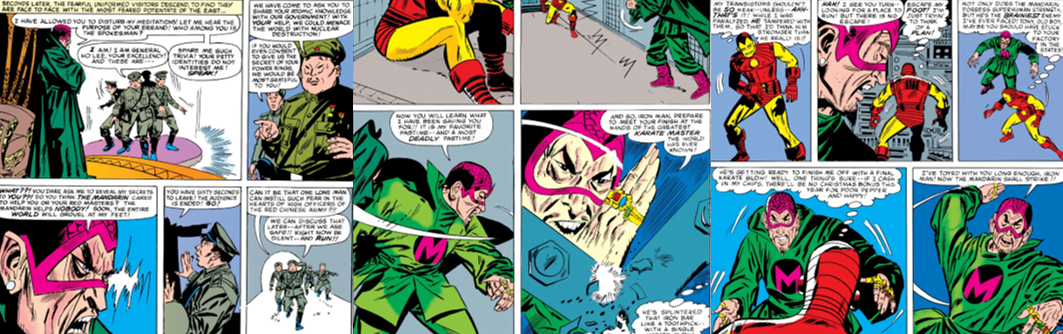
Movie Night: Kraven the Hunter

Released: 13 December 2024
Director: J. C. Chandor
Distributor: Sony Pictures Releasing
Budget: $110 to 130 million
Stars: Aaron Taylor-Johnson, Ariana DeBose, Alessandro Nivola, Fred Hechinger, and Russell Crowe

The Plot:
Saved from death as a boy by a voodoo serum, Sergei Kravinoff (Taylor-Johnson) hunts wrongdoers as “Kraven the Hunter”. However, when his past comes back to haunt him, Kraven must fight to rescue his cowardly younger brother, Dmitri (Hechinger), from a maniacal, half-human, wannabe mobster.

The Background:
Following the phenomenal success of Sam Raimi’s Spider-Man trilogy (2000 to 2007) and the sadly mediocre reception of Marc Webb’s reboot films, Marvel Studios finally achieved the impossible by striking a deal to include the iconic wall-crawler in their Marvel Cinematic Universe (MCU). After seeing the incredible success of Spider-Man: Homecoming (Watts, 2017), Sony were excited enough to greenlight a bunch of spin-offs that would focus on Spidey’s villains and side characters. After Venom (Fleischer, 2018) made bank, Sony not only signed off on a very profitable (if critically maligned) sequel, but also, inexplicably, solo projects for Roy Thomas and Gil Kane’sLiving Vampire”, Doctor Michael Morbius, Denny O’Neil John Romita Jr.’s, Cassandra Webb/Madame Web, and Stan Lee and Steve Ditko’s Sergei Kravinoff/Kraven the Hunter, a character best known for his memorable (if temporary) death in the celebrated “Kraven’s Last Hunt” (DeMatteis, et al, 1987) arc. Although a prominent villain in videogames and the 1990’s Spider-Man cartoon, Kraven’s journey to the silver screen was fraught with years of stop/start efforts. After committing to the idea of their own adjacent series of interconnected Spider-Man movies, production of a solo Kraven film began in earnest in August 2018. Screenwriter Richard Wenk shared that his screenplay was heavily influenced by “Kraven’s Last Hunt” and that he was experimenting with different directions for the character depending on Peter Parker/Spider-Man’s inclusion, all while MCU creators pitched including Kraven in their films. Aaron Taylor-Johnson joined the project and underwent an intense training regime to prepare for the title role, attracted to the film for its deeply interpersonal story. After a number of delays, Kraven the Hunter finally released to universally negative reviews and, as of this writing, the film hasn’t even made $30 million at the box office. Critics tore apart the obvious dubbing of scenes, the disastrous execution, and the tiresome concept of a Spider-Man-less Spider-Man movie. Though director J. C. Chandor was hopeful of a sequel and Taylor-Johnson was contracted for additional appearances, those hopes seem dashed not only by the film’s poor reception but Sony’s announcement that they’ll be refocusing their Spider-Man efforts.

The Review:
It’s baffling to me that Sony just forgot how to make decent Spider-Man movies. Apart from their animated ventures, all their Spider-Man spin-offs have been mediocre to terrible and completely directionless. I can almost understand making standalone Venom movies and it was surprising how well they worked without Spider-Man, but was anyone asking for solo movies for Spidey’s low tier villains and supporting characters? Maybe if there had some kind of plan, like linking all these spin-offs into a coherent, adjacent universe or bringing back Andrew Garfield for a series of showdowns with these characters then maybe, maybe, things would’ve been different. Instead, we live in a world where Sony legitimately thought people would pay to see Kraven the Hunter, of all people. To be fair, Aaron Taylor-Johnson certainly looks the part. He’s ripped and exudes a rugged charisma that certainly catches the eye and his Russian accent and dialect is commendable. He’s easily the best part of this film but that’s a bittersweet compliment as he’s completely wasted here instead of being put to better use in a film that’s not completely forgettable ten minutes in, let alone by the end. Kraven the Hunter opens with Kraven a fully-fledged manhunter; he infiltrates a Russian prison to assassinate crime lord and poacher Seymon Chorney (Yuri Kolokolnikov), an act that kicks off the central conflict of the movie. The film then jumps back in time sixteen years to introduce us to a young Sergei (Levi Miller) and Dmitri (Billy Barratt) and set up their shared and individual issues with their father, kingpin and avid game hunter Nikolai Kravinoff (Crowe).
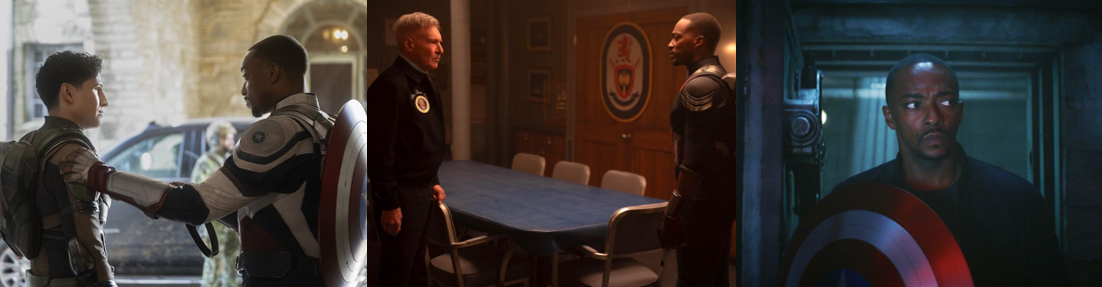
Following a vicious attack and mystical serum, Kraven becomes a renowned manhunter.

This extended flashback establishes that the Kravinoff boys fear and loathe their authoritarian father, who believes in survival of the fittest and refuses to show or tolerate any weakness in either himself, his vaguely defined criminal organisation, and his two boys. Resentful towards Nikolai for his treatment of their mother (Masha Vasyukova), who was mentally unwell and took her own life, the young Kravinoffs are nevertheless powerless to defy their father’s will and forced to accompany him to Tanzania for a hunting trip. While Nikolai favours Sergei, he’s critical and dismissive towards his bastard child, Dmitri, whom Sergei tries to defend at all costs. This drive sees Sergei leap to Dmitri’s defence when a gigantic lion approaches them in the wilds. Hesitating to shoot, Sergei is mauled and hauled away by the beast, leaving Dmitri in hysterics and Sergei close to death. Luckily for him, young Calypso Ezili (Diaana Babnicova) just happened to be vacationing in the area, coincidentally learned from her grandmother’s (Susan Aderin) tarot cards about Sergei’s fate, and carries a helpful voodoo serum which, coupled with the lion’s blood, not only saves Sergei’s life but bestows him with vaguely mystical animal powers. After fully recovering and lashing out at his father’s abhorrent ways, Sergei packs up and leaves, strangely leaving Dmitri behind, fleeing to his mother’s sanctuary (essentially a spherical greenhouse) in the far reaches of Russia. There, Sergei learns the extent of his new abilities: he’s fast like a cheetah, climbs skyscrapers and trees like an ape, is soft footed like a deer (to the extent that he apparently negates people’s peripheral vision), has eyes like a hawk, and superhuman hearing and durability. These gifts allow him to build a reputation as the world’s greatest hunter and he carves a name for himself as “Kraven”, hunting down crime lords like his father (but, oddly, not his father) and local poachers. In all that time, no one has ever pieced together that Kraven is Sergei Kravinoff and his name has become legend. He travels the world with his unseen pilot (whose scenes were clearly left on the cutting room floor) ticking names off his list. However, he riles up the criminal underworld when he kills Chorney as it leaves a power vacuum that both Nikolai and would-be kingpin Aleksei Sytsevich/The Rhino (Nivola) are eager to fill.

Kraven’s family issues see him make unlikely and underutilised allies.

As mentioned, I don’t get why Sergei left Dmitri behind. The boy lived in constant fear of his father and was desperate to earn his approval and respect, an uphill battle he was seemingly doomed to never win, even with his “chameleon” like talent to mimic voices and lovely singing voice. It seems like it would’ve made more sense for Sergei to take Dmitri and for him to be his pilot but, instead, Dmitri ends up kidnapped by the Rhino and held to ransom, forcing Sergei to reunite with Nikolai and begrudgingly work alongside his estranged father to rescue his troublesome little brother. Despite being renowned as the greatest hunter in the world, it takes Kraven sixteen years to track down the now adult Calypso (DeBose), now a lawyer living in London and jaded by the bureaucratic justice system. Though initially hesitant because of Kraven’s violent lifestyle, Calypso reluctantly agrees to help him track down the Rhino and warns him against pursuing dangerous crime lords, a caution that comes true when Dmitri is kidnapped and Calypso is also targeted by the Rhino in a bid to flush Kraven out. If there’s supposed to be a romantic subplot between Kraven and Calypso, this also seems to have been cut from the film. Calypso certainly looks the part and there are glimpses of chemistry between her and Kraven, but so much of her dialogue is clearly redubbed through ADR and it’s not only jarring but leaves much of her performance flat as a result. She just about manages to prove her worth, however, and she’s never held hostage like Dmitri. She also has contacts who provide Kraven with leads (even if they’re false ones courtesy of the Rhino’s slick henchman, “The Foreigner” (Christopher Abbott), a superhuman mercenary with unexplained hypnotic powers), and even saves Kraven’s life when he’s drugged and brought to the brink of death once more.

Aside form Nikolai, the film’s villains are bizarre and dull, poorly characterisaed antagonists.

Despite years of mistreatment, resentment, and hatred towards his father, Kraven purposely leaves Nikolai off his list because, for all his flaws, the crime lord is still the hunter’s father. Kraven reunites with his father and brother once a year for Dmitri’s birthday, growing more and more troubled by his brother’s obsession with pleasing the old man, and rebukes Nikolai when he refuses to pay Dmitri’s ransom to avoid showing weakness. Taking matters into his own hands, Kraven tracks down the Rhino and runs into the Foreigner, a mysterious assassin who, honestly, could’ve easily been cut from the film or supplanted with someone else. While we learn of his personal grudge against Kraven, we never learn the Foreigner’s real name, how he got his strange powers, or even what the extent of them are. He easily subdues and murders anyone in his path until he reaches Kraven, who he decides to drug, cripple, and beat up rather than go for a quick kill, which costs the Foreigner his life. Compounding matters is the use of the Rhino, of all people, as the film’s main antagonist. Reimagined as a neurotic, semi-maniacal would-be crime lord who craves attention and a “partner” to elevate him up the ranks, the Rhino is a strange, cartoonish villain just as apt to make bizarre noises as he is to monologue about his aspirations. After being disregarded by Nikolai for his physical weaknesses and needy demeanour, the Rhino turned to Doctor Miles Warren for both a cure for his condition and a means to become stronger. The result was some unexplained genetic tampering that turned Sytsevich’s skin into an impenetrable hide and bestowed him with incredible strength, much like his namesake, but also causes him such agony that he medically keeps the transformation at bay. Instead, he orchestrates a convoluted plot involving kidnapping and murder to try and fill the void left by Chorney and make a name for himself as the man who killed Kraven, or coerce the Kravinoffs into joining forces. This latter scheme is mirrored by Nikolai, who desires to rule the criminal underworld with his sons, leading to what’s essentially a war between rival mob gangs in a bid for greater glory. However, if you ask me, reimagining the Rhino into this role is a poor fit. I would’ve preferred to see Alonzo Lincoln/Tombstone in this role, with the Rhino replacing the Foreigner as his muscle/henchman, and possible have rewritten the script to weave Dr. Warren into the narrative more explicitly, but what do I know?

The Nitty-Gritty:
Kraven the Hunter is, fundamentally (somewhere beneath all the mess), a story about a son escaping the shadow of his abusive and totalitarian father. While part of young Sergei enjoyed his father’s approval, he was nevertheless disgusted by Nikolai’s treatment of Dmitri and his penchant for big game hunting. Having grown up emotionally and physically abused by his father, and having witnessed his brother get the same treatment or worse, Kraven is determined to not become the same kind of man as his father. To a degree, he accomplishes this (he becomes a morally grey vigilante, of sorts, rather than a ruthless crime boss) but his affinity for violence and desire to be seen as the Alpha Male among his peers echoes his father’s teachings. Naturally, Kraven rejects these comparisons and believes he’s doing good by taking out poachers and mob bosses, but his path inevitably intersects with Nikolai once more and he’s clearly disturbed by his similarities to his father. Dmitri couldn’t be more different from both men; he craves the approval Nikali shows Sergei and does everything he can to appease his father. Dmitri’s talents are in entertaining and mimicry rather than physical feats, wowing the patrons of his club with his pitch-perfect vocal talents and even earning a modicum of respect from his father, who appreciates Nikolai’s Tony Bennett impersonation. Despite a lifetime of abuse and mistreatment, and being beaten and having a finger cut off, Dmitri refuses to succumb to the Rhino’s torture or sell out his family to the irrational wannabe, though he’s stunned to learn that his brother is the fabled Hunter, which only adds to his insecurities and desire to carve his own legacy by the film’s end. Despite featuring many names associated with Spider-Man, Kraven the Hunter is very light on Spider-Man elements: the Daily Bugle appears a couple of times, Dr. Warren is name dropped, and it’s revealed that Kraven has an inexplicable and convenient and never explained fear of spiders. However, there’s no indication that a Spider-Man exists in this world or if it’s even connected to Sony’s other spin-off films.

Sadly, all the bloody violence and delicious abs in the world can’t excuse the poor CGI and editing.

While Kraven the Hunter is often a mess of clunky, clearly rerecorded dialogue and overdone clichés, the action on display is pretty good at times. The film is, sadly, populated with some of the worst CGI animals I’ve ever seen; the gigantic lion and the leopard that attack Kraven at different points are the worst offenders by far. When Kraven leaps into action, the violence is fast, bloody, and brutal, with him stabbing foes, slicing their throats open, and clamping bear traps to their heads! At one point, he sets traps for his pursuers that sees one guy get ripped in half crotch first, another take a machete to the head, and blood splattering across a bleak Russian forest. Kraven beats guys to death with his bare hands, easily breaks bones and manhandles multiple, even armed foes, and his skilled with knives, blades, and spears is readily apparent. Believing it dishonourable to use firearms and any weapons not made of the land or meticulously crafted, Kraven keeps a cache of blades and weapons at his sanctuary and on his person, subduing targets with blow darts and poisons and easily clambering up sheer surfaces with an animal grace. I’m not the biggest fan of or expert on Kraven but I do believe he’s often imbued with animal senses, spirits, and ferocity and that’s on full display here. Kraven often gallops about on all fours, tackles jeeps like a rhino, clings to purchases like a monkey, and has senses so keen that he can hear, smell, and see things no normal human could. This all adds to his abilities as a manhunter and in a fight, with him being swift enough to avoid gun fire and carpet bombs, durable enough to take a beating, and apparently strong enough to survive being buried under a bunch of stones and debris. Somehow, he’s so fleet footed that he can remain completely undetected even when standing right behind his foes and his eyes often glow an ethereal orange to show he can see in the dark or across vast distances. He’s not completely invulnerable, however. He succumbs to the Foreigner’s poison like any other man and is beaten close to death by the malicious mercenary, his life only spared by the timely intervention of Calypso. Dmitri also proves to be a vulnerability, one the Rhino doesn’t hesitate to exploit, and Kraven’s emotions often get the better of him where his brother and family are concerned.
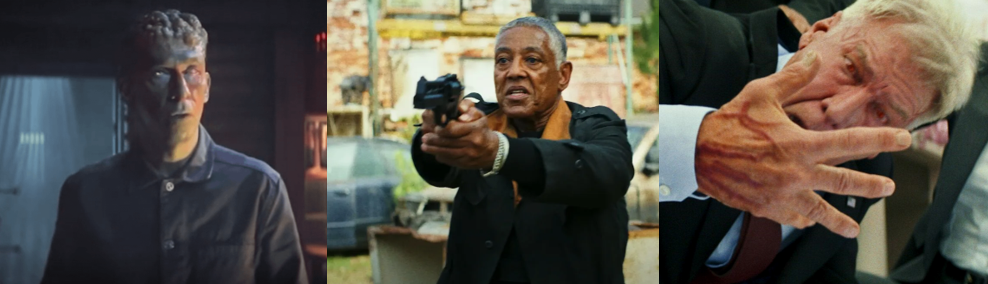
A lacklustre showdown with a ridiculous villain leaves Kraven set for a sequel that’ll never happen.

Despite Kraven’s lauded and feared reputation, he struggles to piece together the paper-thin plot taking place around him and needs Calypso and the intel offered by his dying targets to figure out what the hell’s going on. Already angered that security footage that identifies him is doing the rounds, Kraven’s desire to shut down those actively seeking him out is exacerbated when Nikolai’s life of crime seemingly causes Dmitri’s kidnapping by would-be rival kingpin, the Rhino. When Dmitri and Kraven shoot down the Rhino’s offer to join forces, the Rhino organises a strike against Kraven on his home turf, a ridiculously poorly thought-out operation that leaves all his ill-equipped troops dead and Sytsevic forced to allow his transformation to take full effect. Transforming into a hulking man-rhino that, despite being comic accurate, looks laughably cartoonish, the Rhino fights Kraven amidst a buffalo stampede. Thanks to his impenetrable skin and augmented strength, the Rhino easily shrugs off Kraven’s blows and knives and pummels the Hunter, beating the piss out of him and looking to throttle him to death. However, Kraven spots the medicine line on the Rhino’s thick hide and rams a role into his stomach, then has the stampede trample the weak-ass villain to death. Although Kraven talks Dmitri out of executing the Rhino, Kraven has not hesitation about confronting his father, who released the video footage to coerce his estranged son into eliminating his competition, a revelation that leaves Nikolai being mauled by a wild bear courtesy of Kraven. The film then ends with Kraven being aghast to learn Dmitri has taken control of their father’s operation and undergone some “unorthodox” surgery of his own to assume the face of anyone he wishes at will. How Dr. Warren did this isn’t explained and quite how the Chameleon thinks he’ll fool anyone with his short stature is beyond me. I think a better reveal would’ve been that Dmitri was posing as Nikolai and was a bad guy all along, manipulating events to seize power and using fake masks and practical augmentations rather than what I assume is either a nanotech or some vague bioengineered tampering to steal people’s identities. Oh, and Kraven gets his signature jacket, made out of the hide of the lion he failed to kill, as a parting gift from his father.
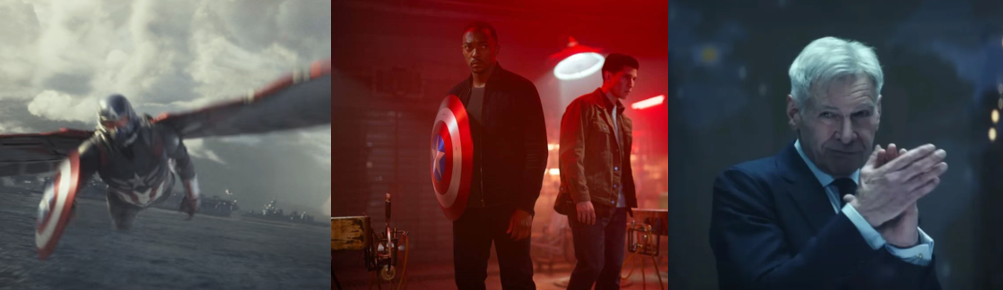
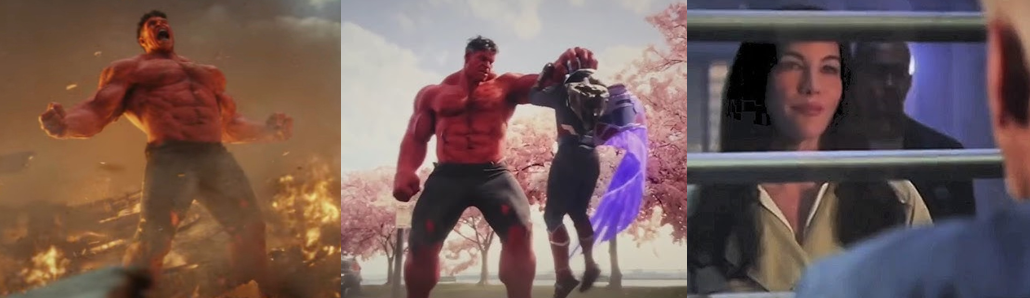
The Summary:
I wasn’t expecting much, if anything, from Kraven the Hunter. I’m really not a fan of the character and would have little interest if he showed up in a Spider-Man movie, so giving him a solo film seems moronic and pointless to me. Luckily, I can say that I enjoyed Kraven the Hunter more than Morbius or Madame Web, but not by much and that’s hardly a high bar to clear and the film’s flaws mean it’s still not getting higher than a generous two-star rating. This rating is based purely on Aaron Taylor-Johnson’s performance, which I did enjoy, and the brutal, bloody action sequences, which give the film an edge sadly not afforded to the Venom movies as swearing and strong, bloody violence would tip them into 18-rated affairs. Aaron Taylor-Johnson does look great in the role, and I did enjoy the depiction of Kraven’s powers; it seemed a lot of his actions and stunts were practical, too, which was appreciated. However, it made the poor CGI stand out even more. I obviously don’t expect the actors to be wrestling with real lions and such but surely CGI has progressed to the point where they can be rendered more convincingly? The Rhino suffers greatly from this, too. Clearly a rushed, last-minute inclusion, the Rhino is so awful here and looks so janky that I honestly prefer the mech-suit version we got previously; at least that’s somewhat believable! Add in pointless characters like the Foreigner, a strange and ill-fitting interpretation of the Rhino, and some horrendous and distracting ADR, and you have a film that feels like it was butchered by the budget and the editing process. It feels like many scenes were left on the cutting room floor, especially those featuring Calypso and Kraven’s life between hunts, making for an awkwardly paced and disjointed affair. It’s also disappointing that it’s not made clear where Kraven the Hunter fits in Sony’s spin-off films, if anywhere. However, even if the film had been better in these regards, I would still be unimpressed and annoyed at the idea of giving Kraven a solo movie. And, if it had been a Spider-Man film featuring Kraven, I would’ve been equally disappointed as I just don’t care about the character. Thus, Kraven the Hunter was doomed to fail for me and I cannot understand, for the life of me, who this mess was made for.

My Rating:

Rating: 2 out of 5.

Could Be Better

Did you enjoy Kraven the Hunter? If so…what’s the matter with you? What did you think to Aaron Taylor-Johnson’s performance and the depiction of Kraven’s powers? Do you agree that the film felt rush, especially regarding Dmitri’s story arc? What did you think to the Rhino and his eventual full reveal? Did you also think that the film felt butchered in the editing room? Are you a fan of the character in general (and, if so, again…why?) and would you like to see Kraven return in some capacity? What Spider-Man villain would you like to see get a standalone movie? I’d love to know your opinions of Kraven the Hunter, so leave them below and be sure to check out my other Spider-Man and Marvel content.