Talking Movies: Marvel Studios’ Fantastic Four

Talking Movies
F4Logo

Those who actually read my articles may recall that, some time ago, I wrote a piece discussing some ideas for the inevitable integration of the X-Men into the Marvel Cinematic Universe since Disney reacquired the rights after their big purchase of 20th Century Fox. In all honesty, bringing in the X-Men is probably one of the hardest tasks faced by Marvel Studios given the popularity and mainstream awareness of the existing movie franchise. As detailed in my piece about films that desperately need a remake, I believe that it would be comparatively easier to bring in a new version of Marvel’s first family of superheroes, the Fantastic Four, and that this should be the main goal following the conclusion of Avengers: Endgame (Russo Brothers, 2019). The Fantastic Four are, obviously, no strangers to live-action adaptation; Roger Corman infamously co-produced, but never released, the extremely low-budget The Fantastic Four (Sassone, 1994) back in the nineties, Tim Story’s Fantastic 4 (2005) and Fantastic 4: Rise of the Silver Surfer (ibid, 2007) actually saw the light of day but came under a lot of criticism for some of the effects, tone, casting, and the handling of Galactus, while Josh Trank’s 2015 grim and gritty reboot, Fant4stic, was beset by studio interference, an oddly serious tone, and a dramatically altered interpretation of Doctor Doom (Toby Kebbell). Having seen each of these adaptations, I can say that each does have its fair share of problems but there are some positives to be found as well.

F4Movies
The Fantastic Four have certainly had their fair share of movies.

The Fantastic Four is probably the closest to the 1960s version of the characters; the Four are bathed in cosmic rays and obtain their superpowers, wear very comic-accurate costumes (to a fault, as they literally just look like Halloween costumes), and Doctor Doom’s (Joseph Culp) origin, abilities, and appearance are probably the closest to the comics out of all three adaptations. Also, while every other effect in the film was cringey to the point of embarrassment, Ben Grimm/The Thing (Michael Bailey Smith/Carl Ciarfalio) was phenomenally realised in a practical, semi-animatronic costume similar to those seen in Teenage Mutant Ninja Turtles (Barron, 1990). Fantastic 4, while suffering from the tired depiction of Victor von Doom (Julian McMahon) as a suit-wearing businessman and some questionable casting (Ioan Gruffudd isn’t bad as Reed Richards/Mr. Fantastic but also isn’t that great and Jessica Alba was woefully miscast as Susan Storm/Invisible Girl, a fact made all the more prevalent by the gratuitous shots of her in her underwear rather than emphasising her intelligence), was basically saved by Michael Chiklis and Chris Evans, whose chemistry as the Thing and the Johnny Storm/Human Torch, respectively, are well worth the price of admission. Rise of the Silver Surfer improved on the lacklustre finale of its predecessor and, while Galactus was little more than a formless space-cloud, at least the movie tried to do Galactus when it could have just as easily gone down a safer, more boring route. The Silver Surfer (Doug Jones/Laurence Fishburne) was also realised extremely effectively, looking great and being a powerful yet empathetic character; while tying his powers directly to his board did weaken him somewhat compared to his comic counterpart, it simplified matters considerably. Oh, also, the Fantasicar is in this and looks amazing!

F4Family

When the first trailers for Fant4stic hit, I was actually quite excited as it looked like it was going to be a more grounded, scientific, realistic interpretation and its trailers, look, and marketing reminded me a lot of Interstellar (Nolan, 2014). I also heard a lot of negative reviews surrounding the movie and went into it expecting this dull, boring, disjointed mess of a film but found myself surprisingly enjoying it. For one thing, the cast is much better; Kate Mara is a far better fit for Susan Storm (though the fact that she doesn’t actually go on the mission with the others is a problem), Miles Teller is also far more suitable, portraying Reed as a somewhat awkward but determined and enthusiastic young genius, and Michael B. Jordan was absolutely brilliant as Johnny Storm because of his natural charisma and totally proved that race shouldn’t always be a factor when casting these characters. On the flip side, Toby Kebbell is quite underwhelming as Doom and Jamie Bell really didn’t have the physical stature to properly fit the role of Ben Grimm, though I did like the CGI used to create the Thing. One of the things that separate the Fantastic Four from other superheroes is that they are a family; their strengths lie completely in their unity and, while each are powerful and talented separately, the idea has always been that the four of them together are a formidable unit. Tim Story’s movies emphasised the “dysfunctional family” dynamic of the team quite well; though miscast, as I said, Sue acts as the “mother” to the team, being the voice of reason and logic and intervening in arguments; Johnny and Ben are the bickering children who are just as likely to fight each other as other threats; and Reed is the level-headed, hyper-intelligent “father” of the group, though Gruffudd rarely exuded the charisma, confidence, or intelligence you might expect from such a character. This ended up being a theme in Fant4stic, with the team officially forming at the film’s climax and staying together out of a true sense of friendship that developed over months of working together after being introduced as strangers. Reed and Ben were close as kids but, once Reed becomes part of Franklin Storm’s (Reg E. Cathey) interdimensional project, he leaves Ben behind and forms a fast friendship with Johnny, which is an interesting twist as Johnny is generally treated as a kid brother by Reed.

F4Doom
Doom’s always been a bit…obsessed, to say the least…

Also at the heart of the team’s story is their complicated relationship with Doom; all three interpretations portray Doom as a former colleague and rival to Reed but only The Fantastic Four and Fant4stic delve into their friendship. Reed and Doom are supposed to be equally matched in their intelligence and separated only by Doom’s megalomaniacal ego and lust for power, which is generally realised in his live-action adaptations; The Fantastic Four’s Doom descends into one-note revenge and a desire to conquer the world while Fant4stic-Doom, similar to Fantastic 4­-Doom, revels in his newfound power and desire to use it to subjugate others and prove he is the better man than Reed. In the films, Doom’s motivations are generally further bolstered (or diluted, you might argue) by his attraction to Sue; Fantastic 4-Doom proposes to her and actively pursues her simply because she is unobtainable, making his motivations much less threatening. Even in Rise of the Silver Surfer there is a suggestion that he seeks to obtain the Surfer’s powers simply to displace Reed in Sue’s life. Personally, I don’t like this addition to Doom’s motivations; I think it’s enough to have Doom be this selfish, egotistical madman who desires power and more power and to prove that he is superior to Reed and, by extension, his extended family. With their acquisition of 20th Century Fox, Marvel Studios now has the opportunity to bring the Fantastic Four into the Marvel Cinematic Universe; with the Four come some of Marvel’s greatest characters and villains, including Doom, Silver Surfer, Namor, Annihilus, and Galactus and their significance in the greater Marvel universe cannot be understated, with Reed being an integral member of the Illuminati and the team being the force that drives away Galactus’ threat.
F4NegativeZone.PNG
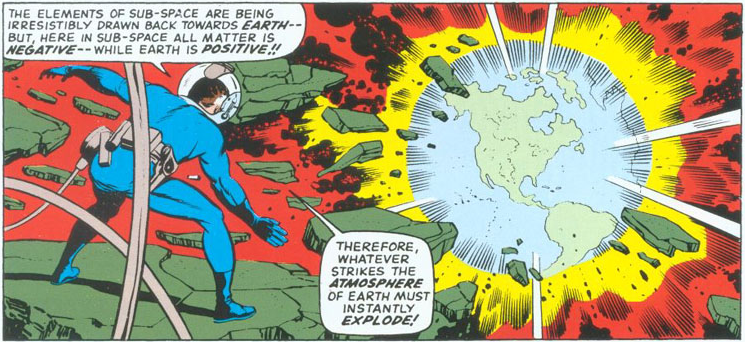
Perhaps the Fantastic Four have been trapped in the Negative Zone for a while?

Unlike the X-Men, bringing in the Fantastic Four can be a relatively simple affair; one of the things I liked about Fant4stic was that the team travelled across dimensions, rather than into space, to acquire their powers. Either approach is fine to me because the main thing here is that the Four are explorers and scientists first and adventurers and superheroes second, so you could very easily have the Fantastic Four return from an excursion into the Negative Zone, either by design or having been trapped there by Doom. That way you can establish that the characters and the Baxter Building have existed in the MCU for some time but they have either been away or lost for some time, similar to how Carol Danvers/Captain Marvel (Brie Larson) was introduced to the MCU. There are, however, a few ways you could portray the team; Marvel Studios could take inspiration from Fant4stic and Ultimate Fantastic Four (Various, 2004 to 2009) and have the Four be in their mid-teens. Perhaps Reed is a genius savant and Doom is his former teacher, embittered by Reed’s intellect and youth, or maybe they were peers driven by a friendly rivalry that turned sour. It’s definitely a route to go down if you want longevity from the actors and characters and to maintain some of the youthful vigour Tom Holland brings to the MCU as Spider-Man.

F4Reed
Reed gives an opportunity to bring in another seasoned actor to the MCU.

However, I would actually go the alternate route, especially as I’m hoping for the majority of the X-Men to be teens at Xavier’s School for the Gifted as in X-Men: Evolution (2000 to 2003), and use this as an opportunity to bring some older actors into the roles and have a few more seasoned voices of authority to be peers with Doctor Strange (Benedict Cumberbatch) and Black Panther (Chadwick Boseman). This puts me in a bit of a bind, as I already had Pierce Brosnan eyed for Magneto, but he’d be equally great as Reed; in another time, I would have also said Bruce Campbell, but he maybe doesn’t have the acting gravitas I envision for Mr. Fantastic, though maybe Bradley Cooper would be a good fit (and it’d give him a chance to be seen onscreen in a Marvel movie) or even Nathan Fillion, if he isn’t going to appear as Simon Williams/Wonder Man any time soon.
F4StormGrimm
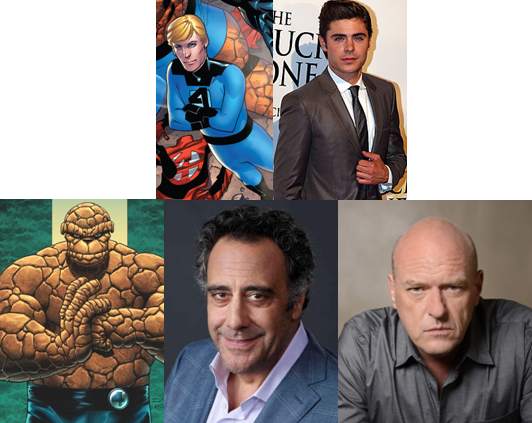
Definately need someone young and sexy for Torch and gruff but loveable for the Thing.

I previously suggested Zac Efron for Johnny Storm, which I think I’ll stick with; a young, cut, utterly handsome hot-head is just the sort of thing the Human Torch needs. He also needs to have good chemistry with the Thing, who I would hope to either be some Hulk-level top-quality CGI or a combination of a practical suit and CGI; I would also keep Ben as the Thing the entire time, meaning Marvel only need to bring in a quality actor to voice the role, like they did with Rocket Raccoon. I previously, somewhat jokingly, suggested Danny DeVito, mainly because of his accent, but maybe Brad Garrett or Dean Norris would be equally good fits.
F4DoomActors
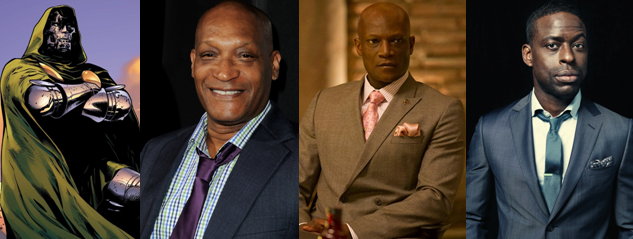
Doom needs a deep, booming, theatrical voice and presence.

As for Sue, I’m at a bit of a loss; perhaps a Jessica Chastain, Amy Adams (if she’s really done with DC movies), or Emily Blunt, if Marvel could get her. I’m not too good at casting females, to be honest, but I definitely think Marvel would be better off looking for a Kate Mara than a Jessica Alba (someone like Felicity Jones, maybe) as Sue doesn’t need to be some drop-dead gorgeous bombshell; she should be smart and sophisticated and have good chemistry with Reed. Similarly, for Doom, you want an actor who won’t be a one-and-done as, unfortunately, Hugo Weaving was; Red Skull should be a much bigger presence in the MCU but Weaving’s comments and attitude seem to have prevented that, and Doom should definitely be a massive threat to the MCU, hopefully similar to Marvel’s version of Magneto. I would push to only see Doom unmasked in a flashback to his time as Reed’s peer, meaning you either need an actor willing to be behind the armour for the entire movie or cast a decent stunt man (bring in Doug Jones, maybe) and an ominous voice actor; off the top of my head, though, I would love to see Tony Todd play the role due to his menacing stature and haunting, raspy voice, though Peter Mensah or Sterling K. Brown would be just as fitting.

Pretty sure the Skrulls will be a big deal going forward.

I would also take quite a bit of inspiration from Captain Marvel (Boden, 2019), especially as that film is bringing the Skrulls to the MCU. At this point, I am hoping that the Skrulls play a significant role in the next phase of Marvel movies, with mid- and after-credit sequences and subsequent movies revealing that certain characters are actually Skrulls in disguise and that the shape-shifters have been secretly invading the Earth in the Four’s absence. Marvel’s Fantastic Four movie could initially take place some time after Captain Marvel, in the late-nineties, with the Four discovering the Skrull invasion or their home planet on an excursion and being left stranded there when their gateway/module explodes. Upon their return, the Four (who would perhaps assume Doom died in the explosion) would use their resources to prepare for the invasion, or fight back against it, only to find that Doom is alive and well and lording it up in Latveria, where his dimensional gateway (a combination of technology and magic) has been allowing the Skrulls to come to Earth over the intervening years. Doom would reveal that he discovered the Skrulls first and struck a bargain with them and that he sabotaged the Four’s gateway; when the Four confront him, they could battle the Super-Skrull (a nice thematic parallel as they essentially have to battle themselves and their own powers) and, upon defeating Doom, find that it was simply a sophisticated robotic decoy and that not only is Doom still out there, but countless Skrulls have infiltrated the human race. Admittedly, this is very thin and doesn’t really delve into how the Four get their powers; maybe they obtain them during their time in the Negative Zone or on the Skrull planet, perhaps even through Skrull experimentation? Either way, I definitely feel Marvel’s Fantastic Four should show that the Skrulls are still at large if only to set up towards a Secret Invasion (Bendis, et al, 2008 to 2009) style conclusion to the whole Skrull storyline in a New Avengers movie.
F4Namor
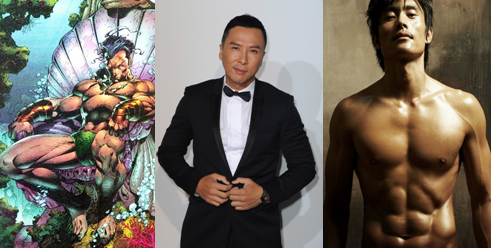
Namor could be a great role for an Asian actor.

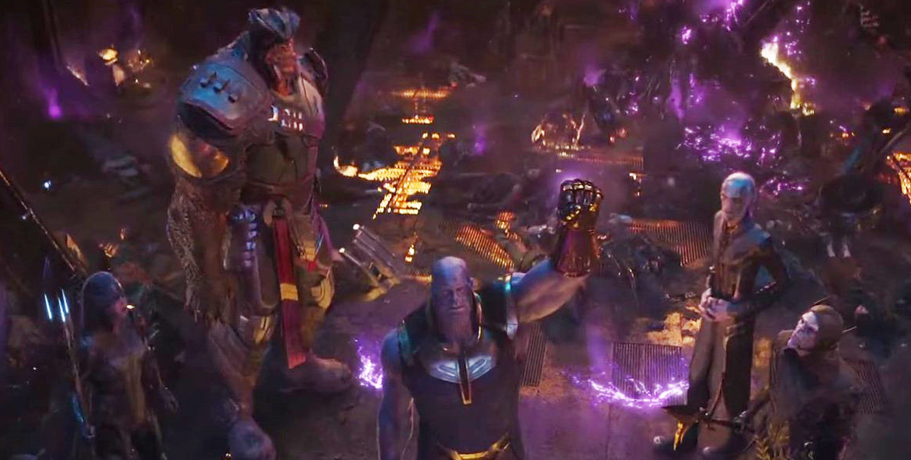
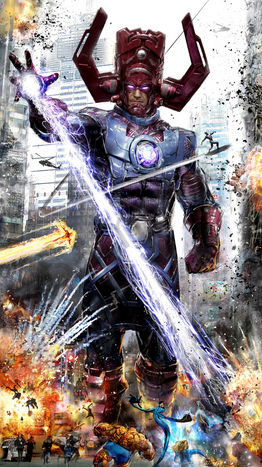
Following this, and with the Four playing key roles in a New Avengers movie, a Fantastic Four sequel could juggle a few famous Fantastic Four plots; aside from the obvious return/revelation that Doom is still alive, perhaps Sue is pregnant and ultimately gives birth to Franklin Richards to actually get that Power Pack movie off the ground? Also, it would be a great opportunity to bring in Namor; given how successful Aquaman (Wan, 2018) was, though, I wouldn’t be averse to seeing Namor in the first of Marvel’s Fantastic Four films and end with the revelation of Doom’s existence/survival. Namor is quite the complex and layered anti-hero and would introduce a whole new world to the MCU while still tying in with the introduction of Mutants; I’d also use Namor as a chance to bring in an Asian actor for the role, like Donnie Yen or Lee Byung-hun. Anyway, the second Fantastic Four movie would also have a sub-plot whereby Reed is constantly monitoring or noticing a strange energy spike crossing the globe and the post-credits scene would show that this is, of course, the Silver Surfer. I’d then have the Silver Surfer appear in this fashion across every subsequent Marvel movie; perhaps, during the films, there would be news reports, headlines, clear spoken dialogue referring to craters appearing, ecological changes, power shortages, and sightings of a strange silvery alien. Definitely, though, I would take a page out of previous Marvel movies and have a few post-credits stingers showing the Surfer preparing various sites and, finally, summoning Galactus to Earth. This would culminate in what I’m going to title Avengers: Doomsday (perhaps New Avengers: Doomsday), a movie that would feature the Silver Surfer as the main antagonist for the first third, Doom for the second (after he drains the Surfer’s powers and uses them for his own ends, possibly in league with other villains), and Galactus for the last two thirds. If anyone can pull off a decent Galactus it’s going to be Marvel Studios, who made Thanos (Josh Brolin) one of their greatest threats and are generally really good at bringing their comic characters to life in a way that is believable and also faithful to the source material.
F4Galactus

Part of me feels like it would be a disservice to Galactus to resolve his threat in one movie, even one that involves most the MCU’s greatest heroes, especially as one of Marvel Studios’ more questionable decisions was to limit Ultron (James Spader) to one appearance. At the same time, though, I don’t really want to see a two part Avengers movie again as it would be too much of a repeat of what Marvel Studios did with Thanos so, instead, building Galactus (through the Silver Surfer) through multiple movies and the two Fantastic Four movies would allow for a much greater payoff in Avengers: Doomsday. Plus, Galactus doesn’t really have any minions for the heroes to fight so it’d be much more about how they are supposed to defeat this giant, God-like being that is sucking the Earth dry. All-in-all, the Fantastic Four would be a great addition to the Marvel Cinematic Universe and offer a lot of opportunities for new characters, new heroes and villains, new worlds and new technology, and to include some more seasoned, mature actors to bring a sense of maturity and authority to the MCU. Having Reed Richards (and Professor X if Marvel also bring in the X-Men) also allows for a potential, movie-spanning arc involving the Illuminati and opens even more doors for new stories to tell. The Fantastic Four also really deserve a good crack of the whip as all of their live-action adaptations have been lacking and I know that Marvel Studios would be able to present them in the proper way; plus, if it gives us a really good, menacing, sinister, and complex villain in Doctor Doom then all the better!

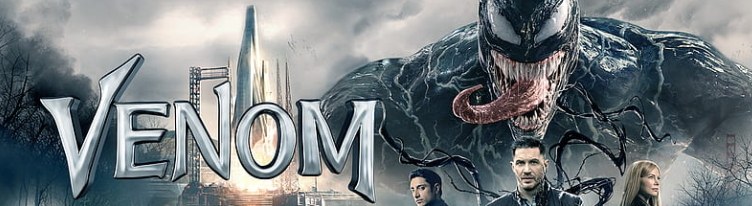
Movie Night: Venom

VenomLogo

Released: October 2018
Director: Ruben Fleischer
Distributor: Sony Pictures Releasing
Budget: $100 million
Stars: Tom Hardy, Michelle Williams, and Riz Ahmed

The Plot:
Disgraced reporter Eddie Brock (Hardy) is bonded with a psychotic symbiotic alien lifeform and becomes a superhuman anti-hero forced to choose between protecting the innocent and enacting revenge.

The Background:
A Venom spin-off had been in the works since Spider-Man 3 (Raimi, 2007), if you can believe that. Sony, once a studio capable of making good decisions and responsible for kicking off the modern superhero crazy with Sami Raimi’s first two Spider-Man movies (2002; 2004), have been determined to produce a Venom movie, even after the character was unceremoniously killed off in Spider-Man 3, and when the Amazing Spider-Man (Webb, 2012; 2014) series was ended prematurely, and now, when the rights to Spider-Man are shared with Marvel Studios. This means that, while Sony can produce spin-offs of Spider-Man characters like Venom, it doesn’t look like they can actually include Tom Holland’s version of the web-head. This has created some confusion, even amongst the two studios, with some at Sony stating that Venom exists adjacent to the Marvel Cinematic Universe and others proclaiming that it is a standalone story, and still others claiming that it’s both! Seemingly inspired by the success of R-rated, violent superheroes like Wade Wilson/Deadpool and Logan/Wolverine, Sony fast-tracked Venom and brought the production back to life, even managing to snag Tom Hardy in the process. Unfortunately, it seems that, at the last minute, someone at Sony lost their balls and, rather than a violent R-rated affair, Venom is more a watered down, studio-friendly version of the character in order to sell more tickets.
The Review:
Venom takes inspiration from three prominent arcs of the character’s self-titled series: Lethal Protector (Michelinie, 1993), Separation Anxiety (Mackie, 1994-1995), and Planet of the Symbiotes (Michelinie, 1995), whilst also taking some inspiration from the character’s origins and portrayal in the Ultimate Spider-Man (Bendis, 2000). This means that Venom is quite a talkative, violent character who isn’t necessarily interested in saving lives but is also driven to punishing only those who do wrong by others, which should result in an interesting and layered character and, instead, produces a fun, if kind of dumb, action movies that could have been really violent but was hampered by studio interference.

VenomDuality
Hardy really captures the duality of Eddie and the symbiote.

Therefore, Venom is an interesting beast; the film lives and dies by the strength and versatility of its star and Tom Hardy is brilliant as a likeable, downtrodden underdog who is trying to do what’s right but is tempted by the power offered by the symbiote to strike back at those who have wronged him. Hardy pulls double duty in this film, playing both Eddie Brock and voicing the alien symbiote, and is portrayed as a loser who screws up his life and blames others for it.

VenomDrake
Here’s an eccentric in a suit. He’s a bad guy.

Unfortunately, the same praise can’t really be said for some of Hardy’s co-stars. Carlton Drake (Ahmed) is every wacky evil corporate villain you’ve seen on film before and, while I didn’t exactly hate him or dislike his performance, I am personally just tired of seeing guys in suits being evil for no real reason. Rounding things out are Anne Weying (Williams), Eddie’s former fiancée who is serviceable enough but sure drops Eddie’s ass pretty quickly after he screws up an important interview. One person who did stand out for me was Dr. Dora Skirth (Jenny Slate), who was super cute and spunky and had a nice little character arc going on. I almost wish that Eddie had started the film with nothing and developed a romance with her rather than trying to find ways to repair his relationship with Anne as Dora had a lot more potential in her.

VenomBond
The symbiote offers Brock the power…but at a price.

Effects wise…well, Venom by its very nature requires substantial special effects and CGI to create the brain-eating anti-hero and it definitely seems like the studio put all of the money into making Venom look as good as possible and, honestly, Venom does look fantastic when he’s on screen. The problem is he’s just not on screen enough; a lot of the runtime is focused more on Eddie as a character and slowly developing his rapport with the symbiote and discovering what it can do, which is great as we really didn’t get to spend enough time with Brock (Topher Grace) in Spider-Man 3 but, as a massive fan of the character, I just wanted to see more Venom in my Venom movie. Other effects, though, are a bit hit and miss; in its non-bonded form, the symbiote is little more than writhing, liquid-like goo that honestly looked a bit dodgy. The effects used in Spider-Man 3 actually looked better and made the symbiote appear more vicious and dangerous; similarly, I wasn’t a fan of how the symbiote formed tentacles and appendages from seemingly nowhere with no ill effect on people’s clothes or skin. In the comics, the symbiote’s mimic clothing and cling and tug at skin like sticky webbing (an effect also nailed in Spider-Man 3) but none of that happens here; it’s seemingly just generated without any noticeable issues. Instead, Venom focuses on the duality between Brock and Venom, with the symbiote constantly talking and expressing itself to Eddie and threatening to devour his organs or takeover his body completely. This is a smart move, as it means we get a much more accurate version of Venom than anything seen before, but the symbiote’s motivations and behaviour is questionable at times, almost as much as those of Drake, and no amount of character work or amazing effects can change that some of those aspects are jarring and glaring flaws.

The Nitty-Gritty:
The Life Foundation obtains the symbiotes and hopes to use them to save humanity from extinction (which is kind of daft but okay, I guess); Eddie stumbles upon their plot and becomes bonded with the symbiote, which helpfully doesn’t kill him in the same way that others were killed from exposure. In an odd addition, the symbiote refers to itself as “Venom” right from the start, which is normally a name the two create to describe their union, and it is driven by hunger for living flesh and the desire to destroy humanity. However, it has a complete change of heart after being bonded to Eddie and decides to protect humankind instead because it randomly decides that it likes life on Earth. Drake, meanwhile, also bonds with another symbiote to become Riot, who wants to bring the rest of their kind to Earth to take the whole show over.

VenomLethalProtector
When he’s actually on screen, Venom looks fantastic!

A lot of fans will probably be annoyed at the decision to include Riot, who is a forgettable footnote in Venom’s character history compared to someone like Carnage, and is simply a return to the tired old formula of a villain who is exactly like the hero but eeeeevil! Riot even looks almost exactly like Venom in the right (or wrong, I guess) lighting, though he is separated by a distinct colour scheme and the ability to form different weapons. Carnage would have been a better choice by far but the neutered rating means that Sony would never have done the character justice. Cletus Kasady (Woody Harrelson) appears in a mid-credits scene, promising to unleash “carnage” when he escapes from prison, which is great as it might mean that the studio finds their balls and does a really violent sequel but it’s weird because the scene is so random and out of nowhere and so obviously put in for fan service. I would have preferred to see Brock chasing Kasady for an interview throughout the movie as his big break and stumble upon the Life Foundation’s plot that way, maybe have Cletus be a captive of theirs. But, still, if they get a sequel and if they go full on with the violence, I look forward to seeing Carnage unleashed in full the next go around.

The Summary:
Venom is loud and fun and full of potential but doesn’t exactly do anything new or even that exciting. Tom Hardy is great and Venom looks amazing, but the rest of the film kind of crumbles around them and the inclusion of Spider-Man would not have helped to stop that from happening, I love Venom and I wanted this movie to be great but, in the end, it only turned out to be just okay. Here’s hoping for an extended, bloodier cut on DVD and a more violent sequel if it makes enough green.

My Rating:

Rating: 3 out of 5.

Pretty Good

Talking Movies: Ant-Man and the Wasp

Talking Movies
Antman&WaspLogo

Marvel Studios took one of their biggest gambles in producing Ant-Man (Reed, 2015), given that the character is far more obscure than his other Marvel counterparts in the Marvel Cinematic Universe. Yet, seemingly against the odds, Ant-Man surprised by momentarily shifting the tone of the MCU away from world- or galaxy-ending threats and back down to Earth for an amusing heist adventure. Now, in the wake of the cataclysmic events of Avengers: Infinity War (The Russo Brothers, 2018), Marvel is at it again. However, while Ant-Man and the Wasp (Reed, 2018) does scale back to stakes and focus of the MCU, it also expands upon the nature and potential of the Quantum Realm, perhaps in service of future films in the franchise.

Antman&WaspCassie
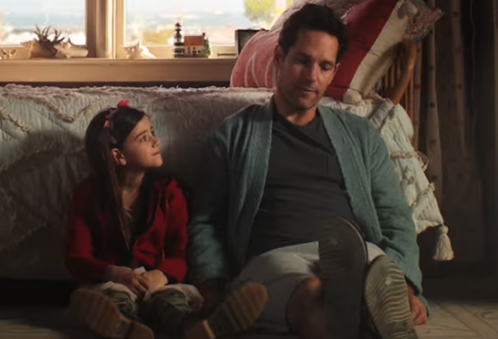
Scott has been under house arrest since Civil War.

Ant-Man and the Wasp takes place about two years after the events of Captain America: Civil War (The Russo Brothers, 2016) and sees Scott Lang (Paul Rudd) three days away from being released from house arrest after violating the Sokovia Accords. While Scott has used the time to set up a security and surveillance company with his friend Luis (Michael Peña) and bond with his daughter Cassie (Abby Ryder Fortson), he has last all contact with Hank Pym (Michael Douglas) and Hope van Dyne (Evangeline Lilly) as they were less-than-impressed with Scott’s actions and have been on the run ever since. However, when Scott has a dream/vision of his time in the Quantum Realm, he reaches out to Hank and is promptly abducted by Hope. Taken to Hank’s laboratory (which he can shrink to the size of a carry-case), Scott learns that he may hold the key to finding and rescuing Hank’s wife, Janet (Michelle Pfeiffer).

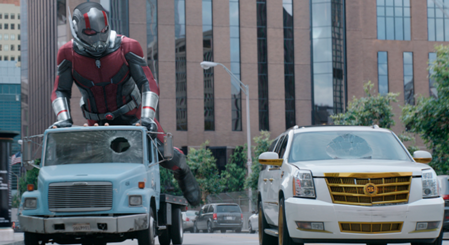
Antman&WaspCarChase.png
It’s all about the car chases this time.

Hank is reluctantly forced to coerce Scott into helping Hope acquire a vital component to their Quantum Tunnel from Sonny Burch (Walton Goggins), an act that draws the attention of the mysterious assassin Ghost (Hannah John-Kamen). Very quickly, Hank, Hope, and Scott are in a race against time to evade Burch, the FBI (led by Jimmy Woo (Randall Park)), and Ghost and complete the machine before Janet is forever lost to the Quantum Realm. I went into this thinking we would be getting a much faster paced, more action-packed story now that the origin and exploration of Ant-Man’s powers had been sufficiently delivered in Ant-Man but, surprisingly, Ant-Man and the Wasp is as much about the notion of family as it is its action. While nothing quite tops the small-scale battles on Thomas the Tank Engine railroad tracks or inside purses, there is a decent level of car-based action as Scott and Hope shrink and grow Hot Wheels cars to evade their pursuers and the fight sequences involving Ghost are pretty exciting.

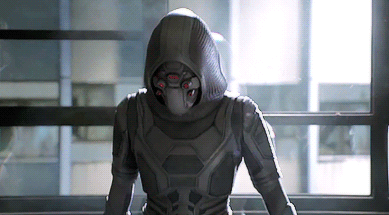
Antman&WaspGhost.png
Ghost continues Marvel’s attempts to have more layered villains.

Speaking of, rather than being a simple dark counterpart to Scott or Hank like Darren Cross (Corey Stoll) was, Ghost is a pretty unique and sympathetic character. Constantly fading in and out of reality thanks to exposure from the Quantum Realm, she blames Hank for her affliction and the death of her parents. It also helps that she’s pretty bad-ass, which helps showcase Hope’s ability to kick ass as the Wasp.

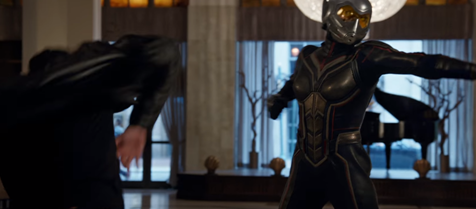
Antman&WaspHope.png
Anything Scott can do, Hope can do better.

In many ways, actually, Ant-Man and the Wasp is more about Hope than any other character; she finally receives her suit, which comes with all sorts of nifty gadgets and tech not included in Scott’s, and is clearly a far better and more effective superhero than Scott. Her passion and desire to be reunited with her mother are evident throughout but she also retains a compassion for others (mainly Scott and her father) that keeps her grounded.

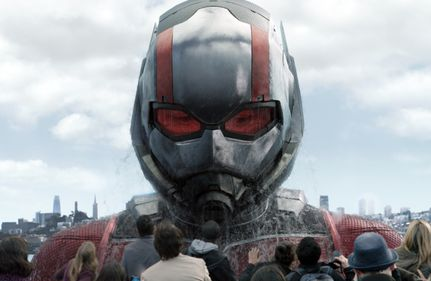
Antman&WaspGiantMan.png
Happy to see Giant-Man make a comeback.

As for Scott, he’s everything he was before, and that’s not a bad thing. Paul Rudd perfectly portrays the everyman who is swept up into things largely beyond him and his ignorance to the technobabble and subpar fighting ability are offset by his charm, wit, and ability to think on his feet. Scott is also all about making up for letting down Hank and Hope by not involving them in the airport skirmish from Civil War and, refreshingly, his daughter and family are all perfectly happy for him to continue to be Ant-Man, rather than giving him shit for his actions.

Antman&WaspFoster.png
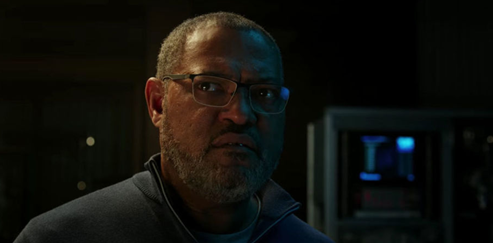
Laurence Fishburne jumps to the MCU but is Bill Foster all that he seems?

Rounding out the cast are Michael Douglas and, in a new addition, Laurence Fishburne as Bill Foster. Foster and Pym have a strained relationship after a falling out and Pym’s efforts to discredit Foster’s work, which all helps cast Hank as a man who has some demons in his past. Driven to rescue Janet, Hank will seemingly go to any lengths to atone for what he sees as his greatest failing. Once again, Marvel Studios employ some impressive de-aging effects to Douglas (and Pfeiffer) to shed more light on the Pym’s troubled past as a married couple and part-time spies. In the end, Ant-Man and the Wasp is probably about on-par with its predecessor; it isn’t necessarily worlds better but it’s by no means a step back. As before, it’s a great way to catch your breath after the exhaustive events of Infinity War and, if the mid-credits scene is anything to go by, a vital entry for future films in the MCU.

My Rating:

Rating: 3 out of 5.

Pretty Good

Recommended: Of course, and not just for MCU fans. Rudd’s charisma and the general premise make this a great recommendation for everyone.
Best moment: The triumphant return of Giant-Man and the fight sequences involving Ghost.
Worst moment: The side-plot of Scott’s damaged belt, which causes him to by stuck at different sizes, grew thin very quickly for me. It just seemed weird for Hank to create a new, presumably better suit but have the most vital component be janky.

Movie Night: Black Panther

BlackPantherLogo

Released: 16 February 2028
Director: Ryan Coogler
Distributor:
Walt Disney Studios Motion Pictures
Budget: $200 million
Stars:
Chadwick Boseman, Michael B. Jordan, Lupita Nyong’o, Danai Gurira, Letitia Wright, Winston Duke, and Martin Freeman

The Plot:
After helping to bring his father’s killer to justice, Prince T’Challa (Boseman) assumes the mantle of the Black Panther is crowned king of the hidden kingdom of Wakanda. However, his reign is challenged by his cousin, N’Jadaka/Erik Stevens (Jordan), now a brutal mercenary known as Killmonger who seeks to overthrow T’Challa and begin a global revolution using Wakanda’s advanced technology.

The Background:
Having co-created Marvel Comics’ First Family of superheroes, the Fantastic Four, Stan Lee and Jack Kirby introduced a number of additional characters and concepts in the pages of the foursome’s adventures, with T’Challa/The Black Panther being one of the most prominent since he was the first black superpowered character in comic books. The Black Panther went on to feature in a critically acclaimed series, join the Avengers, and featured in a number of pivotal Marvel events and politically charged storylines. The Black Panther also saw some exposure outside of the comic books, featuring in the 1994 Fantastic Four cartoon and his own Marvel Knights motion comic series, but a live-action adaptation had been in the works since 1992. Back then Wesley Snipes was attached to the role and became heavily involved with the project, which repeatedly stalled throughout the nineties and failed to get off the ground into the early 2000s. Snipes was forced to bow out of the film by 2010 due to his conviction for tax evasion and, ironically, the very next year Marvel Studios head honcho Kevin Feige pushed the movie into production, though it would be some six years before the film would properly take shape. Chadwick Boseman won the title role after outlining his plans for the character, making his debut in Captain America: Civil War (Russo and Russo, 2016), though the world was shocked and saddened to learn of his death some years later and that he had been battling cancer throughout his MCU tenure. Director Ryan Coogler aimed to make Black Panther a personal, progressive showcase of a sovereign nation that put the spotlight squarely on African-American actors and important messages of racial equality. Accordingly, the production design, sets, and costumes pulled from a variety of cultural influences from Sub-Saharan Africa to mix the traditional with a wash of science-fiction, with this latter aspect being the realm of the numerous visual effects studios employ to bring Wakanda to life. Black Panther proved a massive financial success; it grossed nearly $1.350 billion worldwide and was universally lauded by critics. Reviews praised the film’s refreshing presentation, the performances, and the sheer visual spectacle but, more than anything, Black Panther was praised for tackling themes of racial oppression and depictions. Following Boseman’s untimely death, Feige announced that the role wouldn’t be recast and that Black Panther’s sequel would move the concept into a different direction to ensure a lasting legacy for the beloved performer.

The Review:
One of the things I love about the MCU is the way they’ve always strived to not be completely dependent on the same characters over and over; while Warner Brothers struggle to utilise any DC Comics characters that aren’t Bruce Wayne/Batman or Clark Kent/Superman, Marvel Studios have been seeding, introducing, or debuting new characters and superhero icons all throughout the MCU to help keep things fresh, expand and enhance their interconnected cinematic universe, and lay the foundation for future crossovers. This has also helped to keep the MCU diverse and dabble in portraying different cultures and types of characters, despite what some naysayers will say about the narrative tone most MCU films take. It’s not surprise, then, that Black Panther proved to be quite a monumental release; we’d seen black superheroes before, of course, most famously Eric Brooks/Blade (Wesley Snipes), but never before had a super film gone so in-depth at portraying an African society, tackling the issues of slavery and oppression felt by the Black community everywhere, or in establishing a fictional African-American culture as one of the most formidable forces in superhero cinema. It can be tough to rewatch Black Panther knowing not only that Chadwick Boseman was battling cancer throughout it but also that he has since passed on; I might not be the most knowledgeable Black Panther fan out there, but his performance really inspired me to want to read more Black Panther stories to explore the character.

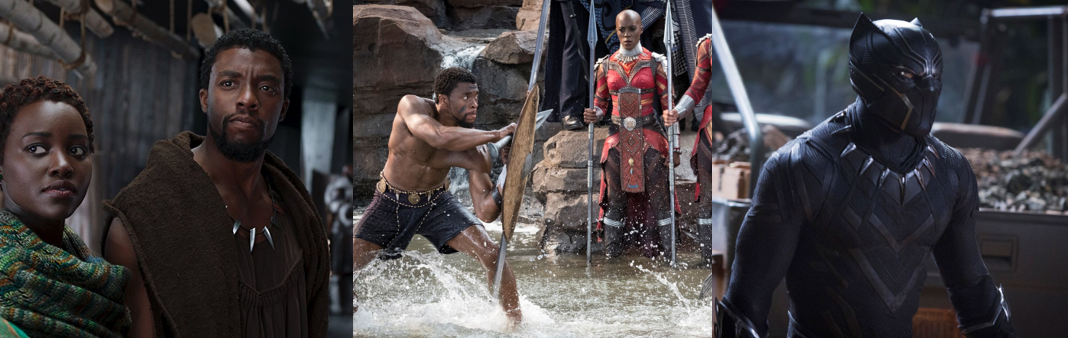
Afforded superhuman abilities as the Black Panther, T’Challa must now step into the role of king.

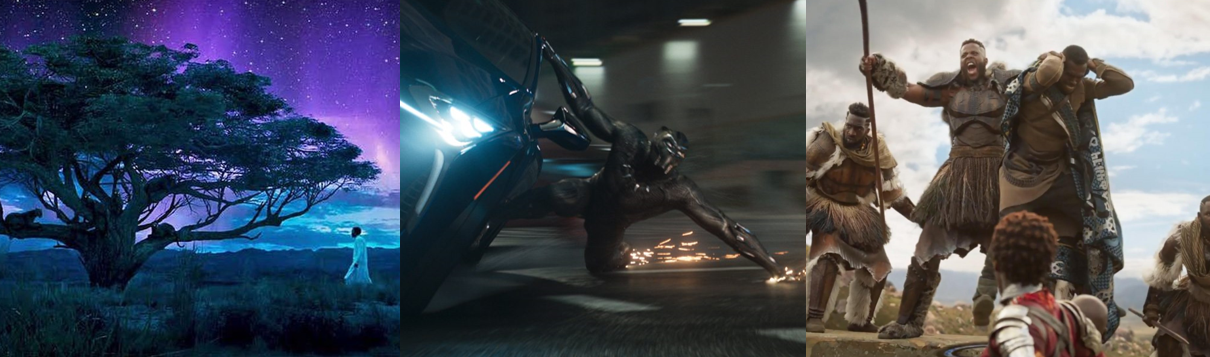
My knowledge and experience of the Black Panther isn’t as learned as with other superheroes but he’s definitely been on my radar over the years, often popping up in Marvel cartoons and crossovers I’ve watched and read. Still, my expectations were simply to have a good time with the film and learn a little more about T’Challa as a character; in Civil War, T’Challa was a soft-spoken, honourable, and fiercely loyal man driven to vengeance after his father, King T’Chaka (John Kani) was killed. His arc was about realising that revenge is all-consuming and that there’s a better, more purposeful path he (and anyone, for that matter) can take, even if it means allowing reprehensible villains to live so they can be brought to justice for their actions. In Black Panther, T’Challa’s focus shifts towards the burden of the crown; not only must he stand as Wakanda’s greatest warrior and protector but he must also assume the role of a leader to his hidden nation, one he accepts out of a strong sense of duty and fiercely fights to earn by defeating challenger to the throne and tribal rival M’Baku (Duke) in ritual combat. T’Challa has an easy coolness to him that makes him warm and relatable; he can easily shift from a more light-hearted demeanour to being a warrior and a king and he’s afforded a great sense of vulnerability from the revelations he learns in this film, his feelings for Nakia (Nyong’o), and the times when he’s forced to fight without his powers. Thanks to a mysterious heart-shaped herb, T’Challa is granted superhuman strength and reflexes; these, along with his highly advance Vibranium suit, allow him to defend his nation as the Black Panther, but he’s forced by tradition to have his powers removed by Wakandan shaman Zuri (Forest Whitaker) in order to prove his right to the throne through his natural guile and abilities. luckily, T’Challa is more than up to the challenge and is equally determined to maintain the pretence that Wakanda is a struggling Third World nation in order to keep the wider world from learning of their Vibranium and the true extent of their advanced technology. Ruling not through force or oppression, T’Challa has an extremely relaxed and approachable demeanour; he goofs around with his tech-savvy and enthusiastic younger sister, Shuri (Wright), and makes efforts to extend the hand of peace to all of Wakanda’s nations despite M’Baku’s desires for the throne. However, he’s reluctant to open Wakanda’s borders and share their technology and resources with the world given that, in the past, outsiders have sought only to take the Vibranium for themselves, by force more often than not, and use it for nefarious ends.

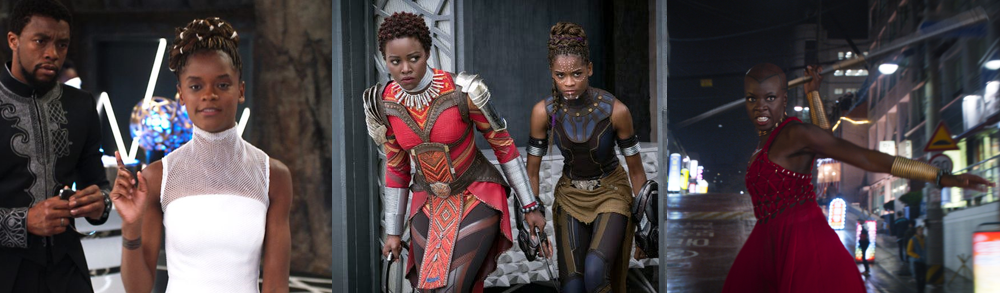
T’Challa is surrounded by strong, loyal, and very capable allies, most of whom are female.

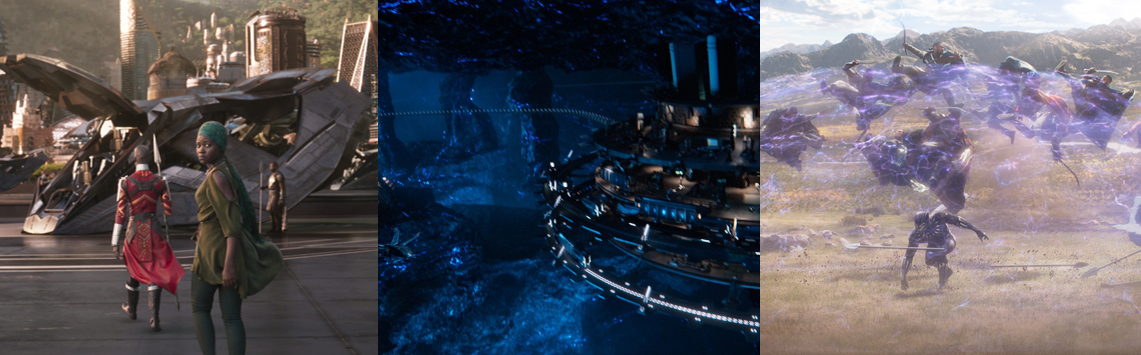
This is a view not readily shared with Nakia, T’Challa’s former flame and a “War Dog” from Wakanda’s River Tribe; at the start of the film, Nakia is out in the world fighting to help those less fortunate. Her time in the outside world as one of many undercover Wakandan agents brings her a deeper knowledge of the suffering and neglect that is happening all over the globe, especially to those in Third World nations, and she actively encourages T’Challa to set aside tradition and share Wakanda’s resources and advances with those in need. Others within T’Challa’s close-knit circle aren’t as open to this idea, however; his mother, Ramonda (Angela Bassett), and Zuri are both deeply entrenched in the centauries-old traditions of their nation, though only Zuri has witnessed first-hand the lengths Wakanda will go to to keep their true nature a secret. T’Challa’s loyal bodyguard and commander of Wakanda’s formidable Dora Milaje forces, Okoye (Gurira), is quite blunt in her stoic distrust and dismissal of “outlanders”. Although his most trusted lieutenant, she’s duty-bound to accept Killmonger as her king when he assumes the throne but her loyalty to T’Challa sees her, Shuri, Ramona, and Nakia forming something of a rebellion against Killmonger’s tainted rule. Shuri, who may very well rival Tony Stark/Iron Man (Robert Downey Jr.) in terms of scientific acumen and arrogance, relishes the opportunity to aid Everett Ross (Freeman), the Central Intelligence Agency (CIA) liaison to Wakanda, after he’s injured and in using her advanced technology to help break James Buchanan “Bucky” Barnes’ (Sebastian Stan) brainwashing from his days as the Winter Soldier. An energetic and somewhat rebellious young girl, Shuri is far more comfortable in street wear, mocking Wakanda’s traditions, and tinkering in her lab; Shuri outfits T’Challa with his gear, including a fancy brand-new fancy Black Panther suit comprised of Vibranium nanotechnology and capable of absorbing and distributing kinetic impact. She’s also able to use hologram technology to remotely drive a Lexus from their lab and, later, even contributes to the final battle against Killmonger and his fellow extremists to safeguard her nation, proving she’s a patriot at heart.

Allied with Klaue, Killmonger is one of the MCU’s most driven and relatable villains.

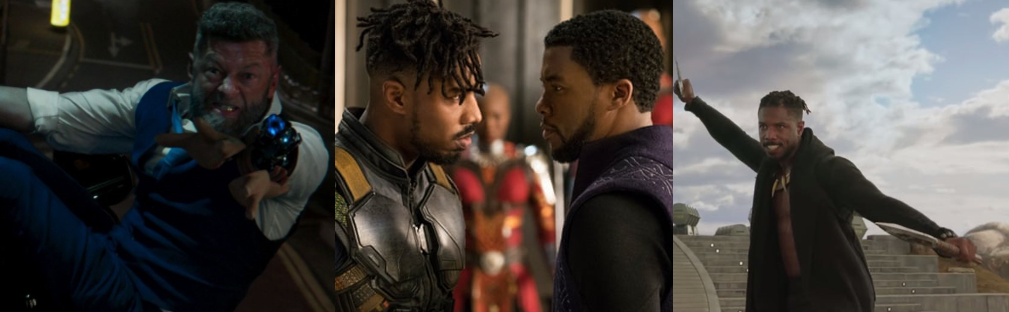
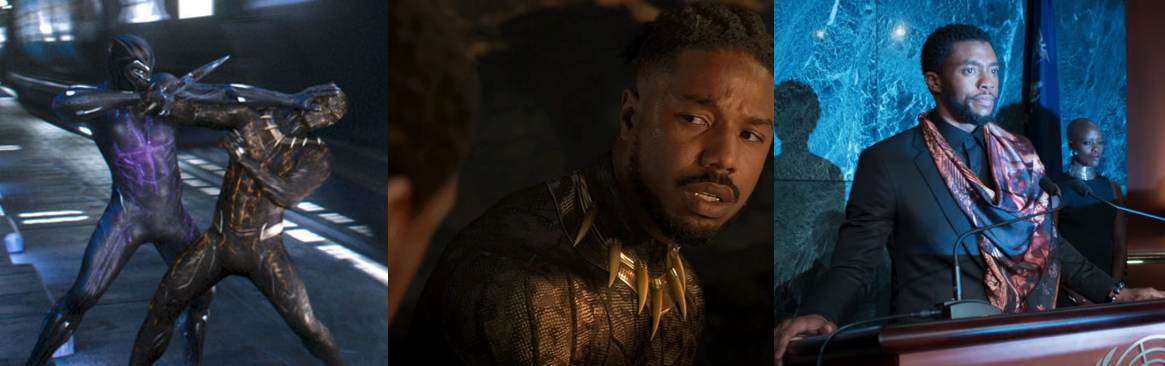
Eccentric South African arms dealer Ulysses Klaue (Andy Serkis), now sporting a plasma cannon hidden in a fake arm after his encounter with Ultron (James Spader), returns, now allied with Killmonger, a mercenary with a thing for anime whose entire torso is covered in self-inflicted tribal scars that showcase his bloodthirsty nature. A patient, learned, and driven individual, Killmonger is actually T’Challa’s cousin, N’Jadaka, who was abandoned decades ago after T’Chaka was forced to kill his own brother, N’Jobu (Sterling K. Brown), after stealing Vibranium alongside Klaue to give power back to oppressed Black people. Just as T’Challa continues to honour his father’s ways, so too does Killmonger seek to use his claim to the throne to acquire the technology and weapons needed to give Black people a fighting chance for the first time. T’Challa is devastated to learn that his father’s ways caused him to grow up without his cousin, and twisted Killmonger into a figure of hatred and radical action, ad his reign as king is tested when Killmonger betrays and kills Klaue and bursts into the Wakandan throne room to challenge his cousin. T’Challa’s reluctance to pursue and kill Klaue, and his alliance with White outsiders, causes some friction between him and his closest friend and ally, W’Kabi (Daniel Kaluuya), who readily accepts Killmonger and backs him as king for his more forthright demeanour. Killmonger’s prowess is enough to not just best T’Challa but also to seemingly kill him; he then sets about destroying the heart-shaped herb to cement his legacy as the one and only king of Wakanda and orders arming the thousands of Wakandan spies across the world so that repressed Black people everywhere finally have the means to seize power for themselves. Michael B. Jordan is a real standout here, and Killmonger represented a turning point for MCU villains; while, yes, he does end up donning his own Black Panther costume (more of a Golden Leopard) and he does disappear for a large chunk of the movie, Klaue more than fills the void as a side villain, and the justifiable chip on his shoulder from the oppression of his people and his separation from Wakanda due to the actions of T’Chaka makes his motivations not only believable and relatable, but deeply personal not just for T’Challa but for oppressed minorities everywhere.

The Nitty-Gritty:
As soon as Black Panther begins, you can tell that this is a very different film to the usual MCU offerings. In the build up to Avengers: Infinity War (Russo Brothers, 2018), Marvel Studios definitely doubled down on world-building, character pieces, and smaller scale films with far reaching potential in recent years. However, Black Panther doesn’t just separate itself through a highly advanced society built purely around the marriage of technology and tradition, but also by tackling the subject of race of oppression in our society, making it an extremely relevant and politically-charged film. Now, I’m just a regular, run-of-the-mill White guy, so Black Panther’s appeal and messages hit a little differently for me; I remember the first time I saw it and thinking how I maybe wasn’t the target demographic since its running theme of the oppression of ethnic minorities hasn’t affected me as it would, say, the Black community. It’s not my place to comment on this strife as I haven’t had to experience it but it’s telling that Killmonger is widely regarded as one of the best and most well-rounded MCU villains. In truth, he’s more like an anti-hero, a dark opposite to T’Challa who is just as loyal and dedicated to his people and his cause but in a way skewed more towards a violent uprising. And, honestly, why not? His people (“brothers and sisters”, as he calls them) have suffered atrocities for generations; his personal vendetta against Wakanda for abandoning home and, in his mind, selfishly hoarding their technology perfectly aligns with a very understandable need to strike back at a world that has shown nothing but contempt for “minority” races. In another life, it’s entirely possible that Killmonger could’ve been a force for good and positive change within Wakanda, and T’Challa even has a respect and sympathy for what’s he’s been through, his suffering and his cause, but Killmonger would rather die free as a martyr than even consider being a prisoner.

A mixture of technology, tradition, and warrior spirit make Wakanda a prosperous nation.

The main thrust of the film is to set up Wakanda ahead of Infinity War and you really get a good sense of their society, one built on tradition and respect as much as the technological wonders afforded by their massive stockpile of Vibranium. Wakanda’s true nature is a secret to all; not even Everett Ross is aware of his advanced they are thanks to a protective, holographic shield around the mainland and a major plot point throughout the film is the lengths Wakanda’s royal family have gone to to maintain their secrecy out of fear of their Vibranium being misused. This is at the centre of both T’Challa and Killmonger’s stories and shapes both of their perspectives throughout; T’Challa comes to realise that Wakanda needs to change and put their resources to good use and Killmonger has no hesitation about perverting those same resources to incite an all-out revolution. While so much of Wakanda is rooted in tribal rituals, from their structures to their traditions and their attire, the nation is bolstered by highly advanced technology that more than rivals Stark’s. Black Panther utilises a suit of almost magical nanotechnology, one that forms over his entire body at his convenience and makes him functionally invincible since it can absorb and unleash kinetic energy. Wakanda’s tech is so advanced that they’re entirely self-sufficient, Shuri can create energy-based weapons in gauntlets and shields and such, and they’re able to heal critically wounded people with ease, to say nothing of their futuristic craft that boast cloaking technology, electromagnetic pulse devices, and fly at incredible speeds. Although Wakanda is a largely peaceful and united nation, there are ripples in the water; W’Kabi is suspicious of T’Challa’s dealings with the outside world and T’Challa’s rule is challenged by M’Baku, whose animalistic and antagonistic Jabari tribe has distanced themselves from the luxuries enjoyed by mainstream Wakandan society. Though noticeably different from his comic book counterpart, Man-Ape, M’Baku is a fantastic addition to the film; he and his tribe have little interest in helping those who they feel look down on them. M’Baku’s proud nature and disapproval of T’Challa’s reign resulted in some powerful moments, such as him dismissing Everett Ross and even restoring T’Challa to life and power despite their rivalry. While he initially has no interest in helping T’Challa further than that, M’Baku is a man of honour who recognies Killmonger’s threat, leading to an unlikely and enjoyable alliance between the Jabari and the Dora Milaje after Okoye finally chooses loyalty to T’Challa over loyalty to the throne.

T’Challa’s gifts and the ways of his people afford him both great strength and conviction.

While traditions and technology are very much at the forefront of Wakanda, Black Panther is also rooted in spirituality; not quite the cosmic or more tradition magic seen in the MCU before, this spirituality is more supernatural and natural, imbuing the heart-shaped herb with properties that bestow superhuman abilities and allowing T’Challa to converse with his father’s spirt on the Ancestral Plane. We’ve seen since how the MCU has really taken the concept of multiple Gods and afterlives and really ran with it, but it all started here, in a kind of meditative wrapping that showed a deep connection to oneself and the lineage that had come before. This spirituality and belief in ages-old traditions is tested when Killmonger reveals T’Chaka’s shady past, but still heavily informs T’Challa’s character; he loves his homeland and will do anything to protect it, whether that’s shielding it from thieves like Klaue or opening Wakanda’s borders to provide aid to the oppressed. This spirituality also informs many of the film’s fight scenes; there’s a serene grace to the Black Panther, who moves with a deft agility that makes him an extremely effective combatant even without his costume. Okoye and the Dora Milaje favour more traditional weapons, but ones augmented by Shuri’s tech; in Wakandan hands, spears and shields before advanced weapons requiring years of training and physical skill to wield as their form and function is rooted in traditional tribal weaponry. They also have futuristic vehicles and energy-based weapons, which allow even the likes of Shuri to hold their own in battle and allow Black Panther to have a unique visual flair to its action and fight scenes. Even when undercover in a casino in Busan, the film separates itself from its MCU predecessors by first infusing a James Bond influence and then showcasing Okoye’s swift and brutal spear-play. Klaue might not pose the physical threat that Killmonger represents but his despicable nature, cruelty, and unsettling artificial arm cannon make him a reasonable secondary threat; he’s mainly there as a loose end and a means to an end to grant Killmonger entry into Wakanda but still manages to cause T’Challa trouble during an incredible car chase through Busan. Twisted by Killmonger’s influence, W’Kabi defends his new king’s designs for Wakanda, even to the point of clashing not just with the Dora Milaje but with his own wife, Okoye, allowing Black Panther to conclude with a suitably dramatic large-scale conflict that even sees Everett Ross put his life on the line to stop Killmonger from taking Vibranium weapons out of the country.

Despite some dodgy CGI, the film’s ending hits hard and changes Wakanda’s ways forever.

Forshadowing the large-scale battles we’d see in the next two Avengers movies, Black Panther ends with two big action set pieces: one pitting those loyal to T’Challa against Killmonger’s fanatics (including armour-clad rhinos and Vibranium weapons galore) and another, far more personal fight between the two would-be kings. As impress as all these sequences are, however, it can’t be denied that the CGI falters somewhat here; Black Panther and Killmonger don ridiculously similar costumes and their fight is largely realised through rubbery CGI characters against the dark and overly visually complex Vibranium mines. While I get the idea of Killmonger wanting to take T’Challa’s place (literally and figuratively) and claim his mantle, I think his default appearance was suitable enough and it would’ve been better to lean into that for his “costume” so that they could be more easily distinguishable. Still, if you can overlook that, their final clash is quite the intense affair; with Killmonger threatening to pervert everything Wakanda stands for, and having already proven himself T’Challa’s equal and better without the benefits of superhuman powers or technology, this is as much a clash of ideals as it is fists. In the end, T’Challa’s greater experience with Wakanda proves to be the difference maker as Shuri’s able to disrupt both of their suits to put them on equal ground and allow T’Challa to outmanoeuvre Killmonger and deliver a mortal wound. Sharing his own experiences with revenge and sympathetic to his cousin’s plight, T’Challa offers mercy but Killmonger refuses, opting to witness his first Wakandan sunset and die peacefully rather than be incarcerated. T’Challa takes the whole experience to heart, however, and works to make amends for Killmonger’s cause and harsh upbringing; he establishes and outreach centre in the United States and reveals Wakanda’s true nature to the world at the United Nations with the promise of sharing their resources with those in need. To exemplify just how beneficial Wakanda can be to even the most tortured individual, a post-credits scene shows Bucky (affectionately referred to as the “White Wolf”) being gifted a new Vibranium arm, now firmly on the road to recovery. It’s a bittersweet ending knowing that we’ll never get to see Chadwick reprise his most iconic role, and considering all the hardship Killmonger and others like him have had to endure over the generations, but one that sends a message of hope and positive change for all repressed peoples.

The Summary:
We’d seen a lot from the MCU when Black Panther came out and were on the cusp of some ground-breaking and game-changing events, and yet it still managed to make one hell of an impression. At the base level, it’s a beautiful film to look at and really captures the allure and mysticism of Africa; Wakanda is such a unique place, like a slice of cosmic, futuristic utopia amidst the wrappings of nature and centuries-old tradition, marrying tried-and-tested ways and beliefs with highly advanced technology. T’Challa is no slouch either, being an affable and alluring hero who it’s easy to root for; he’s gifted great power and capable of great things, but remains loyal and true to himself, never cracking under the burden of responsibility to backing down from a challenge, while still remaining level-headed enough to use diplomacy wherever possible. Naturally, a standout was Killmonger, probably the MCU’s most complex villain yet; his commentary on the oppression of ethnic minorities remains sadly all-too relevant even in modern society and he’s easily the most interesting and multi-faceted of Marvel’s dark doppelgängers. Ultimately, Black Panther is a very different superhero film, one that is as much about world building and politics as it is about kick-ass action sequences and spectacular special effects and sets. T’Challa, who has evolved from a revenge-obsessed renegade into a self-assured, prideful leader of a nation, was a welcome addition to the MCU and had such potential as a worthy leader of the Avengers. The final act of the film is maybe a little rushed, with perhaps two or three too many plot lines being mashed into the narrative, but it never feels like the pacing is off. The goes to great lengths to set Black Panther up as a diplomat who is not against suiting up and fighting against injustice when it rears its ugly head, but also to establish Wakanda and its people as a force to be reckoned with going forward no matter who assumes the Black Panther’s mantle.

My Rating:

Rating: 4 out of 5.

Great Stuff

Did you enjoy Black Panther? How do you think it holds up compared to other MCU films and as an adaptation of the character? What did you think to the film’s visual presentation and fight scenes? How did the depiction of racial oppression affect you, if at all? Where would you rank Killmonger amongst the hierarchy of MCU villains? Who would you like to see become the new Black Panther? Whatever you think about Black Panther, feel free to share your thoughts and memories of Chadwick Boseman in the comments below or on my social media.

Talking Movies: Marvel Studios’ X-Men

Talking Movies
X-Men Logo

It may seem difficult to believe but there was once a time when Marvel Comics were in a bit of a bind. On top of having lost some of their top talent in the early nineties, a slump in the comic book industry forced Marvel to file for bankruptcy in 1996. Although they avoided going out of business completely (largely due to being purchased by Toy Biz) and launched all new Marvel titles, like the Marvel Knights imprint, the comics industry wasn’t what it once was and, in an effort to diversify and reap greater rewards from their vast library of characters, Marvel began selling the film rights to their properties to film studios. 20th Century Fox purchased the film rights in 1994 and, after a tumultuous development period that saw various scripts and ideas rejected, released X-Men in 2000. Directed by Bryan Singer, X-Men catapulted the titular Mutant team to mainstream success, kicking off one of Fox’s most successful and longest-running franchises. With ten films released over the last seventeen years, the X-Men franchise became such a success that it seemed like Marvel would never be able to regain the rights to their characters in the same way they had with Daredevil and Doctor Strange. Even after the unprecedented deal was stuck between Marvel Studios and Sony Pictures to allow Spider-Man to finally feature in the Marvel Cinematic Universe (MCU), it seemed like Mutants would forever be apart from the most successful cinematic universe ever conceived.

Despite their flaws, you cannot fault the success of Fox’s X-Men films.

Enter the House of Mouse. In 2009, a time when Marvel Studios had already established itself as an unquestionably successful movie-making juggernaut, Disney stepped in and acquired Marvel Entertainment, which included both the comics and the films. Backed by Disney’s already vast media conglomerate, Marvel was able to bypass the entire issue of working out some sort of deal with 20th Century Fox when, in December 2017, Disney simply acquired the film studio’s parent company, 21st Century Fox, and thus opened the door for the X-Men to become part of the MCU. There’s a pretty large problem with this, though. Having been going strong since the release of Iron Man (Favreau, 2008), the MCU has established an entire world and history that is entirely independent of that seen in the X-Men film series. Unlike characters like the Fantastic Four (also (and, for me, more excitingly) acquired in the Disney/Fox deal), integrating the X-Men into the MCU is far from a simple premise.

Coulson
If Coulson says there’s no Mutants then he must be right…right?

For starters, it seems like it would be impossible to simply say that the X-Men films have occurred within the MCU; not only has there never been any mention of the world-changing events depicted in films like X-Men: First Class (Singer, 2011) but Mutants seemingly do not exist within the MCU at all. Instead, we have what are referred to as “Gifted” individuals, who are born with superpowers, or “Enhanced” individuals who are bestowed superpowers by some outside force. I know that the MCU doesn’t really acknowledge or cross over with their television properties, but there was also a line in an episode of Marvel’s Agents of S.H.I.E.L.D. (Various, 2013 to present) in which Agent Coulson (Clark Gregg) specifically states that there has never been a legitimate clairvoyant ever discovered which, at the time, seemed like a pretty blatant dig at Fox’s X-Men films.

Rewriting history just seems a bit…lazy, surely?

Plus, you know, there’s the fact that Quicksilver has appeared in both the MCU and the X-Me­n franchises thanks to some decidedly odd small print in the rights for the character during the initial deal. Considering the universe-changing implications of Thanos (Josh Brolin) unifying the six Infinity Stones in the upcoming Avengers: Infinity War (Russo Brothers, 2018), it seems like the two movie universes colliding and merging is a very real possibility at this point. However, I feel like this would be needlessly complicated. Honestly, the purchase of Fox by Disney couldn’t have come at a worse time; X-Men: Dark Phoenix (Kinberg, 2018), Deadpool 2 (Leitch, 2018), and The New Mutants (Boone, 2019) are all due to be released very soon; Legion (Various, 2017 to present) and The Gifted (ibid, 2017 to present) are both still running on television (though they have very little to do with each other or the X-Men films); not to mention the five or six other X-Men spin-offs apparently in the works. On top of that, for all their flaws, Singer’s would-be-prequel series of films (and the previous movies in the franchise) feature some of the best casting choices for popular X-Men characters.

Like it or not, we may need a new Wolverine.

Hugh Jackman recently retired from the role of Wolverine/Logan (although part of me always suspected he was retiring from playing the role full-time and would be open for cameos and short scenes, especially if offered enough cash) but has previously voiced his desire to team up with the Avengers. Michael Fassbender and James McAvoy are both great actors that are still young and virile enough to believably portray middle-aged versions of Professor X and Magneto, and other actors, like the delectable Sophie Turner and Evan Peters, are hot young fits for playing younger versions of Jean Grey and Quicksilver, respectively. To be clear, I’m not really writing this to list a bunch of fanboy recasting but, to me, it seems like the best and simplest course of action would be to allow X-Men: Dark Phoenix to conclude the original X-Men films and retool Deadpool 3 and The New Mutants to retroactively fit into the larger MCU. After all, they sneakily snuck a S.H.I.E.L.D. Helicarrier into Deadpool (Miller, 2016) and the very nature of Deadpool’s (Ryan Reynolds) metahumour allows for him to more easily slide into the MCU with wry commentary. I would then begin to lay the seeds of the X-Men and Mutantkind being revealed within the MCU over the rest of Marvel’s 2018 film releases but not launch a new movie until 2019 and 2020.

Uncanny X-Men
Let’s kick things off with a new title, shall we?

First things first, Marvel’s X-Men movie needs to separate itself from Fox’s series and the best way to do this is by expanding the title in a classic and timeless way, so I would encourage The Uncanny X-Men as the title of the first movie. Next, I would suggest that Mutants have always been a part of the MCU but Professor Xavier has used his incredible psychic powers to block their presence from the world. Some have suggested that Quicksilver (Aaron Taylor-Johnson) and Wanda Maximoff/Scarlet Witch (Elizabeth Olson) should retroactively be reclassified as Mutants and I am open to that; perhaps, after the fallout of Infinity War, the presence of Mutants and Wanda’s true heritage is revealed and Wanda could be our window into the world of Mutants as she seeks to discover her true origins.

Professor X
How awesome would Mark Strong or Colin Salmon be as Xavier?

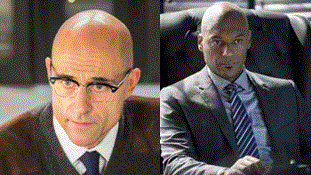
The main idea I had in mind, though, was to take inspiration from Spider-Man: Homecoming (Watts, 2017) and, more specifically (as much as I hate to say it), the Harry Potter film series (Various, 2001 to 2011) and depict the X-Men as being young teenagers at Xavier’s school. Their presence shielded from the outside world by Xavier, the film would be a fantasy adventure following the classic five X-Men (Cyclops, Jean, Iceman, Beast, and Angel) as they learn to deal with their powers, their longing to join the outside world, and their teen angst and issues. I have no real suggestions for casting of the X-Men or the kids but, as much as I like McAvoy and Fassbender, I wouldn’t mind seeing someone like Mark Strong or even Colin Salmon as Charles Xavier. Both are old enough to bring some longevity to the role and can play the wise, overly protective mentor to perfection.

Magneto
And who better than Bean or Brosnan for Magneto?

I see Magneto filling a role very similar to Snape (Alan Rickman); he’d be Xavier’s confidante and closest friend, running the school alongside him, but their attitudes and ideologies would be as different as we’ve come to expect from the characters. I’d like to see them clash over the presence of superheroes and the threat it poses to Mutantkind and have Magento slowly, over the course of the film, plan to splinter away from Xavier’s teachings with five of his own students (Toad, the Blob, Mystique, Avalanche, and Pyro), who would all be bullies towards, or otherwise compliment and contrast with, the protagonists. As far as casting Magneto, maybe get Sean Bean or Pierce Brosnan in because these guys need to be in a major superhero role sometime soon. Also, I would rather they didn’t make Magneto a Holocaust survivor since I find it increasingly difficult to believe that age and time wouldn’t have already killed him. Instead, have his father or grandfather have been the one to suffer during the Holocaust and have him carry those teachings but not have witnessed them first-hand.

Sinister
Mr. Sinister is a must and it’d be quite the coup to get Liam Neeson in to play him!

Okay, so let’s talk villains. I don’t really want to see a repetition of what we’ve already gotten; ideally, I’d like to see Magneto slowly rise into a villainous role over the course of the film and not become a full-blown Mutant extremist until the second or even third X-Men movie, after which he can transition into an MCU-level threat like Loki (Tom Hiddleston) did. At the same time, I would love to see Apocalypse be the ultimate threat for the X-Men but it’s possibly too soon after the character’s lacklustre portrayal in X-Men: Apocalypse (Singer, 2016), so let’s buy him some time and bring in someone we’ve never seen before: Mister Sinister. Sinister, perhaps accompanied by the Hellfire Club, should play a similar role to Sebastian Shaw (Kevin Bacon) in X-Men: First Class in that he is a publically-known Mutant extremist who is aggressively striking against humanity. His radical methods only fuel Magneto’s own desires for Mutant supremacy and he could use his telepathic abilities to infiltrate Xavier’s school and help turn some of them to his way of thinking. Indeed, I would suggest that Xavier doesn’t want his students to ever go out into the world as superheroes and actively discourages such thinking, meaning that Cyclops and the others would recognise or uncover Sinister’s plot and rebel against their mentor, suiting up as X-Men to combat Sinister and his minions and, through their actions, announce the presence of heroic Mutants to the world and begrudgingly change Xavier’s mind. I would’ve loved to see a quirky actor like Jeff Goldblum in the role but, seeing as he already portrayed the Grandmaster, maybe Marvel should try and rope in Liam Neeson for the role?

Sentinels
Stark Industries’ Sentinel Program in full force?

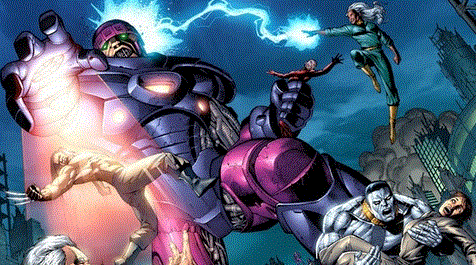
I know what you’re thinking, though, “what about Wolverine?” and you’re right, Wolverine should have a place in Marvel’s X-Men movies but not until the sequel. I would take inspiration from the All-New, All-Different X-Men story from 1975 and have Sinister take his revenge by having his newest henchmen (Wolverine, Gambit, Rogue, Psycloke, and Sabretooth) kidnap Iceman, Beast, Angel, and Jean Grey and disable Xavier in such a way that Magneto is forced to spearhead an aggressive recruitment drive that adds Colossus, Storm, Nightcrawler, and Banshee (or Shadowcat) to the team. In addition to having to whip the rookies into shape and struggle with being a leader, Cyclops would continue to face in-school opposition from Magneto’s Brotherhood after Magneto goes a bit Dolores Umbridge (Imelda Staunton) on the school to enforce his world view. In the midst of their attempt to rescue their team mates, the X-Men would discover that Sinister is using genetic engineering and science to boost his powers, thereby bringing his new acolytes under his control. The X-Men would free them in their rescue attempt, leading to Wolverine and Sabretooth realising they’re hated rivals and the X-Men’s ranks being bolstered by rescuing Sinister’s prisoners. I have no idea who to cast as the new Wolverine but I would also prefer him not to officially join the team or attend the school; instead, Wolverine should wander the MCU so he can fight the Hulk (Mark Ruffalo) and Sabretooth, and maybe get a solo movie where go goes up against Omega Red and/or teams up with Deadpool.

Costumes
Marvel should use this opportunity to do the X-Men’s outfits justice.

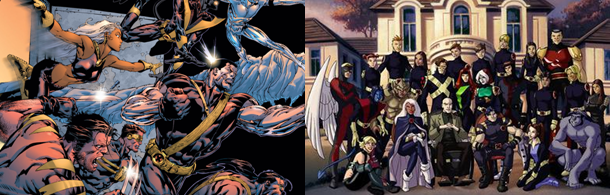
After the events of the second movie make it clear that Magneto’s intentions are far from noble, he would be a full-blown villain for the third X-Men movie, leading his Brotherhood and actively opposing the X-Men. The MCU’s opinion of Mutants as a race to be feared and hated would be directly attributed to the actions of Sinister (whom Magneto should kill in a display of power to take his place as the X-Men’s primary threat) and Magneto, which would result in the Sentinels (which could be derived from Stark technology) being deployed to end the Mutant threat once and for all. A climactic battle between the X-Men, Brotherhood, and Sentinels could result in Jean transforming into Phoenix to end the conflict and the X-Men relocating to Genosha. Or, given the involvement of Sinister in this hypothetical new trilogy, Magneto could be bumped to the primary threat in the second movie and the third would involve Apocalypse’s resurrection. As for the X-Men’s costumes, I would take inspiration from Ultimate X-Men and the X-Men: Evolution (2000 to 2003) animated series (fitting considering that Evolution was very school-based, just as I’d like to see these new films be) to produce outfits that are functional and realistic but also with that comic book tint that the MCU is known for in their outfits.

It’s not an ideal situation as it’s a shame to have to completely recast all of the X-Men characters but it’s surely easier and simpler than attempting to use time travel or the Infinity Stones to rewrite history and integrate the existing X-Men films into the MCU. Integrating the Fantastic Four is so much easier; you just have them return from being lost in the Negative Zone for, like, twenty years or something but the X-Men are so vast and the implications of their presence so game-changing that it would be difficult and, frankly, a little insulting to either just wedge them into existing continuity or debut Mutants as a new thing kicked off from the Infinity War fallout. But to say that Mutants have always existed but their presence has been hidden by Xavier and the government (Weapon X, for example) and are now being exposed? That seems a much more fitting way to recast and reboot the X-Men franchise. The only real issue is that Disney obviously spent a lot of money acquired Fox so will they be able to wait to capitalise on that purchase? Can they afford to take their time and introduce the X-Men in a smart and logical way or will they be forced to swamp the MCU with X-Men and Wolverine movies in order to profit from the purchase? Time will tell but, until then, I’ll continue to live out my Colin Salmon vs. Pierce Brosnan fancasting.

Talking Movies: Thor: Ragnarok

Talking Movies
ThorRagnarok

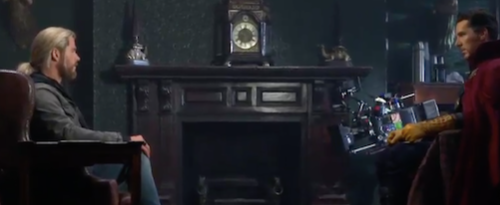
Not content with redefining the superhero genre of movies, the latest effort from Marvel Studios has also redefined the word “psychedelic”. Apparently, the last solo effort to feature everyone’s favourite, muscle-bound God of Thunder (Chris Hemsworth), Thor: The Dark World (Taylor, 2013), did not meet the expectations of many fans and critics out there; it’s easily among the top three less-than-stellar offerings from the Marvel Cinematic Universe (though, personally, I enjoyed it quite a lot). So, in an effort to rectify this, continue the expansion of their cinematic universe, and finally allow the Hulk (Mark Ruffalo) some time to shine, director Taika Waititi has stepped in to infuse the hammer-wielding hero with some of the same outlandish humour seen in the Guardians of the Galaxy (Gunn, 2014; 2017) film series but does it work? Thor: Ragnarok begins with the titular hero bound in chains in the hellish Muspelheim as a prison of the devil-like Surtur (Clancy Brown); through a humorous voice-over, we quickly learn the Thor’s search for the legendary Infinity Stones has turned up nothing and he has stumbled upon evidence to prove that Ragnarök, the twilight of the Gods, is looming on the horizon. As Ragnarök is prophesied to be caused by Surtur placing his crown into the Eternal Flame, Thor defeats the demon and claims his crown. Upon returning to Asgard, he quickly sees through the tricky of his brother, Loki (Tom Hiddleston), easily deducing that the God of Mischief has been posing as their father, Odin (Anthony Hopkins).

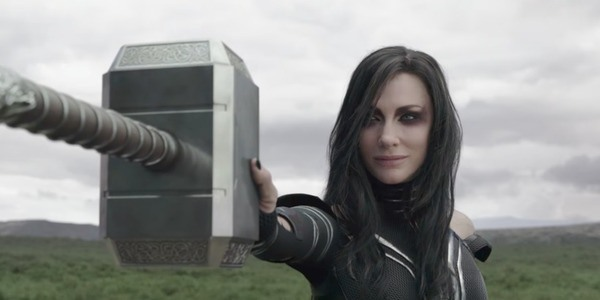
ThorHela
Sadly, Hela’s potential never stretches beyond this display of power.

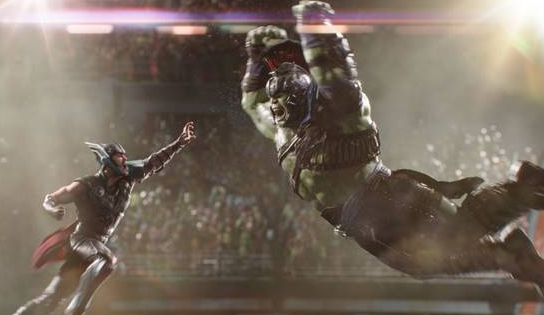
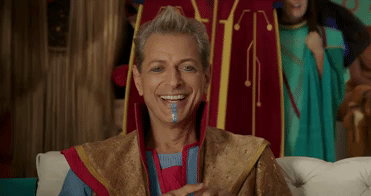
Less than impressed, Thor forces Loki to take him to Odin’s location; however, they are immediately intercepted by Doctor Stephen Strange (Benedict Cumberbatch) who, somewhat needlessly, ushers them along to Norway, where Odin has found himself. On the verge of death, Odin tells his sons that his passing will release his first-born child, Hela (Cate Blanchett), the Goddess of Death, who desires to end all Asgardian life and bring destruction to the Nine Realms. Upon vanishing into a puff of golden sparks, this immediately comes to pass and, when Thor attempts to stop Hela, she easily catches and destroys his magical hammer, Mjolnir. Fearful of his half-sister’s great power, Loki commands the Bifröst to transport them back to Asgard; however, Hela follows and casts her younger siblings into the void of space. Upon her arrival in Asgard, she kills Volstagg (Ray Stevenson) and Fandral (Zachary Levi) within the blink of an eye and recruits Scurge (Karl Urban) as her executioner. Deposited upon the planet Sakaar, Thor is captured – his power subdued by an obedience disk – by Valkyrie (Tessa Thompson) and becomes a prisoner of the enigmatic Grandmaster (Jeff Goldblum). Loki is also there, having landed weeks earlier due to a time-dilation effect and, being in favour with the Grandmaster, is content to remain, leaving Thor to challenge the Grandmaster’s champion in the arena to win his freedom. Just when all hope seems lost, Thor is confronted by the champion, who turns out to be the Incredible Hulk. Revelling in his fame and glory, the now-sentient Hulk battles Thor mercilessly. However, Thor summons the powers of lightning to turn the tide and is summarily subdued by the Grandmaster.

ThorHulk
The battle between Thor and Hulk is easily the best part of the film.

In Hulk’s bed chambers, Thor converses with his fellow Avenger, who is less than enthusiastic about helping Thor as he was hated and feared on Earth, even by his team mates. Thor persists, even managing to convince Valkyrie to help him escape and save Asgard but, after activating the Quinjet that brought Hulk to Sakaar, Thor loses his primary means of transportation when the Hulk destroys the ship during his manic reversion back into Bruce Banner. Banner, in a state of shock as he has been trapped within the Hulk for two years, fears for the loss of his identity should he transform again, yet still teams up with Thor, Valkyrie, and Loki to steal the Grandmaster’s luxury spaceship, return to Asgard, and prevent Hela from bringing ruin to the Nine Realms.

In case it isn’t clear from the trailers or television spots, Thor: Ragnarok is an action comedy with a heavy emphasis on the comedy. Thor, whose humour was always present and based in a dry wit, quips one-liners and glib remarks throughout the film, even in the face of annihilation at the hands of Hela. However, the humour works very well; the chemistry between Hemsworth and Hiddleston is as potent as ever and both react, and act, perfectly with the Hulk. Speaking of the Hulk, the Green Goliath finally gets a chance to show a personality; having been transformed for so long has made the Hulk capable of intelligent, if child-like, speech and able to comprehend what is happening around him. There is a clear difference between the Hulk, who is always angry and craving a fight, and Banner; Banner’s previous tenuous control over the Hulk is apparently now lost and he faces a very real fear of being consumed by the Hulk (although this is never developed beyond a short exchange with Thor).

After a strong but, undoubtedly disappointing, showing from Malekith (Christopher Eccleston), there was quite a lot of anticipation surrounding Hela. Like Ultron (James Spader), Hela has a powerful presence and a snappy wit, with clear and concise motivations: she seeks to rule the Nine Realms through anarchy and death rather than the peace and prosperity her father once sought. However, although she is easily Thor’s most powerful foe, she still succumbs to the same issues that plague many of Marvel’s villains: procrastination. The film, honestly, spends too much time on Sakaar and not enough time with Hela who, upon reaching Asgard, kills a bunch of people, stands around gloating, and is then unable to enact her plan simply because Heimdall (Idris Elba) stole the sword that activates the Bifröst. This is quite the problem as she literally storms into Asgard, leaves some bodies in her wake, awakens an undead army and her steed, Fenris Wolf, and then stands around doing nothing until Thor and his team (the “Revengers”) finally return to take her on.

ThorGrandmaster
The brilliance of Jeff Goldblum continues to astound.

Logically you would think that it would be the Grandmaster who acts as the secondary antagonist; however, you would be largely mistaken. Although Goldblum, who was clearly given free reign to ad-lib and bring as much of his awesome quirks to the character, steals every scene he is in, he isn’t even an obstacle in Thor’s path beyond making him fight the Hulk. Indeed, Thor stages an uprising (lead by Korg (Taika Waititi, whose soft-spoken take on the character was a surprise, to say the least) simply to distract the Grandmaster’s pitiful forces long enough for him to steal his ship and escape. The film appears to be treating Ragnarök as its primary threat; however, the humour laced throughout is so prominent that this apocalyptic event isn’t really treated with the weight or gravitas that you might expect, meaning that Thor’s realisation that he must revive Surtur to cause Ragnarök as the only means of defeating Hela is given barely any significance (Korg even cracks jokes during what should be the sombre and gut-wrenching destruction of Asgard).

Valkyrie is a welcome addition to the franchise; having faced Hela centuries ago and watched all of her fellow female warriors perish, she has become a bitter recluse, resigned to being an alcoholic bounty hunter. Thor gives her a chance at redemption and she takes it gladly, taking up arms once more to help rescue the Asgardians from extinction. However, her inclusion comes at a price; in a throwaway line, Thor reveals that he and Jane Foster (Natalie Portman) have broken up, and (perhaps more criminally) Lady Sif (Jaimie Alexander) is noticeably and inexplicable absent, with no mention of her in any way, and the Warriors Three (Thor’s brothers-in-arms) are unceremoniously killed off presumably to appease Idris Elba with a more significant role for Heimdall, who basically becomes Thor’s right-hand man by the film’s end.

Yet, Thor: Ragnarok is a stunning film to watch; Sakaar is a dystopian cyber-punk dreamland, filled with the decrepit, lived-in quality of the cities and peoples seen in the Guardians of the Galaxy movies. It is clear that the film is meant firmly entrench Thor in the wild, wacky cosmic side of the Marvel Cinematic Universe and the eighties-inspired soundtrack and visuals really help to hammer that point home (no pun intended). In addition, the humour is truly entertaining and the action is intense and thrilling; the battle between Hulk and Thor is fantastic to watch and the sheer scope of the movie is quite impressive given that it mainly jumps back and forth between Sakaar and Asgard. Additionally, as he is devoid of Mjolnir, Thor showcases his command of lightning to great effect in this film; he truly becomes the God of Thunder, summoning lighting bolts, surrounding himself with a shield of lightning, and powering himself up to the point where is is all-but untouchable. In the end, though, I actually expected more. I was expecting a threat such as the Goddess of Death to be treated with a bit more severity; her campaign never really gets a chance to begin before she is stopped in her tracks and the true impact of her actions or threat is never really felt meaning that, in the end, she is as ineffectual a villain as Malekith was because neither got to showcase their incredible potential due to the many other plot threads at work in the film.

ThorStrange
Sadly, this cameo didn’t really add a lot to the film.

Hulk, despite given much more characterisation than ever before, actually quickly fades into the background by the third act and the interesting idea that Banner and the Hulk are finally two separate entities within the same body is never truly explored. Most notably, Thor: Ragnarok goes out of its way to quickly tie up the loose ends from Thor: The Dark World with a very simple and disappointing payoff; when The Dark World ended with Loki impersonating Odin on the throne of Asgard, it posed so many questions and raised expectations of an epic battle to reclaim the throne. Instead, Thor simply reveals the deception and finds Odin maybe ten minutes later. It would have been faster if not for the unnecessary cameo by Doctor Strange; literally, Strange’s inclusion offers nothing of value (Loki could have taken Thor straight to Norway and skipped the entire New York sequence completely) except, I guess, to establish (or re-establish) that Strange acts as the mystic guardian of Earth but we already knew this from Doctor Strange (Derrickson, 2016). I’m all for cameos and inclusions of other Marvel characters but they’ve got to add something to the film and I really don’t think it did in this instance. I think those who disliked Thor: The Dark World will see this film as a redemption as it is, undoubtedly, a better movie and probably the strongest of the Thor films as Hemsworth and Hiddleston truly embody their characters and the interactions between them and their fellow cast of characters was great to see. However, I can’t help but think a film about the literally death of Gods should have some more gravitas to it and be more epic in its scope and execution; instead, this is an action comedy primarily focused on integrating Thor into the cosmic aspect of the Marvel Cinematic Universe and infusing the Hulk with some actual characterisation and, in these aspects, it succeeds spectacularly.

My Rating:

Rating: 3 out of 5.

Pretty Good

Recommended: Yes, though I’d have to voice a a bit of disappointment at the execution of the film’s primary plot.
Best moment: Hands down, the battle between Hulk and Thor in the arena, which delivered in every way possible.
Worst moment: Hela’s lacklustre effort as the primary villain and the execution of Ragnarök left a lot to be desired, effectively nullifying the significance of the final act of the film.

Talking Movies: Spider-Man: Homecoming

Talking Movies
Spiderman

Following the unfortunate critical and commercial failure of the underrated Amazing Spider-Man 2 (Webb, 2014), Sony and Columbia Pictures decided to cancel their plans for a third film and numerous related spin-offs that would form their own shared cinematic universe. The plus side to this was that negotiations and talks opened up between Disney/Marvel Studios and Sony Pictures which saw Spider-Man be recast and incorporated into the massive, unstoppable media juggernaut that is the Marvel Cinematic Universe in Captain America: Civil War (Russo and Russo, 2016). To capitalise on the success of Civil War and the popular reaction of Tom Holland’s youthful, wise-cracking portrayal of the character, Marvel Studios rearranged their scheduled list of films to allow for a solo movie to truly integrate the character into their shared universe.

Spider-Man: Homecoming (Watts, 2017) opens moments after the conclusion of The Avengers/Avengers Assemble (Whedon, 2012) where salvage expert Adrian Toomes (Michael Keaton…I’ll say that again, Michael Keaton!) and his crew are screwed out of their contract to salvage the remains of the battle between the Avengers and the Chitauri by Tony Stark’s (Robert Downey Junior) newly-formed clean-up team, Damage Control. Out of pocket and against the wall, Toomes and his crew reverse-engineer Chitauri tech to construct an elaborate flying harness and wing rig and create weaponry they can sell on the black market. Eight years later, Peter Parker (Tom Holland) is taken to Berlin by Happy Hogan (Jon Favreau) after being recruited by Tony Stark; once there, he is given his spiffy new Spider-Man costume and participates in the new-iconic airport battle seen in Civil War. Being dropped off at home by Stark, Parker is promised that the team will be in touch with him soon with a new mission. However, eight months later, he has heard no word from Stark or Hogan, despite leaving them numerous messages, and is getting frustrated with being nothing more than a “friendly neighbourhood Spider-Man”.

A chance encounter with Toomes’ gang, who wield advanced, retrofitted Chitauri weaponry, brings Toomes’ activities to the attention of Spider-Man. Angered that his eight-year operation, which has remained under the radar of the Avengers and the police, Toomes kills Jackson Brice (Logan Marshall-Green) and passes his signature weapon, and self-appointed alias of “the Shocker”, on to Herman Schultz (Bokeem Woodbine) and vows to kill Spider-Man for interfering in his work. When Peter’s attempts to bring Toomes’ nefarious activities to Stark’s attention apparently fall on deaf ears, he and his incredibly enthusiastic friend friend, Ned (Jacob Batalon) unlock the full potential of Peter’s spider-suit and he takes matters into his own hands. However, when his over-eagerness causes catastrophe, Stark takes the suit back and reprimands his reckless actions. Humbled and disheartened, Peter attempts to focus on the school’s annual homecoming dance and his date, long-time love interest Liz Allen (Laura Harrier) only to once again forced into a deadly confrontation with Toomes in his Vulture persona.

Spider-Man: Homecoming, much like Ant-Man (Reed, 2015) is a welcome breath of fresh air in the Marvel Cinematic Universe primarily because of its dramatic shift in focus from worldwide, earth-shattering, universe-spanning events to simple, yet still dramatic, issues at a more grounded level. The film cleverly showcases that the actions of the Avengers have far-reaching consequences; every time they battle an advanced enemy, they leave behind chaos and remnants that, in this case, birth an entire gang of criminals in possession of advanced weapons. With the Avengers focused on bigger threats and fighting each other, it’s up to street-level superheroes like Spider-Man to stand up for the everyman in the street. Unlike other depictions of Spider-Man, Holland is young and fresh; he rarely takes the mask off, never shuts up once the suit is on, and embodies the youth and enthusiasm of the character’s Ultimate incarnation in spectacular fashion. Additionally, he is young enough to still be in high school and realistically dealing with the problems that come with this situation: constant berating from the loud-mouth Eugene “Flash” Thomson (Tony Revolori), trying to fit in with the more popular kids, and living up to his responsibilities to the academic decathlon team he is a part of. Add to this the fact that he is hiding his duel identity from his Aunt May (Marisa Tomei) and desperately trying to prove that he has what it takes to be an Avenger and you have a very nuanced performance full of heart and humour.

Spidey goes up against one of his traditionally lamer villains; the Vulture has always just been an old guy with wings who robs banks and does very little else. The same goes for the Shocker, who was turned into a walking recurring joke in the Ultimate Spider-Man comics. Here, though, teamed up, they present a formidable threat to the fledgling Spider-Man; within the first ten minutes of the film, Toomes is made relatable and his motivations are completely understandable. He may well be one of the most layered and ruthless villains not only that a live-action Spider-Man has faced but also in the Marvel Cinematic Universe. The best part is that the film not only features Phineas “The Tinkerer” Mason (Michael Chernus) but, more interestingly, introduces an associate of Toomes, Mac “The Scorpion” Gargan (Michael Mando), who alludes to a team-up of the villains in the future. This promises that Spider-Man will, hopefully, face new onscreen enemies in future films rather than rehashing the same villains we’ve seen before. The film does have some negative points, though; I get that Marvel don’t want to go through Peter’s whole origin again as it’s been done to death by now but I would’ve liked to have seen a quick recap of it over the opening titles just so we can see how this version of Peter dealt with that time of his life. An unfortunate by-product of this is that there’s only subtle allusions of Uncle Ben and the great mentor figure in Peter’s life is Tony Stark (however, Stark and Iron Man feature sparingly throughout the film and in no way take the spotlight away from Spider-Man).

Also, I’m not sure why they chose to have Toomes figure out Spider-Man’s secret identity as it didn’t really factor into the film in a meaningful way. Finally, Spidey’s super high-tech suit stretches believability quite a bit as his suit is skin-tight and form-fitting, so it’s hard to believe that it’s packed full of Iron Man-esque tech (I would’ve liked to have seen the Iron Spider-Man suit used as an alternative to this). However, these are extremely small, minor nitpicks; the film is incredibly funny, packed full of action, and never falls into unnecessary drama. As a coming-of-age story that teaches Peter his place in the wider scope of the Marvel Cinematic Universe, Spider-Man: Homecoming succeeded spectacularly and I fully expect any minor issues to addressed in his future appearances.

My Rating:

Rating: 5 out of 5.

Fantastic

Recommended: Highly, it’s Spider-Man in the Marvel Cinematic Universe!
Best moment: A fantastic recreation of a sequence from The Amazing Spider-Man issue thirty-three, in which Peter is trapped beneath some wreckage and must will his way out through sheer brute strength.
Worst moment: The lack of exposition into the origins and motivations of this new interpretation of Spider-Man.