Movie Night: Man-Thing

Released: 30 April 2005
Director: Brett Leonard
Distributor: Sci-Fi Pictures
Budget: $5 million
Stars: Matthew Le Nevez, Rachael Taylor, Jack Thompson, Steve Bastoni, and Conan Stevens

The Plot:
New Sheriff Kyle Williams (Le Nevez) arrives in the sleepy town of Bywater, only to find the area subjected to a series of gruesome murders. As he investigates, Kyle uncovers a plot to pollute and desecrate the sacred swamp waters, and the presence of a horrific swamp creature (Stevens) looking to enact revenge!

The Background:
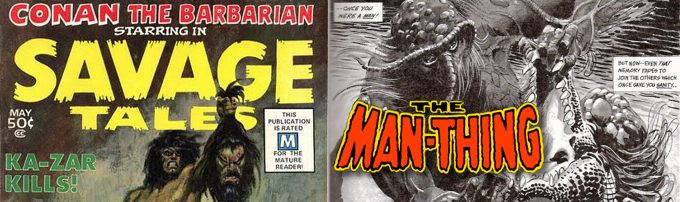
Due to the implementation of the Comics Code Authority (CCA) in 1954 following widespread public concern, comic book publishers like Marvel had to dance around nonsensical rules to avoid corrupting vulnerable child readers from such horrors as violence, supernatural threat, and sexual content. Consequently, publisher Martin Goodman cancelled the none-CCA-approved Savage Tales after just one issue, though it released long enough to introduce Doctor Theodore “Ted” Sallis/Man-Thing. A creation of writers Stan Lee, Roy Thomas, Gerry Conway, and artist Gray Morrow (and entirely different from DC Comics’ Alec Holland/Swamp Thing), Man-Thing has had a not insignificant impact in Marvel since his debut but, it’s fair to say, is one of their more obscure monstrous characters so it was a little surprising to see him included in Marvel’s deal with Artisan Entertainment to produce at least fifteen adaptations of Marvel properties. Development of a Man-Thing movie can thus be traced back to 2000, where the project flip-flopped between a straight-to-video and a cinematic release before the then-recent success of superhero movies like Blade (Norrington, 1998), X-Men (Singer, 2000), and Spider-Man (Raimi, 2002) made a theatrical release more financially viable. Filming took place entirely in Sydney, Australia, which producer Avi Arad later blamed for the film’s failures as Marvel Studios were unable to properly micromanage and supervise the production to ensure a higher standard of quality. A low-budget production meant that the titular creature’s screen time was often rushed, causing the impressive practical effects and suit to become mired in sub-par CGI and, while the film had a very limited theatrical release, it eventually saw the light of day on the Sci-Fi Channel and home video. Consequently, Man-Thing made a paltry $1.1 million gross and was torn apart by scathing reviews that attacked everything but the special effects. Largely forgotten these days, the Man-Thing rights eventually reverted back to Marvel Studios and, after a few subtle allusions to the character, the Man-Thing officially joined the MCU in the Werewolf by Night special (Giacchino, 2022).

The Review:
If I’m being completely honest, I barely had any knowledge of the Man-Thing prior to this movie; I think he cropped up in an issue of Howard the Duck or a Hulk comic I once read as a kid, but it could’ve just as easily been someone like Taboo or Joseph Timms/The Glob. I was slightly more familiar with his DC Comics counterpart, Swamp Thing, thanks to watching (and being unimpressed by) Wes Craven’s 1982 movie and hazy memories of his short-lived cartoon from the nineties but, suffice it to say, I was not some die-hard Man-Thing fan, and in the years since I first picked up this movie the most I’ve really experienced of the character is this movie and his debut story. Still, back when this film came out, I was intrigued by the footage I’d seen; being a big fan of monster and horror films and gory practical effects, I was well on board for experiencing a different kind of comic book movie at a time when the genre was properly moving into a “safe zone” of family-friendly action spectacle. All of this means that I had relatively low expectations, couldn’t really get worked up about any changes made to the source material, and was mildly satisfied upon my first viewing and, even now, I often chuck Man-Thing on if I’m in the mood for a gore-fest that’s not something more mainstream.
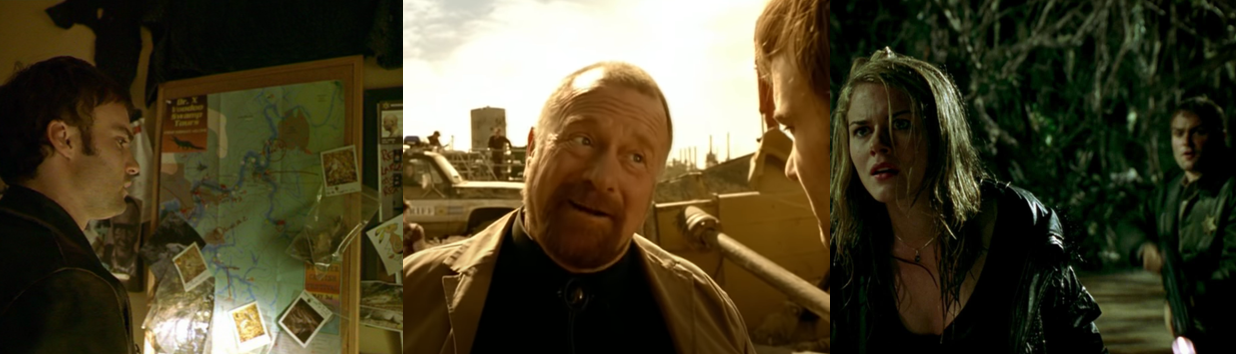
Kyle Williams is new in town and beset by local issues and a string of grisly murders.

That’s not to say that Man-Thing is very impressive, by any means; it has a definite made-for-television presentation in the camera work and the quality of the actors, with the cast made up of mostly Australian television and bit-part players, which is fine for this kind of B-movie but keeps it from living up to the standards (however low they may be) for similar films released around this time, like Doom (Bartkowiak, 2005) and Hatchet (Green, 2006), which were both B-movie horrors that were bolstered by a bigger budget, bigger stars, or from being throwbacks to the slasher genre of old. Nowhere is this more evident than in our lead character; a kind of Ben Browder knock-off, Matthew Le Nevez does what he can, but his fish-out-of-water character is nothing we haven’t seen a million times. Looking for a fresh start and a chance to prove himself in a position of authority, the new sheriff is flustered to find his hideously departed predecessor has left him only one deputy, Eric Fraser (Alex O’Loughlin), and that the town is torn between preserving the sacred swamplands of Dark Water and welcoming the profits brought in by industrialist Frederick Schist (Thompson). Still, while Fraser is amicable enough towards Kyle, there’s a degree of distrust and scepticism levelled towards him not just because he’s new in town but also because of his youth and perceived lack of experience, especially considering the many missing people and gruesome deaths in the small town. Though he’s very much a by-the-book sheriff, Kyle’s also quite fair and humble; he doesn’t want to ruffle any feathers and is eager to ensure total co-operation with his department, but is equally sympathetic towards schoolteacher Teri Elizabeth Richards’ (Taylor) attempts to oppose the desecration and pollution brought by Schist’s operation. The feisty and moralistic Teri immediately clashes with Kyle, kicking him to the dirt and winning herself a stay in the cells for her disruptive actions; however, Kyle admires her fighting spirit and soon turns to her for assistance with the swamp and the legends that permeate it. Naturally, as the two most attractive characters in the film, a mutual attraction sparks up between the two as they’re both captivated by their shared sense of moral justice and desire to do what’s right, and they find a common cause to rally against once the extent of Schist’s violent nature becomes apparent.
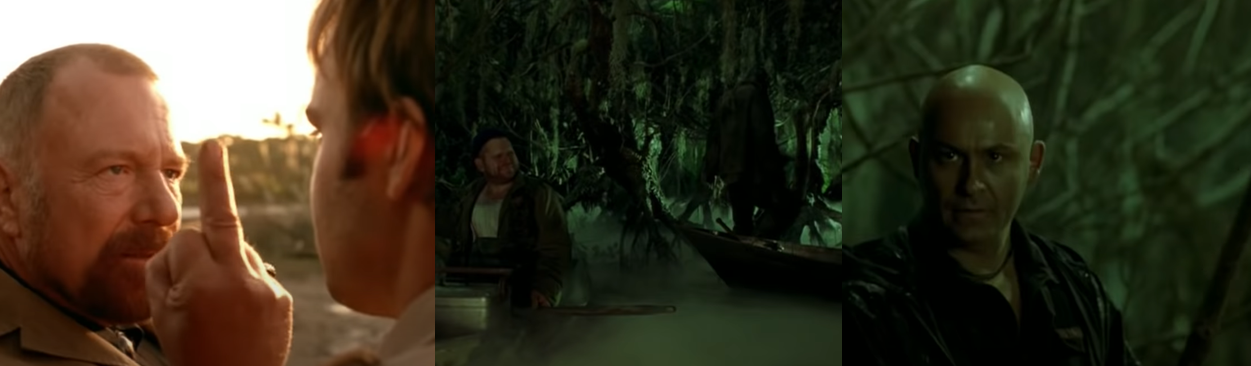
Local industrialist Schist has no problem killing or rolling over those who threaten his operation.

Kyle’s most pressing concern, however, isn’t local politics or superstition, but the number of violent deaths that have recently occurred in Bywater and around the Dark Water swamp. Initially, the most obvious suspect (at least, according to Schist) is Mestizo extremist Rene LaRoque (Bastoni), who has been sabotaging Schist’s facilities. Schist resents the backlash from locals and the Seminole community of Bywater since he legally appropriated all of his land from Ted Sallis, the Seminole shaman and chieftain, who then disappeared after stealing the money for himself. However, in truth, LaRoque helped broker the deal to improve things for the tribe, while Sallis was vehemently opposed to it and, in an effort to make up for his greed, LaRoque has been disrupting Schist’s operations ever since. Schist is a force to be reckoned with, however; firmly seeing himself as nothing more than an industrialist, Schist is protected by his wealth and influence and the fact that all the paperwork says he hasn’t broken any American laws. With no time for mysticism or mumbo-jumbo, Schist is concerned only with profit and expanding his empire but, while Kyle is smart enough to initially be respectful and amicable to Schist, it’s pretty clear that he’s a shady character not just through his boisterous and somewhat condescending nature but also in the startling similarity between his company logo and the Nazi swastika. Since he’s a prominent entrepreneur and wealthy businessman, Schist holds a lot of sway in Bywater; he can influence the hiring and firing of sheriffs, encourages Kyle to play the game and pursue LaRoque, and even orders people to be arrested for disturbing his building and oil digging. Naturally, he’s also an extremely ruthless and shady character; bolstered by his son, Jake (Pat Thompson), and local thugs Wayne (John Batchelor) and Rodney Thibadeaux (Ian Bliss), Schist has no problem ordering LaRoque’s death, aggressively leaning on those who get in his way, or getting his own hands dirty since he killed Sallis and photographer Mike Ploog (Robert Mammone) when they threatened his empire.
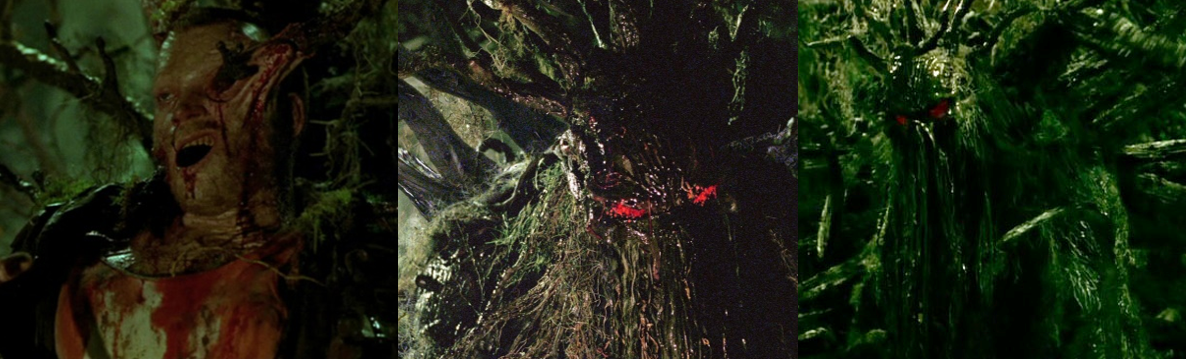
Ted Sallis is transforming into a monstrous creature that slaughters anyone who threatens its swamp.

At first, all evidence points to LaRoque being behind the sabotage and even the strange events in town, no matter how bizarre they may be; despite Teri’s insistence that LaRoque is innocent of murder, Kyle has no choice but the venture into the swamp to find him to get to the bottom of what’s going on. Of course, Schist’s operation has a far bigger threat, one that’s caused the murky swamps of Bywater to become a hazardous land and violently takes lives, such as Fraser’s, with an inhuman brutality. The region, which is seeped in mysticism and dark supernatural power, is regarded by Native Americans like Peter Horn (Rawiri Paratene) to be the “Nexus of All Realities”, a place where a malevolent spirit dwells that brutally attacks any trespassers, especially those who taint its lands. This is the force that transforms Sallis after his murder at Schist’s hands; while the locals have long believed in a swamp guardian, it’s only after Sallis’s corpse is buried in the Dark Water that this actually comes to life in the form of a hulking swamp creature the obsessive and eccentric Ploog haphazardly dubs the “Man-Thing, man!” While many scoff at such local superstitions, they still actively avoid the swamp because of how dangerous it can be, but Horn knows full well the extent of the dark magic that dwells within it. Horn explains that the angered creature seeks blood to atone for the blood spilled on its sacred land, and has determined that everyone will die, though this is a bit misleading as the creature seems satisfied once Schist’s pump is destroyed in the finale (raising the question why the Man-Thing didn’t just destroy the pump itself, especially considering it was formed right in front of it!) Although the creature shows no real signs of intelligence or humanity, appearing more a force of nature (or supernatural wrath) than anything, it’s driven to slaughter those who venture into its waters, especially any that try to desecrate its swamp. It does this through increasingly brutal means, such as tearing its victims apart, causing roots and foliage to burst from their bodies, or pumping him full of Schist’s polluting oil. Those who know fear have no chance of burning at this Man-Thing’s touch as its whipping tentacles and huge, claw-like hands are far more likely to leave its prey little more than bloody, swamp-covered remains. Even people like Plooq and LaRoque, who routinely visit and live in the swamp, and Sallis’s friends and fellow Seminole aren’t safe from the Man-Thing’s rage; the monstrous being rids its swamp of all interlopers and violatiors, friend or foe and, to make matters worse, is functionally immortal and impervious to harm, even to ancient rituals and sacrifices designed to appease its wrath.

The Nitty-Gritty:
While Man-Thing might be a decidedly low-budget (and low-brow) affair, I have to give it props for going all-in with its genre and its premise. It’s fascinating re-watching these licensed properties from before the Marvel Cinematic Universe found a winning formula in family-friendly productions that only touch upon horror or violent elements, and Man-Thing is far more a throwback to the violent, carefree slashers and monster movies of the eighties than anything else. This is evident right from the beginning thanks to a raucous sex scene out on a canoe in the wilds of the swamp that leaves busty Sarah (Imogen Bailey) a screaming, bloody mess and the frequent, barking use of curse words and dark, sticky blood effects. As you might expect, the swamp is very much a big part of Man-Thing; a dark, murky, overgrown mess of withered trees, vines, gloopy muck, and full of alligators and bugs, the swamp is unsightly and hazardous place. While Teri regards it with a great deal of affection, Horn is filled with a respect for its dark power, and Schist just wants to plunder its natural resources, Kyle is completely out of his depth when he ventures into those dark and muddy waters and the film does a decent job of presenting it as a very ominous and mysterious place. Personally, however, I have no love for swamp settings; they’re invariably murky and suffer from low lighting and green filters, all of which is true here, but you can’t really make Man-Thing without a swamp and, considering the time the film takes in building up to the Man-Thing’s first full appearance, the swamp makes for a visually unsettling compromise.
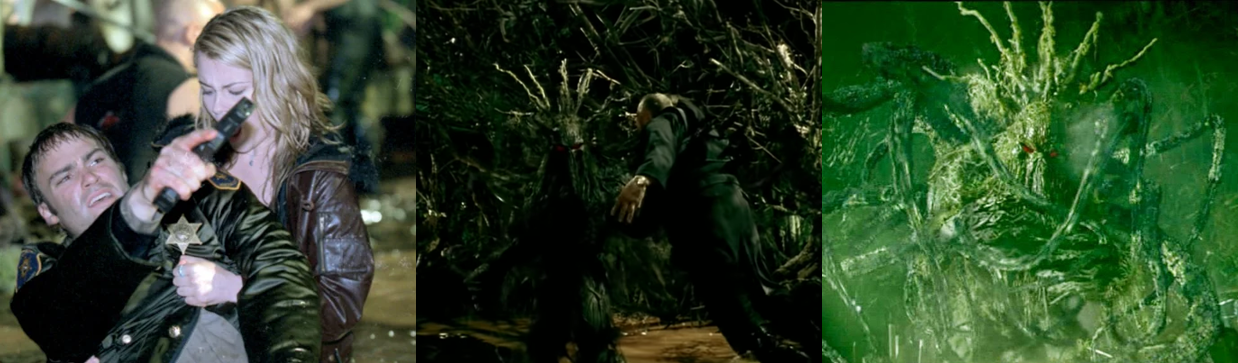
The impressive Man-Thing monster takes its brutal revenge.

Still, if there’s one thing Man-Thing has going for it, it’s the impressive and ambitious special effects. The Man-Thing itself is introduced slowly, building tension and anticipation towards its big reveal, which comes about an hour into the film’s runtime when it stalks and slaughters the Thibadeaux’s before ripping Fraser apart like an insect. Before that, we get an idea of how the creature came into being in flashbacks that resemble the grisly horror of Hellraiser (Barker, 1987) and we see the gruesome aftermath of its unique methods of killing, with Fraser left sickened by the awesome brutality (though both Kyle and coroner Val Mayerick (Brett Leonard) are surprisingly nonplussed by the mangled corpses, which have long been chalked up the alligator attacks). The creature itself is an incredibly impressive combination of a practical suit enhanced by CGI, which is the perfect blend when creating a movie monster, and it’s pretty clear that a big chunk of the budget (if not all of it) went to bringing Marvel’s monstrous swamp-man to life. A hulking beast dripping with vile vines and oozing menace, the Man-Thing easily manhandles and rips apart even the likes of Pete Horn after he tries to sacrifice himself to quell its rage, glaring at its prey with burning eyes and pursuing Kyle and Teri relentlessly for trespassing in its swamp. Determined to track down and kill LaRoque, who seeks to destroy his drilling tower in the Dark Water, Schist ventures into the swamp only to find Kyle and Teri being chased by the Man-Thing in their own attempts to get to LaRoque. Although Schist confesses to killing Sallis and wounds both LaRoque and Kyle, he ultimately meets his grisly end when the Man-Thing impales him with vine-like tentacles and pumps Schist’s own oil back into his body for a fitting and gory demise. Devoid of all humanity and fixated only on eliminating intruders, the Man-Thing turns on Kyle and Teri, forcing LaRoque to sacrifice himself by blowing up the drilling tower, taking himself and the Man-Thing with it. The blast doesn’t actually destroy the beast, however; it simply absorbs the flames and then, after seeing that Schist’s destructive influence has been driven from the Dark Water, it is reclaimed by the swampland to slumber once more until needed, allowing the injured and stunned Kyle and Teri to gingerly make their way back to what passes for civilisation in those parts.
The Summary:
For many, Man-Thing will be little more than a low-budget, made-for-television B-level monster movie that pales in comparison to other films in its genre, especially those it owes much of its horror and imagery to. For fans of the titular character, many may also be put off by how different the film is from the source material, which casts the Man-Thing as an uncompromising force of vengeful nature rather than a more sentient and complex character like I assume it is in the comics. For me, though, as a fan of gory monster movies of this type, there’s a lot to like about Man-Thing; the atmosphere, the sense of dread and horror building throughout the film thanks to the near constant darkness and the disgusting murkiness of the swamp really give the film a foreboding ambiance. Of course, the main selling point is the Man-Thing itself; kept in shadow and blending in with the trees and vines of the gloomy swamp, the creature is an extraordinary and terrifying mixture of CGI and practical effects and impresses every time its on screen, which isn’t often, and always makes an impact. Unfortunately, the acting and overall presentation is very cheap and befitting of its made-for-television status; you don’t really watch a film like this for the performances or any kind of nuance beyond one-dimensional villains, gratuitous sex and violence, and somewhat capable lead characters, and Man-Thing definitely doesn’t try to deliver anything beyond these clichés. Overall, I do feel it’s an under-rated and often forgotten Marvel film that can be fun at times, but I can see why this didn’t really make much of an impact, though I am interested in seeing how the MCU utilises the Man-Thing going forward.

My Rating:

Rating: 2 out of 5.

Could Be Better

Have you ever seen Man-Thing? Were you a fan of the film or did it leave you disappointed? What did you think to Schist and his plot to besmirch the sacred land, and the lead characters and their performances? Were you impressed by the Man-Thing’s special effects and brutal kills? If you’re a fan of the source material, what did you think to this adaptation? Whatever your thoughts on Man-Thing, leave them below and go check out my other horror content!

Back Issues: Savage Tales #1

Story Title: “…Man-Thing!”
Published: May 1971
Writer: Roy Thomas and Gerry Conway
Artist: Gray Morrow

The Background:
Following widespread public concern over gory and horrific comic-book content, New York magistrate Charles F. Murphy established the Comics Code Authority (CCA) in 1954 to protect vulnerable child readers from such horrors as violence, supernatural threats, and sexual content. This posed a problem for comic book publishers like Marvel, who had to dance around these nonsensical rules, and any comics not baring the CCA seal of approval were often seen as taboo. This, as much as anything, led to publisher Martin Goodman cancelling Savage Tales after just one issue; the series wouldn’t return to publication until Goodman left Marvel some three years later and the CCA was eventually (thankfully) phased out over time. Still, while Savage Tales was burdened by this tumultuous edict, readers were introduced to Doctor Theodore “Ted” Sallis/Man-Thing in this issue; created by writers Stan Lee, Roy Thomas, Gerry Conway, and artist Gray Morrow, Man-Thing attracted some controversy due to resembling a similar swamp-based monster hero, Alec Holland/Swamp Thing, over in DC Comics. After guest starring in other comic books, Man-Thing eventually graduated to a solo title, with writer Steve Gerber having the most significant impact with his distinctive second-person text boxes, establishing much of the character’s early lore and coining the tagline, “Whatever knows fear burns at the Man-Thing’s touch!” Despite being one of Marvel’s more obscure monster characters, the Man-Thing has had a not insignificant impact since his debut and has even been a part of superhero teams, despite his monstrous appearance. The character also popped up in small roles in Marvel cartoons and videogames over the years, and even got his own poorly received live-action adaptation in the years prior to the birth of the Marvel Cinematic Universe (MCU) before finally debuting in the MCU, after many sly allusions, in the Werewolf by Night special (Giacchino, 2022).

The Review:
Man-Thing is another obscure Marvel character who, in all my years of reading comics, I have basically never encountered in any story except for a Howard the Duck special I had as a kid. This isn’t that difficult to believe, however; over here in the United Kingdom, we were lucky to get yearly annuals and a few black and white pocketbooks and reprint comics and even those tended to focus on Marvel’s biggest names rather than obscure swamp creatures. Still, I was somewhat aware of the character prior to seeing his live-action debut, mainly because of the many obvious and hilarious jokes that can be made from his most memorable title, Giant-Size Man-Thing, but, similar to with the Swamp Thing, I remain largely unfamiliar with the character and continue to mix up their lore even now so I was somewhat intrigued to reas Man-Thing’s debut story. Our tale begins, fittingly enough, in a dark, fetid swamp were alligators (…or crocodiles, I don’t know the difference) exist as the apex predator…or they would, were it not for the monstrous, tortured soul that is the Man-Thing. Struggling to even remember its time as a man, the Man-Thing easily bests the ravenous lizards with its enormous strength, acting more on a predatory instinct than anything else, before venturing through the swamp with only the vaguest desire for food and drink.

The Man-Thing struggles to recall its past life as a human scientist changed by the swamp.

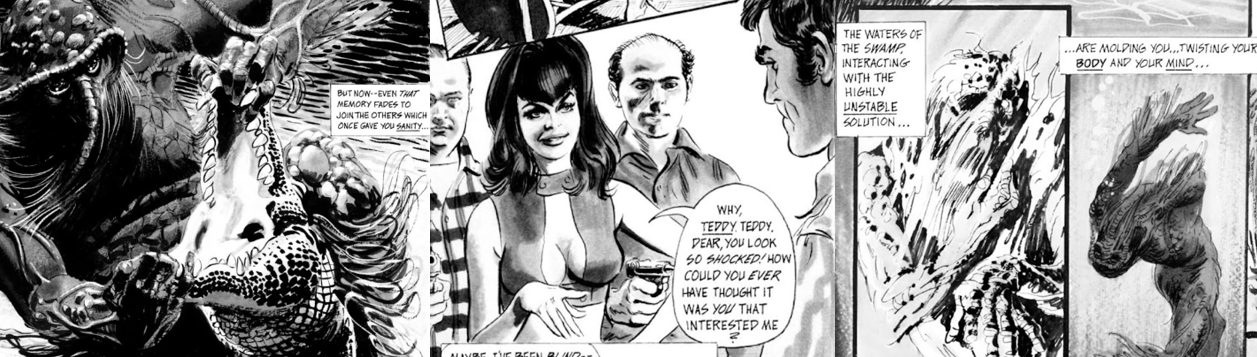
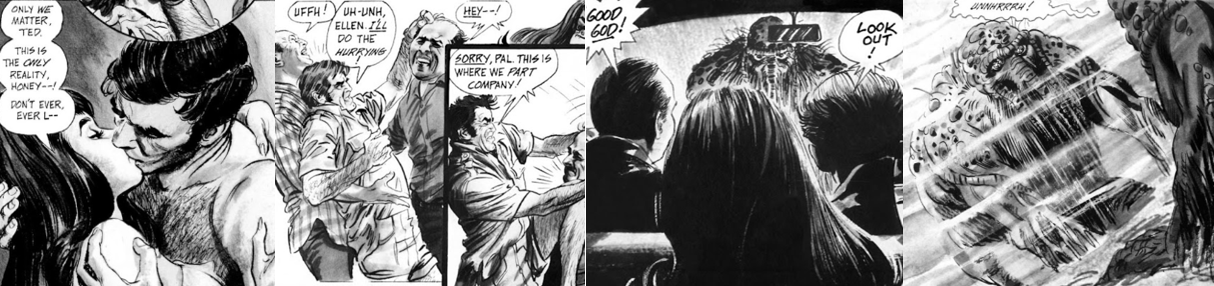
Although these concepts are quickly growing alien to the swamp monster, its feral mind is haunted by dim memories of a man, Ted Sallis, and his scantily-clad beauty, Ellen Brandt. Ellen is frustrated at being cooped up in Ted’s swamp-based laboratory, but Ted is a desperate man who’s been forced to flee to the ass-end of the world out of guilt. His research into some vaguely-defined chemical was perverted into weapons of mass destruction and he’s burdened by the many deaths these caused, which is enough to stop Ellen’s whining and for her to show her emotional (and physical) support to her man. It’s all very vague but basically Ted is waiting for a government agent, Hamilton, to meet him at his lab and take the last vial of whatever this dangerous chemical solution is. Although Ted doesn’t have the guts to destroy it (why this is I’m not quite sure), he burns the written formula and heads out into the swamp with Ellen and is startled to find Hamilton dead in his house. His horror quickly turns to dismay as Ellen betrays him, siding with the two gun-toting brutes who killed Hamilton and demanding that Ted hand over his mysterious vial so she can continue living the life of luxury she’s grown accustomed to. Enraged, Ted fights off gunmen by playing possum and speeds into the spawn overgrowth; however, with nowhere left to run and no hope left, Ted chooses to drive his car right the swamp and expose himself to his chemical solution.

The Man-Thing attacks out of pure, primal instinct.

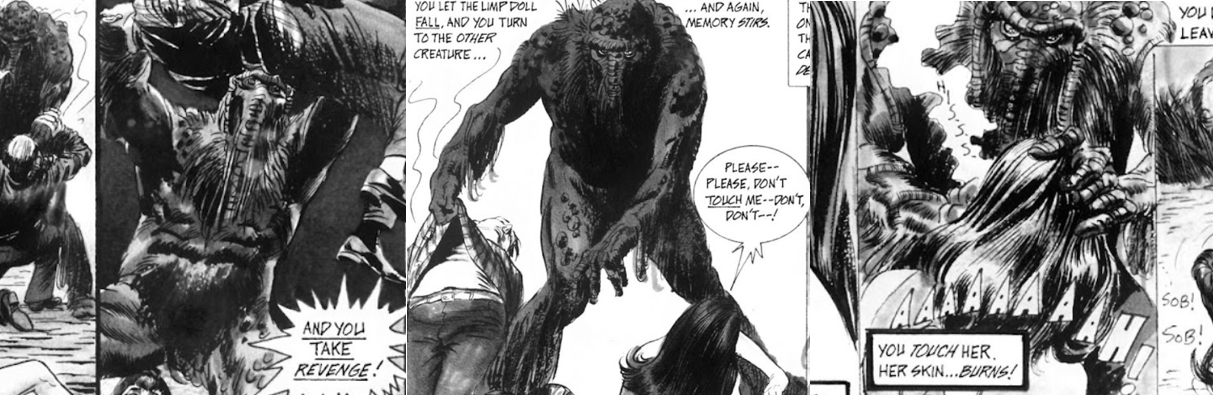
As Ted flails around in the swamp water, the narrative finally touches upon what this chemical is; apparently, he was developing some kind of solution to turn ordinary soldiers into indestructible warriors. However, the swamp waters cause an unforeseen side effect, turning the chemical into a high unstable and volatile compound that horrifically twists and mutates Ted’s body into the lumbering, feral monstrosity that is the Man-Thing! His grotesque body unwieldy, his senses dulled, and his rational mind rapidly degrading, the Man-Thing acts only on instinct and vague memory. It attacks the gunmen ferociously, apparently choking one to death and then snapping the other’s spine across its hulking knee. Upon seeing Ellen’s screaming, terrified, trembling form, the Man-Thing hesitates; unable to explain why it chose not to simply kill her, or the feelings it felt at seeing her, the Man-Thing is equally baffled when the slightest touch of its swamp-like hands causes Ellen’s face to burn and a blistering scar to be left as a permanent reminder of her betrayal. Confused and seeking refuge in the murky depths of the swamp, the Man-Thing shuffles away, its former life as a guilt-ridden scientist fading, and with little realisation (or interest) in the fact that Ted Sallis’ dream of creating the ultimate, indestructible super solider has come true in most grotesque way imaginable.

The Summary:
“…Man-Thing!” is quite the harrowing monster story. Told entirely in black and white and featuring an omniscient narrator who conveys the hopeless tragedy of the titular swamp beast, the story is an exploration of the feral instincts and primal rage of nature unleashed on one forsaken scientist. The Man-Thing itself is largely devoid of any real character; capable only of a few strained groans, its thoughts are primarily on survival and sustenance. It haunts the swamps that provided its ghastly appearance and incredible strength and is similarly haunted by fading memories of its time as a human being. Interestingly, the narration makes a point to explain that the creature’s vision and hearing are dulled and that it senses approaching threats and reacts purely on savage impulse rather than out of a real malicious intent. Its memories of being hurt and betrayed drive it to attack, kill, and wound its would-be murderers but it’s left perplexed by these feelings, and by its burning touch, and is more akin to a child or wild animal than a rational human being.

A story of sex, greed, murder, and with a visually horrific monster on top of it all!

I find the time spent with the Man-Thing to be the most compelling, despite its lack of characterisation and personality, simply because it’s very visually appealing and a tragic, lumbering monster. In comparison, Ted Sallis is a bit of a shady bloke; we don’t really get any real insight into what he’s been up to, but his research has definitely been used to cause a great deal of death and destruction and seems to be linked to the neutron bomb. He carries a great deal of guilt and shame regarding this, but it’s not entirely clear if he was developing his super soldier formula as a means to atone for that or if he was simply trying to keep that from falling into the wrong hands as well. His emotional fragility means he’s easily manipulated by Ellen, who seduces and betrays him to try and steal his mysterious vial for herself, her motivation purely being for selfish, financial gain rather than being an outright villain or a Russian spy or something. Her betrayal was shocking, even though she’s designed to look every bit like an alluring femme fatale, and I’m glad the story avoided the cliché of her being murdered and Sallis left for dead by those seeking to pervert his vague vial of chemicals. Sallis’ transformation into the Man-Thing is as sudden and violent as it is unexpected; it’s not clear why Sallis didn’t just drink or inject the vial into himself, but the result is a terrifying swamp creature that snaps men like twigs and burns with a touch. In the end, “…Man-Thing!” isn’t really changing the formula too much; it’s a tragic tale of betrayal and science gone wrong and of a repentant scientist becoming a grotesque monstrosity, but there’s a visual and awful appeal to the Man-Thing and its plight that does inspire my curiosity to see what else it’s capable of in further stories.

My Rating:

Rating: 3 out of 5.

Pretty Good

What did you think to the Man-Thing’s debut appearance? Did you ever read Savage Tales back in the day or did you discover Man-Thing in a different way? What did you think Ted Sallis was developing and did you see Ellen’s betrayal coming? Are you a fan on Man-Thing’s monstrous appearance and characterisation? What are some of your favourite Man-Thing stories and moments? I’d love to hear your thoughts on the Man-Thing so drop them below or leave a comment on my social media.

Screen Time: Werewolf by Night

Air Date: 7 October 2022
Director: Michael Giacchino
Network: Disney+
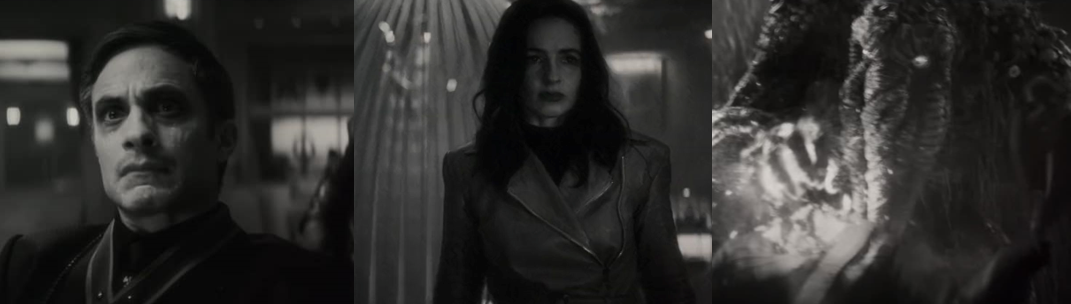
Stars: Gael García Bernal, Laura Donnelly, Harriet Sansom Harris, Kirk R. Thatcher, and Carey Jones/Jeffery Ford

The Background:
Back in February 1972, Roy Thomas, Jeanie Thomas, Gerry Conway, and Mike Ploog (under the direction of the legendary Stan Lee) introduced readers to Jack Russell/Werewolf by Night in the pages of Marvel Spotlight. After a ridiculous ban kept Marvel from publishing stories about werewolves and other supernatural creatures, the writers were finally free to explore these elements, and Werewolf by Night, soon graduated to his own self-titled series later that same year. Coming from a long line of lycanthropes and sharing a complex history with Count Dracula and the cursed Darkhold, Jack Russell became a feral beast under the light of a full moon and was repeatedly targeted by a nefarious cabal known as the Committee, who also introduced the emotionally damaged vigilante Marc Spector/Moon Knight to Marvel’s readers. Despite being one of Marvel’s more obscure characters, Werewolf by Night was pegged for a big-screen adaptation back in 2001; after numerous drafts and delays, Crystal Sky Pictures seemed ready to begin shooting when the project simply vanished from their slate. Hopes for the Werewolf lived again, however, when Kevin Smith was denied use of the character for a 2019 project, and the character was officially announced to be a part of the Marvel Cinematic Universe’s fourth phase in a one-hour, horror-themed special for Disney+. Director Michael Giacchino drew specific inspiration from the classic monster movies of the 1930s and 1940s and promised that the special would include some of Marvel’s most famous monster characters, such as Doctor Ted Sallis/Man-Thing. Upon its release, Werewolf by Night was met with largely positive reviews; critics praised the aesthetic and brisk pace, and the homage to classic Hammer Horror films, while also noting that the characters and certain visuals were somewhat disappointing.

The Plot:
A group of monster hunters gather at Bloodstone Manor following the death of their leader and engage in a mysterious and deadly competition for a powerful relic, which will bring them face to face with a dangerous monster.

The Review:
I might not know much, if anything, about Werewolf by Night but I’m more than familiar with the Hammer Horrors of yesteryear, classic black-and-white terrors that laid the foundation for popular depictions of screen monsters such as Count Dracula, Frankenstein’s Monster, and Larry Talbot/The Wolf Man. I’m actually more a fan of the 1930 Hammer Horrors than the later renaissance spearheaded by the likes of Christopher Lee; there’s just something about the gothic aesthetic surrounding the likes of Bela Lugosi and Lon Chaney Jr. that I find endearing and appealing in its simplicity. Plus, those classic horrors are super brisk; you could probably watch all of them, or a good three or four, in just a few hours and that’s perfect for when you just want a short, sharp fix of horror rather than sitting through a two-hour feature film. Similarly, as someone who struggles to binge-watch even six-episode shows for these reviews, I couldn’t be happier that Werewolf by Night opts to simply be a short special presentation, clocking in at a little under an hour. I miss when Marvel used to produce one-shots to fill in gaps between movies and definitely think they would benefit from producing more one- or two-hour specials to flesh out some of their more obscure characters. Similar to how the old Hammer Horrors would open with some text or a voice over, so too does Werewolf by Night begin with an opening narration touching upon the malevolent monsters lurking in the darkness and those who hunt and kill them, with none being more prominent than the legendary Bloodstone family, whose patriarch has slaughtered monsters across the generations with the supernatural relic known as…well…the Bloodstone.

Jack and Elsa reach an agreement to allow him to free the Man-Thing and her to claim the Bloodstone.

Following the death of Ulysses Bloodstone (Richard Dixon), the Bloodstone is in need of a new master, a process determined by inviting monster hunters from all over the world to take part in a ritualistic hunt to establish who is worthy of this powerful relic. Ulysses is survived by his widow, Verusa Bloodstone (Harris) and his estranged daughter, Elsa (Donnelly); Verusa is Elsa’s stepmother and is greatly disappointed by Elsa’s lack of interest in continuing the family tradition. Once thought to be capable of surpassing Ulysses’s abilities, Elsa instead abandoned her duties and her training but is nonetheless determined to take the Bloodstone for herself. Verusa acts as the hostess for the gathering of hunters, with over two-hundred confirmed kills shared between the death-dealers. Jovan (Thatcher) is easily the most bombastic of the group, making an impression through his impressive beard and facial scars, though only Jack Russell (Bernal) can claim over a hundred kills just for himself. With the exception of Elsa, all present see their crusade as a righteous one, a mission of mercy for the cursed and their victims, though there’s a definite flavour of cult-like sensibilities to their hunt. The hunt itself takes place on the grounds of Bloodstone Manor, a dark forest that leads to an Maurits Cornelis Escher-like labyrinth guarded by members of the Time Variance Authority (TVA), which probably explains why the layout and logic of the labyrinth makes little sense. Sporting tribalistic make-up to honour his ancestors, Jack is randomly selected to head out into the woods ahead of the others and his life is deemed to be as fair game as the monster, and any of the other hunters. Despite his impressive reputation as a monster killer, it turns out that Jack isn’t there to hunt their quarry, the swamp creature we know as the Man-Thing (Jones/Ford), but is actually there to rescue him and even refers to him by his real name, Ted. Thus, Jack wants no part of the hunt and even suggests to Elsa that they forget they saw each other, Jovan is driven into a frenzy by his desire to earn the Bloodstone, attacking Elsa with his axe and being surprised and unarmed by her martial arts skill. She then uses Jovan’s axe to more literally disarm Liorn (Leonardo Nam) and kill him with his own wrist-mounted crossbow, proving that she hasn’t been neglecting her training in her time away from Bloodstone Manor.

Verusa triggers Jack’s transformation into the titular Werewolf and seals her fate.

Although the Man-Thing is incapable of communicating beyond a few grunts and creaks, Jack is fully capable of understanding him and promises to relieve him of the Bloodstone, which hurts and weakens him, and blast their way out of there and to freedom. Although Azarel (Eugenie Bondurant) isn’t quite so altruistic, her attack does lead to Jack and Elsa finding some common ground and agreeing to help each other in return for her getting the Bloodstone and him getting the Man-Thing to safety. Although sceptical about Jack’s motives and his relationship to Man-Thing, Elsa is duly convinced that the creature is only a threat when provoked or senses a threat when he calms down after she reluctantly refers to him by his real name and takes Jack’s advice to treat him like an old friend rather than a monster. After some pratfalling with the explosives, Jack succeeds in freeing his friend but, when he tries to pick up the Bloodstone, it rejects him because he’s also hiding a monster within himself. Naturally, Verusa is disgusted by Jack’s charade and has him locked up with Elsa for her part in freeing the Man-Thing; although embittered that Jack kept his secret from her, Jack assures Elsa that he has “systems” in place to manage his monstrous side and that he works hard to keep that part of himself from hurting others. Unfortunately for him, Verusa doesn’t need to wait for the next full moon to witness Jack’s transformation as she possesses the Bloodstone; fearing what he’s capable of, he desperately tries to remember Elsa’s scent and begs for a merciful death, but Verusa forces him to undergo a startling transformation into a ravenous werewolf with her family relic. Naturally, the Werewolf goes on an animalistic rampage, savaging and tearing his way through anyone he deems a threat, but even his supernaturally-enhanced strength is nothing compared to the debilitating power of the Bloodstone, necessitating Elsa’s intervention to keep him from being killed. Retrieving the Bloodstone, Elsa is spared an evisceration after showing compassion for the Werewolf and Verusa meets a gruesome end when the Man-Thing gets his hands on her.

The Summary:  
Werewolf by Night establishes itself as a very different kind of Marvel production right from the start; not only is the entire feature in black-and-white like the old Hammer Horror films, but the Marvel Studios logo and main theme have been altered to evoke the gothic horror aesthetic of those classic horror films, all the way down to flashes of lightning over the logo, a suitably Hammer-esque orchestral score, and even film grain to give it that weathered, 1930s feel. Everything about the special screams Hammer Horror, right down to the gothic Bloodstone Manor and its hieroglyphics depicting the generations of monster hunting to the stuffed monster heads adorning the walls and the presence of the Bloodstone family crypt. In fact, the only time colour is even used in the special is when the Bloodstone itself is on screen, with the gem shining with a piercing blood-red light and breathing colour into the film after Elsa claims it in the finale. Sadly, the visual presentation doesn’t extend to the cast of characters; it takes about thirty minutes to learn Jack’s name and none of the characters introduce themselves so it was pretty difficult to tell who was who. None of the hunters except Jovan really stood out and we never really get a sense of who they are or their backgrounds; even Elsa and Jack’s origins are left frustratingly vague and Verusa came across as a cackling pantomime villainess that, while suitable for the Hammer vibe of the special, didn’t exactly make her any more nuanced than wanting to destroy all monsters simply because they are monsters.

Both Man-Thing and the Werewolf end up being startlingly brought to life.

On the flip side, I have to say that it’s great to see a character as obscure and visually interesting as the Man-Thing finally make it into the MCU after years of subtle allusions and references. Although an entirely CGI creature rather than being a marriage of digital and practical effects like in the 2005 film, the Man-Thing certainly impresses when onscreen. While the Man-Thing is supernaturally powerful and capable of melting a man’s head with one giant claw-like hand, he also showcases a childish demeanour; the creature is in pain and frightened by his current situation and desperate to get to safety, there’s a definite sense of victory when Jack and Elsa are able to work together to free the lumbering swamp monster from his pain and bondage. Even better, we get to see the Man-Thing in full colour and even handing Jack a cup of coffee after he recovers from his transformation, showing that the creature isn’t just some mindless beast and has not just a measure of intelligence but also a sense of humour. Interestingly, Werewolf by Night bucks a trend of many werewolf tales by not drawing upon the classic An American Werewolf in London (Landis, 1981) for its transformation sequence; instead, Jack’s transformation is largely relegated to a CGI light show and silhouette, which adds an air of mystery to the Werewolf, for sure, but half the fun of a werewolf feature is the gruesome body horror of the transformation. The Werewolf’s look, in the few instances where he is shown, is a nice throwback to The Wolf Man (Waggner, 1941); a furry, voracious humanoid wolf, the Werewolf makes short work of Verusa’s TVA guards, mangling, mauling, and manhandling them as Elsa takes out the last two hunts, all while framed by flashing lights and with a generous helping of gore splattering across the screen.

While I enjoyed the Hammer Horror homage, I don’t feel the special lived up to its potential.

Ultimately, I’m somewhat torn; I enjoyed the visual presentation of the special, which is unlike anything else we’ve seen in the MCU and a fantastic throwback to the classic 1930s Hammer Horror films, but the characterisations are severely lacking. Obviously, it’s only an hour-long special so there’s only so much you can cram in there, and there’s something to be said for keeping an air of mystery around Jack and the Bloodstone family. However, it’s hard to care about the other hunters when none of them are ever named onscreen and they’re simply there to be cannon fodder for Elsa and the Man-Thing; even the appearance of TVA agents is a real head-scratcher and is never explained, nor do we learn anything about the Man-Thing’s backstory even as a throwaway line. The effects are pretty decent, but we don’t get to see the titular Werewolf until the last twenty minutes or so and even then he’s kept in shadow and framed in a way that keeps him monstrous to enhance his threat. I enjoyed seeing the Man-Thing in action, but I guess I was just expecting more monster action from this monster-centric special. I can understand wanting to showcase Jack as a human being trying to suppress his monstrous alter ego and I enjoyed that he goes out of his way to help monsters rather than hunt and kill them, but I didn’t find him a particularly compelling character. Similarly, there was some nuance to Elsa and potential in her conflict with her stepmother and her father’s legacy, but it just wasn’t expanded upon sufficiently enough for me. She’s just another bad-ass female fighter who distances herself from her family’s actions, but it’s not really explained why and all we’re really told is that Verusa and Ulysses recently Elsa for not living up to her potential (yet we see she’s the most capable fighter of all the hunters). In the end, I applaud the attempt at something new, visually and stylistically, and the introduction of monsters to the MCU, but, as presented, Werewolf by Night could easily be skipped or ignored at this point and I’d be surprised to see it directly referenced in later MCU projects.

My Rating:

Rating: 2 out of 5.

Could Be Better

What did you think to Werewolf by Night? Were you disappointed by the lack of insight and characterisation in the hunters? What did you think to Man-Thing, his visuals and his portrayal? Would you have liked to see more monsters featured in the special? What did you think to the Werewolf, his transformation and his bloody rampage? Did you enjoy the references to classic Hammer Horror films? Would you like to see more from these characters, and are there any specific Werewolf by Night and Man-Thing stories you’d like to see adapted into the MCU? Whatever your thoughts Werewolf by Night, leave them below or drop a comment on my social media.